Friday, January 9, 2026
Home Blog Page 4651

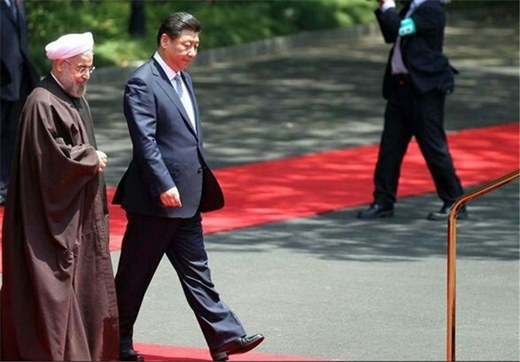
Chinese President Starts Official Visit to Tehran

Xi’s visit comes a few days after West-led sanctions on Iran were lifted following an announcement by the International Atomic Energy Agency (IAEA) confirming that Tehran had scaled back its nuclear program.

As a member of the Group 5+1 (the five permanent UN Security Council members plus Germany), China played a constructive role in prior negotiations.

It is the first state visit in 14 years by a Chinese head of state to Iran, and also Xi’s first trip to the ancient country, whose friendship with China dates back to 2,000 years ago thanks to the Silk Road, Xinhua reported.

The Chinese president will meet his Iranian counterpart, Hassan Rouhani, on Saturday for discussions on aligning their national development strategies and boosting cooperation on both political and economic fronts.

During Xi’s visit, the two countries are expected to lift their ties to a comprehensive strategic partnership.

Xi and Rouhani have met each other on multiple occasions over recent years. Rouhani paid a state visit to China in May 2014.

Xi is also scheduled to meet Iranian Parliament Speaker Ali Larijani and Supreme Leader of the Islamic Revolution Ayatollah Seyed Ali Khamenei during his stay in Tehran.

“China and Iran are faced with important opportunities in developing their relations,” Chinese Vice Foreign Minister Zhang Ming told reporters earlier this week. “This visit will be a milestone that will usher in a new era of bilateral ties featuring comprehensive, long-term and stable development.”

The two countries established diplomatic ties in 1971, and their relationship has since enjoyed sound and steady development.

Xi will conclude on Saturday night his five-day, three-nation tour of the Middle East, which has already taken him to Saudi Arabia and Egypt. It is Xi’s first overseas visit this year and also his first trip to the region since he became Chinese president in 2013.


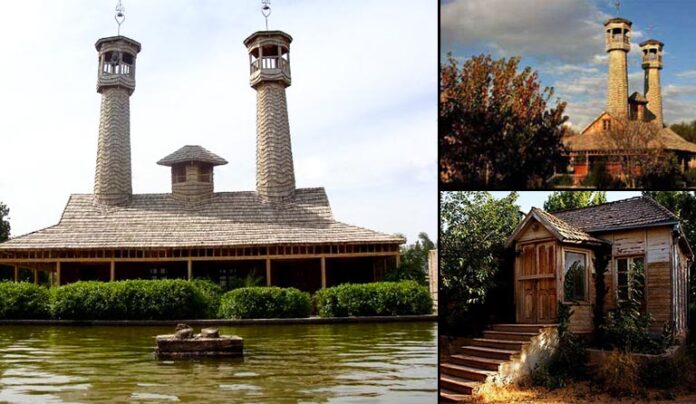
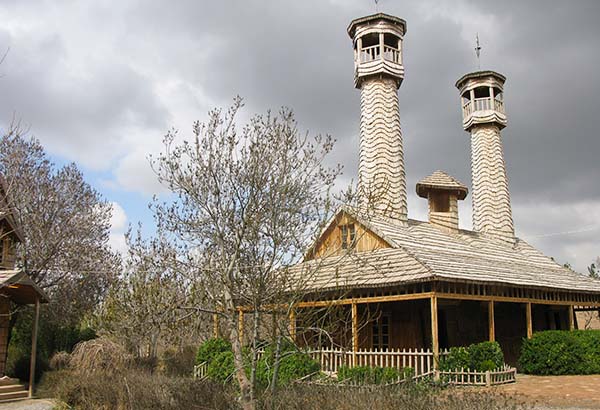
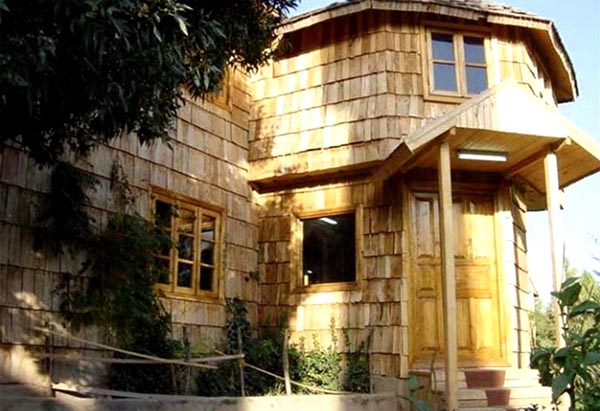
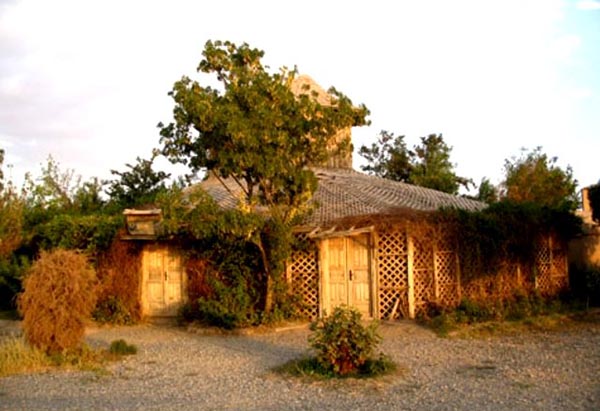
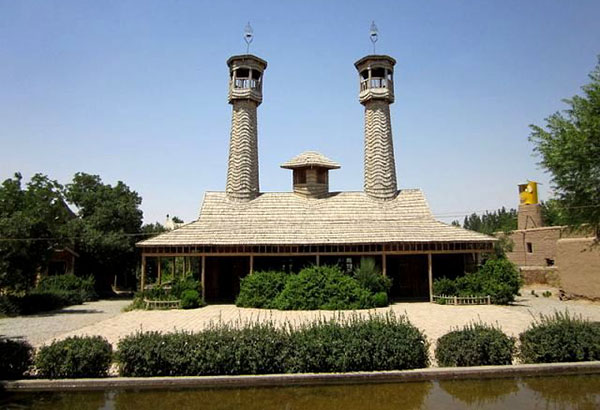
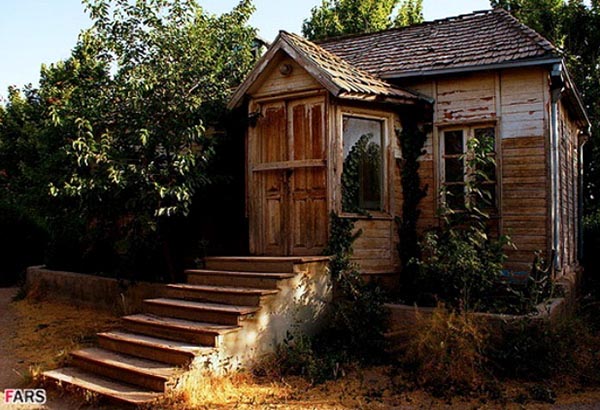
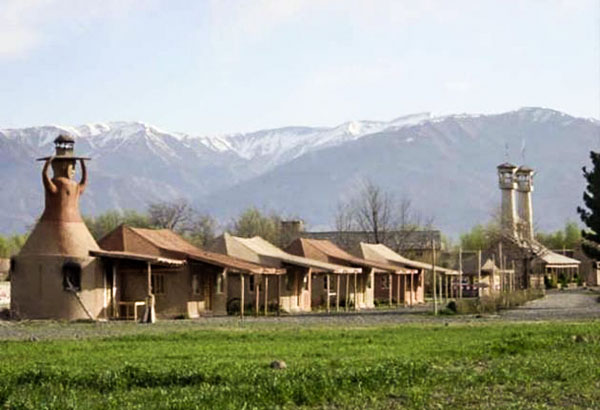
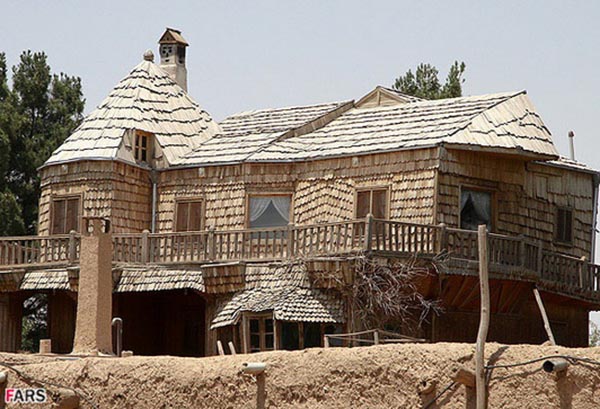
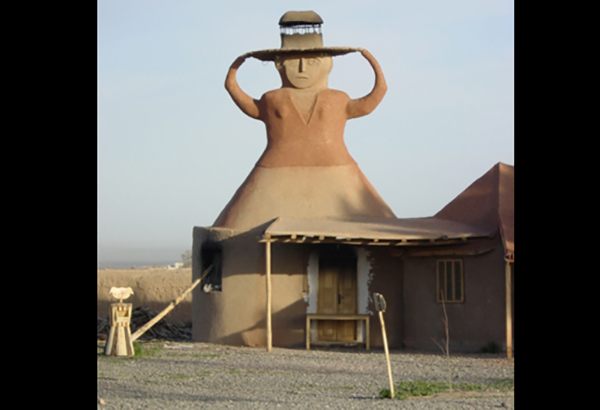
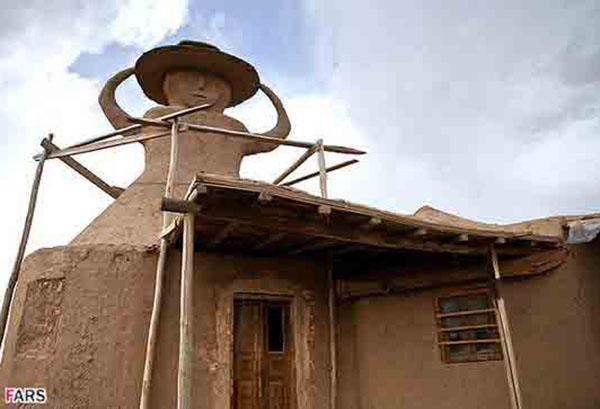
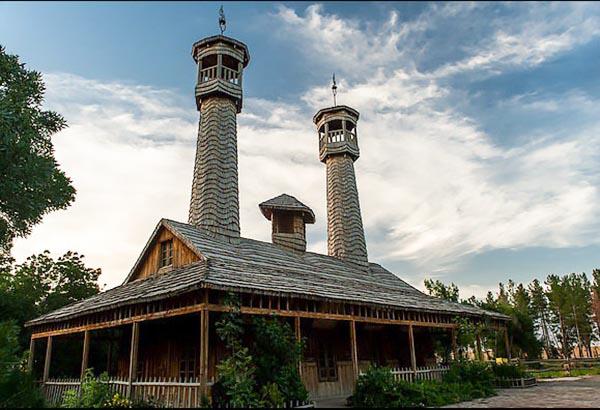
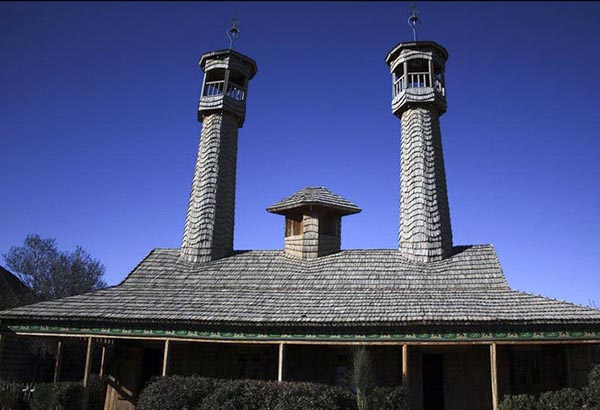
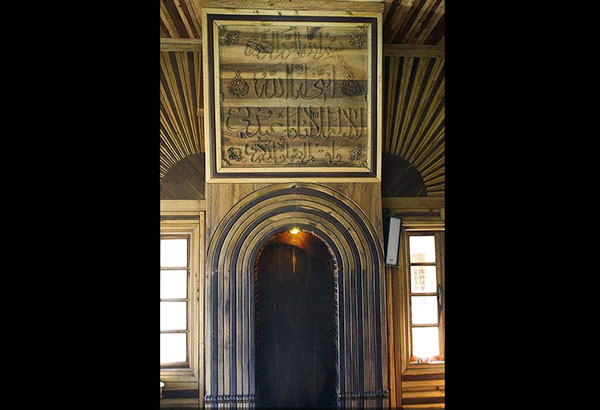
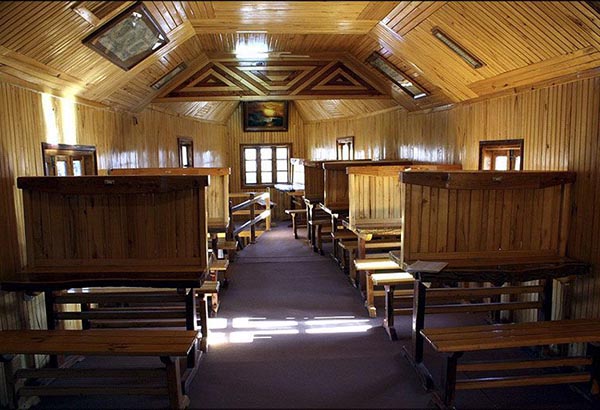
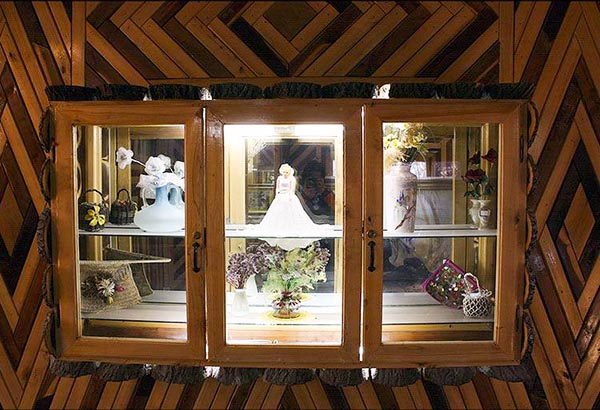
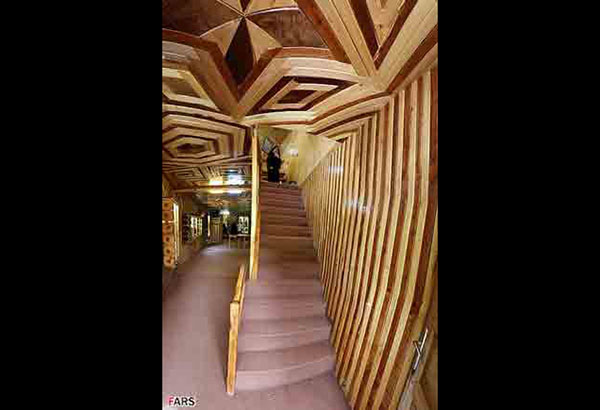
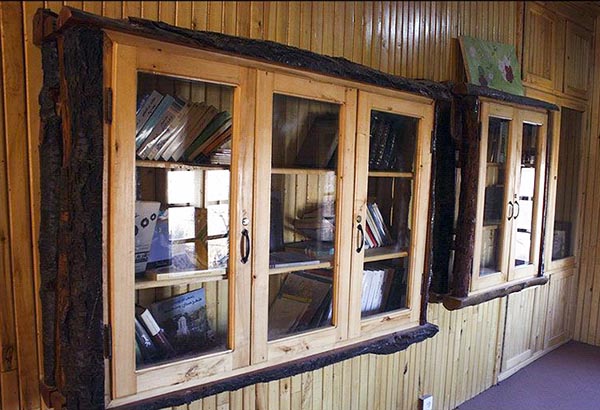
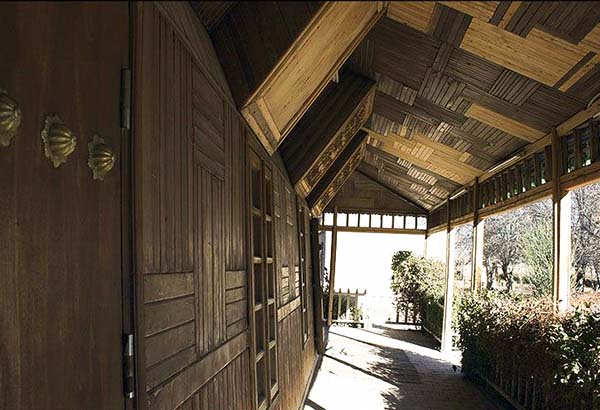
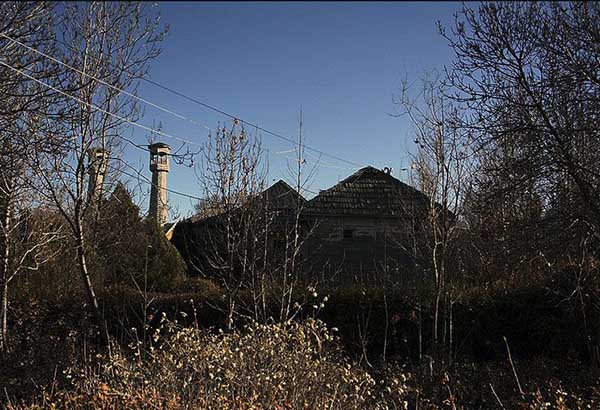
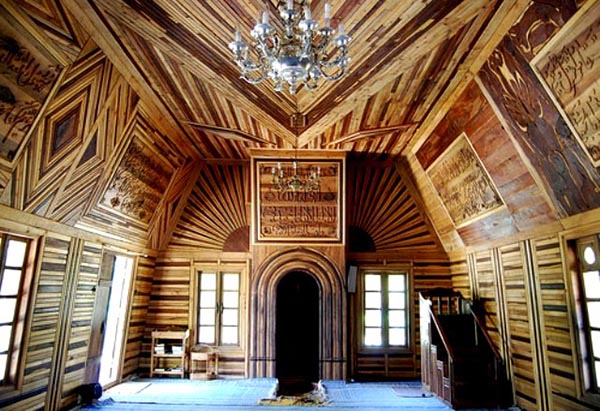
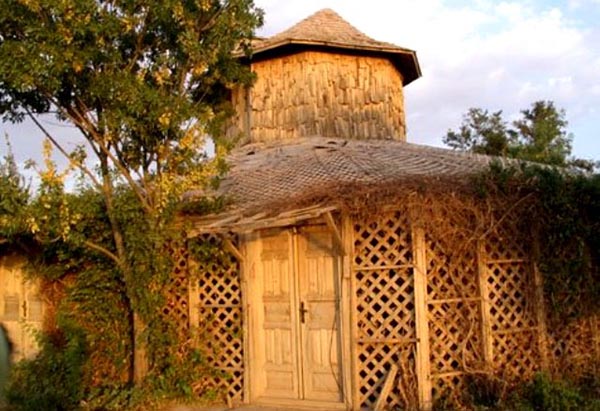
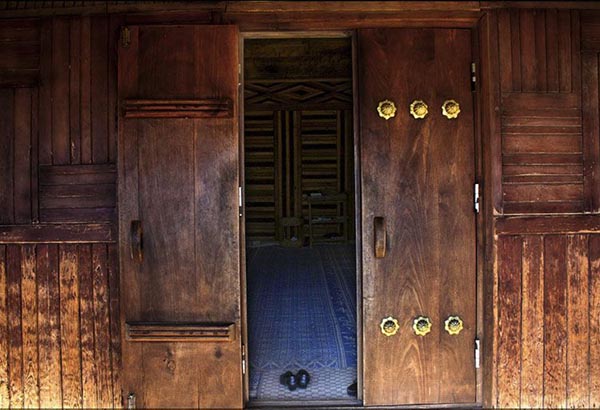
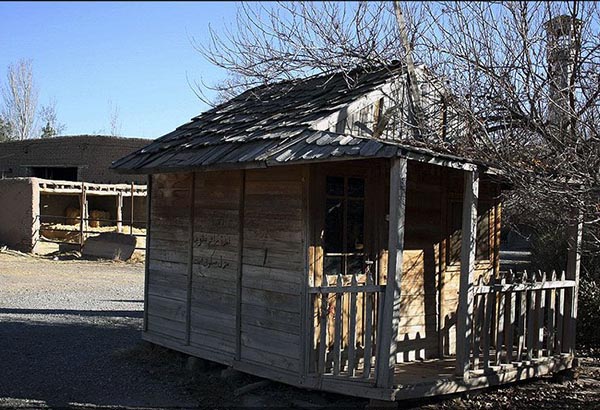
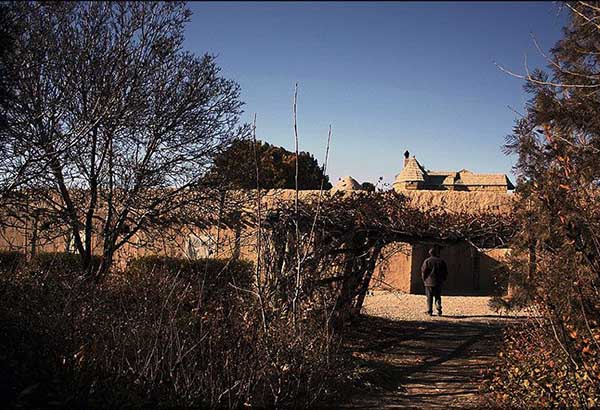
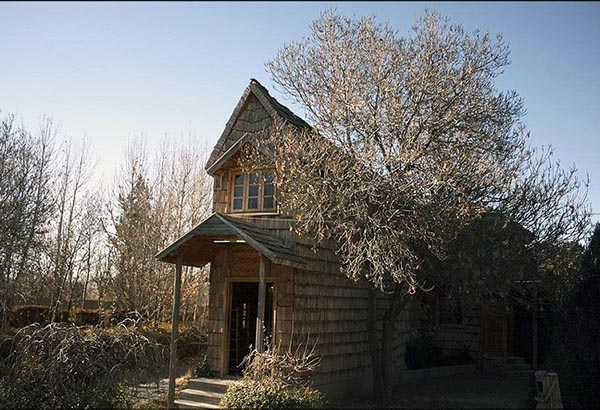
Wooden village in Northeastern city of Neyshabour (PHOTOS)

Iran to Announce Results of Probe into Attacks on Saudi Missions: Deputy FM

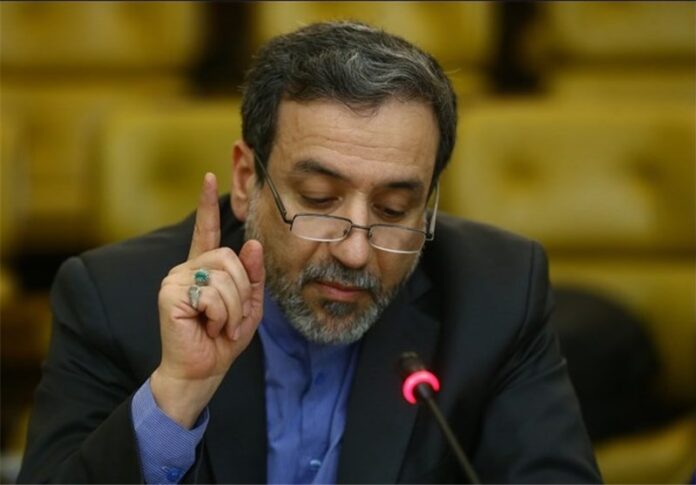
Addressing an extraordinary meeting of the Organization of Islamic Cooperation (OIC) in the Saudi city of Jeddah, Araqchi touched upon Iran’s measures regarding the attacks on Saudi diplomatic buildings in Tehran and Mashhad and said “the Islamic Republic, which condemns the incidents, has started a detailed investigation to identify and prosecute the culprits behind the attacks.”

He further made assurances that the results of the investigation will be announced soon.

However, the Iranian diplomat added, it is unfortunate that the OIC immediately reacted to such incidents (attacks on Saudi missions in Iran) and held an extraordinary meeting, while it is for more than a year that Palestine has called for holding such meeting to raise the issue of attacks on al-Aqsa Mosque by the Zionist regime of Israel and the OIC has ignored the request.

Earlier on Thursday, OIC Secretary General Iyad Madani, a Saudi, warned against widening sectarian tensions, saying the attacks against Saudi Arabia’s diplomatic missions had “breached diplomatic norms”.

In the early hours of January 3, angry demonstrators attacked Saudi Arabia’s embassy in Tehran in protest at Riyadh’s execution of prominent Shiite cleric Sheikh Nimr al-Nimr.

Iran’s police arrested those identified as being involved in the attack and President Hassan Rouhani condemned the move afterwards.

However, the Saudi foreign ministry announced it was cutting diplomatic ties with the Islamic Republic following the angry protests.

Although Iranian officials condemned the embassy attack and police arrested dozens involved, Riyadh cut off its diplomatic relations with Tehran.


Iran rejects OIC statement as ‘unacceptable’

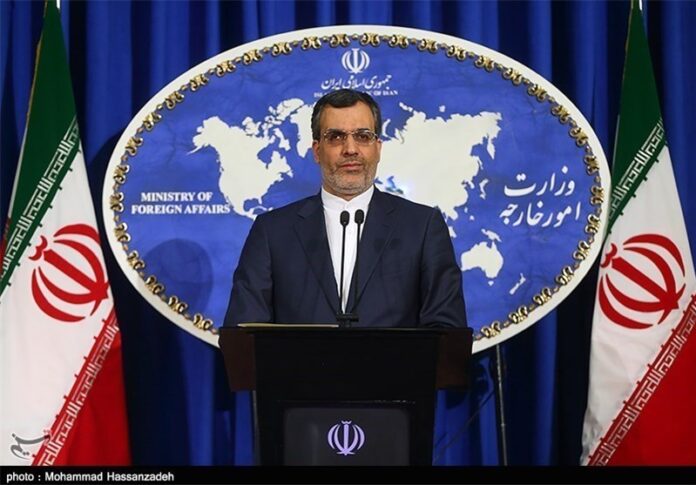
“The Organization of Islamic Cooperation’s success in following up its objectives and priorities depends on solidarity, cooperation and coordination among members and not in their face-off,” Iran’s Foreign Ministry Spokesman Hossein Jaberi Ansari said on Friday.

He added that the OIC statement was issued with lack of consensus among the organization’s member states.

In a statement issued at the end of an OIC emergency meeting in the Saudi port city of Jeddah on Thursday, the organization backed Saudi Arabia in its weeks-long diplomatic spat with Iran, accusing Tehran of supporting terrorism and interfering in other countries’ affairs.

Saudi Arabia had called for the OIC emergency meeting to discuss the recent diplomatic row with Tehran following the January 2 execution of prominent cleric Sheikh Nimr al-Nimr in Riyadh.

Saudi Arabia severed diplomatic relations with Iran on January 3 following demonstrations held in front of the Saudi embassy in Tehran and its consulate in the northeastern city of Mashhad by angry protesters censuring the Al Saud family for the killing of Sheikh Nimr.

Jaberi Ansari said the Jeddah meeting was convened with the aim of supporting Saudi Arabia’s state terrorism.

He added that the OIC statement overlooked the existing realities pertaining to Iran’s swift action against the perpetrators of the incidents and focused on pursuing the “objectives of a specific country.”

The Iranian spokesperson noted that the OIC has been founded to strengthen cooperation among Muslim countries to contribute to liberation of the occupied Palestinian territories.

“Given the continuation of Palestine’s occupation, inhuman blockade of the Palestinians and growing threats of Takfiri extremism and terrorism against international peace and security, the hasty and irresponsible measure by the Saudi government to insist on the emergency meeting and issue a statement lacking consensus have intensified divisions among [OIC] members and undermined the Organization of Islamic Cooperation,” Jaberi Ansari pointed out.

Iran expressed regret that Saudi Arabia overlooked the OIC objectives, principles and priorities as well as rights of the members in the Jeddah statement, he said.

He added that Iran emphasizes that such measures are aimed at supporting sectarianism and warmongering policies as well as backing Saudi state terrorism.

“The Islamic Republic of Iran, in line with its fundamental policy, expresses its readiness for interaction to settle mutual issues with Saudi Arabia and stresses the importance of Riyadh’s return from its wrong policies … to the path of moderation, wisdom and dialog along with mutual respect,” he said.

Jaberi Ansari called on all OIC member states to improve their interaction in dealing with issues of Muslim nations and prepare the ground for the liberation of the occupied Palestine.

In an address to the OIC emergency meeting in Jeddah on Thursday, Iran’s Deputy Foreign Minister for Legal and International Affairs Abbas Araqchi also criticized the OIC for remaining silent on the main issues facing the Muslim world.

“It is regrettable that this organization [OIC] is silent about the major challenges of the Muslim world, particularly [the issue of] Palestine, but hastily reacts to the attack on Saudi Arabia’s embassy in Tehran,” the senior Iranian diplomat said.

Tehran, Riyadh can accommodate each other: Zarif

“We believe that Iran and Saudi Arabia can be two important players, who can accommodate each other, who can complement each other in the region,” he told the CNN Wednesday evening.

“We don’t expect, or we’re not interested even, in pushing Saudi Arabia out of this region, because Saudi Arabia is an important player in this region,” Zarif said.

“Unfortunately, the Saudis have had the illusion that backed by their Western allies, they could push Iran out of the equation in the region,” the minister added.

Relations between Iran and Saudi Arabia nosedived after the kingdom’s execution of top opposition cleric Sheikh Nimr al-Nimr early this month.

Riyadh cut its diplomatic ties with Iran after its two missions in Tehran and Mashhad came under attack by protesters.

Zarif said Saudi leaders are worried by a diplomatic breakthrough in the decade-long standoff between Iran and the West over the Islamic Republic’s nuclear program.

“Saudis are panicking that there may be a slight opportunity that tensions between Iran and the West would reduce, and the smoke screen that had allowed them to export this Wahhabi ideology of extremism” can be removed, he said.

Zarif said Saudi rulers have to accept Iran’s role and stop “panicking.”

“We were always in the community of nations. Now their allies have recognized that Iran is a serious partner,” the Iranian foreign minister said, in reference to the US and EU which were part of the nuclear negotiating sides.

“We do not have a fight to pick with Saudi Arabia. Unfortunately, the fact is the instability in our region is caused by a panicking Saudi Arabia that believes that there is an equilibrium in our region after the fall of (slain Iraqi dictator) Saddam Hussein and after the Arab Spring.”

Several countries, including Pakistan, Russia and China, have voiced readiness to mediate between Iran and Saudi Arabia to ease up their tensions.


Salehi reveals untold stories about nuclear negotiations

Ali Akbar Salehi, Head of Iran’s Atomic Energy Organization talking in “Tonight’s Headline” program of Iranian state TV News Channel, answering a question about the most difficult moment of the negotiations said: “while every single moment of talks were difficult added that from later part of Jan. 2015 I directly joined the negotiations. Of course, before that I was also involved in the talks from the sideline and our experts were engaged in discussions.

When Zarif said we have reached stalemate

In one of the meetings our Foreign Minister Mr. Javd Zarif said we have reached deadlock when two sides could not agree on the arrangement of centrifuges propose by the Americans and the arrangement proposed by the Supreme leader was not accepted by the opposite party. The reason I was joining the talks was to explain that why we could not agree with their proposed arrangement. With grace of God and blessing of Hazrat Fatemeh [SA] (the noble daughter of our holy Prophet Mohammad [PBUH]) which coincided with Fatemiyeh days, with our utmost efforts we tried not to give any concessions on that specific case.”

Mr. Salehi added, “US secretary of Energy Mr. Moniz along with his veteran experts and aids had joined the negotiations and against their army we were like a company. We held lots of discussions. The opposite side didn’t accept our calculations. We told them show us your calculations but they refused on the ground that it will be a sort of transfer of knowhow. I told them this is not a practical way of negotiations. Discussions continued. In a private meeting with Mr. Moniz I told him I am here with full authority and I am authorized to make decision, are you also fully empowered to make decisions or decisions must be taken in your capital? He said he is also fully authorized. I told him show me a place on the earth that they enrich uranium in a manner you have in mind then we will do that way as well. He got a bit surprised and the meeting came to an end. Later in a meeting between two of us he said he acknowledges that the way the US suggests us to enrich uranium is not practical and this was their first defeat and stalemate ended.”

Referring to technical aspects of the JCPOA or what is known in Iran as BARJAM, Mr. Salehi said:” this part of our nuclear program has been rather problematic for us because we had no possibility to cooperate with others and Russians were the only one who announced their willingness to work with us on construction of nuclear power plants.”

Salehi added that refusal of other countries to cooperate with us on nuclear issued ended up in our advantage because we became totally self-sufficient on nuclear technology and knowhow.”

head of Iranian Atomic Energy Organization while admitting that Iran needs expertise and experiences of countries with 60 to70 years of experience on nuclear reactors and power plants, said: “following conclusion of JCPOA so many countries have said they are ready to cooperate with us and opportunities are so numerous that we don’t know to choose Europeans or Asians as our partner.

According to Mr. Salehi in 1965 when the question of putting an end on use of nuclear weapons, 5 countries already had developed nuclear weapons and it was said that from now on, no one can develop such weapons.

Then, None Proliferation Treaty (NPT) came to force and Iran also joined this treaty. In case such treaty was not in place, may be today other countries had nuclear arsenals as well. Those 5 countries possessing nuclear weapons should gradually move towards disarmament but as they have force and power, only give empty promises or such initiative.

Mr. Salehi said: “developing weapons of mass destruction is against Iran’s doctrine and Islamic Sharia but as during the 8 years imposed Iraqi war against Iran  no country supplied us with weapons and military equipment we learned that on strategic questions and important technical and industrial areas, such as manufacturing of aircraft, weaponry and other military sectors, we should only rely on our own potentials and due to this same reason our missile program has grown as country’s diffusive weapon.

A look at Iranian newspaper front pages on Jan 21

Iranian Newspapers Headlines

On Thursday, January 21, 2016, most Iranian press were grieved by the anniversary of the martyrdom of Hazrat Fatemeh Masoumeh, the sister of Imam Reza (8th Shia imam) who is buried in the central city of Qom. The Supreme Leader’s assertions regarding the upcoming parliamentary elections and readiness of international companies and countries to enter Iran’s market in the post-sanctions setting were primarily focused by Iranian press; the following are Thursday’s highlights.


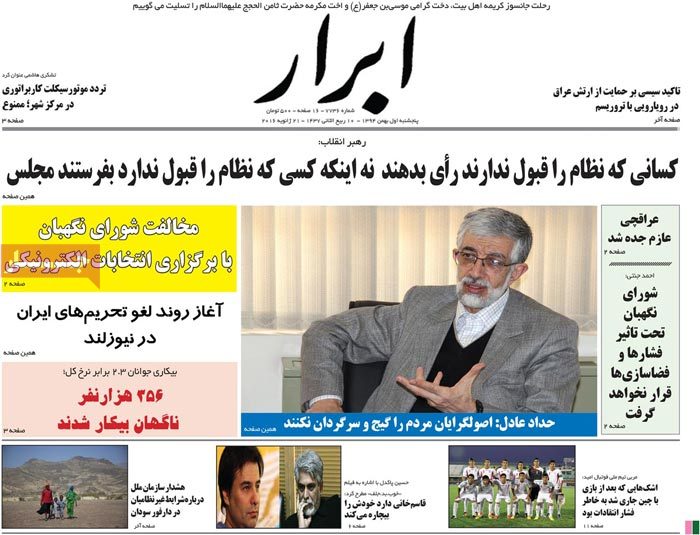
ABRAR:

  1. Leader: System’s opponents should vote in the election but not be let in Parliament
  2. Iran sends Araqchi to Jeddah

Iran has sent Deputy Foreign Minister Seyyed Abbas Araqchi to Saudi Arabia to attend a meeting of the Organization of Islamic Cooperation in Jeddah, Saudi Arabia. Tensions between Tehran and Riyadh escalated after Saudi authorities executed prominent Shia cleric Sheik Nimr al-Nimr and a number of fervent Iranian individuals attacked the Saudi Embassy in Tehran last month. Since then, numerous countries including China and Pakistan have tried to broker détente between the two OPEC members.

  1. Guardian Council will not give in under pressure: body’s head Ahmad Jannati
  2. Guardian Council rules out e-voting

Iran’s Guardian Council has rejected a plan for electronic voting ahead of the February elections for the Parliament and the Assembly of Experts.

  1. Unemployment rises by 356,000 all at once
  2. UN peacekeepers concerned over new fighting in Sudan’s Darfur
 

A look at Iranian newspaper front pages on Jan 21


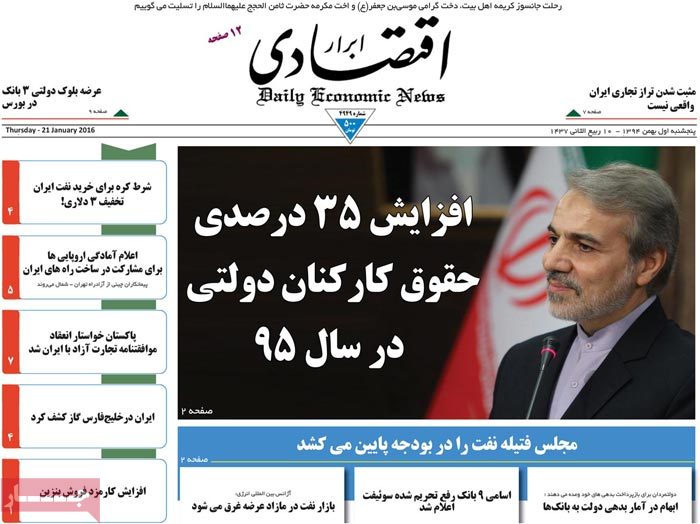
ABRAR EGHTESAADI:

  1. Gov’t Spokesman: 35% rise in salaries of state employees next year
  2. Korea calls for $3 discount to buy Iran oil
  3. EU firms ready to build roads in Iran
  4. Pakistan calls for free trade with Iran
  5. Glut immerses global oil market


A look at Iranian newspaper front pages on Jan 21


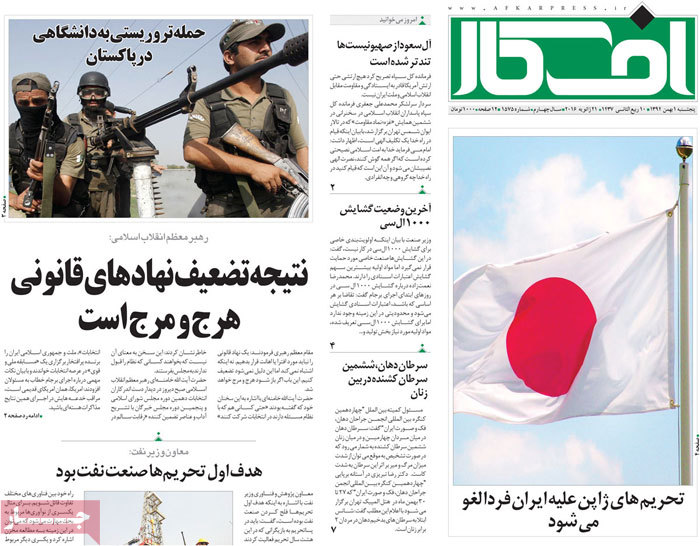
AFKAR:

  1. Japan to lift sanctions on Iran Friday
  2. Petroleum industry first target of sanction: deputy minister
  3. House of Saudi, more aggressive than Zionists
 

A look at Iranian newspaper front pages on Jan 21


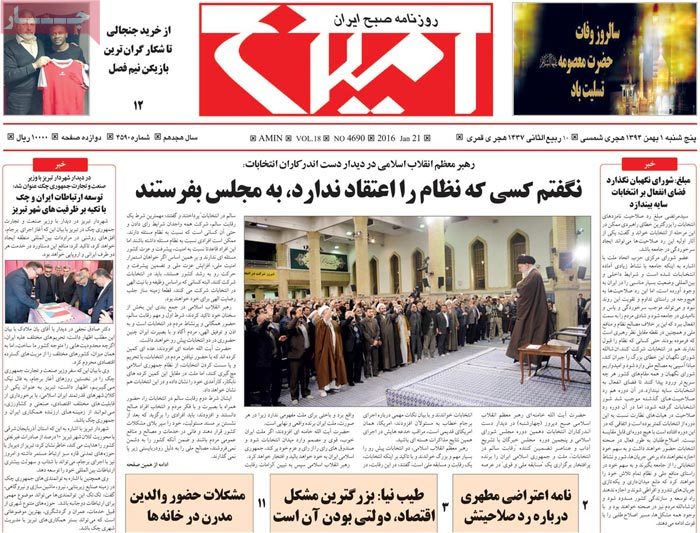
AMIN:

  1. Iran, Czech bent on boosting mutual ties
  2. Economy’s biggest problem is being state-run: Minister
  3. problems faced by of modern parents in families
 

A look at Iranian newspaper front pages on Jan 21


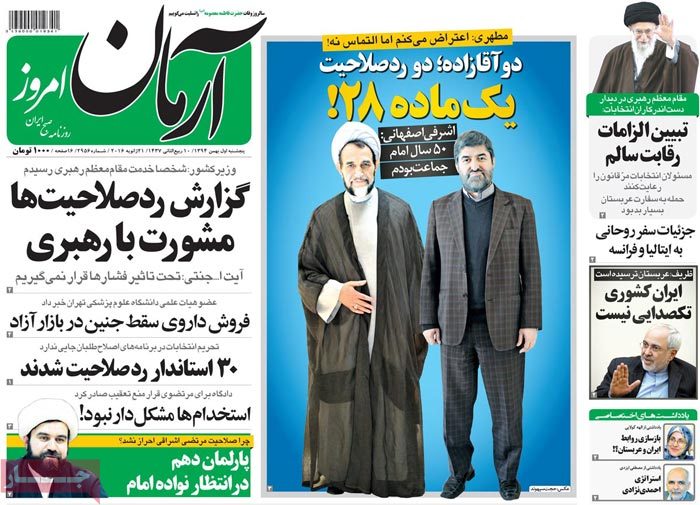
ARMAN-e EMROUZ

  1. Leader decries Saudi Embassy attack in Tehran
  2. Iran President set to visit Italy
  1. Abortion drug sold on Iranian market
  2. 30 provincial governors disqualified

Arman quoted a reformist figure, saying the reformist front has no intention of pulling out of parliamentary election campaigns now that the Guardian Council has disqualified a shockingly large number of reformist hopefuls in its screenings.

  1. Zarif: Iran not a single-voiced country
 

A look at Iranian newspaper front pages on Jan 21


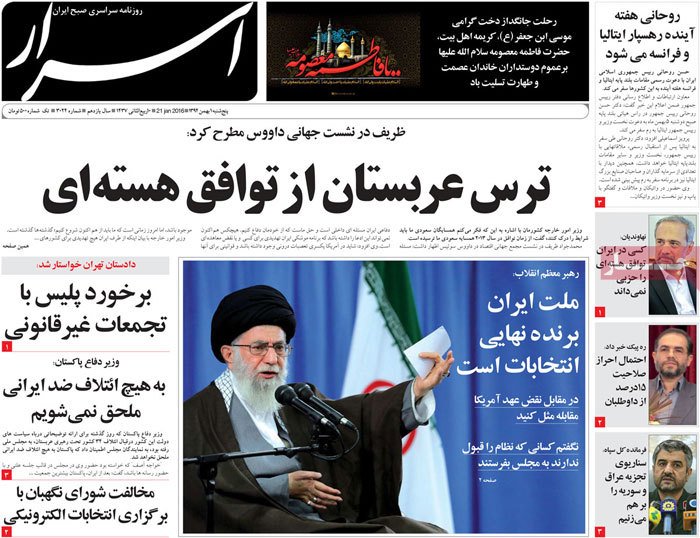
ASRAR:

  1. Zarif in Davos: Saudi Arabia panicked by nuclear deal
  2. Leader: Nation, election’s final winner

Leader: Retaliate US breach

  1. Iran’s Rouhani to visit Italy, France next week
  2. Islamabad not to join Any anti-Iran coalition: Pakistani Defense Minister

Pakistani Defense Minister Khawaja Asif said Islamabad under no circumstances would join a military alliance against Iran.
 

A look at Iranian newspaper front pages on Jan 21


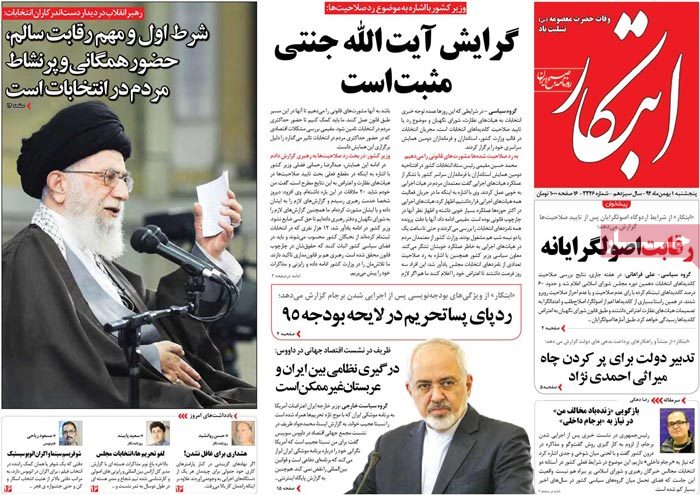
Ebtekar:

  1. Strong turnout will guarantee sound elections: Leader
  2. Tehran-Riyadh military clash not possible: Iran FM

Speaking in Davos, Iranian Minister of Foreign Affairs, Mohammad Javad Zarif said the military confrontation of Iran and Saudi Arabia is not possible and would not benefit anyone.
 

A look at Iranian newspaper front pages on Jan 21


EMTIAZ:

IRR3,000b facilities for exporters of goods to Russia
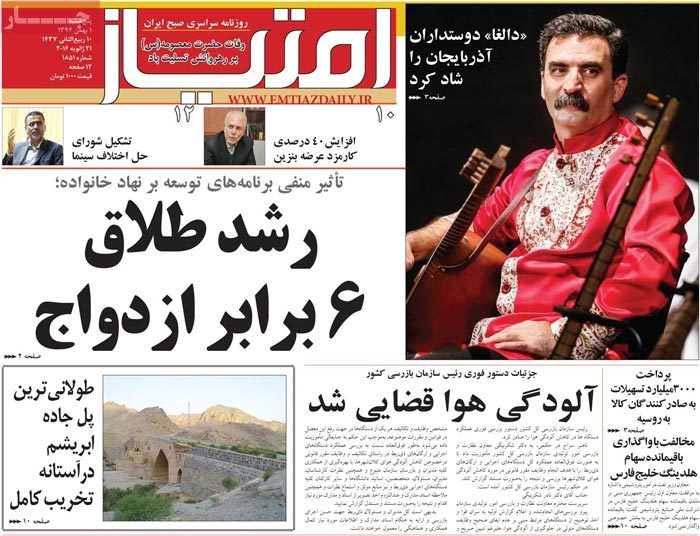
 

A look at Iranian newspaper front pages on Jan 21


ETEMAD:

  1. Leader: Abide by the very framework of law

Addressing a meeting with members of the Guardian Council, the vetting committee of Iran’s February Parliamentary and Assembly of Experts elections, the Supreme Leader of the Islamic Revolution called on adherence to the very framework of law in the elections.

  1. Students’ bloodshed in Peshawar; At least 19 killed in attack on Bacha Khan University in Pakistan
  2. Multinational medicine giants poised for Iran return
  3. Health Minister proposed JCPOA II

Dr. Hashemi says JCPOA II will aim at reducing social chasms and boosting national unity and integrity in the country.
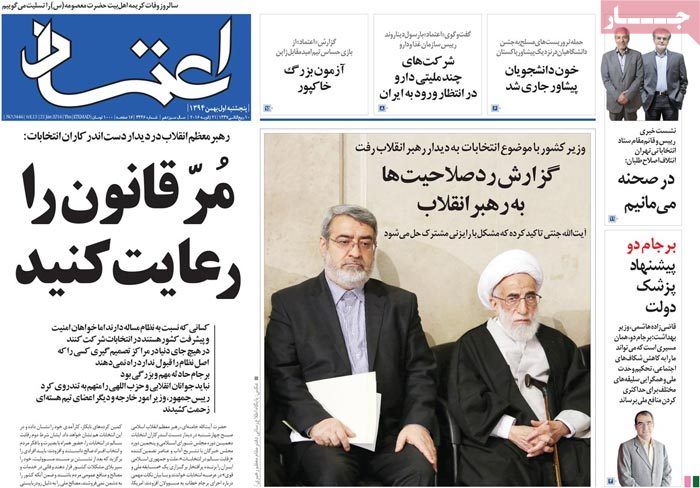
 

A look at Iranian newspaper front pages on Jan 21


HEMAYAT:

  1. Ahmed Shaheed’s clumsy human rights game on Iran

The U.N.’s special “rapporteur” on human rights in Iran, Ahmed Shaheed, in his latest report has called on getting tougher on Iran parallel with JCPOA implementation.
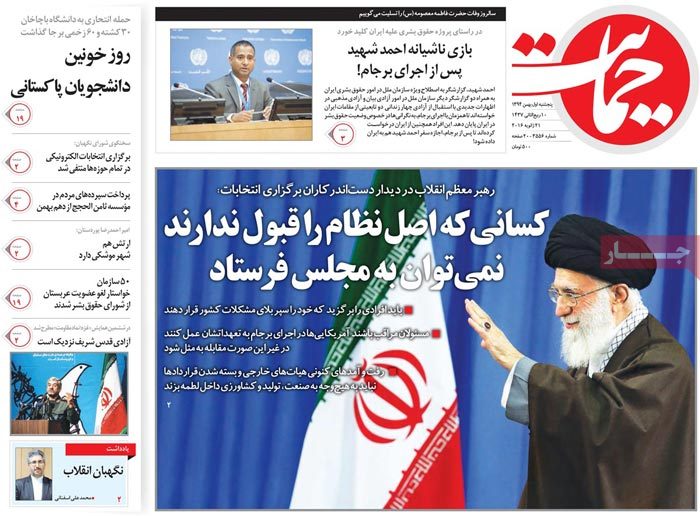
 

A look at Iranian newspaper front pages on Jan 21


JAMEJAM:

  1. Insurance policy for marriage
  2. 15% may be added to the number of qualified candidates
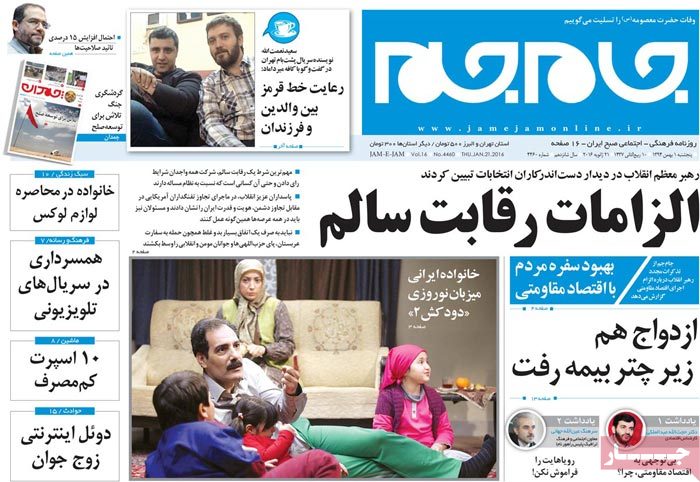
 

A look at Iranian newspaper front pages on Jan 21


JAVAN:

  1. Leader: Nowhere in the world they let in system’s opponents
  2. Zarif: US addicted to coercion
  3. Nuclear game not finished yet; not fair
  4. IRGC Chief: Supporting Gaza  a duty for all Muslim and non-Muslim nations
  5. IRGC Commander: Iran to Foil Zionist Plot to Disintegrate Iraq, Syria
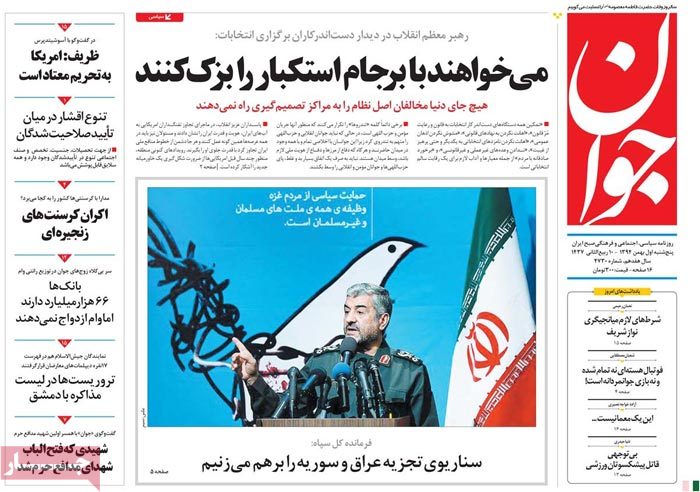
 

A look at Iranian newspaper front pages on Jan 21


JOMHOURI ESLAMI:

  1. Leader outlines criteria for sound competitive elections
  2. All sanctions on 9 Iranian banks lifted
  3. Zionist plot to form autonomous Kurdistan state between Iran, Turkey
  4. 50 Human Rights bodies call for ousting Saudi Arabia from UN Human Rights Council
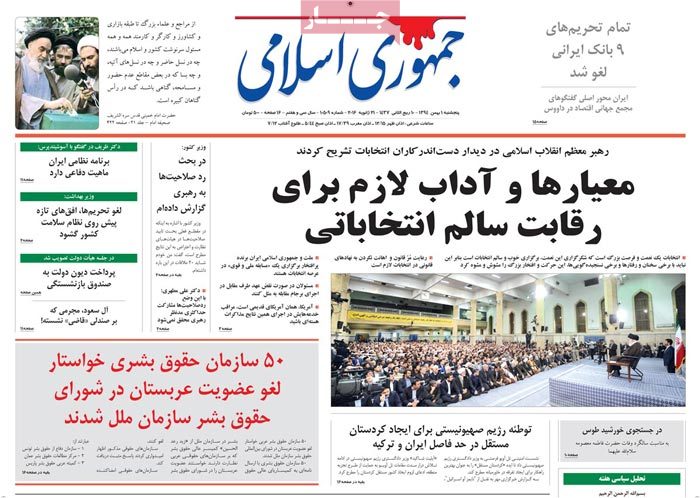
 

A look at Iranian newspaper front pages on Jan 21


KEYHAN:

Leader urges voters to choose candidates that will not sell the country to enemy
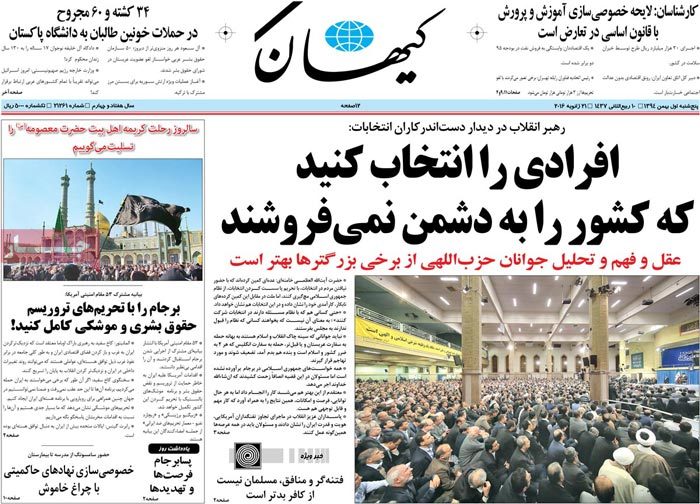
 

A look at Iranian newspaper front pages on Jan 21


KHORASAN:

  1. Clear stance

A report on Leader’s assertions regarding the JCPOA implementation, February Parliamentary and Assembly of Experts elections, honoring capture and freeing of US marines, and condemnation of the mob attack of Saudi embassy in Iran.

  1. Opinion: What China seeks in Middle East
  2. Nawaz Sharif: Iran agreed to meet with Saudis
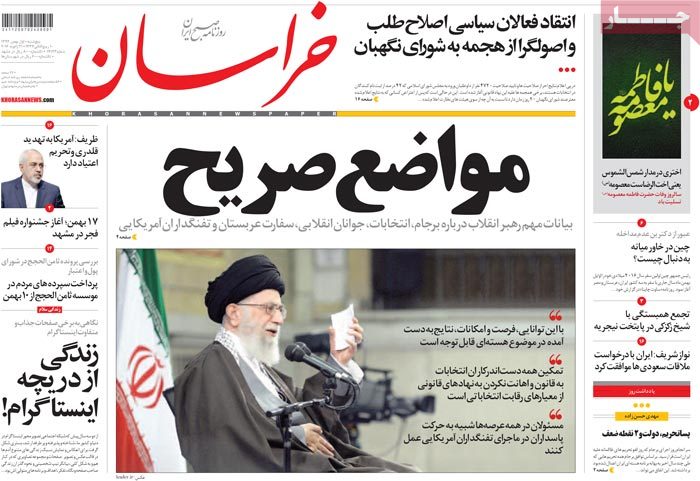
 

A look at Iranian newspaper front pages on Jan 21


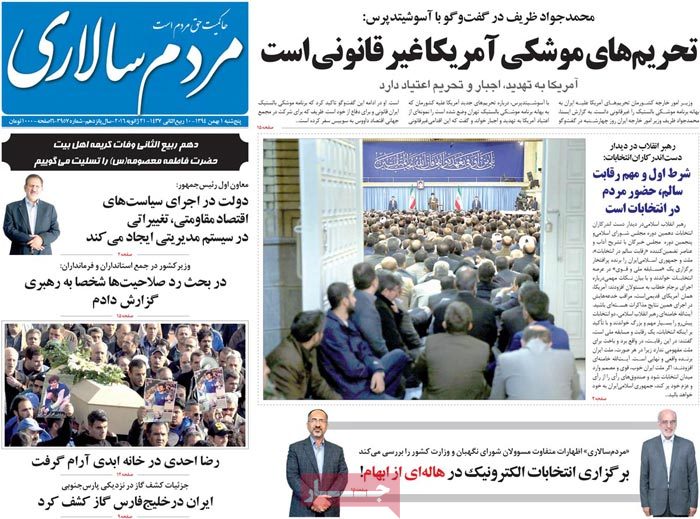
MARDOM SALARI:

  1. Zarif to AP: US missile sanctions illegal
  2. Iran discovers gas reserve in Persian Gulf
 

A look at Iranian newspaper front pages on Jan 21


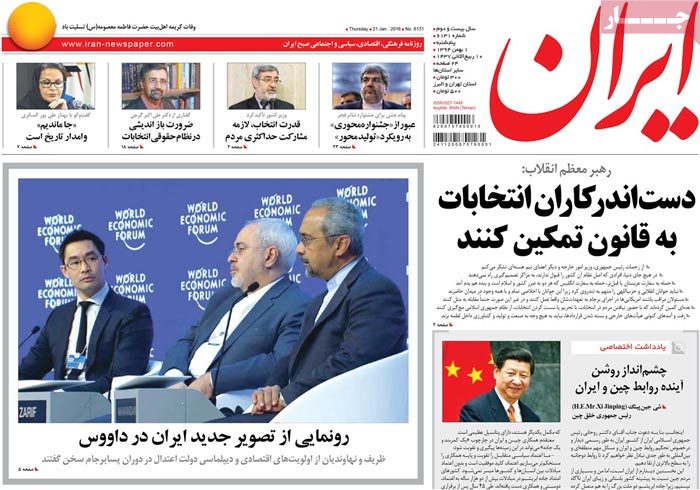
IRAN:

  1. Iran unveils fresh images of Iran in Davos

Foreign Minister Zarif and Presidential Chief of Staff Mohammad Nahavandian outlined Rouhani administration’s economic, diplomatic priorities in post-sanctions setting.

  1. Promising outlook of Iran-China ties


A look at Iranian newspaper front pages on Jan 21


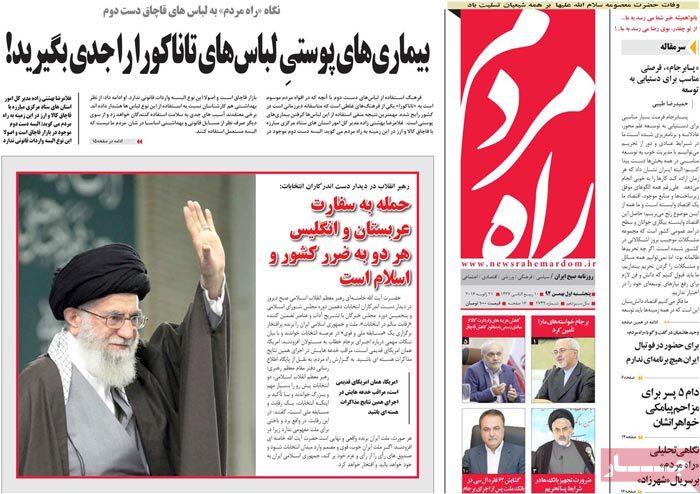
RAH-e MARDOM:

  1. Attack on Saudi, UK embassies detrimental to country, Islam: Leader
  2. Editorial: Post-JCPOA chance for development
 

A look at Iranian newspaper front pages on Jan 21


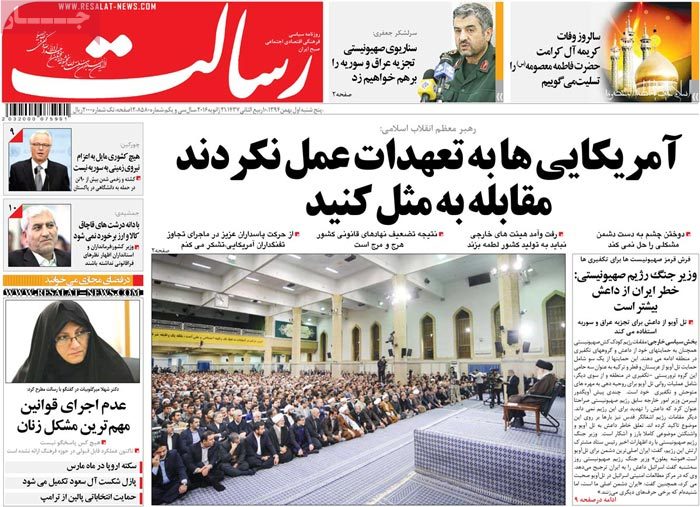
RESALAT:

  1. Israel: Iran more dangerous than ISIL
  2. Violation of laws, women’s biggest concern
 

A look at Iranian newspaper front pages on Jan 21


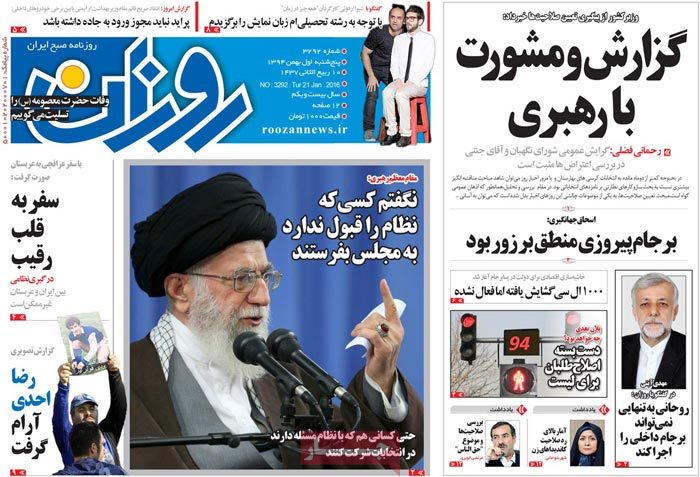
ROOZAN:

Veep: JCPOA victory of logic over force
 

A look at Iranian newspaper front pages on Jan 21


ROOYESH MELLAT:

  1. Obama openly seeks Iran ties
  2. Iran oil industry poised for $200b capitals
  3. Iran President: Iran, EU to bolster ties
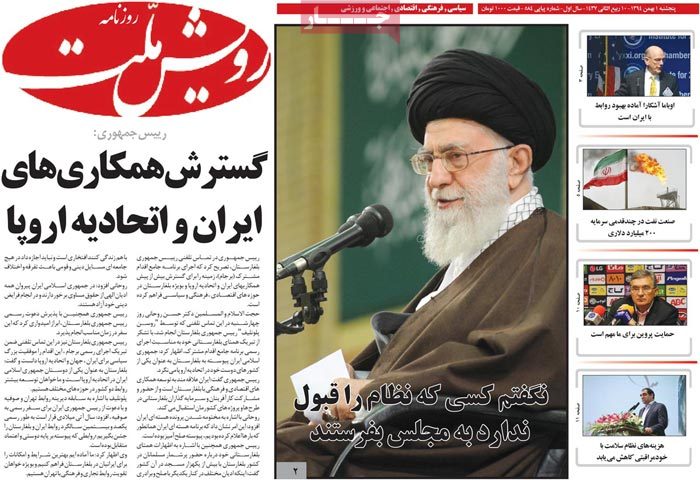
 

A look at Iranian newspaper front pages on Jan 21


SAYEH:

  1. Report on how 62 tycoons put half of the world population into poverty
  2. Report: How Saudis aim to render Iran oil industry insolvent
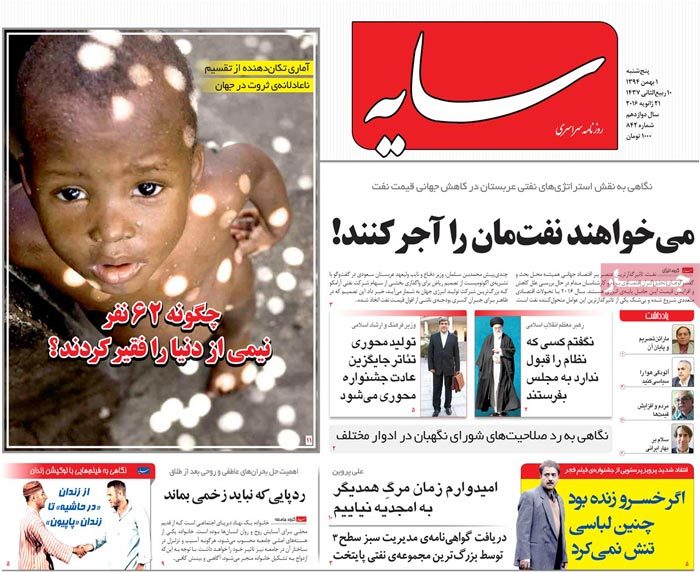
 

A look at Iranian newspaper front pages on Jan 21


SOBH-e EGHTESAD:

0.5% share of Iran of global tourism market
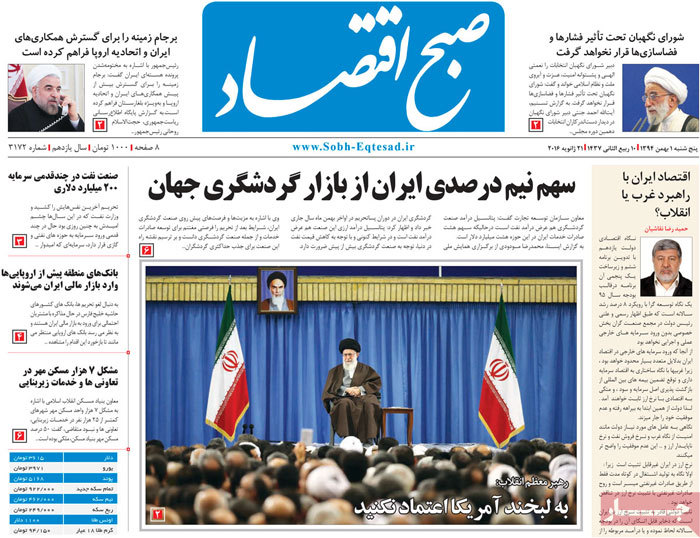
 

A look at Iranian newspaper front pages on Jan 21


SHARGH:

Judiciary steps in to contain pollution in big cities
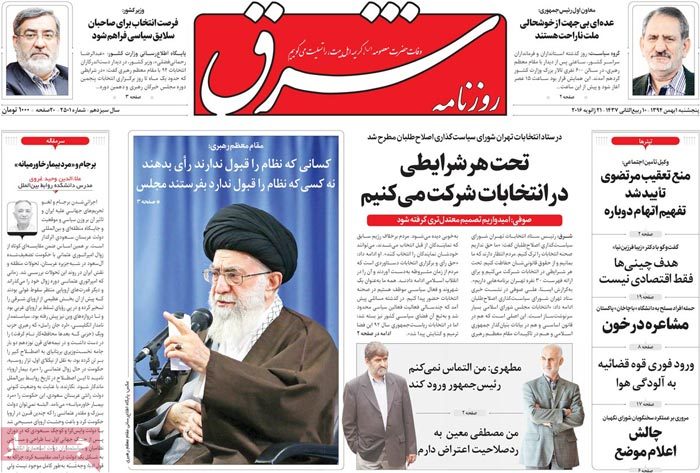
 

A look at Iranian newspaper front pages on Jan 21


SAHEB GhALAM:

  1. No plans to put LNG projects to tender by Iran
  2. Iran, Pakistan appoint representatives to broker Iran-Saudi détente
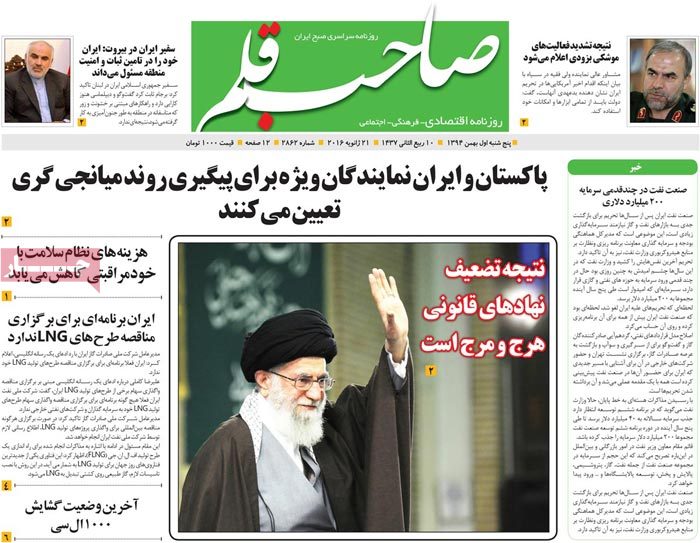
 

A look at Iranian newspaper front pages on Jan 21


VATAN EMROUZ:

– The last word

A report on the Leader’s statements regarding the upcoming elections in Iran
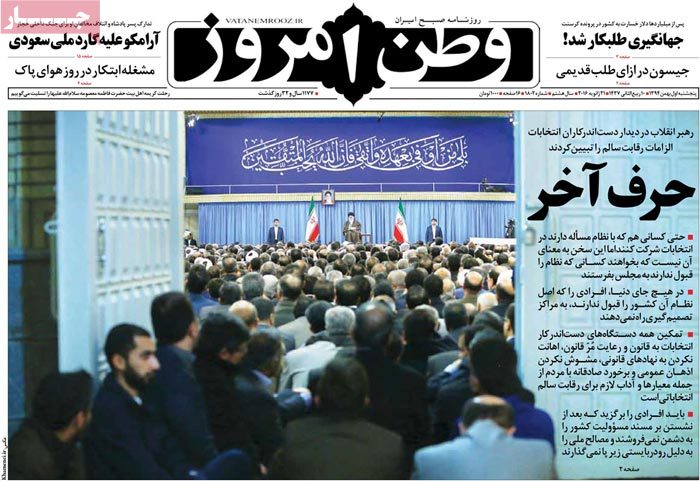
 

A look at Iranian newspaper front pages on Jan 21


50 HR Organizations Call for Cancellation of Saudi Membership in UNHRC

In a letter to UN High Commissioner for Human Rights Zeid Ra’ad Zeid Al-Hussein, the Arab rights groups touched upon the crimes committed by the Riyadh regime in Yemen since the start of its aggressions, stressing the necessity to cancel the membership of the regime in the UNHRC, the Arabic-language Al-Ahed news website reported.

Saudi Arabia was voted onto the council in what some British politicians say was a secret vote-trading deal in 2013.

The French-based Arab Commission for Human Rights, Amman Center for Human Rights Studies, the Arab Coalition Against the Death Penalty, Iraqi Alliance for Human Rights Organizations, Yemen Organization for Defending Rights and Democratic Freedoms, Algerian League for the Defense of Human Rights, and Tunisian Association of Democratic Women are among the 50 organizations and alliances that signed the letter.

The letter came as massive attacks by a coalition led by the Saudi regime against Yemen’s defenseless people continue despite international calls for an end to the aggressions.

On March 26, Saudi Arabia and some of its Arab allies began to launch deadly airstrikes against the Houthi Ansarullah movement in an attempt to restore power to the fugitive former President Abd Rabbuh Mansour Hadi, a close ally of Riyadh.

About 7,500 people have lost their lives in the Saudi airstrikes, and a total of nearly 14,000 people have been injured in the protracted war on Yemen.


Iran nuclear deal proves power of diplomacy: Zarif

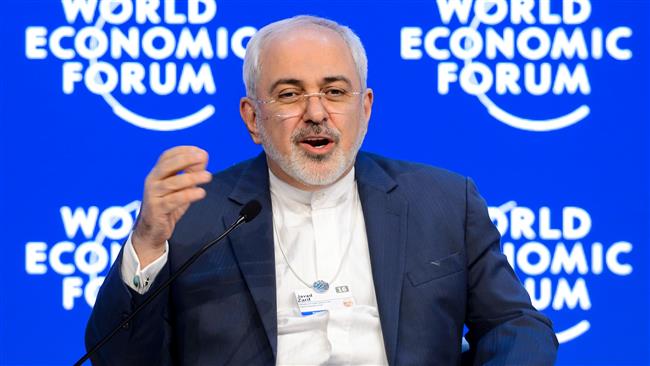
“Regionally I think it sends a message that if we can resolve that something everybody thought was impossible to resolve, with countries who were – obviously at least Iran and the United States – were hostile for at least 37 years, then there’s no impediment in resolving regional issues,” Zarif said while addressing the World Economic Forum (WEF) in the Swiss city of Davos on Wednesday.

Zarif said that regional nations, “who’re bound by a common region, common faith, common history, common culture, common values,” can “work together to address a very serious challenge in our region, and that is the challenge of extremism.”

The top Iranian diplomat said that through the nuclear agreement, the Iranian nation’s right to peaceful nuclear technology has been restored “because our nuclear program was always for peaceful purposes.”

“I think the deal is not a perfect deal. No deal is ever perfect. But it deals with our requirement, that is removal of sanctions and at the same time respecting our right to have our nuclear program for peaceful purposes, because our nuclear program was always for peaceful purposes,” he said.

On January 16, Iran and the five permanent members of the UN Security Council – the United States, Britain, France, Russia and China – plus Germany started to implement the nuclear agreement, dubbed the Joint Comprehensive Plan of Action (JCPOA), they had reached in the Austrian capital, Vienna, on July 14, 2015.

After the JCPOA went into effect, all nuclear-related sanctions imposed on Iran by the European Union, the United Nations Security Council and the United States were lifted. Iran in return has put some limitations on its nuclear activities.
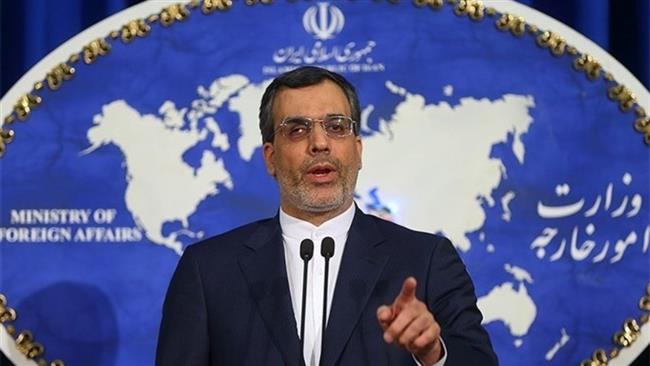
Zarif further expressed Iran’s preparedness “to show even greater transparency in order for the International Community to know what we already know, that our program is nothing but peaceful.”

Saudi Arabia concerned about Iran deal

Pointing to Saudi Arabia’s expression of concerns about Iran’s nuclear deal, Zarif said, “Since the agreement in Geneva in 2013, our Saudi neighbors have been panicking. There is no need to panic, our friends. Iran is there to work with you. Iran does not want to exclude anybody from this region. There is no need to engage in a confrontation.”

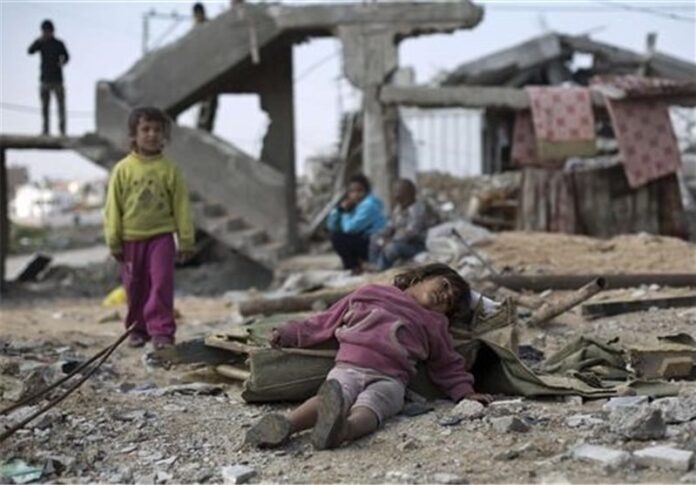
Saudi Foreign Minister Adel al-Jubeir told Reuters on Tuesday that the removal of sanctions on Iran as a result of its nuclear deal with world powers will be a harmful development if it uses the extra money to fund “nefarious activities.”

Saudi Arabia has been calling for tough inspections of Iran’s nuclear program and the possibility for resuming sanctions against the country.

Syria has no military solution

The Iranian foreign minister further dismissed any military solution to the devastating crisis in Syria, saying the conflict must be settled through diplomatic means.

“There is no military solution to the (Syrian) crisis. We need a political solution,” he said.

He said that a ceasefire in Syria was needed before a national unity government could be formed and elections based on a new constitution held.

“We are determined to provide every contribution and encouragement that we can in order to bring people to the negotiating table. I think what is necessary to make sure [is] that those who believe that there is a military solution are also brought to their senses and brought to the negotiating table,” he said.

Over 260,000 people have reportedly been killed in Syria since foreign-backed militancy erupted in the country in March 2011.

Iran Condemns Terrorist Attack on Pakistani University

Condemning the attack, Jaberi Ansari stressed that Iran considers such terrorist moves to serve the inauspicious interests of the enemies of the Pakistani nation and the Muslim world.

The spokesman once again underscored Iran’s firm stance on the necessity for an integrated global fight against terrorism and extremism.

He also expressed sympathy with the bereaved families of the victims as well as the nation and government of the friendly and brotherly country of Pakistan.

Gunmen stormed a university in northwestern Pakistan on Wednesday, killing at least 21 people and triggering a heavy gun battle with police and army troops that rushed to the scene in a town near the city of Peshawar, officials said.

Tehreek-e-Taliban Pakistani (TTP) militant group has claimed responsibility for the attack. “Our four suicide attackers carried out the attack on Bacha Khan University today,” Umar Mansoor, a commander in the TTP militant group told AFP by phone from an undisclosed location.

Pakistan media reports that 50 have been injured in the terror attack and have been shifted to Charsadda District HQ hospital.