Friday, December 26, 2025
Home Blog Page 4649

Iran boosts missile prowess to increase deterrence: Defense minister

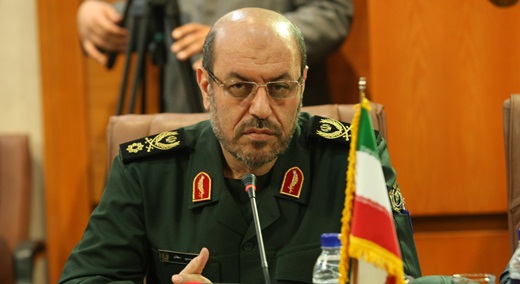
Iran’s Defense Minister Brigadier General Hossein Dehghan says the Islamic Republic will boost its missile capabilities in the shortest time possible to increase its effective deterrent power.

“[We] will develop appropriate plans at the shortest time possible to increase missile and defense capabilities and boost effective deterrent power despite a demand by the global arrogance [which seeks] to limit the Islamic Republic’s military [might],” Dehghan told reporters on Saturday following a meeting with Iranian missile program commanders and officials.

Stressing that Iran has never allowed other countries to make decisions about the country’s internal and defense issues, the Iranian minister said that the Islamic Republic’s measures will guarantee and improve stability and security in the region and across the world.

He said the Zionist lobby and extremists in the US seek to undermine a nuclear agreement reached between Iran and P5+1 group of countries – the United States, Britain, France, China and Russia plus Germany – in July, 2015.

He, however, emphasized that Iran is determined to fulfill its obligations under the agreement dubbed the Joint Comprehensive Plan of Action (JCPOA) and said it will counter excessive demands by the US and the West.

Dehghan’s remarks came in response to President Hassan Rouhani’s letter on December 31, which ordered stepped-up production of missiles after reports that the US was preparing fresh sanctions on international companies and individuals in Iran.

On Thursday, The Wall Street Journal said the White House had delayed plans to slap new sanctions on Iran but added that the measures remained on the table.


Iran summons Saudi deputy mission chief over Nimr execution

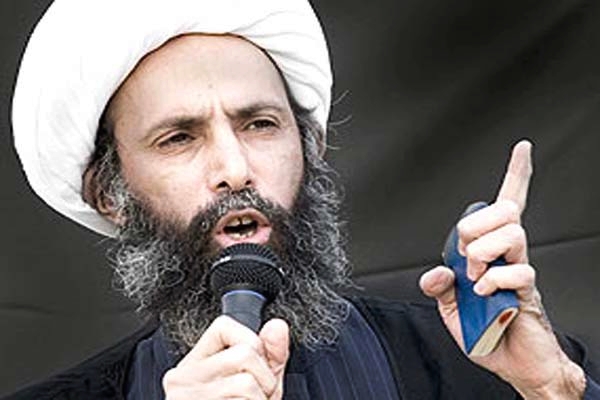
The Iranian Foreign Ministry has summoned the deputy head of the Saudi mission in Tehran to protest the execution of prominent Shiite cleric Sheikh Nimr al-Nimr.

Iranian Deputy Foreign Minister for Arab and African Affairs Hossein Amir-Abdollahian on Saturdayconveyed the Islamic Republic’s protest to Es’hagh al-Arini over Nimr’s execution.

Amir-Abdollahian said Saudi Arabia is the main drive behind the spread of terrorism in the region, adding that the regime cannot clear itself of its wrong policies, which have fueled insecurity in the region, by playing blame game and executing Sheikh Nimr.

He said Saudi Arabia has committed “strategic mistakes” by violating the rights of Shiite Muslims and minorities, noting that Sheikh Nimr was a prominent cleric in the Muslim world.

The Iranian diplomat said while Saudi Arabia has not yet fulfilled its responsibility about last September’s Mina disaster which killed thousands of pilgrims, it once again agitated Muslims and triggered a new conflict in the region by executing the senior cleric.

Asked prior to entering the building of the Foreign Ministry if Nimr’s execution would fuel the divisions in the Muslim world, Arini gave no answer and said, “I will respond later.”

He also claimed that the execution had been “legally and religiously valid.”

On Saturday, the Saudi Interior Ministry announced that Sheikh Nimr along with 46 others, who were convicted of being involved in “terrorism” and adopting a “Takfiri” ideology, had been put to death.

Meanwhile, in an apparent tit-for-tat move, Saudi Arabia also summoned the Iranian ambassador in Riyadh over what Riyadh claims were “hostile” remarks by Iranian officials on the execution of Sheikh Nimr, the Saudi state news agency reported.


Whirlwind of problems for Saudi Arabia: Larijani

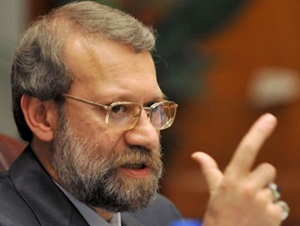
Larijani09Iran’s Parliament Speaker Ali Larijani said on Saturday that executing Sheikh Nimr would create a “whirlwind” of problems for the Saudi regime.

It is unlikely that Saudi Arabia will be able to easily get out of such a whirlwind, he added.

“Such acts will add to security woes in the region,” the top Iranian parliamentarian pointed out.

He said Saudi Arabia’s decisions over the past two years have created problems for regional countries, including Iraq, Yemen and Syria, and expressed regret over Riyadh’s “adventurism” in the region.

Larijani emphasized that Western countries and the US must take action over Saudi Arabia’s execution of Sheikh Nimr, which he said is a “blatant violation of human rights.”

He warned that soaring insecurity in the region would affect all regional countries.


Downgrade in Iran’s ties with Saudi Arabia: MP

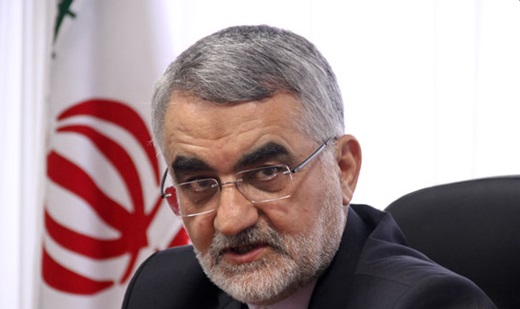
broujerdi1Following Saudi Arabia’s execution of Sheikh Nimr on Saturday, Chairman of parliament’s National Security and Foreign Policy Committee Alaeddin Boroujerdi called on Tehran to downgrade relations with Riyadh.

In a letter to Foreign Minister Mohammad Javad Zarif, Boroujerdi said the number of Saudi diplomats in the capital, Tehran, and the city of Mashhad should be downgraded to the “minimum level.”

Earlier on Saturday, Iranian Foreign Ministry Spokesman Hossein Jaberi Ansari also strongly condemned Saudi Arabia’s execution of the cleric, denouncing it as deeply irresponsible.

Sheikh Nimr, a critic of the Riyadh regime, was arrested in 2012 in the Qatif region of Shiite-dominated Eastern Province, which was the scene of peaceful anti-regime demonstrations at the time.

He was charged with instigating unrest and undermining the kingdom’s security, making anti-government speeches and defending political prisoners. He had rejected all the charges as baseless.

In 2014, a Saudi court sentenced Sheikh Nimr to death, provoking widespread global condemnations. The sentence was upheld last March by the appeal court of Saudi Arabia.


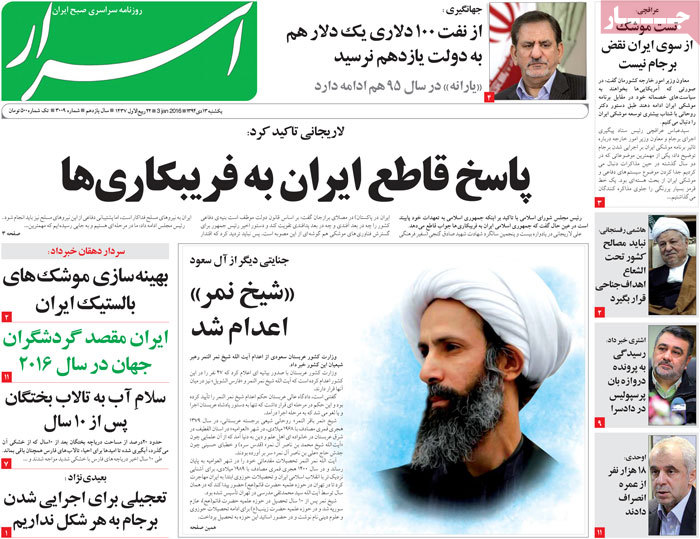
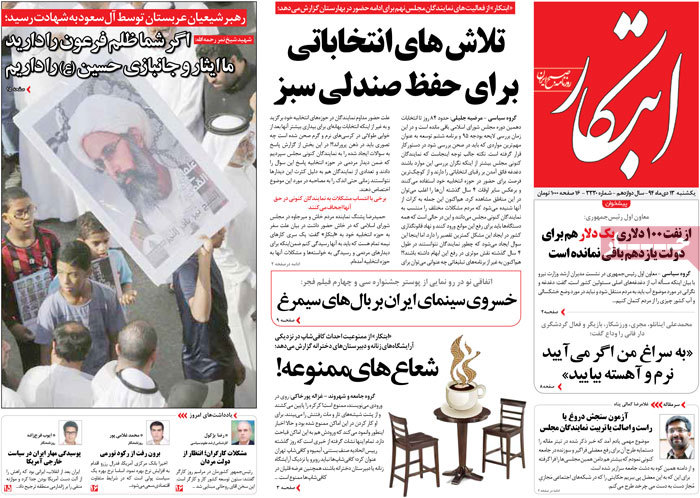
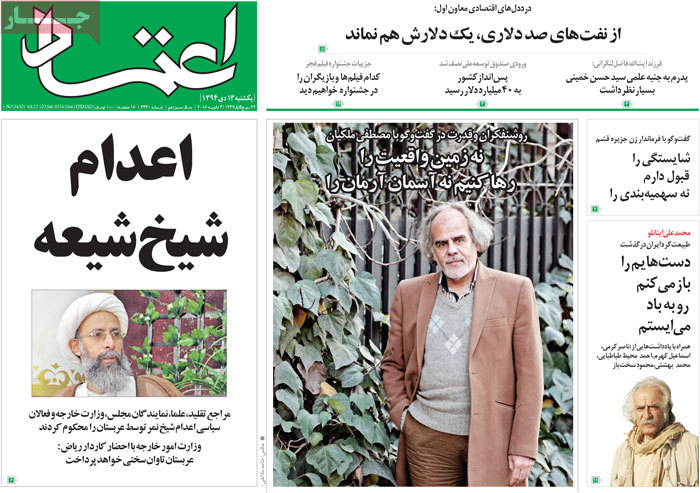
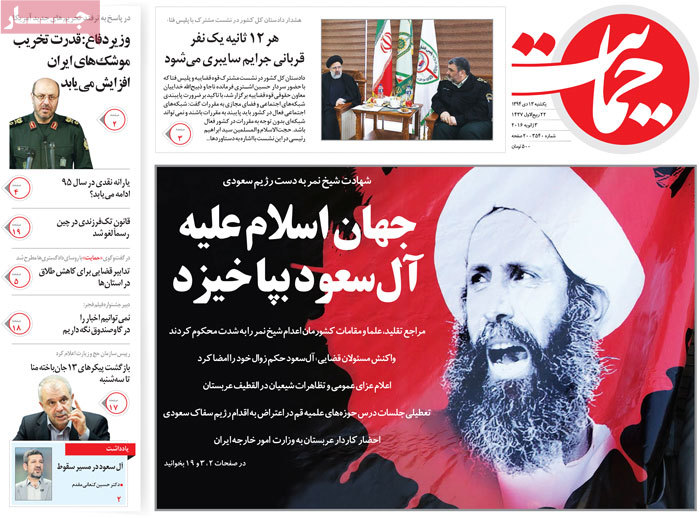
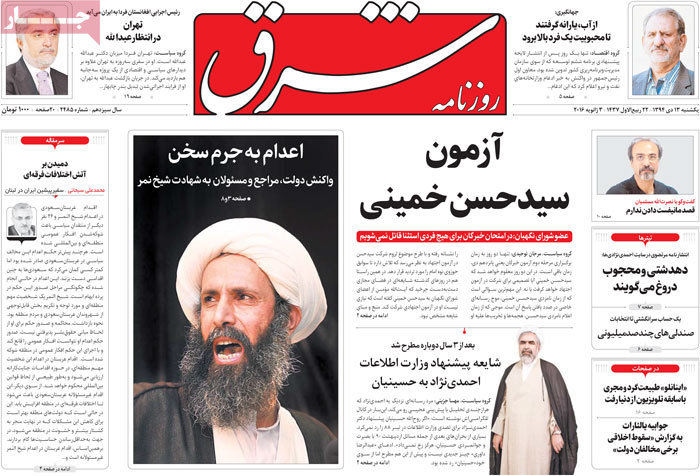
A look at Iranian newspaper front pages on Jan. 3

Iranian Newspapers Headlines

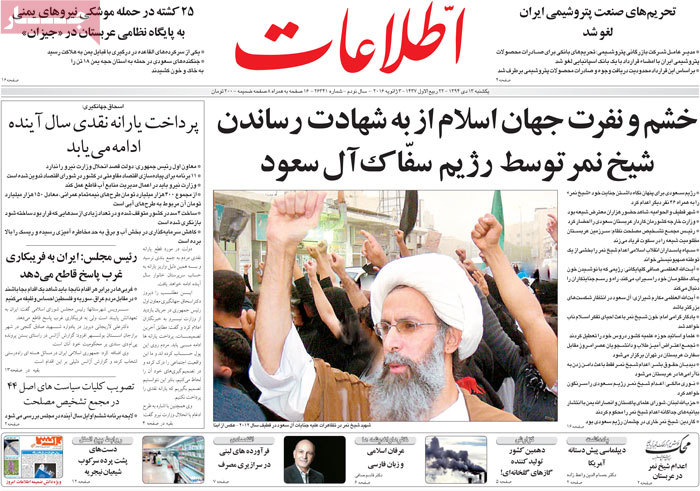
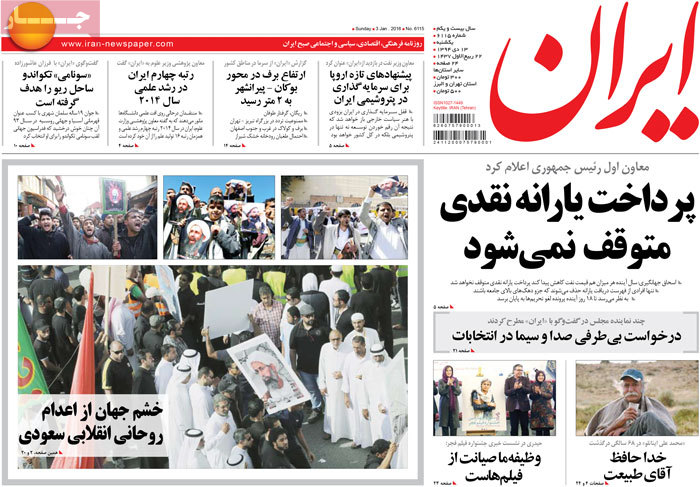
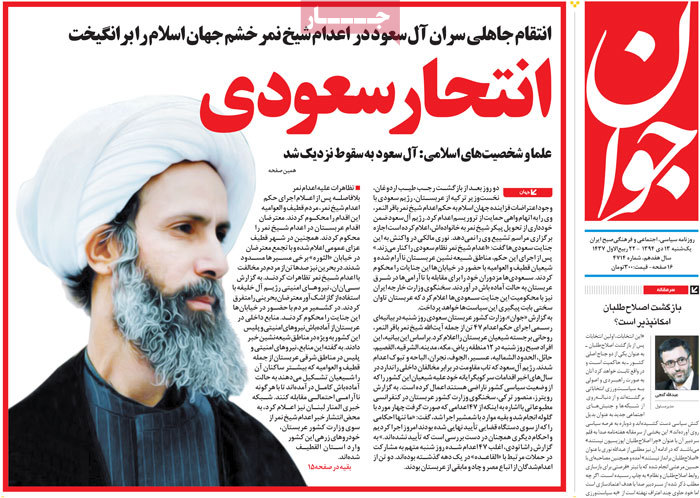
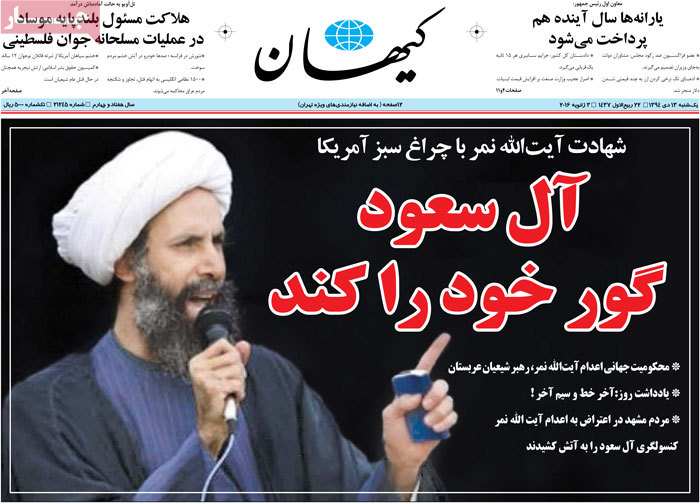
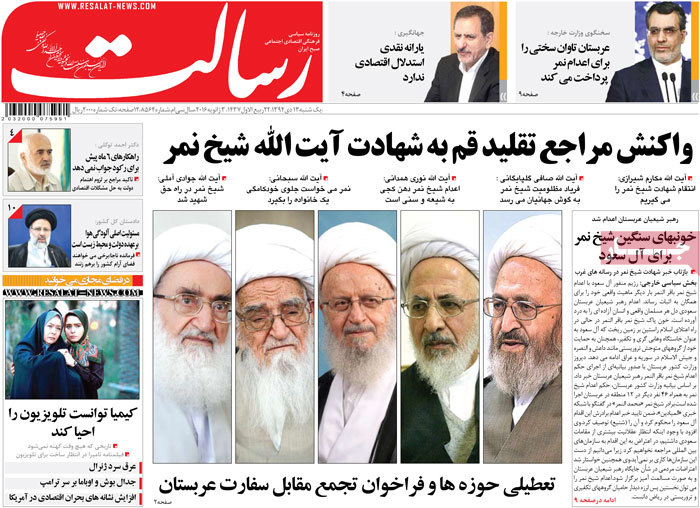
The execution by Saudi regime of Sheikh Nimr al-Nimr and the indignation it has caused around the Muslim world and among Iranian officials dominated the front pages of Iranian newspapers on Sunday.

Ettela’at: Rage and indignation across the Muslim world over the execution of Sheikh Nimr al-Nimr by the brutal Saudi regime

The Iranian Foreign Ministry has summoned the Saudi charges d’affaires over the execution of the prominent Shiite cleric.


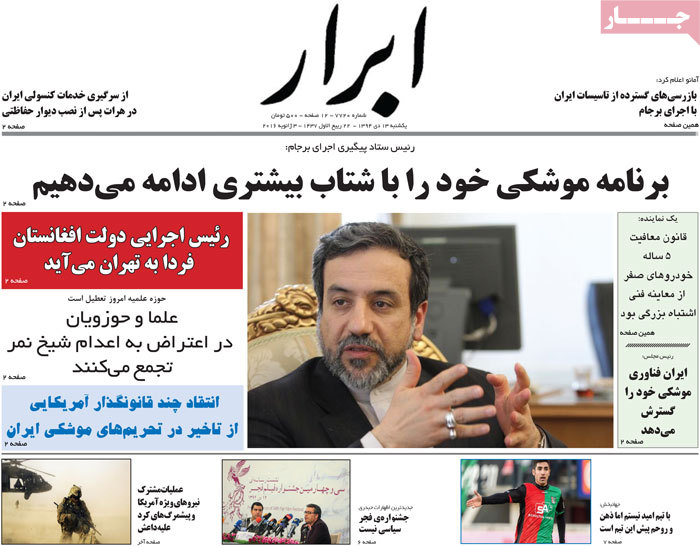
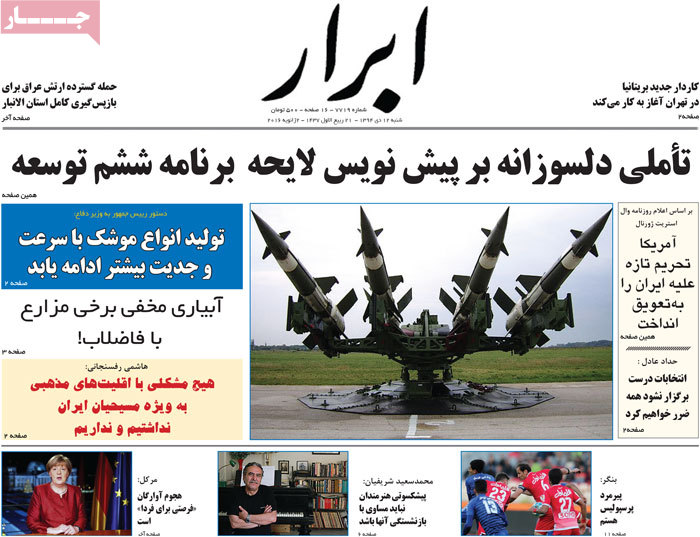
Abrar: The chairman of the commission following up the implementation of the nuclear deal has said that Iran will pursue its missile program with more momentum.

Abrar: The Chief Executive Officer of Afghanistan will arrive in Tehran on Monday.


A look at Iranian newspaper front pages on Jan. 3


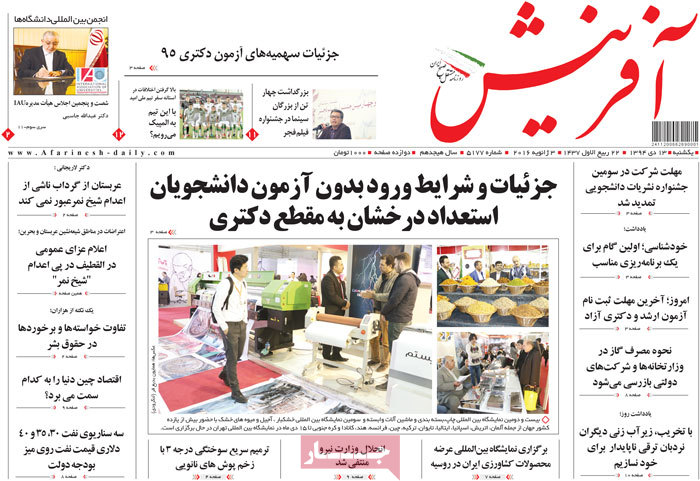
Afarinesh: The Saudis cannot ride out the quagmire the execution of Sheikh Nimr will help create, said Parliament Speaker Ali Larijani.

Afarinesh: An international exhibition of Iranian agricultural products is held in Russia.


A look at Iranian newspaper front pages on Jan. 3


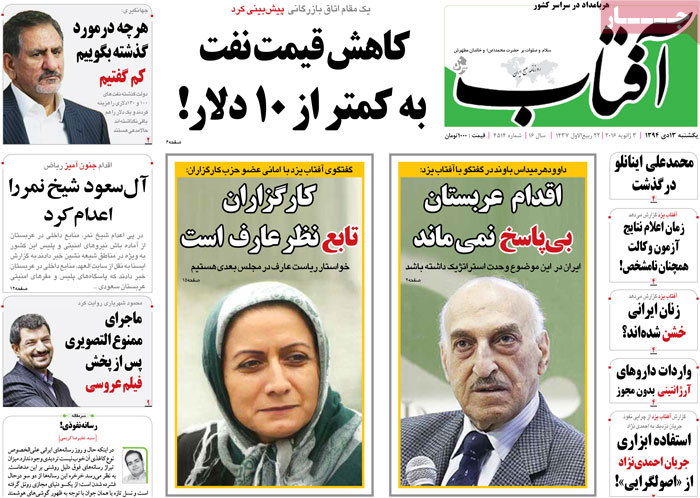
Aftab-e Yazd: The Saudi measure won’t go unanswered, said Davoud Hermidas-Bavand, a prominent professor and analyst.


A look at Iranian newspaper front pages on Jan. 3


Arman-e Emrooz: A warning by Zibakalam!

The prominent political analyst and university professor has said that in the absence of measures to transform the economy we have to wait for a second Ahmadinejad.

Arman-e Emrooz: Three students have died of the complications of air pollution.

That has dragged the prosecutors into the air pollution case.


A look at Iranian newspaper front pages on Jan. 3


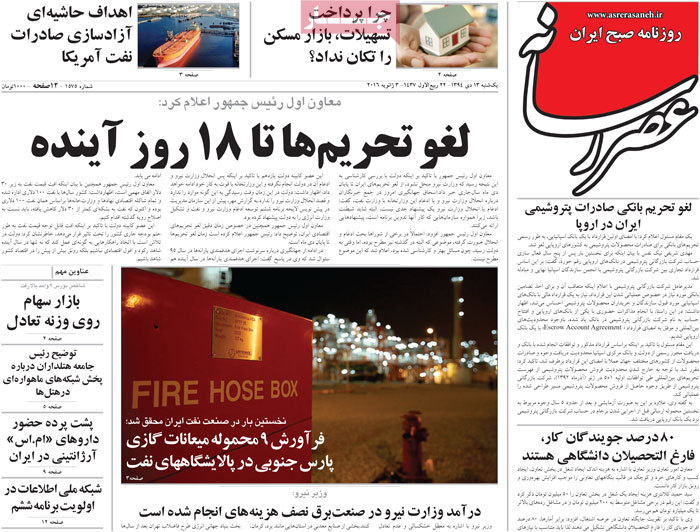
Asr-e Rasaneh: The first vice-president has said that sanctions will have been lifted within 18 days.


A look at Iranian newspaper front pages on Jan. 3


Asrar: Deputy Foreign Minister Abbas Araghchi has said that Iran’s missile tests are not a breach of the Joint Comprehensive Plan of Action.

Asrar: The chairman of the Expediency Council has said that expedience of the country should not be overshadowed by factional interests.

Asrar: Hamid Baeedinejad, an Iranian nuclear negotiator, has said that Iran is in no rush to implement the Joint Comprehensive Plan of Action in any shape or form.


A look at Iranian newspaper front pages on Jan. 3


Ebtekar: Mohammad Ali Inanlou, a sportsman, volleyball commentator and environmental activist has passed away.


A look at Iranian newspaper front pages on Jan. 3


Etemad: Execution of a Shiite sheikh

Sources of emulation, senior scholars, MPs, the Foreign Ministry and politicians have condemned the execution of Sheikh Nimr al-Nimr.

The Foreign Ministry has summoned the Saudi charges d’affaires and said that Saudi Arabia will pay a dear price.


A look at Iranian newspaper front pages on Jan. 3


Hamdeli: The Saudis started off 2016 with executions.


A look at Iranian newspaper front pages on Jan. 3


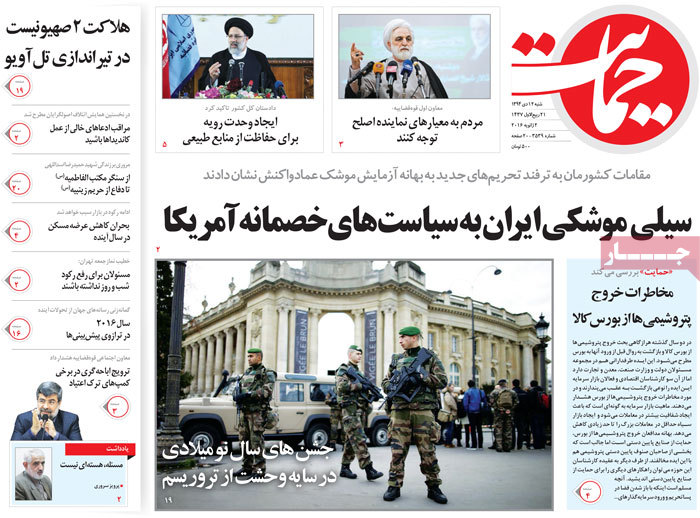
Hemayat: The attorney general has said that every 12 second an individual falls victim to cyber-crimes.


A look at Iranian newspaper front pages on Jan. 3


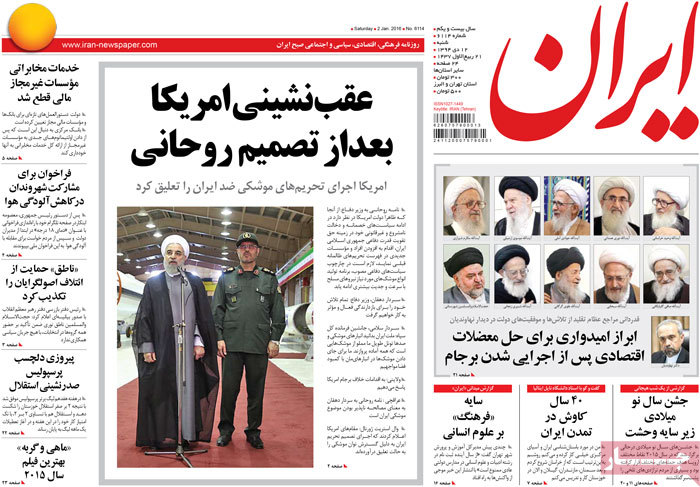
Iran: Two meters of snow has fallen along the road that links Bookan to Piranshahr in northwestern Iran.

Iran: The deputy science minister has said that in 2014 Iran was the world’s fourth country as far as scientific growth was concerned.


A look at Iranian newspaper front pages on Jan. 3


Jomhouri Islami: The Saudis committed suicide.

Islamic scholars have said that the House of Saud is on the brink.


A look at Iranian newspaper front pages on Jan. 3


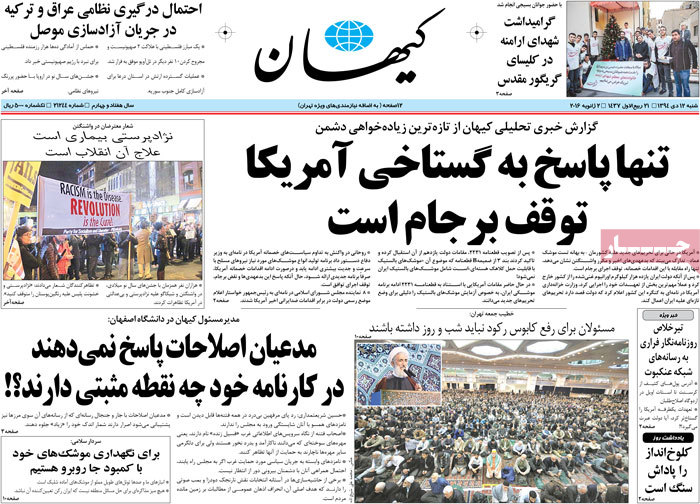
Kayhan: The House of Saud dug its own grave.

The martyrdom of Ayatollah Nimr with the American green-light!


A look at Iranian newspaper front pages on Jan. 3


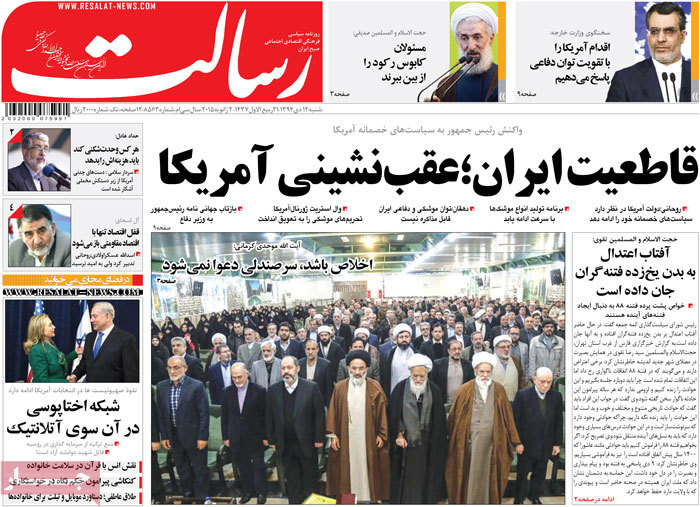
Resalat: “The Saudis will pay a heavy price for the execution of Sheikh Nimr,” said Foreign Ministry Spokesman Hossein Jaberi Ansari.

Resalat: Tehran MP Ahmad Tavakoli has said that 6-monthly plans won’t help the country get rid of recession.


A look at Iranian newspaper front pages on Jan. 3


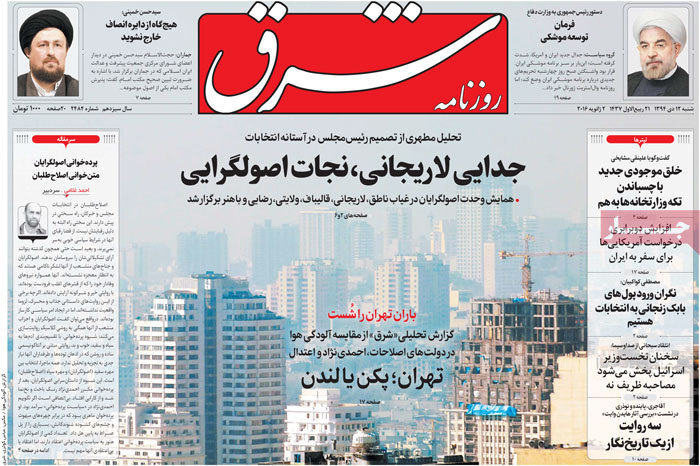
Sharq: The Afghan chief executive officer is due in Tehran Monday.


A look at Iranian newspaper front pages on Jan. 3


Chabahar FTZ at the center of Abdullah’s upcoming Iran visit

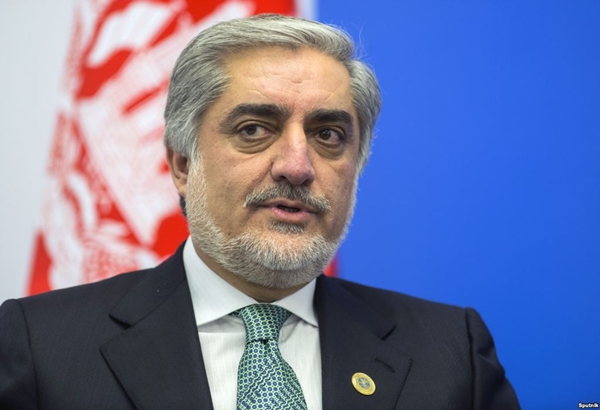
The Chief Executive Officer of Afghanistan Abdullah Abdullah will arrive in Tehran on Monday at the head of a delegation of Afghan cabinet ministers.

During his state visit, Abdullah will take in Chabahar [a seaport in southeastern Iran] to explore ways of exporting and importing Afghan commodities from this port.

Afghanistan intends to use the Port of Chabahar to transfer its goods to Central Asian states and Europe. Currently most goods are imported to or exported from Afghanistan to other countries via Pakistan.

To transform Chabahar to an international port for the transit of goods is a joint plan of Iran, India and Afghanistan which inked an initial agreement on development of the Iranian port city in 2003.

Director of the Afghanistan Investment Support Agency Ghorban Haghjoo believes Chabahar lessens the dependence of Afghanistan on Pakistan’s route. In light of the fact that Chabahar is closer in distance to Afghanistan than Karachi, it can replace Karachi as the port of choice for Afghan imports and exports, he says.

He said what gives an edge to Chabahar is that Iran is ready to provide expanses of land for the establishment of production units and storage facilities for Afghan products.

He also said compared to Pakistan, Iran’s route has always been more open to Afghanistan’s trade, and the problems Afghanistan has with Pakistan do not exist in dealing with Iran.

Cold relations between Pakistan and Afghanistan seem to have doubled the importance of Chabahar to Afghanistan, and Kabul views it as a replacement for Karachi for imports and exports.

The Afghan Chief Executive Officer will also hold talks with Iranian officials on measures to bolster mutual commercial ties as well as on the situation of Afghan immigrants in Iran.

Iran strongly condemns execution of Sheikh Nimr

Iran has strongly condemned Saudi Arabia’s execution of prominent Shiite cleric Sheikh Nimr al-Nimr.

Mehr News Agency on January 2 covered, in separate news reports, reactions by Iranian officials to the execution of the top Shiite cleric in Saudi Arabia. The following is the translation of part of those reports:

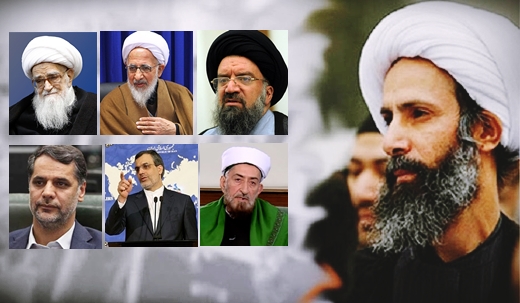
safiGrand Ayatollah Safi Golpaygani, a source of emulation, in a message condemned the execution of Sheikh Nimr al-Nimr.

He said the execution of Ayatollah Nimr will smooth the way for the fall of the Saudi regime.

He also offered condolences to people of the Muslim world, to the Saudis who are sick and tired of the crimes committed by the brutal regime in Riyadh, as well as to the bereaved family of this “esteemed martyr”.

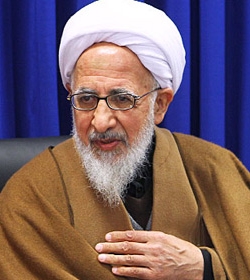
javadi-amoliGrand Ayatollahs Javadi Amoli and Sobhani and Ayatollah Shahroodi too issued separate messages in condemnation of the Saudi act.


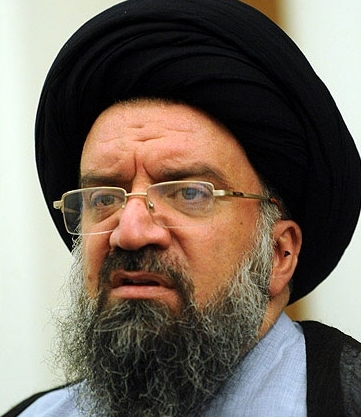
khatamiAyatollah Ahmad Khatami, a member of the Assembly of Experts, said that the execution of Sheikh Nimr is one link in the chain of crimes committed at the hands of the Al Saud family.

Tehran’s Friday prayer leader further said that since its emergence, the Saudi regime has resorted to barbarism and violence, adding that the regime’s aggression against Yemen will remain as a stain on the reputation of the Saudi regime forever.

Khatami went on to say that the world of Islam is expected to react to Sheikh Nimr’s execution and reveal the true colors of the criminal regime of Saudi Arabia, urging the Iranian foreign diplomacy machine to take a proper stance in this regard.

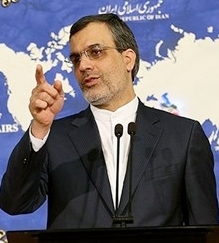
jaberiMeanwhile, Foreign Ministry Spokesman Hossein Jaberi Ansari denounced the execution of Sheikh Nimr as deeply irresponsible. “Saudi Arabia supports terrorists and executes its critics.”

He went on to say that the Saudi government supports terrorists and Takfiri extremists, and uses the language of execution and suppression in talking to its critics at home.

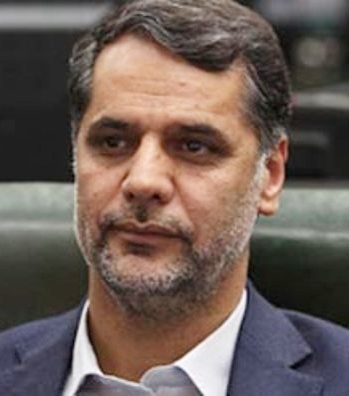
A member of parliament’s National Security and Foreign Policy Committee said that the hasty decisions of Saudi Arabia are worse than crimes committed by ISIS terrorists, adding that Saudi Arabia killed Sheikh Nimr on behalf of the Zionist regime.

743660Hossein Naghavi Hosseini further said that what the House of Saud did was an inhumane, undemocratic and medieval act which could set a [dangerous] precedent in issuing verdicts against Muslim clerics.

The MP also said that such rash decisions reveal the back-to-back failures the Saudi regime has suffered following its interventionist measures in Yemen, Syria and Iraq, adding that the Muslim world will show reaction to the recent decision of Riyadh.

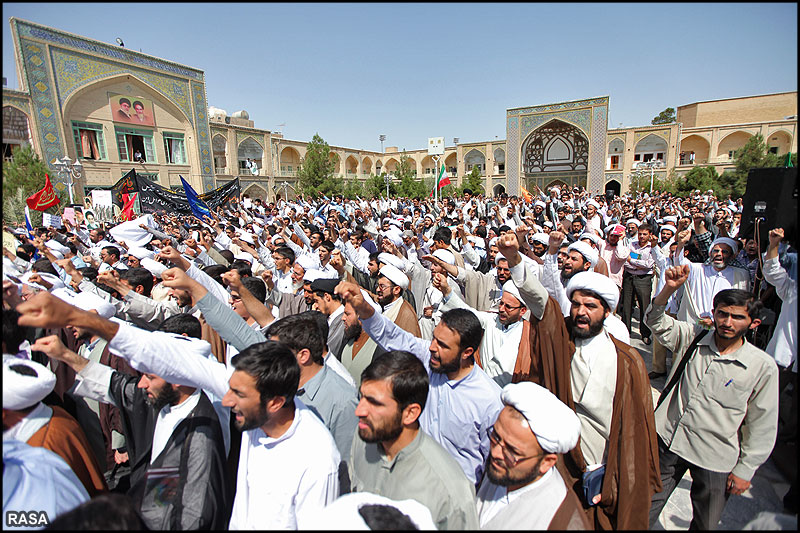
IMAGE634834016914531250Meanwhile, the Qom Seminary announced it will close all its classrooms on January 3 in protest.

Professors, students and scholars of the school are to stage a sit-in to declare their objection to and hatred of the execution of the outstanding Saudi cleric.

molaviThe Sunni Friday Prayer Leader of Sarakhs [a town in Khorasan Razavi Province in northeastern Iran] said that the execution of Sheikh Nimr al-Nimr is indicative of a lack of freedom of opinion and expression.

That anybody who expresses their idea should be executed amounts to interference in Islam’s social and religious regulations, Molavi Ahmad Parsa said.

emam..And the Sunni Friday Prayer Leader of Piranshahr [a town in West Azerbaijan province in northwestern Iran] said that the Saudi government is Wahhabi and Wahhabism lacks compassion and kindness.

“They just endear their deviant ideas and do not accommodate the ideas of other Muslims,” he said.

Revolution Guards general thanks president for missile order

Secretary of the Expediency Council Mohsen Rezaei in a letter to President Hassan Rouhani has thanked him for his focus and follow-up on the missile issue and called for continued efforts to boost the missile capability of the Iranian armed forces.

The following is the translation of the letter in its entirety released by Tabnak.ir, a news website, on January 1:

To Dr. Rouhani

The esteemed president of the Islamic Republic of Iran


I thank you on behalf of myself and the veterans of the Holy Defense for the heed you have paid – in response to the new sanctions and measures by the US – to the expansion and reinforcement of the missile capability of the country’s armed forces as stipulated in Sixth Development Plan policies.

The interventionist nature of the US shows that in such situations, the country’s national interests cannot be safeguarded but with a strong slap. Thirty-something years after the victory of the Islamic Revolution, the US statesmen apparently do not want to recognize our country’s independence and power. In keeping with their domineering habit in the black eras of Pahlavi and Qajar they deem themselves entitled to meddling in our country’s internal affairs.

Our 20,000 centrifuges served as a slap across the face and brought the Americans to the negotiating table and led to the recognition of our country’s right to uranium enrichment. I hope through your support the range of Iran’s missiles surpasses 5,000 kilometers.

The Iranian nation’s historic experience shows that a slap should be answered with a slap; otherwise the scandalous ears of the Qajar and Pahlavi dynasties will be repeated in our country. The only way we can have a powerful presence in the international arena goes through the path the late Imam Khomeini founded in our foreign policy; the Supreme Leader of the revolution has been safeguarding and walking down that path.

Undoubtedly, with the range of our missiles reaching 5,000 kilometers – capable of reaching targets such as Diego Garcia island, home to the airbase the US used in mounting the Tabas attack [A failed attack by the US on Tabas Desert in central Iran on April 25, 1980 to rescue the US embassy staff taken hostage in Tehran after the Islamic Revolution of 1979] – America will regret its action and will understand that these measures bear no fruit.

In dealing with the Islamic Republic, the US seems to have been confounded. They thought they would be able to take advantage of open economic doors and infiltrate the country through the implementation of the Joint Comprehensive Plan of Action (JCPOA) and by reliance on those infatuated with Liberalism.

However, with the vigilance of the Leader and that of his insightful aides and through the help of your government and the Islamic Consultative Assembly, the US plot was nipped in the bud. Today, the US which is overwhelmed is resorting to a new scheme part of which has to do with the imposition of new sanctions. Efforts to keep the oil prices at a low level with the help of its regional mercenaries in the coming months are part of another such plot.

It is expected that with your special attention, plans of the resistance-based economy will be put into effect as soon as possible so that it will be proven to the US once more that Iran is capable of developing its economy despite cruel sanctions.

Major General Mohsen Rezaei

Secretary of the Expediency Council


In line with its hostile policies and in reaction to the test-launch of Emad Missile, the US administration announced it would add the names of 11 individuals and companies related to Iran’s nuclear program to the list of sanctions.

Reacting to the US decision [which now seems to have been put off], President Rouhani told the defense minister to ensure the continued production of different types of missiles and draw up a program to boost Iran’s missile capability in case attempts at meddling were repeated.

Saudi executes 47 people, including Sheikh Nimr

Saudi Arabia has executed Sheikh Nimr al-Nimr along with 47 others in defiance of international calls for the release of the prominent Shiite cleric and other jailed political dissidents in the kingdom.

The state-run Saudi Press Agency (SPA) and state television reported the executions Saturday, citing the kingdom’s Interior Ministry.

According to the Saudi ministry, those executed had been found guilty of being involved in “terrorism” and adopting a “Takfiri” ideology. All on the list of those killed are Saudi nationals except an Egyptian and a Chadian.

The Saudi Interior Ministry did not elaborate on the method to execute the convicts, but said they were executed Saturday in 12 cities across the country.

Sheikh Nimr, a critic of the Riyadh regime, was shot by Saudi police and arrested in 2012 in the Qatif region of Shiite-dominated Eastern Province, which was the scene of peaceful anti-regime demonstrations at the time.

He was charged with instigating unrest and undermining the kingdom’s security, making anti-government speeches and defending political prisoners. He had rejected all the charges as baseless.

In 2014, a Saudi court sentenced Sheikh Nimr to death, provoking widespread global condemnations. The sentence was upheld last March by the appeal court of Saudi Arabia.

Amnesty International also criticized the process of Sheikh Nimr’s trial and said it views the charges against the cleric as his right to free speech.

The death ruling sparked angry reactions from international rights bodies as well as many Muslim nations, including Iran, Iraq, Lebanon, Afghanistan and India, where people staged large protest rallies and called for the release of Sheikh Nimr as well as all political detainees in the kingdom.

Last October, United Nations Secretary General Ban Ki-moon also urged Saudi rulers to revoke the cleric’s death verdict.

Human rights organizations have lashed out at Saudi Arabia for failing to address the rights situation in the kingdom. They say Saudi Arabia has persistently implemented repressive policies that stifle freedom of expression, association and assembly.

The new announcement comes a day after a tally by The Associated Press, which was based on reports by Amnesty International, showed Saudi Arabia had carried out 157 executions in 2015, most of which were beheading by sword. This is a record of the most capital punishments conducted in a single year since 1995.

Sheikh Nimr’s family ‘shocked’

Shocked by the news of his brother’s execution, Sheikh Nimr’s brother, Mohammad, slammed Riyadh’s decision, which he said, was a negative response to the Shiite cleric’s pro-democracy demands, Arabic-language media reported him as saying.

He further expressed hope that the expected reactions to Sheikh Nimr’s death would be peaceful.

“Sheikh Nimr enjoyed high esteem in his community and within Muslim society in general and no doubt there will be reaction,” Mohammed al-Nimr told Reuters, adding, “We hope that any reactions would be confined to a peaceful framework…Enough bloodshed.”

The list of those executed on Saturday does not, however, include Ali Mohammed Baqir al-Nimr, the cleric’s nephew, who has also been sentenced to death over his alleged role in anti-regime protests in 2012, when he was 17 years old.

Many countries and human rights bodies have called for Ali Mohammed’s execution to be stopped.


PART ONE: On the war on terror

A former French premier has said that his country will not follow in the footsteps of the United States if Washington unilaterally goes back on its promises under the Iran nuclear deal.

Jean-Pierre Raffarin, who served as French prime minister (2002–2005), made the remark in an interview with Etemaad daily’s Ehsan Badaghi and added that JCPOA is an agreement between Iran and six world powers and that one country, out of P5+1, cannot unilaterally violate the nuclear deal.

The opposition UMP party senator – who is now the chairman of the French Senate Committee for Foreign Affairs, Defense and Military – also talked about trans-partisan policies of France on the war on terror and stressed that Iran should be a key player in international efforts to take on terrorism.

Raffarin was in Tehran in mid-December as part of a French delegation led by President of the French Senate Gerard Larcher. The following is the translation of PART ONE of the interview which focused on the international fight against terrorism and implementation of the Iran nuclear deal:

Q: How similar, or how different should I say, are what you had in mind about Iran and what you see here in Iran today?

A: The comments of those who have seen Iran first-hand greatly differ from those who have never traveled to the country and simply pass judgment on it from afar. I already knew that a trip of a few days to Iran will change my impression about the country. Naturally political leaders have a sketchy view of countries and, as a politician, I am no exception.

What was shocking for me was the depth of insight and delicacy of assessment by the [Iranian] officials I met with. During my trip, I did not have the opportunity to get into close contact with members of Iranian society, but from the contacts I had with high-ranking political officials, I realized that we had to have a different look at Iran. Thus it would be quite natural to come across differences when establishing contact with Iranian society and its people.

Q: How will such a different look affect your policies? We believe that positive attitudes should show themselves in practice as well.

A: Never can I guarantee an immediate, instantaneous change. I want to give the good news that we will definitely pursue our assessment of Iran today in the form of a practical policy in France. What we are to do relies on how the two countries can maintain the positive atmosphere created between them.

Q: You need to give us the right not to remain indifferent to incorrect judgments which are passed on us from time to time. We are seeking to fairly judge France’s policies in Iran. Let’s go to the second comparison: A relatively calm France at the heart of Europe and a France which has been repeatedly rattled by terror attacks over the past two years and has – on some days – turned into an unsafe place. How different is today’s France which has gained bitter experiences of terrorism from France in the past years?   

A: Following these events, France came to realize that the war on terrorism would be a very prolonged war, a war which will spill over into many other geographical places. We learned about the abilities of our enemy and also learned that the enemies – the terrorist groups – are very much powerful and lethal. The lessons we learned prompted us to prioritize our goals. A case in point is [the decision by] President Hollande to appear before parliament and say [the fight on] terrorism is the country’s number one priority.

Q: You talked about the enemy’s abilities and a prolonged war with it. What you are saying evokes the comments US President George Bush made following the 9/11 attacks before the United States got involved in a full-scale war in the Persian Gulf. What does such a resemblance mean? Shall we wait for France to adopt a tactic similar to what the US did 15 years after September 11 attacks in the US?

A: No. This is simply a lexical similarity. France’s assessment [of the situation on the ground] is different from the way the Americans saw things back then. On those days [in the wake of 9/11 attacks] the US had already made up its mind and was seeking to [make its case for war and] build a [global] consensus. But today we say that we need a broad international consensus before we can make the final decision. We are trying to reach a consensus which does not – on the grounds of mutual differences – exclude those who are seeking to wage war on terrorism.

Q: Let’s go back to the comparison between France today and France in the past. Given the experiences you have gained today and the developments which have unfolded in the world, especially in the Middle East and North Africa, do you see any change in your assessment of terrorists, effective methods to take on terrorism and what supports and boosts such methods? Let me be frank, haven’t you already made mistakes in this regard?    

A: I’m not sure whether we made a mistake. I do not insist that all we did was correct, because we lack an accurate judgment now. What I can say is that we [in France] deepened our analysis of this phenomenon [terrorism] following the developments which unfolded [in France and across the world].

We moved toward developing a profound and accurate insight [of the ground situation]. We tried to analyze terrorism – which is a nebular phenomenon – more than before. We tried to create more suitable tools to stage a fight on this phenomenon or work toward developing such a tool in the near future.

Q: For over 30 years Iran has been grappling with terrorism one way or another. We lost a large number of citizens and officials because of terrorism in the early years after the victory of the Islamic Revolution. Back then a terror group, Mojahedin Khalgh Organization (MKO) which claimed responsibility for a number of terrorist attacks in Iran was given shelter by the French government, and your country turned into the base for the group’s main leaders in Europe. Paris has lent political and legal support to this group on many occasions. Where do you stand on such a decision [which was made years ago]?  

A: This is the question which came up for discussion in our official meetings during this trip. It was also raised and pursued by Iranian officials in the previous years when I was in charge in the French government. I think there were days when the fight against terrorism was not like what it is like today.

In other words, in those days each country would counter its own terrorists and terrorism was more of an internal [within-national-borders] phenomenon. A case in point is France itself which was hit by terror attacks when the war in Algeria was raging on.

But today we are facing a multilateral and trans-border aspect of terrorism and suffer its dire consequences. Today the question of terrorism is not simply about one country; rather, it involves a number of countries and regions across the world. I think the front-and-center mentality in France suggests that all those countries which honestly fight such a phenomenon should join hands and improve coordination within their ranks.

It comes as there are still a number of countries which are believed to be partners of terrorists. The fight on terrorism goes through one single way: national determination inside countries and multilateral determination on the part of [all] countries.

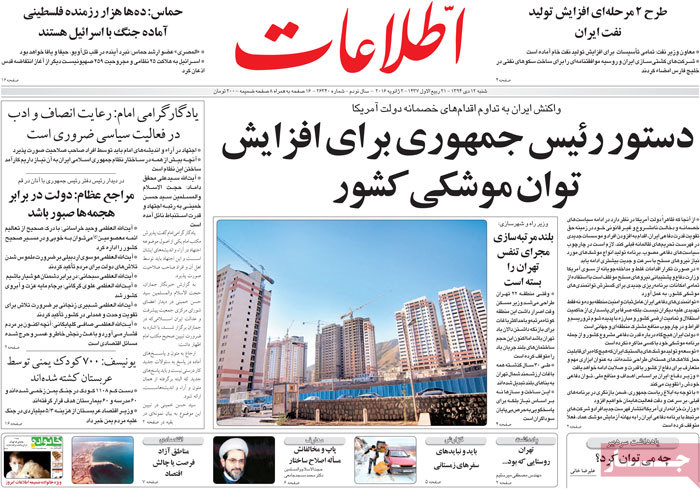
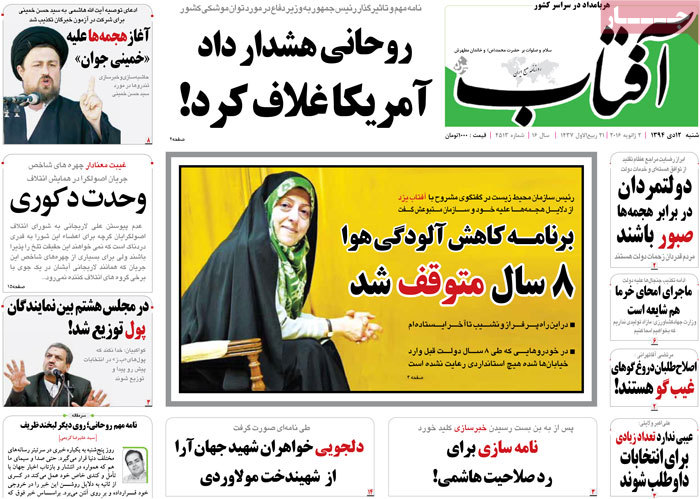
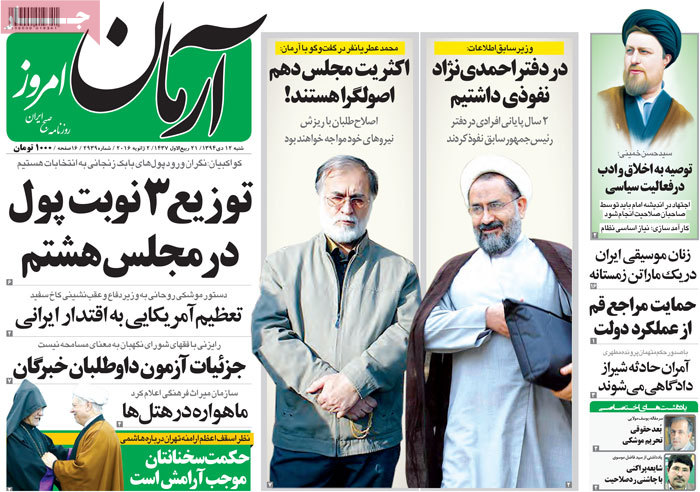
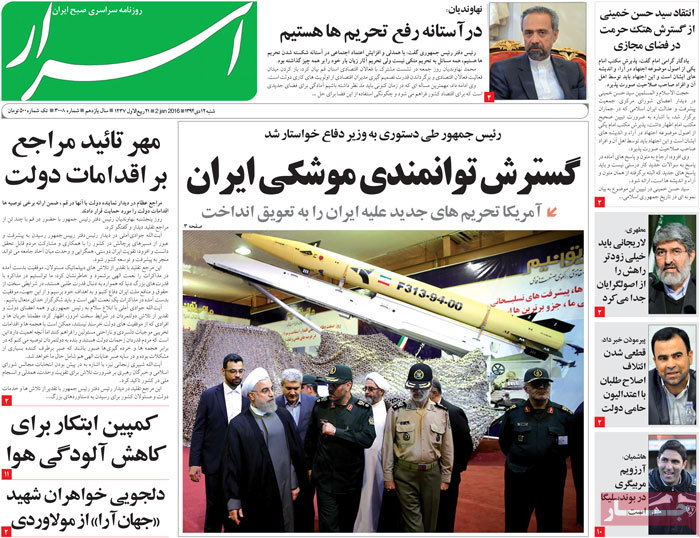
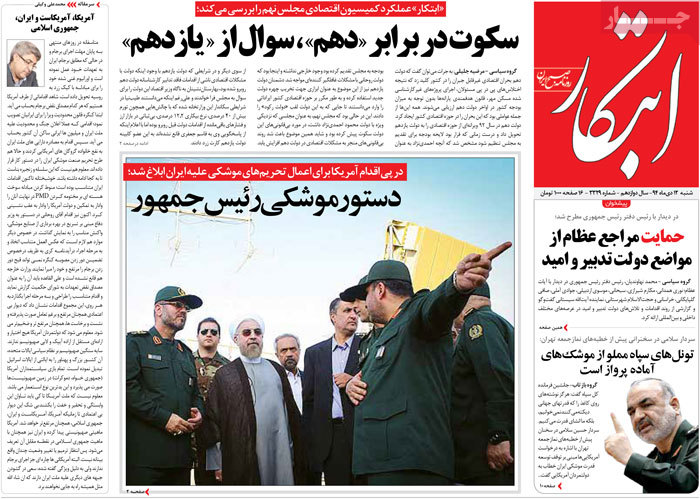
A look at Iranian newspaper front pages on Jan. 2
Iranian Newspapers Headlines

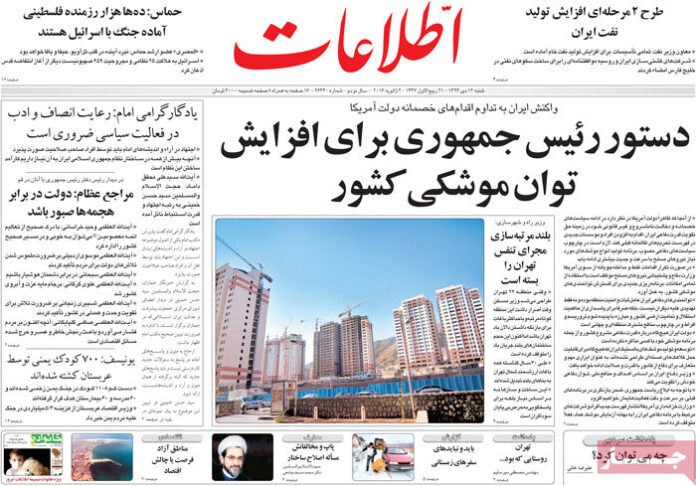
The president’s order to accelerate the country’s missile program dominated the front pages of Iranian newspapers on Saturday.


Ettela’at: The president has ordered Iran’s missile capabilities boosted.

It came in reaction to continued hostilities by the US administration.


Abrar: The chairman of the Expediency Council has said that the establishment has no problem with religious minorities, especially Christians.


A look at Iranian newspaper front pages on Jan. 2


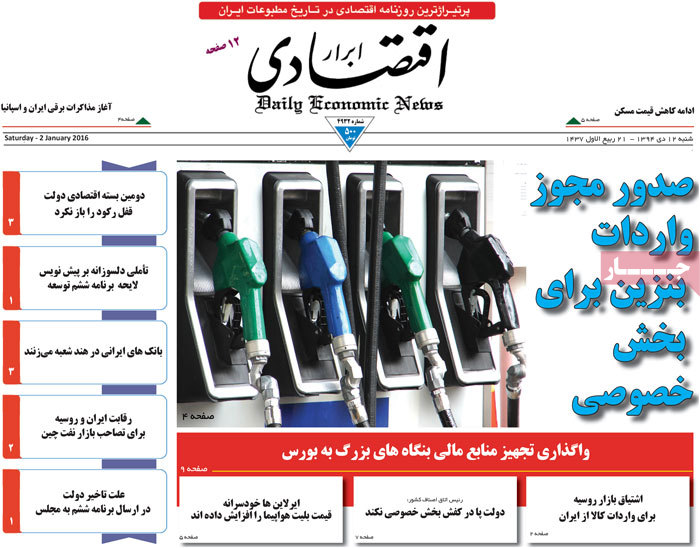
Abrar-e Eghtesadi: The private sector has been given the go-ahead to import gasoline.


A look at Iranian newspaper front pages on Jan. 2


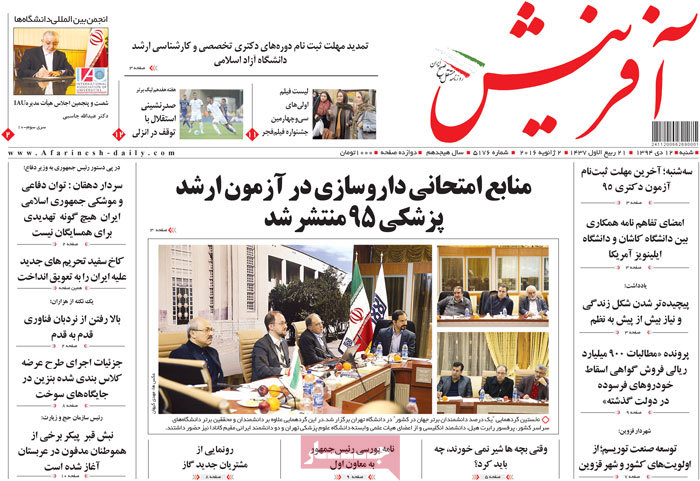
Afarinesh: Kashan University and University of Illinois have signed a cooperation document.

Afarinesh: The defense minister has said that Iran’s defense and missile capability poses no threat to neighboring countries.


A look at Iranian newspaper front pages on Jan. 2


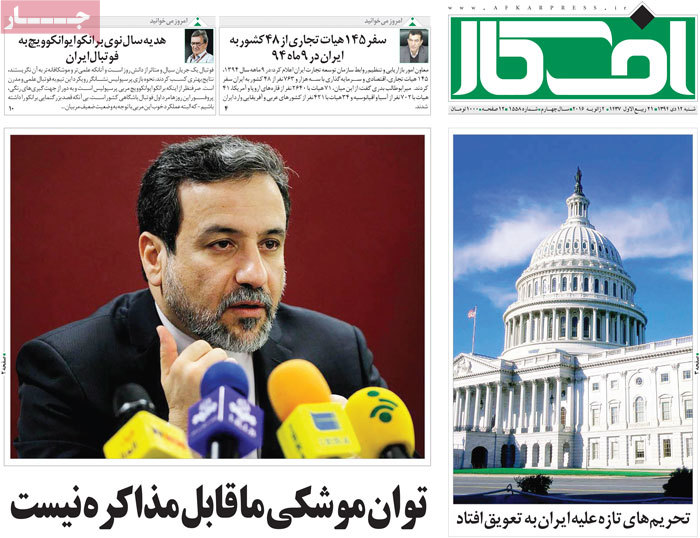
Afkar: In the first nine months of the year [started March 21, 2015] 145 trade delegations from 48 countries visited Iran.

Afkar: Iran’s missile capability is not negotiable, said Deputy Foreign Minister Abbas Araghchi.


A look at Iranian newspaper front pages on Jan. 2


Aftab-e Yazd: The plan to ease air pollution stalled for eight years [a reference to Ahmadinejad’s presidency], said the director of the Environment Protection Organization.


A look at Iranian newspaper front pages on Jan. 2


Arman-e Emrooz: The former intelligence minister has said that his men had infiltrated the Presidential Office in the final two years of Ahmadinejad presidency.

Arman-e Emrooz: Those who ordered an attack on Tehran MP Ali Motahari when he was in Shiraz to deliver a speech will go on trial.

The announcement came as a court in the southern city issued a verdict in the case of those who carried out the attack.


A look at Iranian newspaper front pages on Jan. 2


Asrar: President Rouhani’s chief of staff has said the sanctions are on the verge of being eliminated.

Asrar: Ali Motahari, an MP, has said Parliament Speaker Ali Larijani should have parted ways with principlists much earlier.


A look at Iranian newspaper front pages on Jan. 2


Ebtekar: Our tunnels are full of missiles ready to blast off, said Brigadier General Hossein Salami, the second in command of the Islamic Revolution Guard Corps.


A look at Iranian newspaper front pages on Jan. 2


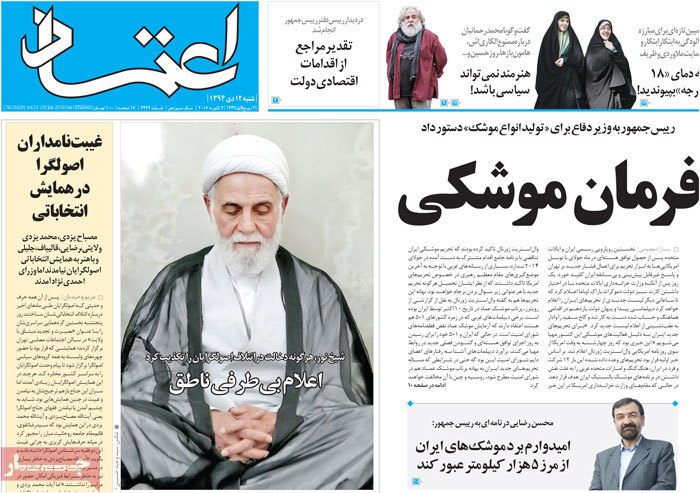
Etemad: I hope Iran can develop missiles with a range of more than 5,000 km, said Mohsen Rezaei [a former Revolution Guards commander] in a letter to President Rouhani.


A look at Iranian newspaper front pages on Jan. 2


Hemayat: The attorney general has underlined a unified approach to protecting the environment.


A look at Iranian newspaper front pages on Jan. 2


Iran: The US backed down after a decision by President Rouhani [to boost Iran’s missile capability].

New missile sanctions against Iran have been put off.


A look at Iranian newspaper front pages on Jan. 2


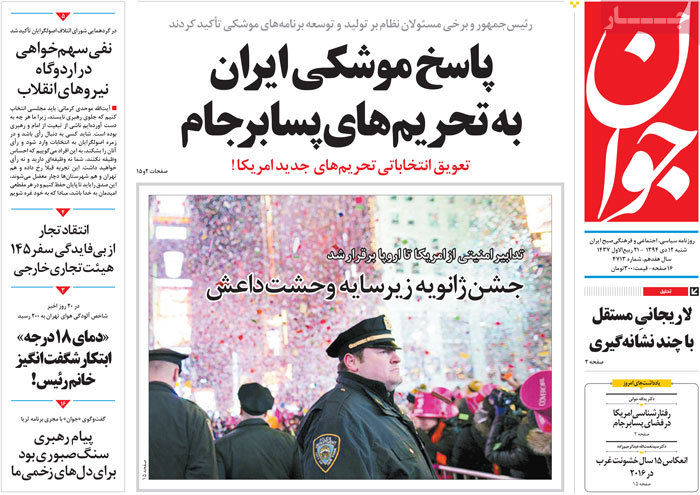
Javan: Iran’s missile response to the post-JCPOA sanctions

Imposition of sanctions has been put off.


A look at Iranian newspaper front pages on Jan. 2


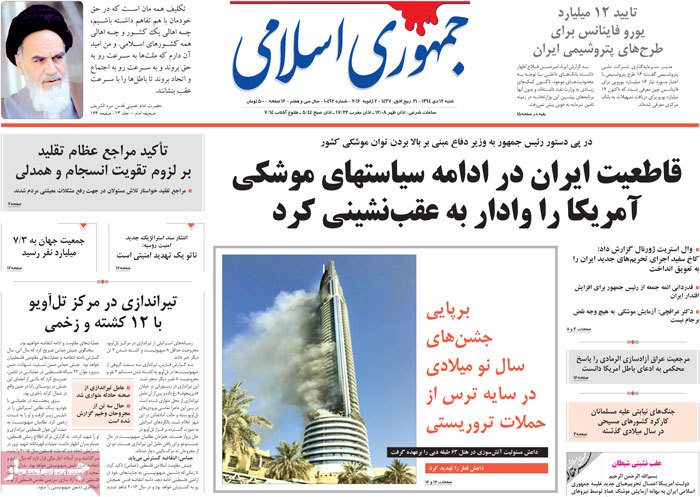
Jomhouri Islami: Petrochemical products to receive €12 billion in finances.


A look at Iranian newspaper front pages on Jan. 2


Kayhan: Stopping the nuclear deal would be the best response to American audacity.


A look at Iranian newspaper front pages on Jan. 2


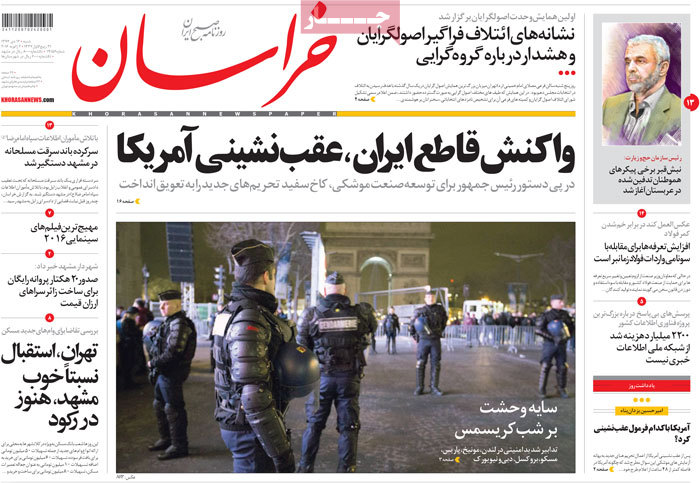
Khorasan: The director of the Hajj and Pilgrimage Organization has said that the exhumation of the bodies of a number of Iranian victims of the Mina tragedy has started.


A look at Iranian newspaper front pages on Jan. 2


Resalat: The Foreign Ministry spokesman has said Iran will respond to the American measures by boosting its defense capability.


A look at Iranian newspaper front pages on Jan. 2


Sharq: Applications by American citizens to travel to Iran have doubled.


A look at Iranian newspaper front pages on Jan. 2


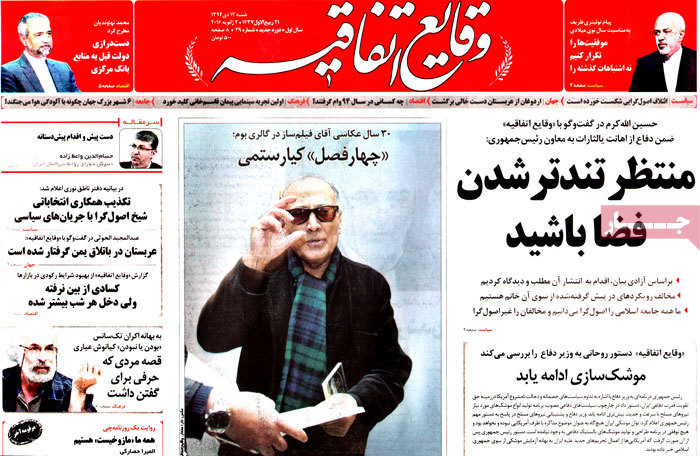
Vaghaye-e Etefaghiyeh: Wait for the rhetoric to get tougher.

In an interview with the daily, Hossein Allah Karam has defended the insulting comments Yalasarat weekly published against the vice-president for women and family affairs.

We published that piece in line with the principle of freedom of speech, he said.


A look at Iranian newspaper front pages on Jan. 2


Highlights of Ettela’at newspaper on Jan. 2

 The president has ordered Iran’s missile capabilities boosted.

It came in reaction to continued hostilities by the US administration.

 The minister of roads and urban development has said that building high-rises has blocked Tehran airway.

 A two-stage increase in Iran’s oil output

A deputy oil minister has said that the country’s facilities are all set to raise crude production.

 Hamas has said that tens of thousands of Palestinian fighters are ready to take on Israel.

A senior Hamas leader said the future battle will be fought in the heart of Tel Aviv and Haifa.

 The grandson of the late Imam Khomeini has said that civility and fairness are imperative in politics.

Seyyed Hassan Khomeini further said infusion of efficiency into the establishment is what we need more than anything else.

 In separate meetings with the chief of staff of President Rouhani, senior Shiite scholars have urged the executive to exercise patience in the face of attacks.

 UNICEF has said that 700 Yemeni children have been killed in Saudi airstrikes.