Monday, December 22, 2025
Home Blog Page 4642

Saudi Arabia and the UAE; disputed territories and geographical maps

Persian Gulf

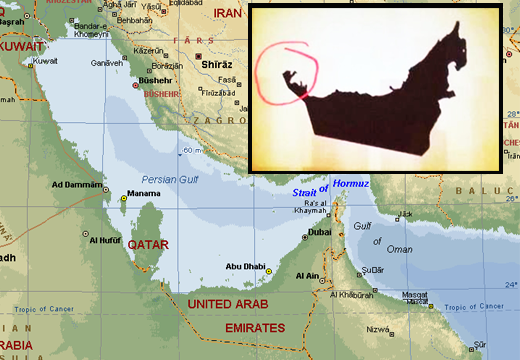
Abu Dhabi has released [new] official topographic maps which display part of Saudi territory as an annexation to the United Arab Emirates.

The Islamic Republic News Agency (IRNA) on September 12 published a report on a border dispute between Saudi Arabia and the UAE quoting the Arabic-language Alwaie News Agency as saying that informed sources in the Persian Gulf have suggested that a crisis is brewing between Riyadh and Abu Dhabi behind the scenes. The following is the translation of the report:

Informed sources in the Persian Gulf, who asked not to be named, further said that Saudi Arabia is insisting on keeping its border dispute with its neighbor unrevealed at a time when the Yemeni question has cast a shadow on the Persian Gulf region. That’s why Riyadh has officially asked Abu Dhabi to explain its annexation of Saudi land without going so far as to lodge a protest.

The rulers in Saudi Arabia have expressed discontent with the UAE’s move at the current juncture, fearing that Abu Dhabi may seek to capitalize on the Saudi embarrassment and its insistence on not provoking any crisis with fellow Arab countries in the Persian Gulf, the same sources added.

Thanks to ongoing military action in Yemen and the possibility that Arabs may put boots on the ground in Yemen, Saudi Arabia is reportedly building on calm, wisdom and prudence to deal with the territorial dispute with its [southeastern] neighbor.

Following the death of Sheikh Zayed bin Sultan Al Nahyan, [the founder of the UAE], Abu Dhabi made its border dispute with Saudi Arabia public, calling for the annexation of part of the border with Saudi Arabia, the sources went on to say.

In response, Saudi officials said that the border dispute has been settled based on an agreement signed between Riyadh and Abu Dhabi in August 1974 [known as the Treaty of Jeddah]. Under the Jeddah agreement, the UAE would keep six villages in the area of Al Buraimi, and Saudi Arabia – in return – would have control over Khawr al Udayd, which spans a 25km expanse of coastal land. This area is home to 80 percent of oil wells in the Shaybah-Zarrarazone which has huge energy reserves: around 15 billion barrels of oil and 650 million cubic meters of gas.

In 1971, Saudi Arabia welcomed the departure of the British forces from the Persian Gulf region, but refused to recognize the United Arab Emirates. Riyadh said it would recognize the UAE if Abu Dhabi accepted to settle its border dispute with Riyadh. Back then, the UAE could do nothing but give up to the demands of the Saudi regime.
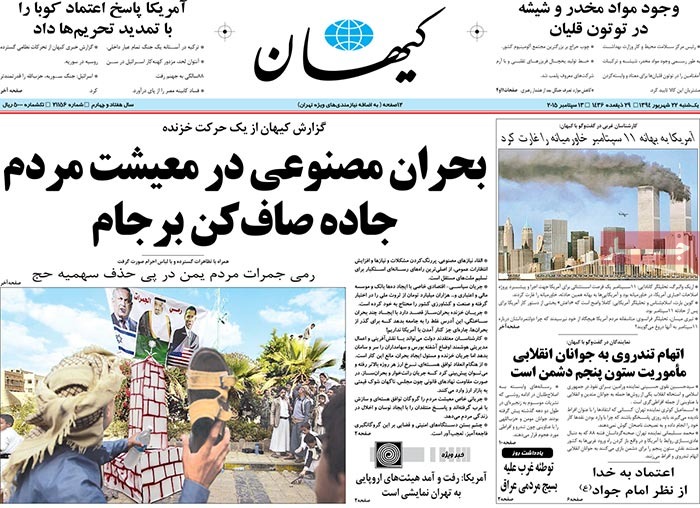
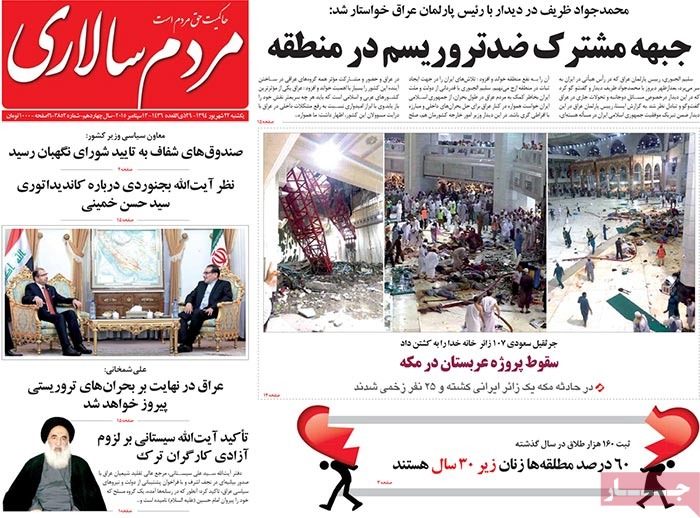
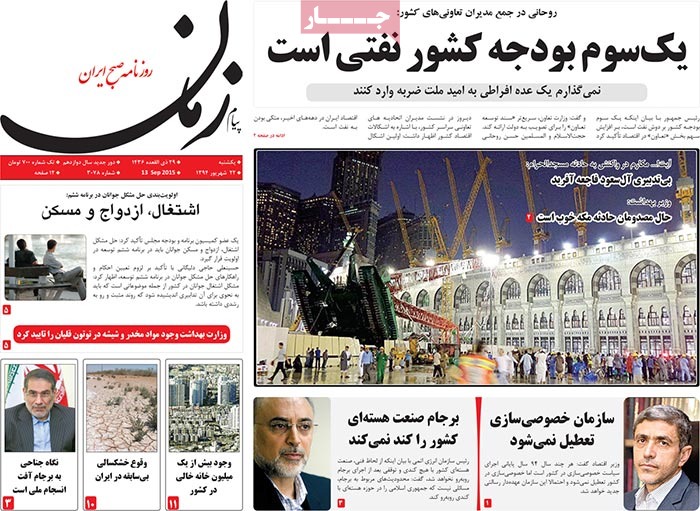
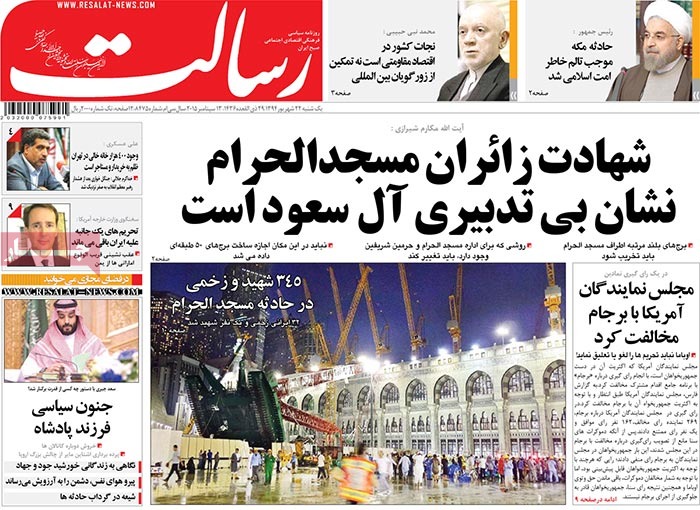
A look at Iranian newspaper front pages on September 13

Iranian Newspapers Headlines

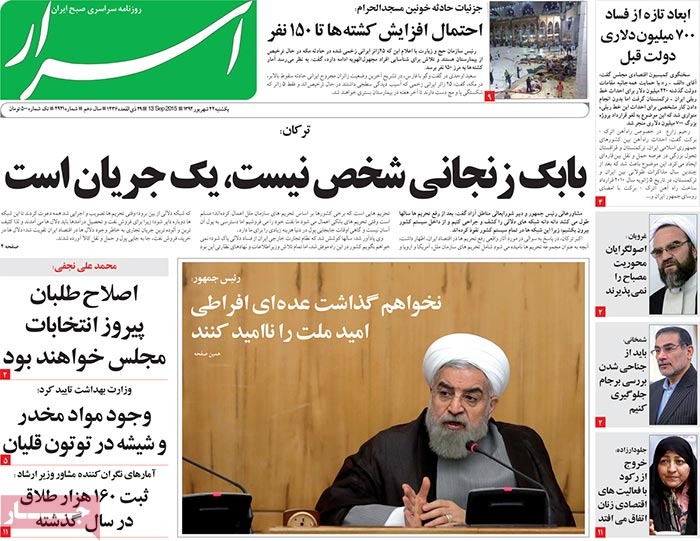
The president’s comment that he would not “allow hardliners to deal a blow to the aspirations of the nation” dominated the front pages of Iranian newspapers on Sunday.


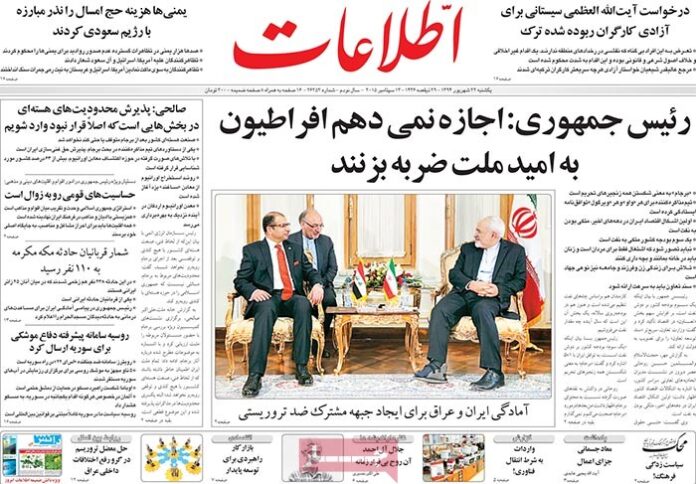
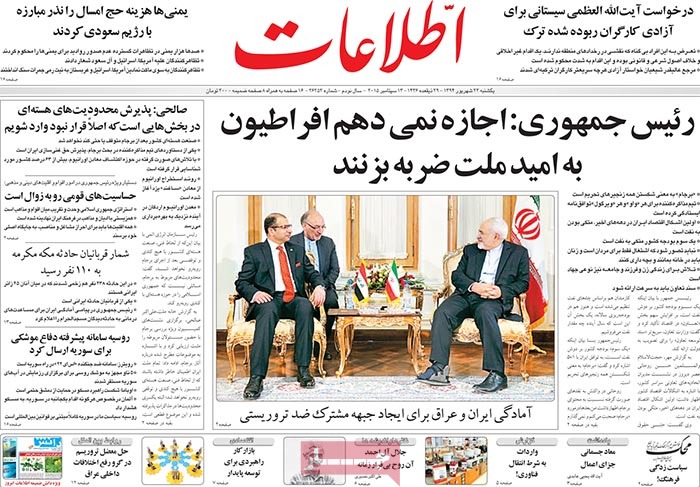
Ettela’at: “I won’t allow hardliners to deal a blow to the aspirations of the nation,” President Rouhani said.

The president further said that the Joint Comprehensive Plan of Action will see the collapse of all links in the chain of sanctions.


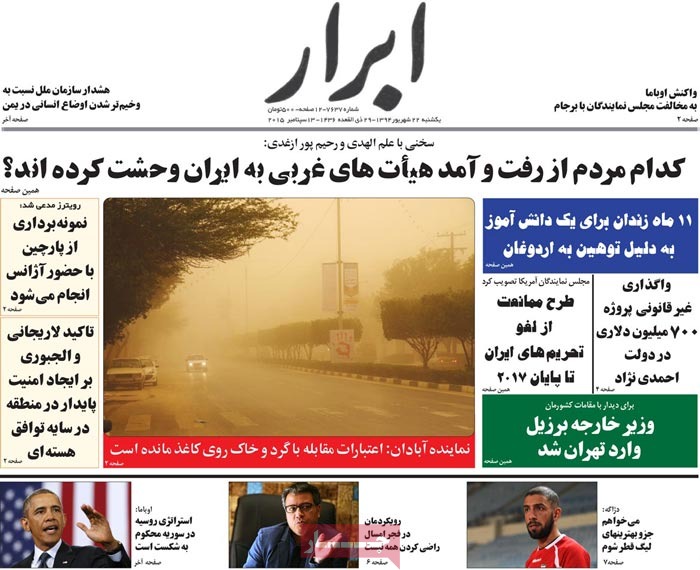
Abrar: The Brazilian foreign minister has arrived in Tehran for talks with Iranian officials.


A look at Iranian newspaper front pages on September 13


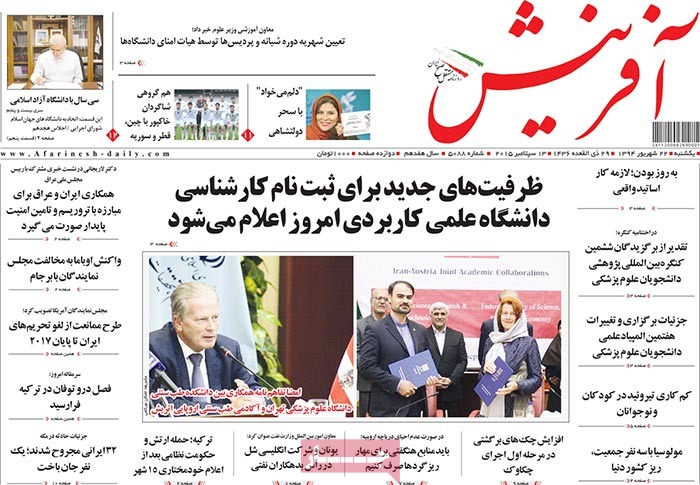
Afarinesh: The Traditional Medicine Department of Tehran University of Medical Sciences has signed an MOU with Austria’s academy of traditional medicine.


A look at Iranian newspaper front pages on September 13


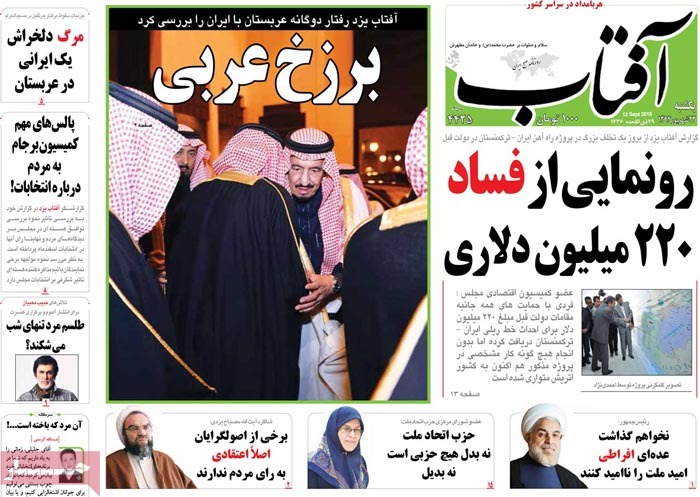
Aftab-e Yazd: A corruption case involving $220 million

The daily features a report on corruption in the Iran-Turkmenistan railway project dating back to the tenure of the previous government.


A look at Iranian newspaper front pages on September 13


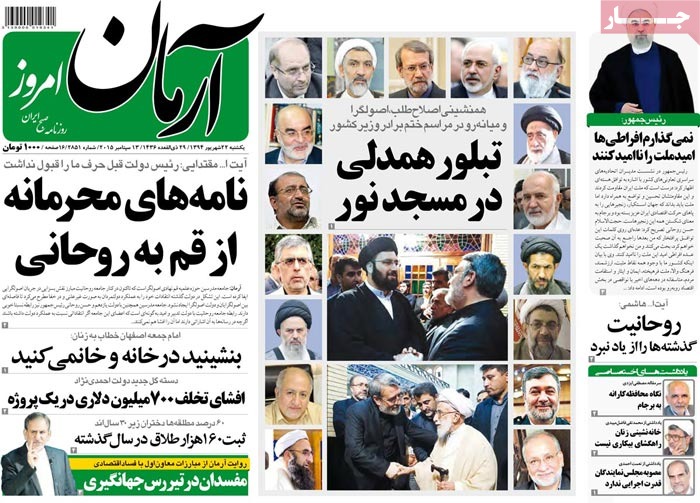
Arman-e Emrooz: Revelation of a $700 million fraud in a project

A new scandal involving the government of Ahmadinejad


A look at Iranian newspaper front pages on September 13


Asrar: The Health Ministry has confirmed reports that there are traces of meth in tobacco used in hookah.


A look at Iranian newspaper front pages on September 13


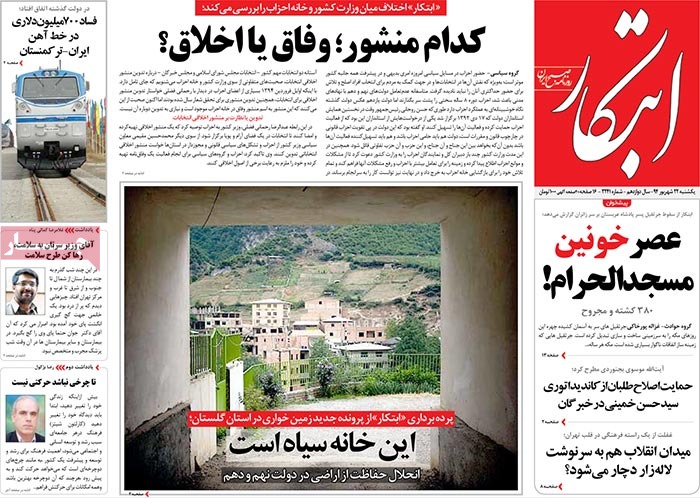
Ebtekar: “Reformists support the candidacy of Seyyed Hassan Khomeini in upcoming elections for the Assembly of Experts,” said Ayatollah Mousavi Bojnurdi.


A look at Iranian newspaper front pages on September 13


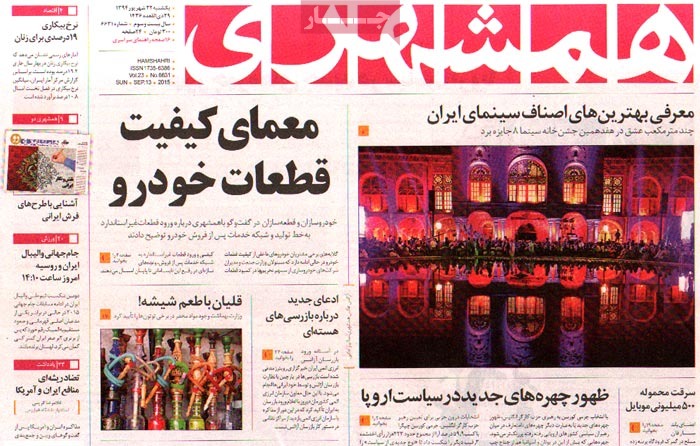
Hamshahri: Police have arrested armed robbers who made off with more than $160,000 worth of brand new cell phones.


A look at Iranian newspaper front pages on September 13


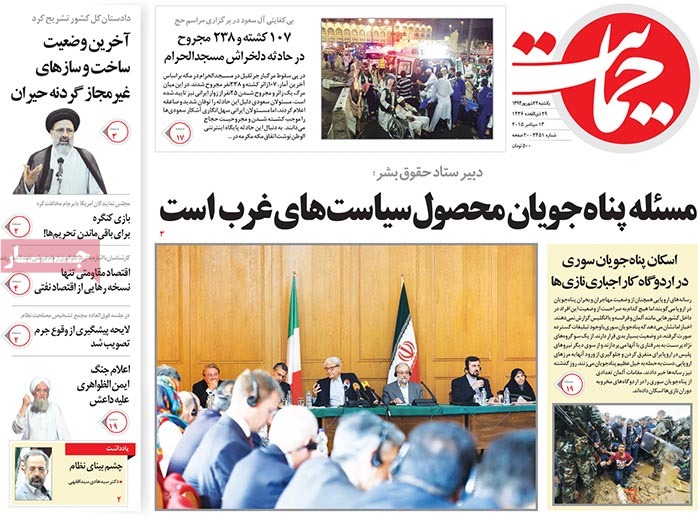
Hemayat: The secretary of the Human Rights Council has blamed the migration crisis in Europe on the policies of the West.


A look at Iranian newspaper front pages on September 13


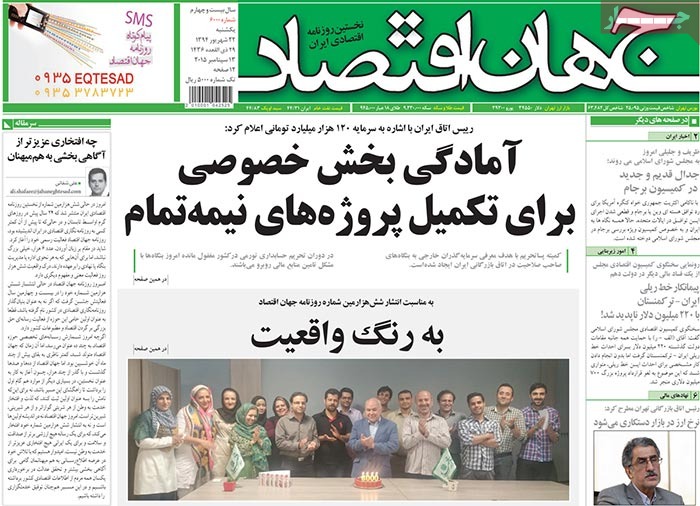
Jahan-e Eghtesad: The private sector stands ready to complete unfinished government projects, said the chairman of Iran Chamber of Commerce.


A look at Iranian newspaper front pages on September 13


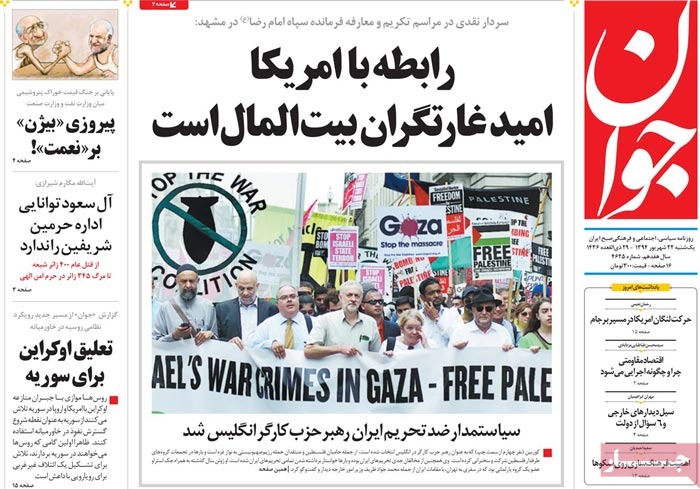
Javan: A British politician opposed to Iran sanctions has been elected leader of the Labour Party.


A look at Iranian newspaper front pages on September 13


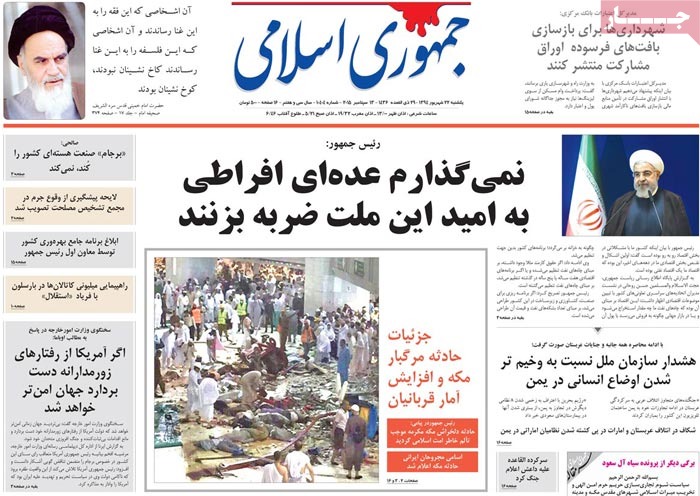
Jomhouri Islami: The Expediency Council has voted for the Crime Prevention Bill.

Jomhouri Islami: The UN has warned about worsening humanitarian conditions in Yemen.


A look at Iranian newspaper front pages on September 13


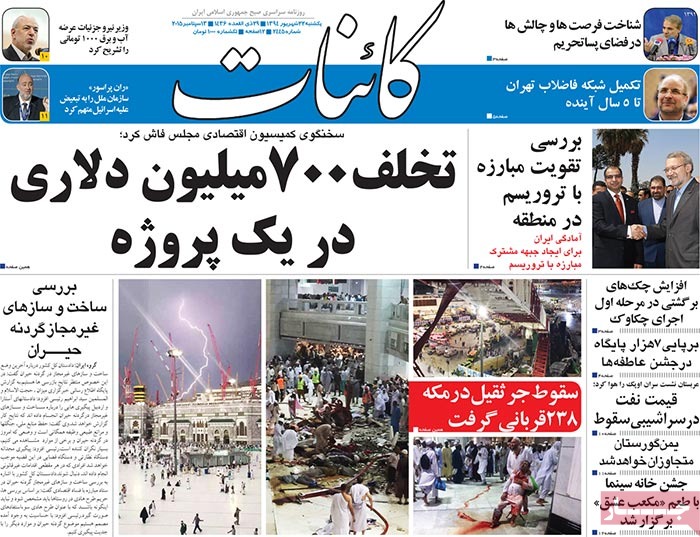
Kaenat: The mayor of Tehran has said that the capital’s sewage system will be fully operational within five years.


A look at Iranian newspaper front pages on September 13


Kayhan: A number of MPs have said allegations that revolutionary youths are hardliners are part of the mission of the fifth column.


A look at Iranian newspaper front pages on September 13


Mardomsalari: There were over 160,000 divorces across the country last year; women under 30 account for 60 percent of divorcees.


A look at Iranian newspaper front pages on September 13


Payam-e Zaman: “A factional attitude toward the Joint Comprehensive Plan of Action would harm national solidarity,” said the secretary of the Supreme National Security Council.


A look at Iranian newspaper front pages on September 13


Resalat: Ayatollah Nasser Makarem Shirazi has criticized the injudiciousness of Saudi authorities [in the deadly crane collapse at the Grand Mosque] and said authorities should not have allowed multistory buildings to be erected near the holy site.


A look at Iranian newspaper front pages on September 13


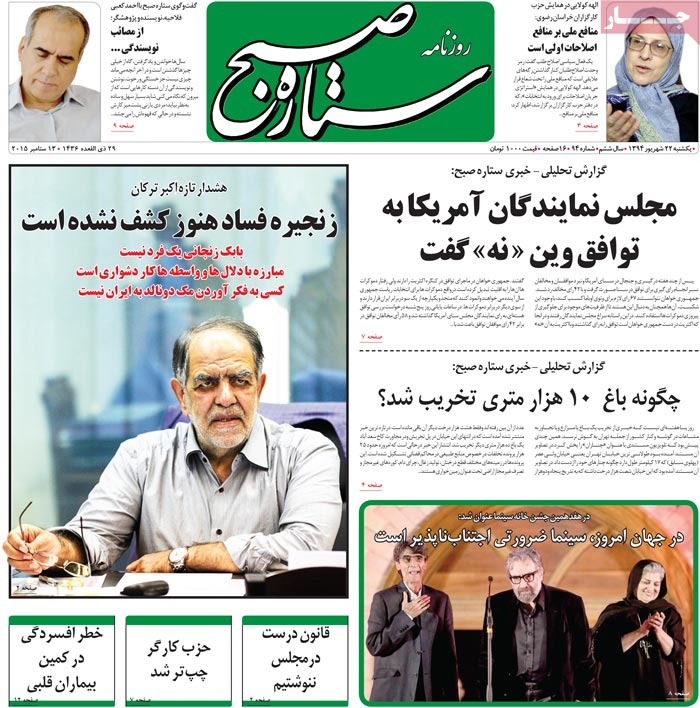
Setareh Sobh: Akbar Torkan, a senior advisor to the president, has warned that the links of the corruption chain have yet to be fully identified.

He admitted that taking on middlemen is no mean feat.


A look at Iranian newspaper front pages on September 13


Highlights of Ettela’at newspaper on September 13

Ettelaat

 “I won’t allow hardliners to deal a blow to the aspirations of the nation,” President Rouhani said.

The president further said that the Joint Comprehensive Plan of Action will see the collapse of all links in the chain of sanctions.

 Iran and Iraq have signaled readiness to form a united anti-terror front.

 Grand Ayatollah Ali Sistani has appealed for the release of kidnapped Turkish workers.

The top Shiite cleric said assaulting innocent individuals who play no role in regional developments is unethical, un-Islamic and condemnable.

 The Yemenis are using the money they were to spend on the Hajj pilgrimage this year to contribute to the war with the Saudis.

Hundreds of thousands of Yemeni people have staged a rally to protest against Saudi failure to issue visas for Yemeni pilgrims.

 The director of the Atomic Energy Organization of Iran has said the nuclear restrictions Iran has accepted cover the areas it was not supposed to wade into in the first place.

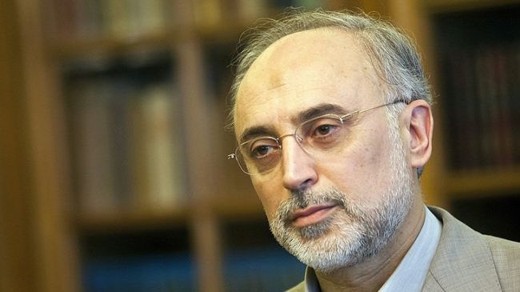
Ali Akbar Salehi further said that implementation of the Joint Comprehensive Plan of Action won’t halt or slow down the country’s nuclear industry.

 “Ethnic sensitivities are on the decline,” said an advisor to the president for ethnic and religious minorities.

“The policy of the Islamic Republic of Iran centers on unity and proximity among all ethnicities and followers of different faiths,” Ali Younesi said.

 The death toll from a construction crane collapse in Mecca has risen to 110.

The Iranian president in a message has expressed Iran’s readiness to offer medical aid to those injured in the deadly accident.

 Russia has shipped an advanced missile defense system to Syria.

The Russian government has said that its Syria policy is in line with international law.


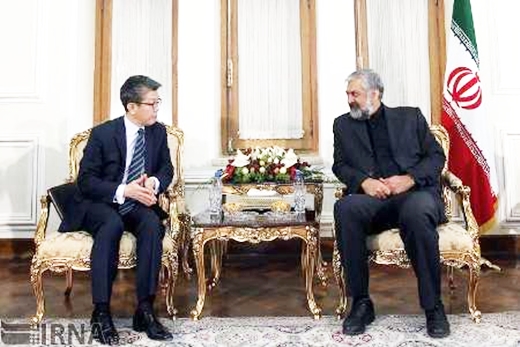
Iran, South Korea underline need for countering spread of terrorism

81757172-70158823

Deputy Foreign Minister Morteza Sarmadi described consultations with South Korean officials as a significant step in line with the two governments’ resolve to counter the spread of extremism and terrorism in the region.

In a meeting with South Korean Deputy Foreign Minister Kim Hong-kyun, Sarmadi said that Iran and South Korea have longstanding ties.

He said that increased political ties and consultations will help discover new areas of cooperation and contribute to investment and transfer of technology as well as strengthening economic ties.

Underlining Iran’s positive role in regional security and stability, he expressed hope that meetings with South Korean officials will help devise a suitable mechanism for joint cooperation in regional and international issues such as countering the spread of extremism and terrorism.

Kim Hong-kyun, for his part, referred to successful results of Iran-P5+1 nuclear talks, and said that his country is keen on development of ties and opening a new chapter in political, economic and cultural ties between the two countries.

He also called for regular political consultations in line with the international campaign against terrorism.

Iran reaffirms commitment to international campaign against terrorism

fararu-news-website-13-237

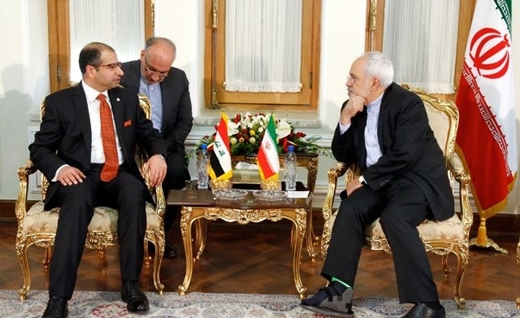
Iran is determined to establish a joint front to counter terrorism and extremism, Foreign Minister Mohammad Javad Zarif said in a meeting with visiting Iraqi Parliament Speaker Salim al-Jabouri.

Zarif expressed hope that regional governments can solve their issues through dialogue.

Underlining the necessity of peace and stability in Iraq and partnership of all Iraqi groups in building the future of the country, Zarif said that Iraq is one of the most influential Arab and Islamic countries that has to regain its status as soon as possible.

The foreign minister said that Iran will stand by the Iraqi government and nation to help solve their internal problems, as well as regional and international problems, particularly in the campaign against violence and extremism.

The Iraqi parliament speaker congratulated Zarif and the Iranian nation on the conclusion of a nuclear deal with six world powers and said the deal would benefit the entire region.

Al-Jabouri hailed Iran’s support for the Iraqi nation, calling on the Iranian government to stand by Baghdad in solving its internal crisis and fighting extremism.

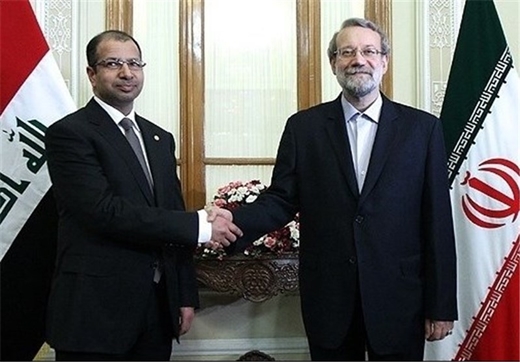
Larijani, Jabouri discuss closer Tehran-Baghdad ties

Larijani-Iraq

Iranian Parliament Speaker Ali Larijani and his Iraqi counterpart, Salim al-Jabouri, held talks on a host of issues, including ways to promote bilateral relations between the two neighboring countries.

The meeting in Tehran on Saturday between Larijani and Jabouri also covered regional and international issues as well as the latest developments in war-stricken Iraq.

Iraqi sources said Jabouri would discuss the national reconciliation plan in Iraq and the fight against terrorists in the Arab country in his meetings with Iranian officials.

Iraq has been facing the growing threat of terrorism, mainly posed by the ISIL terrorist group.

The ISIL militants made swift advances in much of northern and western Iraq over the last summer, after capturing large swaths of northern Syria.

However, a combination of concentrated attacks by the Iraqi military and the volunteer forces, who rushed to take arms after top Iraqi cleric Ayatollah Ali al-Sistani issued a fatwa calling for the fight against the militants, have blunted the edge of the ISIL offensive.

Amid tensions in Iraq, Iran is known as the first country to help the Arab country and has always voiced support for Iraq’s solidarity and prosperity.

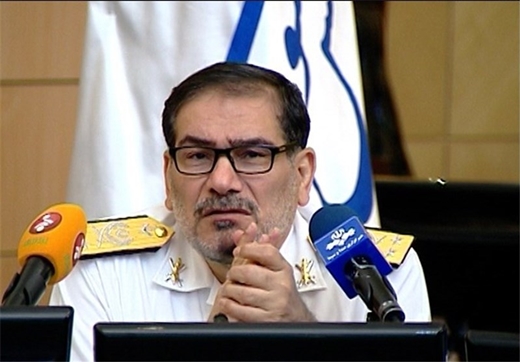
West’s lack of seriousness against ISIL root cause of migrant crisis: Iran’s Shamkhani

Shamkhani

Secretary of the Supreme National Security Council (SNSC) Ali Shamkhani blamed the present refugee crisis on the “lack of seriousness” of the West’s so-called military coalition in the battle against the ISIL terrorist group.

Shamkhani, in a meeting with Iraq’s parliament speaker in Tehran on Saturday, said “suspicious” attempts are underway to employ the acts of terrorism carried out by ISIL in order to keep “insecurity, instability and crisis” in place across the Middle East.

He said the massive exodus of refugees from Syria and Iraq is the result of the West’s lack of seriousness in fighting the ISIL terrorists via a so-called military coalition.

Shamkhani said a surge in the number of refugees arriving in Europe has let the world public opinion know about the pains that the oppressed people of Syria and Iraq have been suffering.

The top Iranian official also expressed confidence that Iraq will ultimately overcome the terrorist crises and regain the regional place it deserves.

For his part, Iraqi Parliament Speaker Salim al-Jabouri thanked Iran for its continued support for his country’s government and nation.

He also said Baghdad is making efforts to prevent recruitments by the Takfiri terrorist groups.

The Iraqi speaker is visiting Iran to hold talks on a range of issues, such as the national reconciliation plan in Iraq and the fight against Takfiri terrorists in the Arab country.

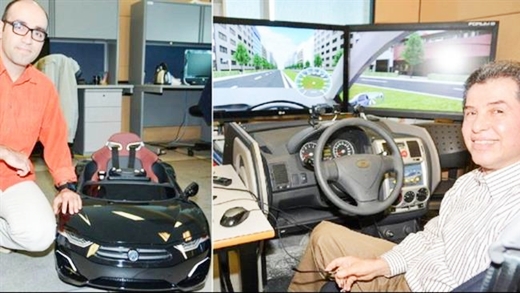
Iranian researchers crafting driverless cars ‘gradually morphing into robots’

car

Two Iranian scientists are revolutionizing research and development in the field of driverless automobiles.

Ahmad Rad, a professor at Simon Fraser University (SFU)’s School of Mechatronic Systems Engineering, is conducting research on driverless cars and advanced driver-assistance systems at SFU’s Surrey campus.

“So maybe automobile is a misnomer,” Rad said during an interview at the Autonomous and Intelligent Systems Laboratory on the campus in Burnaby, in Canada’s British Columbia.

“What we’re seeing now is a paradigm shift, in a sense that the car that we know is gradually morphing into an autonomous robot. The task of a driver will change from driving to supervising the car.”

Rad and PhD student Mehran Shirazi displayed the driving simulator consisting of a car seat with a steering wheel, a dashboard, and—in place of a windshield—three flat-screens showing a city street. Two infrared cameras sit on the dash, facing the driver.

The professor explained that the cameras constitute an eye tracker which discerns where the driver is looking. This system can detect whether a driver is sending a text message, intoxicated, or falling asleep.

Rad’s research team uses Fatal Vision goggles to simulate the impairment associated with particular blood-alcohol concentrations. In the future, he predicted, an automated car will temporarily take over from a distracted driver, and pull over and park or head home if someone is unfit to drive.

“The human is driving the car,” Rad said. “But once it sees that the human is talking (on a cellphone) or sending texts, it will take over. Or, in worse cases, if the car recognizes that this person is drunk, it will take control of the car.”

According to Rad and Shirazi, cars of the future will pair the eye tracker with a front-facing camera. This camera will be used to detect jaywalkers and road signs.

Nevertheless, Rad predicted that fully driverless cars will not become widespread for another 20 years as developing the artificial intelligence required for self-driving cars is a very demanding job.

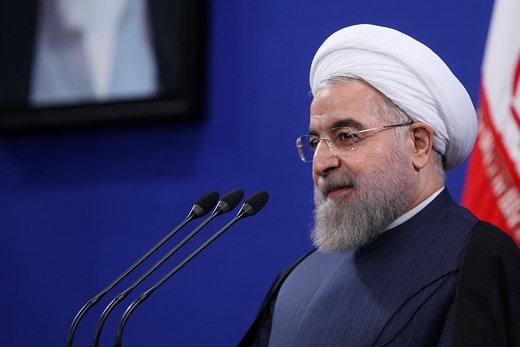
President: Iranian nation to decide oil prices in post-sanction era

Rouhani

President Hassan Rouhani said on Saturday that the great Iranian nation will decide how much oil to sell and where to sell it, to what bank account to deposit its money, and where or how to spend it.

He took a swipe at former President Ahmadinejad for claiming that he deserves to lead the global community which prompted the enemies of the Iranian nation to impose crippling sanctions on Iran.

“Unfortunately, miscalculated measures by former statesmen undermined the prestige and glory of the Iranian nation,” President Rouhani said in a critical tone.

He said that in the past, due to dependence on oil and the outward looking nature of the Iranian economy, others instructed Iran on oil sales and the prices were decided by the market and not by Iranians themselves.

He added that Iran under sanctions had to export only one million barrels of oil and not more, which amounted to a drag on the Iranian nation, dealing a blow to national pride and dignity.

“Our nation has resisted and the resistance of our nation deserves to be praised and be told well done. Our nation should know that the arrogance and the big powers have put shackles on the economic movement of Iran and impeded its progress, targeting its dignity, freedom, trade and sale of their resources. And now, the Joint Comprehensive Plan of Action (JCPOA) means breaking all those shackles,” he said.

“That (JCPOA) is what our national heroes held talks with six major powers around the clock for two years and fought for each word and sentence of it so that context of the deal was achieved. No one can claim throughout history that the context of the deal is inconsistent with the dignity and majesty of Iranian nation. You do see that whole the world and all countries, excluding an illegitimate regime and a number of extremists inside the US, have been humbled by the agreement, viewing it as being in line with international peace.”

Salehi: JCPOA not to pace down Iran nuclear growth

Ali Akbar Salehi

Head of the Atomic Energy Organization of Iran Ali Akbar Salehi said the Joint Comprehensive Plan of Action (JCPOA) will not pace down the development of Iran’s nuclear program.

He stressed that the document will have no adverse effect on the development of Iran’s nuclear program.

The official said the restrictions which JCPOA entails will by no means restrict Iran in its nuclear activities.

He welcomed the sessions the Iranian parliament’s JCPOA Review Committee holds to examine the text of the Iran nuclear deal in the presence of relevant officials and said that such meetings help improve transparency and deflate certain concerns.

He assured people that the Iranian nuclear industry will suffer no slowdown in technical aspects because of JCPOA.

Salehi went on to explain that the restrictions put in place by JCPOA cover areas Iran has no intention of wading into in the coming years.

For example, he said, Iran possesses no platinum, so naturally it has no plans to produce any metals from it either.

One important achievement of the Iranian negotiating team was to make the document guarantee Iran’s right for enrichment which was achieved after 12 years of talks, he added.

The Iranian nuclear chief further stressed that only a few countries have such a right.


As for Iran’s uranium resources, Salehi said reserves in two points of the central province of Yazd have already been spotted which will be exploited soon.