Friday, December 26, 2025
Home Blog Page 4612

Why German FM Came to Tehran Once Again?

The recent visit of German Foreign Minister Frank-Walter Steinmeier to Iran is important both to us and to the European country’s regional policy. A senior official with the German foreign ministry said, “We have rights and interests as much as others do. I think it is the time for Berlin to fulfill its international duties more responsibly. We have shouldered the burden and fulfilled our responsibilities by doing what we could do for Europe within the past fifty years.”


According to a report by the Persian newspaper Ghanoon translated by the Iran Front Page (IFP), the German official did not provide further details on what he described as international commitments and the heavy burden of Europe. However, the increase in Berlin’s diplomatic efforts at the international level, particularly in the Middle East and Persian Gulf, reveals to a great extent the secret willingness of German officials to play the role they believe their country has so far failed or avoided to play.

This German official, who was afraid of reactions to his remarks and spoke on condition of anonymity, added, “Our foreign and defense policy is not supposed to be limited to Europe forever. In the Middle East, the Persian Gulf, and the Arab countries of Africa, there is no bad impression of Germany unlike our allies.”

It is not clear how much the German official’s remarks can be reflective of the views of German authorities. During the past 60 years at least, whether based on the call of its NATO allies or for fear of USSR’s reaction, Germany’s foreign policy (that of the West Germany during the Cold War and the current united Germany) has been mainly focused on economic and technological rather than military diplomacy. It was an efficient and straightforward policy that first turned to a political habit, and then provided Germany with the opportunity to reconstruct its economic and technical infrastructures after the World War II.

As regards the gradual change in Germany’s strategic foreign policy, one can now witness numerous signals indicating that Berlin is getting out of its nearly 60-year cocoon. However, as far as the special policies adopted by Berlin in the Arab Middle East and Persian Gulf are concerned (a completely-classic but forgotten view), the acceleration of Germany’s diplomacy and attempts to play a totally active role in regional political and security developments is no longer an issue to be concealed or denied, or that allies like France and Britain would hinder it through their relative dissatisfaction; especially now that the US seems willing to welcome Berlin’s new role, which will practically lead to further balance of strategic power in the crisis-hit Middle East and now in Persian Gulf.

The surprising capability German diplomats, Foreign Minister Steinmeier in particular, showed during the talks on Iran’s nuclear energy program was well recognized by political observers. Western diplomatic sources as well as the Iranian foreign ministry have noted that back in June and July 2015, in the course of the international community’s negotiations with Iran over its nuclear energy program, Steinmeier played a very constructive role in Vienna talks, which finally led Iran and the Group 5+1 (Russia, China, the US, Britain, France, and Germany) to a common point after several months. At least this could lead Tehran and Washington as the two main sides of negotiations to a common and defendable point through diplomatic goodwill.

The German Foreign Minister arrived in Tehran on February 2 for the second time in less than four months in a bid to pursue his country’s foreign policy based on “acceleration of presence in the region, enhancement of power in Berlin, and extension of influence in Europe”, an approach he considers himself as its architect.

Steinmeier was accompanied by a high-ranking delegation of senior economic and cultural representatives during his Tehran visit. However, given his recent stances after the escalation of tension between Iran and Saudi Arabia, the majority of political and diplomatic sources in Tehran and Berlin believe that, aside from economic cooperation, his trip is mainly aimed at political and security objectives regarding regional issues, Syrian crisis in particular, whose repercussions have deeply influenced Germany. Moreover, it is said that Steinmeier will head for Riyadh after leaving Tehran.

After the traditional tensions between Tehran and Riyadh escalated in early January, Steinmeier described the situation as very deep, and initiated efforts to control the tension and mediate between the two sides. Saudi officials, unlike Iranians, did not welcome Germany’s attempt. Nevertheless, the sensitive conditions in the Middle East, especially the worrying situation in Syria and the conflicts between Iran and Saudi Arabia – which might affect the Syrian crisis and the ongoing Geneva talks – convinced Berlin to follow up on its Middle East diplomacy, especially given the positive view and insistence of the US on the issue.

We can be hopeful about the achievements of Steinmeier’s regional visit. It was said that the German foreign minister “will face new positions and remarks in Tehran”. If it is the case, the story would go beyond Steinmeier’s success on Iran-Saudi ties. Germany would prove to be a more reliable path for Iran in its general diplomacy on Western countries, especially on both sides of the Atlantic.

Iran-Europe Ties: Past, Present, and Future

During President Hashemi Rafsanjani’s term, Iran and Europe held a series of talks referred to as Critical Dialogues. These talks were resumed during President Mohammad Khatami’s term under the name of Constructive and Comprehensive Dialogues. The Critical Dialogues were left unfinished after the Mykonos restaurant assassinations, when European ambassadors left Tehran. The Comprehensive Dialogues also remained unfinished, and were curtailed when the country’s nuclear issue escalated. Now that the nuclear deal (JCPOA) between Iran and world powers has been implemented, we are hearing news of “High-Level Talks” between Iran and the European Union (EU) at the level of deputy ministers, which are scheduled to commence in the coming days.

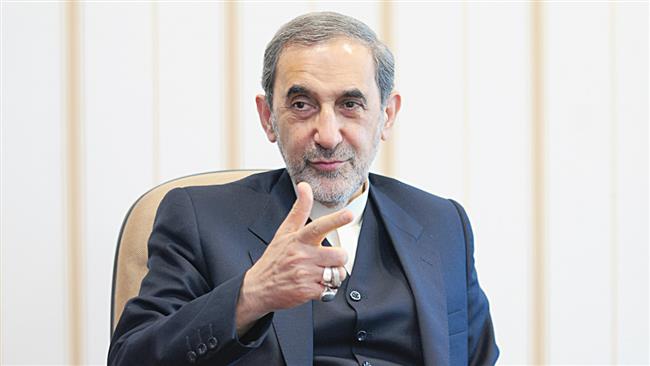
A Fararu reporter held an interview with Dr. Mousavian, who spent more than a decade of his diplomatic life on improving Iran’s ties with Europe, and now has a considerable presence in European conferences and meetings. In this interview, Mousavian was asked about his viewpoint on the current state and future perspective of Iran-EU ties.

Here is the full text of the interview, which has been translated by Iran Front Page (IFP).


Mr. Mousavian, let’s get straight to the questions without any introduction. Since there are fundamental differences between the viewpoints of Iran and Europe on such issues as human rights and terrorism, and as Europe is part of the Western world and a strategic ally of the United States, on what basis one can be hopeful about the future of serious relations [between Iran and Europe]?
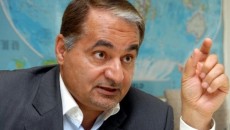
MousavianObviously, we have basic differences of opinion with Europe. However, we should not deceive ourselves; there is no country in the world with which we are in total agreement and accord.

The government of the Syrian President Bashar al-Assad is one of the few Iran considers as a strategic ally. However, the Islamic Republic of Iran has a conflict even with Assad’s government in terms of its most fundamental principle, which is “religious government”. The Syrian government has taken a secular form, both under former President Hafez Assad and now his son Bashar Assad, while the basis of the Islamic Republic is a religious ruling system. Under Bashar’s government, Islamic hijab is not compulsory, dancing and use of alcoholic drinks are permitted, and so on. This shows that we should admit that we have to move forward in our foreign relations, based on national interests. Regarding ties with Europe, if we consider them as being based on national interest, we would like to be able to achieve “balanced and sustainable ties” at most, but not “strategic ties.”


Those “balanced relations” that you mentioned – are they the implication of President Hassan Rouhani’s recent visits to Italy and France?

No, President Rouhani’s trip was an excellent start for breaking the ice in the previously frozen Iran-Europe relations. The move is a great starting point.

In fact, because of deep ideological differences, Iran and Europe have conflicting opinions on such issues as human rights, terrorism, Israel, and the like. These differences will remain until the reappearance of Imam Mahdi, unless the nature of the Islamic Republic ruling system changes or Europeans convert to Shiite Islam, neither of which is going to happen. There won’t be any change in the nature of Islamic Republic, and the Europeans wouldn’t convert to Twelver Shiism. Even if Europeans convert, I fear they would act like our neighboring Shiite country, Azerbaijan, which has always been a US ally.

Even if Europeans become Muslims, we would not have strategic ties, because the history of our foreign relations after the 1979 Revolution has shown that our problems with certain Muslim states like Saudi Arabia have not been improved, and may even have got worse than those we have with Westerners. Within the decade before the nuclear deal, the Saudis became an ally of the Israelis, and put unprecedented pressure on the US to launch military attacks on Iran. However, the Europeans kept advising Washington against waging war on Iran.


Mr. Mousavian, as we’ve talked about, there are basic differences between the viewpoints of Iran and Europe on such issues as human rights and terrorism. How is it possible to achieve the “balanced and sustainable relations” that you mentioned, so that the new dialogues will bear fruit, unlike previous ones? Deputy Foreign Minister Majid Takht Ravanchi is going to start the negotiations soon. What is your suggestion?

We have had unstable relations with Europe since the Revolution. During the eight years of war Iraq imposed on Iran, many Europeans leaned towards Saddam Hussein. After the war, we started the critical dialogues with Europe to rebuild relations. I was the one who agreed upon their basis with Europe during a trip to Dublin in 1990, which was then the president of the Council of the European Union. At that time, I was the director-general of relations with Western Europe, and met the European troika (incumbent, preceding, and successor presidencies) for the first time. Later, we raised the level of negotiations to deputy ministers, after which Mr. Vaezi held responsibility for the talks for some years. In the last years of President Hashemi Rafsanjani’s term, the talks were ended due to a Berlin court’s verdict on the assassination of Kurdish leaders in a Mykonos restaurant.

After a while, the talks were resumed under the reformist administration, and there was the potential for a change from “critical dialogues” to “constructive dialogues.” However, the exacerbation of US hostility toward Iran prevented that from happening, because George W. Bush held extreme anti-Iran stances. Later, under the administration of Mr. Ahmadinejad, our ties with Europe were totally destroyed.

However, the situation is different now under President Rouhani’s government. It is now possible to establish some kind of strategic dialogue in a bid to achieve “balanced and sustainable ties” with Europe.

This goal, however, requires six basic conditions:

1. A national political will and consensus is needed within the country on the type of relations we want to have with Europe. The SNSC should determine and approve the minimum, maximum, content, and other aspects of these relations. If these are deemed suitable by the Leader of the Islamic Revolution, the foreign ministry should start the negotiations with a specific plan and goal, so that once a deal is reached, we would not get engaged in domestic controversy and conflict, or, God forbid, we would not challenge the deal.

2. We should accept the fact that the anti-Iran domestic consensus in the United States is broken. No party in the US believes in “regime change” in Iran any longer. They believe in mutual interaction with Iran. However, there are still people inside the country who wish to play good-cop, bad-cop in the US.

3. For the new strategic talks with Europe to succeed, the Islamic Republic of Iran should be able to control the trend of decreasing tension with the US, and also to maintain the current gap between the US government and its elites on the issue of Iran, so as to prevent another anti-Iranian domestic consensus within the US. In the best-case scenario, Iran could turn the oppositional sides within the US into minimal and neutral forces. However, I don’t see such a chance given the current circumstances in Iran.

Maintaining the existing gap requires consultation and dialogue with a US party that believes in working with Iran. The clear example is what President Rouhani did recently, under the Leader’s supervision, in the cases of the nuclear deal (JCPOA), prisoner swaps, the release of the US sailors, and in claiming the $1.7 billion the US has owed to Iran for 37 years. Europeans should also follow that lead. During the nuclear negotiations, Europeans established active lobbies in the US.

If this trend goes on, not only will the hostility between the US and Iran decrease, but also the gap in the US would persist, and can be further widened; especially given the fact that all current US presidential candidates have vowed to take much stricter policies than those of Barack Obama.

Maintaining the gap which already exists in the US would allow Europe to develop its cooperation with the Islamic Republic.

4. Iran and Europe should engage in multipurpose dialogue which includes both areas of conflict like human rights, and common interests like Daesh (ISIS), WMD (Weapons of Mass Destruction), a Free Middle East, and the fight against illicit drug trafficking. The two sides should both negotiate and instigate operational co-operation at the same time. Such a development would lead to an “Iran-Europe Political-Security Partnership” on issues related to regional and international peace, stability, and security.

The weak point in Europe’s past ties with Iran was that Europeans, under US pressure, would only negotiate on areas of conflict, and wouldn’t co-operate with Iran on areas of mutual interest.

During my mission in Germany, thanks to the support provided by Deputy Foreign Minister Mr. Vaezi, Foreign Minister Mr. Velayati, SNSC Secretary Mr. Rouhani, and President Hashemi Rafsanjani, we held very important talks with the German Chancellery. Rouhani, Velayati, and Vaezi even held personal meetings with the then-Chancellor, discussing these issues specifically. Chancellor Helmut Kohl also accepted such co-operation, but we were surrounded and defeated by a four-sided problem.

The first side was US opposition. Kohl raised the issue of co-operation with Iran during two of his visits to the US, but the White House didn’t accept it.

The second side was the heavy pressure exerted by Israelis.

The third side was the negative role Britain played in the restoration of Iran-Germany ties.

And the fourth side was provided by incidents as the separate assassinations of Kurdish leaders in Berlin, former Iranian Prime Minister Shapour Bakhtiar (the last one under the Shah), and the famous Iranian poet and entertainer Fereydoun Farokhzad in Bonn, as well as the confiscation of a Germany-bound mortar shell cargo in the Belgian port city of Antwerp. This, and many other similar cases, every now and then would ruin any new progress in Iranian-European relationships like a bomb. The US and Israel would also take advantage of such incidents to increase their negative propaganda against Iran’s relations with Germany and Europe.

5. We should avoid such provocative measures as the 2011 attack on the British embassy in Tehran, Holocaust denial (under ex-president Ahmadinejad), and the recent attack on the Saudi embassy. If the culprits behind such attacks are not detained, they must at least be controlled. And, if they are agent provocateurs, they should be countered. Of course in this case, the Europeans should also avoid provocative issues. A clear example was the case of Salman Rushdie, who insulted the tenets of Islam and 1.5 billion Muslims, but who was repeatedly invited to prestigious events and given awards. Whenever we talked about that case, they would raise the issue of freedom of speech. I told Europeans that you don’t consider freedom of speech whenever you arrest people for denying the Holocaust, which you regard as a crime. Therefore, you should also criminalize any insult to divine religions, such as Islam, Christianity, and Judaism, in the same way.

6. Finally, the economic ties between Iran and Europe should be promoted from “surface-level trade” ties to “deep industrial and economic” ties, in which the focus is on joint ventures, energy partnerships, joint presence in regional markets, and the like. To achieve this goal, Iran has to sign trade agreements with the EU and join the World Trade Organization (WTO).

Iran, Russia to enforce $40bn deals

The announcement was made by Ali-Akbar Velayati, a top adviser to Iran’s Leader Ayatollah Seyyed Ali Khamenei, at the end of his visit to Moscow. Velayati emphasized that the contracts had been signed with Russia over the past few months and are ready to be implemented.

“Our contracts concern generation of nuclear energy, construction of phases II and III of the nuclear reactors [at the Bushehr nuclear power plant], of new power plants and railway networks,” he said.

Velayati said he had discussed the projects in a meeting with the Russian President Vladimir Putin.  He added that he had also discussed several regional developments, particularly the crisis in Syria, in his meeting with President Putin.

The official further said that Iran and Russia have agreed over several other key issues including easing visas and sales of oil. He said both countries have agreed to introduce a softer visa regime between the two countries starting from 6 February.

Iran is contemplating a possibility of selling oil to Russian oil company Rosneft, said the former Iranian foreign minister.

Cooperation over purchases of weapons was another key area which Velayati said he had discussed during his stay in Moscow.

“Iran wants to buy more weapons from Russia, and Russia wants to respond positively to this sort of request,” he said when asked if Iran was going to buy S-400 missile systems.

Elsewhere in his remarks, Velayati emphasized that Russia’s President Putin has voiced support for Iran’s full membership in Shanghai Cooperation Organization (SCO).


Iran, Britain to resume issuing visa soon: Zarif

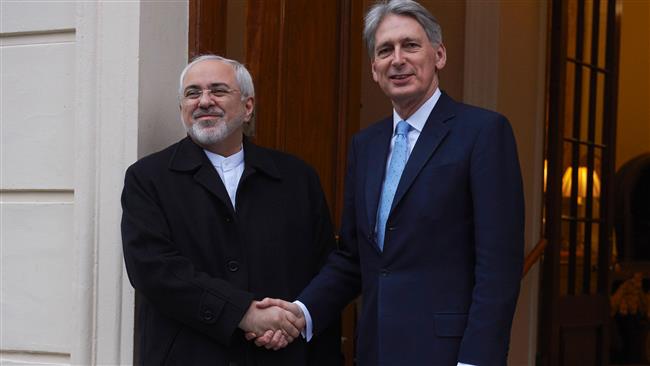
Zarif made the remarks while speaking to reporters in London on Friday after a 1.5-hour meeting with Britain’s Foreign Secretary Philip Hammond on the sidelines of a donor conference on Syria.

“In the meeting, we agreed that the two countries start issuing visa for ordinary citizens and ordinary passports within weeks,” the Iranian minister said.

“We believe that this measure is a positive move for further exchanges between the two countries’ people and we hope that it will be conducive to a better mutual understanding,” he added.

On August 23, 2015, the British foreign secretary attended a symbolic ceremony marking the reopening of the UK embassy in Tehran.

Britain shut down its embassy in Tehran in November 2011 and withdrew its diplomatic staff after hundreds of Iranian students staged a protest outside the UK embassy in Tehran against the expansion of London sanctions on the Islamic Republic, pulling down the UK flag and demanding the expulsion of the British ambassador.

Nearly two years after their diplomatic ties were severed, Iran and Britain agreed in October 2013 to appoint non-resident chargés d’affaires as a first step toward reopening embassies.

Also in his remarks, the Iranian foreign minister said he raised bilateral cooperation in banking, economic and investment sectors as well as regional issues with his British counterpart.


A look at Iranian newspaper front pages on Feb 4

Iran Newspaper front pages

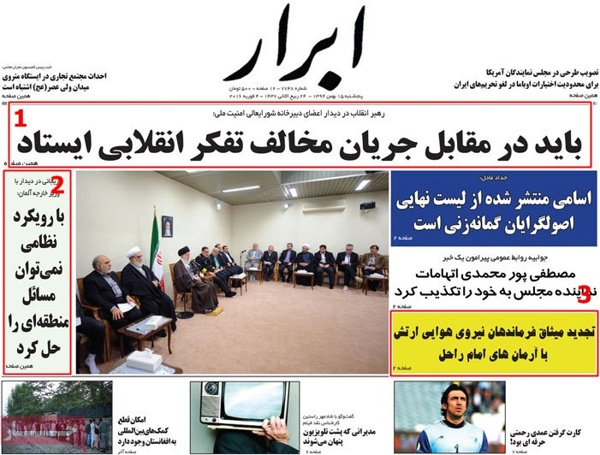
Abrar:

1. Leader calls for standing up to anti-revolution thinking current

2. Majlis Speaker to visiting German FM: Military approach no solution to region’s problems

3. Air force commanders renew allegiance to Imam Khomeini’s ideals


abrar


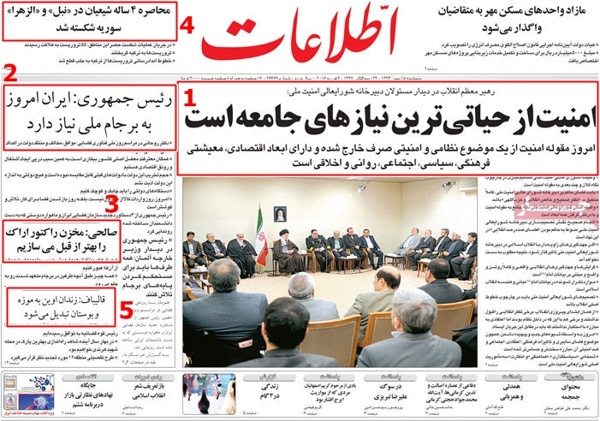
Ettela’at:

1. Leader to Supreme National Security Council: Safety one of society’s most vital necessities

“Today, the issue of safety is no more a mere military and security matter; rather it entails economic, lifestyle, cultural, political, social and psycho-ethical dimensions,” said the Leader in a Wednesday meeting with secretary of the SNSC and its secretariat’s staff.

2. President Rouhani: National JCPOA needed in Iran

3. AEOI Chief: Iran to rebuild Arak Reactor better than before

4. 4-year seige of Shia Muslims in Aleppo’s Nubl, Al-Zahra ended

5. Mayor: Tehran to transform old prison (Evin) into museum, park


etela'at


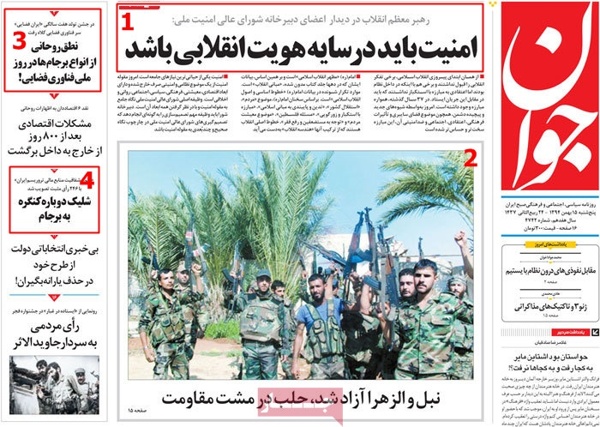
Javan:

1. Security must be under the shadow of revolutionary identity: Leader

2. Nubl, Al-Zahra freed, resistance contains Aleppo

3. Rouhani speaks of various JCPOAs on national day of Space Technology

4. For second time, Congress OKs bill targeting Iran nuclear deal


javan


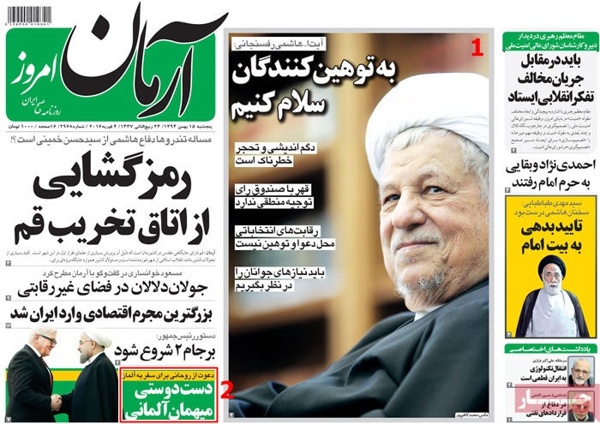
Arman-e Emrouz:

1. Ayatollah Hashemi Rafsanjani: Let’s salute insulters

Rafsanjani: dogmatism and ossification is dangers

Turning backs to ballot boxes not logically justifiable

Election campaigns no place for infighting, abuse

Needs of the youths must be considered

2. German guest shakes hand of friendship with Iran

Rouhani invited to visit Germany


arman


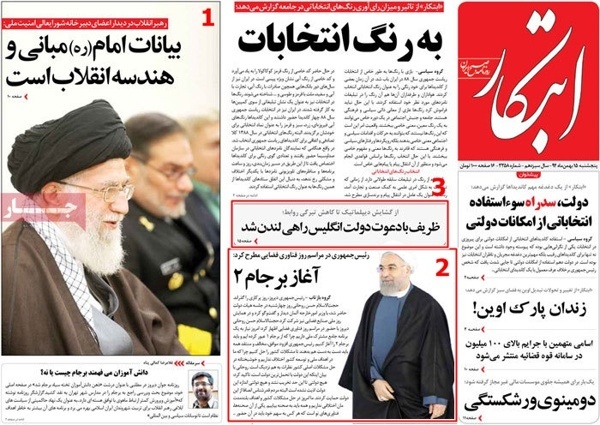
Ebtekar:

1. Imam Khomeini’s words, basis, geometry of revolution: Leader

2. Start of 2nd JCPOA [Iran is putting Joint Comprehensive Plan of Action as a model for a national version of the plan.]

President Rouhani addressed a ceremony marking National Day of Space Technology on Wednesday, and called for what he believed was a second JCPOA, this time, calling it ‘Joint Comprehensive National Plan.’

“We have put JCPOA 1 behind and must set off walking in the path of the second JCPOA,” he said.

“All the nation, including critics, government supporters and [even] the opposition must join hands to help solve the country’s problems.”

3. FM Zarif heads to London at UK’s invitation


ebtekar


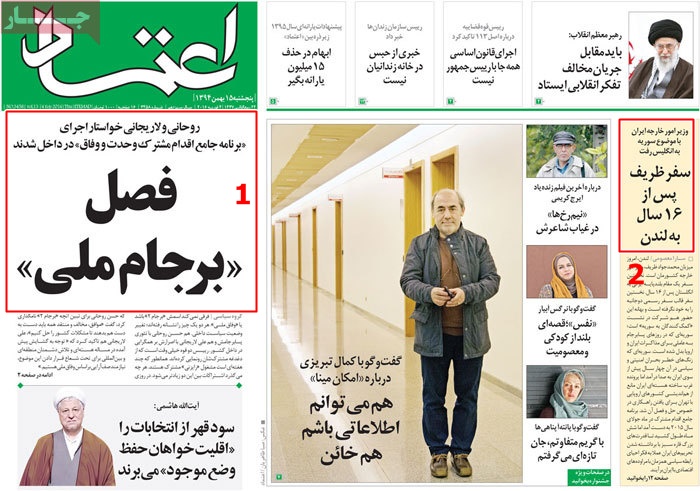
Etemad:

1. National JCPOA season

Iranian President Hassan Rouhani and Majlis Speaker Ali Larijani have called for implementation of the Joint National Comprehensive Plan of Unity, Consensus

2. Iran FM to visit London after 16 years


etemad


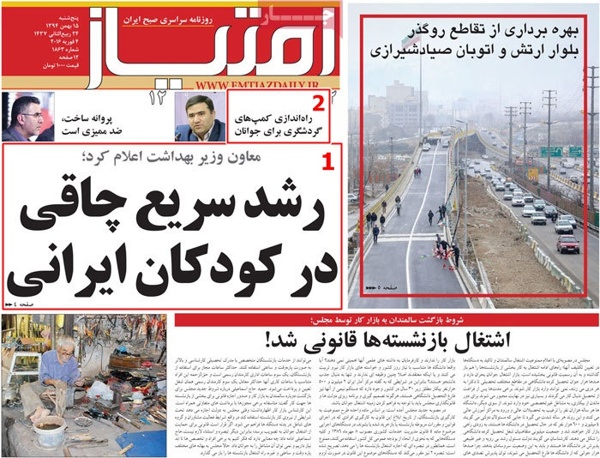
Emtiaz:

1. Deputy Health Minister warns against growing rate of obesity in Iranian children

2. Sightseeing camps for youths launched


emtiaz


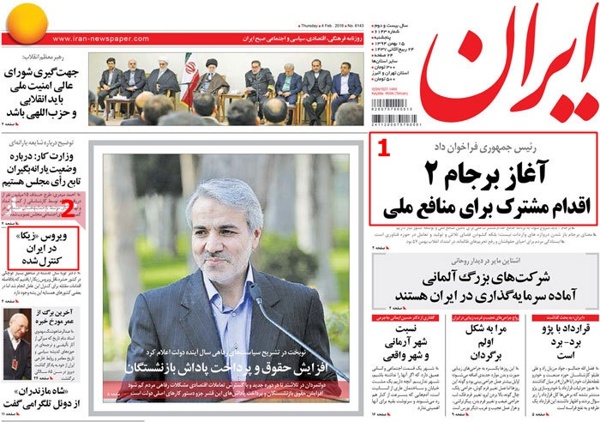
Iran:

1. Major German firms bracing for investment in Iran: Frank-Walter Steinmeier, former vice-chancellor of Germany, to President Rouhani

2. Zika virus controlled in Iran


iran


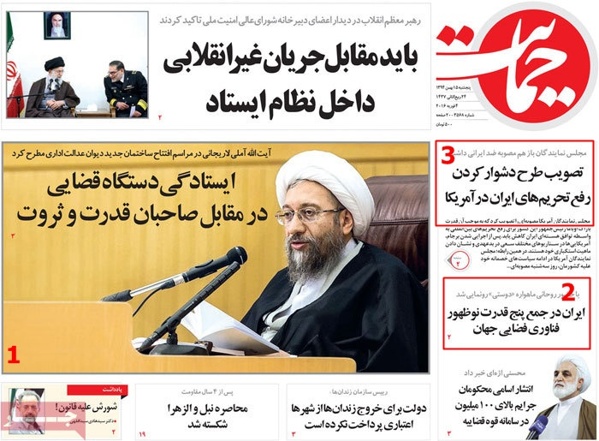
Hemayat:

1. Judiciary resistance against those in power, wealth

2. Free Iran, Thailand trade

3. Qeshm, Iran’s new gas hub


hemayat


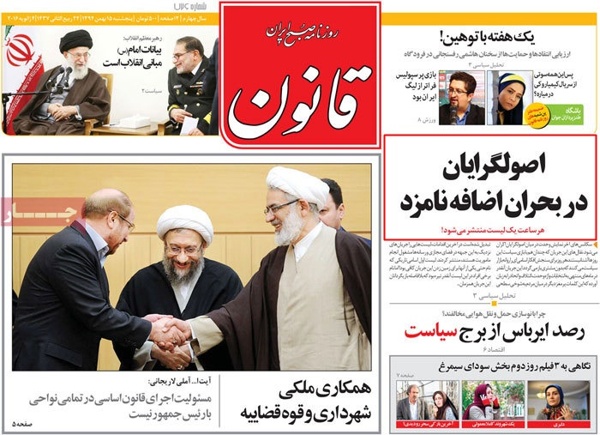
Ghanoon:

 Principlists faced with crisis of candidate surplus


ghanon


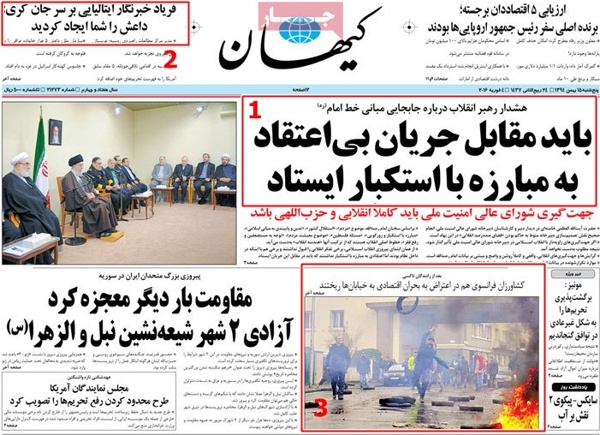
Kayhan:

1. Leader warns against dislocation of Imam Khomeini’s principles

Leader calls for standing up against anti-resistance current

2. You made ISIS: Italian reporter shouts at Kerry

3. After French taxi drivers, farmers pour in cities to protest economic crisis


kayhan


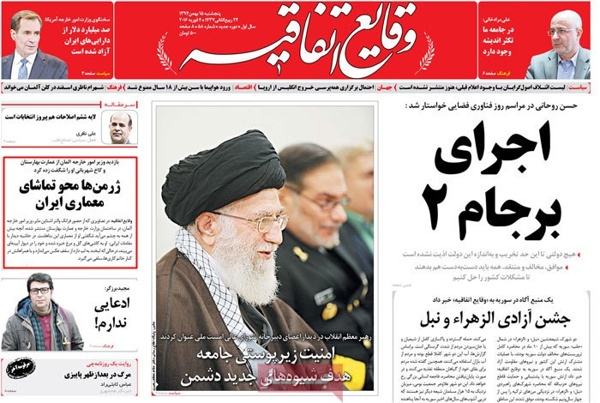
Vaghaye Etefaghiyeh:

– Germans stunned by Iranian architecture

German foreign minister said he was astounded by the architectural beauties of Baharestan and Shahrbani palaces in Tehran.


vaghaye etefaghiye


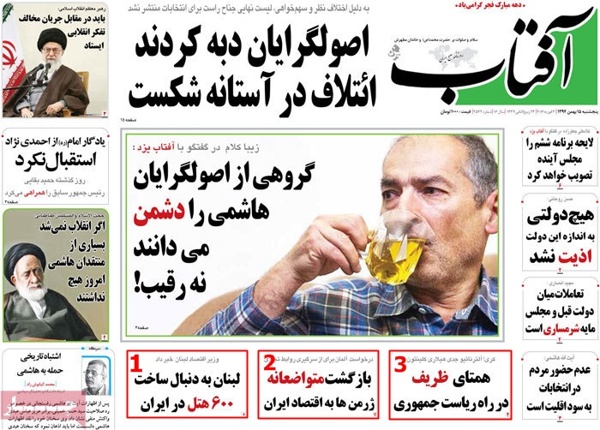
Aftab-e Yazd:

1. Lebanon: Beirut planning to build 600 hotels in Iran

2. German’s modest return to Iran economy

3. Zarif opposite number en route Presidential Palace

Kerry, serious Hillary alternative


aftabe yazd


“I Didn’t Imagine Iran Being Open-Minded to This Extent”

“I have read Ayatollah Khamenei’s letter to western youth, and that’s exactly why I’m in Iran at the moment. I want to draw the attention of the world’s Christian believers to a country which has a peaceful and charitable face. I believe that when world leaders’ minds and hearts have failed, the feet and hearts of pilgrims can surely lead the way to peace.”

The Supreme Leader’s letter to western youth was published around two months before the recent terrorist attacks in France, after the publishing of some offensive photos which disrespected the tenets of Islam in a French magazine, and as a response to rising Islamophobia from the western media and authorities. Later, this was followed by the Iranian President’s trip to the Vatican, where he met the global Catholic leader to emphasize spreading peace and avoiding violence and extremism. Now, a delegation from the Vatican and Italy have traveled to Iran to take a further step, beyond mere dialogue, in ridding the world of violence.

The Vatican and Iran have arrived at the belief that they can spread religious friendship and peace throughout the world by “tourism”.

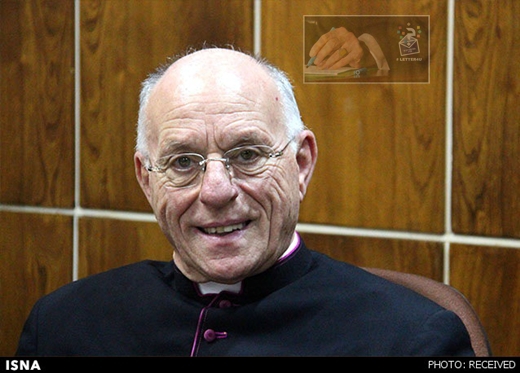
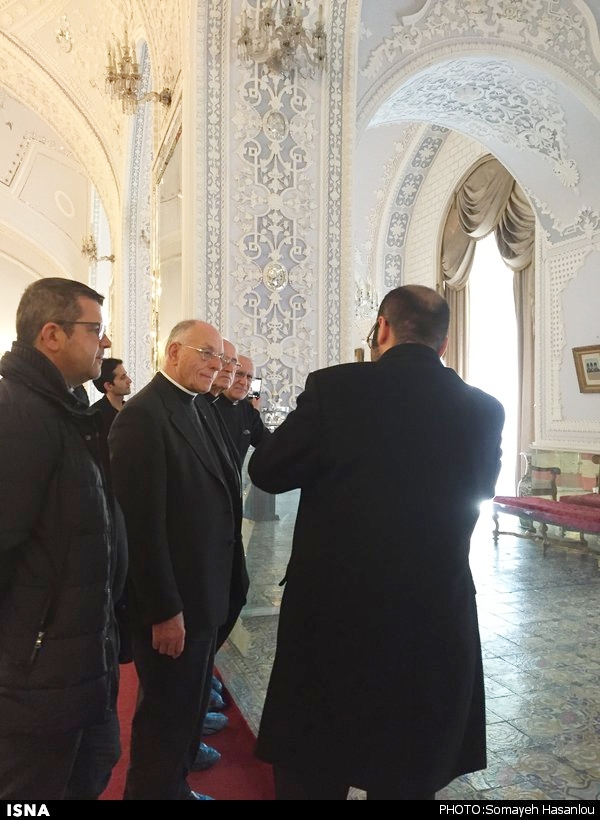
Vatican Representative Bishop Mosnignor Andreatta, head of the Opera Romana Pellegrinaggi (ORP), the Vatican-related pilgrimage agency, in his interview with an ISNA tourism journalist during their visit to Si-e Tir street (an old street in Tehran city centre which is famous for keeping holy places of different religions including Zoroastrians’ fire temple, Armenian church, the Polish church, mosque and synagogue), called the Christian believers who will travel to Iran, “Witnesses of Peace.” He said, “Our pilgrims are believers who have spent a great time of their life praying. My interpretation is that they will be witnesses for peace. I believe that when world leaders’ minds and hearts have failed, the feet and hearts of pilgrims can surely lead the way to peace.”
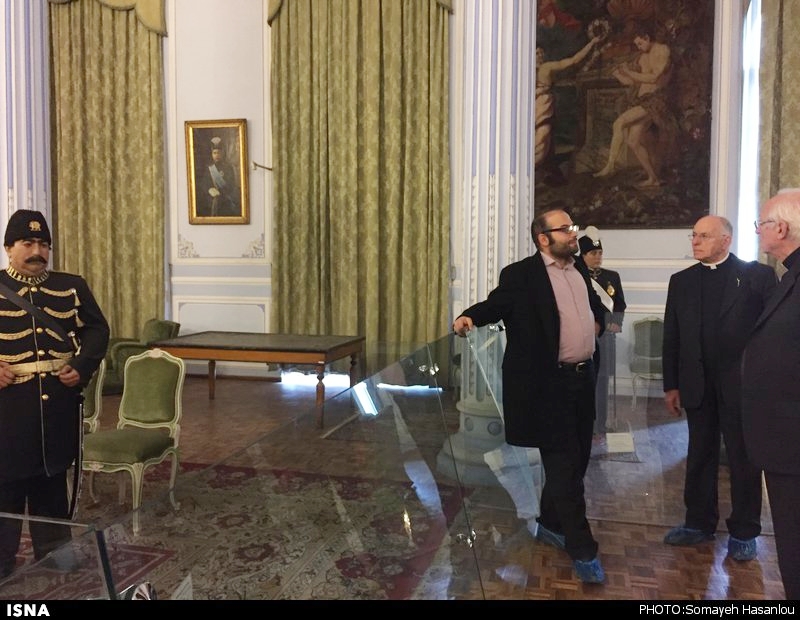
The first steps of the mission for the messengers from the Vatican and Rome are the consolidation of friendship and peace, and bringing Christianity and Islam closer. Then, in the next step, they wish to plan pilgrimage and tourist trips to Iran for the world’s Catholics, especially those from the Vatican and Italy.

Bishop Andreatta stated, “The level of Iran and the Vatican’s relations and interactions is currently at its historical best.”

He highlighted the years of dialogue between the Vatican and Iran, saying “Today, we are witnessing the blossoming of that dialogue. Our goal is to restart European, and especially Italian, pilgrimages to Iran, which were suspended for a time, through Vatican management and planning.”


The Definition of Islam, as Put Forth by Ayatollah Khamenei

The head of the ORP was posed the following question: “Based on the high level of terrorist acts, and the consequent increase of global Islamophobia, how much do you believe that creating a wave of tourism between Christianity and Islam can lessen the spread of Islamophobia, and help in making a world without violence?”

He answered, “There has been a lot of talk in European and Italian media about the general idea of Islam, and, because it has often been accompanied by violence and terrorism, unfortunately Islam has turned into a metaphor for violence and terrorism. This is exactly why we insist on running these tours from Europe and Italy to Iran, so that people can see a different face of Islam in a country like Iran with their own eyes. A peaceful face, where people of different beliefs and religions live next to each other in peace and stability.”

Leader Message
The Islamic Revolution Leader writes a letter to the youth of the West

Andreatta then mentioned the Supreme Leader’s letter to western youth, and also the recent meeting of the Pope and Hojatoleslam Hassan Rouhani, commenting, “This is exactly the reason we are in Iran at the moment. Firstly, because of Ayatollah Khamenei’s letter, which was given to us by Iranian authorities in Italy. I read this letter, and through the Vatican we sent it to all the universities and Christian youth organizations in Italy, so that they could read it and realize there’s an interpretation of Islam that presents itself in this format. The other motivation for this trip was the recent meeting of the Pope and President Rouhani, in which both sides were agreed on combating evil, violence and war.”


I Didn’t Imagine Iran Being Open-Minded to This Extent

The head of the Opera Romana Pellegrinaggi and his three companions from a Rome-based pilgrimage organization, were moved by people’s attitudes, men and women socializing, the urban architecture, historical sites and the liberal lives of different religions next to each other in Iran. They mentioned their surprise in their interview.

Vatican Representative Andreatta said: “It is true that I have studied a lot about Iran before, and knew that Iran was not the country that the western media have portrayed to us, but still, after we arrived, I realized how strongly we’ve been affected by the media.”
He continued: “Even with all that information, I was highly impressed by encountering Iran up close. I didn’t imagine Iran being so open-minded, and ready for interaction with the world to this extent. I can see how much people believe in connecting with the world, and that they have realized that tourism can be a great help to their country’s economy. These are all signs of Iranian awareness and their open mentality. I am really impressed – I never thought Iran would be like this.


Well-known Italian Journalists Writing on Iran

Bishop Andreatta later described his plan for tourist interaction with Iran, saying “After returning to the Vatican, we will create a common project with the collaboration of the Ministry of Culture and Relations and the Hajj and Pilgrimage Organization authorities, to plan a trip for a group of well-known Italian journalists and the managers of developed pilgrimage agencies who run tours from Italy to different holy places in the world, so that they can see the attractions and beauties of Iran. Each of them can lead several groups from Italy or other European countries to Iran and organize itineraries for them.”

According to the statistics given to the ISNA by the head of the Opera Romana Pellegrinaggi (ORP), every year 50,000 pilgrims travel to different destinations around the world from the Vatican. The number of pilgrims whose plans are influenced by Vatican advice can sometimes exceed 100,000 each year.

Interview by Somayyeh Hasanlou – ISNA

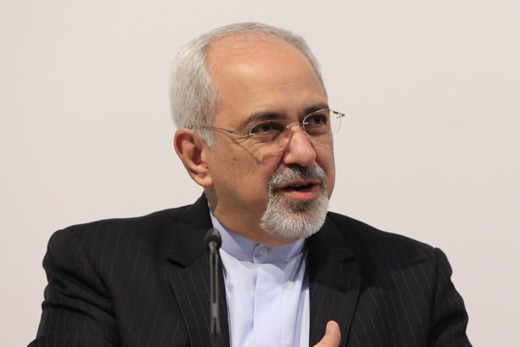
Zarif: London conference on Syria good opportunity to outline Iran plans

Iran FM Zarif

‘The conference will provide Iran with an opportunity to express its position on the Syria crisis,’ said Mohammad Javad Zarif.

Zarif arrived in British capital Wednesday evening to participate in the Syria Donors Conference 2016.

Iran’s top diplomat urged that the human crisis in Syria and the issue of Syrian refugees should be addressed appropriately.

‘The Conference will let the Islamic Republic to mention the aid it has provided and is providing for the Syrian people,’ he added.

Zarif also said that he will hold talks with other participants and he will visit British officials and people from research institutes on the sidelines of the event.

‘We will use the opportunity to study not only the best ways for implementing the Joint Comprehensive Plan Of Action, but also we will hold talks to survey the regional situation and ways to achieve peace in Syria and Yemen and end the conflicts,’ he said.

The Syria Donors Conference 2016 is going to be inaugurated on Thursday morning in London.

The Iranian Foreign Minister will also take part in a meeting organized by the London-based think-tank Chatham House.

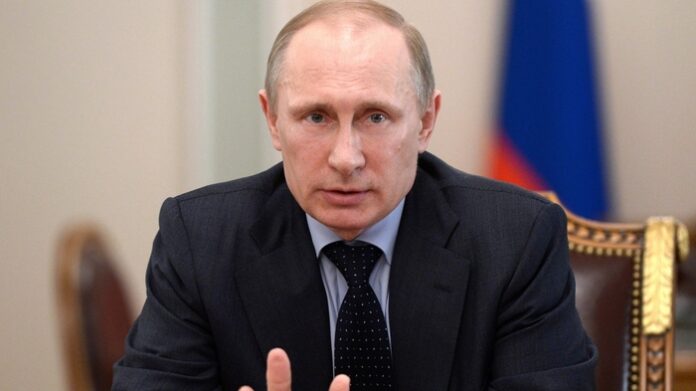
President Putin: Russia, Iran having strategic ties

‘It is necessary that cooperation to be expanded in all areas and all capacities to be used to this end,’ President Putin said while voicing his pleasure in the expansion of strategic ties between the two countries during his meeting.

The Russian president underlined that Moscow and Tehran are having strategic relations.

Velayati, for his part voiced his pleasure in meeting the Russia president, and said, ‘The Islamic Republic of Iran and Russia are stepping towards adopting strategic ties.’

Iran warns against consequences of Iraq breakup

amir-abdolahian1

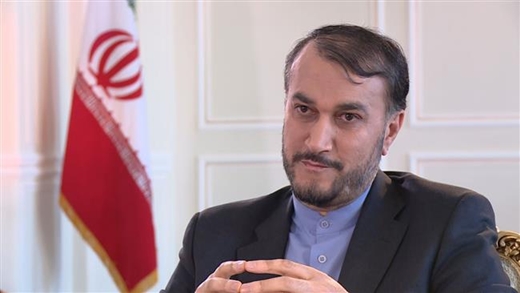
“Certain parties which speak about Iraq’s breakup do not pay attention to its adverse consequences for security and stability of the region,” Iran’s Deputy Foreign Minister for Arab and African Affairs Hossein Amir-Abdollahian said in a meeting with the secretary of Iraq’s Islamic Virtue Party, Hashim al-Hashimi, in Tehran on Wednesday.

He reaffirmed the significance of Iraq for Iran, saying, “We carefully follow up on Iraq’s developments and believe that the smart and patient Iraqi people will be able to defeat terrorism in light of the unity and foresight of [Iraq’s] political and religious leaders,” the Iranian official said.

The Iranian official’s remarks came after President of Iraq’s Kurdistan Regional Government (KRG) Masoud Barzani released a statement on Wednesday, saying that the “time has come” for the country’s Kurdish people to hold a referendum on statehood.

“The time has come and the conditions are now suitable for the people to make a decision through a referendum on their future,” Barzani said, adding, “This referendum would not necessarily lead to (an) immediate declaration of statehood, but rather to know the will and opinion of the people of Kurdistan about their future.”

In the past, Barzani had made similar calls for a referendum without setting a specific timetable or date.

Iran playing constructive role in ME: Hashimi

The Iraqi official said, for his part, that Iran has been playing a constructive role in the region.

Hashimi added that Iraqis will succeed in achieving development through unity and consensus despite all plots against the country.

Iranian FM Zarif arrives in London for Syria aid conference

Zarif arrived in the British capital’s Gatwick airport late on Wednesday where he was received by the UK’s chargé d’affaires in Tehran Nicholas Hopton and Iran’s chargé d’affaires in Britain Mohammad Hassan Habibollahzadeh.

World leaders and officials are gathering in London to take part in the conference with the aim of raising $9 billion for Syria, where foreign-sponsored militancy, which began in March 2011, has claimed the lives of over than 260,000 people and displaced almost half of the country’s population. The conference is expected to broach Syria’s humanitarian needs and ending the country’s five-year conflict.    

“Alongside the conference, we will hold talks with several participating dignitaries about Syria, the implementation of the Joint Comprehensive Plan of Action (JCPOA), and bilateral relations,” said Zarif.  

Iran and the five permanent members of the UN Security Council – the United States, France, Britain, China and Russia – plus Germany started to implement the JCPOA on January 16.

Zarif’s trip to London is the first on such a political level since 2004.