Tuesday, December 23, 2025
Home Blog Page 46

IAEA head: Iran not seeking nuclear weapons

Speaking in an interview with Uruguayan newspaper El Observador, Grossi confirmed the serious damage inflicted on Iran’s nuclear facilities following the military attacks by the US and the Israeli regime, adding that Iran is developing very advanced technologies.

Iran suspended cooperation with the IAEA in June over security concerns following the US and Israeli war of aggression, during which some of its nuclear sites were bombed in violation of international law, the Non-Proliferation Treaty, and the UN Charter.

In response, the Iranian Parliament passed legislation barring further access to its nuclear facilities by IAEA inspectors. Tehran also accused the Agency of effectively providing cover for the strikes by declaring Iran in breach of its non-proliferation obligations and then failing to condemn the attacks.

On September 8, the IAEA chief signed an agreement in Cairo with Foreign Minister Abbas Araghchi, setting out a framework of understanding on procedures for Agency inspections.

However, Iran announced that the deal was null and void after the European parties to a now-expired nuclear deal invoked its so-called snapback mechanism, restoring UN sanctions on the country.

But, Tehran later announced that it had allowed IAEA inspectors to visit several nuclear facilities since the June assault.


331 killed, 945 injured by Israeli fire since ceasefire: Lebanon

Lebanon War

On Thursday, the UN Interim Force in Lebanon (UNIFIL) said it had recorded more than 10,000 air and ground violations by Israel inside Lebanese territory since the ceasefire.

UNIFIL added all violations were reported to the UN Security Council.

Tensions have been mounting in southern Lebanon for weeks, with the Israeli army intensifying near-daily air raids inside Lebanese territory, allegedly targeting Hezbollah members and infrastructure.

The Israeli army has killed more than 4,000 people and injured nearly 17,000 in its attacks on Lebanon, which began in October 2023 and turned into a full-scale offensive in September 2024.

Under the ceasefire, the Israeli army was supposed to withdraw from southern Lebanon this January, but instead only partially pulled out and continues to maintain a military presence at five border outposts.

Iranian FM: US and European troika sabotaged Cairo agreement

In a post on X, Araghchi wrote that just as diplomacy had come under attack in June by Israel and the United States, the Cairo agreement “was likewise killed by the US and the three European countries”, a reference to the US-Israeli attacks on Iran’s nuclear facilities in June amid the Tehran-Washington talks.The Cairo agreement outlined Tehran’s cooperation with the IAEA following those raids.

He described as “regrettable and shameful” a chain of events that ultimately led to the collapse of the deal.

According to Araghchi, Iran had been preparing to enter the sixth round of nuclear negotiations with the United States when Israel, and shortly afterward the US, launched attacks on Iran. Despite the bombing of several nuclear facilities, Iran, through Egyptian mediation, reached an agreement in Cairo with the International Atomic Energy Agency (IAEA) to resume inspections. However, soon after the deal was signed, the three European countries -Britain, Germany, and France- acting under US pressure, pursued efforts to impose UN Security Council sanctions on Iran.

Araghchi added that when Iran began granting IAEA inspectors access to its nuclear sites, starting with those that were not damaged in the June attacks, the US and the European trio jointly moved to secure a condemnation of Iran at the IAEA Board of Governors.
This, he said, made it clear that Iran is not the party seeking to create a new crisis, but rather that “they simply do not recognize our goodwill.” The foreign minister said Washington and the three European governments are responsible for heightening tensions, stressing that they fully understand that the official collapse of the Cairo agreement is a direct consequence of their own provocations.

Iran’s leader commends  silver medalist Hassanzadeh for “gold-worthy determination”      

Ms. Hassanzadeh won a silver medal in the Muay Thai competitions at the Islamic Solidarity Games in Riyadh, Saudi Arabia. After securing the medal, she said she hoped to dedicate her gold medal to the Supreme Leader.

In response, Ayatollah Khamenei sent a message addressing Hassanzadeh’s remarks, saying: “Convey my greetings and gratitude, and tell her: more precious than gold are your effort,  perseverance, faith, and self-confidence, my daughter”.

Iran’s parliament speaker: Israel could resist “less than a week” without US, NATO support

“If the Zionist regime were to stand alone against Iran, it would not endure for even a week,” he stated, adding that its prolonged resistance was due to support from the U.S. and NATO.

He further noted that even that assistance was insufficient, pushing Washington toward “direct involvement,” referring to the U.S. bombardment of Iran’s safeguarded nuclear facilities.

Qalibaf also emphasized that Iran’s true source of strength lies not only in its military arsenal but in its popular backing.

“We take pride in our missile capability, but our main power is the heart of our people,” he said. “If the people are with us, we are strong; without them, even missiles will not create real power.”

He described the war as a “window of opportunity,” stressing that Iran’s military response, combined with public resilience, thwarted foreign plans to destabilize and fragment the country.

Qalibaf also urged officials to rethink traditional approaches and pursue reforms to address domestic challenges.

Iran Slams IAEA Board Resolution as Illegal, Politically Motivated

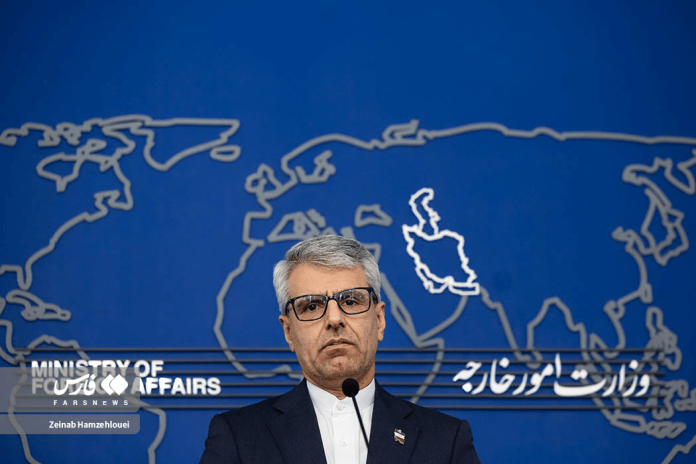
Iran's Foreign Ministry

In a statement issued on Friday, the Ministry said the move by the three European countries and the United States to draft and impose the resolution on the Board of Governors is yet another clear sign of their irresponsible conduct and ongoing efforts to instrumentalize the Agency to pressure the Islamic Republic of Iran.

The statement says the resolution—approved by exploiting the numerical dominance of the Western bloc and its supporters on the Board, and lacking the backing of nearly half of the member states, including opposition from two permanent members of the UN Security Council—violates core principles of the Non-Proliferation Treaty (NPT), which guarantees the inalienable right of member states to use nuclear energy for peaceful purposes.

It also reiterates unlawful demands contained in now-obsolete Security Council resolutions calling on Iran to suspend enrichment.

According to the statement, the Board of Governors has no legal authority to revive terminated Security Council resolutions, previously pursued through misuse of the JCPOA dispute-resolution mechanism.

The statement adds that the content of the resolution reflects US coercion and the duplicity of the three European states.

It notes that the United States has been the main instigator of crises surrounding Iran’s nuclear program over the past decade, having unilaterally and illegally withdrawn from the JCPOA in 2018 and carried out acts of military aggression against Iran, including attacks on safeguarded nuclear facilities.

The Foreign Ministry said Germany, France, and the UK—due to their repeated violations of JCPOA commitments, particularly since May 2018, their alignment with the US and the Zionist regime in attacking Iranian nuclear facilities in June 2025, and their role in initiating the so-called “snapback” process—must themselves be held accountable for the severe consequences of their actions.

The Ministry once again reaffirmed the Islamic Republic of Iran’s opposition to nuclear weapons, calling the genocidal Zionist regime as the sole possessor of weapons of mass destruction in the region and the main obstacle to establishing a Middle East free of such weapons, the greatest threat to international peace and security.

Iran Says Cairo Cooperation Framework with IAEA is now void

Abbas Araghchi

His statement came after the IAEA Board of Governors passed a resolution critical of Iran.
Araghchi denounced the resolution, saying the United States and three European countries had pushed it through despite its illegality and lack of justification.

According to him, the UK, France, Germany and the US forced the measure forward even though fifteen board members either opposed it or refused to support it.

He argued that by taking this step and ignoring Iran’s efforts to cooperate with the IAEA, those states have damaged the Agency’s independence and credibility and derailed ongoing technical engagement between Tehran and the IAEA.

The minister also noted that the Cairo document had already been effectively sidelined after the three European countries sought at the UN Security Council to revive canceled resolutions against Iran. He said Tehran has now formally informed the IAEA’s Director General that the Cairo arrangement no longer has any standing and should be regarded as nullified.

US demands Ukraine accept Washington-drafted peace plan: Reuters

Reuters quoted anonymous sources as saying that “Washington wants Kiev to accept the main points” of the reported peace plan. This would reportedly require Kiev to cede the remaining parts of Russia’s Donetsk People’s Republic (DPR) it still occupies, as well as significantly reduce its armed forces in exchange for Western security guarantees.

Axios and the Financial Times have published similar reports, claiming that the document also stipulates recognizing Russian as an official state language in Ukraine and granting official status to the Ukrainian Orthodox Church.

The purported points of the American plan, if confirmed, echo some of Moscow’s long-standing demands.

Reuters quoted an unnamed senior Ukrainian official as confirming that the authorities in Kiev had received “signals” about the purported peace plan. The proposal has reportedly been prepared without any input from Ukraine and the EU.

An anonymous White House official told Politico the peace roadmap could be agreed by all parties to the conflict by the end of this month and possibly “as soon as this week.”

In a post on Thursday, US Secretary of State Marco Rubio, while not directly confirming the media reports, wrote that “achieving a durable peace will require both sides to agree to difficult but necessary concessions.”

Speaking to Axios, senior Russian negotiator Kirill Dmitriev expressed cautious optimism, saying that “we feel the Russian position is really being heard.”

Kremlin spokesman Dmitry Peskov, in turn, said there was “nothing new” in Russia-US negotiations to end the conflict, adding that Russia remains willing to engage in talks with Ukraine.

The EU has pushed back against the US-proposed plan to end the Ukraine conflict on Thursday, insisting that any settlement must reflect the positions of both Brussels and Kiev.

Ukraine peace plan needs Kyiv, Europe ‘on board’: EU

Russia Ukraine War

The initiative from Washington — reportedly drawn up in cooperation with Moscow — has stirred fears that President Donald Trump could be see-sawing back to the Kremlin’s side despite months of nudging by Europe.

“For any plan to work, it needs Ukrainians and Europeans on board,” Kallas told reporters ahead of a meeting of EU foreign ministers in Brussels.

“We have to understand that in this war, there is one aggressor and one victim. So we haven’t heard of any concessions on the Russian side.”

A source familiar with the US proposal told AFP Wednesday that it would see Kyiv ceding land to Moscow and more than halving its army.

American media outlet Axios earlier reported Moscow and Washington had been working on the secret plan to end the almost four-year war.

The source told AFP it was unclear if the proposals were backed by US President Donald Trump personally.

Kallas stated that as far as she knew there had been no input from Ukraine or its European backers.

“We welcome all meaningful efforts to end this war, but like we have said before it has to be just and lasting,” she added.

“If Russia really wanted peace it could have agreed to an unconditional ceasefire already.”

French Foreign Minister Jean-Noel Barrot insisted that peace in Ukraine could not mean “capitulation” for Kyiv.

“Discussions are needed for us to reach a just and durable peace in Ukraine, they should start with a ceasefire on the contact line that allows for orderly discussions on the question of territories and security,” he said.

His German counterpart Johann Wadephul echoed that, stressing it was a “prerequisite” for any negotiations that Russia agree to a truce without any conditions.

Poland’s Radoslaw Sikorski pointed out it would be wrong to limit the size of the forces Ukraine could use to defend itself.

“I hope it’s not the victim that has restrictions on its ability to defend itself put on, but it’s the aggressor, whose aggressive potential should be restricted,” he said.

European leaders have been playing a cat-and-mouse game with Trump over Ukraine since he returned to office in January as they try to steer him towards their position.

That has seen them launch repeated frantic efforts to talk him around from trying to impose painful conditions on Kyiv — and seizing on any hint he is getting tougher on Russia.

A senior EU official stated the latest plan suggested a Russian effort to show willing to Trump after he hit two of its biggest oil majors with sanctions.

“It’s a Russian narrative, Russia pushing for it to distract attention for fear of sanctions,” the official added, speaking on condition of anonymity.

Lithuania’s Foreign Minister Kestutis Budrys said that respecting Ukraine’s territorial integrity remained fundamental.

But he stated it was at least a plus that Washington had not yet washed its hands of Ukraine, after months of unsuccessful efforts to stop the fighting.

“I do not see the big tragedy that there are some ideas how to end this war — that is good that it is coming from United States,” he added.

“Look at the positive side. If they are working on it, it means that they engage. They are not dropping it for Europe to only to deal with.”


IAEA BoG votes to urge Iran to provide information about nuclear material

Nineteen countries on the International Atomic Energy Agency’s 35-member board voted for the resolution, according to diplomats who spoke on condition of anonymity to describe the outcome of the closed-doors vote.

Russia, China and Niger opposed it, while 12 countries abstained and one did not vote.

The resolution was put forward by France, the United Kingdom, Germany and the United States.

Thursday’s vote at the IAEA headquarters in Vienna sets the stage for a likely further escalation of tensions between the agency and Iran, which has reacted strongly to similar previous resolutions.