Saturday, December 27, 2025
Home Blog Page 4598

It’s a pity that certain media are no-shows in press exhibition

Ashena

President Rouhani’s cultural advisor has said that he wished all media outlets were represented at the 21st Press and News Agencies Exhibition in Tehran.

Hessamoddin Ashena made the comment in an interview with Tasnim News Agency on Saturday and added, “We really wish all news agencies, including Tasnim, participated in the cultural event.” The following is the translation of what else the presidential advisor said about this year’s press exhibition:

Ashena said that the government always listens to critical voices and is ready to enter into talks with them, rejecting reports that the Cabinet, including the Ministry of Culture and Islamic Guidance, has refused to listen to the reasons why certain news agencies do not attend this year’s press exhibition.

Asked about why the government has yet to try to talk with these media, he said that the government would have launched talks with the media if they had stepped forward.

“Did you expect the absent media to ask for a meeting and explain the reasons for their absence?” he was asked. In response, the presidential advisor said nobody asked for a meeting, adding if they had anything to say, we were ready to listen to.

Ashena dismissed as untrue reports that the president and his cultural advisor had asked the Culture Ministry to limit the presence of critical media circles in the press exhibition and said that it is sheer lie. “We should not resort to lies in pursuing our objectives”.

Tehran-based religious site for English speakers

1876871 (1)

The Iranian capital is a metropolis of around ten million. People originally from other cities account for a big chunk of Tehran’s population. Those who move into the capital stick to the traditions of their hometowns when observing religious rites and rituals, especially in mourning ceremonies for Imam Hussein (PBUH) – the grandson of the Prophet Muhammad and the third Shiite Imam – in Muharram.

The bustling megacity is brimful of religious sites attended by, say, the capital-based Azerbaijanis or the Tehran-based Hamedanis. But have you ever heard of a religious site dedicated to Tehran-based English speakers?

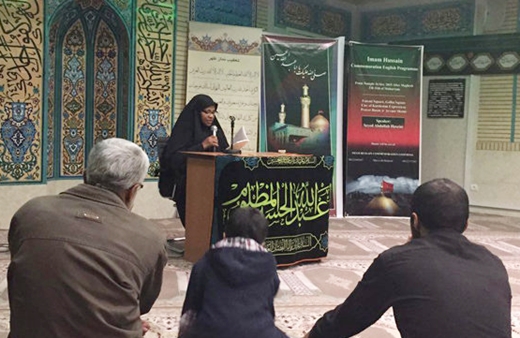
“Mourning ceremonies for Imam Hussein (Peace be upon him) in English language each night after first evening prayers with Tehran-based English speakers and students of the English language in attendance….” This was part of a text which changed hands on social networking sites like Telegram and WhatsApp and aroused the curiosity of Mehr News Agency’s Azadeh Bagheri, compelling her to pay a visit to the site.

Marzieh Hashemi, an American-born Iranian TV presenter, journalist, and documentarian and the host of Press TV, is the founder of this small group. Two years ago, she launched the group by holding Dua Kumayl (Supplication of Kumayl) on Thursdays. She and other members of the group are trying to introduce the group to people and bring together foreign Muslims who are based in Iran to ease their homesickness.

The following is the translation of part of a report Mehr News Agency released in late October on the activities of this English-speaking group and its objectives as well as comments of Marzieh Hashemi and Behrouz Alipour, who are active members of the group:

A group, low in quantity but high in quality

Eyvan Shams was not much crowded, but the get-together of the few people there was too attractive to be ignored. This group is different because its every single member has made a personal decision to embrace Islam. Some are not Iranian; those who are have been away from their homeland for years. They get together and hold mourning ceremonies in a language which sounds more familiar to them: English.

Marzieh Hashemi speaks a few minutes about Imam Hussein and his uprising [which culminated] in Tasoua and Ashura, and then it is the turn of Abdollah Hosseini, a cleric, to take the podium and speak – in English – about Imam Hussein and his companions.

Going public after two years

Behrouz Alipour, one of the group’s active members, has been with the group ever since it was formed two years ago. Alipour, who has a B.A in Islamic art and an M.A in political science, says, “The Dua Kumayl group, which is an English speaking group, was formed by Ms. Marzieh Hashemi whose real name is Melanie Franklin, and Messrs. Foad Izadi and Marandi. The group used to meet at the Faculty of World Studies in the University of Tehran. Back then those interested would gather at the faculty’s mosque on Thursdays to read Dua Kumayl.

“[…] Currently the group has 50 main members, but on some days a variable number of people, for instance up to 100, are present here.”

He says, “The group absorbed more members and people learned about it a bit after it held an Iftar [fast-breaking] ceremony in Mellat Park in Ramadan. […] Generally speaking, people warmly welcomed the ceremony. There were oppositions, but it produced a satisfactory result. That night we spread a table cloth in the park and everybody who was there joined us. We asked people to join us for Iftar. […] People asked where we were based. That was how contacts were established and the number of members increased until the month of Muharram started.”

He says that they launched a group on social networking sites such as WhatsApp and Telegram after being warmly welcomed by people. They wanted to see more people get familiar with this group. […]

We were denied a place because we were anti-American

The group has faced certain problems. It does not have a fixed place and has moved to different sites. Alipour says, “We wanted to stay in the university’s prayer room, but some issues came up and they did not want this anti-US group to remain in the Faculty of World Studies. On different grounds, we were told we had better not be there.

“So we went to the Faculty of Foreign Languages, but we had to leave that place for the same reason. Later we went to a building of the Supreme Leader’s Office on Zartosht Street. […] Now we want to change our place. For the first ten days of Muharram [this year] we were in the prayer room of Eyvan Shams.”

We aim to launch an Islamic training center in English

Alipour says that Iranian Muslims have limited contacts with fellow Muslims in other countries, adding that formation of such groups helps boost contacts between Muslims. “We intend to launch an Islamic center to help Muslims in Iran establish contacts with other Muslims outside Iran. I think Iran’s contact with the outside world is limited. If we can establish international contact through this group, it would be great.

“Our motto is that borders and races do not count. Some members of this group hold different programs; for instance, the New Horizon Conference which has been held for three years led by Mr. Nader Talebzadeh raises international questions focusing on tyranny and injustice, especially by the US. It aims to reveal the true colors of the United States where racism is clearly evident”.

He further says that the group aims to set up an Islamic training center in English. “Our major goal is to have a place for our members to receive training on Islam in English, because it is an international language by which we can transfer what we have to other societies. We want to hold courses and teach Islamic concepts. If we can have a place supervised by the Education Ministry and offer trainings authorized by the ministry, it would be great. There are similar cases outside Iran. It takes a long time to reach such a goal.”

It has always something to do with Marzieh Hashemi!

Marzieh Hashemi, the founder of the group, says, “I converted to Islam more than 30 years ago. In addition to Iran, I have had religious activities in the US. […] People came to Iran from the US and elsewhere in the world. They got deeply involved in their profession in Tehran and their activities became more personalized. They were no longer engaged in their previous activities. What a pity, I thought. I talked with a few people in this regard and I realized that we had to do something to bring those people together again. […]”

We help foreign Muslims with their homesickness

“[…] The foreigners who have come to Iran after embracing Islam are alone. We have to help ease their homesickness one way or another. I think the group we have formed can be very much helpful. Currently, we have focused our attention on Tehran. […]

The group is the foundation of an international gathering

[…] Hamidreza Gholamzadeh, who holds a B.A. in translation and an M.A. in American Studies, has been in contact with the group since its inception. He says, “[…] This is a small gathering with a big goal which acts as the foundation for a massive international gathering.”

Foad Izadi, who is among the founders of this group, has lived in the US for 23 years. He is now a professor at the Faculty of World Studies and teaches American Studies.

He says, “I knew Ms. Hashemi from many years ago. I saw she was so concerned about foreign Muslims in Iran trying to bring them together. Reading the Supplication of Kumayl was good enough reason to that end. Group members and I would eagerly follow her. We hope the current trend persists and the group can achieve its ultimate goal.”

Founding father of numismatics in Iran

page

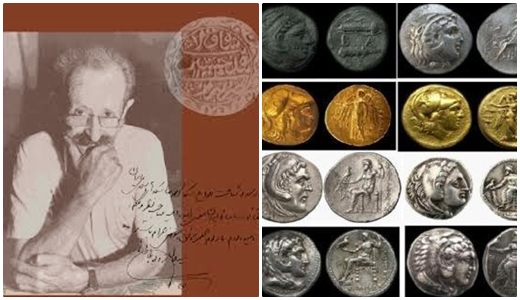
Seyyed Jamal Torabi Tabatabaei, who was born in 1925, has a bachelor’s degree in history and geography from Tehran University. Thanks to his efforts over the years which have resulted in the identification of coins dating back to Islamic and pre-Islamic eras in Iran, he has made a name for himself as a numismatist.

The following is the translation of some part of the comments he made in an interview with tebyan.net in late October:

When I was young, because of my great interest in history, I began to study coins and eventually found out that certificates of nearly 50 percent of those coins were not based on true information.

Given that Iranian coins are varied, numismatics is of great importance in this country and Iran stands first in this field in the region and around the world.

A majority of coins minted in Iran have been identified, more than 95 percent of them by me. I have collected over 3,500 coins from across Iran. Actually, I have mostly bought them from middlemen involved in illegal trade.

Coins dating to the Achaemenid Empire are the most ancient minted in Iran.

Coins dating back to the reign of Mohammad Ali Shah Qajar are the world’s rarest and most expensive because many of them were destroyed due to public resentment toward the king. A 5-rial or a 2-rial coin of that era is worth about $6,000.

The cheapest coins go back to the Eldiguzids era when a majority of coins were made of copper. The most beautiful coins belong to the Ilkhanate era when variety came first.

The largest coins were minted during the reign of Sultan Hossein, a Safavid king, reflecting the country’s booming economy.

I have donated most of the coins I collected to Azerbaijan Museum, but unfortunately a large number of those precious coins have been transferred to other museums across the country.

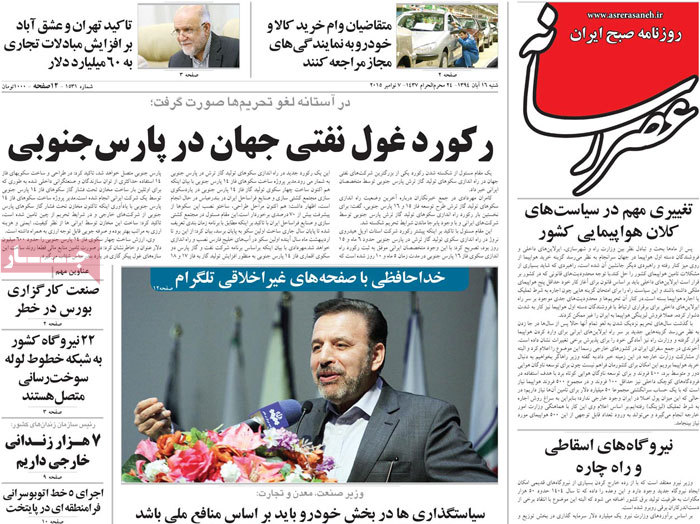
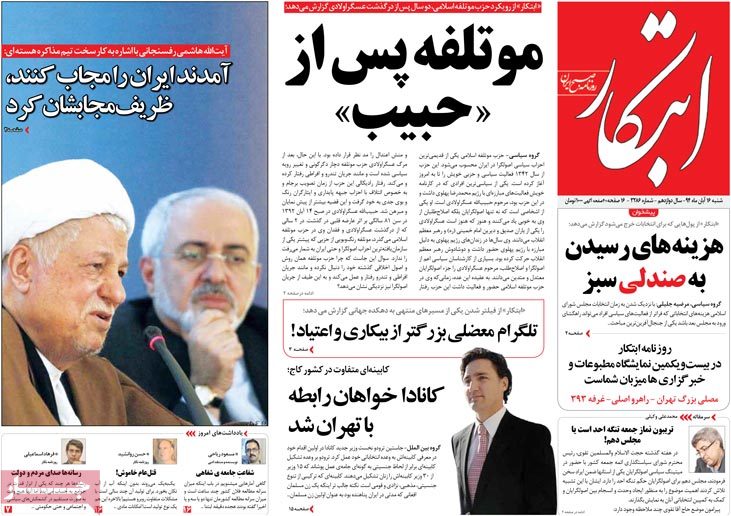
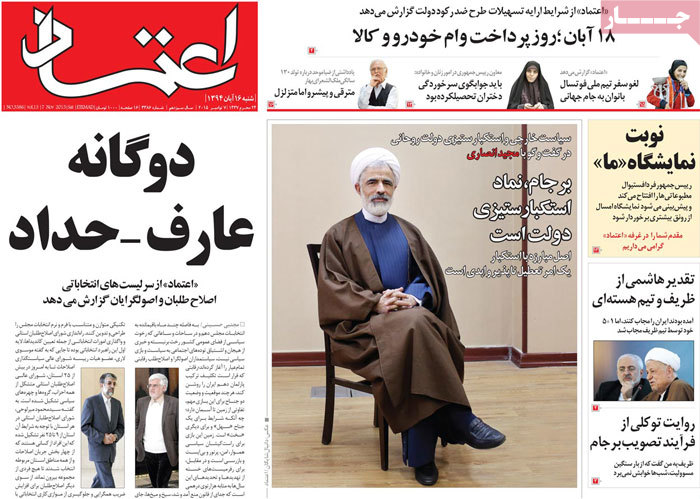
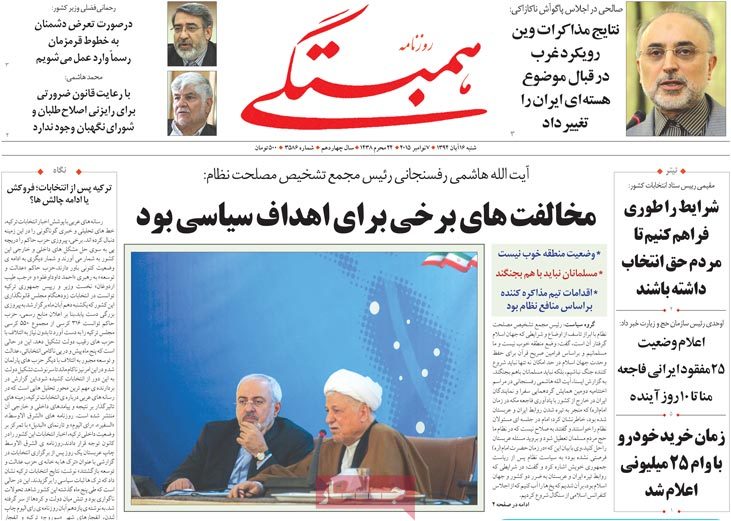
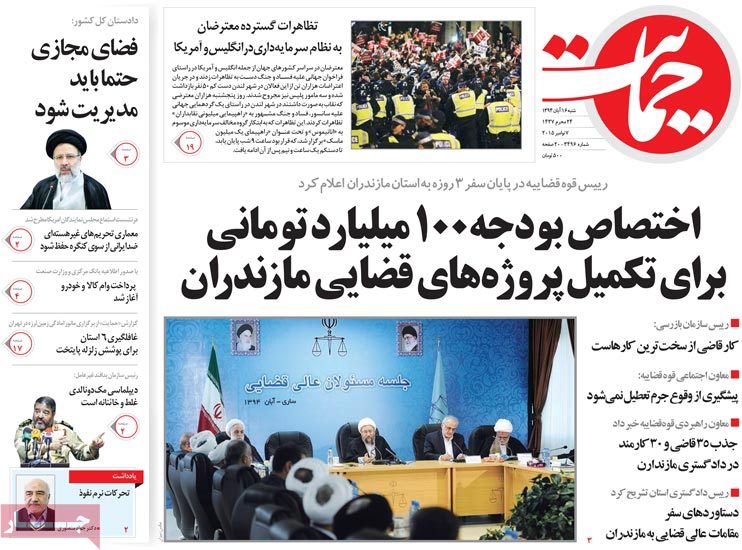
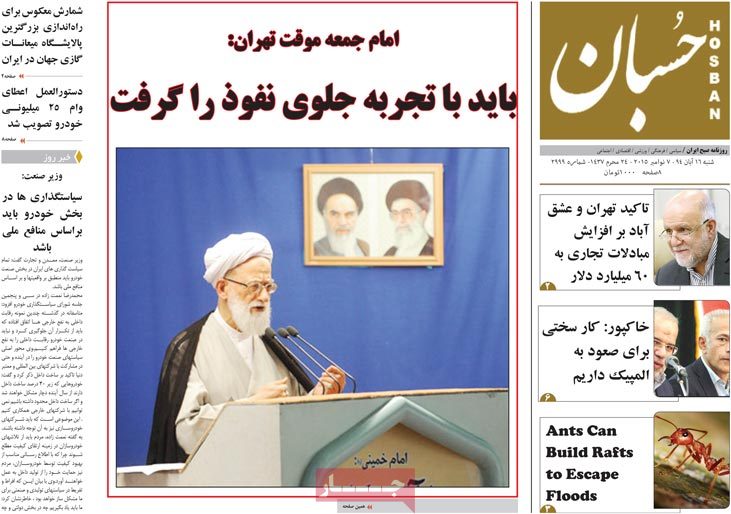
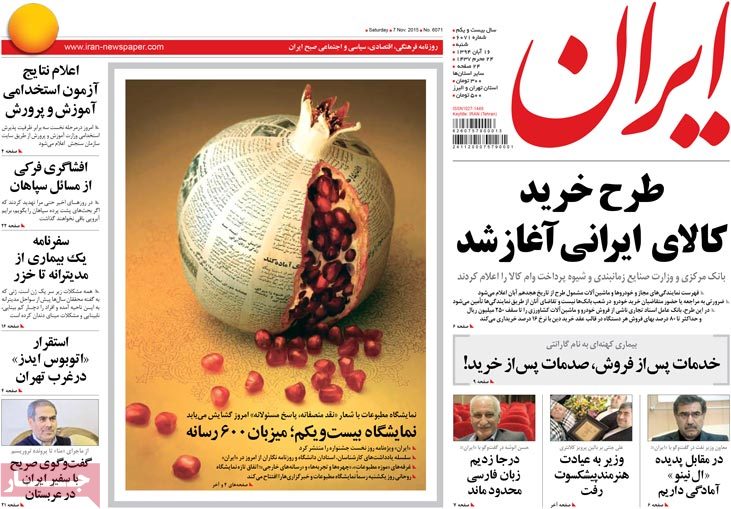
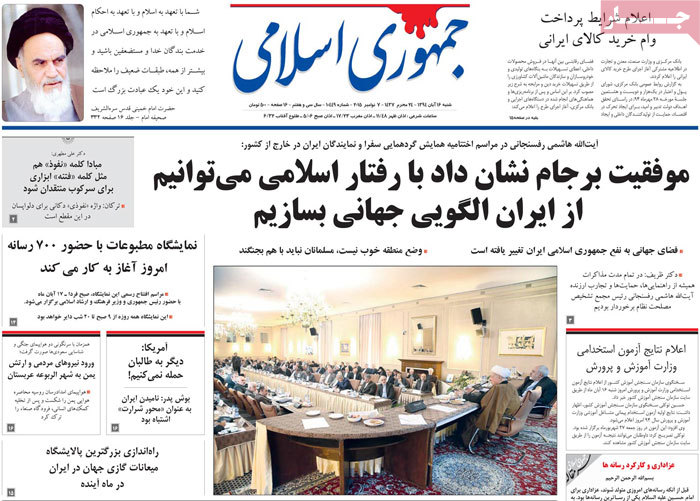
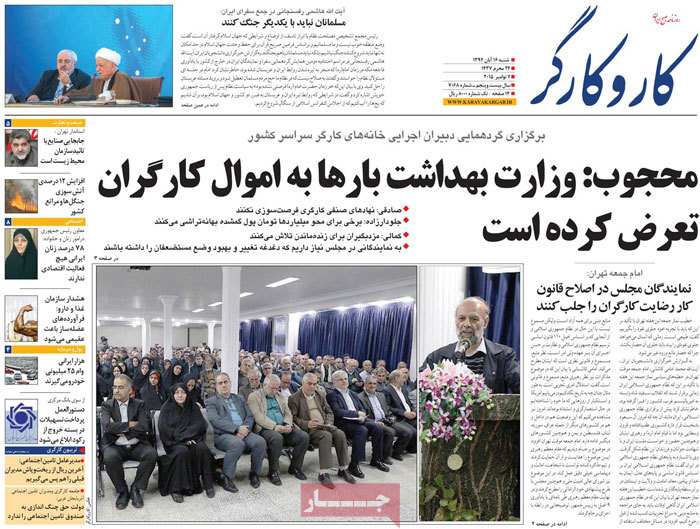
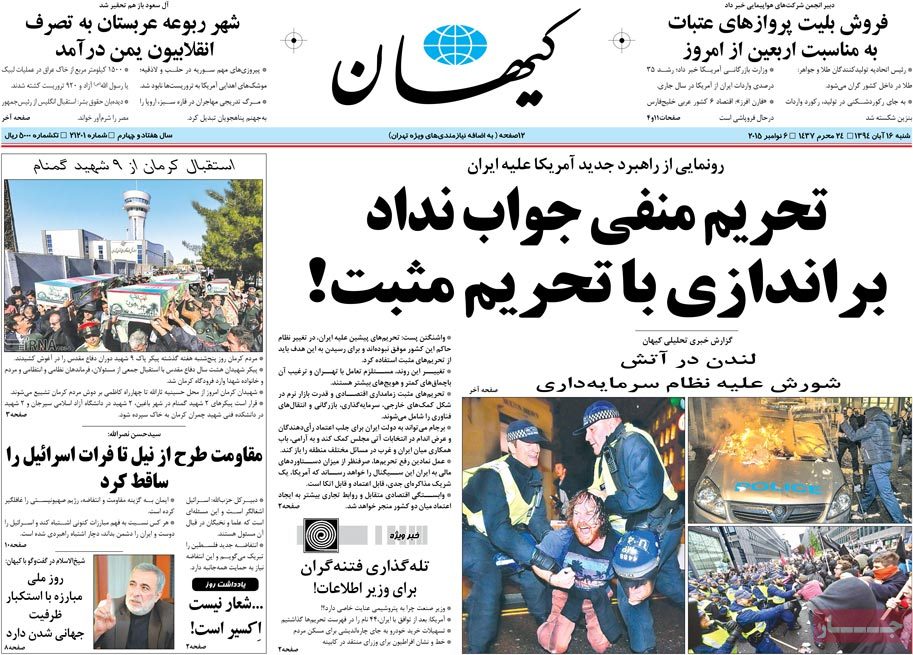
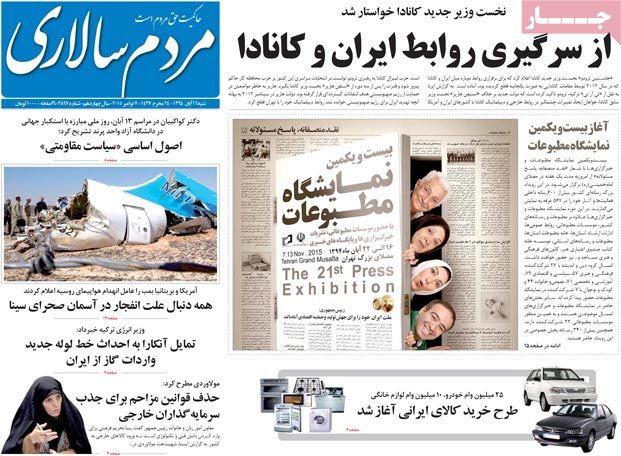
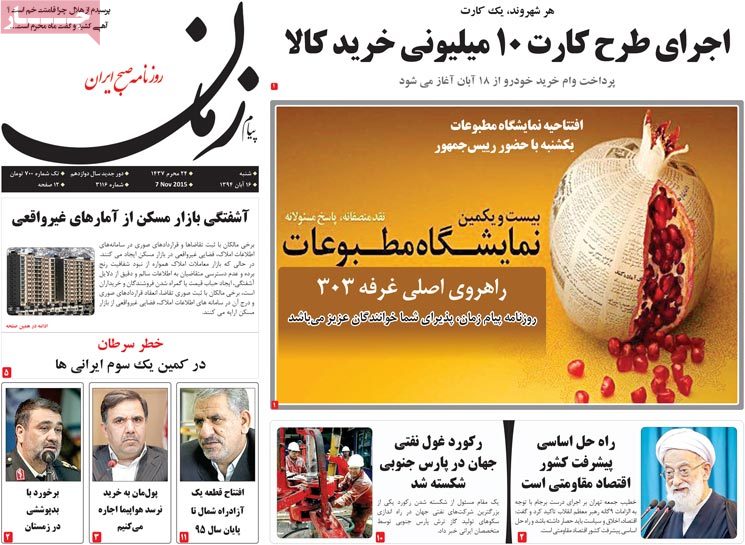
A look at Iranian newspaper front pages on Nov. 7

Iranian Newspapers Headlines

Comments of Chairman of the Expediency Council Ayatollah Akbar Hashemi Rafsanjani in a meeting with foreign-based Iranian ambassadors on nuclear talks and his praise for the country’s negotiating team dominated the front pages of Iranian newspapers on Saturday. Also in the news was the inauguration of the 21st Press and News Agencies Exhibition in Tehran.


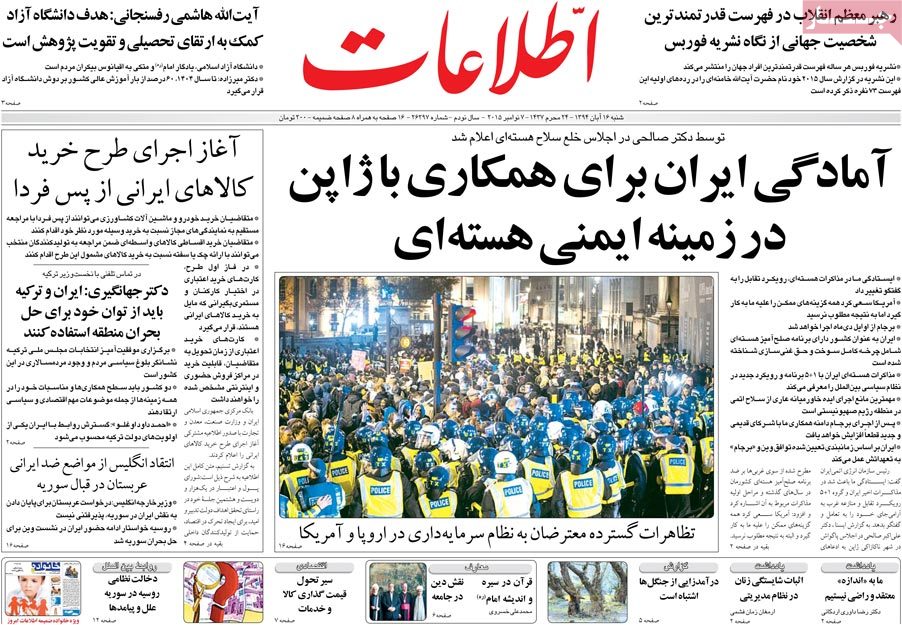
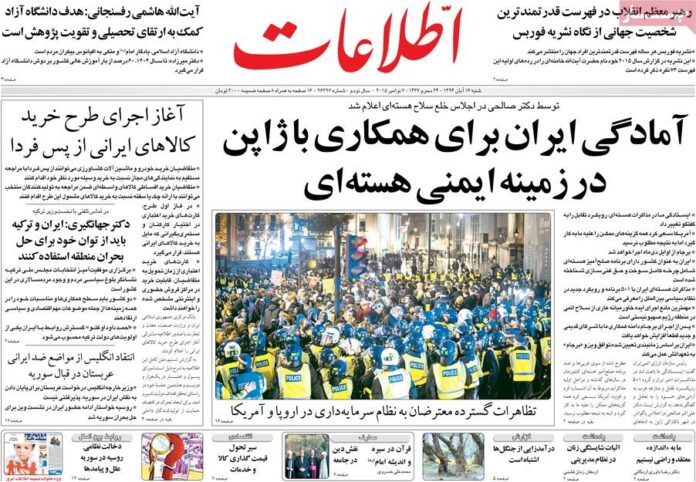
Ettela’at: Iran voices readiness to cooperate with Japan on nuclear safety.

Director of the Atomic Energy Organization Ali Akbar Salehi told the 61st Pugwash Conference on Science & World Affairs in Nagasaki that Iran’s resistance in nuclear talks turned confrontation into dialogue.


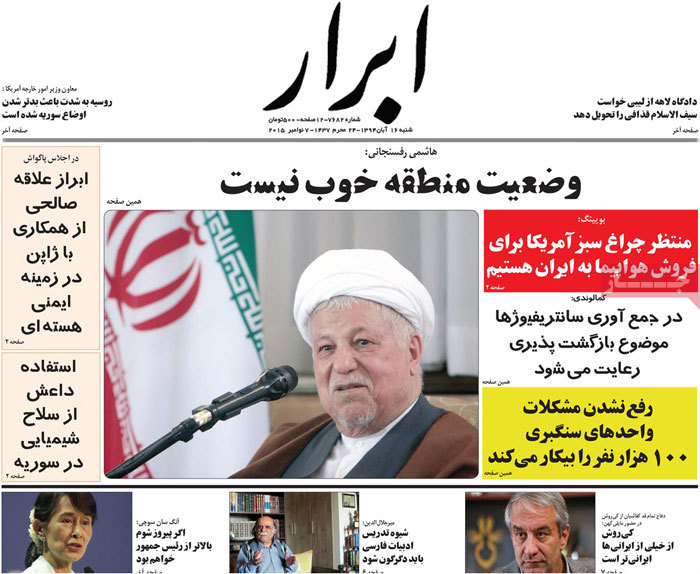
Abrar: ISIS has used chemical weapons in Syria.


A look at Iranian newspaper front pages on Nov. 7


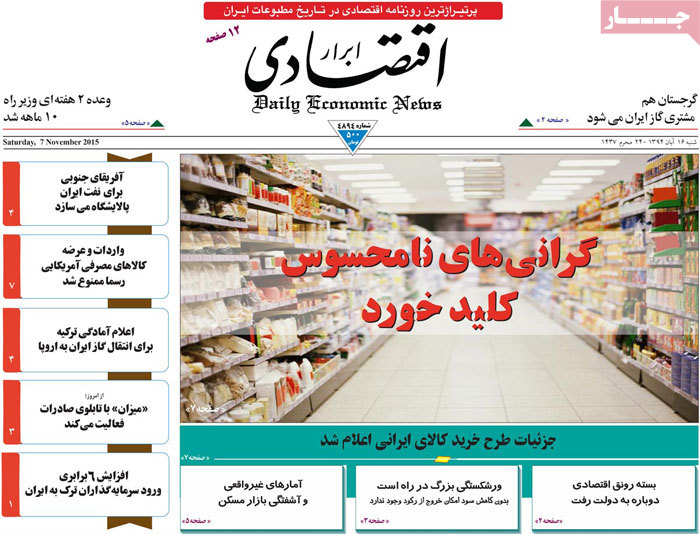
Abrar-e Eghtesadi: Georgia will become a consumer of Iran’s natural gas.


A look at Iranian newspaper front pages on Nov. 7


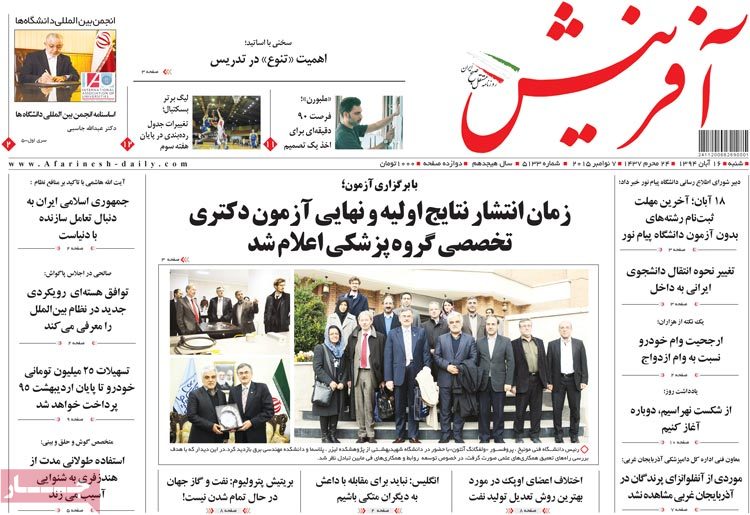
Afarinesh: “The Islamic Republic of Iran is after having constructive interaction with the world,” said Chairman of the Expediency Council Ayatollah Akbar Hashemi Rafsanjani.


A look at Iranian newspaper front pages on Nov. 7


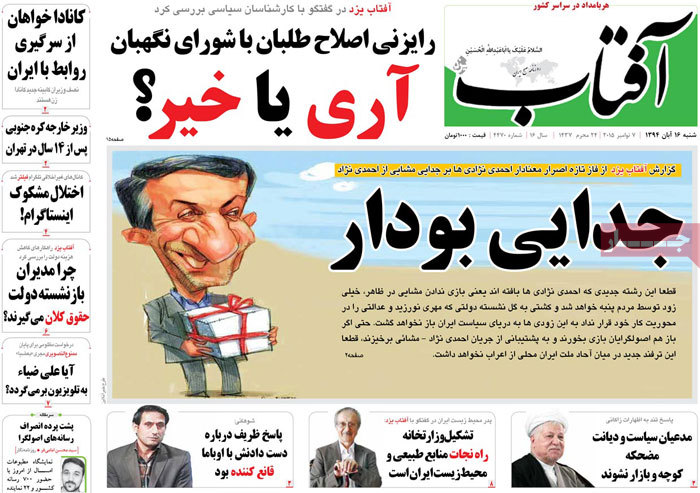
Aftab-e Yazd: Canada is seeking to resume ties with Iran.

Women account for half of ministers in the new Canadian Cabinet.

Aftab-e Yazd: The South Korean foreign minister is to visit Tehran for the first time in 14 years.


A look at Iranian newspaper front pages on Nov. 7


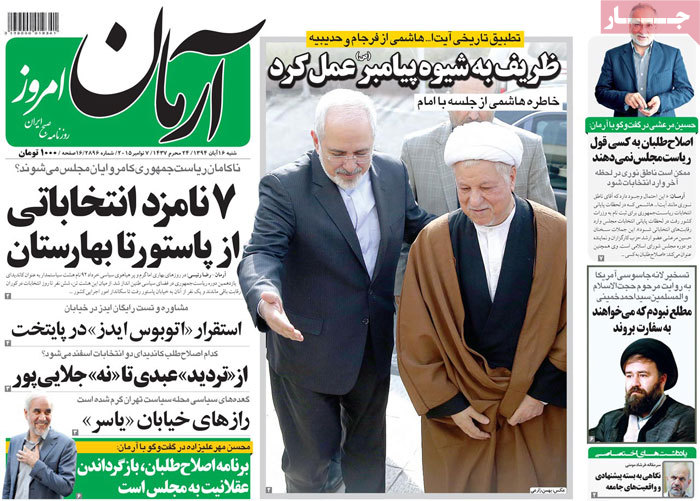
Arman-e Emrooz: HIVtest for free  

An AIDS bus is to be stationed in Tehran to carry out HIV tests [for citizens].


A look at Iranian newspaper front pages on Nov. 7


Asr-e Rasaneh: As many as 7,000 foreigners are serving time in Iran’s prisons, said the director of the State Prisons and Security and Corrective Measures Organization.


A look at Iranian newspaper front pages on Nov. 7


Ebtekar: “They [P5+1] were seeking to convince Iran, but it was [FM] Zarif who convinced them,” said Ayatollah Hashemi Rafsanjani, stressing the daunting task the Iranian nuclear negotiating team took on.


A look at Iranian newspaper front pages on Nov. 7


Etemad: “The Joint Comprehensive Plan of Action is the symbol of government’s fight against arrogant powers,” said Vice-President for Parliamentary Affairs Majid Ansari.

He further said that the fight against the global arrogance will never come to an end.


A look at Iranian newspaper front pages on Nov. 7


Hambastegi: The Election Headquarters chief has said that the stage should be set for people so that they can have different options to choose from.


A look at Iranian newspaper front pages on Nov. 7


Hemayat: The attorney general has said that cyberspace should be managed.


A look at Iranian newspaper front pages on Nov. 7


Hosban: The industry minister has said that policymaking in the automotive industry should be in line with national interests.


A look at Iranian newspaper front pages on Nov. 7


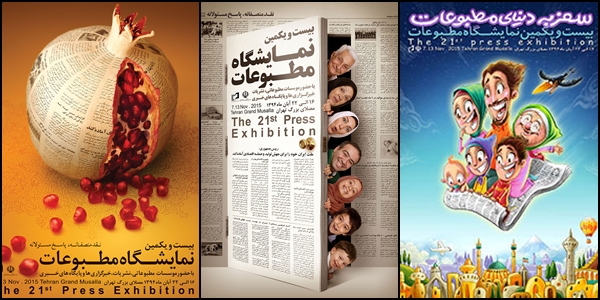
Iran: The 21st Press Exhibition (November 7-13) is themed “Fair Criticism and Accountability”, bringing together 600 media outlets.

Iran: A deputy oil minister has said that the country is ready to tackle El Nino.


A look at Iranian newspaper front pages on Nov. 7


Jomhouri Islami: Foreign Minister Zarif has said that the nuclear team has tapped into the valuable experience, guidance, and support of Ayatollah Hashemi Rafsanjani all through nuclear talks.


A look at Iranian newspaper front pages on Nov. 7


Kar va Kargar: “Muslims should not fight each other,” Ayatollah Hashemi Rafsanjani told Iranian ambassadors overseas.


A look at Iranian newspaper front pages on Nov. 7


Kayhan: Negative sanctions did not pay off; regime change through positive sanctions!

The daily takes an analytical look at America’s new Iran strategy.


A look at Iranian newspaper front pages on Nov. 7


Khorasan: The president of the European Parliament arrives in Tehran on Saturday.


A look at Iranian newspaper front pages on Nov. 7


Mardomsalari: Vice-President for women’s affairsShahindokht Molaverdihas said that the government is trying to repeal the rules and regulations which stand in the way of absorbing foreign investment.


A look at Iranian newspaper front pages on Nov. 7


Payam-e Zaman: The 21st Press and News Agencies Exhibition will be inaugurated with President Rouhani in attendance.


A look at Iranian newspaper front pages on Nov. 7


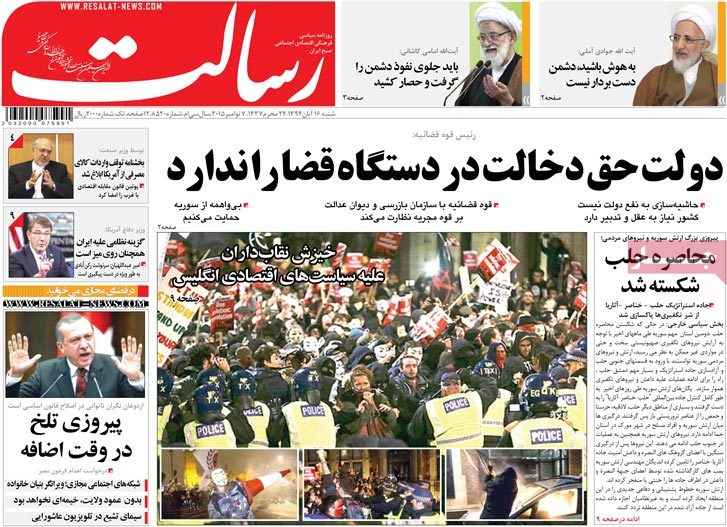
Resalat: “The government is not entitled to meddle in [the affairs of] the Judiciary system,” said the Judiciary chief.


A look at Iranian newspaper front pages on Nov. 7


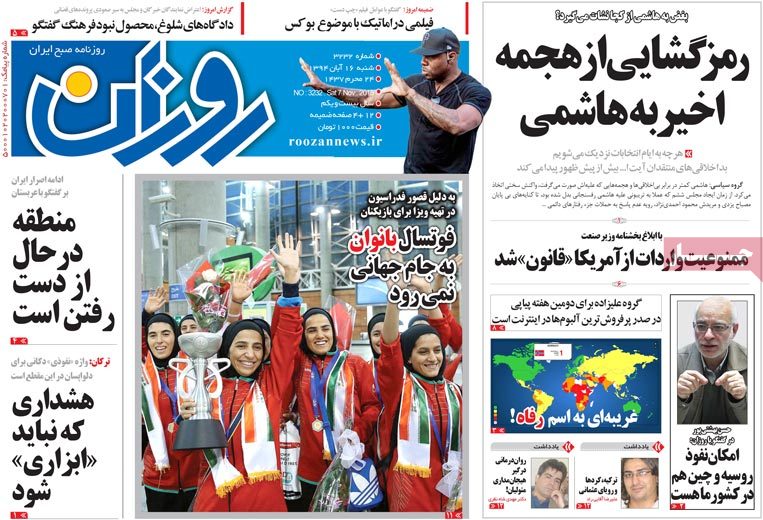
Roozan: The Iranian Women’s National Futsal teamwill not go to the 2015 World Tournament thanks to the negligence by the Football Federation to get visa for players.


A look at Iranian newspaper front pages on Nov. 7


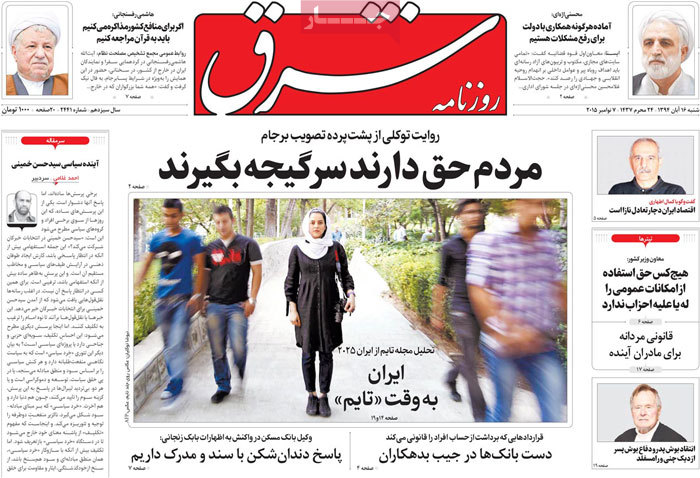
Sharq: Judiciary Spokesman Gholamhossein Mohseni Ejei has said that the Judiciary is ready to cooperate with the government to remove the existing problems.


A look at Iranian newspaper front pages on Nov. 7


Highlights of Ettela’at newspaper on Nov. 7

Ettelaat

 Iran voices readiness to cooperate with Japan on nuclear safety.

Director of the Atomic Energy Organization Ali Akbar Salehi told the 61st Pugwash Conference on Science & World Affairs in Nagasaki that Iran’s resistance in nuclear talks turned confrontation into dialogue.

 Iran’s Supreme Leader has a berth on Forbes magazine’s 2015 list of the world’s most powerful people.

Ayatollah Khamenei is among top finishers on the magazine’s list of 74 most powerful people this year.

 “The Islamic Azad University aims to help upgrade education and bolster research [in the country],” said Ayatollah Akbar Hashemi Rafsanjani.

 The plan to buy Iranian-made commodities is to get underway on Monday.

In the first phase of the plan, civil servants and pensioners are provided prepaid cards to purchase Iranian-made goods.     

 “Iran and Turkey should tap into their capabilities to help solve the regional crisis,” said the first vice-president in a telephone call with the Turkish prime minister.

Ahmet Davutoglu told Eshagh Jahangiri that promotion of ties with Iran is one of his government’s priorities.

 Britain lashes out at Saudi Arabia’s anti-Iran stances in dealing with the Syrian question.

The British foreign secretary has said that Saudi Arabia’s call for ending Iran’s role in Syria is far from acceptable.

 Massive rallies in the US and Europe in protest at capitalism


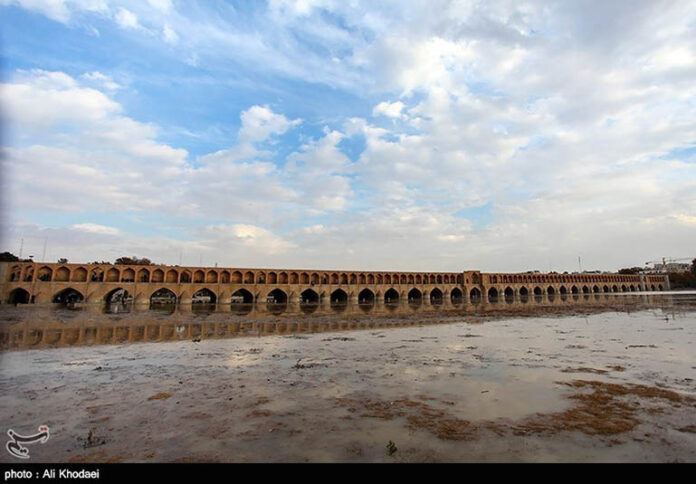
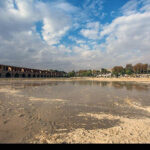
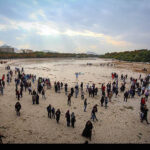
Water makes much-anticipated comeback to dried up Zayandehrood River (PHOTOS)

Zayandehrood0

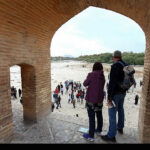
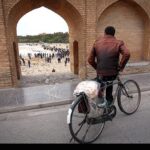
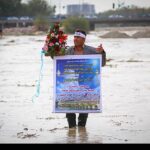
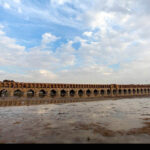
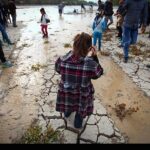
Water has flowed back to the Zayandehrood River in the central city of Isfahan.

The following are images of the river published by Tasnim News Agency:

Iranian diplomat challenges US panelist over ISIS

Miryousefi

Anti-Iran comments by David Pollock, a senior researcher at the Washington Institute, drew reaction from an Iranian diplomat who defended Tehran’s Iraq policies and its involvement in efforts to take on the terrorist group, ISIS, in Iraq.

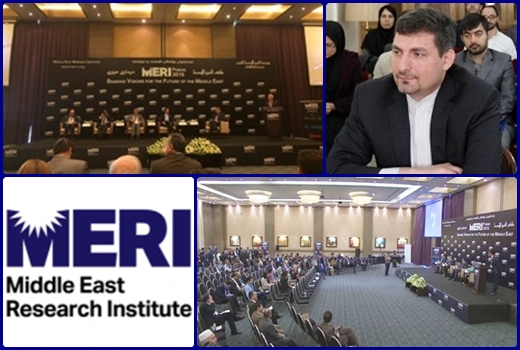
At the annual Middle East Research Institute (MERI) – a new think tank in Erbil, Kurdistan Region of Iraq – Pollock made harsh comments against Iran. In reaction Alireza Miryousefi, the director of the Center for Middle East Studies, Institute for Political and International Studies (IPIS) who was present in the gathering said that ISIS would have captured Erbil after Mosul if Iran had not helped Iraq and consequently this gathering would not have been held here in Erbil.

Khabaronline.ir on November 4 published a report on the Erbil gathering, comments by the American panelist from the Washington Institute who talked about the role of Iran and Russia in the fight against ISIS and the reaction of the Iranian diplomat. The following is the translation of the report:

Immediately after Pollock’s speech, Miryousefi took the podium and addressed the hardline American panelist and said that ISIS would have taken over Erbil after Mosul if Iran had not got involved, adding if so, “this gathering would not have met in Erbil and you would not have been given the opportunity to attend the meeting and make critical comments on Iran.”
“After the occupation of Mosul, ISIS was closing in on Erbil. When ISIS was close to conquering the city, Erbil defenders made multiple appeals for help to the countries involved in the anti-ISIS coalition, but their appeals were not answered and Erbil was on the brink of being seized. [Back then] Iran was the only – it is better to say the first and last – country which responded to their calls for help and pulled Erbil from the brink of collapse”, said the Iranian diplomat.

He went on to say, “Mr. Pollock had better answer these questions: What was the reason behind the indifference of the countries which were part of the theatrical US-led coalition against ISIS to the threat hanging over Erbil? Why didn’t coalition countries try to help the city? Wouldn’t the situation in Iraq and the [entire] Middle East have been more catastrophic than now if Iran had not got involved to save Erbil and the city had fallen to ISIS?”
Miryousefi highlighted the fact that Iran is the most serious country as far as the fight against terrorism and ISIS is concerned and said, “According to reports released last year by a number of US think tanks and media outlets, the so-called anti-ISIS coalition has been – since start – a theatrical and disingenuous coalition which has been formed to score electoral points in the lead-up to US congressional elections and to calm the agitated US public opinion following the beheading [by ISIS] of a few American citizens. Do you have good enough reasons to reject these claims?”

The Iranian diplomat went on to slam America’s selective use of terrorist and extremist groups in the past and asked, “Do you think you can use ISIS or similar groups as a political tool, like what the US did in the 1990s by using Jihadi groups against the former Soviet Union? Does a selective and unreal approach to these groups help solve the problems and reestablish peace and security?”

Recalling remarks by David Pollock that ISIS has no popular support among the Saudis, Miryousefi said, “This comes as the latest polls released by Western sources show that around 92 percent of the Saudis support ISIS or sympathize with it thanks to the one-sided propaganda by the kingdom’s media circles. Is there any solid evidence to substantiate your new claim that the Saudi media and public opinion do not back ISIS and similar [terrorist] groups?”

Later in the gathering – which was attended by President Fuad Masum, the Iraqi parliament speaker and senior officials as well as Prime Minister of Kurdistan Region Nechirvan Barzani, head of the Islamic Supreme Council Ammar al-Hakim and a host of diplomats from other countries including Russia – Kobad Talabani, the deputy prime minister of Kurdistan Region confirmed the remarks of the Iranian diplomat and underlined Iran’s vital and decisive role in bringing Erbil back from the brink of collapse.

Talabani further talked about the night Erbil was on the verge of collapse and recalled his repeated, but vain, contacts with US officials to ask for help to save Erbil from falling into the hands of ISIS, and implicitly blamed administrative problems in the US decision-making structure for the negligence [of Washington].

The annual Middle East Research Institute (MERI) – a policy-research institute –opened Tuesday in Erbil, bringing together high-level officials, academics and diplomats to debate the critical issues now facing Iraq, the Kurdistan region, and the greater Middle East.
The MERI Forum 2015, titled “Sharing Visions for the Future of the Middle East,” discussed the war against ISIS, the crises of displacement and demography, and the challenge of keeping restive Iraq as a united country.

Iran holds 21st press exhibition on Saturday

page

The 21st Press and News Agencies Exhibition is to open at Tehran’s Grand Prayer Ground on Saturday.

Minister of Culture and Islamic Guidance Ali Jannati is to attend the opening ceremony and over 600 domestic media are to display their works in some 567 pavilions at the fair.

The exhibition dubbed “Fair Criticism and Accountability” is to run through November 13.

Civil defense chief calls US gov’t biggest threat to Iran

13940715093004776252954

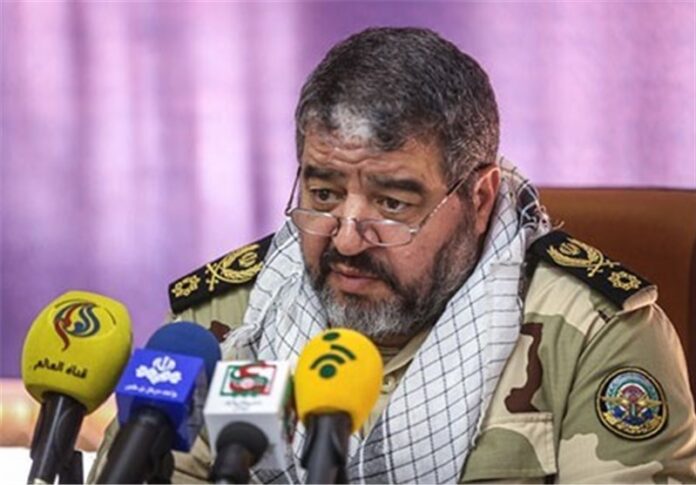
The head of Iran’s Civil Defense Organization warned against Washington’s continued hostilities toward Tehran despite a recent nuclear deal between the country and six world powers, describing the US “the biggest threat” to the Iranian nation.

Addressing a large congregation of worshippers in Tehran on Friday, Brigadier General Gholamreza Jalali pointed to recent remarks by Supreme Leader of the Islamic Revolution Ayatollah Seyyed Ali Khamenei on anniversary of the 1979 takeover of the US Embassy in Tehran, saying that as the Leader has noted, the threats against Iran have not changed and “the US enmity remained unchanged”.

“Today, the US is the biggest threat to our country,” he said, adding that the threat would remain in place even after the implementation of the nuclear agreement between Iran and P5+1, also known as the Joint Comprehensive Plan of Action (JCPOA).

The senior official further emphasized that the confrontation between Iran and the US has its roots in the ideologies of the two sides.

Jalali said the values defined by true Islam are “in contradiction with the liberal democracy and secularism,” and the two cultures will never stand together.

[…]

Ayatollah Khamenei said Tuesday there has been no slackening off in US hostility toward Iran.

Addressing a big crowd of students, the Leader stressed that the US antagonistic attitude toward Iran has not changed a bit, but there are attempts to whitewash the issue.

[…]

Visually-impaired Iranian man climbs the ladder of success

Mohammad Askari

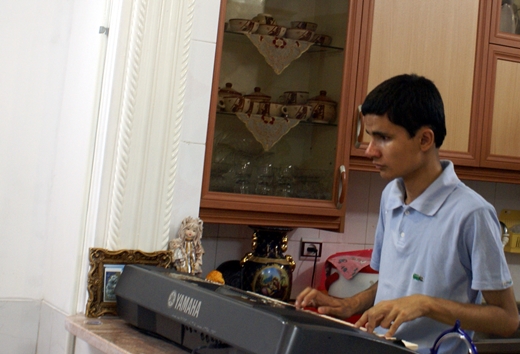
Mohammad Askari was born blind, but visual impairment did nothing to hinder or slow down his praiseworthy climb up the ladder of success.

The following is the translation of part of a report filed by Mehr News Agency about the young man who hails from Bafgh, in Yazd Province:

Mohammad’s father says, “I remember he memorized whatever he heard. When Mohammad attended school, the father-like kindness of his teachers instilled a sense of self-belief into my son and helped him develop a strong liking for learning.”

For eight consecutive years, he finished at the top of the class. When he was in middle school, he developed an interest in music and began to learn how to play keyboards. He was so talented that he even found fault with his music teacher during a fourth session of tutoring.

Admitting to his mistake, the music teacher told Mohammad’s brother that his trainee was so talented that he could play any note by ear and did not need training.

In the university entrance exam, among all but one million participants, Mohammad finished 606th in the nationwide ranking.

He always looks up to two people: His teacher, the late Mazloumi, and Louis Braille [the French inventor of the system of reading and writing for the blind who opened up a new horizon for the visually-impaired throughout the world].

He harbors lofty ambitions and has been making plans to fulfill them ever since he was in high school.

One of his greatest wishes is to write a book for the visually-impaired across the world in Persian, English and Arabic to let them know that disability does not constitute inability and that where there’s a will there’s a way.

Mohammad Askari says he owes his success in life and education to the support and guidelines of his parents, siblings and family.