Monday, December 22, 2025
Home Blog Page 4539

No New Arrangement for Missile Negotiation with Iran, US Says

“I don’t think he (John Kerry) was being specific that there’s some kind of new policy to be launched here or new arrangement in the terms of concrete actions. Simply, he was just emphasizing or underscoring the fact that if Iran chooses to act more constructively in the region, then we can have a different kind of relationship with Iran,” Toner said at a daily briefing on Friday, referring to the recent remarks by the US Secretary of State suggesting Washington was open to a “new arrangement” with Iran for resolving the issue.

The spokesman’s remarks came after a top Iranian military official reminded the US to keep its nose out of Tehran’s defense program, stressing that the Iranian Armed Force will not allow any foreign country to set limits for its activities, including progress in the missile industry.

“Iran’s missile power is by no means negotiable and any restriction on it is a red line for the country,” Deputy Chief of Staff of the Iranian Armed Forces Brigadier General Massoud Jazayeri said on Friday.

“Iran will not get permission from anybody to boost its defense capabilities,” he added.

In late March, Leader of the Islamic Revolution Ayatollah Seyed Ali Khamenei had underscored the need for boosting Iran’s defense capabilities, warning that enemies are making use of every tool available to undermine the Islamic Republic.

Ayatollah Khamenei said at the time that if the Islamic establishment seeks technology and negotiations but lacks defense might, it will have to buckle in the face of any weak country that poses threat to it.

In March, the country’s Islamic Revolution Guards Corps (IRGC) forces test-fired two types of Qadr ballistic missiles during the large-scale drills, codenamed “Might of Velayat”.

The two ballistic missiles, Qadr-H and Qadr-F, were launched from the heights of East Alborz Mountains, north of Iran, and hit targets on the Makran coasts, southeast of the country.

According to reports, Qadr-H missile has a range of 1,700 kilometers while Qadr-F missile can destroy targets some 2,000 kilometers away.

Iran to Host 65 International Exhibitions

International Iranplast Exhibition is the first expo scheduled for April, while the last one is the 16th International Environment Exhibition.

The tally shows that Iran will host exhibitions on 288 days this year.

The exhibitions include laboratory material and equipment, oil, gas, refinery and petrochemistry, elevator and related equipment, a seminar on women’s role in sustainable development, telecom industries, mining and mineral industries, electronics, computer and e-commerce, and the environment.

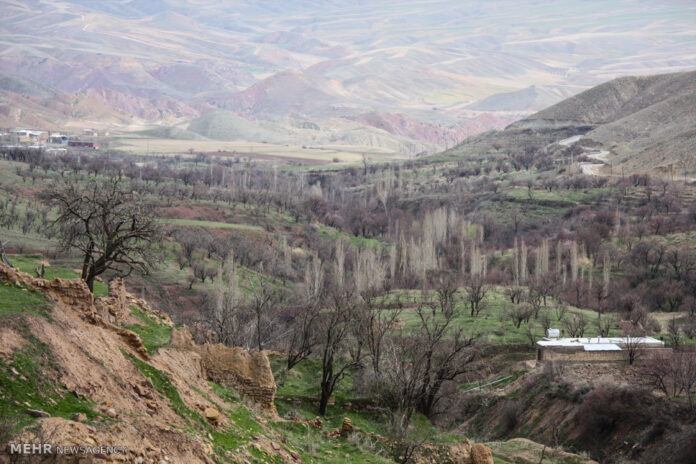
Spring nature of Zanjan

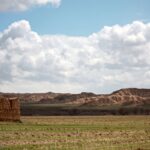
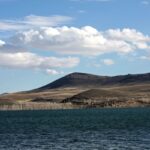
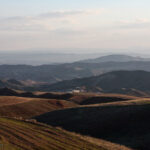
 Beautiful nature of north-western city of Zanjan in the early days of spring.


A look at Iranian newspaper front pages on April 9

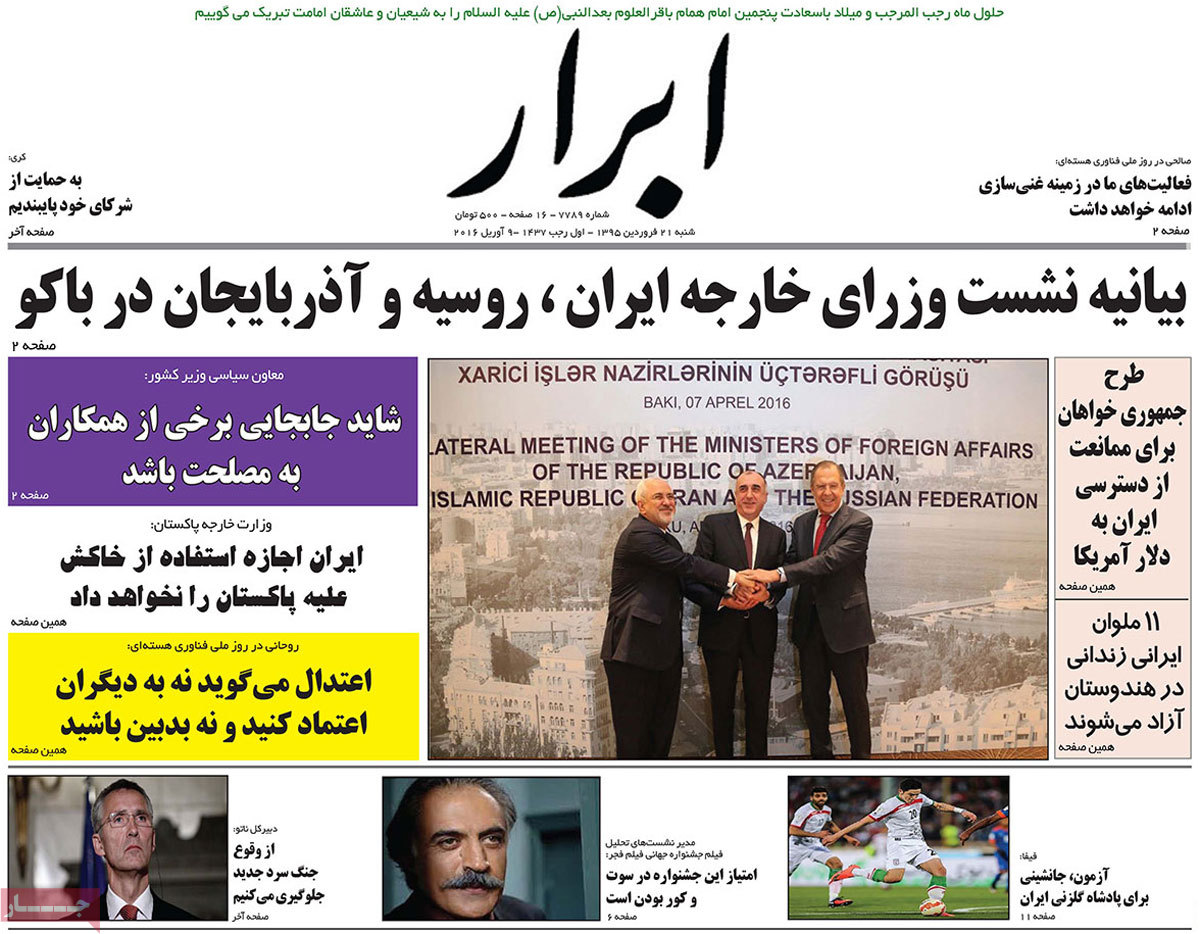
Iran Newspaper front pages

Abrar:

1- Joint statement by foreign ministers of Iran, Russia and Republic of Azerbaijan in Baku

2- Salehi speaking on the occasion of National Day of Nuclear Technology: Our Uranium enrichment activities will continue

3- Republicans are trying to deny Iran access to US Dollar

4- Pakistan Foreign Ministry:  Iran will not allow its soil to be used against Pakistan

5- Rouhani speaking on National Day of Nuclear Technology: Neither trust others, nor mistrust them

6- 11 jailed Iranian sailors in India are to be released


A look at Iranian newspaper front pages on April 9


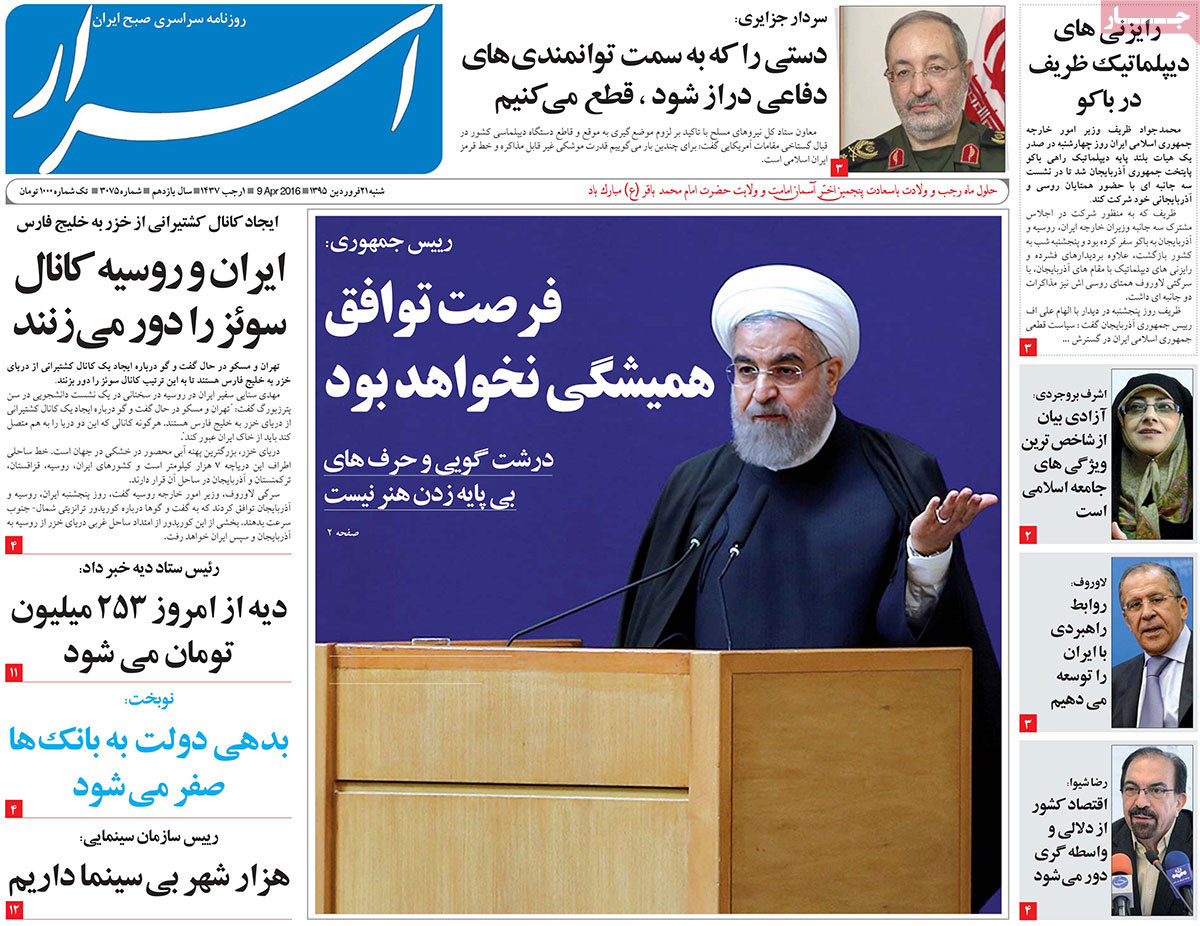
Asrar:

1- President Rouhani: Opportunity for agreement will not always be available

2- Iran and Russia to disregard Suez Canal

– Tehran- Moscow are talking about constructing a canal between Caspian sea and Persian Gulf

3- Ashraf Brujerdi: Freedom of speech is one of the fundamental characteristics of Islamic society

4- General Jazayeri: We will cut off any intruding hand against our defensive capabilities


A look at Iranian newspaper front pages on April 9


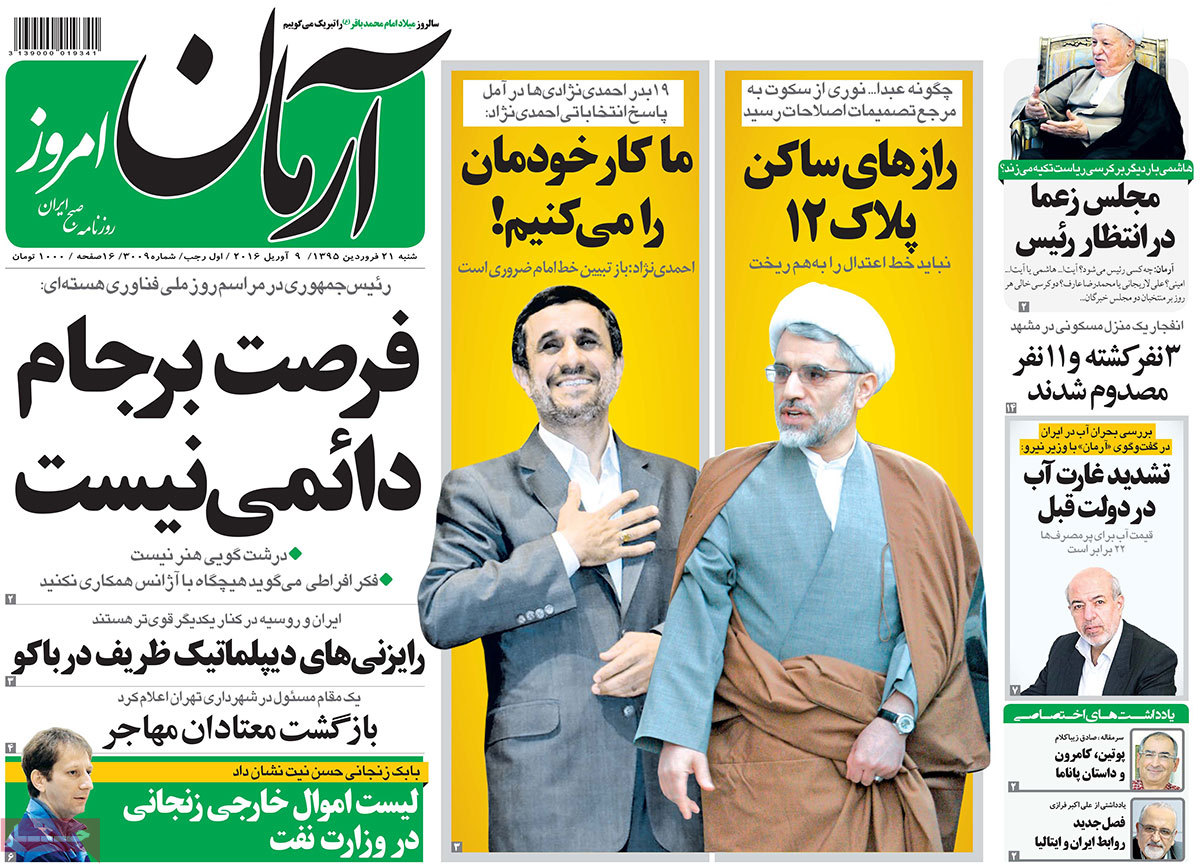
Armane Emrooz:

1- President Rouhani: Opportunity for agreement is available at all times

2- Ahmadinejad: we will do what we want!


A look at Iranian newspaper front pages on April 9


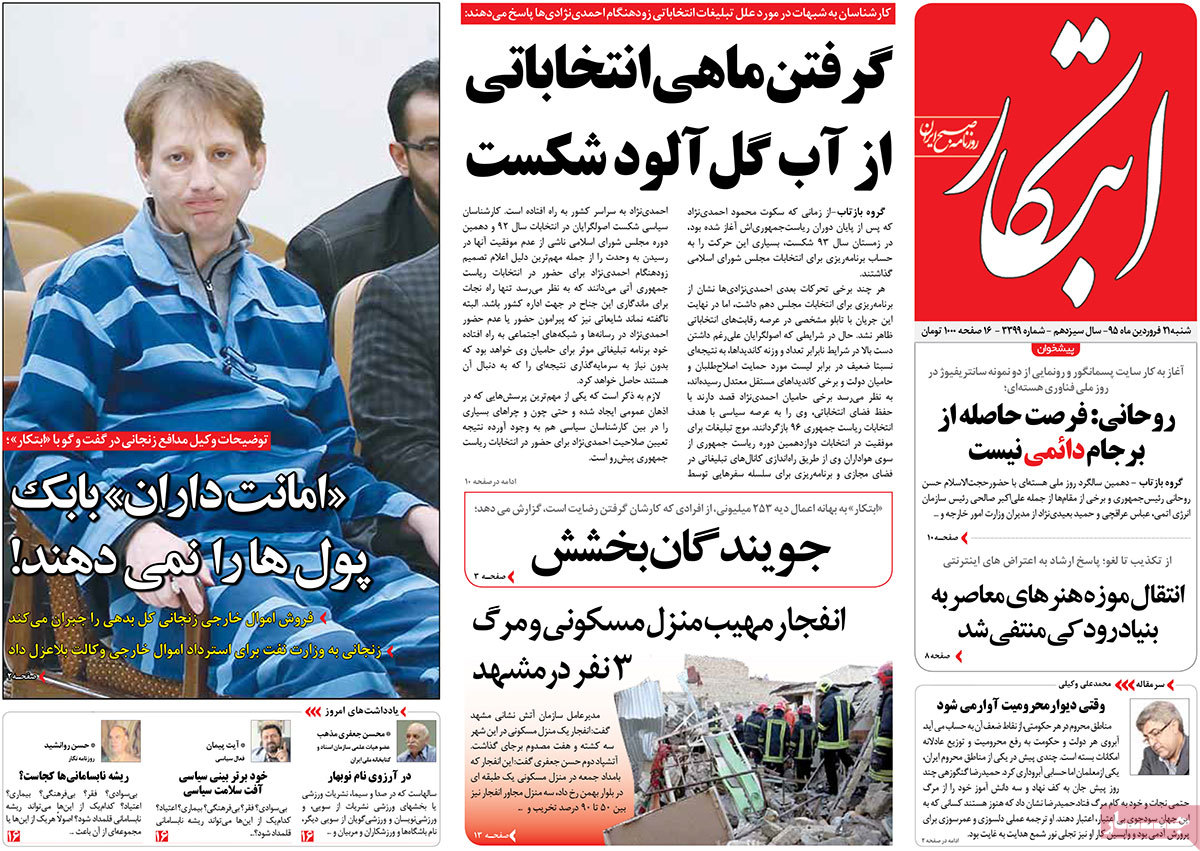
Ebtekar:

1- Trustees of Babak are not refunding his money (Lawyer of oil debtor talking to Ebtekar)

– Selling of Zanjani’s foreign assets will cover all his debts. Babak Zanjani has issued irrevocable power of attorney to recover his foreign assets


A look at Iranian newspaper front pages on April 9


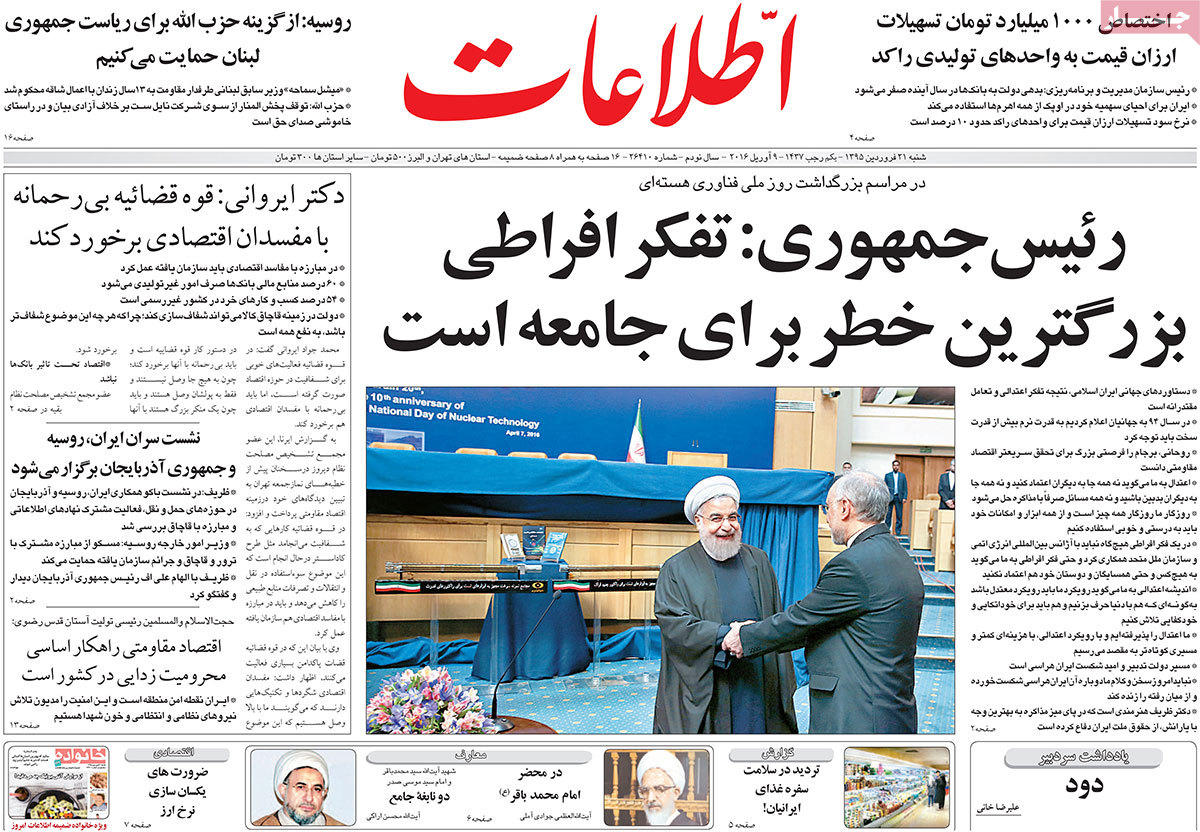
Etelaat:

1- President Rouhani: Extremism is the most dangerous threat against our country

2- Allocation of Rls.10thousands billions low interest rate banking facilities to inactive production firms

3- Russia:  We support Hezbollah’s nominee for Lebanese president

4- Iran, Russia and Republic of Azerbaijan Summit due to take place


A look at Iranian newspaper front pages on April 9


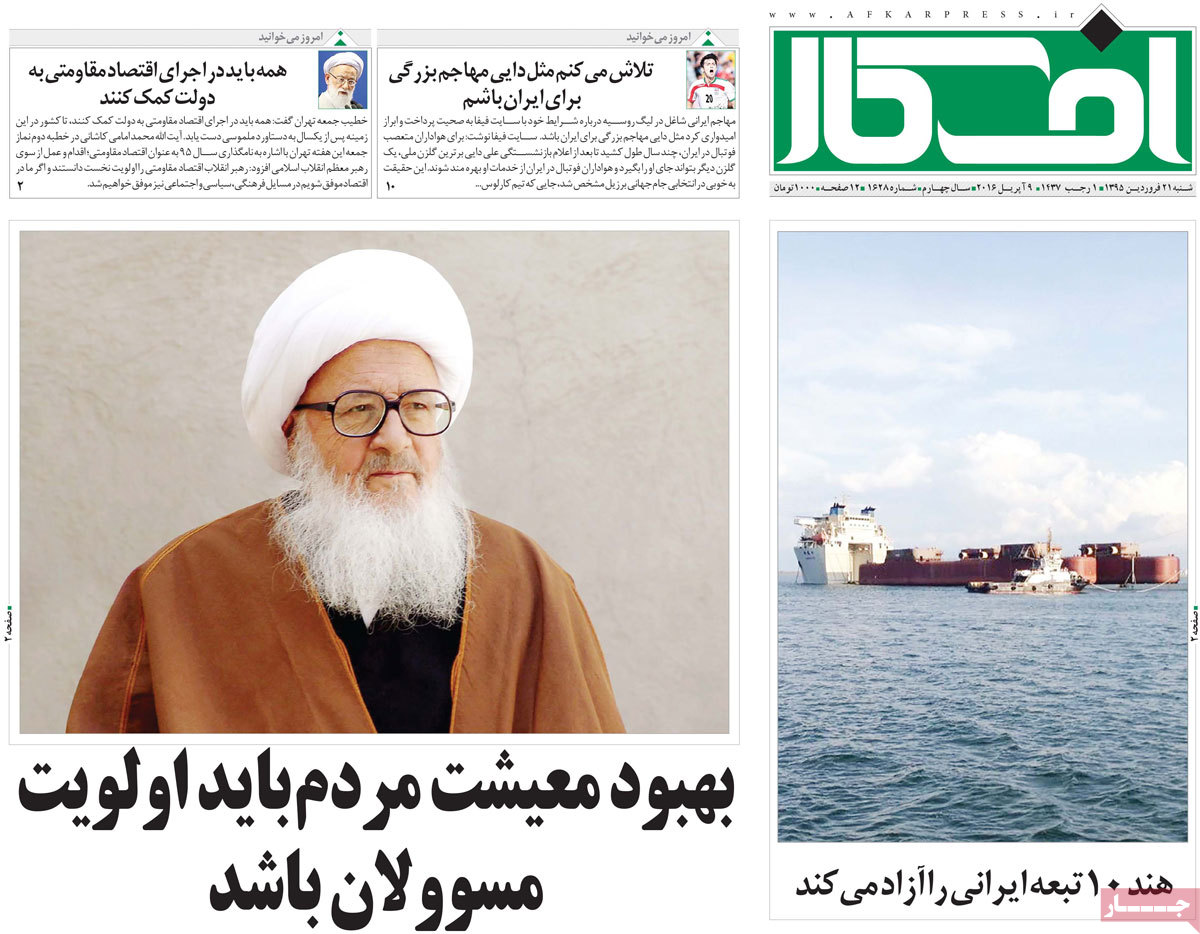
Afkar:

1- Ayatollah Vahid Khorasani: People’s wellbeing must be a priority for officials

2- Tehran Friday Prayer Leader: Everybody should help government to implement “Resistance Economy”


A look at Iranian newspaper front pages on April 9


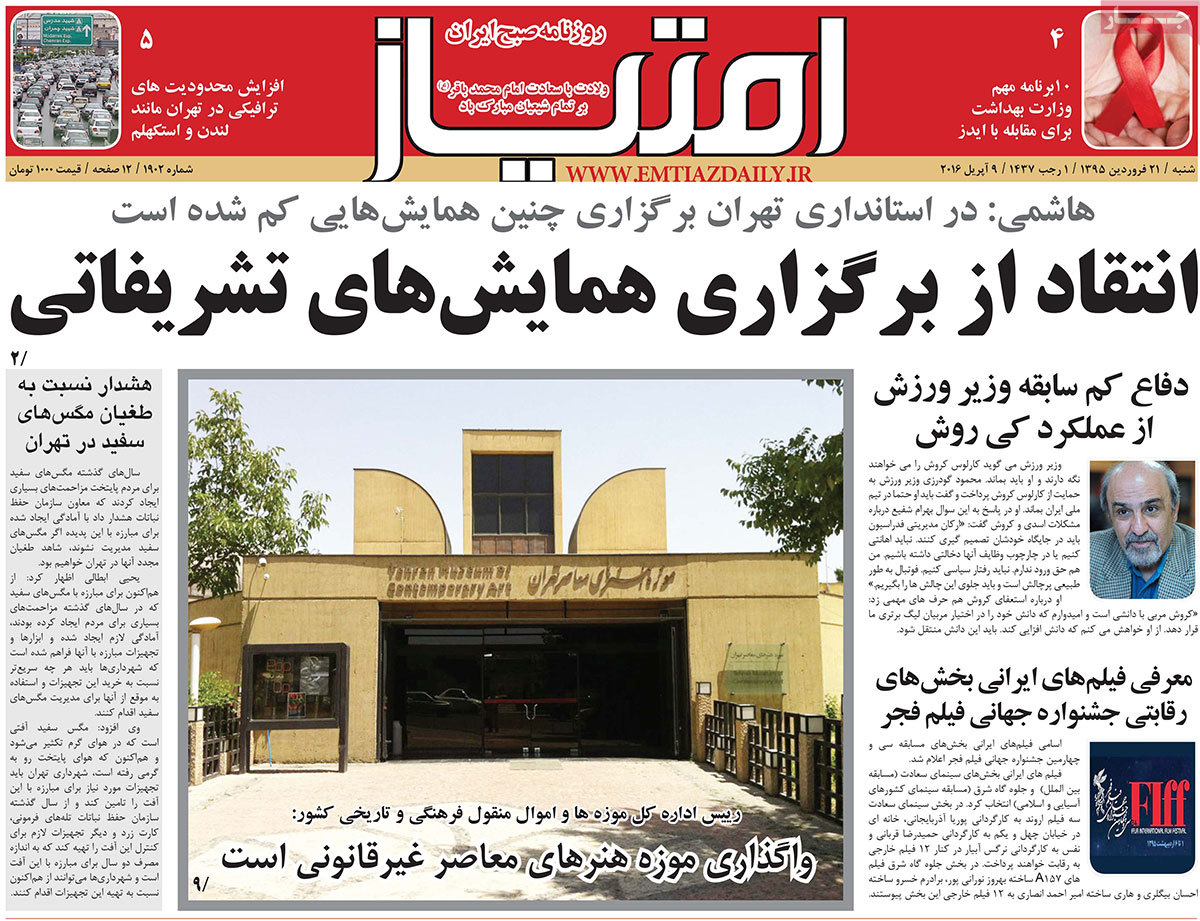
Emtiaz:

1- 10 Important Measures by Ministry of Health to tackle AIDS

2-   More traffic restriction in Tehran similar to London and Stockholm

3- Sport Minister’s unprecedented backing for Carlos Queiroz, head coach of Iranian national succor team


A look at Iranian newspaper front pages on April 9


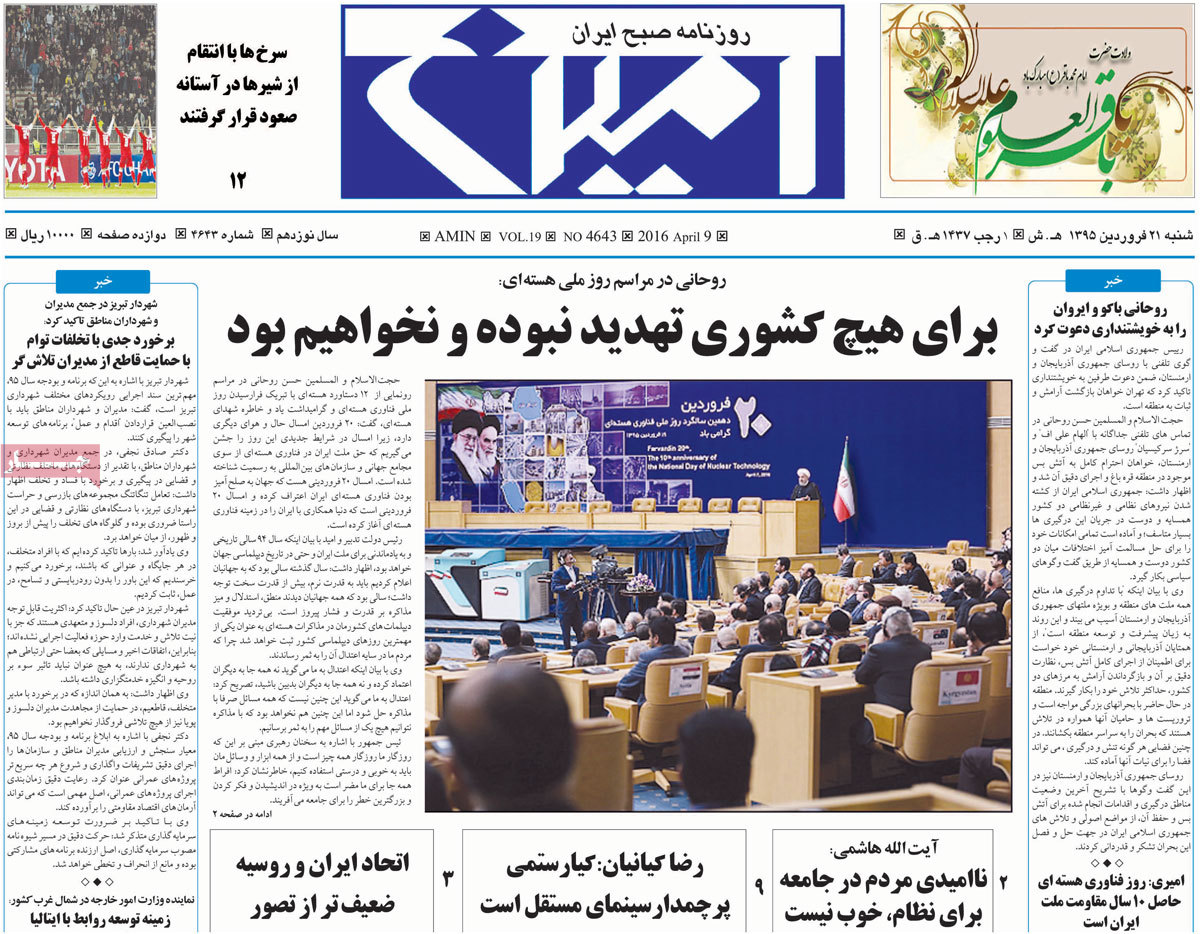
Amin:

1- Rouhani: we have not been and will not be a threat to any country


A look at Iranian newspaper front pages on April 9


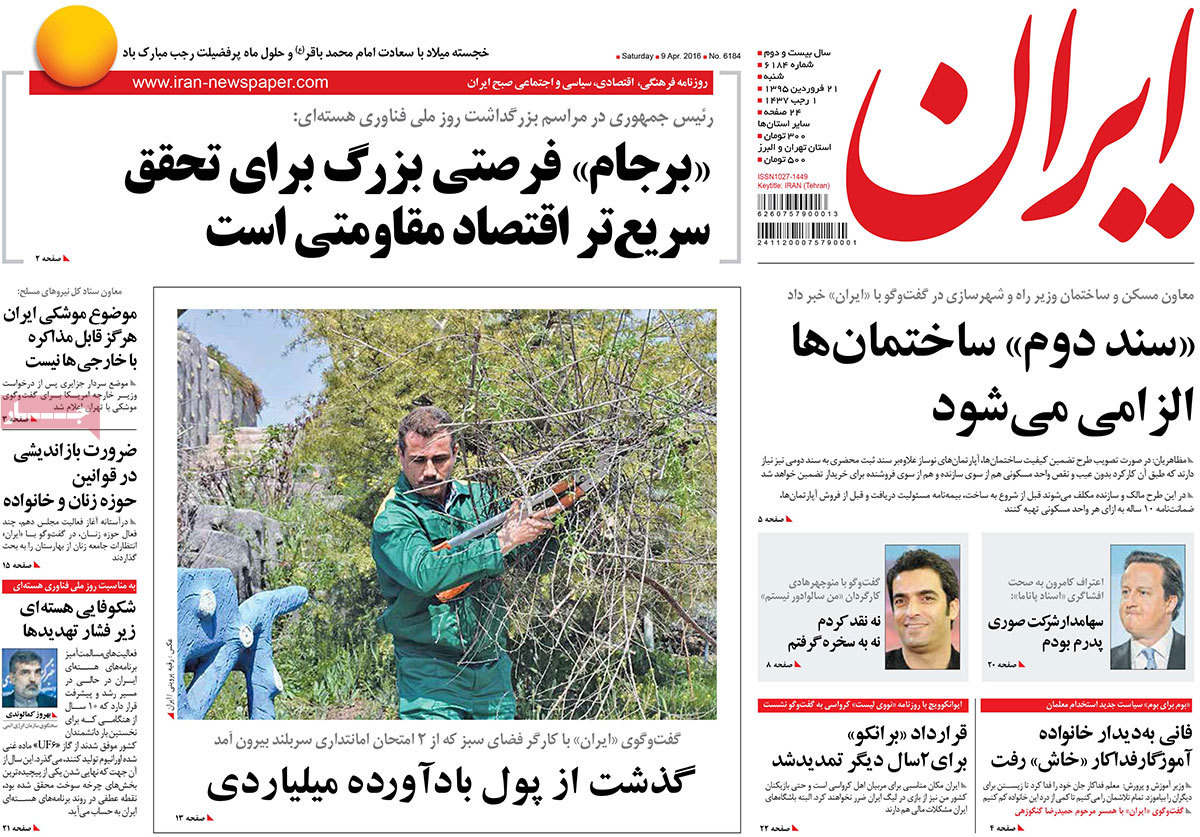
Iran:

1- Rouhani: Joint Comprehensive Plan of Action(JCPA) a great opportunity for speeding up implementation of “Resistance Economy”

2- Deputy Chief of staff of Iranian Armed Forces: Iranian Missiles are not negotiable with any foreigners

3- Disregarding unforeseen fortune:  Interview with a municipality worker who proved his honesty by returning two cases huge lost money to their owners


A look at Iranian newspaper front pages on April 9


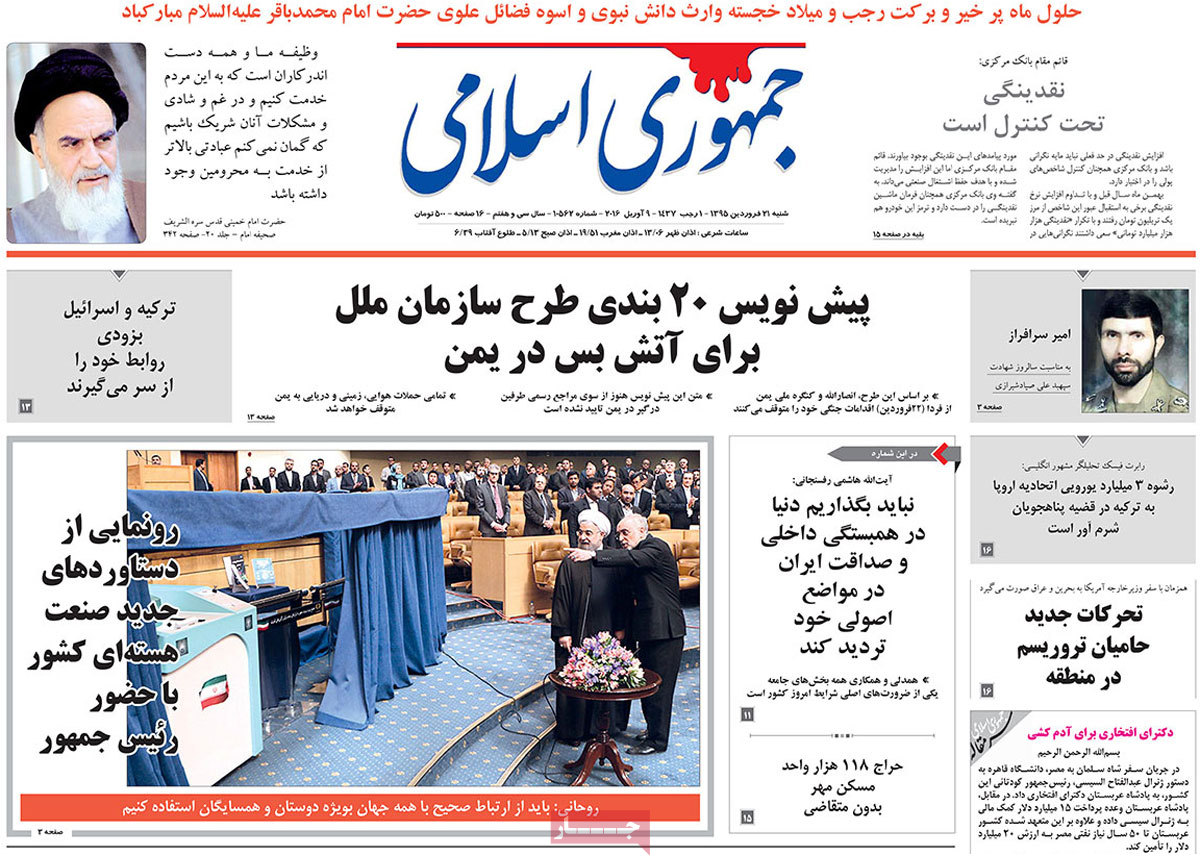
Jomhori Eslami:

1- UN drafts a 20 articles Resolution for ceasefire in Yemen

2- Unveiling new achievements of nuclear industry with President Rouhani in attendance

3- Turkey and Israel to resume their diplomatic ties soon


A look at Iranian newspaper front pages on April 9


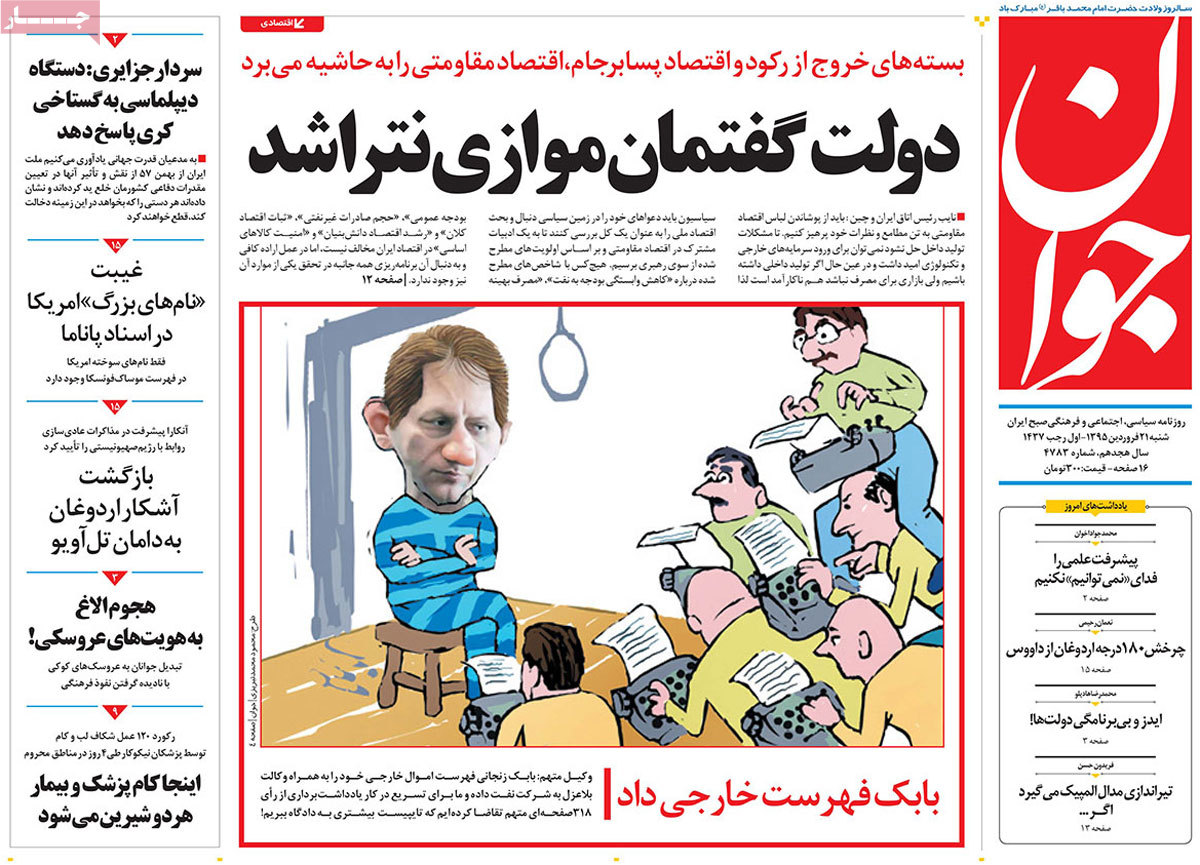
Javan:

1- Babak Zanjani provided a list of his foreign assets

2- Big American names are missing in Panama Documents

– Only little known Americans are named in list released by Mosak Fonseka

3- Erdogan openly return to Israeli lap


A look at Iranian newspaper front pages on April 9


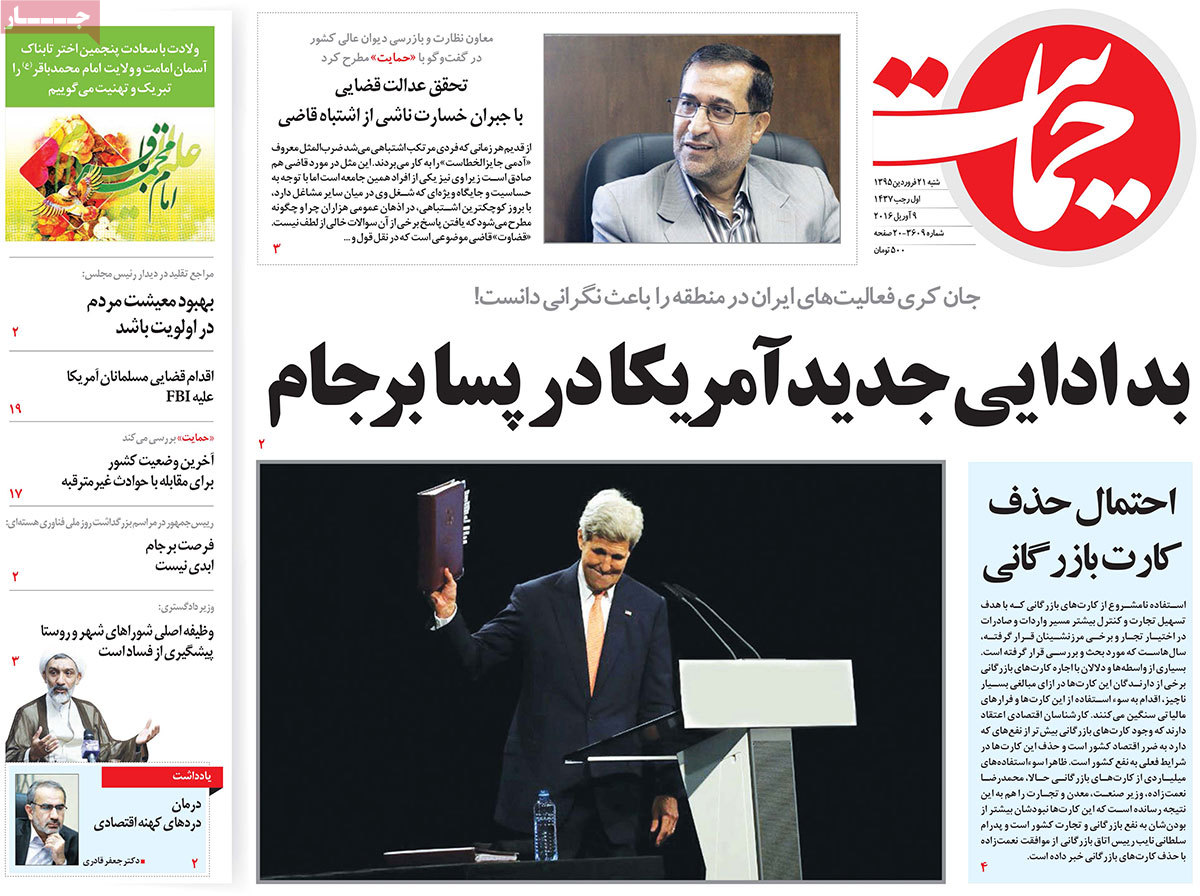
Hemayat:

1- US new unprincipled behavior in post – nuclear agreement era

– John Kerri describes Iran’s activities in the region as concerning


A look at Iranian newspaper front pages on April 9


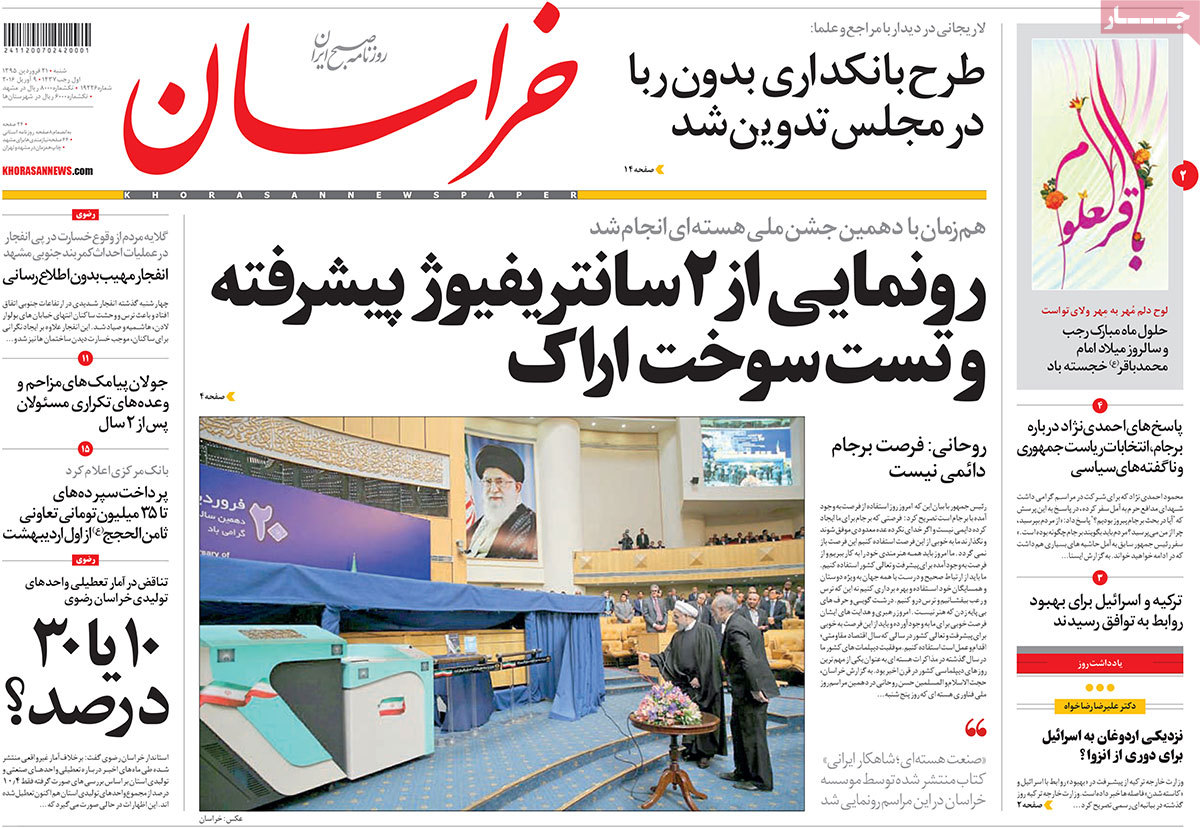
Khorasan:

1- Unveiling to new advanced Centrifuges and test of fuels of Arak Reactor


A look at Iranian newspaper front pages on April 9


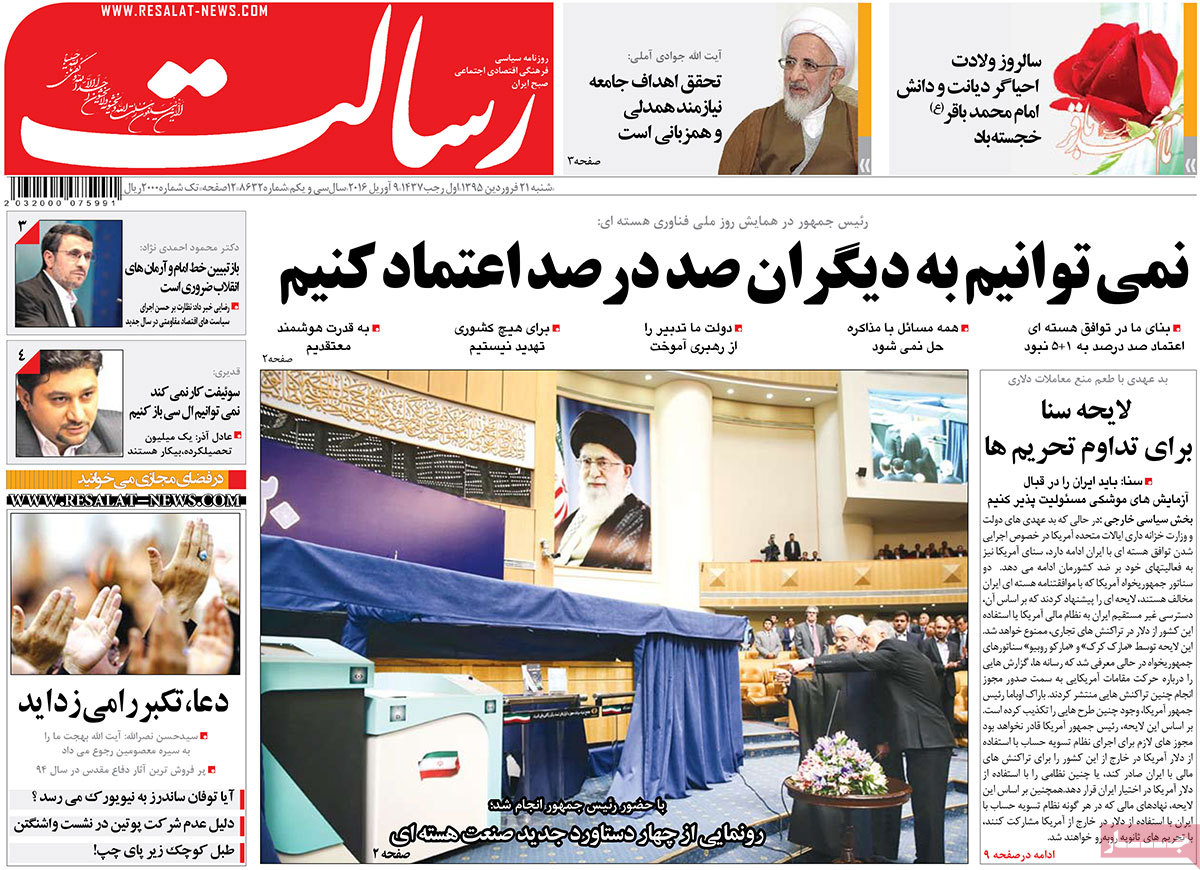
Resalat:

1- President Rouhani: we can not 100 percent trust others

-In nuclear agreement with 5+1 we did not intend to 100 percent trust others


A look at Iranian newspaper front pages on April 9


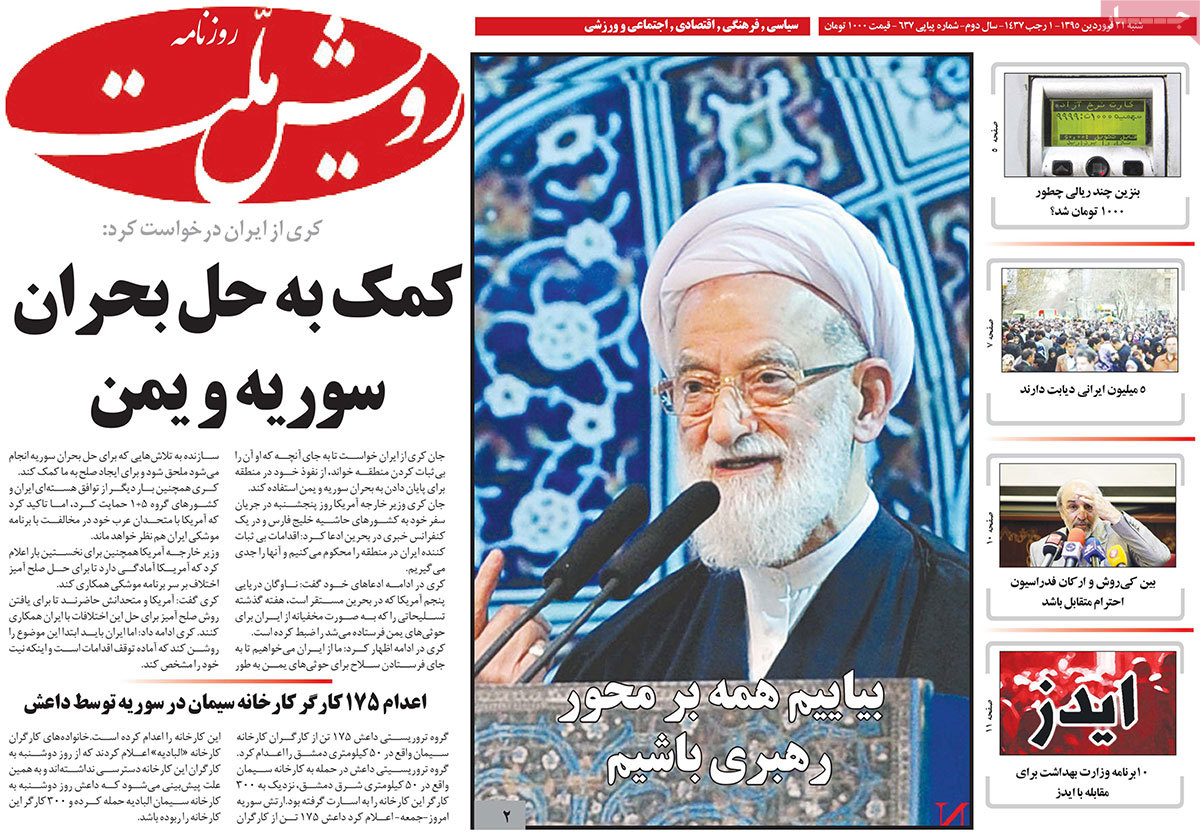
Royesh Mellat:

1- Kerri asks Iran to help to resolve Syrian crisis

2- Daesh executes 172 workers at a cement plant in Syria


A look at Iranian newspaper front pages on April 9


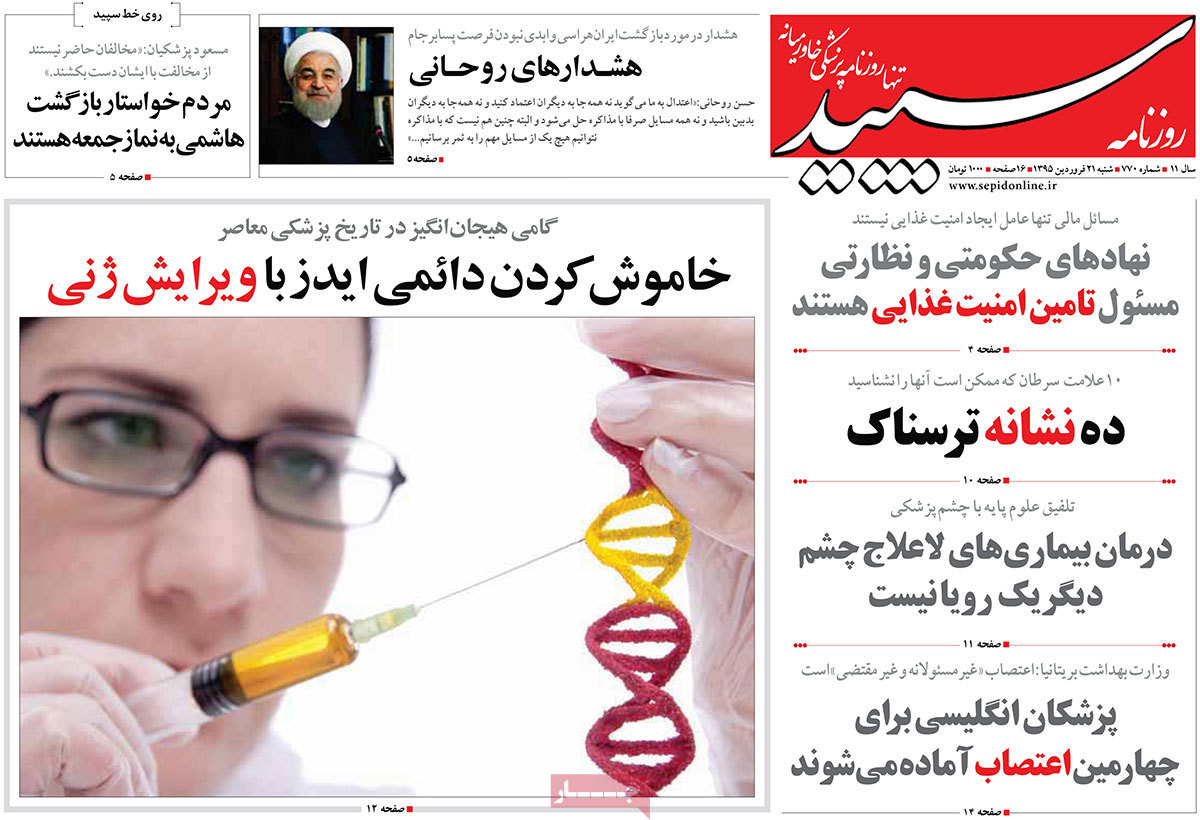
Sepeed:

1- Permanent eradication of AIDS by genetic rearrangement


A look at Iranian newspaper front pages on April 9


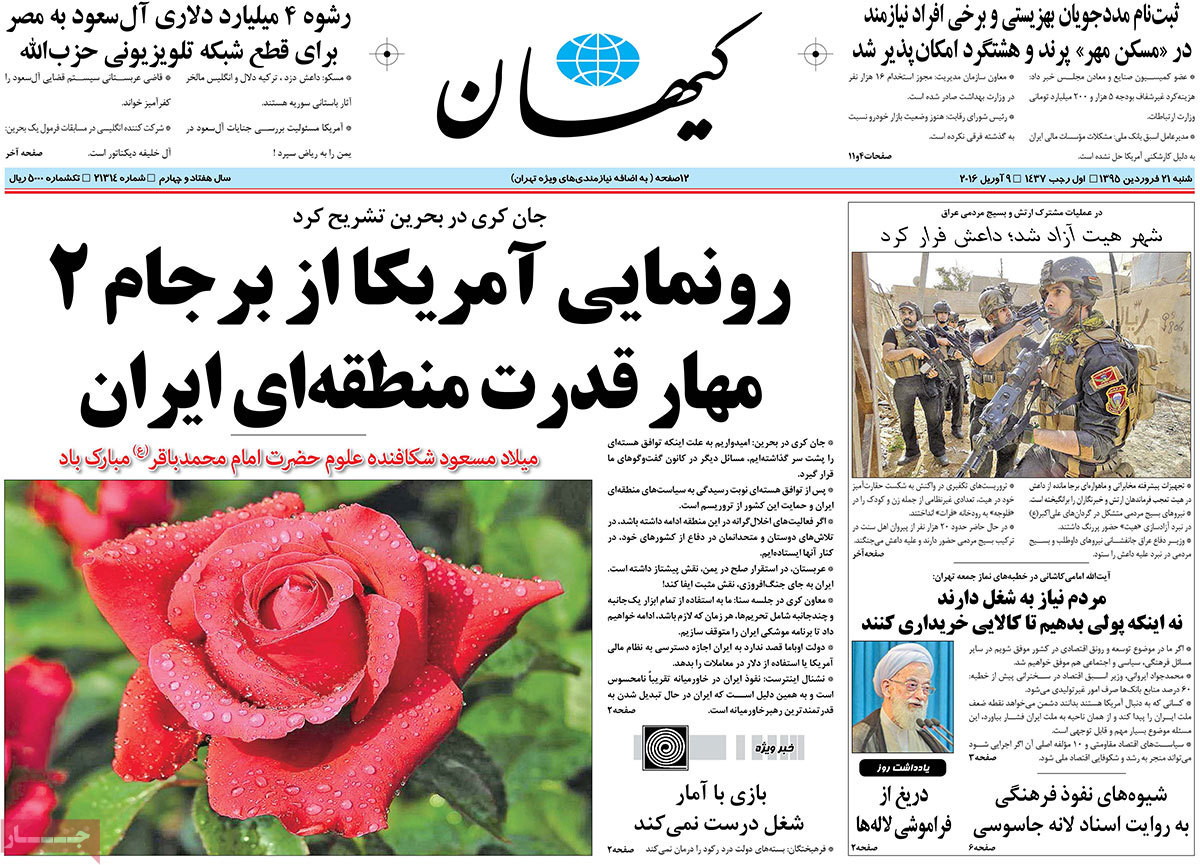
Keyhan:

1- US unveils JCPA 2: Containing Iranian regional Influence, John Kerri explains in Bahrein

2- Saudi rulers pay $4 billion as bribe to Egyptians to remove Hezbollah’s Alalam TV network from Nilesat


A look at Iranian newspaper front pages on April 9


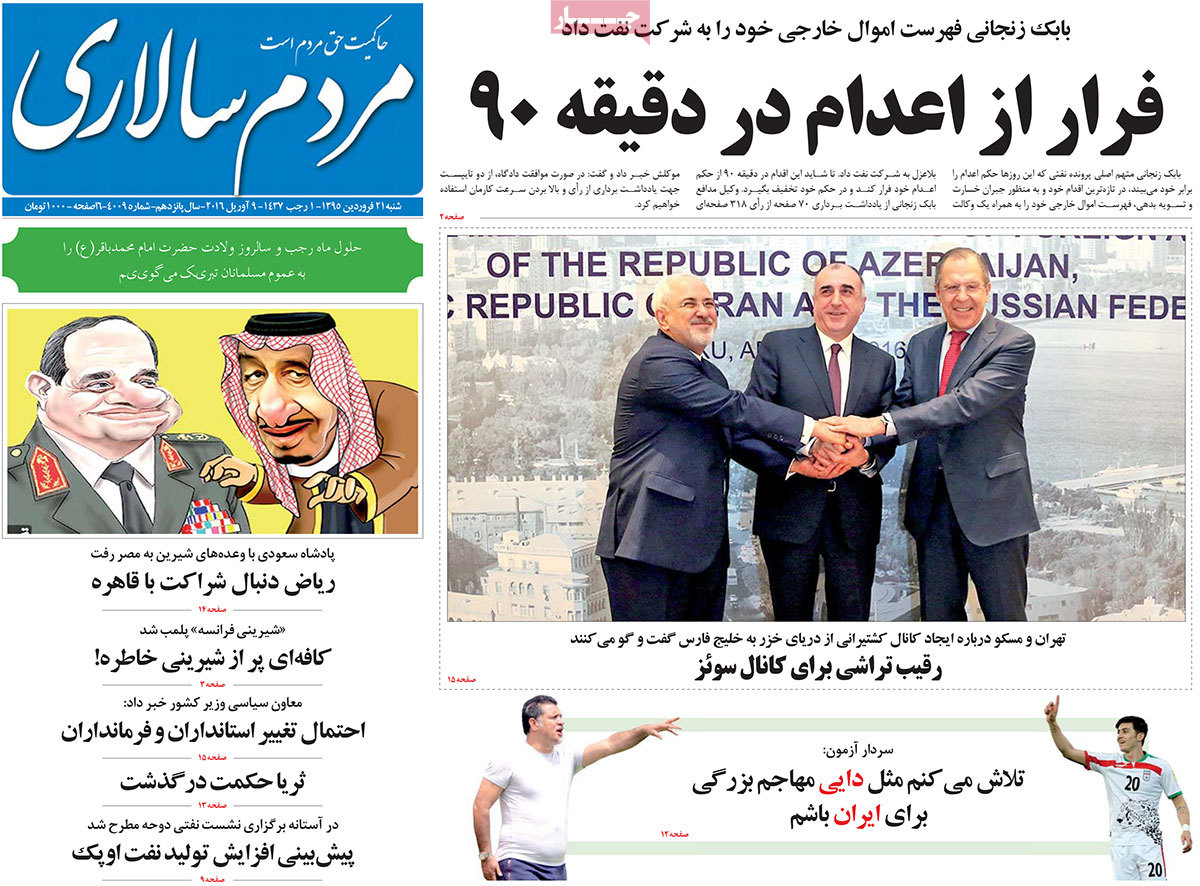
Mardomsalari:

1- Creating a rival for Suez Canal

2- Riyadh looking for partnership with Cairo

– Sweet pledges by Saudi King to Egyptians

3- Forecast of increased OPEC oil output on the eve of Doha oil meeting


A look at Iranian newspaper front pages on April 9


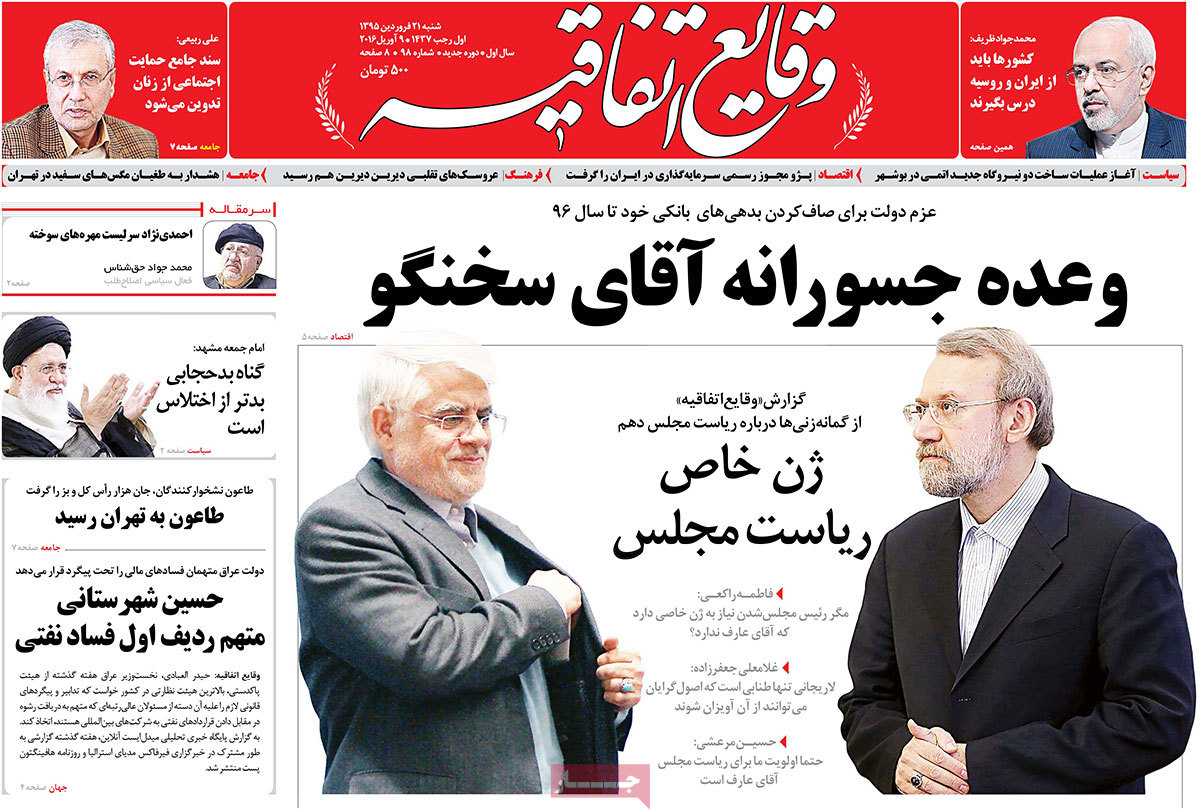
Vaghayeh Etefaghiyeh:

1- Bold pledge by Mr. Spokesman

– Government is determined to settle all its debts by the end of next  Iranian year

2- Special Presidential Gene

– Fatemeh Rakei: Has Parliament Spokesman a special gene that Mr. Aref lacks it?

3- Ali Rabiee: The comprehensive charter to provide social support for women is being compiled

4- Zarif: other countries should learn from Iran and Russia


A look at Iranian newspaper front pages on April 9


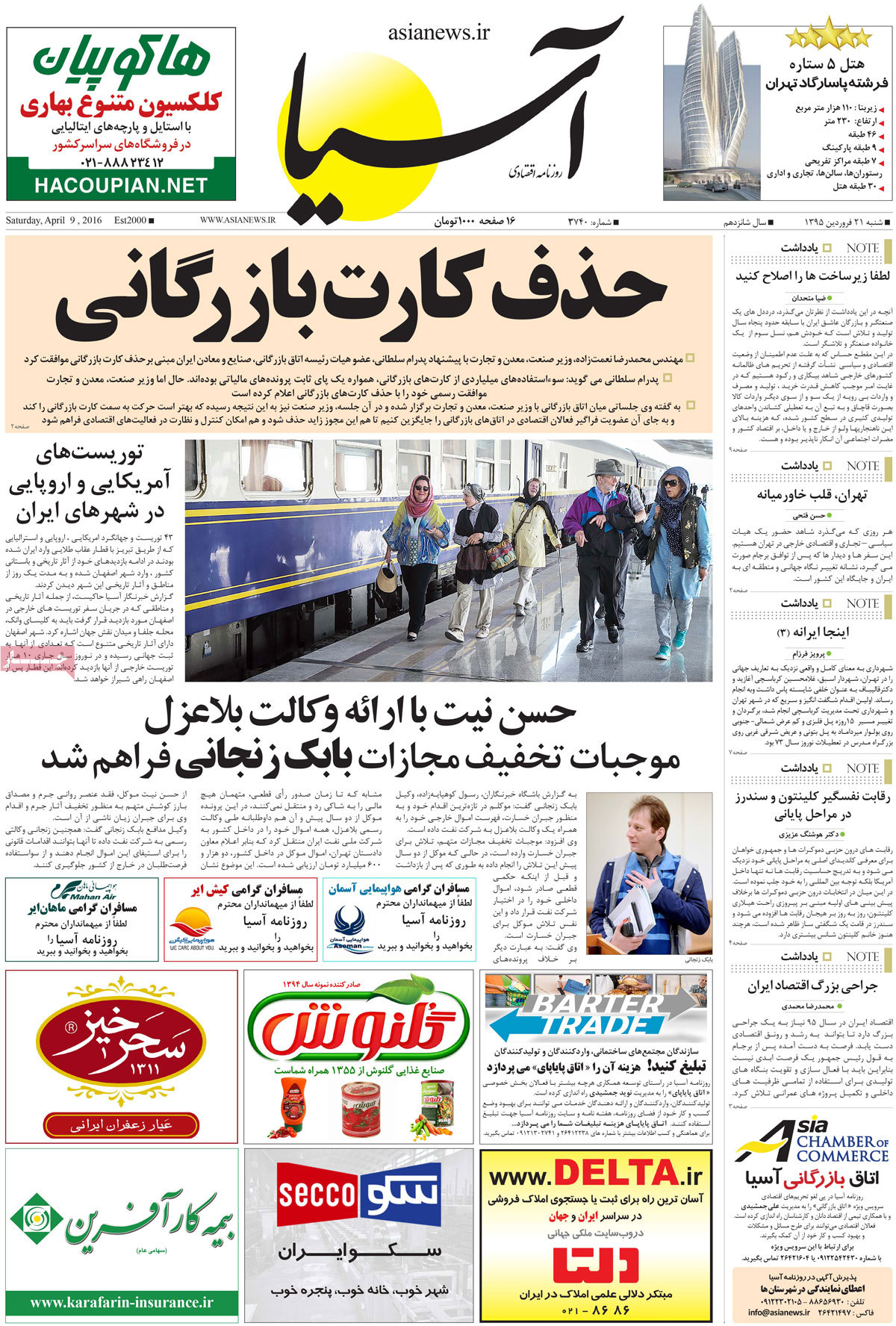
Asia:

1- US and European Tourists in Iranian cities

2- Good intention by giving irrevocable power of Attorney by Babak Zanjani to reduce his term


A look at Iranian newspaper front pages on April 9


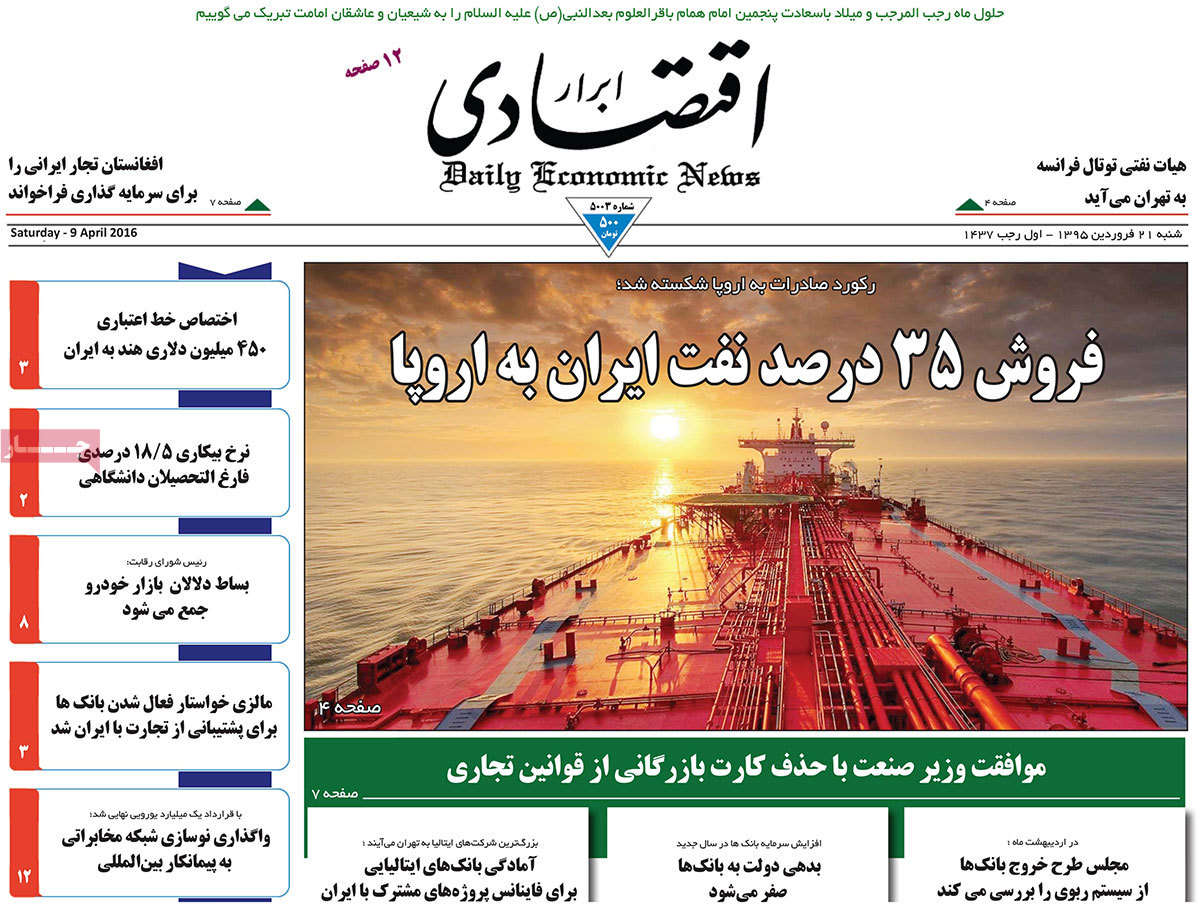
Abrar Eghtesadi:

1- Iran sells 35 percent of its oil to Europeans

2- Malaysian government calls on banks to become active in supporting trade with Iran

3- Italian banks are ready to finance joint projects in Iran


A look at Iranian newspaper front pages on April 9


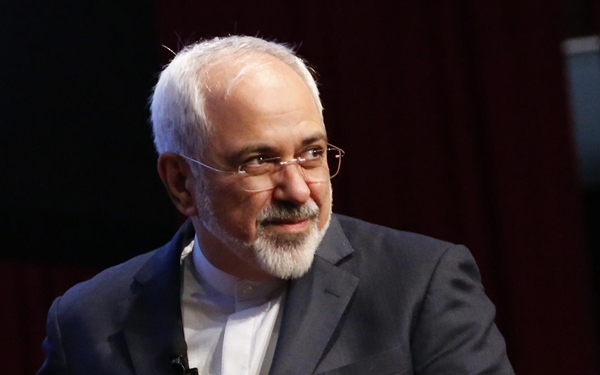
Zarif: Iran Will Remain Friend, Close Partner of Russia

“We will remain a friend of Russia, and because of our common interests, we will further enhance our relations in the course of years to come. We believe our relations with the rest of the world will never undermine our relations with Russia because we value our relations with Russia as an extremely important strategic partnership,” Zarif told Russia’s TASS news agency in an interview published on Friday.

To a question about the alliance of Iran and Syria in the ongoing war on terrorism and extremism in Syria, Zarif said certain countries that “talk a lot” about fighting terrorism and extremism should be engaged seriously in the battle against them.

“The international community will need to learn, particularly those who talk a lot about fighting extremism [and] terrorism … that they need to be serious, they need to act rather than simply take political decisions in dealing with that,” he added.


Nagorno-Karabakh

In response to a question regarding the Iranian position on the Nagorno-Karabakh conflict, he said, “We believe that our region does not need any more conflicts. We are all faced with extremism and terrorism that is emanating from years of occupation of Iraq and the situation that came after that, the rising extremism after the US occupation. And now that threat is threatening us all, particularly in Central Asia and the Caucasus region. We are all faced with the threat of extremism, so we need to set up all disputes to peaceful means, to respect international law and principles of the UN Charter.”

“This is why immediately after the most recent outbreak of hostilities we called the two sides, our defense minister called the two defense ministers, I called the foreign minister of Armenia and had a meeting in Ramsar with the foreign minister of Azerbaijan,” he added.

He further noted, “The (Iranian) president also called both presidents calling for an end to hostilities. We are very happy to see an end to hostilities right now and cessation of hostilities or a ceasefire. We hope this would be the prelude to serious negotiations in order to resolve this issue. Our region requires cooperation between everybody. We believe Armenia as a neighbor and Azerbaijan, as a close friend of Iran, need to have good relations and we hope and support all efforts aimed at resolving this problem.”


North-South Transportation Corridor

On the expectations he has from the North-South Transportation Corridor, Zarif said, “The North-South corridor will enable probably one of the best and cheapest routes from Asia to Europe.”

He added, “It would not just serve the citizens of the three countries. The North-South Corridor will enable probably one of the best and cheapest routes from Asia to Europe. And this will enable countries in Europe and Russia to be able to connect through the Persian Gulf and through the Sea of Oman in a way that could make economic sense. It requires all of us – Iran, Russia and Azerbaijan – to cooperate on building the infrastructure, on easing our customs and tariff values, so that we can encourage greater trade. And we are ready for that and I believe this was a good first step. It would be followed by a summit and probably by meetings in the sectorial field.”


Caspian Sea States

Regarding the next summit of the five Caspian states in Astana, the capital of Kazakhstan, the Iranian foreign minister said, “We hope to be able to finish the Convention. We believe that the countries around the Caspian, this is a peculiar environment with a very specific legal system. We need to finalize the legal document, the Convention on the Caspian. We also need to enhance our cooperation with regard to the environment. We already have the necessary legal framework for cooperation, and the environment cooperation, and the fisheries.”

He added, “And we also need to make sure that the Caspian will remain a zone of peace, a zone of friendship and cooperation among the countries, the littoral states of the Caspian. We are hopeful between now and the summit in Astana there’ll be meetings both on the expert and the ministerial level and we believe that those meetings should prepare the grounds that once we have the summit in Astana among our heads of state, we will be able to finalize the Convention.”


Trilateral Baku Meeting

Elsewhere in his remarks, Zarif expressed satisfaction with the results of a Thursday meeting with his Azeri and Russian counterparts Elmar Mammadyarov and Sergei Lavrov in the Azeri capital Baku.

“Actually, we all were satisfied. This was a very good first step, there is agreement on almost every issue. And our cooperation will not be limited to transit and economic issues but also to security issues, to intelligence cooperation, counter-terrorism and in narcotics,” he said.

“These are important areas of common challenge to the three countries and we agree to cooperate in all these areas. We also agree to have sectorial ministerial meetings and a summit. The agreement on the summit was already reached between the three presidents, now we need to set the date, and hopefully in the near future we will have a summit of the three leaders. Both giving the greater momentum and impetus to cooperation and also directing various ministries, organizations and agencies to work together in the various fields that we agreed we need to work together,” he added.


Tehran-Moscow Ties

Zarif once again reiterated the strong ties between Tehran and Moscow and said, “Iran and Russia are neighbors. And for us, relations with our neighbors are extremely important. Russia is an important neighbor, we have strong historical ties, we have strong political relations in all fields – political relations, multilateral relations, economic relations, defense relations, intelligence relations. And we will have this in a long-term perspective.”

“We believe that Russia helped Iran during our difficult times. Russia was on the side of Iran during the times when the international community, the United Nations imposed sanctions on Iran. We will not forget that. We will remain a friend of Russia, we will remain a close partner of Russia, and because of our relations with Russia, because of our common interests and shared principles and the strategic relations that we look to further enhance and further strengthen in the course of years to come. And we believe our relations with the rest of the world will never undermine our relations with Russia because we value our relations with Russia as an extremely important strategic partnership,” he said.

He further noted, “Iran and Russia are stronger together, we can in fact defeat extremism and contain extremism. We have made, with the sacrifice of the Syrian people, with the bravery of the Syrian Armed Forces, we have been able to defeat in many respects the advances of Daesh, al-Nusra. And the international community will need to learn, particularly those who talk a lot, about fighting extremism, terrorism, need to learn that they need to be engaged, they need to be serious, they need to act rather than simply take political decisions in dealing with that. So I think there are important lessons but the most important lesson is that terrorism and extremism can be contained and can be defeated. We require a multifaceted approach. The military dimension is only one aspect of this. Iran and Russia are going to be working together on cultural counter-extremism. We need to extend cooperation to inter-religious dialogue so that we can promote moderation rather than extremist views.”

According to the Iranian Foreign Minister, “These are important ideas, important values, shared values, shared concerns and challenges that we, and Russia, and Azerbaijan for that matter, and other countries in Central Asia and the Caucasus that who face this threat, have in common. We believe that Islam is a religion of peace, that these terrorists and extremists have nothing to do with Islam, and together we can in fact promote a vision, a reading, a narrative that contains extremism and promotes tolerance and moderation.”


Need for Improving Trade

Elsewhere in his remarks, Zarif regretted that trade ties between Iran and Russia are not up to the mark.

He added, “We have actually taken steps. There are some bottlenecks, and we are addressing those bottlenecks. One is banking. Due to sanctions, banking relations between Iran and other countries were restricted. Now we are taking steps with Russia and with other countries to remove those banking restrictions. Of course, sanctions have been lifted but the speed of lifting of sanctions in bilateral relations is taking a bit longer. We have agreed on easing and facilitation of customs regulations, we have also agreed on easing and facilitating visas so that our business people, as well as our tourists, can interact and travel from one country to another. We also have been discussing with Russia reducing tariffs and other barriers in trade, so we’re making progress. We make progress in some fishery products, in some agricultural products but we will make even more progress. We have made some progress and enhanced cooperation between Iran and Russia in the area of defense, in the area of peaceful nuclear technology, in the area of construction of railroads, credits, other possibilities.”

He further said, “We are making good progress but potential between Iran and Russia is far greater. We are two important neighbors and we have complementarities that we need to work on. And I think, as you pointed out, that the leadership of the two countries are seriously interested in engagement and I believe with greater work, we can expand this engagement and enhance it.”


Iran’s Oil Exports

Zarif also touched upon Iran’s oil exports and its global market share. He said confrontation in the oil market is a fact of life.

He however added, “But Iran’s share in Europe’s market has been taken over by Americans. And now that Iran is back with the removal of sanctions, we expect other producers to take note – and I believe Russia has already indicated that it recognizes the special situation of Iran after the removal of sanctions. I hope that the rest of oil producing countries, both OPEC and non-OPEC, recognize this fact and live with it accordingly.”


Iran and Russia Work Together

He noted, “Iran and Russia played together, worked very closely together in reaching the nuclear agreement which everybody has hailed as significant achievement. The role of Russia in reaching that nuclear agreement was instrumental, and we very much appreciate the role Sergey Lavrov himself and the Russian government played in this process. So Iran and Russia working together can be a force for peace, a force for prosperity and a force for combatting our common challenges.”

Iran, Iraq to seal gas oil deal

Given that Iran possesses surplus capacity for the production and supply of gas oil, the export of the strategic oil product to neighboring countries and the Middle East region has been put on the agenda.

National Iranian Oil Products Distribution Company’s Director for Export and Import Esmaeil Hasham Firouz pointed to the daily export of two million tons of gas oil to Iraq said “the new deal for gas oil exports to the neighboring company will be extended.”

In time with the deployment of gas oil to Iraq, export of the gas product to the Iraqi Kurdistan also marks Iran’s priority in the current Iranian calendar year while more than five million liters of gas oil was exported to the region in the previous year (ended March 19).

Overall, near two billion liters of gas oil was shipped to various world countries in the previous year including Iraq, Iraqi Kurdistan, Pakistan, Afghanistan, Tajikistan as well as some African countries.

Accordingly, the volume of gas oil exports to Iraq and Afghanistan, as two traditional customers, experienced a significant rise in the past year while the figure in estimated to soar even more with the opening of a new border terminal.

Seyed Ramazan Hashemi, Director of Kermanshah Oil Products Distribution Company, had previously pointed to the shipment of gasoline to Iraq through Khosravi border asserting “the export of Iran’s gasoline to the neighboring country was launched for the first time via Khosravi border terminal in Kermanshah.”

Iran turned into a major gas oil exporter for the first time in the previous year following the operation of new South Pars phases as well as the rise in production of natural gas.

Nevertheless, the fall in global oil prices has brought about numerous problems for Iran’s export of oil products particularly gas oil and fuel gas as the price of Iran’s gas oil has dropped from 970 to 280 dollars per ton.

Display of Louvre Museum World Masterpieces in Iran

The Director of the Louvre Museum (the world most visited and famous museum) and his delegation, including French cultural heritage experts, will be in Tehran from today to Monday evening to discuss and open a new chapter of cultural collaboration between the museums of both countries.

Mohamadreza Kargar, in his interview with IRNA, said, “Soon there will be a significant exhibition of Louvre Museum masterpieces in Iran with the arrangement of both countries.”
He added, “Currently we are negotiating with Mexico to arrange an exhibition of Mayan civilization artefacts in Iran. After that, we will provide the facilities for hosting an exhibition of Louvre Museum masterpieces.”
The Head of Iran’s Museums Department answered a question about whether it has been determined which part of the Louvre Museum will be exhibited in Iran, saying, “ We have requested to transfer the complete collection of ancient Egyptian culture and civilization which is hosted by that museum.”
He also talked about the reason for choosing Egyptian Civilization, mentioning that they were more interested in displaying masterpieces belonging to civilizations such as Egypt, Rome, and China due to their ancient history, civilization and culture.”

He highlighted that this is the first trip of the Louvre Museum’s new Director to Iran, which will allow him and the other Louvre authorities to get more familiar with Iranian culture and civilization.

Export of Caviar to the US and Canada to be Resumed

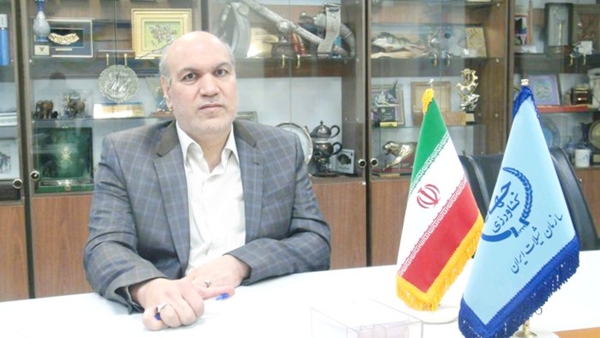
According to Tasnim News Agency, the Deputy Agriculture Minister said that exporting caviar to the United States and Canada will be resumed this year. There is no obstacle for such exports, and negotiations with relevant traders have already been conducted.

Mr. Salehi said that, in addition to major importers of Iranian caviar and shrimp in Europe and Southeast Asia, this year Canada, Russia and America will be added to the list of Iranian customers for such products.

Marathon in Persepolis a Symbol of Iran’s Safety

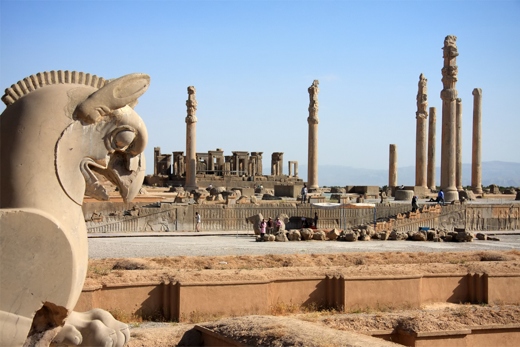
Persepolis

Nearly 200 competitors will run 42 km between the main gate of Shiraz and the historical site of Persepolis. The participants come from the following countries: Germany, Austria, Australia, China, Denmark, Egypt, France, Hungary, Greece, Iran, Italy, Ireland, Lebanon, Luxemburg, Netherlands, Iceland, Pakistan, Poland, South Africa, Sweden, Turkey, England and the UAE. Attending this marathon is both endurance as well as entertainment.

Alireza Qajar, the manager of a tourist company, organized this marathon in Shiraz in partnership with a Dutch tourist company. He talked to an ISNA journalist about the details of this event, saying, “This marathon is a reminder of King Darius I and the Battle of Marathon during the first Persian invasion of Greece. This event is organized as a symbol of peace and unity among people from different nations. It is not merely a competition – the foreign competitors from Asia, Africa and Europe who make up about one hundred of the runners will also be introduced to Iranian culture, history and cuisine.

He highlighted the fact that the marathon will be officiated according to international standards, and said, “We have chosen a historical route for this marathon. In determining the path, we considered the protection of the historical sites, so the competitors will not run through or enter any of the sites. They will run 42km and 190m in total, both in the city and on the road. The ceremony for giving the awards will also be held in a location close to Darius’ castle.

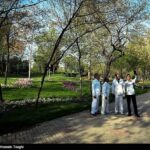
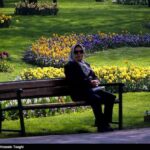
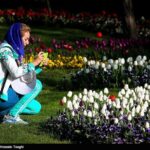
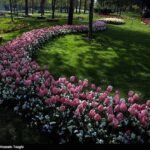
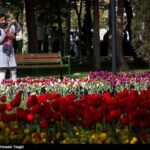
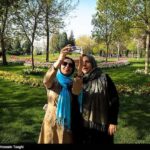
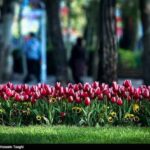
Iran’s Beauties in Photos: Tulips Festival in Mashhad

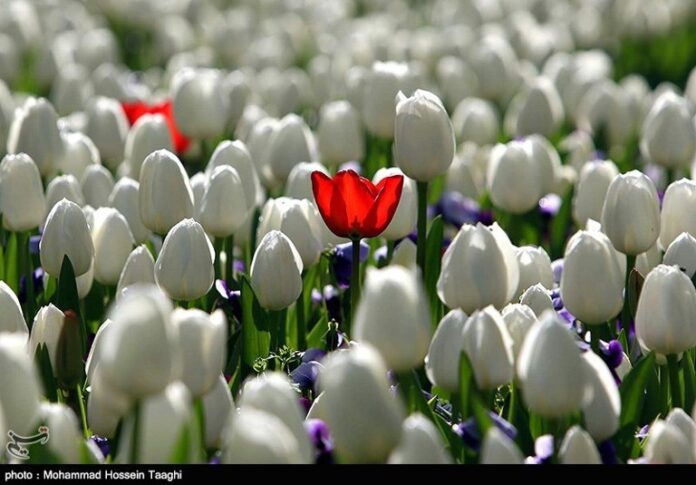
 A festival of tulips flowers is underway in Park Mellat in the holy city of Mashhad, northeast of Iran.