Thursday, December 25, 2025
Home Blog Page 4476

Iran test-fires two ballistic missiles during large-scale drills

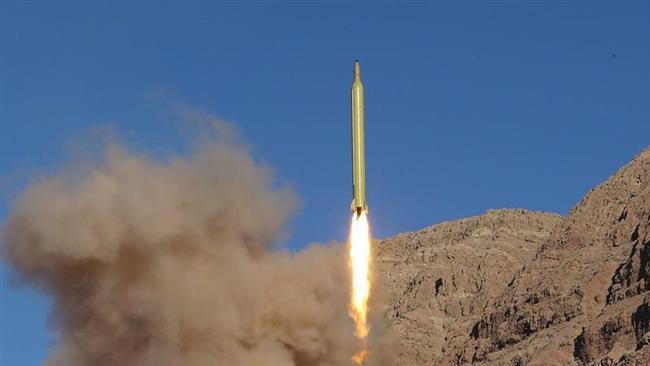
The missiles dubbed Qadr-H and Qadr-F were fired on Wednesday during the large-scale drills, codenamed Eqtedar-e-Velayat.

The missiles were fired from East Alborz heights in northern Iran and could hit targets 1,400 kilometers away in Makran Coasts southeast of the country.

Commander of the IRGC Aerospace Division Brigadier General Amirali Hajizadeh said Qadr-H missile has a range of 1,700 kilometers while Qadr-F missile can destroy targets some 2,000 kilometers away.

Iran’s test-firing of the missiles comes after a US State Department spokesman, Mark Toner, on Tuesday criticized the country’s missile launch, saying Washington planned to bring it before the United Nations Security Council.

Last month, Iran’s Foreign Minister Mohammad Javad Zarif said the Islamic Republic will continue to develop its missile program and that Tehran needs “no permission” to enhance the country’s defense capabilities.

“We have announced that we will not ask permission from anyone to [strengthen] our defense and missile capability,” Zarif said in an interview with Iranian Students’ News Agency, ISNA, on February 28.

The top Iranian diplomat went on to say that the country’s missile program does not breach last July nuclear agreement struck between Tehran and six world powers and that the deal does not ban Iran from boosting its defense capabilities.

In recent years, Iran has made great achievements in its defense sector and manufactured different types of military equipment.

Iran has repeatedly assured other countries that its military might poses no threat to other states, insisting that its defense doctrine is entirely based on deterrence.

Commander: Most IRGC Missiles Can Reach Israel

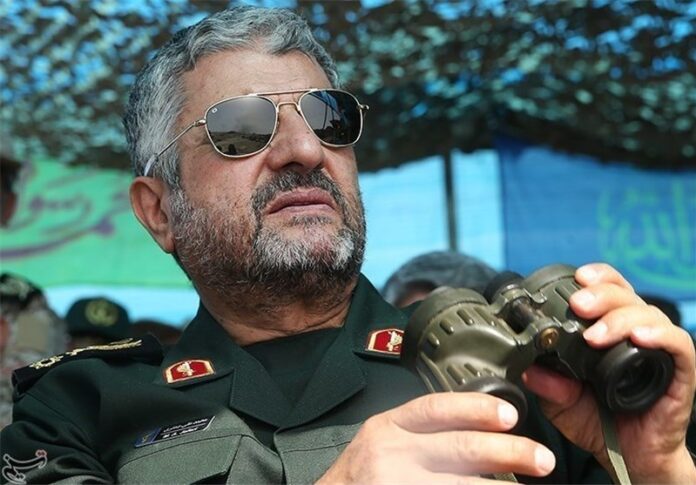
Whoever feels more hostility towards Iran will be naturally more fearful of the country’s military capabilities and achievements, the top general told reporters on Tuesday on the sidelines of an ongoing missile drill staged by the IRGC, codenamed ‘Might of Velayat’.

Since most of the IRGC missiles have the enough range to reach the lands occupied by the Zionist regime of Israel, the Tel Aviv regime has the most degree of concerns, he added.

“Enemies of the Islamic Revolution and security in the region should be in panic about the roar of the IRGC missiles,” Jafari stated.

The commander noted that the launch of various types of missiles in the drill was only a slight indication that the IRGC’s missile silos, scattered all over the country, are fully operational.

He underscored that the country’s missile capabilities have been achieved under sanctions imposed by the foreigners, stressing that Iran’s missiles are fully indigenous.

The message of the missile drills is security for Iran and the neighboring countries, Major General Jafari underlined.

The missile drill has been in progress for a couple of days, but its final stage kicked off on Tuesday in different parts of the country.

According to the IRGC, the exercise is meant to demonstrate Iran’s might and sustainable security in light of unity, convergence, empathy and harmony.

Iranian officials have already made it clear that the country’s military program, including the routine exercises and test of new missiles, will not be hampered by anything, including a recent nuclear deal with the Group 5+1 (Russia, China, the US, Britain, France and Germany), which took effect on January 16.


A look at Iranian newspaper front pages on March 8

Iran Newspaper front pages

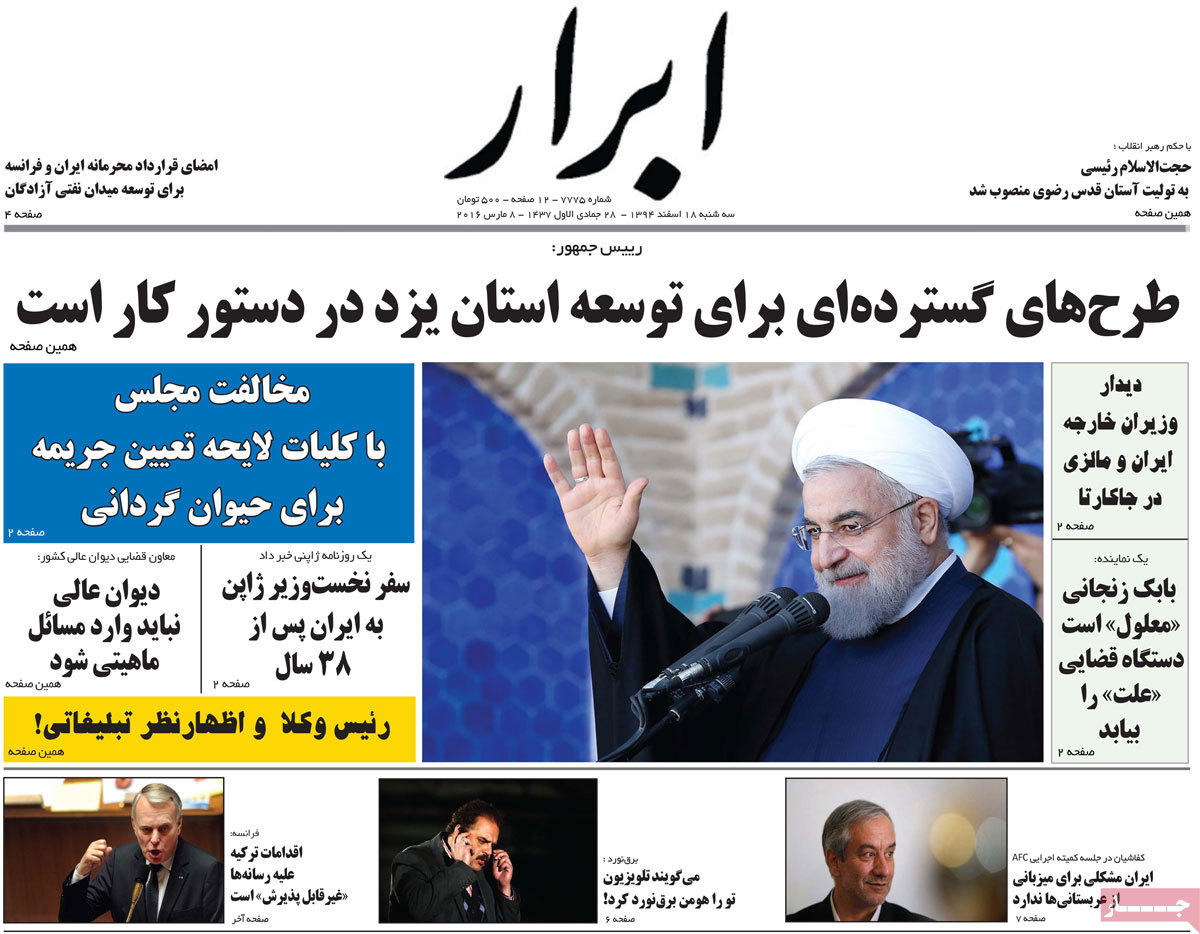
Abrar:

1.  Iran and France sign confidential deal to develop Azadegan oilfield

2.  Rouhani says major plans under way to develop Yazd Province

3.  Zarif meets Malaysian counterpart in Jakarta

4.  First Japanese PM to visit Iran in 38 years
 

A look at Iranian newspaper front pages on March 8


Abrar Eqtesadi:

1.  Iran to link China to Europe by rail

2.  Approved: Iran membership in Asian Infrastructure Investment Bank

3.  13 years needed to complete unfinished projects

4.  First Iranian oil shipment reaches Europe
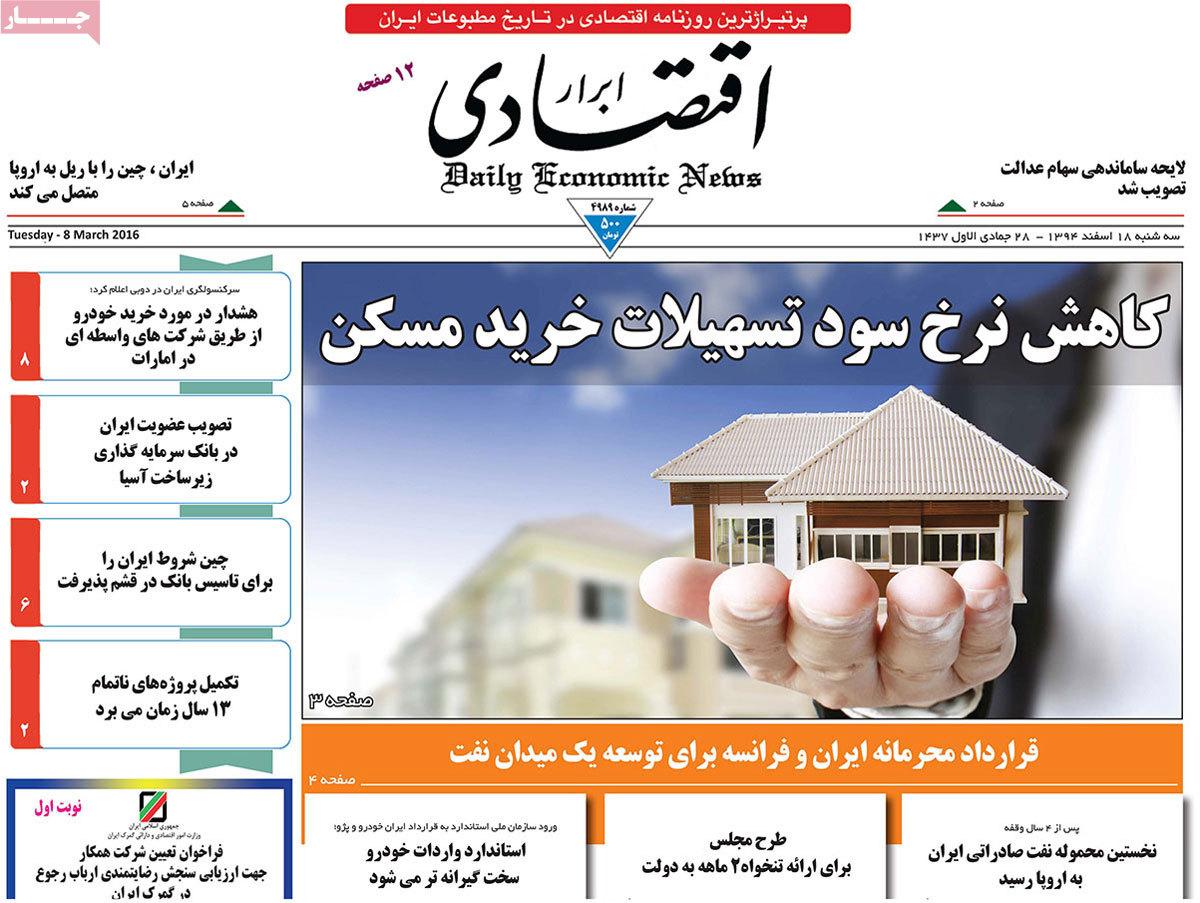
 

A look at Iranian newspaper front pages on March 8


Afkar:

1.  North Korea threatens nuclear strike over US-South Korean exercises

2.  Value of awareness-based freedom of thought: Rafsanjani
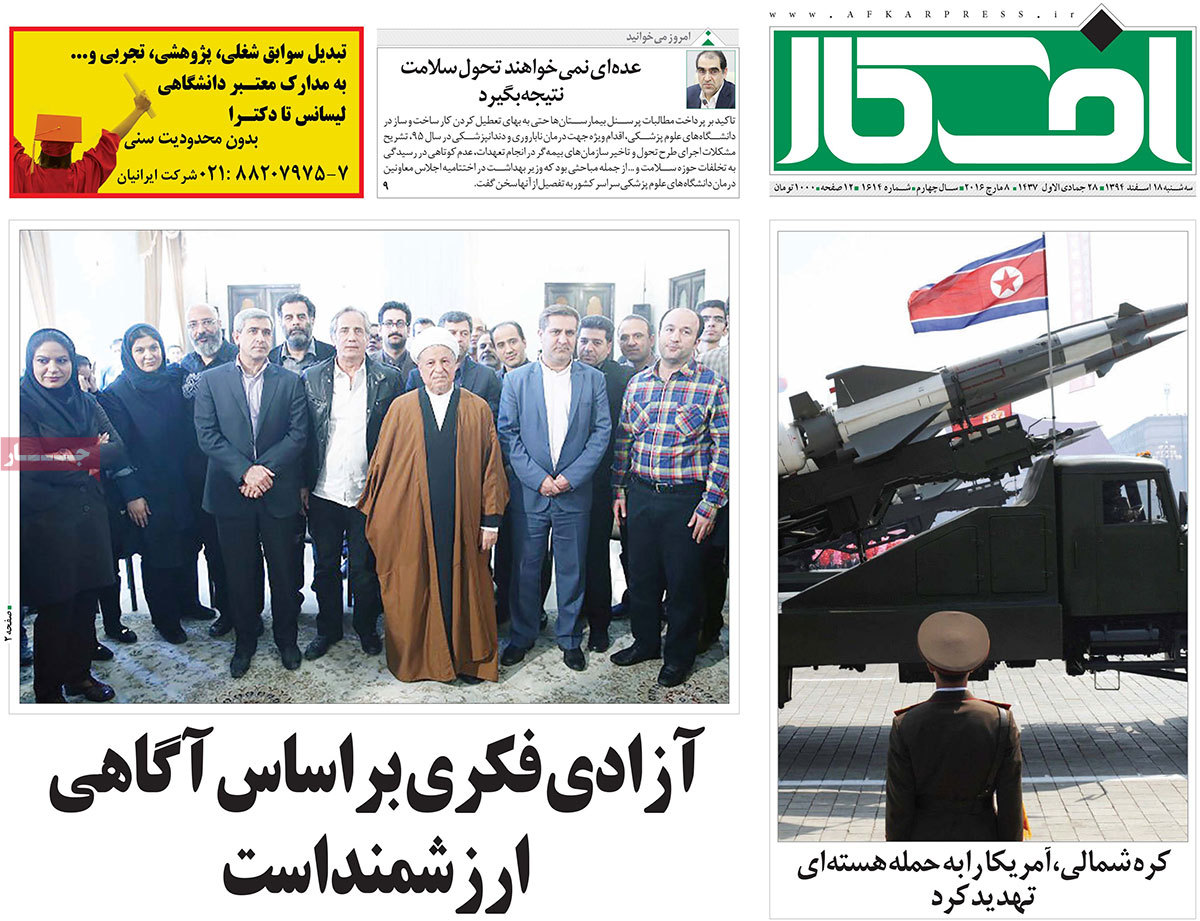
A look at Iranian newspaper front pages on March 8


Arman-e Emrouz:

1.  Raeisi named chairman of Astan Qods Razavi

2.  Rouhani: Where is the oil money, then?

Iranian President Hassan Rouhani said this in reaction to a death sentence issued to corporate mogul Babak Zanjani for corruption and money laundering charges.

3.  Iranian engineers heading to Iraq and Afghanistan as housing market remains bearish in Iran
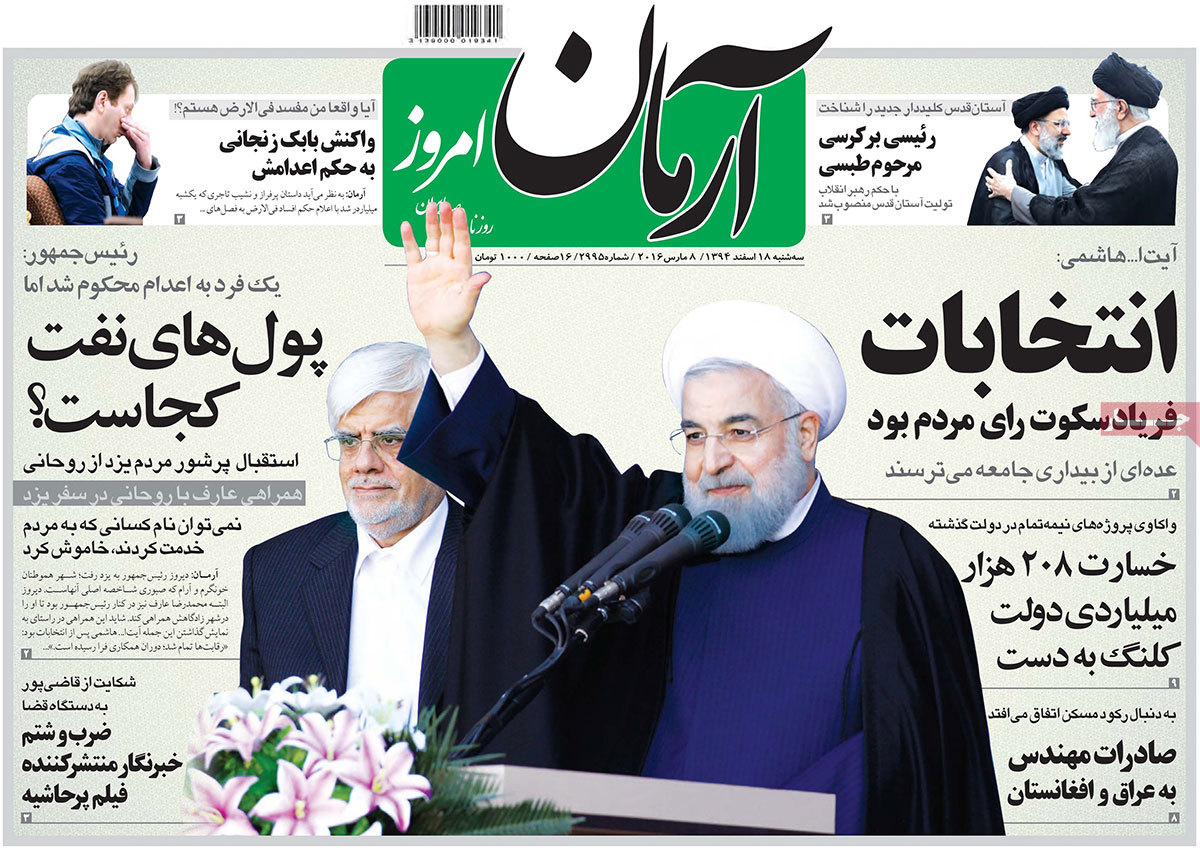
 

A look at Iranian newspaper front pages on March 8


Asrar:

1.  Nation places hope in a better future with improved conditions: Rafsanjani

2.  Serving garment for Raeisi

The Supreme Leader appointed Hujatoleslam Raeisi as head of Astan Qods Razavi, replacing the late Ayatollah Tabasi who passed away on Friday at the age of 80.

3.  Davotoglu: We reached an agreement with Iran over Syria

4.  Biden says military measures offer no solution to Syrian crisis

5.  Iran receives $5bn unfrozen assets in US

6.  Japan PM in Iran after 38 years
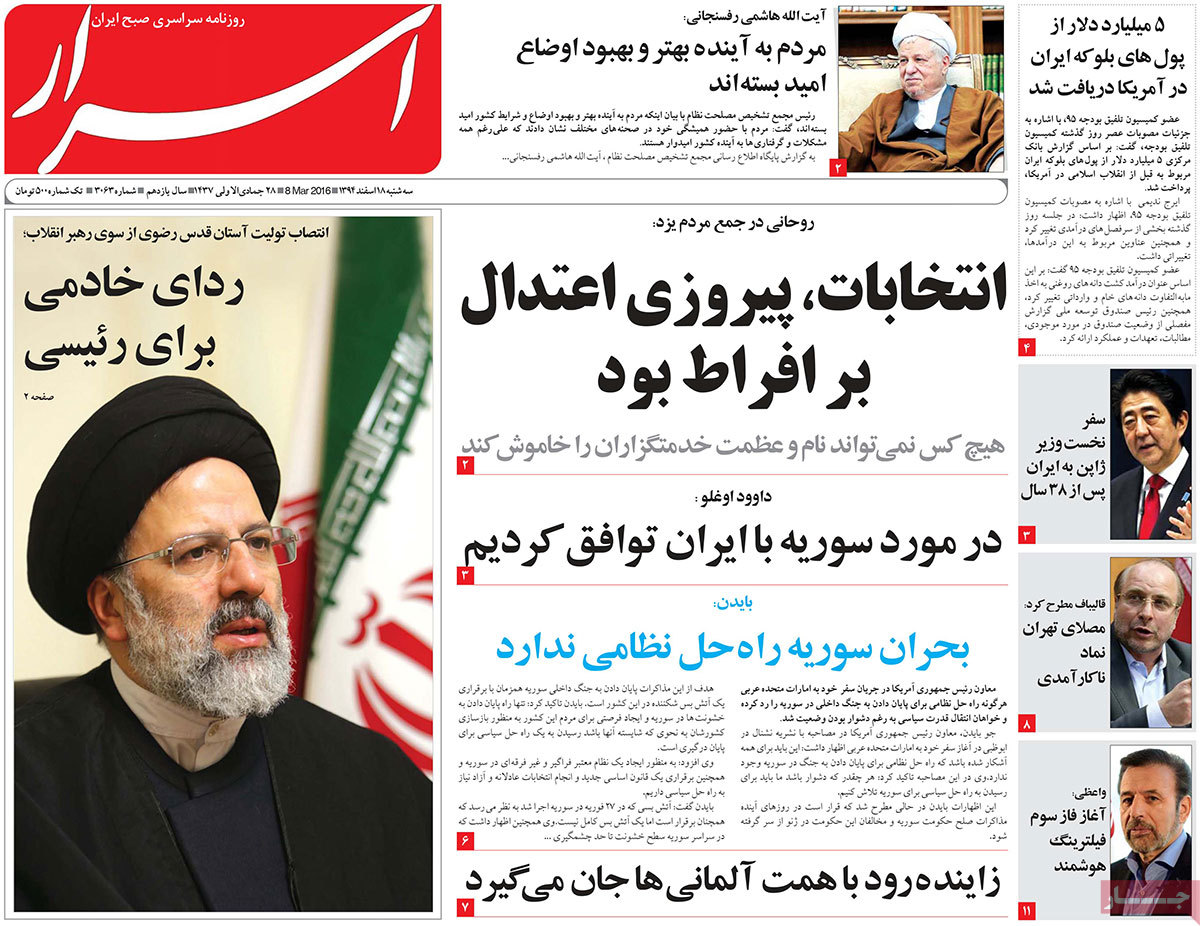
 

A look at Iranian newspaper front pages on March 8


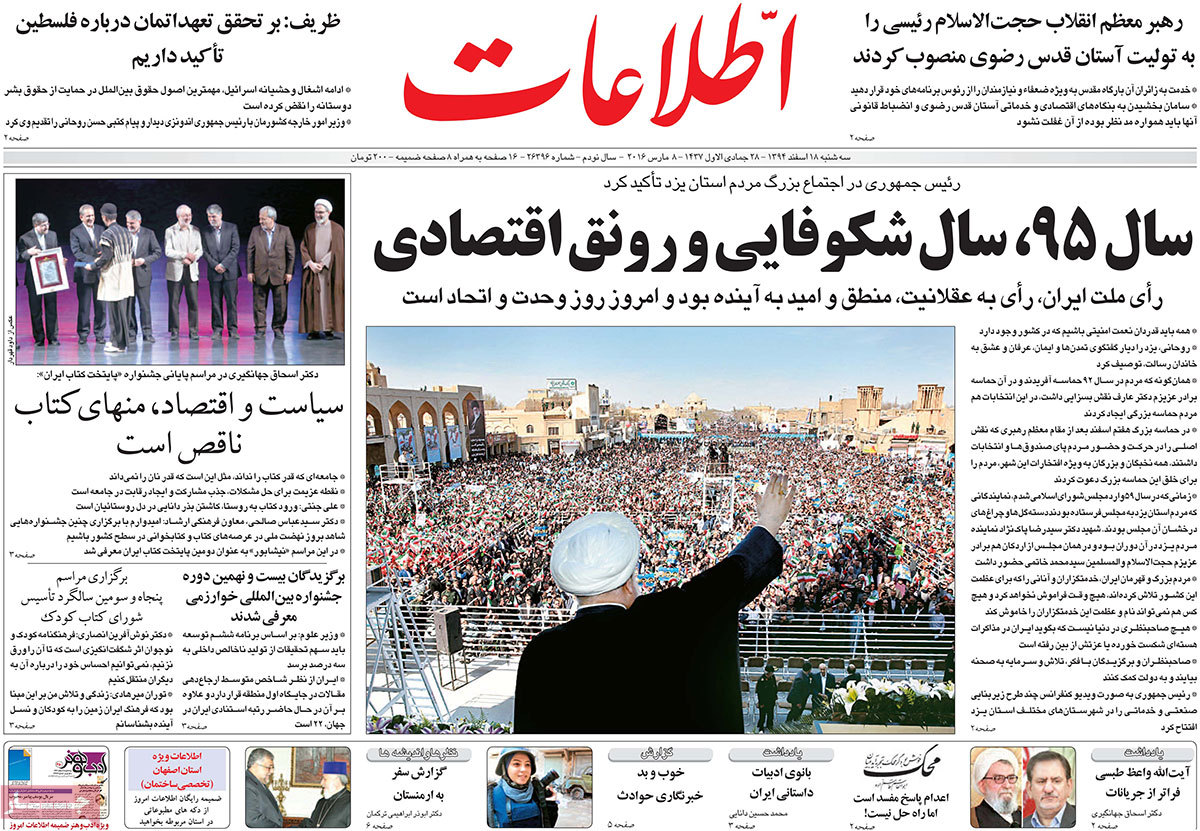
Ettela’at:

1.  Zarif stresses continuing support for Palestine

2.  President Rouhani promises prosperity, economic boom next year
 

A look at Iranian newspaper front pages on March 8


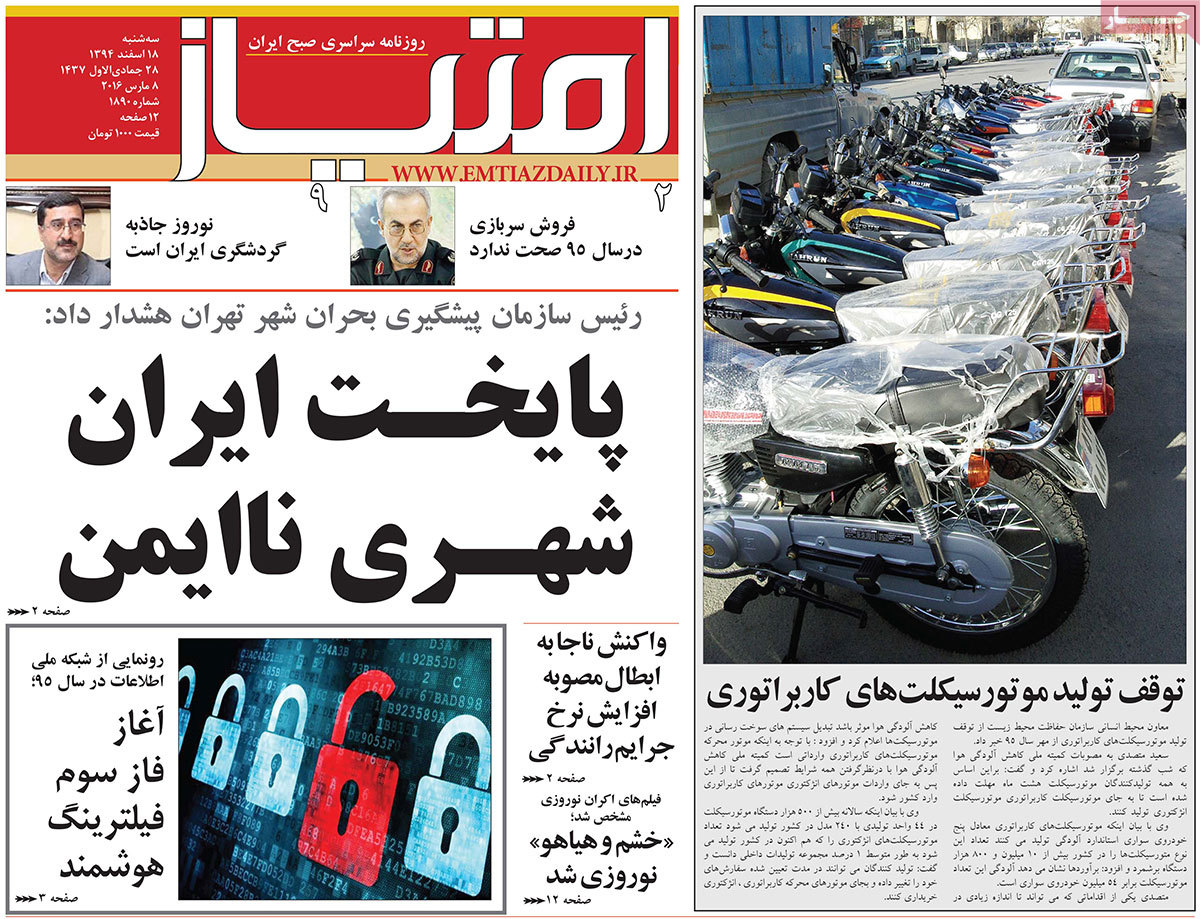
Emtiaz:

1.  Nowrouz in Iran is an attraction for foreigners: Expert

2.  No more motorcycle carburettor production in Iran

3.  Iran unveils smart internet filtering system
 

A look at Iranian newspaper front pages on March 8


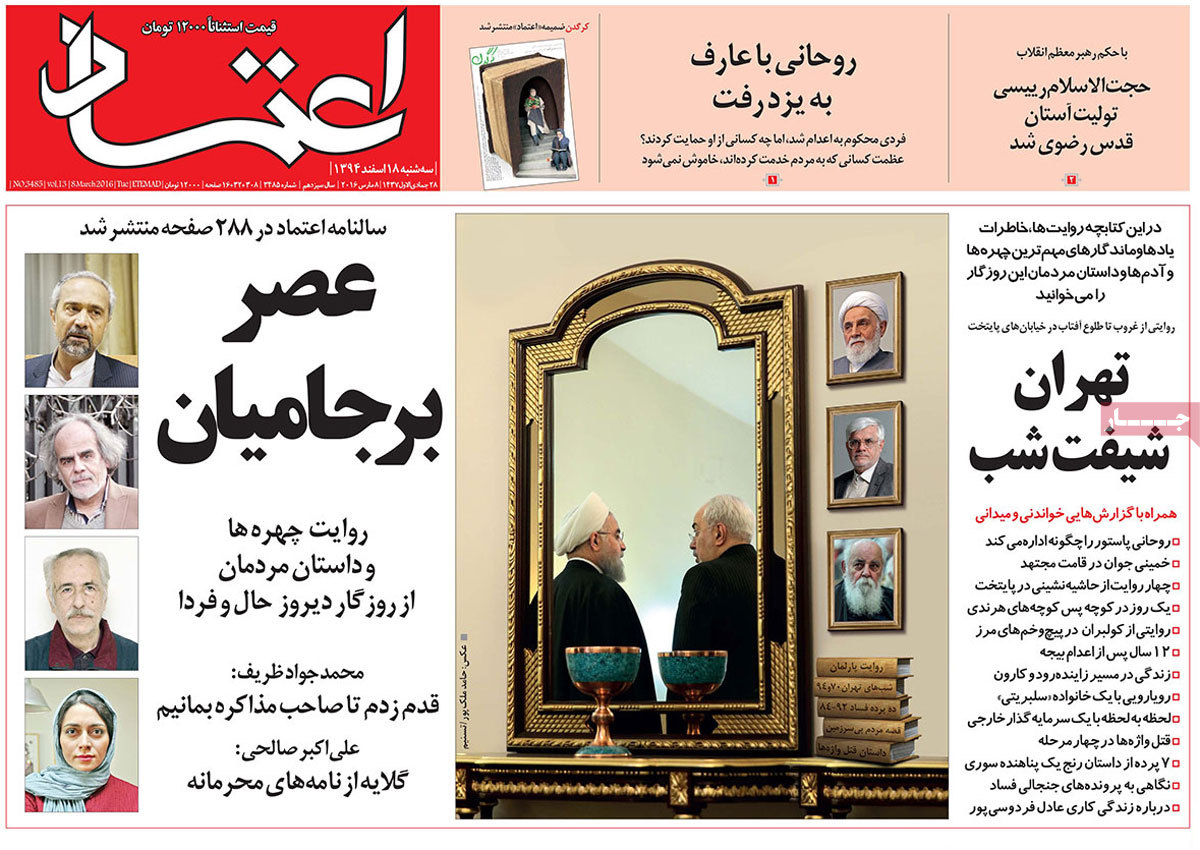
Etemad:

1.  Rouhani visits Yazd with Aref

2.  Etemad releases 288-page yearbook
 

A look at Iranian newspaper front pages on March 8


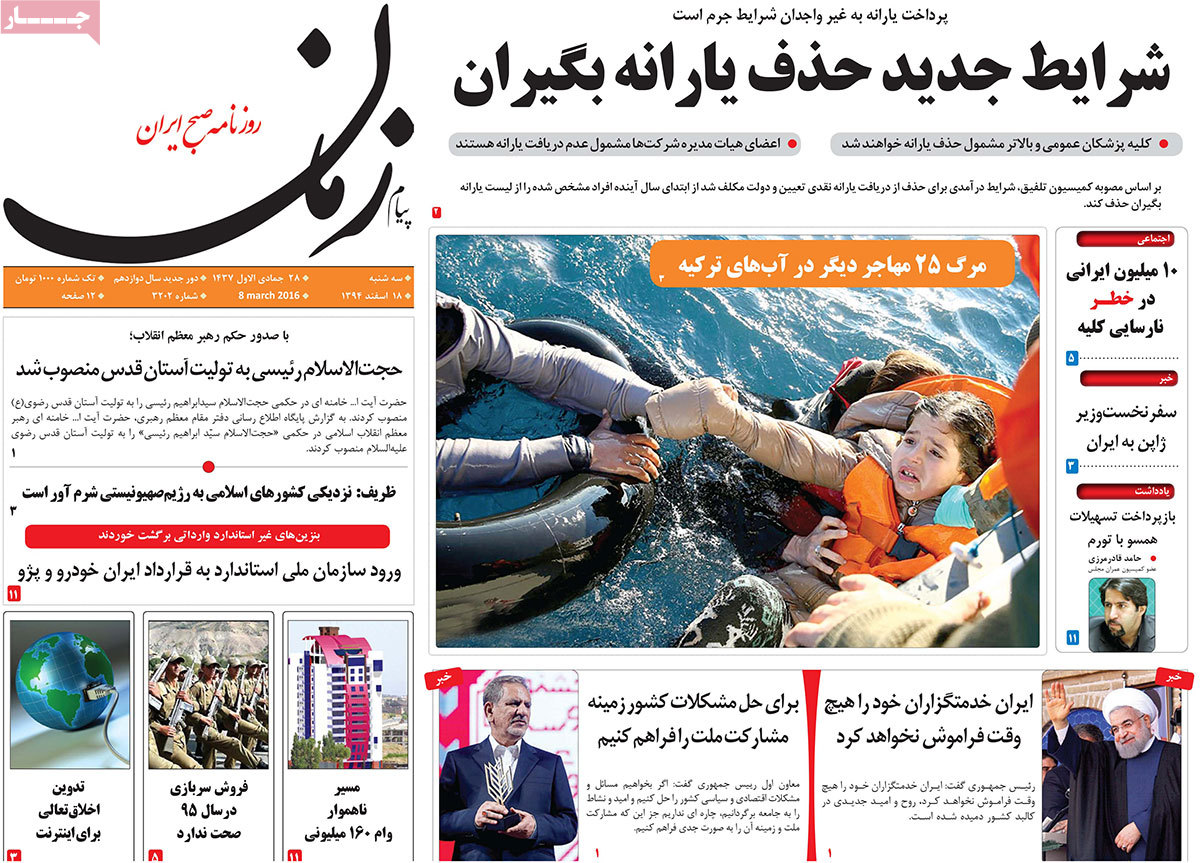
Payam Zaman:

1.  25 Syrian refugees die in Turkish waters

2.  Zarif denounces Muslim nations’ closeness to Israel as shameful

3.  Iran Standards Organization supervises IKCO deal with Peugeot

4.  10m Iranians heading for kidney failure
 

A look at Iranian newspaper front pages on March 8


Hemayat:

1.  Iran boosts worker salaries by 15%

2.  Judiciary relentless in fighting corruption: Lawyers

3.  No evidence of diversion in Iran’s nuclear program: IAEA

4.  Prosecutors firm on illegal land owners
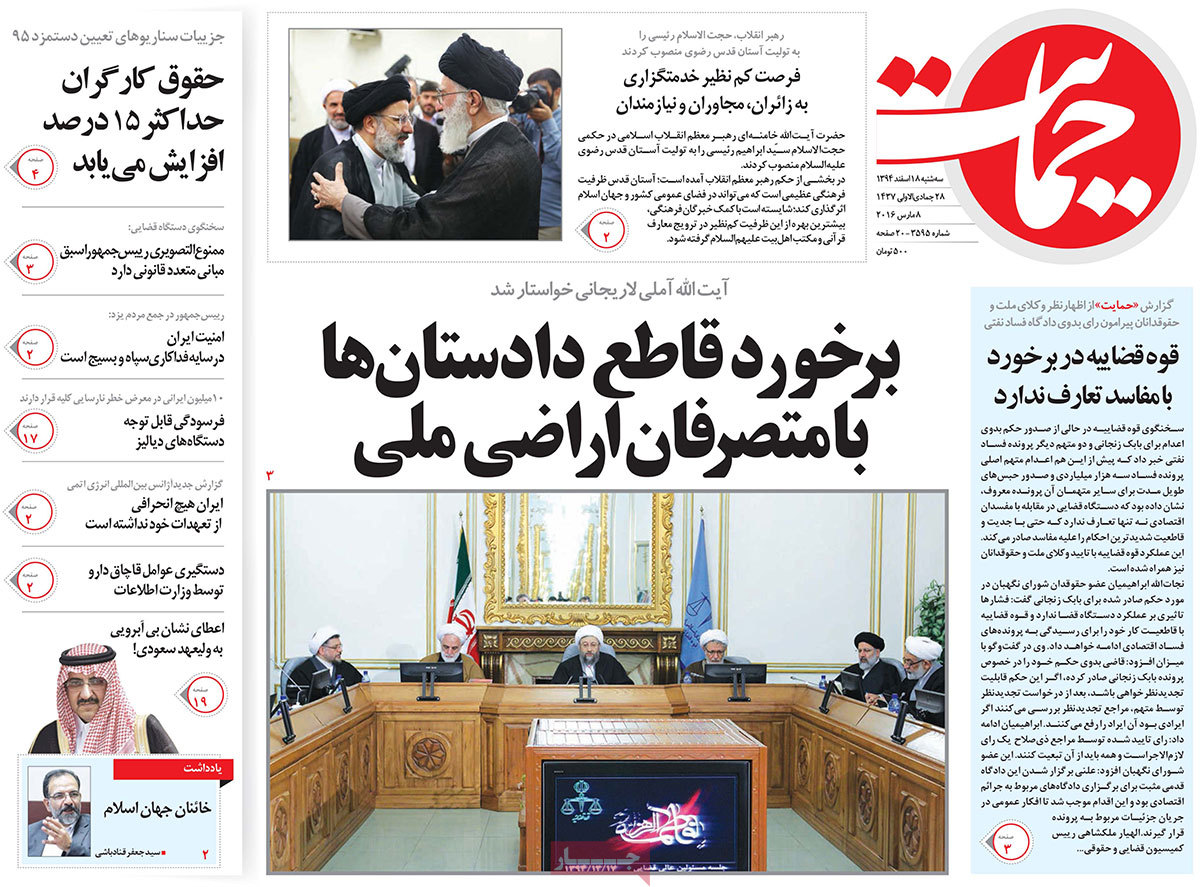
 

A look at Iranian newspaper front pages on March 8


Iran:

1.  Rouhani calls for unity to achieve economic prosperity
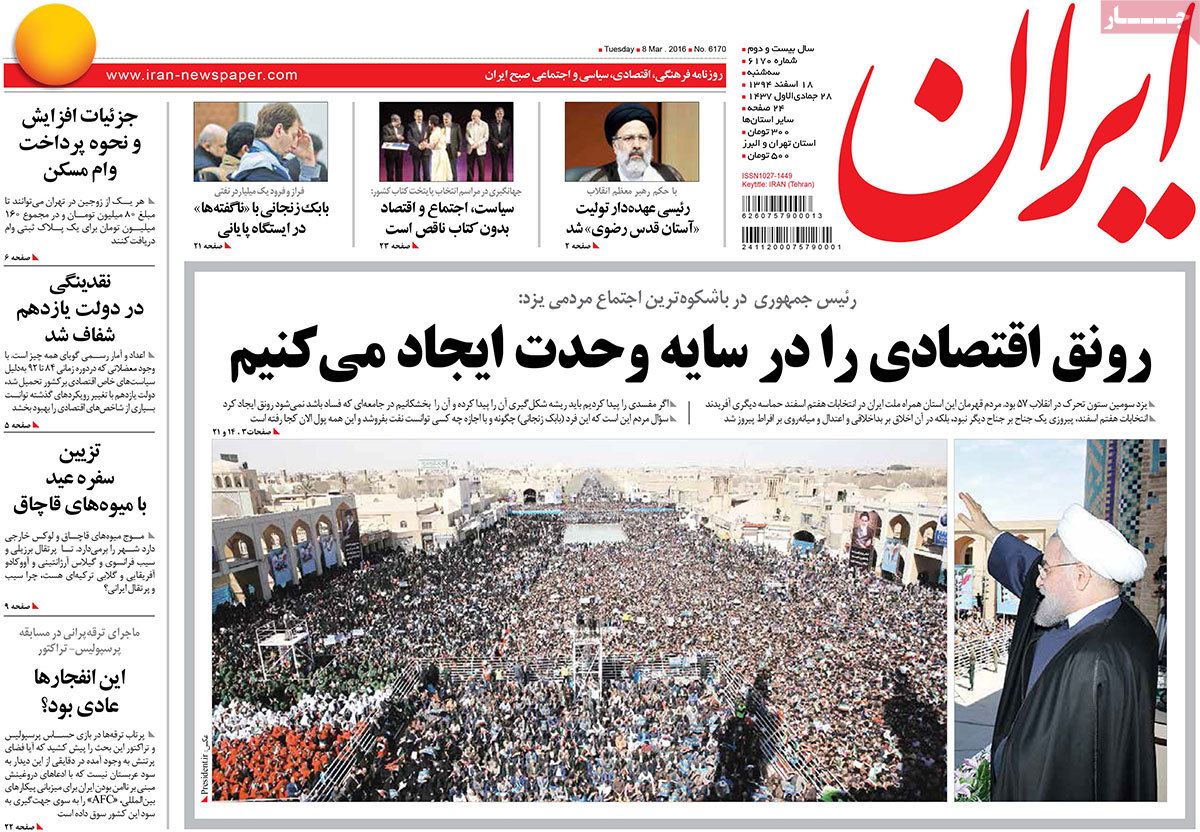
 

A look at Iranian newspaper front pages on March 8


Jamejam:

1.  Viewpoint: Challenges of the Islamic Co-operation Organization

2.  Instagram blackmails perverts
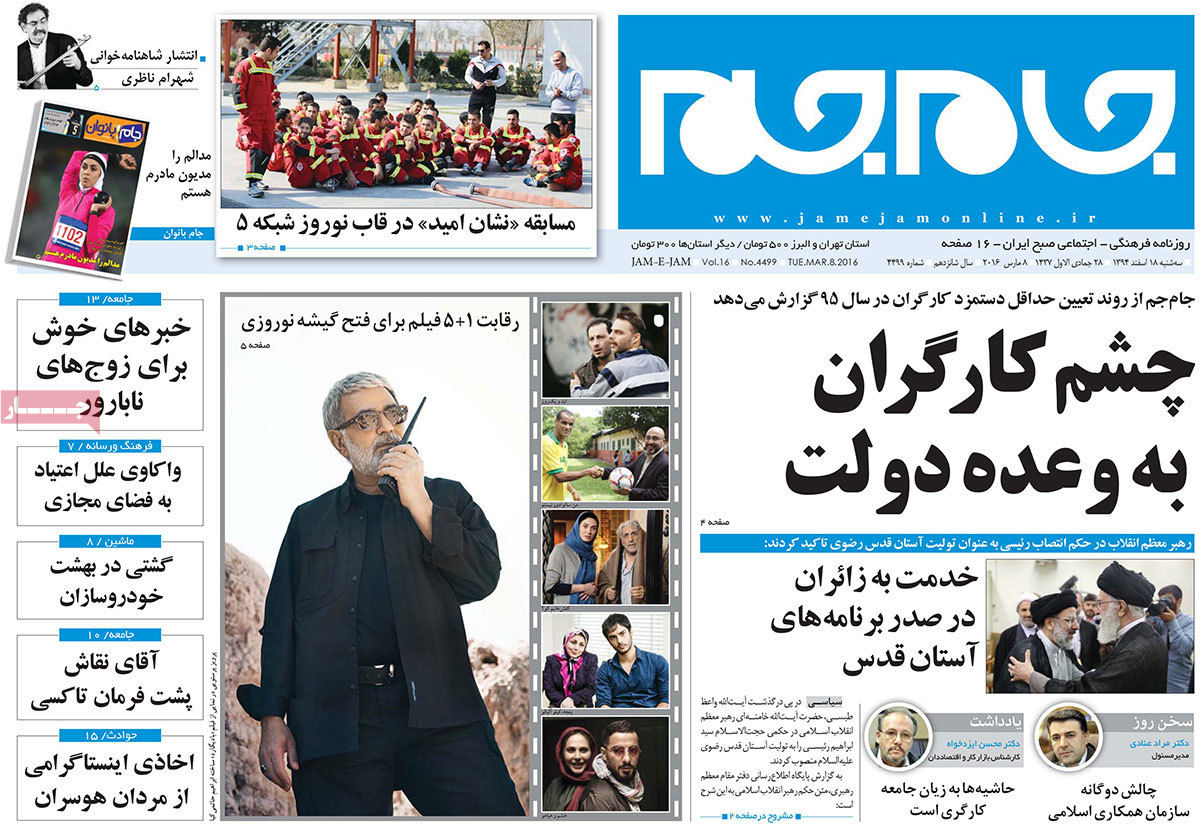
 

A look at Iranian newspaper front pages on March 8


Jomhouri Islami:

1.  Iran commences operations on several infrastructure projects in Yazd Province

2.  Criticisms from the Arab world pour in on Saudi Arabia
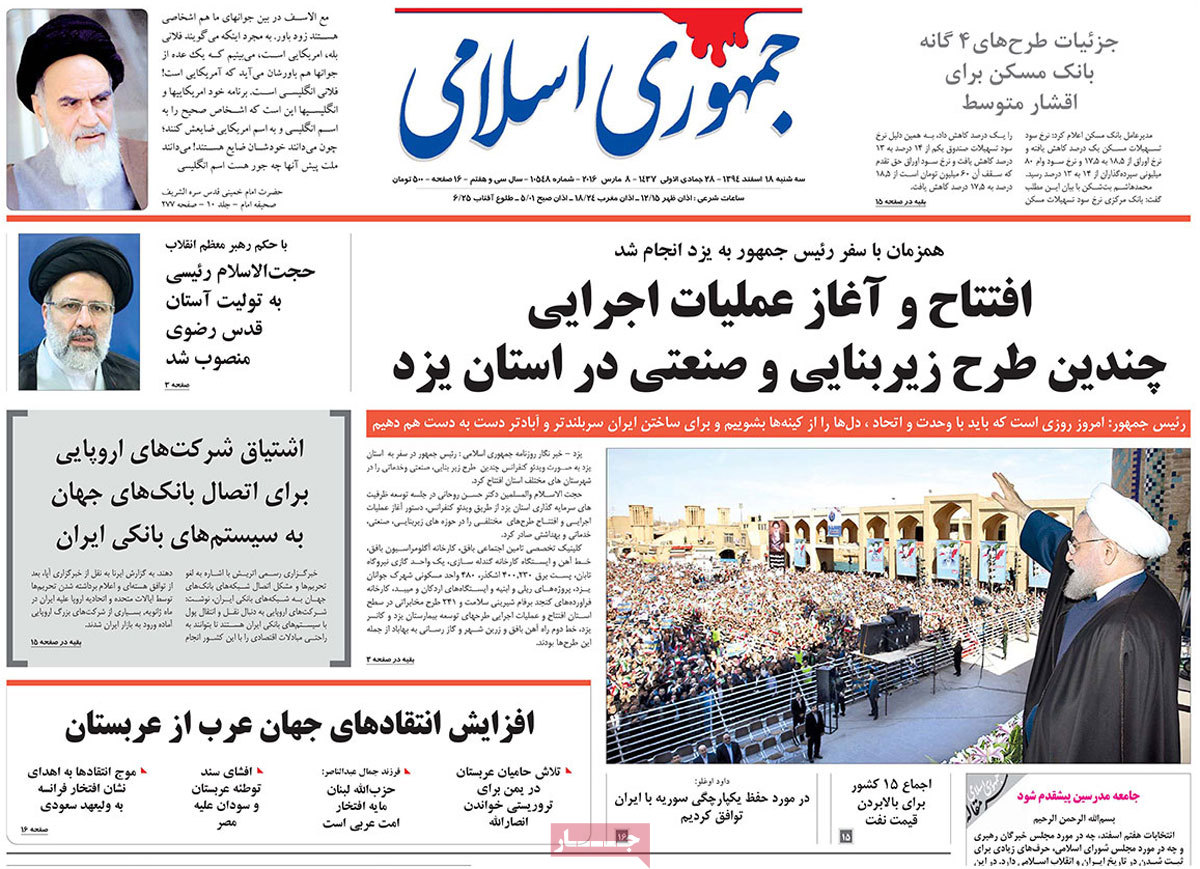
 

A look at Iranian newspaper front pages on March 8


Javan:

1.  $47 censorship: Rouhani talked about running the country at $25/b oil prices, while average oil prices have been $72/b during his office.

2.  US continues studying Feb 26 election in Iran
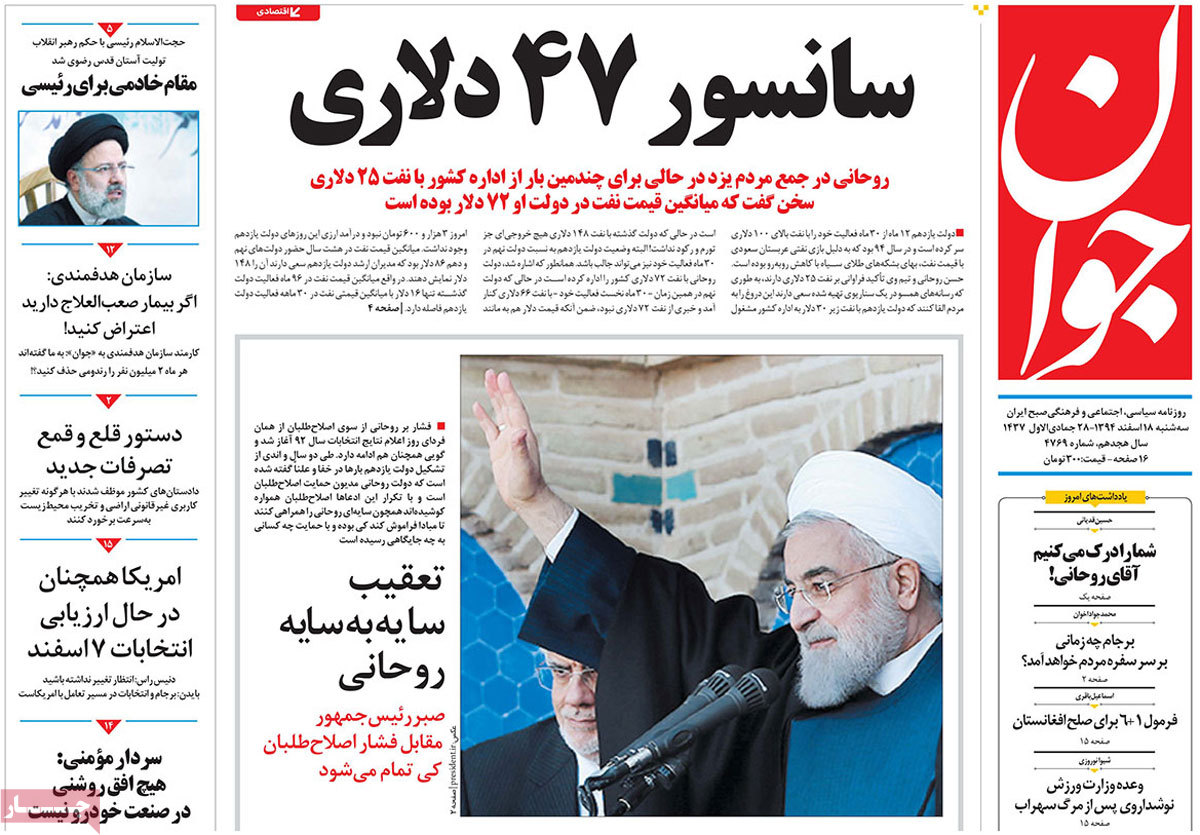
 

A look at Iranian newspaper front pages on March 8


Kaenat:

1.  Iran selects foreign partners based on its interests: Deputy Minister

2.  Iran to see economic boom next year: Rouhani in Yazd
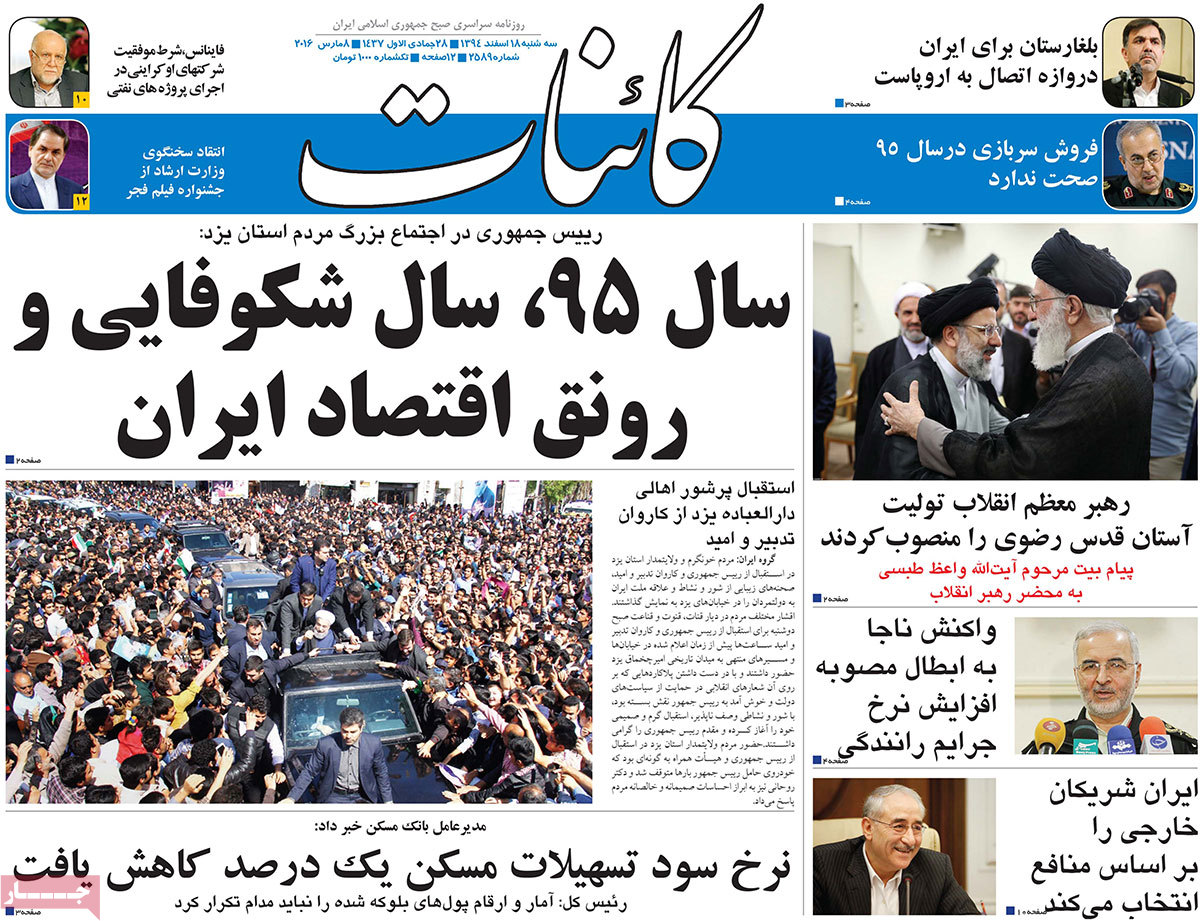
 

A look at Iranian newspaper front pages on March 8


Kayhan:

1.  Hezbollah defends Ummah, House of Saud traitor to the Arab world: Gamal Abdul Nasser’s son

2.  Astan Qods appointment for Hujatoleslam Raeisi

3.  World media: Davutoglu’s Tehran visit evidence of Turkey’s foreign policy U-turn
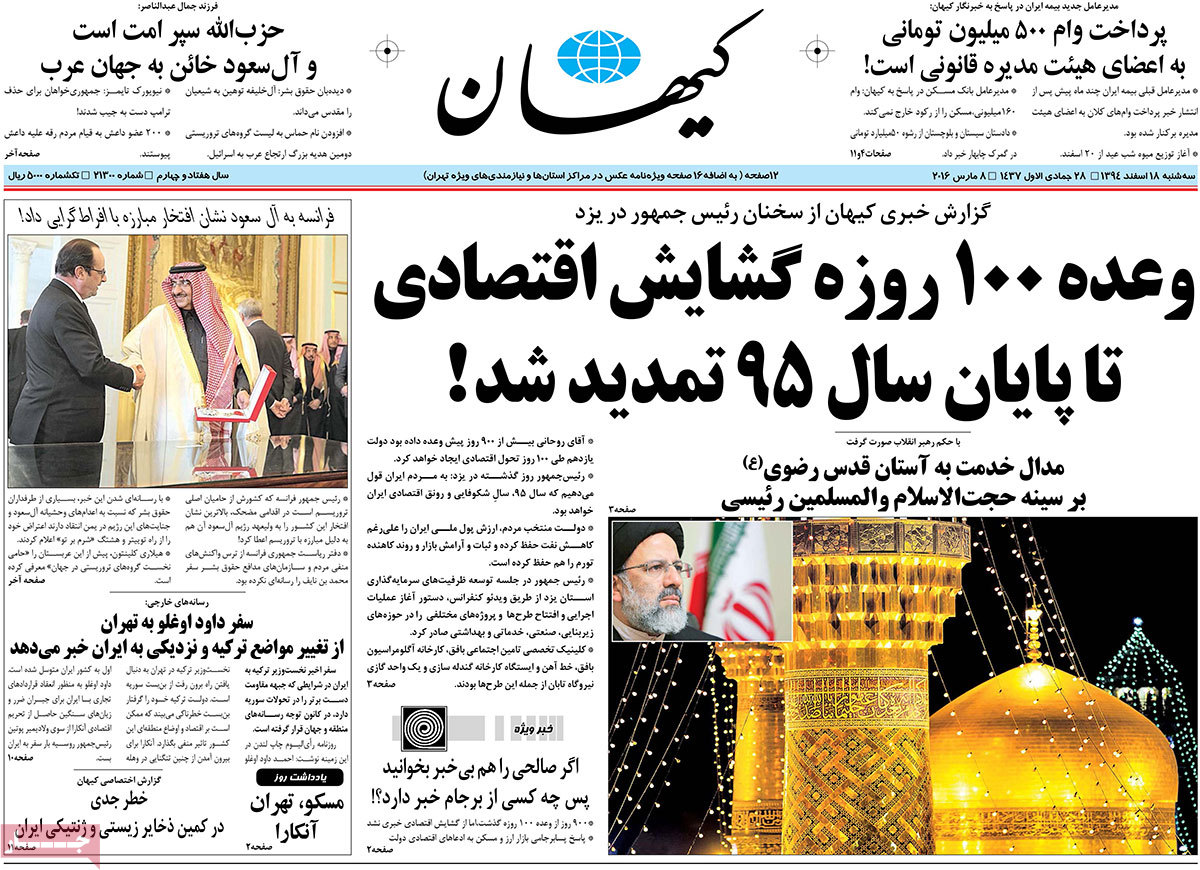
 

A look at Iranian newspaper front pages on March 8


Khorasan:

1.  Shia and Sunni poets gather in Mashhad
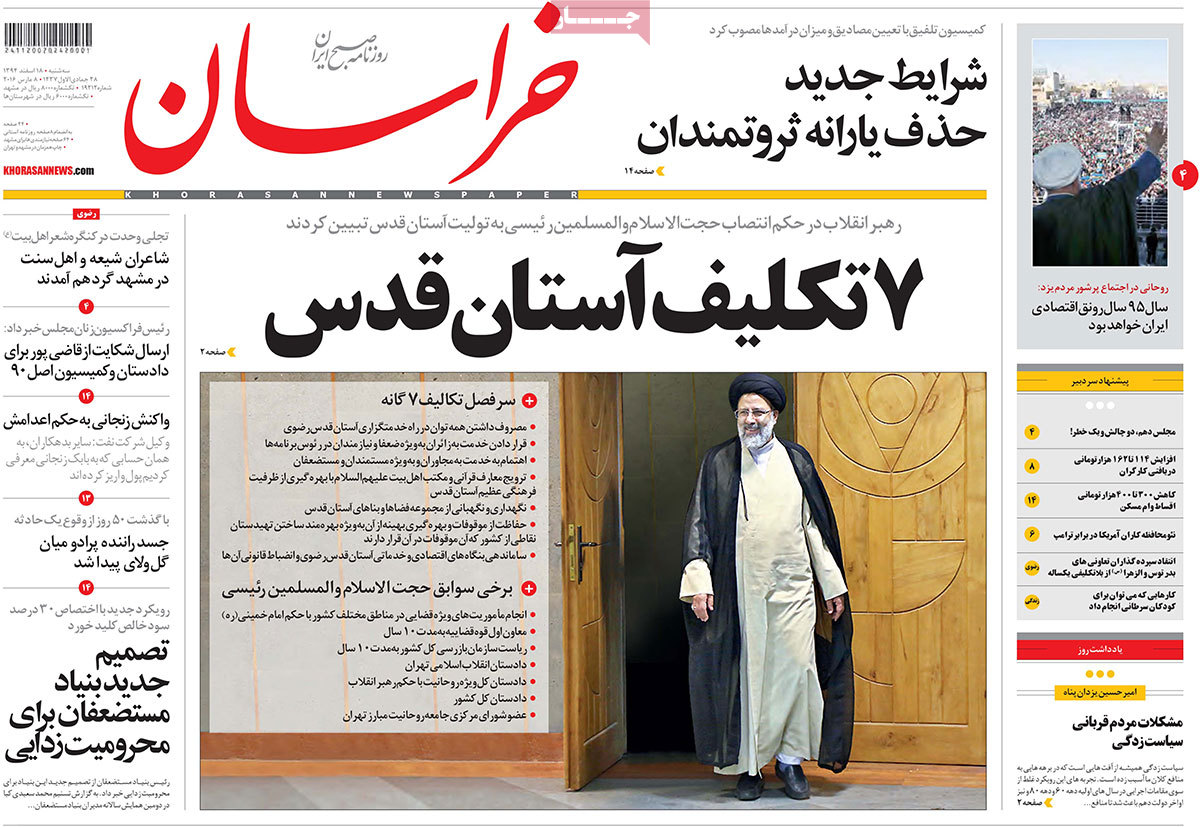
 

A look at Iranian newspaper front pages on March 8


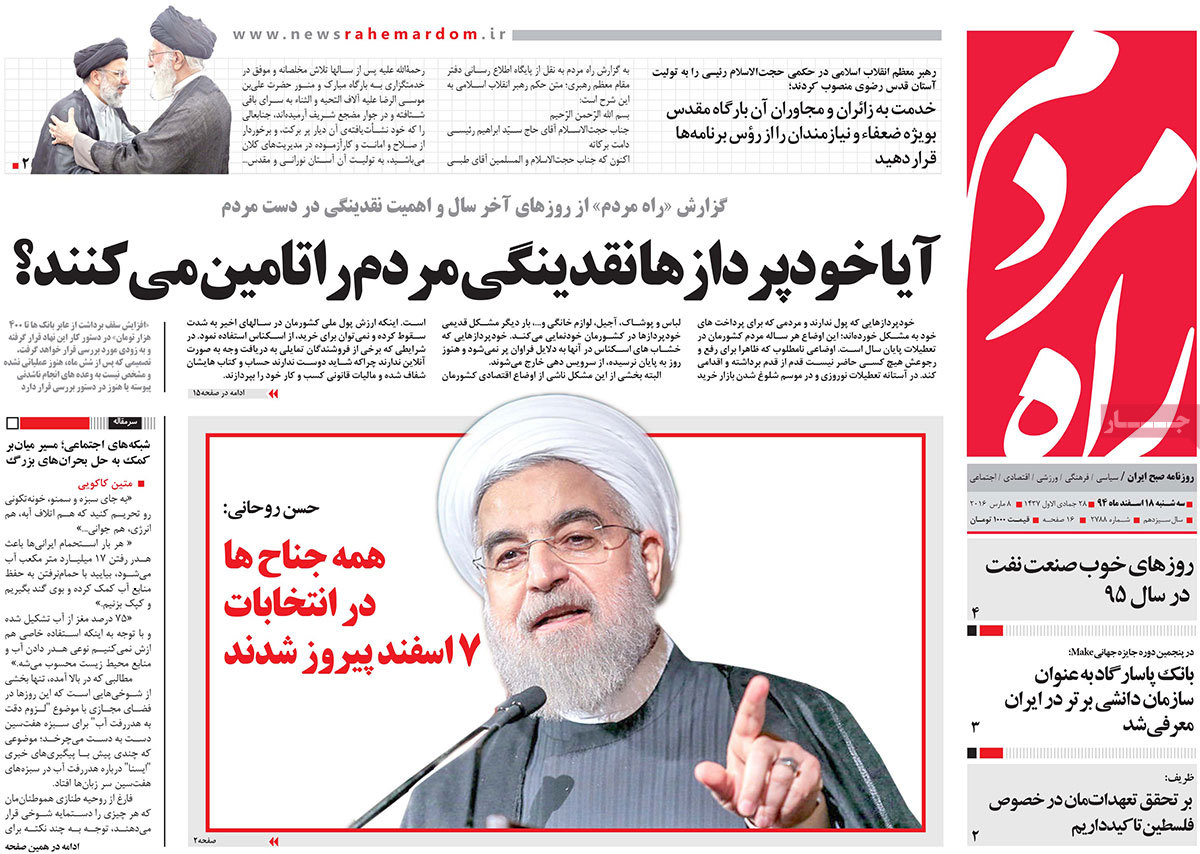
Rah-e Mardom:

1.  Good prospects await Iran’s oil industry next year

2.  Pasargad Bank hailed as top knowledge-based organization

3.  All factions were winners in Feb 26 elections: Rouhani
 

A look at Iranian newspaper front pages on March 8


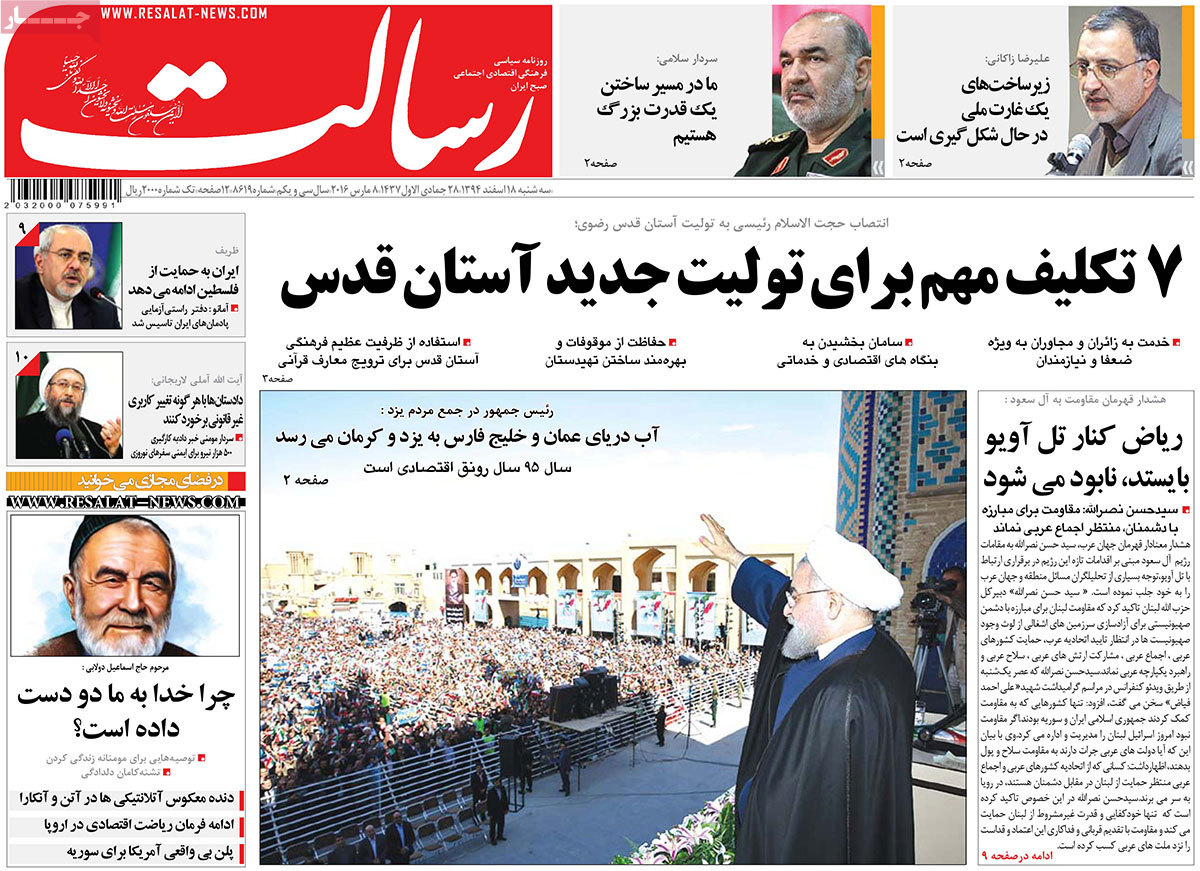
Resalat:

1.  Nasrallah: Riyadh will fall if it stands beside Tel Aviv

2.  Iran to become major power: Cmdr. Salami

3.  Zarif: Iran to keep supporting Palestine

4.  Rouhani: Persian Gulf and Gulf of Oman water supplies on their way for Yazd and Kerman
 

A look at Iranian newspaper front pages on March 8


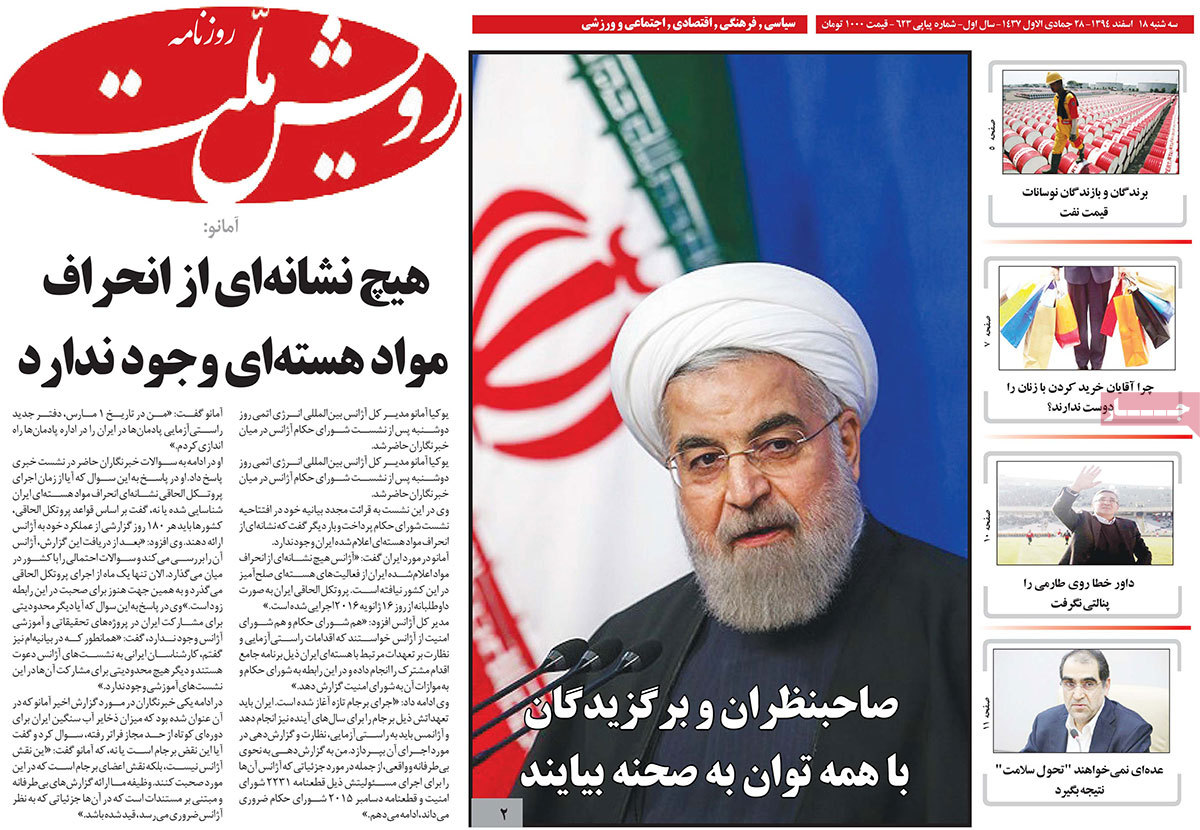
Rooyesh Mellat:

1.  President calls for experts to come forward

2.  No evidence of diversion in Iran’s nuclear program: IAEA

3.  Winners and losers in oil price slump

4.  Whey men hate shopping with women: Report
 

A look at Iranian newspaper front pages on March 8


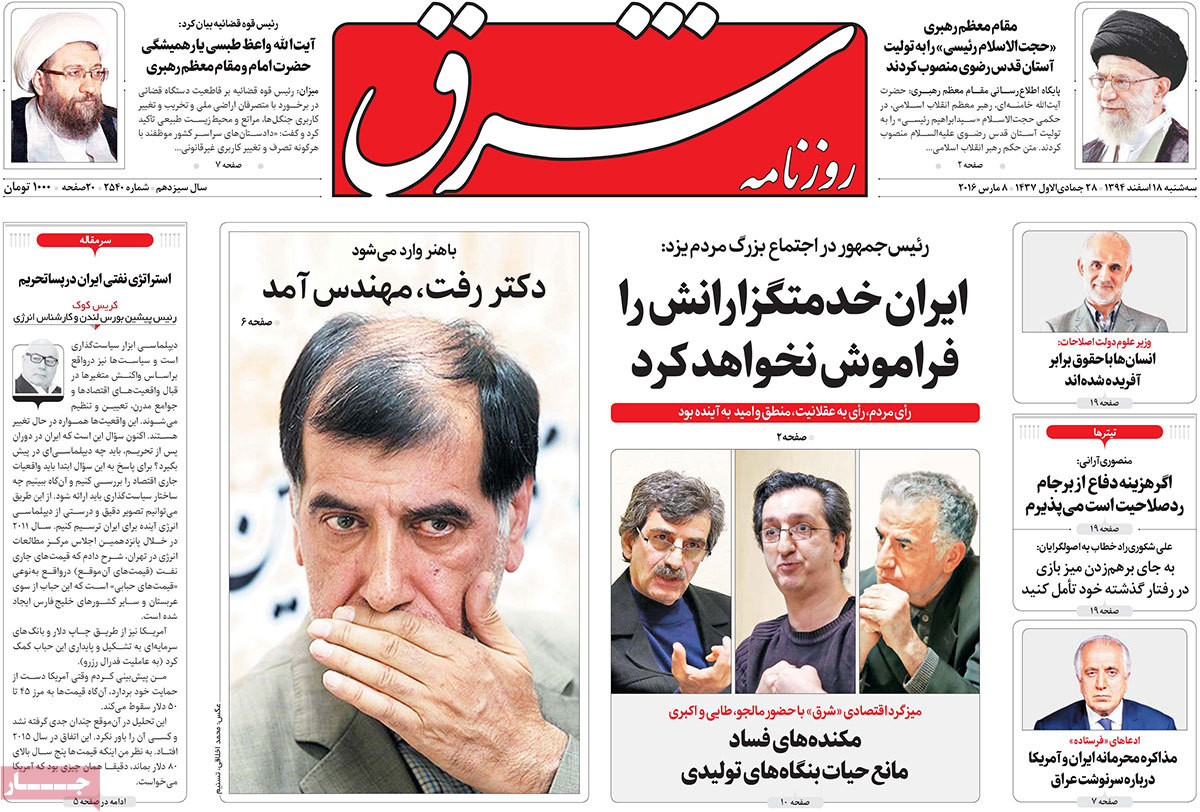
Shargh:

1.  Rouhani: Iran never forgets its helpers

2.  Article: Iran’s oil strategy in a post-sanctions environment
 

A look at Iranian newspaper front pages on March 8


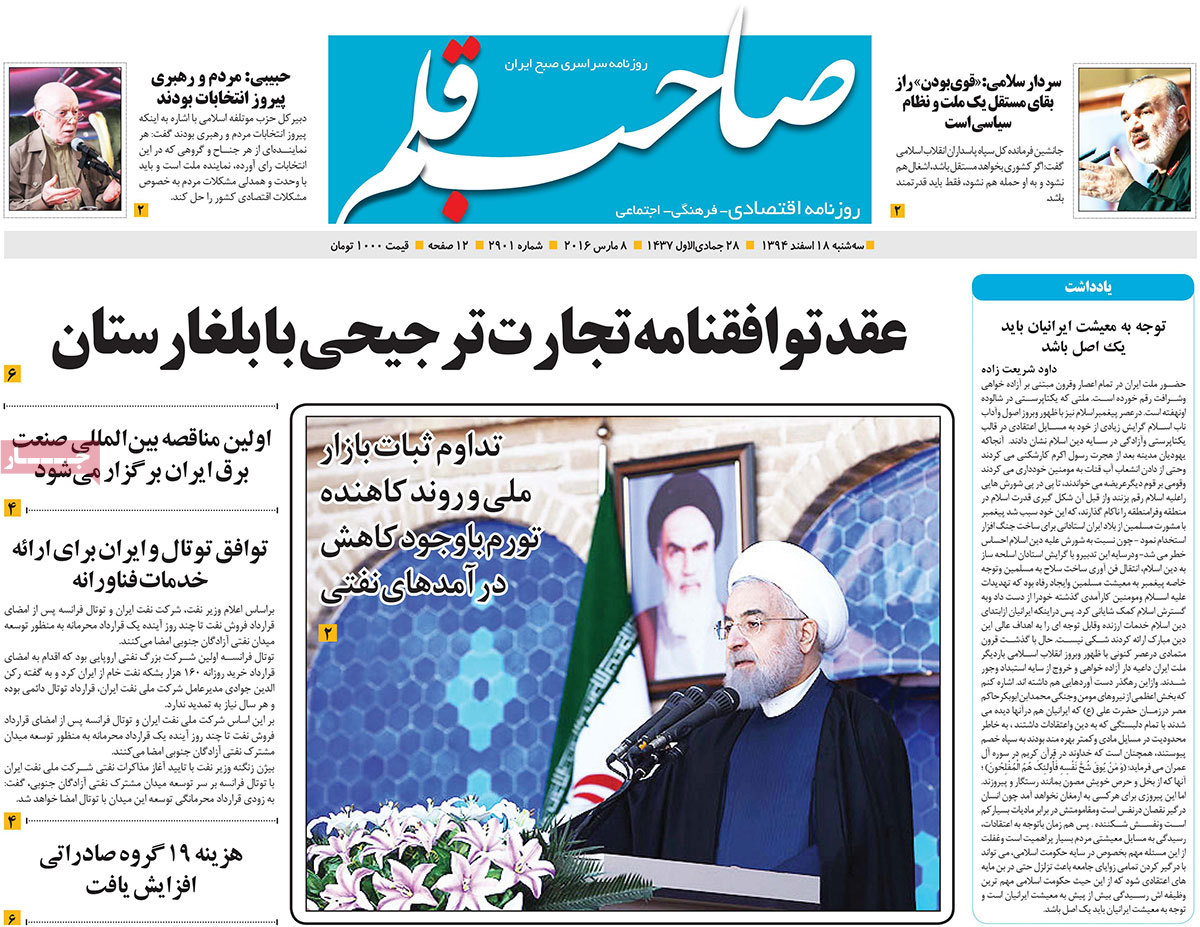
Saheb Ghalam:

1.  Iran and Bulgaria sign preferential trade deal

2.  Iran to hold first int’l tender on power industry

3.  Iran inks technological co-operation deal with Total
 

A look at Iranian newspaper front pages on March 8


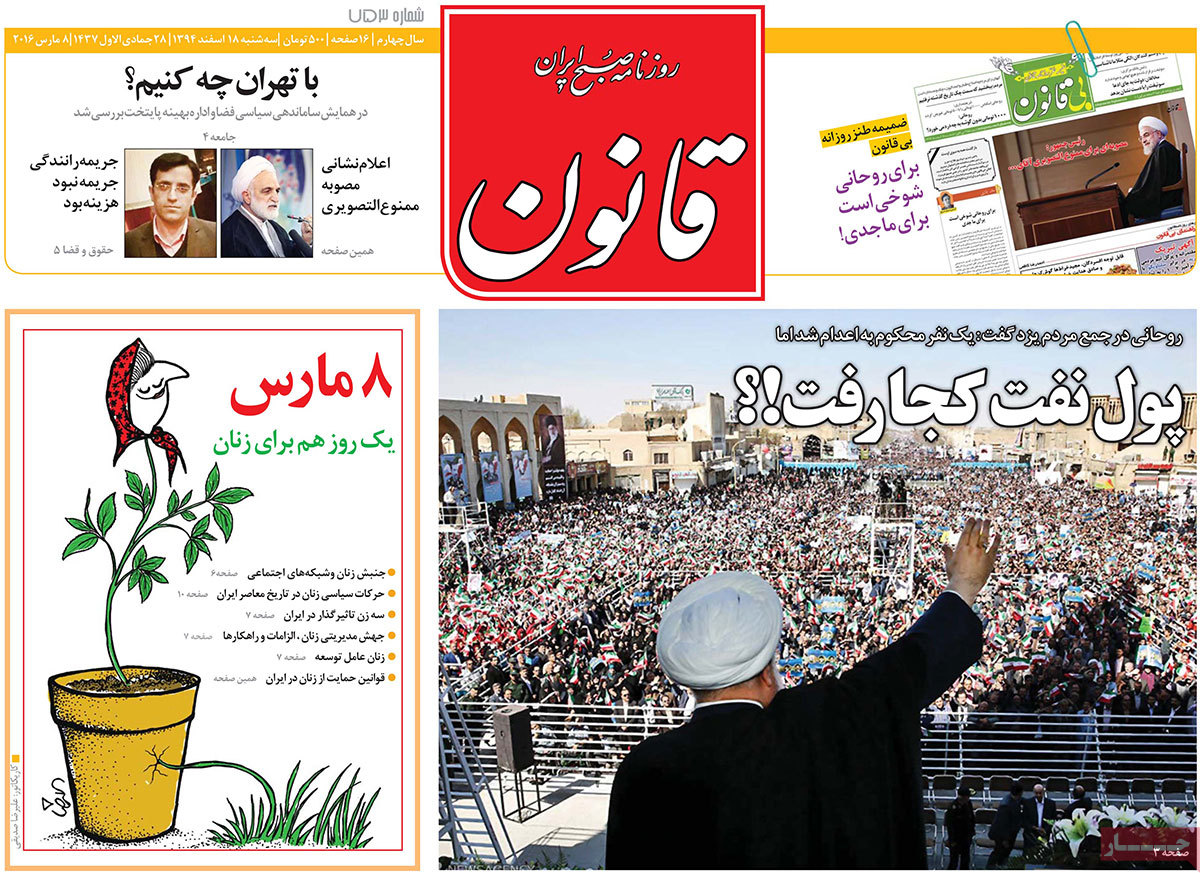
Ghanoon:

1.  Rouhani reacts to death sentence for Zanjani: Where is the oil money, then?

2.  March 8: International Women’s Day
 

A look at Iranian newspaper front pages on March 8


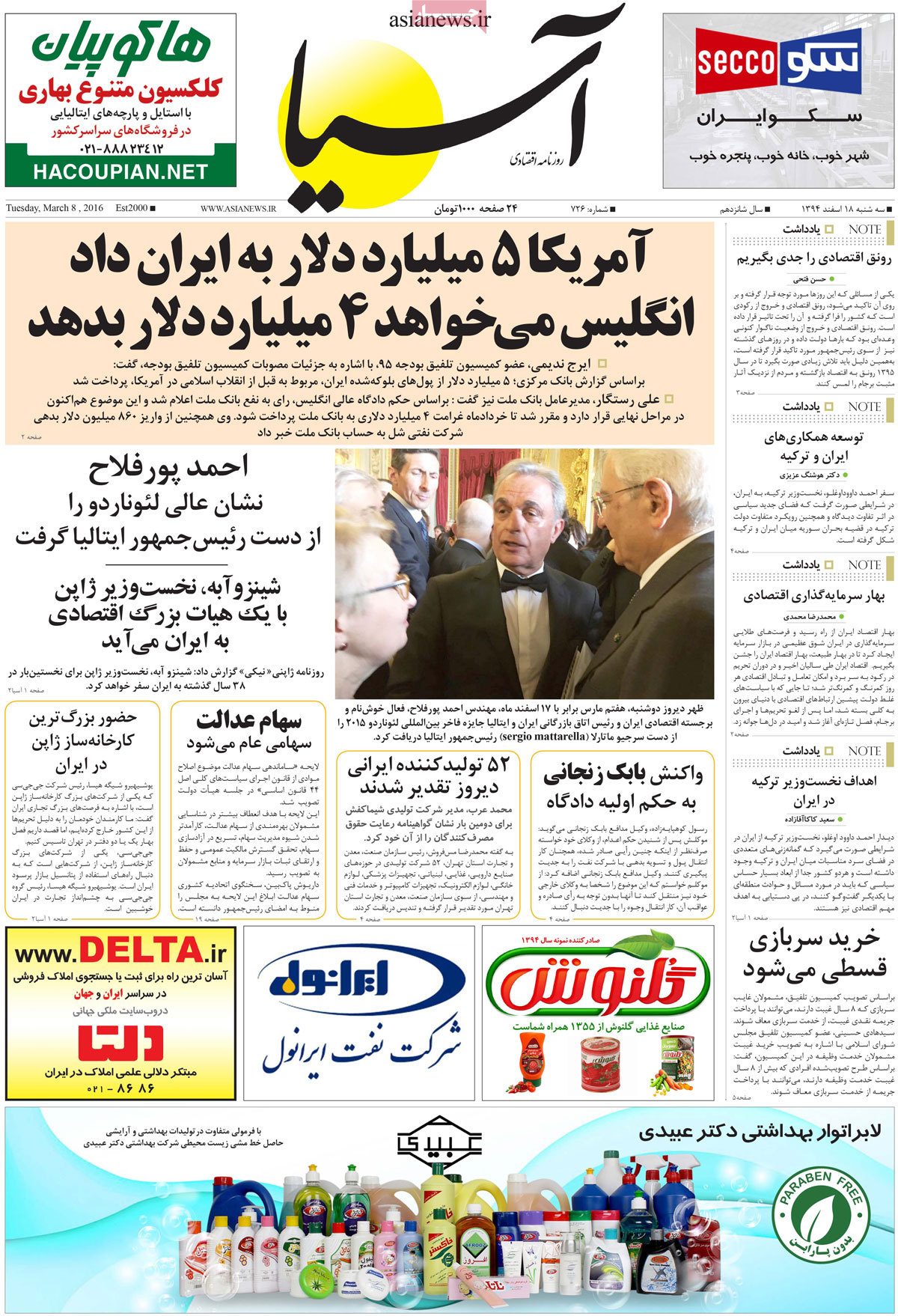
Asia:

1.  US pays $5bn to Iran; UK to pay $4bn

2.  Ahmad Pourfallah receives Leonardo Medal from Italian President
 

A look at Iranian newspaper front pages on March 8


Iran develops second generation solar cells

IRNA learned that it is the first time the second generation thin film solar cells are produced in Iran.
Lead author Abdolnabi Kosarian said that the project has been registered with the office of the vice-president for science and technology.
Kosarian, the university professor said that the project is sponsored by Khuzestan province power distribution company.
He said that the research team is working on optimizing the developed solar cell structure and paving the way for the semi-industrial production of solar panels.
A solar cell (or a ‘photovoltaic’ cell) is a device that converts photons from the sun (solar light) into electricity.
A thin-film solar cell is a second generation solar cell that is made by depositing one or more thin layers, or thin film (TF) of photovoltaic material on a substrate, such as glass, plastic or metal.
Thin-film solar cells are commercially used in several technologies.

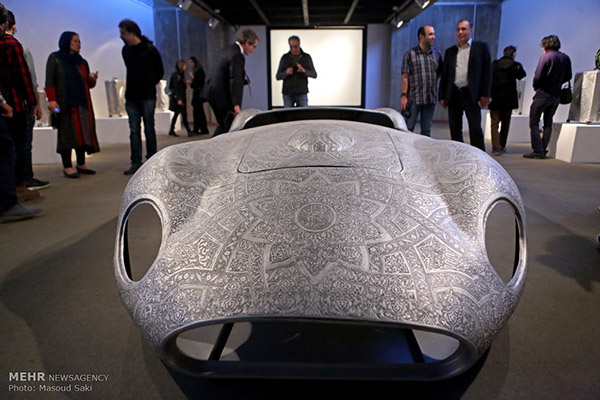
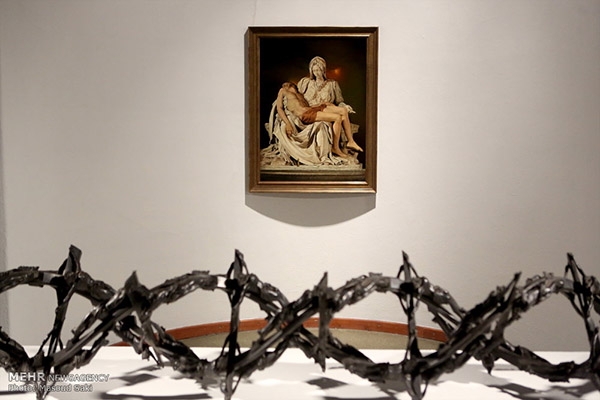
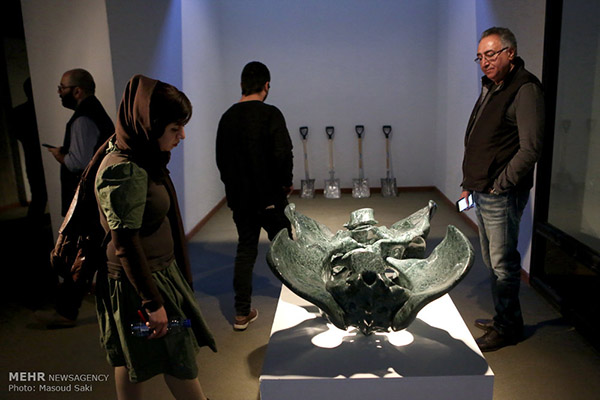
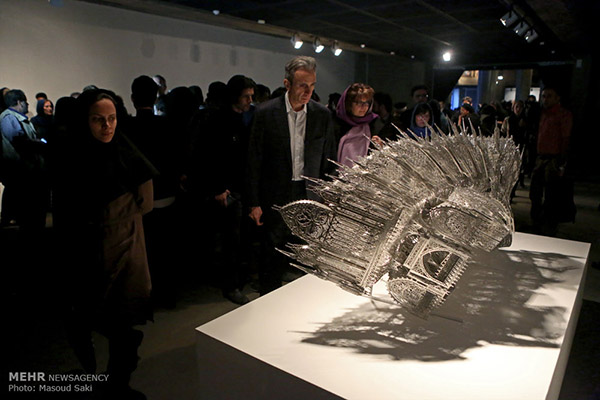
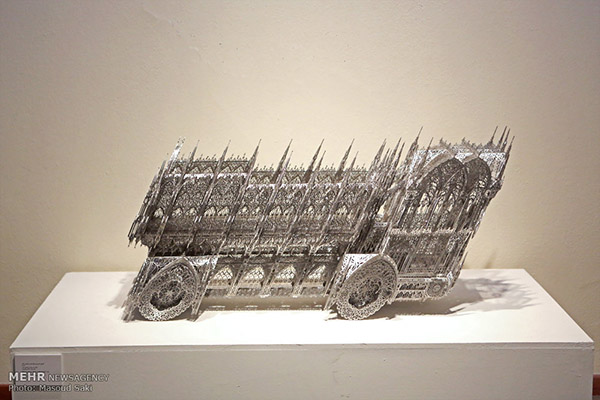
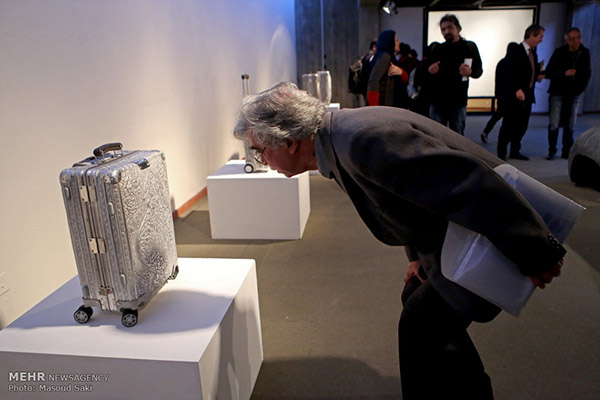
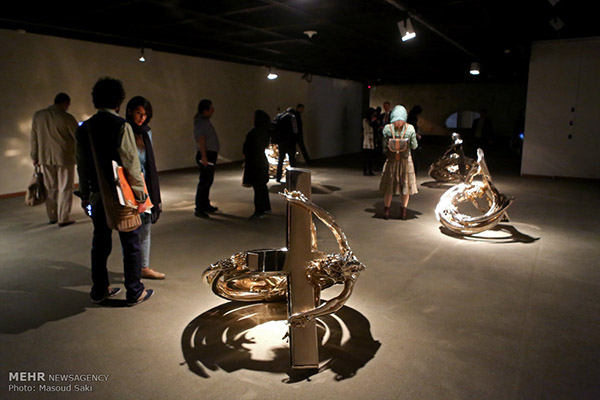
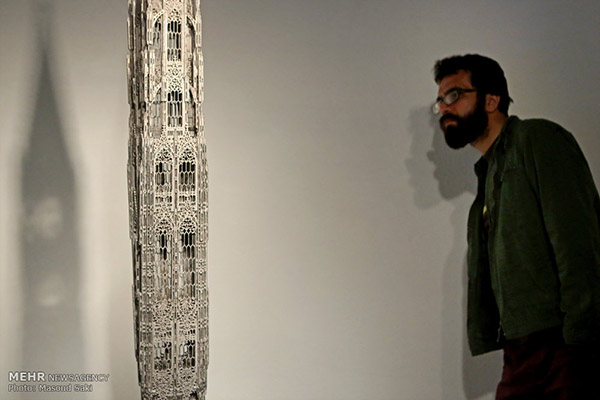
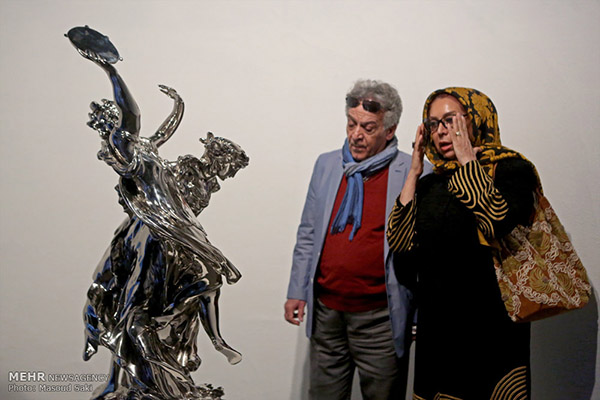
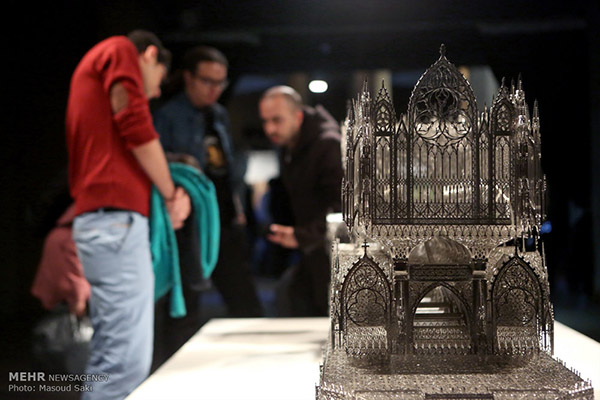
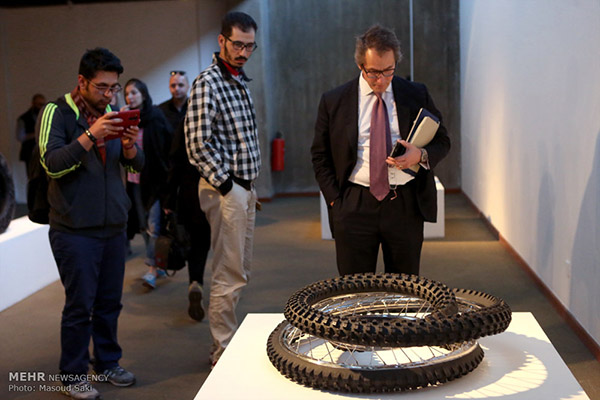
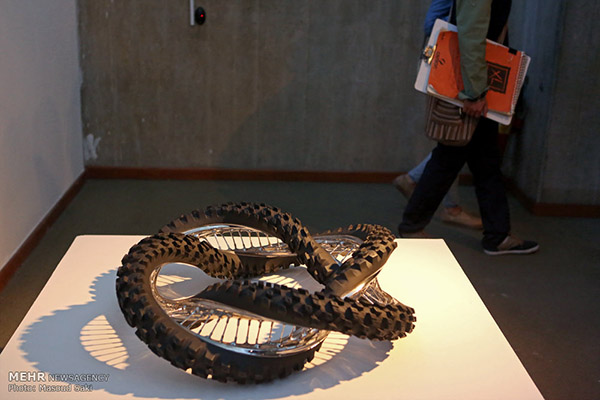
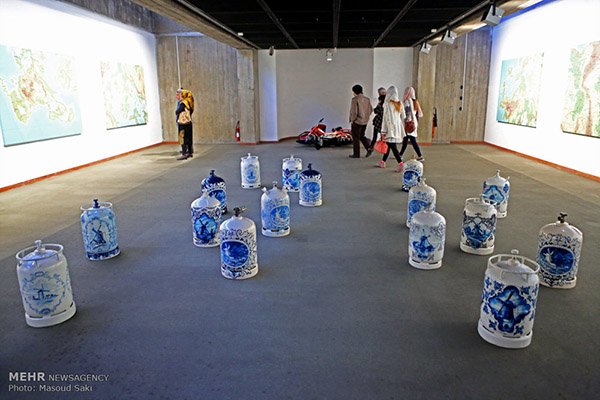
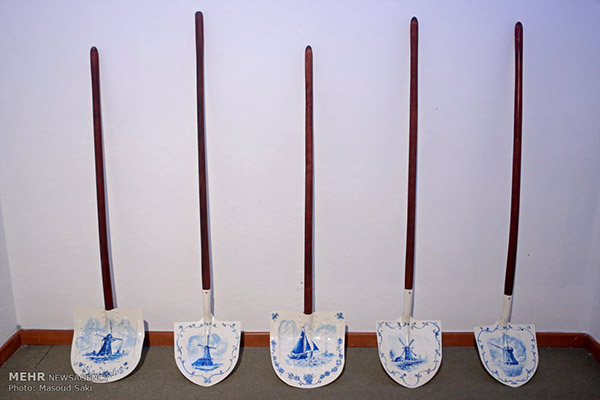
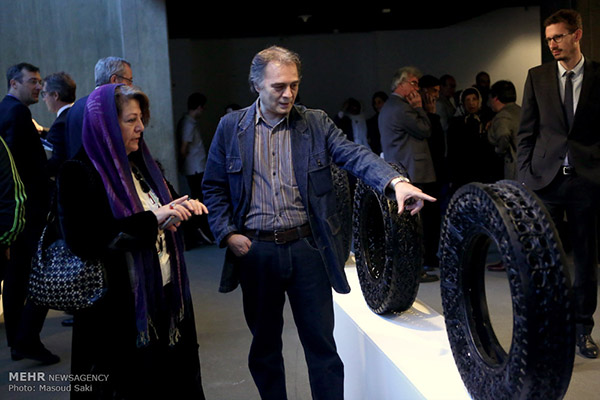
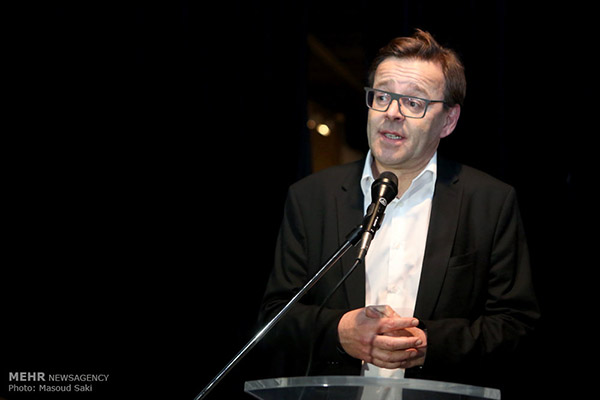
Tehran hosts Belgian pioneer artist’s works

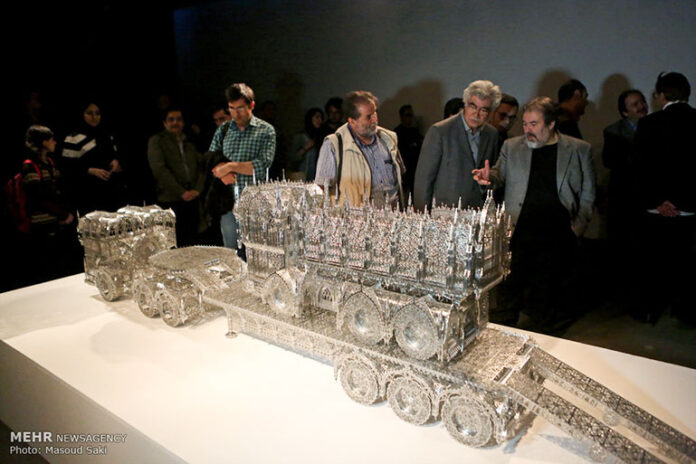
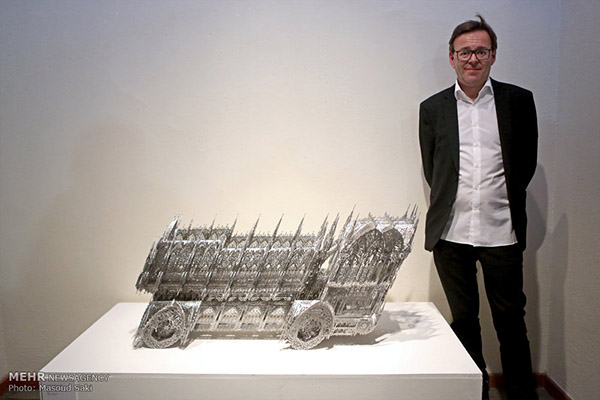
A gallery in Tehran’s Museum of Contemporary Art has displayed conceptual art and paintings by Belgian artist Wim Delvoye.

The following images have been released by Mehr News Agency:


‘US, German, Japanese insurers seek Iran service market’

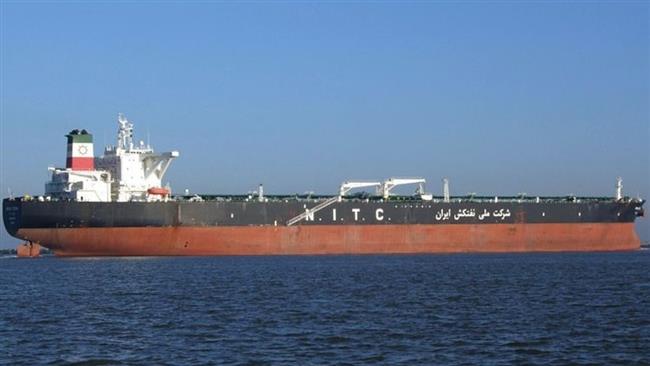
According to the Central Insurance of the Islamic Republic of Iran, the International Group (IG) of Protection & Indemnity Clubs seeks to provide insurance coverage for Iranian oil tankers amid its ongoing negotiations with the US Treasury to facilitate the process, IRNA reported on Monday.

It also said a ban on insurance service by the US Office of Foreign Assets Control (OFAC) against the IG member, American Steamship Owners Mutual, has been lifted. The report said such companies have been seeking to provide insurance services to Iranian shipping firms.

Last month, a circular posted on the website of the American Steamship Owners Mutual Protection and Indemnity Association, Inc. (the American Club), said OFAC had “prospectively removed” the restriction that previously prevented the American Club from covering cargos originating from Iran.

The American Club is one of 13 members of the International Group of P&I Clubs in London, who collectively cover more than 90 percent of the global tanker fleet against risks including oil spills.

The New York-based insurance company added that following the OFAC measure, the club is “now generally available for non-US person Members’ transportation of crude and products to and from Iran.”

Iran’s Central Insurance further highlighted the willingness of some German and Japanese insurance providers for work with Iran without identifying them.

The news comes after Iran and P5+1 countries – the US, the UK, France, China, and Russia plus Germany – started implementing a deal they clinched last July on Iran’s nuclear program. According to the agreement, known as the Joint Comprehensive Plan of Action (JCPOA), the six countries accepted to remove sanctions imposed on Iran’s economic and energy sectors in return for Iran imposing restrictions on its nuclear activities.

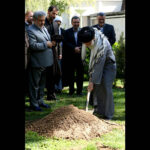
On National Week of Natural Resources, the Leader planted a sapling

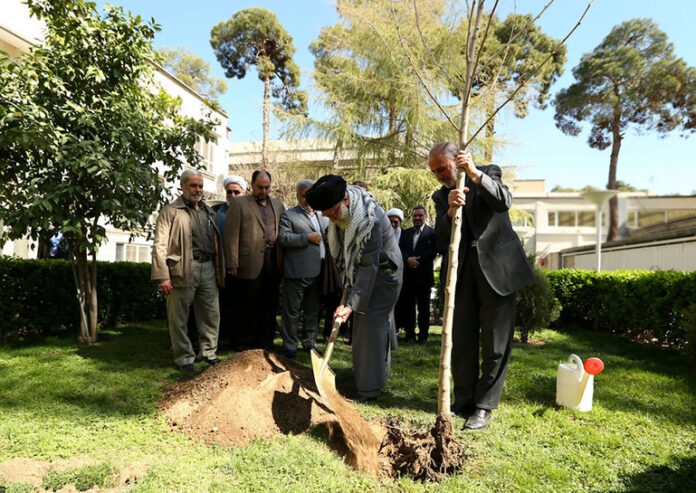
On the occasion of the National Week of Natural Resources, Ayatollah Khamenei, the Leader of the Revolution planted a sapling today (Tuesday) afternoon. Ayatollah Khamenei then made a statement where he stressed the need for appreciating plants and trees as blessings to the life of the mankind and added: All the people and officials must work hard as a part of their duty to protect green environments, forests and rangelands. He pointed to the destruction of original and native plant species as a result of deforestation and said: targeting forests and gardens is imprudent and raises the concern that some species may extinct, hence it is everyone’s duty to preserve and protect green environments.
IRGC holds final stage of missile drill

The final phase of the exercises, codenamed Eqtedar-e-Velayat, saw ballistic missiles fired from silo-based launchers in different locations across the country on Tuesday.
The maneuvers are aimed at displaying Iran’s “deterrence power” and the country’s “full readiness to confront all kinds of threats against the Revolution, establishment and territorial integrity,” the IRGC said.

IRGC commander Major General Mohammad Ali Jafari and commander of the IRGC Aerospace Division Brigadier General Amirali Hajizadeh oversaw parts of the drills.

Last October, Iran successfully test-fired its precision-guided long-range Emad missile, sparking an uproar among US politicians.

In January, the US Department of the Treasury imposed new sanctions against Iranian citizens and companies over the country’s ballistic missile program.

Iranian Defense Minister Brigadier General Hossein Dehqan has asserted that the Emad missile is a conventional weapon.

Last December, Iranian Foreign Minister Mohammad Javad Zarif defended Iran’s right to carry out missile tests, saying none of Iranian missiles are capable of carrying nuclear warheads.

The Islamic Republic has repeatedly said that its military might poses no threat to other countries, reiterating that its defense doctrine is merely based on deterrence.

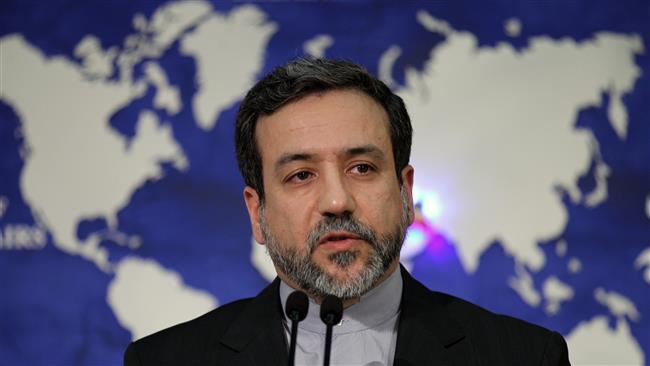
Iran’s diplomatic capability manifested in nuclear talks

Araghchi-12

At a local ceremony here Tuesday, Araqchi said the July deal, JCPOA, was a great achievement gained by the Iranian nation after 12 years of resistance.

Referring to win-win result in the nuclear talks, Araqchi said ‘win’ means the two sides’ interests have been safeguarded.

Iran’s request was to make its peaceful nuclear program recognized internationally, continue its activities and see lifting of sanctions, said Araqchi.

He added the other side claimed that Iran was on the way to make nuclear bomb but they prevented the country from doing it without using any military actions.

Anti-Iran sanctions were lifted on January 16.

‘We built confidence, however, we don’t think of it as an advantage,’ he said, stressing that nuclear weapon has no place in Iran’s doctrine.

‘The major achievement we gained was to impose our will on the six world powers,’ Araqchi said, adding that the P5+1, during the past 12 years, did in vain everything they could in order to impose their policy on Iran.

Zarif Calls Iranian Expatriates Best Bridges for Dialogue of Civilizations

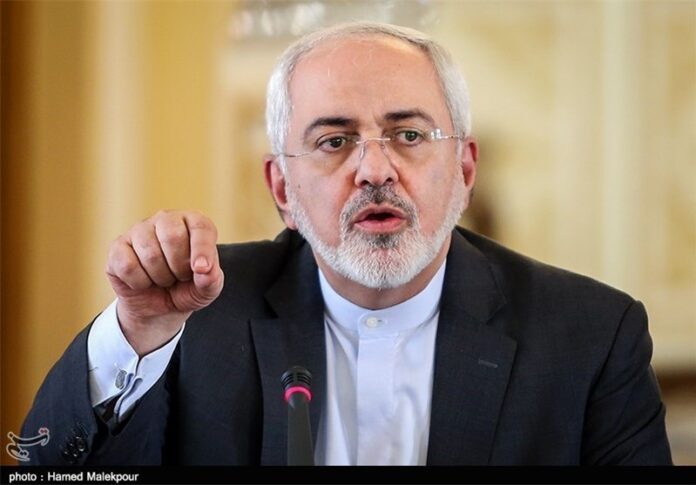
Addressing a gathering of Iranian expatriates in Singapore on Monday, Zarif pointed to the global atmosphere created after the implementation of the July 2015 nuclear deal between Tehran and six world powers (known as JCPOA), saying that in the post-JCPOA era, grounds are provided for the expansion of Iran’s foreign relations in line with the interests of the country.

“Iranian expatriates are an asset for the country… and the best bridges for dialogue of cultures and civilizations,” the Iranian top diplomat noted.

During the meeting, two of the Iranian expatriates also delivered speeches and appreciated Zarif’s successful efforts and achievements in the nuclear negotiations with the Group 5+1 (Russia, China, the US, Britain, France and Germany).

Zarif’s 11-day tour of Southeast Asia and Oceania which took him to Indonesia and Singapore will go on with official visits to Brunei, Thailand, New Zealand, and Australia.

The visits come against the backdrop of a new wave of interest in ties with Iran after the country’s negotiating team, headed by Zarif, and representatives of the Group 5+1 on July 14, 2015 reached a conclusion over the text of a comprehensive 159-page deal on Tehran’s nuclear program.

The two sides started implementing the nuclear agreement on January 16.

The comprehensive nuclear deal, known as Joint Comprehensive Plan of Action (JCPOA), terminated all nuclear-related sanctions imposed on Iran.

Experts believe that Iran’s economic growth would rise remarkably after the final nuclear deal takes effect.