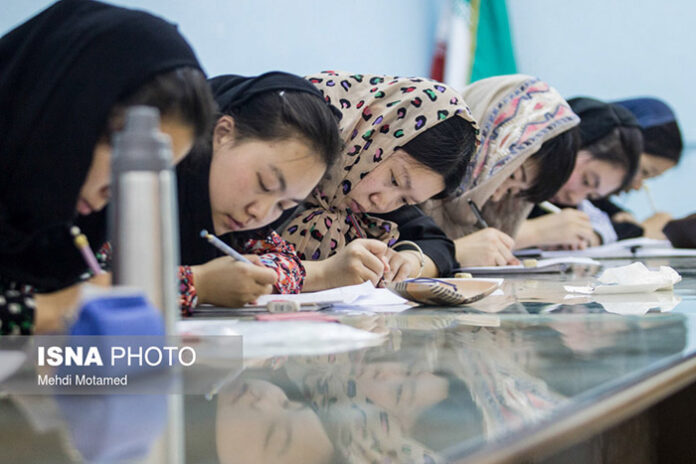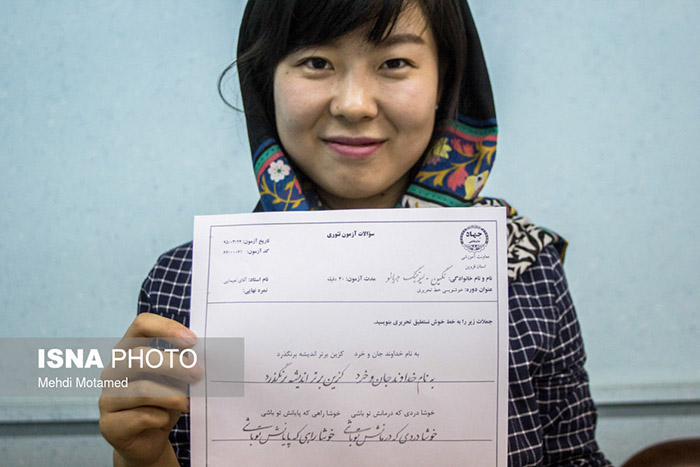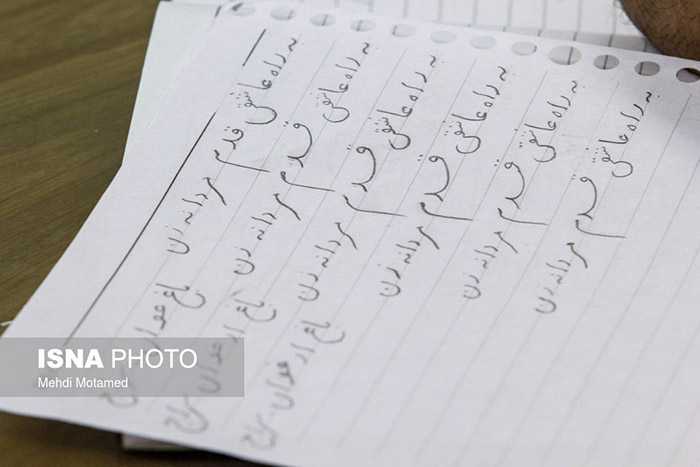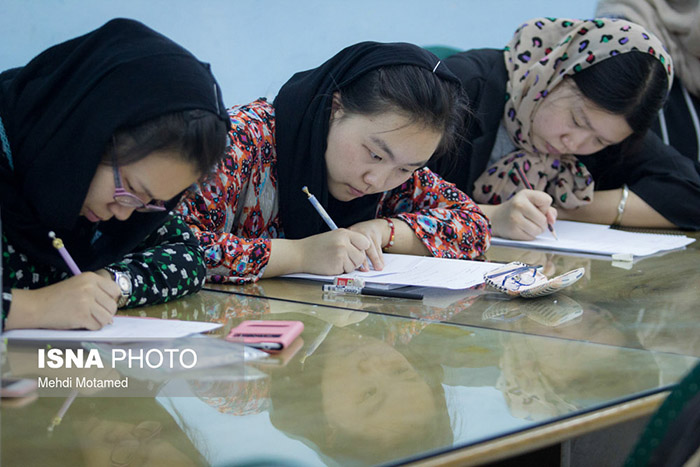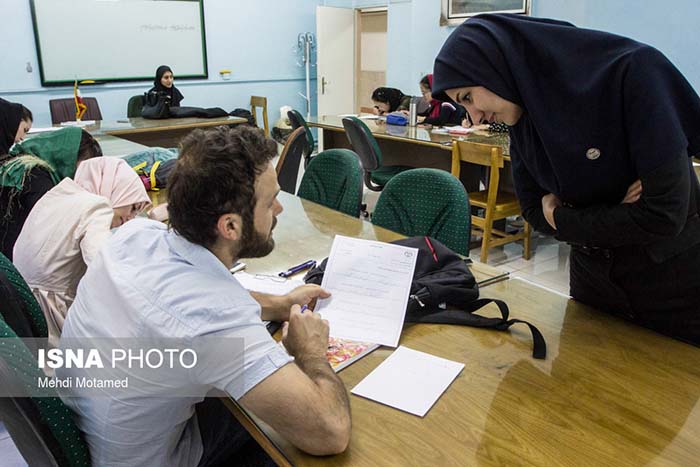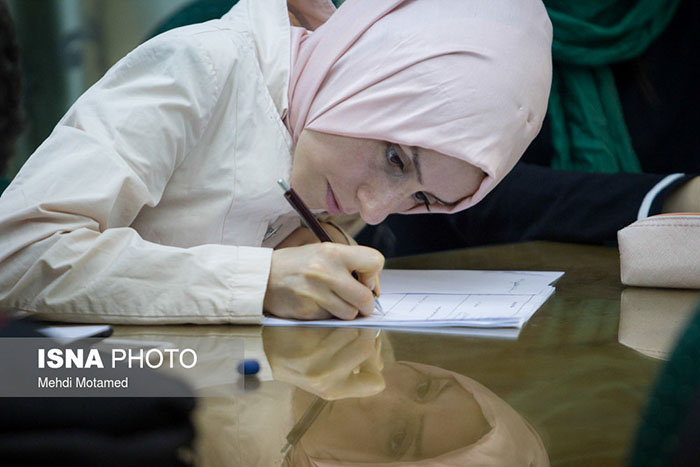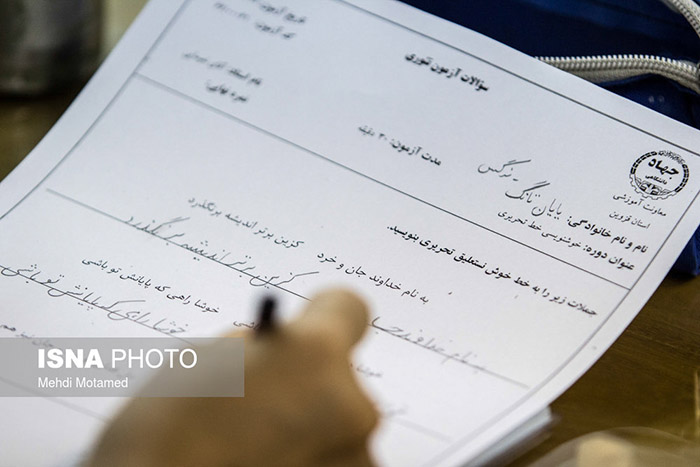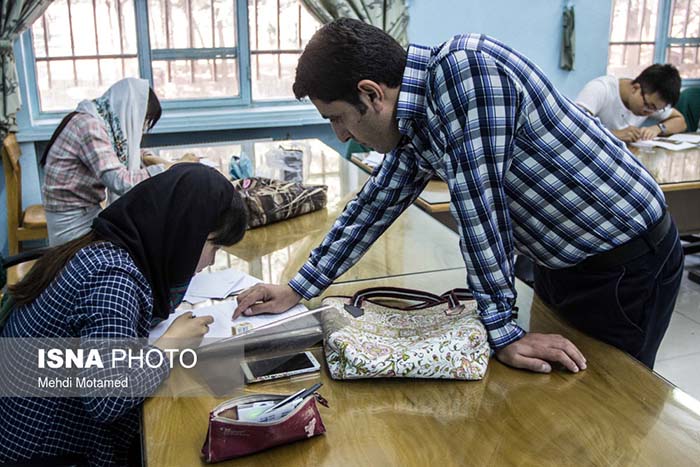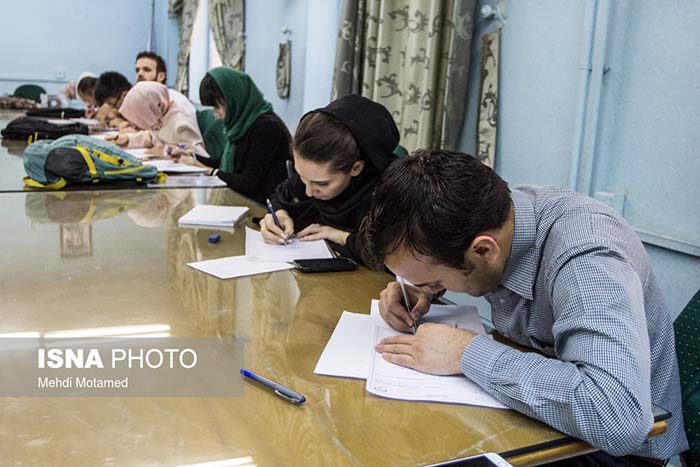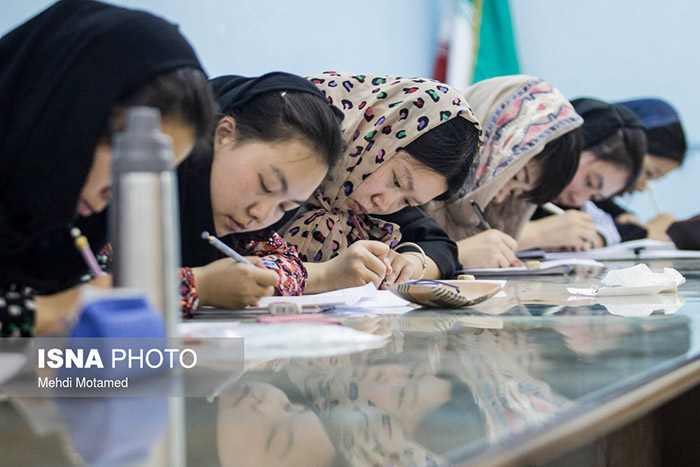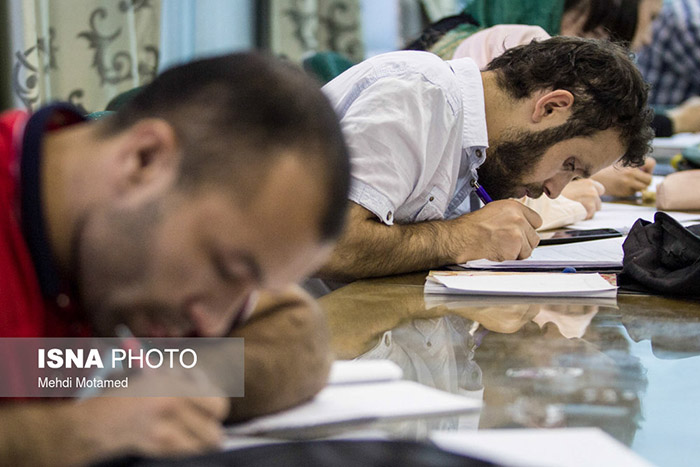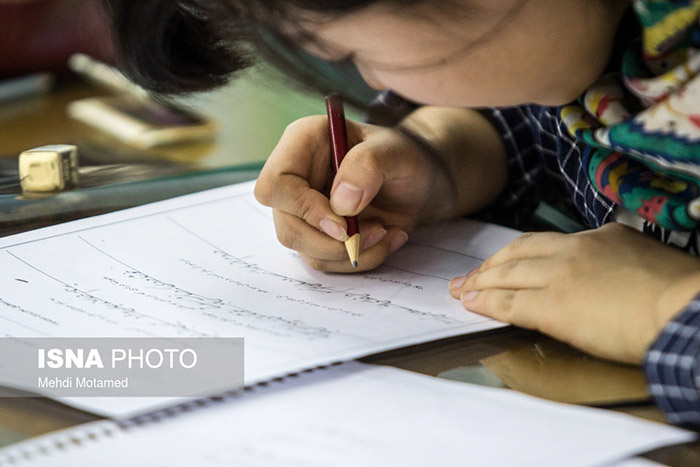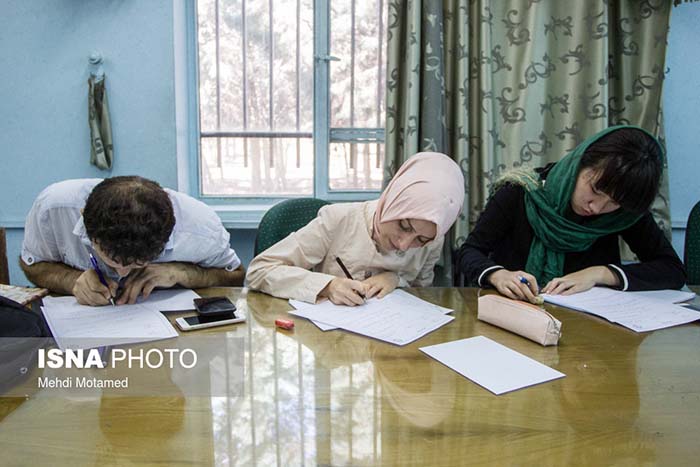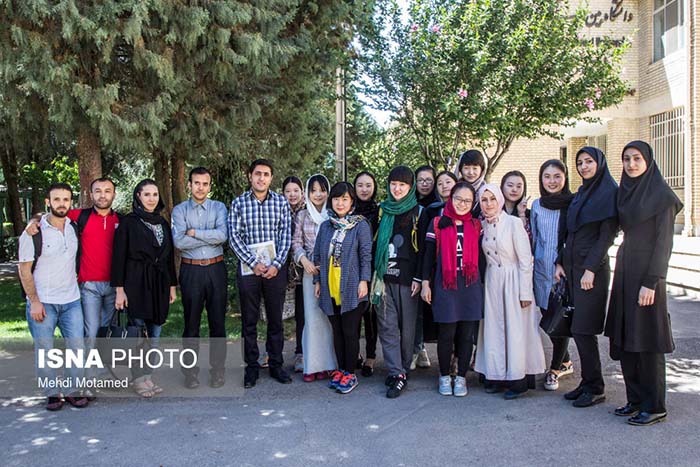
A calligraphy test was recently held in the Iranian city of Qazvin for foreign students at Imam Khomeini International University. See some of the examples of their work writing in traditional scripts below.
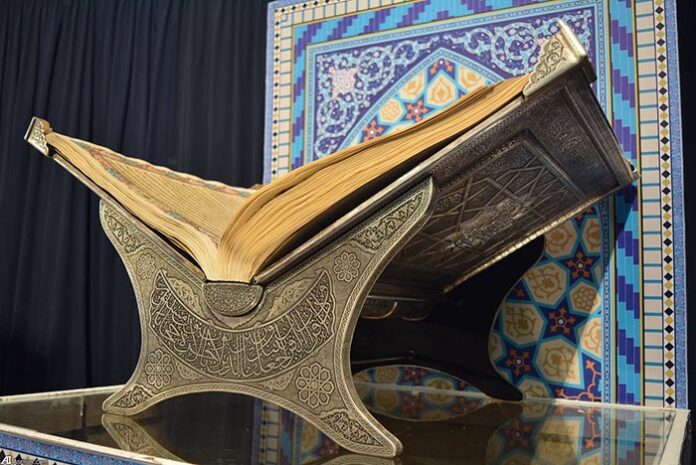
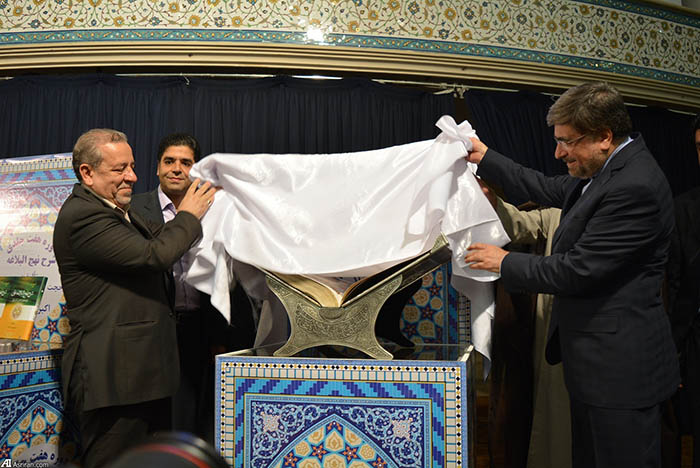
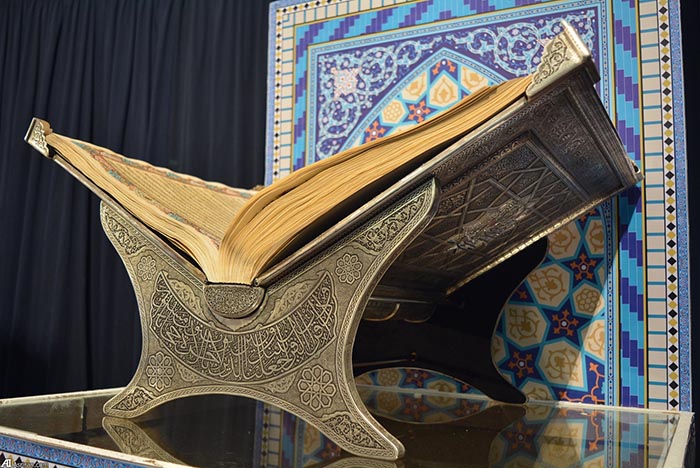
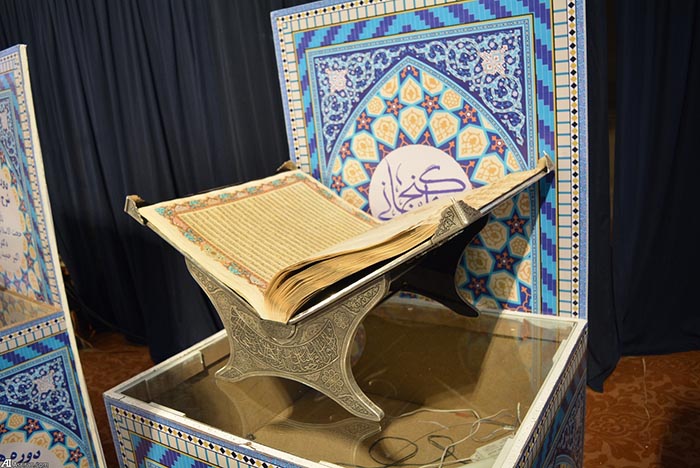
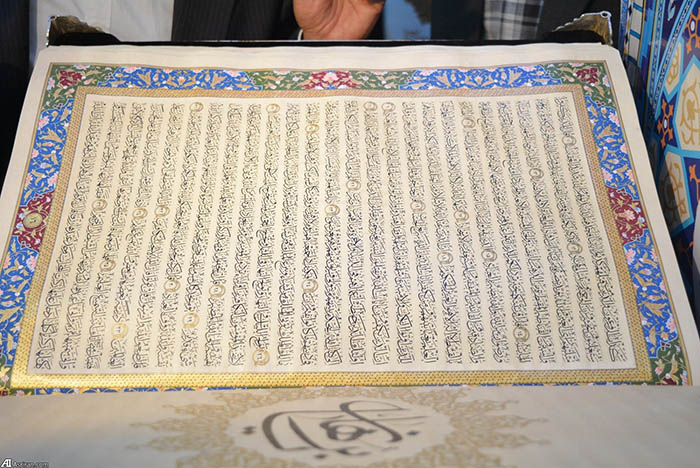
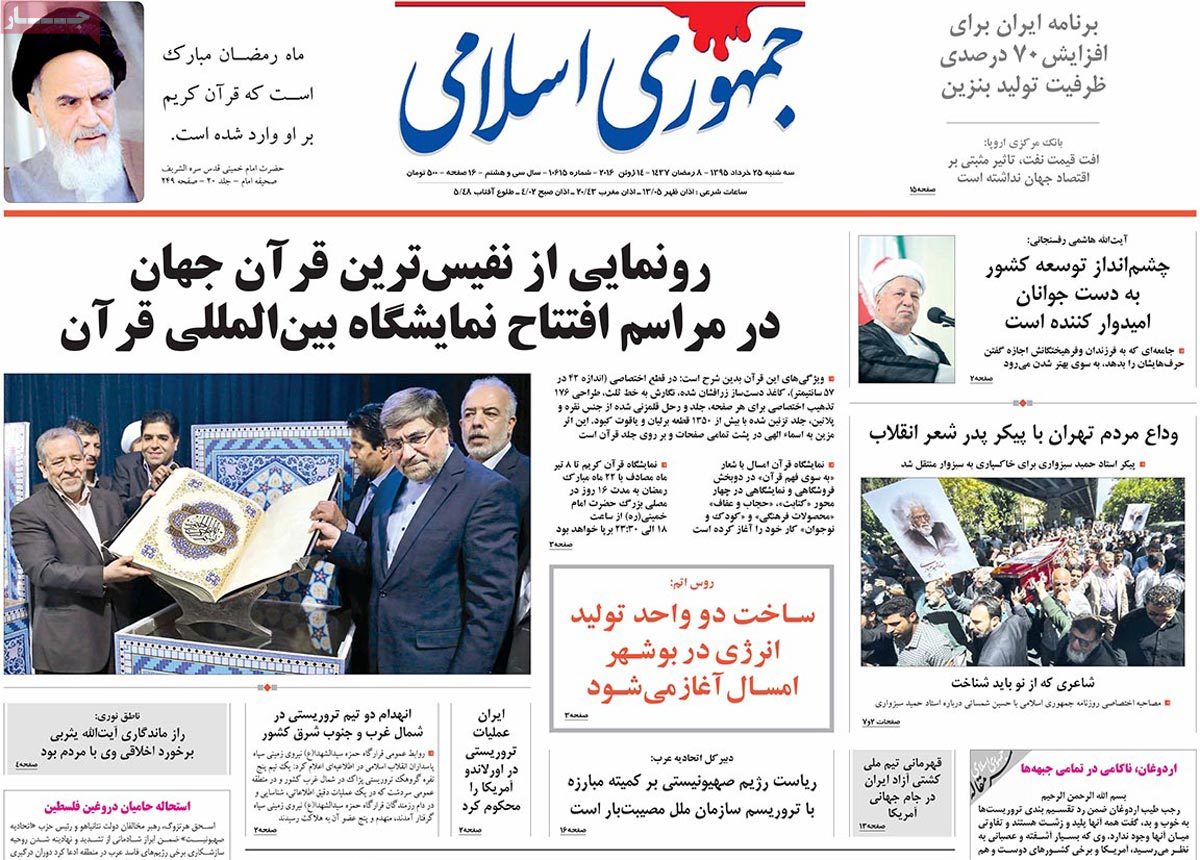
The world’s most precious handwritten Quran was unveiled after 18 years on Monday June 13 at the opening ceremony of the 24th International Holy Quran Exhibition in Tehran, which was attended by Culture and Islamic Guidance Minister Ali Jannati.
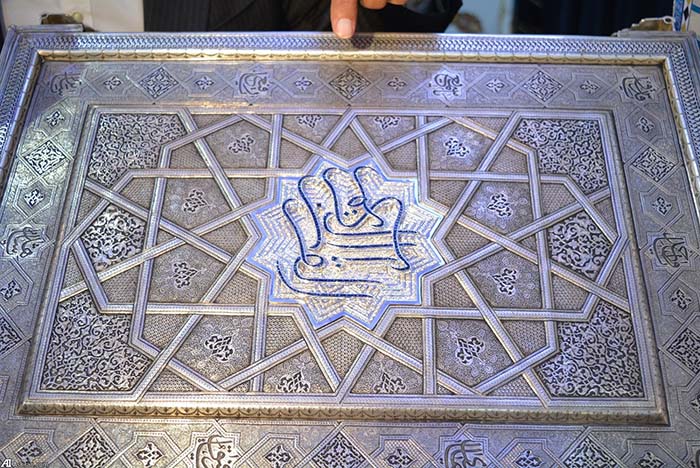
The Quran was handwritten by Gholam-Reza Mahrouei in a distinctive Sols calligraphy, one of the most beautiful Islamic written forms, on a special type of paper. It took 18 years for Mahrouei to write the holy book, each page of which contains a unique design and artwork.
To read more about the book itself, click here.
more on the exhibition, click here.
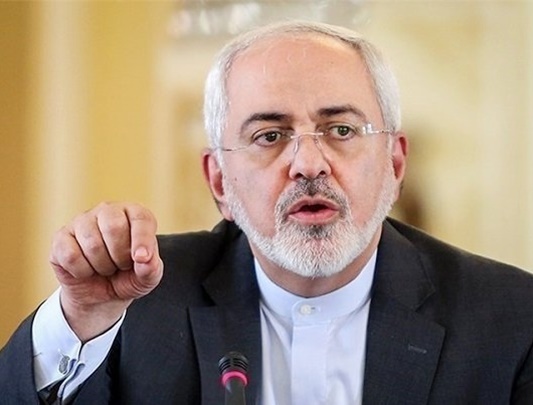
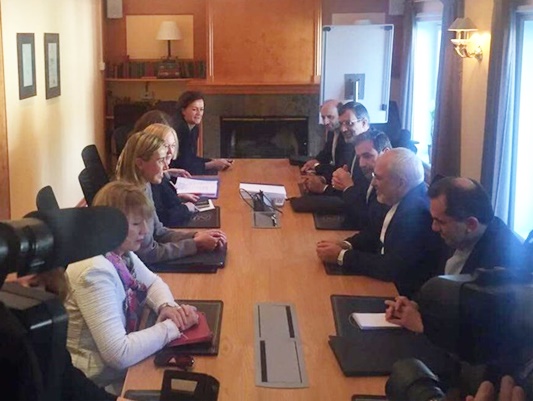
Foreign Minister Mohammad Javad Zarif told a news conference in Norway on Tuesday June 14 that Iran had yet to feel gains from a July nuclear agreement with the West and other parties.
“I believe the United States on paper has removed all the sanctions,” Zarif said in a joint news conference with EU’s foreign policy chief Federica Mogherini in Oslo.
“On the banks, I believe it is important for everybody to realize that an agreement will be sustainable if everybody feels they are making gains from the agreement,” he said.
“Its implementation must also be a win-win implementation so that everybody feels there are benefits, there are dividends,” Zarif added.
Mogherini said the EU is engaging with businesses and banks to encourage them to do business in Iran, adding bilateral trade in the first four months this year had risen by 22%.
“We are very actively engaging with the business community and the banks in Europe and elsewhere to encourage engaging in Iran,” she said.
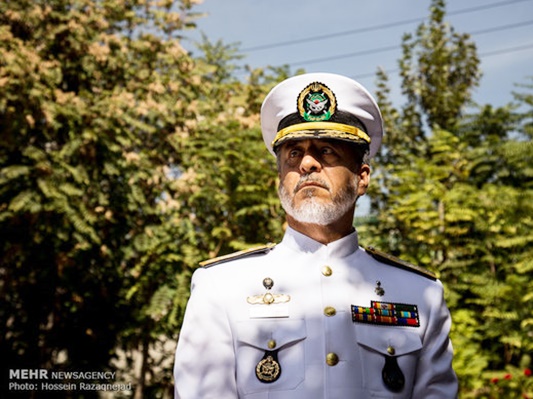
The Commander of Iran’s Army Navy, Rear Admiral Habibollah Sayyari, told Mehr on Tuesday June 14 that the Moudge 5 destroyer, also known as Sahand, has been 90% completed, while Moudge 3 and 4 are 80% finished.
“The exact date of delivery for the Moudge 5 destroyer to the Navy will be decided after technical, military and navigation tests have been conducted; it will most likely be some time this year,” he added.
According to experts, the Sahand destroyer is 30% more radar-elusive than its former versions, he said.
“By February 2017, the Navy will have staged 20 drills, and the most important and biggest of which – if approved and funded – will be held sometime in February in the Sea of Oman to the 10th parallel of the Indian Ocean,” he said.
Iran’s navy has so far staged drills in the northern Indian Ocean, Red Sea, Gulf of Aden, the southern Indian Ocean, South China Sea, Mediterranean, and Pacific Ocean, said Sayyari, adding, “We have not yet decided on a country bordering the Atlantic Ocean to send the Islamic Republic’s message of peace and friendship there. Once decided, the navy will dispatch a military flotilla to the Atlantic Ocean as well.”
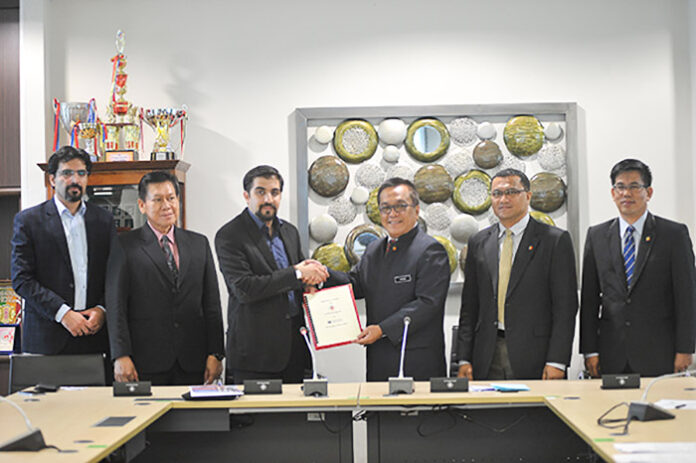
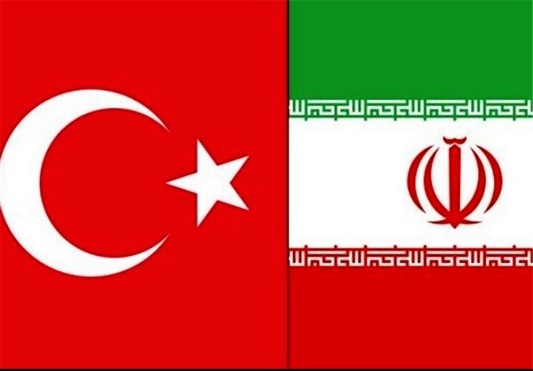
High-ranking officials from the Istanbul Chamber of Industry, Iran Chamber of Commerce, Industries, Mines, and Agriculture (ICCIMA) and the Iran Small Industries and Industrial Parks Organization (ISIPO) signed the trilateral agreement on Monday night, June 13.
The industrial park is planned to be built by the Turkish contractor, and will include 140 units, according to media reports.
Back in April, Iran and Turkey signed eight memorandums of understanding (MoUs) to strengthen bilateral cooperation in various areas.
The cooperation documents were signed in a ceremony in Ankara on April 16, attended by Iranian President Hassan Rouhani and his Turkish counterpart Recep Tayyip Erdoğan.
The documents covered a range of fields, including higher education, social security, plant maintenance services and standardization.
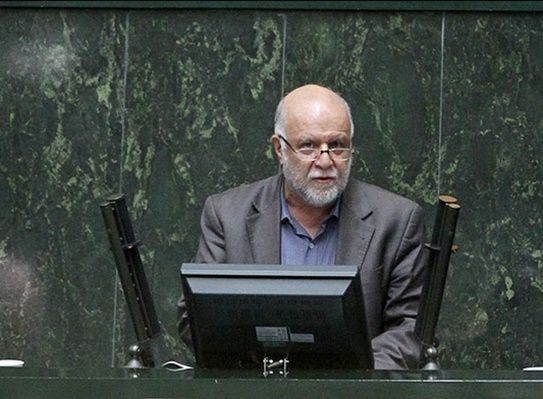
Addressing the Iranian Parliament on Tuesday June 14, Zangeneh said that the country had doubled its crude oil exports since the Joint Comprehensive Plan of Action (JCPOA)’s implementation in January 2016.
“Iran produced 2.7mbd in the first five months of the (Iranian calendar) year 1392 (March 21 2013-March 20 2014),” he said, briefing newly-elected MPs about his ministry’s performance under the Rouhani Administration.
He said Iran has doubled oil exports since January 2016. “Iran is now exporting more than 2 mbd of crude oil,” he added.
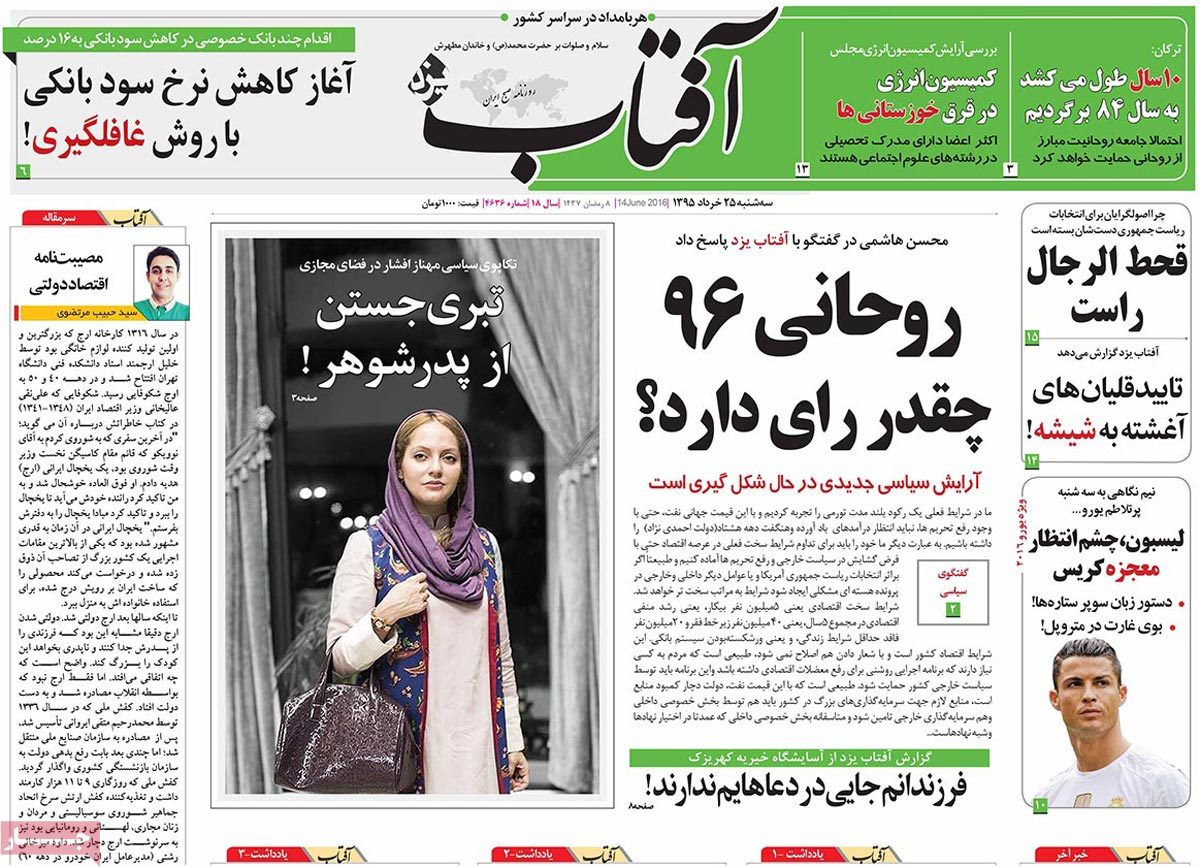
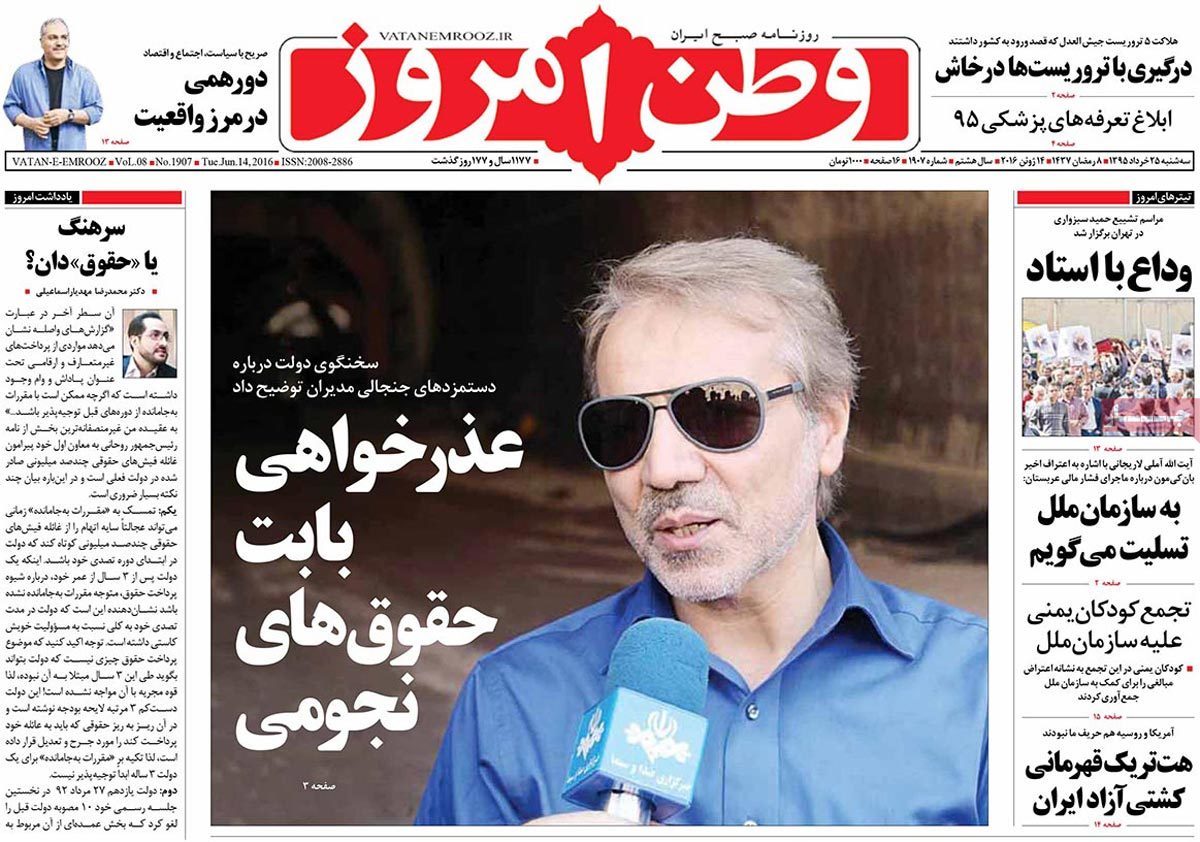
Many Iranian papers covered IRIB’s recent televised interview with the Spokesman for the Iranian Administration, Mohammad Baqer Nobakht, in which he discussed the astronomical salaries paid to certain executives and apologized for the unfair payment system. He vowed to have the mechanism corrected, working with Parliament.
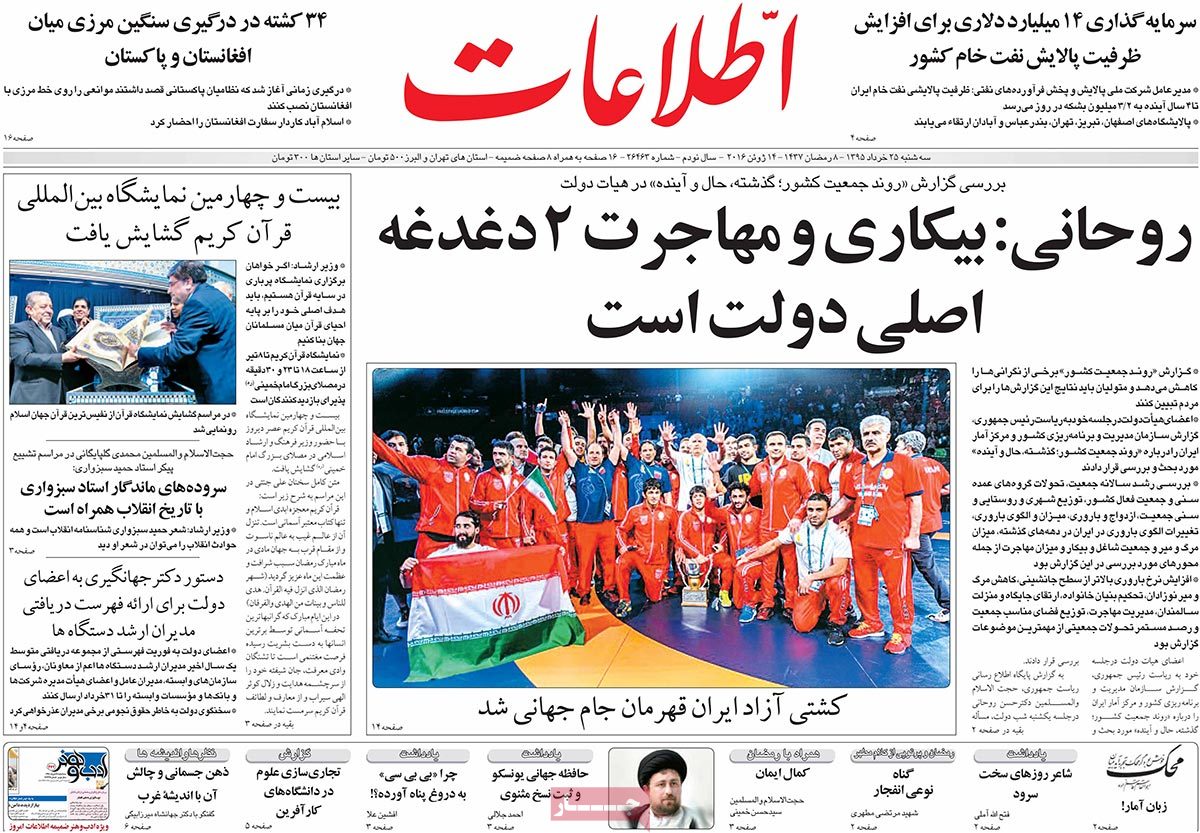
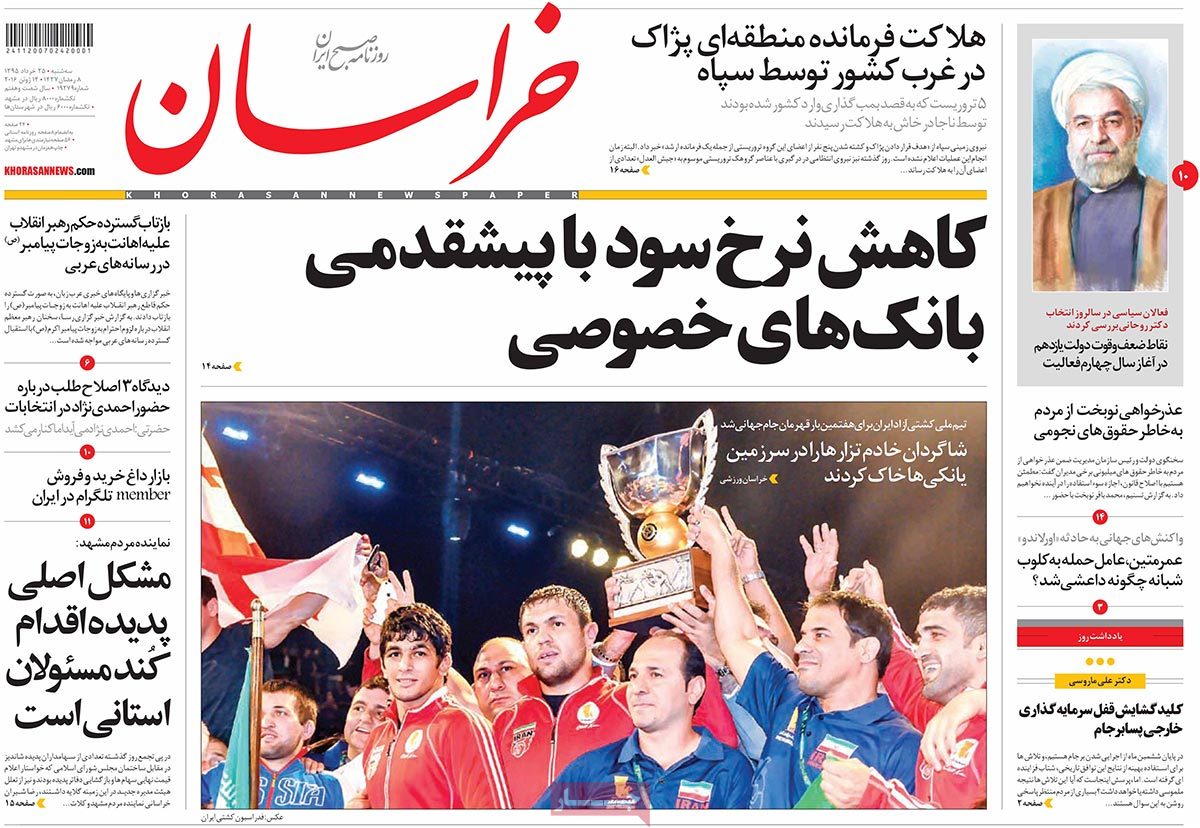
Iran’s freestyle wrestling team won their 5th consecutive (and 7th total) world championship in the US city of Los Angeles on June 12. In covering the championship, some headlines spotlighted Iran’s victories over the US and Russia, as well as the tournament’s location, boasting that Iran had defeated the two superpowers on American soil to become world champion.
Two separate operations by the Islamic Revolution Guards Corps (IRGC) and the Iranian Police in the west and east of the country also received great attention. 10 terrorists, including the regional commander of the PJAK terrorist group, were killed during the operations. One Police officer was also killed in the operations near the southeastern city of Khash.
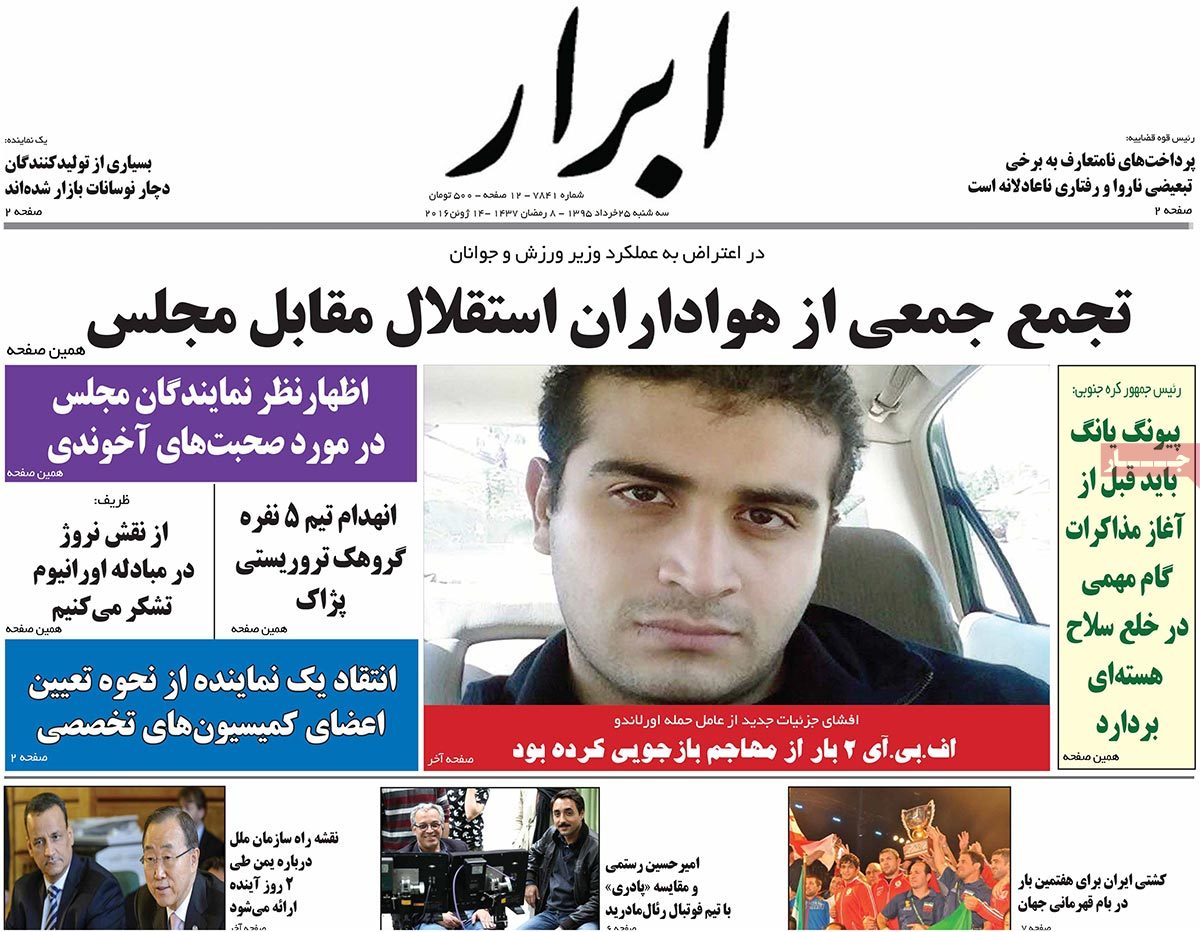
Abrar:
1- I Appreciate Norway’s Role in Uranium Exchange: Zarif
2- 5 PJAK Terrorists Killed in Clashes with Iran’s Police
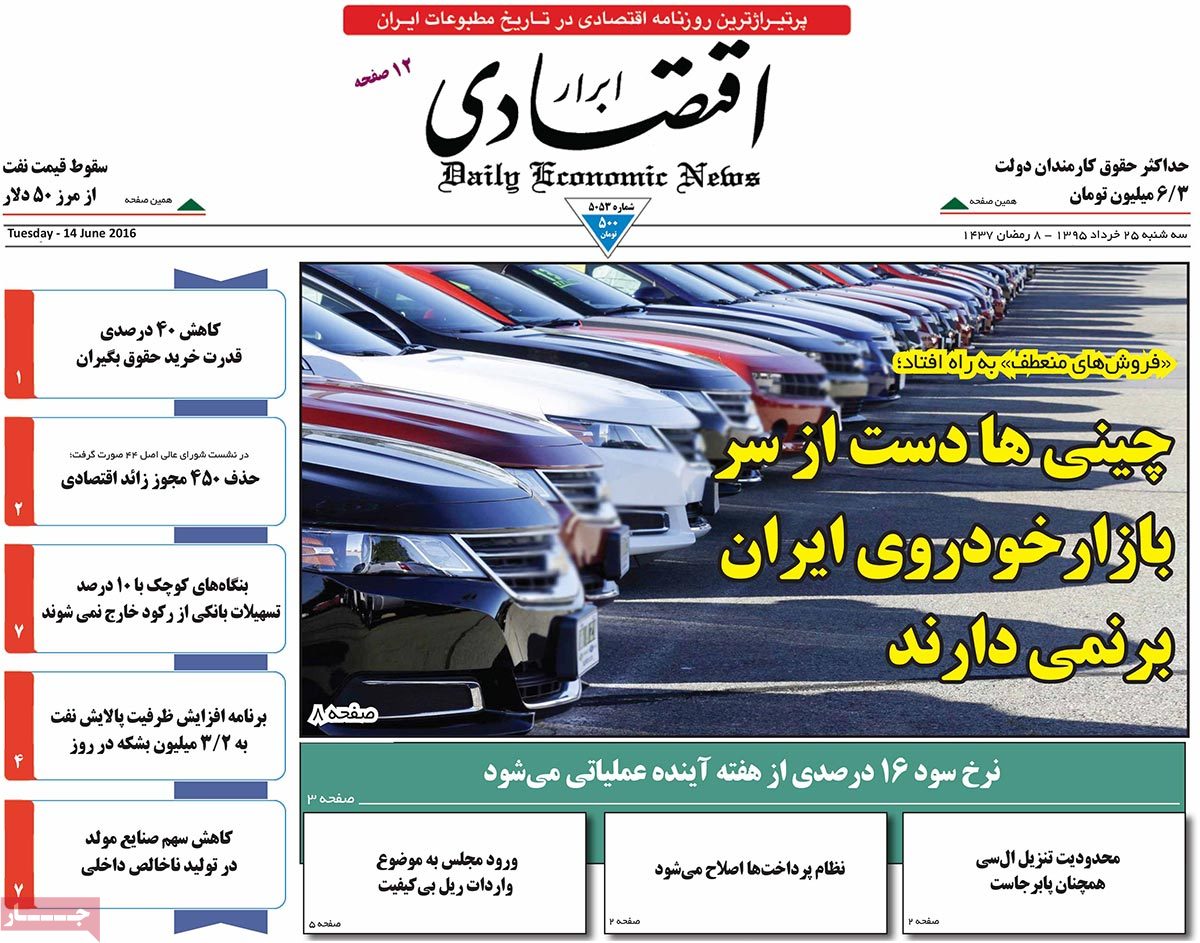
Abrar-e Eqtesadi:
1- China Not Going to Leave Iran’s Car Market Alone
2- Plans for Increase of Refining Capacity to over 3.2m bpd
Aftab-e Yazd:
1- New Political Makeup Being Formed: How Many Votes For Rouhani in 2017 Elections?
2- Why Conservatives Have No Candidate in Next Year’s Presidential Votes
Arman-e Emrooz:
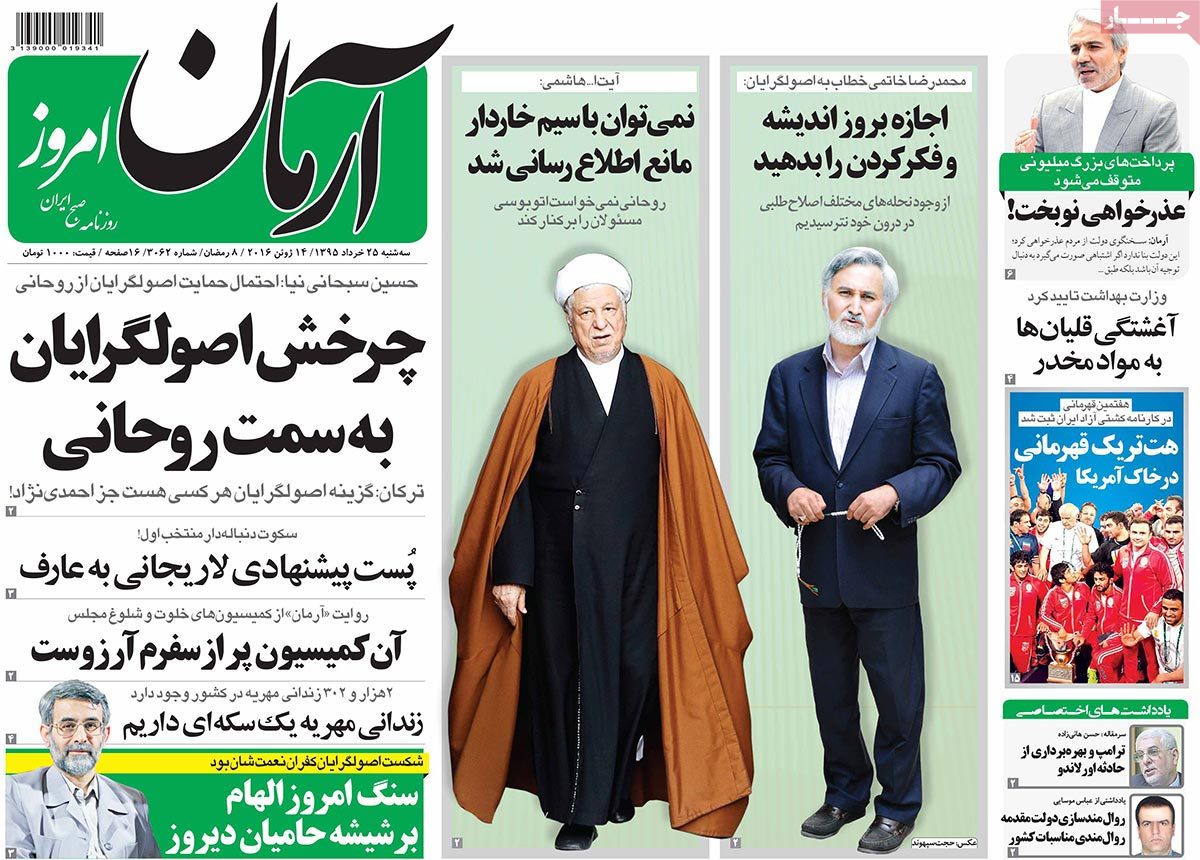
1- Conservatives Leaning towards Rouhani
2- You Can’t Prevent Dissemination of Information with Barbed Wire: Rafsanjani
3- Hookahs in Iran Contain Narcotics: Health Minister
4- Gov’t Spokesman Apologizes for Payment of Astronomical Salaries
Asia:
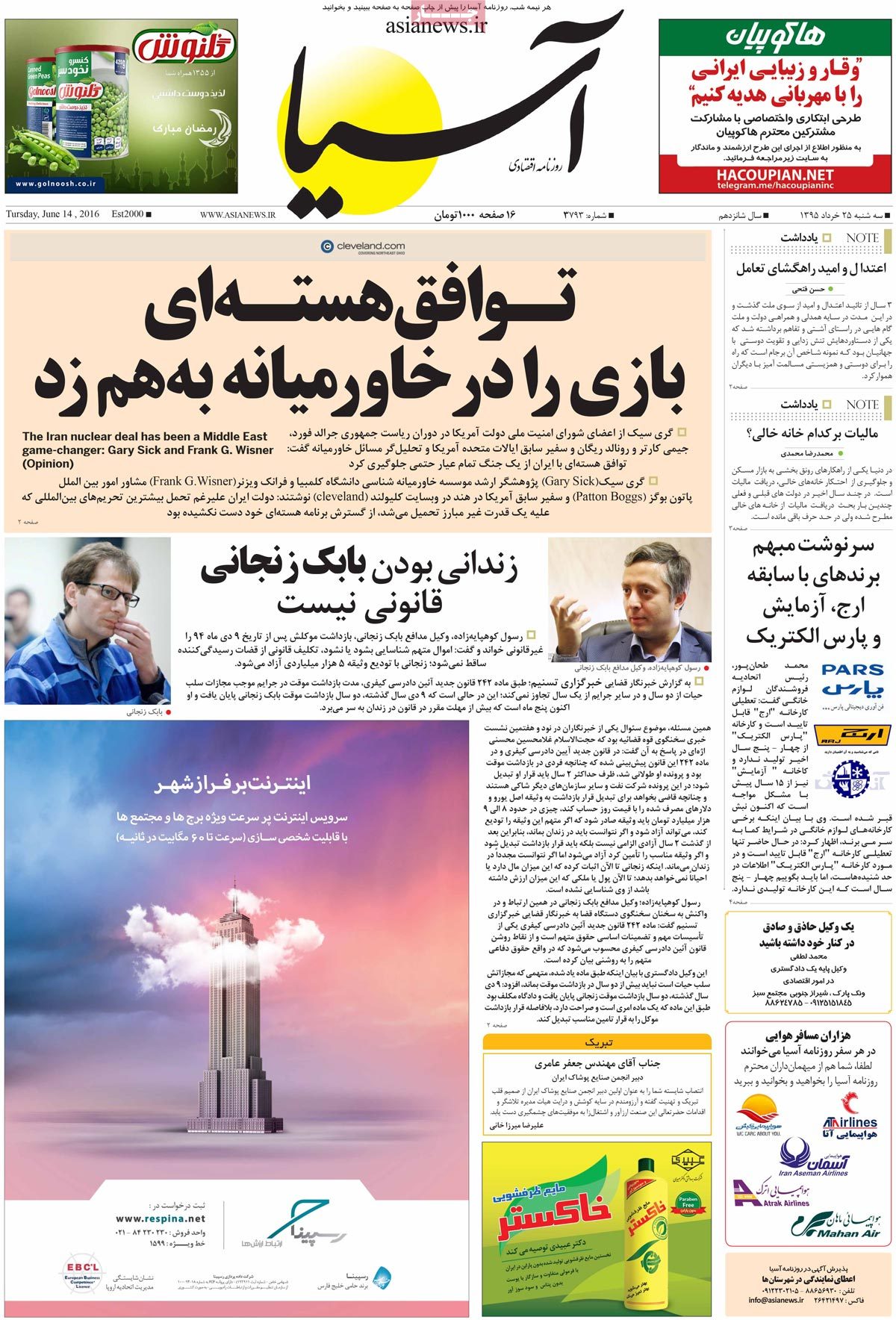
1- Nuclear Deal Has Been a Middle East Game-Changer: Gary Sick
2- Unclear Fate of Longstanding Iranian Brands Arj, Pars Electric, and Azmayesh
Asrar:
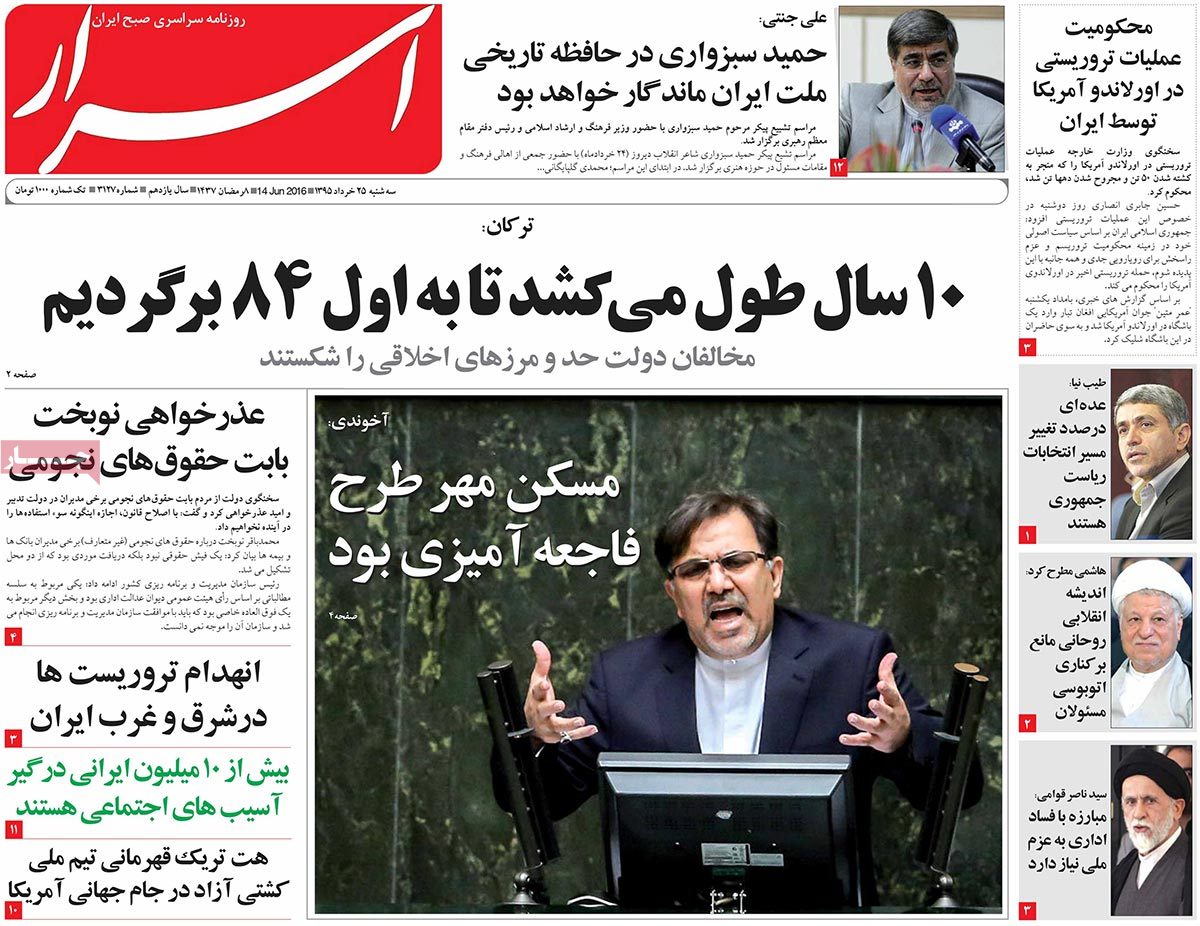
1- Iran Condemns Orlando Shooting
2- Terrorists Destroyed in West and East of Iran
3- Over 10m Iranians Suffering from Social Ills
Ebtekar:
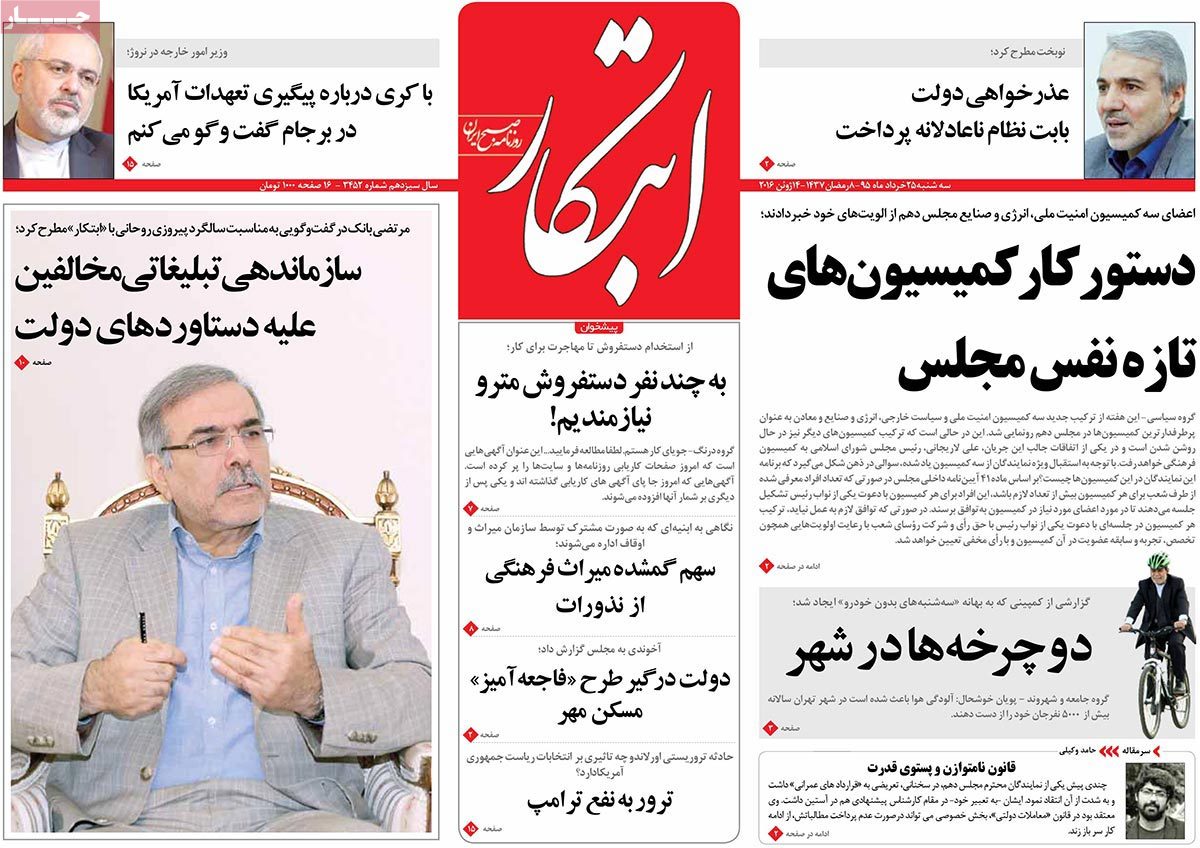
1- Gov’t Apologizes for Unfair Payment System
2- I’ll Talk to Kerry about USA’s JCPOA Commitments: Zarif in Norway
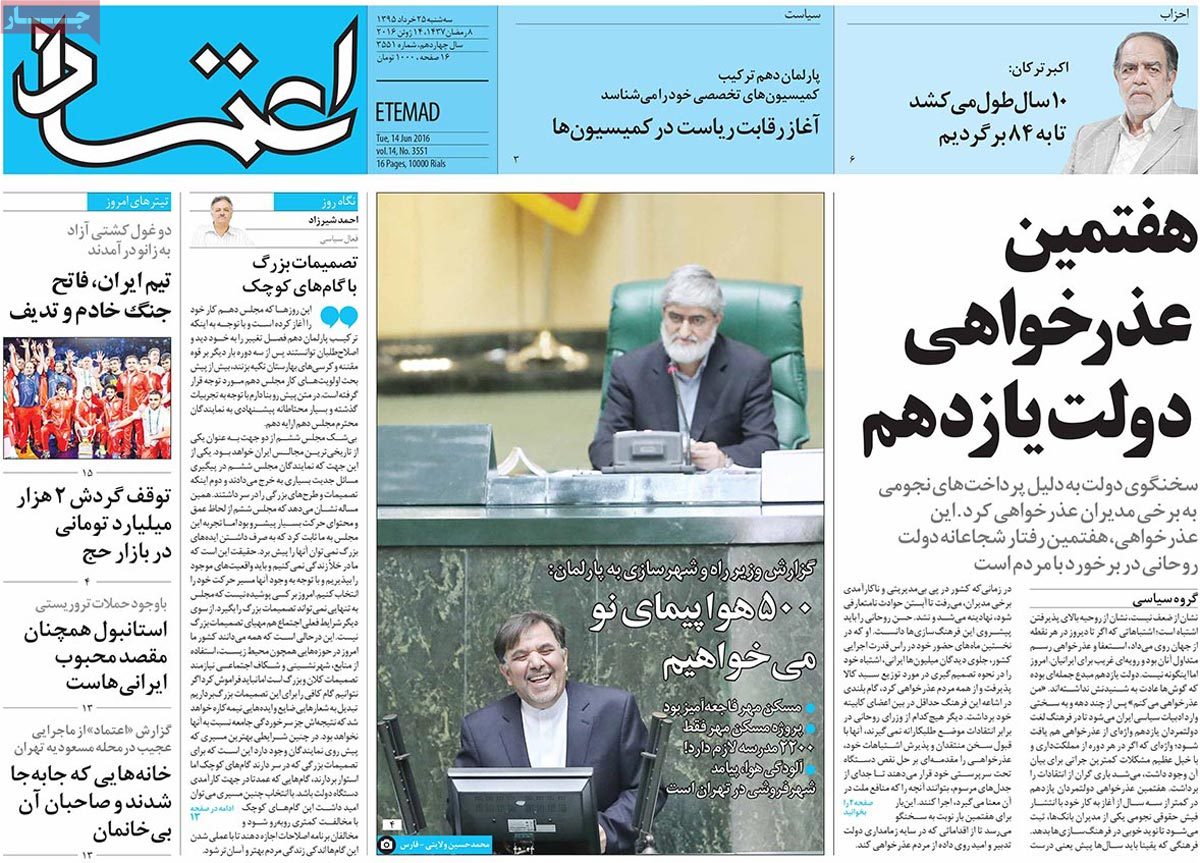
Etemad:
1- Rouhani Government’s Seventh Courageous Apology
2- We Need 500 New Airplanes: Minister
3- Despite Terrorist Attacks, Istanbul Is Still a Popular Destination for Iranians
Ettela’at:
1- Unemployment and Immigration Government’s 2 Main Concerns: Rouhani
2- $14bn Investment for Increasing Iran’s Crude Oil Refining Capacity
3- 34 Killed in Heavy Border Fight between Afghanistan and Pakistan
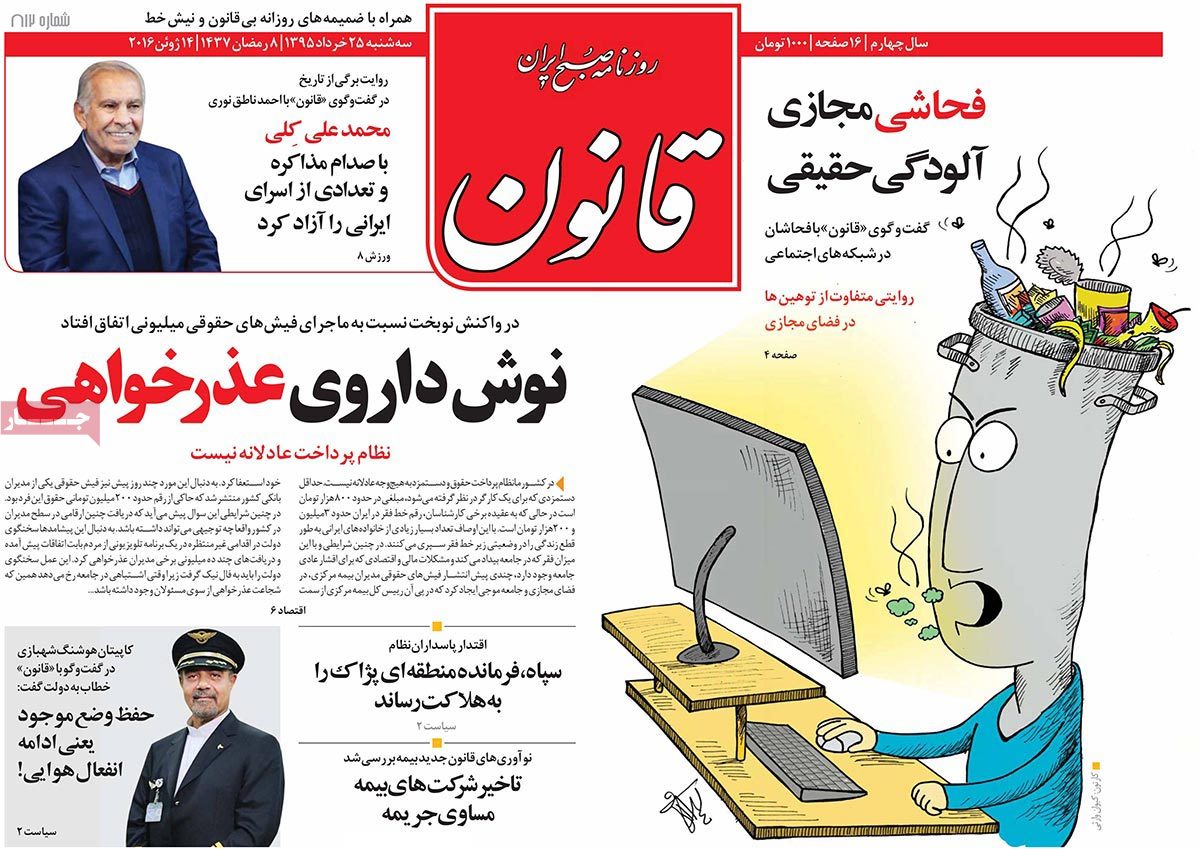
Ghanoon:
1- Muhammad Ali Held Negotiations with Saddam Hussein and Had a Number of Iranian Prisoners of War Released: Politician
2- Swearing in Cyberspace, Pollution in Real Life: Ghanoon’s Interview with Social Media Abusive Users
3- Apology as a Panacea [Nobakht’s apology for huge salaries]
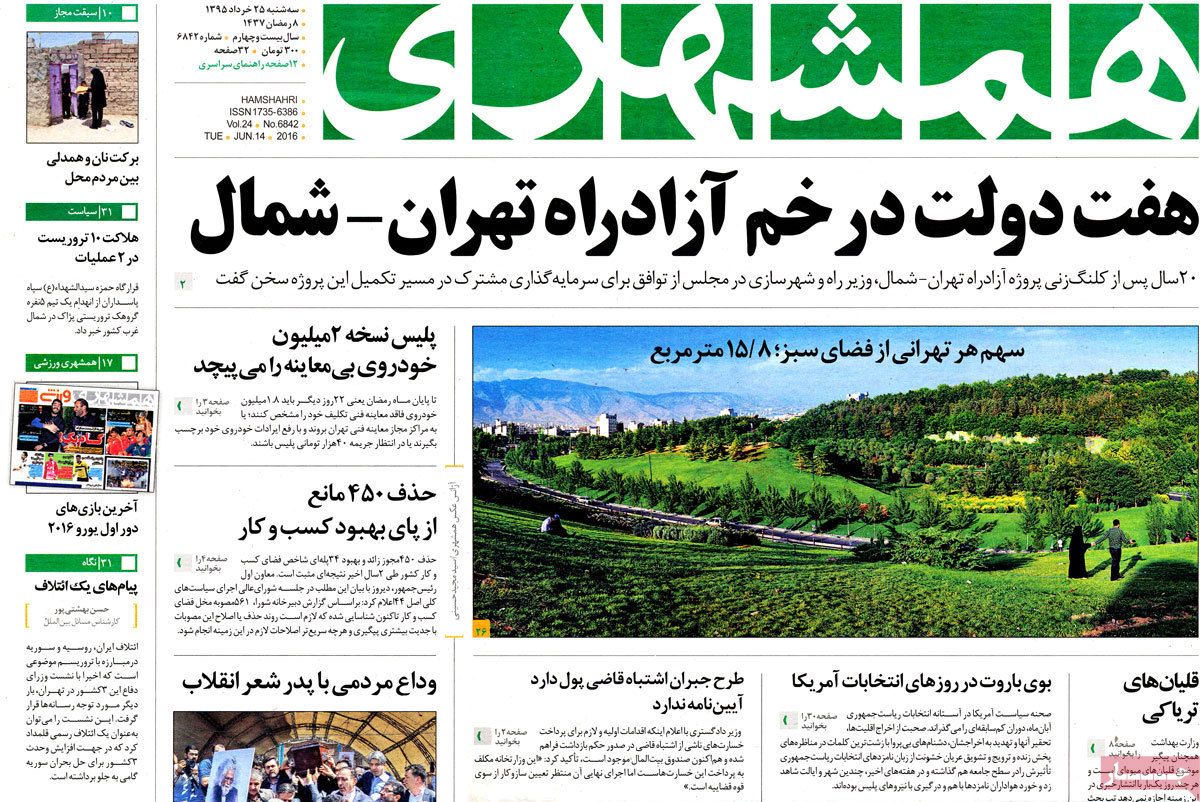
Hamshahri:
1- Tehran-Northern Iran Highway Project Still Unfinished after 20 Years
2- Each Citizen of Tehran Has 15.8sqm Share of Green Space
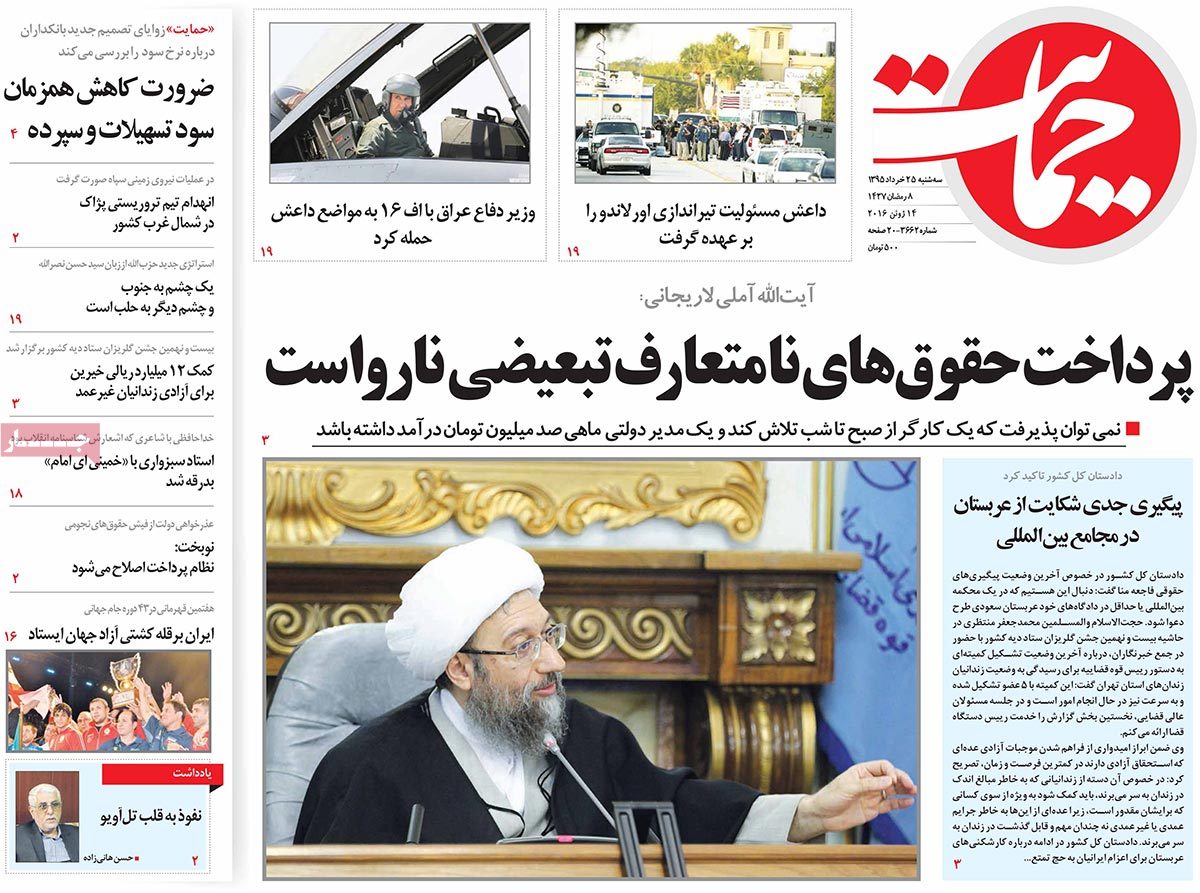
Hemayat:
1- Prosecutor-General: Iran Seriously Pursuing Lawsuit against Saudi Arabia in Int’l Bodies
2- Iraqi DM Attacks ISIS Positions with F-16
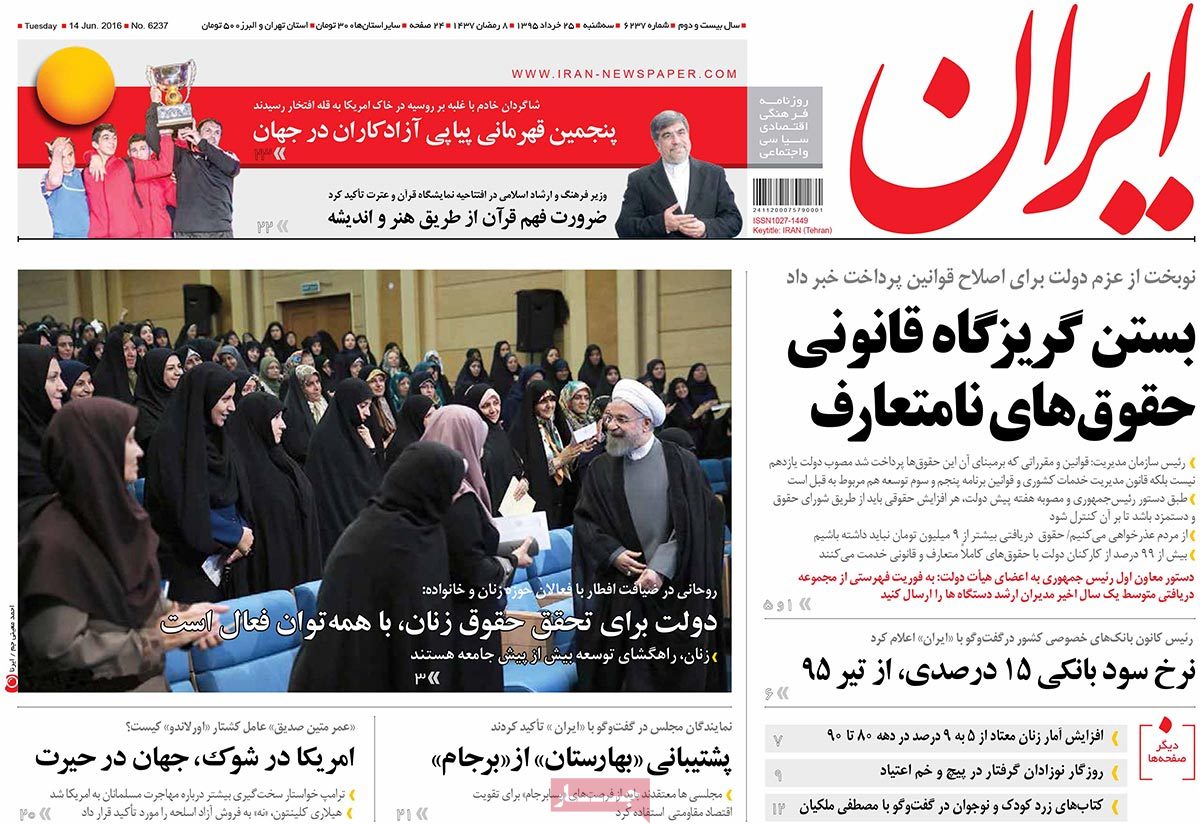
Iran:
1- Gov’t Doing Its Best to Implement Women’s Rights: President
2- US Shocked, the World Amazed: Who’s Omar Mateen, the Orlando Shooter?
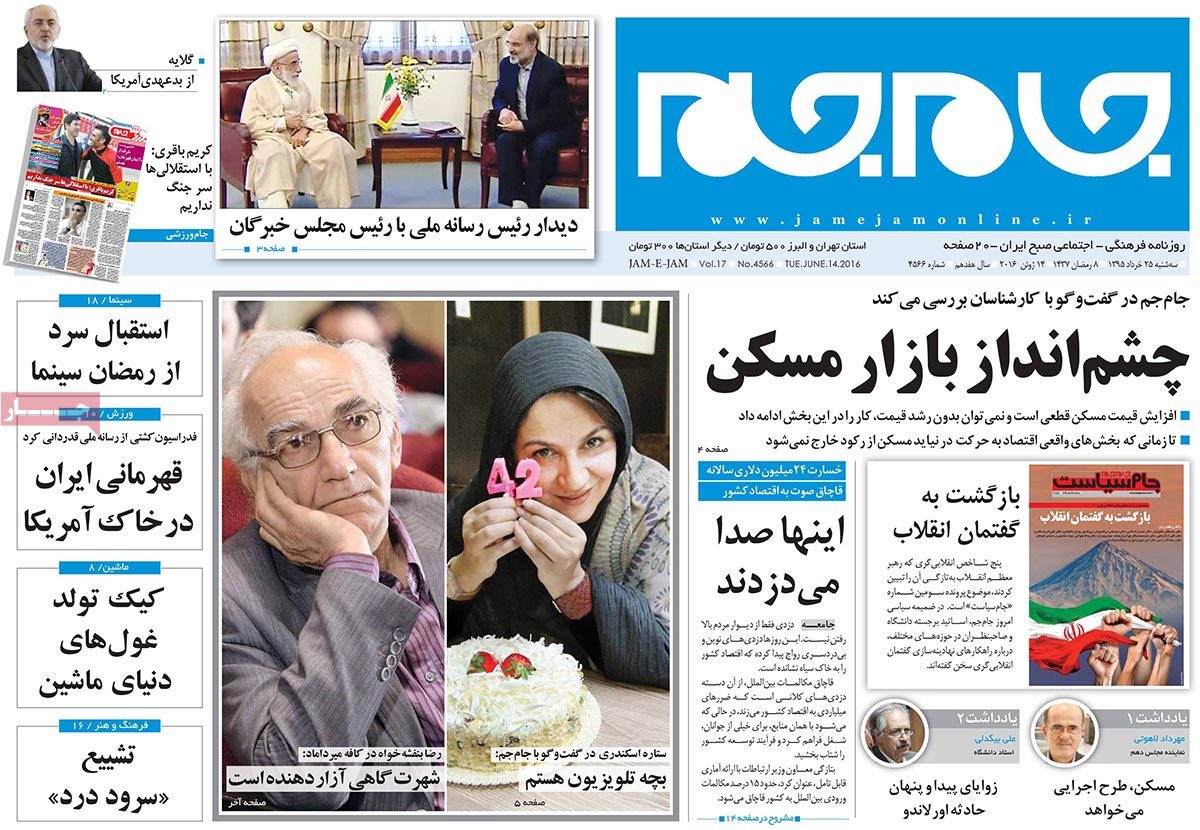
Jame Jam:
1- Iran’s [Wrestling] Championship in US Territory
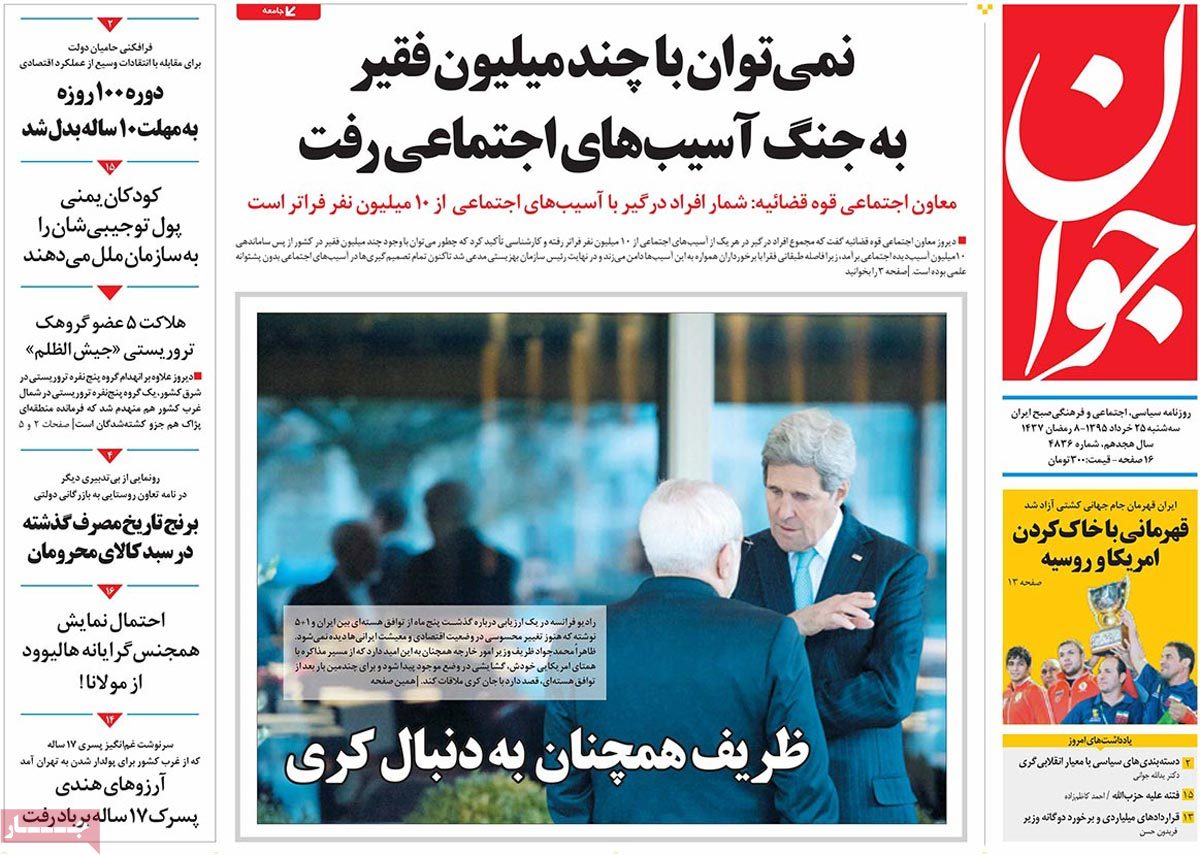
Javan:
1- Zarif Still Looking for Kerry
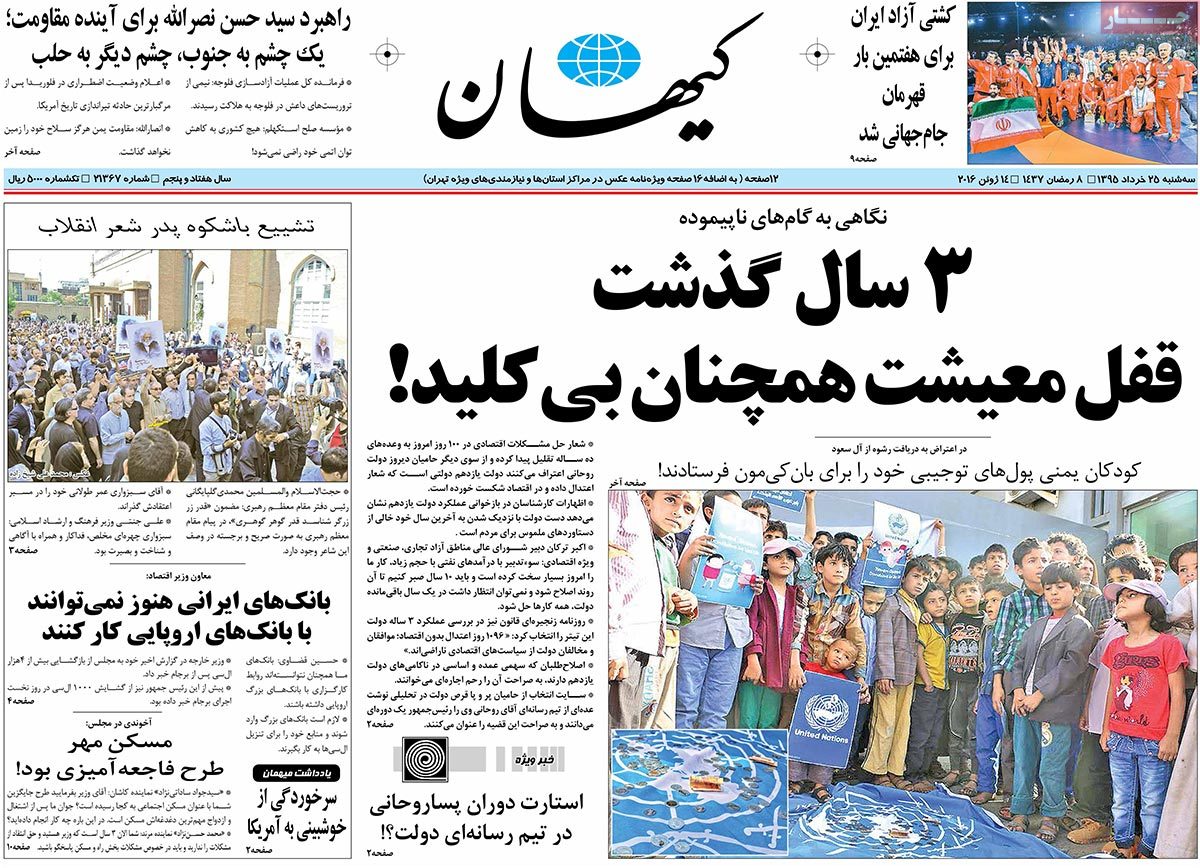
2- Yemeni Children Give Their Allowance to UN
3- Hollywood May Portray a Homosexual Image of Rumi
4- Championship after Defeating US and Russia
Jomhouri Eslami:
1- World’s Most Precious Quran Unveiled in Opening Ceremony of Tehran Int’l Quran Exhibition
2- Iran to Boost Gasoline Production Capacity by 70%
Kayhan:
1- 3 Years Have Passed, Still No Solution to People’s Livelihood Problems
2- Iranian Banks Still Can’t Work with European Ones: Deputy Minister
3- Frustration with Optimism towards US
4- Yemeni Children Send Their Pocket Money to UN in Protest at Accepting Saudi Bribe
Khorasan:
1- PJAK’s Regional Commander Killed by IRGC in Western Iran
2- Weak and Strong Points of Rouhani’s 3-Year Performance
Roozan:
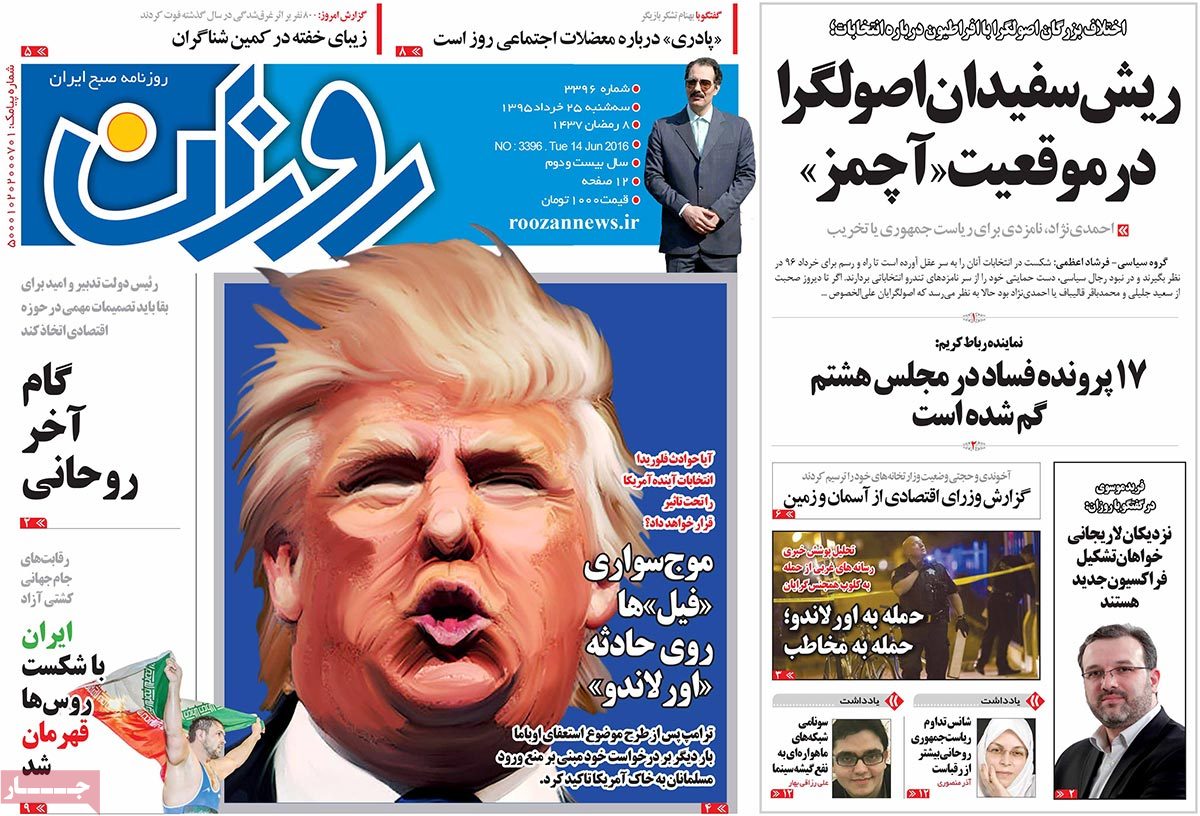
1- Conservatives Taking Advantage of Florida Attack: Will Orlando Shooting Influence US Elections?
2- 17 Corruption Cases Missing: MP
3- Rouhani’s Chance More than Others in Next Year’s Presidential Elections: Reformist Politician
4- Rouhani’s Last Step: President Should Make Important Decisions for Economy
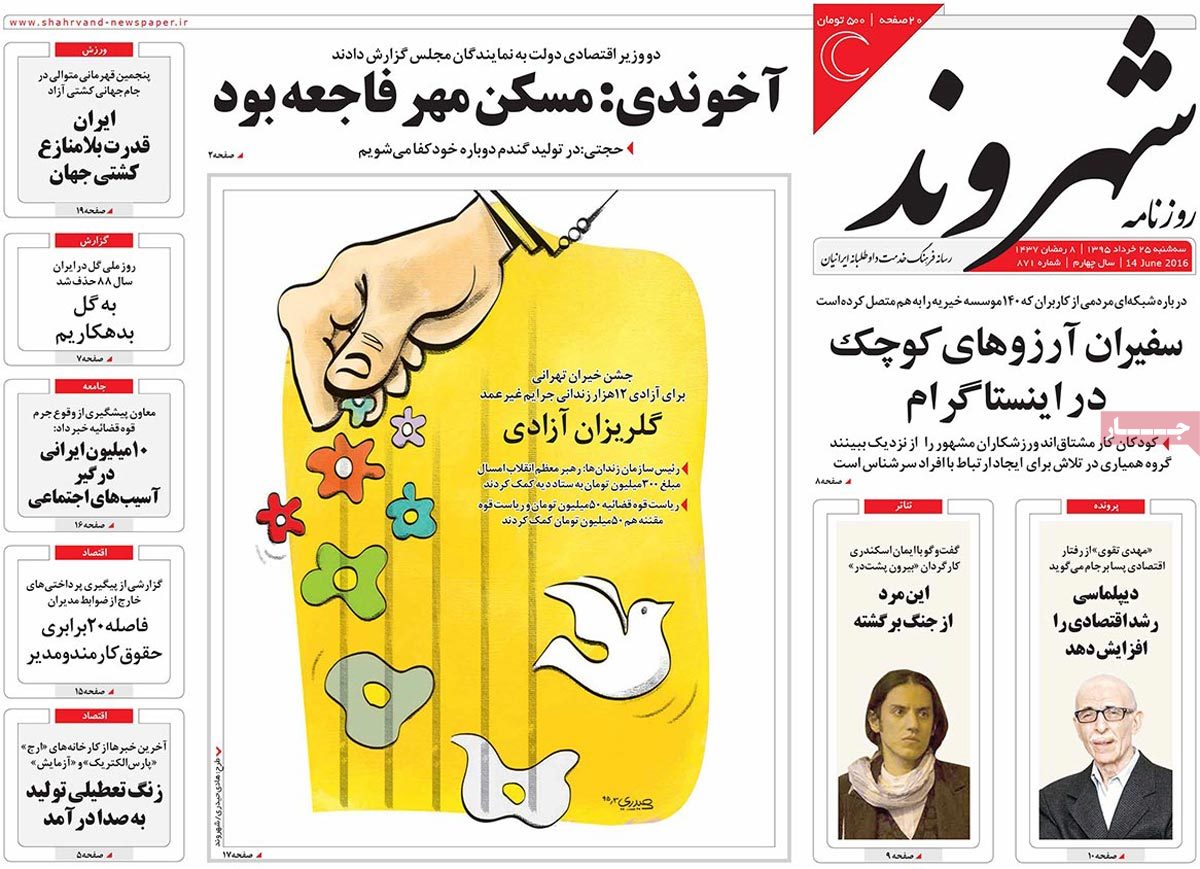
Shahrvand:
1- Golrizan for Freedom: Tehran Citizens Attend Charitable Ceremony to Raise Money for Release of Prisoners with Unintentional Crimes
2- Iran, Undisputed King of World Wrestling
3- Executives Receiving 20 Times More than Employees
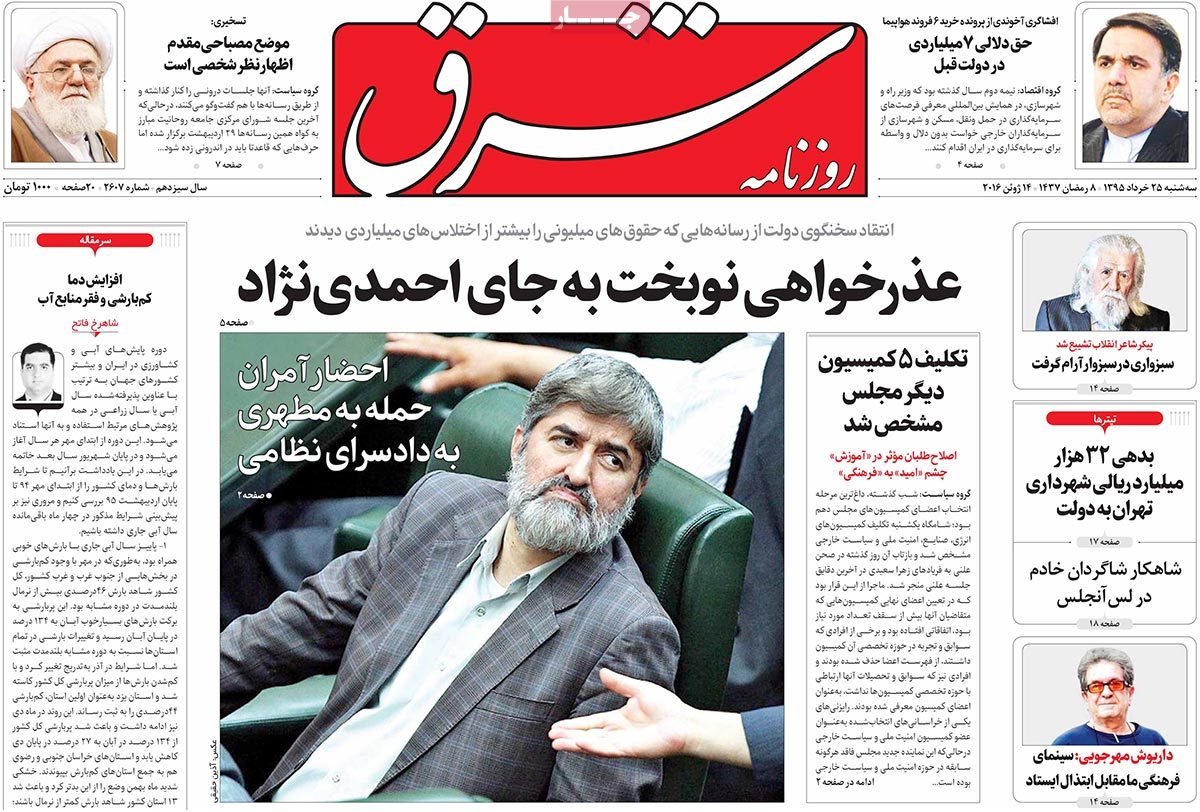
Shargh:
1- Gov’t Spokesman Nobakht, Rather than Ahmadinejad, Apologizes
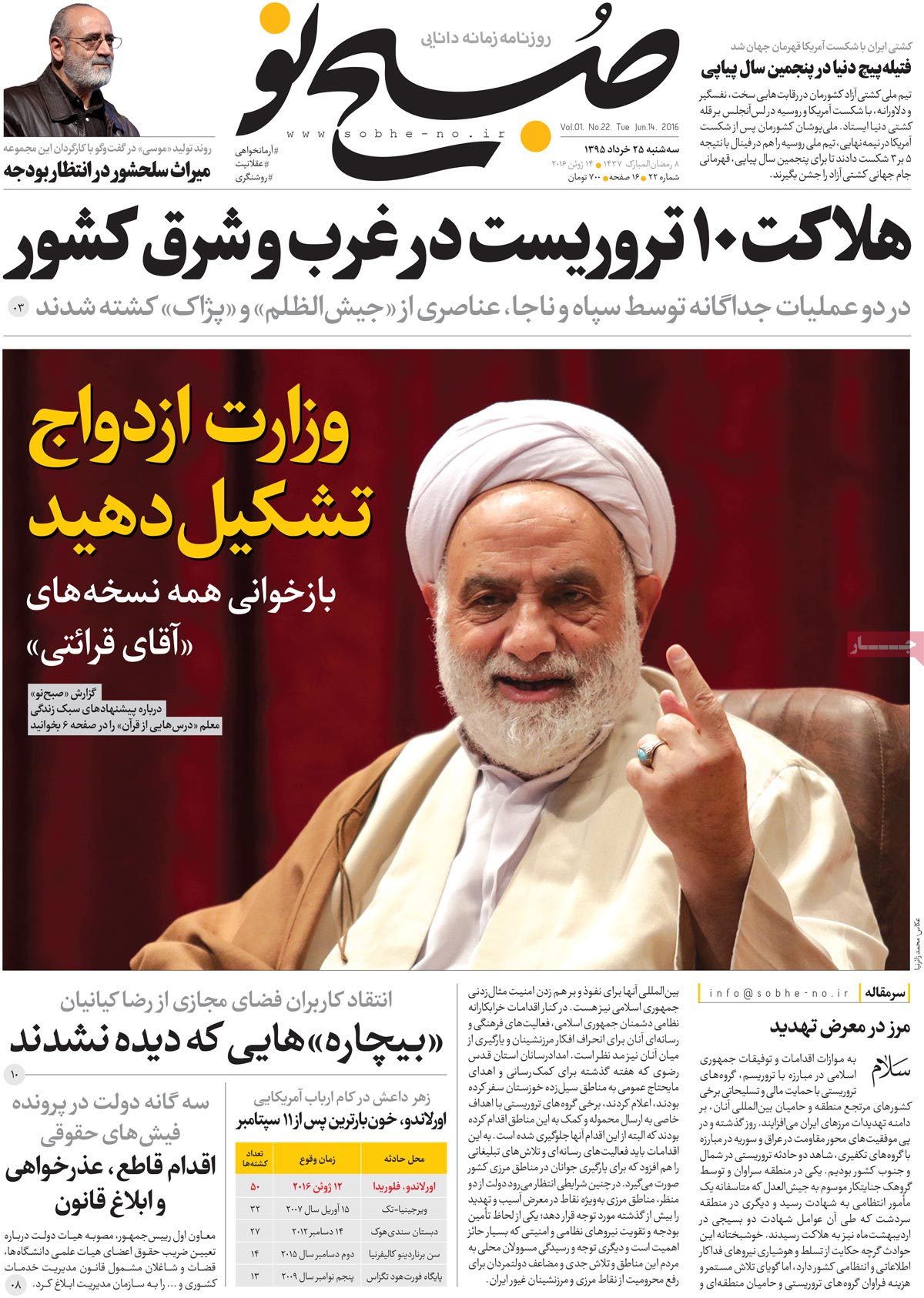
Sobh-e Now:
1- Cleric Calls for Formation of “Marriage Ministry”
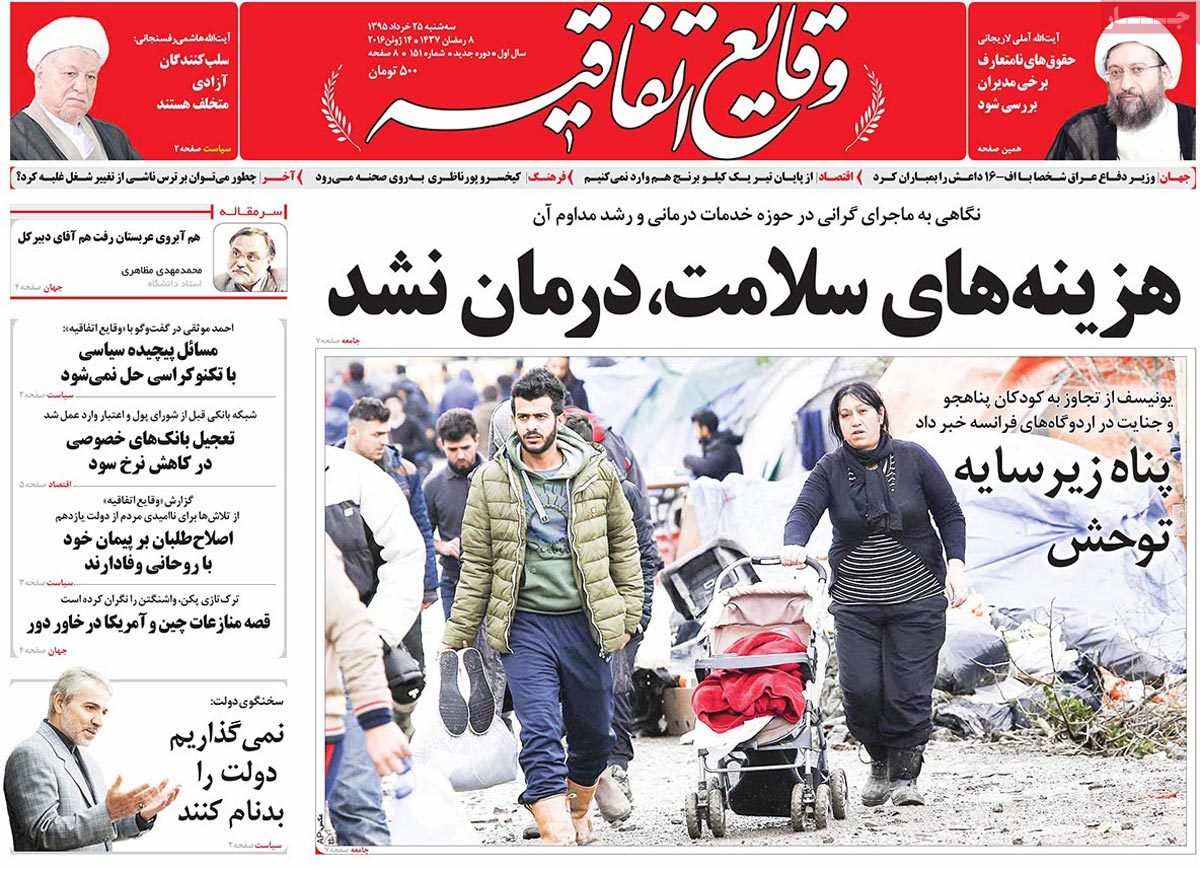
Vaghaye Ettefaghieh:
1- Reformists Are Committed to Their Allegiance with Rouhani
2- UN and Saudi Arabia Both Disgraced
3- US and China Contending in Far East
4- We Won’t Let Them Disgrace Government: Spokesman
Vatan-e Emroz:
1- Apology for Astronomical Salaries: Spokesman Explains Controversial Wages
2- We Extend Our Condolences to the UN: Amoli Larijani in Reaction to Ban’s Confession
3- Yemeni Children’s Gathering against UN

He made the remarks in central Iran while inspecting the historic citadel of Bam, telling IRNA that his country was working to promote all-out relations with Iran.
The ambassador said his country was planning to boost ties with Iran in car trade, product manufacturing and car spare parts.
He said he was visiting Bam because the place was going to play a part in the project, saying that an agreement had been signed between Iran and China on setting up an industrial town to produce car parts in the new Arg-e Bam.
He said the two countries are keen to boost cooperation in cultural, political and economic areas, especially agriculture.
“As a first step, we see the conclusion of an interim agreement with Iran on free trade as a characteristic feature, which may result in the reduction of duties on some exports of goods, which will allow us to maximize the benefit from trade with Iran,” Nikishina said in an interview with TV channel Belarus 1. Furthermore, she called Iran “a very interesting partner” for the alliance.
Iranian expert on international strategic issues and former Iranian ambassador to Armenia, Mohammad Farhad Koleini, discussed in an interview with Sputnik how Iran sees this initiative and what this trade alliance means to it.
“In the current atmosphere of mutual trust with countries of this economic alliance, Iran is optimistic about the expansion of the partnership,” Koleini said. “As you know, in this year, which could be called the ‘Year of deepening economic relations of the Eurasian Economic Union with third countries and integration of key unions,’ there are still problems between the principal members of the Union in terms of convergence and quality of integration,” the analyst added.
According to the analyst, the first stage of EEU cooperation with Iran would be the issue of reducing customs duties, which is currently being actively considered. He noted that it is clear that the parties are not expecting any miracles from each other, but once this issue is resolved it will give Iran considerable opportunities in the fields of trade in food, chemicals and construction materials, as well as exports of engineering services and a number of other spheres.
“It is important to realize that the first step in this direction was taken by Armenia, Iran’s only neighbour with full membership in the trade union,” Koleini said.
The analyst also stressed the importance of studying the barriers that appear at a domestic level between members of the Union, as well as the possibility of reducing the economic gaps between them.
“On the other hand, cooperation with the EEU, as well as in the long term — with some members of BRICS, such as China and Russia, can be very advantageous for Iran. The leading role of Russia, given its capacity and capability, and those of Kazakhstan and Belarus, has been part of Iran’s vision for a long time,” the analyst said.
He noted that it is obvious that cooperation should not hinder the development of Iran’s relations with other important partners as well.
Talking about what kind of results Iran expects from the Eurasian Economic Commission analysis and when it will be possible to sign the agreement to establish the free trade zone between Iran and EEU, Koleini said, “Cooperation with Iran will help EEU countries to strengthen cooperation on the North-South corridor project.”
He added that identification of all the nuances of the economic benefits of these projects and the process of resolving legal issues will take time, as the population of the countries belonging to the EEU together account for more than 180m people, over an area of 20m square km, making it a lengthy process.
Furthermore, the GDP of these countries amounts to over $4 trillion a year. “These indicators determine the stability of economic cooperation with other countries of the Union. There is no need to look at cooperation between Iran and the EEU as being politically motivated. It should be borne in mind, that it is due to Iran that a vast joint economic bridge from Lisbon to the Persian Gulf may likely be created,” Koleini concluded.
The formation of the commissions were determined during sessions of Parliament on Monday June 13 and Tuesday June 14 co-chaired by Massoud Pezeshkian and Ali Motahhari, the vice speakers of the new Parliament.
The specialized commissions include Industries and Mines Commission, Energy Commission, Planning and Budget Commission, Civil Commission, Article 90 Commission, Education Commission and Economy Commission.
The National Security and Foreign Policy Commission is comprised of well-known lawmakers, including Kazem Jalali, Javad Karimi Qoddousi, and Alaeddin Boroujerdi, who was chairman of the commission in the previous Parliament.
There are 290 seats in the Parliament, known in Iran as the Majlis, 8 of which are still vacant.
The parliamentary elections were held on February 26, when more than 60% of some 55 million eligible voters cast their ballots at around 53,000 polling stations across the country. The run-off votes were then held in late April to fill the remaining seats.