Friday, December 26, 2025
Home Blog Page 4427

First VP Underlines Importance of Knowledge-Based Economy

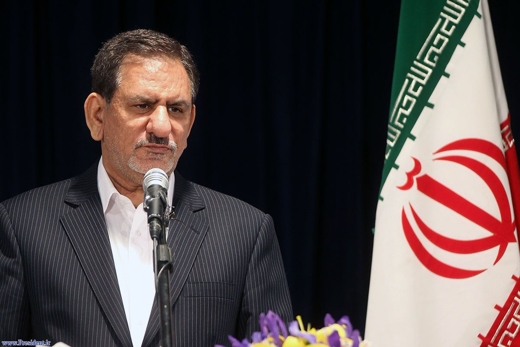
Jahangiri

Jahangiri noted on Sunday that five approaches in the Resistance Economy are focused on knowledge-based economy, stressing that knowledge-based companies can benefit from all of these approaches, as they are all commensurate with each other.

He made the remarks at the opening ceremony of the 4th Exhibition of Iranian-Made Laboratory Equipment and Materials here in Tehran, as reported by IRNA and translated by IFP.

The main orientation of Iran’s economy is towards the accumulation of knowledge, Jahangiri pointed out, adding that the Iranian administration should develop precise approaches so as to realize this knowledge-based economy.

“A knowledge-based economy means that our industry, agriculture, and oil – as well as the way the country is administered – should be based on knowledge,” he added.

Jahangiri referred to universities as the main infrastructure for the realization of such an economy, and stated that universities have a key role to play in the production of knowledge inside the country.

“Our primary mission is to equip the universities correctly, and the government should help equip the country’s universities with the required laboratory equipment,” he went on to say.

The Iranian first vice-president further referred to the contracts recently signed by the Iranian oil ministry with the country’s top universities, and said that more than $300m is earmarked to be given to universities to make the oil industry less dependent on foreign sources of knowledge and expertise.

“We are all responsible for Iran’s development,” he said, stressing that sustainable development is only possible if it utilizes science and technology.

“Given Iran’s historical record in the production of science and technology in the world, we need to regain our former position. We should pay attention to the scientific elite and respect our universities,” he stated.

Kerry assures world business transactions with Iran are safe

Speaking to reporters before meeting with Iranian Foreign Minister Mohammad Javad Zarif in New York on Friday, Kerry urged internatioanl financial institutions to inquire whenever they have any doubts on their business with Iran.

The following is the full text of the remarks made by Secretary Kerry and Foreign Minister Zarif:

SECRETARY KERRY: Good afternoon, everybody. Let me just say a few words, if I can. I’m very pleased to be meeting with Foreign Minister Zarif today to continue our discussions about the Joint Comprehensive Plan of Action implementation. We had a very productive meeting earlier in the week. We exchanged a lot of thoughts. We talked about some challenges, and so I think we both decided that it was important to do some homework. And we’ve come back today to follow up on that conversation.

First, I want to say something about one of the issues that we have been discussing. As President Obama has said, as Secretary Jack Lew has said, and as I have said, and we have said it repeatedly, the United States is not standing in the way and will not stand in the way of business that is permitted with Iran since the JCPOA took effect.
And I want to emphasize we lifted our nuclear-related sanctions, as we committed to do, and there are now opportunities for foreign banks to do business with Iran.

Unfortunately, there seems to be some confusion among some foreign banks, and we want to try to clarify that as much as we can. Among the nuclear-related sanctions that were lifted were those that prevented Iran from engaging with non-U.S. banks, including getting access to Iran’s restricted funds that were previously held overseas.

Now, we have no objection – I want to make this clear. We have no objection and we do not stand in the way of foreign banks engaging with Iranian banks and companies, obviously as long as those banks and companies are not on our sanctions list for non-nuclear reasons. But the nuclear sanctions permitted non-U.S. banks to engage with business activity and companies in Iran, and it allows them to provide access to funds and financing, and it allows Iran, importantly, to have access to its own funds.

We also – I want to say that we understand that banks and businesses have complicated business decisions to make, and they have to make them. But that is why the State and the Treasury Department have been actively engaged with partner governments and the private sector in order to clarify those sanctions that have been lifted. And if banks or any company has any question about this, we’re happy to answer those questions. They shouldn’t just assume that activities that were not permitted before the JCPOA are not permitted at this point in time. And so they shouldn’t also assume that activities still prohibited by the primary embargo are also prohibited for foreign actors. That’s not the way that works.

So when in doubt – my message: when in doubt, ask.

Now, we recognize it is going to take some time for companies to feel confident in reengaging with Iran, and in all fairness, that is due to concerns other than sanctions. And Iran, as we have said in a candid conversation, also has a certain amount it needs to do to modernize its own banking system to begin to do things to – that it hadn’t done during the years that it was operating under sanctions, and that would facilitate this process.

But I want to make clear the United States is committed to doing our part as we believe it is in our interest to ensure that the JCPOA, the nuclear agreement that we reached, that it is in fact working for all participants. And just as we have upheld our commitments, we’re going to continue to work with Iran to verify that they uphold theirs also. It is mutuality that was created in this, and it’s important that we make sure there is mutuality in its implementation.

FOREIGN MINISTER ZARIF: Thank you, Secretary Kerry. I think what is important for everybody to understand is that the JCPOA was a balanced agreement, and Iran has implemented its part of the bargain and we hope that with this statement by Secretary Kerry and other steps that were taken by the United State, now we will see serious implementation of all JCPOA benefits that Iran should derive from this agreement so that we can ensure that agreement is a way for addressing international problems, that sanctions and pressure won’t resolve international problems, but negotiations,
talks, dialogue in fact are the way to address international problems.

We hope that the statement made today by Secretary Kerry will begin to open the difficult path that has been closed because of concerns that banks had about the U.S. approach towards implementation of the commitments under the JCPOA. We will continue to have differences with the United States. Our differences are very serious in a good number of areas. We will – but we have decided together with P5+1 to address this issue, and we want to show that P5+1 and Iran have been able to resolve a very serious, difficult issue through negotiations, and I believe we should take the necessary steps in that regard. And I hope that by – through serious action so that the Iranian people can see the benefits of implementation of JCPOA, we can move forward with the long-term implications for this very important agreement, which should create the foundations and not the ceilings for resolution of international issues. Thank you.

SECRETARY KERRY: The foreign minister just mentioned one thing I just want to make clear so we’re both on – addressing it. The foreign minister is correct; there are differences and some of them are obviously serious differences. Those have to be the subject of future discussion. But it’s important for people to understand that an agreement is an agreement, and we need to separate, even as we are working to resolve those other differences. And nothing that I said diminishes the United States commitment to helping to resolve those differences and certainly to continue to work for the peace and stability of the region. Thank you.

Water skiing competitions in Kish

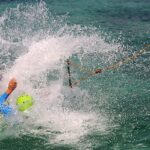
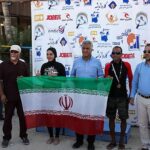
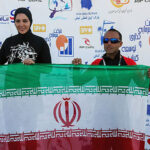
The qualifying competitions of Iran’s national water skiing team was held in Kish Island of Persian Gulf on Friday.


President Rouhani Welcomes South African Counterpart in Tehran

President Zuma, heading a high-ranking delegation, arrived early today.

The national anthems of the two countries were played at the ceremony, and the two presidents reviewed a parade.

After that, the Iranian and South African presidents started bilateral talks.

During Zuma’s stay in Tehran, several economic documents will be signed by the two countries’ delegations.

The South African president is scheduled to leave Tehran for the historical Iranian city of Isfahan on Monday.

Tehran, Seoul to Ink Multi-Billion Dollar Deals: Report

Heading a delegation of some 200 businesspeople from such areas as construction, energy and finance, South Korean President Park Geun-hye is slated to visit Iran on May 1-3 to discuss ways to promote business ties between the two countries.

Her visit, the first of its kind by a South Korean president since the two sides established diplomatic relations in 1962, comes as Iran has been emerging as a high-potential market after international sanctions were lifted in January.

Leading Korean builders plan to sign memorandums of understanding and preliminary agreements on building railroads, a dam, petrochemical plants and hospitals, with the value of contracts estimated around 15-20 trillion won ($13-17 billion), Yonhap News Agency quoted industry officials as saying.

Daelim Industrial said it plans to ink a $4.9 billion deal on railroad projects and a preliminary agreement on a dam and water plant deal estimated at $2 billion. It has also been pushing for participating in a petrochemical project, hoping to sign a memorandum of understanding with the Iranian government during the South Korean president’s visit.

Hyundai Engineering Co. said it is set to clinch a $3.6 billion framework agreement with Kangan Petro Refining Co. to build a gas refining facility in the South Pars, the world’s largest gas field located in the Persian Gulf. The firm also plans to sign a preliminary deal to participate in a private power plant construction project estimated at $500 million.

Hyundai Engineering & Construction Co. and POSCO Daewoo Corp., formerly Daewoo International Corp., will sign a deal with Iran’s health ministry to build a hospital for Shiraz University of Medical Sciences, according to the company officials.

Under the contract, Hyundai E&C will build the facility and POSCO Daewoo will provide the medical equipment, they said.

The large-scale deals in the offing are expected to give momentum to Korean companies, which have grappled with shrinking demands in the Middle East amid low oil prices.

“It would take some time to sign formal agreements and confirm the contracts in Iran. But at least they would inject fresh momentum into the sluggish Middle Eastern construction market, dragged by a prolonged oil price slump,” said a senior official at a Seoul-based construction firm.

Iran’s President Urges Long-Term Plans for Environmental Protection

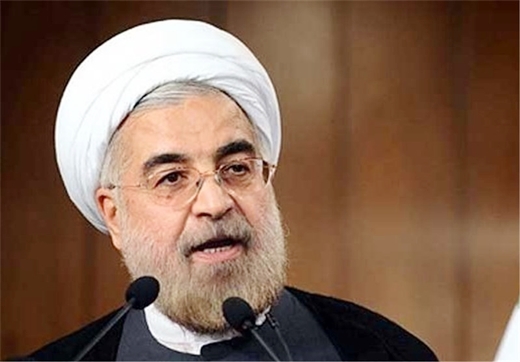
Despite a whole host of political and social concerns and security problems in the region, the first item on the agenda at the first cabinet session in 2013 was a scheme to save drying Lake Oroumiyeh in northwest of Iran, President Rouhani said in an address to the 2nd edition of an international seminar on environment, culture and religion, which kicked off in Tehran on Saturday.

He referred to plans for taking high-polluting vehicles off the roads, tackling dust particles, producing gasoline in compliance with the Euro-4 emission standards, developing the South Pars gas filed and feeding the country’s power plants with gas as some of the administration’s efforts to prevent damage to the environment.

President Rouhani further emphasized that the environmental concerns cannot be settled in short term, but a long-term plan is required to deal with those problems.

Back in March, Leader of the Islamic Revolution Ayatollah Seyed Ali Khamenei urged all Iranian people and officials to pay more attention to safeguarding the country’s green spaces.

The 2nd International Seminar on Environment, Religion and Culture is underway in Tehran for two days with the participation of representatives from 15 countries.

It has been organized by Iran in cooperation with the United Nations Environment Program (UNEP) and the UN Educational, Scientific and Cultural Organization (UNESCO).

A Look at Iranian Newspaper Front Pages on Apr. 24

Iran Newspaper front pages

Almost all newspapers today covered a recent meeting between Iranian Foreign Minister Mohammad Javad Zarif and his US counterpart John Kerry in New York, where the American side promised to remove barriers to Iran’s trade with Europe.

Iranian media also covered the remarks by Central Bank of Iran (CBI) Chief Valiollah Seif, who blamed the former Iranian administration for a recent US court ruling which seized $2 billion of Iranian assets.

President Hassan Rouhani’s comments on Iran’s role in the fight against terrorism and extremism, as well as his cabinet meeting on the controversial plan of “plainclothes morality” police were also discussed.


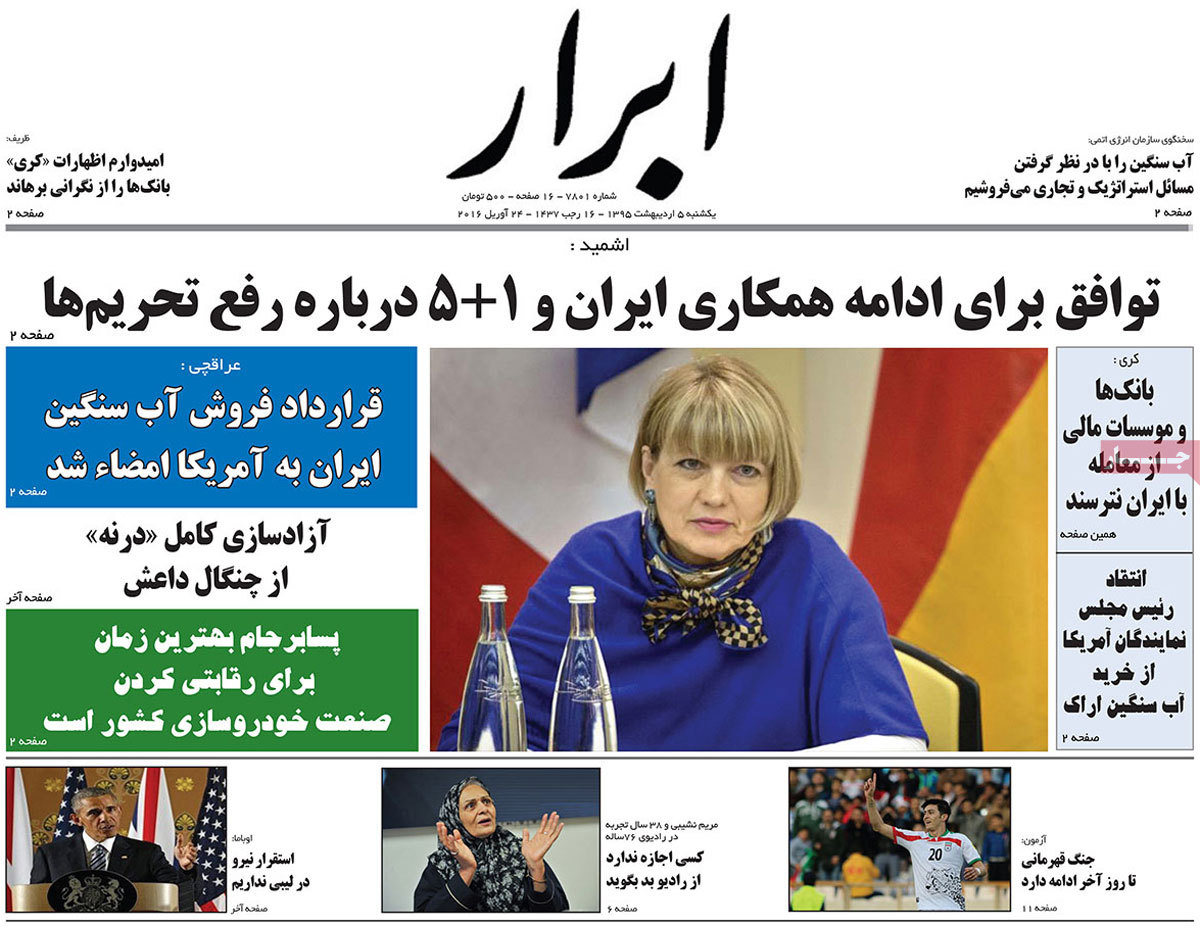
Abrar:

1-Iran and Group 5+1 Agree to Continue Cooperation on Sanctions Removal: EU

2-Kerry: Banks and Financial Institutions Should Not Be Afraid of Dealing with Iran

3-I Hope Kerry’s Remarks Allay Banks’ Concerns: Iran FM

4-US House Speaker Criticizes Purchase of Iran’s Heavy Water

5-Libya’s Darnah Fully Cleansed of Daesh Terrorists
 

A Look at Iranian Newspaper Front Pages on Apr. 24


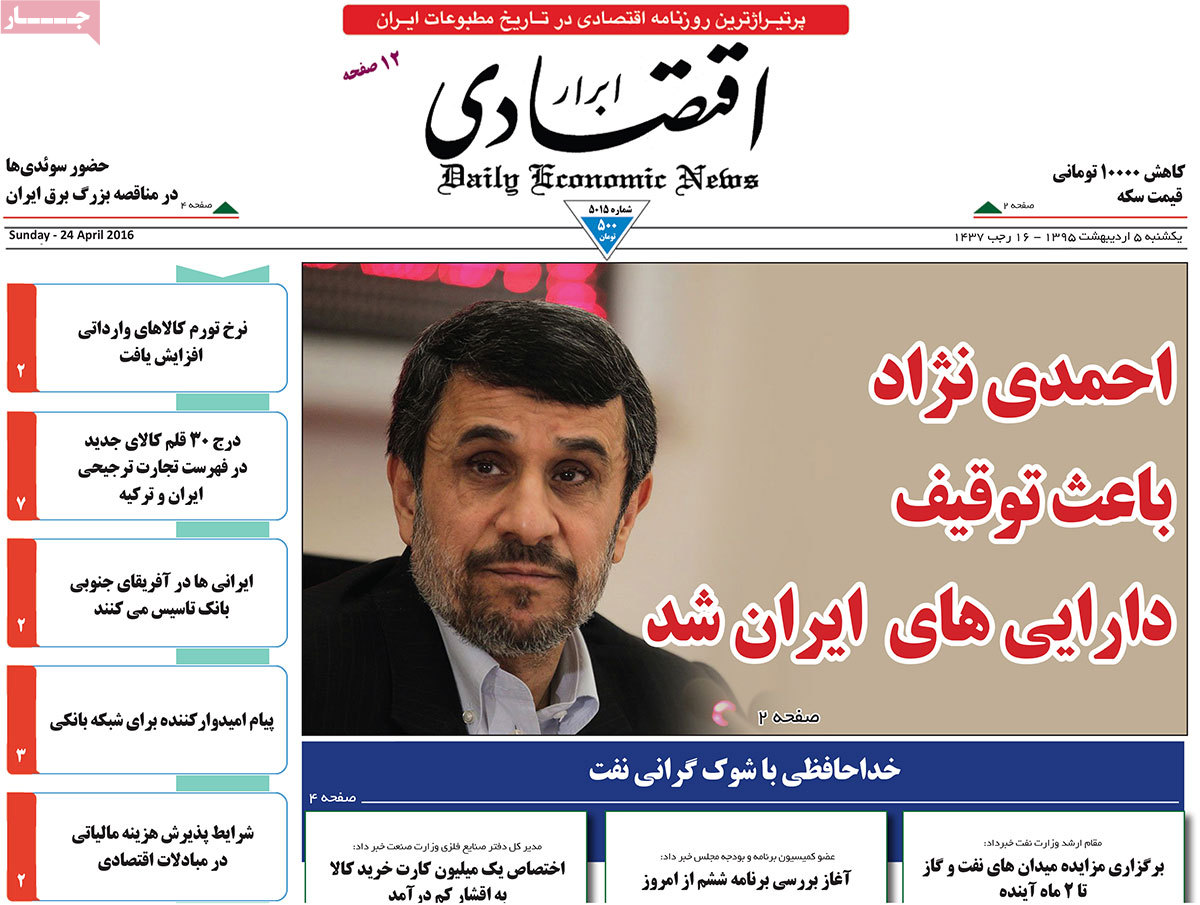
Abrar-e Eqtesadi:

1- Ahmadinejad to Blame for US Seizure of Iranian Assets

2- 1 Million Shopping Cards Allocated to Low-Income People
 

A Look at Iranian Newspaper Front Pages on Apr. 24


Aftab-e Yazd:

1- American Promise, Iranian Confusion: Will US Keep Its Promises?

2- TV Host of London-Based Persian Channel Controversially Attends Fajr Int’l Film Festival in Tehran
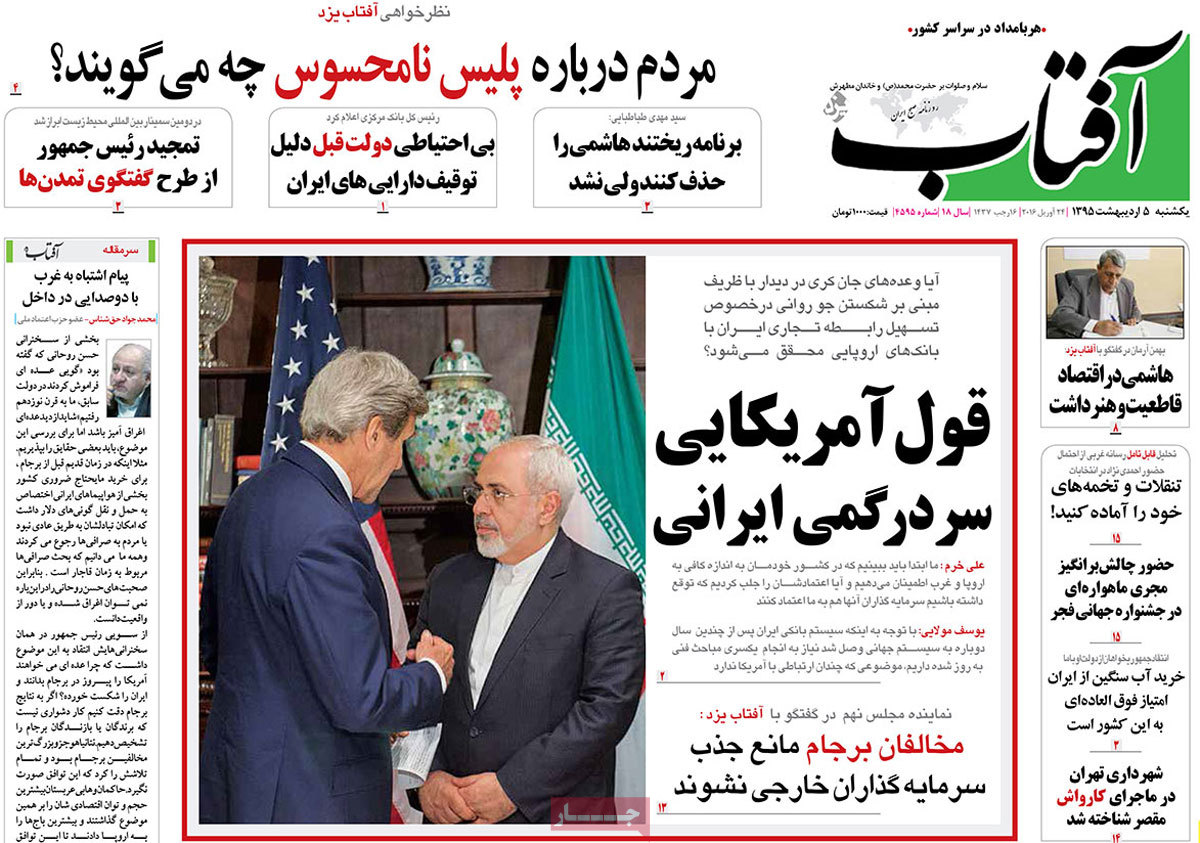
 

A Look at Iranian Newspaper Front Pages on Apr. 24


Amin:

1- Carlos Queiroz to Continue as Head Coach of National Football Team

2- Iran is Flag-Bearer in Global Fight against Extremism: Rouhani

3- Why did Israel’s Bibi Suddenly Visited Moscow?

4- Asghar Farhadi: About Elly Started with a Photo
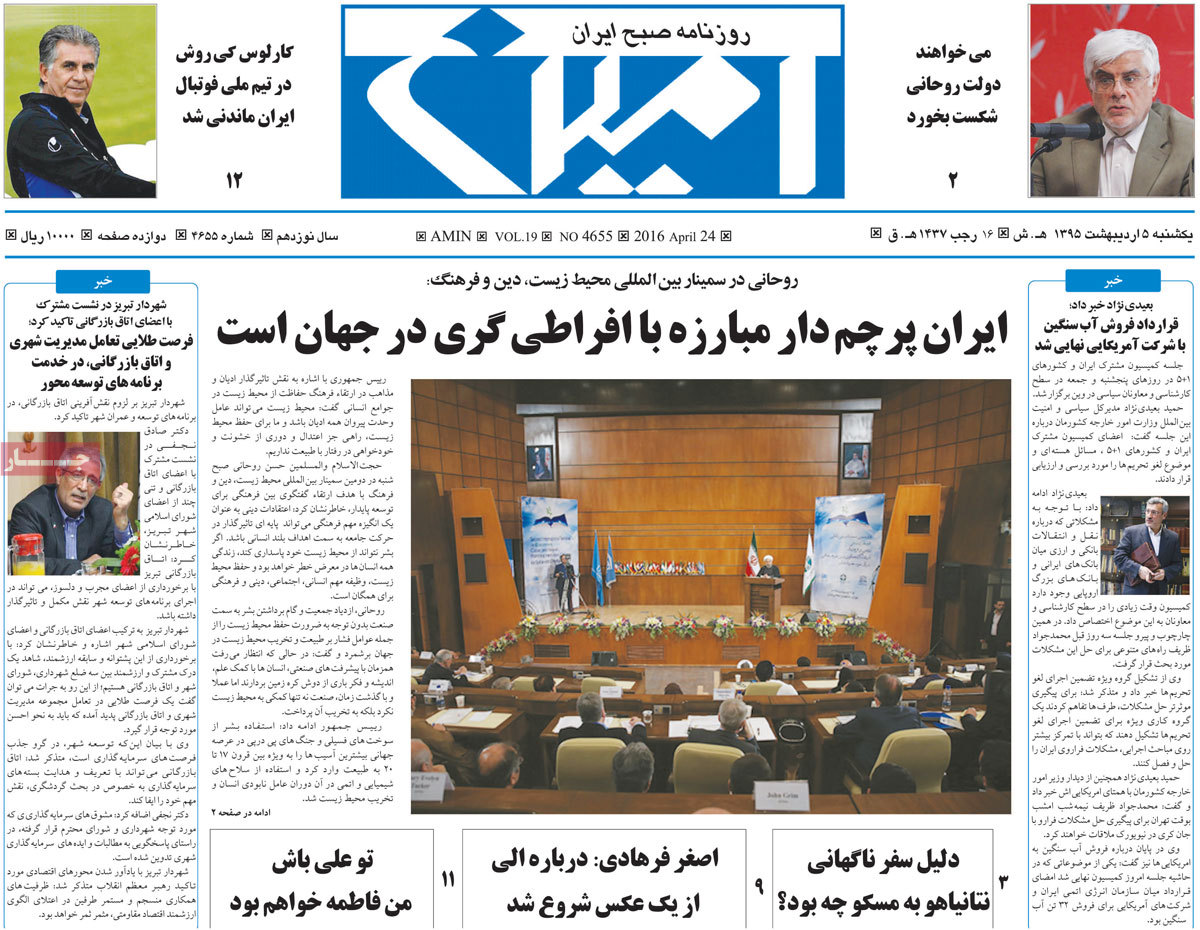
 

A Look at Iranian Newspaper Front Pages on Apr. 24


Arman-e Emrooz:

1- Shocking Confession on Possible Tehran Earthquake: No One Is Ready, Even Rescue Teams

2- Iran-US Heavy Water Deal  Worth $8.6m

3- We Are Aware of USA’s Domestic Problems: Ayatollah Rafsanjani
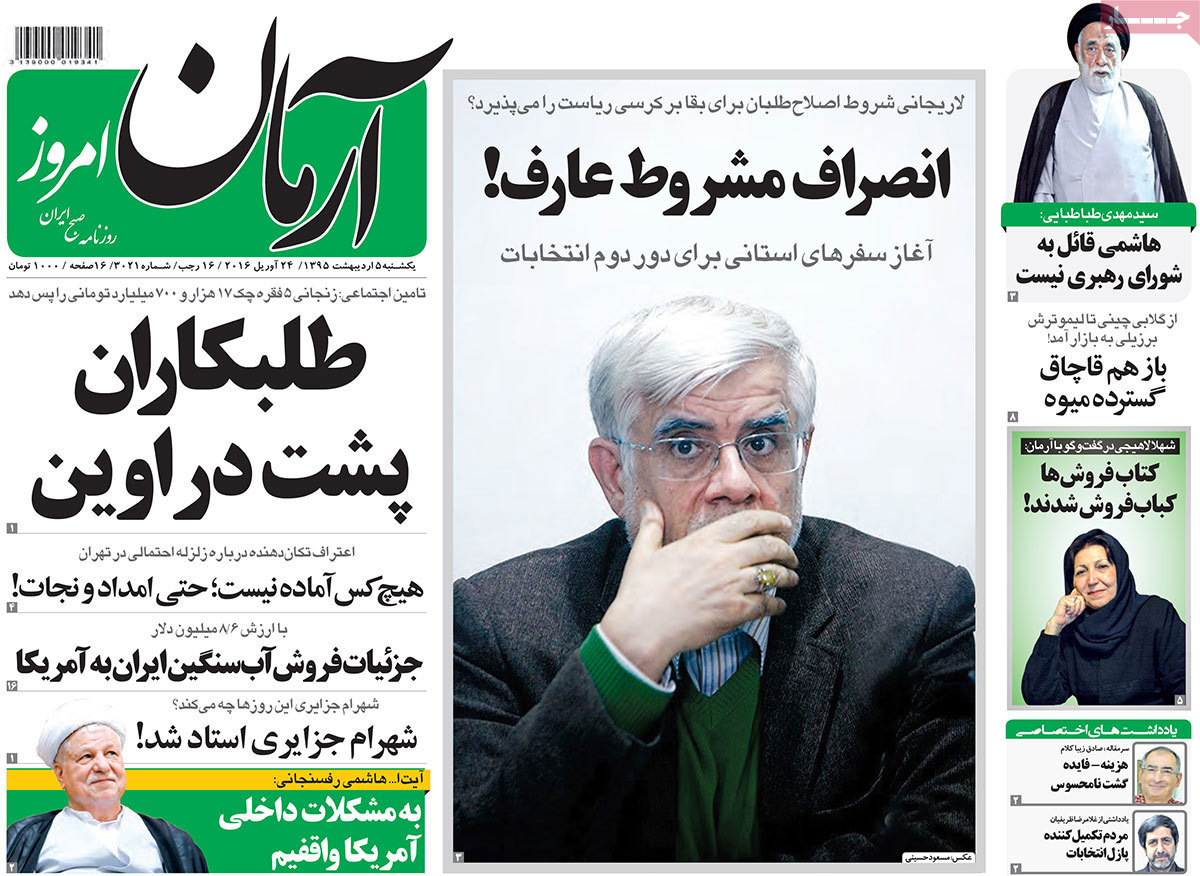
 

A Look at Iranian Newspaper Front Pages on Apr. 24


Asia:

1- US Takes Major Steps for Cooperation with Iran

2- Oil Price Decline Stopped after Doha Meeting: Oil Minister
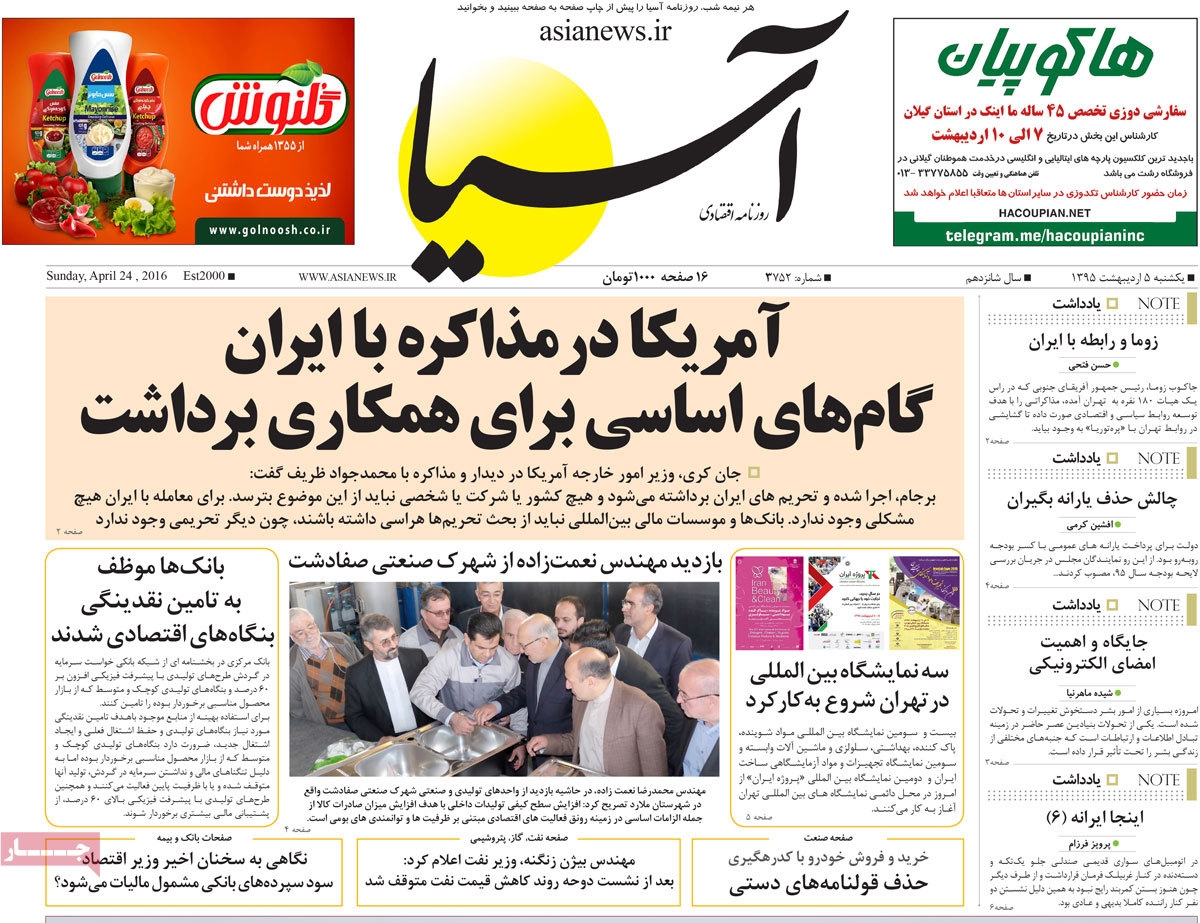
 

918317b5


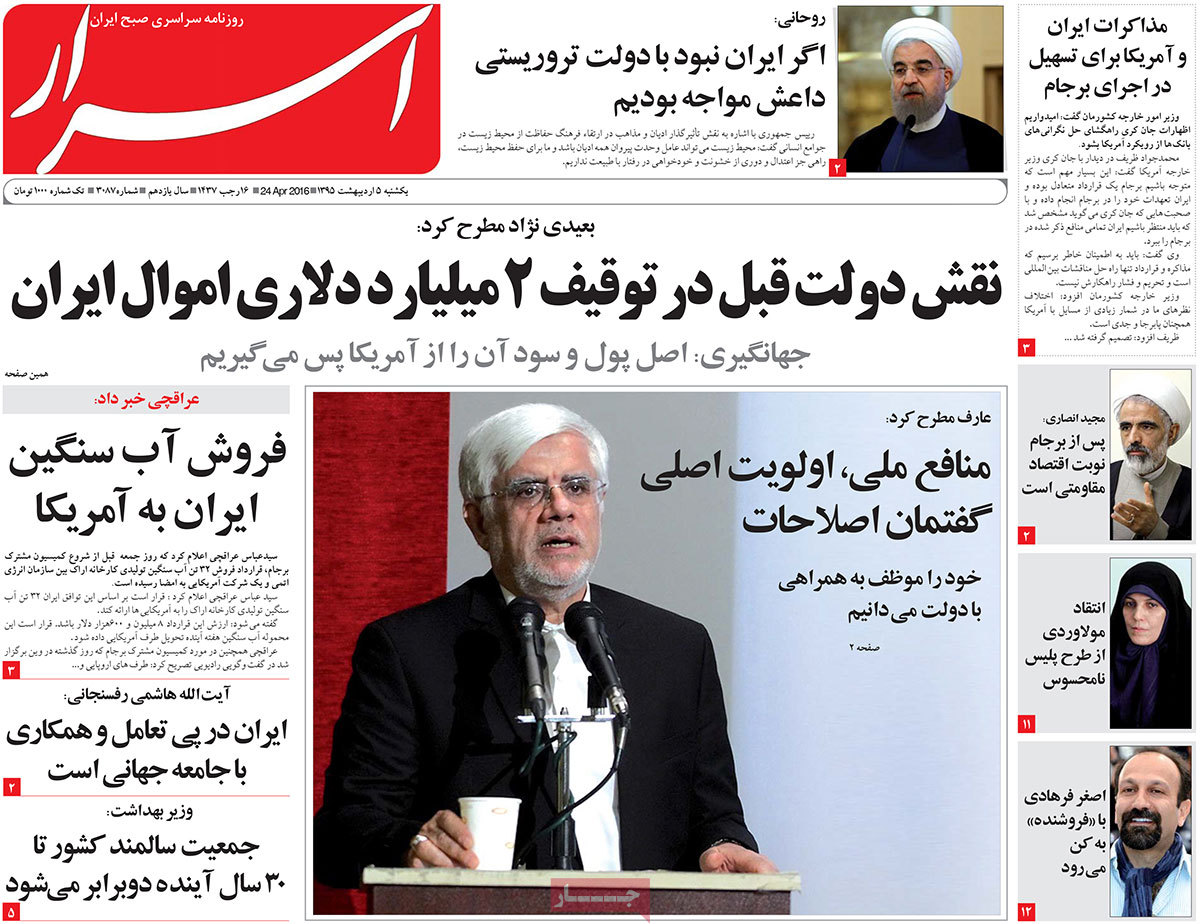
Asrar:

1- If It Was Not for Iran, We Would Be Facing the “Terrorist State of Daesh [ISIS]”: Rouhani

2-Iran to Collect Its Principal Money and Interest from US: First VP

3- Iran Seeks to Interact and Cooperate with the World: Rafsanjani

4-Iran’s VP Criticizes “Plainclothes Morality Police” Plan
 

A Look at Iranian Newspaper Front Pages on Apr. 24


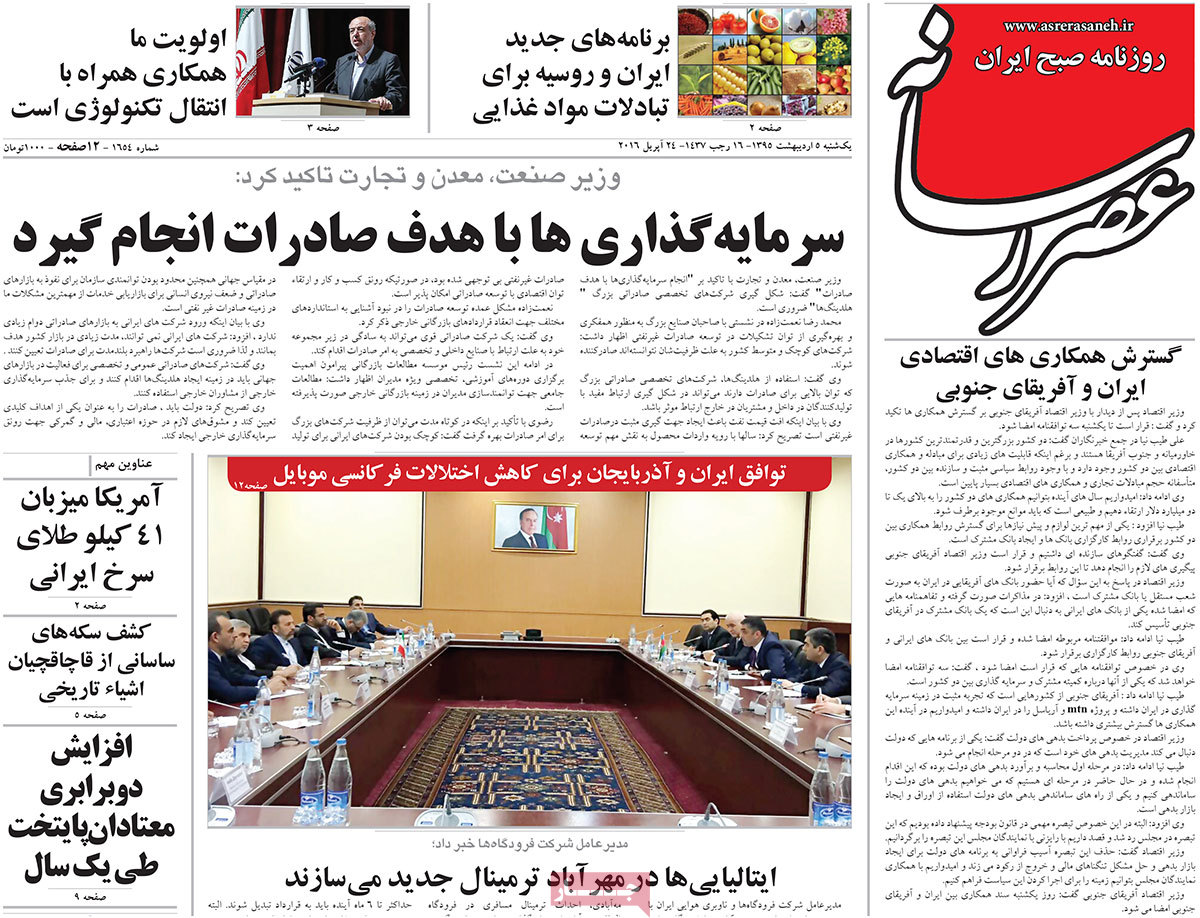
Asre Rasaneh:

1- Iran and Azerbaijan Agree on Regulation of Radio Frequency

2- Italy to Build New Terminal in Tehran’s Mehrabad Airport

3- US to Import 41kg of Iran’s Saffron
 

A Look at Iranian Newspaper Front Pages on Apr. 24


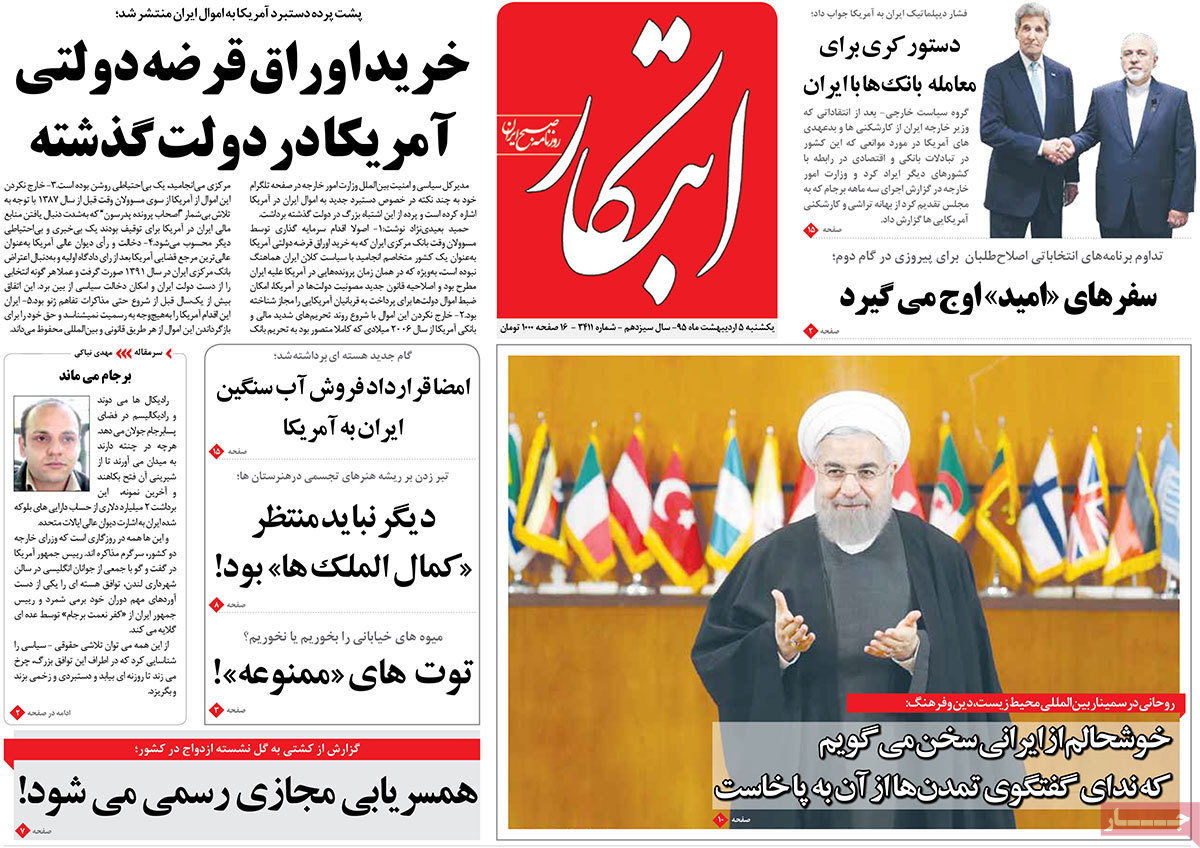
Ebtekar:

1- Online Dating for Marriage to Become Legal in Iran!

2- Iran’s Diplomatic Pressure Works: US’s Kerry Assures Banks of Cooperation with Tehran
 

A Look at Iranian Newspaper Front Pages on Apr. 24


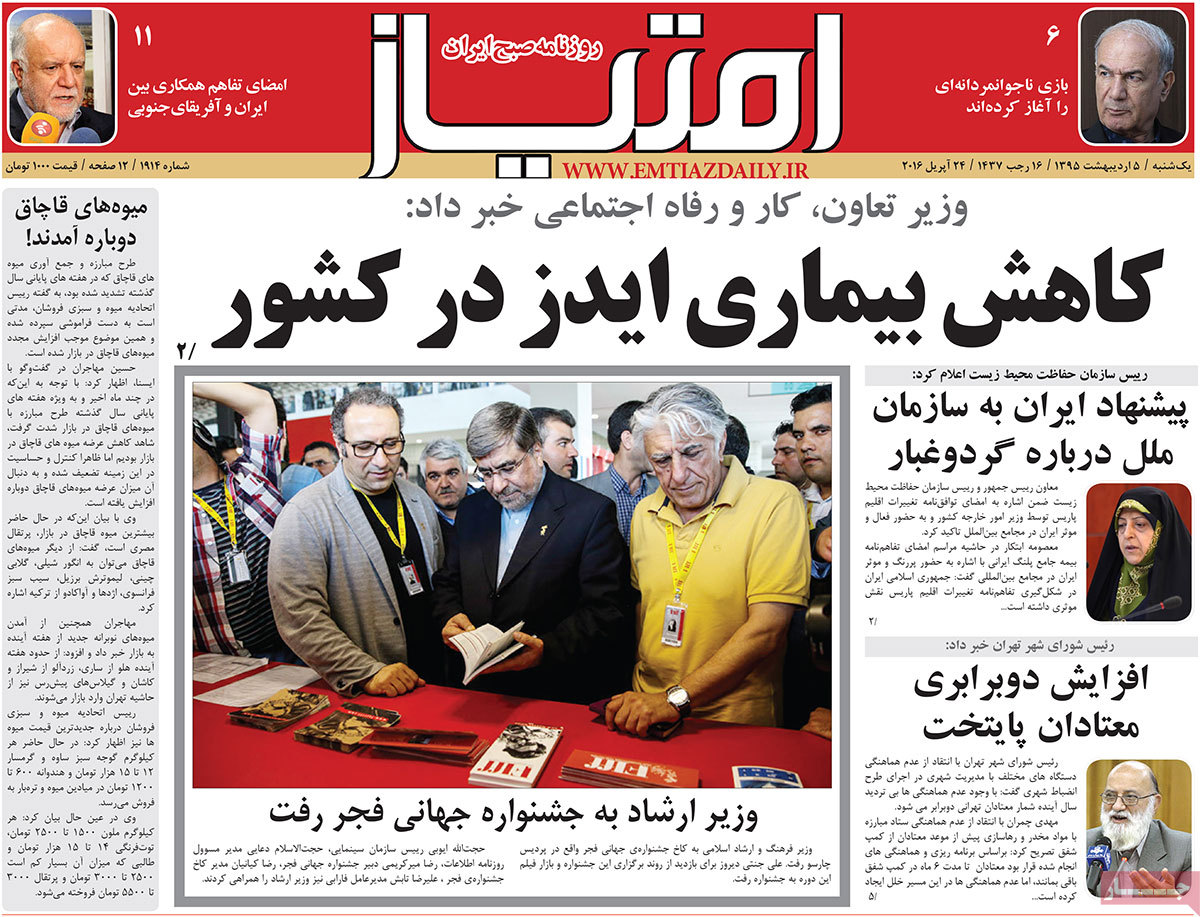
Emtiaz:

1- HIV Rate Declines: Social Welfare Minister

2- Iran’s Proposal to UN on Dust Pollution: VP Ebtekar

3-Number of Drug Addicts in Tehran Doubled: City Council Chief

4- Iran and South Africa to Sign MoUs for Increased Cooperation: Oil Minister
 

A Look at Iranian Newspaper Front Pages on Apr. 24


Ettela’at:

1-First Call for Dialogue of Civilizations, Interaction of Religions, and World Cooperation against Violence and Extremism Originated from Iran: Rouhani

2- UN Urges Saudi Arabia to Stop Torture of Political Activists

3-Iran’s Cabinet to Study “Plainclothes Morality Police” Plan Today
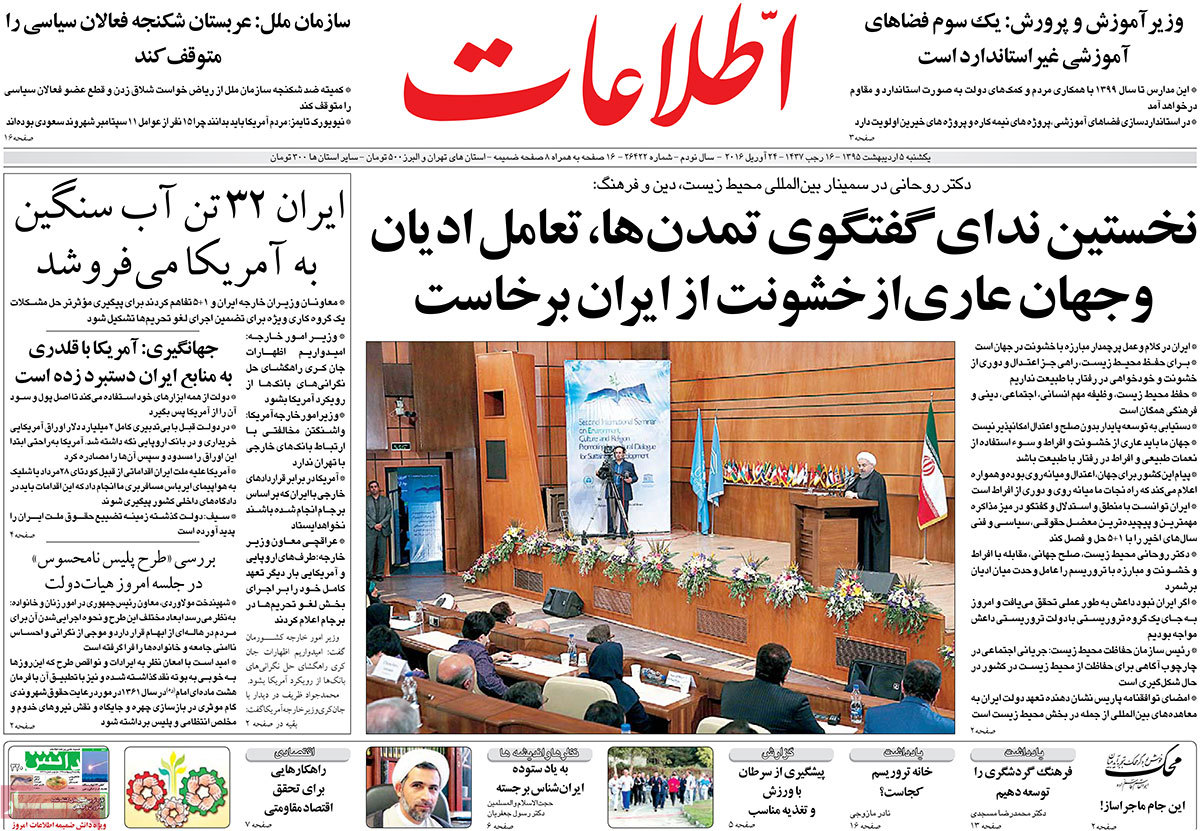
 

A Look at Iranian Newspaper Front Pages on Apr. 24


Etemad:

1-Iran Resumes Export of Saffron to US after 15 Years

2- Central Bank Chief Blames Ahmadinejad’s Gov’t for Seizure of Iranian Assets in US
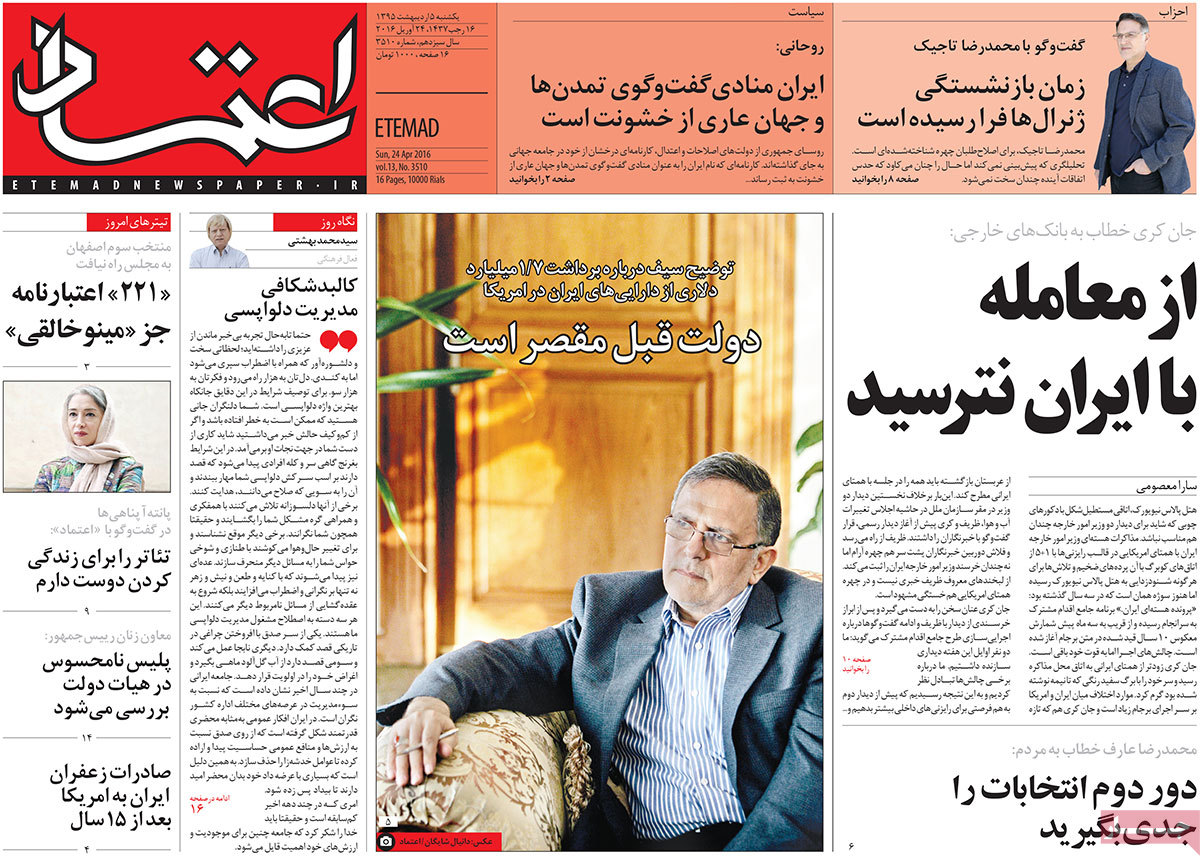
 

A Look at Iranian Newspaper Front Pages on Apr. 24


Ghanoon:

1-President “Tweets” Iran’s Might to the World: Rouhani Shows Off Iran’s Regional Policies

2-The Gift Ahmadinejad Gave to US: Purchase of Bonds from “Hostile” Gov’t

3-Playing with Britain’s Cards in EU: A Reflection on US Opposition to Brexit
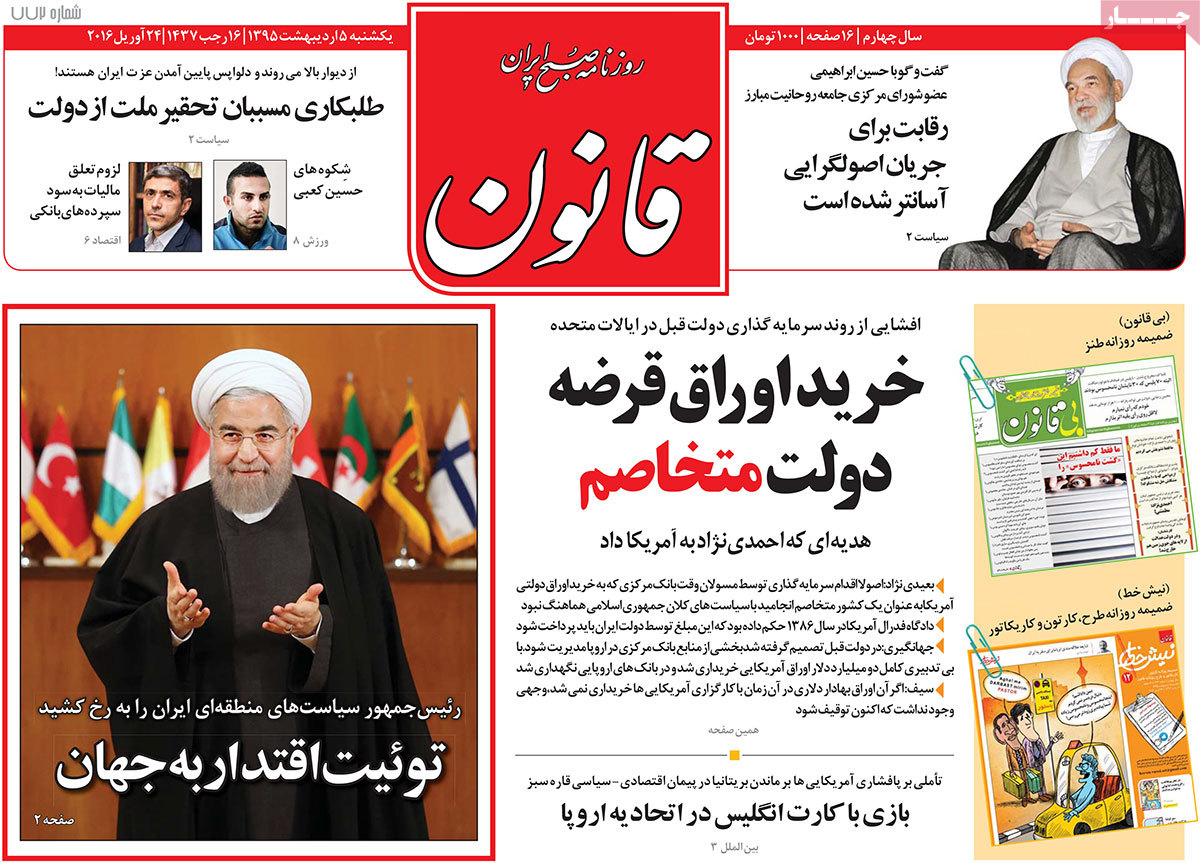
 

A Look at Iranian Newspaper Front Pages on Apr. 24


Hamshahri:

1-Lake Urmia to Be Drowned under Wave of Water Transfer from Caspian Sea to Central Iran

2- Central Bank Calls On People to Sue Iranian Banks That Overcharge Them
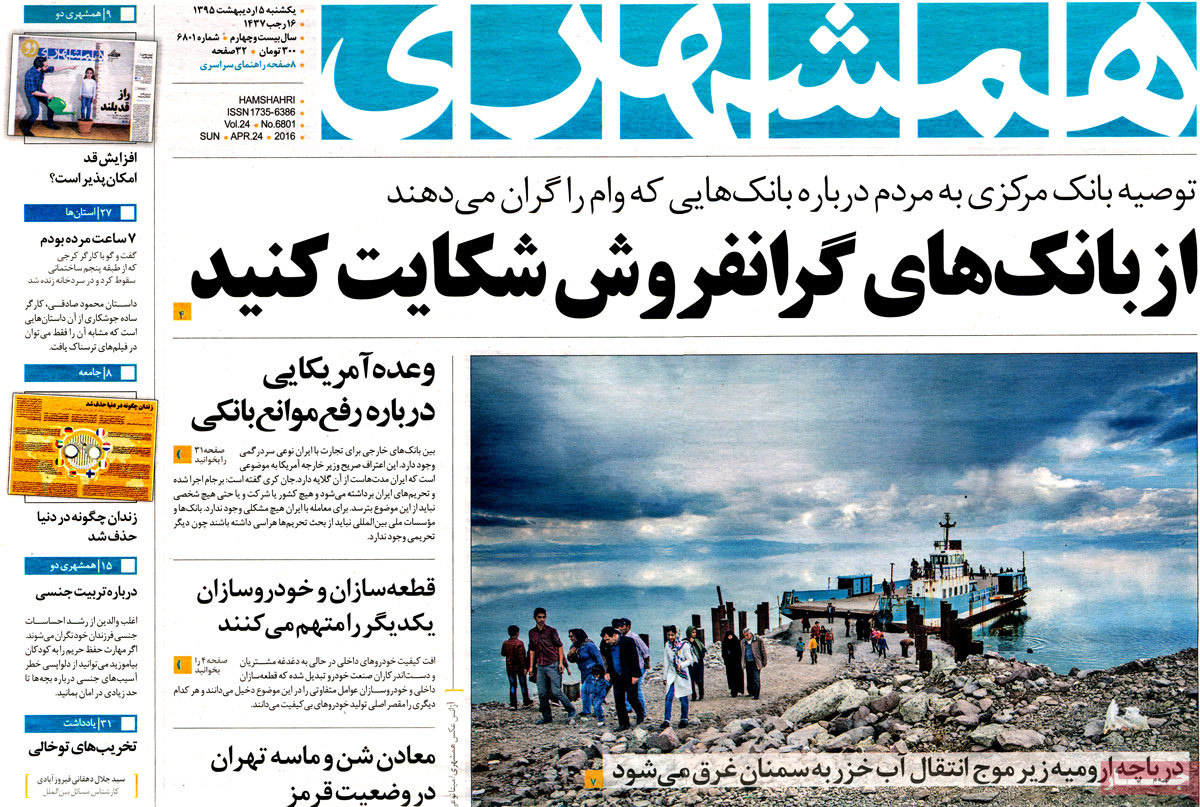
 

A Look at Iranian Newspaper Front Pages on Apr. 24


Hemayat:

1-US Court Ruling Is International Thievery: Iranian Lawmakers

2-Price of Imported Medicine Down by 18%

3-White House’s Support for Takfiri Terrorists in Aleppo
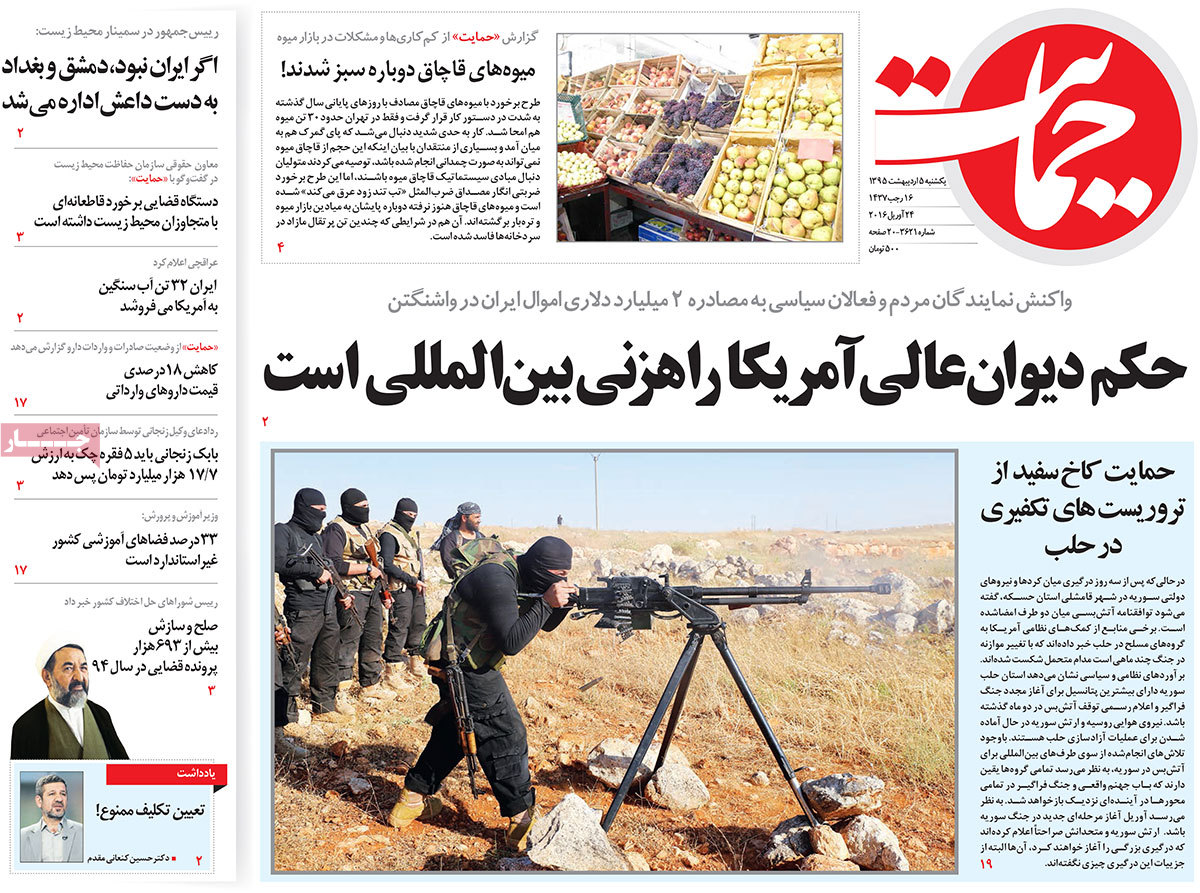
 

A Look at Iranian Newspaper Front Pages on Apr. 24


Iran:

1-VP Issues Order to Pursue Case of Iranian Woman Brutally Tortured by Husband

2- Sustainable Development Not Possible without Peace and Moderation: Rouhani
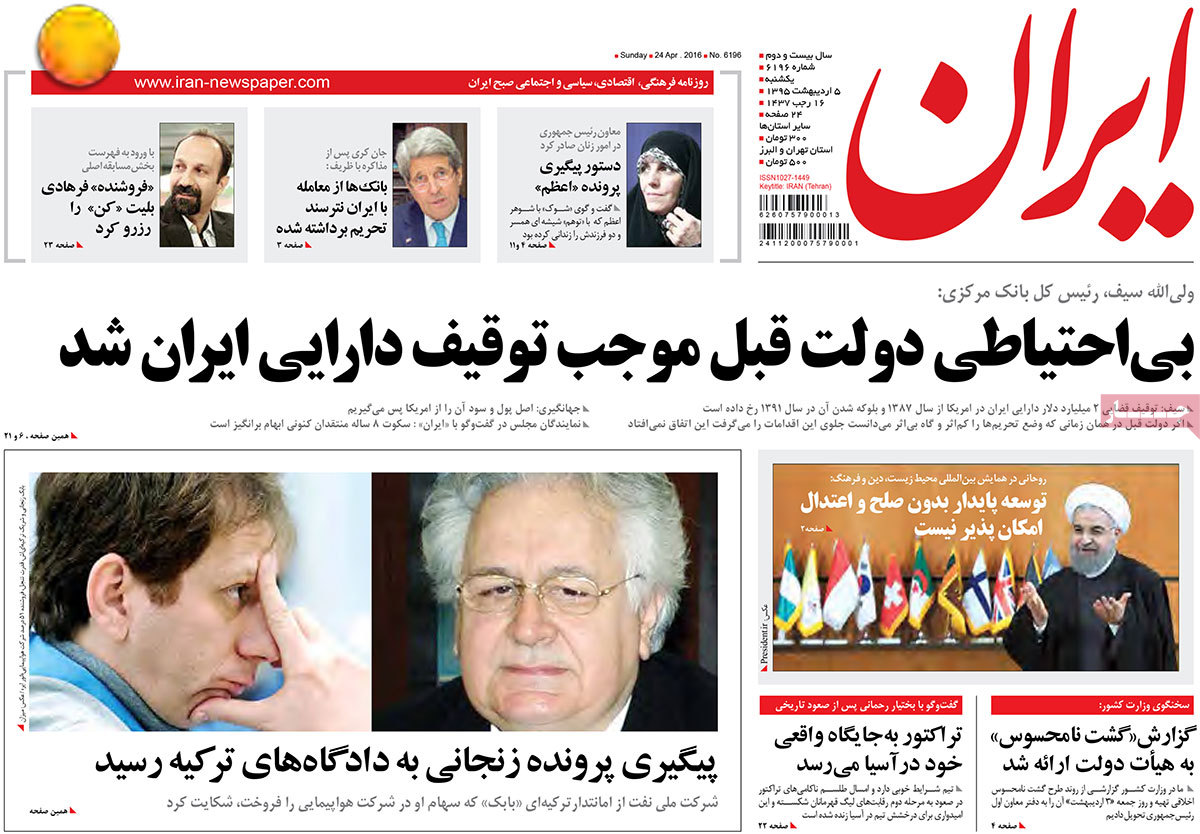
 

A Look at Iranian Newspaper Front Pages on Apr. 24


Jame Jam:

1- People’s Health Up for Auction in Beauty Salons

2- Negotiations to Put an End to Yemen’s Hiroshima

3-20-Year-Old Girl Victim of Selfie
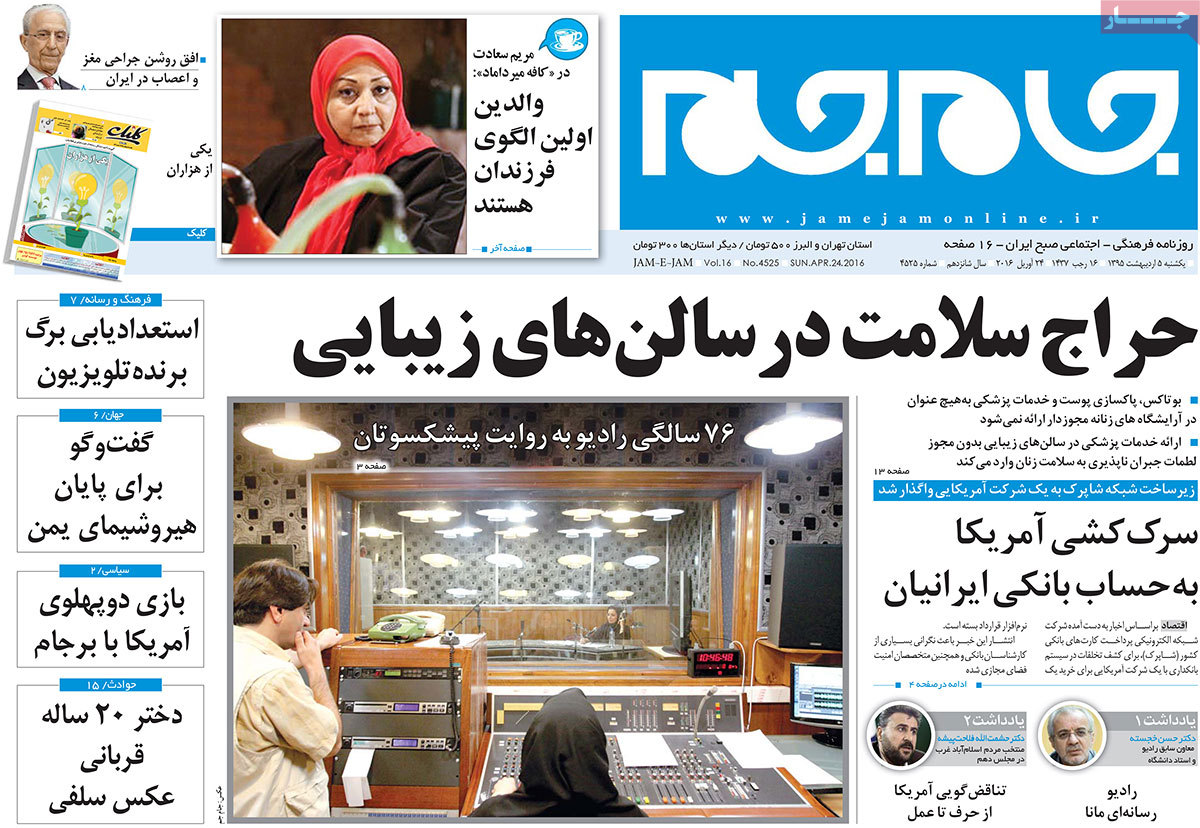
 

A Look at Iranian Newspaper Front Pages on Apr. 24


Javan:

1-US and EU Passing JCPOA Back and Forth: Kerry Wants European Firms to Consult Washington before Cooperation with Iran

2- Sale of Iran’s Heavy Water to US “on Credit”

3-Mass Execution in US State of Ohio
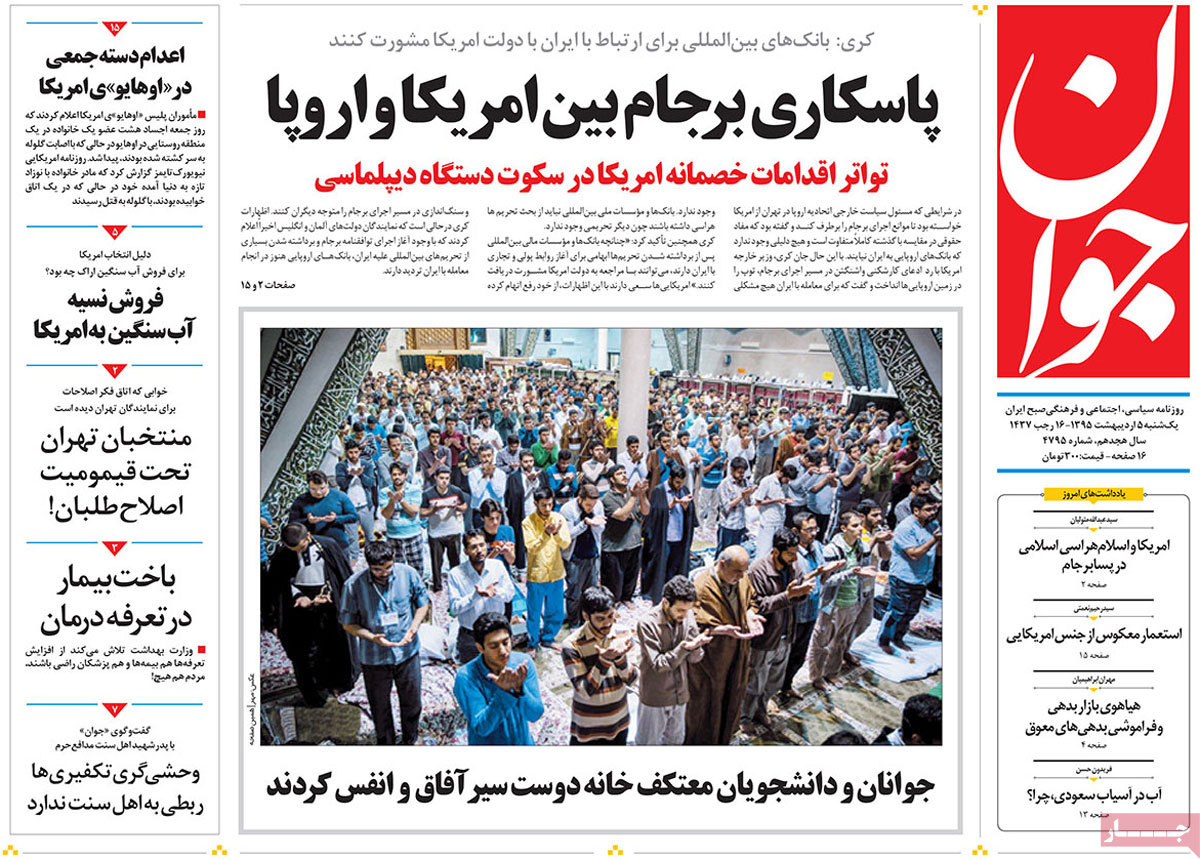
 

A Look at Iranian Newspaper Front Pages on Apr. 24


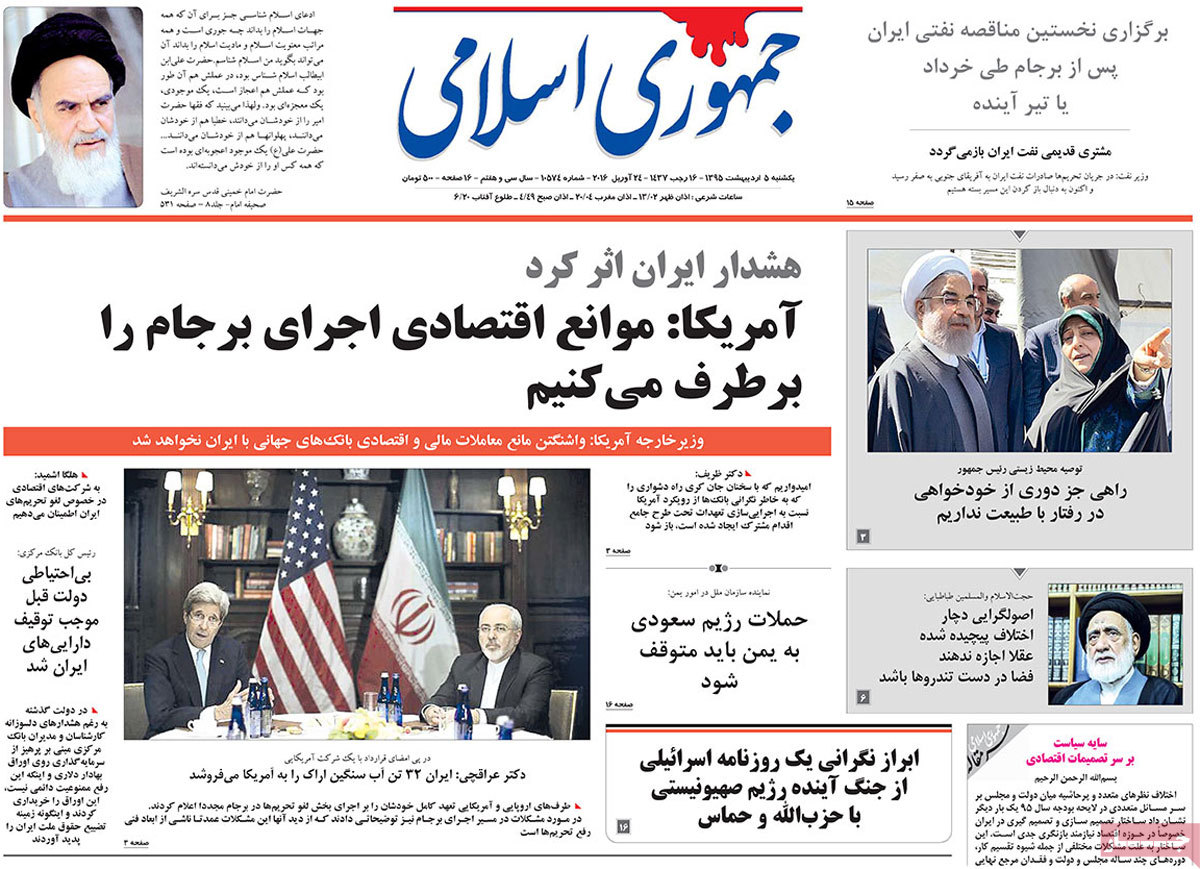
Jomhouri Eslami:

1-EU Official Gives Assurance to Business Firms on Termination of Anti-Iran Sanctions

2-Saudi Regime’s Attacks on Yemen Must Be Stopped: UN Envoy
 

A Look at Iranian Newspaper Front Pages on Apr. 24


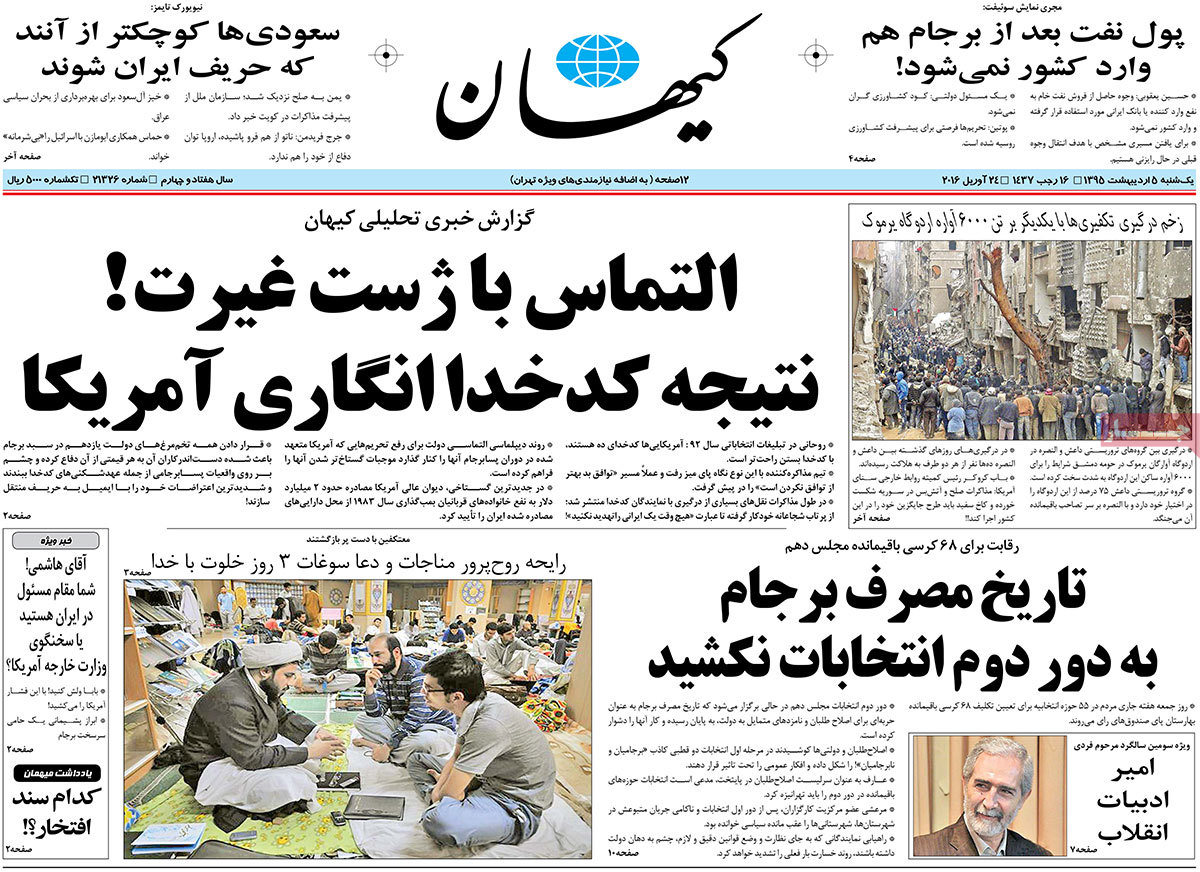
Kayhan:

1-Feigning Patriotic Fervour while Begging Americans: Result of Seeing US as the “Boss”

2-Saudis Too Weak to Defeat Iran: New York Times
 

A Look at Iranian Newspaper Front Pages on Apr. 24


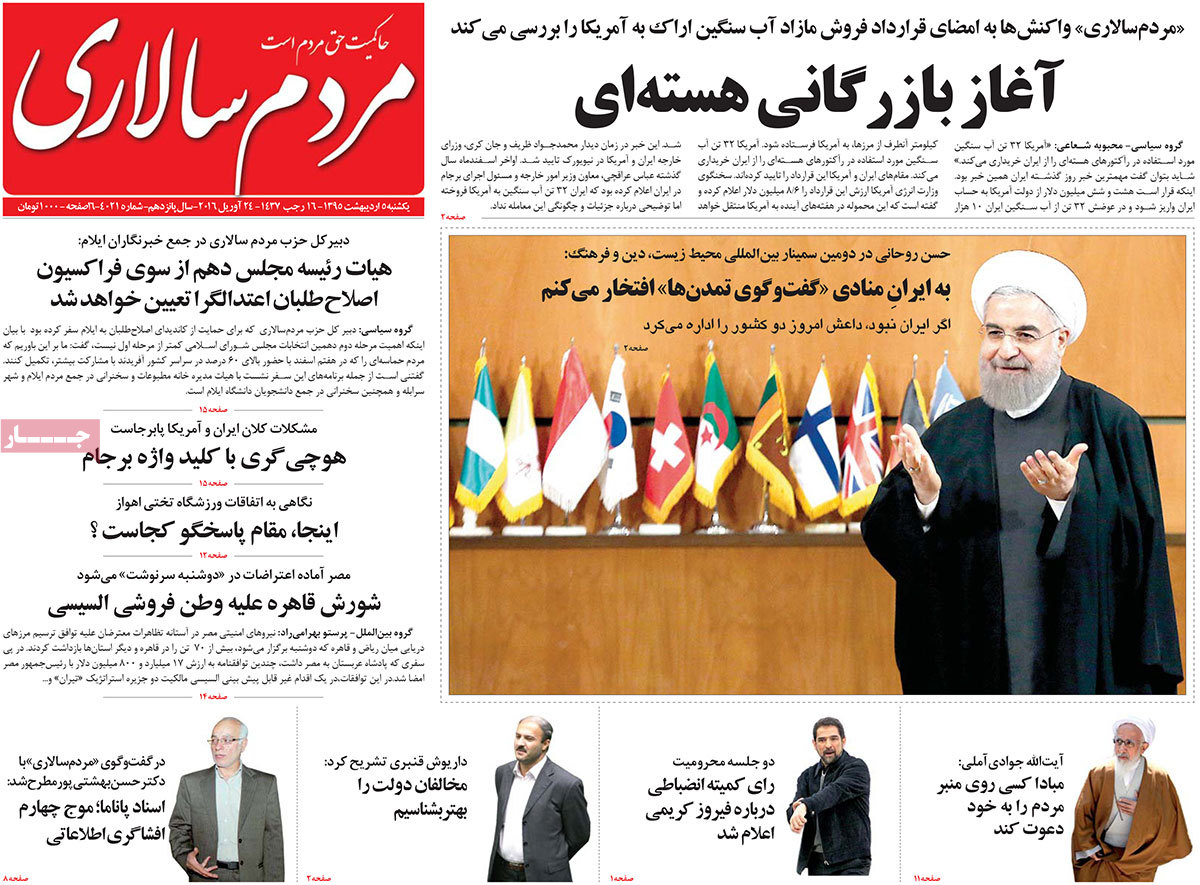
Mardom Salari:

1-Beginning of Nuclear Trade

2-Cairo Rises against El-Sisi’s Betrayal: Egypt Bracing for Protests
 

A Look at Iranian Newspaper Front Pages on Apr. 24


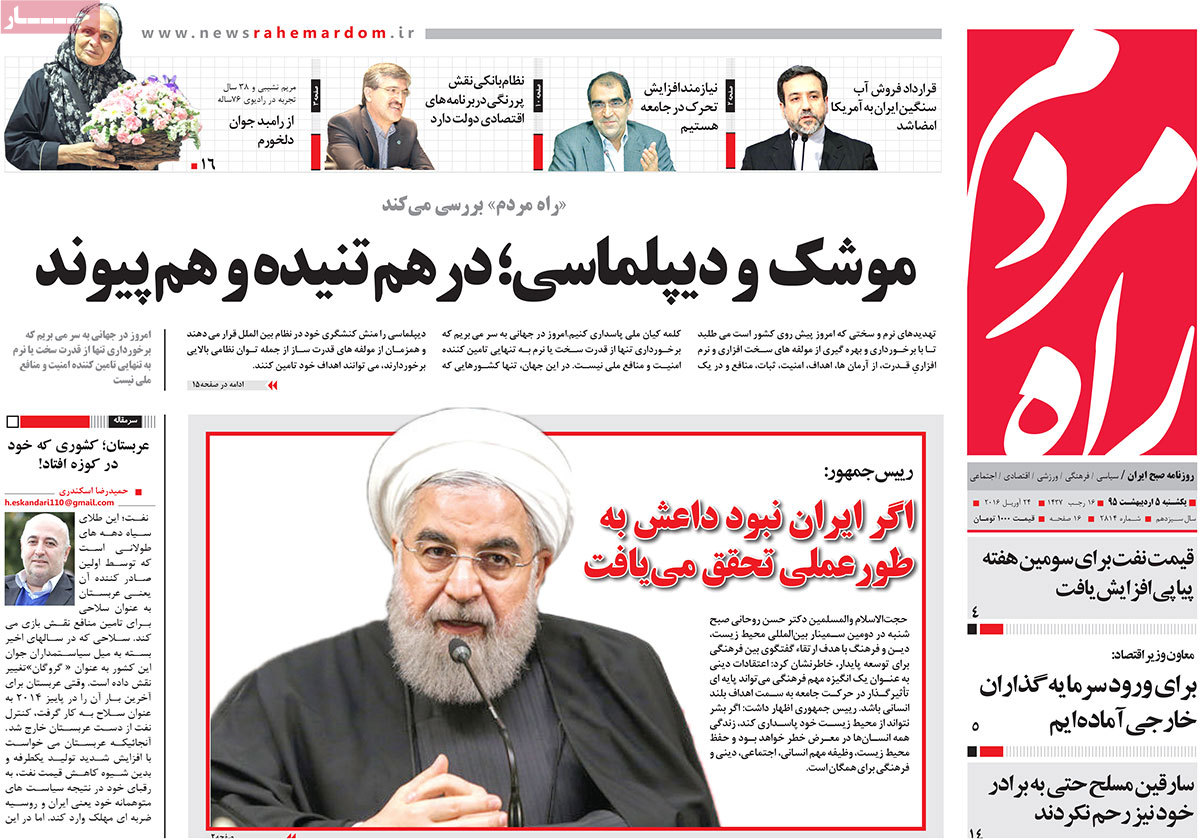
Rah-e Mardom:

1- Missiles and Diplomacy: Interwoven and Interconnected

2- Oil Price Increases for Third Consecutive Week

3- Iran Ready to Welcome Foreign Investors: Deputy Economy Minister
 

A Look at Iranian Newspaper Front Pages on Apr. 24


Resalat:

1- US Main Barrier to Europe’s Trade Ties with Iran: New York Times

2- Humanitarian Disaster in Nigeria: Amnesty Int’l Reports

3- Differences between Iran and US Still Exist: FM Zarif
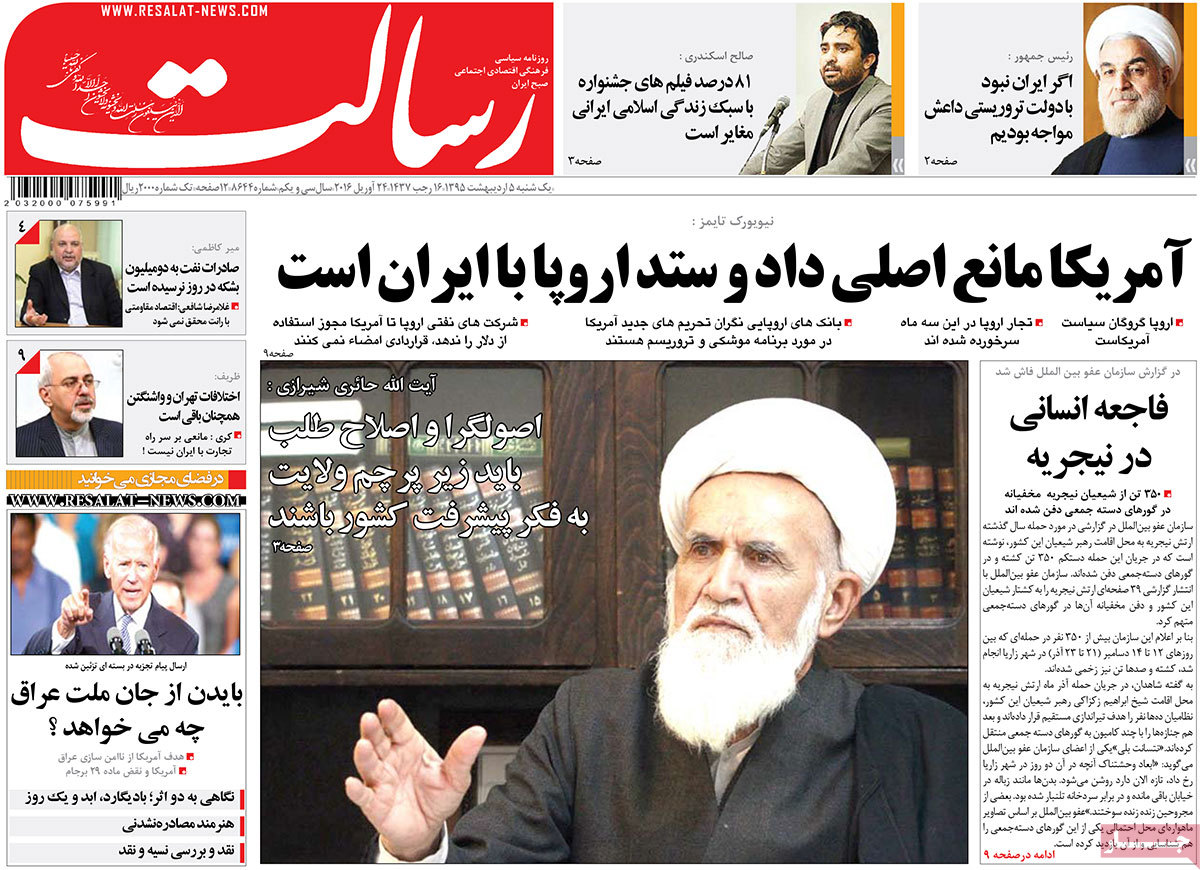
 

A Look at Iranian Newspaper Front Pages on Apr. 24


Rooyesh-e Mellat:

1-Kerry Warns against End of Ceasefire in Syria

2-Iran Supports Any Plan to Regulate Oil Market: Minister

3- Environment, Key to Unity among All Religions: President Rouhani
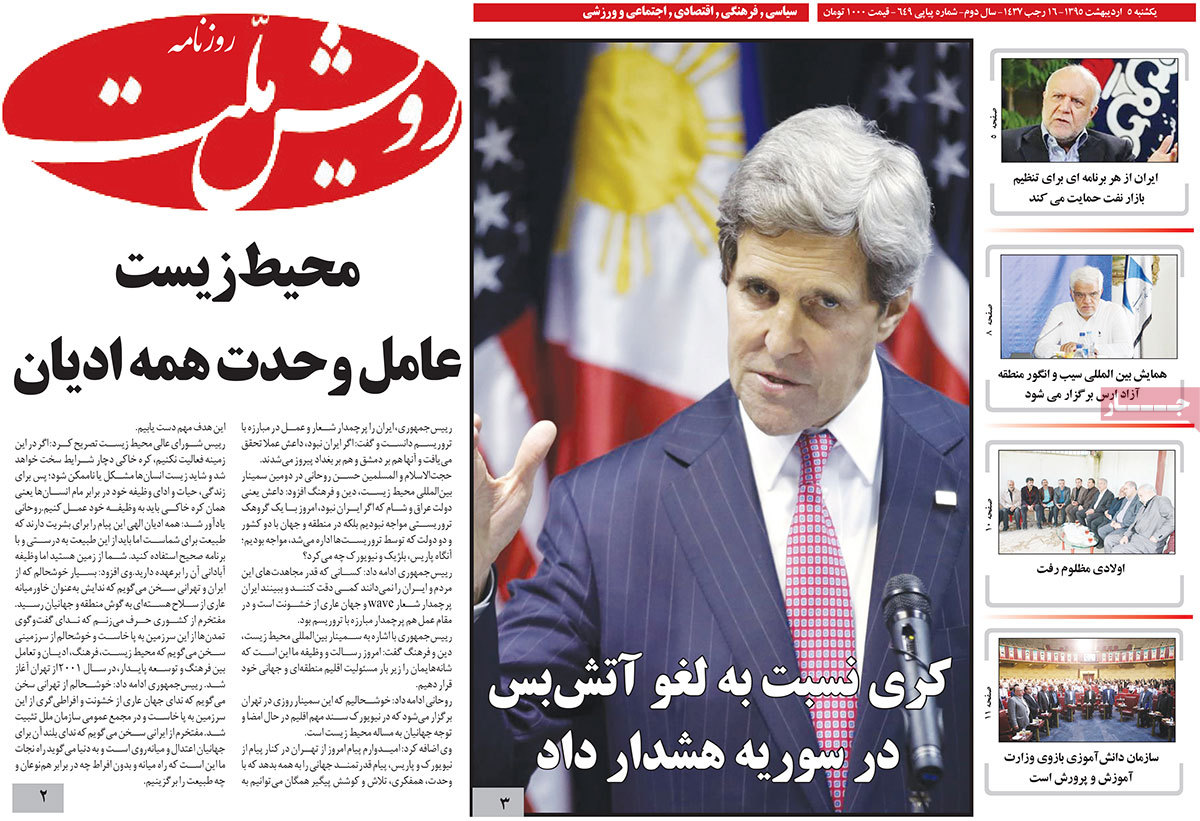
 

A Look at Iranian Newspaper Front Pages on Apr. 24


Sepid:

1- Telegram Is No Place to Find Your Spouse: Experts Warn

2- Iranian Doctors More Exposed to Depression
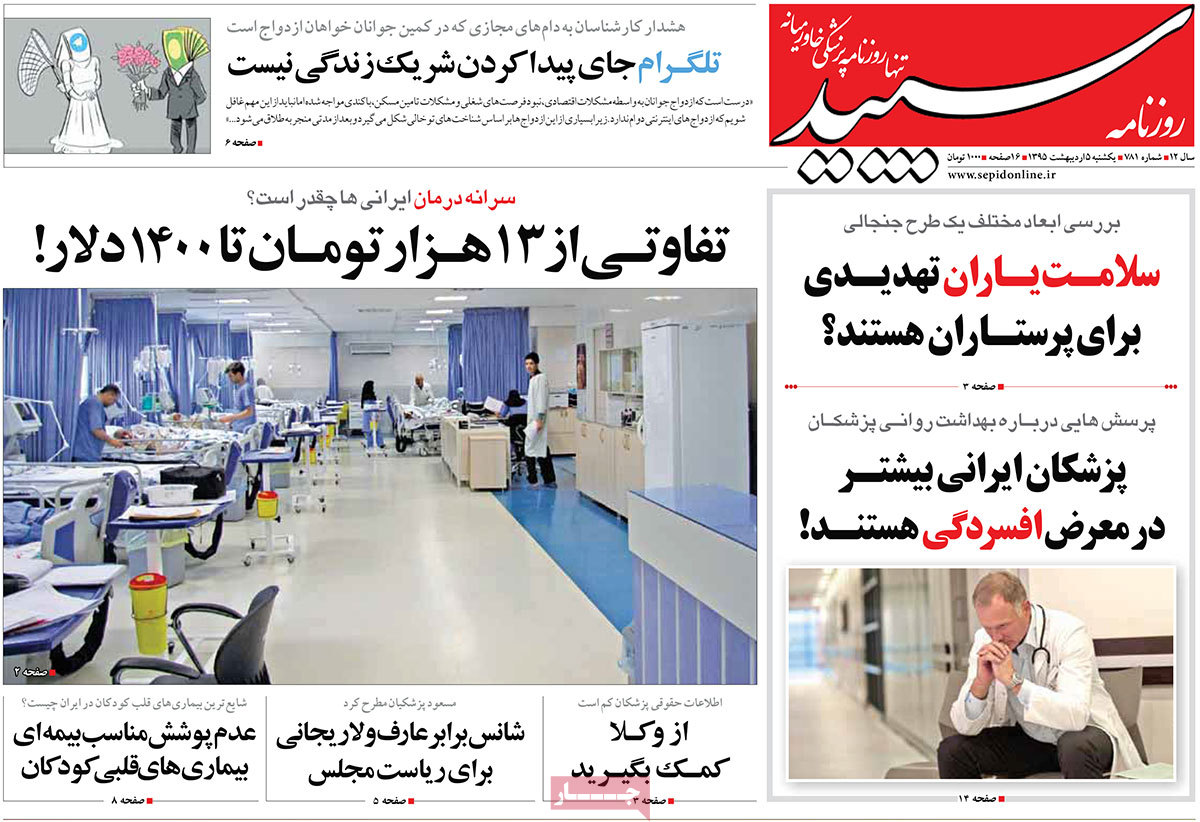
 

A Look at Iranian Newspaper Front Pages on Apr. 24


Tejarat:

1- Cost of Plane Tickets Declining after Price Dump

2-Iran’s Car Industry Coming Out of Hibernation
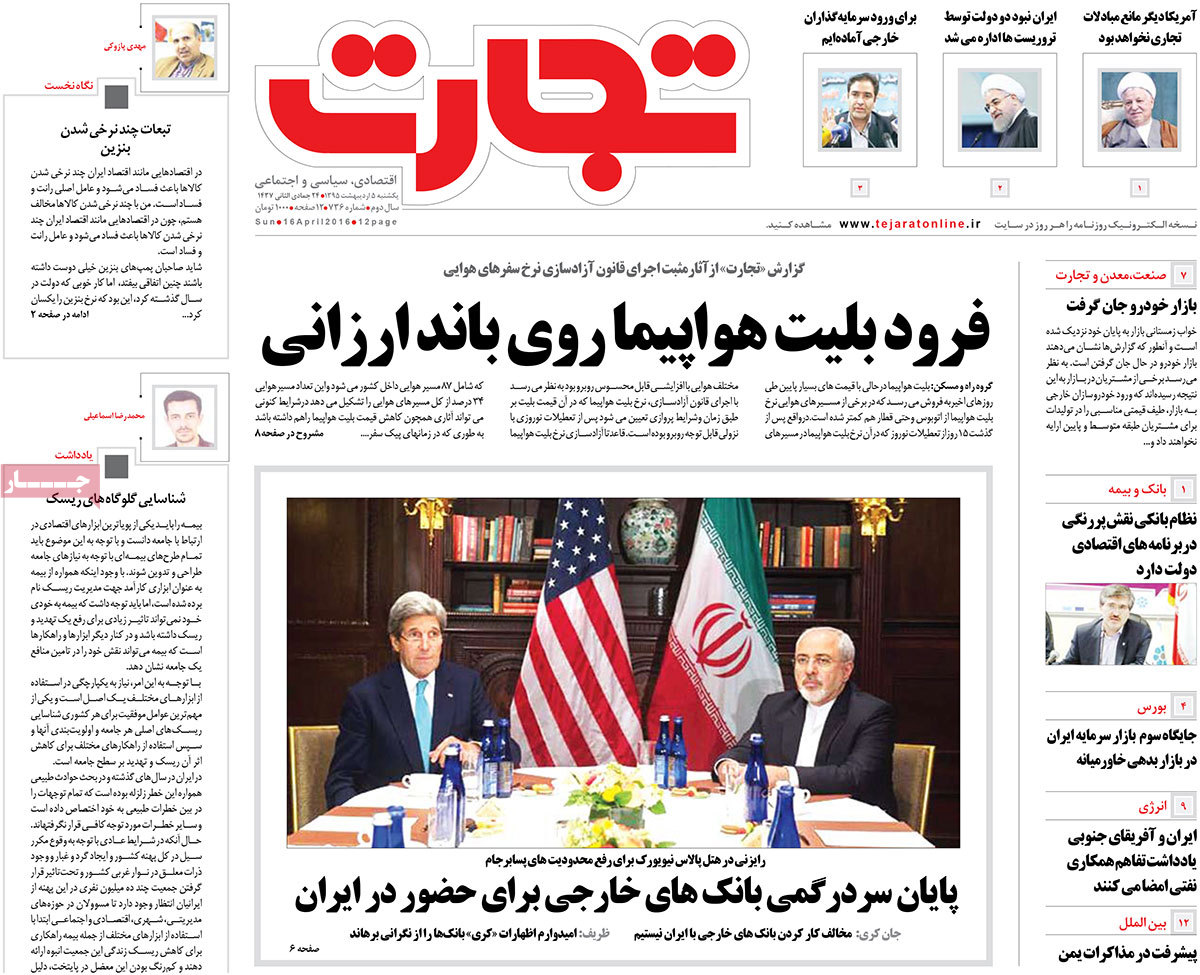
 

A Look at Iranian Newspaper Front Pages on Apr. 24


“Iranian Cinema Conveys its Message without being Affected by Censorship”

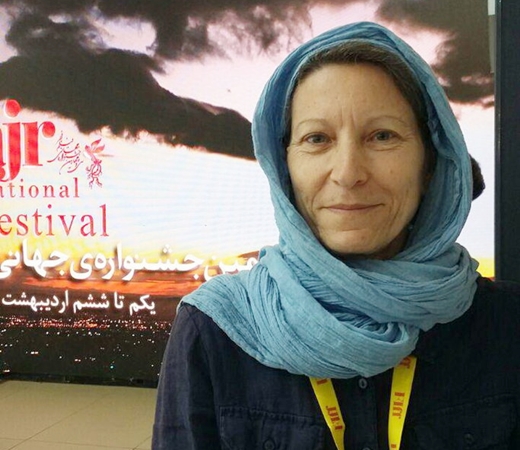
This is the third time she has traveled to Iran and she seems happy to participate in an Iranian festival again. In her interview with ISNA she said, “In the last festivals we had the chance to watch more Iranian films. That was great because the Iranian films we watch in Europe are very different. Not that we can’t watch Iranian films in Europe , but most of the one we see there are not addressed for general public and are considered artistic films.”

She mentioned that she has watched different films from the last festival and is looking forward to watch Iranian movies in the current festival, “Even though Iranian films in this festival are less in number, but I think in general it is good for people to be able to watch foreign and Iranian films at the same time. In fact, Fajr Festival now has the real qualities of an international festival. I’m happy to see youngsters and normal people coming to watch films. As a jury member it’s always important for me to see what type of people watch films in a festival.”

Van Reeth talked about the films she has already watched, saying, “It’s very interesting for me to see these movies start from a normal life and then expand to a global dimension. And all that happens while Iranian filmmakers should go through a censorship process. Even with that, they manage to get their messages understood.”

At the end she added, “International Fajr Film Festival screens movies from Iran and other countries. It shows a cinema which we don’t see it in Europe. That’s why I believe and hope in the effectiveness of this festival.”

Magali Van Reeth was born in 1956 in France. She is the General Secretary of SIGNIS France and President of SIGNIS Europe. She is also a journalist and film reviewer for the SIGNIS website and for a network of French Catholic parishes and French Catholic Medias (Radio, Tv and magazines). Reeth is a board member of the Fipresci through the French Union of Journalism de Cinema and member of different SIGNIS, Ecumenical and Fipresci juries since 2000.

Iran and Group 5+1 Form Special Working Group for Sanctions Removal

“The Islamic Republic of Iran and the Group 5+1 member states (Russia, China, the US, Britain, France, and Germany) held the [third] meeting of the [JCPOA] Joint Commission on Thursday and Friday at the level of experts and political deputies in Vienna,” the Iranian expert wrote in his Telegram account on Saturday, April 23.

“Members of the commission conferred on nuclear issues and the termination of [anti-Tehran] sanctions. Given the existing problems with banking transactions between Iranian banks and major European banks, the commission spent a lot of time on the issue at the level of experts and deputies,” he noted.

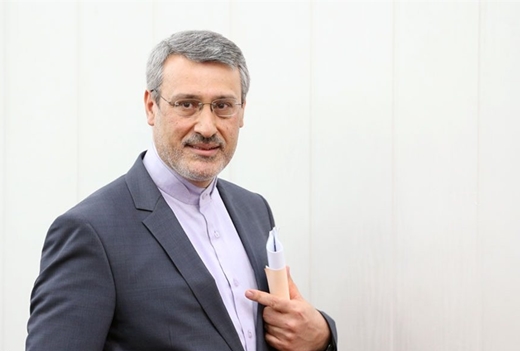
Given the results of Iranian Foreign Minister Mohammad Javad Zarif’s meeting [with his US counterpart] held three days ago, the two sides of the commission discussed various ways to settle the problems, Baeidinejad added.

“In order to pursue the settlement of problems more effectively, the two sides agreed to set up a special working group to ensure the implementation of sanctions removal so that they would resolve the problems ahead of Iran with more concentration on executive issues,” he went on to say.


Unprecedented Deal Finalized for USA’s Purchase of Iran’s Heavy Water

“One of the important issues finalized on the sidelines of the commission’s session was the signing of a contract between the Atomic Energy Organization of Iran (AEOI) and American companies for the sale of 32 tons of heavy water,” said Baeidinejad, who is the Director General of Political Affairs and International Security at the Iranian Foreign Ministry.

Given the sensitivity of the heavy water nuclear materials, he added, Iran’s sale of such products was considered to be impossible in the past.

Iran Signs Climate Change Deal to Reduce Greenhouse Effects: Ebtekar

She made the remarks at the 2nd International Seminar on Environment, Religion, and Culture.
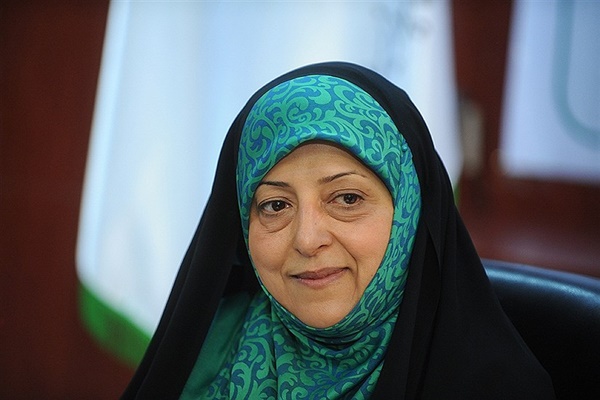
Masoumeh Ebtekar said that Iran has taken effective steps to protect the environment at the national level, and that programs have been designed to keep up with the international standards.
Referring to the signing of the Paris climate deal by Iran’s Foreign Minister at the UN on April 22, she hoped that the international community would adopt effective measures to lower greenhouse effects.
She said that destruction of green areas, reductions in water resources, and soil pollution have posed threats to the future of the Earth.
Ebtekar said that religious teachings call for protection of the environment by their followers.
She praised the cooperation between UNESCO and UNEP in holding this event.
The 2nd International Seminar on Environment, Religion, and Culture is held from April 23-24.