Sunday, April 19, 2026
Home Blog Page 4365

Iran and Cuba Proved US Sanctions Can Be Overcome: Zarif

Zarif - Rodriguez in Cuba

“The resistance of the Iranian and Cuban nations has left the hegemonic countries no other choice but compromise and renunciation of their hostile policies even in their words,” Zarif said in the opening ceremony of Iran-Cuba joint economic conference in Havana on Monday, as reported by Press TV.

He added that steadfastness of the Iranian and Cuban people is a “valuable asset” to improve cooperation between the two countries’ state and private sectors.

The top Iranian diplomat further emphasized that Tehran and Havana should make use of the appropriate opportunity created following the removal of sanctions against Iran to strengthen relations.

“Iran and Cuba enjoy broad interaction on political and international scenes and their cooperation must be improved in the economic sector,” Zarif said.

He noted that the high-ranking politico-economic delegation accompanying him in his six-nation tour of Latin America indicates that the “Islamic Republic attaches great importance to its deep and strong ties with Cuba and the Latin American countries.”

He said Tehran and Havana can boost cooperation, adding that this would be beneficial to Latin American countries.


US Policy of Sanctions against Iran, Cuba Fallen Flat: Zarif
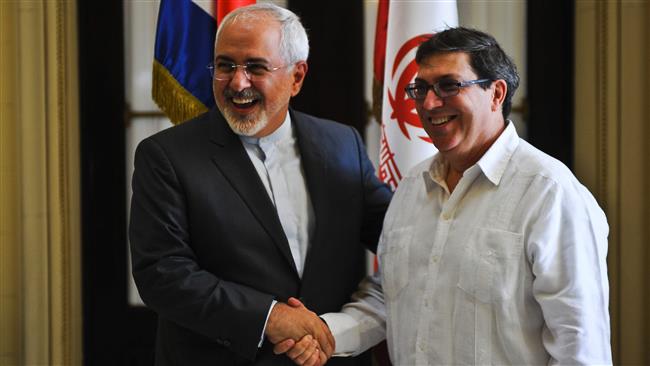
Zarif in CubaIn similar remarks made in a meeting with his Cuban counterpart Bruno Rodriguez, Zarif noted Iran and Cuba have proven that the United States has failed to advance its agendas by exerting pressure on the two countries.

Zarif added that Iran and Cuba proved that they can overcome sanctions through resistance.

“The Iranian nation proved that sanctions imposed by big powers cannot distance it from its policies and viewpoints,” he said.

He added that Iran has always stood by the Cuban nation in countering sanctions and hailed Havana’s support for the Iranian people in the face of brutal US-led bans.

Zarif - Rodriguez in CubaThe top Iranian diplomat said Tehran and Havana can boost cooperation on the international scene, adding, “The two countries have always had common stances on confronting the use of economic force and pressure as well as meddling in the internal affairs of other countries.”

He expressed hope that Iran and Cuba, as two influential members of the Non-Aligned Movement (NAM), would through their cooperation “succeed in further advancing the objectives” of the body.


Cuba Proud of Iran’s Successes: Rodriguez
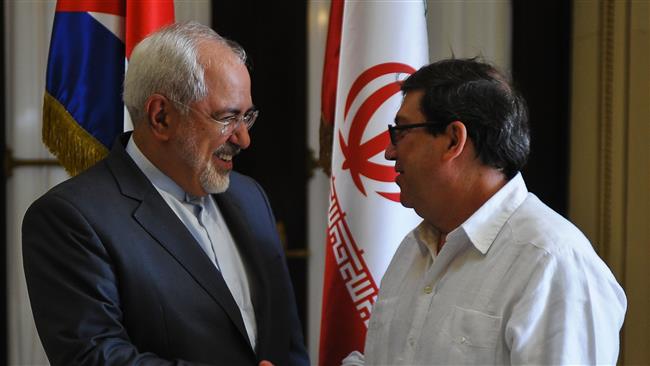
Zarif - Rodriguez in CubaThe Cuban foreign minister, for his part, said his country takes pride in Iran’s achievements and successes and added that Havana is resolved to promote its relations with Tehran.

Rodriguez hailed the very good political ties between the two countries at bilateral and international levels.

He reaffirmed Cuba’s supportive stance on Iran’s right to use nuclear energy and said Havana would counter all types of cruel sanctions, particularly in the financial sector.


Iran’s FM Zarif Meets with Cuban President Castro

Zarif also met with Cuba’s President Raul Castro on Monday in the Cuban capital of Havana, where the top Iranian diplomat arrived on Sunday night at the head of a high-ranking politico-economic delegation.

The two statesmen discussed the development of bilateral ties, international and Middle East affairs, as well as the upcoming summit of the Non-Aligned Movement (NAM), which is to be held in Venezuela later in the year.

Iran and Cuba have both been the target of various US sanctions over the past decades.

However, sanctions against Iran over its nuclear program were stipulated to be removed under last year’s agreement between Tehran and the Group 5+1, known as the Joint Comprehensive Plan of Action (JCPOA), which went into effect on January 16.

Meanwhile, despite a thaw in diplomatic relations between Washington and Havana, a 55-year embargo on Cuba still remains in place. The two countries became ideological foes soon after the 1959 revolution that brought Fidel Castro to power and their ties remained hostile even after the end of the Cold War.


Zarif Pays Tribute to Cuba’s National Hero
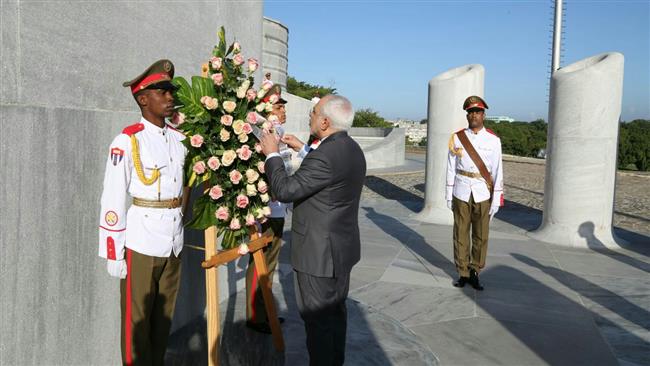
Zarif Pays Tribute to Cuba's National HeroEarlier on Monday, the Iranian foreign minister paid tribute to Jose Marti, Cuba’s national hero, and laid a wreath at his memorial monument.

Zarif and his entourage visited parts of the building.

Heading a 120-strong politico-economic delegation, Zarif arrived in the Cuban capital Sunday night as the first leg of his official Latin America tour, which will also take him to Nicaragua, Ecuador, Chile, Bolivia and Venezuela.
Russian Fighter Jets’ Flights from Iranian Airbase Not Halted: Speaker Larijani

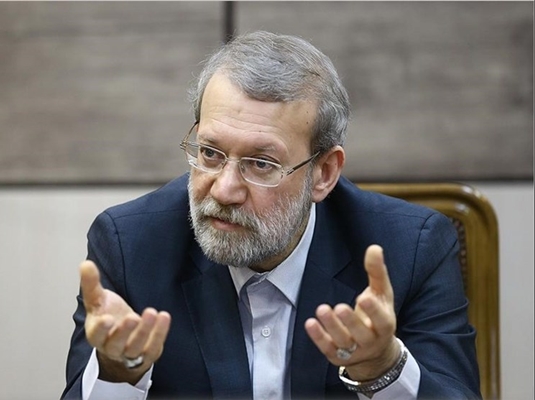
Ali Larijani

Iran is in alliance with Russia in its campaign in Syria and in its battle against terrorism, Larijani said Tuesday.

Russian flights have not been halted, he added, stressing that neither Russia nor any other countries have a permanent military base in the Islamic Republic.

Russians’ flights from the base are a temporary issue and are only for refueling,Larijani went on to add, and noted that the decision did not need the parliament’s permission.

The comments by the Iranian parliament speaker came after the country’s Defense Minister Brigadier General Hossein Dehqan also said the Russian aircraft fly to the Iranian airbase to be either refueled or get reloaded, noting that they use the base for more effective operation against terrorist groups in Syria.

Dehqan further ruled out any plans for permitting Russian jets to use Iranian bases other than Nojeh at the moment, but said they can keep using the airbase as long as necessary.

Syria has been gripped by civil war since March 2011 with various terrorist groups, including Daesh (also known as ISIS or ISIL), currently controlling parts of it.

Meanwhile, Russia’s aerial support for the Syrian forces since September 2015 has given fresh impetus to the fight against the foreign-backed terrorists.

Iran has also remained a close ally of Syria and supports its legitimate government in the face of militancy.

Tehran-Moscow Anti-Terror Cooperation ‘Positive’: Russian Envoy

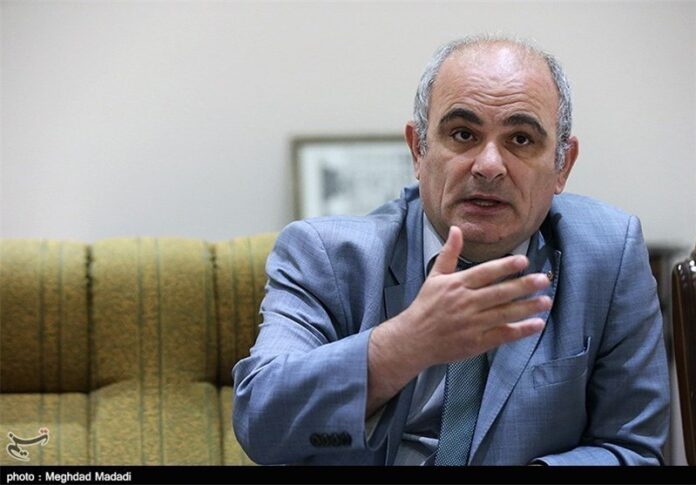
Russia’s ambassador to Iran, Levan Dzhagaryan

“Interaction with Tehran on Syria has positive perspective,” Dzhagaryan said on Monday in an interview with Russia’s Interfax news agency.

He added that the two countries are determined to further strengthen their military cooperation and resolve the ongoing crisis in the Arab country.

Referring to Russia’s recent use of an airbase in western Iran for bombing Takfiri terrorists’ positions in Syria, he said, “All Russian military left Iran’s Hamedan airbase.”

The Russian Air Force may resume operation from the Iranian airbase when it is “expedient and by the decision of leaders” of the two countries, the Russian diplomat said, adding that Moscow sees no obstacle to using Iran’s military infrastructure in the future again.

Also on Monday, Iran’s Foreign Ministry Spokesman Bahram Qassemi said that Russian military jets’ use of the airbase has ended for the time being.

Qassemi noted that Tehran and Moscow had agreed to publicize such cooperation after the aerial operations.

He said Iran and Russia have developed strategic relations in certain areas, as in the fight against the Daesh (ISIL) terrorist group, but made it clear that Russians have not been stationed in Iran and do not have any base inside the country either.

Tehran will spare no effort to honor an agreement with Moscow on joint action against terrorism, the spokesman underlined, saying Russia has used the Iranian airspace with Tehran’s prior permission as part of counter-terrorism collaborations.

On Saturday, Defense Minister Brigadier General Hossein Dehqan said the Russian aircraft fly to the Iranian airbase to be either refueled or get reloaded, noting that they use the base for more effective operation against terrorist groups in Syria.

Syria has been gripped by civil war since March 2011 with various terrorist groups, including Daesh (also known as ISIS or ISIL), currently controlling parts of it.

Meanwhile, Russia’s aerial support for the Syrian forces since September 2015 has given fresh impetus to the fight against the foreign-backed terrorists.

Iran has also remained a close ally of Syria and supports its legitimate government in the face of militancy.

Iranian Police Arrest Drug Kingpin in Southeastern Province

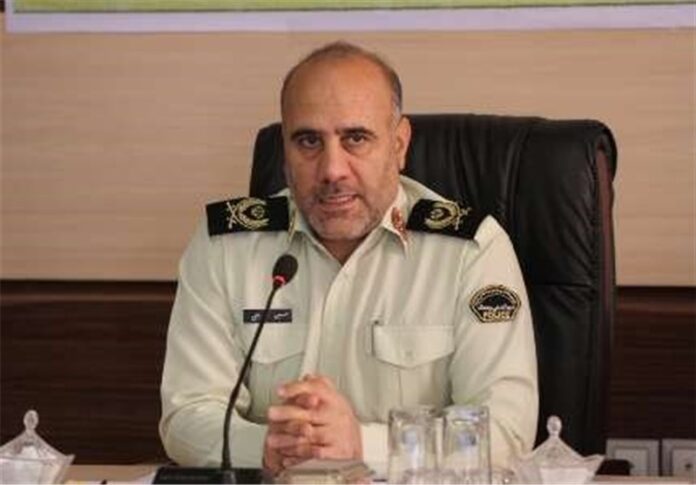
General Hossein Rahimi

Speaking to the Tasnim News Agency, Brigadier General Hossein Rahimi said the criminal was recently apprehended by the police forces of Sistan and Baluchestan following massive and lengthy intelligence measures.

He said the drug lord is the biggest ever smuggler arrested in Iran after the 1979 Islamic Revolution, adding that he has confessed to smuggling up to 800 tons of illicit drugs.

The commander went on to say that in the operation to nab the individual, about 300 other criminals involved in narcotics trafficking under his leadership were identified and arrested.

According to Iranian Interior Minister Abdolreza Rahmani Fazli, the drug trafficker collaborated with 14 international drug rings.

Iran, which has a 900-kilometer common border with Afghanistan, has been used as the main conduit for smuggling Afghan drugs to narcotics kingpins in Europe.

Despite high economic and human costs, the Islamic Republic has been actively fighting drug-trafficking over the past three decades.

The country has spent more than $700 million on sealing its borders and preventing the transit of narcotics destined for European, Arab and Central Asian countries.

The war on drug trade originating from Afghanistan has claimed the lives of nearly 4,000 Iranian police officers over the past 34 years.

4,000 Doctors Visit Patients for Free on National Doctors’ Day

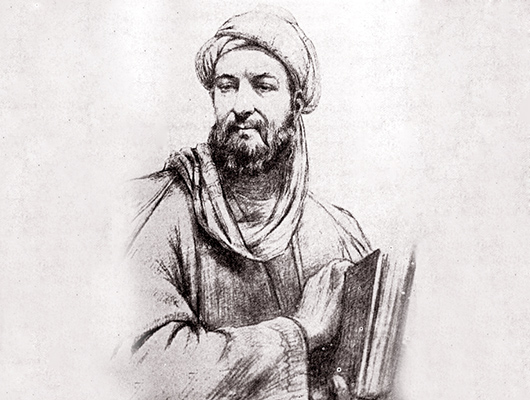
Ibn Sina
Ibn Sina, was a Persian and Muslim physician, astronomer, alchemist, chemist, logician, mathematician, metaphysician, philosopher, physicist, poet, scientist, theologian, and statesman.

According to a report by Mizan, as translated by IFP, the Municipality of Tehran has kicked off the plan and is providing free services for citizens of all 22 districts in the city.

Samaneh Zamani Garmsiri, the Director-General of Health at the Municipality, said that 4,000 doctors visit the patients for free on this special day.

The birthday anniversary of Avicenna, on August 22, is annually commemorated by Iranian physicians and scientific centres as National Doctors’ Day.

Avicenna, also known as Ibn Sina, was a Persian and Muslim physician, astronomer, alchemist, chemist, logician, mathematician, metaphysician, philosopher, physicist, poet, scientist, theologian, and statesman.

He was born around 980 AD in Afshana, near Bukhara which was then a part of Iran and is now in Uzbekistan, and died in 1037 AD in the Iranian city of Hamadan.

Avicenna is regarded as the father of the modern medicine for introducing systematic experimentation and quantification into the study of physiology and contributing to the discovery of contagious diseases.

He is also considered the father of the fundamental concept of momentum in physics.

He wrote some 450 books on a wide range of subjects, many of which concentrated on philosophy and medicine. His most famous works are the ‘Book of Healing’ and the ‘Canon of Medicine’, which used to be standard medical texts in many Islamic and European universities until the 18th century.

He wrote most of his works in Arabic, since it was the dominant language for centuries following the Arab invasion of Iran.

However, he also wrote a large manual on philosophical science entitled ‘Danesh-Nameh Alai’ and a small paper on the pulse in his native language, Persian.

Among Avicenna’s 16 medical works, eight are versified treatises on issues such as the 25 signs indicating the fatal termination of illnesses, hygienic precepts, proved remedies, anatomical memoranda etc.

Amongst his prose works, after the great Canon, the treatise on cardiac drugs, a large number of fine manuscripts which have remained unpublished, are kept at the British Museum.

Secret behind Japan’s Rapid Growth Can Be Found in Quran: Ambassador

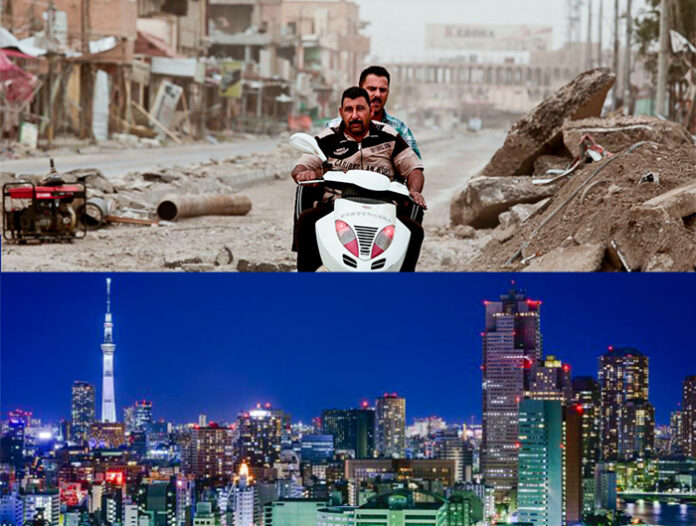
iraq-Japan

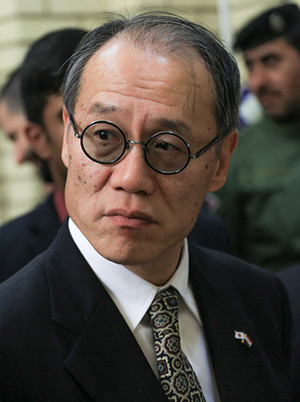
According to a report by IRNA, as translated by IFP, Iwai, in an article published in Arabic, referred to the verse 11 of Quran’s “Ar-Ra’d (the thunder)” Surah, as a roadmap for nations’ development and prosperity.

Fumio Iwai“Despite all the adversities and havoc caused by war and occupation, Japanese leaders made determined efforts to bring prosperity to their country while its people had been left with nothing but determination and faith,” Iwai noted, citing a verse from Quran.
“In your holy book, Quran, God says: indeed, Allah will not change people’s condition until they change what is in themselves.”

He addressed the political leaders of Iraq and added, “I like to see your efforts to build the future of your own country. I do not like to see others working for your country’s growth. Japan is ready to strengthen its ties with Iraq.”

Paul Bremer, once a US top civil administrator in Iraq, had promised that they would build another Japan out of Iraq. However, it has been 13 years since the fall of former Iraqi dictator Saddam Hussein and the establishment of new political system in this country, but violence and destruction have been so far the grim legacy of occupiers, let alone growth and prosperity in Japanese style.

Turkish President Erdogan Due in Iran: Spokesman

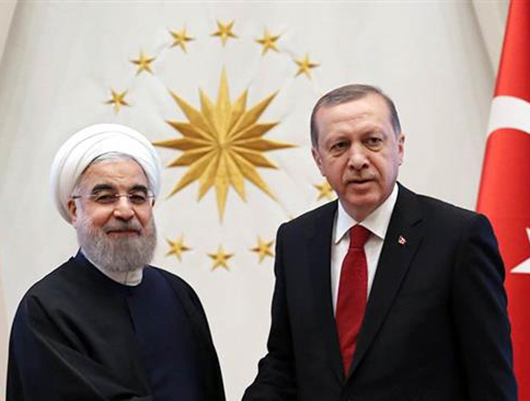
Erdogan - Rouhani

Turkey is an age-old and major neighbour that Iran needs to work with, because the significance of neighbourliness would not diminish over time, Bahram Qassemi said at a press conference in Tehran on Monday, as reported by Tasnim.

He said Tehran and Ankara have some difference on the crisis in Syria, but have increased interaction and talks recently to help stability return to the region.

Qassemi added that the two neighbours have also intensified cooperation since a futile July coup in Turkey.

He said Turkish President Erdogan is to pay a visit to Iran, but did not specify any date for the trip.

Iran and Turkey share stances on some issues and have disagreements on some other ones, but that would not prevent mutual interaction, he stressed.

“We do not dictate our stances on anybody and would not allow anybody to dictate theirs on us either,” Qassemi said of Iran and Turkey’s views on Syria.

As regards Russia’s views on the issue of Syria’s Kurds, the spokesman said Moscow’s attitude toward Kurds may differ from that of Tehran and Ankara, because Russia is not a neighbour in the region, adding that the issue of Kurds could be used as leverage.

In mid-August, Iranian Foreign Minister Mohammad Javad Zarif paid a one-day visit to Turkey and held separate meetings with his Turkish counterpart Mevlut Cavusoglu and President Erdogan.

In the meetings, Zarif and Turkish officials discussed different aspects of bilateral relations as well as the regional and international developments.

It was the first visit to the neighbouring country by a senior Iranian official since the failed coup attempt in Turkey on July 15.

Iran was among the very first countries to condemn the coup attempt.

A few weeks ago, Turkish ambassador to Tehran hailed Iran’s stance against the coup, saying no other government acted like Iran in the process of the putsch.

Iran to Reclaim Achaemenid Tablets from US after 80 Years

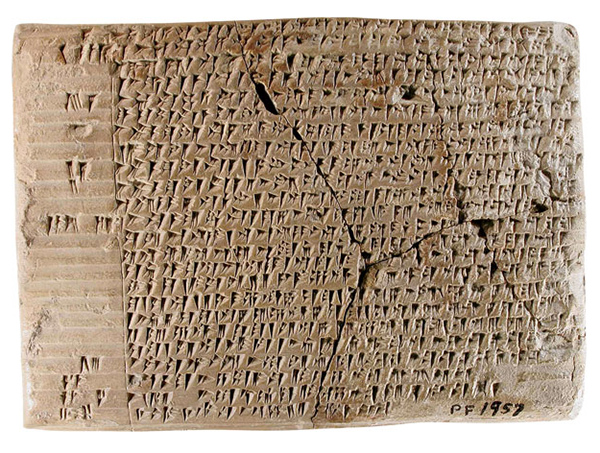
Achaemenid Tablets

According to a report by ISNA, as translated by IFP, Soltanifar, who is also the head of Iran’s Cultural Heritage, Handicrafts and Tourism Organization (ICHTO), announced that the largest collection of historical and cultural relics of the Achaemenid Empire will be returned to the country after 80 years.

According to him, the Persepolis Collection, which dates back to the Achaemenid era (550–330 BC), includes about 3,000 clay tablets and fragments that Iran loaned to the University of Chicago Oriental Institute for research, translation and cataloguing some 80 years ago.


Unfair Seizure of Iranian Historical Relics

“The study on tablets in Chicago was supposed to take only three years,” he regretted.

Families of American victims injured in a Hamas suicide bombing in Israel in 1997 have accused Iran of involvement in the incident, and thus expect compensation from Iran.

Soltanifar went on to say that the rest of the Persepolis Collection will be returned to the country, should the victims’ families refrain from protracting the seizure of Iranian historical relics by appealing to the court of appeals.

“The restitution of parts of these Achaemenid tablets has taken place in three different periods of time so far,” Soltanifar noted.

Thanks to the attempts made by the Cultural Heritage Organization and with the help of the Ministry of Foreign Affairs, the court of appeals ruled in July 19, 2016 that, “since the relics were not used for commercial activity in the US, they are immune from attachment and execution.”

On July 19, the US Seventh Circuit Court of Appeals ruled Chicago’s Field Museum and the University of Chicago’s Oriental Institute are not required to return ancient Persian artefacts over to the victims of the attack.

Soltanifar further announced that, Iran has also been successful to reclaim other historical, cultural relics, as many as four, from other countries.


Cultural Heritage Enthusiasm among Officials

Soltanifar expressed contentment over the fact that the protection of tangible and intangible cultural heritage of the country has been accepted as a principle among officials during the past three years.

“Our main achievement is that almost all of the governors, ministers and mayors of the country have assimilated the importance of protecting historical monuments and sites. Therefore, they have put it high on their agenda.”

Soltanifar announced that the municipality offices have kicked off talks with the Cultural Heritage Organization on restoration and utilization of historical sites and said, “Fortunately, this has turned to a competition among them.”

“It’s good to know that many Members of the Parliament have also shown interest to pass a bill for protection of cultural heritage,” he added.


Eying Global Registration of Arba’een Rally and Mourning Rituals

“The country’s mourning rituals and Arba’een rally [40th day after Imam Hussein’s martyrdom] have also bought a place in the national heritage list, which is a prelude to global registrations of these rituals,” he noted.


Shortage of Manpower to Protect 32,000 Historical Sites

“After a 10-year pause I am glad to announce that 550 contributions have been made to the restoration of historical houses so far; 20 global Board of Trustees have also been established in the last three years,” Soltanifar said.

“With regard to the copious number of 32,000 registered national heritage sites, I have to admit that we lack the required manpower,” he argued, concluding that “the establishment of popular associations active in cultural heritage fields is one of our most significant achievements.”

He said that the responsibility of protecting historical sites and relics lies upon popular associations that are composed of 120,000 cultural heritage enthusiasts.

Soltanifar stressed that Iran is one of the pioneering countries in terms of UNESCO inscriptions and added, “During the past three years, Iran has inscribed five sites in UNESCO including Shahr-e Sukhteh (burnt city), Susa, Meymand, The Persian Qanat, and Lut Desert.”

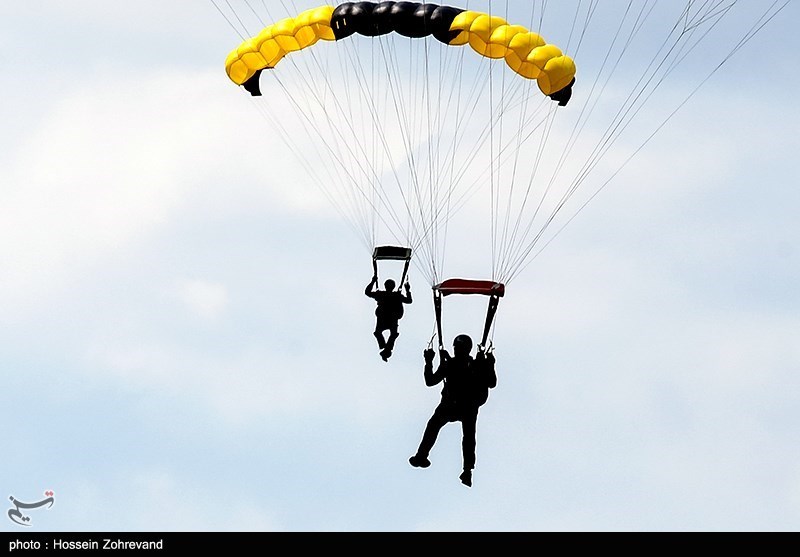
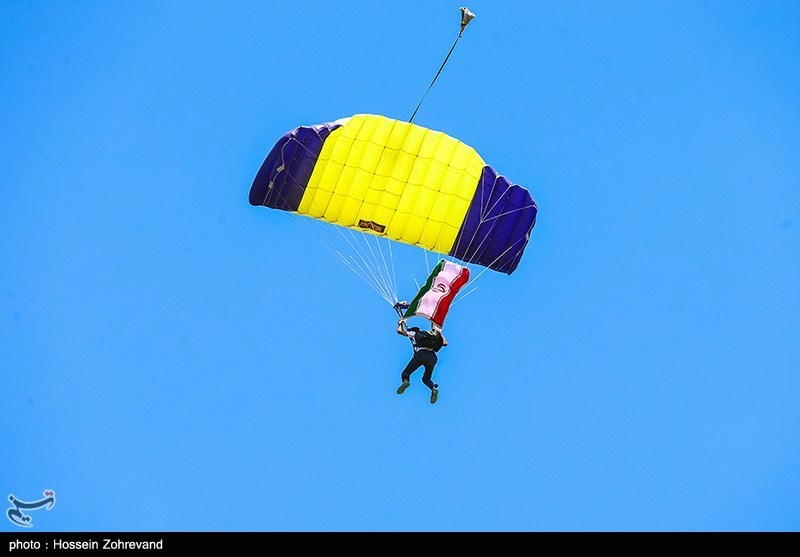
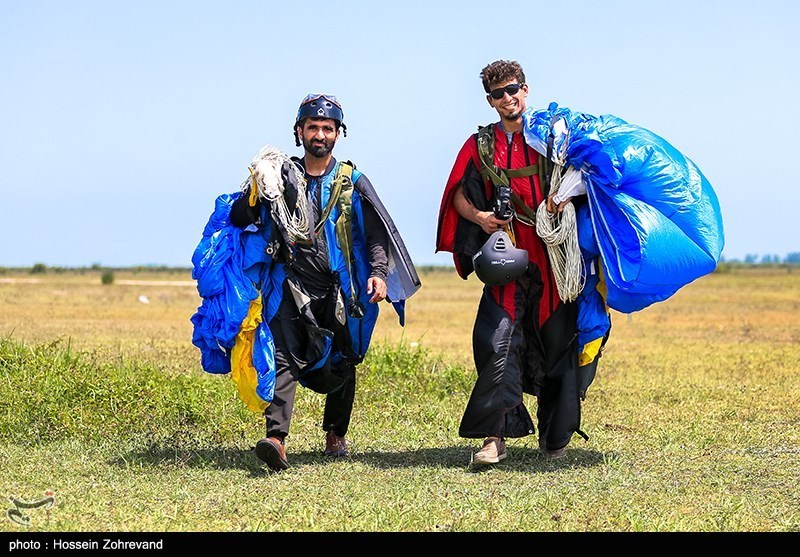
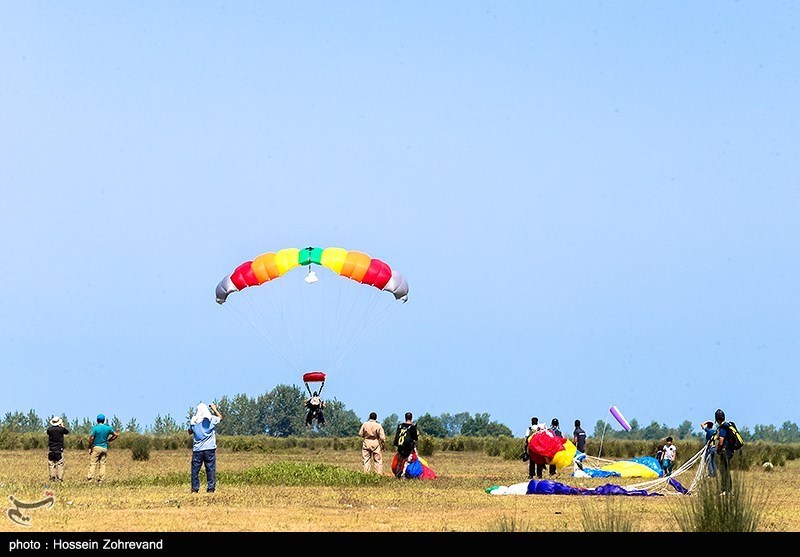
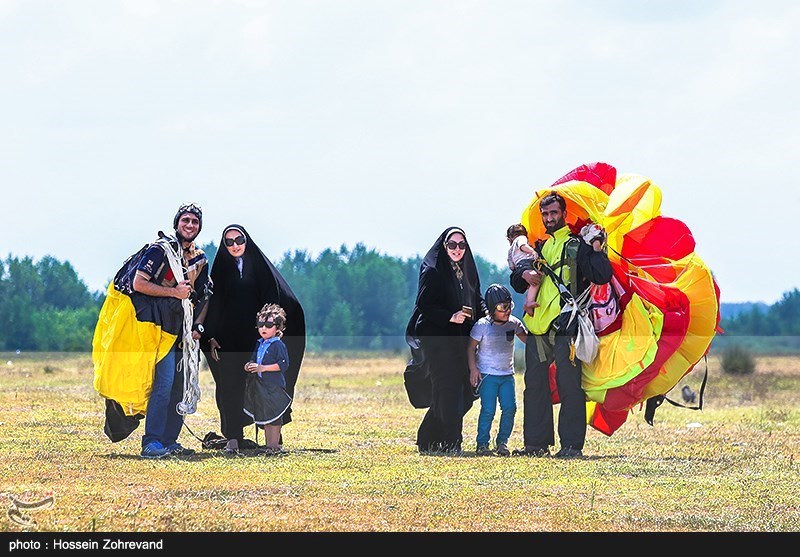
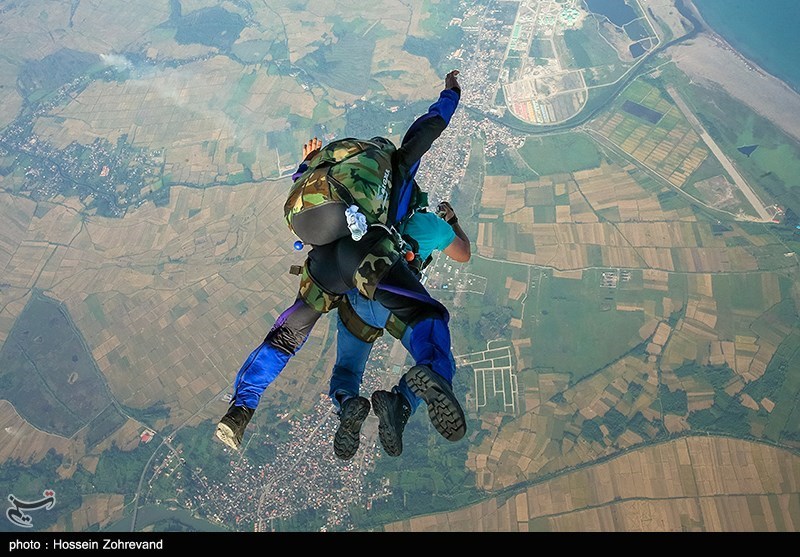
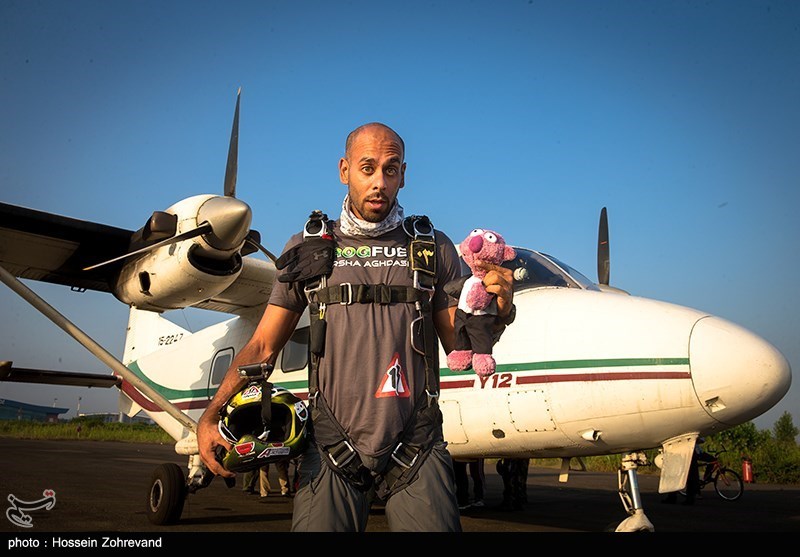
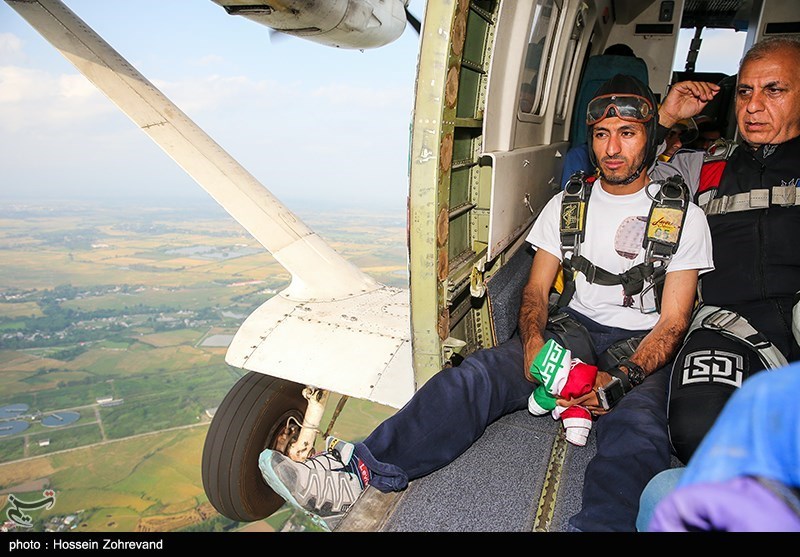
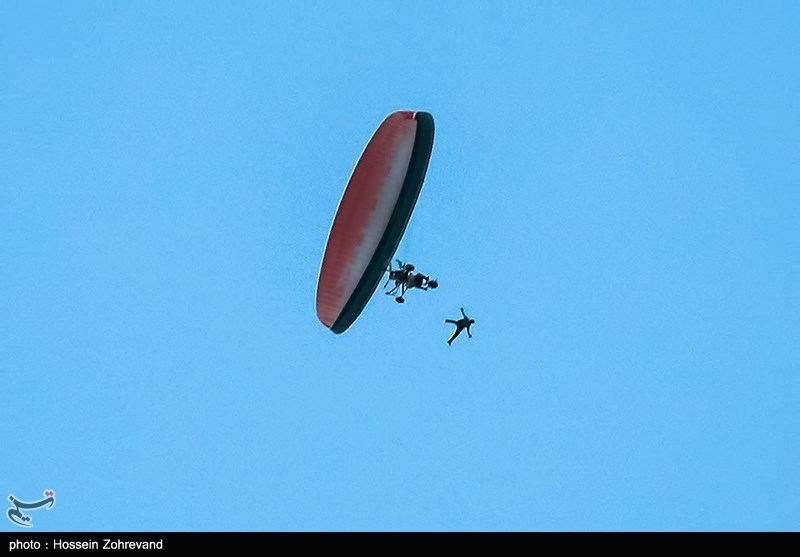
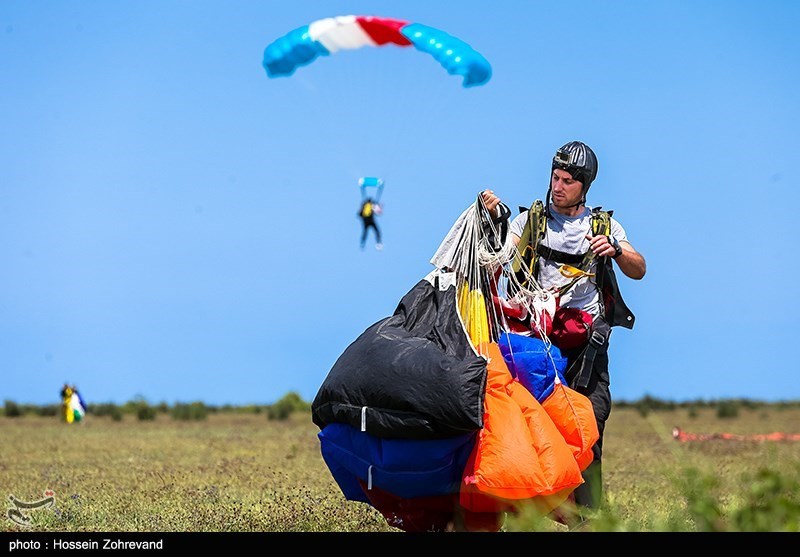
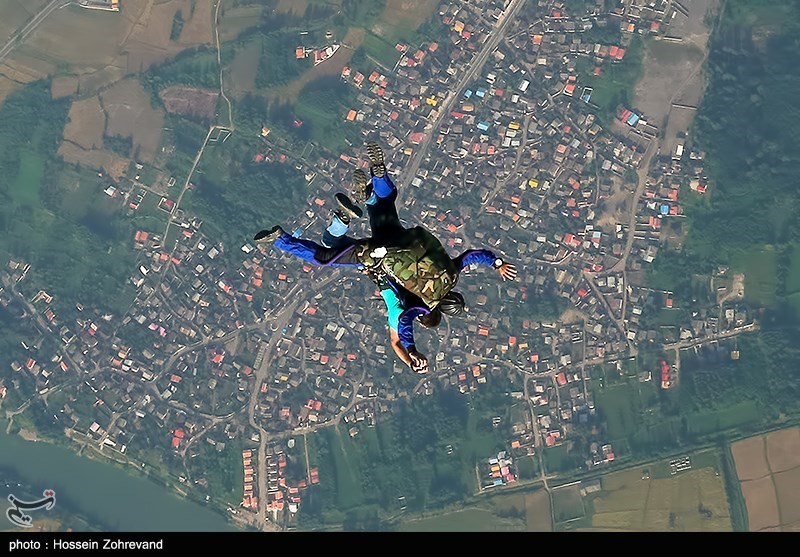
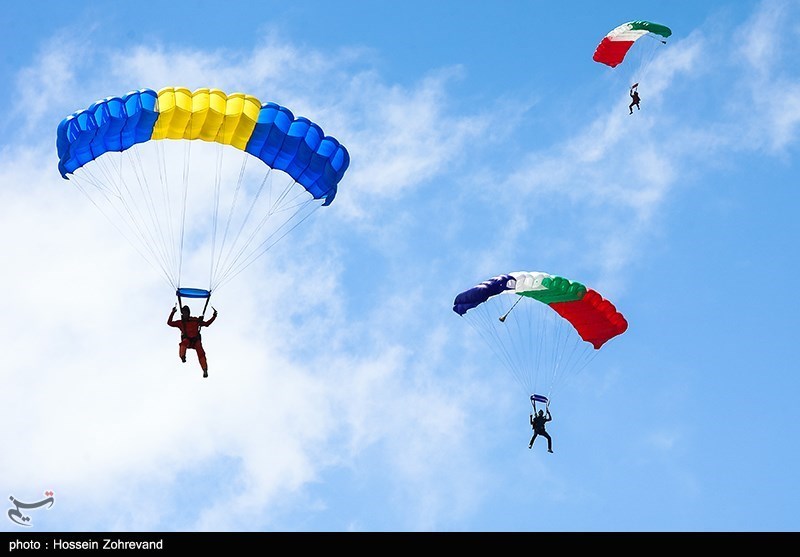
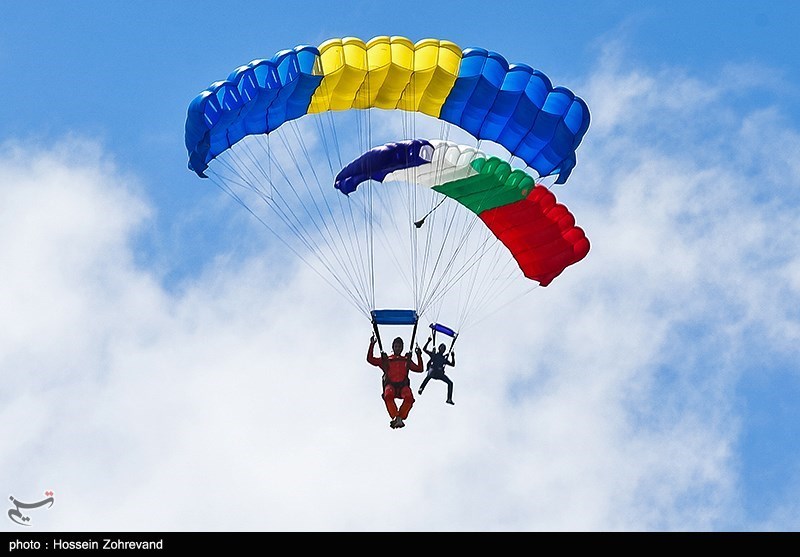
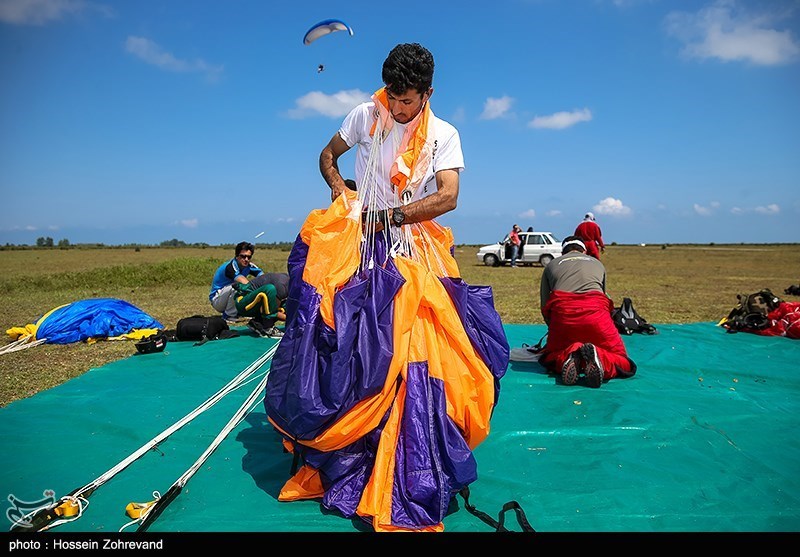
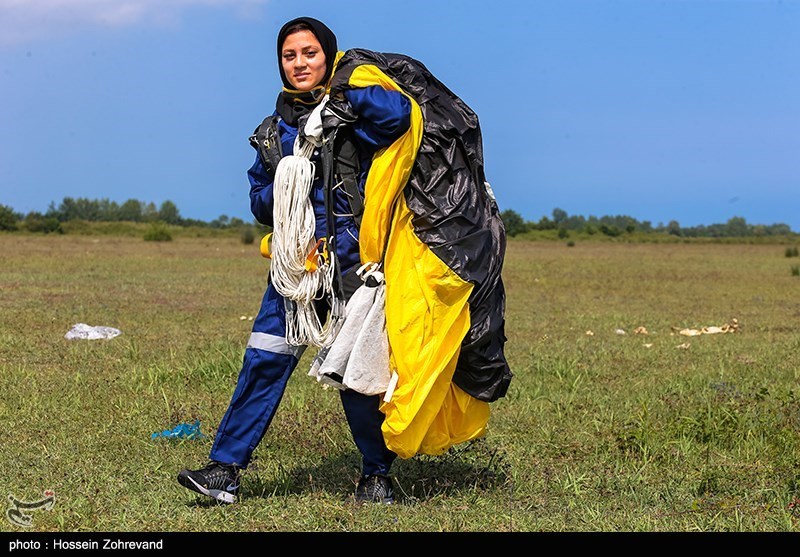
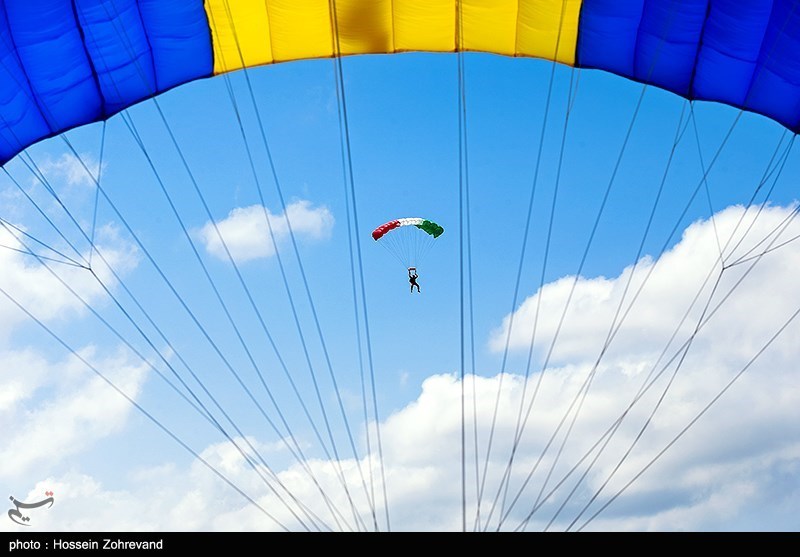
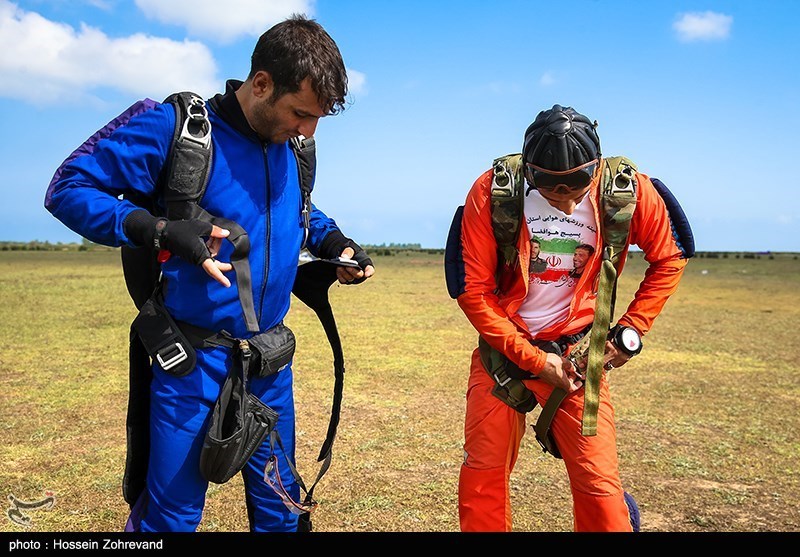
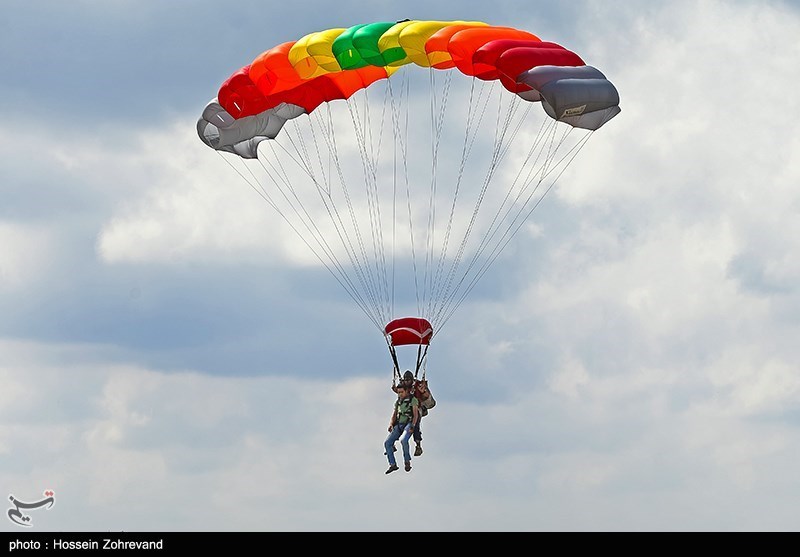
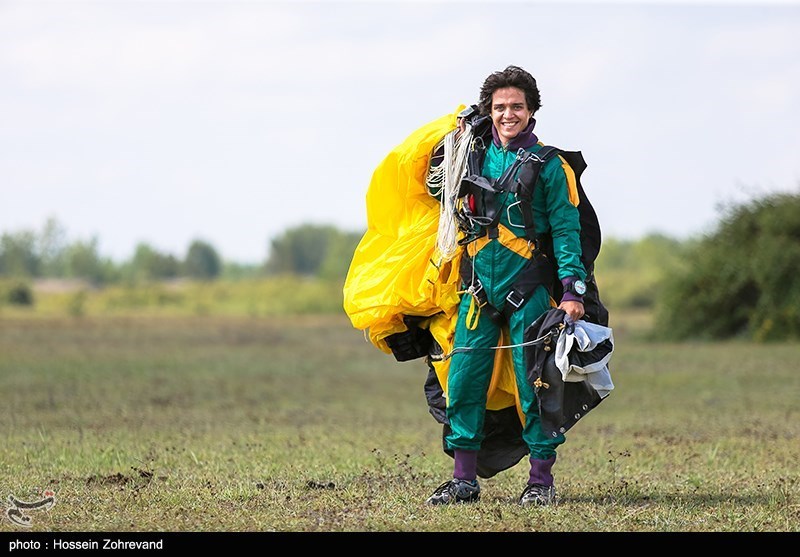
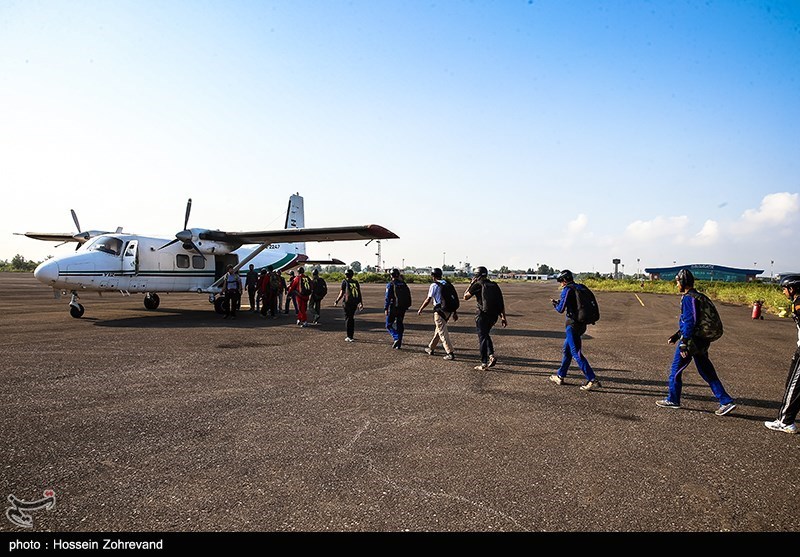
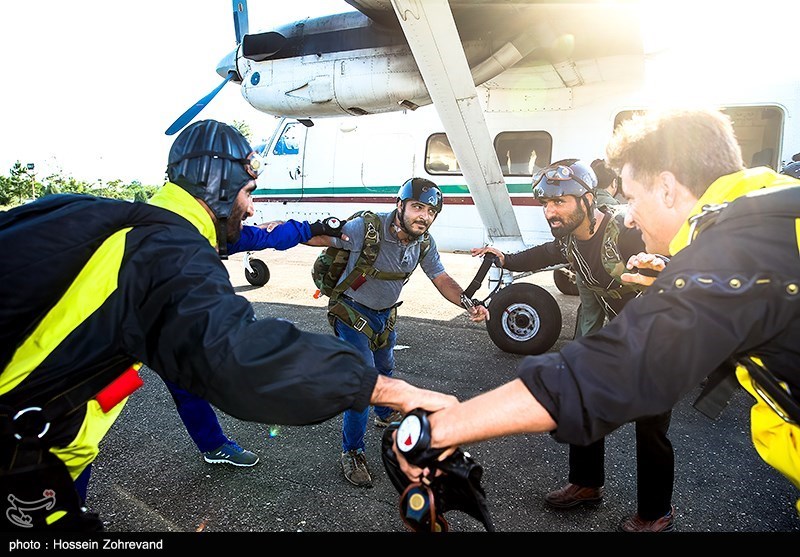
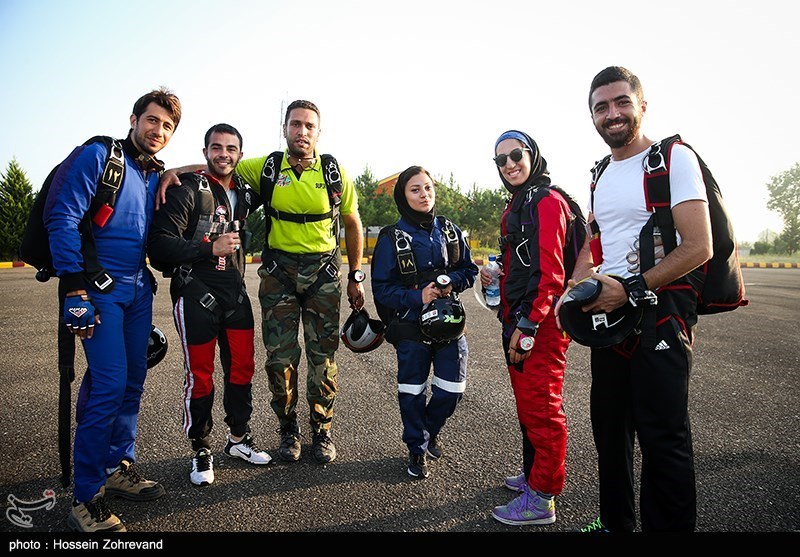
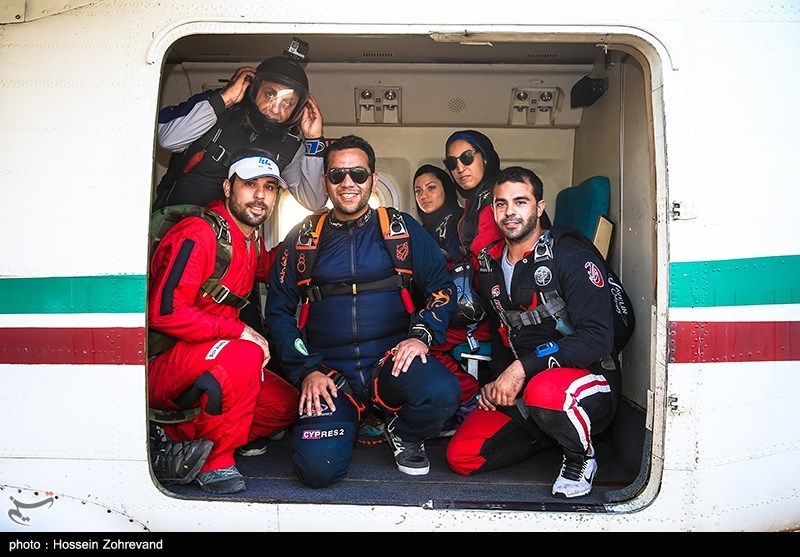
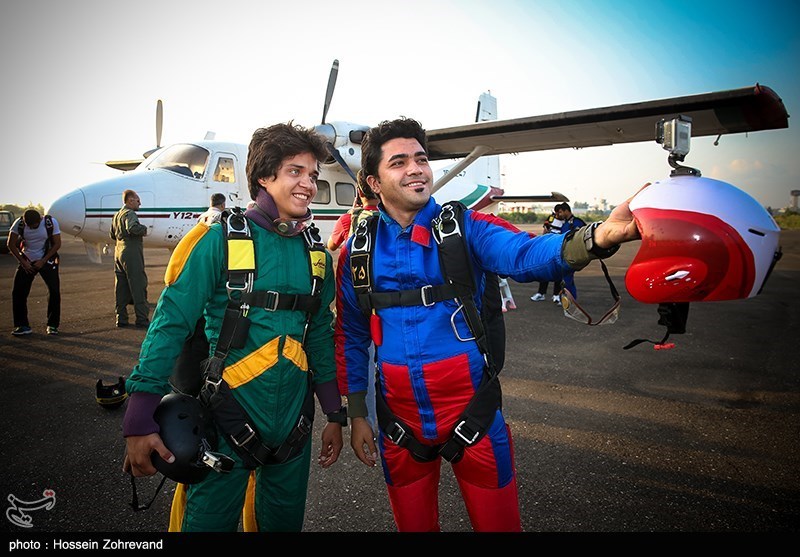
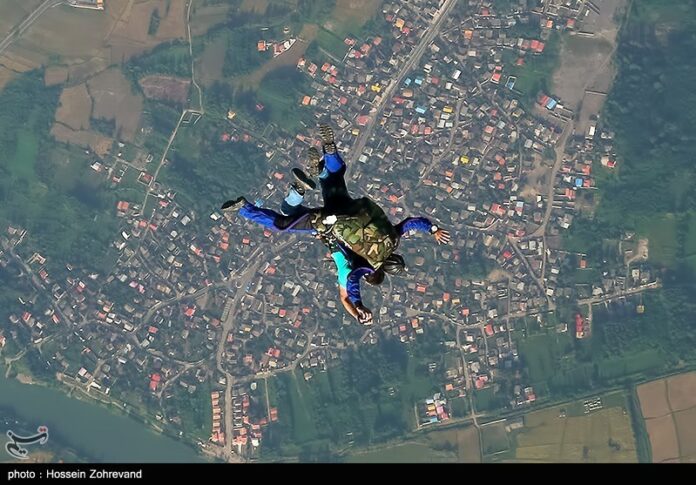
Iranian Skydivers Make Parachute Jump

Parachute Jump16

Iranian skydivers successfully parachuted from nearly 4,000 meters above the ground after jumping from a Harbin Y-12 plane.


Russia’s Use of Iranian Airbase Is Over ‘For Now’: Iran

Bahram Qassemi

Speaking in his first weekly press conference in Tehran, Qassemi said Iran and Russia have strategic and very close ties in some areas, including the fight against ISIS.

“The fight against ISIS is what matters to us and we will spare no effort to that end. We had an agreement for joint moves with Russia, and [Moscow’s] use of our space was with prior notice and permission for the fight against terrorism,” he noted, as reported by Tasnim and translated by IFP.

“Iran and Russia had agreed to make announcements [about Russia’s use of Iranian airbase] after the operation, and they did so,” Qassemi noted.

“Neither has Russia a military base in Iran, nor has it any deployment. It was something carried out [by the two sides], and is over for now,” he stressed.

The remarks came as Defence Minister Brigadier General Hossein Dehqan said on Saturday the Russian aircraft fly to the Iranian airbase to be either refuelled or get reloaded, noting that they use the base for more effective operation against terrorist groups in Syria.

Dehqan also ruled out any plans for permitting Russian jets to use Iranian bases other than the Nojeh airbase in Hamadan at the moment, but noted that they can keep using the airbase as long as necessary.