Sunday, April 19, 2026
Home Blog Page 4363

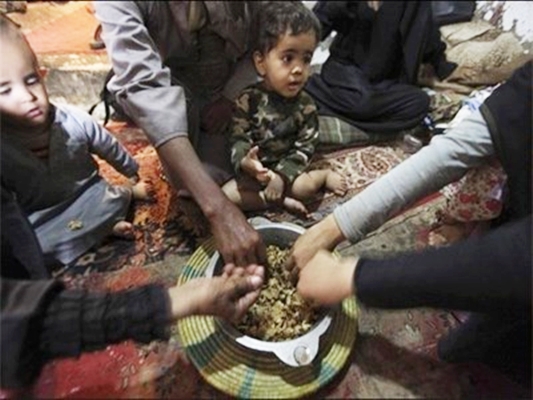
ISIS Hunger Plan for Soldier Recruitment

636068833056574844

According to a report by Entekhab, as translated by IFP, as the looming threat of an all-out attack on Mosul to retake the city from ISIS terrorists is getting more and more serious, the militants have resorted to an unethical strategy for soldier recruitment; starving people!

In an interview with Rudaw Media Network, Rabi’ al-Jawari, a military analyst of Peshmerga forces, pointed to the ISIS’ most recent, yet desperate attempt and said, “Residents of Mosul have been compelled to fight in support of ISIS, albeit reluctantly, and this in no way means they have accepted the terrorists’ thoughts and principles.”

“As the saying goes, a drowning man will clutch at a straw. This holds perfectly true about ISIS’ current predicament,” he noted, adding that the battles against Peshmerga [Kurdish] and Iraqi forces have so far turned into a rout for ISIS.

“We have access to reliable sources who say people of Mosul have refused to help ISIS,” al-Jawari added.

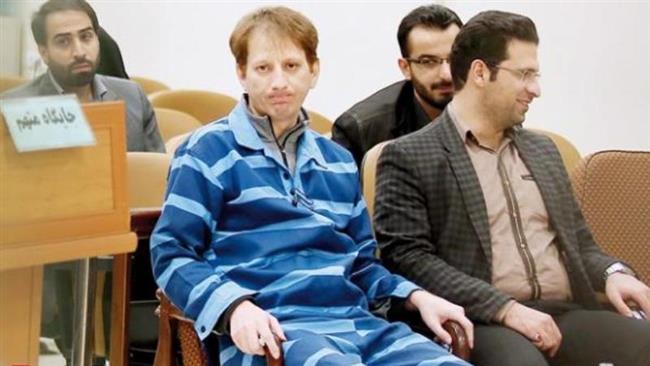
Iran Ministry to Own Billionaire’s Assets

zanjani

“The Prosecutor’s Office, as per the most recent views of a team of experts, agreed with the transfer of the convict’s assets worth 20 trillion rials ($642 million) to the Ministry of Petroleum,” Tehran Prosecutor Abbas Jafari-Dowlatabadi was quoted as saying.

Prosecutors had accused Zanjani of owing the government more than $2.7 billion for oil sold on behalf of the Ministry of Petroleum and not returning the money.

In March, the court of first instance convicted Zanjani and two accomplices of “spreading corruption on earth,” and sentenced them to death. The three defendants were also ordered to repay funds embezzled from the National Iranian Oil Company (NIOC) and other state organizations.

The tycoon once told an Iranian magazine that he amassed a fortune of $10 billion along with debts of a similar scale by arranging deals through a network of companies stretching from Turkey to Malaysia and the United Arab Emirates.

Officials have said most of Zanjani’s assets are outside Iran in Turkey, Tajikistan and elsewhere, presenting a serious challenge to the country to repatriate them.

Jafari-Dawlatabadi said the Iranian Foreign Ministry was being asked to use its good offices and press Tajikistan and Turkey on helping return the assets.

120 NAM Member-States Urge Israel’s Accession to NPT

13940619000158_PhotoI

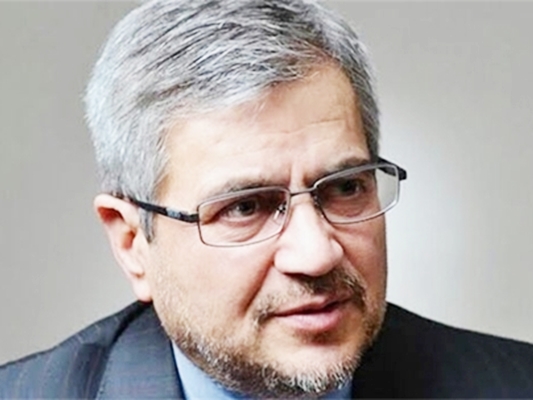
“Member States of the Non-Aligned Movement reiterate their full support for the establishment in the Middle East of a zone free of nuclear weapons and all other weapons of mass destruction, and as a priority step to this end, reaffirm the need for the speedy establishment of a Nuclear-Weapon-Free Zone in the Middle East,” Iran’s Ambassador to the United Nations Gholam Ali Khoshroo said on Tuesday.

“Pending its establishment, they demand on Israel, which has not joined the Treaty on the Non-Proliferation of Nuclear Weapons (NPT) nor declared its intention to do so, to renounce possession of nuclear weapons, to accede to the NPT without precondition and further delay, to place promptly all its nuclear facilities under International Atomic Energy Agency full-scope safeguards according to Security Council Resolution 487 and to conduct its nuclear related activities in conformity with the non-proliferation regime.”

Speaking on behalf of the NAM, whose rotating presidency is assumed by Iran, Khoshroo addressed a Security Council open debate on non-proliferation of WMDs, held in the UN Headquarters in New York.


The following is the full text of Khoshroo’s speech:


Mr. President

I have the honour to speak on behalf of the member States of the Non-Aligned Movement. I appreciate the Malaysian presidency of the Council for convening this open debate.

NAM member States express grave concern over the threat posed to humankind by the existing weapons of mass destruction, particularly nuclear weapons, and underline the need for their total elimination.

The Movement is satisfied with the consensus among States on measures to prevent terrorists from acquiring weapons of mass destruction and, in this regard, welcomes the adoption by consensus of General Assembly Resolution 70/36 entitled “Measures to prevent terrorists from acquiring weapons of mass destruction”.

Underlining the need for this threat to humanity to be addressed within the UN framework and through international cooperation, NAM calls upon all States to support international efforts to prevent terrorists from acquiring weapons of mass destruction. NAM also urges all States to take and strengthen national measures, as appropriate, to prevent terrorists from acquiring weapons of mass destruction, their means of delivery and materials and technologies related to their manufacture.

Noting the adoption of resolutions 1540, 1673, 1810 and 1977 by the Security Council, the Movement underlines the need to ensure that any action by the Security Council does not undermine the UN Charter and existing multilateral treaties on weapons of mass destruction and of international Organizations established in this regard, as well as the role of the General Assembly.

NAM further cautions against the continuing practice of the Security Council to utilize its authority to define the legislative requirements for Member States in implementing Security Council decisions. In this regard, the Movement stresses the importance of the issue of non-State actors acquiring weapons of mass destruction to be addressed in an inclusive manner by the General Assembly, taking into account the views of all Member States.

Member States of the Movement express their deepest concern over the immediate, indiscriminate, and massive death and destruction caused by any nuclear weapon detonation and its long term catastrophic consequences on human health, environment, and other vital economic resources, thus endangering the life of present and future generations. They reiterate further their deep concern at the catastrophic humanitarian consequences of any use of nuclear weapons, and in this context reaffirm the need for all States at all times to comply with applicable international law, including international humanitarian law.

Reaffirming that nuclear disarmament remains its highest priority, the Movement stresses the importance of ensuring that efforts aimed at nuclear non-proliferation are parallel to simultaneous efforts aimed at nuclear disarmament, which, as a multilateral legal obligation, also should not be made conditional on confidence building measures or other disarmament efforts.

NAM expresses deep concern over the slow pace of progress towards nuclear disarmament and the lack of progress by the Nuclear-Weapon States to accomplish the total elimination of their nuclear arsenals in accordance with their relevant multilateral legal obligations. Accordingly, the Movement calls upon the Nuclear- Weapon States to fulfil their multilateral legal obligations on nuclear disarmament and to implement the unequivocal undertaking they provided in 2000 and further reiterated in 2010, so as to accomplish the total elimination of nuclear weapons.


Concerned with the improvements in existing nuclear weapons  and the  development  of new types of nuclear weapons, as provided for in the military doctrines of some Nuclear- Weapon States, as well as the strategic defence  doctrines of the Nuclear-Weapon States, including the “NATO Alliance Strategic Concept”, which not only set out rationales for the use or threat of use of nuclear weapons, but also maintain unjustifiable concepts on international security based on promoting and developing military alliances and nuclear deterrence policies, NAM strongly calls upon them to exclude completely the use or threat of use of nuclear weapons from their military and security doctrines. In this context NAM also stresses the need for effective measures in order to prevent the emergence new types of weapons of mass destruction, as reaffirmed by the UNGA resolution 69/27 on the prohibition of the development and manufacture of new types of weapons of mass destruction and new systems of such weapons.


Mr. President

Reaffirming the absolute validity of multilateral diplomacy in the field of disarmament and non-proliferation, NAM reiterates its determination to promote multilateralism as the core principle of negotiations in the area of disarmament and non-proliferation.

Concerned with the current difficult and complex situation in the field of disarmament and international security, and underlining the need for renewed efforts to resolve the current impasse in achieving nuclear disarmament and nuclear non-proliferation in all its aspects, member States of the Movement call on the Conference on Disarmament, as the sole multilateral negotiating body on disarmament, to agree by consensus on a balanced and comprehensive program of work without any further delay, taking into account the security interests of all States. In particular, they emphasize the necessity to start negotiations in the Conference on Disarmament, without further delay, on a comprehensive nuclear weapons convention that sets, inter alia, a phased program for the complete elimination of nuclear weapons with a specified framework of time.

NAM highlights the importance of focusing international public attention on the dangers of nuclear weapons and the advantages of nuclear disarmament for development as well as for international peace and security. Welcoming UN meetings and activities for the commemoration of 26 September, as the International Day for the Total Elimination of Nuclear Weapons, NAM invites Member States, the UN  system and the civil society, including non-governmental organizations, academia, parliamentarians, the mass media and individuals, to commemorate and promote that  International Day through all means of educational and public awareness-raising activities.

The Movement reaffirms that the total elimination of nuclear weapons is the only absolute guarantee against the use or threat of use of nuclear weapons, and pending the total elimination of nuclear weapons, calls for the early commencement of negotiations on effective, universal, unconditional, non-discriminatory, irrevocable and legally binding security assurances to all non­nuclear-weapon States by all the nuclear-weapon States against the use or threat of use of nuclear weapons under all circumstances as a matter of high priority.

Highlighting the role of Nuclear-Weapon-Free Zones created by the treaties of Tlatelolco, Rarotonga, Bangkok, Pelindaba, Semipalatinsk, as well as Mongolia’s Nuclear-Weapon-Fee­Status, as positive steps and important measures towards strengthening global nuclear disarmament and nuclear non-proliferation, NAM calls upon all the nuclear-weapon States to ratify related protocols to all treaties establishing nuclear-weapon-free zones, withdraw any reservations or interpretative declarations incompatible with their object and purpose, and respect the denuclearization status of these zones.

In this context, member States of the Non-Aligned Movement reiterate their full support for the establishment in the Middle East of a zone free of nuclear weapons and all other weapons of mass destruction, and as a priority step to this end, reaffirm the need for the speedy establishment of a Nuclear-Weapon-Free Zone in the Middle East. Pending its establishment, they demand on Israel, which has not joined the Treaty on the Non-Proliferation of Nuclear Weapons (NPT) nor declared its intention to do so, to renounce possession of nuclear weapons, to accede to the NPT without precondition and further delay, to place promptly all its nuclear facilities under International Atomic Energy Agency full-scope safeguards according to Security Council Resolution 487 and to conduct its nuclear related activities in conformity with the non-proliferation regime.

Concerned with the persistence of undue restrictions on exports to developing countries of material, equipment and technology, for peaceful purposes, NAM member States underscore that adoption of measures to prevent terrorists from acquiring weapons of mass destruction must not be used as a pretext or leverage to impose restrictions on exports to developing countries of material, equipment and technology, for peaceful purposes, including in particular to violate, deny or restrict the inalienable right of developing countries to develop research, production and use of nuclear energy for peaceful purposes without discrimination.


Mr. President

NAM States Parties to the Biological Weapons Convention emphasize its important role in the international legal architecture related to Weapons of Mass Destruction, and in particular, in the total prohibition on all biological and toxin weapons, and reaffirm that the possibility of any use of bacteriological (biological) agents and toxins as weapons should be completely excluded, and the conviction that such use would be repugnant to the conscience of humankind. They recognize the particular importance of strengthening the Convention through the resumption of the multilateral negotiations for a legally binding Protocol dealing with all Articles of the Convention, in a balanced and comprehensive manner, including through verification measures, bearing in mind that the lack of such verification regime poses a challenge to the effectiveness of the Convention, and urge the party rejecting negotiations to reconsider its policy.

Moreover, NAM States Parties to the Chemical Weapons Convention reaffirm the effective contribution of the Convention to international and regional peace and security, which can be enhanced through its full implementation. They express their serious concern that certain possessor States Parties did not meet their obligations regarding the deadlines for the total elimination of chemical weapons, and therefore, urge all possessor State Parties to take every necessary measure to ensure their compliance with their “Detailed plan for the destruction of Chemical Weapons remaining after the final extended destruction deadline of29 April2012”,  in the shortest time possible, in order to uphold the credibility and integrity of the Convention.

NAM member States condemn the use of chemical weapons in the Syrian Arab Republic, which reinforces the absolute necessity to eliminate all chemical weapons. In this regard, they acknowledge the accession of the Syrian Arab Republic to the Convention and the commitment to implement its obligations. They furthermore encouraged the Government of the Syrian Arab Republic to continue its commitment towards the elimination of the country’s chemical weapons program.

In conclusion, Mr. President, I would like to reiterate the willingness of the Movement to cooperate with other partners in addressing the threats posed to humankind by the existing weapons of mass destruction, particularly nuclear weapons.


I thank you Mr. President

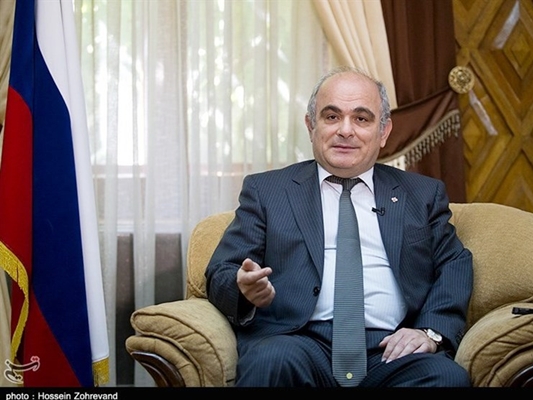
Envoy: Russia Not After Any Military Base in Iran

139506031246222168466124

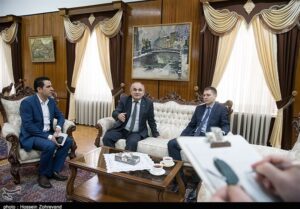
Speaking to the Tasnim News Agency in Tehran, Levan Dzhagaryan stressed that Russia fully respects the Iranian Constitution and the views of Iran’s lawmakers and is friendly toward the Iranian nation.

Russia’s message to the Iranian people and parliamentarians is that they do not need to be concerned because “Russia has never been and will never be seeking a military base in Iran.”

His comments came after announcement of Russian warplanes’ use of Nojeh airbase -near Iran’s western city of Hamedan- for hitting targets in Syria caused a few raised eyebrows.

Elsewhere in his remarks, Dzhagaryan made it clear that the presence of Russian warplanes in Iran had been coordinated with Iran’s Supreme National Security Council (SNSC).

Moreover, the envoy noted, Russian forces were not deployed to Hamedan for leisure, but to carry the joint task of countering terrorist groups.

Dzhagaryan also made it clear that such cooperation between Tehran and Moscow “may repeat in the future” if necessary, with the approval of the two sides’ high-ranking officials.

Pointing to the casualties that Iranian and Russian military forces and advisers have suffered in Syria, the Russian diplomat described joint action by the two countries as “revenge against terrorists.”

139506031248373428466154Reports began circulating last week that Russia’s Tupolev-22M3 bombers and military transport planes have used Iran’s Nojeh airbase for airstrikes against terrorist groups in Syria. The Iranian deployment allows the Russian air force to cut flight times by 60 percent.
Syria has been gripped by civil war since March 2011 with various terrorist groups, including Daesh (also known as ISIS or ISIL), currently controlling parts of it.

Meanwhile, Russia’s aerial support for the Syrian forces since September 2015 has given fresh impetus to the fight against the foreign-backed terrorists.

Iran has also remained a close ally of Syria and supports its legitimate government in the face of militancy.

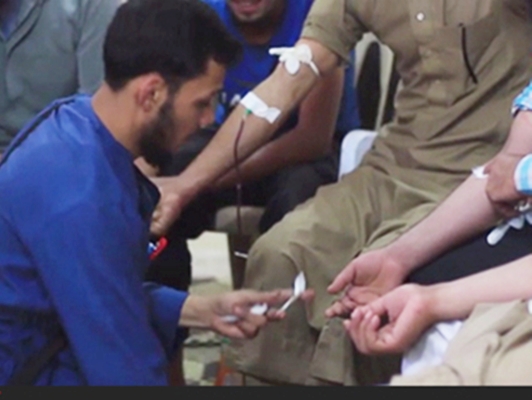
ISIS Forces Citizens to Give Blood to Wounded Fighters (+Video)

isis-blood

The Takfiri [extremist] group, which is known for using people as human shields and sex slaves, is now forcefully taking people’s blood to treat its fighters, as reported by ILNA and translated by IFP.

Whoever refrains from giving his blood will be sentenced by ISIS to 70 lashes.


Russian Bombers Using Iran’s Airbase for Refuelling Only: Cleric

Khatami

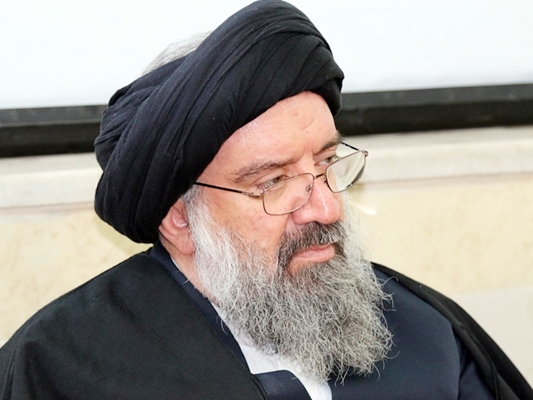
According to a report by IRNA, as translated by IFP, Ayatollah Khatami, who is also a member of Iran’s Assembly of Experts, emphasized that Russian warplanes landed in Nojeh airbase in Hamadan just for refuelling.

“The Islamic Republic of Iran has never dedicated its airbase to Russians’ military operations,” Khatami said in an address in Imam Khomeini’s Mosalla Mosque in Iran’s Western city of Shahr-e Kord.

Refuelling is pretty common and frequently seen in different parts of the world, Khatami said, adding, “Russian warplanes which were heading to Syria for bombing ISIS positions had a brief stop just for refueling.”

On August 16, Tu-22M3 long-range bombers and Su-34 frontline bombers, flying with a full bomb load from the Nojeh airbase located in Iran’s western city of Hamadan, conducted a group air strike against targets of ISIS in Syria.

Will Iran Join Oil Production Freeze Initiative?

166694_orig

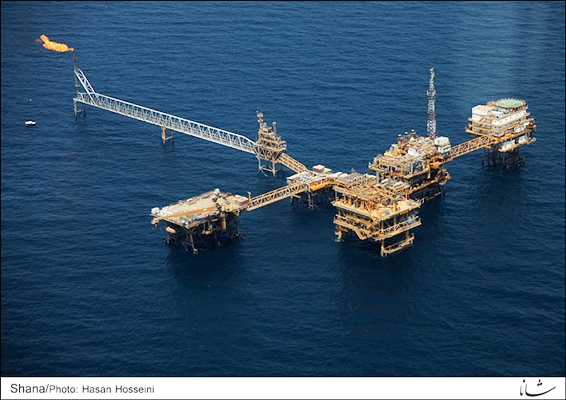
Iran has been ramping up output since the lifting of sanctions in January to reclaim its lost market share, dismissing demands to join the freeze initiative.

In a recent 30-day period (the Iranian month of Khordad), Iran’s oil output exceeded 3.8m bpd, while it used to be 2.7m under the sanctions, as reported by IRNA and translated by IFP.

On Tuesday, August 23, Reuters cited unnamed sources as saying that Iran was sending “positive signals” that it might get behind the push to curb production.

“Though Iran has not yet decided whether to join a new effort, Tehran appears to be more willing to reach an understanding with other oil producers,” the news agency quoted the sources as saying.

Iran, the source said, was on course to reach its pre-sanction production level soon, after which it would join other producers to freeze output.

Iranian officials have already signalled that the country would support the initiative after its crude production reached the level it desired.

The Islamic Republic exported up to 2.3 million barrels per day of crude before sanctions cut it by half in 2012.

On Friday, Reuters said its latest figures confirmed that Iran’s exports had surpassed two million bpd.

Director for international affairs of the National Iranian Oil Company (NIOC) Mohsen Qamsari said Iran’s total exports hit 2.74 million bpd in June. The figure included 0.6 million bpd of condensate.

Qamsari said Iran was still exporting around 0.4 million bpd less than the average it released on the market before sanctions were imposed against the country.

There was no immediate reaction from Iranian officials to Reuters’ report on Wednesday, as reported by Press TV.

Members of the Organization of the Petroleum Exporting Countries are due to meet informally in Algeria next month on the sidelines of the International Energy Forum which groups both producers and consumers.

Reuters quoted an unnamed OPEC source as saying that Iran had confirmed it would participate in the Sept. 26-28 meeting in which members would probably revive talks on freezing oil production levels.

The report caused oil prices to jump on Tuesday. In London, Brent North Sea crude for October rose 80 cents to $49.96 a barrel. US benchmark West Texas Intermediate for October delivery ended up 69 cents from Monday at $48.10 a barrel.

The previous attempt to freeze output collapsed in April after Saudi Arabia insisted that it would join the initiative, supported by non-OPEC producers such as Russia and Venezuela, only if Iran were on board.

The kingdom has reached record production, leading to a collapse in prices which has hit the country hard as well as other producers.

Iran Eyes Nicaragua Rival to Panama Canal

2c647851-6daf-447f-8323-e7cf81dfacb8

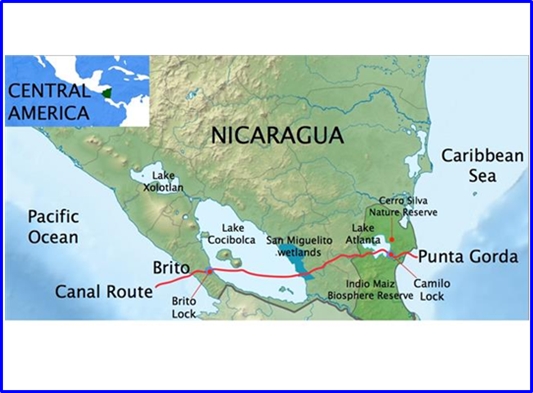
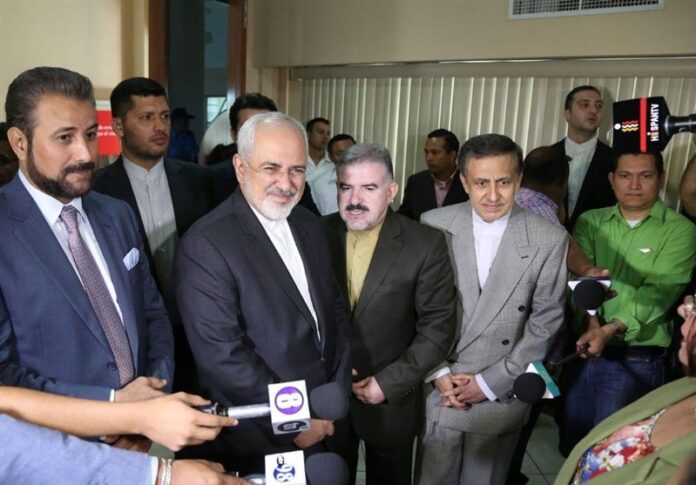
“Cooperation between Iran and Nicaragua can include collaboration in the construction of the [Grand] Interoceanic Canal to the areas of agriculture, energy production, petrochemistry, banking, credit, transportation, food and pharmaceutical industries, and science and technology,” Zarif noted.

Zarif visited Nicaragua on Tuesday, August 23, along with representatives of Iranian companies and discussed their possible involvement in the 50-billion-dollar project which is groomed to rival the Panama pathway.

China’s HKND group is tasked with carrying out the megaproject, with the construction about to begin at the end of this year.


The US and its allies have tried to cast doubt on the project and question its viability.


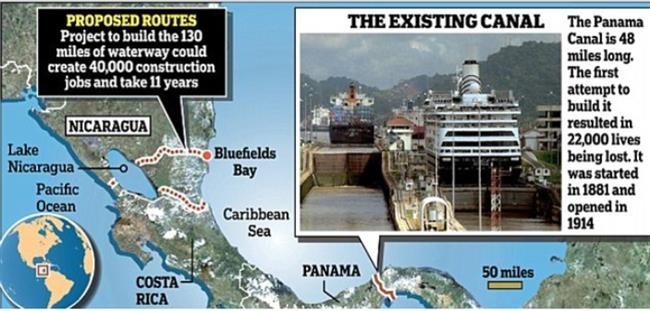
At 172 miles (278 km), Interoceanic Grand Canal is over three times the length of the 100-year-old Panama Canal, which was completed by the United States 34 years after French engineers began it.

The new route is also deeper and wider than the Panama Canal, triggering a flurry of resentment from the US and its allies which have tried to cast doubt on the project and question its viability.

Moreover, China’s involvement would be a direct challenge to the United States, which controlled the Panama Canal until 1999.


Iran Eyes Nicaragua Rival to Panama Canal
Iran’s Foreign Minister Mohammad Javad Zarif (L) and Nicaragua’s Foreign Minister Samuel Santos (R) attend a press conference at the Nicaraguan State Department in Managua, August 23, 2016. (Photo by AFP)


Iran Greatly Values Latin America Ties: Zarif

Speaking in the Nicaraguan capital of Managua on Wednesday and after meeting with his counterpart Samuel Santos López, Zarif said the large politico-economic delegation accompanying him on the trip testifies to the significance that Iran attaches to ties with Nicaragua and other Latin American countries.

The Nicaraguan foreign minister, for his part, said his country had for long been awaiting a visit by the Iranian delegation.

The visit, he said, signalled that Iranian officials and enterprises were determined to expand the Islamic Republic’s already-good relations with countries in the Latin American region.

During his stay in Nicaragua, Zarif also met with René Nuñez Tellez, the head of Nicaragua’s National Assembly (Parliament), as well as the country’s President Daniel Ortega.


Iran Eyes Nicaragua Rival to Panama Canal
Iranian Foreign Minister Mohammad Javad Zarif (R) meets with Nicaraguan President Daniel Ortega (L), in Managua, August 23, 2016.


Zarif has travelled to the region at the head of a high-ranking politico-economic delegation comprising 120 businessmen and financial executives from government and private sectors. The tour started off in Cuba on Monday, and has now taken him to Ecuador.

Zarif is on the landmark tour of six Latin American nations to boost trade relations following the lifting of US-led sanctions on the Islamic Republic.

He started his visit in Havana where he met Cuban leaders, including President Raul Castro in what they described a new chapter in bilateral ties.

His tour of Latin American countries will further take him to Chile, Bolivia, and finally Venezuela.


Iran Eyes Nicaragua Rival to Panama Canal
Iran’s Foreign Minister Mohammad Javad Zarif (C) is welcomed by the Nicaraguan Foreign Affairs Minister Samuel Santos (L) in Managua, Nicaragua on August 23, 2016. (Photo by AFP)


Boosting Trade Profile 

More than 100 representatives of state and private companies are accompanying Zarif in the visit which also includes trips to Chile, Bolivia and Venezuela.

Iran has good relations with almost all Latin American countries, including with Nicaragua where Zarif discussed investment opportunities in a variety of areas.

Zarif told reporters aboard the flight to Cuba that promoting diplomatic and economic relations with Latin American countries is among Iran’s fundamental policies.

“The Islamic Republic of Iran has had strong and age-old relations with the Americas and Latin American states and is determined to expand its relations with and political and economic presence in this important region of the world,” he said.

Zarif said Iranian firms have implemented several projects in Latin American countries over the past few years, and Iran has diplomatic relations with nearly all the counties in the region.

Among the Latin American countries, Iran has developed more advanced ties with Venezuela. The country is involved in a series of joint ventures worth several billion dollars in energy, agriculture, housing, and infrastructure sectors in Venezuela.

In June, Venezuelan President Nicolas Maduro said the Islamic Republic had agreed to a $500 million credit line for his country to finance joint investments there.

Iran’s main industrial projects in Venezuela include a car assembly plant, a tractor manufacturing complex and a cement factory. It has also built more than 3,000 residential housing units for less privileged citizens in Venezuela, with 7,000 more to be completed.


Iran Eyes Nicaragua Rival to Panama Canal
Iran’s FM Mohammad Javad Zarif (L) shakes hands with Cuban President Raul Castro in Havana on August 22, 2016. (Photo by Mehr)


Shared Grievances

Most Latin American states and Iran have shared grievances toward the US because of Washington’s history of supporting authoritarian regimes and engineering coups in those countries and pressuring them through sanctions and other means.

On Monday, Zarif was told in Cuba that US sanctions on the Latin American country and Iran have opened a common ground for the two countries to forge special trade ties.

“Both Cuba and Iran have reached a roadmap after years of sanctions which they should use to explore new economic opportunities and take advantage of each other’s capabilities,” Cuban Minister of Foreign Trade and Foreign Investment Malmierca Diaz said, as reported by Press TV.

The first Iran-Cuba economic forum opened in Havana on Monday, with Diaz telling Iranian companies that they could become the engine of economic growth and dynamism in his country.

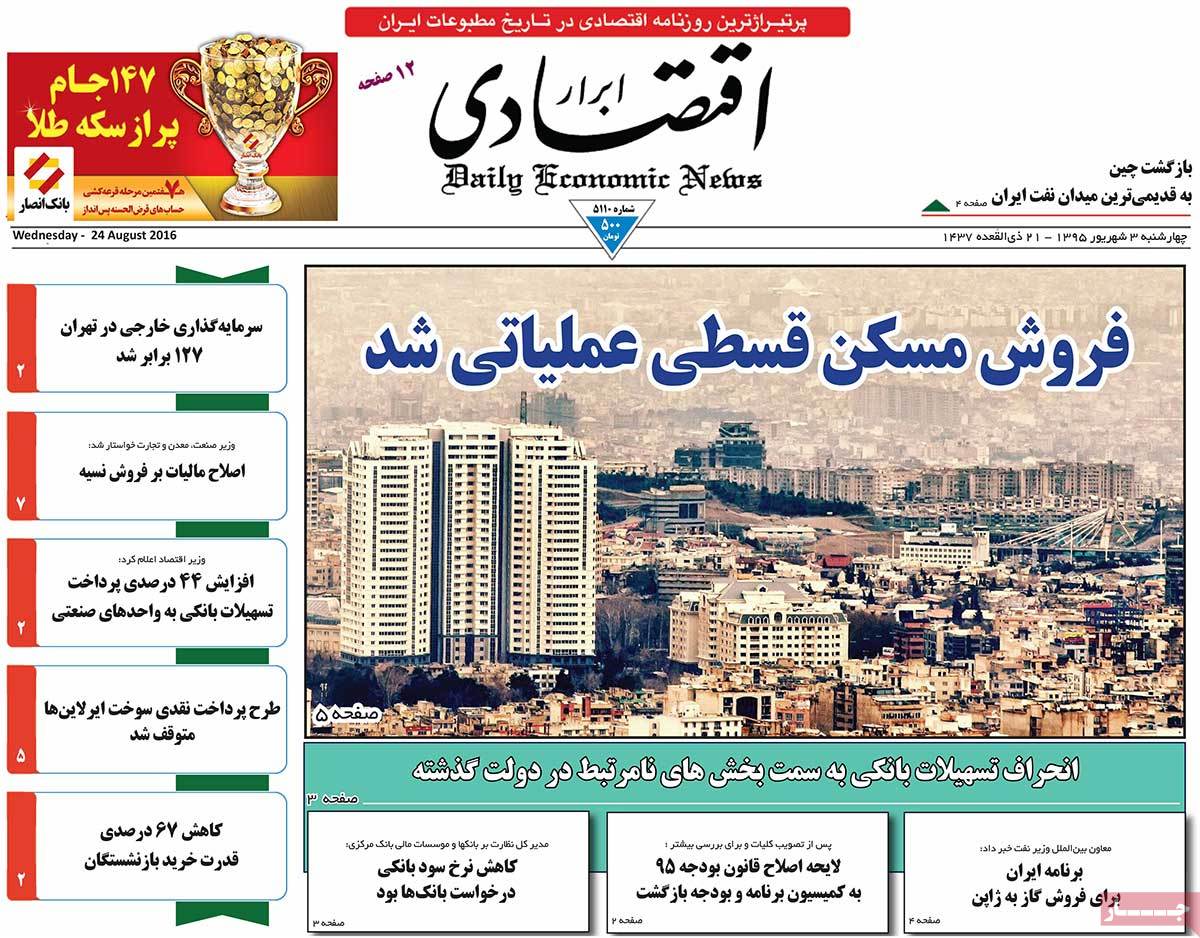
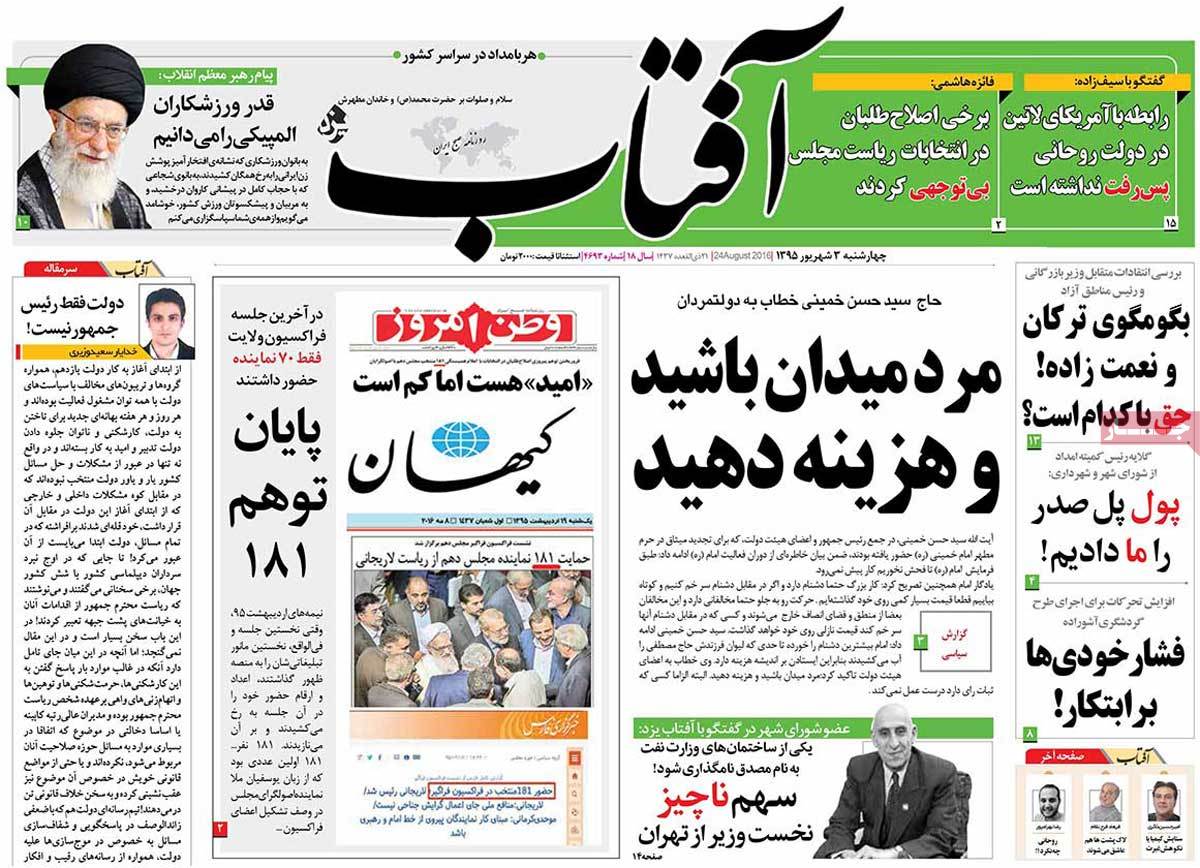
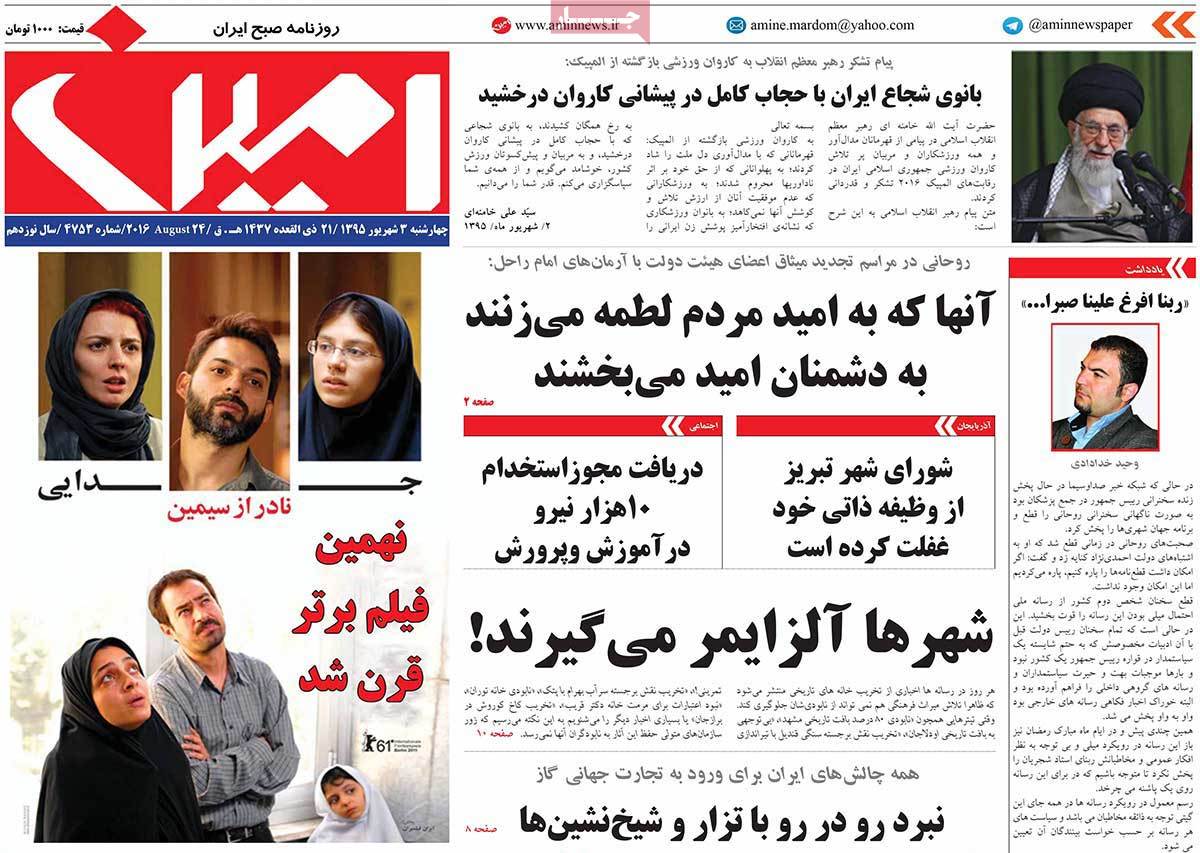
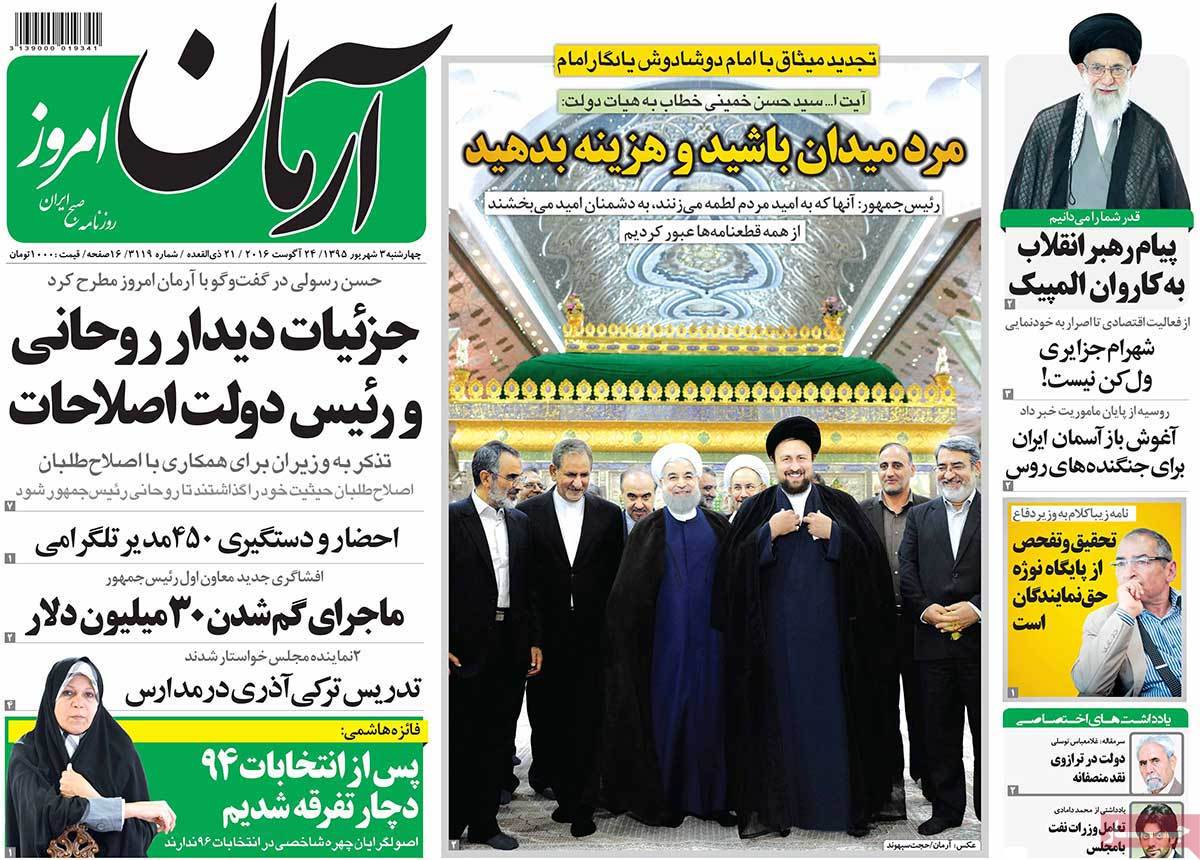
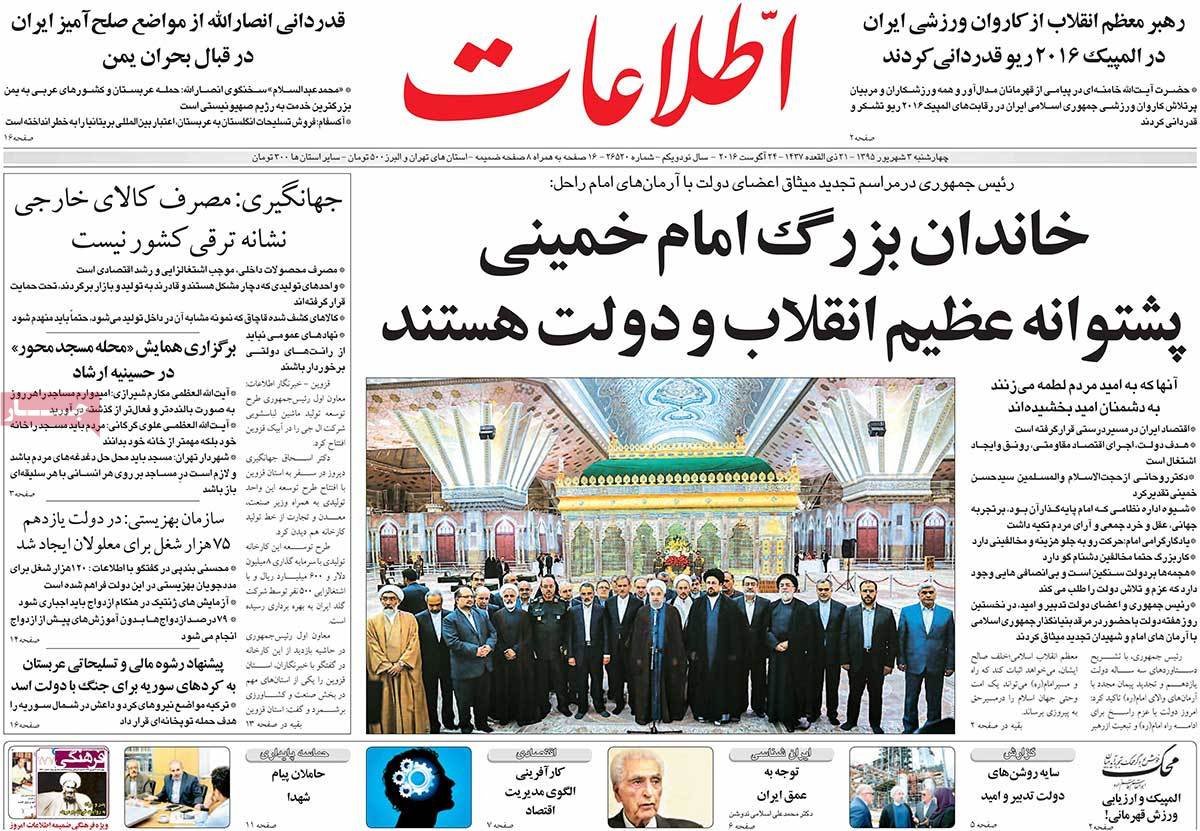
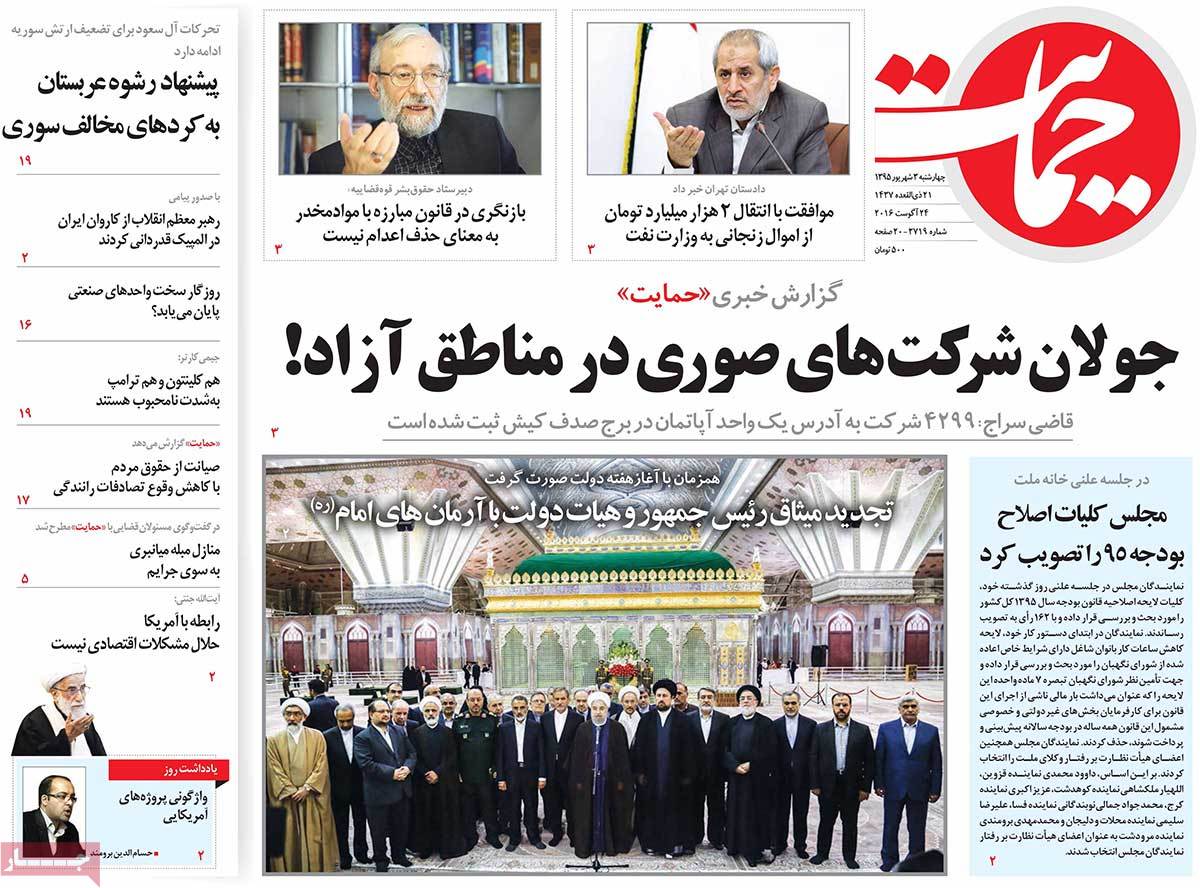
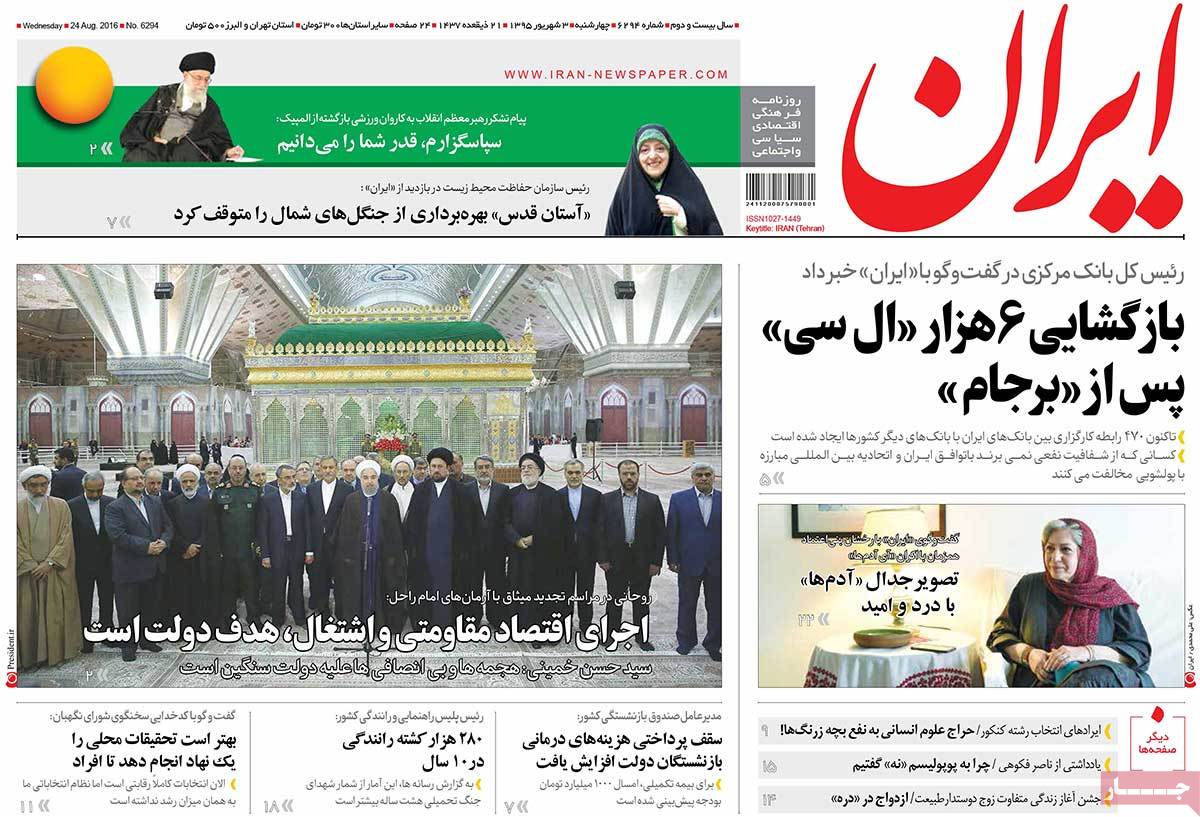
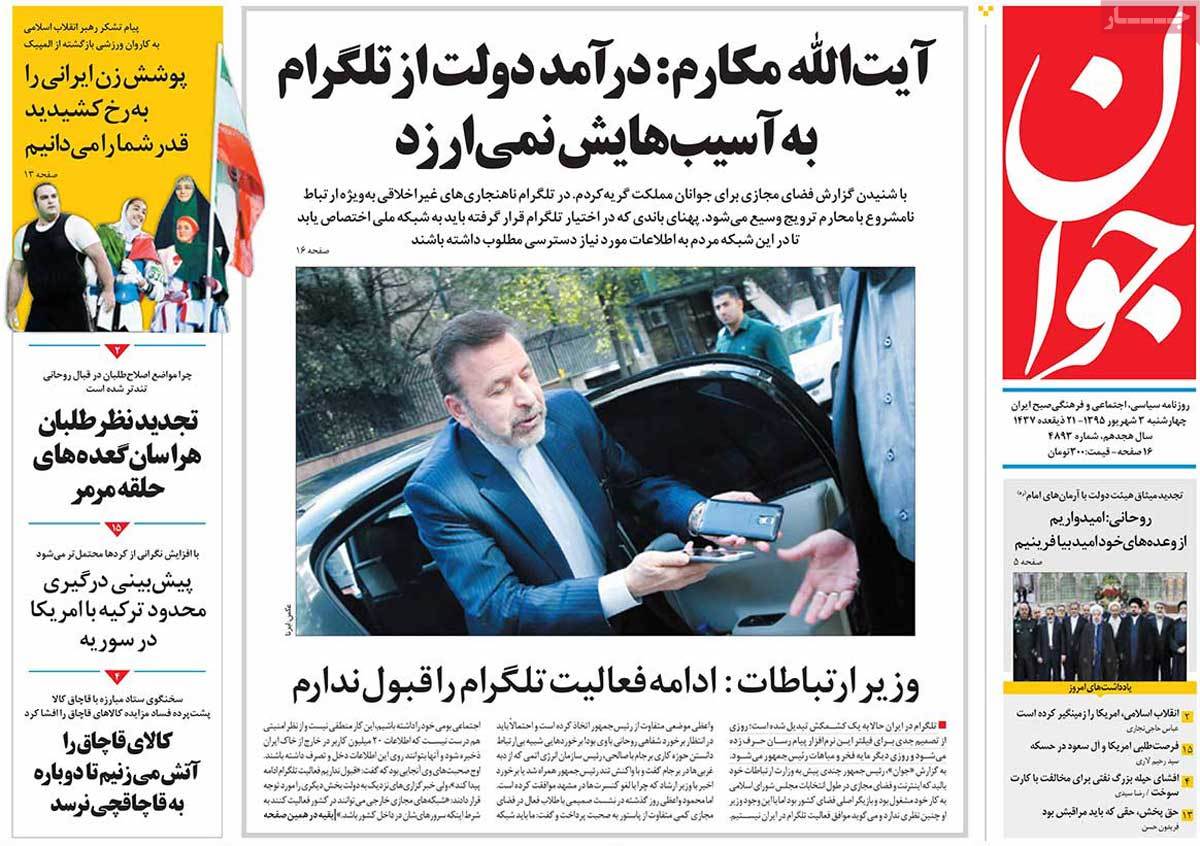
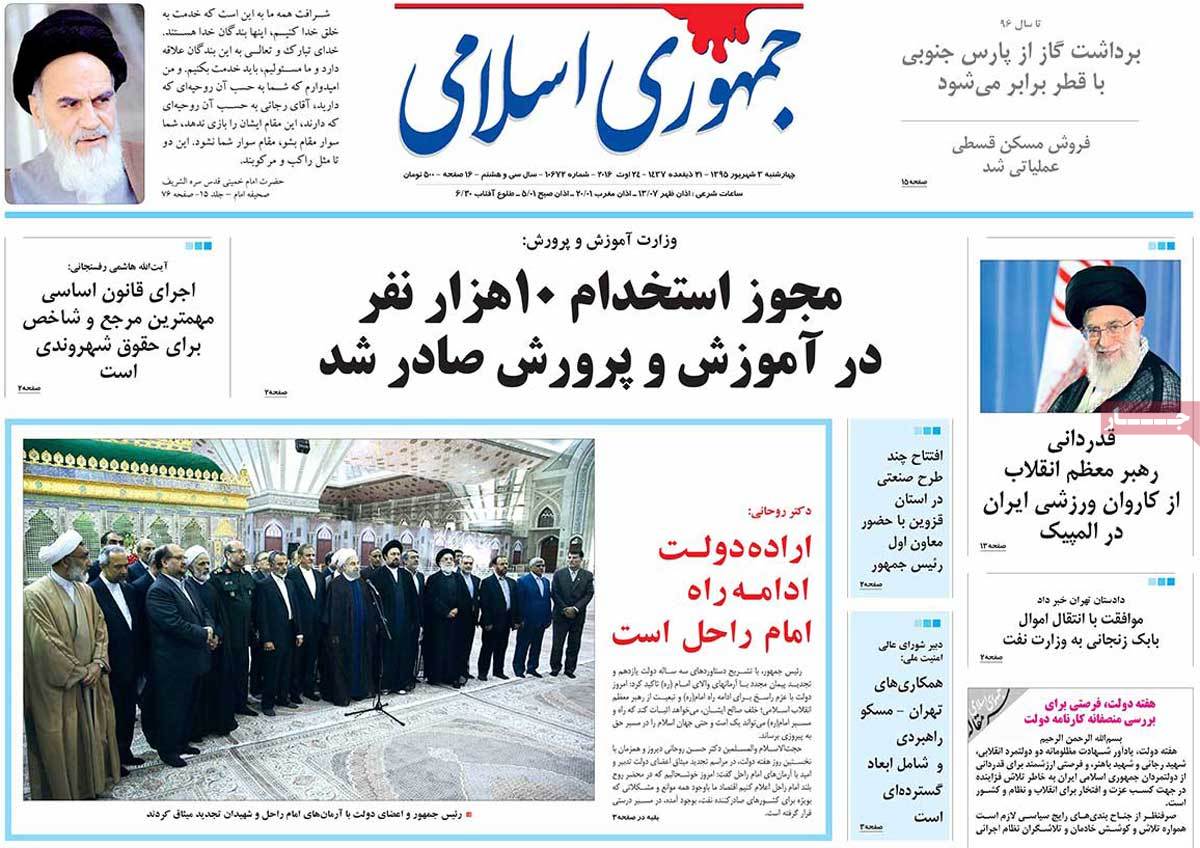
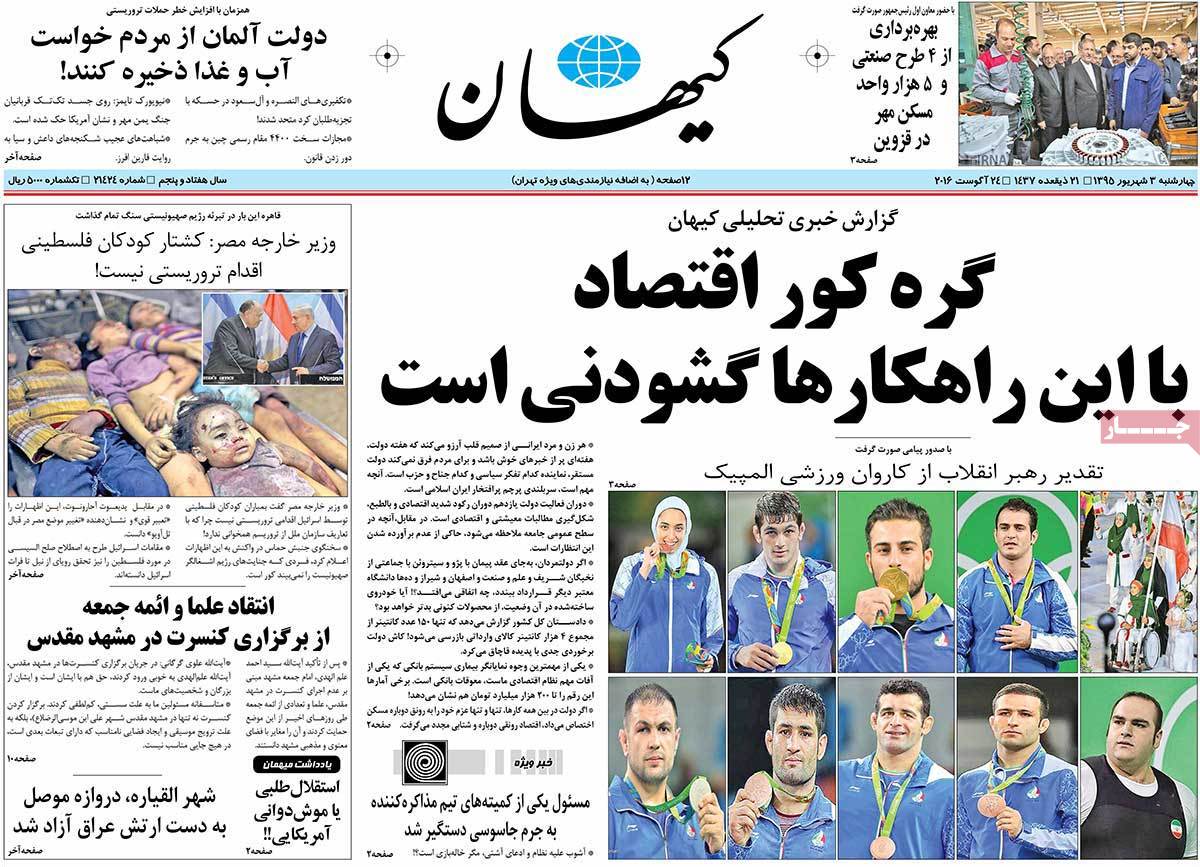
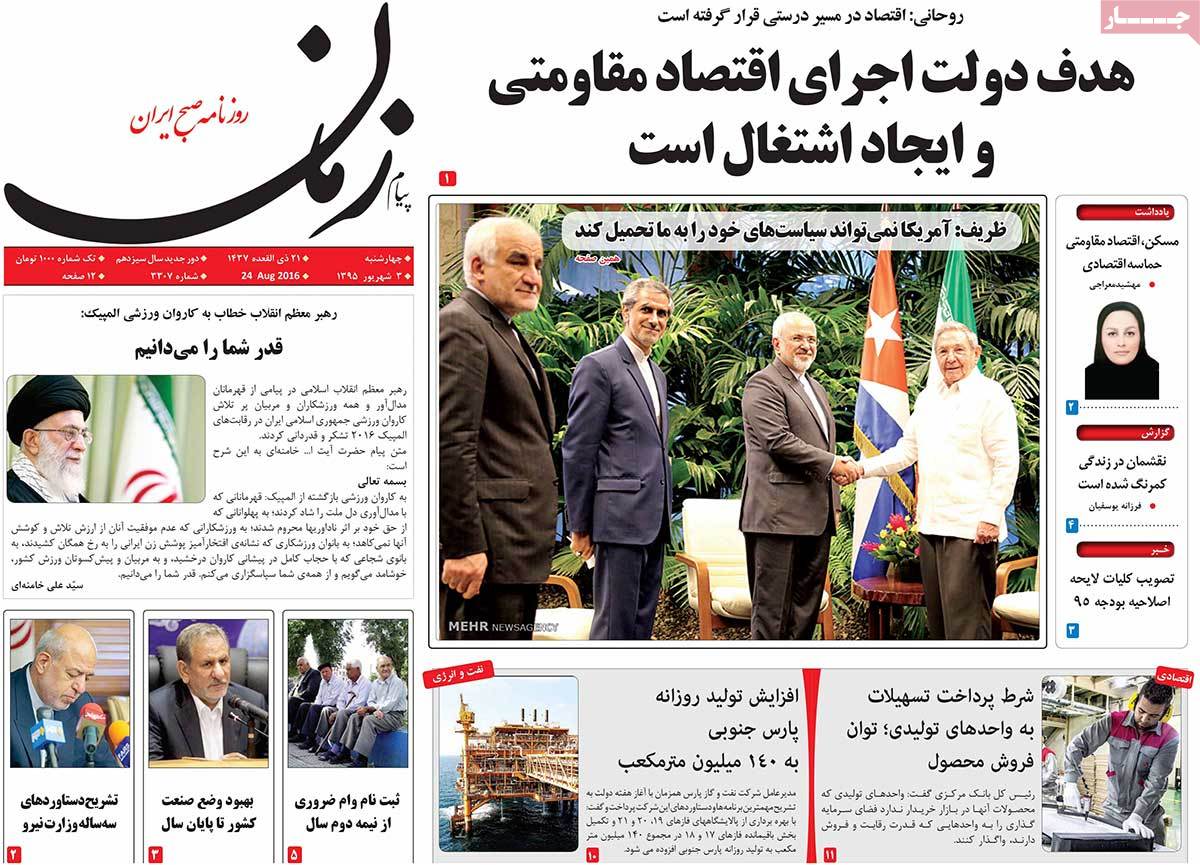
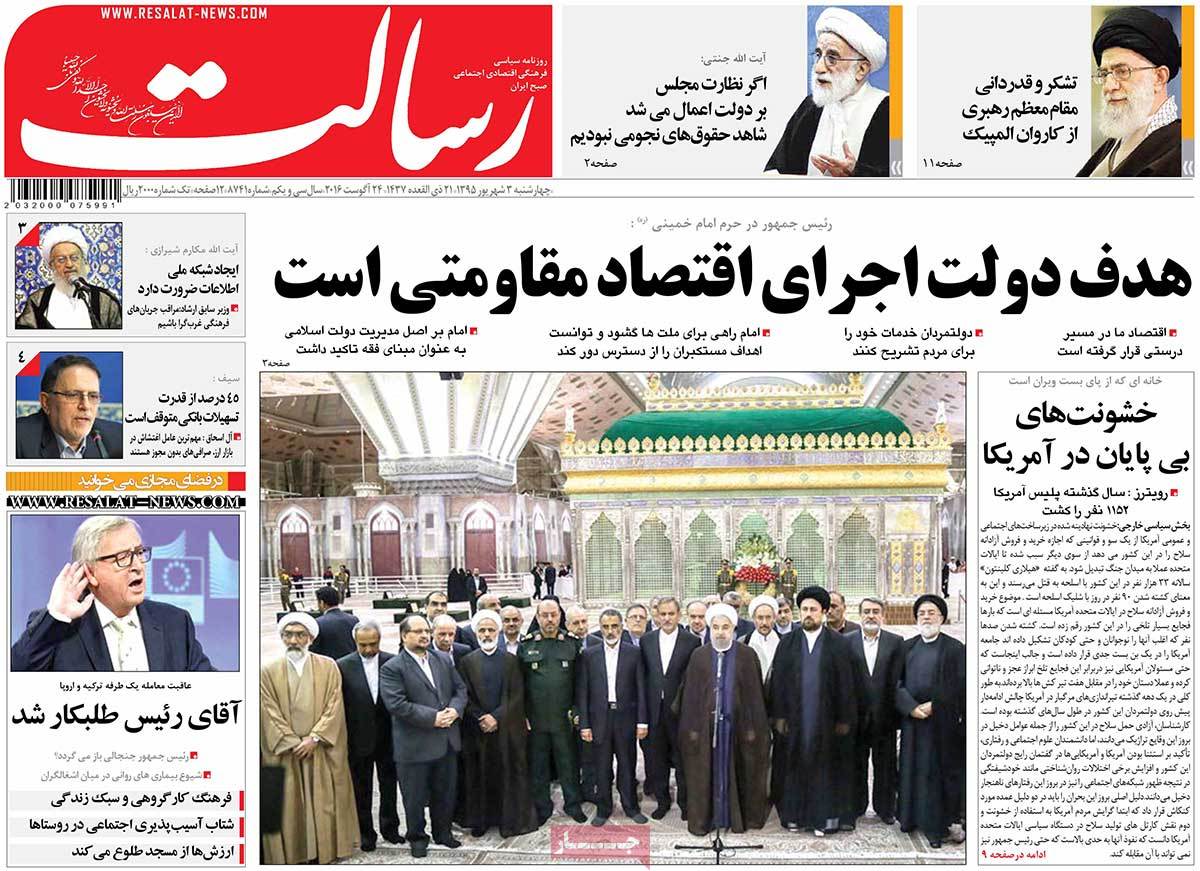
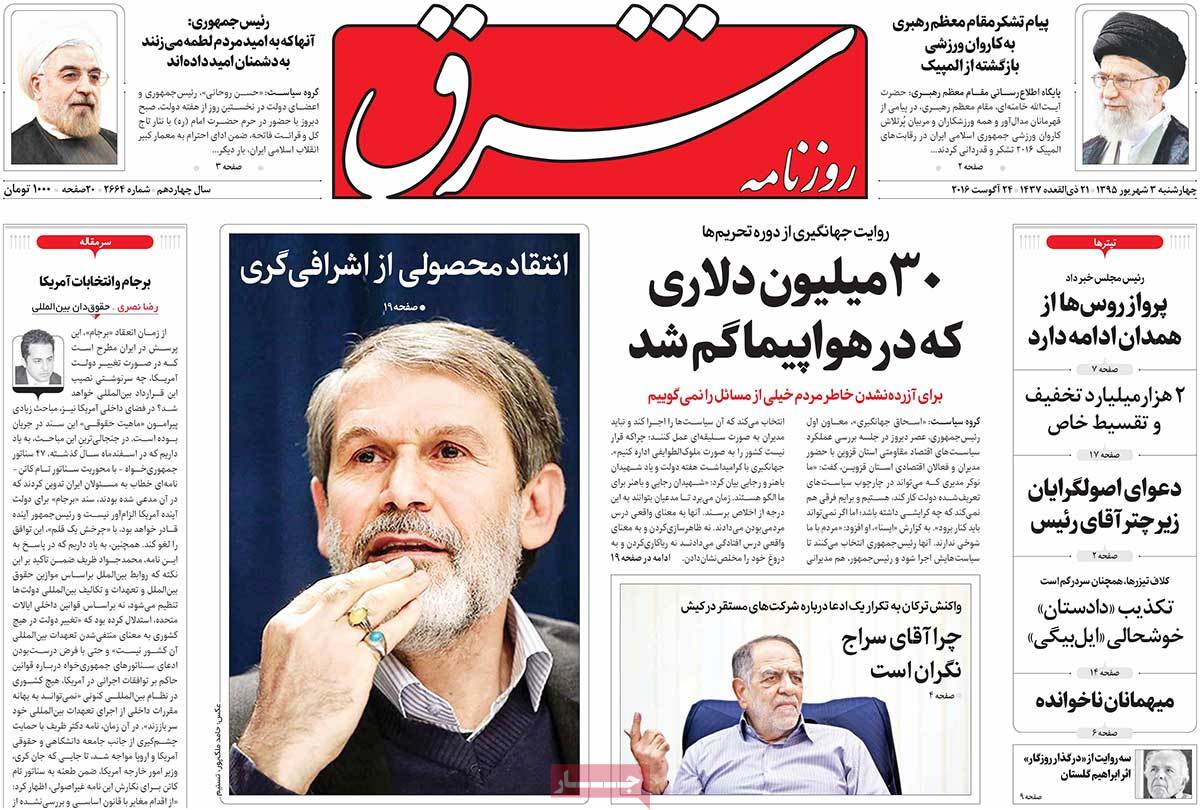
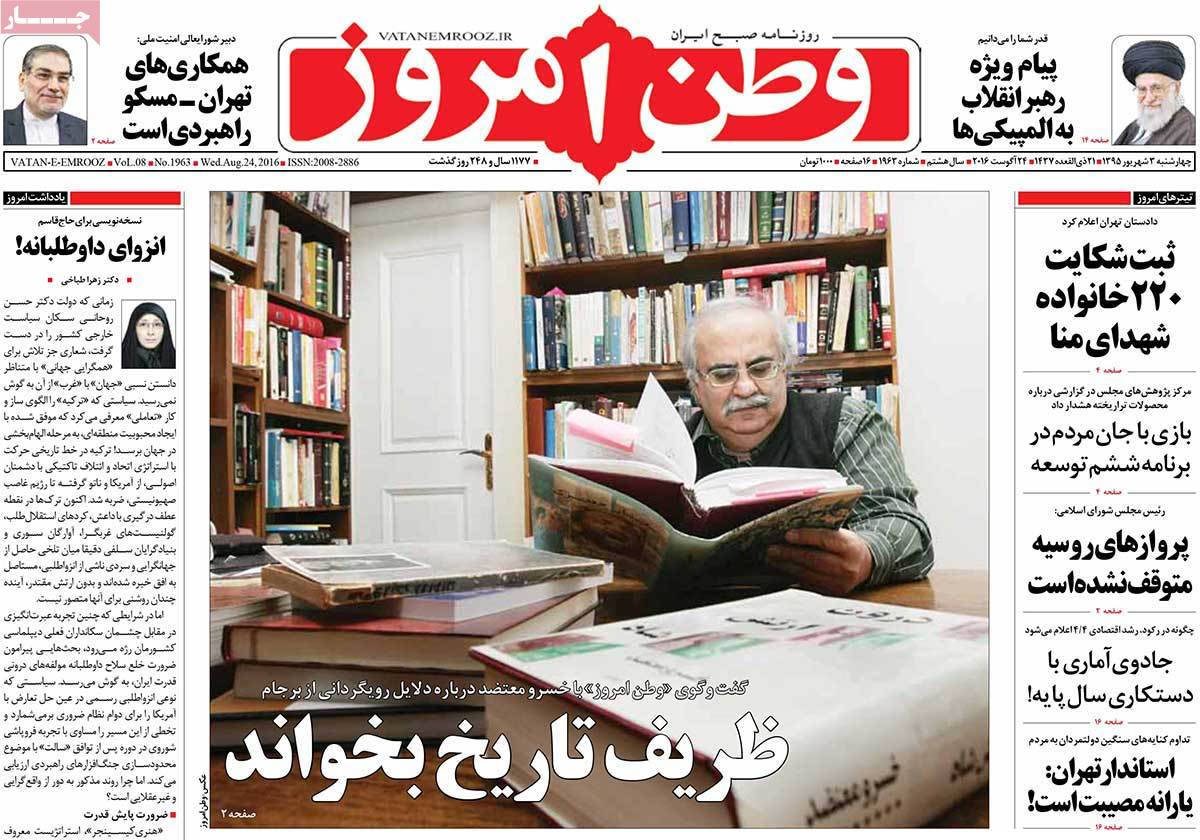
A Look at Iranian Newspaper Front Pages on August 24

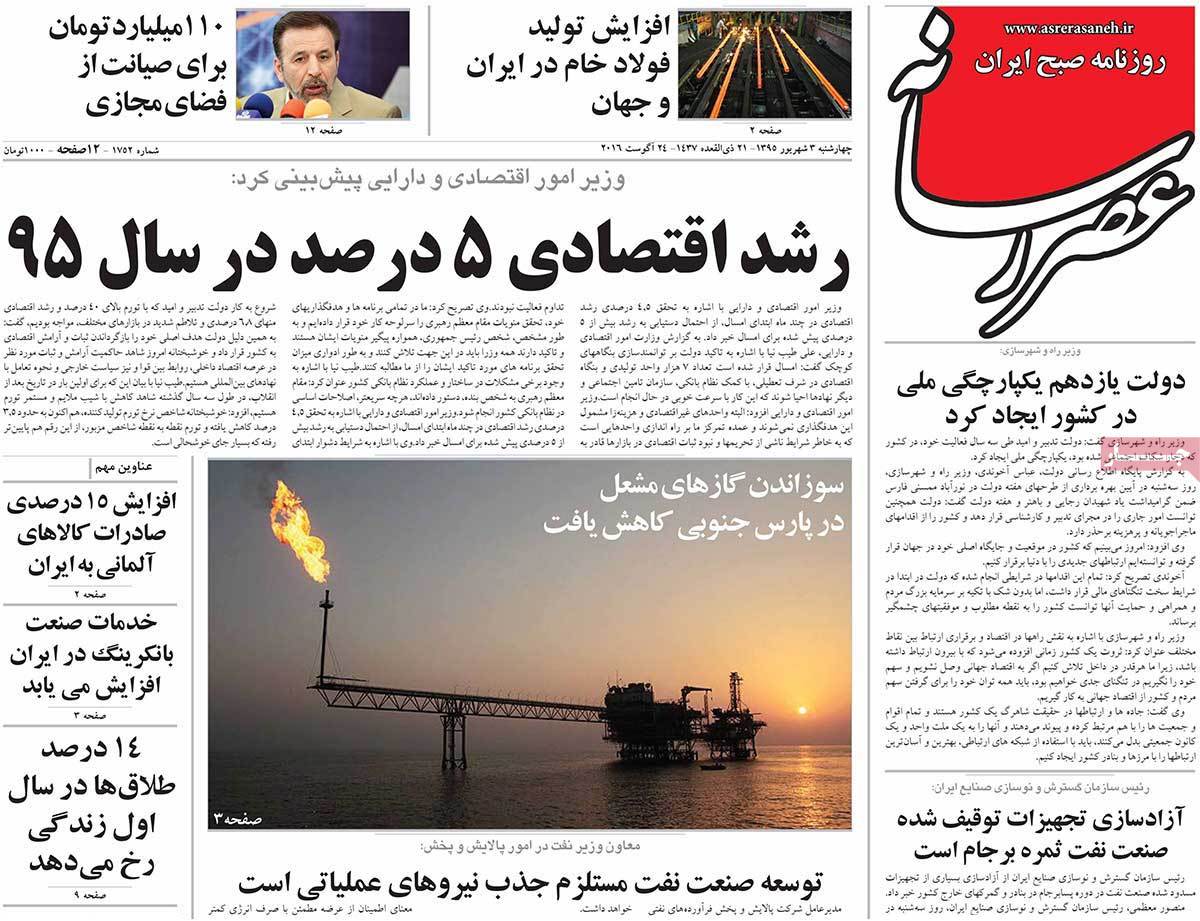
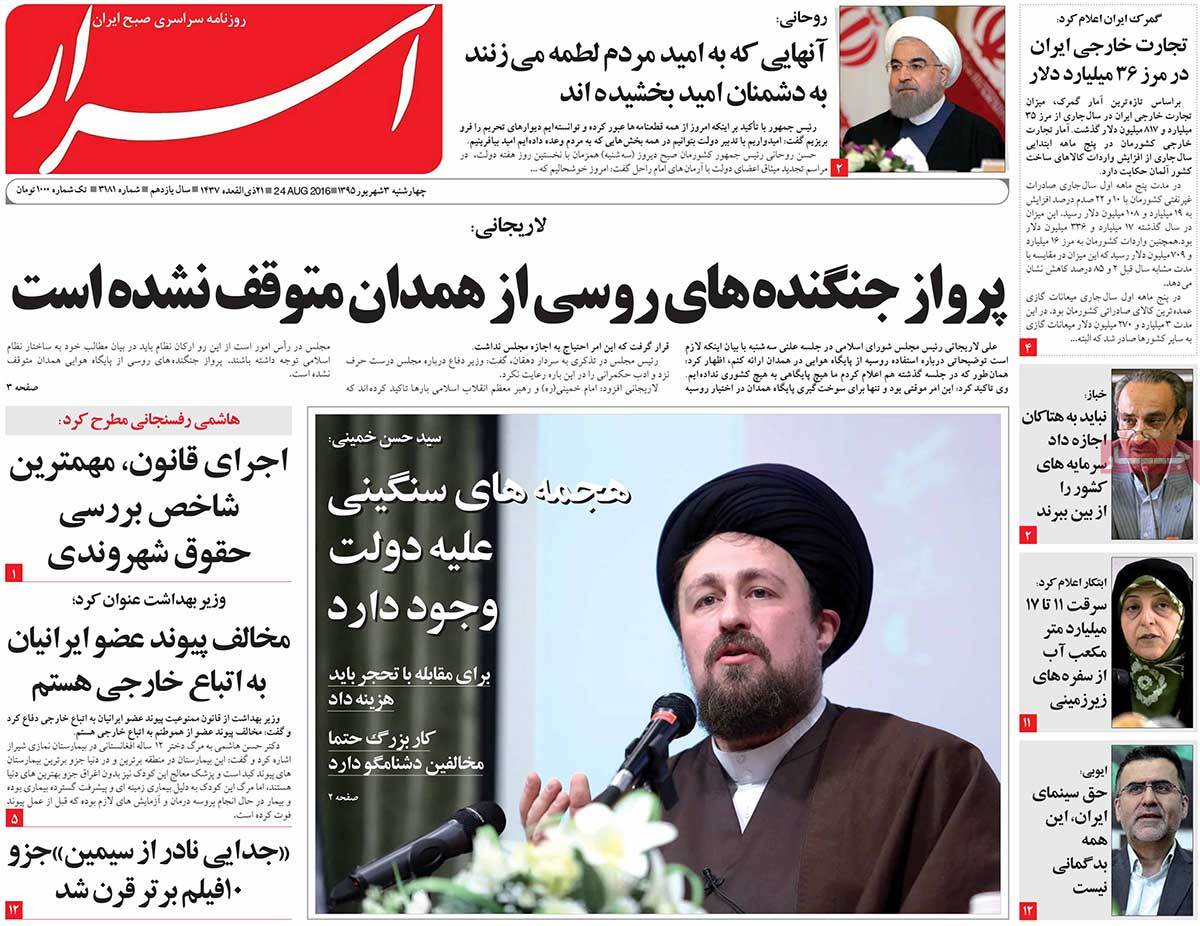
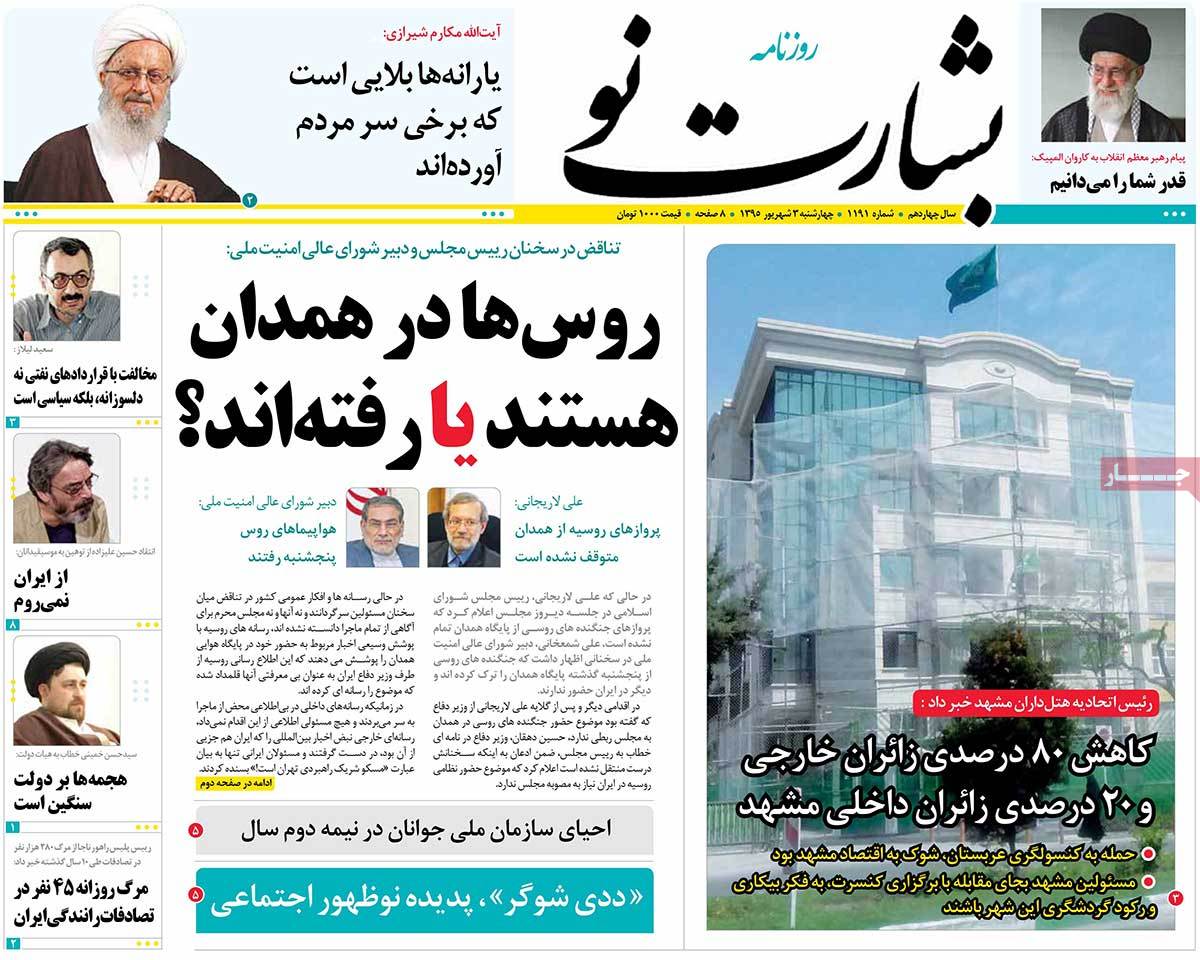
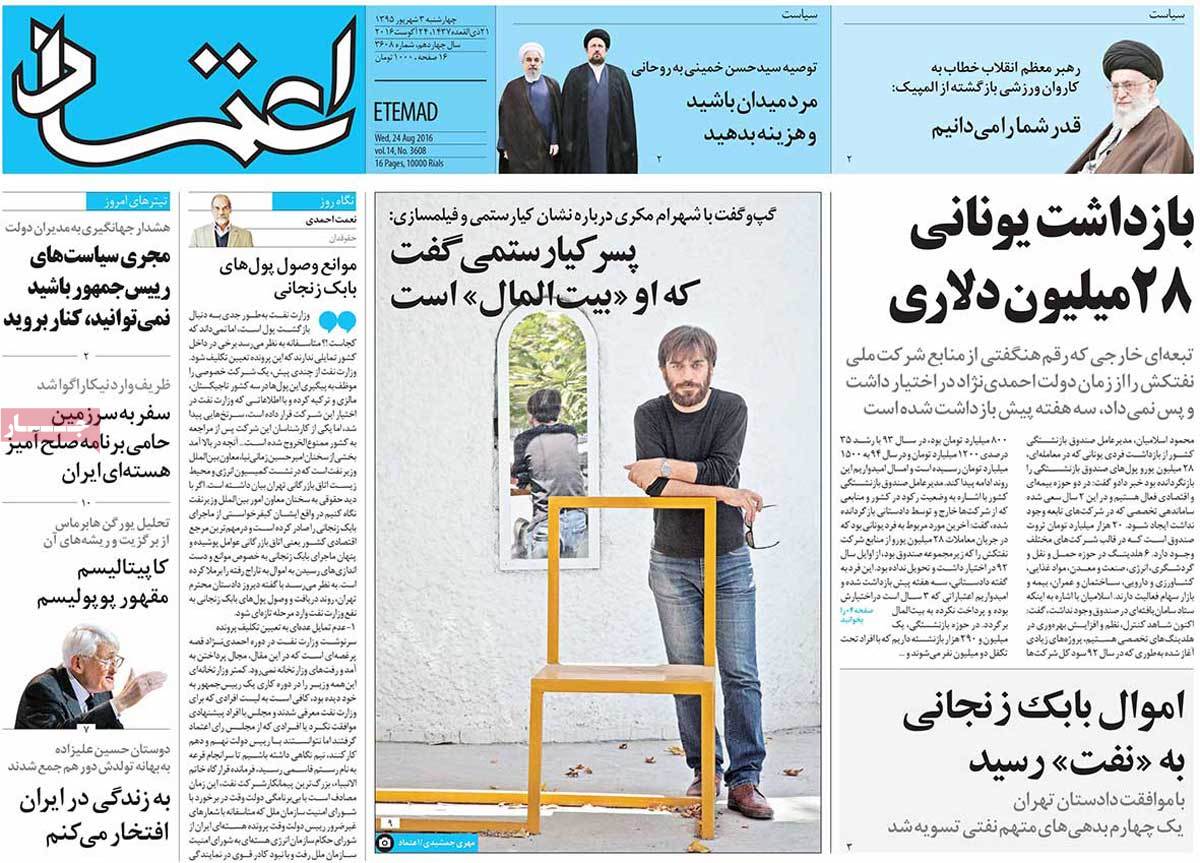
Iran Newspaper front pages

Newspapers on Wednesday covered the message by the Leader of the Islamic Revolution Ayatollah Seyyed Ali Khamenei to the Team Iran, the athletes coming back from Rio 2016 Olympics. The Leader in his message thanked the athletes and praised their efforts.

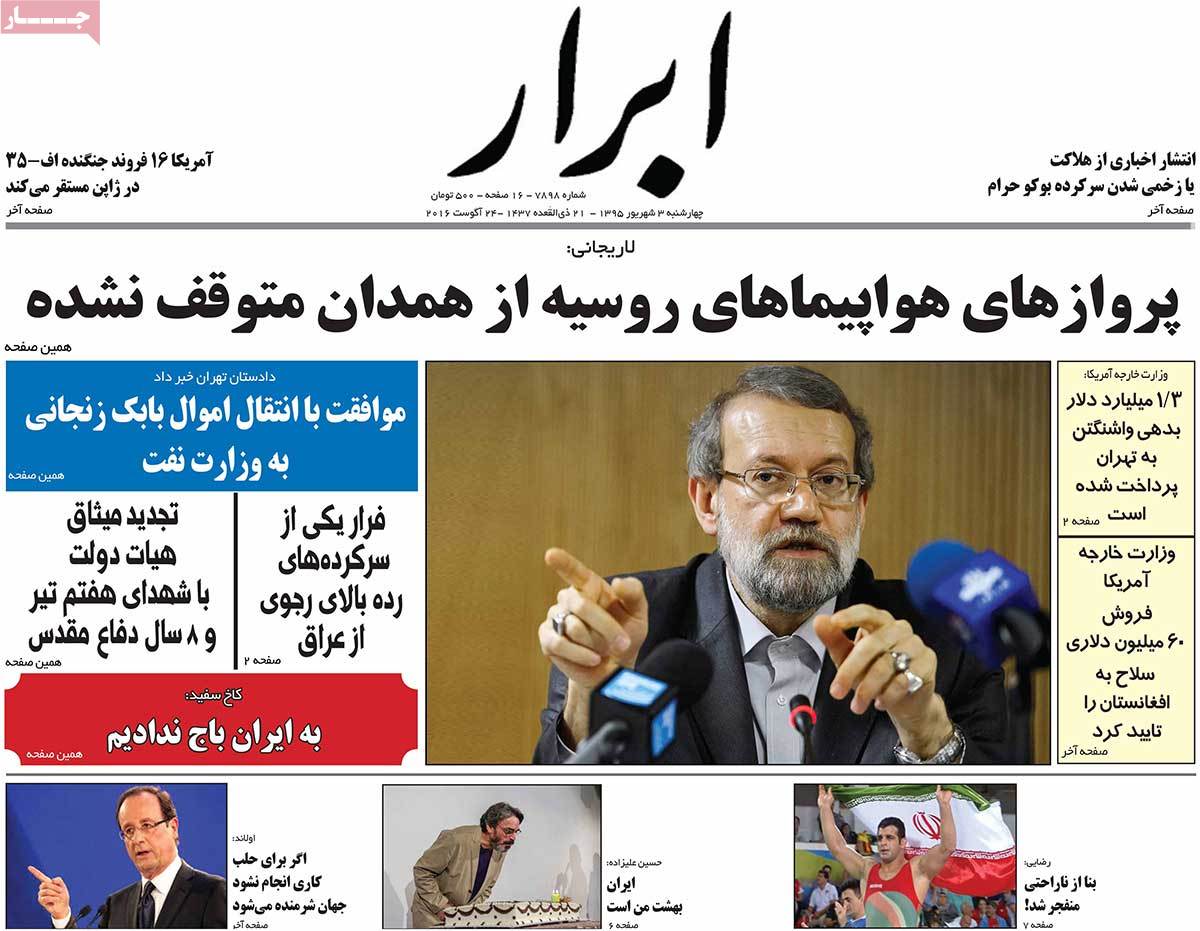
The remarks made by Ali Larijani, the Parliament Speaker, about Russia’s continued use of Iranian airbase also received good coverage today.

Some papers also covered the arrest of a member of Iranian negotiating team on charge of espionage.

The cancellation of concerts in Mashhad, north-eastern Iran, has also remained a top story in many newspapers.

The above issues, as well as many more, are highlighted in the following headlines:


Abrar:

1- Larijani: No Halt to Russian Aircraft’s Use of Hamadan Airbase

2- US State Dept.: Washington Paid $1.3bn of Iran’s Debt

3- Prosecutor-General: Babak Zanjani’s Assets Will Be Given to Oil Ministry

A Look at Iranian Newspaper Front Pages on August 24


Abrar-e Eqtesadi:

1- 127-Fold Increase of Foreign Investment in Tehran

2- China Returns to Iran’s Oldest Oilfield

3- Deputy Oil Minister: Iran’s Plan for Sale of Gas to Japan

A Look at Iranian Newspaper Front Pages on August 24


Aftab-e Yazd:

1- Leader’s Message: We Appreciate Value of Olympic Athletes

2- No Regress in Iran’s Ties with Latin America during Rouhani Term: Analyst

A Look at Iranian Newspaper Front Pages on August 24


Amin:

1- Asghar Farhadi’s ‘A Separation’ Named as 9th Best Film of 21st Century

A Look at Iranian Newspaper Front Pages on August 24


Arman-e Emrooz:

1- Rouhani: Those Who Make People Frustrated Are Giving Hope to Enemies

2- Zibakalam to Defence Minister: It’s MPs’ Right to Probe into Russia’s Use of Hamadan Base

3- 450 Telegram Channel Administrators Arrested and Summoned

A Look at Iranian Newspaper Front Pages on August 24


Asr-e Rasaneh:

1- Increase in Production of Raw Steel in Iran and the World

2- 15% Increase in Export of German Goods to Iran

3- Thanks to JCPOA, Oil Industry’s Frozen Equipment Are Released: Official

4- Rouhani’s Government Created National Integrity in Iran: Minister

A Look at Iranian Newspaper Front Pages on August 24


Asrar:

1- Rafsanjani: Implementation of Law, Most Important Index in Analysing Civil Rights

2- Health Minister: I’m Opposed to Transplant of Iranian People’s Body Organs to Foreign Nationals

3- Ebtekar: 11 to 17 Billion Cubic Metres of Water Stolen from Aquifers

4- Iran’s Customs Office: Iran’s Foreign Trade Is near $36bn

A Look at Iranian Newspaper Front Pages on August 24


Besharat-e Now:

1- Economist: Opposition to Oil Contracts Isn’t out of Compassion, But Politically-Motivated

2- 45 People in Iran Die in Car Accidents Every Day: 280,000 Killed by Road Crashes in Past 10 Years

3- 80% Decrease in Number of Foreign Tourists, and 20% in that of Iranian Ones Visiting Mashhad: Hotel Syndicate Chief

  • Attack on Saudi Consul Was a Shock to Mashhad’s Economy
  • Mashhad Officials Should Better Think about Unemployment and Downturn of Tourism in the City rather than Confrontation with Concerts

A Look at Iranian Newspaper Front Pages on August 24


Etemad:

1- A Greek National Arrested for Refusing to Repay $28bn of Iran’s Money

2- First VP Warns Government Executives: Implement President’s Policies, If You Can’t, Just Leave

A Look at Iranian Newspaper Front Pages on August 24


Ettela’at:

1- President Rouhani: Imam Khomeini’s Family Is a Great Backing for Revolution and Government

2- 75,000 Jobs Created for the Disabled during Rouhani’s Government: Official

3- Ansarullah Praises Iran’s Peaceful Stances towards Yemen Crisis

A Look at Iranian Newspaper Front Pages on August 24


Hemayat:

1- Human Rights Official: Revision in Law of Fight against Illicit Drugs Doesn’t Mean Removal of Death Penalty

2- Al Saud’s Moves to Weaken Syrian Army Continue: Saudi Arabia Offers Bribe to Syrian Kurdish Opposition

3- 1 Single Apartment Registered for 4,299 Companies in Kish Island [Free Trade Zone]: Judiciary

4- Ayatollah Jannati: Ties with US Don’t Resolve Iran’s Economy Problems

A Look at Iranian Newspaper Front Pages on August 24


Iran:

1- CBI Governor: 6,000 LCs Opened after JCPOA

A Look at Iranian Newspaper Front Pages on August 24


Javan:

1- Ayatollah Makarem Shirazi: Telegram Messenger App’s Harms Are More than Its Benefits [The Grand Ayatollah said he has cried when he heard the report on young Iranians’ use of cyberspace. He said unethical behaviours, particularly un-Islamic relationships, are spreading in Telegram. The bandwidth given to Telegram should be dedicated to National Information Network]

2- ICT Minister: I Don’t Accept that Telegram Continues Its Operation in Iran [under current circumstances]

3- We Set Fire on Smuggled Goods to Prevent It from Reaching Smugglers’ Hands Once Again

A Look at Iranian Newspaper Front Pages on August 24


Jomhouri Eslami:

1- Rouhani: Government Pursuing Imam Khomeini’s Path

2- SNSC Secretary: Tehran-Moscow Cooperation Is Strategic and Includes Extensive Aspects

A Look at Iranian Newspaper Front Pages on August 24


Kayhan:

1- Clerics and Friday Prayer Imams Criticize Holding Concerts in Holy City of Mashhad

2- German Gov’t Asks People to Reserve Water and Food after Increased Threats of Terrorist Attacks

3- Member of Iranian Negotiating Team Arrested for Espionage

A Look at Iranian Newspaper Front Pages on August 24


Payam-e Zaman:

1- Zarif: US Cannot Impose Its Policies on Us

2- South Pars Gas Field’s Daily Output Increased to 140mcm

A Look at Iranian Newspaper Front Pages on August 24


Resalat:

1- Ayatollah Jannati: If Parliament Had Oversight over Government, We Wouldn’t Have Astronomical Salaries

2- Endless Violence in US: US Police Killed 1,152 People Last Year, Reuters Says

A Look at Iranian Newspaper Front Pages on August 24


Shargh:

1- First VP: $30m Was Lost in a Plane under Sanctions

2- We Don’t Tell People Many of the Problems So as Not to Upset Them: Jahangiri

A Look at Iranian Newspaper Front Pages on August 24


Vatan-e Emrooz:

1- Zarif Should Read History: Historian on Reasons for JCPOA Backlash

2- Tehran Prosecutor-General: 220 Families of Mina Tragedy Victims File Lawsuit

A Look at Iranian Newspaper Front Pages on August 24

Iran to Support Investment in Nicaragua

139506030050561318462494

The Iranian government will facilitate and guarantee investment by the private sector companies in Nicaragua and will support the implementation of agreements between the Iranian and Nicaraguan enterprises, Zarif said in Managua on Tuesday night.

He made the comments at a conference on the opportunities for Iran-Nicaragua economic cooperation, after paying a visit to the Central American nation’s parliament.

The conference was attended by a big delegation of Iranian business people and economic officials accompanying Zarif in a tour of Latin America, senior Nicaraguan officials and members of the Chamber of Commerce.

The top Iranian diplomat also noted that the gathering provided a good opportunity for the two countries to get acquainted with each other’s capabilities and carry out joint economic projects.

Elsewhere in the conference, Nicaraguan President Daniel Ortega’s son, Laureano Ortega, who holds the post of presidential adviser for foreign investment, said his country is open to the presence of Iranian companies.

He also noted that the services offered by the Iranian companies with expertise in construction, renewable energy industry and agriculture, fully match Nicaragua’s needs.

Zarif arrived in Nicaragua on Tuesday in the second leg of his six-nation tour of Latin America, after paying a visit to Cuba.

The top Iranian diplomat will visit Ecuador, Chile, Bolivia, and Venezuela afterwards.

Iran’s Foreign Ministry has announced that the tour of Latin America signifies Tehran’s plans to boost non-oil exports.