Friday, December 26, 2025
Home Blog Page 4230

A Look at Iranian Newspaper Front Pages on November 24


Almost all newspapers covered the remarks made by the Leader of the Islamic Revolution Ayatollah Seyyed Ali Khamenei about the reaction Iran will show in case the US violates the nuclear deal.

They also highlighted the Judiciary Chief’s harsh criticism of President Hassan Rouhani and Parliament Speaker Ali Larijani over their remarks about the cancellation of outspoken MP Ali Motahari’s speech in Mashhad.

The death of prominent moderate cleric Ayatollah Mousavi Ardabili also received great coverage. His death prompted President Rouhani to declare two days of national morning in Iran.

The above issues, as well as many more, are highlighted in the following headlines:


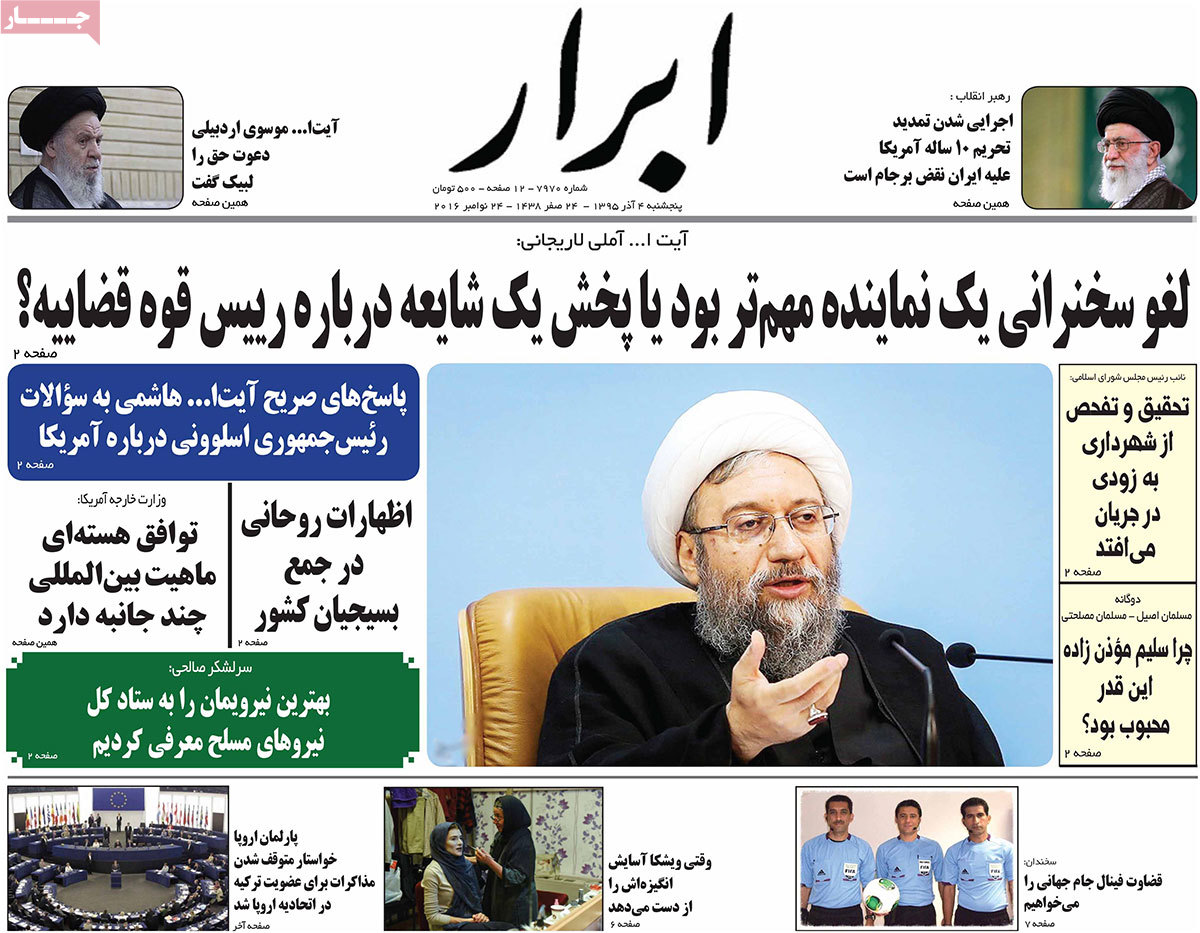
Abrar:

1- Parliament to Start Its Investigation of Tehran Municipality

2- Ayatollah Rafsanjani’s Clear Answers to Slovenian President about the US

3- Nuclear Deal Has a Multilateral International Nature: US State Dept.
A Look at Iranian Newspaper Front Pages on November 24


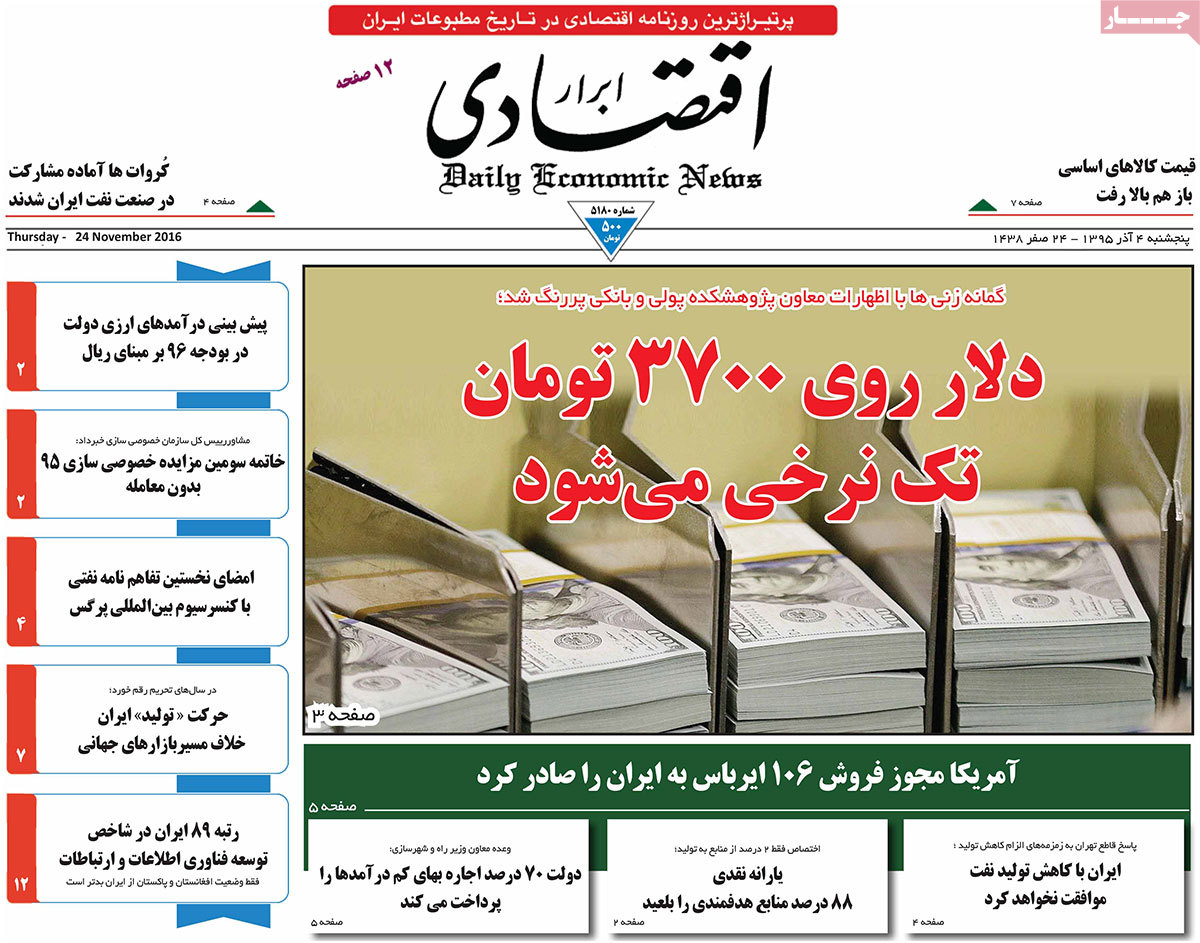
Abrar-e Eqtesadi:

1- Croats Ready to Invest in Iran’s Oil Industry

2- Iran Won’t Agree with Oil Production Cut: Tehran’s Firm Reaction to Rumours

3- Government to Fund 70% of House Rent Expenses for Low-Income People
A Look at Iranian Newspaper Front Pages on November 24


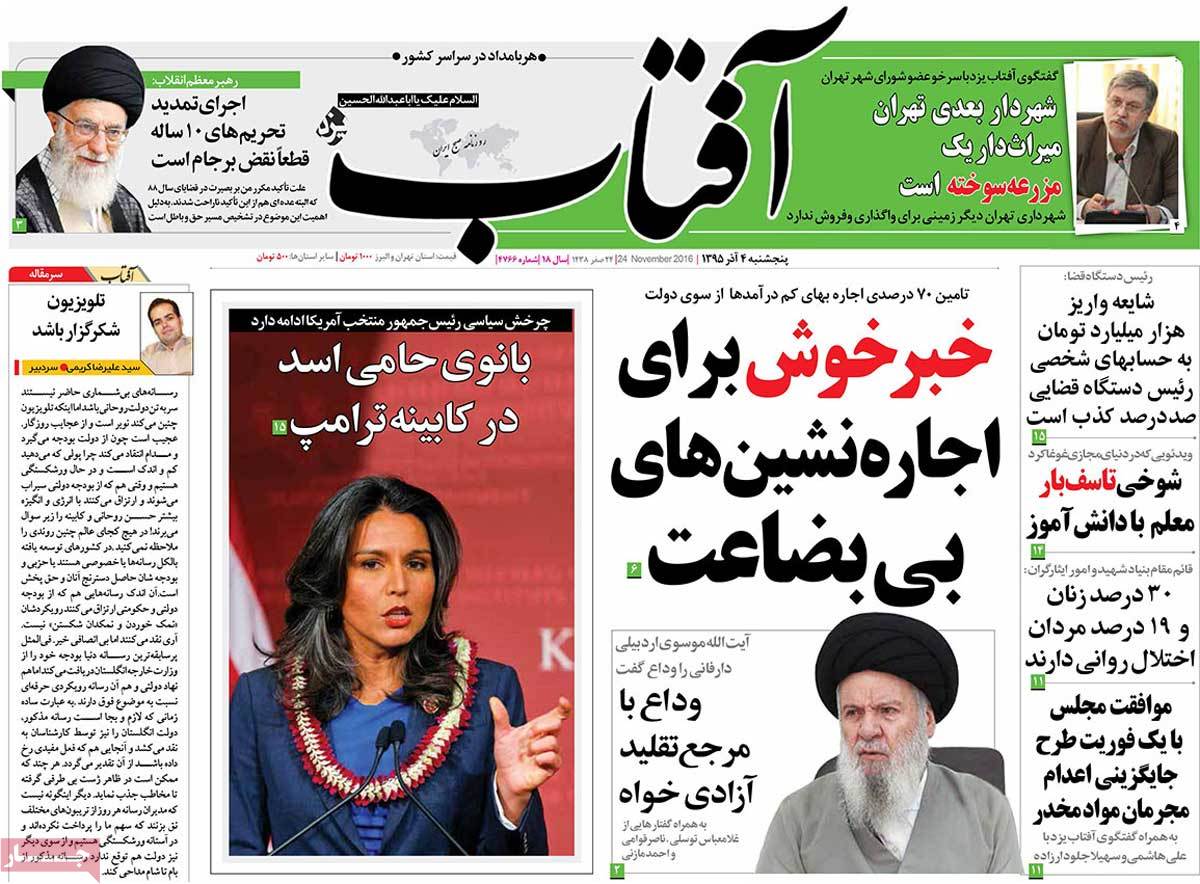
Aftab-e Yazd:

1- Pro-Assad Woman in Trump’s Cabinet: President-Elect Continues His Political Turnaround

2- Farewell to a Freedom-Seeking Cleric: Ayatollah Mousavi Ardabili Passes Away

3- Teacher’s Regrettable Joke with Pupil: A Video Clip that Went Viral in Iran

4- Parliament to Discuss a Plan that Devises Alternative Punishments to Death Penalty for Drug-Related Crimes
A Look at Iranian Newspaper Front Pages on November 24


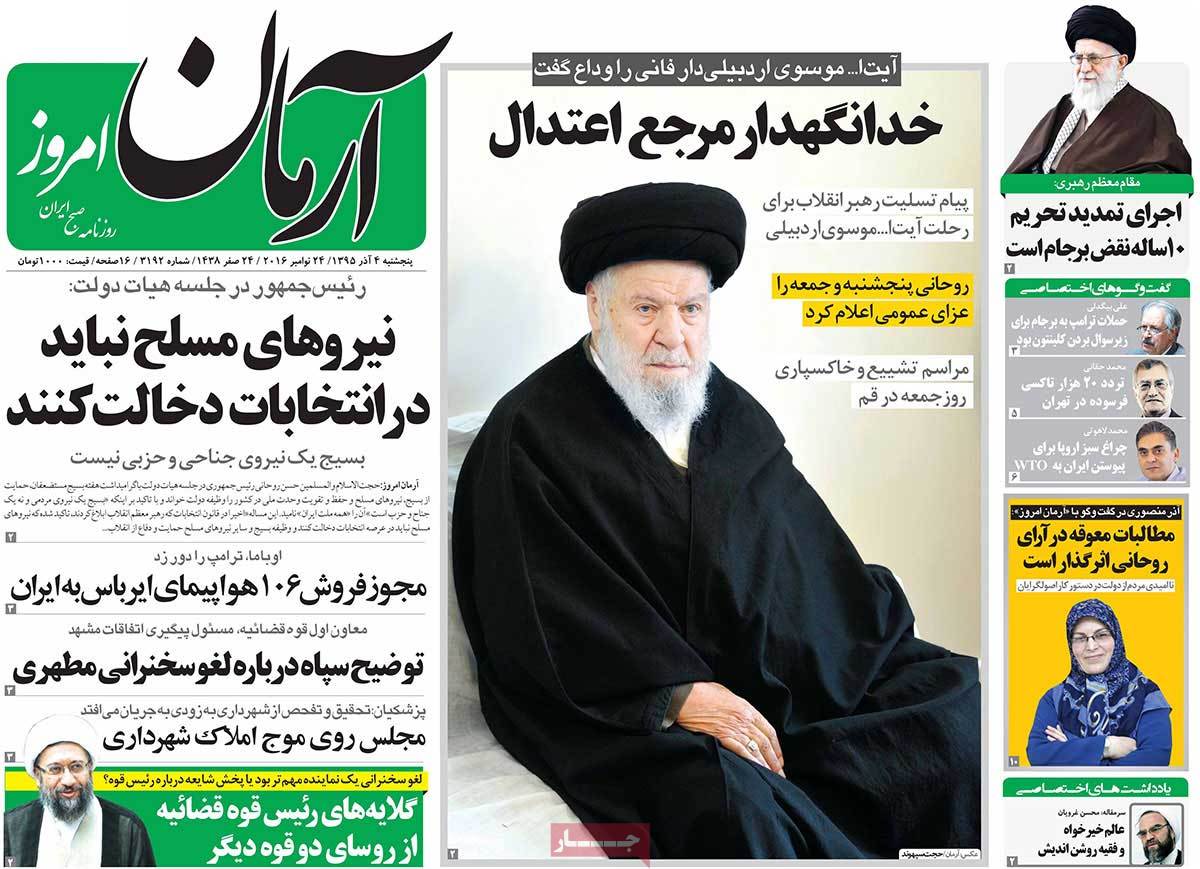
Arman-e Emrooz:

1- Goodbye the Cleric of Moderation: Rouhani Declares Two Days of National Mourning after Mousavi Ardabili’s Death

2- Armed Forces Should Not Interfere in Iran Elections: President Rouhani

3- Permission Given to Airbus for Sale of 106 Planes to Iran

4- IRGC Explains about Cancellation of Motahari’s Speech in Mashhad

5- Iranian Judiciary Chief’s Complaints against President and Parliament Speaker

6- Europe Gives Greenlight for Iran’s Accession to WTO

7- Trump’s Attacks on JCPOA Were Aimed at Questioning Clinton
A Look at Iranian Newspaper Front Pages on November 24


Asrar:

1- Basij (Volunteer) Forces Are Not Part of Any Iranian Party: Leader

2- IRGC’s Intelligence Organization Had No Role in Cancellation of Motahari’s Speech in Mashhad: Spokesman

3- Increasing Speculations about Rigged Ballot Boxes in US

4- Saudi Arabia Lost Its Influence in OPEC: Bloomberg
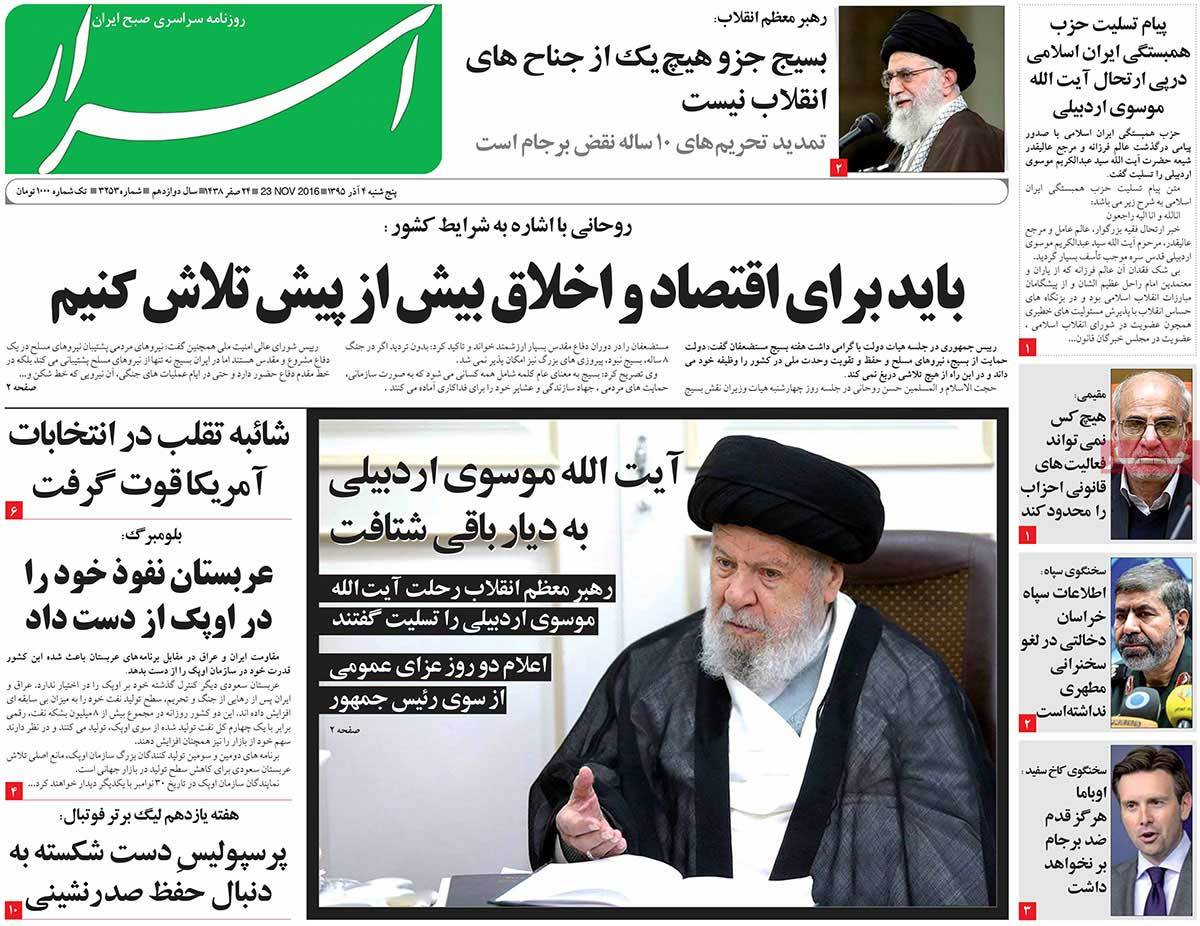
A Look at Iranian Newspaper Front Pages on November 24


Ebtekar:

1- Stopping Death Penalty for Drug Traffickers: Positive or Negative?

2- Cold Slap of Weather: Sub-Zero Temperature Threatens Lives of over 25,000 Homeless People in Tehran
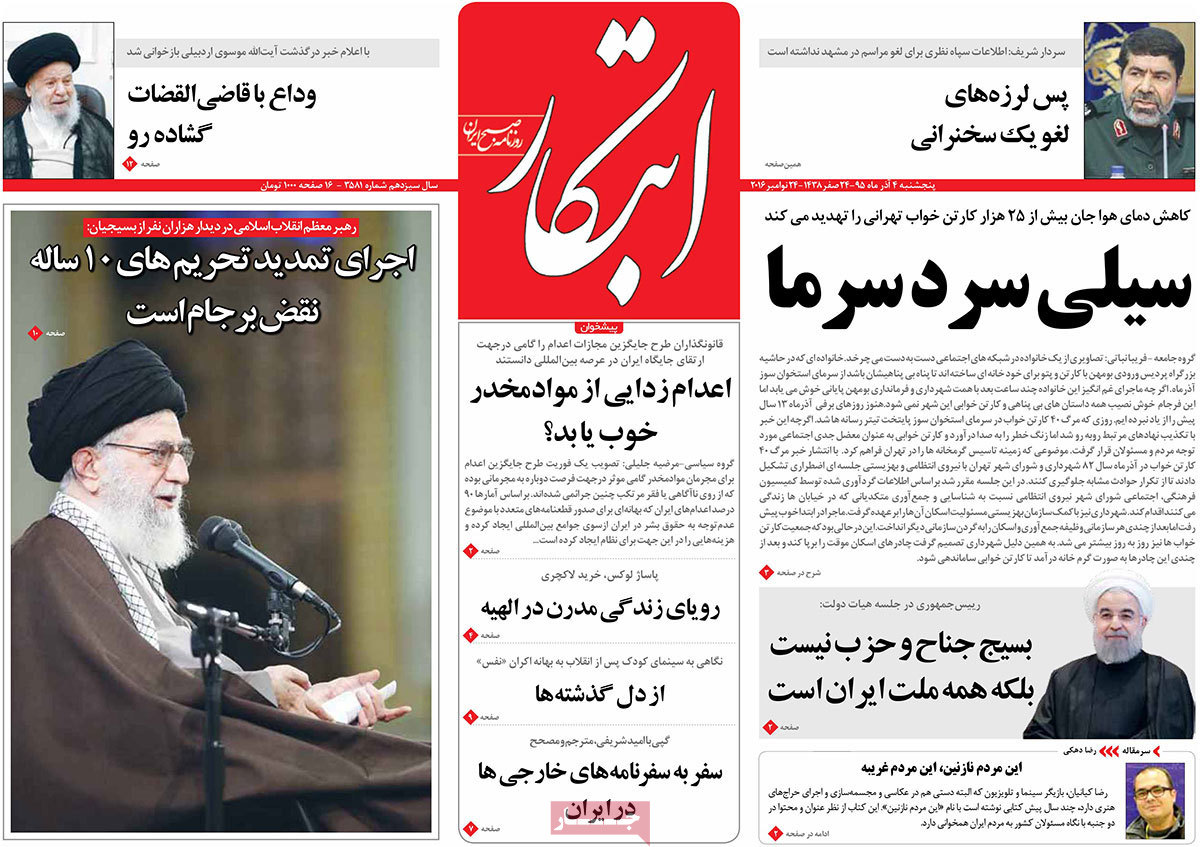
A Look at Iranian Newspaper Front Pages on November 24


Emtiaz:

1- Death Business for Becoming Hercules: Horrible Side-Effects of Using Body Building Powders

2- 80% Increase in Electronic Trade in Iran

3- 30% of Women Suffering from Neurological Disorders

4- 1,800 Beggars in Tehran Are under 15 Years of Age
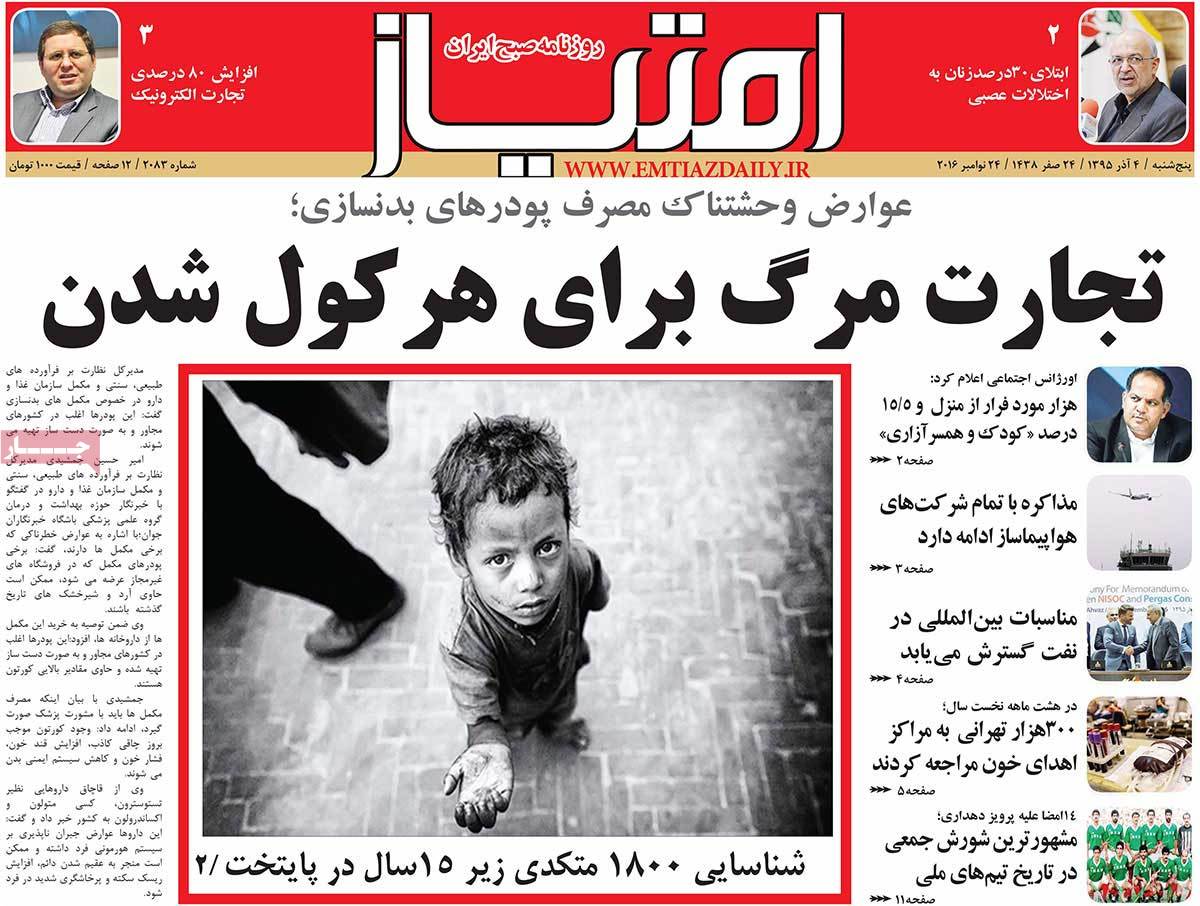
 

A Look at Iranian Newspaper Front Pages on November 24


Ettela’at:

1- Implementation of US Law on Sanctions against Iran Violates Nuclear Deal: Leader

2- Egyptian President Officially Supports Assad’s Army against Terrorists

3- General Soleimani: It’s a National Duty to Support Basij (Volunteer) Forces
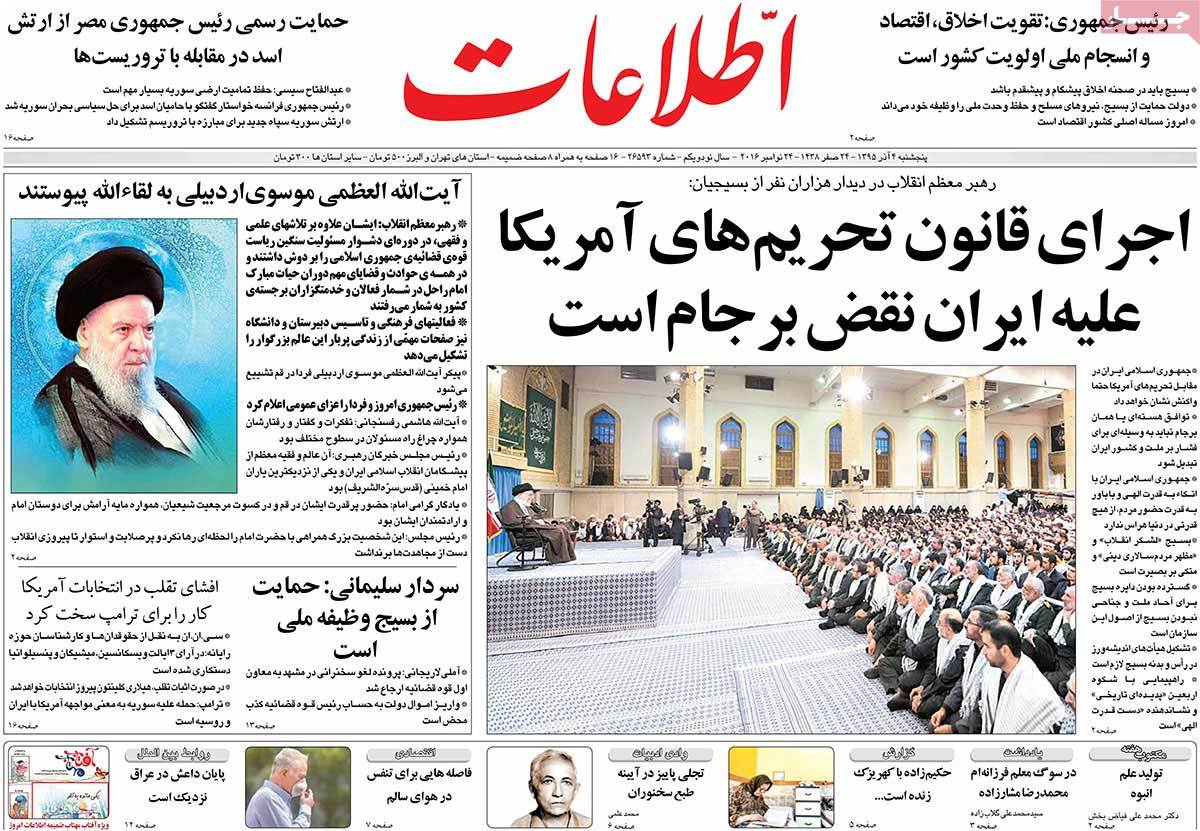
A Look at Iranian Newspaper Front Pages on November 24


Haft-e Sobh:

1- Secrets of Iranian Birdmen: Interview with Iran’s First Wingsuit Athlete

2- Oil Reconciliation with Britain: BP Gives Greenlight to Iran’s Oil Industry

3- Iranian Cities of Hamadan and Mashhad Are Now Colder than Moscow and Toronto
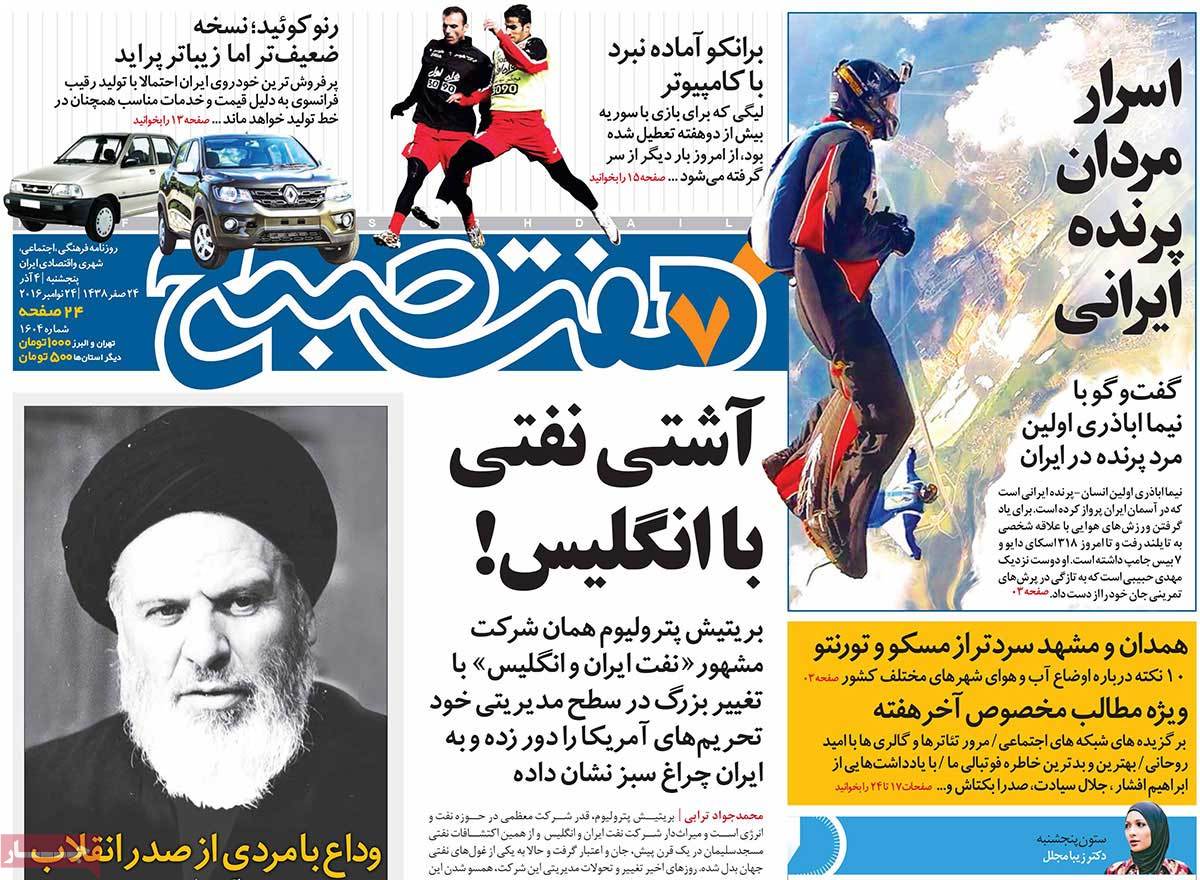
A Look at Iranian Newspaper Front Pages on November 24


Hamshahri:

1- Call 137 to Save Homeless People from the Cold

2- ISIS in Mosul Trap

3- Death Penalty Will Be Restricted

4- Parliament’s Major Step to Restore Clean Air to Megacities
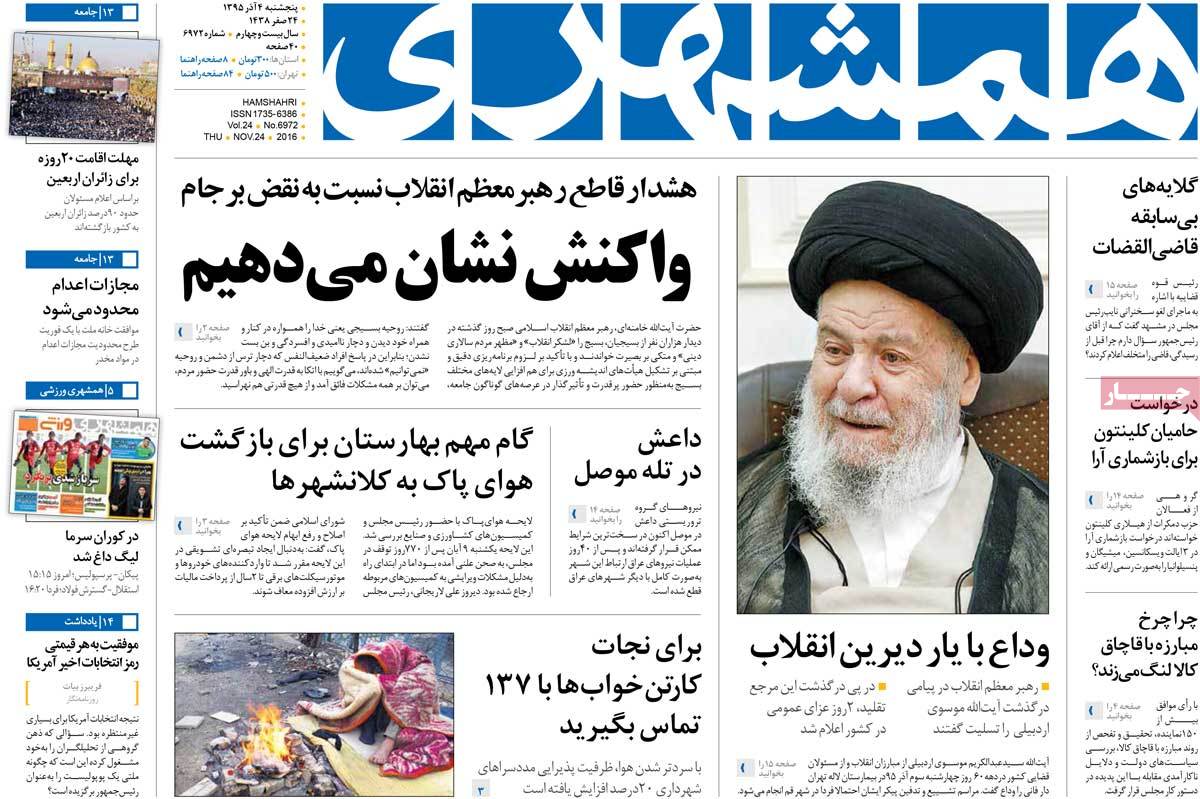
A Look at Iranian Newspaper Front Pages on November 24


Jame Jam:

1- 10-Year Extension of Anti-Iran Sanctions Is Violation of JCPOA: Leader

2- Sardar Azmoun, Iranian Striker, Scored a Beautiful Goal in Match against Bayern Munich

3- Americans Should Think about Consequences of Violating JCPOA: Former Diplomat
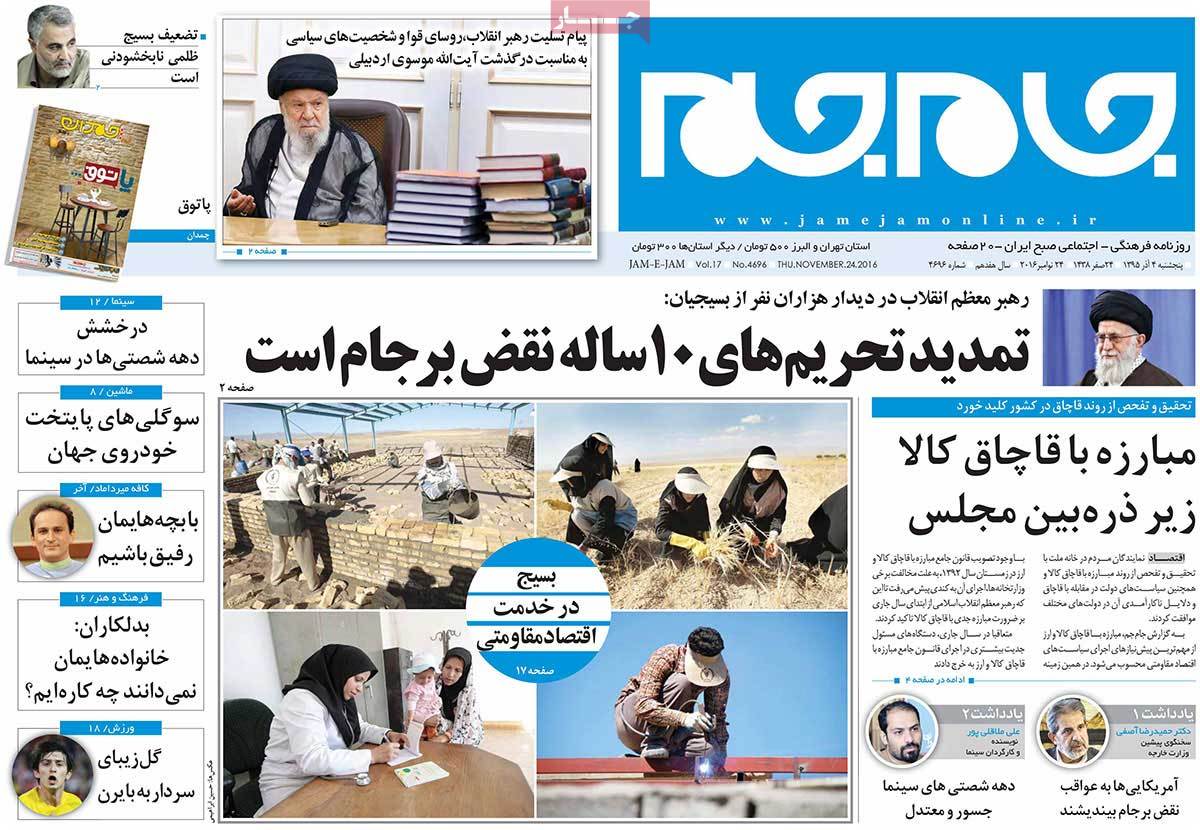
A Look at Iranian Newspaper Front Pages on November 24


Javan:

1- Judiciary Chief Ayatollah Amoli Larijani: President Rouhani and Parliament Speaker Larijani Kept Silent over Accusations Raised against Me and Became Embarrassed of Cancellation of an MP’s Speech; I Don’t Need These People’s Backing!

2- Hollywood Standards in Narrating the Massacre of Iranian People: Critics Talk about ‘Iran Orphanage’ Film

3- CNN Says It Has Documents that Show US Election Was Rigged

4- Reasons for Erdogan’s Intervention in Northern Iraq
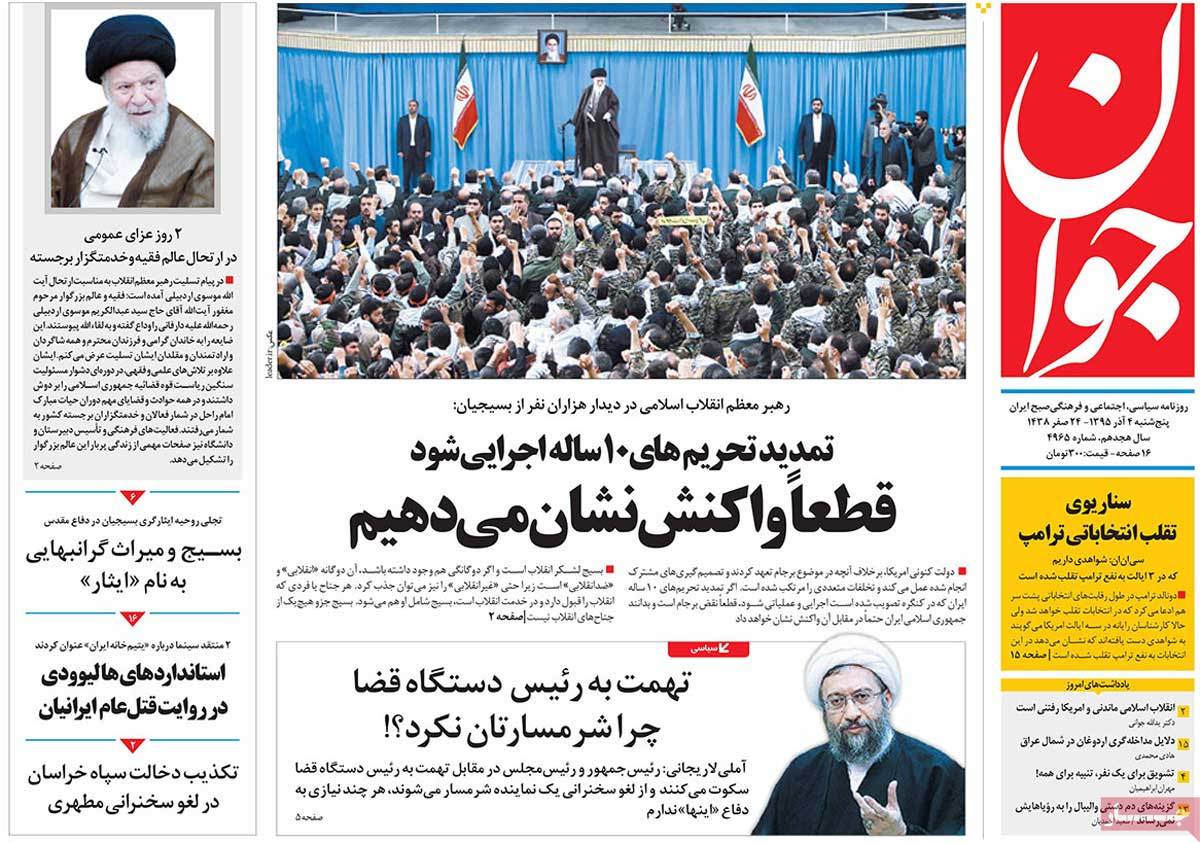
A Look at Iranian Newspaper Front Pages on November 24


Jomhouri Eslami:

1- Iran Will Definitely Show Reaction If US Violates Nuclear Deal: Leader

2- Violation of JCPOA Will Have Dire Consequences: US State Dept. Spokesman

3- UN’s Ban Urges All Sides to Stay Committed to Nuclear Deal

4- 150 MPs Call for Action against Those Who Cancelled Parliament Vice-Speaker’s Speech in Mashhad
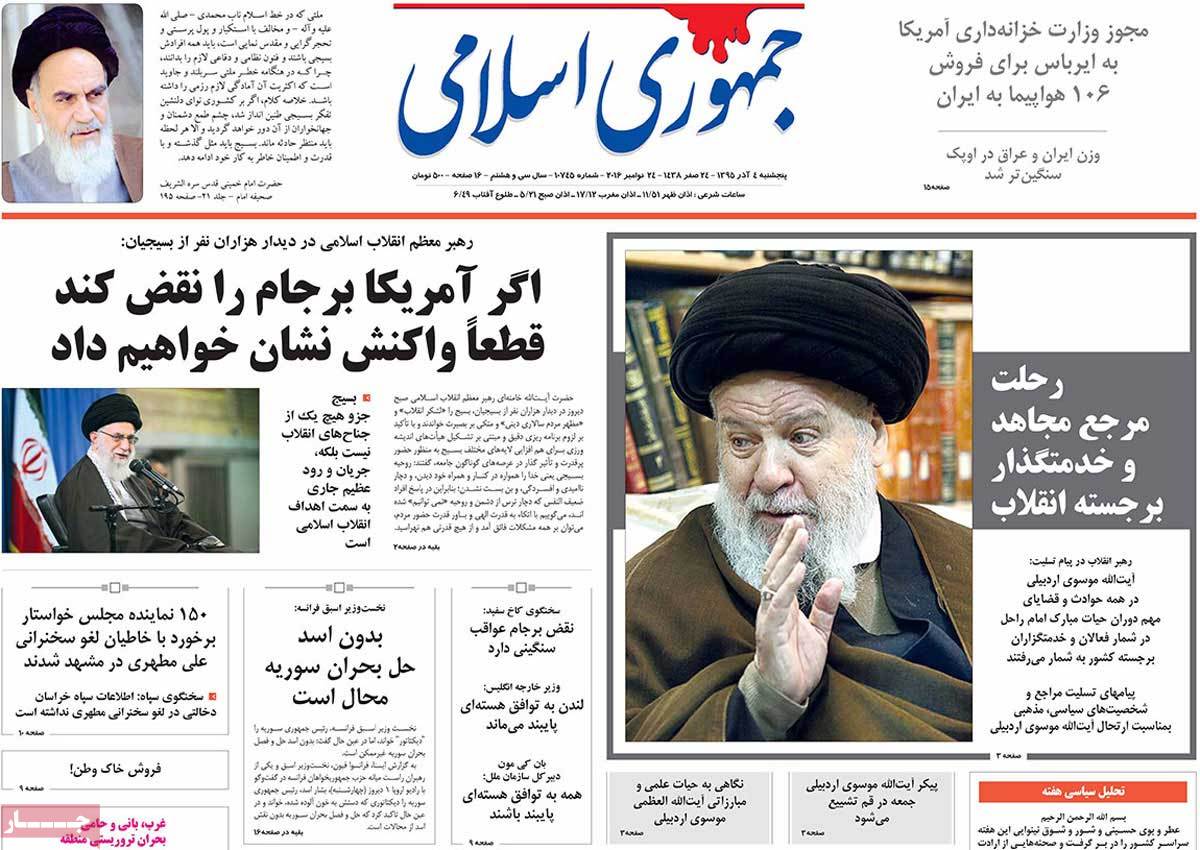
A Look at Iranian Newspaper Front Pages on November 24


Kayhan:

1- Trump’s Step-by-Step Withdrawal from Controversial Stances

2- Organized Crime against Myanmar Muslims: Where’s Human Rights?
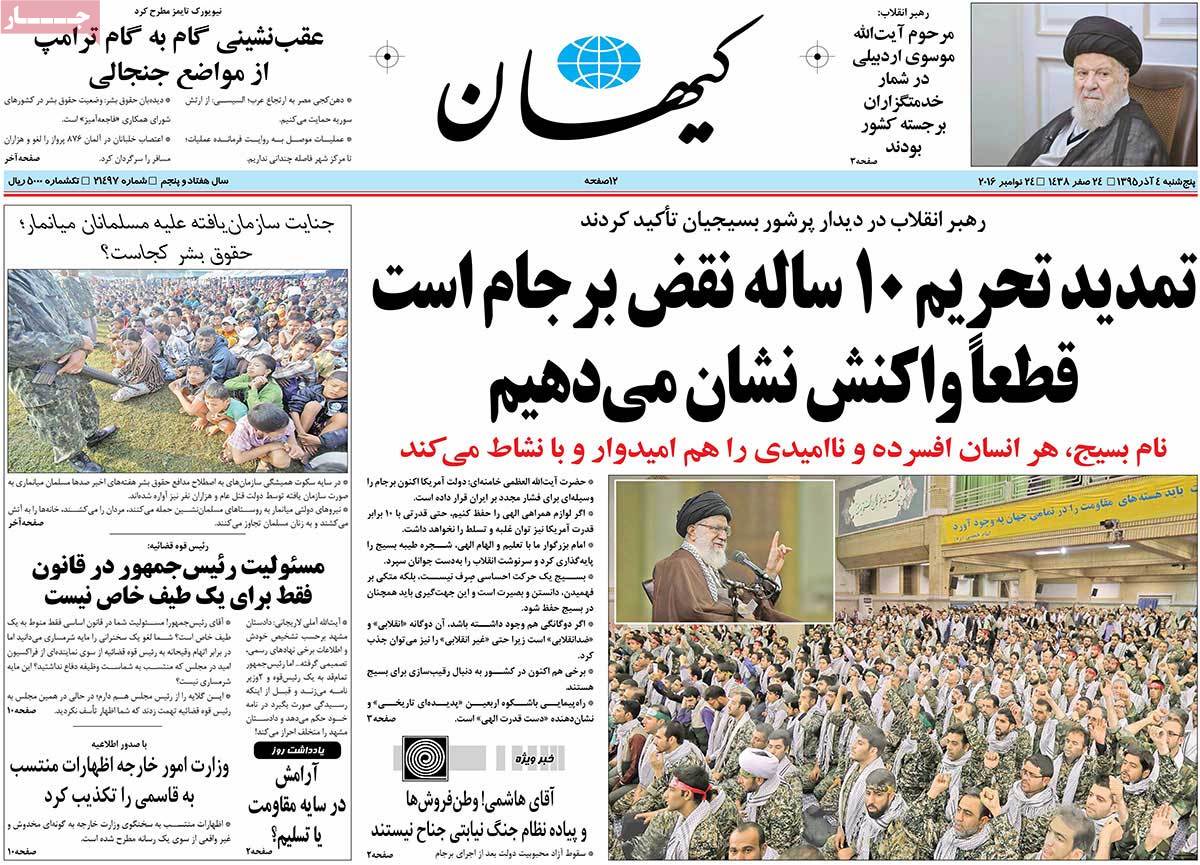
A Look at Iranian Newspaper Front Pages on November 24


Khorasan:

1- Italian Trade Minister: We’ll Continue Our Billion-Dollar Trade with Iran in Spite of Trump’s Election
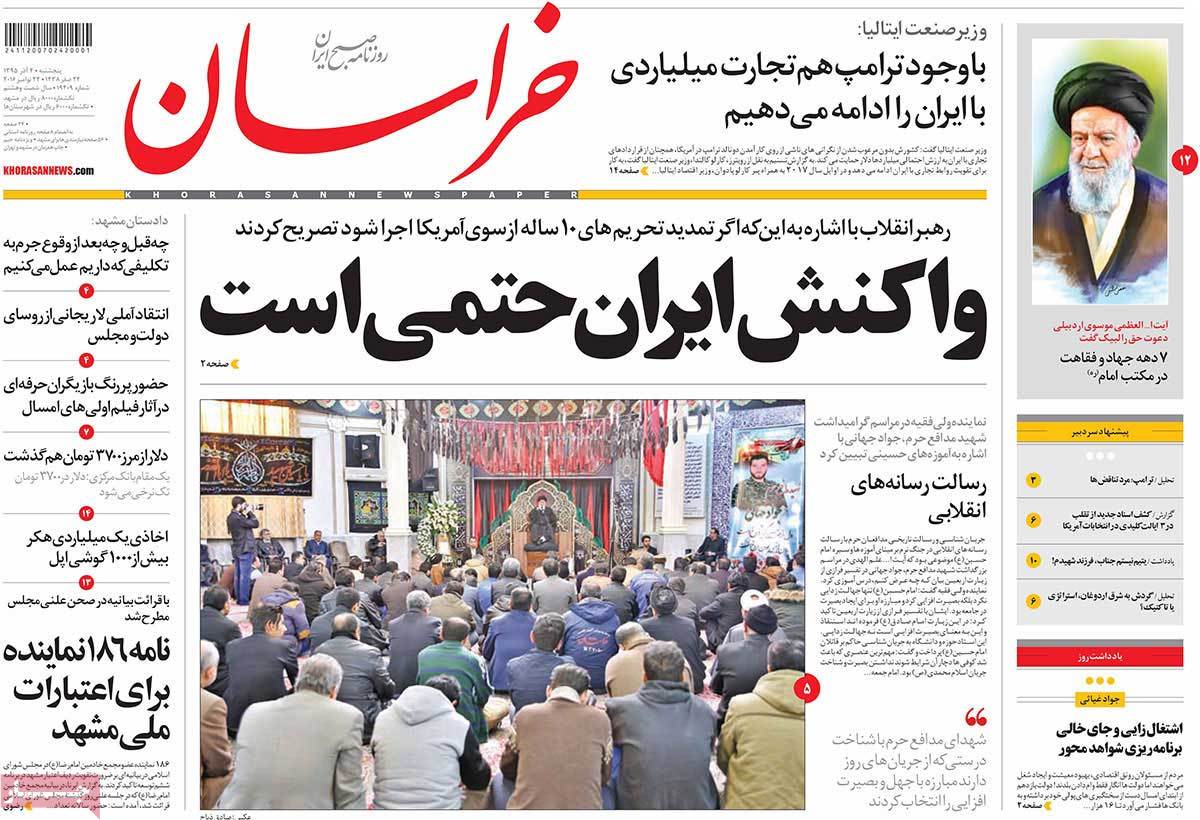
A Look at Iranian Newspaper Front Pages on November 24


Resalat:

1- JCPOA Will Be Definitely Violated in Trump’s Administration

2- West’s Sanctions Have Benefited Russia: Putin

3- Government Feels Duty-Bound to Support Basij: Rouhani
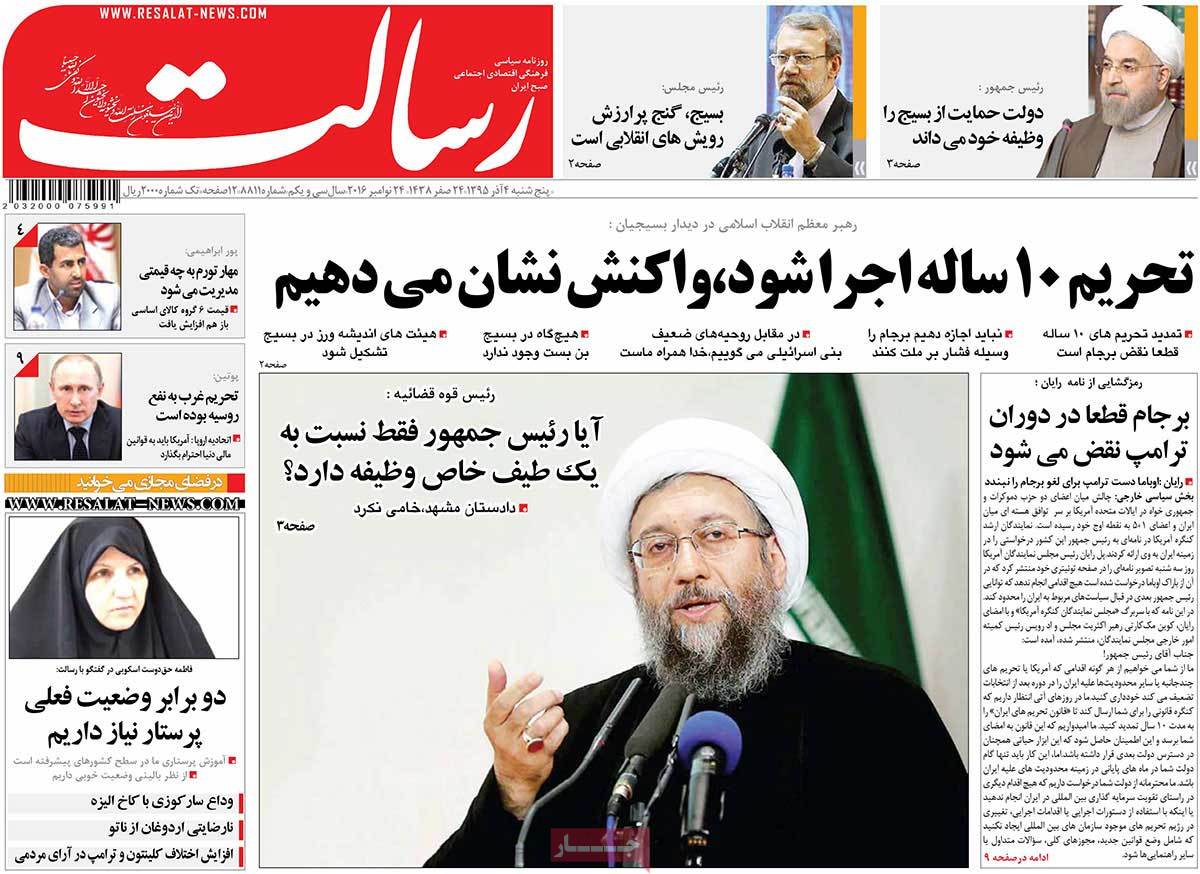
A Look at Iranian Newspaper Front Pages on November 24


Shargh:

1- What Has Happened to Freedom of Speech in Iran? [Editorial]

2- Analysis of Photos Taken during Obama’s 8-Year Term

3- Inauspicious Oil Offer to Iran
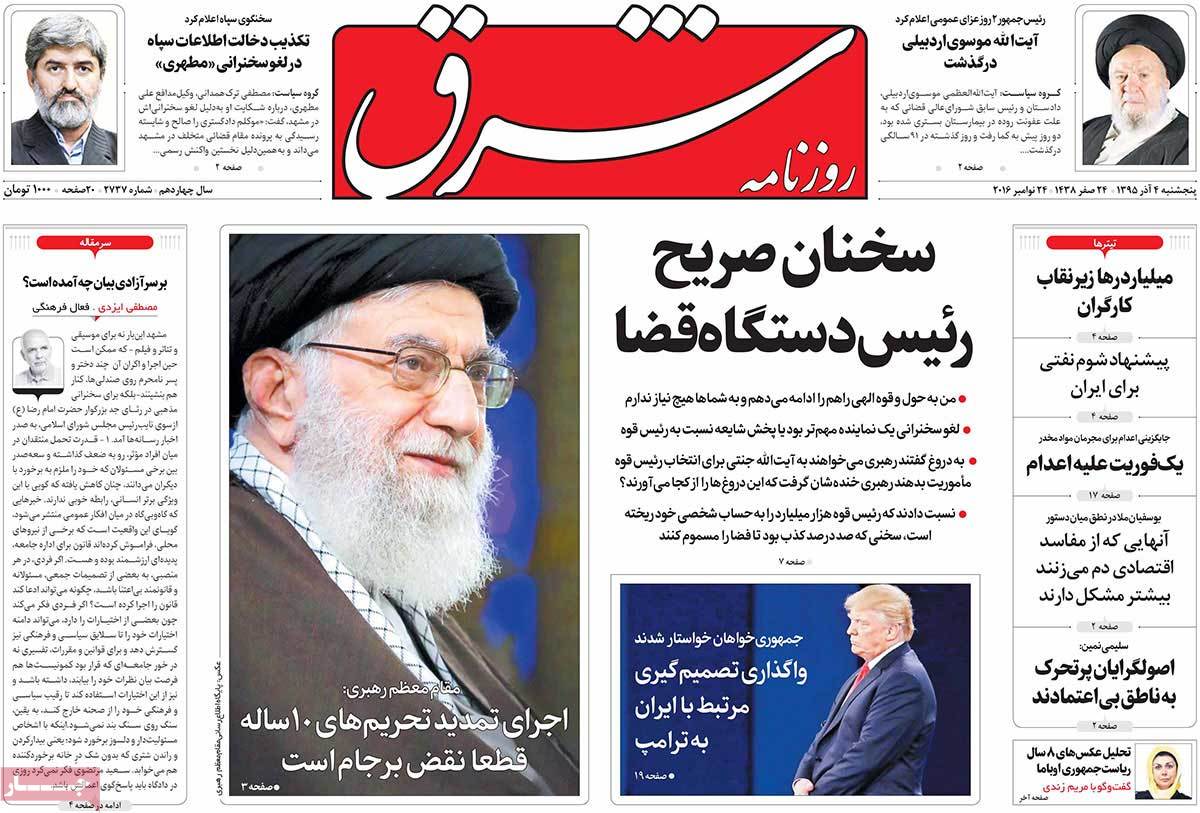
A Look at Iranian Newspaper Front Pages on November 24


Siasat-e Rooz:

1- JCPOA Should Not Become a Means for Putting Pressure on Iranian Nation: Leader

2- Everyone Knows that Syrian Crisis Has No Military Solution: Expert

3- Analysts Discuss Iran’s Possible Reaction to US Violation of JCPOA

4- Bahrainis Suppressed with Poisonous Gases
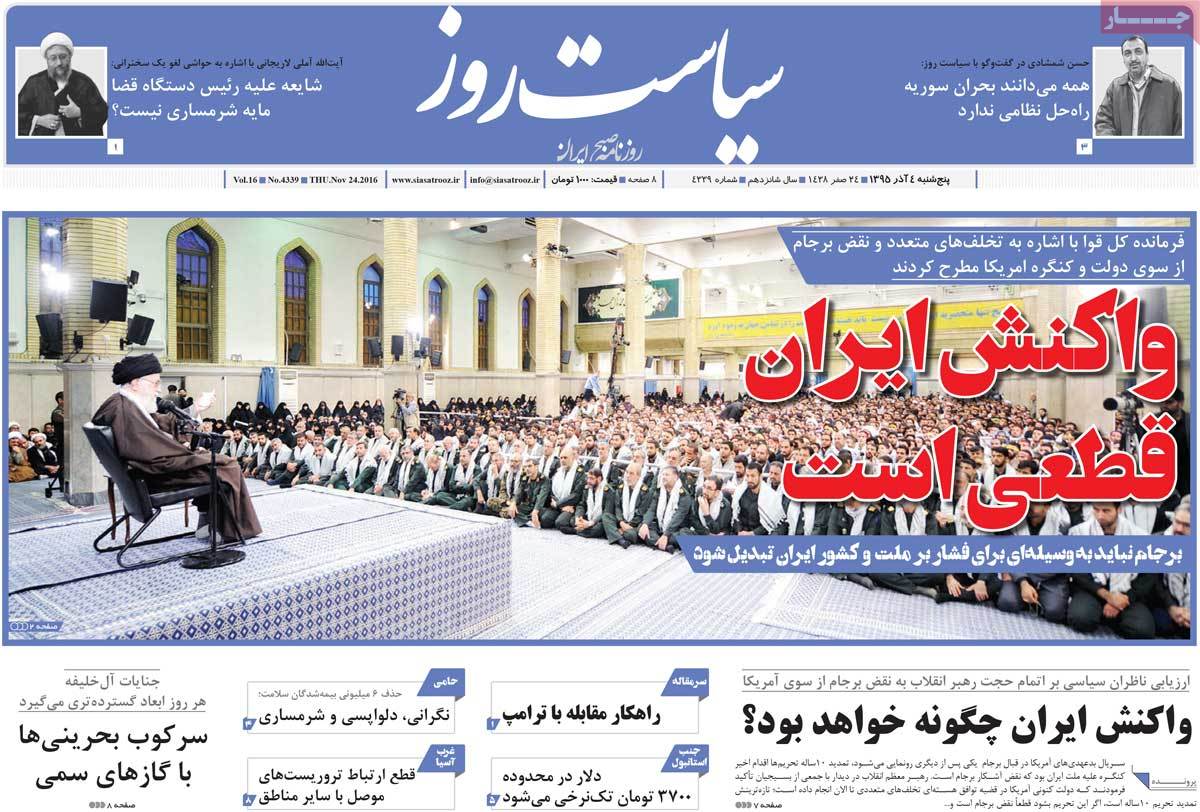
A Look at Iranian Newspaper Front Pages on November 24


Vaghaye Ettefaghieh:

1- Judiciary Chief Dismisses Reports about $275 Million Deposit in His Personal Account

2- The Laws that Will Prevent Criminals from Committing Further Crimes: Parliament Discussing a Plan to Devise Alternative Punishment to Death Penalty for Drug Traffickers
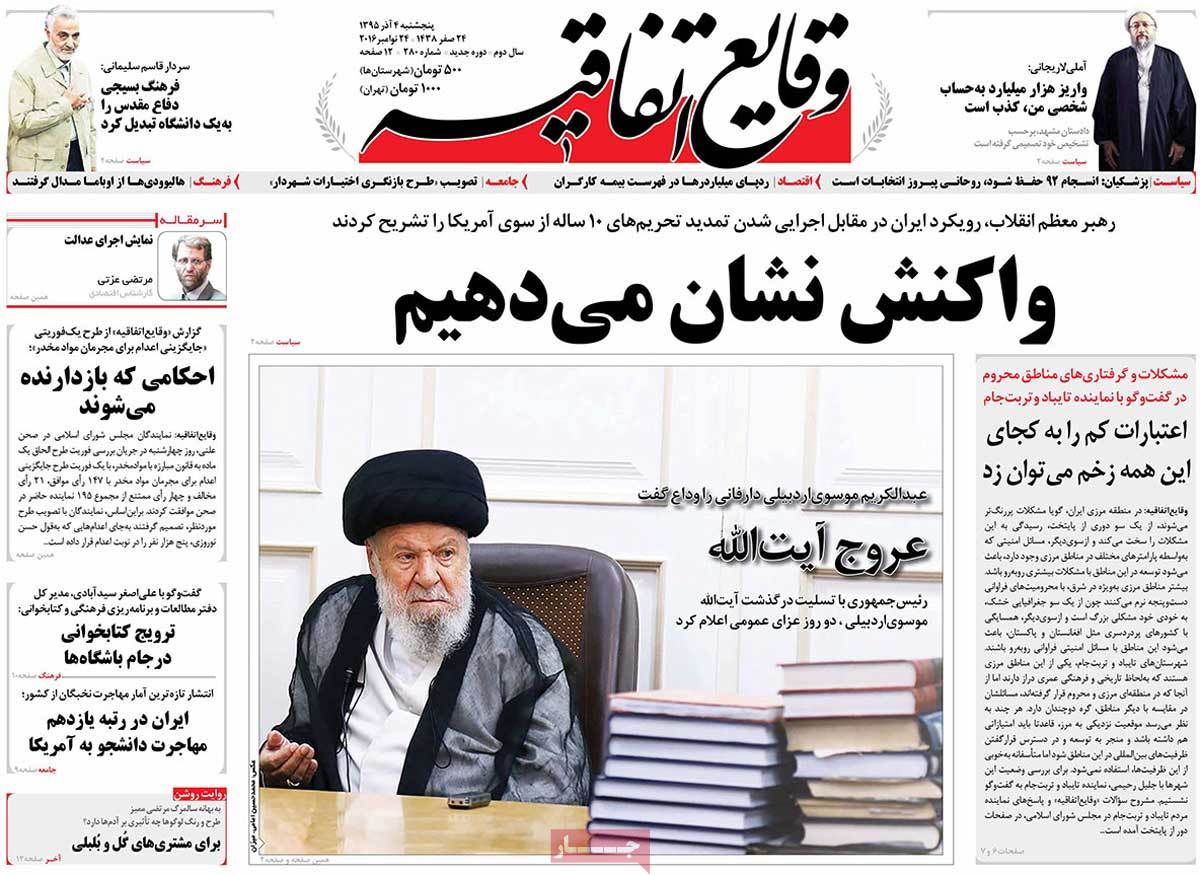
A Look at Iranian Newspaper Front Pages on November 24


Vatan-e Emrooz:

1- 101 Cases the Government Should Be Ashamed of!

2- World Observing Iran’s Government: Future of Sanctions

3- Government Officials Hatching Plot against the Honest Cleric [the Judiciary Chief Ayatollah Amoli Larijani]
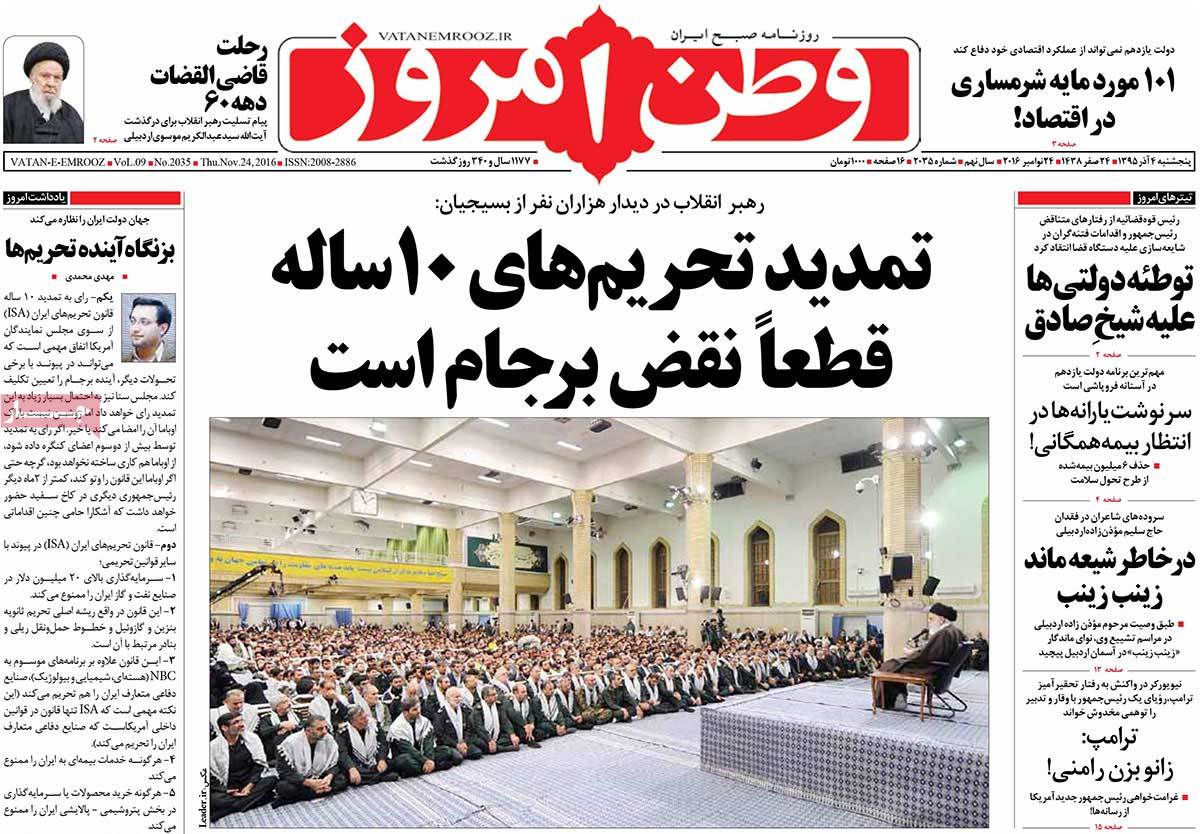
A Look at Iranian Newspaper Front Pages on November 24

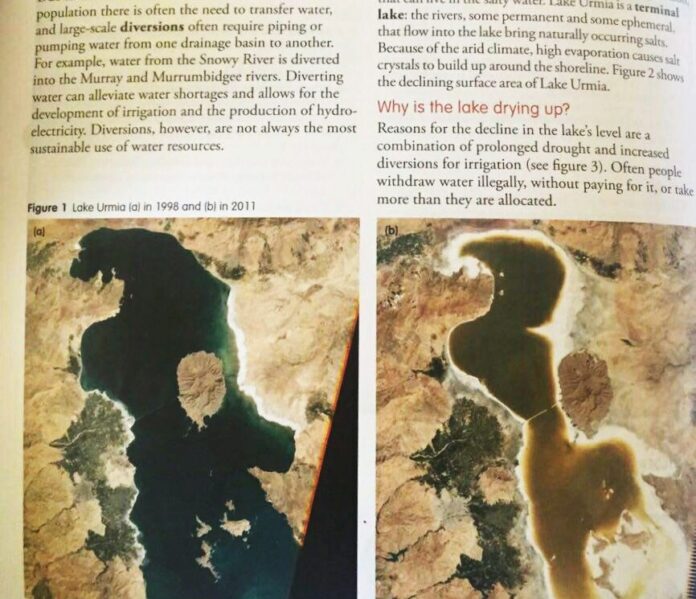
Iran’s Lake Urmia, a Good Lesson for Australian Youth to Value Water

photo_2016-11-24_13-58-00

According to a report by Vaghaye Ettefaghieh newspaper, as translated by IFP, Lake Urmia, the world`s largest salt lake, is dying. Meanwhile, some experts believe that Iran`s largest lake can be saved if the locals are trained for sustainable use of water resources in agriculture.

Now “the drying of Lake Urmia” has turned to the subject of geography lessons in Australian high schools to discuss the issue of water transfer and its harmful effects. In Geography textbook of 10th year in Australia, Lake Urmia is presented as an example for failure to save the world`s wetlands and lakes.

The textbook has referred to Ramsar Convention, an international treaty for the conservation and sustainable use of wetlands signed in February 1971. Although the Convention was signed in Ramsar, Iran, it has not been respected in our country.

16-11-21-9352photo_2016-11-21_09-04-58It is written in the textbook, “Lake Urmia, one of largest lakes of Middle East and the world`s largest salt lake, is drying up. This lake, located in Iran`s northwest, had lost about 65% of its surface water in 2005, and started to dry off. It is said that the need to conserve its rich ecosystem led the international community to create Ramsar Convention for the conservation of wetlands in 1971. As the most important and the only convention to control the conservation of wetlands, this treaty commits all contracting parties, including Iran, to reasonable use of wetlands. Despite the treaty, Lake Urmia, as one of most important Iranian wetlands recorded in Ramsar Convention, has faced the drying crisis. The reasons include: implementing developmental projects such as constructing Shahid Kalantari highway on the lake, and building dams on the lake`s rivers.”

“Lake Urmia and its surrounding grounds are the seasonal habitat of migratory birds who feed their selves with the lake`s Artemia. Artemia is a species of crustaceans and the only living creature of Lake Urmia, who can live in dense, salty waters and eats the lake`s algae. Artemia is the main food of migratory birds, being the biggest source of nutrition for sturgeons,” the book added.

“After planktons, Artemias are more likely to live in salty waters. According to experts, salt crystals are formed around the lake`s shore because of dry climate and excessive vaporization. Scientists have pointed at the drought and the increasing capture and transfer of the lake`s water as well as illegal water capture by people as the main reasons for the lake`s dryness,” the textbook went on to say.


The latest status of Lake Urmia

Latest studies show that the water level of Lake Urmia has risen; however, the cut of Lake Urmia Restoration Program`s budget poses many new challenges to the project.

“The water volume is twice as much as last year; the water surface shows a growth of 50%, and the level has risen as much as 40cm; it is not promising, though,” stated Massoud Tajrishi, the Director of Lake Urmia Restoration Program`s Planning and Integration Office.

“We intend to increase the lake`s water level for 40cm by next September; it depends on the implementation of some projects and provision of the required budget. Because of government`s financial problems, we had to cut the budget of program last year and reduce it to $465 million,” he added.

“Three sources are due to provide this money: National Development Fund of Iran which supplies us with about $93 million, the Annual Budget of Executive Organizations, which is about $82 million – we have no problem with these two; however, a sum of about $301 million was due to be allocated for a lot of our projects according to the 10th and 12th articles of the Law of Partial Regulation of Government’s Finances and the Law of Formation of National Disaster Management Organisation.”

“The government agreed to pay over $82 million. We discussed it with the Management and Planning Organisation in several sessions; finally we had to omit some projects and give priority to the ones that required less time and money and were more effective. But, unfortunately, no money has been injected by this sector till now,” he added.

“There were important projects; for example we should plant Nitraria in large areas and it required major irrigation. The Organization of Forest, Range and Watershed Management cooperated with us, but we couldn`t pay their wage to make them able for paying contractors` money; we have no funding for our dust control project, and the dredging projects are halfway.”

The Australians came to help Lake Urmia

Besides noticing the Lake Urmia in their textbooks, Australians came to Iran last September to help the conservation of lake through their research.

“We have decided to build a common water controlling centre in cooperation with Melbourne University,” announced a member of the Australian board researching about Lake Urmia restoration.

“I believe that we have complicated problems. In Australia, we learned to progress slowly, because we faced problems every time we speeded up. It is important to have a good, even if slow, perspective,” said Michael Stewardson, the Head of Department of Aquatic and Environmental Hydrology at the University of Melbourne, about the slow process of the lake`s restoration.

“In our visit to Lake Urmia, we observed some executive initiatives by Iranian government, concluding that we are going to have great successes in restoration of the lake,” he confirmed.

“It is complicated because we have seven million people and an agricultural system that uses too much water. It should change,” stated Peter Scales, the Dean of University of Melbourne’s Infrastructure School.


People should change, not the lake

“If we persuade people that water is part of the environment, farmers will use less water and industries will leave a healthier water. People should change, not the lake. I can accept that Lake Urmia`s situation will change, but not before changing public opinion about using the lake`s water,” added Scales.

He believes that the solutions include considering incentives for people who use the water properly, and convincing them that the change is good for them, “It is hard to find the first group of people, but then everything will change very quickly.”

“We have been very active in managing our water resources in Australia; for example, we announced that the optimal duration of bathing is four minutes. We give hourglasses to school children to be used when taking bath, so that they know the duration of their bathing.”

“When we receive our water bills, we can see the individual, regional and urban amount of consumption. As a result, everyone learns how much water one uses,” he added.

“We have good experiences in managing our water resources; I believe that by exchanging our experiences, we can accelerate the accomplishment of our goals about global water resources.”

“I hope that we establish a joint centre for water studies as soon as possible in cooperation with Sharif University of Technology and the Lake Urmia Restoration Program,” he went on to say.

Iran May Reduce Its Oil Output as Part of an OPEC Deal

up_5872c90063d45931424f88c2651ef574

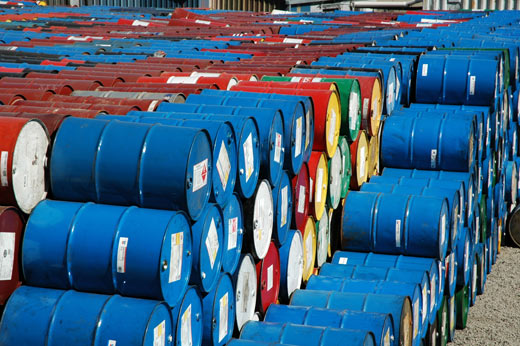
OPEC will debate an oil output cut of 4.0-4.5 percent for all of its members except Libya and Nigeria next week. Three OPEC sources told Reuters a gathering of experts from the oil producer group in Vienna had decided on Tuesday to recommend that a ministerial meeting on Nov. 30 debate a proposal from member Algeria to reduce output by that amount.

Such a cut would bring OPEC’s current output down by more than 1.2 million barrels per day (bpd), according to Reuters calculations based on the group’s October production, and is towards the upper end of market expectations.

But sources also said the representatives of Iran, Iraq and Indonesia had expressed reservations during talks that continued for 11 hours about their level of participation in what would be the group’s first supply-limiting deal since 2008.

According to a report covered by Fars, sources said Saudi Arabia and its Persian Gulf allies have signaled they were prepared to cut close to 1 million bpd of their output.

The Algerian proposal would see all member countries, except Nigeria and Libya, cutting 4-4.5 percent from OPEC’s estimates of their October production with the aim of reaching a total output target of 32.5 million bpd, OPEC sources have said.

That would mean Saudi Arabia alone could cut up to 500,000 bpd, sources said.

Under the Algerian proposal, Iran was asked to cut 4.5 percent from almost 4 million bpd, according to sources. But Tehran has signaled it wants to cut from higher levels of 4.1-4.2 million bpd, one of the sources said.

Iraq was asked to cut about 200,000 bpd. Baghdad is also still debating whether it should cut from the levels of OPEC’s estimates or its own, higher, production figures.

“Eighty-five percent of proposed OPEC cuts are from Persian Gulf countries but Iran is still not in favor,” one source said.

World’s Second Oldest Living Man Is a 135-Year-Old Iranian

photo_2016-11-24_14-04-53

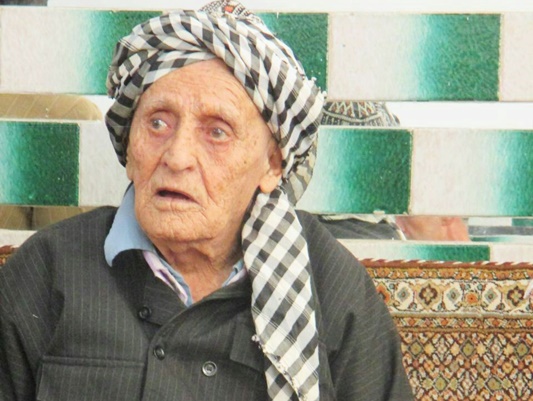
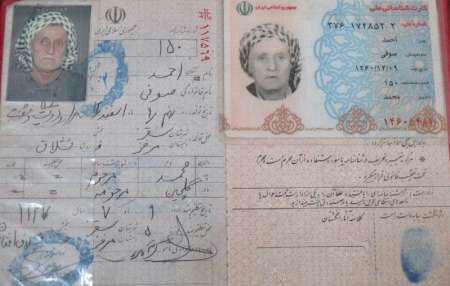
Based on the 2016 national census, the 135-year-old Ahmad Soufi is the oldest person in Iran, and second oldest living person in the world after the Indonesian man Mbah Gotho who claims to be 145.

According to a report by Fars, as translated by IFP, Soufi was born in February 28, 1882, and lives in the Kurdish-majority city of Saqqez in Western Iran.

His 75-year-old stepson Mohammad Amini describes him as a kind, affable, and friendly man.

In an earlier report, census officials had announced that they have registered a 130-year-old man named Mohammad Amin Youzi in the Western Iranian city of Kamyaran.

Youzi was born in 1886 and has more than 130 children and grandchildren. Youzi is now considered the second oldest living person in Iran after Soufi, and might be the third one in the world.

photo_2016-11-24_14-11-19

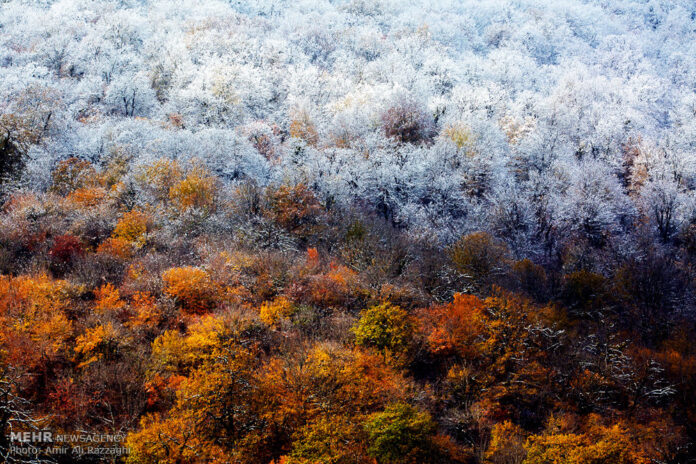
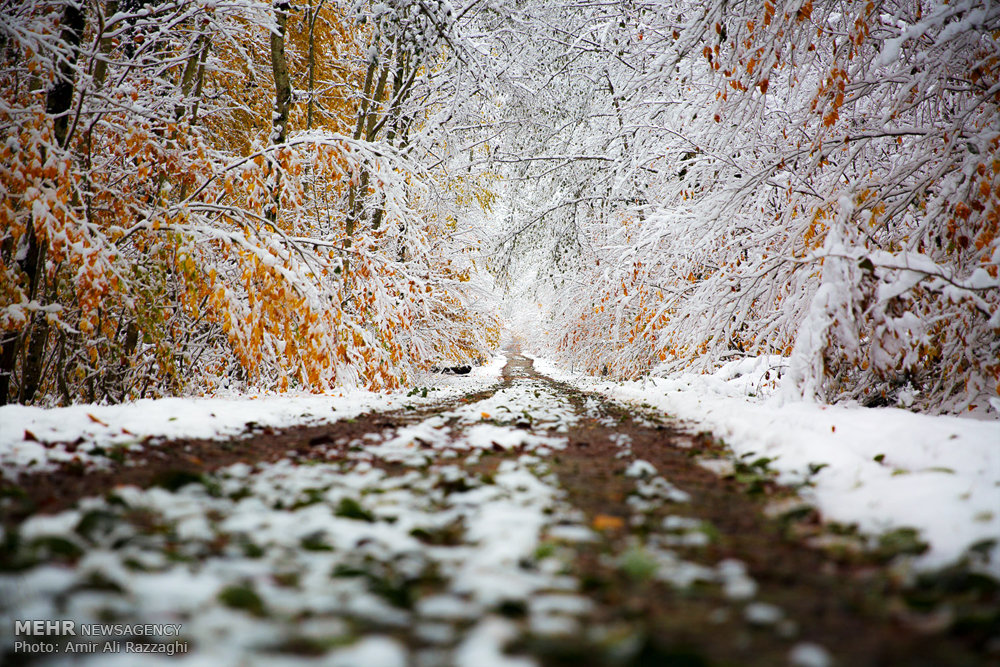
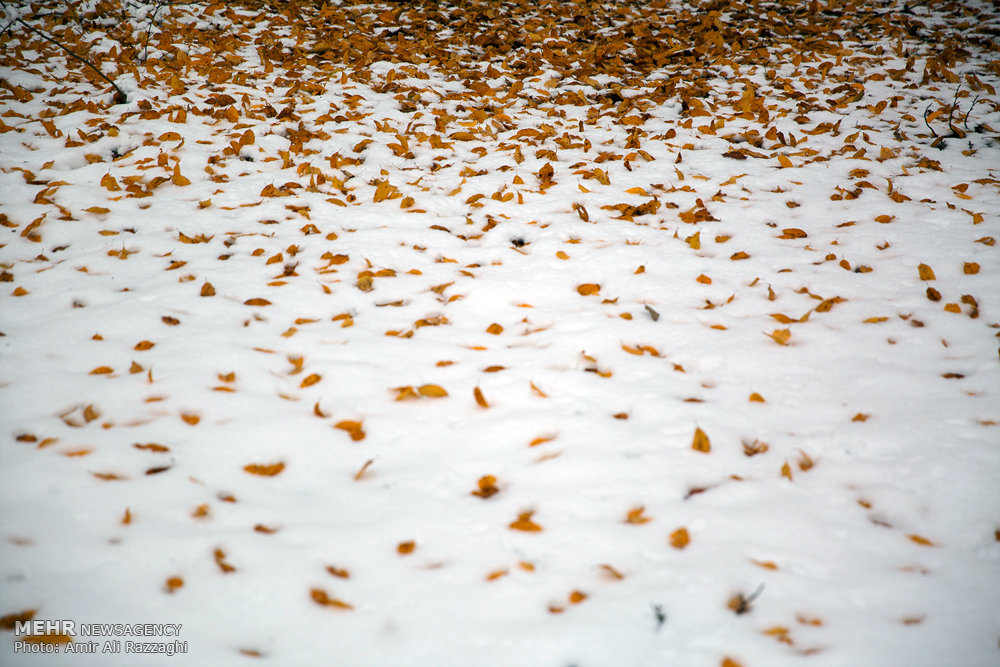
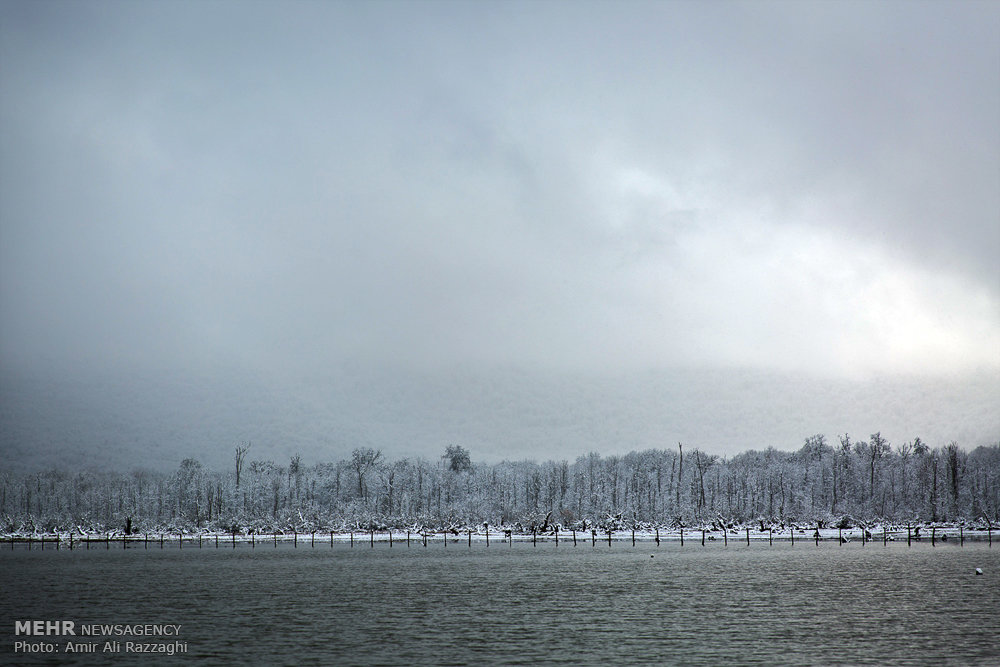
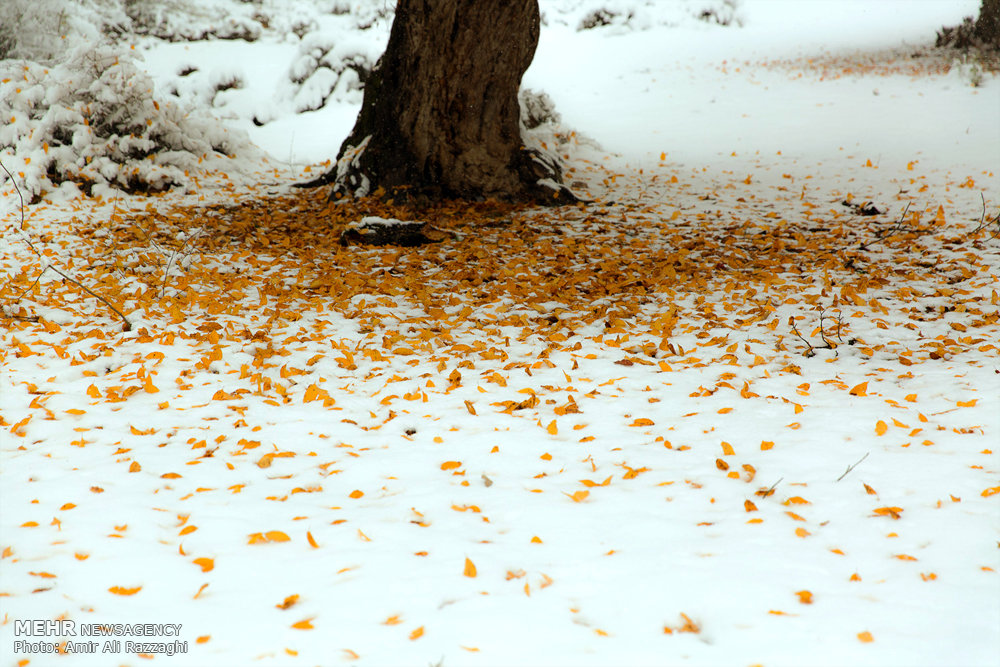
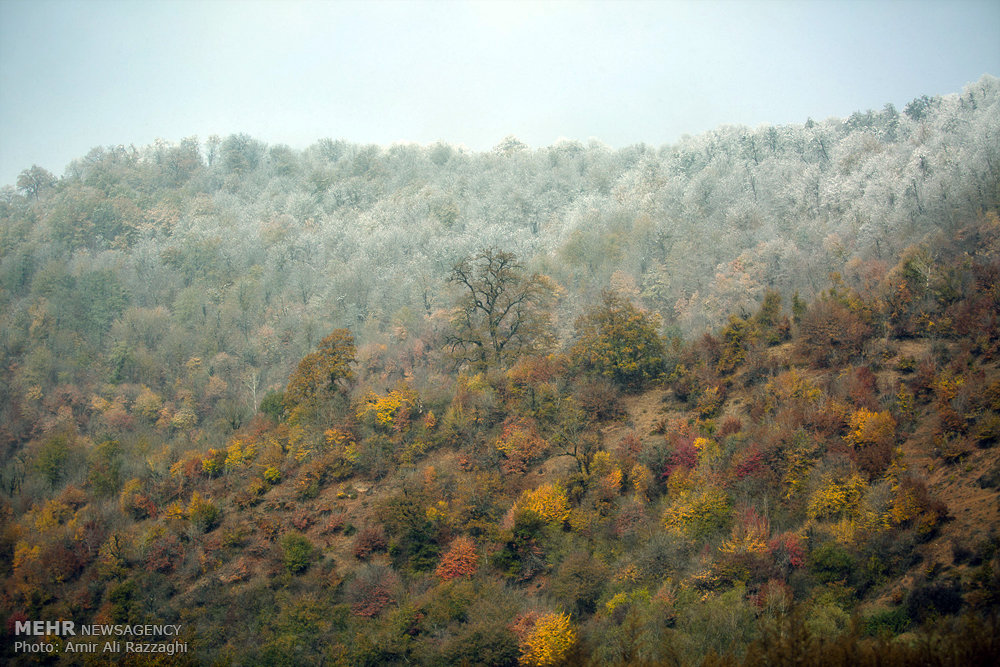
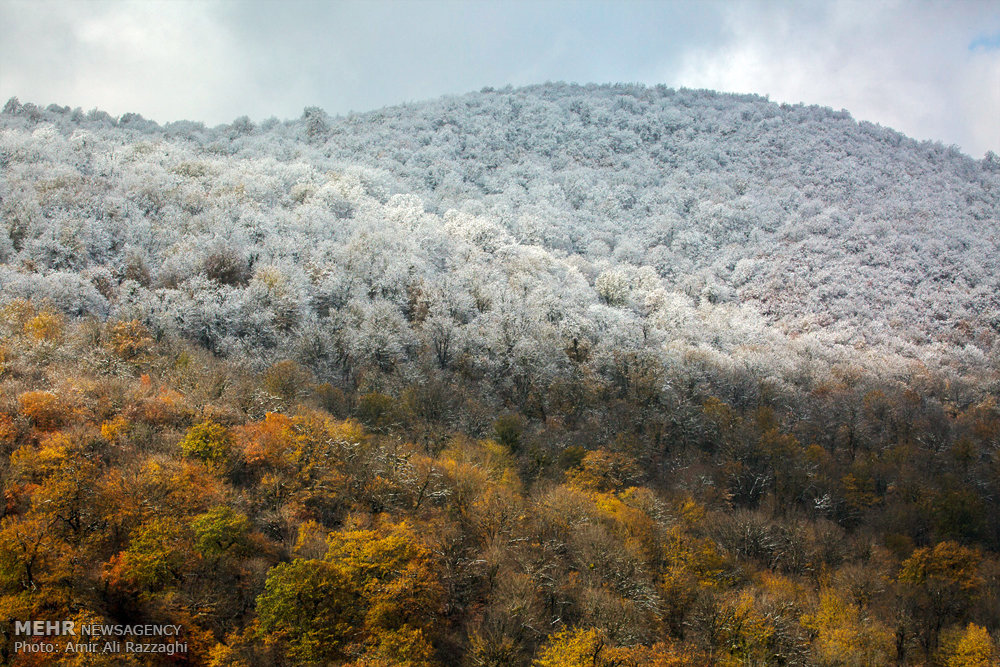
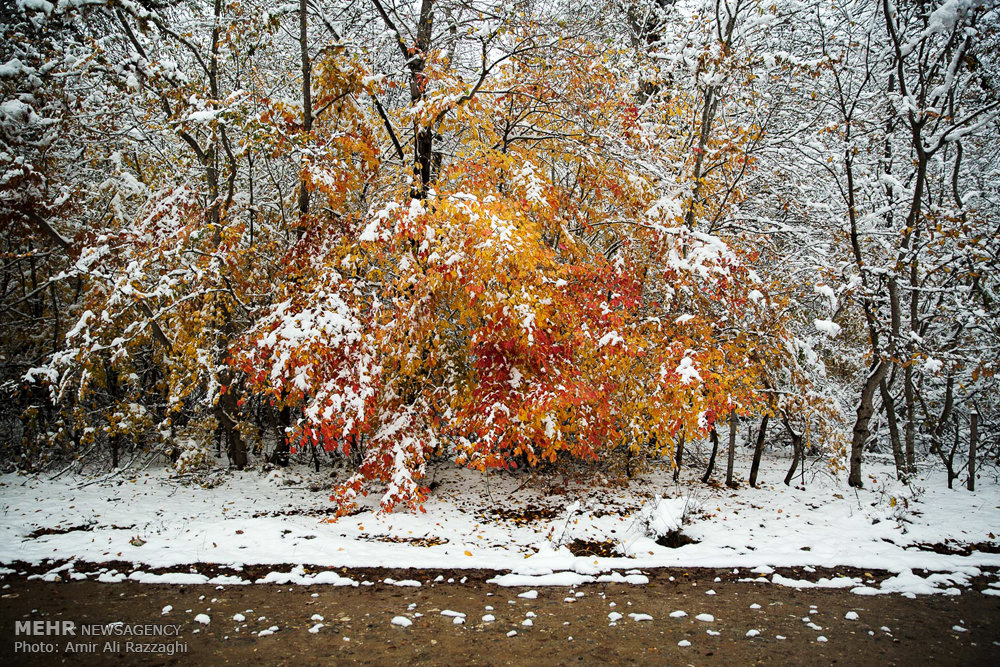
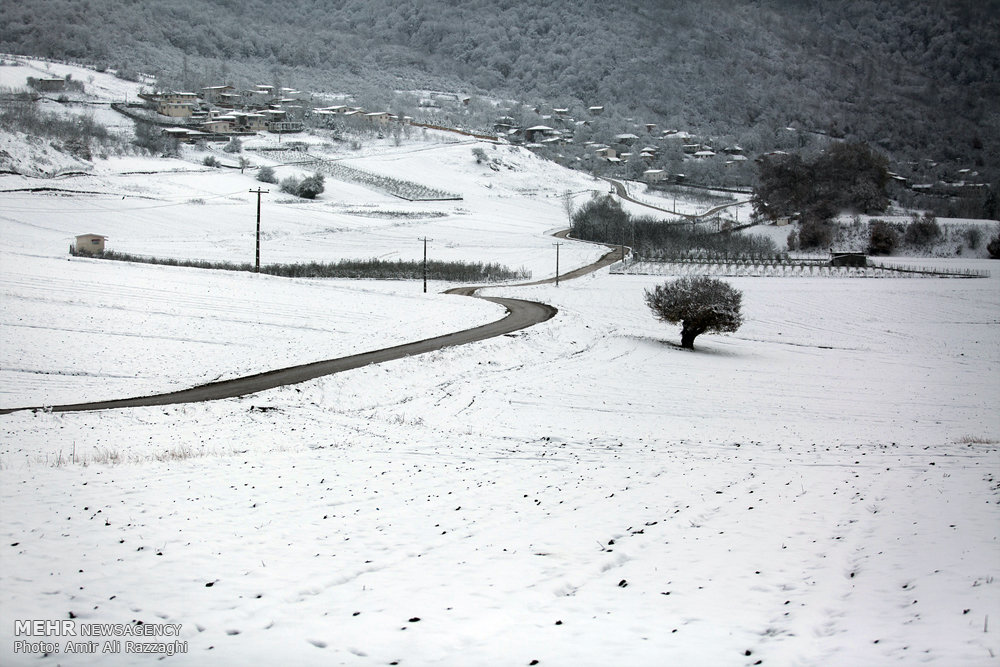
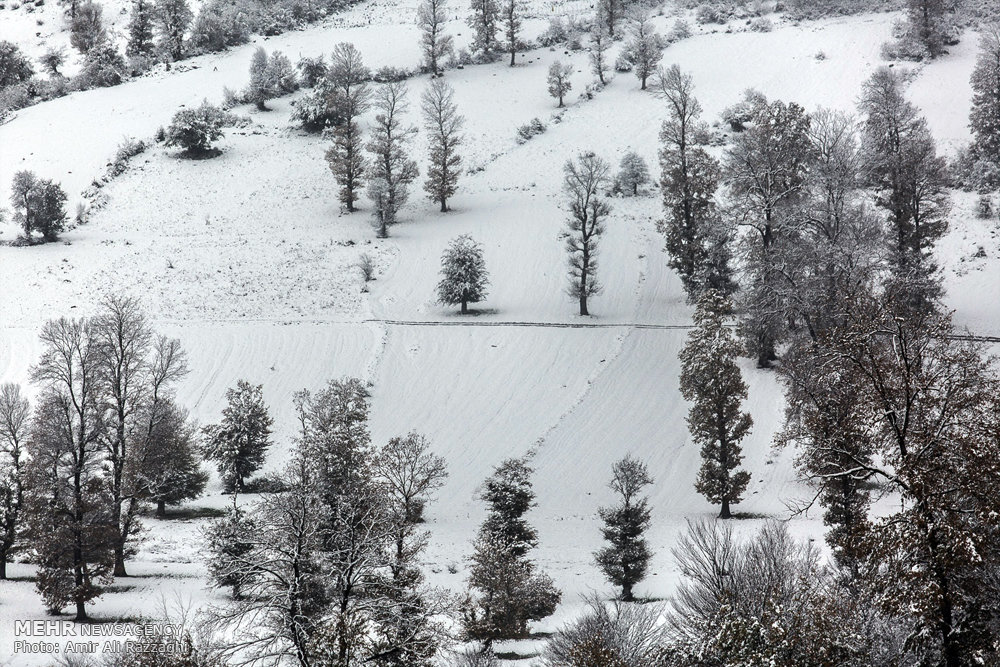
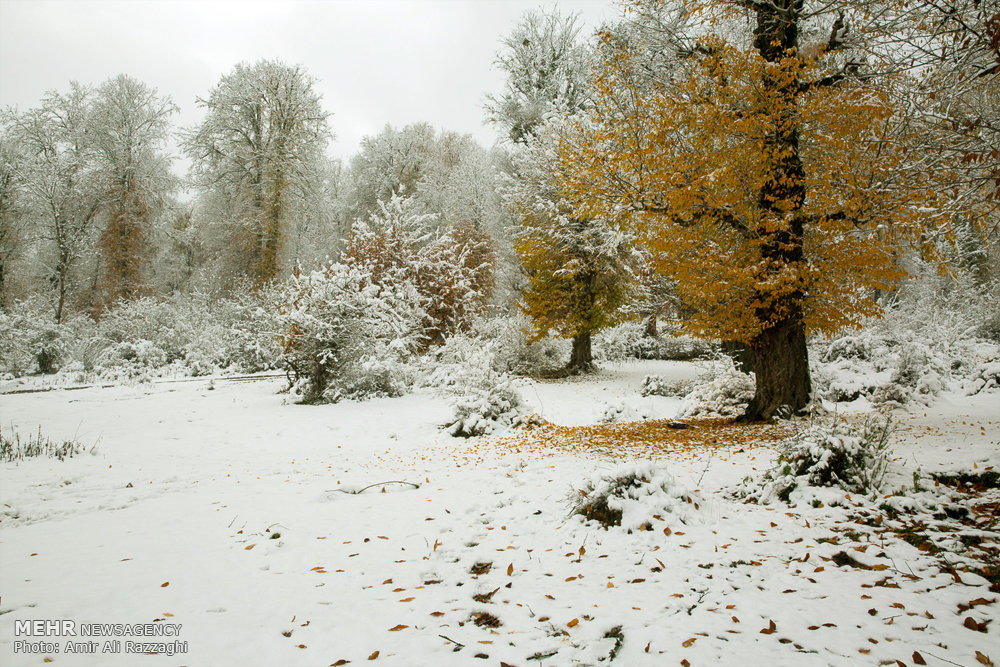
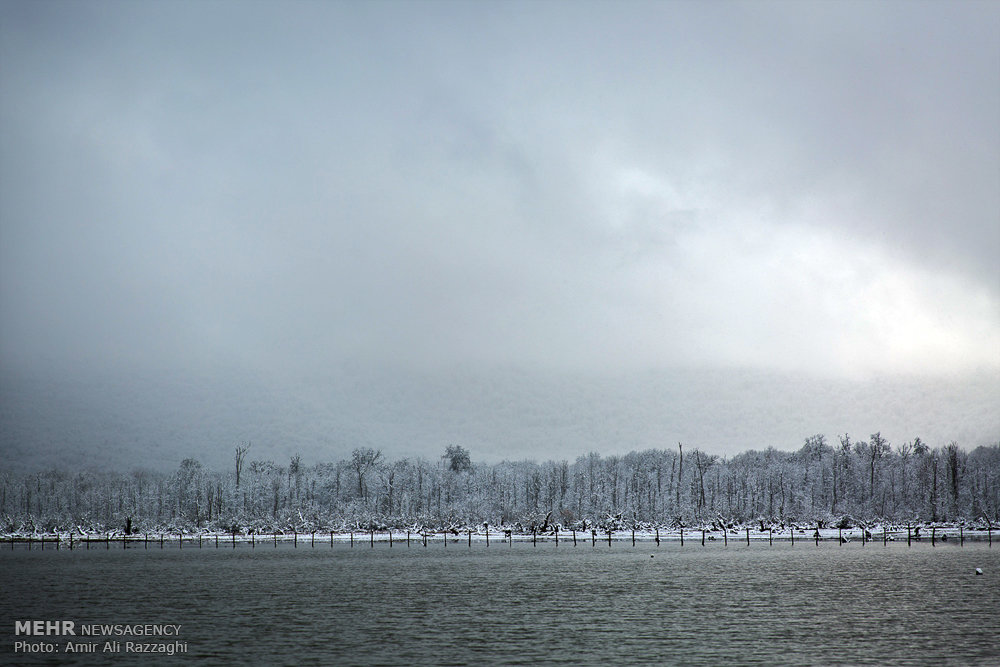
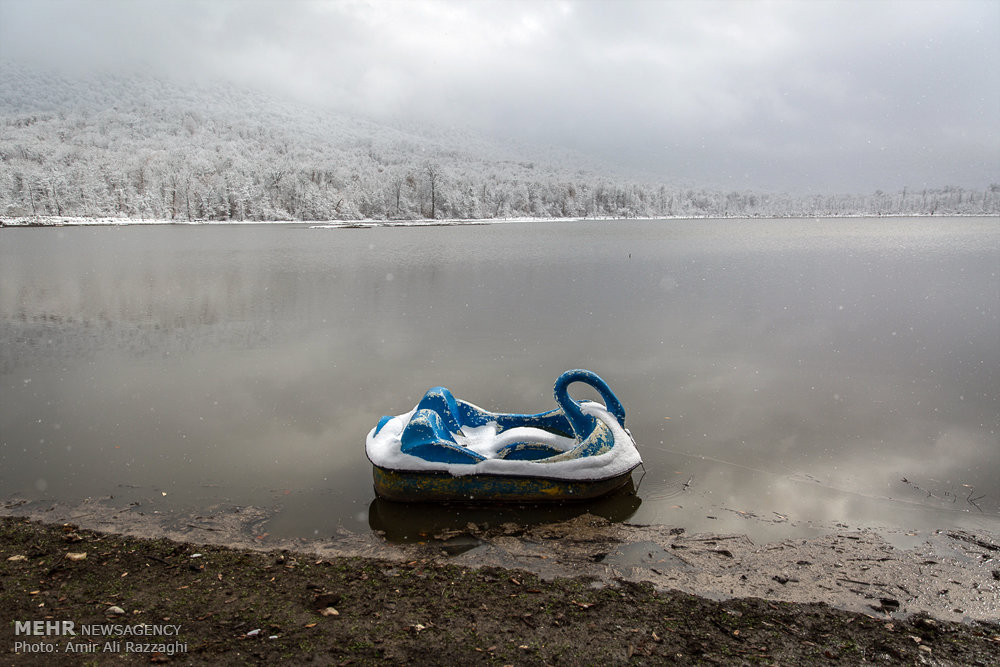
Autumn Snow Covers Sari Mountains in Northern Iran

Here are Mehr’s photos of the picturesque mountains of Sari which are covered by snow:


Slovenia Reopens Embassy in Iran’s Capital after Nearly Four Years

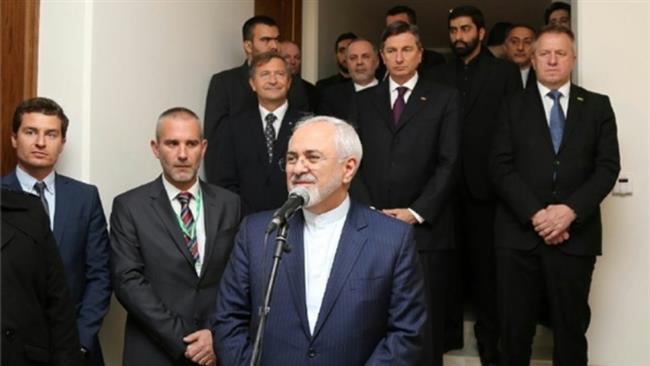
Zarif in Slovenia Embassy reopening
Iranian Foreign Minister Mohammad Javad Zarif speaks during a ceremony for the reopening of the Slovenian embassy in Tehran on November 23, 2016. (Photo by Fars news agency)

Slovenian President Borut Pahor, Iranian Foreign Minister Mohammad Javad Zarif and his Slovenian counterpart, Karl Erjavec, attended a ceremony for the reopening of the embassy in Tehran on Wednesday.

Speaking during the ceremony, Zarif said the reopening of the Slovenian embassy would set a good trend towards the promotion of relations between the two countries.

“There are good and suitable grounds for bilateral cooperation, which… we can advance [to a level] beneficial to the regional nations,” Zarif said.

Pahor, for his part, said the reopening of his country’s embassy in Tehran bears testimony to good cooperation between the two countries.

“We want to create common interests between our nations, and we believe that today is a very significant and promising moment for both countries and highly important for the development of Slovenia’s diplomatic activities,” he said.

Slovenia’s embassy in Tehran was closed in March 2013 as part of the European country’s general austerity policies. Slovenia said at the time that the move came in response to the difficult financial and economic situation in the country.

The reopening of the embassy had been announced by Darja Bavdaž Kuret, the state secretary at Slovenia’s Foreign Ministry, during a visit to Tehran earlier this month.

Heading a high-ranking politico-economic delegation, the Slovenian president arrived in Tehran on Monday to hold talks with senior Iranian officials.

Iran and Slovenia President
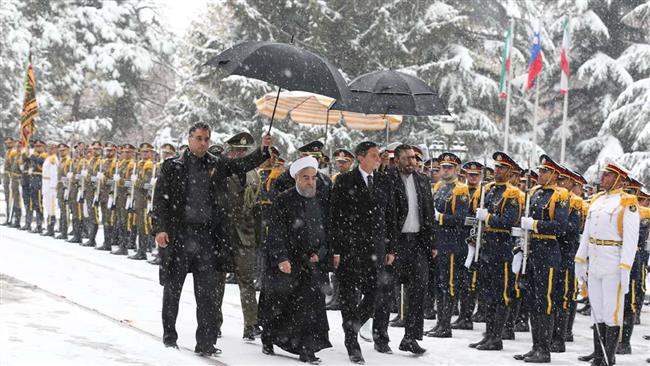
A handout picture provided by IRNA on November 22, 2016 shows Iranian President Hassan Rouhani (C-L) reviewing the honor guard alongside his Slovenian counterpart, Borut Pahor (C-R), during a welcoming ceremony at the presidential palace in Tehran.

On Tuesday, Iranian President Hassan Rouhani met and held talks with his Slovenian counterpart. Rouhani said Pahor’s visit, the first by a Slovenian head of state in 25 years, and the reopening of the Slovenian embassy in Tehran indicated the two countries’ “strong resolve” to develop bilateral ties.

Later on Tuesday, the Slovenian president was also received by Leader of the Islamic Revolution Ayatollah Seyyed Ali Khamenei.

During the meeting, Ayatollah Khamenei said that Iran and Slovenia enjoyed great potentialities and capacities to bolster cooperation and expressed hope that the future would back up the Tuesday talks.

The Slovenian president, for his part, said he had held very good talks with senior Iranian officials and expressed his country’s interest in deepening relations with Iran in all fields.

Pahor added that Iran and Slovenia share plenty of common experience and enjoy great potential for cooperation.

Slovenian President Highlights Iran’s Stability, Strategic Position

slovenia-president-and-iran-speaker

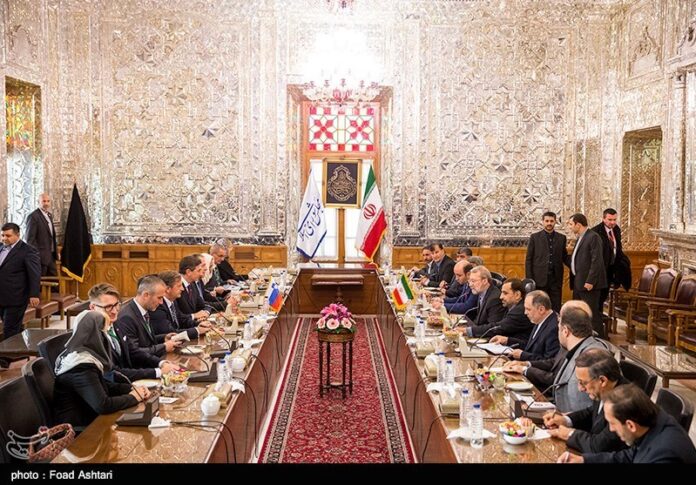
Iran’s significance, strategic position and stability in the Middle East gives Ljubljana enough motive for the expansion of relations with Tehran, Pahor said at a meeting with Iranian Parliament Speaker Ali Larijani in Tehran on Wednesday.

The visiting president also referred to reopening of Slovenia’s embassy in Tehran earlier in the day as a testimony to the willingness for stronger relations with Iran, predicting a bright future for the bilateral ties in all fields.

He voiced Slovenia’s readiness for joint investment with Iran in various economic fields, including modern technologies, industry, environment and new energies.

larijani-and-slovenia-presidentLarijani, for his part, affirmed the Iranian Parliament’s support for reinforcing bilateral cooperation, stressing that Iran holds a “positive view” on the enhancement of political, economic, parliamentary and cultural relations with Slovenia.

The speaker also hailed Pahor’s visit and the reopening of Slovenia’s embassy in Tehran as a milestone in the history of Iran-Slovenia ties.


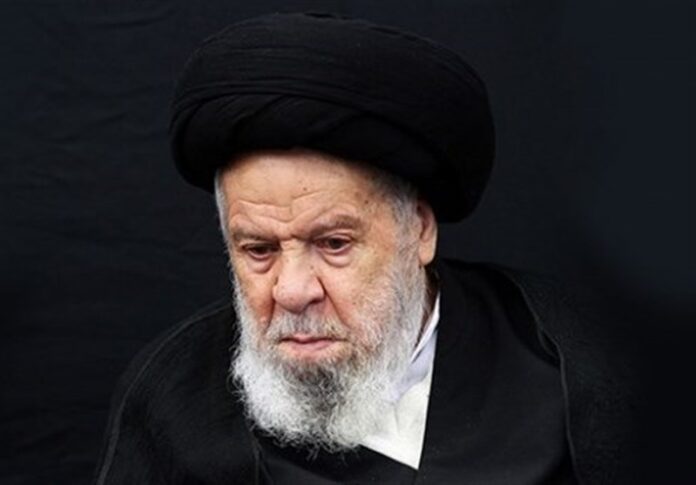
Two Days of Mourning Declared in Iran after Senior Cleric Passes Away

mousavi-ardebili

Ayatollah Mousavi Ardebili passed away at the age of 91 at a hospital in Tehran after suffering cardiac and digestive complications.

In a message, President Rouhani expressed condolences to the Leader of the Islamic Revolution Ayatollah Seyed Ali Khamenei, seminary scholars and Iranian people over the demise of the Shiite source of emulation and declared two days of mourning starting on Thursday.

The president also prayed God to confer blessings on the senior cleric’s soul and patience on the bereaved family.

Ayatollah Mousavi Ardebeli was born in Ardebil, northwest of Iran, in 1926. After the victory of the 1979 Islamic Revolution, he became a founding member of the former Islamic Republic Party.

He also held positions in the Council of the Islamic Revolution, the Assembly of Experts, and the Attorney-General’s Office.

He was appointed the head of the Supreme Court in 1981 after the assassination of Ayatollah Mohammad Beheshti, who had held the office until then. Ayatollah Mousavi Ardebili served in that position for 6 years.

‘I Can’t Say If Israel or Hitler Is More Barbarous’: Turkish President

According to a report covered by Fars, the President of Turkey said in his first interview with the Israeli press in more than 10 years that he could not decide whether the Holocaust or Israeli military offensives in Gaza were “more barbarous”.

“I don’t approve of what Hitler did, and neither do I approve of what Israel has done,” Erdogan said, adding, “When it’s a question of so many people dying, it’s inappropriate to ask who was the more barbarous.”

He told Channel 2 he was “well aware” of the sensitivities associated with Hitler, blamed for the deaths of some six million Jewish people in the Holocaust, The Independent reported.

But he said he found it “impossible to forget the hundreds, the thousands of people who died when [the Israeli military] struck Gaza”.

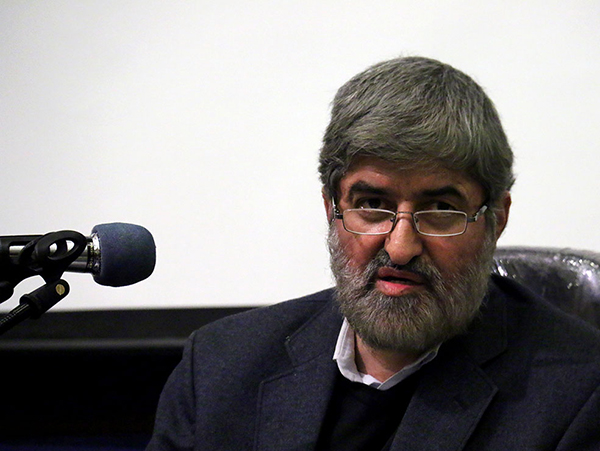
A Different Look at Cancellation of Iranian MP’s Speech in Mashhad

Ali Motahari

Vice-Speaker of Iranian Parliament Ali Motahari was due to deliver a speech in Mashhad on Sunday morning, but it was called off based on an order by provincial prosecutor.

According to media reports translated by IFP, although the cancellation immediately led to widespread reactions by the government and the Parliament, leading conservative newspapers have protested that why the country’s serious problems like economic downturn are not dealt with in such a speed.

Kayhan newspaper wrote in its Tuesday article, “While the country is gripped by major problems like air pollution, unemployment, economic downturn, and astronomical salaries, and a few months are only left of the government’s term, what is the purpose behind highlighting the cancellation of a speech?”

It further noted that if the government had a similar speed in showing reaction to other problems faced by Iranian people or the issue of astronomical salaries, many of them could be resolved so far.

Javan newspaper also wrote, “A review of reformist media shows they have just started using the cancellation of Motahari’s speech in Mashhad as a means of propaganda, and they are trying to take advantage of the issue.”

Following the controversy over Motahari’s speech, the Governor of Mashhad was dismissed; however, it was later announced that the decision to dismiss him had been taken a couple of days earlier.

Javan referred to the issue, and said that “reformist media were trying to make a connection between the dismissal and Motahari’s case in an effort to imply that the government has fired the Governor in an act of protest (or let’s say in a move to attract more votes in the upcoming elections).”