Friday, December 26, 2025
Home Blog Page 4156

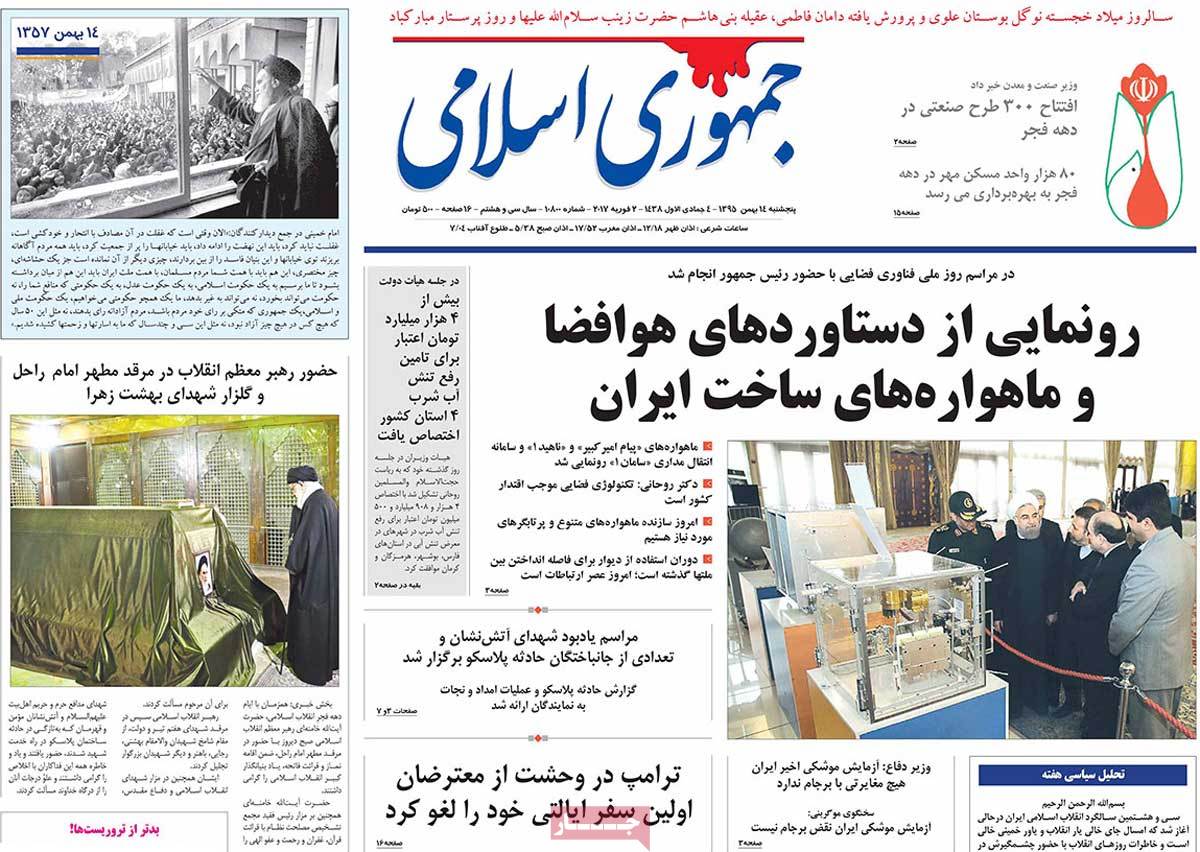
Iranian President Test-Drives Homegrown Electric Car
Electric car in Iran - Rouhani

On the sidelines of a cabinet session on Wednesday, Rouhani took a tour by some of his ministers to check the products of three knowledge-based companies manufacturing electric cars and motorcycles.

The Iranian president was briefed on the capabilities and quality of the products, including the two-seat electric car Yooz [Cheetah], produced by the Islamic Azad University of Qazvin, as well as two electric motorcycles manufactured by two other research centres.

The Yooz car can travel at a speed of 80 kilometres per hour. It can also hold 15 kilowatt-hours of electricity per 100 kilometers and it takes two and a half hours to charge.

During his visit, Rouhani praised the products and underlined the need to boost their quality and safety.

Iran has named January 18 as the National Clean Air to draw attention to the problem of air pollution gripping the country’s big cities.

Over the past few years, Iran’s megacities, including the capital Tehran, have been suffering from heavy air pollution blamed largely on floating particles from car emissions, Press TV reported.

Pollution especially increases in the country in winter by a temperature inversion and a lack of wind.

Rural Women in Iran Weaving Carpets with Two Silky Sides

The Turkmen-majority village of Doidokh near the city of Bojnord is widely known for the carpets woven by its local women. Almost 80 per cent of these carpets, both sides of which are made of silk, are exported to other countries.

Here are IRNA’s photos of these women weaving the silky carpets:

Exclusive Hangouts for Girls in Tehran

girl

“Two Shahrdokht centres, exclusive hangouts for girls, are to be opened in Tehran’s first and third districts, near Shahid Beheshti and Al-Zahra universities [the latter is a girl only university], in 2017,” announced Elaheh Atayi, an official in Tehran Municipality.

“They can serve as proper meeting spots for girls,” she added.

Shahrdokht centres are established to provide girls with favourable conditions to enjoy a rich leisure time, so that female students, particularly the ones who live in dormitories, would be able to use leisure facilities without going to faraway places.”

“In Shahrdokht centres, there are facilities such as coffee shops, and free resorts and amphitheatres for girls,” she noted.

According to a Farsi report by ISNA, a Shahrdokht centre is already active in Tehran’s sixth district.

Shahrbanous are other municipal foundations designed for women’s leisure time, aimed at promoting cultural activities and creating job opportunities for Iranian women.

“While all Sharbanou centres have been following identical instructions up to now, we will pay attention to the demands of every district of Tehran in our future plans in 2017,” Atayi added.

“We try to offer our services based on women’s needs in different districts, according to their financial, cultural and educational levels.”

She went on to say that the Municipality of Tehran has decided to establish two Shahrbanou centres in every district; a plan which has yet to be carried out so far.

“This is one of our long-term plans which requires money and time. It has been implemented in the 8th and 14th districts. A centre is to be launched in Tehran’s 16th district due in March 2017. An exclusive park for women will also be opened in the fourth district, Lavizan, in February.”

Stories behind a Gun Used for Assassinaton

Hashemi-Rafsanjani

After the unexpected demise of Ayatollah Akbar Hashemi Rafsanjani, the well-known Iranian moderate politician, Asadollah Badamchian, a member of Islamic Coalition Party, one of the oldest conservative political-religious organizations and pioneers of Islamic movement led by Imam Khomeini, showed up in a televised program to say “the gun used to assassinate Hassan Ali Mansur, former Iranian Prime Minister, in 1965 had been provided by Ayatollah Rafsanjani. He, however, didn’t want the fact to be revealed before his death.”

RafsanjaniMaybe Badamchian just wanted to mention the revolutionary background of Ayatollah Rafsanjani and his efforts to struggle against the Shah, given the fact that the late Ayatollah had in recent years been criticized by his opponents for taking anti-revolutionary positions and considered as the leader of Iranian moderates.

However, Ayatollah Rafsanjani and his family members gained nothing from these ‘revealing memoirs’; they were rather faced with a big question about the real character of someone who has always been insisting on “Islam with moderation and moderate manner” in  recent years: a question emphasized by domestic opponents of Ayatollah Rafsanjani, and the opposition of Islamic Republic in particular, to degrade his moderate position by suggesting that his moderate manner wasn’t due to the Islamic doctrine (as Ayatollah explained himself), but rather a cunning, necessary trick.

As “Ayatollah” participates in “Assassination” by providing “the gun”, “moderation” can’t be a doctrinal principle and guideline in the mentality of this revolutionary militant who believes in assassination: at its best, this motto is a tactic to win the votes of people and stay in power!

RafsanjaniDid Badamchian talk about the brilliant experience of Ayatollah Rafsanjani in historical struggles against despotism and colonialism so that his opponents don’t tear him to shreds for flattery and compromise with the West? Was he waiting for Ayatollah Hashemi’s death to affirm the assertions of people who accused the late Ayatollah of revisionism and moving away from the line of genuine revolutionaries during last decades of his life? Does the history of his collaboration in an “assassination”, if true, prove that Ayatollah Rafsanjani had departed from the left wing to the extreme conservative right? Does it prove that, in an indecent move, he had necessarily adopted a policy based on the Machiavellian rules of political game? Or that a “transformation” of political opinion and actions, during several decades of ups and downs, is a natural, even admirable move?

Regardless of what Badamchian, the veteran conservative, had or has in his mind, the family and supporters of Ayatollah Rafsanjani have reliable evidence that shows Badamchian’s remarks are false, and that participation in “assassination” was beneath the dignity of Ayatollah Rafsanjani.

Moderation and avoiding extreme behaviours are presented as the sustainable elements of policy in Rafsanjani’s doctrine; not as a revisionist, but as a “moderate” politician for life who acted upon religious and moral rules.

Rafsanjani

But what did Ayatollah Rafsanjani himself say about that eventful “gun” and his role in the assassination of Mohammad Reza Shah’s Primer Minister?

“They were already armed. The armed group formed among Islamic Coalition Party had taken lots of guns,” said Ayatollah Rafsanjani when he was alive, according to a Farsi report by Khabar Online.

“There wasn’t only one gun that we can say who they had received it from. Just after Araqi [a member of the group Fada’iyan-e Islam responsible for the assassination] was arrested, newspaper headlines wrote that the gun by which Mansur was assassinated belonged to Navvab Safavi [founder of Fada’iyan-e Islam group].”

“I really don’t know who gave them the gun,” Ayatollah Rafsanjani said at the time.

Rouhani’s Gov’t Overexcited by Airbus Plane Arrival: Conservative Journalist

shariatmadari3

Iran recently received the first brand-new airplane it had purchased from giant European plane-maker Airbus. The plane’s delivery ended nearly four decades of embargoes against Iran’s aviation industry.

The Airbus A321 arrived in Mehrabad Airport in Tehran in a ceremony attended by Transport Minister Mahmoud Akhoundi.

The government seems to be very proud of receiving the airplane; however, this has been harshly criticized by conservative media.

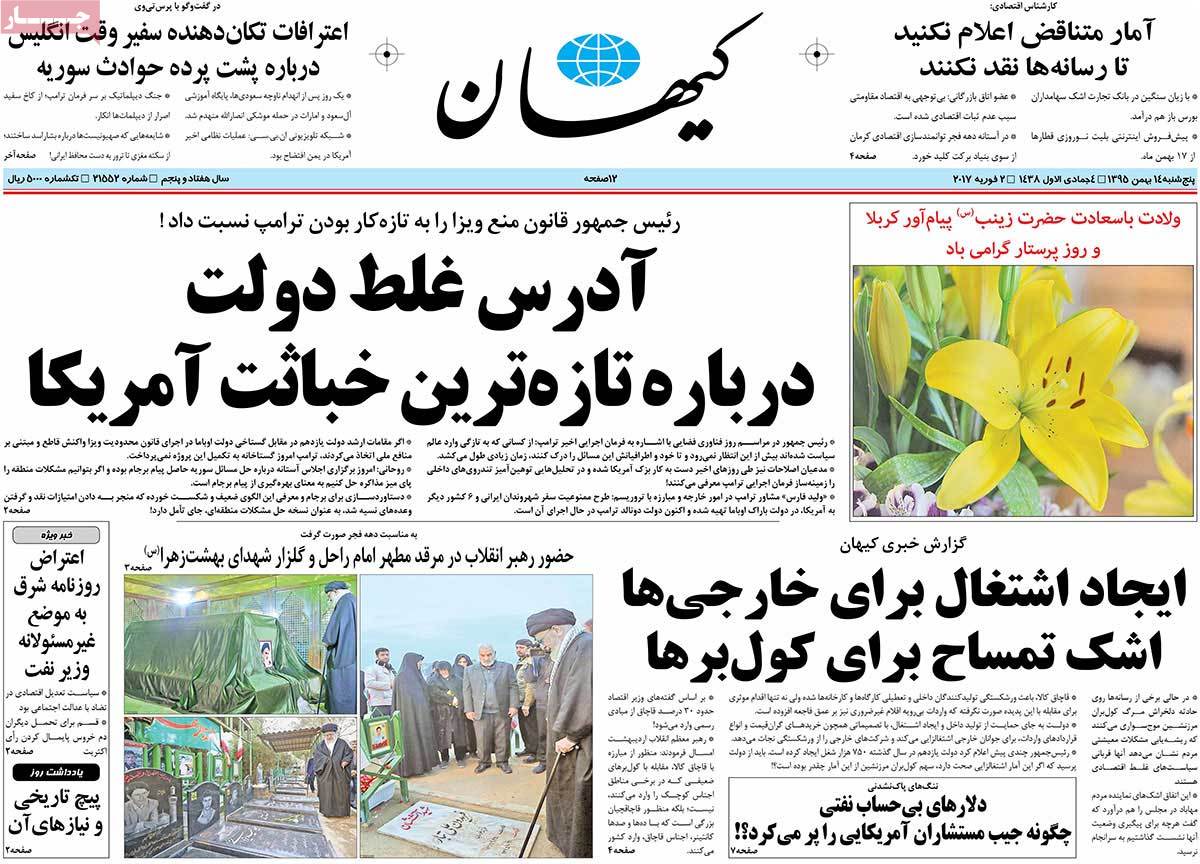
Hossein Shariatmadari, the Editor-in-Chief of leading conservative newspaper Kayhan, said in a Farsi interview with Fars News Agency that such extreme happiness shown by some Iranian officials over receiving only one airplane is unbelievable, and thus it can be assumed that the overexcitement is fake.

Shariatmadari expressed the hope that the excessive thrill is not aimed at deceiving public opinion and hiding the fact that Iran has returned empty-handed from the nuclear negotiations and the Joint Comprehensive Plan of Action (JCPOA) has had almost no achievements for the country.

Referring to the celebration held at Tehran’s Mehrabad Airport for the arrival of the first Airbus plane (A321), Shariatmadari noted that the government’s delight does not look natural “because they know very well that the delivered plane is nothing compared to the concessions we have granted to the adversary to reach the nuclear accord.”

He said as stipulated in the JCPOA, selling aircraft and spare parts to Iran constitutes only a minor portion of the commitments the opposing side has promised to fulfil, adding, “This is while, the other side had, up to now, even refrained from honouring such a pledge which fails to match its other obligations in importance.”

Admitting that the addition of the plane to Iran’s aviation fleet can be counted among the concessions won by the government, Shariatmadari noted that, however, the price paid for it is too high.

“You can generate heat by burning both firewood and expensive furniture and carpets. Nevertheless, no wise person would go for the latter, let alone publicising his/her stunning success later.”

He also referred to the colourful headlines of a number of so-called reformist and pro-government newspapers, which admired the delivery of the Airbus aircraft as a great achievement of the JCPOA, and stressed that they were doing what they had been ordered to do.

Iran Has Yet to Make Any Contact with Trump’s Administration: FM

“We have not made any contacts with the new US administration as of yet,” Zarif, who is in Davos, Switzerland, said on Tuesday, the Arabic-language Al Mayadeen TV reported.

He also said Iran will take part in a conference on the future of Syria planned to be held in Europe in the spring.

EU Foreign Policy Chief Federica Mogherini said earlier this week that the UN Syria donors conference will take place in the Belgian capital of Brussels in the near future.

“I have shared the plans to hold the UN joint conference on the future of Syria this spring. The conference will aim at two things. On the one hand it will allow to assess fulfillment of the liabilities undertaken during the donor conference in London last year.

“I hope that in a few months after the scheduled reset of the intra-Syrian negotiations in Geneva under the UN aegis, the international community will turn the page and begin the political transition, process of reconciliation and restoration of Syria on the basis of the existing resolutions of the UN Security Council”, Mogherini said, adding that the conference will be held in close connection with the UN and UN Special Envoy for Syria Stafan de Mistura.

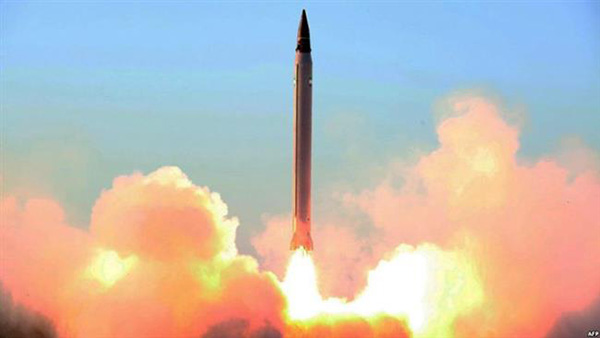
Iran’s Air Defence Foiled US F-18 Attemp to Free Sailors Last Year

F-18

“Regarding the arrest of American sailors, they (the US) attempted to free their sailors forcefully by using their F-18 fighter jets,” General Ali Reza Sabahi-Fard said in a speech on Wednesday.

However, the commander added, after the Khatam al-Anbia Air Defense Base issued warning alerts, the US fighter jets were forced to retreat.

The Islamic Revolution Guards Corps (IRGC) Navy on January 12, 2016 captured the US Navy sailors inside Iran’s territorial waters in the Persian Gulf, but released them the next day following an apology and after technical and operational investigations indicated that the intrusion into Iranian territorial waters was “unintentional”.

US Defense Secretary Ashton Carter later said he was “very, very angry” when he saw footage of 10 US Navy sailors detained by Iranian authorities broadcast by Iranian television.

Leader of the Islamic Revolution Ayatollah Seyed Ali Khamenei awarded Medals of Fath (Conquest) to Commander of the Islamic Revolution Guards Corps Navy Rear Admiral Ali Fadavi and four other IRGC commanders who made the “courageous and timely” move to capture the intruding American boats and sailors near Iran’s Farsi Island.

Aleppo Victory Major Step towards Syria Peace: Iran’s President

In a Wednesday meeting with visiting Syrian Prime Minister Imad Khamis, Rouhani said had the Takfiri terrorists and their supporters won in Aleppo, “a dangerous path would have opened up for the region and an uncertain future befallen it.”

Late last year, the army managed to liberate the eastern sector of Aleppo, the country’s second-largest city, which had fallen to Takfiri groups back in 2012. By doing so, the Syrian forces both restored the entirety of the city to government control and dealt the hardest blow to the militants since the onset of their campaign of foreign-fueled violence in Syria in 2011.

Government forces later secured the evacuation of remaining civilians and armed elements from the city under a ceasefire deal, brokered by Russia and Turkey, which were respectively representing the Syrian government and the armed factions. The Aleppo deal set the stage for a landmark all-Syria truce deal between Damascus and foreign-backed militant groups.

Rouhani further said the victory in Aleppo showed the world that “the Syrian people are capable of defending their homeland in the face of terrorists, and that the terror groups and their sponsors will never be able to achieve their goals.

The Iranian chief executive praised the Aleppo triumph as well as the Syria ceasefire as “two important steps towards establishment of peace and stability in the Arab country.”

This favorable opportunity should be seized to step up the fight against terrorists, said Rouhani, stressing, “What is sought by all of Syria’s friends is for peace and stability to return to the country so people can easily decide their future.”

“The Iranian government, people, and Leader [Ayatollah Seyyed Ali Khamenei] have always stood by the Syrian people and will always do so,” the Iranian president noted.

Khamis, for his part, said the Aleppo victory owes to the perseverance and resistance of the Syrian people and army as well as Iran’s unstinting support.

He asserted that the Syrians were intent upon returning security to their country.

Astana Talks ‘No Place for US’

Khamis also met with Ali Akbar Velayati, a senior advisor to Ayatollah Khamenei, who said the Islamic Republic is “vehemently opposed” to the US participation in the upcoming conflict resolution talks in the Kazakh capital of Astana.

Aleppo Victory Major Step towards Syria Peace: Iran's President

The negotiations will be held between representatives from the Damascus government and foreign-sponsored opposition groups on January 23.

They are mediated by Russia, Turkey, and Iran. Talks between the three have so far worked much in the way of bringing about the achievements on the ground.

“The talks will be the result of the victories of the Syrian government and people as well as their allies,” said Velayati, adding that the parties, which have long supported the terror groups and faced defeat on the battlefield, should not be allowed to “exploit the political arena and reap their desired results.”

The US has, from the start, insisted on deposing Syria’s legitimate government, he added.

The United States and its regional allies, namely Turkey, Saudi Arabia, and Qatar, have been lavishing financial and political support on anti-Syria terror groups since 2011, when the outfits unleashed their campaign of violence against the country.

Earlier, Iranian Foreign Minister Mohammad Javad Zarif also communicated Tehran’s opposition to Washington’s presence at the negotiation table.

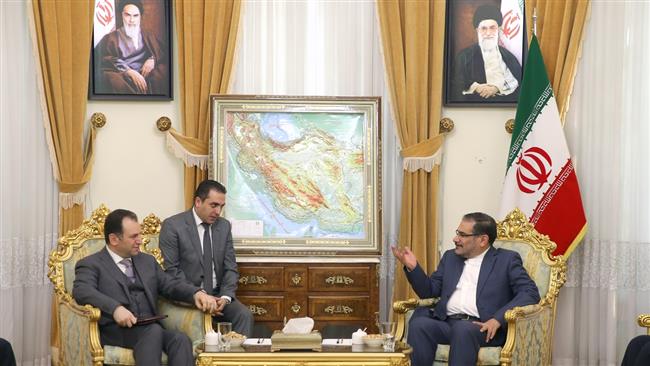
US Not Invited to Astana Talks on Syria: Iran’s Top Security Official

Iran Urges Collective Cooperation to Tackle Regional Security Challenges

“Due to Iran’s objection to the US participation in the Astana gathering, Washington has been sent no joint invitation by the three countries, at whose initiative the meeting is to take place,” Ali Shamkhani, Secretary of Iran’s Supreme National Security Council said Wednesday.

The Kazakh capital is to host the negotiations between representatives from the Damascus government and foreign-sponsored opposition groups on January 23.

The talks are to be mediated by Russia, Turkey, and Iran.

The three countries have over the past several months been working together and holding trilateral talks aimed at improving the situation on the ground in the Arab country.

Last month, such efforts led to the conclusion of a deal enabling the evacuation of civilians and armed elements out of the northwestern city of Aleppo as it was being liberated by the Syrian Army.

Iranian officials, most importantly Foreign Minister Mohammad Javad Zarif, have voiced opposition to Washington’s attendance, citing its dedication to the ouster of the Syrian government thought supporting the terror groups.

Russian Foreign Minister Sergei Lavrov has, however, said he believes US representatives should be invited to the meeting.

The United States and its regional allies, namely Turkey, Saudi Arabia, and Qatar, have been lavishing financial and political support on anti-Syria terror group since 2011, when the outfits unleashed their campaign of violence against the country.

Shamkhani said the US may only be invited to the talks as an observer at the invitation of the host country, adding that Washington cannot play a part in “managing, leading and directing the current initiatives on the Syria crisis,” including the Astana talks.

He cited Washington’s record of reneging on its commitments and incompetence in bringing about truce and directing the warring parties towards negotiation.

“As the country, which has had the most important role in supporting the Syrian government in fighting terrorism, the Islamic Republic will also be having a notable and active role in the political process, including the Astana meeting,” the official noted.

Iran has been lending political and military advisory support to Damascus in its uphill battle against terrorism.

Shamkhani also said only the armed groups, which have signed the all-Syria ceasefire and announced their commitment to inter-Syrian talks, as well as the UN envoy for Syria Staffan de Mistura have been invited to the Astana talks.

Bus Crash in Iran’s Kerman Kills 6, Injures 16

Bus Crash

The tragic bus crash took place at 21:51 pm (Iran local time) on Tuesday, January 17, said Shahin Fathi, the deputy head of the Relief and Rescue Organization of Iranian Red Crescent Society.

According to Farsi report by Iran Online, following the accident, relief and rescue forces immediately arrived at the scene and took the necessary measures to save the victims.

22 people were on the bus, of which 16 suffered injuries and 6 were killed.