Monday, December 22, 2025
Home Blog Page 4104

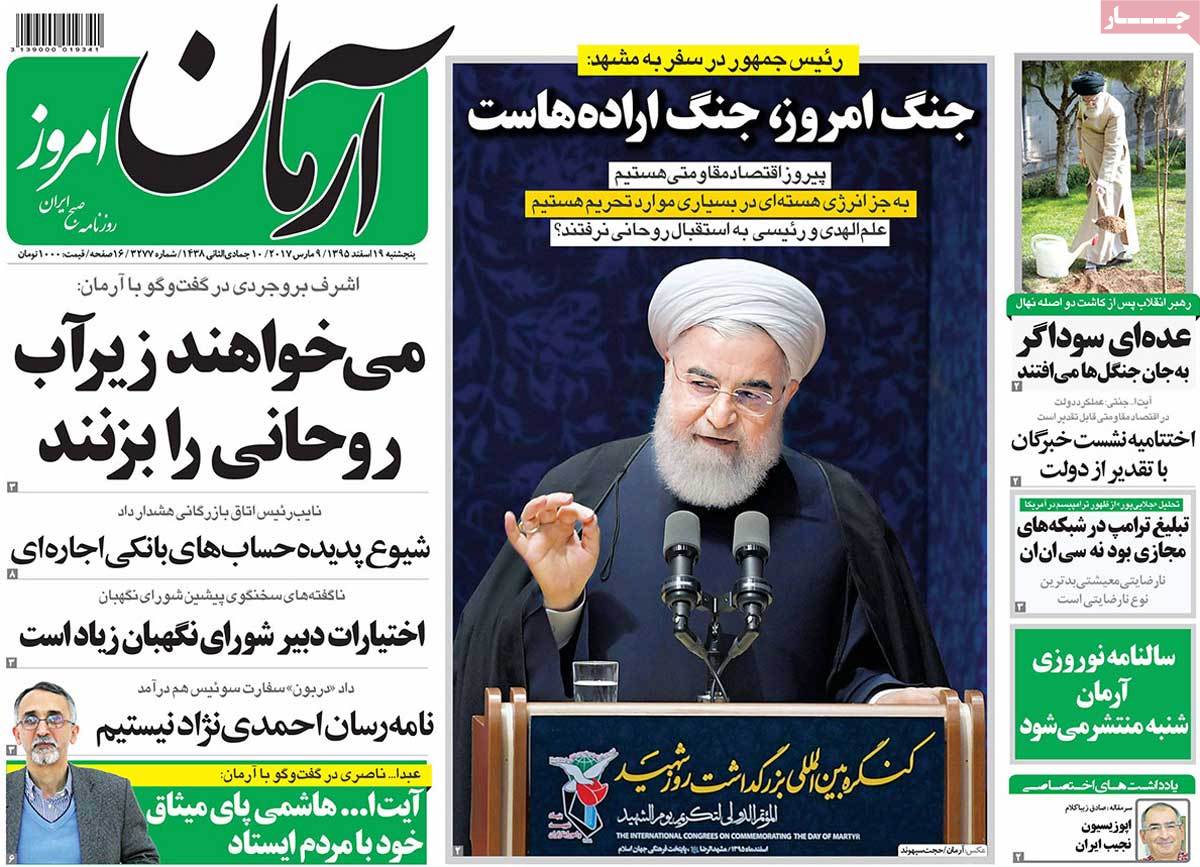
Common Enemies of Islam, Arab World Hatching Plots against Iran: President

rouhani

“Tehran has always been the harbinger of the settlement of problems and differences through dialogue, and Iran’s military might is solely defensive and supports regional security,” Rouhani said in a meeting with Oman’s Sultan Qaboos bin Said Al Said in Muscat on Wednesday.

The Iranian president stressed that the region’s security could be guaranteed only through cooperation among regional countries.

“Therefore, regional countries need to stand by each other and cooperate for the sake of lasting stability and security in the region,” he added.

Describing Iran and Oman as the “guardians of the Strait of Hormuz,” Rouhani underlined the two countries’ role in safeguarding the security of the region and the strategic route for international trade.

He also welcomed the expansion of ties between Iran and other countries of the region.

Iran has come to the help of regional countries whenever they were entangled in challenges, including terrorism, and will continue to render assistance to them if they demand it, the Iranian president added.

Common Enemies of Islam, Arab World Hatching Plots against Iran: President

The Iranian president also described Muscat-Tehran relations as “friendly and deep-rooted,” and welcomed the promotion of ties in different sectors, including economy, transportation, energy and trade.

Muslim countries urged to help Yemen

Touching on the conflicts in the region, including in Yemen, the Iranian president described the situation in the impoverished Arab state as “very grave” and called for serious action to address the issue.

“The Muslim countries of the region are all duty-bound to take… measures to help the oppressed people of Yemen,” Rouhani said.

The establishment of a ceasefire, the delivery of humanitarian aid and intra-Yemeni talks are the key to ending the crisis in the country, he added.

Sultan Qaboos, for his part, welcomed the expansion of ties between his country and Iran in the political, economic and cultural sectors.

He praised Iran’s resolve to hold amicable ties with its neighbors and promote regional cooperation, saying such a policy would serve the region’s peace and security.

The Omani ruler added that the countries of the Persian Gulf region had a “prime responsibility” to restore regional security through “consultations.”

Rouhani arrived in Muscat on Wednesday to discuss the promotion of ties with the Persian Gulf Arab country. After meeting Sultan Qaboos, Rouhani left Muscat to hold talks with Kuwaiti officials.

Iran ready to develop all-out ties with Kuwait  

During a meeting with Kuwait’s Emir Sheikh Sabah al-Ahmad al-Jaber al-Sabah in Kuwait City, Rouhani stressed that the two countries have close political ties and that their economic relations must follow suit.

“Iran is fully prepared for the development all-out ties, including joint investments in diverse projects, with Kuwait,” he said.

Common Enemies of Islam, Arab World Hatching Plots against Iran: President

For his part, Sheikh Sabah stressed that his country is adamant to increase relations with Iran in all fields.

The Iranian president’s one-day tour of the two countries comes less than a month after Iran received a message from the Kuwaiti emir on relations between the Islamic Republic and Persian Gulf Arab states.

The one-day visit by Kuwaiti Foreign Minister Sheikh Sabah al-Khalid al-Hamad al-Sabah to Iran was the first by a senior official of a Persian Gulf Arab state to the Islamic Republic after relations between Tehran and some of the Arab countries of the strategic region became tense when Saudi Arabia unilaterally severed its diplomatic ties with Iran.

Iran has already stressed that it is ready to cooperate with regional countries, including Saudi Arabia, on regional problems.

Nuclear Deal Prevents Trump from Increasing Pressure on Iran

“One of the challenges facing the JCPOA is Trump,” Abbas Araqchi was cited by lawmaker Hossein Naqavi Hosseini as telling a parliamentary meeting on Wednesday, IRNA reported.

JCPOA stands for the official name of the pact, the Joint Comprehensive Plan of Action.

“If Trump had taken office before the action plan was completed, we would have had serious problems because before the JCPOA there was an international alliance against us but now that alliance is working in Iran’s favor by supporting JCPOA,” Araqchi said.

“So thanks to the action plan, we are in a very good position against Trump and if it weren’t for the deal, Trump would have had many tools to use against the Islamic Republic.”

Trump, who has signaled he wants to take a harder line on Iran than his predecessor Barack Obama, promised during his electoral campaign to renegotiate the nuclear pact if he became president.

However, he is forced to toe the line, as the five other states, which are also party to the nuclear deal with Iran, oppose any attempt to tamper with the deal.

Spokesman Condemns Washington’s Meddling in Iran’s Domestic Affairs

ad16f74b-63f7-4b08-8a00-417bb9d13489

The Iranian government and nation have “very bitter memories” of the American officials’ “occasional and uncalled-for” interference in Iran’s domestic affairs, Iranian Foreign Ministry Spokesman Bahram Qassemi said on Wednesday.

In a statement on Tuesday, the US State Department called on Iran to put an end to the house arrest of Mehdi Karroubi and Mir Hossein Musavi, two of the candidates in the 2009 presidential election who had lost the race but claimed that the results had been rigged. The two remain under house arrest on charges of provoking the public and harming the national security.

The Iranian Foreign Ministry official condemned the US statement as “biased, suspicious, unwarranted and politically-motivated,” stressing that Iran will never accept such meddlesome approaches adopted by the US.

While remaining committed to its international obligations, Iran has prioritized the implementation of the Iranian Constitution’s principles to protect civil rights, Qassemi said, in reaction to part of the US statement that called on Iran to “respect human rights.”

Iran has on numerous occasions censured Western countries for exploiting the issue of human rights to pile up pressure on the Islamic Republic, rejecting the West’s stance on the issue as interference in the country’s internal affairs.

Herbal Healthcare and Great Potentials for Growth in Iran

12_green_gold_2

“There has been emphasis on tapping into the potential of Iranian traditional medicine,” he said addressing the Fifth Conference of Green Gold on medicinal herbs at Tehran’s Shahid Beheshti University of Medical Sciences.

High-ranking officials from the Health Ministry as well as experts in the field, attended the meet, Mehr News Agency reported.

“Globally too there has been a move to prioritize and introduce and incorporate traditional medicine in health systems,” Khodadoost noted, adding that the World Health Organization has taken steps to further promote the specialty.

The WHO has adopted a strategy to endorse traditional medicines and support member states in developing proactive policies and implement plans to strengthen the role of traditional medicine in the health sector.

Due to Iran’s geographical diversity, which includes 11 of the world’s 13 climates, more than 7,500 species of herbal plants are grown, of which 1,800 are used in traditional medicine.

Also, many of the herbal plants are unique to Iran and found nowhere else in the world.

“But the question is, how much we have succeeded to integrate authentic herbal medicine in people’s everyday lives and diets,” Khodadoost noted.

Dr Mohammad Ayyazi, deputy health minister for social affairs, pointed to traditional remedies as a technique long used by Iranians especially in rural regions.

“Most households even in urban areas store herbal petals, essences, powders and extracts to provide relief for different kinds of ailments, but despite all efforts, we have not been fully able to use traditional medicine as a complement to contemporary medicine,” he said.

In the past three years the Health Ministry has taken measures to strengthen the role of Iranian traditional medicine.

Establishment of eight faculties of traditional medicine, development of 17 university programs on Iranian traditional medicine (and 8 university programs on traditional pharmacy), and fixing tariffs for 11 traditional medicine services (for the first time in 2013) are among the important measures taken so far to integrate traditional medicine into the modern healthcare system.

Ayyazi maintained that there is room to promote Iranian traditional medicine through different strategies, registering those indigenous to Iran globally, for instance.

Iranian traditional medicine dates back more than 3,000 years and has been used since ancient times. Persian polymath Avicenna’s ‘Book of Healing’ and the ‘Canon of Medicine’ are the most authoritative sources in this field.

There are currently 30 companies producing natural herbal remedies in Iran, and all herbal medicine is manufactured on par with the quality standards as pharmaceutical drugs.

Currently, there are 70 accredited traditional medicine specialists, more than half of whom work at medical science universities. The rest are involved in treatment procedures at traditional medicine centers affiliated to universities.

Iranian FM to Take Part in Munich Security Conference

Mohammad Javad Zarif

Iranian Foreign Ministry Spokesman Bahram Qassemi announced on Wednesday that Zarif will leave Tehran for Germany in coming days to attend Munich Security Conference (MSN).

“Based on schedules, the foreign minister will address the conference and hold talks with a number of foreign officials, including presidents, foreign ministers, owners of economic companies, heads of international organizations and political figures, on the sidelines of the conference,” Qassemi added.

Since its foundation five decades ago, the MSC has become a leading international platform for dialogue on foreign and security policy.

In addition to its annual flagship conference, the MSC regularly convenes high-profile events on particular topics and regions and publishes the Munich Security Report.

MP Rejects Arab Parliament Chairman’s Anti-Iran Remarks

Persian Gulf islands

Chairman of Arab Parliament Meshaal al-Salmi recently repeated certain Arab states’ claim that the three Persian Gulf islands Abu Musa, the Greater Tunb, and the Lesser Tunb belong to the United Arab Emirates, and called on Iran to end its occupation of three UAE islands.

In reaction to the remarks, Jalal Mirzaei, a member of Iran’s Parliament, reaffirmed Iran’s sovereignty over the three Persian Gulf islands, stressing that these islands are an inseparable part of the Iranian territory.

“These remarks have no basis, and all historical documents indicate the three islands have always been an integral part of the Iranian territory,” he added, according to a Farsi report by ICANA.

Fox News Says Iran’s General Soleimani Is Visiting Russia

Ghasem-Soleimani

The Iranian general traveled to Moscow Wednesday to meet with high-ranking Russian officials, Fox News said in a report on Wednesday.

Fox News quoted multiple western intelligence officials with direct knowledge of the visit as saying the trip violated multiple United Nations resolutions forbidding him from leaving his country.

“General Soleimani arrived in Terminal A of Vnukovo airport outside Moscow on Feb. 14 on Mahan Air WD084 at 12:13 p.m. local time and was scheduled to remain in Russia for a few days for meetings,” Fox News quoted officials as saying.

“Soleimani is visiting Moscow to express his displeasure with the Russian government over their relationship with Saudi Arabia and other Arab states, mainly regarding weapons deals and strengthening economic ties,” sources told Fox News.

According to the US right-winger news website, this is Soleimani’s third trip to Moscow following visits in April and July last year.

Iran, Main Topic of US Officials’ Foreign Visits, Talks

The top members of US President Donald Trump’s government have initiated their activities in the field of foreign policy by setting off on overseas tours of other countries.

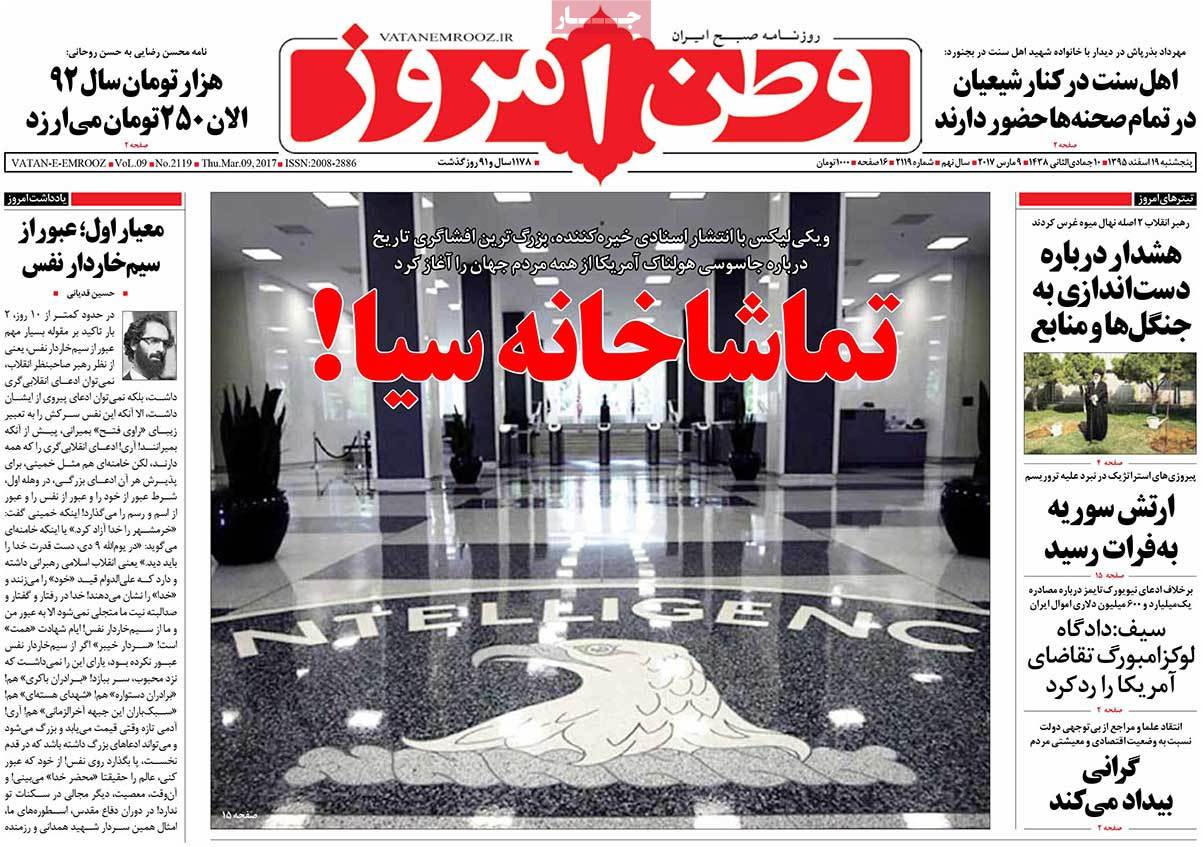
According to a Farsi report by Etemad newspaper, [new] US Defence Secretary James Mattis opted for East Asian countries of Japan and South Korea as his first destinations, whereas, the new director of the country’s Central Intelligence Agency (CIA), Mike Pompeo, initially spent two days in Turkey and, then, set out for Saudi Arabia.

A full report of Ankara’s complaints about the performance of the former US government was all that was published in media about Pompeo’s visit. Turkish officials criticized Washington’s insistence upon not extraditing the US-based opposition figure Fethullah Gulen, who is accused of organizing 2016 Turkish coup d’état attempt, and the White House’s support for the [north] Syrian Kurds, whom Ankara views as a threat, during Barack Obama’s term in office. Although not given a hint about by international media, it is crystal clear that Iran’s name has been mentioned in Pompeo’s meetings with Prime Minister Binali Yildirim and President Recep Tayyip Erdogan.

Perhaps, the proposal put forward a few days ago by Turkish Foreign Minister Mevlut Cavusoglu concerning the need for greater unity among Turkey, Saudi Arabia and the US to fight against terrorist groups in the region, was also among the issues discussed in the meetings between Turkish officials and the new member of the Trump administration.

Amidst ambiguities about Trump’s policies towards the Middle East, Pompeo travelled to Riyadh and primarily met the Saudi Crown Prince Muhammad bin Nayef bin Abdulaziz Al Saud, who although has not played a significant role in formulating the Saudi government’s policies over the past few years, is still quite popular with different US governments.

At the beginning of his meeting with Pompeo, Muhammad bin Nayef, who is also deputy prime minister and minister of interior, said the relationship between the US and Saudi Arabia is historic and strategic, stressing any plot aimed at destroying this strategic relationship is doomed to failure.

“No attempt will succeed in driving a wedge between the Kingdom of Saudi Arabia and the US.”

He also stressed the Saudi government’s determination and policy to continue its fight against terrorism.

Also over the course of his Saudi Arabia visit, Pompeo honoured Muhammad bin Nayef with CIA’s prestigious “George Tenet Medal” for his “intelligence work in the fight against terrorism” at a reception ceremony in Riyadh on February 10.

CIA- saudi

Addressing the ceremony after receiving the medal, in a statement, Muhammad bin Nayef said he appreciated the CIA honour and framed it as a recognition of what he called Saudi Arabia’s anti-terrorism efforts under the directives of King Salman bin Abdulaziz Al Saud.

“The kingdom has been keen to combat terrorism based on its conviction that terrorism has no identity and no religion, and from its belief that the terrorists are committing these acts stemming from their deviant ideologies and evil thought,” he stated.

Pompeo has become the first top official of the new US government to visit Saudi Arabia.

A week prior to Pompeo’s visit to Riyadh, Trump had held extensive talks on a number of regional issues with Saudi Arabia’s King Salman bin Abdulaziz in their first phone conversation.

In this phone call, King Salman invited Trump “to lead a Middle East effort to defeat terrorism and to help build a new future, economically and socially,” for Saudi Arabia and the region.

The Trump’s move to select Saudi Arabia as one of his cabinet members’ first destinations in the Middle East, came as he had harshly criticised the US traditional allies in the region during his election campaign, stressing that the Persian Gulf littoral states, themselves, are required to bear the costs of creating a safe zone for protecting Syrian refugees.

The US president had also repeatedly said that US allies are required to meet all the expenses involved in ensuring their security on their own, addressing both a number of the European and Persian Gulf littoral states.

Nevertheless, the sole priority the Trump administration has, to some extent, clearly identified so far with regard to the Middle East, is its determination to fight the ISIS and other terrorist circles in the region. Other US state officials have also repeatedly stressed the importance of the US administration’s priority. The US government’s resolve to fight terrorism in the Middle East region is what the Saudi government has capitalised on to get closer to the White House.

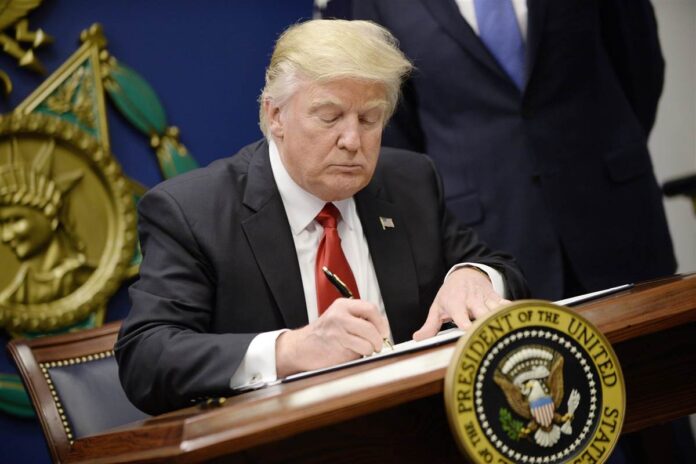
Pompeo’s visit to Saudi Arabia came as, Trump had signed an executive order to temporarily suspend immigration from seven Middle Eastern and North African countries, including Iran, to the US only a few days after coming into power as the American president.

Muslim Ban

The ban has, currently, been suspended by a number of US courts of appeals. Interesting about the order is that Saudi Arabia and the UAE were not on the list of the banned countries. This is while, the two countries’ citizens were closely involved in the September 11 terrorist attacks in 2001. Following the issuance of the executive order, Saudi Arabia and the UAE, feeling blessed due to not being included in the list, remained silent and did not react to it.

Their silence came as, even Washington’s European allies, the United Nations and the Arab League slammed the order as discriminatory and racist.

Among the other members of the [Persian] Gulf Cooperation Council ([P]GCC) who did not react to Trump’s ban were Bahrain, Kuwait and Oman.

On the reasons for [P]GCC members’ silence in the face of an order targeting the entire Muslim world, the Washington-based Al-Monitor said in a report, “The lack of condemnation from the [P]GCC [save Qatar, which expressed a subtle disapproval of Trump’s executive order] is indicative of the Arab [Persian] Gulf states’ ‘wait-and-see’ approach to the new US administration and their vested interests in staying on Trump’s good side at a time when their economic and security challenges require close cooperation with Washington.”

The main policy Al Saud pursues by investing in the new US government is to secure the country’s support for Riyadh’s efforts to curb Iran’s activities in the region.

In addition, due to its prolonged (almost two-year) military siege of Yemen, Saudi Arabia is currently beset with a host of economic problems which heighten its government’s need to foreign investments.

Washington’s main interest in having relations with the [P]GCC countries is the revenues it earns by selling weapons to them. When the names of the seven banned countries were released, it was claimed that they were among the nations with which the US has no trade ties. Commenting on this, Al-Monitor wrote in the same report, “The United States is not a major arms seller to most of the seven countries listed: Iran, Iraq, Libya, Somalia, Sudan, Syria and Yemen. With James Mattis heading the Pentagon and Rex Tillerson serving as America’s top diplomat, these two figures have close ties with the [P]GCC and view the Arab Gulf states as pivotal American allies in the Middle East, particularly as the White House flexes its muscles in the [Persian] Gulf to send Iran a bold message.”

Unlike the [P]GCC members which opted to remain silent and do not risk their interests, in a phone conversation with Trump, Iraqi Prime Minister Haider al-Abadi criticised the travel ban. Tensions with Iran were also mentioned in this phone call.

In addition, on February 11, al-Abadi said Iraq will not take part in any regional or international conflicts.

“Iraq is very keen to preserve its national interests […] and does not wish to be part of any regional or international conflict which would lead to disasters for the region and for Iraq,” Abadi told state TV.

Italian Company Offers to Repair Iranian Historical Palace for Free

Massoudieh Mansion

There are many monuments and caravansaries in the ancient road of Garmsar to Isfahan in central Iran, which dates back to Safavid era. The Italian company L. E. Genesis plans to renovate some of these historical places in a project titled “Iranian tourist areas on the edge of desert.”

“Our company seeks to repair and utilize a number of caravansaries in the road of Garmsar to Isfahan from Iranian Fund for Revival and Utilization of Historical and Cultural Places,” said Alan Ascherelli, the CEO of L. E. Genesis, according to a Farsi report by Mehr.

“L. E. Genesis is willing repair the magnificent Masoudieh palace of Tehran for free as a gift to the Iranian Fund if the project is launched.”

“We also plan to choose some historical monuments near the caravansaries to build tourist towns around them,” he added. “We intend to present the culture of local people.”

isfahanReferring to the importance of the Safavid road, he noted, “This 600km-long road is 25,000 square kilometres, so worthy tourist destinations can be presented there if we work on this path and its monuments.”

He went on to say that having worked on the caravansaries since two years ago, this company offers the latest technical and engineering services for monument revival in cooperation with 12 international experienced firms in the field.

Meanwhile, Mohammadreza Poyandeh, the managing director of Iranian Fund for Revival and Utilization of Historical and Cultural Places, said, “During the visit of Italian Prime Minister to Iran, the Fund established good relations with Italian investors.”

“Different Italian groups have negotiated with us for repairing our monuments, investment, and knowledge transfer.”

“Based on our negotiations with Iran’s Ministry of Economic Affairs and Finance, we can guarantee that every foreign country can make investment in Iranian monuments,” he added.

Iranian MP Warns against Efforts to Spoil Presidential Election’s Atmosphere

aref

Iranian MP Mohammad-Reza Aref maintains that a trend has begun in Iran which seeks to cause disappointment and frustration in the country, especially in universities, and charge the overall atmosphere of the country’s upcoming elections (19 May) with lassitude and indifference to prevent the continuation of a movement started in the country in June 2013.

According to a Farsi report by ISNA, addressing a group of university students, he warned them about efforts currently underway by certain circles to spoil the atmosphere of Iranian universities, calling on the students to be proud of themselves for being heir to a formation which has a very precious historical background.

He stressed that all efforts are required to be aimed at preserving the formation’s identity.
Aref said the Iranian party opposing the country’s reformists has all the potential facilities [to win the competition] including the state TV — Islamic Republic of Iran Broadcasting (IRIB) — which both fails to be available to the reformist and pro-government moderate parties and has turned into a tribune for confronting them.

“Reformists approve of the Establishment. They only maintain that certain criticisms can be levelled at the functions and performances.”

Referring to the Central Council of the Islamic Association of Students, Aref said considerable effort is made to decompose this council, which, fortunately, has failed so far.

“We have reached out a friendly hand to all of the country’s political circles by, having a long-term vision in mind and putting forward the idea of holding national dialogues. We, benevolently, seek to overcome the domestic challenges faced by the [1979] Islamic revolution [of Iran] and maintain that resolving these problems will be in the interest of the Establishment.”