Monday, December 22, 2025
Home Blog Page 4103

Iran in Final Stages of Purchasing ATR Planes

“Negotiations for the purchase of aircraft from ATR have reached the final stage and at the moment, the two sides are at the stage of exchanging documents,” Akhoundi said.

The minister added that with the finalization of document exchange, the introduction of the first ATR aircraft into Iran’s air fleet will begin to be followed up through official channels.

The deal was first signed in February 2016 in Tehran following the commercial discussions held in Rome and Paris during visit of Iranian President Hassan Rouhani to those countries.

Tel Aviv Quietly Withdraws Ambassador from Cairo

photo_2017-02-16_11-48-44

Sources told The Telegraph that Ambassador David Govrin was quietly pulled out of Egypt at the end of last year over security concerns.

News of Govrin’s withdrawal from Egypt was first reported on Facebook by Amin el-Mahdy, an Egyptian political analyst who maintains contacts with Israeli officials.

Mr el-Mahdy said he did not believe that the ambassador was withdrawn over security fears and said instead that the move was the result of behind the scenes political tensions between Egypt and Israel.

He said he believed that Benjamin Netanyahu, the Israeli prime minister, and Abdel Fattah el-Sisi, the Egyptian president, were in a disagreement over Gaza and its border with Egypt and that the argument had led to Mr Govrin being brought home.

Egypt and Jordan are the only Arab countries to have diplomatic ties with the Israeli regime; however, Tel Aviv’s insistence on its occupation policies on the one hand, and the Egyptian and Jordanian people’s protests against ties with Israel on the other hand, have always kept the tensions high.

Iran Should Resume Ties with Saudis for Hajj Pilgrimage

Iran Officially Declares Cancellation of This Year's Hajj Pilgrimage

“In a recent parliamentary session, Iranian MPs evaluated Saudi Arabia’s latest hostile policies towards Iran,” Iranian lawmaker Valiollah Nanvakenari said.

“Saudi Arabia supports Takfiris [extremists] in the region,” he added. “It endeavors to penetrate the Islamic Revolution forces to destroy the credibility and greatness of its ideals.”

According to a Farsi report by ICANA, he went on to say that the Al Saud is trying to extend acts of terrorism in the form of such groups as Al-Qaeda and ISIS. “Diplomatically, we condemn such measures.”

“Saudi Arabia bribes several countries to have their support and reduce the number of its opponents.”

Despite refusing and condemning its pro-terrorism policies, he said, Iran has some religious demands from Saudi Arabia. “They must provide for Iranians’ attendance in Hajj pilgrimage.”

“We expect the Iranian Foreign Minister to prepare a good atmosphere for the dispatch of pilgrims to Mecca while their dignity is maintained,” he added.

Common Enemies of Islam, Arab World Hatching Plots against Iran: President

rouhani

“Tehran has always been the harbinger of the settlement of problems and differences through dialogue, and Iran’s military might is solely defensive and supports regional security,” Rouhani said in a meeting with Oman’s Sultan Qaboos bin Said Al Said in Muscat on Wednesday.

The Iranian president stressed that the region’s security could be guaranteed only through cooperation among regional countries.

“Therefore, regional countries need to stand by each other and cooperate for the sake of lasting stability and security in the region,” he added.

Describing Iran and Oman as the “guardians of the Strait of Hormuz,” Rouhani underlined the two countries’ role in safeguarding the security of the region and the strategic route for international trade.

He also welcomed the expansion of ties between Iran and other countries of the region.

Iran has come to the help of regional countries whenever they were entangled in challenges, including terrorism, and will continue to render assistance to them if they demand it, the Iranian president added.

Common Enemies of Islam, Arab World Hatching Plots against Iran: President

The Iranian president also described Muscat-Tehran relations as “friendly and deep-rooted,” and welcomed the promotion of ties in different sectors, including economy, transportation, energy and trade.

Muslim countries urged to help Yemen

Touching on the conflicts in the region, including in Yemen, the Iranian president described the situation in the impoverished Arab state as “very grave” and called for serious action to address the issue.

“The Muslim countries of the region are all duty-bound to take… measures to help the oppressed people of Yemen,” Rouhani said.

The establishment of a ceasefire, the delivery of humanitarian aid and intra-Yemeni talks are the key to ending the crisis in the country, he added.

Sultan Qaboos, for his part, welcomed the expansion of ties between his country and Iran in the political, economic and cultural sectors.

He praised Iran’s resolve to hold amicable ties with its neighbors and promote regional cooperation, saying such a policy would serve the region’s peace and security.

The Omani ruler added that the countries of the Persian Gulf region had a “prime responsibility” to restore regional security through “consultations.”

Rouhani arrived in Muscat on Wednesday to discuss the promotion of ties with the Persian Gulf Arab country. After meeting Sultan Qaboos, Rouhani left Muscat to hold talks with Kuwaiti officials.

Iran ready to develop all-out ties with Kuwait  

During a meeting with Kuwait’s Emir Sheikh Sabah al-Ahmad al-Jaber al-Sabah in Kuwait City, Rouhani stressed that the two countries have close political ties and that their economic relations must follow suit.

“Iran is fully prepared for the development all-out ties, including joint investments in diverse projects, with Kuwait,” he said.

Common Enemies of Islam, Arab World Hatching Plots against Iran: President

For his part, Sheikh Sabah stressed that his country is adamant to increase relations with Iran in all fields.

The Iranian president’s one-day tour of the two countries comes less than a month after Iran received a message from the Kuwaiti emir on relations between the Islamic Republic and Persian Gulf Arab states.

The one-day visit by Kuwaiti Foreign Minister Sheikh Sabah al-Khalid al-Hamad al-Sabah to Iran was the first by a senior official of a Persian Gulf Arab state to the Islamic Republic after relations between Tehran and some of the Arab countries of the strategic region became tense when Saudi Arabia unilaterally severed its diplomatic ties with Iran.

Iran has already stressed that it is ready to cooperate with regional countries, including Saudi Arabia, on regional problems.

Nuclear Deal Prevents Trump from Increasing Pressure on Iran

“One of the challenges facing the JCPOA is Trump,” Abbas Araqchi was cited by lawmaker Hossein Naqavi Hosseini as telling a parliamentary meeting on Wednesday, IRNA reported.

JCPOA stands for the official name of the pact, the Joint Comprehensive Plan of Action.

“If Trump had taken office before the action plan was completed, we would have had serious problems because before the JCPOA there was an international alliance against us but now that alliance is working in Iran’s favor by supporting JCPOA,” Araqchi said.

“So thanks to the action plan, we are in a very good position against Trump and if it weren’t for the deal, Trump would have had many tools to use against the Islamic Republic.”

Trump, who has signaled he wants to take a harder line on Iran than his predecessor Barack Obama, promised during his electoral campaign to renegotiate the nuclear pact if he became president.

However, he is forced to toe the line, as the five other states, which are also party to the nuclear deal with Iran, oppose any attempt to tamper with the deal.

Spokesman Condemns Washington’s Meddling in Iran’s Domestic Affairs

ad16f74b-63f7-4b08-8a00-417bb9d13489

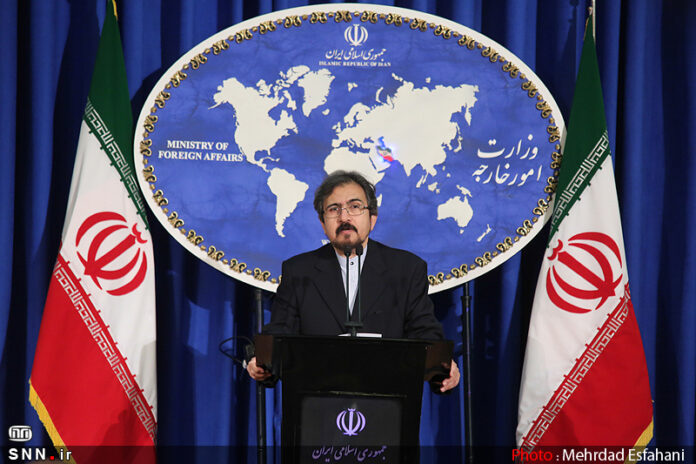
The Iranian government and nation have “very bitter memories” of the American officials’ “occasional and uncalled-for” interference in Iran’s domestic affairs, Iranian Foreign Ministry Spokesman Bahram Qassemi said on Wednesday.

In a statement on Tuesday, the US State Department called on Iran to put an end to the house arrest of Mehdi Karroubi and Mir Hossein Musavi, two of the candidates in the 2009 presidential election who had lost the race but claimed that the results had been rigged. The two remain under house arrest on charges of provoking the public and harming the national security.

The Iranian Foreign Ministry official condemned the US statement as “biased, suspicious, unwarranted and politically-motivated,” stressing that Iran will never accept such meddlesome approaches adopted by the US.

While remaining committed to its international obligations, Iran has prioritized the implementation of the Iranian Constitution’s principles to protect civil rights, Qassemi said, in reaction to part of the US statement that called on Iran to “respect human rights.”

Iran has on numerous occasions censured Western countries for exploiting the issue of human rights to pile up pressure on the Islamic Republic, rejecting the West’s stance on the issue as interference in the country’s internal affairs.

Herbal Healthcare and Great Potentials for Growth in Iran

12_green_gold_2

“There has been emphasis on tapping into the potential of Iranian traditional medicine,” he said addressing the Fifth Conference of Green Gold on medicinal herbs at Tehran’s Shahid Beheshti University of Medical Sciences.

High-ranking officials from the Health Ministry as well as experts in the field, attended the meet, Mehr News Agency reported.

“Globally too there has been a move to prioritize and introduce and incorporate traditional medicine in health systems,” Khodadoost noted, adding that the World Health Organization has taken steps to further promote the specialty.

The WHO has adopted a strategy to endorse traditional medicines and support member states in developing proactive policies and implement plans to strengthen the role of traditional medicine in the health sector.

Due to Iran’s geographical diversity, which includes 11 of the world’s 13 climates, more than 7,500 species of herbal plants are grown, of which 1,800 are used in traditional medicine.

Also, many of the herbal plants are unique to Iran and found nowhere else in the world.

“But the question is, how much we have succeeded to integrate authentic herbal medicine in people’s everyday lives and diets,” Khodadoost noted.

Dr Mohammad Ayyazi, deputy health minister for social affairs, pointed to traditional remedies as a technique long used by Iranians especially in rural regions.

“Most households even in urban areas store herbal petals, essences, powders and extracts to provide relief for different kinds of ailments, but despite all efforts, we have not been fully able to use traditional medicine as a complement to contemporary medicine,” he said.

In the past three years the Health Ministry has taken measures to strengthen the role of Iranian traditional medicine.

Establishment of eight faculties of traditional medicine, development of 17 university programs on Iranian traditional medicine (and 8 university programs on traditional pharmacy), and fixing tariffs for 11 traditional medicine services (for the first time in 2013) are among the important measures taken so far to integrate traditional medicine into the modern healthcare system.

Ayyazi maintained that there is room to promote Iranian traditional medicine through different strategies, registering those indigenous to Iran globally, for instance.

Iranian traditional medicine dates back more than 3,000 years and has been used since ancient times. Persian polymath Avicenna’s ‘Book of Healing’ and the ‘Canon of Medicine’ are the most authoritative sources in this field.

There are currently 30 companies producing natural herbal remedies in Iran, and all herbal medicine is manufactured on par with the quality standards as pharmaceutical drugs.

Currently, there are 70 accredited traditional medicine specialists, more than half of whom work at medical science universities. The rest are involved in treatment procedures at traditional medicine centers affiliated to universities.

Iranian FM to Take Part in Munich Security Conference

Mohammad Javad Zarif

Iranian Foreign Ministry Spokesman Bahram Qassemi announced on Wednesday that Zarif will leave Tehran for Germany in coming days to attend Munich Security Conference (MSN).

“Based on schedules, the foreign minister will address the conference and hold talks with a number of foreign officials, including presidents, foreign ministers, owners of economic companies, heads of international organizations and political figures, on the sidelines of the conference,” Qassemi added.

Since its foundation five decades ago, the MSC has become a leading international platform for dialogue on foreign and security policy.

In addition to its annual flagship conference, the MSC regularly convenes high-profile events on particular topics and regions and publishes the Munich Security Report.

MP Rejects Arab Parliament Chairman’s Anti-Iran Remarks

Persian Gulf islands

Chairman of Arab Parliament Meshaal al-Salmi recently repeated certain Arab states’ claim that the three Persian Gulf islands Abu Musa, the Greater Tunb, and the Lesser Tunb belong to the United Arab Emirates, and called on Iran to end its occupation of three UAE islands.

In reaction to the remarks, Jalal Mirzaei, a member of Iran’s Parliament, reaffirmed Iran’s sovereignty over the three Persian Gulf islands, stressing that these islands are an inseparable part of the Iranian territory.

“These remarks have no basis, and all historical documents indicate the three islands have always been an integral part of the Iranian territory,” he added, according to a Farsi report by ICANA.

Fox News Says Iran’s General Soleimani Is Visiting Russia

Ghasem-Soleimani

The Iranian general traveled to Moscow Wednesday to meet with high-ranking Russian officials, Fox News said in a report on Wednesday.

Fox News quoted multiple western intelligence officials with direct knowledge of the visit as saying the trip violated multiple United Nations resolutions forbidding him from leaving his country.

“General Soleimani arrived in Terminal A of Vnukovo airport outside Moscow on Feb. 14 on Mahan Air WD084 at 12:13 p.m. local time and was scheduled to remain in Russia for a few days for meetings,” Fox News quoted officials as saying.

“Soleimani is visiting Moscow to express his displeasure with the Russian government over their relationship with Saudi Arabia and other Arab states, mainly regarding weapons deals and strengthening economic ties,” sources told Fox News.

According to the US right-winger news website, this is Soleimani’s third trip to Moscow following visits in April and July last year.