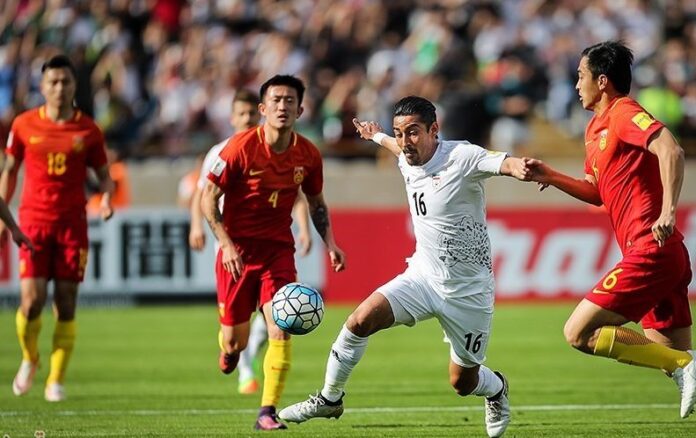
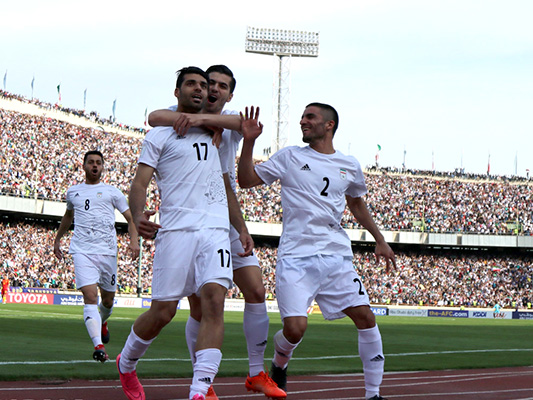
In front of about 100,000 cheering fans in Tehran’s Azadi Stadium, Iran cemented its place at top of Group A with 17 points, four points ahead of second place South Korea who defeated Syria 1-0 in the group.
China has little chance of qualifying with just five points.
Taremi, who scored Iran’s solitary goal against Qatar in Doha last week, found the back of the net once again in the 46th minute.
His low shot from eight yards out slipped under Chinese goalkeeper Zeng Cheng to give Carlos Queiroz’s side its fifth win in seven games.
Iran could have won with more goals but Team Melli’s strikers missed their chances.
Iran captain Masoud Shojaei was named ‘Man of the Match’.
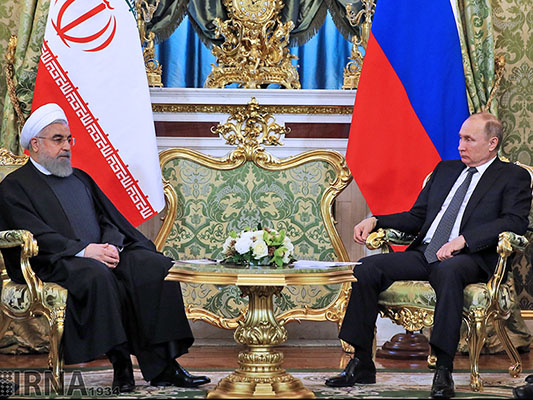
“Relations between Iran and Russia are aimed at promoting regional stability and the two countries’ main objective is to promote regional peace and tranquility,” Rouhani said in a meeting with Russian President Vladimir Putin at the Kremlin, Moscow, on Tuesday.
He added that Tehran-Moscow ties would never be against the interests of any third country.
Rouhani said Iran attached importance to strengthening relations with Russia, adding that the two countries had taken steps to bring about positive developments in mutual ties over the past three and a half years.
Iranian President Hassan Rouhani (R) shakes hands with his Russian counterpart, Vladimir Putin, during their meeting at the Kremlin in Moscow on March 28, 2017. (Photo by president.ir)
The Iranian chief executive emphasized that mutual relations had entered “a new phase,” saying, “In this new phase, we can speak about sustainable and long-term ties.”
Rouhani expressed hope that the two sides would manage to take more steps to further deepen ties.
The Russian president, for his part, said Iran was a good neighbor and a stable and reliable partner for his country.
Putin added that Moscow and Tehran worked very effectively together in all areas, including on global issues and the resolution of major and very grave international problems.
He also commended major achievements made by the two countries in recent years, particularly in the economic sector, saying that trade volume between Iran and Russia increased 70 percent in 2016 in comparison with the year before.
Iran, Russia sign 14 documents for cooperation
Meanwhile, Iran and Russia signed 14 documents for the expansion of cooperation in various political, economic, judicial, legal, scientific and cultural fields.
The documents were signed by senior Iranian and Russian officials in the presence of Rouhani and Putin following their talks.
Meanwhile, Iranian and Russian economic entrepreneurs and businesspeople held several rounds of talks and signed agreements to boost cooperation between the two countries’ private sectors.
Heading a high-ranking politico-economic delegation, the Iranian president arrived in Moscow Monday evening for a two-day official visit at the invitation of his Russian counterpart.
In a meeting with Russian Prime Minister Dmitry Medvedev on Monday, Rouhani said mutual relations were “growing” and stressed that relations would play an effective role in promoting regional and international stability and security.
Before the current meeting, Rouhani and Putin had held eight meetings over the past four years. Tehran and Moscow enjoy strategic relations with senior delegations from the two countries regularly exchanging visits.
The two presidents have also held several phone conversations and discussed the available avenues for the continuation of bilateral cooperation on the crisis in Syria and the fight against international terrorism.
Rouhani, Putin stress expansion of economic ties in joint presser
Following their meeting in Moscow, the presidents of Iran and Russia took part in a joint press conference.
Addressing the reporters, Putin said in his talks with Rouhani, they had discussed further expansion of joint investment and technology transfer between Tehran and Moscow.
He added that special attention was also paid during their negotiations to the continuation of cooperation on peaceful nuclear energy between the two countries.
The Russian president said the first unit of Bushehr nuclear power plant, in southern Iran, is now operating at full capacity, noting that his country was also planning to build the second and third units at the facility.
He added that Moscow has extended 4.2 billion dollars in loan to Iran for the construction of a thermal power plant and electrification of a railroad connecting the central Iranian city of Semnan to northeastern city of Incheborun.
Putin expressed his country’s readiness to make investment in Iran’s oil and gas sectors.
Pointing to similar stances taken by Iran and Russia on a variety of regional and international issues, Putin said the two sides had reiterated their determination to continue fighting terrorism and extremism in the region.
He noted that the two countries had agreed to press ahead with the campaign against terrorist groups operating in the region, particularly Daesh and al-Nusra front.
The Russian president also stressed the importance of establishment of a lasting ceasefire in Syria through cooperation of Russia, Iran and Turkey, noting that both Tehran and Moscow attached importance to the restoration of security to the crisis-hit country.
Putin also threw his country’s weight behind Iran’s membership at the Shanghai Cooperation Organization.
The Iranian president, for his part, said he had discussed the situation in Syria and Yemen with his Russian counterpart.
Rouhani said the two sides had reviewed ways of improving regional peace and security and establishing close relations among nations and countries in the region.
Iran’s chief executive added that Tehran and Moscow would continue their campaign against terrorism until terrorism is eradicated across the region.
He further hailed Russia’s role in striking and implementing a landmark nuclear agreement, known as the Joint Comprehensive Plan of Action (JCPOA), between Iran and the P5+1 group of countries and said Tehran and Moscow would further bolster cooperation in this regard.
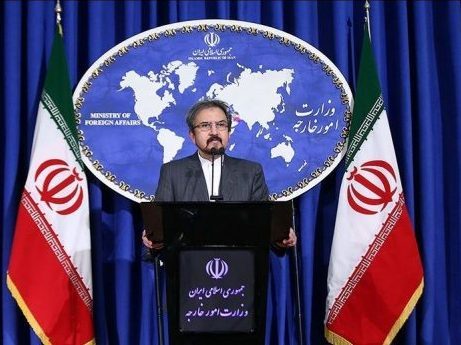
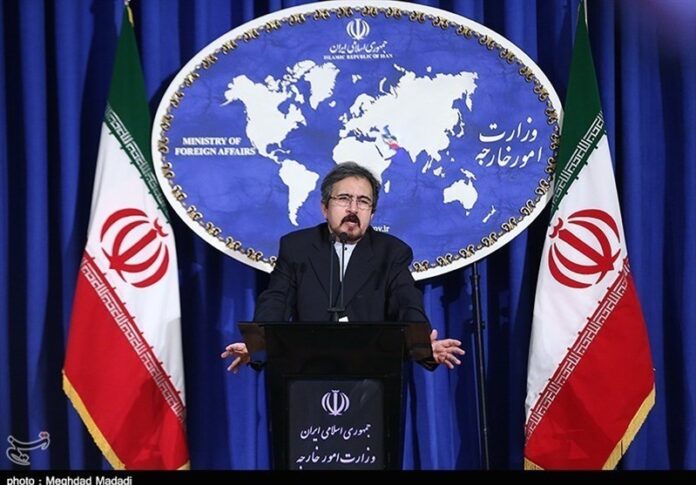
“Unfortunately, the United States’ polices in support of the Zionist regime’s aggressive measures against the people of the region and also daily crimes committed by America’s partners against the defenseless people of Yemen have worsened insecurity in the Middle East,” Qassemi said.
As long as such policies continue, the region and the world will not witness peace and stability, he added.
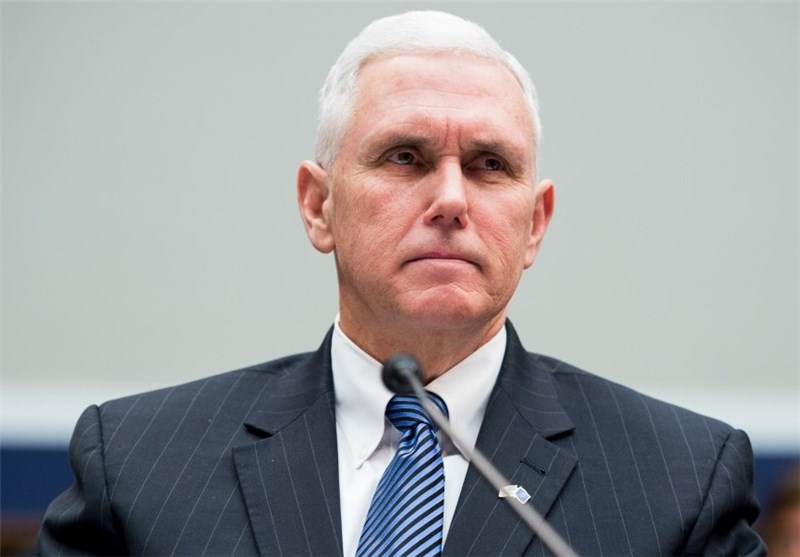
Addressing the annual meeting of the American Israel Public Affairs Committee (AIPAC) in Washington, DC, on Sunday, US Vice President Mike Pence said America will no longer tolerate what he called “Iran’s efforts to destabilize the region and jeopardize Israel’s security.
“They’ve gone to great lengths to develop nuclear weapons and ballistic missiles,” he said.
“Under President Donald Trump, the United States of America will not allow Iran to develop a nuclear weapon. This is our solemn promise to you, to Israel, and to the world.”
Qassemi described the remarks as sign of Washington’s continued hostility toward the Iranian nation and government and said while Iran’s nuclear program has been fully transparent and entirely peaceful, as acknowledged in all of the reports issued by the International Atomic Energy Agency (IAEA), US support for Tel Aviv’s military nuclear activities that has led to production of hundreds of nuclear warheads by Israel is a factor that causes insecurity in the region and the world.
As for Iran’s missile program, the spokesman underlined that the Islamic Republic will continue its legitimate defense activities, which are not against any country but are fully based on deterrence.
“In bolstering our indigenized defense power and defending our country, we will neither accept recommendations from anyone nor will allow others’ interference,” he went on to say.
“Undoubtedly, cooperation between the two countries will have positive effects on the regional and international stability and security,” Rouhani said in a meeting with Russian Prime Minister Dmitry Medvedev in Moscow on Monday.
He added that Iran welcomes the expansion of relations with its neighboring countries in the region, particularly Russia.
The Iranian chief executive expressed hope that his visit to Moscow would lead to new developments in Tehran-Moscow cooperation in political, economic and cultural areas and on international issues.
The Russian premier, for his part, said his country was resolved to bolster relations with Iran in all sectors.
He pointed to the favorable relations between Tehran and Moscow and expressed confidence that President Rouhani’s trip would help both sides further deepen their ties.
Heading a high-ranking politico-economic delegation, the Iranian president arrived in Moscow Monday evening for a two-day official visit at the invitation of his Russian counterpart, Vladimir Putin.
The Russian president is scheduled to officially welcome his Iranian counterpart at the Kremlin on Tuesday. Rouhani and Putin will then hold talks on regional and international issues and matters of mutual interest.
The two presidents are also expected to issue a statement following their meeting.
Speaking to reporters in Tehran on Monday before setting off for Moscow, Rouhani said the two sides were closely cooperating on regional issues, including fighting against terrorism and promoting stability.
“The two countries are also opposed to any shift in geographical borders in the region,” he said, adding that Iran and Russia have the highest level of cooperation on the crisis in Syria, the campaign against terrorism and the establishment of stability in the Middle East.
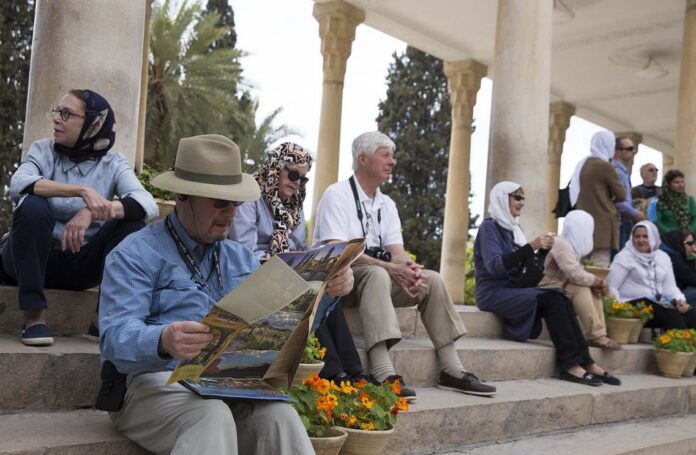
Mosayyeb Amiri, the General Manager of Iran’s Cultural Heritage, Handicrafts and Tourism Organization (ICHHTO) office in Fars province, announced that the number of foreign visitors to Fars has increased by 221% after the nuclear deal.
According to a Farsi report by Mehr, he noted, “The countries which have sent the highest number of tourists to Fars respectively include France, Germany, Italy, China and Spain.”
Based on official statistics, Fars has been visited by 348,966 foreign tourist between March 2016 and January 2017.
“The Tomb of Hafez complex has been the most visited historical site by domestic and international tourists, with an overall number of 1,132,026 visits,” Amiri added.
He went on to say that the high quality hotels and the domestic and international flights of Shiraz Airport contribute to the attraction of more tourists.
With around 3,500 nationally registered monuments, some of them registered in the UNESO including Pasargadae, Persepolis, and Eram Garden, Fars province is an important hub of historical tourism in Iran which attracts a large number of international tourists every year.
The Iranian lawmaker, Kamal Dehqani Firouz-Abadi, says the recent terrorist attack launched in the British capital of London on March 21, was an outcome of the UK’s policy in Syria, as the country as well as France were the main sponsors of the terrorists and militants in the Middle Eastern state.
According to a Farsi report by ICANA, Dehqani Firouz-Abadi added the terrorist attack in London, which was carried out almost on the anniversary of the 2016 Brussels bombings, as well as other similar terrorist acts in Europe are all consequences of the Western states’ policies against Syrian President Bashar al-Assad and towards the war in Syria.
The Western nations, in cooperation with some Arab states, formed the Takfiri [extremist] terrorist group ISIS in the Middle East to spark the war in Syria, he noted.
London and Paris, the main supporters of terrorists in Syria, are, at present, witnessing the outcomes of their moves [in the Middle East and, particularly, towards Syria] as their plans and actions have backfired in the form of terrorist attacks on their cities and the massacre of their citizens, he said.
Terrorism is a phenomenon that knows no boundaries or nationalities and soon will become a threat to the entire world, the MP added.
Recalling the Western countries’ strategy towards Iraq’s former dictator Saddam Hussein and the Ba’athist regime he had established in the country, he said, “Over the past few decades, we have always been witness to these states applying double standards in the face of security threats. They, who had supported Saddam Hussein in Iran-Iraq war (1980-88) and his massacre of Iranians, invaded their main chess piece in the Persian Gulf War – also called Gulf War – (1990–91) and eventually toppled him.”
Commenting on the formation of al-Qaeda, Dehqani Firouz-Abadi noted that the US Central Intelligence Agency set up the group during the Afghan Civil War (1992–96) and later, in the aftermath of the 9/11 attacks, it eventually sent its troops to the Middle East on the pretext of fighting the same terrorist group.
He said a glance at the emergence and, later, collapse of Saddam Hussein’s Ba’athist regime as well as the creation of and, later, fight against al-Qaeda are all indicative of the fact that the West determines the nature of a group or regime and its activities according to its double standards.
“In coming years, following the likely return of Takfiri terrorists to their hometowns in Western countries, from the war in Syria, an increase would be witnessed in the number of terrorist acts perpetrated by them in these states and the occurrence of such attacks would become a usual phenomenon in the eyes of international media.”
He stressed that the Zionist regime of Israel, which perpetrates its crimes as part of its state-sponsored terrorism efforts, is, currently, the Middle East’s biggest problem.
This is while, the MP added, the Western nations have turned a blind eye to Israel’s violent behaviour.
“Tel Aviv is the main factor behind the formation of the ISIS.”
According to media reports, four were killed and dozens were hurt in London’s [March 21] terror attack, when an assailant, later identified as Khalid Masood by police, drove a car through pedestrians on Westminster Bridge and then fatally knifed a police officer who tried to stop him entering the Houses of Parliament. He was then shot dead. The attack took place while British Prime Minster Theresa May was in the Houses of Parliament.
This has been the first terrorist act carried out in Britain‘s territory since the beginning of the ISIS’ terrorist attacks on European cities.
Witnesses said the airstrike killed hundreds of residents, including many women and young children, on Baghdad Street in west Mosul’s Aghawat Jadidah neighborhood on March 17.
On Friday, in an area where apartment blocks were reduced to rubble, at least 50 bodies could be seen, including those of pregnant women, children and newborns.
On Saturday, a day after announcing that the incident was under investigation, Pentagon officials released a statement claiming the coalition had targeted Daesh (ISIL or ISIS) fighters and equipment in the area.
Secretary of Iran’s Supreme National Security Council (SNSC) Ali Shamkhani on Sunday stressed that the “war crime, which is similar to the conduct of Daesh and other Takfiri groups in targeting civilians and innocent people,” must be immediately investigated by fair and impartial courts.
“Killing innocent people under the pretext of fighting terrorism has turned into the US army’s modus operandi in the region,” Shamkhani deplored.
He expressed condolences to the Iraqi people over the tragic incident and said whether it happened deliberately or unintentionally, nothing will minimize the US responsibility in the incident.
Shamkhani further underscored that carrying out any military operation and targeting terrorists in Iraqi and Syrian territories must be done with the official consent of these countries’ governments, adding that the UN Security Council must remind “governments considering themselves to be above the UN” of the necessity for respecting countries’ sovereignty and territorial integrity.
In a statement released on Sunday, the Iranian Foreign Ministry said the 15 companies have directly or indirectly collaborated with the Tel Aviv regime in committing its “savage crimes” in the occupied Palestinian territories.
The sanctions came two days after Washington imposed bans on nearly a dozen foreign companies or individuals for cooperating with the Islamic Republic.
The US sanctions targeted 11 companies or individuals from China, North Korea or the United Arab Emirates for transferring technology to Iran that it claimed could boost the country’s ballistic missile program.
The Iranian Foreign Ministry said according to the country’s sanctions, any business activity with these 15 companies is forbidden and their assets within the jurisdiction of the Islamic Republic will be subject to freezing, and no visas will be issued to individuals holding positions in or associated with these corporations.
The statement also said Washington’s unilateral bans were imposed on Tehran “under fabricated pretexts,” slamming the restrictive measures as a violation of “international law” as well as the spirit and text of the July 2015 nuclear deal between Iran and world powers, known as the Joint Comprehensive Plan of Action (JCPOA).
The ministry further underlined that Iran is resolved to develop its peaceful missile power as part of the nation’s “inalienable” right to enhance its deterrence and defense might in the face of threats.
Here is the list of the sanctioned US corporations:
-Beni Tal security company has collaborated with the Israeli military in the suppression of Palestinian people.
-United Technologies has sold Black Hawk military helicopters to the Israeli regime which have been used to bomb occupied territories and Palestinian refugee camps.
-Raytheon has supplied Israel with technologically advanced military weapons that have been used against Palestinian people during the Gaza war.
-ITT Corporation has provided the Israeli military with equipment it has used to stage nightly raids in Palestinian villages and refugee camps.
-Re/Max has been involved in illegal real estate transactions in Israeli settlements across occupied Palestinian territories.
-Oshkosh Corporation has been supplying the Israeli military with parts for armored vehicles used to restrain the Palestinian population.
-Magnum Research Inc. has collaborated with Israeli military industries in the manufacturing of firearms and military equipment.
– Kahr Arms has provided spare parts and developed light weapons used by the Israeli army in cooperation with the regime’s military industry.
– M7 Aerospace LP, purchased by US subsidiary of the Israeli military contractor Elbit Systems, has been active in the production and development of Israeli radar and missile systems.
– Military Armament Corporation has provided services and equipment linked to the weapons used by Israeli police.
– Lewis Machine and Tool Company has provided weapons spare parts and services to the Israeli military’s arms industry.
– Daniel Defense has provided the Israeli military’s arms industry with spare parts and services for weapons manufacturing.
– Bushmaster Firearms International has provided the Israeli military’s arms industry with spare parts and services for weapons manufacturing.
-O.F. Mossberg & Sons has supplied Israel with weapons, which are used by the regime’s military and police forces in the crackdown on Palestinian civilians.
-H-S Precision, Inc. has provided the Israeli regime with weapons manufacturing technology.
According to the Iranian Foreign Ministry, the list could expand to include more entities.
Iranian Foreign Ministry Spokesman Bahram Qassemi expressed regret on Sunday that Turkish officials continue to make “baseless, meddlesome and troublesome” remarks against the country’s neighbors.
“By accusing others and repeating fictitious claims, they [Turkish officials] are trying to justify their meddlesome and expansionist policies toward their neighbors,” he added.
Speaking at a Turkish-British forum in the southern city of Antalya on Saturday, the Turkish president accused Iran of adopting and pursuing “racist and discriminatory” policies in Iraq.
The Iranian spokesperson also dismissed as incorrect comments by Turkish Deputy Prime Minister Veysi Kaynak, who recently claimed that some three million refugees, mostly Afghans, were trying to go to Turkey from Iran, expressing concern that Iran was “ignoring their demand for migration.”
“Iran has been hosting millions of refugees from its neighboring countries for more than 30 years,” Qassemi said.
“Turkey must learn from Iran how it has hosted millions of refugees for more than three decades and has never abused this human and humanitarian issue for specific and politically-motivated purposes against any other country.”
He recommended Turkish officials to avoid conflating humanitarian issues with political disputes, urging them to respect the national sovereignty of their neighboring states, particularly Iraq and Syria.
“The Islamic Republic of Iran regards respect for the national sovereignty and territorial integrity of neighboring countries as the best option for strengthening and developing relations among nations and countries,” Qassemi said.
Iran also considers “constructive dialogue with neighbors, instead of accusing others, as the most appropriate way” to deepen ties with them, he pointed out.
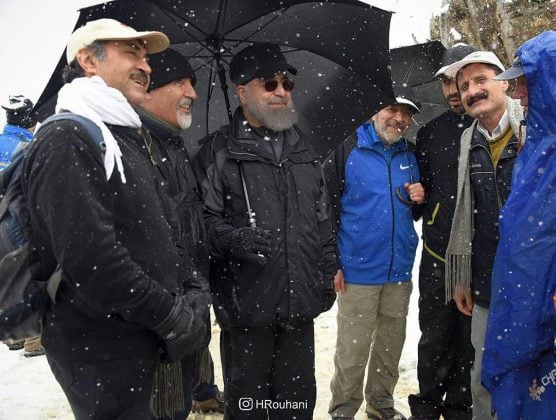
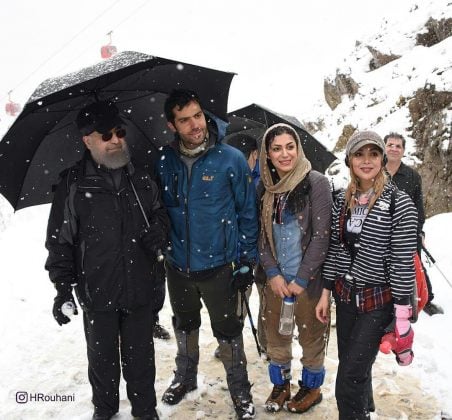
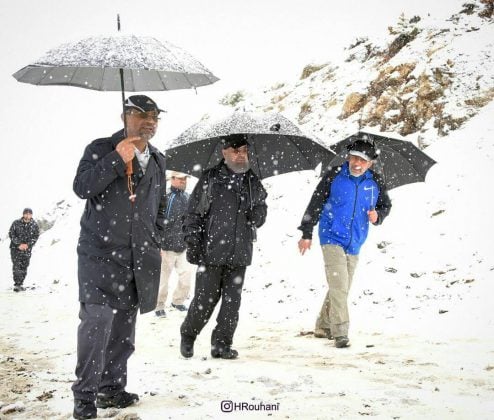
The photos taken on Friday show President Hassan Rouhani, usually seen in the turban and robes used by Iranian clerics, in a black baseball cap and matching ski jacket climbing mountains outside Tehran using hiking poles.
During the hike, which was taken in a rainy and snowy weather, Rouhani took pictures with many people including the younger generations of Iranians hiking Mount Tochal in early days of spring.
Rouhani posted the photos on his Instagram page and wrote, “This morning; young people who had come for a hike to Tehran mountains in aquite pleasant weather and relaxing nature.”