Tuesday, December 23, 2025
Home Blog Page 4046

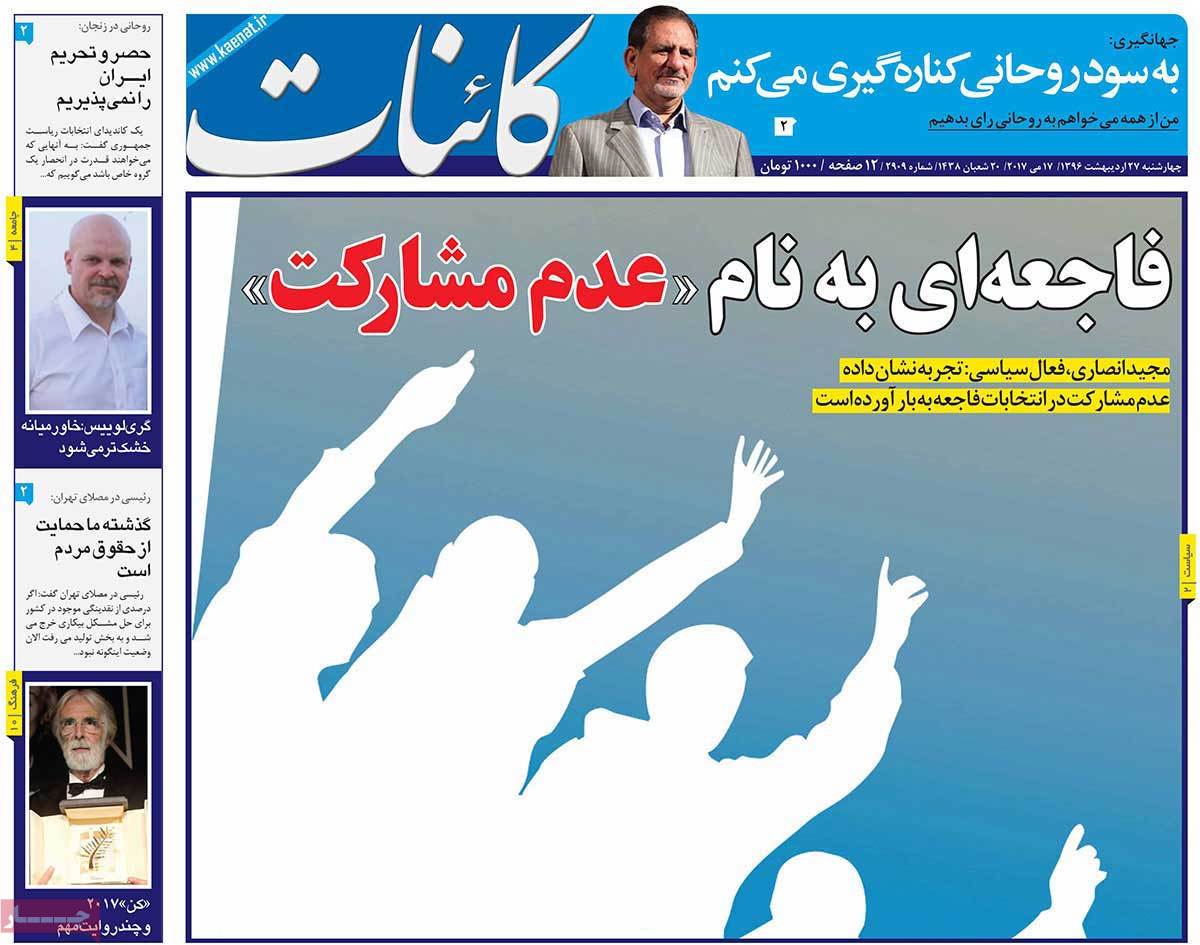
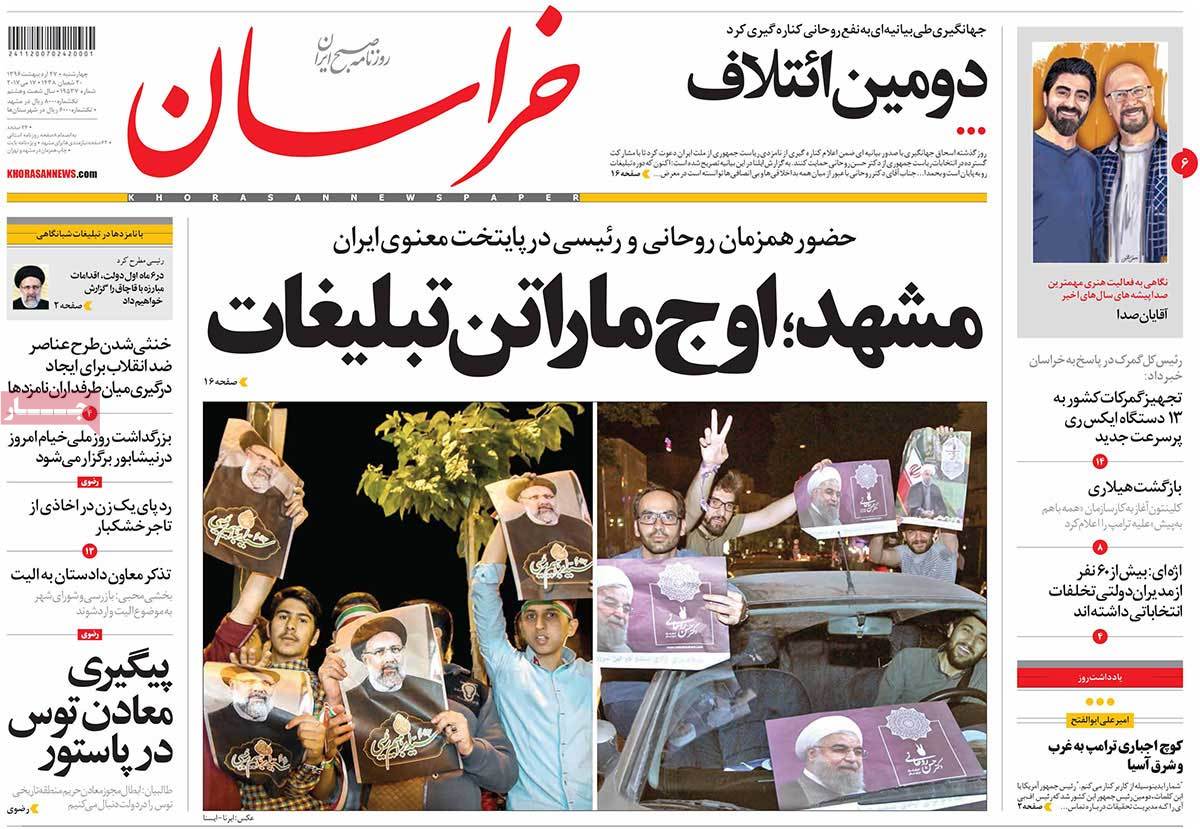
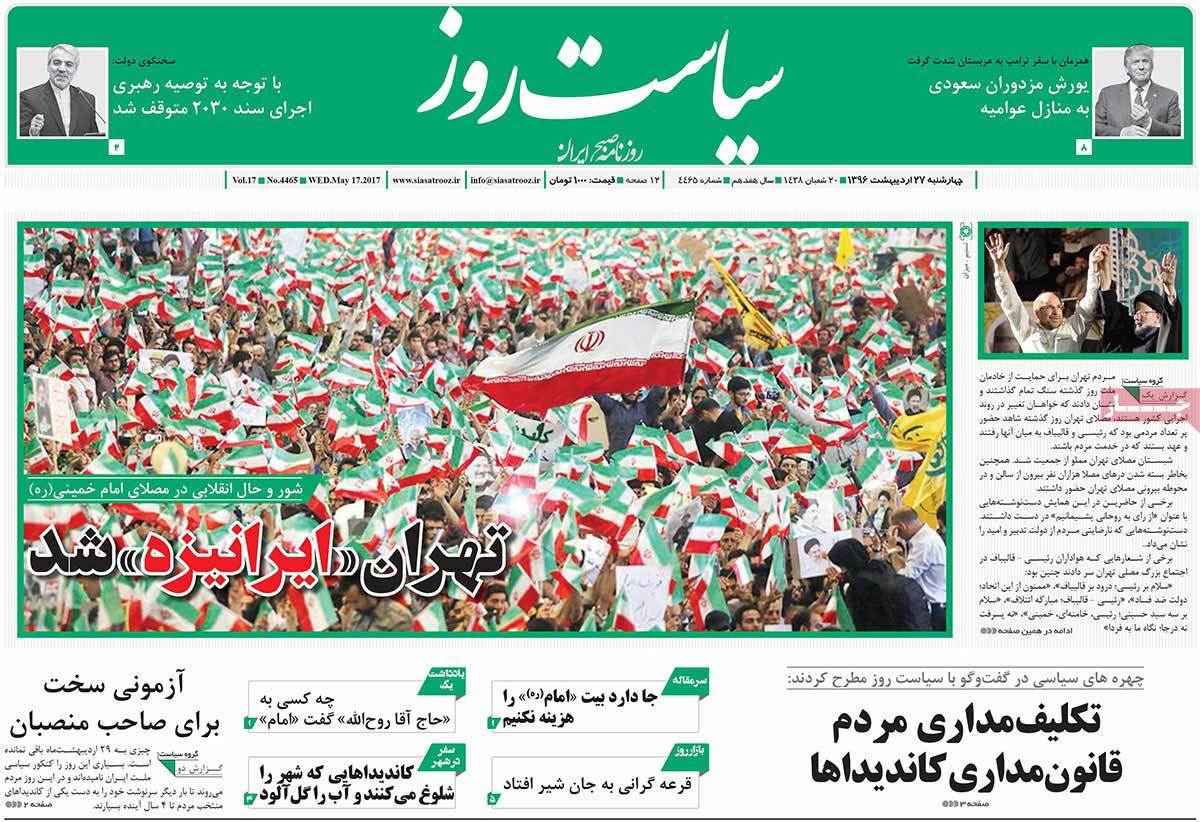
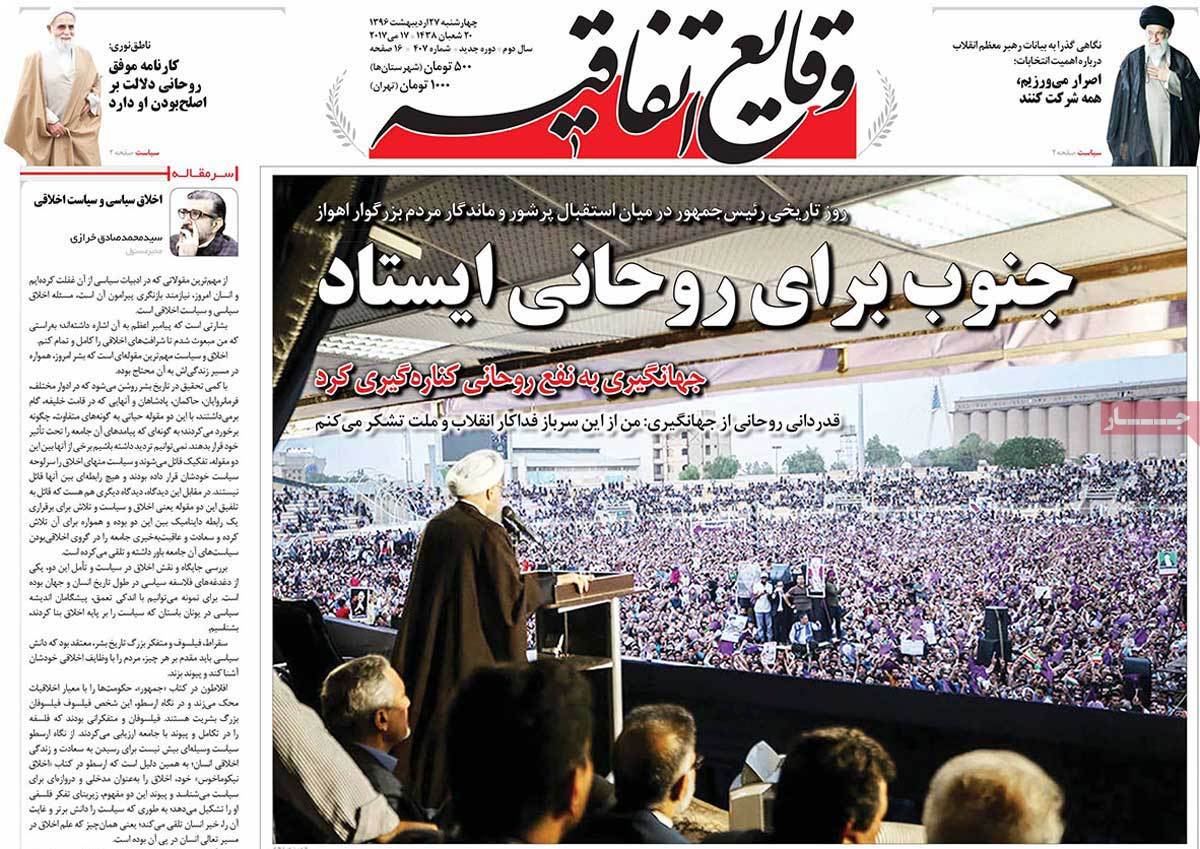
A Look at Iranian Newspaper Front Pages on April 19

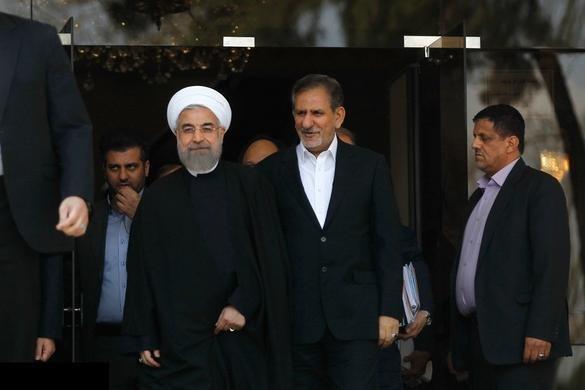
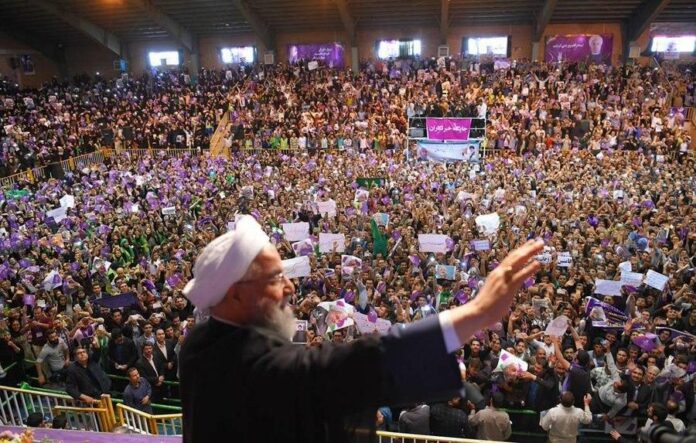
Iranian newspapers today covered the remarks made by President Hassan Rouhani against the presence of military forces in Iran’s politics, particularly the upcoming elections.

Rouhani made the remarks in a ceremony to display the country’s military achievements. His remarks about these achievement also received great coverage.
Comments by Rouhani’s deputies and ministers about the poor performance of ex-president Mahmoud Ahmadinejad’s administrations were among other top stories.

The above issues, as well as many more, are highlighted in the following headlines and top stories:


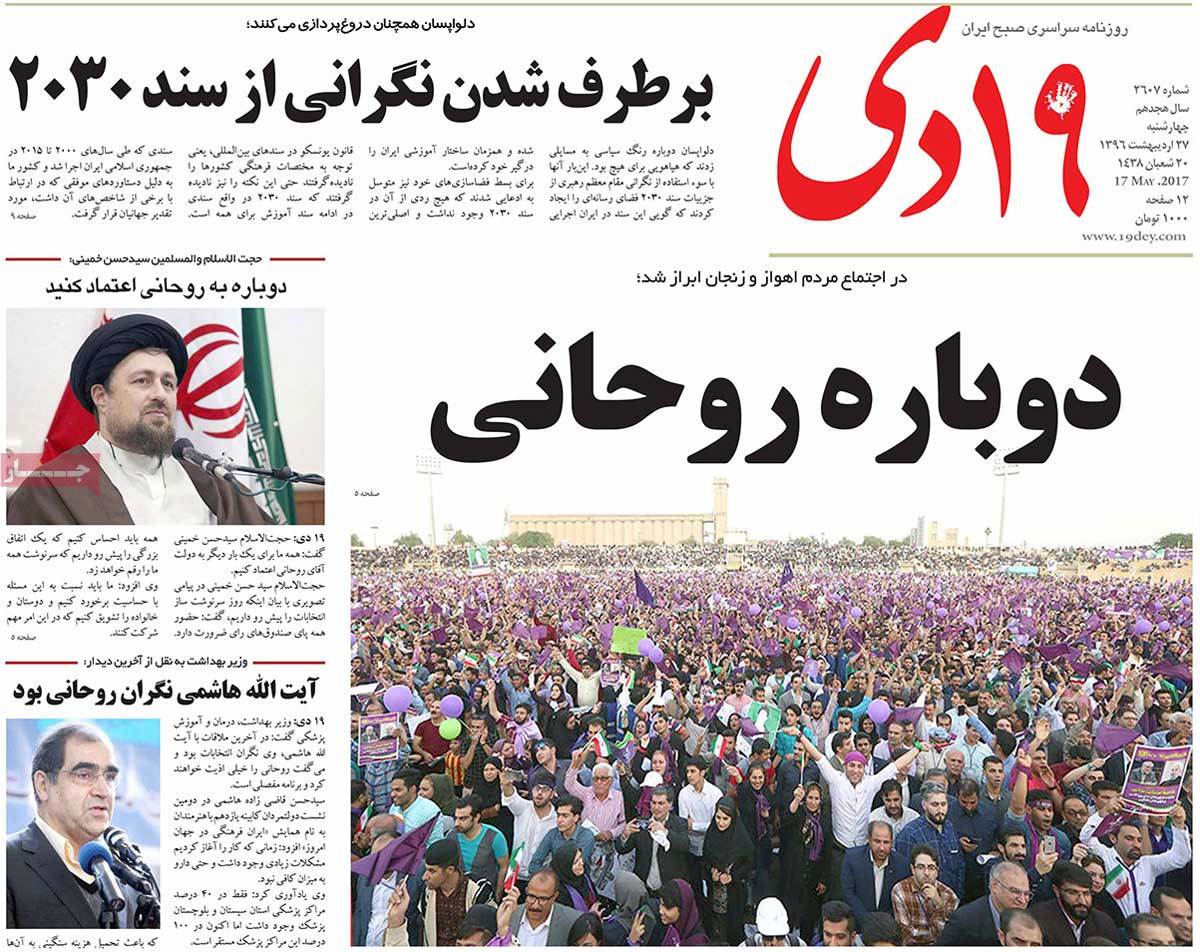
19 Dey:

1- Larijani Discloses Ahmadinejad Government’s Negligence in Healthcare

2- President Rouhani Warns against Armed Forces’ Presence in Election

A Look at Iranian Newspaper Front Pages on April 19 - 19 dey


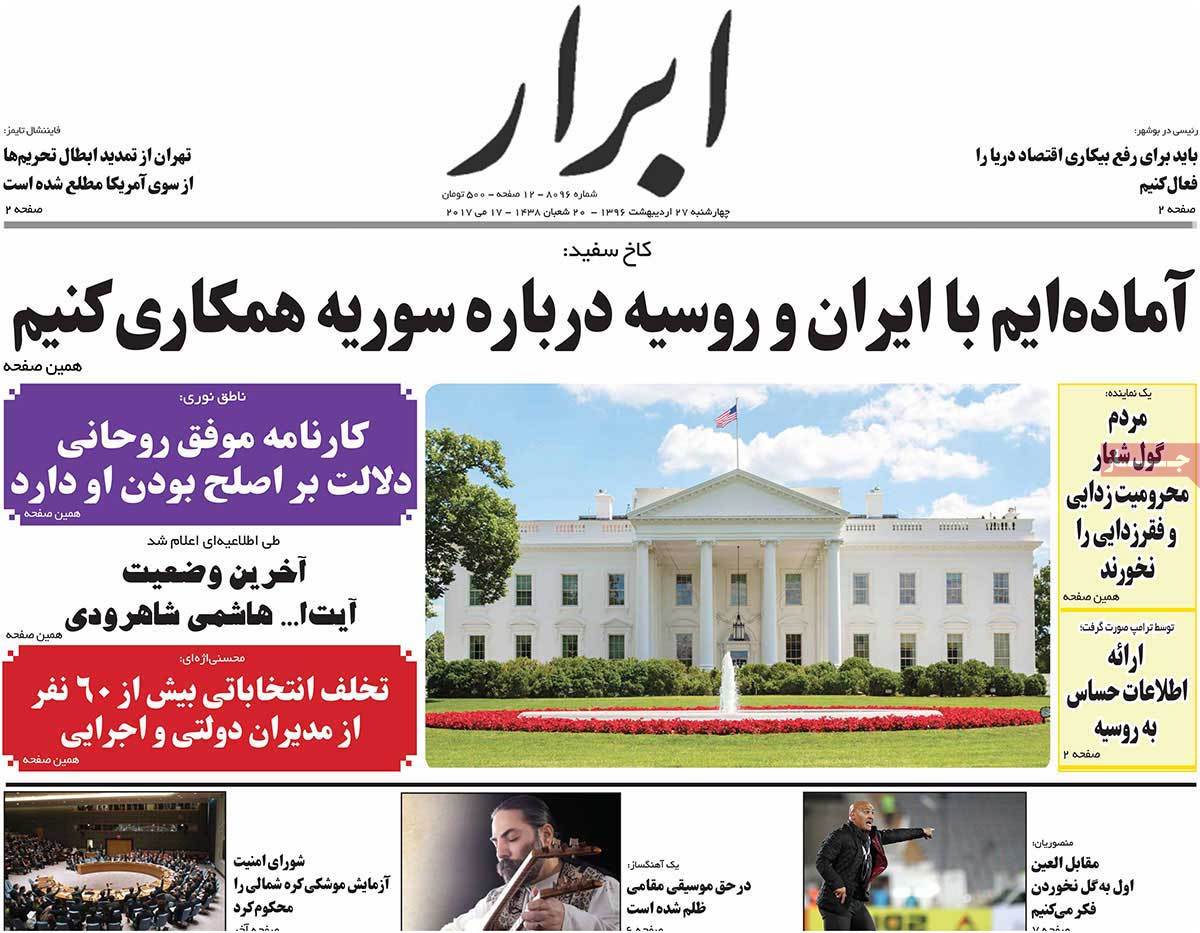
Abrar:

1- Ahmadinejad’s Refusal to Obey Leader’s Advice is Beginning of New Sedition: MP

2- White House Considering Fresh Sanctions against Firms Working with IRGC

A Look at Iranian Newspaper Front Pages on April 19 - abrar


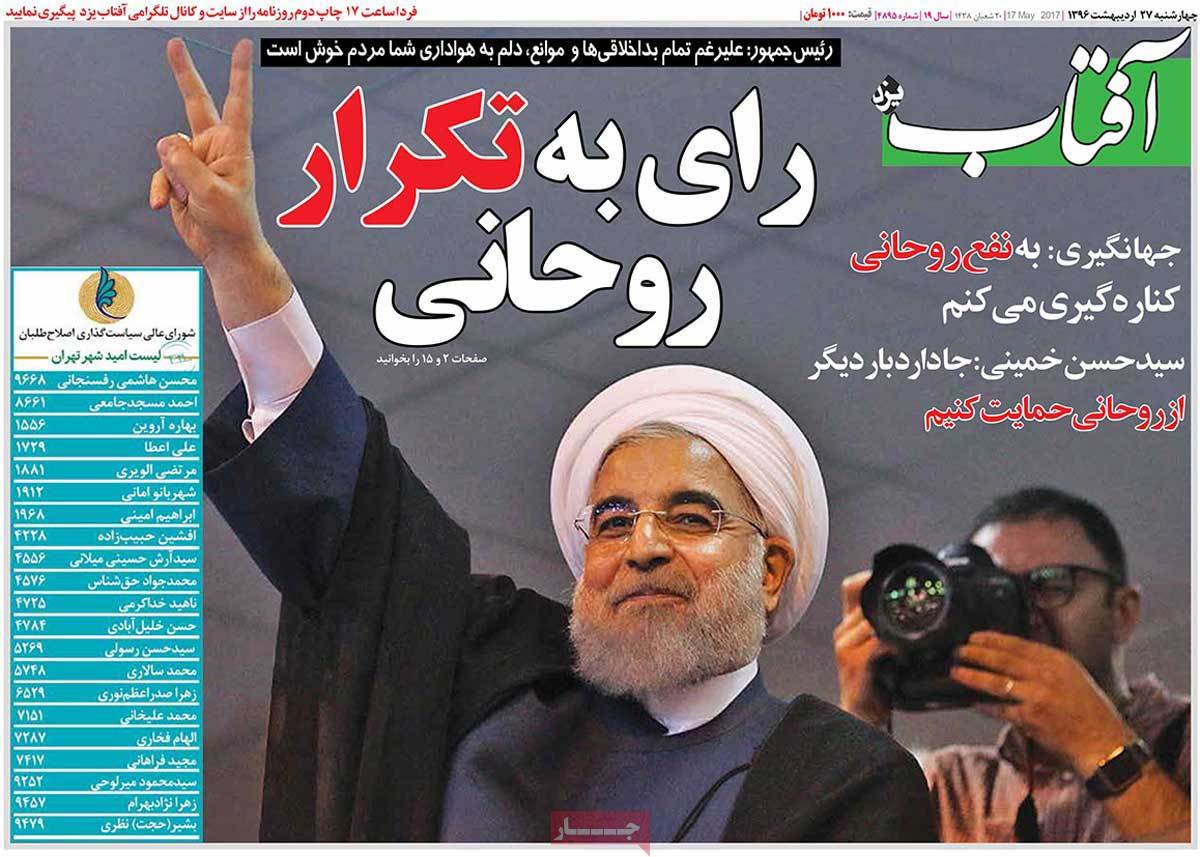
Aftab-e Yazd:

1- Rouhani Urges Armed Forces to Avoid Getting Engaged in Politics

2- VP: I Testify Rouhani Has Been Treated Very Unfairly

A Look at Iranian Newspaper Front Pages on April 19 - aftabe yazd


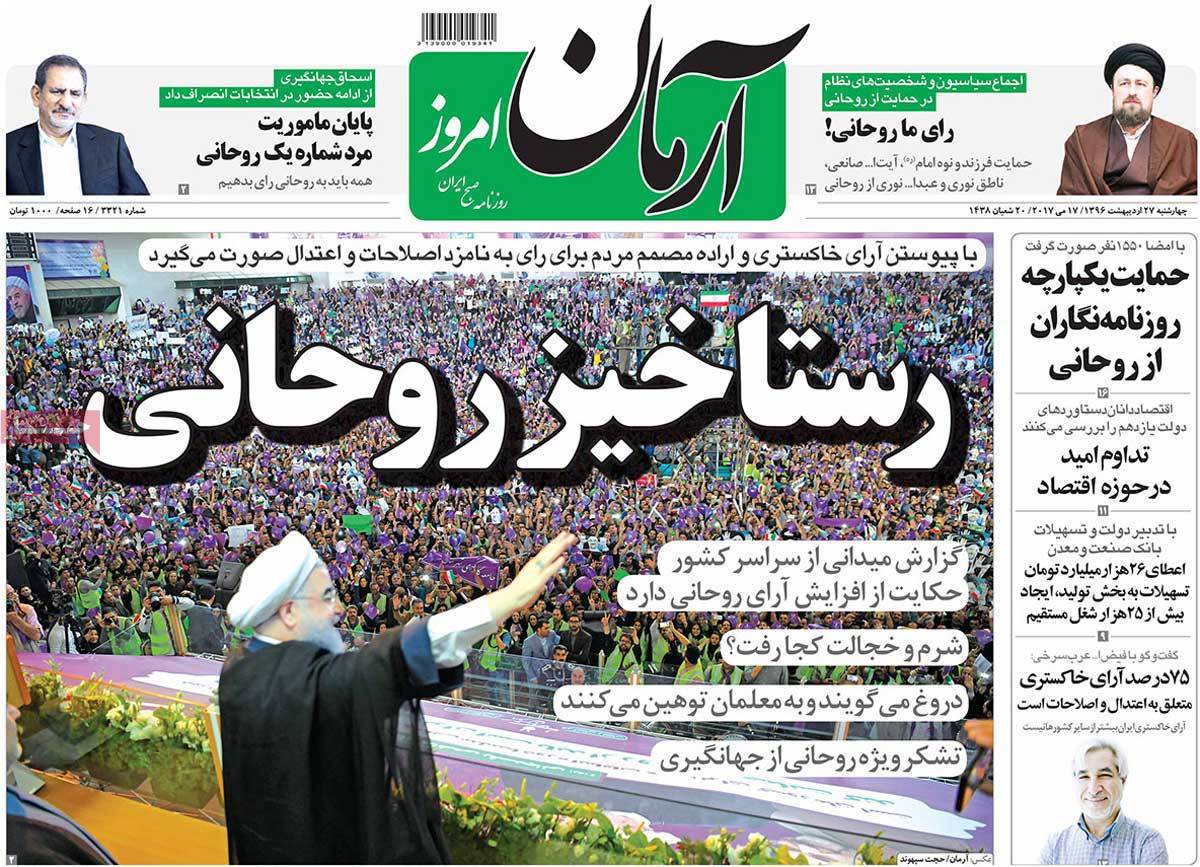
Arman-e Emrooz:

1- Politico: Iranians Living in US to File Lawsuit against Trump

2- End of Jahangiri’s Silence

  • They [Ahmadinejad’s gov’t] Kept Talking about Corruption, but Had Worst Corruptions in History

A Look at Iranian Newspaper Front Pages on April 19 - arman


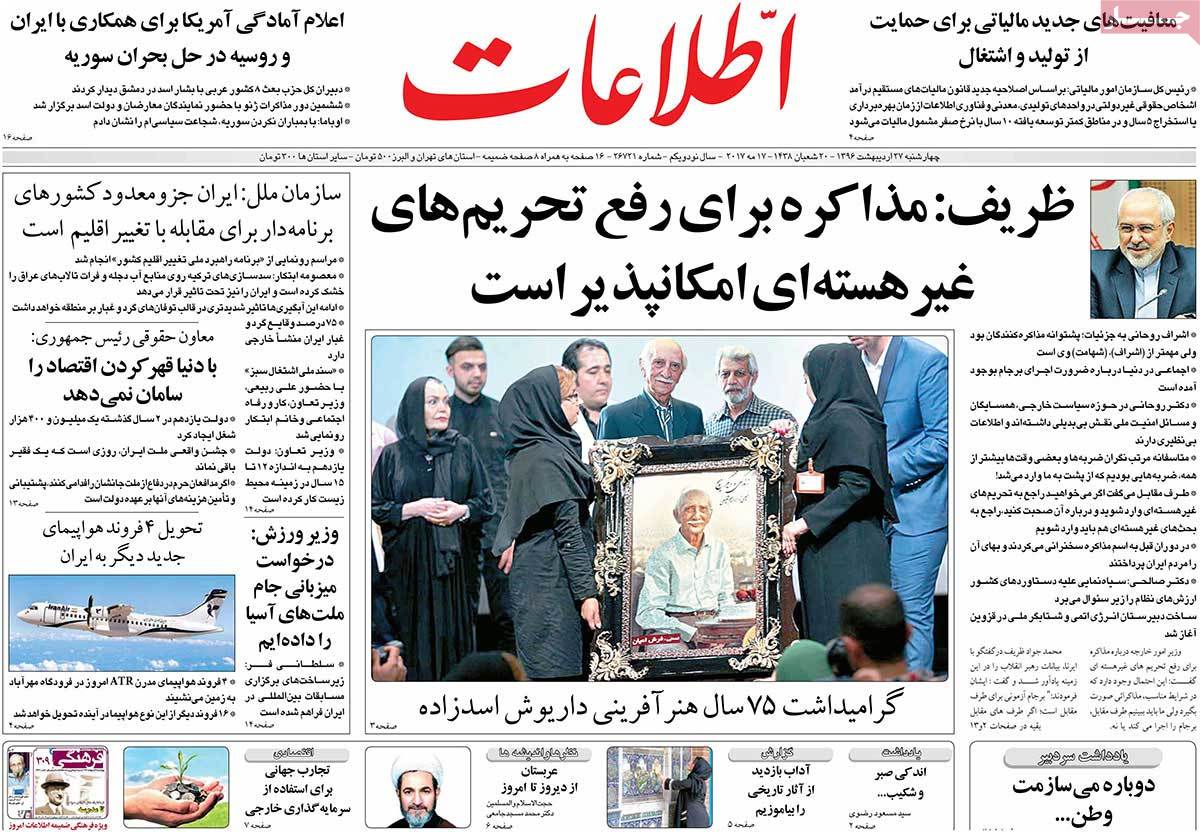
Ettela’at:

1- Zarif: Falling Trend of Oil Prices Stopped after JCPOA

2- Putin: Russia to Continue Supporting Assad, Syria’s Territorial Integrity

3- Economy Minister: We’re Heir to 700,000 Billion Tomans [$186bn] of Previous Government’s Debts

A Look at Iranian Newspaper Front Pages on April 19 - etelaat


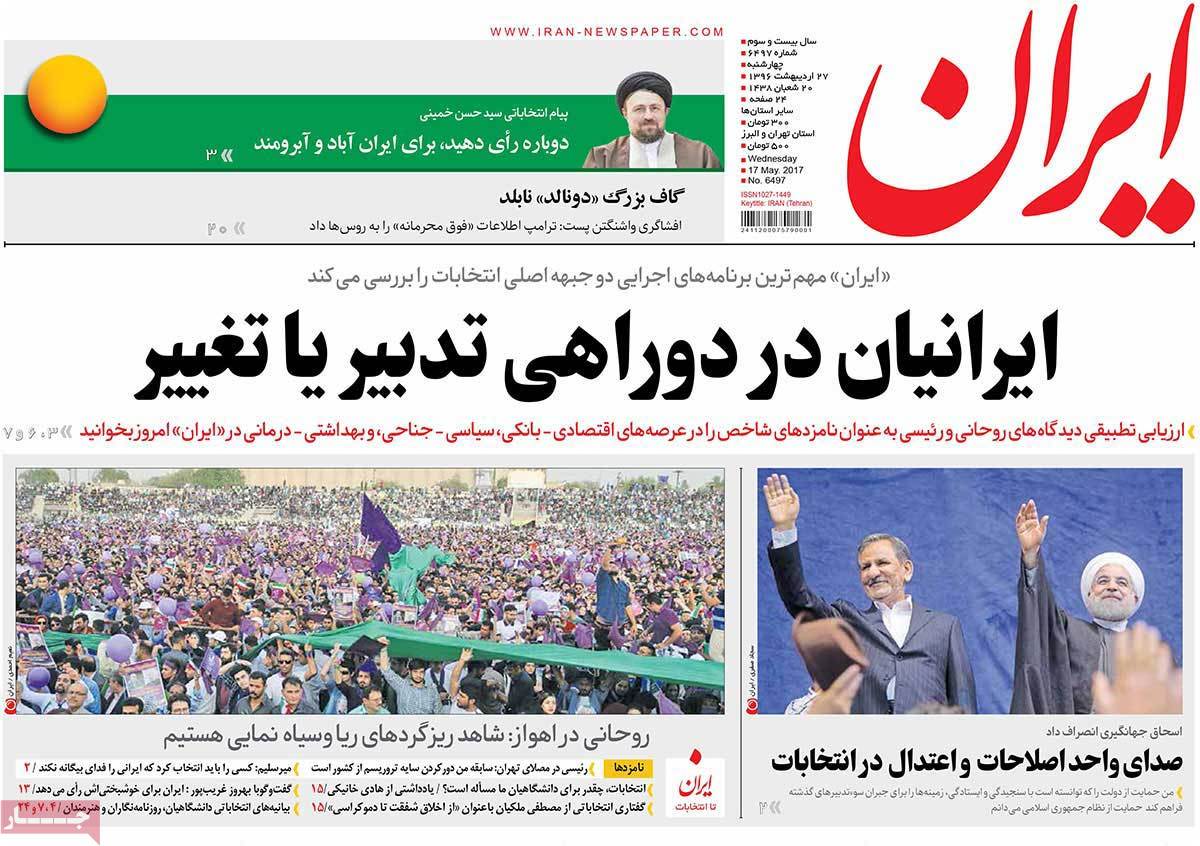
Iran:

1- Rouhani: Iran’s Defence Budget up by 145% Compared to Beginning of My Term

2- 3,000 Factories Shut Down in Ahmadinejad’s 8-Year Presidency

3- Conservative Supporters of Rouhani to Form HQ for Election: MP Close to Larijani

A Look at Iranian Newspaper Front Pages on April 19 - iran


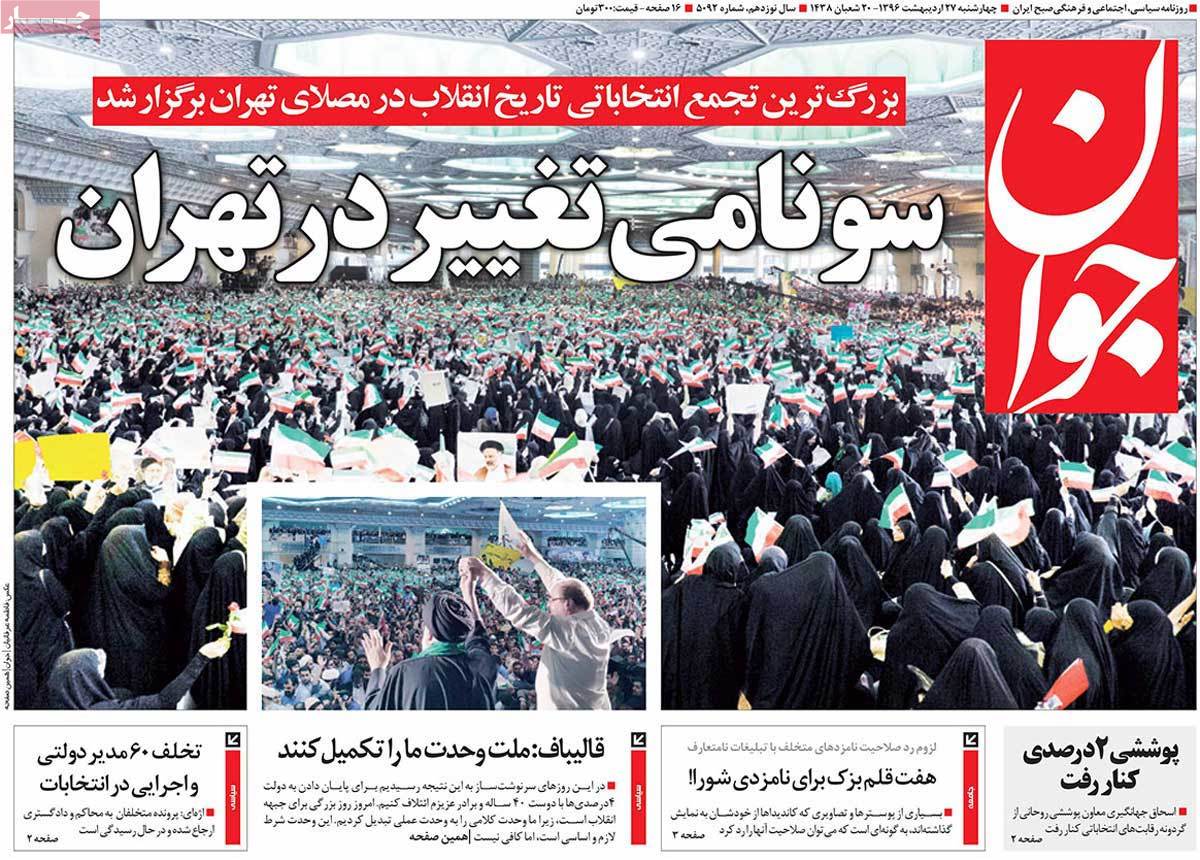
Javan:

1- Rouhani: We Created 700,000 Jobs Each Year

2- Statistics Organisation: 350,000 Jobs Created Each Year!

3- President: Armed Forces Protect Peace, Security in Mideast

A Look at Iranian Newspaper Front Pages on April 19 - javan


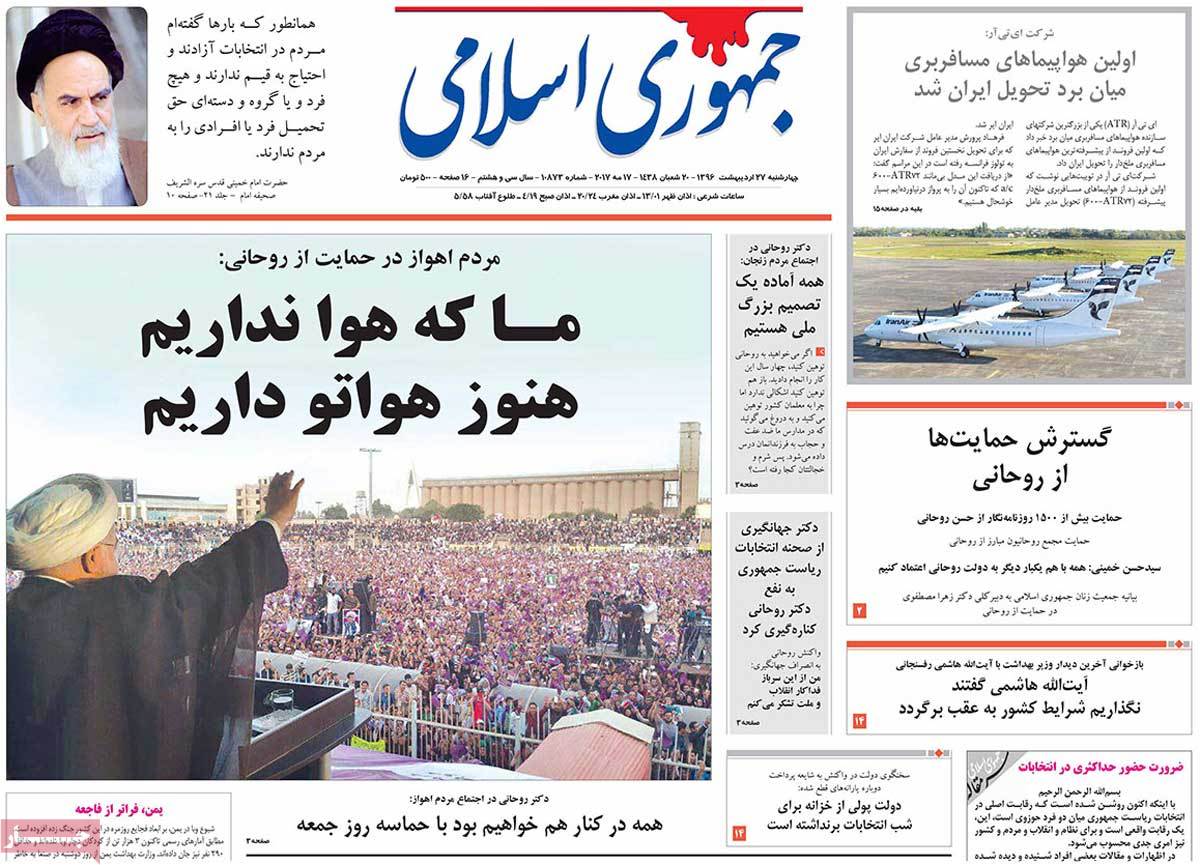
Jomhouri Eslami:

1- President: Government’s Supply of Military Equipment in 3 Years Equal to that of Past 10 Years

2- Health Minister: Government Started Construction of 6,500 Medical Centres

A Look at Iranian Newspaper Front Pages on April 19 - jomhori


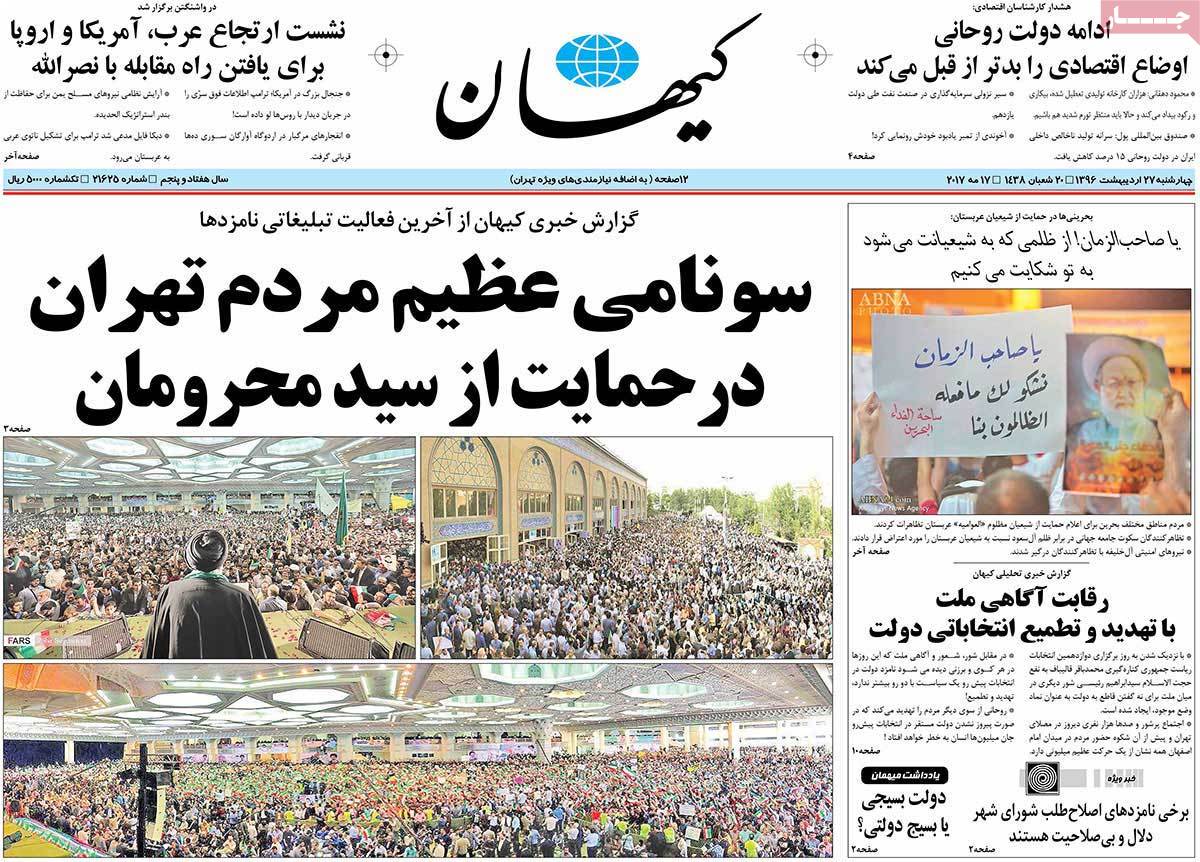
Kayhan:

1- Gov’t Admits It’d Be Worried If People’s Economic Demands Raised in Election

2- Pyongyang in Reaction to US Military Threats: We’ll Test Missiles Every Week

A Look at Iranian Newspaper Front Pages on April 19 - keyhan


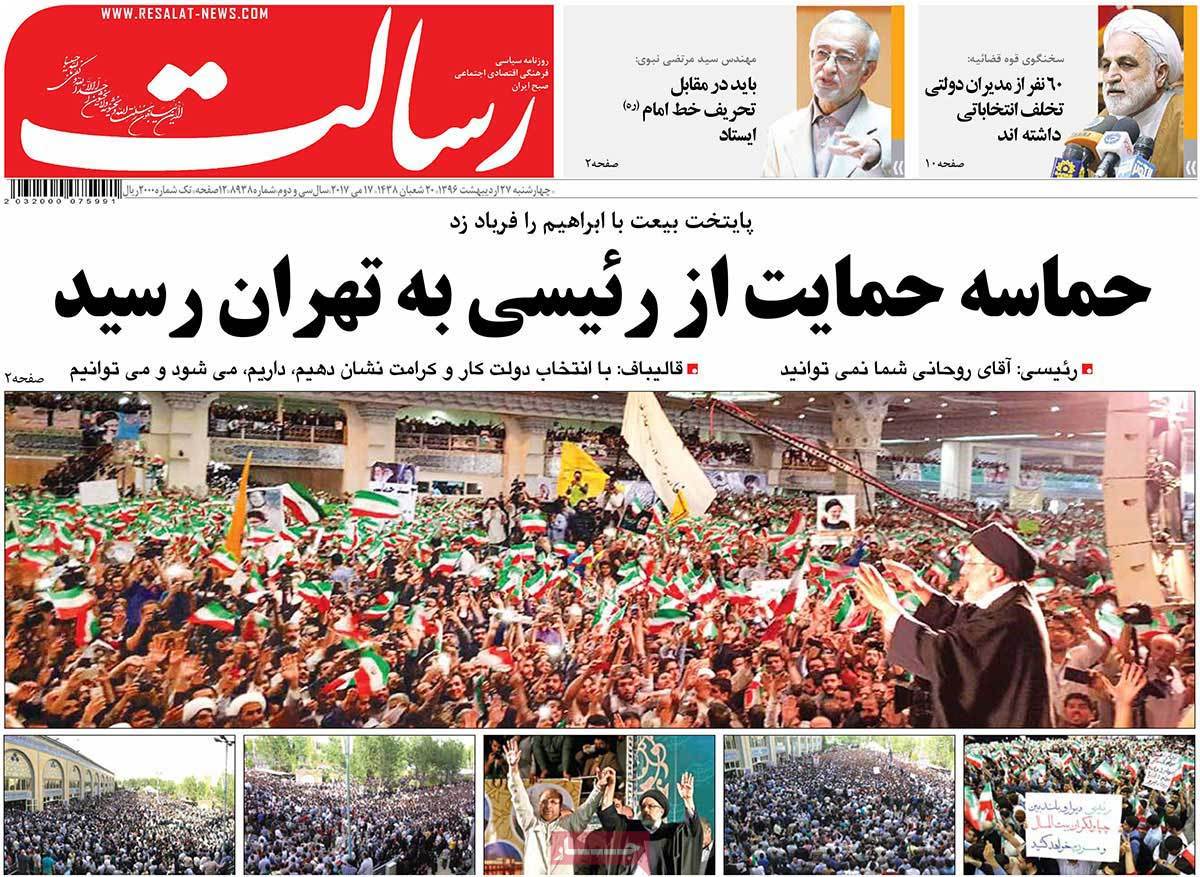
Resalat:

1- Display of Defensive Equipment: From S-300 Missile Defence System to Roar of Jet Fighters

2- President: We’ll Strongly Respond to Aggression

3- Analyst Urges Government to Protest against US Interference in Iran Election

A Look at Iranian Newspaper Front Pages on April 19 - resalat


Rooyesh-e Mellat:

1- Rouhani, Trump Don’t Know Each Other’s Languages: IRGC General

A Look at Iranian Newspaper Front Pages on April 19 - royesh mellat


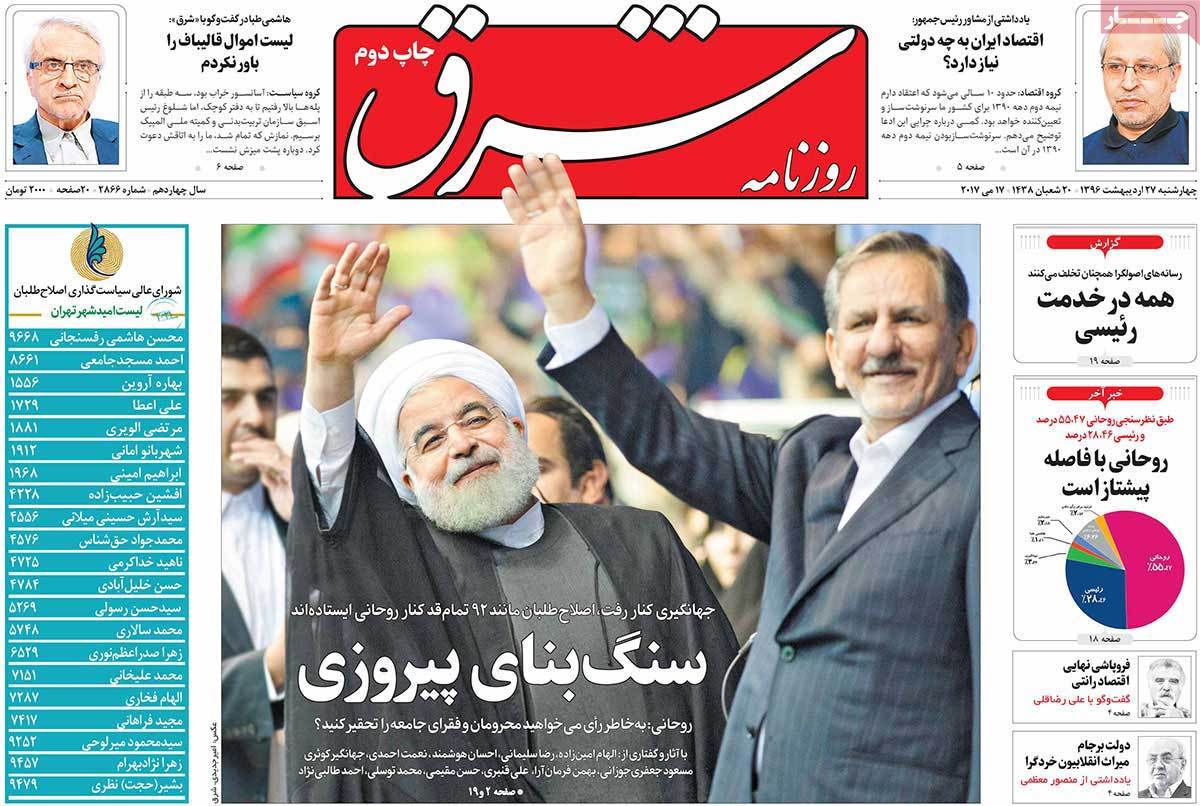
Shargh:

1- Telegram’s Voice Calling Service Blocked by Iran’s Judiciary

A Look at Iranian Newspaper Front Pages on April 19 - shargh


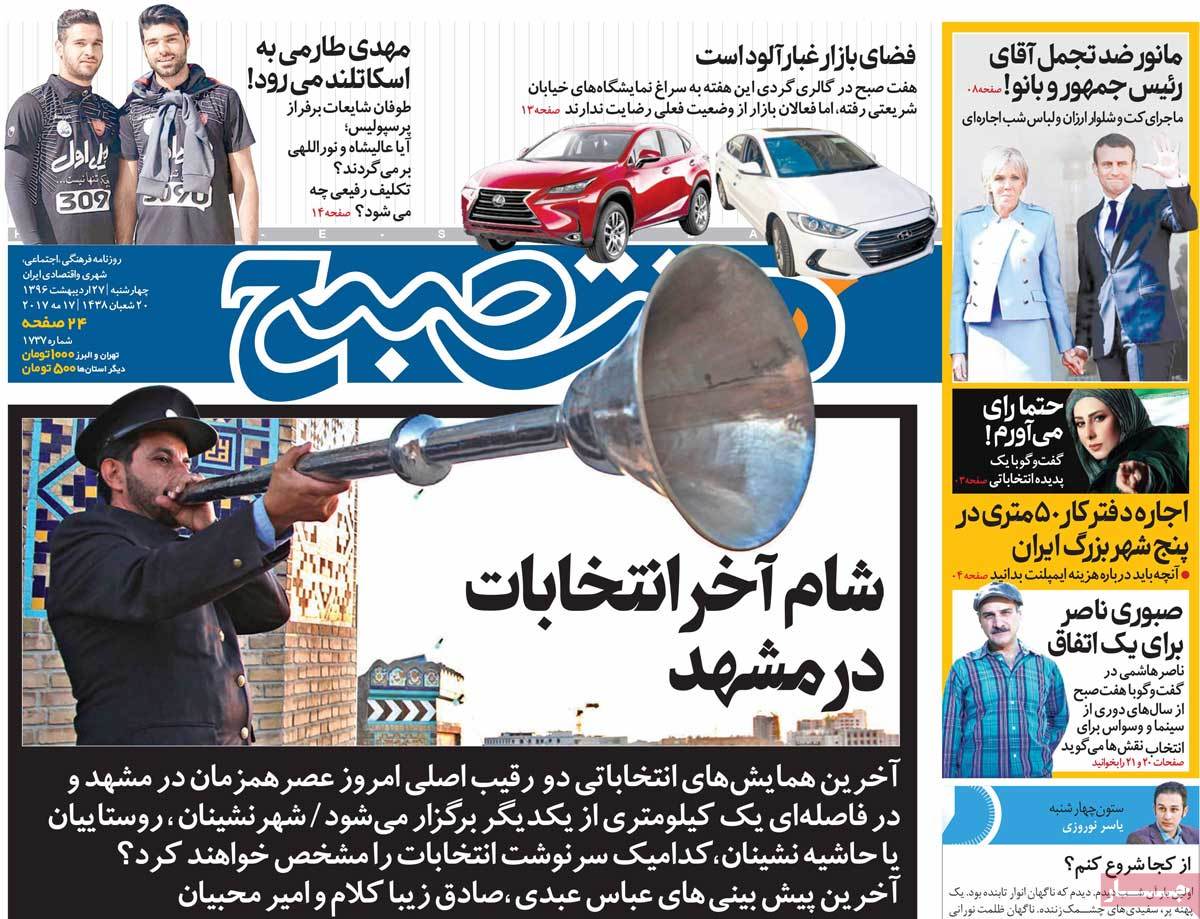
Sobh-e Now:

1- Émile Lahoud: Saudi Arabia, from Buying Politicians to Hiring Terrorism

A Look at Iranian Newspaper Front Pages on April 19 - sobhe no

Conservative Presidential Candidate Vows Strong Economic Management

“If our economy is not fragile, structures would be amended and we would become resistant against sanctions and threats and people’s business would boom. A strong economic management has the first word in this regard,” Hojjatoleslam Seyyed Ebrahim Raisi said in a meeting with a number of entrepreneurs and representatives of private sectors in Tehran on Tuesday.

He added that the levels of efficiency, economic growth, production rise and job creation are currently not acceptable in the country.

The presidential hopeful stressed that the competent Iranian youth can solve many of the country’s problems, saying all strategies must focus on job creation in order to “witness economic growth.”

Raisi further criticized the performance of the current administration, saying that it has only used “30 percent of the capacity of the country’s experts” and failed to make use of a capacity that would lead to independence.

It is possible to change the situation and conditions in favor of the Iranian people in the economic and social sectors and “save the country’s management and economy,” he said.

Also on Tuesday, Raisi sent separate letters to incumbent president, Hassan Rouhani, and the head of the Islamic Republic of Iran Broadcasting (IRIB), Abdolali Ali Askari, criticizing what he described as the extensive coverage given to the Iranian president on national television.

Raisi, the current custodian of the Holy Shrine of Imam Reza (PBUH) in the northeastern Iranian city of Mashhad, on Friday threw his hat in the ring for the 12th presidential contest, scheduled to be held on May 19.

Addressing the media after registering for the presidential election, Raisi said the status quo in the country can be changed for the better and added that national economy must be insulated from fluctuations in the global economy.

Enemies Trying to Sabotage Iran Elections: Leader

Enemies Trying to Sabotage Iran Elections-Leader

Speaking in a Wednesday meeting with a group of Army commanders and personnel in Tehran, Ayatollah Khamenei warned that “the enemies make provocations to sabotage the elections.”

“The nation should proceed along in the face of the hostile movement, while maintaining its current awareness so the elections will be held with vibrancy, passion, neatness and security,” the Leader added.

“Bluster is the modus operandi of big powers. The worse situation for a country comes about when its authorities start to become afraid of the enemy’s sulk, threat and bluster,” the leader said, adding, however, that “the nation is standing upright.”

Ayatollah Khamenei further said the nation’s resistance has been the key to thwarting different enemy plots against the country over the past decades, Press TV reported.

“Either the US or bigger [entities] than that cannot do a damn thing in the face of an establishment, which is connected to its people, likes its people and is liked by them,” the Leader added.

The Leader further emphasized, “The very election of such nature would lend much security to the country.”

Over a dozen high-profile figures have registered for the country’s 12th presidential elections.

The registration process is over and the people will go to the polls on May 19. Concomitantly, the electorate will vote to choose members of village and city council.

Enemies Trying to Sabotage Iran Elections

Iran Exporting Saffron to 47 Countries

Saffron

The figure shows an over 32.3% rise in weight compared to the previous year.

“It is estimated that during the current year, exports will rise by 20% provided prices stay balanced and no export limitations are imposed,” Gholamreza Miri was quoted as saying by Young Journalists Club.

Iran is the world’s biggest saffron producer and accounts for more than 90% of the global production.

Close to 95% of Iranian saffron are grown in the two provinces of South Khorasan and Khorasan Razavi in northeastern Iran.

Last year, area under saffron cultivation increased from 88,000 to 95,000 hectares.

Bus Accident in North India Kills at Least 44

Bus Accident in North India Kills at Least 44 -1

At least 44 people died after a bus carrying over 50 passengers fell into a river in northern India, local media reported Wednesday.
The AFP also reported that the bus swerved off a mountain road and plunged into a ravine.
“[Forty-four] people dead after a bus falls into Tons river in Shimla district of Himachal Pradesh,” the ANI news service said on Twitter.

Iranian FM, Kyrgyz President Discuss Bilateral Ties

Iranian FM, Kyrgyz President Discuss Bilateral Ties

According to the Iranian Foreign Ministry’s official website, Foreign Minister Mohammad Javad Zarif and Kyrgyz President Almazbek Atambayev have conferred on Tehran-Bishkek bilateral ties and other issues of mutual interest during the meeting held on Wednesday.
The Iranian top diplomat is in Bishkek on the third and final leg of a regional tour of Central Asia and the Caucasus, which earlier took him to Turkmenistan and Georgia.

Iranian FM, Kyrgyz President Discuss Bilateral Ties
Earlier today, Zarif took part in a conference in Bishkek on Iran-Kyrgyzstan economic cooperation, and stressed that the Islamic Republic sees no limit to the reinforcement of its ties with Kyrgyzstan, and is prepared to promote mutual cooperation in all fields.
“Cooperation between Iran and Kyrgyzstan is possible in various fields such as technology and advanced sciences, energy, construction, agriculture, animal husbandry, industry, mining, and other fields,” he noted.
Heading a high-ranking business delegation, the Iranian foreign minister arrived in the Kyrgyz capital on Tuesday evening, and will later meet Kyrgyz prime minister, hold a press conference and join his counterpart in an official banquet.

Iran Ready to Expand Ties with Kyrgyzstan in All Fields: FM

Iran Ready to Expand Ties with Kyrgyzstan in All Fields: FM

On the third and final leg of a regional tour, which earlier took Zarif to Turkmenistan and Georgia, the Iranian foreign minister arrived in the Kyrgyz capital on Tuesday evening.

Addressing a conference in Bishkek on Iran-Kyrgyzstan economic cooperation on Wednesday, Zarif hailed the age-old relations between the two states, and highlighted the commonalities in culture, religion, faith, geography, and historical background.

“During the past 25 years, the two states have had official diplomatic ties based on unbreakable historical bonds, and this is particularly significant,” the Iranian top diplomat added.

Zarif further offered his congratulations on the 25th anniversary of the beginning of diplomatic ties between Iran and Kyrgyzstan, and stressed that the Islamic Republic was one of the first countries to recognize the Central Asian state’s independence.

The two states have always had friendly relations, Zarif noted, adding that Iran never forgets those who remained its friend in hard times.

Zarif pointed to the Iranian president’s “very successful visit” to Kyrgyzstan in December 2016, which led to the signing of several documents, and said, “Following the visit, the grounds are now totally prepared for the expansion of mutual cooperation between the two sides.”

“Cooperation between Iran and Kyrgyzstan is possible in various fields such as technology and advanced sciences, energy, construction, agriculture, animal husbandry, industry, mining, and other fields.”

He noted that he is accompanied by two high-ranking business delegations from public and private sectors, and stressed that they are in Bishkek to initiate or reinforce their cooperation with the Kyrgyz side.

“I hope the grounds would be prepared, either in this meeting or in bilateral negotiations between Iranian and Kyrgyz businessmen and entrepreneurs, for signing new agreements and pursuing the implementation of previous deals,” he added.

Iran Ready to Expand Ties with Kyrgyzstan in All Fields

Iran Sees Kyrgyzstan’s Security as Its Own

Elsewhere in his remarks, Zarif stressed that the Islamic Republic sees Kyrgyzstan’s progress, development, security, and stability as its own since “we are not only living in the same region, but also the historical bonds, religious and cultural interests have connected us together.”

“At a time of chaos, when the region and the world are threatened by the danger of extremism and terror, mutual cooperation and expanding the culture of tolerance are among the most important ways to counter extremism and terrorism,” he went on to say.

Such cooperation, Zarif added, not only can secure people’s prosperity and happiness, but also would prevent the spread of terrorism and extremism.

“We see no limit to our ties with Kyrgyzstan, and we are prepared to reinforce bilateral relations in all fields,” he added.

The Iranian foreign minister further underlined the need for more serious actions in monetary and banking interactions to facilitate the ties between entrepreneurs, and expressed the hope that the deals between Iranian and Kyrgyz central banks would pave the way for the private sector’s increased activities.

Later in his one-day visit to Bishkek, Zarif will meet Kyrgyz president and prime minister, hold a press conference and join his counterpart in an official banquet.

“Trump Welcomes Acts of Terrorism in Sweden”

The recent terror attack in Stockholm left 4 people dead and a dozen wounded. Investigations suggest an operative of the ISIS Takfiri terrorist group was behind the attack. The suspect has been apprehended and handed over to the Swedish police. To further discuss the matter, Hanif Ghaffari, an expert on European and Scandinavian affairs, has shared with the Basirat website his views on the different dimensions of the terrorist act. Here are excerpts from the interview.

The nature of the recent security crises in Sweden shows there is a direct link between US President Donald Trump’s controversial comments and the events which unfolded afterwards in the European country.

Some time ago, Trump referred to a terrorist act in Sweden which basically had not happened! In other words, he resorted to a sort of political and media chantage as far as Sweden’s security situation was concerned. Some analysts believe Trump made the media gaffe unintentionally. But his repeated attempts later on to create the impression that Sweden was gripped by insecurity showed what he had done was a calculated move.

By making those comments, Trump undoubtedly sought to trigger security crises in Sweden. Not only does Trump not welcome multicultural societies in Europe, but he is trying to eliminate this multicultural structure. Trump believes in order to counter immigrants and Muslims, multicultural societies should be targeted.

Sweden is one of the clear examples of a multicultural society in Europe. During the course of the immigration crisis which began in 2015, Sweden played a key role in admitting immigrants. That was not favoured by Trump, who basically wants anti-immigration and nationalist groups in Europe to have a freer hand. Trump and his associates have arrived at the conclusion that the most effective method to counter this trend is to indirectly support efforts aimed at creating security crises in Sweden. The emergence of security crises in Sweden will reinforce the country’s ultra-right camp and Democratic Party. That is why Trump welcomes terrorist moves in Sweden!

One of Trump’s aspirations is to see security crises flare up in Sweden, so that the country will no longer be regarded as a nation which is against his anti-immigration policies. Another objective of Trump is to strengthen ultra-right groups in Sweden, which could be analysed within the context of Trump’s backing for national currents in Europe as a whole.

Security crises in Sweden would lead to the reinforcement of far-right movements and Sweden’s Democratic Party led by Jimmie Åkesson and his companions. This is why Trump welcomes acts of terrorism in Sweden.


Iran’s Judiciary Blocks Telegram’s Voice Calling Service

According to local technology news website, Zoomit.ir, the service was blocked on Monday.

The website said the deputy minister of communications and information technology, Mahmoud Khosravi, and directors of local mobile operators have confirmed the implementation of the ban.

The judiciary — or any other official body — has not offered any reason for the order yet.

According to tests by users of the app, no one is able to connect to each other using the service. The phone rings, but when the user answers the call, the application just says “connecting”.

The service was launched in Iran on April 13, two weeks after its initial launch in Europe.

Telegram founder Pavel Durov tweeted that the new feature was blocked on several occasions over the course of the week.

One Twitter user, M. H. Abdollahi, asked Durov, “Some Iranian news said that Telegram disabled voice call by itself in Iran and operators didn’t filter. Is it true?

Durov wrote on his personal authenticated account to the user, “No, this is a lie. Telegram didn’t block voice calls in your country, your providers/authorities did that.”

He previously tweeted on April 16 saying “Yes, we have activated calls for our users in Iran, but Iranian operators started to filter them. I think you should complain to them.”

Following Durov’s tweet, the public relations department of MCI (Hamrah-e Avval) MTN-Irancell and RighTel — Iran’s three largest mobile operators — in separate official statements announced the companies have nothing to do with blocking of any service.

Later on the service was available and worked for four days.

Last week Mahmoud Vaezi, the telecoms minister, said the ministry was studying the possible launch of Telegram calls in the country.

He said, “Telegram officials and the government are in talks about the planned launch of the service in Iran. The primary concern is its inevitable impact on the business of Iranian mobile network operators.”

Iranian mobile operators were apparently reluctant about the launch of the Telegram call service and the negative impact it can and will have on their earnings.

Whatsapp, another messaging app owned by Facebook, has offered both voice and video calling for over a year. Meanwhile, Skype, which also offers a mobile version, can do the same.

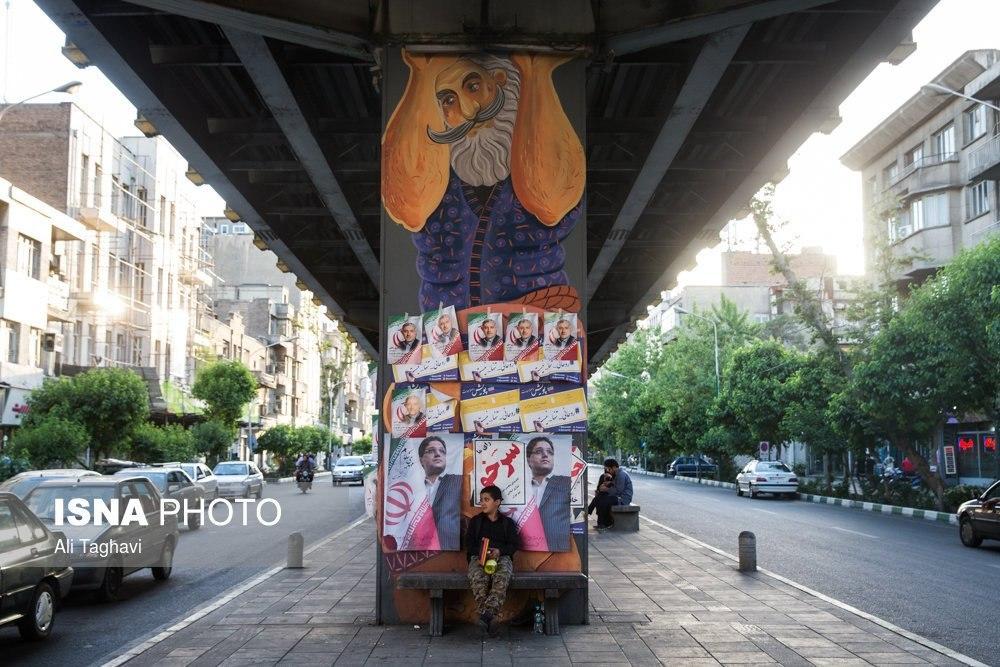
Economy Likely to Be Most Pressing Theme in Iran Election Campaigns

Economic issues are likely to be the main sparring ground for the reformist and conservative candidates, reads an article published by Forbes.

A total of 1,636 candidates have registered to run, but the Guardians Council, which vets all candidates, is likely to disqualify the vast majority of them.

The key test will be whether it chooses to block any of the more prominent figures from running. The final slate of candidates is expected to be revealed on April 26 or 27.

The main contenders can be roughly divided up into reformists such as President Hassan Rouhani and conservative or principlist candidates such as Ebrahim Raiesi, a former prosecutor-general and current custodian of the Imam Reza (PBUH) shrine in Mashhad.

Alongside those two frontrunners, on the reformist slate are First Vice President Es’haq Jahangiri, who is thought to have registered as a fallback option in case Rouhani is barred from competing by the Guardians Council.

Other principlist candidates include former president Mahmoud Ahmadinejad, who is widely tipped to be blocked by the council, his former vice president, Hamid Baqaei, and Tehran’s Mayor Mohammad Baqer Qalibaf.

The economy is likely to be the most pressing theme in the campaign, which will officially run from April 28 to May 17. In particular, much of the debate is likely to focus on the gains–or lack of them–to have come as a result of the nuclear agreement Iran signed with the US and other world powers in July 2015.

A rebound in economic growth and reining in the runaway inflation inherited from the previous administration are considered to be the main achievements of the Rouhani administration.

Not to mention the 2015 nuclear deal, which led to the lifting of sanctions the following year and opened Iran’s economy to the world.

Nonetheless, Iran’s foreign trade still remains impeded by remaining US sanctions, mainly pertaining to the banking sector.

According to the Central Bank of Iran’s latest report, the Iranian economy grew 11.9% during the three quarters of the last Iranian year (started March 20, 2016).

Without taking the oil sector into account, the growth rate stands at 1.9%, the report shows.

The oil sector expanded 65.4%, thanks to ramped up crude production and increased exports following the lifting of sanctions.

The sectors of agriculture, industries, mining and services grew by 4.2%, 5.8%, 0.2% and 2.4% respectively while construction saw a negative growth of 17.1% during the nine months.

Iran’s inflation rate went below 10% for the rolling year ending June 20. This was the first time the country was experiencing single-digit inflation in about a quarter century.