Friday, December 26, 2025
Home Blog Page 3997

Free Treatment for Child Whose Photo Went Viral after Tehran Attacks

The minister’s order came after large number of Iranians held an online campaign to provide Emad’s family with the required money to treat their son.

Qazizadeh Hashemi also urged the officials to provide him with reports on Emad’s treatment progress.

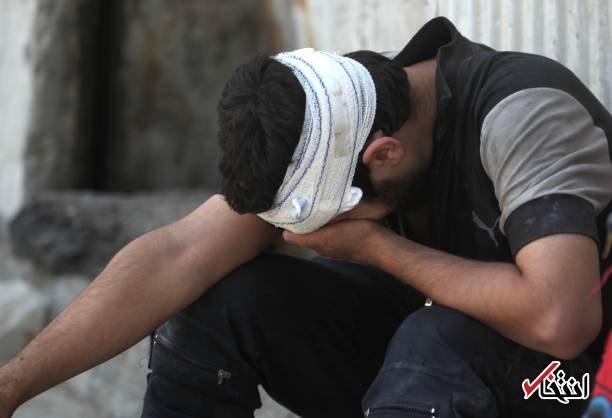
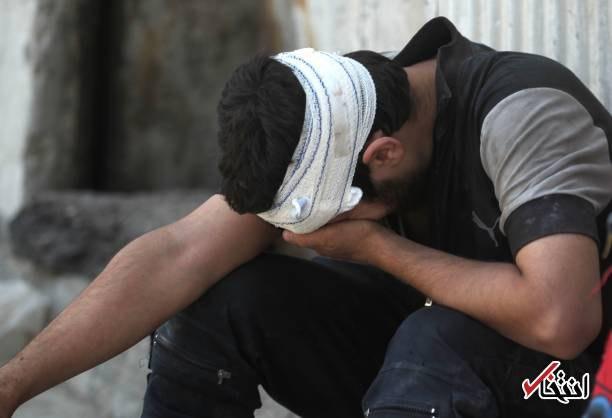
Free Treatment for Child Whose Photo Went Viral after Tehran Attacks -emadEmad, who escaped terrorists’ attack on the Parliament, has been suffering from an advancing liver disease. The boy’s mother had taken him from their hometown Gorgan, northeast of Iran, to the Parliament on Wednesday to ask for help from lawmakers, because the family was too poor to afford an expensive treatment for their son.

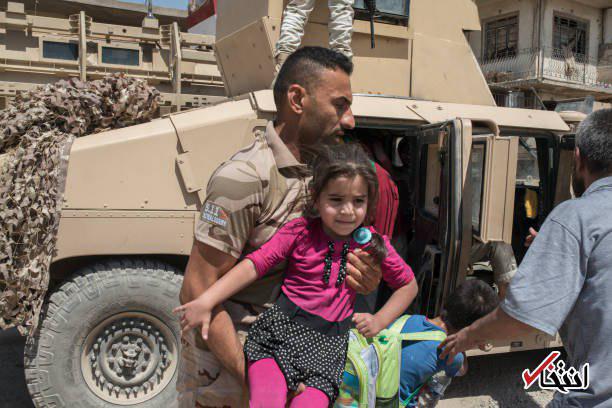
Emad’s photo, in which the Iranian security forces are taking him out of the Parliament’s building amid Tehran attacks, went viral within hours after the incident. It also raised serious concerns among viewers over the terrorists’ brutality in targeting innocent people.

Earlier, in a message to Fars News Agency’s photographer, who took and published the historic photo, Emad’s cousin had said, “You have taken a photo of his rescue {during Tehran attacks}, but he has not been rescued yet.”

He went on adding that Emad remained in hospital because he needed Hematopoietic stem cell transplantation, and providing the money is far beyond the financial power of his poor family.

Thousands of Flamingos Delay Migration from Lake Urmia

Thousands of Flamingos Delay Migration from Lake Urmia

According to Omid Yousefi, the head of Wildlife Monitoring Office at West Azarbaijan’s office of the Department of Environment, these birds normally migrate from here to South Africa and the Persian Gulf region at this time of the year, but have chosen to stay put for now in Urmia Lake National Park, IRNA reported.

“Flamingos are spread across the park but can be mostly seen in the southern areas and at the mouth of Urmia’s tributaries, due to greater depths of fresher water sources,” he said.

The official said his office has received reports of birds traveling between the national park and Urmia’s seasonally-flooded wetlands, which are now filled with water.

“The province’s southern wetlands, such as Hassanlou and Kani Barazan, are also suitable places for these birds due to their abundant sources of food,” he said.

Flamingos are part of Urmia Lake’s biodiversity. Prior to the lake’s struggle with water shortage and seemingly inevitable desiccation, hundreds of thousands of these birds flew to the region each year. By some accounts, the lake used to host 100,000 to 200,000 birds in winter every year.

Located between the provinces of East and West Azarbaijan, Urmia Lake has been facing serious drought for years. Its desiccation is attributed to climate change and the long dry spell due to lack of rainfall, unrestrained damming and excessive water use, especially in the agriculture sector.

Restoration projects, however, are progressing well and the volume of water in the lake has more than doubled since 2013, when the Urmia Lake Restoration Program was launched by President Hassan Rouhani.

One of the largest hyper-saline lakes in the world, Urmia Lake is marked by more than 100 small rocky islands that are stopover points in the migration of various waterfowl, including flamingos, pelicans, spoonbills, ibises, storks, avocets, stilts and gulls.

Iran Sends Five Planes of Food to Qatar: Official

Iran air

Iran has sent five planes of food exports to Qatar, an Iran Air official told AFP on Sunday, days after Persian Gulf countries cut off air and transport links to the emirate.

“So far five planes carrying perishable food items such as fruit and vegetables have been sent to Qatar,” Iran Air spokesman Shahrokh Noushabadi said.

Each of these planes carries around 90 tons of cargo, the Iranian official noted, adding that another plane will also be sent today.

Iran voiced its preparedness to provide Qatar with whatever food products the Arab country needs immediately after Saudi Arabia and a number of others broke off relations with Qatar, which relies heavily on importing food.

Back on June 5, the head of Iran’s Agricultural Products Exporters Union Reza Noorani said the Islamic Republic is ready to export various types of agricultural and food products to Qatar through three Iranian port cities.

Saudi Arabia has closed Qatar’s only land border, and Iran, as the closest country to Qatar, can export food products to the Arab country through a 12-hour shipping lane, he added.

Three Iranian ports of Bushehr, Bandar Abbas, and Bandar Lengeh are now ready to be used for the dispatch of Iranian products to Qatar, Noorani went on to say.

Many people in Qatar flocked to local supermarkets and grocery stores to stock up on food items after waking up to news of Saudi Arabia closing the country’s only land border.

Two Iranian Warships to Set Sail for Oman

Two Iranian Warships to Set Sail for Oman

The 47th flotilla of Iranian warships, comprised of Alborz destroyer and Bushehr logistic vessel, is to embark on the voyage on Sunday.

It will leave southern Iranian port city of Bandar Abbas for Oman and then for the Indian Ocean and the Gulf of Aden.

Iran’s 46th naval fleet, comprised of Sabalan destroyer and Lavan logistic warship, left Bandar Abbas for the Gulf of Aden on April 17 through a ceremony attended by Iran’s Navy Commander Rear Admiral Habibollah Sayyari. It is set to return to the country later on Sunday after managing to successfully conduct its mission.

In recent years, Iran’s Navy has increased its presence in international waters to protect naval routes and provide security for merchant vessels and tankers.

In line with international efforts against piracy, the Iranian Navy has been conducting patrols in the Gulf of Aden since November 2008, safeguarding merchant containers and oil tankers owned or leased by Iran or other countries.

Iran’s Navy has managed to foil several attacks on both Iranian and foreign tankers during its missions in international waters.

US Double Standards towards “Inhumane” Sanctions

Rex Tillerson-US Double Standards towards “Inhumane” Sanctions

Just two days after the US Senate advanced Iran Sanctions Bill, US Secretary of State Rex Tillerson said putting Qatar under blockade had led to “unintended” humanitarian consequences and called on Saudi Arabia, the United Arab Emirates, Bahrain and Egypt “to ease the blockade.”

“We’re seeing shortages of food. Families are being forcibly separated, and children pulled out of school…Our expectation is that these countries will immediately take steps to de-escalate the situation and put forth a good faith effort to resolve their grievances they have with each other,” the US top diplomat said.

The call for easing Qatar’s blockade comes as, despite the nuclear deal between Iran and the P5+1 group of countries, the US Senate unanimously approved a bill to tighten Iran sanctions on Wednesday. The sanctions not only have significantly hampered Iran’s international trade, but also created serious obstacles in the way of importing medicines, endangering the Iranian patients’ lives over the past decades.

Meanwhile, the US senior officials have repeatedly accused Iran of sponsoring terrorism with no solid evidence. In the latest case, US President Donald Trump called the Tehran twin attacks the fruits of Iran’s support for terrorism. The attacks, which left 17 dead and dozens injured, were claimed by the ISIS terrorist group.

Trump’s statements which sparked harsh international criticisms across the world stand in direct contradiction with his presidential campaign promises. During his campaign Trump repeatedly blamed his predecessor, President Barack Obama, for supporting Saudi Arabia. He also praised Iran and Russia for their fight against ISIS.

But Trump dramatically changed his positions since taking office and particularly after signing a $200b arms deal with Saudi Arabia. Now, he not only remains silent towards Saudi Arabia as the ideological hub of terrorism, but also accuses Iran of sponsoring terrorism.

It seems that the US expresses concerns about terrorism and accuses certain states of sponsoring terror based on its trade ties with the regional states. With its significant trade relations with Saudi Arabia, the US has already closed its eyes to Riyadh’s dictatorship, violent acts and sponsoring terrorist groups like Al-Qaeda that was behind 9/11 attacks.

Interestingly enough, Washington is against Qatar blockade despite admitting its support for terrorists in Iraq and Syria. During his Friday statements, Tillerson said: “The nation of Qatar unfortunately has historically been a funder of terrorism at a very high level.”

He went on saying: “The emir of Qatar has made progress in halting financial support and expelling terrorist elements from his country, but he must do more and he must do it more quickly.”

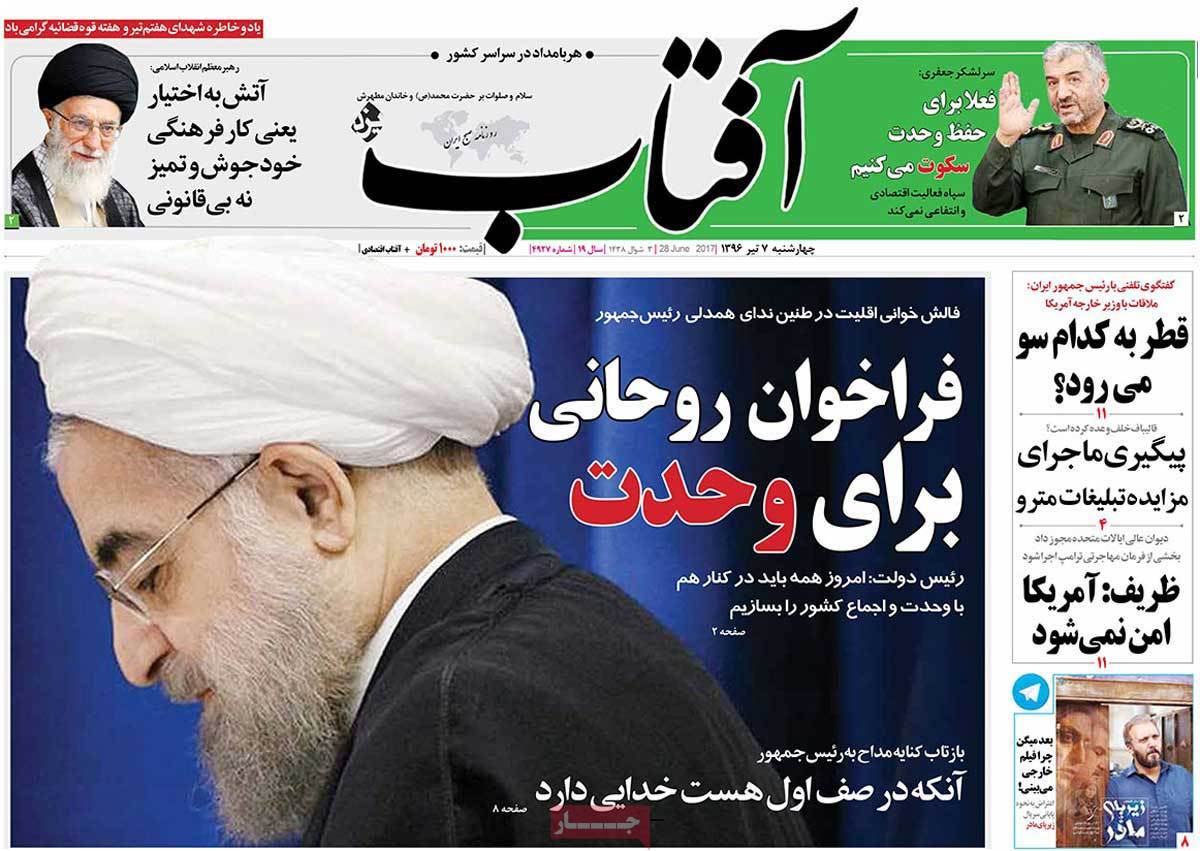
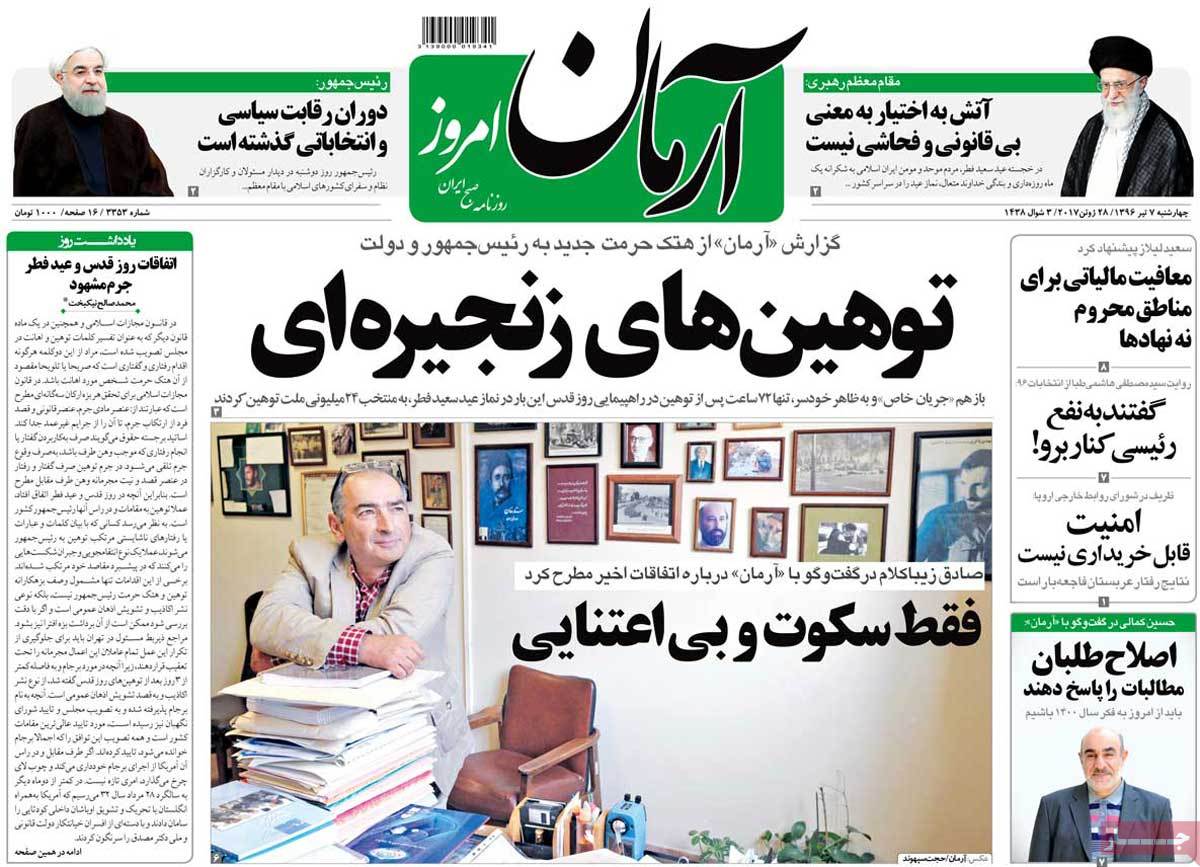
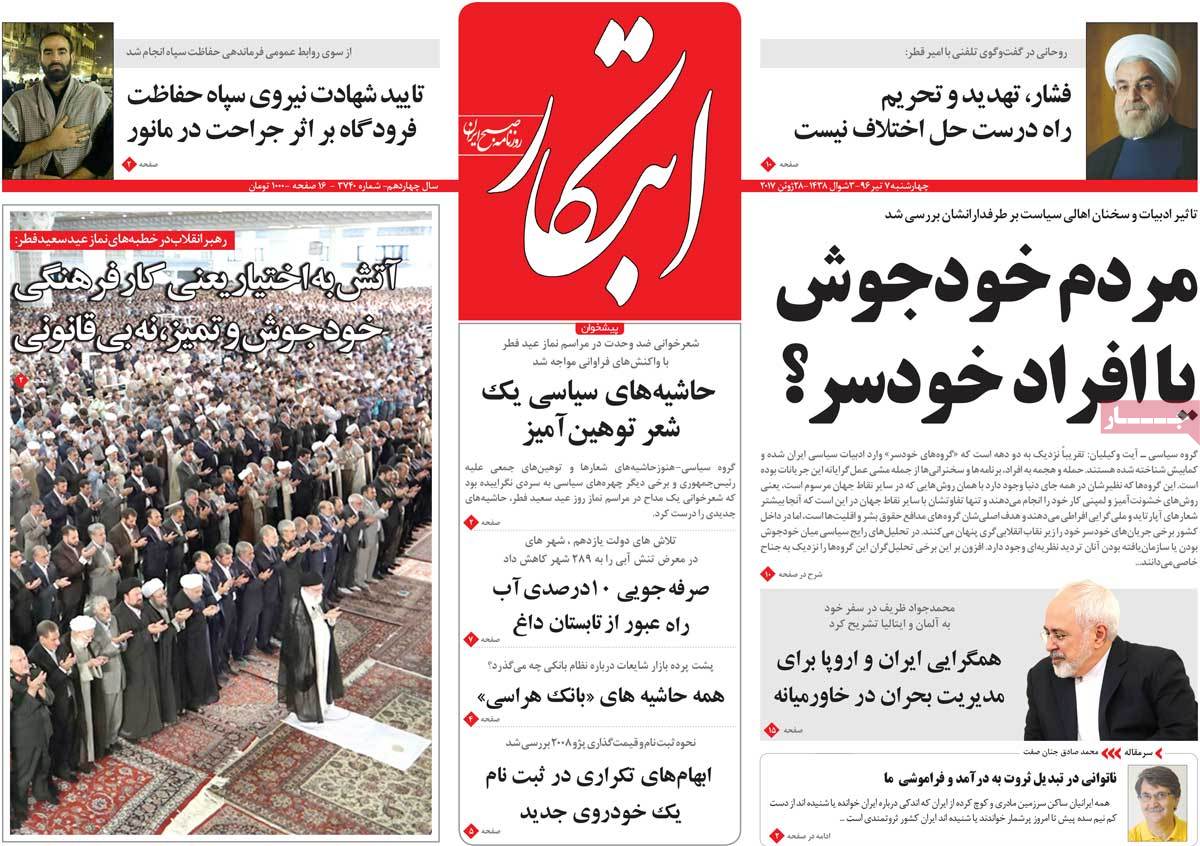
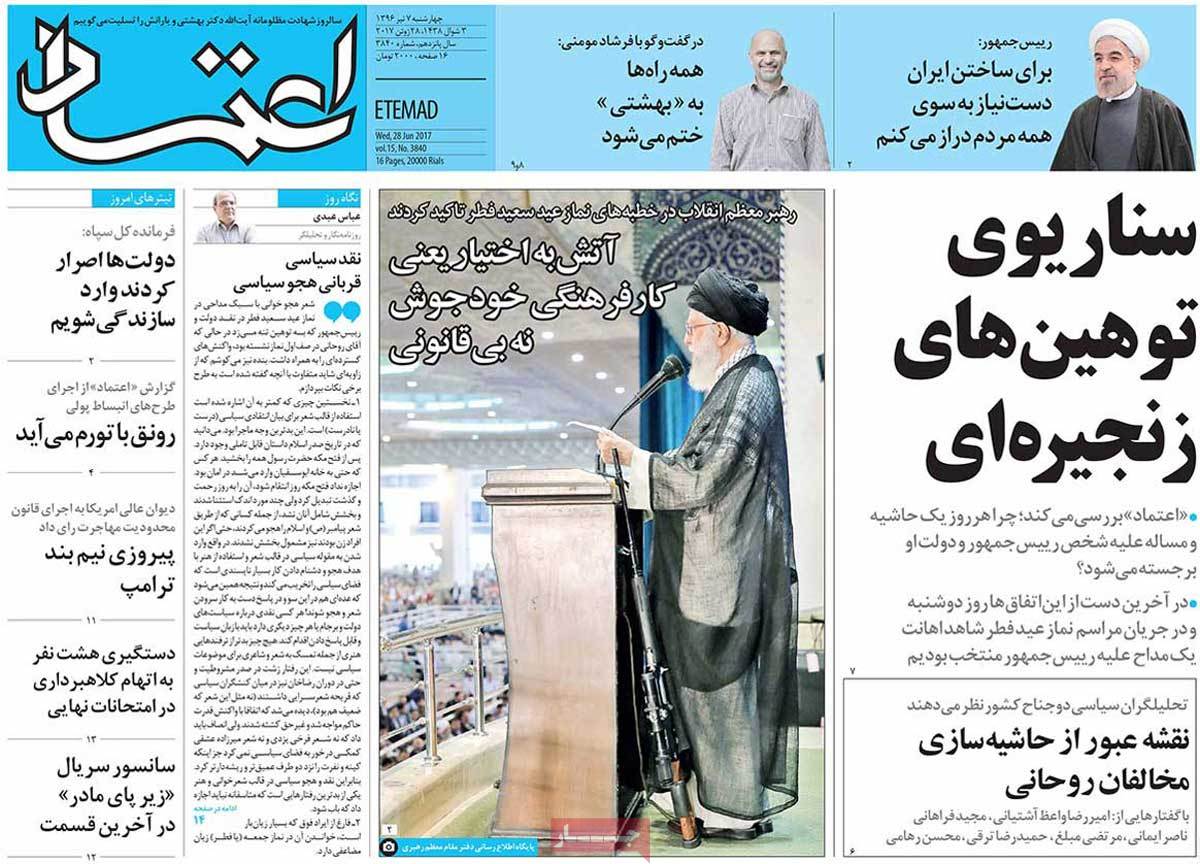
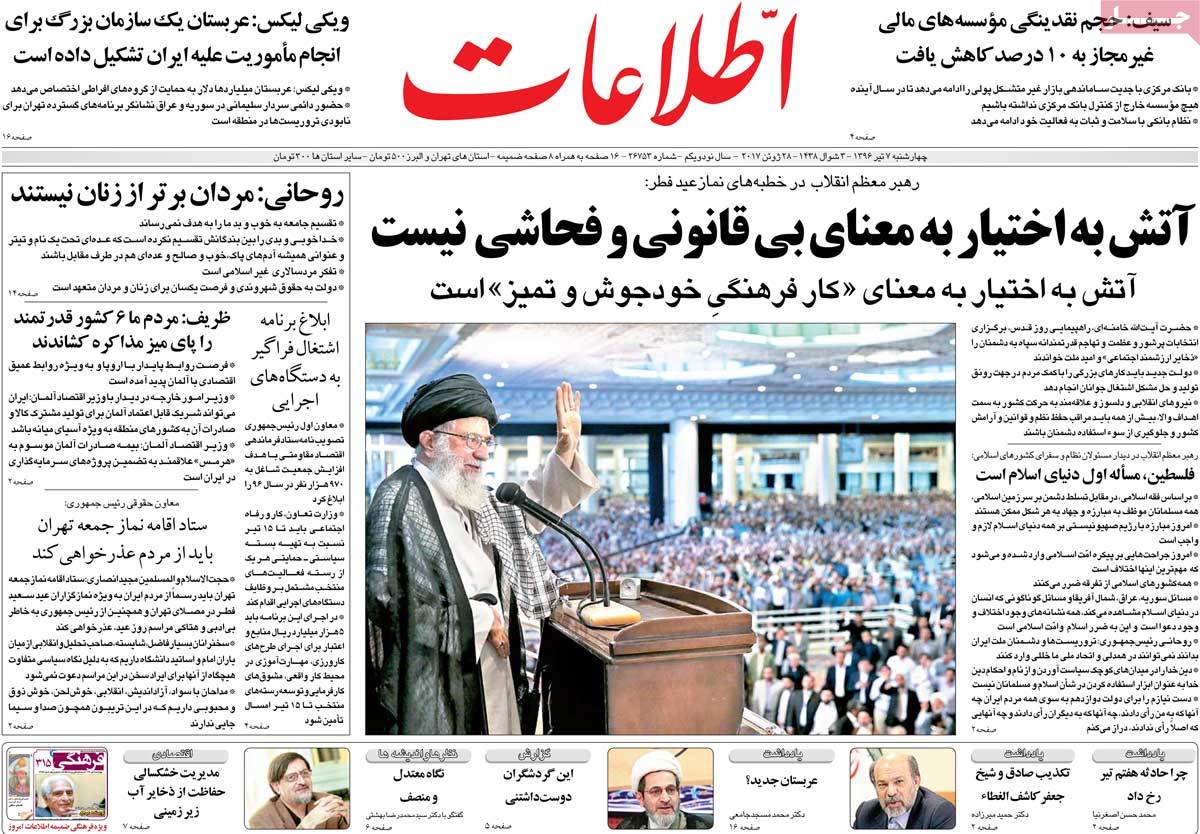
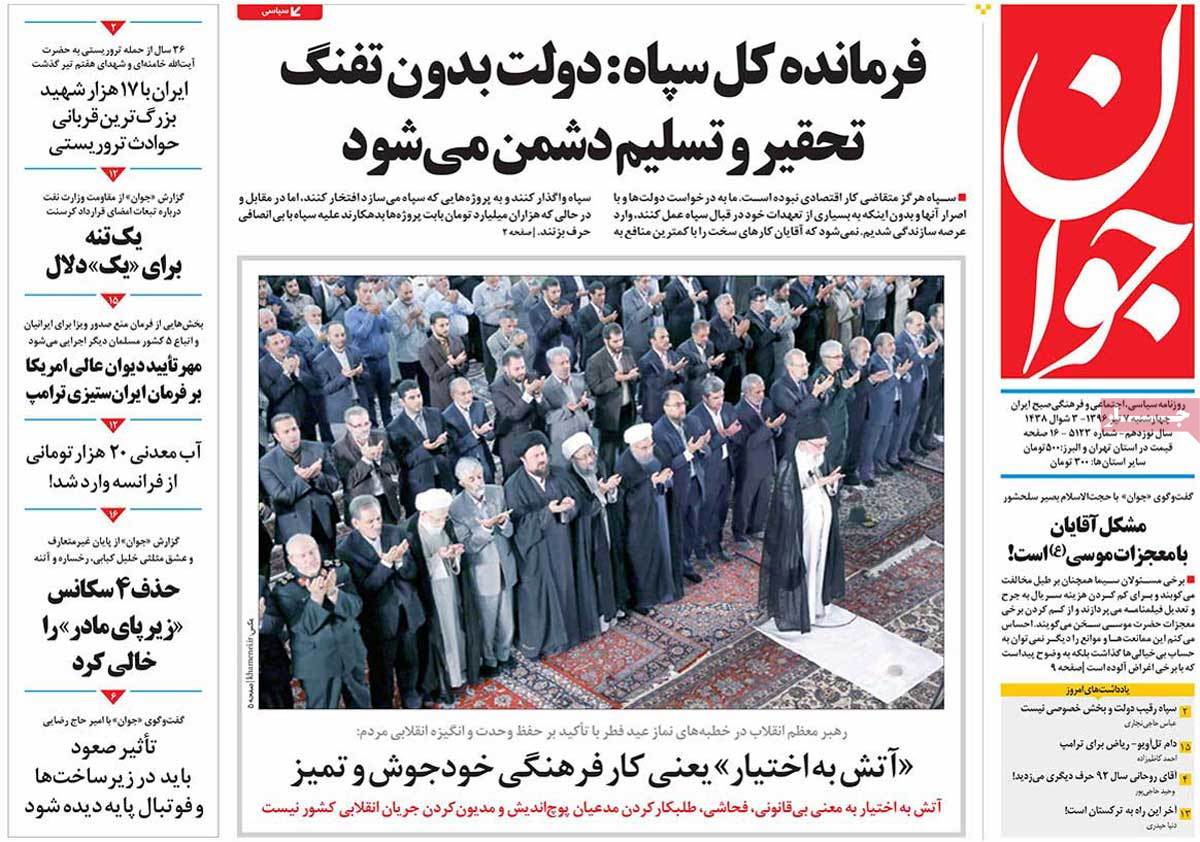
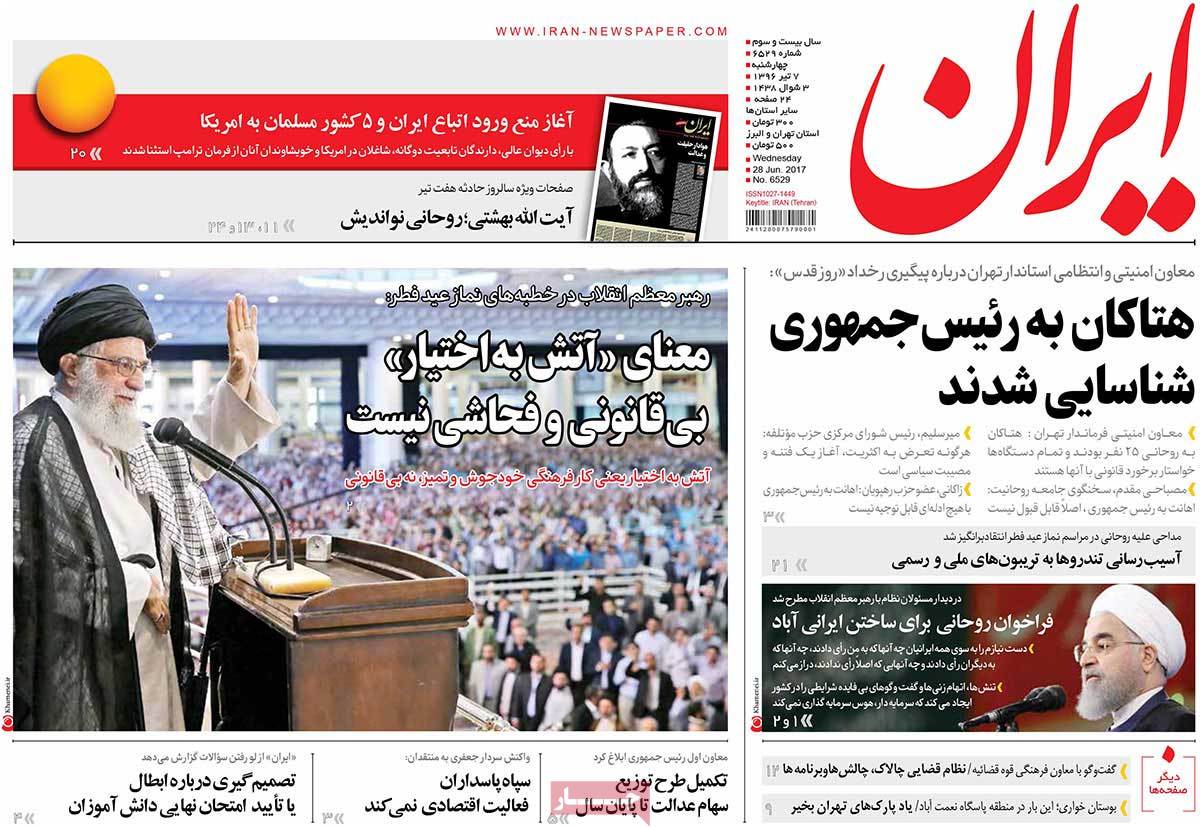
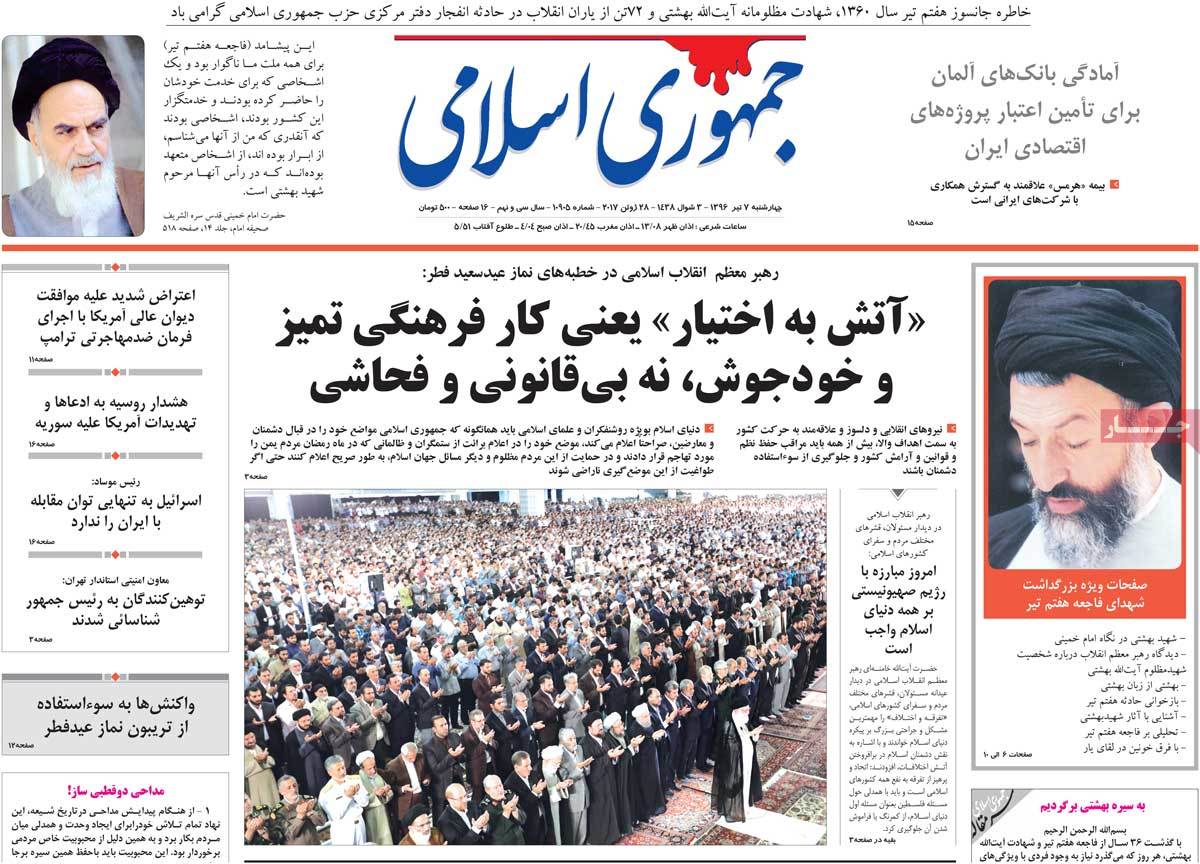
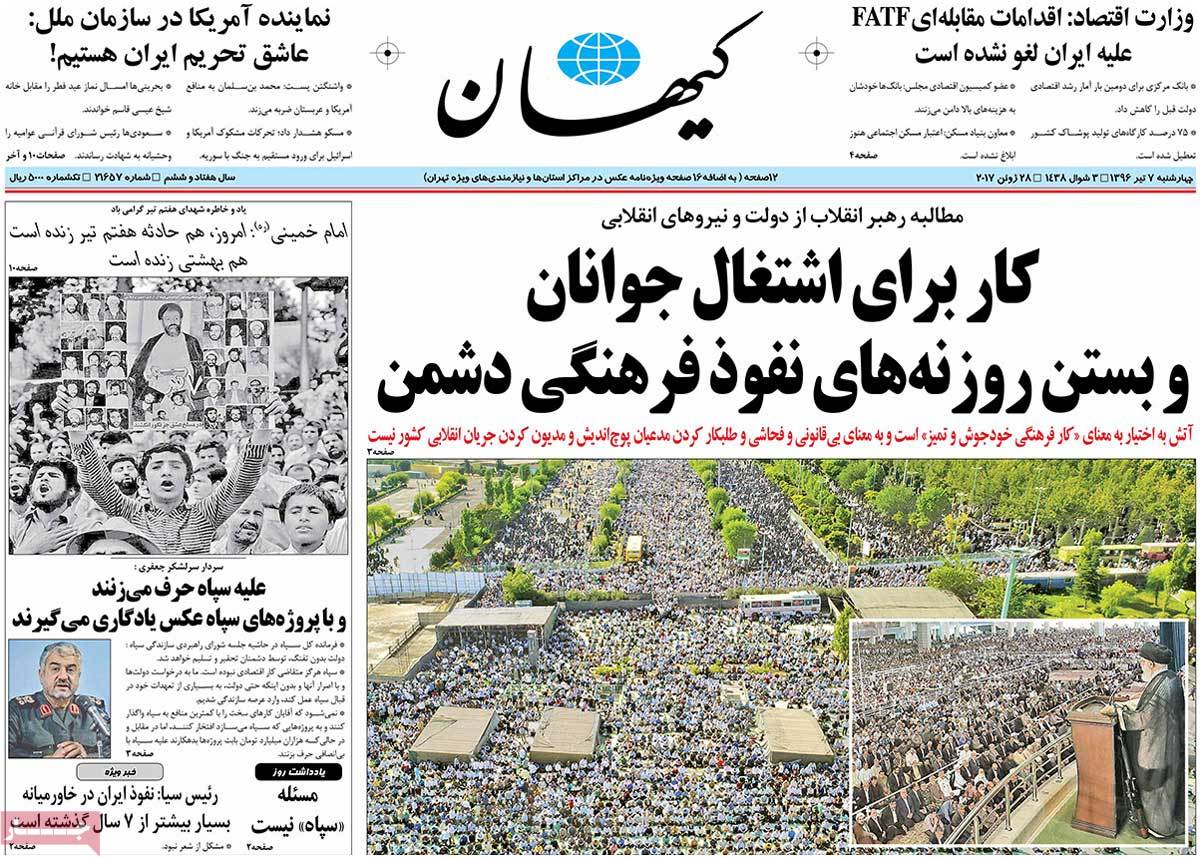
A Look at Iranian Newspaper Front Pages on June 11

Many newspapers today continued covering the reactions to the Wednesday’s twin attacks in Tehran, which killed at least 17 and wounded over 46.

They also highlighted the arrest of numerous ISIS elements in separate operations all around the country following the deadly attacks in Tehran.

Another top story was the remarks made by First Vice-President Es’haq Jahangiri about the need for moving forward after the presidential election.

The above issues, as well as many more, are highlighted in the following headlines and top stories:


Abrar:

1- Pope Francis Condemns Tehran Terror Attacks

2- Croatian President: Serious Fight against Terrorism Necessary

3- Iranian Navy Achievements to Be Unveiled by Year-End: Commander

A Look at Iranian Newspaper Front Pages on June 11


Afkar:

1- Qalibaf: Government Does Nothing for Tehran Subway

2- Suspension of 2030 Document Not Enough; It Should Be Annulled: Cleric

A Look at Iranian Newspaper Front Pages on June 11


Aftab-e Yazd:

1- Female MPs Oversee Selling Tickets to Women Spectators!

  • Only 300 Seats Given to Women in Volleyball Match

2- Tehran Safe for Tourists

A Look at Iranian Newspaper Front Pages on June 11


Arman-e Emrooz:

1- First VP Calls on Friday Prayer Leaders to Meet Private Sector Representatives

A Look at Iranian Newspaper Front Pages on June 11


Ebtekar:

1- Iran Establishment’s Bodies Shouldn’t See Gov’t as Their Rival: First VP

2- Deal Signed between Aseman Air and Boeing for Purchase of 60 Planes


A Look at Iranian Newspaper Front Pages on June 11


Ettela’at:

1- First VP: Gov’t Resolved to Attract Foreign, Domestic Investments

2- First Int’l Dust Pollution Conference to Be Held in Iran

3- Syrian Army Reaches Iraqi Border; Iraqis on Verge of Mosul Liberation

A Look at Iranian Newspaper Front Pages on June 11


Iran:

1- President: Patience for Peace More Difficult than Resistance in War Front

A Look at Iranian Newspaper Front Pages on June 11


Javan:

1- US Congressman: We Should Support Terrorist Acts in Iran

A Look at Iranian Newspaper Front Pages on June 11


Jomhouri Eslami:

1- Russia: US-Led Coalition Supporting ISIS against Syrian Army

2- Amnesty Int’l: Saudi Arabia, Allies Playing with People’s Lives in Mideast

3- Sunni Clerics: Iran to Stand United against Terrorism


A Look at Iranian Newspaper Front Pages on June 11


Kayhan:

1- Iraqi Popular Forces Commander: Operation Over, 2,000 ISIS Elements Killed

2- Poets, Cultural Figures Meet with Iran Leader

3- Iran Starts Export of Food Products to Qatar


A Look at Iranian Newspaper Front Pages on June 11


Resalat:

1- Mayor of Tehran: We’ve Been under Sanctions for 12 Years

2- Police Chief: Members of Terrorist Outfit Arrested near Tehran

3- Senior Cleric: You Can’t Talk of Islam and Deny Hijab

A Look at Iranian Newspaper Front Pages on June 11


Rooyesh-e Mellat:

1- Qatar FM: We Have Positive Ties with Iran

2- AEOI: No Need for Foreign Funds in Redesigning Arak Reactor

3- Tillerson Calls for Decrease in Pressures on Qatar

A Look at Iranian Newspaper Front Pages on June 11


Vaghaye Ettefaghieh:

1- Cyber Warrior: Putin to Test His New Weapon

2- Rouhani: Parliament, Judiciary Aware of Details of 2030 Document

3- 56 Terrorists: Security Forces Arrest 56 ISIS Elements after Tehran Attacks

A Look at Iranian Newspaper Front Pages on June 11


US Favours Separation of Kurdistan Region from Iraq: Analyst

US Favours Separation of Kurdistan Region from Iraq

Political analyst Hassan Hanizadeh has, in a Farsi interview with the Mizan News Agency, underlined that the United States’ opposition to the holding of a referendum in Iraq’s Kurdistan Region later this year is a complete sham.

He touched upon the Iraqi Kurdistan’s decision to hold a plebiscite on the region’s independence on September 25, 2017, and added US officials have, under former US Vice President Joe Biden’s plan, been seeking to disintegrate Iraq and separate Kurdistan from the country.

“Based on Biden’s scheme, Iraq is to be divided into three Shiite-populated, Sunni-populated and Kurdish-populated countries,” he noted.

“Iraq’s Kurdistan Region is ready to hold the referendum under the UN supervision. Reports suggest the region, in an illegal move, began handing out birth certificates (ID cards) to Kurds residing in other countries months ago to encourage them to take part in the vote,” he said.

He added that the referendum will be held one way or another, even if countries such as Iran, Turkey, Syria and Iraq oppose it.

“This plebiscite may be postponed due to regional pressure, but it will be held one day and the Kurdistan Region will be separated from Iraq,” he said.

The analyst noted that Washington’s opposition to the holding of a referendum in Iraq’s Kurdistan Region later this year is a sham and just a show.

“The Americans even seek to disintegrate Syrian Kurds from this country,” he said.

Hanizadeh highlighted that Kurds in Syria and Iraq suffered tyranny over the past decades, but this, he added, is not good reason for them to establish an independent country.

“The region is not prepared to see the emergence of a new country, and Iraqi Kurds should know that the separation of the Kurdistan Region from Iraq will not only not solve any problems, but result in more difficulties as well,” the analyst stressed.


Creation of Greater Kurdistan among Israel’s Priorities*

He concluded by saying that the creation of a greater Kurdistan is among the Israeli regime’s main priorities.

“Zionists have underlined this priority via official tribunes, in their books and in their doctrines announced in 2000,” he said.

Iraqi Kurdish parties held a meeting with President of the Kurdistan Region Masoud Barzani on June 7, 2017 without the presence of Iraq’s Kurdistan Islamic Group and the Change Movement, and decided to hold a referendum on September 25, 2017 on the region’s independence.

The decision is made as Iraq’s Kurdish parties have not yet reached a consensus on the referendum and its conditions.

After the news was announced, US State Department Spokesman Heather Nauert said that “we have expressed our concern” to Kurdistan Region authorities in that regard.


* To know more about Israel’s interest in the creation of the greater Kurdistan, read this report

Iran, Sweden to Expand Parliamentary Ties

Iran, Sweden to Expand Parliamentary Ties

The call for enhancement of mutual parliamentary cooperation was made during a meeting between the head of Iranian Parliament’s Research Centre, Kazem Jalali, and his Swedish counterpart Gunnar Fors in Tehran.

Iran, Sweden to Expand Parliamentary TiesJalali also cited the meeting as the beginning of a new phase in cooperation between parliamentary research centres of Iran and Sweden and added the two centres could take the best advantage of each other’s experience to improve the current situation.

“The model of cooperation between Iranian and Swedish parliament research centres can be used as a good roadmap for establishing deeper relations by the two sides,” he said.

The Iranian lawmaker also welcomed the exchange of experience between the two research centres and said, “We are seeking to use the experience of other parliamentary research centres as well in resolving the issues that the Iranian parliament is facing.”

Jalali noted that achieving a good cooperation model could be useful for both sides.

For his part, Fors expressed delight at visiting Iran and hoped the meeting could pave the way for expansion of ties between the two research centres.

Iran, Sweden to Expand Parliamentary Ties“Swedish Parliament’s Research Centre needs to exchange experience with other research centres and we hope the centre can take the best advantage of the Iranian centre’s experience,” he said.

He elaborated on the administrative procedures of Swedish Parliament Research Centre and said the 100-year-long cooperation between the parliaments of Iran and Sweden further highlighted the need to exchange experience in law-making fields.


Tehran Terrorist Attacks

Elsewhere in the meeting, Jalali also expressed his regret over Wednesday terrorist attacks in Tehran. He cited hatreds towards the Islamic Republic as the main cause behind the attacks and said Iran is one of the main victims of terrorism across the world.

The member of Iranian Parliament’s National Security and Foreign Policy Commission also emphasized that terrorist attacks could not undermine Iran’s regional security and stability.

“The Islamic Republic had always been at the forefront in fight against terrorist and in this sense, the country can be a good model for those states that only pay lip services to war on terror,” he said.

Tehran Attacks: Eyewitness Describes 5 Hours of Horror

Tehran Attacks: Eyewitness Describes 5 Hours of Horror

Amir Abbas Hashemi, an advisor to and the chief of staff of parliamentarian Javad Kazem Nassab, is one of eight people entrapped in a room on the fourth floor of the Parliament building in the Iranian capital, Tehran. He speaks of the ordeal that they went through when terrorists attacked the building:

We were trapped for five hours in a room behind a door from which footsteps were heard every now and then, and which was sprayed with bullets by the ISIS terrorists walking by.

Our office is across from Mr. Tajgardoon’s on the fourth floor. Ms. Mo’tamedi, who was with us in the room, is Mr. Tajgardoon’s chief of staff. As soon as sentries were martyred in the shootout on the first floor and before terrorists made their way to the fourth storey, the security guards told us that they had a security situation. They told us to go inside rooms and lock the doors. We did so, but we wouldn’t have thought that it might be a terrorist incident. We thought someone with a personal grudge against an MP or an official had come to take revenge.

Tehran Attacks: Eyewitness Describes 5 Hours of Horror

There were eight of us in the office. We remained trapped in the room from around 10 am to 3 pm. We could hear the gunfire. Terrorists would kick at the doors and sprayed them with bullets to break them open. Our room was at the end of the corridor and overlooked the Management Organization and the place where people and security forces had ambushed. It was the best place for taking shelter. So, they kept trying to enter the room. I cannot describe those moments. We could even hear their footsteps. They wouldn’t talk. Sometimes they would say a few words. We couldn’t tell if they were speaking in Farsi or Arabic.


I saw a thick book on the bookshelf. I grabbed it and wrote “There are eight of us trapped inside the room; one is a pregnant lady” on it. I then wrote my phone number and threw the book to security forces. From then on, they were in contact with me via text messages.


We had lost all hope and were waiting for a miracle to get out of the room safe. Ms. Mo’tamedi, who was pregnant, was so impatient. She was worried about her child who was at school. She wanted to jump out of the window several times, but we talked her out of it. We were mostly worried about her. She passed out a few times and had her blood pressure drop. That was the reason why we asked Mr. Tajgardoon to allow us to get her out with the fire escape ladder, but security forces convened a meeting and told us it was not the right thing to do. She was feeling very bad, indeed. Now she is in hospital due to her mental condition.

Security forces were right under the window of our room behind the fences. Police snipers had ambushed at the building of the Parliament’s secretariat right across from our window. We were afraid lest they might shoot us instead of the terrorists. I saw a thick book on the bookshelf. I grabbed it and wrote “There are eight of us trapped inside the room; one is a pregnant lady” on it. I then wrote my phone number under that sentence and threw the book to them from the window. From then on, they were in contact with me via text messages.


When we stepped out of the room we couldn’t believe what we were seeing. We hadn’t experienced anything like that before. We had always lived in full security in the county.


As security forces approached upper floors, more gunfire was heard. There was a possibility that terrorists had planted explosives on the first floor and wanted to blow up the building. We heard an explosion, which scared us more. The false ceiling caved in, the pipes burst and there was water all over the floor. Security forces told us through a text message that they had reached the third floor and that they were engaged in a gun battle with terrorists between the third and fourth floors. Security forces said we needn’t worry because the terrorists were engaged in a gun fight with them and would leave us alone. We became hopeful. It was almost 3 pm when we opened the door after hearing the codename that security forces had told us before. We opened the door only to see the bloody body of one of the terrorists lying on the floor right in front of us.

First, we didn’t know how many terrorists were there and what was going on. It was only after we saw the news on the Tehran terrorist attacks on Telegram and websites when we realized what had happened. There was a piece of news on the number of the terrorists. When we stepped out of the room we couldn’t believe what we were seeing. We hadn’t experienced anything like that before. We had always lived in full security in the county. We thank all security forces, who are the guarantors of our security.

Iranians Go Online to Teach Tillerson Correct Name of Persian Gulf

Iran Says Persian Gulf Always ‘Persian’ Gulf, not ‘Washington’ Gulf

US Secretary of State Rex Tillerson’s use of a fabricated name to refer to the Persian Gulf has drawn strong reaction from Iranians, prompting them to remind the top diplomat of the official and real name of the body of water.

While reading out a statement on the Qatar crisis on June 9, 2017, Tillerson used a false name favourite with Saudis to refer to the Persian Gulf. The move was met with immediate and widespread reaction from Iranians on social networks.

Tillerson, whose country is in a bind over how to simultaneously support rich kingdoms of the Persian Gulf, called on Saudi Arabia and its allies to relax the boycott of Qatar and set aside their differences through goodwill, so that their divisions wouldn’t hinder US trade in the region, either. Tillerson’s statement was read out only hours after US President Donald Trump’s comments in a joint press briefing with his Romanian counterpart in which Trump had called Qatar a sponsor of terrorism.

Trump also touched upon his recent trip to Saudi Arabia in which the two sides agreed on a deal on $200 billion worth of US arms sales to Riyadh.

After Trump’s remarks, the US secretary of state began to use a fabricated name to refer to the Persian Gulf. It seems the mistake was a deliberate one and was made to please Washington’s Arab allies and insult Iranians.

Persiangulf-Iranians Go Online to Teach Tillerson Correct Name of Persian Gulf


Persian GulfThe move received strong reaction from Iranians on social media on Friday night. They posted historical documents and even the UN directive on using the name “Persian Gulf” in all of the world body’s statements and letters. In fact, Iranians were trying to remind Tillerson of his mistake and teach him the correct name of this important international region.

During the Friday campaign, some Iranian users posted photos of a grave belonging to a fallen US soldier, on which the name Persian Gulf is written.
America’s use of fabricated names such as “The Gulf” or “The A-r-a-b-i-a-n Gulf” in reference to “The Persian Gulf” has its roots in the country’s years-old policies aimed at pleasing the rich sheikhs of Persian Gulf kingdoms.
Earlier, even the US Army had ordered the phrase “The Persian Gulf” to be used to refer to the body of water.