Friday, December 26, 2025
Home Blog Page 3996

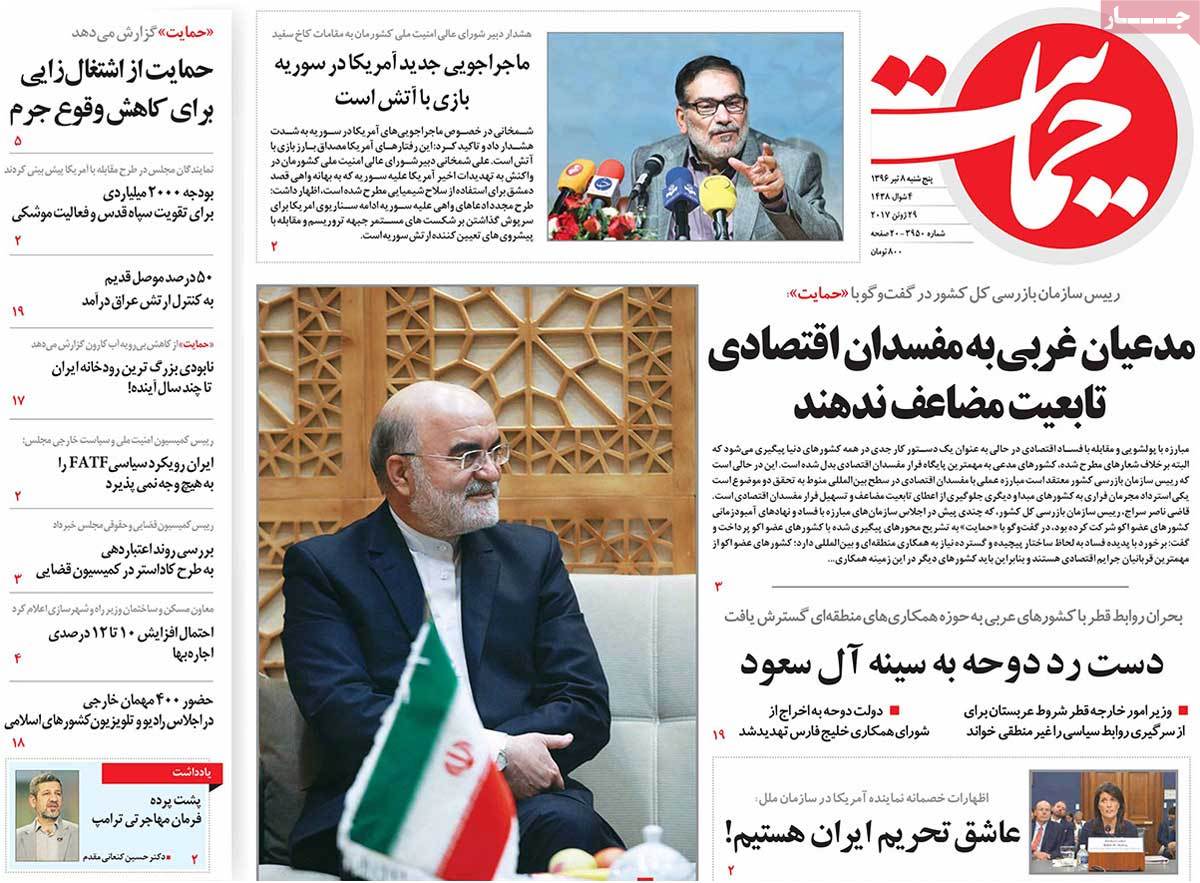
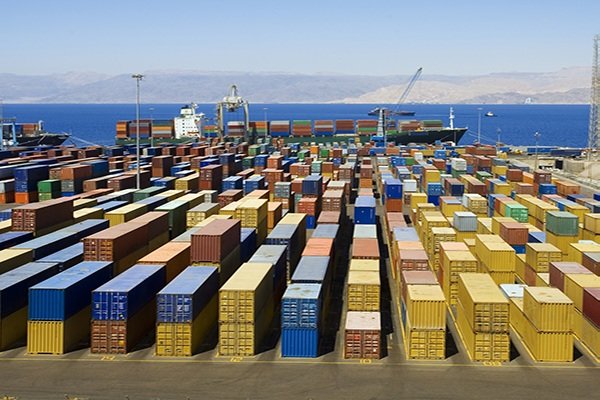
Iran’s Air Traffic Up by 17% after Qatar Crisis

“Qatar’s unexpected request has led to a 17% increase in air traffic,” Ali Abedzadeh was also reported as saying in a CAO press release posted on its website.

“It is a very difficult task to respond to a request of this size at short notice,” he said, adding that Iran managed to do just that given the “capacity-making” carried out in the past months.

Qatar Airways, a big international carrier, was unable to fly over Bahrain, the UAE, Egypt and Saudi Arabia as of Monday last week, when the Saudi allies cut all economic and diplomatic ties over Doha’s alleged support for terrorism, a claim vehemently rejected by Qatari officials.

Iran Spokesman Rules Out JCPOA on Regional Issues

The Iranian Foreign Ministry official said the nuclear deal between Iran and the P5+1 group of countries was something different from what is going on between Iran and its Persian Gulf neighbours.

“This is a totally different issue which needs special solutions,” Qassemi added.

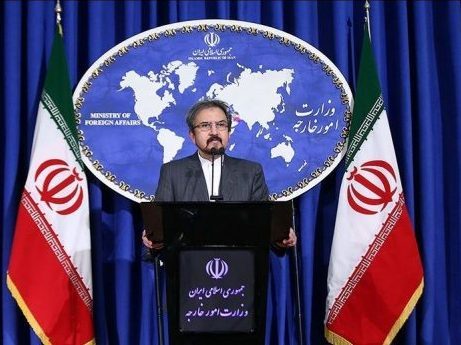
Speaking at a weekly press conference in Tehran on Monday, he called the Riyadh Summit which was held on May 20-21 on the occasion of the visit of United States President Donald Trump to Saudi Arabia, an untimely conference with a wrong layout.

“After the Riyadh Summit, some things came up that led to adverse consequences in the region. Considering the tensions in the region, we believe that the involved countries can resolve their issues in a positive trend through diplomacy. We call on them to show restraint and sit at a table to negotiate,” he noted.

“Our policy towards our neighbours is clear and we have constantly cooperated with them and if needed, we are ready to boost cooperation. There is no limitation in this regard if it would be a mutual cooperation,” Qassemi noted.

Regarding the creation of more convergence between Iran and Qatar, the Iranian spokesman said that, as far as possible, Iran has had good relations with the neighbours.

“We have established good contacts and ties with Qatar and such an interest exists [in ties] with the rest of the countries in the region. Based on a variety of reasons and backgrounds, Iran has always been in dialogue with Turkey as well and the disagreements could never spoil friendship.”

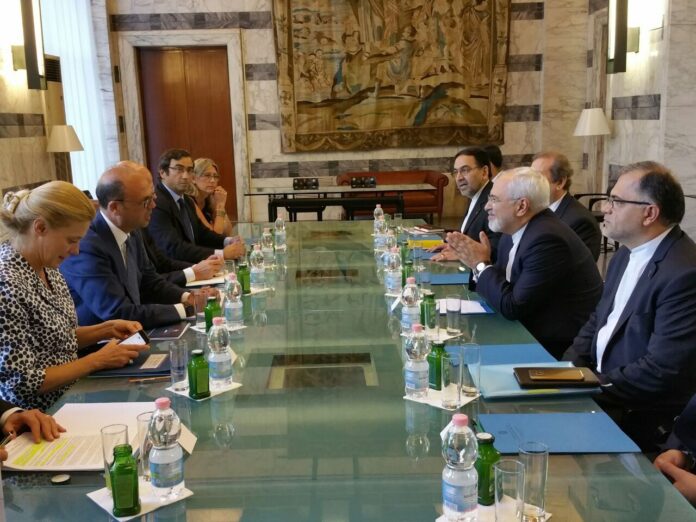
Qassemi went on to say that “FM [Mohammad Javad] Zarif has begun consultations on a variety of issues and made a visit to Turkey to discuss different topics including bilateral issues, regional ones, and Syria. We also held talks with nine high-ranking officials in Astana (during Shanghai Cooperation Organization Summit) and hope they may have a positive impact.”

He also talked about the unwillingness of Iran’s neighbours to join the so-called Arab NATO, saying that some of the world realities are being copied, but they are too far from the realities of the region and such developments must be observed. “What we witnessed in ‘Riyadh Show’ changed very soon,” the spokesman added.

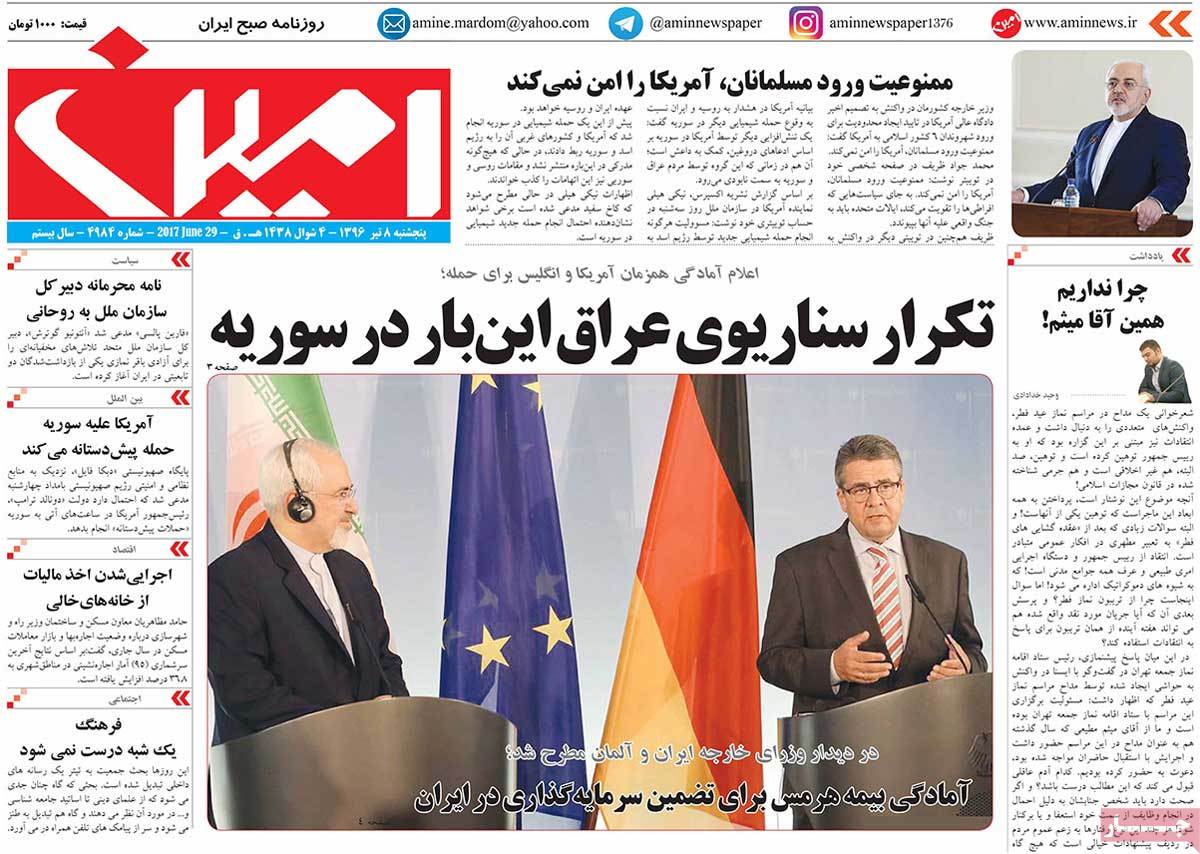
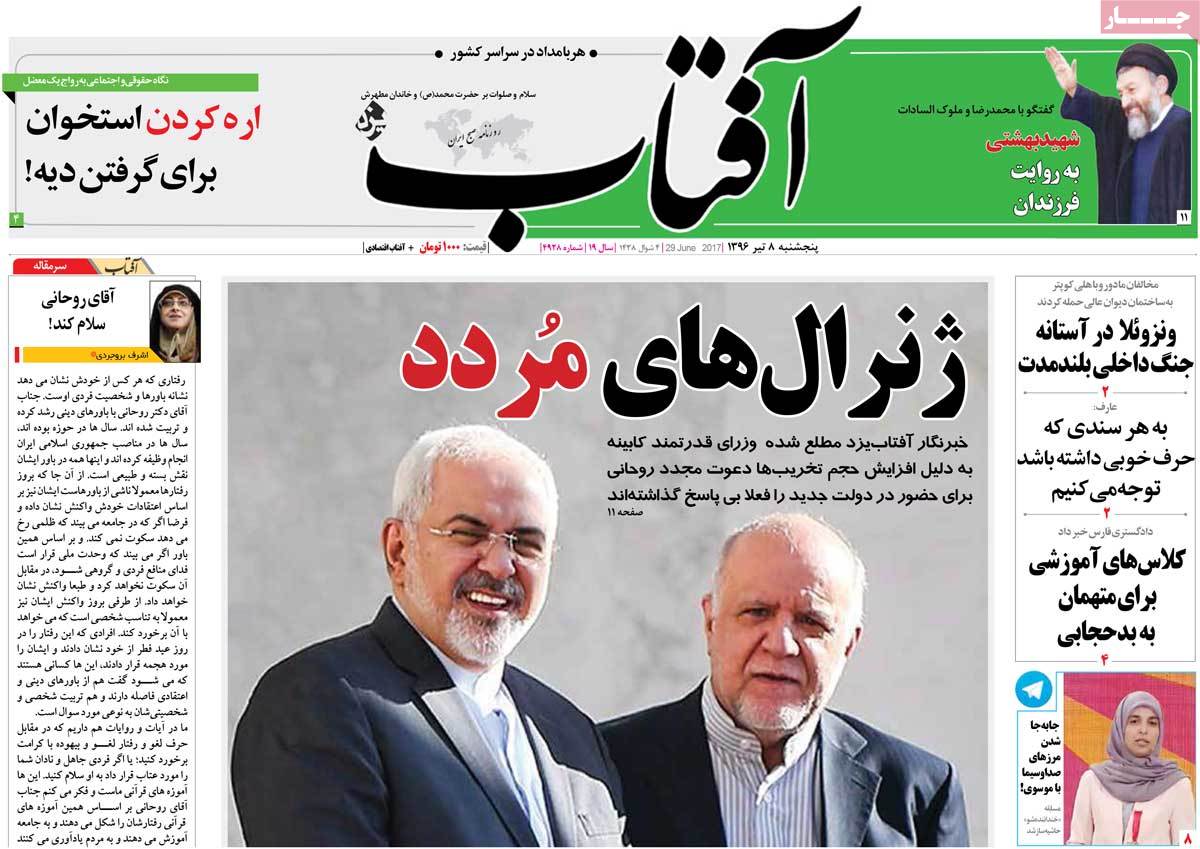
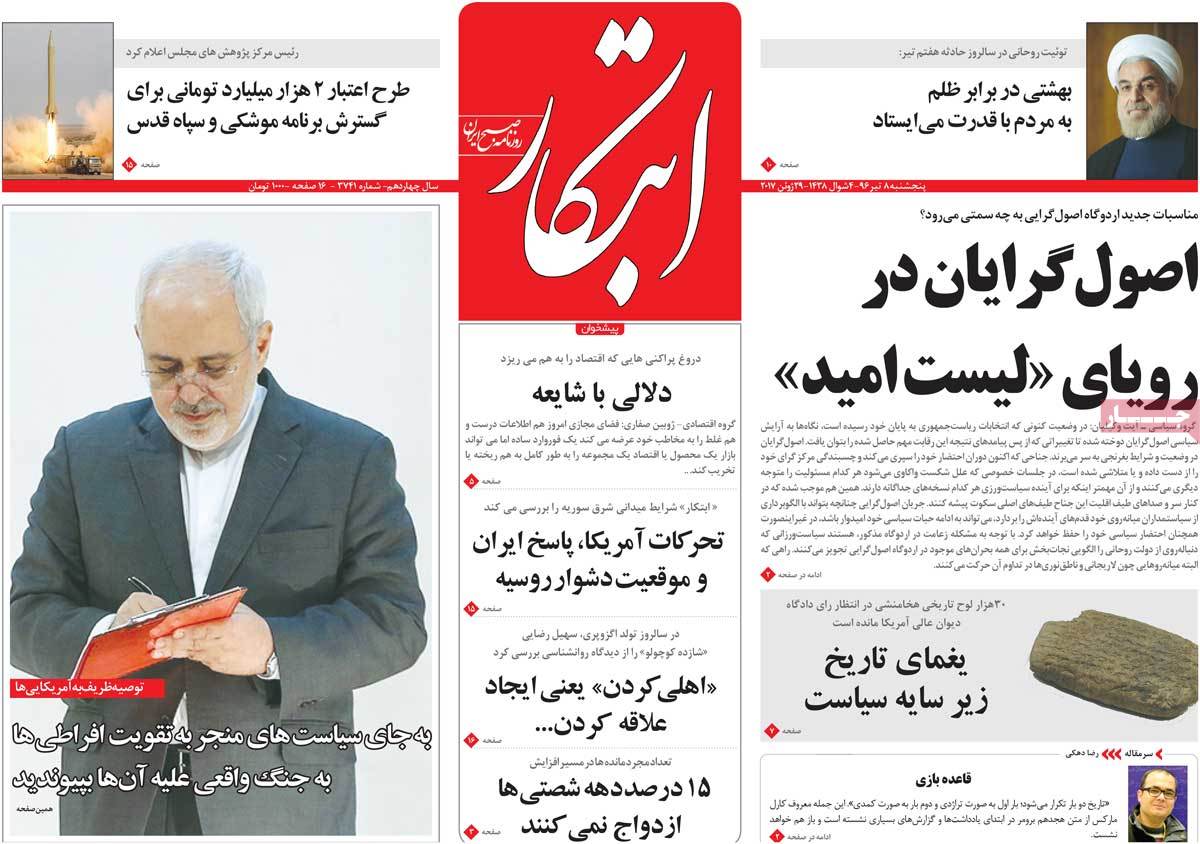
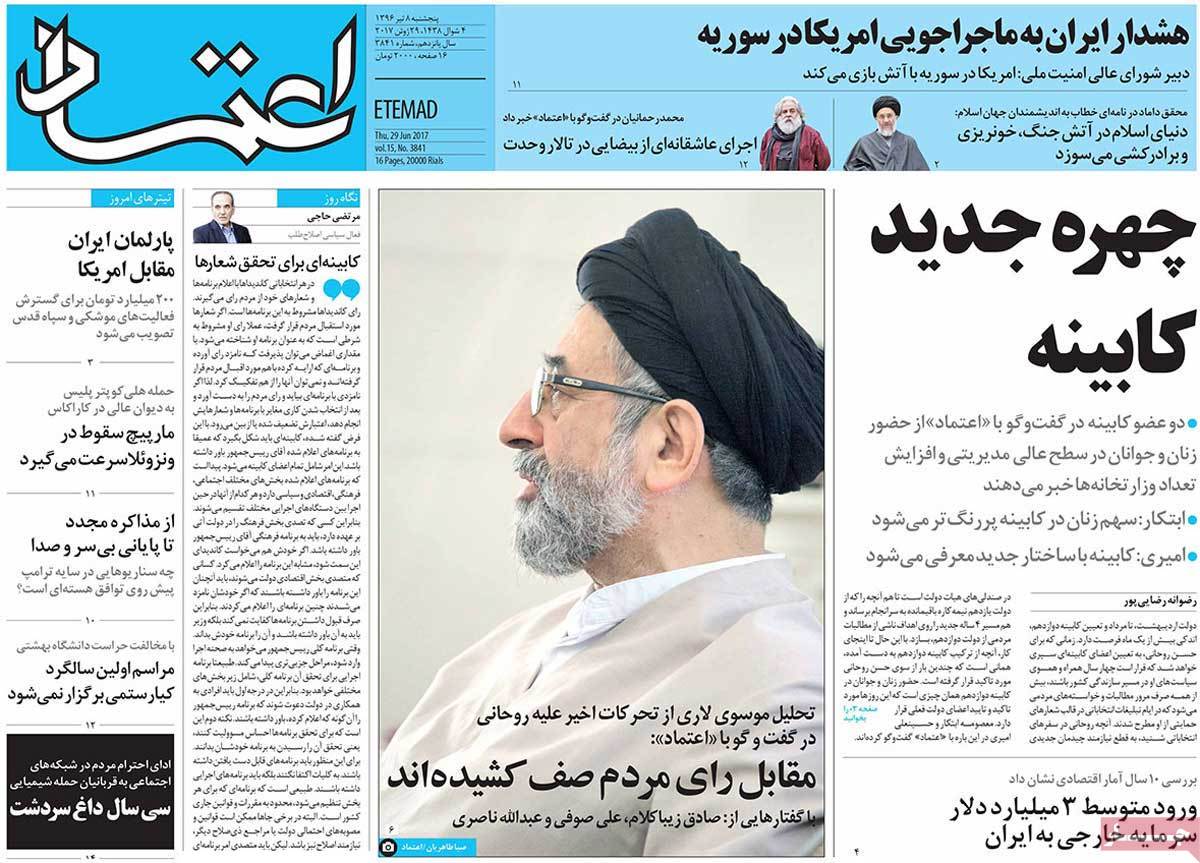
A Look at Iranian Newspaper Front Pages on June 12

Newspapers today covered the remarks made by the Leader of Iran’s Islamic Revolution Ayatollah Seyyed Ali Khamenei in a meeting with a group of poets and cultural figures.

They also continued covering the reactions and arrests linked to the recent terrorist attacks on Tehran, which claimed the lives of 17 and wounded dozens of people.

The Monday night’s match between Iran and Uzbekistan was also a top story. If Iran wins the game, it will book a place in FIFA World Cup 2018 in Russia.

The above issues, as well as many more, are highlighted in the following headlines and top stories:


19 Dey:

1- Iran Leader: Modern Ignorance [Trump] Danced with Tribal Ignorance [King Salman]

2- Intelligence Minister: Mastermind of Tehran Terror Attacks Killed

A Look at Iranian Newspaper Front Pages on June 12


Abrar:

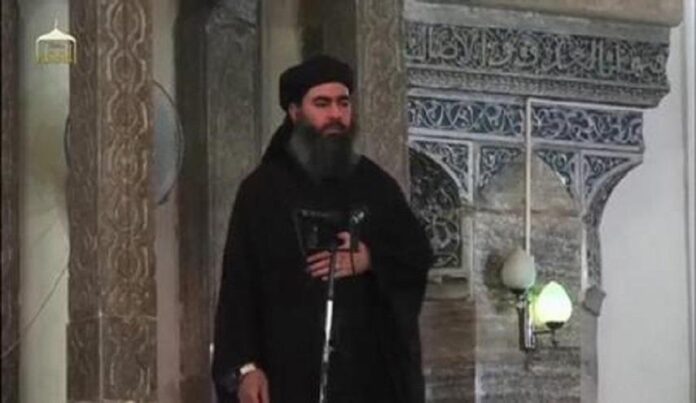
1- Unconfirmed Reports Say ISIS Leader Killed

2- Larijani: Parliament to Give Response to Senate Moves

3- Iraqi PM: Tal Afar, Hawija to Be Liberated Soon

A Look at Iranian Newspaper Front Pages on June 12


Abrar-e Eqtesadi:

1- Apparel Imports by Individuals Prohibited

2- OFAC Starts Issuing Permission for Sale of Boeing Planes to Iran

3- Trade Minister: Iran to Promote Business with Eurasia

A Look at Iranian Newspaper Front Pages on June 12


Aftab-e Yazd:

1- MPs Call for Enhancement of Parliament’s Security after Tehran Attacks

2- Turkey Outperforms Iran in Exporting Goods to Qatar Market

3- ISIS Richest Terrorist Group in World! [Editorial]

A Look at Iranian Newspaper Front Pages on June 12


Arman-e Emrooz:

1- World Afraid of General Soleimani

  • Qatar FM: I Haven’t Met General Soleimani

2- Six Arrested in Iran’s Kordestan with Links to Tehran Attacks

A Look at Iranian Newspaper Front Pages on June 12


Asrar:

1- Parliament Speaker: Unity Created after Terror Attacks Should Be Safeguarded

A Look at Iranian Newspaper Front Pages on June 12


Donya-ye Eqtesad:

1- Russia Backs Doha in Opposition to Saudi Arabia

A Look at Iranian Newspaper Front Pages on June 12


Ebtekar:

1- Intelligence Minister: No Trace of ISIS Terrorist Group Left in Iran

2- Should We Be Worried about Killer Shark Spotted in Persian Gulf?


A Look at Iranian Newspaper Front Pages on June 12


Etemad:

1- May 19 Votes Cast for Politics, Not Economy: Analysts

2- Top Officer: Iran to Give Unforgettable Lesson to Terrorists

3- Deputy FM: New US Sanctions against Goodwill Principle


A Look at Iranian Newspaper Front Pages on June 12


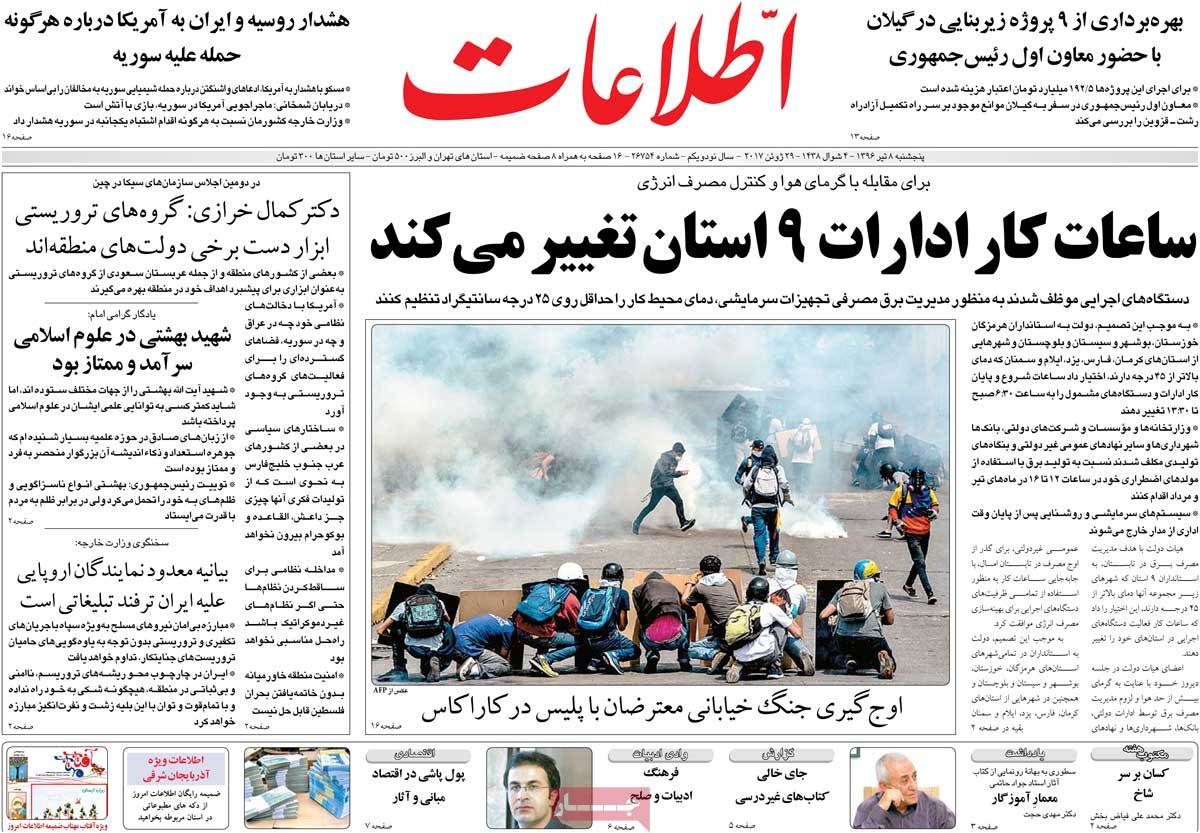
Ettela’at:

1- Iran’s Poetry Has Much Higher Potential for Growth: Leader

2- Austria Allocated €1-Billion Credit to Cooperation with Iran

2- American People Hold Rallies in Support of Muslims

A Look at Iranian Newspaper Front Pages on June 12


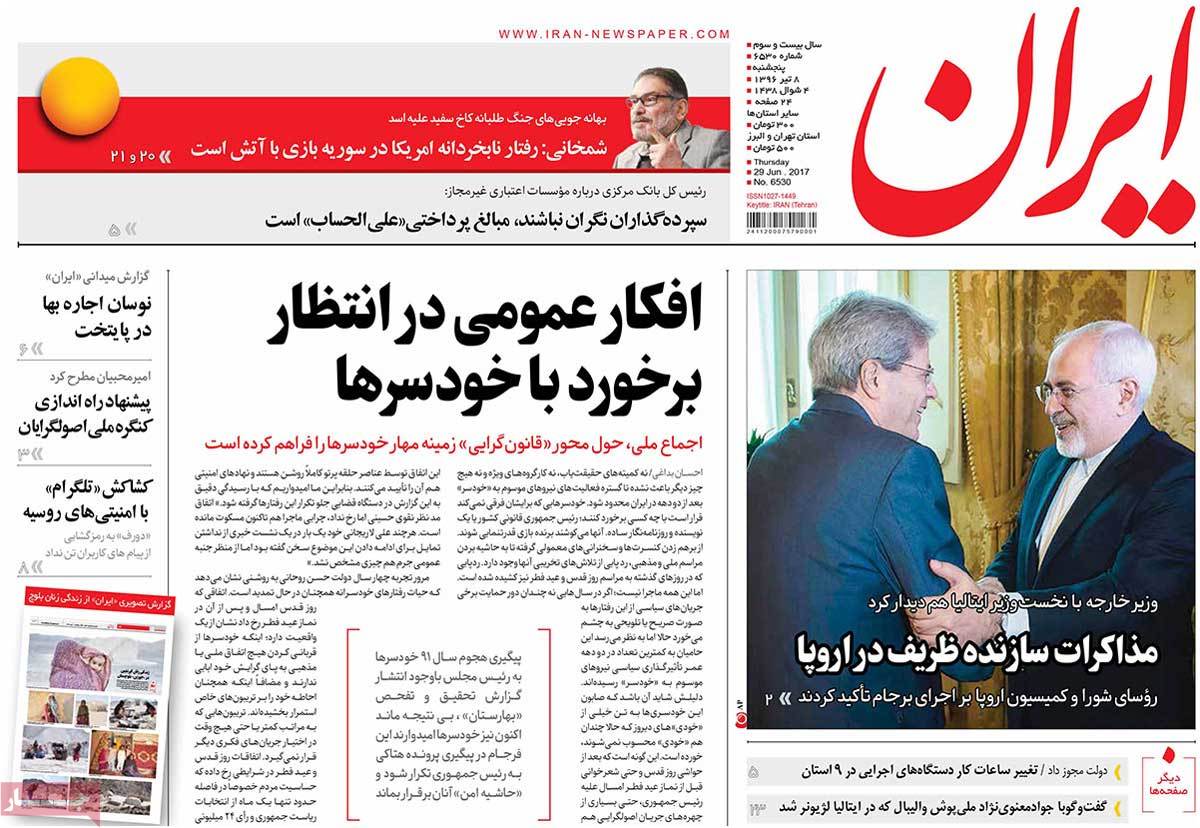
Iran:

1- Austrian Finance Minister’s Busy Day in Tehran

2- Rouhani’s Aide: Security Forces Did Great Job in Controlling ISIS

A Look at Iranian Newspaper Front Pages on June 12


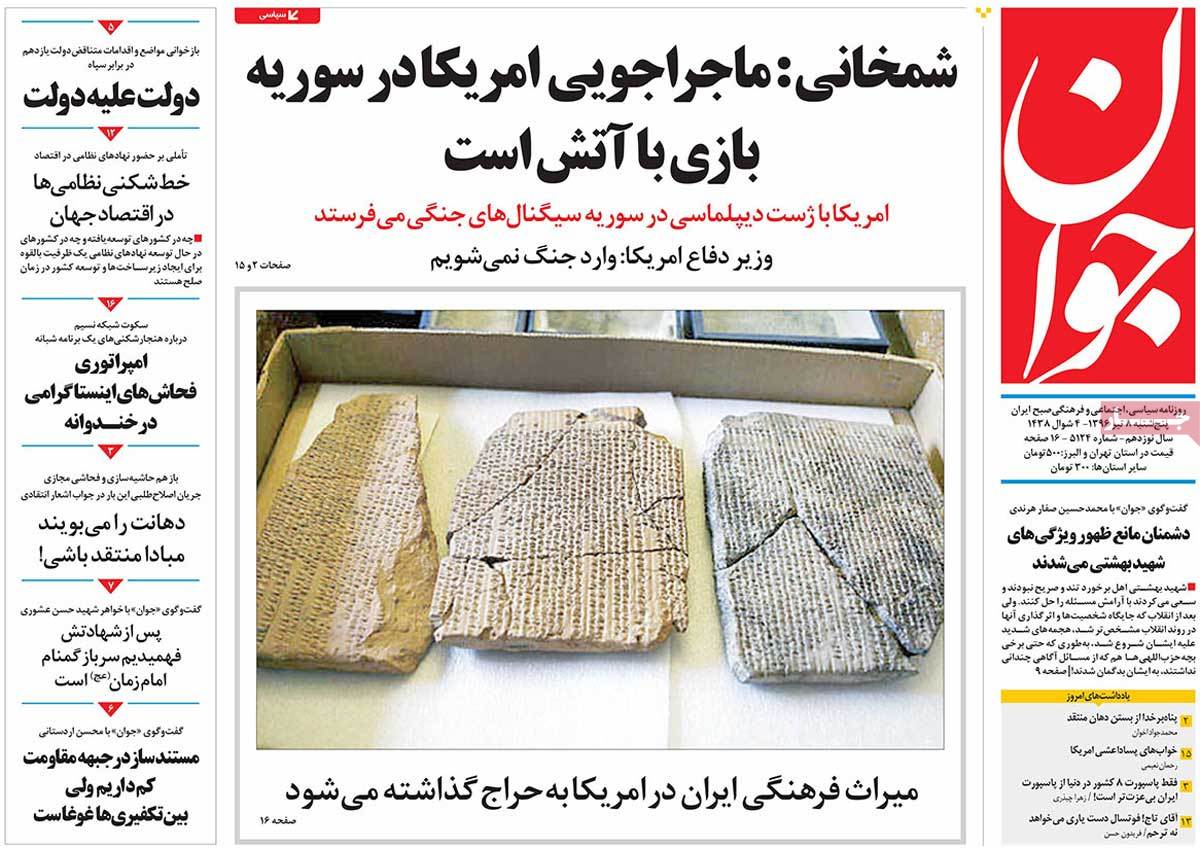
Javan:

1- Ministry of Foreign Cars! A Report on Chaotic Market of Importing Cars

2- Deputy FM: New US Sanctions Embarrassing

3- Barzani Sedition to Begin after Weakening ISIS

  • Kurdish-US Talks for Safe Exit of 2,500 ISIS Elements

A Look at Iranian Newspaper Front Pages on June 12


Jomhouri Eslami:

1- Iran Leader Calls on Poets to Satirize Trump-Salman Dance of Ignorance


A Look at Iranian Newspaper Front Pages on June 12


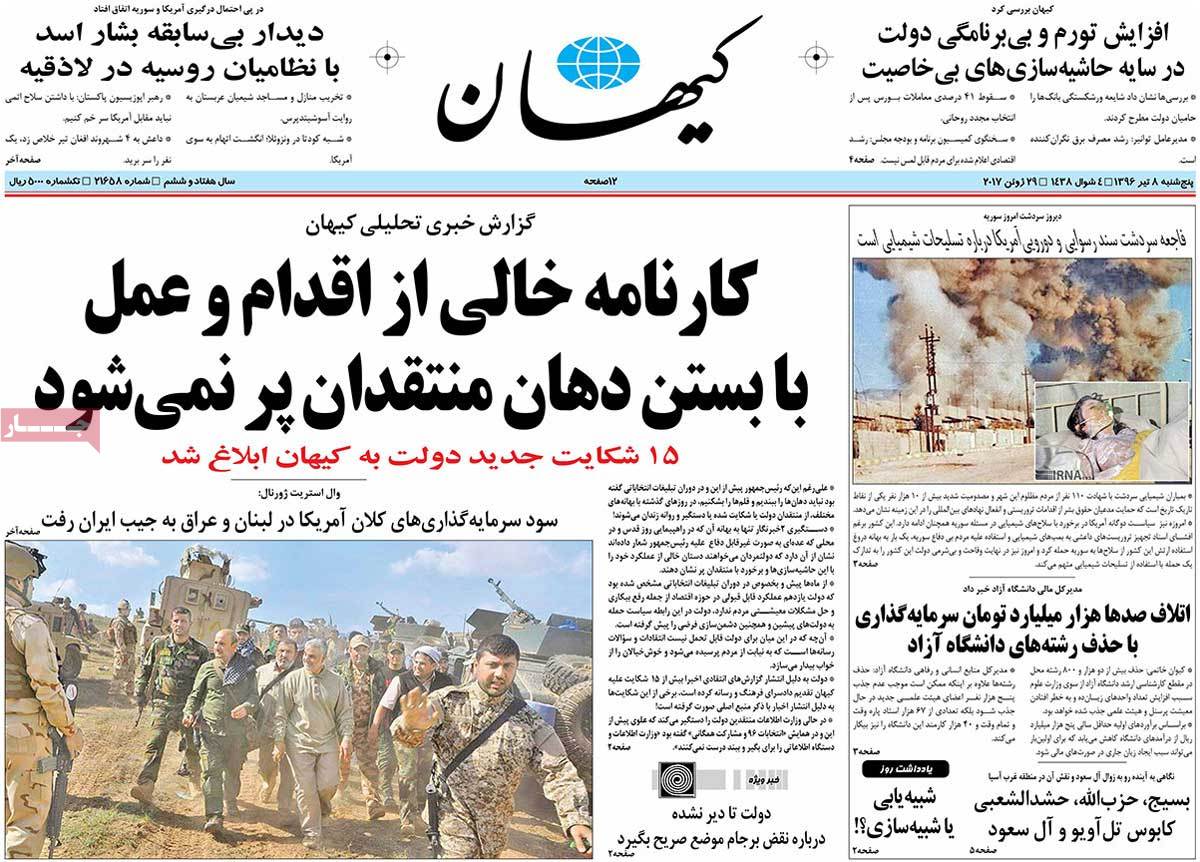
Kayhan:

1- Only One Percent! Iran’s Share of World Gas Trade

2- In Strange Move, Foreign Ministry Buys All Luxury Cars Smuggled to Iran!

A Look at Iranian Newspaper Front Pages on June 12


Payam-e Zaman:

1- Queiroz: Qualifier Match against Uzbekistan Is World Cup Final

A Look at Iranian Newspaper Front Pages on June 12


Rooyesh-e Mellat:

1- Senior Advisor Highlights Role of Saudis, US Radical Forces in Iran Parliament Attack

2- German Foreign Ministry: Qatar Crisis Can Lead to War

A Look at Iranian Newspaper Front Pages on June 12


Sayeh:

1- They Don’t Know What Calm Means: Poorest Countries in World in 2017

A Look at Iranian Newspaper Front Pages on June 12


Setareh Sobh:

1- Scientific Findings Show Environment Destruction Trend Is Growing: Academic

A Look at Iranian Newspaper Front Pages on June 12


Shahrvand:

1- Iranians Are Predictable: Chief of ISPA Poll Centre

A Look at Iranian Newspaper Front Pages on June 12


Shargh:

1- Moving Over Terror: First Parliament Session Held after Tehran Attacks

2- President: Officials Are in Final Decades of Their Lives, Future Belongs to Youths

3- From Iran Parliament to US Senate [Editorial]

A Look at Iranian Newspaper Front Pages on June 12


Tamashagaran:

1- Ready for Firecrackers: Iran-Uzbekistan Match, Everything Ready for Celebration

A Look at Iranian Newspaper Front Pages on June 12


Iran Urges Tillerson to Study History besides Doing Oil Trade

Bahram Qassemi

Iran’s Foreign Ministry Spokesman has taken a swipe at US Secretary of State Rex Tillerson for using a fabricated name to refer to the Persian Gulf.

Speaking at a weekly press conference on Monday, Bahram Qassemi said all US statesmen know what the real name of the Persian Gulf is.

“Tillerson has a background in the field of oil [business], and given the background that American politicians have, the name ‘Persian Gulf’ is known to all of them,” Qassemi said.

“Tillerson probably doesn’t know [the real name of this body of water], and the worst-case scenario would be that he doesn’t know history. I recommend they study history in addition to their oil background, and take a look at the documents and archived papers available at the US State Department, Congress, and European national archives. It wouldn’t be difficult to review history,” the spokesman said.

Qassemi underlined that one cannot buy history, civilization and culture with the greenback, nor is it possible to strip a nation of its culture or provide it with culture by spending dollars.

“I hope in the future they will be careful enough when they use this name, and they should know that this name is sensitive and holy for the Iranian nation,” Qassemi added.


New US Sanctions against Iran Show Lack of Goodwill

Elsewhere in his remarks, the spokesman touched upon Washington’s plan to ratchet up its sanctions against Iran.

He said most policies on sanctions have failed and, hence, are a nonstarter, urging US statesmen not to go for a failed experience again.

“We should wait and see what happens. If the plan receives the nod from the Foreign Relations Committee, it will then be discussed at an open session [of Congress] before going to the president,” he said.

Of course, on numerous occasions, plans have failed to win approval in the middle, he said.

Qassemi said the plan shows a lack of goodwill on the part of Washington, and called on the US not to move forward on that path.

“We urge the US government not to make a mistake again and not go the wrong way,” he stressed.

“At the JCPOA committee, we are monitoring these moves and follow them up and we will take action at any point in time we deem necessary,” Qassemi noted.

“This trend will only create problems and hassles for the US itself,” he said.


US Not Honest in Fight against Terrorists in Mideast

Qassemi further touched upon a recent attack by US-backed militants on the Syrian army and resistance forces.

“America’s actions in Syria are suspicious and unjustifiable,” he said.

“They have said repeatedly that they are fighting terrorists, […] but we haven’t seen honesty and necessary measures from them,” he said.

He then urged the US to battle ISIS terrorists to help boost stability and security in Syria.

“They should act more responsibly, but, unfortunately, so far they haven’t done so,” he said.

Austria Allocates One Billion Euro Credit Line to Iran Steel Project

The announcement was made by the visiting Austrian Finance Minister Hans Jörg Schelling during a visit to Tehran.

Schelling was quoted by Iran’s IRNA news agency as telling his Iranian counterpart Ali Tayyebniya that the credit line was meant to help the expansion of relations between the two countries.

IRNA further quoted him as saying that Austria’s banks were eager to promote relations with Iran’s banks.

For his part, Tayyebniya called on the Austria government to do more to help expand economic relations with Iran.

He emphasized that fighting money-laundering – as well as funds with suspicious origins – were central themes in the plans of Iran’s banking system.

Austria’s steel production investment plan in Iran involves the establishment of a plant with a capacity of 2.4 million tons per year in Gol Gohar in Iran’s southern province of Kerman.

To the same effect, Austria’s Voest Alpine has reportedly signed an agreement to team up with Iranian partners to establish a steel production plant in Gol Gohar.

On a separate front, Iran’s Minister of Industry, Mine and Trade Mohammad-Reza Ne’matzadeh told Schelling in a separate meeting that Iran expected Austria to adopt more hostile plans to expand trade relations between the two countries.

Ne’matzadeh emphasized that banking restrictions were the most important barriers that were obstructing the expansion of Iran-Austria relations.

The Iranian official further said companies from Iran and Austria were working over the production of low-consumption motors for automobiles.

He expressed hope that an agreement that the relevant parties had signed over this last year would lead to industrial production by 2020.

No More Turmoil Needed in Mideast: Iran’s Zarif

Mohammad Javad Zarif

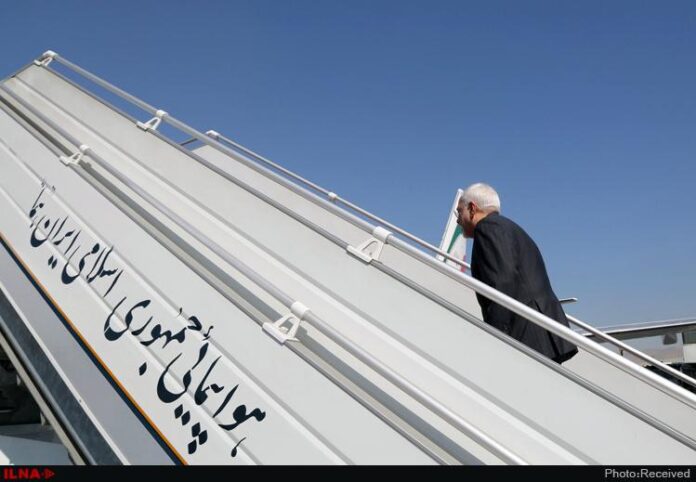
Speaking to Press TV’s correspondent on arrival in Oslo, Zarif said he would discuss with other officials present there to participate in the Oslo Forum “particularly the very volatile situation in the Persian Gulf region, and the fact that our region doesn’t need any more turmoil.”

He was referring to the recent tensions between Qatar and a number of other regional states. Qatar has come under intense pressure from Saudi Arabia, the United Arab Emirates (UAE), Bahrain, the Maldives, and Egypt — all of which have broken off ties with Doha — over accusations that the Qatari government sponsors extremist groups. The tensions risk turning into a regional conflict.

Zarif will stay in Norway for two days, during which he will give an address to the Oslo Forum, which gathers leading armed conflict mediation practitioners.

This year’s summit is to be held under the rubric, “Peace Making in the New Era of Geopolitics.”

The Forum’s upcoming edition is expected to gather the European Union’s foreign policy director Federica Mogherini, United Nations Under-Secretary General for Political Affairs Jeffrey Feltman, former UN chief Kofi Annan, former US secretary of state John Kerry, and the  foreign ministers of Kenya, Indonesia, Sudan, Jordan, Bosnia, Finland, and Croatia, among others.

Zarif also said he would talk to Mogherini and others about the need to have a united front against terrorism and extremism and not to create new tensions in Middle East region, “which would be disastrous for everybody.”

No More Turmoil Needed in Mideast: Iran's Zarif

Zarif attended the event’s last year edition, too, speaking on its sidelines with various officials, including Mogherini.

The Forum started in 2003, gathering only 17 nations. However, it now invites representatives from around 100 countries each year to participate in discussions on international affairs.

Iran’s Top Officer Vows to Give Terrorists Unforgettable Lessons

Baqeri made the remarks in a message to a ceremony held in Tehran on Sunday attended by a large number of high-ranking Iranian officials and people from all walks of life to commemorate the victims of this last Wednesday’s terrorist incidents in Tehran.

He added that the Iranian Armed Forces and intelligence and security bodies would give new unforgettable lessons to terrorists and their regional and extra-regional supporters at the suitable location and time in order to uproot the ominous phenomenon of terrorism in cooperation with other Muslim nations.

The top Iranian commander warned those who still seek to hatch plots and draw up anti-security plans against the Islamic Republic to take lessons from the terrorists’ fate and avoid repeating their mistakes even in their minds.

Baqeri expressed confidence that the hegemonic system and Zionism, which have dispatchedteterrorists nurtured by spy agencies to Iran in cooperation with reactionary regimes in the region, would face no other fate but defeat and disgrace.

At least 17 people were killed and over 50 others injured in Tehran on Wednesday when gunmen mounted almost simultaneous assaults on Iran’s Parliament and the Mausoleum of the late Founder of the Islamic Republic Imam Khomeini.

The Daesh Takfiri terrorist group claimed responsibility for the assaults.

A senior commander of the Islamic Revolution Guards Corps (IRGC) said on Saturday that the readiness of Iran’s security forces at the Parliament and Imam Khomeini’s Mausoleum foiled Daesh terror attacks in the Iranian capital.

Ali Asghar Gorjizadeh, the commander of IRGC’s Ansar-ol-Mahdi Corps, which is responsible for protection of senior Iranian officials, added that from the very first moments after the twin terrorist attacks, members of the Ansar-ol-Mahdi Corps took measures to encounter the terrorists.

World Diplomats Pay Tribute to Victims of Tehran Attacks

Yukiya Amano, the director general of the International Atomic Energy Agency (IAE), and a number of diplomats residing in Austria, signed the book of condolences in Iran’s embassy in Vienna.

Dozens of foreign diplomats and politicians took to Iranian embassies all around the world to sign the books of condolences and condemn the deadly terrorist attacks that killed at least 17 and wounded over 46 people in Tehran on Wednesday.

Here are IRNA’s photos of world diplomats paying tribute to the victims of Tehran attacks:

Arab Rulers’ Academic Degrees, Majors at a Glance

While students are currently taking their final exams in almost every corner of the world, with the seniors most probably receiving their degrees at the end of the present academic year, Al-Alam News Website has compiled a report citing some of the Arab rulers’ degrees, level of education and university major.

Given the ongoing crises and recent developments in the region, it would be fascinating to know about the degrees held by those who decide the fate of the people living in the Middle East and their majors at university.

At the centre of attention these days is Emir of Qatar Sheikh Tamim bin Hamad Al Thani. In 1997, he received a diploma from Sherborne School – a British independent boys’ school – and then was admitted to the Royal Military Academy Sandhurst (RMAS), the British Army’s initial officer training centre located about 55 kilometres southwest of London. A few years later he graduated from RMAS. In addition to Arabic, he is fluent in English and French.

Due to the regional developments and ongoing crises, Saudi Arabia’s King Salman bin Abdulaziz Al Saud is more than ever in the limelight these days. He finished his elementary school at the Princes’ School in Riyadh established in 1937 by Saudi Arabia’s founding monarch, King Ibn Saud. The school is specifically to ensure a high level of education for members of the Al Saud and sons of other foremost Saudis. He studied religion and modern science.

Syrian President Bashar al-Assad attended elementary and high school in the Syrian capital of Damascus. He studied medicine and received a diploma in this major in 1988. He worked for a few years at a military hospital in Tishrin village, Hama Governorate, and then, in 1992, travelled to the UK to continue his studies in ophthalmology. In addition to Arabic, he speaks English, French and Spanish very well.

Oman’s Sultan Qaboos received his primary and secondary education at Salalah and Pune, India where he was the student of Shankar Dayal Sharma, the former President of India. He was later sent to a private educational establishment in England at age 16. At 20, he entered the Royal Military Academy Sandhurst, and graduated from the RMAS before joining the British Army.

The UAE’s President Khalifa bin Zayed Al Nahyan has received primary education in a school built by his father in the city of Al Ain.

Hamad bin Isa bin Salman Al Khalifa, the King of Bahrain, attended Manama secondary school in Bahrain. Later, he was sent to England to attend Applegarth College in Godalming, Surrey before taking a place at The Leys School in Cambridge. Hamad then underwent military training, first with the British Army at Mons Officer Cadet School at Aldershot in Hampshire, graduating in September 1968. Four years later, in June 1972, Hamad attended the United States Army Command and General Staff College at Fort Leavenworth in Kansas, graduating the following June with a degree in leadership.

Egyptian President Abd El-Fattah El-Sisi enrolled in the Egyptian Military Academy, and upon graduating he held various command positions in the Egyptian Armed Forces and served as Egypt’s military attaché in Riyadh. In 1987 he attended the Egyptian Command and Staff College. In 1992 he continued his military career by enrolling in the British Command and Staff College, and in 2006 enrolled in the United States Army War College in Carlisle, Pennsylvania.

Kuwait’s Emir Sabah Al-Ahmad Al-Jaber Al-Sabah received primary education at Al Mubarakya School during the 1930s and then completed his education under tutors.

Iraqi President Fuad Masum studied at various religious schools in Iraqi Kurdistan until the age of 18. He studied law and Sharia at Baghdad University. In 1958, Masum traveled to Cairo to complete his higher education at Al-Azhar University. He worked as a professor in Basrah University in 1968. He earned his PhD in Islamic philosophy from Al-Azhar in 1975.

King Abdullah II of Jordan began his schooling in 1966 at the Islamic Educational College in Amman, and continued at St Edmund’s School in England. Abdullah attended high school at Eaglebrook School and Deerfield Academy in the United States. He began his military career at Royal Military Academy Sandhurst in 1980. He was later admitted to Pembroke College, Oxford, in 1982, where he completed a one-year special-studies course in Middle Eastern affairs. The prince then attended the Edmund A. Walsh School of Foreign Service at Georgetown University in Washington, D.C. in 1987, undertaking advanced study and research in international affairs.


Tehran Attacks Created Unity among Iranians: Larijani

Larijani

Speaking in an open session of the Parliament on Sunday, Ali Larijani said the unity and convergence created among the Iranian people and authorities after Tehran terrorist attacks is a valuable achievement that should not be underestimated.

“We must admit that a line comprising terrorists and the countries supporting them, led by the United States and Saudi Arabia, has been formed against our people,” he added.

“We must be conscious not to let political margins distract us from serving the nation,” he noted.

Referring to the push at the US Senate to impose new Sanctions on Iran, Larijani stated that the enemy’s strategy is to slow down the means of Iran’s dignity and to keep the Iranian nation and officials busy with minor issues.

Iran’s Parliament chief stressed that the legislature is to deliver a “serious” and “clear” response to the US Senate’s recent move adding that the Parliament’s National Security and Foreign Policy Commission is assigned to “immediately” draw up a counter-plan and submit it to the legislature.