Sunday, April 12, 2026
Home Blog Page 3976

Iraq security important for neighbors: Iran Majlis speaker

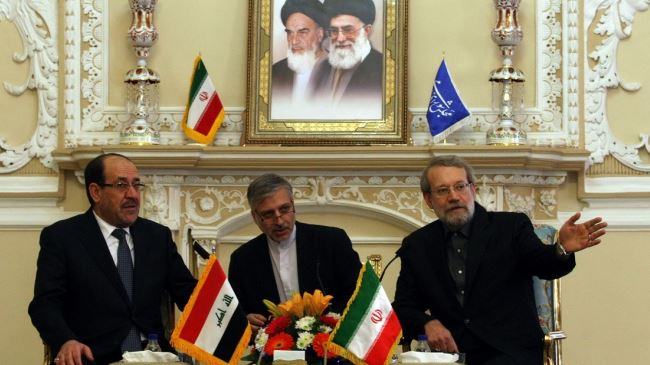
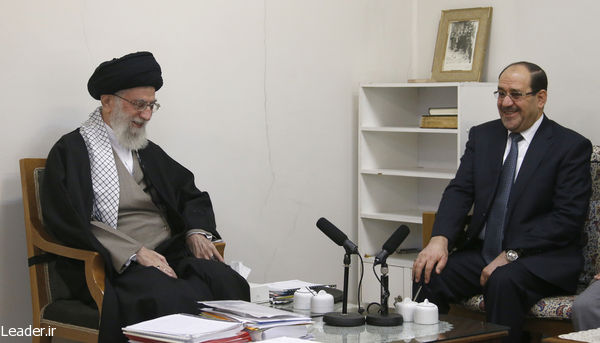
Ali Larijani at a meeting with Nouri al-Maliki

Iran’s Majlis Speaker Ali Larijani has underlined the importance of a secure Iraq to its neighbors, saying Tehran has thrown its weight behind efforts toward that end.

“Establishment of security and stability across Iraqi territories is important for all the neighboring countries from the regional point of view and Iran has spared no effort in this respect,” Larijani said at a Monday meeting with visiting Iraqi Vice President Nouri al-Maliki in Tehran.

He pointed to the existing friendly ties between Iran and Iraq in different political and economic arenas as well as the ample potential for the further growth of such relations.

Larijani also touched on the presence of ISIL terrorists in Iraq and the so-called coalition led by the US against the Takfiri group, adding, “The terrorist and inhumane activities of the group knows no borders and mere airstrikes cannot purge the region from the filth of [ISIL].”

The top Iranian lawmaker praised the Iraqi nation’s resistance against ISIL and expressed optimism that calm and peace will soon be restored to Iraq.

Maliki, for his part, lauded Iran as a great country and a friend of Iraq at different junctures in the post-Saddam era, noting that all Iraqis consider Iran as a real ally during difficult times and crises.

He noted that the Iraqi nation’s campaign will soon put an end to the terrorist actions of ISIL, which indiscriminately targets all ethnicities in the country.

The ISIL terrorists currently control large areas of Iraq. The group sent its militants into Iraq in June, seizing large swathes of land straddling the border between Syria and Iraq.

The ISIL militants have been carrying out horrific acts of violence, including public decapitations, against Iraqi communities such as Shias, Sunnis, Kurds, and Christians.

The Iraqi army has managed to make major gains in the fight against the ISIL militants in recent weeks.

No progress made in trilateral nuclear talks in Oman: Iran top negotiator

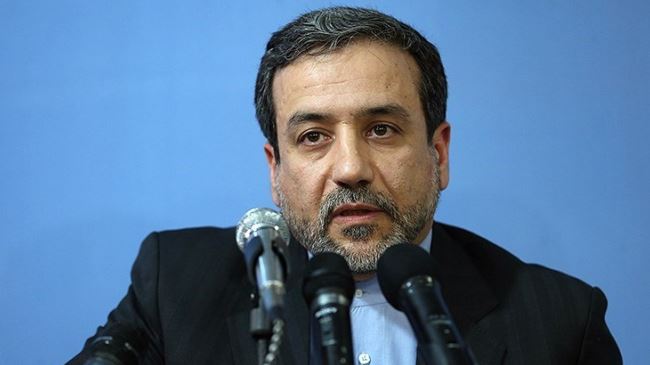
Abbas Araqchi

Senior Iranian nuclear negotiator Abbas Araghchi tells Press TV that no progress has yet been achieved in trilateral talks between Iran, the US, and the EU over Tehran’s nuclear energy program.

Speaking to Press TV correspondent on Monday, Araghchi said negotiations in the Omani capital, Muscat, were useful, however, no headway was made.

He said the sides are now “working on solutions” after months of talks on different subjects, adding that the Iranian side believes that “negotiations in the past two days and discussions were very useful. But we are not still in a position to say that we have made progress. It’s yet to be done in the coming days. We would be available as much as needed here in Oman or in any other place before the November 24 deadline. We are still hopeful.”

The top negotiator noted that a lot of work has remained to be done and more expert-level and bilateral meetings are required.

Araghchi added that the process of striking a comprehensive deal on Iran’s nuclear energy program needs “lots of goodwill by all parties and of course readiness to make difficult decisions.”

On Monday, Iranian Foreign Minister Mohammad Javad Zarif, US Secretary of State John Kerry and EU negotiator, Catherine Ashton, wrapped up two days of discussions.

They were due to hold a joint press conference following the talks. However, it was canceled with no clear breakthrough in the discussions.

Araghchi further described the issue of uranium enrichment as a “key question” for the other side and the lifting of sanctions slapped on Iran as a “very important key question” for Tehran.

Referring to different aspects of sanctions, Araghchi said the sides have to find a solution about “how and when these sanctions are removed.”

“It’s a fact that based on a possible comprehensive solution all the sanctions should be lifted,” he said, expressing hope that the negotiating sides could find a settlement to the issue of enrichment.

“Iran would certainly continue its enrichment, but the question is the capacity of this enrichment which should be determined based on our practical needs and that would be something we are very hopeful to come to at the end of these negotiations.”

The US State Department spokeswoman, meanwhile, said the talks were “tough, direct and serious.” Jen Psaki told reporters in Washington that the US remained focused on making progress, and there’s still time to do so.

In response to a question about the political will on the part of the US to find a resolution to the dispute over Iran’s nuclear activities, Araghchi said that the other side, including Washington, apparently has “enough seriousness” and shows “political will and determination.”

“We have seen political determination in all parties in P5+1, but how these political determination or political will is translated into those difficult decisions that the other side should make [is] yet to be seen.”

The negotiations were aimed at facilitating a final deal over Iran’s nuclear energy program before the November 24 deadline.

The extent of Iran’s uranium enrichment as well as a timetable for the removal of US and EU sanctions were high on the agenda of the Oman negotiations.

Representatives of Iran and the five permanent members of the UN Security Council – Russia, China, France, Britain and the US – plus Germany will hold further talks at deputy level on Tuesday.

Iran lawmakers urge full removal of sanctions

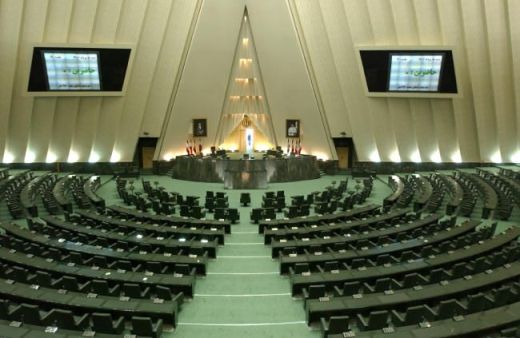
Iran parliament
Iran parliament

An overwhelming majority of Iranian lawmakers have called for the removal of the entire sanctions against Tehran immediately after a comprehensive agreement has been reached between Iran and P5+1.

In a statement on Sunday, more than 200 legislators called on Iranian nuclear negotiators “not to accept any restrictions on [uranium] enrichment research and development as well as other research activities related to nuclear fuel cycle” in the country.

They stressed the importance of refusing any inspection by the International Atomic Energy Agency (IAEA) of Iran’s nuclear sites “beyond the IAEA Safeguards Agreement and the Non-Proliferation Treaty (NPT).”

The statement emphasized that activities at Iran’s Arak heavy water plant and Fordow nuclear facilities should continue in order to supply fuel to Tehran Research Reactor (TRR) and serve medical, scientific, industrial and agricultural purposes.

The statement comes as Iran’s Foreign Minister Mohammad Javad Zarif, US Secretary of State John Kerry and the EU representative, Catherine Ashton, kicked off trilateral talks in the Omani capital, Muscat, on Sunday to exchange views on the outstanding issues hindering a final deal on Tehran’s civilian nuclear work.

In an exclusive interview with Press TV on his way to Muscat, Zarif said the illegal sanctions slapped on the country over its nuclear energy program have failed to meet the goals of those countries that imposed them.

The top Iranian diplomat said the removal of sanctions is a main theme of the Muscat talks, noting that the extent of Iran’s enrichment activities is another key topic in the negotiations.

Iran slams EU’s fresh bans against Iranian institutions, companies

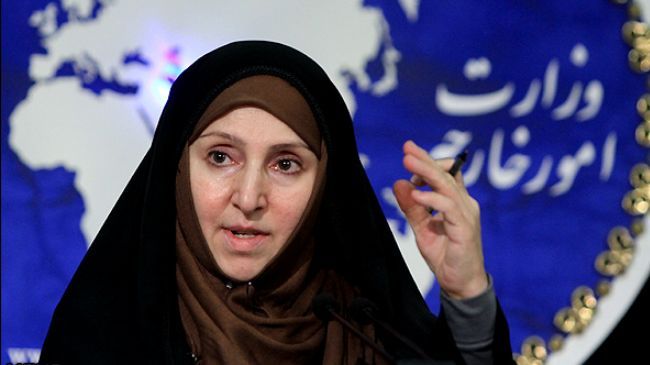
Ms. Marzieh Afkham

Iran has strongly condemned the European Union’s latest move to impose fresh sanctions on a number of Iranian institutions and companies despite the ongoing negotiations between representatives of Iran, the US and the EU in the Omani capital, Muscat.

“Under the circumstances that the nuclear negotiations are going on and efforts by the negotiating parties are underway to reach an acceptable agreement, this move by the European Union is questionable and contradicts the purpose of talks and the opposite side’s commitments,” Iran’s Foreign Ministry Spokeswoman Marzieh Afkham said on Sunday.

She added that EU’s move to impose bans on a number of Iranian entities was a sign of “unusual insistence” on EU’s past policies and an “astonishing move” at the current juncture.

Iran has voiced objection to the European Union through its embassy in Brussels.

Afkham’s remarks came after the Council of the European Union announced on November 7 that the bloc has imposed sanctions on Iran’s Sina Bank, Power Plants’ Equipment Manufacturing Company, Naftiran Intertrade Company (a.k.a. Naftiran Trade Company) (NICO), and Naftiran Intertrade Company Srl.

It added that an Iranian businessman, Sorinet Commercial Trust Bankers, and Sharif University of Technology should be included again on the list of persons and entities subject to restrictive measures on the basis of a new statement of reasons.

Iran’s Foreign Minister Mohammad Javad Zarif, US Secretary of State John Kerry and the EU’s representative, Catherine Ashton, kicked off trilateral talks in the Omani capital, Muscat, on Sunday to exchange views on the outstanding issues hindering a final deal on Tehran’s civilian nuclear work.

Sources close to the Iranian negotiating team say the main stumbling block in the way of resolving the Western dispute over Iran’s nuclear energy program remains to be the removal of all the bans imposed on the country, and not the number of centrifuges or the level of uranium enrichment.

Tehran wants the sanctions entirely lifted while Washington, under pressure from the pro-Israeli lobby, insists that at least the UN-imposed sanctions should remain in place.

Iran resolute on final deal based on full nuclear rights: Iran’s FM

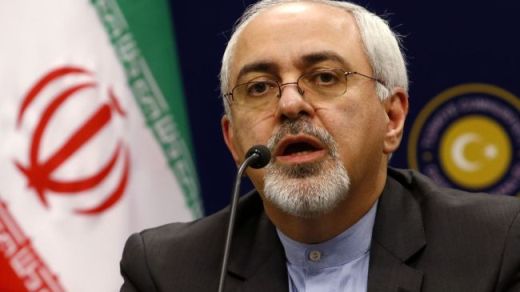
Mohammad Javad Zarif

Iranian Foreign Minister Mohammad Javad Zarif has expressed the Islamic Republic’s firm determination to reach a final agreement with P5+1 which will fully safeguard the country’s nuclear rights.

“We are determined to find a solution based on our country’s full nuclear rights,” Zarif said in a meeting with Minister Responsible for Foreign Affairs of Sultanate of Oman Yusuf bin Alawi bin Abdullah in Muscat on Sunday.

He briefed his Omani counterpart on the process of the nuclear talks between Iran and P5+1, adding that Tehran has entered into the negotiations with goodwill and acted with all seriousness.

Iran and the five permanent members of the six countries – France, Britain, the US, Russia, China, and Germany – have been holding talks to work out a final deal aimed at ending the longstanding standoff over the Islamic Republic’s nuclear energy program as a November 24 deadline draws near.

On Sunday, Iran’s Foreign Minister Mohammad Javad Zarif, US Secretary of State John Kerry and the EU representative, Catherine Ashton, kicked off trilateral talks in the Omani capital to exchange views on the outstanding issues hindering a final deal on Tehran’s civilian nuclear work.

Zarif and bin Alawi further discussed the latest developments in the Middle East, particularly the adverse consequences of terrorist acts on regional countries.

They said positive relations between Tehran and Muscat will play a role in strengthening cooperation among regional countries.

We are determined to preserve our rights in nuclear talks: Iranian MP

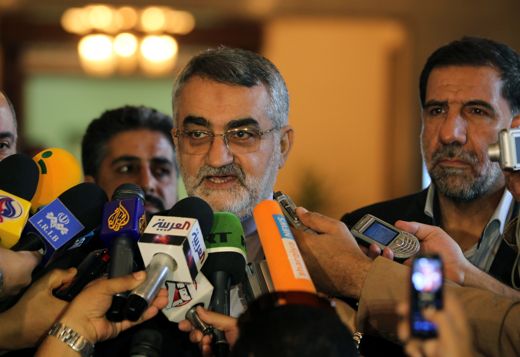
Alaedin Broujerdi

The influential chairman of parliament’s Foreign Policy and National Security Committee says Iran is determined to stick to its rights in nuclear talks with P5+1. According to the Iranian Students’ News Agency the following is what Alaeddin Boroujerdi, who appeared in a talk show on Channel Two of Iran’s national TV on November 9, had to say about the country’s nuclear program and talks underway in Oman to clinch a final deal:

What we want does not run counter to the regulations of the International Atomic Energy Agency (IAEA) or to the terms of the Nuclear Non-Proliferation Treaty (NPT) and we are determined to preserve the nuclear rights and achievements of the nation.

As to why Oman has been picked as the venue of the negotiations, I must say that a nation which does not take sides with any party to the talks is usually chosen, a country which other nations do not have any problems with.

Given the special relations between Omani Officials and both sides of the negotiations, they have always tried to play a role in bringing the parties together. That’s why this country, which had already played host to similar talks in the past, was picked.

We have taken crucial steps toward training nuclear experts. We have competent human resources. […]

America and its allies have always been in quest of monopoly over nuclear science. However, in the long run, we are all heading for a decline in fossil fuels and the best alternative to fossil fuels is nuclear energy which is of great economic importance.

For instance, Tehran Research Reactor, whose output is used for medical purposes, is immensely important. When we were running out of fuel for the research facility, they played fast and loose as far as supply of fuel went, forcing us to produce 20-percent-enriched uranium on our own.

According to a bill passed by parliament, the government has to generate as much as 20,000 megawatts of nuclear electricity. Failure of the government to provide enough fuel for our nuclear power plants may prompt major powers to set conditions for us, and that is inconsistent with our principle of independence. Thus, we should have the capability of producing fuel to avoid being dependent on others.

Iran-Russia cooperation in nuclear field has driven talks for construction of more plants into high gear, and I think that is one of the reasons behind a visit by Director of the Atomic Energy Organization of Iran Ali Akbar Salehi to Russia.

The decision by Iran’s parliament about the production of 20,000 MW of nuclear electricity is final and should be implemented by the government. The West should not waste this opportunity, or it will suffer losses.

In a recent statement, the Islamic Consultative Assembly has set the red lines and we are utterly determined to preserve our rights.

At a juncture, the Americans appealed for the conversion of Arak’s heavy water reactor to light water. Neither parliament nor government approved of their demand. So the Americans accepted that we hold on to heavy water.

In terms of passive defense, Fordow nuclear plant is immune to enemy attacks. That’s why the elimination of the facility does not make sense at all, and it should carry on its activity.

The extent of enrichment is determined by our need. That means we should produce in Iran part of fuel required by our power plants.

The unfair sanctions slapped on Iran by America, Europe and the UN Security Council must be lifted. Americans want to have them lifted over time. However, if we are supposed to honor our commitments, they should lift them all at one stage.

If negotiations turn out to be inconclusive, Americans will be to blame because they demand too much. There is no reason for us not to forge ahead with 20-percent uranium enrichment for Tehran Research Reactor in case no deal is clinched.

The commitments under which we have restricted our nuclear activity will last if sanctions are lifted, otherwise there is no reason to maintain the status quo.

Iran’s nuclear program has become a source of national consensus years ago. We are asked by the public not to budge, because they have lost their loved ones for this national cause. They have gone through a lot.

The support and wisdom of the Supreme Leader are the best of backing those who are fighting [for Iran’s rights] can get.

Leader lauds Maliki efforts to promote Iraq stability

Supreme Leader Khamenei and Nouri Maleki

Leader of the Islamic Revolution Ayatollah Seyyed Ali Khamenei has praised the role of former Iraqi Prime Minister Nouri al-Maliki in promoting “stability” and “independence” in the violence-torn Arab country.

In a meeting with Maliki, who currently serves as Iraq’s vice president in Tehran Monday, the Leader hailed Maliki’s contributions to the recent transition of power in Iraq, saying such an approach helped prevent “chaos” and “instability” in the country.

Ayatollah Khamenei described as “very good” the Iraqi official’s “approach to help the new government of [Prime Minister] Haidar al-Abadi and efforts to establish unity among different Iraqi groups.”

Maliki, in turn, thanked the Islamic Republic for standing by the Iraqi nation in its fight against the ISIL terror group, which has seized large swathes of land in his country over the past months.

In August, Maliki stepped down as Iraq’s premier and voiced support for his successor Abadi. He said his decision to give up the position shows his desire to “safeguard the high interests of the country.”

A look at Iranian newspaper front pages on Nov. 10

Iranian Newspapers Headlines

Nuclear talks between representatives of Iran, the EU and the US in Muscat, Oman dominated the front pages of Iranian newspapers on Monday.


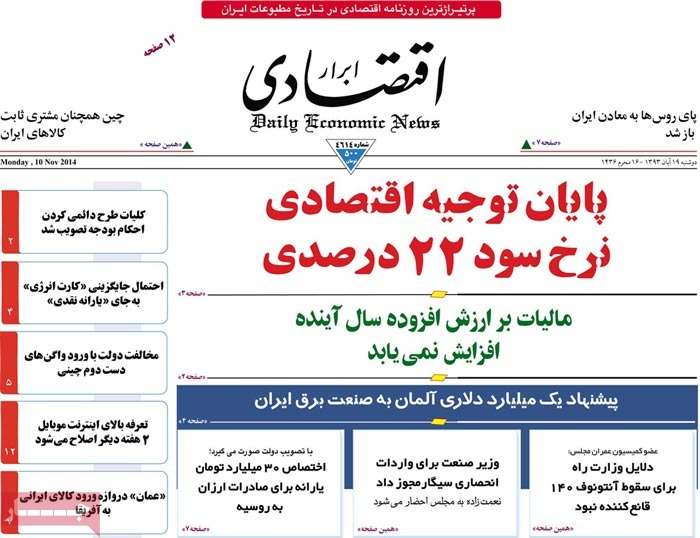
Abrar: Iraqi Vice-President Nouri al-Maliki has arrived in Tehran on an official visit.
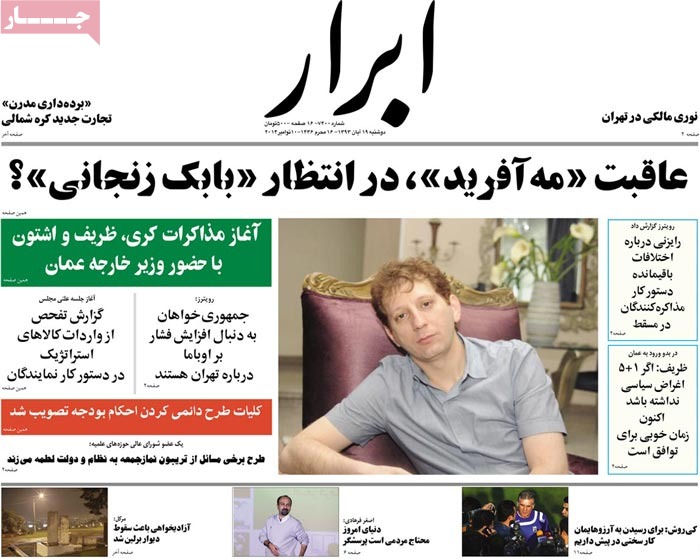
A look at Iranian newspaper front pages on Nov. 10


Abrar-e Eghtesadi: A member of parliament’s Development Committee has described the explanations of the Ministry of Transportation on a recent deadly crash of an Antonov 140 turboprop as insufficient.
A look at Iranian newspaper front pages on Nov. 10


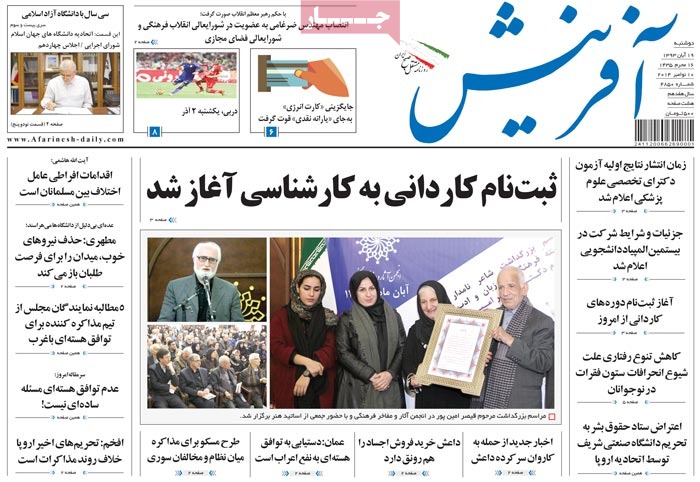
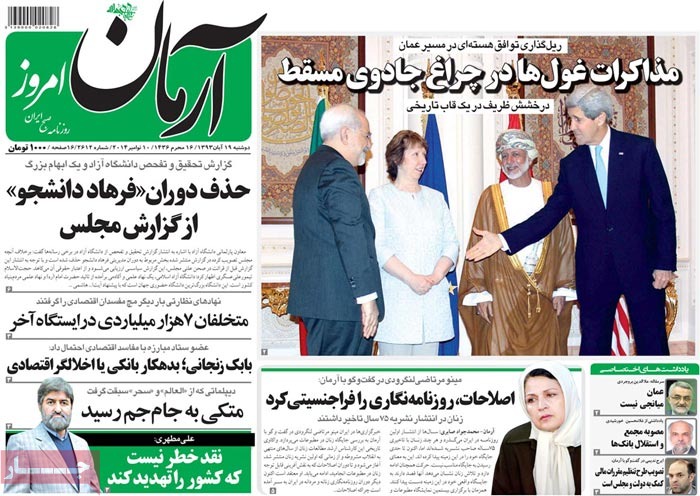
Afarinesh: “Elimination of talented individuals paves the way for opportunists,” said Ali Motahari, [a principlist MP who represents the capital in the Islamic Consultative Assembly].

Afarinesh: “Recent sanctions by Europe are inconsistent with the spirit of talks,” said Foreign Ministry Spokeswoman Marziyeh Afkham.

Afarinesh: Oman says conclusion of a nuclear deal [between Iran and major powers] will serve the interests of Arabs.
A look at Iranian newspaper front pages on Nov. 10


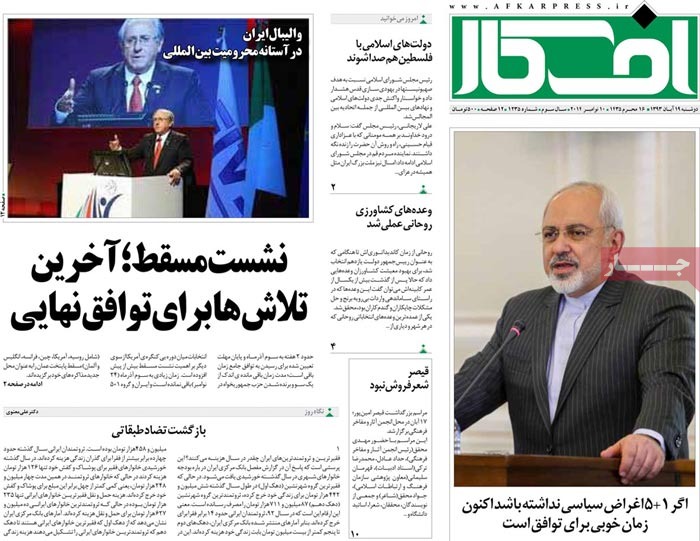
Afkar: “In the absence of political motives on the part of P5+1, time is right to clinch a nuclear deal,” said Iranian Foreign Minister Mohammad Javad Zarif.
A look at Iranian newspaper front pages on Nov. 10


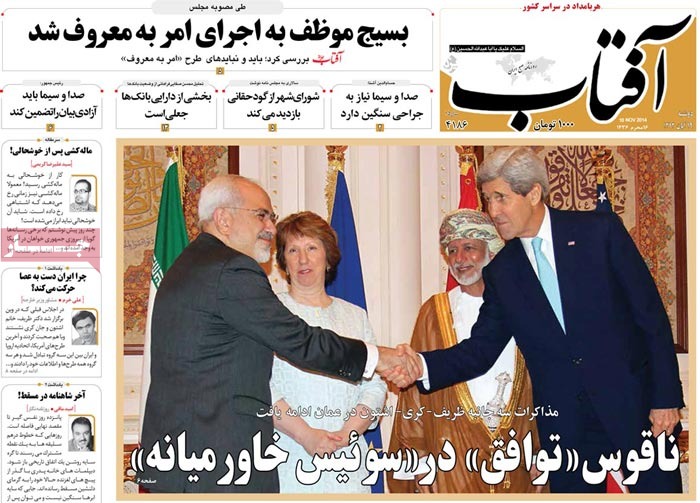
Aftab-e Yazd: President Rouhani has said that IRIB [the national broadcaster] should ensure the freedom of expression.
A look at Iranian newspaper front pages on Nov. 10


Arman-e Emrooz: “Airing critical comments does not pose a threat to the country,” said Ali Motahari [a principlist MP].

Arman-e Emrooz: The reformist period [during which Mohammad Khatami served as president] gave women a befitting role to play in journalism, said Minoo Mortazi Langeroodi, a senior expert on women’s studies.
A look at Iranian newspaper front pages on Nov. 10


Asia: Electronic passports will be issued as of tomorrow.

Asia: German investors are in Iran with a $1 billion proposal for investment in the electricity sector.

A look at Iranian newspaper front pages on Nov. 10


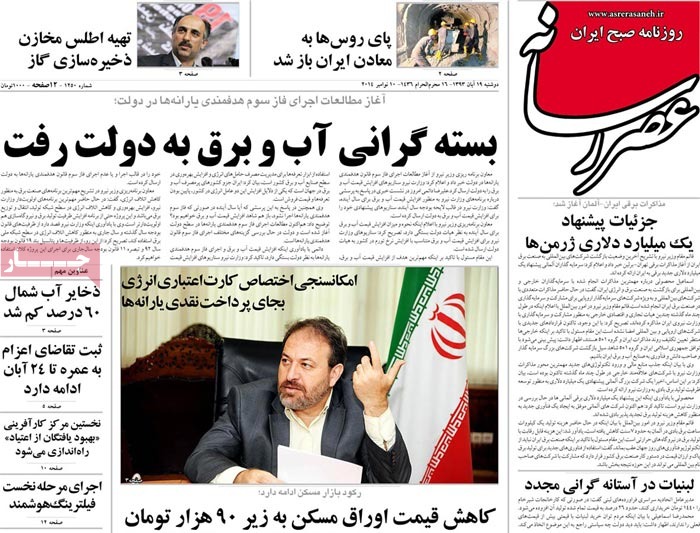
Asr-e Rasaneh: The Russians have been given the green-light to get involved in Iranian mining projects.
A look at Iranian newspaper front pages on Nov. 10


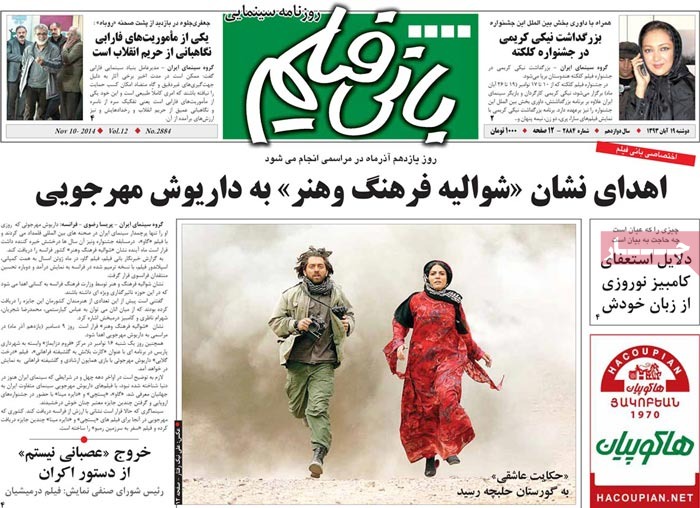
Bani Film: Kolkata International Film Festival is to honor veteran Iranian actress Niki Karimi.

Bani Film: Veteran Iranian director Dariush Mehrjui is to be awarded France’s Ordre national du Mérite.
A look at Iranian newspaper front pages on Nov. 10


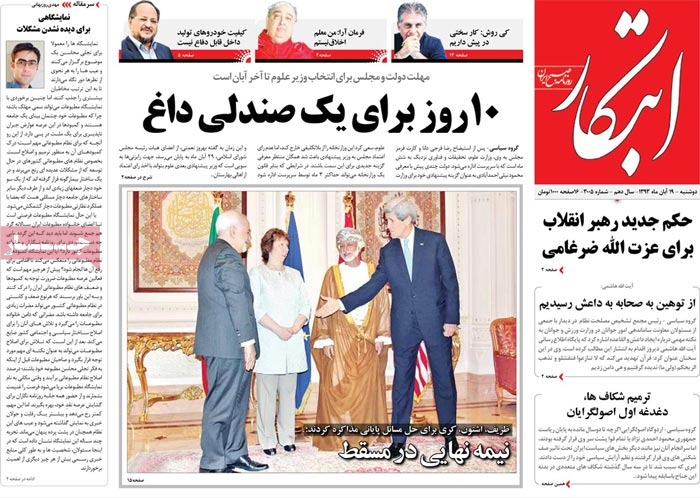
Ebtekar: The executive and legislative branches have 11 more days to name and approve a new minister of science, research and technology.
A look at Iranian newspaper front pages on Nov. 10


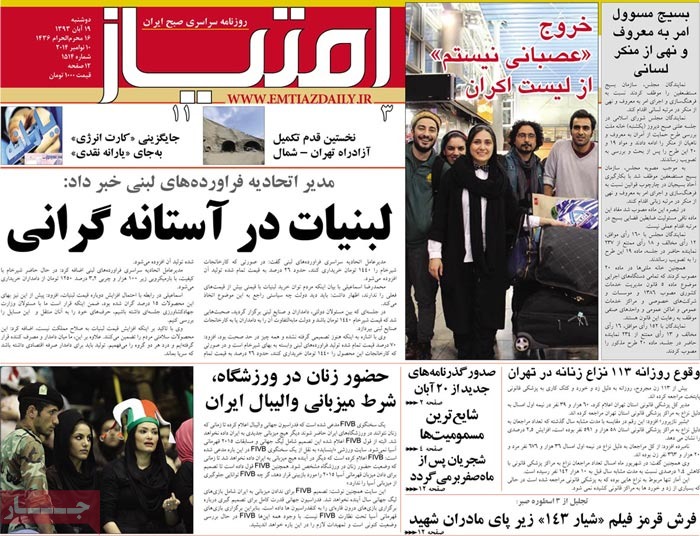
Emtiaz: A spokesman of the FIVB (International Federation of Volleyball) has said that Iran won’t be given the right to host international events as long as sports stadiums remain off-limits to female spectators.

Emtiaz: A first step has been taken to complete the unfinished Tehran-North highway project.
A look at Iranian newspaper front pages on Nov. 10


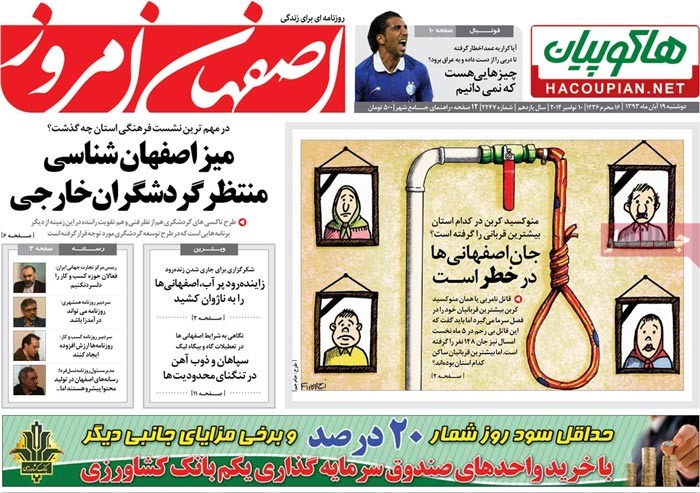
Esfahan Emrooz: People of Isfahan have celebrated the flow of water in the Zayandehrood River [that cuts through the central historic city].
A look at Iranian newspaper front pages on Nov. 10


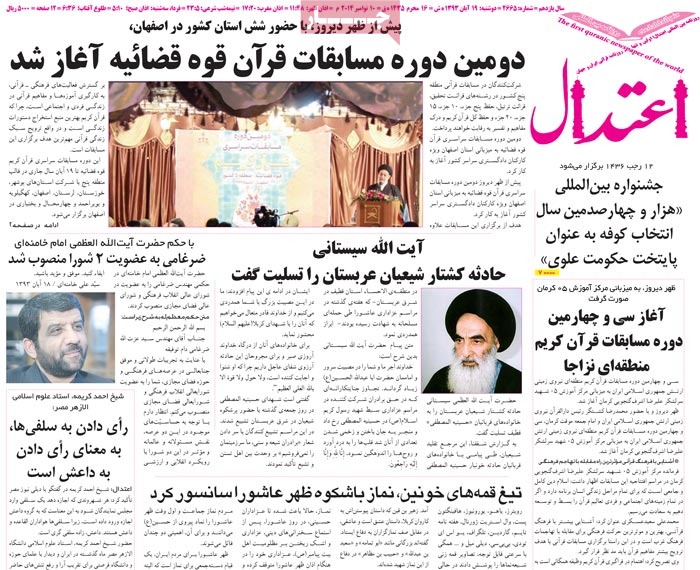
Etedal:The Supreme Leader has appointed Ezzatollah Zarghami, the former president of IRIB who was replaced earlier this week, to serve on the Supreme Cultural Revolution Council and the Supreme Cyberspace Council.
A look at Iranian newspaper front pages on Nov. 10


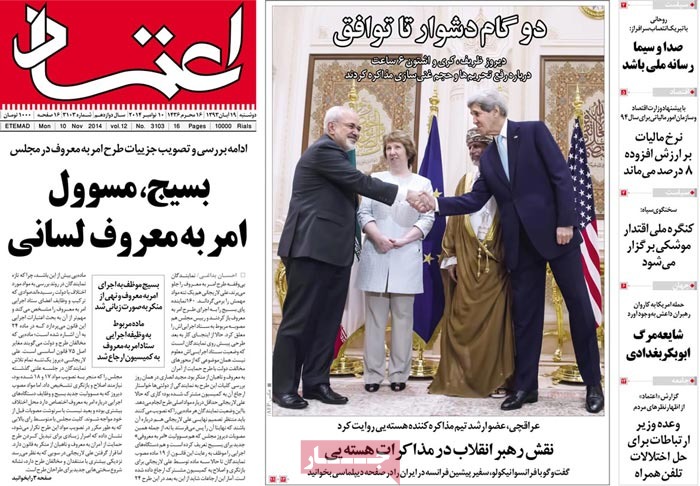
Etemad: Parliament has tasked the Basij Volunteer Force with verbally implementing a “Promotion of Virtue and Prevention of Vice” law it is finalizing.
A look at Iranian newspaper front pages on Nov. 10


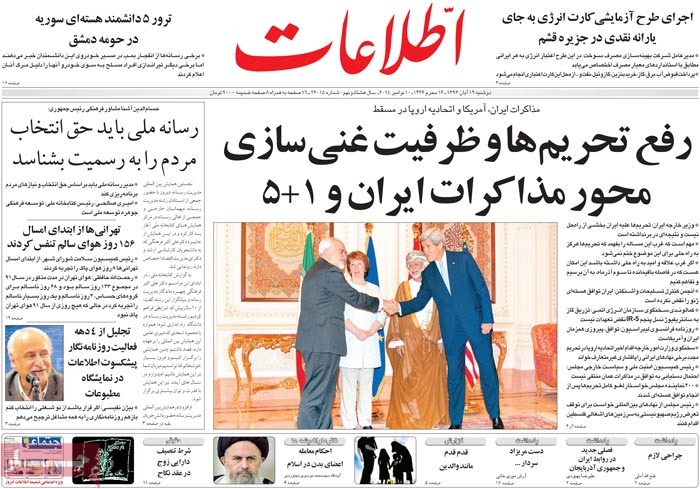
Ettela’at: Removal of sanctions and enrichment capacity are at the center of talks between Iran and P5+1.

Ettela’at: Hessameddin Ashna, a cultural advisor to President Rouhani, has urged Islamic Republic of Iran Broadcasting (IRIB) to recognize the right of the public to choose.

Ettela’at: Bijan Nafisi’s four decades in journalism has been celebrated at the 20th Exhibition of Press and News Agencies. Nafisi is a veteran journalist with Ettela’at.
A look at Iranian newspaper front pages on Nov. 10


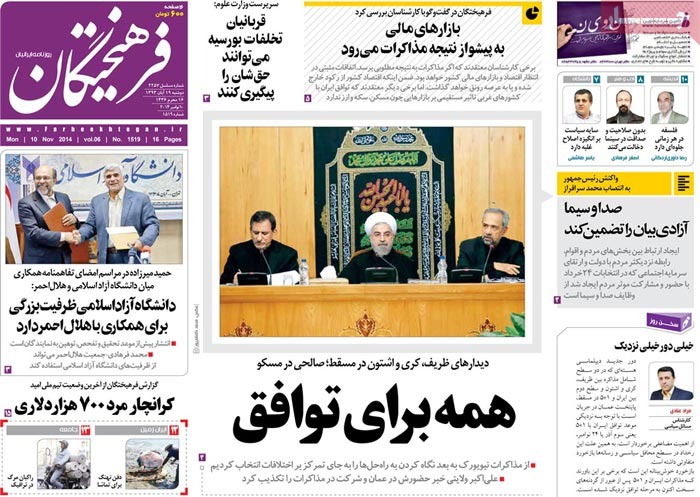
Farhikhtegan: Ali Akbar Velayati, an advisor to the Supreme Leader, has denied reports by an American newspaper that he is in Oman to take part in talks between Iran, the EU and the US.
A look at Iranian newspaper front pages on Nov. 10


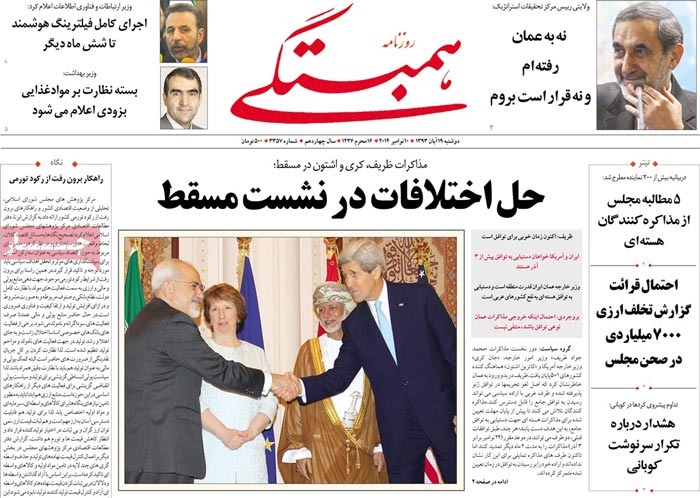
Hambastegi: The Iranian health minister has said that his ministry will soon announce the details of a package to promote food production supervision.
A look at Iranian newspaper front pages on Nov. 10


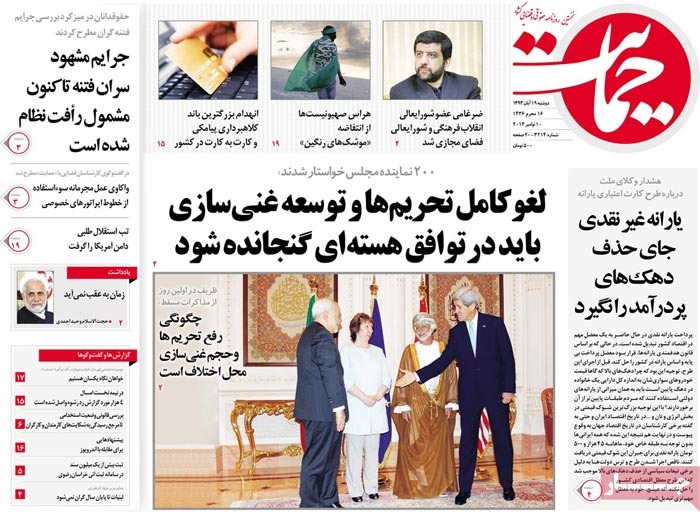
Hemayat: Up to 200 Iranian MPs have called for “complete removal of sanctions” and “expansion of enrichment” to be included in any final nuclear deal.
A look at Iranian newspaper front pages on Nov. 10


Iran: The 20th Exhibition of the Press and News Agencies has got off to a good start.
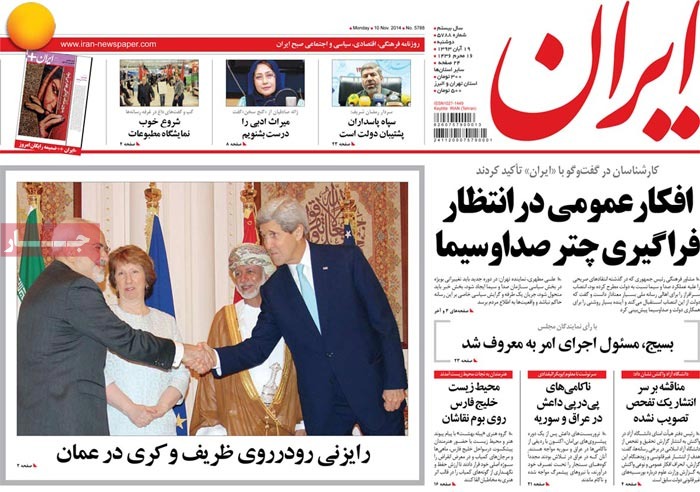
A look at Iranian newspaper front pages on Nov. 10


Iran Daily: Iran key to resolving Mideast crises, said former German Foreign Minister Joschka Fischer.
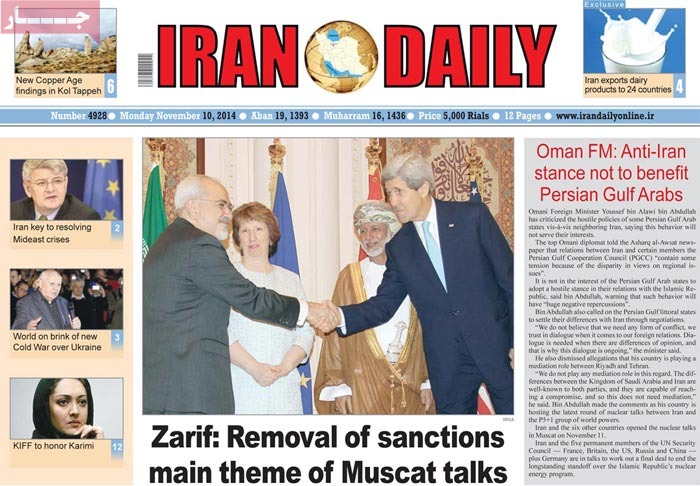
A look at Iranian newspaper front pages on Nov. 10


Jahan-e Eghtesad: The vice-president for executive affairs has said that the quality of locally-manufactured automobiles is not defendable.
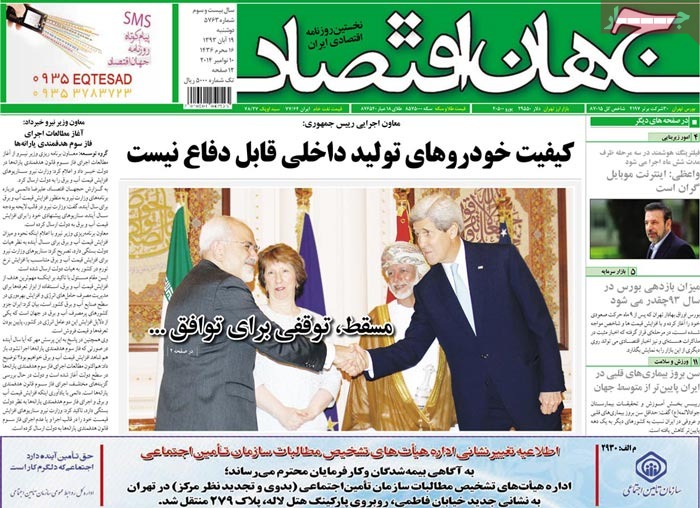
A look at Iranian newspaper front pages on Nov. 10


Jomhouri Islami: A general strike has swept through occupied territories.

Jomhouri Islami: Some $70 million has been allocated to improvement of roads across the nation.
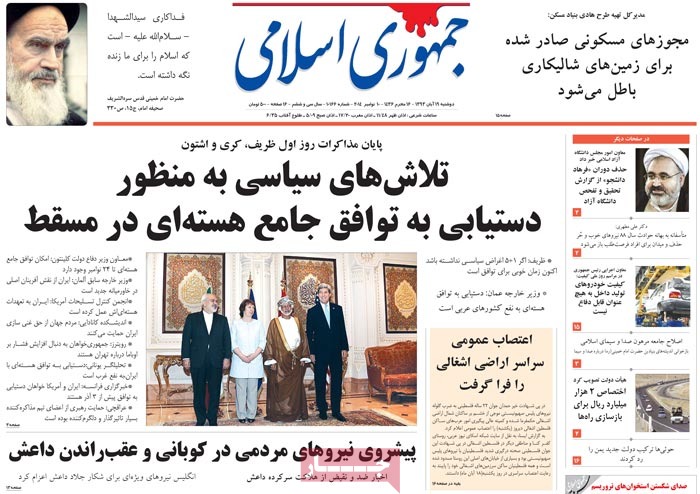
A look at Iranian newspaper front pages on Nov. 10


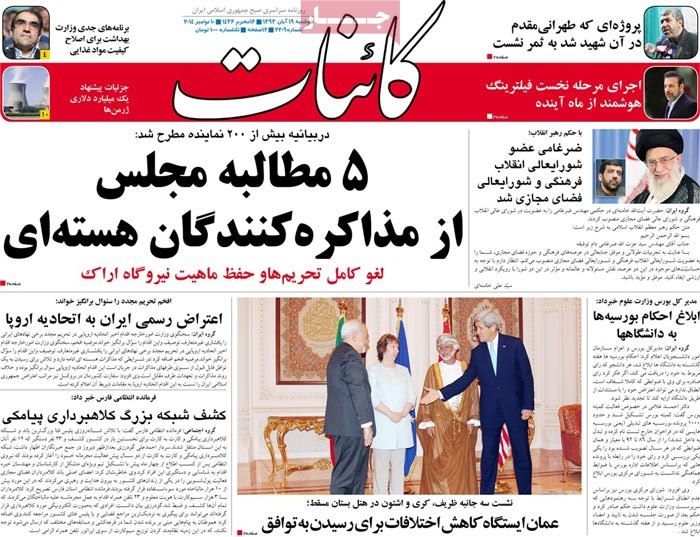
Kaenat: A big fraud ring which used SMS scams has been busted in Fars Province, southern Iran.
A look at Iranian newspaper front pages on Nov. 10


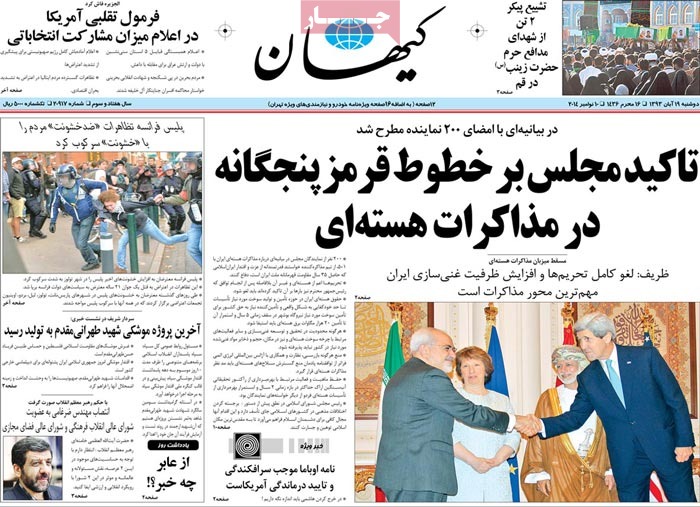
Kayhan: Police in France used brute force [on Saturday] to put down an anti-violence demonstration.
A look at Iranian newspaper front pages on Nov. 10


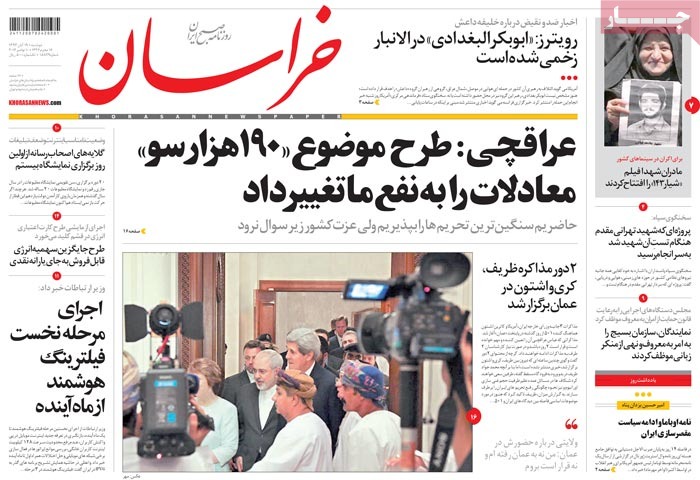
Khorasan: “The statement [by the Supreme Leader] that Iran needs 190,000 separative work units of uranium enrichment tilted the balance in favor of Iran,” Iranian nuclear negotiator Abbas Araghchi said.
A look at Iranian newspaper front pages on Nov. 10


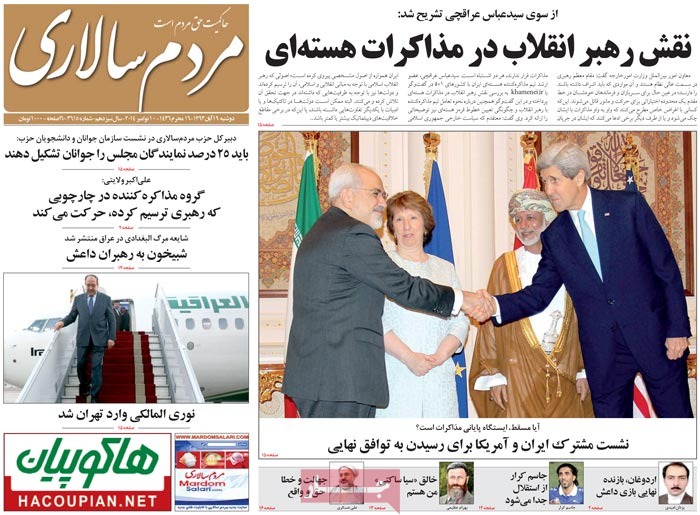
Mardomsalari: The Iranian nuclear negotiating team will take action within the framework outlined by the Supreme Leader.
A look at Iranian newspaper front pages on Nov. 10


Qods: “The smart Internet filtering software Iran has developed will take effect fully in six months,” said Minister of Information and Communications Technology Mahmoud Vaezi.

Qods: “The last [indigenous] missile project developed by Martyr Tehrani Moghadam has been complete”, said Head of the Islamic Revolution Guards Corps (IRGC) Public Relations Department General Ramezan Sharif.
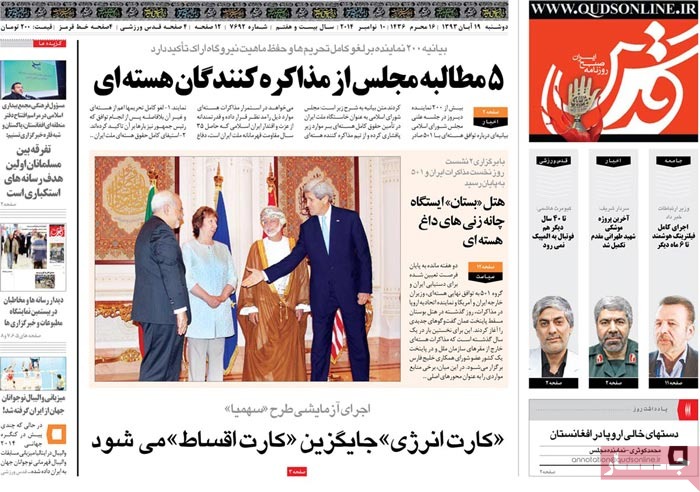
A look at Iranian newspaper front pages on Nov. 10


Resalat: “The United States has failed to honor its commitments,” said Ali Akbar Velayati, an advisor to the Supreme Leader and a former foreign minister.
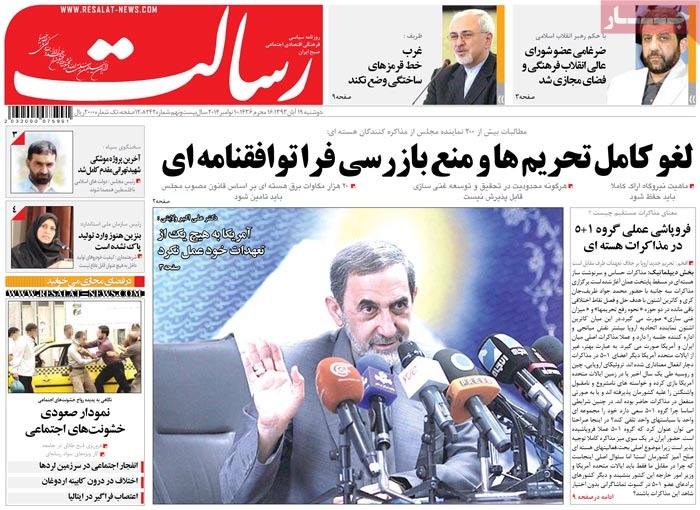
A look at Iranian newspaper front pages on Nov. 10


Roozan: “[Former President Mahmoud] Ahmadinejad and Seyyed Hassan Khomeini [the grandson of the late Imam Khomeini] are on friendly terms,” said Ali Akbar Javanfekr, an advisor to Ahmadinejad.
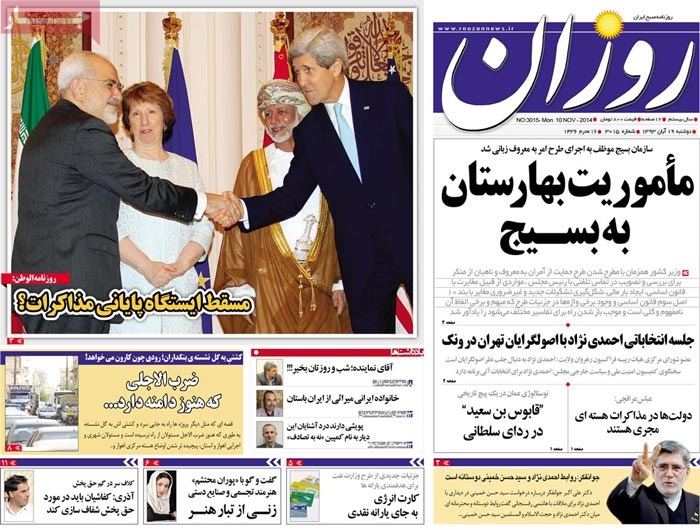
A look at Iranian newspaper front pages on Nov. 10


SMT: At a ceremony attended by the health minister, a host of MPs, university professors and producers to mark the National Quality Day, participants stressed “A national will to boost the quality of domestic products”.
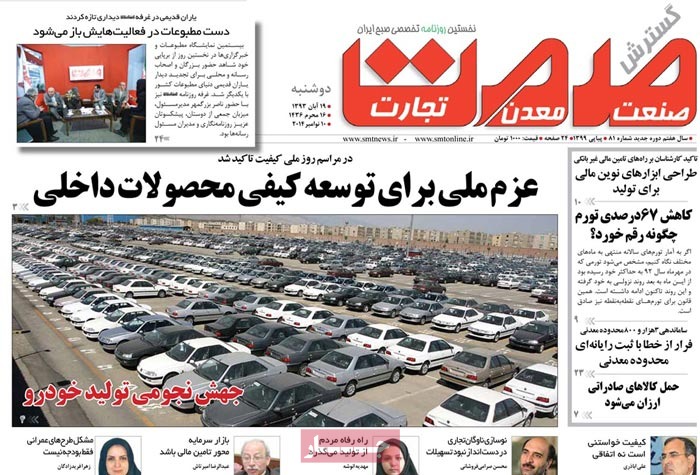
A look at Iranian newspaper front pages on Nov. 10


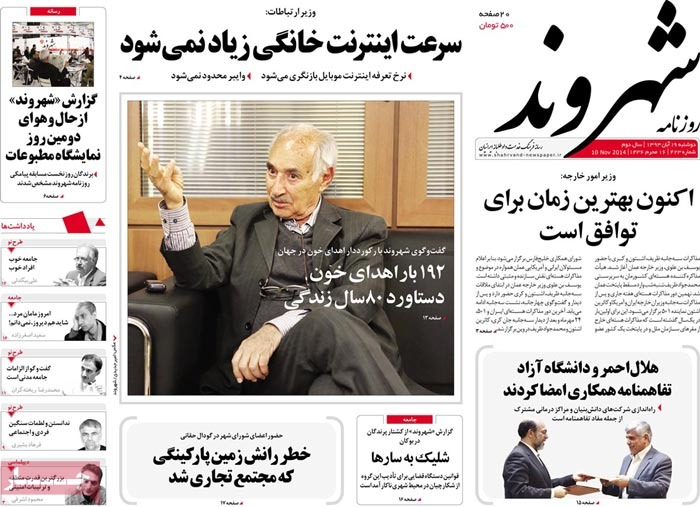
Shahrvand: The Iranian Red Crescent Society and the Islamic Azad University have signed a cooperation agreement.

Shahrvand: An 80-year-old Iranian has broken the world’s blood donation record by donating blood 192 times.
A look at Iranian newspaper front pages on Nov. 10


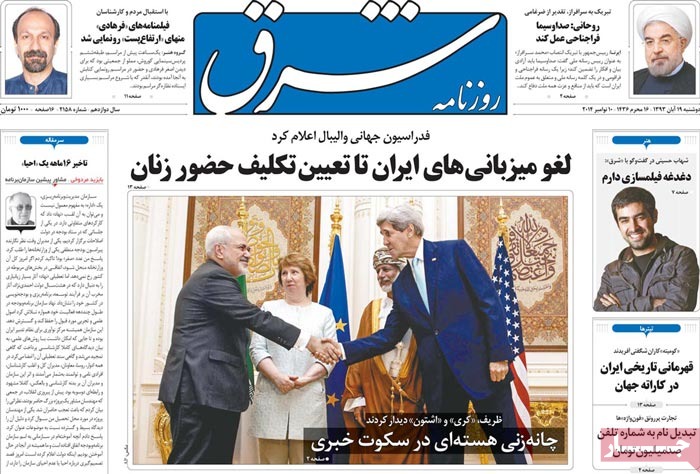
Sharq: “Nuclear bargaining in the absence of the media,” read the daily’s headline about a meeting between Mohammad Javad Zarif, John Kerry and Catherine Ashton in Oman.
A look at Iranian newspaper front pages on Nov. 10


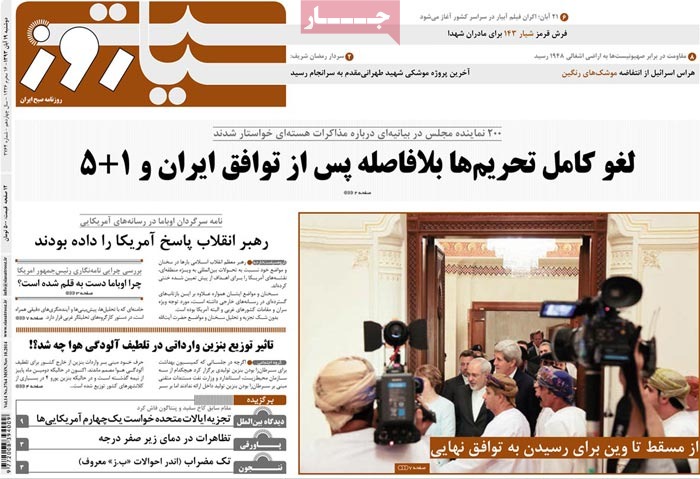
Siasat-e Rooz: One in four Americans is open to secession.
A look at Iranian newspaper front pages on Nov. 10


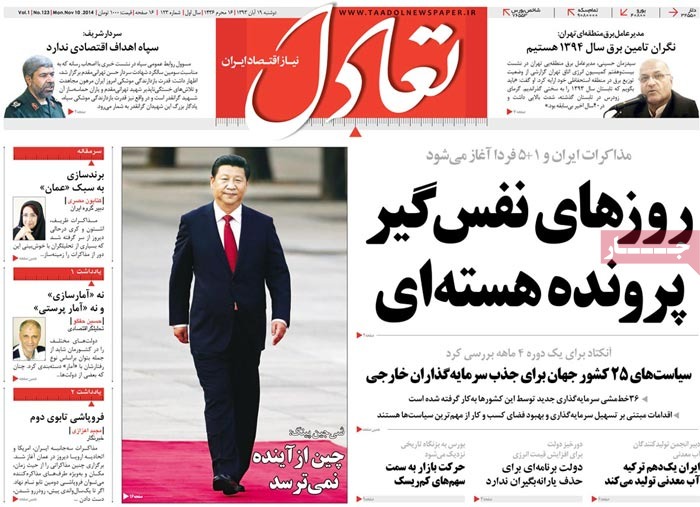
Taadol: “The Islamic Revolution Guards Corps does not pursue any economic objectives,” said the head of the Public Relations office of the revolution guards.
A look at Iranian newspaper front pages on Nov. 10


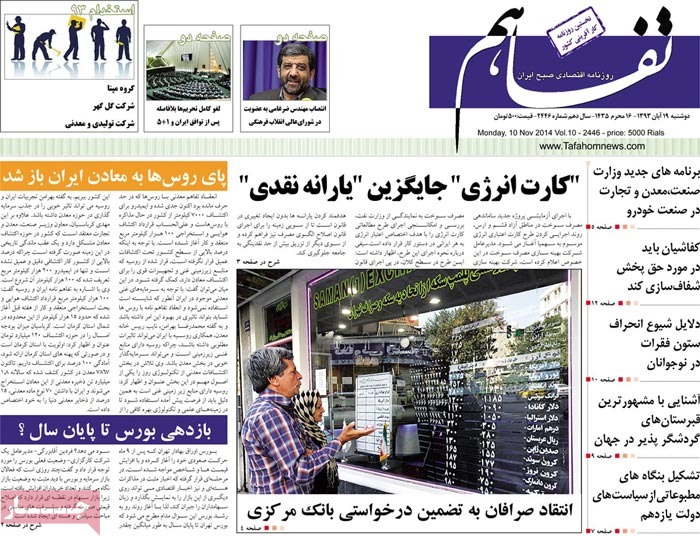
Tafahom: An experimental project to replace cash subsidies with energy cards has been implemented in Qeshm and Aras Free Trade Zones.
A look at Iranian newspaper front pages on Nov. 10


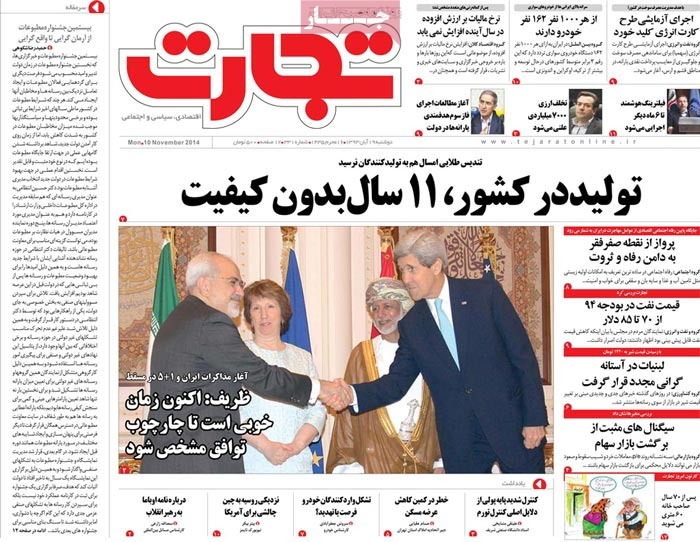
Tejarat: Prices of dairy products are to increase.
A look at Iranian newspaper front pages on Nov. 10


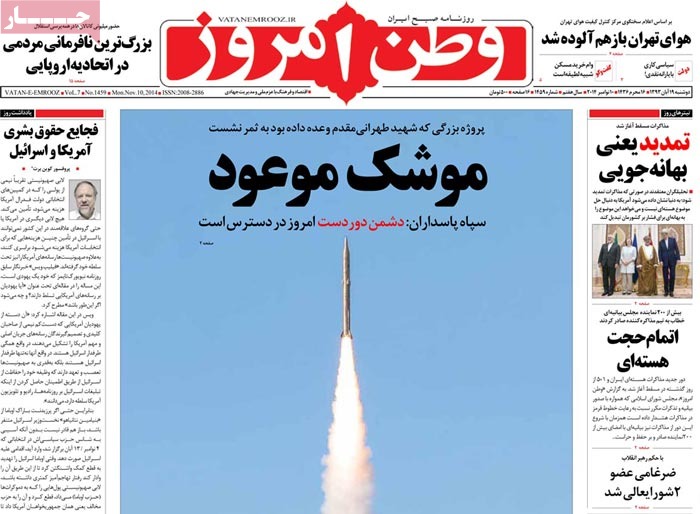
Vatan-e Emrooz: “Tehran once again grapples with air pollution,” wrote the daily, quoting Tehran Air Quality Control Center.

A look at Iranian newspaper front pages on Nov. 10


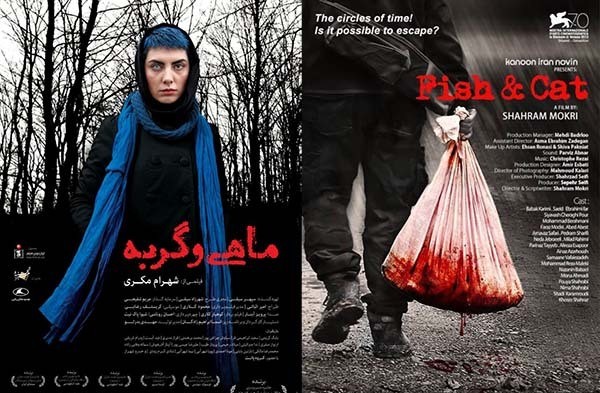
‘Fish and Cat’ bags NETPAC

fish and cat cover - shahram mokri

Acclaimed Iranian cinematic production ‘Fish and Cat’, directed by Shahram Mokri, has been selected as the best film at the Iranian Film Festival Australia (IFFA).

The film has received the NETPAC Award at the festival.

NETPAC (Network for the Promotion of Asia Pacific Cinema) is the festival’s only award.

Several successful Iranian films were screened in Sydney, Melbourne, Adelaide, Brisbane and Canberra for a month and finally ‘Fish and Cat’ was selected as the best work.

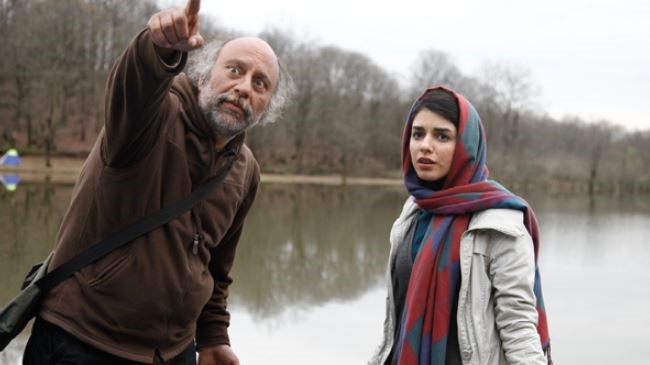
The 127-minute movie depicts the story of a group of university students who face different problems during their trip to the north of Iran.

Produced by Kanoon Iran Novin, ‘Fish and Cat’ has been screened in over 40 international festivals so far.

fish and cat screenshot - shahram mokri
‘Fish and Cat’ screenshot – Shahram Mokri

The film has won the FIPRESCI Award and the Youth Jury Award at the 28th Fribourg International Film Festival in April 2014.

Mokri won the special jury prize for this film at the 10th Dubai International Film Festival (DIFF) in December 2013.

It won the best film award at the 13th Lisbon and Estoril Film Festival in Portugal in November 2013.

The 70th Venice International Film Festival honored the film with the Special Orizzonti Award for Innovative Content in September 2013.

Iran has refuted the claim that it denied four British MPs a visit to Iran

Iran Officially Announces Termination of UN Arms Embargo

A well-informed source at the Iranian Foreign Ministry has dismissed reports by a US newspaper that Iran has not allowed four British parliamentarians to pay a visit to Tehran, Islamic Republic News Agency reported on November 10.

The unnamed official denounced the report as an invention based on unfounded claims, reiterating that the application for the visit was handed in to the Islamic Consultative Assembly, which decides on visits by foreign parliamentary delegations.