Sunday, December 28, 2025
Home Blog Page 3901

Iran Ready to Host Meeting of Female Asian MPs in 2018

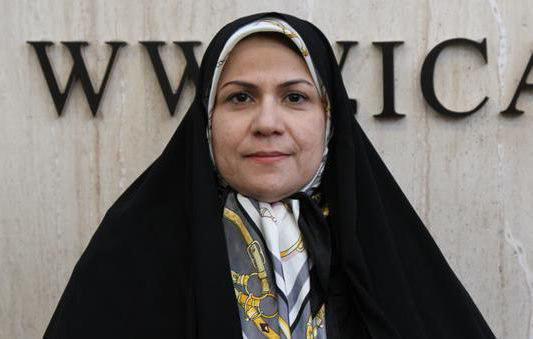
Iranian parliamentarian Fatemeh Zolqadr says the country’s Parliament stands ready to host a 2018 meeting of female representatives from countries which are members of the Asian Parliamentary Assembly.

Zolqadr, who chairs the Assembly’s Permanent Committee for Social and Cultural Affairs, made the comment at the closing ceremony of a meeting of the committee in Bhutan where she thanked the country for hosting the key event.

According to a Farsi report by the Iranian Parliament’s website, she also expressed the hope that the event and its outcome will be a key step toward boosting cooperation and rapport among parliaments and people of Asian countries.

“Given the importance of parliamentary relations, especially in the domain of women and youth’s affairs, I would like to take the opportunity and announce the Iranian parliament’s readiness to host a 2018 meeting to be attended by women representatives from the Asian Parliamentary Assembly’s member states in a bid to discuss women’s situation in Asian countries and exchange views on how to tackle the problems and challenges facing them,” she said.

“The holding of the [2018] meeting can increase coordination among female legislators of Asian parliaments to advance their common goals, and can play an important role in boosting women’s participation in social, cultural, economic, and political affairs at national and regional levels,” she noted.


Iran Holds International Frame Drum Festival

The mystic and pleasant sound of Daf (a tambourine-like drum) echoed across Sanandaj in Kordestan province from August 30 to September 1, as prominent domestic and foreign musicians played the traditional musical instrument in the Seventh National Festival and First International Course on Daf.

According to a Farsi report by IRNA, the national section of the festival was titled ‘Daf, the Sound of Mercy’.

Kordestan Province has been Iran’s hub of mystic music and Daf playing since a long time ago. Playing this musical instrument has a very high and special status among the people of the province.

The musical instrument helps the romantic and mystical spirit of Kurds in this province to become more familiar with God.

The native people’s avid interest in Daf is so much that one can hardly find a house in the province to which the musical instrument has failed to find its way. The same interest has turned the province into the world’s Daf capital.

Each year, the province hosts festivals on different occasions, during which Daf players stage their performances.

Since 2014, after a seven-year hiatus, the festival has been held nationwide in Sanandaj every year, attended by Iran’s prominent Daf players.

The motto of this year’s festival was “Art, Convergence and Kindness”. Daf players from 25 Iranian provinces as well as two foreign ensembles took part in the recently held edition of the fest.

Addressing the opening ceremony of the event, the Governor of Sanandaj said Daf is an old Iranian musical instrument, with which spiritual music can be played, and has a high status in the country and, particularly, Kordestan Province.

Mohammad-Ebrahim Zarei added playing the Daf constitutes a major part of Iran’s spiritual and mystical music.

He stressed that Kordestan region plays a significant role in preserving and promoting the art.

People in this province have preserved the art of playing the Daf for 3,300 years, Zarei said, adding plans are underway to inscribe Daf as a national intangible cultural heritage.

During the festival, a two-volume book on teaching how to play the Daf was also unveiled. The book is written by Farzad Andalibi and published by the Art Bureau of Kordestan Province.

Iran Gets Connected to 4 Video Game Developers

Iran’s Minister of Communications and Information Technology declared the country has been directly connected to well-known video game developers Valve, Riot, Blizzard and Gameforge.

“Talks are underway to transfer the servers of [entertainment and video developing] companies popular with the youth as a permanent solution,” said Mohammad Javad Azari Jahromi on his Instagram page.

He said the ping in international connection with the products of the four companies has reached 80 milliseconds, and has been improved by around 50% compared to the past.

“The jitter has also been improved considerably,” the minister added.

Ping and jitter are very important in playing video games. The ping rate, which is also known as latency, is a number that corresponds to delay time on the Internet measured in milliseconds. The higher the number, the more data transfer delays you might experience, and sense, while you are online.

If you play online games, then you want the latency to be less than 30ms. For other online activities, anything under 100ms would be good enough, according to a Farsi report by ISCA News.

Jitter refers to the amount of variation in the latency when multiple ping tests are performed. Wired connections such as Cable, Fiber, DSL, etc. will always have a lower latency than wireless connections such as Satellite, LTE, Wi-Fi, etc. Lower latency and lower jitter is beneficial in applications such as online gaming and VoIP (Voice Over IP) communications.

Hezbollah Chief Praises Lebanese PM in Unprecedented Remarks

Nasrallah announced Thursday that the ISIS-held areas near the Lebanese-Syrian borders were completely liberated, pointing out that 2,920 square kilometres of the Syrian territories and 764 square kilometres of the Lebanese territories were under the control of the terrorist group.

Addressing his followers via a televised speech in a ceremony held by Hezbollah in Baalback celebrating the liberation of eastern Lebanon, Nasrallah described the gains against the terrorists as the “Second Liberation” after the withdrawal of Israeli military forces from southern Lebanon and Western Bekaa region in 2000.

Nasrallah stressed that “the decision to engage in this battle was taken independently by the Lebanese state, and this is a very important point because it represents a sovereign political decision.”

The Hezbollah chief stressed that the decision was a national one made by members of the Lebanese Defence Council including President Michel Aoun and Prime Minister Saad Hariri.

“This is one of the achievements of the new era that is represented by President Michel Aoun, who I’ve always considered a brave, independent, and leading man who is not affiliated to any country, embassy, or threat,” he added.

Honestly speaking, Nasrallah said, PM Hariri gave his consent to the decision, and also Parliament Speaker Nabih Berri, whose stances have always been no secret to anyone.

He explained that the Lebanese Army had taken over the northern borders and that this battle had stopped an emirate from being established from Lebanon to the Mediterranean.

Nasrallah further revealed that the US government was upset about Hezbollah’s intervention in the operation and threatened to cut aid on the Lebanese Army if the operation takes place.

He called for enhanced political trust in the strength of the Lebanese Army and assured that the Lebanese Army has proved that it is trustworthy.

The Hezbollah chief also referred to Shebaa Farms and Kfarshuba hills of Lebanon, which are occupied by the Israeli regime, and said that “we are waiting for another sovereign decision because a Lebanese land is still under Israeli occupation.

“Today, on the ceremony of the Second Liberation, we demand a plan to liberate Shebaa Farms and the hills… I am not calling for a war against Israel, but for a complete plan to liberate the land and return it to the Lebanese sovereignty.”

Nasrallah finally reassured his support for the call of President Aoun, Prime Minister Hariri, and Parliament Speaker Berri to pacify the situation and halt arguments, and reassured that protecting the borders is the responsibility of the Lebanese Army.

Meanwhile, PM Hariri on Friday dismissed certain claims made by Israelis about the Hezbollah resistance movement.

“They (the Israelis) say Hezbollah controls Lebanon, and that is not true. Hezbollah is present. It’s in the government and it has support in the country. But this doesn’t mean Hezbollah controls all of Lebanon,” he said in an interview with the French daily Le Monde.

Prime Minister Hariri also said that the Lebanese Armed Forces played the biggest role in freeing the outskirts of the border towns from terrorism.

Hariri, the leader of the essentially Sunni party Future Movement – the Lebanese Parliament’s largest bloc – and “the strongest figurehead” of the March 14 Alliance, is an arch-rival and opponent of Nasrallah and his Shiite political party Hezbollah, and is known for his close ties with Saudi Arabia.

However, the two sides finally reached a compromise last year to end two and a half years of power vacuum in the Arab country.

Lebanon was without a president from May 2014 to October 2016, when the Lebanese parliament finally gathered in its entirety to elect Aoun, a close ally of Hezbollah, as the 13th head of state.

Hariri, a billionaire businessman, also announced that he would support Aoun for the presidency, arguing that the country could no longer continue to stagnate.

Aoun, in turn, appointed Hariri as the country’s prime minister and asked him to head a new government after the presidential election.

Enemy Unlikely to Launch Ground Attack on Iran: Top Officer

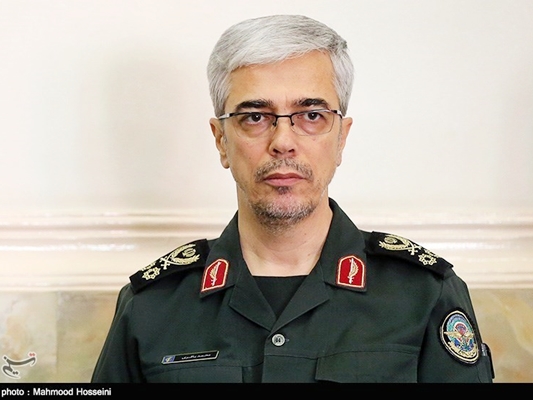
General Bagheri

Addressing a group of officers in Tehran on Saturday, senior Iranian military commander Major General Mohammad Baqeri stressed that the enemies of Iran are unlikely to launch a ground attack on the country.

“[Even] if there should be a very low possibility of the enemies attacking us, the aggression won’t be a land offensive because in case of ground attack they will face [our] brave troops,” said General Baqeri who is the Chief of the General Staff of the Iranian Armed Forces.

“We thank God Almighty that in a world where the global hegemony is led by unwise powers, and they won’t dare attack Iran as they have come to the conclusion that launching aggression against the Islamic Republic will have huge costs for them,” he said, according to a Farsi report by Tasnim.

“Even if they initiate an aggression, it won’t be up to them to end it, and they won’t be able to limit the war zone to Iran’s borders, and they won’t be able to determine the priorities of war, and that’s due to the privilege of deterrence that Iran has,” said the top general.

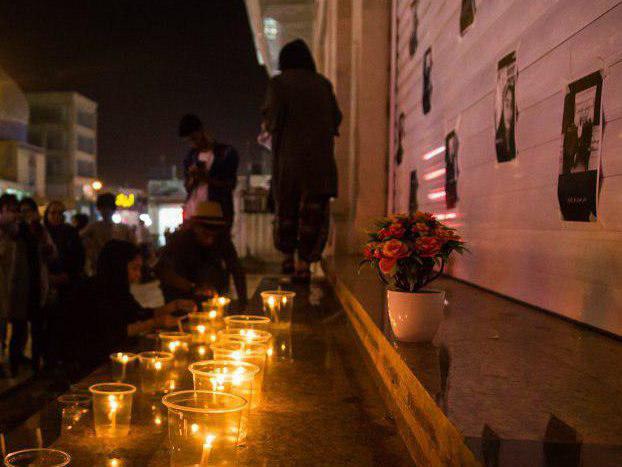
Iran Observes Day of Mourning after Tragic Bus Crash

At least seven female junior high-school students and two others were killed and dozens severely wounded after their bus overturned in southern Iran.

The bus was carrying 45 mostly junior high school students from Bandar Abbas, Hormozgan Province, to the city of Shiraz in Fars Province, according to Nader Rahmani, a senior traffic police official.

Hassan Nouri, an emergency official, told ISNA that seven schoolgirls, a female instructor, and a male assistant driver have lost their lives so far.

34 wounded girls were transferred to a hospital in Darab, and five others were taken to Shiraz hospital with a chopper, he added.

Nouri said two of those injured have lost one of their organs. Four others also sustained spinal cord injuries.

The elite schoolgirls were planning to attend a national conference of talented students in the city of Shiraz.

According to officials, initial investigations indicate the crash was caused by the exhaustion and sleepiness of the bus driver, who is now under arrest.

Following the incident, the governor of Hormozgan province declared one day of mourning in the province, and several top Iranian officials offered condolences.

Foreign Minister Mohammad Javad Zarif was one of the authorities who expressed sympathy over the incident, saying, “It was a source of deep sorrow and grief to hear the sad news of the bus crash in which many of our dear students and children and the country’s scientific assets were killed and wounded.”

“I offer my condolences to the bereaved families of these dear students and the people of Hormozgan province, and deeply sympathize with them,” he added in his Saturday message.

The Iranian top diplomat also wished patience and blessing for the victims’ families and speedy recovery for those wounded in the painful incident.

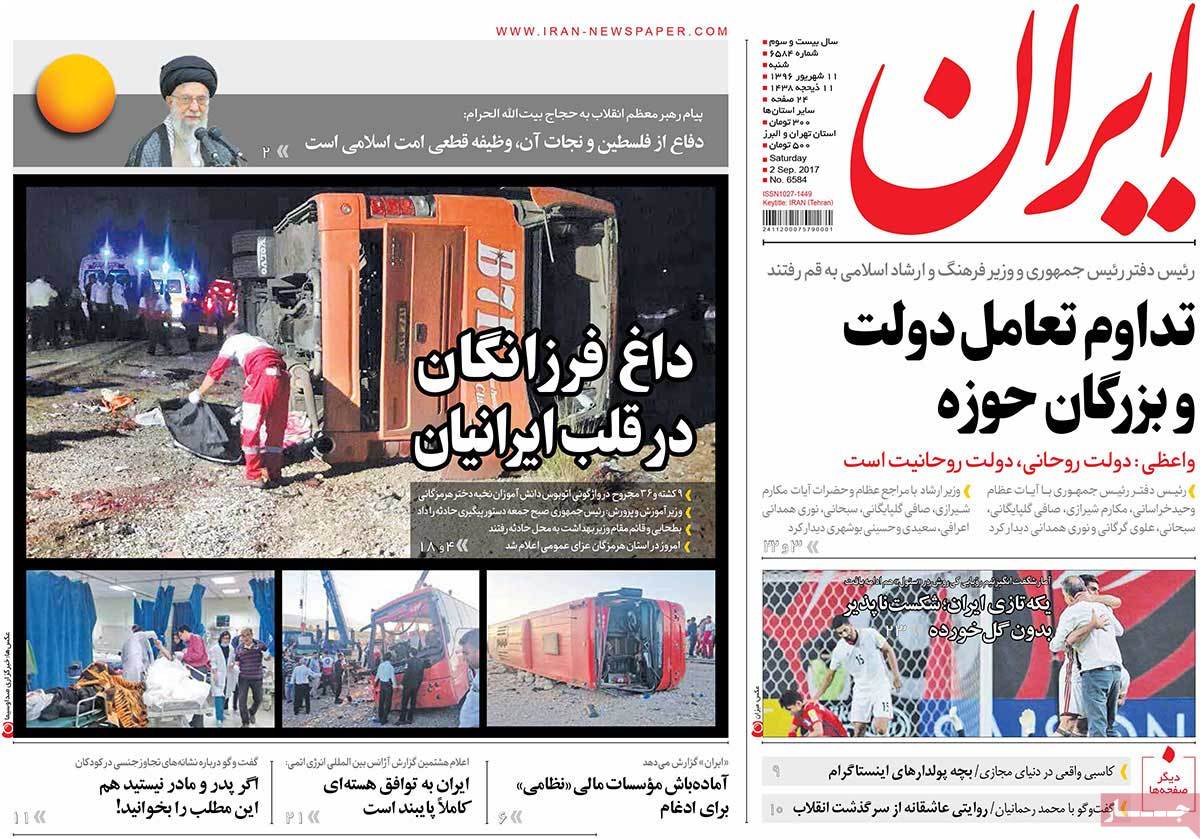
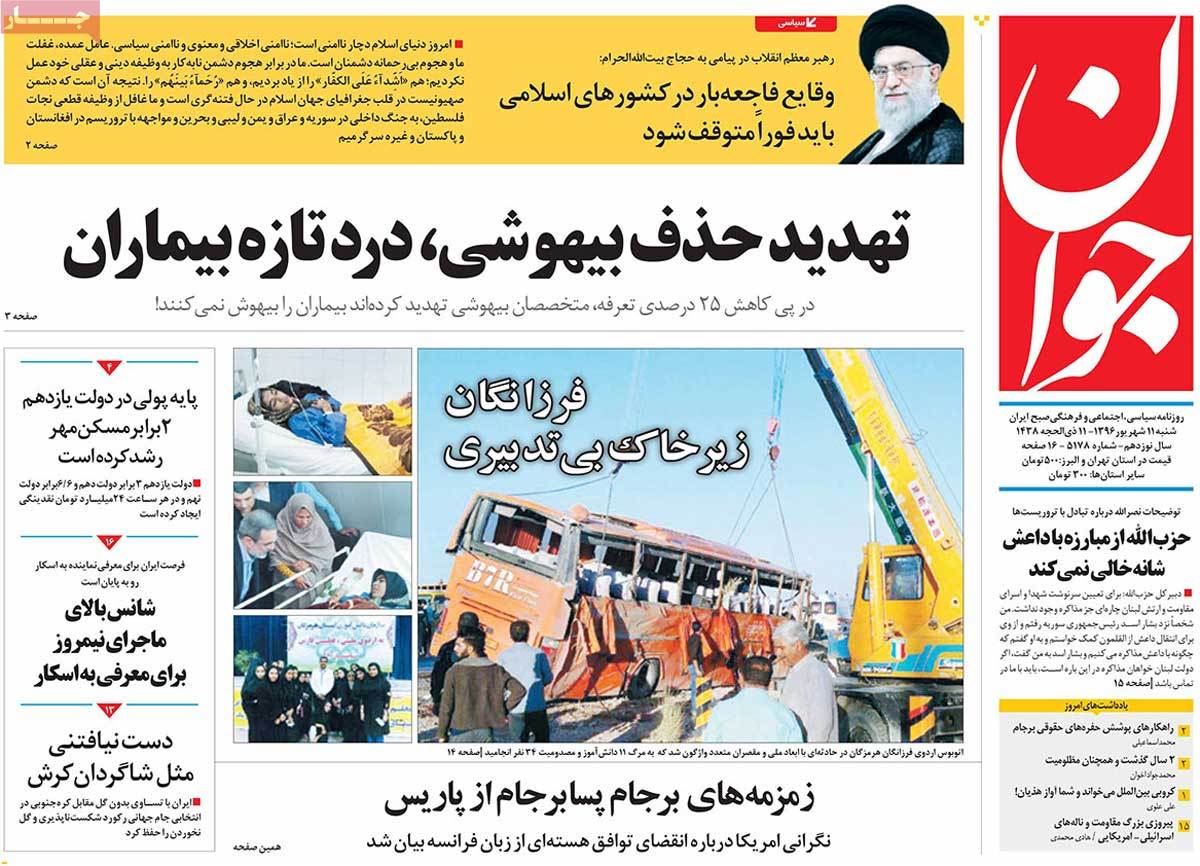
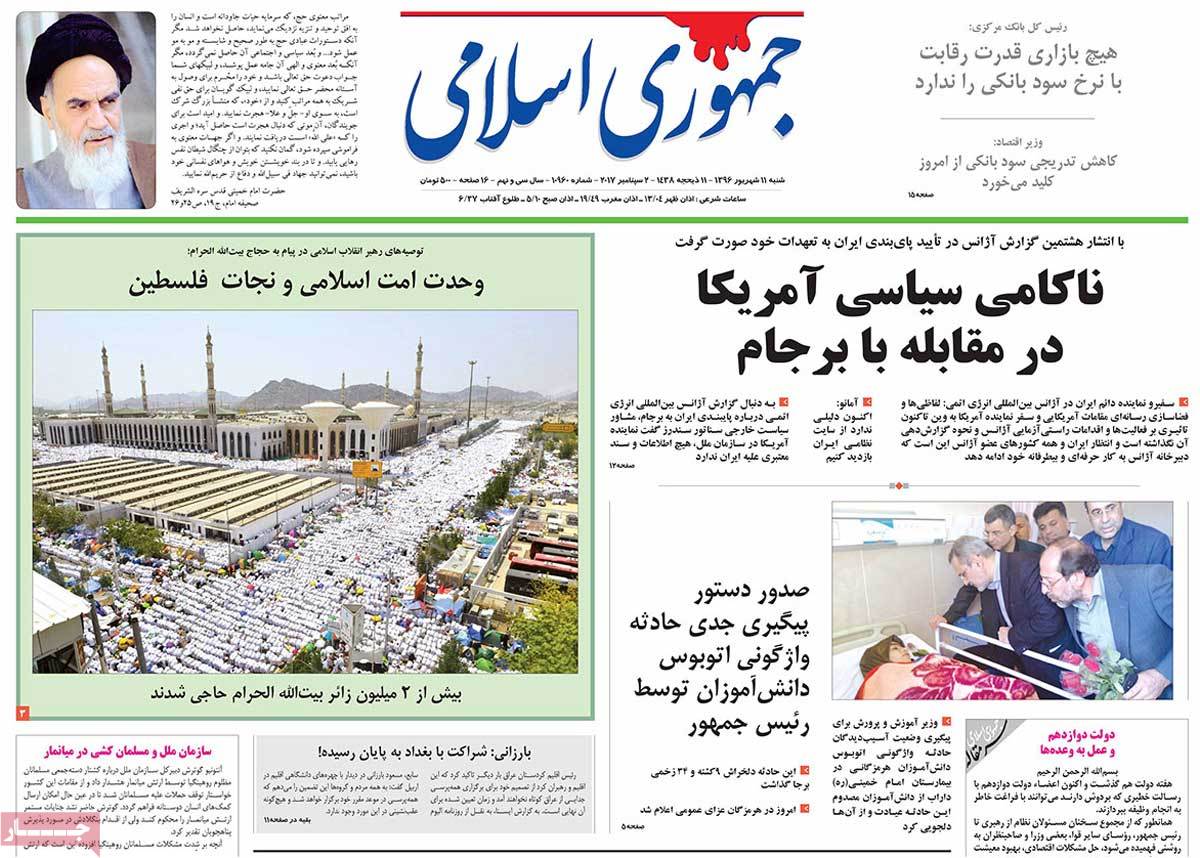
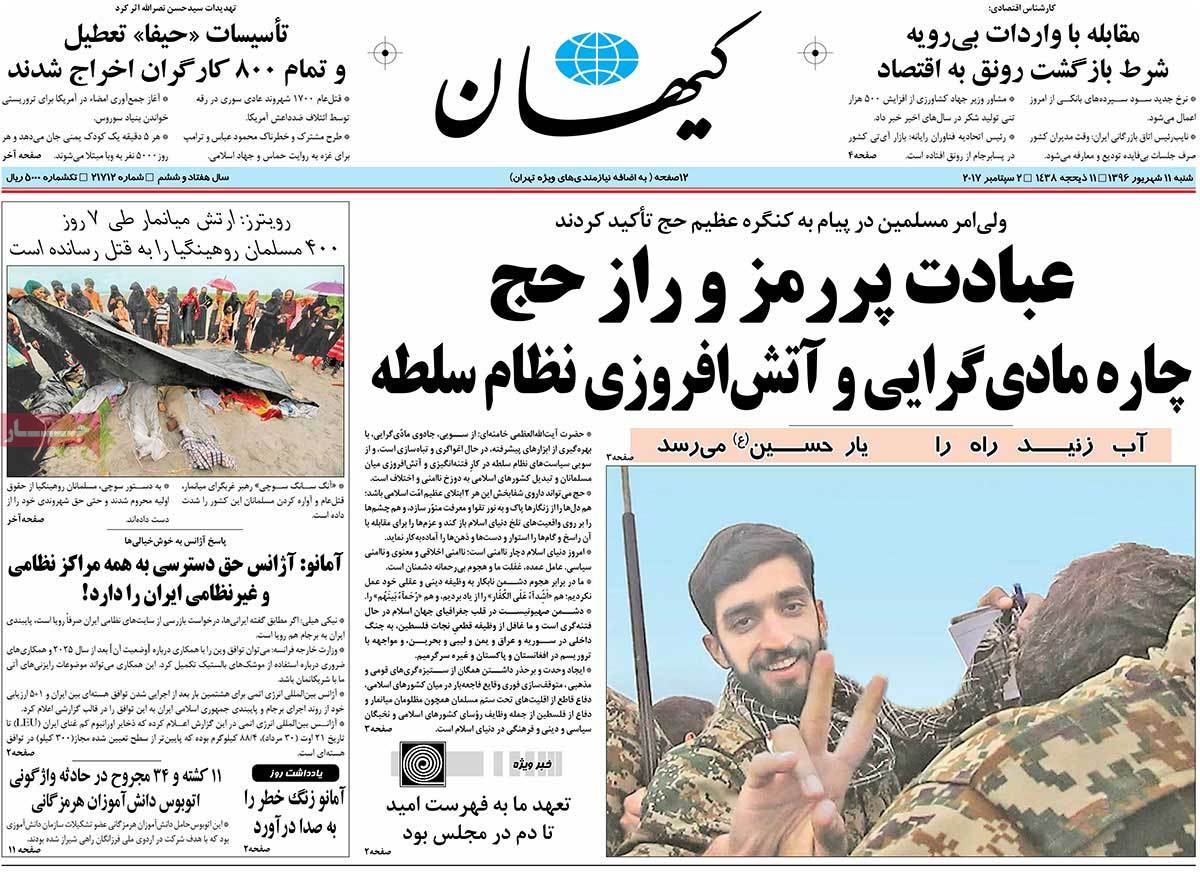
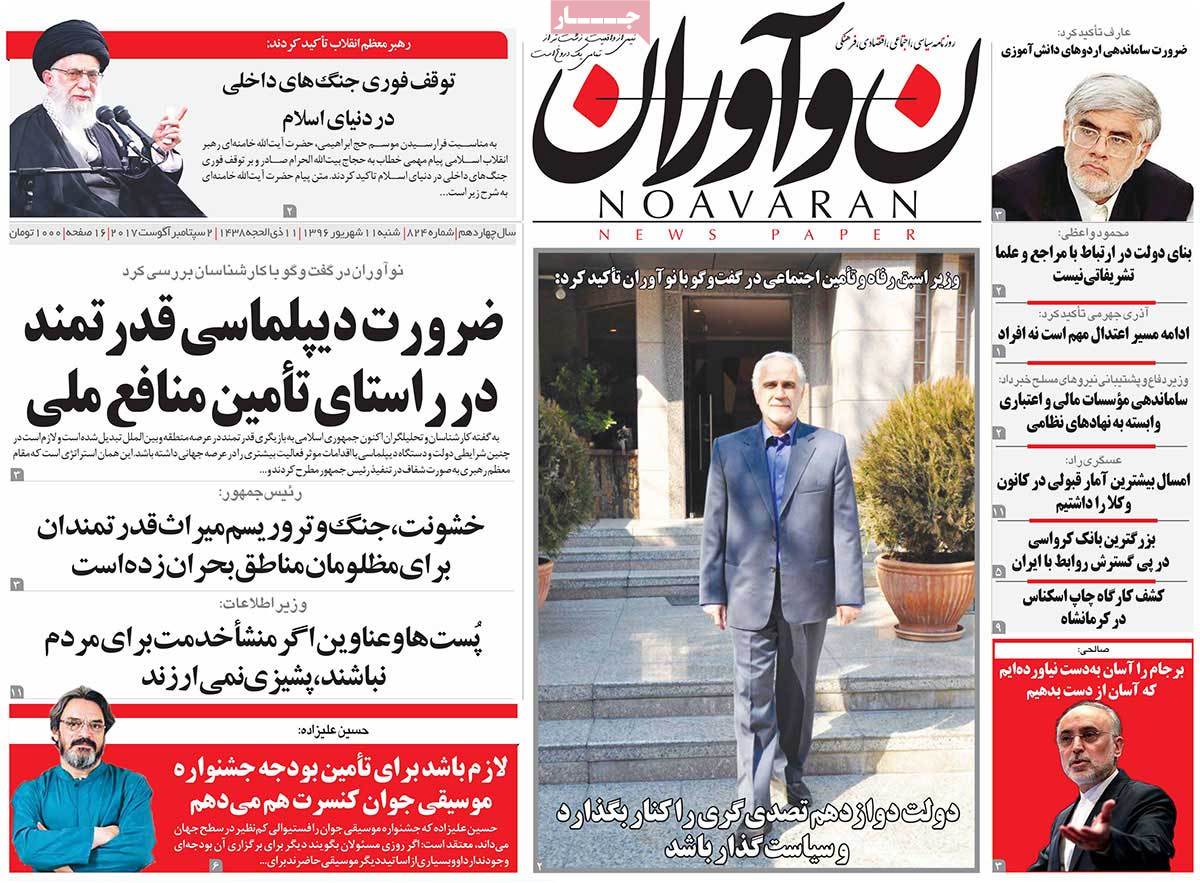
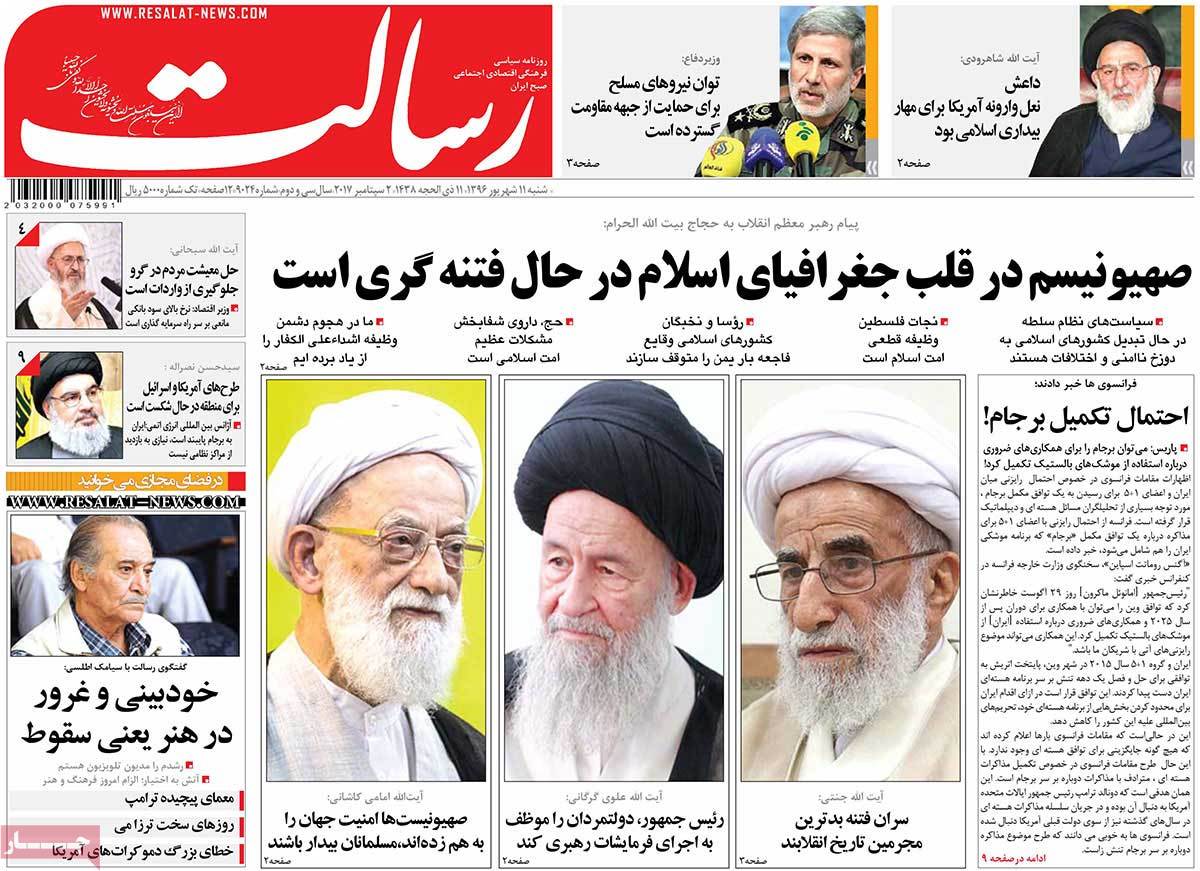
A Look at Iranian Newspaper Front Pages on September 2

The top story today was the remarks made by Ayatollah Seyyed Ali Khamenei, the Leader of Iran’s Islamic Revolution, in a letter to Hajj pilgrims.

Newspapers also covered a tragic bus crash in southern Iran in which several elite schoolgirls lost their lives and several others were seriously injured.

Another top story today was the latest report by the International Atomic Energy Agency (IAEA) on the implementation of a nuclear deal between Tehran and world powers. In this report, the IAEA once again confirmed Iran’s compliance with its JCPOA commitments.

The above issues, as well as many more, are highlighted in the following headlines and top stories:

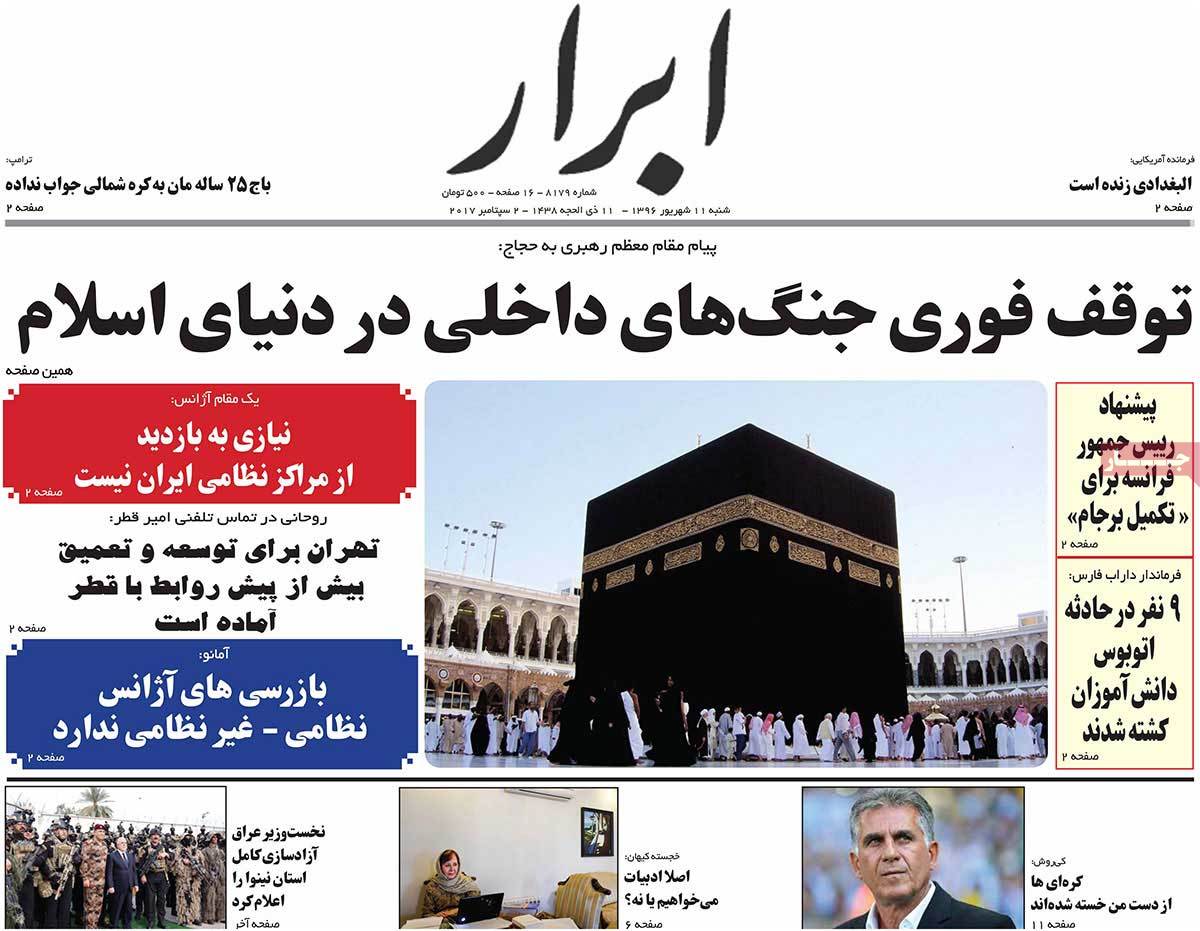
Abrar:

1- Rouhani: Tehran Ready to Deepen Ties with Qatar

2- IAEA: No Need for Inspection of Iran’s Military Sites

3- American Commander: ISIS Leader Al-Baghdadi Still Alive

A Look at Iranian Newspaper Front Pages on September 2 - abrar


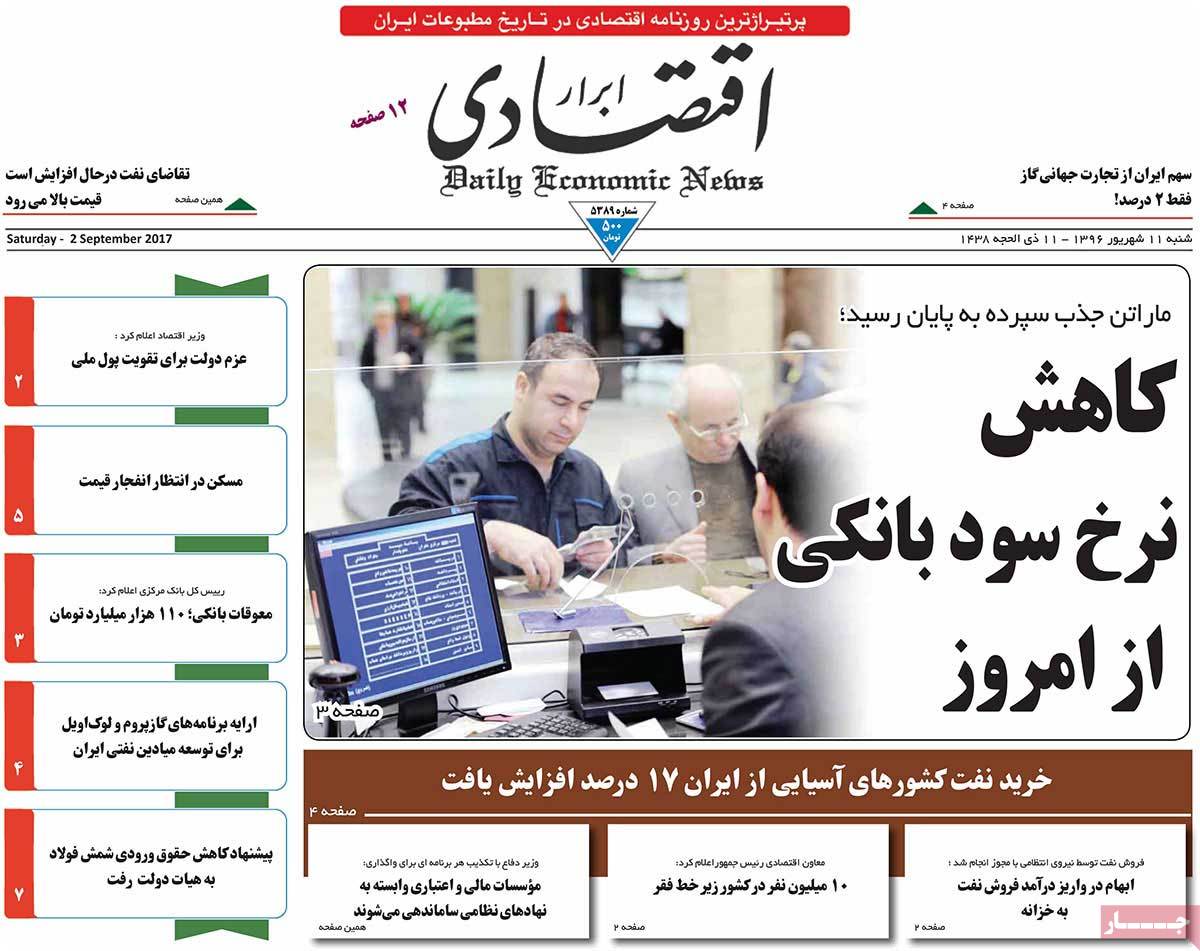
Abrar-e Eqtesadi:

1- 17% Increase in Asian Countries’ Purchase of Iran’s Oil

A Look at Iranian Newspaper Front Pages on September 2 - abrar egtesadi


Aftab-e Yazd:

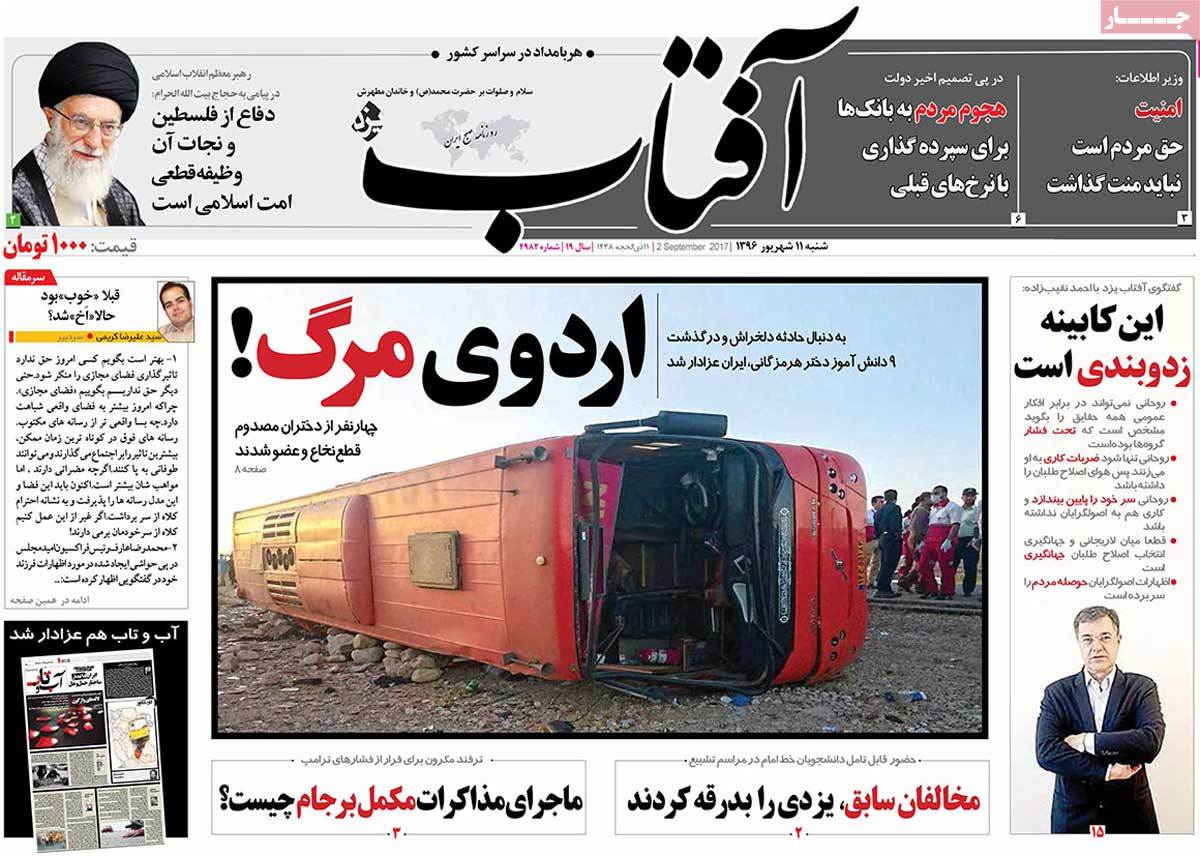
1- Camp of Death! Iran Mourning Deaths of 9 Schoolgirls in Bus Crash

  • Four of Wounded Girls Sustain Spinal Cord Injuries, Lose Organs

2- Iran Leader: Defending, Saving Palestine Definite Duty of Islamic Society

3- Intelligence Minister: Security Is People’s Right, We Shouldn’t Expect Them to Thank Us

A Look at Iranian Newspaper Front Pages on September 2 - aftab


Arman-e Emrooz:

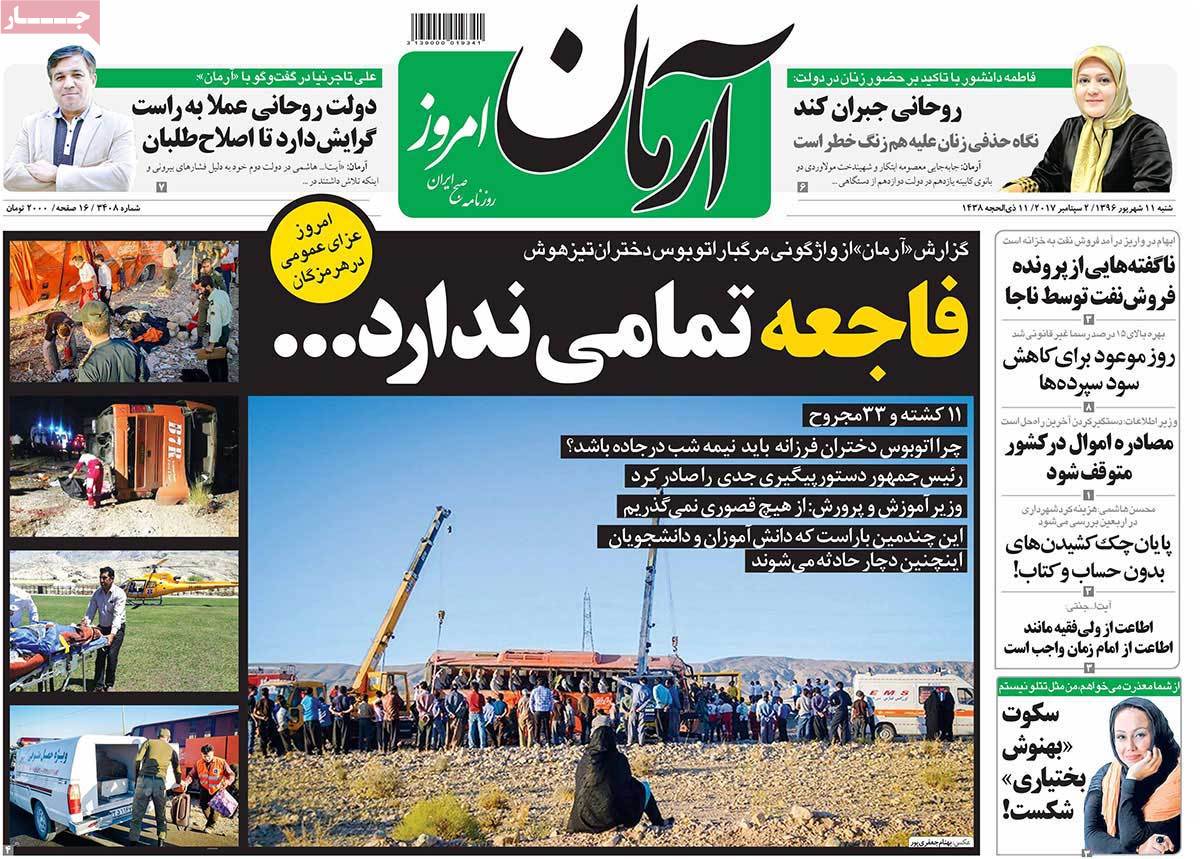
1- Disaster Not Going to End: How Elite Schoolgirls Died in Bus Crash

2- Ayatollah Jannati: Obeying ‘Guardian Jurist’ Compulsory Just Like Obeying Imam Mahdi

A Look at Iranian Newspaper Front Pages on September 2 - arman


Ebtekar:

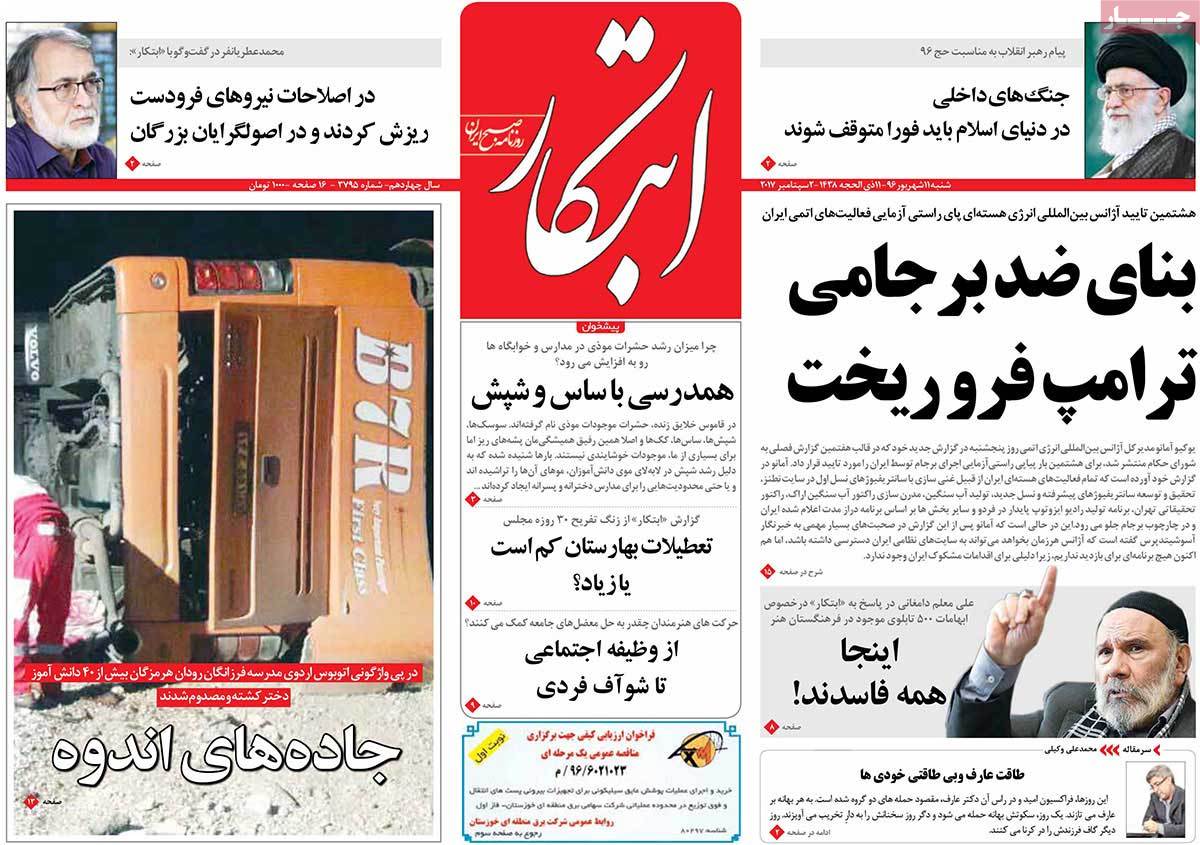
1- Iran Leader: Domestic Conflicts in Muslims World Should Be Immediately Stopped

2- Trump’s Anti-JCPOA Structure Collapses: IAEA for Eighth Time Confirms Iran’s Compliance

A Look at Iranian Newspaper Front Pages on September 2 - ebtekar


Ettela’at:

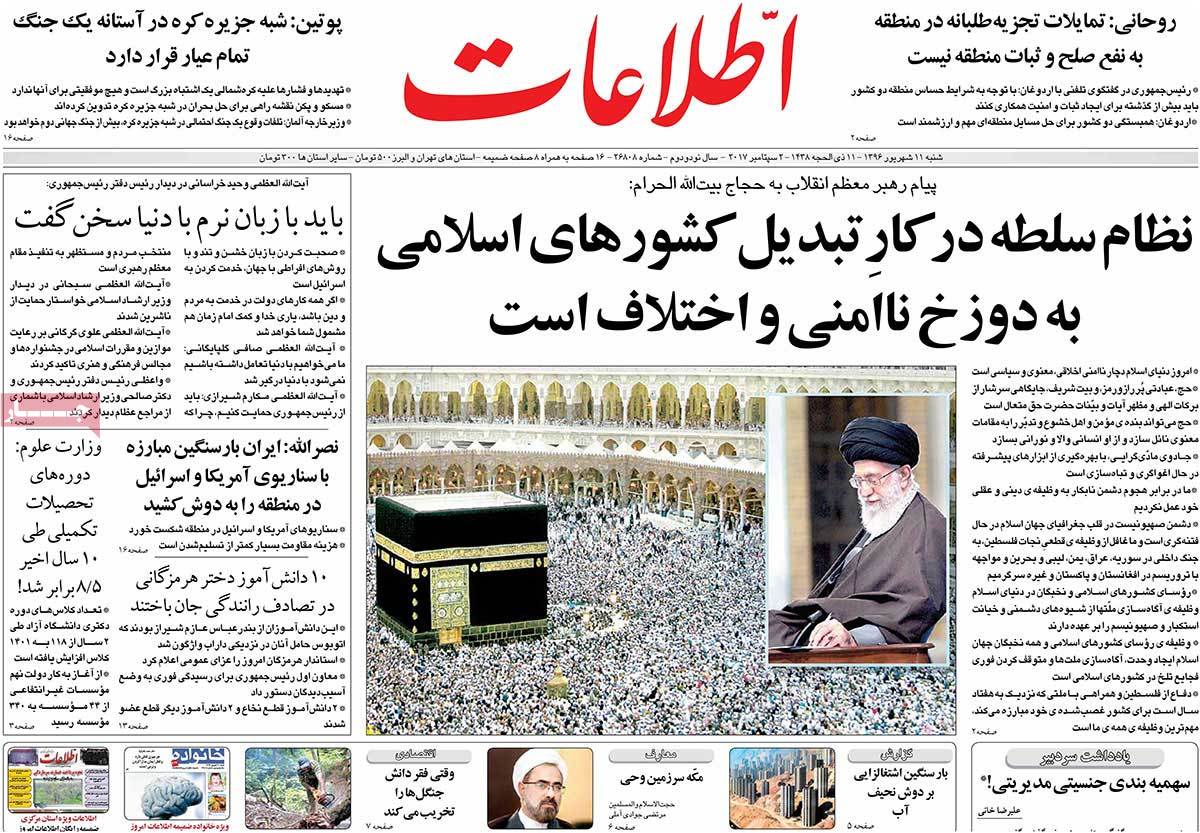
1- Iran Leader: Global Hegemony Turning Islamic Countries into Hell of Insecurity, Split

2- Rouhani: Secessionist Tendencies in Mideast Not in Interests of Regional Peace, Stability

3- Nasrallah: Iran Shoulders Heavy Burden of Countering US-Israeli Plots in Mideast

A Look at Iranian Newspaper Front Pages on September 2 - etelaat


Iran:

1- Continued Interaction between Gov’t, Senior Clerics in Qom

  • Rouhani’s Chief of Staff, Culture Minister Visit Qom

A Look at Iranian Newspaper Front Pages on September 2 - iran


Javan:

1- Iran Leader: Disastrous Events in Muslim States Should Be Immediately Stopped

2- New Pain for Patients: Surgery without Anaesthesia!

  • After decrease in wages, some anaesthesiologists threaten patients to do surgery without anaesthesia!

3- Nasrallah’s Explanations about Prisoner Swap with Terrorists

  • Hezbollah Won’t Evade Responsibility of Fighting ISIS

A Look at Iranian Newspaper Front Pages on September 2 - javan


Jomhouri Eslami:

1- Rouhani Orders Cabinet to Seriously Pursue Deadly Bus Crash

2- Over 2m Hajj Pilgrims Finish Pilgrimage Rituals

A Look at Iranian Newspaper Front Pages on September 2 - jomhori


Kayhan:

1- Iran Leader: Hajj Pilgrimage Solution to Global Hegemony’s Materialism, Warmongering

A Look at Iranian Newspaper Front Pages on September 2 - kayhan


Noavaran:

1- Nuclear Chief: Iran Not to Give Up on JCPOA Easily as It’s Not Achieved Easily

2- Rouhani: Violence, War, Terrorism Legacy of World Powers for People in Crisis-Hit Areas

A Look at Iranian Newspaper Front Pages on September 2 - noavaran


Resalat:

1- Iran’s Armed Forces Have Great Power to Support Resistance Front: DM

2- Iran Leader: Zionism Creating Sedition in Heart off Islamic Geography

A Look at Iranian Newspaper Front Pages on September 2 - resalat


Iran Offers Sympathy to Flood-Hit People of India, Nepal, Pakistan

In his Friday message, Foreign Ministry Spokesman Bahram Qassemi expressed regret at the flooding in parts of South Asia, particularly in India, Nepal, and Pakistan, and sympathized with their nations and governments as well as the bereaved families of the victims.

More than 1,200 people are feared to have died and 40 million are estimated to have been affected by flooding in India, Nepal and Bangladesh.

Vast swaths of land are underwater in the eastern part of the Indian state of Uttar Pradesh, where more than 100 people have reportedly died, 3,097 villages are submerged and almost 3 million villagers have been affected by flooding, according to officials. Army personnel have joined rescuers to evacuate people from the area.

The storm reached Pakistan on Thursday, lashing the port city of Karachi, where at least 14 people have died, and streets have been submerged by water. The country’s meteorological department forecast that the rains would continue for three days in various parts of Sindh province, where authorities closed schools as a precaution.

Qatar’s Emir Praises Iran’s Help amid ‘Cruel Sanctions’

In a telephone conversation with Iranian President Hassan Rouhani on Thursday evening, Qatari Emir Sheikh Tamim bin Hamad Al Thani hailed Iran’s “principled stances” in backing his country in the face of sanctions.

He also congratulated the Iranian government and nation on the Muslim festival of Eid al-Adha, voicing Doha’s willingness for closer relations with Tehran in various fields.

The prospect of political, economic and cultural ties between Iran and Qatar is bright and promising, the Qatari emir noted, saying his country is ready to seize the “historical opportunity” to broaden relations with Iran.

For his part, President Rouhani reaffirmed Iran’s commitment to working with and supporting the Qatari government and nation and to contributing to regional stability, and deplored the “unfair” sanctions that some of the Persian Gulf states have imposed on Qatar.

The Iranian president also stressed the need for closer cooperation between Tehran and Doha and negotiations on the regional issues in order to serve their mutual interests.

President Rouhani finally expressed Iran’s support for strong “brotherly ties” among all Muslim nations in the region.

Earlier in the day, in a congratulatory message to Muslim leaders on Eid al-Adha, the Iranian president called on the Islamic countries to make efforts for restoring peace and security to crisis-hit countries and expressed the hope that Muslims would show “the beautiful face” of their religion to the world.

Iran Hails IAEA’s Impartiality in Nuclear Deal Report

In a statement released on Thursday, Iran’s IAEA Ambassador Reza Najafi said that the UN nuclear watchdog has continued to verify the implementation of the JCPOA under the Safeguards standards and in a professional and impartial manner.

His comments came after the most recent quarterly report by the IAEA confirmed once again that Iran has been honoring its commitments under the JCPOA, a nuclear agreement between Tehran and the Group 5+1 (Russia, China, the US, Britain, France and Germany).

Najafi also expressed delight that the political rhetoric by the US officials, the propaganda campaign by the US media outlets and even a recent trip to Vienna by the US envoy to the UN have not had any impact on the IAEA’s activities, its verification work or its reports on Iran.

“Iran and all the (UN nuclear) agency’s member states expect the agency’s secretariat to keep working professionally and neutrally,” the envoy added.

According to the latest IAEA report, Iran is honoring the terms of the JCPOA by keeping its uranium stockpile and production capacity below set thresholds.

Details of the report are likely to be made public at the next IAEA Board of Governors meeting on September 11-15.

The most recent quarterly report came as a surprise to the US administration which has signaled willingness to declare Iran in breach of the deal.

US President Donald Trump had said in August he did not consider Iran in compliance and dispatched his UN envoy to Vienna to convey his concerns.

However, the IAEA officials said they would not help the Trump administration make a false case for abandoning the agreement.

“If they want to bring down the deal, they will,” an IAEA official told Reuters. “We just don’t want to give them an excuse to.”