Sunday, December 28, 2025
Home Blog Page 3902

Iran Observes Day of Mourning after Tragic Bus Crash

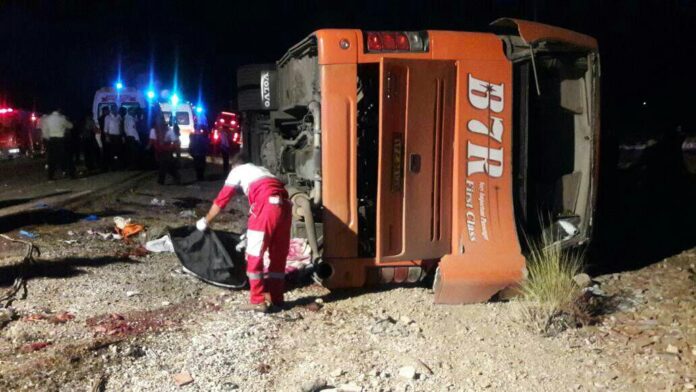
At least seven female junior high-school students and two others were killed and dozens severely wounded after their bus overturned in southern Iran.

The bus was carrying 45 mostly junior high school students from Bandar Abbas, Hormozgan Province, to the city of Shiraz in Fars Province, according to Nader Rahmani, a senior traffic police official.

Hassan Nouri, an emergency official, told ISNA that seven schoolgirls, a female instructor, and a male assistant driver have lost their lives so far.

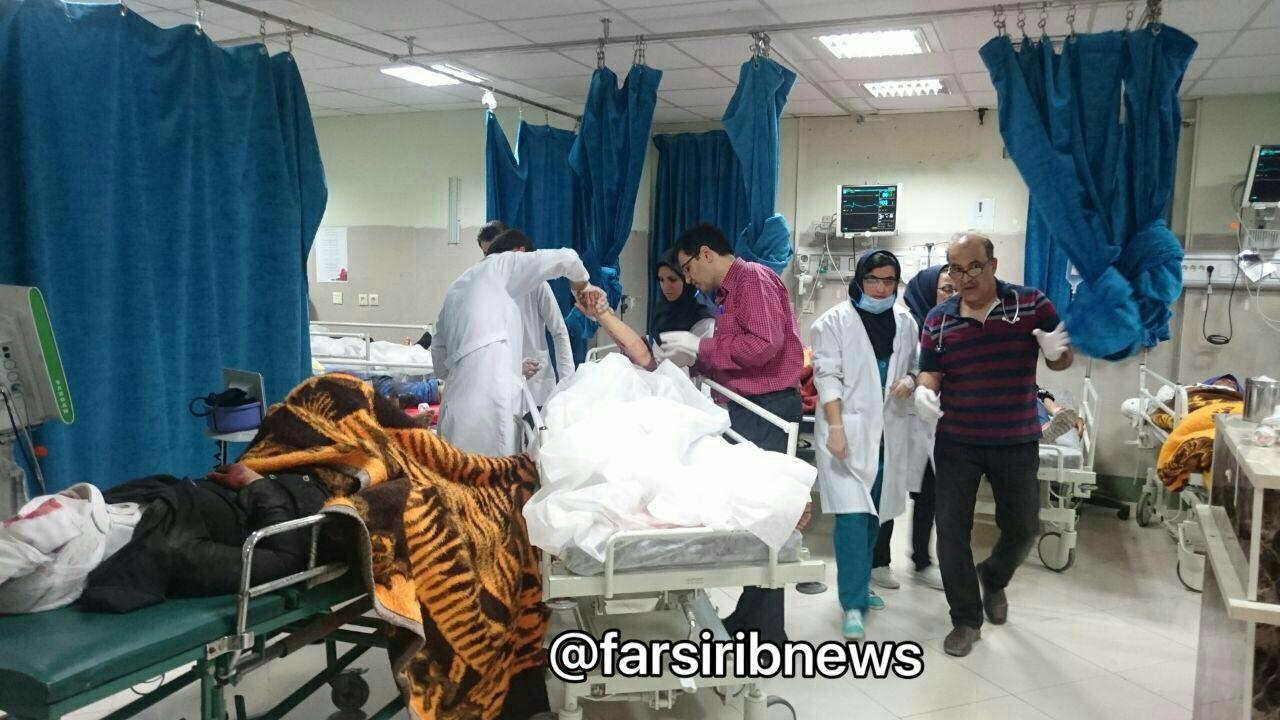
34 wounded girls were transferred to a hospital in Darab, and five others were taken to Shiraz hospital with a chopper, he added.

Nouri said two of those injured have lost one of their organs. Four others also sustained spinal cord injuries.

The elite schoolgirls were planning to attend a national conference of talented students in the city of Shiraz.

According to officials, initial investigations indicate the crash was caused by the exhaustion and sleepiness of the bus driver, who is now under arrest.

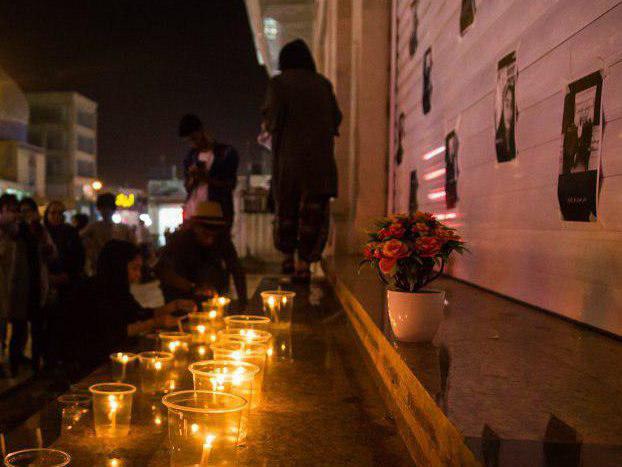
Following the incident, the governor of Hormozgan province declared one day of mourning in the province, and several top Iranian officials offered condolences.

Foreign Minister Mohammad Javad Zarif was one of the authorities who expressed sympathy over the incident, saying, “It was a source of deep sorrow and grief to hear the sad news of the bus crash in which many of our dear students and children and the country’s scientific assets were killed and wounded.”

“I offer my condolences to the bereaved families of these dear students and the people of Hormozgan province, and deeply sympathize with them,” he added in his Saturday message.

The Iranian top diplomat also wished patience and blessing for the victims’ families and speedy recovery for those wounded in the painful incident.

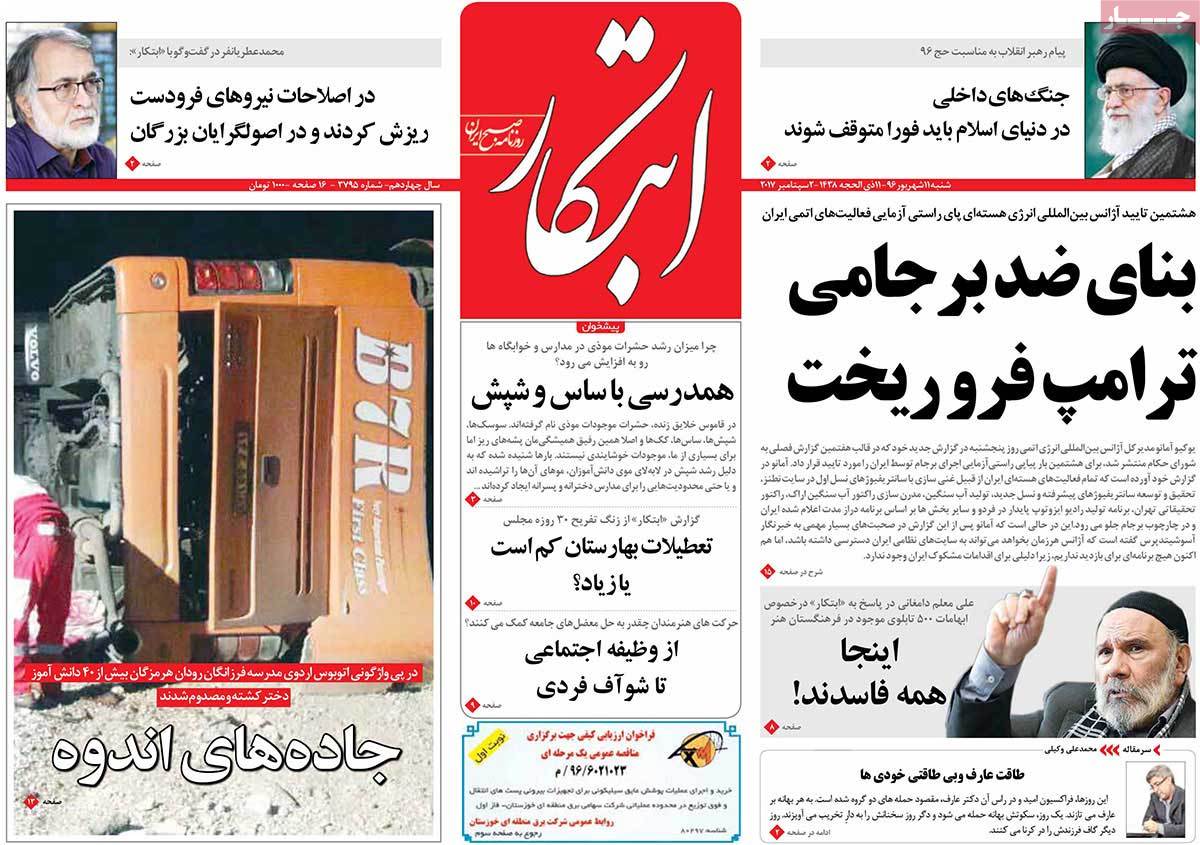
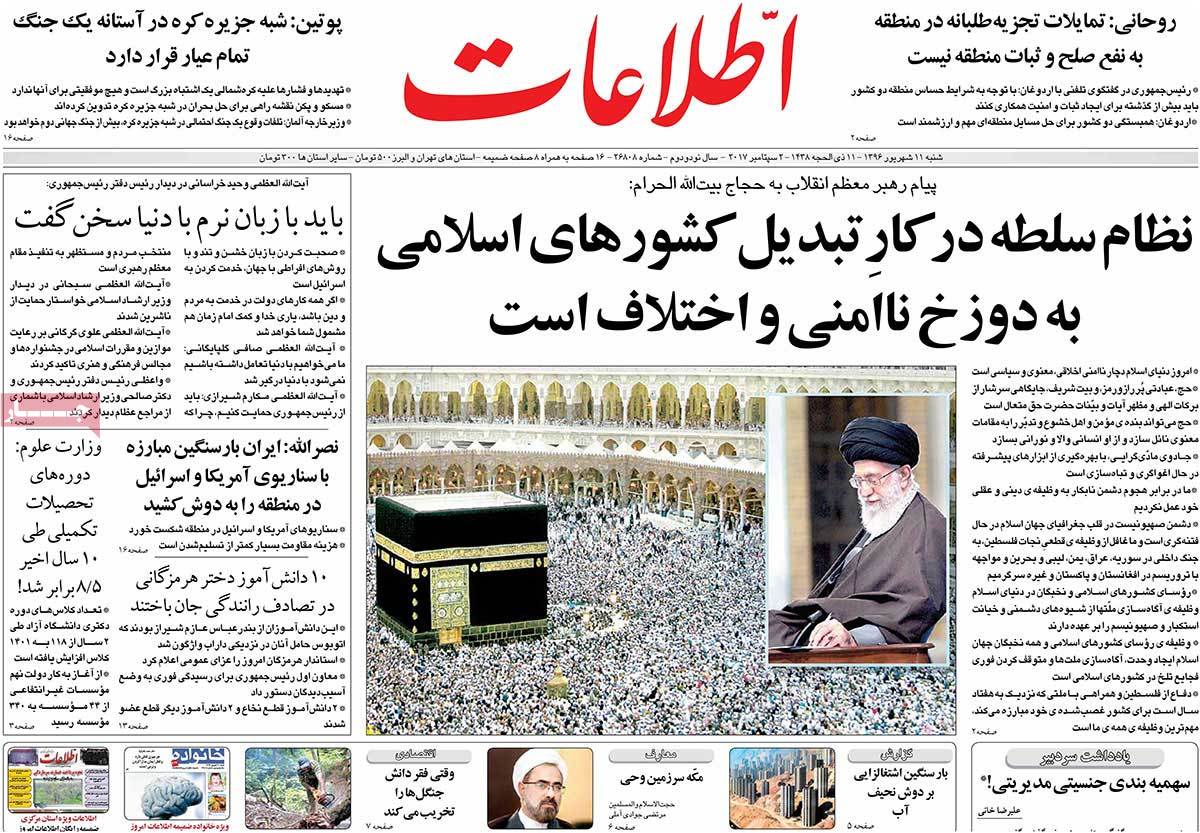
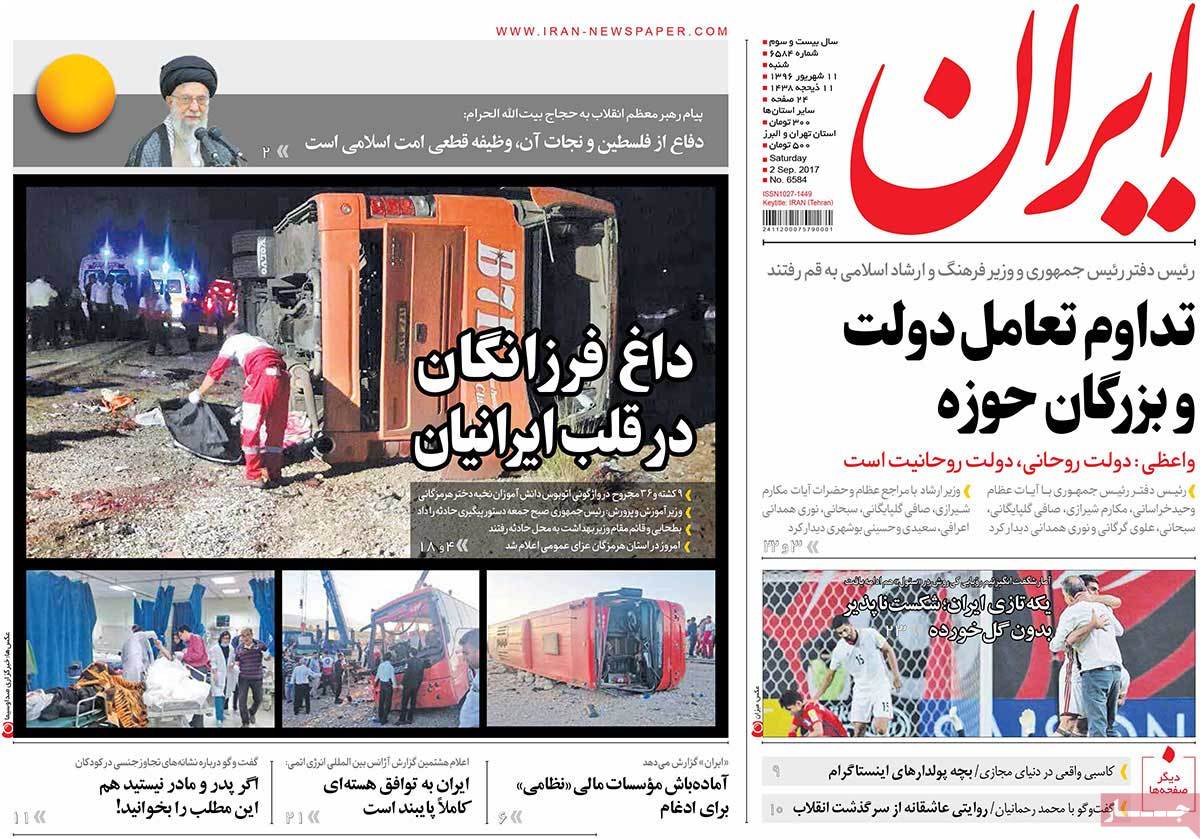
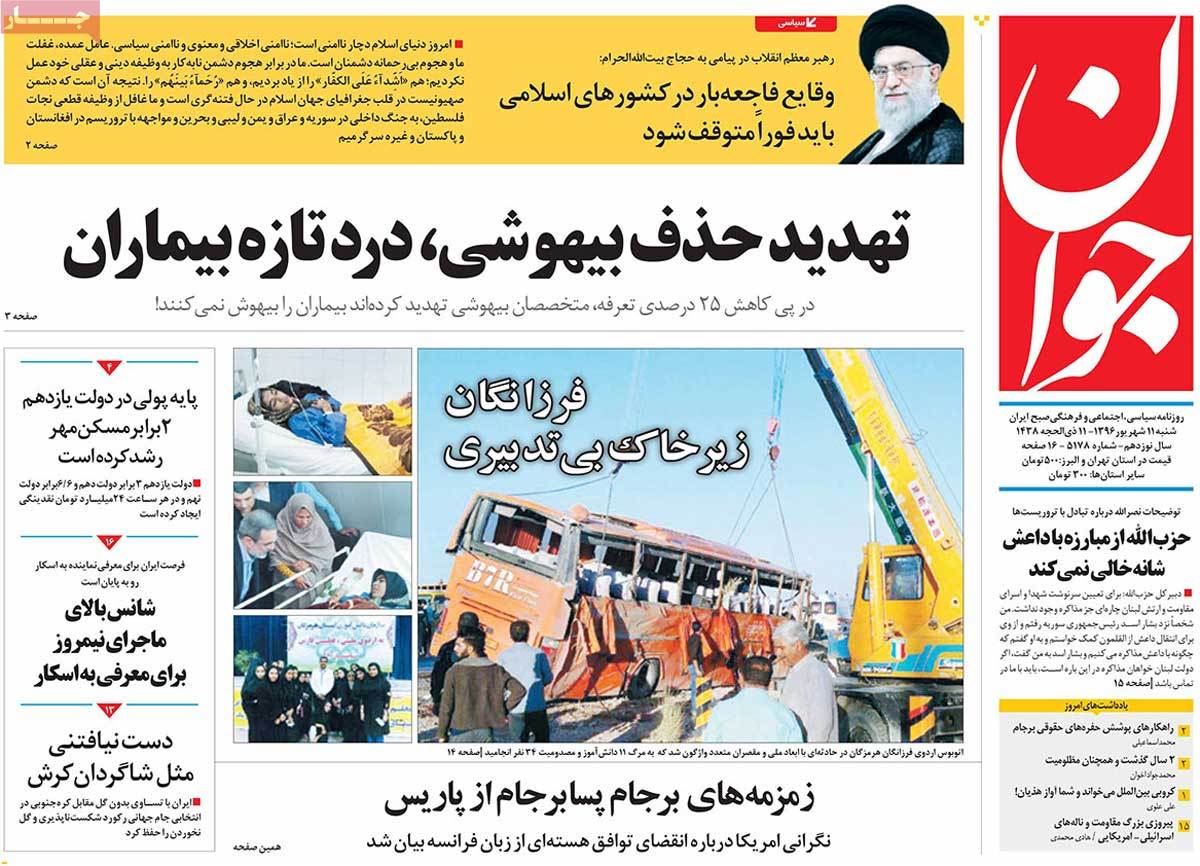
A Look at Iranian Newspaper Front Pages on September 2

The top story today was the remarks made by Ayatollah Seyyed Ali Khamenei, the Leader of Iran’s Islamic Revolution, in a letter to Hajj pilgrims.

Newspapers also covered a tragic bus crash in southern Iran in which several elite schoolgirls lost their lives and several others were seriously injured.

Another top story today was the latest report by the International Atomic Energy Agency (IAEA) on the implementation of a nuclear deal between Tehran and world powers. In this report, the IAEA once again confirmed Iran’s compliance with its JCPOA commitments.

The above issues, as well as many more, are highlighted in the following headlines and top stories:

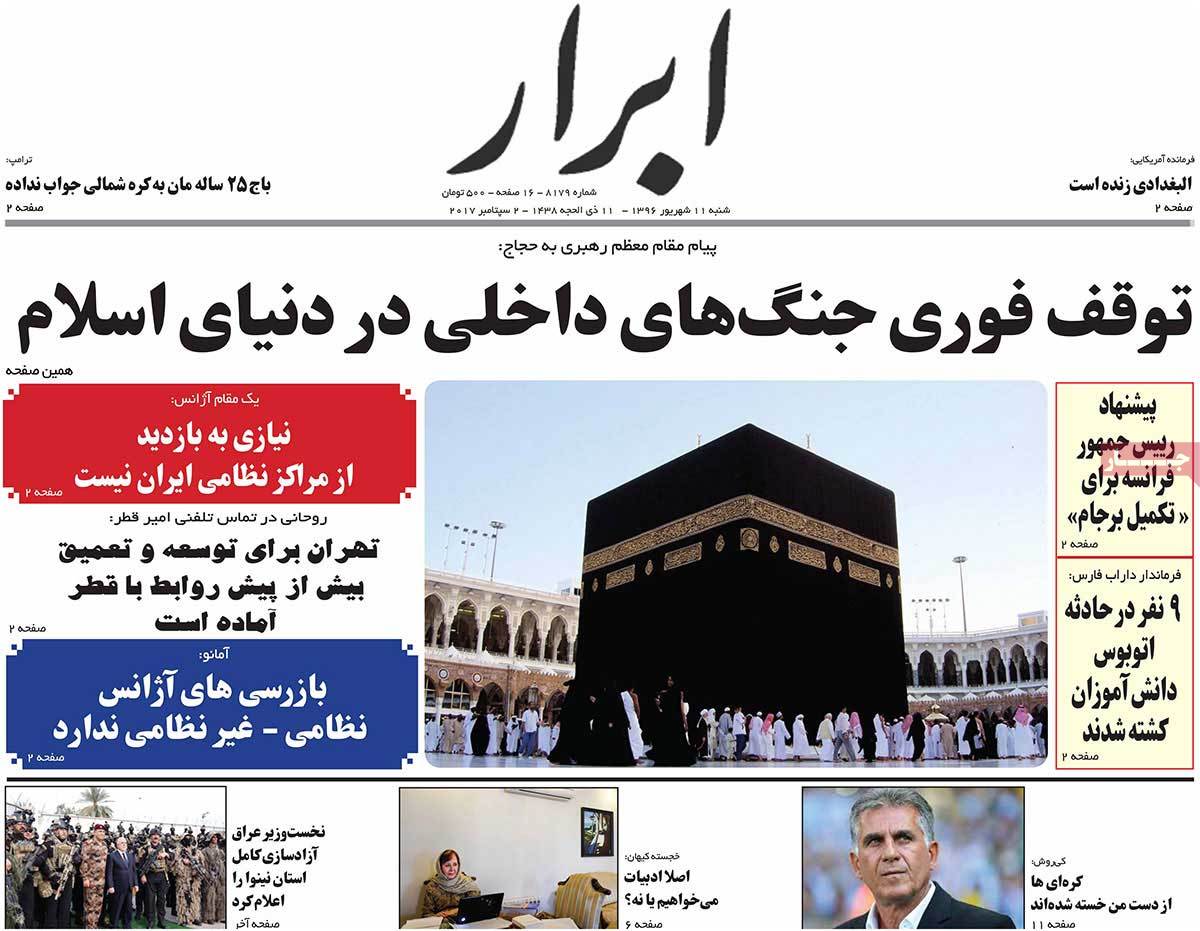
Abrar:

1- Rouhani: Tehran Ready to Deepen Ties with Qatar

2- IAEA: No Need for Inspection of Iran’s Military Sites

3- American Commander: ISIS Leader Al-Baghdadi Still Alive

A Look at Iranian Newspaper Front Pages on September 2 - abrar


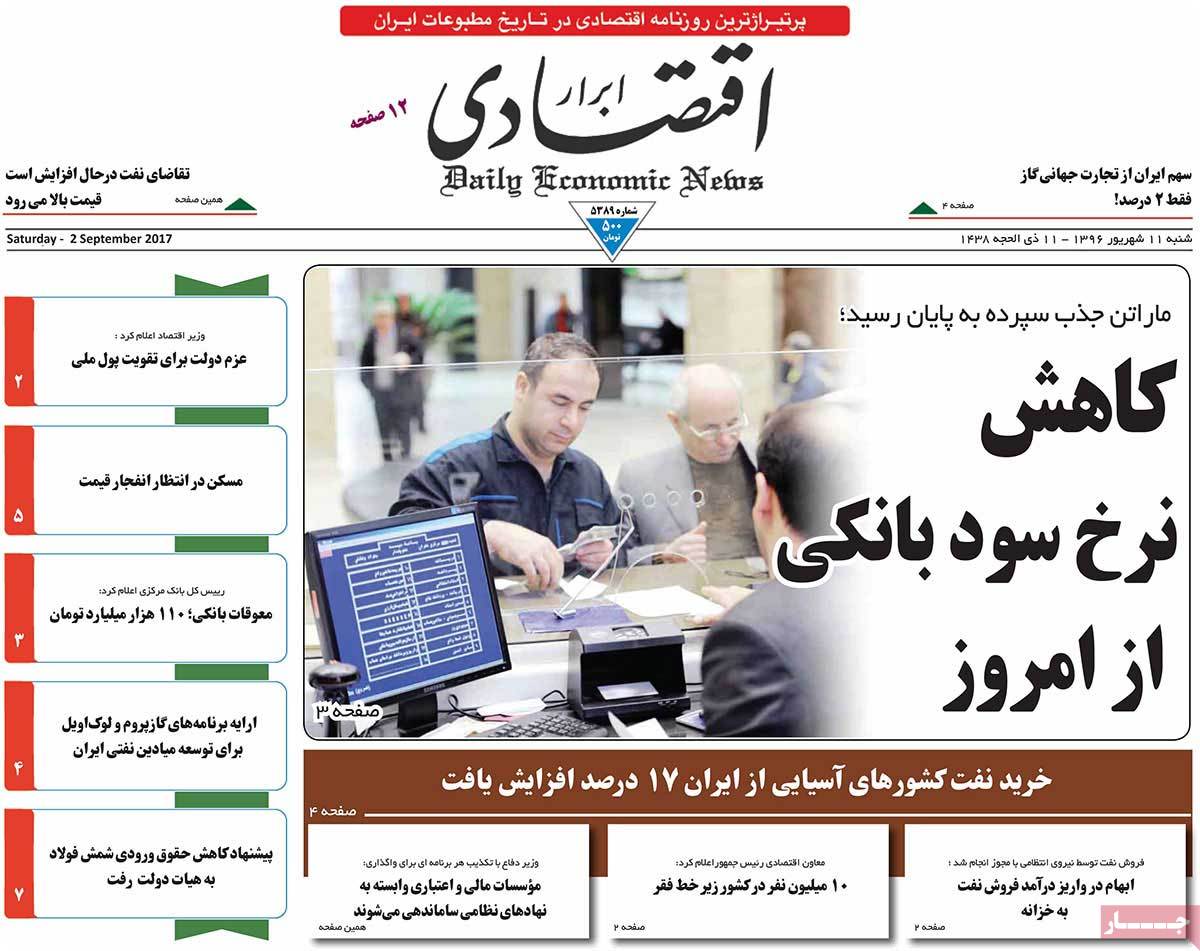
Abrar-e Eqtesadi:

1- 17% Increase in Asian Countries’ Purchase of Iran’s Oil

A Look at Iranian Newspaper Front Pages on September 2 - abrar egtesadi


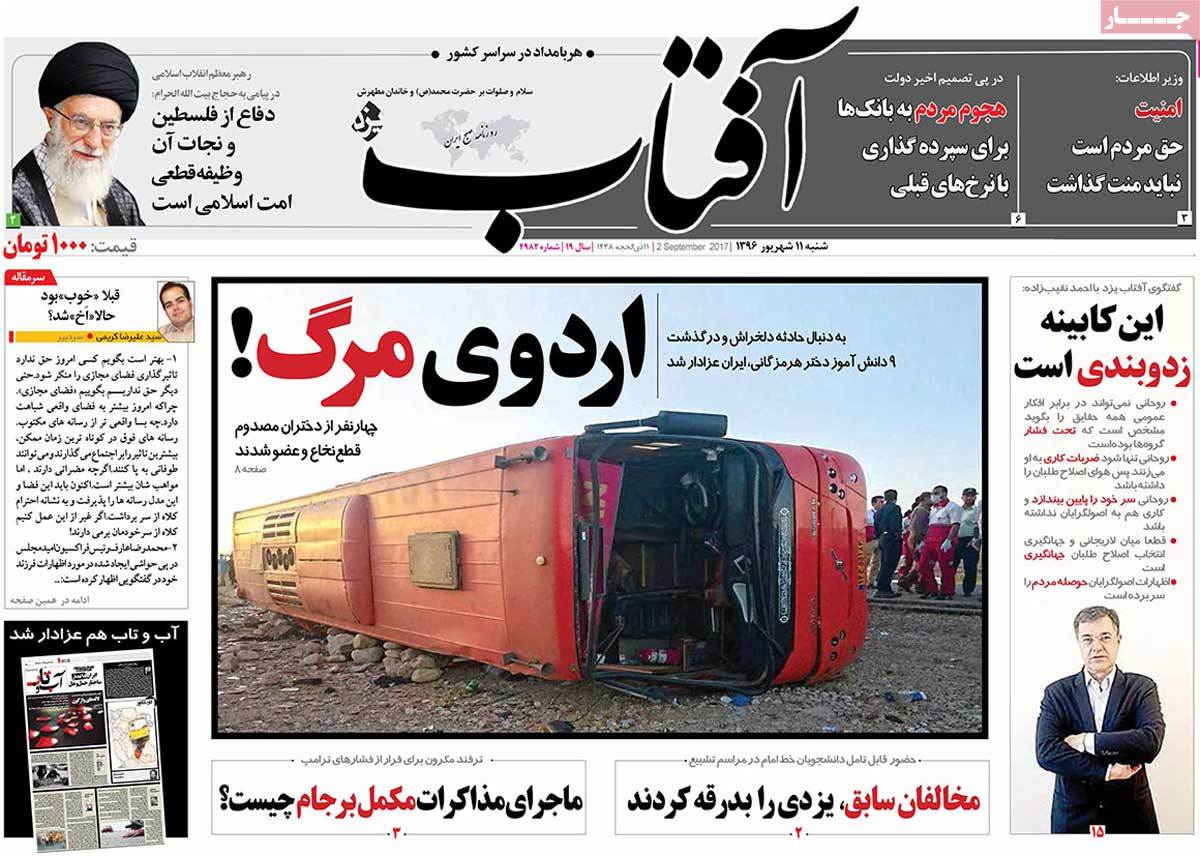
Aftab-e Yazd:

1- Camp of Death! Iran Mourning Deaths of 9 Schoolgirls in Bus Crash

  • Four of Wounded Girls Sustain Spinal Cord Injuries, Lose Organs

2- Iran Leader: Defending, Saving Palestine Definite Duty of Islamic Society

3- Intelligence Minister: Security Is People’s Right, We Shouldn’t Expect Them to Thank Us

A Look at Iranian Newspaper Front Pages on September 2 - aftab


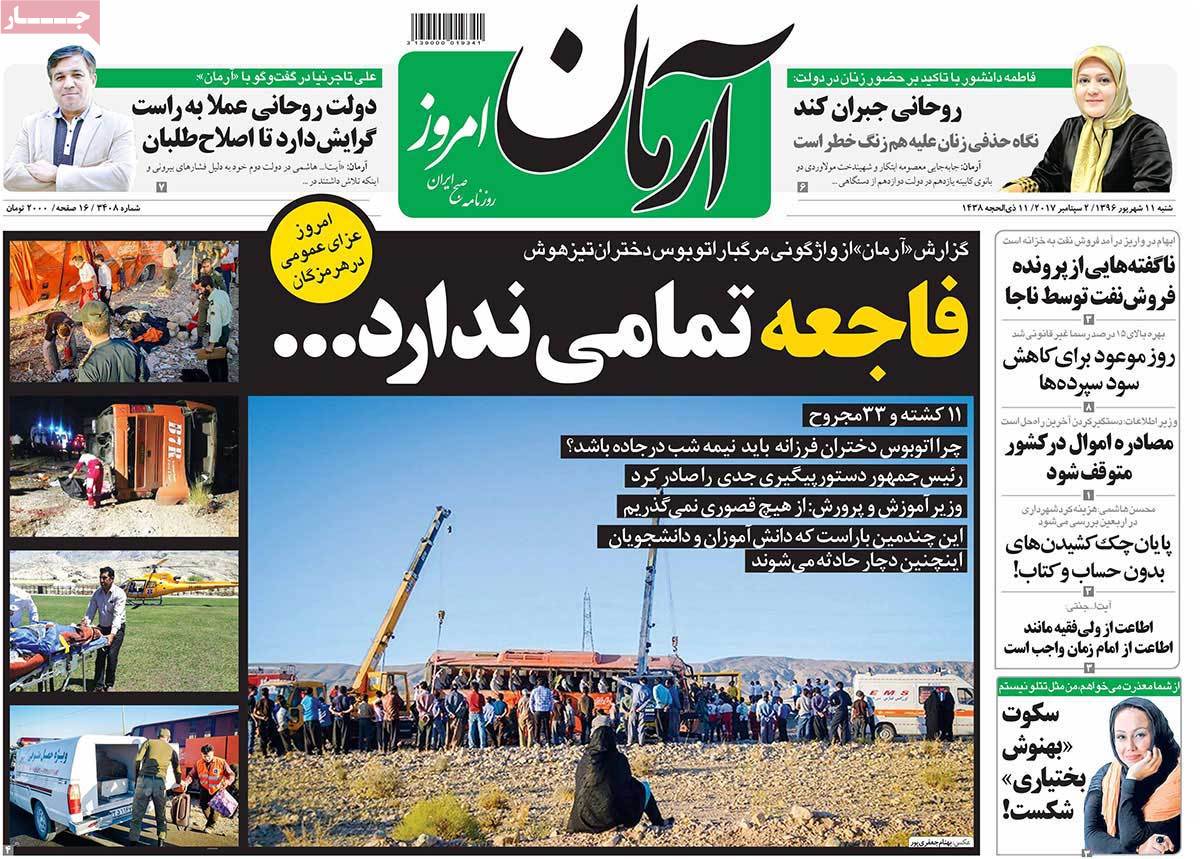
Arman-e Emrooz:

1- Disaster Not Going to End: How Elite Schoolgirls Died in Bus Crash

2- Ayatollah Jannati: Obeying ‘Guardian Jurist’ Compulsory Just Like Obeying Imam Mahdi

A Look at Iranian Newspaper Front Pages on September 2 - arman


Ebtekar:

1- Iran Leader: Domestic Conflicts in Muslims World Should Be Immediately Stopped

2- Trump’s Anti-JCPOA Structure Collapses: IAEA for Eighth Time Confirms Iran’s Compliance

A Look at Iranian Newspaper Front Pages on September 2 - ebtekar


Ettela’at:

1- Iran Leader: Global Hegemony Turning Islamic Countries into Hell of Insecurity, Split

2- Rouhani: Secessionist Tendencies in Mideast Not in Interests of Regional Peace, Stability

3- Nasrallah: Iran Shoulders Heavy Burden of Countering US-Israeli Plots in Mideast

A Look at Iranian Newspaper Front Pages on September 2 - etelaat


Iran:

1- Continued Interaction between Gov’t, Senior Clerics in Qom

  • Rouhani’s Chief of Staff, Culture Minister Visit Qom

A Look at Iranian Newspaper Front Pages on September 2 - iran


Javan:

1- Iran Leader: Disastrous Events in Muslim States Should Be Immediately Stopped

2- New Pain for Patients: Surgery without Anaesthesia!

  • After decrease in wages, some anaesthesiologists threaten patients to do surgery without anaesthesia!

3- Nasrallah’s Explanations about Prisoner Swap with Terrorists

  • Hezbollah Won’t Evade Responsibility of Fighting ISIS

A Look at Iranian Newspaper Front Pages on September 2 - javan


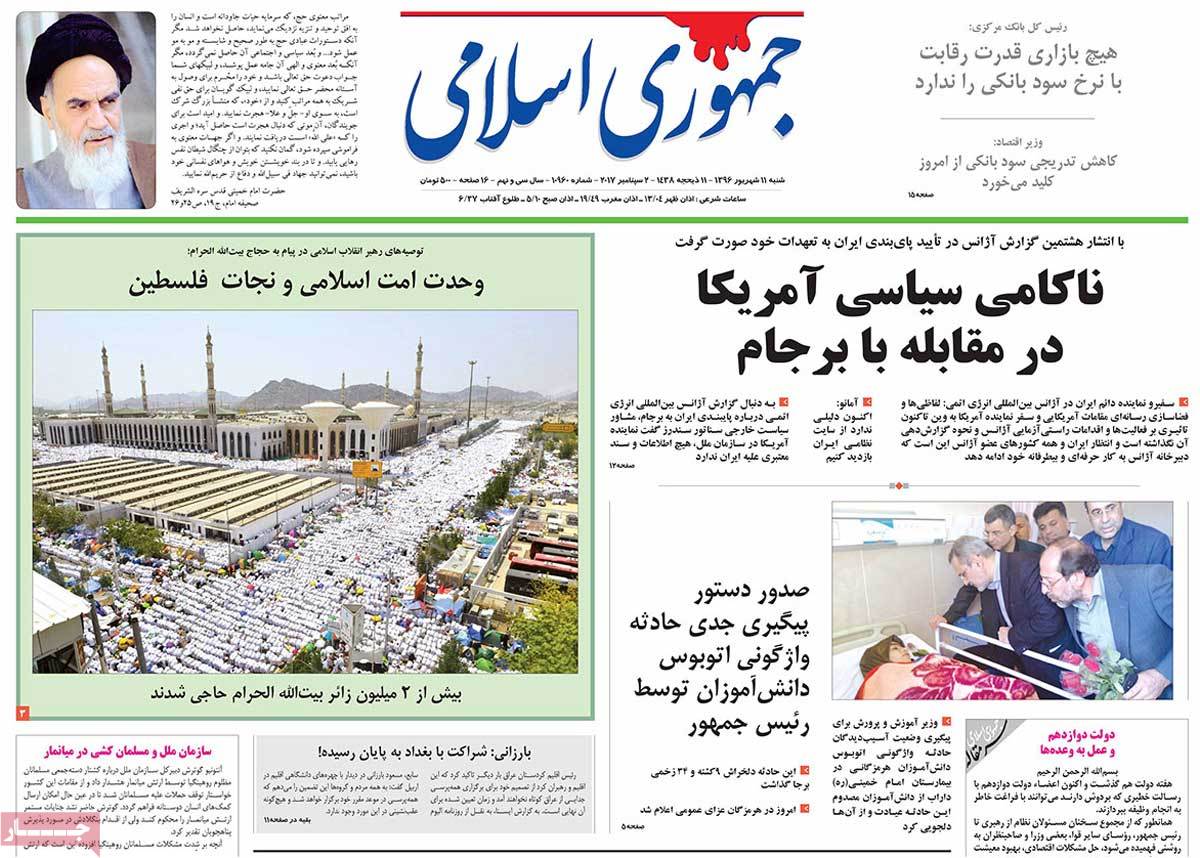
Jomhouri Eslami:

1- Rouhani Orders Cabinet to Seriously Pursue Deadly Bus Crash

2- Over 2m Hajj Pilgrims Finish Pilgrimage Rituals

A Look at Iranian Newspaper Front Pages on September 2 - jomhori


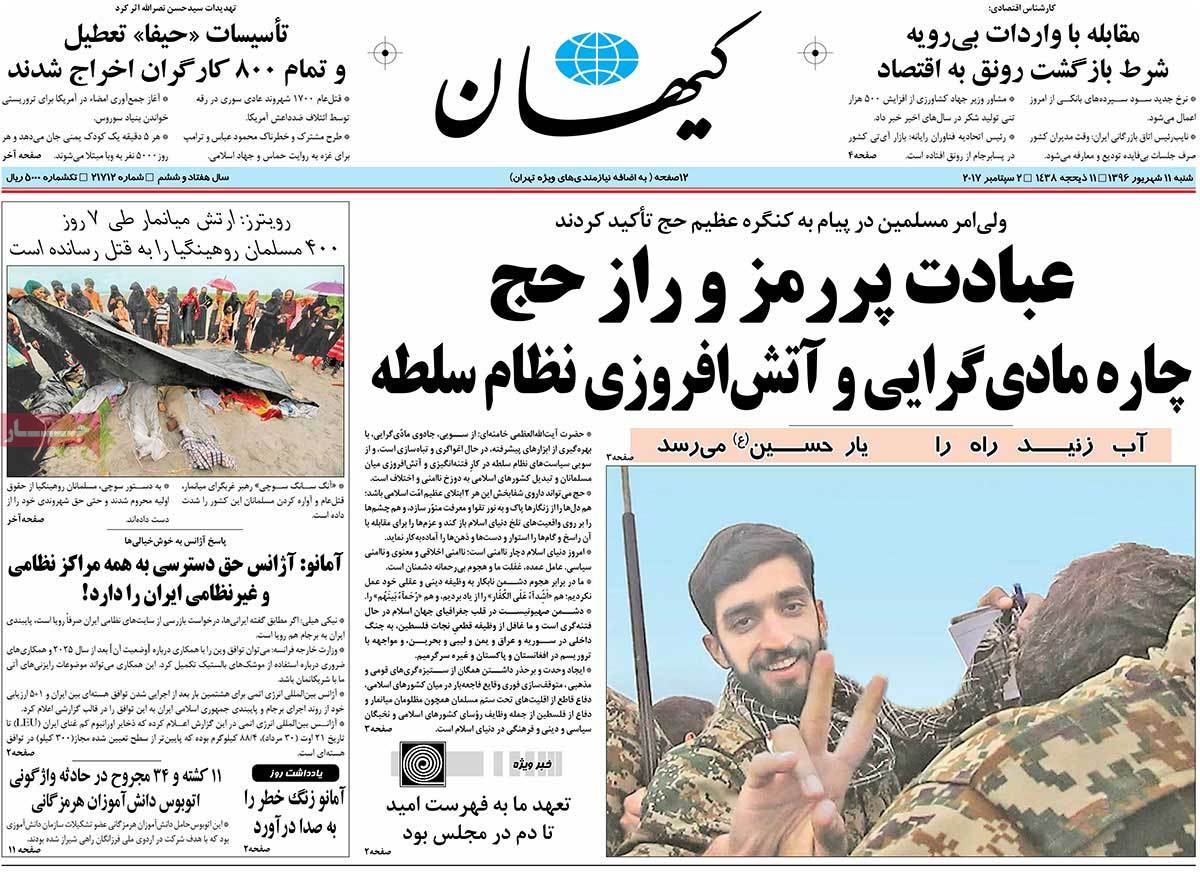
Kayhan:

1- Iran Leader: Hajj Pilgrimage Solution to Global Hegemony’s Materialism, Warmongering

A Look at Iranian Newspaper Front Pages on September 2 - kayhan


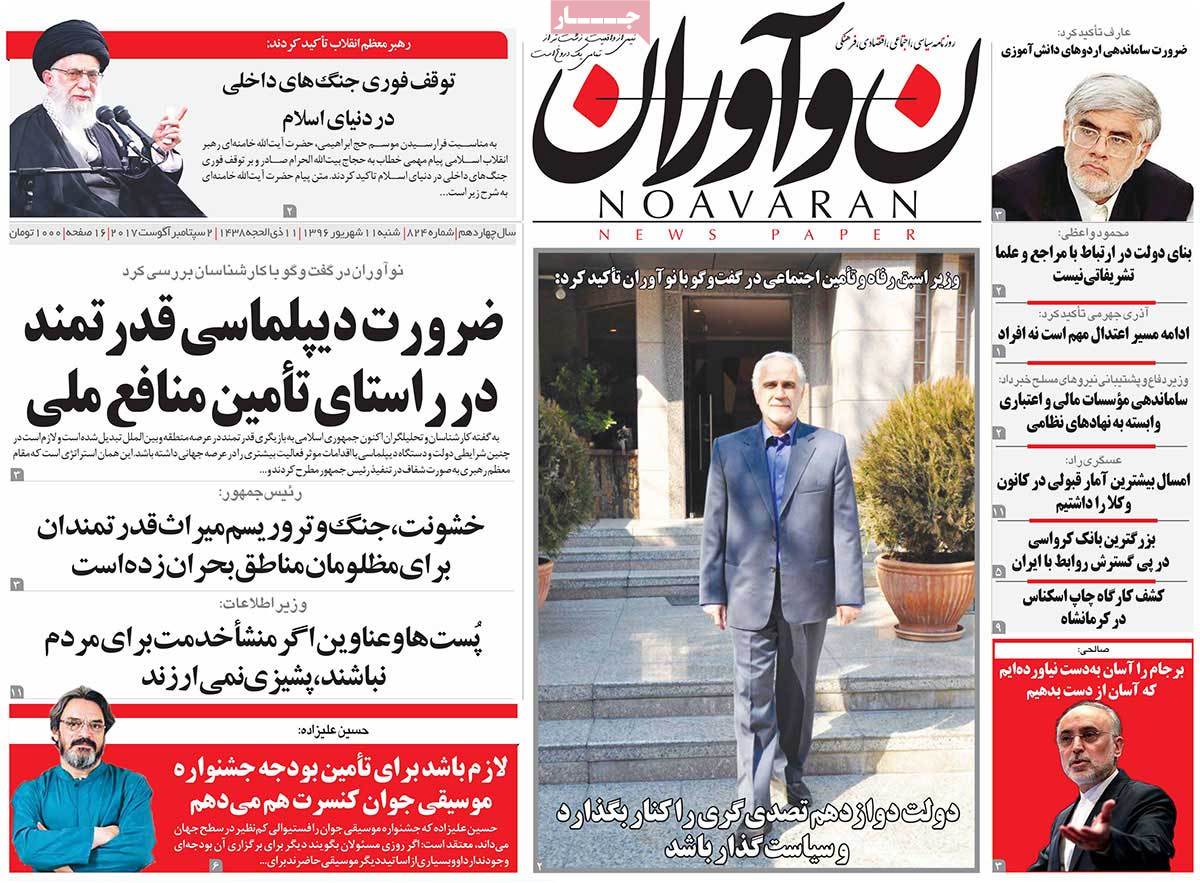
Noavaran:

1- Nuclear Chief: Iran Not to Give Up on JCPOA Easily as It’s Not Achieved Easily

2- Rouhani: Violence, War, Terrorism Legacy of World Powers for People in Crisis-Hit Areas

A Look at Iranian Newspaper Front Pages on September 2 - noavaran


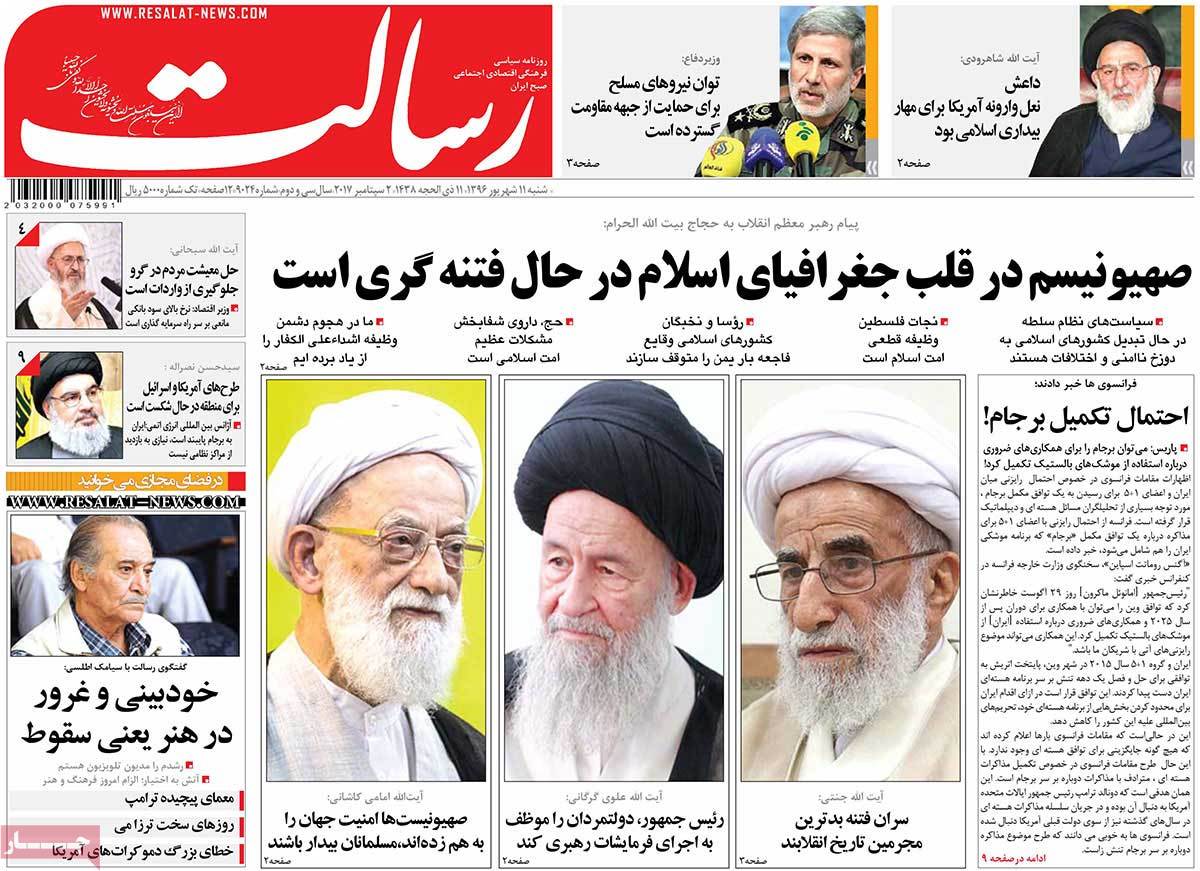
Resalat:

1- Iran’s Armed Forces Have Great Power to Support Resistance Front: DM

2- Iran Leader: Zionism Creating Sedition in Heart off Islamic Geography

A Look at Iranian Newspaper Front Pages on September 2 - resalat


Iran Offers Sympathy to Flood-Hit People of India, Nepal, Pakistan

In his Friday message, Foreign Ministry Spokesman Bahram Qassemi expressed regret at the flooding in parts of South Asia, particularly in India, Nepal, and Pakistan, and sympathized with their nations and governments as well as the bereaved families of the victims.

More than 1,200 people are feared to have died and 40 million are estimated to have been affected by flooding in India, Nepal and Bangladesh.

Vast swaths of land are underwater in the eastern part of the Indian state of Uttar Pradesh, where more than 100 people have reportedly died, 3,097 villages are submerged and almost 3 million villagers have been affected by flooding, according to officials. Army personnel have joined rescuers to evacuate people from the area.

The storm reached Pakistan on Thursday, lashing the port city of Karachi, where at least 14 people have died, and streets have been submerged by water. The country’s meteorological department forecast that the rains would continue for three days in various parts of Sindh province, where authorities closed schools as a precaution.

Qatar’s Emir Praises Iran’s Help amid ‘Cruel Sanctions’

In a telephone conversation with Iranian President Hassan Rouhani on Thursday evening, Qatari Emir Sheikh Tamim bin Hamad Al Thani hailed Iran’s “principled stances” in backing his country in the face of sanctions.

He also congratulated the Iranian government and nation on the Muslim festival of Eid al-Adha, voicing Doha’s willingness for closer relations with Tehran in various fields.

The prospect of political, economic and cultural ties between Iran and Qatar is bright and promising, the Qatari emir noted, saying his country is ready to seize the “historical opportunity” to broaden relations with Iran.

For his part, President Rouhani reaffirmed Iran’s commitment to working with and supporting the Qatari government and nation and to contributing to regional stability, and deplored the “unfair” sanctions that some of the Persian Gulf states have imposed on Qatar.

The Iranian president also stressed the need for closer cooperation between Tehran and Doha and negotiations on the regional issues in order to serve their mutual interests.

President Rouhani finally expressed Iran’s support for strong “brotherly ties” among all Muslim nations in the region.

Earlier in the day, in a congratulatory message to Muslim leaders on Eid al-Adha, the Iranian president called on the Islamic countries to make efforts for restoring peace and security to crisis-hit countries and expressed the hope that Muslims would show “the beautiful face” of their religion to the world.

Iran Hails IAEA’s Impartiality in Nuclear Deal Report

In a statement released on Thursday, Iran’s IAEA Ambassador Reza Najafi said that the UN nuclear watchdog has continued to verify the implementation of the JCPOA under the Safeguards standards and in a professional and impartial manner.

His comments came after the most recent quarterly report by the IAEA confirmed once again that Iran has been honoring its commitments under the JCPOA, a nuclear agreement between Tehran and the Group 5+1 (Russia, China, the US, Britain, France and Germany).

Najafi also expressed delight that the political rhetoric by the US officials, the propaganda campaign by the US media outlets and even a recent trip to Vienna by the US envoy to the UN have not had any impact on the IAEA’s activities, its verification work or its reports on Iran.

“Iran and all the (UN nuclear) agency’s member states expect the agency’s secretariat to keep working professionally and neutrally,” the envoy added.

According to the latest IAEA report, Iran is honoring the terms of the JCPOA by keeping its uranium stockpile and production capacity below set thresholds.

Details of the report are likely to be made public at the next IAEA Board of Governors meeting on September 11-15.

The most recent quarterly report came as a surprise to the US administration which has signaled willingness to declare Iran in breach of the deal.

US President Donald Trump had said in August he did not consider Iran in compliance and dispatched his UN envoy to Vienna to convey his concerns.

However, the IAEA officials said they would not help the Trump administration make a false case for abandoning the agreement.

“If they want to bring down the deal, they will,” an IAEA official told Reuters. “We just don’t want to give them an excuse to.”

Iran’s North Khorasan, Land of Tribal Treasures

After Iran’s Khorasan Province was divided into three smaller provinces, North Khorasan became one of the new provinces of Iran in spring of 2004. The people of this northeastern province with Bojnord city as the centre live in nature in spite of the deprivation and drought. They make their living with their own efforts while calling for blessing from the heaven and earth.

North Khorasan is among the provinces that are called “The Land of Treasures of Tribes”. Families living in North Khorasan include Farsi-speaking tribes, Tat-speaking ethnic groups, Kurmanji Kurds, Turkmens, Turks and Lurs.

Common Languages are Persian, Tat, Kurmanji Kurdish, Turkmen and Khorasani Turkish. In general, Kurmanji Kurds are the majority of the province’s population.

The following photo collection by the Mehr News Agency tries to give a picture of the province’s people:

‘Riyadh Fails to Intimidate Doha into Downgrading Ties with Tehran’

Nearly three months have passed since a crisis emerged among members of the [Persian] Gulf Cooperation Council (GCC). During this time, Qatar has suffered an unprecedented political and economic blockade, but has survived. In the meantime, Iran and Turkey have edged closer to Qatar, and Doha has managed to stay alive through artificial respiration thanks to popular support for the government as well as the trade ties it has established with Tehran and Ankara. Unlike what Saudi Arabia and some of its Arab allies in the region have expected, Doha has not succumbed to Riyadh’s demands. Qatar has not only refused to reduce the level of its relations with Iran, but returned its ambassador to Tehran last week.

Mehran Kamrava, the director of the Centre for International and Regional Studies at Georgetown University’s School of Foreign Service in Qatar, believes Qatar’s restoration of its ambassador to Tehran does not necessarily suggest the amelioration of Tehran-Doha relations in the long run. At the same time, he believes Doha is using the trump cards it has to counter the Saudi-imposed blockade.

Excerpts of Kamrava’s interview with the Persian-language Etemad daily newspaper follow.

[Asked on the Qatari ambassador’s return to Iran, Kamrava said] A few points should be taken into consideration in this regard. First of all, in the first phase, Qatar recalled its ambassador from Tehran as the country had close relations with Saudi Arabia and wanted to sympathize with Riyadh over the attack on the Saudi embassy in Tehran. But now, Qatar is having issues with Saudi Arabia. So, the key reason behind Doha’s recalling its ambassador from Tehran, i.e., showing support for Riyadh, no longer exists.

The second point which could have contributed to Qatar’s decision to send its ambassador back to Iran is that, in recent days, there has been talk of meetings between Iranian and Saudi diplomats. Under such circumstances, Doha believes that if Iranian and Saudi diplomats are supposed to hold talks, there is no reason for Qatar to maintain its previously low level of ties with Tehran.

The third point is that the move by Doha sends a signal to Riyadh that it should take Qatar more seriously. In this scenario, the Qataris are sending the message to Saudi Arabia that they can improve their relations with Iran. At the moment, Tehran and Doha only have trade relations. However, with the normalization of ties and the Qatari ambassador to Tehran beginning work, Doha shows to Saudi Arabia that it can establish diplomatic and political relations with Iran in addition to trade ties.

Saudi Arabia and the United Arab Emirates (UAE) first believed that the measure they had adopted against Qatar would bear fruit in one or two weeks and Doha would give in to their demands. However, the scenario which began more than two months ago continues to unfold, and Qatar is not showing the reaction desired by Saudi Arabia and the UAE. Qatar is even adopting measures which are against Saudi Arabia and its allies. Doha has even taken steps such as working towards further promotion of Tehran-Ankara ties. Therefore, with every step it takes, Qatar seeks to find more and more ways to tackle the crisis it is currently grappling with. The UAE’s negative reaction is natural. At the moment, the United Arab Emirates is trying hard to depict Qatar as a colony of Iran, and as a result, Abu Dhabi is using Doha’s decision to return its ambassador to Tehran as a pretext to suggest Doha is leaning toward Tehran.

[Asked why Iran has become so important for Qatar at this juncture, and whether or not Tehran-Doha relations will further expand in the long run, Kamrava said] This is a very important question for which there is no definitive answer at this point in time. The current developments cannot show whether or not Tehran-Doha ties will improve in the long run. Qatari politicians have seen for themselves that they cannot trust their Arab neighbours. Rather, they have realized it is Iran and Turkey that they can trust. Qatar saw in practice that it was Tehran and Ankara that rushed to Doha’s aid in times of danger and need. It is not unlikely that the situation will continue to remain the same in the long term. Still, no definite answer can be given to that question.

Iran and Qatar have always had cordial, but not deep relations. Iran has tried over the past years to further deepen its ties with Qatar. However, Qatar has been extremely skeptical about Iran over the past one or two decades. For instance, Qatar did not renew residence permits for the Iranians expats who were living in Qatar for several decades, or did not extend visas for many of them. Many Iranian restaurants in Doha face numerous problems in bringing more waiters from Iran. Iranian businessmen in Qatar have problems, too. Of course, a few of the obstacles have been removed over the past couple of months. Still, Doha, for example, allowed the nationals of eighty countries to stay in Qatar without visas, but Iran was not among those countries. Although Iran and Qatar have good relations at this juncture and both countries are exchanging ambassadors, sending ambassadors per se does not necessarily indicate that the two countries are deepening their relations in the long run. It is military, commercial and cultural cooperation that brings two countries closer together in the long term, and this does not happen simply by opening embassies and exchanging ambassadors.

[Asked what impact the amelioration of Iran-Qatar relations will have on regional equations and the current trends in the region, he said] There are two possibilities ahead of us. One possibility is that the GCC will return to is previous state, i.e. will turn into an anti-Iran front and a US ally again. It may not be controlled by the hegemony, but will be controlled by Saudi Arabia and others.

The second possibility is to continue the same path whereby Qatar’s confidence in Saudi Arabia and others will shatter, and no new trust will take shape in the foreseeable future. Under such circumstances, a kind of bipolarity will emerge in the Middle East. On the one side stand supporters of Saudi Arabia, the UAE, Bahrain and Egypt. On the other side stand a group of countries comprising Turkey, Iran, Qatar and maybe Syria. I don’t think this duality will take shape in practice, but what is noteworthy is that relations have been overhauled. Iran and Turkey have got much closer together, which is due to domestic developments in Syria. Iran, Turkey and Qatar have also got closer because of the latest developments. Based on the recent events, we will witness happenings in the future, but it is not clear what they will be. There is also a possibility that Iran, Turkey and Qatar will form a group based on economic-trade cooperation, or as I said earlier, the GCC may return to its previous anti-Iran state.

A question mark exists is the United States. At the moment, the US is a missing piece of a puzzle. Over the past month, US President Donald Trump has remained silent vis-à-vis the crisis between Qatar and some Arab countries, including Saudi Arabia. At the same time, the US State Department has shown no capability to mediate. We should wait and see what position Washington will adopt in this regard. It may continue the current trend without taking any new stance.

As you know, the White House has its own political problems inside the United States. For example, if the US opts to get tough on Saudi Arabia and the UAE or somehow pressure them, certain analyses can be a driving force behind new developments, analyses such as “Iran is taking advantage of the current crisis among GCC member states, or Iran is gaining more power due to the crisis within the GCC.”

Another scenario would be for Qatar to enter into talks with Iran and Turkey. Under such talks, Doha should be able to take items such as heavy machinery and auto spare parts through Europe to Turkey and then to Iran before importing them via the Persian Gulf into Qatar. This scenario is under discussion at the moment.

A group of Qataris travelled to Iran last week and kicked off negotiations in this regard and on some other issues. Of course, the talks may take months, so that Iran and Turkey can put the process back on track. It is important for Qatar to find a way to circumvent the sanctions imposed on its neighbouring countries. At the moment, the costs of each trade transaction in Qatar have risen by 15 to 20 percent. The Qatari government is trying to roll back that increase one way or another. If it can bring down the costs in the next three or four months and ease pressure on the private sector, prices will fall.

Another point is that there are no rifts within the Qatari government that Saudi Arabia can cash in on. An interesting event that has taken place in the last two months is that we have witnessed nationalistic and patriotic sentiments among Qatari people. This has been unprecedented over the past decade that I’ve been living in Qatar. Even foreigners who live in Qatar have hung the pictures of the Qatari emir in their homes or cars without having to do so. Unlike in most Mideast countries, we wouldn’t see the pictures of the Qatari emir in public places. But over the past two months, the people have put up the photos of the emir of their own volition.

Saudi Arabia recently released the photo of a meeting between one of the members of the Qatari royal family and Saudi King Salman bin Abdulaziz Al Saud in a bid to undermine Qatar and intimidate the Qatari emir, but to no avail. This shows Saudi Arabia has reached a dead end.

At the moment, Saudi Arabia and its allies have imposed an all-out air, sea and land blockade on Qatar and have no more cards to play. The only remaining option could be a military action, which is not on the agenda at all. Saudi Arabia and its allies first used their trump card, and when they saw it was useless, adopted new measures. For example, in the UAE, the Dubai police chief said on his Twitter page that Qatar has turned into a colony; or the UAE’s state TV reports that protest rallies have been held in Qatar and Turkish forces have cracked down on people; these are all ridiculous and farcical. Despite all these baseless reports, nationalistic and patriotic sentiments among Qatari people are running high.

With no cards left in its hands, Saudi Arabia now seeks to provoke Qatar in different ways. For instance, a Qatari sheikh who has a lot of land and property in Saudi Arabia was told to go and meet King Salman if he wanted to have his property. Then the Qatari sheikh was taken to Morocco to meet King Salman. Photos were taken of the meeting to somehow threaten the Qatari government. The Qatari sheikh has now fled to London and has sent a message to the Qatari emir saying he did not allow the Saudis to take advantage of him. The biggest problem that Qatar has at the moment is the transfer of machinery into the country. It has no other economic and trade problems. Of course, machinery is being imported into Qatar, but at exorbitant prices. If Qatar can import machinery via Turkey and then Iran, the problem will be solved.

 

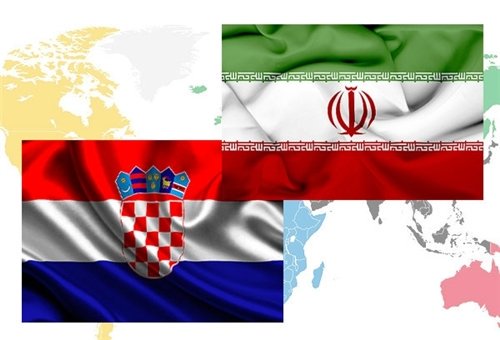
Croatia’s Largest Bank Keen on Expanding Relations with Iran

Tehran, Zagreb Denounce Unilateralism amid COVID-19 Outbreak

The governor of the Croatian National Bank, Boris Vujčić, has said following months-long talks between his institute and other banks of the East European state, Croatia’s biggest financial institution has shown interest in deepening and expanding ties with Iran.

According to a Farsi report by the Asr-e Iran news website, speaking in a meeting with the Governor of Iran’s Central Bank Valiollah Seif, on August 30, he added these talks, which have produced favourable results, were focused on expanding cooperation between Iran and Croatia in the field of payment systems.

Croatia’s Largest Bank Keen on Expanding Relations with IranAddressing the same meeting in Tehran, Seif said political relations between the two countries are developed at an acceptable level.

He called on both countries to foster their mutual banking collaborations.

Seif said the structure of Croatia’s banking sector is coherent and logical, and Iran is thus interested in establishing close relations with their banks.

He expressed the hope that improved relations between Iranian and Croatian banks would lead to an increase in the level of the two countries’ economic and trade ties.

The CBI chief stressed that banking relations are a prerequisite to improved economic ties between two states.

He hoped that the meeting with his Croatian counterpart would prepare the ground for improved relations between the two countries.

Given the present condition of Europe’s economy, Saif said, some banks may be interested in carrying out joint activities and fostering cooperation with their foreign counterparts.

He added such collaborations can be in the form of making joint investments and opening branches as well as representative offices in one another’s countries.

Seif said Iran welcomes enhancement of cooperation with Croatia.

Currently, he added, both sides possess enough capacity to improve their cooperation.

“Therefore, I hope that the next trip by Iranian traders to Croatia, to be led by the head of Iran’s Chamber of Commerce, Industries, Mines and Agriculture, would lead to a significant improvement in trade and economic relations between the two countries.”

He urged the two sides to encourage their banks to establish close connection with each other and promote their mutual cooperation to prepare the ground for their managers and bankers to increase their knowledge of their counterparts in the other country.

Several Schoolgirls Killed in Tragic Bus Crash Southern Iran

The bus was carrying 45 mostly junior high school students from Bandar Abbas to the city of Shiraz in Fars Province, according to Nader Rahmani, a senior traffic police official.

Hassan Nouri, an emergency official, told ISNA that seven schoolgirls, a female instructor, and a male assistant driver have lost their lives so far.

Several Schoolgirls Killed in Tragic Bus Crash Southern Iran34 wounded girls were transferred to a hospital in Darab, and five others were taken to Shiraz hospital with a chopper, he added.
Nouri said two of those injured have lost one of their organs. Four others also sustained spinal cord injuries.

Five others are under surgery, he added.

The girls were planning to attend a national conference of talented students in the city of Shiraz.

According to officials, initial investigations indicate the crash was caused by the exhaustion and sleepiness of the bus driver, who is now under arrest.

Several Schoolgirls Killed in Tragic Bus Crash Southern IranA few hours after the crash, Iran’s Education Minister Mohammad Bat’haei, in a post in his Twitter account, offered sympathy to the families of the victims, and said he is en route to Darab to investigate the issue in person.
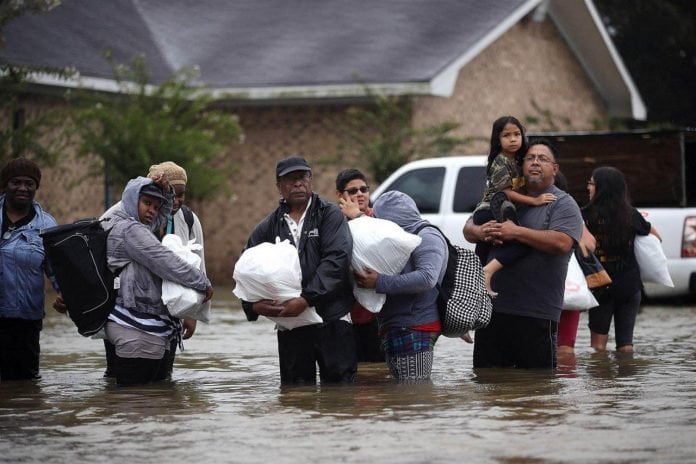

Member of Parliament Fatemeh Saeidi also urged the Education Ministry to devise regulations for student trips as soon as possible in an effort to prevent such tragic incidents from happening again.

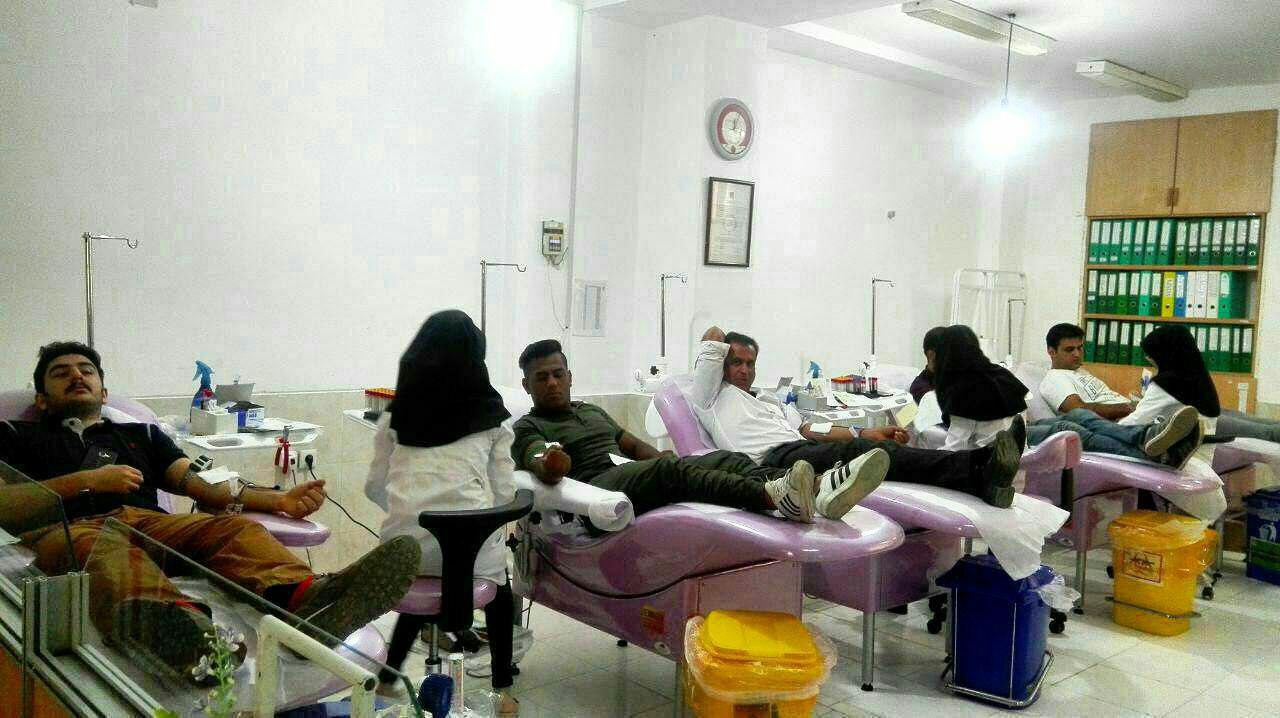
Photos retrieved from news agencies indicate that dozens of people in Darab have queued up to donate their blood for the injured schoolgirls.

Several Schoolgirls Killed in Tragic Bus Crash Southern Iran

Iran Sympathizes with US over Deadly Harvey Storm

In his Thursday message, Foreign Ministry Spokesman Bahram Qassemi expressed sympathy with the crisis-hit people and bereaved families of the victims of Harvey storm.

Hurricane Harvey has so far caused at least 39 (and counting) confirmed deaths; 1 in Guyana, and 38 in the United States. Catastrophic inland flooding is ongoing in the Greater Houston metropolitan area.

Harvey has been described as the worst disaster in Texas history, and the recovery is expected to take many years.

Preliminary estimates of economic losses range from $10 billion to $160 billion, with a large portion of losses sustained by uninsured homeowners.