Sunday, January 18, 2026
Home Blog Page 3822

‘US Slapping Bans on Iran to Make Up for Own Defeats’

The United States has put on its agenda extensive sanctions against Iran’s Islamic Revolution Guards Corps (IRGC) in line with Washington’s bans on the Islamic Republic of Iran. To that end, the US House of Representatives and Senate have, once again, passed a sanctions act aimed at countering “Iran’s destabilizing moves.”

The legislation passed in late July, 2017 imposes sanctions on Iran, Russia and North Korea. Now the development begs the question of whether the US can be trusted as a friendly country and a partner.

To review what objectives Washington pursues by imposing sanctions and what counter-measures Tehran has put on its agenda, the Basirat news website has interviewed Hossein Naqavi Hosseini, an Iranian MP and a member of the parliament’s National Security and Foreign Policy Commission. The full text of the interview follows.


What objectives Washington follows by passing the Countering America’s Adversaries through Sanctions Act, which envisages restrictions on Iran’s missile activities and the isolation of the IRGC in the region?

The victory of the [1979] Islamic Revolution of Iran has jeopardized the United States’ colonial interests in southwest Asia. So, the US government has always pursued Iran’s political isolation and Iranophobia as two of its major schemes in a bid to regain its foothold in the region by undermining Iran’s sources of power. Missile activities and the IRGC constitute sources of Iran’s power. By passing the sanctions, the US has not only violated the Iran nuclear deal, but seeks to undercut the sources of Iran’s power.

The Iran nuclear deal (also called the Joint Comprehensive Plan of Action, the JCPOA for short) is an international agreement between Iran and six world powers. It is not simply a bilateral agreement between Tehran and Washington. Among all signatories to the JCPOA, only one (the US) is not living up to its obligations under the deal. Iran had expected Washington to breach its promises and not to abide by an international agreement. Iran has reached agreement with six countries and has made good on its commitments under the deal. However, since the second day of the implementation of the JCPOA (January 17, 2016), the US imposed sanctions on 11 Iranian natural and legal persons. The move shows Washington wouldn’t like the JCPOA to be implemented and the Iranian nation to benefit from the deal. Ever since, the US has, for 16 times, adopted measures and passed legislation in contravention of the JCPOA, which we presented to the National Security and Foreign Policy Commission in a documented report. The last instance of these violations was legislation passed by the Senate a couple of days ago, blocking the sales of commercial aircraft to Iran. This comes as it is clearly stipulated in the JCPOA that Iran is entitled to purchase passenger planes. So, US statesmen do not want the JCPOA to be implemented. They are seeking pretexts and breaching their commitments.

The International Atomic Energy Agency (IAEA) is the only authority to verify that Iran has delivered on its commitments under the JCPOA, and the agency has so far reiterated in is official statements eight times that Tehran has remained committed to the JCPOA and has fulfilled all its obligations. The IAEA chief has also, time and again, reaffirmed Iran’s compliance with the deal in his speeches. However, the US seeks to create the impression that the agency regards Iran as a violator of the agreement. So, the US ambassador to the UN travelled to the IAEA headquarters and met [IAEA] chief Yukiya Amano in order to persuade him to introduce Iran as a violator of the agreement in the agency’s statements and in his own remarks. The call for inspecting Iran’s military sites and missile activities was in line with the same objective. Washington also resorts to different pretexts in order to neutralize benefits of the JCPOA. Sometimes they say the JCPOA needs addenda, and sometimes say the agreement should include missile activities as well. Sometimes they say the JCPOA needs to be revised. None of these scenarios is acceptable to Iran. We have signed an agreement and act accordingly.

If the new sanctions act is implemented, what will Iran’s reaction be?

The Supreme National Security Council and the parliament’s National Security and Foreign Policy Commission have held several meetings in this regard and reviewed different scenarios. Precisely scheduled operational plans have been envisaged for each of these scenarios, and Iran is definitely prepared to take the necessary action based on the circumstances. The actions taken by the US run counter to international norms. But we should know that sanctions have never been able to impede Iran’s development and progress. Many economic and military experts happen to believe that if Iran’s economic or technological progress is studied, we will see that the peaks of the country’s progress coincided with the time when Iran was under sanctions. It means whenever the sanctions were intensified, Iran’s scientific, economic and military development gained momentum. So, sanctions will definitely not be able to hinder the progress and development of such a nation.

Despite the fact that the IRGC has adopted effective measures in countering Takfiri terrorist groups in the region, why is it that the US calls the IRGC a terrorist entity?

By pressuring the IRGC and calling it a terrorist entity, the US seeks to make up for the frustration and defeats it has suffered in the region. Today, Zionists and Saudis are furious at the situation in the region. They had made a 10-to-15-year investment. They gave financial and military support to a terrorist group called ISIS and trained its members. They spent a lot to help ISIS counter Iran. From the outset, al-Qaeda, the Taliban, ISIS and other terrorist groups in the region aimed to target Iran. This is the reality. Now, the evil triangle comprising the US, Zionism and Saudi Arabia has reached a stalemate, and its plots have been foiled. It is natural that they have got angry. The Americans have bitten the dust in Syria and Iraq. They themselves know that they will soon drown in the quagmire of Bahrain and Yemen. In order to compensate for this frustration and defeat, they are trying to portray the IRGC as a terrorist group. They have also put pressure on the IRGC’s Quds Force in order to soothe their pains a little bit and make up for their defeats in the region.
‘US Supporting Kurdistan Referendum through Israel’

‘US Supporting Kurdistan Referendum through Israel’

The referendum on the Iraqi Kurdistan’s independence, which is planned to be held on September 25 despite global opposition, not only violates Iraq’s constitution but also will further destabilize the region.

While the Iraqi central government, Iraq’s neighbours, the US and many other players have asked the head of Kurdistan Regional Government (KRG) Masoud Barzani to withdraw from his destabilizing decision on holding independence referendum, he insists on his decision and says they will go ahead with it on September 25 despite all these concerns.

The US State Department has stated that it is concerned that the referendum in northern Iraq would distract attentions from “more urgent priorities” such as the defeat of ISIS militants.

There seems to be only one reason for insistence of Erbil on holding the referendum despite all oppositions, and that is “difference between stated and actual policy of the US.”

Such a notion is not farfetched due to its destructive impact on the US relation with Baghdad and its NATO ally, Turkey.

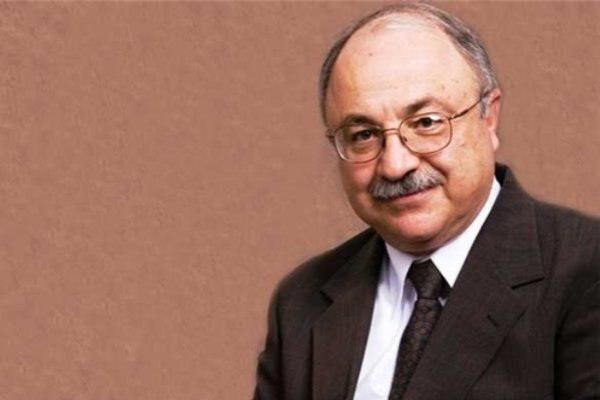
To shed further light on the ongoing developments about the issue, the Tehran Times daily newspaper has reached out to Nader Entessar, a professor and Chair of Department of Political Science and Criminal Justice at the University of South Alabama.

Here is the full text of Tehran Times’ interview with Entessar:

Can we imagine that there is a difference between the US stated policy and its actual policy on the ground?

Yes, I think we should not be surprised if the stated US policy and the actual policy on this issue prove to be incongruent with each other. The US does not have a carefully calibrated policy in the Middle East.  Today, Washington has moods and not well-articulated policies in the Middle East or many other parts of the world.

Despite regional opposition, how far the US will be able to support Arbil? How will the US be able to manage its differences with its regional ally, Turkey on the issue?

The US will not be able to sustain its support for an independent Kurdish state without the support of some of its regional allies, especially Turkey.  However, based on stated Turkish policies, Ankara will oppose the creation of an independent Kurdistan.  Besides, such a move by Washington will require a major redefinition of its relationship with Baghdad.  However, those in favour of creating an Independent Kurdish state count on US support via Israel, the only regional country that has supported the creation of an independent Kurdistan in northern Iraq.

Are there any legal ways to stop Arbil from its destabilizing decision on holding the independence referendum?

There are two major legal problems with holding the referendum as proposed by the KRG.  First, the opponents of the referendum, including Barzani’s Kurdish rivals, have stated that since Masoud Barzani’s term as the president of Iraqi Kurdistan expired two years ago, he does not have the legal authority to decide on holding a referendum on the future of Kurdistan.  Second, constitutionally speaking, the decision to hold a referendum in Iraq’s Kurdish autonomous region must be approved by the Kurdistan Regional Parliament.  However, this body has not fully convened since October 2015, and no Kurdish parliament is functioning today.  Therefore, the Kurdish Regional Parliament cannot legally approve the holding of a referendum as proposed by Mr. Barzani.  However, these two legal obstacles have not prevented Barzani and the Kurdish Regional Government from going forward with the scheduled referendum on Kurdish independence.

Mogherini Reiterates EU’s Support for Iran Nuclear Deal

Mogherini Reiterates EU’s Support for Iran Nuclear Deal

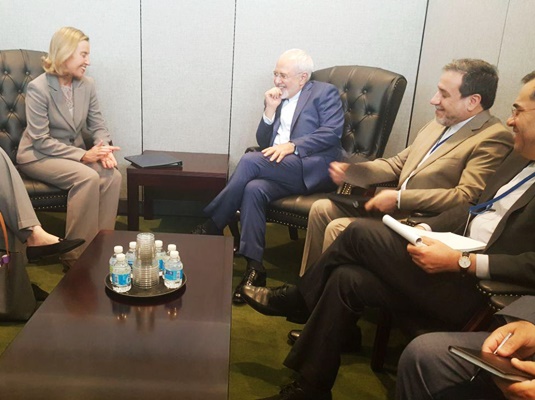
In their Wednesday talks held on the sidelines of the United Nations General Assembly, Zarif and Mogherini conferred on the latest developments regarding the implementation of the nuclear deal.

During the meeting, Mogherini once again underlined the EU’s support for and commitment to the deal, known as Joint Comprehensive Plan of Action (JCPOA).

The meeting came as the foreign ministers of Iran and the P5+1 (Russia, China, the US, Britain, France, and Germany) are due to hold a meeting in New York on the nuclear deal and its implementation.

This could be the first meeting between Zarif and his American counterpart Rex Tillerson.

Iran Has Long Way to Go to Become Top Tourist Destination

Iran Has Long Way to Go to Become Top Tourist Destination

Tourists bring the countries they visit extra revenues and foreign currencies, and this is the most important benefit of tourism for the host state.

Such revenue can be particularly significant for a country like Iran, which is heavily dependent on its oil and gas incomes.

According to a Farsi report by Pool News, Iranian Deputy Minister for Industries, Mines and Trade, Mojtaba Khosrowtaj, recently announced in a TV program that based on 2014 statistics, Iran ranked among the top 10 countries of the world in terms of tourist attractions, but in terms of attracting tourists the country is ranked 40th among 184 countries.

The growth of attracting tourists, however, has witnessed a rising trend in Rouhani’s first term, according to the government’s website.

Based on the figures released by the administration, by the end of March 2017, more than 6 million people visited Iran, which is three times more than 5 years ago.

Interestingly, there has been a steady increase in attraction of tourists to Iran, which, of course, has been slower in the period between 2010 and 2011. This slow pace, however, can be attributed to the start of cruel sanctions against the Islamic Republic.

Disregard of Myanmar Crisis to Foment Extremism: Iran President

Disregard of Myanmar Crisis to Foment Extremism: Iran President

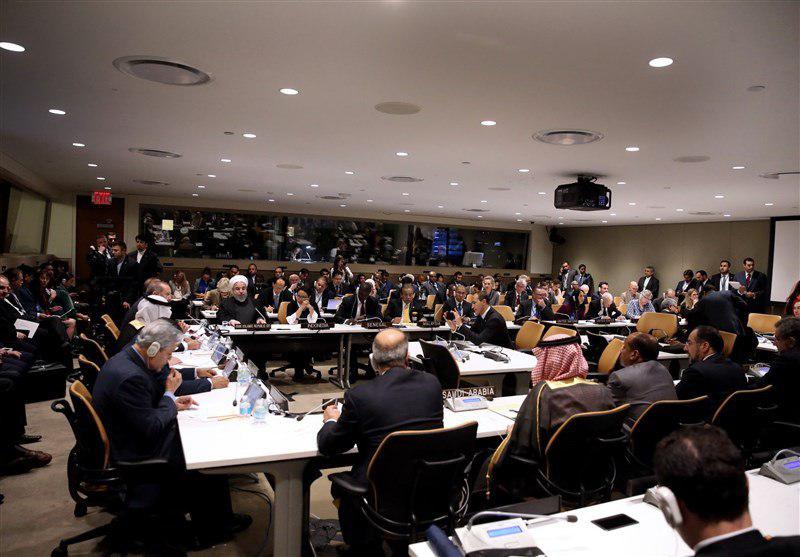
Addressing the Organization of Islamic Cooperation (OIC) Contact Group on Myanmar, held at the UN Headquarters in New York on Tuesday evening, Iranian President Hassan Rouhani called on the government of Myanmar to end violence against the Rohingya Muslims.

“Should the extensive violation of the basic human rights of the Rohingya Muslims be left unattended, it would further encourage extremism and even become a destabilizing factor for the entire region,” he warned.

The following is the full text of President Rouhani’s address to the OIC Contact Group on Myanmar:

In the Name of Allah, the Most Beneficent, the Most Merciful

Your Excellencies;

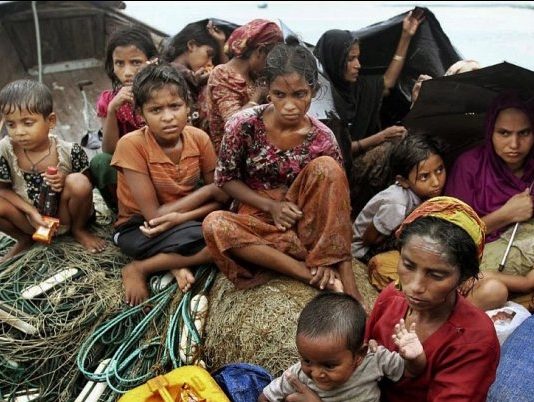
The plight of the Rohingya Muslims in Myanmar has shaken the conscience of humanity. The disturbing reports on mass killings, rape, razed homes and the tragic images of defenceless civilians and innocent women and children living in and at the mercy of the elements, are reminiscent of the worst human atrocities. The indiscriminate and systematic attacks against Muslims by extremist elements and some associated with government security forces of Myanmar have resulted in significant loss of life and exacerbated a history of discrimination and desperation. The gravity of the situation has caused serious anguish among the peoples of the world, regardless of their faith and nationality.

Should the extensive violation of the basic human rights of the Rohingya Muslims be left unattended, it would further encourage extremism and even become a destabilizing factor for the entire region. I call for a meaningful response to the dreadful situation of the Muslim community in Myanmar by the United Nations and OIC. The future of hundreds of thousands of peoples cannot simply hang in balance and remain at the mercy of extremists. The situation in Myanmar underscores the fact that extremism has always served as the breeding grounds for the worst human atrocities.

Disregard of Myanmar Crisis to Foment Extremism: Iran PresidentThe government of Myanmar should understand that forcing people out of their homeland and displacing them in other countries do not resolve this deep-rooted crisis. They need to address the long-standing grievances and the plight of its Muslim community including through effective restoration of their citizenship right.

The international community and in particular the OIC should take all available measures to make the government of Myanmar put an immediate end to the violence against the Rohingya Muslim community and bring those responsible for the atrocities to justice. We also need to ensure humanitarian assistance to the peoples in need.

Meanwhile, it is expected that the OIC use its leverage to further shed light on the situation in Myanmar and actively engage in campaigns for mobilization of humanitarian assistance and finding a sustainable solution to the crisis. The OIC has a clear responsibility to support the Rohingya Muslim population, who are in the most vulnerable situation.

The Islamic Republic of Iran stands ready to provide its assistance and willing to support all such efforts towards the achievement of a durable and peaceful solution to the crisis, ensuring full respect for the human rights, dignity and security of the Muslim Community in Myanmar.

Thank you.

Britain Inks €500m Deal to Build Solar Farm in Central Iran

Britain Inks €500m Deal to Build Solar Farm in Central Iran

The work located in central Iran is expected to take three years, with the project coming online in 100 MW phases every six months, Quercus said of its first project outside Europe.

“As Iran opens for business, we are delighted to be taking a leading role in building the country’s renewable energy infrastructure at such an early stage of its development,” Quercus CEO Diego Biasi said.

The company will be responsible for the construction, development and operation of the plant, for which it will set up a specialist team based in Dubai and Tehran to help deliver the project, including a head of engineering, financial controller, project coordinator, planning manager and procurement staff.

According to Biasi, the project by Iran’s Ministry of Energy has attracted enough interest from private and institutional investors, including sovereign funds.

“This is a project of national interest, so we got special support. We had enough investors interested so instead of splitting that across smaller projects which wouldn’t have given us the same relationship with the Ministry, we decided to go for one,” Reuters quoted him as saying.

Britain Inks €500m Deal to Build Solar Farm in Central Iran
Chief Executive of Quercus Investment Partners Diego Biasi

Under the contract, foreign investors will be treated the same as local ones, with a guarantee that the electricity would be paid for.

Quercus prides itself on a portfolio of around 40 renewable energy plants across Europe. Biasi hoped that its first inroads into Iran would lead to more solar projects.

Iran currently has 63 MW of installed solar capacity, chiefly in the cities of Yazd, Kerman, Isfahan and Hamadan. This figure is meager for a country with over 300 sunny days and an average of 2,800 hours of sunshine.

There is an ambitious plan to expand the renewable capacity in the face of an acute air pollution problem in major cities and towns. Iran’s overall power capacity stands at 77,000 megawatts, which is mostly generated in thermal power plants using fossil fuel.

Before Quercus’s announcement on Wednesday, contracts for about 950 MW of renewable energy projects had been signed.

They are part of the plan to add 1000 MW of renewable energy to the national grid each year in the next five years but the ultimate goal is to establish a 26,000 MW renewable capacity with $60 billion of investment.

Britain Inks €500m Deal to Build Solar Farm in Central Iran

Energy producers from Germany, Italy, India, South Korea, Japan, Spain, China, and Switzerland have already visited the country to test the waters for possible investment.

On Friday, Norway’s Scatec Solar was reported to be in talks to generate 120 megawatts of solar power in Iran, which would rise to 500 MW later.

The Oslo-listed firm’s CEO Raymond Carlsen told Reuters that the initial project under discussion would cost $120 million per 100 MW installed.

Iran’s largest solar project is reserved for Qazvin, where the Italians are to set up 1,000 MW of solar capacity with $1.5 billion of investment.

It includes constructing an array of 100 photovoltaic solar power stations over 10 years, each with a nominal capacity of 10 MW.

No One Will Trust US If Trump Exits Iran Nuclear Deal: Rouhani

No One Will Trust US If Trump Exits Iran Nuclear Deal: Rouhani

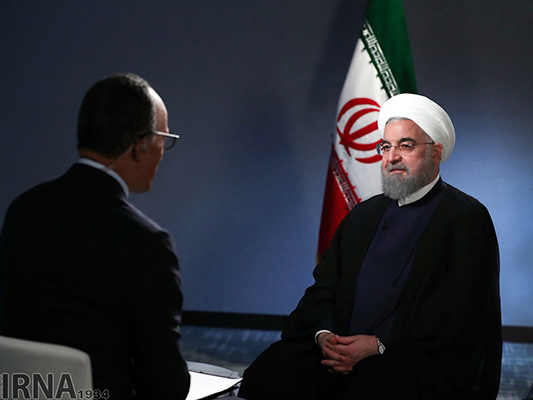
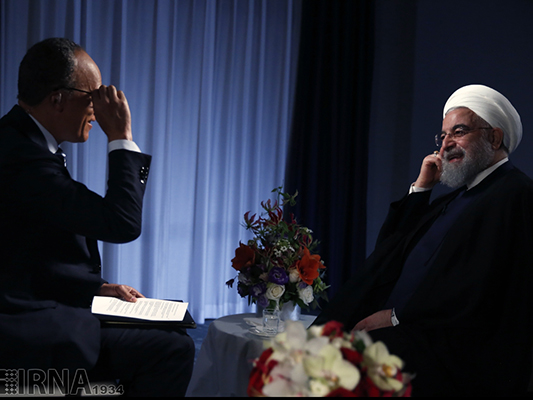
“The exiting of the United States from such an agreement would carry a high cost, meaning that subsequent to such an action by the United States of America, no one will trust America again,” Rouhani told NBC News on Tuesday.

He raised the possibility just before Trump called Tehran a “murderous regime” and the nuclear deal “an embarrassment to the United States” in his address to the United Nations General Assembly.

No One Will Trust US If Trump Exits Iran Nuclear Deal: RouhaniRouhani went on to say, “Every word was analyzed many times by countries involved before its ratification, so if the United States were to not adhere to the commitments and trample upon this agreement, this will mean that it will carry with it the lack of subsequent trust from countries towards the United States because the greatest capital that any country has is trust and credibility.”
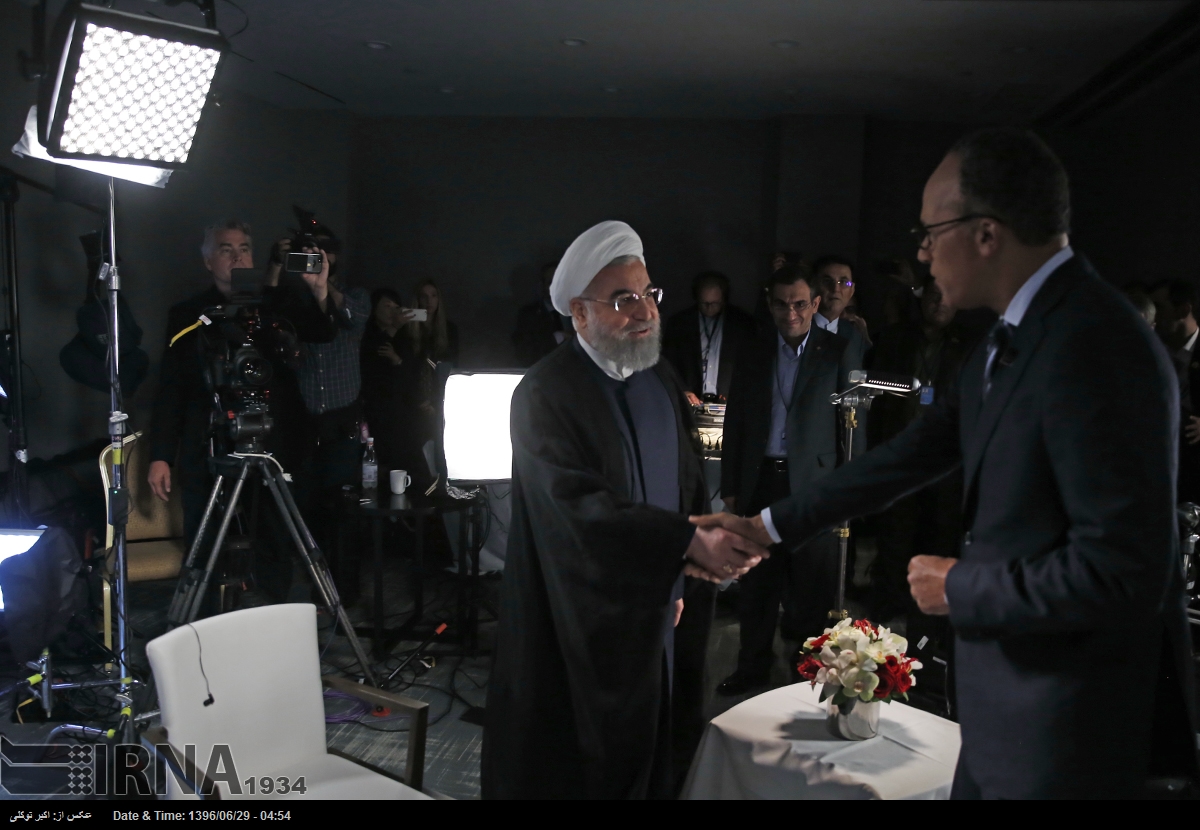
Asked if Iran would continue to abide by the deal if the United State withdrew, Rouhani said his country’s commitments “would no longer exist” and it would be free to pursue a new path.

“One of the options and choices were one of our counterparts not to remain in the current framework would be to go back to previous activities,” Rouhani said.

“This is one option. And that’s not difficult. We can easily go back to previous conditions if counterparts were to not live up to their commitments. But you do know fairly well that Iran will not be the initiator of this return to that path.”

But he stressed that Iran would resume “peace activities only,” saying the country had no intention of leaving the agreement.

“So we will never go towards production of nuclear weapons, just as in the past we never intended to go towards that path nor did we ever. It has always been peaceful.”

Rouhani defended Iran’s use of ballistic missiles, saying that it fell outside the nuclear agreement and that his country would never sacrifice its “defensive missile capabilities.”

No One Will Trust US If Trump Exits Iran Nuclear Deal: Rouhani 1He also complained that the Trump administration was lumping Iran in with North Korea by describing both countries as nuclear threats.

“We wish to have nuclear energy for peaceful uses just as today, in Arak, there is collaboration between America, China and Iran for the completion of the power plant in Arak,” Rouhani said of the industrial city where his country has been modifying a reactor pursuant to the nuclear agreement.

Rouhani also referred to Iran’s detention of Baquer and Siamak Namazi, who have joint American and Iranian citizenship and were convicted of “collaborating with an enemy state.”

The Iranian president said Tehran does not recognize dual citizenship, and so the courts see the Namazis as Iranians only. He also said the government’s separation of powers prevented him from influencing a decision by the judiciary.

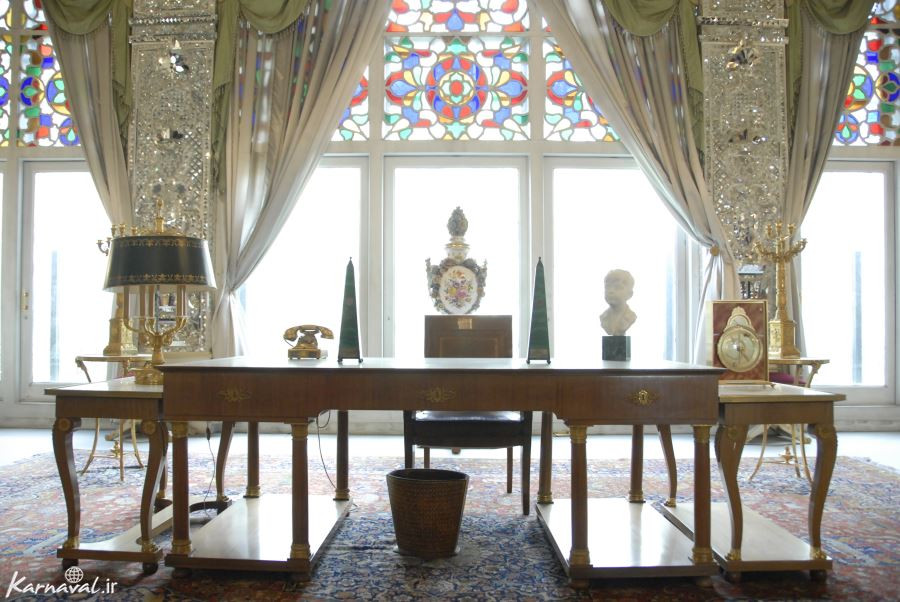
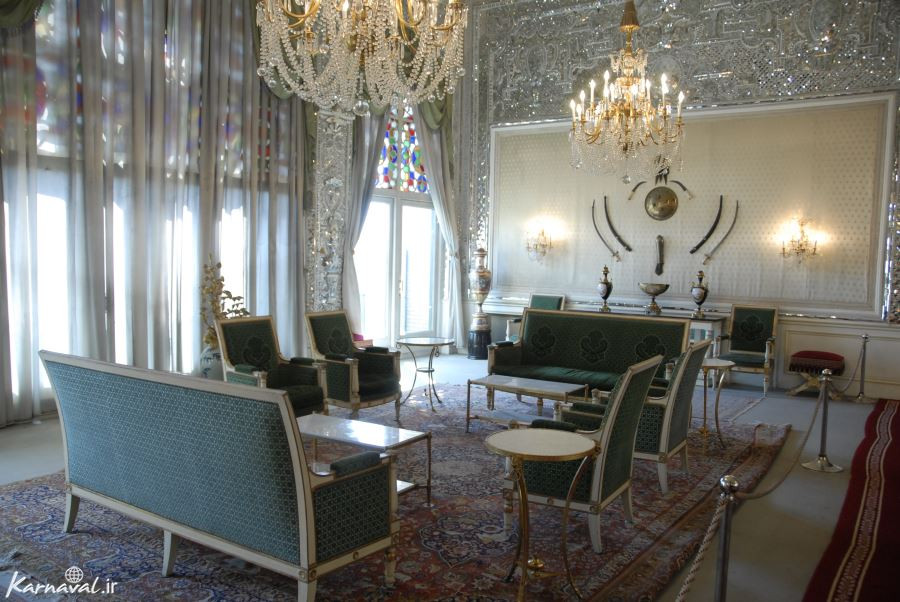
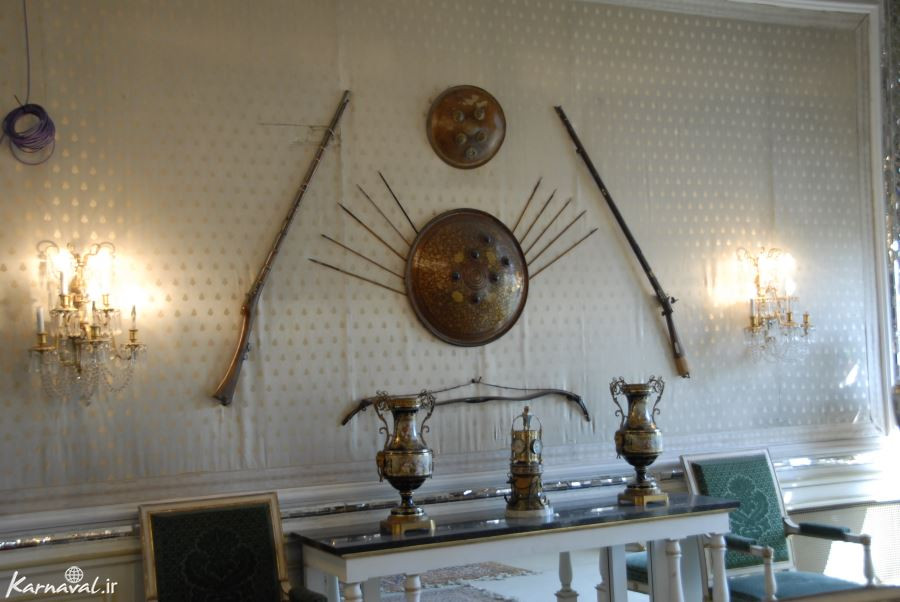
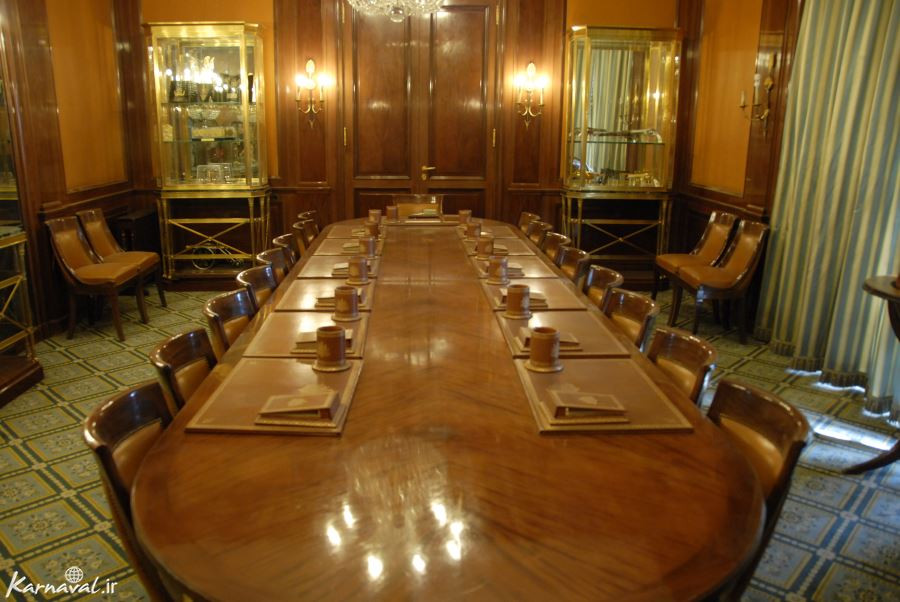
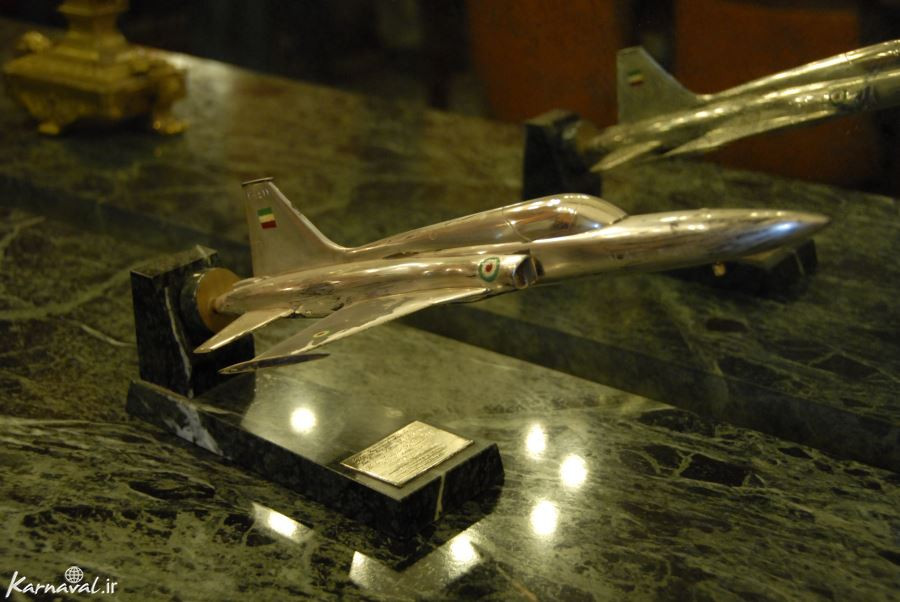
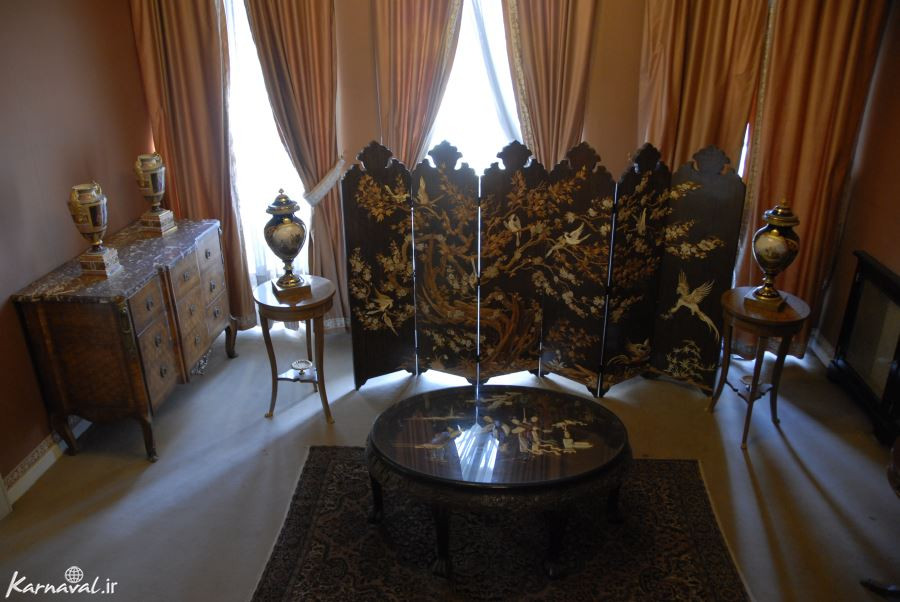
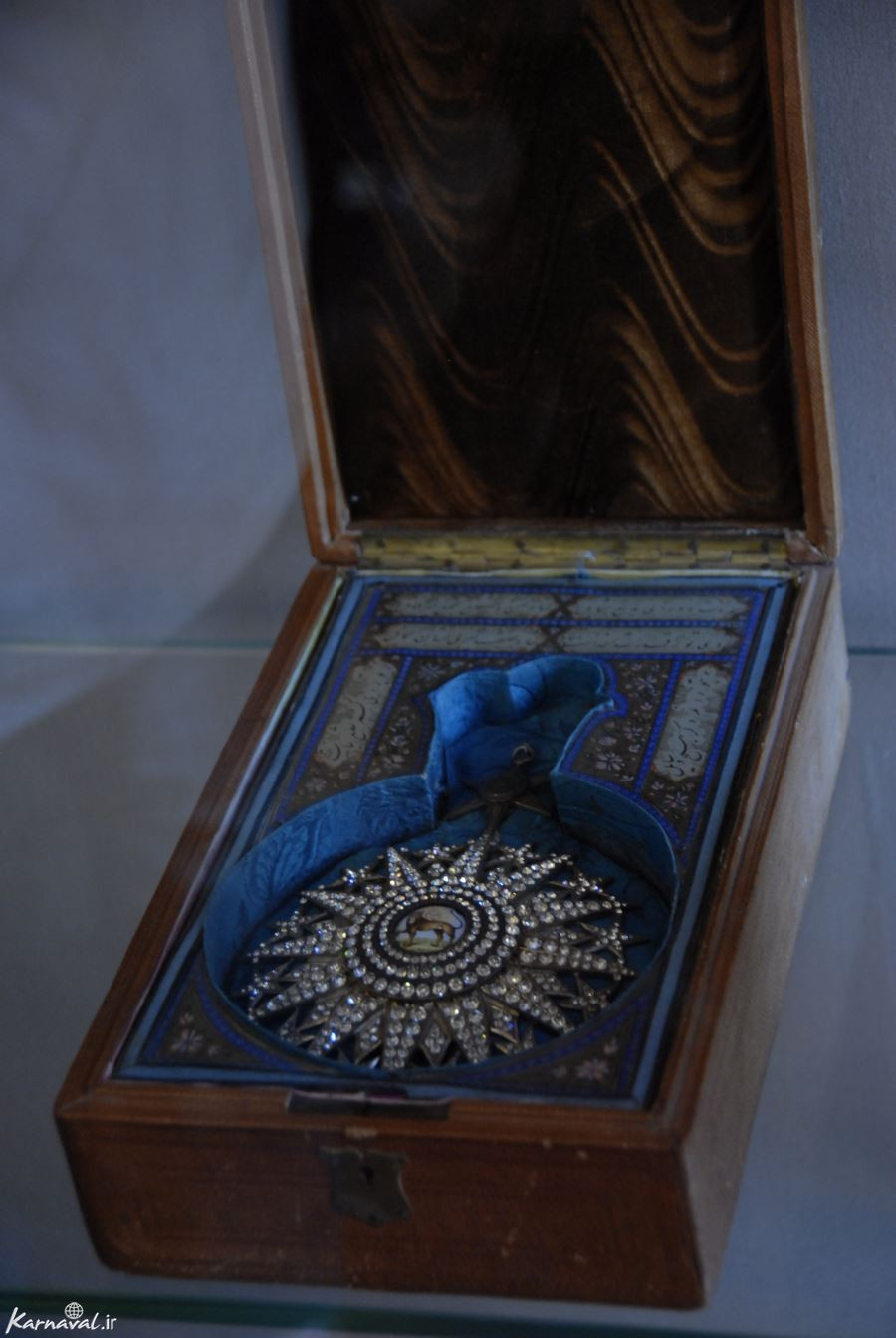
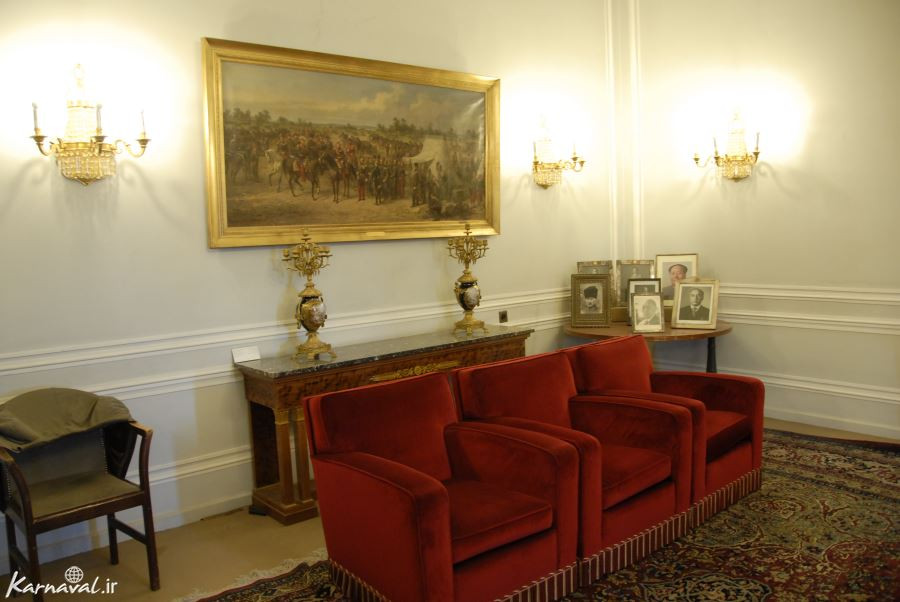
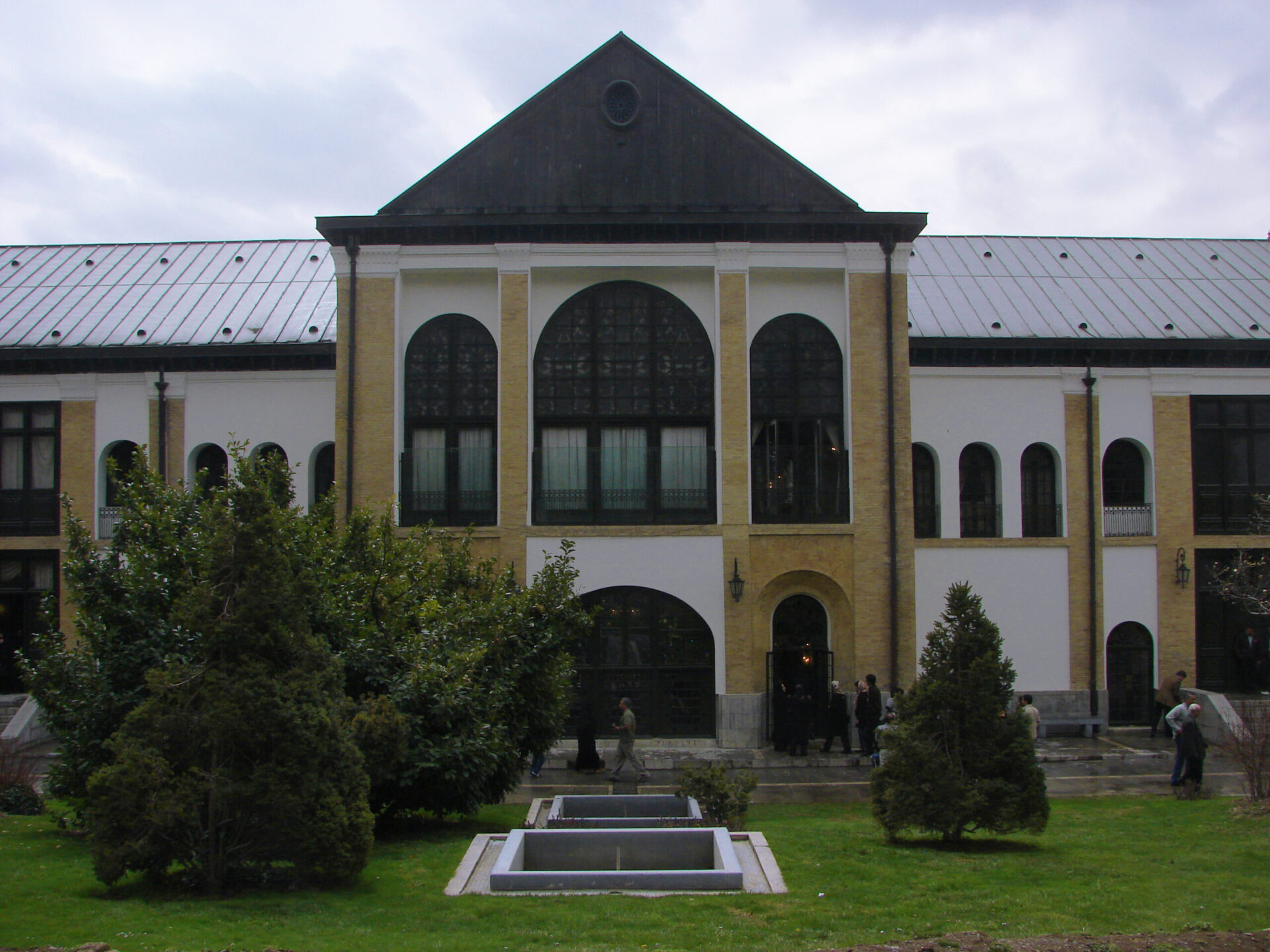
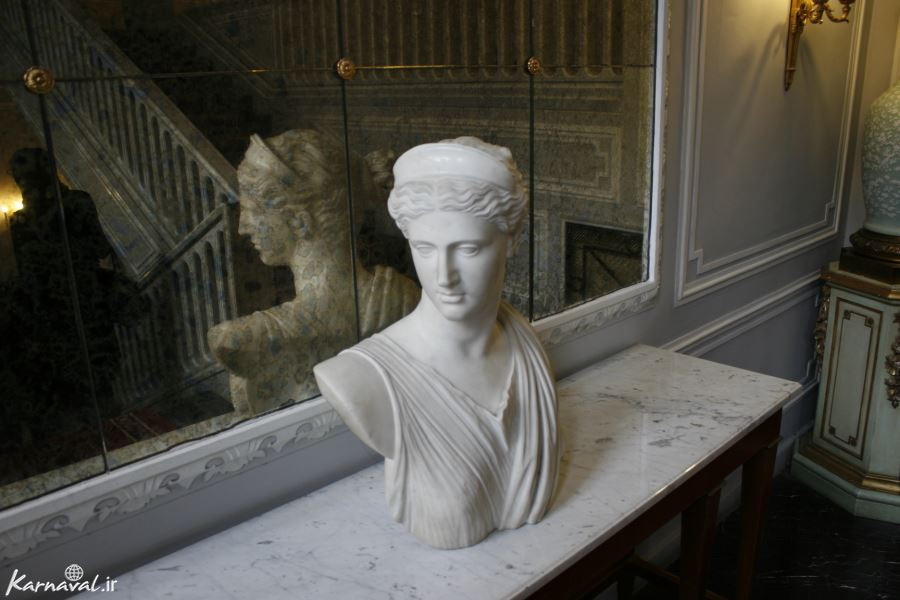
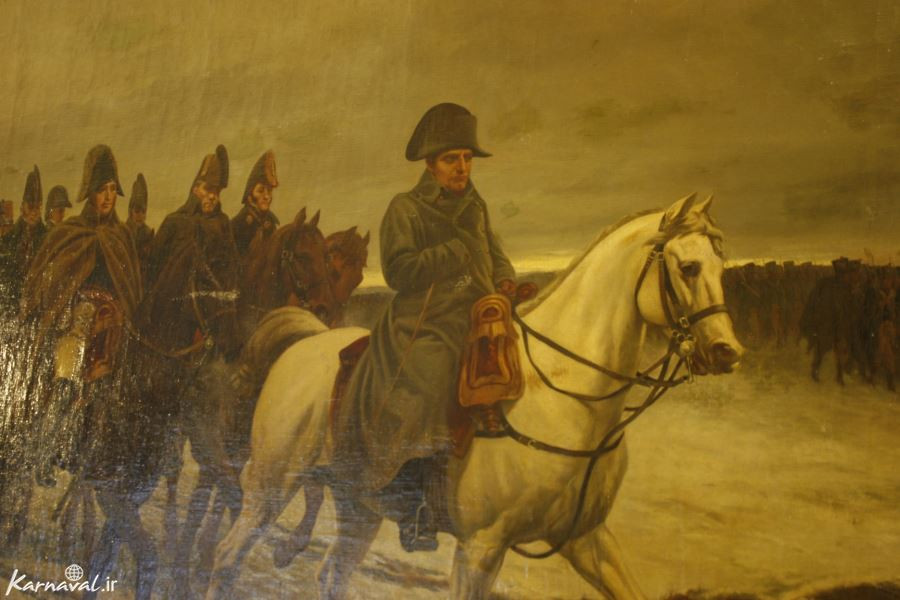
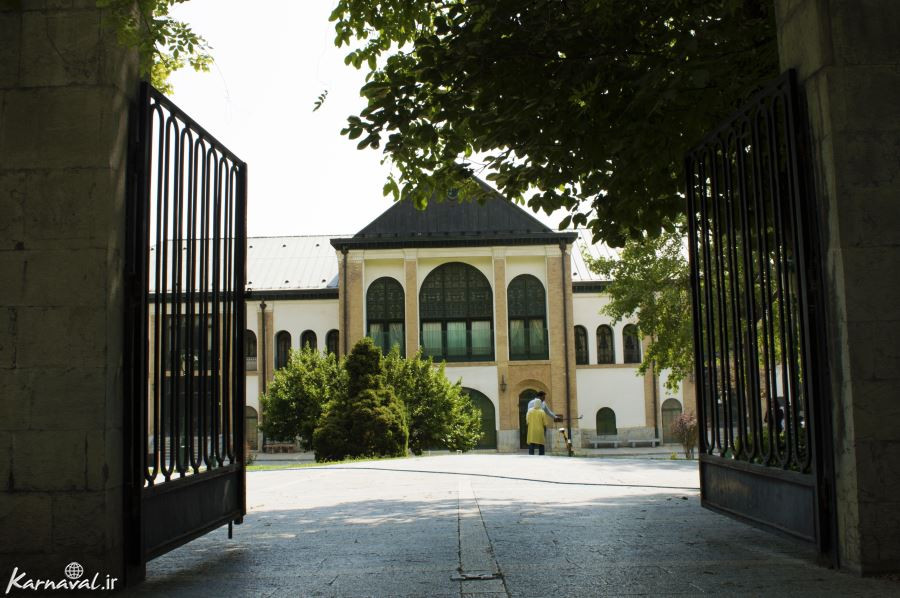
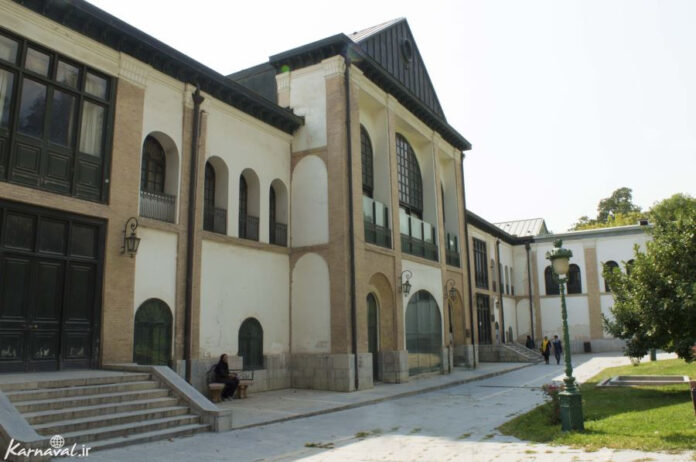
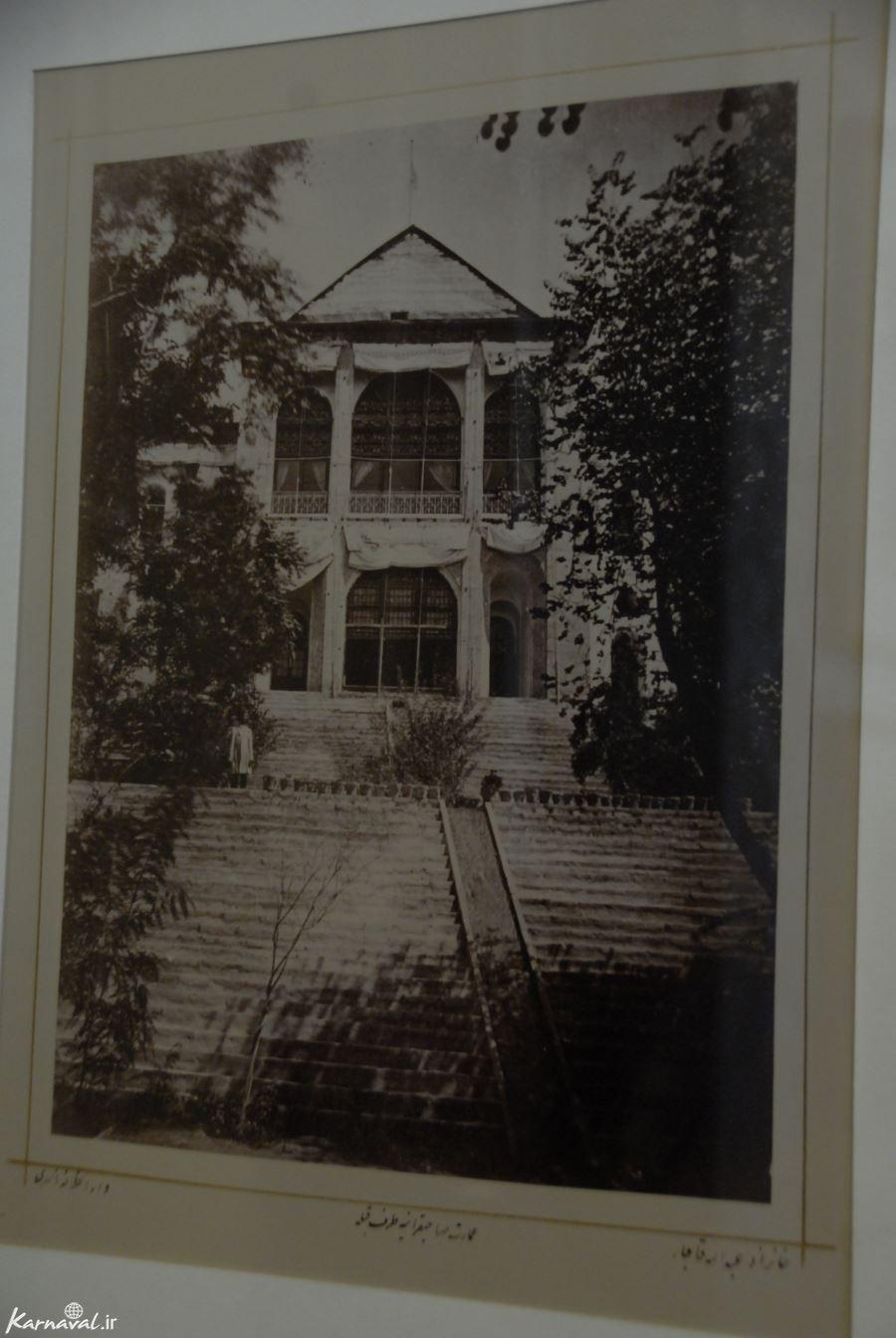
Sahebqaraniyeh Palace; Recreation Centre of Iranian Kings

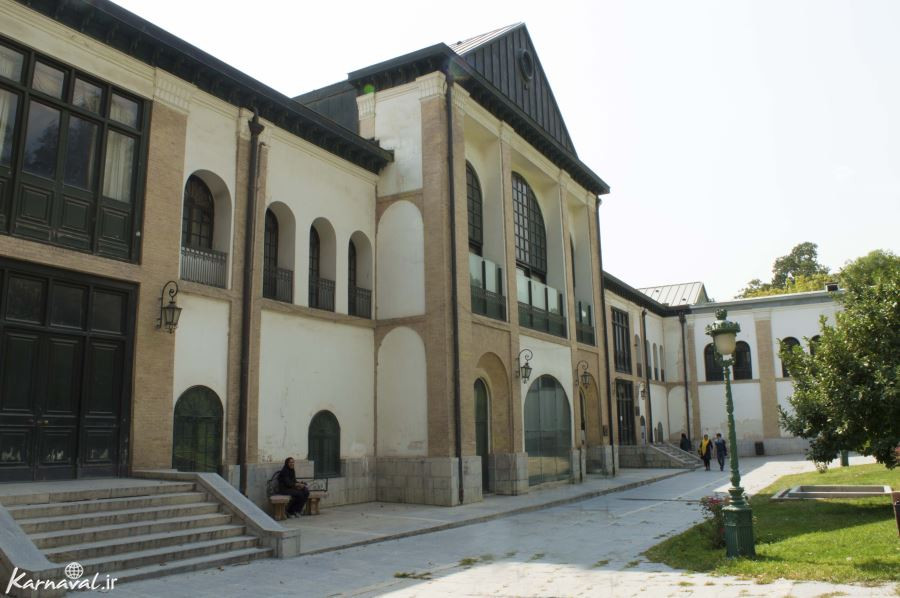
The palace is situated in Niavaran Historical-Cultural Complex in Shemiran, north of the Iranian capital.

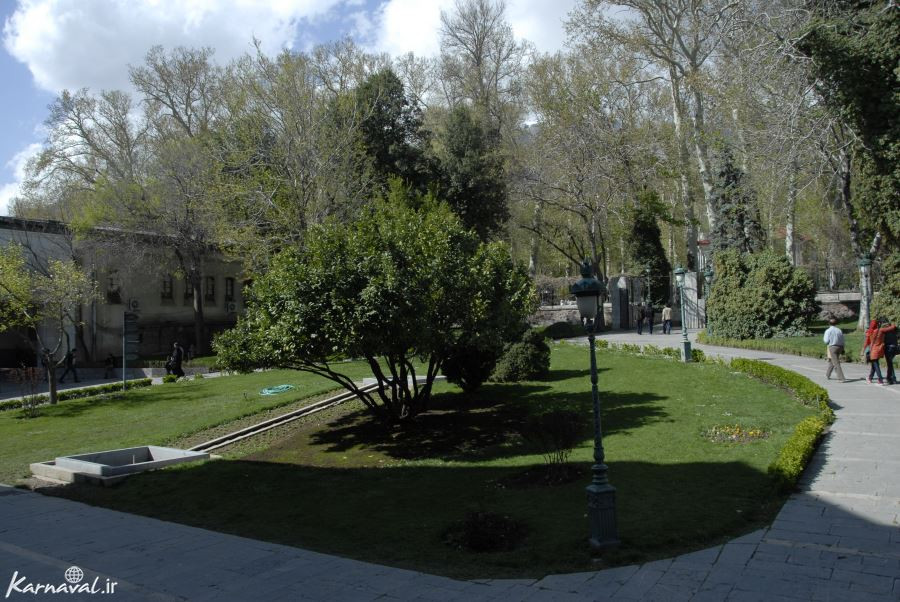
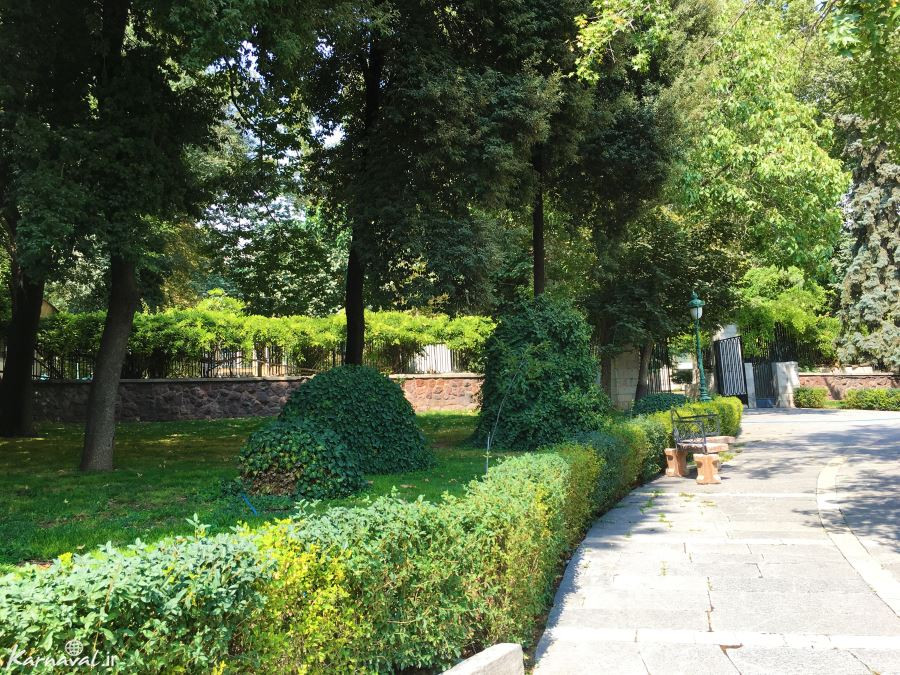
To get to the palace, one must step into a historic garden. The eye-catching nature of this garden has been witness to part of Iran’s history.

After passing through the garden, the white building of the palace and its green gables appear. The beautiful area opposite the palace is built like a field and displays a different atmosphere. The palace is surrounded by oak, maple, poplar, ash, ficus and fruit trees of plum, walnut and mulberry.

The garden of Niavaran was built at the time of Fath-Ali Shah Qajar in a place which was just a reed bed earlier. Hence, the garden was known as Ney Avaran (Ney means reed in Farsi) and became known as Niavaran over time.

Sahebqaraniyeh Palace; Recreation Centre of Iranian KingsMohammad Shah of Qajar had built a small and simple building, but Nassereddin Shah founded the magnificent building of Sahebqaraniyeh.

The order to demolish the mansions of Fath-Ali Shah and Mohammad Shah and the construction of this palace in the garden of Niavaran was issued in 1267 AH by Nassereddin Shah.

Sahebqaraniyeh Palace; Recreation Centre of Iranian KingsUpon completion, the building was officially recognized as the Nassereddin Shah’s summer residence, a Farsi report by Karnaval.ir said.

During the reign of the Pahlavi dynasty, Reza Shah forgot about Sahebqaraniyeh and began to build palaces in Sa’dabad instead. But at the time of the marriage of Mohammad Reza Pahlavi to Fawzia in 1939, the palace was chosen to be the wedding ceremony venue, and by the order of Reza Shah the present-day structures were built in the north of the Sahebqaraniyeh.

As a result of eight months of nonstop work by a group of engineers, carpenters, painters, etc., the small palace chambers were changed into the current-day form, but due to the cold weather, the wedding ceremony was held in another place.

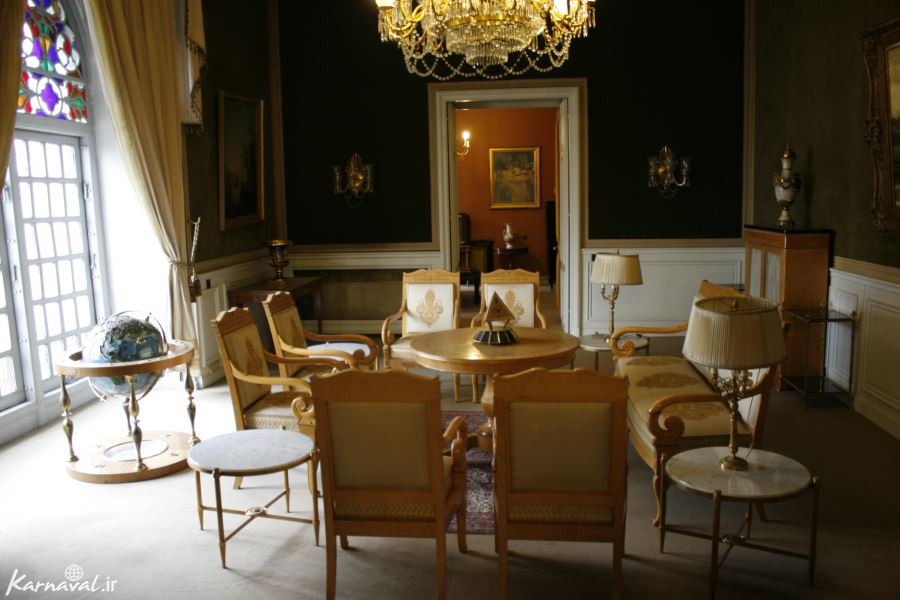
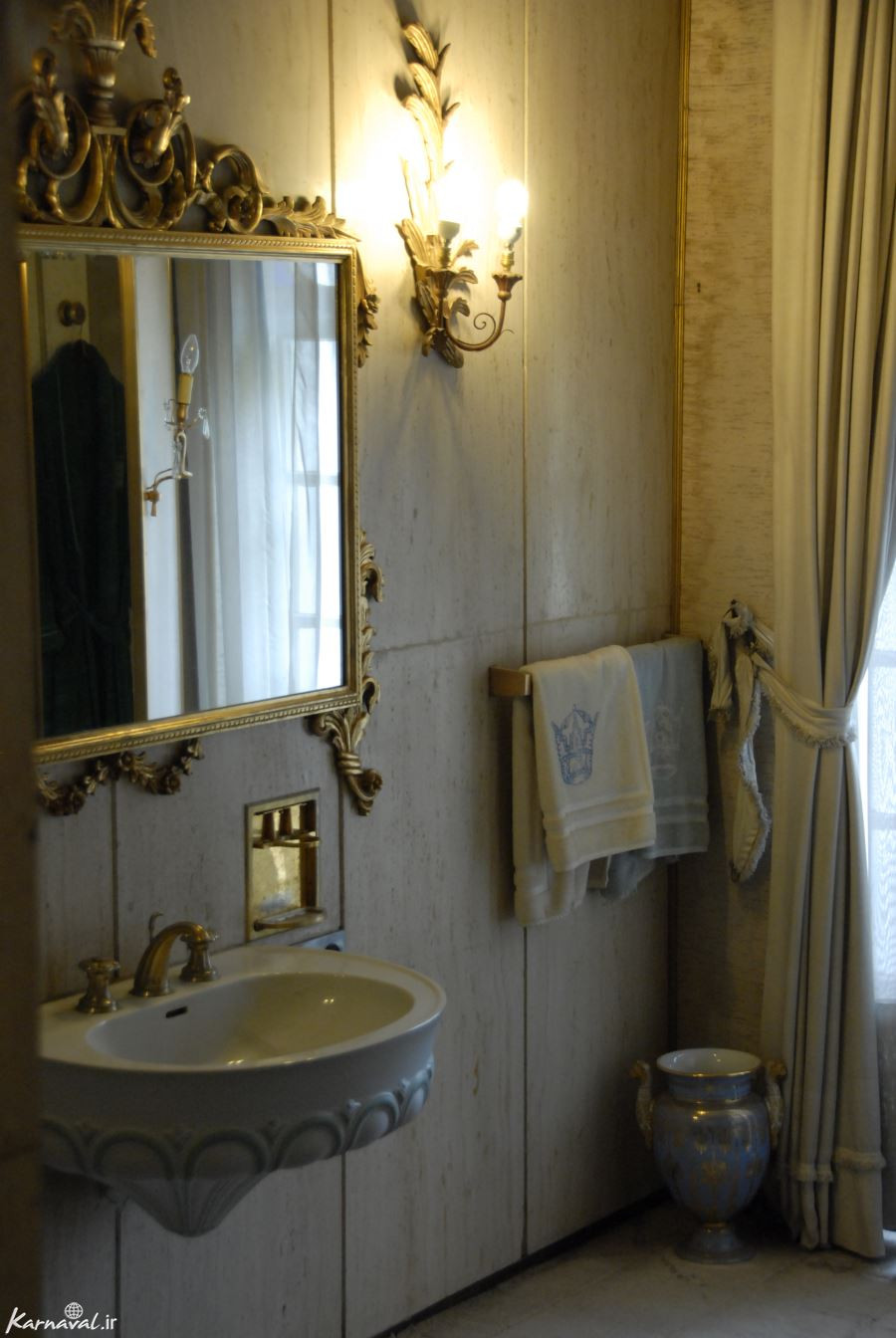
During the reign of Mohammad Reza Pahlavi, his wife Farah Diba began to make major changes to the interior parts of the building and decoration.

By making changes, the first floor was renovated for reception of guests and the second floor was restructured as the office of Mohammad Reza Pahlavi and in the garden of Niavaran, a new building was created for the residence of the Shah’s family.

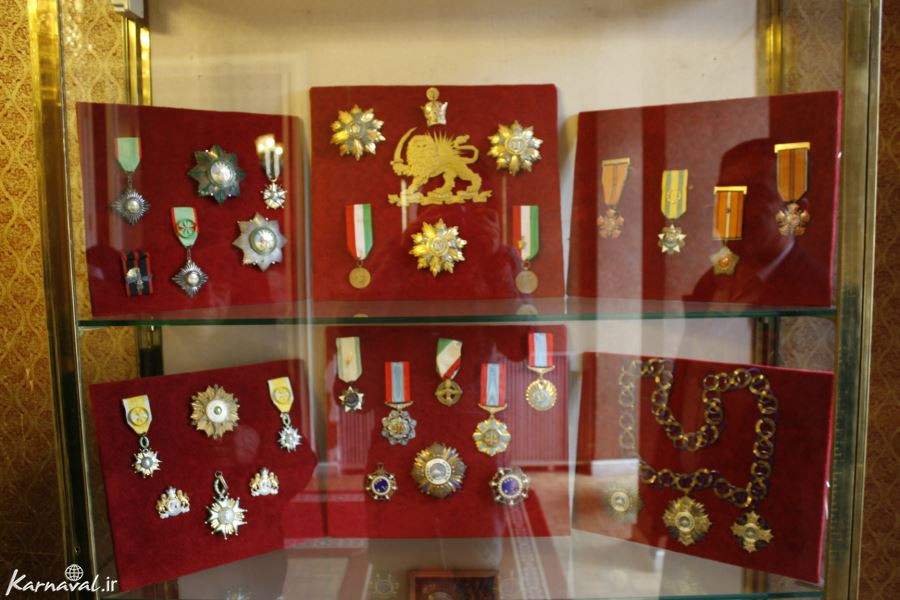
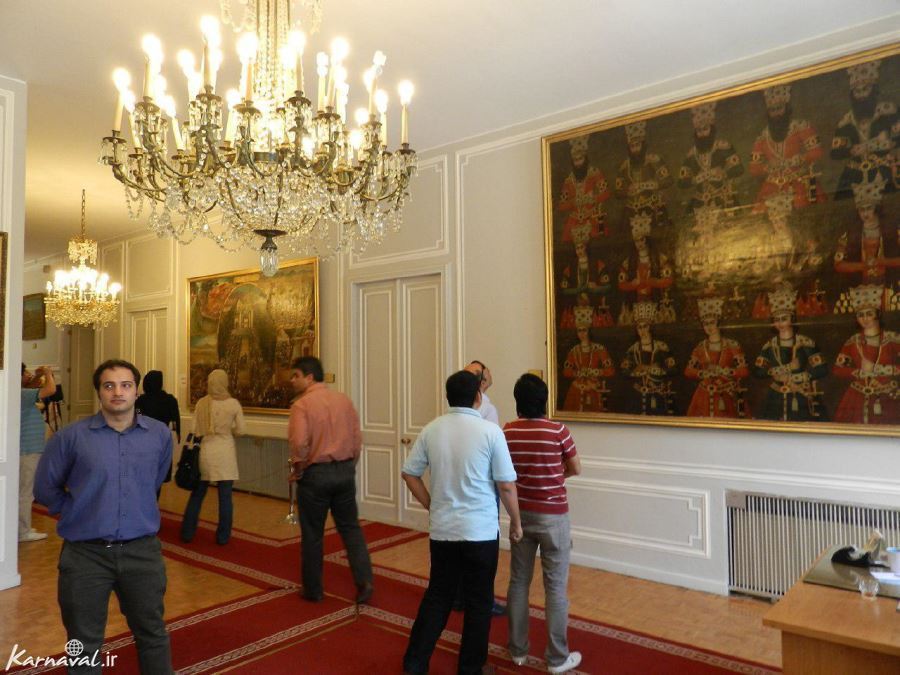
After the escape of Mohammad Reza Pahlavi from the country and the victory of the Islamic Revolution of Iran, all of the palace properties were listed by experts. The entire building of the palace was repaired in 1995 by Iranian experts and artists and it was reopened to public for visit.

Iran Not to Hesitate in Boosting Its Defensive Power: Rouhani

Iran Not to Hesitate in Boosting Its Defensive Power: Rouhani

At a Tuesday meeting with US media representatives in New York, Rouhani said, “Our people cannot stand by idly in the face of regional threats. Iran’s missiles serve defense purposes.”
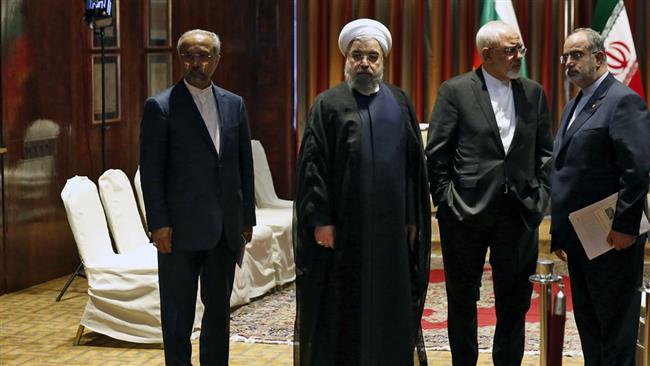
Rouhani further said no one can argue that “Iran should not defend itself or manufacture the weapons it needs while regional countries are in possession of state-of-the-art weapons.”

The Iranian nation continues to produce “missiles and defensive weapons,” said the Iranian chief executive, stressing that “the government’s biggest responsibility is to defend people and national security.”

He further exclaimed that Iran’s national defense program was being subjected to intensive debates amid a deafening silence over the weapons being used on a daily basis against innocent civilians in Yemen.

The Iranian president also touched on Iran’s nuclear deal, known as the Joint Comprehensive Plan of Action (JCPOA), and noted that the agreement has led to “better interactions between Iran, regional states, the European Union and other countries.”

Rouhani pointed to the accusations by US President Donald Trump’s administration that Iran does not abide by the JCPOA and said, “Under this agreement, the only observatory body is the International Atomic Energy Agency (IAEA), whose inspectors provide reports on a quarterly basis, and no other authority is entitled to talk about Iran’s compliance or noncompliance.”

“All the seven reports of the IAEA have confirmed that Iran has been fully compliant with its obligations,” he emphasized.

“If the US administration breaches its commitments, it will be responsible for all the damage,” Rouhani warned.

In his speech before the 72nd session of the UN General Assembly on Tuesday, Trump called the internationally-negotiated nuclear agreement with Iran an “embarrassment” to the United States.
Iran and the five permanent members of the United Nations Security Council – the United States, France, Britain, Russia and China – plus Germany signed the nuclear agreement on July 14, 2015 and started implementing it on January 16, 2016.
Under the JCPOA, Iran undertook to put limitations on its nuclear program in exchange for the removal of nuclear-related sanctions imposed against Tehran.

The White House faces an imminent decision on whether to certify Iran’s compliance with the terms of the nuclear accord.

Rouhani meets more world leaders at UN

On the sidelines of the General Assembly session, Rouhani held separate meetings with world leaders to exchange views on issues of bilateral and global importance.

Iran Not to Hesitate in Boosting Its Defensive Power: Rouhani

In one of the meetings, Rouhani sat down with new Pakistani Prime Minister Shahid Khaqan Abbasi to explore ways of promoting neighborly relations in all areas, especially in the energy sector.

“We are ready to provide energy for Pakistan and we welcome Pakistani investors in this area,” the Iranian president said.

Rouhani also raised concerns about terror attacks by Pakistani-based terror groups against Iranian soil, calling on Islamabad to identify those terrorists and prevent their anti-Iran moves.

Abbasi, for his part, called for promotion of bilateral ties in all areas. He also pledged to follow up on Iran’s border security concerns, noting that the Pakistani army has already been deployed at the border to ensure security there.

Iran-Norway banking ties

In a separate meeting with Norwegian Prime Minister Erna Solberg, Rouhani said there are ample opportunities for the promotion of Iran-Norway economic ties in the post-JCPOA era.

Iran Not to Hesitate in Boosting Its Defensive Power: Rouhani

“Expansion of Tehran-Oslo banking ties will lay a solid foundation for accelerating the two countries’ economic relations,” he said.

Solberg, for her part, underlined the country’s commitment to Iran’s nuclear agreement, saying Iran and Norway can cooperate in many areas, as reports confirm that Iran has been abiding by its commitments under the JCPOA.

She pointed to her country’s resolve to make investment in Iran and noted that Oslo is trying to remove the obstacles to closer banking ties to that effect.

Belgium invites Rouhani

At another meeting with Belgian Prime Minister Charles Michel, Rouhani welcomed Belgian companies to invest in the Iranian market and underlined the need to provide more facilities for tourists from both countries.

Iran Not to Hesitate in Boosting Its Defensive Power: Rouhani

Michel, fort his part, lauded the JCPOA as a great opportunity for the promotion of Iran-Belgium cooperation.

He also invited Rouhani to visit Belgium and described the visit as a “good sign” for the enhancement of Iran’s relations with 27 EU member states.

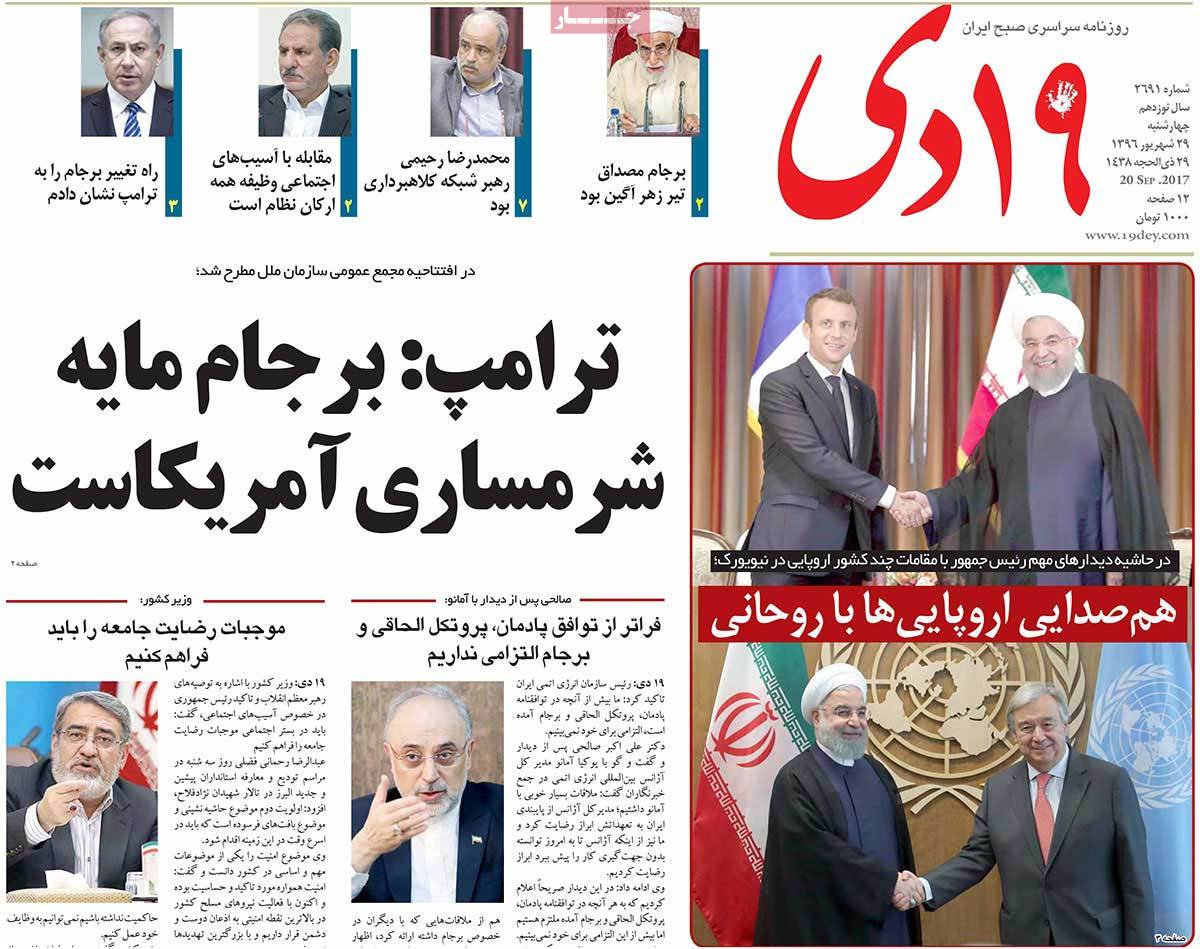
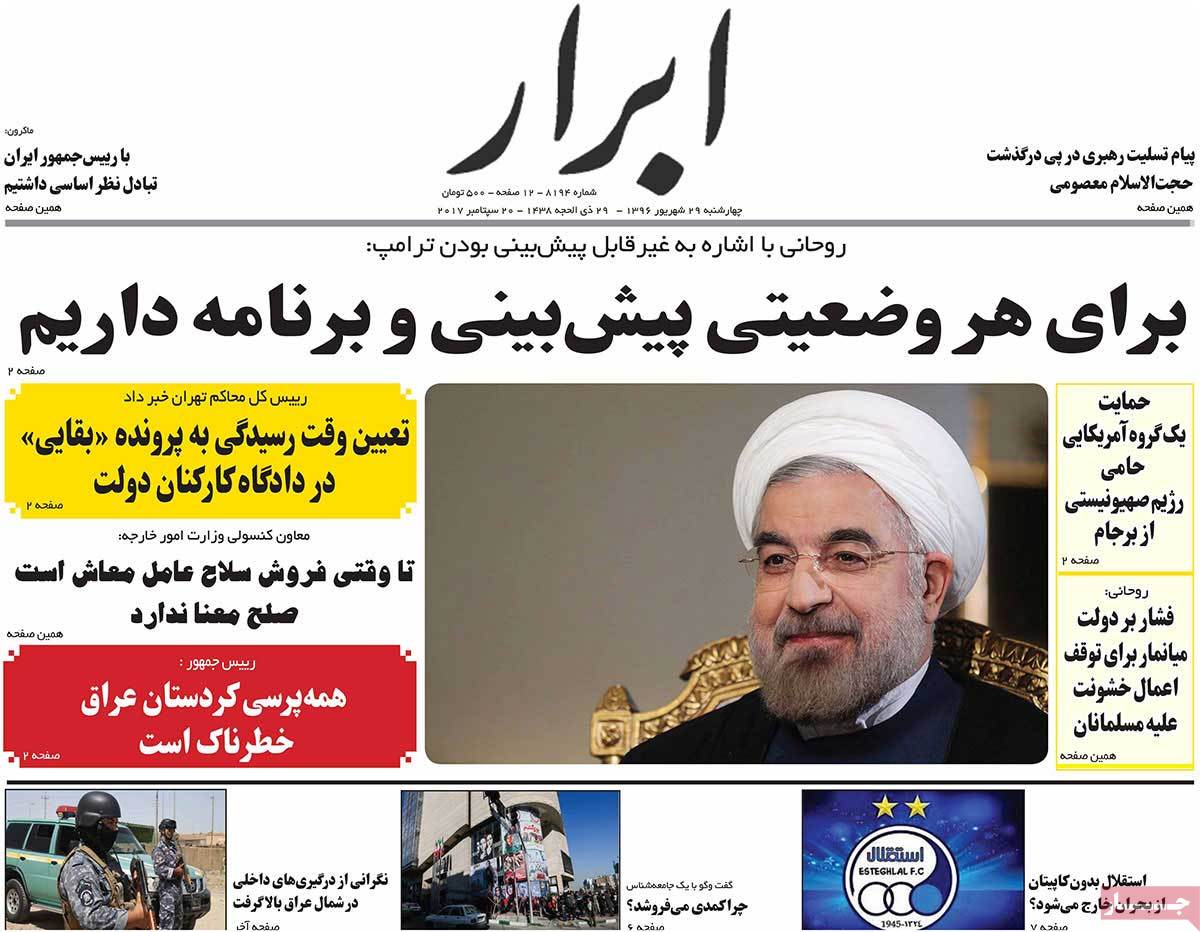
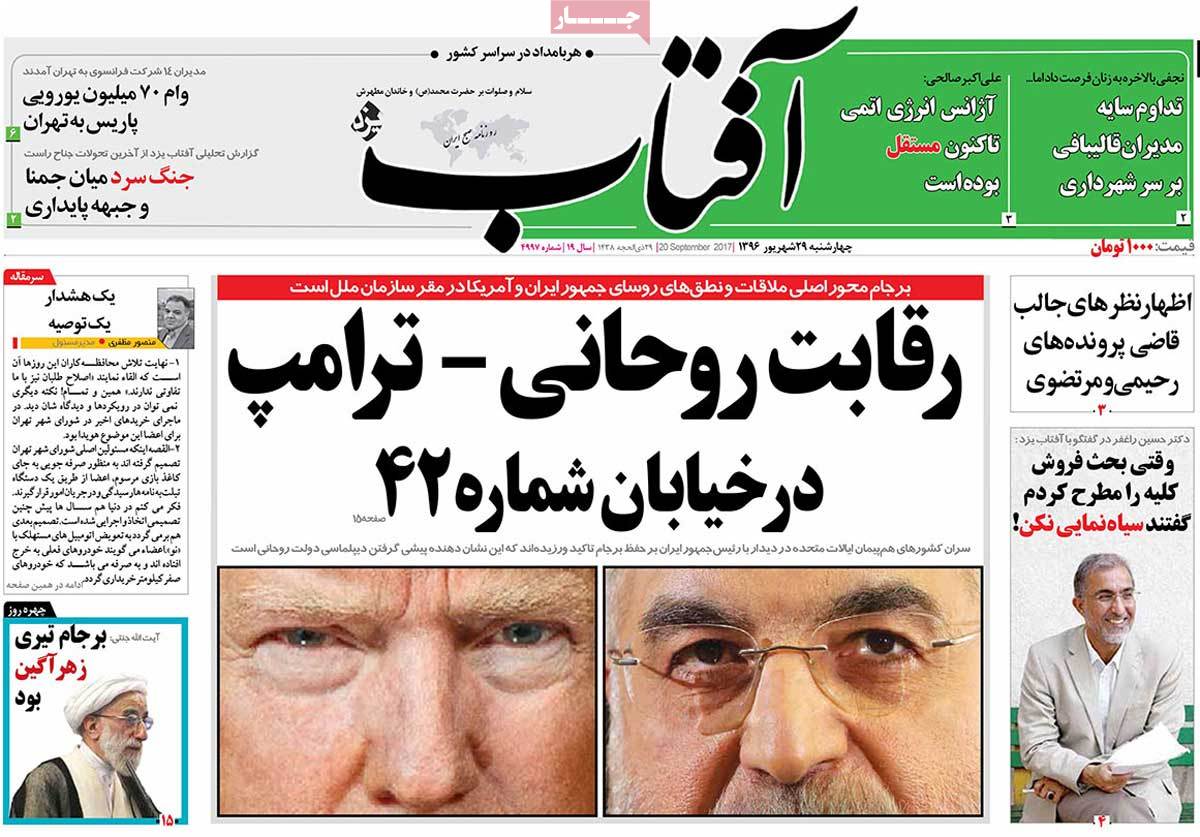
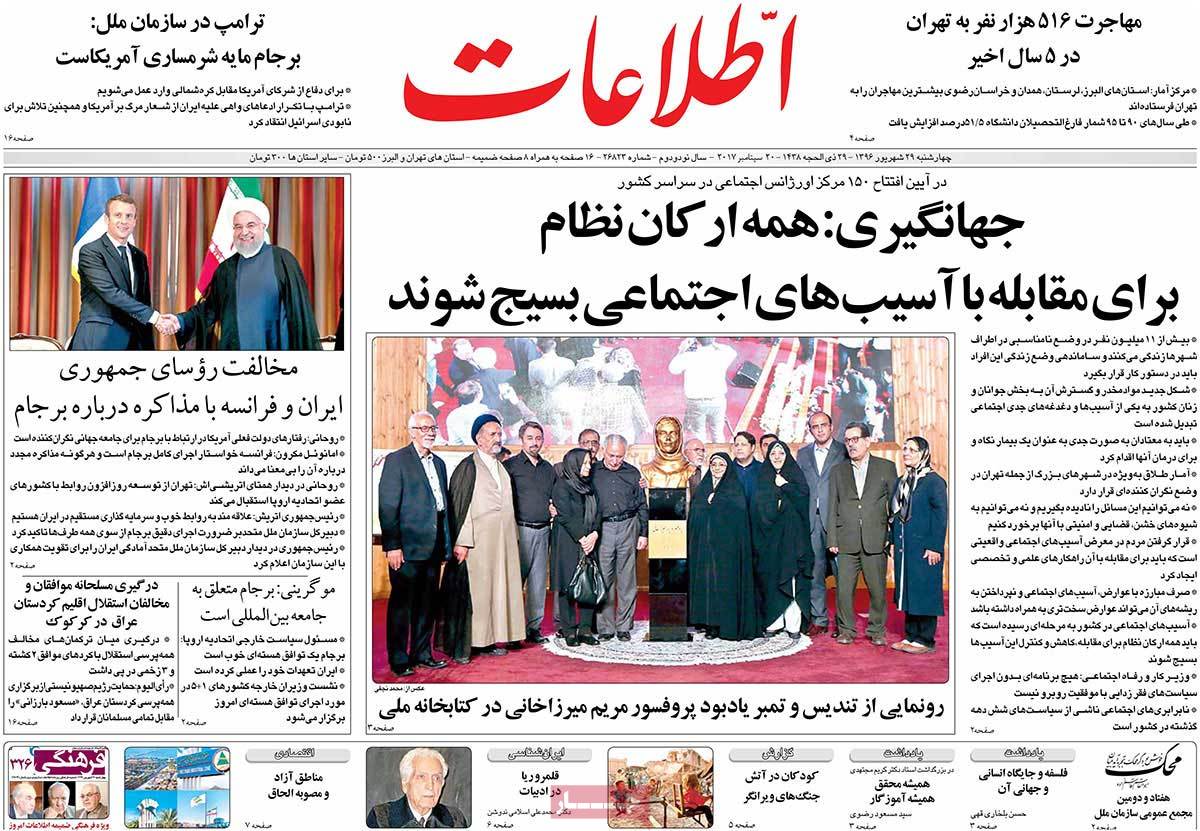
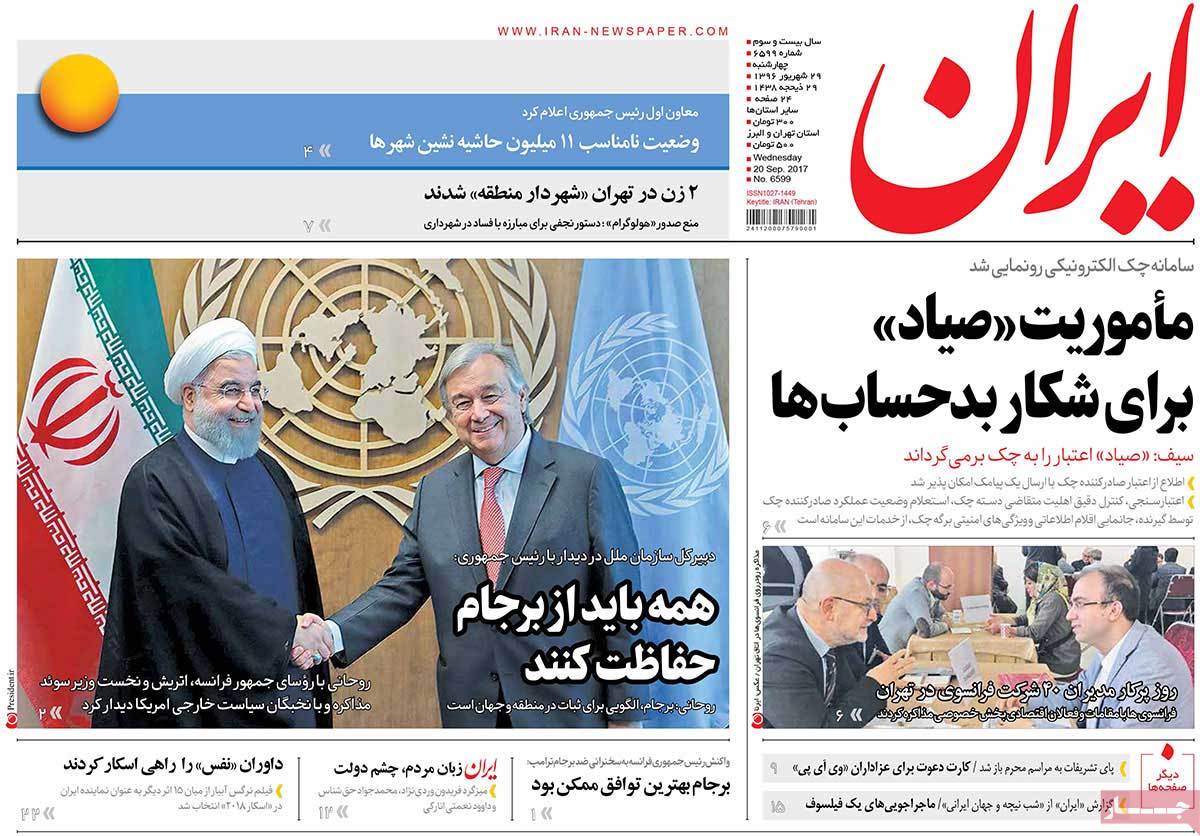
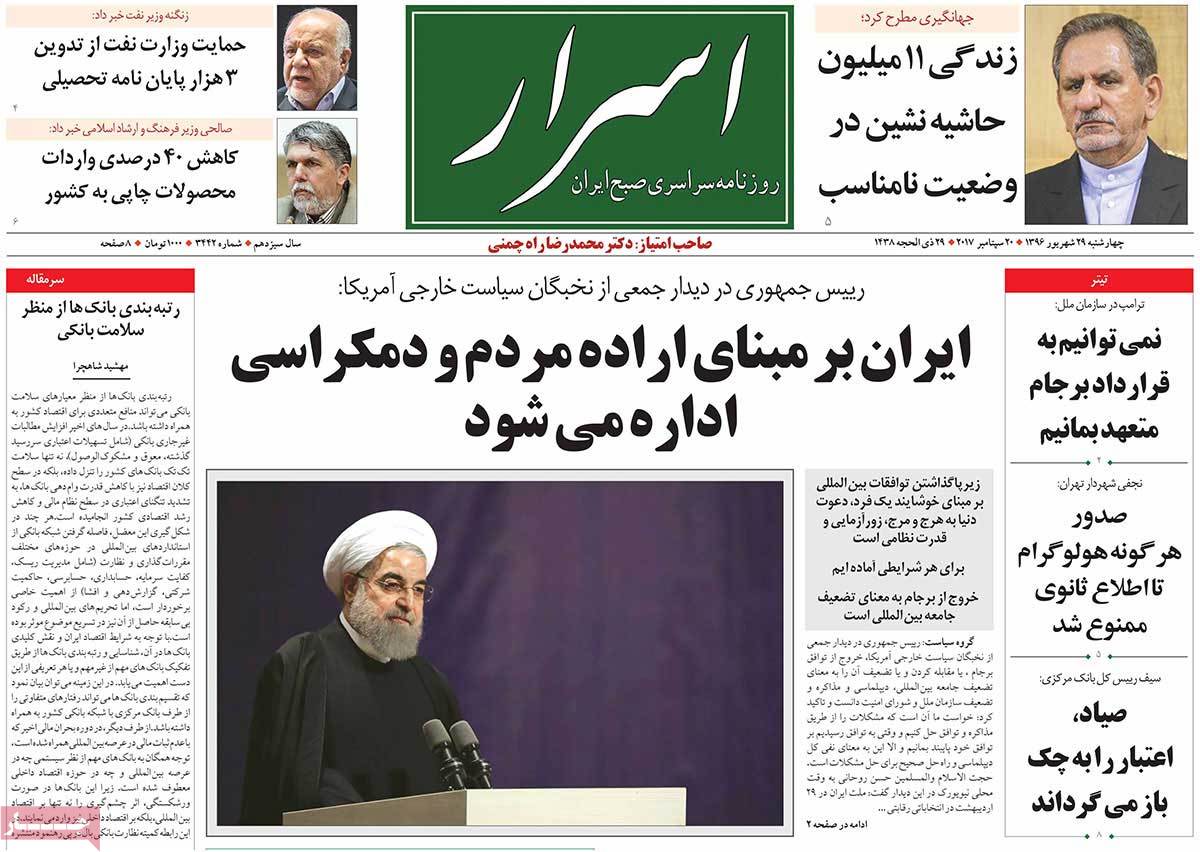
A Look at Iranian Newspaper Front Pages on September 20

Newspapers today covered the latest reports and developments of the UN General Assembly and a speech by US President Donald Trump, where he repeated his anti-Iran claims and allegations.

Another top story was Iranian President Hassan Rouhani’s interview with CNN, where he said the Islamic Republic has plans for any situation on the nuclear deal.

The Iraqi Kurdistan’s upcoming referendum also remained a top story today.

The above issues, as well as many more, are highlighted in the following headlines and top stories:


19 Dey:

1- Trump: Nuclear Deal a Shame for US

2- Nuclear Chief: Iran Not Committed to Anything beyond Safeguard, Additional Protocol, JCPOA

A Look at Iranian Newspaper Front Pages on September 20


Abrar:

1- Rouhani: Trump Unpredictable, but We Have Plans for Any Situation

2- Deputy FM: Peace Meaningless Until Weapons Used for Business

3- Rouhani: Iraqi Kurdistan’s Referendum Dangerous

A Look at Iranian Newspaper Front Pages on September 20


Aftab-e Yazd:

1- Rouhani-Trump Rivalry in Street No. 42

  • Nuclear Deal Main Focus of Iranian, US Presidents’ UNGA Addresses

2- Salehi: IAEA Has Remain Independent So Far

3- Managers of 14 French Companies in Tehran: Paris’ €70m Loan to Tehran

A Look at Iranian Newspaper Front Pages on September 20


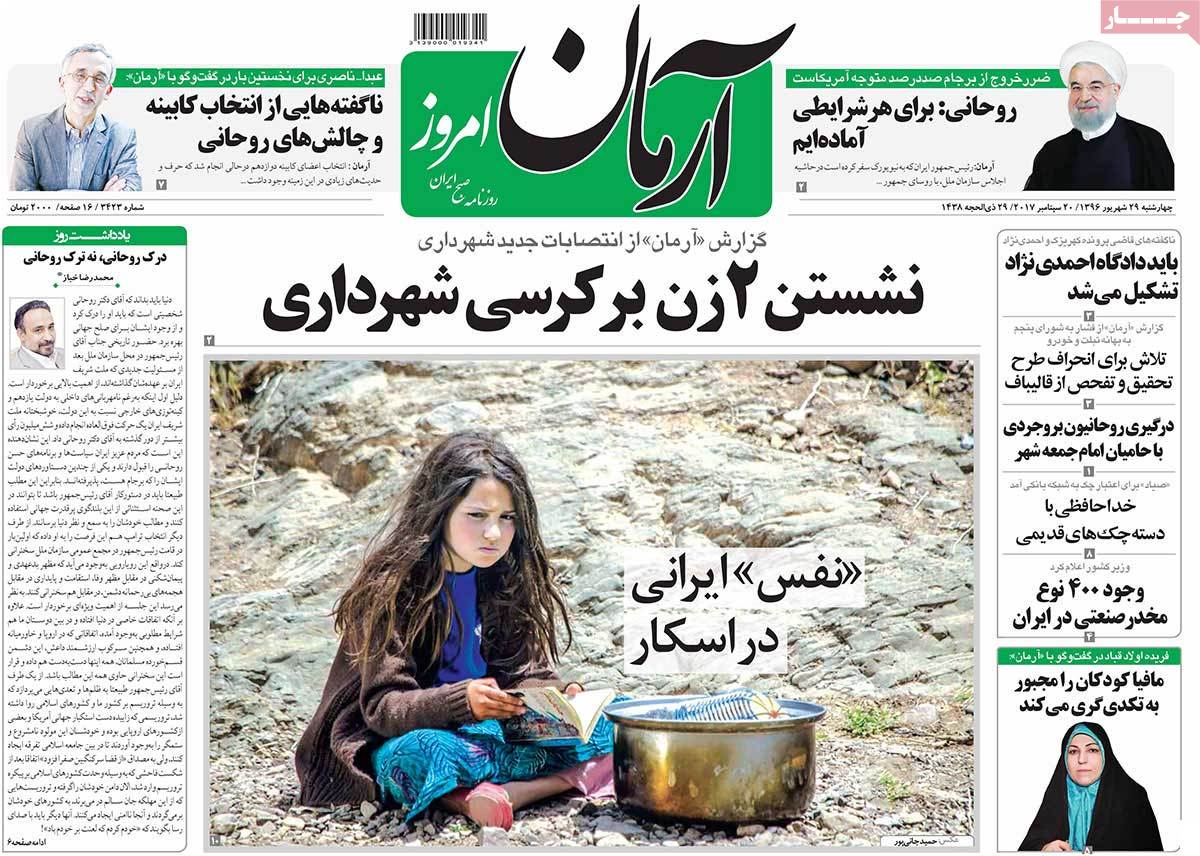
Arman-e Emrooz:

1- US Is the One Harmed by JCPOA Withdrawal: Rouhani

2- Iran President: We’re Ready for Any Situation

A Look at Iranian Newspaper Front Pages on September 20


Asrar:

1- Iran Governed Based on People’s Will, Democracy

2- Trump to UN: We Cannot Remain Committed to Iran Nuclear Deal

A Look at Iranian Newspaper Front Pages on September 20


Ettela’at:

1- First VP: All Iranian Bodies Should Be Mobilized to Counter Social Ills

2- Commemorative Statue, Stamp of Maryam Mirzakhani Unveiled in Tehran

3- 516,000 People Have Immigrated to Tehran in Past 5 Years

A Look at Iranian Newspaper Front Pages on September 20


Iran:

1- UN Chief: All Sides Should Protect Iran Nuclear Deal

2- Rouhani: Nuclear Deal Role Model for Stability in World, Region

3- Two Women Appointed as Mayors of Tehran Districts

A Look at Iranian Newspaper Front Pages on September 20


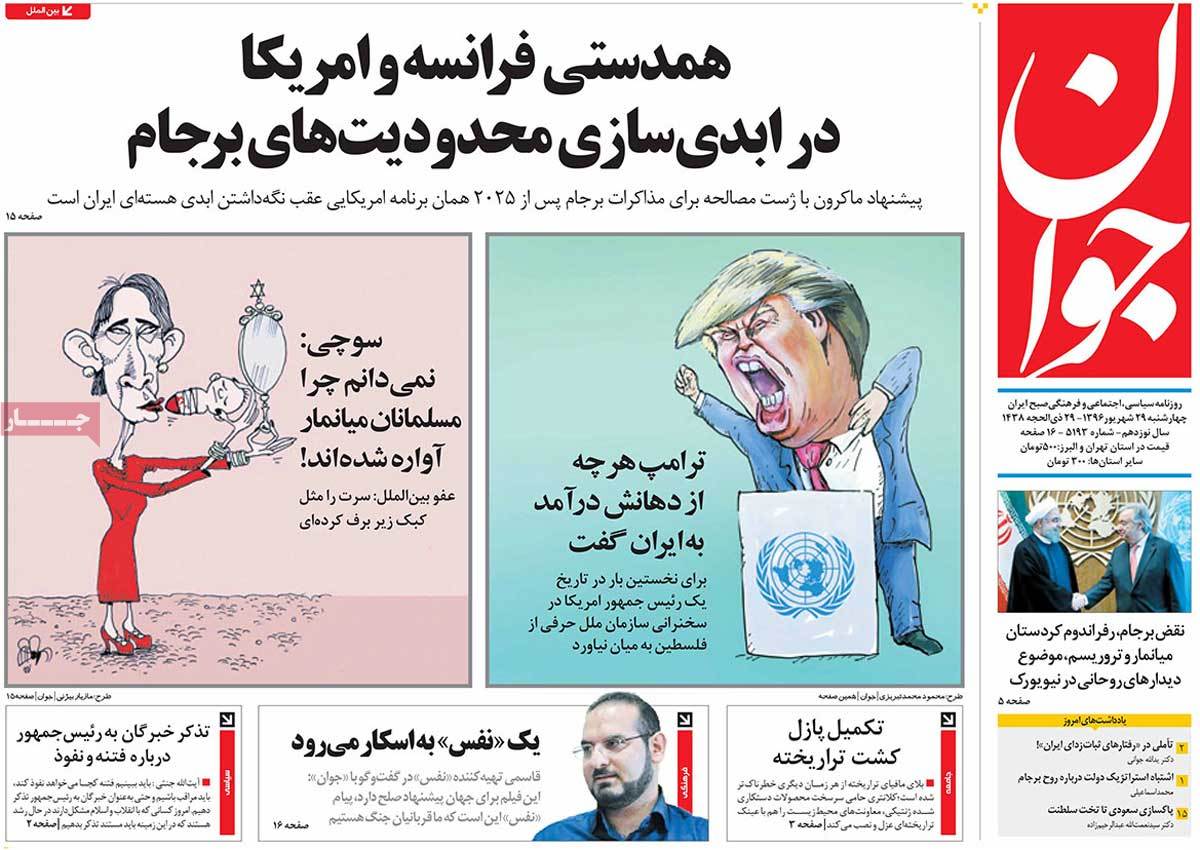
Javan:

1- France, US Joining Hands to Make JCPOA Limitations Permanent

2- Trump Says Whatever He Wants against Iran

  • For First Time in History, US President’s UNGA Address Doesn’t Mention Palestine

A Look at Iranian Newspaper Front Pages on September 20


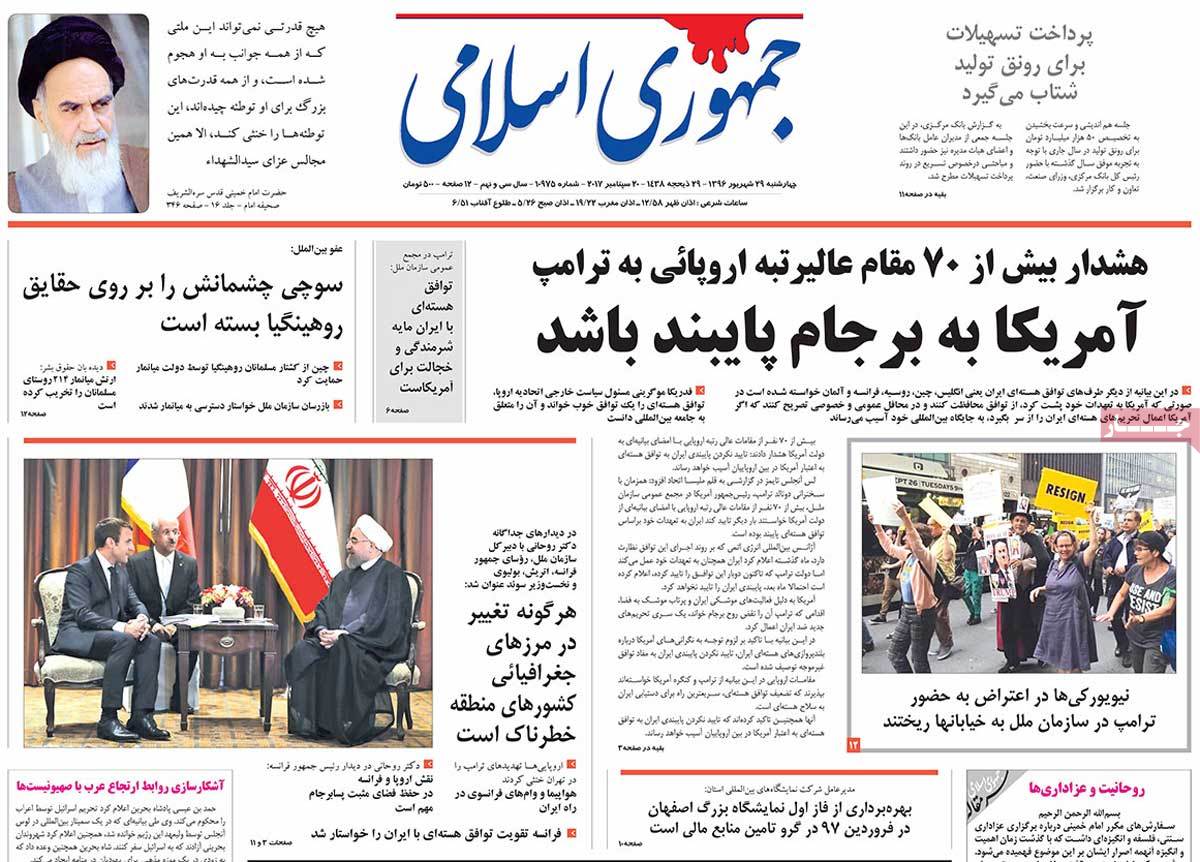
Jomhouri Eslami:

1- Over 70 Top European Officials Warn Trump: US Should Stay Committed to JCPOA

A Look at Iranian Newspaper Front Pages on September 20


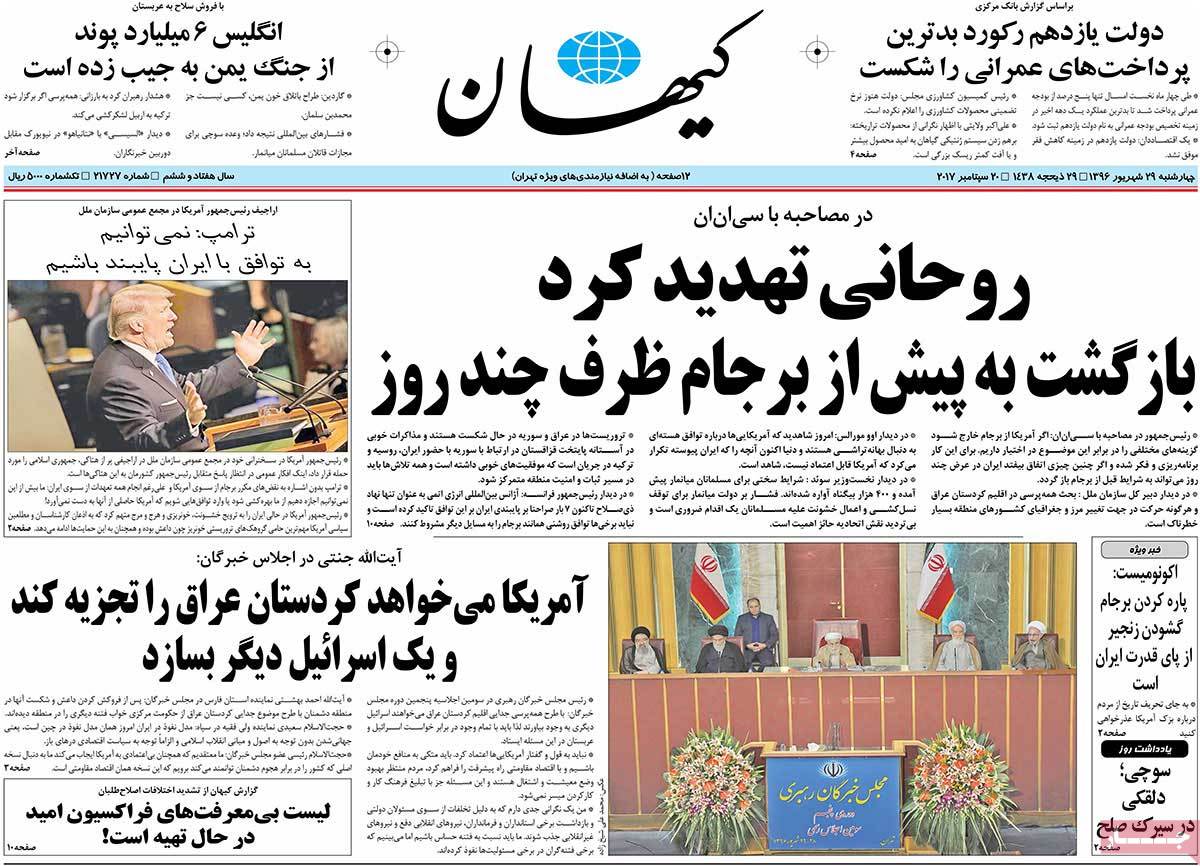
Kayhan:

1- Rouhani Threatens to Return Iran’s Nuclear Program to Pre-JCPOA Era within Days

2- Ayatollah Jannati: US Intends to Disintegrate Iraqi Kurdistan, Make another Israel

A Look at Iranian Newspaper Front Pages on September 20


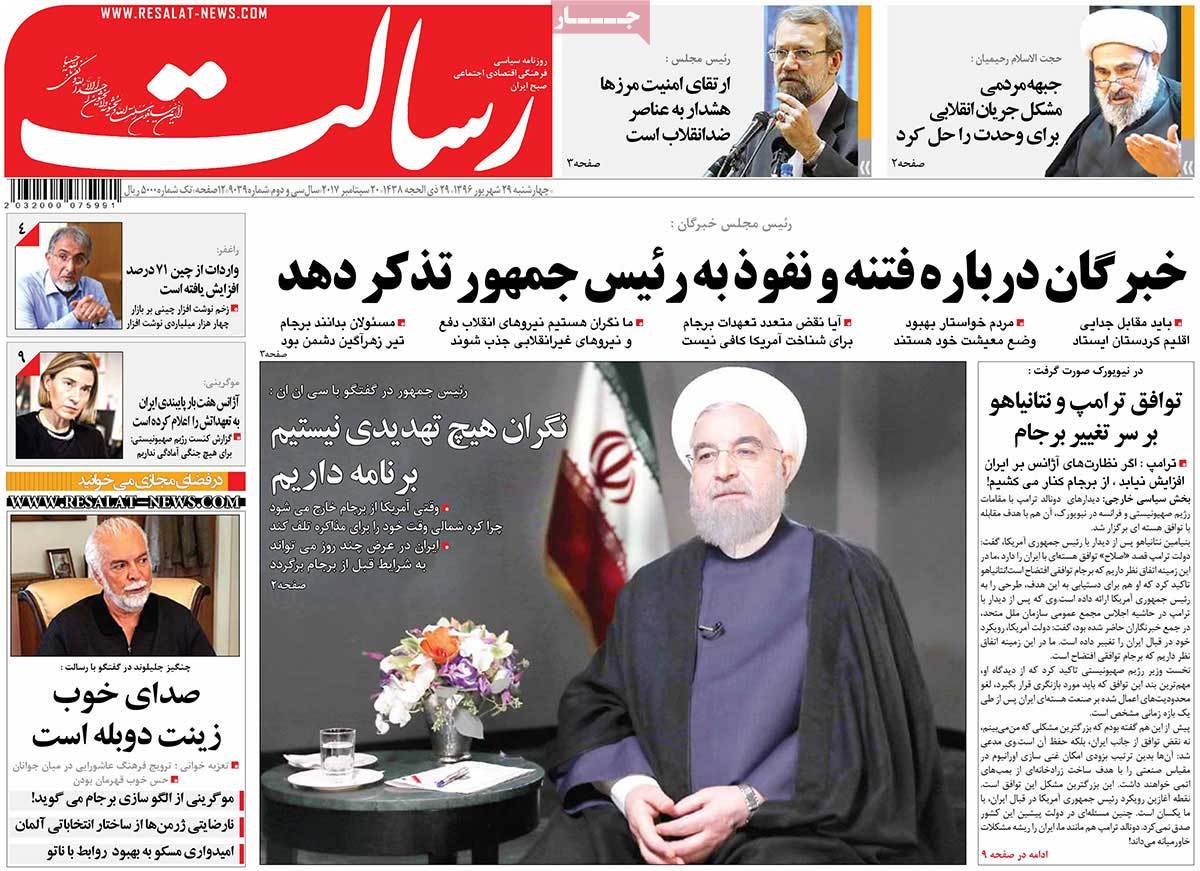
Resalat:

1- Rouhani: Iran Not Worried about Any Threat

2- Rouhani: Why Should N. Korea Waste Its Time on Negotiation When US Exits JCPOA?

3- Parliament Speaker: Promoting Border Security Warning to Counter-Revolutionary Forces

4- Mogherini: IAEA Has Confirmed Iran’s Compliance with JCPOA Commitments for 7 Times

A Look at Iranian Newspaper Front Pages on September 20


Vaghaye Ettefaghieh:

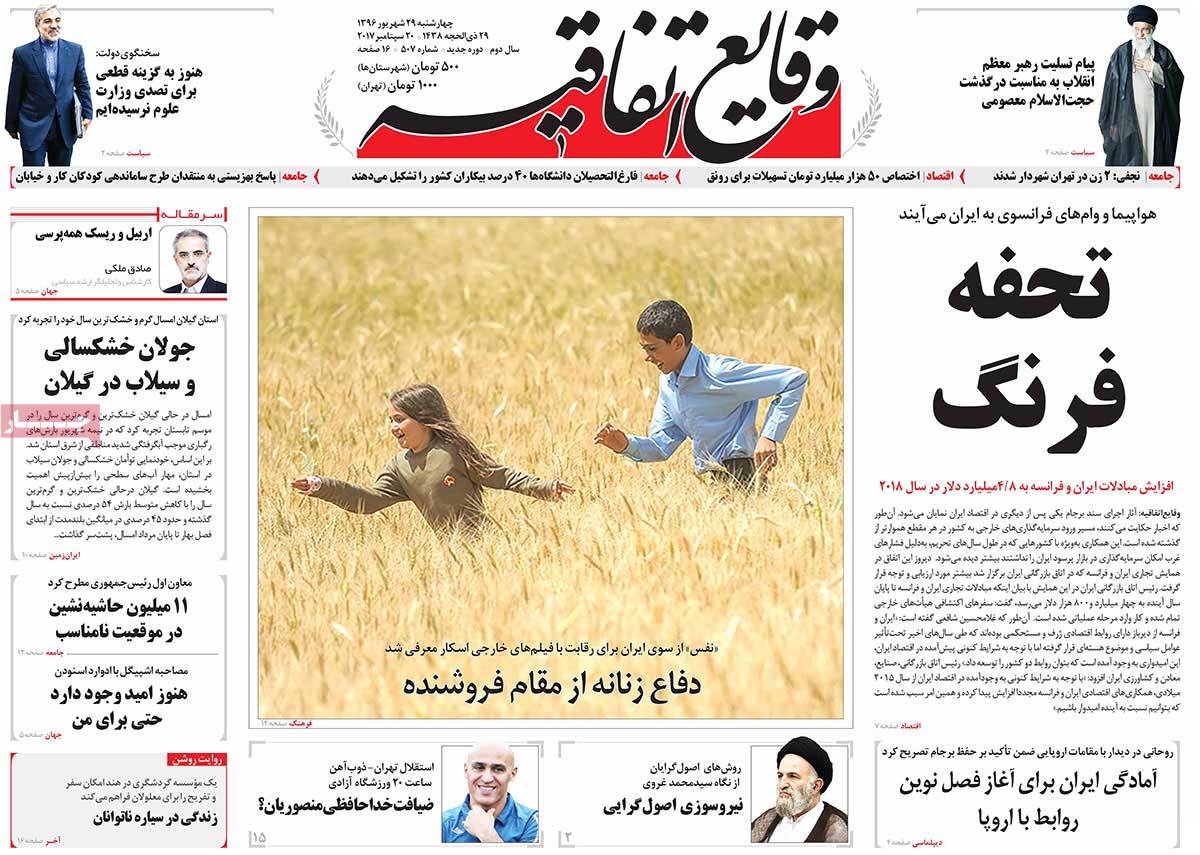
1- Female Filmmaker to Defend Iran’s Position in Academy Awards

  • Iran Selects ‘Breath’ as Official Submission to the Oscars

A Look at Iranian Newspaper Front Pages on September 20