Monday, December 29, 2025
Home Blog Page 3820

US Not Aware of IRGC Naval Forces’ High Potential: Commander

Iran Warns US, Allies against Adventurism, Provocative Moves in Region

The IRGC Navy has a great potential in the Persian Gulf, General Fadavi said, adding that the IRGC’s naval forces have been involved in activities to promote the security of the Persian Gulf, and are now at the highest level of readiness.

According to a Farsi report by Tasnim, he noted that at the moment the IRGC is demonstrating capabilities that it has never developed before.

“In the situation that has existed for the IRGC navy against the Great Satan (the US) in the Persian Gulf, we have never been as powerful as today,” he noted, reiterating the great potentialities of his forces.

Fadavi also talked about the extensive damage suffered by the US against the IRGC naval forces in the Persian Gulf, saying that “in 1987 and 1988 the Americans suffered many defeats against the IRGC and the Muslim warriors in the Persian Gulf that has been unprecedented in the history of the United States.”

He went on to say that the US military power is mainly based on its navy, warning that “the Americans need to look at the power of the IRGC navy (carefully), since if they face our navy in the future, the situation will not be like 1987 and 1988. This time they will see a more powerful navy than before.”

Iran Taking Long Steps towards Agricultural Mechanization

In a Farsi interview with Mehr New Agency, Kambiz Hosseini said Iran has invested hugely in agricultural mechanization, and the traditional gap between Iran and the developed countries in agricultural mechanization is being bridged further day by day.

“Today, about 70 percent and 95 percent of cereals are cultivated and harvested mechanically, respectively,” he said, adding that about 80 percent of the country’s rice is cultivated and harvested mechanically.

Hosseini also said the agricultural industry of Iran has 440,000 units of tractor, 35,000 units of seed processing machinery, over 16,000 units of combine harvester and tens of other agricultural machineries.

“Penetration of mechanization has dramatically increased in Iran’s agriculture over the past years,” he stressed.

One of the main reasons behind Iran’s recent success in wheat production is that the Iranian farmers use agricultural machinery, he added.

“Japan’s mechanization penetration in the agricultural field stands at 14 hp/h followed by European states with 6 hp/h and the US with 2.5 hp/h and Australia with 3 hp/h,” he said.

However, he noted, this does not mean that the agricultural production of the countries with higher mechanization penetration is higher than the US and Australia.

Hosseini added about 95 percent of the mechanization process of Iran’s agricultural field is being carried out by the local companies and only five percent of the agricultural machinery are imported from abroad.


11 Saudi Princes, Including Bin Talal, Arrested for Corruption

The Al-Arabiya news channel quoted unnamed sources as saying that well-known billionaire investor Prince Alwaleed bin Talal was among those who have been detained in connection with newly-opened corruption probes.

Bin Talal is a prominent investor in US companies including Twitter.

Adel Faqih, the current economy and planning minister, is also among those arrested. He is known as the mastermind of the Vision 2030 plan widely advertised by the ruling officials.

The arrests were made based on a decision by Saudi Arabia’s anti-corruption committee, which was recently established by King Salman bin Abdulaziz Al Saud.

Crown Prince Mohammed bin Salman was later appointed by the King as the head of the anti-corruption committee.

According to Al-Sura, some of the arrest warrants have been issued for the following people:

11 Saudi Princes, Including Bin Talal, Arrested for Corruption

Tehran Engulfed with High-Rise Buildings

More than eight million people are currently residing in Tehran, and not paying attention to environmental capacities and disparate population distribution can jeopardize the rights of citizens.

Here are IRNA’s photos of some of these high-rise buildings in the Iranian capital:

Iranian Translator Talks of 444 Days in US Embassy

Sheikholeslam, who is now an advisor to Iranian Foreign Minister Mohammad Javad Zarif, was not involved in the US embassy siege in 1979, but as the students failed in communicating with the hostages, they trusted him and invited him to enter the Embassy in order to help them as an interpreter.

Sheikholeslam accepted the invitation and entered the embassy on November 4, and was busy with translating the documents of the “den of espionage” until the last day, i.e. January 20, 1980.

38 years after that day, the Khabar Online News Agency has conducted a Farsi interview with him, a summary of which follows:

Iranian Translator Talks of 444 Days in US EmbassyI was a student abroad, and came to Iran after the Revolution. My job was to give answers to the articles that the world’s English-language papers were publishing against the Islamic Revolution. During my studies, I was the editor of the American, European, and Canadian Association and I was participating in demonstrations and debates. That was why I was known, and others knew I have a good command of English language. The students who occupied the “den of espionage” were looking for those who could translate the documents and talk to the hostages. Therefore, that evening they came to my home and invited me to do the job.

When I went there, it became clear that I was the right pick. Among 52 hostages, the first person I talked to was the CIA chief in Tehran.

One of the rooms was full of telecommunication and encryption devices. Some of the items inside the room were destroyed. On the western side of the building, there was a room in which there was a lot of microfilm powder and shredded paper and a large concrete safe. Thus, we found out that important documents have been destroyed there.

Iranian Translator Talks of 444 Days in US EmbassyThere existed two US bases in Kabkan, Bushehr Province, and Behshahr in Mazandaran province. No Iranian, even the Shah of Iran, had the right to enter the bases. The information of those two bases were given to the embassy and were sent directly to the United States. These two sites were monitoring the Soviet missile and atomic tests. The hostages themselves said “if we did not have these bases, we could not hold The Strategic Arms Limitation Talks (SALT) because it was unclear whether the Russians are observing it or not?”

When Imam Khomeini traveled to Paris, the Americans saw they have no one around him to collect information. So they studied all the people around Imam in Paris to see which one of them could be used. Banisadr was one of those the Americans focused on. One of the most well-known and professional US missionaries went to Paris as an American who invests in Iran. He claimed that Iran was not secure and his assets were in danger, and asked for advice from Banisadr. In fact, he developed friendship with Banisadr and kept up contact with him. We found these information in the shredded documents.

They put the documents according to their importance in the shredder machine. Fortunately, the person who wanted to put them in the machine was a clumsy one. When he heard the voice of the students behind the door, he got nervous and put more documents into the machine and the shredder got stuck. The documents I am talking about were found in the shredder. (In one of them) the CIA agent says, “I gave him (Banisadr) money and I did not ask for anything. I think he understood what this means.”

Iranian Translator Talks of 444 Days in US Embassy

The US espionage satellites were sending messages to the embassy when crossing over Iran. I understood it when I saw the “completely confidential” sign on the documents, while the documents related to Banisadr where just “confidential”. On the whole, this document was very simple saying “the lawn must be cut, pay someone to mow. Or there’s water in the Kabkan pool in Behshahr, tell someone to empty the water because it freezes and spurts out.”

Iranian Translator Talks of 444 Days in US EmbassyI did not understand anything about these documents. At first the hostage was resisting, but after a while he understood he must cooperate. More than a year after the hostage-taking, they abandoned hope of being freed and some of the hostages themselves helped us in understanding the documents. One of them said “these documents are produced by our espionage satellite that is crossing over Iran, and we thought we would return to those bases. We did not want them to be ruined because the satellite is completely clandestine, and nobody knows what it produces is completely confidential.”

Loud Explosion in Saudi Capital: Riyadh Airport Hit by Yemeni Missiles

Loud Explosion in Saudi Capital: Riyadh Airport Hit by Yemeni Missiles

A spokesman for the Houthis told Al Jazeera they launched a Burkan 2-H missile towards Riyadh late on Saturday, a Scud-type missile with a range of more than 800km.
“The capital cities of countries that continually shell us, targeting innocent civilians, will not be spared from our missiles,” the spokesman said.
Al Masirah, a TV network run by the Houthis, also claimed responsibility for the attack on their social media account.
According to videos published on social media, smoke could be seen rising from an area near Riyadh’s King Khalid International Airport.
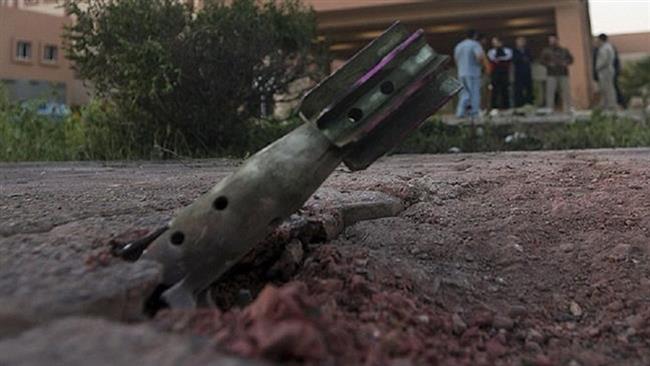
The official Saudi news agency SPA quoted Colonel Turki al-Maliki as saying that at exactly 8:07pm local time, a ballistic missile was fired from Yemeni territory towards the kingdom.
Maliki said Saudi forces used a surface-to-air Patriot missile to destroy the missile which shattered into fragments in an uninhabited area east of the airport.
He said there were no reported casualties.
Al Jazeera could not independently verify the reports.

Who Scared Off Lebanon’s PM: Nasrallah or Bin Salman?

After the assassination of the rich and relatively popular Prime Minister of Lebanon, Rafic Hariri, the accusing finger was pointed at Lebanon’s Hezbollah movement. This was the most popular answer and also a simplification of a complex puzzle. This puzzle, albeit with delay, was later resolved for the young Saad Hariri, and March 14 Alliance stopped seeking revenge on its powerful rival. The presidential spell in Lebanon was also broken, and an era of executive power vacuum was filled in the Arab country.
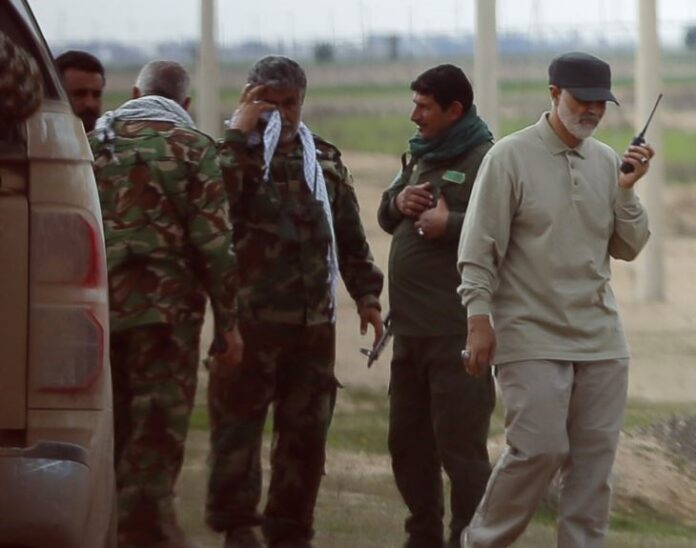
Saad Hariri spent a relatively long period with his suspicion falling on Hezbollah, and as a result, a tense atmosphere was created in Lebanon. A state without government was left for the parties and tribes of this land. Eventually, the spell of presidential vacuum broke with the agreement of Lebanon’s major political currents to elect General Michel Aoun, and as a result of this national consensus Saad Hariri became the premier. However, with the end of the presidential void, the ambiguities about Rafic Hariri’s assassination was resolved. Lebanon’s problem was solved when neat documents provided clues about the identity of the late prime minister’s assassin, and proved to the young Hariri that Hezbollah had not been involved in his father’s murder.

Saad Hariri was shocked to see the role of Saudi Arabia revealed in the assassination of his father. Now, it was time for him to forget his anger at Sayyed Hassan Nasrallah, and that’s what he did. Exercising restraint, he maintained the ties with the Saudi rulers. With the puzzle of his father’s assassination solved, the young Hariri clearly understood that the cost of changing his position towards Riyadh is his life. But from now on, having confidence in Hezbollah, he could lead the coalition government of Lebanon; A crisis-struck country, whose smallest problem was the dumping of rubbish in the beautiful city of Beirut!
While ordinary Lebanese civilians are witnessing sacrifices made by Hezbollah forces to keep their country away from civil war and the sedition of ISIS and also their efforts to cleanse their homeland of multinational terrorism, it is surprising that Saad Hariri, at the same time as his Israeli counterpart regretted the failure of ISIS in Syria, suddenly returned to the days before his premiership and called for Hezbollah to be disarmed!

What has happened in Lebanon that forced the young prime minister to show a 180-degree turn in his positions? Is the Hebrew, Arab, and Western-backed Zionism going to turn this country into a (new) battlefield and spill the civil war from Syria and Iraq to Lebanon while the terrorists are fleeing the Iraqi and Syrian territories? Should Lebanon once again experience a bitter power vacuum and be flooded with internal disputes?

On Friday, the special envoy of Iran’s Leader to Lebanon, Ali Akbar Velayati, who had travelled to the Lebanese capital to attend the Union of Resistance Ulema Summit, met with the country’s officials, including Saad Hariri. He expressed satisfaction with the continuation of the victories of the axis of resistance (in Lebanon, Syria, Iraq and Yemen, next to their allies, Russia and Turkey). This satisfaction was reflected on TV screens for a few moments and drew the attention of the opposite side (terrorists and their regional and trans-regional supporters). Now the question is that if Hariri’s surprise resignation in Riyadh, and its announcement by the Al-Arabia network in Saudi Arabia, is linked to the joint satisfaction expressed by the host and the guest?
Should the Lebanese Prime Minister quit playing with Saudi’s fire only because of giving a warm laugh (not an artificial or diplomatic one) to Velayati and his inability to conceal his apparent satisfaction with the victory of a number of citizens against ISIS and al-Nusra Front?

A remarkable point in Hariri’s resignation was expressing that the conditions of Lebanon today is similar to his father’s term. Has the young Saad been afraid of meeting a similar fate to the late Prime Minister of Lebanon?!

The mystery of today is: who scared off Hariri? Bin Salman or Hassan Nasrallah?!

CIA Documents on Iran’s Links to Al-Qaeda ‘Shameless Fabrication’

Iran Summons French Envoy over Macron’s Anti-Islam Stances

In a Saturday statement, Qassemi has reacted to the Central Intelligence Agency (CIA)’s release of documents pertaining to Al-Qaeda some of which contain accusations that Iran has ties to the terrorist group.

“Although US authorities have not yet made any comments on these alleged documents, the American government and intelligence agencies have a dark record of fabricating such documents and deceiving the world public opinion and even American people to achieve their political and strategic objectives,” said Qassemi.

“Such moves are a clear example of shamelessly fabricating documents in order to prove the US president’s groundless remarks against the Islamic Republic of Iran and to use them for domestic consumption,” the spokesman highlighted, adding that such documents have no other value.
“There is no doubt that such futile propaganda campaigns by American intelligence services are only aimed at saving some of the United States’ allies in the Middle East region which are seriously gripped by multiple domestic and regional crises, and those in the international community that have a conscience have no doubts about their (US allies’) role in creating and ideologically training terrorist groups in the past two decades,” said the spokesman.

“Levelling such accusations against the Islamic Republic of Iran is completely irrelevant, farcical and unfounded, and releasing them ahead of November 4, the day Iranian people express their opposition to the US government’s policies and decades of interference in our country, shows that such campaigns against our country lack any credit and value,” he said.

He then touched upon the current US statesmen’s misleading American people regarding the role that some of Washington’s allies played in the September 11 attacks in which around three thousand American citizens were killed.

“While the US government intentionally refuses to release a full report by the national 9/11 commission and shed light on the real perpetrators behind the incident, the publication of such illusionary and fabricated documents will not change the proven international belief regarding what countries in the region are ideologically feeding terrorist groups such as Al-Qaeda, and what country or countries have contributed to their formation and have offered them military, political and logistical support,” Qassemi said.

Spokesman Rejects Anti-Iran Remarks by Lebanon’s Hariri

“Mr. Hariri’s sudden resignation and announcing it in another country is regrettable and at the same time surprising; it shows Hariri is playing in a field prepared by those who wish ill for the region, and the winner of this game is both Arab countries and the Zionist regime [of Israel] whose survival is contingent upon tension in and among Muslim countries in the region,” said the spokesman in a Saturday statement.

He said at a time when the life of ISIS and other terrorist groups in some regional countries is coming to an end, efforts should be made to calm the situation and repair the damage caused by terrorists trained and sponsored by the US and its regional allies and reconstruct the countries suffering from the ravages of years of war and destruction.

The spokesman rejected Hariri’s comments against Iran’s role in the region, saying, “The resigned Lebanese premier’s repetition of unfounded accusations levelled against Iran by the Zionists, Saudis and Americans bears witness to the fact that this resignation, too, is a new scenario to create new tension in Lebanon and in the region; but we believe that strong Lebanese people will easily pass through this phase, too.”

He said Iran has always wanted to see peace and stability in the Middle East countries and has defined its interests based on the security, stability and economic growth of all neighbouring and regional countries.

“Accordingly, top of Iran’s regional policies is to fight insecurity and instability as well as extremist and terrorist groups to ensure tranquility for all countries,” he added.
He concluded by saying that Iran and Lebanon enjoy good relations.
“As the Lebanese president highlighted the good political relations between the two countries and rejected any accusations of Iran’s interference in Lebanon, the Islamic Republic of Iran, too, has always respected Lebanon’s independence and [the necessity of] maintaining stability and tranquility, and has expressed its readiness to cooperate with the Lebanese government in areas of mutual interest,” the spokesman noted.

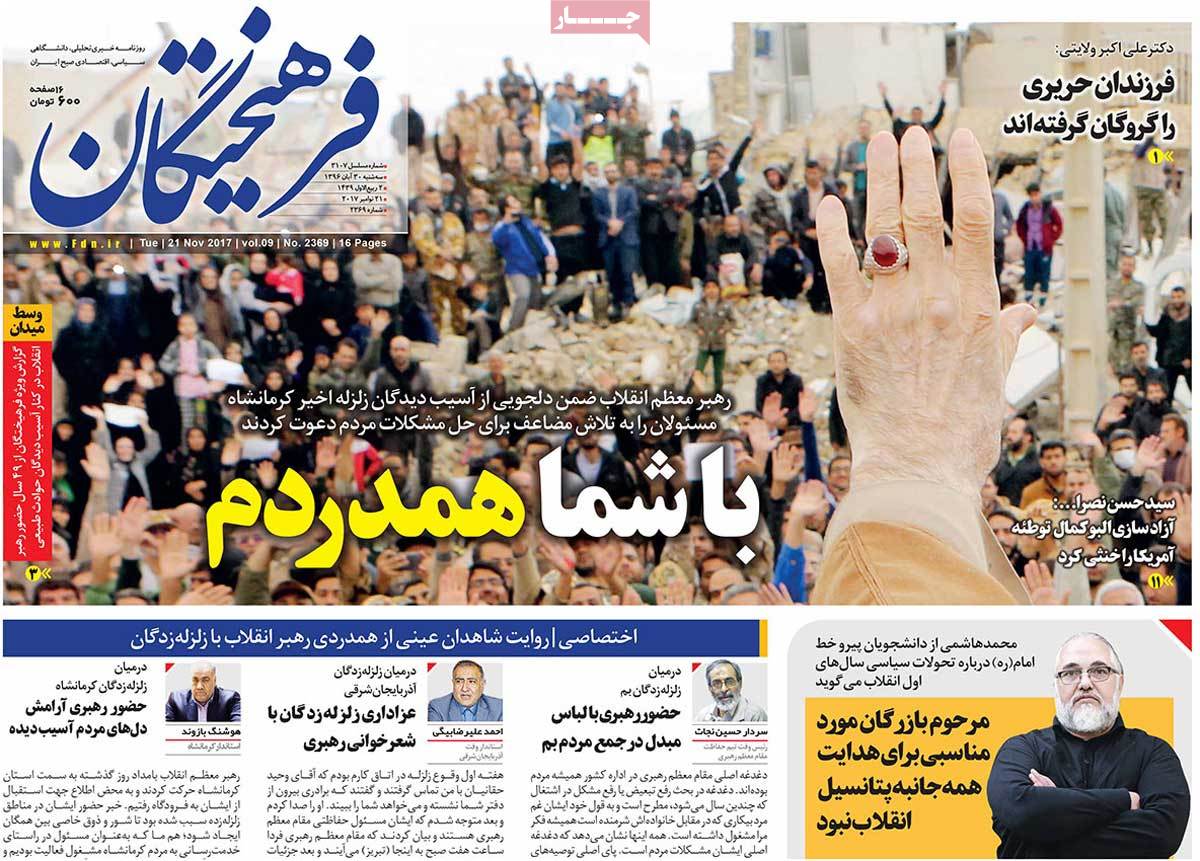
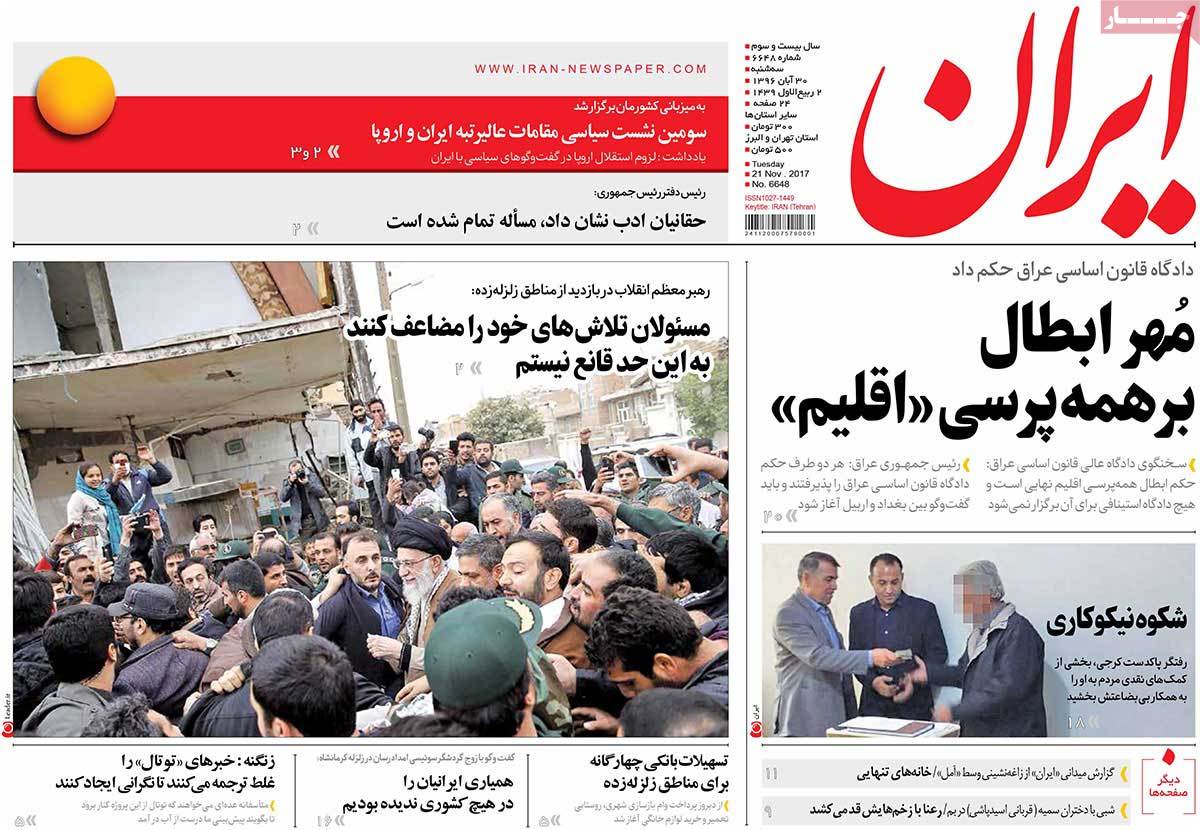
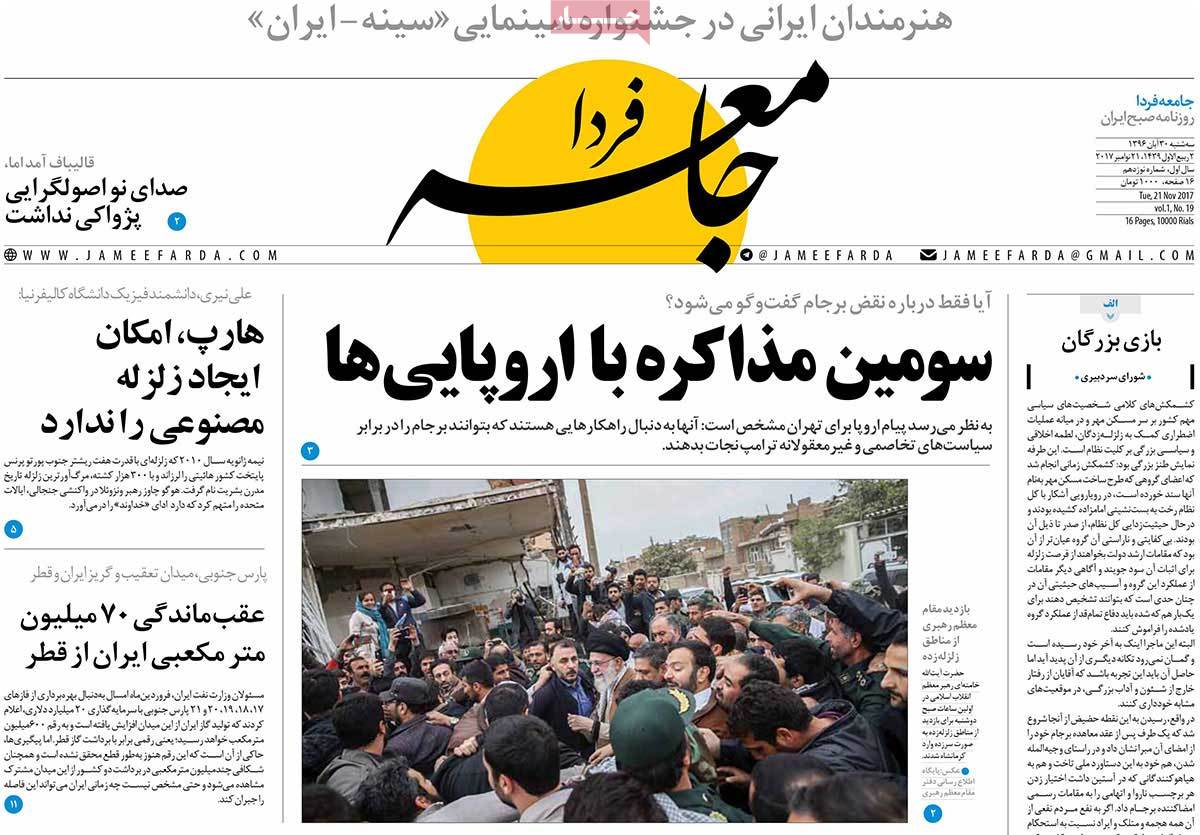
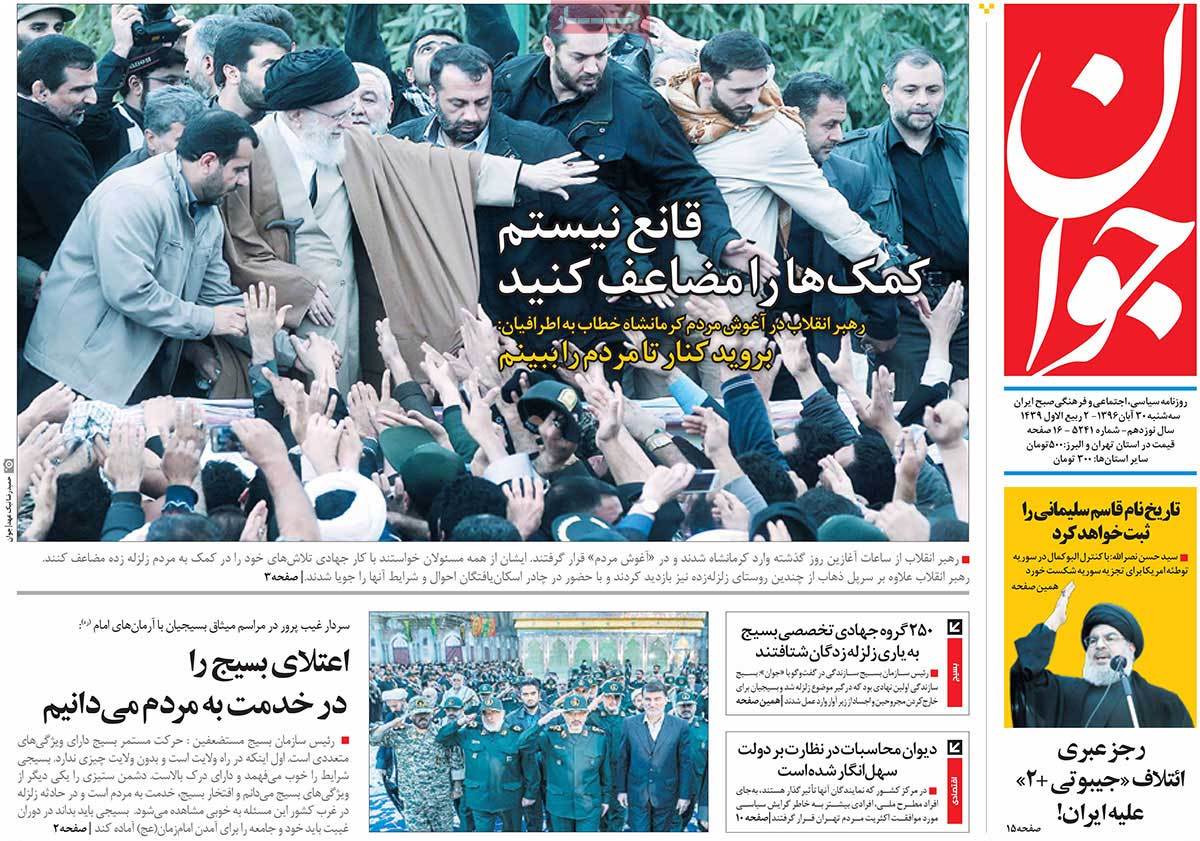
A Look at Iranian Newspaper Front Pages on November 4

The top story in all Iranian newspapers today was the remarks made by the Leader of Iran’s Islamic Revolution Ayatollah Seyyed Ali Khamenei in a meeting with hundreds of young Iranian people.

The Saturday papers also covered the accusations raised by the CIA about Iran’s ties with Al-Qaeda based on a series of documents, which CIA says are Bin Laden’s memoirs.

Among other top stories were the criticisms raised by a number of newspapers, particularly reformist ones, against a controversial journalism bill introduced by the Iranian government. Reformist papers believe the bill will destroy the independent nature of journalism in Iran and further restricts the profession.

The above issues, as well as many more, are highlighted in the following headlines and top stories:

Abrar:

1-Iran Leader: Appeasement to Embolden US

2- Iraqi PM: We’re Opposed to Boycotting Residents of Kurdistan Region

3- IRGC Quds Force General: Islamic Republic of Iran Cannot Be Stopped

A Look at Iranian Newspaper Front Pages on November 4


Abrar-e Eqtesadi:

1- Iran Signs $30bn Strategic Oil Deal with Russia during Putin’s Visit

2- Germans to Renovate Iran’s Obsolete Railway Management System

A Look at Iranian Newspaper Front Pages on November 4


Aftab-e Yazd:

1- Fabricating Documents Using Bin Laden’s Memoirs

  • CIA Accuses Iran of Cooperating with Al-Qaeda to Prove Trump’s Claims
  • Zarif: They Can’t Clean Role of US Allies in 9/11
  • Iran Ambassador to London: Let’s Not Forget Clinton’s Important Confession

2- Larijani: Gap Created between US and Europe on Iran Nuclear Deal

A Look at Iranian Newspaper Front Pages on November 4


Ettela’at:

1-Leader: Prosperity of Iran to Be Realized by Young People

2- Russia Warns US about Withdrawing from Iran Nuclear Deal

3- Deir ez-Zor, Last ISIS Stronghold in Syria, Liberated

A Look at Iranian Newspaper Front Pages on November 4


Iran:

1- Media Should Have Security, Freedom of Speech: Iran Top Security Official

A Look at Iranian Newspaper Front Pages on November 4


Javan:

1- Iran Leader: Americans Show No Mercy Even to One Who Pins His Hope on Them

2- Iran Deputy FM Urges Private Sector to Cooperate in Syria’s Reconstruction

A Look at Iranian Newspaper Front Pages on November 4


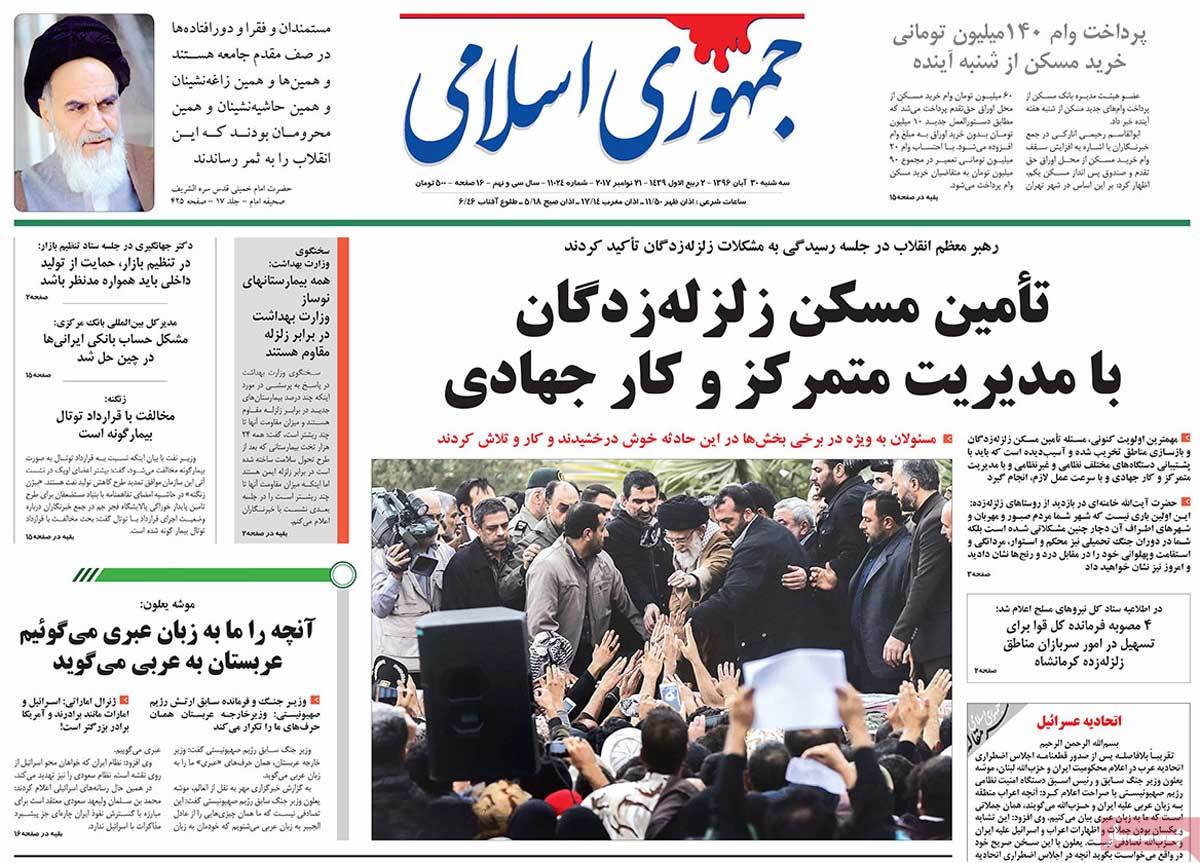
Jomhouri Eslami:

1- Iran Leader: US to Take Most Evil Measures to Spoil Iran Nuclear Deal

2- Netanyahu: Arab States Consider Israel Their Ally in Countering Iran

A Look at Iranian Newspaper Front Pages on November 4


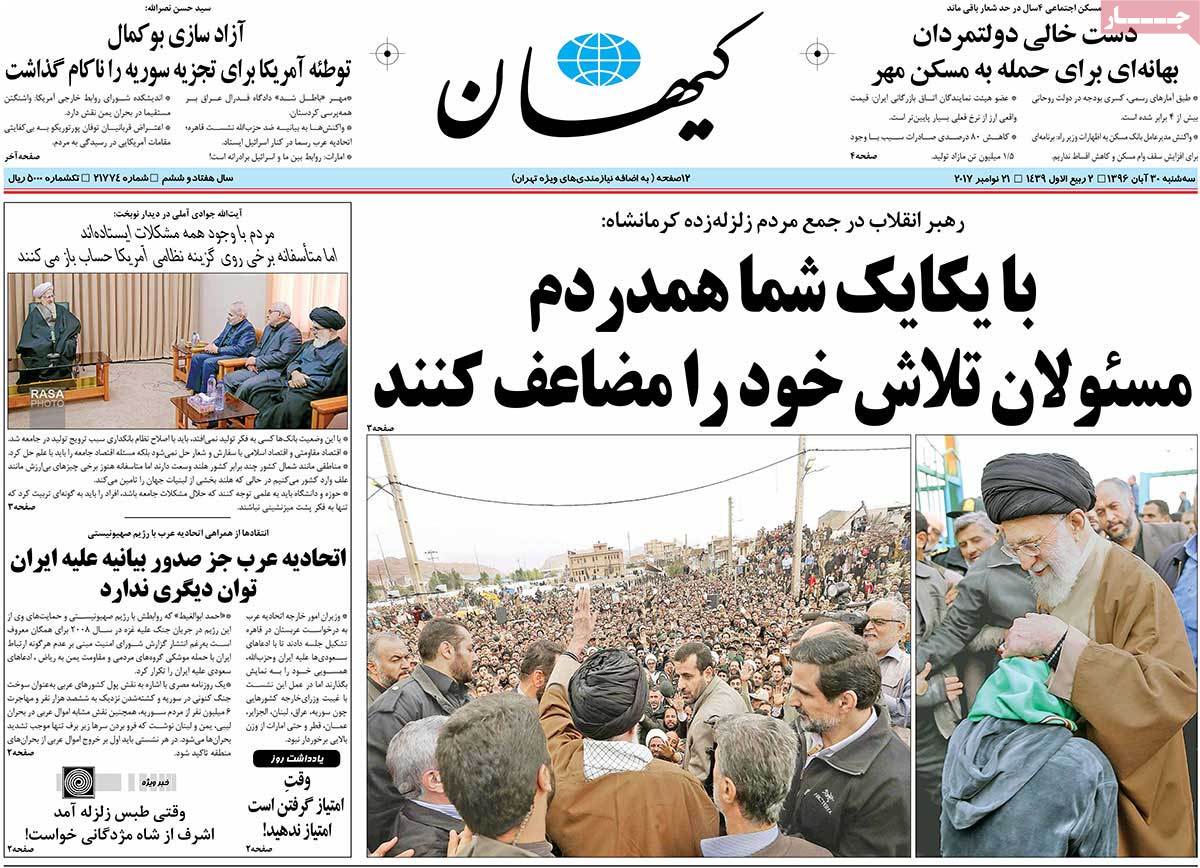
Kayhan:

1- Russian PM: No Place for US Dollar in Int’l System

A Look at Iranian Newspaper Front Pages on November 4


Rah-e Mardom:

1- Iran Leader: Promotion of Illicit Drugs, Prostitution Is Enemy Plot to Deviate Young Generation

A Look at Iranian Newspaper Front Pages on November 4


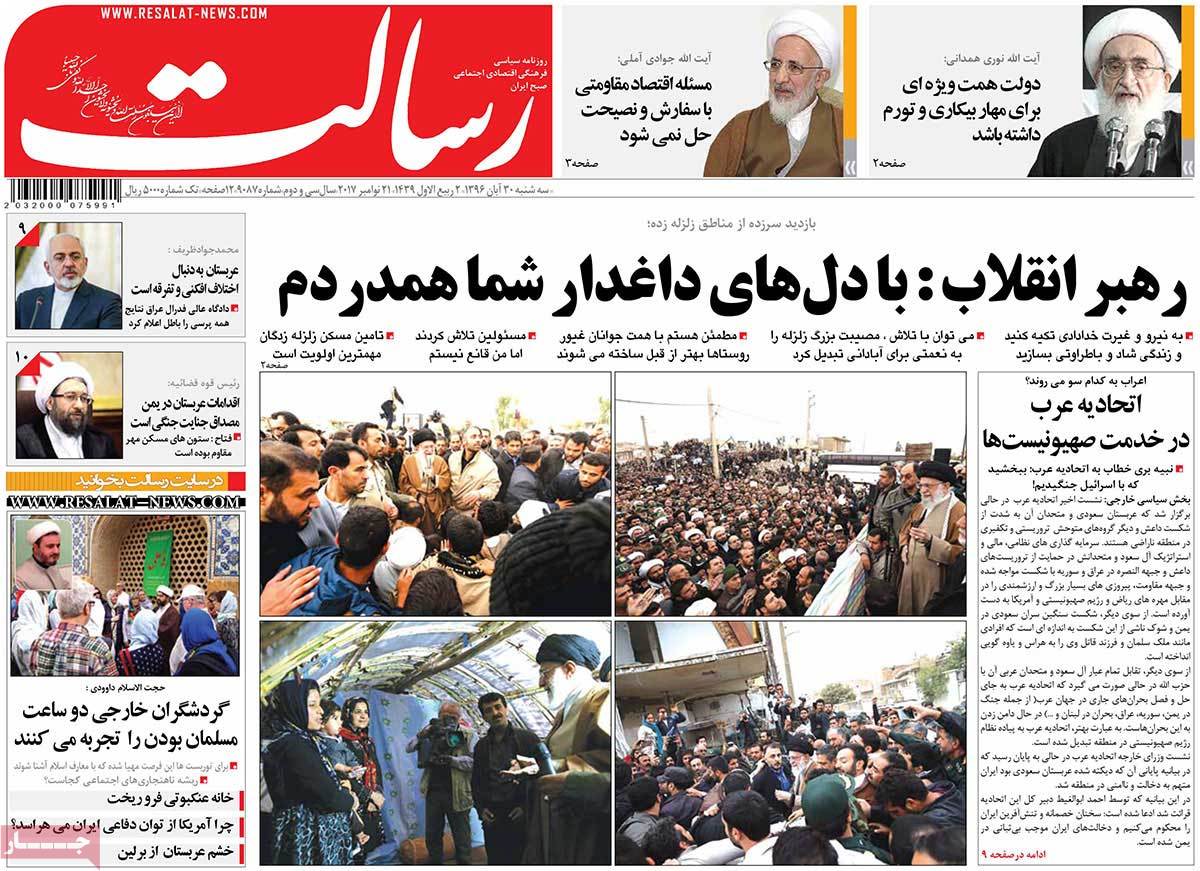
Resalat:

1- Iran Leader: Only Way Is to Counter US

2- Aoun: Zionist Regime to Be Defeated in Possible War against Lebanon

A Look at Iranian Newspaper Front Pages on November 4


Ta’adol:

1- Tehran Air Pollution Goes on 10th Consecutive Day

  • Every Citizen Receives 1.5 Kilogram of Pollutants

2- Portal Launched for Forex Transactions First Step after JCPOA

A Look at Iranian Newspaper Front Pages on November 4