Wednesday, January 14, 2026
Home Blog Page 3748

A Look at Iranian Newspaper Front Pages on November 20

Newspapers today continued to cover the ongoing efforts to help the quake-hit people in Western Iran, particularly their accommodation in the cold weather.

Media reports about the unsuccessful assassination of Saudi Crown Prince Mohammed bin Salman also received great coverage.

Another top story was a trilateral meeting between the foreign ministers of Iran, Russia, and Turkey in the Turkish city of Antalya on the Syria crisis and ways to de-escalate tension in the region.

The above issues, as well as many more, are highlighted in the following headlines and top stories:


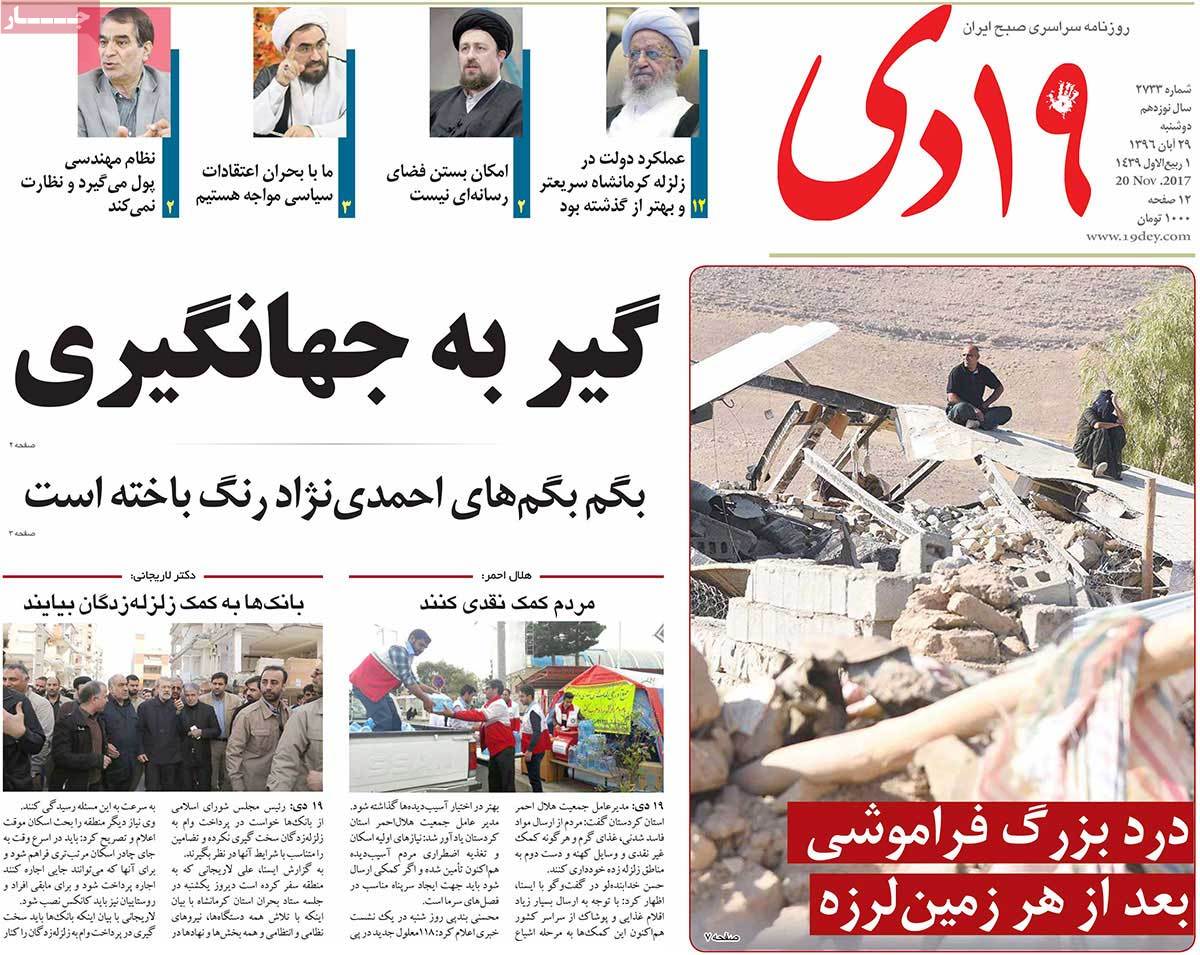
19 Dey:

1- Ayatollah Makarem Shirazi: Government’s Performance in Quake Better, Faster
A Look at Iranian Newspaper Front Pages on November 20


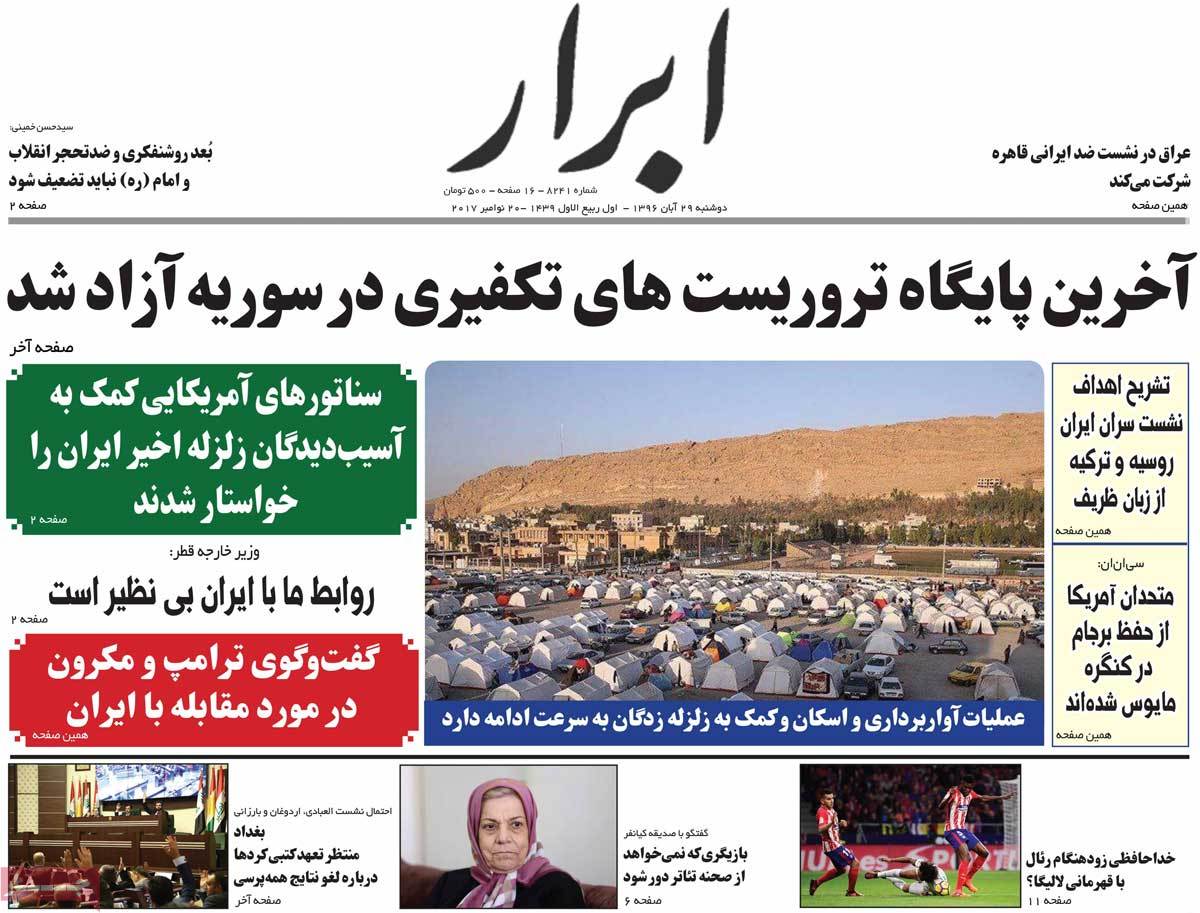
Abrar:

1- Last Stronghold of Takfiri Terrorists in Syria Liberated

2- Iraq to Attend Anti-Iran Summit in Cairo

3- Qatar FM: Our Ties with Iran Unique
A Look at Iranian Newspaper Front Pages on November 20


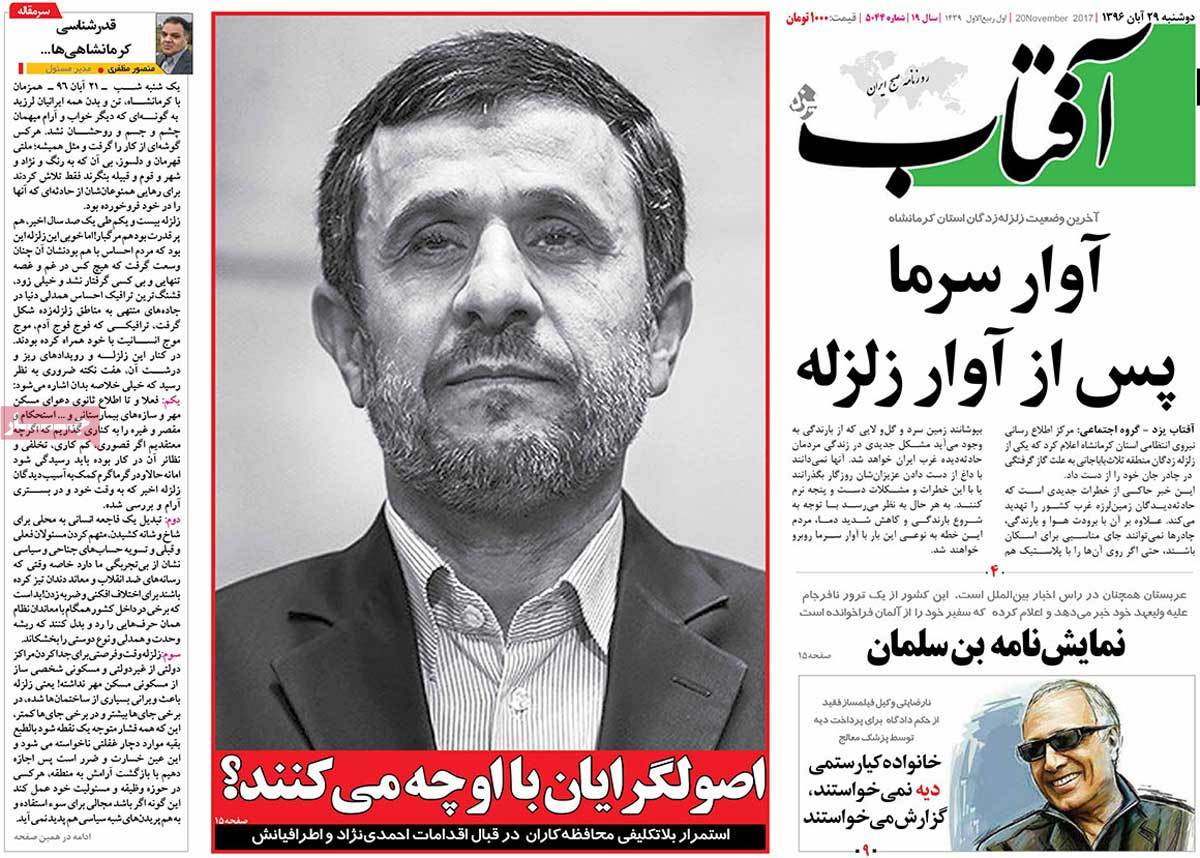
Aftab-e Yazd:

1- Rubble of Cold after Rubble of Earthquake

2- Conservatives Remain Undecided about Actions of Ahmadinejad and His Allies
A Look at Iranian Newspaper Front Pages on November 20


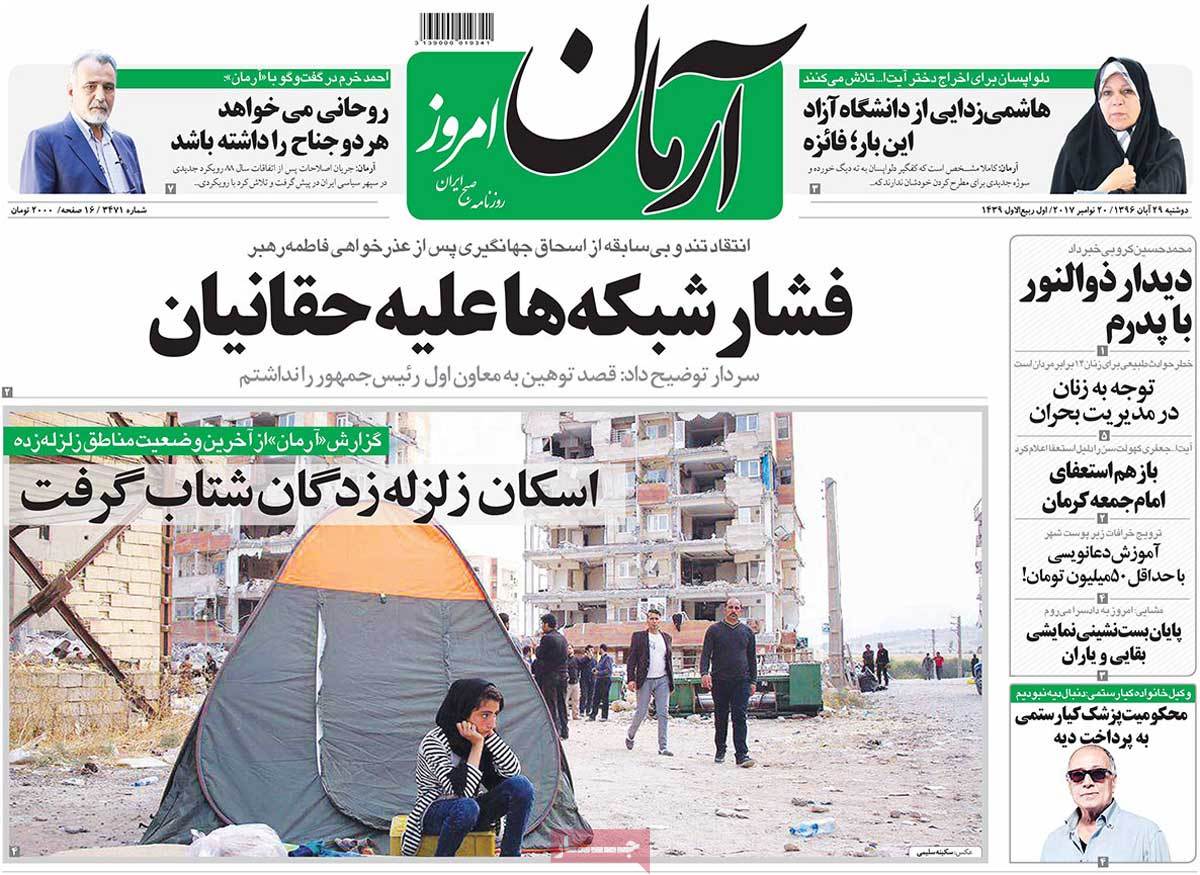
Arman-e Emrooz:

1- Accommodation of Quake-Hit People Accelerated

2- Analyst: Rouhani Wants to Keep Both Parties on His Side

3- Kiarostami’s Doctor Condemned to Pay Blood Money
A Look at Iranian Newspaper Front Pages on November 20


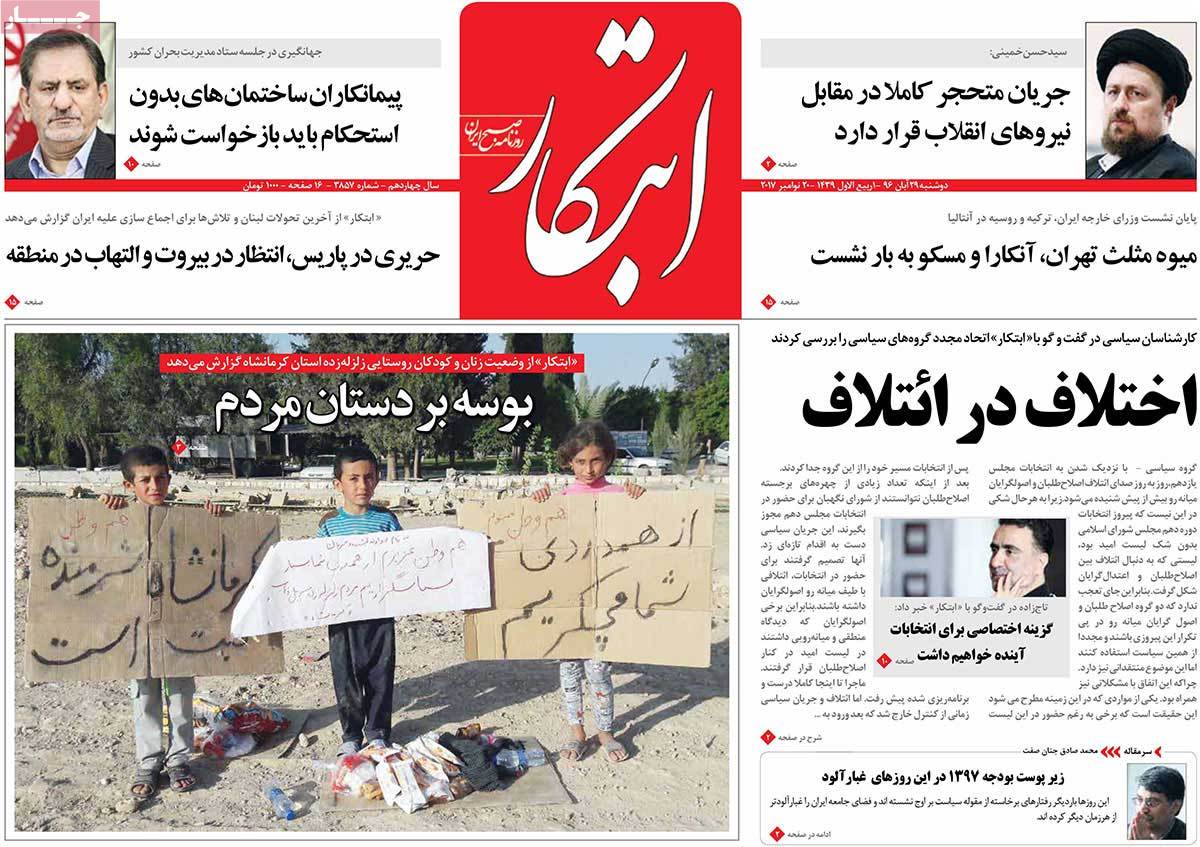
Ebtekar:

1- Imam Khomeini’s Grandson: Reactionary Movements Totally against Revolutionary Forces

2- Hariri in Paris; Beirut Waiting for Him; Tension in Region

3- Trilateral Meeting of Iranian, Turkish, Russian FMs Held in Antalya

  • Tree of Tehran-Ankara-Moscow Bears Fruit
A Look at Iranian Newspaper Front Pages on November 20


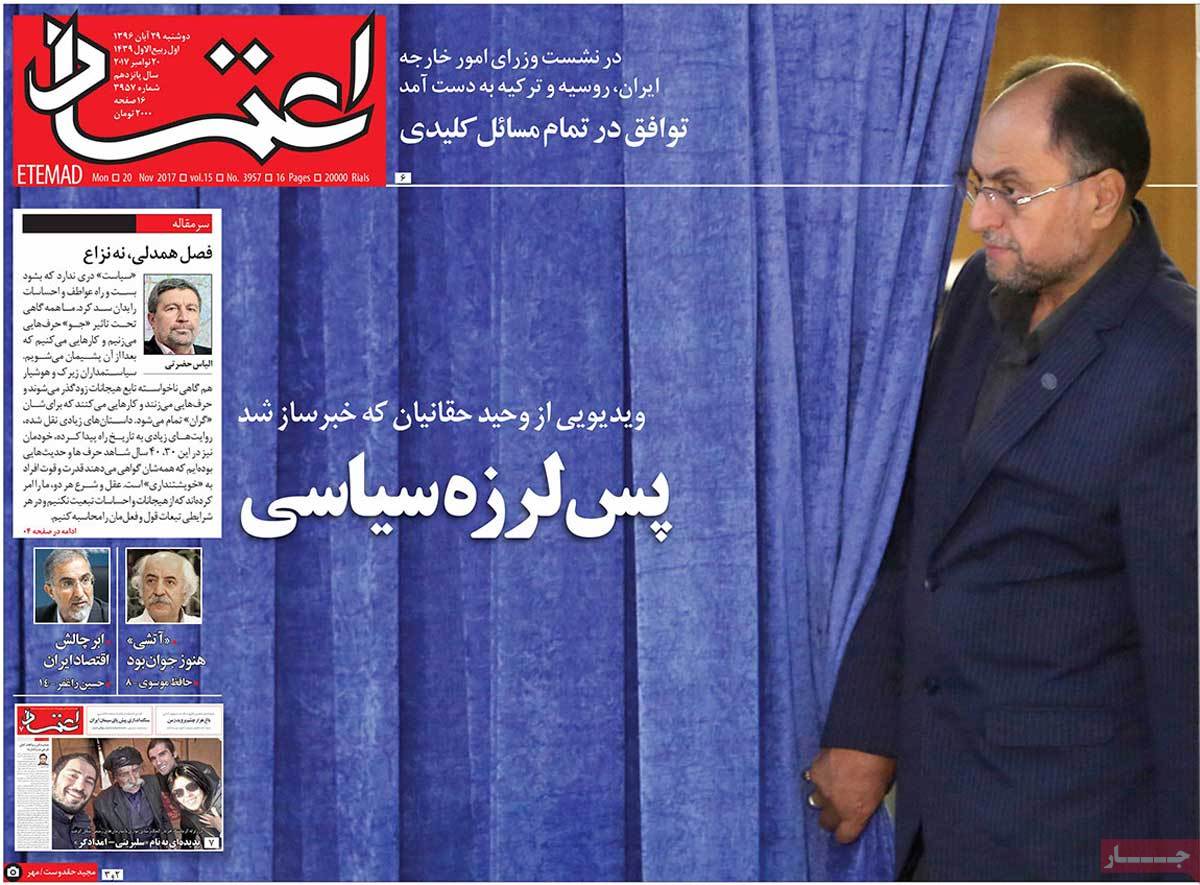
Etemad:

1- FMs of Iran, Russia, Turkey Agree on All Key Issues
A Look at Iranian Newspaper Front Pages on November 20


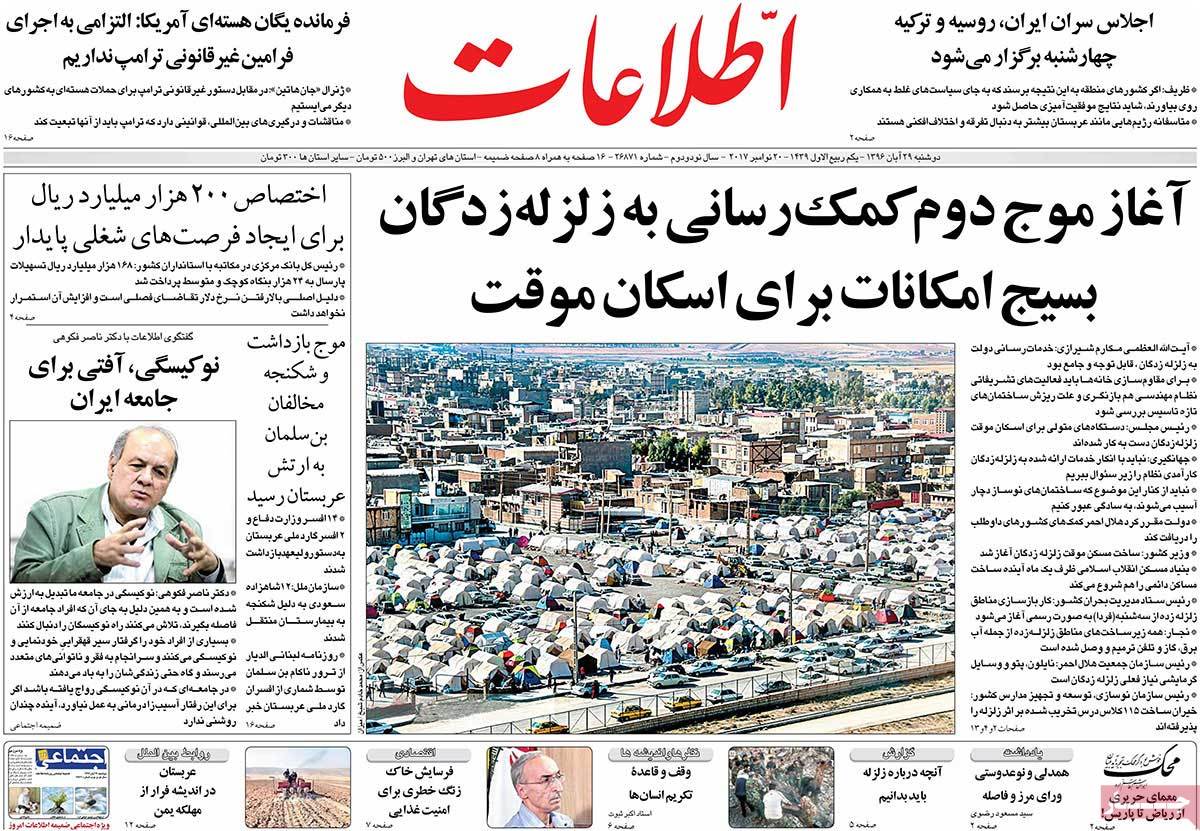
Ettela’at:

1- Second Wave of Help for Quake-Hit People Begins

  • All Facilities, Equipment Deployed for Temporary Accommodation

2- Leaders of Iran, Russia, Turkey to Hold Summit Wednesday

3- US Commander: We’re Not Required to Implement Trump’s Illegal Orders
A Look at Iranian Newspaper Front Pages on November 20


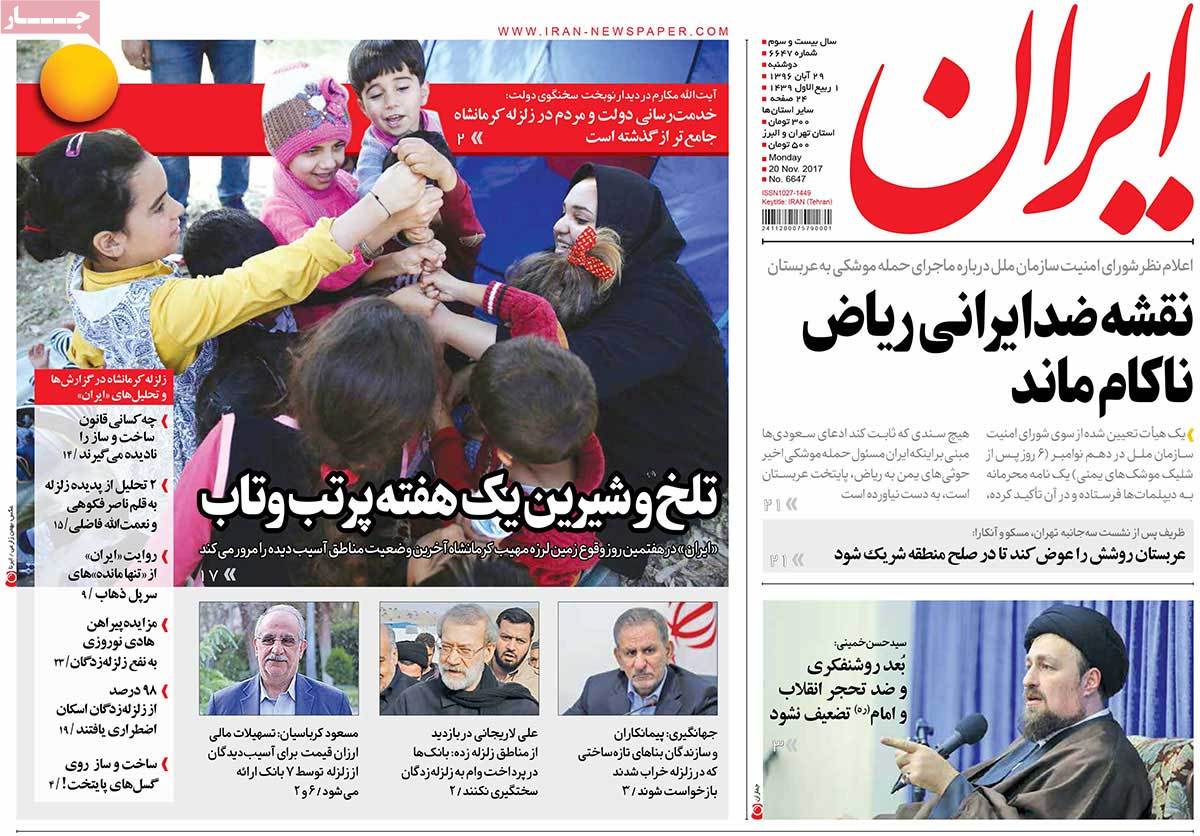
Iran:

1- Riyadh’s Anti-Iran Plot Fails

2- Zarif: Saudi Arabia Should Change Its Policies to Be Part of Regional Peace

3- A Week Full of Bitter, Sweet Incidents

  • A Review of 7th Day after Iran Earthquake
A Look at Iranian Newspaper Front Pages on November 20


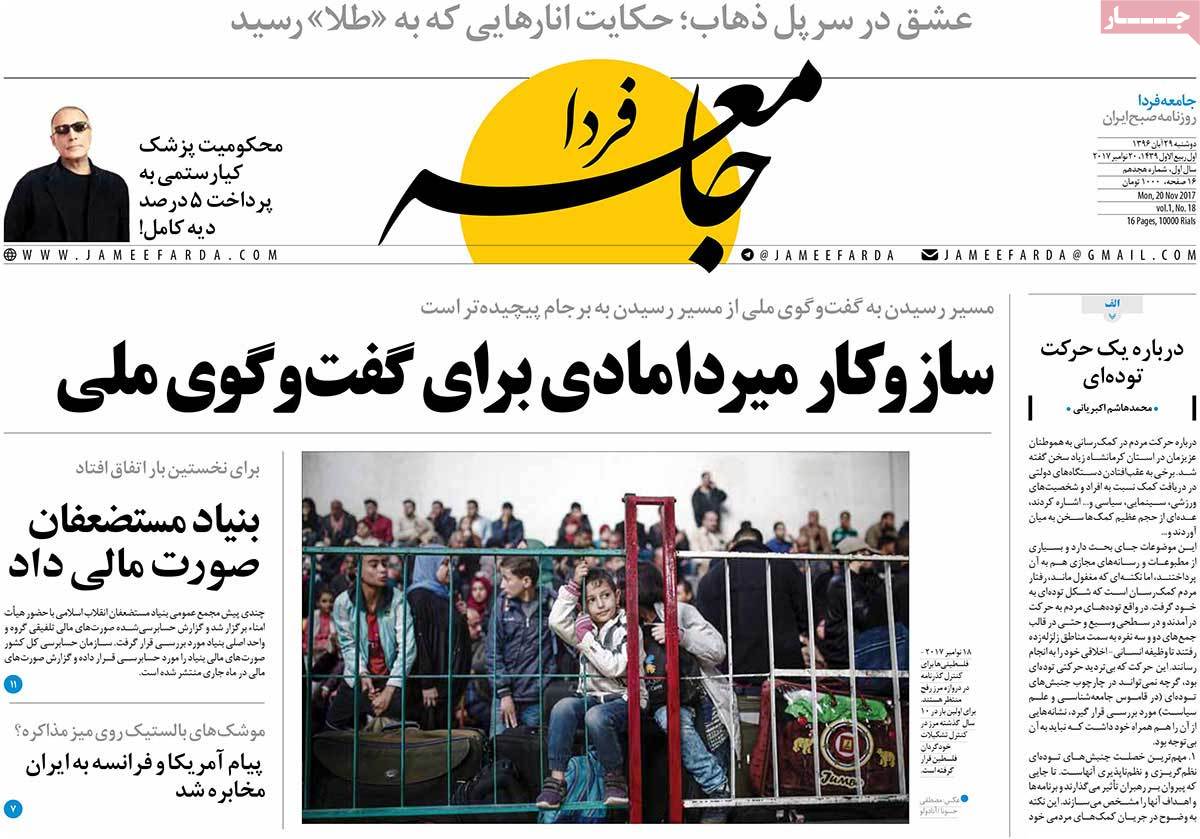
Jame’eh Farda:

1- Ballistic Missiles on Negotiating Table?

  • Message of US, France Conveyed to Iran

2- Reformist Figure’s Mechanism for National Dialogue

  • Path of Achieving National Dialogue More Complicated than Path of Achieving JCPOA
A Look at Iranian Newspaper Front Pages on November 20


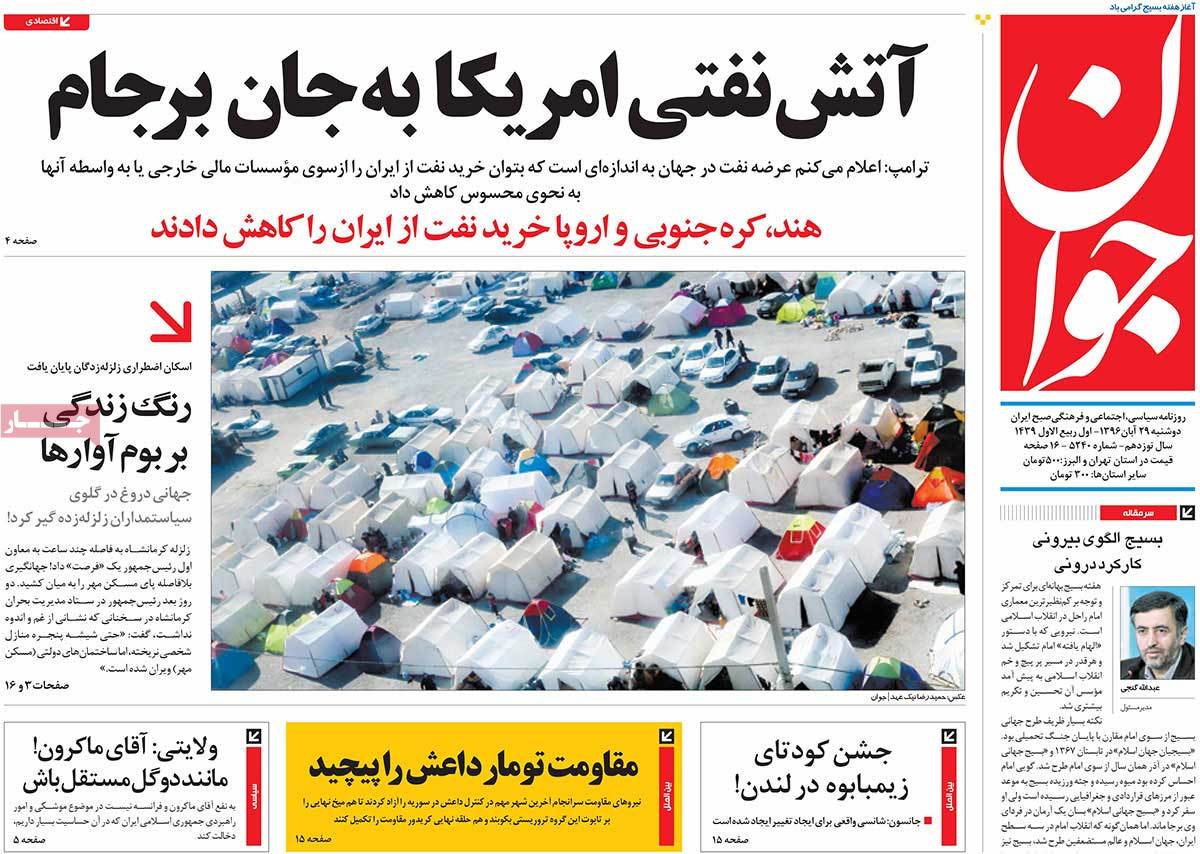
Javan:

1- US Uses Oil to Set Iran Nuclear Deal on Fire

2- India, South Korea, Europe Decrease Oil Purchase from Iran

3- Axis of Resistance Eradicates ISIS Terrorists

4- Velayati: Mr. Macron! Be as Independent as Charles de Gaulle
A Look at Iranian Newspaper Front Pages on November 20


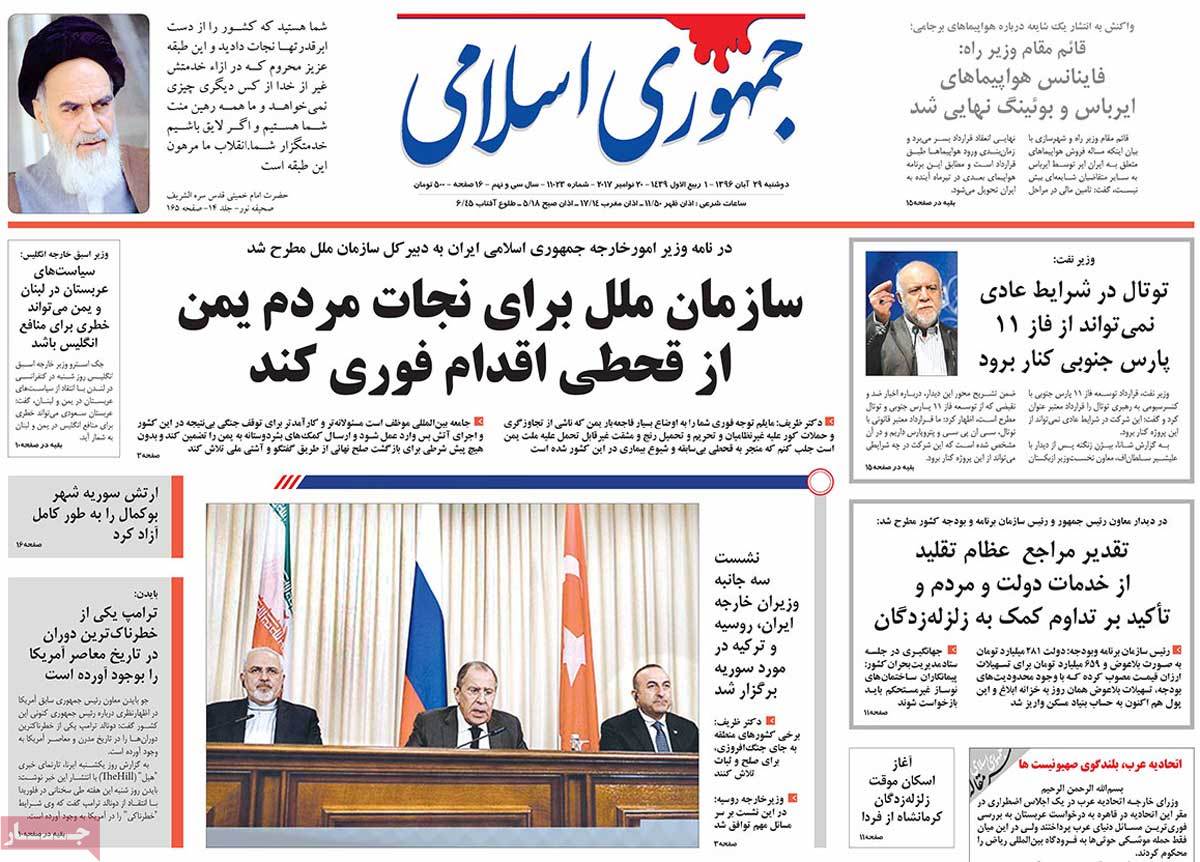
Jomhouri Eslami:

1- FM Zarif: UN Should Take Immediate Action to Save Yemeni People from Drought

2- Oil Minister: Under Normal Circumstances, Total Cannot Leave Phase 11 of South Pars

3- Top Clerics Praise Services of Gov’t, People, Call for Continued Help for Quake-Hit People
A Look at Iranian Newspaper Front Pages on November 20


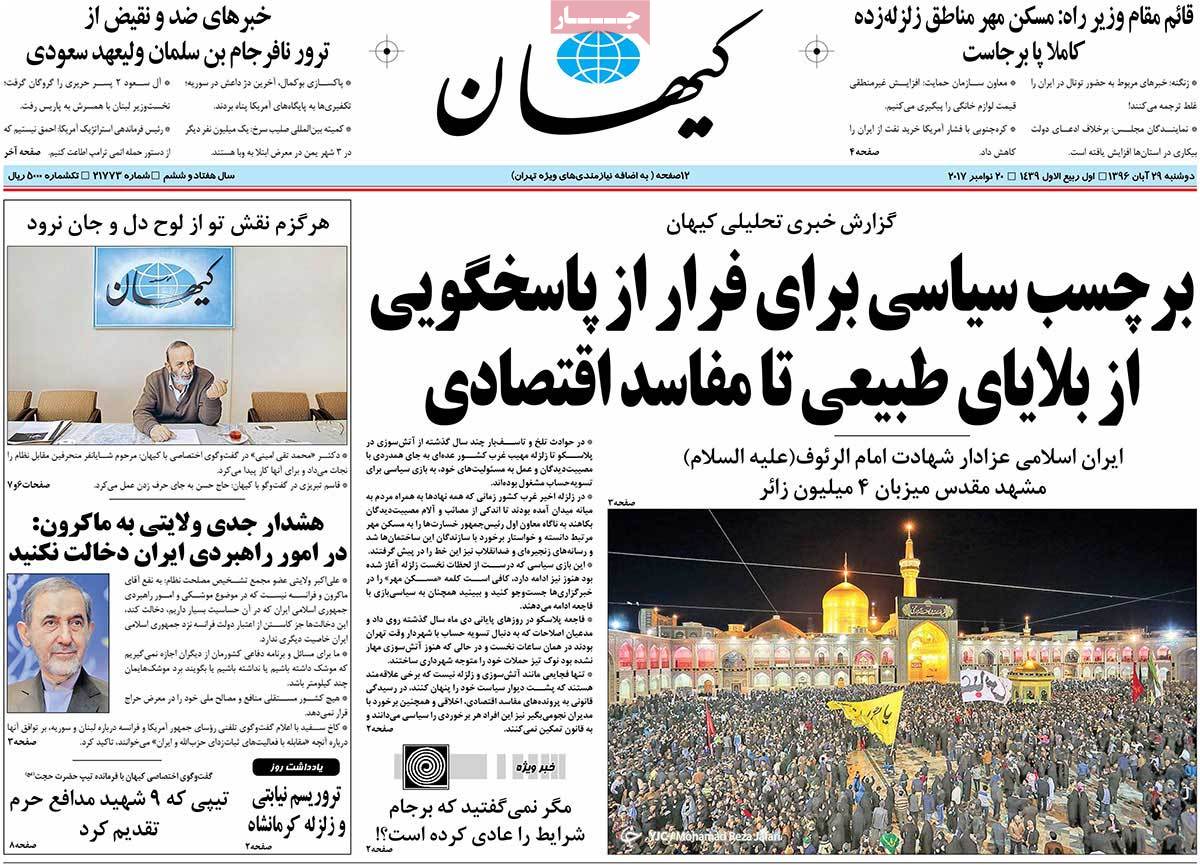
Kayhan:

1- Political Labelling to Evade Accountability: From Natural Disasters to Economic Corruption

2- Mixed Reports about Attempt to Murder Bin Salman

3- Velayati Seriously Warns Macron over Interfering in Iran’s Strategic Affairs
A Look at Iranian Newspaper Front Pages on November 20


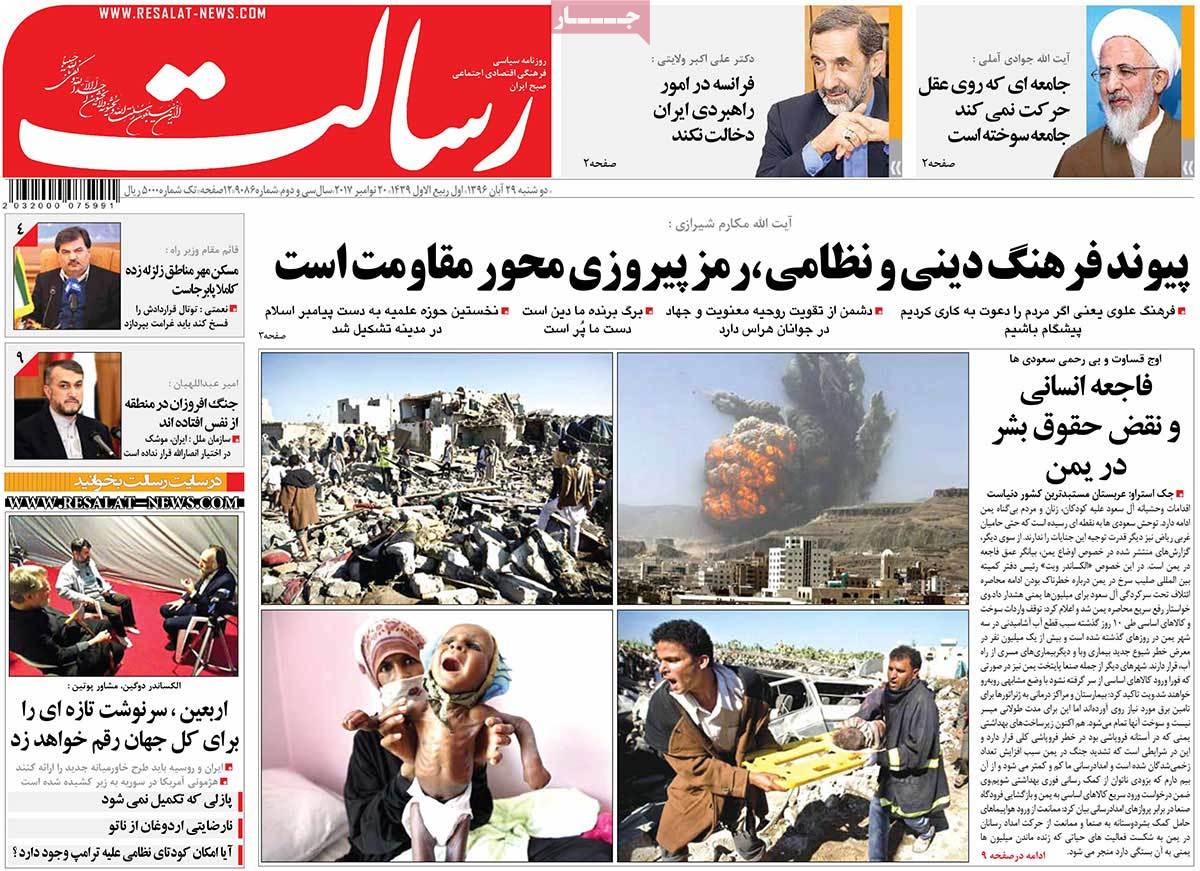
Resalat:

1- Ayatollah Makarem Shirazi: Connection of Religious, Military Cultures Secret behind Victory of Resistance
A Look at Iranian Newspaper Front Pages on November 20


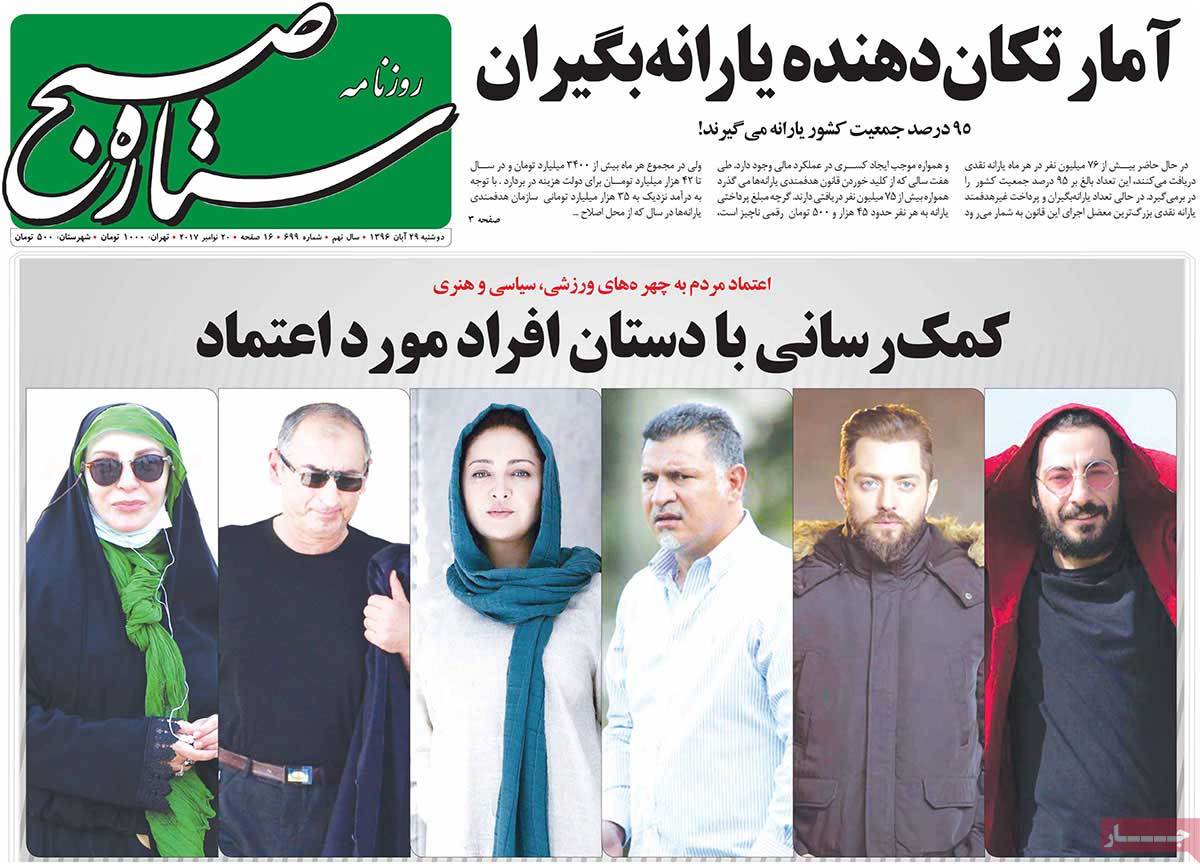
Setareh Sobh:

1- People’s Trust for Athletic, Political, Art Figures: Helping People through Trusted Hands
A Look at Iranian Newspaper Front Pages on November 20


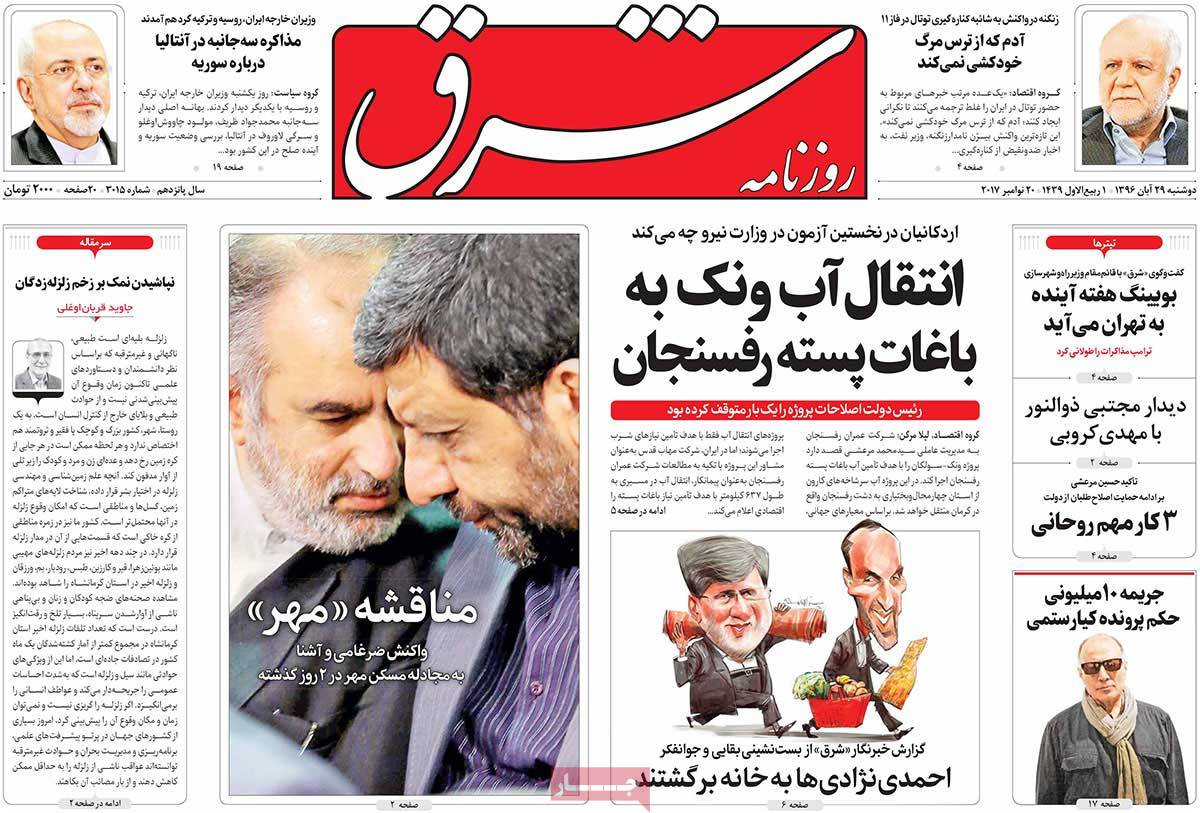
Shargh:

1- Oil Minister on Total’s Withdrawal from South Pars: No One Commits Suicide for Fear of Death

2- Deputy Roads Minister: Boeing to Come to Tehran Next Week; Trump Prolonged Negotiations
A Look at Iranian Newspaper Front Pages on November 20


Siasat-e Rooz:

1- Settlements before Kingdom: Media Reports Claim Bin Salman Assassinated

2- France Continues to Play Role of Bad Cop

  • White House: Trump, Macron Make Deal on Countering Iran, Hezbollah
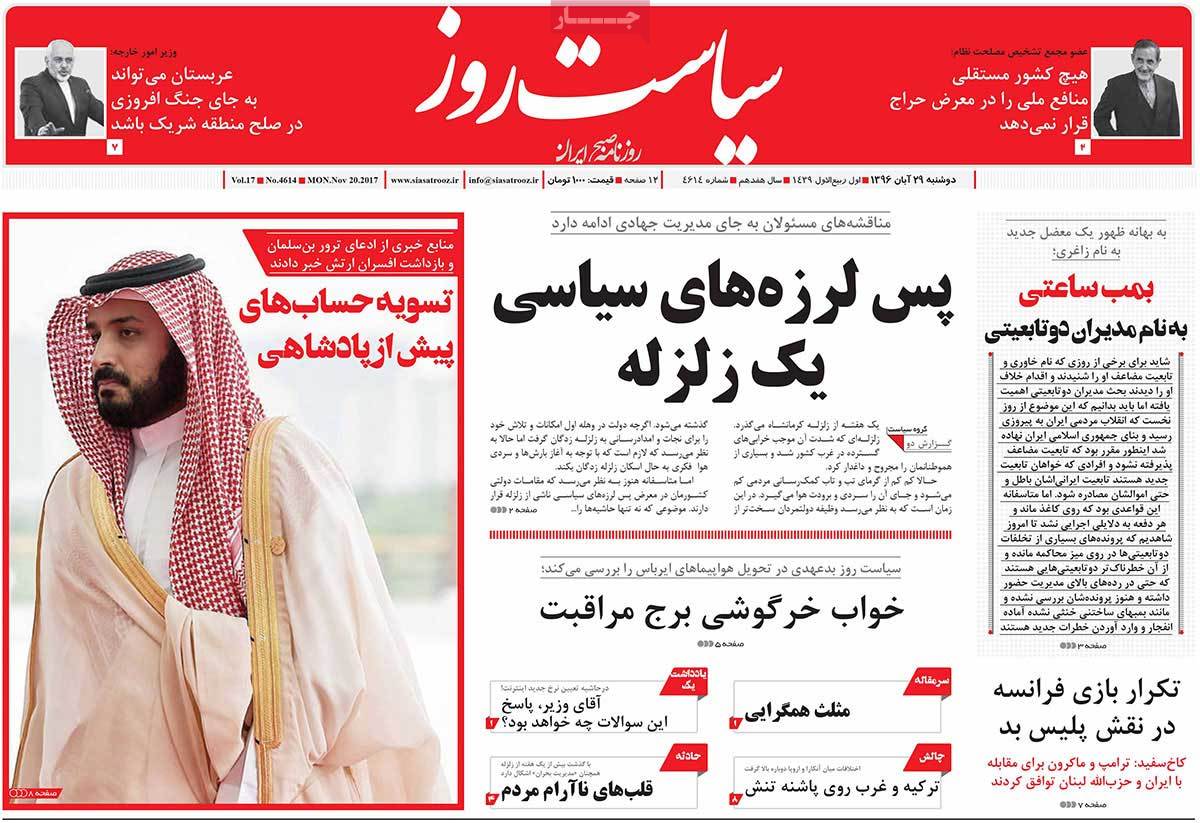
A Look at Iranian Newspaper Front Pages on November 20


Sobh-e Now:

1- Syria’s Bukamal Liberated: General Soleimani Fulfils His Promise
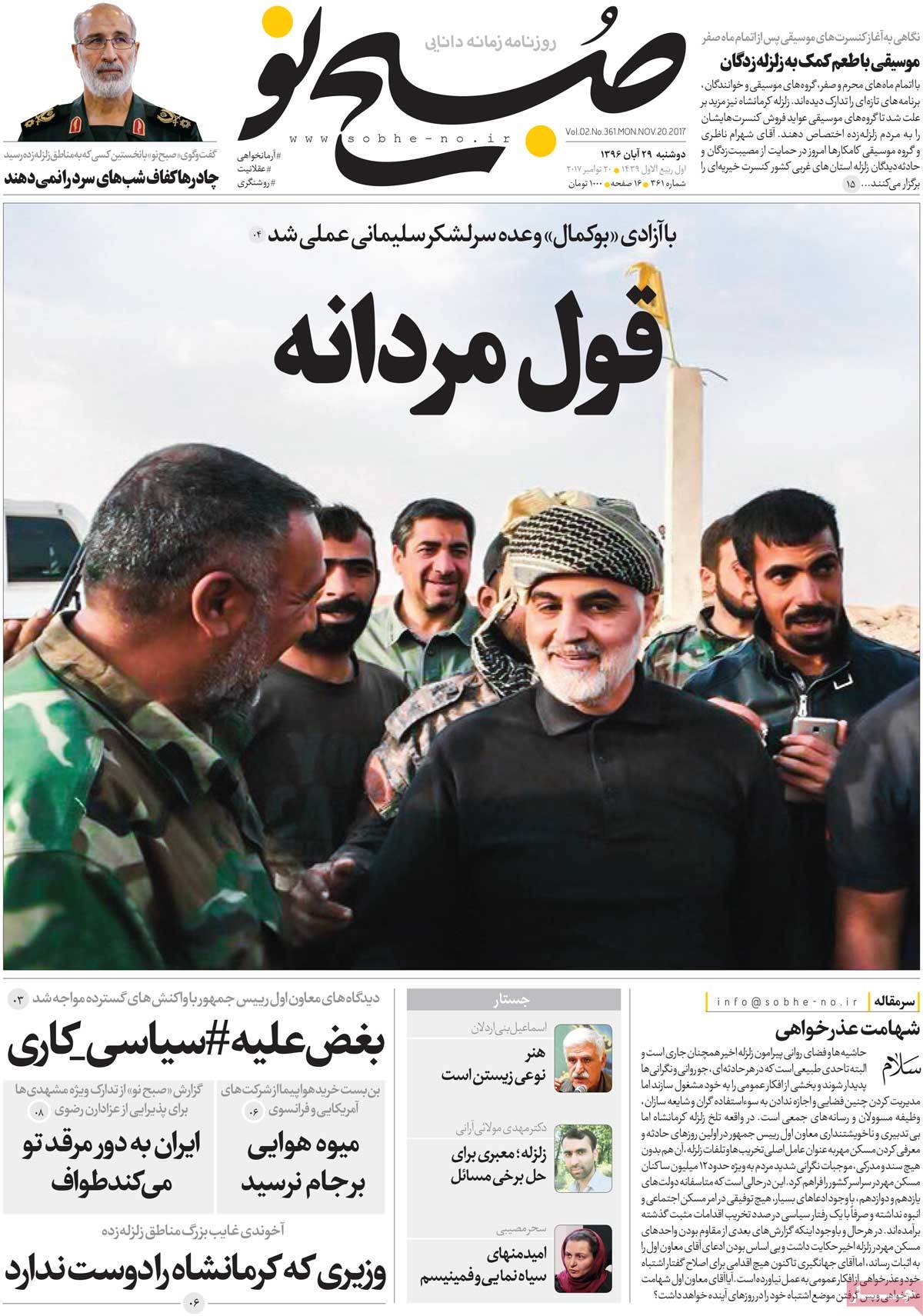
A Look at Iranian Newspaper Front Pages on November 20


Saudi Arabia, Not Iran, Destabilizing Mideast: FM Zarif

“Irony is KSA accuses Iran of destabilization, while itself fuels terrorists, wages war on Yemen, blockades Qatar & foments crisis in Lebanon,” Zarif said in a message posted on his official Twitter account on Sunday.

In the first part of his tweet, the Iranian minister referred to a meeting with his Russian and Turkish counterparts Sergei Lavrov and Mevlut Cavusoglu in the Turkish city of Antalya earlier on Sunday, saying, “Working with Turkish & Russian counterparts to build on ceasefire we achieved in Syria & preparing for inclusive dialog among Syrians”.

The three ministers convened on Sunday in Antalya to discuss the results of expert-level talk on the settlement of Syria crisis.

Iran, Russia and Turkey have so far held seven rounds of peace talks in Kazakhstan to help end the conflict in Syria. The fourth round of those talks in May produced a memorandum of understanding on de-escalation zones in Syria, sharply reducing fighting in the country.

Diplomatic efforts to end fighting in Syria gained momentum in 2017 with the announcement of a ceasefire in the Arab country in early January.

According to a report by the Syrian Center for Policy Research, the conflict has claimed the lives of over 470,000 people, injured 1.9 million others, and displaced nearly half of the country’s pre-war population of about 23 million within or beyond its borders.

No Shortage of Food, Basic Necessities for Iran Quake Victims

The devastating 7.3-magnitude earthquake which struck western Iran several days ago has left well over 400 people dead and more than 10,000 injured.

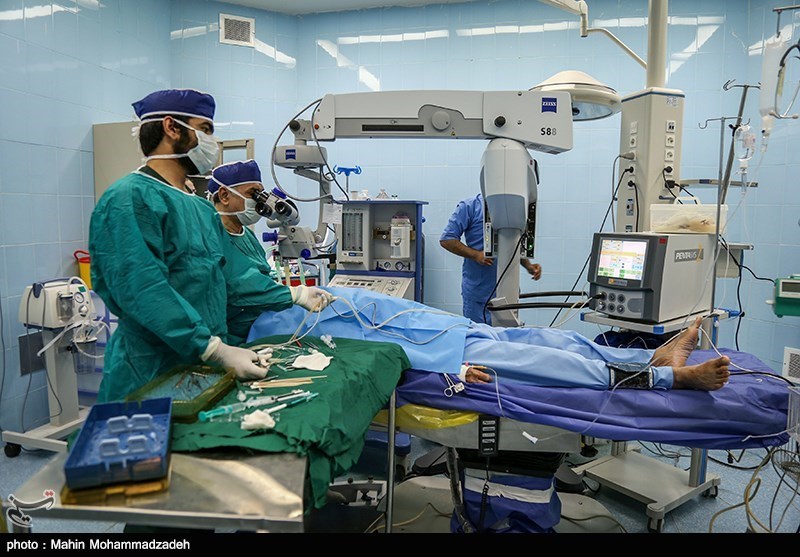
The large number of people suffering from broken limbs and ribs was a challenge to the medical personnel at makeshift hospitals as well as the medical staff of the Red Crescent Society in the first days after the temblor struck.

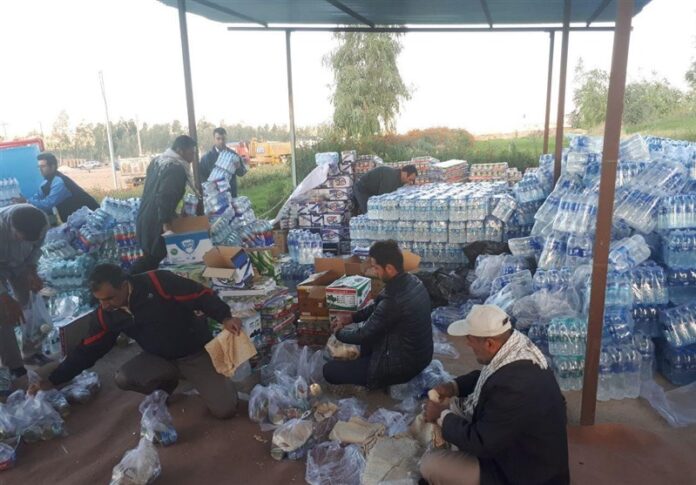
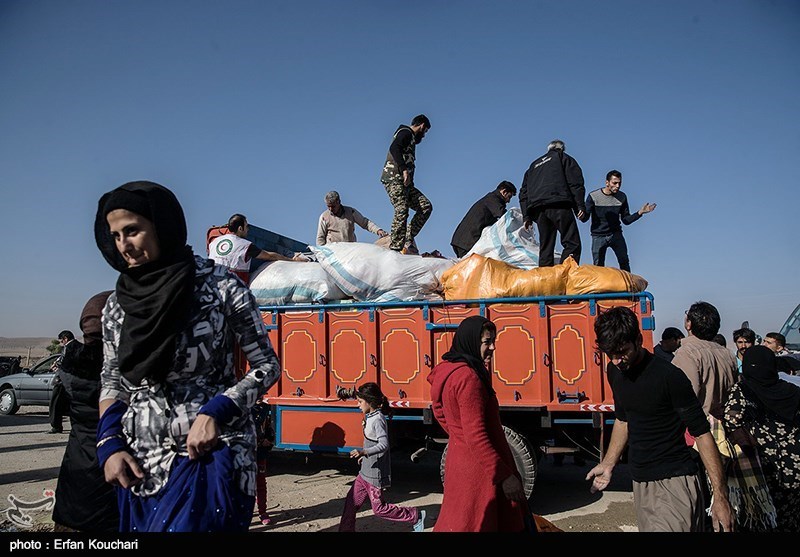
However, aid operations have been in full swing since the tragic disaster happened, and huge quantities of basic supplies have been sent to and distributed among the quake victims.

No Shortage of Food, Basic Necessities for Iran Quake VictimsAccording to senior military officials on the ground, thousands of helpings of warm food are being handed out among the quake-stricken victims every day, and there is no shortage of food in villages. The government, Red Crescent Society, Armed Forces and contingency headquarters are all working round the clock to take to the affected areas the relief aid offered by the general public from across the nation.
A census has been taken in quake-hit villages to specify the number of households in need of tents. Based on the same figures, tents are distributed among the residents.

The IRGC Ground Force has set up 6 makeshift hospitals to offer medical services to the earthquake victims. Experienced doctors and paramedics working there have played a key role in treating the patients.

Plans are also underway to remove the remaining rubble and bury the cattle killed in the temblor.

No Shortage of Food, Basic Necessities for Iran Quake VictimsThe IRGC’s engineering groups have been dispatched to the affected regions to facilitate work to remove the debris. Over 1000 pieces of machinery and equipment are working in the area to remove the rubble and conduct engineering work.
Some groups also went into action from the early hours after the quake hit and cleared the roads blocked by debris.

Head of the Red Crescent Society Morteza Salimi says all the affected people have been provided with makeshift housing.

The whole quake affected area has been divided into eight regions, and as many committees have been set up to handle the affairs in each region.

Salimi says the huge amount of relief aid sent in by the general public from around the country has somehow turned into a major problem as it is too much to cope with, saying there are more than enough supplies and basic necessities.

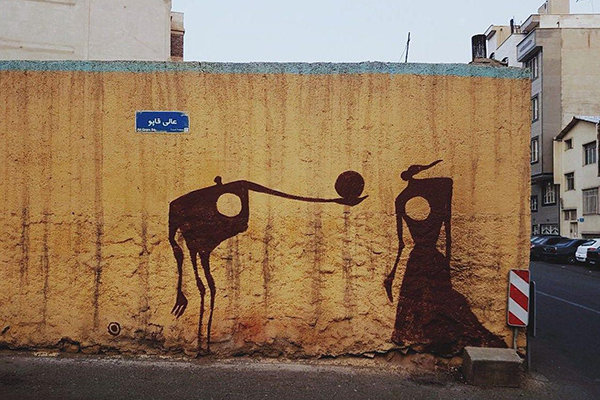
Iranian Painter Depicting Loneliness in Wall Paintings

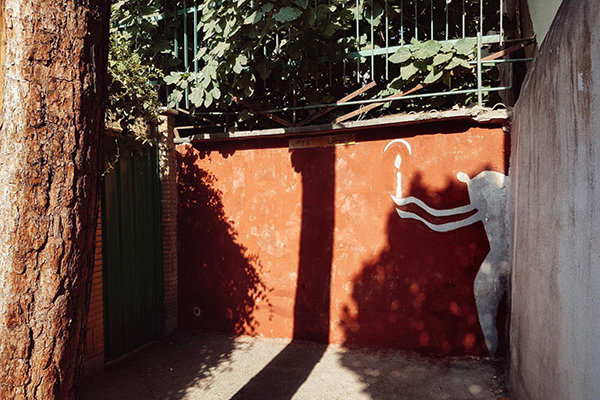
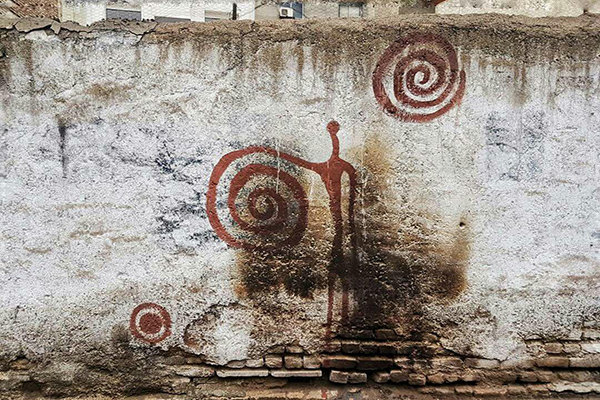
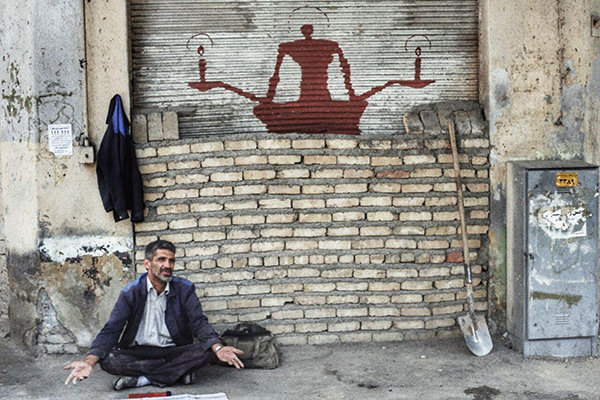
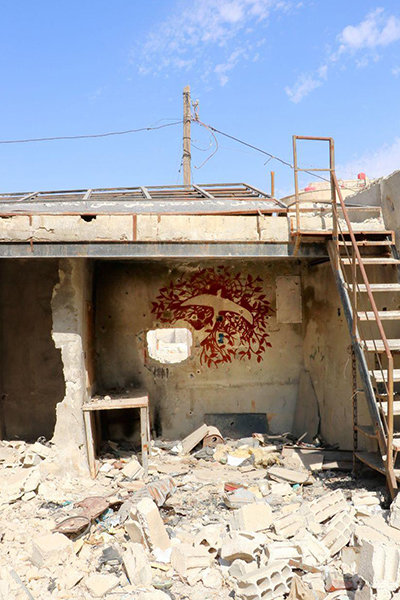
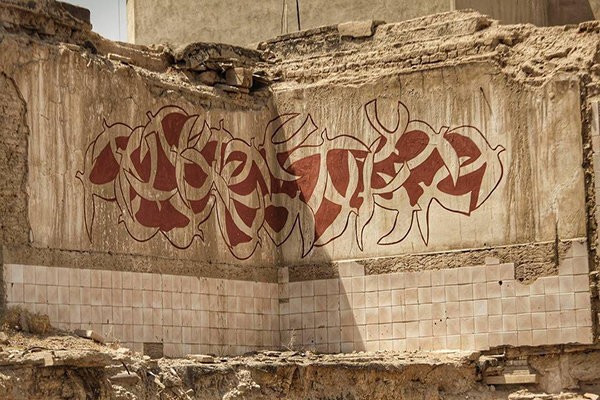
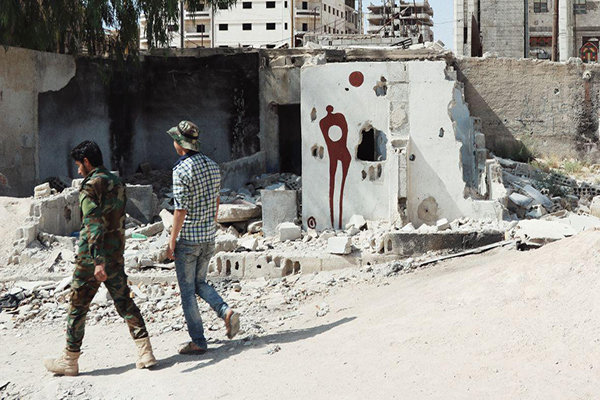
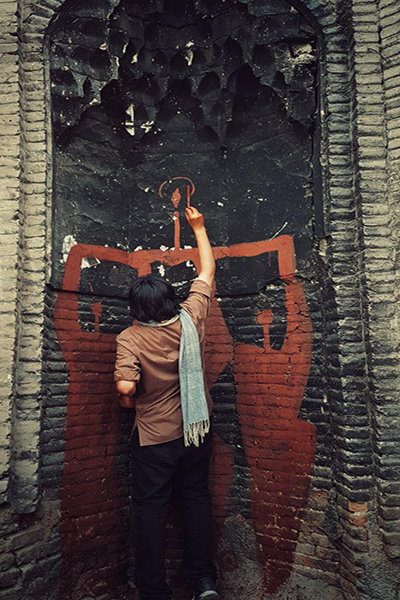
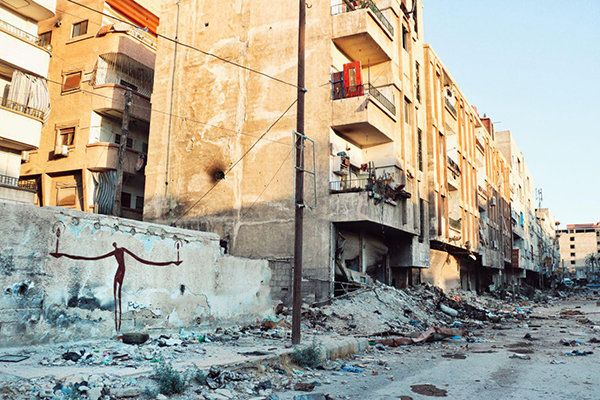
Mirza is an artist who has drawn paintings in ochre on walls everywhere, from old neighbourhoods in Tehran to abandoned dilapidated buildings in Damascus. There is no name or photo of him; it is only his paintings that one can see. Even in videos, he covers his face. The following report elaborates on his paintings.


Iranian Painter Depicting Loneliness in Wall PaintingsWe Have Forgotten to Marvel in Life
In his paintings, Mirza seeks to create and receive marvel. He believes contemporary man does not marvel. He says modern man becomes happy and sad, is surprised, gets angry, but does not marvel!

Ochre: Colour of Primitive Man

Mirza’s paintings all have the same colour, a type of red which he himself calls “the colour ochre.” Anyway, primitive man had the ochre earth and the wall. It seems the impression left behind by the paintings of primitive man has become stronger and more mysterious throug years. Mirza, too, has the same simple tools: the ochre earth, which still hasn’t run out and still exists on the Planet Earth, and the wall which exists in much higher numbers today than in the era of primitive man.


I object to man’s not marveling in life!

Murals and paintings on walls suggest a kind of protest all over the world. In many countries, political, social and civil protest is expressed in this way. But Mirza has a different look. Of course, he has objections, too, but his protest is of a different kind. His grievances go beyond political and social objections. Such objections have an expiration date as they get old and invalid, but how is it that the secret shared by primitive man through their wall paintings are still new? These paintings are an objection to man’s not marveling, and objections addressing man, not politics or ruling systems.

Iranian Painter Depicting Loneliness in Wall Paintings


Iranian Painter Depicting Loneliness in Wall PaintingsExhibition without Borders

Mirza has organized different exhibits, but all of them have been held across the cities, no at galleries where such exhibitions are normally held. He had his first exhibition experience on a street called Arbab-e-Jamshid. His first audience were the rough sleepers on that street, who expressed their views on his artworks and slept next to them. The Arbabe-e-Jamshid street is located in downtown Tehran in a neighbouhood where the sound of water running through street canals can be heard and everything is extremely serene; an old traditional neighbourhood.

Some of our compatriots would sleep under one of his paintings drawn on a column. Once I asked one of them what the story behind the paintings on the street were.

“I think they were drawn by aliens because all of them bear the same sign: a circle with a point inside,” he answered.

Iranian Painter Depicting Loneliness in Wall Paintings


Walking to Hear Silence

War has left behind a trail of destruction. The ravages of war are seen across Damascus as if there is no end to them. However, man will keep making discoveries. Amid the destroyed buildings, Mirza is looking for what human spirit has lost. Being alone is very important to him. Being alone mostly takes the form of loneliness rather than isolation. In his viewpoint, loneliness is the most basic human feeling. Individual loneliness could be seen in his early works: lonely animals, lonely people, separate from one another. But Later, Mirza went for collective loneliness also referred to as public loneliness. The more the number of lonely individuals, the more pure the loneliness is. A clear example of collective loneliness can be seen in the Middle East, he believes. It is a kind of loneliness which can specify the status of man on earth. But such an ambience is hidden in a modern style of living and is hard to notice. So, in his paintings, Mirza mostly highlights collective loneliness. He suggests that we, like all humans, are lonely, regardless of whether or not there is war, and may be that is the only way to salvation.

Iran FM in Turkey for Syria Peace Talks

During his visit, Zarif is expected to take part in the ministerial-level meeting of Iran, Russia and Turkey –the guarantor states of Syria truce- to be held on Sunday (November 19) in the Turkish city of Antalya. The meeting is held in preparation for a leaders’ summit, which will be held on November 22 in the Russian city of Sochi and will focus on efforts to cement a truce in Syria.

The leaders’ summit in Sochi is expected to be attended by the presidents of Iran, Russia and Turkey.

Syria’s warring sides have so far attended five rounds of peace talks in Astana, brokered by Iran, Russia and Turkey. The fourth round of those talks in May produced a memorandum of understanding on de-escalation zones in Syria, sharply reducing fighting in the country.

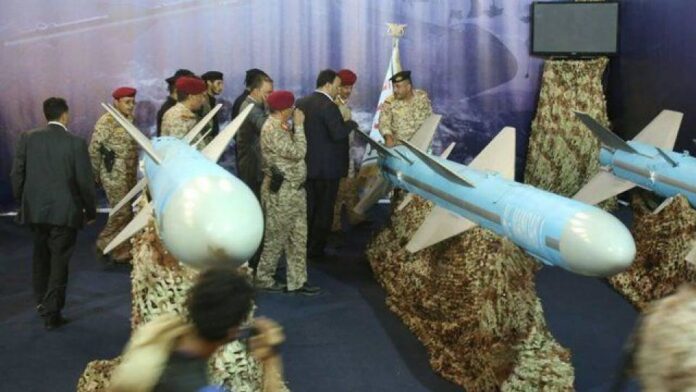
UN Rejects Riyadh’s Claim that Iran Sending Arms to Yemen

UN observers have, in a confidential report parts of which have leaked out, stressed that the Saudi-led coalition which is launching attacks on Yemen and has imposed a blockade on the country is threatening peace, security and stability in Yemen, reports the Persian-language website alef.ir.

Independent observers of the UN say the Saudi-led coalition has called for gathering documents regarding Riyadh’s claim that Iran has played a role in arming Yemeni Houthi fighters and warned that failure to do so will be tantamount to a violation of the UN Security Council resolution issued in February 2017.

The coalition announced on November 6 that it would block all land, sea and air crossing points in order to keep Iran from sending weapons to Yemen.

This comes as the UN has called for ending the blockade on Yemen and said the siege will lead to the world’s biggest starvation crisis in decades.

UN observers have announced in a report that the Saudi blockade on Yemen will, in fact, hamper the dispatch of humanitarian aid to the war-ravaged country.

The observers have also doubt about the coalition’s claim that Iran is arming Yemeni Houthis with missiles.

On November 7, the Saudi ambassador to the world body claimed in a letter to the UN Security Council that Riyadh had assessed the remains of the missiles fired by Ansarullah on July 22 and November 4, and found out Iran was involved in manufacturing the projectiles.

UN observers say they have not found any documents that could prove Saudi Arabia’s claim that foreign sources were sending short-range missiles to Ansarullah.

The Saudi-led coalition says the missile fired by Ansarullah on July 22 at Riyadh was a short-range Qiam-1 missile produced by Iran.

The observers have also said in their report that the documents and evidence presented by the coalition is not enough to confirm Riyadh’s claim. Saudi Arabia has not yet identified the type of the missile fired at Riyadh on Novermber 4.

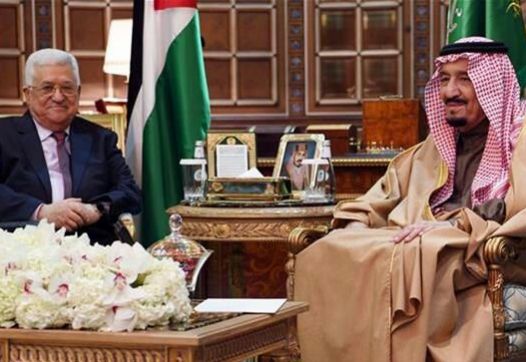
Saudi King Blackmails Palestinian President: Report

The Arabic-language website Al Youm revealed that during his latest visit with Abbas in Riyadh, King Salman has urged him to put pressure on Hamas as part of Saudi Arabia’s policies to normalize ties with the Zionist regime of Israel.

According to Al Youm, King Salman said his country will pay part of the Palestinian Authority’s monthly salary only if Abbas pressurizes Hamas into distancing itself from Iran and Lebanon’s Hezbollah movement.

The Palestinian website quoted Abbas as saying during the meeting that Riyadh should urge Cairo to pressurize Hamas into remaining committed to a long–term truce with Israel.

Meanwhile, a report by the trans-regional paper Rai Al Youm said Saudi Arabia has put pressure on Abbas to accept either “a big deal -dubbed as the largest deal of the century- reached with US President, Donald Trump, on creating peace in the Middle East or resign.”

About one week before Abbas’ visit to Riyadh, a senior advisor to Trump who is also his son-in-low, Jared Kushner, and US president’s Special Envoy in the Middle East, Jason Grinblatt, made a secret visit to Riyadh and held talks with Saudi officials.

Reports said Saudi Arabia’s Crown Prince, Mohammad Bin Salman has already revealed some parts of the big deal to Abbas.

According to Rai Al Youm, security coordination between Palestinian Authority with the Zionist regime which has been restored following the visit of Abbas to Riyadh on the one hand and the pressures put on the Palestinian Authority to accept the deal aimed at restoring ties between Israel and the Arab states on the other hand, have put the Issue of Palestine at a critical condition.

Rai Al Youm wrote Riyadh is seeking to use Abbas as leverage against Iran and Hezbollah, adding what motivates Saudi Arabia to increase cooperation with Abbas is that earlier Abbas announced he would not allow another Hezbollah to grow in the Gaza Strip.

“The Saudis maintain that Mahmoud Abbas can turn into a good ally because his main enemy, (Hamas) in the Gaza Strip has established good ties with the Islamic Republic of Iran and a number of Hamas delegations have paid a visit to Tehran over the past month,” the paper concluded.

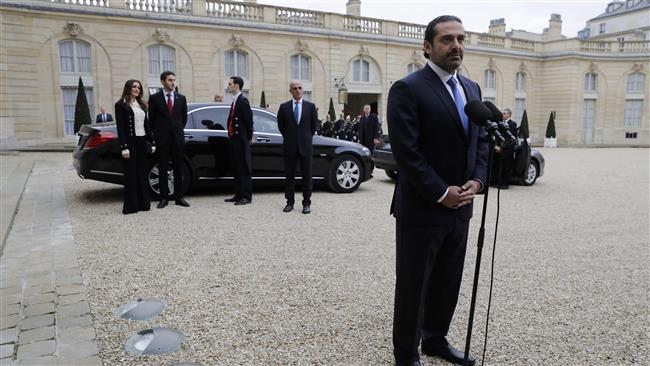
Hariri to Clarify Position on Lebanon after Return to Beirut

“With regard to the political situation in Lebanon, I will go to Beirut in the coming days, I will participate in the independence celebrations, and it is there that I will make known my position on these subjects after meeting President [Michel] Aoun,” Hariri said after meeting French President Emmanuel Macron in Paris on Saturday.

Hariri stunned Lebanon and the region by announcing his resignation in a live television broadcast from Saudi Arabia on November 4.

Senior sources close to Hariri and top Lebanese political and security officials said Saudi Arabia had coerced Hariri into stepping down and had put him under house arrest.

After days of confusion about Hariri’s situation in Saudi Arabia, the Lebanese premier and his wife arrived in the French capital, Paris, on Saturday, but two of his children have stayed behind in Riyadh.

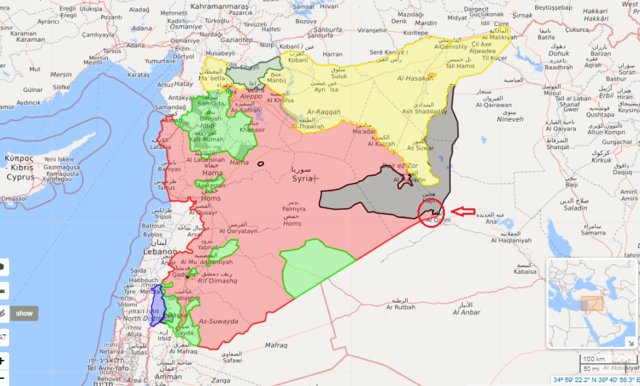
Syrian Army Liberates Last ISIS Stronghold

According to a Farsi report by ISNA the Syrian Observatory for Human Rights, which is close to the Syrian opposition, has confirmed the news, saying the city has been fully recaptured by Syrian army troops and that ISIS terrorists have fled to desert areas.

Abu Kamal was the last major urban area under the control of the ISIS terrorist group in Syria. Last week, the Syrian army announced it had managed to take control of the city, but apparently it had to retreat to within a few kilometres of the city due to a massive counteroffensive by ISIS.

On Friday, Syrian army troops secured control of several neighbourhoods in Abu Kamal, and fully retook the city on Saturday, putting an end to ISIS’ four-year occupation of cities in Syria.

Currently, the terrorist group only has control over some desert areas, especially in central and eastern Syria, adjacent to Iraq’s borders. It apparently will not take long to purge those areas of terrorists, as well.

Although large parts of areas on the common border between Iraq and Syria in north of the country are under the control of US-backed Syrian Kurds, and Washington itself has set up a base in Altanef region controlling the southern parts of the border areas, Abu Kamal plays a key role in the transport of troops and commodities between Iraq and Syria as it is the main route linking Baghdad, Qaim and Damascus. With the liberation of Abu Kamal, the common borders between Iraq and Syria will practically come under the Syrian government forces’ control or effective influence.

Due to the strategic importance of Abu Kamal, there had been a tight race in recent months between Syrian army forces and its allies on the one hand, and US-backed Kurdish troops on the other, to take control of the city. Now, with the Syrian army having gained control of the city, the United States can practically be regarded as the loser of this rivalry.

Iran Warns French President over Interventionist Remark

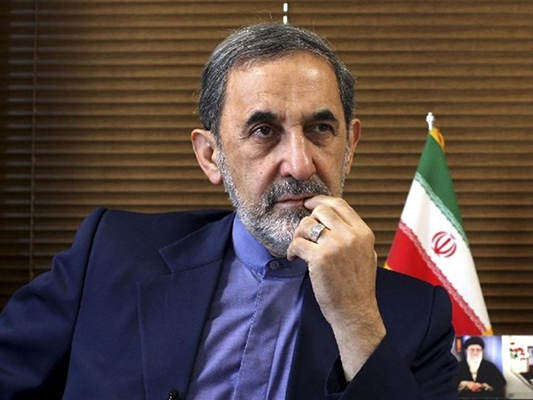
Iran Leader's Top Aide Velayati Infected with Coronavirus: Report

Velayati on Saturday referred to the latest meddlesome statements of Macron about Iran’s missile program and called on the French president to follow the footstep of French ex-President Charles de Gaulle and remain at least semi-independent when it comes to foreign policy.

In a Farsi interview with ISNA, he rejected Macron’s anti-Iran rhetoric and added “it is in the interest of Mr. Macron and France not to meddle in Iran’s missile program as well as our strategic affairs which are of great importance for us because such statements will only damage the respect that the Islamic Republic has for France.”

“As an Iranian who is familiar with the French foreign policy and history, I advise the French president to follow the footstep of General De Gaulle and adopt a semi-independent stance in foreign policy,” he said.

He said the Islamic Republic of Iran will not seek permission from others to press ahead with its missile program and they are not in a position to tell Iran whether or not it should have missile or how far the range of its missiles should be.

“Iran’s missile program is none of Mr. Macron’s business. He is not in a position to discuss such issues. If he likes to have our ties expanded, he should stop such meddlesome statements because they are against France’s national interests,” he noted.

The Iranian official stressed that Iran’s negative response to the “interventionist request” of Macron will tarnish his image in the world, adding Iran advises Macron to adopt policies which portray a good picture of him as a successful politician.

“The possibility that we give a positive response to such a request is near zero. So, as an Iranian citizen, I advise Mr. Macron to stop raising such meddlesome requests because our response is definitely negative.”

Earlier, French President Macron said at a press conference in Gothenburg, Sweden, “We want an Iran that is a less aggressive power and for its ballistic missile program to be curtailed. But Iran is a regional power and we speak to them.”