Saturday, December 27, 2025
Home Blog Page 3626

A Look at Iranian Newspaper Front Pages on April 26

A Look at Iranian Newspaper Front Pages on November 19

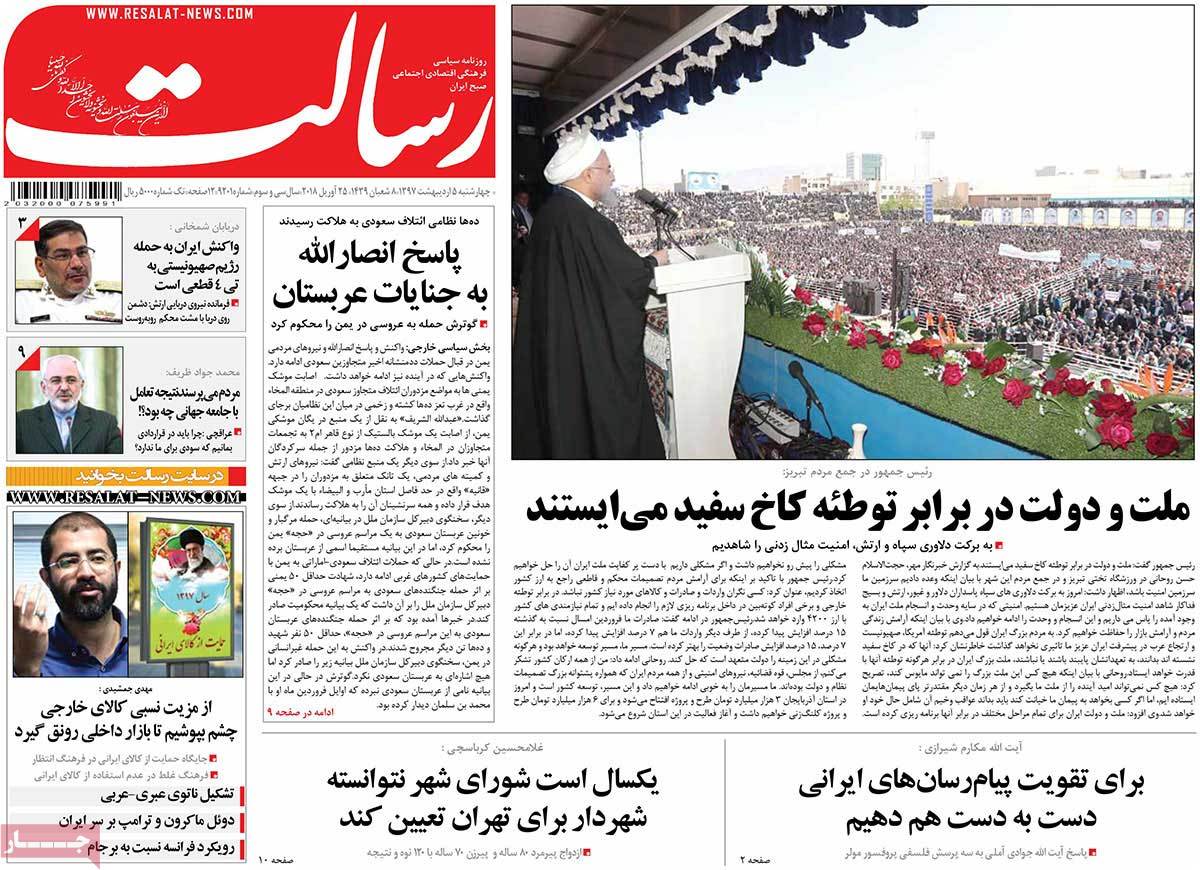
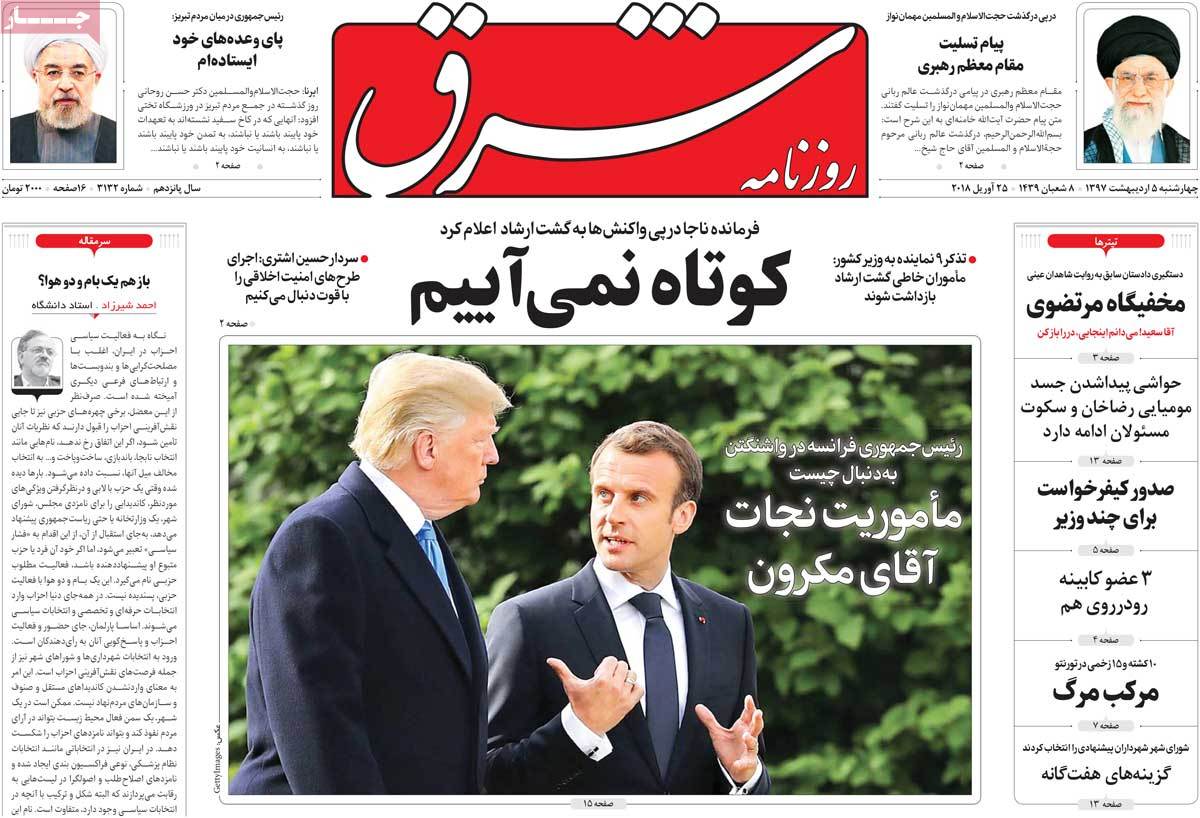
The top story in all newspapers today was the talks between US President Donald Trump and his French counterpart Emmanuel Macron over a new deal on Iran, and Tehran’s harsh reactions to the idea.

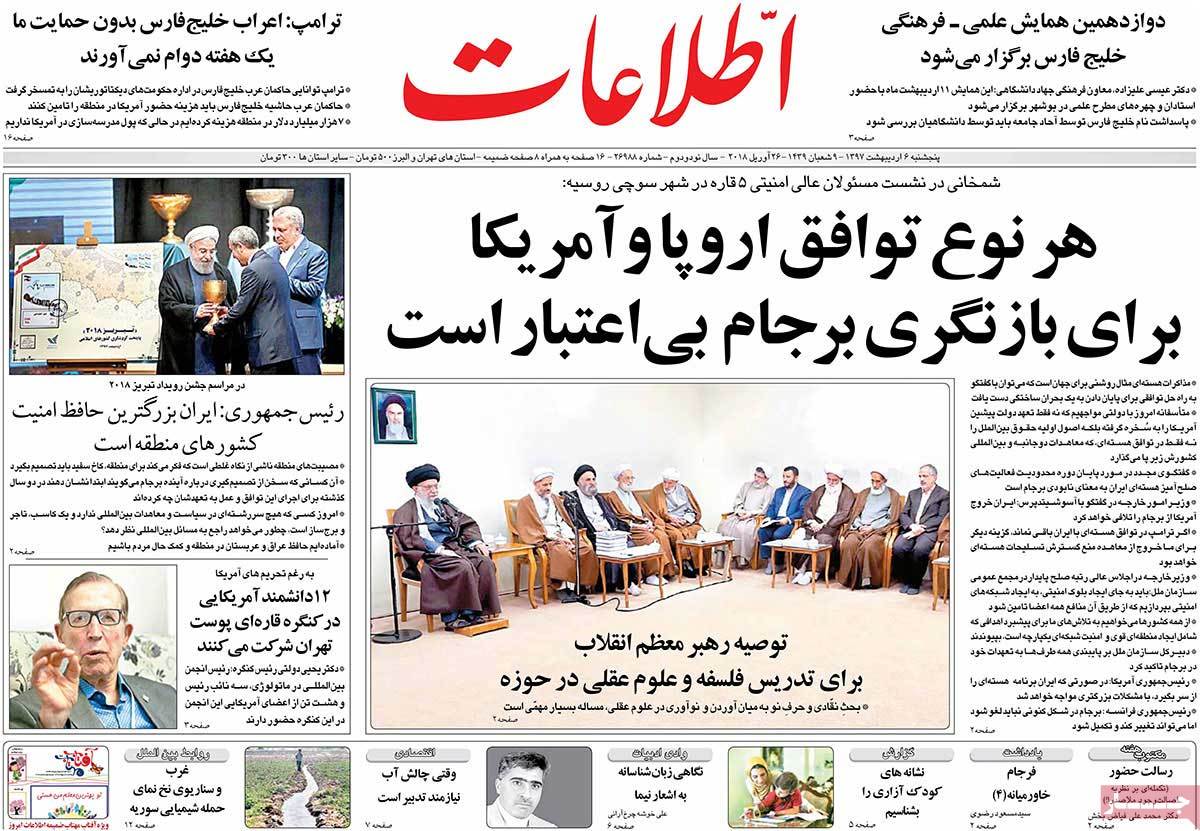
Several papers also covered the remarks made by Ayatollah Seyyed Ali Khamenei, the Leader of Iran’s Islamic Revolution, on the need for seminaries to take philosophy more seriously.

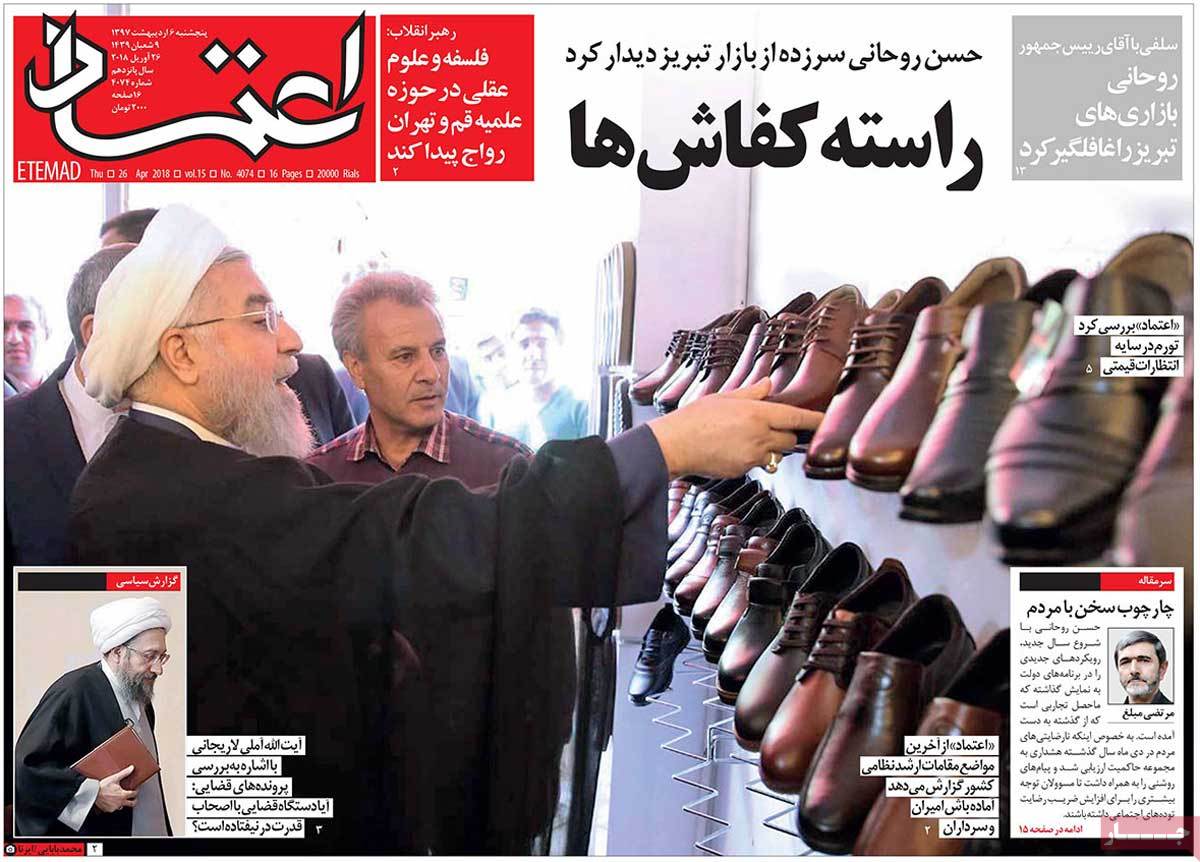
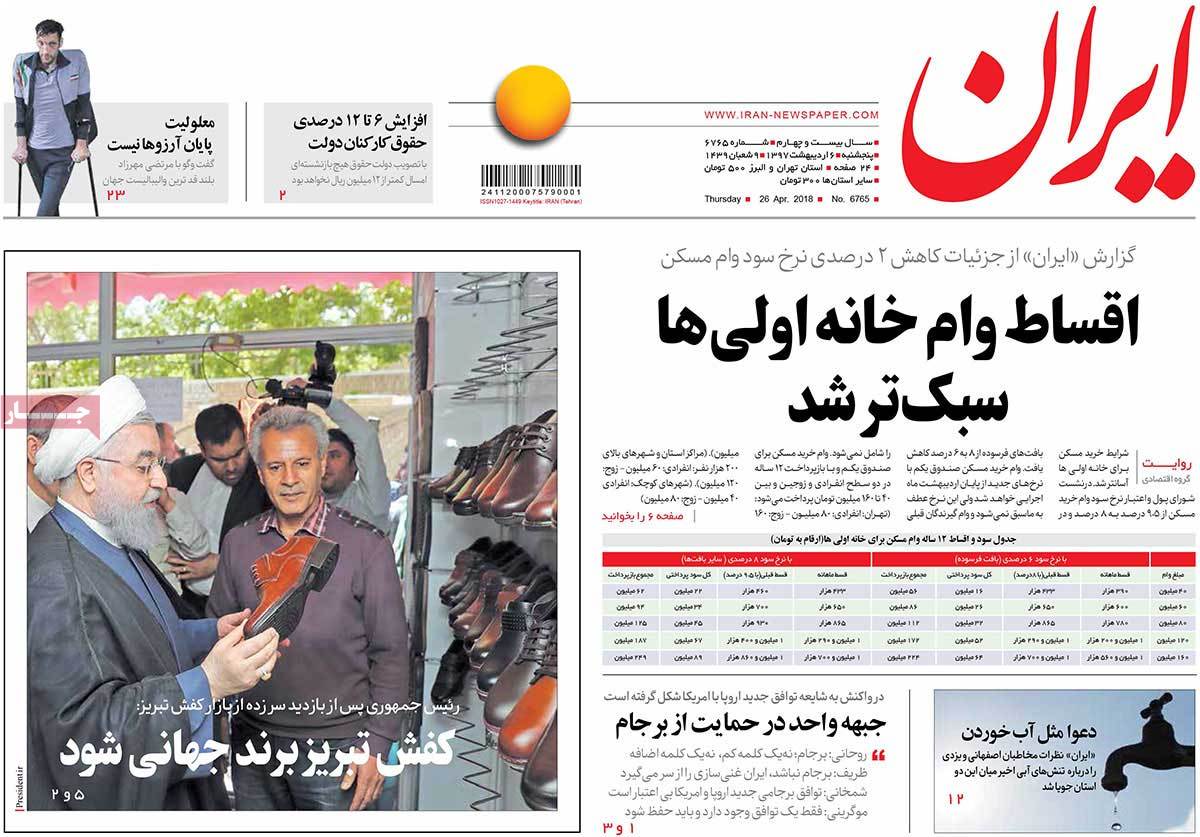
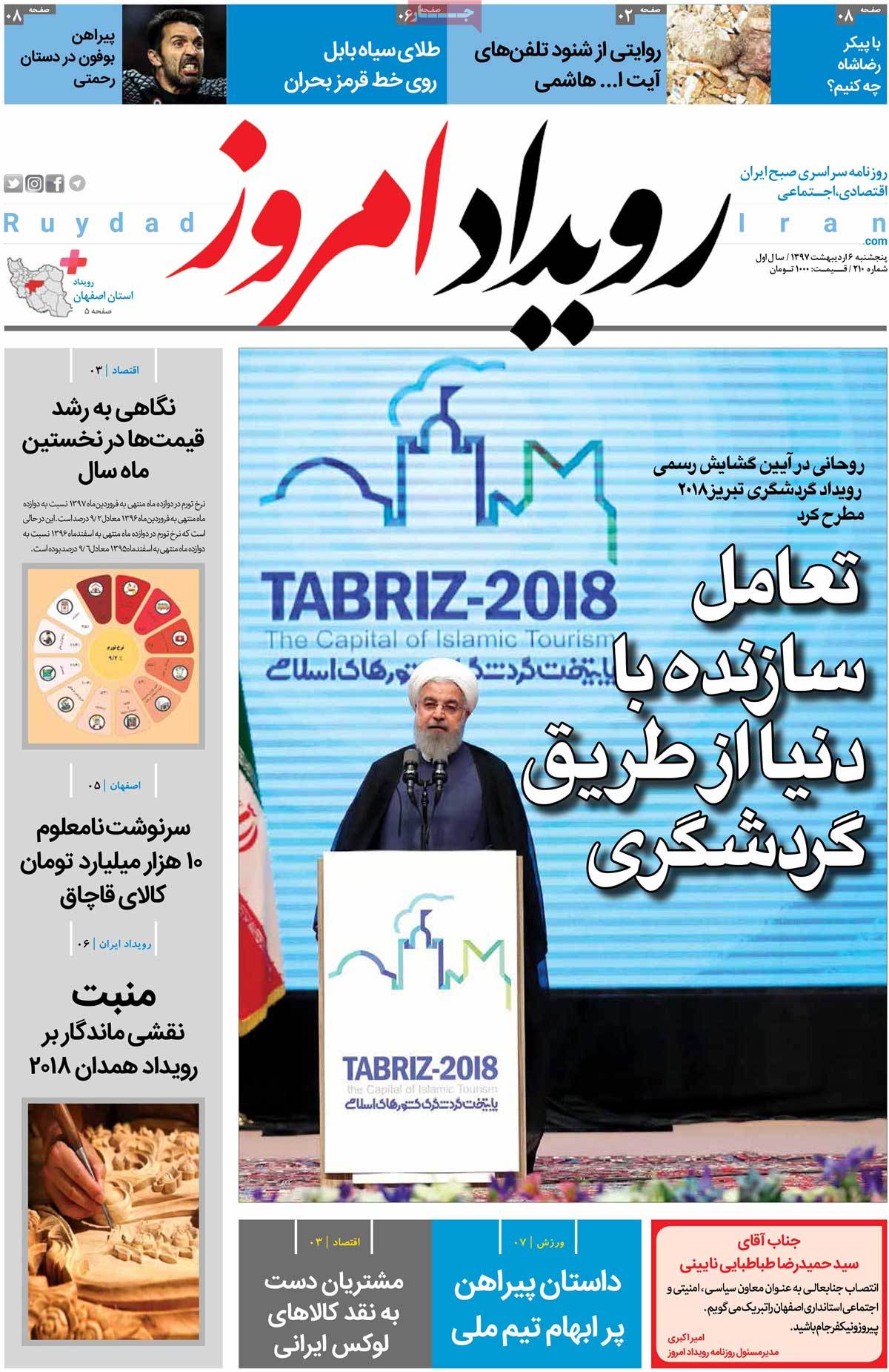
Iranian President Hassan Rouhani’s visit to the city of Tabriz in north-western Iran, his surprise visit to the bazaar of shoemakers, and his participation in a ceremony to inaugurate the Tabriz 2018 tourism event also received great coverage. Tabriz 2018 is an event to mark the designation of Tabriz as the tourism capital of Muslim world in 2018.

The above issues, as well as many more, are highlighted in the following headlines and top stories:


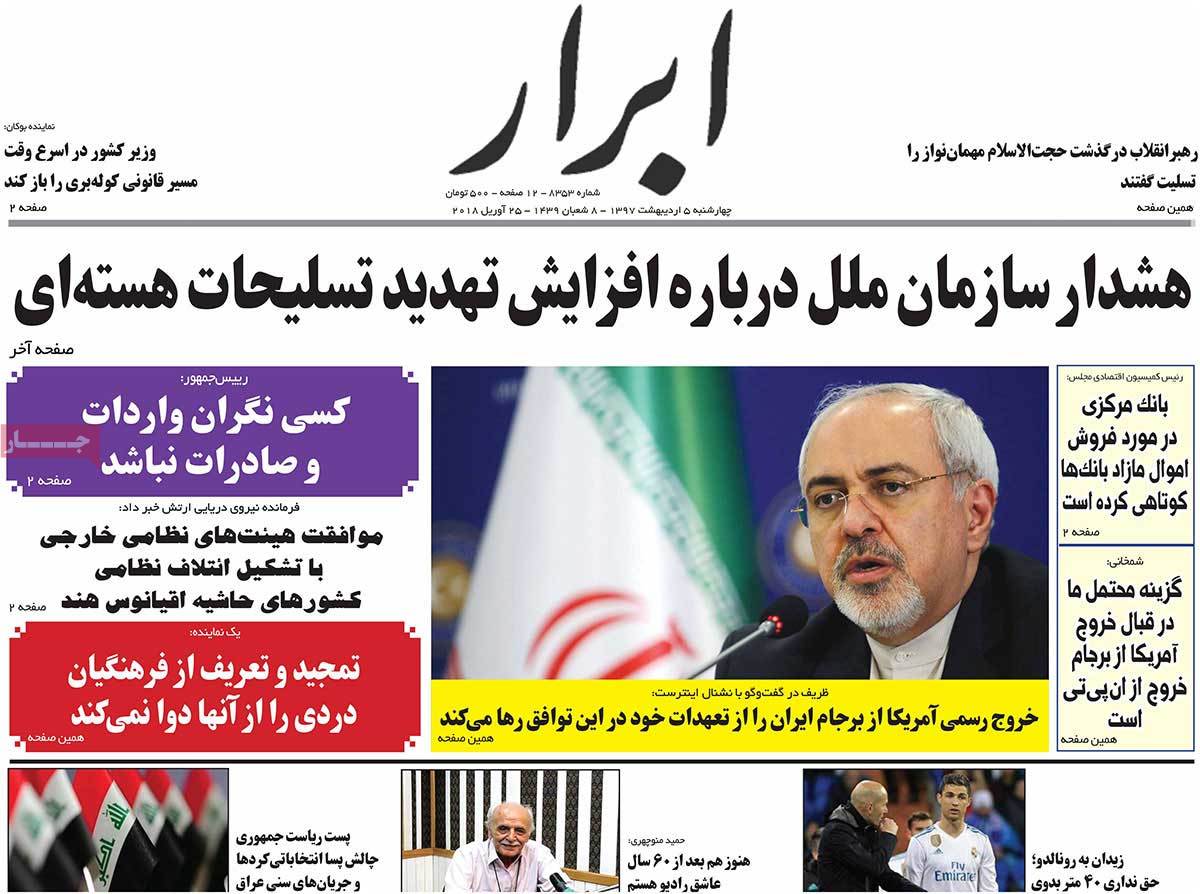
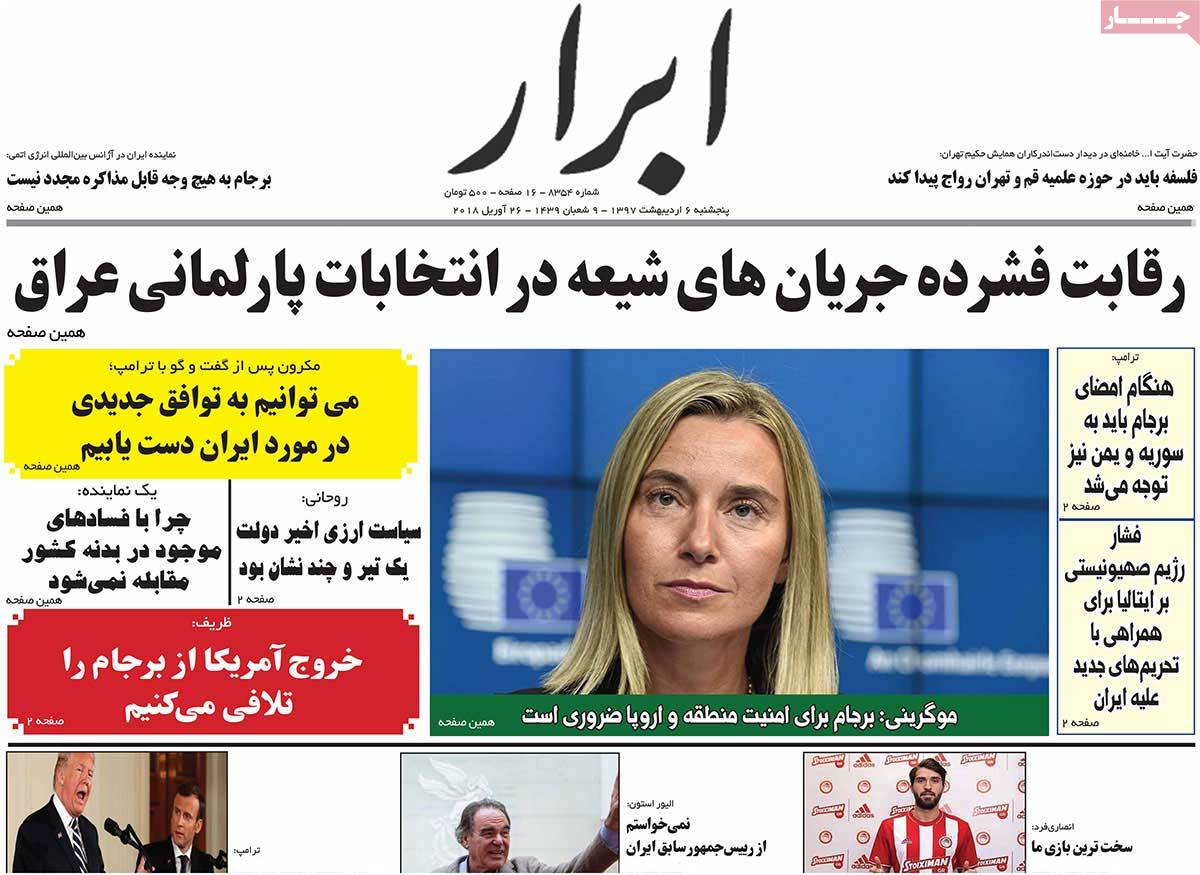
Abrar:

  • Zarif: We’ll Retaliate US Withdrawal from Iran Nuclear Deal
  • Macron after Talks with Trump: We Can Achieve New Deal on Iran
  • Shiite Movements’ Close Competition in Iraq’s Parliamentary Elections
A Look at Iranian Newspaper Front Pages on April 26


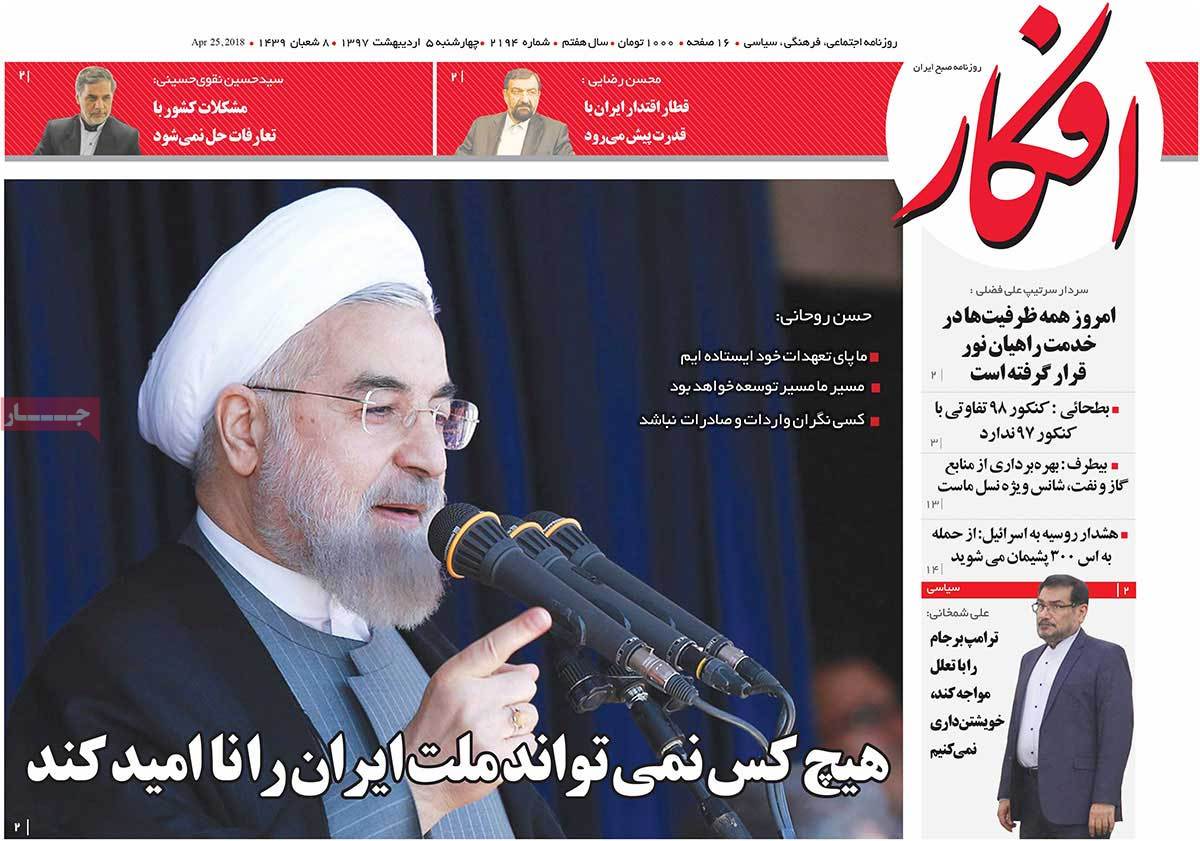
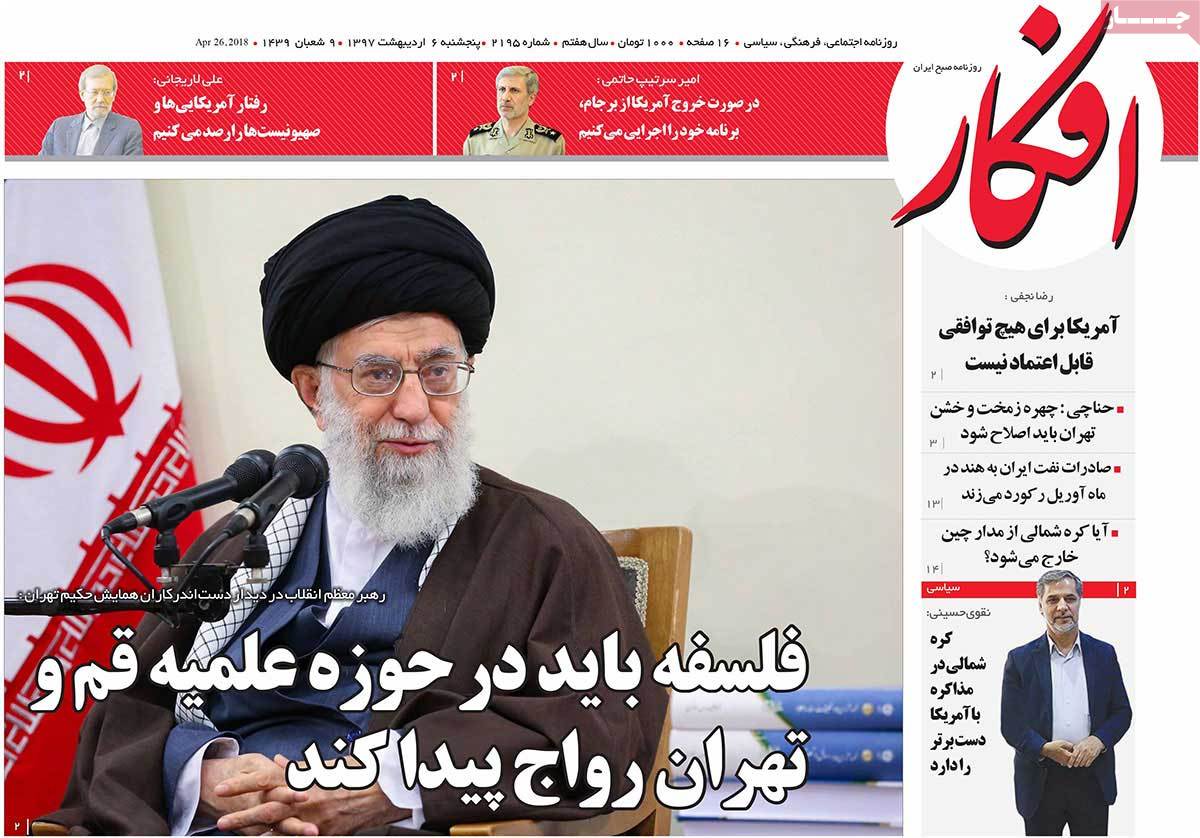
Afkar:

  • Philosophy Must Be Promoted in Seminaries of Qom, Tehran: Iran Leader
  • Iran DM: We’ll Implement Our Plan If US Leaves JCPOA
A Look at Iranian Newspaper Front Pages on April 26


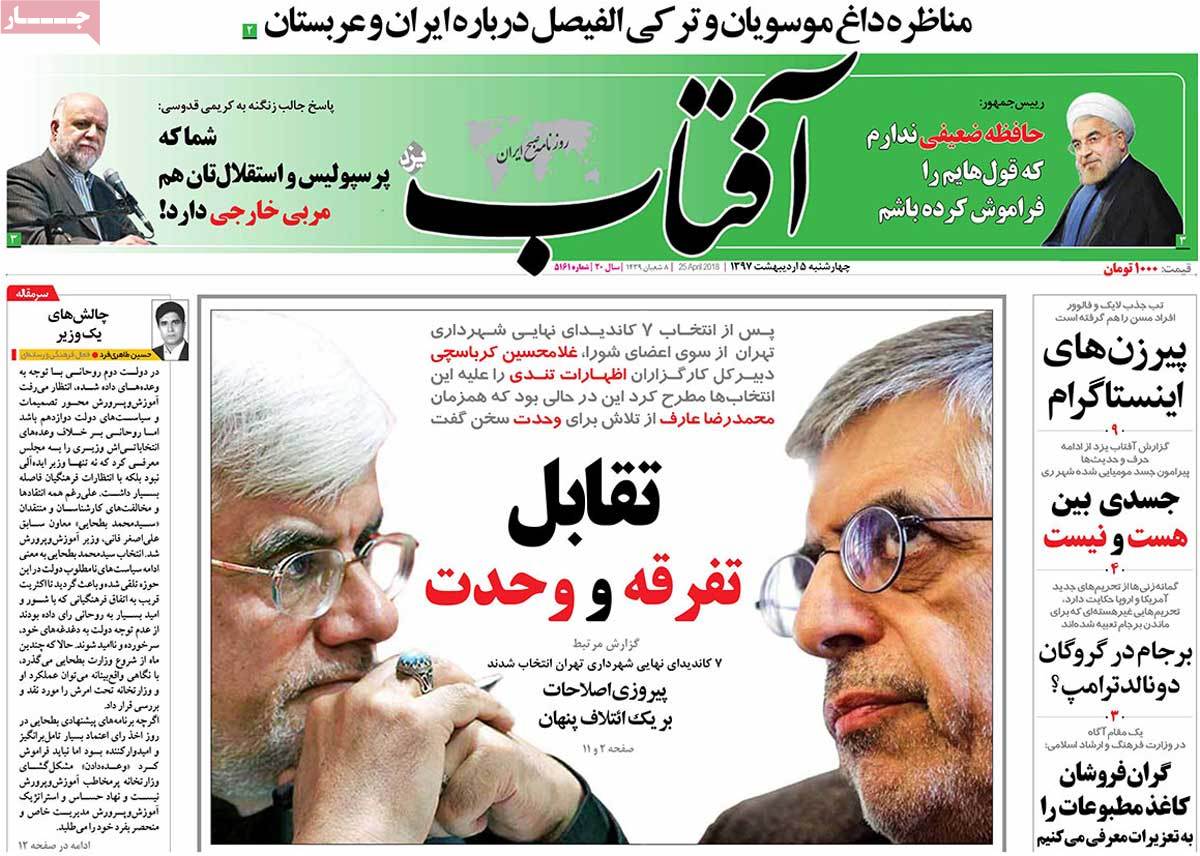
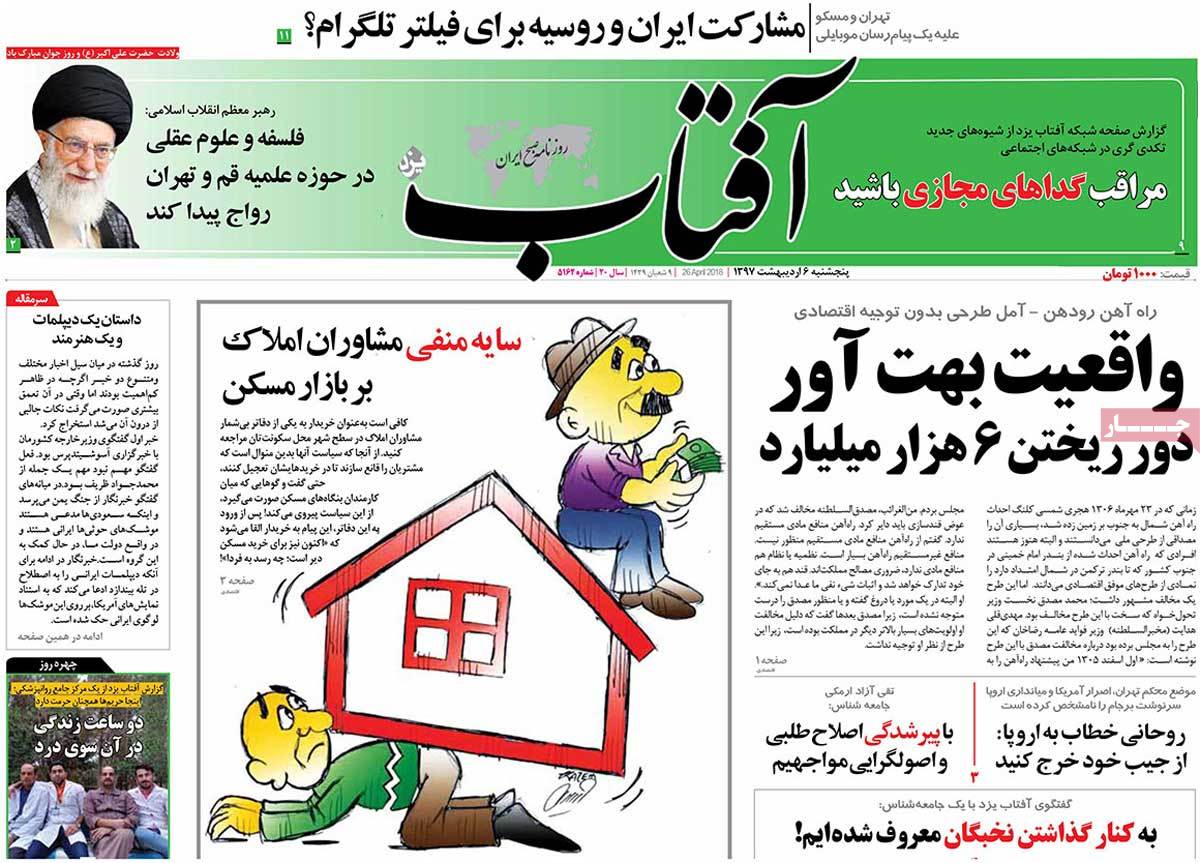
Aftab-e Yazd:

  • Tehran, Moscow against Messaging App
  • Iran-Russia Cooperation to Block Telegram?
A Look at Iranian Newspaper Front Pages on April 26


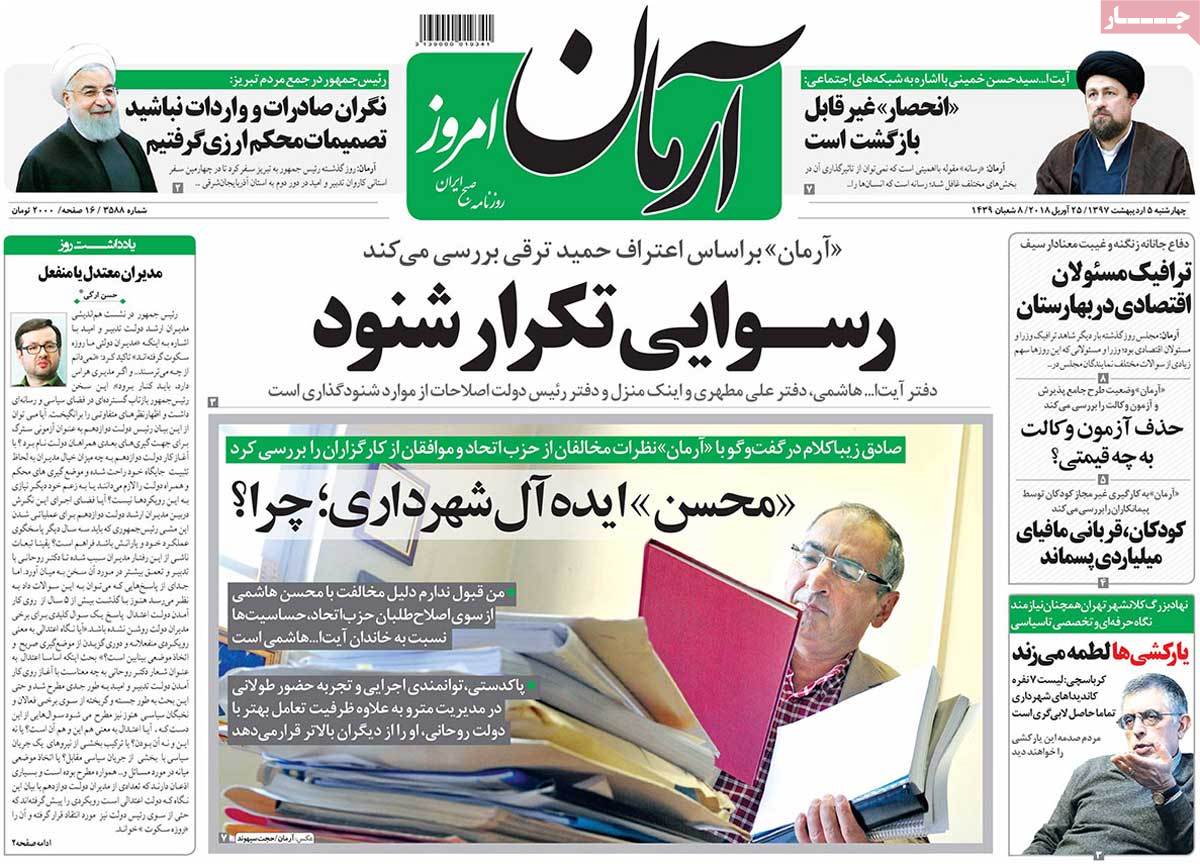
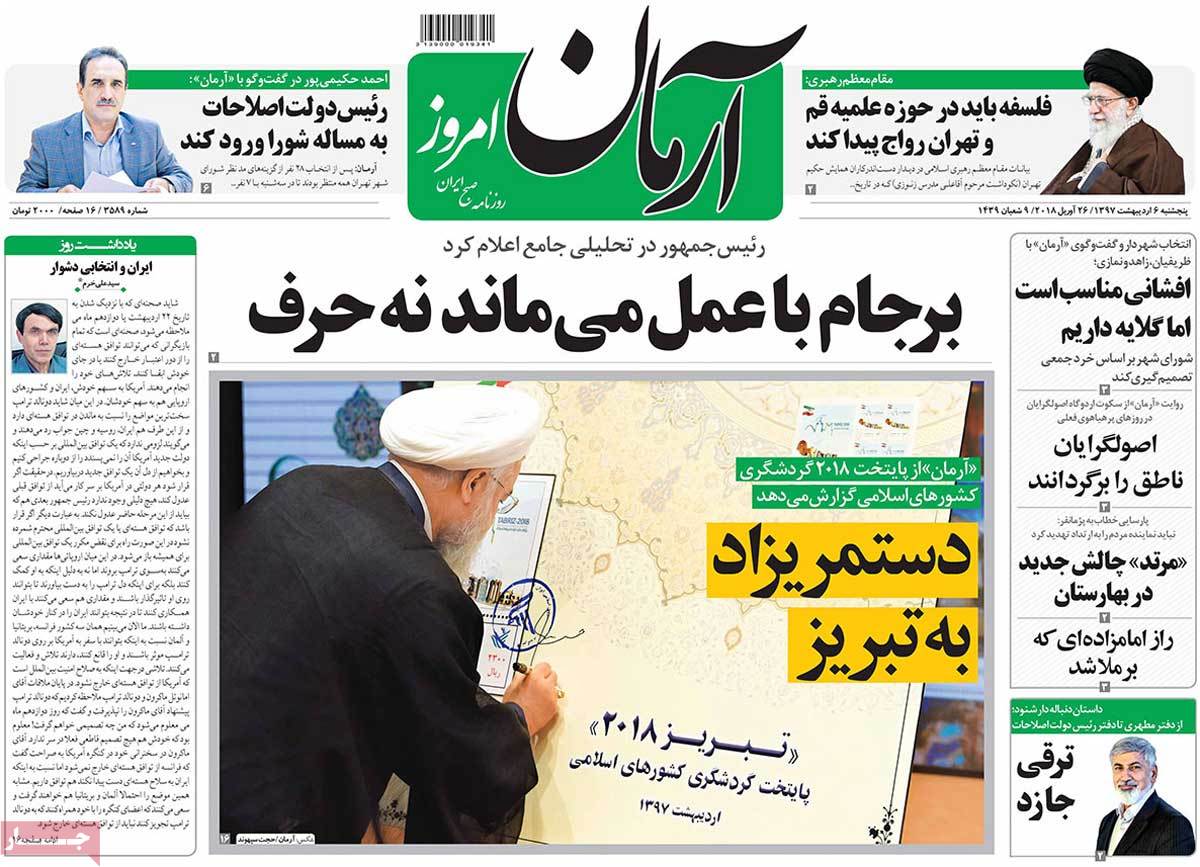
Arman-e Emrooz:

  • Rouhani: JCPOA Can Be Preserved by Actions, Not Words
A Look at Iranian Newspaper Front Pages on April 26


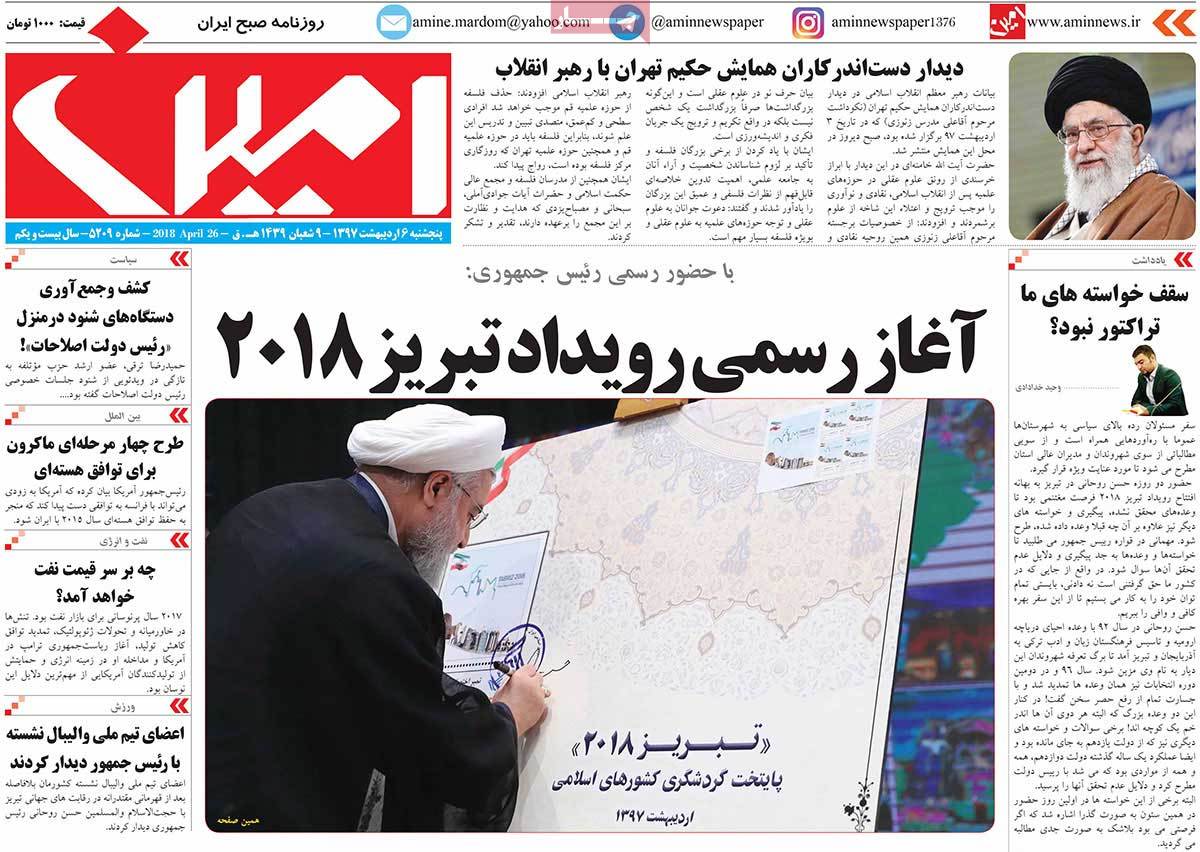
Amin:

  • Rouhani Officially Inaugurates Tabriz 2018 Tourism Event
A Look at Iranian Newspaper Front Pages on April 26


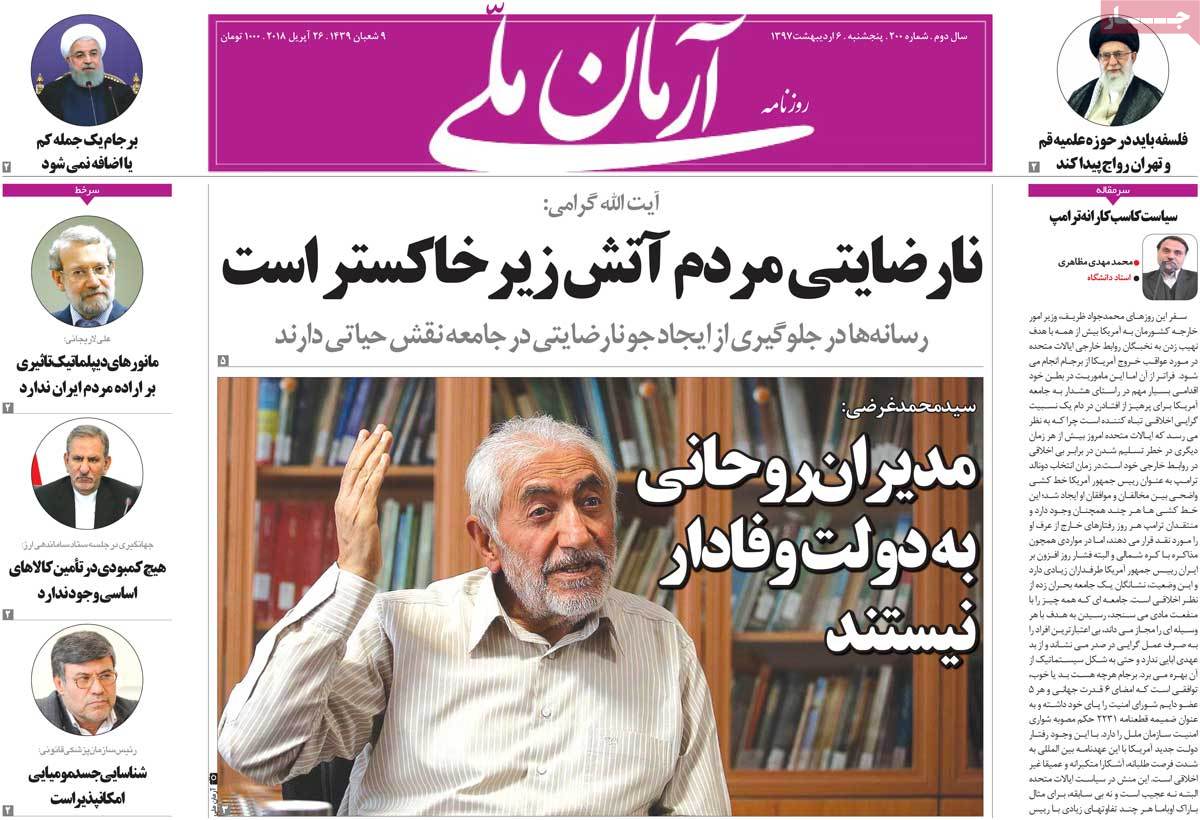
Arman-e Melli:

  • Politician: Rouhani’s Executives Not Loyal to His Gov’t
A Look at Iranian Newspaper Front Pages on April 26


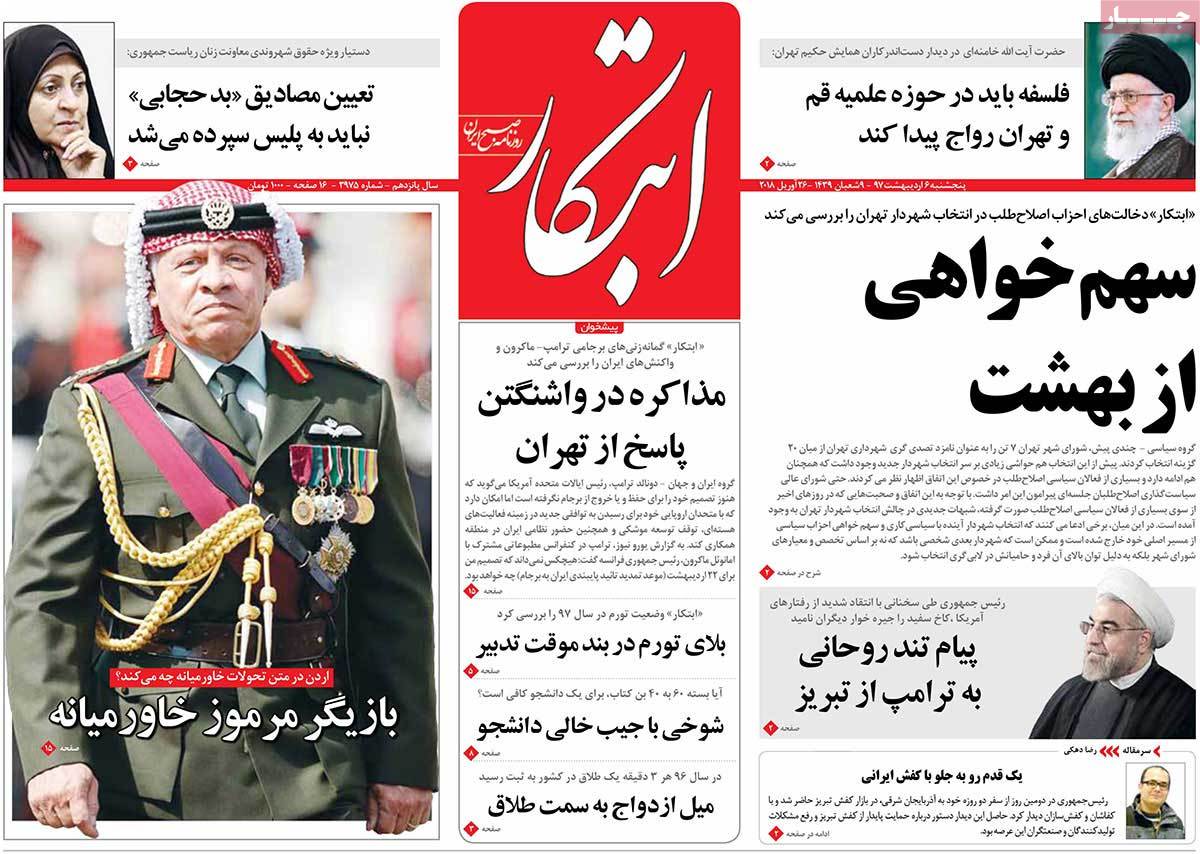
Ebtekar:

  • Mysterious Player of the Middle East
  • What Is Jordan Doing in Regional Developments?
A Look at Iranian Newspaper Front Pages on April 26


Etemad:

  • Bazaar of Shoemakers
  • Rouhani Makes Surprise Visit to Bazaar of Tariz
A Look at Iranian Newspaper Front Pages on April 26


Ettela’at:

  • Shamkhani: Any Europe-US Agreement to Revise Iran Nuclear Deal Invalid
  • Trump: Persian Gulf Arabs Not to Survive without Us Even for One Week
  • 12 American Scientists to Attend Tehran Continental Congress of Dermatology despite US Bans
A Look at Iranian Newspaper Front Pages on April 26


Iran:

  • Rouhani: Shoes of Tabriz Must Be Turned into Global Brand
A Look at Iranian Newspaper Front Pages on April 26


Javan:

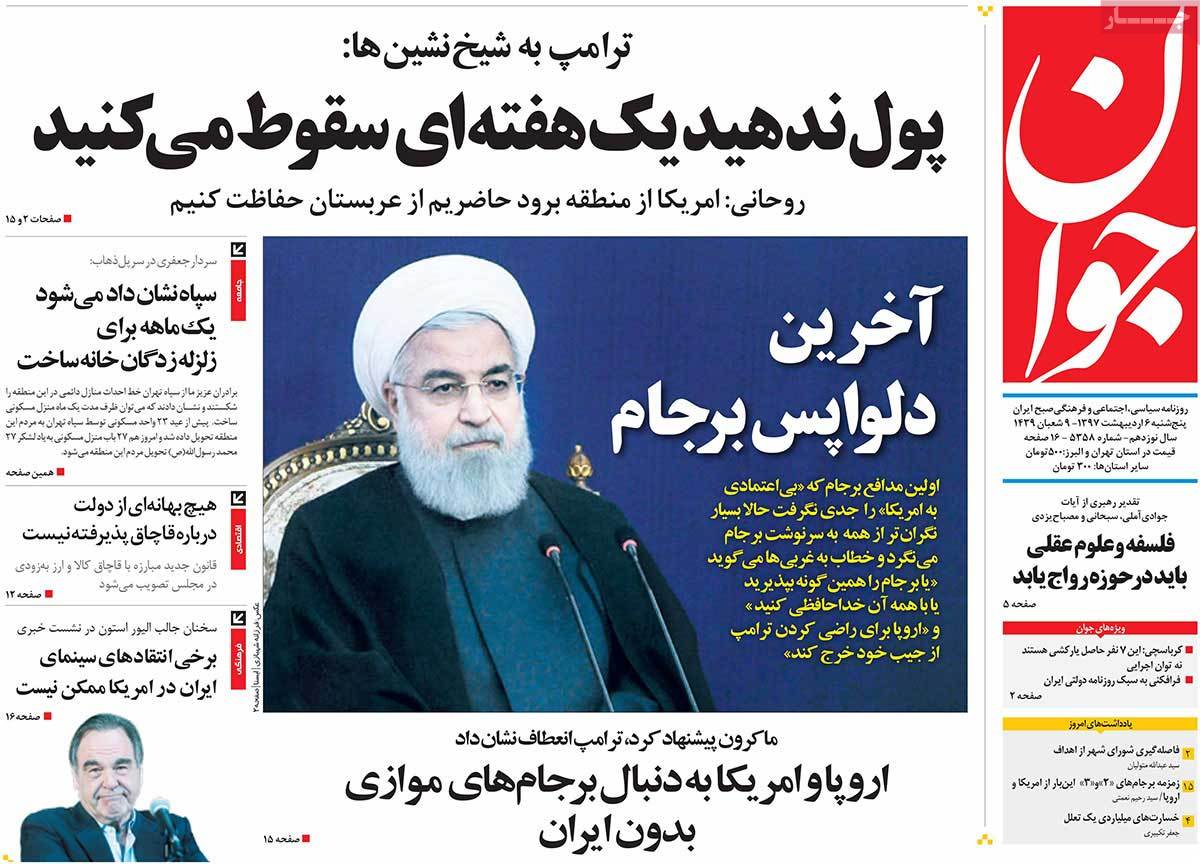
  • Trump to Sheikhdoms: You’ll Collapse in One Week If You Don’t Pay Us
  • Rouhani: We’re Ready to Protect Saudi Arabia If US Leaves Middle East
  • Macron Made the Offer, Trump Showed Flexibility
  • Europe, US after Other Deals with Iran Similar to JCPOA
A Look at Iranian Newspaper Front Pages on April 26


Jomhouri Eslami:

  • Rouhani: US Now in Position of Defendant
  • Not a Single Word to Be Added to or Deleted from JCPOA
  • Egyptian Researcher: Slaughter of Yemeni Muslims Intolerable
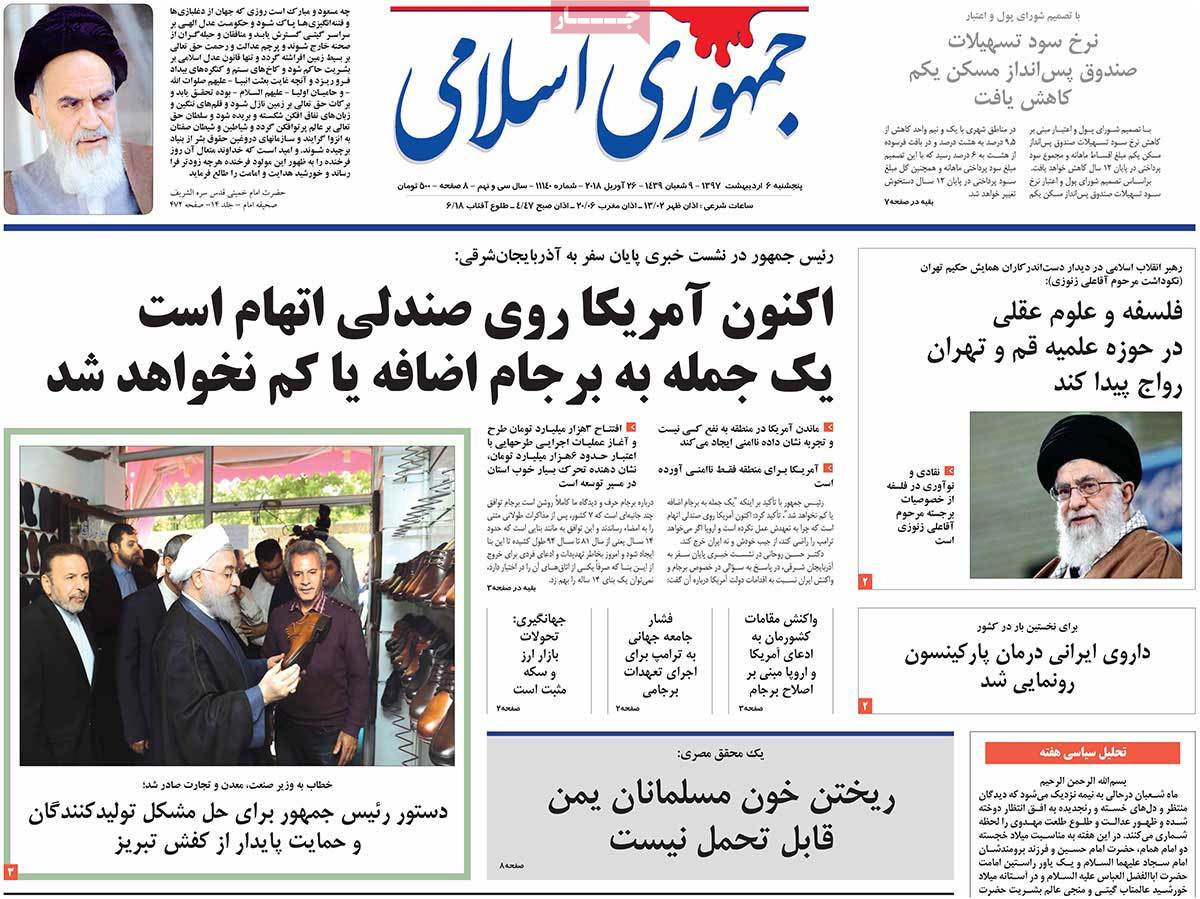
A Look at Iranian Newspaper Front Pages on April 26


Kayhan:

  • Coup de Grace Delivered to Wishful Thinkers
  • Macron: Iran Deal Can Be Preserved If Tehran Abandons Its Missiles
  • Yemeni Revolutionaries: We’ll Take War Deep into Saudi Territory
  • Saudi People Must Stay Away from State Buildings
  • Nouri al-Maliki: Iran a Friend and Saudi Arabia a Foe of Iraq
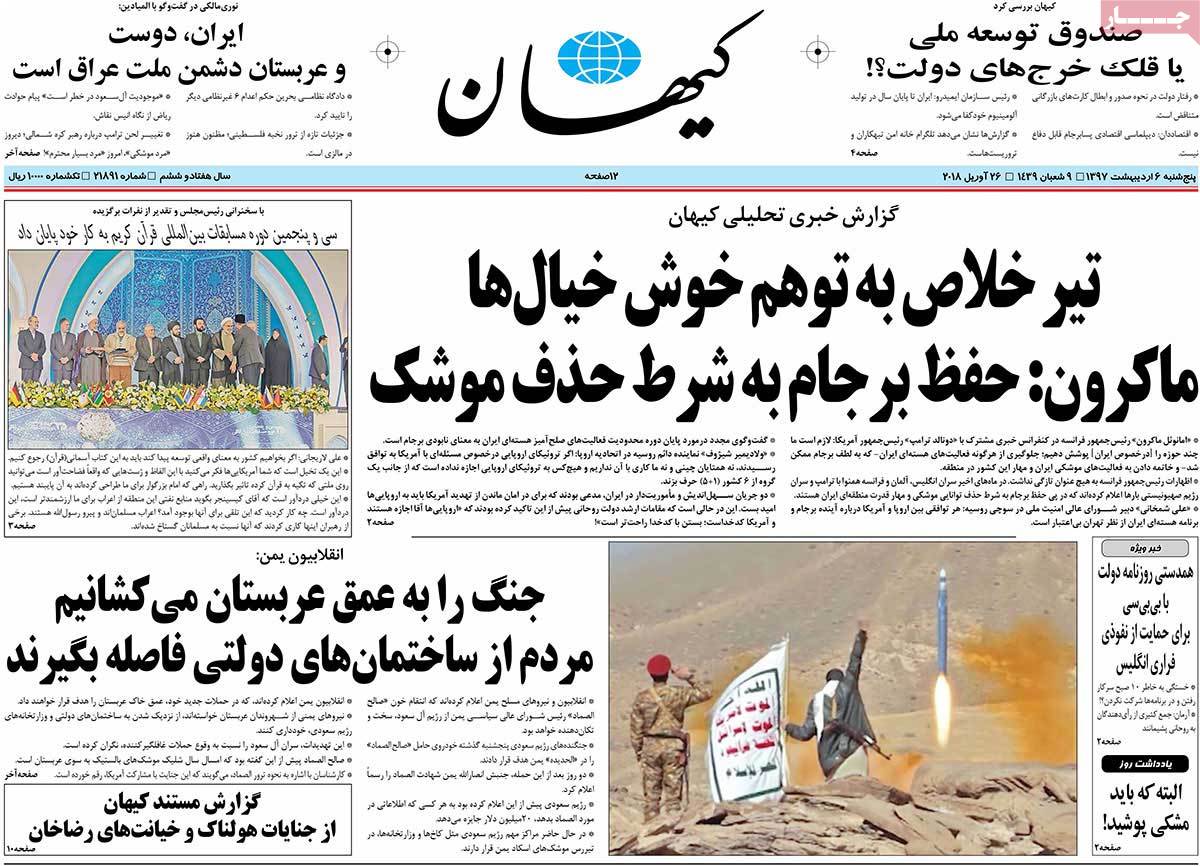
A Look at Iranian Newspaper Front Pages on April 26


Khorasan:

  • Iran’s Harsh Reaction to Europe’s New Game
  • Russia, China Also Reject US-Europe Preliminary Agreement
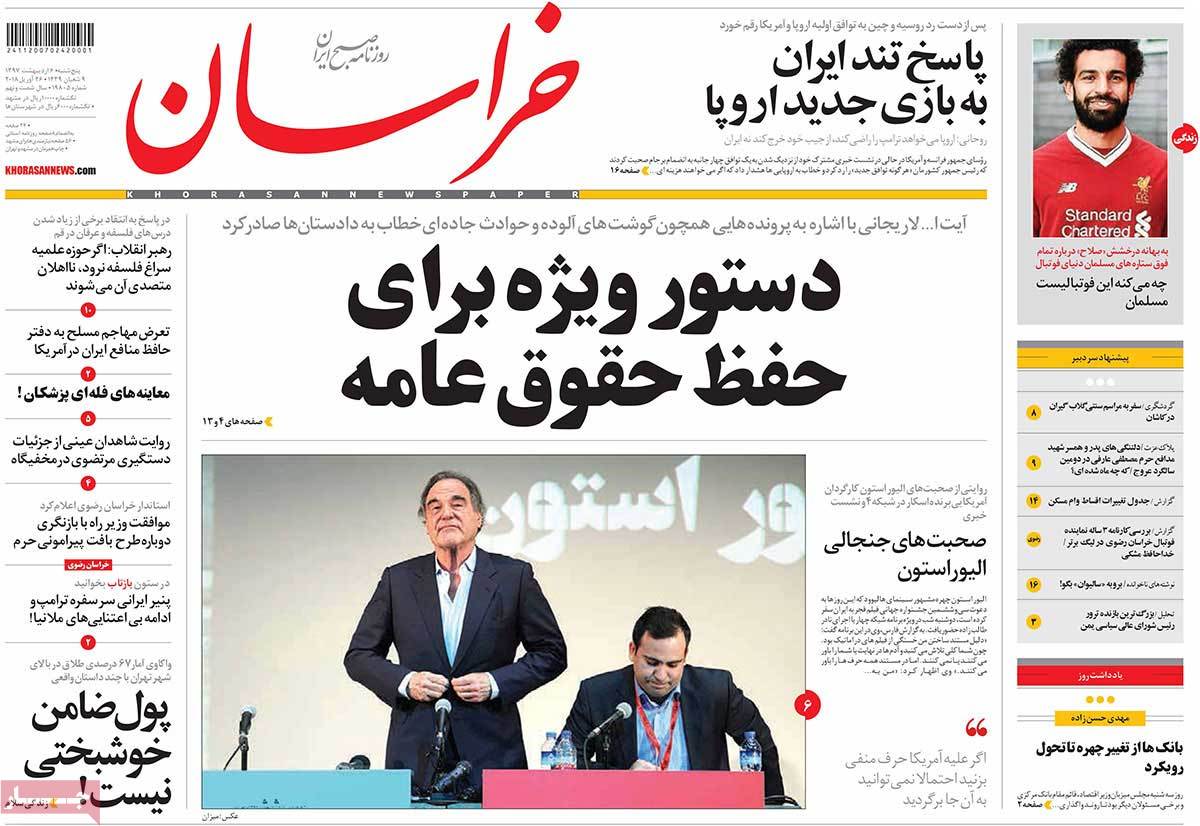
A Look at Iranian Newspaper Front Pages on April 26


Resalat:

  • Iran Leader Urges Seminaries to Deal with Philosophy More Seriously
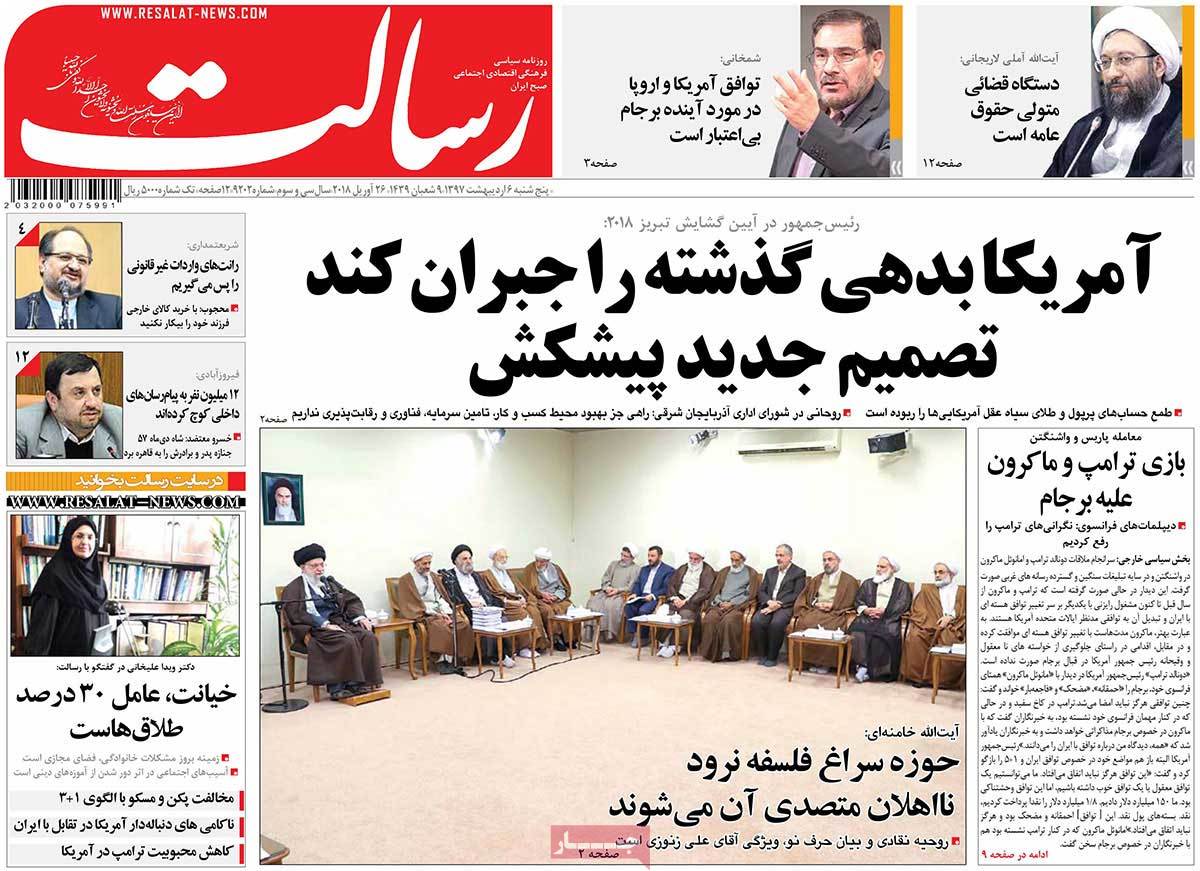
A Look at Iranian Newspaper Front Pages on April 26


Rooydad-e Emrooz:

  • Rouhani Calls for Constructive Engagement with World through Tourism
A Look at Iranian Newspaper Front Pages on April 26


Rooyesh-e Mellat:

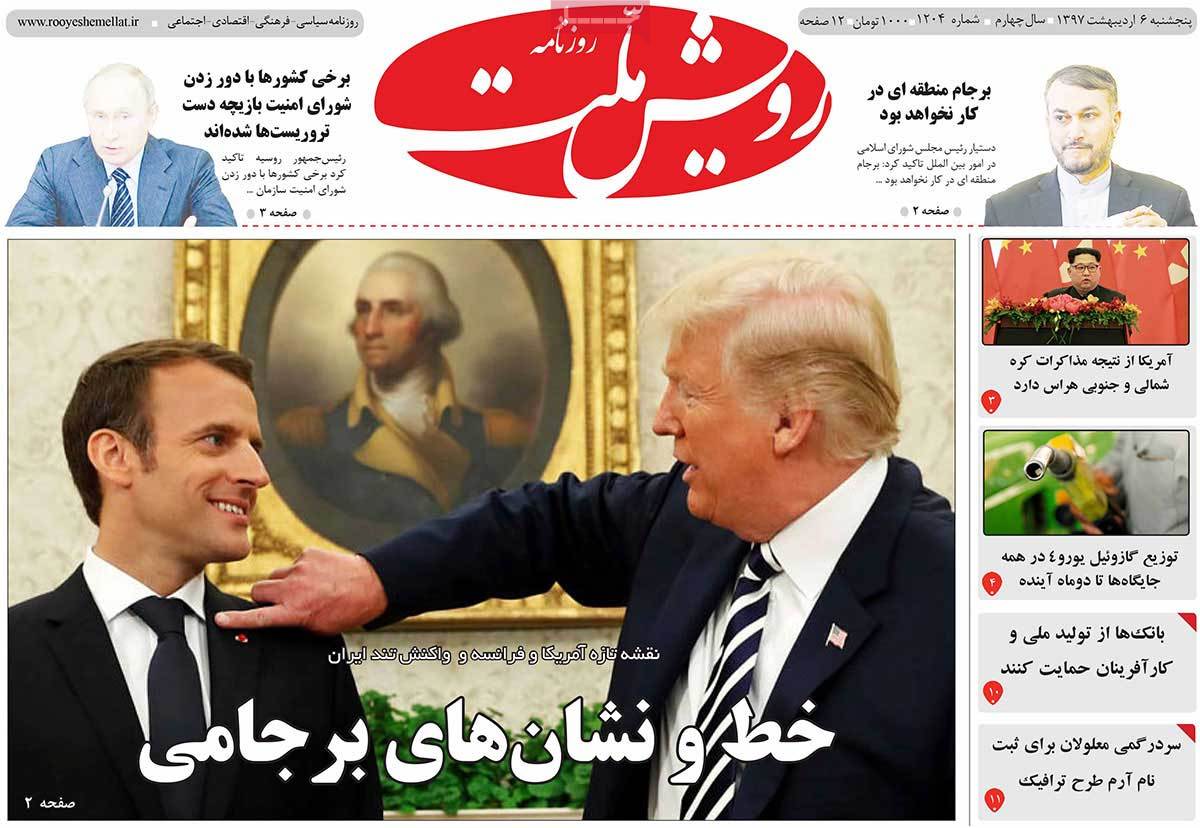
  • Putin: Certain Countries Turned into Terrorists’ Puppet by Bypassing UNSC
  • Larijani’s Top Aide: There’ll Be No Regional JCPOA
A Look at Iranian Newspaper Front Pages on April 26


Shargh:

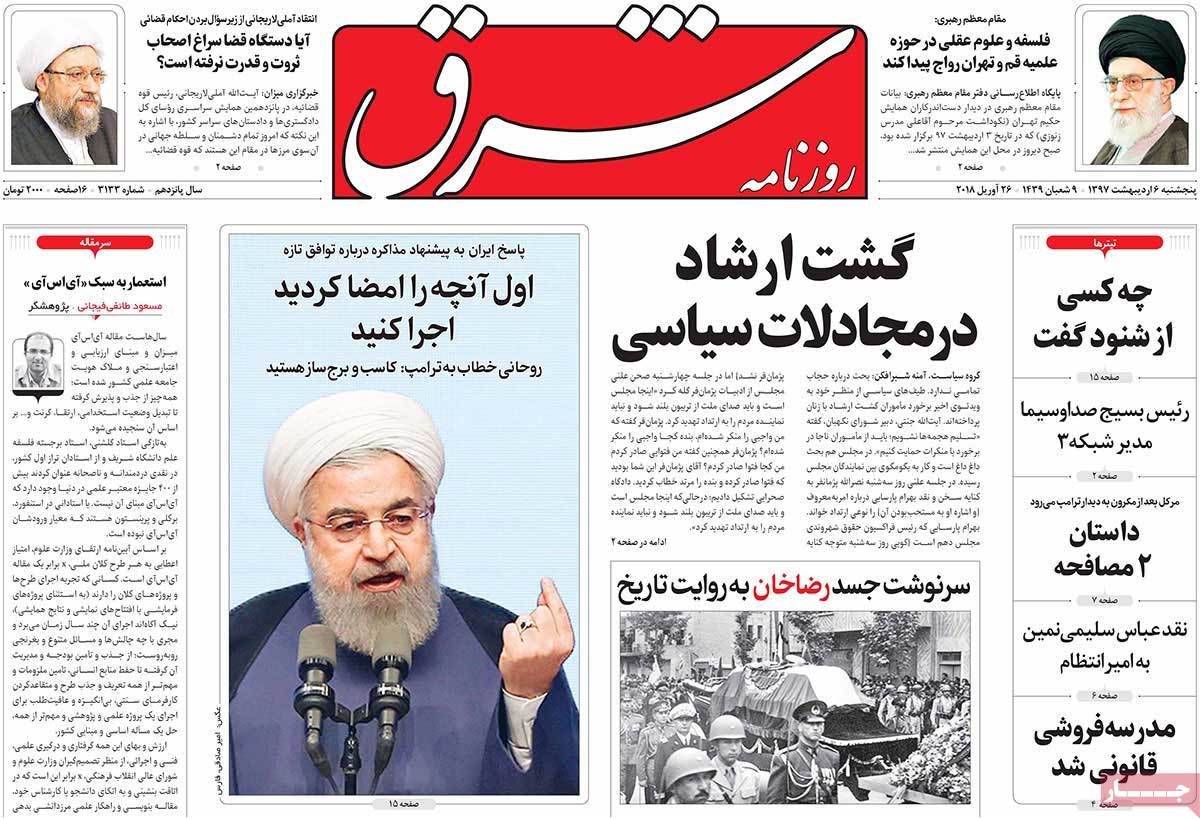
  • Iran’s Response to Possible Talks on New Deal: First Implement What You Already Signed
  • Rouhani to Trump: You’re Just a Real-Estate Mogul
A Look at Iranian Newspaper Front Pages on April 26


Vatan-e Emrooz:

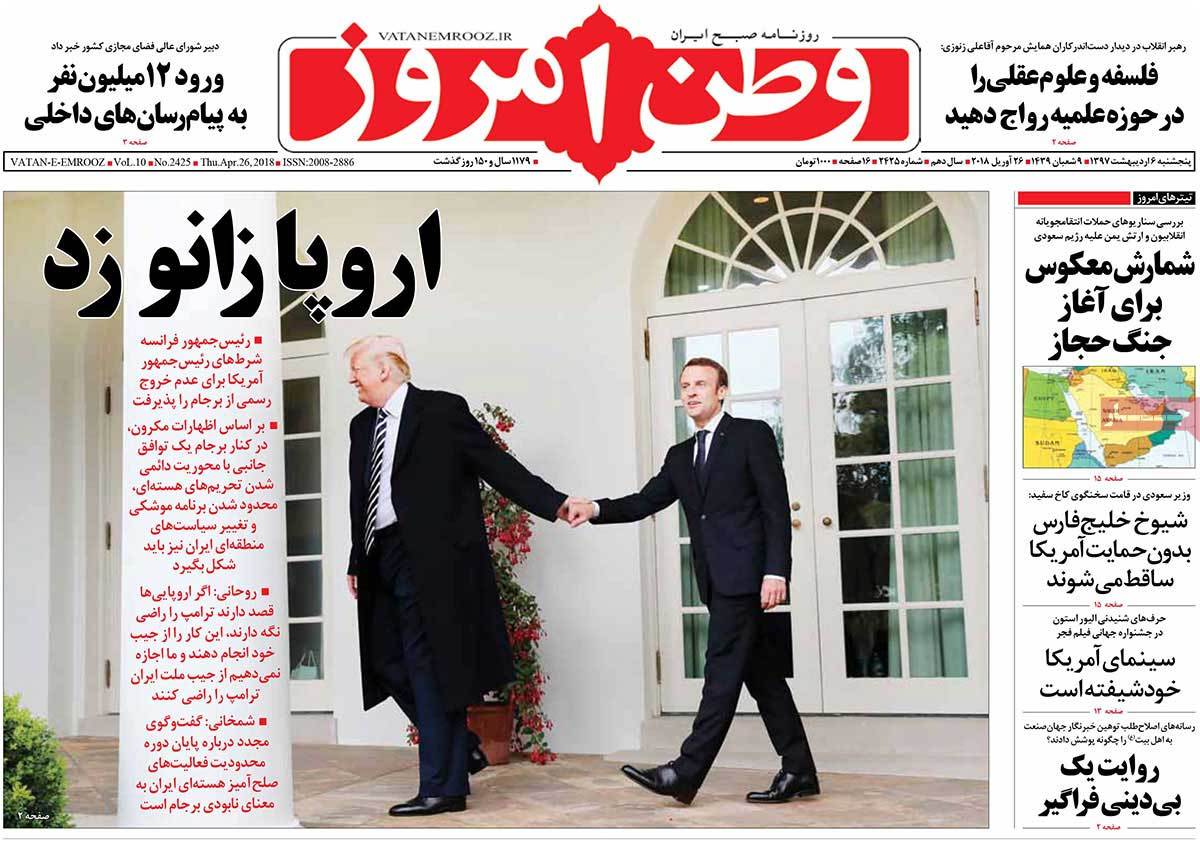
  • 12 Million People Have Installed Domestic Messenger Apps
  • Europe Bends on Its Knees
  • French President Accepts Trump’s Conditions for Staying in Iran Deal
A Look at Iranian Newspaper Front Pages on April 26

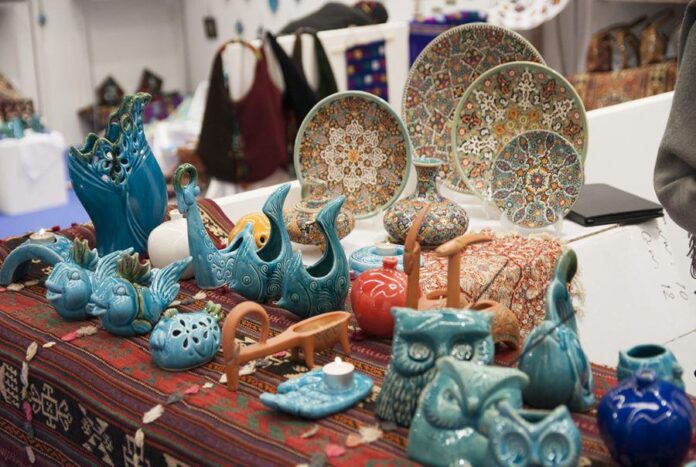
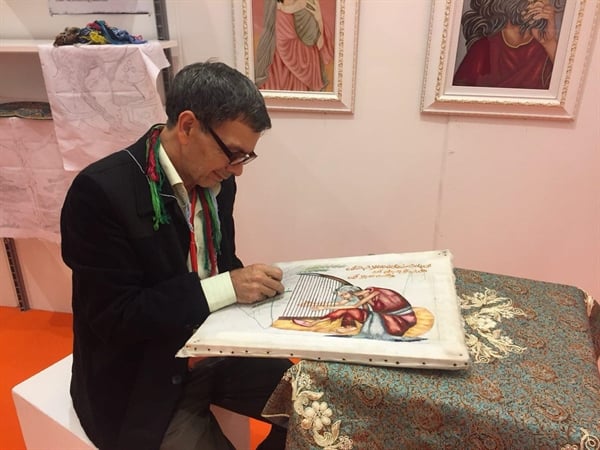
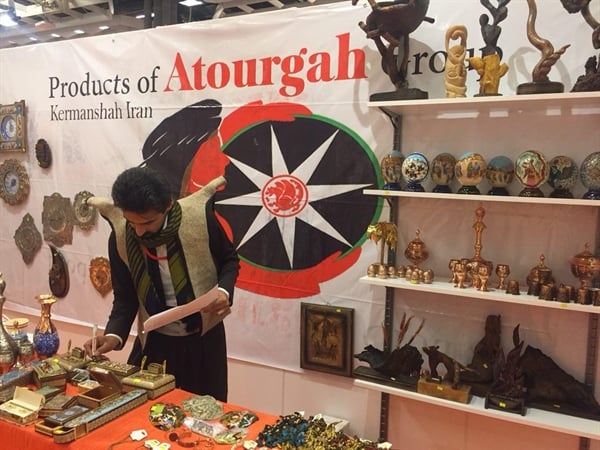
Iranian Handicrafts on Display at Italian Fair

The exhibition opened on April 21 and will run through May 1.

According to a report by the Persian-language Miras-e-Arya news agency, 32 distinguished Iranian artisans along with representatives of the Touring & Automobile Club of the Islamic Republic of Iran (on behalf of Iran’s Cultural Heritage, Handcraft and Tourism Organization) have participated in the event.

Iranian craftspeople and artisans from provinces of Tehran, Isfahan, South Khorasan, Khorasan Razavi, Kermanshah, Hormozgan, Khuzestan, Zanjan, and Golestan as well as Qeshm Island are showcasing their native crafts at the exhibit in an area of 120 square metres.

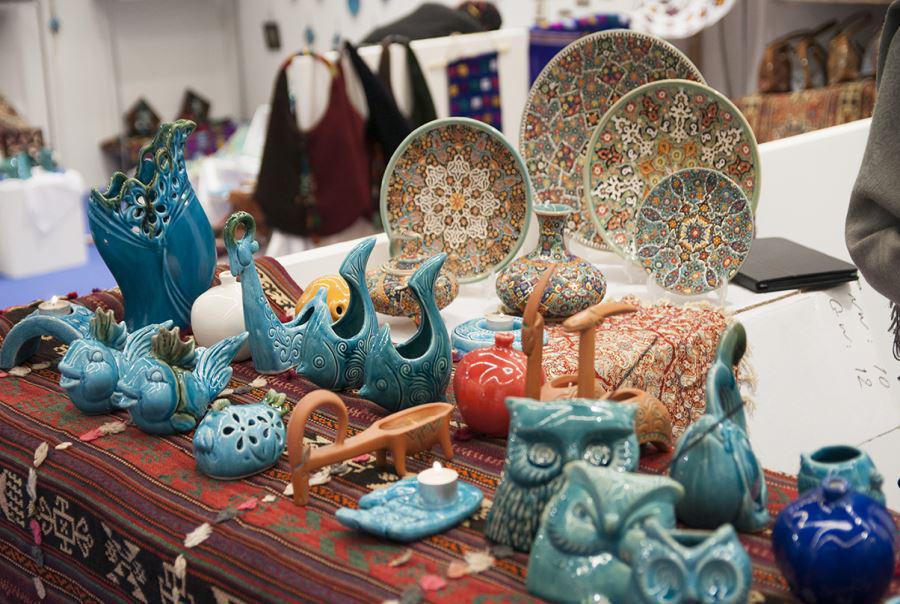
Woodcarving, needlework, leatherwork, glassware productions along with traditional jewelries, miniatures, ceramics, potteries, precious stones, etc. are among the Iranian offerings.

Over 800 companies and tens of artists from 50 countries are in attendance and will hold meetings to improve artworks industry.

Kurdish music performances are among other programs performed at the pavilion of the Islamic Republic of Iran.

Launched in 1996, the Italian fair seeks to draw attention to craftsmanship and its enormous production capacity and quality.

Foreign Interference Hindering Peace Process in Syria: Zarif

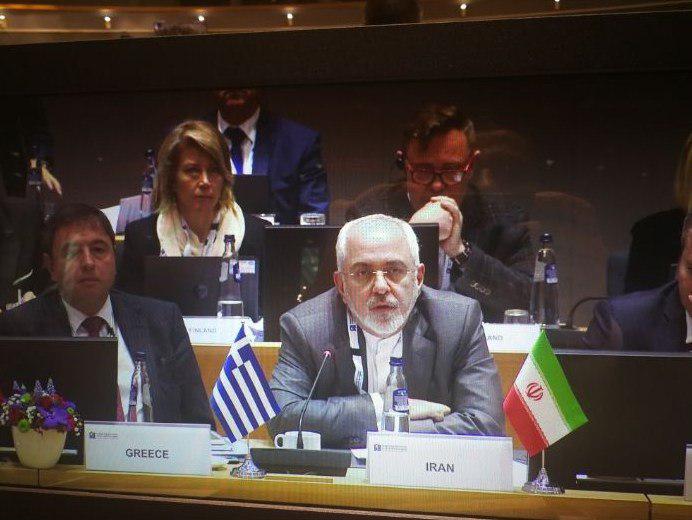
The second EU conference on Syria was held in Brussels, bringing together delegates from 80 countries. The event held Wednesday was jointly chaired by the EU and the UN, featuring a speech by Iranian Foreign Minister Mohammad Javad Zarif.

In his speech, the top Iranian diplomat said handling the humanitarian situation in Syria is a priority.

“If humanitarian assistance is in line with humanitarian principles, unconditional and not politically motivated, it could improve the living conditions of the displaced and refugees, and facilitate efforts to work out peaceful solutions to the conflict,” Zarif noted.

The foreign minister also reiterated the need for the establishment of a ceasefire in Syria.

“The establishment of peace in Syria should remain our top priority. Iran, in cooperation with Russia and Turkey, as the guarantor states of the trend of the Astana talks, is working towards expanding tension-free areas.”

“This process was formed based on the understanding that the Syria crisis can be settled only through political means and within the framework of a real, overarching political trend led by Syrian people while fully respecting the territorial integrity, sovereignty and independence of Syria,” he added.

He also referred to recent claims that Syria used chemical weapons in the country and touched upon the consequences of unilateral interventionist moves by certain countries.

“Largely affected by gas attacks in the 1980s, Iran condemns such strikes by any person and under any circumstances. We have always stressed the necessity of conducting impartial field research. At the same time, we denounce illegal unilateral military action. Foreign interference has only delayed the achievement of peace and will further aggravate the situation,” Zarif noted.

The foreign minister also said that Iran has been offering humanitarian assistance to Syrians.

“In recent years, Iran has been actively offering humanitarian aid to Syrian people, including those displaced on the Syrian soil as well as those under siege. We have already begun working with Syria to reconstruct the country, and we are also ready to interact with others in that regard,” he said.

Iranian, American Universities Sign MoU on Earthquake Studies

Two Quakes Hit Iran as Fight against COVID-19 Goes On

Keyvan Hosseini told a press conference on Tuesday that “the main contents of this memorandum of understanding are in the field of research on earthquake data, especially quakes occurring around the city of Mashhad.”

He added that the School of Geosciences at the University of South Florida is one of the most advanced international science centres, and the signing of this memorandum can lead to joint valid research.

Meanwhile, Dr Ehsan Qaboul, the Director of Scientific and International Cooperation and Non-Iranian Students Affairs, also highlighted the University’s strategy of getting in touch with the best universities of the world with the aim of promoting its academic level.

Iranian, American Universities Sign MoU on Earthquake StudiesHe stressed that the signing of this agreement in the area of earthquake studies could pave the ground for other scientific collaborations with the University of South Florida, a report by the Persian-language Mehr News Agency said.
Iran is one of the most seismically active


countries in the world, being crossed by several major fault lines that cover at least 90% of the country. As a result, earthquakes in Iran occur often and are destructive.

The deadliest quake in Iran’s modern history happened in June 1990. It destroyed the northern cities of Rudbar, Manjil, and Lushan, along with hundreds of villages, killing an estimated 37,000 people.

Bam in the country’s southeastern province of Kerman witnessed a strong quake in December 2003 which killed 31,000 people.

“Saudi Arabia Driving Wedge between Iran, Tajikistan”

The Persian-language Mehr News Agency has, in a recent report, argued that attempts by Iran’s regional rival, Saudi Arabia, to sabotage relations between Tehran and Dushanbe and cash in on their estrangement have contributed to straining relations between the two countries.

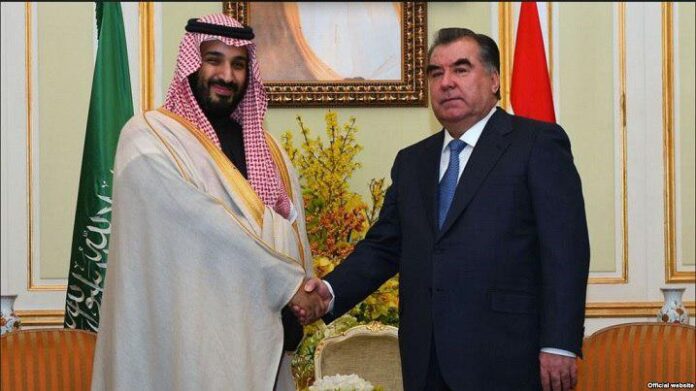
During a trip to Saudi Arabia in 2016, Tajik President Emomali Rahmon received loans and financial aid from the Saudi government in what many believed were Riyadh’s attempts to pry a good ally away from Iran, the article said.
However, the article said the Tajik government must show vigilance towards the Saudis, as Riyadh’s assistance could have ulterior motives.

It said a pledge by Riyadh in 2017 to provide $35 million for construction of schools in Tajikistan is aimed at propagating an extremist mind-set among the youth in the Persian-speaking and predominantly Muslim state.

The Tajik government should fight a rearguard action against such efforts if it wants to prevent the country from turning into a breeding ground for advocates of a radical interpretation of Islam, it suggested.

The article said providing the Central Asian country with financial aid gives Saudi Arabia ample room for manoeuvre, setting up a situation ripe for the rise of extremism.

“Cold relations between Iran and Tajikistan, which share common cultural heritage, will create favourable conditions for Saudi Arabia and Takfiri groups that will definitely pose a great security challenge to Tajikistan,” the article said.
Takfiris are hardliners who accuse Muslims that do not follow their extreme interpretation of Islam of apostasy punishable by death.


Severed Ties between Tehran, Dushanbe

Iran was the first country to recognize Tajikistan’s independence in the early 1990s and acted as one of the mediators in talks to end its 1992-97 civil war.

But ties between the two nations have been strained since a leader of a banned Tajik Islamist party, Islamic Renaissance Party, attended a conference in Tehran in 2015, which angered the government in Dushanbe.

The Rahmon administration accused the Islamic Renaissance Party of Tajikistan of being behind a failed coup attempt in September 2015 and later banned the party, jailing some of its leaders and activists.

Last year, Tajikistan accused Iran of intervening in the 1990s Tajik civil war, sending assassins and saboteurs into the former Soviet republic, which worsened the situation in the country, the article said.
In a documentary broadcast by Tajikistan’s television in 2017, three Tajiks claimed that following training in Iran, they killed politicians and other prominent figures inside Tajikistan during the 1992-97 war and attacked a Russian military base there.

Tehran, however, denies the allegations.

The article said that the shuttering of several Iranian centres in the country at the request of Tajik authorities and their decision to slap travel and trade restrictions on citizens and goods from Iran in recent years contributed to the souring in relations.

Another irritant has been the fate of the assets of jailed Iranian billionaire Babak Zanjani, whose international business empire once included assets in Tajikistan, the article added.


Zarif’s Tajikistan Trip Could Pave Way for Thaw in Ties

Iranian Foreign Minister Mohammad Javad Zarif was in Dushanbe last week, where he held talks with President Rahmon in the Central Asian country.

In the meeting, held on the sidelines of the 23rd ECO Ministerial Meeting held on April 17, the two sides exchanged views on bilateral, regional and international issues, stressing the need to forge closer cooperation in different fields.

The meeting, described as “friendly”, was the second meeting between Zarif and Rahmon within the past few months.

Earlier in November 2017, the Iranian top diplomat had made a trip to the Central Asian country as the first of its kind in the past couple of years.

Mehr News Agency’s report further wrote that the trip could open a new chapter in bilateral ties if accompanied by concrete steps.

“Improvement of Iran-Tajikistan relations, which was pursued in the foreign minister’s recent trip, requires more fundamental and considerable measures so that the two countries that share a common language could get closer to each other,” read the article.

Iran Renews Call for Regional Talks on Mideast Security

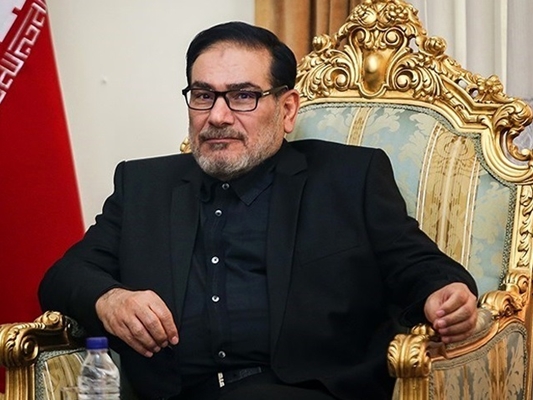
Secretary of Iran’s Supreme National Security Council Ali Shamkhani on Wednesday lamented that violence is on the rise across the region and challenges to international security are getting more and more complicated.

Addressing the 9th International Meeting of High Representatives for Security Issues in the Russian Black Sea resort of Sochi, he said a host of factors contribute to the unpleasant situation in the region, including a misguided belief among some leaders that war could help them advance their agenda and meddling by outside powers who see their interests in increased tensions in the region.

For instance, Shamkhani said, the US, as the biggest exporter of weaponry who sells most of its weapons to West Asia, has no motive to help end wars in the region.

“The fixed policy of the US in this region is to foment insecurity and instability, so it can sell weapons and expand military bases and make interventions in the region’s affairs,” the SNSC chief said, according to a report by the Persian-language Fars News Agency.

Shamkhani said it is up to regional countries to mobilise resources to help stop wars, as history shows no conflict has ever been settled through war.

Regional countries should also work to move past stalemates and find political solutions to conflicts in West Asia, particularly those in Syria, Yemen, and Afghanistan, he said.
Iran is ready to join hands with regional countries to help settle disputes and unite the region to fight terrorism and restore stability to the region, Shamkhani said, adding that Iran’s role in the collapse of the so-called caliphate of ISIS proves Tehran is sincere in its desire to promote calm in the region.

Tehran in recent years has repeatedly called for establishment of a regional forum that enables cooperation among regional governments for curbing chaos in the region.

But its calls have mainly been ignored by powers hostile to Iran, including Saudi Arabia, which accuse Tehran of interfering in the affairs of regional countries and having aspirations to dominate the region.

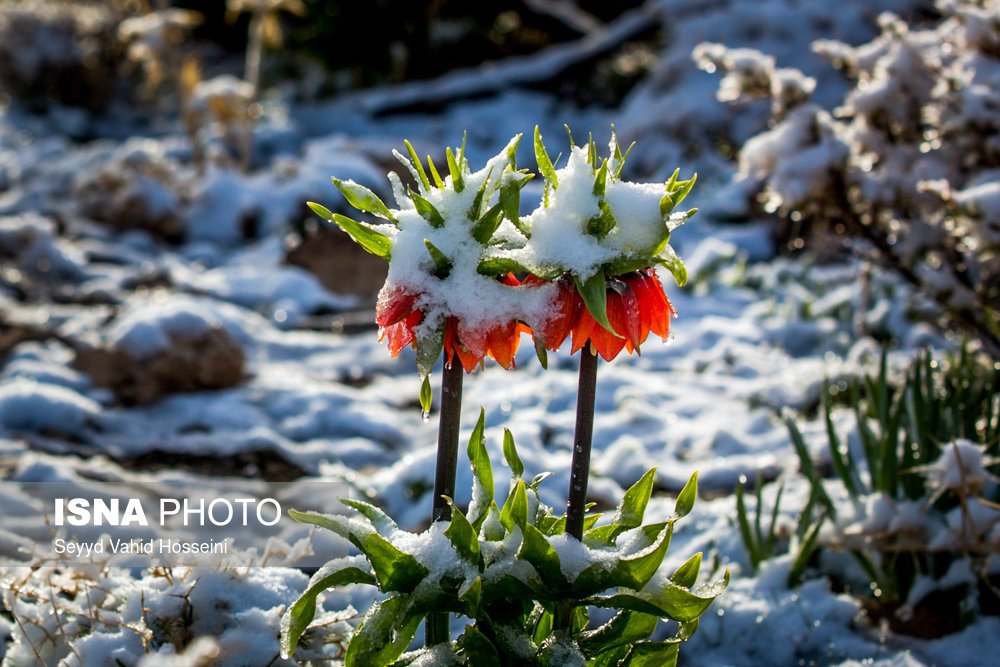
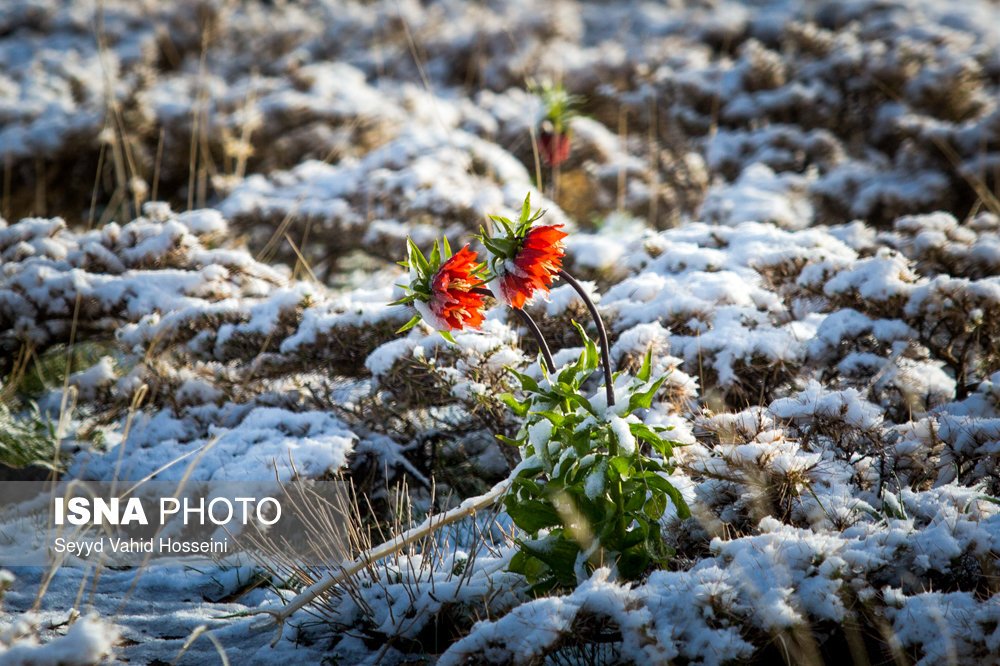
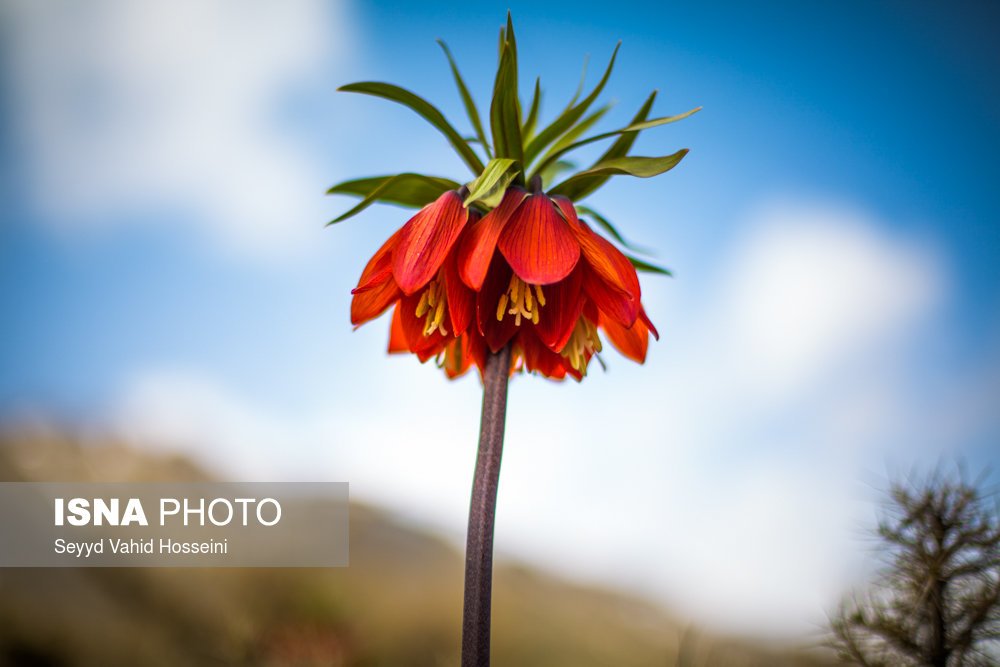
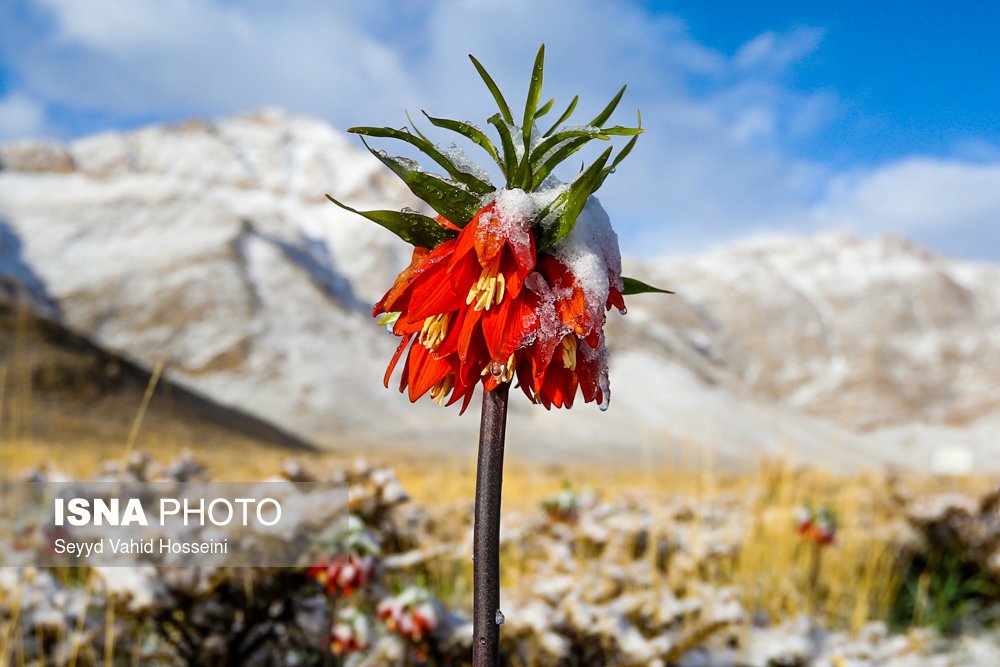
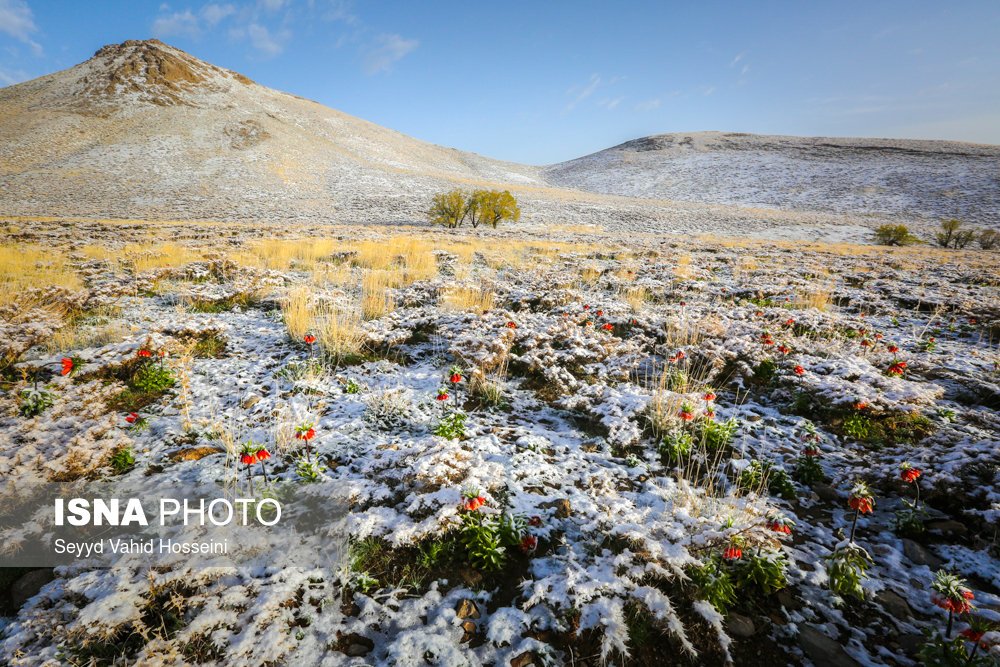
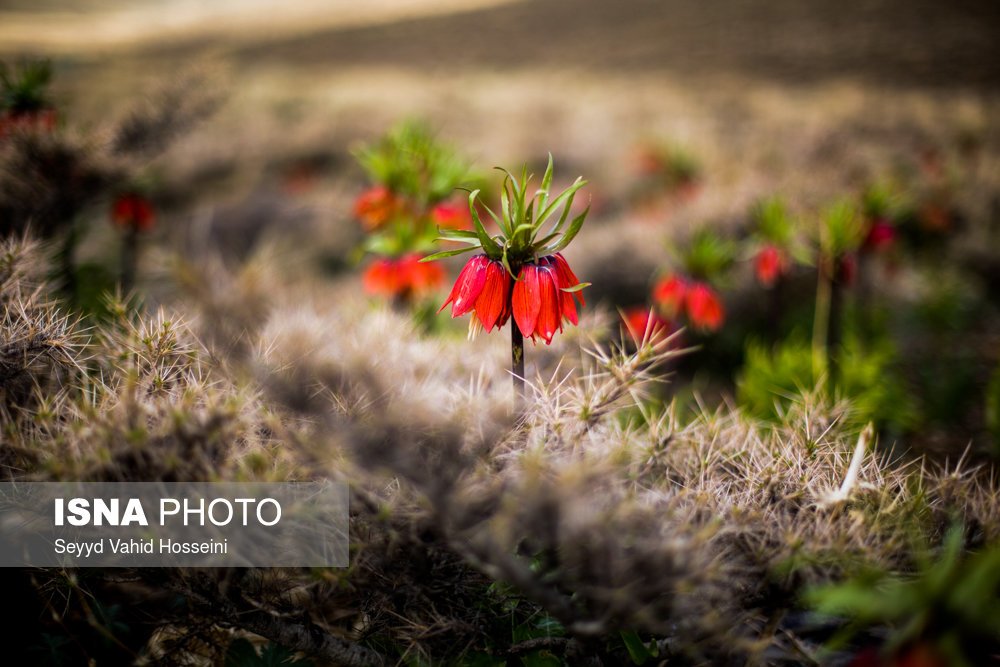
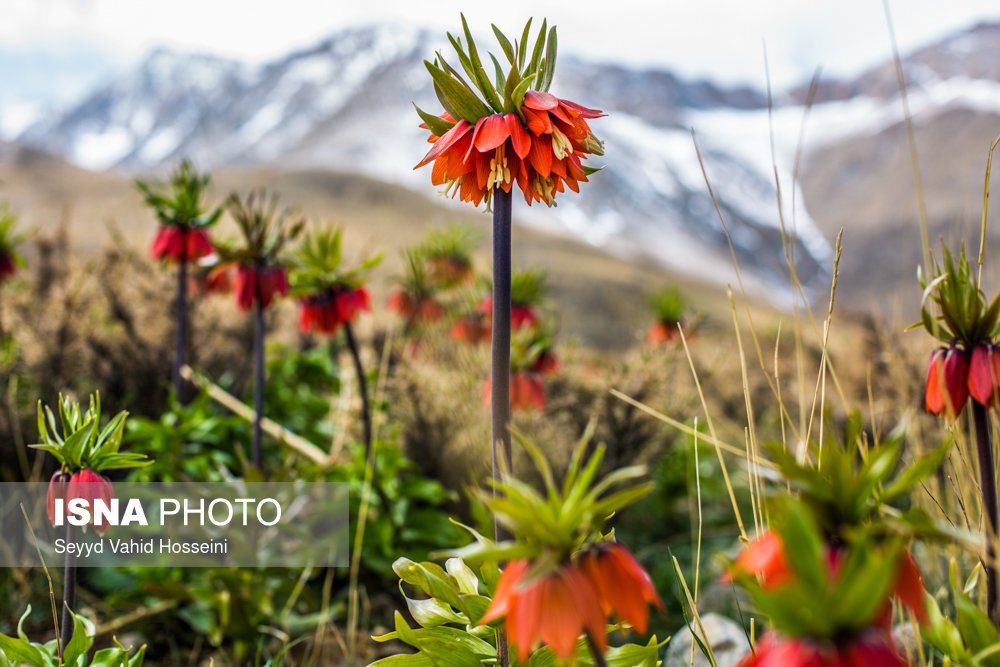
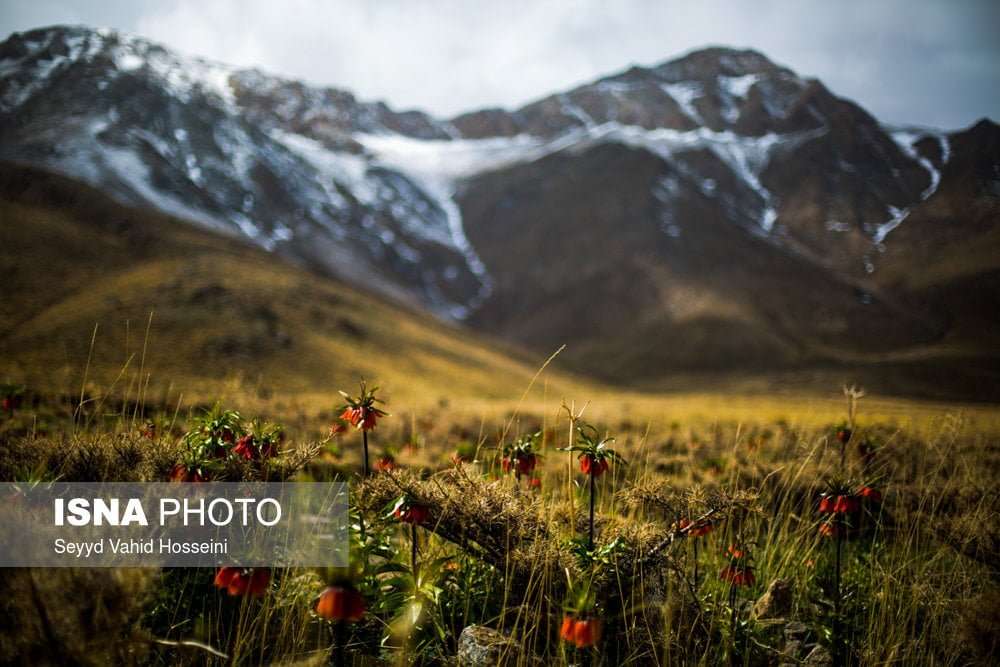
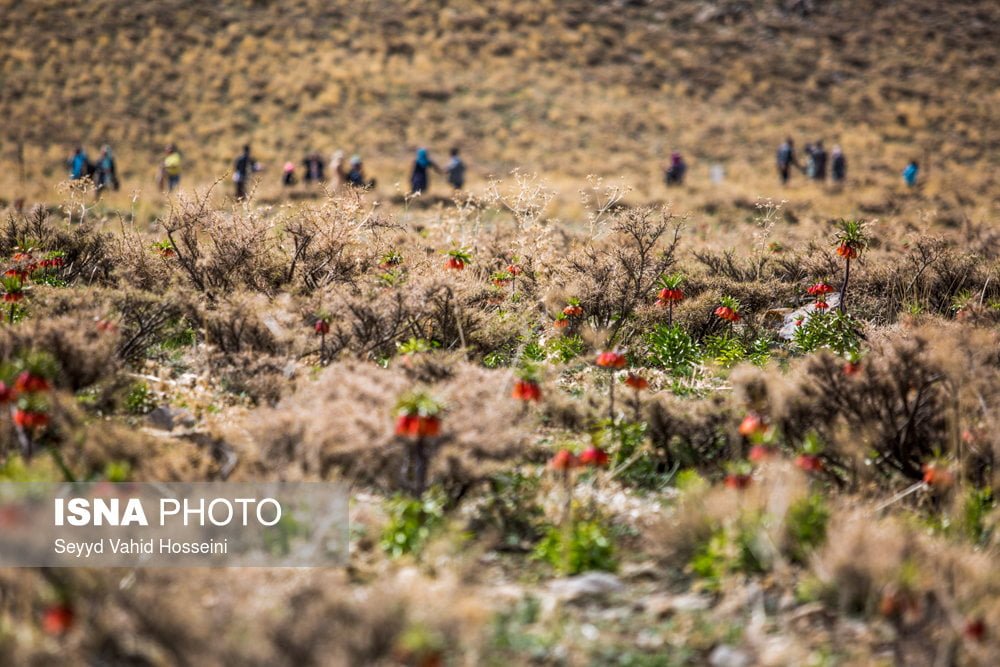
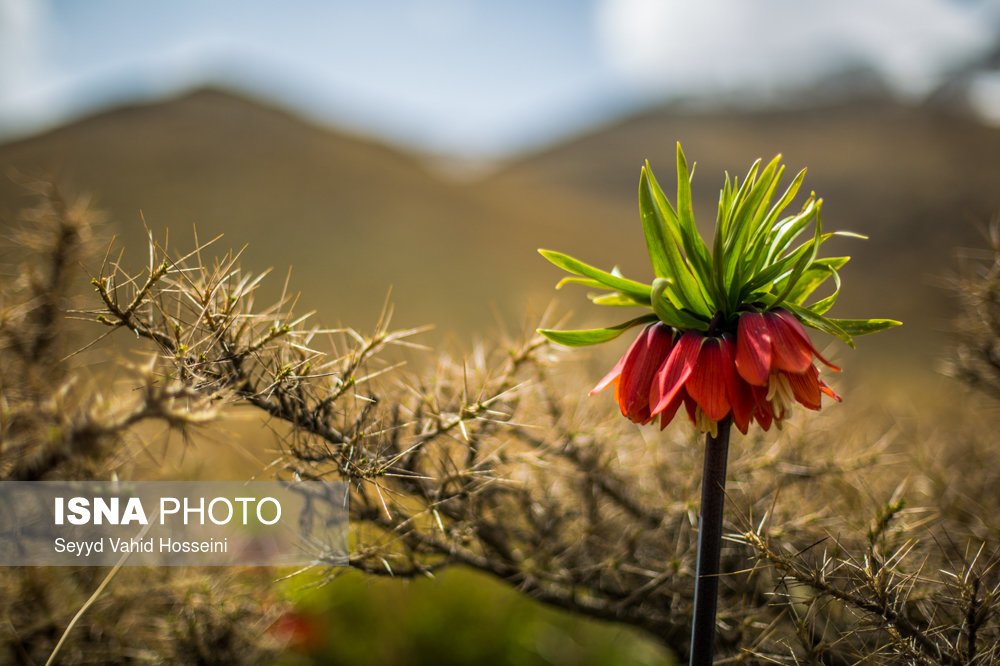
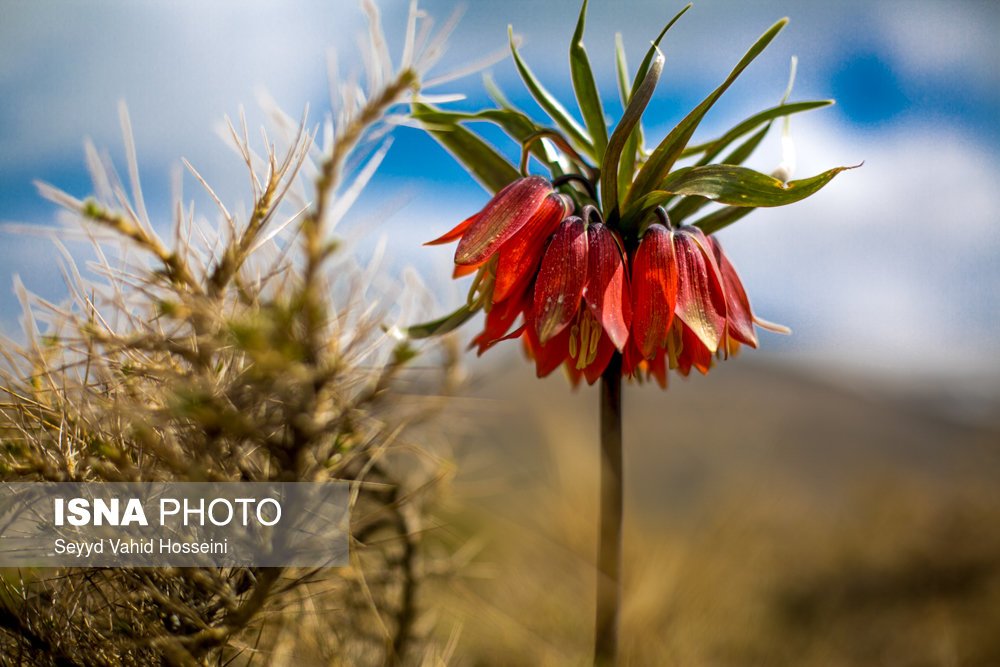
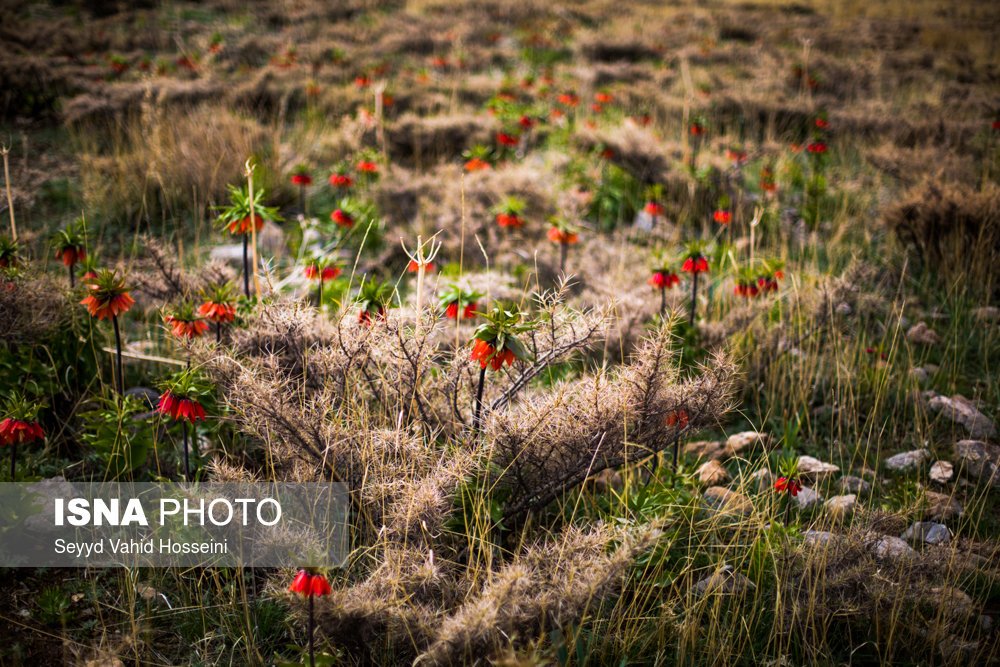
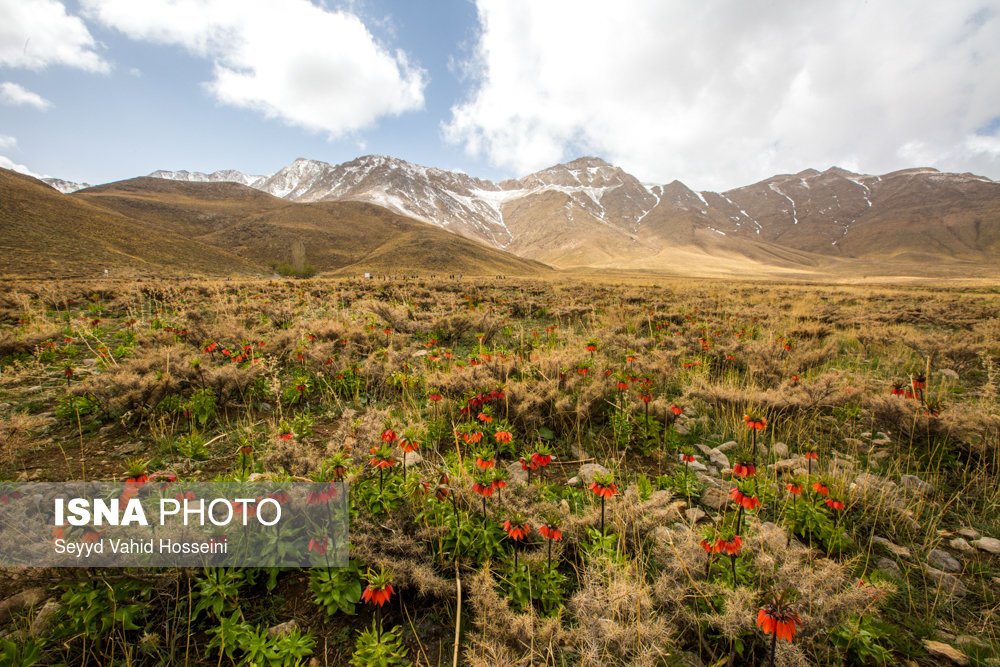
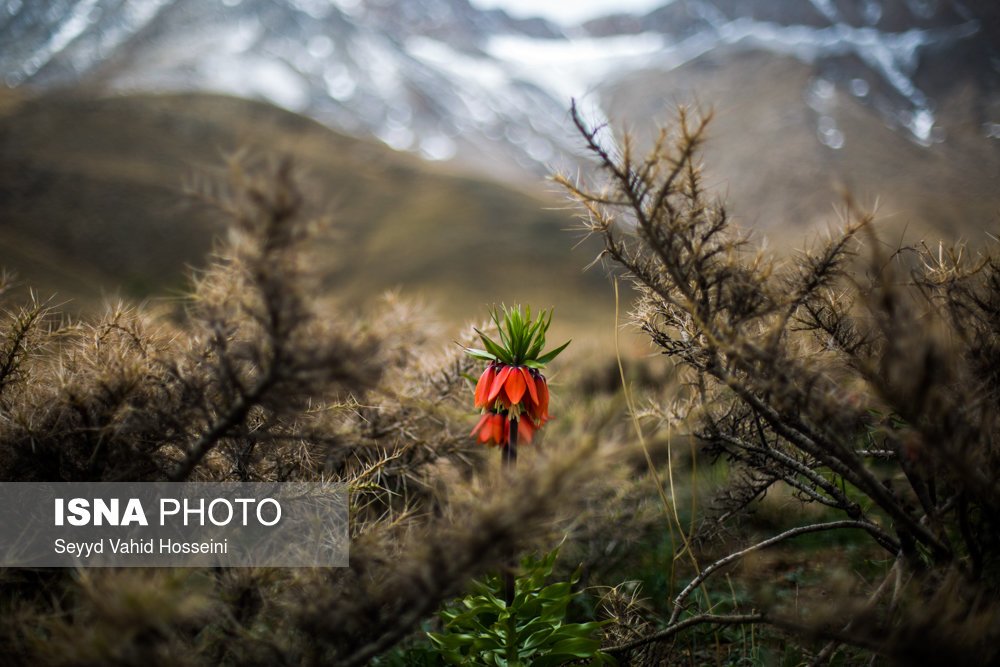
Iran’s Beauties in Photos: Upside-Down Tulips in Western Iran

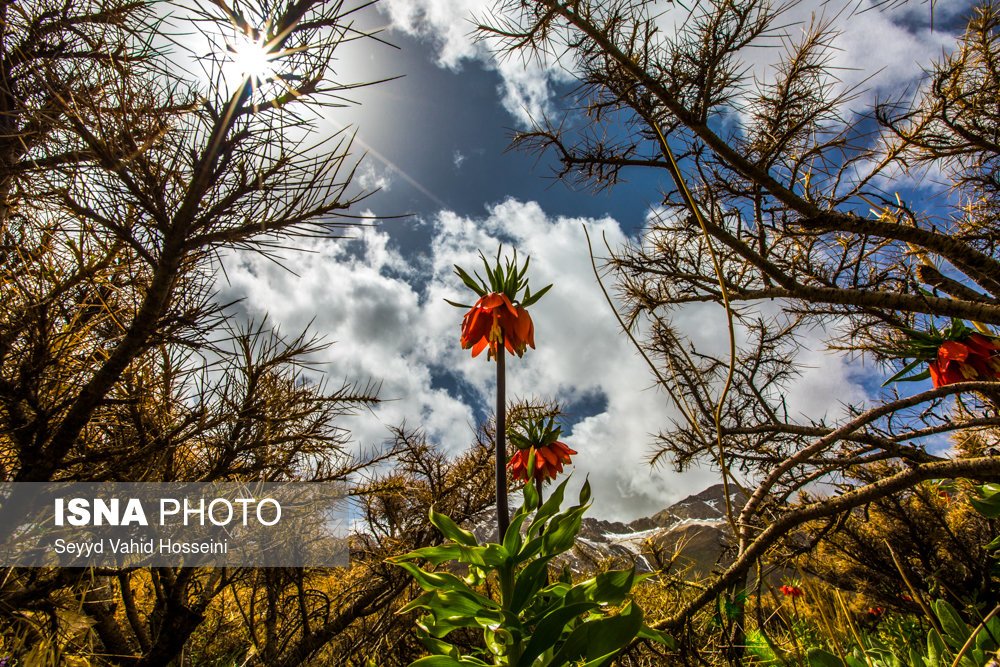
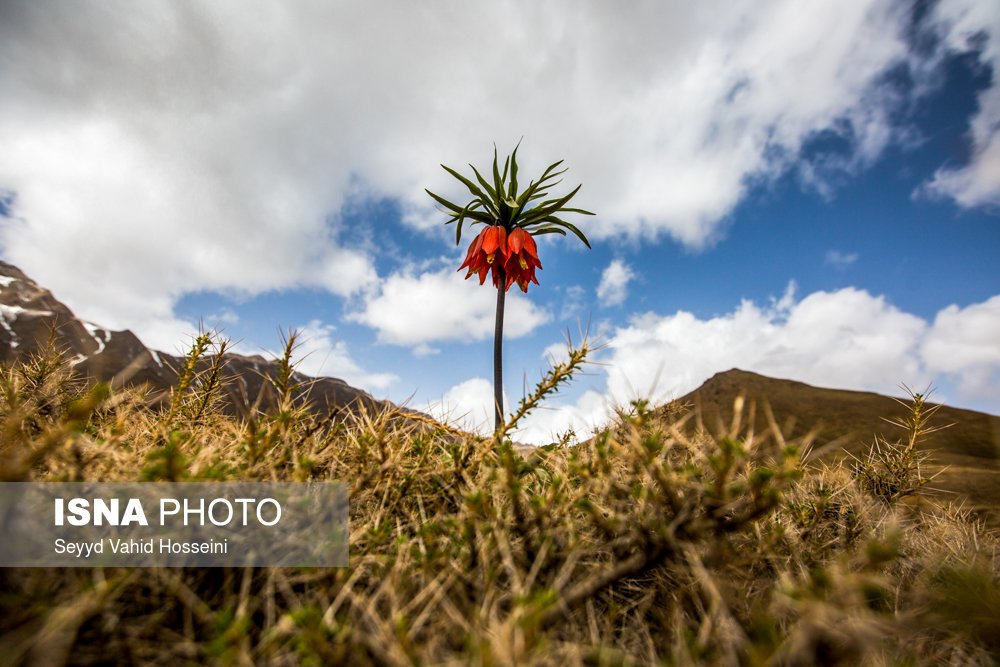
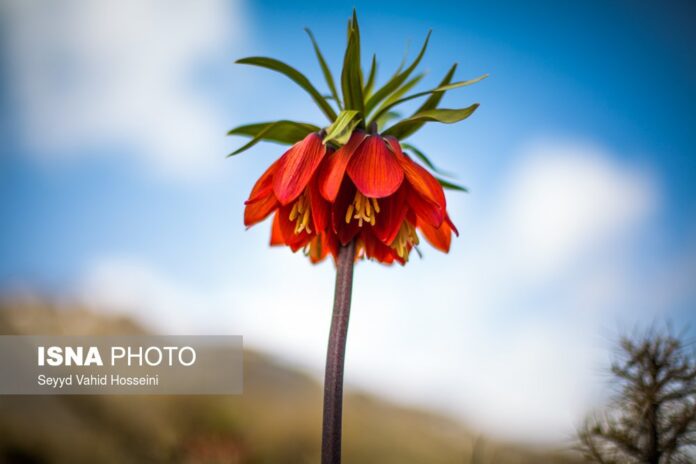
The flower sprouts on the Iranian plains of Isfahan and Chaharmahal and Bakhtiari provinces in mid-March every year. The full bloom of upside-down tulips is spectacular, as if it creates a red and green carpet. During this period, a lot of travellers visit areas where this wonderful flower blooms.

A place these tulips grow in is Khansar of Isfahan, at the foot of Golestan Kooh Mountain. Its flowering begins in early May and ends at the end of spring. These tulips, which have a short lifespan, enjoy healing properties for rheumatism and joint pains.

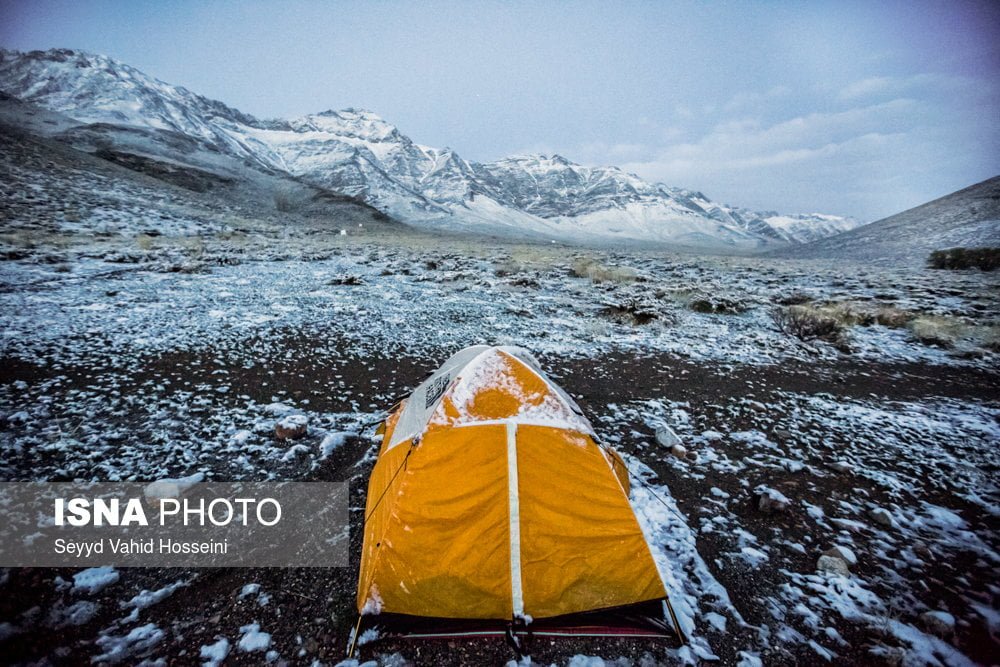
Following you can find photos of Golestan Kooh’s upside-down tulips retrieved from ISNA:

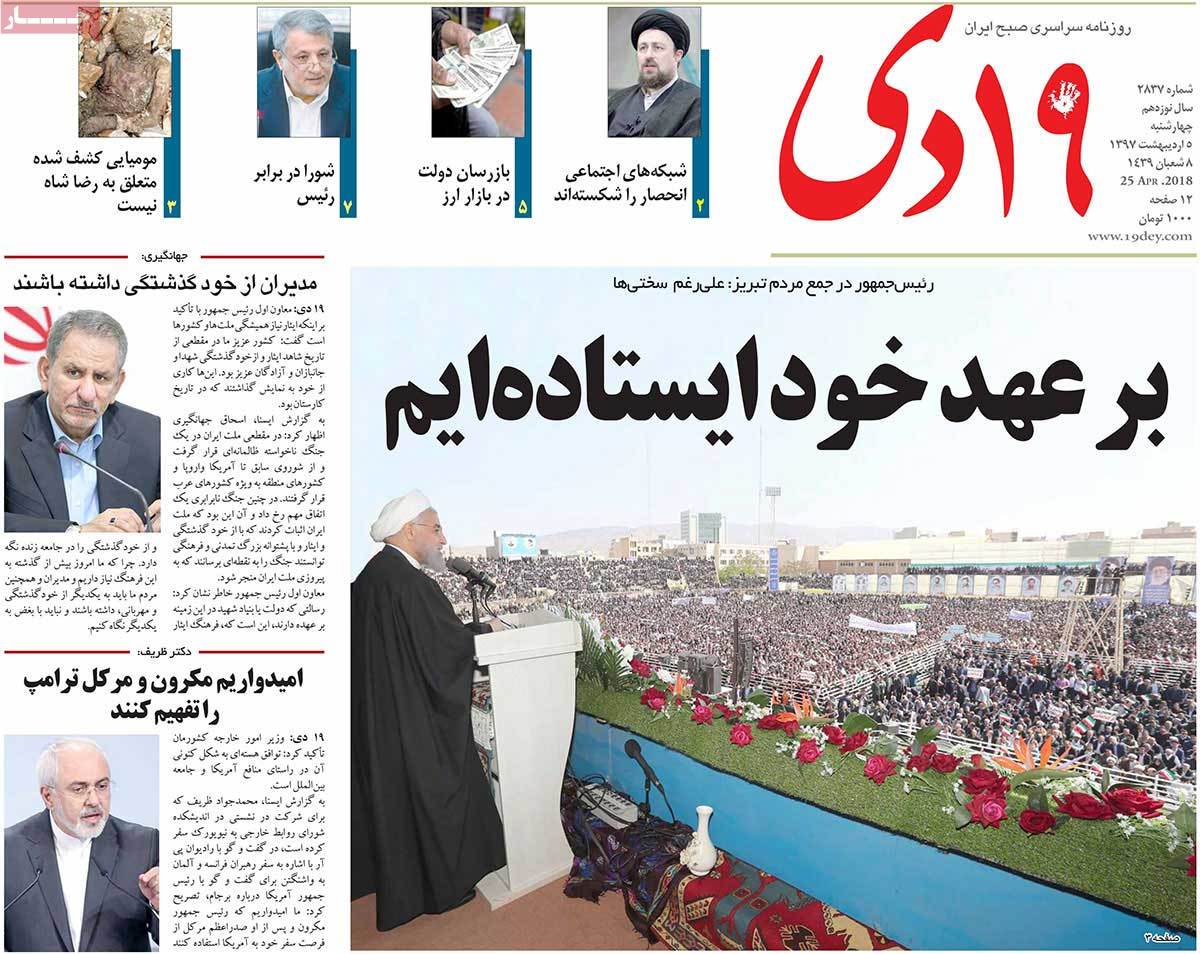
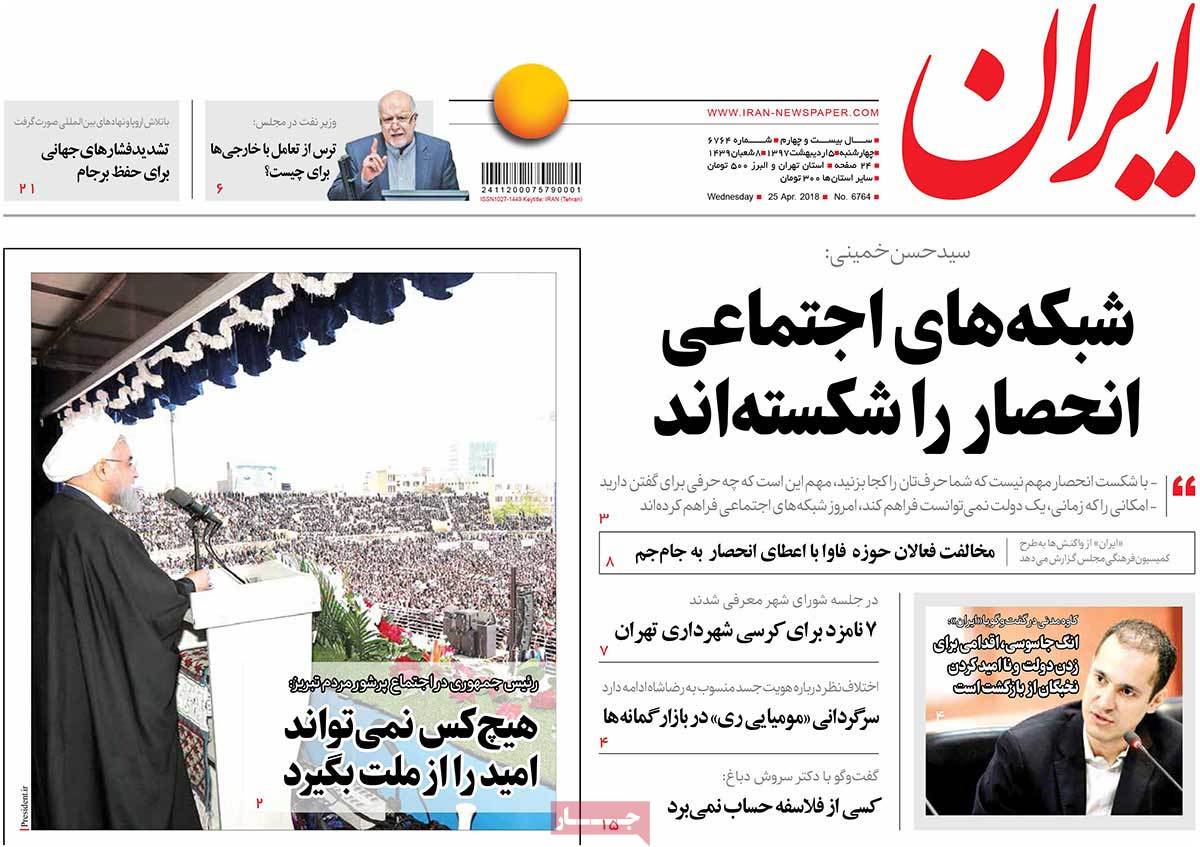
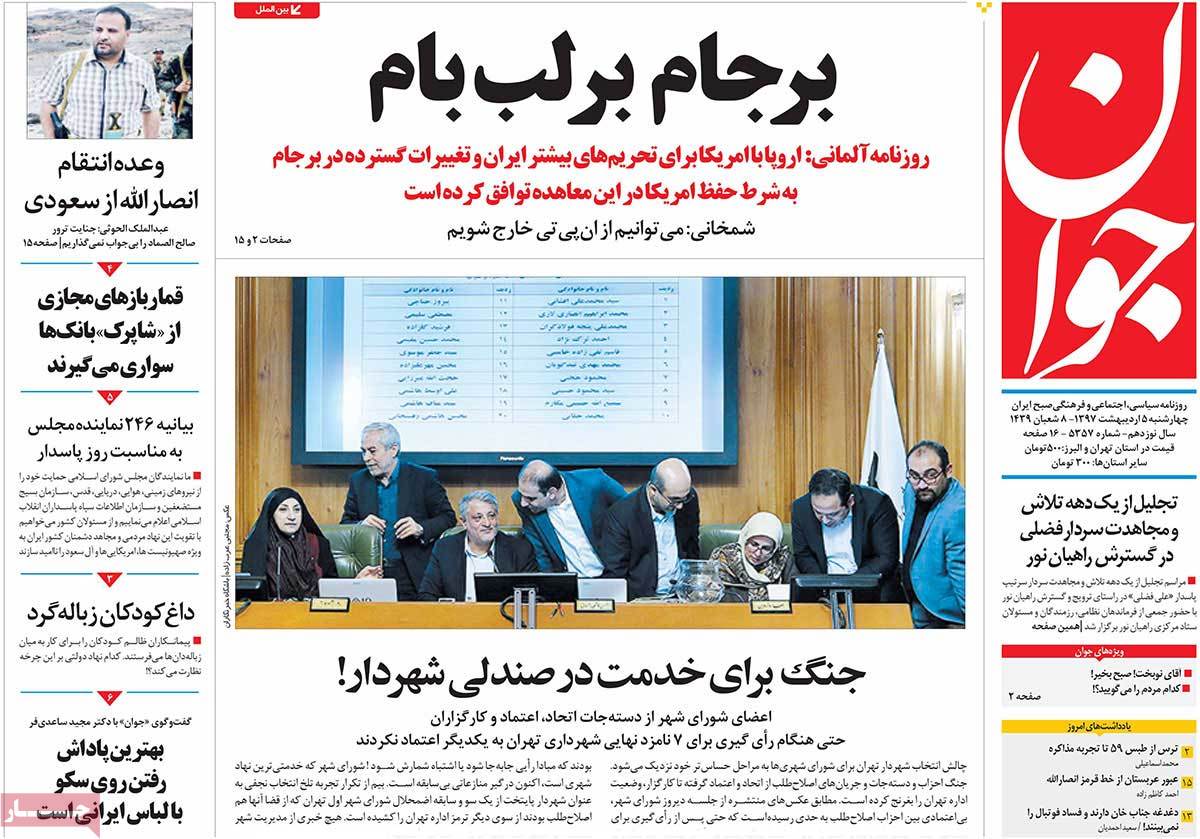
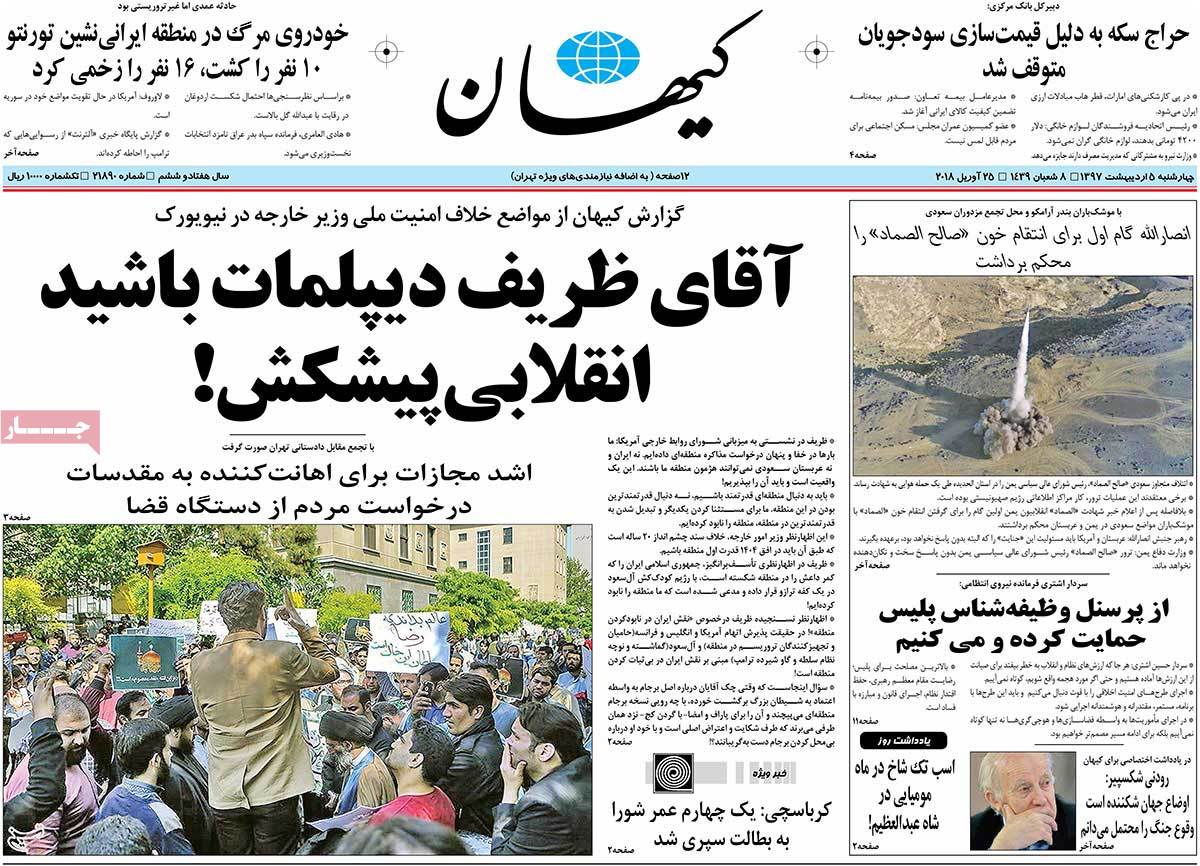
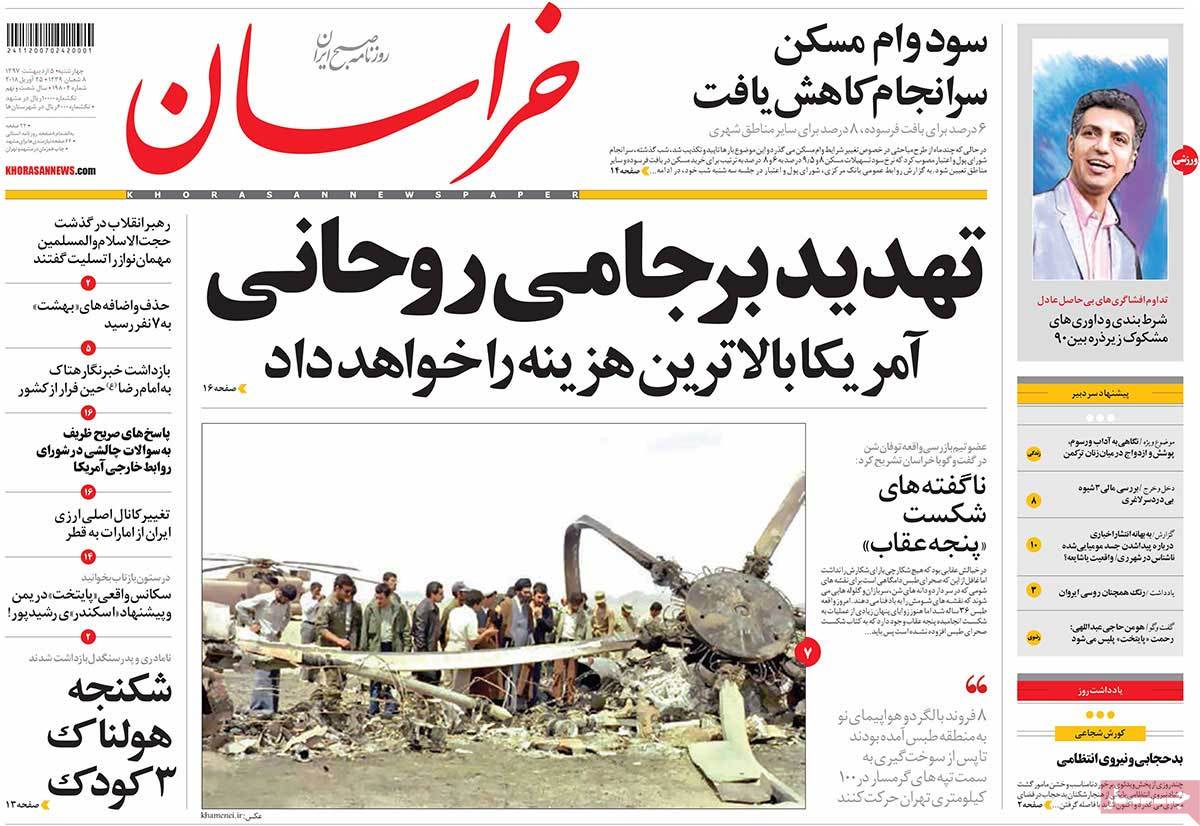
A Look at Iranian Newspaper Front Pages on April 25

A Look at Iranian Newspaper Front Pages on November 19

The top story in all papers today was the remarks made by Iranian President Hassan Rouhani and top security official Ali Shamkhani about the Iran nuclear deal and the consequences of the US withdrawal from the 2015 accord.

Also a top story was comments made by Foreign Minister Mohammad Javad Zarif on the Iran nuclear deal in separate interviews with American media in New York.
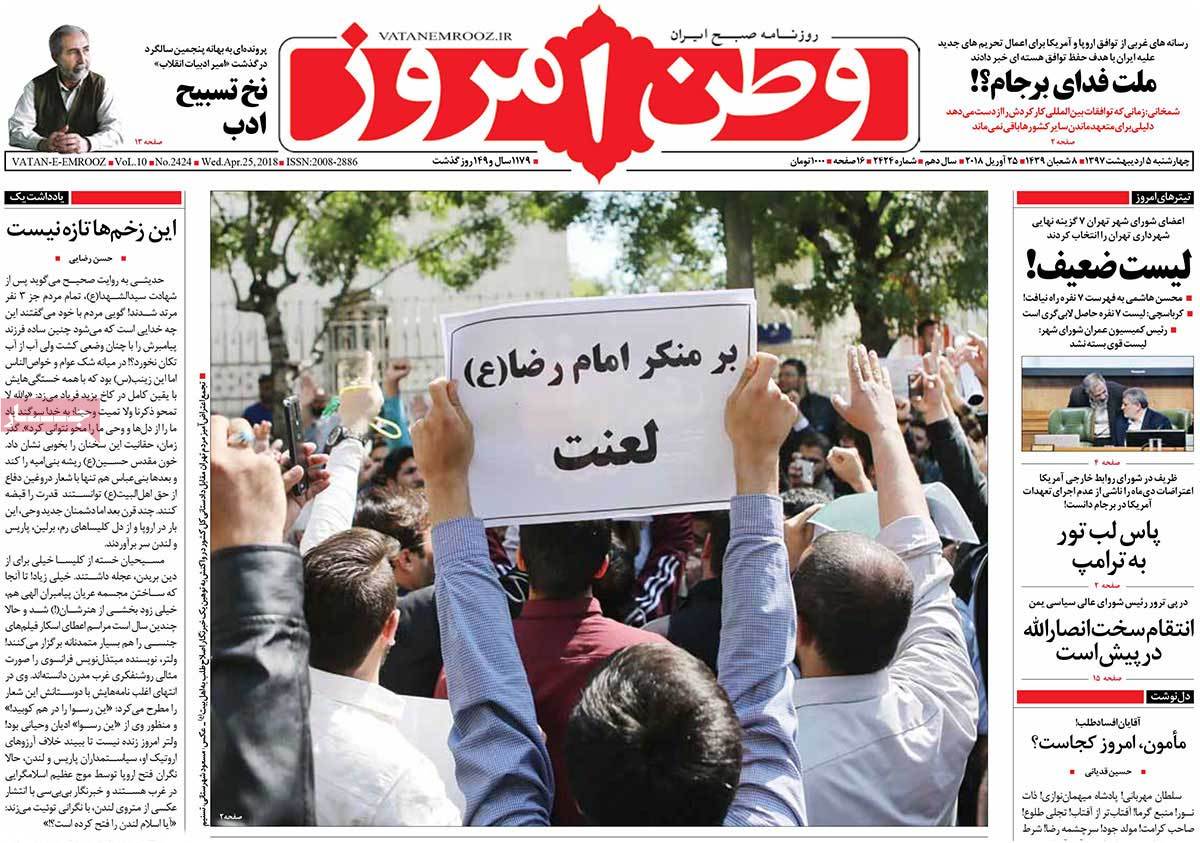
The martyrdom of Saleh al-Samad, a senior Ansarullah official, and the Yemeni group’s vow to take revenge from the Saudi perpetrators also received great coverage.

The above issues, as well as many more, are highlighted in the following headlines and top stories:


19 Dey:

  • Rouhani: We’ve Remained Committed to Our Promise
  • Zarif: We Hope Macron, Merkel Would Make Trump Understood

A Look at Iranian Newspaper Front Pages on April 25


Abrar:

  • Zarif: US Withdrawal from JCPOA to Free Iran from Commitments

A Look at Iranian Newspaper Front Pages on April 25


Afkar:

  • Shamkhani: We Won’t Show Restraint If Trump Hampers JCPOA Implementation
  • Rouhani: No One Can Make Iranian Nation Disappointed

A Look at Iranian Newspaper Front Pages on April 25


Aftab-e Yazd:

  • Rouhani: I Don’t Have a Weak Memory, So I’ve Not Forgotten My Promises

A Look at Iranian Newspaper Front Pages on April 25


Arman-e Emrooz:

  • Rouhani: Don’t Worry about Exports, Imports; We’ve Made Robust Forex Decisions

A Look at Iranian Newspaper Front Pages on April 25


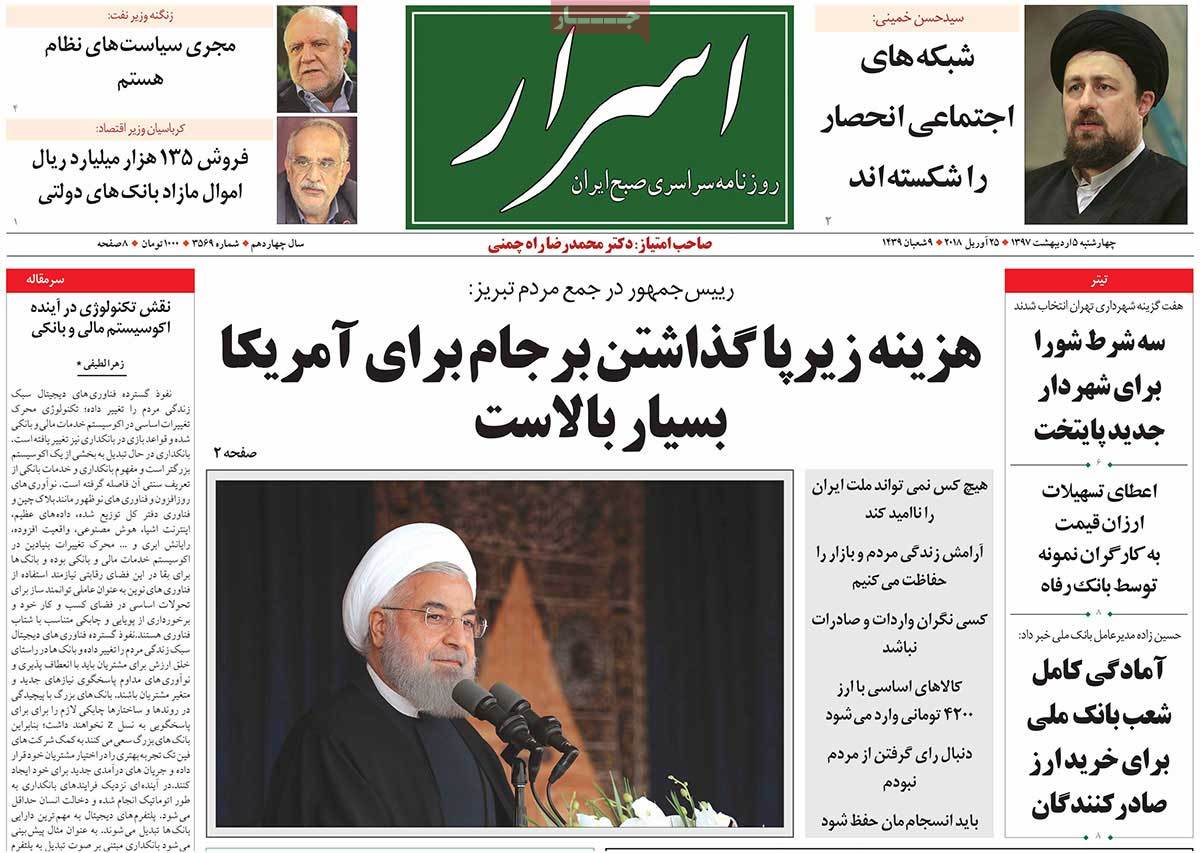
Asrar:

  • Imam Khomeini’s Grandson: Social Media Have Ended Monopoly [of traditional media]
  • Rouhani: US to Pay Dearly for Violating Iran Nuclear Deal

A Look at Iranian Newspaper Front Pages on April 25


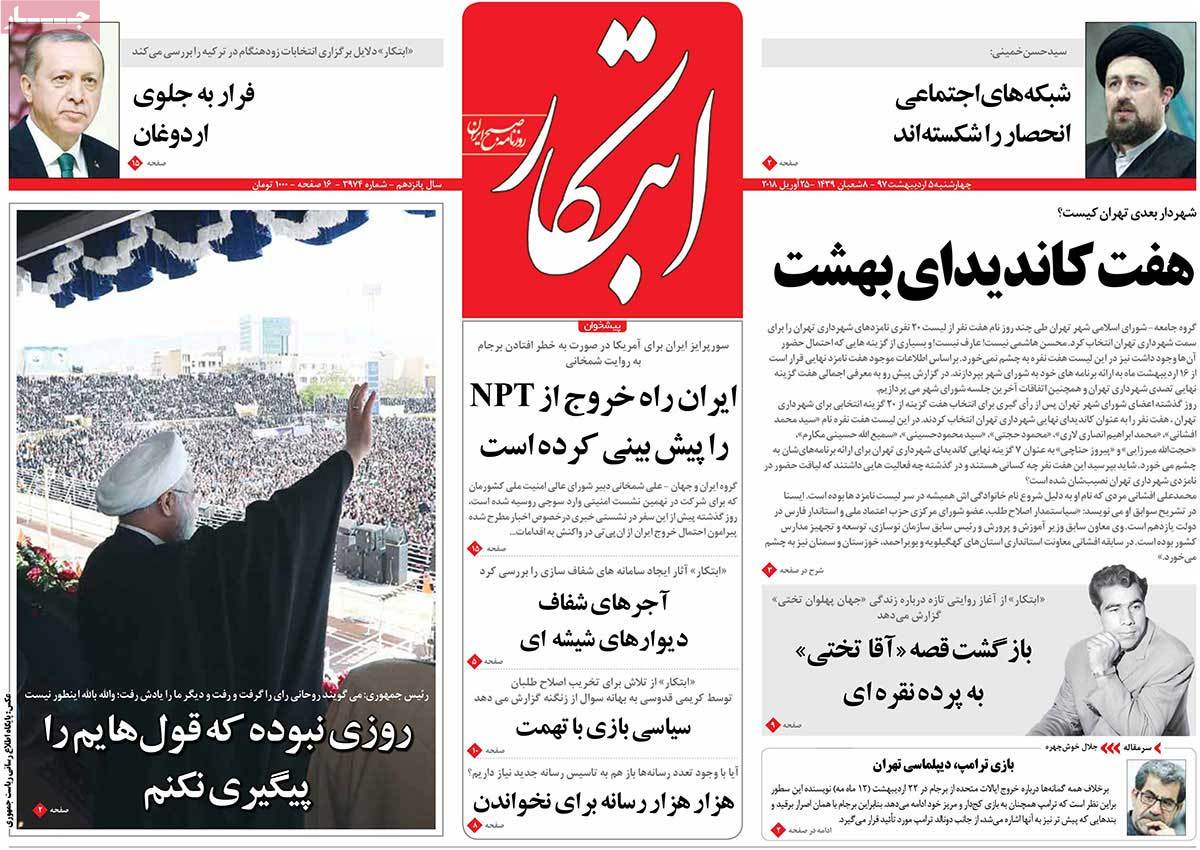
Ebtekar:

  • Leaving NPT among Iran’s Options in Case US Threatens JCPOA: Shamkhani

A Look at Iranian Newspaper Front Pages on April 25


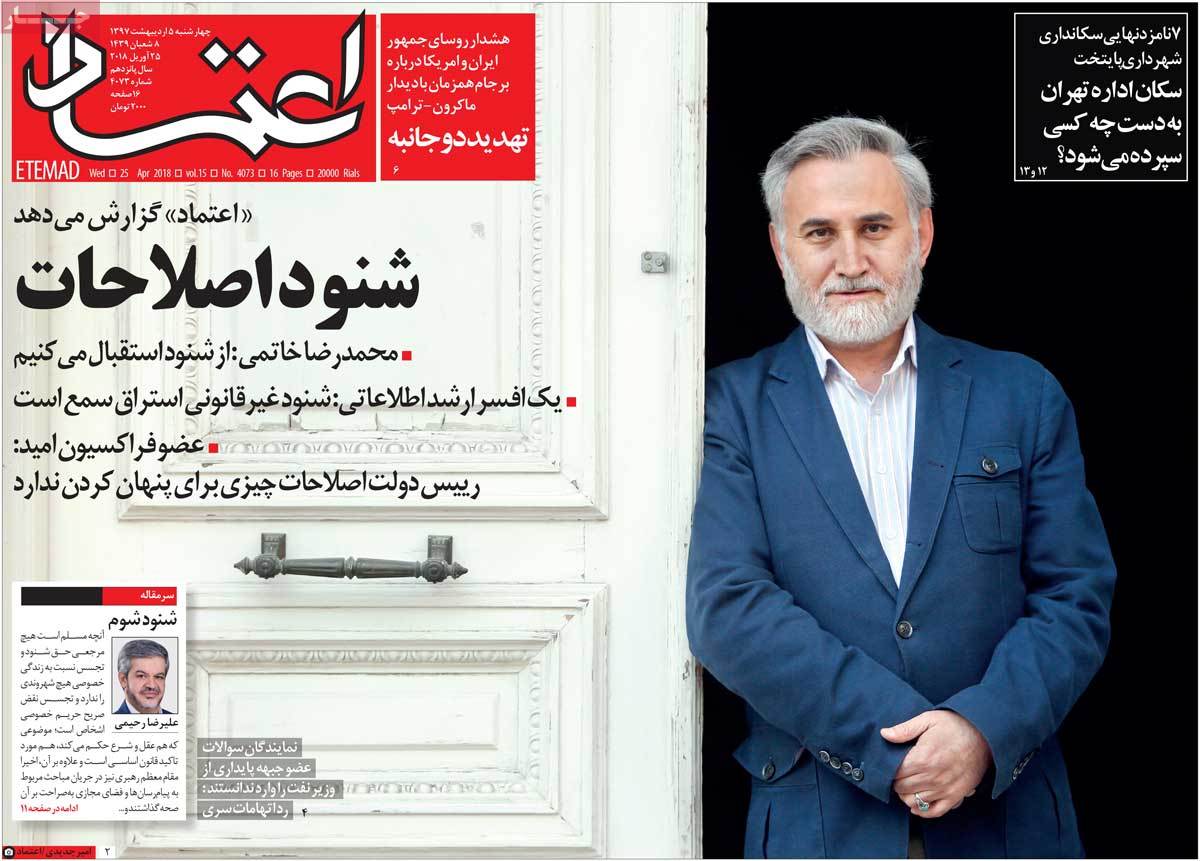
Etemad:

  • Who Will Be Elected as Tehran Mayor? There Are Seven Candidates

A Look at Iranian Newspaper Front Pages on April 25


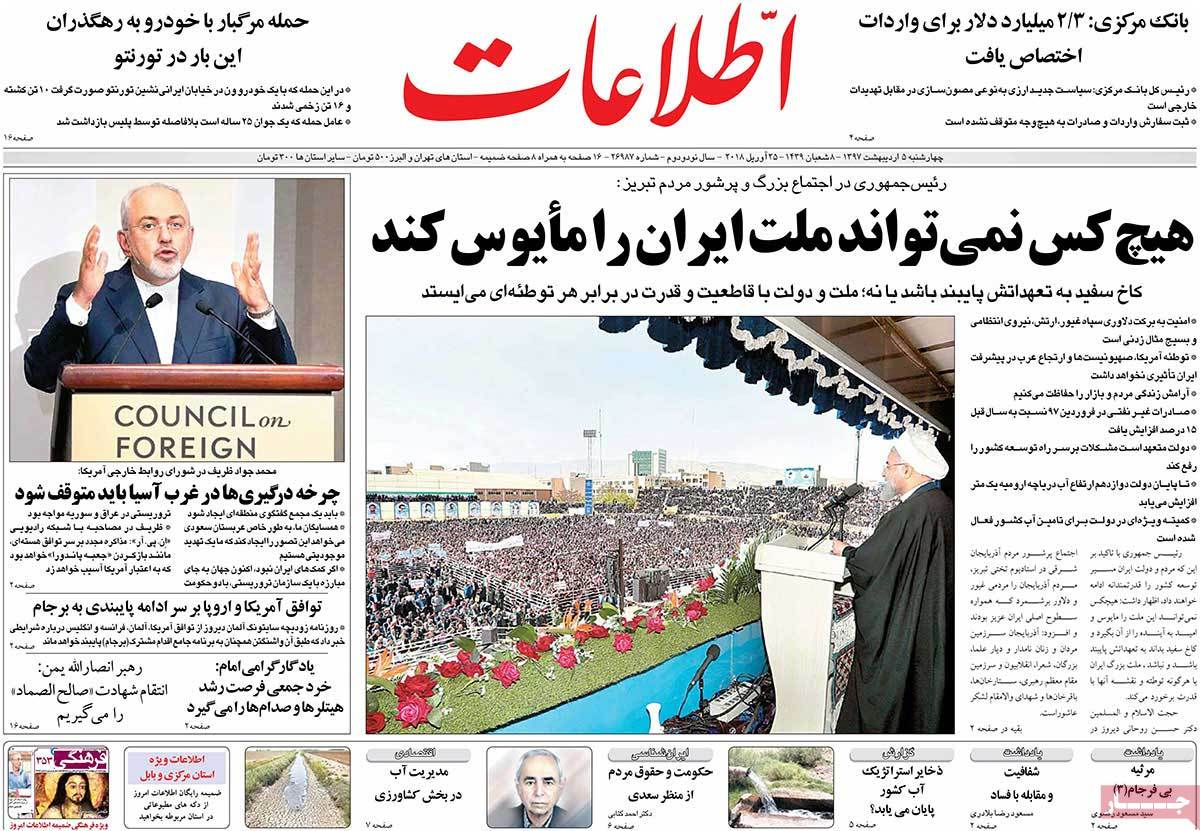
Ettela’at:

  • Zarif: Conflicts in Western Asia Must Be Stopped
  • Central Bank Allocates $2.3 Billion to Import

A Look at Iranian Newspaper Front Pages on April 25


Iran:

  • Oil Minister: What Are We Afraid of Interacting with Foreigners?
  • EU, Int’l Bodies Increase Pressure to Preserve Iran Nuclear Deal

A Look at Iranian Newspaper Front Pages on April 25


Javan:

  • JCPOA on Verge of Collapse
  • German Paper: Europe, US Have Agreed on More Iran Sanctions, Major Changes to JCPOA

A Look at Iranian Newspaper Front Pages on April 25


Kayhan:

  • Mr Zarif! You Don’t Need to Be A Revolutionary, Just Be A Diplomat!
  • A Report on Zarif’s Remarks against Iran’s National Interests in New York
  • Car in Toronto Kills 10, Wounds 16
  • Ansarullah Takes First Step to Avenge Death of Saleh al-Samad by Targeting Aramco Port

A Look at Iranian Newspaper Front Pages on April 25


Khorasan:

  • Rouhani’s Threatening Remarks on Iran Nuclear Deal
  • US to Pay Heaviest Costs

A Look at Iranian Newspaper Front Pages on April 25


Rah-e Mardom:

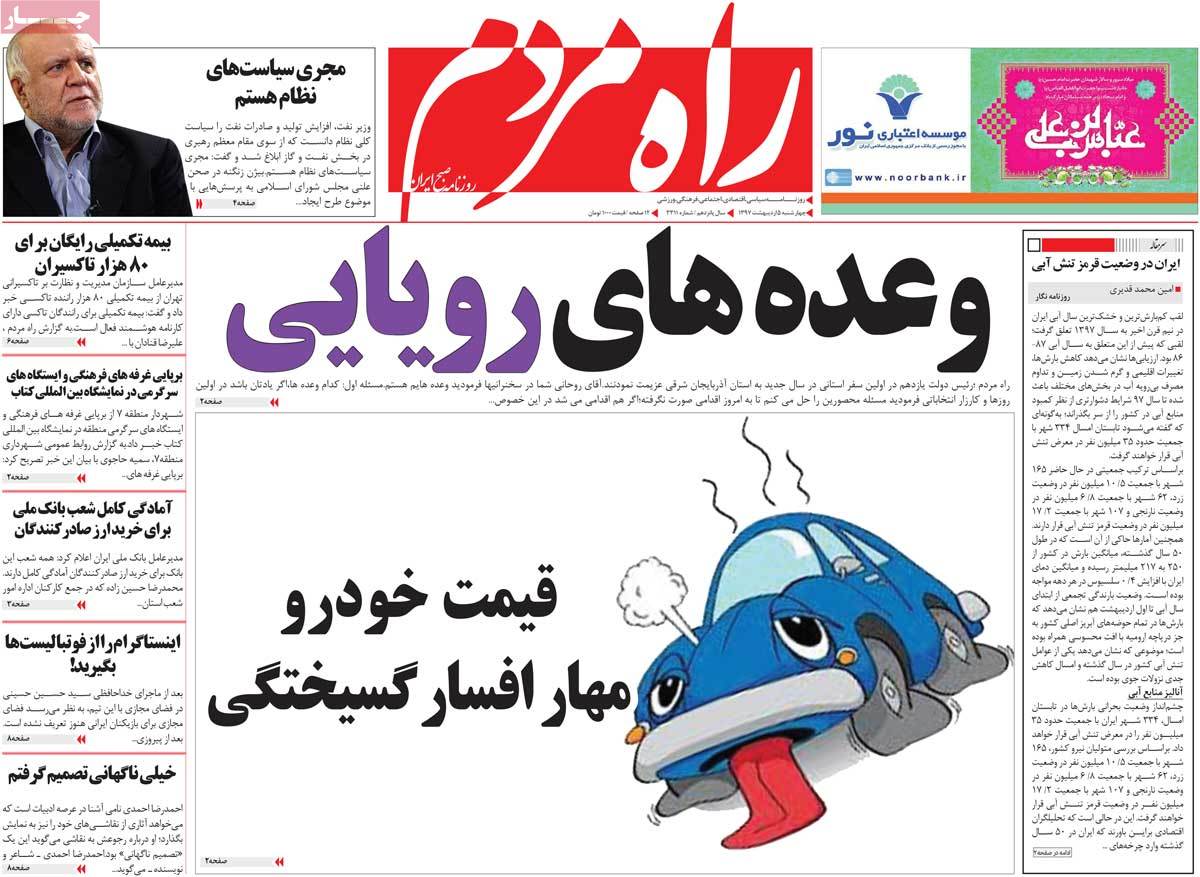
  • Iran Oil Minister: I’m Just Implementing Establishment’s Policies

A Look at Iranian Newspaper Front Pages on April 25


Resalat:

  • Rouhani: Nation, Gov’t to Stand against White House’s Plot

A Look at Iranian Newspaper Front Pages on April 25


Shargh:

  • Mr Macron’s Mission to Save Iran Nuclear Deal
  • What French President Looks for in Washington

A Look at Iranian Newspaper Front Pages on April 25


Vatan-e Emrooz:

  • Yemen’s Ansarullah to Take Revenge for Death of Its Top Official

A Look at Iranian Newspaper Front Pages on April 25

Iran President Inaugurates Tabriz 2018 Tourism Event

The event is held on the occasion of the designation of Tabriz, the third largest city in Iran, as the tourism capital of Muslim world in 2018.

The designation was made during a conference of the tourism ministers of the Organisation of Islamic Cooperation held in February in Bangladesh, a report by IRNA said.

Tabriz is the largest economic hub and metropolitan area in Northwest Iran.

As a 3,500-year-old city, Tabriz hosts around 1,800 cultural heritage sites registered on the national List of Cultural Heritage, notably the Grand Mosque and Tabriz Citadel.

The city is famous for its handicrafts, including hand-woven rugs and jewelry.

It has also been declared a World Craft City by the World Craft Council, which, along with Isfahan, makes it one of Iran’s only two cities to boast the title.

The population is overwhelmingly Azerbaijani, though Persian is spoken by residents as a second language.


Tourism Brings Great Benefits

Speaking in the ceremony, Rouhani said promoting tourism could be a good way to drive constructive engagement with the world.

“Tourism helps people know history of other countries and thus obtain a deeper understanding of other nations,” he said, according to a transcript of his speech posted on President.ir.

Rouhani said encouraging tourism could also bring significant economic benefits to the Iranian people.

“Developing relations with neighbors and other countries improves living conditions of Iranians and produce economic benefits,” he said.

The president said Tabriz, a key location on the legendary Silk Road and a gateway to Europe, has the potential to become a hot tourist destination for decades to come.

Besides western people, Rouhani said Tabriz could hold strong appeal for nations in the region and Muslim world.

“People and officials in East Azarbaijan Province should work towards turning Tabriz into a widely popular tourist destination in the world not only for 2018 but for decades,” he said.

Iran Rejects Potential US-Europe Deal on Fate of JCPOA

Signs of US Decline Clearer Than Ever: Iran Official

“In our view, any agreement between Europe and the US over the future of JCPOA and the fate of Iran’s nuclear program after the end of time-bound restrictions are invalid and worthless,” Secretary of Iran’s Supreme National Security Council Ali Shamkhani said on Wednesday.

The official made the statement while addressing the 9th International Meeting of High Representatives for Security Issues in the Russian Black Sea resort of Sochi, according to a report by the Persian-language Iranian Students’ News Agency (ISNA).

Trump, who calls the 2015 nuclear accord one of the worst deals ever negotiated, has threatened that he will return US sanctions on Iran unless what he calls “flaws” in the accord are fixed by Britain, France and Germany.

Shamkhani’s warning comes a couple of weeks before a May 12 deadline set by Trump to renew the waivers for US sanctions on Iran that were lifted under the accord.

The refusal of the US to keep the sanctions frozen will mean Washington is longer bound by the pact.

Meanwhile, French President Emmanuel Macron is in Washington, trying to convince Trump not to tear up the accord.

The deal was signed by Iran, the US and five other world powers to put confidence-building, temporary curbs on Iran’s nuclear program in exchange for sanctions relief.

Shamkhani said the Trump administration, who is undermining basic principles of international law, will never see its dreams regarding Iran came true.

“Engaging in new talks over extension of restrictions on Iran’s peaceful nuclear program will destroy the JCPOA, as the end of restrictions and normalization of Iran’s nuclear program was a major commitment [taken by the other side] under the international accord,” he said.

The Sochi security forum is attended by secretaries of national security councils, government ministers, aides to presidents and prime ministers in charge of security matters.

On the sidelines of the conference, Shamkhani will discuss bilateral and multilateral issues in talks with officials from other countries.