Saturday, December 27, 2025
Home Blog Page 3624

Iran FM’s European Tour Takes Him to Bulgaria

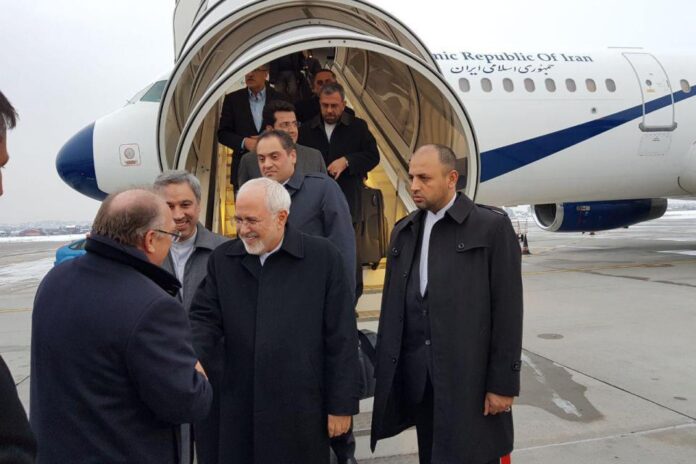
Iranian Foreign Minister Mohammad Javad Zarif arrives in Bulgarian capital Sofia on February 28, 2018 / Photo retrieved from IRIB

Heading a high-ranking political and economic delegation, he arrived at the Sofia International Airport and was welcomed by Iranian chargé d’affaires in Sofia and Bulgarian officials.

During their one-day visit, Zarif and his entourage are scheduled to have separate meetings with President Rosen Plevneliev, Prime Minister Boyko Borisov, and Foreign Minister Ekaterina Zaharieva.

They will also hold talks with Chairperson of the National Assembly of the Republic of Bulgaria Dimitar Glavchev, and Minister of Economy, Energy and Tourism, Asen Vasilev.

The Iranian delegation, which arrived in Sofia after a two-day visit to the Serbian capital Belgrade, will leave Bulgaria for Croatian capital Zagreb on Wednesday February 28.

Iran Rejects Report about ‘Successor Deal’ to JCPOA

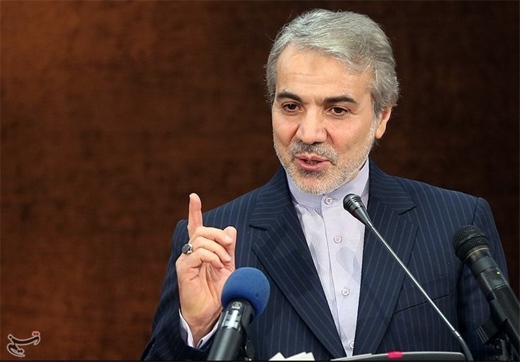
Nobakht-Iran

Speaking to reporters on Tuesday, Nobakht rejected a report by the New York Times on the alleged efforts by the Britain, France and Germany to create a “successor deal” to the 2015 nuclear agreement.

“For Iran, the JCPOA is the only viable nuclear deal. The JCPOA was drafted and agreed on word by word after months of hard efforts and negotiations,” he was quoted as saying in a Farsi report by IRIB news agency.

He also added Iran will remain committed to the nuclear deal as long as other sides continue to do so.

In its Monday report, the New York Times said the three European countries seek to appease US President Donald Trump by trying to make permanent the restrictions on Tehran’s ability to produce nuclear fuel.

“The Europeans are demanding a guarantee that Mr. Trump will abide by the add-on deal after it is negotiated and not jettison it on some other pretext,” the report said.

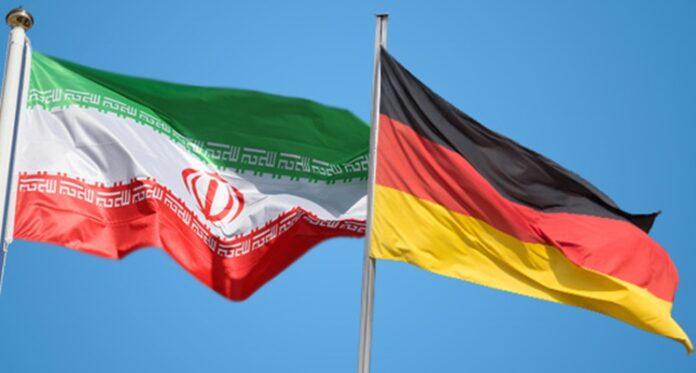
Iran, Germany Discuss Resolution of Consular Issues

The Tuesday meeting was co-chaired by directors for consular affairs from the foreign ministries of both countries.

The Iranian and German delegations discussed different consular issues at the meeting, including easing and expediting the issuance of visas, especially for university professors and students as well as businessmen and truck drivers, the necessity of legal cooperation and judicial assistance, and support for nationals of both countries.

At the end of the meeting, the two sides expressed satisfaction with the outcome of the talks and declared that the next meeting would be held in Germany.

During their stay in Tehran and after the consular meeting, members of the German delegation also met with Hossein Panahi-Azar, the deputy director for parliamentary and Iranian expatriates’ affairs at the Iranian Foreign Ministry.

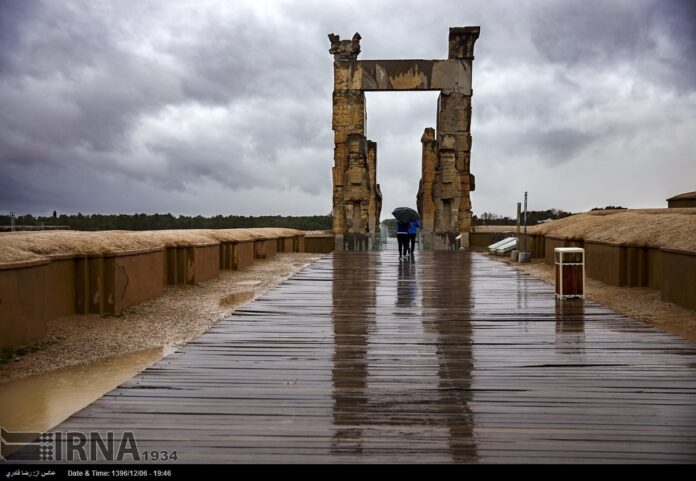
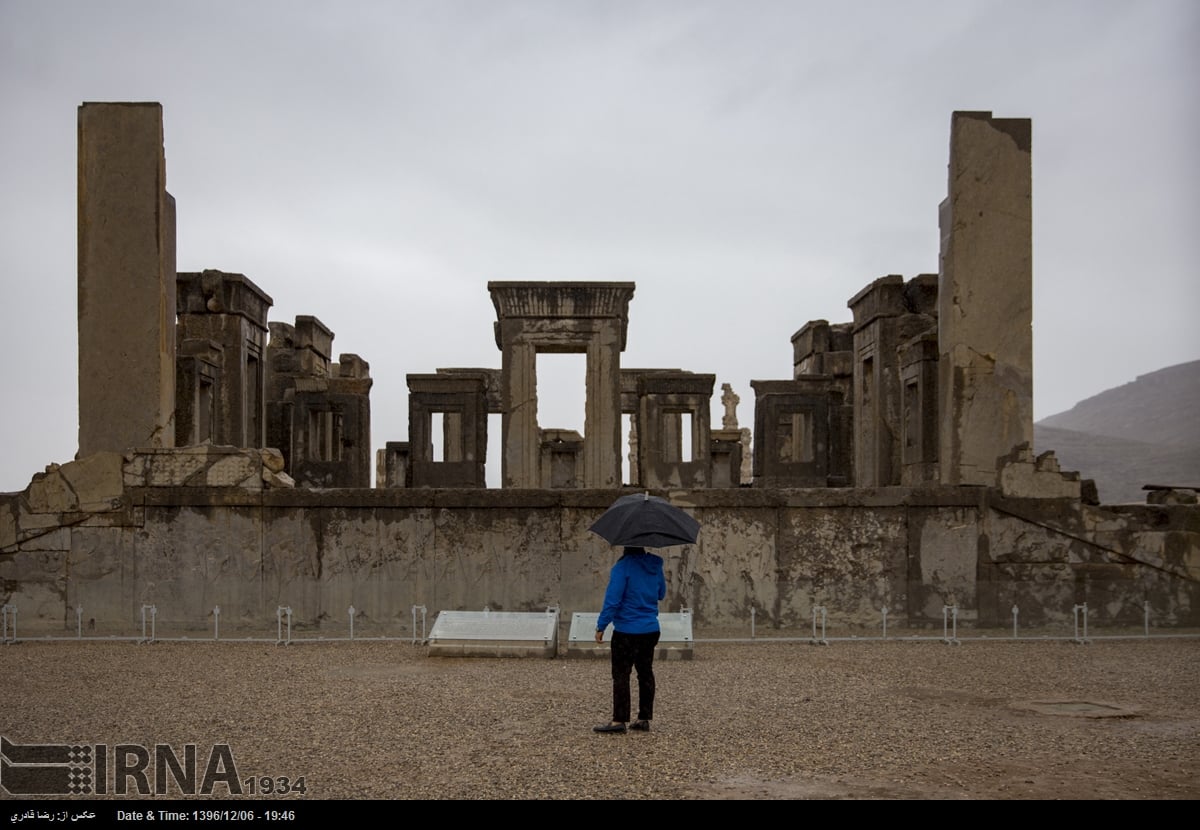
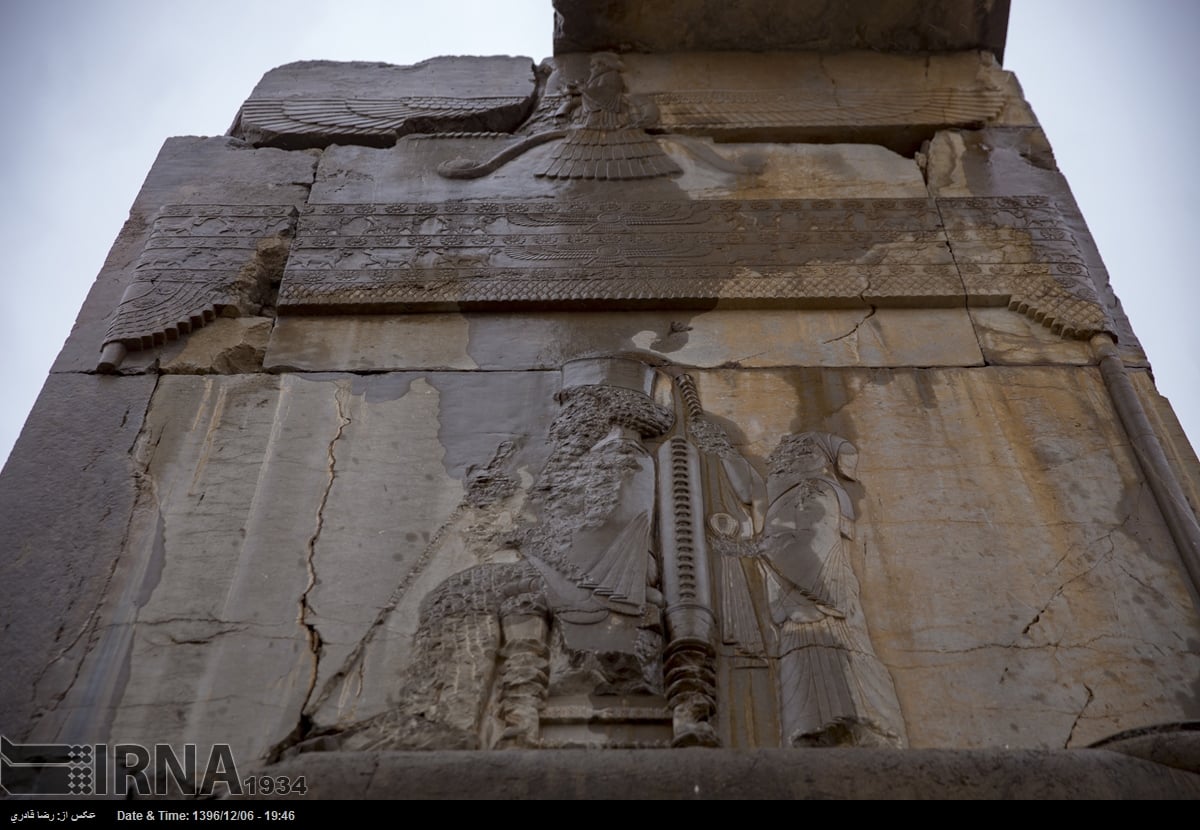
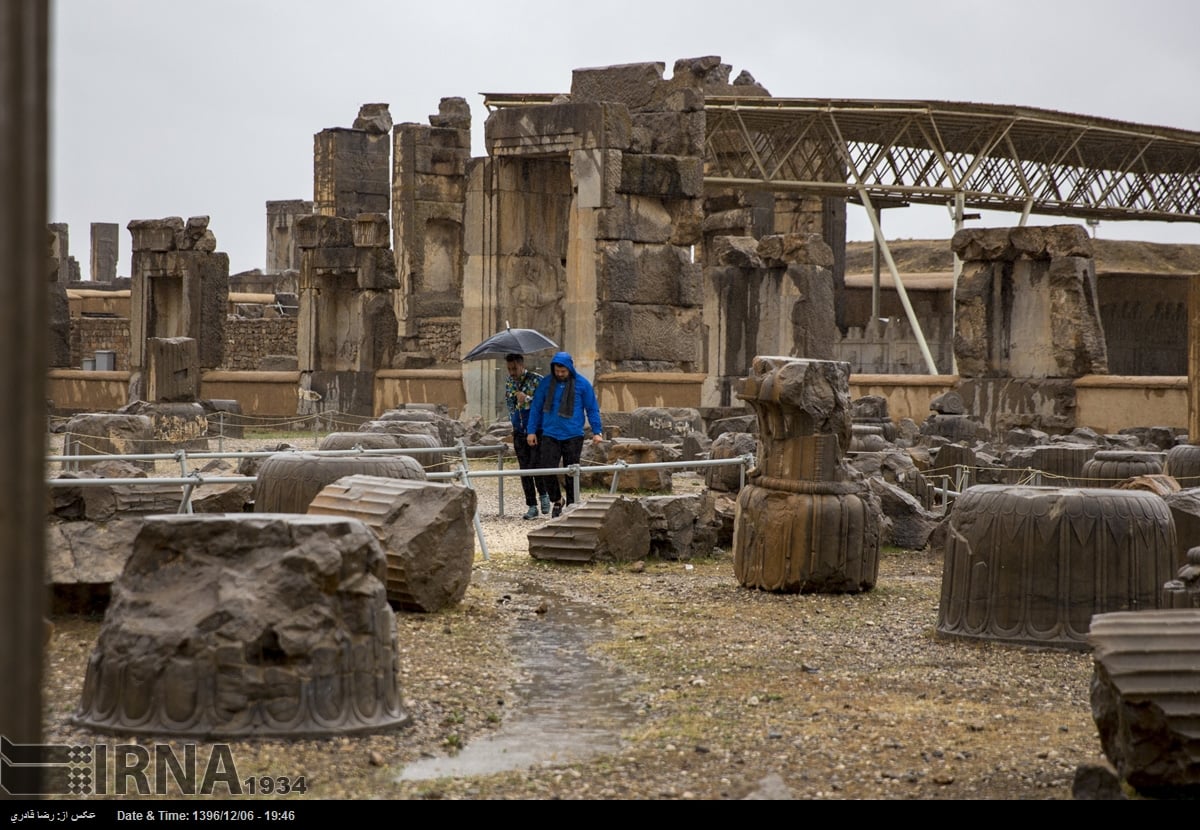
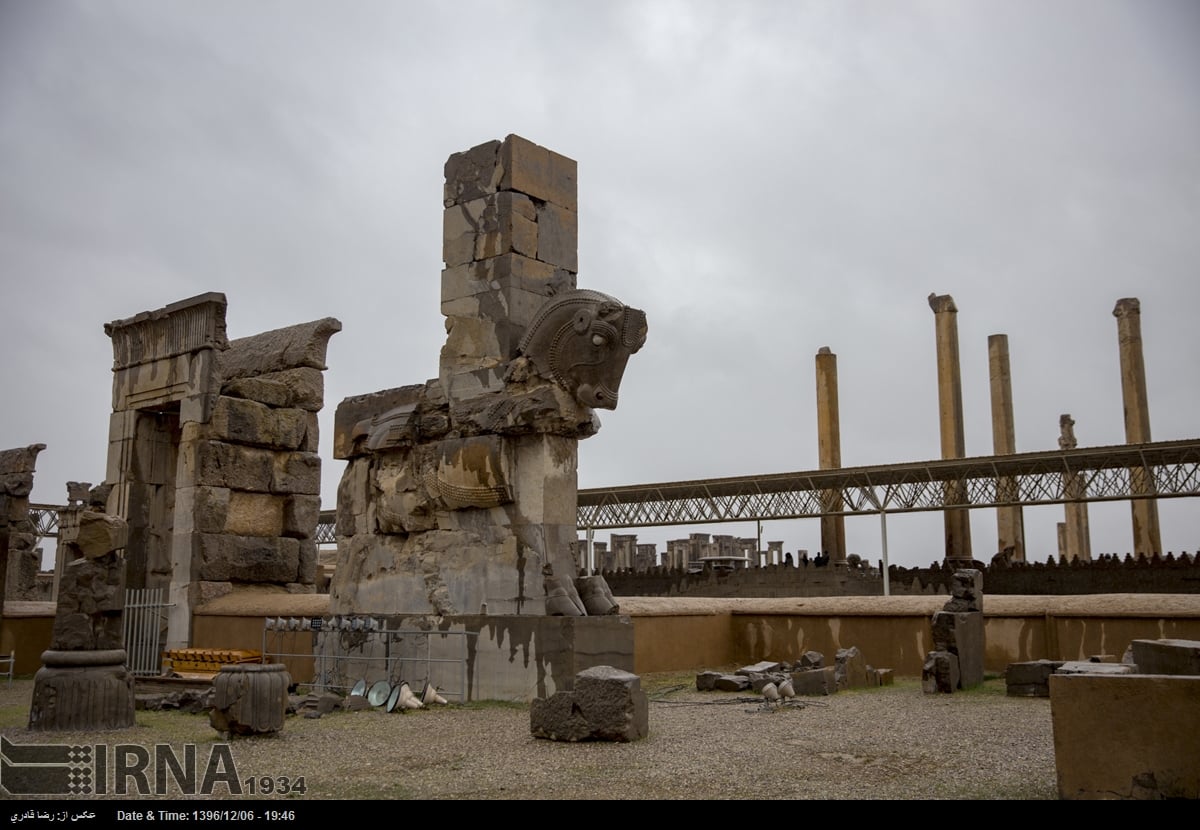
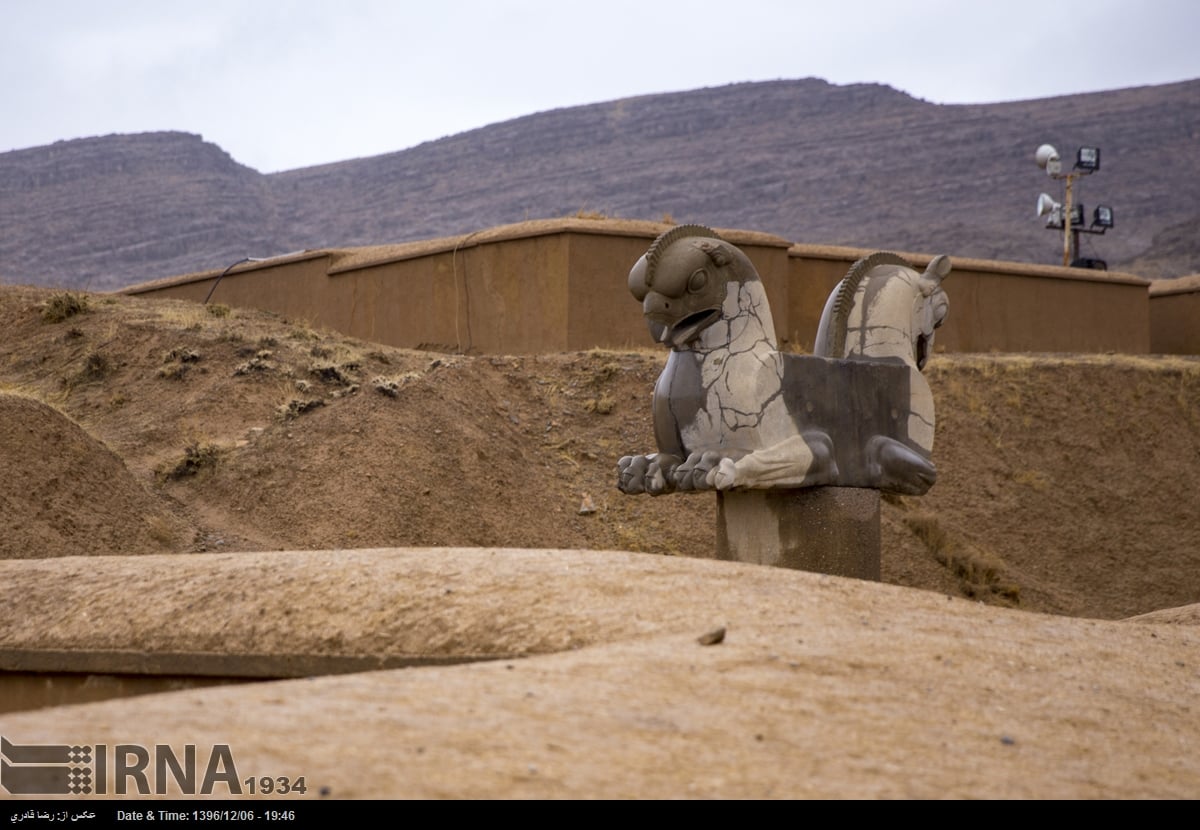
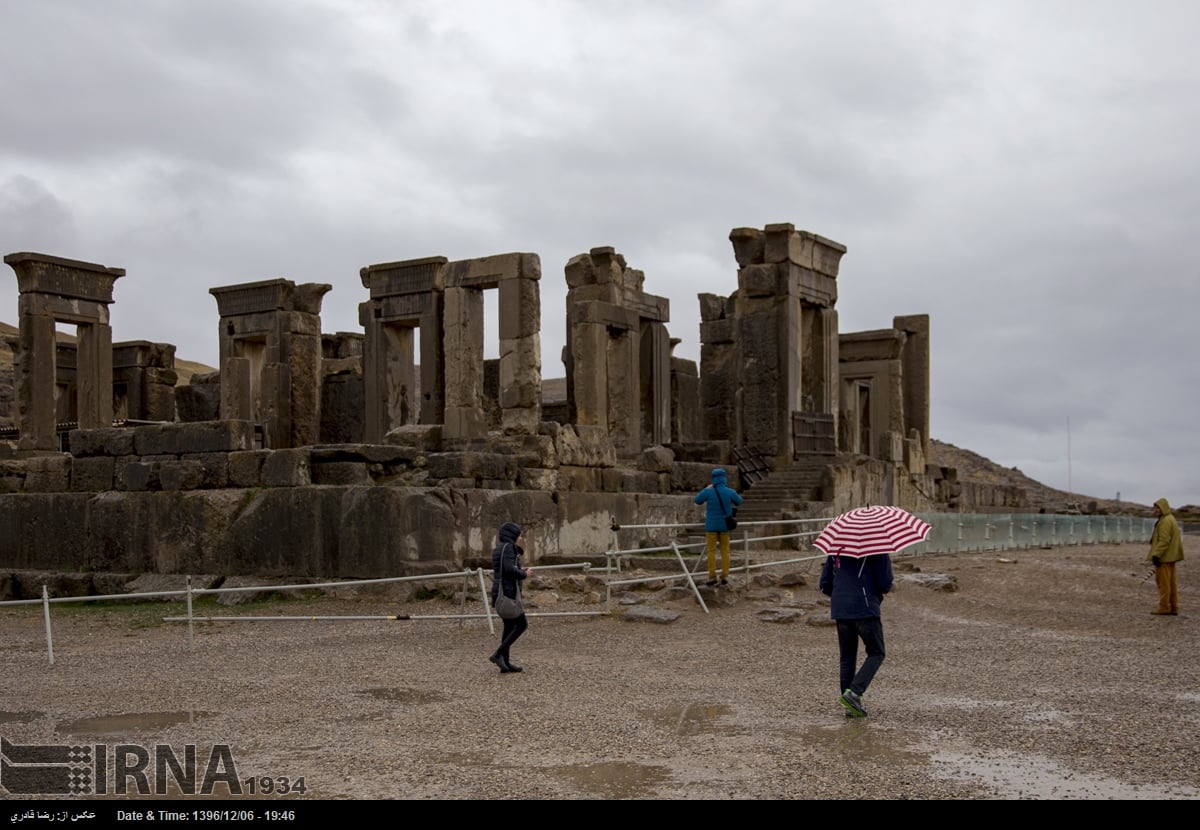
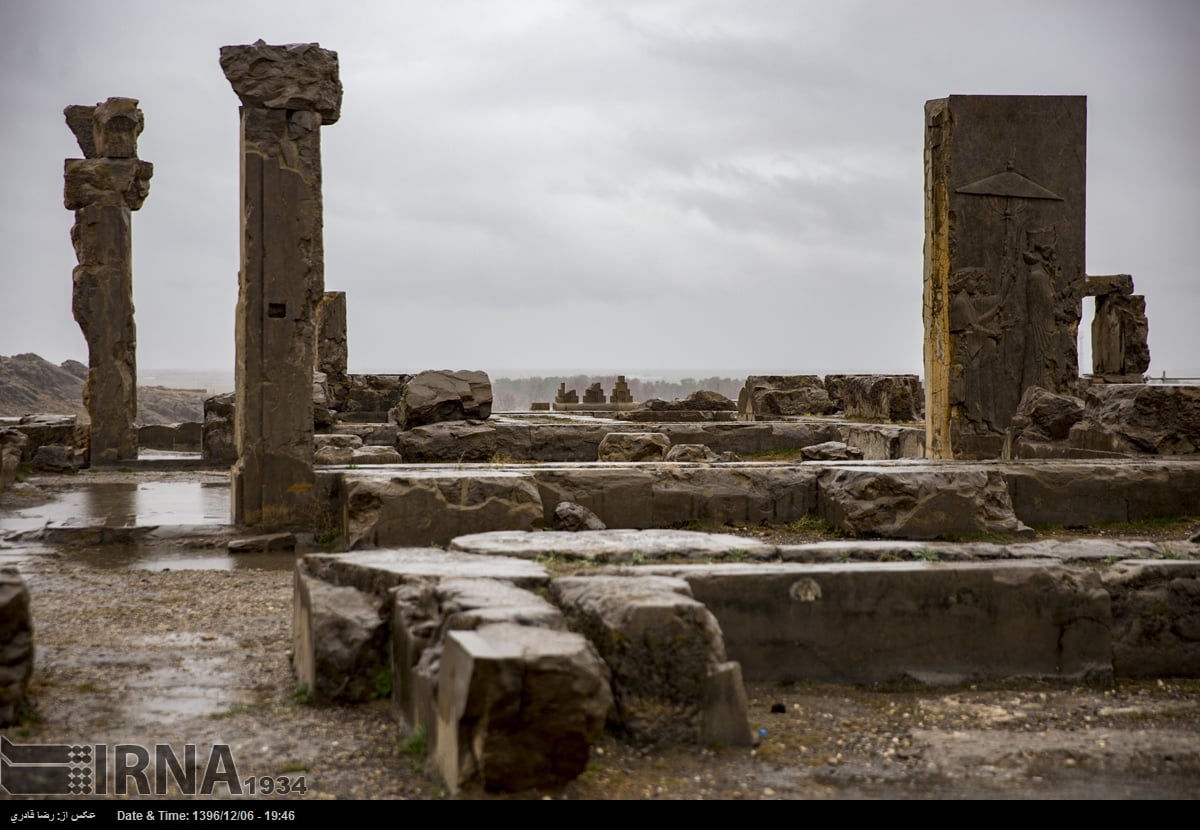
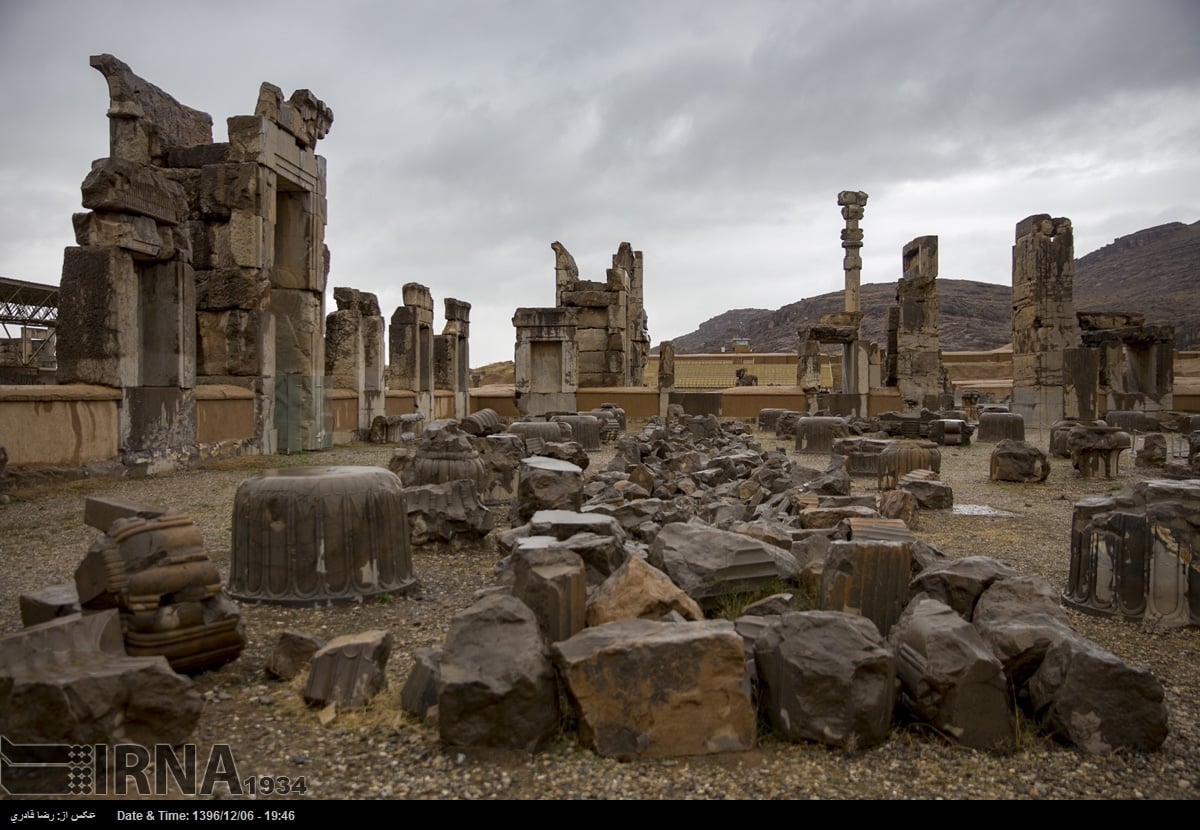
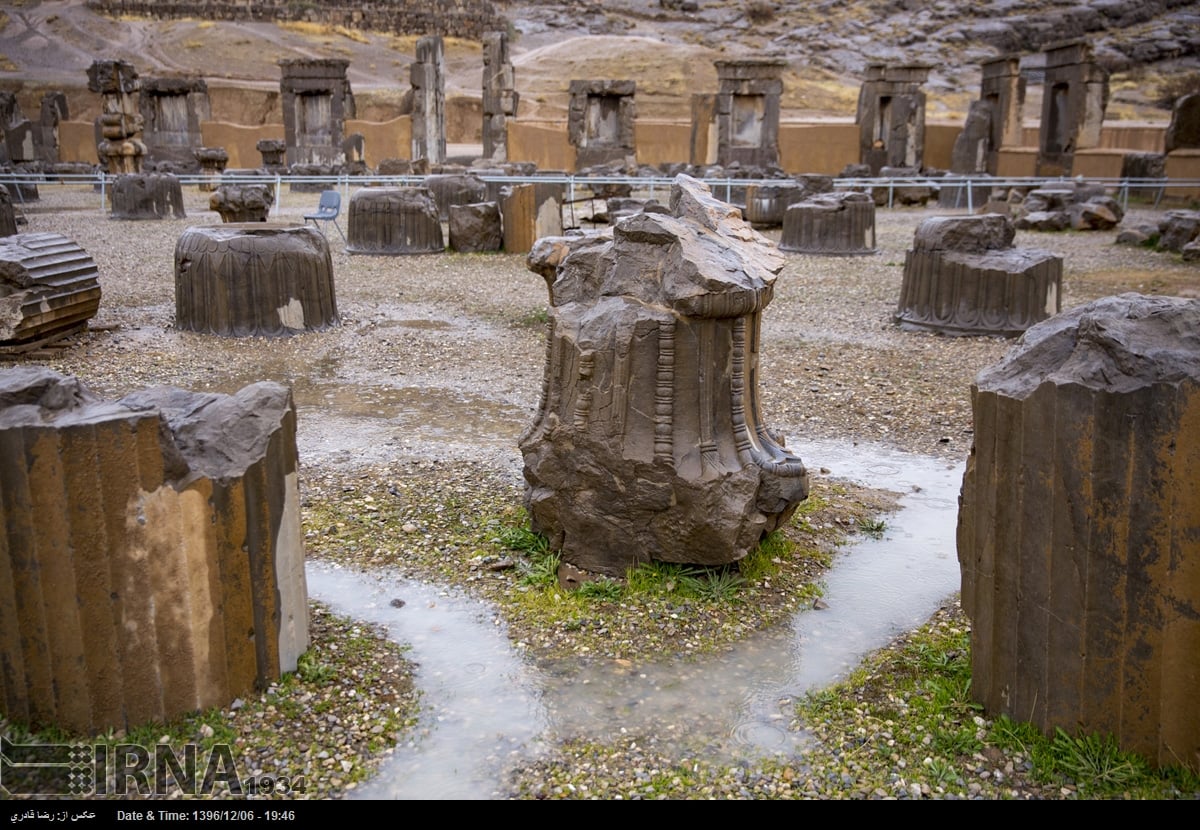
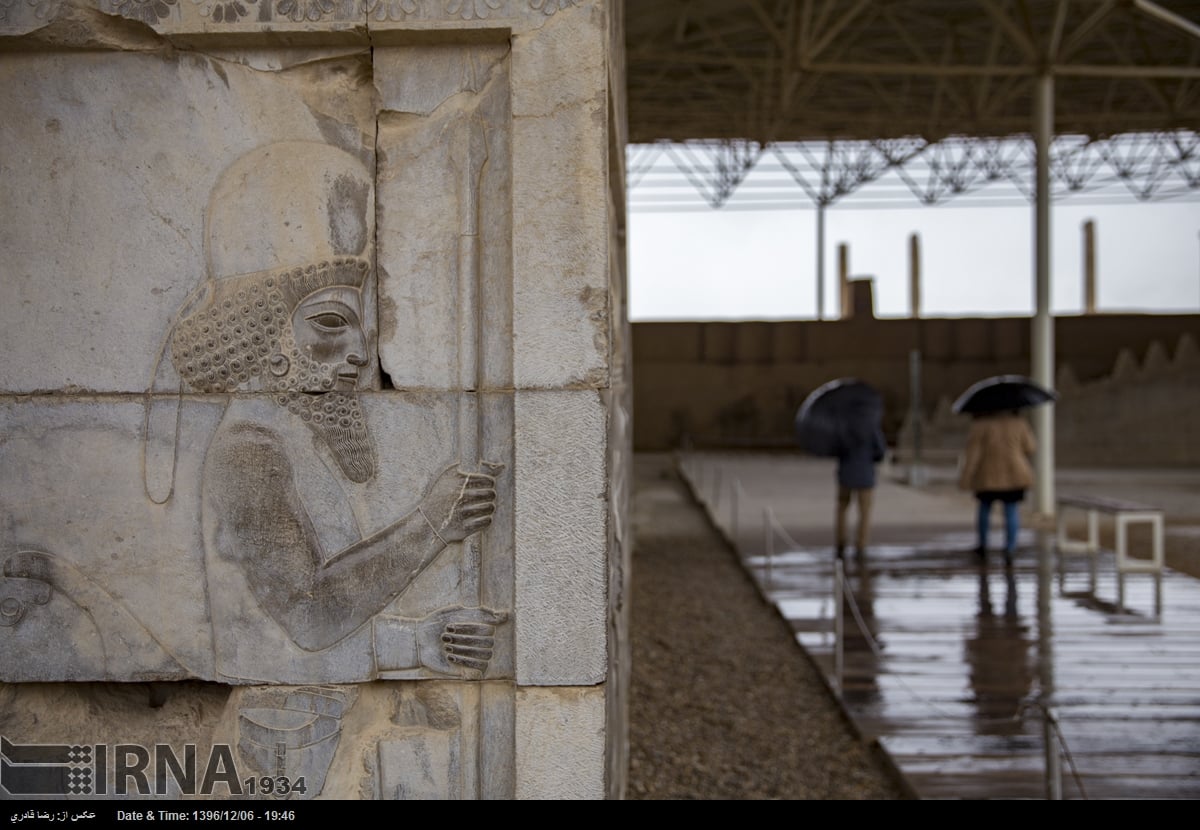
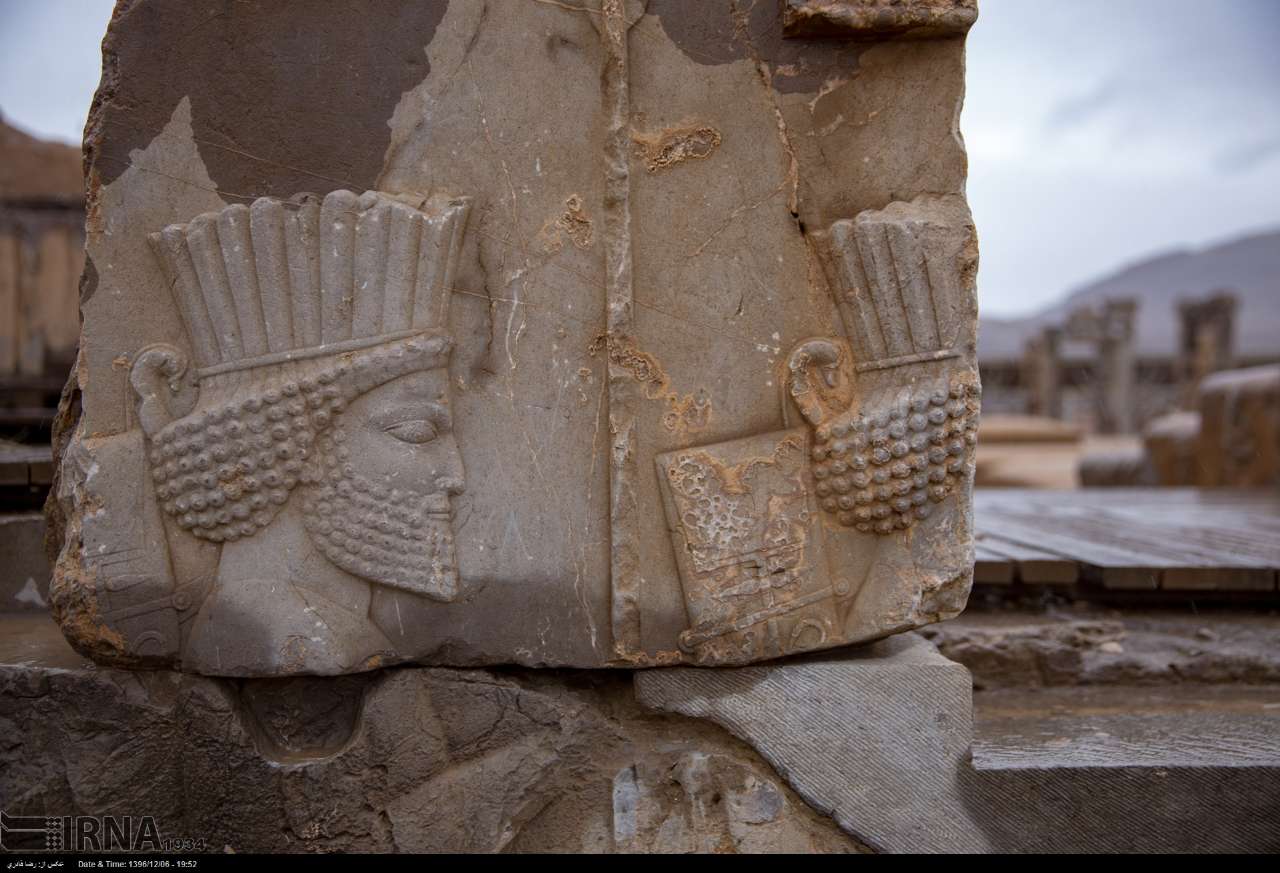
Iran’s Beauties in Photos: A Rainy Day in Persepolis

The earliest remains of Persepolis date back to 515 BCE. The renowned complex exemplifies the Achaemenid style of architecture.

The United Nations Educational, Scientific, and Cultural Organization (UNESCO) has declared the ruins of Persepolis a World Heritage site in 1979.

The rainy weather of Fars province these days has created very attractive scenes at Persepolis. Following you can find the photos of the site retrieved from IRNA:

Iran Slams US, UK’s ‘Unconstructive’ Approaches at UNSC

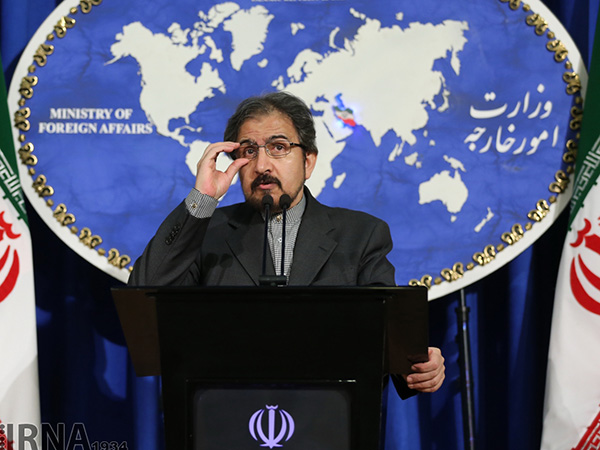
Bahram Qassemi

In a Tuesday statement, the spokesman referred to the unanimous approval of the Russian-drafted resolution at the UN Security Council which extended the mission of the UN Panel of Experts on Yemen for another year, saying, “As expected, an earlier resolution proposed by the UK was blocked because of being far from reality.”

“With no tangible achievement for its sponsors, the UK-drafted resolution turned into another setback, particularly for the US, at the UN and the international arena,” he noted.

Qassemi then expressed his deep concern over the continuation of war in Yemen as well as the relentless attacks on the ‘oppressed Yemenis’ and added, “Unfortunately, the Saudi-led coalition’s war on the Muslim country is dragging into its third year.”

He then called for a resolute move by the international community to stop the violence of foreign troops in Yemen and the massacre of thousands of innocent Yemenis.

Qassemi blamed certain states including the US and the UK for playing a destructive role in Yemen by contributing to the crisis and instability in the region through providing the Saudi-led coalition with modern weapons and enriching their arsenals.

“These countries are responsible for protecting defenceless Yemeni women and children who are prone to a humanitarian catastrophe due to the destructive war imposed on them,” he said.

Qassemi referred to the ‘wrong policies’ of some states at the UN Security Council and said, “Over the past three years, the US and the UK’s approaches at the UNSC have been unconstructive and replete with mistakes.”

The spokesman underlined that instead of taking advantage of the UNSC as an international mechanism to resolve the conflict, the US and the UK use it merely to legitimize the aggressions and covering the war crimes committed in Yemen.

Qassemi then dismissed as “misleading” the stances and behaviours of the US, the UK and France – the main sponsors of the resolution rejected at the UNSC – and said such approaches show they are trying to evade their responsibility.

“As the main sponsors and suppliers of deadly arms for the aggressors, these countries play a leading role in the continuation of Saudi Arabia’s military violence in Yemen.”

Instead of cutting their arms sales to the aggressors and being accountable to the international community, these countries have turned into prosecutors blaming others for the crimes, he added.

“These countries pin the blame on others for the crimes committed against the oppressed nation of Yemen and hide their all-out and unconditional support for the aggressors,” he concluded.

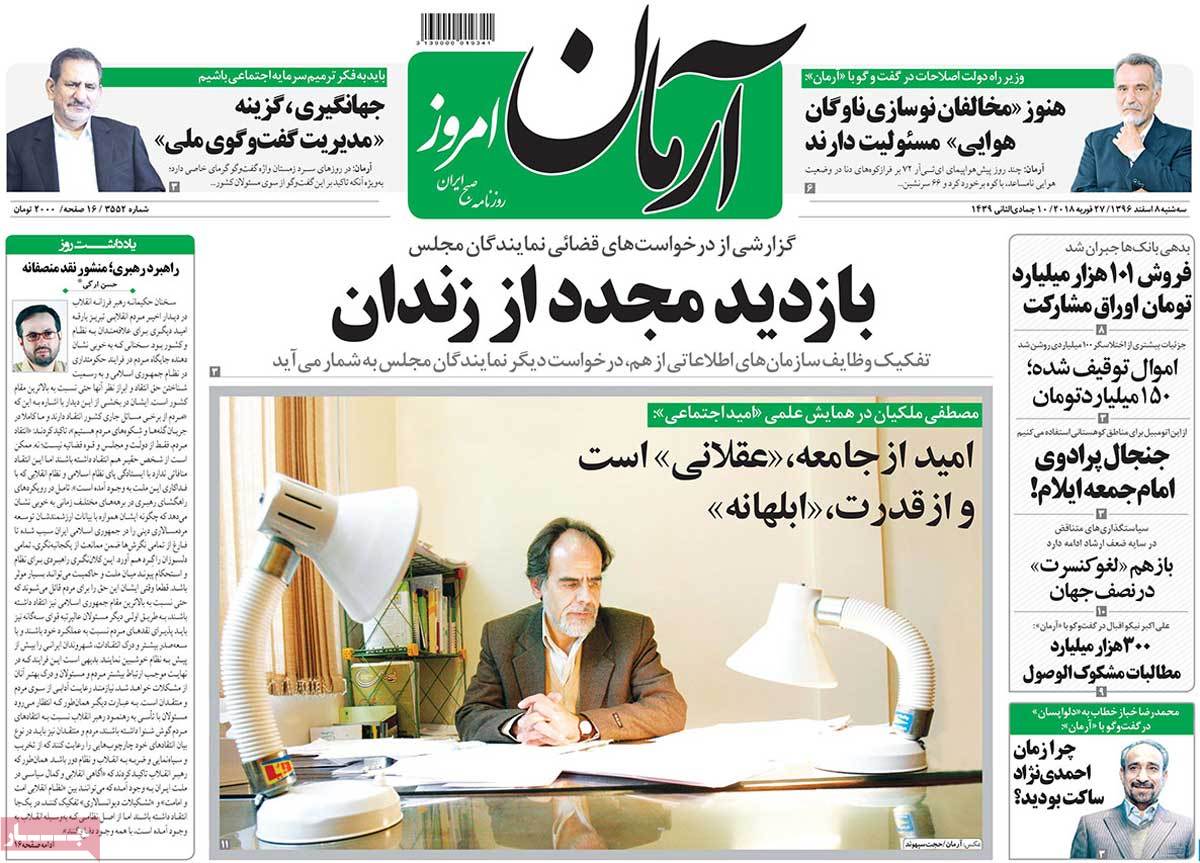
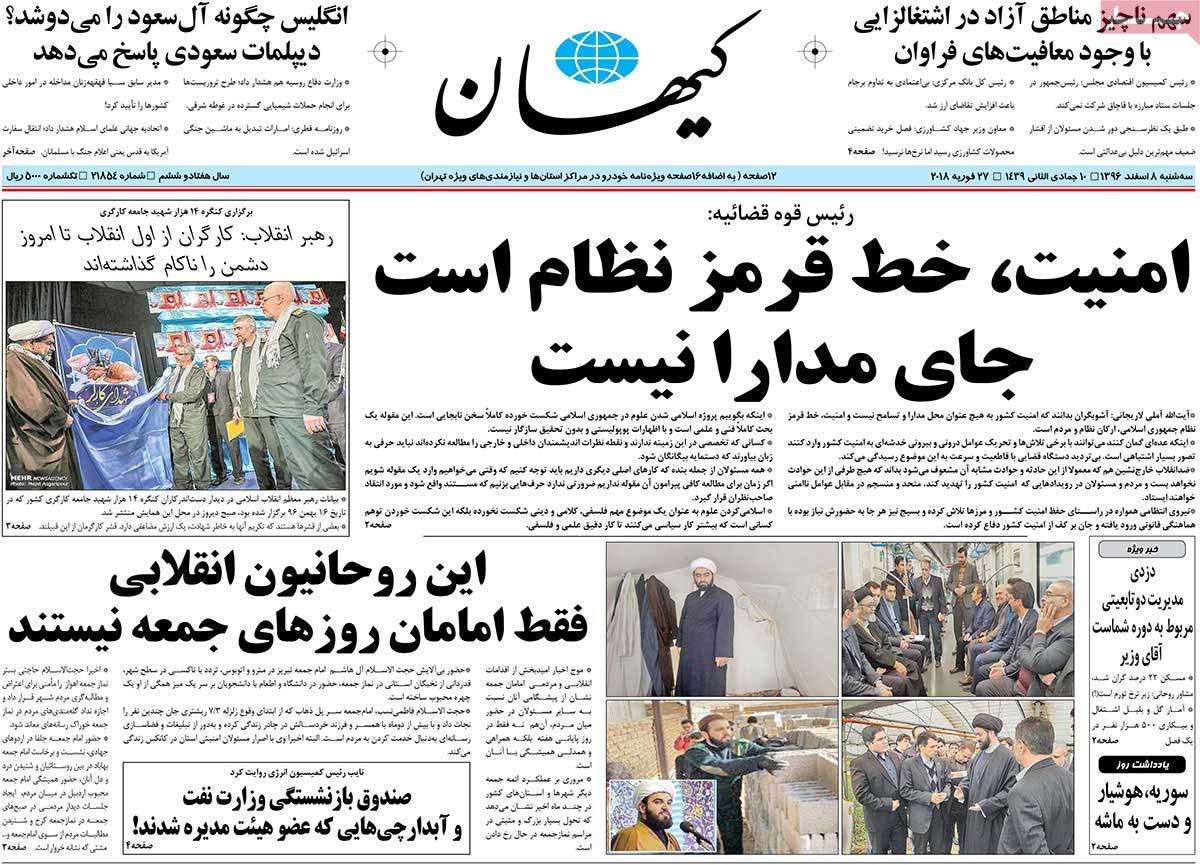
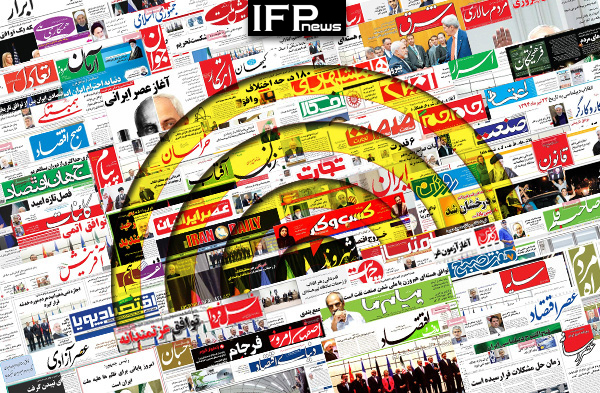
A Look at Iranian Newspaper Front Pages on February 27

A Look at Iranian Newspaper Front Pages on November 18

Several papers today covered the remarks made by the Leader of Iran’s Islamic Revolution Ayatollah Seyyed Ali Khamenei about the Iranian workers’ vigilance and the failed attempts by anti-Revolution forces to incite labourers to take action against the Islamic Republic.

Also a top story was an anti-Iran resolution drafted by the United Kingdom, which was vetoed by Russia at the United Nations Security Council.

The ongoing conflict in Syria’s Eastern Ghouta also received great coverage by both reformist and conservative papers. The former ones seem to be blaming both sides for the deaths of civilians, but the conservative papers blasted the terrorists for the ongoing violence.

The above issues, as well as many more, are highlighted in the following headlines and top stories:


19 Dey:

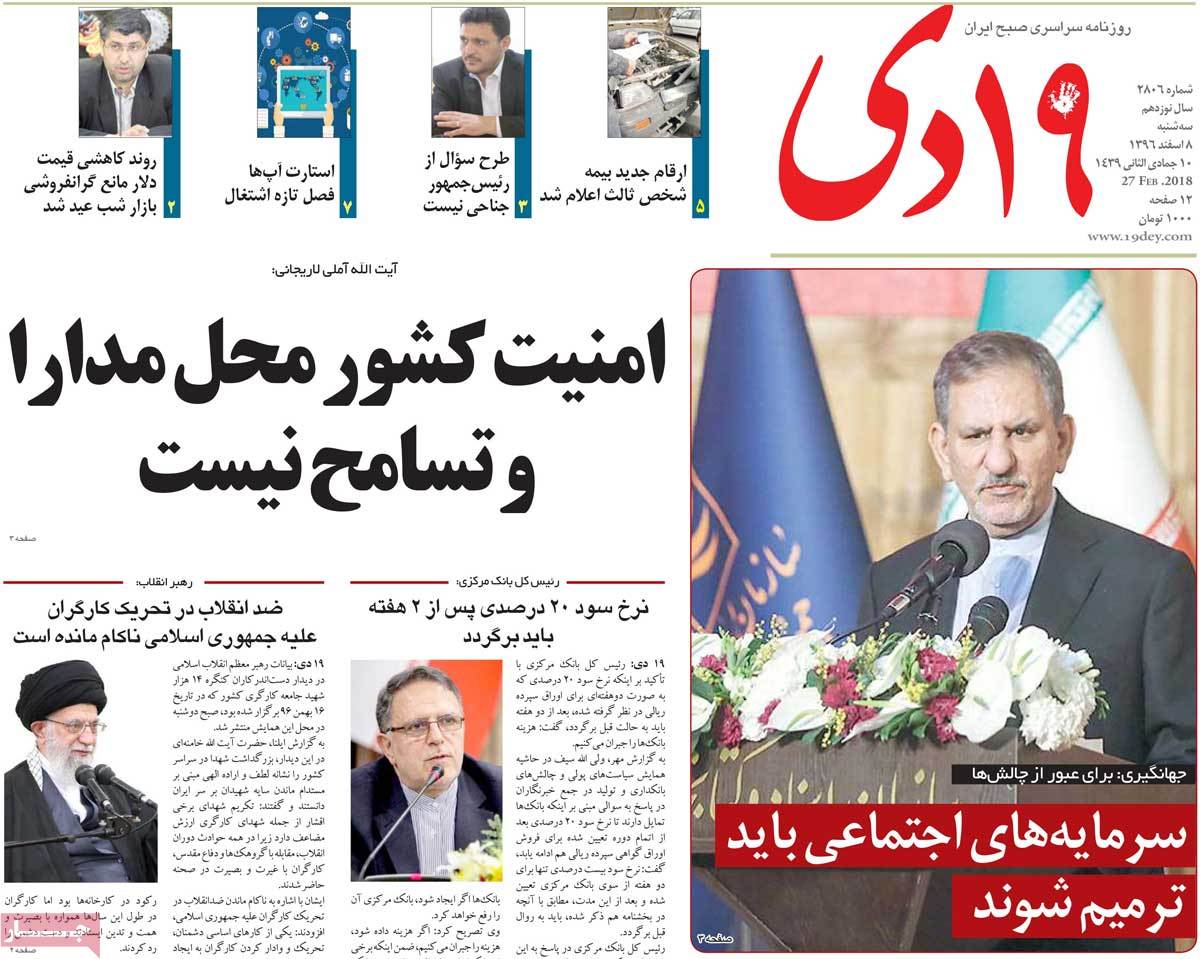
1- Judiciary Chief: No Toleration on Iran’s Security

2- Leader: Anti-Revolution Forces Failed to Provoke Workers against Islamic Republic
A Look at Iranian Newspaper Front Pages on February 27


Abrar:

1- Iran Consulting with UNSC Member States on Yemen: Spokesman

2- Moscow Worried about Washington’s Threat to Use Force against Syria

3- UAE’s UN Envoy Raises Accusations against Iran
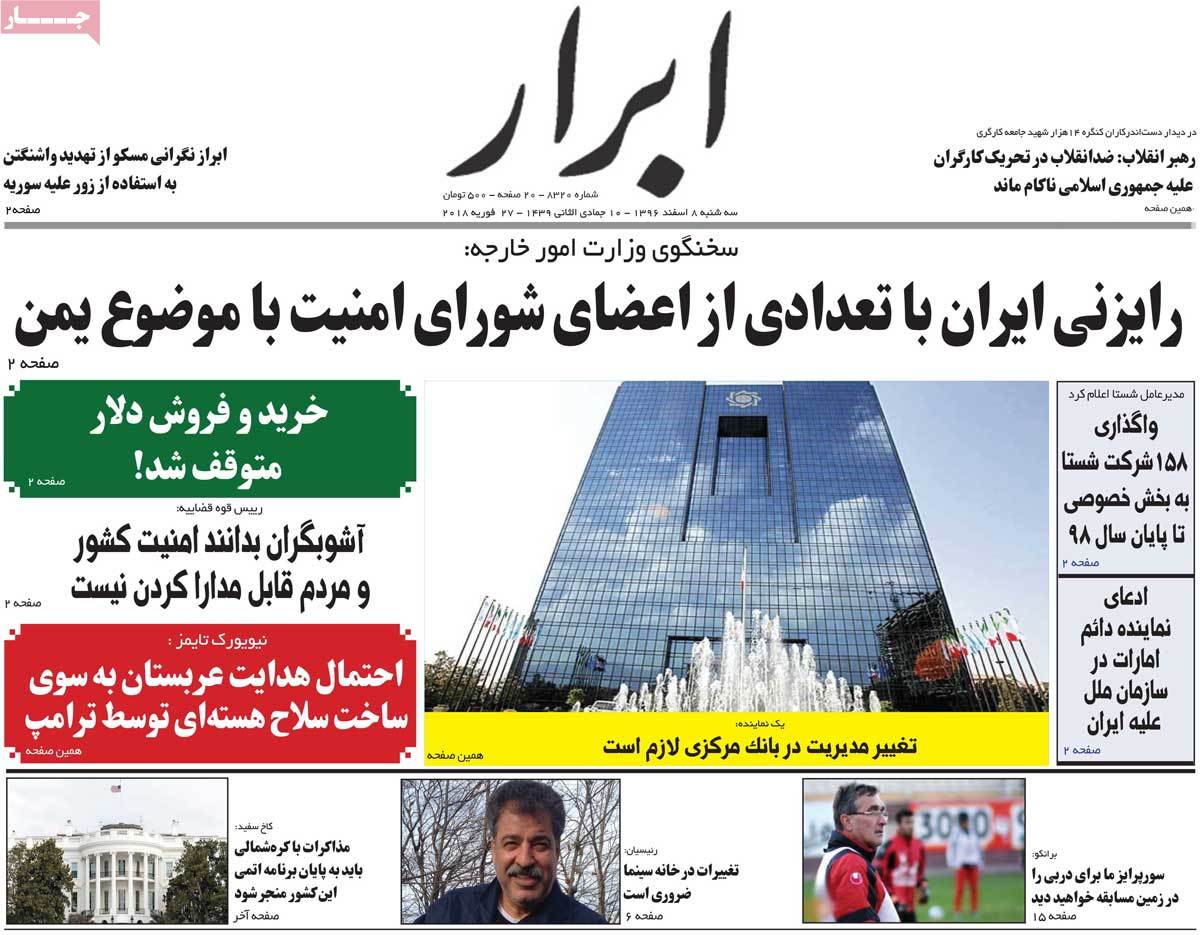
A Look at Iranian Newspaper Front Pages on February 27


Aftab-e Yazd:

1- Iran Leader: Workers Remained Vigilant during Revolution, Sacred Defence

2- Zoroastrian MP: I’ll Resign If Zoroastrian Councilor Not Allowed to Get Back to Work

3- A Report on MPs’ Plan to Summon Rouhani to Parliament: Will He Turn into Whistleblower?
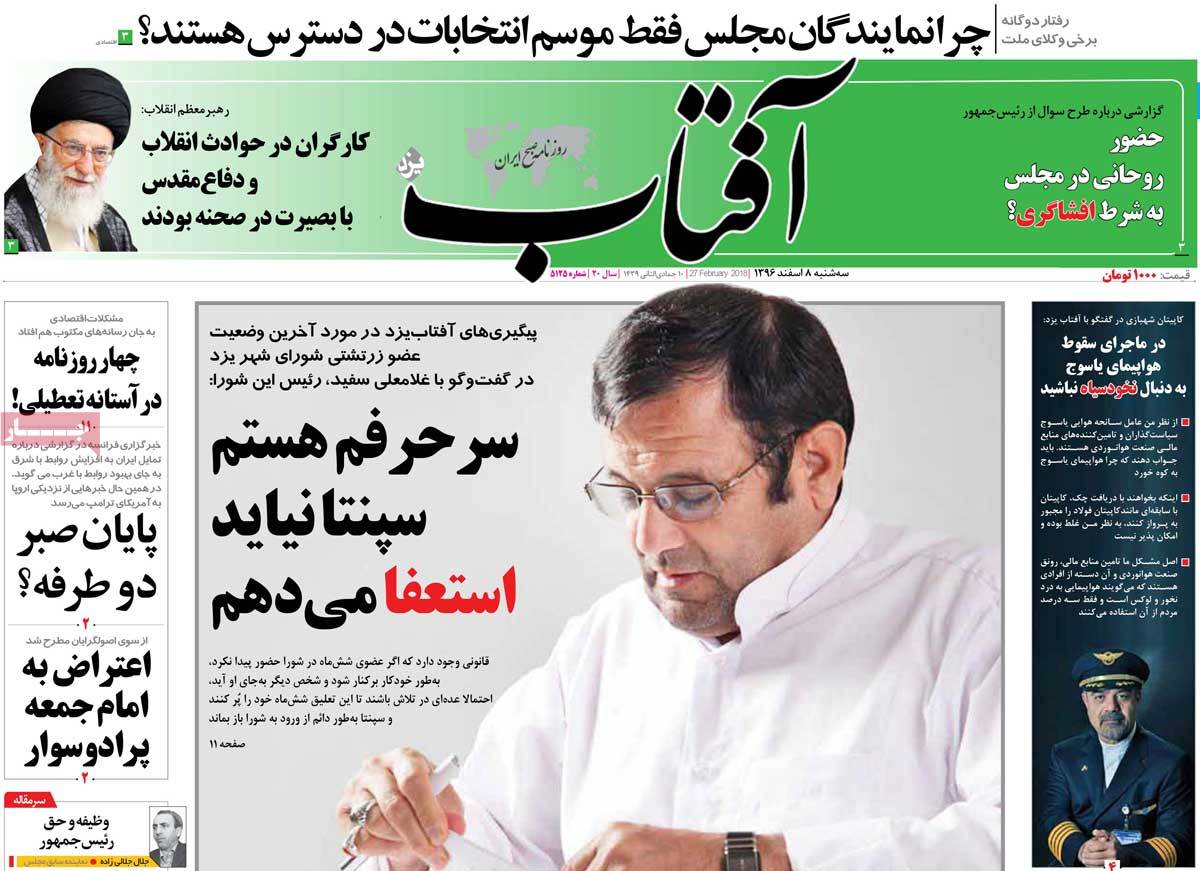
A Look at Iranian Newspaper Front Pages on February 27


Arman-e Emrooz:

1- MPs Call for Paying another Visit to Prison

2- Imam of Ilam Friday Prayers Sparks Controversy after Using SUV!

  • We Use This Car for Mountainous Areas

A Look at Iranian Newspaper Front Pages on February 27


Asrar:

1- Iran First VP: Cessation of Dialogue to Exert Great Pressure on Society
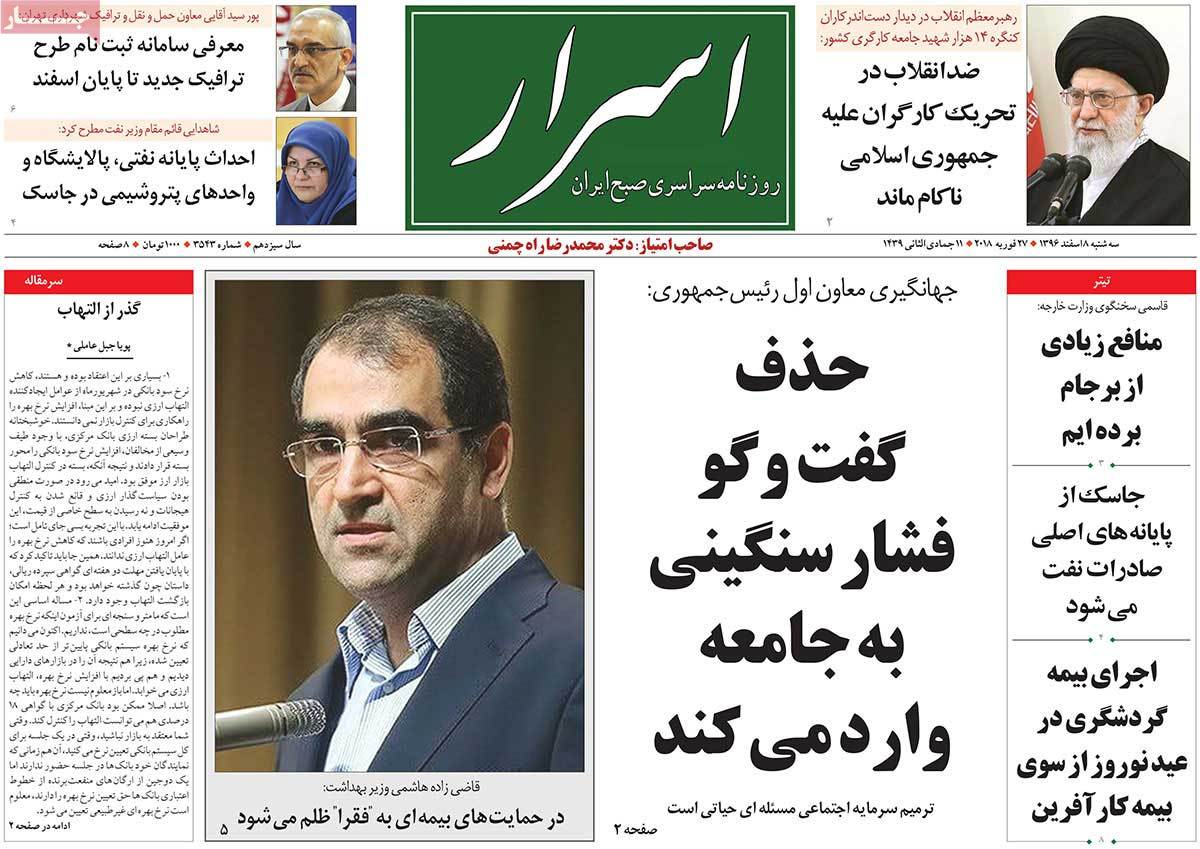
A Look at Iranian Newspaper Front Pages on February 27


Ebtekar:

1- 39 Concerns for Justice: A Report on Failure to Realize Society’s Demand for Justice
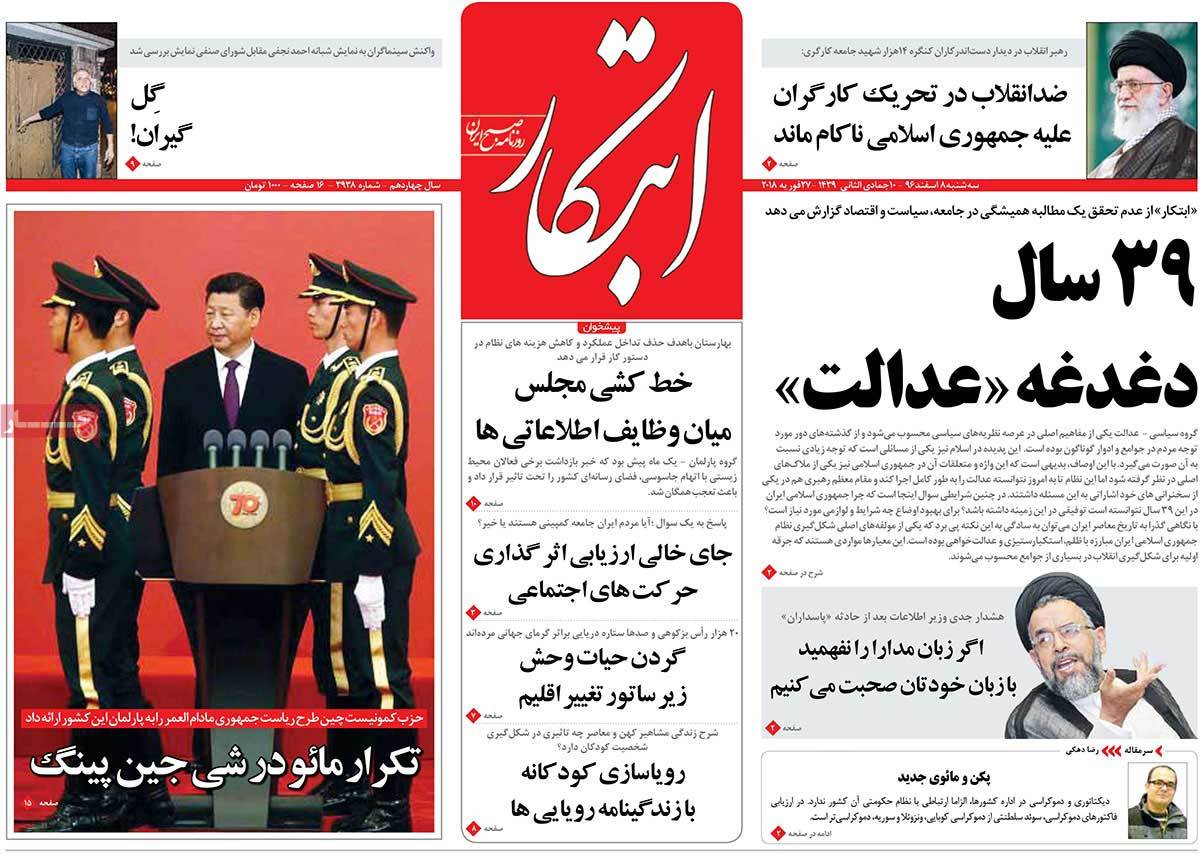
A Look at Iranian Newspaper Front Pages on February 27


Etemad:

1- Ghouta Still on Fire: Ambiguity in UN Security Council Resolution’s Implementation
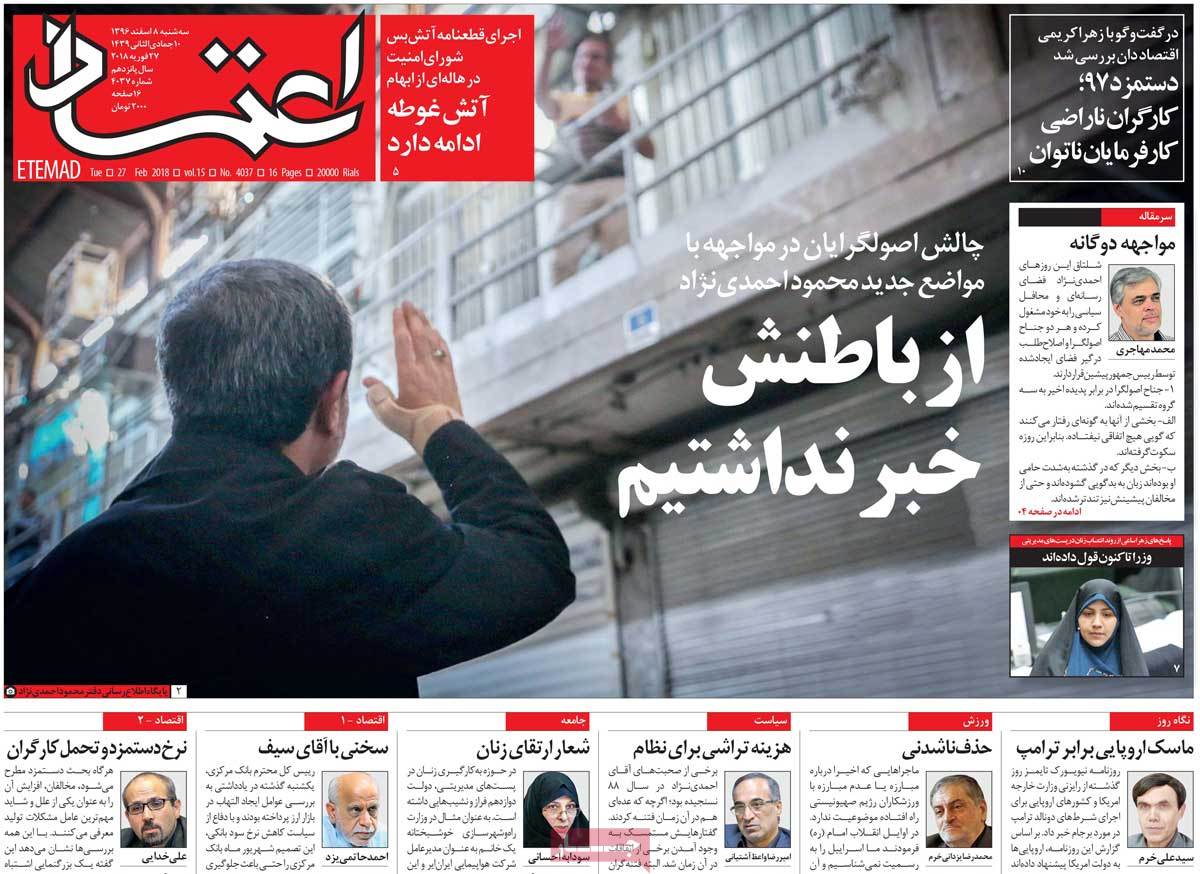
A Look at Iranian Newspaper Front Pages on February 27


Ettela’at:

1- Supporters of Resistance Warmly Welcome Gen. Soleimani’s Memoirs in Lebanon

2- We Must Release Mothers from Jail: VP for Women Affairs
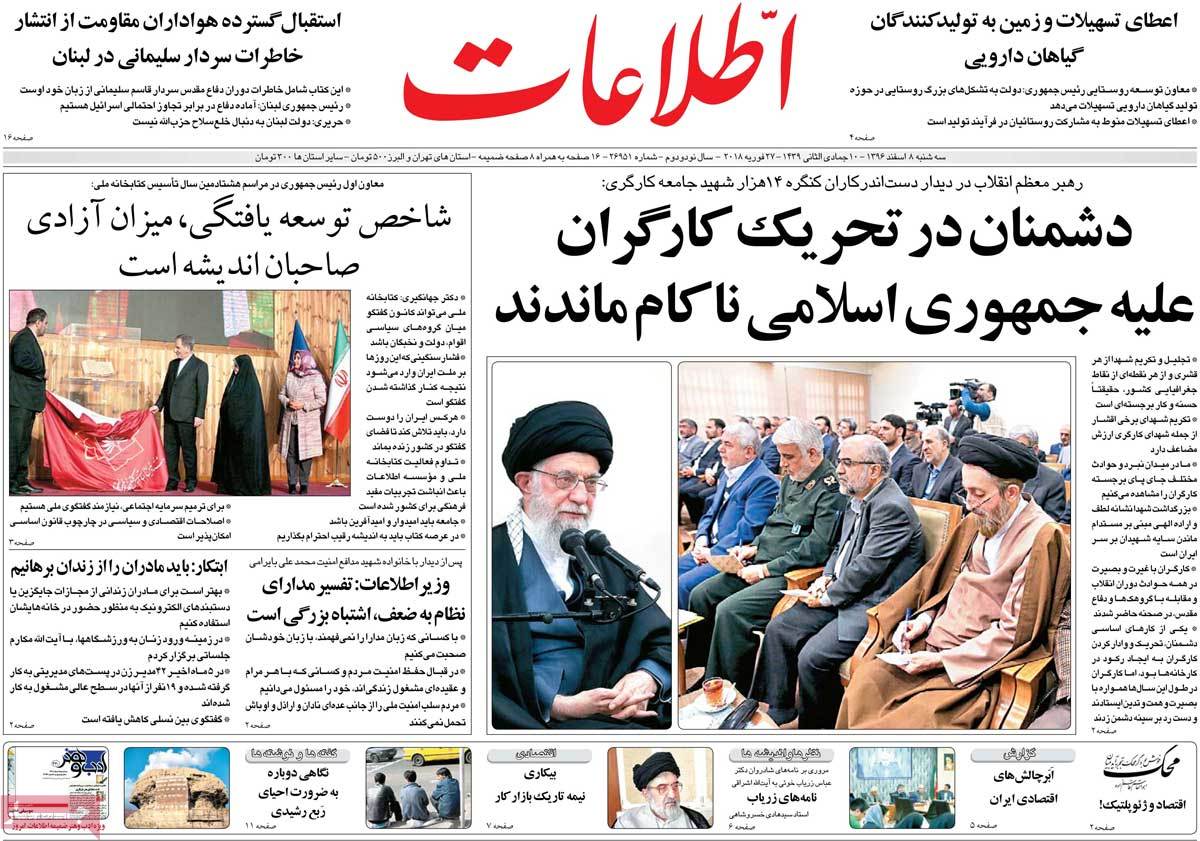
A Look at Iranian Newspaper Front Pages on February 27


Iran:

1- Search Teams Once Again Deployed in Dena
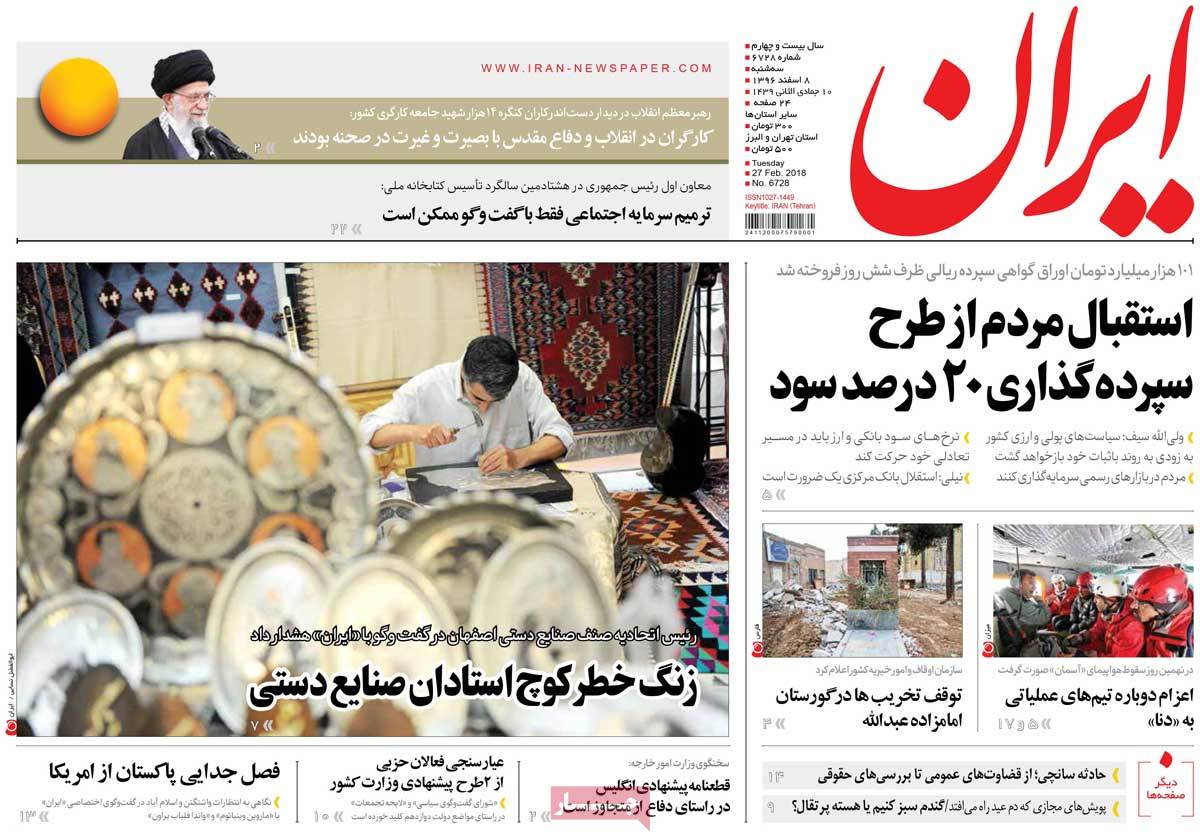
A Look at Iranian Newspaper Front Pages on February 27


Jame Jam:

1- Ghouta in Blood: Details of Terrorists’ Inhumane Moves in East Ghouta against Women, Children

2- Memories of Mysterious General!

  • Book of General Soleimani’s Memoirs Released in Lebanon
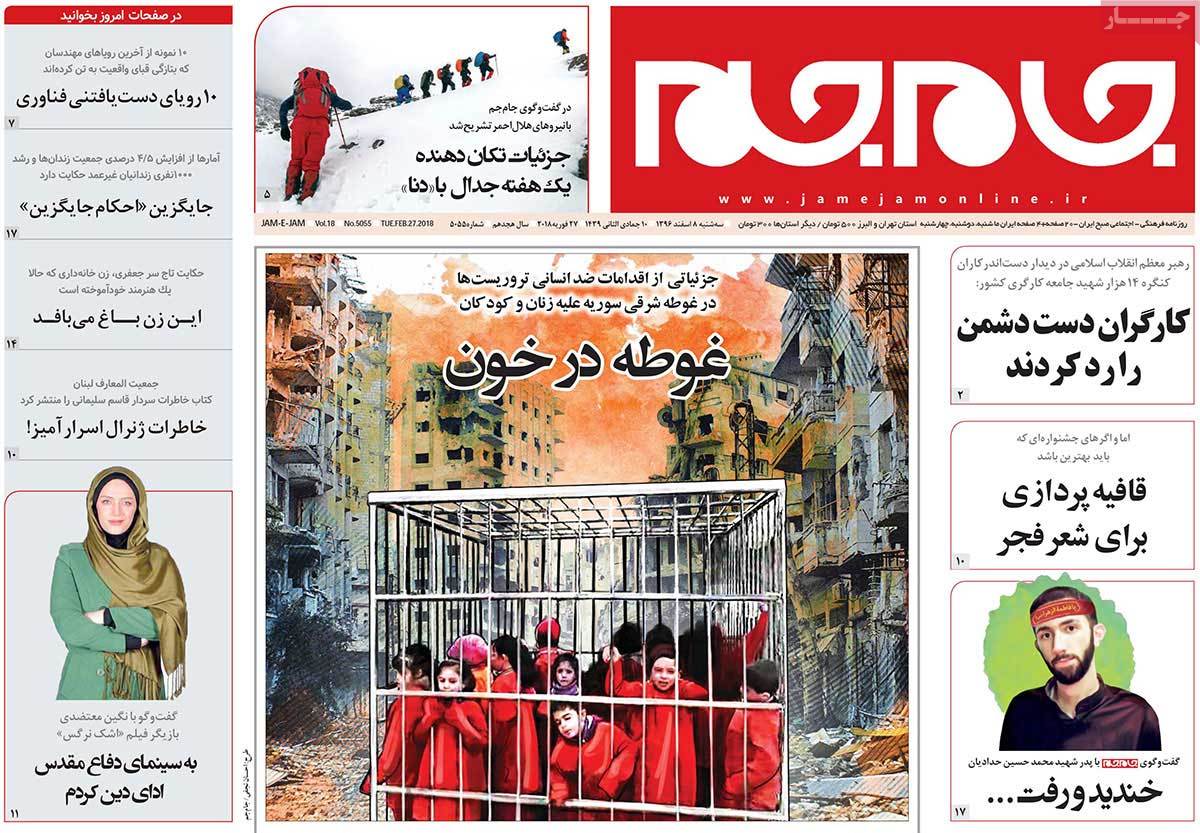
A Look at Iranian Newspaper Front Pages on February 27


Javan:

1- Europe Joins Europe in Revising Iran Nuclear Deal!

2- Chemical Scenario for Syria Disintegration

  • Yes Vote for UNSC Resolution 2401 Didn’t Work
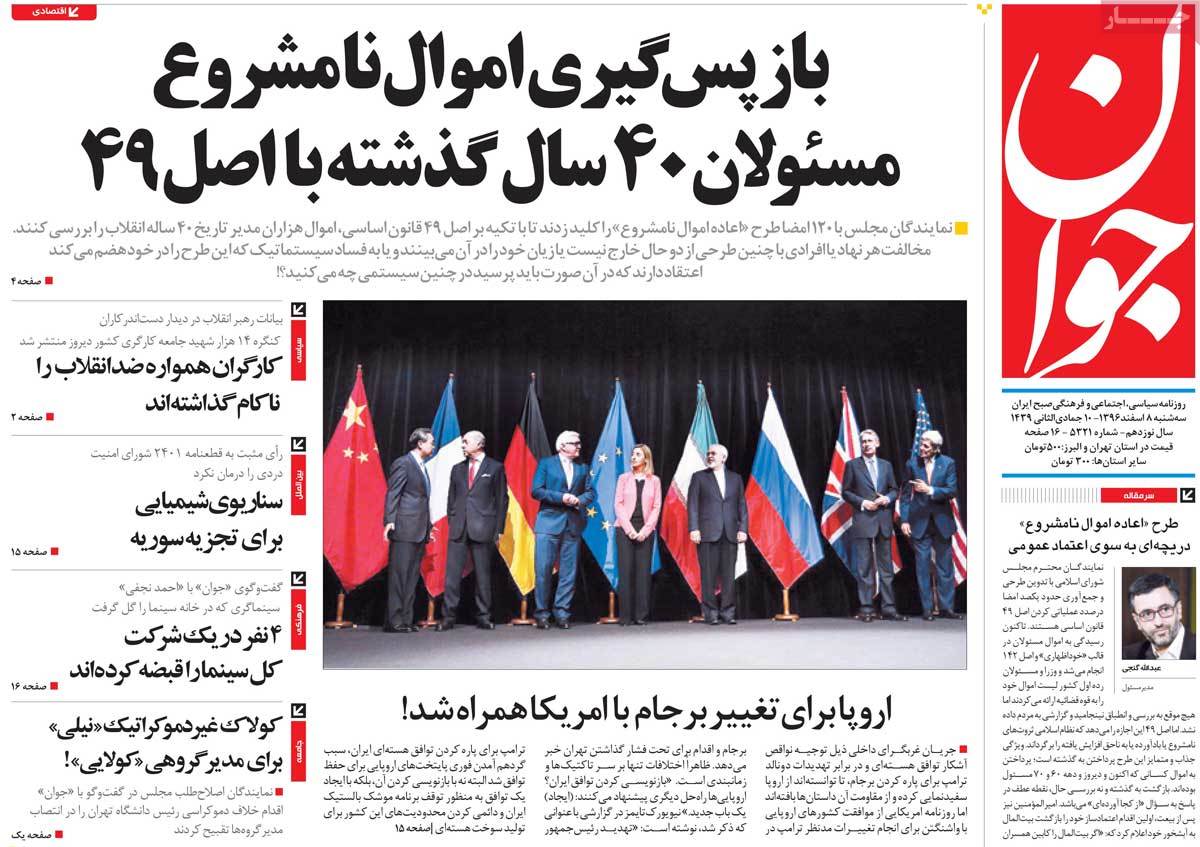
A Look at Iranian Newspaper Front Pages on February 27


Jomhouri Eslami:

1- Yemeni People on Verge of Widespread Epidemic of Dangerous Diseases

2- Russia: Ceasefire in Syria Not to Include Terrorists

3- Iran Ranks First in Region in Health Sector
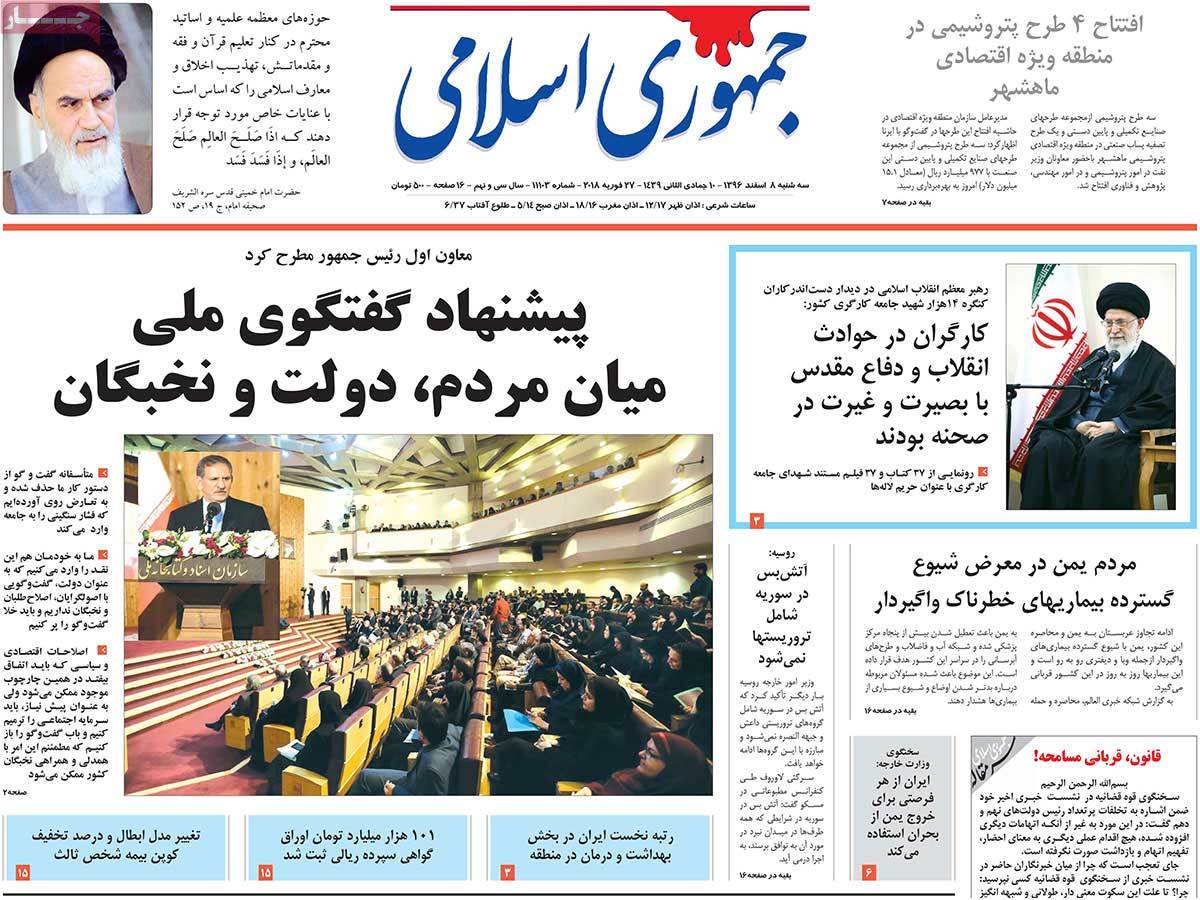
A Look at Iranian Newspaper Front Pages on February 27


Kayhan:

1- How UK Milking Al Saud

A Look at Iranian Newspaper Front Pages on February 27


Kelid:

1- Iran, Oman Agree on Expansion of Maritime Tourism: VP
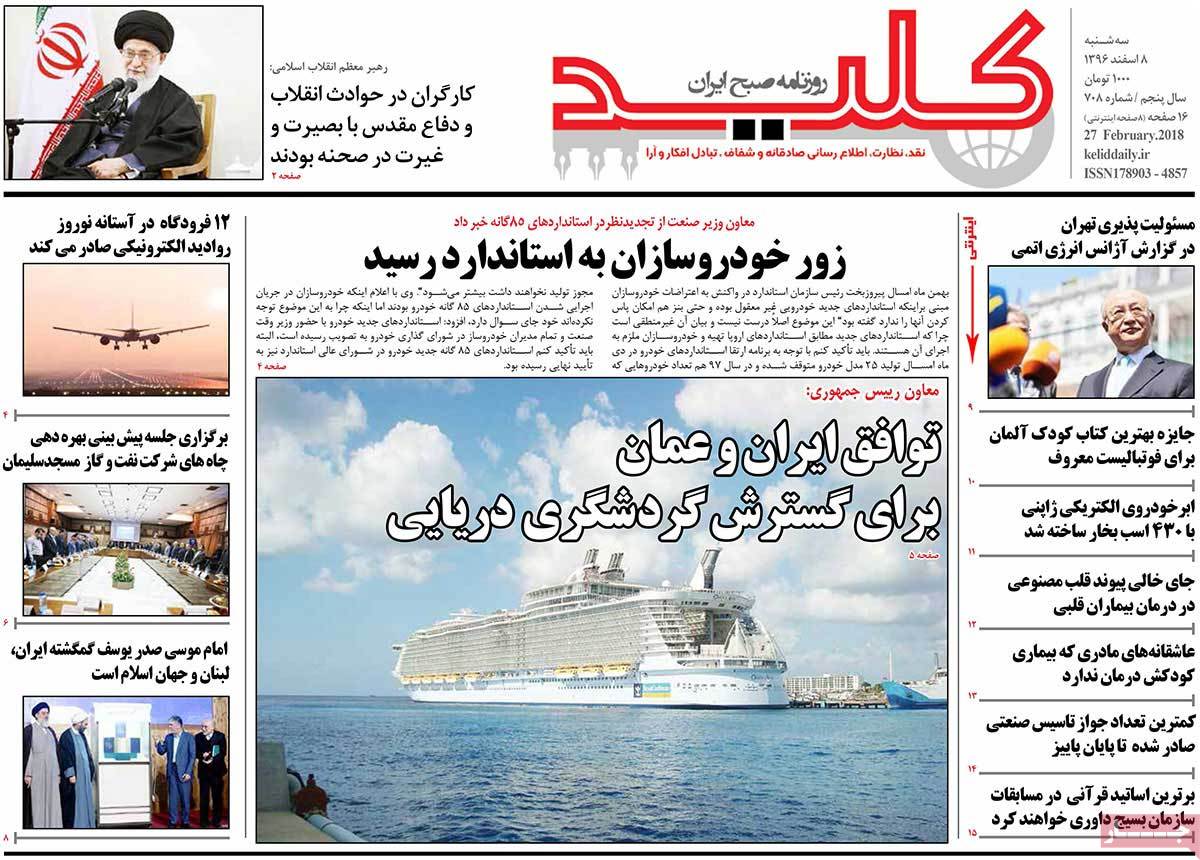
A Look at Iranian Newspaper Front Pages on February 27


Khorasan:

1- Iran First VP Criticizes Political Parties for Not Sitting for Talks with Each Other
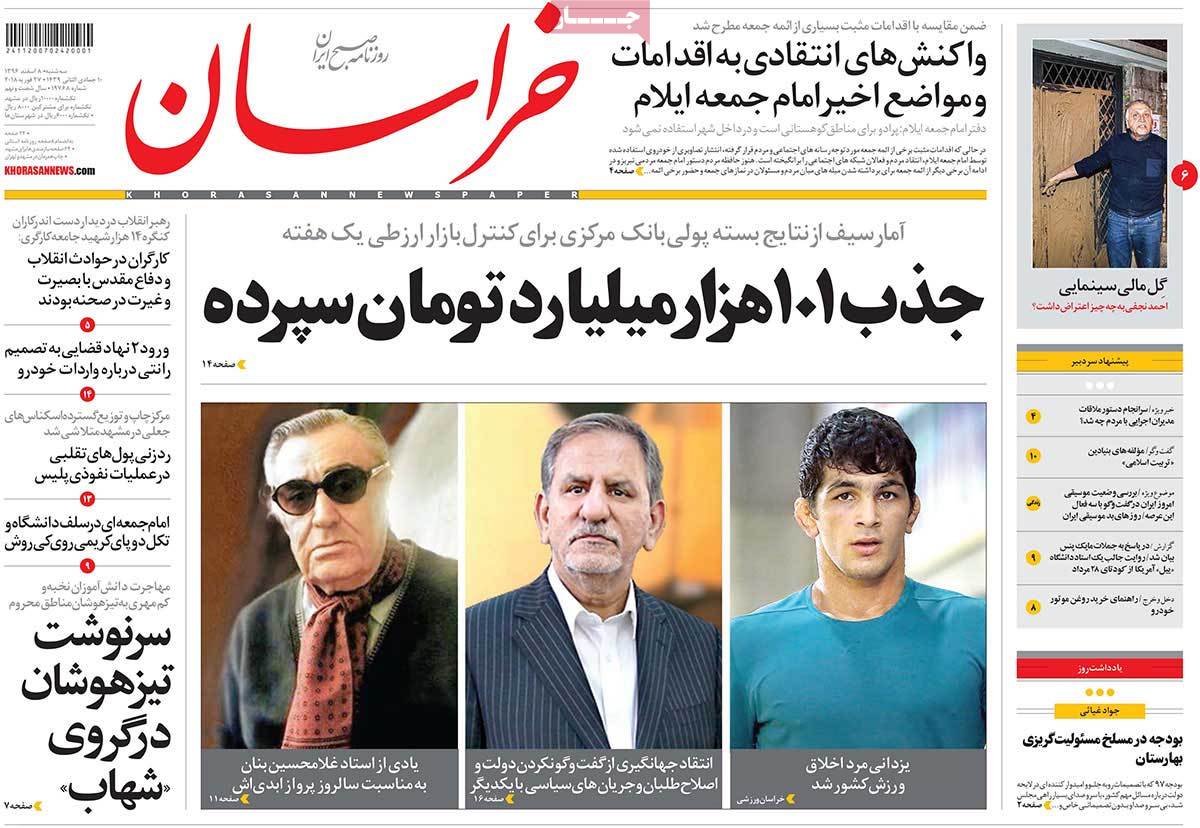
A Look at Iranian Newspaper Front Pages on February 27


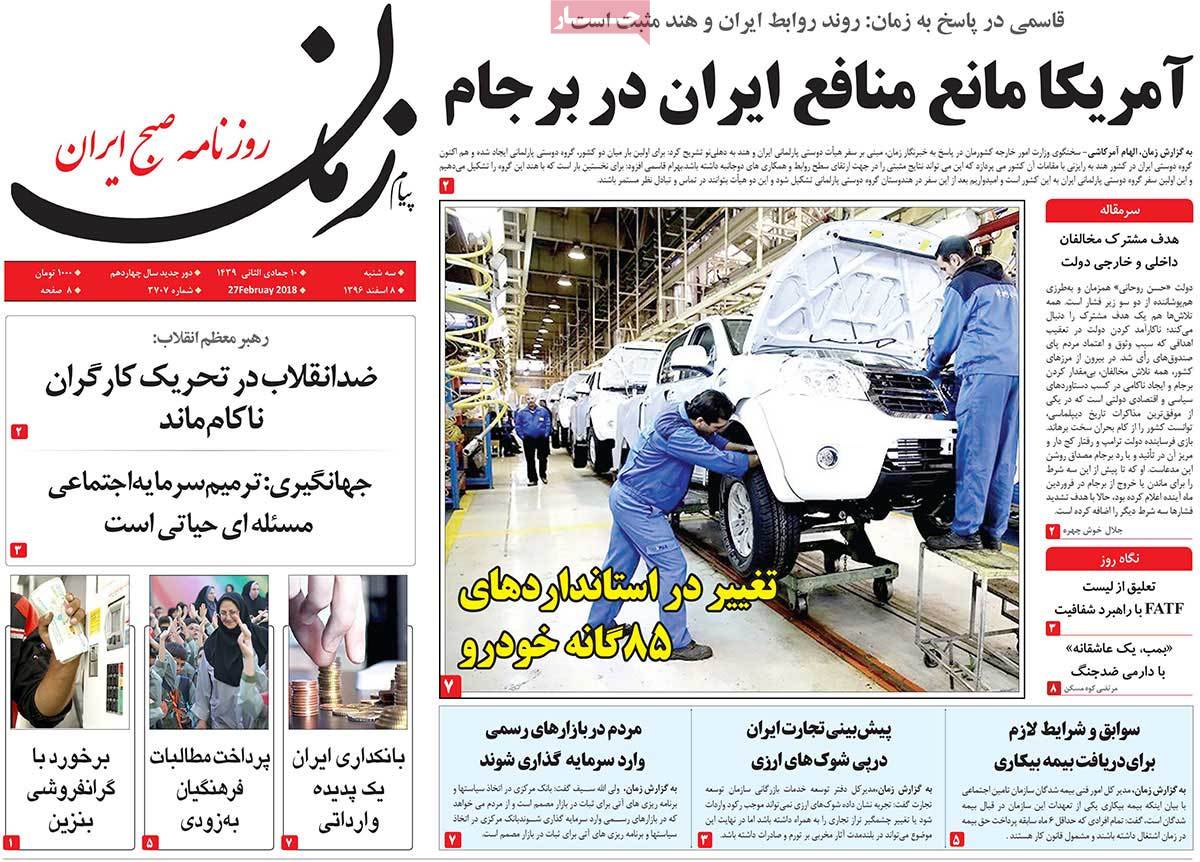
Payam-e Zaman:

1- Qassemi: US Preventing Iran from Reaping JCPOA Benefits
A Look at Iranian Newspaper Front Pages on February 27


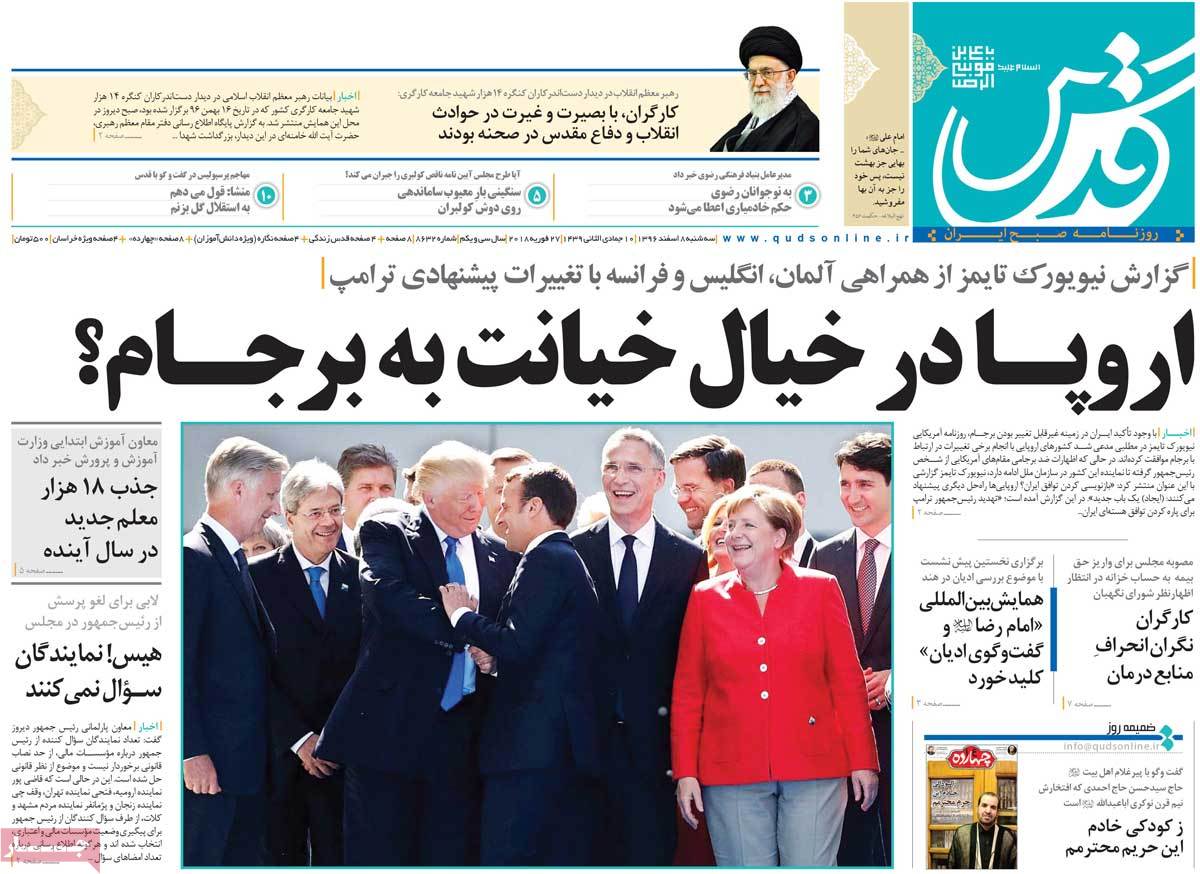
Quds:

1- Is Europe Betraying Iran Nuclear Deal?

  • New York Times Says UK, Germany, France to Support Trump’s Changes to JCPOA
A Look at Iranian Newspaper Front Pages on February 27


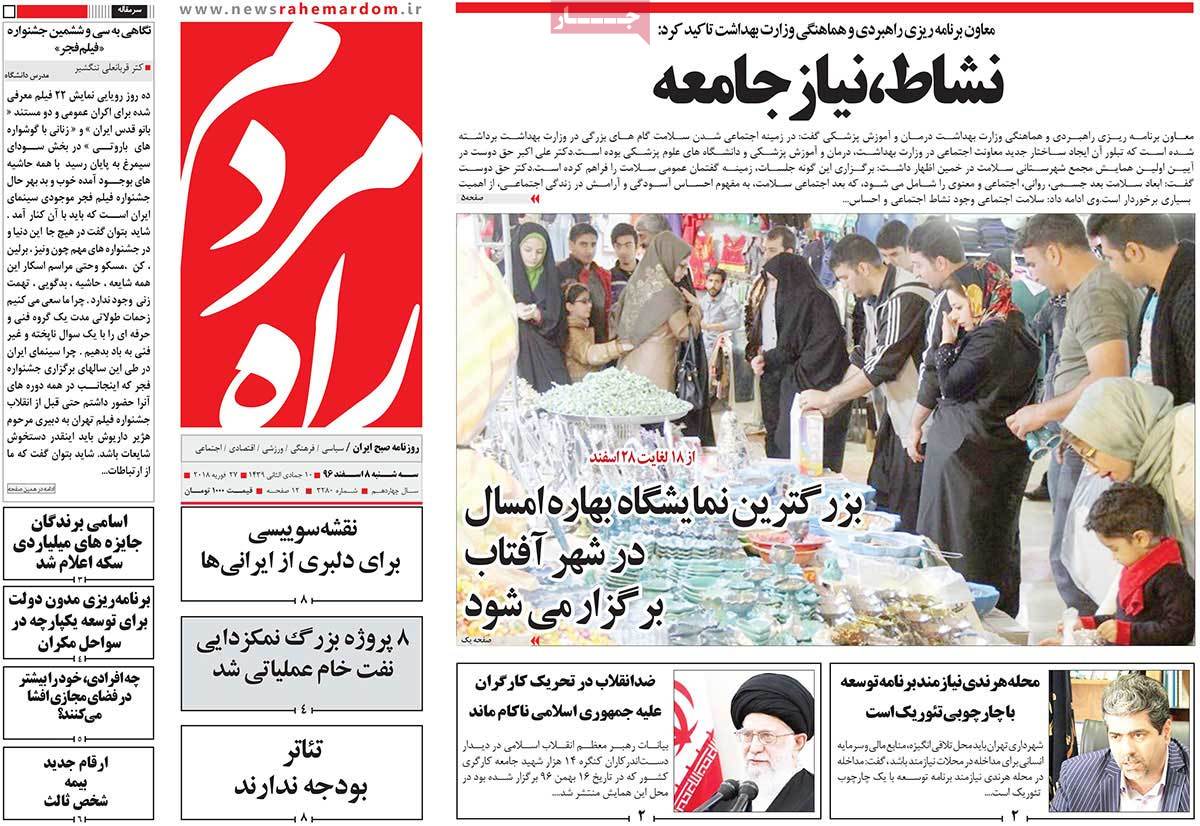
Rah-e Mardom:

1- Happiness Is What Society Needs: Health Official
A Look at Iranian Newspaper Front Pages on February 27


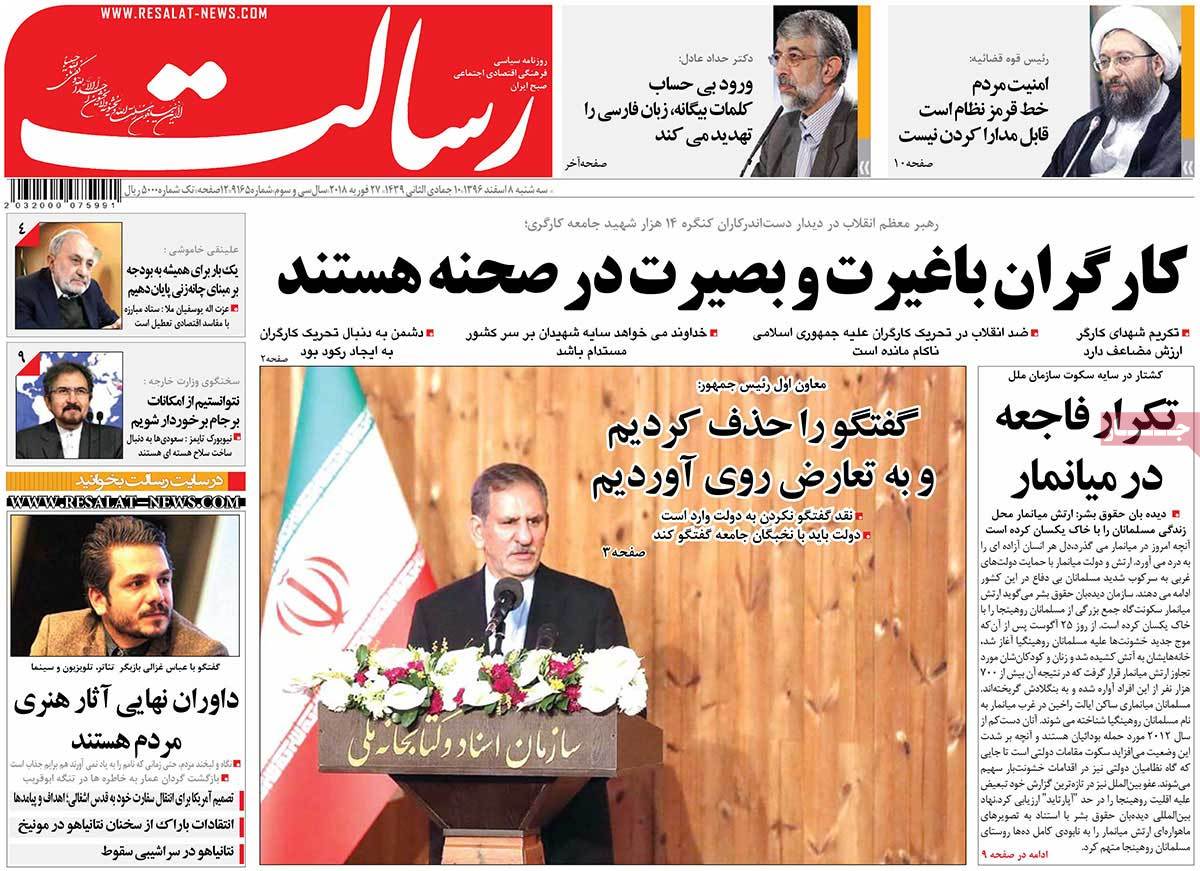
Resalat:

1- Iran First VP: We’ve Ceased to Talk, Resorted to Conflict
A Look at Iranian Newspaper Front Pages on February 27


Rooyesh-e Mellat:

1- Velayati Rules Out Iraq’s Mediation in Iran-US Ties
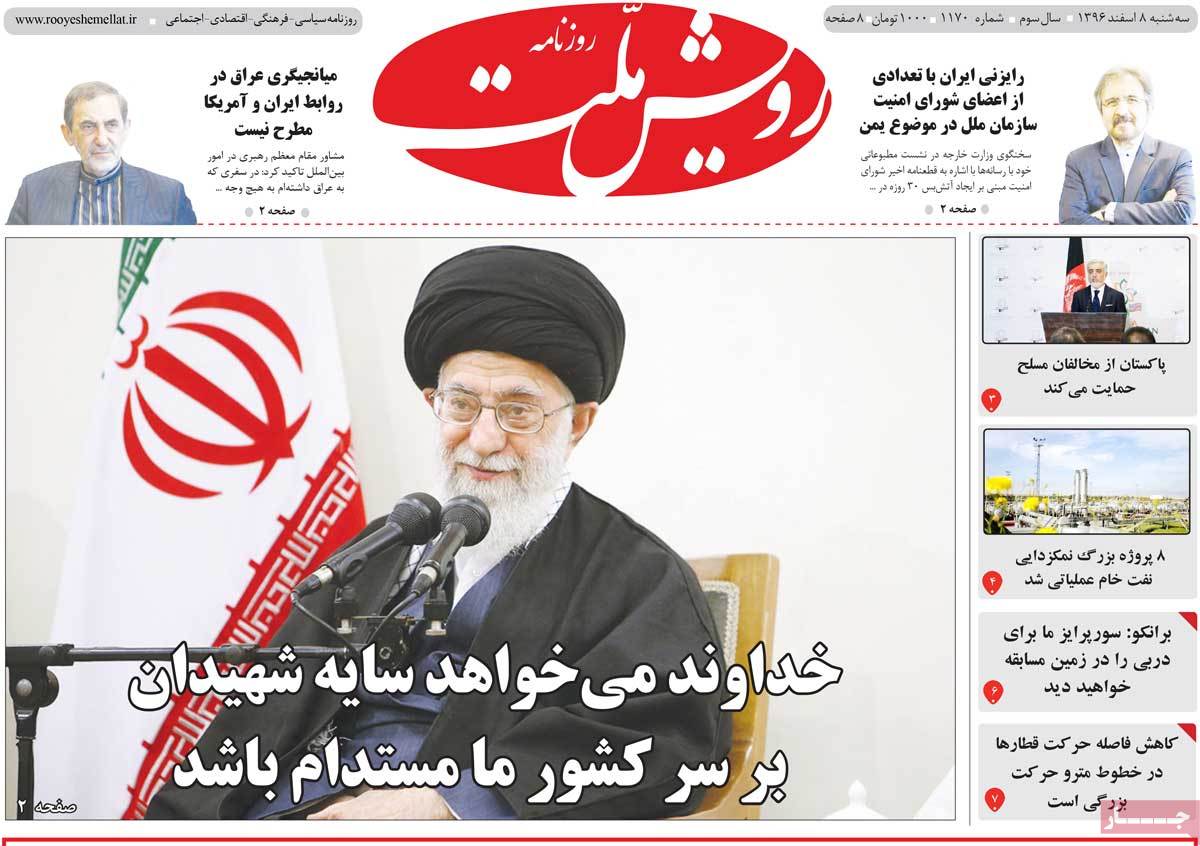
A Look at Iranian Newspaper Front Pages on February 27


Shahrvand:

1- Iran Thirsty for Hope: Sociologists Talk of Iranian People’s Need for Social Hope
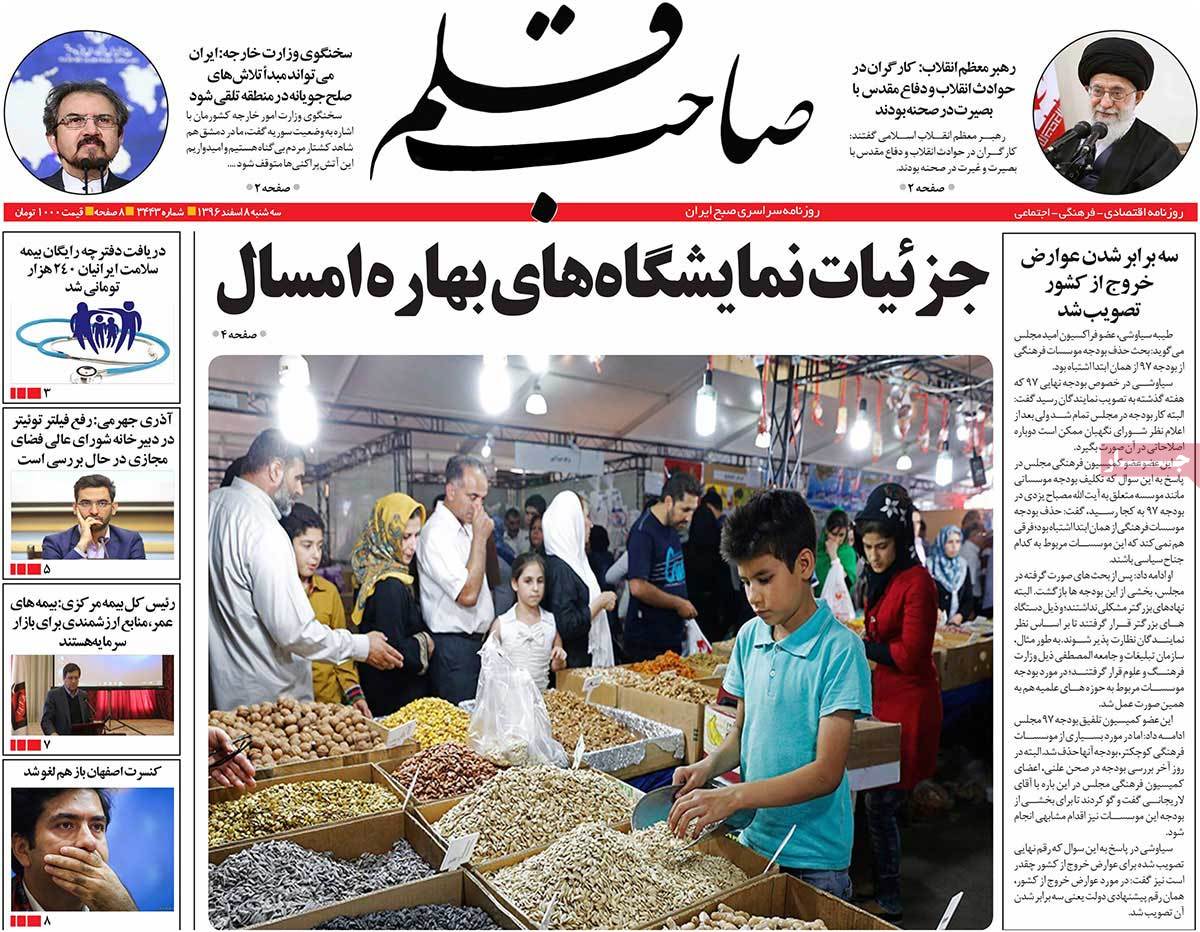
A Look at Iranian Newspaper Front Pages on February 27


Shargh:

1- Major General’s Frankness

  • Firouzabadi: Mir-Hossein Mousavi Knew about Real Face of Ahmadinejad, We Didn’t
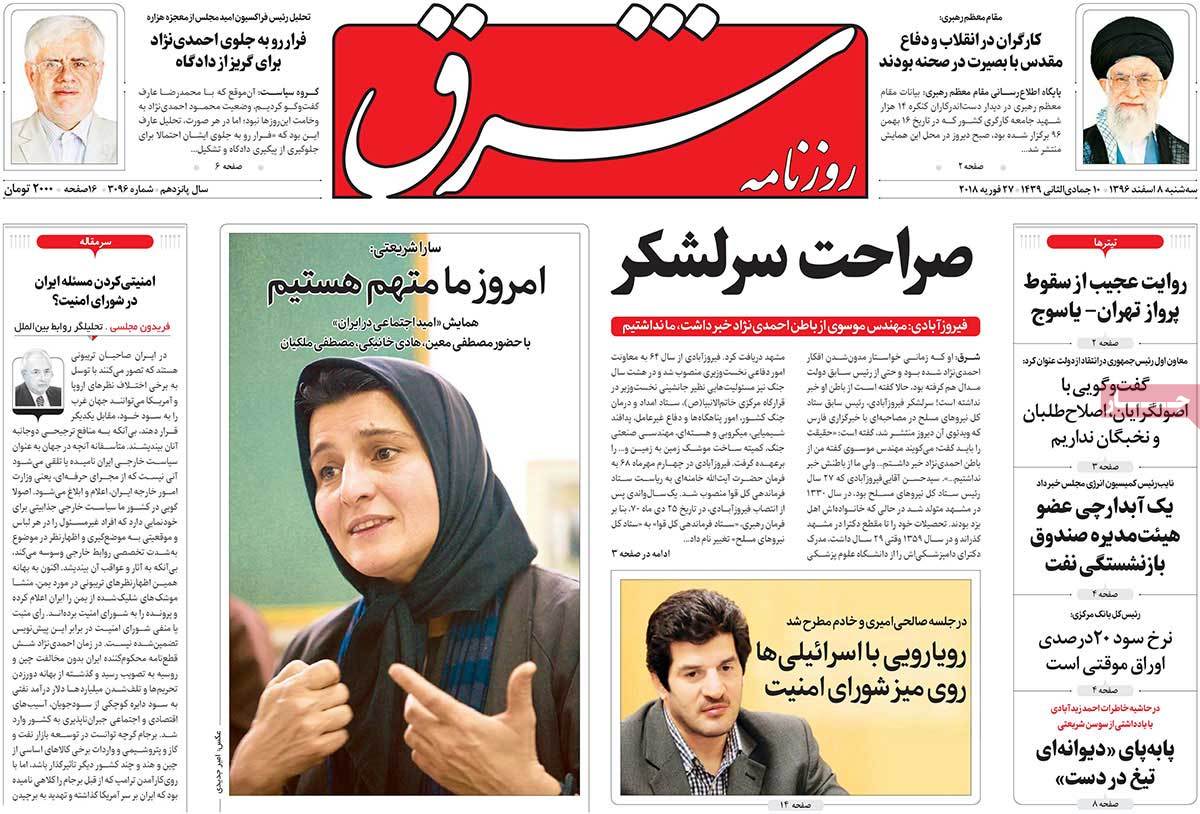
A Look at Iranian Newspaper Front Pages on February 27


Vatan-e Emrooz:

1- Three Jewish People Were in Green Espionage Network

  • Which Iranian Missile Site Were Spied by Environmentalists?
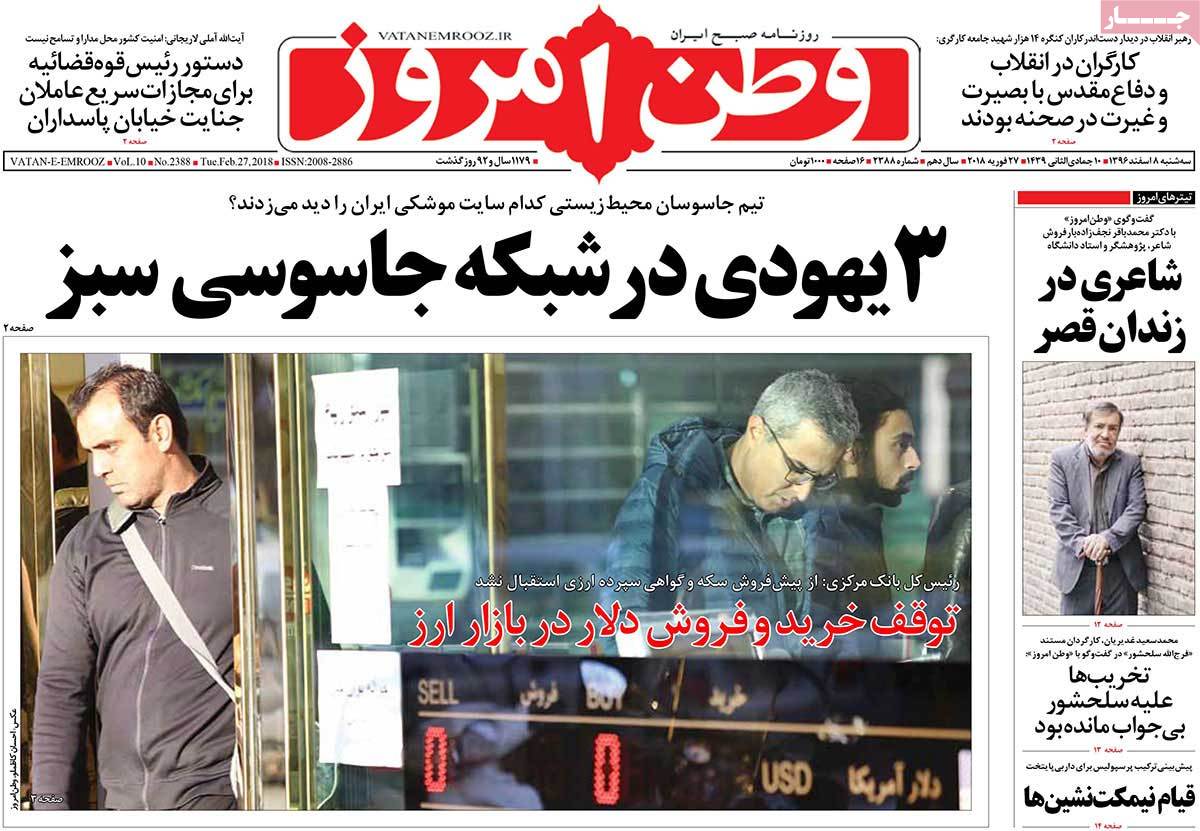
A Look at Iranian Newspaper Front Pages on February 27

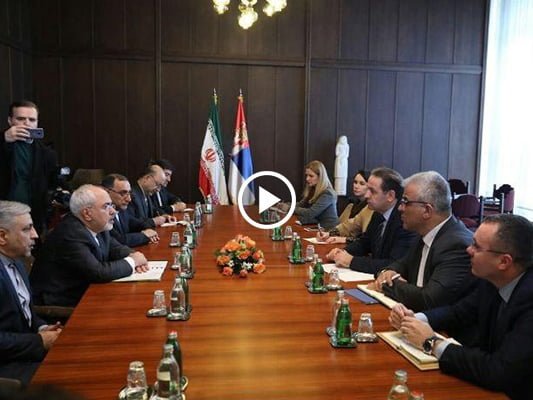
Serbia Ready to Enhance Parliamentary, Trade Ties with Iran

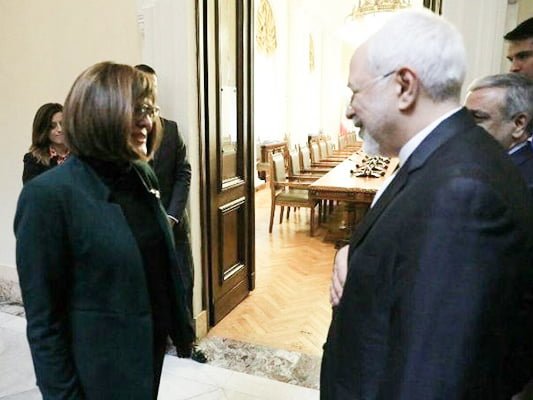
In a Tuesday meeting in Belgrade, Ljajić and Iranian Foreign Minister Mohammad Javad Zarif discussed various dimensions of bilateral trade and economic relations, as well as obstacles to the expansion of ties between Iran and Serbia and the ways to remove them.

Energy ties, banking cooperation, business facilities, consular cooperation, and tourism were among other key points discussed by the two officials.

Earlier in the day, Serbian Parliament Speaker Gojković said her country welcomes the expansion of bilateral relations and parliamentary cooperation between Tehran and Belgrade.

Serbia Ready to Enhance Parliamentary, Trade Ties with Iran
President of the country’s National Assembly Maja Gojković meeting Iranian Foreign Minister Mohammad Javad Zarif in Belgrade on February 27, 2018 / Photo released by the Iranian Foreign Ministry

Referring to her earlier trips to Iran, she further called the two visits successful and memorable.

For his part, Zarif expressed his satisfaction with the growing trend of bilateral relations in all fields, especially in the economic and commercial spheres.

The Islamic Republic welcomes the development of its parliamentary cooperation with Serbia, he noted, adding that the parliament speaker of the Islamic Republic will travel to Serbia later this year.

Referring to Tehran’s resolve to expand ties with the Republic of Serbia, the Iranian foreign minister called for closer cooperation between the two countries at the international communities.

Zarif and Gojković also discussed regional and international issues.

The Iranian top diplomat arrived in Belgrade on Monday as the first leg of his tour of the Balkans and Eastern Europe. Bulgaria, Croatia and Bosnia and Herzegovina are the next destinations of Zarif and his accompanying delegation.

Iran Can Use Tourism to Improve Its Global Image: Omani Minister  

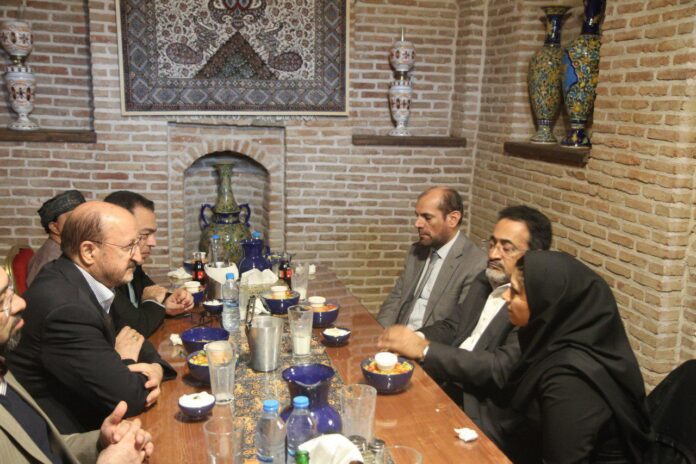
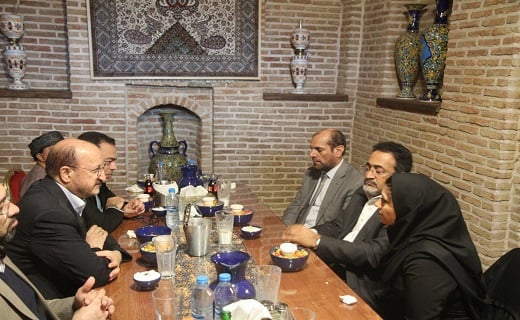
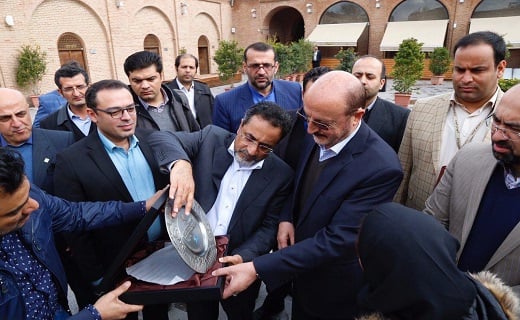
In a recent meeting in Iran’s Qazvin province, Omani Minister Ahmed bin Nasser al-Mahrizi said Iran and Oman enjoy cultural and historical commonalities which can be used to deepen mutual cooperation in the field of tourism.

“I held talks with the private sector managers who are active in tourism field and discussed ways to take the most advantages of the tourist capacities in both countries,” he was quoted as saying in a Farsi report by IRNA.

He referred to his country’s strategy for attracting further foreign tourists and said in 2017 the number of foreign tourists visiting Oman hit 3 million, most of whom were from Europe and Iran.

Following his visit to Qazvin’s historic sites, the Omani minister noted the province’s cultural history represents Iran’s rich culture and history.

He also praised the Iranian tourism officials for repairing and preserving the historic sites in Qazvin.

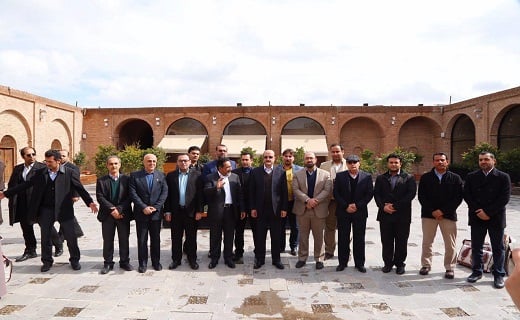
Earlier, he visited Sa’d al-Saltaneh Caravanserai in Qazvin and closely watched the reconstruction process of the historic site.

Built during the Qajar era, the caravanserai is one of Iran’s best preserved urban caravanserais. The site is built on a square plan, has 4 Iwans facing a courtyard. Established at the centre of Qazvin, the site annually attracts lots of domestic and foreign tourists. It is one of the 1,304 historical and natural sites in the province which have been registered at the national heritage list.

The Omani minister is expected to hold talks with the Iranian Vice-President and Head of Iran’s Cultural Heritage, Handicrafts and Tourism Organization, Ali Asghar Moonesan, later in Tehran.

During his three-day stay in Iran, he will also visit the historic and cultural sites of Shiraz, the capital city of Fars province in the south of Iran.

Russia Vetoes UK-Drafted Anti-Iran Resolution at UNSC

Russia Vetoes UK-Drafted Anti-Iran Resolution at UNSC

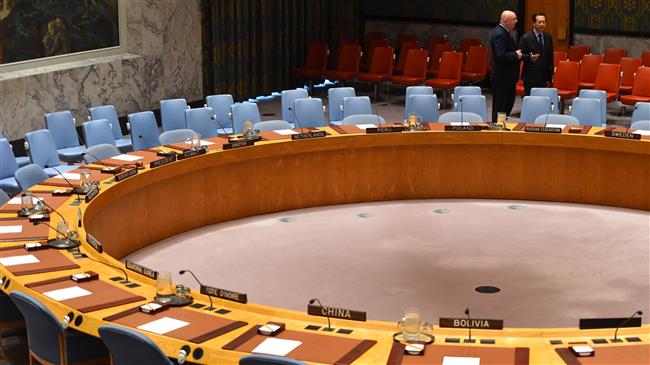
On Monday, the resolution gained 11 favorable votes at the 15-member Security Council but was halted by Russia’s veto.

“We cannot concur with uncorroborated conclusions and evidence which requires verification and discussions within the sanctions committee,” Russian Ambassador Vassily Nebenzia told the council.

Earlier in the month, Britain circulated a draft resolution that would renew sanctions on Yemen for another year and also “condemns” Iran for allegedly breaching the 2015 arms embargo on the country by “failing to take the necessary measures to prevent the direct or indirect supply, sale or transfer” of short-range ballistic missiles, UAVs and other military equipment to Yemen’s Houthi Ansarullah movement.

The Houthi movement has been defending Yemen against a bloody Saudi-led military campaign, which was launched in 2015 with the help of the US and the UK to reinstall the country’s former Riyadh-friendly government.

The draft resolution, backed by France and the US, called for unspecified measures in response to the UN report about Iran’s alleged role in Yemen, stressing that the UNSC will take “additional measures to address these violations,” and that “any activity related to the use of ballistic missiles in Yemen” is a criteria for sanctions.

A group of UN experts monitoring the sanctions on Yemen reported to the Security Council in January that it had “identified missile remnants, related military equipment and military unmanned aerial vehicles that are of Iranian origin and were brought into Yemen after the imposition of the targeted arms embargo.”

The UN experts, however, said they were unable to identify the supplier.

Both Tehran and Sana’a have repeatedly rejected the allegations as a fabricated scenario, and said the armed forces of Yemen have strengthened their missile power on their own.

After the veto, the UNSC unanimously adopted a Russian-drafted measure to extended for one year the sanctions regime against Yemen.

Iran dismiss allegations as baseless

Meanwhile, Iran’s envoy to the United Nations says that the US and the UK are trying to distract the international community away from Saudi Arabia’s war crimes in Yemen by drafting such resolutions.

Gholamali Khoshroo further went on to dismiss the allegations that his country had been providing weapons to Yemen’s Ansarullah movement.

The Iranian diplomat also reiterated Tehran’s stance on Yemen, stressing that only a political solution and intra-Yemeni dialog can put an end to the country’s conflict.

Oil Swap Deal between Iran, Iraq Delayed over Safety Issues

Oil Swap Deal between Iran, Iraq Delayed over Safety Issues

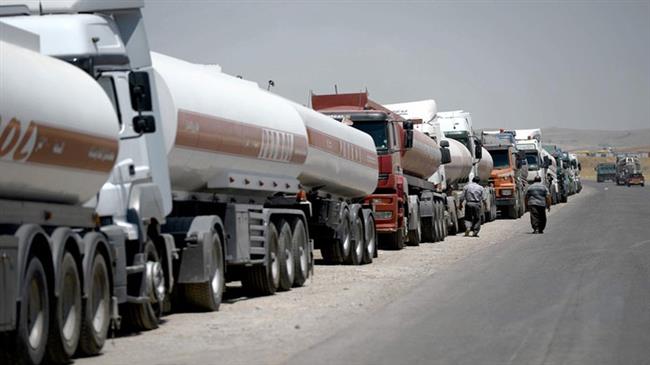
The deal to initially truck 30,000 barrels per day (bpd) of crude oil from Iraq’s Kirkuk fields to Iran’s Kermanshah refinery was to get underway this month.

However, Hamid Hosseini told the ISNA news agency that “for the deal to be implemented, there are problems in the area of safety,” citing the lack of truck screening devices.

“We need to check the safety of the trucks that are supposed to arrive, and we are having problems in this regard, because we do not have X-ray machines,” he said.

“In this regard, we are talking with the Iraqi side, and if they agree, we will use the facilities that they have and gradually complete our equipment,” Hosseini added.

The two neighbors signed a swap deal in December, under which Iraq is about to truck 60,000 bpd of oil from its northern fields to Iran.

The two neighbors also plan to build a pipeline to carry the oil from Kirkuk to Iranian refineries in Kermanshah, Tabriz, Tehran and Arak.

Iraq’s planned oil exports to Iran threaten the existing export route from Kirkuk via Turkey and the Mediterranean.

Turkey has invited Iraqi Oil Minister Jabar al-Luaibi to discuss the resumption of oil exports through the Mediterranean port of Ceyhan, which have been halted since Baghdad took control of the major oilfields in Kirkuk late last year.

For years, Turkey has been reaping the economic benefits of transporting and selling the Iraqi oil from the semi-autonomous Kurdistan region.

Iraqi officials have said a deal with Turkey on resuming oil exports would require shipments “exclusively through Iraq’s state oil marketer SOMO.”

Iraq also plans to build a second export pipeline from the Kirkuk oilfields which will replace an old one severely damaged by Daesh terrorists.

The country exported 250,000 to 400,000 barrels per day (bpd) through the pipeline before the start of Daesh terrorism halted the supplies.

Luaibi has said Baghdad planned to raise production from the Kirkuk fields to 1 million bpd, which produced 407,000 bpd in July.