Friday, December 26, 2025
Home Blog Page 3600

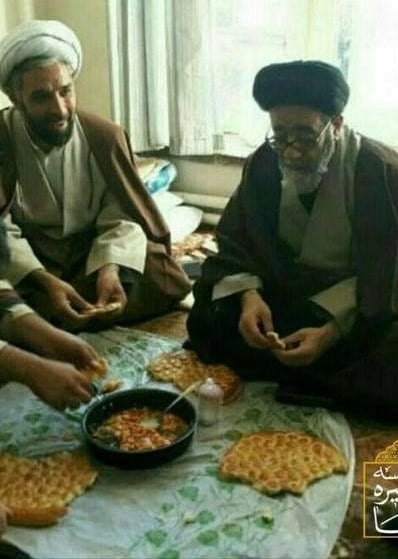
Qayqanaq; Delicious Pancake Indigenous to Iran’s Azarbaijan

Qayqanaq is cooked in the cities of Zanjan and Tabriz. The recipe for, and appearance of this Iranian desert is very similar to foreign pancakes eaten as breakfast.


Ingredients

Flour: 4 spoonfuls

Eggs: 4 eggs

Cinnamon: a teaspoonful

Powdered cardamom: as much as needed

Sugar: 3 spoonfuls

Crushed walnut: as much as needed


Recipe

First beat the eggs. Then add sugar, flour, crushed walnut and cardamom, and fry the mixture. You may add cinnamon or saffron to the snack. Qayqanaq can be made as thin as the pancake or thicker.

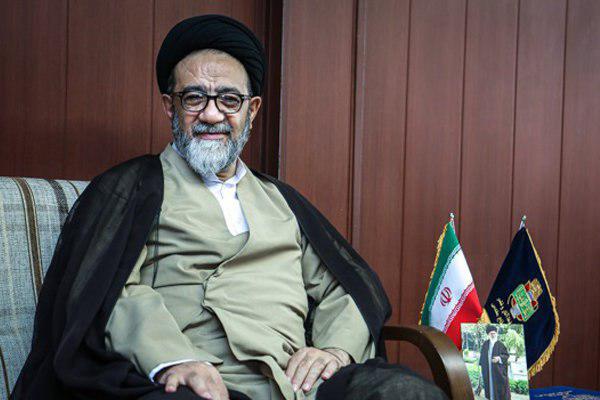
Popularity of Iranian Friday Prayers Imam Growing in Tabriz

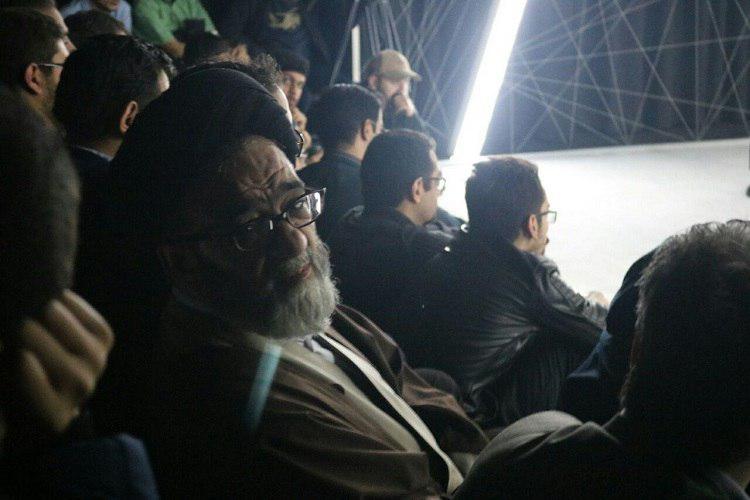
Seyyed Mohammad-Ali Al-e Hashem, the popular leader of Tabriz's Friday Prayers

Seyyed Mohammad-Ali Al-e Hashem leads Friday Prayers in Tabriz, the capital of the northwestern province of East Azerbaijan.

Recently, he went to a theatre in Tabriz to watch a show featuring the lives of disabled war veterans suffering from psychological problems, reports the Persian-language Iranian Labour News Agency (ILNA).

The play depicts the hidden mental aspects of the war veterans who have suffered serious maladies during their lives, who are grappling with those problems today as well.

The cleric is popular not only because he went to watch a play. Al-e Hashem’s behaviour towards the general public after he was appointed as the Friday Prayer Imam of Tabriz last year has been the focus of attention by media and people alike.

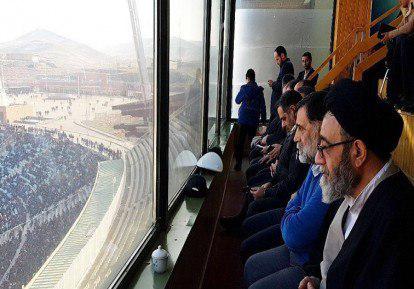
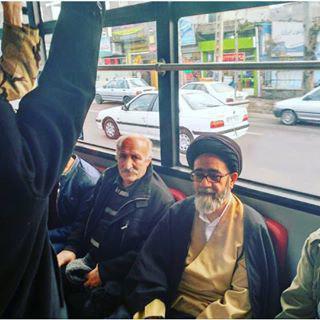
His social conduct, which has been warmly welcomed by people and has received widespread coverage in media outlets and the cyberspace, includes his praising the elite during the sermons of Friday Prayers, following up on issues pertaining to journalists, using public transport in times of severe air pollution in Tabriz, using taxis, visiting universities and having lunch with students at the university restaurant, and going to the stadium to watch football matches, among other things.


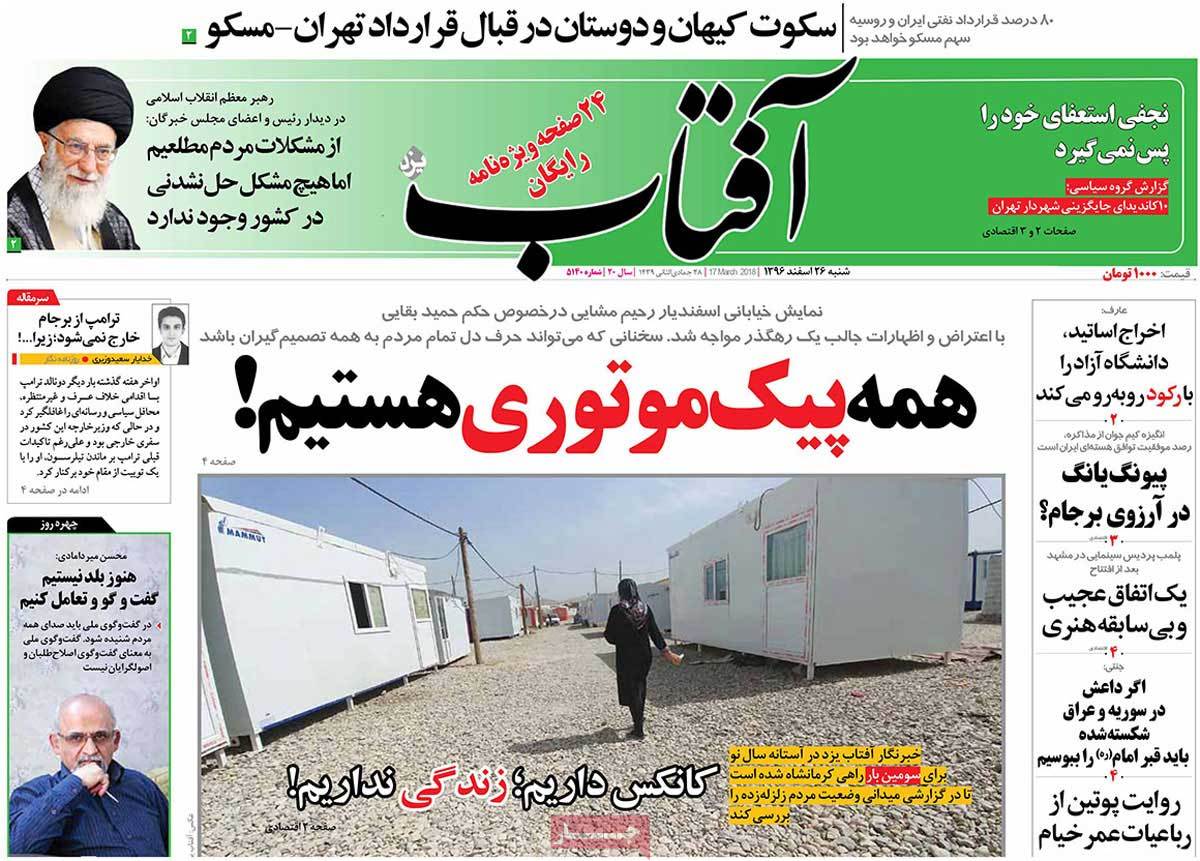
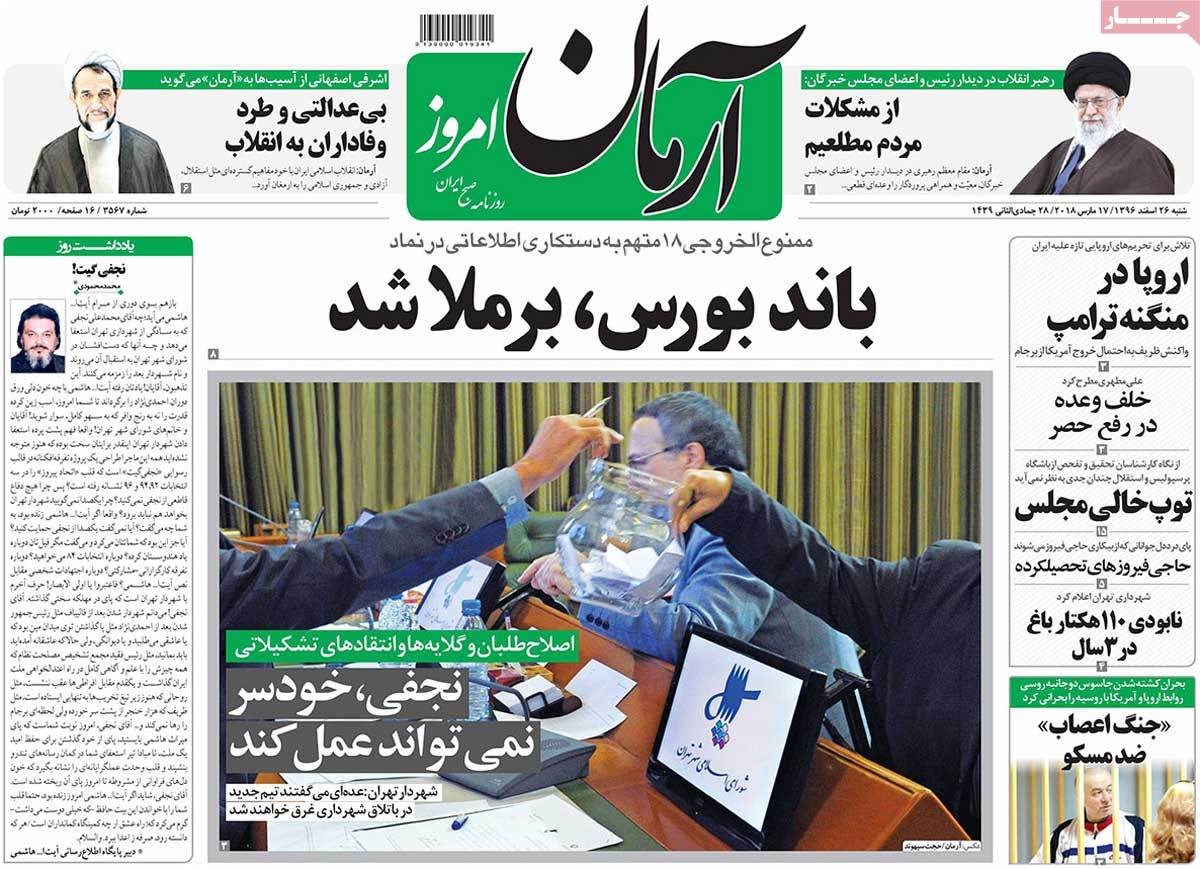
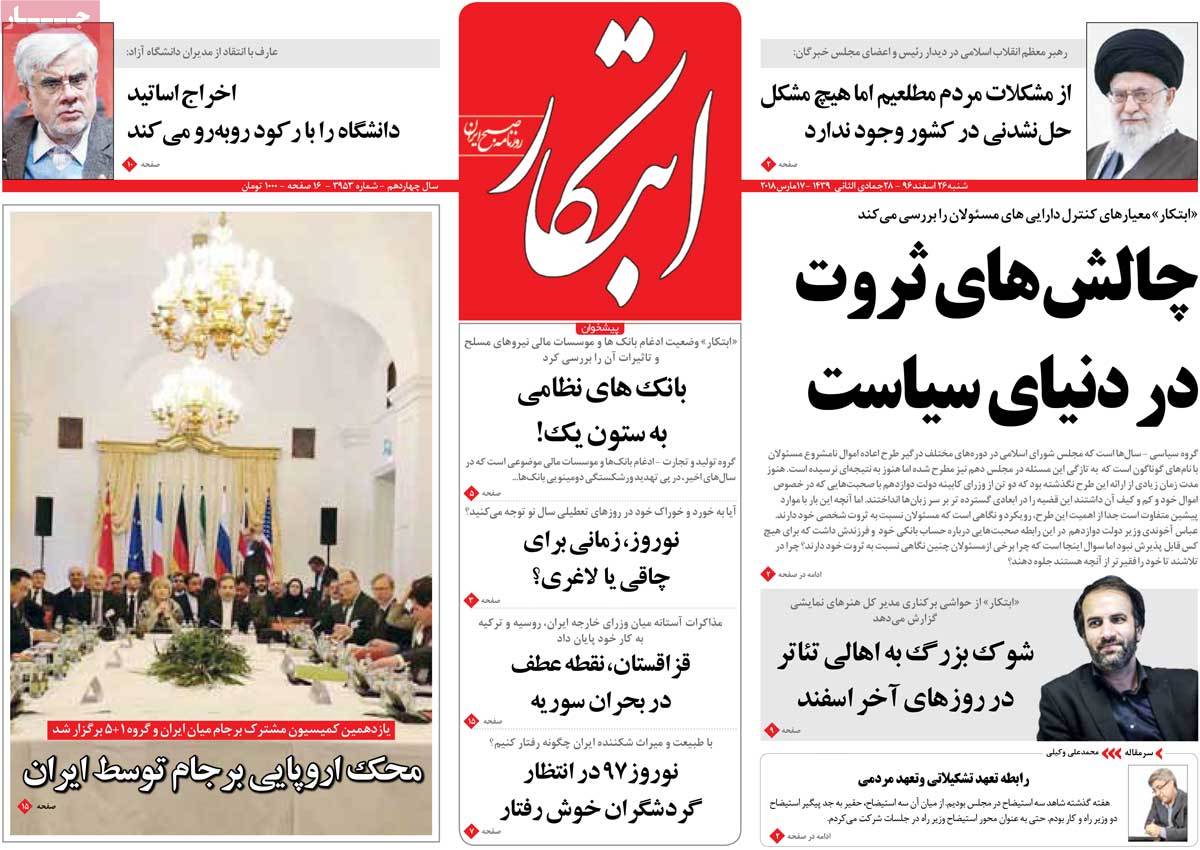
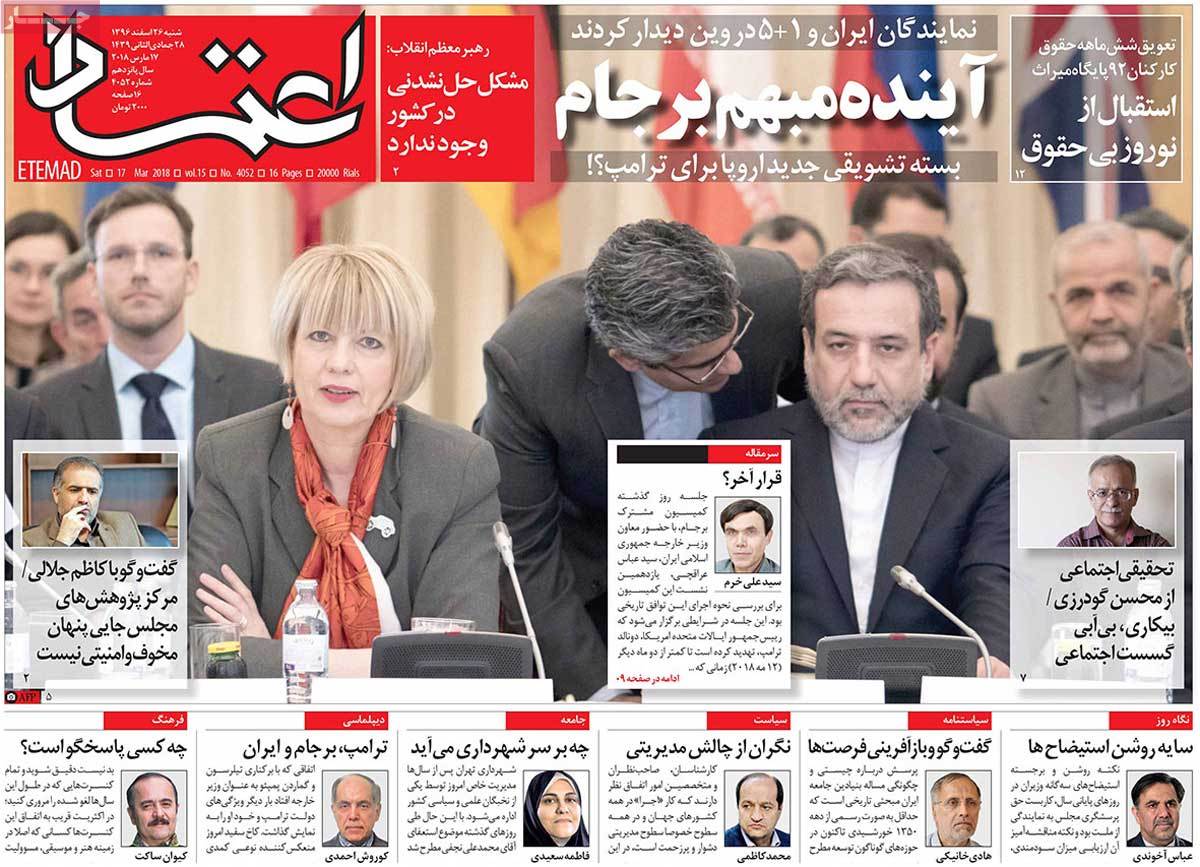
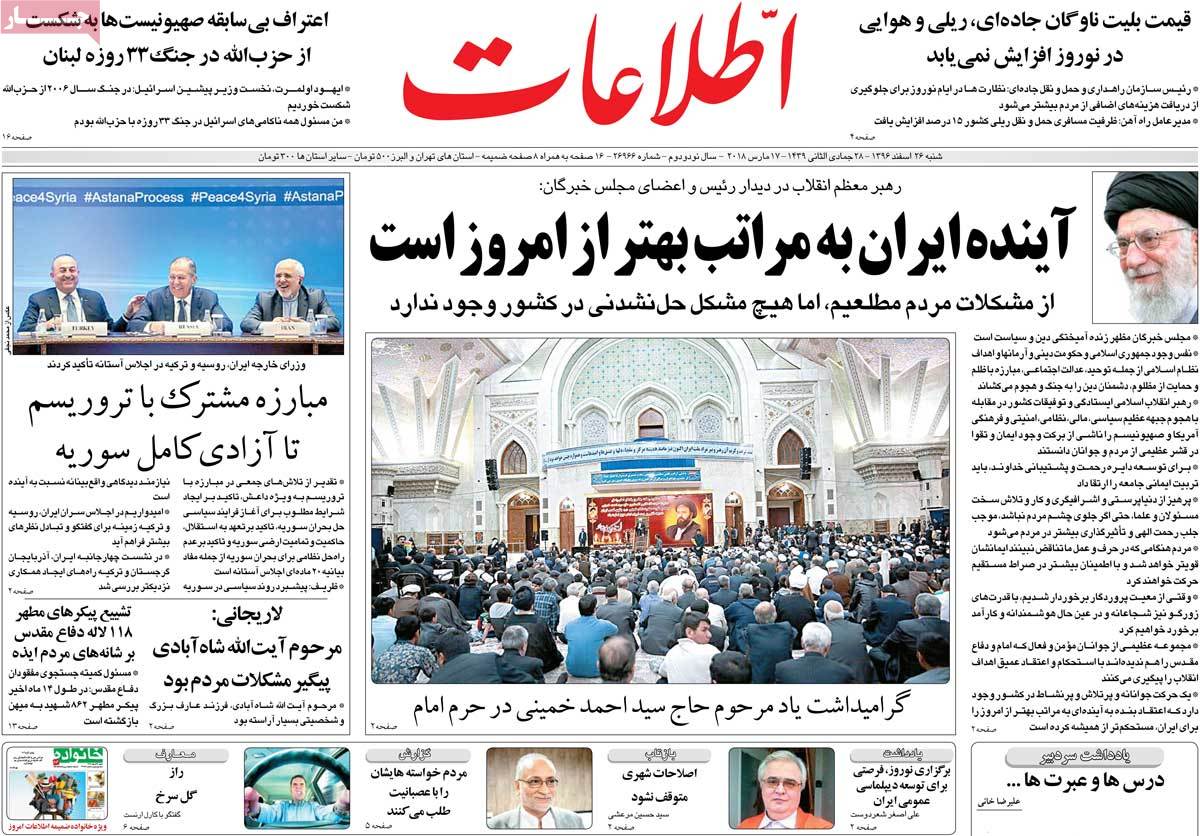
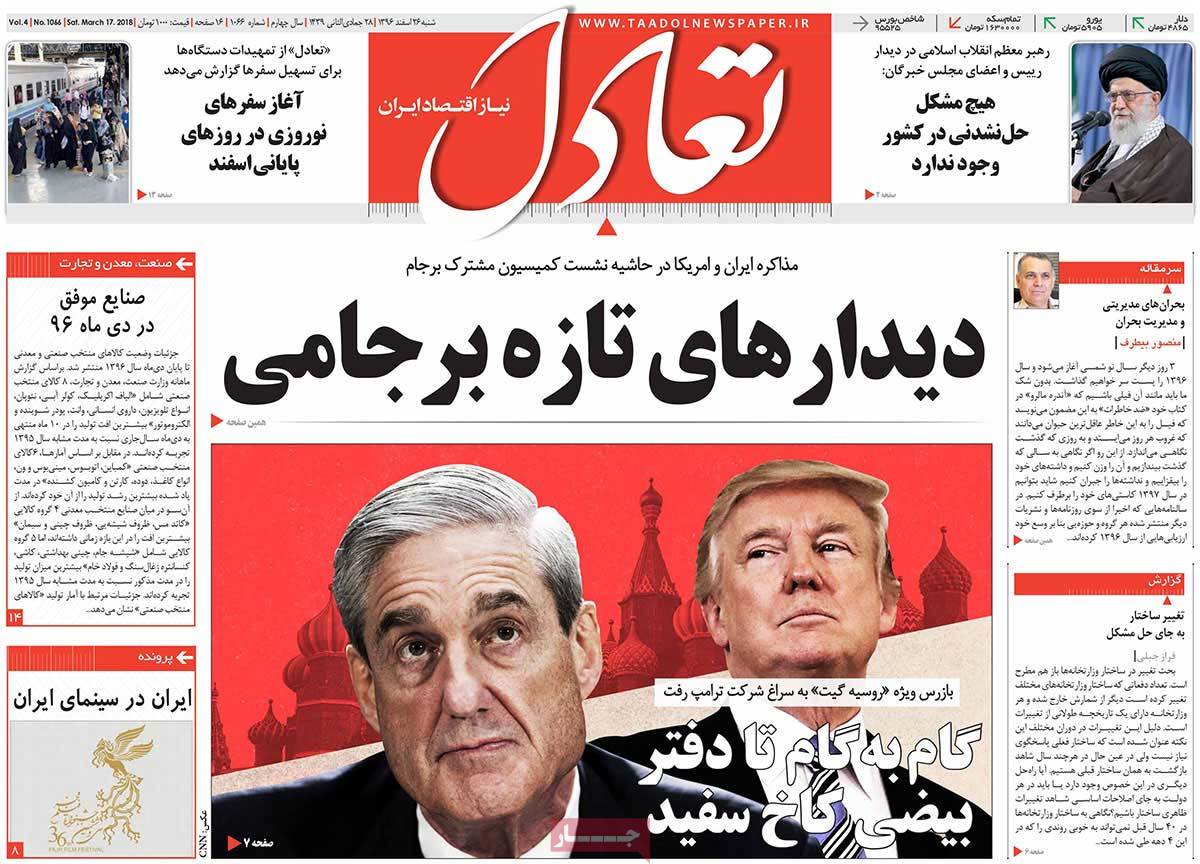
A Look at Iranian Newspaper Front Pages on March 17

A Look at Iranian Newspaper Front Pages on November 18

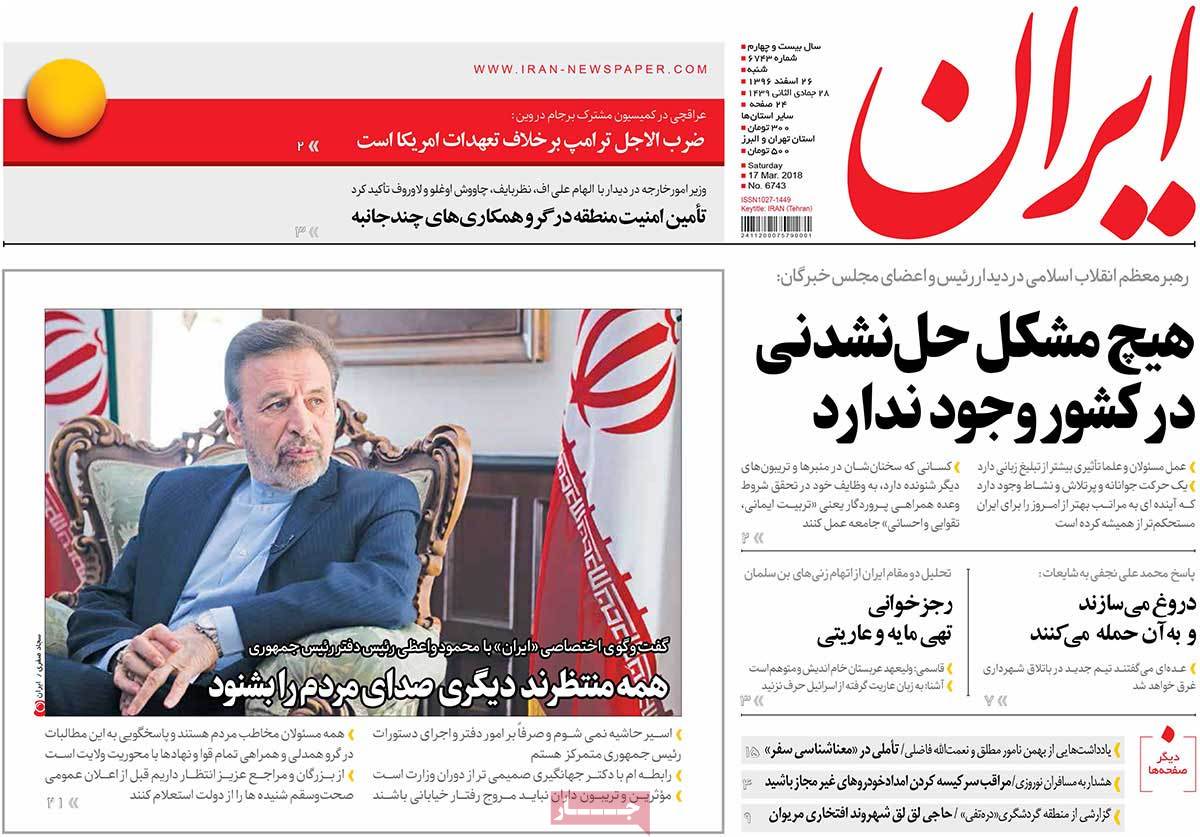
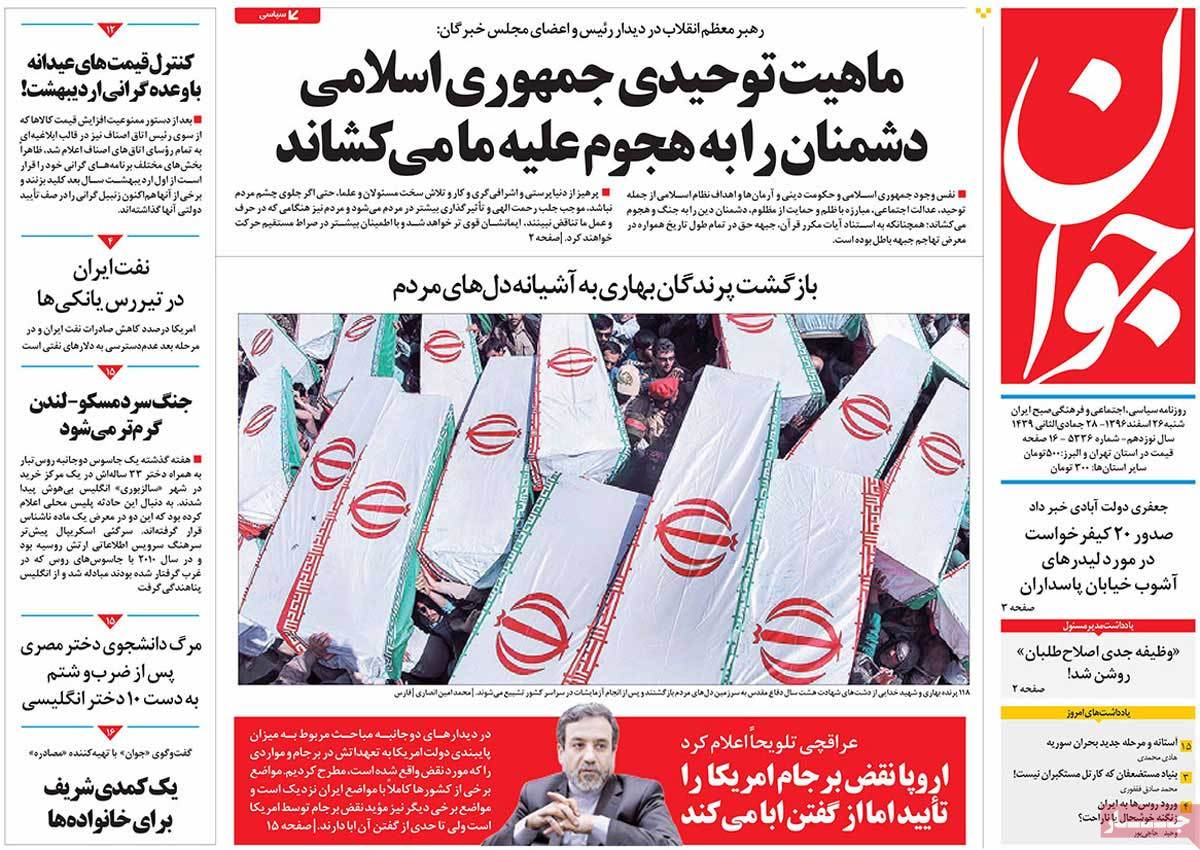
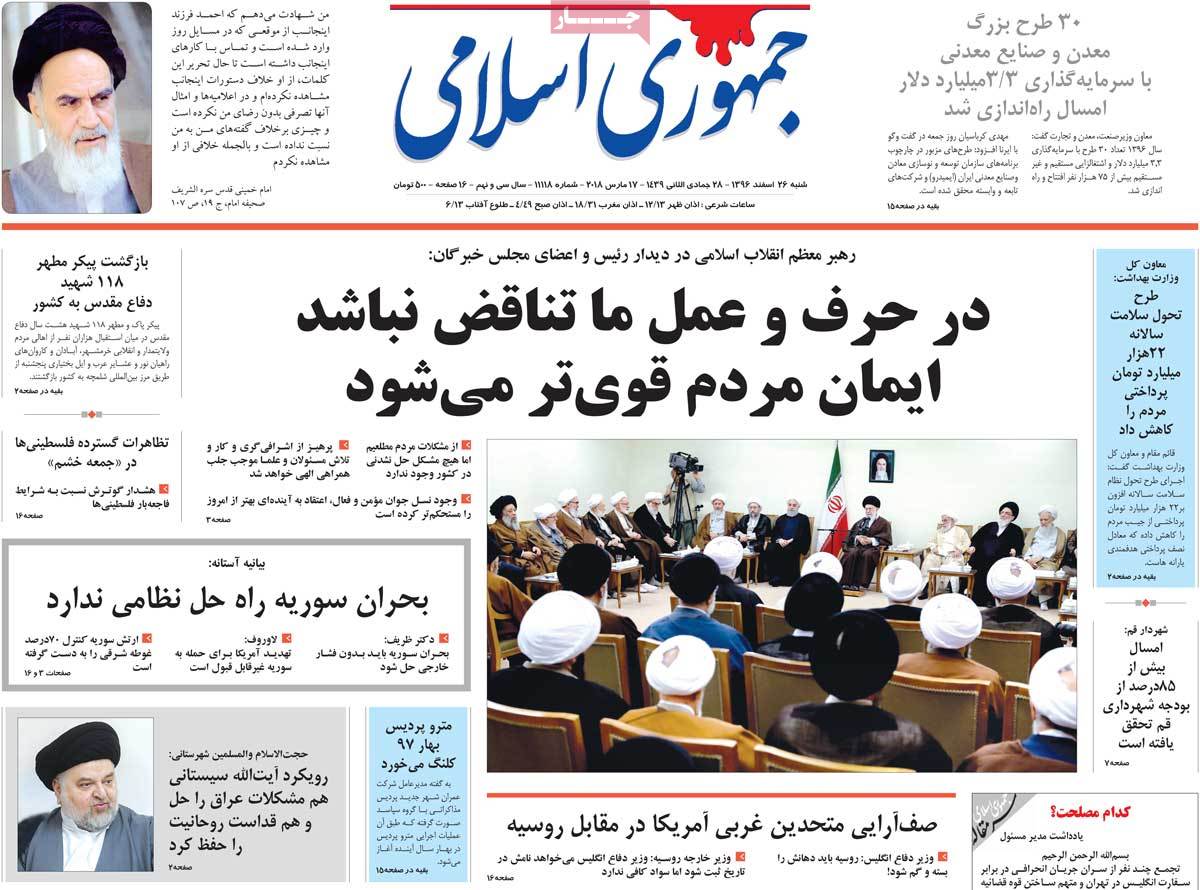
All newspapers today covered the remarks made by the Leader of Iran’s Islamic Revolution Ayatollah Seyyed Ali Khamenei in a meeting with members of the Assembly of Experts, a body responsible for choosing or dismissing the country’s Leader.

A meeting of the JCPOA Joint Commission in the Austrian capital of Vienna also made headlines on Saturday. Several papers referred to the US pressure on Europe, and the EU’s efforts to appease Trump in order to keep him in the nuclear deal.

The latest round of trilateral talks between Iran, Turkey, and Russia on the Syrian crisis was also a top story today, as the final statement released by the three countries’ foreign ministers received great coverage today.

The above issues, as well as many more, are highlighted in the following headlines and top stories:


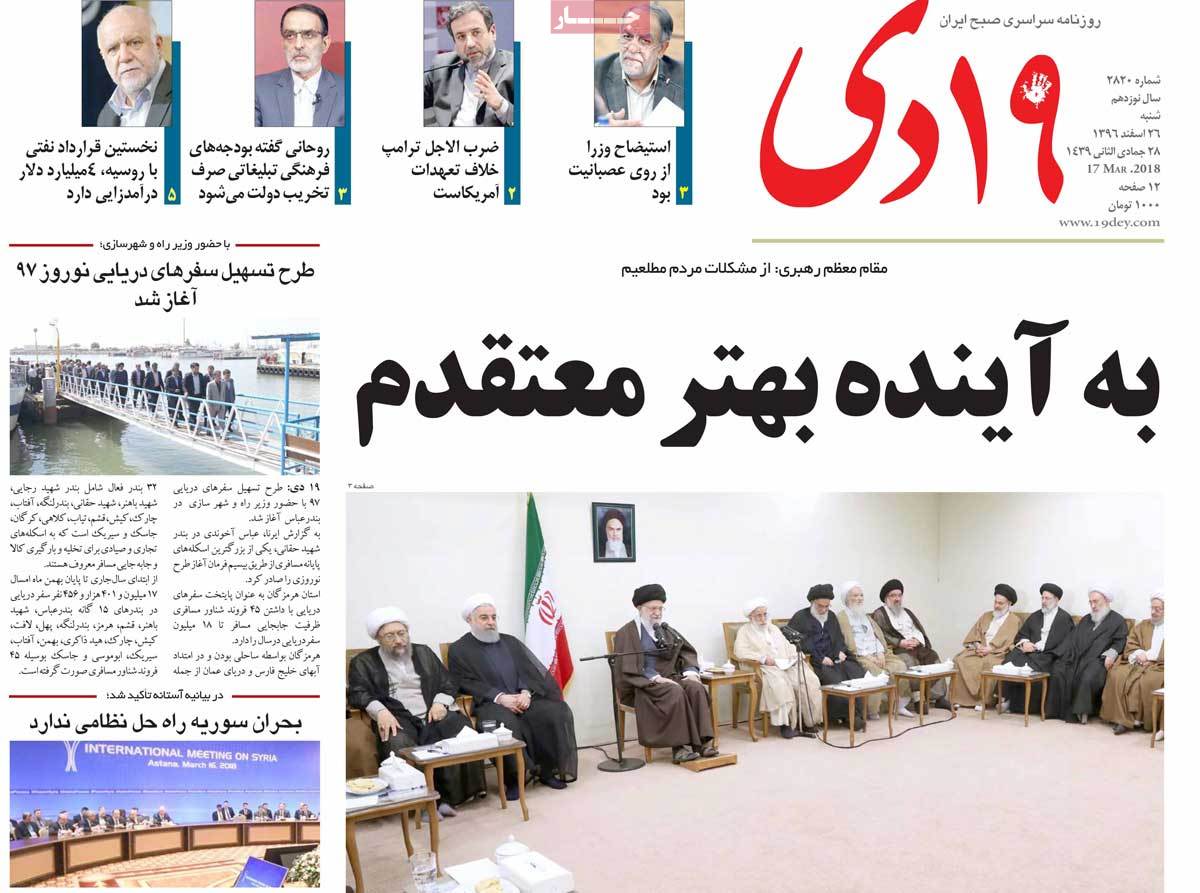
19 Dey:

  • Iran Leader: I Believe A Better Future Will Come
  • Syria Crisis Has No Military Solution: Astana Statement

A Look at Iranian Newspaper Front Pages on March 17


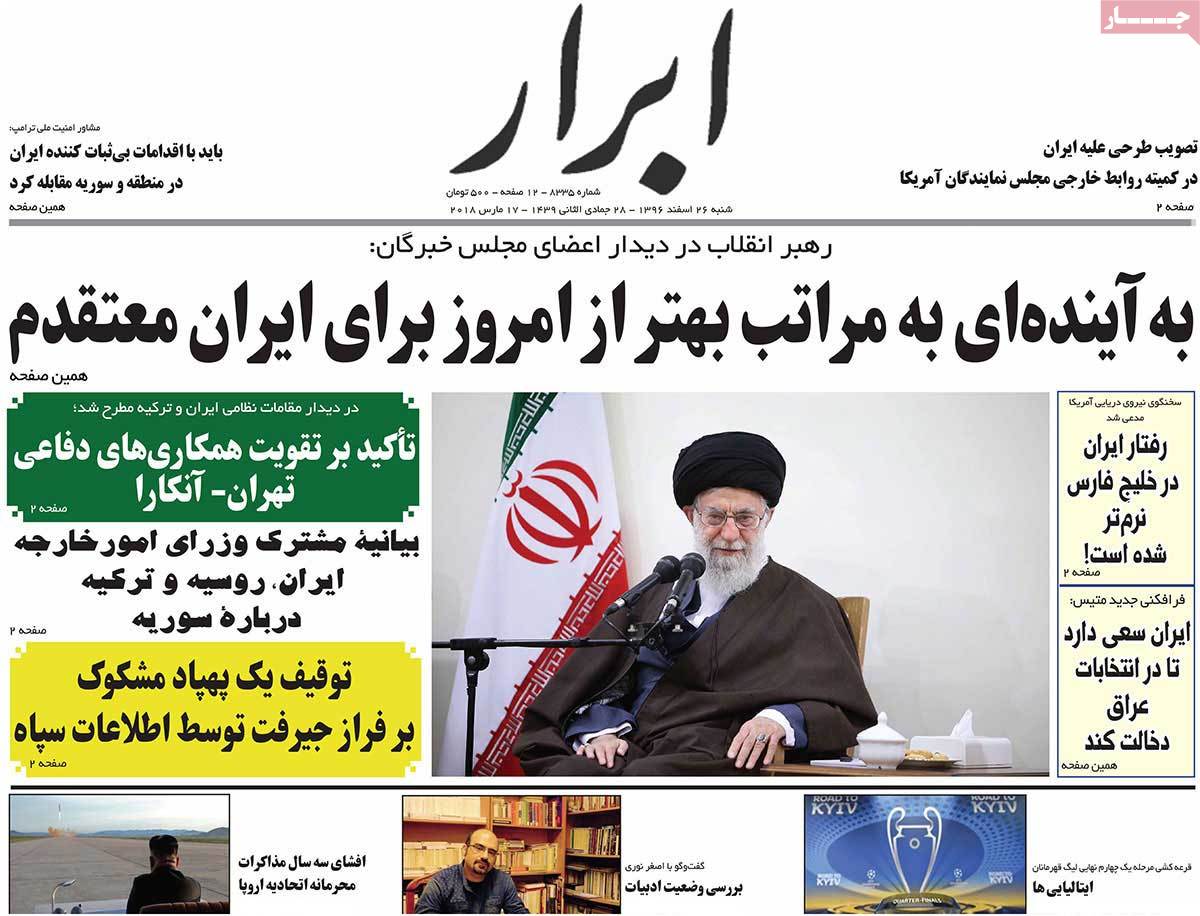
Abrar:

  • Iranian, Turkish Military Officials Underline Enhancement of Defence Ties
  • US Navy Spokesman: Iran’s Behaviour in Persian Gulf Has Become Softer!
  • Mattis Accuses Iran of Trying to Interfere in Iraq Elections

A Look at Iranian Newspaper Front Pages on March 17


Aftab-e Yazd:

  • Iran Leader: We’re Aware of People’s Problems, but No Problem Unsolvable

A Look at Iranian Newspaper Front Pages on March 17


Arman-e Emrooz:

  • Europe under Trump’s Pressure
  • EU Proposes New Sanctions against Iran

A Look at Iranian Newspaper Front Pages on March 17


Ebtekar

  • Iran Tests Europe on JCPOA
  • 11th Meeting of JCPOA Joint Commission Held in Vienna
  • Kazakhstan, Watershed in Syria Crisis

A Look at Iranian Newspaper Front Pages on March 17


Etemad:

  • Ambiguous Future of Iran Nuclear Deal
  • Representatives of Iran, P5+1 Meet in Vienna

A Look at Iranian Newspaper Front Pages on March 17


Ettela’at:

  • In Unprecedented Move, Zionists Confess to Being Defeated by Hezbollah in 33-Day War
  • FMs of Iran, Russia, Turkey Underline Joint Fight against Terror Until Syria Liberation

A Look at Iranian Newspaper Front Pages on March 17


Iran:

  • Araqchi: Trump’s Ultimatum against US Commitments under JCPOA
  • Rouhani’s Chief of Staff: Everyone Waiting for Others to Hear People’s Voice

A Look at Iranian Newspaper Front Pages on March 17


Javan:

  • Iran Leader: Islamic Republic’s Monotheistic Nature Makes Enemies Attack Us
  • Araqchi Implicitly Admits: EU Confirms US Violation of JCPOA, but Refrains from Saying It

A Look at Iranian Newspaper Front Pages on March 17


Jomhouri Eslami:

  • Iran Leader: People’s Faith to Become Stronger If We Do What We Preach
  • Western Allies of US Line Up against US

A Look at Iranian Newspaper Front Pages on March 17


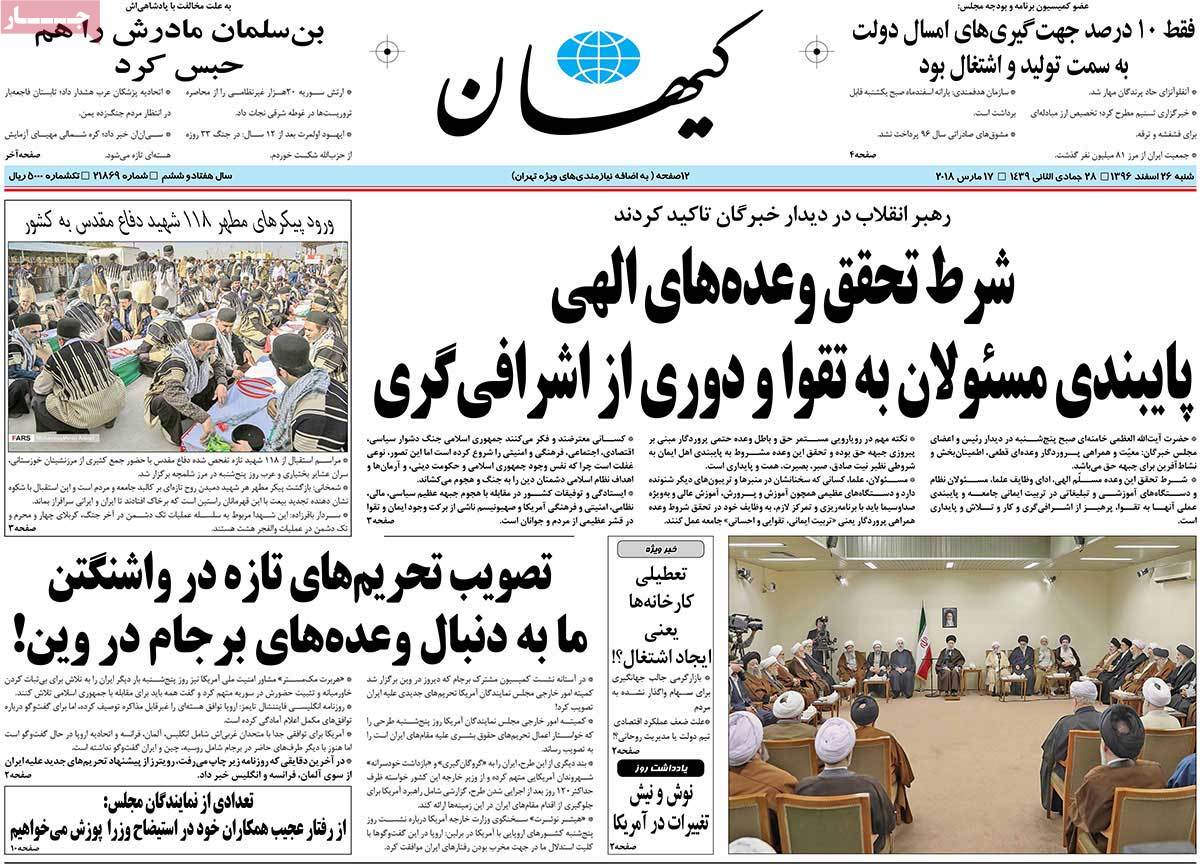
Kayhan:

  • Bin Salman Imprisons His Mother Due to Her Opposition to His Kingdom
  • New Sanctions Approved in Washington
  • We Still Looking for Realization of JCPOA Promises in Vienna

A Look at Iranian Newspaper Front Pages on March 17


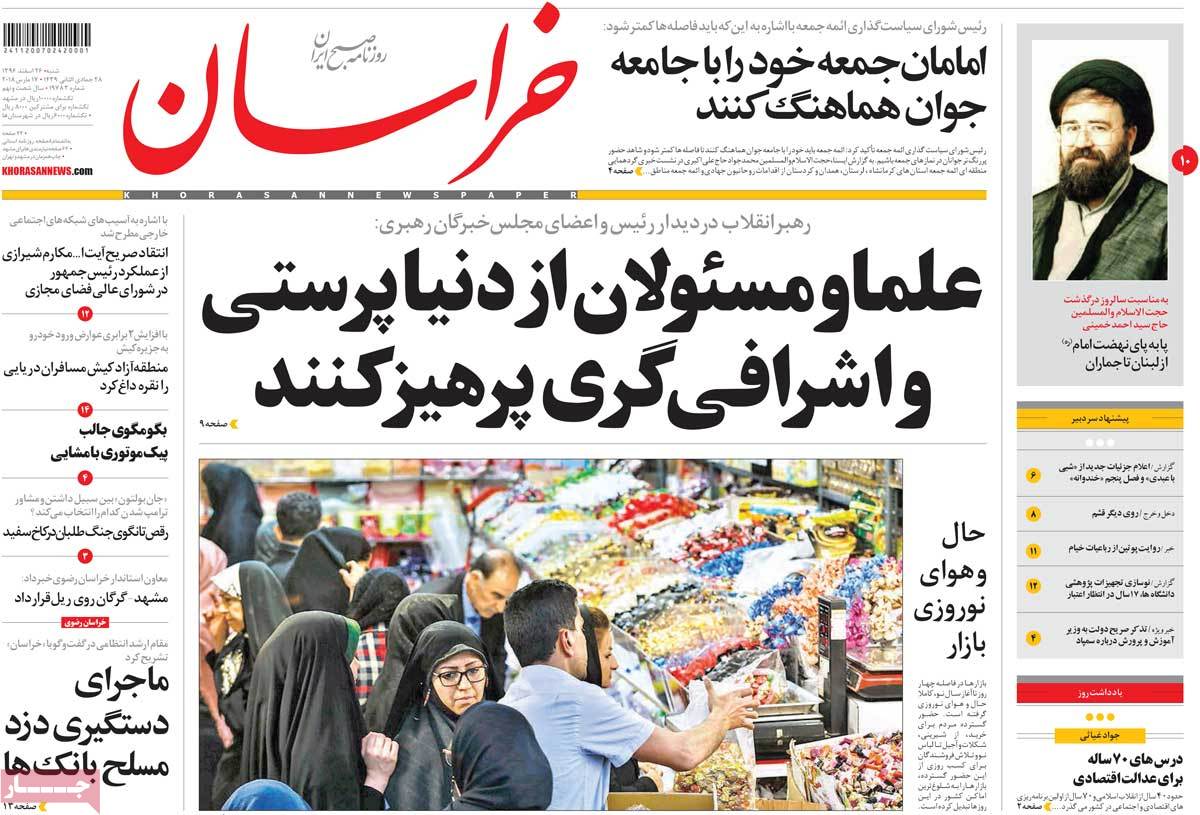
Khorasan:

  • Iran Leader: Top Clerics, Officials Must Avoid Aristocracy, Worldliness

A Look at Iranian Newspaper Front Pages on March 17


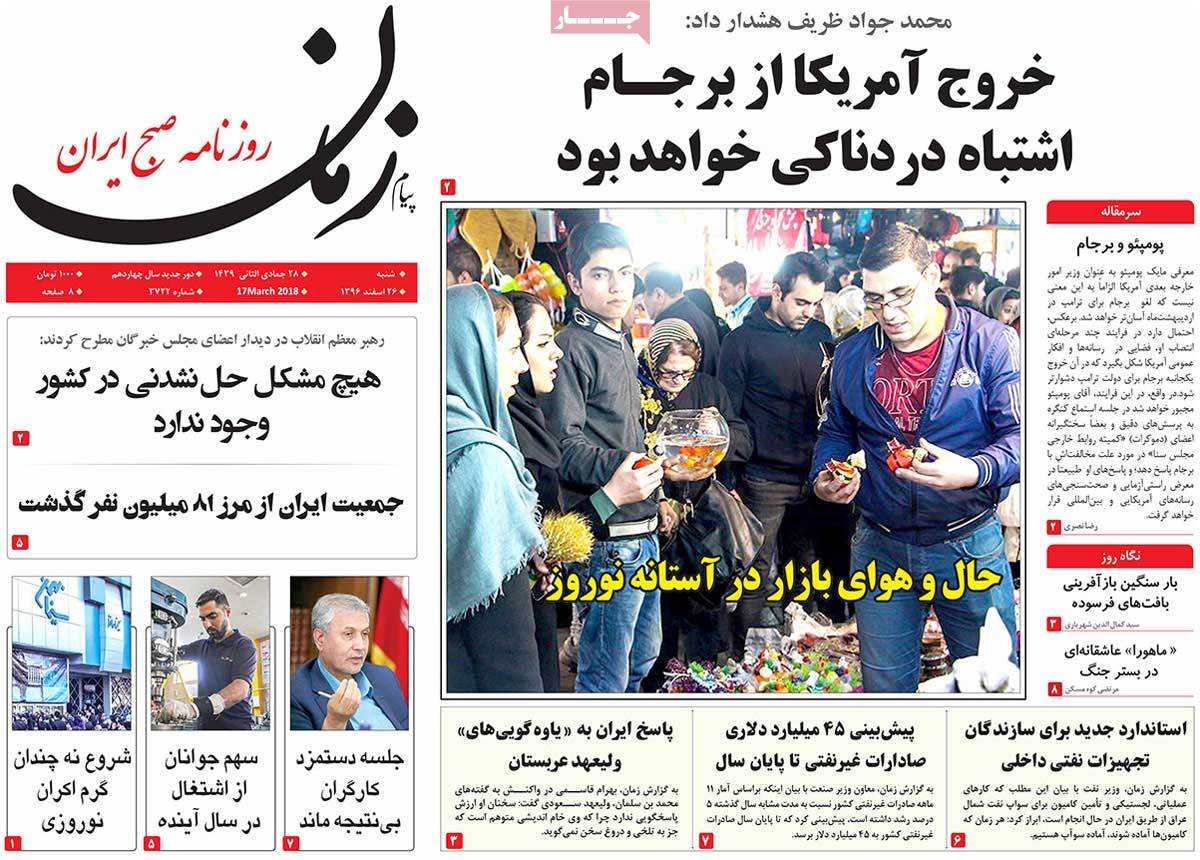
Payam-e Zaman:

  • Zarif Warns US Withdrawal from JCPOA to Be Painful Mistake
  • Iran’s Population Exceeds 81 Million

A Look at Iranian Newspaper Front Pages on March 17


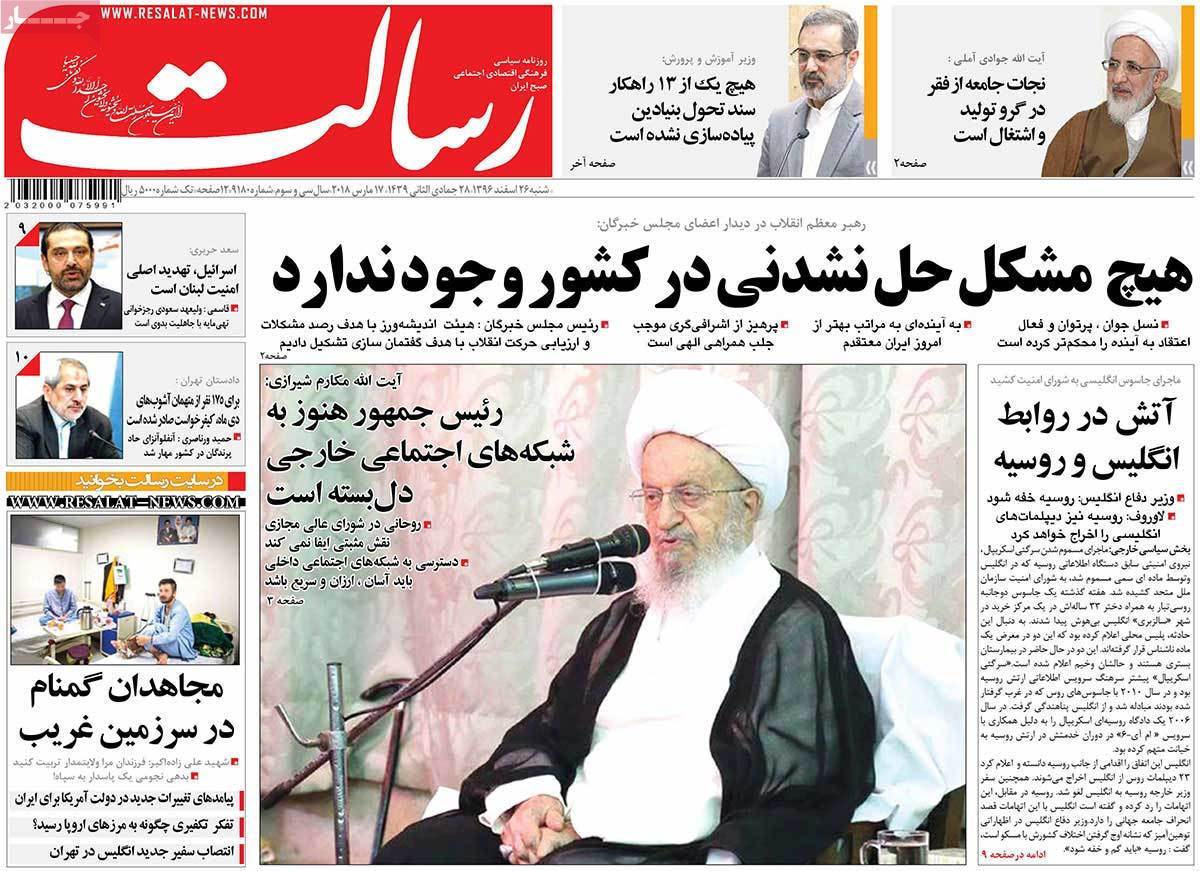
Resalat:

  • Fire in UK-Russia Ties: UN Security Council to Discuss British Spy’s Case

A Look at Iranian Newspaper Front Pages on March 17


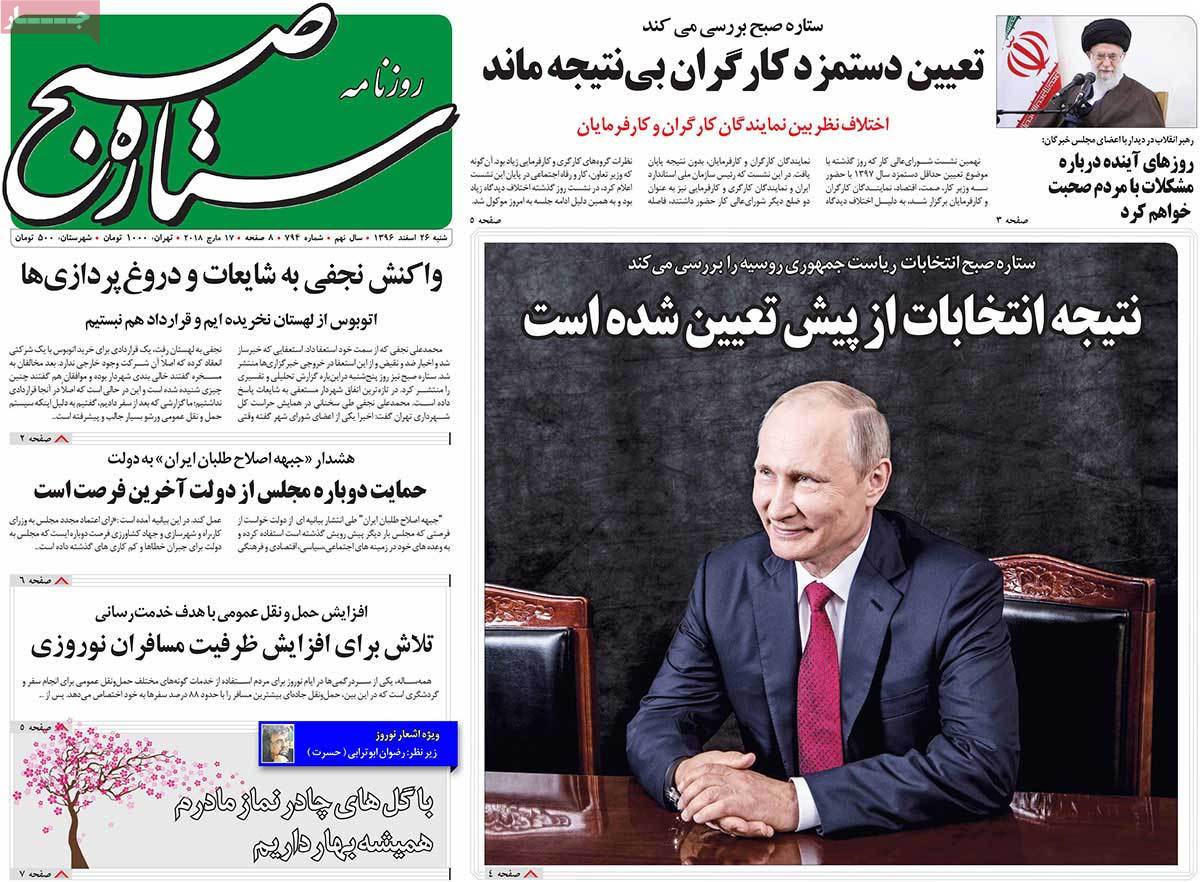
Setareh Sobh:

  • A Report on Russia Elections: Results Determined in Advance

A Look at Iranian Newspaper Front Pages on March 17


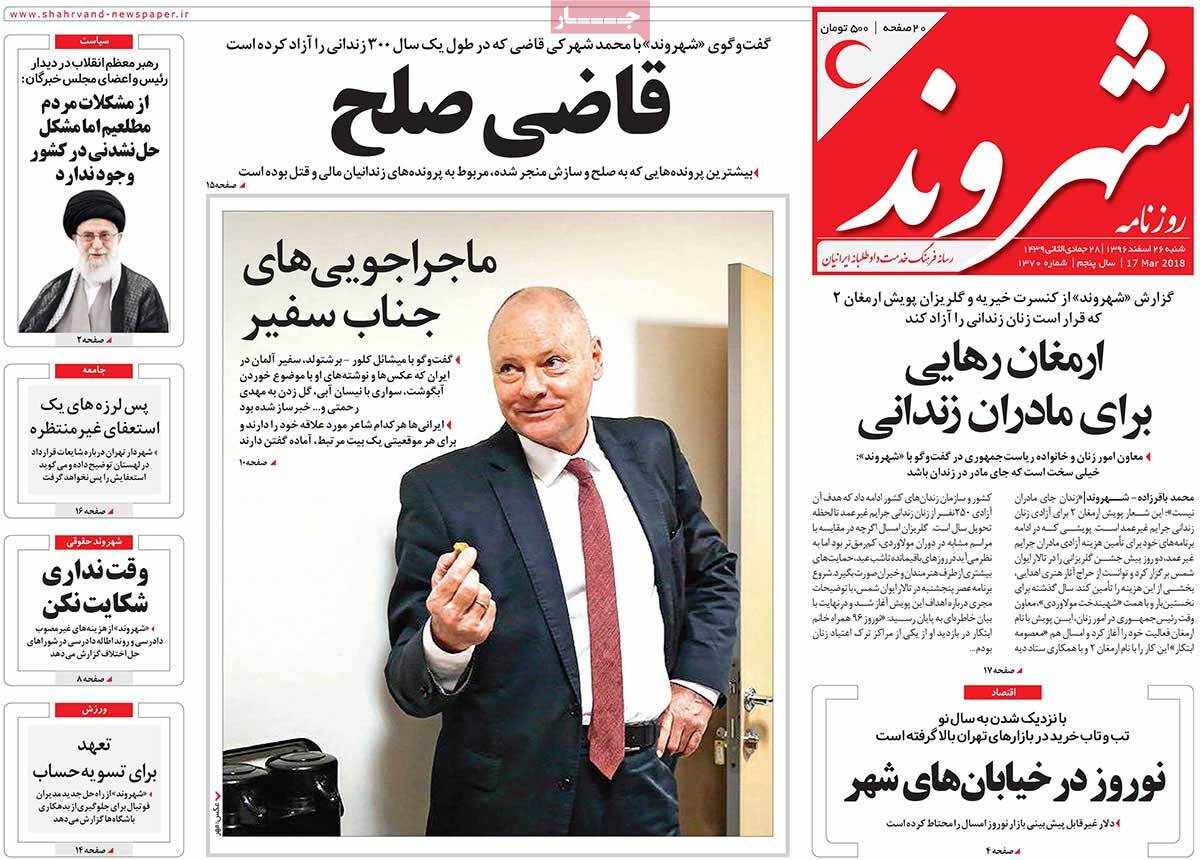
Shahrvand:

  • Gift of Freedom for Mothers in Prison
  • Charity Concert’s Revenues to Release Female Prisoners
  • VP for Women Affairs: It’s Very Hard for Mothers to Be in Prison
  • Mr Ambassador’s Adventures in Iran
  • German Ambassador Talks of Iranians’ Love for Poetry


A Look at Iranian Newspaper Front Pages on March 17


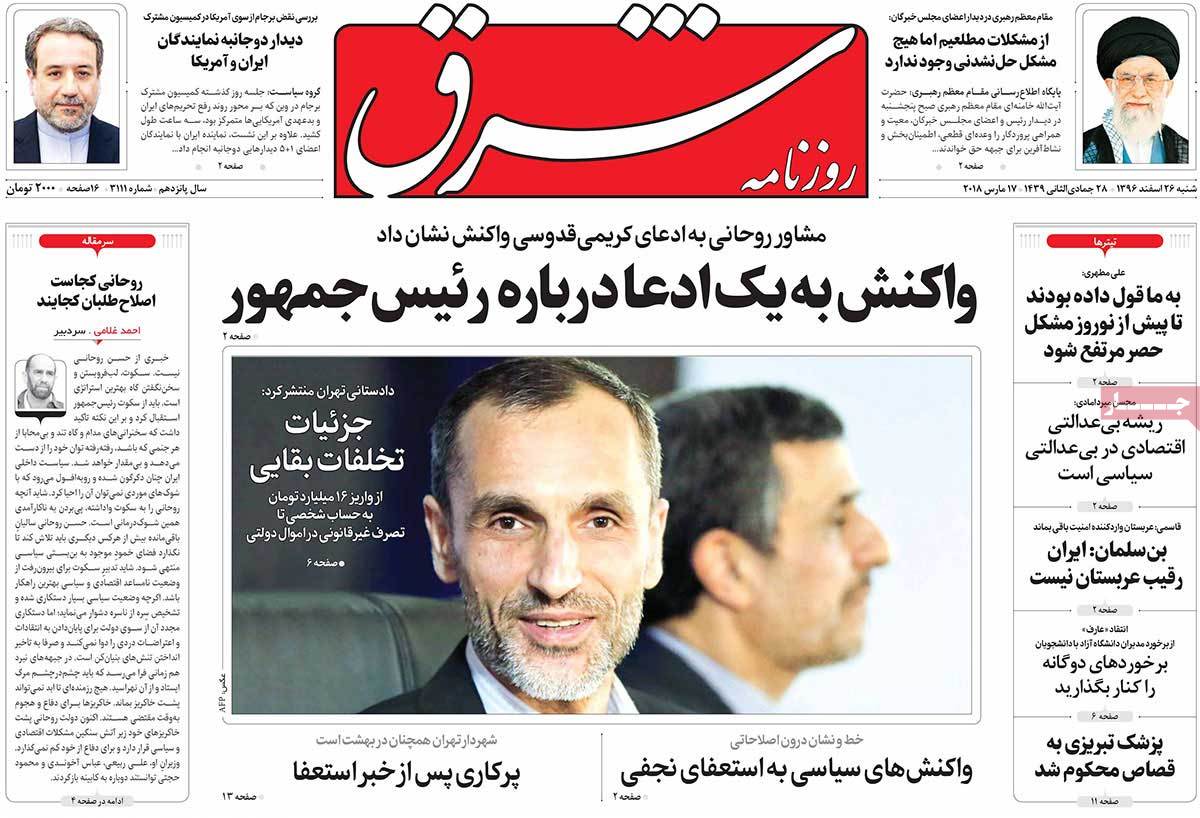
Shargh:

  • Bin Salman: Iran No Rival to Saudi Arabia
  • Representatives of Iran, US Hold Bilateral Talks in Vienna
  • JCPOA Joint Commission Discusses US Violation of Nuclear Deal

A Look at Iranian Newspaper Front Pages on March 17


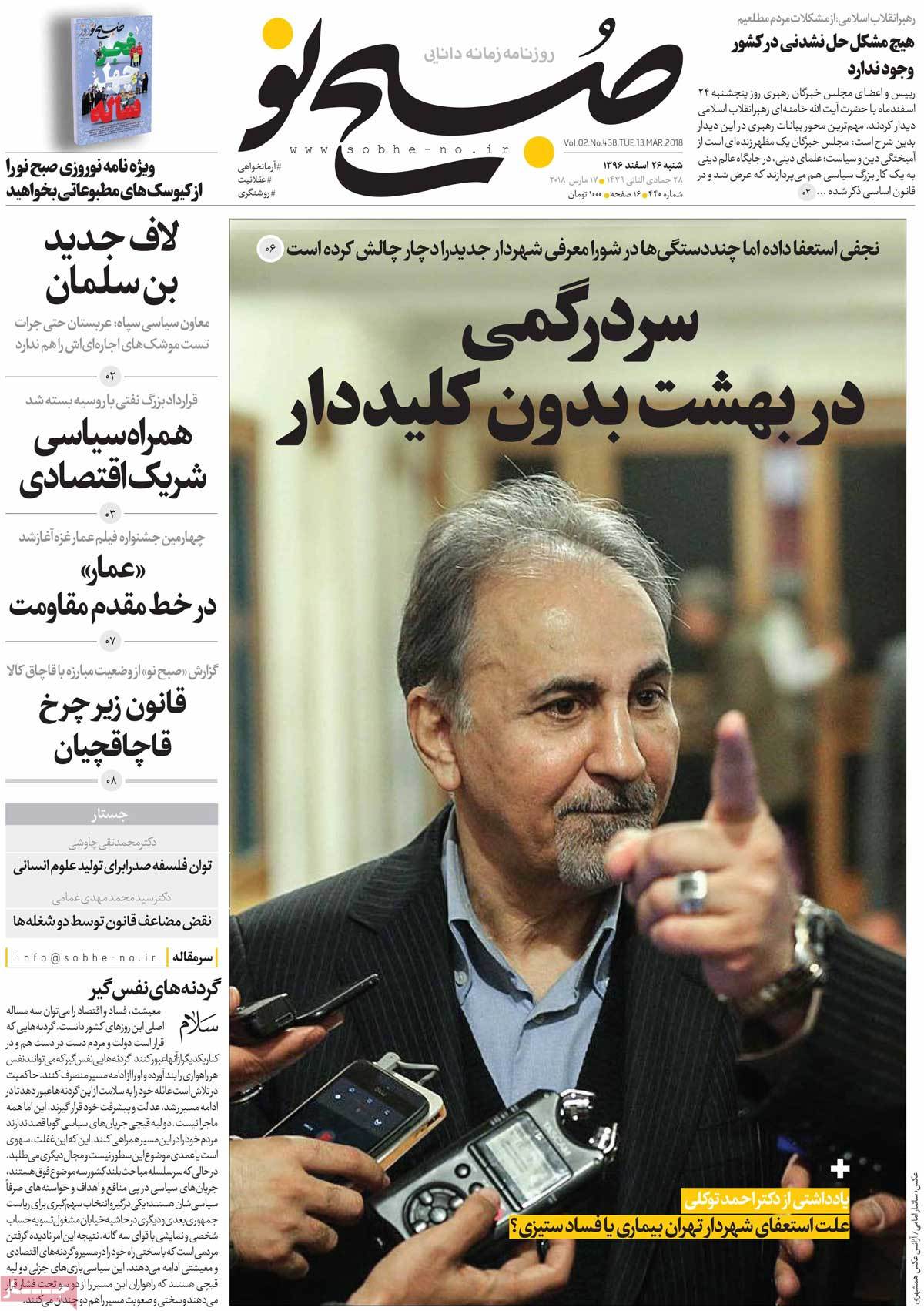
Sobh-e Now:

  • Bin Salman’s New Brag
  • IRGC: Riyadh Doesn’t Even Dare to Test-Fire Missiles It Has Rented

A Look at Iranian Newspaper Front Pages on March 17


Ta’adol:

  • Step by Step to Oval Office
  • Special Counsel to Probe into Trump Firm’s Role in Russiagate

A Look at Iranian Newspaper Front Pages on March 17


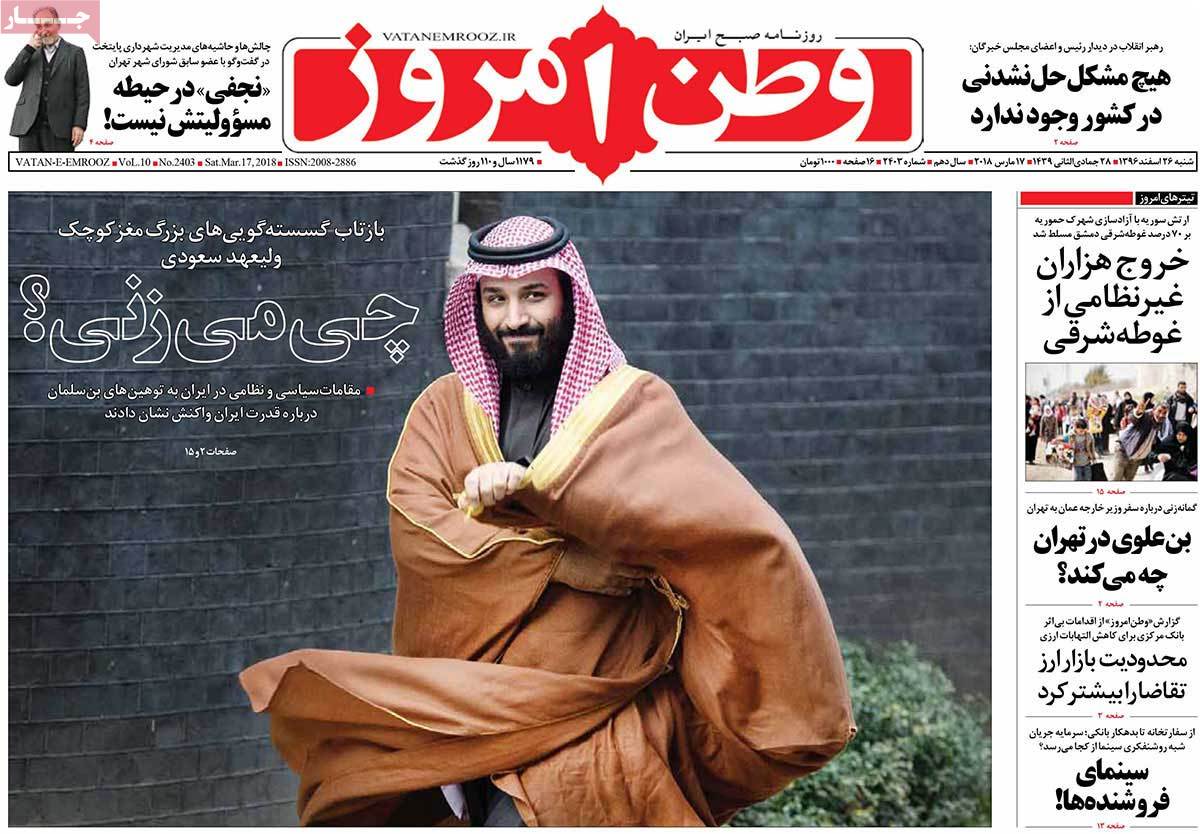
Vatan-e Emrooz:

  • Saudi Crown Prince, A Feeble-Minded Person Who Talks Nonsense
  • What Is Bin Alawi Doing in Tehran? Speculations about Omani FM’s Visit to Iran
  • Thousands of Civilians Evacuated from Eastern Ghouta

A Look at Iranian Newspaper Front Pages on March 17

“Oman FM’s Tehran Trip Unrelated to Mattis’ Muscat Visit”

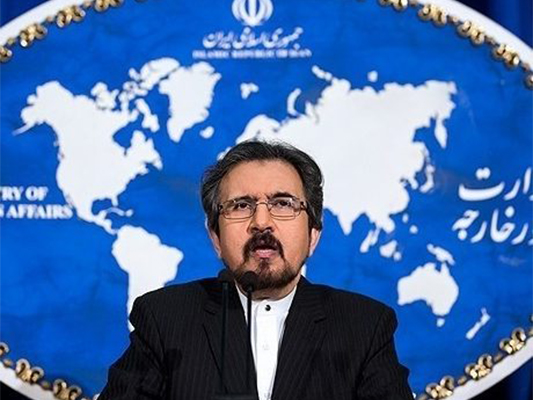
“The trip of Mr. Bin Alawi was made according to the schedule and to [help] develop bilateral ties,” said Bahram Qassemi in a Saturday statement.

Bin Alawi arrived in Tehran late Friday to hold talks with Iranian officials.

The spokesman said a constructive atmosphere prevails Tehran-Muscat relations and the two countries are eager to strengthen bonds of friendship.

“During the visit, he will meet the governor of the Central Bank of Iran and managers of governmental and private firms, in addition to political and parliamentary officials,” he said.

Qassemi said the trip is unrelated to an Oman trip by US Defence Secretary James Mattis last Sunday and the developments regarding the 2015 nuclear deal.

“Oman is an independent country that enjoys good relations with many countries. However, Mr Bin Alawi’s trip to Tehran has nothing to do with these issues,” he said.

During his visit to Muscat, Mattis discussed US concerns, particularly those related to the Yemen conflict, with Sultan Qaboos.

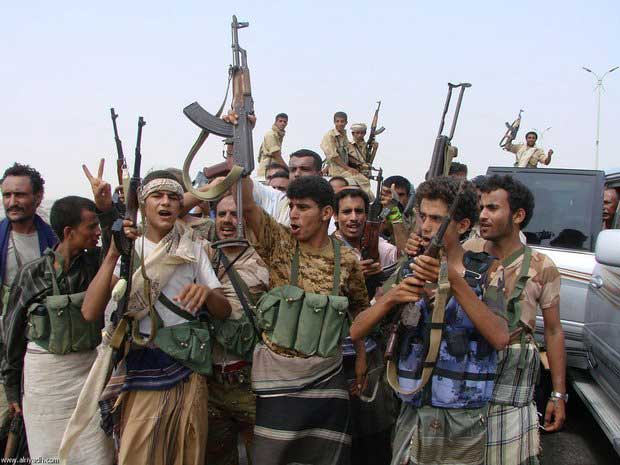
Since 2015, Yemen has been the scene of a Saudi military campaign, which Riyadh says aims to push Houti fighters out of the Yemen capital Sana’a and restore to power the fugitive president Abd-Rabbu Mansour Hadi.

The US, a staunch ally of Saudis in the war, has accused Iran of trafficking weapons through Oman to Houthi fighters.

Oman, traditionally on friendly terms with Iran, has often sought to play the role of a mediator in disputes between Tehran and Western capitals.

In 2013, Muscat hosted talks between Iran and Western powers that led to the landmark July 2015 deal.

“Opportunists” Kicked Out of Iran’s Former Embassy Building in Germany

Iran-Germany
Iran's former embassy in Germany's Bonn

In a statement released Saturday, Bahram Qassemi said, “With arrangements being made, and in a rapid response operation by the German police, the people who were illegally residing in the former building of the Iranian Embassy in Bonn in recent days were expelled.”

Speaking to ISNA, the spokesman said the building has been handed over the Iranian Consulate General in Frankfurt.

“These opportunist and adventurous individuals were 4, who had taken advantage of the building being empty in recent years, and resided in the building illegally and without permission for a few days,” Qassemi said.

Will Iran Block Telegram Messaging App Forever?

telegram

Iranian lawmaker Hamideh Zarabadi said on Saturday that “according to credible information from the ICT ministry, the permanent blocking of Telegram for the next year [starting March 21] has been approved by the Supreme Council of Cyberspace.”

However, the Council’s Public Relations Department later rejected Zarabadi’s comments, saying in a statement no decision has yet been taken to block Telegram.

The remarks came shortly after remarks by the head of the country’s cybercrime committee Abdolsamad Khoramabadi that a consensus has emerged among government officials to diminish the “control and influence of adversaries on the country’s cyberspace.”

“We will soon witness key measures to save the country’s cyberspace from the dominance of foreign social networks and the migration of people from foreign services to domestic ones”, he said in a post on his channel on the Iranian Soroush messaging app.

Khoramabadi, who was addressing speculations that a ban on Twitter and YouTube could be lifted in the near future, said the two services have been blocked based on a judicial verdict and could not be back online in Iran.

For a brief review of Iran’s achievements in various fields of science and technology, check the book “Science and Technology in Iran: A Brief Review

“The filtering of Twitter and YouTube results from disrespecting for the country’s law, publishing millions of criminal content.”

He said the country intends to “block cyber-espionage activities and end the dominance of foreigners on the country’s cyberspace.”


It Doesn’t Work

“These statements are meant to prepare public opinion for the implementation of the decision,” Zarabadi said in a talk with the Persian-language Iran’s Labour News Agency (ILNA).

The lawmaker said the ban on Telegram will not stop Iranians from using the app, as the affiliation of local messaging apps with governmental institution will prevent Iranians from trusting them.

Some Iranians use VPN apps to get around blocks on sites such as Twitter and YouTube.

The Telegram app, which allows users to send encrypted messages and has at least 40 million users in Iran, was shut down in Iran last January, amid price protests that began in the eastern city of Mashhad before spreading to several cities across the country.

The demonstrations later turned political and violent in some cities, leaving several dead and injured.

The ban came after the Iranian government requested Telegram to block channels inciting armed violence in Iran. Telegram initially agreed to shut down one channel accused of encouraging armed clashes.

However, the Supreme Council of Cyberspace blocked the service after it restored access to the channel and refused to take down similar channels.

The restrictions on Telegram were lifted two weeks later, after President Hassan Rouhani reportedly fought for the government to reinstate access to the service.

Rouhani said during the protests that the restrictions were necessary, but should not be “indefinite”, arguing that doing so would undermine citizens’ rights and exacerbate job losses associated with the restrictions.

Zarabadi says she believes the government ought to voice its opposition to the decision to block Telegram, if it really favours open access to social media.

“Otherwise, people will naturally believe the government is not opposed to the decision,” she said.


Iran Warns Europe against Proposing New Sanctions

“If some European countries go after imposing non-nuclear sanctions on Iran to appease the US president, they would make a big miscalculation and will see its impact on the deal and its continuation,” Iran’s Deputy Foreign Minister for Political Affairs Abbas Araqchi said on Friday.

“European countries ought to keep pushing the US to fulfill its obligations under the deal,” he added, speaking before leaving Vienna for Tehran.

“There is no other way for the US and other parties to keep the deal in place but showing full commitment to obligations,” Aqarchi was quoted as saying by the Persian-language Islamic Republic News Agency.

His remarks came after Reuters reported Friday that according to a confidential document, Britain, France and Germany have proposed fresh EU sanctions on Iran over its ballistic missiles and its role in Syria conflict, in a bid to persuade Washington to preserve the 2015 nuclear deal.

The joint paper, seen by Reuters, was sent to European Union capitals on Friday, said two people familiar with the matter, to sound out support for such sanctions as they would need the support of all 28 EU member governments.

The proposal is reportedly part of an EU strategy to save the accord signed by world powers that curbs Tehran’s ability to develop nuclear weapons, namely by showing US President Donald Trump that there are other ways to counter Iranian power abroad.

Trump delivered an ultimatum to the European signatories on Jan. 12, saying they must agree to “fix the terrible flaws of the Iran nuclear deal” or he would refuse to extend US sanctions relief on Iran.

The report was published shortly after the end of the 11th meeting of the Joint Commission of the Joint Comprehensive Plan of Action in Vienna.

European Union foreign ministers will discuss the proposal at a closed-door meeting on Monday in Brussels, European diplomats told Reuters.

Iran Says Welcomes Baghdad-Erbil Agreements

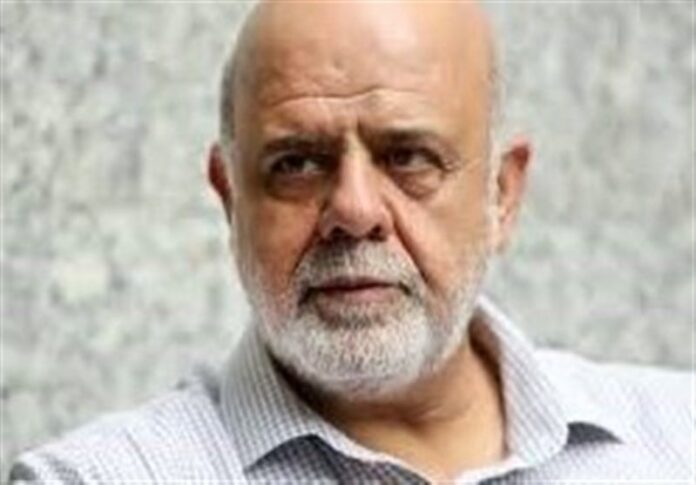
In a message released late on Thursday, Masjedi pointed to the recent negotiations between Baghdad and Erbil that led to the resumption of worldwide flights to the Kurdistan Region’s two main airports and said Iran has always stressed the necessity for dialogue to settle disputes and problems in Iraq.

The diplomat also pointed to Tehran’s close relations with all Iraqi tribes and political groups and said the Islamic Republic supports all peaceful efforts to settle disputes in Iraq.

He further hailed recent agreements between the Baghdad and Kurdish officials as effective in boosting economic and social relations inside and outside of Iraq and expressed the hope that the new deals would improve economic conditions in various parts of the Arab country.

In an official statement issued on Tuesday, March 13, Iraqi Prime Minister Haider al-Abadi declared that an international flight ban on the Kurdistan Region – a semi-autonomous region in northern Iraq – had been lifted, the Kurdistan 24 reported.

According to another statement issued by Abadi’s office on March 15, the Iraqi premier ordered the reopening of the region’s two main airports – the Erbil International Airport (EBL) and Suleimaniya International Airport (ISU) – for international flights.

People in the Iraqi Kurdistan Region voted for independence on September 25 in a controversial referendum, amid rising tensions and international opposition.

The referendum set off a chain of events, culminating in a military confrontation between Erbil and Baghdad.

Iraqi government forces launched a major operation in Kirkuk on October 16 and took control of its oil fields and a strategic military base without any armed clashes.

Analysts believe that the decision to hold the referendum in the face of near-universal condemnation was a colossal miscalculation, saying Kurdistan’s former president Masoud Barzani undermined his legitimacy by making such a move.

The Kurdistan Regional Government announced on October 25 it is prepared to freeze the results of the referendum.

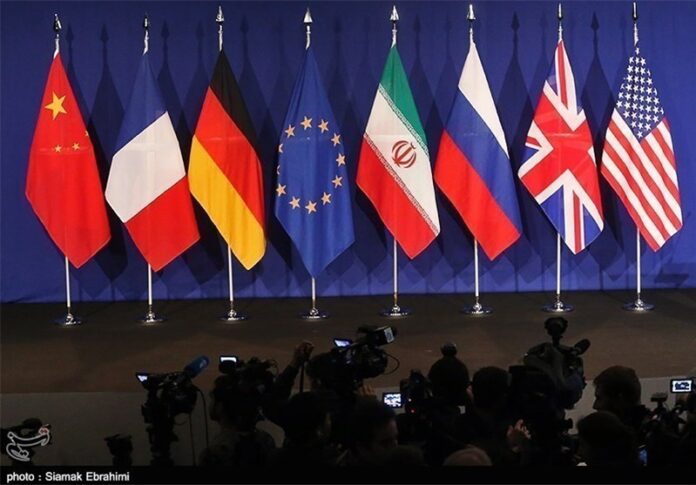
“Signatories Agree to Maintain Iran Nuclear Deal amid Trump Threats”

Nuclear Deal Talk, JCPOA, Flags

“There was a consensus among parties – against the US – that the deal must be continued […],” said Abbas Araqchi, the Iranian deputy foreign minister for political affairs who headed the country’s delegation to a fresh round of talks on the nuclear deal.

Araqchi made the statement while speaking to reporters after the 11th meeting of the Joint Commission of the Joint Comprehensive Plan of Action (JCPOA) in Vienna on Friday, according to a Farsi report by ISNA.

The meeting of the commission, tasked with monitoring the implementation of the nuclear deal, was held as US President Donald Trump has issued an ultimatum to European countries that the US will walk away from the 2015 agreement in mid-May unless they join Washington in addressing what he alleges are its “fatal flaws”.

Iran has so far held its ground, insisting it is not going to make new concessions to save the nuclear deal.

Araqchi, a member of the Iranian team who negotiated the pact, said the Iranian team has raised frequent violations of the deal by the US, calling for a change of tack in the US approach.

“From Iran’s point of view, threatening to walk out of the JCPOA is itself a violation of the deal, as all parties to the pact are committed to implement the deal in a good faith and constructive atmosphere,” Araqchi said, adding that other sides agreed with Iran’s position.

After the meeting, Araqchi also held bilateral talks with the head of the US delegation Brian Hook on the US violations of the pact and the Iranian nationals imprisoned in the US over accusations they have violated the remaining US sanctions on Iran.

Saudi Army Bogged Down in Yemen: Iran

Hamid Aboutalebi in response to Bin Salman said on his Twitter page, “Your Excellency’s concern that Iran’s Army is among the top few armies of the world, and not [only] of the Muslim world, is a nightmare that will last forever, and you had better get along with it.”

“But what everybody agrees on is the reality that Yemen has nothing which can be called an army, and your army is bogged down in this army-less country,” he added.

“One’s claim should match one’s capability,” Aboutalebi noted.

His remarks came after Bin Salman claimed Iran is not in Saudi Arabia’s league and the Islamic Republic’s army is not even among the top five greatest armies of the Muslim world.