Saturday, December 27, 2025
Home Blog Page 3564

Iraq Major Customer of Iran’s Medicinal Herbs

Medicinal Plant

The western Iranian province of Kermanshah is among the areas home to a large variety of medicinal herbs and one of the provinces exporting the products.

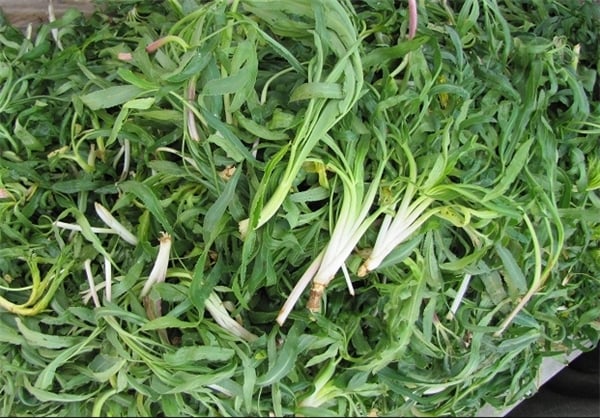
“Only yesterday (April 21, 2018) some 20 tonnes of spear thistles produced just from the farms created by people were exported to Iraq, and this can be a good source of income for the country,” said Morad Sheikh Veisi, the director general of the Watershed and Natural Resources Management Department of Kermanshah Province.

Mehr News Agency quoted him as saying that a whole variety of other types of herbs are also produced and exported.

“Out of around 2,000 species of flora which grow in Zagros region, 800 species grow in Kermanshah province, of which 200 are regarded as medicinal and edible herbs,” he said.

The official noted that people are interested in using medicinal and edible herbs, especially in spring. However, he underlined that some people have put different species of medicinal herbs on the verge of extinction through the excessive and unrestrained picking of the plants.

He said some species of the medicinal herbs are on the brink of extinction and can only be found in hardly negotiable passageways. He called on people to avoid the excessive exploitation of areas where medicinal herbs grow.

Given the growing interest in the use of natural products of medicinal and food industries in the global healthcare debates, Iranian people, officials, and industries have increasingly considered the benefits of medicinal herbs and significance of integrating traditional medicine into modern healthcare system and supporting it.

According to the data released by the Iranian Vice-Presidency for Science and Technology, Iran is home to 8,000 herb species, and 2,500 species with medicinal properties and applications such as spice, fragrance, and cosmetics. It also has a rich heritage of traditional medicine with over 14,000 reference books and elegant works such as Avicenna’s Canon of Medicine and Book of Healing, Al-Razi’s Al-Havi, and Zakhireh-i Kharazmshahi.

Given its great potential in the field of medicinal herbs, the country plans to increase the export of medicinal herbs, herbal-based products and herbal products to join the top 10 countries in the world.
Iran Designs System to Inspect Airbus A320’s Landing Gear

Iran Designs System to Inspect Airbus A320’s Landing Gear

CEO of Iran Air Farzaneh Sharafbafi says “it is an honour we now have the technical know-how of producing the system required for checking the landing gear in the country.”

“This technical knowledge is much more valuable than the production itself,” she added, according to a Farsi report by Young Journalists’ Club (YJC).

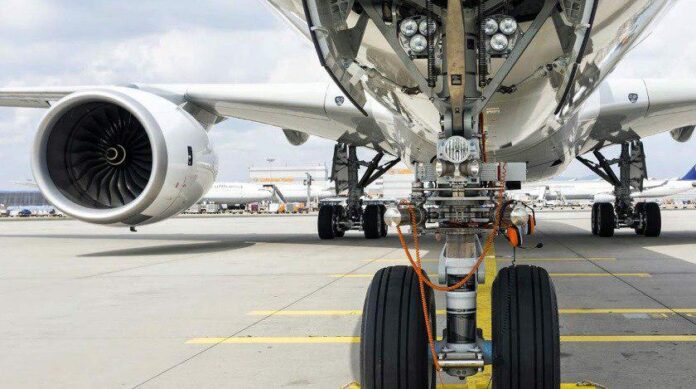
The landing gear is the sole direct link between the airframe and tarmac and is vital to the safe conclusion of the flight. Like all other components which make up an aircraft the landing gear – often simply known as the “legs” by aircrew and ground crew – the landing gear is also checked and maintained on a daily basis, repaired as required and fully overhauled at regular intervals.

A full landing gear overhaul is a task for specialists that requires the use of special tools, equipment and technology. For this reason, for some long time many airlines have sub-contracted this work to organizations with commensurate equipment and know-how, but according to Sharafbafi Iran Air is now able to do the job itself.

Under the cruel sanctions, Iran could not import aviation products to the country. The sanctions also preclude non-American manufacturers from exporting plane parts to Iran if the US-made parts exceed 10 percent.

The Islamic Republic’s aviation industry is a sector rapidly drawing increasing attention. As evidenced by the inaugural flight of Iran’s indigenously designed and manufactured Azarakhsh fighter jet to the mass production of small turboprops and passenger planes, this sector was seen to be making rapid strides.

Part of the impetus for the development of this industry lay within domestic demand factors. It was for a time estimated that over 10% of total demand for passenger planes in the Asian-Pacific market was in Iran, as domestic passenger traffic was expected to top eleven million passengers by the year 2000. This massive demand also spurred private sector investment in this sector as evidenced by the establishment of 17 private airlines.

Iran’s aviation industry infrastructure was by and large established in the 1970s. The Iran Helicopter Support and Renewal Company (IHSRC), or Panha Company, was formed in 1969, the Iranian Aircraft Industries (IACI) in 1970, and Iran Aircraft Manufacturing Industries Corporation (IAMI), also known under its Farsi acronym (HESA), in 1974.

Two other important companies, Iran Aviation Industries Organization of the Armed Forces (IAIO), also known as the Iranian Armed Forces Aviation Industries Organization (IAFAIO), and Quds Research Centre were formed in the early 1980s. These companies progressed from repair and maintenance facilities to larger defence enterprises with several thousand employees.

Joint aircraft technology projects with Russia were supplemented by such projects as the indigenously designed and manufactured Shabaviz helicopter manufactured by the IHSRC and the S-68 turboprop trainer manufactured by Iran Aircraft Industries.

The IHSRC in Tehran is a producer of the helicopter’s body and maintenance of helicopters according to American standards. However, the achievements of Iran’s aviation industry has not only been limited to the manufacture of planes. Iran Air had successfully and completely overhauled a number of planes in its fleet, without any foreign assistance as have other local companies such as Aseman.

According to the data released by the Iranian Vice-Presidency for Science and Technology, Iran plans to design and manufacture 100-150-seat regional aircrafts and general aviation airplanes in accordance with national and global market demands. It also aims to design and manufacture medium and semi-heavy helicopters, and design and manufacture mini turbojet engines, light and heavy turbofan engines and gas turbine engine compressors with a capacity of 1-10 MW.

Iran Strongly Denounces Kabul Terrorist Blast

Bahram Qassemi

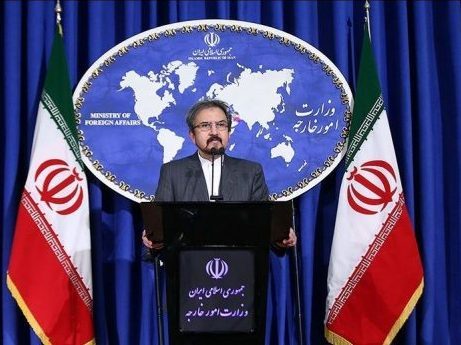
In a Sunday statement, Qassemi extended Iran’s condolences to the Afghan nation, government as well as the families of the victims of the deadly attack.

He also expressed hope that terrorism in all its aspects and forms would be eradicated soon in the region and the whole world through joint resolve and attempts by all states at bilateral, regional and international levels.

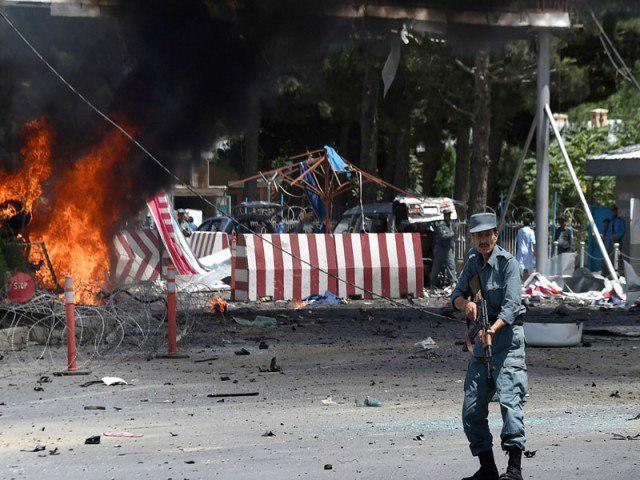
At least 45 people were killed and over 60 others injured earlier Sunday in a blast targeting a voter registration centre in Kabul.

Police say the explosion occurred when a bomber detonated explosives in Dasht-e Barchi area. The ISIS terror group has claimed responsibility for the attack.

Voter registration centres have been set up across Afghanistan in preparation for long-delayed parliamentary elections due to be held in October. The bombing is the fourth attack against the election process in less than a week.

Dasht-e Barchi is largely inhabited by members of the Shiite Hazara minority, which has been repeatedly targeted by ISIS terrorists.

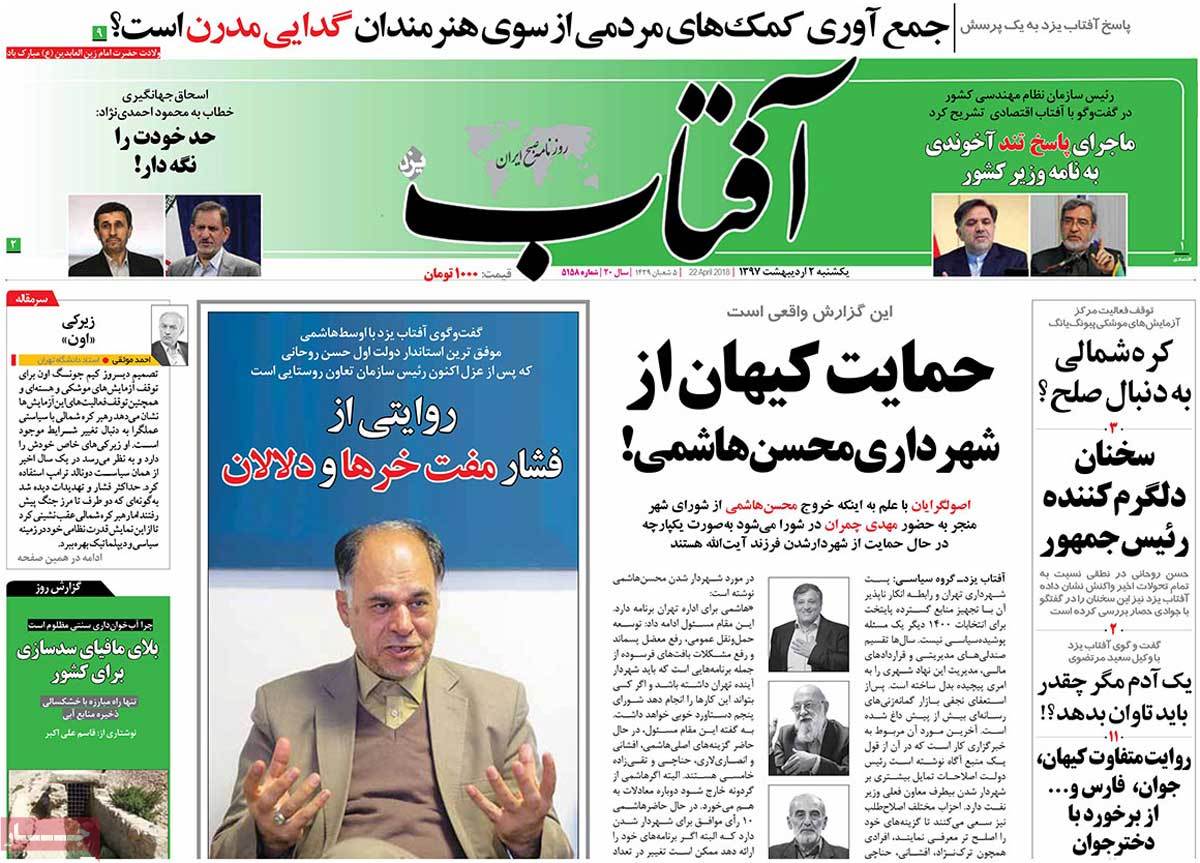
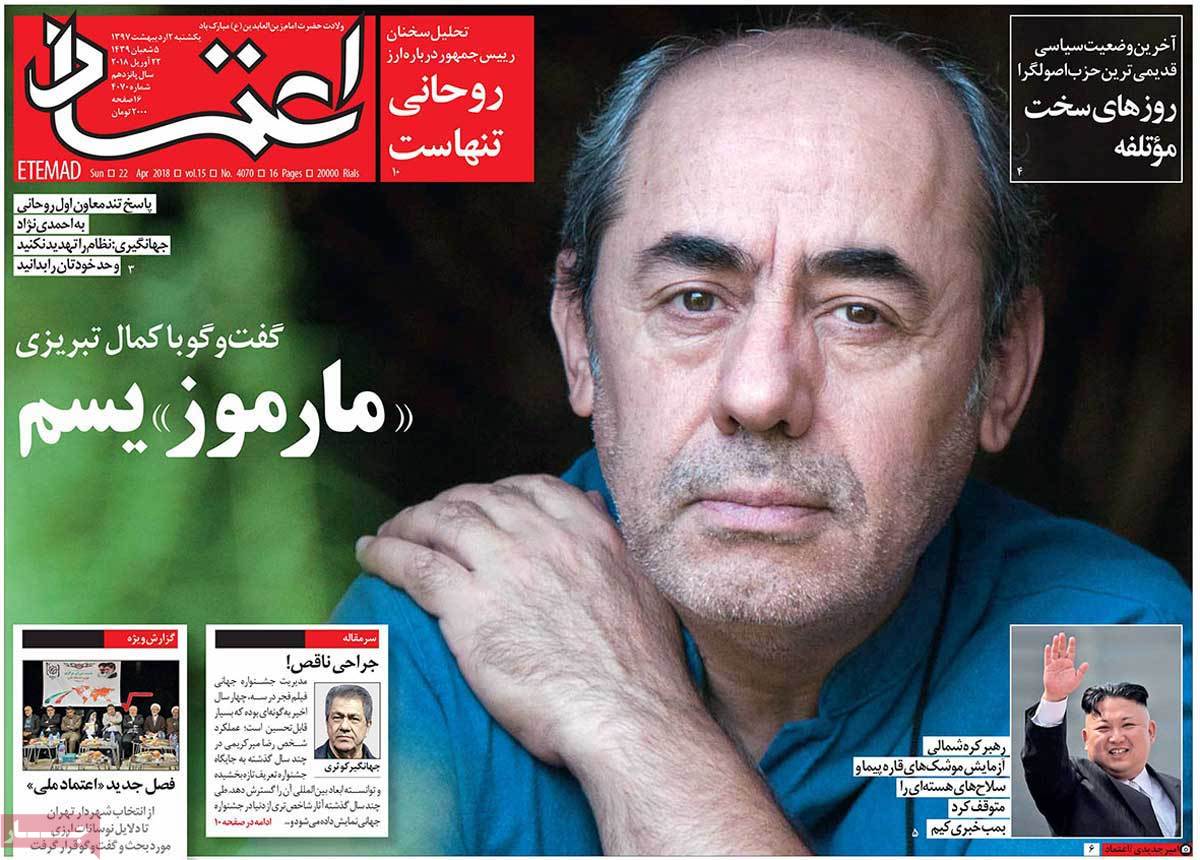
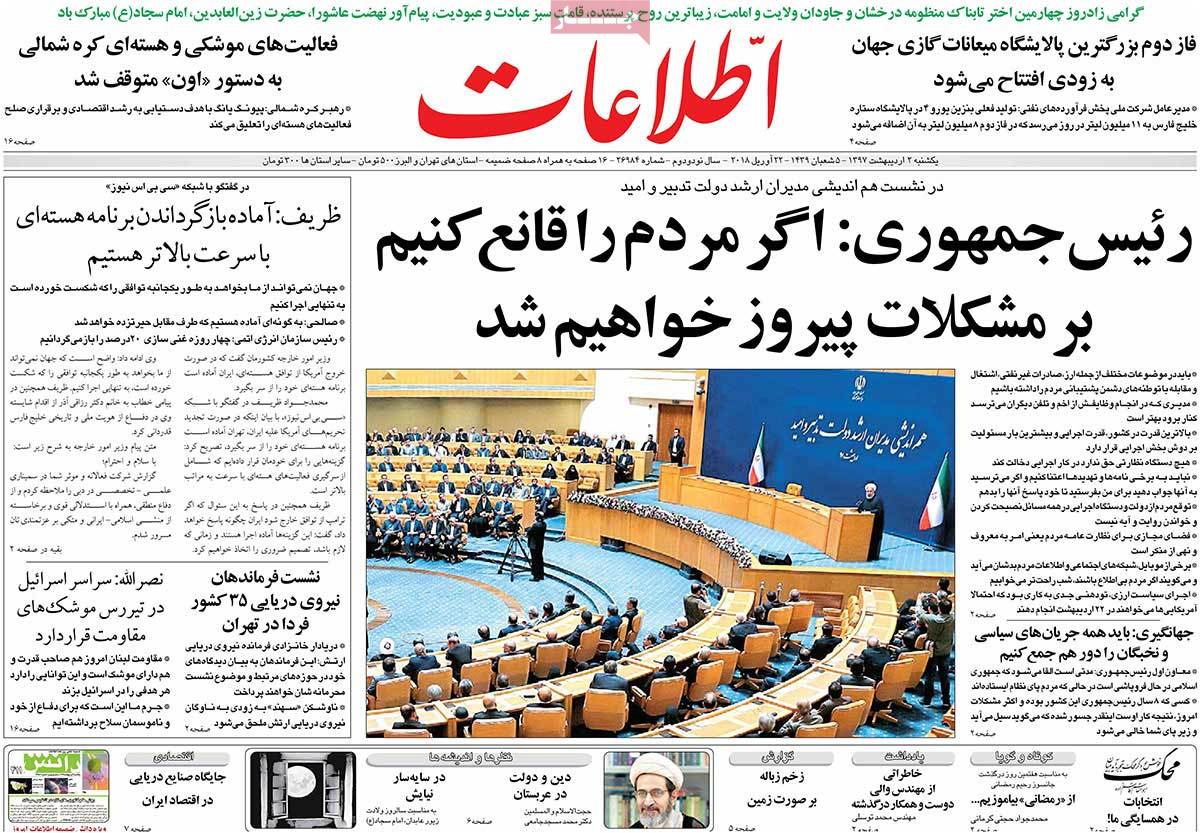
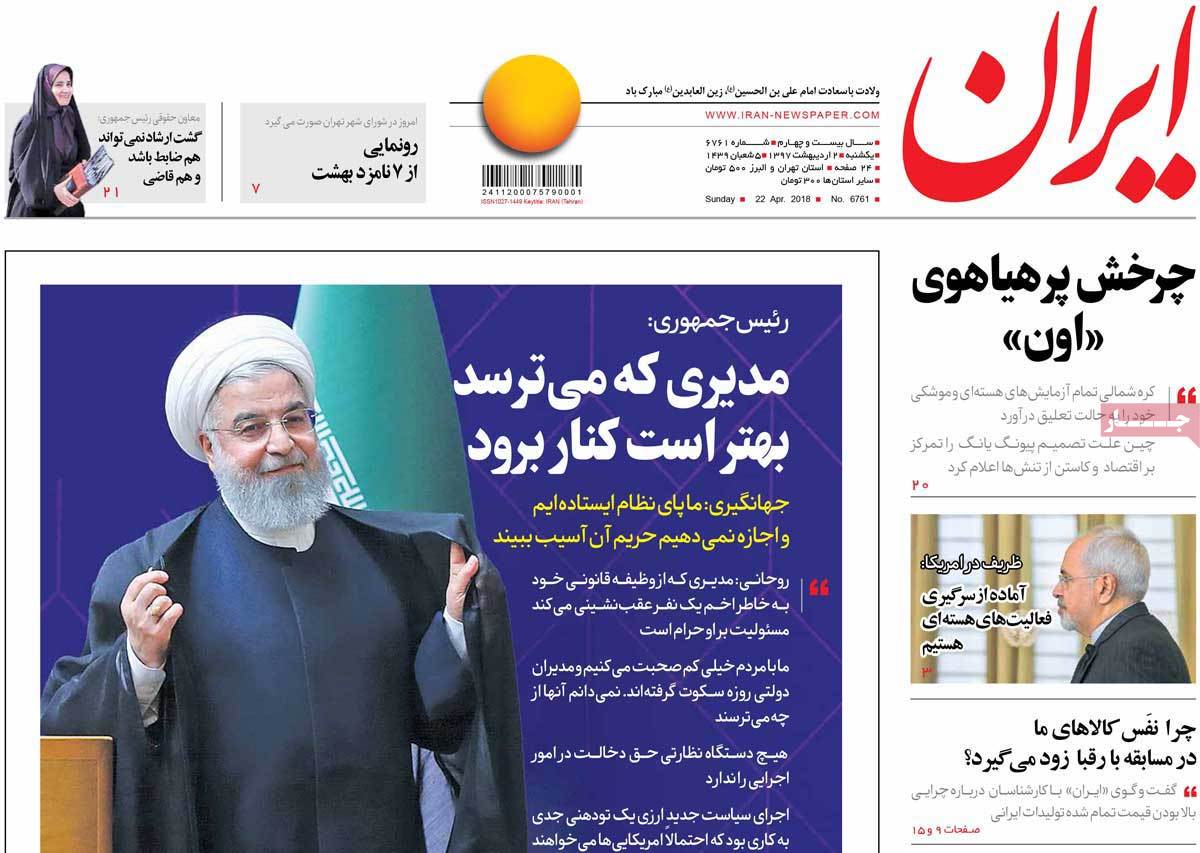
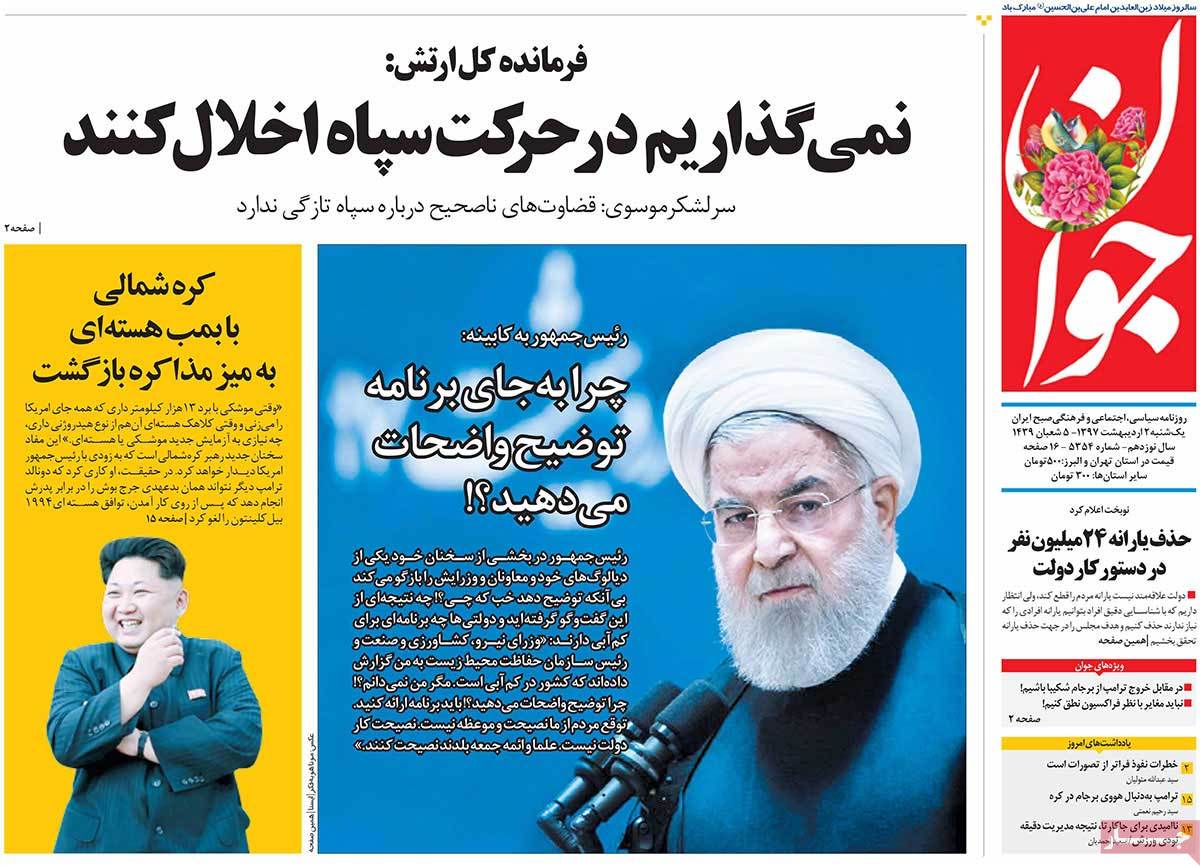
A Look at Iranian Newspaper Front Pages on April 22

A Look at Iranian Newspaper Front Pages on November 19

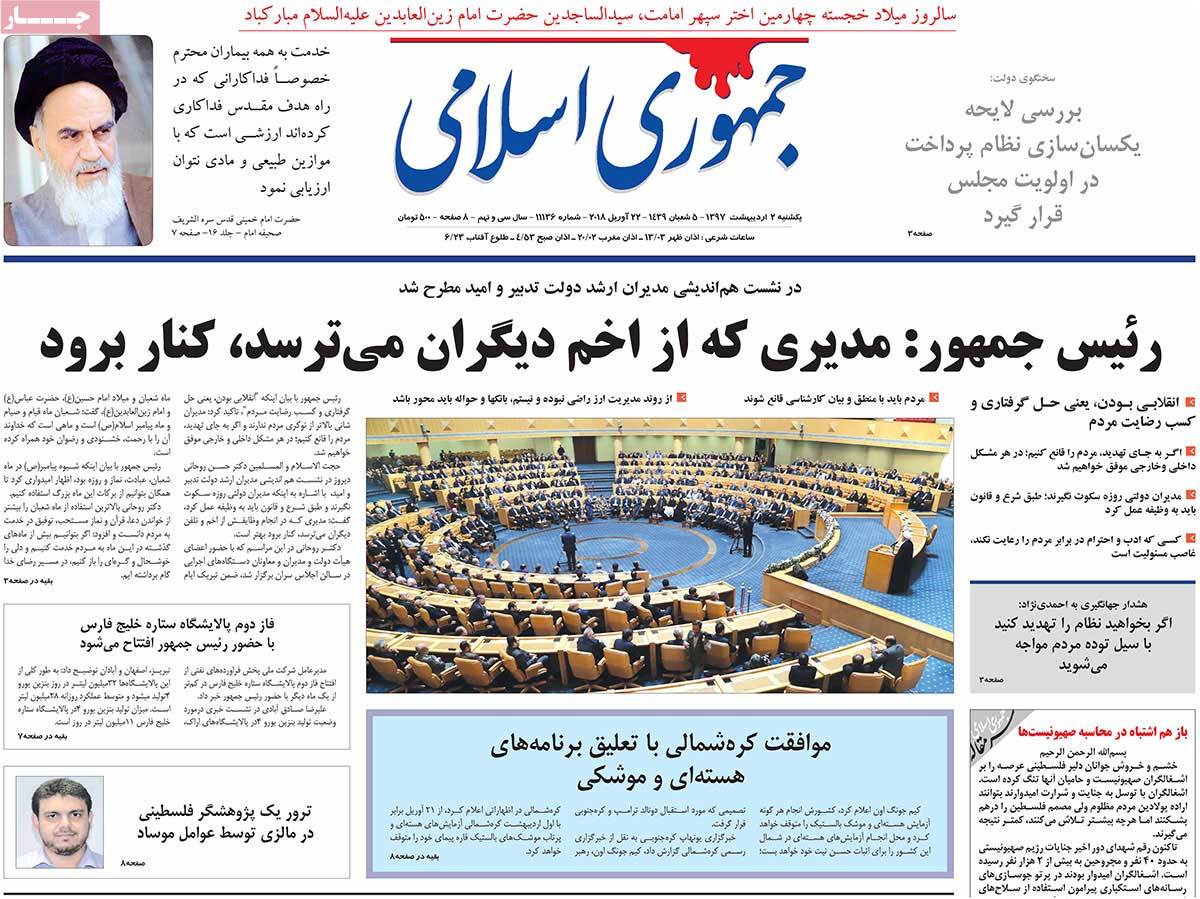
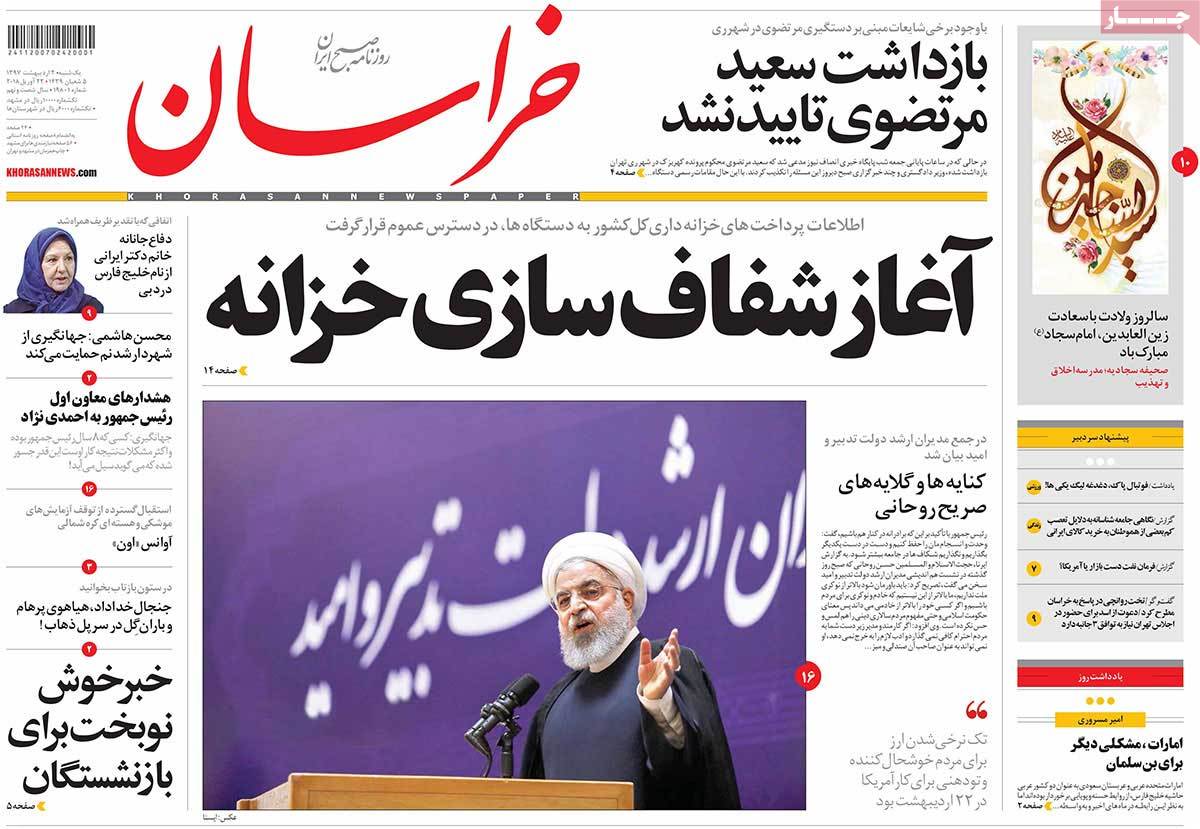
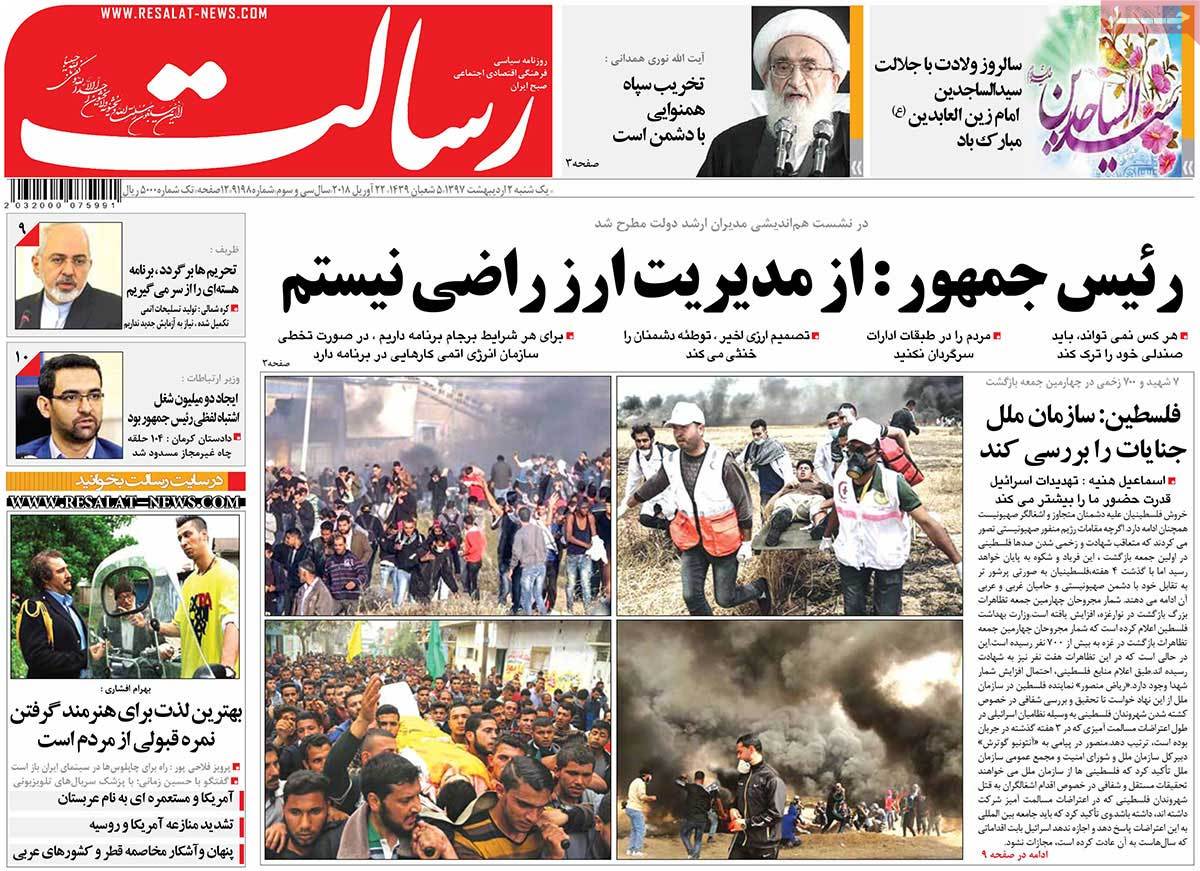
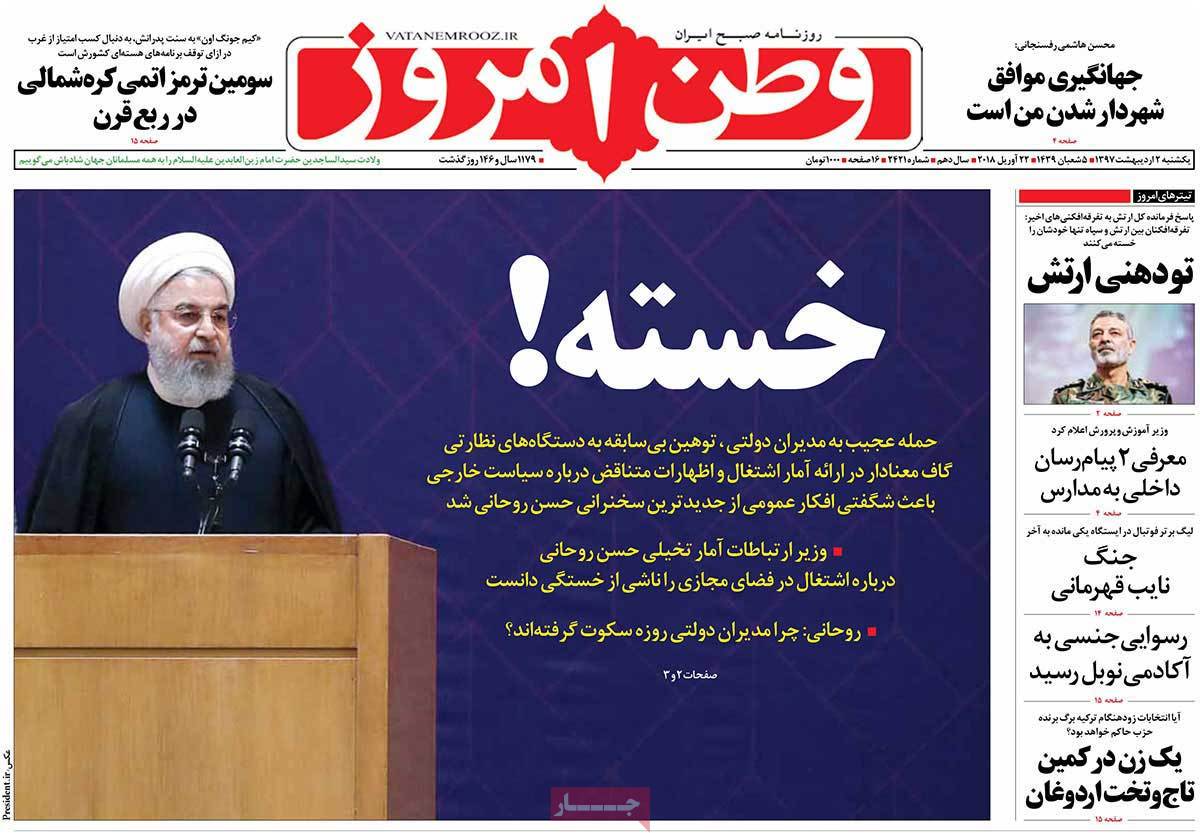
Almost all papers today covered the remarks made by Iranian President Hassan Rouhani in an address to a group of top executives and cabinet members.

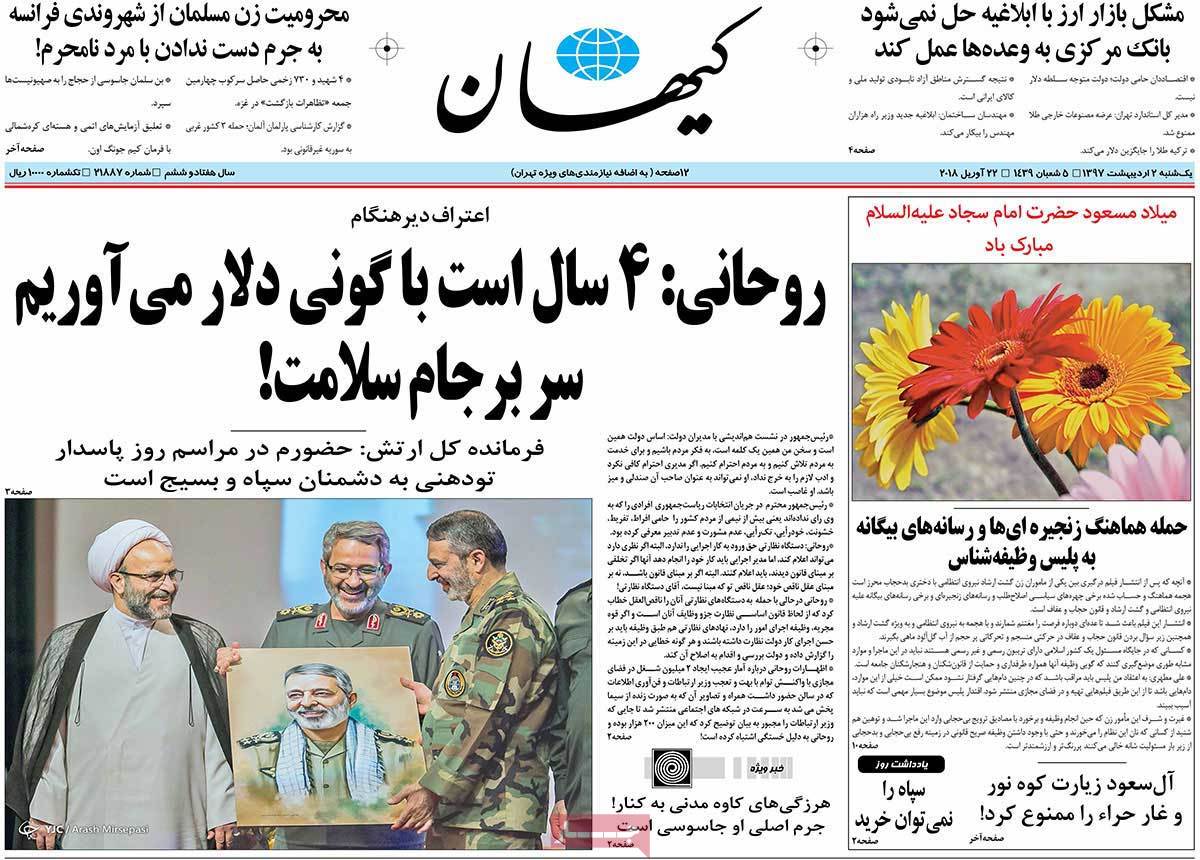
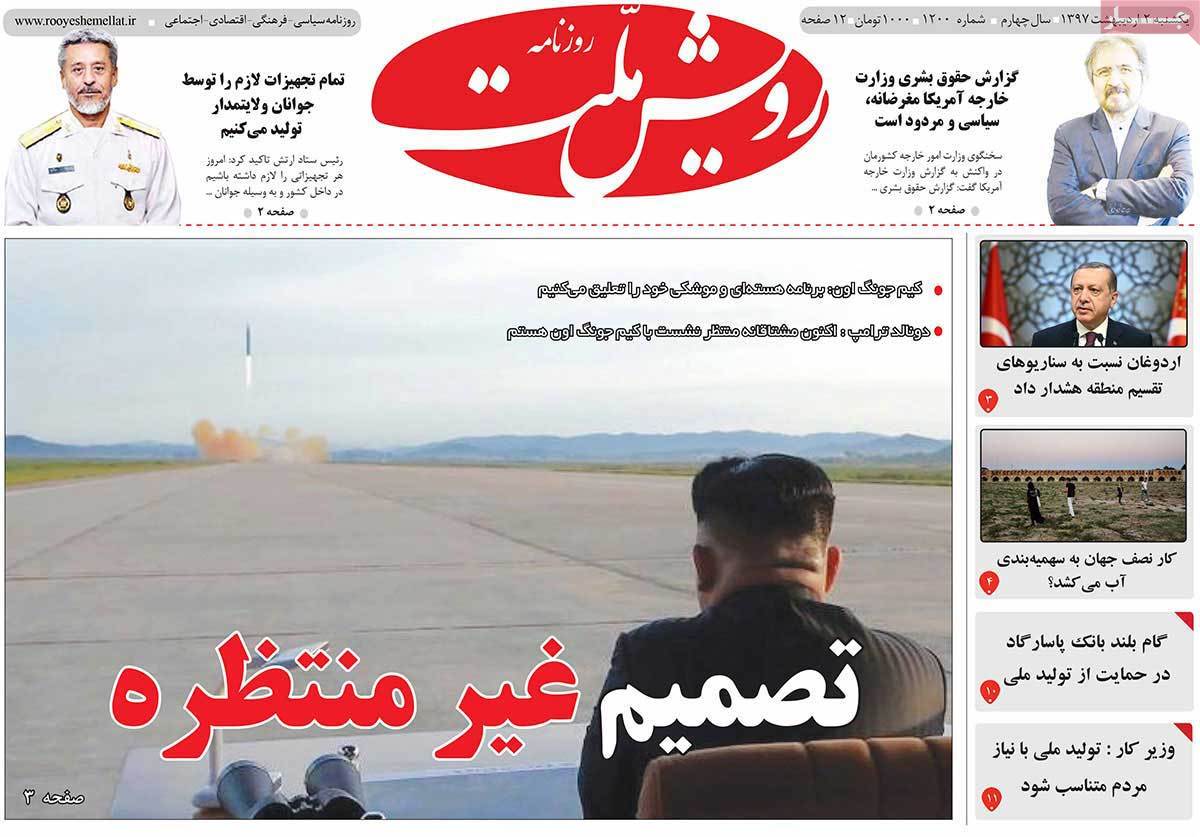
Also a top story was the comments made by Army Chief-Commander Major General Abdolrahim Mousavi in support of the Islamic Revolution Guards Corps (IRGC).

Several papers also highlighted the remarks made by Iranian Foreign Minister Mohammad Javad Zarif in an interview with the CBS News about Tehran’s reaction to Washington’s possible withdrawal from the Iran nuclear deal. Zarif stressed that the Islamic Republic will immediately resume its nuclear program in a faster pace than before if Trump decides to pull out of the JCPOA.

The above issues, as well as many more, are highlighted in the following headlines and top stories:


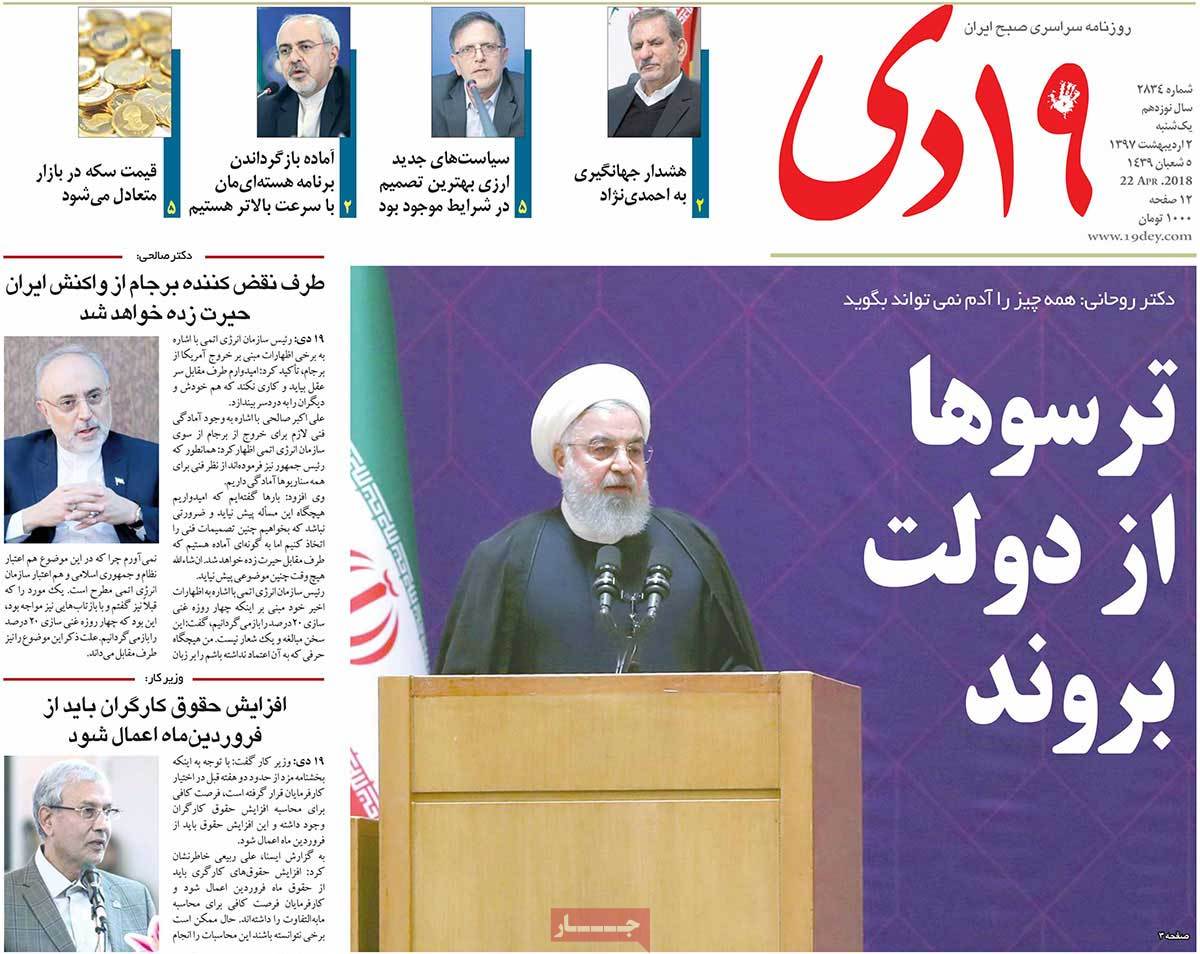
19 Dey:

  • Cowards Must Leave Their Government Positions: Rouhani
  • I Can’t Tell Everything
  • Nuclear Chief: Those Violating Nuclear Deal to Be Surprised by Iran’s Reaction

A Look at Iranian Newspaper Front Pages on April 22


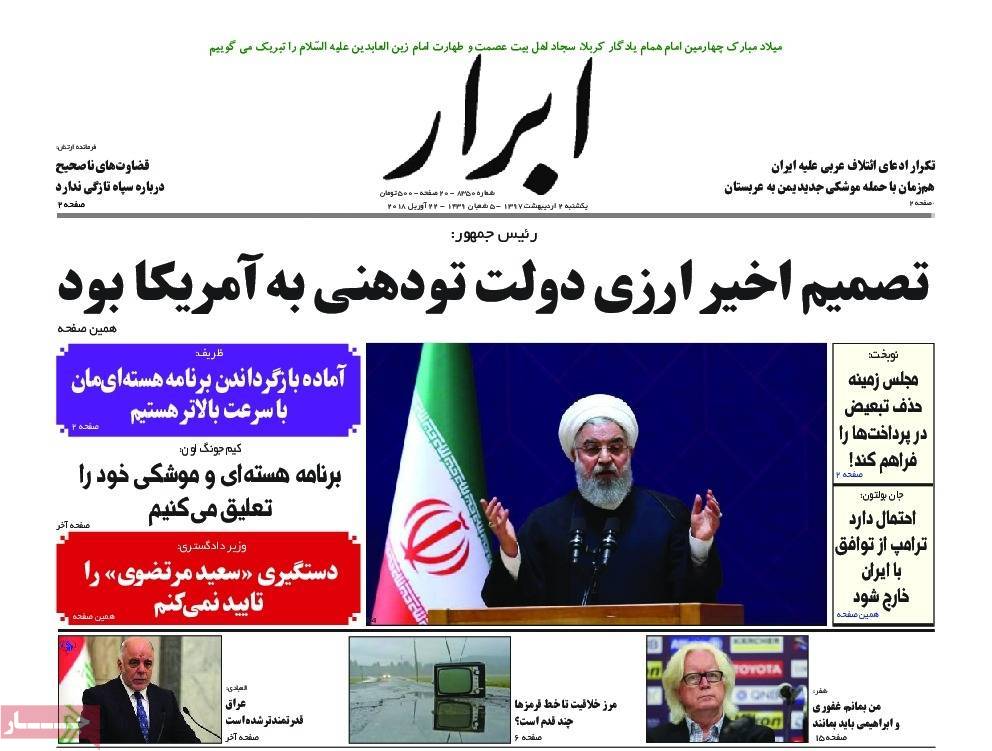
Abrar:

  • Rouhani: Recent Forex Decision Heavy Blow to US
  • Zarif: We’re Ready to Resume Our Nuclear Program at Faster Pace

A Look at Iranian Newspaper Front Pages on April 22


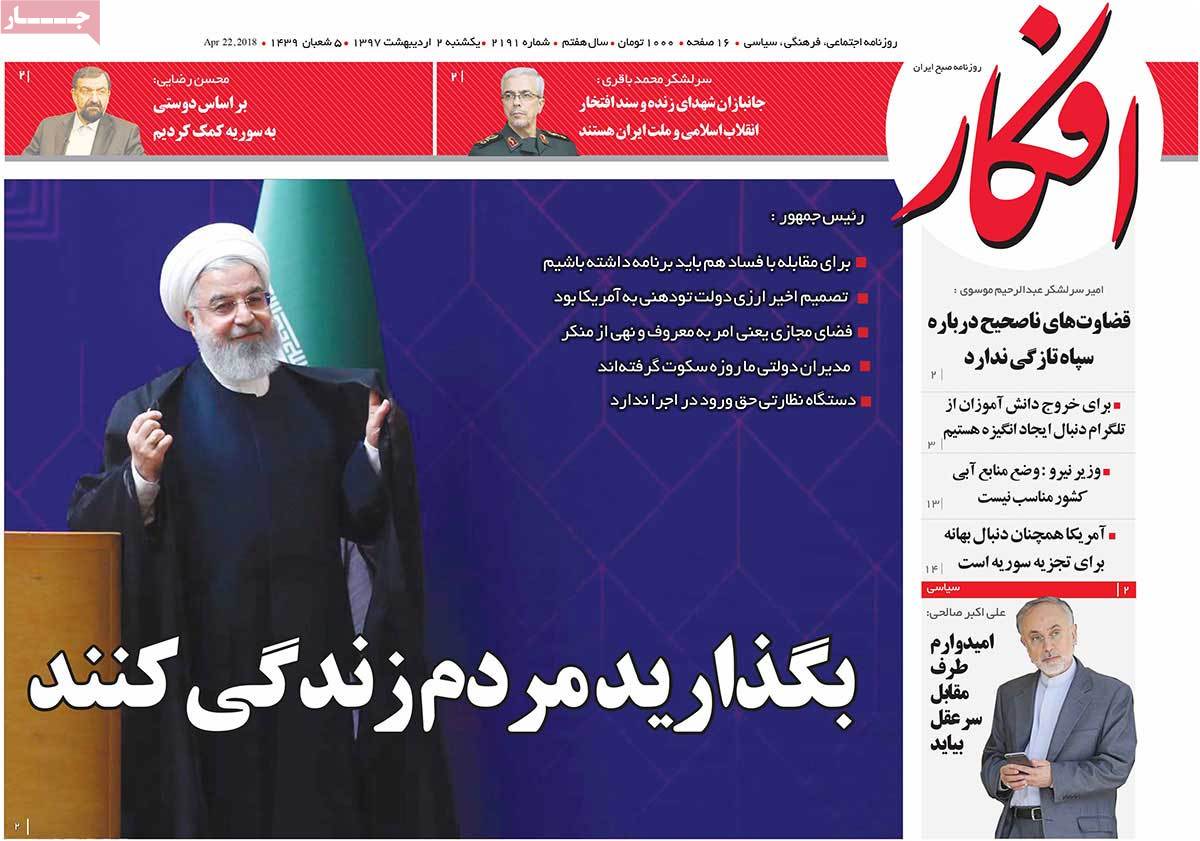
Afkar:

  • Iran Nuclear Chief: I Hope Other Side Would Come to Its Senses

A Look at Iranian Newspaper Front Pages on April 22


Aftab-e Yazd:

  • North Korea Looking for Peace? Pyongyang Stops Missile Test Centre

A Look at Iranian Newspaper Front Pages on April 22


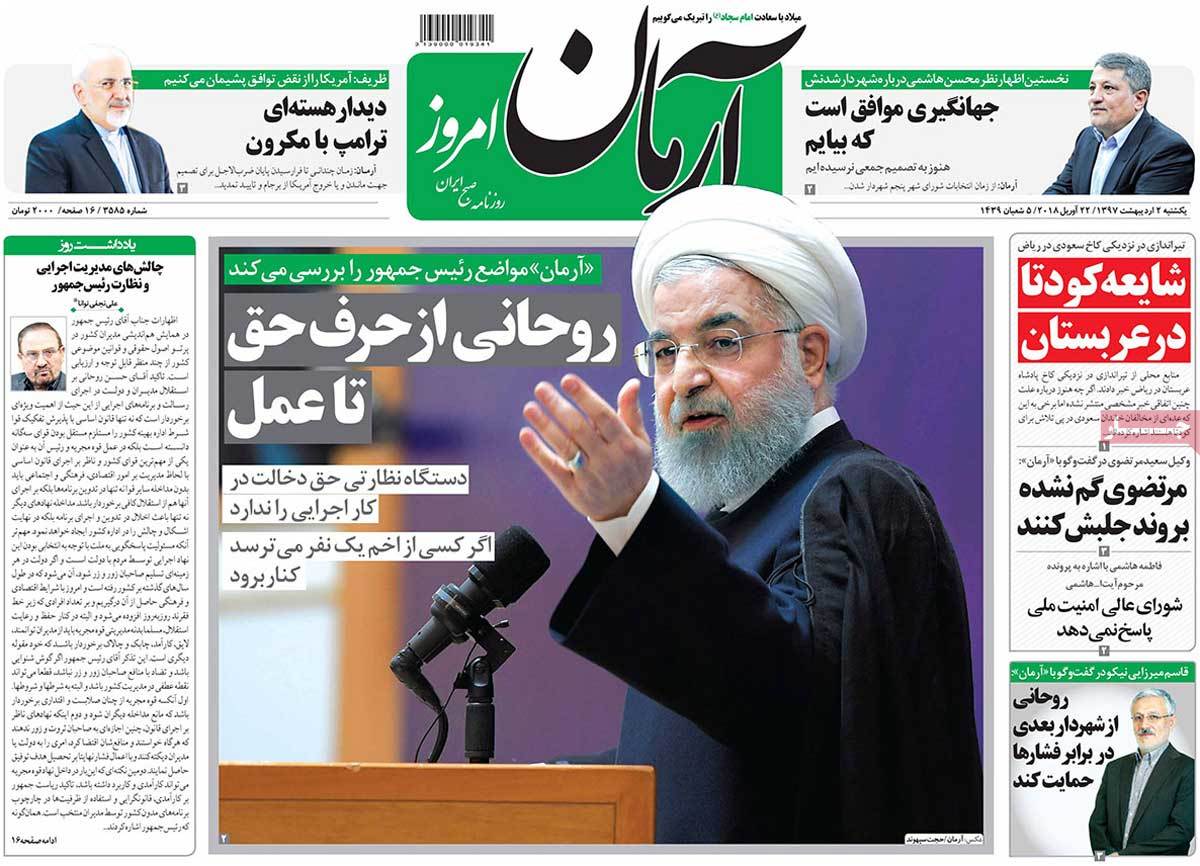
Arman-e Emrooz:

  • Rouhani, from Lip Service to Action
  • President: Bodies Supervising Gov’t Not Allowed to Interfere in Executive Affairs
  • We’ll Make US Regret Violating Iran Nuclear Deal: Zarif

A Look at Iranian Newspaper Front Pages on April 22


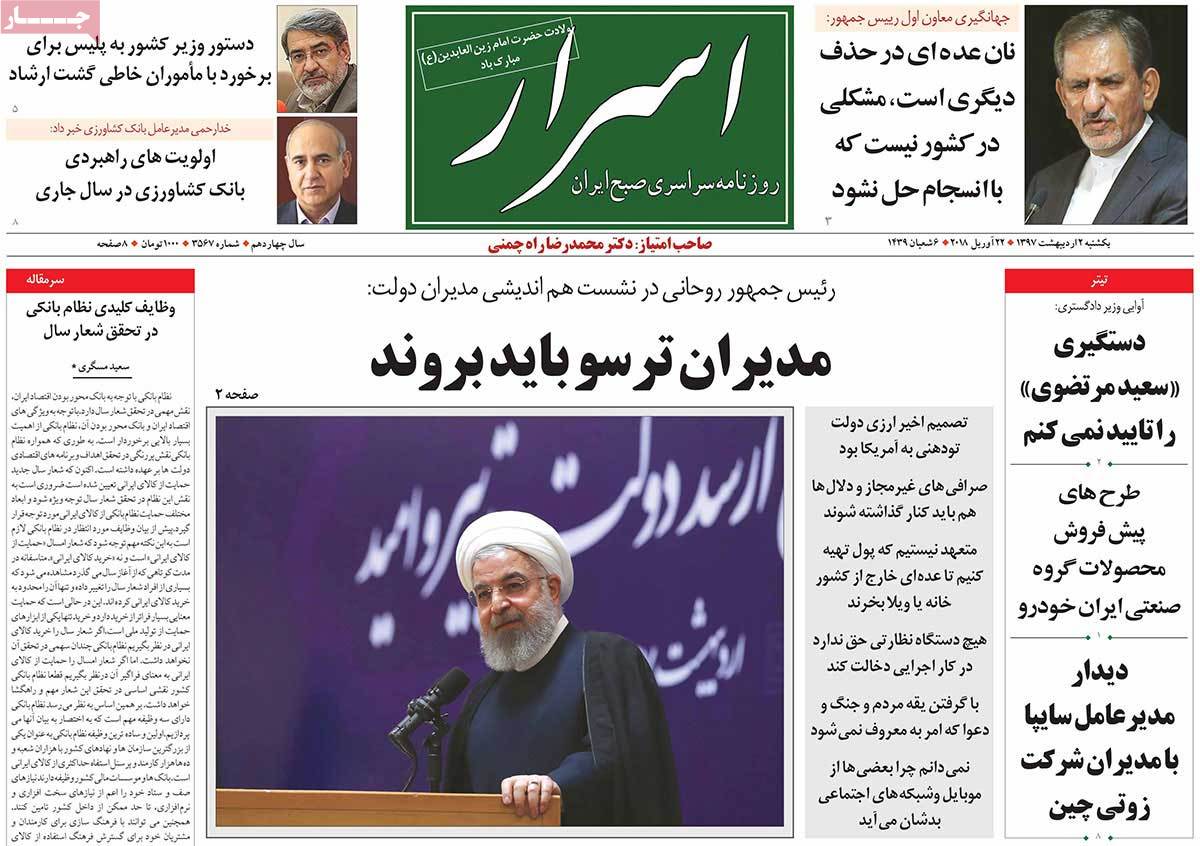
Asrar:

  • Iran First VP: Solidarity to Solve All Problems in the Country

A Look at Iranian Newspaper Front Pages on April 22


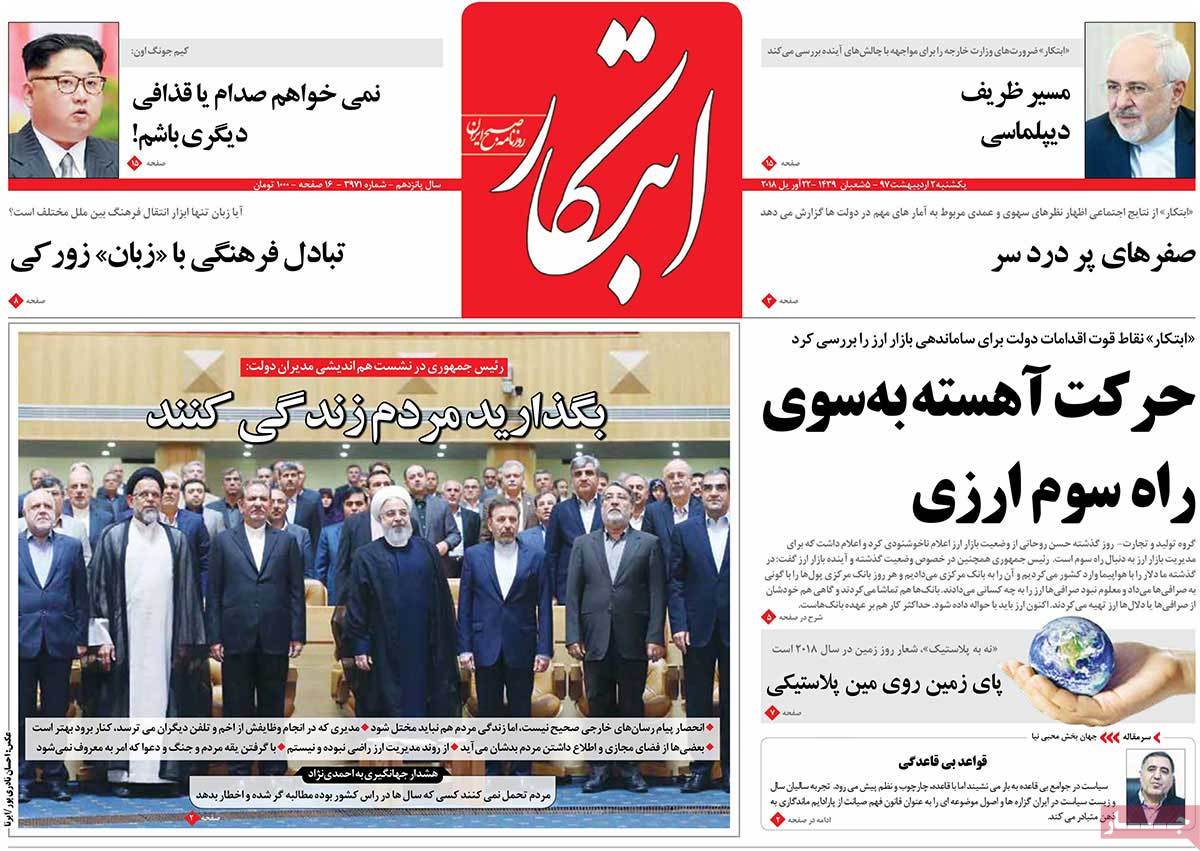
Ebtekar:

  • North Korean Leader: I Don’t Want to Turn into Another Saddam, Gaddafi

A Look at Iranian Newspaper Front Pages on April 22


Etemad:

  • Rouhani’s First VP to Ahmadinejad: Don’t Threaten Establishment, Know Your Limits

A Look at Iranian Newspaper Front Pages on April 22


Ettela’at:

  • Rouhani: We’ll Overcome Problems If We Manage to Convince People
  • North Korea’s Missile, Nuclear Activities Stopped on Leader’s Order

A Look at Iranian Newspaper Front Pages on April 22


Iran:

  • Zarif in US: We’re Ready to Resume Nuclear Activities
  • Rouhani: Executives Who Are Afraid Must Leave Their Positions

A Look at Iranian Newspaper Front Pages on April 22


Javan:

  • Army Chief: We Won’t Let Anyone Disrupt IRGC’s Progress
  • Incorrect Judgements about IRGC Nothing New

A Look at Iranian Newspaper Front Pages on April 22


Jomhouri Eslami:

  • Jahangiri Warns Ahmadinejad: You’ll Face People’s Outrage If You Threaten Establishment
  • Palestinian Researcher Assassinated in Malaysia by Mossad Agents

A Look at Iranian Newspaper Front Pages on April 22


Kayhan:

  • Late Admission of JCPOA’s Failure
  • Rouhani: It’s Been Four Years We’re Transferring US Dollars in Sacks!
  • Army Chief: I Attended IRGC Day Ceremony to Deal Heavy Blow to Enemies
  • Muslim Woman Denied French Citizenship over Refusing to Shake Hands with a Man!

A Look at Iranian Newspaper Front Pages on April 22


Khorasan:

  • People Now Have Access to Treasury’s Payments to All State Bodies

A Look at Iranian Newspaper Front Pages on April 22


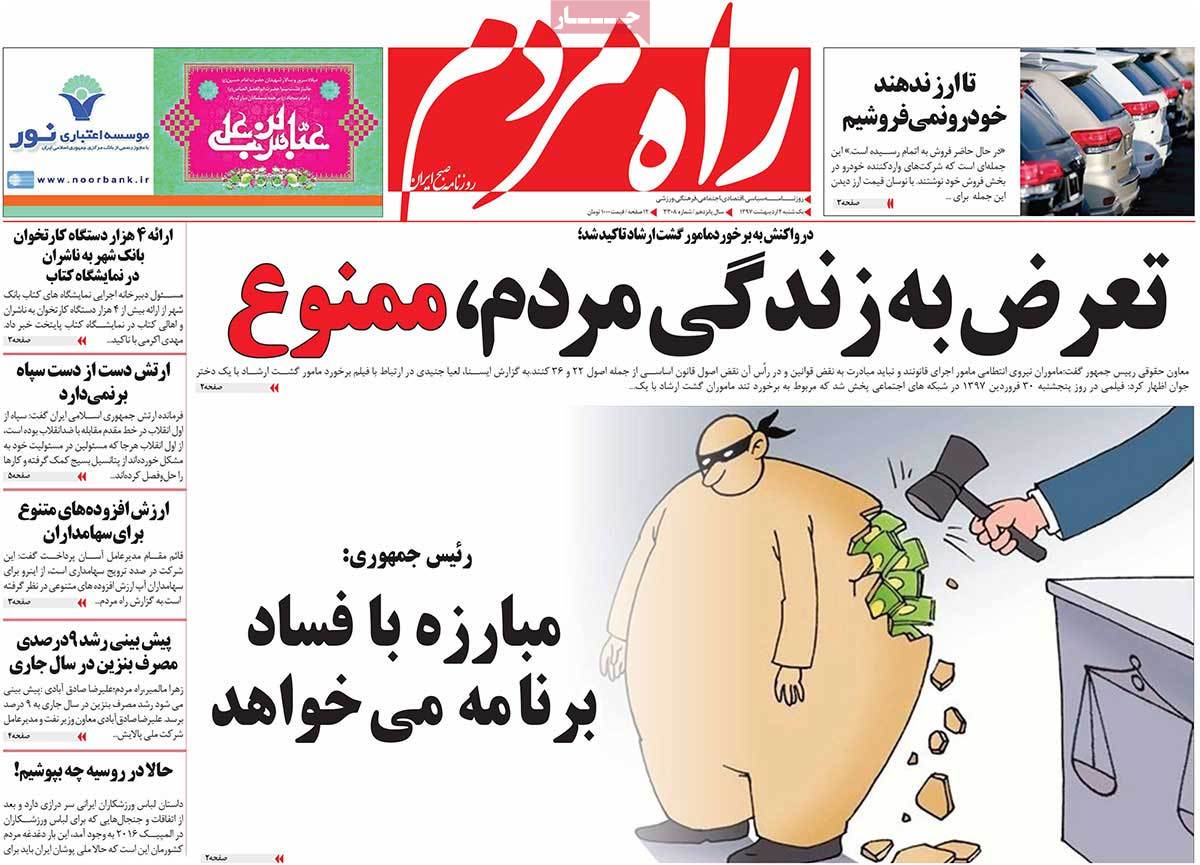
Rah-e Mardom:

  • Rouhani: Fight against Corruption Needs Planning

A Look at Iranian Newspaper Front Pages on April 22


Resalat:

  • Ayatollah Nouri Hamadani: Those Undermining IRGC Echoing Enemies’ Words

A Look at Iranian Newspaper Front Pages on April 22


Rooyesh-e Mellat:

  • Army Chief: We Produce All Equipment We Need Inside Iran

A Look at Iranian Newspaper Front Pages on April 22


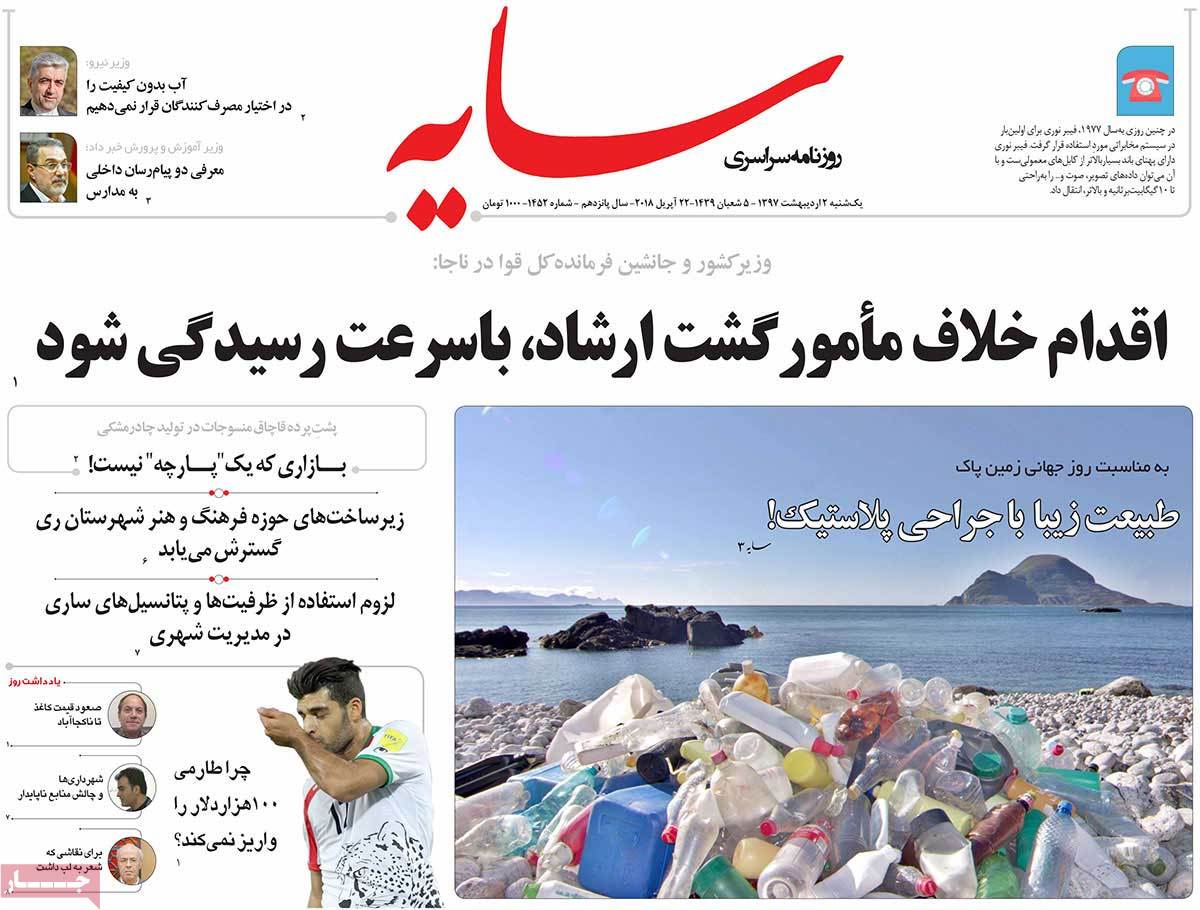
Sayeh:

  • Interior Minister: Morality Police Force’s Illegal Move to Be Dealt with Immediately

A Look at Iranian Newspaper Front Pages on April 22


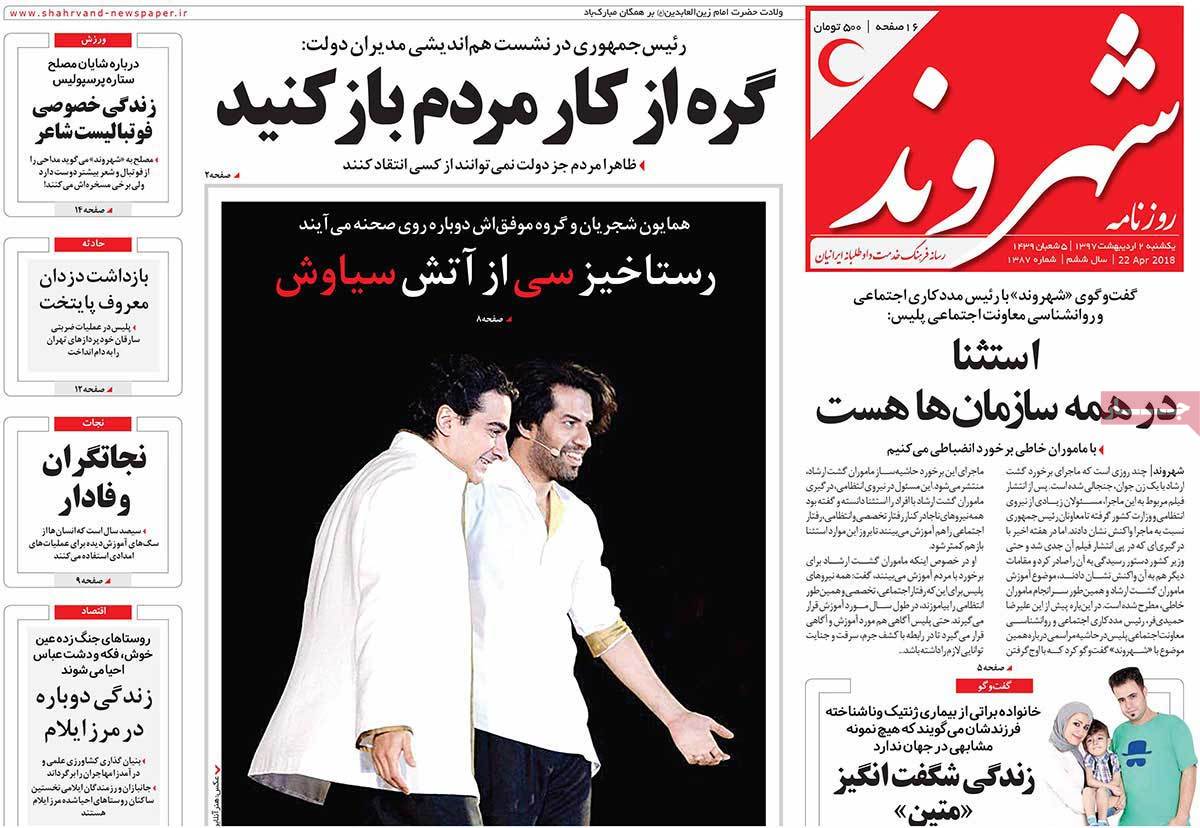
Shahrvand:

  • Rouhani to Top Executives: Resolve People’s Problems

A Look at Iranian Newspaper Front Pages on April 22


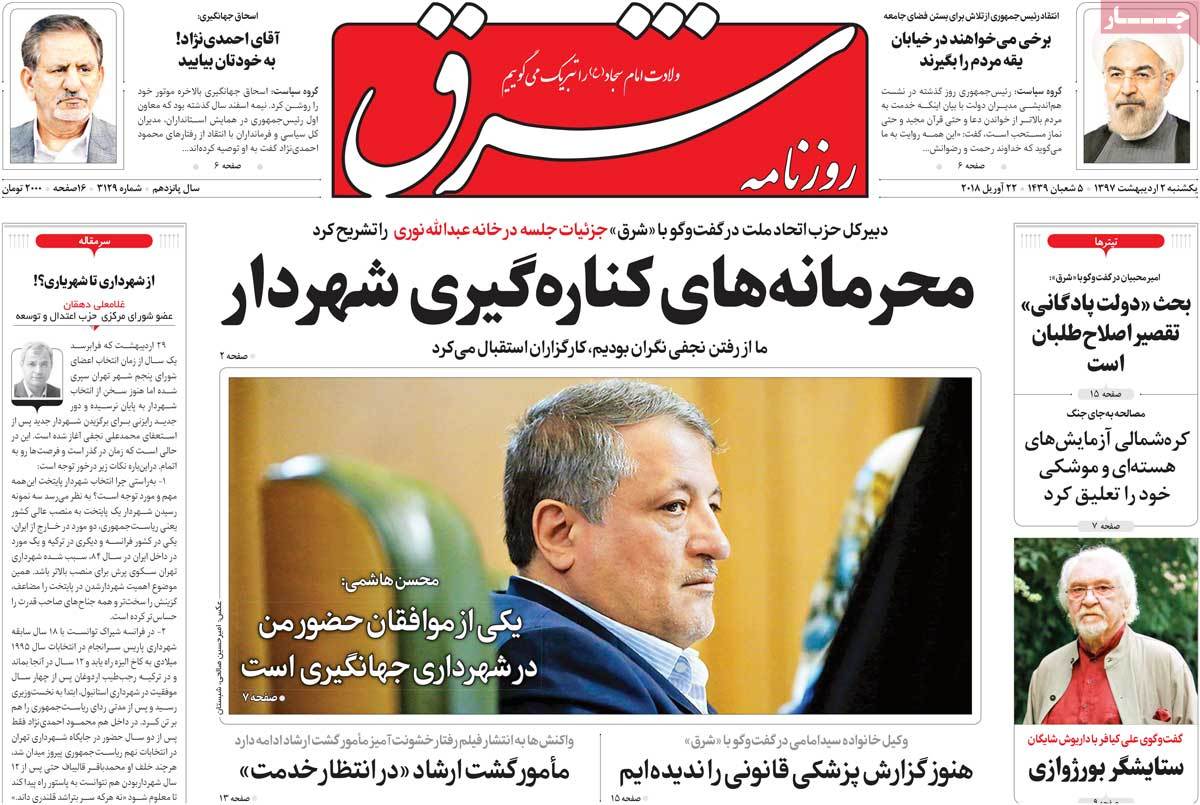
Shargh:

  • Mohsen Hashemi Rafsanjani: First VP Jahangiri among Supporters of My Mayoralty

A Look at Iranian Newspaper Front Pages on April 22


Vatan-e Emrooz:

  • A Woman Plans to Replace Erdogan
  • Will Turkey’s Early Elections Be Winning Card for Ruling Party?

A Look at Iranian Newspaper Front Pages on April 22


Iran President Vows Not to Restrict Social Media

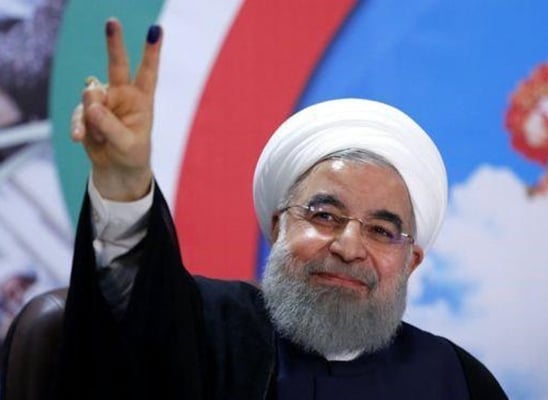
Apparently referring to the controversial issue of blocking people’s access to the popular messenger Telegram, Rouhani stressed that people have the right to choose between the social networks they want to use.

In a Farsi post on his Instagram account on Sunday, the Iranian president also added that his government will protect the cyberspace and people’s access to communications.

This comes as within the past few weeks there were contradictory reports saying the popular messaging app Telegram is seemingly drawing its last breaths in Iran.

Telegram has more than 40 million users in Iran and is widely believed to have played a significant role in the victory of Rouhani in the 2017 presidential elections.

On April 18, the Telegram channel of Leader of Iran’s Islamic Revolution Ayatollah Khamenei announced it would have no further activity in the app. It said “in order to protect the national interests and to break the monopoly of the Telegram messenger,” the website Khamanei.ir has stopped its activity on this messaging application.

For a brief review of Iran’s achievements in various fields of science and technology, check the book “Science and Technology in Iran: A Brief Review

Following that, a number of other Telegram channels attributed to top Iranian officials stopped their activities in a move that seemed to signal the imminent blocking of the messenger.

The fate of Telegram in Iran became a hot subject in political circles late last month, when the chairman of the Parliament’s National Security Commission Alaeddin Boroujerdi said a decision has been made “at the highest levels” to permanently ban Telegram by April 20.

However, shortly afterwards, President Rouhani said he opposes the filtering of Telegram.

4,000-Year-Old Skeletons of Mother, Infant on Show in Iran

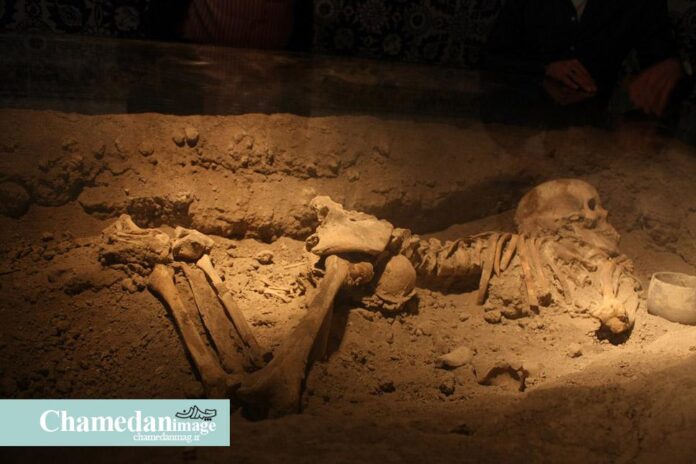
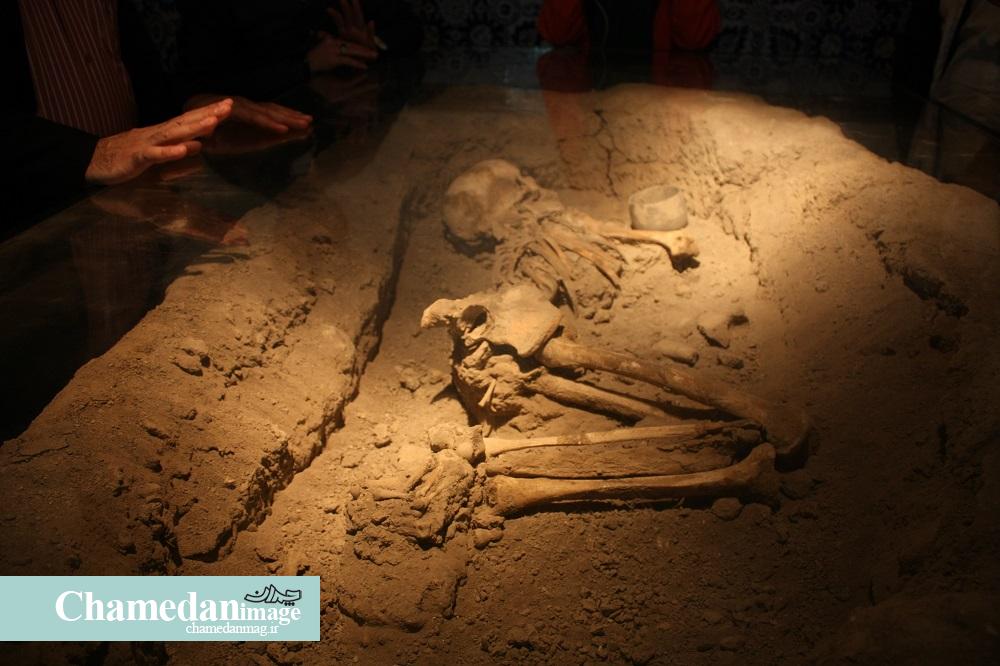
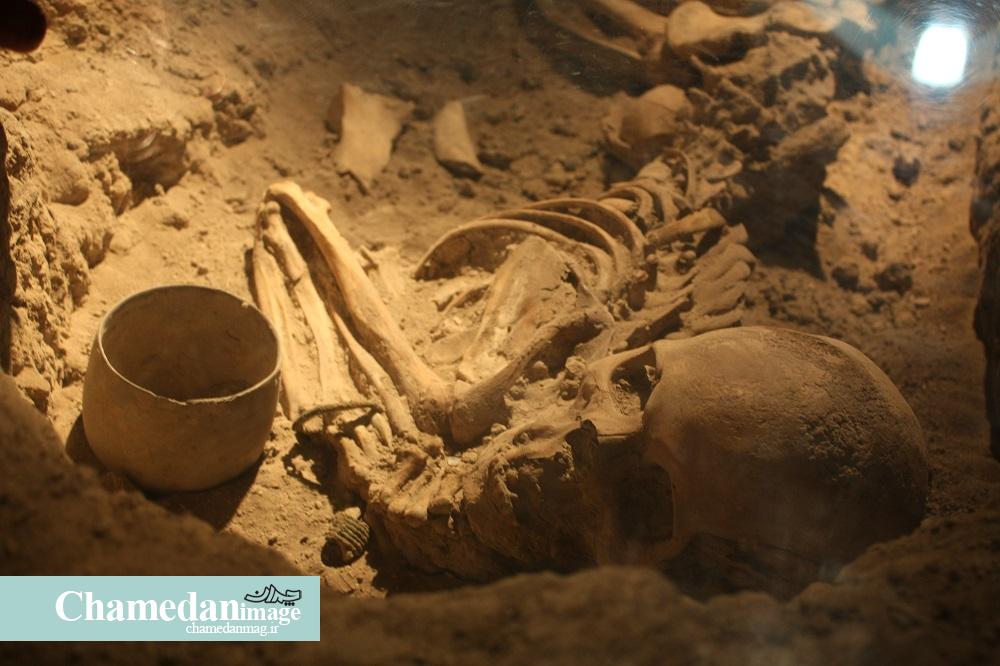
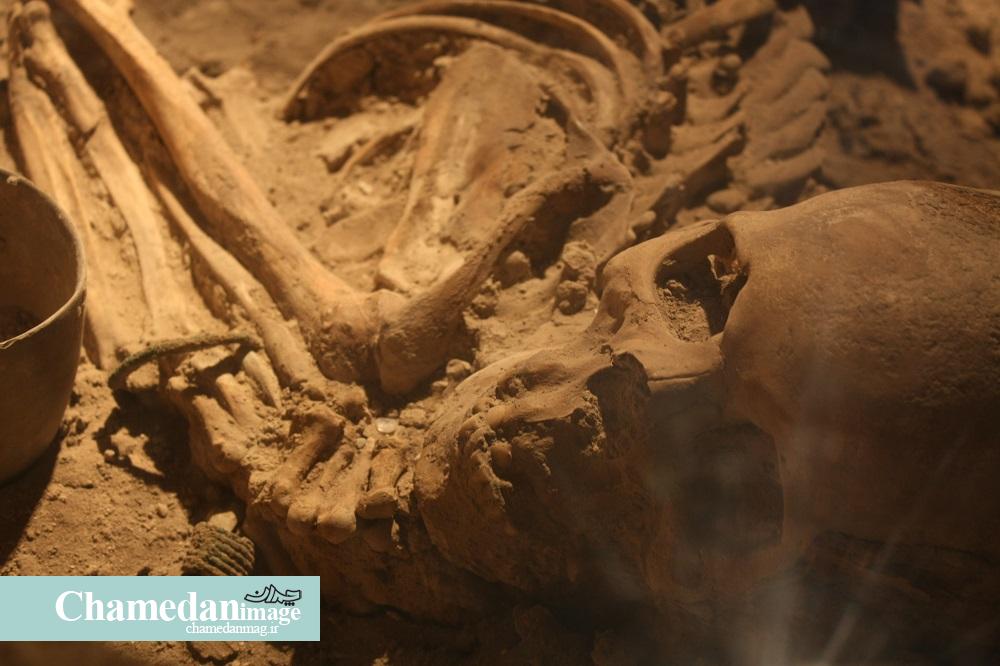
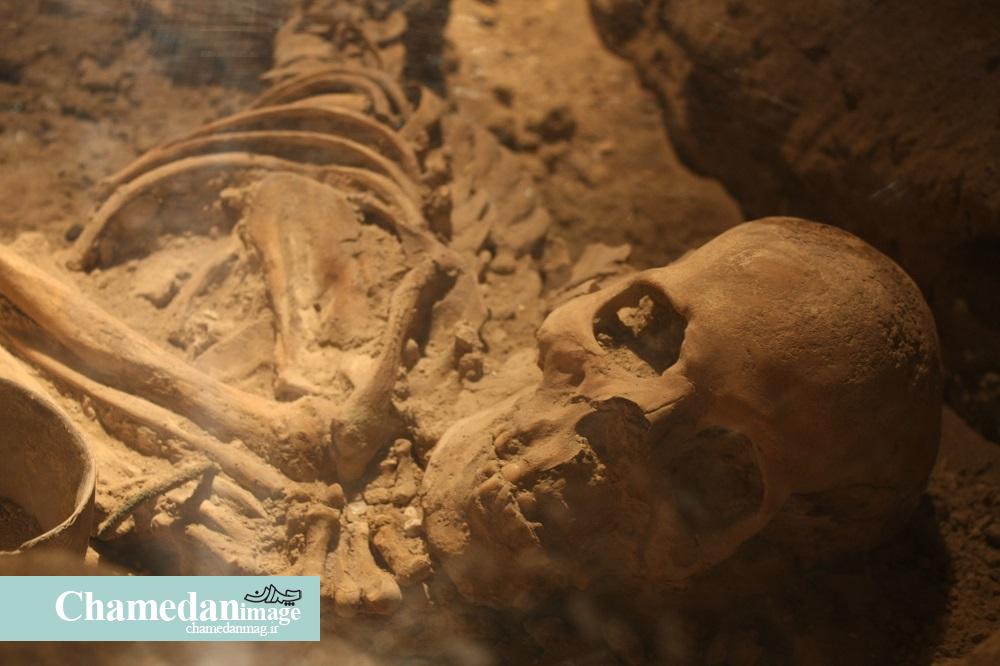
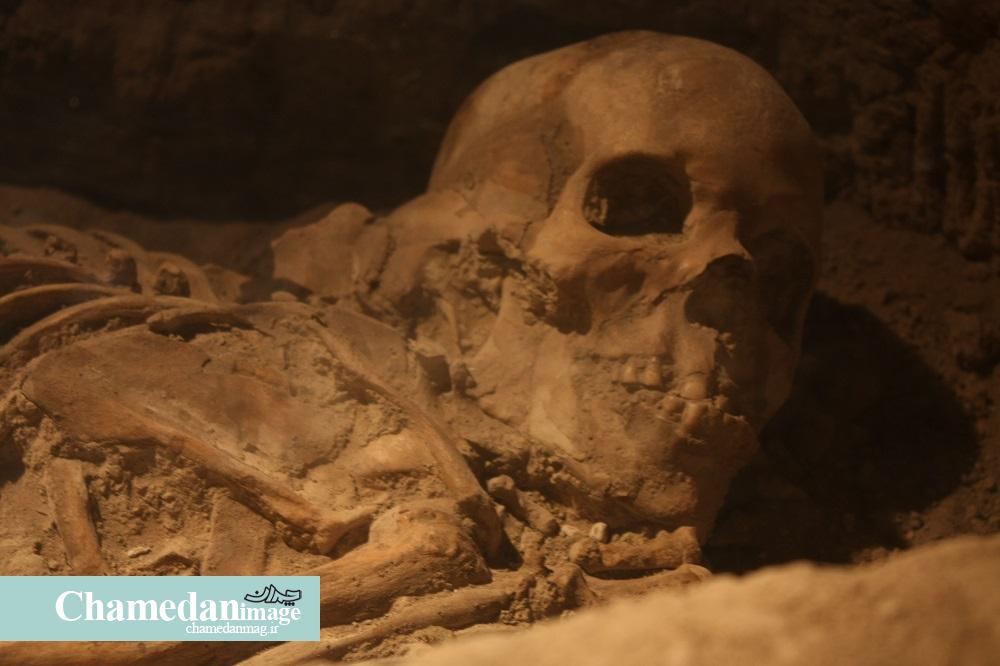
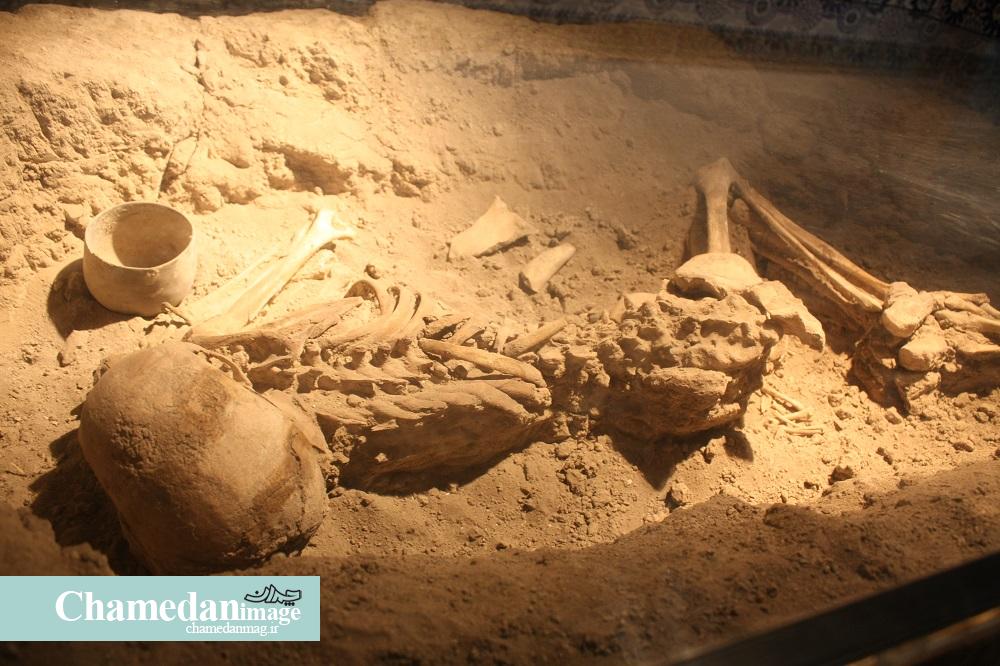
The relic belongs to a mother who died while giving birth to her baby. The skeleton dates back to the 2nd millennium BCE. It was unearthed in archaeological excavations on a hill in the provincial town of Moghan in 1995. The grave containing the mother and baby has been fully moved to the Semnan museum.

The unique skeletons are the only intact ones kept in the Iranian museum. The place where the skeleton was dug out contains some salt and does not have much humidity, and that is why the relic has not been damaged even after 4,000 years, a Farsi report by ISNA said.
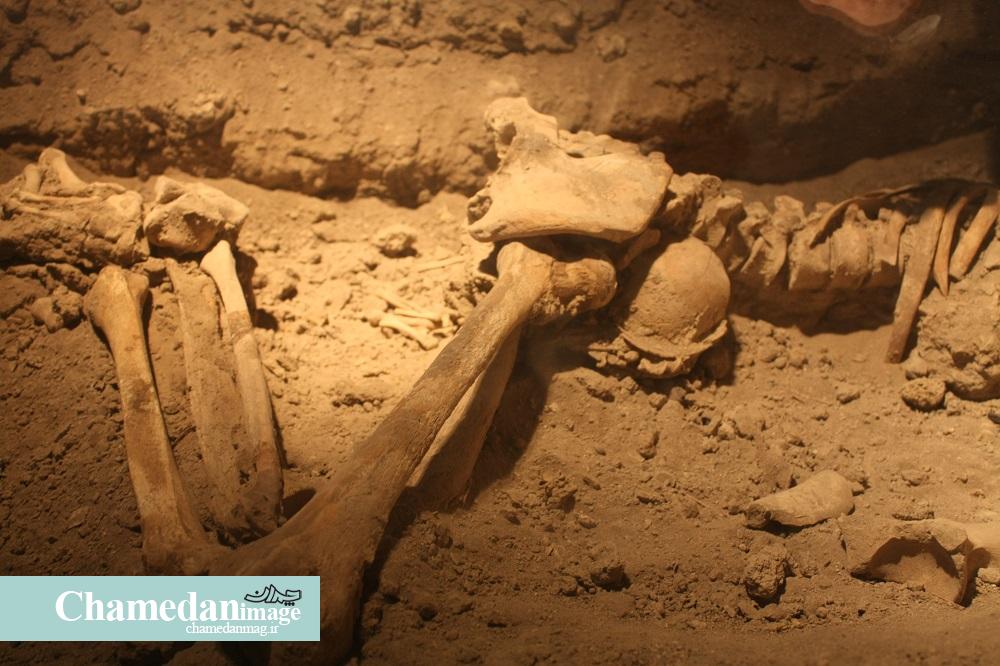
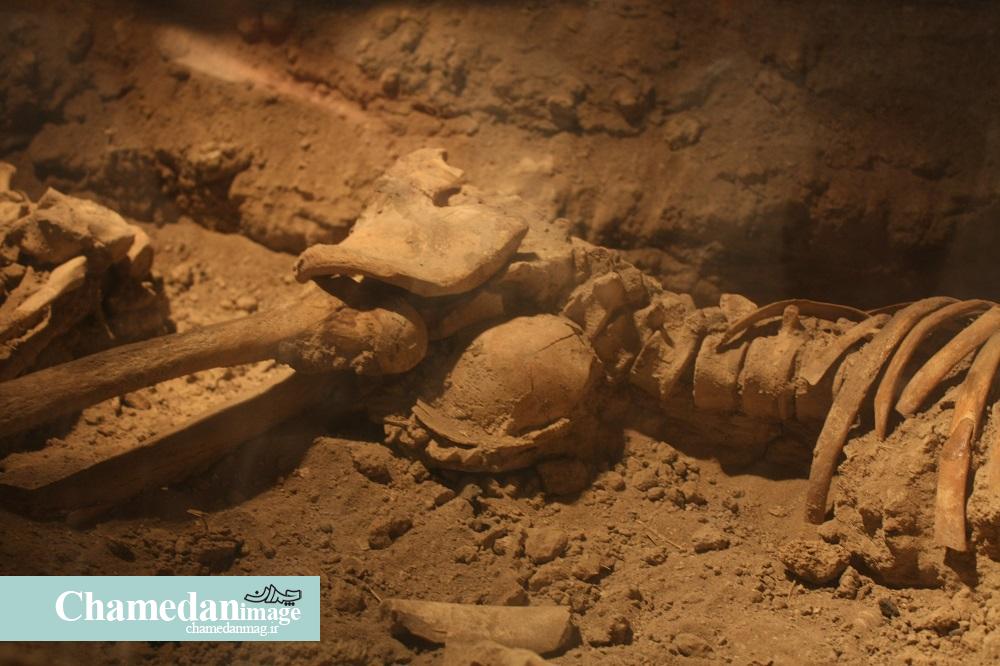
The mother, estimated to have been 17-20 years old, died while delivering her baby. The cause of the death was probably the small size of her pelvis, say experts. The baby was born leg-first, and as the mother’s pelvis was too small, she lost her life during the delivery. The bones of the baby’s arms and legs were found on the ground next to the mother’s skeleton.
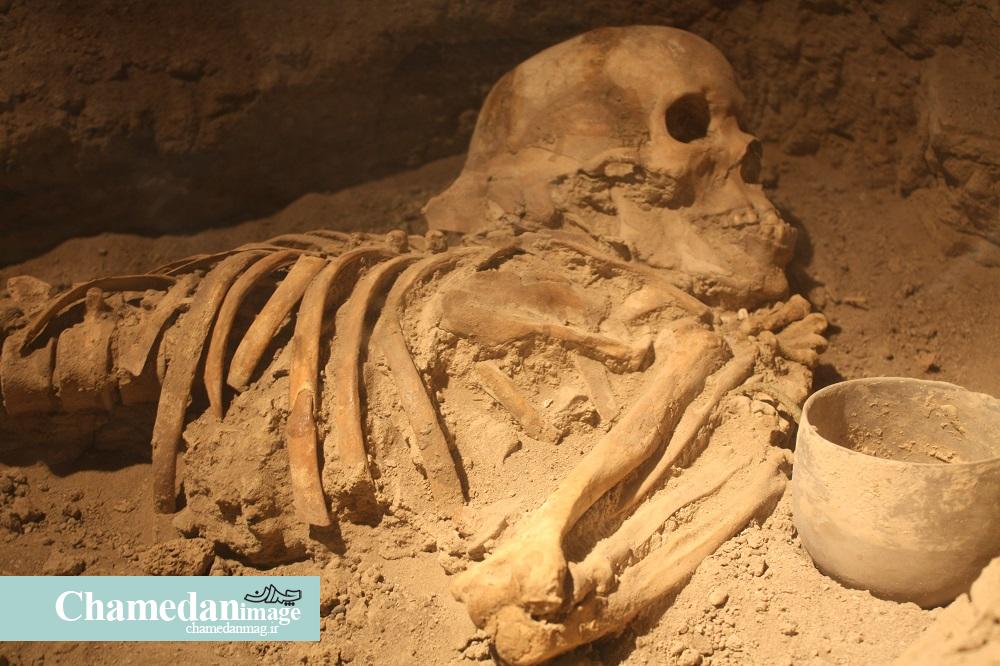
Experts say the mother was buried “infant-style,” so that her head faced the East where the sun rises. This method of burying was common practice in the Mithraism rituals. So, it seems the woman was a follower of the Mithraism faith in which they worshiped the sun.

Moreover, the woman has a bracelet and a ring on her hand. In Mithraism, it was customary to bury women with their jewelry, and men with their tools of work as well as weapons of war.

The area where the body was found is known as the Hesar Hill of Damghan. Located three kilometres southeast of Damghan, It is one of the most important historical sites in Semnan province and in Iran. The civilisation found there dates back to the first to fourth millennia BCE.

What follows are Chamedan’s photos of the skeletons:

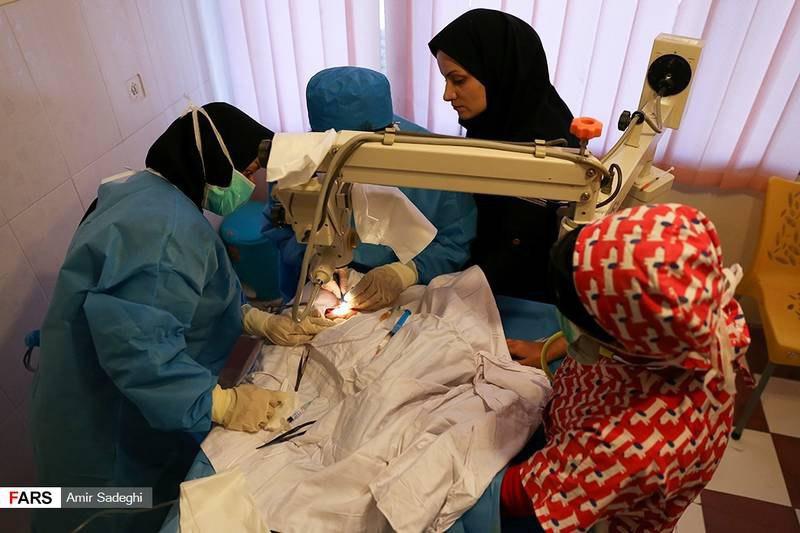
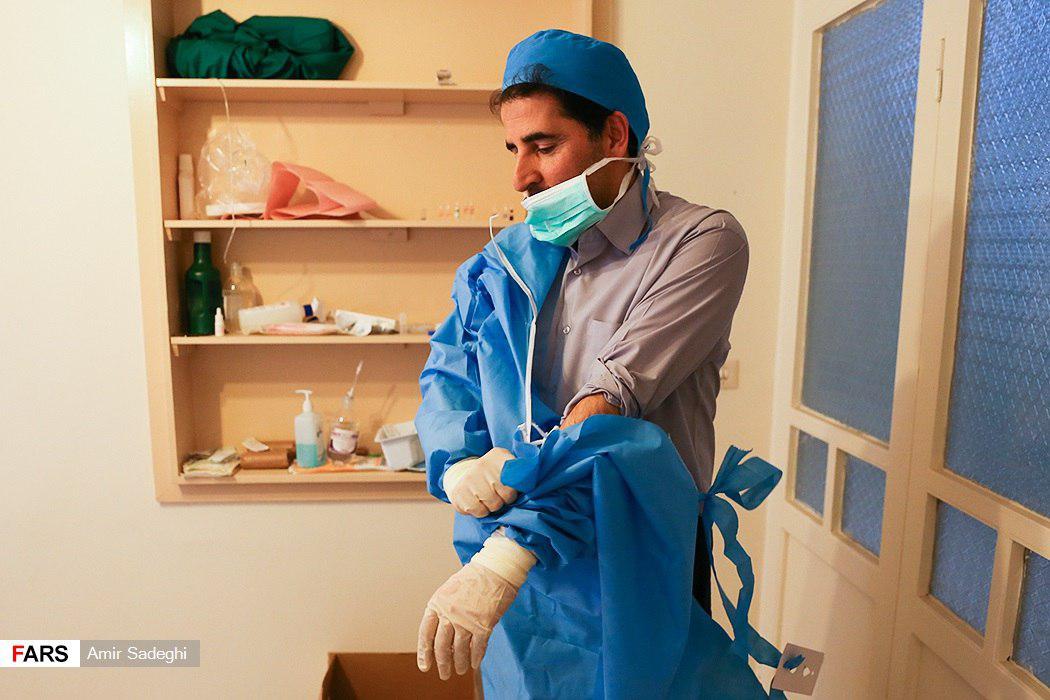
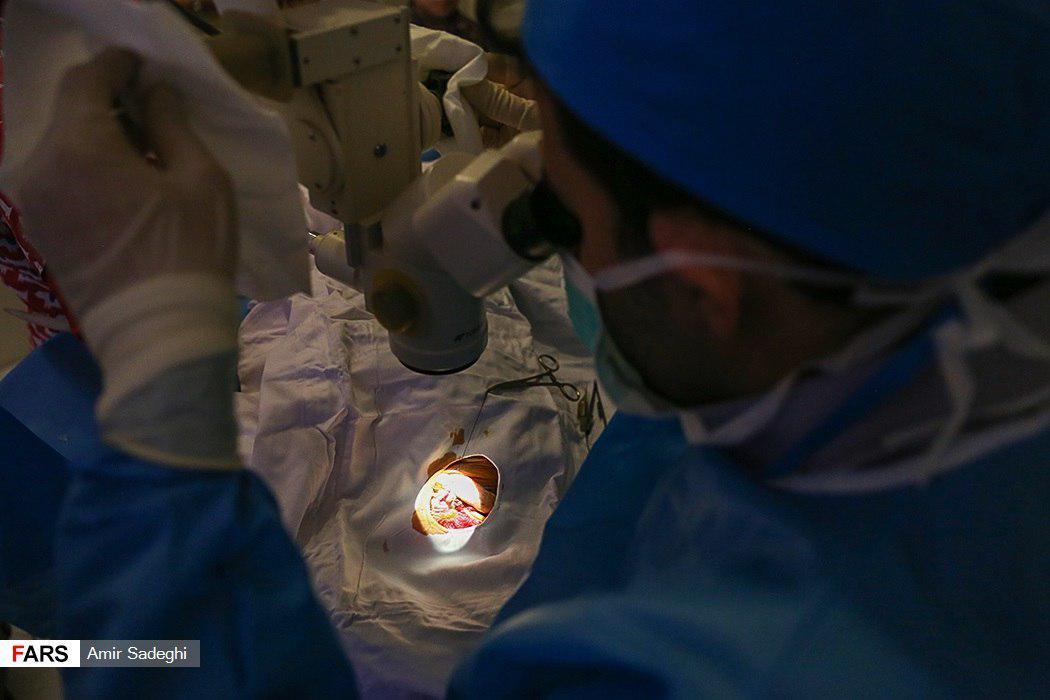
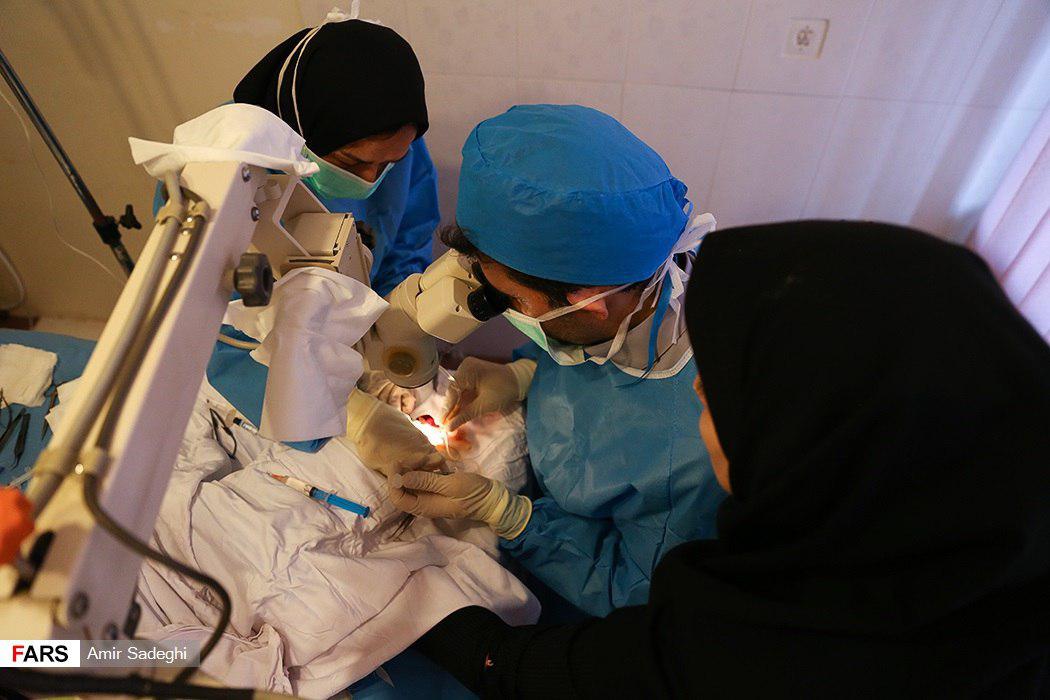
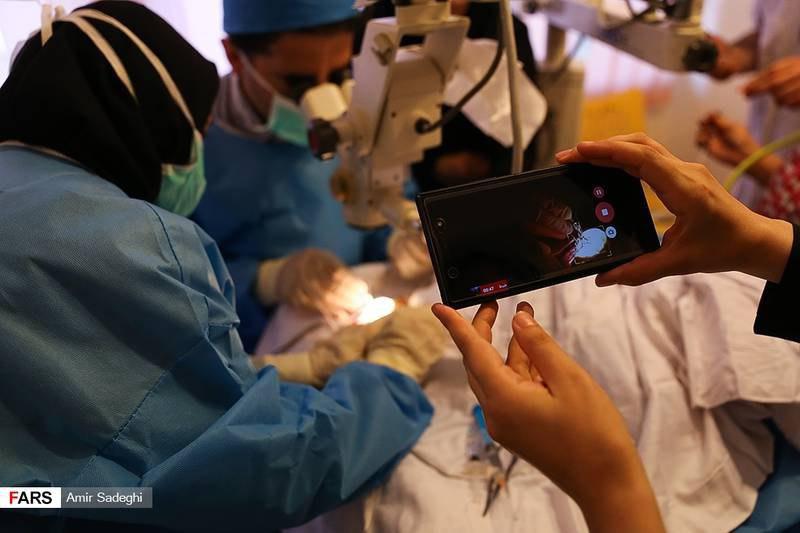
Rooster Undergoes World’s First Cataract Surgery

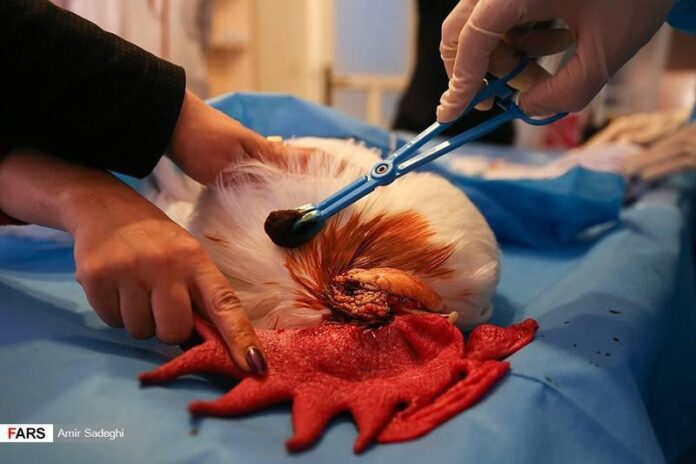
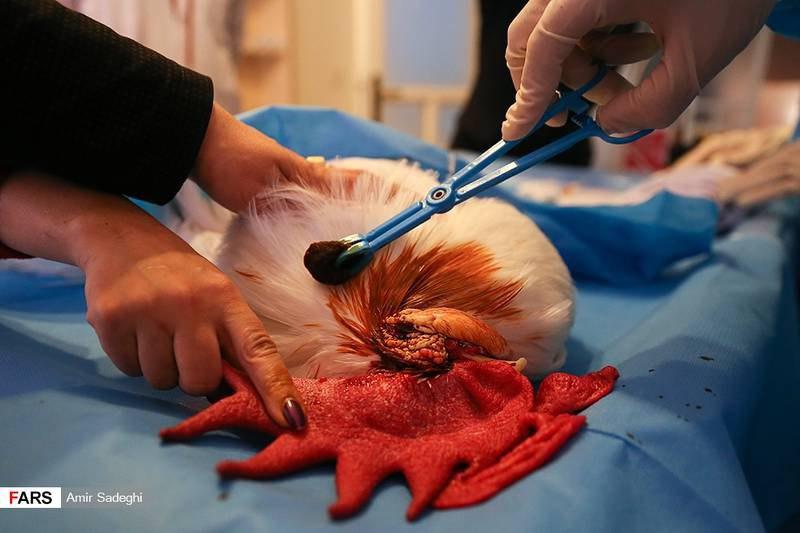
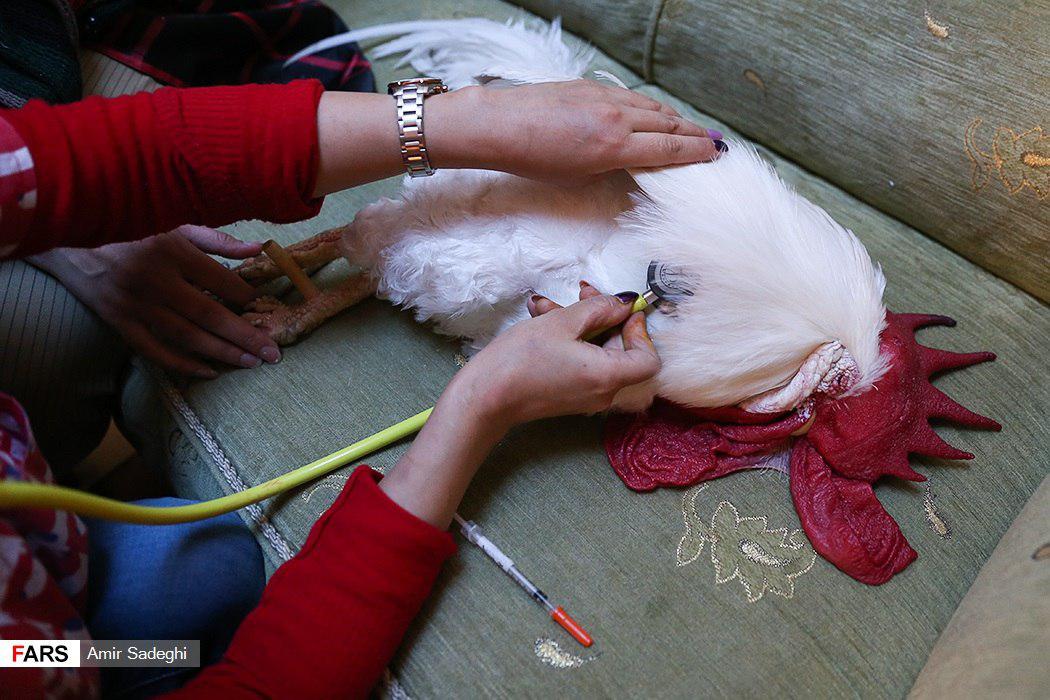
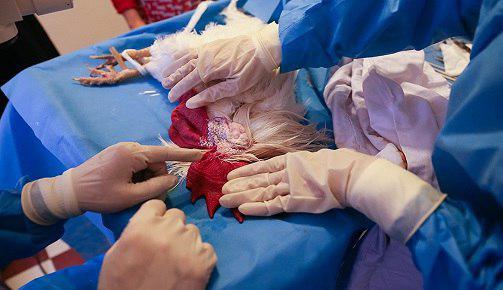
The surgery was performed by Behnam Ghaffarzadeh, a surgeon and eye examiner, on a five-year-old cock.

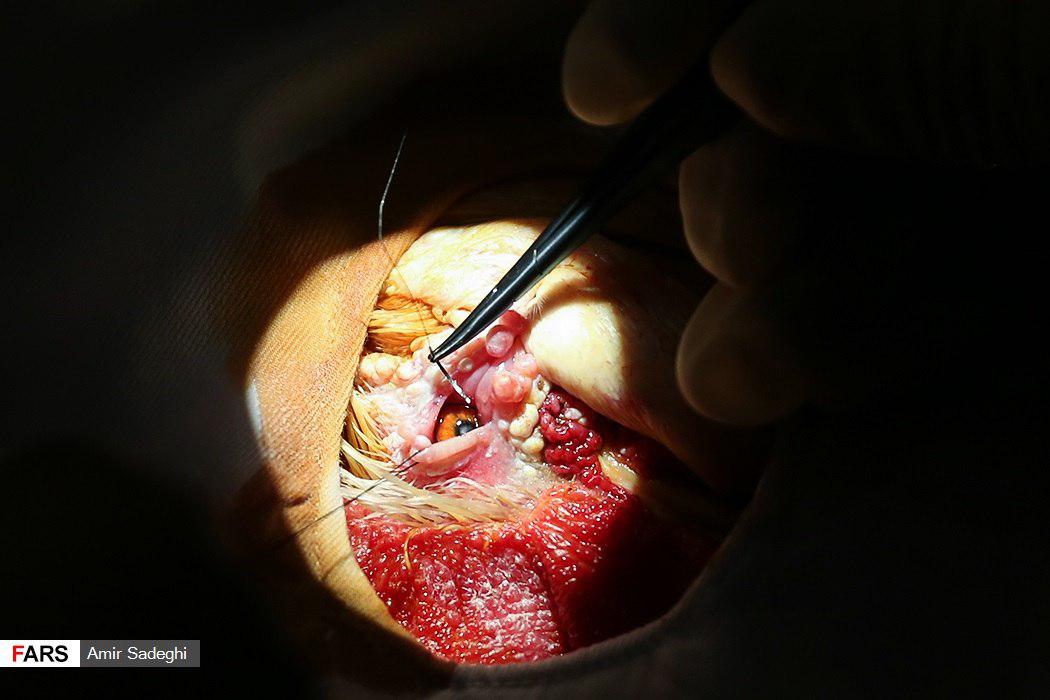
“The operation was carried out on the animal’s left eye, and I also examined its other eye to see when the surgery on the next must be performed,” said Ghaffarzadeh in Farsi interview with Fars News Agency.

This specialist also mentioned he had already performed a similar surgery on a 9-year-old duckling in his office.

“Given the fact that pupils of birds are not like human, cats and dogs, this surgery is much more difficult and it is even possible that they lose their pupil. However, the operation was successfully completed without any problem.”

According to Shokoufeh Khalili, the rooster’s owner, it had lost its eyesight about one and a half years ago as a result of cataract.

She said that she did a lot of search, but no expert in Iran and even in the world had performed such a surgery, and all the surgeries were on dogs and cats.

“However, I learned about Dr Ghaffarzadeh’s surgery on a duckling through the Internet and took my pet to Tabriz to be cured,” said Khalili.

A cataract is a clouding of the lens in the eye which leads to a decrease in vision. Cataracts often develop slowly and can affect one or both eyes.

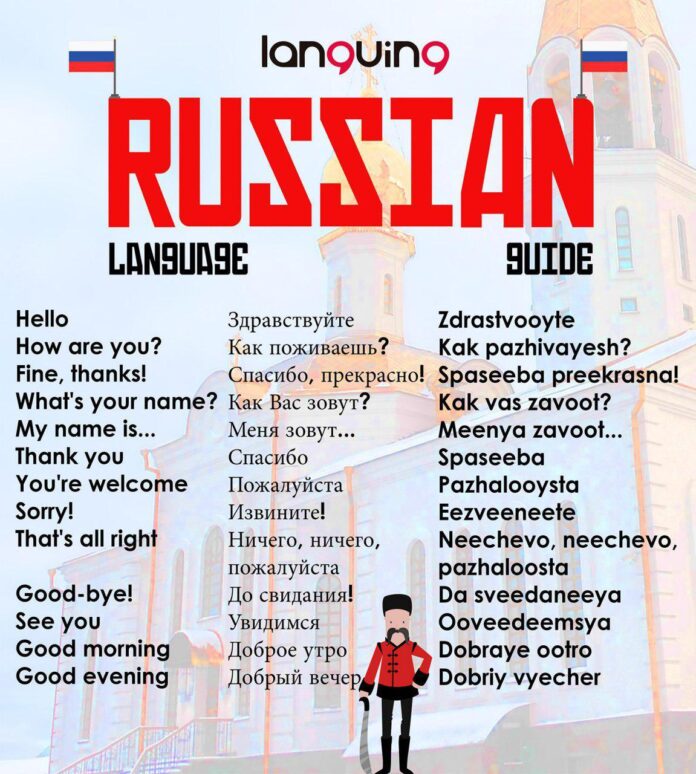
Iran Ready to Teach Russian as Foreign Language at Schools

The Iranian minister made the proposal at a meeting with Chairman of the Committee on Education of the State Duma of Russia Vyacheslav Nikonov, saying that the Islamic Republic plans to “break up the monopoly of English as the second language” and develop students’ skills in other languages, particularly Russian.

Bat’haei’s suggestion drew a lot of criticism in social networks and many people including celebrities wrote on their pages that learning Russian language would not be that much useful for their children.

Following the reactions, the Iranian education minister in a series of tweets elaborated on his proposal saying that “on my trip to Russia to attend a conference on the use of ICT in education, I presented a report on our current programs and the role of social networks in our future plans.”

“When I visited a school in Russia, I noticed that, unfortunately, the Russian students are completely unfamiliar with the Persian culture and language. Chairman of the Russian Duma Education Committee said Russia is ready to teach Persian language, like Chinese at some schools as a second language.”

According to the minister, reciprocal action is a prerequisite for any international agreement, and thus Iran has offered to teach Russian as a foreign language in certain Iranian schools.

However, the expansion of Russian language education in Iran depends on teaching Persian language in Russia, he added.

“Getting to know the Iranian culture in Russian students’ textbooks is another issue that would be considered in our future MoU.”

“We are trying to diversify the teaching of foreign languages at schools, and according to the law, the conditions will be provided for teaching French, German, Russian and Spanish next to English.”

Earlier in January Iran banned the teaching of English in primary schools after the Leader of Islamic Revolution Ayatollah Seyyed Ali Khamenei said that the early learning of English opened the way to a Western “cultural invasion”.

The teaching of English usually starts in middle school in Iran, around the ages of 12 to 14, but some primary schools, below that age, also have English classes.

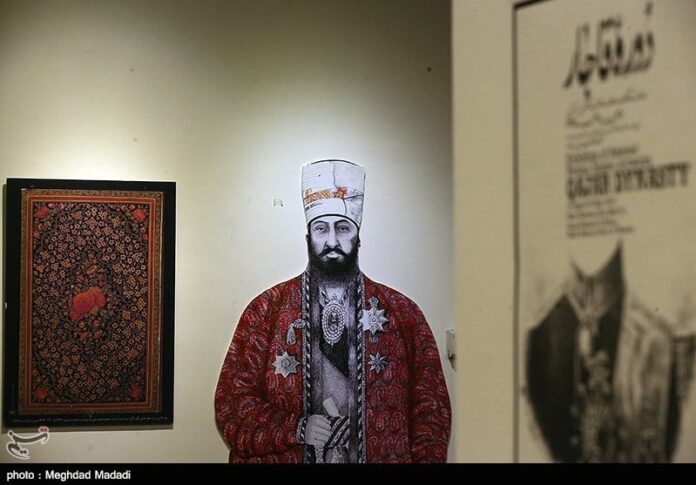
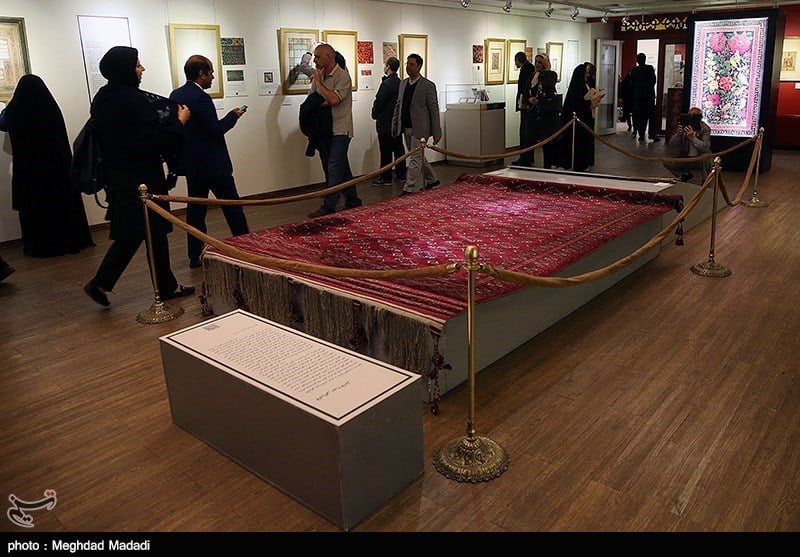
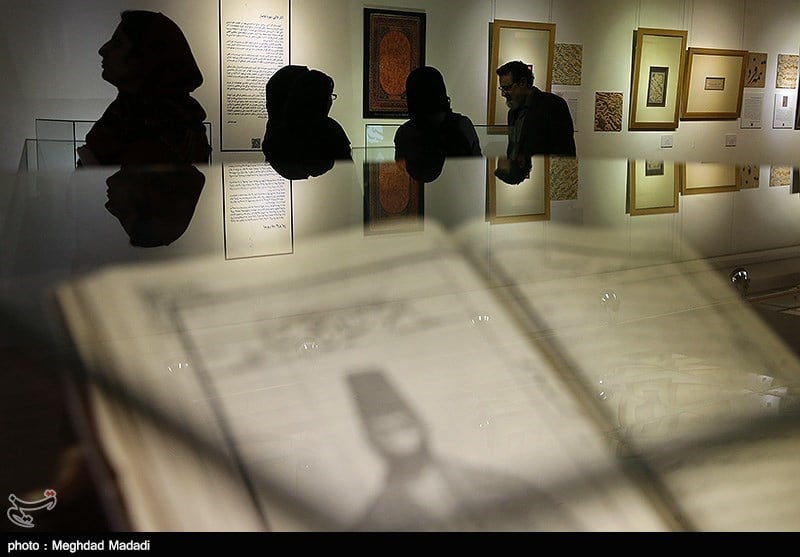
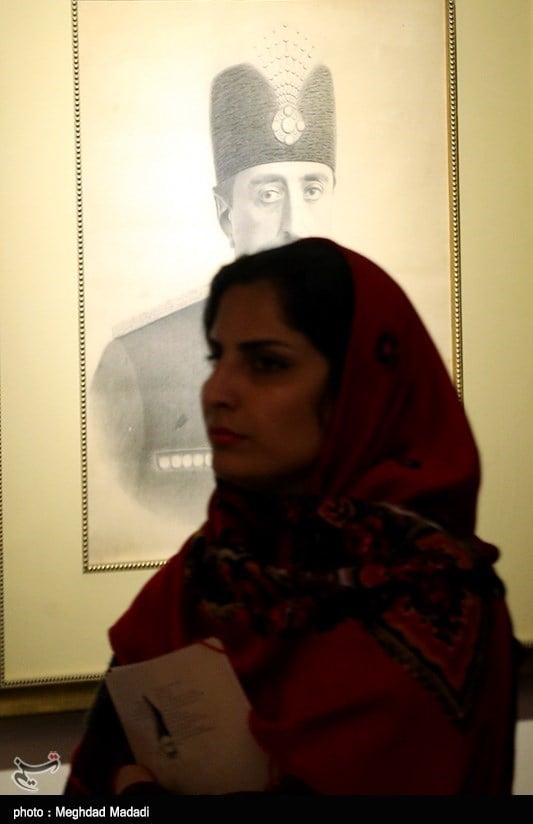
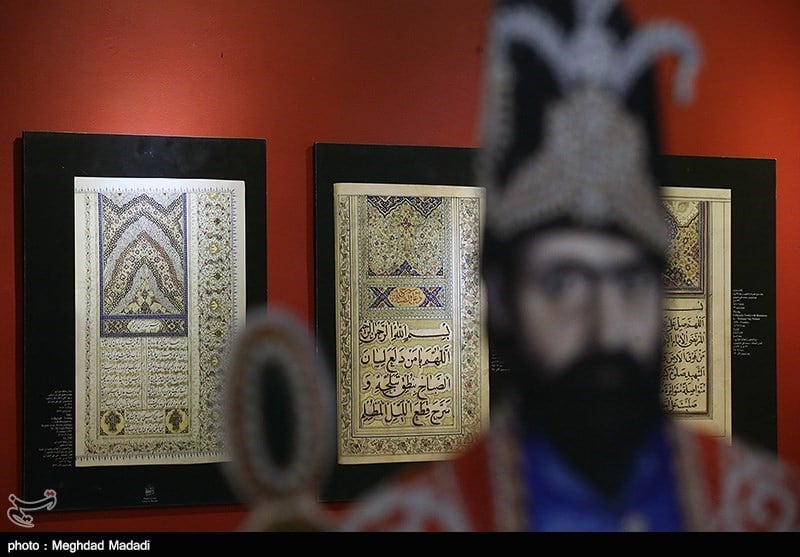
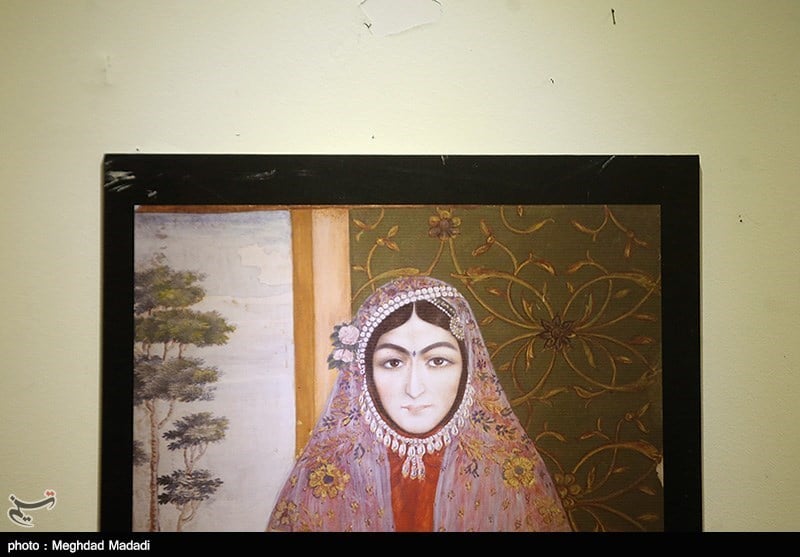
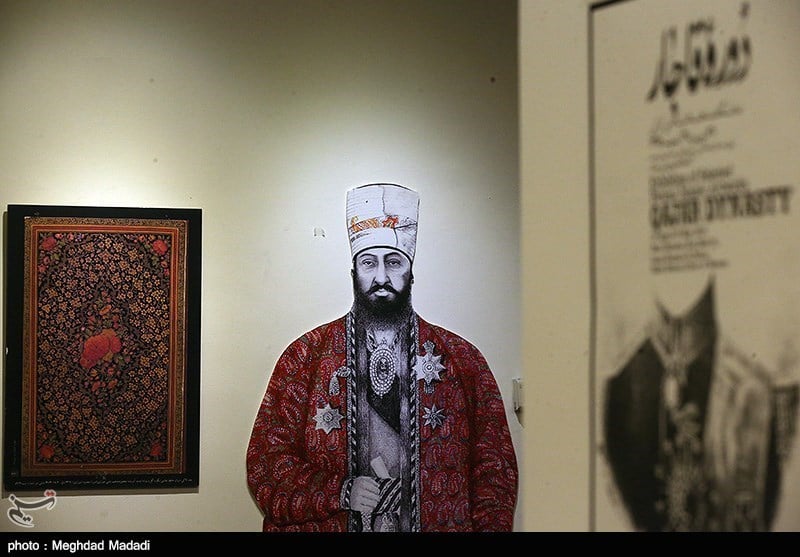
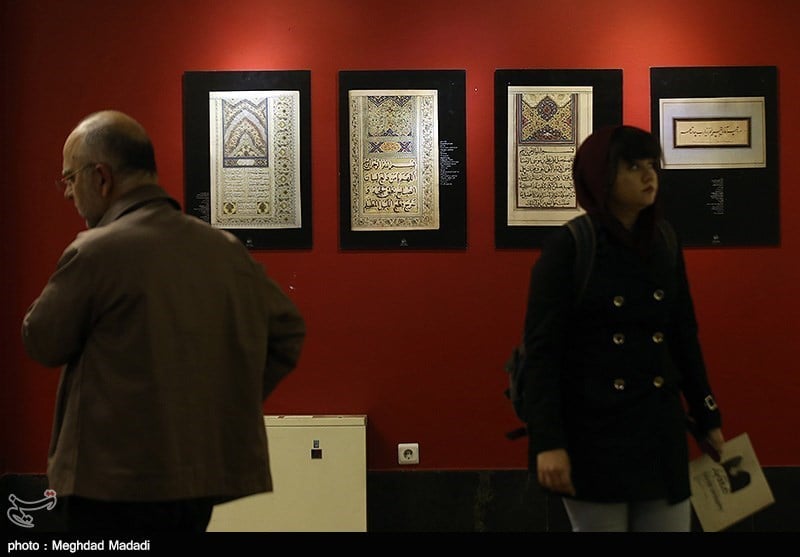
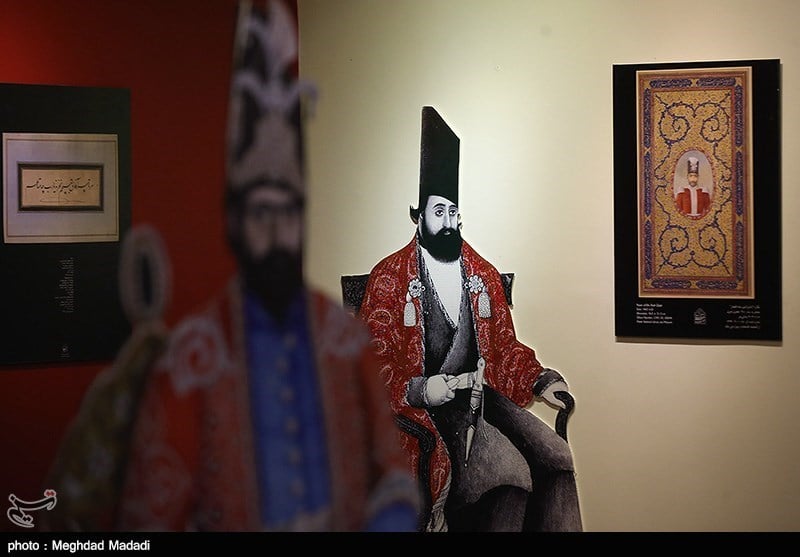
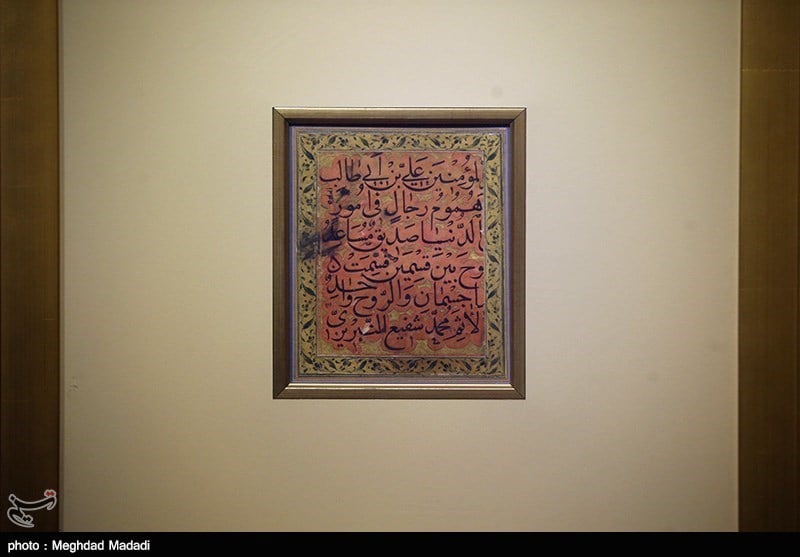
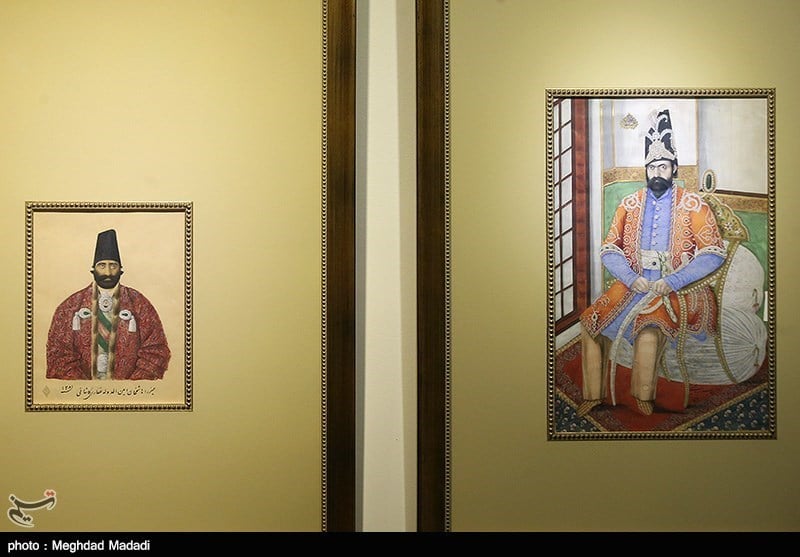
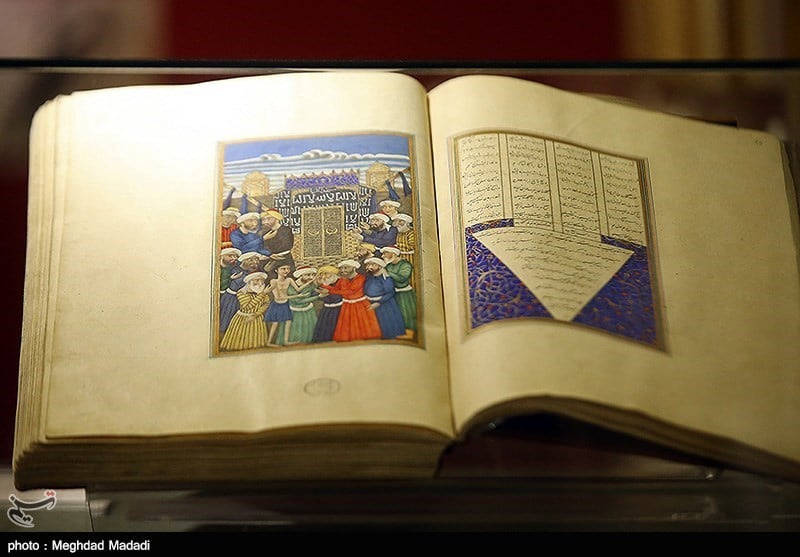
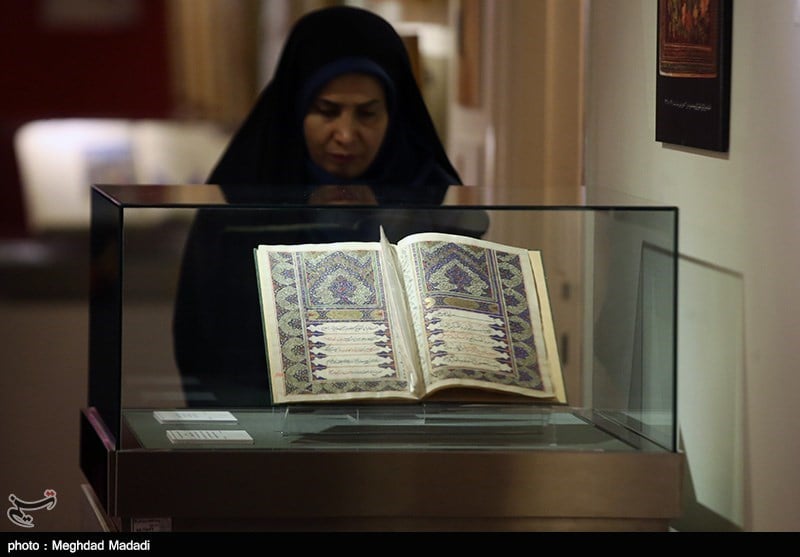
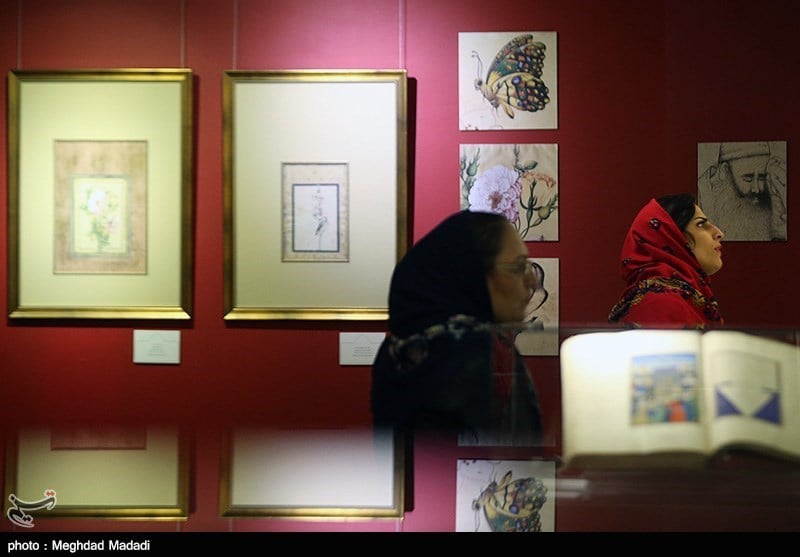
Tehran Hosts Exhibition of Qajar Era Artworks

The exhibition named “Selection of Islamic-Iranian Art in Qajar Era” is open to the public.

Malek National Library and Museum Institution (MNLMI) is the first private museum of Iran and one of the six large libraries holding exquisite manuscripts. The MNLMI collection is a rich trove of the best manuscripts and Iranian historical artworks.

The Institution is located in the historical precinct of “Bagh-e Melli” (National Garden) that is considered the cultural-historical centre of Tehran. The MNLM visitors include a large number of university students and researchers, as well as tourists who enjoy its library and museum facilities.

Qajar art refers to the art, architecture, and art-forms of the Qajar dynasty of the late Persian Empire, which lasted from 1781 to 1925 in Iran.

The boom in artistic expression that occurred during the Qajar era was the fortunate side-effect of the period of relative peace that accompanied the rule of Agha Muhammad Khan and his descendants. With his ascension, the bloody turmoil that had been the 18th century in Persia came to a close, and made it possible for the peacetime arts to again flourish.

Most notably, Qajar art is recognizable for its distinctive style of portraiture. While the depiction of inanimate objects and still lives is seen to be very realistic in Qajar painting, the depiction of human beings is decidedly idealised. This is especially evident in the portrayal of Qajar royalty, where the subjects of the paintings are very formulaically placed and situated to achieve a desired effect.

What follows are photos of the ongoing exhibition retrieved from Tasnim News Agency:

Dozens Killed, Wounded in Latest Suicide Blast in Kabul

“It happened at the entrance gate of the centre. It was a suicide attack,” Dawood Amin, police chief of Kabul, told AFP.

The Afghan Health Ministry puts the death toll at 52, but the number is expected to rise. Many civilians including three babies less than 6 years old are among the victims.

The ISIS terrorist group has claimed responsibility for the deadly attack.

The attack was the latest deadly blast in the past few months. Earlier last month, a car packed with explosives blew up outside a sports stadium in Afghanistan’s restive south, killing at least 13 people and wounding dozens more, officials said, capping a bloody week in the war-torn country.

The suicide attack happened in Lashkar Gah, the capital of opium poppy-rich Helmand province, as spectators were leaving a wrestling match at the stadium, provincial governor spokesperson Omar Zwak told AFP.

Helmand is largely controlled by the Taliban, which is under growing pressure to take up Ghani’s offer of peace talks to end the 16-year war.