Friday, December 26, 2025
Home Blog Page 3542

Digi: A Local Nomadic Iranian Food

The dish is usually cooked by nomads. The ingredients include pieces of lamb, tomatoes, potatoes, onions, spices and rice.


Ingredients

Rice: 2kg

Lamb: 2kg

Potatoes: 3 potatoes

Onions: 3 onions

Tomatoes: 5 tomatoes

Spices: as much as necessary

Digi: A Local Nomadic Iranian FoodRecipe:

Put the meat in a copper dish whose lid can be shut tight. Put as much rice as the lamb in a cauldron and add chopped potatoes and tomatoes. Then add water, salt and oil as much as necessary. Close the lid of the cauldron tight and put it on charcoal fire. Put charcoal all around the cauldron as well and somehow “bury” the cauldron in burning charcoal. That way, the ingredients are cooked through slowly by the charcoal heat and the lamb’s gravy is gradually absorbed by the rice.

Official Says Iran’s Presence in Syria Aimed at Keeping Israel Out

Hossein Amir-Abdollahian, the Iranian parliament speaker’s special adviser on international affairs, stressed that Syrians would not permit the Zionists in their homeland following the collapse of the Daesh terrorist group.

“The Zionist regime tries to gain dominance over Syria after Daesh, but resistance forces and military advisers from the Islamic Republic of Iran will continue their presence alongside Syria to counter terrorism, ” he said in a meeting with Palestinian Ambassador to Tehran Salah al-Zawawi.

“The Syrian people will not allow the country to be turned into the hotbed of Zionist terrorists once again,” Amir-Abdollahian noted.

Over the past few years, Israel has frequently attacked military targets inside Syria in an attempt to prop up terrorist groups that have been suffering defeats at the hands of Syrian government forces.

Tel Aviv has also been providing weapons to anti-Damascus militants as well as medical treatment to the Takfiri elements wounded in Syria.

Iran has been offering military advisory support to Syria at the request of the Damascus government, enabling its army to speed up its gains on various fronts against terror outfits.

Amir-Abdollahian also said Tehran will keep up its “decisive support” for the resistance and will not give in to pressures as regards the Palestinian issue and Israeli threats against the security of the regional countries.

Zawawi, for his part, warned that Israel’s right-wing Likud party, led by Prime Minister Benjamin Netanyahu, is seeking to control the Muslim world.

He further said the US is exerting economic pressure on some regional countries to advance the plans of President Donald Trump, who himself is implementing the will of the international Zionism.

Iran’s role in Syria is reported to be addressed at the July 16 meeting between Trump and Russian President Vladimir Putin, in the Finnish capital, Helsinki.

John Bolton, Trump’s national security adviser, said last weekend that the summit offered the possibility of a “larger negotiation on helping to get Iranian forces out of Syria.”

Such a deal, he said, would amount to “a significant step forward” in promoting Washington’s interests in the region.

Kremlin spokesman Dmitry Peskov, however, rejected reports that Iran’s role in Syria would be raised at the Helsinki summit.

“At any rate, the Russian side is getting ready, and Putin is prepared to discuss the topic of Syria,” he said, adding reports that Trump and Putin will discuss “a third country … are not true.”

Iran’s Beauties in Photos: Grape Harvest in Khuzestan

The grape harvest is usually done manually and its season is July-August.

Following are Mehr News Agency’s photos of people harvesting grapes in Ghazavieh Bozorg, a village located east of Karun River in Karun County:

Iran Expresses Regret over Deadly Floods, Landslides in Japan

In a statement on Sunday, Qassemi offered sympathy to the Japanese nation and government, and the bereaved families of the tragic incident’s victims.

Flooding and landslides have killed at least 60 people and left dozens missing in western areas of Japan.

Most of the deaths have occurred in Hiroshima prefecture, which has been hit by torrential rain since Thursday. Hundreds of homes have been damaged.

About 1.5 million people have been ordered to leave their homes and three million more advised to do so.

Authorities say it could potentially be the worst weather disaster Japan has seen in decades.

Prime Minister Shinzo Abe said the authorities were facing a “race against time” to save and evacuate people.

Thousands of police, firefighters and soldiers are taking part in search-and-rescue operations.

Some of the victims have been buried alive by landslides, Japan’s Kyodo news agency reports.

A Look at Iranian Newspaper Front Pages on July 8

A Look at Iranian Newspaper Front Pages on November 19

Newspapers today widely covered the results of the Friday talks in Vienna between foreign ministers of the P4+1 and Iran on the Joint Comprehensive Plan of Action. A key focus of headlines today was the positive signals received from the talks, and the positive impact of the EU’s package on the markets.

The US’ bid to stop Iran’s oil imports and Tehran’s reaction to the move also received great coverage.

Also a top story was the execution of eight ISIS elements who were behind the 2017 terrorist attacks on the Iranian Parliament and the mausoleum of Imam Khomeini, the late founder of the Islamic Republic, in Tehran.

The above issues, as well as many more, are highlighted in the following headlines and top stories:


19 Dey:

1- Zarif: We’re Sure World Standing against US

A Look at Iranian Newspaper Front Pages on July 8


Abrar:

1- Rouhani: Europe Must Make Practical Decisions on JCPOA

A Look at Iranian Newspaper Front Pages on July 8


Afarinesh:

1- Health Ministry: Child Obesity, Future Challenge of Society’s Health

A Look at Iranian Newspaper Front Pages on July 8


Aftab-e Yazd:

1- What Information Iran Received from Israeli Minister

  • Spy on Death Row

2- Iran Cuts Electricity Supply to Iraq for Baghdad’s Debts

A Look at Iranian Newspaper Front Pages on July 8


Arman-e Emrooz:

1- Prosecutor General: Details of 16 Female ISIS Members

A Look at Iranian Newspaper Front Pages on July 8


Asrar:

1- Oil Minister: Iran to Oppose US’ Oil Policies

A Look at Iranian Newspaper Front Pages on July 8


Ebtekar:

1- Return of Life to Water Pipes

  • Residents Talk about Current Situation of Abadan, Khorramshahr

A Look at Iranian Newspaper Front Pages on July 8


Etemad:

1- Oil Minister Calls US’ Bid to Stop Iran’s Oil Exports a Trade War

A Look at Iranian Newspaper Front Pages on July 8


Ettela’at:

1- Transfer of Water from Persian Gulf to Central Plain of Iran to Be Expedited

A Look at Iranian Newspaper Front Pages on July 8


Ghanoon:

1- Analyst: EU Worried about Its Prestige on JCPOA Case

A Look at Iranian Newspaper Front Pages on July 8


Hamshahri:

1- Markets Show Cautious, but Positive Reaction to EU’s Package

A Look at Iranian Newspaper Front Pages on July 8


Jame Jam:

1- Female Taekwondo Player Kimia Alizadeh to Be Iran’s Flag-Bearer in Jakarta Asian Games

A Look at Iranian Newspaper Front Pages on July 8


Javan:

1- North Korea: US’ Demands Aimed at Looting Our Country

2- Now It’s War Time!

  • Bodies of Two Martyrs Returned to Iran after 36 Years

A Look at Iranian Newspaper Front Pages on July 8


Jomhouri Eslami:

1- Zarif: Parties to Iran Nuclear Deal Committed to Purchase Oil from Iran

2- Academic: Trump Is a Bully and Others Should Stand against Him

3- Israeli MP Invites Saudi Crown Prince to Address Knesset Session

A Look at Iranian Newspaper Front Pages on July 8


Kayhan:

1- Europe Failed to Do Anything for Iran; Don’t Keep the Country Idle Anymore

2- Terrorists Surrender: Southern Front in Hands of Syrian Army

A Look at Iranian Newspaper Front Pages on July 8


Sazandegi:

1- Lady of Iranian Diplomacy

  • VP Laya Joneydi First Iranian Woman to Attend Highest-Level Diplomatic Talks

2- Does Iran Know about Russia’s Stance towards Sanctions

A Look at Iranian Newspaper Front Pages on July 8


Sepid:

1- Deputy Health Minister: 10,000 New Cases of Gastric Cancer in Iran

  • It’s Deadliest Type of Cancer and Very Hard to Treat

A Look at Iranian Newspaper Front Pages on July 8


Shargh:

1- Trump Backs Off from Boycotting Iran’s Oil

2- Positive Signals from Vienna

A Look at Iranian Newspaper Front Pages on July 8


Ta’adol:

1- Meeting Chaired by Rouhani Discusses Promotion of Employment, Production

A Look at Iranian Newspaper Front Pages on July 8


Vatan-e Emrooz:

1- Eight ISIS Elements Executed One Year after Attacking Iran Parliament, Imam Khomeini Mausoleum

A Look at Iranian Newspaper Front Pages on July 8

Iran Furniture Museum; History of an Industry

The museum has been established with the goal of creating a permanent place for gathering antique furniture.

It also provides researchers with an opportunity to conduct studies on the history of furniture in Iran as well as other countries of the world.

Iran Furniture Museum was established in 2011 in southern Tehran.

What follows are Tehran Picture Agency’s photos of the museum:

“West’s Support for MKO Discredits FATF’s Definition of Terrorism”

FATF’s Blacklisting of Iran; Threat or Opportunity?

The West’s support for the anti-Iran MKO cult shows the American-European consensus should have no bearing on the government’s definition of terrorism, an Iranian newspaper said.

In an op-ed published on Thursday, the conservative Resalat Daily said the government should not accept the dictates of the FTAF regarding how to block finance for terrorists.

Iran has for many years found itself in a blacklist of countries not doing enough to combat money laundering and terrorism financing by the FATF, an international group that sets anti-money laundering and counterterrorist finance (AML/CTF) standards and monitors money laundering worldwide.

Following the early January implementation of the JCPOA, the FATF in June 2016 suspended countermeasures against the country and entered into talks with the Iranian government.

The talks led to an action plan, according to which Tehran must amend its CTF law and join anti-money laundering conventions.

However, in its last meeting held on June 29, the group lamented that “Iran’s action plan has expired with a majority of the action items remaining incomplete.”

In what must amount to a final warning, the FATF gave Iran until October to implement necessary reforms, otherwise it will decide about Iran’s return to the FATF blacklist.


Heated Debate

One requirement the body says that Iran “should fully address” is “adequately criminalising terrorist financing, including by removing the [Iranian] exemption for designated groups ‘attempting to end foreign occupation, colonialism and racism’”.

While the FATF does not name such exempted groups, they are widely believed to include Palestine’s Hamas and Lebanon’s Hezbollah.

Some have argued that this condition is out of step with the article 154 of the Iranian Constitution that states while Iran “will not meddle into other nations’ affairs, it supports the rightful struggle of the oppressed against the arrogant forces anywhere in the word”.

The situation has sparked a heated debate in the country.

Advocates believe the return of Iran to the FATF’s blacklist will isolate Iran from the global economy and provides support for those who seek to undermine the JCPOA.

But critics argue it could hamper Iranian support for allies such as Hezbollah, which the United States has classified as a terrorist organization.

The Iranian government has expressed its reservation that the implementation of the convention should not dispute the legitimate right of nations under colonial domination and foreign occupation for fighting for self-determination.

But opponents in Iran’s parliament have so far blocked legislation toward compliance with FATF standards, believing membership in the group only makes the country vulnerable to outside meddling.

Iran’s Leader Ayatollah Seyyed Ali Khamenei recently suggested that it Iran did not have to join international conventions such as FATF when the consequences are not clear.

Speaking on June 20, the Leader said the parliament should pass legislation to combat money laundering according to its own criteria.


Double Standards

Resalat wrote the latest FATF statement shows Iran’s reservation was worthless and the group insists Tehran should accept its definition of terrorism.

But the group is in no position to lecture Iran on how to fight terrorism, considering the western countries’ double standards on terrorism, the newspaper said.

“The statement was published from Paris [the FATF headquarters], where the Hypocrites [a derogatory name for MKO members] as perfect examples of terrorists whose hands are stained with blood of over 17,000 Iranians, are freely active and hold meetings,” the article said.

MKO is designated a terrorist organization by Iran and Iraq. Washington and the European Union removed MKO from their lists of terrorist organizations in 2012 and 2009, respectively. The group is based in Paris, with a compound for its militiamen located in Albania.

Resalat said the French government’s hosting of MKO members and its green light for holding such a meeting is a flagrant violation of the United Nations Security Council’s Resolution 1373, which bars UN members from providing terrorists with safe havens.

“While FATF is bargaining with Iran over the definition of terrorism, hypocrites who hold a black record in carrying out terrorist operations and committing terrible crimes in Iran and Iraq … were holding a meeting calling for regime change in Iran”, the article said.

The meeting was attended by dozens of current and former officials and military brass from western countries, including 33 Americans.

Rudi Giuliani, US President Donald Trump’s lawyer, Newt Gingrich, a former House speaker and a close Trump ally, Bill Richardson, former US ambassador to the United Nations, US energy secretary and Democratic governor of New Mexico, were also in attendance.

“US’ Unilateralism Could Trigger World War III”

Nahavandian
Nahavandian

Iranian Vice-President for Economic Affairs Mohammad Nahavandian has, in an article published by Khabar Online, weighed in on the ramifications of Washington’s unilateral approaches. The full text of the analytical piece follows.

  1. Friday, July 6, marks the anniversary of the adoption of the Bayonet Constitution in Hawaii in the United States in the late 1900s. One-hundred thirty-one years ago (in 1887) on such a day, Kalakaua, the monarch of the tiny kingdom of Hawaii, had to sign the constitution under the force of the bayonet and threat of terror by a pressure group organized and armed by the Americans and other foreigners residing in Hawaii as well as the CEOs of foreign sugar companies. The constitution gave the Americans and Europeans the right to vote, but set limitations and the condition of being rich for aborigines in Hawaii! Consequently, American troops openly backed by the then US secretary of state quashed any objection by Hawaiian aborigines to this blatant foreign interference. Years later, the US changed the government of Hawaii before occupying it due to its strategic importance in the waters of south Pacific Ocean. The Americans refused to give residents of their neighbouring island the same rights that the US had recognized in the country’s constitution for its own people a hundred years before, i.e. in 1788. Despite all their humanitarian rhetoric, the US reserved the right to use force and determine the fate of others. Based on that mind-set, the US would put its interests before those of others, and give itself more rights than others.
  2. Eighty-nine years ago in 1929, the US Congress passed the Smoot-Hawley Tariff Act which slapped the highest-level duties on imports into the US in the country’s history. Then US President Herbert Clark Hoover had just won the 1928 presidential election with the slogan of support for local production and employment for American farmers on the threshold of the severe worldwide economic downturn known as the Great Depression (1929-1939). An economic forum of the League of Nations in 1927 in Geneva, which saw signs of a global economic slowdown, urged all states to set aside tariffs and boost international trade to give fresh impetus to economic growth. Some 1,028 American legislators also wrote a letter to Hoover expressing their opposition to trade restrictions. However, Hoover, under pressure from Congress, enforced the 59-percent tariffs on imported goods. Immediately, other countries imposed similar duties on American commodities in a retaliatory move, leading to 61-percent drop in American exports and a decrease in the country’s GDP to less than a half during the following four years. The unemployment rate, which stood at 8% at the time the tariffs were ratified, jumped to 25% in three years. Many historians and economists believe the Smoot-Hawley Tariff Act and the United States’ policy of unilateralism during that period, which led to a 33-percent decline in global trade, were the key contributors to the fueling an perpetuation of the global economic downturn and set the scene for World War II at the end of the 1930s. Senator Smoot and legislator Hawley, despite populist slogans, could not even maintain their seats in Congress in the congressional elections two years later. American statesmen’s selfish and unilateral mentalities once again plunged the US and the rest of the world into an unprecedented crisis and conflict. A mentality which prioritized American interests brought humanity to a crisis whose human cost was to strip 60 million people of the right to live worldwide.
  3. Today, the world has once again faced a new wave of common unilateralism among American politicians. It is a current which claims prioritizes American people’s interests, but is not against the rights of others. Nevertheless, the first steps taken by this current was to counter the international Paris Agreement on climate change, disrupt regional trade agreements, namely the North American Free Trade Agreement (NAFTA), slap high tariffs on imports of aluminium, steel and automobiles, and pull out of the multilateral nuclear deal with Iran. Such moves violate the rights of people of other countries, harm global environment and trade, and result in a global trade war, setting the stage for a global downturn, which poses a threat to world security. The root cause of this dangerous approach is not only profiteering in the trade domain, but is the egoistic approach which considers the US superior to others and gives it the right to determine others’ fate. This arrogant point of view is clearly manifested in Trump’s decision to ban travellers of certain Muslim countries from entering the US and to separate children of illegal immigrants from their parents.
  4. However, the important difference between our era and the nineteenth and twentieth centuries is the widespread awareness of incidents and policies. The global virtual world, even if it has shortcomings, has a major advantage, and that is, it provides for transparency and enables people to put forward their demands immediately and on a large scale. The old and threadbare mentalities of the 19th century have less chance of success in the era of information explosion. Their long-term consequences can be seen in a shorter period of time. Today, everybody in the world understands the true reality of “everybody should be sacrificed for powerful Americans” and react to it. Currently, all across the world, namely inside the United States, have a more widespread awareness of, and show reaction to the disastrous repercussions of the US government’s policies. Other countries, too, have begun reacting to Washington’s unilateral moves, namely the tariff war. November elections in the United States will show to what extent American voters are aware of this global danger. Governments and nations need to show serious and firm reaction to Washington’s unilateral approach and policies in order to ward off a global catastrophe. Those who are familiar with the past and can see the future shoulder the onerous responsibility of contributing to the world public opinion.

South Korea Rejects Reports on Stopping Oil Imports from Iran

In a post on its Twitter account, the South Korean embassy in Iran rejected a report by Reuters which claimed the country has stopped oil loading in Iran amid fear of sanctions by the US.

The tweet added that South Korea is involved in negotiation with the US government to receive an exemption from US sanctions on buying Iranian oil in line with a waiver it received during previous sanctions., a report by ISNA said

The tweet came after Reuters claimed Seoul will not lift any Iranian crude and condensate in July.

According to Reuters quoting three sources familiar with the matter, South Korea will not lift any Iranian crude and condensate in July, halting all shipments for the first time in six years amid US pressure to cut all imports of Iranian oil from November.

South Korea is one of Iran’s main customers in Asia along with China and Japan.

“There was pressure from the South Korean government to halt purchases,” said the sources familiar with Iranian shipping arrangements. “South Korea overall is lifting zero oil (from Iran) for July loading.”

Iran Dismisses Claim Germany Holding Its Assets

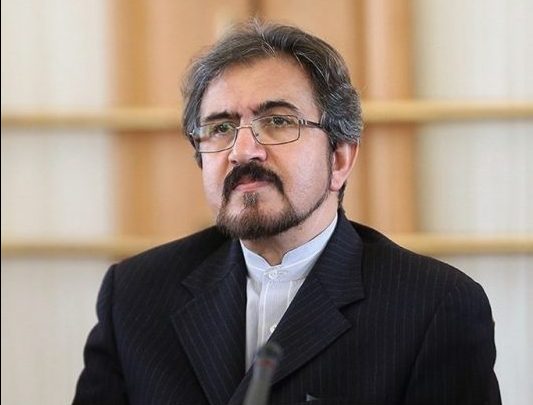
Qassemi said economic relations between Iran and Germany are developing within their normal mechanism.

“During the Friday talks in Vienna between the foreign ministers of Iran and other parties to the Iran nuclear deal, the German and Iranian delegations discussed ways to develop better mechanisms for further expansion of economic and banking relations between the two sides,” he said in an interview with Fars News Agency on Saturday.

The spokesman said the claim that Iranian assets have been frozen in Germany is part of a psychological war against the Islamic Republic.

“Unfortunately a psychological war by some extra-regional states and anti-Iran groups has been waged over the past days and weeks as Iran and other parties to the JCPOA have engaged in talks over the future of the 2015 agreement,” he said.

Qassemi said the war is aimed at undermining ties between Iran and the European states and called for vigilance against such dirty propaganda.

He made the comments in reaction to an Iranian lawmaker’s interview with Fars News, in which the MP claimed Germany has blocked parts of the Iranian assets.