Sunday, December 28, 2025
Home Blog Page 3531

A Look at Iranian Newspaper Front Pages on July 22

A Look at Iranian Newspaper Front Pages on November 19

The top story in all papers today was the Saturday remarks by the Leader of Iran’s Islamic Revolution Ayatollah Seyyed Ali Khamenei in a meeting with the Iranian foreign minister and the country’s ambassadors.

Also a top story was a vote by the Expediency Council which reaffirmed the religious minorities’ right to run for local elections and be elected to city and village councils. The vote allowed Sepanta Niknam, a Zoroastrian politician, to get back to his work in the City Council of Yazd after being suspended by the Guardian Council.

Several papers also covered a terrorist attack by PJAK militants on an Iranian border post in Marivan, western Iran, during which 11 IRGC forces were killed and several others wounded.

The above issues, as well as many more, are highlighted in the following headlines and top stories:


19 Dey:

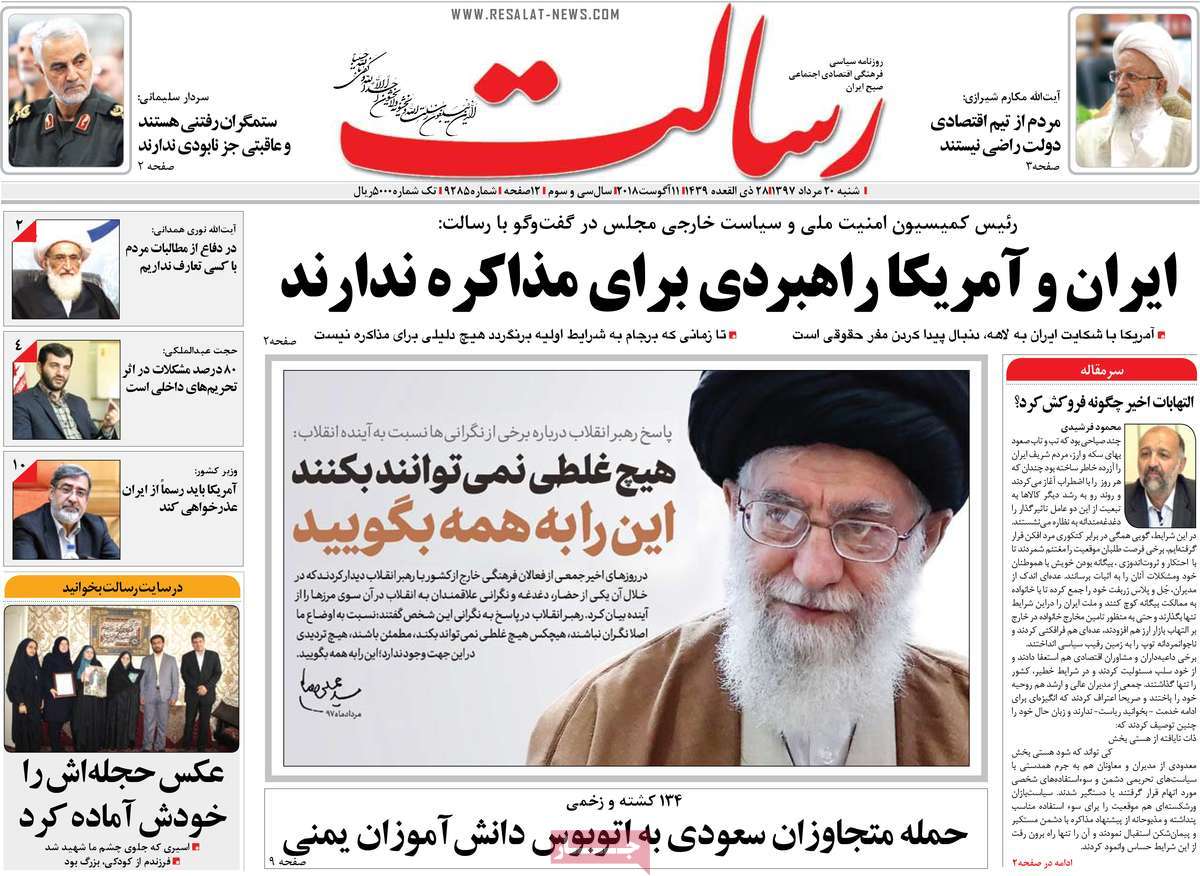
1- Iran Leader: There’s No Point in Holding Talks with US

A Look at Iranian Newspaper Front Pages on July 22


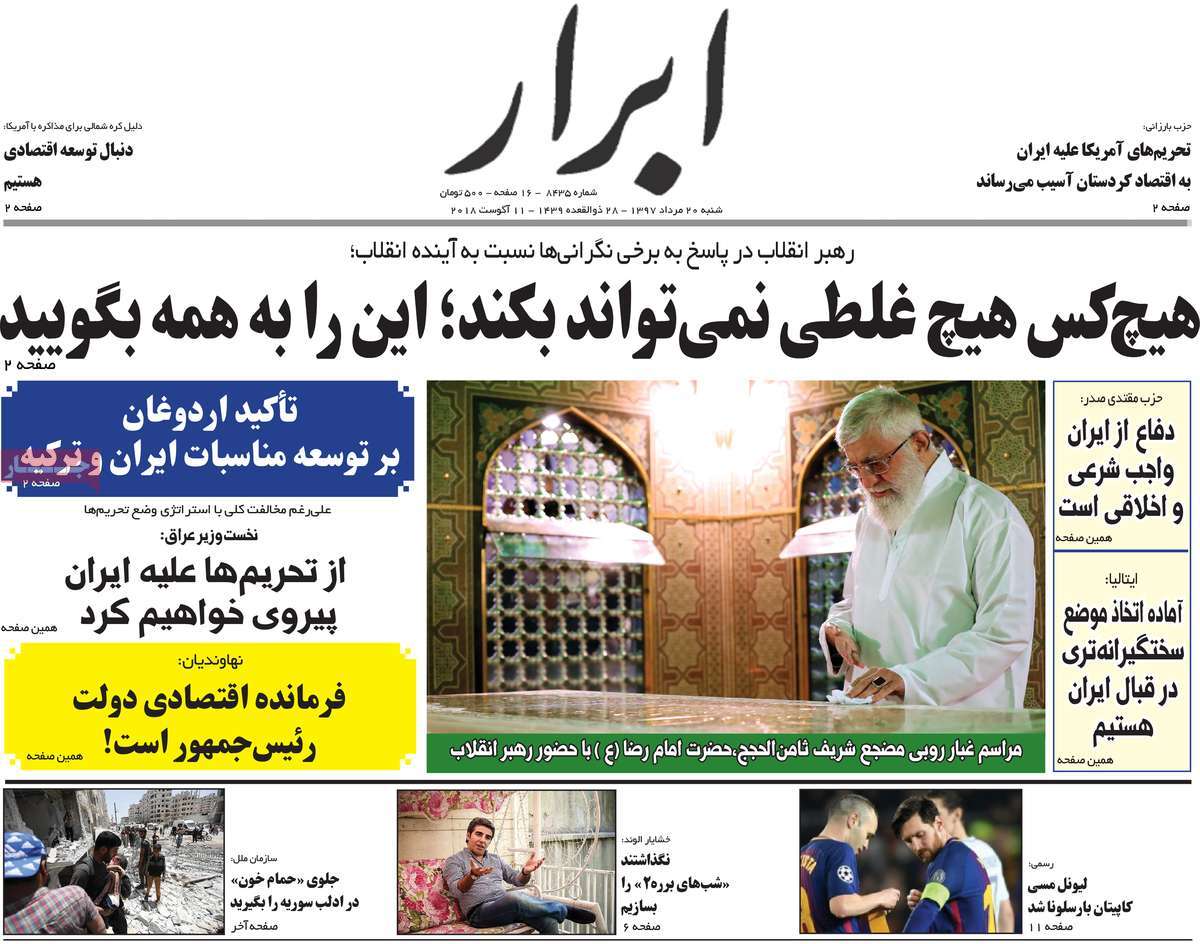
Abrar:

1- FM: Zionists’ Iranophobia Project Failed

A Look at Iranian Newspaper Front Pages on July 22


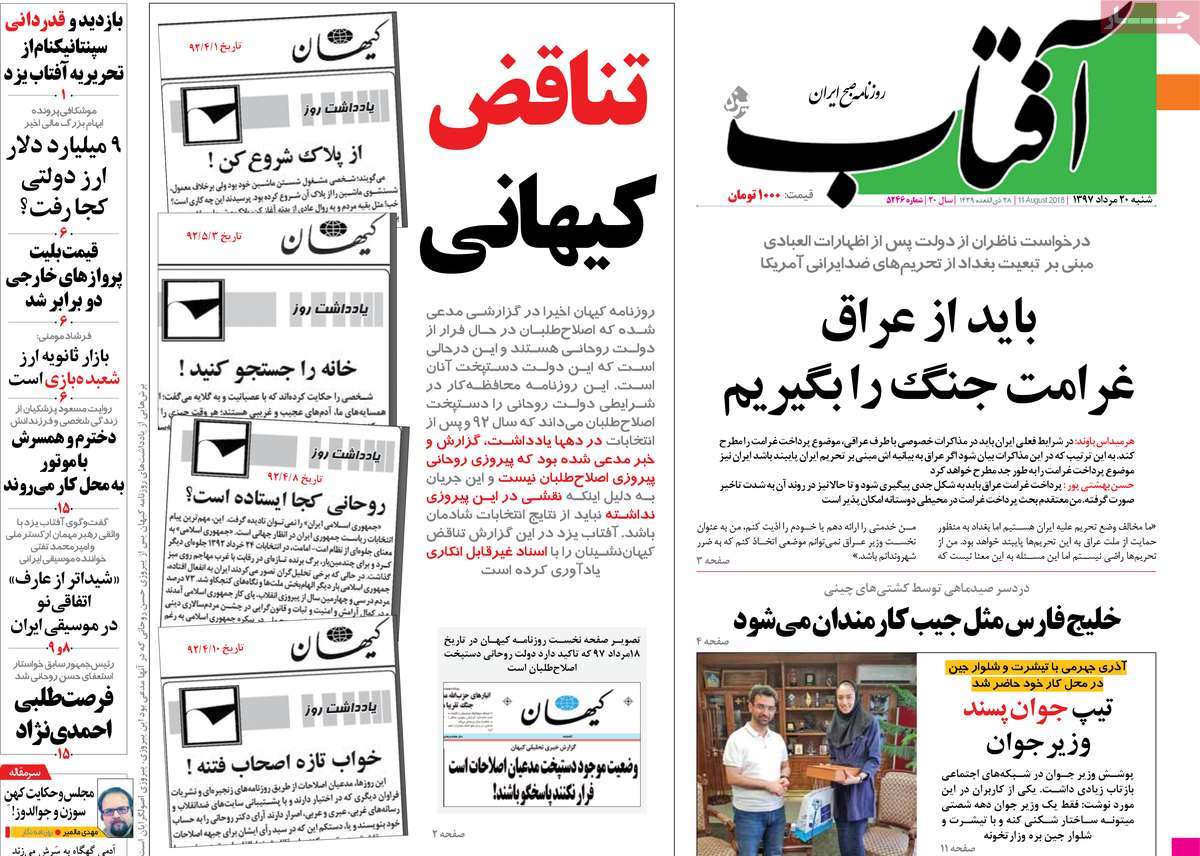
Aftab-e Yazd:

1- We Were All Together Yesterday: Zoroastrian Councillor

  • Expediency Council’s Vote Sends Sepanta Niknam Back to Yazd’s City Council

2- Iran Leader: Talks with Europeans Shouldn’t Be Halted

A Look at Iranian Newspaper Front Pages on July 22


Arman-e Emrooz:

1- Sepanta Niknam Finally Returns to Yazd’s City Council

2- Attack on Border Post in Iran’s Marivan Leaves 11 Killed

3- Imam Khomeini’s Grandson: We’ll Undoubtedly Overcome Challenges

A Look at Iranian Newspaper Front Pages on July 22


Donya-ye Eqtesad:

1- Trump Backs Off from His Stances on US Dollar

A Look at Iranian Newspaper Front Pages on July 22


Ebtekar:

1- China Biggest Player of New Cold War: A Review of Xi’s Visit to Africa

2- Another Scandal for Trump

A Look at Iranian Newspaper Front Pages on July 22


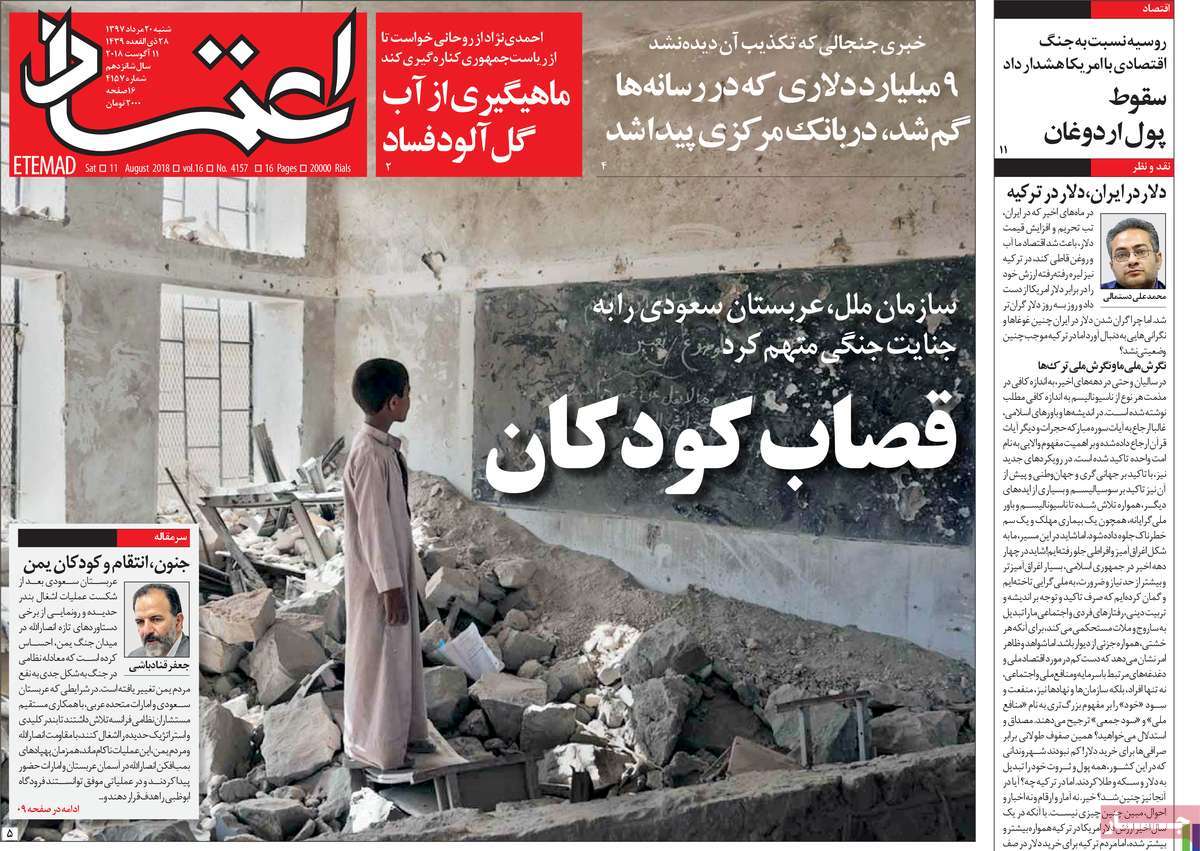
Etemad:

1- Paying Our Debts to Zoroastrian Iranians [Editorial]

2- Reformists’ Main Challenge Is Those Who Seek Regime Change in Iran

A Look at Iranian Newspaper Front Pages on July 22


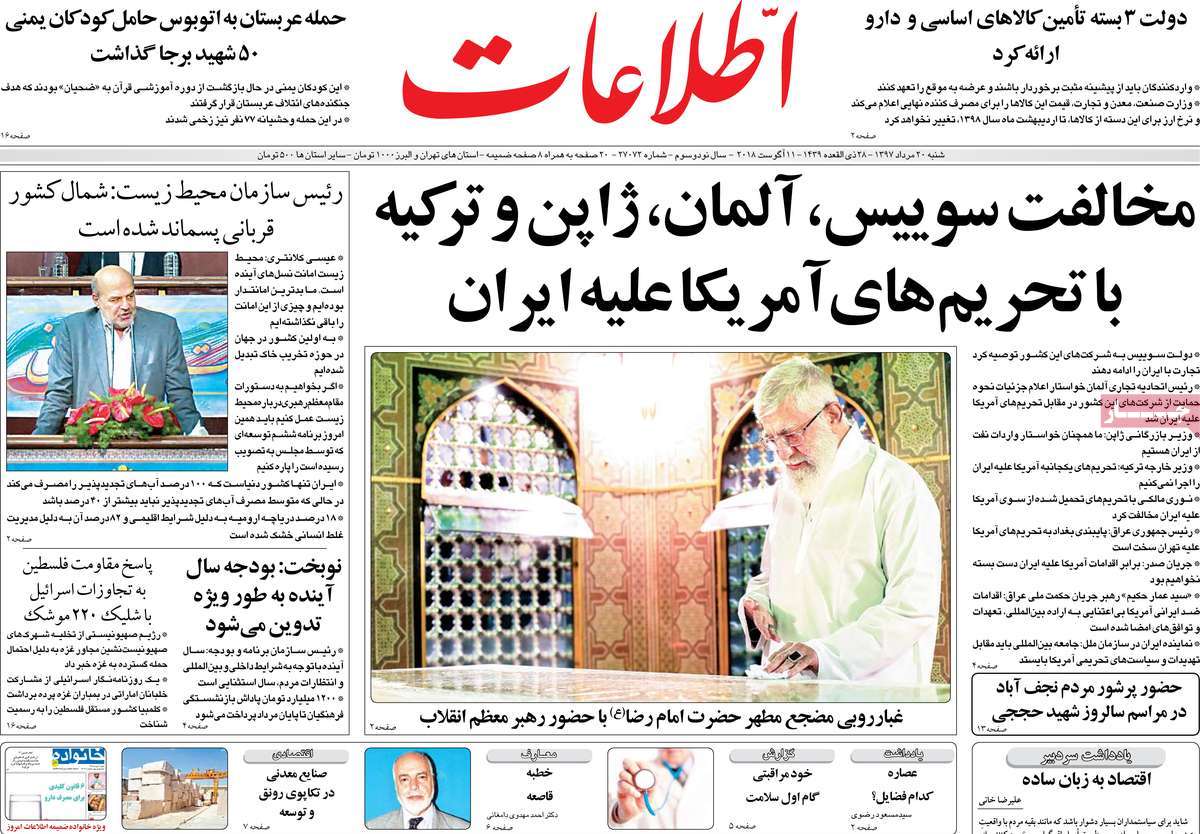
Ettela’at:

1- Israel’s Artillery Attack on Resistance Forces’ Positions in Gaza Leaves 5 Dead

A Look at Iranian Newspaper Front Pages on July 22


Jame Jam:

1- Iran Leader: Don’t Wait for EU’s Package

A Look at Iranian Newspaper Front Pages on July 22


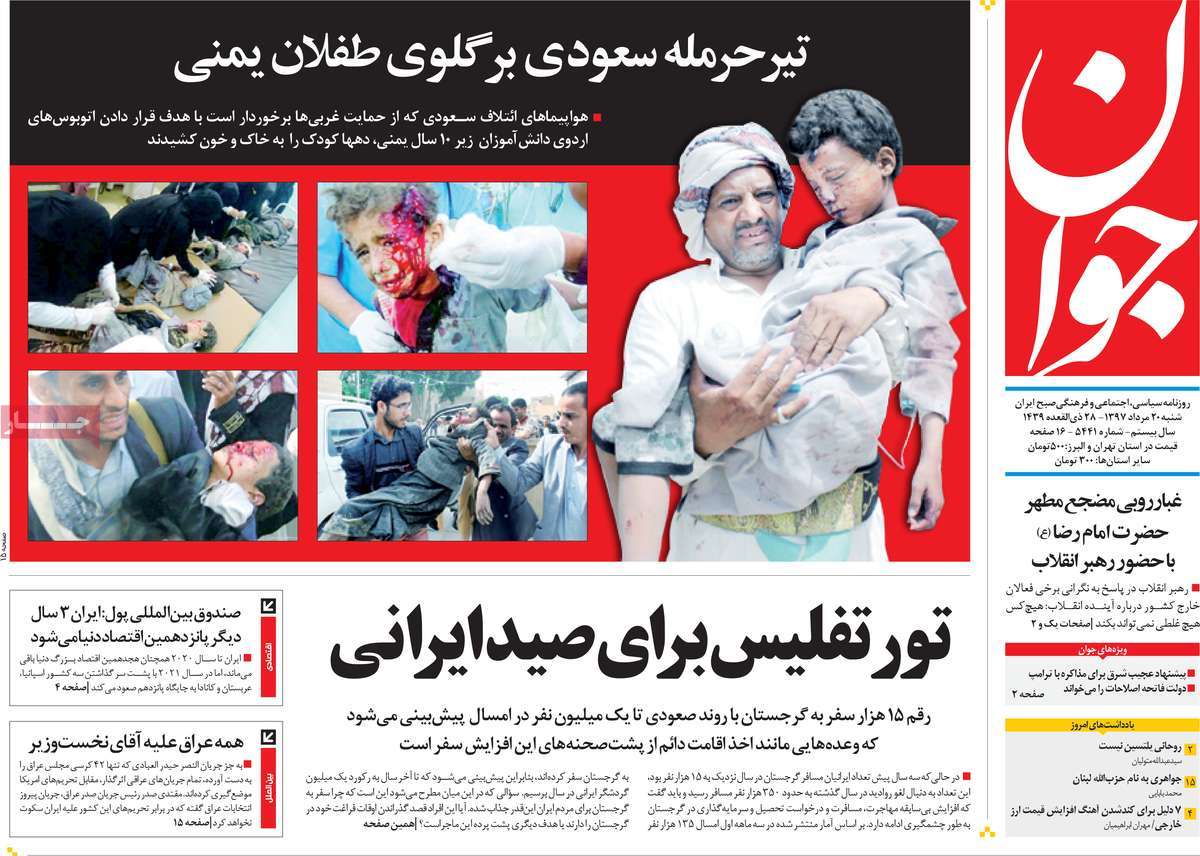
Javan:

1- Those Going Abroad for Pleasure Won’t Receive Official-Rate Currency Anymore

A Look at Iranian Newspaper Front Pages on July 22


Jomhouri Eslami:

1- Global Opposition to Zionist Regime’s Plot to Create “Jewish Nation-State”

A Look at Iranian Newspaper Front Pages on July 22


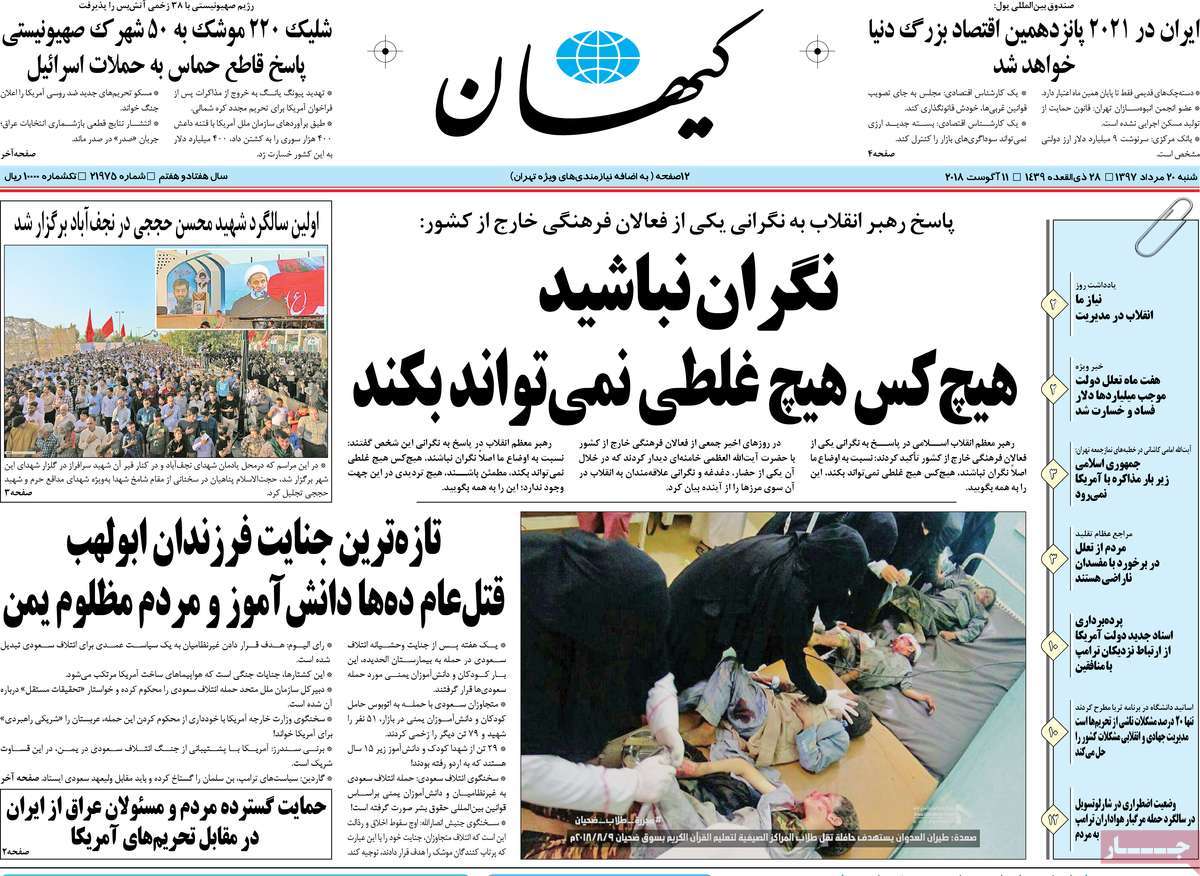
Kayhan:

1- Iran Leader: Rouhani’s Oil Threat Based on Policy of Islamic Republic

2- Insane Aerial, Ground Attacks on Gaza Leaves Hundreds of Palestinians Dead, Wounded

A Look at Iranian Newspaper Front Pages on July 22


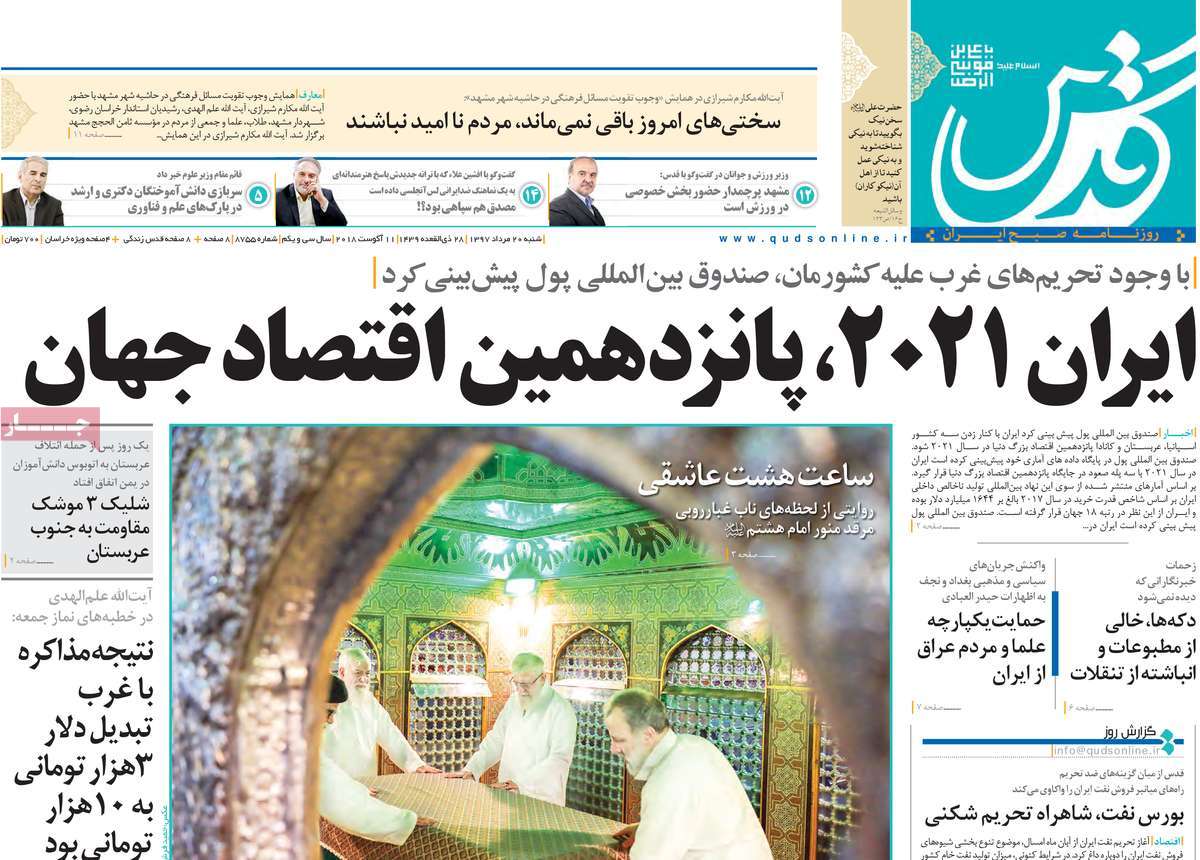
Quds:

1- Iran Leader: Even US’ Signature Cannot Be Trusted

A Look at Iranian Newspaper Front Pages on July 22


Sazandegi:

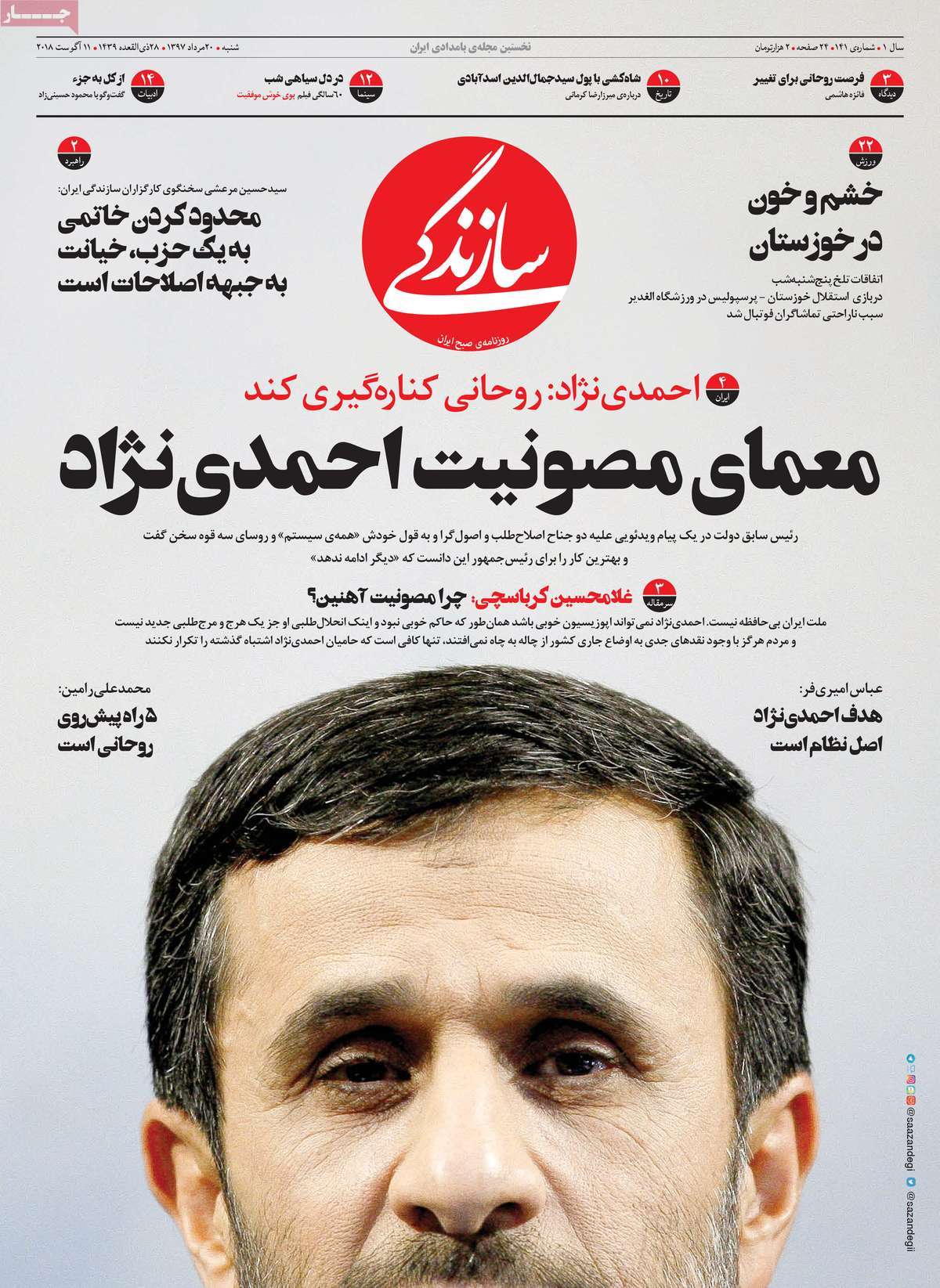
1- Iran Leader: Diplomacy Has No Contradiction with Ideology

A Look at Iranian Newspaper Front Pages on July 22


Setareh Sobh:

1- Iran Leader: Main Goal of Diplomacy Is to Protect National Interests

A Look at Iranian Newspaper Front Pages on July 22


Shargh:

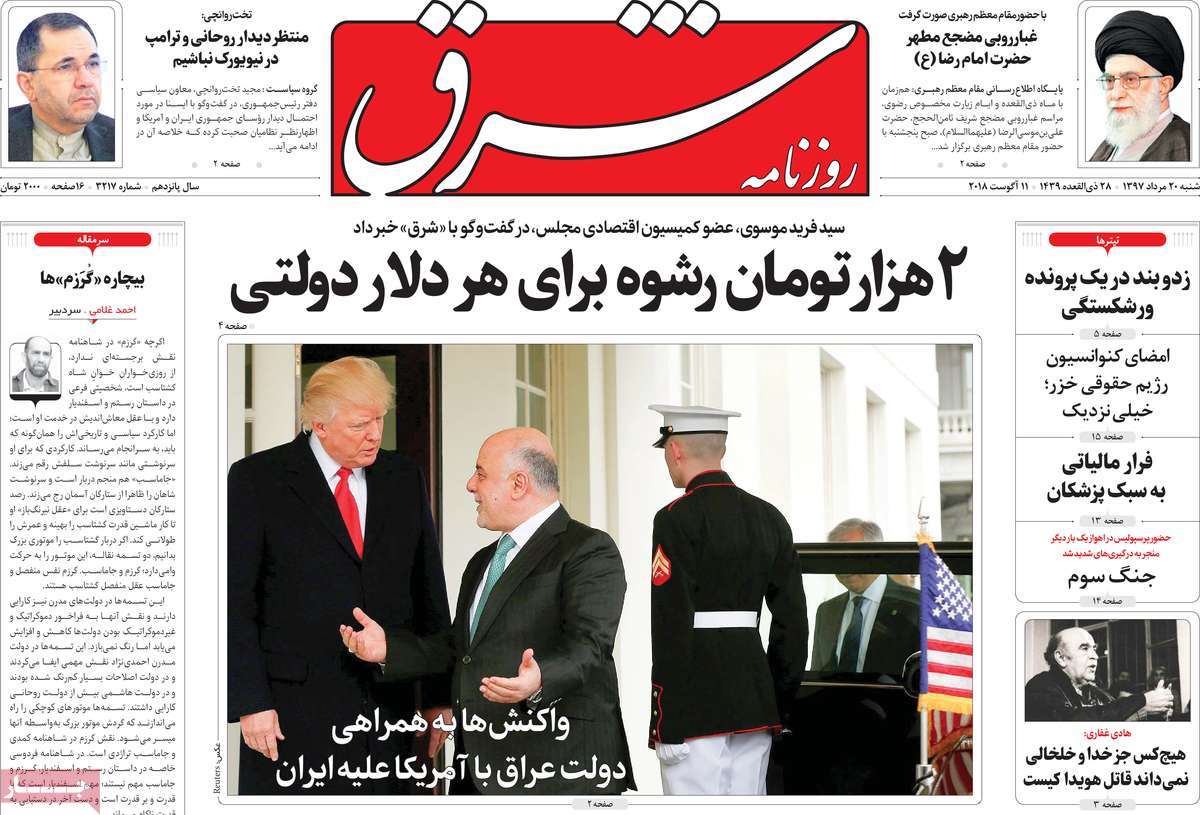
1- Turkish Foreign Ministry: We’ll Oversee US Sanctions against Iran

2- NIAC: Pompeo Must Apologize

A Look at Iranian Newspaper Front Pages on July 22


Iran’s Printing Museum; A Must-See Site for Tourists

The museum is located on the 30th Tir Street downtown Tehran. The neighborhood is one of the most prosperous passageways in Tehran, where many people come to do their job and spend their time during the day and night.

The Script and Print Museum is a subset of Library, Museum, and Document Centre of the Parliament, and is located in a building of the National Library. Its corners have different memorials from the Qajar period and their printing machines.

Amin Ali Jahani, the director of the museum, says the Parliament’s print house is the oldest major printing house in the country. There exists a brilliant record of publishing books and various publications, as well as the machines of that era. Visiting this museum can help visitors get familiar with the evolution of the print industry in Iran.

“The museum is divided into 14 sections in seven parts: the history of books in Iran, the beginning of printing in Iran, printing machines, printing houses, printing of photographs, binding, and book publishing and printing in the digital age and contemporary era; and in each of these parts one can find the oldest machineries,” added Jahani.

The first exhibition space of the museum is the section allocated to the history of writing in Iran, which dates back to the beginning of the time of writing in Iran, i.e. from 3,000 BCE till the beginning of traditional Iranian book publishing.

In this section, clay tablets and stamps of Proto-Elamite, Elamite writing system, Elamite cuneiform scripts, Persian cuneiform scripts, Middle Persian scripts including Pahlavi and Sassanid Pahlavi inscriptions, as well as Avestan scripts could be seen.

Iran’s Printing Museum; A Must-See Site for TouristsThe second section of the museum focuses on historical schools of traditional book writing in Iran during the Islamic era with works such as the scripts of the early Islamic centuries (Quranic scripts written in Kufic), the Seljuk era scientific books, the Iranian painting and calligraphy schools with works of Tabriz’s Ilkhani school, Herat’s Timurid school, Tabriz’s Safavid school, Isfahan’s Safavid school and Qajar school.

The third section is about the beginning of printing in Iran. This section deals with how the printing industry enters Iran and lithographic printing practices start in the country.

One of the most attractive parts of the museum is the fourth and fifth sections of the museum which focus on the printing machinery, and have occupied the largest space of the museum.

The sixth section of the museum located in the basement of this complex is the live show of an old print shop, in which printers are set up to show the space of a print house and its working environment to the visitors.

The museum’s seventh to ninth sections are devoted to photo printing techniques in the printing industry, including the introduction of photography glasses, photography devices such as the German-made old cameras and the 1973 Toyota camera manufactured by Japan, among others.

In the next sections, one can see bookbinding techniques from the past to contemporary times. In the last section of the exhibition, the contemporary era examples of print works and the digital age computer techniques in publishing, as well as the publication of texts on the Internet and cyberspace are briefly presented so that the evolution of the printing industry can be introduced.

Iran Not to Wait Too Long for Europeans: FM Zarif

zarif

Addressing a ceremony to pay homage to the late founder of the Islamic Republic, Imam Khomeini, in Tehran on Saturday evening, Zarif pointed to recent talks between Iran and the European parties to the JCPOA and said, “Alongside the statements and pledges they give, the Europeans must act to save this agreement.”

“We have not seen sufficient practical measures by the Western powers and the remaining parties (to the JCPOA),” he said.

Iran will continue the talks with the Europeans, but will not wait too long for them, the top diplomat said, referring to Europe’s move to propose a package of economic measures to offset US pullout from the JCPOA.

Earlier this week, Zarif said that the practical measures of the five remaining parties to the JCPOA have begun, adding that in his recent visit to Vienna, the foreign ministers of the countries informed him of the detailed measures.

Zarif further emphasized that Iranian diplomats will continue the talks on saving the JCPOA.

On May 8, the US president pulled his country out of the JCPOA, which was achieved in 2015 after years of negotiations among Iran and the Group 5+1 (Russia, China, the US, Britain, France and Germany).

Following the US exit, Iran and the remaining parties launched talks to save the accord.

Meanwhile, Leader of the Islamic Revolution Ayatollah Seyed Ali Khamenei has underlined that any decision to keep the JCPOA running without the US should be conditional on “practical guarantees” from the Europeans.

Iranian Researchers Develop Herbal Medicine for Epilepsy

Project manager Reza Mazloum Farsibaf said the newly-developed medicine can be used for the “final and definitive treatment” of the disease while other drugs currently used to cure epilepsy are coupled with some challenges.

He told ISNA that some of the medicines prescribed should be used by patients for a long time while they have side effects, including extreme somnolence, permanent tensions, and severe physical damage.

“So, the drugs developed to treat this disease in the world have not led to the complete treatment of the disease, so far,” he said.

For a brief review of Iran’s achievements in various fields of science and technology, check the book “Science and Technology in Iran: A Brief Review

He said research shows that taking the newly-developed herbal drug for 6 to 12 months and stopping the use of chemical medicines result in the final treatment of the disease.

According to the senior researcher, surveys have also shown that patients which needed surgery were cured after taking the medicine.

He said the drug has gone through the stage of tests on animals, adding its clinical tests are being carried out at a hospital under the supervision of the Shahid Beheshti University of Medical Sciences.

Iran Different Experience for Every Foreign Tourist: Indian Daily

Tarun Vijay, a former Indian lawmaker who recently had a trip to the Iranian city of Shiraz, has written an article in Telegraph India that “our relations with the Persian people go beyond strategic needs. It’s a matter of the heart.”

“For me, the journey to Persia was also a matter of de-learning some things and weaving something new – a serenade of serenity is what I would call it,” he was quoted as saying in a report by IRNA.

This Indian researcher has also commented that Iran is not like any other country for India. “Since the days of King Darius to the Mughals, and from the families of Jamshetji Tata and Godrej to Field Marshal Sam Manekshaw and Ghorban Mohammadpour, we have had so much of Persia amidst us. So much that it has silently merged into our being, giving a distinct flavour to our languages, culture, strengths, mores and habits. But the presence in Iran is a very different experience for any traveller who wants to travel to the country.”

Iran Different Experience for Every Foreign Tourist: Indian Daily“The three days I spent in Iran just a few weeks ago changed a lot of my perceptions about that country, its people and culture. Iran, as routinely reported to us by Western governments and media agencies, is everything that stands against human values and democratic practices. Is that stereotype true? Should I not say something about what I saw and experienced for myself?” writes Vijay

He further mentions that Iran must be seen and understood by Indians through the eyes of Indians. “Iran is a people, something that defines itself in unmatched subtlety and finesse; it’s a poet’s dream, it’s dance, it’s drama, it’s fun. It is a land of unparalleled brilliance and beauty.”

“We in India might still be debating about our Aryan roots, but Iran is sure and proud to be an Aryan land. That name itself – Iran – is directly derived from the word Aryan.”

“They are different from every other Muslim land – so distinctly refreshing and civilised that it cannot but strike a visitor. We could see a softer, liberal, open side of Iranian society, a side not often showcased. Restaurants were as noisy and chaotic rolling with all types of kebabs. A large number of cars on the roads were driven by women, who not just waved at our visiting caravan but also shouted with their necks out – Hello! Welcome to Iran!”

takht jamshidVijay also says that visiting the ruins of Persepolis, the ancient city of the Persians also known as Takht-e-Jamshid, was an amazing experience as we all know how immensely they have pioneered and contributed to the India growth story.

“Contemporary Islamic Iran has kept its ancient pre-Islamic heritage preserved with such touching care and pride that we can learn a few things from them. Another revealing moment for me was paying obeisance at a Hindu temple and a gurdwara – both on the same campus – at Bandar Abbas; these structures are meticulously preserved and maintained by the Iranian government’s culture department.”

This Indian journalist further points out that, what was incredible throughout the trip, was the spontaneous show of warmth and friendship by the Iranian people.

Referring to his long journey to the Iranian cities, he wrote all of this came to transpire along the 7,200-kilometre International North–South Transport Corridor (INSTC), which has been receiving the attentions of Prime Minister Narendra Modi and the Russian President, Vladimir Putin, for obvious reasons.

Iran Different Experience for Every Foreign Tourist: Indian Daily
Iran Officially Opens Strategic Port of Chabahar

India’s help in developing Iran’s Chabahar port is a milestone in the overall development of INSTC. It received a boost during Modi’s Tehran visit and, in more than one way, it underlines the critical importance of India-Iran co-operation.

Yes, the American sanctions wrecked the Iranian economy. But everyone should trust that for Delhi, the road to Tehran doesn’t pass through Washington DC. Our relations with the Iranian people go beyond strategic needs. It’s a matter of the heart. For me, the journey to Iran was also a matter of de-learning some things and weaving something new – a serenade of serenity is what I would call it, he concludes.

Trump Pushing US Army to Invade Iran: Top General

Iran Will Definitely Change Approach to UAE: Top General

“Today, our system is at risk of harshest sanctions and threats, and the enemies’ behaviour is unpredictable,” Chief of Staff of Iran’s Armed Forces Major General Mohammad Baqeri said on Sunday.

“Although the incumbent US administration does not make military threats, there is credible information that in the past year and a half, it has been trying to push the US military to invade [Iran].”

The top general said although the US is currently focused on carrying out its economic threats against Iran, Tehran would do well to get ready to come to grips with other types of threats as well.

“The focus of enemies’ threats is on economic sanctions, but various threats could emerge and armed forces should be ready to defend the nation and the system,” Tasnim quoted him as saying.

The Trump administration pulled the US out of the 2015 nuclear deal early May and has vowed to impose harsh sanctions that it claims could eventually destroy the Iranian economy.

The US has provided a list of 12 demands that says Tehran needs to accept if it seeks relief from Washington’s threats.

Don’t Play with Lion’s Tail, Iran’s President Tells Trump

Donald Trump’s threat that the US will cut off Iran’s oil exports shows that he is a political neophyte, Rouhani said, stressing that if the US president knew anything about politics, he would not have made such a threat.

He also noted that Iran has various options on the table to deal with US threats including the closure of the strategic Strait of Hormuz.

“Mr Trump! We are men of honour and have guaranteed the security of the region’s waterways [Hormuz Strait] throughout the history. Don’t play with fire, it will make you regretful,” he told a gathering of Iranian ambassadors in Tehran on Sunday.

The Trump administration has announced it intends to cut down to zero Iran’s oil revenues by early November, when a majority of anti-Iran US sanctions that were suspended under the 2015 nuclear pact will snap back.

Rouhani has vowed Iran will stop oil imports from the Persian Gulf by blocking the Strait of Hormuz if the US halts Iran’s oil exports.


War with Iran Mother of All Wars

The president said Iran’s enemies have hatched various plots against the country since the Islamic Revolution of 1979, from attempts to topple the system to disintegrate the country.
Rouhani said the latest plot was weakening Iran through international sanctions, which was foiled by the 2015 nuclear deal.

The president said the US has now decided to try exhausting the Iranian nation.
“Today, our internal unity is greater than before. Threats will boost our cohesion,” he said.
Rouhani said enemies will “loot” Iran if it caves into pressure by a “lying bully” like Trump.
“Today, talking with the US means nothing but surrender and ruining all achievements of the Iranian nation,” he said.

Rouhani said the incumbent US administration is standing against the world and acting against the US’ national interests.

“Americans must understand well that peace with Iran is the mother of all peace and war with Iran is the mother of all wars,” he said.

War of Words Escalates between Iranian, US Presidents


Iran to Improve Ties with Saudi Arabia, Bahrain, UAE

Referring to allegations by the US that Tehran is destabilizing the region, the president said Iran is a peace-loving nation that sees helping neighbours against killers as its sacred duty.
“We uprooted ISIS and saved the people of the region. We are proud of that,” Fars News Agency quoted him as saying.

“Our influence in the region is historic and civilizational. Our commitment to the [security of the] region results from our Islamic and Iranian identity,” he said.

Rouhani said moves by the US administration and the Israeli regime in recent months have exposed the true nature of the Zionist regime and proved Iran’s relentless opposition to the Zionist regime was a good policy.

“Today, it is more clear that the Zionist regime is bent on aggression and occupation … What we were telling our neighbours and Arab countries regarding the nature of Israel has proved correct,” he said.

The US and Israel have taken steps seen as preparations for implementing a so-called peace plan dubbed “the deal of the century”, which has been formulated by the Trump administration.

In May, the US moved its embassy from Tel Aviv to Jerusalem al-Quds, effectively killing hopes to reach a so-called two-state solution for the Palestine conflict.

“So far, [they] were telling Israel is a model of democracy in the region. Today, it is proven that this is the centre of apartheid,” Rouhani said.

In spite of recent developments, the president said Tehran seeks closer relations with Saudi Arabia and its allies.

“We want best relations with our neighbours. Under the new circumstances, we seek to mend Iran’s relations with Saudi Arabia, the UAE and Bahrain,” he said.

Iran Reaffirms Religious Minorities Free to Be Elected to Local Councils

Iran’s Expediency Council, which is charged with resolving disputes between the Iranian Parliament and the Guardian Council, ruled on Saturday that members of the religious minorities can be elected to local councils.

Two-thirds of those participating a Saturday meeting of the Expediency Council voted for the law, which will allow Sepanta Niknam, a Zoroastrian member-elect of Yazd’s city council, to start his work as a councillor after being suspended by the Guardian Council.

“Today, the Expediency Council ruled that the 1996 law on religious minorities is applicable and they can run for local elections,” Gholam-Reza Mesbahi-Moqaddam a member of the Expediency Council told Mehr News Agency.

Iran Reaffirms Religious Minorities Free to Be Elected to Local CouncilsSepanta Niknam was the only non-Muslim politician elected to the council of Yazd in central Iran back in May 2017 but he was suspended later in the year following a complaint by one of his fellow councillors and a decision by the Guardian Council.

It had followed a ruling by the head of Iran’s Guardian Council, which oversees elections, barring religious minorities from running for municipal votes.

Since the Guardian Council can only oversee national elections, the ruling was rejected by parliament, but that did not prevent Niknam’s suspension.

Majid Ansari, another member of the Expediency Council said the members ruled on Saturday in favour of Niknam.

“Today, the Expediency Council ruled that religious minorities can participate in council elections in their towns,” he said.  According to Ansari, Niknam is now free to retake his post in the Yazd city council.

Iran officially recognises Iranian Zoroastrians, Jews and Christians as religious minorities.

The national parliament has several religious minority members, including three Christians, a Zoroastrian and a Jew among its 290 deputies.

Zoroastrianism was the dominant religion in Persia, prior to the arrival of Islam, but only counts around 25,000 adherents today, according to government figures.

Iran Reaffirms Religious Minorities Free to Be Elected to Local Councils

Iran Marks Inscription of Bam Citadel as World Heritage

A group of people and authorities gathered on Thursday in front of the historical structure in Kerman province to mark the inscription, which took place on July 8, 2004.

At the cultural event, a group of artists exhibited scenes from the lives of the people of Bam in various historical periods as well as the arrest of Lotf Ali Khan, the last Shah of Iran during the Zand dynasty.

In this festival, the lifestyle of people in the marketplace of the ruled-over part of the building and the rulers’ part in the most internal wall, the command centre, and barracks were recreated and presented to the public.

What follows are Fars News Agency’s photos of this event:

A Look at Iranian Newspaper Front Pages on July 21

A Look at Iranian Newspaper Front Pages on November 19

Several papers today covered the remarks made by Iranian Foreign Minister Mohammad Javad Zarif in a recent interview with euronews, in which he said the package offered by the EU to save the Iran nuclear deal was not satisfactory.

The Guardian Council’s decision to reject the bills ratified by the Parliament on Iran’s implementation of Financial Action Task Force (FATF) standards also remained a top story today.

Also a top story was the Israeli Parliament’s ratification of a controversial and racist bill that recognizes a “Jewish Nation-State” and discriminates against Palestinians and Arabs living in the occupied territories.

The above issues, as well as many more, are highlighted in the following headlines and top stories:


19 Dey:

1- Europe’s Last Chance to Save Iran Nuclear Deal

2- Zarif: EU’s Package to Save JCPOA Not Satisfactory

A Look at Iranian Newspaper Front Pages on July 21


Abrar:

1- North Korea Has Highest Index of Modern Slavery

A Look at Iranian Newspaper Front Pages on July 21


Aftab-e Yazd:

1- A Woman’s Controversial Presence at Iranian Foreign Ministry

2- Aref: Reformists’ Parliamentary Faction Supports Four FATF Bills

3- US Trying to Convince Turkey to Cooperate on Iran Bans

A Look at Iranian Newspaper Front Pages on July 21


Donya-ye Eqtesad:

1- Diplomacy of Partners after US Withdrawal

  • Ambassadors, Economic Attaches of Four Countries Discuss Iran’s Remaining in JCPOA

A Look at Iranian Newspaper Front Pages on July 21


Ebtekar:

1- Israel Continues Trend of Creating Tensions

  • “Jewish Nation-States” Bill Sparks Controversy

2- Turkey’s Extraordinary Situation Finally Cancelled Two Years after Coup

3- Iran Leader to Government: Your Performance Should Be as Well as Team Melli’s!

A Look at Iranian Newspaper Front Pages on July 21


Etemad:

1- Iran’s Top Sunni Cleric: We Won’t Betray Our Own Territory [Iran]

2- One Iran, One Voice [Editorial]

A Look at Iranian Newspaper Front Pages on July 21


Ettela’at:

1- Zionist Regime’s “Jewish Nation-State” Law Globally Condemned

2- Rouhani’s Chief of Staff: Velayati’s Visit to Moscow Based on Government’s Decision

3- Nasrallah Personally Claims Responsibility for Mediation in Syrian Refugees’ Case

A Look at Iranian Newspaper Front Pages on July 21


Hemayat:

1- Zionists’ Apartheid in Occupied Territories

  • Knesset Ratifies Law of Forming “Jewish Nation-State”

A Look at Iranian Newspaper Front Pages on July 21


Iran:

1- Iranians Warmly Welcome French Artists’ “Time Labyrinth” in Tehran’s Azadi Tower

A Look at Iranian Newspaper Front Pages on July 21


Javan:

1- End of 39 Months of Shiites’ Pains in al-Foua and Kafraya

2- Beijing: We’ll Stand against US Sanctions

A Look at Iranian Newspaper Front Pages on July 21


Jomhouri Eslami:

1- Zarif to Euronews: Doing Oil-for-Good Trade with Russia Not on Agenda of Iran

A Look at Iranian Newspaper Front Pages on July 21


Kayhan:

1- Shiites of al-Foua and Kefraya See Result of 3 Years of Resistance

2- People Must Feel Government Is Doing Its Best: Iran Leader

A Look at Iranian Newspaper Front Pages on July 21


Khorasan:

1- Yemeni Drones Give Shock to Riyadh Refinery

A Look at Iranian Newspaper Front Pages on July 21


Rooyesh-e Mellat:

1- Zarif Calls on Europe to Stop Being under US’ Influence

A Look at Iranian Newspaper Front Pages on July 21


Sazandegi:

1- Solidarity to Rebuild Iran: Rouhani Holds Meeting with Mayors of 7 Megacities

A Look at Iranian Newspaper Front Pages on July 21


Setareh Sobh:

1- FATF Bills in Coma

  • Supreme National Security Council or Expediency Council: Which One to Make Final Decision?

A Look at Iranian Newspaper Front Pages on July 21


Shargh:

1- Trump Invites Putin to Visit Washington

2- Russian President’s Special Envoy Briefs Iran on Results of Helsinki Summit

A Look at Iranian Newspaper Front Pages on July 21