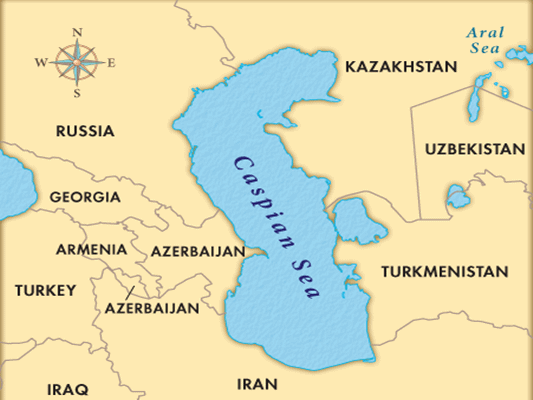
The Caspian Legal Regime Convention signed by the five littoral states of the Caspian Sea, namely Iran, Russia, the Azerbaijan Republic, Turkmenistan and Kazakhstan on August 12, 2018 received extensive reactions from political and legal experts. Some jurists referred to the provisions of two agreements signed in 1921 and 1940, believing Iran should have a 50% share of the sea. By virtue of the terms of the two agreements, they say, all privileges must be equally divided between Iran and the former Soviet Union. Accordingly, the Ministry of Foreign Affairs has, based on legal and statutory arguments, responded to the questions and ambiguities which have arisen in that regard in order to illuminate the public. The full response is as follows.
- Under the 1921 and 1940 agreements, the two countries enjoy equal rights, and the Caspian Sea has always been shared between Iran and Russia throughout history. What is your idea about this?
As it has been announced time and again, neither of the above-said agreements explicitly speaks of an equal share, or division of the sea equally or shared utilization of the sea. Basically, neither of the contracts mentions a point about the division of the sea between Iran and the Soviet Union.
- It is stipulated in Clause 3 of Chapter 3 of the 1921 agreement between Iran and Russia that both sides will enjoy equal rights to the Atrek river and other rivers and waters on the border. Apart from Atrek and other rivers, what other body of water is there? So, border waters mean the Caspian Sea! How is it that the above-mentioned clause speaks of the Atrek river with low water levels, but does not mention a major and important sea such as the Caspian Sea?
In addition to Atrek and other rivers, there are other border waters such as reservoirs, dams, ponds, springs, creeks, etc., all of which have been clearly referred to. However, there is no explicit and direct reference to the Caspian Sea. Moreover, the relevant commission has, so far, met ten times and finalized decisions on all rivers, creeks, reservoirs and other issues. However, no point has been mentioned regarding the Caspian Sea. This shows the term “coastal waters” mentioned in the convention does not include the Caspian Sea.
- What does ‘border waters’ mean?
In all border agreements between the two countries, whenever the term “border waters” is mentioned, it refers to rivers, creeks, reservoirs (dams), ponds, springs, etc.
- Based on Chapter 11 of the 1921 agreement, both signatories to the deal have agreed to enjoy an equal right to free shipping under their flags in the Caspian Sea. Doesn’t that mean equal rights?
In the above-said phrase, only “free shipping” and “the principle of the flag” are clearly mentioned, and no special points have been mentioned regarding the division (whether equally or unequally) of the Caspian Sea.
- At the moment, Iran enjoys the right, even an equal right, to free shipping in most waters across the world. Does that mean Iran’s right to equal ownership and sovereignty in those areas? If so, what’s Iran’s status in the Caspian Sea?
First of all, we should know that in the agreement on the above-mentioned regions, only three chapters and one clause is related to the Caspian Sea. Second, the rights are not equal in some chapters, and it is not right to claim that Iran has equal rights because some chapters are completely unilateral and to Russia’s benefit.
- Given that the 1940 agreement says all rights are equal, why has the issue been followed up differently so far?
It should be noted that that the Iranian foreign minister and deputy commerce minister signed the agreement as Iran’s representatives, and the Soviet Union’s ambassador and commercial attaché in Tehran signed the agreement on behalf of the Soviet Union. Moreover, the above-mentioned treaty is about sea navigation and commerce, not borders. Therefore, it is not appropriate to say that all rights are divided equally, and the agreement does not provide for border issues.
- It is stipulated in Clause 1 of Article 12 of the 1940 treaty that the ships plying across the Caspian Sea under the flag of either of the two countries shall be treated as state vessels in the ports of the two sides whether upon entrance into, during stay at, or when leaving the ports. Doesn’t that mean equal rights?
These provisions provide for equality of rights only as far as port regulations are concerned, not border and sovereignty issues. In addition, these provisions were ostensibly in Iran’s interest, but it was not, because Iran had no ships in the Caspian Sea, and it was only Russian vessels that were carrying goods. It was they that enjoyed exemptions, not Iran. This comes as Iran’s first ship (in the true sense of the word) entered the Caspian Sea in 1989. Furthermore, under Clause 3 of Article 12, both Iran and the Soviet Union had been mutually granted the cabotage to transfer commodities and passengers, but in practice, it was only Russia that could do it.
- Under Clause 4 of Article 12 of the above-mentioned treaty, both signatories monopolize fishing for their own vessels within a radius of 10 miles from their seashores, and reserve the right to offer special discounts and privileges for the imports of fish caught by the vessels plying across the sea under their flag. What evidence is available in that regard?
Under Clause 4 of Article 12, a 10-mile limit had been allocated for both countries merely for fishing. According to that clause, the Soviet Union’s exclusive fisheries area was almost seven times as large as Iran’s. The base for determining that area was the length of the coastline of each country. The Soviet Union’s coastline was between 6 and 7 times that of Iran’s.
- Based on Article 13 of the 1940 treaty, both sides have agreed that no vessel can ply throughout the Caspian Sea except the ones belonging to either Iran or the Soviet Union, or the ships which belong to state transportation and commercial enterprises operating under the flag of one of the two countries. So, this can lead to the conclusion that equal rights are given to both countries.
Article 13 is very good, but does not denote the division of the sea on a 50-50 basis. That article only suggests that any vessel with a third flag is not allowed to ply across the Caspian Sea. Article 14 also mutually accepts shipping certificates issued by either side, but does not refer to division and demarcation, whatsoever. Even Article 15 merely refers to shipping measures in the Caspian Sea and commodities and does not explicitly or implicitly refer to division or demarcation.
- Under Article 16, this is a three-year agreement and can be revoked at a six-month notice. Is this article legally binding?
Any of the Caspian Sea littoral states, even Iran and Russia, can terminate the contract at a six-month notice.
- Another point which refers to Iran’s 50-percent share is a letter annexed to the 1940 agreement. The letter reads that Iran and the Soviet Union regard the Caspian Sea as their own, and that the sea is of special importance to them; so, the two governments will adopt the necessary measures to keep nationals of third countries serving on the ships of Iran and the Soviet and at Caspian Sea ports from using the services and their stay at ships and ports for purposes other than the ones within the tasks and responsibilities assigned to them. Does this case concern the equality of rights?
The word “common” is not mentioned in the above-mentioned letter unlike what is publicly said about it in most books, articles and speeches. The letter is significant only in that it mentions that the Caspian Sea belongs to its two littoral states, and underlines that nationals of third countries must not take advantage of their situation, and does not provide for joint ownership of the sea, especially one based on a 50-50 share. Moreover, the above-said clause is very useful and positive for Iran at the moment, but it was in the Soviet Union’s interest during the ruler of former Iranian dictator, the Shah, when the Americans were present in Iran.
- Based on the letter written by the Soviet Union’s national commissioner in 1927 concerning the handing over of the Anzali port, the former Soviet Union’s government asked Iran to take into account both countries’ common interests at the Caspian Sea, and not use non-Iranian nationals for a period of 25 years except for janitors and workers.
The issue that the sea exclusively belongs to its two littoral states simply indicates that no third party should enter the sea. Of course, this provision was to Iran’s detriment at the time. Moreover, the 25-year period mentioned in the treaty has expired now.
- Anyway, the overall spirit of the agreements indicate the two sides enjoy equal rights.
This is not true. What was said clearly shows that not only the overall spirit of the above-named treaties is not based on enjoying equal rights and shares, but in several cases they were unilateral and in the Soviet Union’s interest. We can also say that not only have the two countries not always enjoyed equal rights, but also in some cases the situation unfolded in such a way that rights were determined based on the length of each country’s coastline.
- The former Soviet Union collapsed, but Iran stands like before. Should the collapse of the Soviet Union have any effect on Iran’s share?
The 1921 agreement was concluded between Iran and the Soviet Union. Back then, Communists still faced opposition from white Russians and the Soviet Union had not been officially established, yet. The former Soviet Union was officially established in 1922. Azerbaijan and Turkmenistan joined the Soviet Union after two years. The contract is also called the Russo-Persian Treaty of Friendship (1921). Now, Russia can claim a 50-percent share of the sea, as well, but it won’t, and has not, and settled for a much smaller share of the seabed, i.e. less than 19 percent, and later accepted to have a very much smaller share of oil and natural gas resources. On the other hand, even if a 50-percent share is allocated to Iran, the two littoral states should have no share of the sea at all and a fence should be built on shorelines to keep them from utilizing the sea.
- Can basically something be done in order for the Caspian Sea not to be divided at all in order to face no problem in this regard?
In all legal systems, every owner can terminate his or her partnership unless they have already committed themselves to not doing so. This is not the case in the Caspian Sea. At the moment, four other countries are claiming shares, and Iran cannot say it does not accept their demand.
- Half of the Caspian Sea is printed in the maps that appeared in school books during the rule of the former Shah of Iran and after the 1979 Islamic Revolution. Doesn’t that mean that Iran has a 50-percent share of the sea?
First, what was printed in the maps during the Shah’s rule and even after the revolution showed around one fifth or one sixth of the Caspian Sea, not 50 percent. So, that claim is not true. Second, even if it is true, the publishing of a map unilaterally is no evidence to prove a country’s claims. As you might know, the Soviet Union regarded the Hosseinqoli-Astara line as the base for Iran’s share in all maps. Third, the maps drawn in Iran always include parts of neighbouring countries. Does that mean those parts belong to Iran? At the end, it should be noted that the maps drawn in Iran depict the whole of the Persian Gulf and the Sea of Oman. Does that mean the whole of the Persian Gulf belongs to Iran?