Tuesday, December 23, 2025
Home Blog Page 3482

Tajrish: A Lovely Neighbourhood North of Tehran

Tajrish: A Lovely Neighbourhood North of Tehran

Tajrish neighbourhood, which is located in northern Tehran at an altitude of 1,612 metres above sea level, has a cold climate thanks to its proximity to Alborz Mountain range.

During the Qajar period, Tehran was chosen as the capital of Iran. At the same time, Tajrish became the summer resort of Tehran citizens. Many of aristocrats built gardens there for their summer residence.

There are several Qanats in the district. Some of them still have water supplies. As people moved from other parts of the country to Tehran and its suburbs, some of them settled in Tajrish. As a result, the region became a part of the city and was not a sheer summer resort anymore.

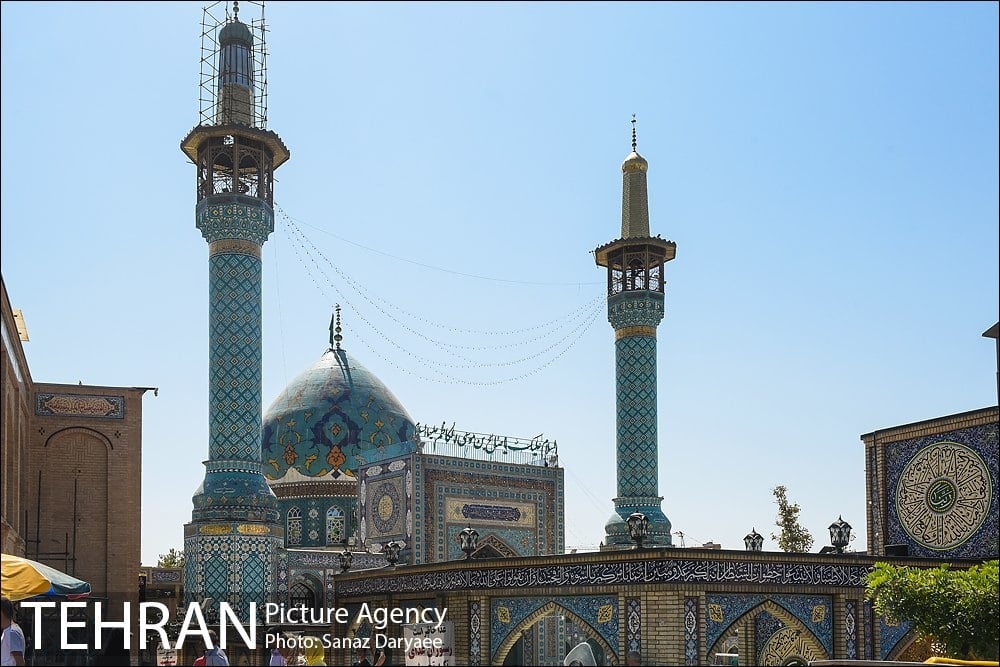
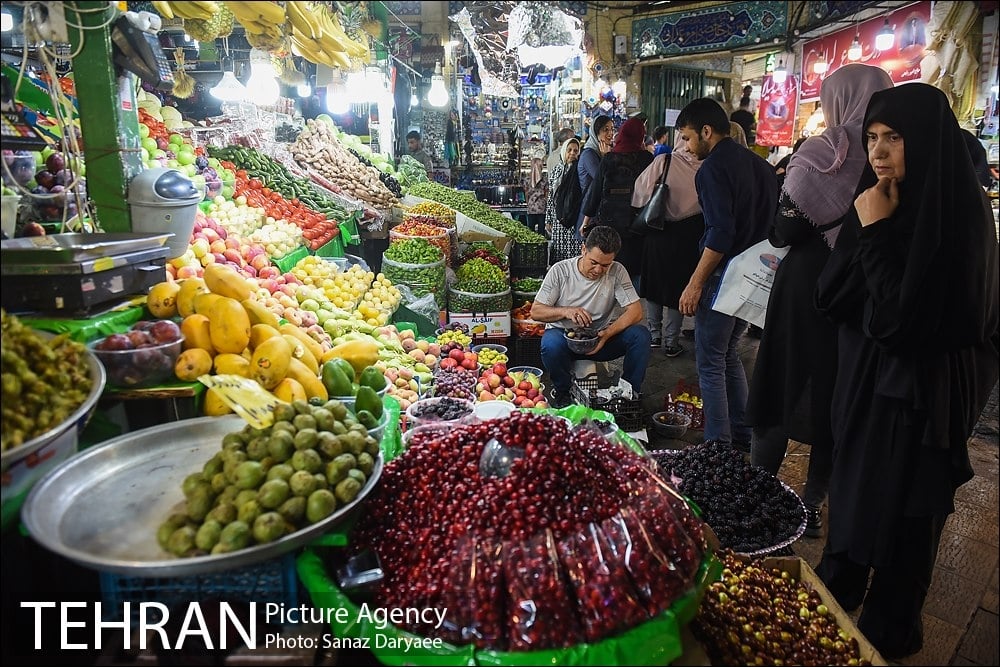
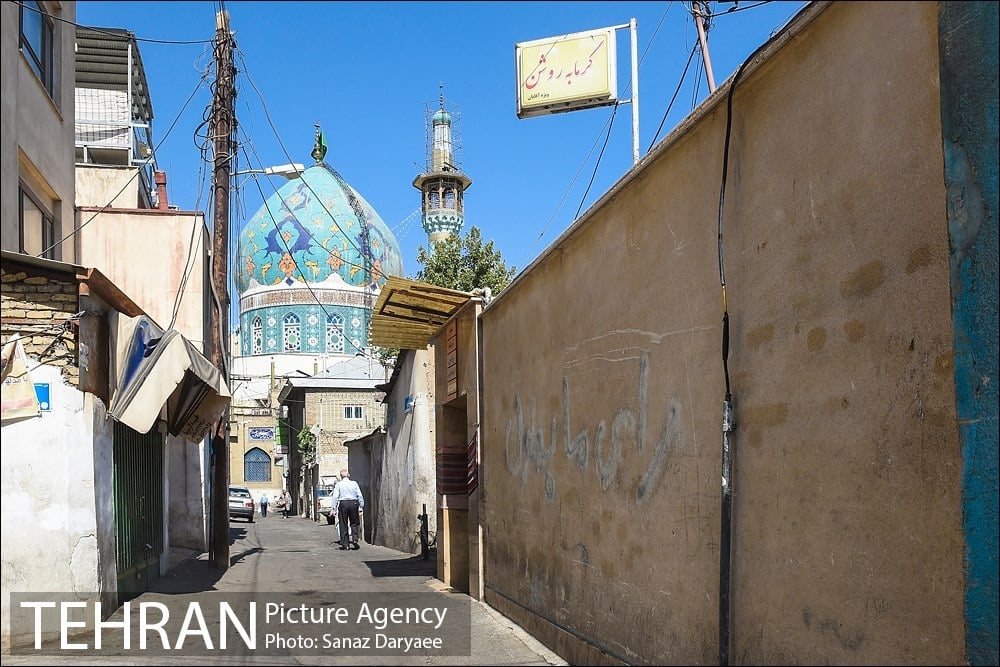
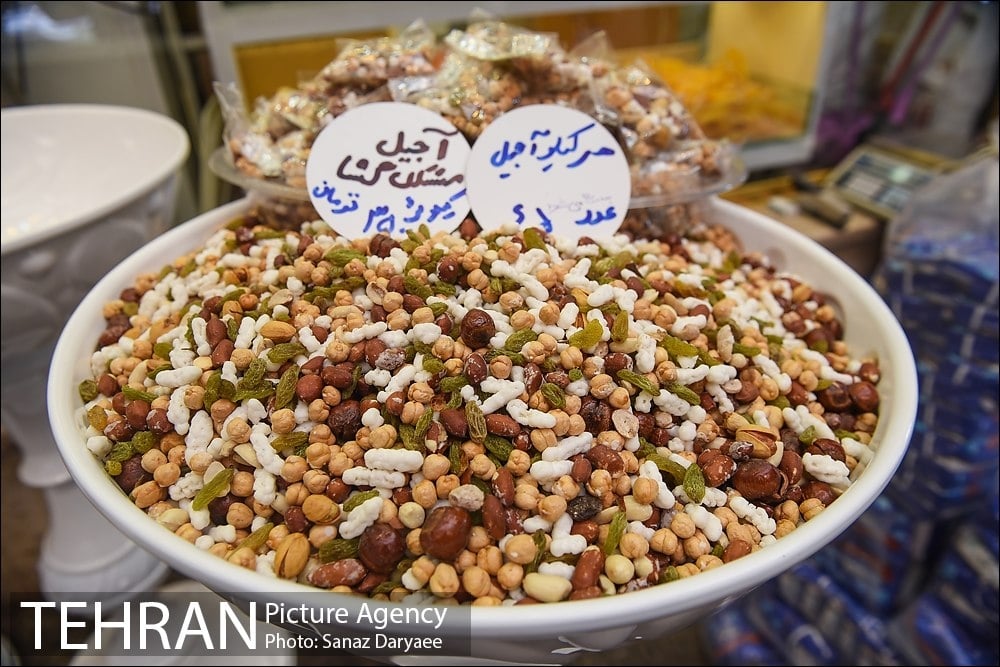
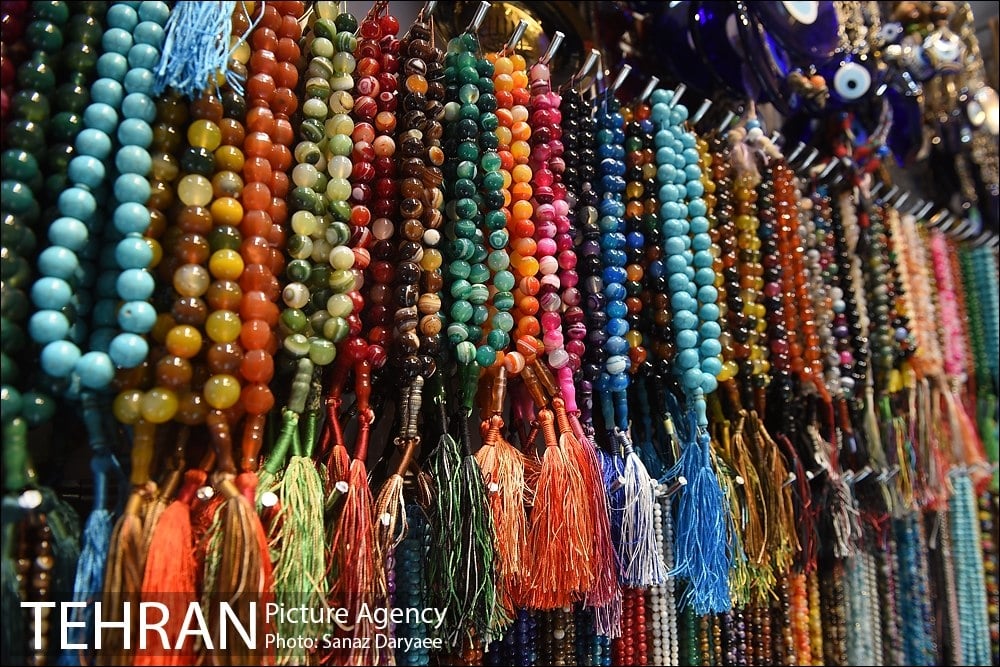
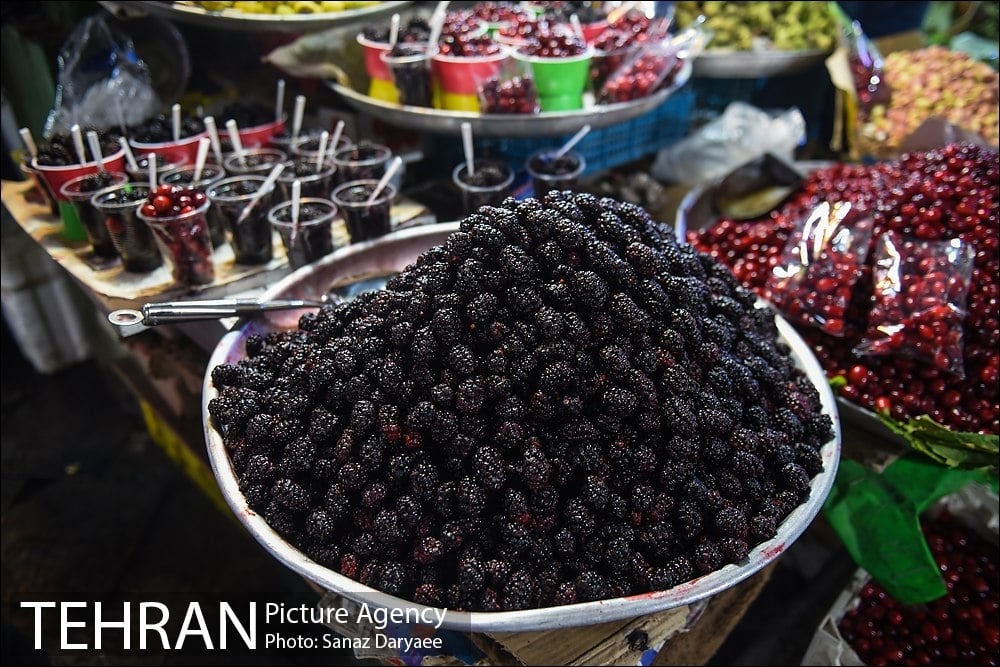
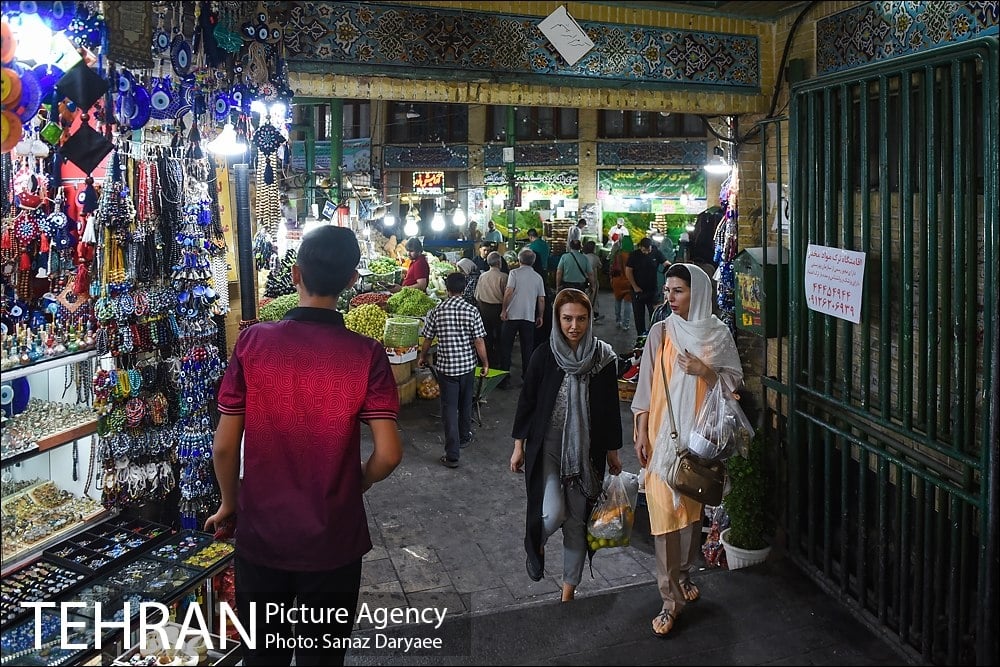
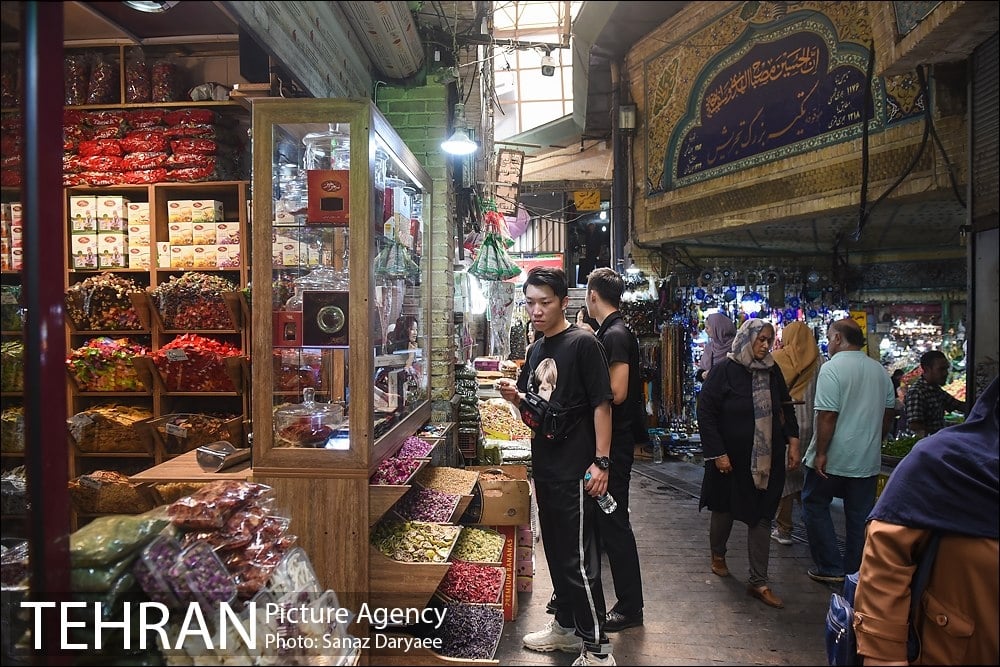
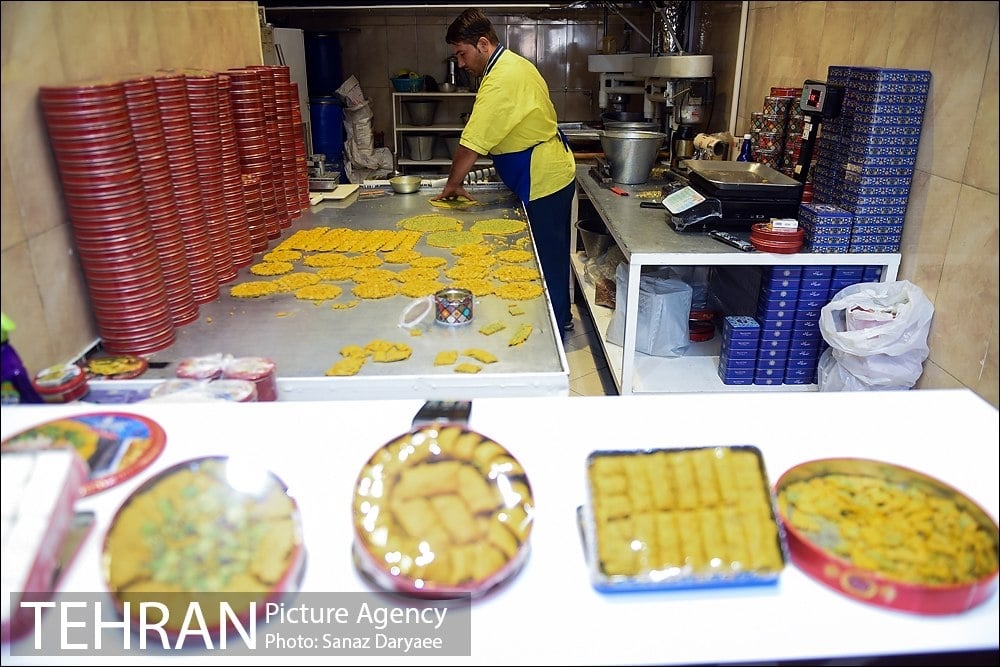
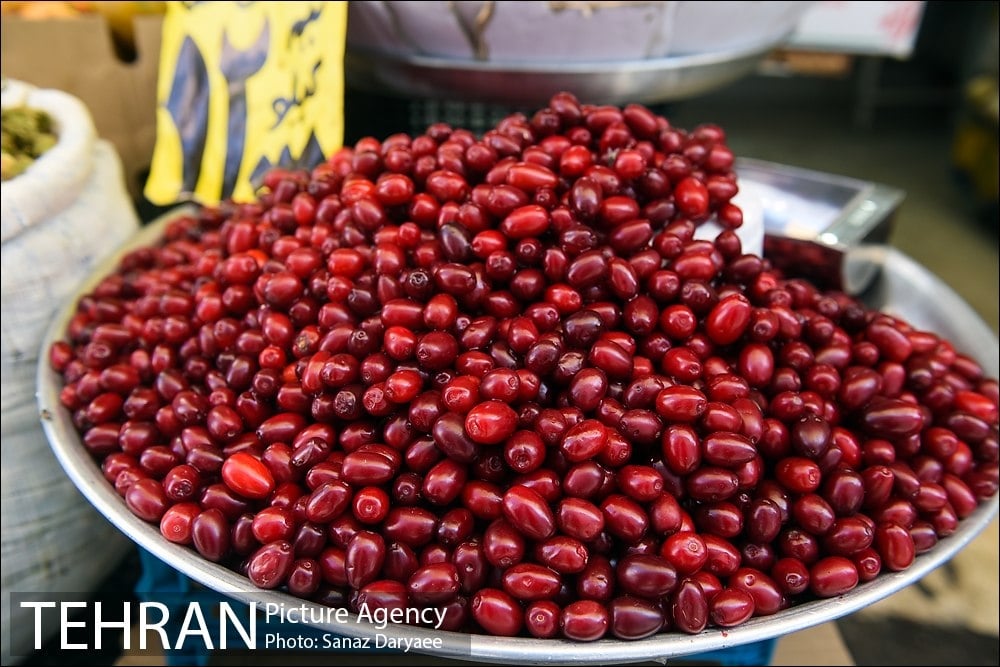
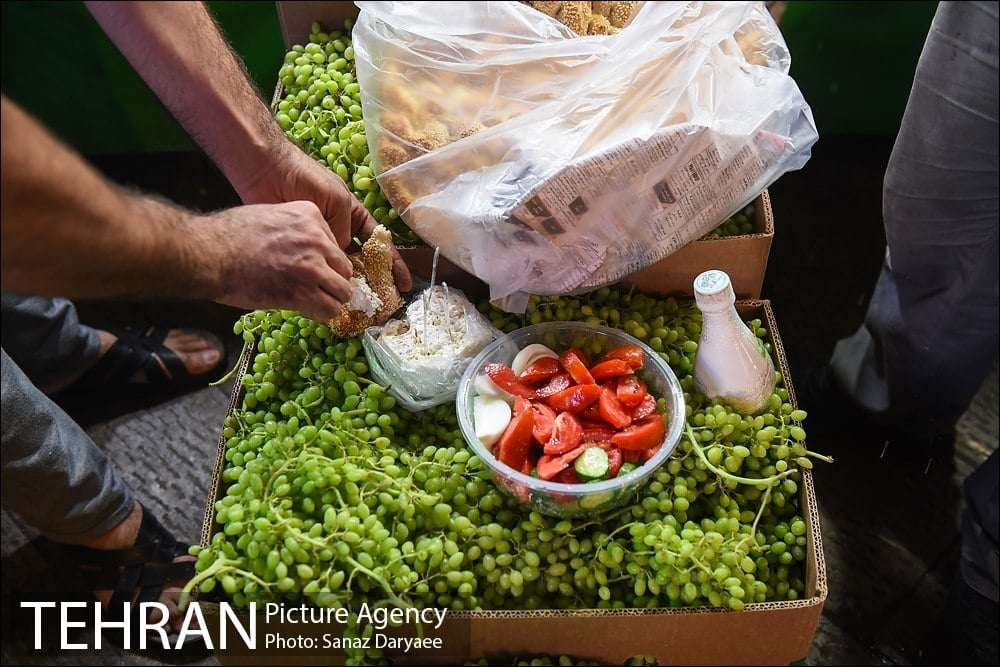
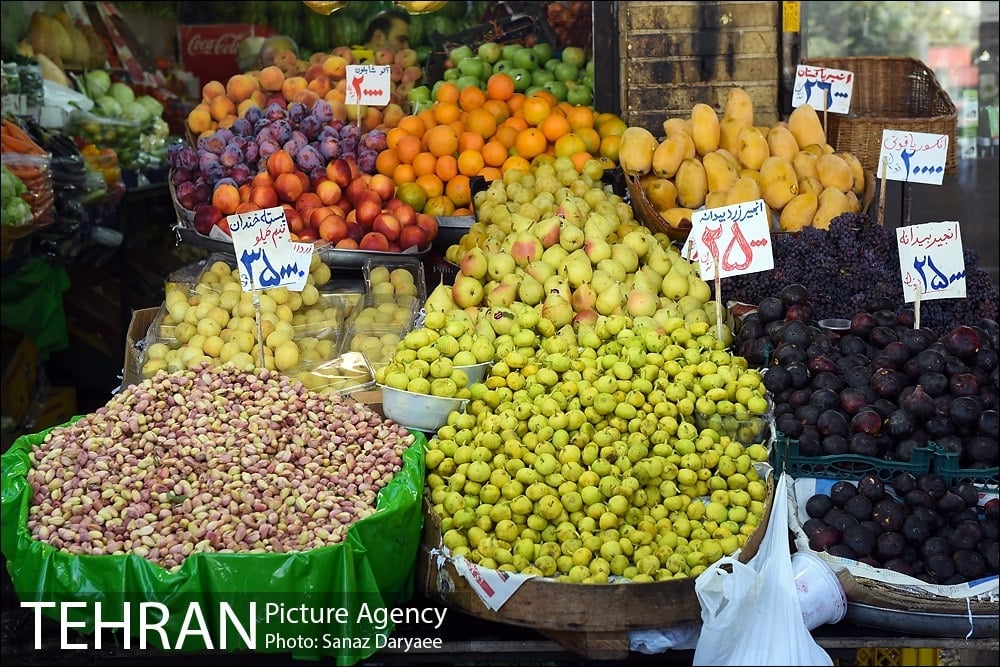
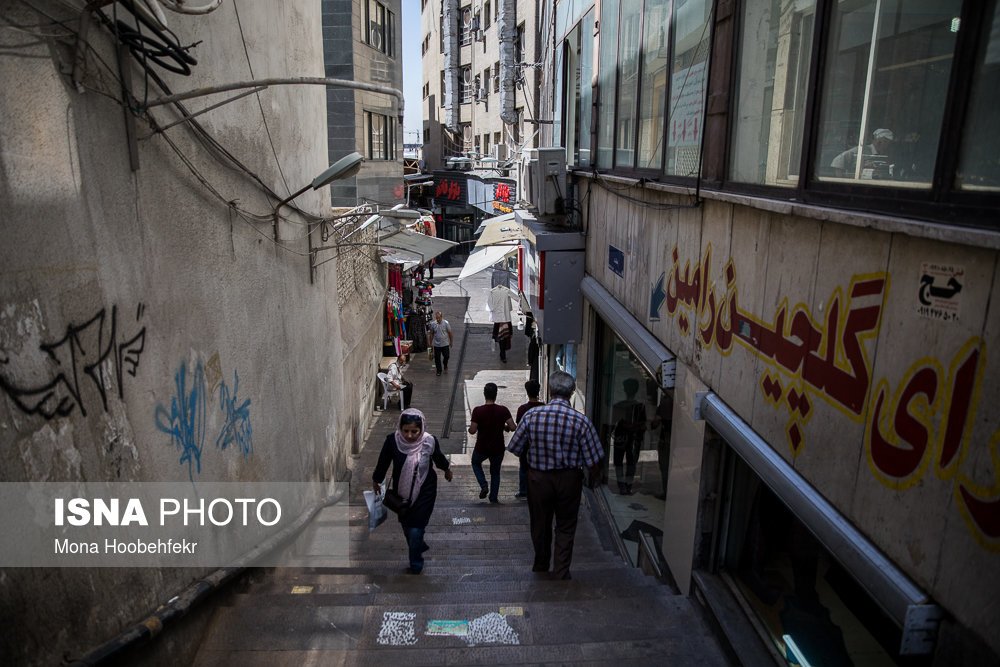
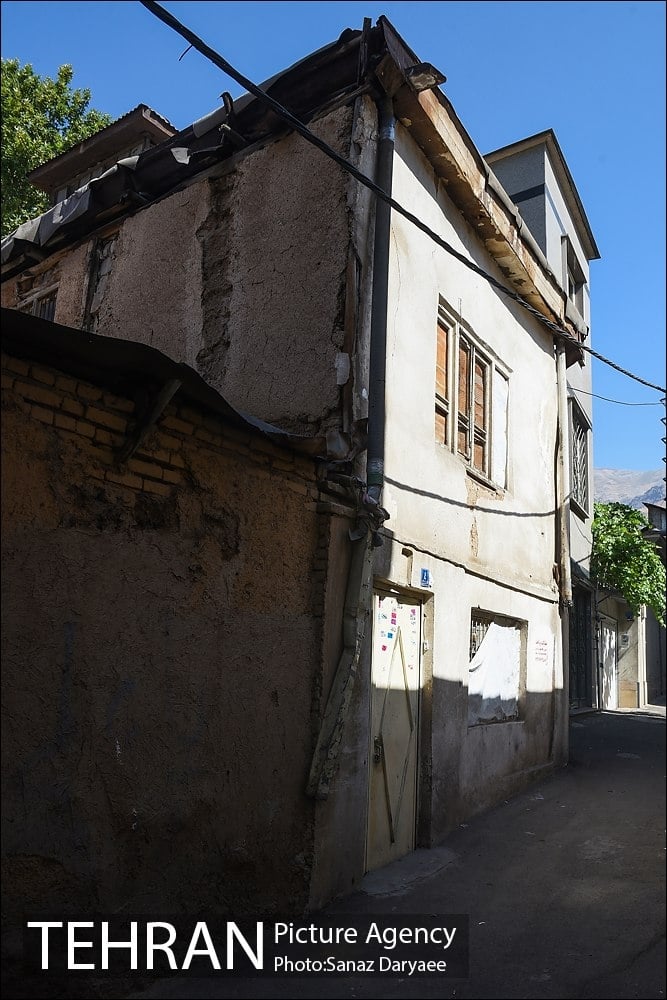
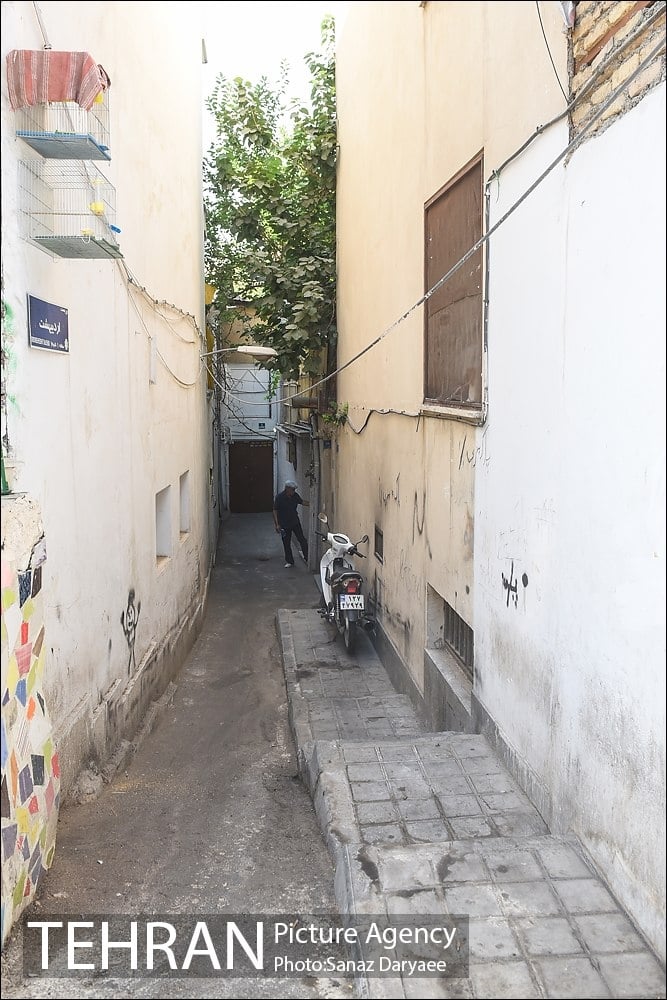
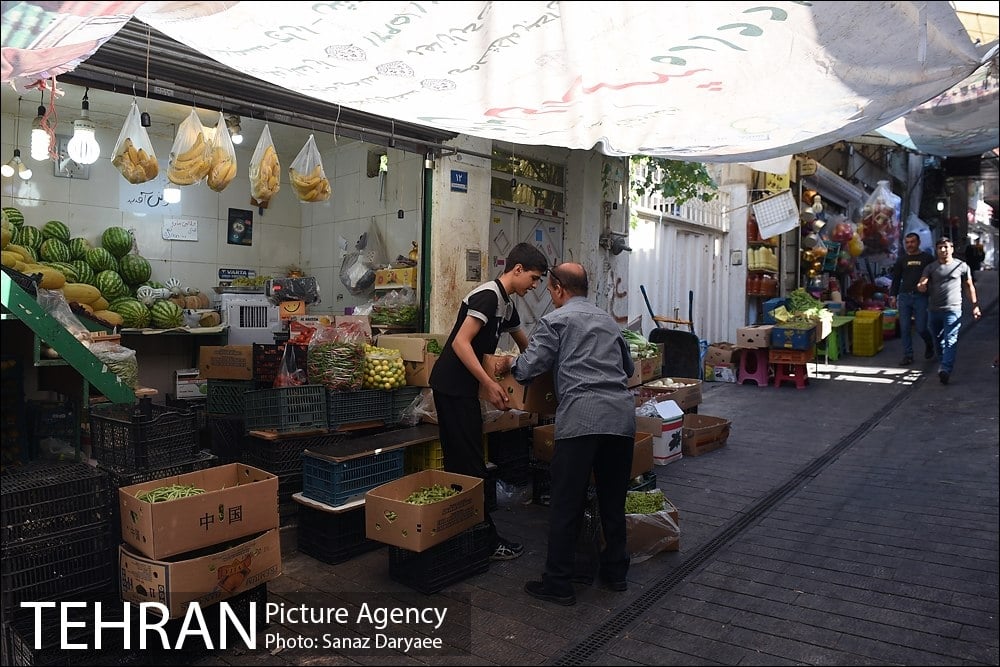
Today, the only thing left from the old Tajrish neighbourhood is its traditional market and several houses next to Imamzadeh Saleh Shrine.

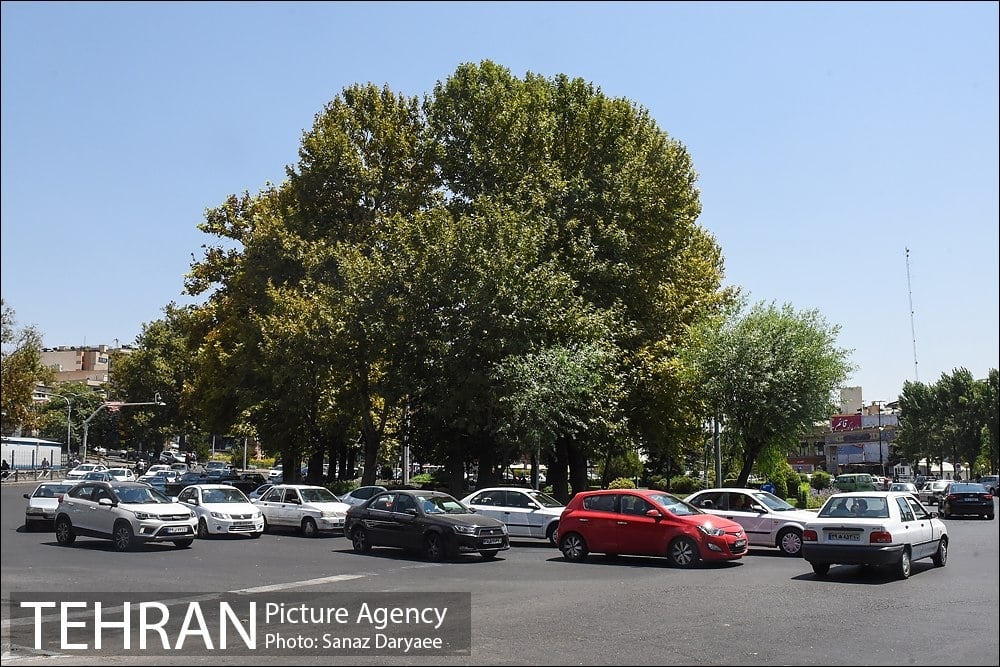
Tajrish Square, located at the end of Tehran’s Vali-e Asr Avenue, is one of the city’s busiest commercial centres.

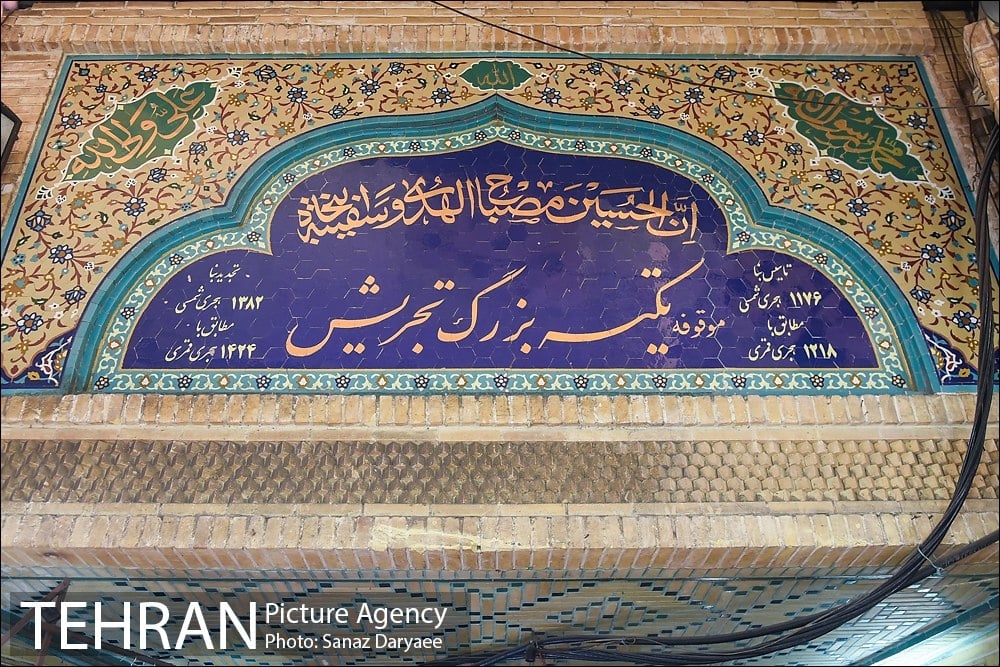
The old market, the great Tajrish Tekyeh (a place where Shiites gather for mourning of Muharram) and Imamzadeh Saleh Shrine are among the most beautiful attractions of this neighbourhood.

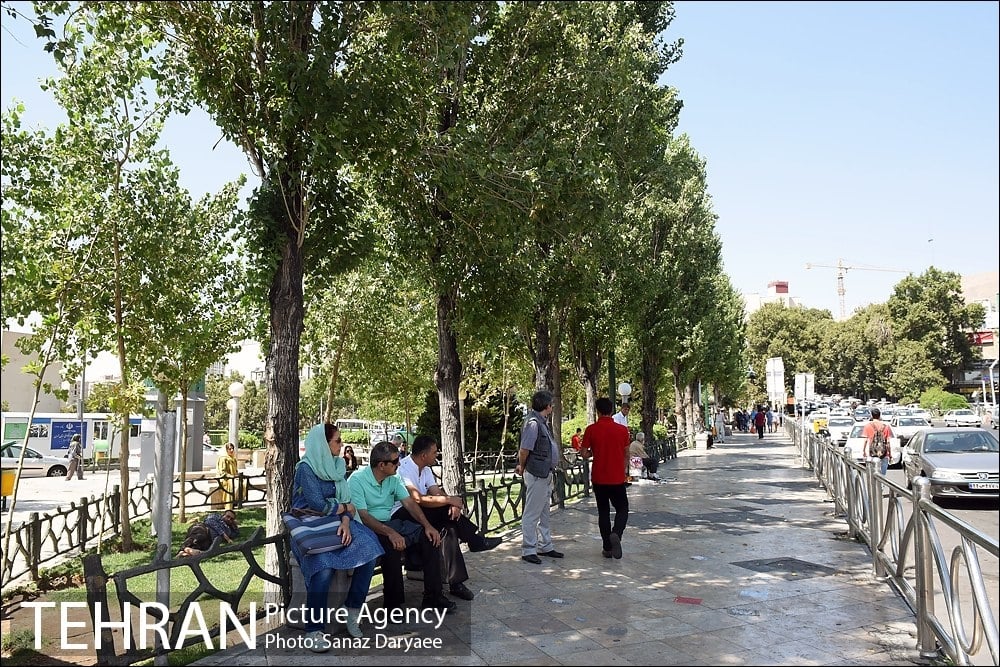
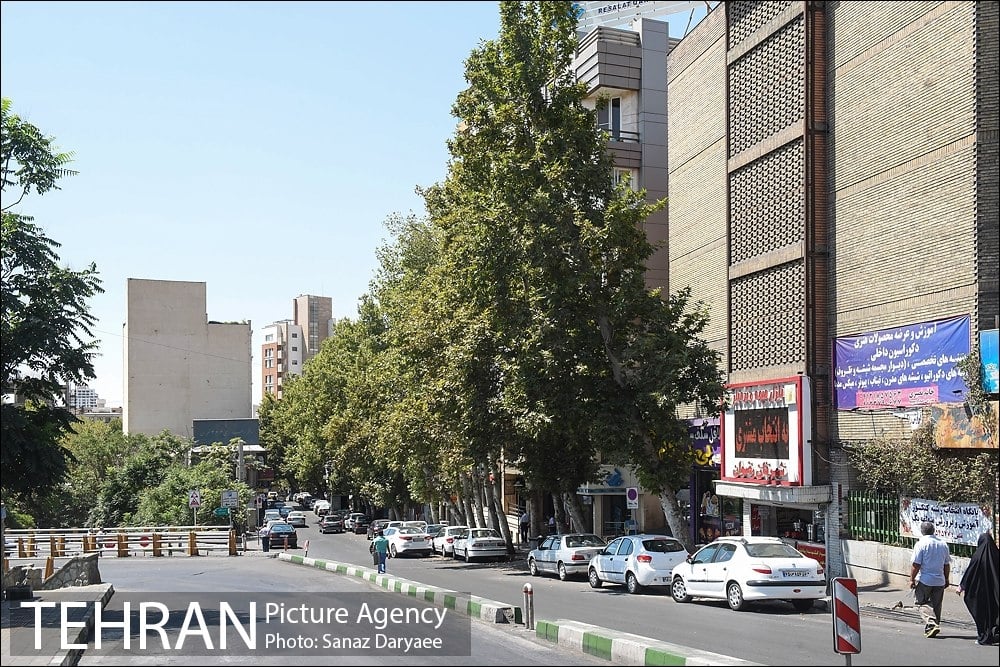
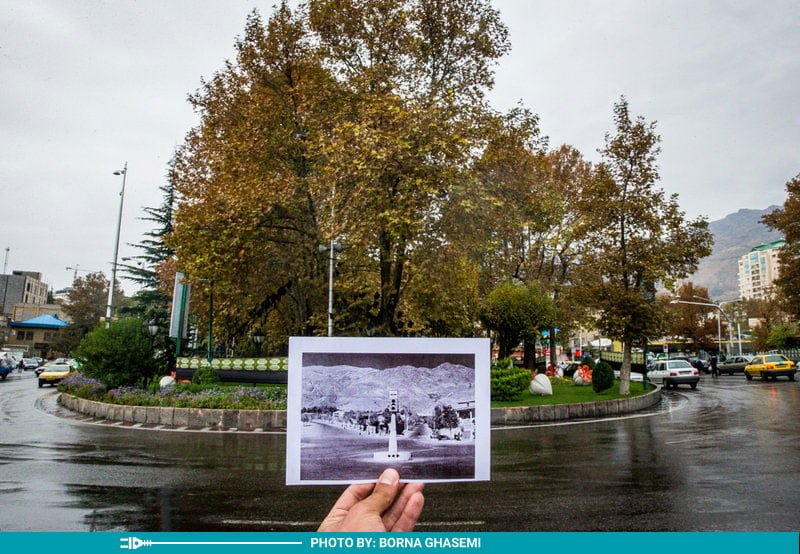
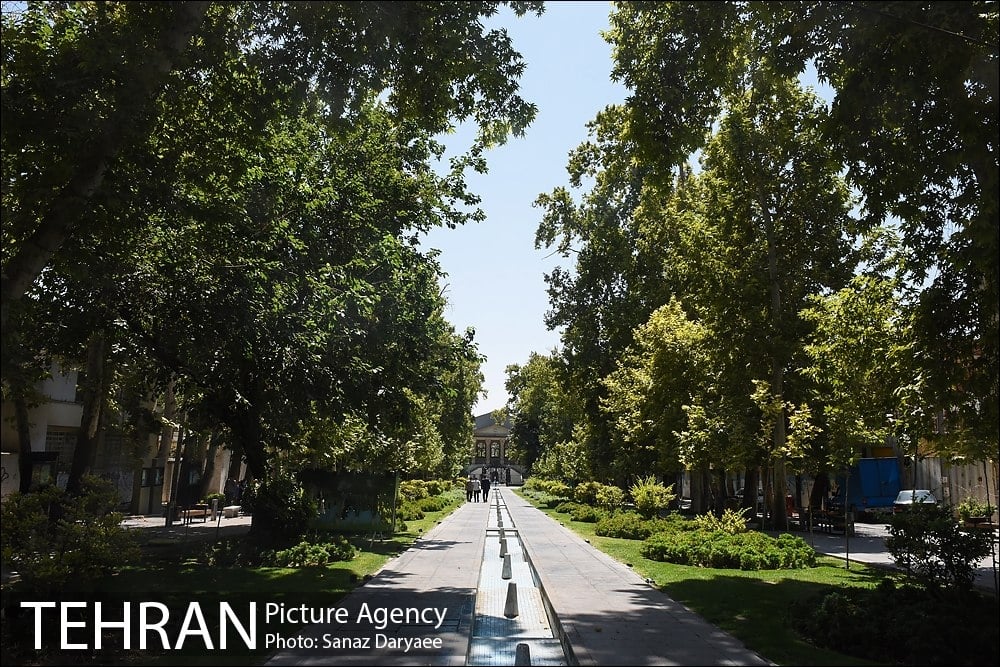
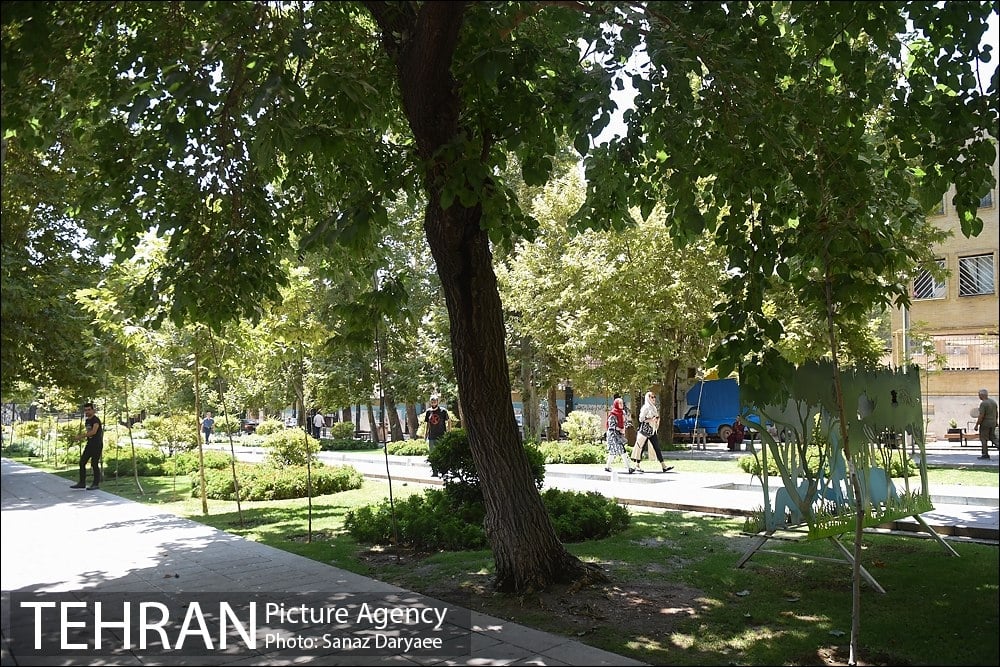
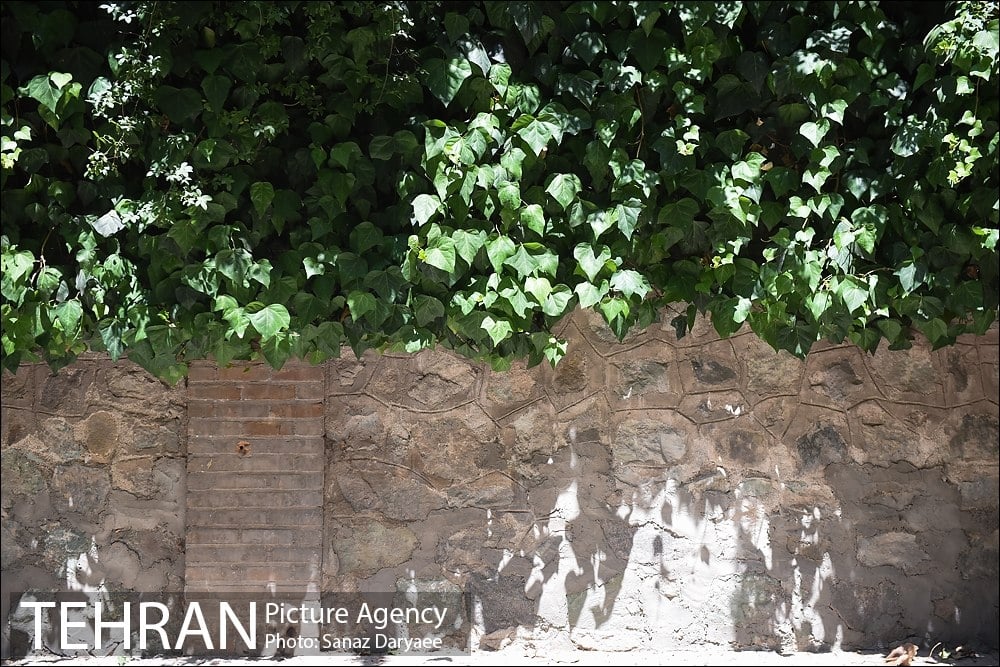
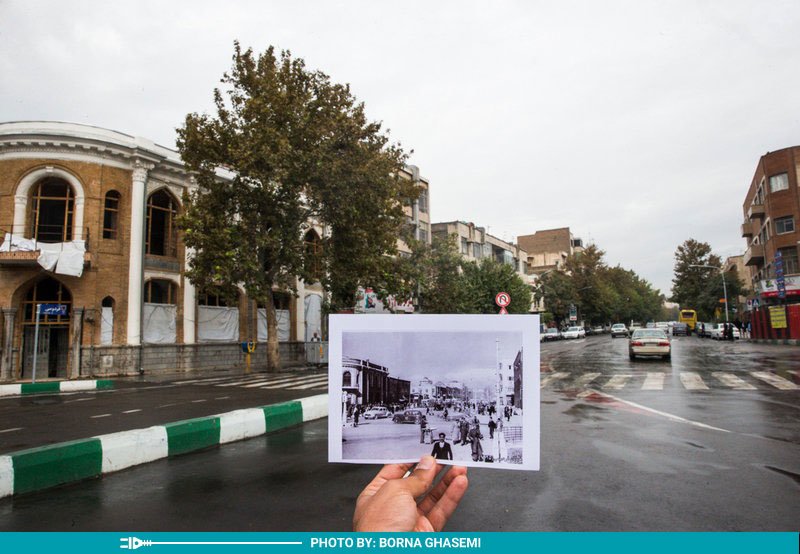
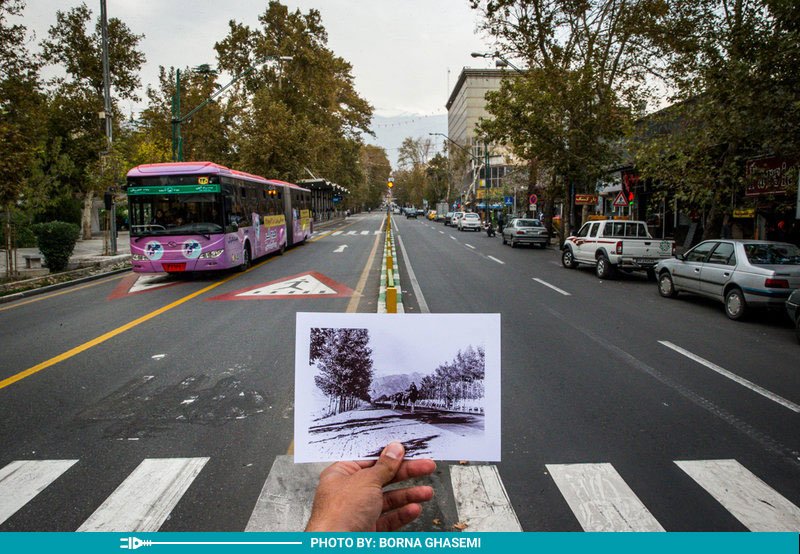
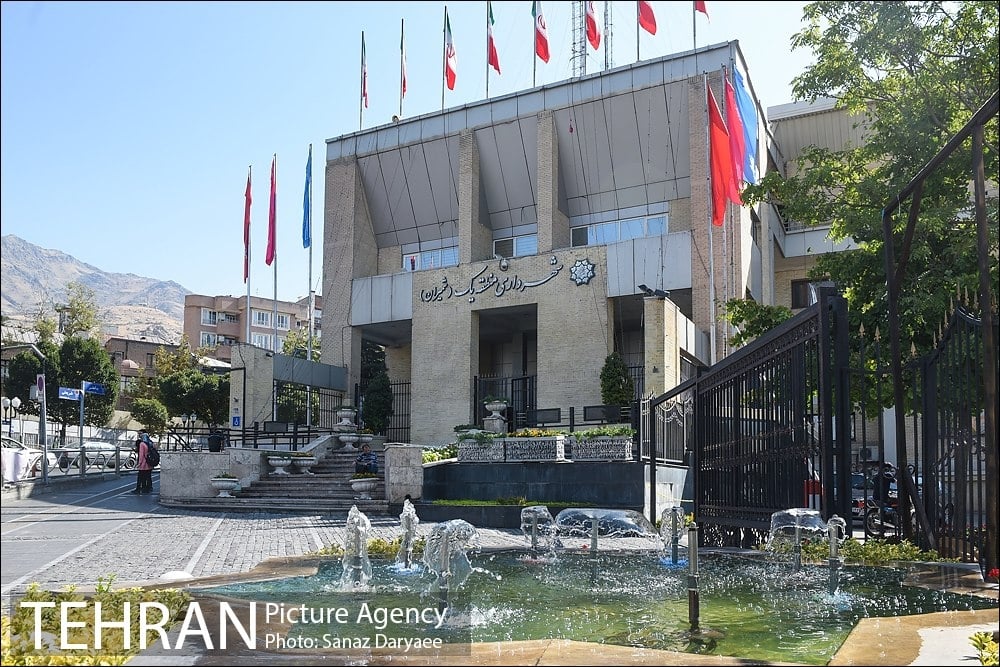
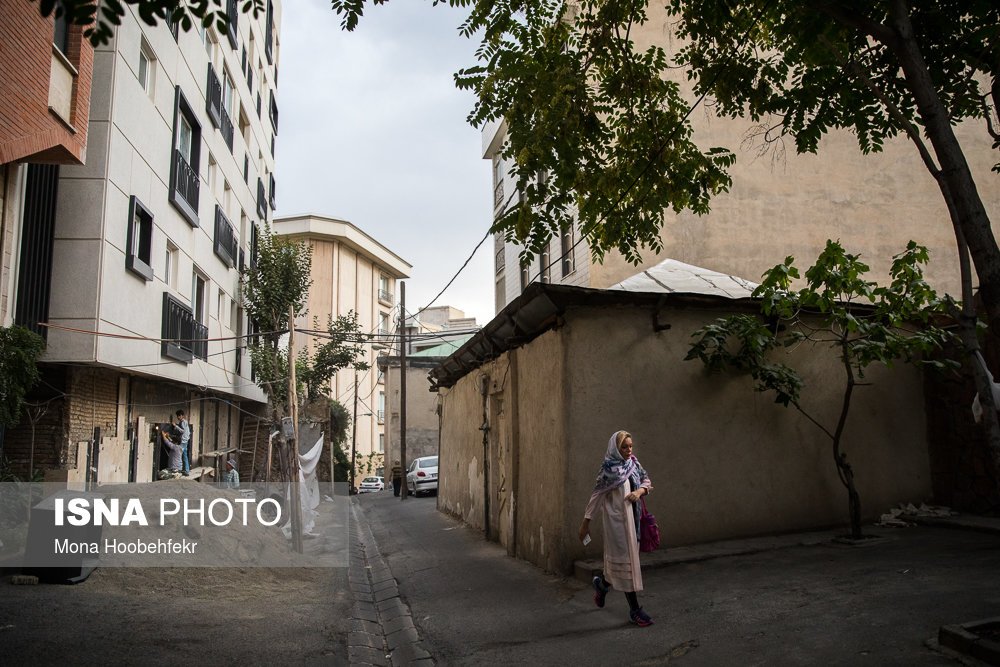
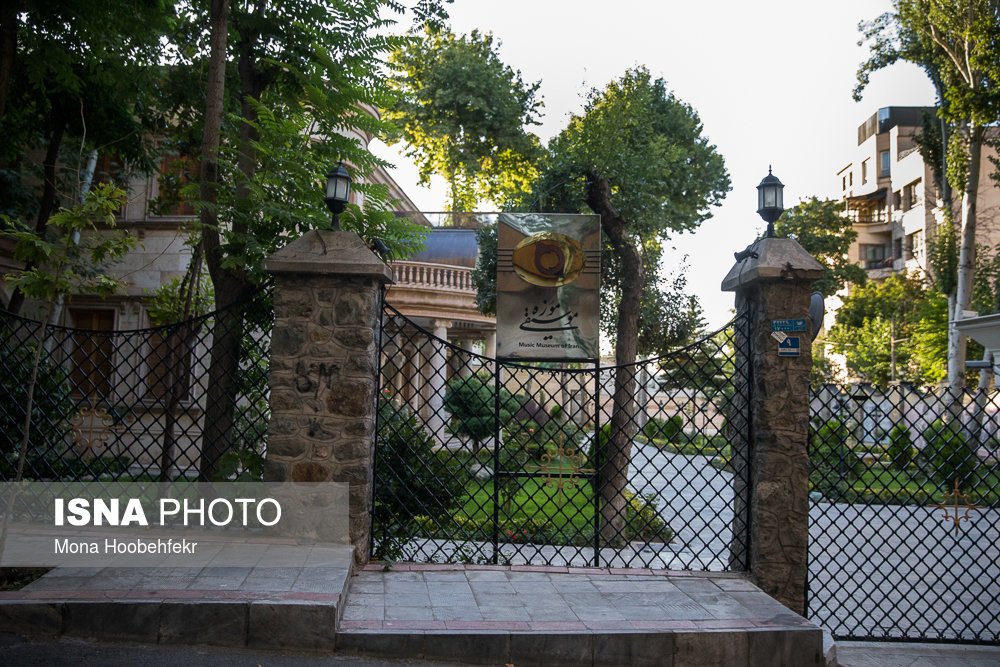
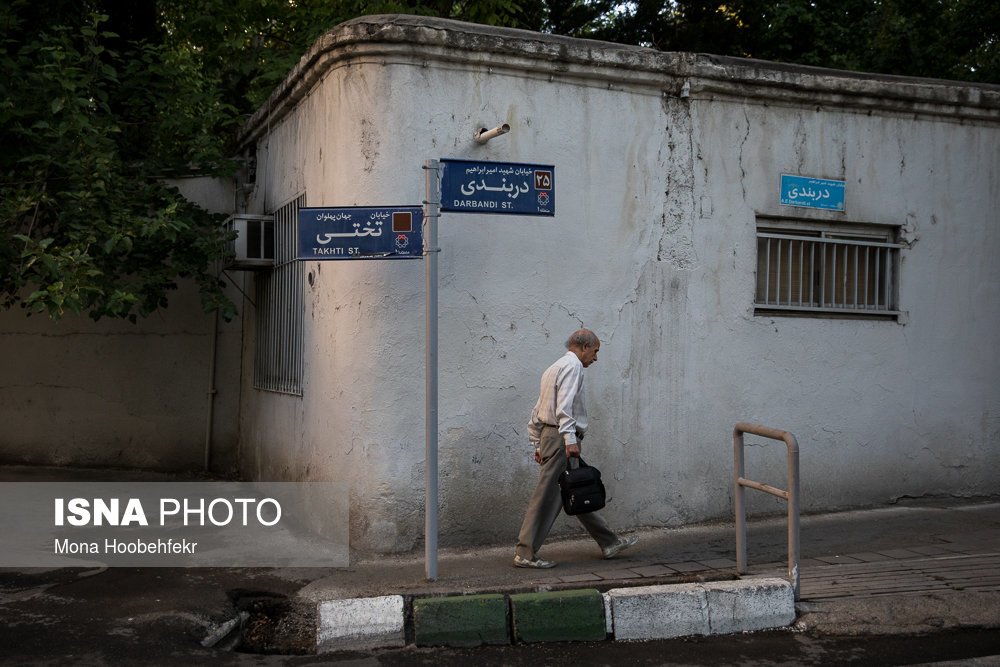
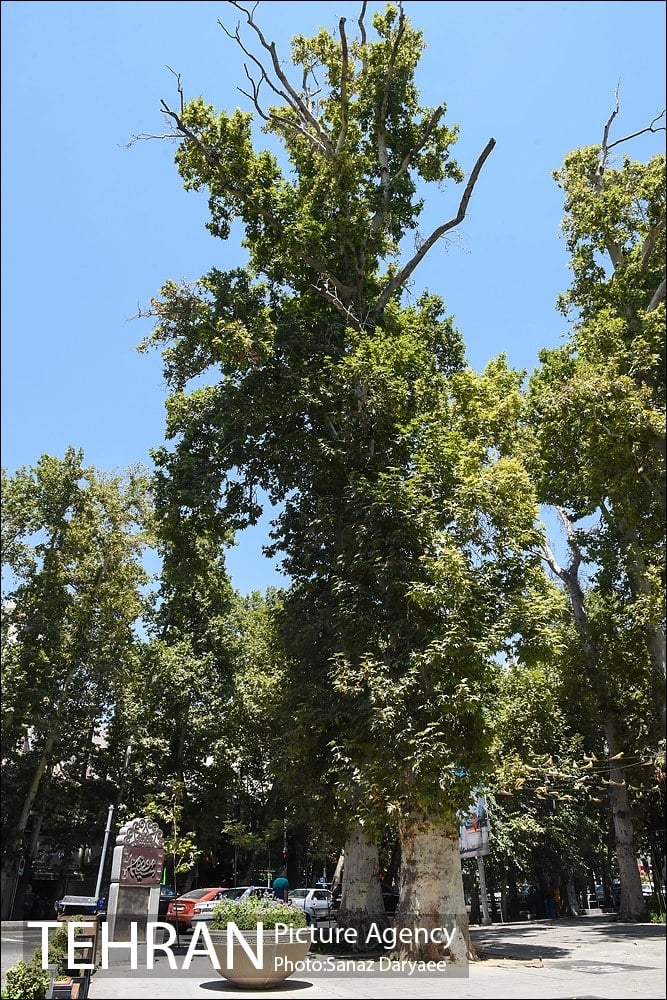
What follows are Tehran Picture Agency’s photos of the neighbourhood:

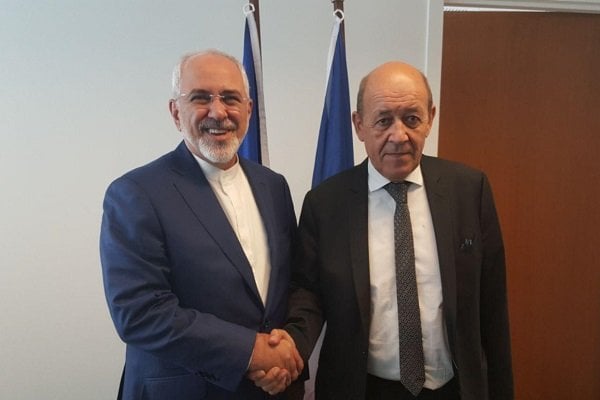
Iranian, French FMs Discuss Bilateral, Regional Issues

During the Saturday phone talk, Mohammad Javad Zarif of Iran and his French opposite number Jean-Yves Le Drian discussed the latest status of bilateral relations, the Iran nuclear deal and regional developments.

The phone conversation came a few days after Le Drian told a gathering of EU foreign ministers in Vienna that Iran must respect the fundamentals of the 2015 nuclear deal and should be prepared to negotiate on its future nuclear plans, ballistic missile arsenal and alleged meddling in conflicts across the Middle East.

Iran “cannot avoid discussions, negotiations on three other major subjects that worry us — the future of Iran’s nuclear commitments after 2025, the ballistic question and the fact that there is a sort of ballistic proliferation on the part of Iran… and the role Iran plays to stabilize the whole region,” he said.

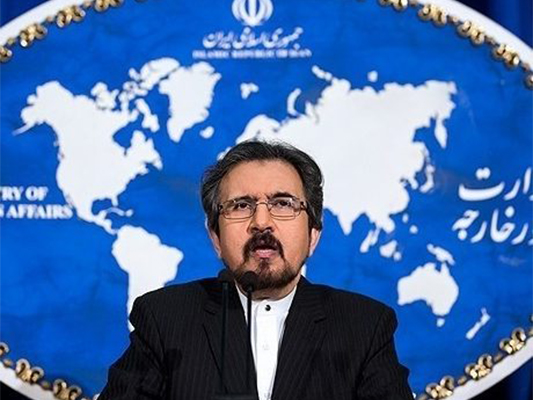
In reaction, Iran’s Foreign Ministry Spokesman Bahram Qassemi rejected the call for talks on Tehran’s missile program and regional policies, saying the West has left no trust for Iran to sit for talks on non-nuclear issues.

In a statement on Friday, Qassemi said Le Drian’s comments were “undue concerns” founded on a misunderstanding or lack of knowledge about Iran.

Qassemi said Iran had always proved that it was not afraid of talks and that it strongly believed in dialogue.

The nuclear talks revealed Iran’s good faith and commitment to the principle of negotiation, and could in turn serve as a yardstick against which to measure the West’s commitment to its pledges, he noted.

However, he added, the West failed to live up to its commitments after US President Donald Trump unilaterally withdrew the US from the Iran nuclear deal – the Joint Comprehensive Plan of Action (JCPOA) – while other parties stood idle and kept mum.

“Under current circumstances … there is no reason, need, reliability or trust for holding fresh talks on any topic, let alone non-negotiable issues,” he said.

Iran Dismisses “Absurd” Reports on Moving Missile to Iraq

In a Saturday statement, Qassemi dismissed the reports as absurd, meaningless and ridiculous.

The claim has been raised by certain notorious centres and media outlets, and is totally irrelevant and basically false, he added.

According to Qassemi, such reports are aimed at spreading fear among the regional states and are part of the enemies’ Iranophobia and anti-Iran policies.

The main purpose of these false and ridiculous reports is to negatively impact the Islamic Republic’s foreign relations particularly with its neighbours, Qassemi noted.

Back on Friday, Reuters cited some unknown Iranian, Iraqi and western intelligence officials as claiming that Iran has begun moving missiles into Iraq.

The report identified the missiles as Zelzal, Fateh-110 and Zulfiqar models with ranges varying from 124 to 435 miles.

It also claimed that the Islamic Republic is contributing significantly to the construction of a new missile production facility in Syria.

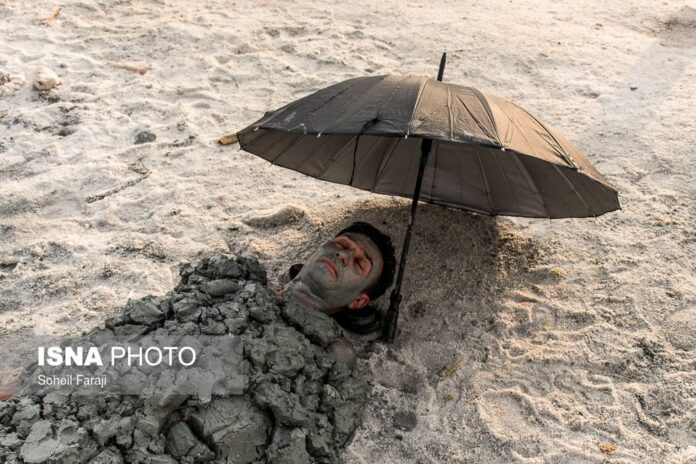
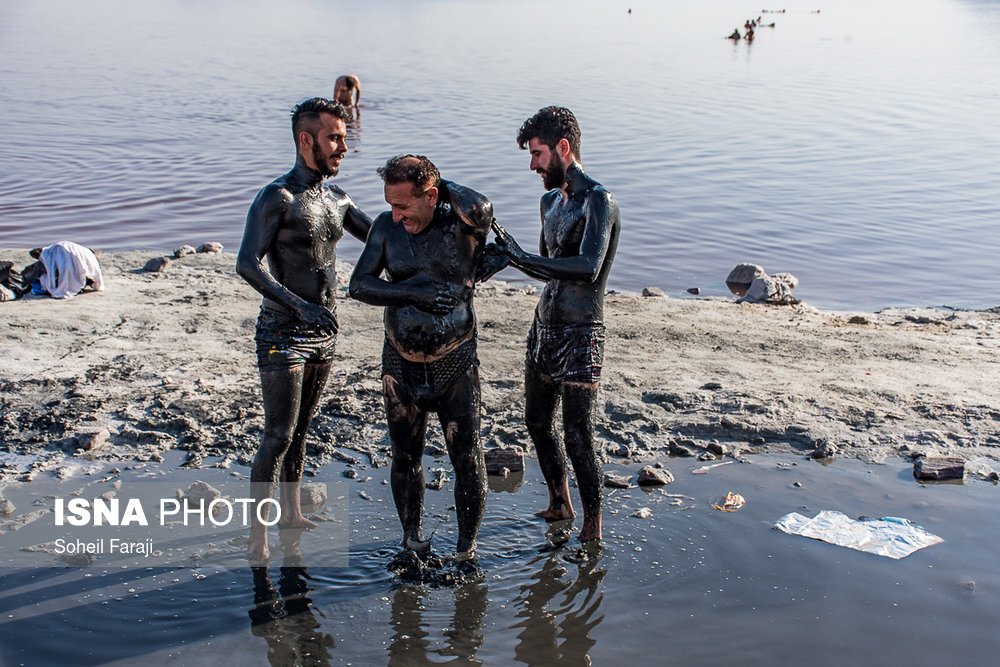
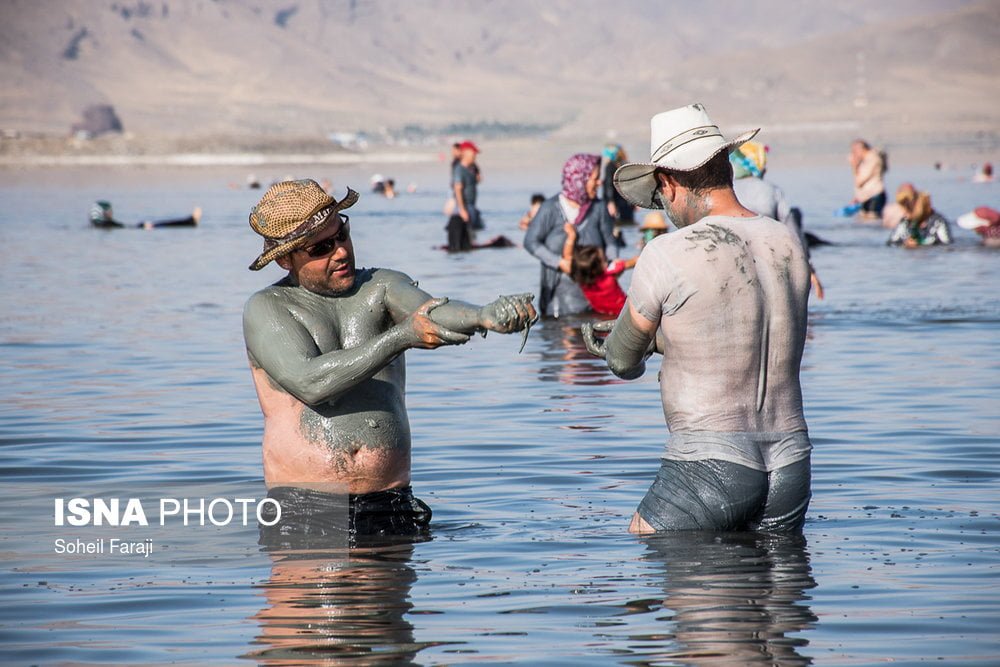
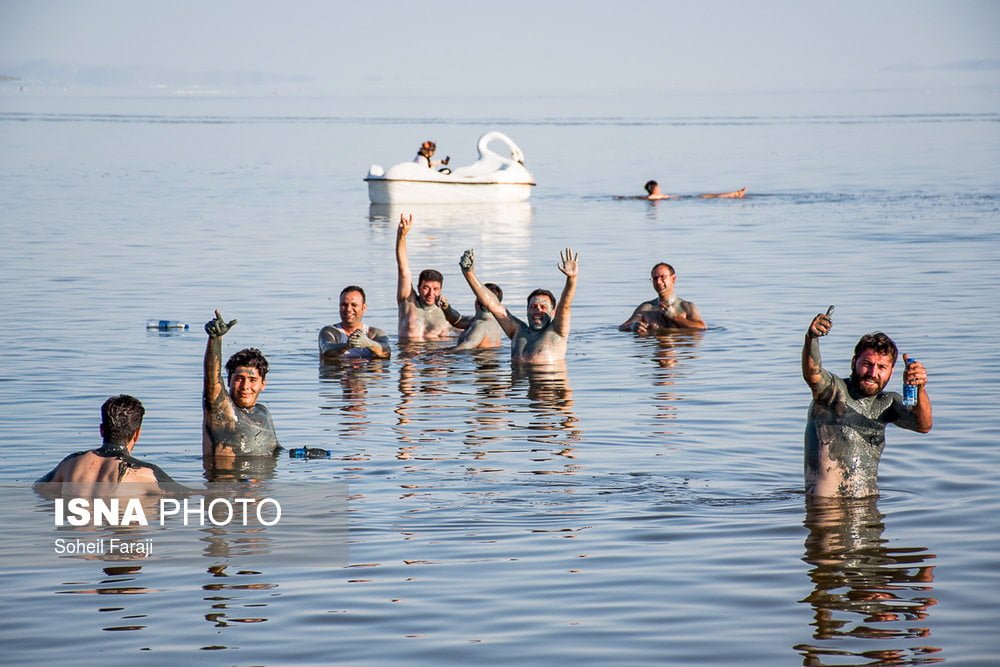
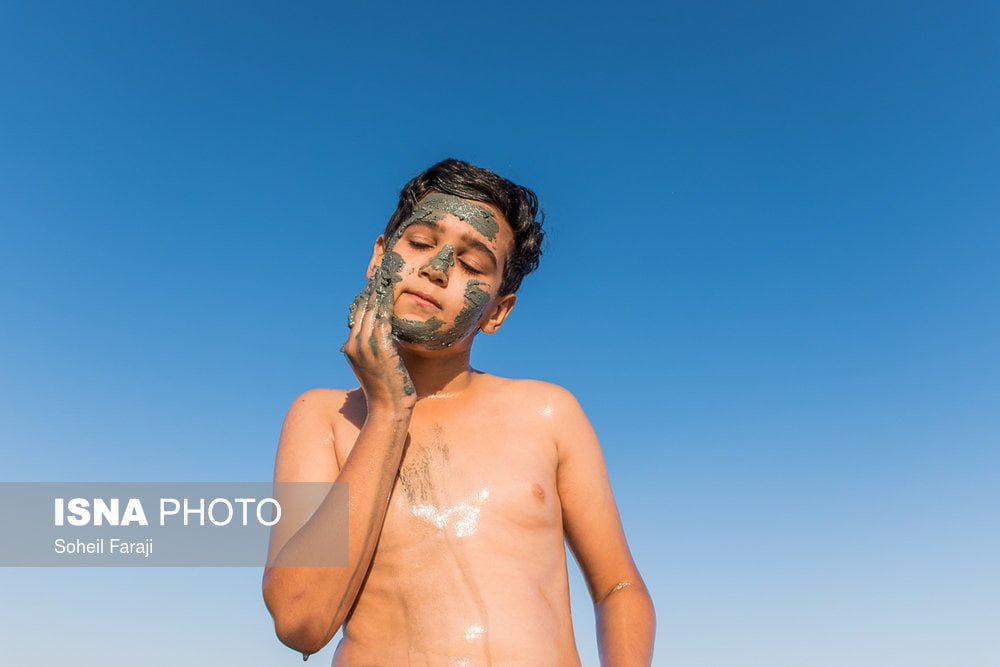
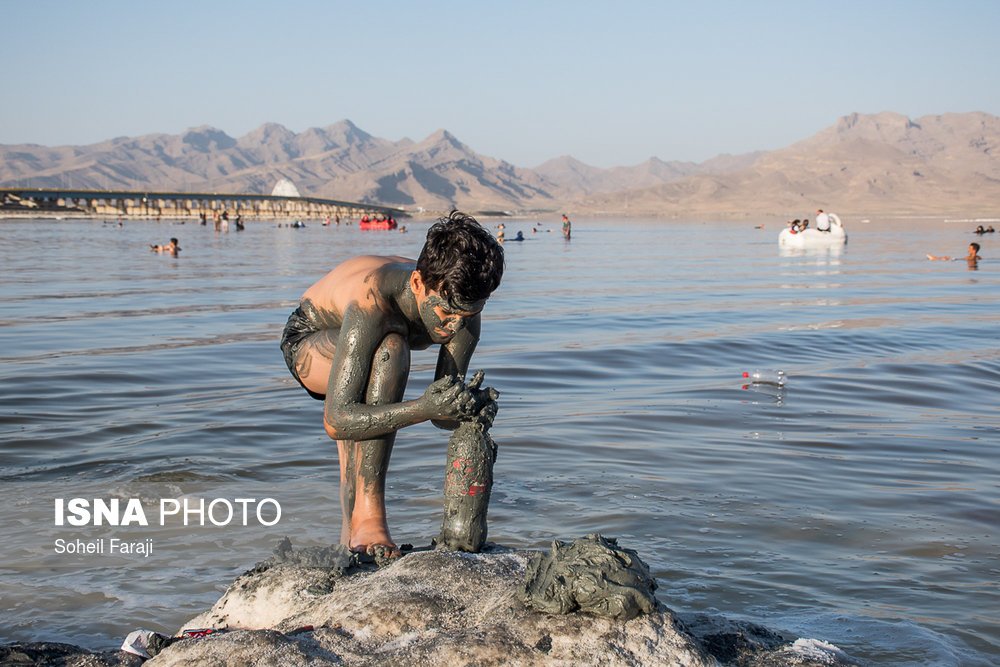
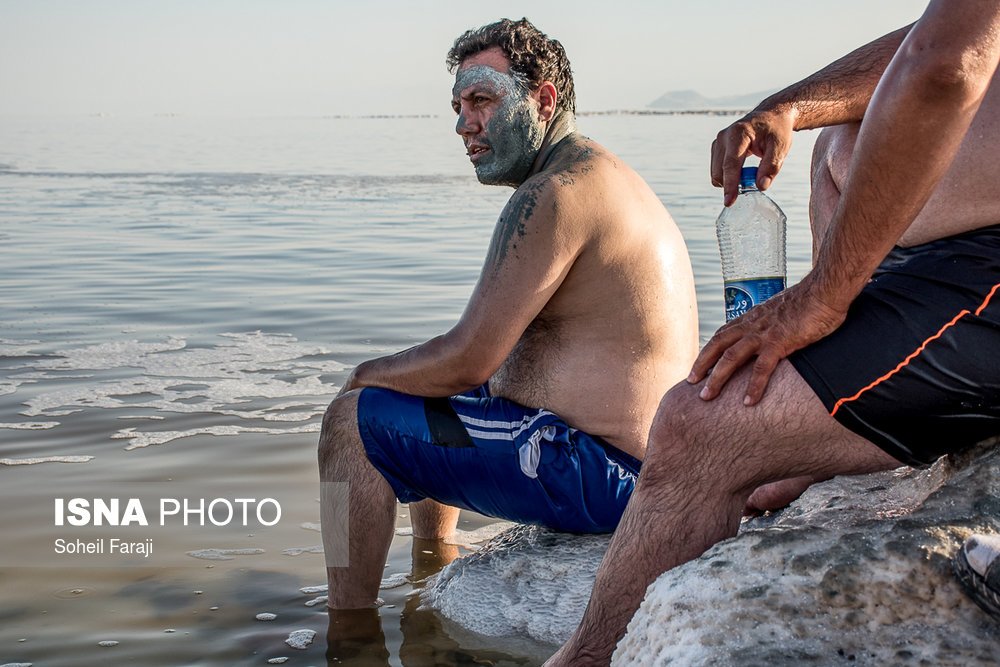
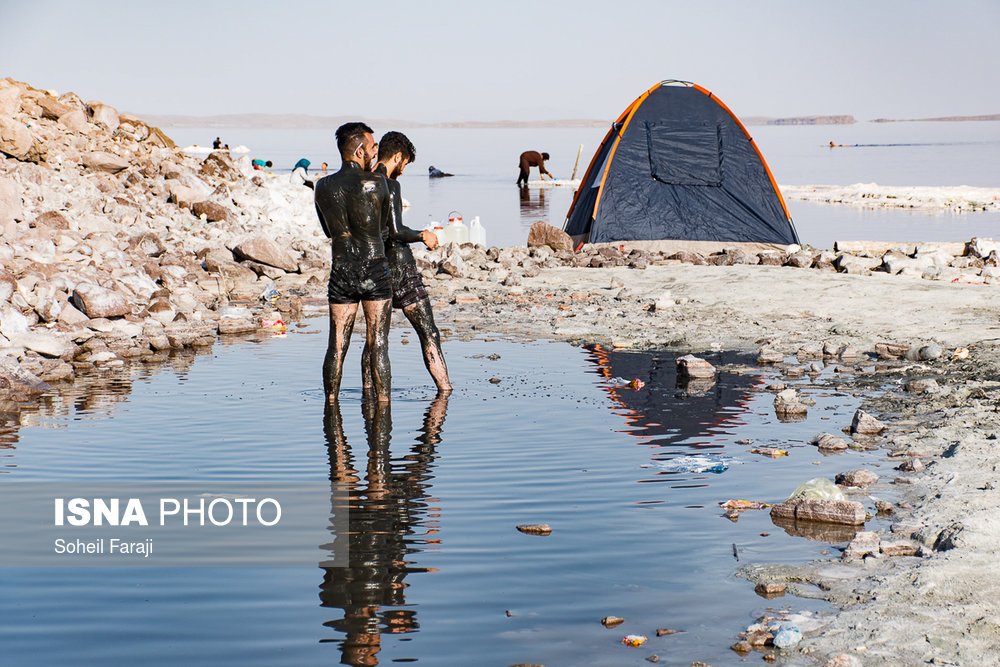
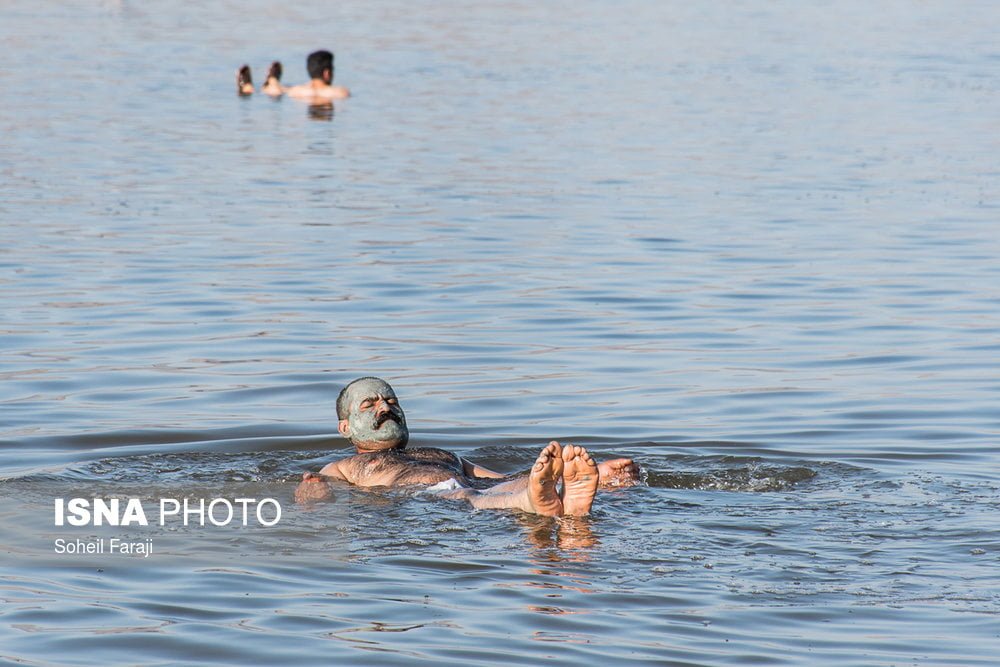
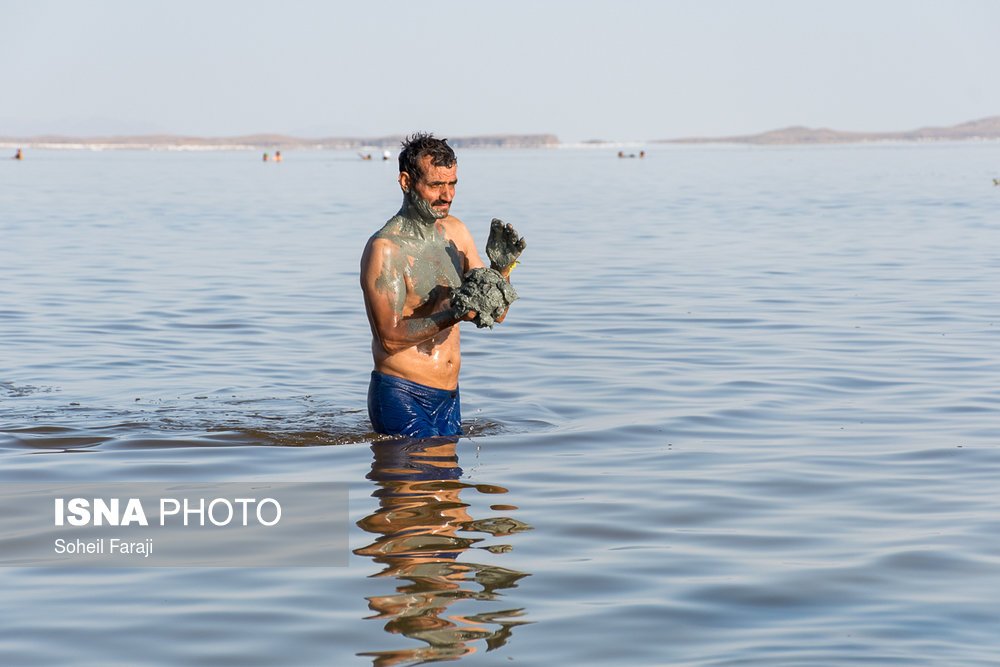
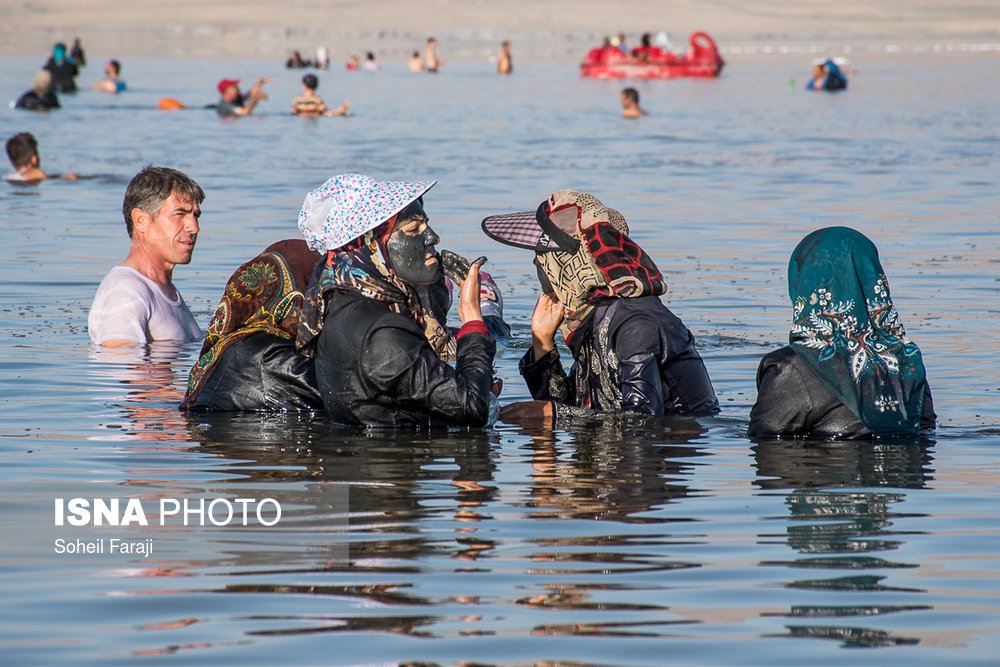
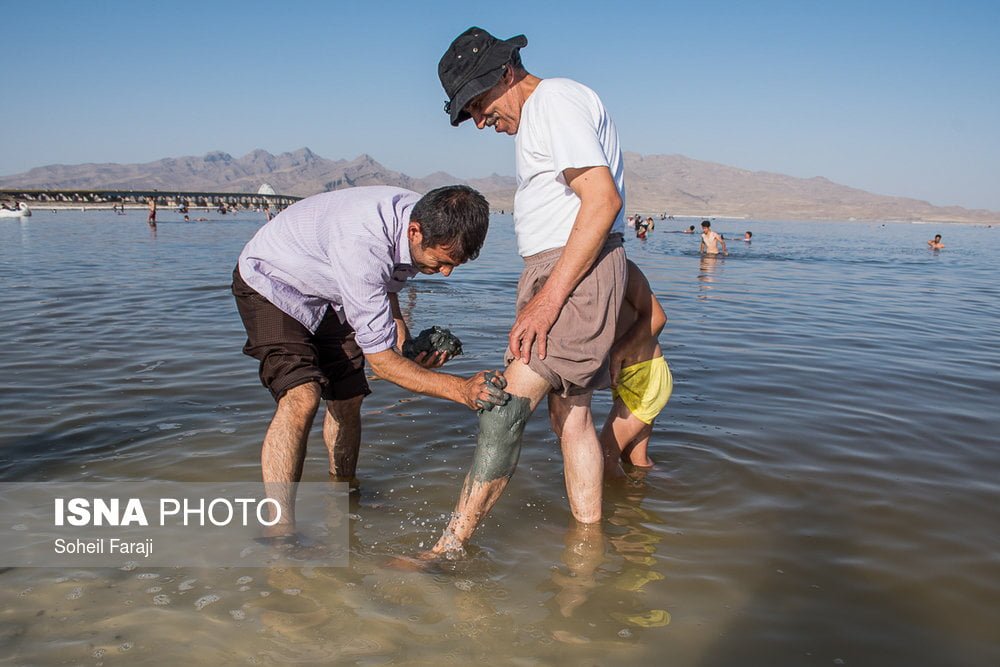
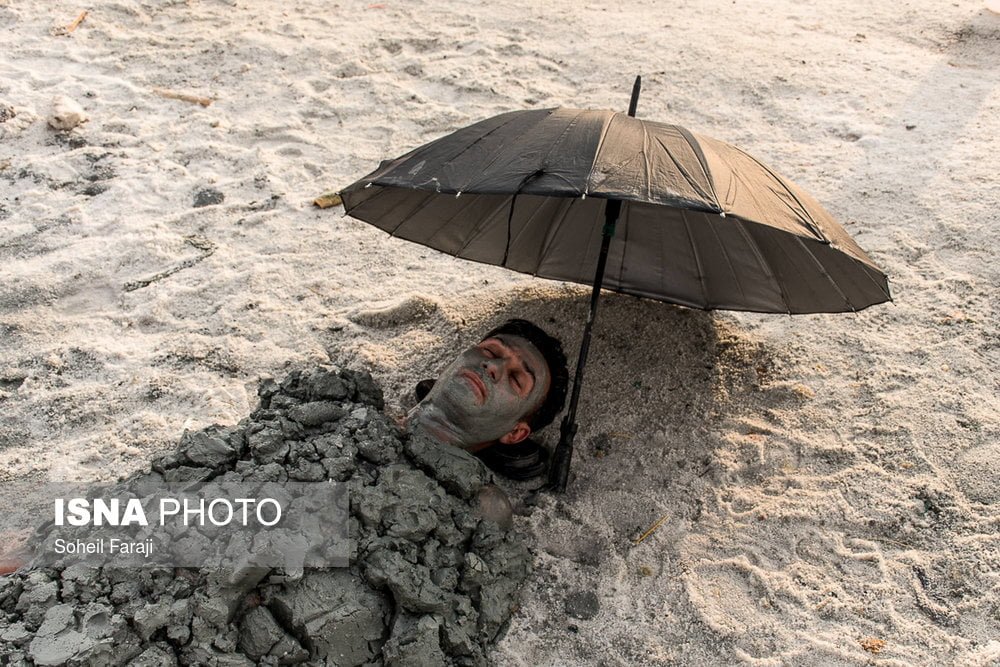
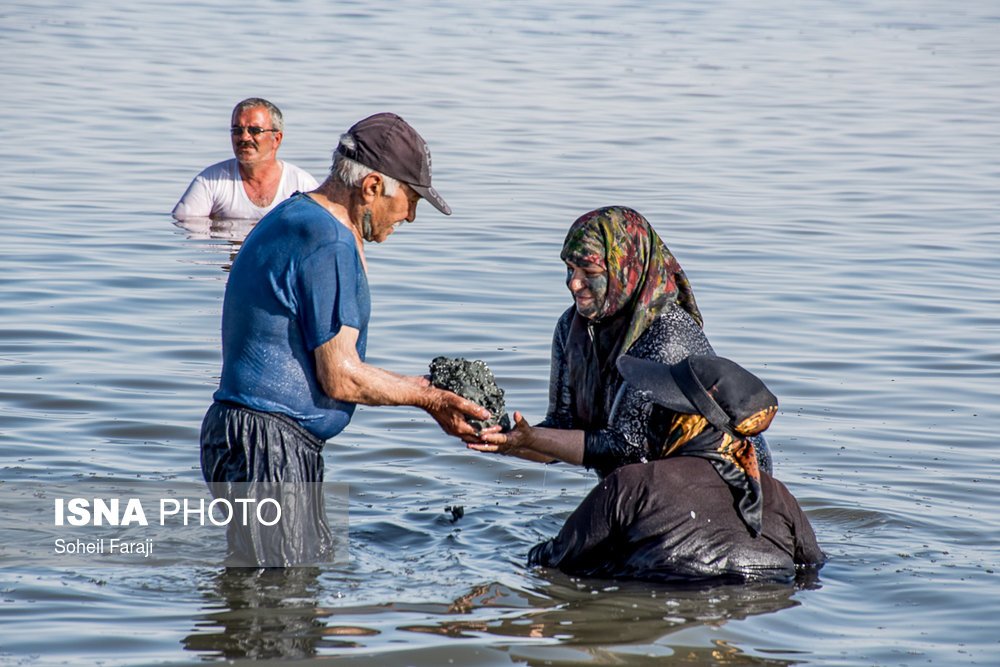
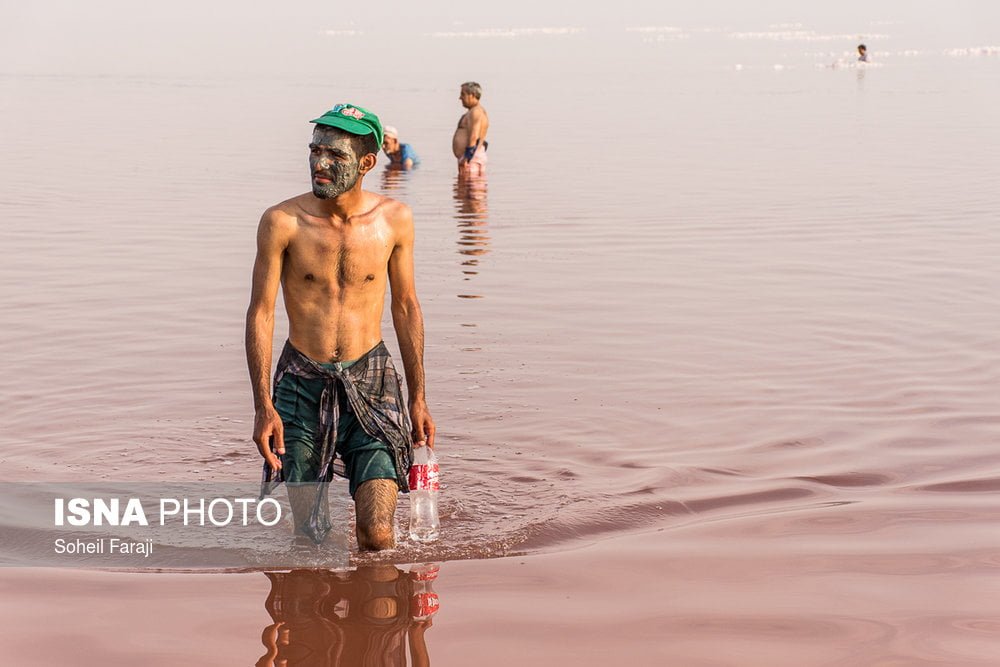
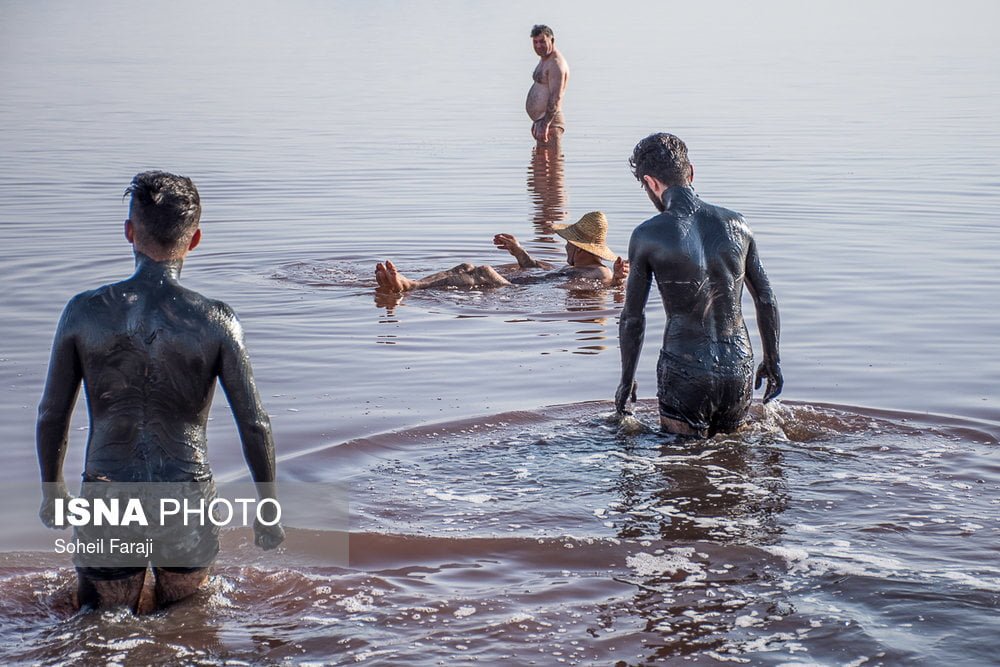
Mud Therapy in Lake Urmia; A Mixture of Healing, Recreation

The Lake’s mud is among the best-performing medical ones thanks to its mineral salts, especially chlorine, sulphate, sulphur, radioactive materials, iodine, iron and numerous organic substances.

It is effective in the treatment of many diseases, such as skin and rheumatic diseases, psychosomatic illnesses, gynaecological diseases, especially pelvic inflammation and menstrual disorders, and many other diseases.

In the past, the Lake’s mud used to be exported to several other countries as well as the Soviet Hospital of Tehran, which is now called Khordad 15th Hospital for the treatment of patients.

However, unfortunately in recent years, except for the general public and tourists, no one else makes use of this therapeutic method.

Nowadays, by using new methods and building modern health centres near Lake Urmia, effective steps could be taken not only in the development of tourism industry, but also in helping patients.

These centres can effectively help to develop new therapeutic approaches in the healthcare system of the country and become a reference environment for other countries, especially the neighbours.

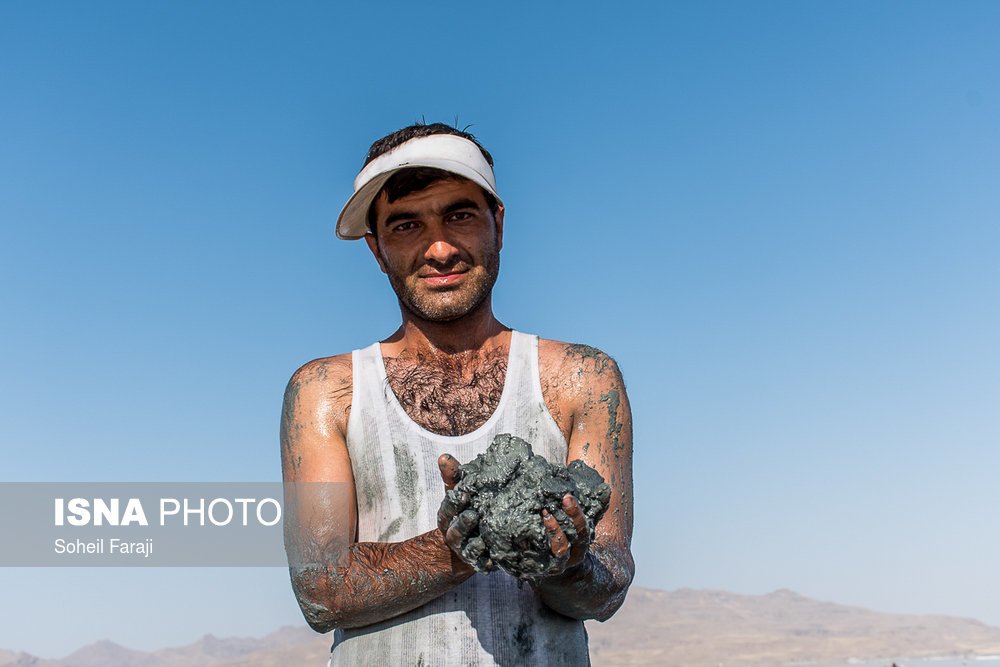
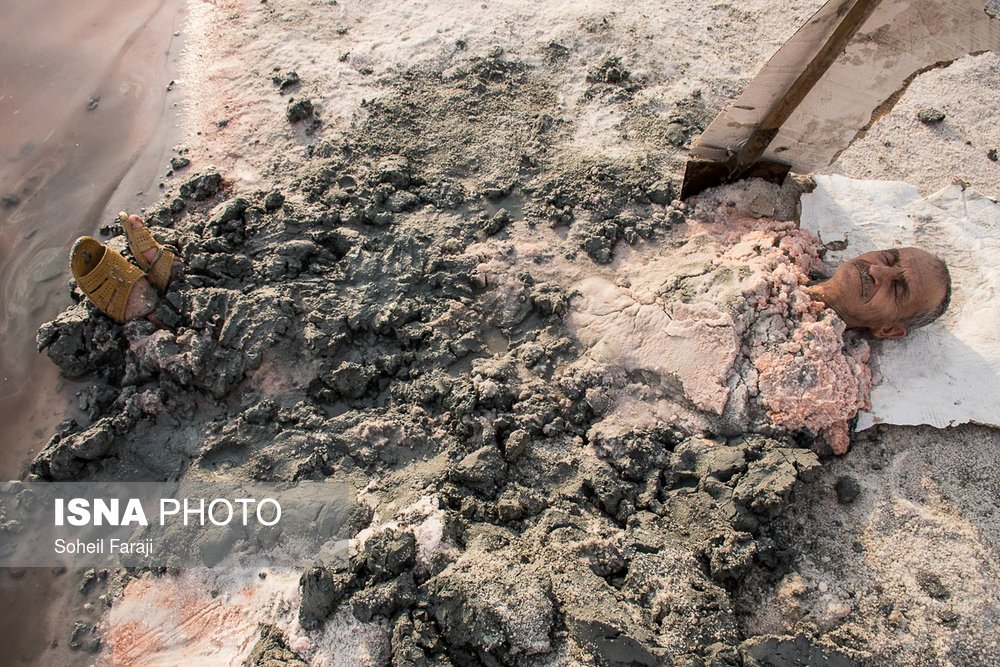
What follows are ISNA’s photos of tourists receiving mud therapy in Lake Urmia’s shores:

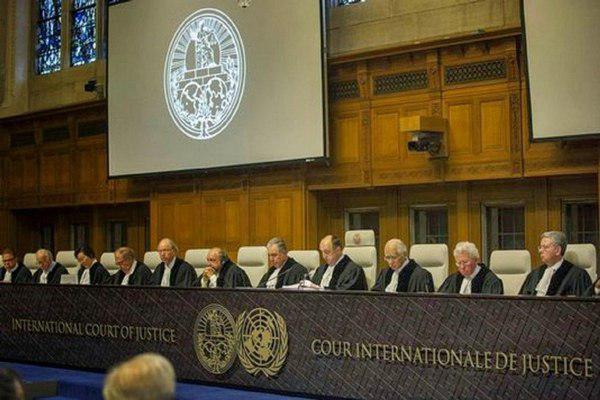
US Trying to Mislead ICJ on Iran’s Lawsuit: Official

In an interview with IRNA, Araqchi slammed the US lawyer’s remarks in a recent ICJ hearing, saying that instead of responding to the logical and legal arguments of Iranian lawyers, the US attempted to provide non-technical and non-relevant justifications.

Araqchi said the US’ lawyer interrupted the senior officials of Iran, including himself (Araqchi), and provided incorrect translations and interpretations in a bid to mislead the court and evade accountability.

“I stated in my interview that, although the court’s decision was binding as per the international law, the international bodies’ power to force the US into abiding by the decision is very limited. In the past, Washington had openly refused to abide by The Hague’s verdicts on several occasions in spite of the clarity of the lawsuits against the United States,” he added.

“We knew that even if the ICJ issues a fair ruling and confirms that Iran’s rights have been violated by the US sanctions, the United States will not possibly accept it in any case. However, we decided to take our case to the court in order to prove Iran’s rightfulness.”

The breath-taking controversy of Iranian-American legal teams ended at the International Court of Justice on Thursday, and it will be clear in the coming weeks which side will win the case.

The first hearing session on Iran’s complaint against the re-imposition of unilateral sanctions by the United States was held on August 27 in The Hague, Netherlands, and at the Peace Palace of the International Court of Justice.

Earlier, Iranian Foreign Minister Mohammad Javad Zarif said Tehran has complained to the ICJ against United States’ violation of 1955 Treaty of Amity, Economic Relations, and Consular Rights.

He also noted that the Islamic Republic of Iran has filed a lawsuit against the US at The Hague on this basis.

The International Court of Justice has 15 qualified judges, elected by the General Assembly of the United Nations and the Security Council for a period of nine years.

Iran’s ambassador to the Netherlands, Alireza Jahangiri, had previously stated that if the vote would be in favour of the Islamic Republic, the UN Security Council must implement it and could enforce it on Washington. But even if the verdict is vetoed by the United States at the Security Council, it can still put great pressure on Washington.

The 1955 treaty was signed between Tehran and Washington before the 1979 Islamic Revolution.

It consists of an introduction and twenty-three articles calling for friendly ties while encouraging bilateral trade, investments, and regulating consular relations. The treaty was signed in Tehran just a week before the second anniversary of the 1953 Coup. The treaty came into force in June 1957. Ever since, it has been considered as the legal framework for bilateral ties between Tehran and Washington.

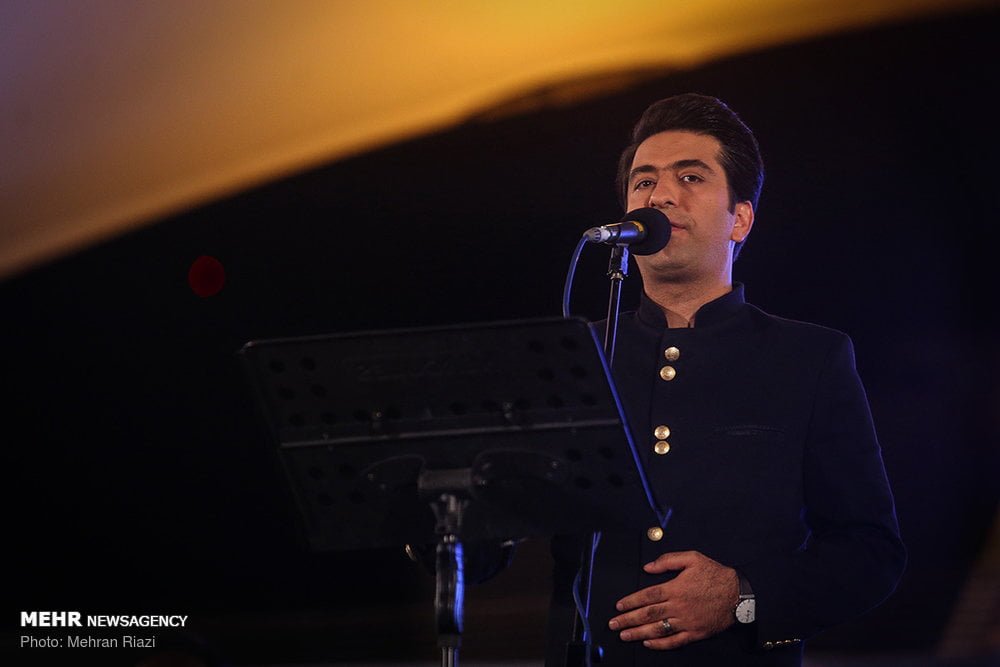
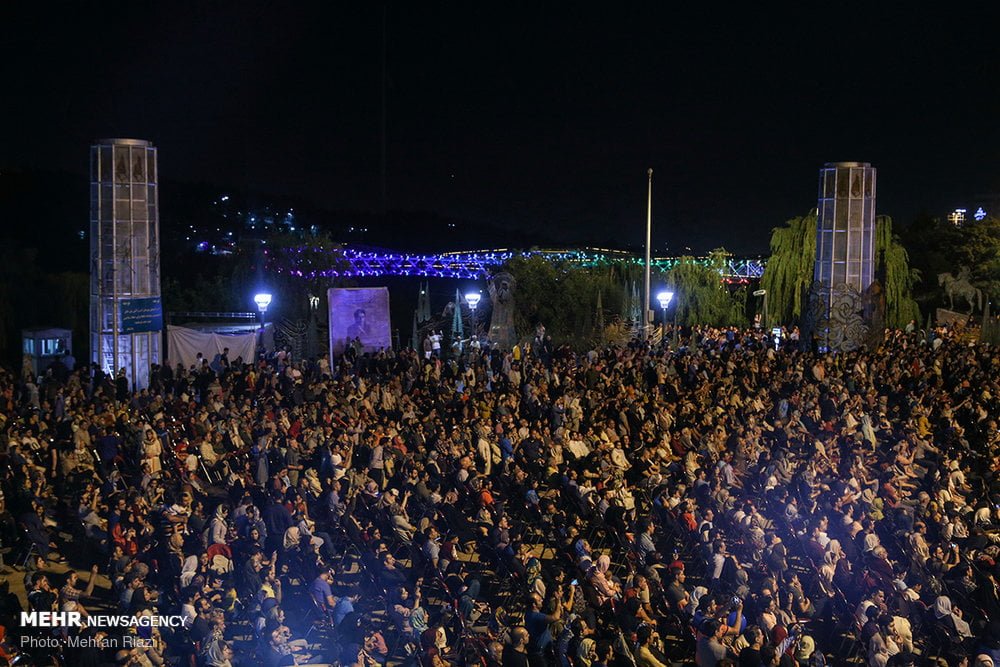
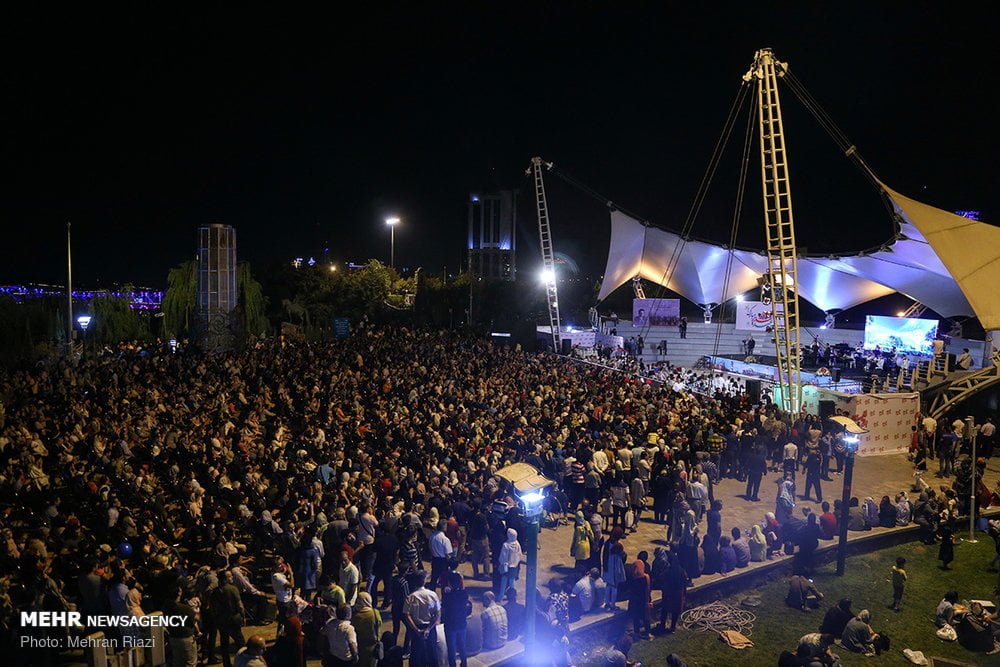
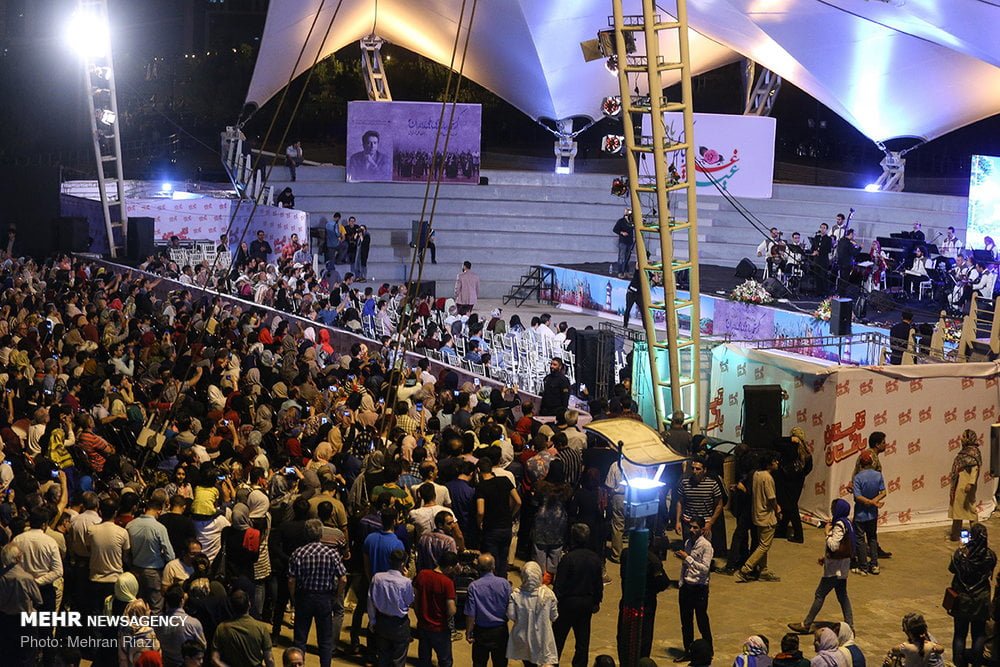
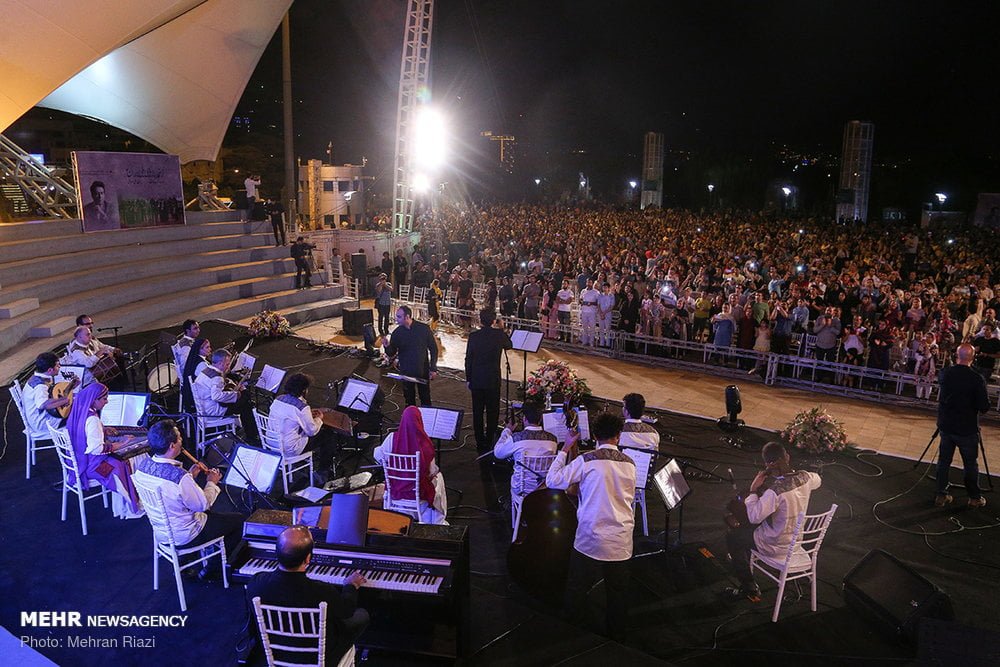
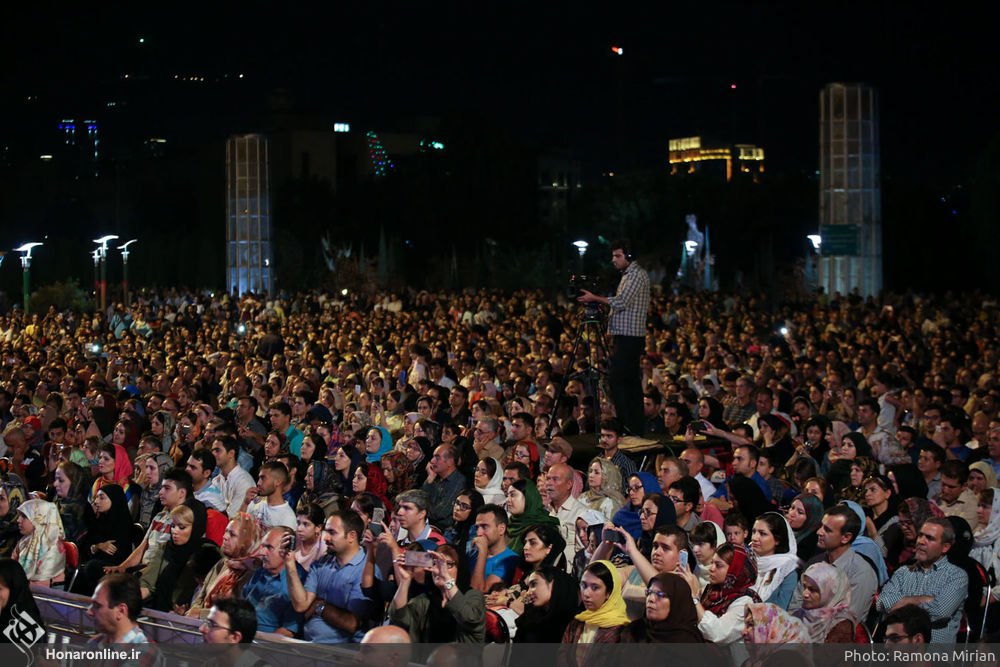
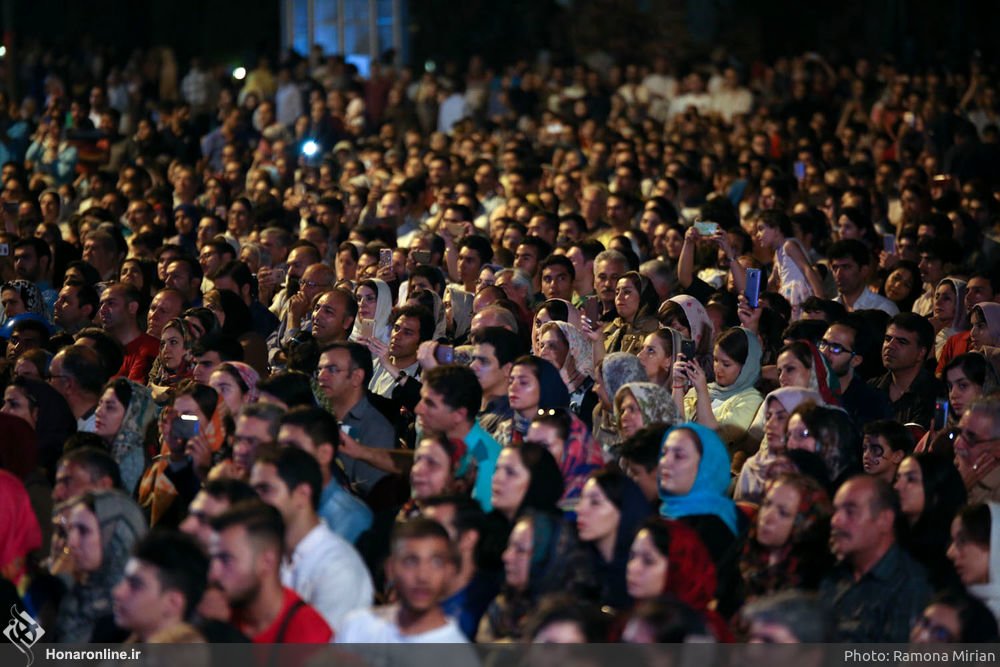
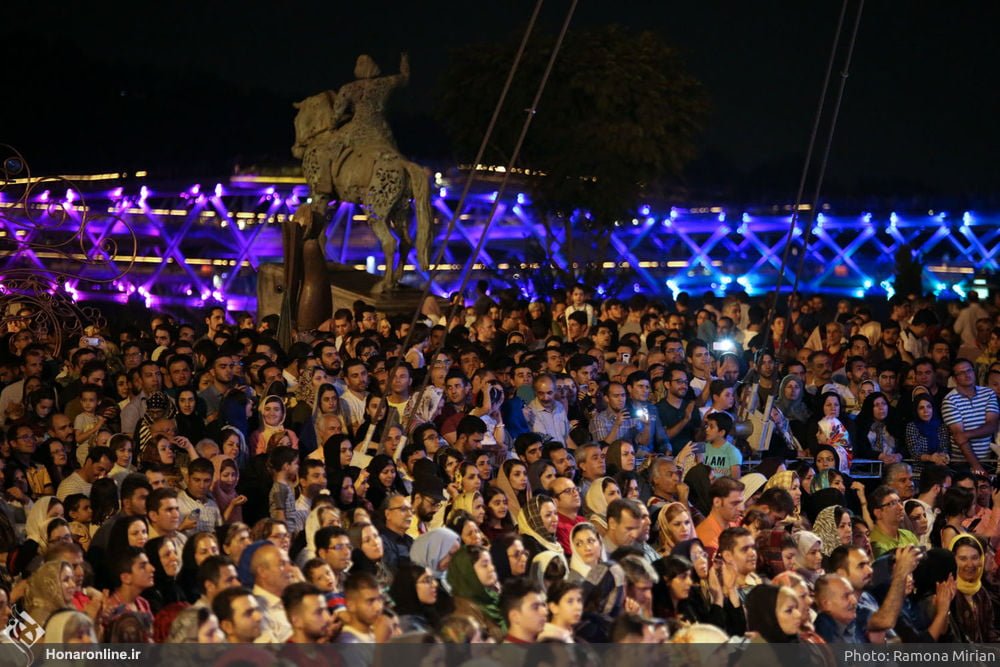
Tehran Hosts First Free Outdoor Concert

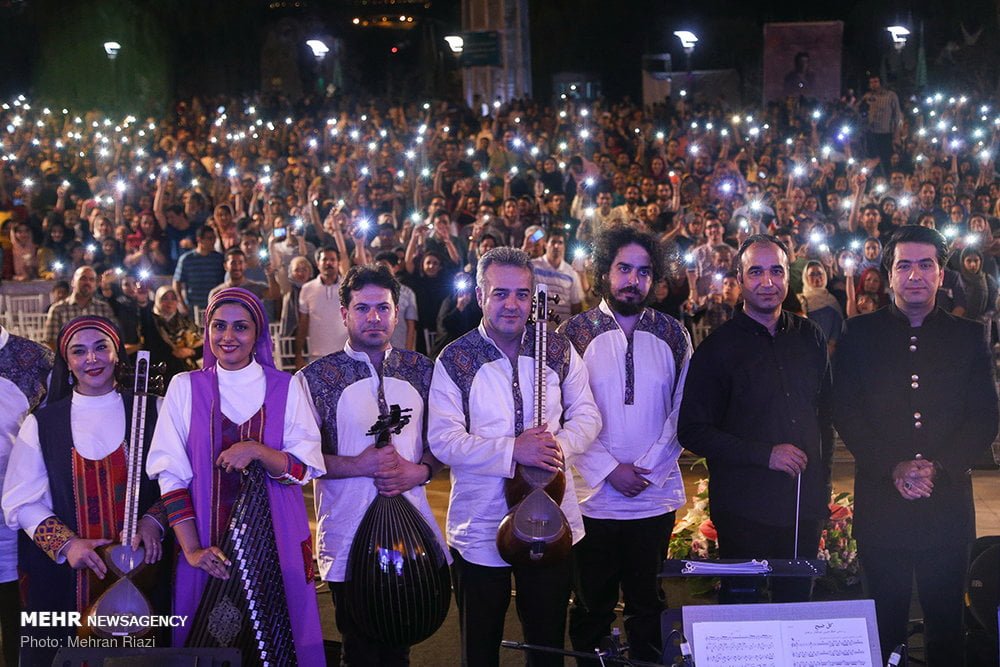
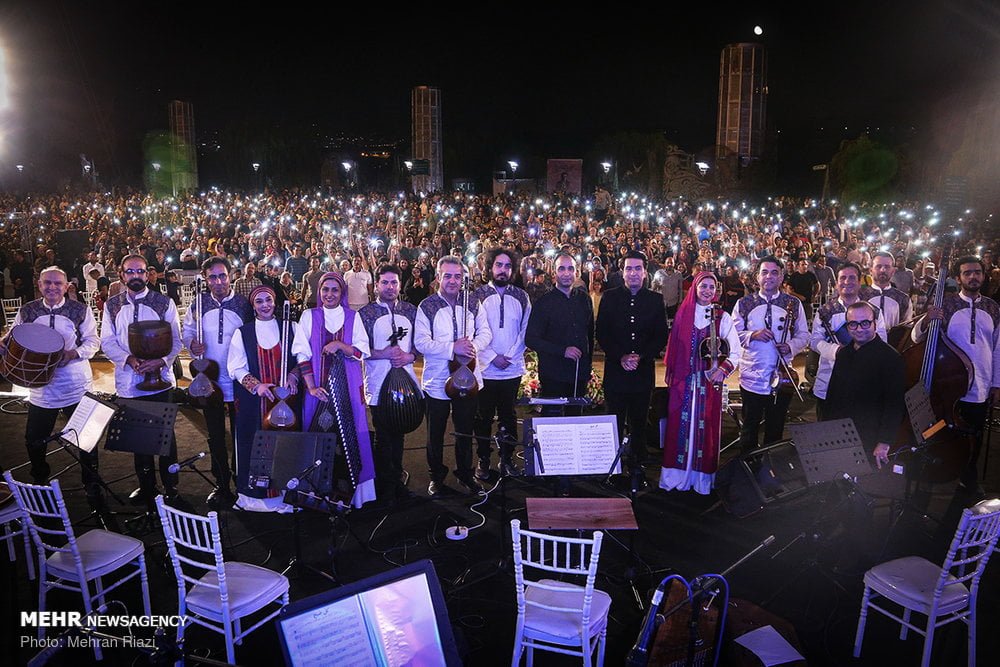
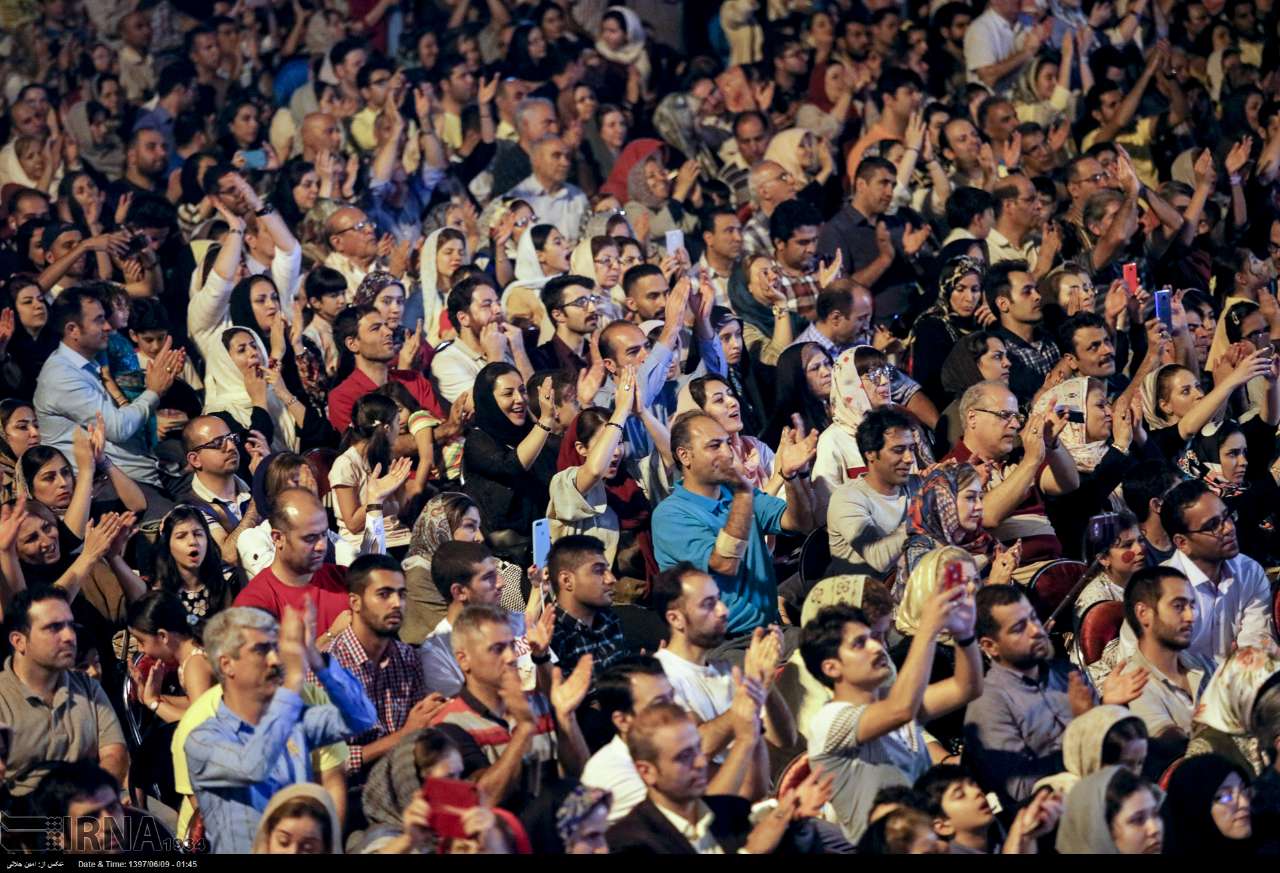
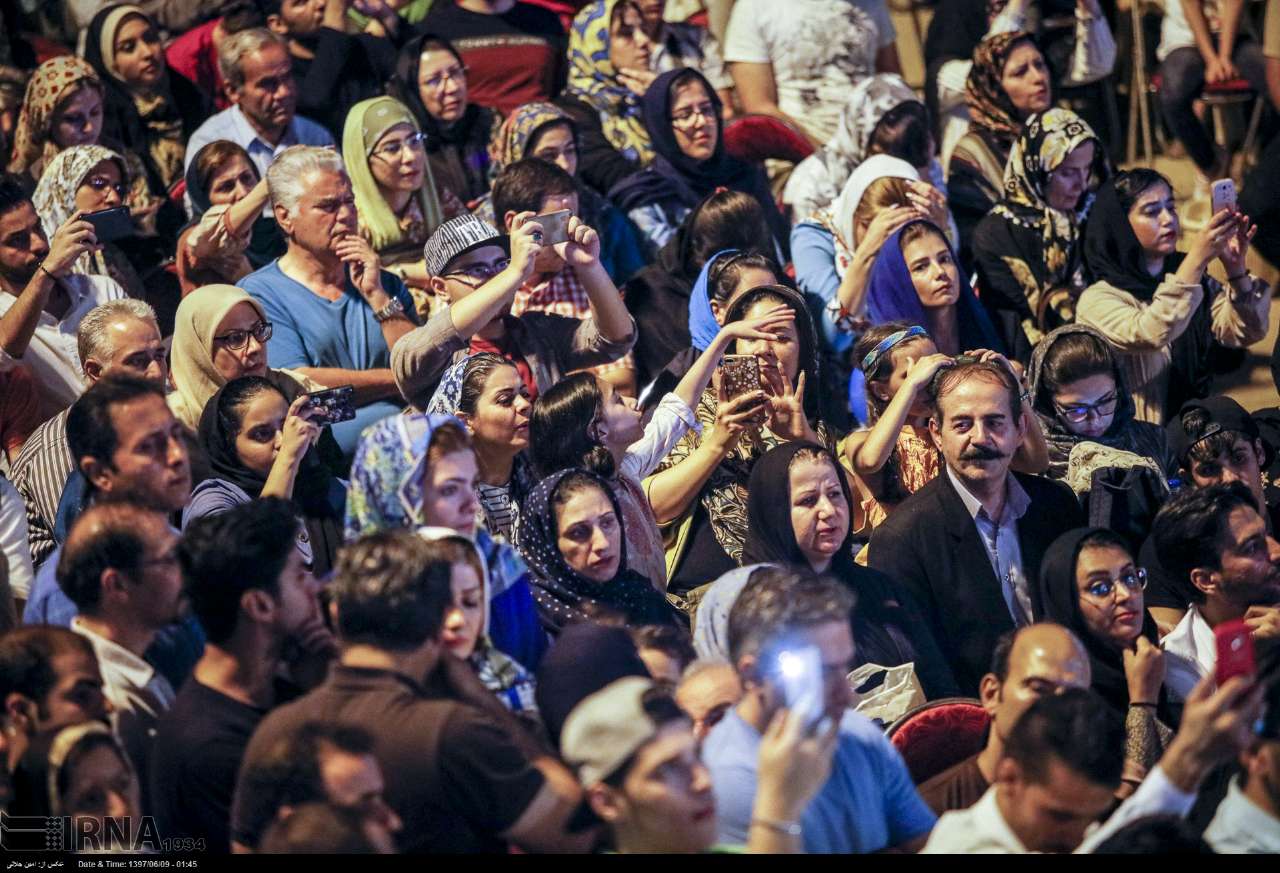
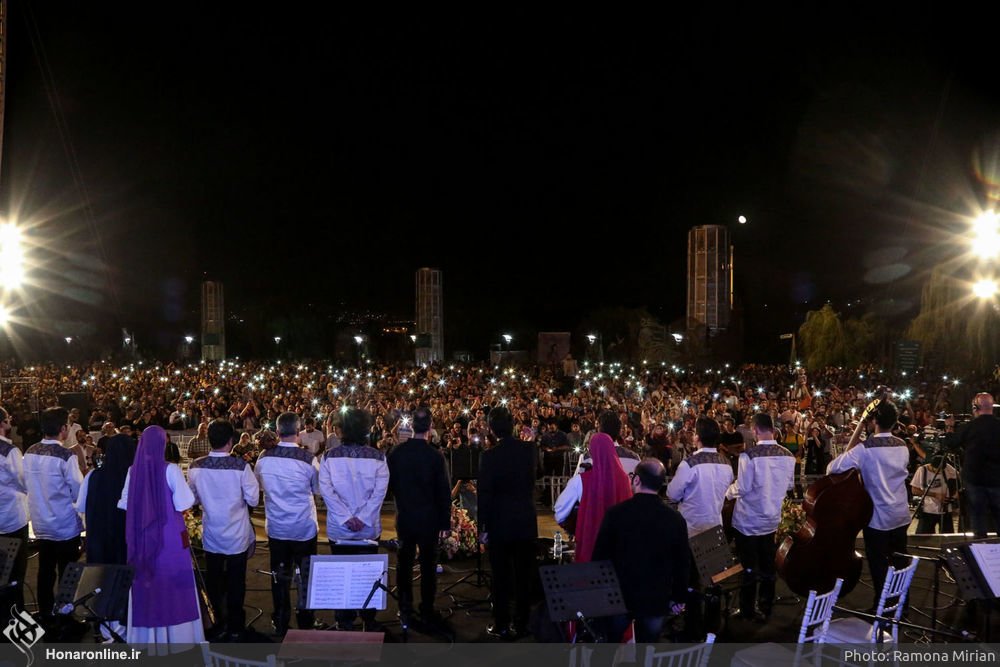
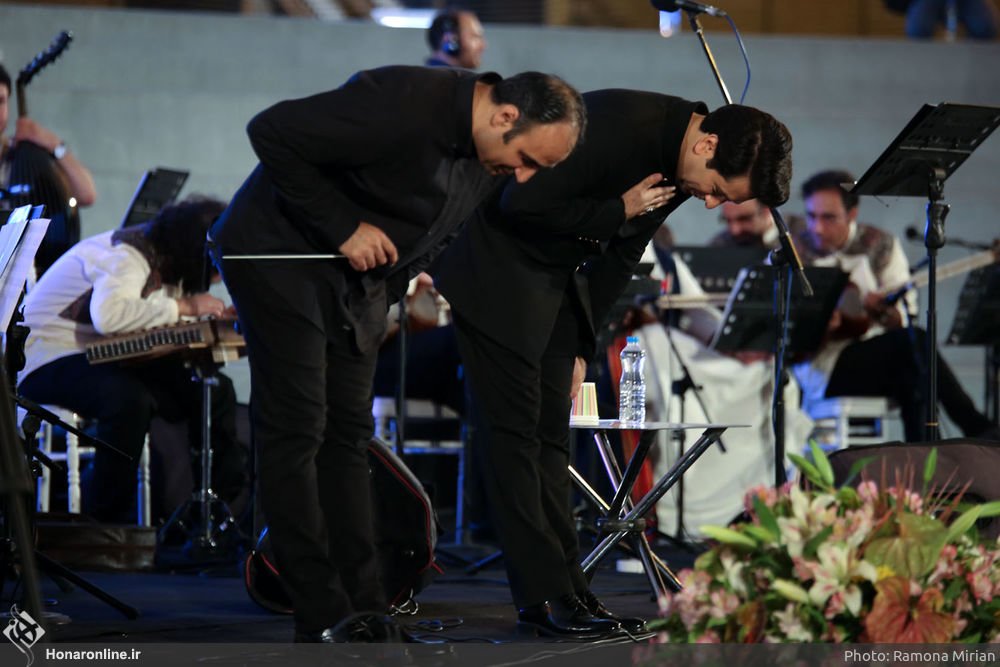
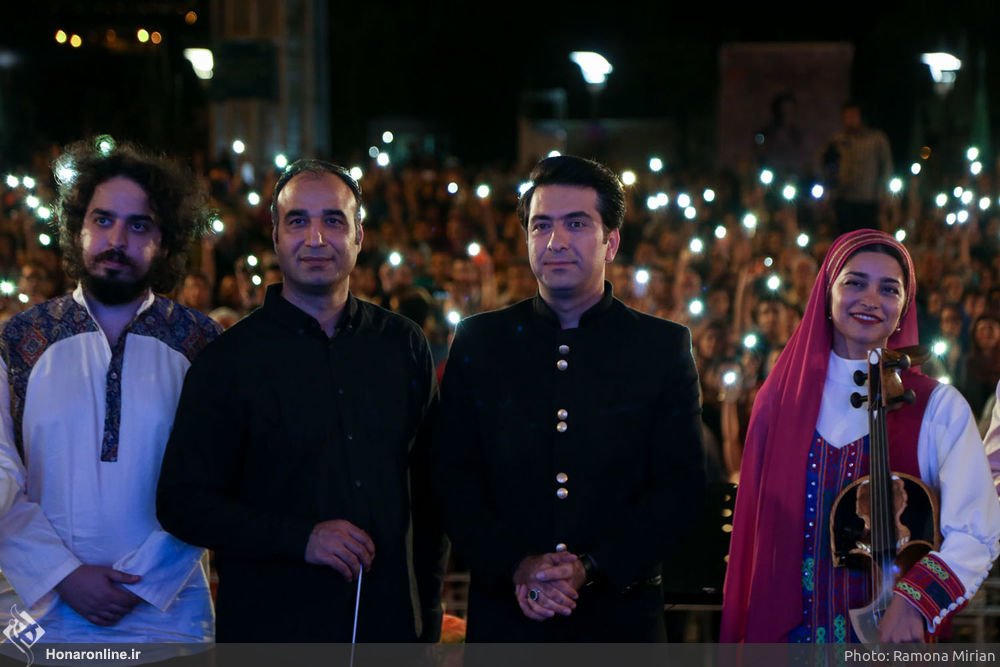
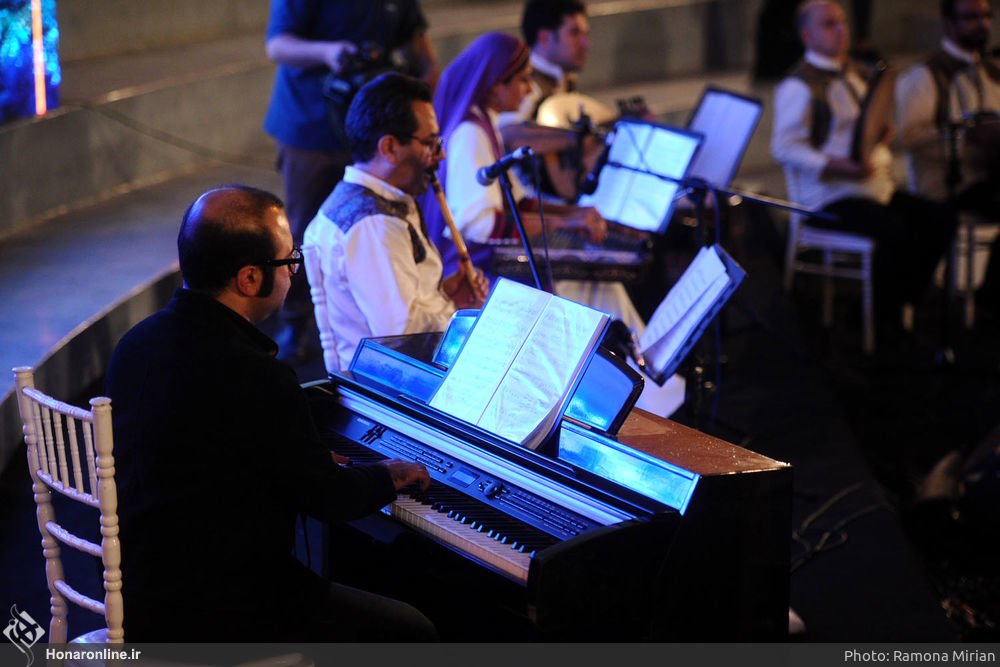
The event was marked by performances by the Orchestra of National Musical Instruments.

The orchestra conducted by Aliakbar Qorbani featured vocals by Mohammad Mo’tamedi, a renowned traditional signer.

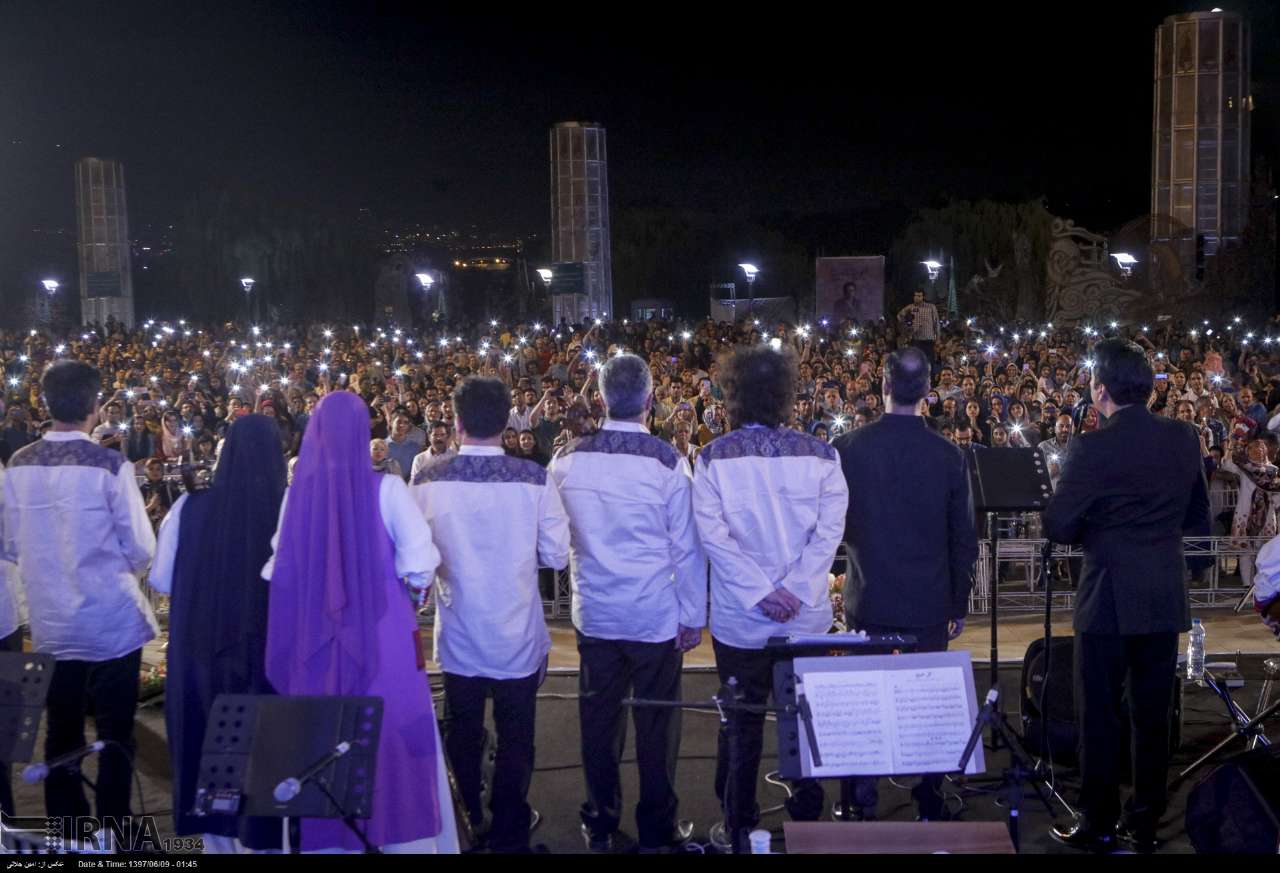
It was the first musical performance free of charge for the public and was held at Water-and-Fire Park on August 30, 2018.

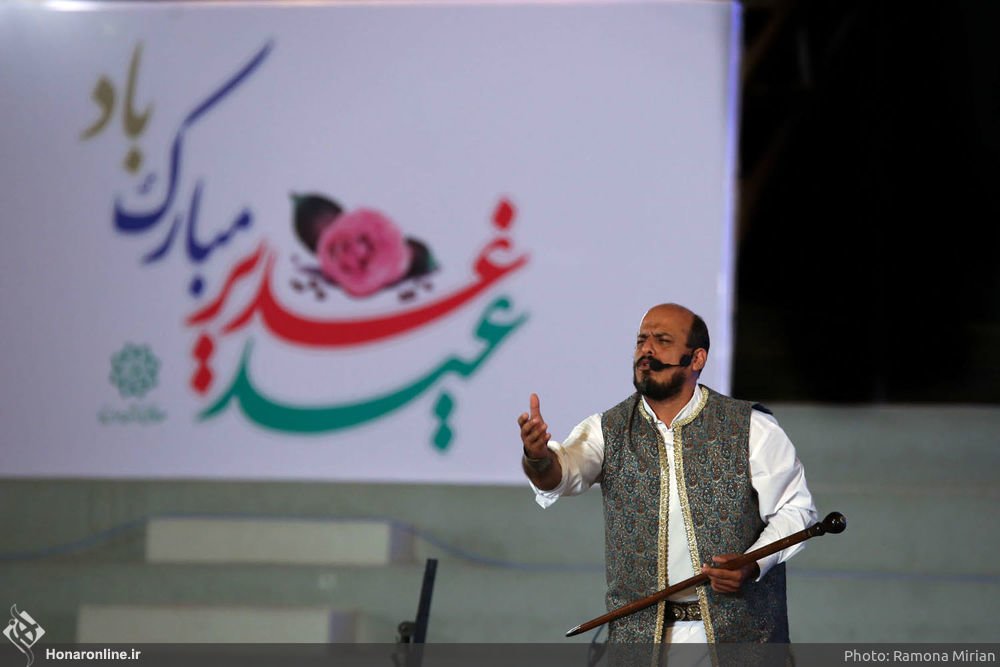
At the beginning of the concert, Narrator Mirza-Ali recited pieces about Imam Ali.

The event was organized in cooperation with the Ministry of Culture and Islamic Guidance, and was warmly welcomed by the people on its first night, though there were some problems such as a shortage of seats for the audience and the long time it took to tune up the instruments.

However, the concert went very well with the cooperation of the people and no security incidents came up during the performances despite earlier concerns.

The audience stood up to honour the “Oh, Iran” piece played without prior rehearsal and sang along in harmony with the orchestra.

“With such performances, we intend to show the police that such events will not be problematic for public security,” said Mo’tamedi.

The National Musical Instruments Orchestra comprises musicians playing such instruments as the Tar, Santoor, Tumbak and flute.

The idea of holding such free outdoor concerts was first raised by famous singer Homayoun Shajarian, who said such performances may help ordinary people forget about their economic problems for a few hours.

Ancient Artefacts Seized from Smugglers in Southern Iran

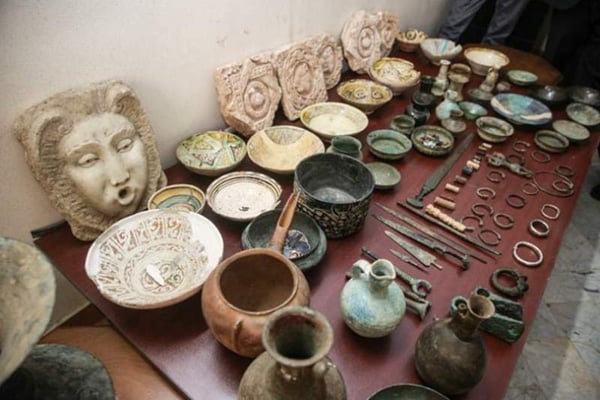
Ancient artefacts seized from smugglers in Iran's Khuzestan province

Prosecutor General of Jiroft, Hossein Salami, told IRNA that after carrying out a series of intelligence operations by the IRGC forces of Kerman Province, it was revealed that smugglers were determined to traffic an invaluable cargo of antiques.

When the Prosecutor’s Office was informed about it, he added, the issue was put high on the agenda, and a team of the IRGC intelligence forces was deployed to the region.

“In this operation, 14 antique objects dating back to the third millennium BCE were discovered and seized, and smugglers of antique objects escaped to the mountains.”

He underlined that among the objects discovered things such as a crescent blade, a bronze plaque, a bronze ring, a three-part metal object, a stone button, and a conical metal object could be seen.

Ancient Artefacts Seized from Smugglers in Southern IranThe discovery of such historical objects in the city of Jiroft reveals the ancient civilization, culture, and history of the region, and the protection of this historical heritage is necessary for everyone, added Salami.

He further mentioned that this is the third discovery of antique relics in the past few weeks in the city of Jiroft adding that so far, a total of 28 pieces of such relics have been seized.

Meanwhile, the Intelligence office of Khuzestan province announced the discovery of 908 antique items in the province.

After four months of investigation, a collection of 81 types of antiques including historical coins, bayonets, stitching awls, candlesticks, armbands, bracelets, gold, silver and iron rings, daggers, maces, dishes, and weapons were seized.

Cultural heritage experts say the objects belong to the Sassanid, Elamites, Islamic, Achaemenids, first millennium BCE and Qajar periods.

The smugglers were supposed to transfer the antiques to a European country, and so far a few of them have been arrested.

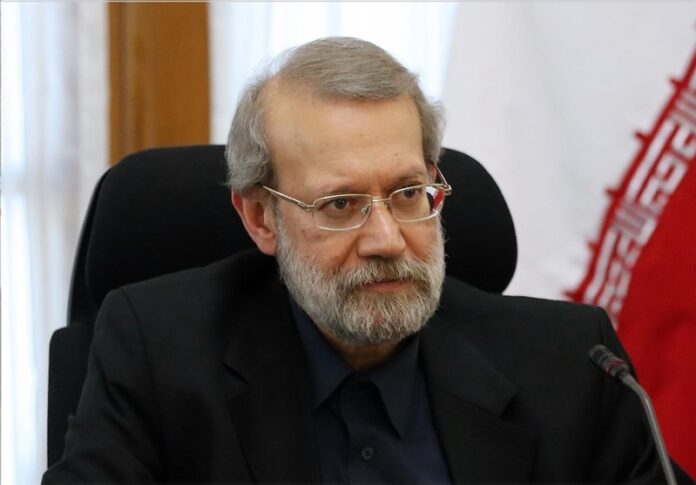
Iran Has So Far Stayed in JCPOA at EU’s Request: Larijani

larijani

Ali Larijani said Europe has stated that it will secure Tehran’s interests in such a way that Iran will suffer no losses.

“Iran agreed to hold talks with the P5+1 group, and they were tough negotiations, indeed,” said the top parliamentarian.

“The current [Iranian] administration also tried very hard to make the talks bear fruit. I was following up the affairs personally and saw that Mr Rouhani’s administration and Mr [Mohammad Javad] Zarif made a lot of efforts to reach agreement. However, there are problems in the deal and it’s not that all demands are met,” said Larijani.

He said the European asked the Islamic Republic to stay in the Iran nuclear deal after Washington’s withdrawal from the agreement.

“They asked us to cooperate and said they would ensure [Iran’s interests] in such a way that it won’t cost Iran anything,” the speaker said.

“In fact, after contacts with the three European leaders, Iran agreed to stay with Europe for a period of time to see whether or not they have what it takes to do it and [whether or not they] are dedicated to the job,” Larijani added.

“It was a rational course of action to take, and the Islamic Republic of Iran took ‘time’ into account, too” said the top parliamentarian.

Elsewhere in his remarks, he reiterated that Iran is not seeking nuclear weapons.

“We took the path to technological advances part of which was nuclear technology, and it was announced time and again that we won’t seek nuclear arms,” he noted.

“The Leader [of the Islamic Revolution Ayatollah Seyyed Ali Khamenei] also issued a fatwa indicating that we consider nuclear arms to be against religion,” he said.

The parliament speaker said Iran then provided the International Atomic Energy Agency (IAEA) with the necessary information, and that the agency confirmed afterwards that Tehran had lived up to its obligations.

A Look at Iranian Newspaper Front Pages on September 1

A Look at Iranian Newspaper Front Pages on November 19

Newspapers today widely covered the remarks made by the Leader of Iran’s Islamic Revolution Ayatollah Seyyed Ali Khamenei in a meeting with President Hassan Rouhani and members of his cabinet.

The visit of Iranian Foreign Minister Mohammad Javad Zarif to Pakistan and his meeting with the country’s new Prime Minister Imran Khan also received great coverage. Zarif became the first foreign diplomat to meet Imran Khan after his taking office.

Several papers also highlighted the successful holding of the first free outdoor concert in Iran, which was performed by traditional singer Mohammad Motamedi in a park in the capital.

The above issues, as well as many more, are highlighted in the following headlines and top stories:


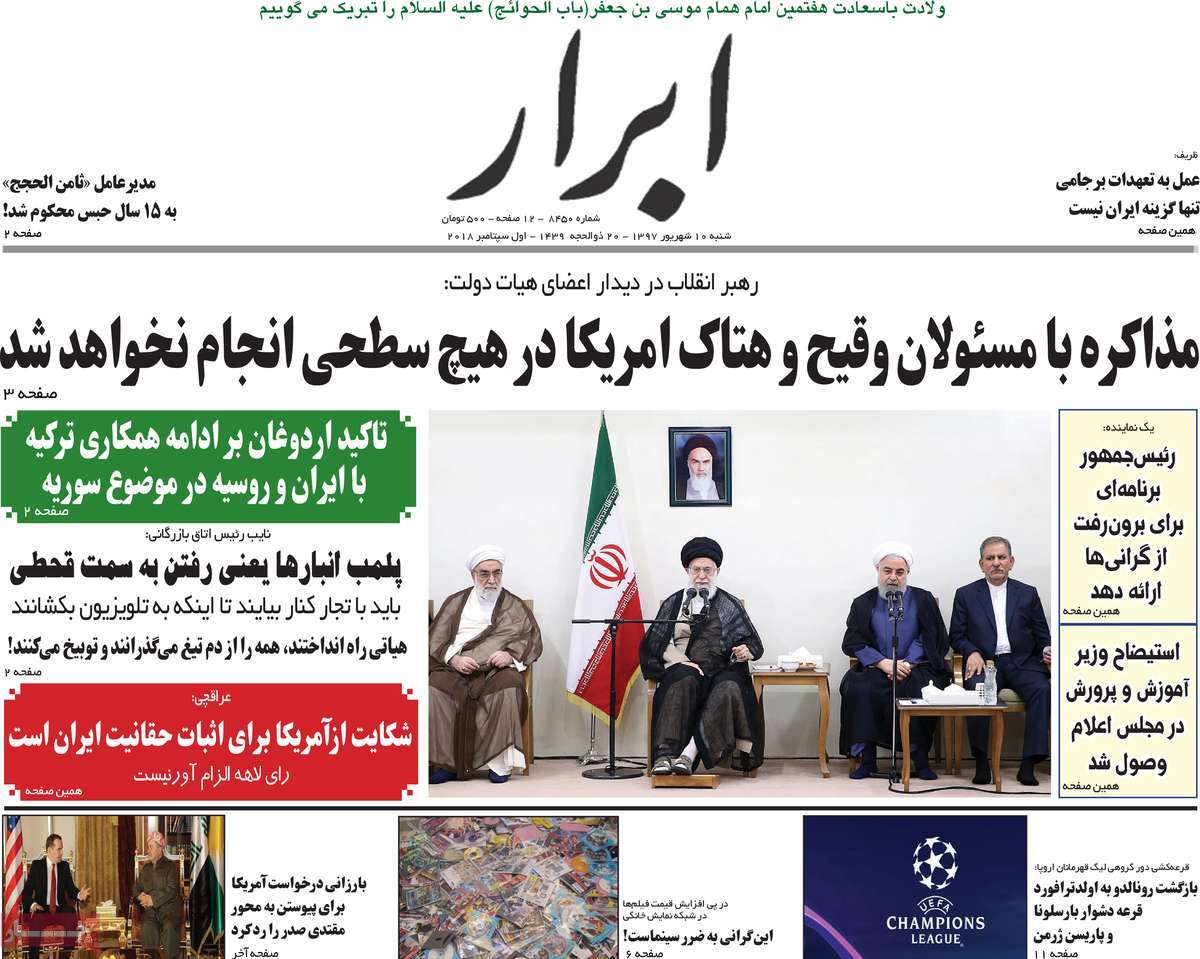
Abrar:

1- Araqchi: Lawsuit against US Aimed at Proving Iran’s Rightfulness

2- Erdogan Says Turkey Will Work with Iran, Russia on Idlib
A Look at Iranian Newspaper Front Pages on September 1


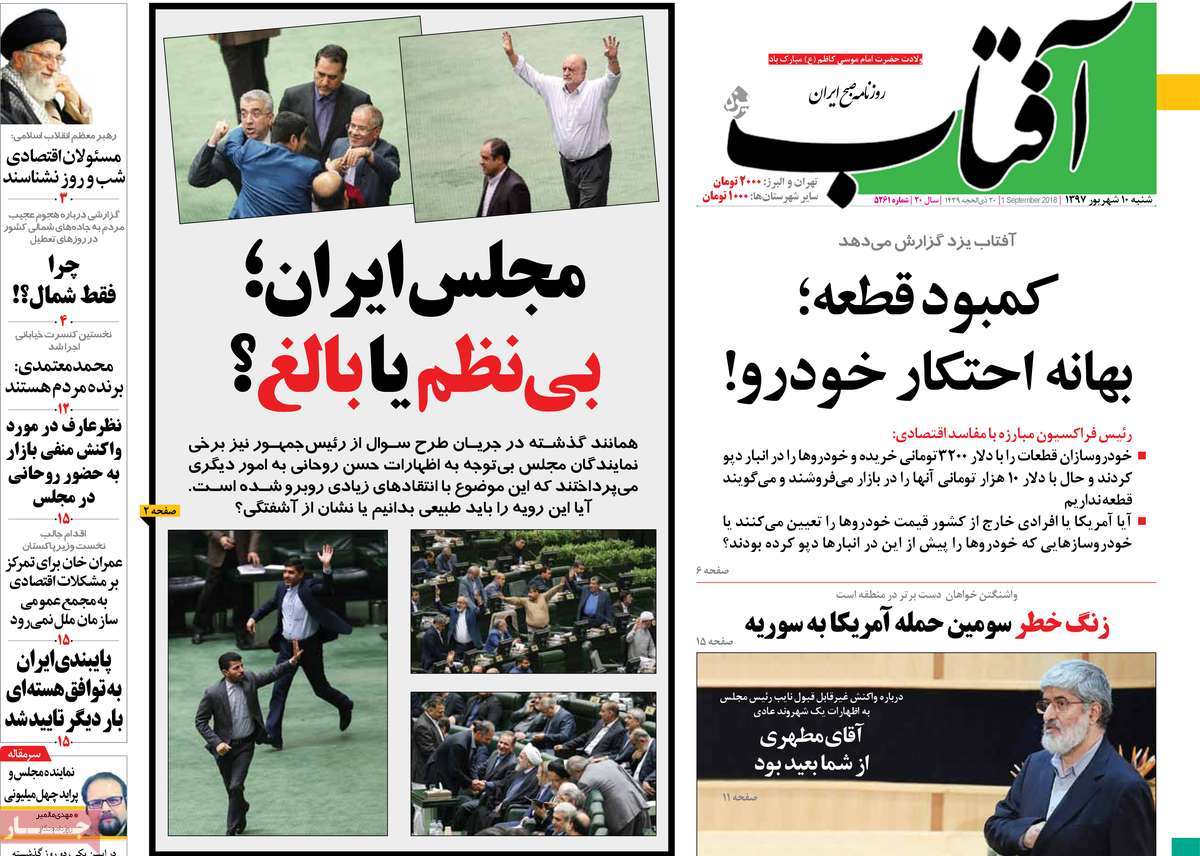
Aftab-e Yazd:

1- Pakistani Prime Minister’s Interesting Move

  • Imran Khan Won’t Attend UNGA in New York to Focus on Economic Woes

2- Iran’s Commitment to JCPOA Once Again Confirmed by IAEA
A Look at Iranian Newspaper Front Pages on September 1


Arman-e Emrooz:

1- Iran Leader: Everyone Must Help Government in Tackling Problems

2- Twitter, One More Step Closer to Being Unblocked after FM’s Support
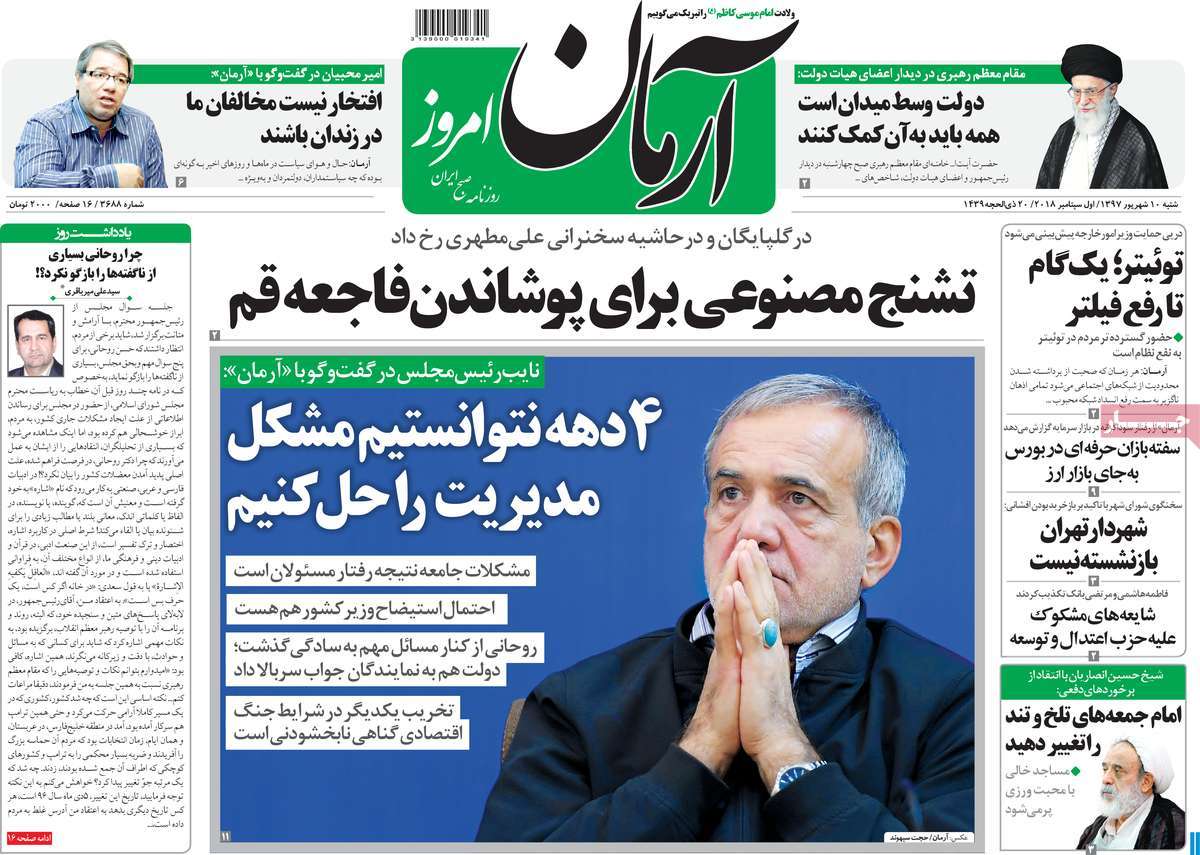
A Look at Iranian Newspaper Front Pages on September 1


Ebtekar:

1- Tsunami of Impeachment: Rouhani’s Minister May Fail to Survive Impeachment

2- Queiroz: I’ll Sign New Deal with Iran Tomorrow; We Want to Claim Asian Title
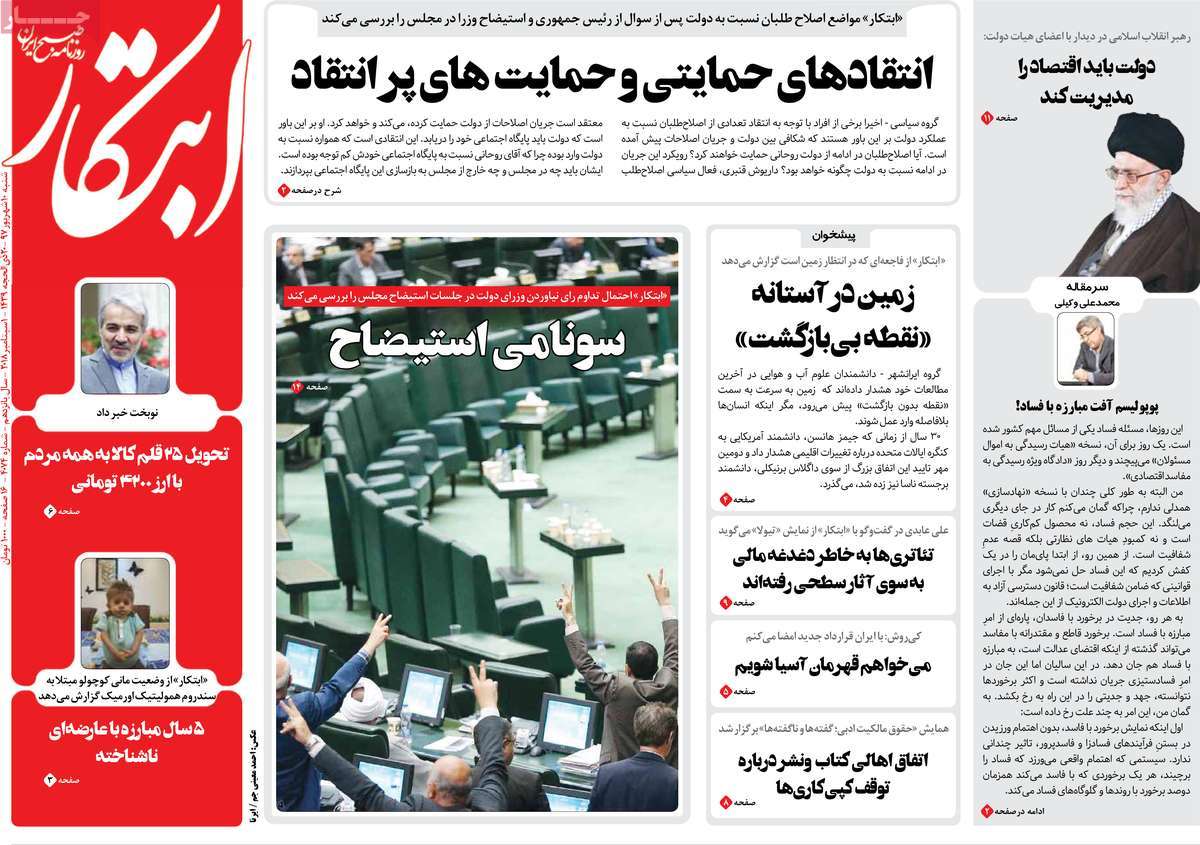
A Look at Iranian Newspaper Front Pages on September 1


Etemad:

1- Rouhani’s Failure Doesn’t Mean Victory for Anyone

  • Why Reformists Are Criticizing Rouhani’s Government

2- Iran Leader: No Talks to Be Held with US at Any Level
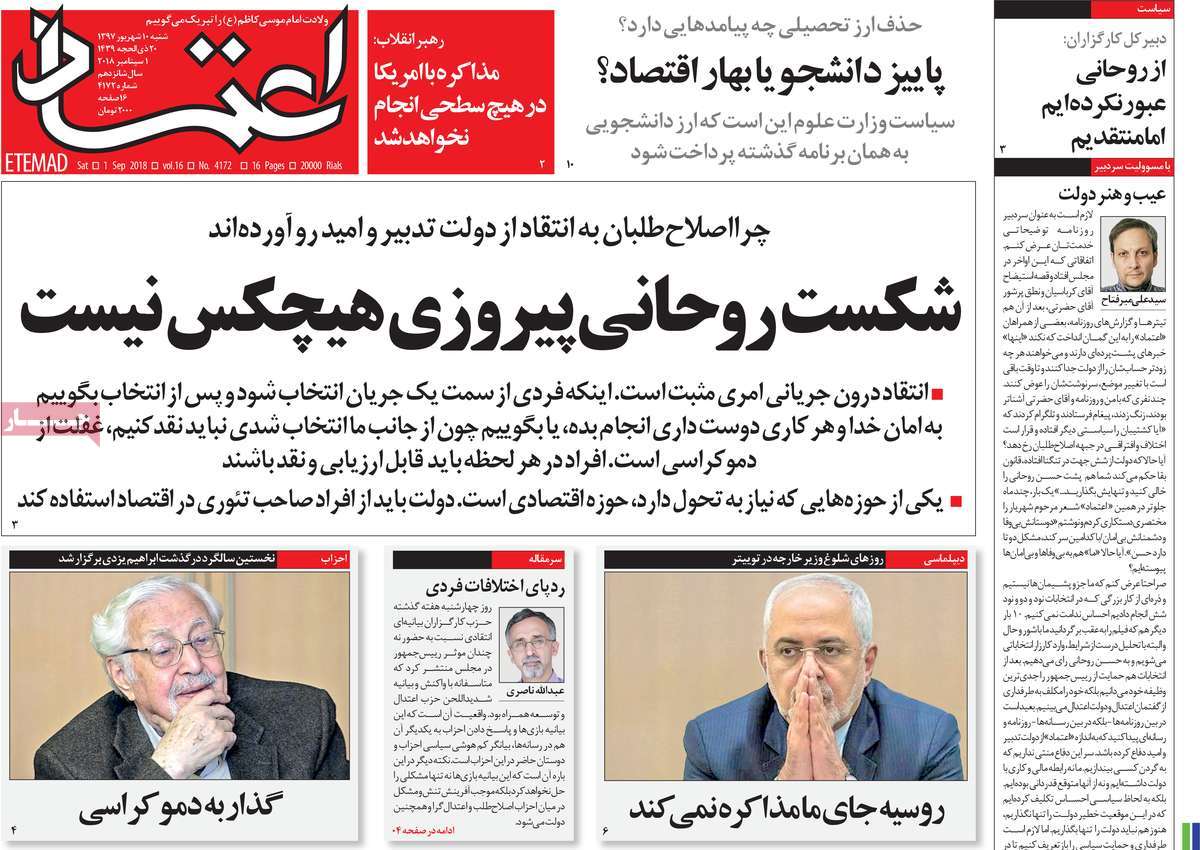
A Look at Iranian Newspaper Front Pages on September 1


Ettela’at:

1- Iran Leader: Government Capable of Running the Country’s Economy

2- Zarif: Iran’s JCPOA Partners Must Stop Releasing Fruitless Statements
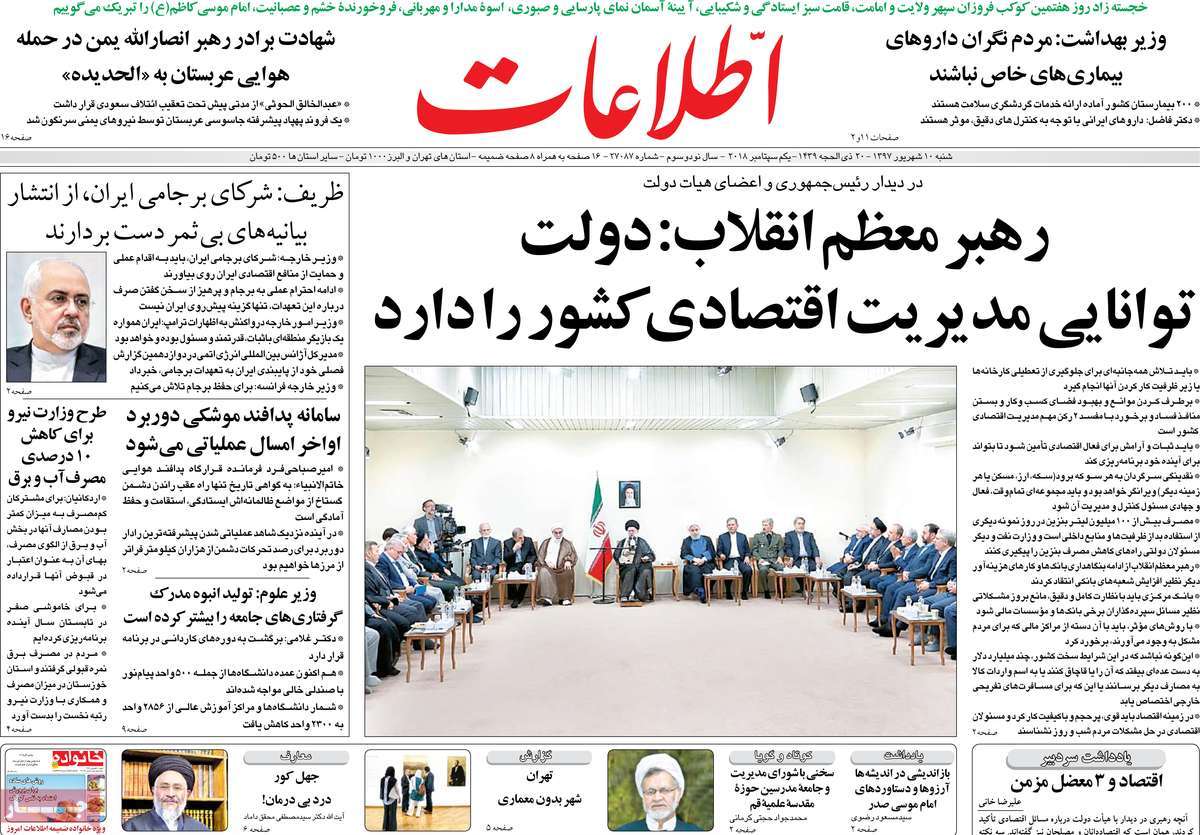
A Look at Iranian Newspaper Front Pages on September 1


Hamshahri:

1- Nights of Music

  • Traditional Singer Motamedi Holds First Free Street Concert
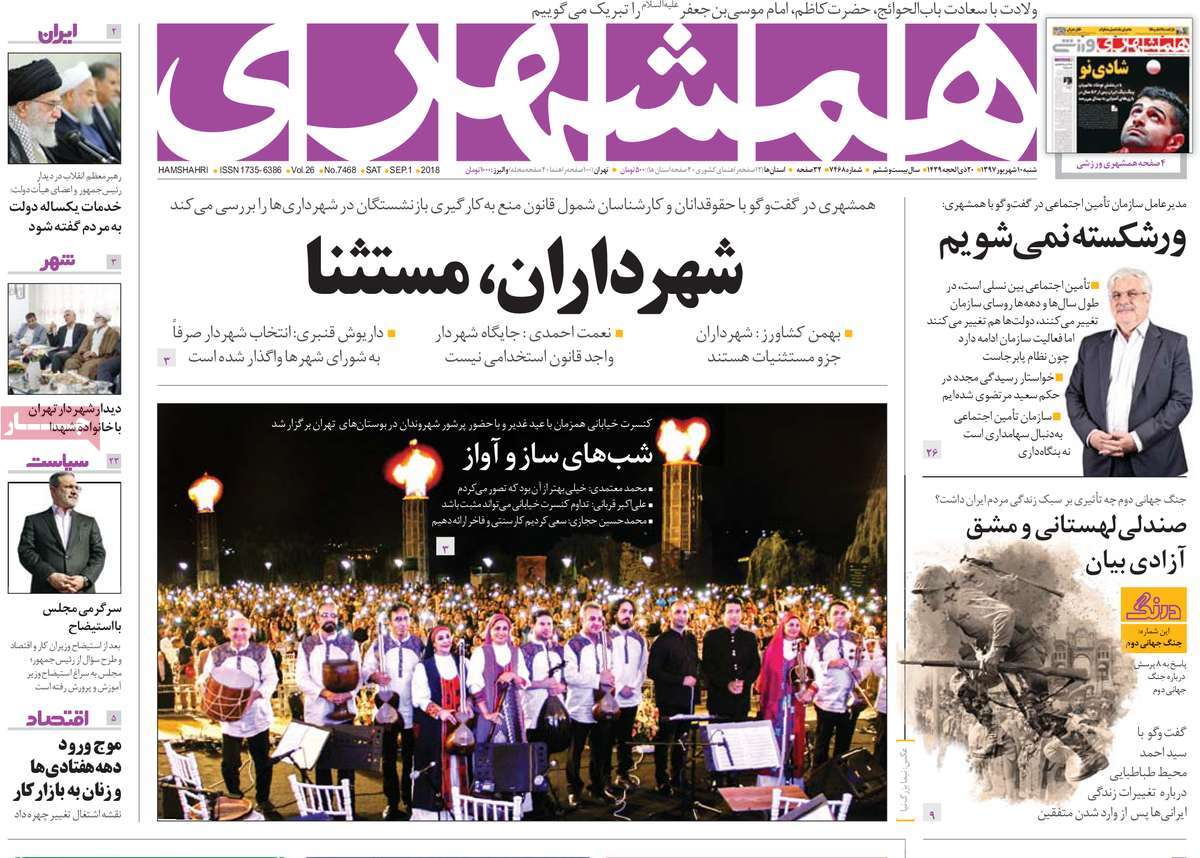
A Look at Iranian Newspaper Front Pages on September 1


Iran:

1- Tehran Hosts First Free Street Concert: Huge Crowd of People Welcome Performance

2- Zarif: People’s Massive Presence in Twitter to Serve Islamic Republic’s Interests
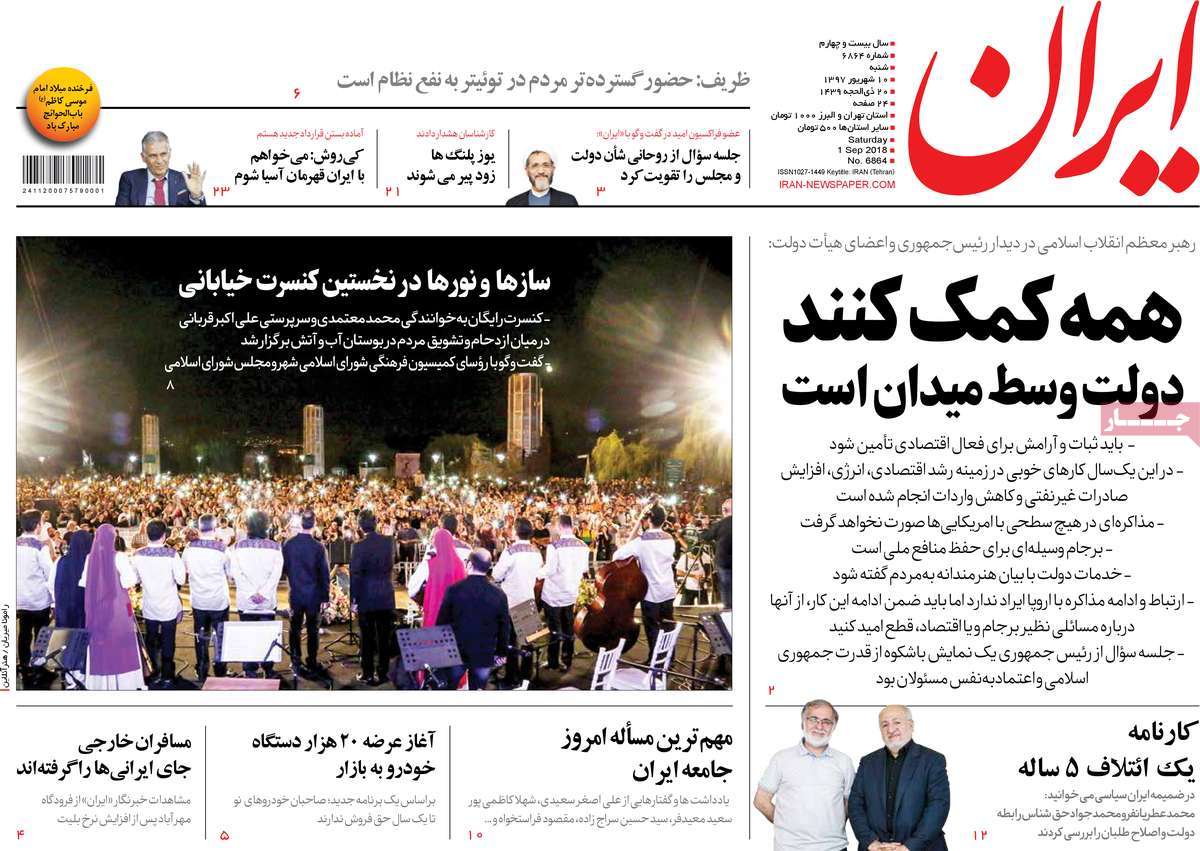
A Look at Iranian Newspaper Front Pages on September 1


Javan:

1- Iran Leader: Banks Not Allowed to Use People’s Money to Run Business Firms

2- Government Spokesman: Five Plans Devised to Counter Sanctions
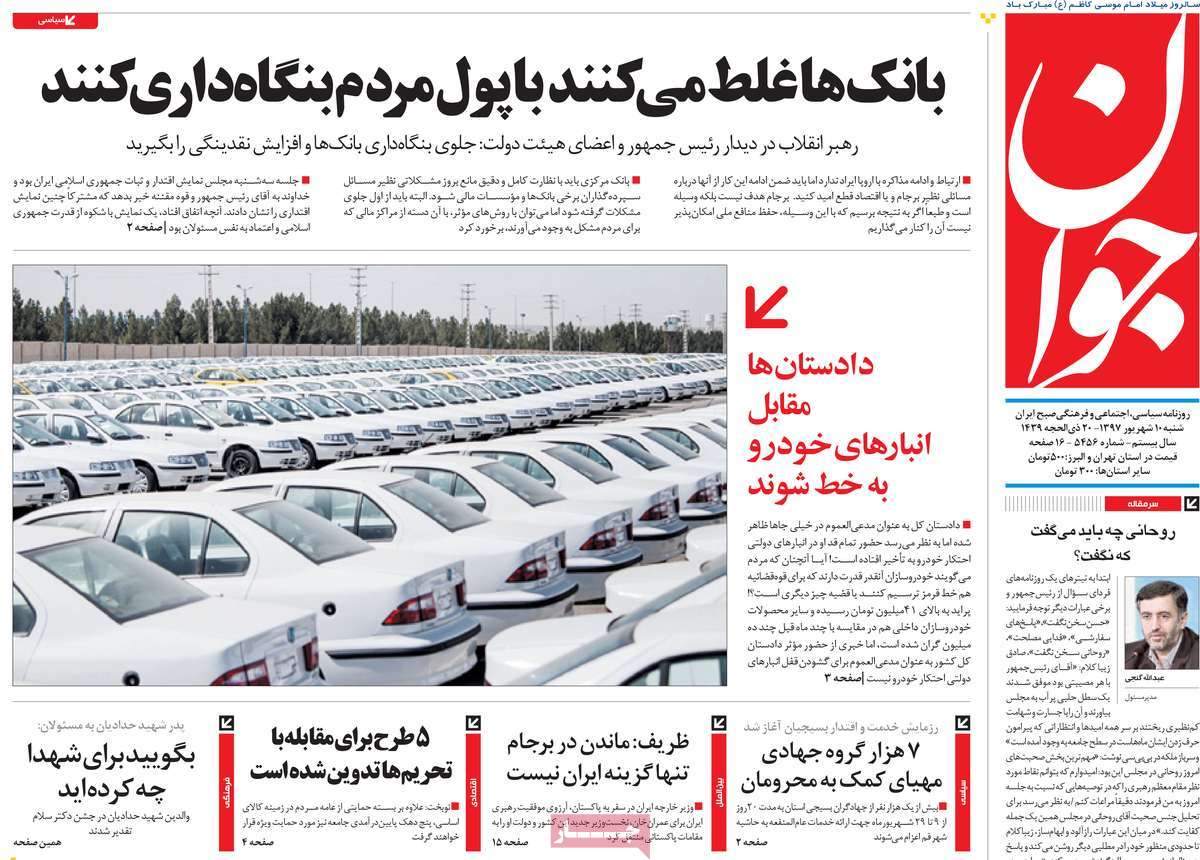


A Look at Iranian Newspaper Front Pages on September 1


Kayhan:

1- Iran Leader: JCPOA Not a Target, but a Means; We’ll Leave It If Our Interests Not Secured

2- Increased Pressures on Suu Kyi, Urging Her to Resign over Her Role in Myanmar Genocide

3- US Backs Off from Deal of the Century until Further Notice
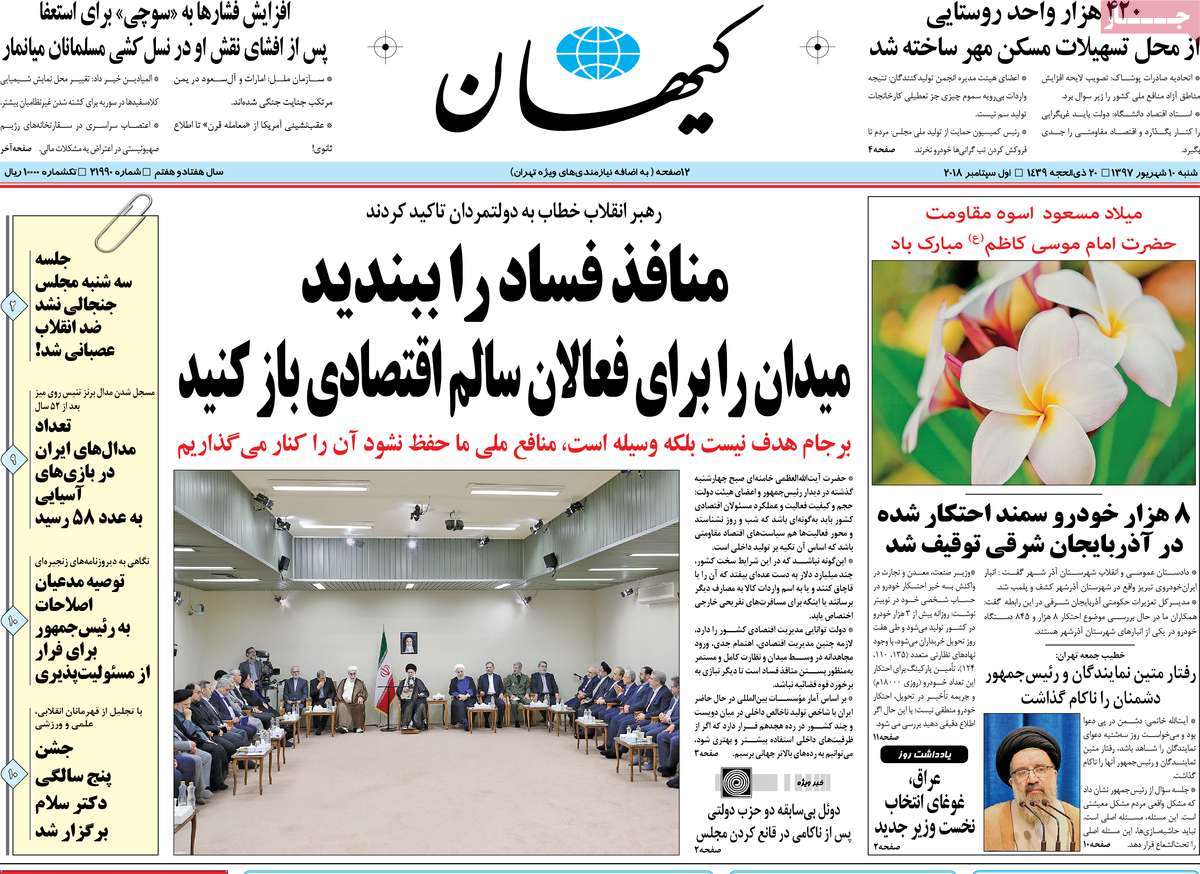
A Look at Iranian Newspaper Front Pages on September 1


Sazandegi:

1- Iran Leader: JCPOA Not a Goal, but a Means

2- Education Minister to Be Impeached As Well
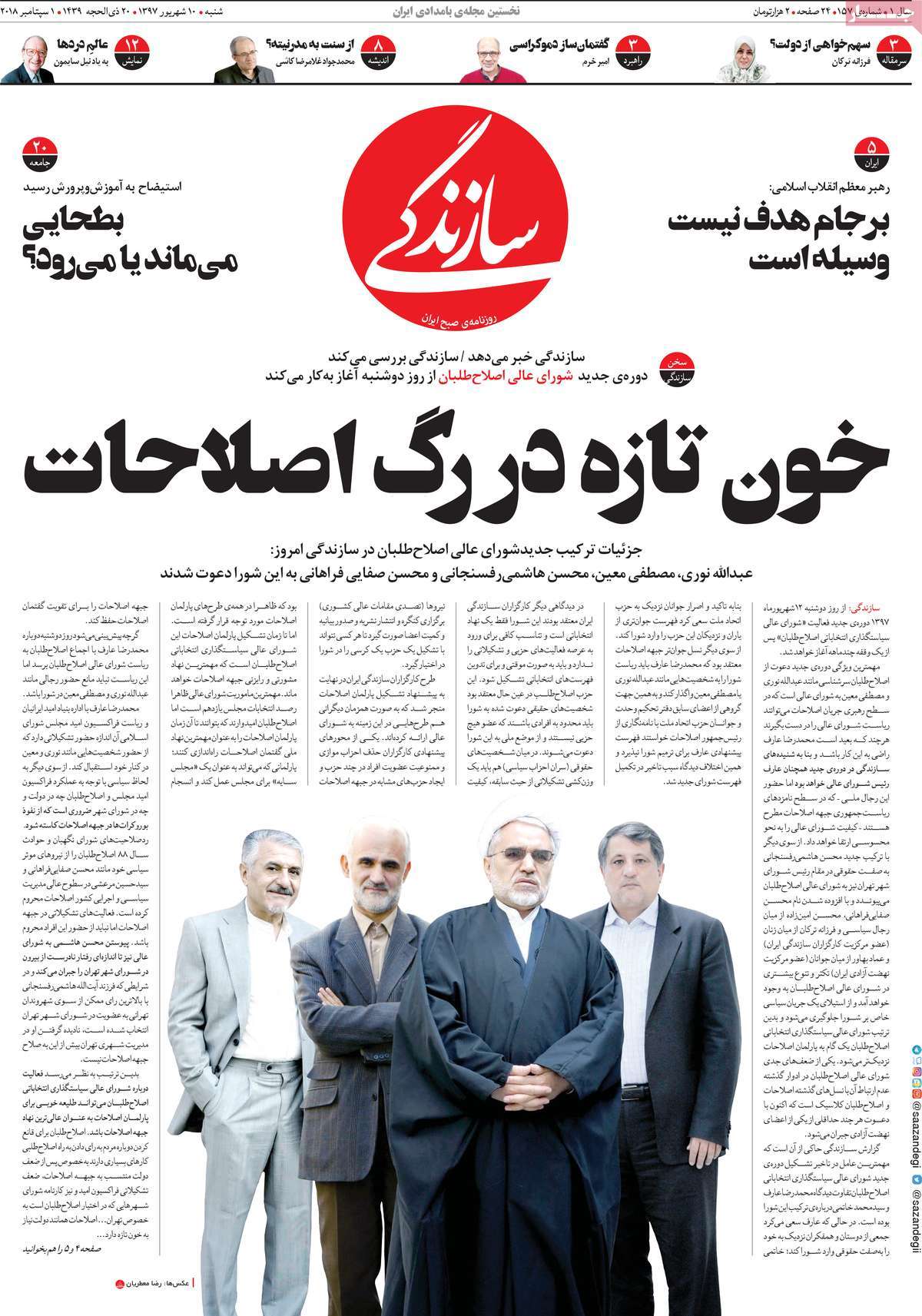
A Look at Iranian Newspaper Front Pages on September 1


Shahrvand:

1- Zarif: Caspian Sea Convention Great Success for Iran

2- Instagram Page Opened by Young Woman Helps Many Families Find Their Lost Children
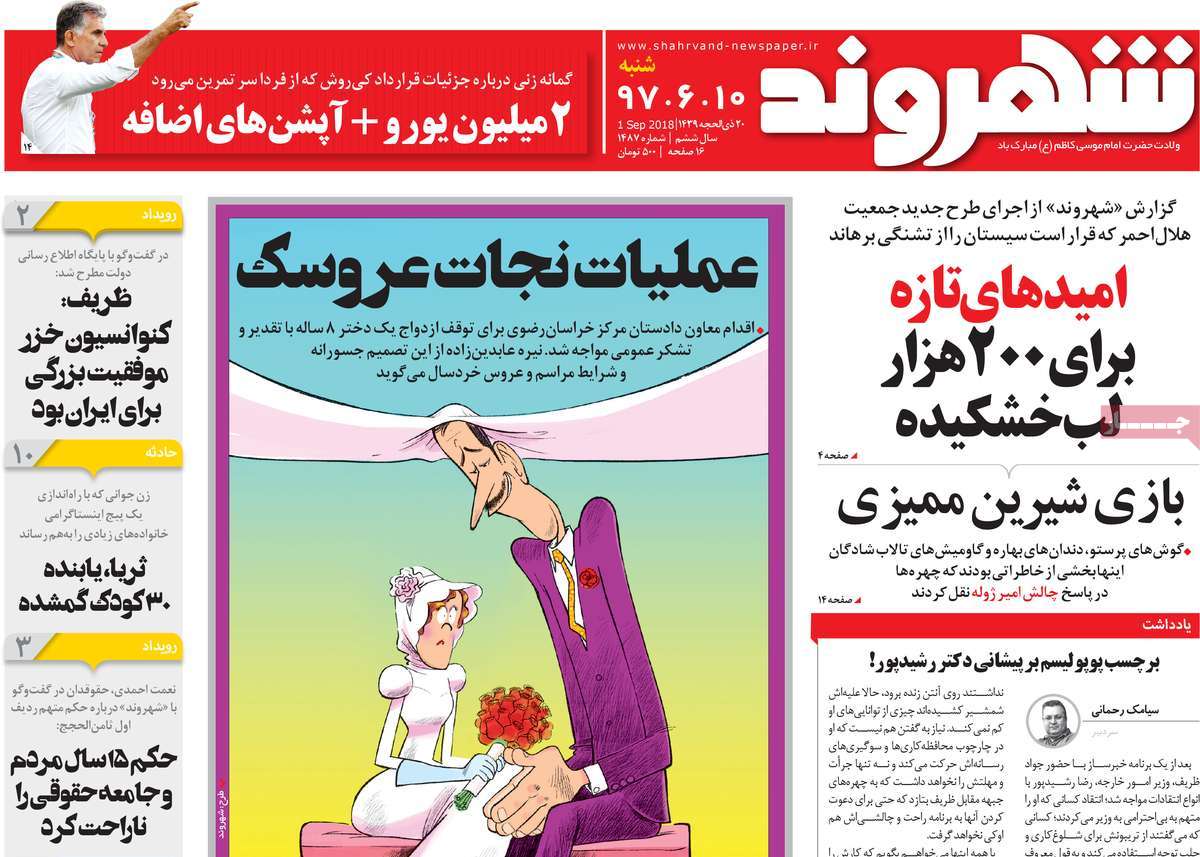
A Look at Iranian Newspaper Front Pages on September 1


Shargh:

1- FM: We Haven’t Closed Doors for Dialogue with Saudi Arabia

  • Iranians’ Presence in Twitter Could Respond to Certain Anti-Iran Moves

2- Punishment and Reward for Rouhani (Editorial)
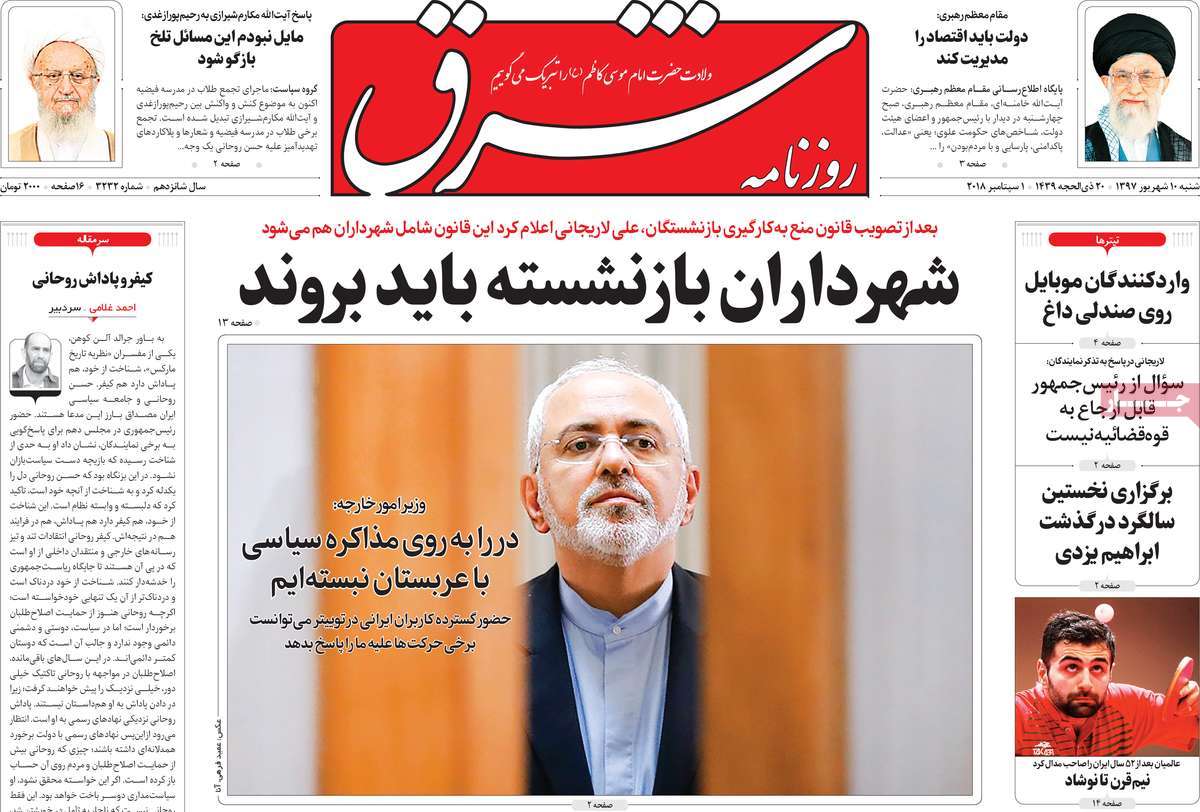
A Look at Iranian Newspaper Front Pages on September 1


Vatan-e Emrooz:

1- They Want Both Our Missiles and Region

  • French FM Once Again Stresses What US Wants from JCPOA!
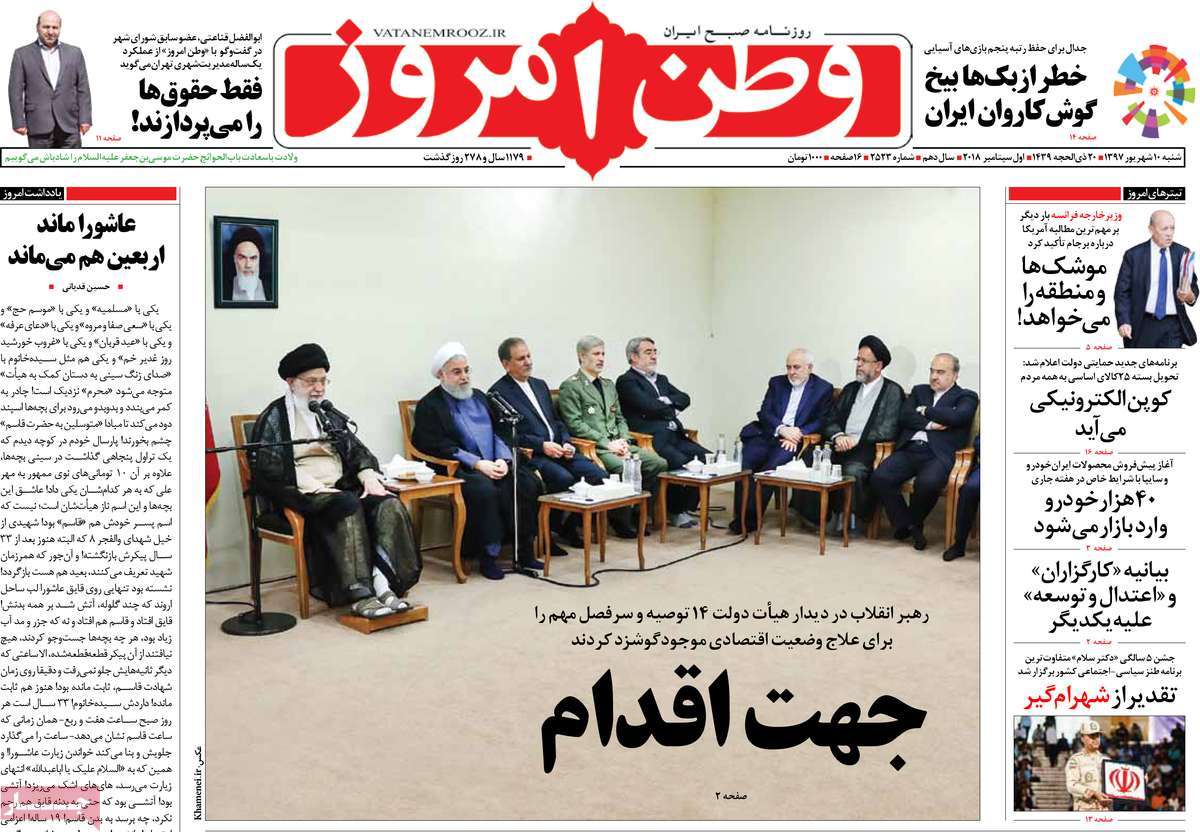
A Look at Iranian Newspaper Front Pages on September 1

Iran Disbands Terrorist Cell in Southeastern Province

The IRGC Ground Force said in a statement that the terrorist team, “affiliated with the global arrogance”, had plans to cross the border and carry out acts of sabotage and upset security in Iran.

In the armed clash on the border in the Saravan region, the IRGC troops killed four of the terrorists and injured three others, the statement added.

It also said one of the Iranian forces received minor injuries in the gunfight.

The IRGC is tasked with protecting the country’s northwestern and southeastern borders.