Saturday, December 27, 2025
Home Blog Page 3467

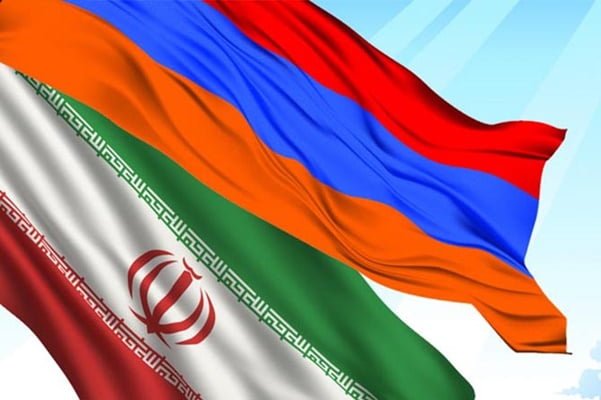
Iran, Armenia Hold Joint Consular Meeting

Iran Congratulates Armenia on National Day

The meeting was held at the Iranian Foreign Ministry on Wednesday and was chaired by Iranian and Armenian directors general for consular affairs.

At the meeting, the two sides reviewed the topics discussed at the 11th joint consular meeting of the two countries and expressed satisfaction with the proper implementation of the decisions adopted and the progress made. They further exchanged views on issues such as mutual cooperation in easing popular exchanges between the two countries and upgrading cooperation in the fields of commerce and tourism.

They also discussed students and prisoners’ affairs as well as fighting drugs, human smuggling and organized crime, among other issues.

Iran Ready to Expand Business Ties with D-8 States: FM

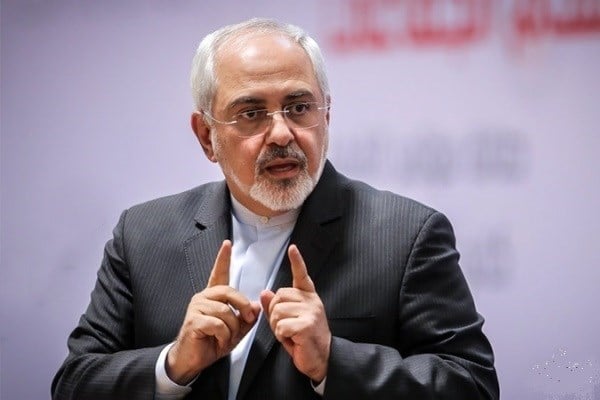
During the Wednesday meeting, Iran’s top diplomat described the D-8 Organization as an important body with great untapped potentialities for expanding cooperation among the member states.

He also expressed Iran’s willingness and preparedness to enhance cooperation with the private sectors of the D-8 member states and exchange experiences with the organization in scientific and technological areas.

Transfer of Technology, cooperation in various research and development areas, financing economic projects, barter system, cooperation in medicine production and exports were among other issues discussed in the meeting.

The D-8 Organization for Economic Cooperation, also known as Developing-8, is an organization for development cooperation among Bangladesh, Egypt, Nigeria, Indonesia, Iran, Malaysia, Pakistan, and Turkey.

The goals of D-8 Organization for Economic Cooperation are to improve the member states’ position in the global economy, diversify and create new opportunities in trade relations, enhance participation in decision-making at international level, and improve standards of living.

D-8 is a forum with no adverse impact on bilateral and multilateral commitments of the member states, emanating from their membership to other international or regional organizations.

Iran Ready to Expand Business Ties with D-8 States: FM

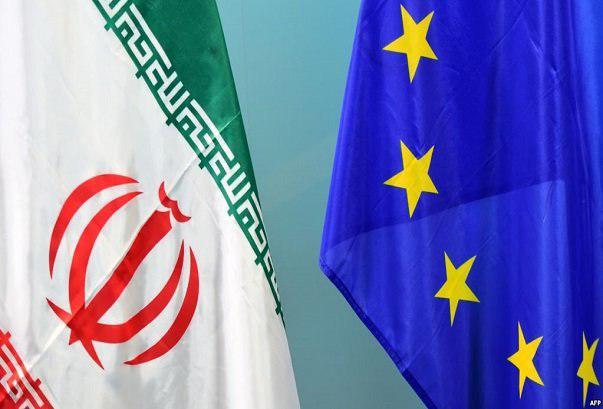
FM Zarif Warns against Plots to Sever Iran-Europe Ties

Iran Blasts Europe’s ‘Disastrous’ Subservience to US

Zarif made the comments in separate meetings with the outgoing ambassadors of France, Belgium and the Netherlands in Tehran.

During the Wednesday meetings, the Iranian top diplomat referred to the long-time and historical relations between the Islamic Republic of Iran and Europe and warned about the enemies’ plots to sever relations between the two sides through false pretexts.

He also underlined the dire need for Europe to avoid sheltering desperate terrorist groups on its soil.

Iran and the five remaining parties to the 2015 nuclear deal have been involved in talks over the past months to discuss ways of maintaining the international accord after the US’ withdrawal.FM Zarif Warns against Plots to Sever Iran-Europe Ties

Since US President Donald Trump pulled Washington out of the historic nuclear deal, European countries have been scrambling to ensure that Iran gets enough economic benefits to persuade it to stay in the deal.

Trump also said he would reinstate US nuclear sanctions on Iran and impose “the highest level” of economic bans on the Islamic Republic.

Under the JCPOA, Iran undertook to put limits on its nuclear program in exchange for the removal of nuclear-related sanctions imposed against Tehran. The remaining parties have vowed to stay in the accord.

Iran Foreign Ministry Presents 10th Quarterly Report on JCPOA to Parliament

ICJ Ruling Proves US Sanctions against Iran Cruel: Statement

In a Wednesday statement, Qassemi said the report was presented to the Parliament’s National Security and Foreign Policy Commission on Tuesday.

“In its 10th report to the Parliament, the Foreign Ministry pointed out that during the first three months of this Persian year, all the developments of the Iran nuclear deal were influenced by the US administration’s illegal and unilateral move to withdraw from the JCPOA in May,” he said.

The spokesman went on to say that the Foreign Ministry’s report also referred to the intensification of the US’ aggressive moves and approaches towards Iran under the current president as well as the US’ repeated violations of its commitments under the JCPOA.

“The report then elaborated on the US administration’s moves over the past three months as well as the other measures it adopted following an exclusive speech by the US president dedicated to his country’s new policies towards Iran on May 8,” he noted.

According to Qassemi, the tenth report to the Parliament also  covered the measures adopted by the Foreign Ministry to pursue the rightful demands of the Islamic Republic by taking advantage of the existing capacities including the negotiations that the Iranian foreign minister held with his counterparts of the remaining sides of the JCPOA, two meetings at the level of ministers and deputy ministers held by the Joint Commission of the JCPOA, several expert meetings held with other sides of the JCPOA aimed at exploring ways on how they can compensate for the loss inflicted on Iran by the US’ withdrawal as well as their pledges and measures to guarantee that Iran can enjoy its benefits under the nuclear deal.

In its report, he said, the Foreign Ministry also referred to the 11th report by the International Atomic Energy Agency on Iran’s full compliance with its nuclear pledges and its continued nuclear activities within the country’s strategic and long-term nuclear program.

“The report underlines that over the past three months, all nuclear activities of Iran –particularly in Research & Development area – have continued based on the schedule of the Atomic Energy Organization of Iran.”

Iran Gov’t Promises Transparency on Jamming Satellite Signals

In a recent interview with ISNA, Azari Jahromi said the ministry is neither involved in the jamming operation nor has granted any licenses for that.

“The ICT Ministry is not involved in the jamming. There are no licenses for jamming and the ministry has not issued any organization with such licences,” he said.

The jamming of satellite channels, usually targeting channels accused of spreading propaganda against the Islamic Republic, has caused controversies in Iran in recent months.

There are concerns among people over the negative health impacts of the local jamming operations, which are rumoured to cause a wide range of health problems, from headaches to cancer and birth defects.

In 2017, hundreds of people in Shiraz in central Iran held protests outside the headquarters of the governor of the Fars Province against the use of broadcast jamming.

Some government organs, including the Health Ministry, have also warned against health risks of exposure to jamming signals.

But the source of the jamming is still a mystery, with no one in the Establishment admitting to be behind the operation.


Iran Meeting Radiation Standards

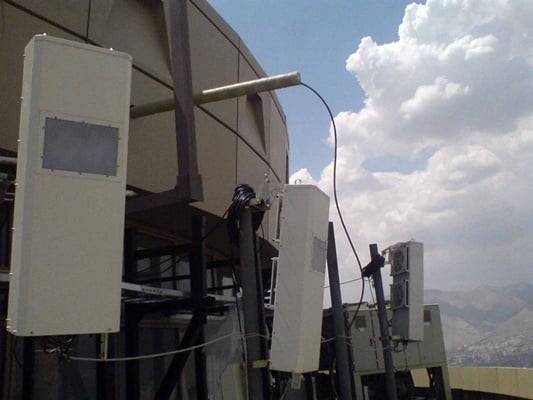
Azari Jahromi told ISNA that officials are concerned over health impacts of electromagnetic radiation, particularly those caused by mobile towers.

These concerns have led the Leader of Islamic Revolution Ayatollah Seyyed Ali Khamenei to order the Supreme National Security Council to set a working group to investigate whether standards in radiation are met, the minister said.

As part of the investigation, Jahromi said, the ministry has been tasked with installing equipment for monitoring “electromagnetic emissions” in five Iranian metropolitans, including Shiraz and Tehran.

The minister said the equipment have so far shown the level of emissions in the country are about a third of maximum level under global standards.

“Fortunately, world standards are met in Iran in this regard,” he said, adding that people need not to be concerned about the health risks of exposure to emissions.

The minister said governments organizations including Atomic Energy Organization of Iran are in charge of preventing health problems caused by emissions, if the need arises.

“EU Allocates $80 Billion Credit to Cooperation with Iranian Firms”

Pedram Soltani said after the incidents in Iraq and Syria, Europe is no longer interested in seeing insecurity and war in the Middle East and wants to stand by Iran firmly so much so that those incidents would not happen in the Islamic Republic.

“But Iranian political analysts are neglecting this issue, and they are creating a negative atmosphere in the country,” Fars News Agency quoted the Iranian official as saying.

Soltani pointed out that the $80 billion credit is allocated by the European Union to the cooperation of small and medium-sized Iranian and European companies.

“A European economic organization has been tasked with this, in order to establish a relationship between the two sides.”

The management of funds and small and medium-sized enterprises in the European Union is carried out by a subsidiary of the European Union, he added.

The commissioner for small and medium-sized industries of the European Union was in Iran three weeks ago and Iran’s Chamber of Commerce is going to negotiate with them as the representative of the private sector, noted Soltani, stressing that the Chamber of Commerce of Iran has established good ties with the European Union.

Poll: MKO Doesn’t Represent Iranian Diaspora in Canada

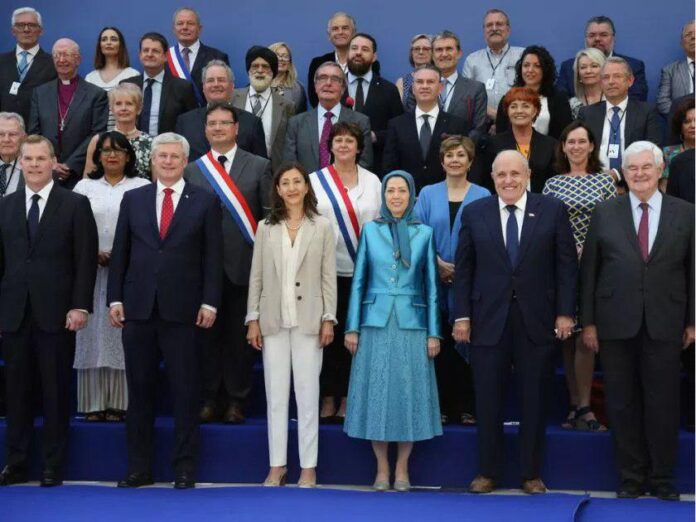
Members of anti-Iran terrorist group MKO along with its guests from the US and its regional allies in its annual gathering in Paris

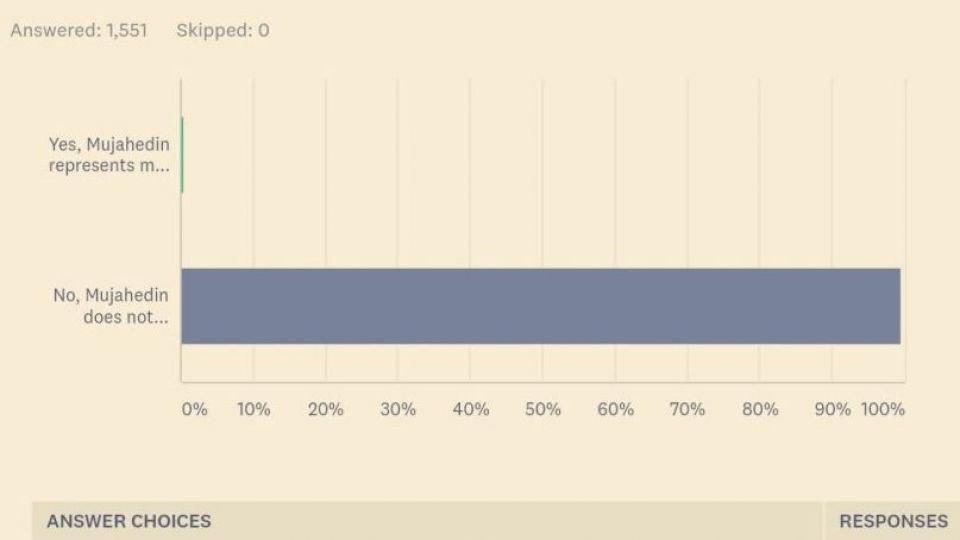
According to the survey conducted by the Iranian-Canadian Congress, 98.90 percent of 1,551 Iranian diaspora in Canada who took part in the online survey said they were against the presence of Ottawa officials in the Paris annual gathering.

In response to a question whether or not the MKO represent you when it comes to Iran-related issues and Canada’s policies towards the country, 99.48 percent said the terrorist group doesn’t represent them at all, a report by Alef news website said.

Meanwhile, 94.13 percent said they are against a decision by the former Canadian Prime Minister Stephen Harper to remove the MKO from the list of terrorist organizations in 2012. They also described Harper’s decision as a mistake.

Poll: MKO Doesn’t Represent Iranian Diaspora in CanadaAs the 22nd Prime Minister of Canada, Harper came from the modern Conservative Party of Canada. During his premiership, he was among the staunch supporters of the Zionist regime and showed deep animosity towards the Islamic Republic. Meanwhile, he never supported the talks between Iran and the six world powers which finally led to the Iran nuclear deal in 2015.

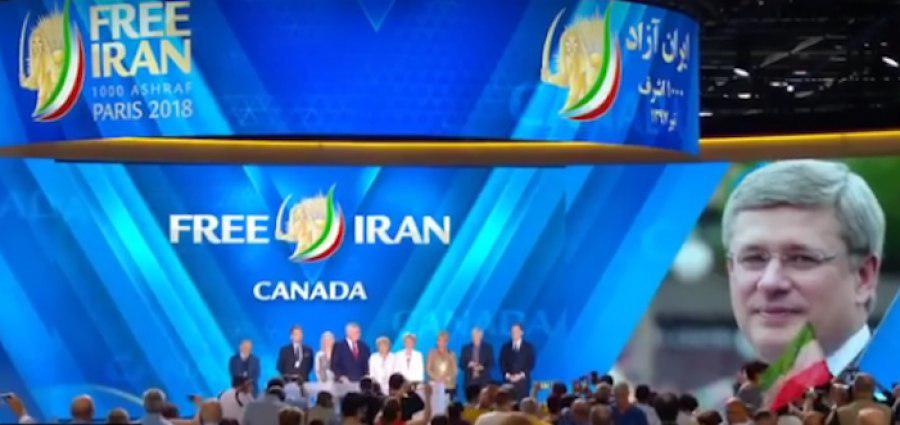
In his latest move against Iran, Harper attended the recent MKO gathering in Paris.

MKO is designated a terrorist organization by Iran and Iraq. Washington and the European Union removed MKO from their lists of terrorist organizations in 2012 and 2009, respectively. The group is based in Paris, with a compound for its militiamen located in Albania.

The MKO held its annual meeting in Paris on Saturday with a number of American hawks such as Rudy Giuliani – Donald Trump’s personal lawyer – and other former US officials as well as former Canadian PM Harper in attendance.

Founded in the 1960s, the terror group fled to Iraq in 1986, where it joined Saddam’s army during the war Iraq imposed on Iran (1980-1988) and helped Saddam kill thousands of Iranian civilians and soldiers during the US-backed war imposed on Iran.

Poll: MKO Doesn’t Represent Iranian Diaspora in Canada

A Look at Iranian Newspaper Front Pages on July 18

A Look at Iranian Newspaper Front Pages on November 19

The top story in all papers today was the harsh reactions in the US to a meeting between US President Donald Trump and his Russian counterpart Vladimir Putin in Helsinki. The US Congress and many others in the country are outraged by Trump’s stances and talks with Putin.

The cessation of Iran’s electricity exports to Iraq over the Arab country’s huge debts, and a decision by Iraqi Prime Minister Haider al-Abadi to replace Iran with Saudi Arabia also received great coverage.

Also a top story was the Expediency Council’s rejection of a bill passed by the Parliament, which allowed the government to implement the FATF standards.

The above issues, as well as many more, are highlighted in the following headlines and top stories:


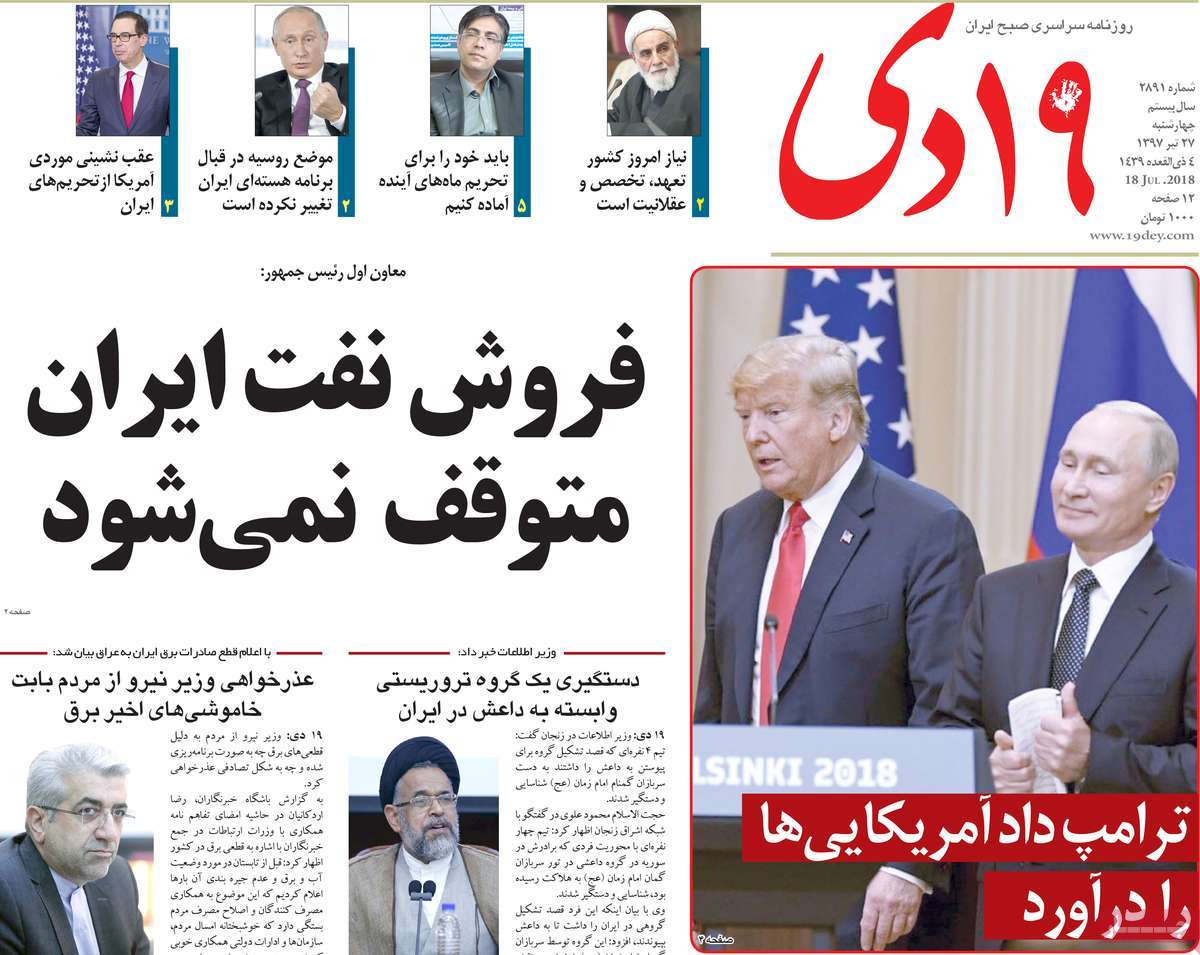
19 Dey:

1- Iran’s Oil Exports Not to Be Stopped: VP

2- Russia’s Position on Iran Nuclear Deal Not Changed

3- Americans Outraged by Trump’s Meeting with Putin

4- ISIS Terrorists Arrested in Iran
A Look at Iranian Newspaper Front Pages on July 18


Abrar:

1- Iraq to Use Saudi Arabia’s Electricity instead of Importing Iran’s Power

2- Trump: Putin Looking for Preserving Iran Nuclear Deal
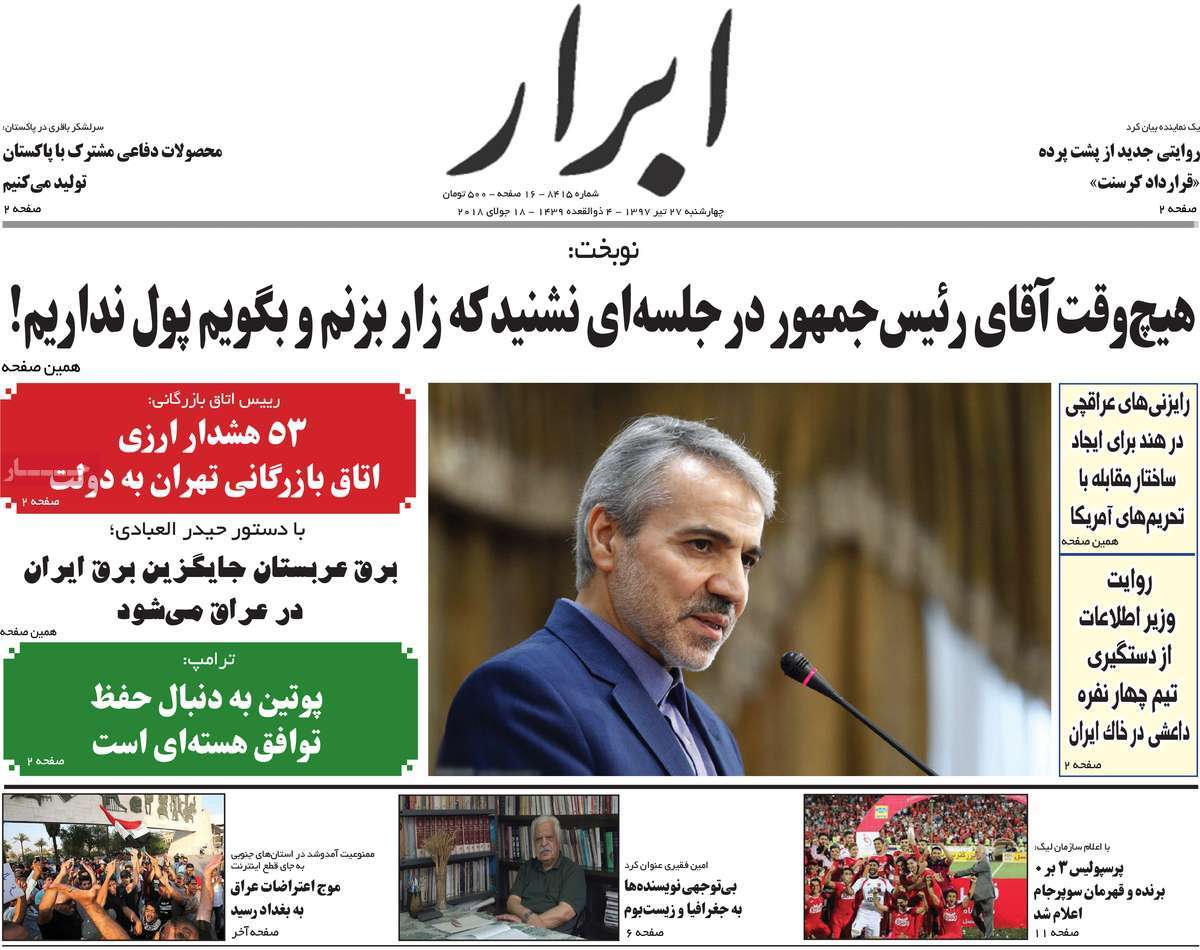
A Look at Iranian Newspaper Front Pages on July 18


Aftab-e Yazd:

1- Iran Needs to Hold Talks with Anti-Trump Figures in US: Rouhani’s Aide

2- Kayhan Criticizes IRIB for Airing Croatian President’s Hugs after FIFA World Cup Final

  • You’re Now Free to Even Broadcast American Women’s WWE Matches!
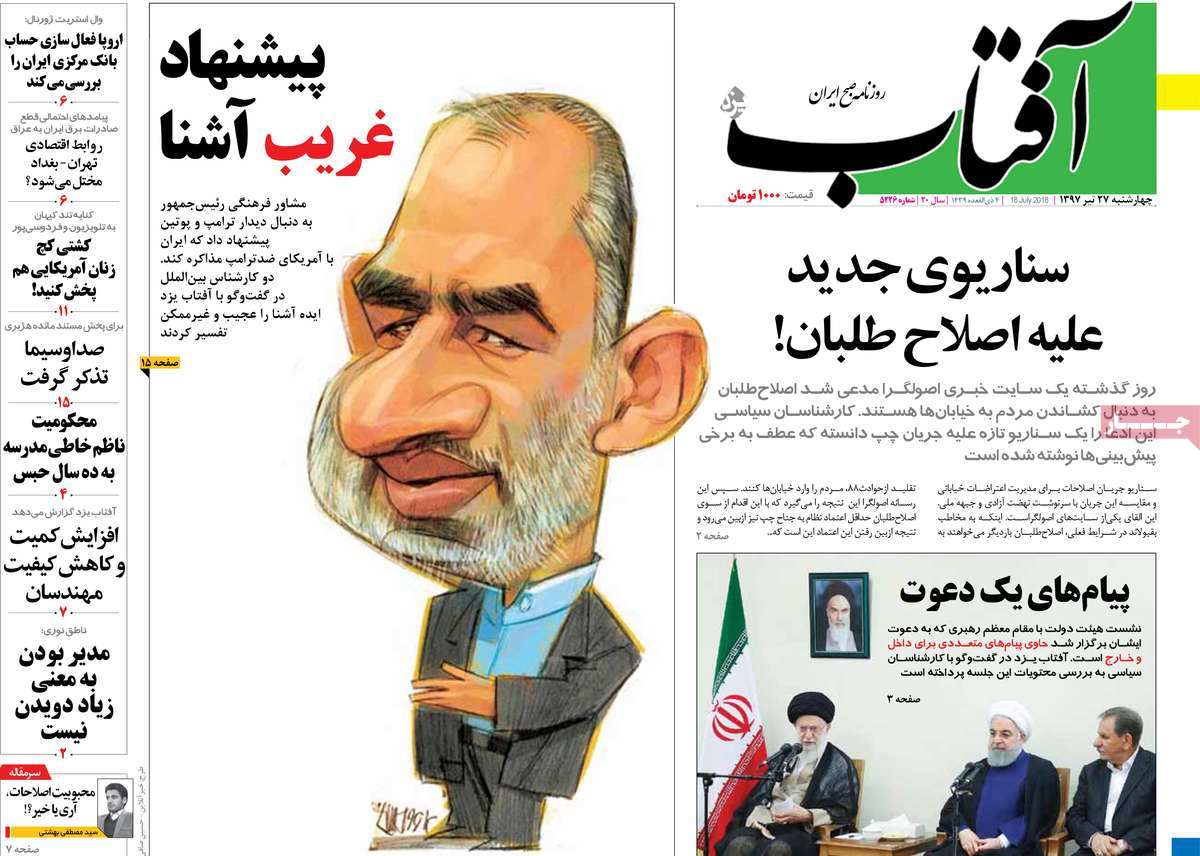
A Look at Iranian Newspaper Front Pages on July 18


Amin:

1- Mogherini Rejects US’ Call for Isolation of Iran

2- Moscow Big Winner of Helsinki Game
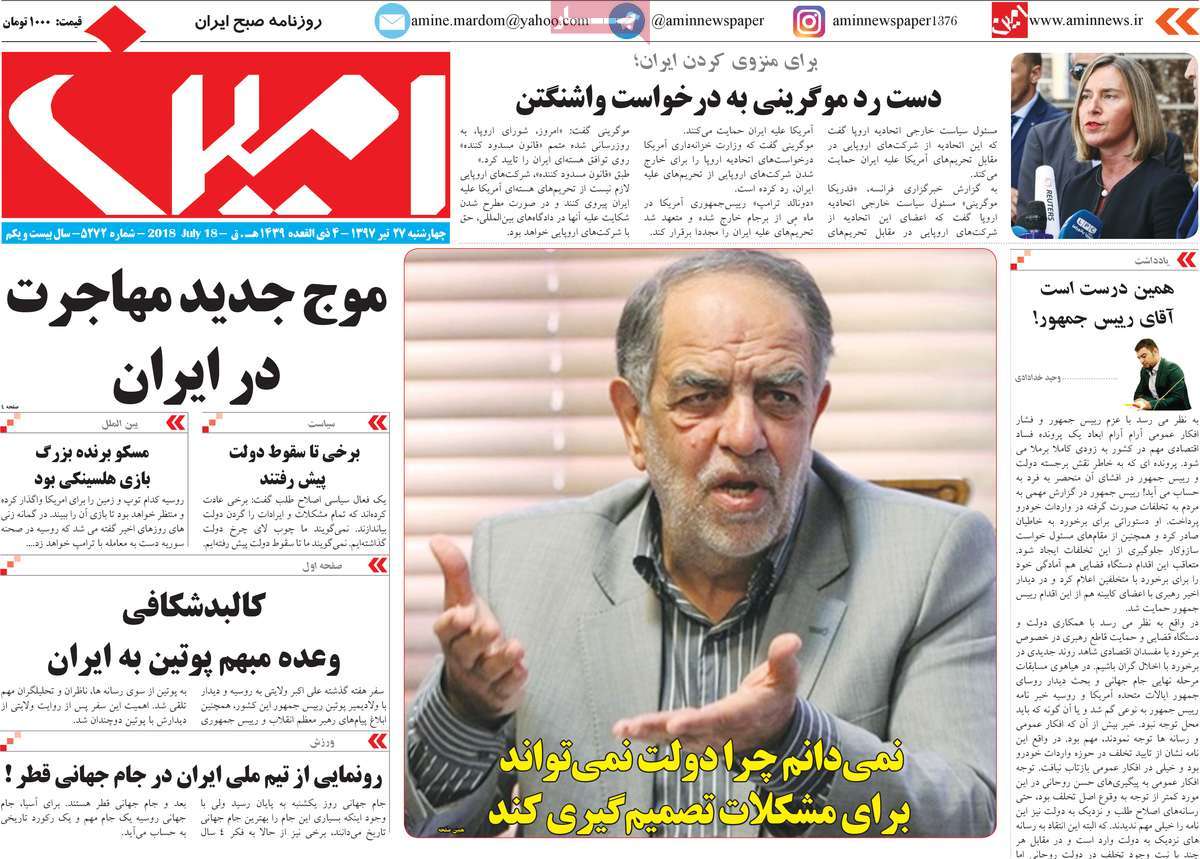
A Look at Iranian Newspaper Front Pages on July 18


Arman-e Emrooz:

1- Iran’s Lawsuit at The Hague to Put Trump in Passive Position

2- Cleric Calls for Giving More Freedom to Foreign Tourists

3- Iran’s Electricity Exports to Iraq Stopped
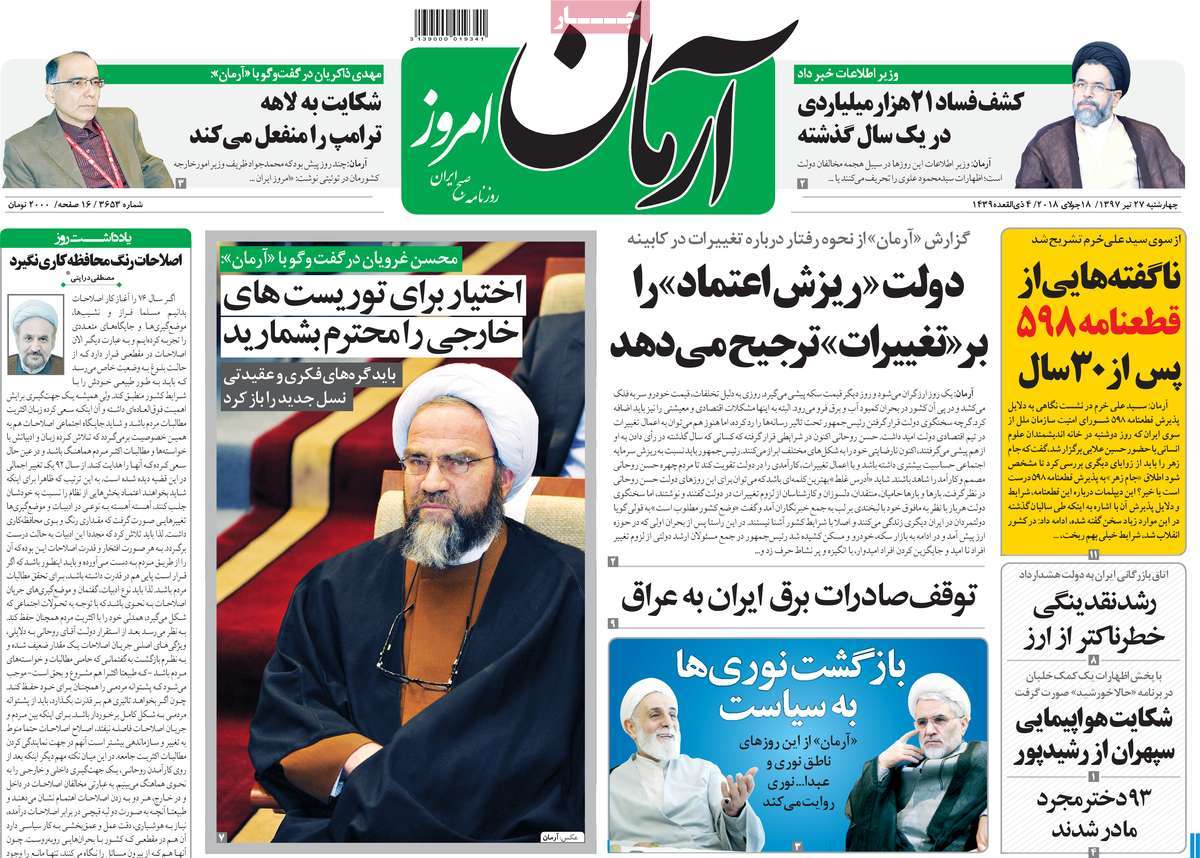
A Look at Iranian Newspaper Front Pages on July 18


Ebtekar:

1- Putin Once Again Wreaks Havoc on Trump

2- Issue of Women’s Presence in Stadiums to Be Raised Soon: VP

3- Taliban’s Precondition for Holding Talks with US
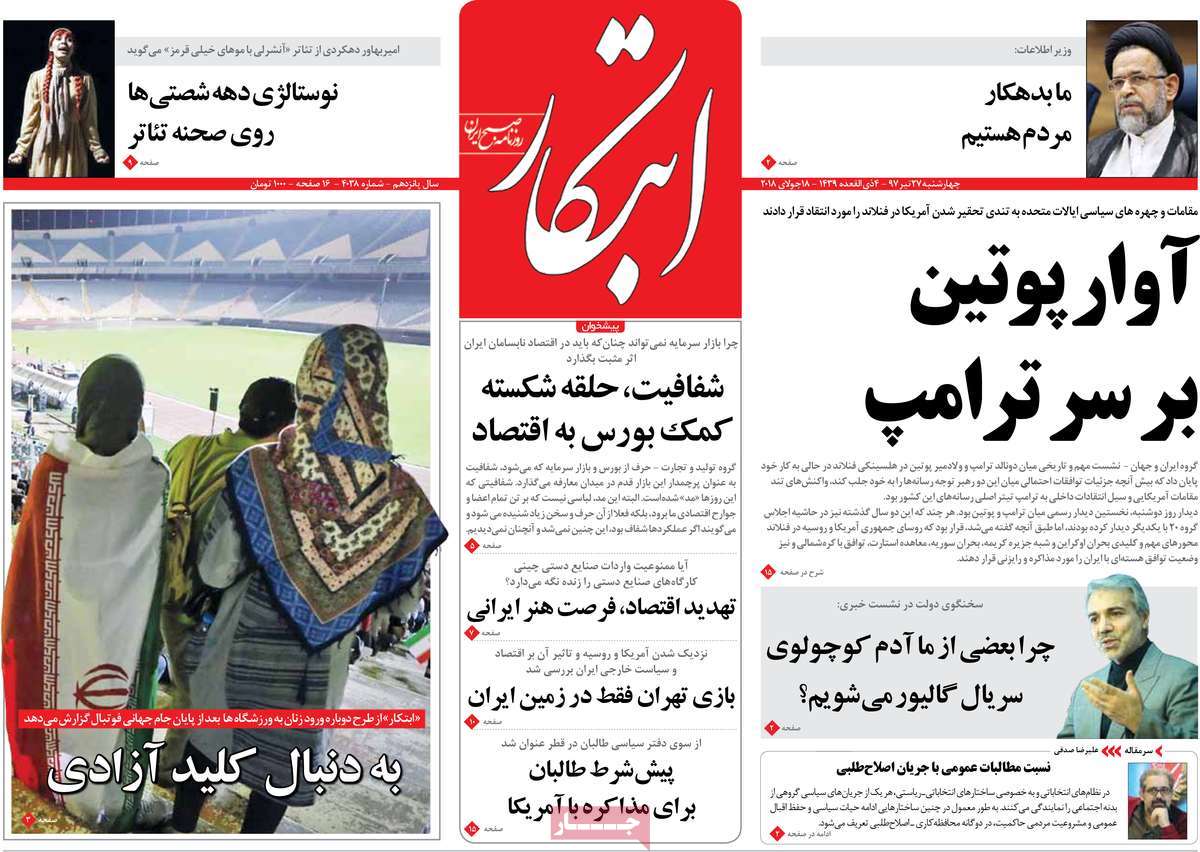
A Look at Iranian Newspaper Front Pages on July 18


Emrooz:

1- Austrian Ambassador Says Cutting Exports to Iran Will Damage Europe

2- Central Bank Chief Is to Blame for What Happened to Forex Market: Former MP
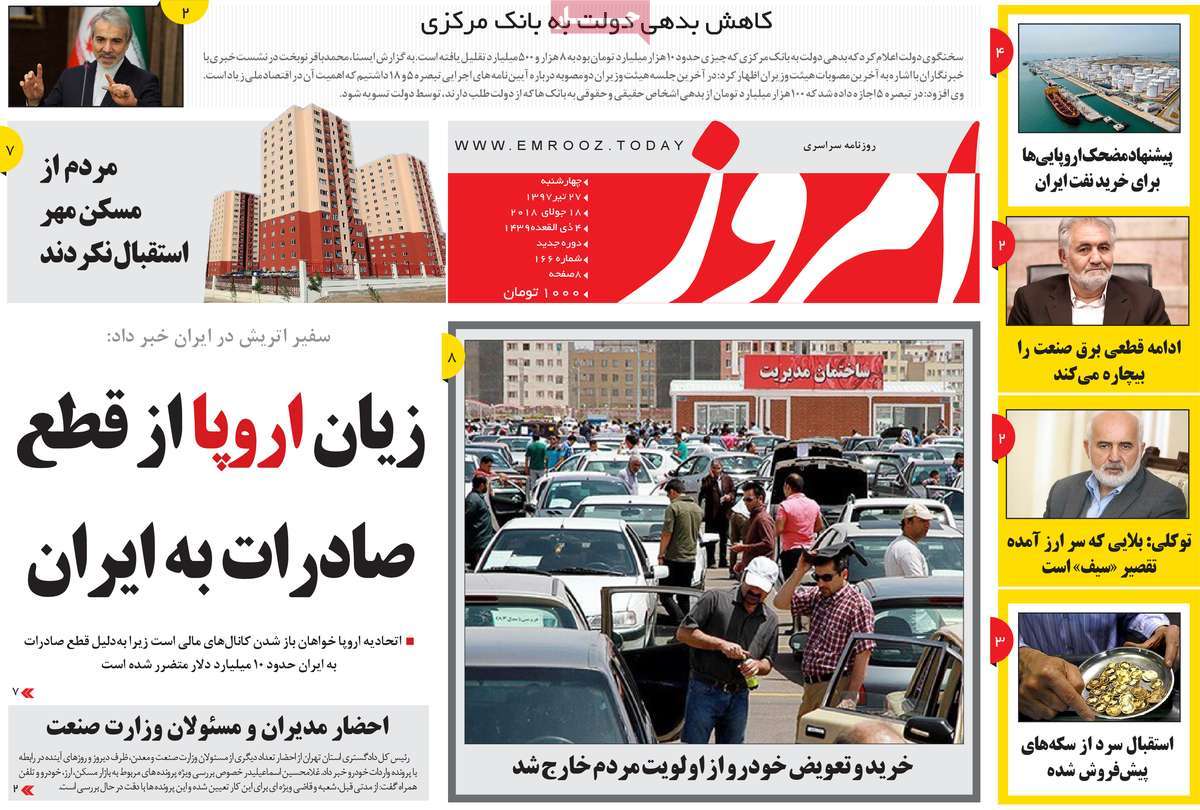
A Look at Iranian Newspaper Front Pages on July 18


Emtiaz:

1- Illicit Drugs Used to Be of 20 Types, Now We Have 700 Types of Them: Interior Minister

2- Iran Ranks among Top 15 Countries in Science Production for First Time in History
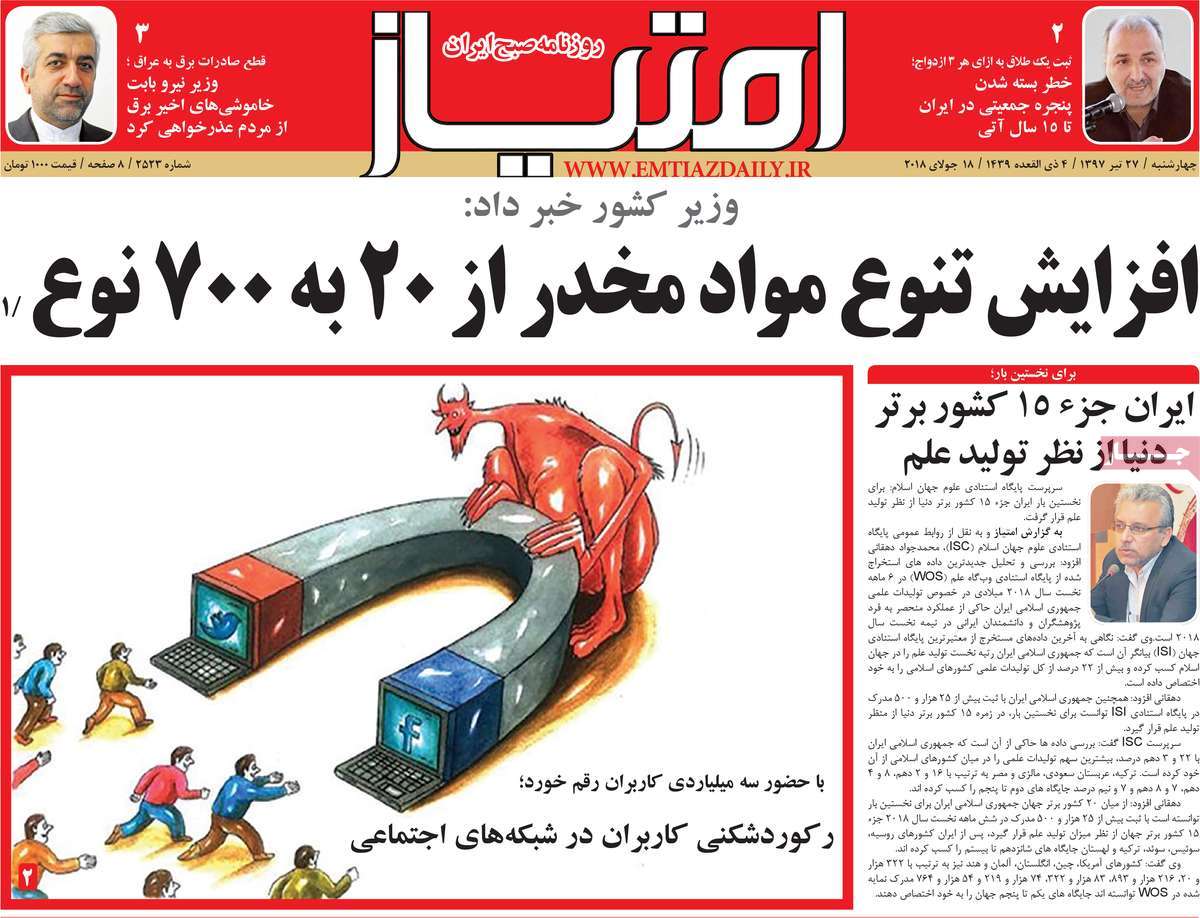
A Look at Iranian Newspaper Front Pages on July 18


Ettela’at:

1- Europe Allocates $80 Billion for Doing Business with Iran

2- Saudi Coalition Admits: Yemenis Have Fired 160 Rockets

3- Efforts to Keep Beautiful Anzali Lagoon Alive

4- US’ Political Community Strongly Protests Trump’s Remarks in Meeting with Putin
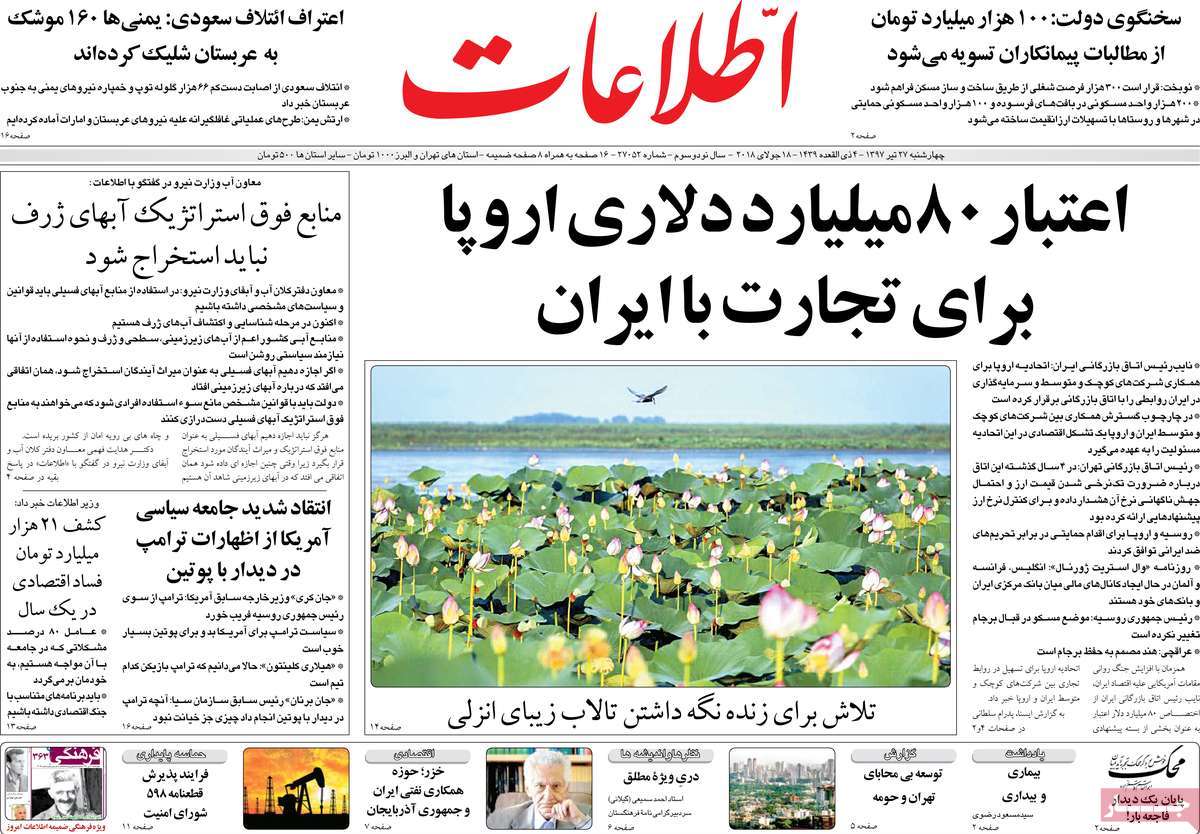
A Look at Iranian Newspaper Front Pages on July 18


Haft-e Sobh:

1- Iranian Girl Accidentally Travels to Russia Alone with Her Cheap Car

2- Iran’s Expediency Council Totally Opposed to FATF
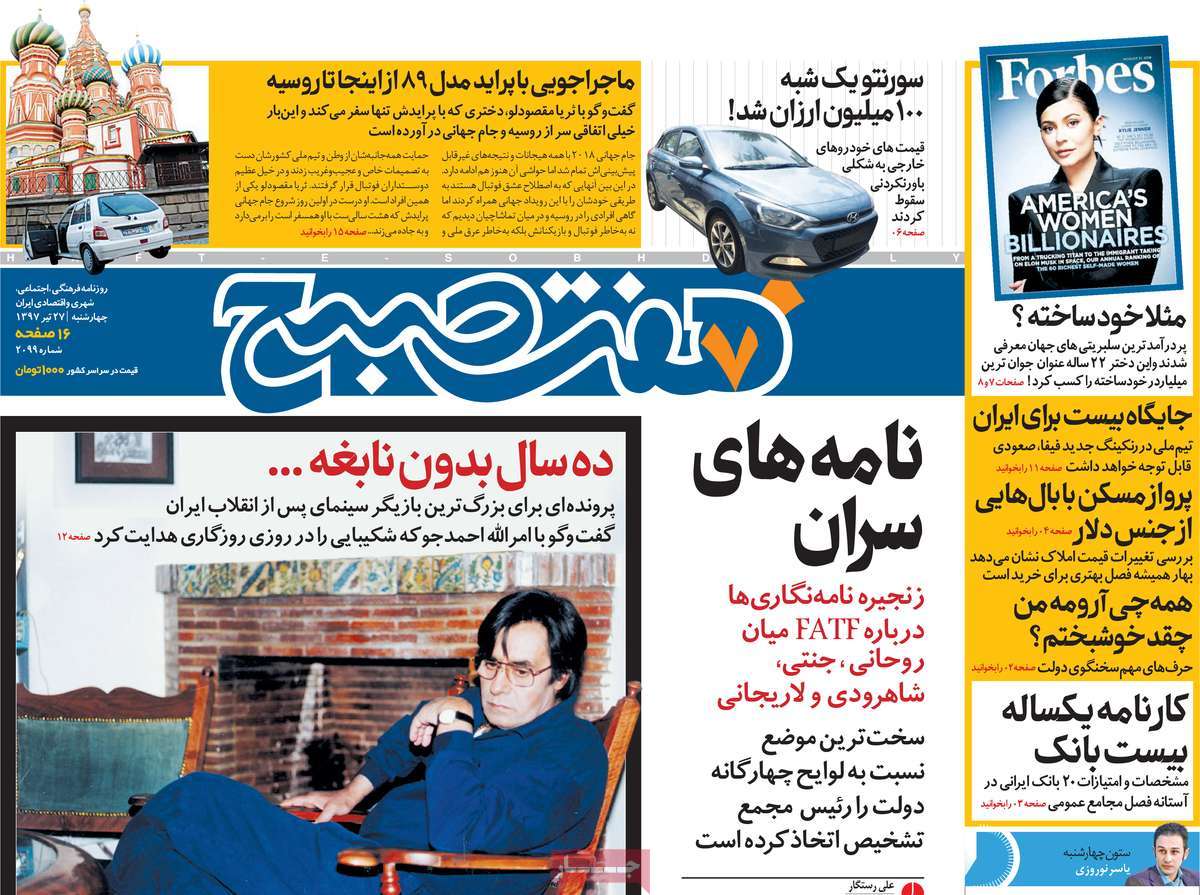
A Look at Iranian Newspaper Front Pages on July 18


Hemayat:

1- Bill on Iran’s Accession to Palermo Convention Rejected

2- Kids Who Got Old: Shocking Report by PBS on Arab Coalition’s Genocide in Yemen
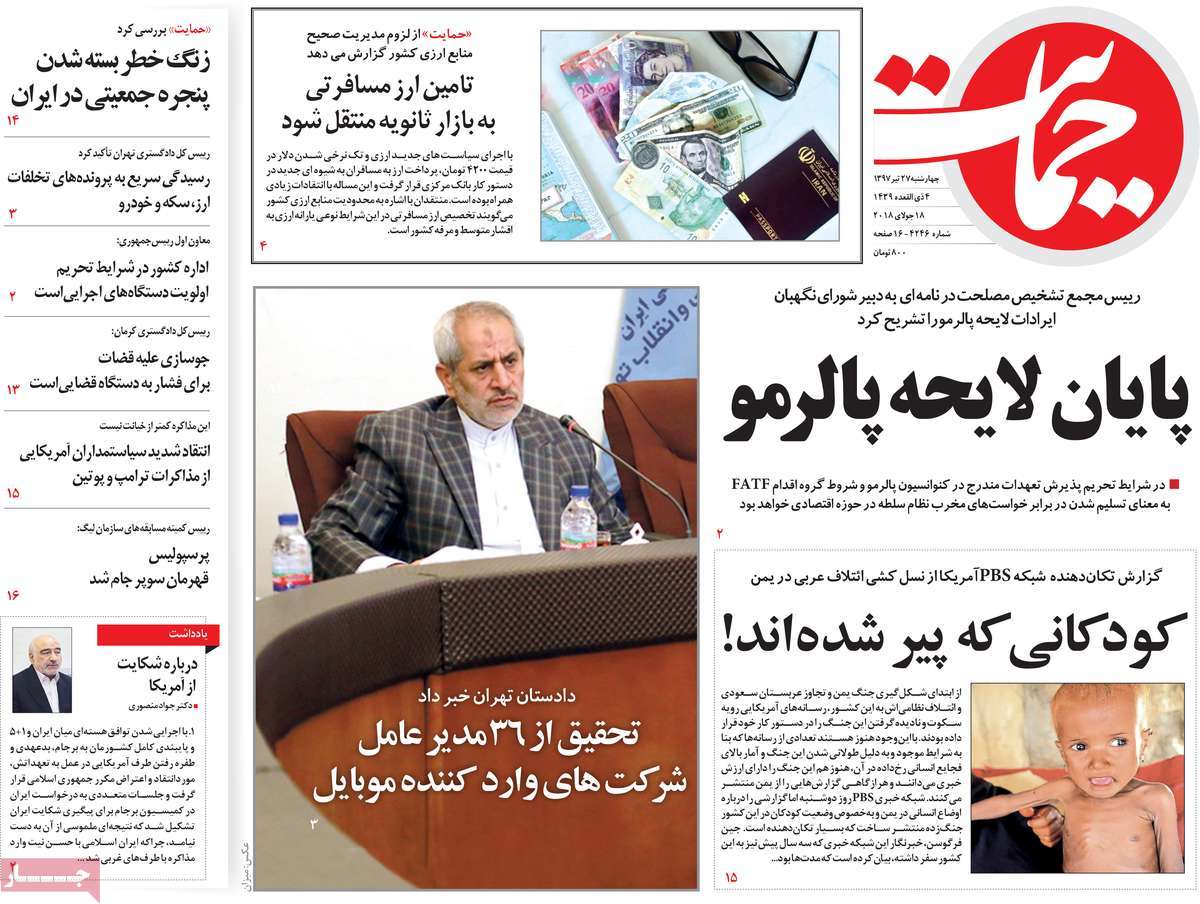
A Look at Iranian Newspaper Front Pages on July 18


Iran:

1- Draft Bill Prepared for Transparency in Fight against Corruption
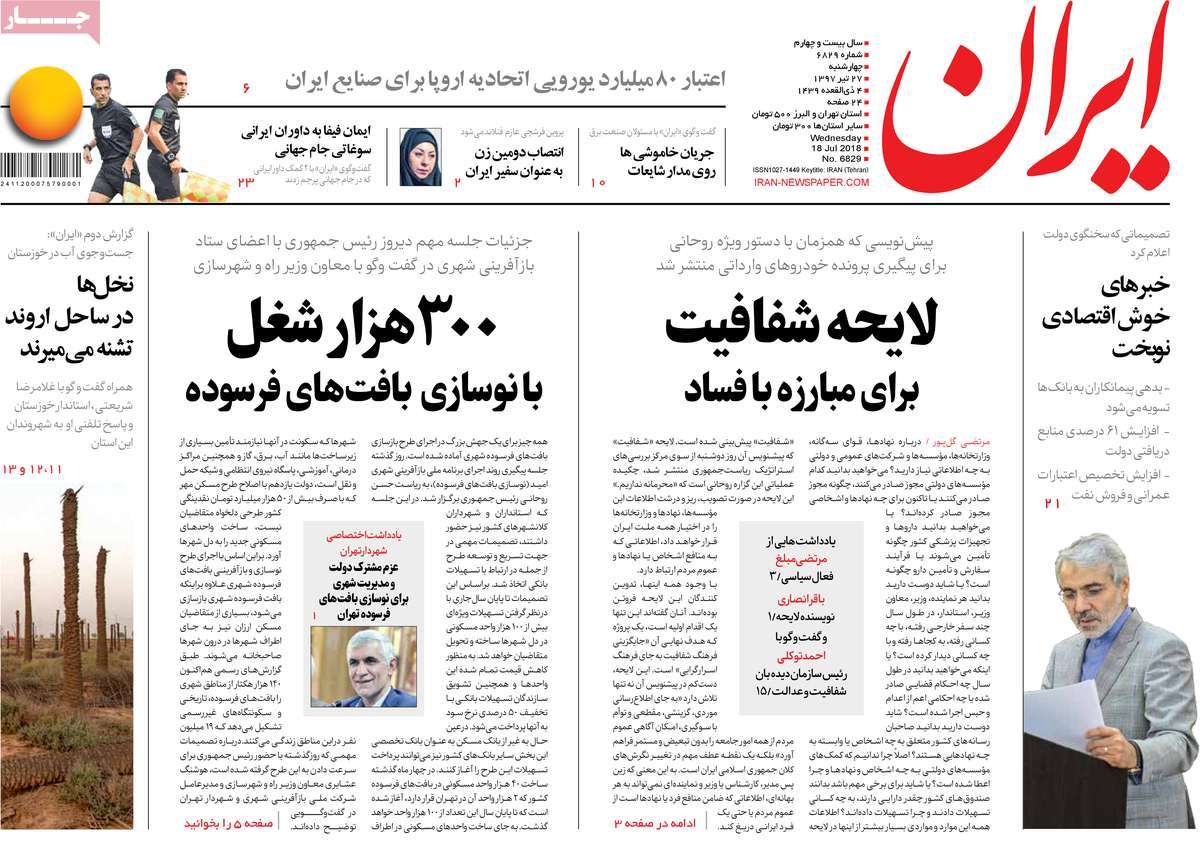
A Look at Iranian Newspaper Front Pages on July 18


Jame Jam:

1- Why Doesn’t Iran File Lawsuit against Total?
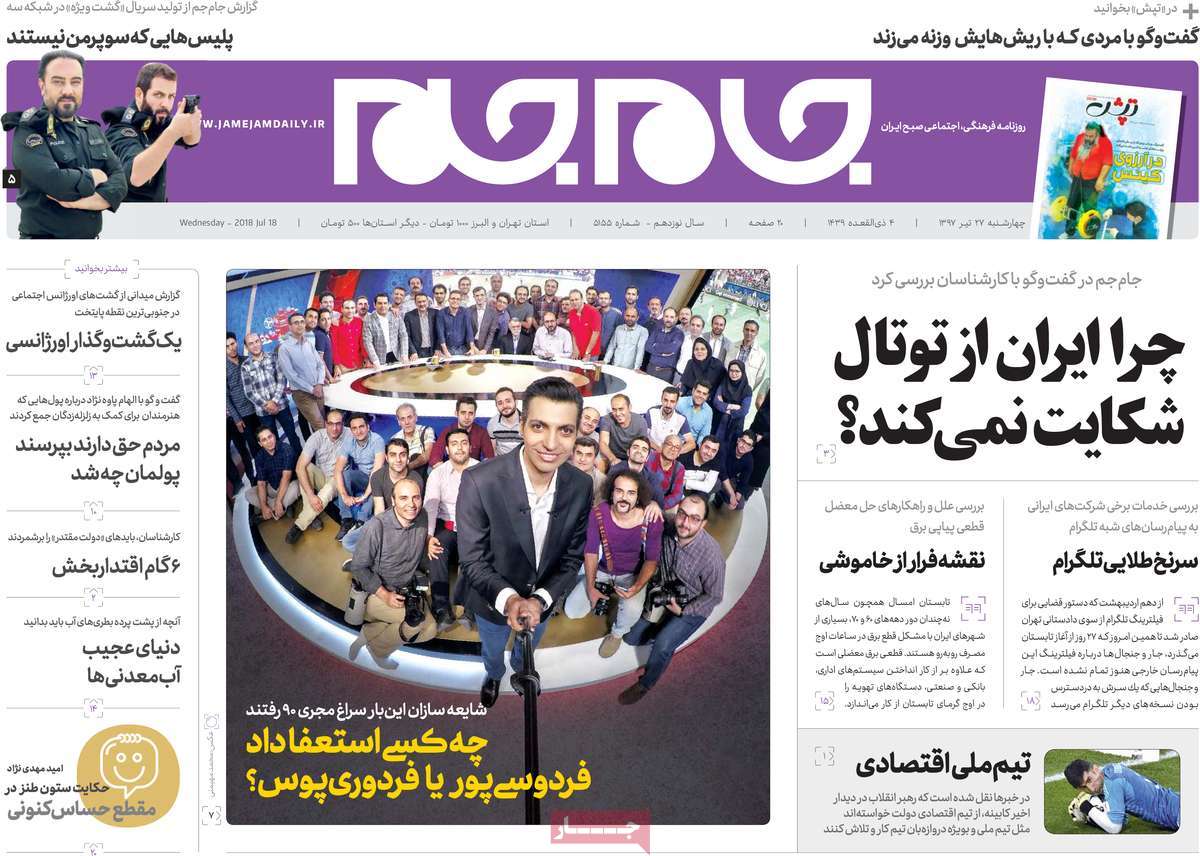
A Look at Iranian Newspaper Front Pages on July 18


Javan:

1- Government Must Stop Giving Official-Rate Currencies to Those Going Abroad for Pleasure

2- US Has Killed Thousands of Civilians in Syria: Amnesty International

3- Trump-Putin Meeting Did Not Change Syria Equation
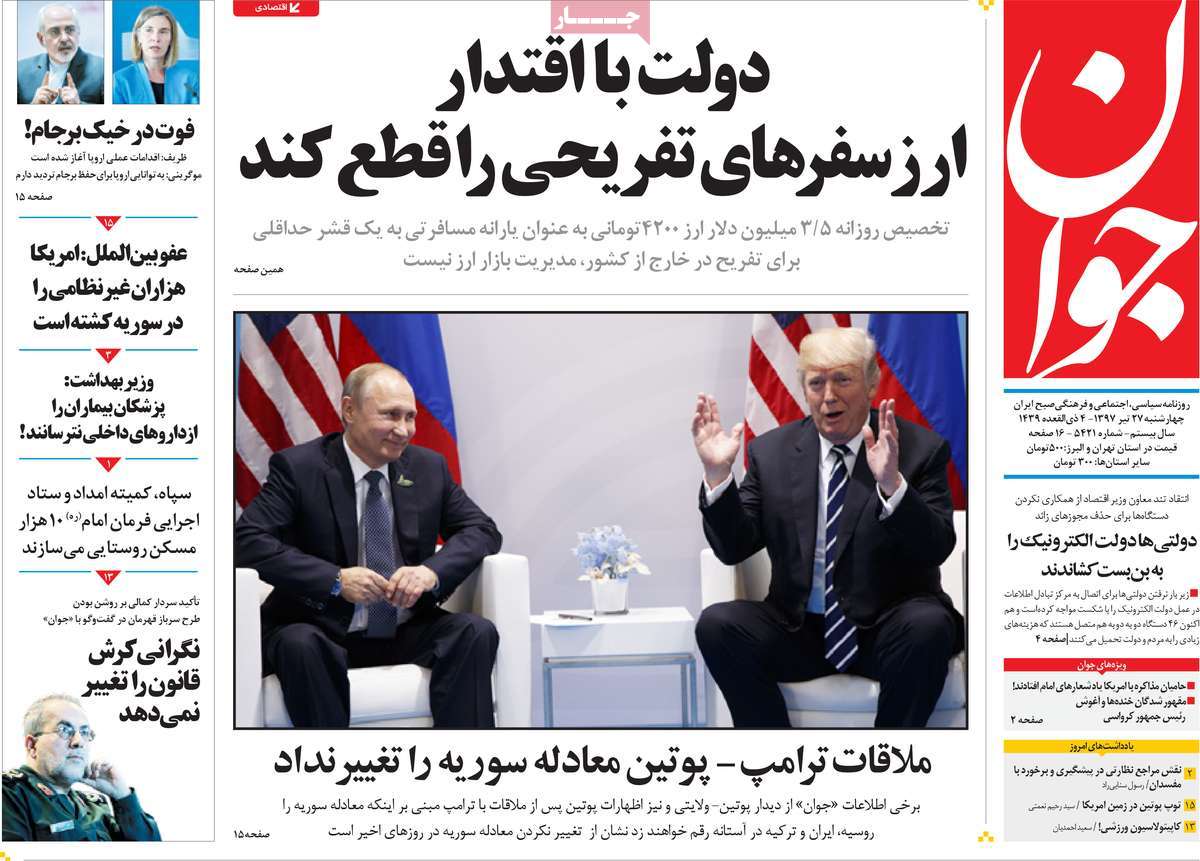
A Look at Iranian Newspaper Front Pages on July 18


Jomhour:

1- Desperate Effort: How Much Europeans Will Succeed in Keeping JCPOA Alive?
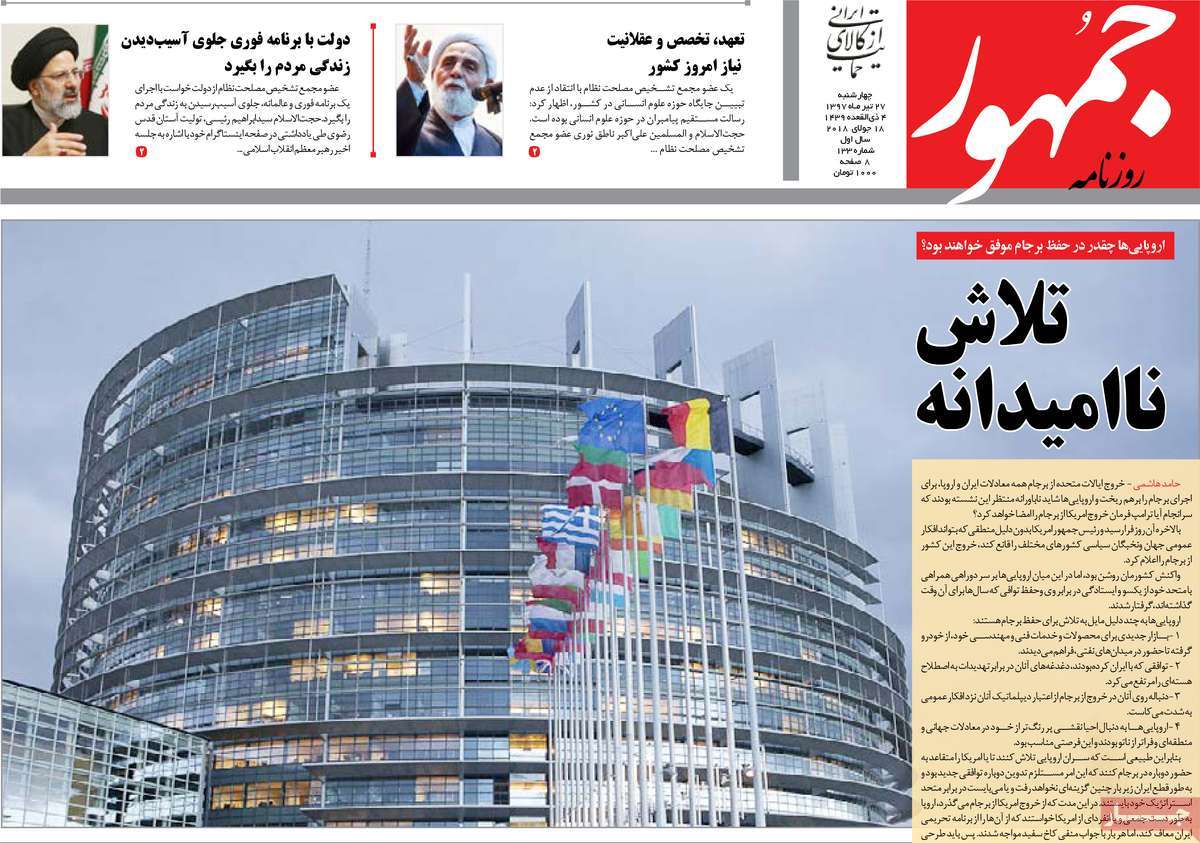
A Look at Iranian Newspaper Front Pages on July 18


Jomhouri Eslami:

1- FM Zarif Says World Resolved to Help Iran Maintain Its Active Role at Int’l Level

2- Trump’s Own Goal in Helsinki Leads to US’ Defeat against Russia
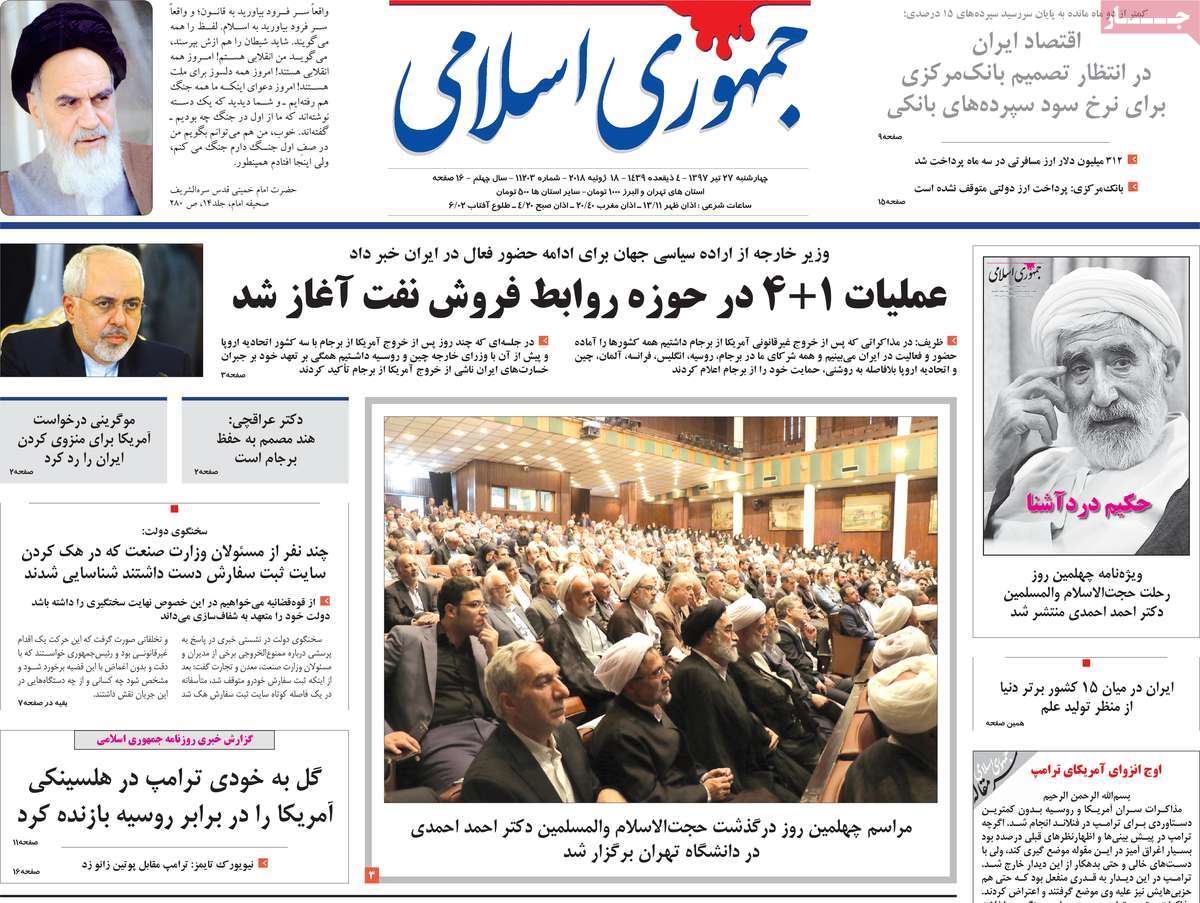
A Look at Iranian Newspaper Front Pages on July 18


Kayhan:

1- Government Expected to Change Its Behaviour, Reshuffle Cabinet to Resolve Issues
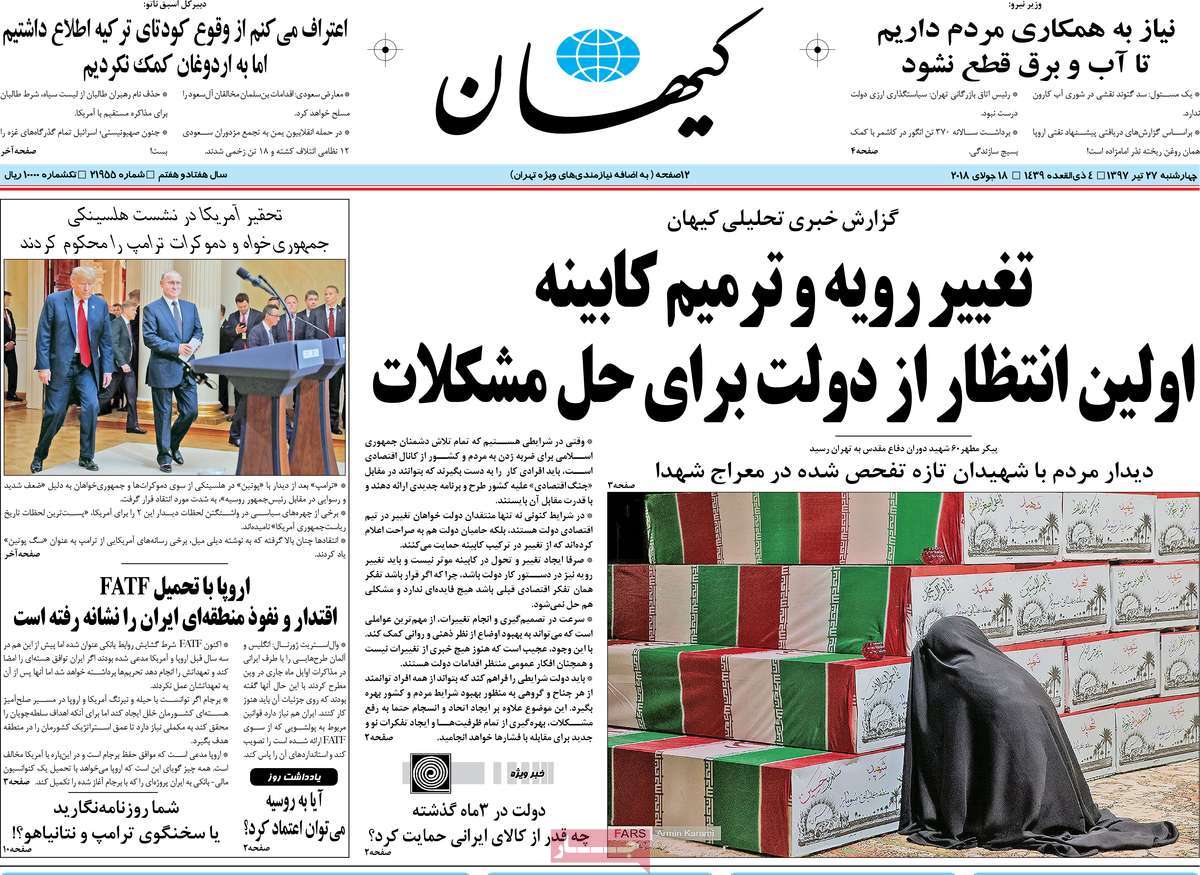
A Look at Iranian Newspaper Front Pages on July 18


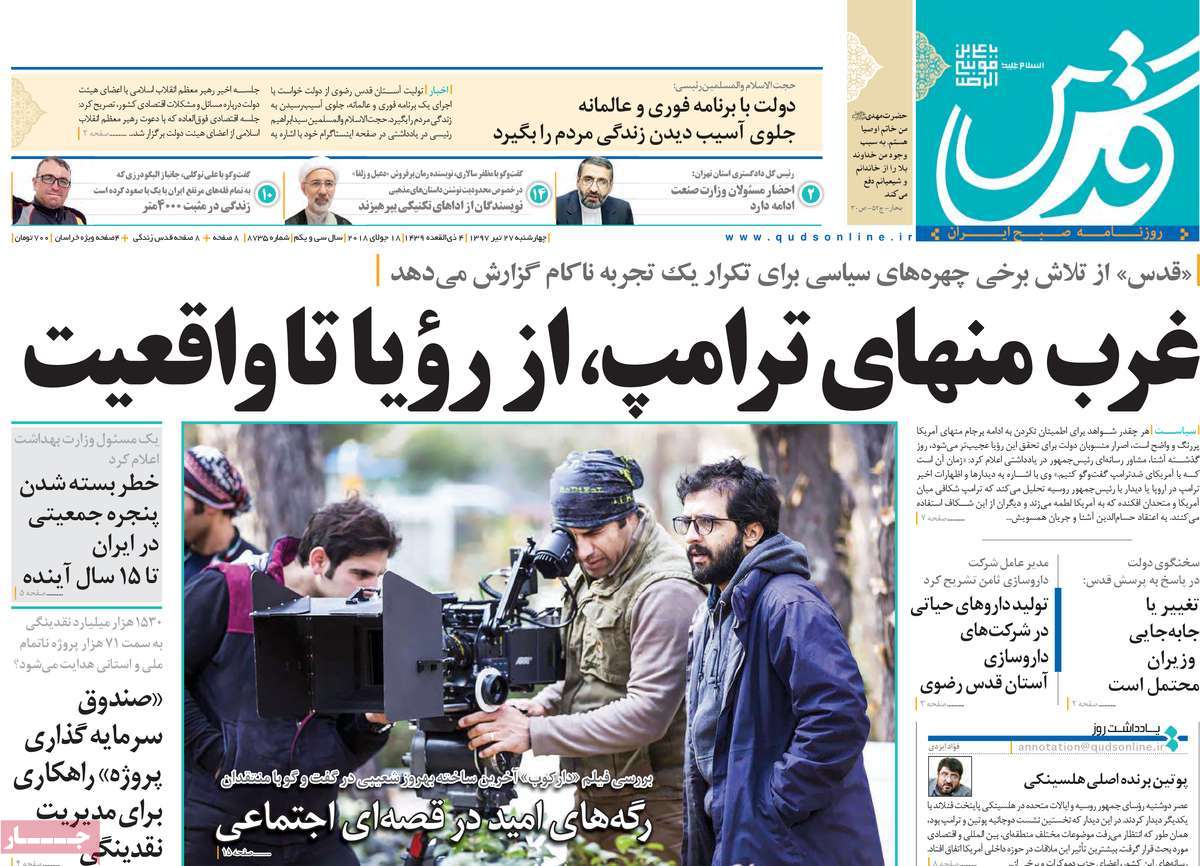
Quds:

1- West Minus Trump: From Dream to Reality
A Look at Iranian Newspaper Front Pages on July 18


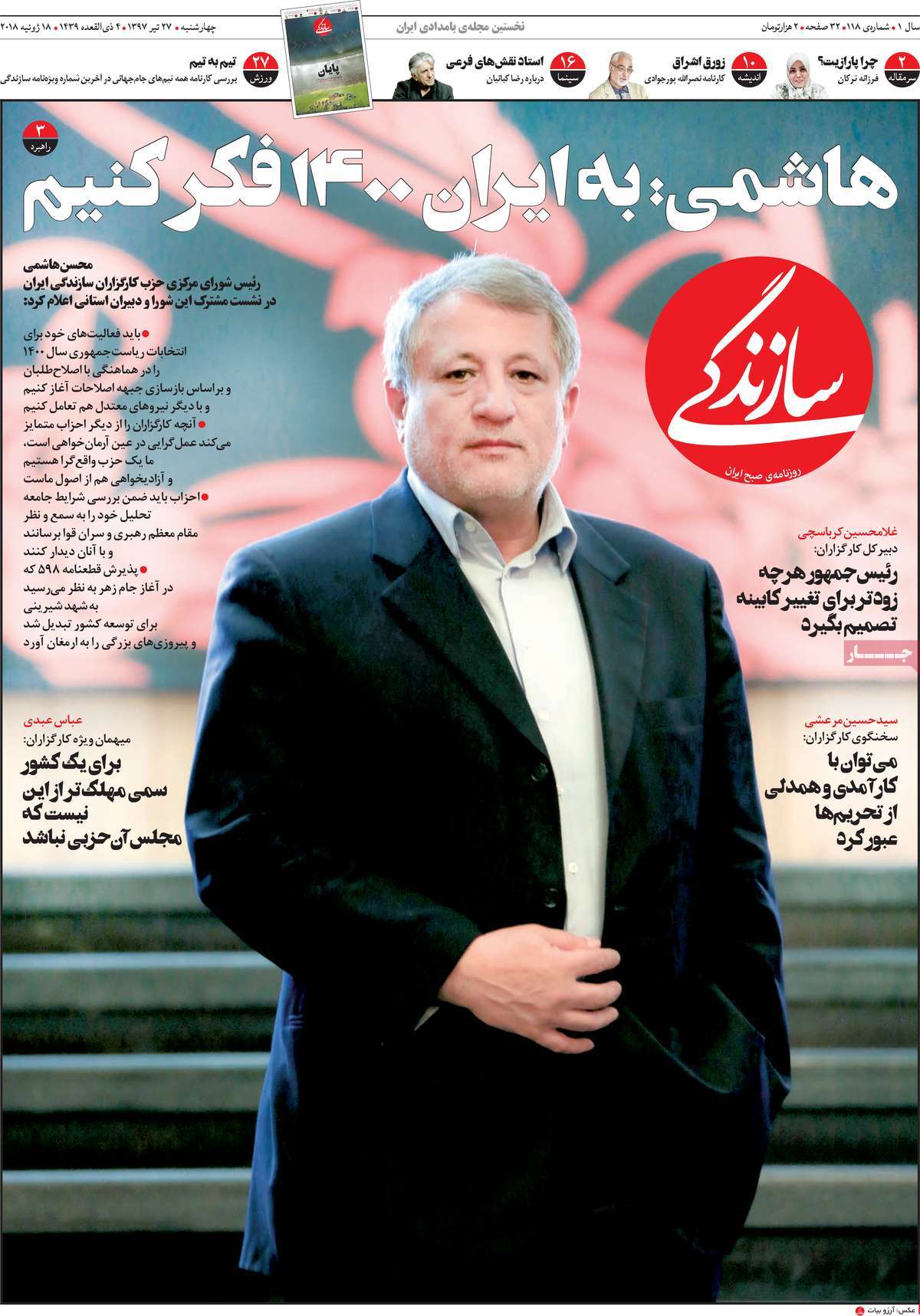
Sazandegi:

1- Reformist Figure: It’s Fatal for a Country to Have Non-Partisan Parliament

2- Rafsanjani’s Son: We Must Think of Iran in 2021
A Look at Iranian Newspaper Front Pages on July 18


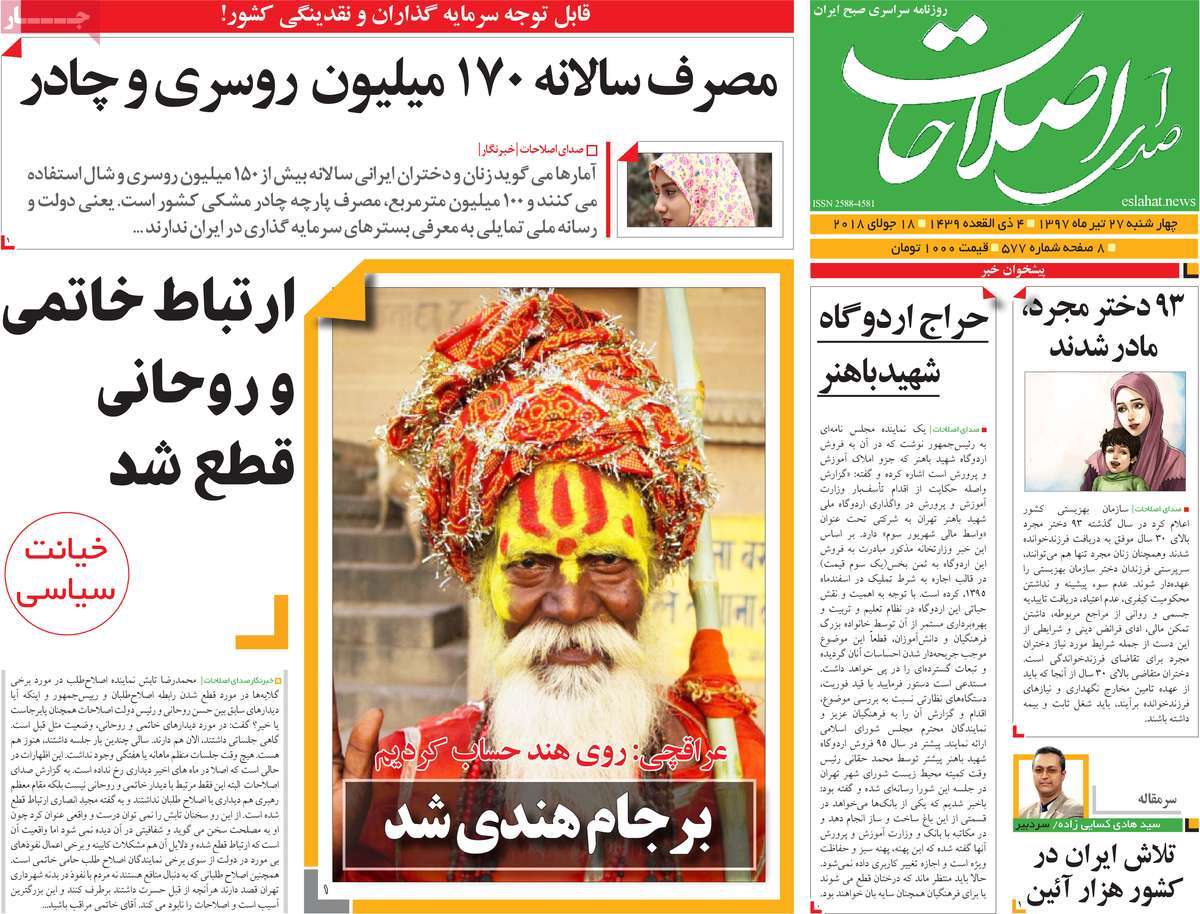
Seda-ye Eslahat:

1- 170 Million Headscarves, Chadors Used Annually

2- Iran Counts on India amid US Sanctions: Araqchi
A Look at Iranian Newspaper Front Pages on July 18


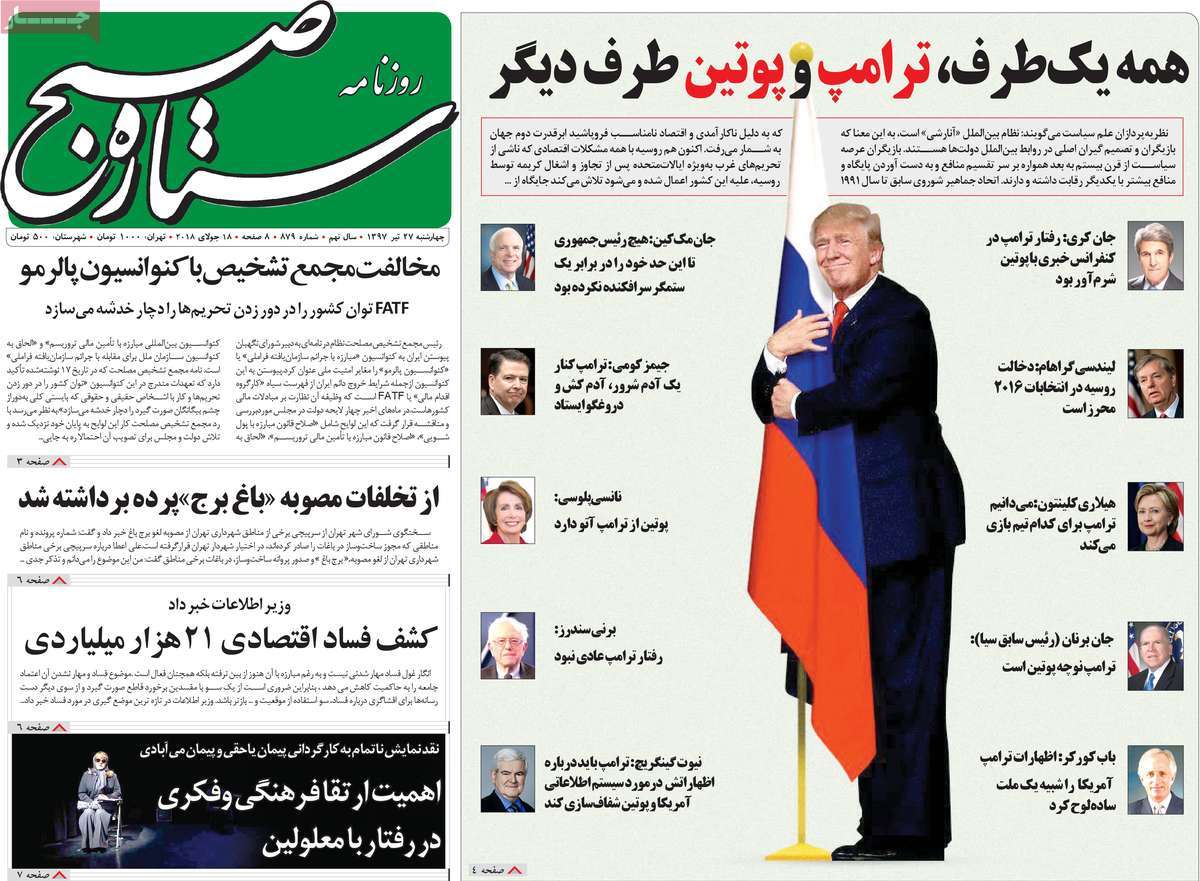
Setareh Sobh:

1- All on One Side, Trump and Putin on the Other Side
A Look at Iranian Newspaper Front Pages on July 18


Siasat-e Rooz:

1- Zionist Regime’s Army Afraid of Kites

2- American Bluff: US Treasury Dept. Says Exceptions to Be Made on Iran Oil Sanctions
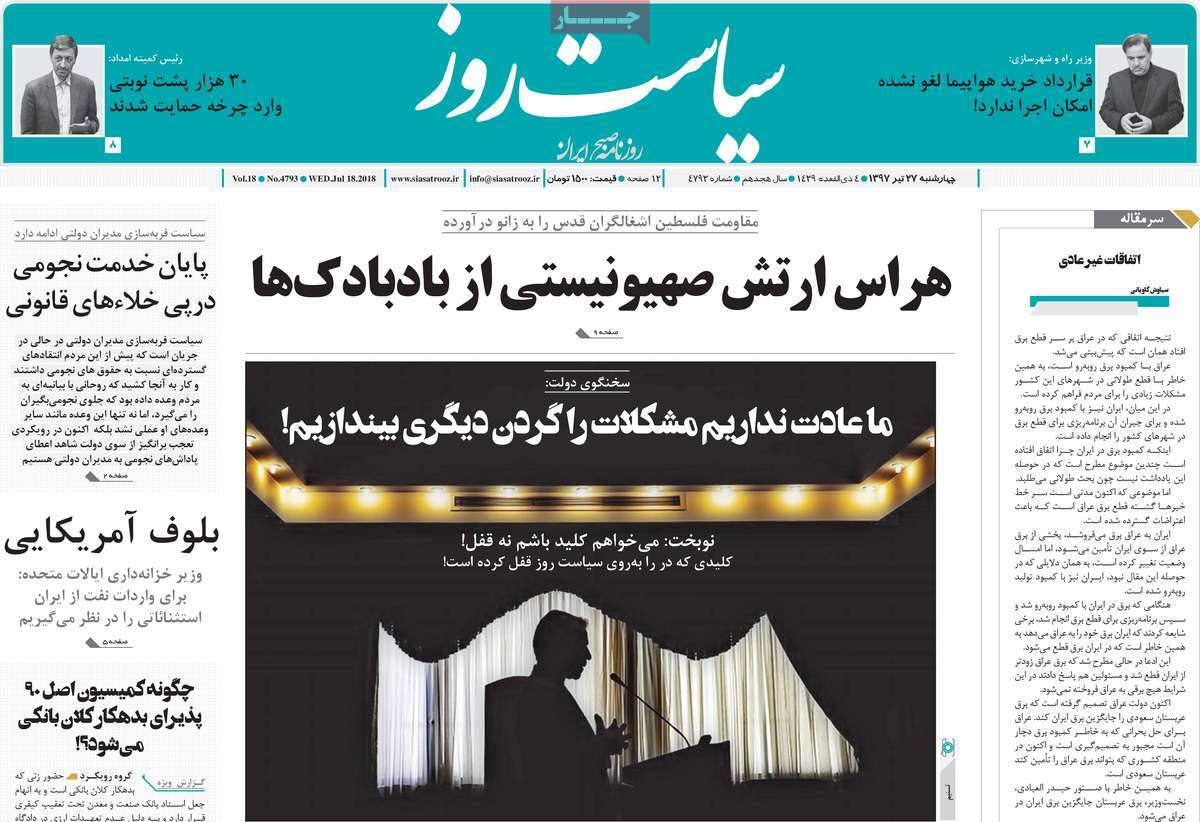
A Look at Iranian Newspaper Front Pages on July 18


Sokhan-e Rooz:

1- Shameless, Cowardly, Humiliating!

  • US Congress Outraged by Putin-Trump Talks
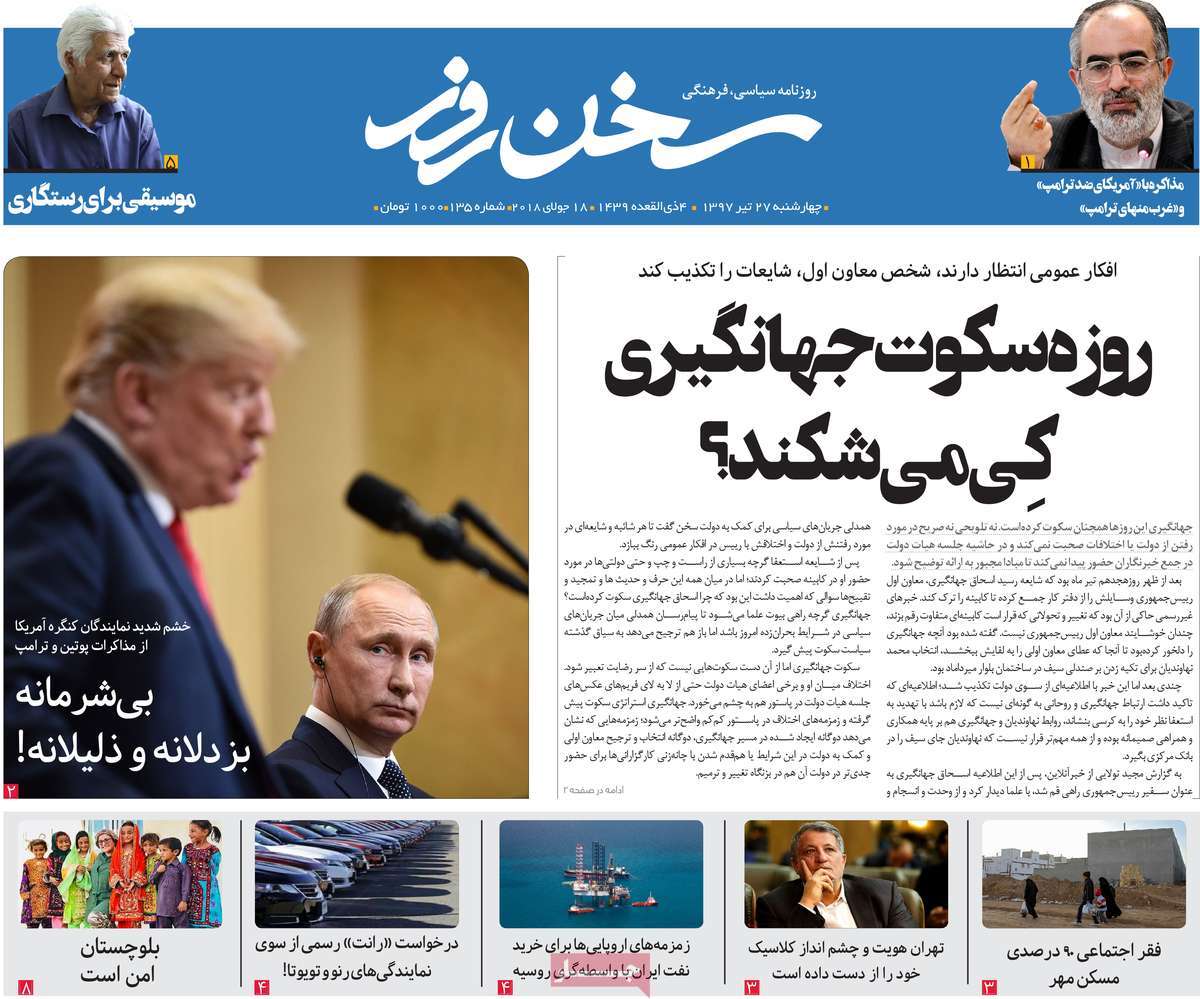
A Look at Iranian Newspaper Front Pages on July 18

Qurut; Special Dish Made in Eastern Iran

If we want to introduce regional cuisine in Iran, which is a typical example of the country’s geography, we should certainly go to South Khorasan; a desert region where every food is worth a lot.

Due to the warm and dry climate of South Khorasan, animal husbandry has always been more dominant than farming in this area. Therefore, it is not surprising that the most important ingredient in Khorasan Razavi province is whey, which is used differently in foods and also as a popular daily intake alone or in combination with local herbs.

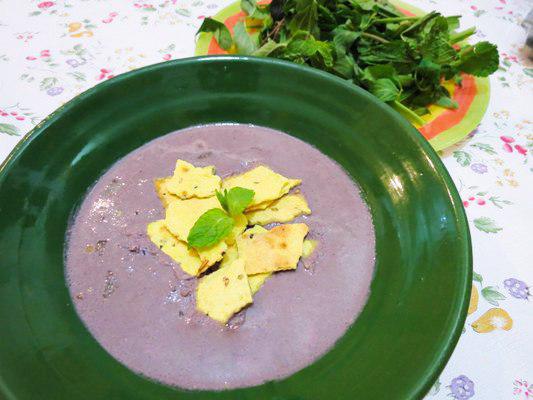
The Birjandi whey dish or Qurut is the most famous food in southern Khorasan with its purple colour which has a special taste. It would be a great experience to try this dish.

Qurut; Special Dish Made in Eastern IranThis delicious food was formerly used by the general public, but the high-ranking people could not forgo Qurut as well. The main ingredient of this food, which is purple, is special Qurut (whey) of Birjand, and powdered walnut.
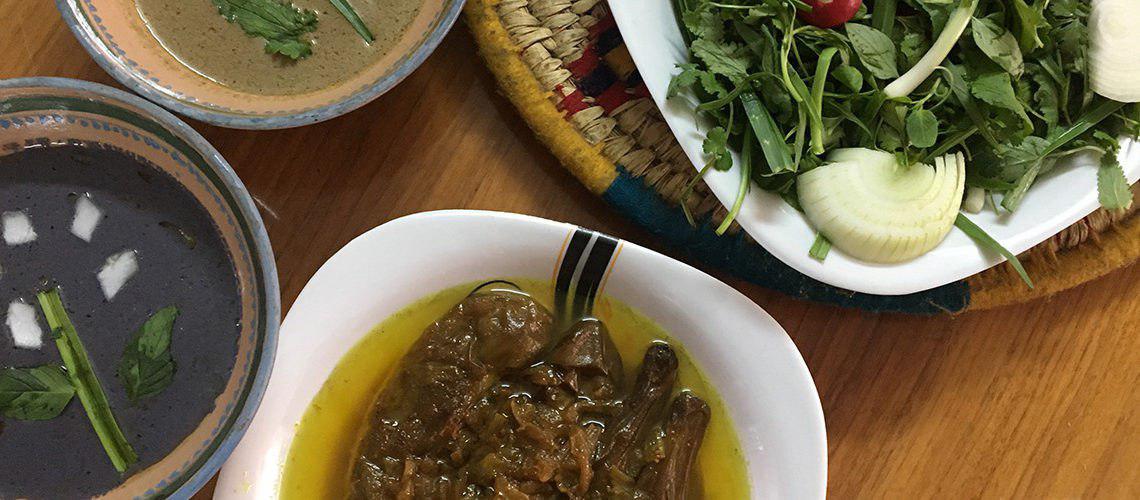
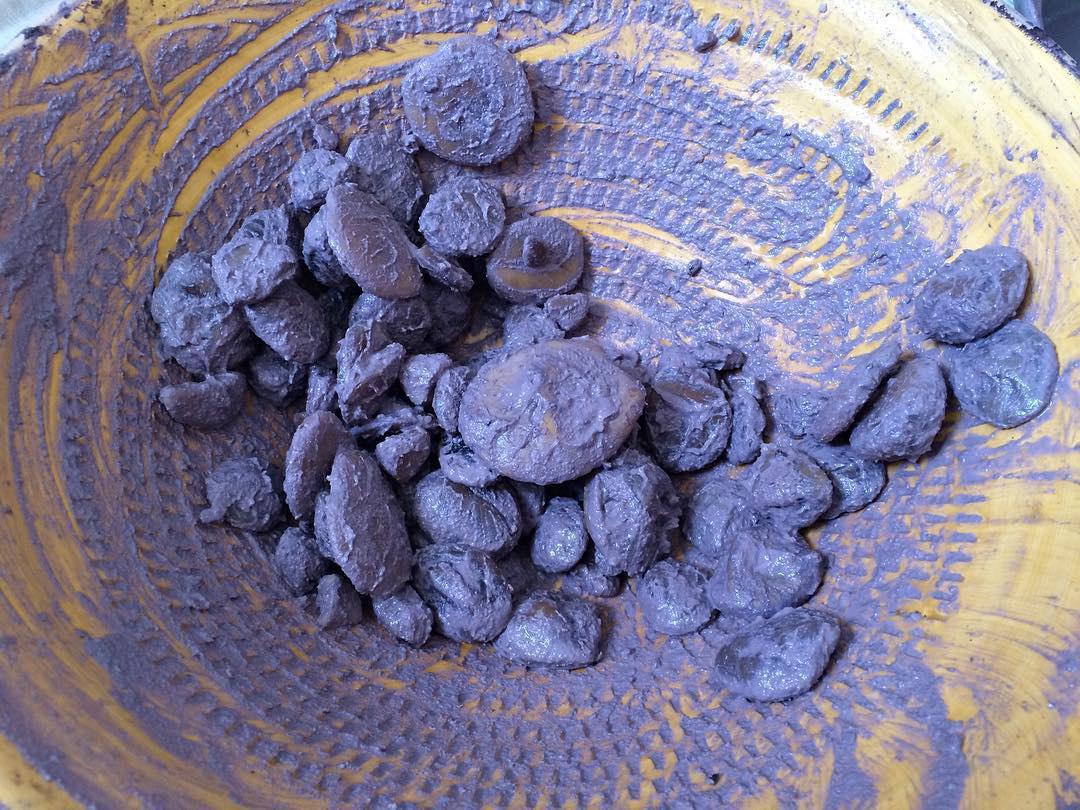
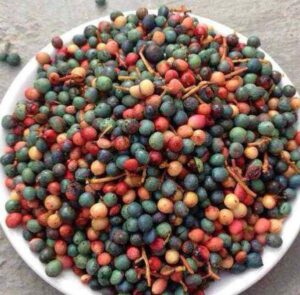
To get a better purple colour and change of the taste, some locals use mountain pistachios of Khorasan region instead of walnut.

According to the Cultural Heritage, Handicrafts and Tourism Department of South Khorasan province, the local dish of the southern Khorasan Province was inscribed in the Intangible Cultural Heritage List of Iran on July 14, 2018. The inscription came after the setting of Birjandi purple sufra and serving Qurut for 1,200 Birjandis residing in Tehran.

Qurut; Special Dish Made in Eastern Iran

Recipe

Qurut is served in both hot and cold forms. To prepare hot Qurut, they mix some onions or fried garlic with a little salt, black pepper and cinnamon, then add whey to it. Before getting boiled, it is taken off the heat and is ready to be served.

First, they should moisten the hard whey in water for one hour, and then empty the water and put the whey pieces that are now softened in a special container called “whey grinder”, which is hollow with rough walls. After that, they pour powdered walnut on whey pieces, and start to rub them into the wall of the container using their hand palms. They also slowly add water to get a liquid mixture. Then they pour oil in a pot and sauté onions. Some also add chopped mint to fried onions. When the onions get fried, they add the mixture of whey, walnut or mountain pistachio, saffron, water and cinnamon to onions and heat a bit.

Now Qurut is ready. They pour it into a bowl and mix it with Sangak bread or Komaj which is a local type of bread in South Khorasan. Sometimes, hot Qurut is served with eggplants, potatoes, zucchini and cooked vegetables like spinach.

Qurut; Special Dish Made in Eastern Iran

Iran Ready to Assist Yemenis If They Ask: Leader’s Aide

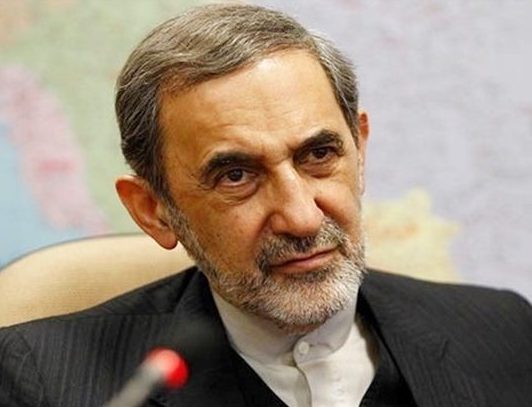
“We welcome any kind of help that we can do to the people in the region, governments of the region, including Syria, Iraq, Lebanon and also Yemen,” Ali Akbar Velayati told RT in an interview during his recent trip to Russia aired on July 15.

“If Yemen asks us to help them bring peace and tranquility to the region, we will not hesitate to do that,” Velayati said.

Since 2015, Yemen has been the scene of a Saudi military campaign, which Riyadh says aims to push Houti fighters out of the Yemen capital Sana’a and restore to power the fugitive president Abd-Rabbu Mansour Hadi.

The US and its regional allies are accusing Iran of seeking to dominate the region, saying Iran’s measures are destabilizing the region.

But Tehran says it’s regional presence is aimed at promoting peace and fighting terrorism.

Last week, Velayati met with Russian President Vladimir Putin in Moscow to deliver a message from the Leader of Iran’s Islamic Revolution Ayatollah Seyyed Ali Khamenei and President Hassan Rouhani.

The trip came as the US is working to tighten the screws on Iran, vowing to impose harsh sanctions on the country to force Tehran to accept US demands regarding its nuclear and regional activities.