Friday, January 9, 2026
Home Blog Page 3461

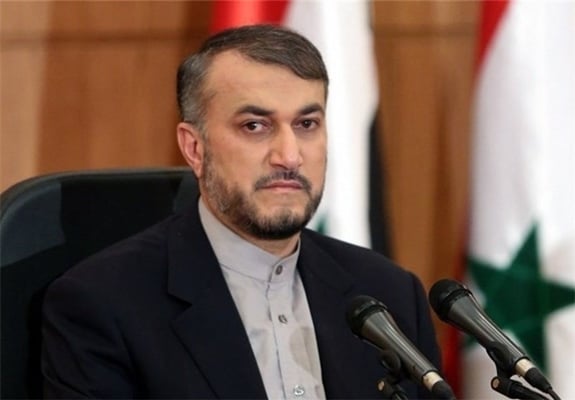
Iran Urges UN Human Rights Council to Terminate Saudi Membership

The comments were made by Hossein Amir-Abdollahian, a top aide to Iranian parliament speaker, in a Sunday post on his Twitter page.

“Saudi Arabia as the human rights violator in Yemen and Bahrain, and the perpetrator of Jamal Khashoggi’s death, should be expelled from the UN Human Rights Council,” he said in his tweet

He also noted that US President Donald Trump must be held accountable for the “Khashoggi-gate” scandal and his support for Riyadh’s terror squad.

Khashoggi was a Saudi journalist, author, and a former general manager and editor-in-chief of Arab News Channel. Khashoggi fled Saudi Arabia in September 2017. He used to be sharply critical of Saudi Arabia’s crown prince, Mohammed bin Salman, and the Saudi king.

The dissident journalist entered the Saudi consulate in Istanbul on 2 October 2018, but did not get out of the building. Riyadh initially denied his death, but later on admitted he had died inside the consulate after a “fist fight”.

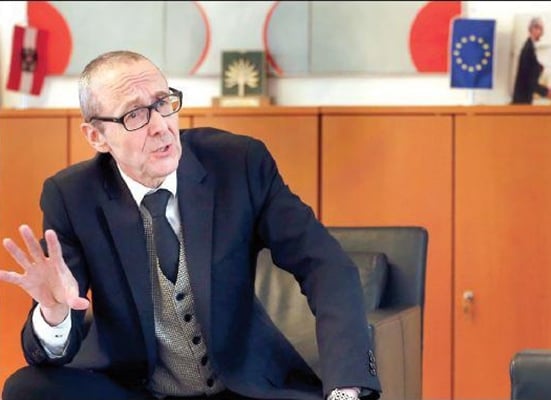
European Firms Returning to Iran under New Names: Austria

Not much is left until the second round of the United States’ unilateral sanctions against Iran goes into effect. By the admission of world countries and the United Nations, the bans are illegal this time. This is the first time that the world is standing by Iran against Washington’s sanctions. And the Europeans have been on board with Iran, too.

The beginning of round two of US sanctions against Iran and Europe’s countermeasures to harness the bans has coincided with Austria’s six-month chairmanship of the European Union.

The Hamshahri newspaper has recently conducted an interview with Austrian ambassador to Iran Stefan Scholz, seeking his views on the foreign policy of Austria and the European Union, the Iran nuclear deal (also known as the Joint Comprehensive Plan of Action or the JCPOA), and the impact of US sanctions on Tehran-Vienna relations.

Scholz calls Iran sanctions “deplorable” while believing that the current situation facing Iran is an opportunity for economic reforms as well as shaping cooperation with Europe on a larger scale than ever. The top diplomat says he is confident that Iran will weather the US sanctions. The highlights of the interview summarized by the IFP follow.

Q: After the JCPOA was signed, Austria was the first country to send its delegation to Iran. The team led by the Austrian president travelled to Iran at the highest level. The Iranian economic delegation led by President Hassan Rouhani also travelled to Vienna a few months ago. Figures show Iran-Austria trade hovers around $600 million. Why haven’t Iran-Austria trade ties grown as much as they should have since three years ago when the Iran nuclear deal was clinched?
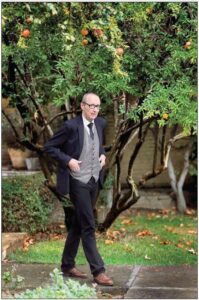
European Firms Returning to Iran under New Names: AustriaA: Look, the Austrians are not that active with regards to trading in goods. Our country’s capability mostly concerns infrastructure. Austria is present in major projects whose feasibility studies may take one to two years. Over this time, we have held talks with Iranian sides on the construction of nuclear hospitals and fifth-generation hospitals. We are planning several other major projects whose implementation will upgrade Iran’s technological level in the relevant field. Of course, these projects have been mothballed now until the fate of Iran-Europe cooperation becomes clear. The implementation of the projects hinges on the finalization of the financial mechanism between Iran and Europe.

Q: Why have the projects been halted? US financial sanctions have not come into effect, yet. Why are your companies concerned? Are they waiting for more support from the EU?

A: No. We are waiting to see through what channels financial payments between Iran and Europe will be handled. By the way, let’s not forget that Austria has the necessary technical knowhow in many joint ventures with Iran, but the implementation of the projects may need machinery or equipment procured from countries other than Austria.

The United States’ strategy toward Iran and the JCPOA was to create an atmosphere coupled with ambiguity, an atmosphere which affected big and small companies. Companies did not know to what extent they can get involved in cooperation with Iran. It was then when the concept of over compliance with the sanctions emerged. In other words, because the extent of the sanctions was not clear, companies preferred to stop their activities and, hence, became too much affected by the climate of sanctions.

Let me mention one point. The news which is published is not the whole story. I mean a company comes and says it has stopped its cooperation with Iran and it even releases a firm statement in that regard. However, the very same company resumes its cooperation with Iran under a new name and with a new address. Therefore, the current situation is not a black-and-white one; rather it should be regarded as a gray situation.

In fact, none of the European companies have left Iran completely and permanently.

Q: Europe has announced that it will work out a special financial mechanism vis-à-vis Iran. Not much detail has been released with regards to that mechanism. What are the details of this mechanism?

A: Since six months ago when the United States withdrew from the JCPOA, the European Union has been trying hard to create a toolbox to conduct financial transactions with Iran. Accordingly, the European companies which intend to work with Iran under EU rules can use the facilities in this toolbox. In a meeting of a committee looking into cooperation between the European Investment Bank (EIB) and Iran, Austria put forward a proposal for cooperation, which immediately received ‘yes’ votes, and received final approval by the European Parliament. One should admit that it was the first and most serious EU show to support Iran against US sanctions.

Europe’s next move was to update the so-called “blocking regulations” first approved in 1996, which needed to be updated.

Do not forget that we have many legal and statutory agreements with the US, and whatever ruling American courts issue against a company can be enforced by European countries based on our traditional mechanisms in Europe. However, the blocking regulations have come into force in order to help Iran and prevents the enforcement of the rulings [issued by US courts]. This is an important development.

Q: But some in Iran believe Europe has not backed us as it should have.

A: Look, all of these things are a new development for us in Europe. This is the first time that Europe wants to work with a country that has come under US sanctions. Everything the EU does is aimed at preserving the JCPOA. This is the first time that I, as the Austrian ambassador to Tehran, regularly receive reports from the Austrian Central Bank and Finance Ministry, and I give them reports, in turn. In fact, the nuclear deal with Iran has helped us in Europe to establish better coordination between different institutions both at the national level and at the level of the institutions affiliated with the EU to be able to create channels for financial transactions with Iran and keep those channels open. In fact, we are creating a new platform to maintain economic relations with Iran, a platform which is new from every aspect and will become more and more complete gradually.

On the whole, I should say that the special financial mechanism is meant to serve as a framework for conducting financial transactions under the supervision of the EU and to provide for trade between EU members and Iran, and between thirds countries and Iran in such a way that banks are not involved.

  1. So, the SWIFT system will not be incorporated into the special financial mechanism?
  2. SWIFT may be a complementary part, but the structure of the special financial mechanism is not based on SWIFT.

Q: Do you think this financial platform will have the required efficiency?

A: This platform is supposed to be dynamic; i.e. as new developments unfold, this financial tool will change, too. So, a system will be put in place which will change in accordance with how Washington will behave with regards to sanctions. One should bear in mind that if the sanctions are imposed, the EU will have to forgo $ 10 billion in exports. Therefore, keeping these financial channels is important to us.

As you said, the JCPOA and its subsequent issues helped the EU to act in a more coordinated manner. In fact, the European block basically tried to revive its status as an international player by entering into nuclear talks and channeling the negotiations.

Q: Last month, even John Bolton scoffed at the EU and said the union talks well, but does not do anything in practice. He said the United Sates will not allow Europe to circumvent its sanctions. In fact, the US openly seeks to eclipse Europe’s role in international politics as a global power. What’s your take on that?

A: This is the first time since World War II that Europe is seeking to put in place a mechanism to thwart US actions. This is a rare event. The Iran story has changed many things, things whose meaning we still don’t know and are new to all of us. It is a new playing field. We have completely realized how your government has taken in all these crises and challenges to create a new dialogue in its foreign policy arena and, at the same time, be able to overhaul the country’s economy. The whole story is an educational book, teaching us how a country can turn a major challenge into a major opportunity. With that in mind, the EU is taking action.

Q: Less than 20 are left before the second round of US sanctions against Iran goes into effect. Given Austria’s presidency over the EU, you are now regarded as the EU representative to Iran as well. With US sanctions looming, if you want to talk to Iranian people, what would you tell them?

A: I recommend Iranians adopt the strategy of maximum patience and forbearance in the face of Washington’s strategy of maximum pressure. This has made Iran the ethical player in international politics. Your country is very powerful when it comes to economic resilience. I am confident that Iran will weather US sanctions.

Iran: The World’s Cradle of Horse Breeding

The world’s best horses were bred in Ancient Persia. Iran can be described as the cradle of breeding different breeds of horses in the world. There are numerous breeds of horse in Iran. Different breeds of horses were the result of man crossbreeding horses, or natural breeding. Horses and ponies look different as they are different in height. Horses are usually tall.

The native Persian horse is one of the most famous and oldest breeds of horse in the world. The Persian horse has unique features and is regarded as the ancestor of all original and top-breed horses today. Ancient Persia was the land of breeding the best horses which exist today.

In Ancient Persia, horses were available in all colours in which they are found today, which shows Iran was the cradle of breeding original horses in the world. Horse-breeding was one of the hobbies in Ancient Persia, and many of those serving in kings’ courts were busy breeding original horses.
For a more detailed review of Iran’s achievments in various fields of science and technology, check the book “Science and Technology in Iran: A Brief Review”, released by the Science and Technology Department of the Iranian President’s Office.
It is said that Cyrus, a king of the Achaemenid Empire, paid due regard to breeding horses, so much so that some 120,000 horses were bred in Iran annually. It would be interesting to know that at that time all horses had family trees and identity certificates and were used by cavalry in the Achaemenid army. Today, genetic tests and DNA extraction can be used to determine the purity and value of each horse.

Iran: The World’s Cradle of Horse BreedingHorse-riding was one of the most important skills which, as required by the law, every Iranian had to learn. Polo is one of Iran’s ancient sports, which is common around the world today. One of the pastimes of Iranian kings was hunting on horseback. During hunting, the hunter had to jump over obstacles. This skill has turned into “show jumping” today. In Ancient Persia, women learned horse riding and hunting as men did, and learned polo during childhood.

Depending on the geographical area, native Persian horses have different features. The horse native to the Iranian Plateau is not very big in size, but is very strong and sturdy. Throughout history, Iranian horses have always been used for difficult tasks or passing through long and rough terrain. The best Iranian horse breeds include Arabian, Qarabagh, Turkmen, Lori, Qashqai, Kurdish, Bakhtiari, Sistani, Dareshooi and Telsh horses.

Renowned globetrotter and explorer Marco Polo has, in his travelogue, mentioned that Iran is home to the world’s most beautiful and expensive horses.

Iranian Woman Abandons City to Breathe Life into Remote Village

After a sudden boom in sustainable rural tourism, Iranian women have missed no chance to get involved in this area. Today, most of them have turned into ecotourism activists. Urban women have also begun to return to their motherlands or settle in remote villages to open eco-lodges.

According to the figures released by Cultural Heritage, Handicrafts and Tourism Organization of Iran, there are nearly 700 eco-lodges across the country. “The lodges are scattered across 28 provinces and two free zones.”

Iranian officials promised three years ago to increase the number of eco-tourism centres in Iran to 2,000.

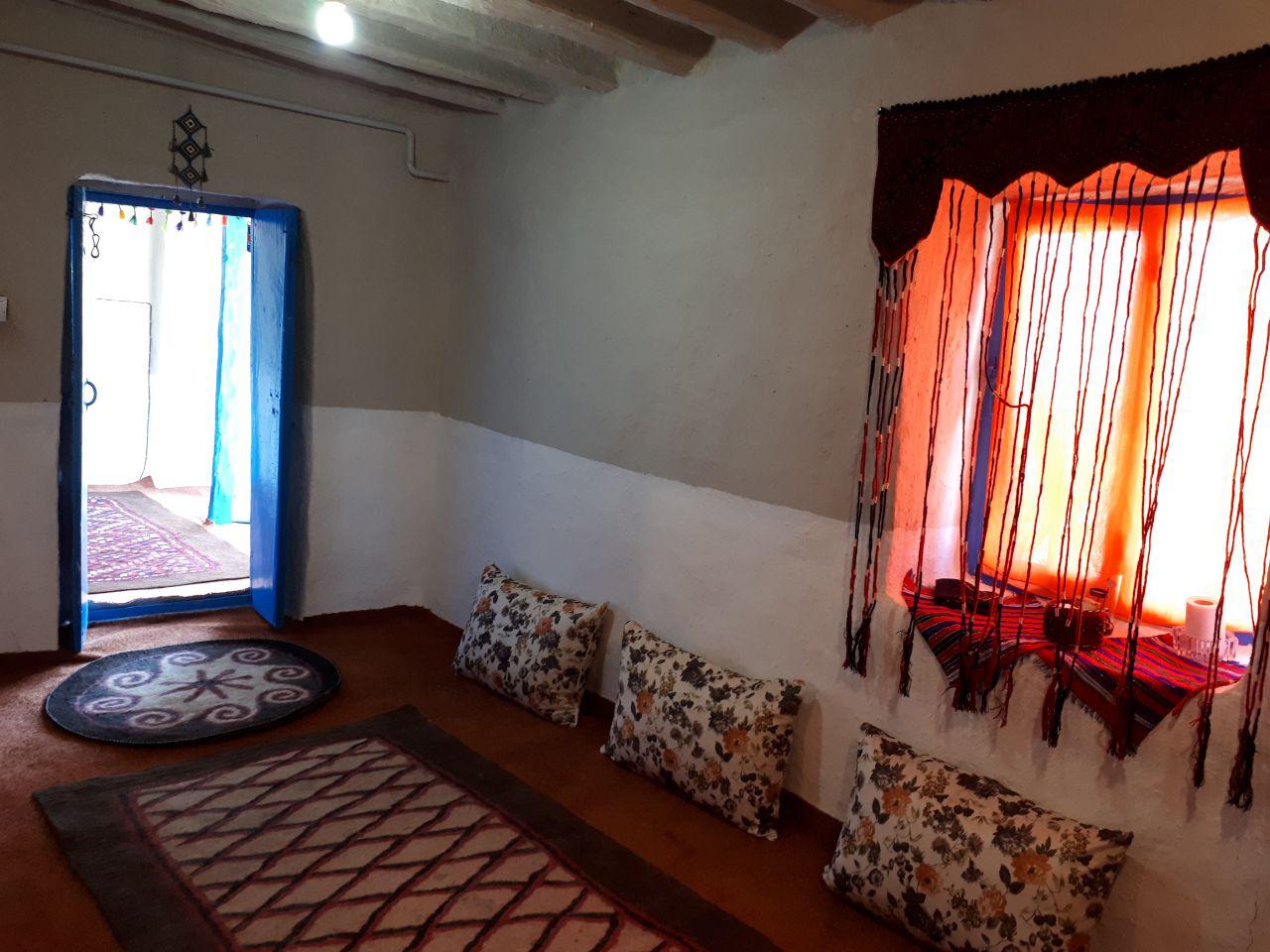
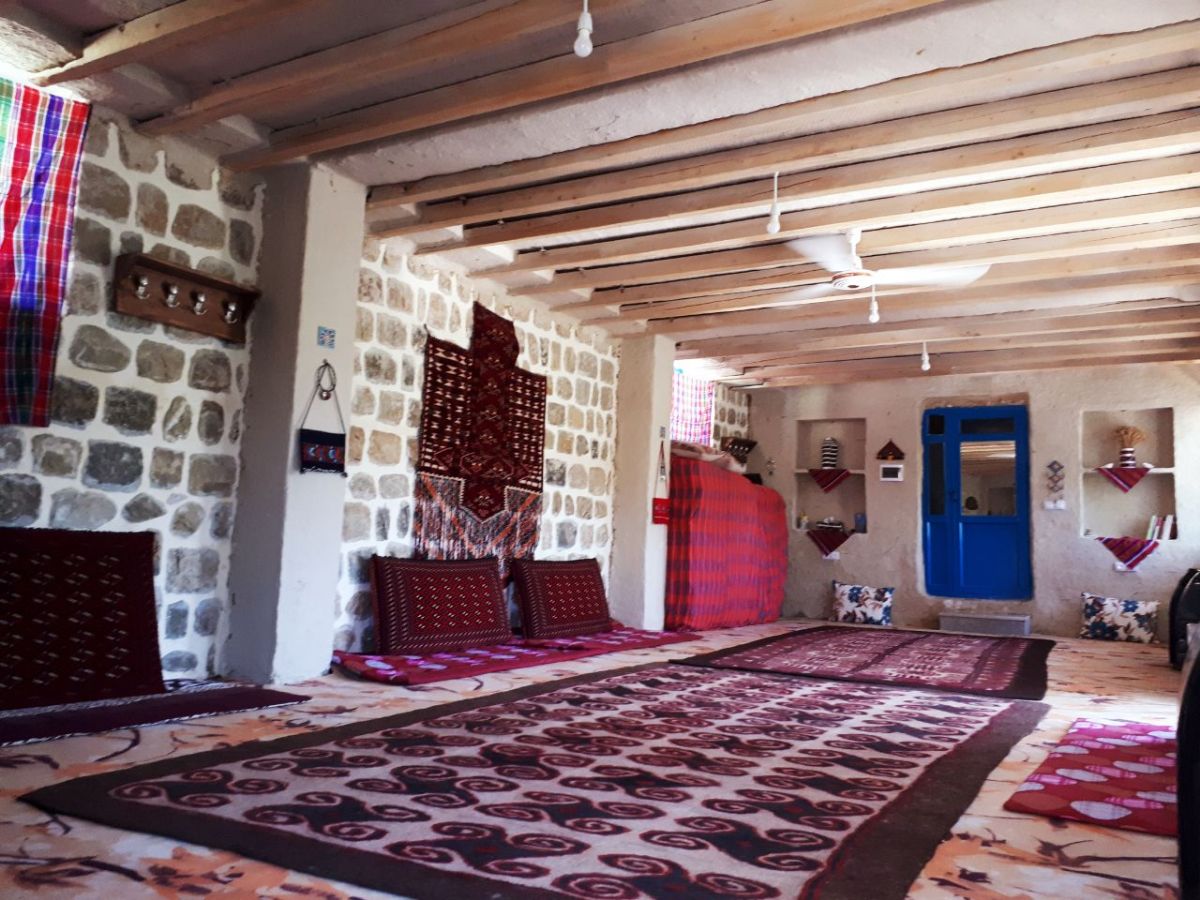
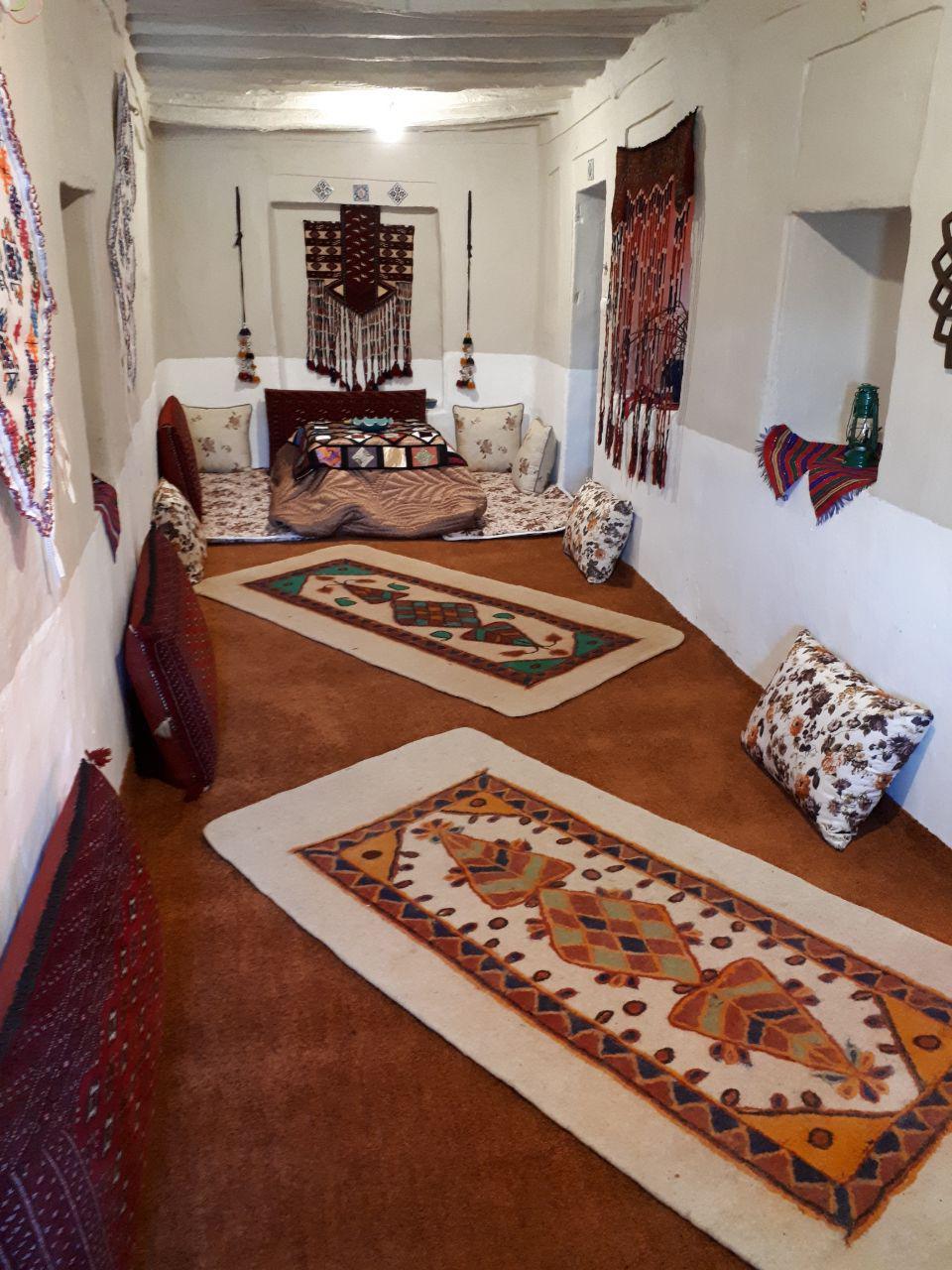
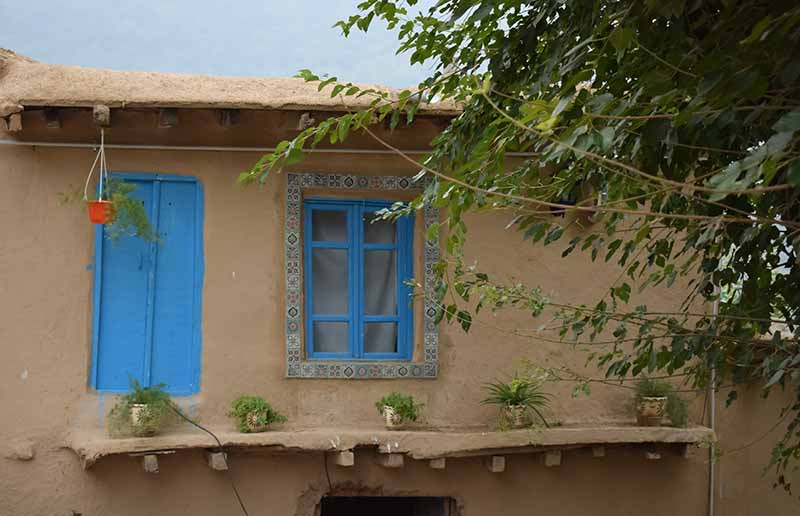
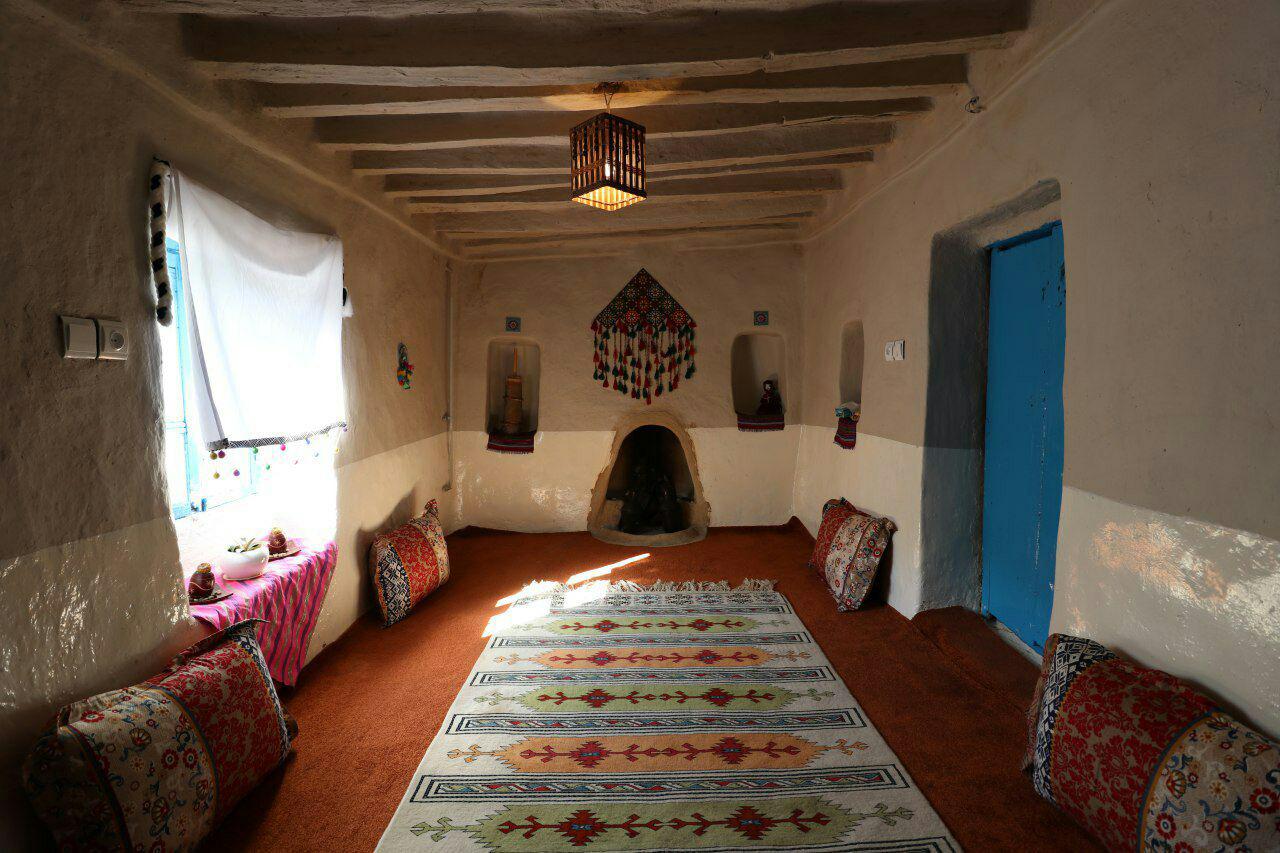
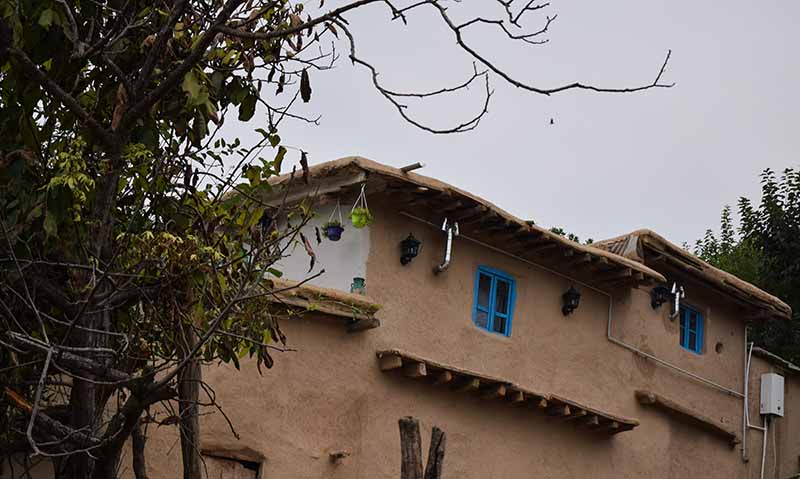
Iranian Woman Abandons City to Breathe Life into Remote VillageSasang is a village 21 kilometers away from the city of Minudasht in Golestan province, northern Iran. About 300 families live in the remote village. The village used to be a hub of textile industry for a long time, but the industry has lost its momentum in the village over the past years. Today, it is hosting its first eco-lodge, hoping to boost its ancient industry once again.

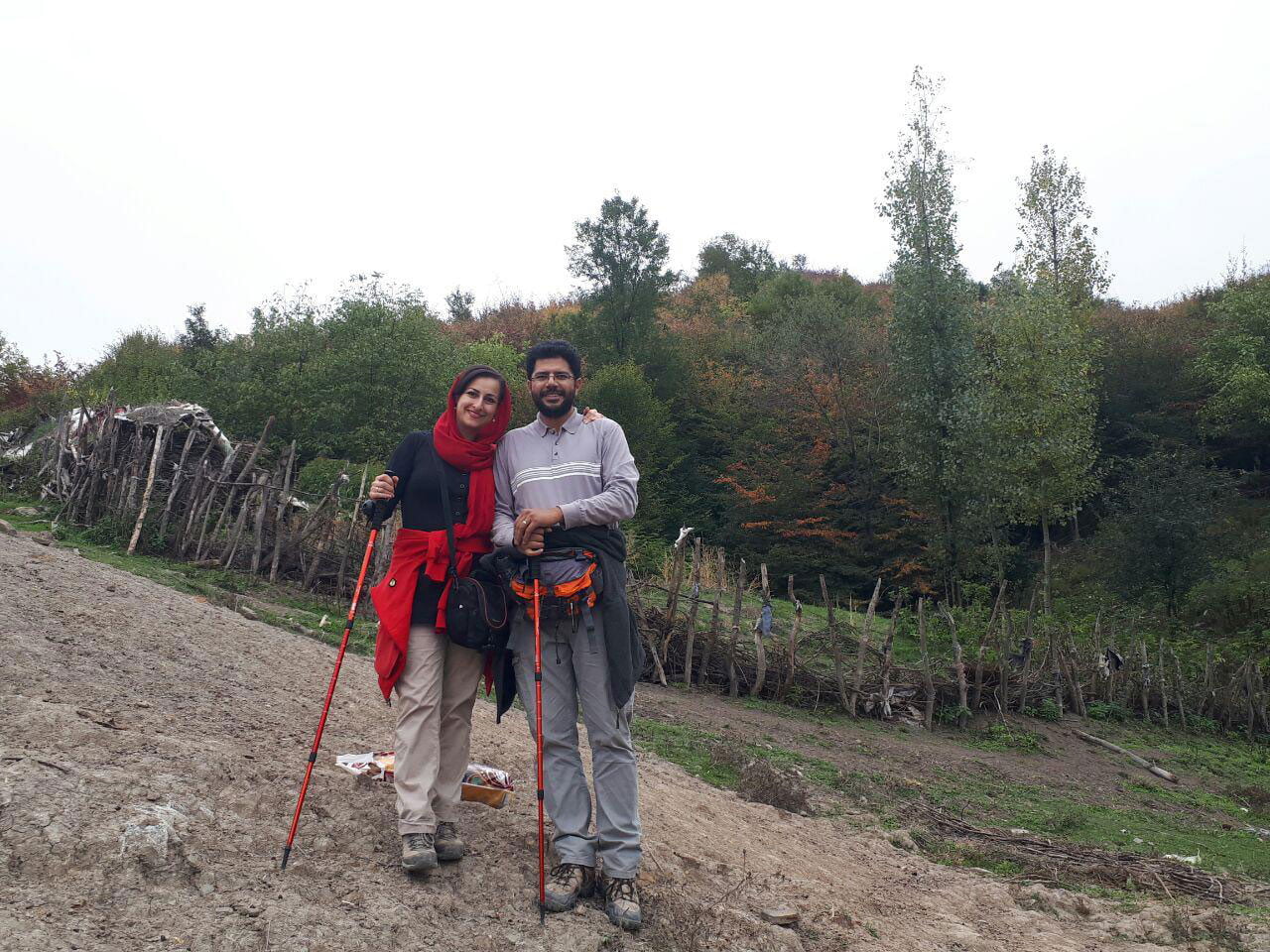
By establishing an eco-lodge in Sasang, Raheleh Ahmadi has managed to not only refresh her own life but also add colour to the lives of many villagers particularly the rural women.

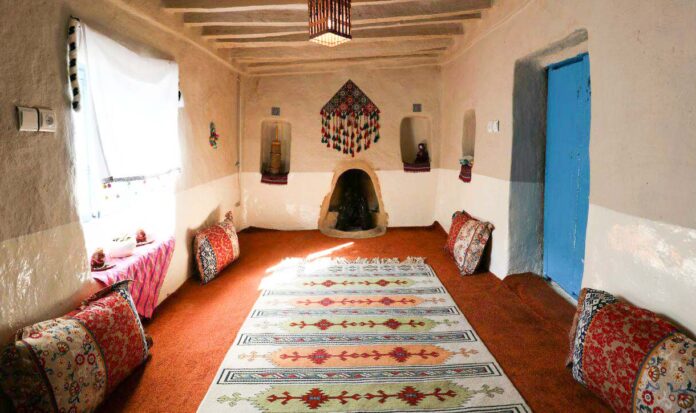
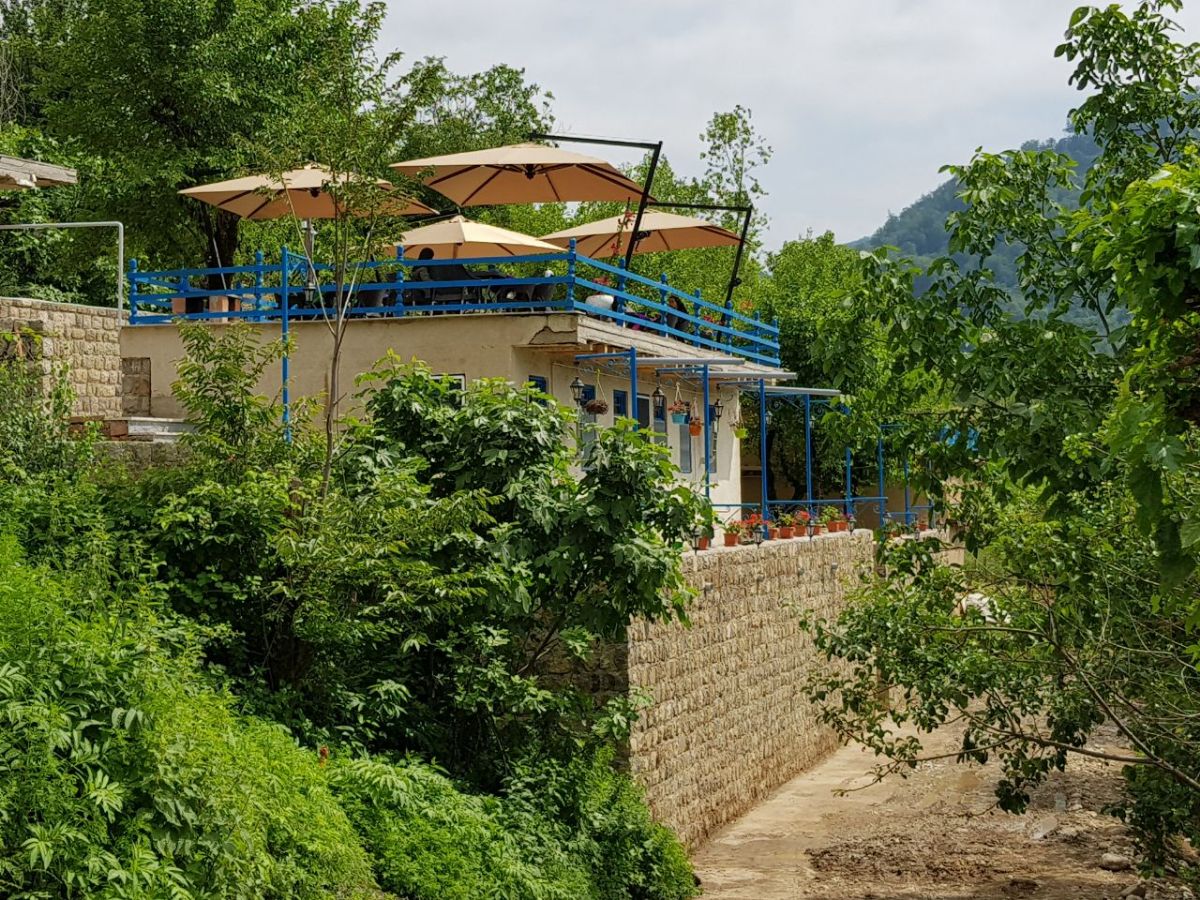
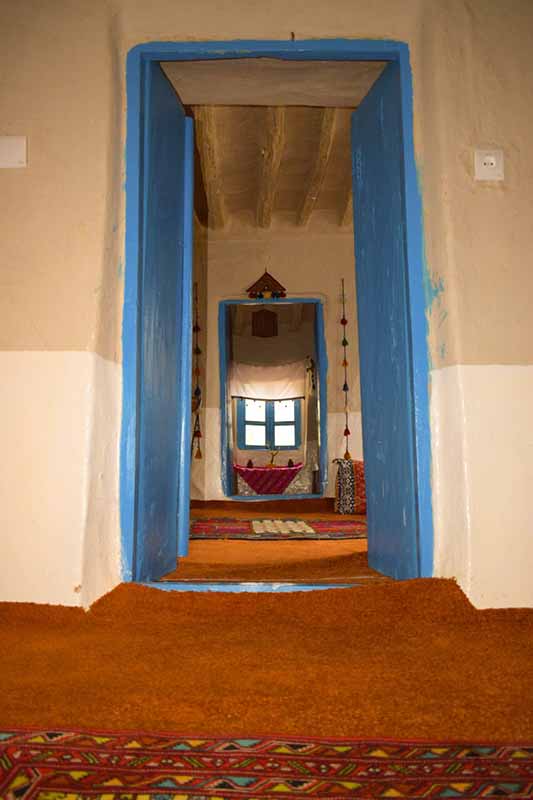
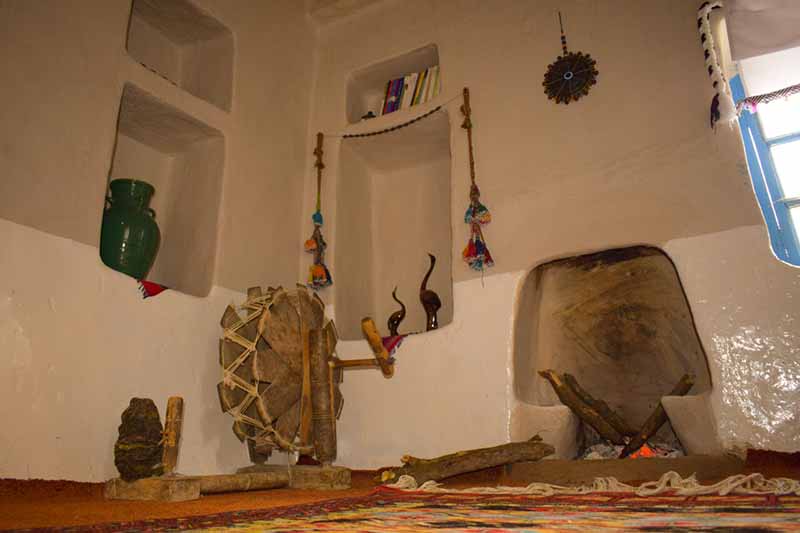
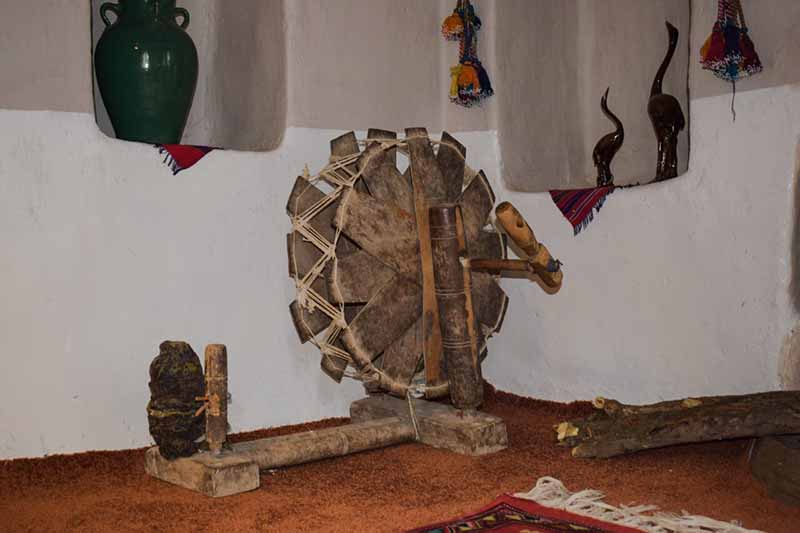
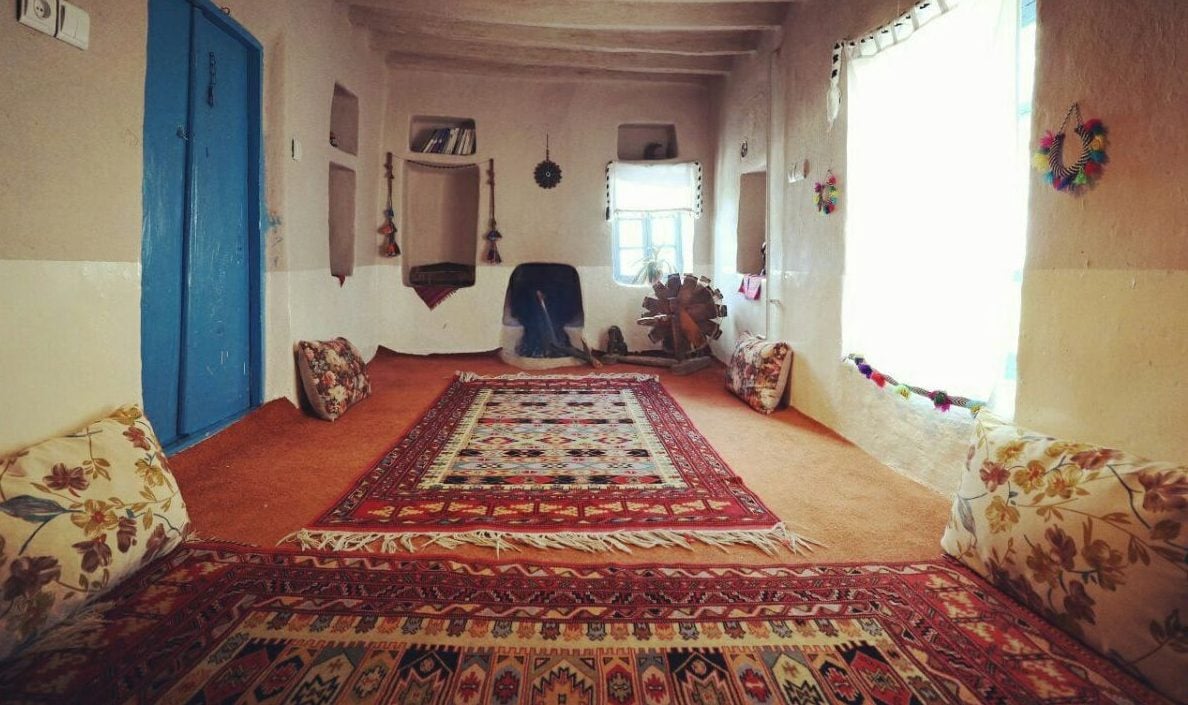
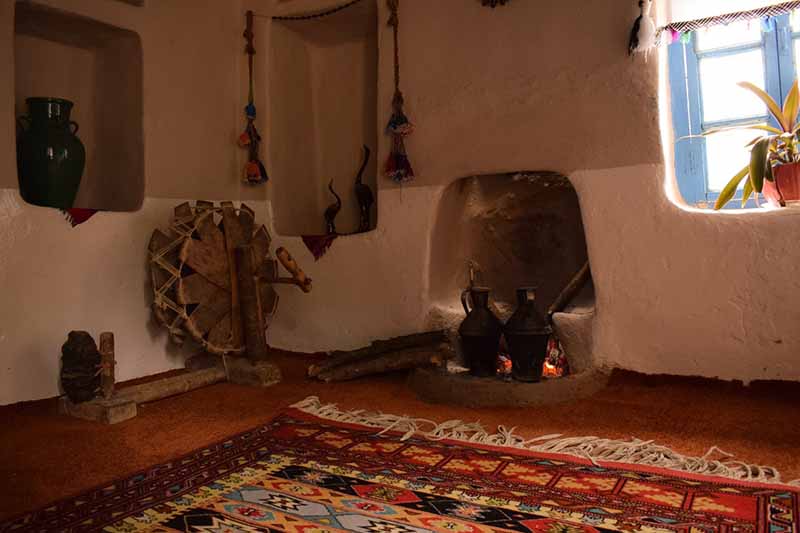
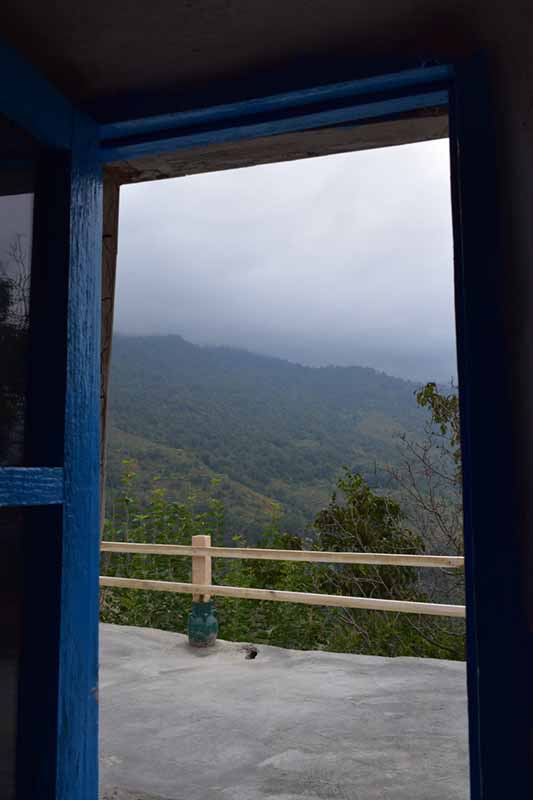
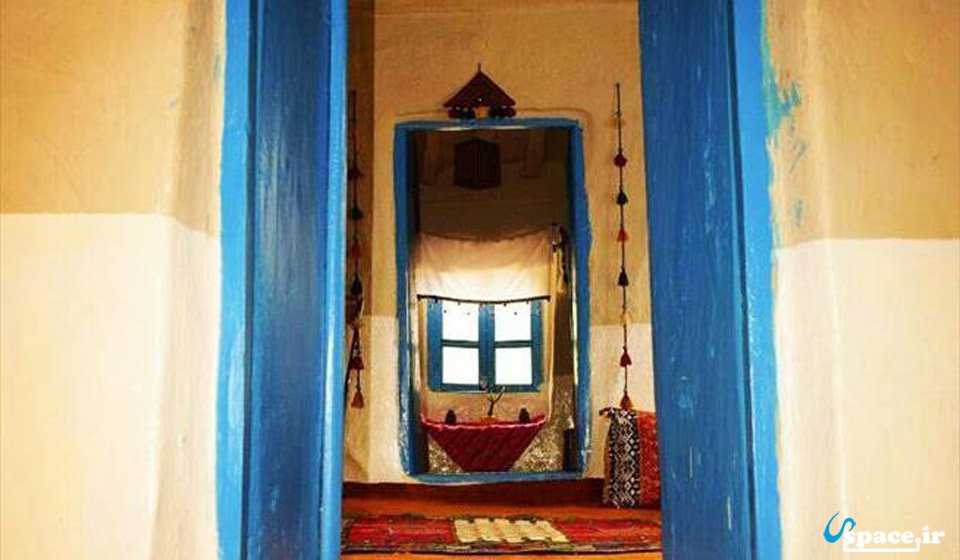
The lodge which Raheleh has established in Sasang is made up of two separate buildings with seven rooms in the heart of Hyrcanian forests.

Elaborating on the lodge’s establishment, which took one and a half years, Raheleh says, “Two years ago, during the early days of the New Persian Year, my daughter and I took a tour of village roads to find an appropriate place for establishing an eco-lodge. I found it in Sasang village. We loved it very much and began to hold dialogue with the rural women on living costs in their village. I told them that I like to live with them. They were surprised to see that an urban woman wants to migrate to a remote village. I tried to establish a good relation with them.”

She further noted that she held talks with the officials to rent a piece of ground to establish her eco-lodge. “At first, they didn’t trust us and we had problems.”

According to Raheleh, at first, no villager was ready to rent her a house or ground, saying they didn’t trust women when it comes to issues like this.

One year on, Raheleh visited Sasang once again, this time, along with a male colleague. She was shocked to see that this time the villagers eagerly rented a home to her male colleague.

“We began to repair the rented houses for at least three months. We first began our work last year with a building with three rooms. About five to six months later we expanded it to two buildings,” she said.

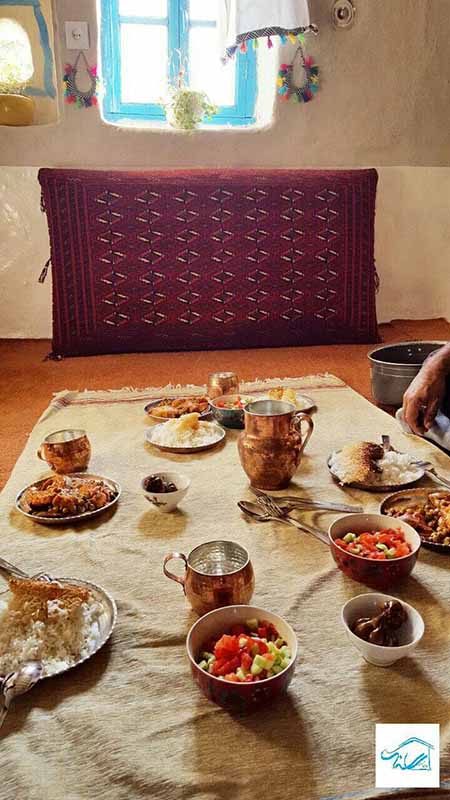
Valery is 30 year-old girl from Switzerland who came to visit Iran. She entered the kitchen and enjoyed its interior decoration after making a tour of the village. Valery returned to her country with the good memory of Iranian hospitality and the delicious taste of noodle soup.

Sasang eco-lodge is now the only destinations in the village with the rural women as its main staff. Raheleh says she became determined to press ahead with her project to attract the dismayed women of the village. “One of the main motives that pushed me forward was to create jobs for the village’s women. I was impressed by their dismay. They asked me why I wanted to migrate to here. They said they wished to change their lives with mine. There was a deep dismay in their statements and looks which deeply impressed me.”

Iranian Woman Abandons City to Breathe Life into Remote Village
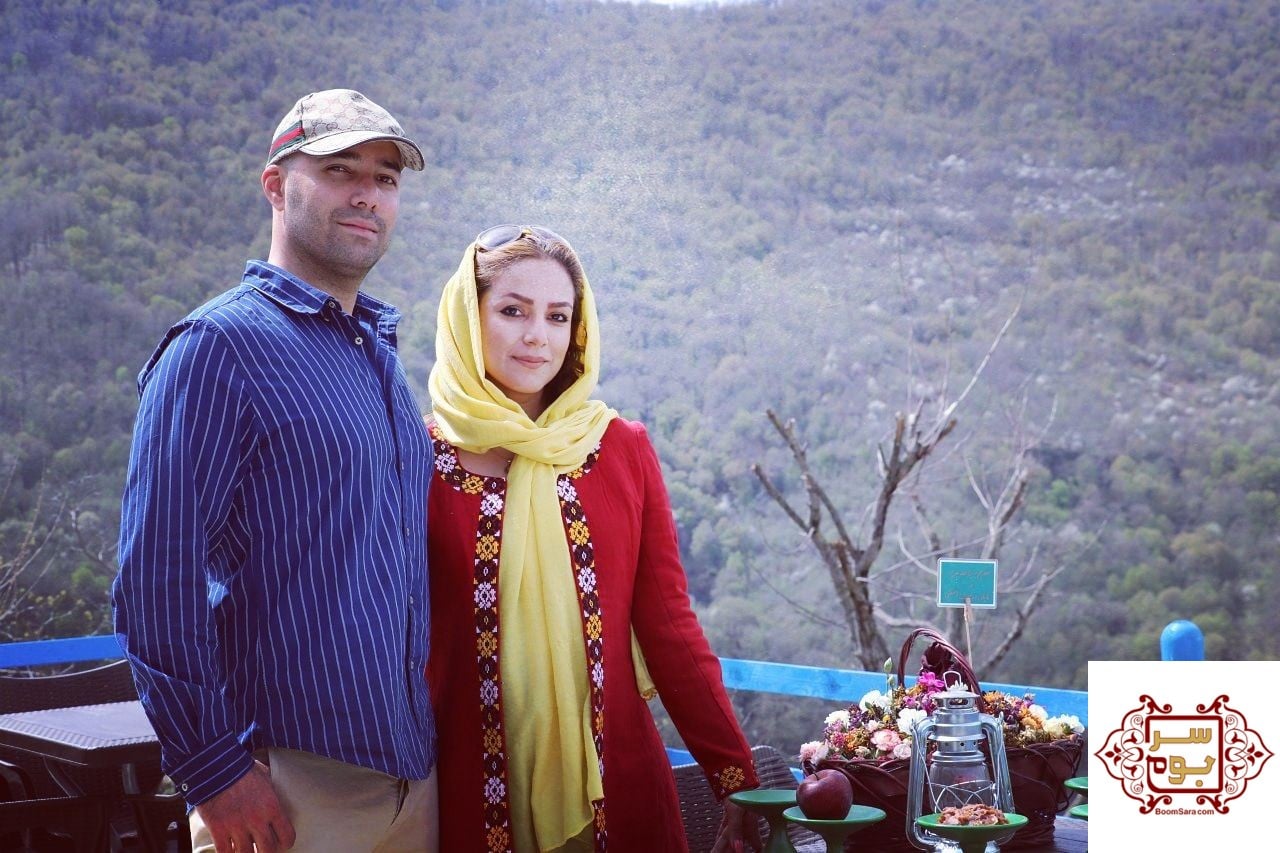
Raheleh Ahmadi, the manager and founder of Sasang eco-lodge, along with her brother

Raheleh said during early days of her career, she sat on a mattress under a walnut tree holding talks with the rural girls who came to confabulate with her.

“I told myself I should do something to make these girls hopeful. I had to do it. So, I decided to put at least 10 years of my life into the project to turn their absolute dismay into hope,” she added.

According to Raheleh, the project was very difficult. “I spent one and a half years of my two years in Sasang in hard conditions because the locals rejected me. There are some abnormal behaviours in the rural areas which is difficult to decode. As a lonely woman with a different appearance, I could potentially create misunderstanding. But I tried to act and wear like them. I sat for talks with them to hear their sufferings and help them.”

Raheleh maintains that the villagers had come to this belief that through eco-lodges they can earn revenues. “After one and a half years, other villagers became encouraged to build their own lodges.”

“During our peak seasons, when our lodge with a capacity of 25 passengers is filled, we send other tourists to the locals’ homes to create revenues for them. They take the tourists on a tour of the village and get them involved in tourist projects,” she noted.

Raheleh says eco-tourism business begin from our home, adding each home gains its identity with the presence of women. “Many tourists choose to come to our residency because they say it has a female atmosphere which distinguishes it from other residencies. Women are better hosts. That’s why the guests feel better when hosted by a woman.”

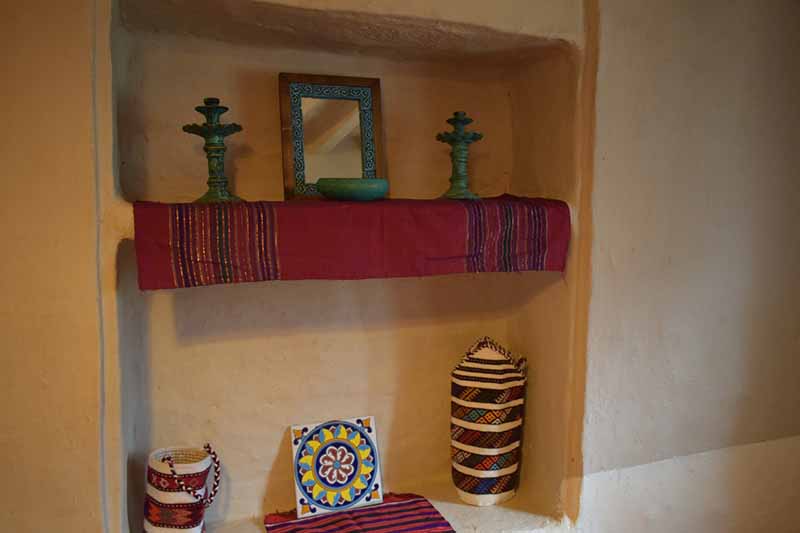
What follows is a collection of photos from Sasanh eco-lodge:

First Neanderthal Human Tooth Discovered in Iran

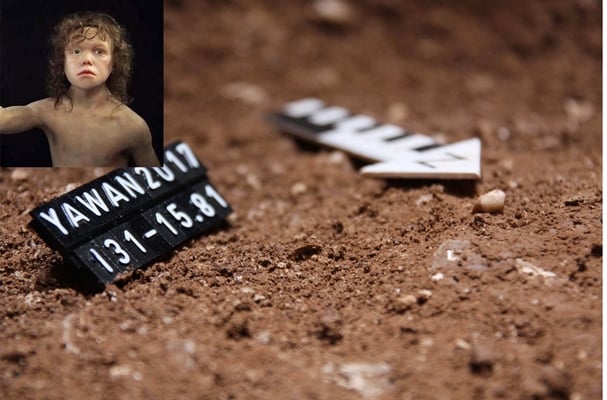
Saman Heydari Goran, head of the archaeological site, announced Sunday that it is the first time the remains of a Neanderthal human is being discovered in Iran.

He said the tooth belongs to a six-year-old child that was found along with some rocky tools of the middle Paleolithic period.

“Based on our studies, this tooth dates back to 42,000-45,000 years ago, and belongs to communities close to the present time,” said Heydari.

The Iranian Cultural Heritage Research Centre’s website quoted him as saying that other similar teeth have also been discovered in Spain, France and Germany.

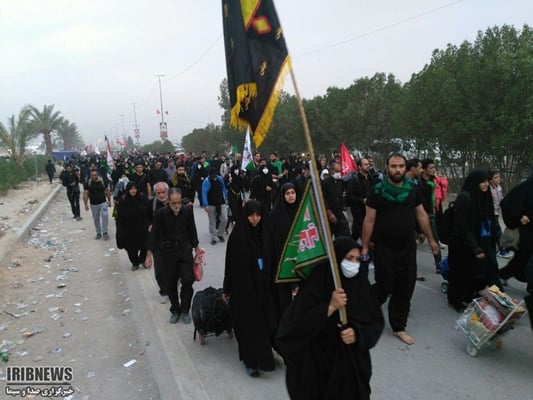
1,600 Iranian Journalists Due in Iraq to Cover Arb’aeen

The news was recently announced by the Director of the Information Committee on Arba’een.

Alavi told reporters that the committee builds on its earlier experiences gained over the past years to give an appropriate coverage to the pilgrimage.

He said enemies are plotting to tarnish the image of the pilgrimage, and thus Iranian journalists should beware and open their eyes to such plots.

Touching on the importance of the presence of pilgrim-reporters in this year’s Arba’een coverage, he said relying merely on the official media capacities will prevent the committee from fully covering the big pilgrimage.

“That’s why, along with official correspondents from mainstream media, we need to rely on the help by any pilgrim who is willing to serve as a reporter to broadcast further news and beauties of Arba’een to the whole world,” he said.

According to the official, the Islamic Republic will dispatch about 1600 documentary-makers, correspondents, photographers and technical staff to Iraq for covering Arb’aeen.

“This year, 400 TV channels from 43 countries will cover the Arba’een epic. Meanwhile, about 1,200 experts from various countries will appear before the cameras of the Islamic Republic of Iran Broadcasting (IRIB) to elaborate on Arba’een,” he noted.

The committee director also said for the first time in the past years, at least 77 SNGs are set to be deployed in 13 stations allocated for Arba’een’s coverage.

According to Alavi, this year two media stations will be set up equipped with high-speed internet to provide the correspondents as well as the pilgrims with free access to the internet.

He then referred to the establishment of Radio Arba’een station, saying this year the radio will lively broadcast programs on Arba’een in Iraq. “This year, 40 radio frequencies broadcast programs in English, Arabic and Persian. Meanwhile, we have prepared at least 130 documentaries to be broadcast by the IRIB during Arba’een.”

Alavi said the presence of professional correspondents is highly significant for giving a full coverage to Arba’een. Therefore, he said, the media outlets should send their most professional correspondents to the pilgrimage.

“The media should provide their audiences with a full picture of the social and public order during the pilgrimage and we hope the order could get more widespread year by year,” he concluded.

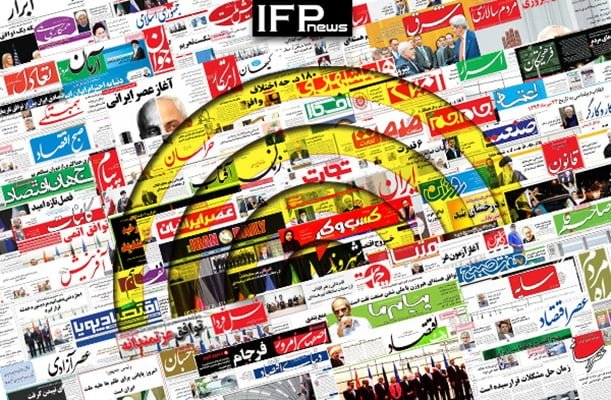
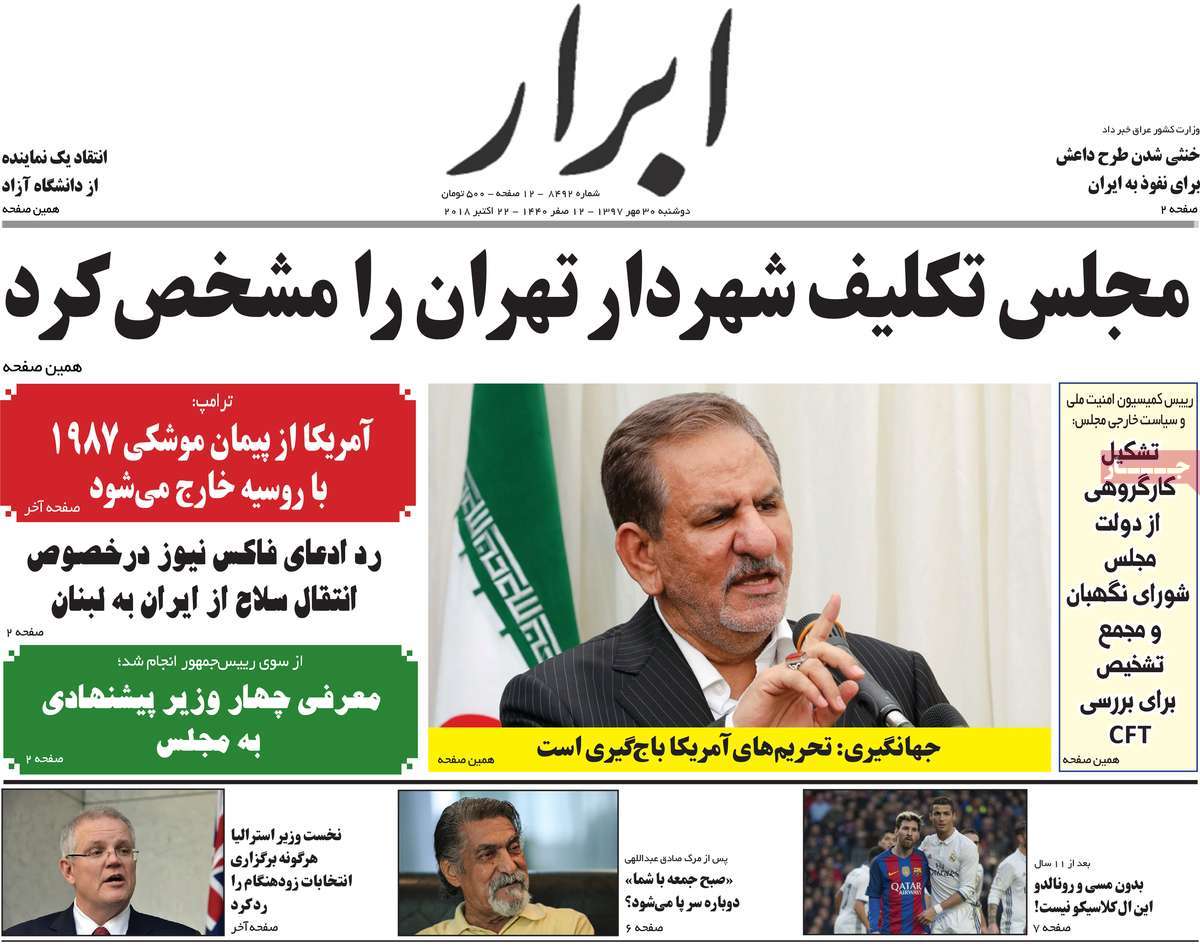
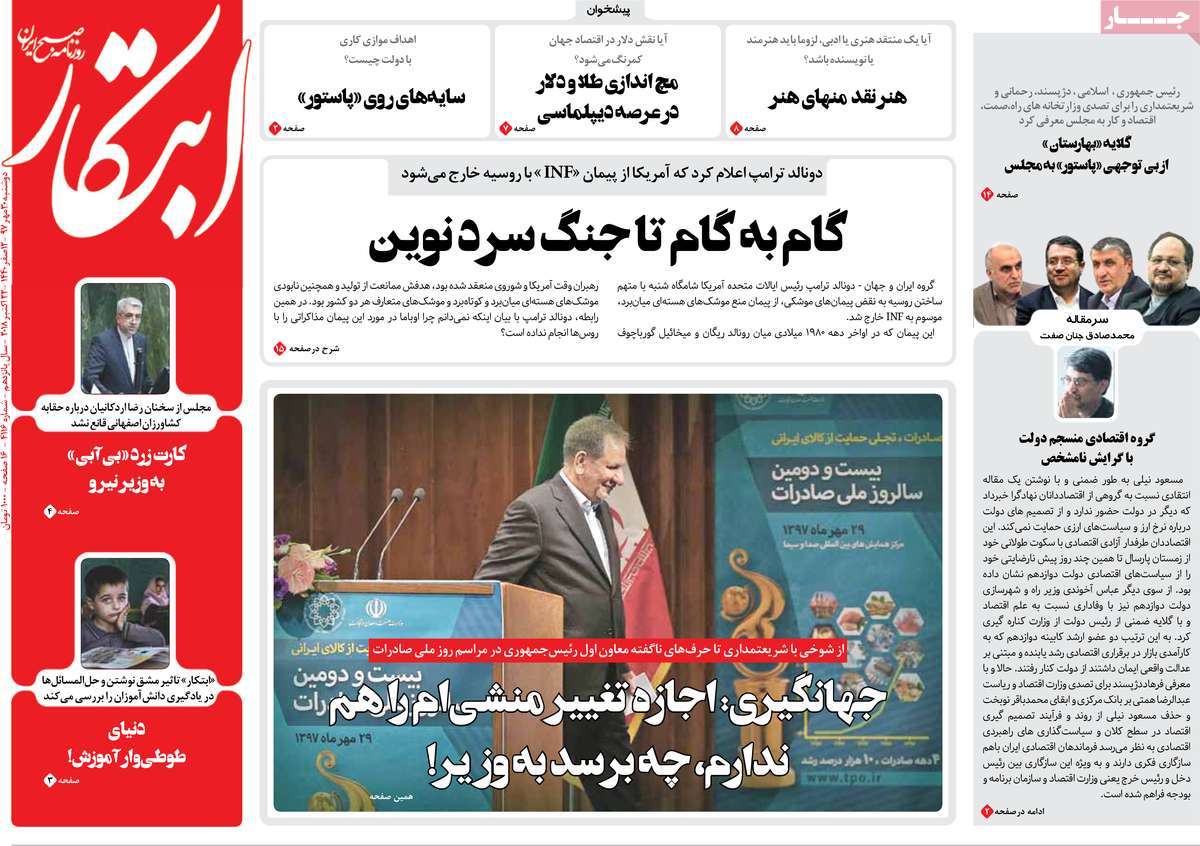
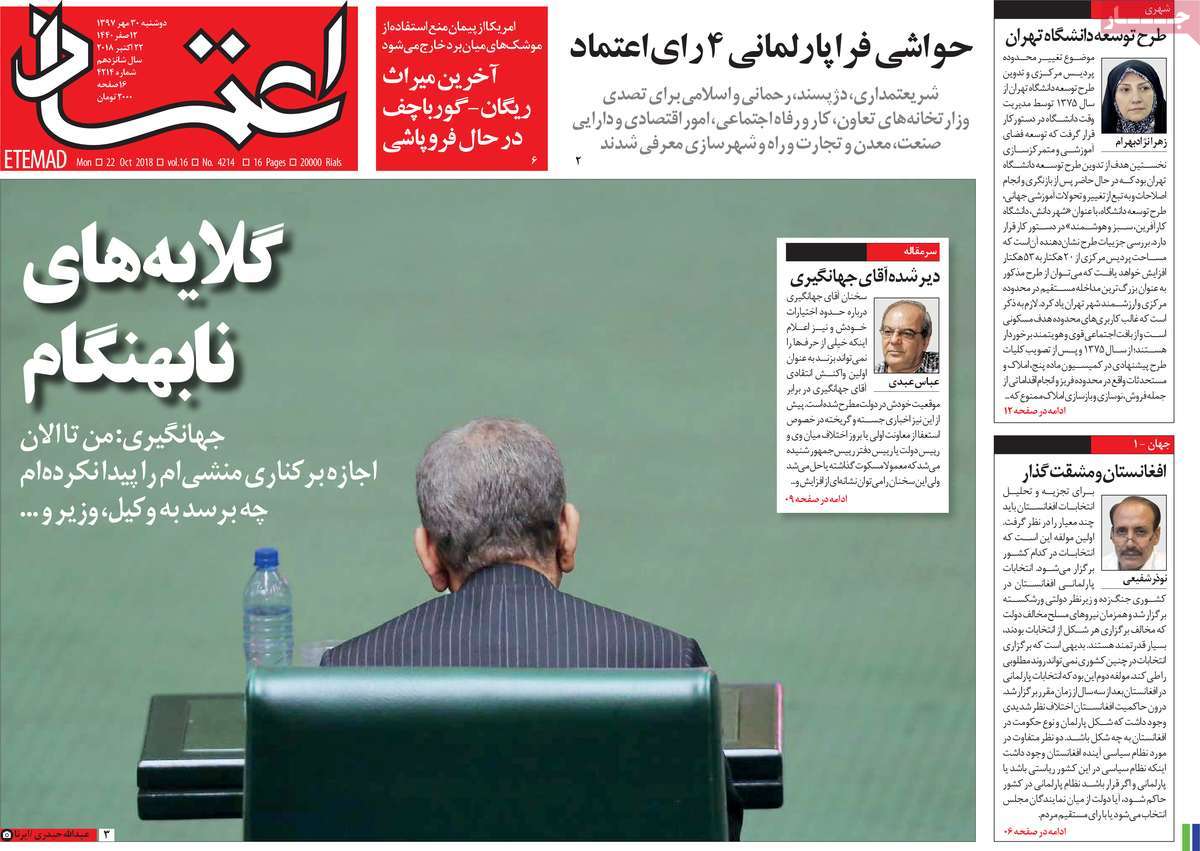
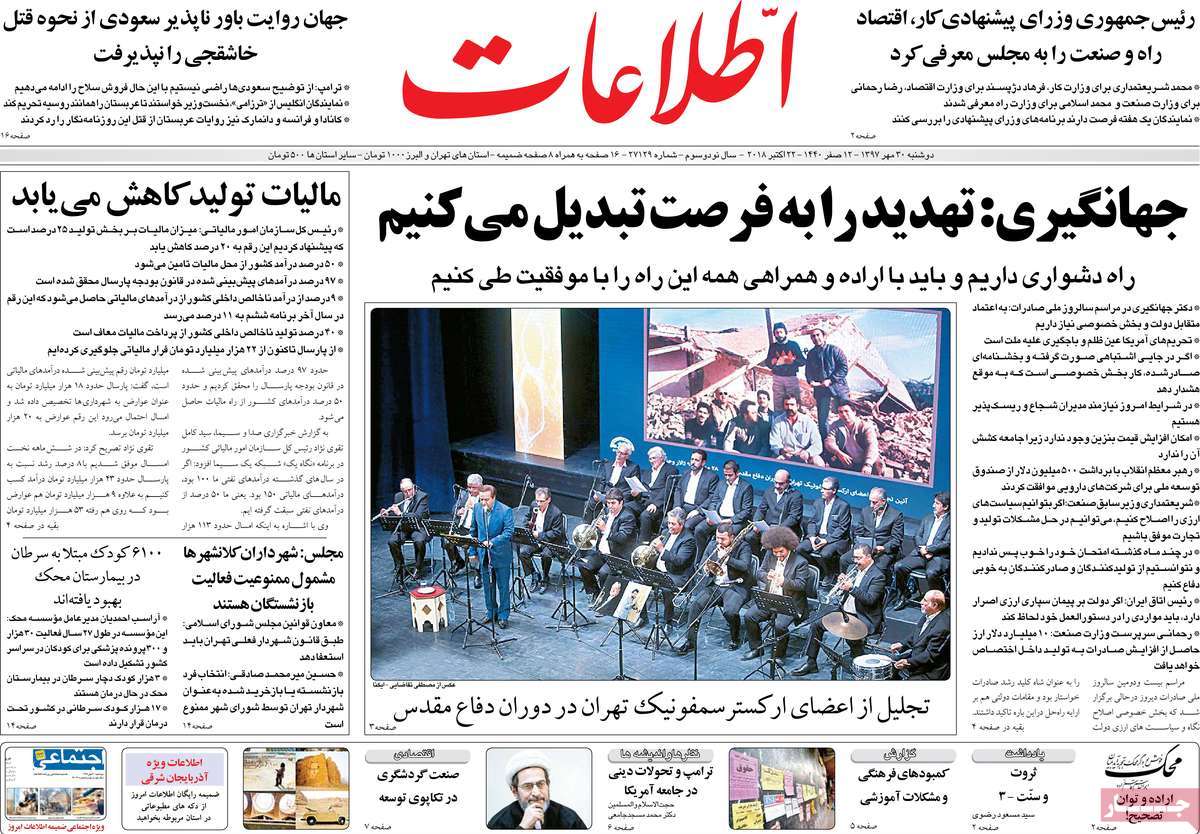
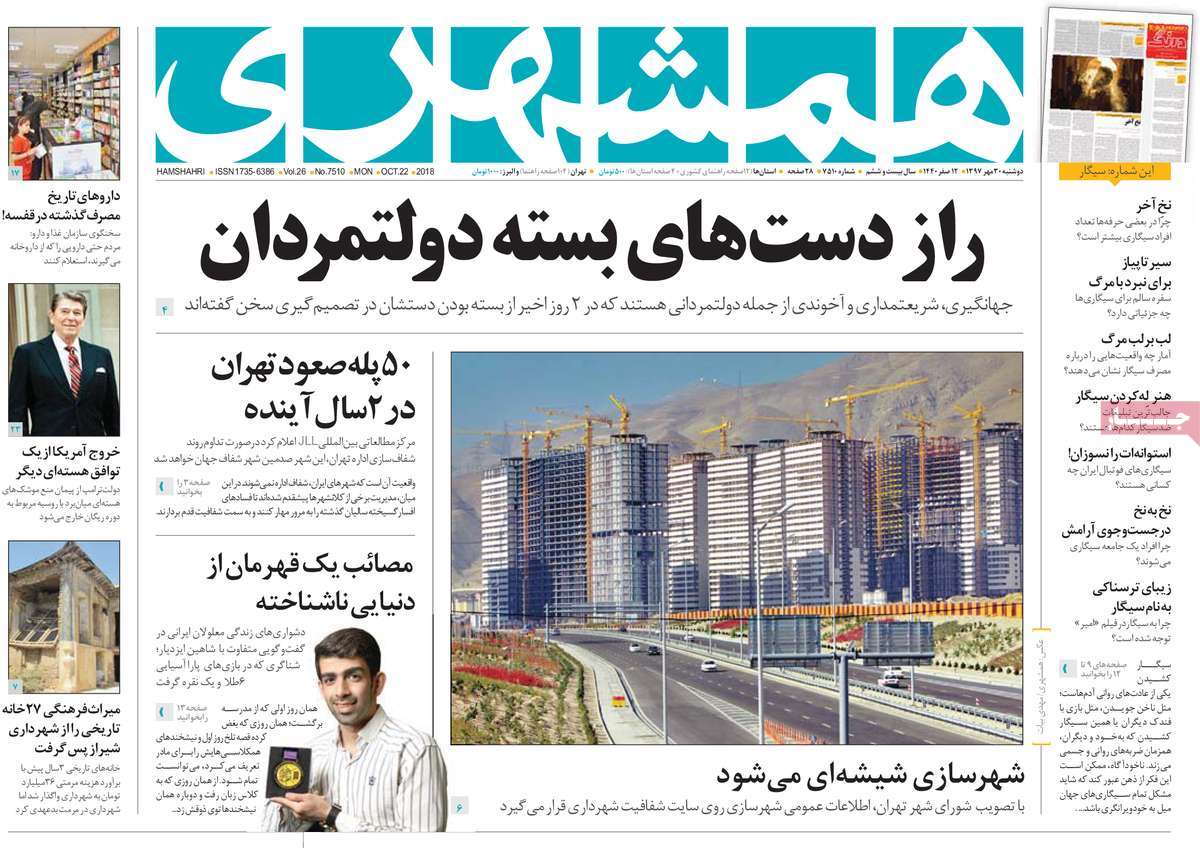
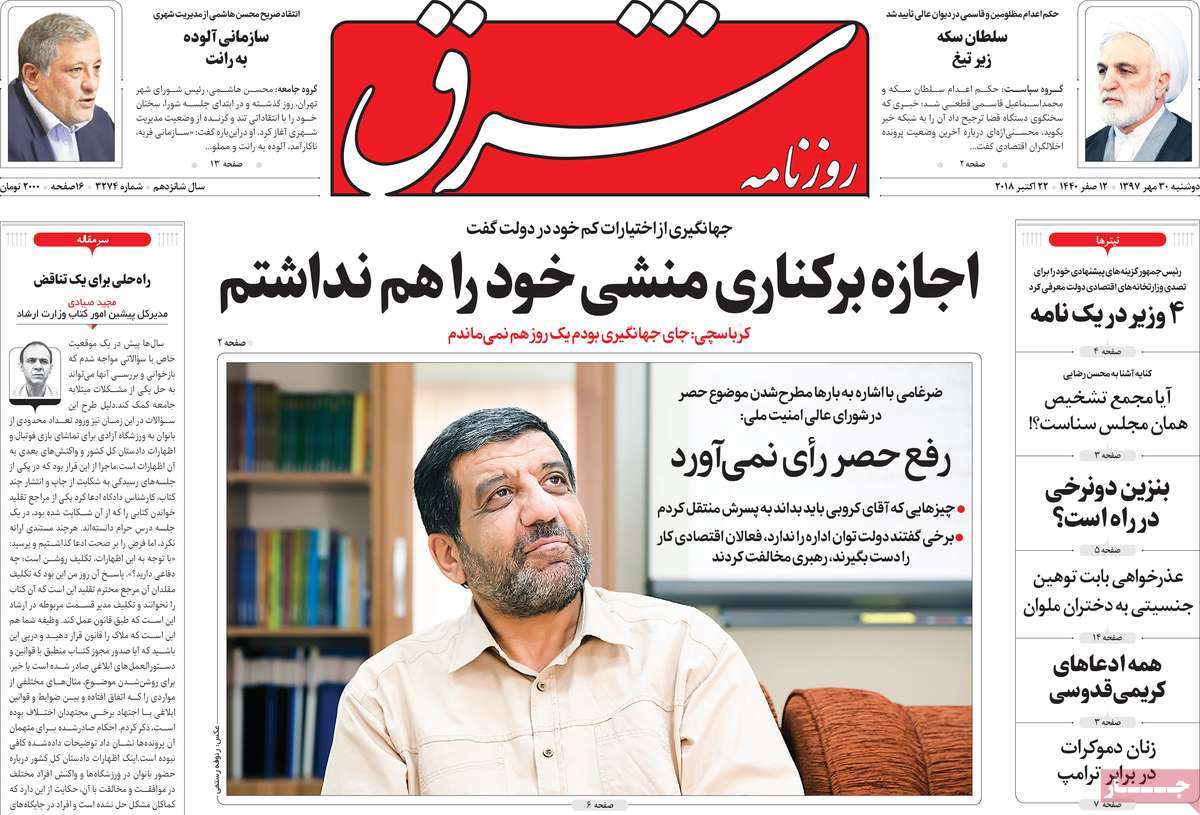
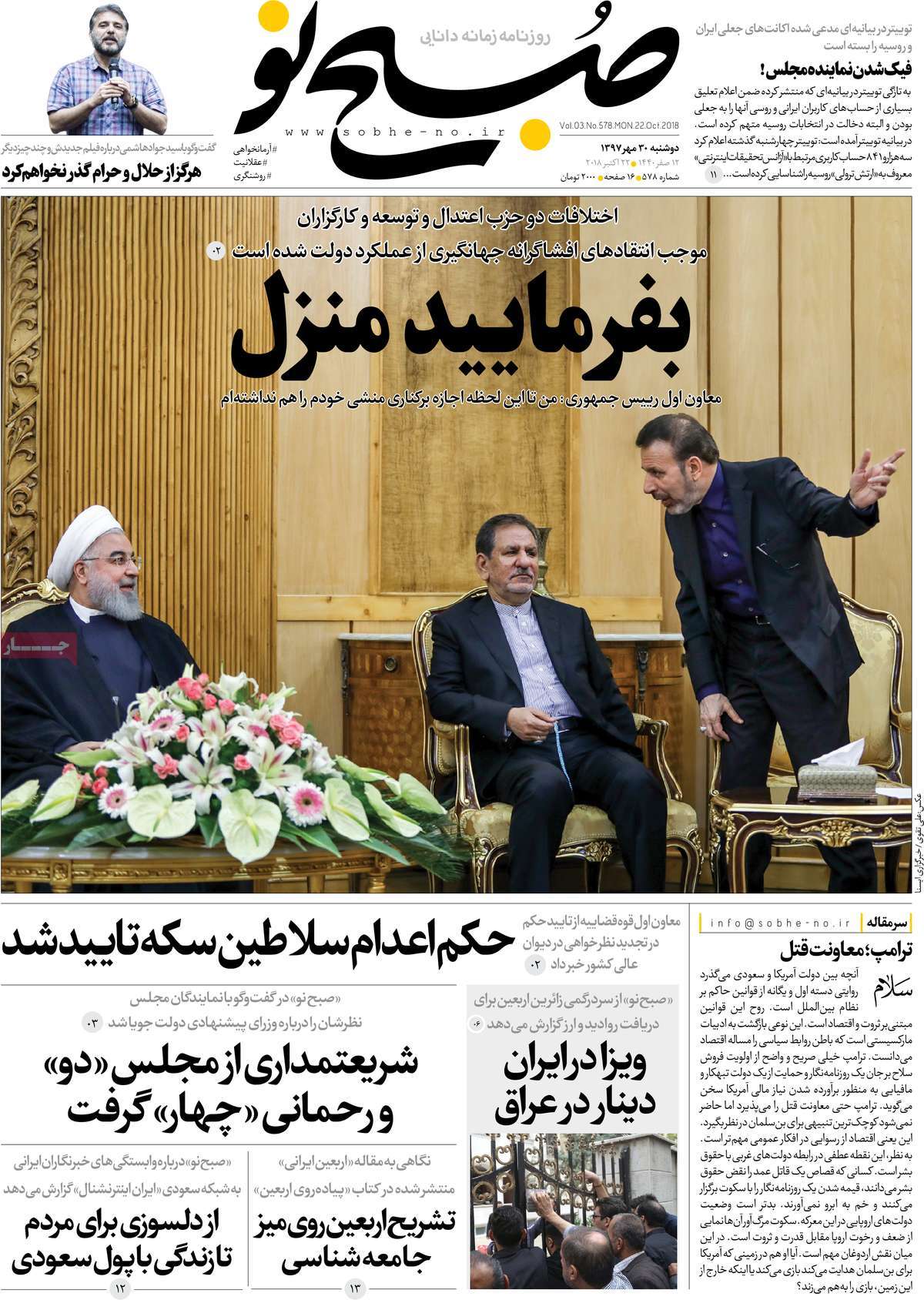
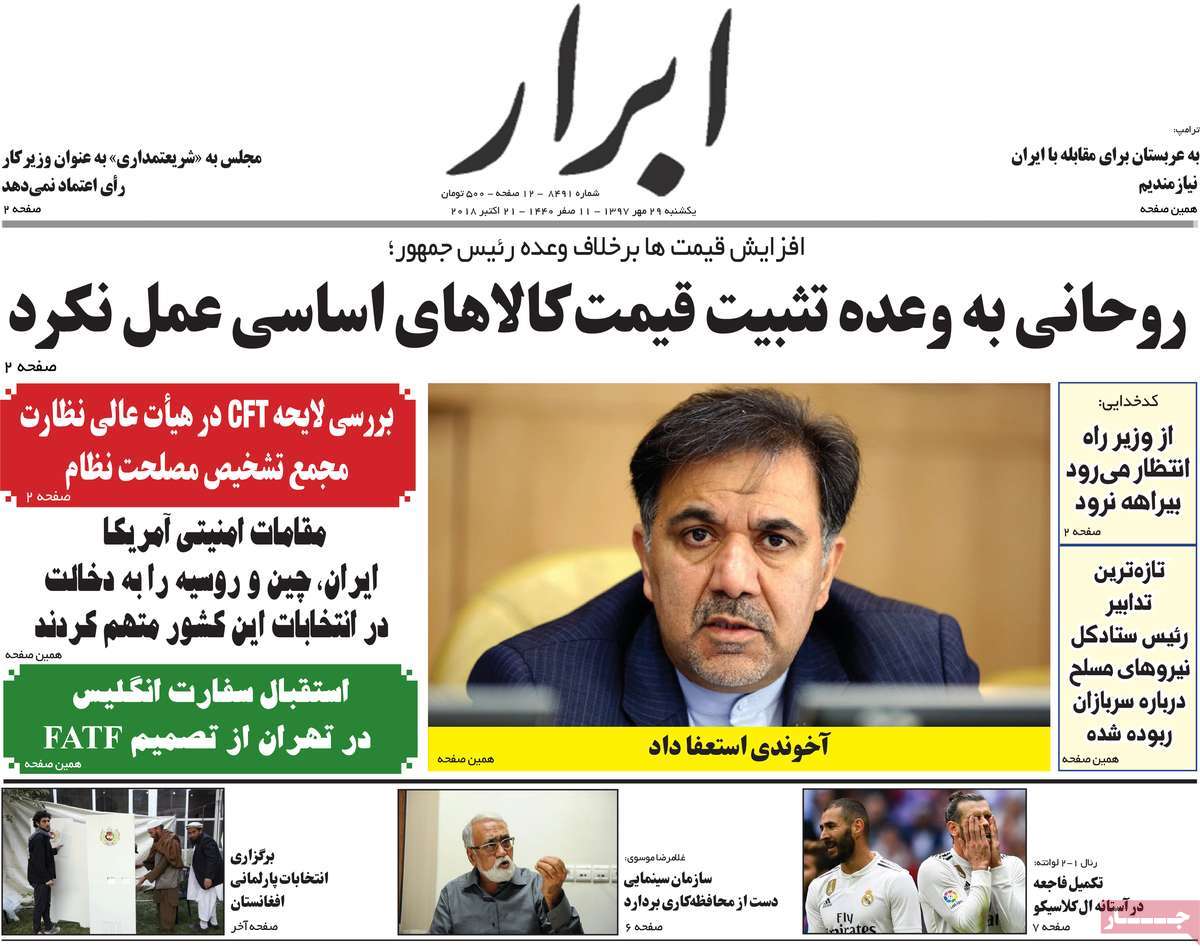
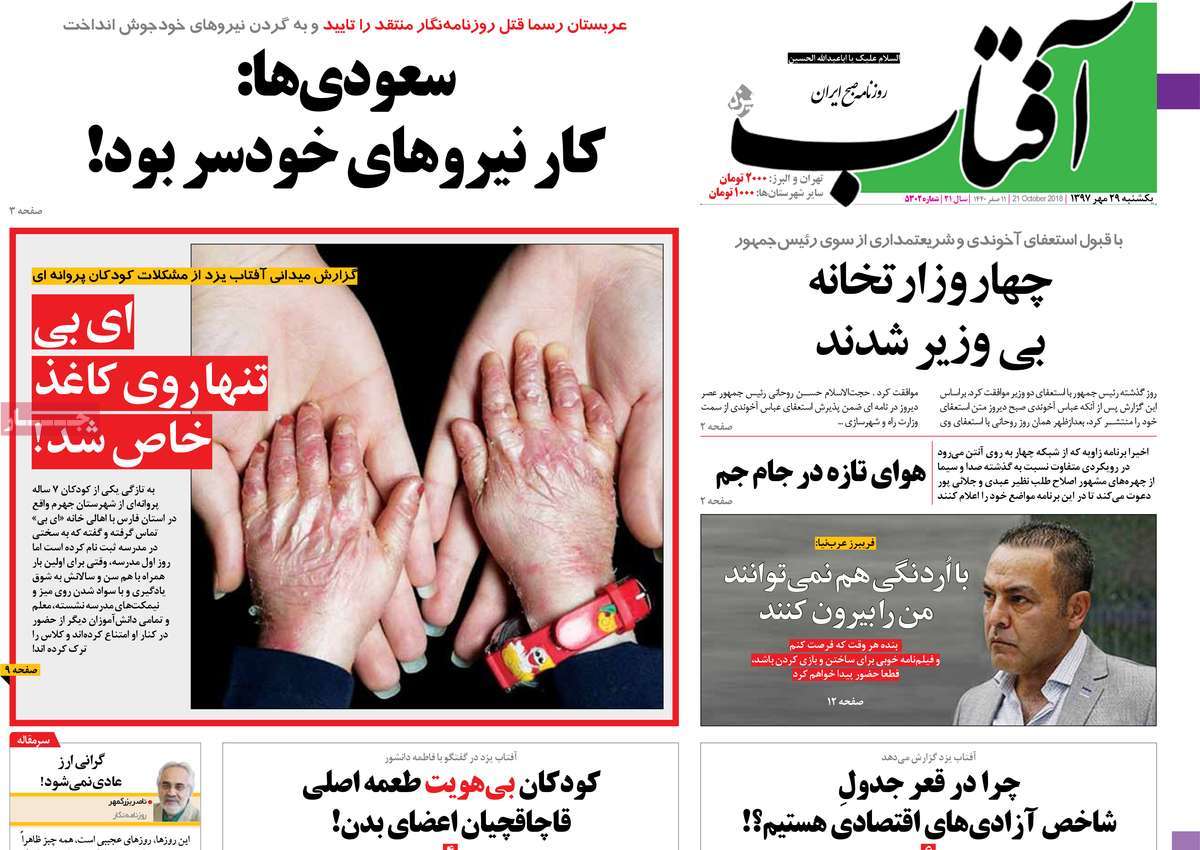
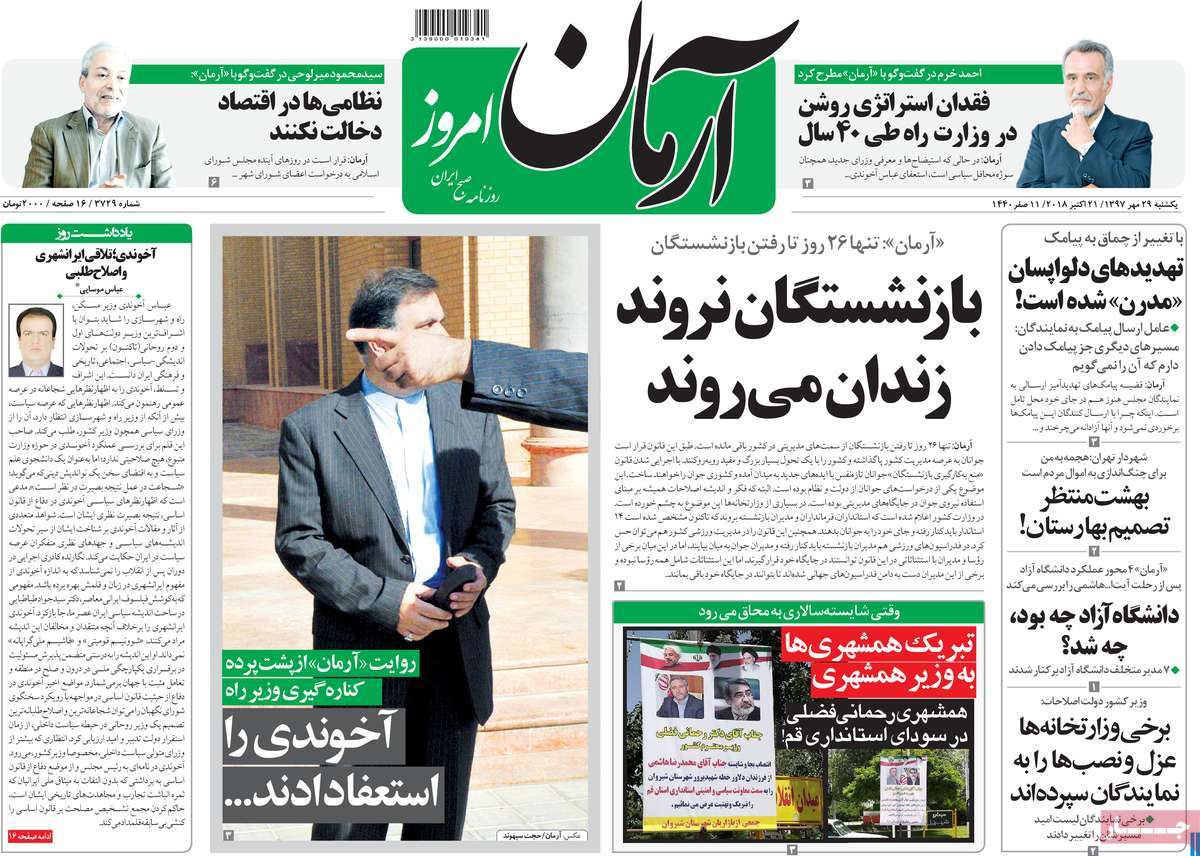
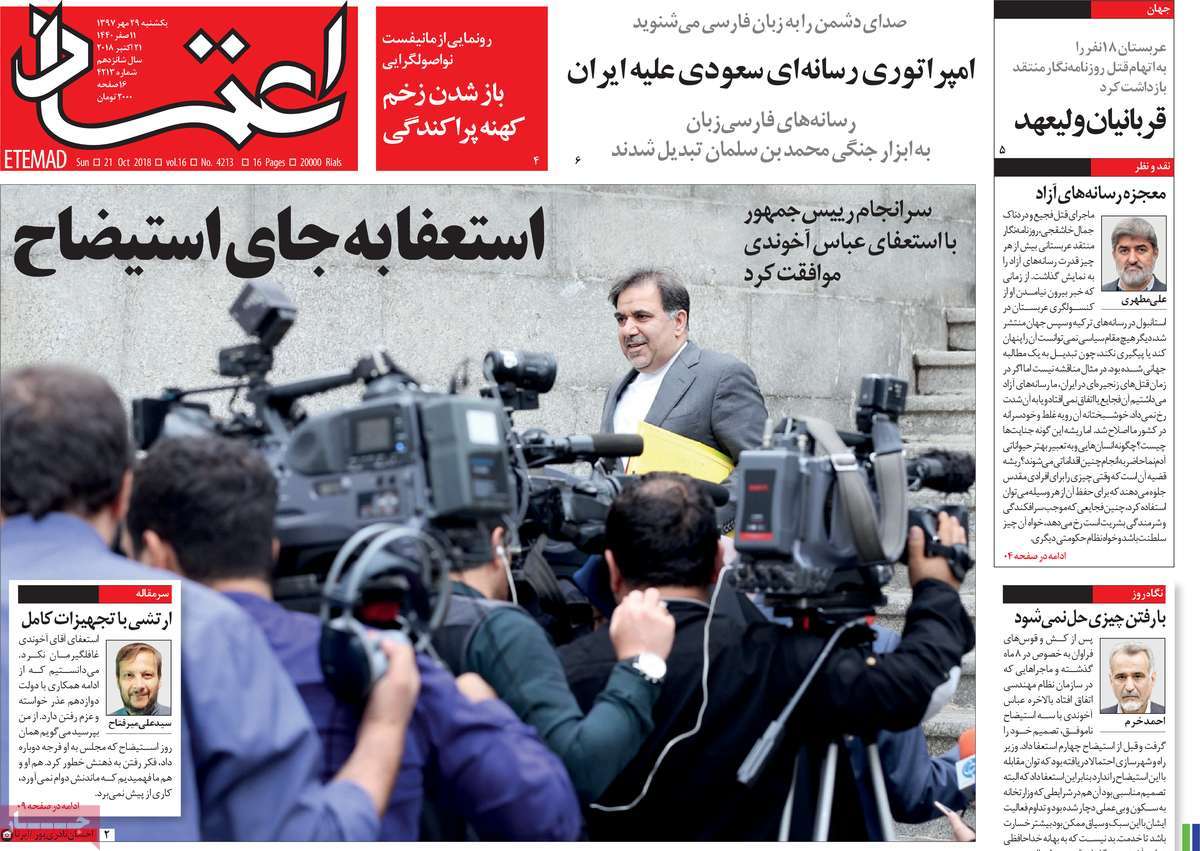
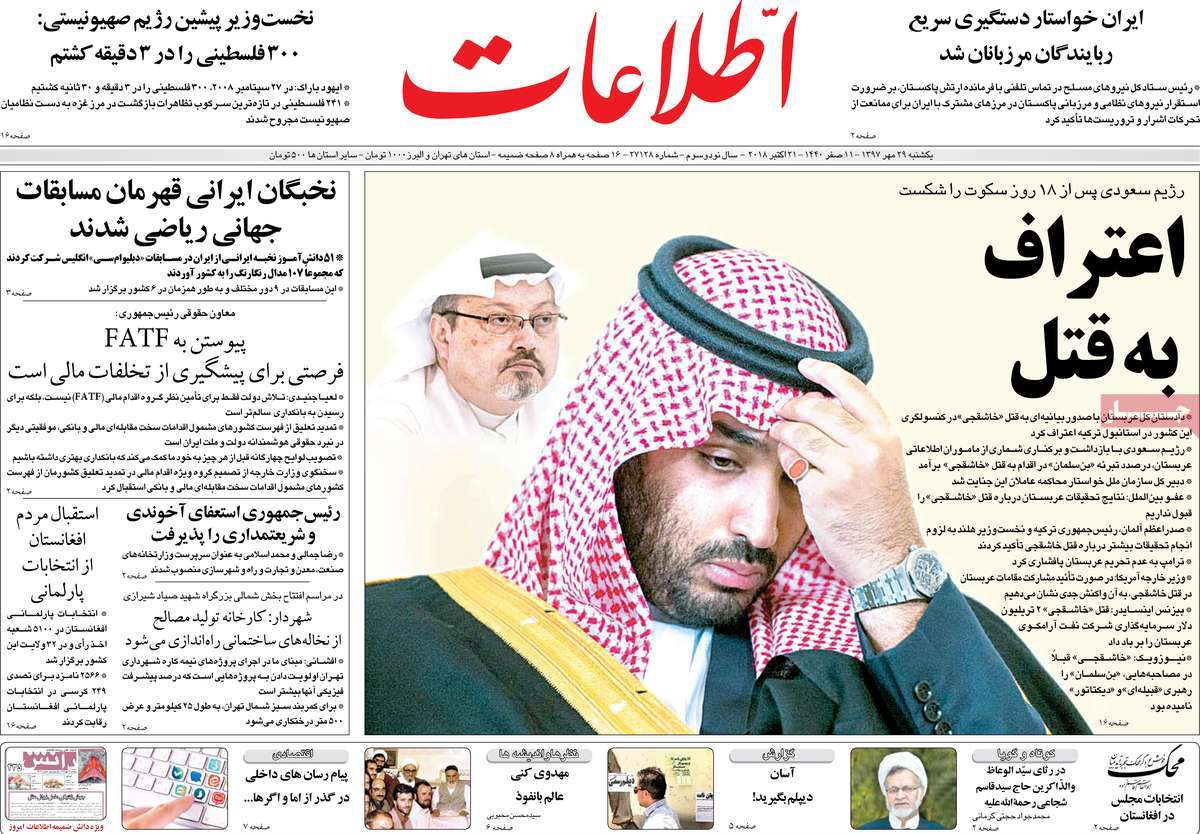
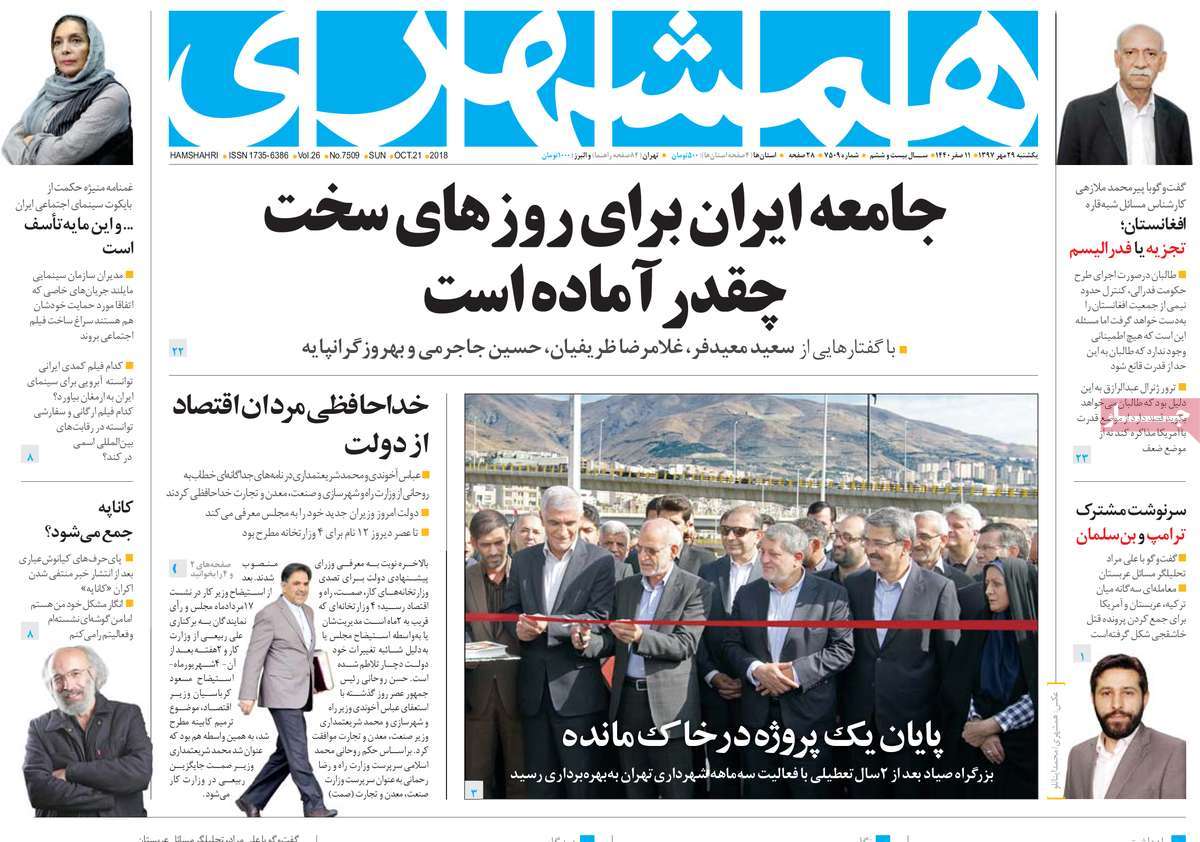
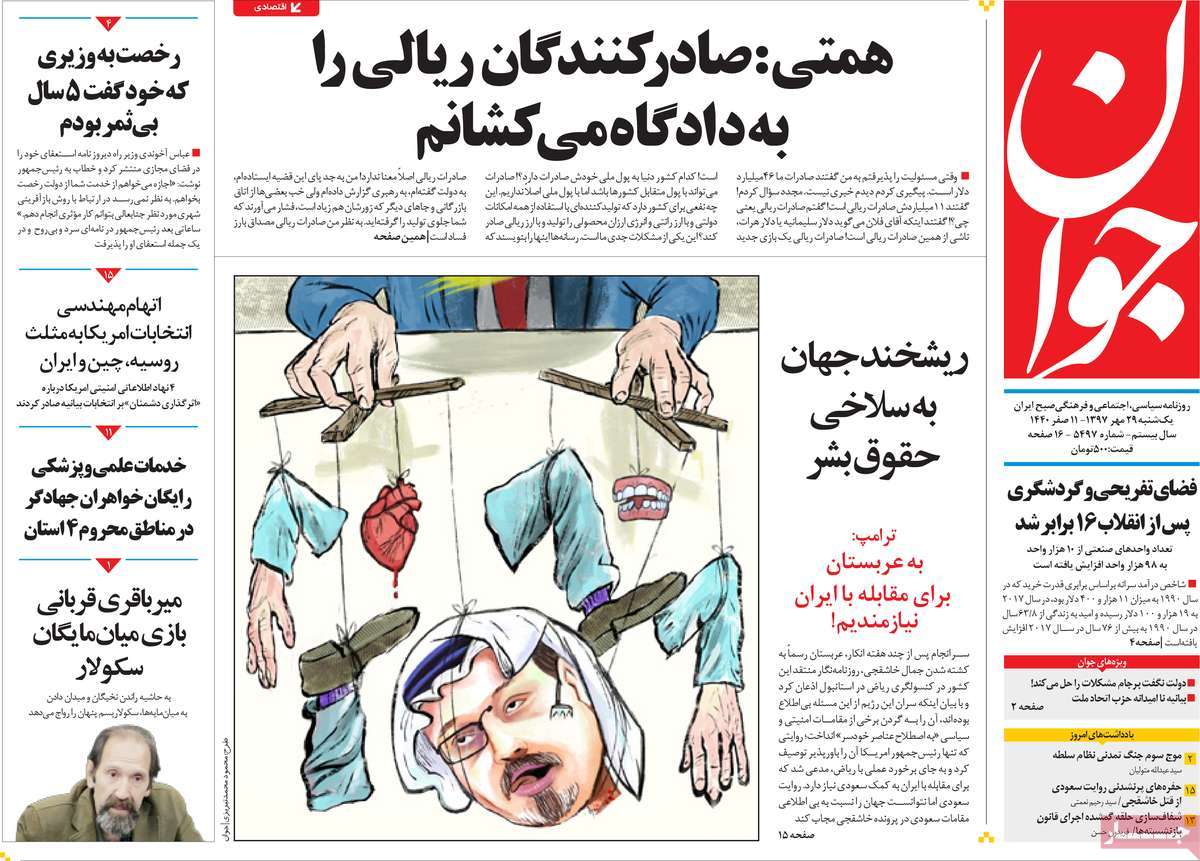
A Look at Iranian Newspaper Front Pages on October 21

A Look at Iranian Newspaper Front Pages on November 19

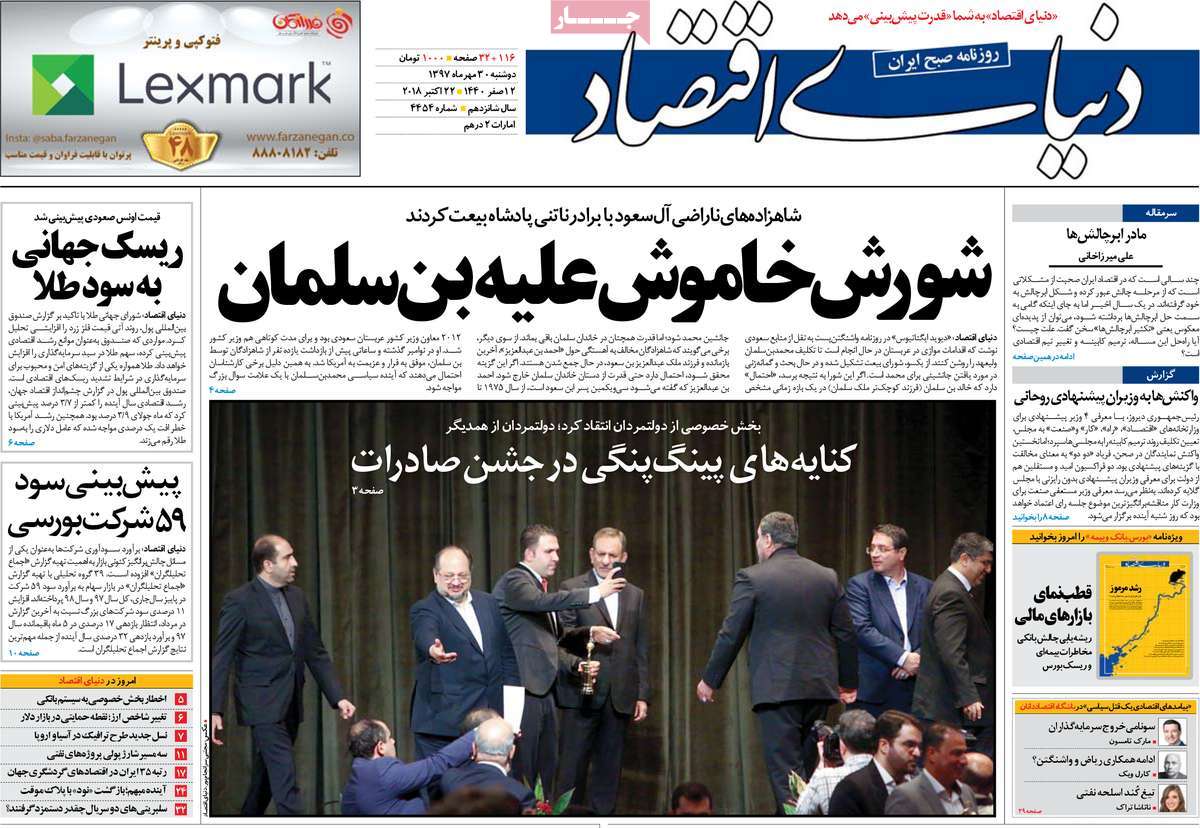
The top story in all papers today was Saudi Arabia’s confession of the murder of dissident journalist Jamal Khashoggi in the Kingdom’s consulate in Istanbul.

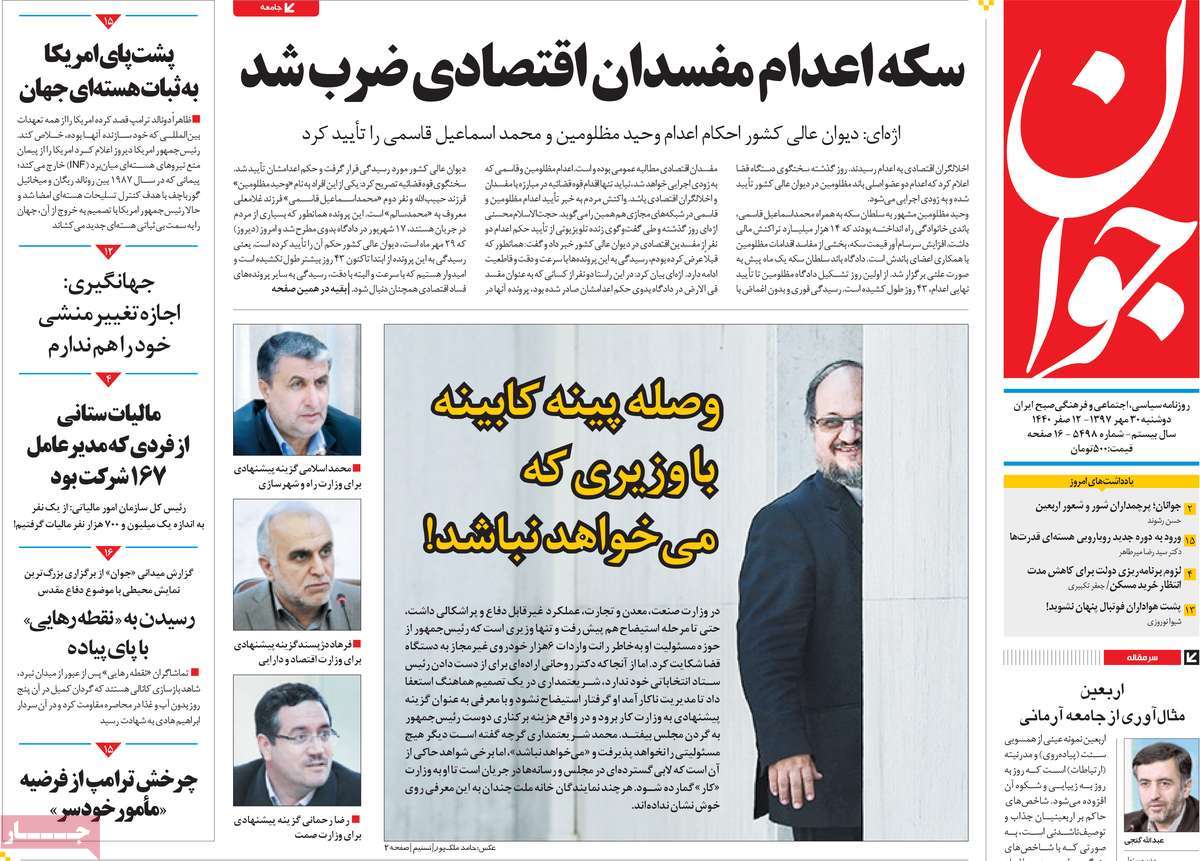
Several papers also covered the resignation of Iranian Roads and Urban Development Minister Abbas Akhondi, which was later accepted by President Hassan Rouhani.

The US Intelligence’s claim that Iran, Russia, and China have interfered in the US elections also received great coverage.

The above issues, as well as many more, are highlighted in the following headlines and top stories:


Abrar:

1- Iran’s Expediency Council Reviewing CFT Bill

2- British Embassy in Tehran Welcomes FATF’s Decision

A Look at Iranian Newspaper Front Pages on October 21


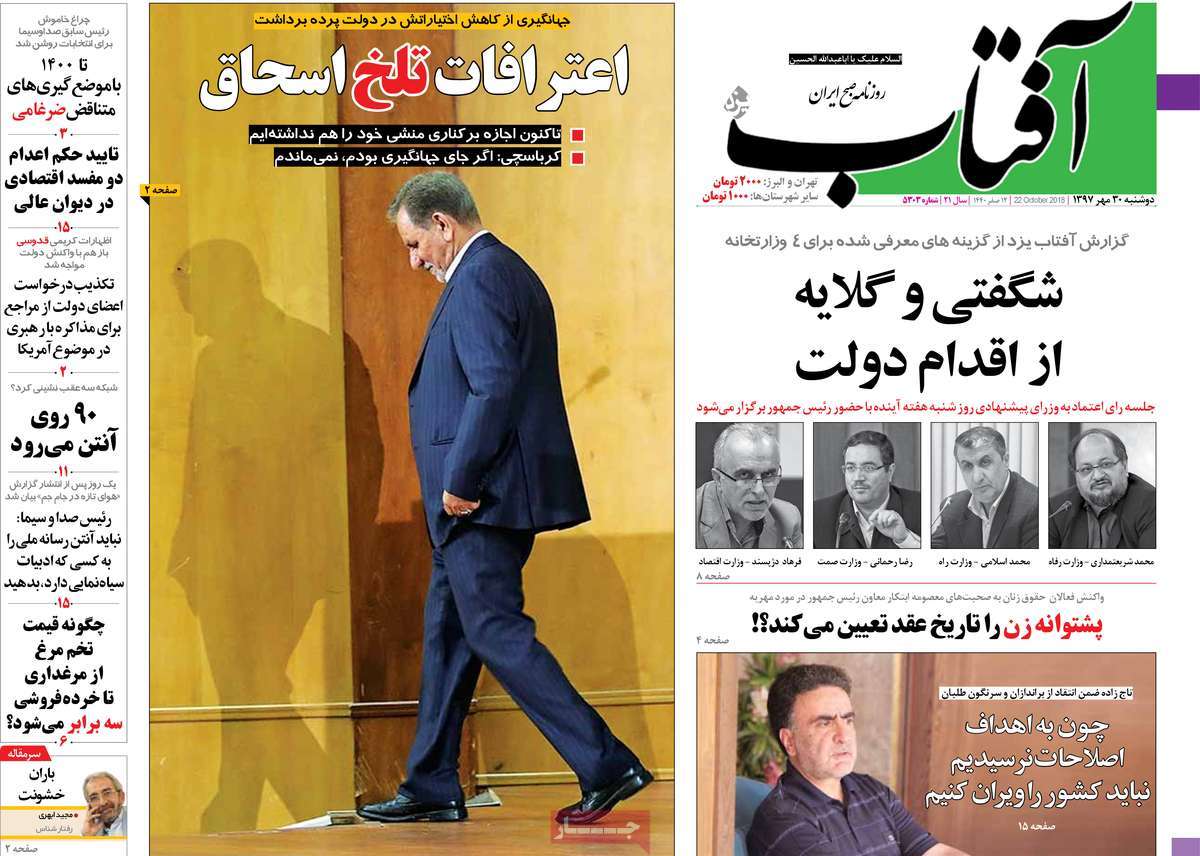
Aftab-e Yazd:

1- Four Ministries without a Minister

  • Rouhani Accepts Resignations of Roads, Industry Ministers

2- Saudis: Rogue People Killed Khashoggi!

  • Riyadh Officially Admits Murder of Dissident Journalist, Blames Rogue Elements

A Look at Iranian Newspaper Front Pages on October 21


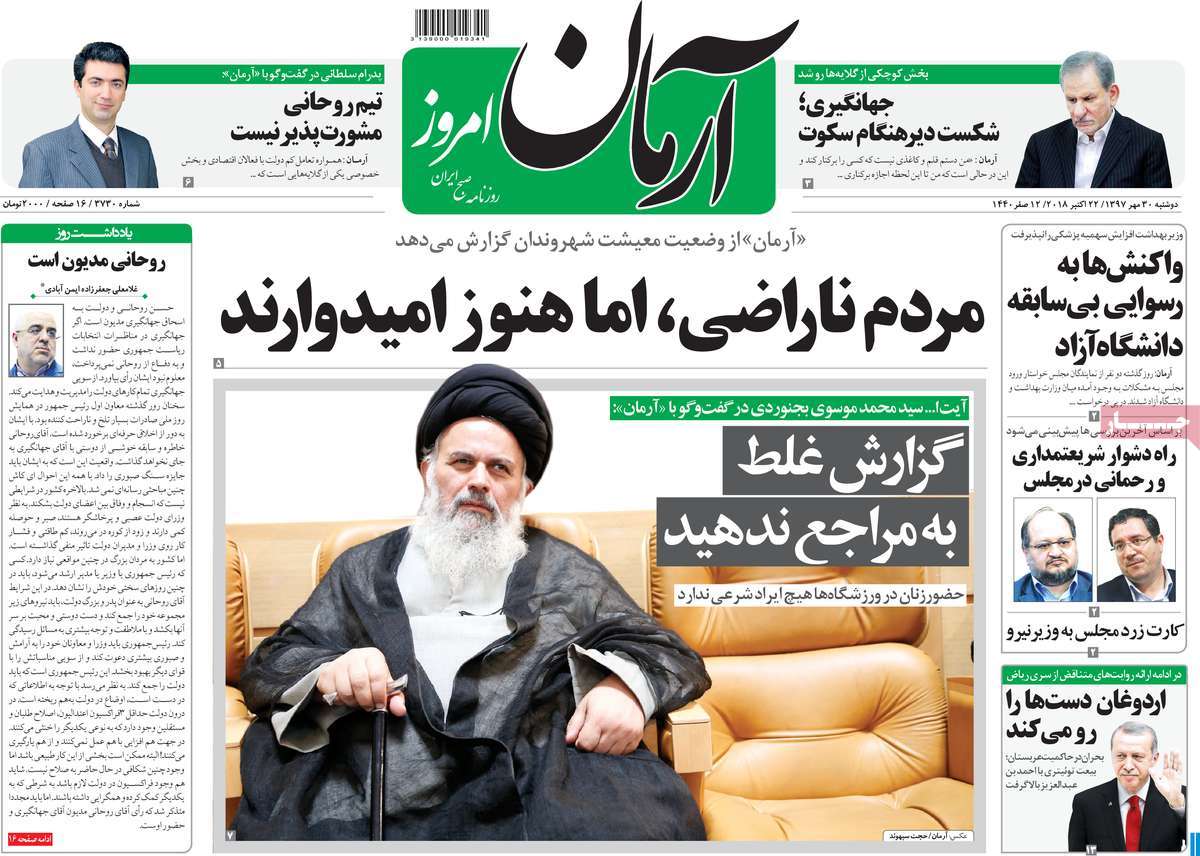
Arman-e Emrooz:

1- Retired People Should Even Leave Office or Go to Jail

  • Only 26 Days to Deadline for Retired Executives

A Look at Iranian Newspaper Front Pages on October 21


Ebtekar:

1- Adel al-Jubeir May Fall Victim to Bin Salman’s Ambitions

A Look at Iranian Newspaper Front Pages on October 21


Etemad:

1- Saudi Media Empire against Iran: Persian-Language Media Turned into Bin Salman’s Warfare

2- Victims of Crown Price: Saudi Arabia Arrests 18 for Murder of Dissident Journalist

A Look at Iranian Newspaper Front Pages on October 21


Ettela’at:

1- Confession of Murder: Saudi Regime Breaks Its Silence after 18 Days

2- Iranian Elites Claim Title in World Math Competition

  • 51 Iranian Students Win 107 Medals in UK’s WMC

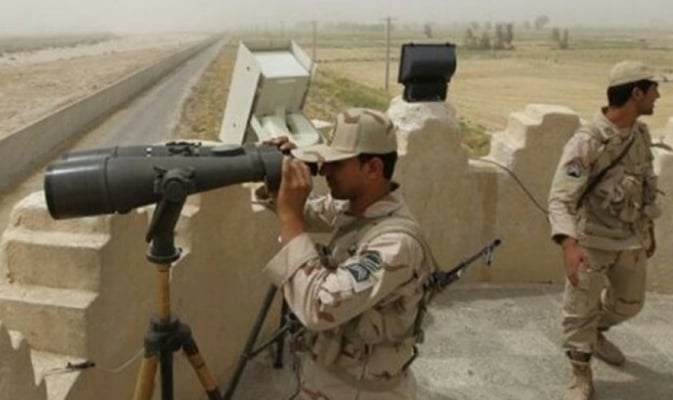
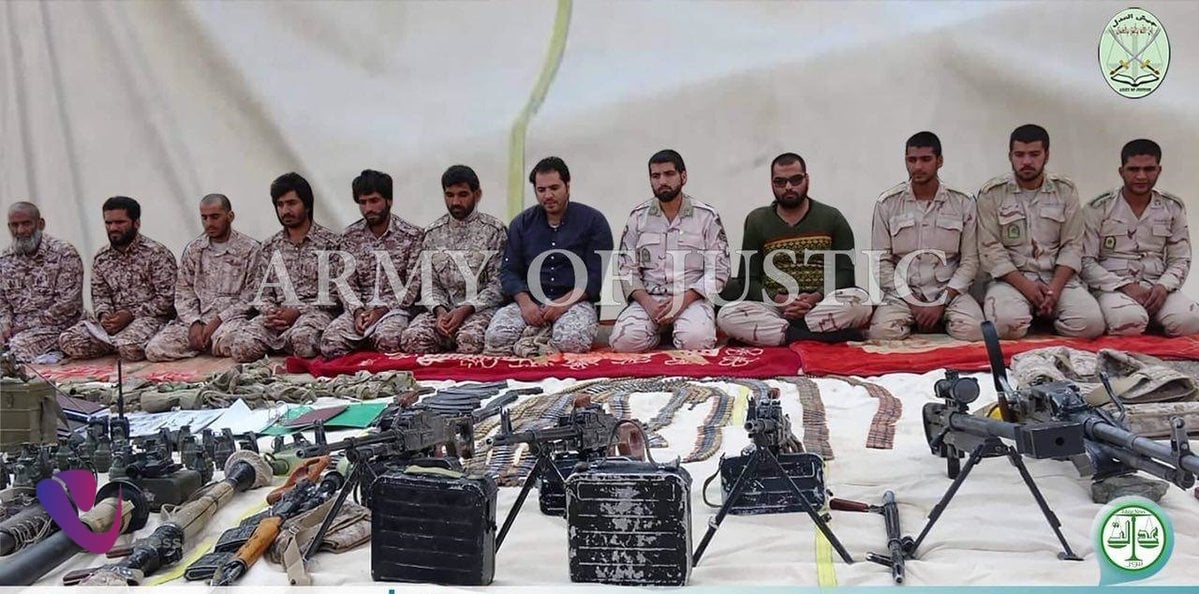
3- Iran Calls for Immediate Arrest of Those Who Abducted Border Guards

4- We Killed 300 Palestinians in 3 Minutes: Former Israeli PM

A Look at Iranian Newspaper Front Pages on October 21


Hamshahri:

1- Common Fates of Trump, Bin Salman

  • Analyst: Turkey, Saudi Arabia, US Reach Trilateral Deal on Khashoggi Case

A Look at Iranian Newspaper Front Pages on October 21


Javan:

1- World Laughed When Human Rights Slaughtered

2- Trump: We Need Saudi Arabia to Counter Iran!

3- US Accuses Russia, China, Iran of Interfering in Its Elections

A Look at Iranian Newspaper Front Pages on October 21


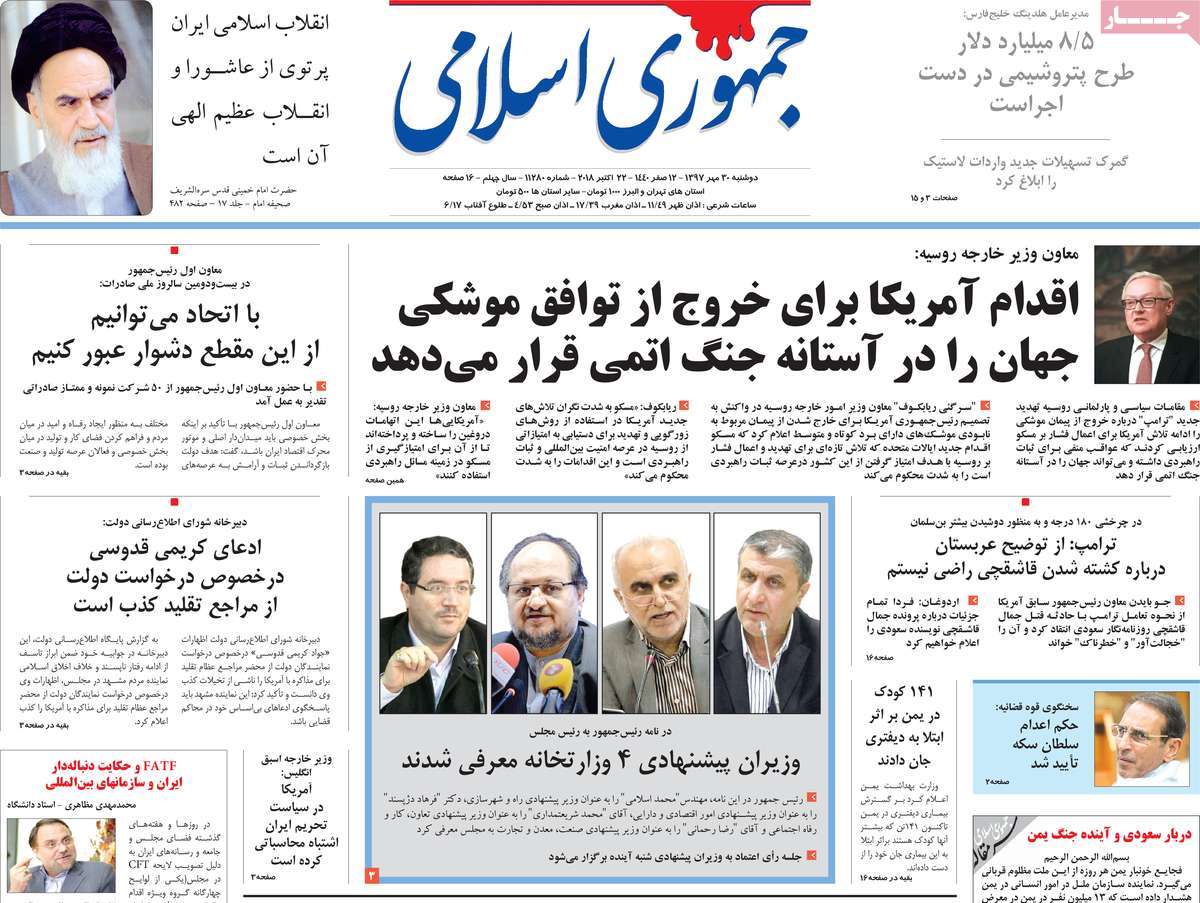
Jomhouri Eslami:

1- Bin Salman’s Bribe to White House Worked

2- Trump, Al Saud Have Probably Colluded over Khashoggi’s Case

A Look at Iranian Newspaper Front Pages on October 21


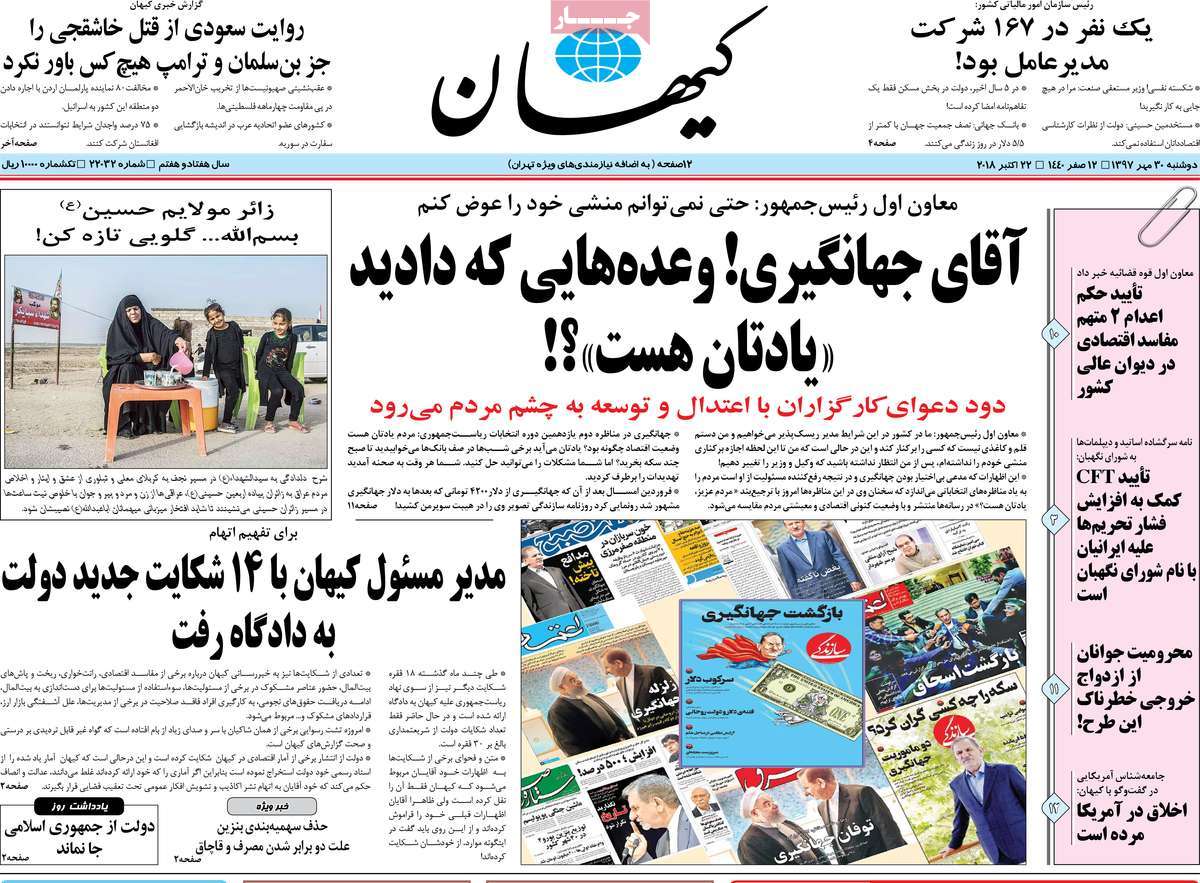
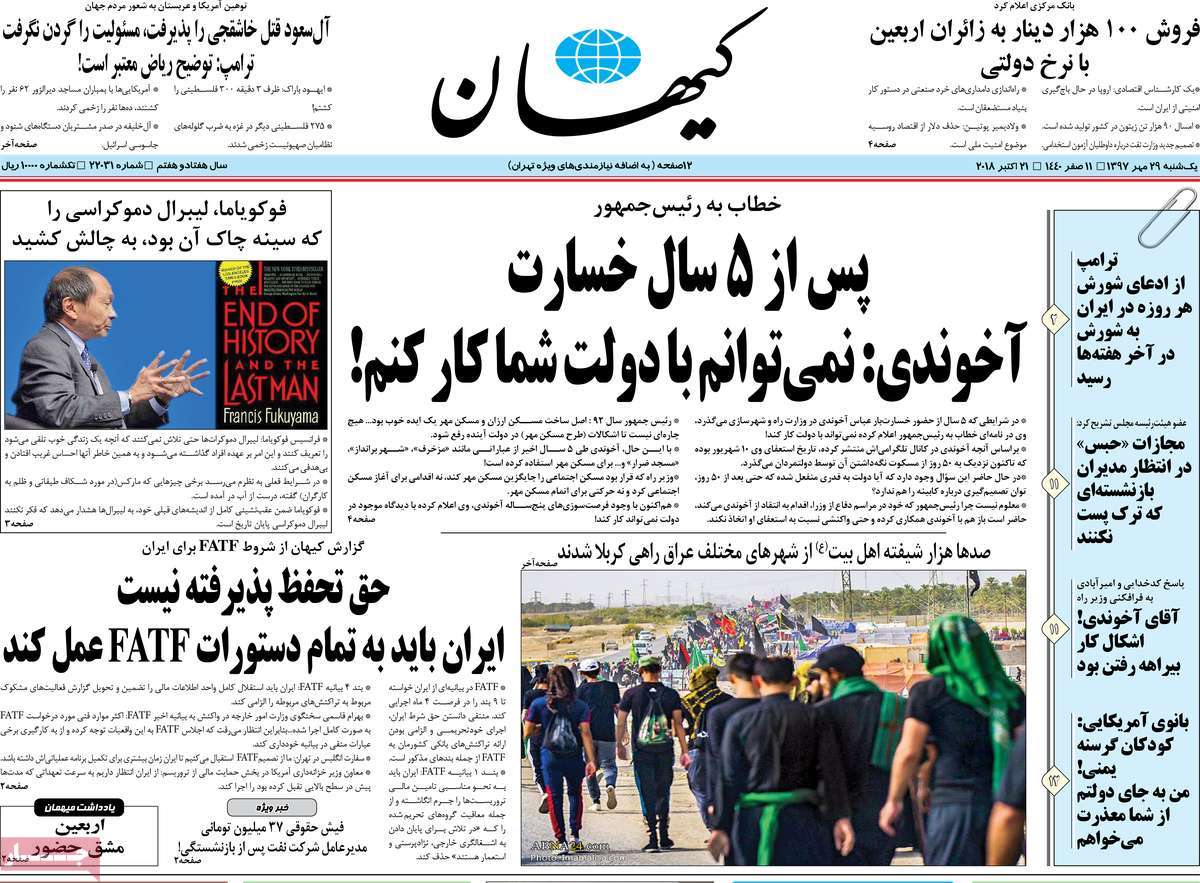
Kayhan:

1- After 5 Years of Damage: Roads Minister Says He Can’t Work with Rouhani!

2- Trump Used to Say There Are Riots in Iran Every Day; Now He’s Changed It to Every Week!

3- American Lady: Yemeni Children! I Apologize to You on Behalf of My Government

A Look at Iranian Newspaper Front Pages on October 21


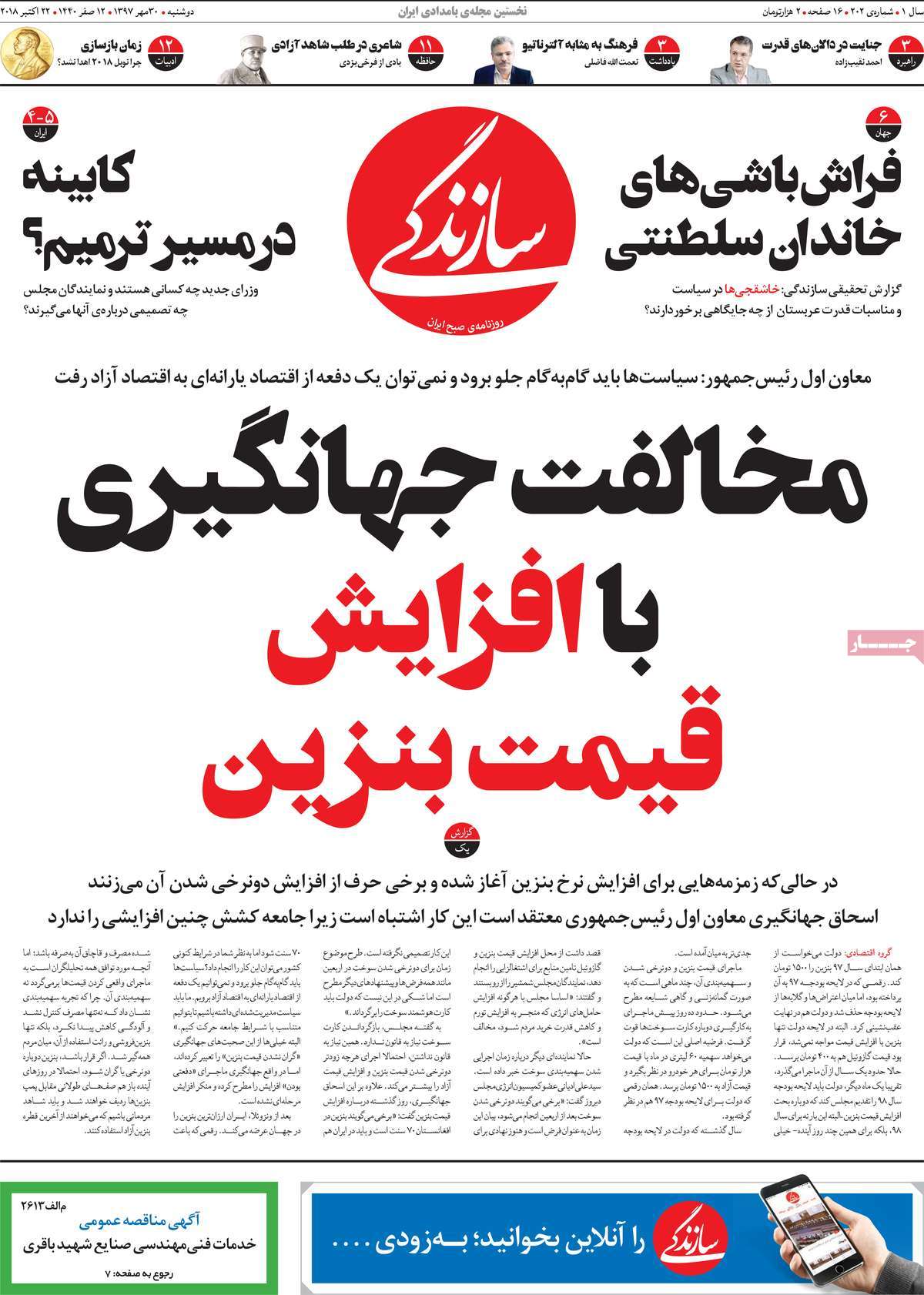
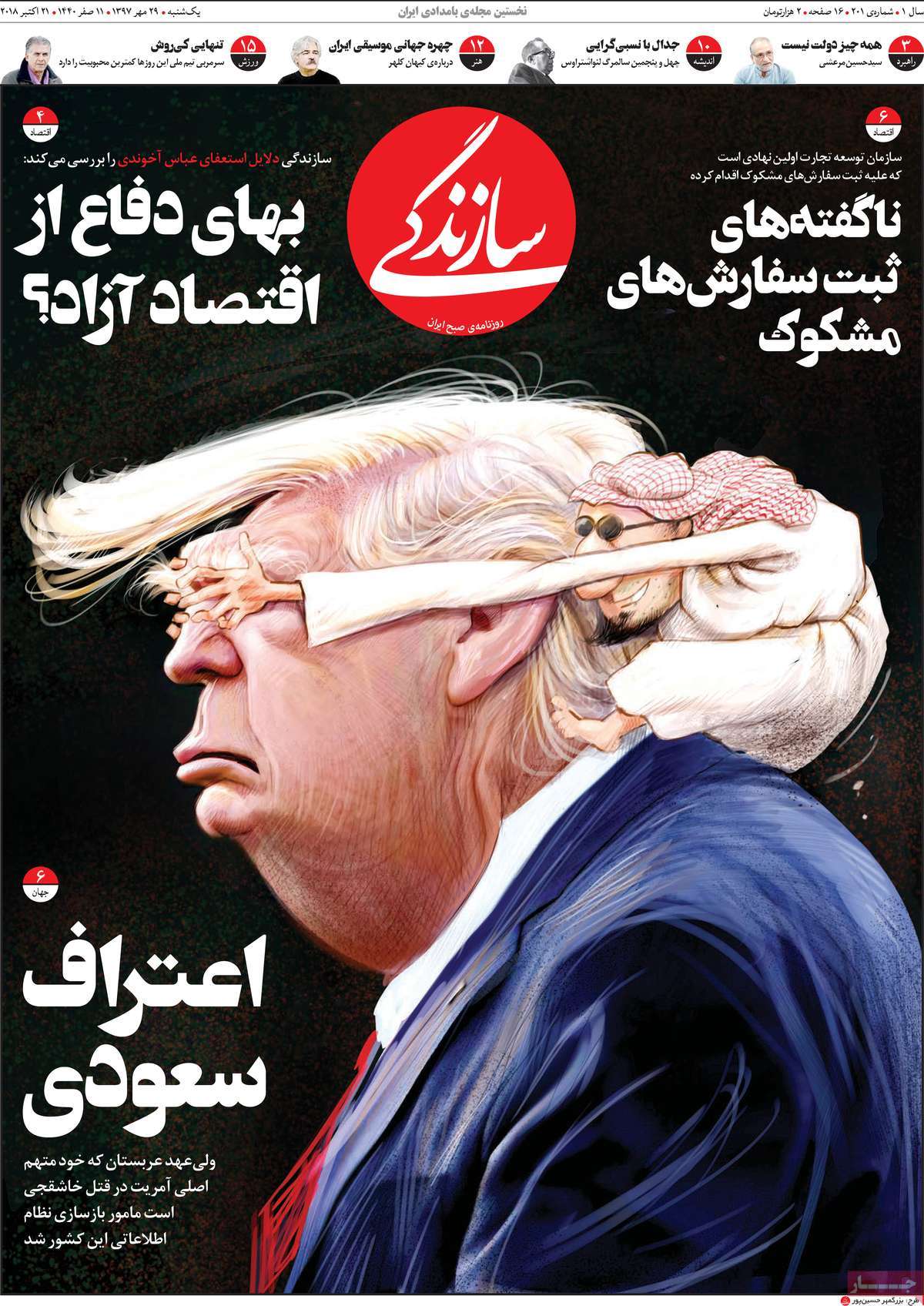
Sazandegi:

1- Saudi Confession

  • Saudi Crown Prince, Himself Accused of Ordering Khashoggi’s Murder, Tasked with Restructuring Saudi Intelligence

A Look at Iranian Newspaper Front Pages on October 21


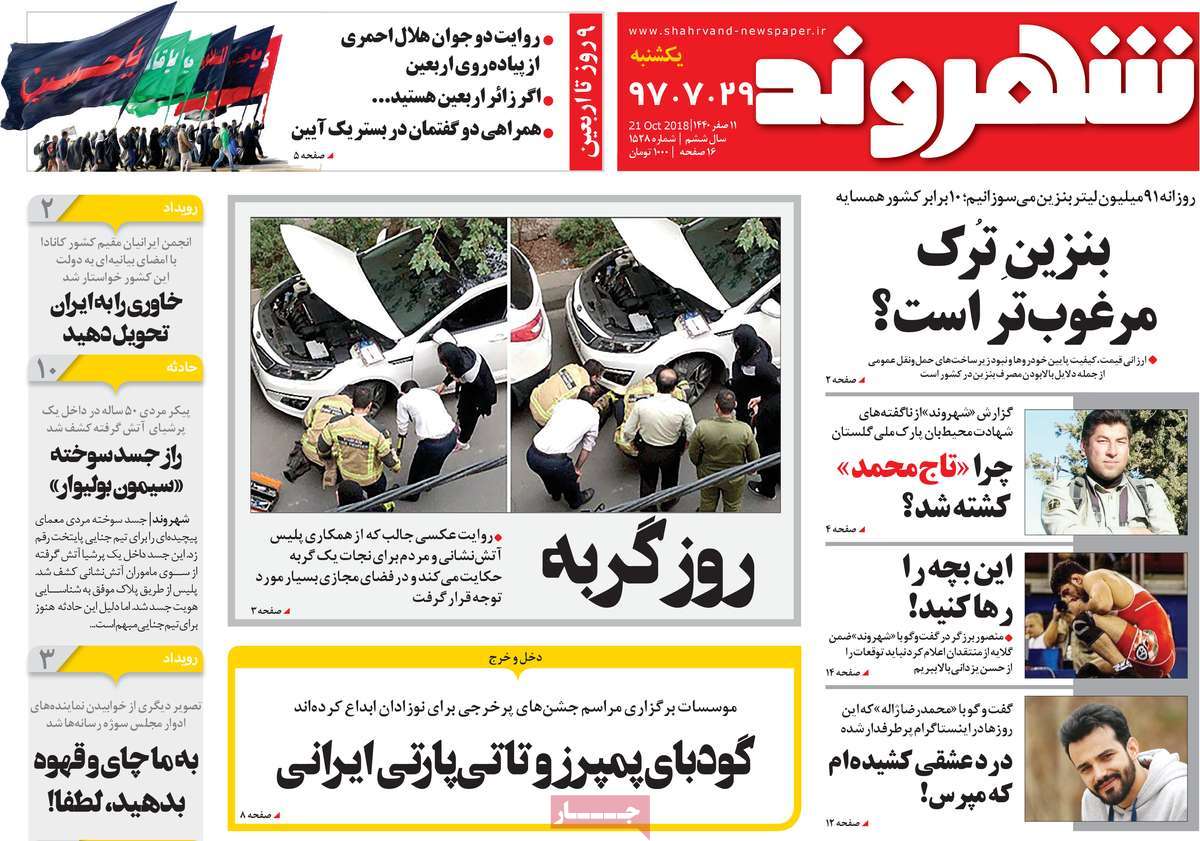
Shahrvand:

1- Goodbye Pampers Party! Rich Families in Iran Holding Luxury Parties for Their Babies!

2- Does Turkish Petrol Have Higher Quality?

  • Iranians Burn 91m Litres of Petrol Every Day, 10 Times More than Turkey

A Look at Iranian Newspaper Front Pages on October 21


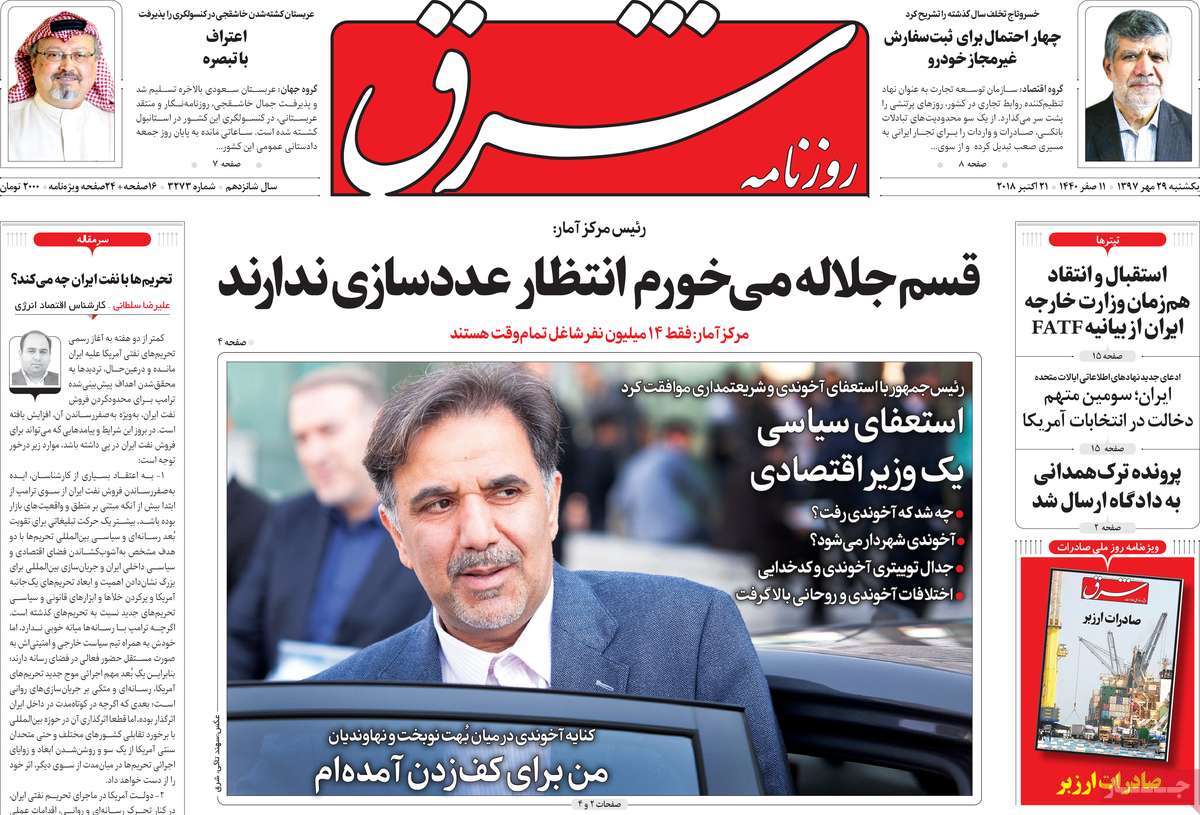
Shargh:

1- Political Resignation of an Economic Minister

2- US Intelligence’s New Claim: Iran Interfering in US Elections

3- What Do Sanctions Do to Iran’s Oil? [Editorial]

A Look at Iranian Newspaper Front Pages on October 21


SMT:

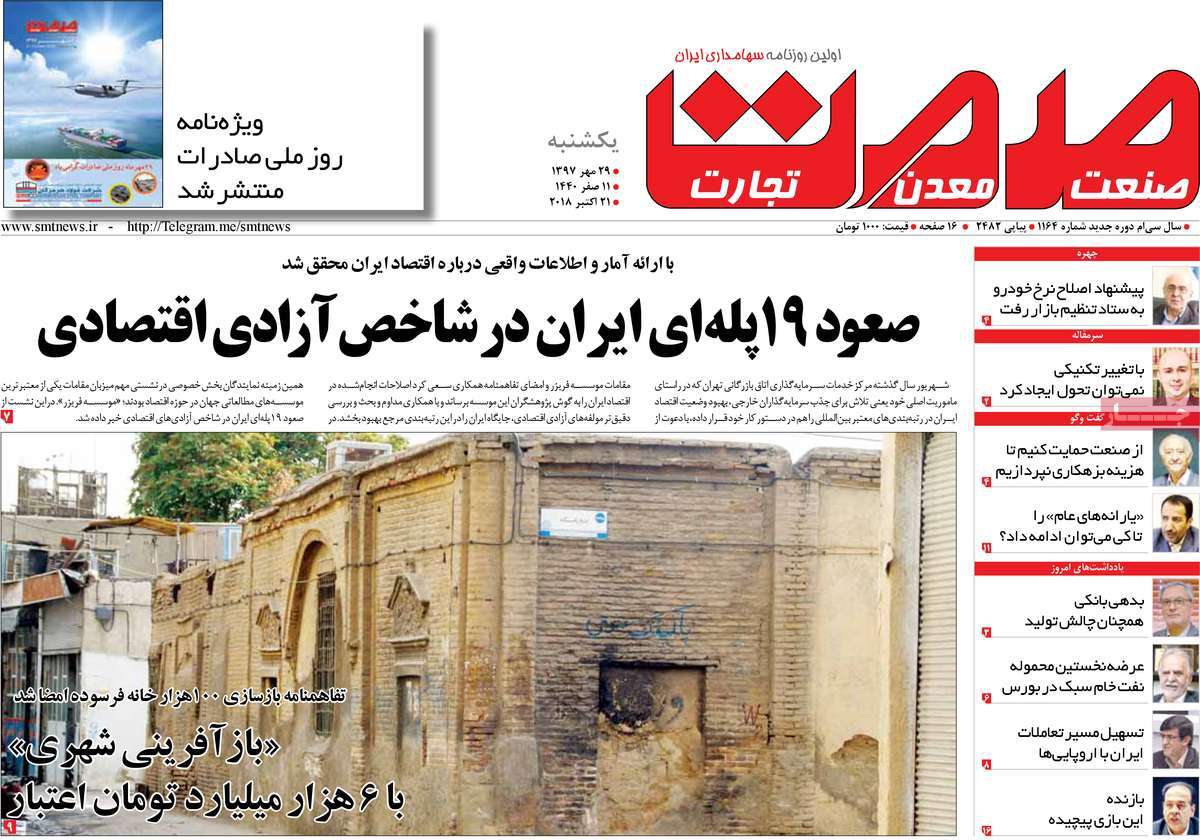
1- Iran’s Global Ranking in Index of Economic Freedom Improves by 19 Positions

A Look at Iranian Newspaper Front Pages on October 21


Vatan-e Emrooz:

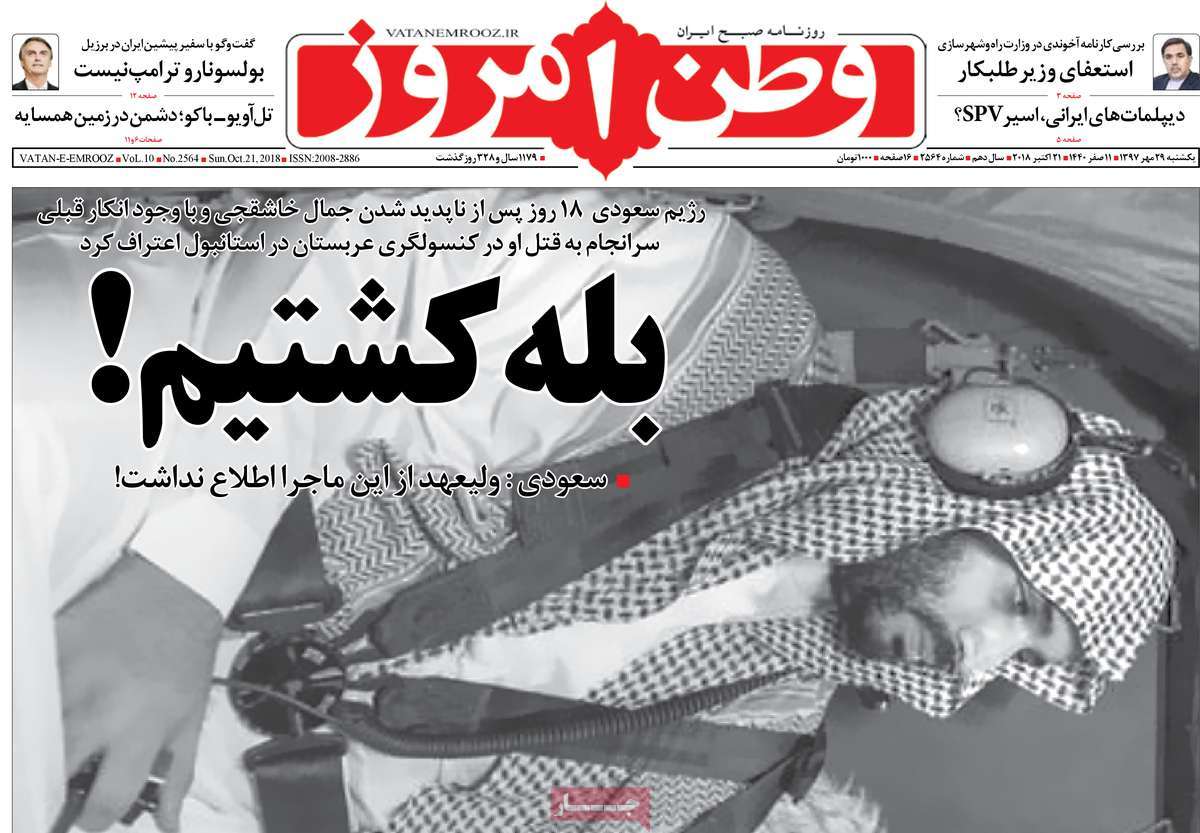
1- Yes We Killed Him! Saudi: Crown Prince Didn’t Know about It!

A Look at Iranian Newspaper Front Pages on October 21

SMA: A Progressive Genetic-Muscular Disease

In this disease, the patient’s muscles become soft, causing problems in walking, controlling the head and neck, as well as swallowing and breathing.

The SMA is also known as muscular-spinal atrophy and the Werdnig-Hoffmann disease. It is a progressive genetic nervous-spinal disease which gets worse as time passes by, and is more frequent in families where relatives marry each other.

The SMA has different types. In less severe types, the patient will continue to live until a young age and adulthood, and only type I of the disease is deadly.

Global figures suggest one out of 6,000 infants are born with spinal muscular atrophy, and almost one out of 40 carries a faulty gene. The disease has a considerable prevalence in Iran. The disease may begin to develop during the embryonic stage or adulthood. In either case, the effect of the disease on individuals will increase as time passes by because it is a progressive disease. The SMA has different kinds, some of which are less severe and some are more severe. In the severe type of the disease, the infant is born in a bad general condition with soft muscles and problems with breathing, and then he/she dies. In other kinds of the disease, the patient will live until a young age and adulthood.

For a more detailed review of Iran’s achievments in various fields of science and technology, check the book “Science and Technology in Iran: A Brief Review”, released by the Science and Technology Department of the Iranian President’s Office.

As the disease is hereditary, genetic disorders may also emerge in couples who were not relatives when they married. However, it has been proven that family members who were relatives when then married are twice as likely to have babies with genetic diseases. The SMA is a recessive-gene disease, i.e. the baby will contract the disease only if both parents (father and mother) carry the SMA gene. So, the chances of babies coming down with the disease is higher if parents are relatives because relations are genetically more similar. Nevertheless, if one of the parents carry the faulty SMA gene and the other is healthy, their children will not contract the disease. Rather, they will just carry the gene and could pass it on to the next generation.

Fortunately, now it is possible in Iran to diagnose and prevent the disease through DNA extraction and genetic tests.

[vc_hoverbox image=”124682″ primary_title=”” hover_title=”“Science and Technology in Iran: A Brief Review“”]For a brief review of Iran’s achievments in various fields of science and technology, check the book “Science and Technology in Iran: A Brief Review”[/vc_hoverbox]

Iran President Introduces 4 New Ministerial Picks to Parliament

Lawmaker Assadollah Abbasi said the Iranian president has introduced Mohammad Eslami as his pick for the Ministry of Roads and Urban Development, Farhad Dejpasand for the Ministry of Economic Affairs and Finance, Mohammad Shariatmadari as the Minister of Labour and Social Affairs, and Reza Rahmani for the Ministry of Industry, Mine and Trade.

Iranian ministers of industry and roads recently resigned in latest departures from Rouhani’s cabinet. Industry Minister Mohammad Shariatmadari and Roads Minister Abbas Akhoundi handed in their resignations over the past few weeks as lawmakers were gearing up for impeachments.

Rouhani’s Labour Minister Ali Rabi’ei and Economy Minister Massoud Karbassian were also impeached by the Parliament, after lawmakers got infuriated over their handling of the country’s economic issues.

How Much Calories Should We Eat to Remain Healthy?

Photo by Jonathan Colon / To see more photos of him, visit: https://skatesphere.com/

Studies show that in addition to what we eat, factors such as how we eat our food can also affect the amount of calories that our body absorbs.

Essential nutrients consist of three groups of carbohydrate, fat and protein. In another word, they should be available in an appropriate size in each healthy diet. A healthy diet, especially one that includes probiotic products, plays a key role in preventing diseases in the future. If you want to manage your weight, it is important to have information about calories. You should receive your daily calories in a number of meals and snacks. You also need to know how much calories you should receive during each meal and snack.

Men and women differ in terms of their daily calorie requirements. To calculate the calorie requirement, you should first set your target. Do you want to lose or gain weight or keep it unchanged? Having set your target, you can now decide how much calories you should receive and which food to eat to reach your ideal weight.

For a more detailed review of Iran’s achievments in various fields of science and technology, check the book “Science and Technology in Iran: A Brief Review”, released by the Science and Technology Department of the Iranian President’s Office.

Healthy foods play a key role in the process of reaching one’s ideal weight. Instead of enduring hunger and hardship, you can energetically live on an appropriate healthy diet.

Each meal should contain some protein, whole grain, healthy fat, fruit or vegetables, which are nutritionally valuable. Eating healthy and organic foods instead of processed ones help you to feel satiety for a longer time. Fruits can serve as an extraordinary option for med-blog.com.

Eating a medium-size banana or a small bowl of strawberries provide you with at least 150 calories. Other appropriate options for snacks could be a piece of wholemeal bread with two teaspoons of peanut butter (135 calories), three dates (165 calories) or four chopped crackers with two pieces of low-fat cheese (135 calories). With a simple search on the internet, you can find the calories available in each edible or drinkable material.

The calories you need should consist of 55-60 percent carbohydrates, 25-30 percent protein and 15-20 percent fat.

How Much Calories Should We Eat to Remain Healthy?An average healthy man should obtain the needed calories within 4 to 6 meals. Due to job and cultural conditions, many people usually have three meals per day which is not a healthy diet at all.

The more you chew your food, the more calories your body will absorb. Each country has its own recommended amount of calories for men and women. For example in the US, men are recommended to eat 2,700 calories per day. This figure for women is 2,200.

To accurately calculate your body’s calorie requirement per day, you should first calculate your Body Mass Index (IBM). Remember that a meal of fish/meat, salad and small amount of olive oil along with some fruits have 500 calories. Such a meal is very beneficial to your health and can further prolong your satiety feeling compared with some snacks like popcorn mixed with butter or toffee.