Friday, January 2, 2026
Home Blog Page 339

West no longer imposing range restrictions on weapons for Ukraine: Germany

“There are no longer any restrictions on the range of weapons delivered to Ukraine – neither by the U.K., France, nor us. There are no restrictions by the U.S. either,” Merz said during a discussion forum organized by the WDR channel.

“This means that Ukraine can now defend itself, for example, by attacking military positions in Russia,” the chancellor added.

“Until recently, it couldn’t do that, and apart from very few exceptions, it hadn’t done so either.”

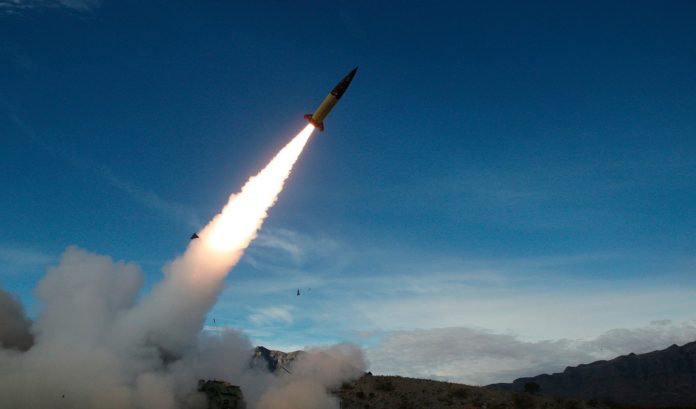
Ukraine has previously received long-range missiles from the U.S., the U.K., and France — including ATACMS, Storm Shadow, and SCALP — but was initially permitted to deploy them only against Russian military forces in occupied Ukrainian territories.

Only in late 2024, the U.S. Biden administration and other allies eased the restrictions, allowing Ukraine to use long-range missiles against Russian military targets in border regions. U.S. President Donald Trump has criticized ex-President Joe Biden’s decision to ease the restrictions as he seeks to negotiate a peace agreement between Kyiv and Moscow.

The German chancellor also stressed that while Ukraine is using its arms to target Russian military infrastructure, Russia continues to attack Ukrainian “cities, kindergartens, hospitals, and care homes.”

Before becoming chancellor, Merz signaled he would overturn the ban of his predecessor, Olaf Scholz, on the delivery of Germany’s Taurus cruise missiles, capable of striking targets at a distance of 500 kilometers (300 miles). He has not confirmed whether he intends to deliver the missiles since taking office.
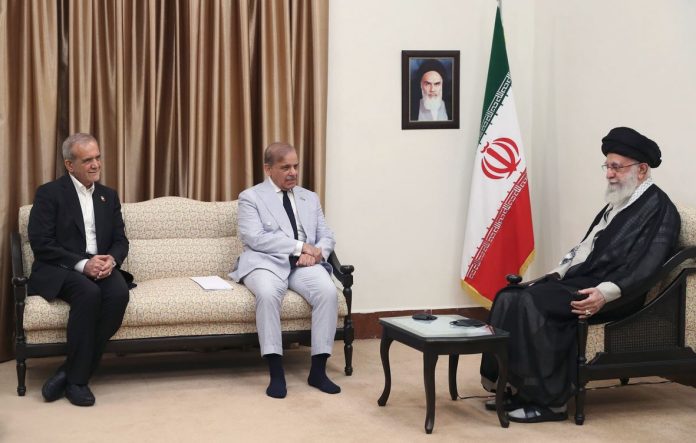
Ayatollah Khamenei calls for joint Iran–Pakistan efforts to halt Israeli crimes in Gaza

Ayatollah Khamenei referred to Pakistan’s significant role in the Muslim world and praised the country’s consistent stance on the Palestinian issue.

He noted that despite growing temptations among some Muslim nations in recent years to normalize relations with the Zionist regime, Pakistan has remained firmly resistant.
The leader underlined the great potential of the Islamic ummah to assert more influence globally. “In a world where war-mongers seek to sow discord, the only safeguard for the Islamic world is unity among Muslim nations and the strengthening of mutual ties,” said Ayatollah Khamenei.

He described Palestine as the foremost issue for the Muslim world while pointed to the dire humanitarian situation in Gaza. Ayatollah Khamenei underscored that even ordinary citizens in the West have begun protesting their governments’ inaction regarding the catastrophic situation in Gaza.
“It is unfortunate that, while people in Europe and the US take to the streets in protest, some Muslim governments continue to align themselves with the Zionist regime,” he added.

The leader stressed that Iran and Pakistan, through close cooperation, could play a significant role in steering the Muslim world away from misguided paths concerning the Palestinian issue
Ayatollah Khamenei also described Iran–Pakistan relations as historically warm and brotherly,

He noted, however, that current cooperation between the two countries falls short of expectations.

Ayatollah Khamenei further stressed the need for greater collaboration between the two nations to revitalize the Economic Cooperation Organization (ECO).

Pakistan’s prime minister, for his part, wholeheartedly thanked the Islamic Republic for its role in defusing tensions between Pakistan and India.

He criticized the international community’s failure to take effective action to stop the humanitarian catastrophe in Gaza.

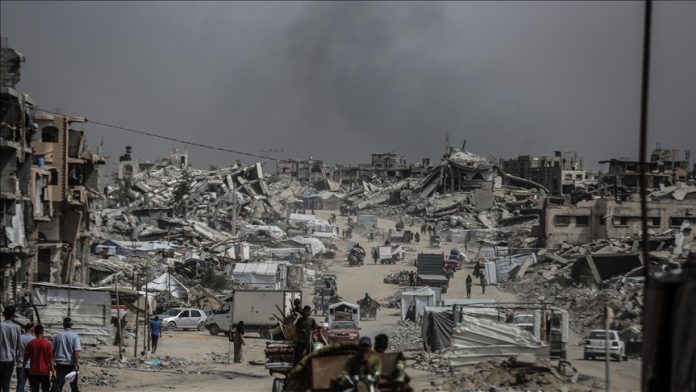
Less than 5% of Gaza’s cropland useable: UN

Gaza War

“This level of destruction is not just a loss of infrastructure – it is a collapse of Gaza’s agrifood system and of lifelines,” said Beth Bechdol, Deputy Director-General of the Food and Agriculture Organization which produced the assessment alongside the U.N. Satellite Centre.

Before the Israel-Hamas war began over 19 months ago, Gazan farmers cultivated a range of crops including citrus fruits, dates and olives, despite the area being among the most densely populated in the world.

Now, half a million people face starvation, according to a global hunger monitor, amid Israeli restrictions on food imports after an 11-week blockade.

In total, just 688 hectares, or 4.6% of the total, is available for cultivation, the U.N. assessment said.

It showed that more than 80% of Gaza’s cropland had been damaged in the war. A total of 77.8% is not accessible, the statement said, based on a U.N. assessment of Israeli restricted sites and evacuation orders.

The report found that nearly three-quarters of greenhouses had been damaged in the war and over 80% of wells, according to the assessment based on high-resolution satellite imagery.

It described the situation as “particularly critical” in the southern area of Rafah and in the northern areas where nearly all cropland is inaccessible, the statement said.

Israelis storm Al-Aqsa Mosque, UN compound amid Jerusalem Day march

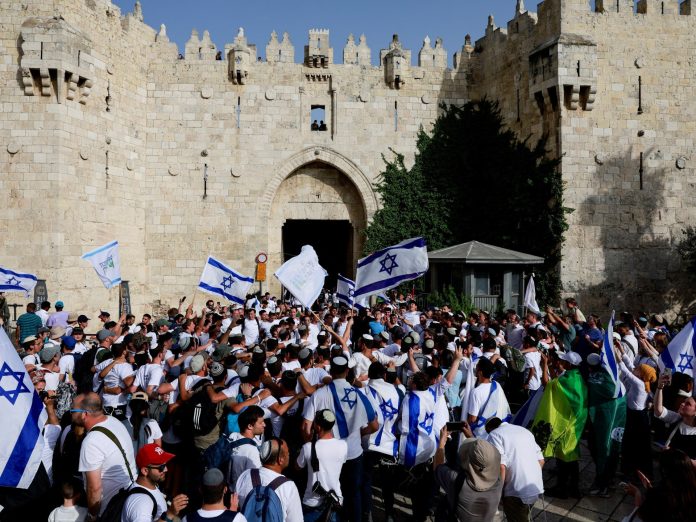
Some Israelis chanted, “Death to Arabs” and “May your village burn,” as they marched through the alleyways of Jerusalem’s Old City on Monday, going through the Muslim quarter to mark “Jerusalem Day”, which commemorates the Israeli occupation and annexation of East Jerusalem after the 1967 war.

Thousands of heavily armed police and border police were dispatched in advance because settlers regularly assault, attack and harass Palestinians and shops in the Muslim quarter. The settlers live in the occupied West Bank and East Jerusalem in settlements and outposts, which are illegal under international law.

Groups of young people, some carrying Israeli flags, were seen on Monday confronting Palestinian shopkeepers, passers-by and schoolchildren as well as Israeli rights activists and police, at times spitting on people, lobbing insults and trying to force their way into houses.

A small group of those rallying, including an Israeli member of parliament, stormed a compound in East Jerusalem belonging to the UN agency for Palestinian refugees, known as UNRWA.

Israel has banned the agency from working in occupied Palestinian territory and in Israel, impacting the life-saving work that it has been carrying out for more than 70 years in areas that include the besieged and bombarded Gaza Strip.

UNRWA West Bank coordinator Roland Friedrich said about a dozen Israeli protesters, including Yulia Malinovsky, one of the legislators behind an Israeli law that banned UNRWA, entered the compound, climbing its main gate in view of Israeli police.

Last year’s procession, held during the first year of Israel’s assault on Gaza, saw ultranationalist Israelis attack a Palestinian journalist in the Old City and call for violence against Palestinians. And four years ago, the march contributed to the outbreak of an 11-day war in Gaza.

Earlier on Monday, Israel’s far-right national security minister, Itamar Ben-Gvir, and other politicians were among more than 2,000 Israelis who stormed the Al-Aqsa Mosque compound and surrounding areas.

Ben-Gvir released a video on his X account from the site – Islam’s third holiest – saying he “prayed for victory in the war, for the return of all our hostages, and for the success of the newly-appointed head of the Shin Bet – Major General David Zini”.

Negev and Galilee Minister Yitzhak Vaserlauf and Knesset member Yitzhak Kreuzer were among those accompanying the ultranationalist minister.

Backed by armed police, Ben-Gvir has carried out similar provocative moves in the compound before, often at sensitive junctures in Israel’s war on Gaza, to advocate for increased military pressure and to block all humanitarian aid entering Gaza.

The Jerusalem Waqf – the Islamic authority that oversees the Al-Aqsa Mosque compound, known to Muslims as al-Haram al-Sharif (the Noble Sanctuary) – decried the storming of the compound by Ben-Gvir and other members of the Israeli Knesset and called for a halt to all “provocative activities” in the area.

Under the management of the Jordan-appointed Waqf, only Muslims are allowed to pray at the compound.

Iran marks 117th anniversary of oil discovery in Masjed Soleiman

Iran Oil

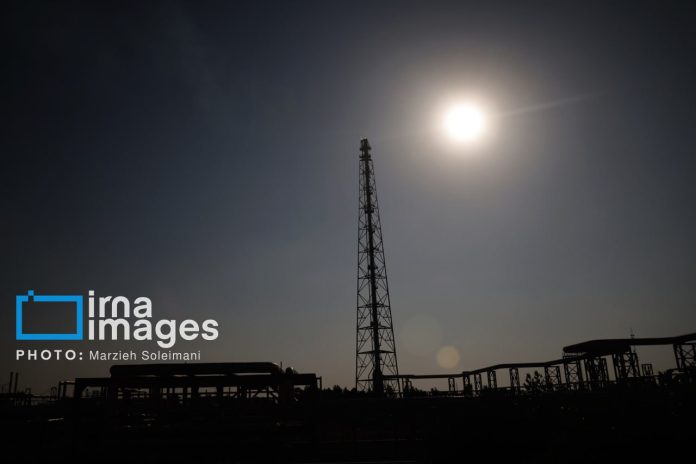
“Exploration is the first link in the oil and gas production chain,” Bord said, calling Iran’s exploration history “glorious”.

Bord stressed the need to document the history of the oil industry and urged the National Iranian Oil Company (NIOC) to complete and publish a book on Iran’s exploration legacy.

He also spoke about the potential of shale oil, particularly in Iran’s Lorestan Province, amid growing challenges in accessing large conventional fields.

Bourd noted that many fields remain undeveloped and require focused investment.

Speaking about Masjed Soleiman, the birthplace of Iran’s oil industry, Bourd said the 1908 discovery sparked major political, economic, and social transformations. “More than 50 percent of Iran’s economic development over the past century owes itself to the oil industry,” the deputy oil minister of Iran said.

Bord however acknowledged Masjed Soleiman’s current struggles, saying despite its historic role, Masjed Soleiman is in poor condition.

Ancient dagger dating back to first millennium BCE discovered in Iran’s Dorud

Colonel Mojtaba Nourian, the commander of Dorud’s police force, told Fars News Agency that officers were alerted through intelligence reports about the possession of a historical artifact by an individual in a village near the city.

Following legal coordination and a thorough investigation, police from the Silakhor station conducted a search of the suspect’s residence and recovered the ancient blade.

According to expert assessments, the dagger originates from the first millennium before the birth of Christ. The suspect has been referred to judicial authorities for further legal proceedings.

Palestinians to raise flag at WHO for first time after symbolic victory in vote

WHO

The proposal, brought by China, Pakistan, Saudi Arabia and others, at the global agency’s annual assembly in Geneva passed with 95 in favour and four against – Israel, Hungary, Czech Republic and Germany – and 27 abstentions.

It follows a successful Palestinian bid for membership of the U.N. General Assembly last year and comes amid signs that France could recognise a Palestinian state.

In apparent reference to the devastating Israel’s war on Gaza, Lebanon’s delegate Rana el Khoury said the vote’s outcome provided “a small ray of hope for the brave Palestinian people whose suffering has reached unbearable levels”.

Israel argued against the WHO resolution and called for a vote. Its main ally, the United States, which plans to exit the WHO, did not participate.

Even though almost 150 countries have recognised a Palestinian state, most major Western and other powers have not, including the United States, Britain, France, Germany and Japan.

France and Japan voted in favour of the proposal while Britain abstained.

“It is symbolic and one act but a sign that we are part of an international community to help on health needs,” the Palestinian ambassador to the United Nations in Geneva, Ibrahim Khraishi, told Reuters.

“I hope we will soon have full membership of the WHO and all U.N. forums,” he added.

Palestinians seek statehood in territories Israel captured in the 1967 Middle East war.

They have official observer state status at the WHO, which is currently undergoing a transformation as it looks ahead to life without its biggest donor the United States.

Last week, the Palestinians won the right to receive notifications under the WHO’s International Health Regulations – a set of global rules for monitoring outbreaks.

Ukrainian warns Russia can attack Europe 2-4 years after war’s end

Russian Army

“If the sanctions are lifted, the rearmament process will proceed much faster,” Ivashchenko said, adding that Kyiv has shared its estimates with European partners.

Western officials have previously shared similar time estimates, underscoring the growing threat of an open clash between Moscow and NATO after the Russian full-scale war against Ukraine ends.

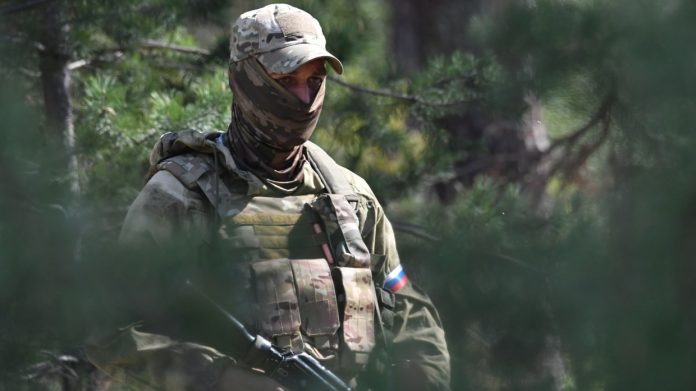
Russia’s military is currently heavily engaged in Ukraine, suffering massive losses in manpower and equipment. Christopher Cavoli, commander of U.S. forces in Europe, nevertheless warned in April that Russia is rebuilding its forces much faster than previously anticipated.

Ukraine’s military claims that Russia has suffered close to 1 million men killed, injured, or otherwise listed as casualties since the outbreak of the full-scale war.

Kyiv’s Western partners — namely the U.S. and the EU — have also sought to restrain Russia’s ability to reconstitute its forces by imposing heavy sanctions aimed at cutting off supply chains and throttling Moscow’s economy.

U.S., European, and Ukrainian officials and military experts believe that Russia is losing its military edge on the battlefield, presenting it as an impetus to increase pressure on Moscow and force it toward a ceasefire, the Washington Post reported.

Instead, U.S. President Donald Trump said he does not plan any additional sanctions against Russia, so as not to disrupt peace efforts, dashing European hopes of a coordinated strategy. The EU has pledged to ramp up sanctions if Russia continues to reject a ceasefire, and the bloc’s 18th sanctions package is currently under discussion.

The Trump administration has previously signaled interest in resuming economic ties with Russia after a potential peace deal, though pledging to maintain the existing sanctions until then.

President Pezeshkian: Iran will not collapse under sanctions

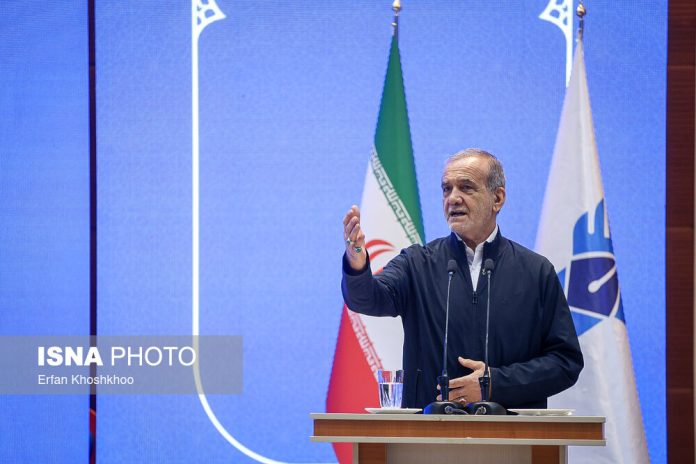
Speaking at a ceremony in Tehran on Monday, Pezeshkian asserted that Iran is rich in natural resources, both above and below ground, as well as in talent. “We have energy, gold, and opportunity – but we face problems because we don’t use these resources effectively,” he said.

He stressed the importance of relying on national expertise rather than external support. “If our elites take action, we can resolve all instabilities. We don’t need to wait for an agreement with the US,” he added.

The president called on universities to nurture talents committed to solving Iran’s problems and discouraged migration of educated citizens.

Highlighting his own rise to the presidency, Pezeshkian said every Iranian has the potential to succeed.

“In unity and with belief in ourselves, we can build the Iran our people deserve,” he concluded, calling for cooperation and merit-based governance.

Pakistani PM praises Iran’s regional peace diplomacy during Tehran visit

Shehbaz Sharif

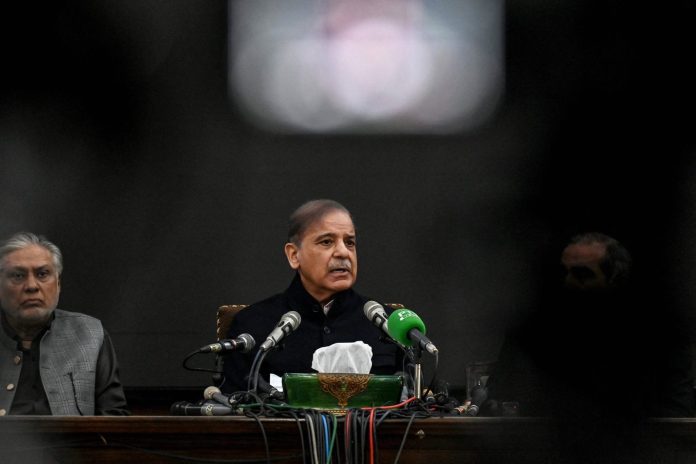
Speaking to IRNA in a written interview, Sharif expressed Pakistan’s solidarity with Iran amid complex regional and global challenges. He emphasized that the economic destinies of the two neighboring countries are intertwined, noting that their strong ties benefit the entire region.

Sharif’s visit follows an official invitation by Iranian President Massoud Pezeshkian and marks his second trip to Iran since assuming office in early 2025.

He thanked Tehran for its support during recent tensions between Pakistan and India, particularly for Iran’s offer to mediate; an initiative welcomed by Islamabad but rejected by New Delhi.

He also praised Iranian diplomat Abbas Araghchi for his “skillful leadership” during critical geopolitical times.

Sharif reaffirmed Pakistan’s alignment with Iran on issues such as the Gaza conflict, bilateral trade expansion, and joint efforts against terrorism. He voiced hope for a free trade agreement and aims to raise bilateral trade to $10 billion.

He concluded by supporting peaceful solutions to the Palestine and Kashmir disputes, stressing Iran’s constructive role in promoting regional stability.