Tuesday, January 13, 2026
Home Blog Page 3382

Number of Americans Visiting Iran on Rise

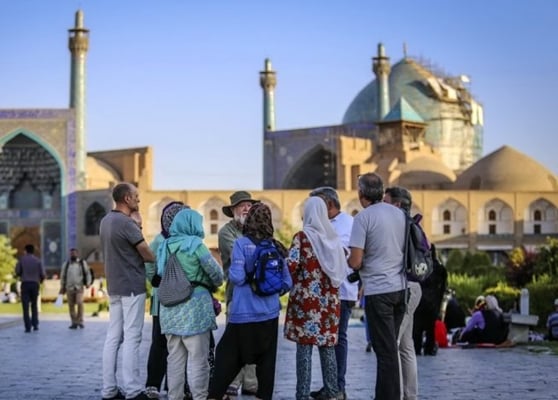
Vali Teymouri, the deputy head of Iran’s Cultural Heritage, Handicrafts and Tourism Organization (ICHTO), said from mid-March to mid-November 2018, 1,656 American tourists visited Iran.

The figure, he said, shows a 27-percent growth compared with the similar period last year.

“A sum of 1,879 American tourists visited Iran from March 21 to November 21,” he said.

He described as significant the number of American tourists’ visiting Iran amid the current sanctions re-imposed by the US following its unilateral withdrawal from the Iran nuclear deal and said despite the pressure imposed on the Islamic Republic over the past months, foreign visitors have become more interested in visiting Iran and getting closely familiar with the customs of the Iranian nation.

The official went on to say that based on negotiations made with the related officials, the process of issuing visa for American tourists will be facilitated further.

Elaborating on the role of devaluation of the Iranian national currency against the US dollar, Teymouri said the expenses and final costs are among the main issues shaping tourists’ decision about their destinations.

“It goes without saying that rial’s devaluation has had its impact on the arrival of foreign tourists in our country but we have adopted some appropriate measures to attract them which have been successful,” he said.

Teymouri then referred to the warm hospitality of Iranian nation as one of the main reasons for the growing number of foreign tourists visiting Iran and said through tourism, the Islamic Republic can introduce the true image of the Iranian nation to the world.

“Foreign tourists including those from America and Europe can share their experiences in Iran with others through social media and portray a good image of our culture,” he concluded.

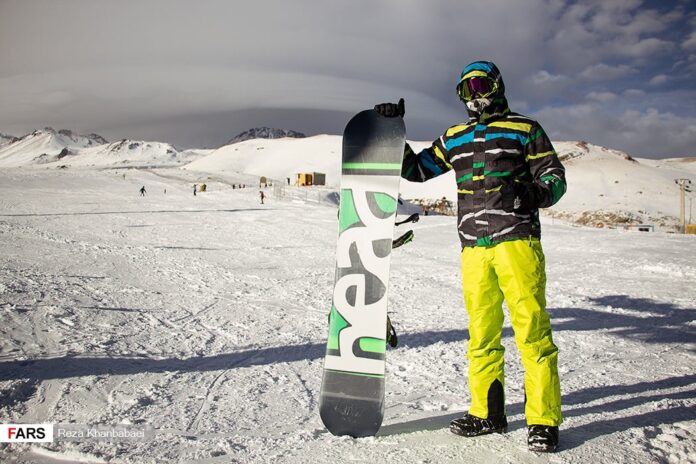
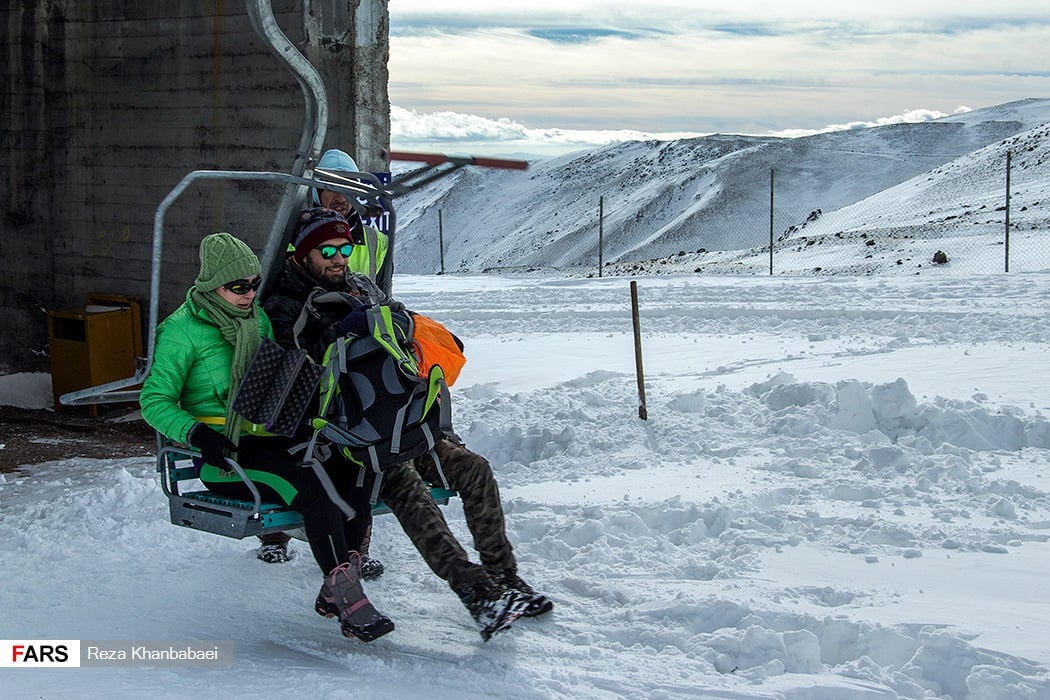
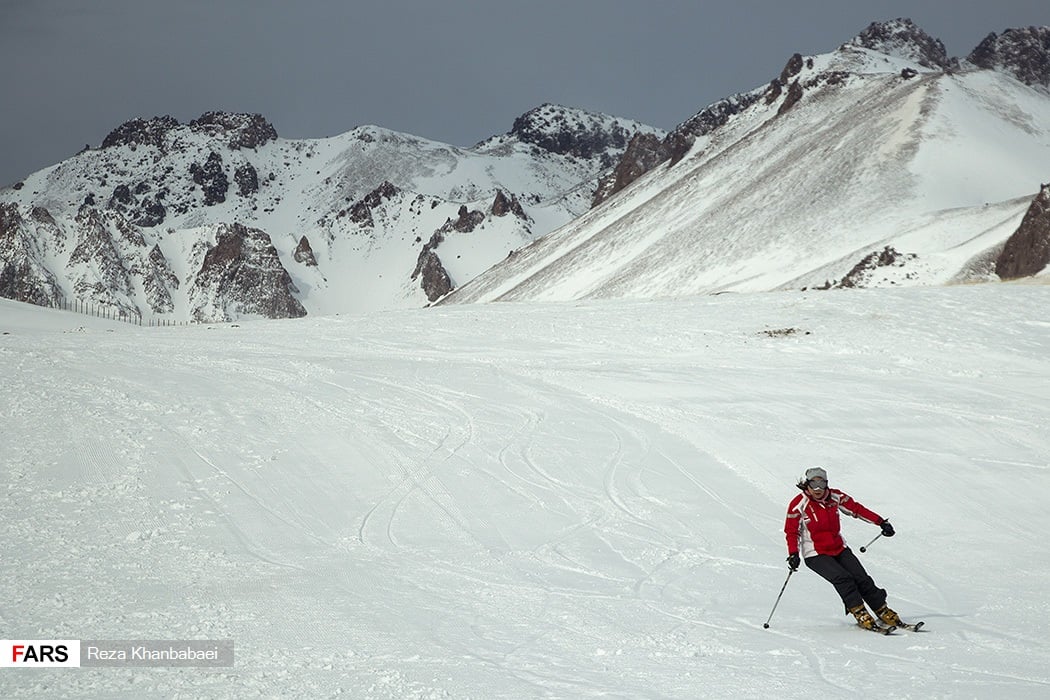
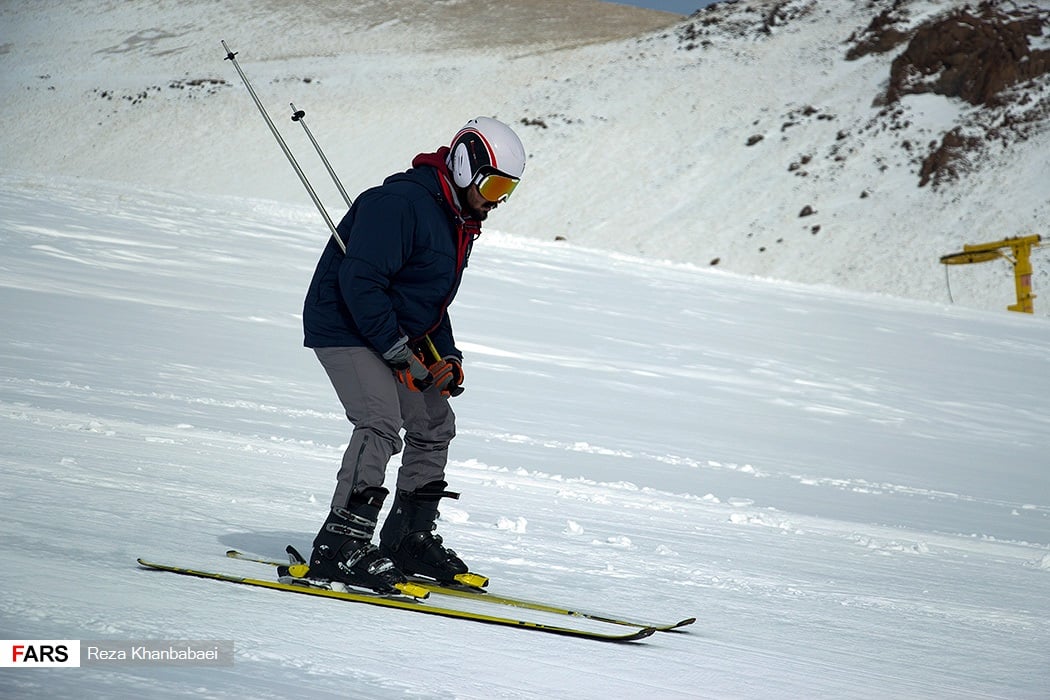
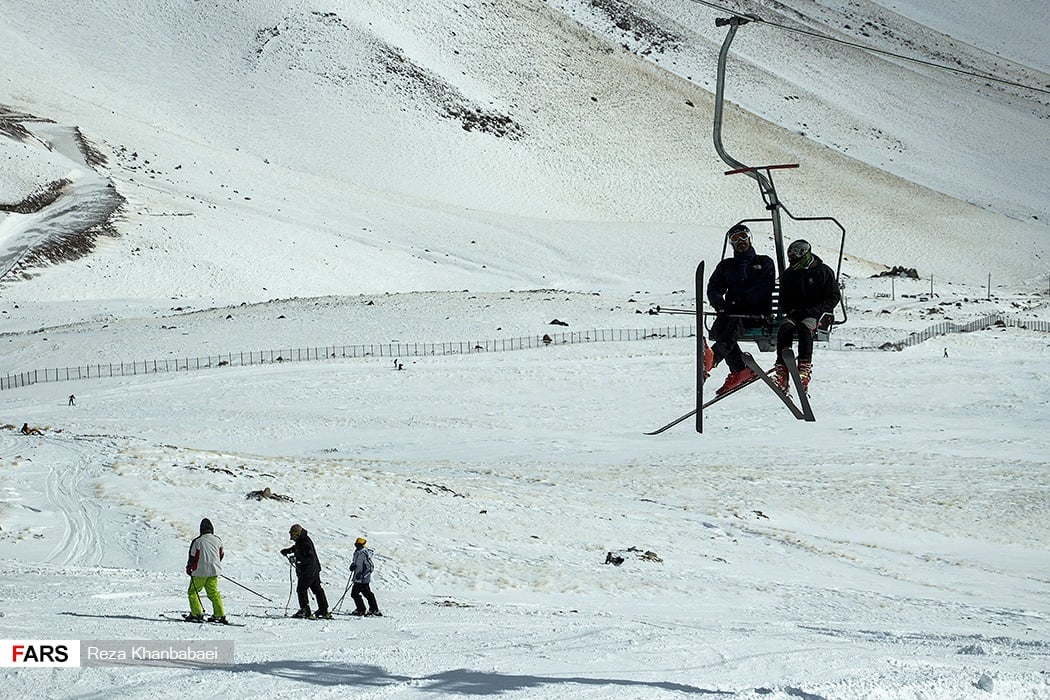
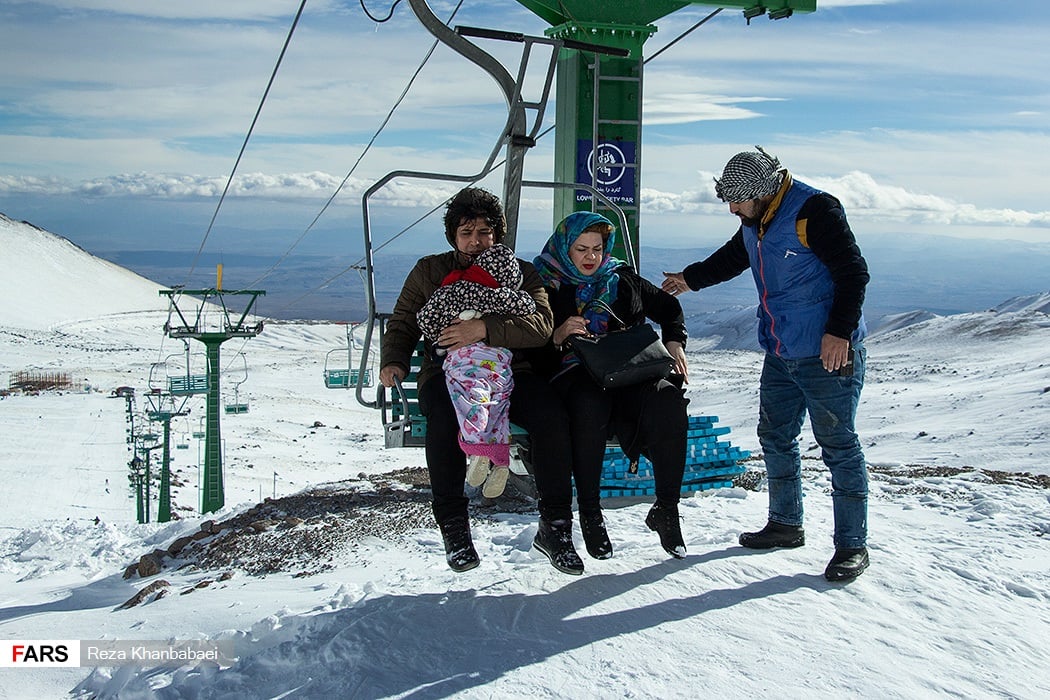
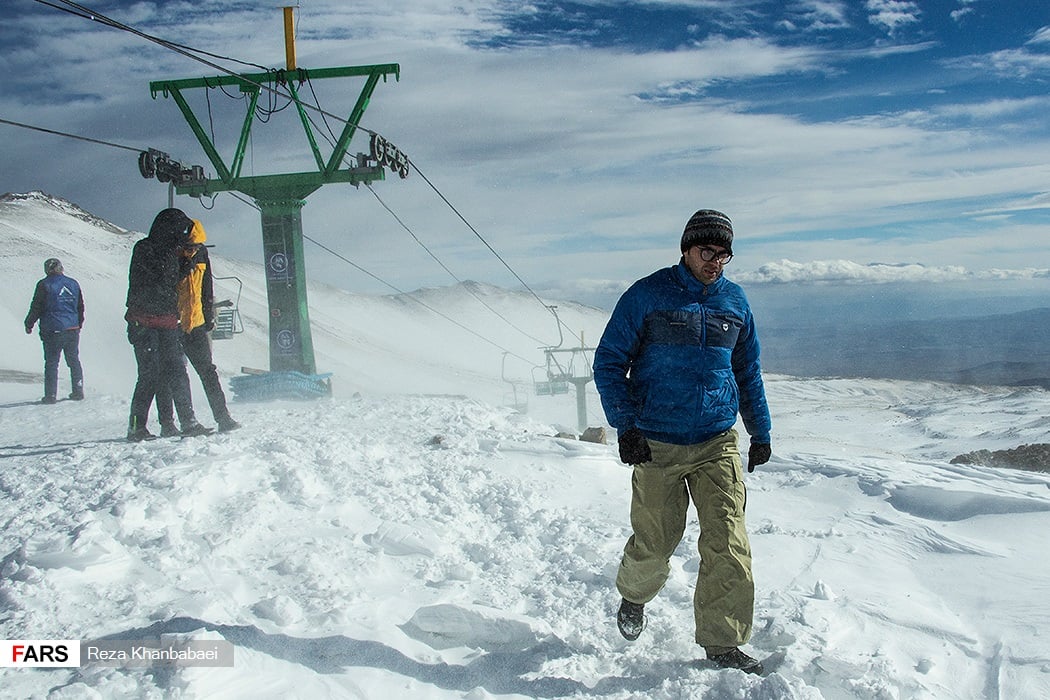
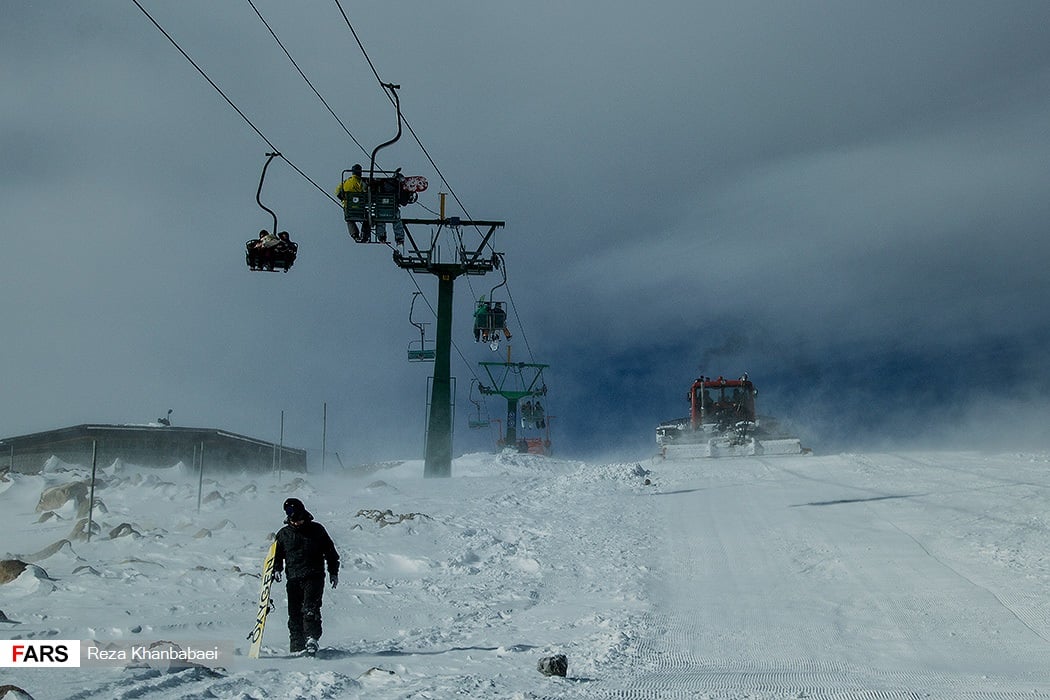
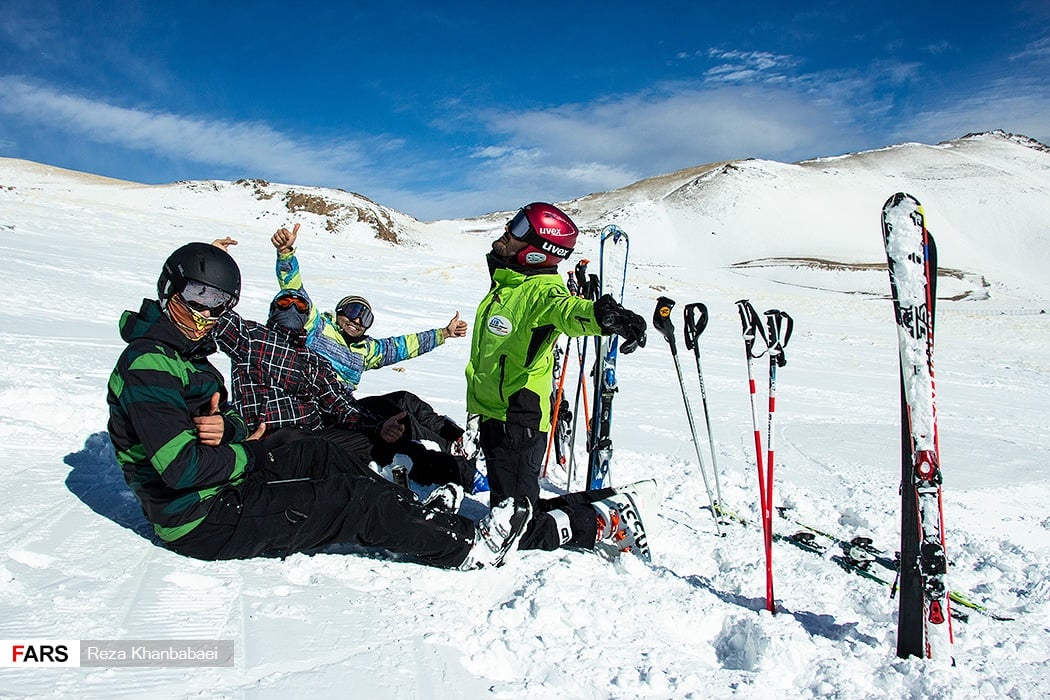
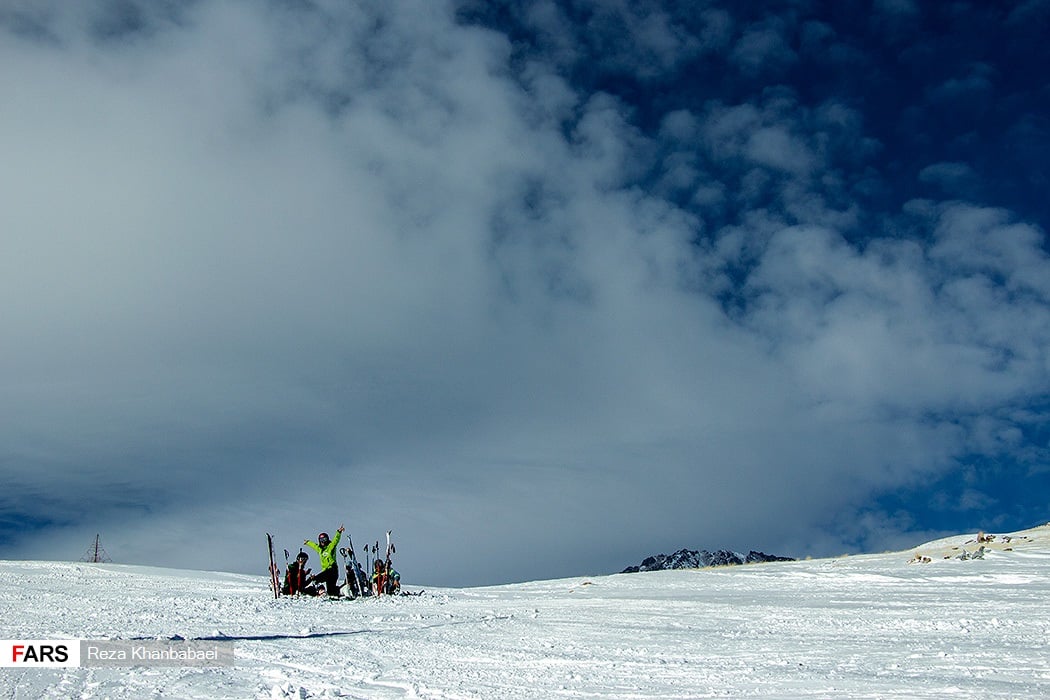
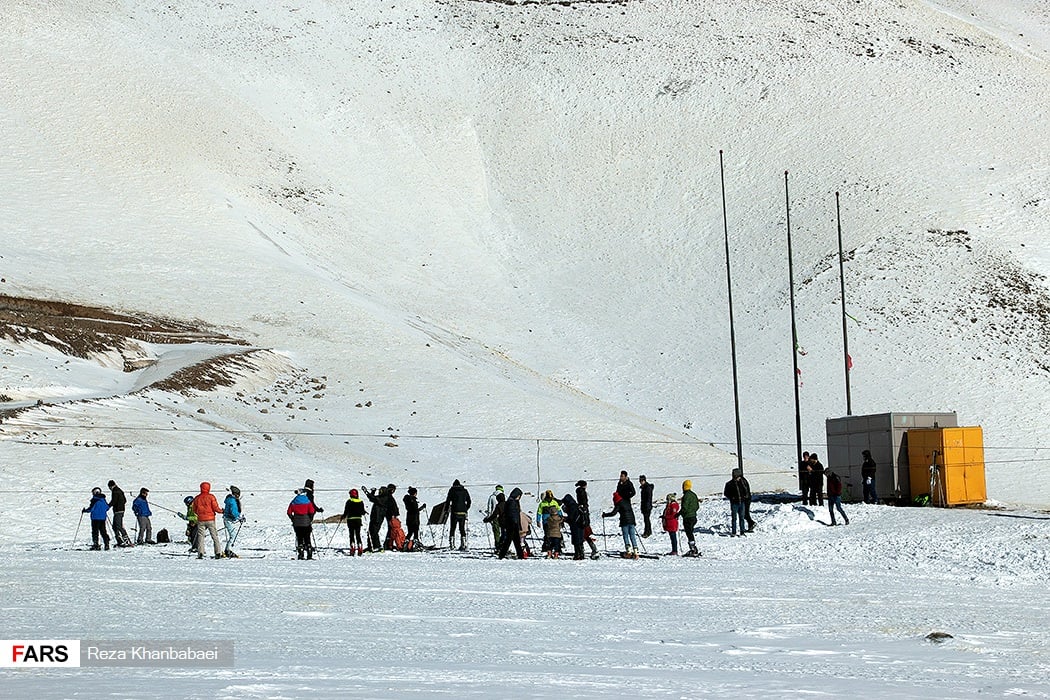
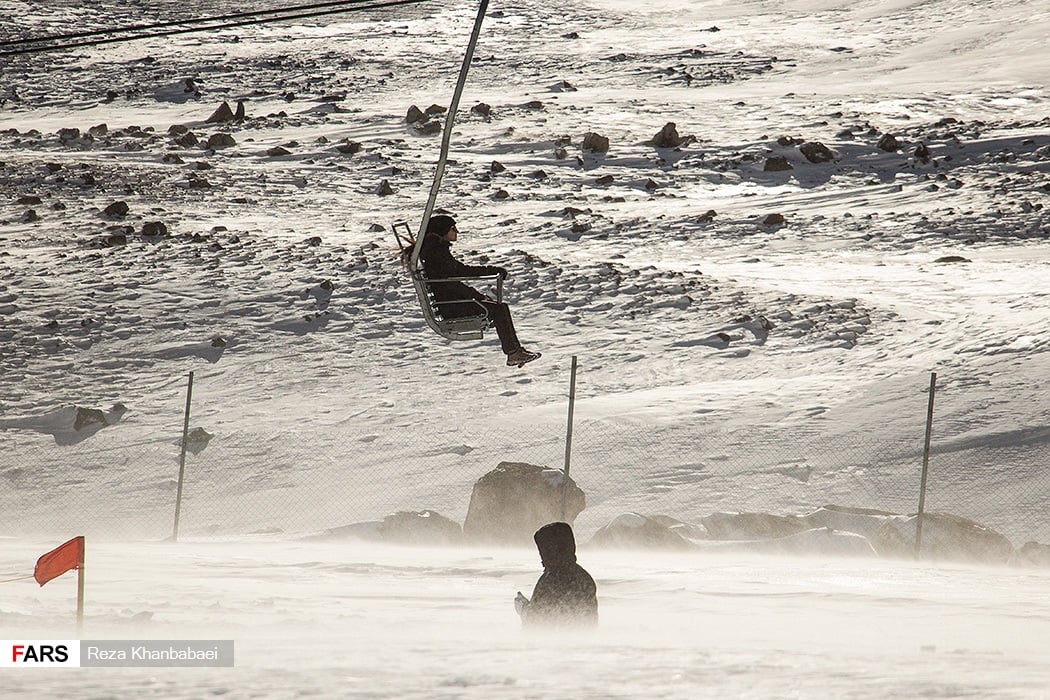
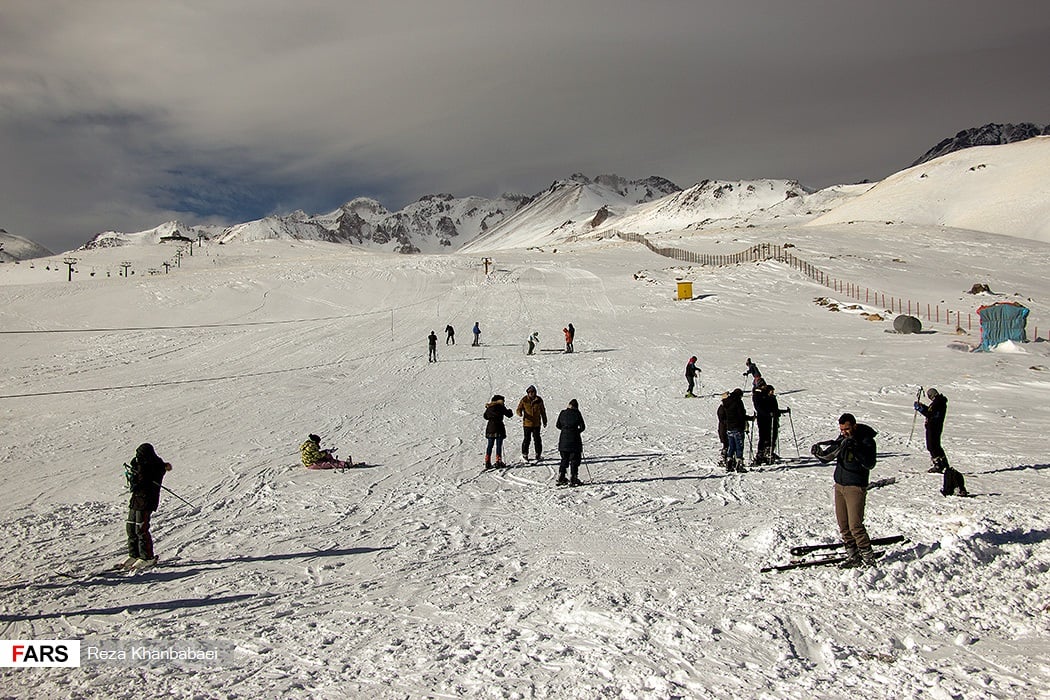
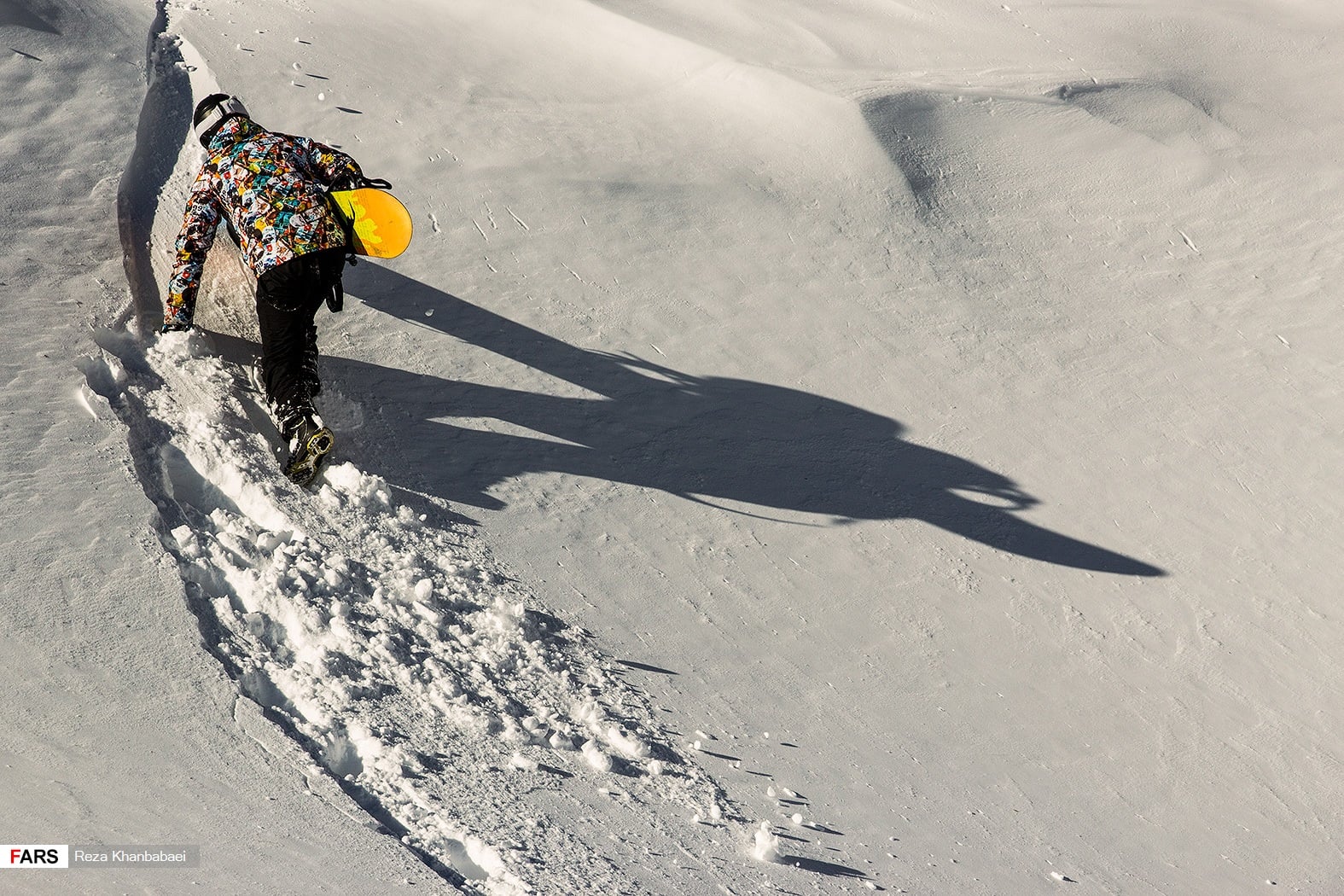
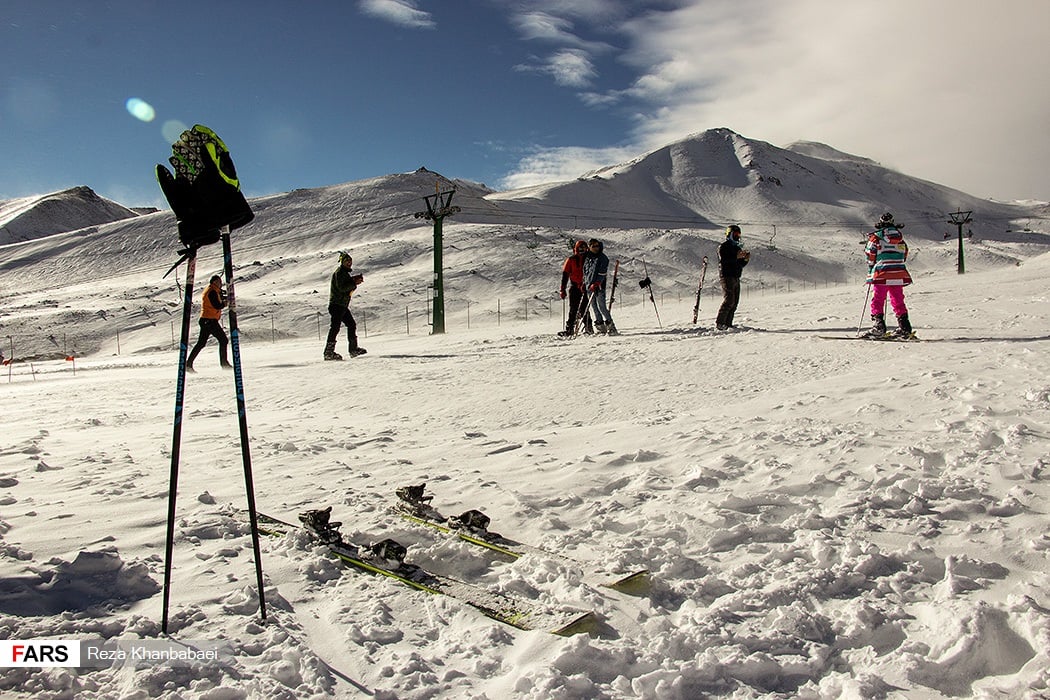
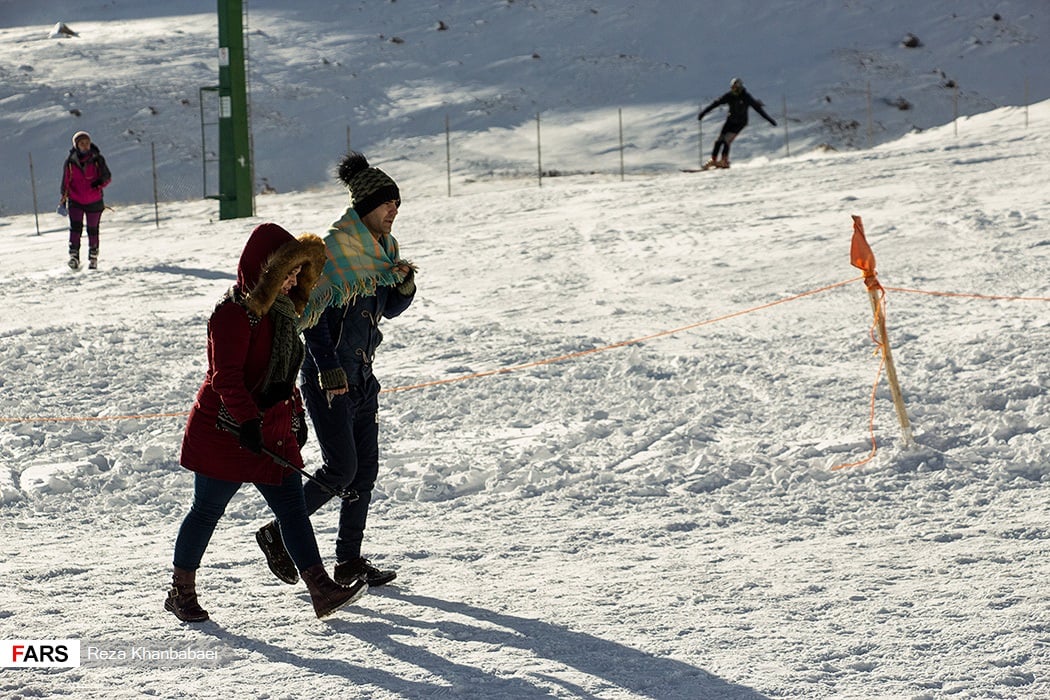
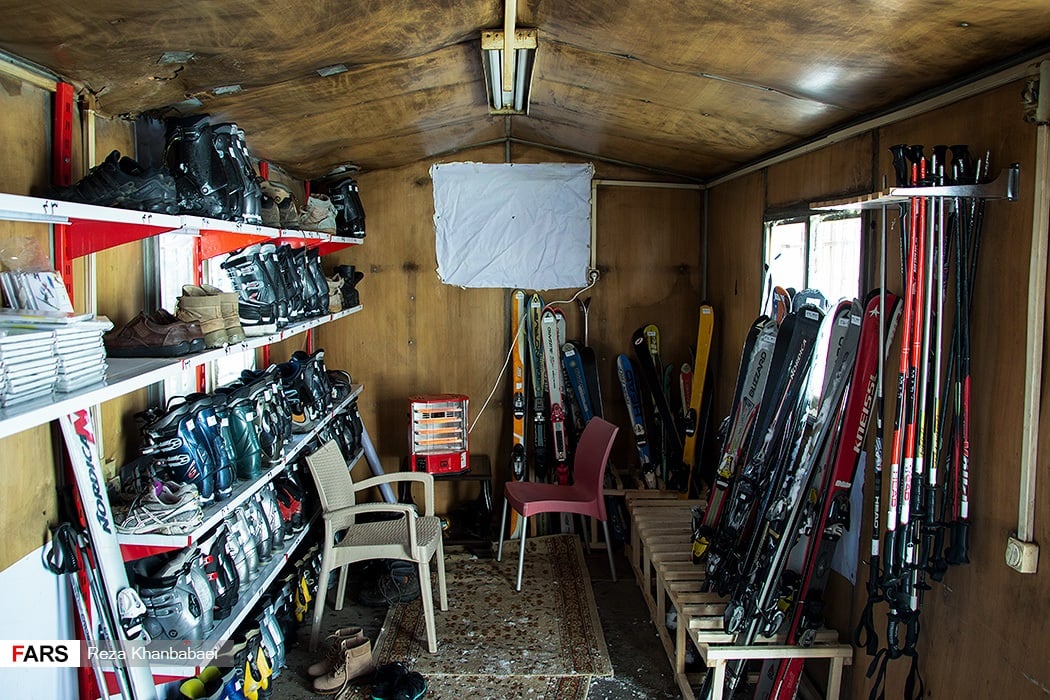
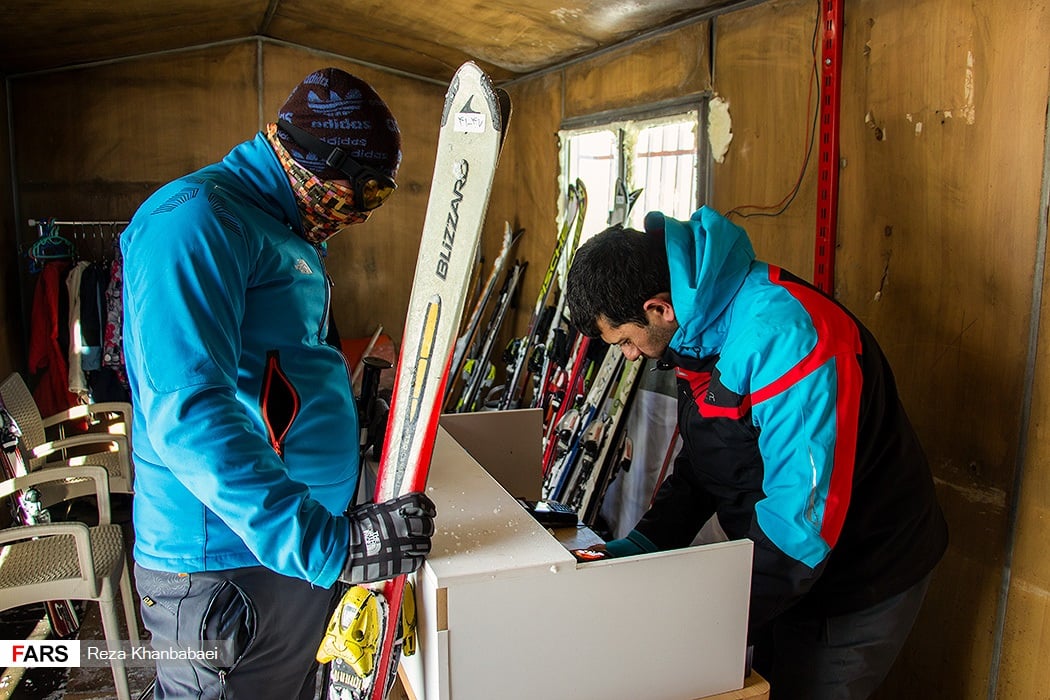
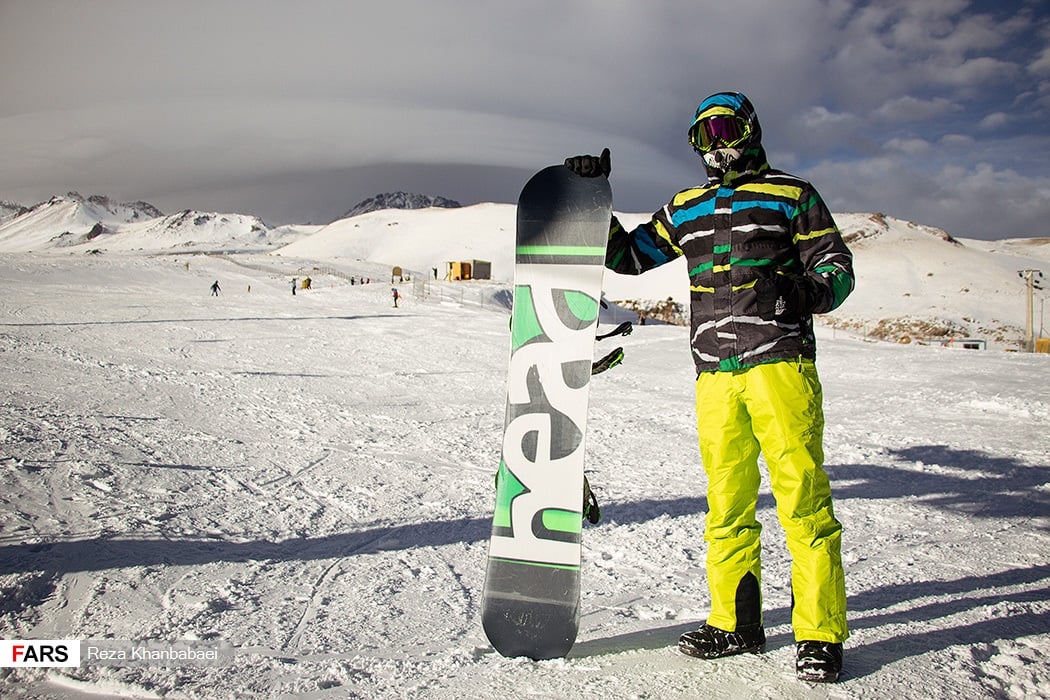
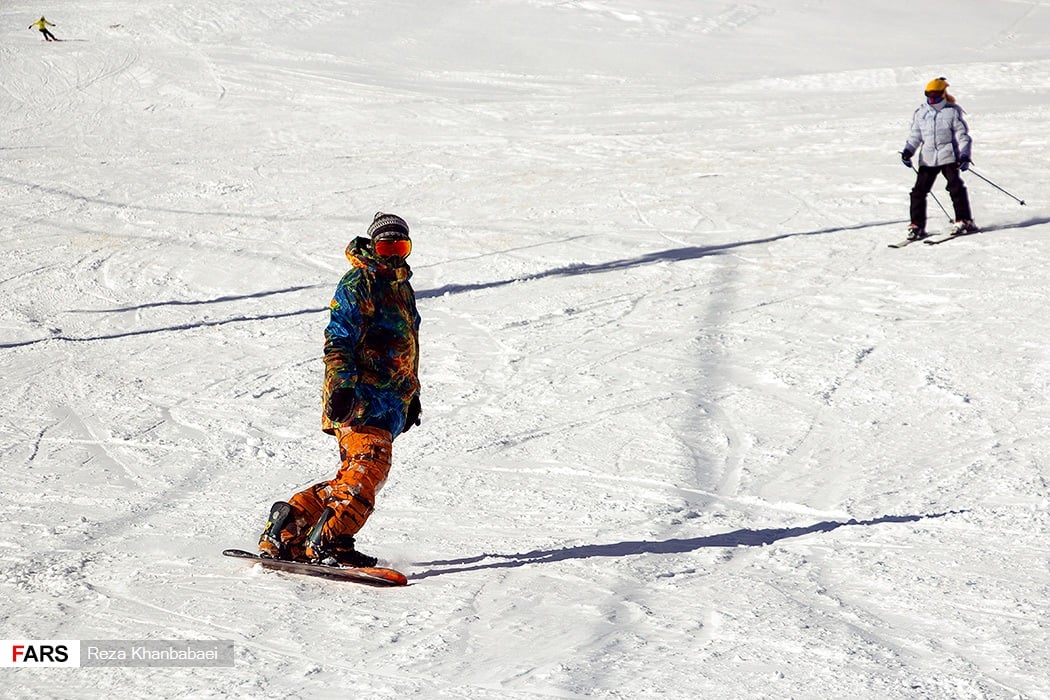
Alvares Ski Resort; Largest of Its Kind in Iran

Alvares stands 3,200 meters above the sea level. It can attract skiers for about six to eight months of each year due to its cold temperature which prevents the snow from melting.

Alvares is the largest ski resort of the country capable of hosting ski players for longer times of each year compared with other resorts.

What follows are Fars News Agency’s photos of the resort:

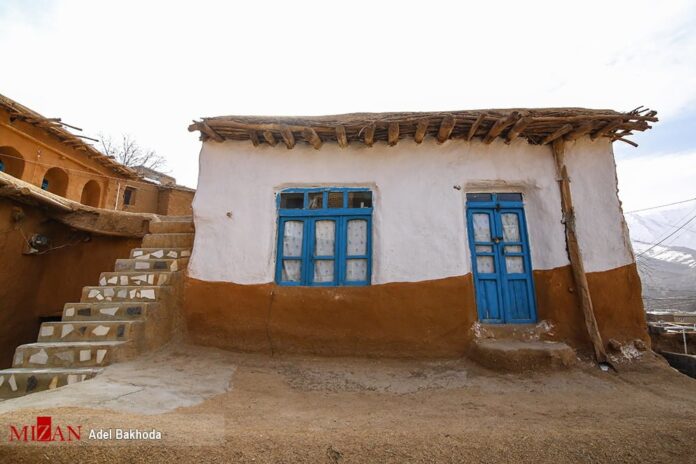
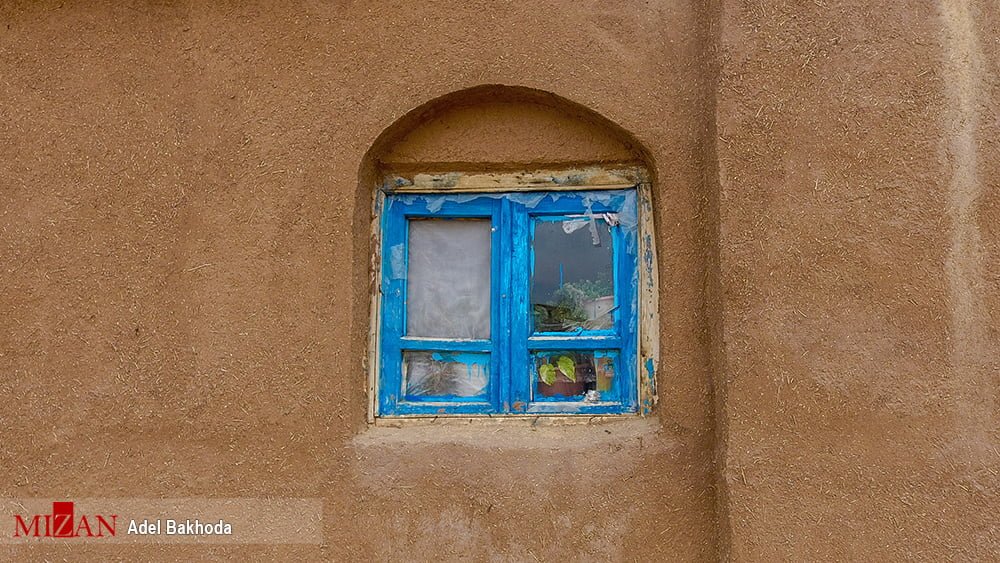
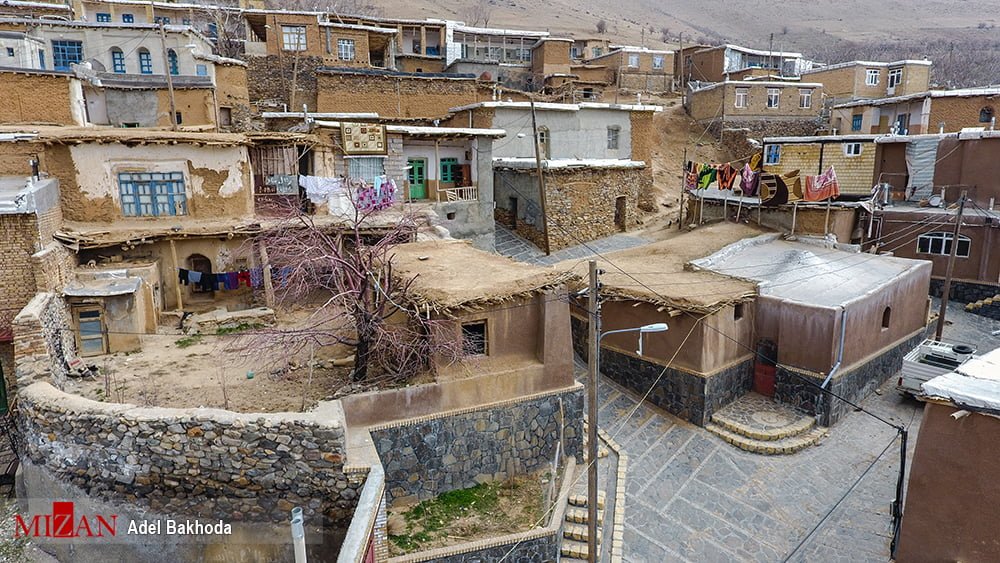
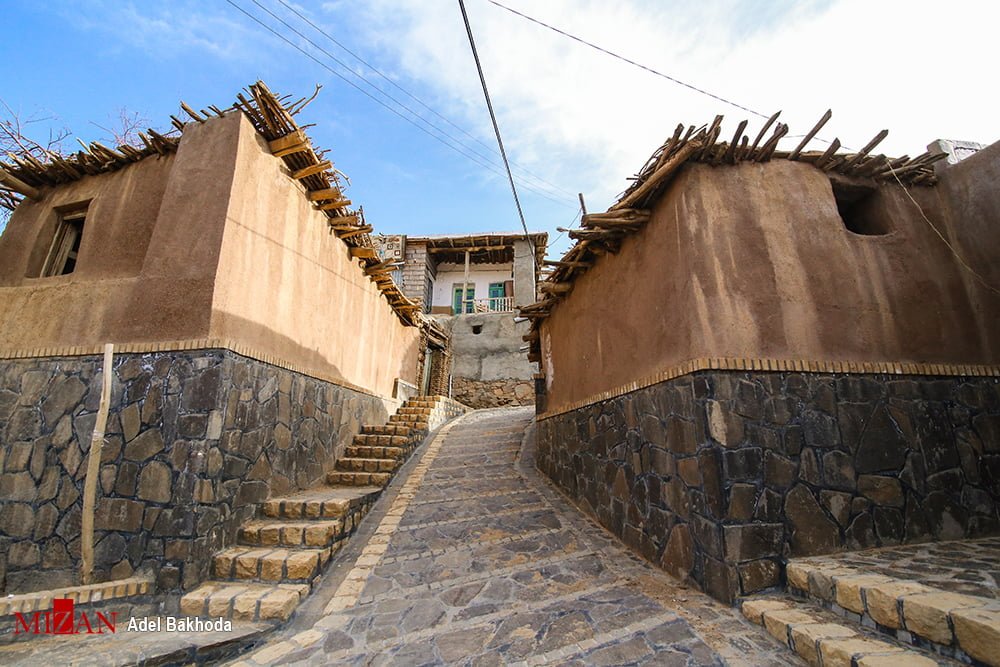
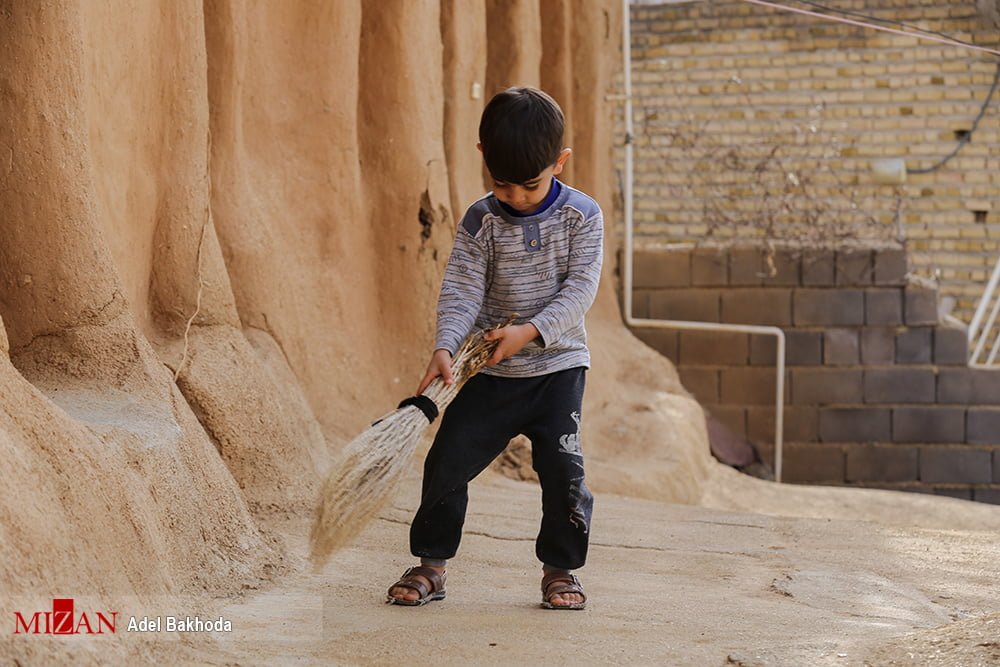
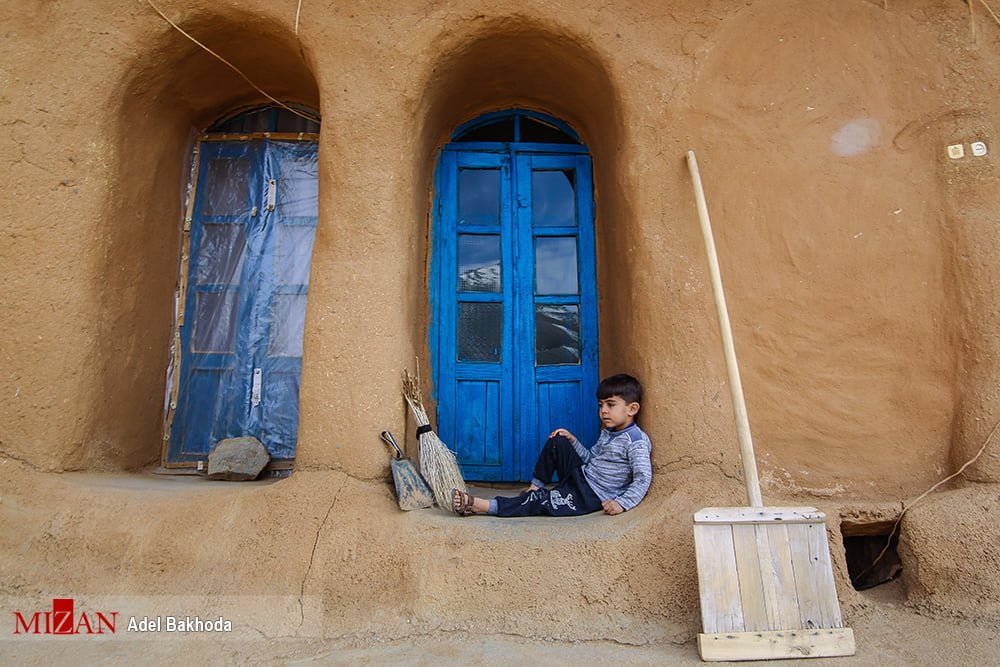
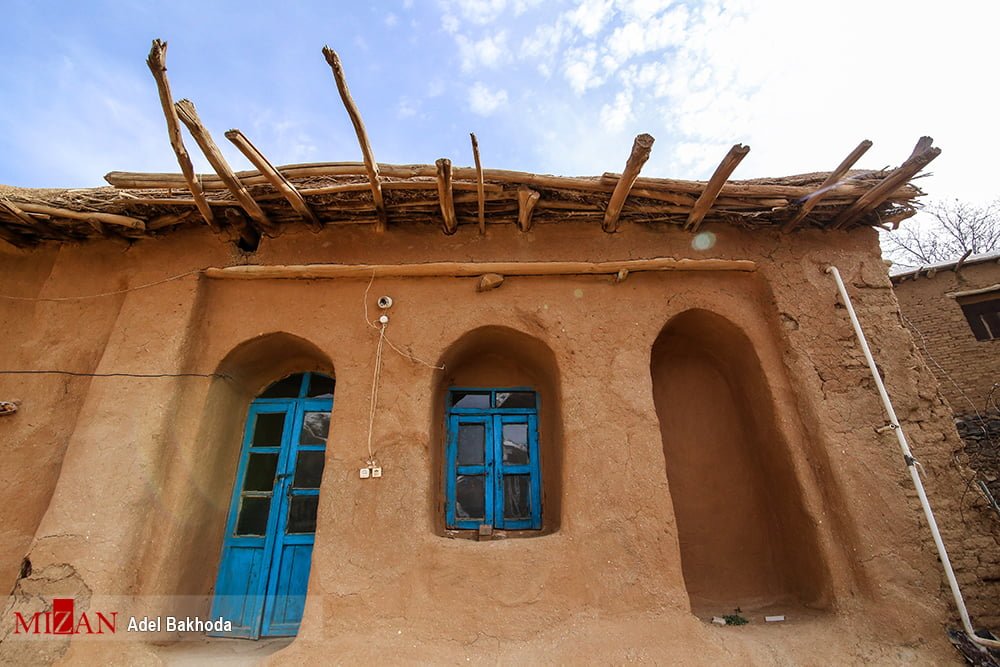
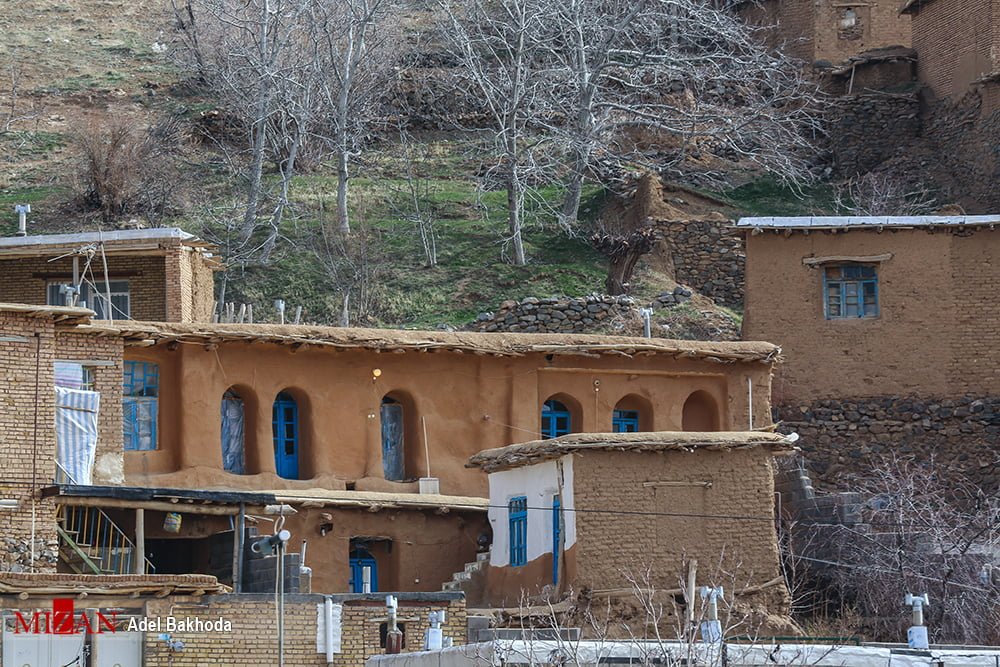
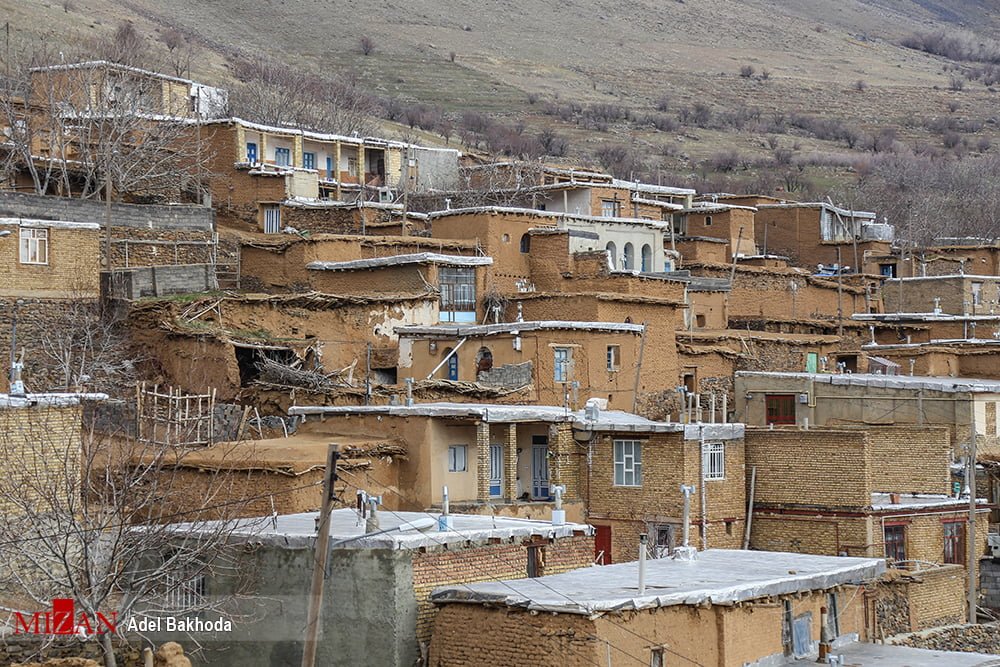
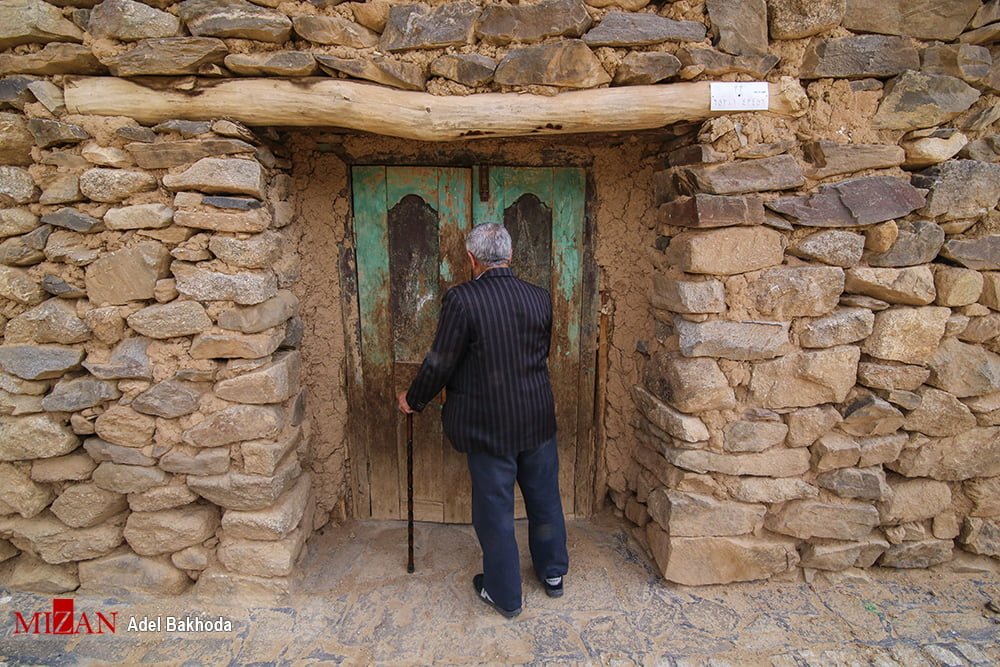
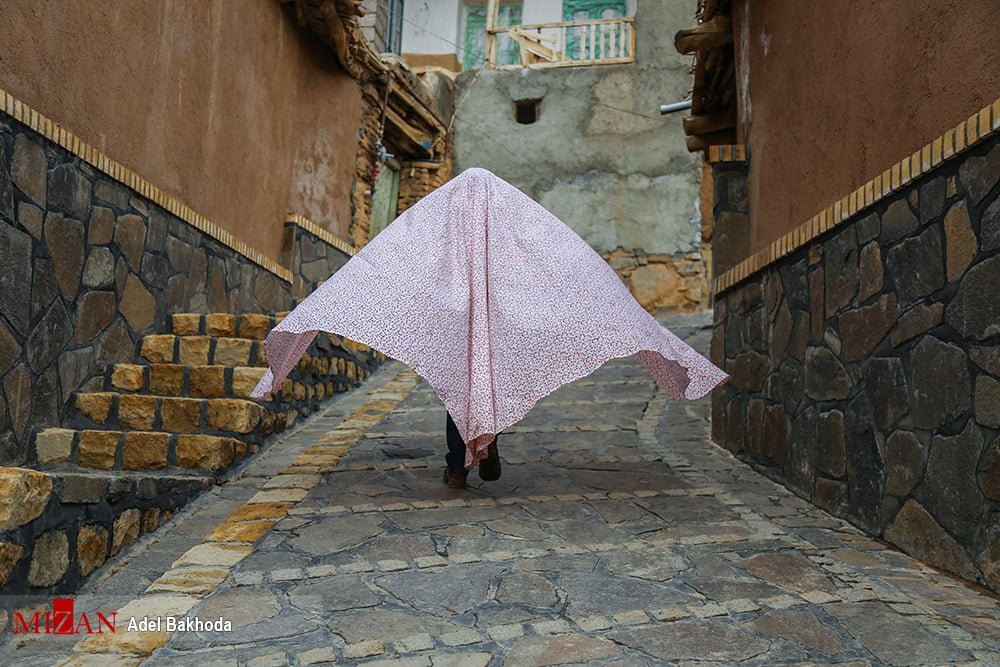
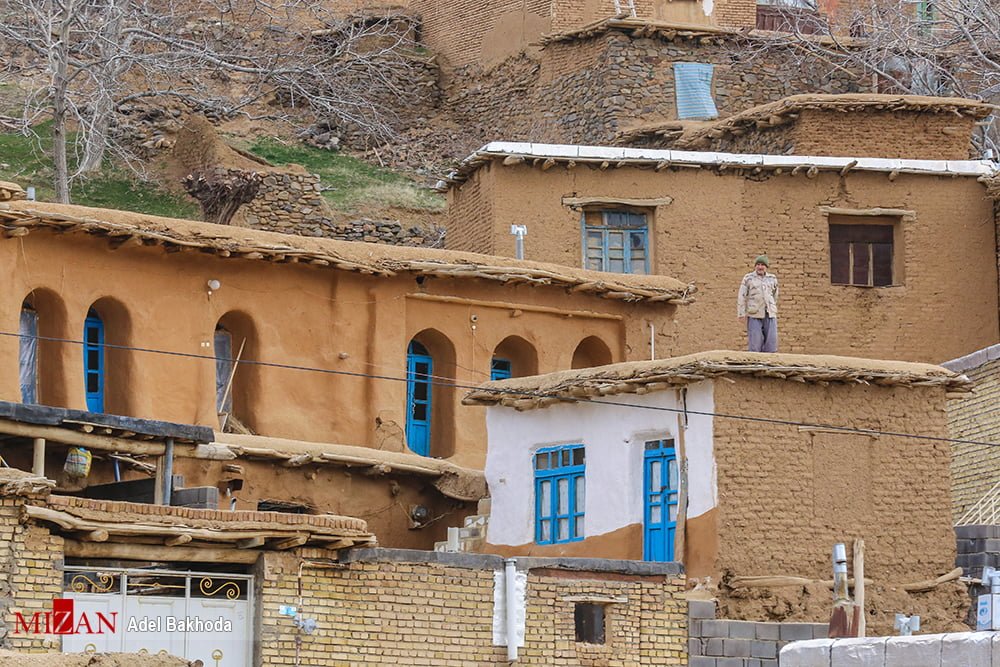
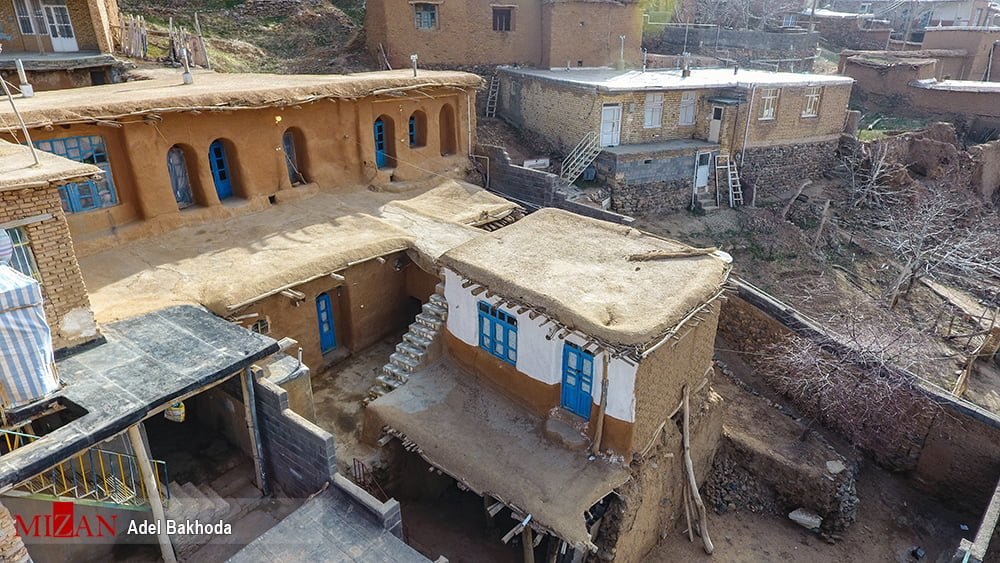
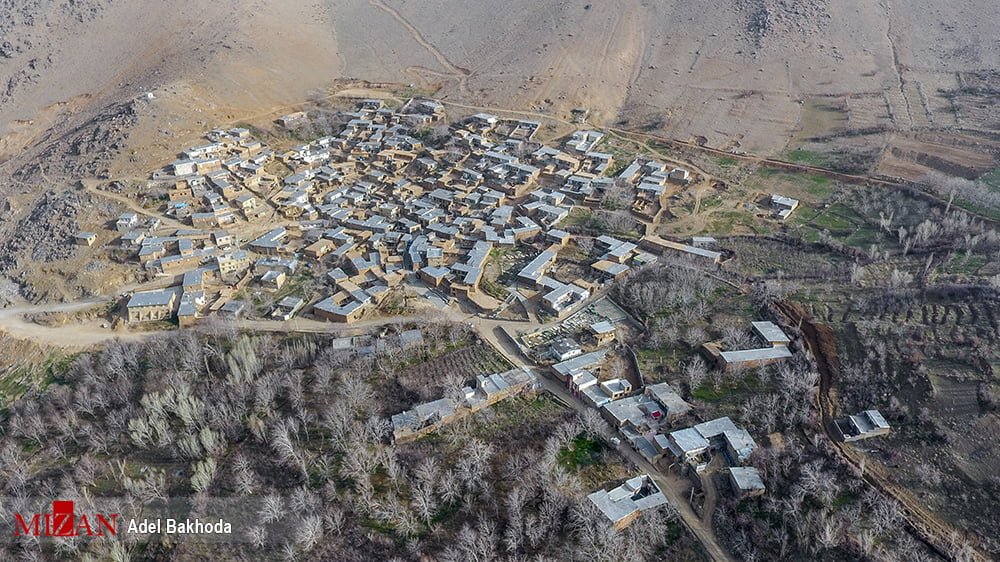
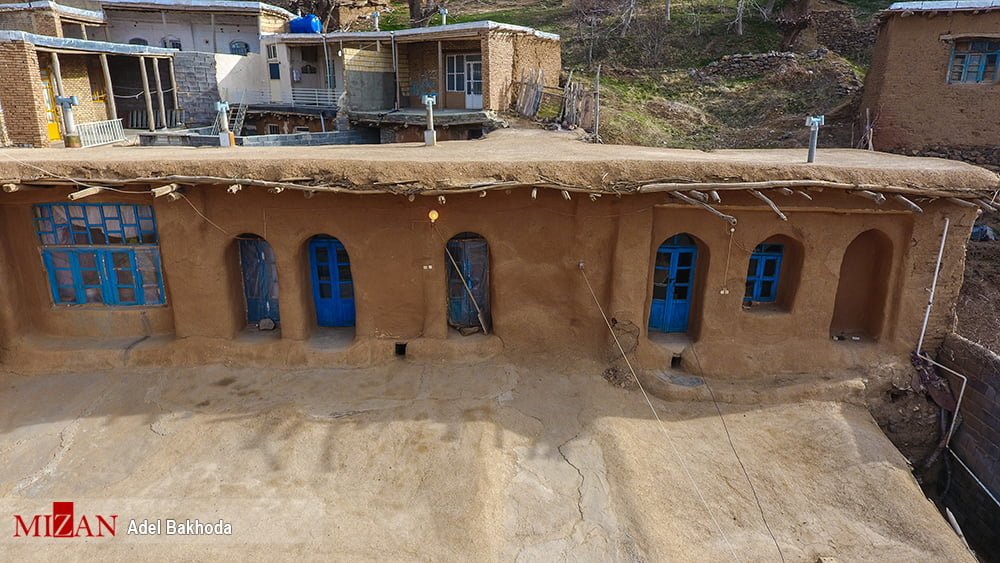
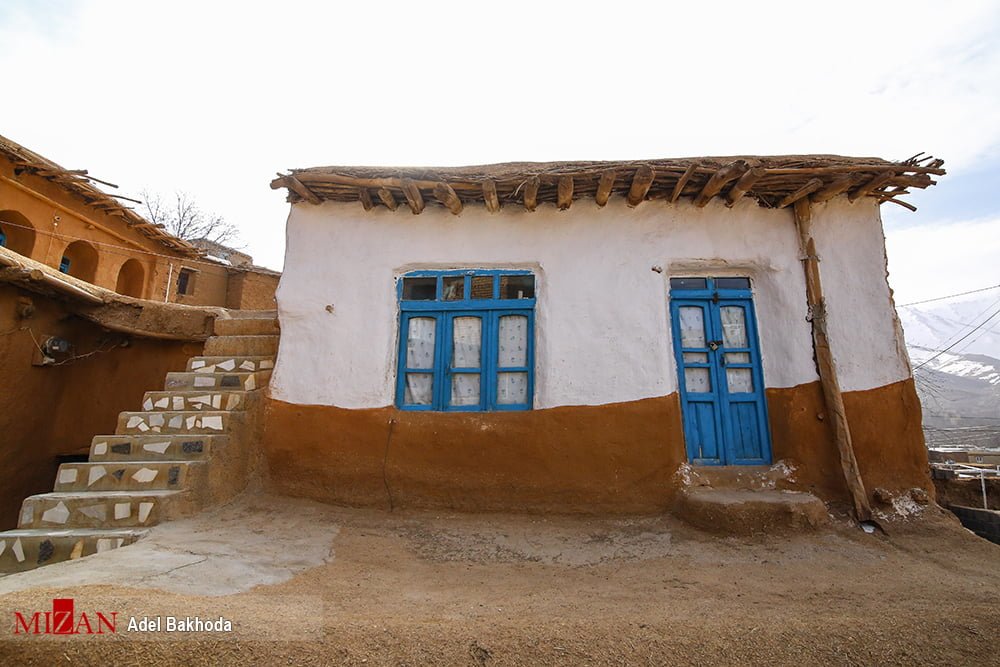
Heydareh-Qazi Khan Village: A Picturesque Site in West-Central Iran

It is located 30 kilometres away from the town of Bahar in Hamadan province, and is 35 kilometres away from the provincial capital.

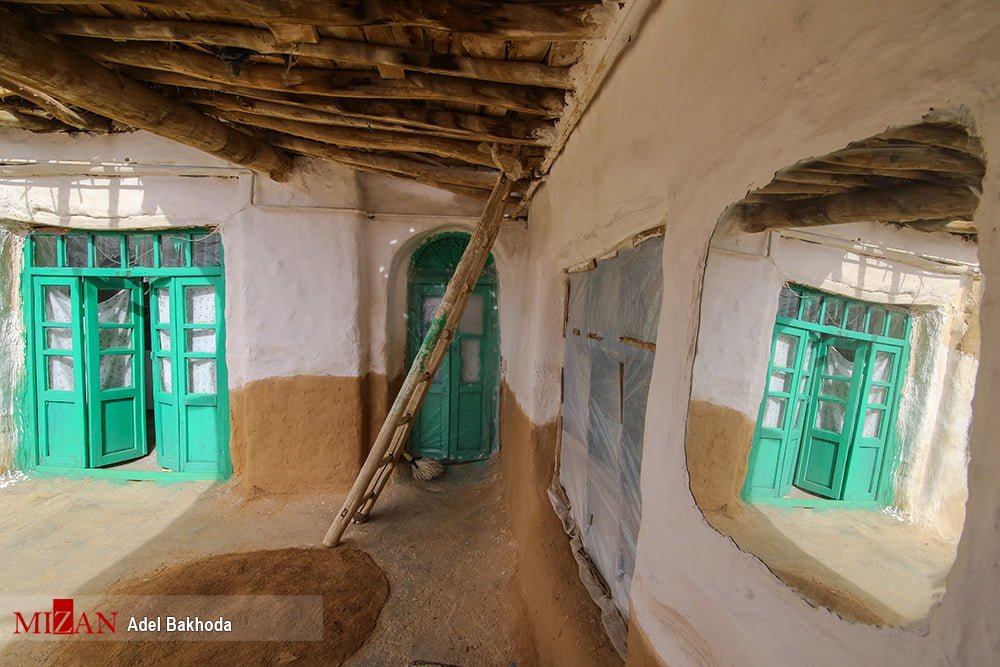
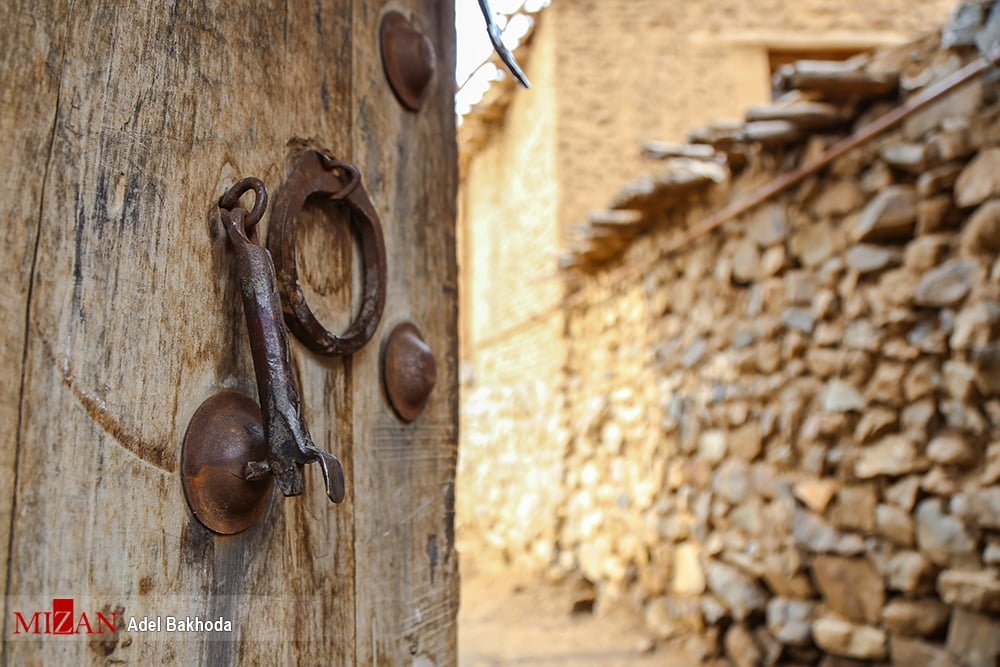
The special architecture of buildings, spectacular scenery, pristine nature, historical monuments dating back thousands of years, old subterranean aqueducts, rivers and high-quality agricultural produce have turned the village into an outstanding tourist hub.

What follows are Mizan News Agency’s photos of the village:

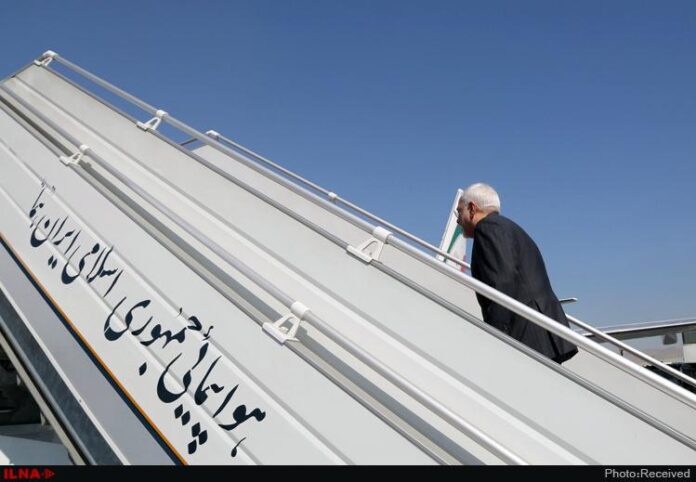
Iran FM to Visit Iraq Sunday

“Senior executives from dozens of state-run and private entrepreneurial companies will accompany the foreign minister in this trip,” Qassemi said Saturday.

During the important regional trip, Zarif will meet with high-ranking Iraqi officials and participate in joint trade conferences in several cities including Karbala and Sulaymaniyah, the spokesman said.

The top diplomat’s visit to the neighbouring country is of particular significance since it will be made shortly after the trip of US Secretary of State Mike Pompeo to Baghdad, which was aimed at convincing Iraqi officials to restrict their ties with Tehran.

Iran is Iraq’s largest trading partner, with annual trade between the two reaching up to $12 billion.

Iranian President Hassan Rouhani said late November Iran and Iraq could raise bilateral trade to $20 billion.

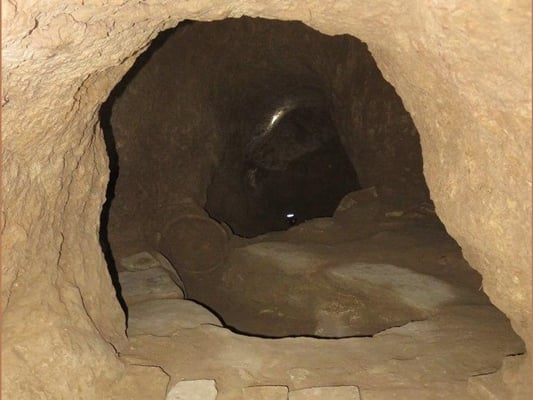
Historical Water Transfer System Unearthed in Central Iran

The system was dug out during archaeological excavations at the underground city of Nooshabad  located in Aran va Bidgol town in Isfahan province.

“The system which contains historical water structures was probably built during the two historical Ilkhanate and Safavid eras,” says Zahra Sarookhani, the head of the archaeological team.

She says archaeological excavations and relevant studies should be completed in order to establish whether the findings date back to the pre-Islamic era and whether the system was used for a special purpose.

The archeologist also said the fifth phase of archaeological excavations at Nooshabad is underway with the permission of the research centre of the Cultural Heritage Organization of Iran.

“As archaeological excavations continue in the near future, the water structures in Nooshabad city together with its museum site will turn into a water museum,” she said.

The archaeologist noted that the findings in Nooshabad suggest there used to be a special social system, which is of interest to experts on social studies as well as archaeologists.

Trump’s Syria Withdrawal Just for Domestic Purposes: French General

Dominique Delawarde, a former officer in the French military from 1959 to 2005 and a graduate of the prestigious military academy of Saint-Cyr, says Trump is doing his best to fulfil his electoral promises, as he seeks re-election in the next presidential election, and his plan to pull US forces out of the Middle East is just part of the same framework.

He made the remarks in an exclusive interview with IFP News on the sidelines of the international conference on Peace and Security in West Asia in Tehran earlier this week.

Pointing to the shutdown of the US government over a feud between Trump and Democrats who control the US House of Representatives, Delawarde said the Syria announcement is part of Trump’s tactics to defeat the lawmakers and push forward his electoral pledge to build a wall on the US-Mexico border.

The House has rejected Trump’s demand that a bill to keep the federal government operational include more than $5 billion to help build the wall, leading large parts of the government to shut down on December 22.

According to Delawarde, “Trump has a big problem with his Congress. He is placing pressure on the legislature.”

He said Trump knows the Congress is heavily influenced by the Israeli lobby groups, so his announcement is meant to push the Israeli lobby to convince the Congress to pass the bill.

“He is telling Israel that if you want me to stay in Syria, you should go to the Congress -through AIPAC, for example- and convince just 10 lawmakers to vote for me so I can get my bill passed,” he said.

Delawarde said Trump might bring home some forces or send them somewhere else, but it would be a symbolic move and he will not withdraw completely.

“If he gets what he wants, he can move some troops to Iraq or elsewhere. That’s not withdrawal. I’m 100% sure he won’t leave now,” he said.


Purpose of US Presence in Syria

Delawarde said the occupation of Syria by the US forces only has one goal: to block the route from Iran to Syria and Lebanon, and prevent Iran from increasing threats against Israel.

“It’s all about Iran. It’s the reason why they want to stay in the country. So they have no motive to leave the country now,” he said.


US Would Be Forced to Withdraw

Although the US won’t withdraw from Syria now, Delawarde said Washington will be forced to do so in the near future.

“The US will withdraw in the future. I’m not talking about this year or next year, but 2020 or 2025,” he said.

Unlike what the Western media portray, the US is in no good shape and the country is about to go into a big crisis, he said.

Delawarde said the US has a huge debt, with just the federal debt reaching an unprecedented amount of 23,000 trillion dollars. Moreover, they are losing big in a trade war with China, he said.

“It’s the beginning of the end. The US has so economic bubbles that could explode soon. It may take a few months, one year, two years or 10 years – but it will certainly happen,” he said.

A Look at Iranian Newspaper Front Pages on January 12

A Look at Iranian Newspaper Front Pages on November 19

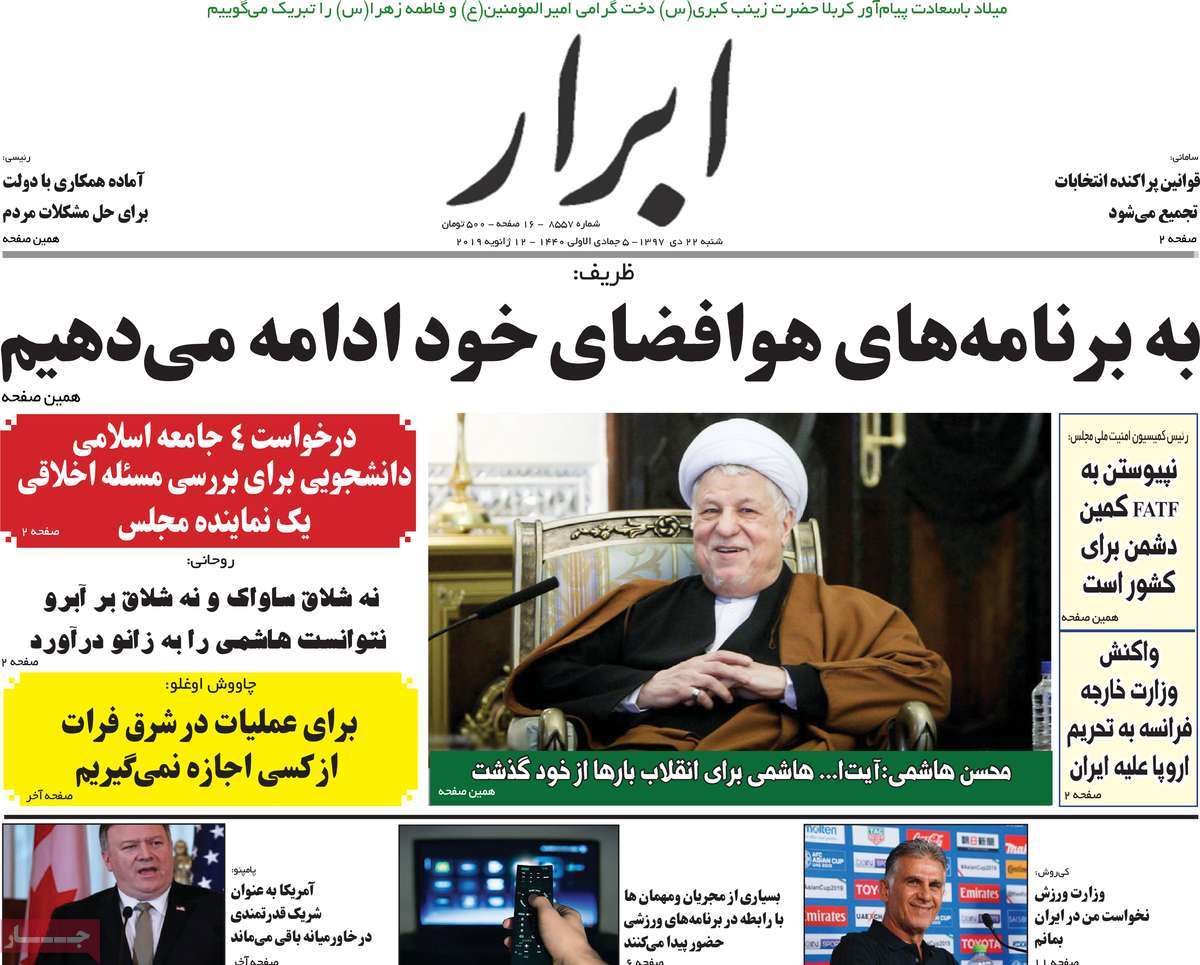
Almost all papers today covered the remarks made by Iranian President Hassan Rouhani in praise of the late ex-president Ayatollah Akbar Hashemi Rafsanjani and his personality.

Also a top story was US Secretary of State Mike Pompeo’s tour of regional countries which is aimed at uniting Arab countries against the Islamic Republic of Iran.

A controversial plan by the municipality of Tehran to receive tolls from citizens who use some of the busiest tunnels in the capital also received great coverage.

The above issues, as well as many more, are highlighted in the following headlines and top stories:


Abrar:

1- Zarif: We’ll Continue Our Aerospace Program

2- Top Lawmaker: FATF Adoption Enemy’s Plot for Iran
A Look at Iranian Newspaper Front Pages on January 12


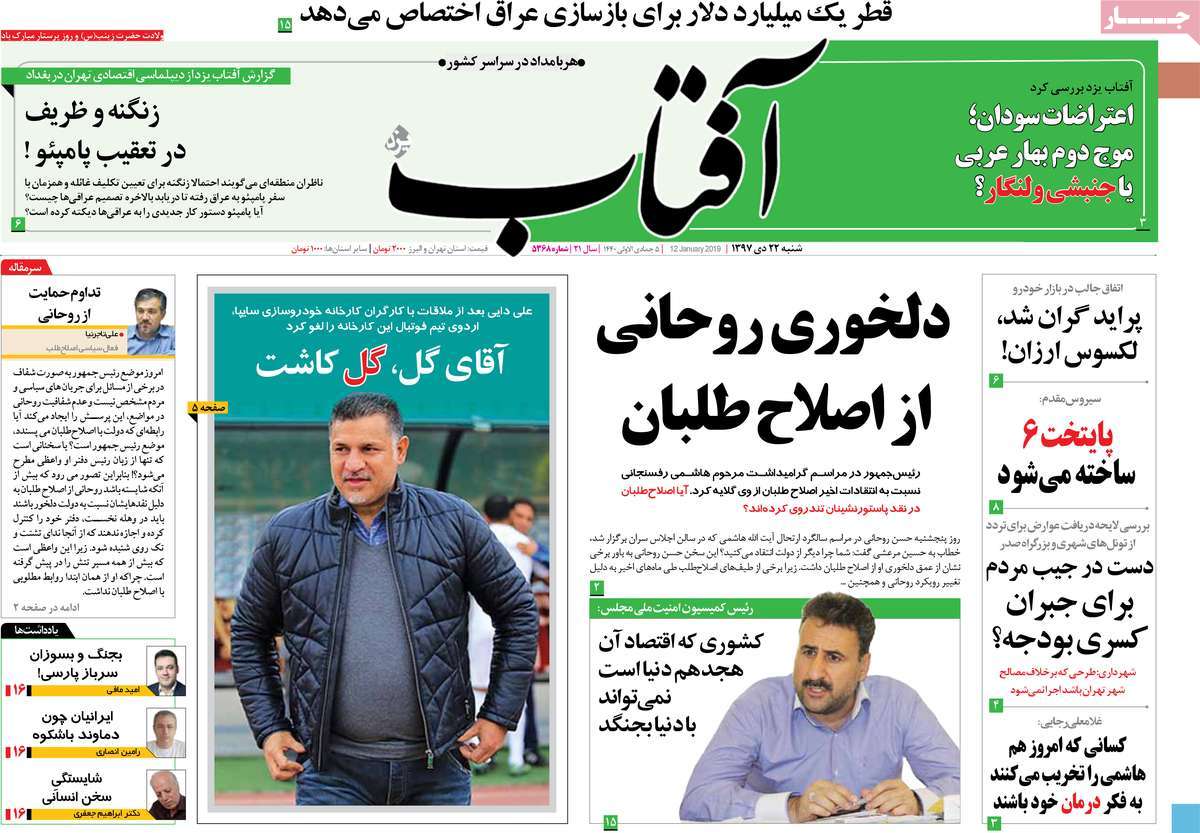
Aftab-e Yazd:

1- Rouhani Upset with Reformists

2- Zarif, Zanganeh Chasing Pompeo!

3- Senior Lawmaker: Iran Can’t Fight the World When Its Economy Ranks 18th
A Look at Iranian Newspaper Front Pages on January 12


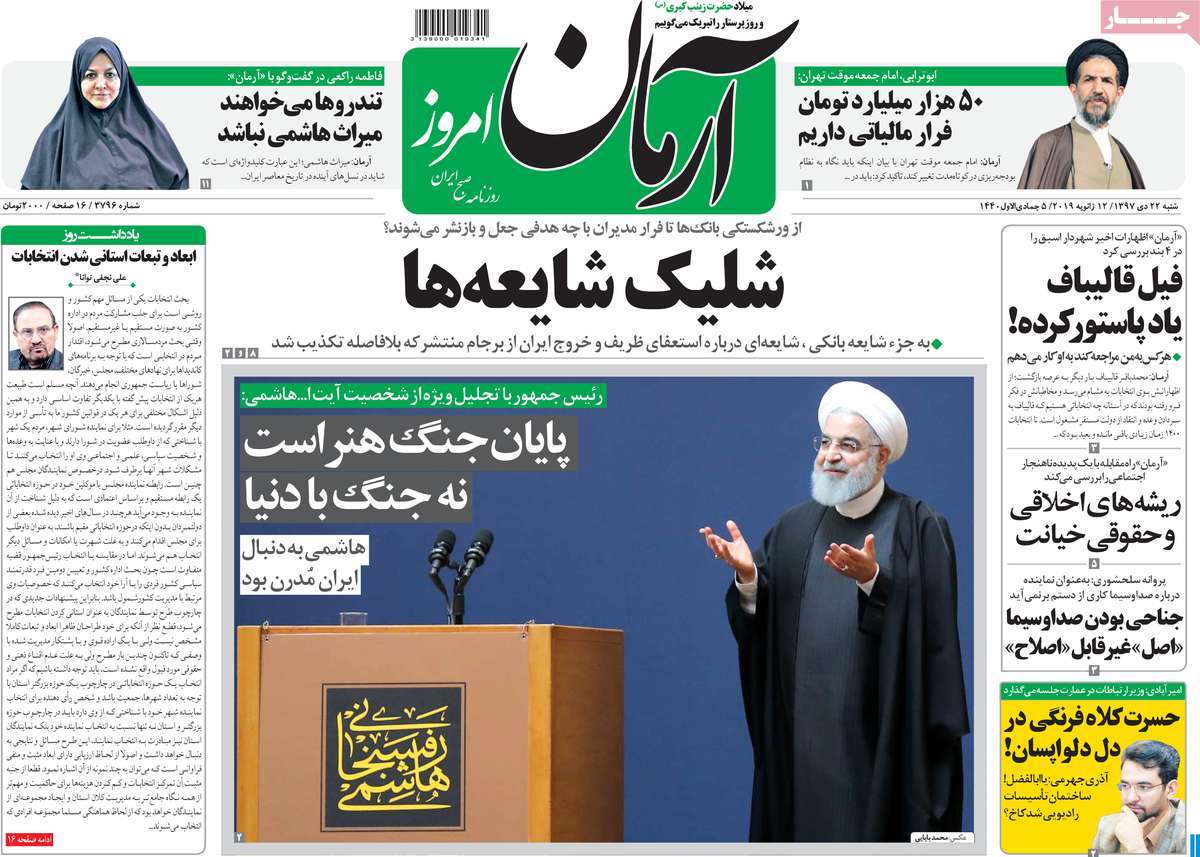
Arman-e Emrooz:

1- Rouhani Praises Ayatollah Rafsanjani’s Personality

* Ending War Matters, Not Fighting against the World

2- Rumours of Zarif’s Resignation, Iran’s Withdrawal from JCPOA Dismissed
A Look at Iranian Newspaper Front Pages on January 12


Etemad:

1- Rouhani: We Should Be Rafsanjani of Our Time

2- Pompeo Visiting 9 Regional Countries with Aim of Countering Iran
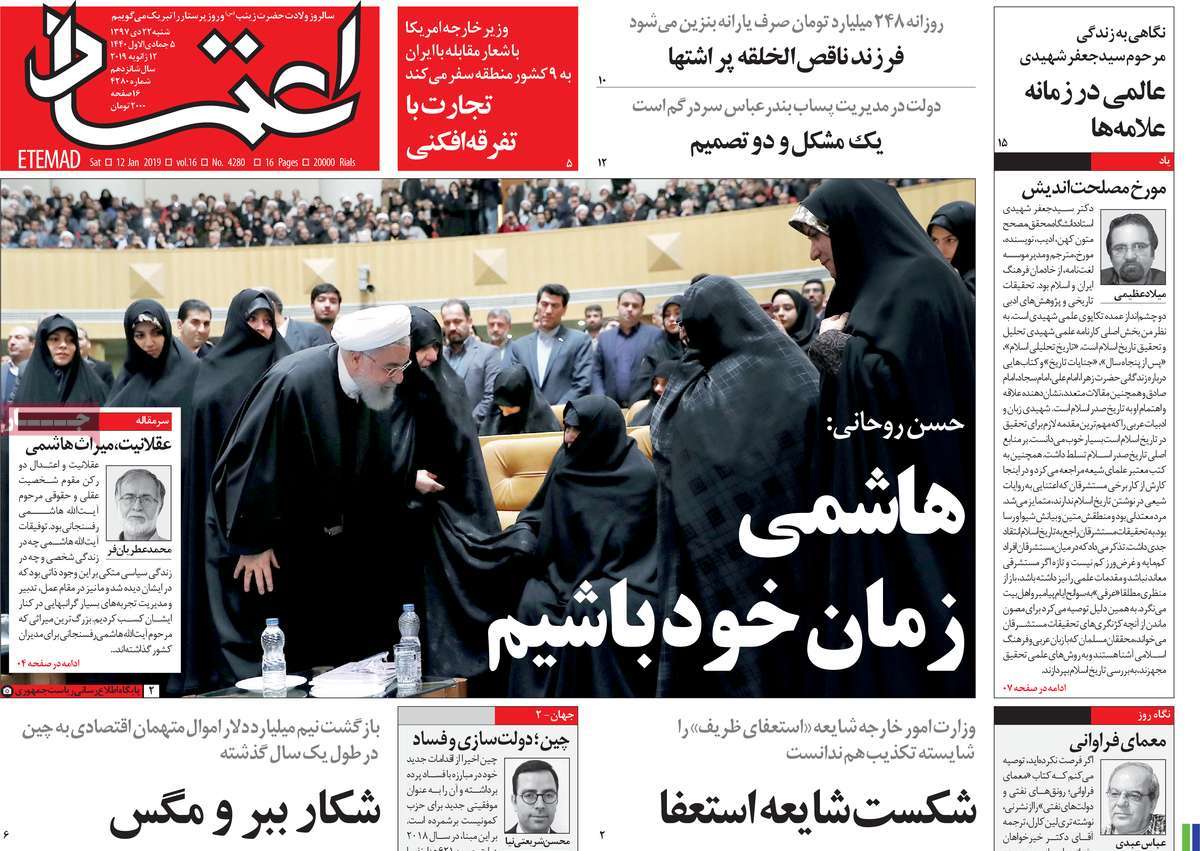
A Look at Iranian Newspaper Front Pages on January 12


Ettela’at:

1- Zarif to Pompeo: Hell Will Freeze the Day When Iran Follows US’ Model of Human Rights

2- Several Top Saudi Commanders Killed in Yemeni Ansarullah’s Drone Attack
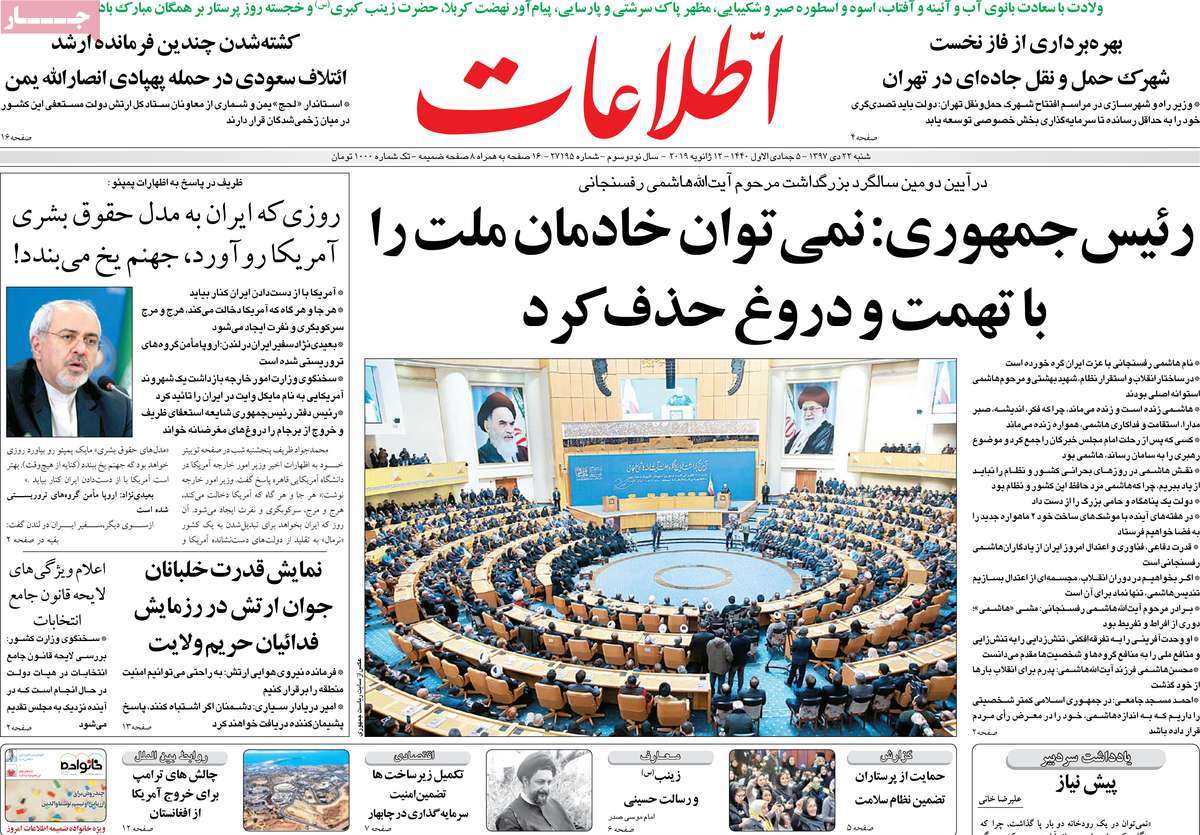
A Look at Iranian Newspaper Front Pages on January 12


Javan:

1- US Starts Escaping Syria

2- Vietnam, Second Important Rival of Iran at AFC Asian Cup
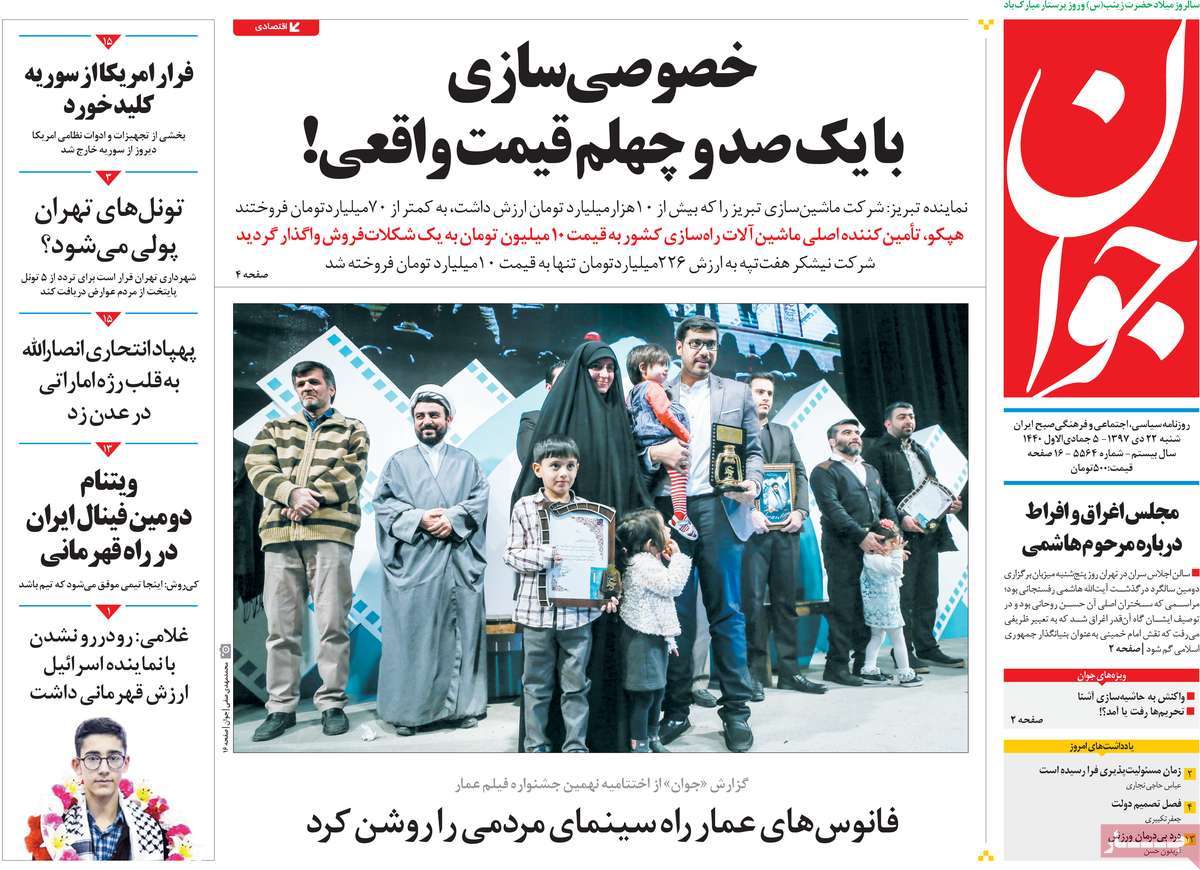
A Look at Iranian Newspaper Front Pages on January 12


Jomhouri Eslami:

1- Rouhani: Ayatollah Rafsanjani’s Name Interwoven with Iran’s Dignity

2- Reuters: S Korea to Resume Oil Imports from Iran

3- Trump’s Son Compares Refugees to Wild Animals
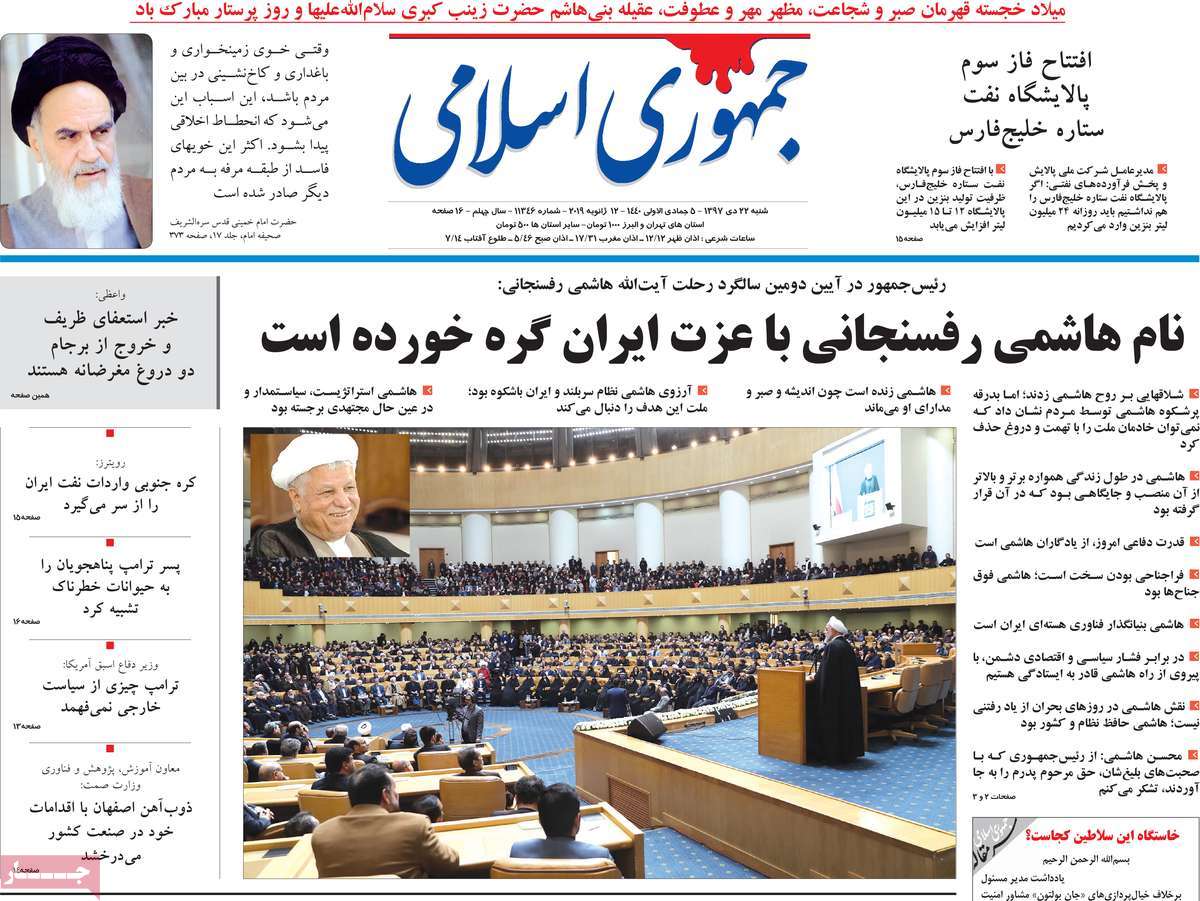
A Look at Iranian Newspaper Front Pages on January 12


Kayhan:

1- First-Degree Idiot in Cairo: US Saviour of Middle East!

2- Iran Leader: Some US Statesmen Pretend to Be Crazy; I Don’t Believe that; They’re First-Degree Idiots

3- Europe’s Time Over: Iran’s Top Security Official Slams Europe’s Failure to Launch SPV
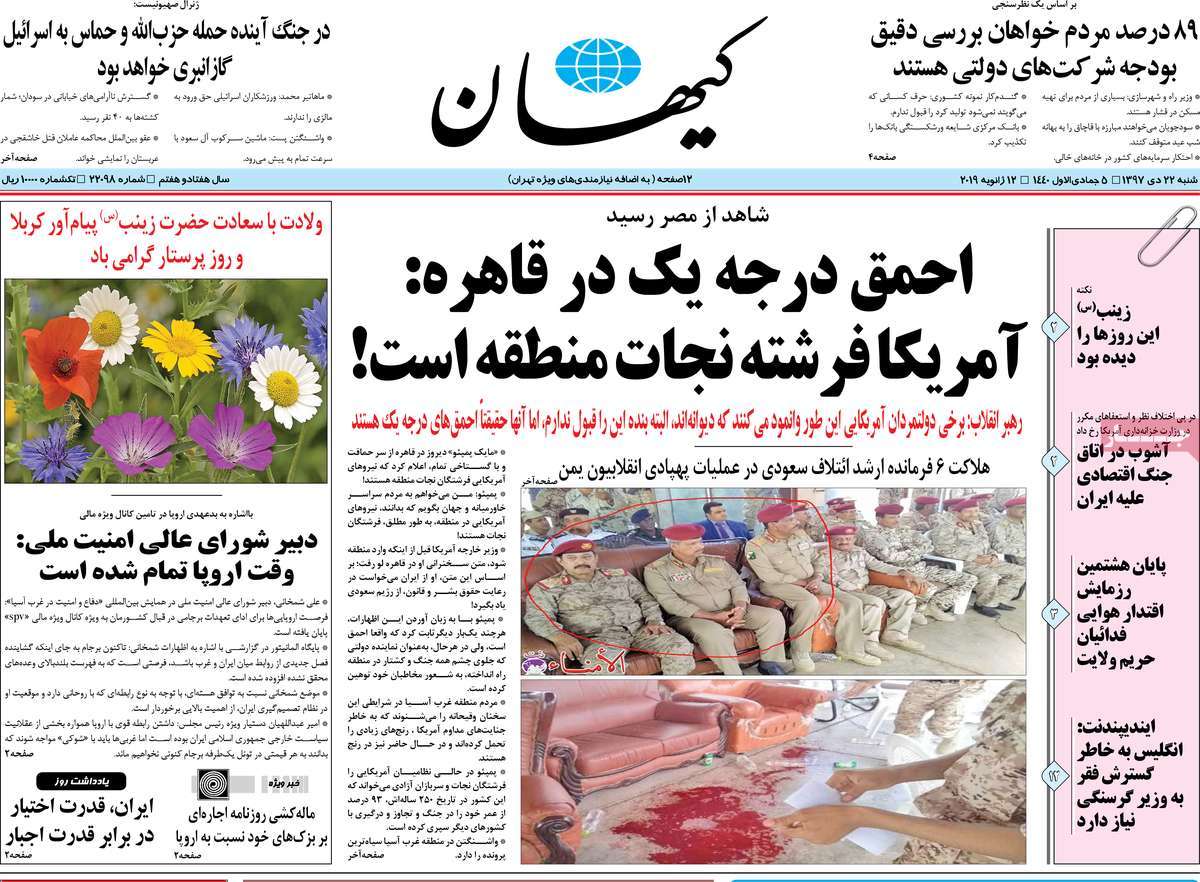
A Look at Iranian Newspaper Front Pages on January 12


Sazandegi:

1- US on Verge of National Emergency

* Trump Threatening Congress to Receive Budget for Building Border Wall
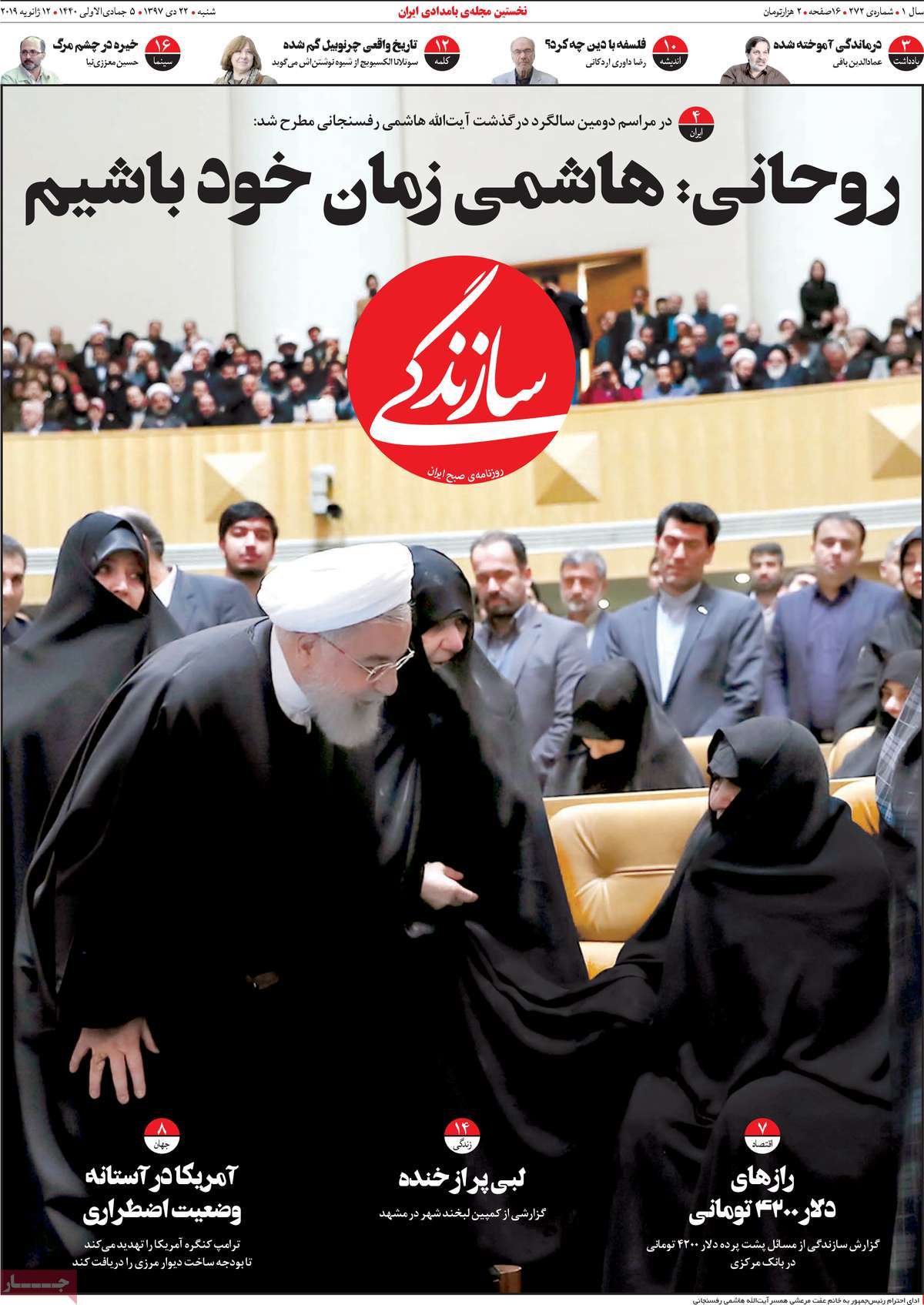
A Look at Iranian Newspaper Front Pages on January 12


Setareh Sobh:

1- Interior Ministry: Gov’t Reviewing Law of Elections

* Voters Must Sign Up before Election Day
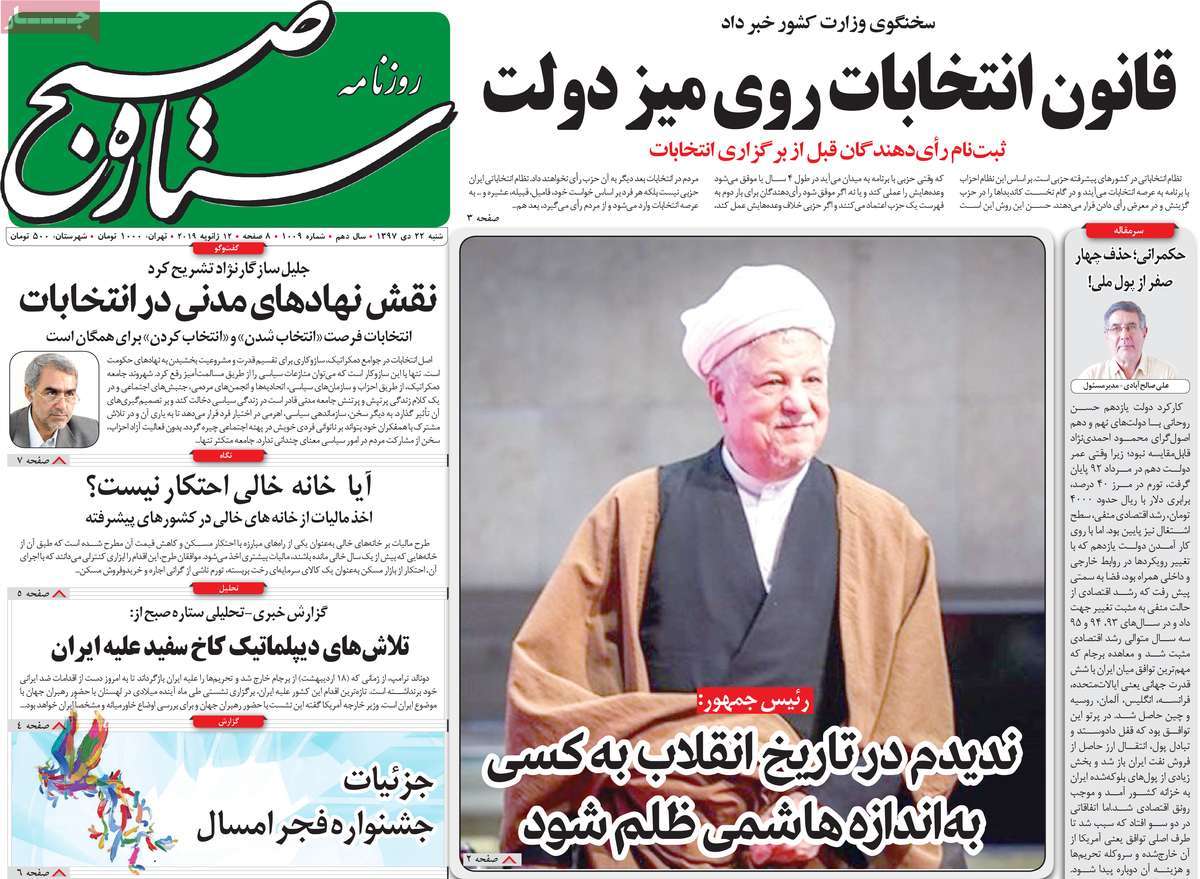
A Look at Iranian Newspaper Front Pages on January 12


Shahrvand:

1- Tunnel of Horror in Tehran

* Municipality’s Plan to Receive Tolls for Use of Tehran’s Tunnels Sparks Controversy

* City Council Opposed to the Plan

2- We’ll Win and Advance to Next Stage: Team Melli to Face Vietnam Saturday
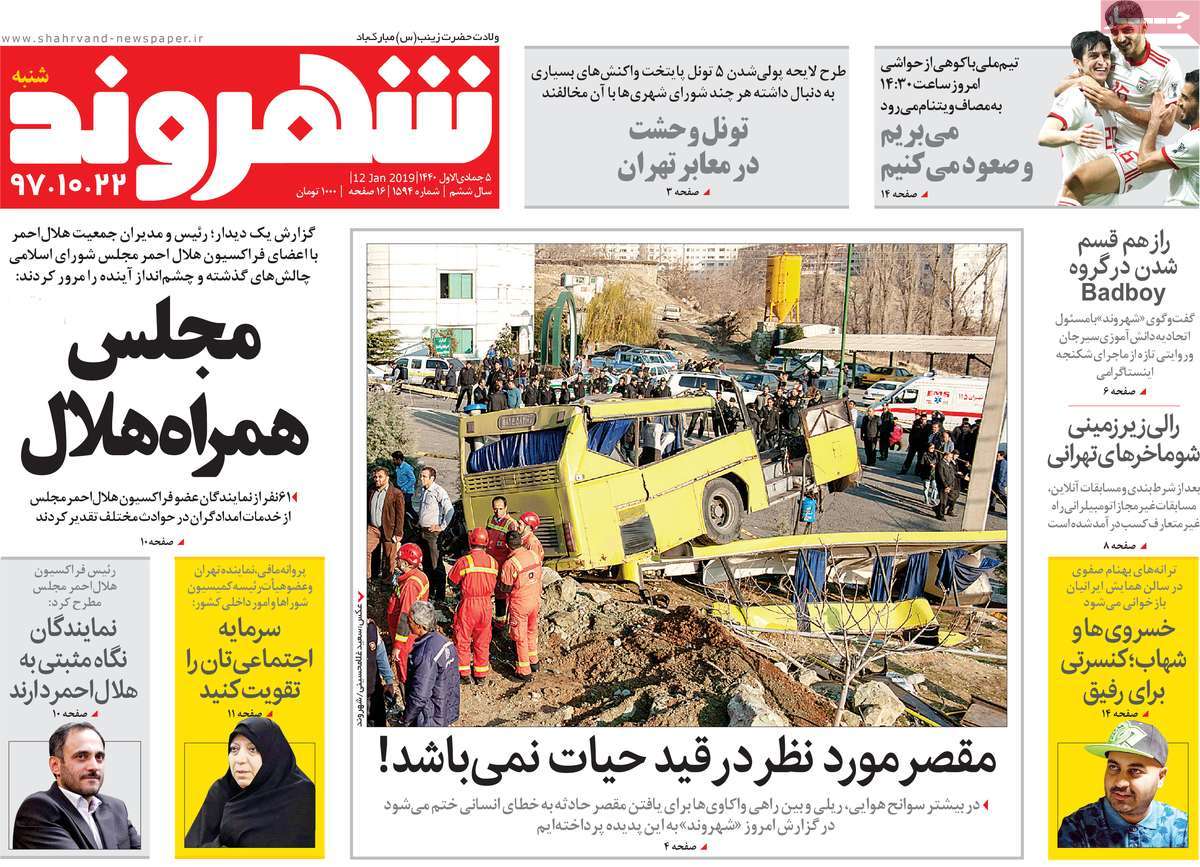
A Look at Iranian Newspaper Front Pages on January 12


Shargh:

1- US Taking Advantage of Regional Conflicts: Regional Arabs Host Pompeo

2- Iran Using Natural Gas as Diplomatic Tool in Negotiations
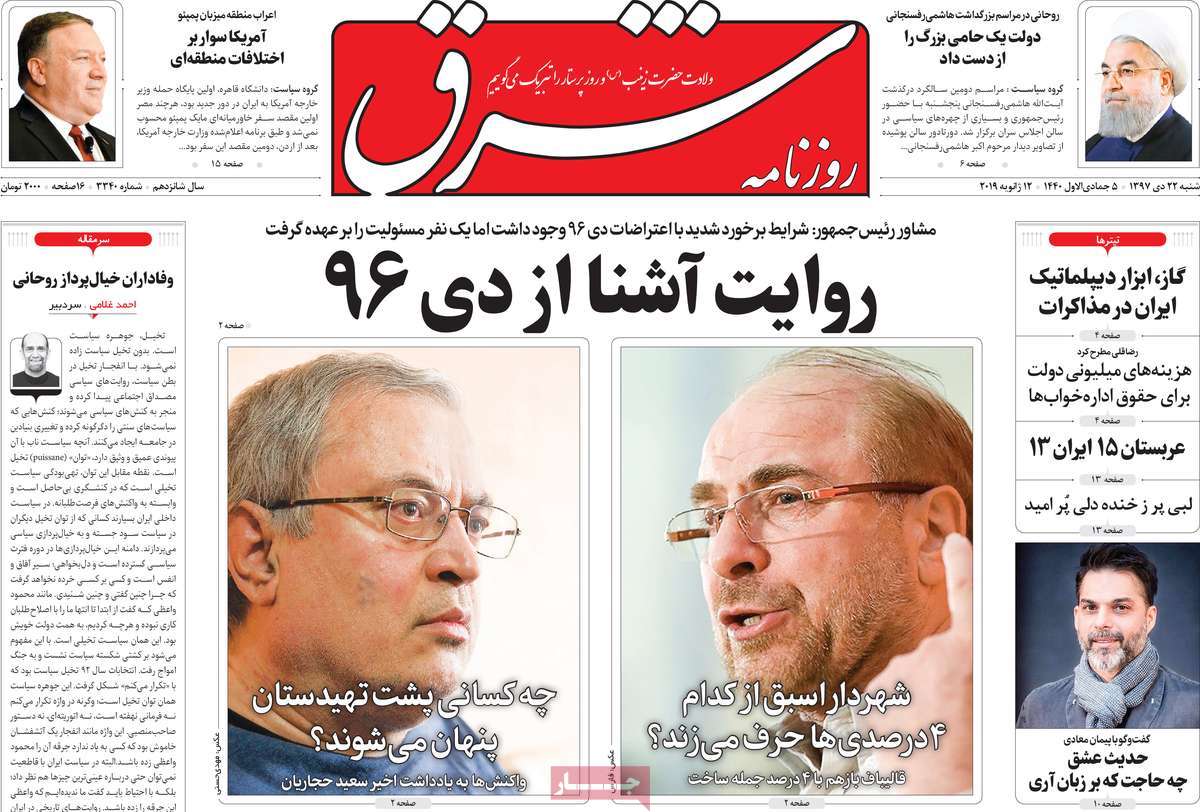
A Look at Iranian Newspaper Front Pages on January 12


Sobh-e Now:

1- Iraqi Market Top Destination of Iran’s Exports

2- People May Be Forced to Pay Toll for Using Tunnels in Tehran

* Reformists Seeking to Make Life More Expensive for Citizens of Tehran
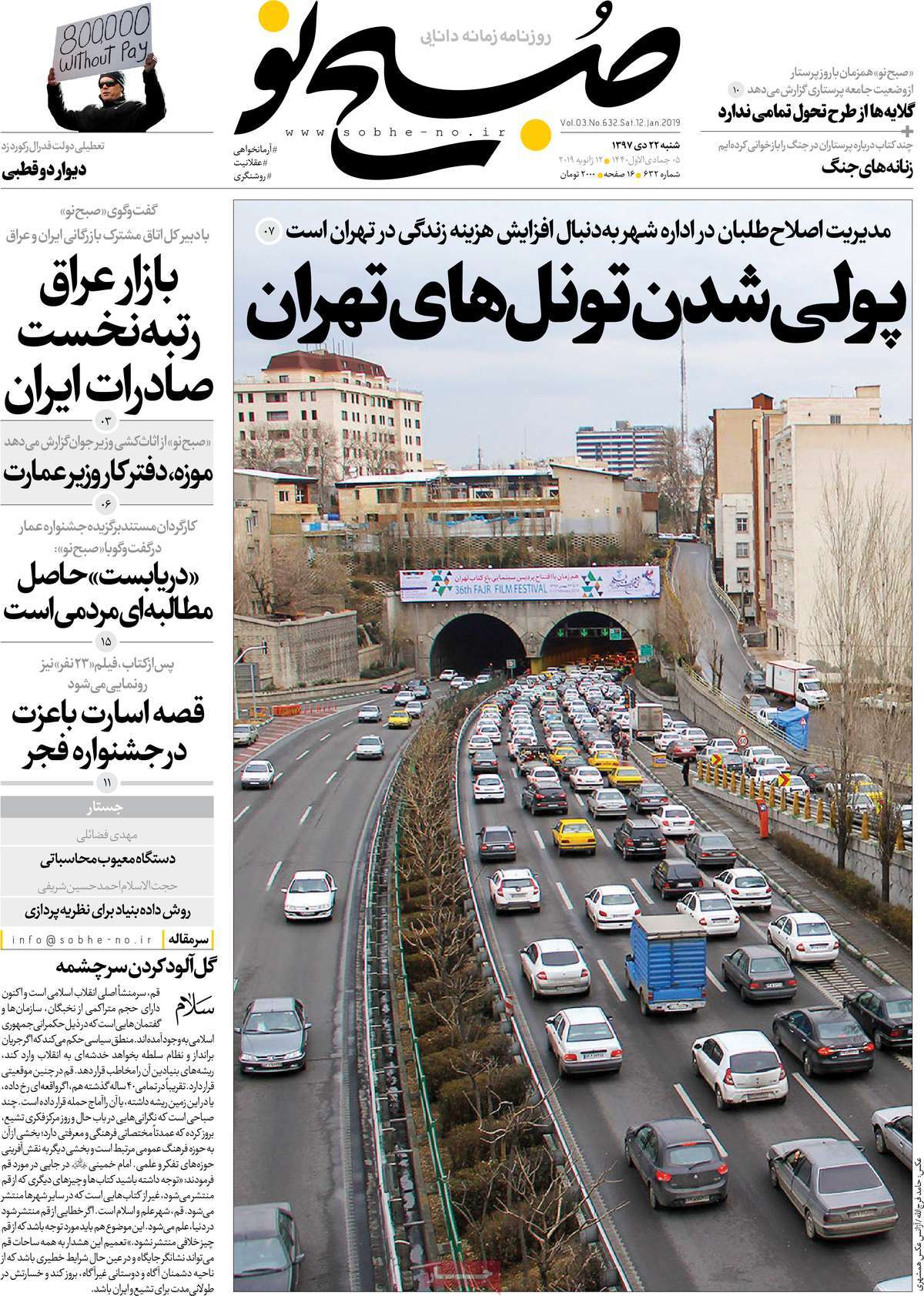
A Look at Iranian Newspaper Front Pages on January 12

Zarif: Anti-Iran Summit to Be Held by US in Poland ‘Desperate Circus’

Pompeo Seeks to Flood Region with Even More US Arms: Zarif

“Reminder to host/participants of anti-Iran conference: those who attended last US anti-Iran show are either dead, disgraced, or marginalized. And Iran is stronger than ever,” Zarif said in a Friday tweet.

His comments came after US Secretary of State Mike Pompeo told Fox News in an interview to air on Friday that Washington will jointly host a global summit focused on Iran and the Middle East next month in Poland.

The international gathering will take place in Warsaw from February 13 to 14, the US State Department said in a statement.

Pompeo said the meeting would “focus on Middle East stability and peace, freedom and security here in this region, and that includes an important element of making sure that Iran is not a destabilizing influence”.

Since withdrawing from the Iran nuclear deal last year, the US administration has steadily ratcheted up pressure on Tehran and vowed to increase it until Iran halts what US officials describe as its “malign activities” throughout the Mideast and elsewhere.

As part of its policy of maximum pressure, Washington in early November re-imposed what it called the harshest-ever sanctions against the Islamic Republic.

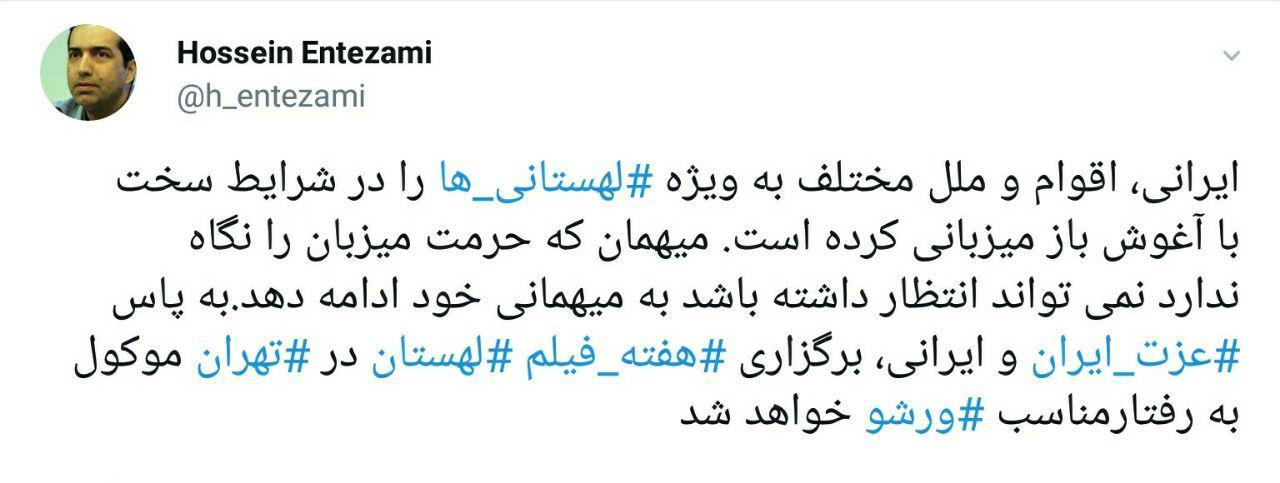
In his tweet, Zarif also strongly criticized the Polish government for hosting the conference, reminding Warsaw of thousands of Polish refugees saved by Iran during the Second World War.

“Polish Govt. can’t wash the shame: while Iran saved Poles in WWII, it now hosts desperate anti-Iran circus,” he went on to say.
During the World War II, up to two million Polish civilians were arrested by the Soviet secret police and deported to Siberia and Kazakhstan. Many did not survive the long journey (lasting many weeks) by cattle train; many more died during their imprisonment.

Others simply failed to get out after finally being freed from the Soviet gulags. A total of 120,000 Polish people, 3,000 of whom were orphans, escaped from the Soviet Union to Iran, starting a new life in Isfahan.

The Poles entered Iran from the port city of Anzali on the southern coast of the Caspian Sea. Soviet ships docking in Anzali were packed with starving Polish refugees, and they were the lucky ones: Many others died along the way from typhus, typhoid and hunger.

Photos of the Poles and their graveyard in Iran were posted by Zarif in his Friday tweet.

Zarif also included a photograph from the 1996 “Summit of Peacemakers” in Sharm el Sheikh in Egypt.

The photo showed Jordan’s King Hussein, Israeli Prime Minister Shimon Peres, US President Bill Clinton, Egyptian President Hosni Mubarak, Russian President Boris Yeltsin and Palestinian leader Yasser Arafat, among other world leaders.

Culture of Hijab in Iran; From Past to Present

The original uniform of Turkmen women is a long silk gown called “Don” that reaches the knees.

In many images and designs of the centuries before the advent of Islam and afterwards, Iranian men and women have observed Hijab and maintained their dignity by covering their heads and their body.

Culture of Hijab in Iran; From Past to PresentTherefore, one can say the Iranian culture and civilisation is different from other cultures including that of Greece, in which men and women were occasionally bare or not covering their bodies fully.

The Iranian historical trend shows that the majority of people, including men and women, tended to put on more covered clothes than other societies.

According to Hadi Vakili, an associate professor at the History Department of Ferdowsi University of Mashhad, “the anti-hijab movement entered Iran’s history several times, but at no point was welcomed by Iranians.”

“In the same ancient Iran, when Alexander the Great and later the Seleucids entered Iran, their culture was not the same as those of the Iranians regarding their clothes. In another word, they were not observing Hijab, but the Iranian society did not accept them,” he said.

Culture of Hijab in Iran; From Past to Present
A photo retrieved from French traveller Jean Chardin’s “Travels in Persia” book

“Similarly, Mongol women or some other ethnic minorities in Iran did not have full hijab, but they were adapted to the Iranian culture and society and started to wear Iranian-style clothes.”

Another important event against hijab in Iran was the removing of hijab by Reza Khan. It was a very clear example of tyranny and modernisation of the Iranian society by force of guns and bayonets. This move, despite the great efforts of the Pahlavi regime, who used all the country’s facilities to ban hijab, failed to be accepted by the majority of the society and was defeated by the power of culture.

Part of this culture has its roots in the culture of Iranian tribes and their wearing-style that dates back hundreds of years.

A few days ago, Deputy Speaker of Iran’s Parliament Ali Motahari said in a speech that “as far as I know, if we hold a referendum on hijab today, the majority of the Iranian society will vote for it.”


Special Wear of Iranian Ethnic Groups

Ethnic groups living in different parts of Iran are climatically and geographically affected by the weather and the biological conditions of the region, and most importantly by the religious, and cultural aspects of each nation.

Sometimes through this wear, you can understand the cultural components of each region. The identity of the local clothing of the people is inextricably linked with the beliefs of the people and is part of the cultural attraction.

Following, we take a look at the wearing style of different ethnic groups in Iran; an original wear that has been worn by Iranians for centuries, each of which has a world of colours and designs.

The images that follow show the wearing style of various ethnic groups in Iran, retrieved from various sources:

Iran Slams France for ‘Irresponsible’ Missile Claims

“Contrary to the French Foreign Ministry spokeswoman’s claim, Iran’s missile program has neither been established for non-conventional purposes, nor the country’s natural right to strengthen its scientific and defensive capabilities as developed in the form of missile program is in violation of [UN Security Council] Resolution 2231,” said Qassemi in a Friday statement.

Iran has not been prevented from developing defensive and conventional missile program and those with scientific application in any part of the Resolution, he added.

“We strongly believe that any attempt to induce and impose a wrong interpretation of Resolution 2231 regarding Iran’s missile program is an irresponsible act,” Qassemi added.

He also reiterated the defensive, national, and conventional nature of Iran’s missile program, saying that it is not only legitimate but also a natural right of the Iranian nation.

Qassemi’s remarks came after French Foreign Ministry Spokeswoman Agnes von der Muhll called on Tehran to “immediately cease all ballistic missile-related activities designed to carry nuclear weapons, including tests using ballistic missile technology.”