Monday, January 19, 2026
Home Blog Page 3346

Iran Says FATF Extended Its Deadline to Avoid ‘Deadlock’

FATF’s Blacklisting of Iran; Threat or Opportunity?

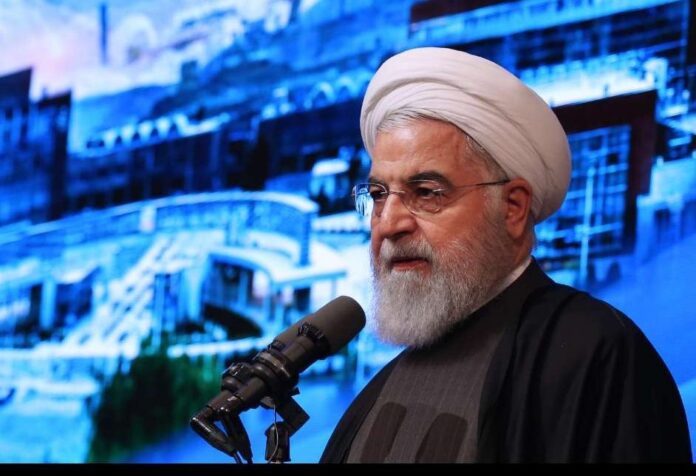
“The move shows the other side doesn’t want to create a situation that creates a feeling of deadlock,” said Ali Akbar Salehi, the head of the Atomic Energy Organization of Iran, without elaborating further.

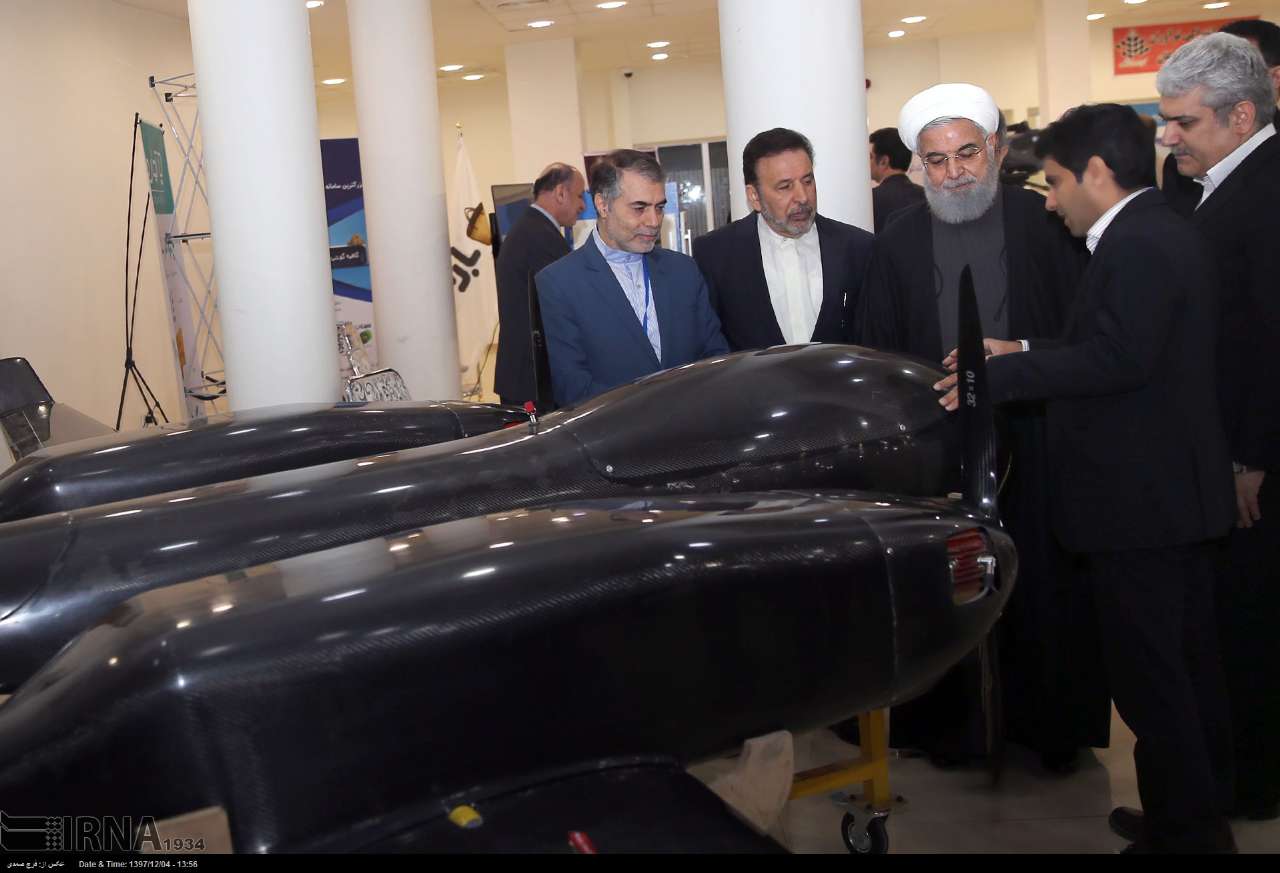
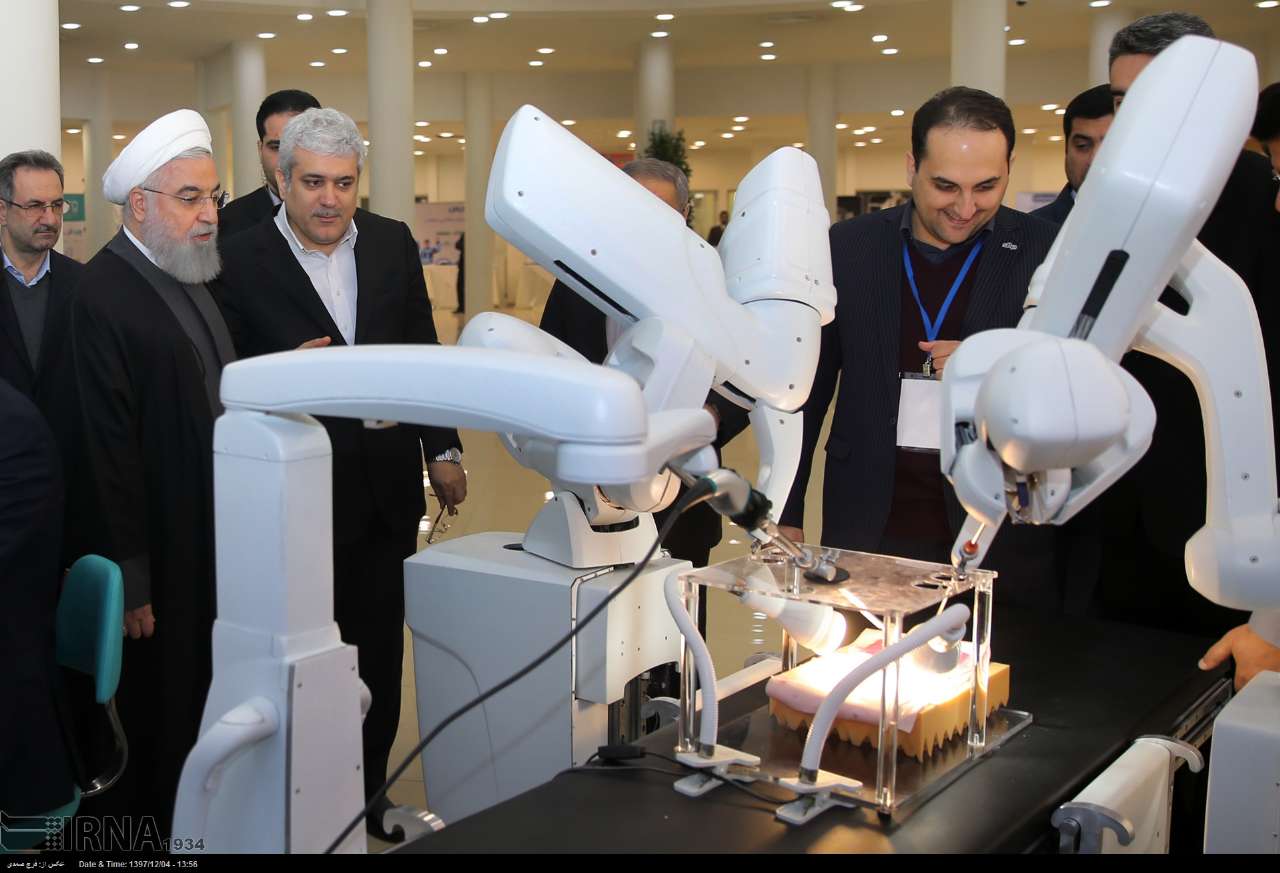
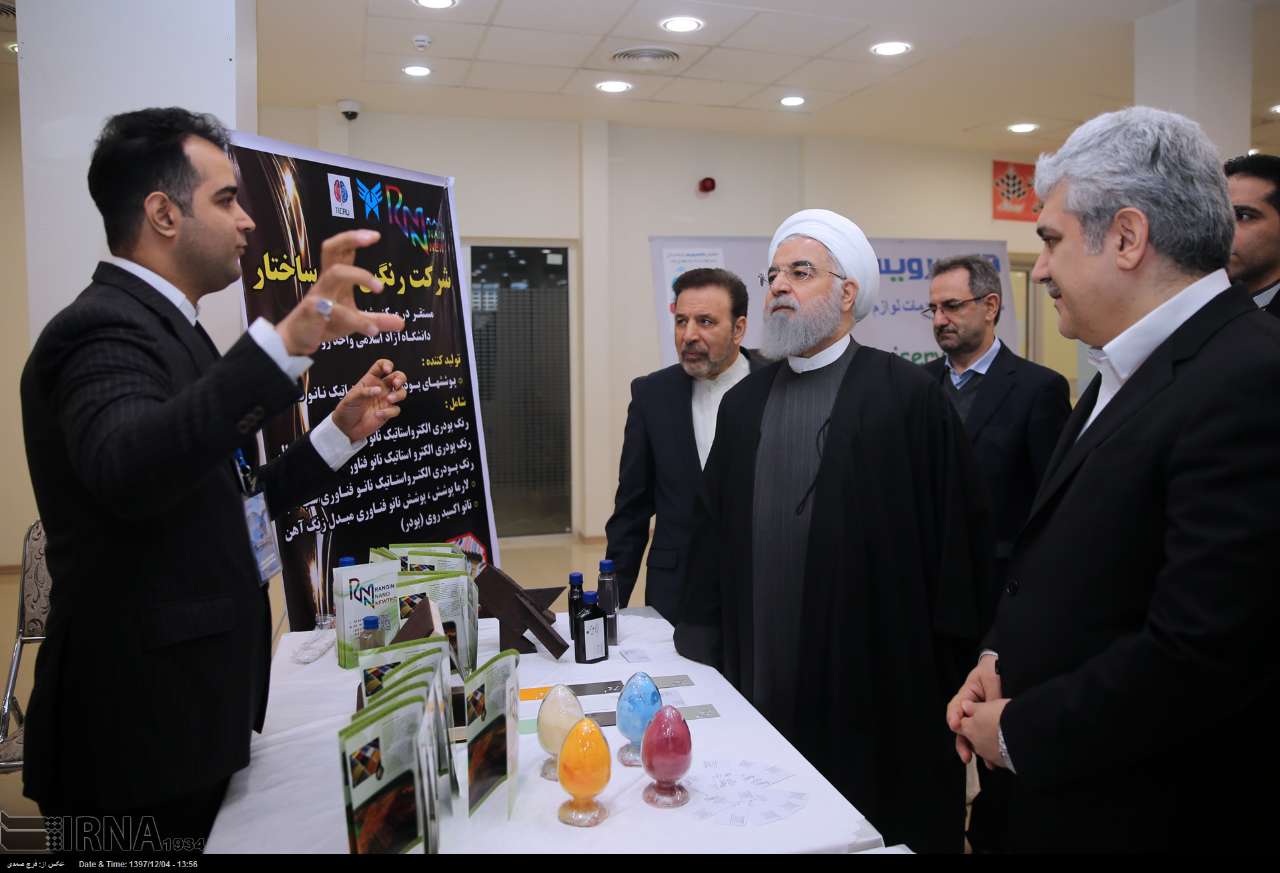
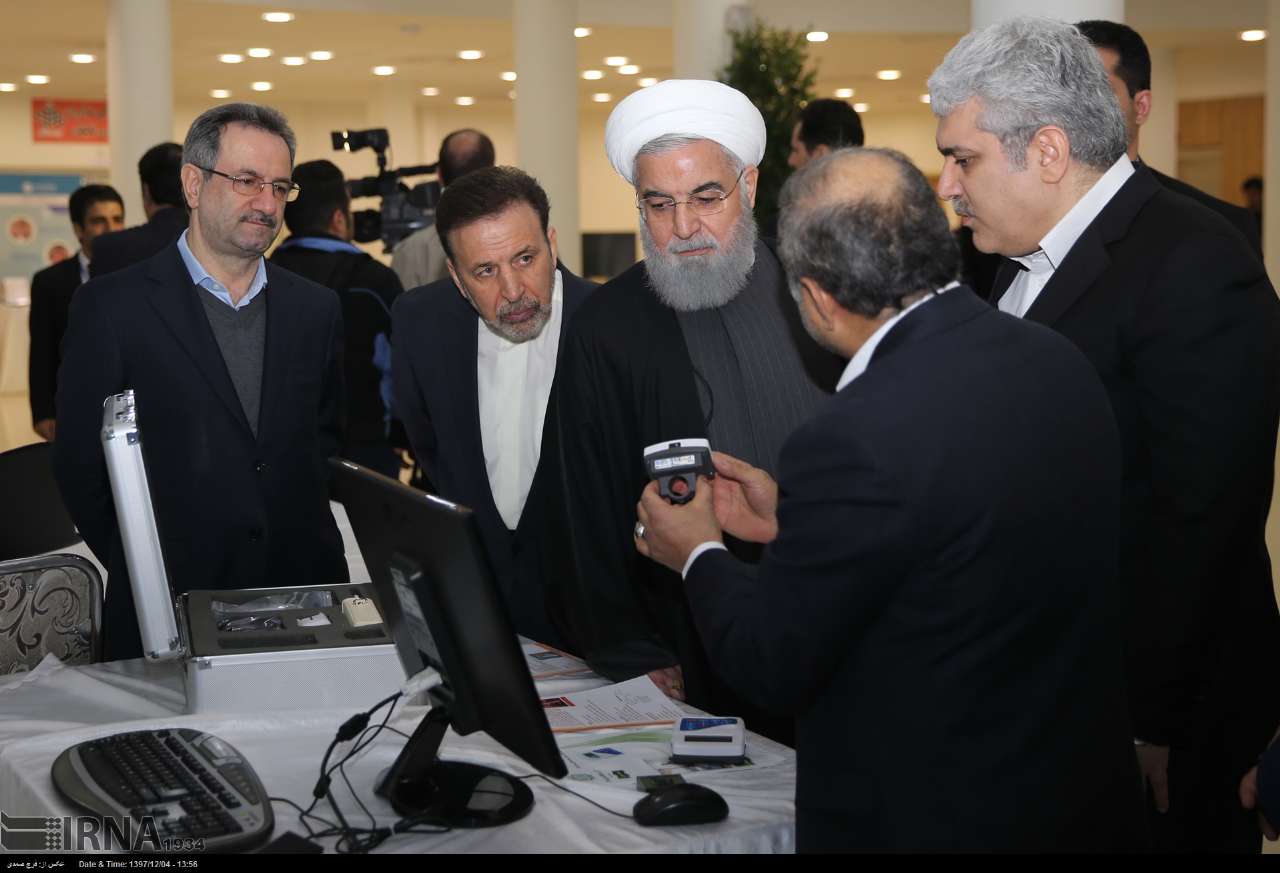
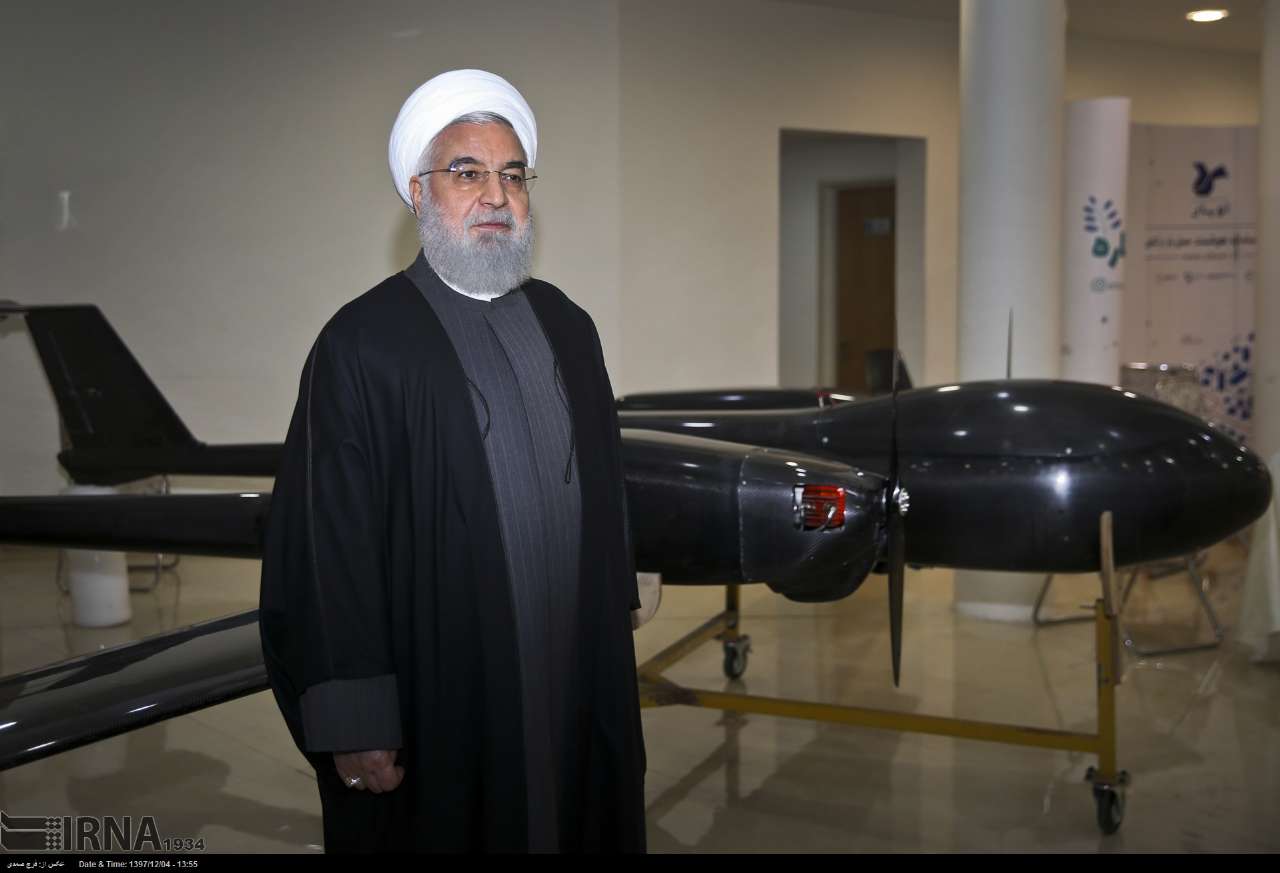
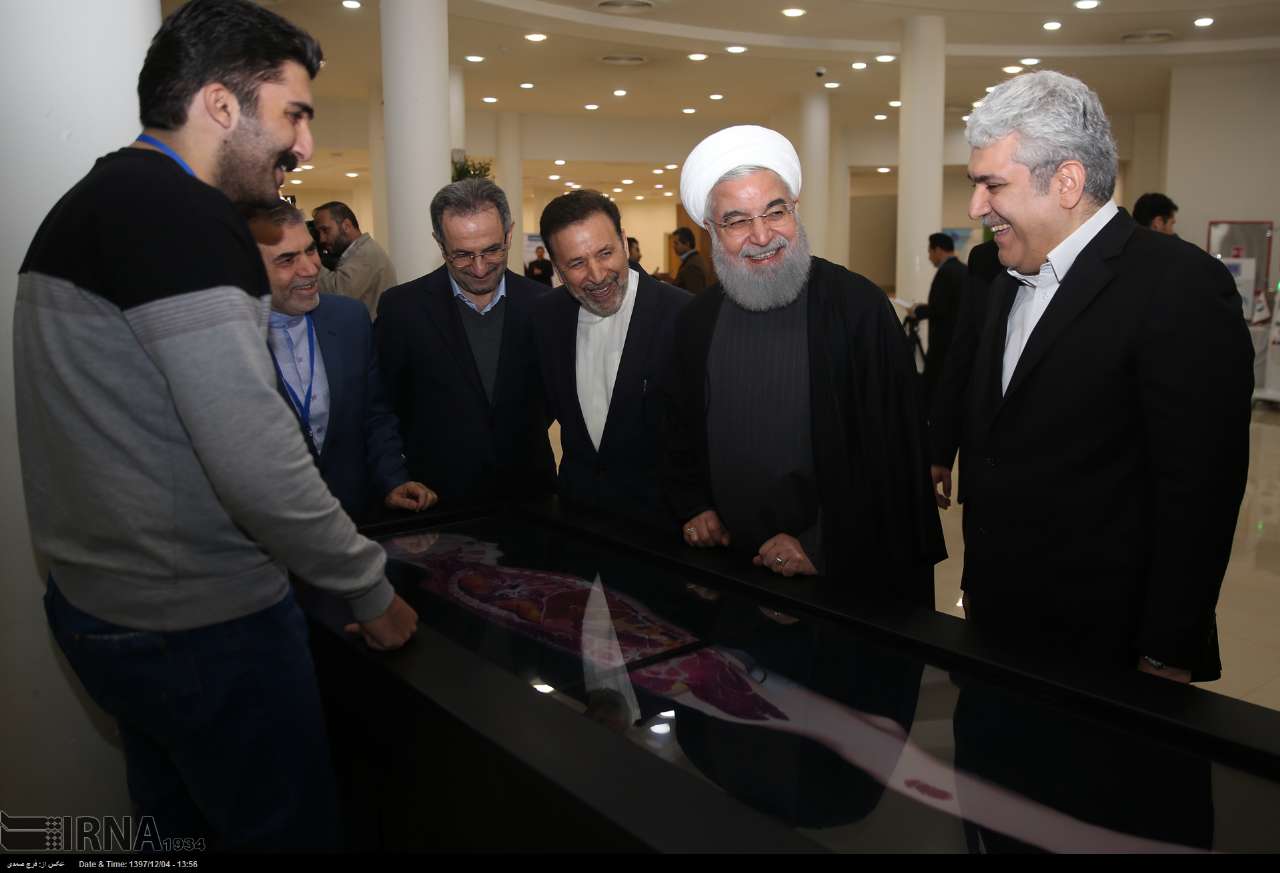
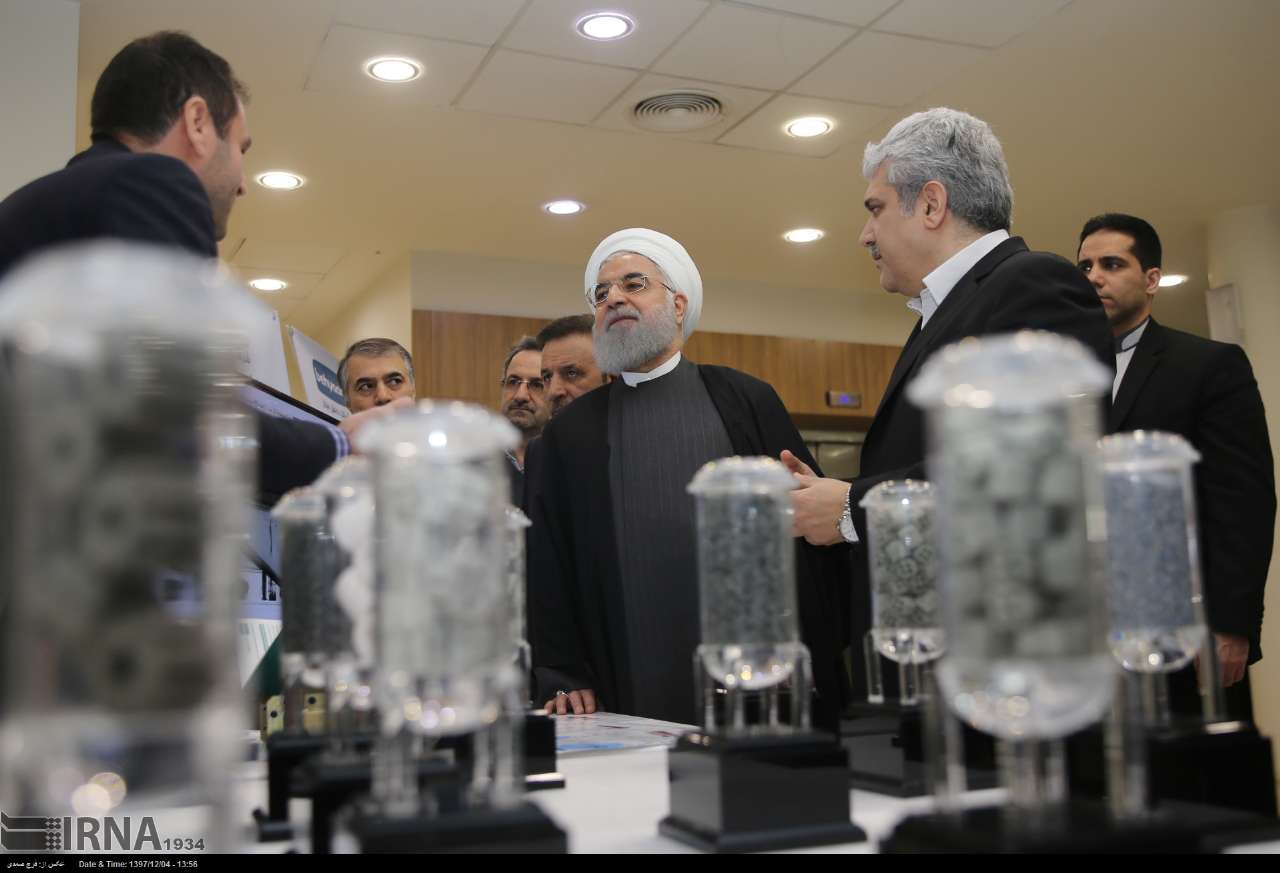
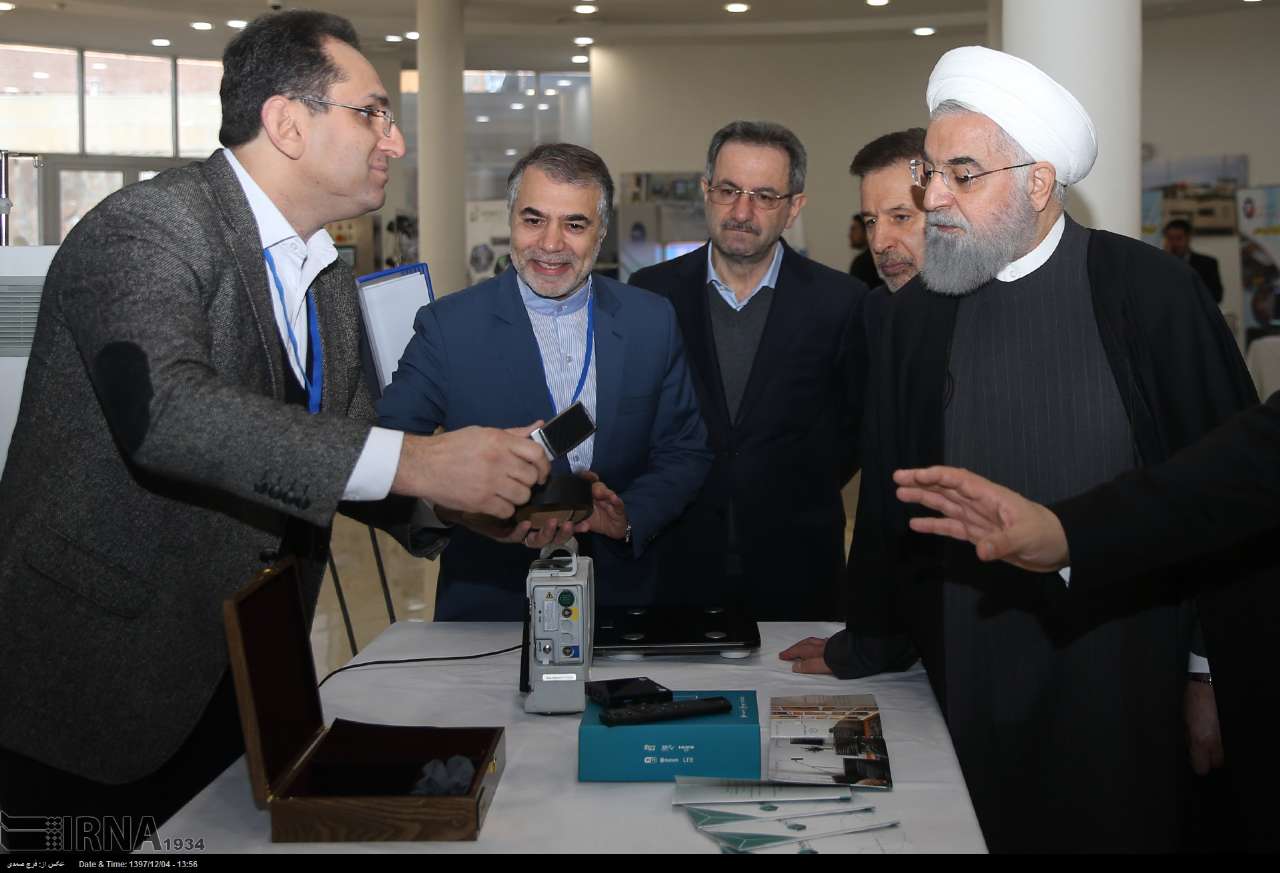
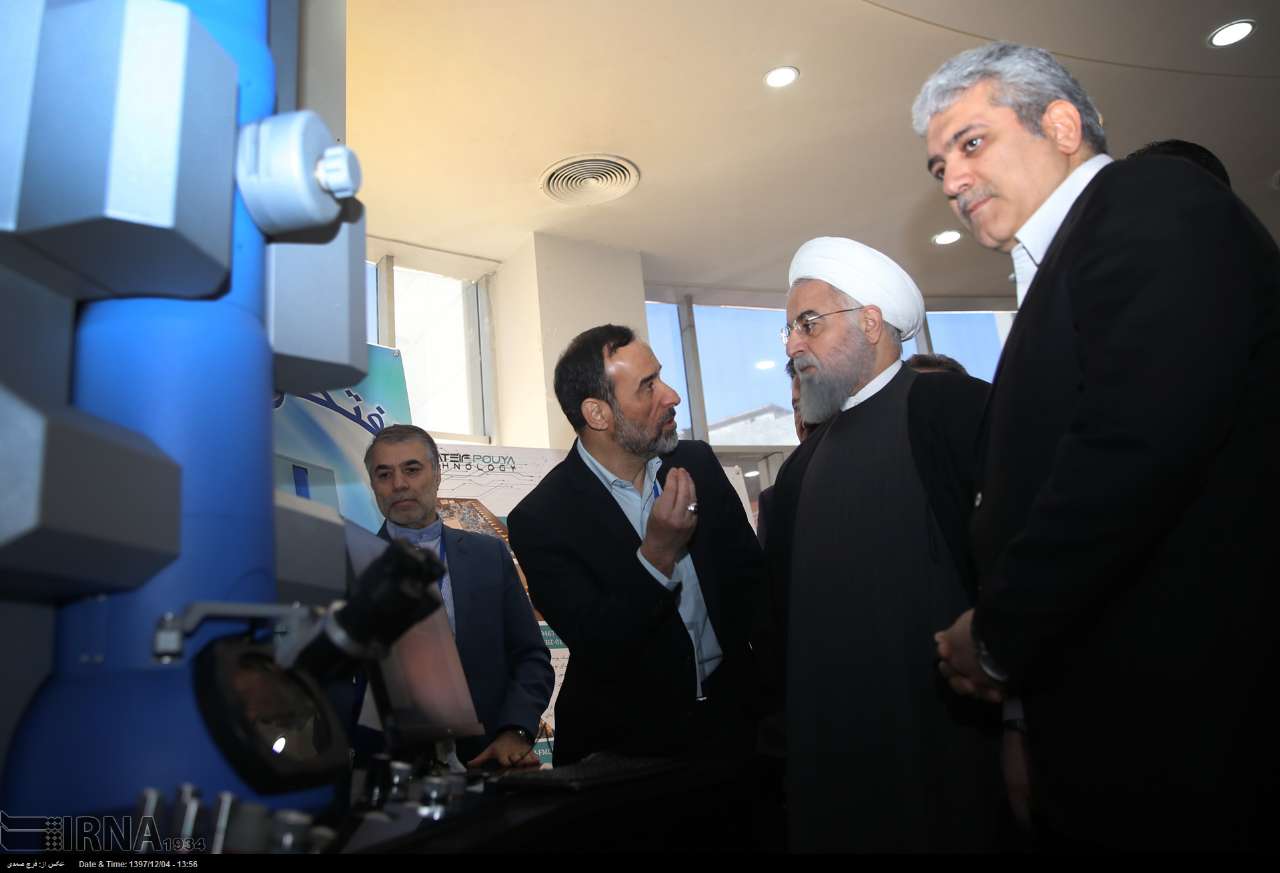
Speaking to reporters while visiting a technology exhibition in Tehran on Saturday, Salehi said Iran will explore this issue and will take decisions accordingly, ISNA reported.

The Financial Action Task Force on Friday gave Iran until June to bring its internal law into compliance with the body’s guidelines on fighting financing of terrorism and money laundering.

Iran has met some conditions for getting out of the FATF’s blacklist, but some related parliamentary bills are yet to be approved by related bodies in Iran.

Proponents of Iran adhering to FATF guidelines believe the measure would smooth Iran’s path to protect its foreign trade at a time when the US is bent on hampering Iran’s economic relations worldwide.

Opponents, however, cite national security concerns and possible problems that can be created for the country in circumventing the US sanctions as the reasons for their opposition.

Washington pulled out of the 2015 nuclear deal in May and reinstated anti-Iran sanctions suspended under the accord in the following months.


Leaving JCPOA on Iran’s Table

Salehi said Iran’s decisions on JCPOA are “measured” and Tehran would not be emotional on matters related to national interests.

“If the JCPOA monitoring committee and the Leader of the Islamic Revolution reach a decision that our presence in JCPOA is no longer useful, necessary orders will be made,” he said.

Iran has required Europe to compensate for the US withdrawal and protect Iran’s economic benefits under the accord or Tehran will move out of the pact.

The European powers have created a financial mechanism, known as INSTEX, to enable non-dollar trade between Iran and the EU, but they have suggested the removal of Iran from the FATF blacklist is necessary for the mechanism to be useful.

A Look at Iranian Newspaper Front Pages on February 23

A Look at Iranian Newspaper Front Pages on November 19

Iranian papers today covered the decision by the Financial Action Task Force (FATF) to extend the suspension of its anti-Iran measures for four more months, giving Iran more time to ratify the bills required for getting the country out of the global anti-money laundering body’s blacklist.

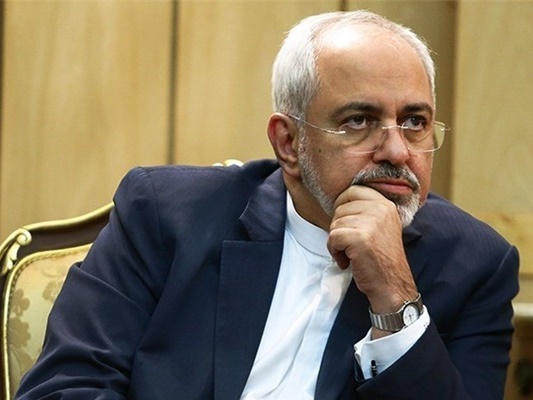
Also a top story was the remarks made by Iranian Foreign Minister Mohammad Javad Zarif in an interview with a Swiss newspaper, in which he said the country may leave the Iran nuclear deal if the nation wants so.

The above issues, as well as many more, are highlighted in the following headlines and top stories:


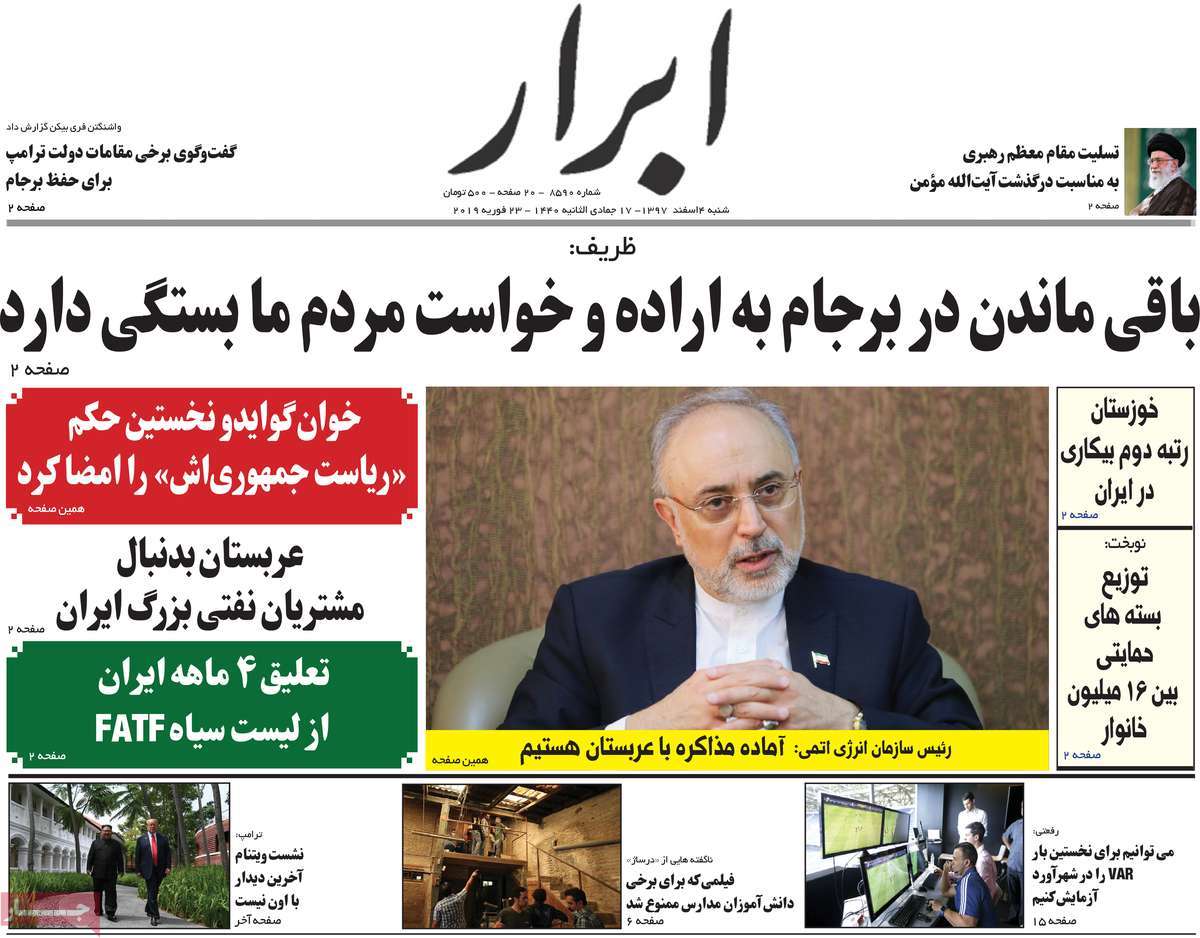
Abrar:

1- Zarif: Remaining in JCPOA Depends on Our People’s Resolve

2- Saudi Arabia Seeking to Steal Iran’s Big Oil Clients

A Look at Iranian Newspaper Front Pages on February 23


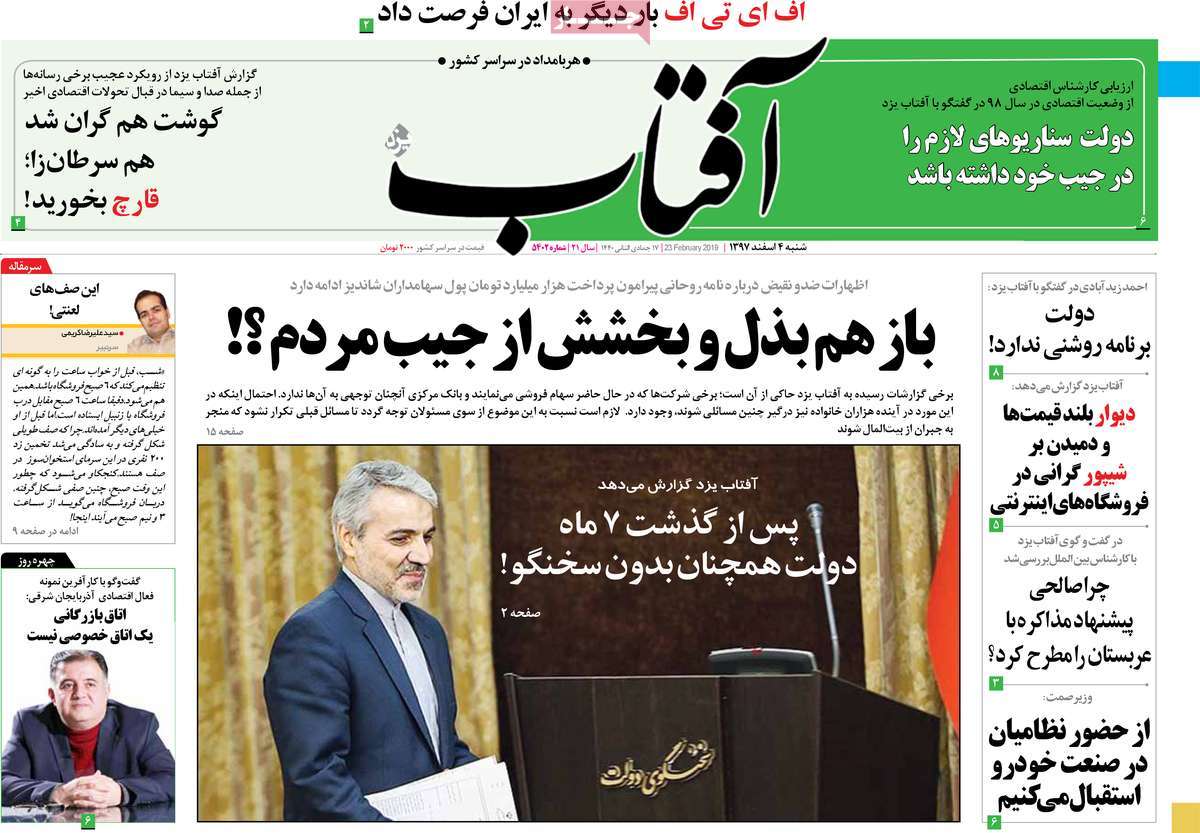
Aftab-e Yazd:

1- Government Still Doesn’t Have Spokesman after 7 Months

2- Amid Price Hikes, State TV Telling People Not to Eat Meat Because It Causes Cancer!

A Look at Iranian Newspaper Front Pages on February 23


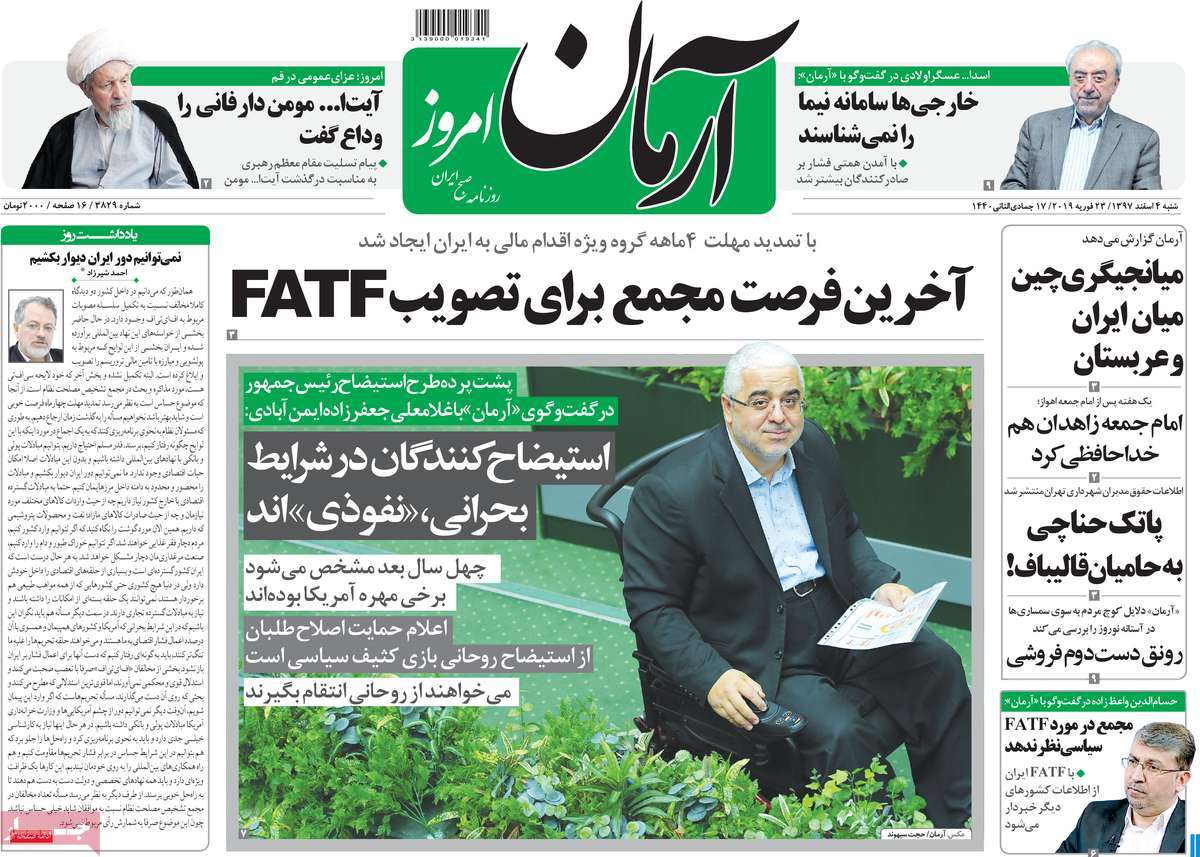
Arman-e Emrooz:

1- Expediency Council’s Last Deadline for Passing FATF

2- Expediency Council Should Avoid Political Motivations

3- China to Mediate between Iran, Saudi

A Look at Iranian Newspaper Front Pages on February 23


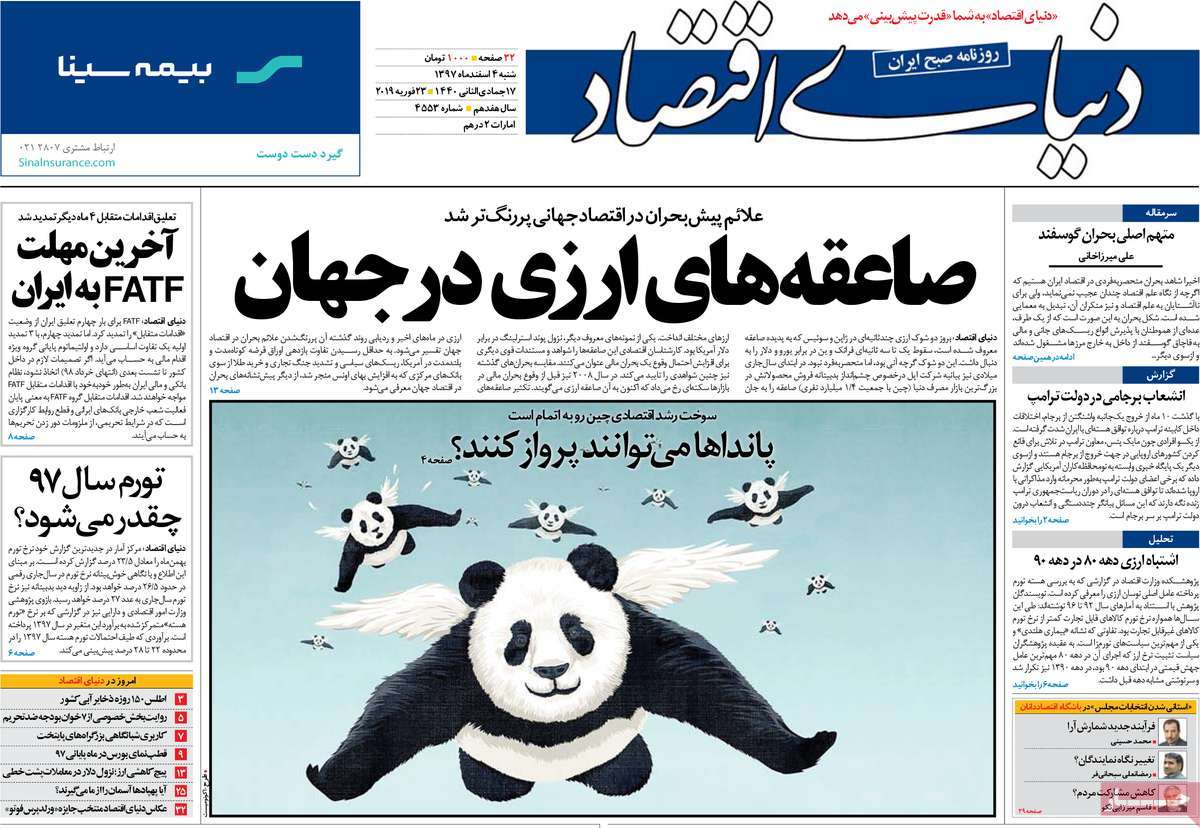
Donya-ye Eqtesad:

1- Pre-Crisis Symptoms in World Economy

A Look at Iranian Newspaper Front Pages on February 23


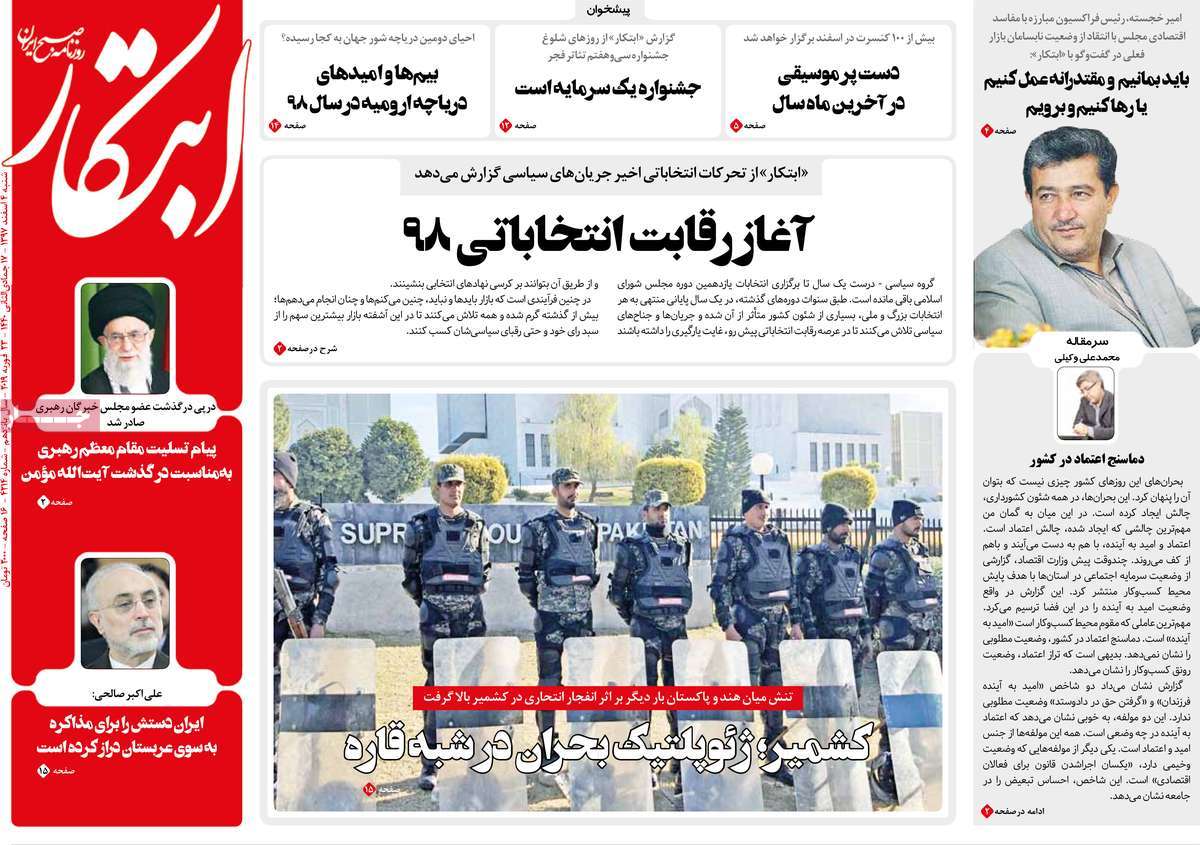
Ebtekar:

1- Kashmir, Geopolitics of Crisis in Subcontinent

2- Campaigns for Iran’s 2020 Parliamentary Elections Kicked Off

A Look at Iranian Newspaper Front Pages on February 23


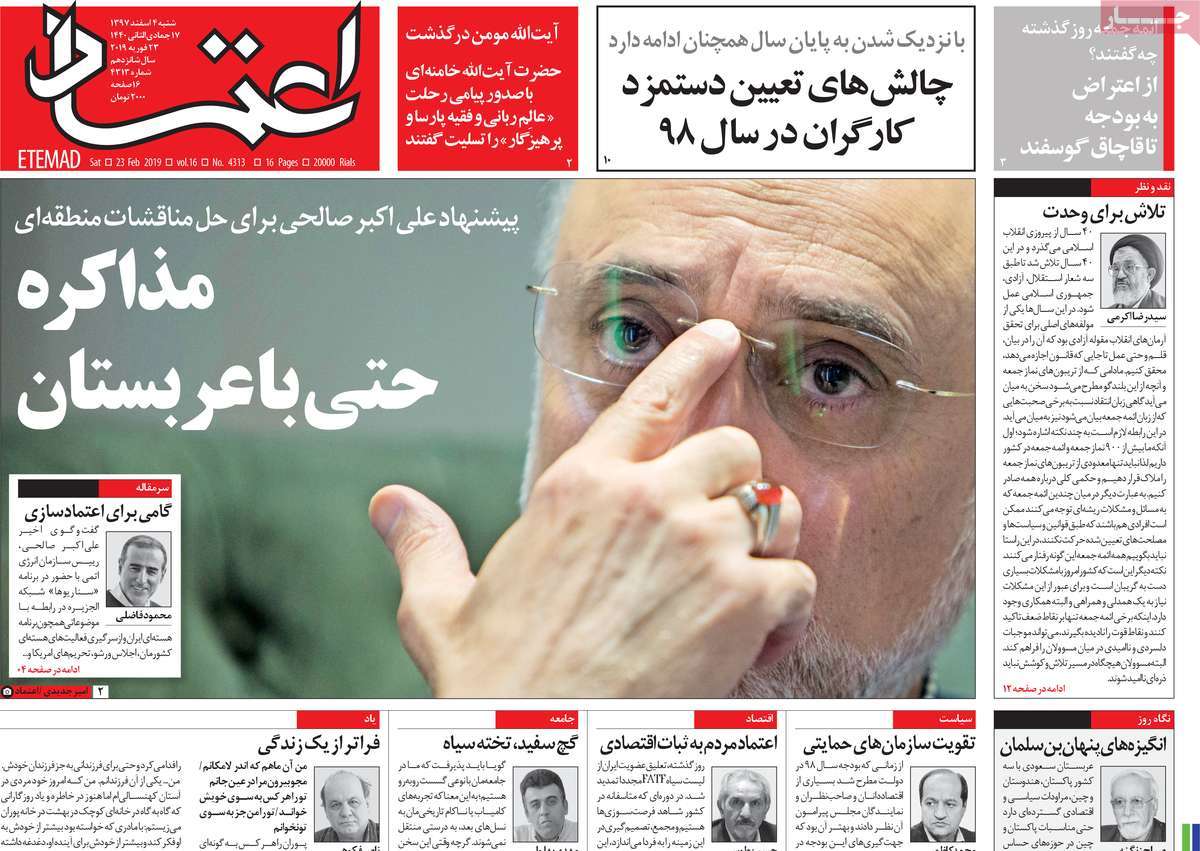
Etemad:

1- Iran Nuclear Chief Calls for Negotiation, Even with Saudi Arabia, to Settle Regional Woes

2- Senior Iranian Cleric Ayatollah Momen Passes Away

A Look at Iranian Newspaper Front Pages on February 23


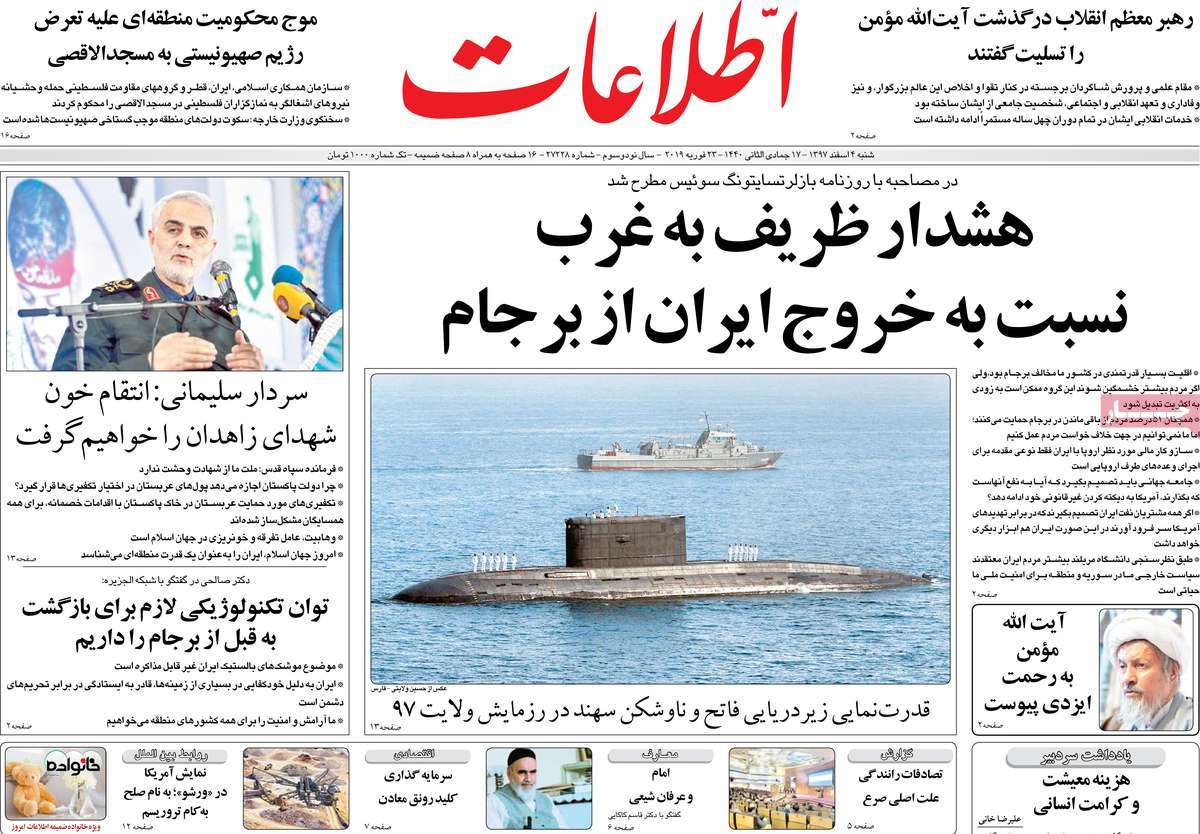
Ettela’at:

1- Zarif Warns West of Iran’s Withdrawal from JCPOA

2- World Condemning Israeli Assault on Al-Aqsa Mosque

A Look at Iranian Newspaper Front Pages on February 23


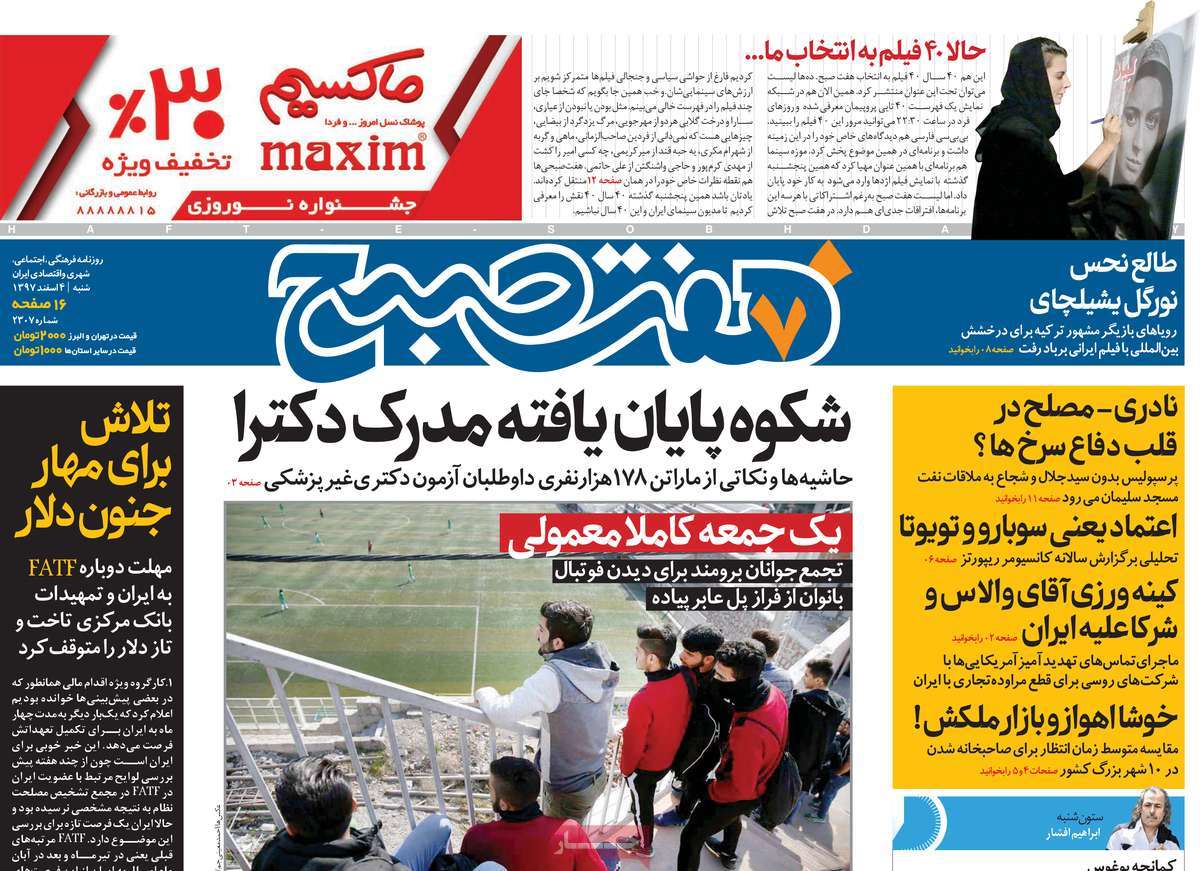
Haft-e Sobh:

1- Efforts to Control Madness of US Dollar

A Look at Iranian Newspaper Front Pages on February 23


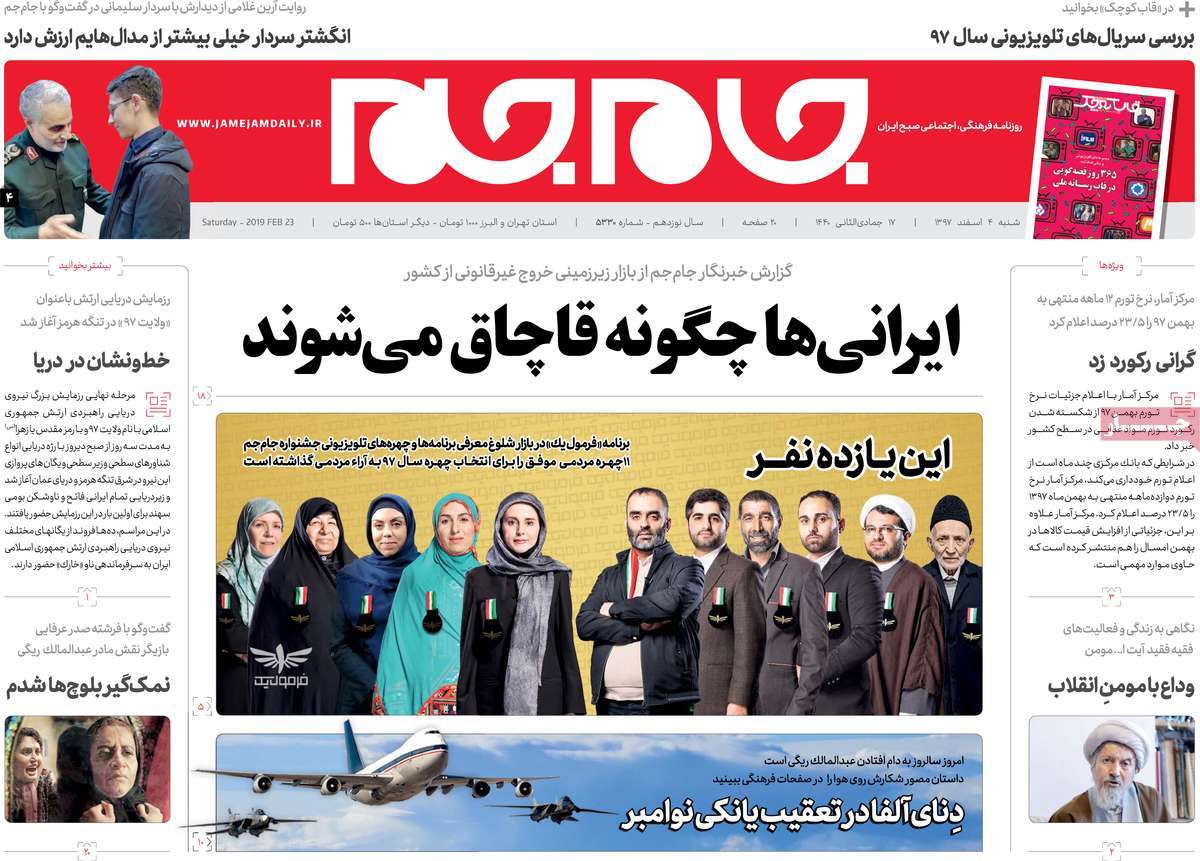
Jame Jam:

1- How Iranians Are Smuggled: A Report on Illegal Smuggling of Humans Out of Iran

2- Price of Consumer Goods at Record High

A Look at Iranian Newspaper Front Pages on February 23


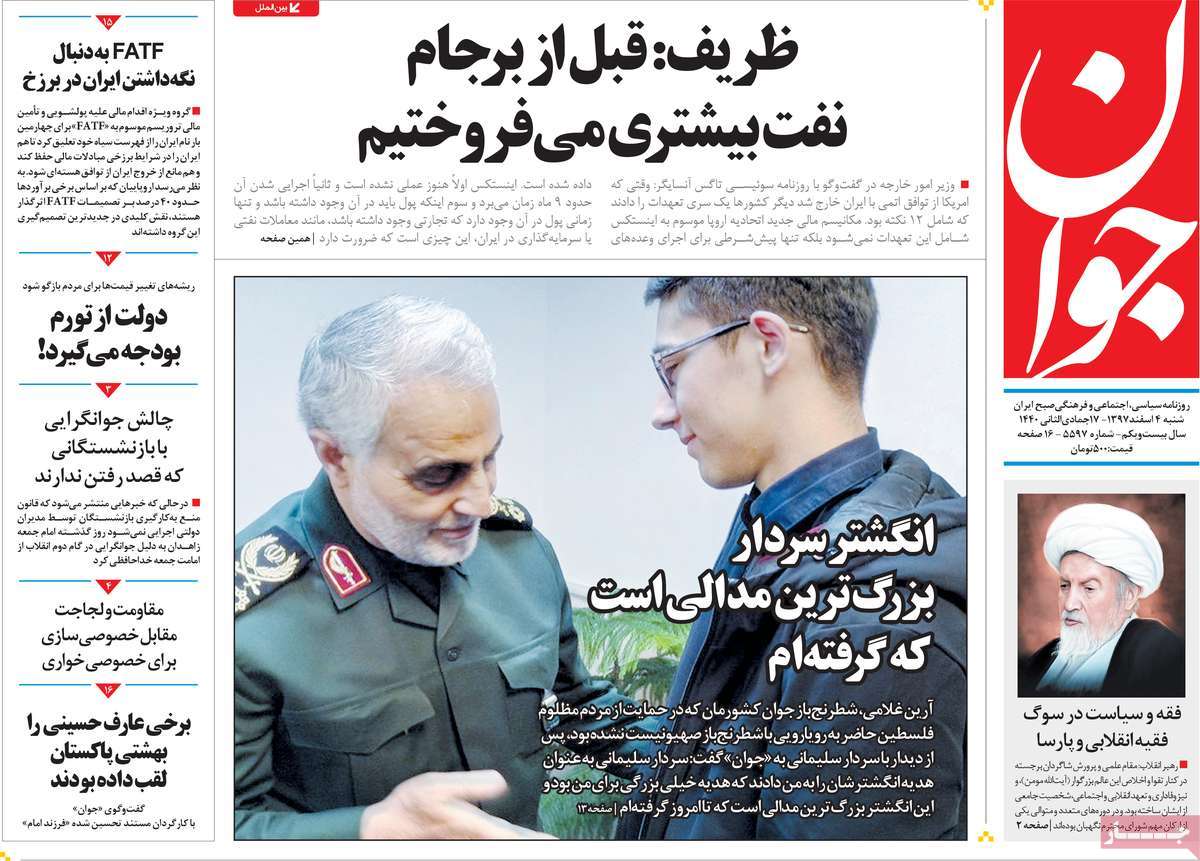
Javan:

1- Zarif: We Used to Sell More Oil before JCPOA

2- FATF Seeks to Keep Iran in Limbo

A Look at Iranian Newspaper Front Pages on February 23


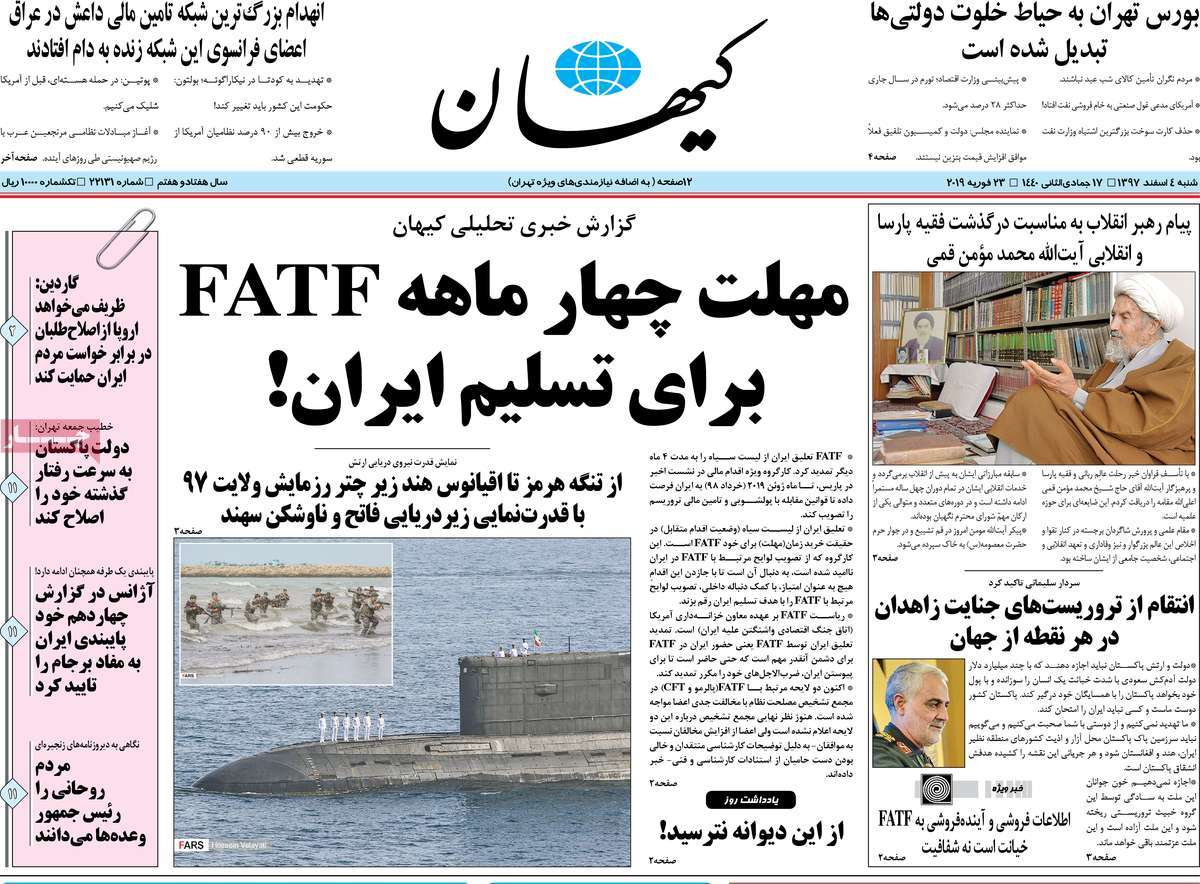
Kayhan:

1- FATF Gives Iran Four More Months for Giving Up!

2- Biggest Centre of Financing ISIS Destroyed in Iraq: French Members Arrested Alive

3- From Strait of Hormuz to Indian Ocean under Umbrella of Iranian Navy

A Look at Iranian Newspaper Front Pages on February 23


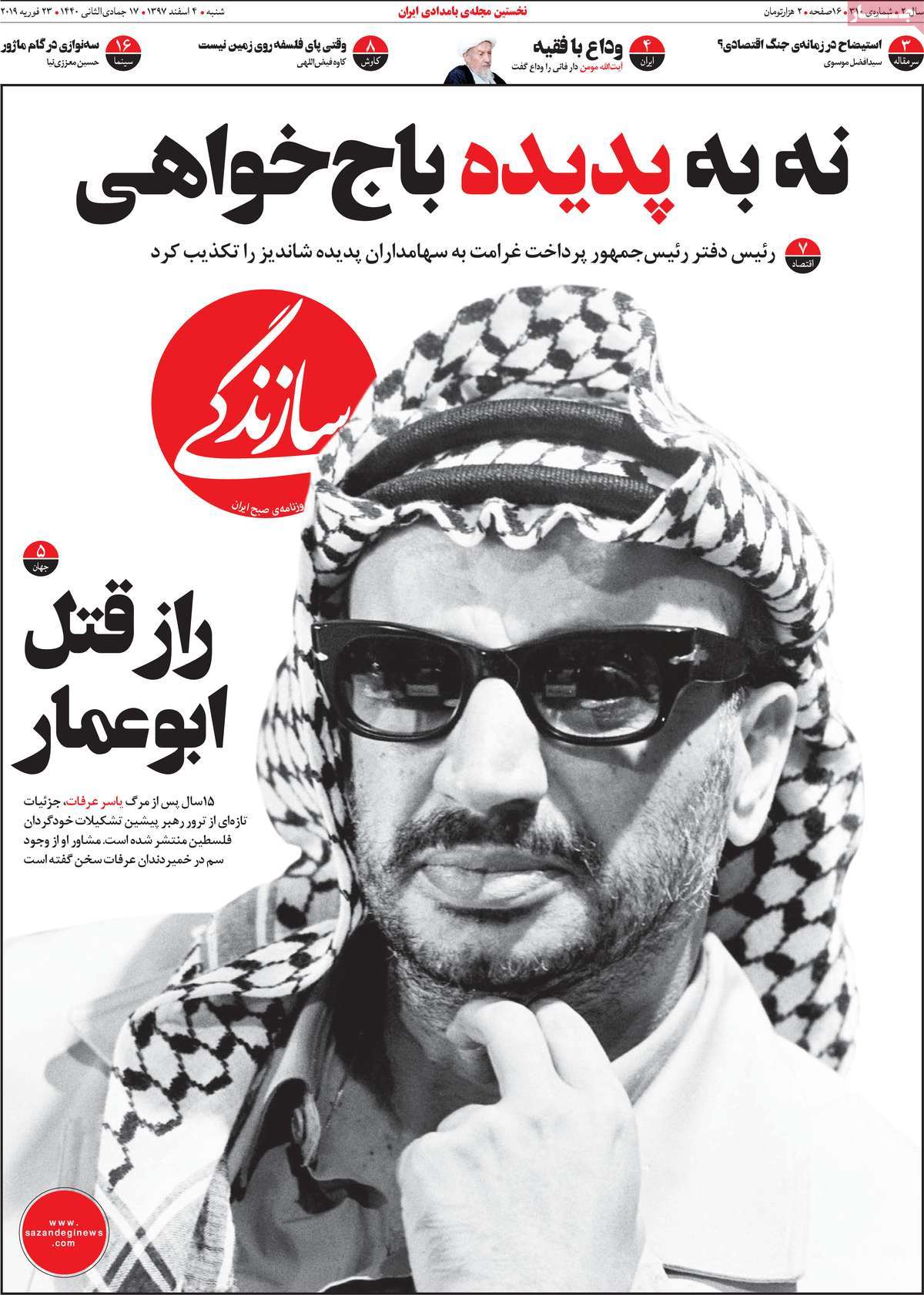
Sazandegi:

1- Secret behind Murder of Arafat: New Details after 15 Years

A Look at Iranian Newspaper Front Pages on February 23


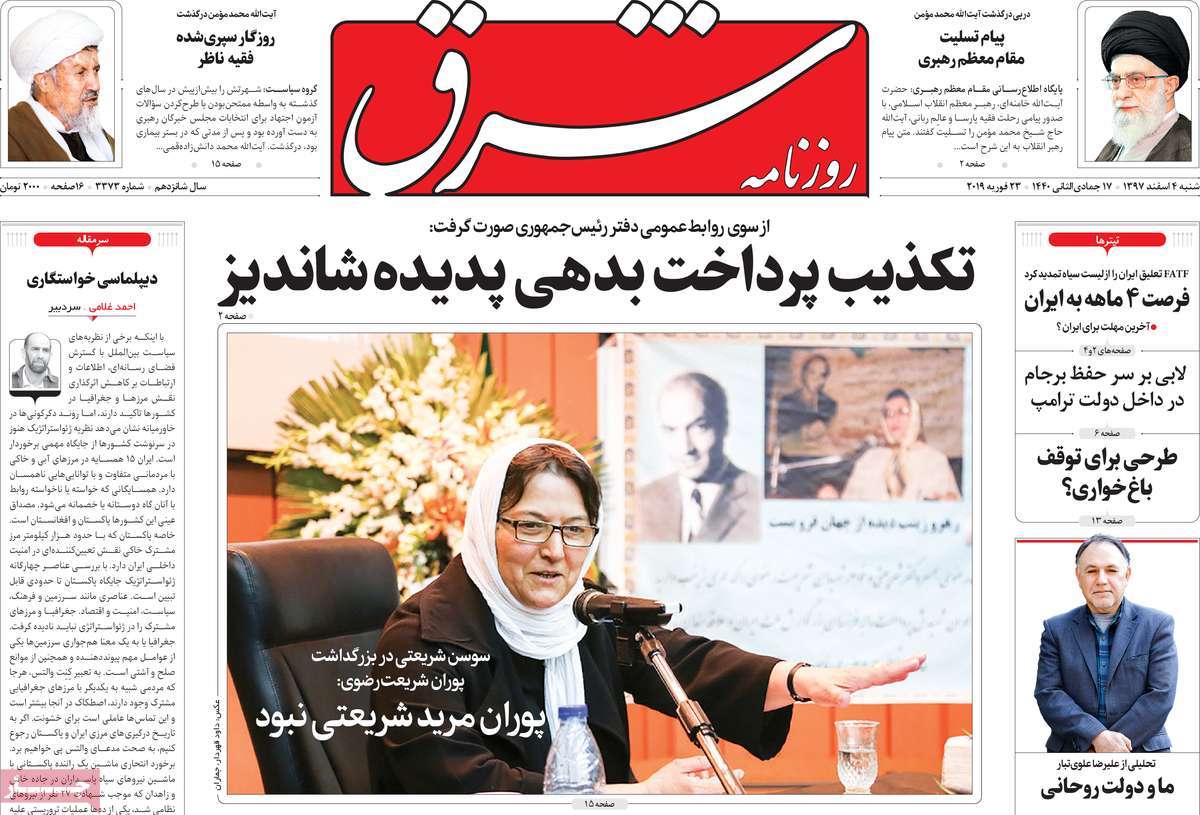
Shargh:

1- FATF Gives Iran Four Months

2- Efforts to Save JCPOA from Inside Trump Administration

A Look at Iranian Newspaper Front Pages on February 23

No Move in Persian Gulf Hidden from IRGC’s Sharp Eyes: Commander

“The smallest moves in the country’s water borders, particularly in the Persian Gulf, are watched by the Navy with full might and no move is hidden from the IRGC’s sharp eyes,” said Brigadier General Alireza Tangsiri, speaking to IRNA Friday night.

The commander said the IRGC’s naval forces have proven their capabilities numerous times.

“The mighty presence of the IRGC Navy in the Persian Gulf waters using modern and advanced equipment is a strong barrier against the enemies and this power and vigilance has been proved to the enemy seeveral times in recent years,” he said.

The Persian Gulf has seen frequent encounters between Iranian patrol vessels and US warships in recent years.

Such encounters have continued in recent months, after US President Donald Trump took office in January 2017 and tensions between Tehran and Washington rose.

Trump pulled the US out of the 2015 nuclear deal in May 2018 and returned anti-Iran sanctions suspended under the accord.

Washington is also working to push the world to cut trade with Iran and stop purchasing the country’s oil.

Tehran has suggested it would move to block other countries’ oil exports, which are mainly moved through the Strait of Hormuz, in case the US carries out its threat to cut down to zero Iran’s oil sale.

Massive Naval Drill Kicked Off in Iran’s Southern Waters

The three-day massive drill, code-named Velayat-97, began in the Sea of Oman with a parade of surface and subsurface vessels as well as the airborne units of the Navy.

The war game is being staged in an area of 2 million square kilometers from the Strait of Hormuz to the northern parts of the Indian Ocean, down to the 10-degrees latitude.

A new domestically made submarine dubbed “Fateh (Conqueror)” and the Sahand destroyer, which recently joined the Iranian Navy’s fleet, are also participating in the war game.

According to Commander of the Iranian Navy Rear Admiral Hossein Khanzadi, the drill is planned be held in four separate phases, including naval parades, simulation of a real naval war, maritime and land offense to practice recapturing the territories occupied by the enemy, and the display of the Navy’s power by launching various types of missiles and torpedoes.

He also noted that for the first time, the Navy would fly patrol, reconnaissance and bomber drones during the war game.

Rear Admiral Khanzadi said the submarines will also launch missiles in the exercise, noting that anti-submarine helicopters will also land on and take off from the Sahand destroyer’s deck.

The war game will include electronic warfare tactics and electronic data transmission from the coast, he added.

Iran’s Armed Forces hold routine military exercises throughout the year.

Iranian officials have repeatedly underscored that the country will not hesitate to strengthen its military capabilities, including its missile power, which are entirely meant for defense, and that Iran’s defense capabilities will be never subject to negotiations.

FATF Extends Iran’s Deadline by June

Foreign Ministry Condemns FATF’s Blacklisting of Iran

“While welcoming the passage [by Iran] of the Anti-Money Laundering Act, the FATF expresses its disappointment that the Action Plan remains outstanding and expects Iran to proceed swiftly in the reform path to ensure that it addresses all of the remaining items,” a statement by the FATF said.

“If by June 2019, Iran does not enact the remaining legislation in line with FATF Standards, then the FATF will require increased supervisory examination for branches and subsidiaries of financial institutions based in Iran,” said the statement.

In January, Iran passed some new measures for countering terror financing, but the country still is having internal disagreements about finalizing certain other measures which FATF has been pressing Tehran on in recent years.

Moreover, “The FATF also expects Iran to continue to progress with enabling regulations and other amendments. Iran will remain on the FATF Public Statement until the full Action Plan has been completed.”

“Until Iran implements the measures required to address the deficiencies identified with respect to countering terrorism-financing in the Action Plan, the FATF will remain concerned with the terrorist financing risk emanating from Iran and the threat this poses to the international financial system,” said the statement.

In addition, the FATF called “on its members and urges all jurisdictions to continue to advise their financial institutions to apply enhanced due diligence with respect to business relationships and transactions with natural and legal persons from Iran,” including “(1) obtaining information on the reasons for intended transactions; and (2) conducting enhanced monitoring of business relationships.”

Iran’s accession to FATF has been the subject of heated debates in recent months.

Opponents believe FATF would limit Iran’s ability to support allies in the region, some of whom recognized as terrorist entities by the US and some of its allies.

This is while proponents of Iran joining FATF fear Iran’s inclusion on the body’s blacklist could make it impossible to salvage the 2015 nuclear deal following the US withdrawal.

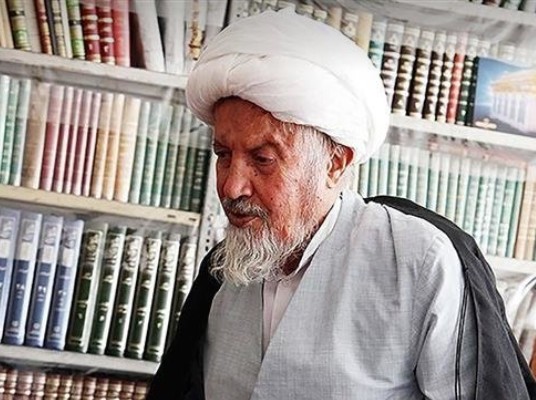
Senior Iranian Cleric Dies at 81

Ayatollah Momen passed away at the age of 81 in a hospital in the capital Tehran on Thursday after spending the past two months battling with brain hemorrhage and respiratory problems.

An influential member of the Guardian Council, he was first appointed to the position by late founder of the Islamic Republic Imam Khomeini in 1984 and continued to serve in that capacity after Leader of the Islamic Revolution Ayatollah Seyyed Ali Khamenei extended his assignment in 2014.

The late cleric also served as a member of the Assembly of Experts after being elected during all of the governmental body’s five elections so far. He also served as the deputy head of the council from 2008 to 2011.

Before attaining Ijtihad (juristic reasoning), he was a pupil of such prominent Islamic scholars as Imam Khomeini, Allameh Tabatabai, Ayatollah Meshkini and many others in the Qom Seminary.

Ayatollah Momen had a long record of struggle against tyranny of the US-backed Pahlavi regime before the 1979 Islamic Revolution. Concerned by the effectiveness of his attempts, the Pahlavi regime sent Ayatollah Momen and over 20 other scholars into exile for many years.

The cleric also served as the head of the Qom Seminary and was a member of other important organizations, including the Constitution Review Council, the Supreme Judiciary Council and the Supreme Policy-making Council of the Qom Seminary, among others.

Iran Warns Pakistan against Being Swayed by Saudi Petrodollars

“Each year, tens of terrorist attacks in Iran are carried out by terrorist groups stationed in Pakistan. They kill our people. Now, instead of offering condolences to our people, it is better for the Pakistani government to take a practical step and flush out the terrorist groups,” General Soleimani said Thursday.

The Iranian commander underlined that the government and army of Pakistan should not allow the criminal Saudi government to create tension between Islamabad and its neighbours through pumping hefty money into Pakistan’s economy.

General Soleimani said Pakistan should not be turned into a centre for creating troubles for regional states like Iran, India and Afghanistan. “The main goal behind the regional tension is to destroy and divide Pakistan.”

He further noted that Iran will not threaten Pakistan but will exact revenge on the Takfiri mercenaries who recently killed 27 Iranian border guards and have the blood of Iranian youths on their hands, no matter where in the world they are.

“We won’t allow the nasty terrorist groups go unpunished easily after killing members of our nation,” he added.

He then underlined that Iran is ready to support Pakistan in fight against terror, but the main question is in which direction the Pakistani government is moving.

At least 27 IRGC forces were killed on Feb. 13 after a bomber slammed his explosives-laden vehicle into a bus carrying off-duty members of IRGC in Sistan and Baluchestan Province bordering Pakistan.

The Pakistan-based Jaish al-Adl Takfiri terrorist group claimed responsibility for the attack.

Rouhani Gov’t Denies Rumours It’s Behind Currency Hikes

Speaking on the sidelines of a cabinet meeting earlier this week, Mahmoud Vaezi said the government itself has been hit hard by a plunge in the Iranian rial’s value.

“The rise of dollar’s rate would place [immense] pressure on the government and it would never play with interests of the country and people’s livelihood,” he said.

Vaezi said the government is doing its best to decrease the currency’s price, as it will lead to a decrease in general prices of goods and make life easier for the government.

“Those who make such statements have political motives and are pursuing other goals,” he said.

Vaezi said the government keeps up advocating for the four bills proposed by the administration to get Iran out of the blacklist of the Financial Action Task Force (FATF) using arguments, as the Expediency Council is making its mind on a parliamentary bill on Iran’s accession to the United Nations Convention against Transnational Organized Crime.

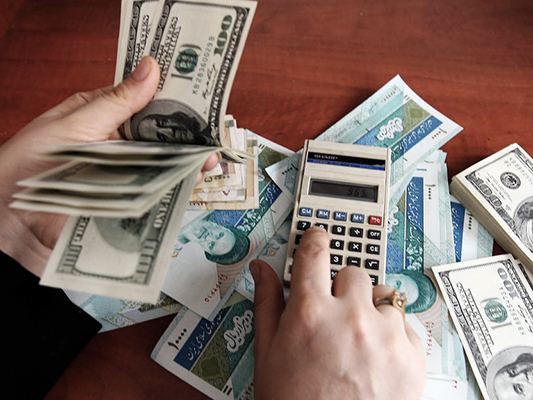
The US dollar crossed a threshold in Tehran this week, as its price increased to 135,000 rials, up from over 120,000 rials last week.

The hike came after Iran’s Expediency Council postponed for two weeks voting on the bill, which is one of four parliamentary bills required for Iran to get out of the anti-money laundering body’s blacklist.

Two of them have so far gone into effect and the fate of the last one, a bill amending Iran’s Combating the Financing of Terrorism (CFT) law, is also in limbo.

The government is a staunch supporter of the FATF accession, believing the measure would smooth the path for Iran’s increased financial transactions with the world and allow the country’s financial sector to function more easily in the international economy.

Iran’s accession to the G7-created FATF has faced problems over concerns among some officials that the move could endanger Iran’s national security and economic interests.

Iran Condemns Israeli Occupiers’ Assaults on al-Aqsa Mosque

In a Thursday statement, Qassemi also slammed the silence of certain regional states over the Israeli assaults, saying that the silence encourages Zionists to continue their aggression on the historical and Islamic sites of Palestinians.

Qassemi said the killing and ethno-religious cleansing in al-Quds has been underway in a constant and organized way since the occupation of the Palestinian territories.

However, he added, the deadly silence of certain regional states over the repeated violence of the Zionists, their participation in the ridiculous show co-organized by the US and Israel in Warsaw, and their establishment of overt and covert ties with the killers of the Palestinian people have emboldened and encouraged the Zionists to continue their aggression on historical and Islamic sites, particularly those in al-Quds.

The spokesman then praised and paid tribute to the Palestinians, especially the residents of al-Quds, for their resistance and protection of the sacred Islamic sites against Israeli aggression and called for an immediate and practical action by Islamic countries and international bodies and organizations, including the UN, to denounce the latest attack by the racist Zionists on al-Aqsa Mosque and put an end to such aggression.

The statement came after Israeli forces banned Muslim worshippers from entering the al-Aqsa Mosque compound on Monday. The regime’s troops also beat and wounded Palestinians and arrested several of them as they attempted to enter the site.

Iran Expresses Deep Regret over Bangladesh Fire

In a Thursday statement, Bahram Qassemi offered condolences to the Bangladeshi nation and government.

He also sympathized with the bereaved families of those killed and wounded in the tragic incident.

At least 81 people have died in a huge fire that tore through apartment buildings also used as chemical warehouses in an old part of the Bangladeshi capital, a fire official said Thursday.

Dozens of people were trapped in the buildings, unable to escape onto narrow streets clogged with traffic, as the highly-combustible stores of chemicals, body sprays and plastic granules erupted in flames.

Bangladesh’s fire service chief Ali Ahmed said the death toll was expected to rise “The number of bodies may increase. The search is still going on,” he told AFP.

Ahmed said the blaze at Chawkbazar in the old part of Dhaka might have originated from a gas cylinder before quickly spreading through a building where chemicals were stored.