Wednesday, December 31, 2025
Home Blog Page 3330

3 Airbus Planes Join Iran’s Flag Carrier

Three Airbus 319 planes with numbers EY-557, EY-558 and EY-559 will join the airline’s fleet in a matter of hours.

The airplanes were purchased from Hungary around one year ago, and landed at an airport in the city of Mashhad in northwestern Iran.

The aircraft were manufactured in 2002 and now belong to Iran Air.

The US sanctions have prevented Iran from receiving the planes it had purchased as per deals with Airbus and ATR following the signing of the Iran nuclear deal.

The bans, which also keep spare parts from being delivered to Iran, have affected air safety in the country and jeopardized the lives of civilians travelling by air.

IRGC Says Hacked US Drone in Reaction to Missile Sabotage Claim

IRGC Aerospace Commander Brigadier General Amirali Hajizadeh said in a ceremony Sunday that Iran recently hacked American drones in Iraq in response to Washington’s “insolence”.

“The Americans were cheeky enough to say they had sent faulty parts into our missile industries. We did this (infiltration into their systems in Iraq) to tell them that they were unable to achieve their goals, that we have infiltrated into their systems as a response to their rude behaviour,” said General Hajizadeh.

“When the Americans came to Iraq, they said the war would take 30 years. The efforts by Iran’s Islamic Revolution Guards Corps (IRGC), especially by its Quds Force, caused the duration of the war to decrease to 3 years,” the top general added.

He also touched upon Iran hacking American drones in Iraq.

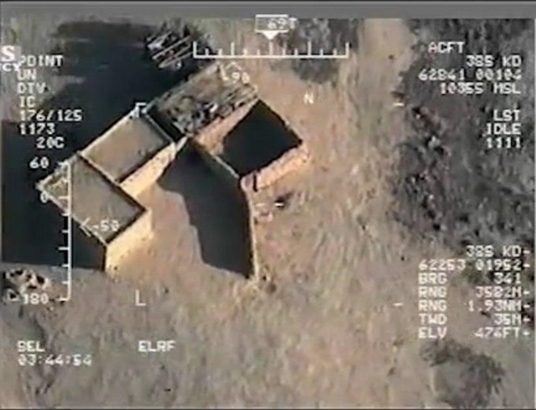
Hajizadeh announced recently that the IRGC had acquired footage showing the US military bombs one of its own drones for fear that it might be seized by the IRGC.

“Seven or eight aerial vehicles [belonging to the US-led coalition] with regular flights in Syria and Iraq were under our [intelligence] control; we could monitor their data, and managed to acquire their first-hand information,” Hajizadeh said a few days ago.

According to the top general, one of these unmanned aerial vehicles was once forced to have an emergency landing due to a problem it faced during the flight.

As shown in a drone footage released by the IRGC, the unmanned aerial vehicle was landed with difficulty in a desert area 10 km from the US base.

However, the Americans did not dare to approach their own drone, and thus bombed and destroyed it with a jet fighter, so that it would not be seized by resistance forces.

Elsewhere in his remarks on Sunday, the top general said the enemy has been trying to sabotage Iran’s missile industries by manipulating missile parts to make the projectiles explode mid-air.

Also, General Hajizadeh underlined that Saudi Arabia and the United Arab Emirates are affecting Iran’s economy.

“The traces of the Saudis and Emiratis are evident in Iran’s economy. Saudi Arabia pays money and recruits people in Pakistan to carry out hundreds of operations against us,” he said.

He noted Iran should remain on the watch for the enemy’s cyberattacks as well.

A Look at Iranian Newspaper Front Pages on February 24

A Look at Iranian Newspaper Front Pages on November 19

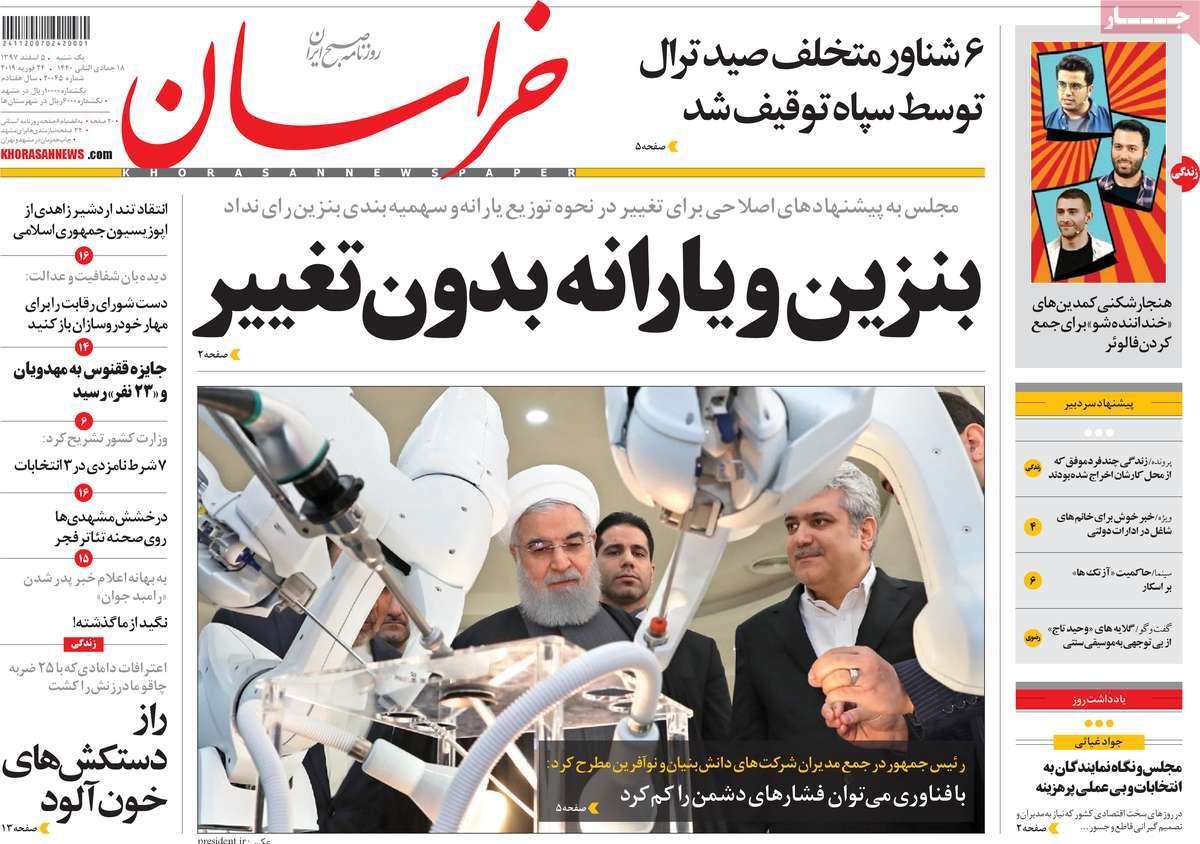
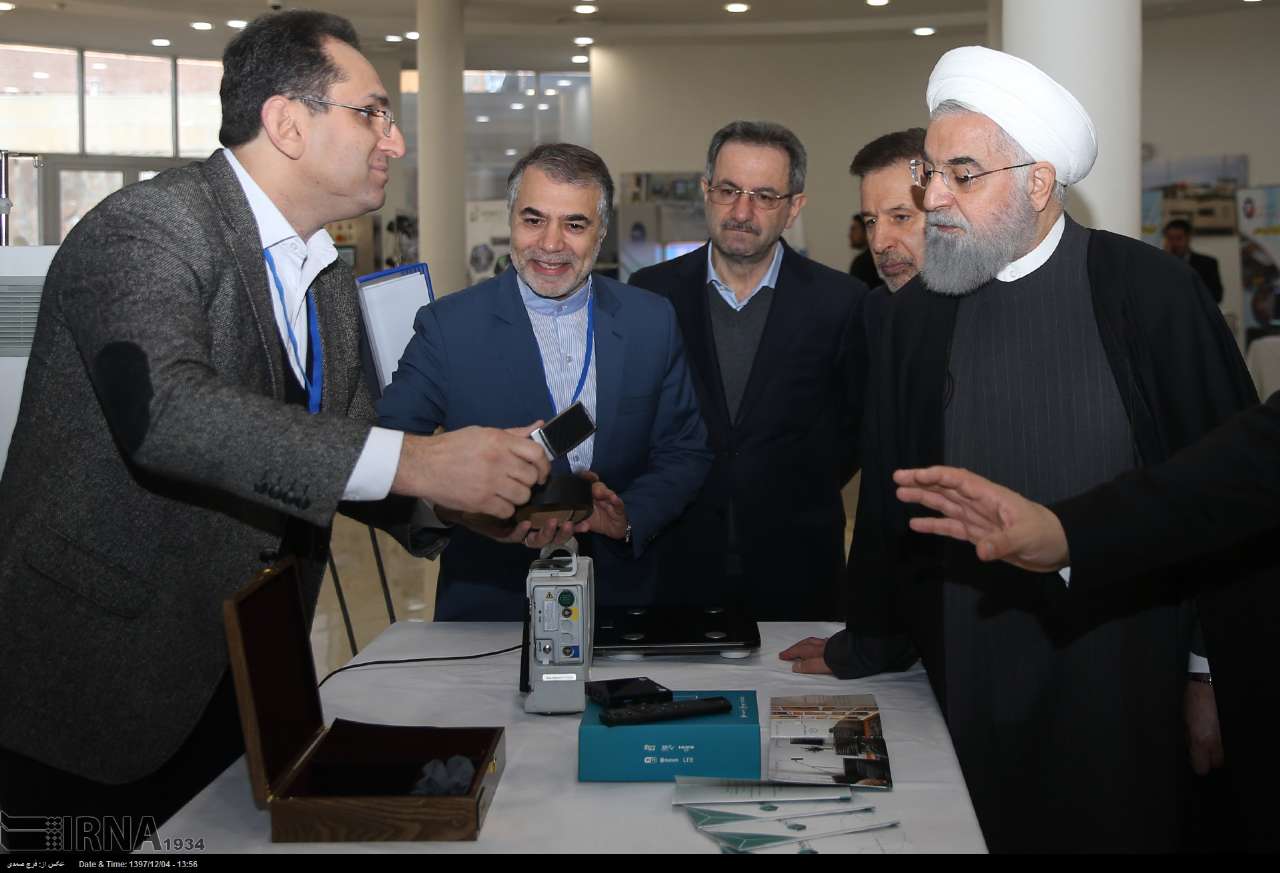
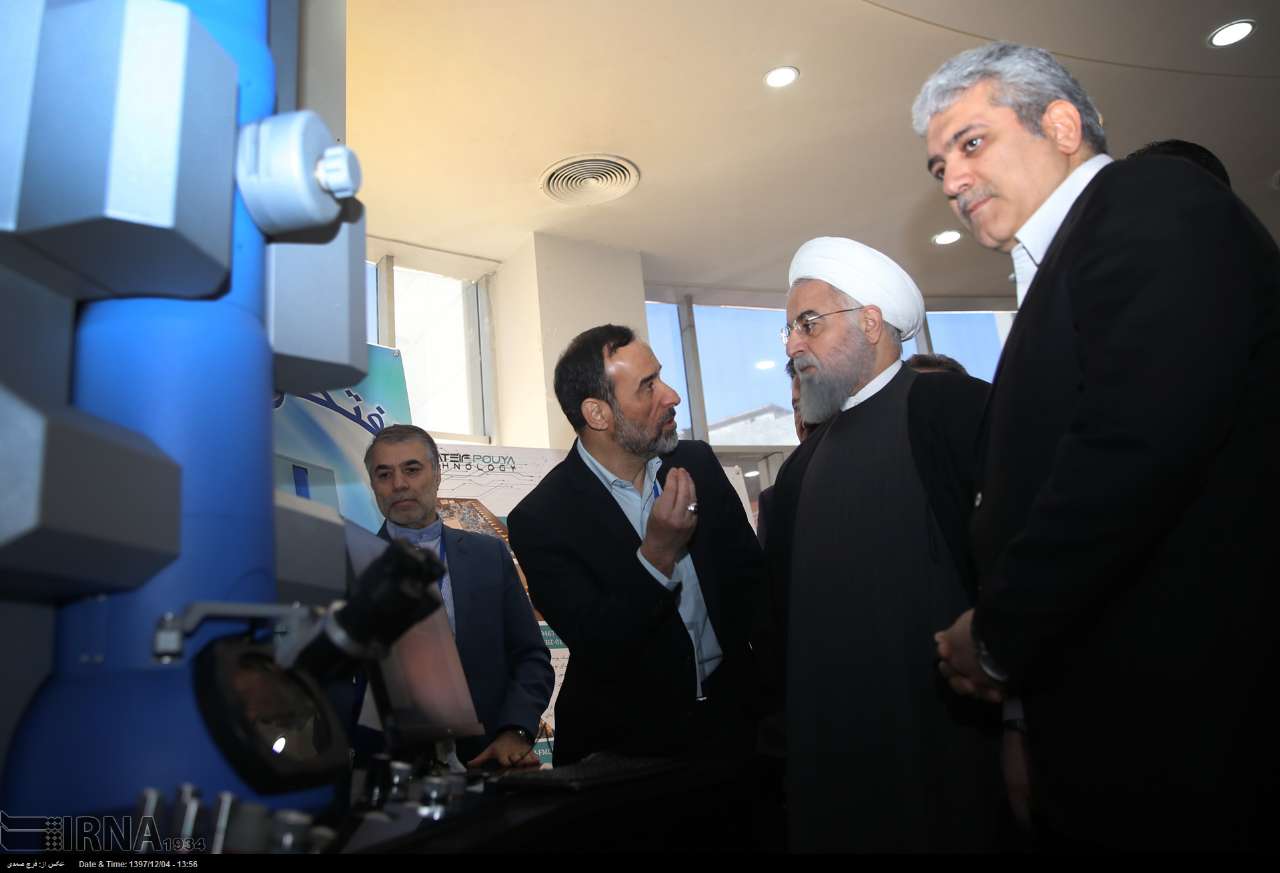
Newspapers today widely covered the remarks made by Iranian President Hassan Rouhani in an address to a science and technology exhibition in Tehran.

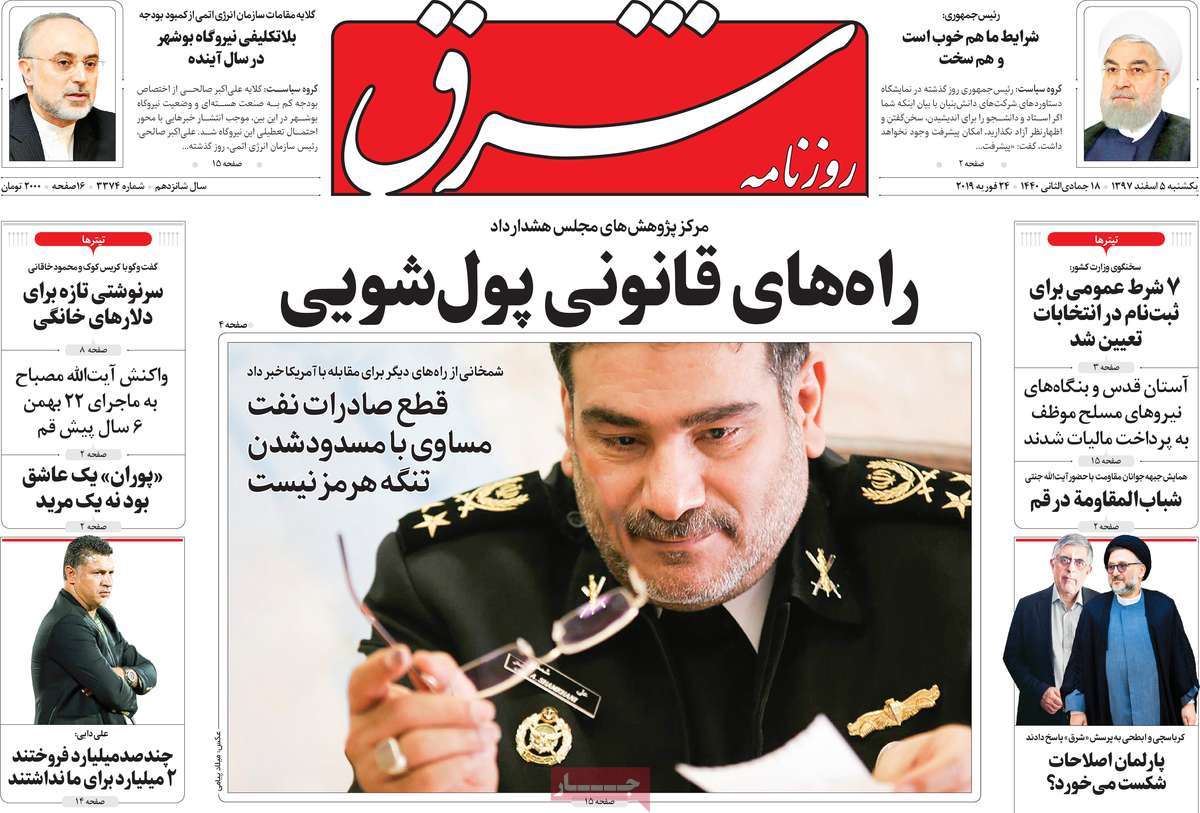
Also a top story was comments made by Secretary of Iran’s Supreme National Security Council (SNSC) Ali Shamkhani about possible close of the Strait of Hormuz in case the US manages to cut down Iran’s oil exports to zero.

The above issues, as well as many more, are highlighted in the following headlines and top stories:


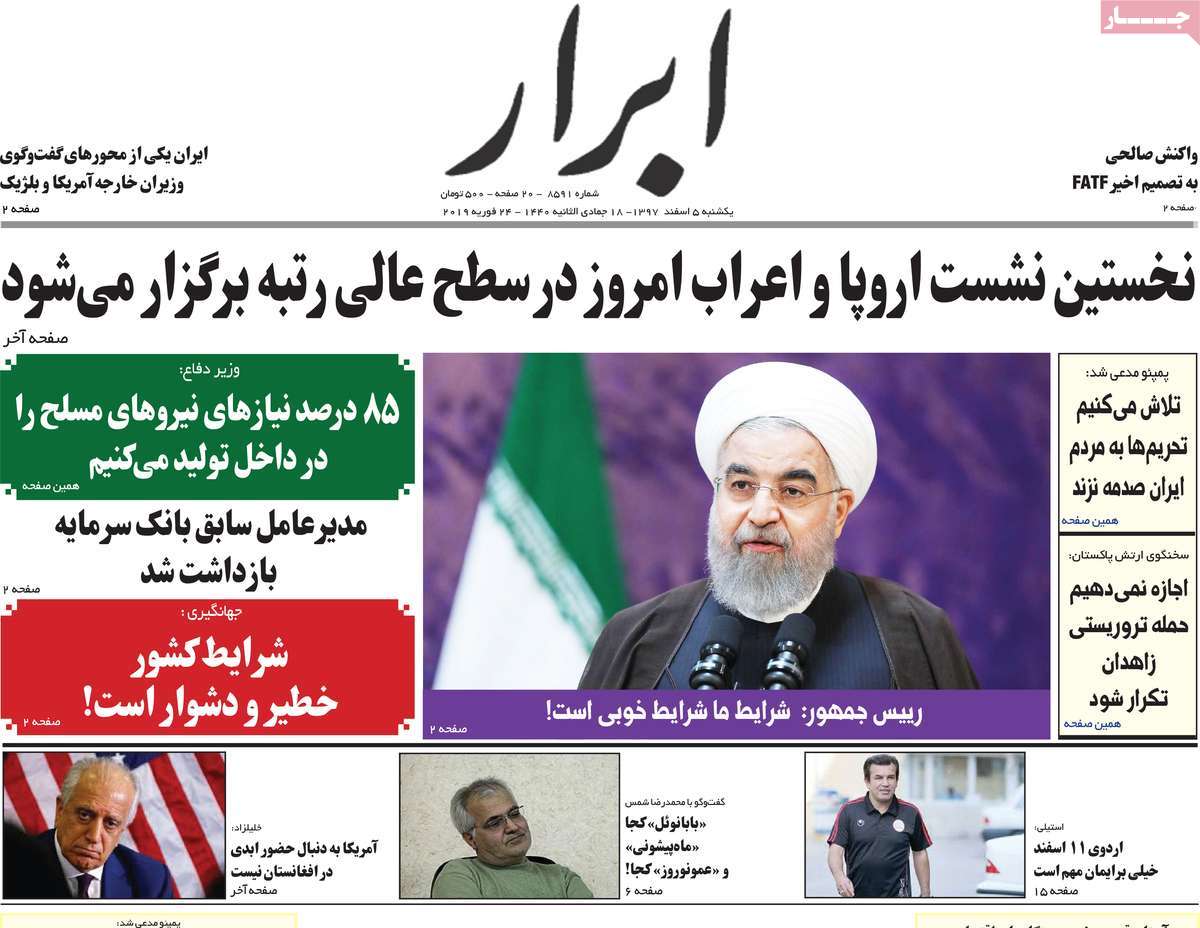
Abrar:

1- Europeans, Arabs to Hold First High-Level Meeting Today

2- DM: 85% of Armed Forces’ Needs Supplied inside Iran

3- Pompeo: We Try to Prevent Sanctions from Harming Iranian People

A Look at Iranian Newspaper Front Pages on February 24


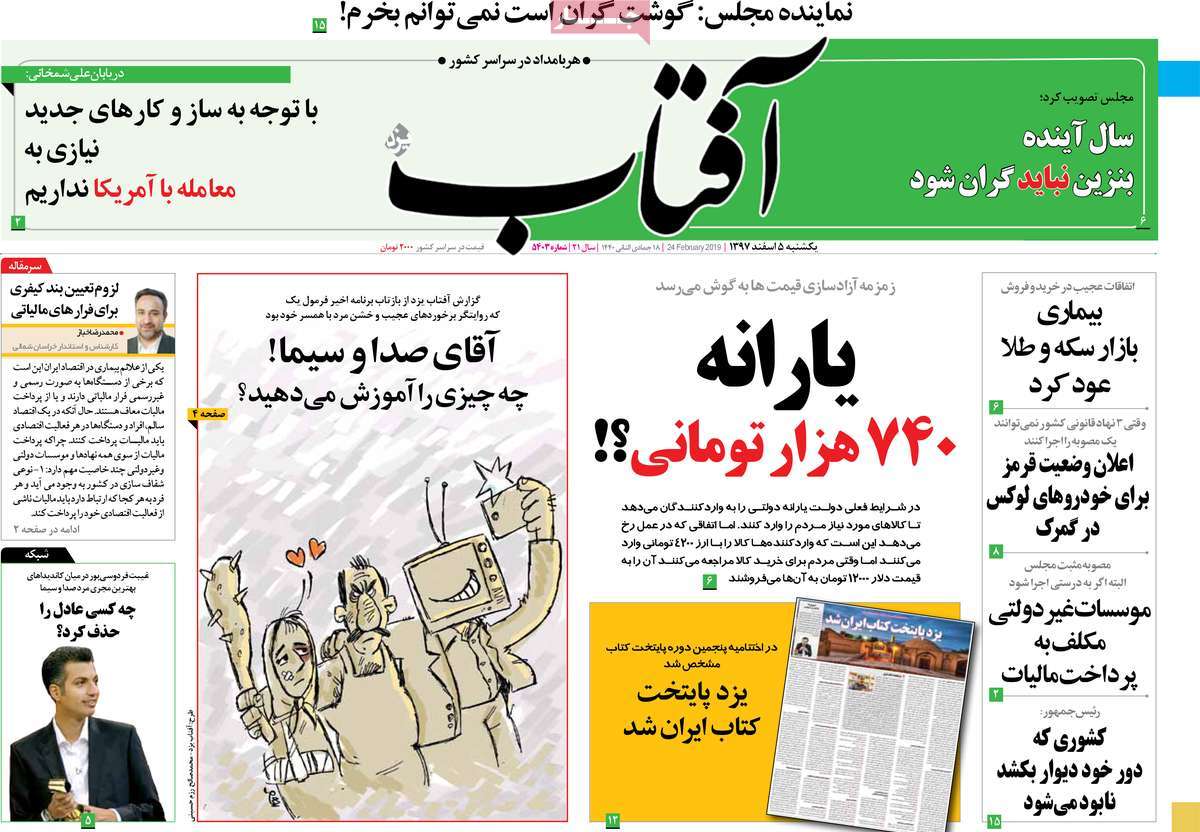
Aftab-e Yazd:

1- Shamkhani: Iran Doesn’t Need Any Deal with US Given New Mechanisms

2- Rouhani: Any Country that Builds Walls around Itself Will Be Destroyed

A Look at Iranian Newspaper Front Pages on February 24


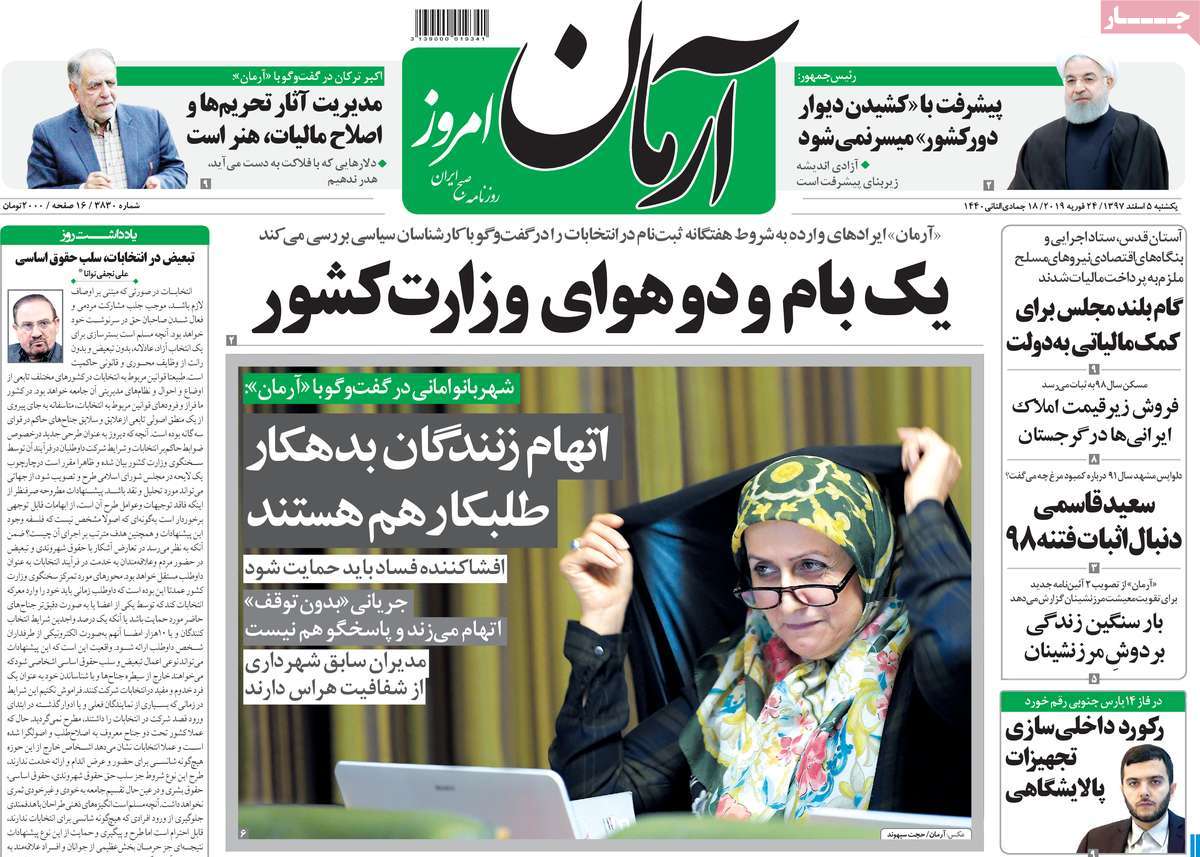
Arman-e Emrooz:

1- Parliament’s Long Step to Help Gov’t with Taxes

2- Iran Breaks Record of Using Domestically-Developed Refinery Equipment in Phase 14 of South Pars

A Look at Iranian Newspaper Front Pages on February 24


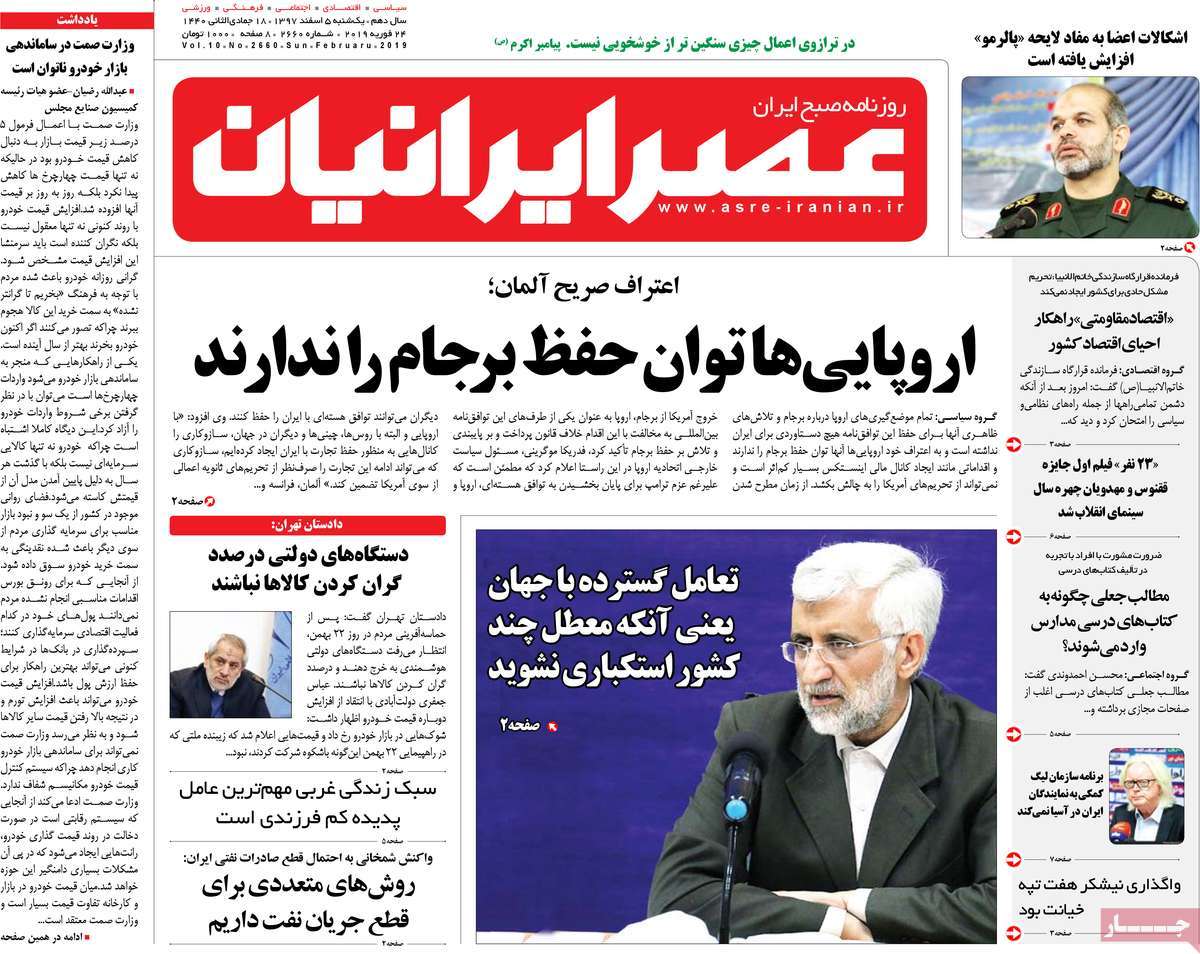
Asr-e Iranian:

1- Germany Admits: Europeans Not Capable of Saving JCPOA

2- Shamkhani: We Have Various Ways to Stop Oil Supplies [through Persian Gulf]

A Look at Iranian Newspaper Front Pages on February 24


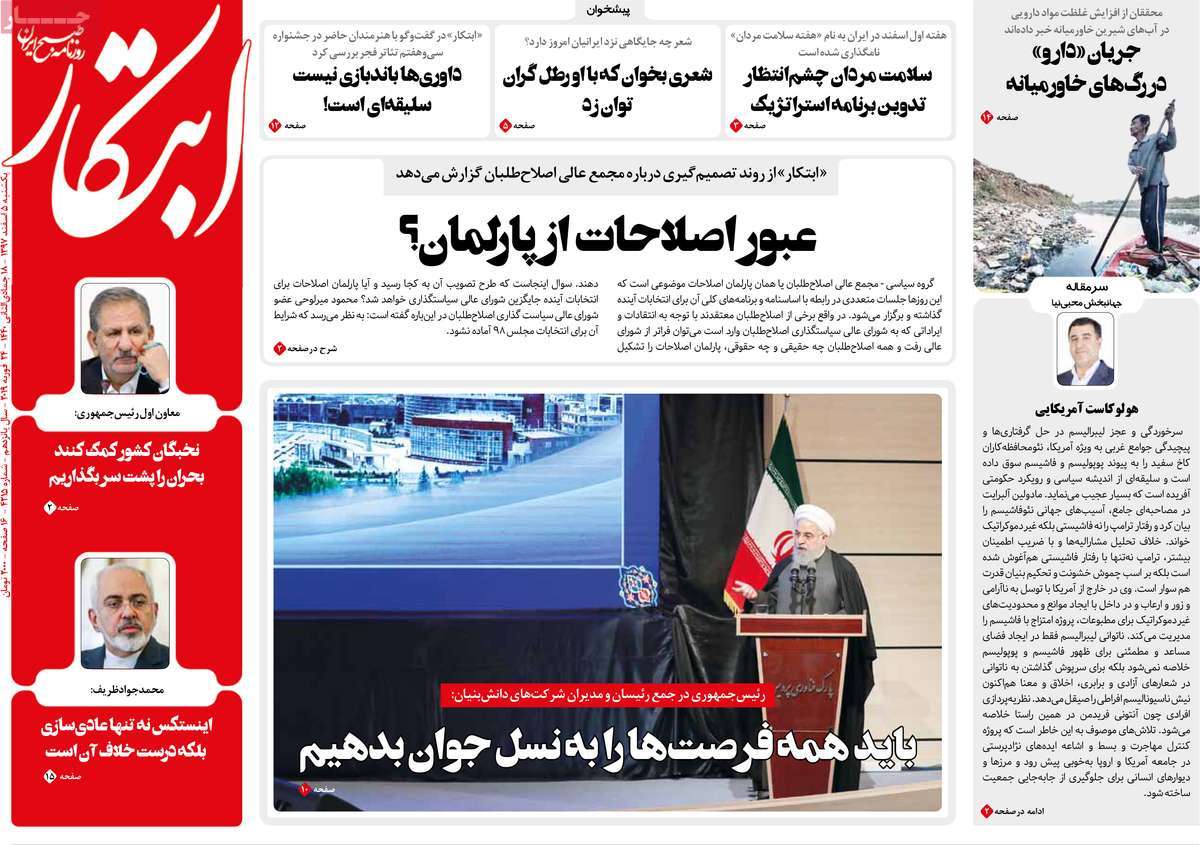
Ebtekar:

1- Zarif: INSTEX Does Not Normalize Iran’s Ties with World, It Rather Does Opposite

2- Iran First VP: Elites Must Help Us Overcome This Crisis

A Look at Iranian Newspaper Front Pages on February 24


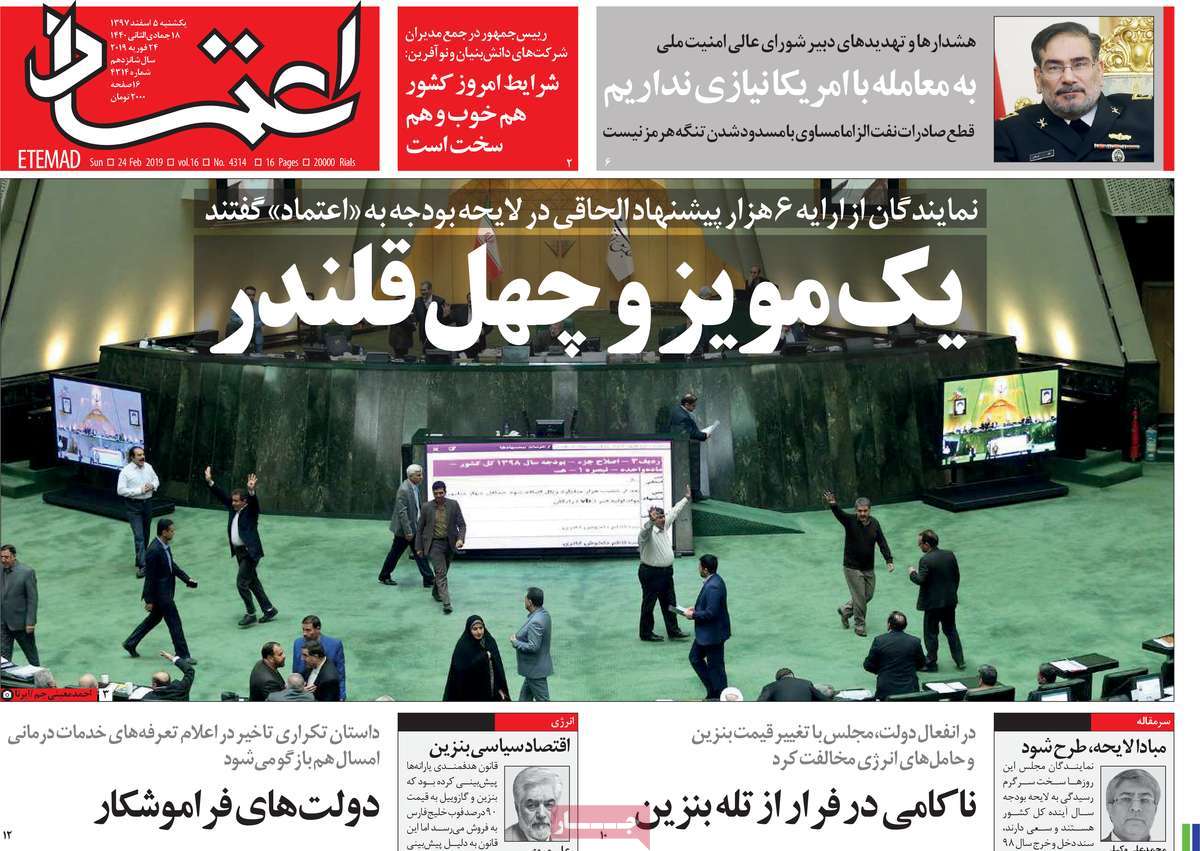
Etemad:

1- Shamkhani: Cutting Iran’s Oil Exports Will Not Necessarily Lead to Closure of Strait of Hormuz

2- Rouhani: Iran’s Situation Today Both Good, Difficult

A Look at Iranian Newspaper Front Pages on February 24


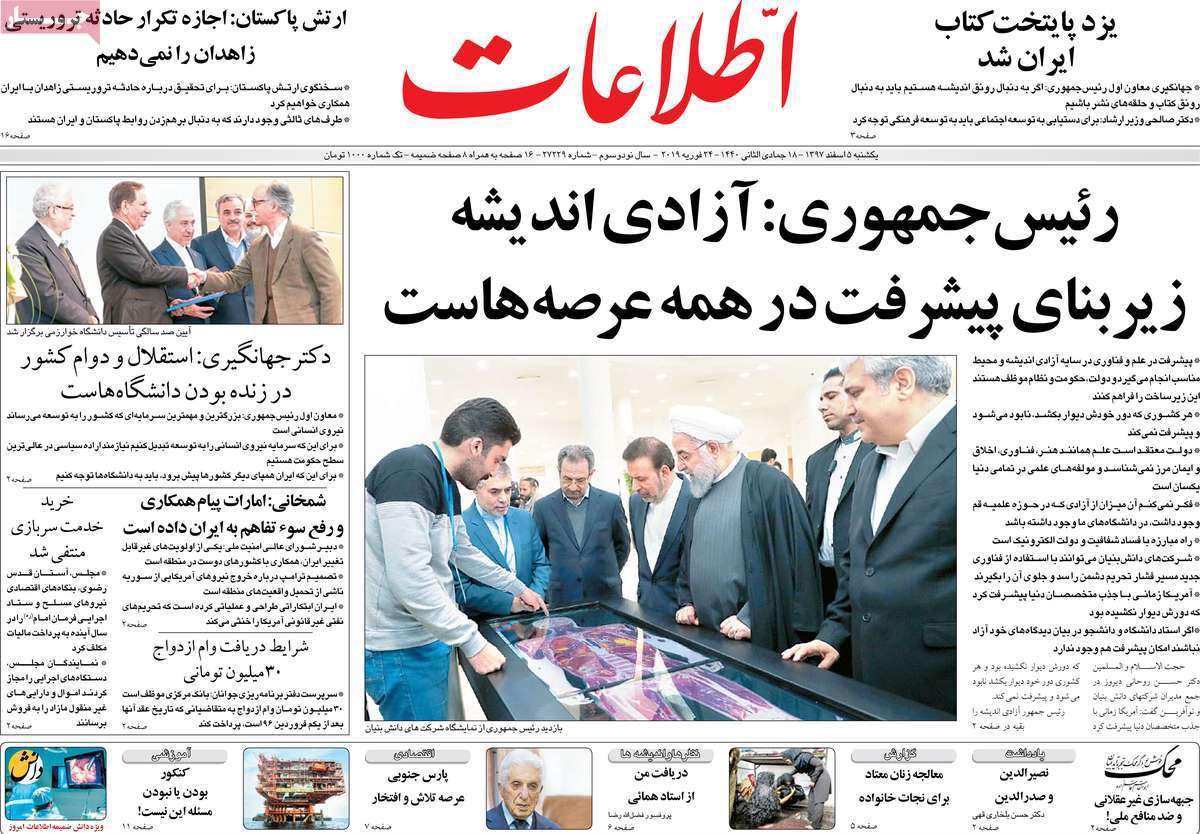
Ettela’at:

1- Rouhani: Freedom of Speech Basis of Progress in All Fields

2- Yazd Named Iranian Capital of Book

3- Pakistani Army: We Won’t Let Zahedan Terror Attack Happen Again

4- Shamkhani: UAE Has Given Iran Message of Cooperation

A Look at Iranian Newspaper Front Pages on February 24


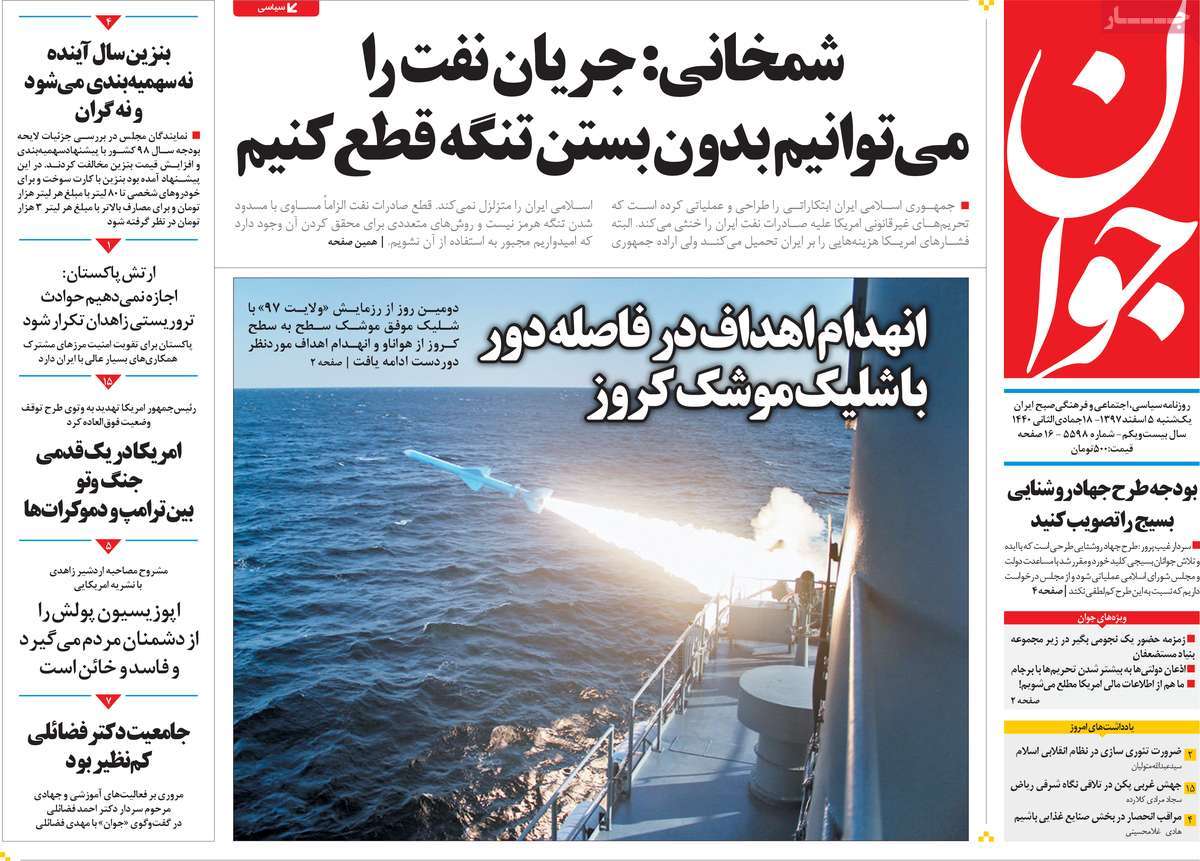
Javan:

1- Shamkhani: We Can Stop Supply of Oil without Closing Hormuz Strait

2- Iran Destroys Remote Targets with Cruise Missile in Massive Naval Drill

3- US One Step from War of Veto between Trump, Democrats

A Look at Iranian Newspaper Front Pages on February 24


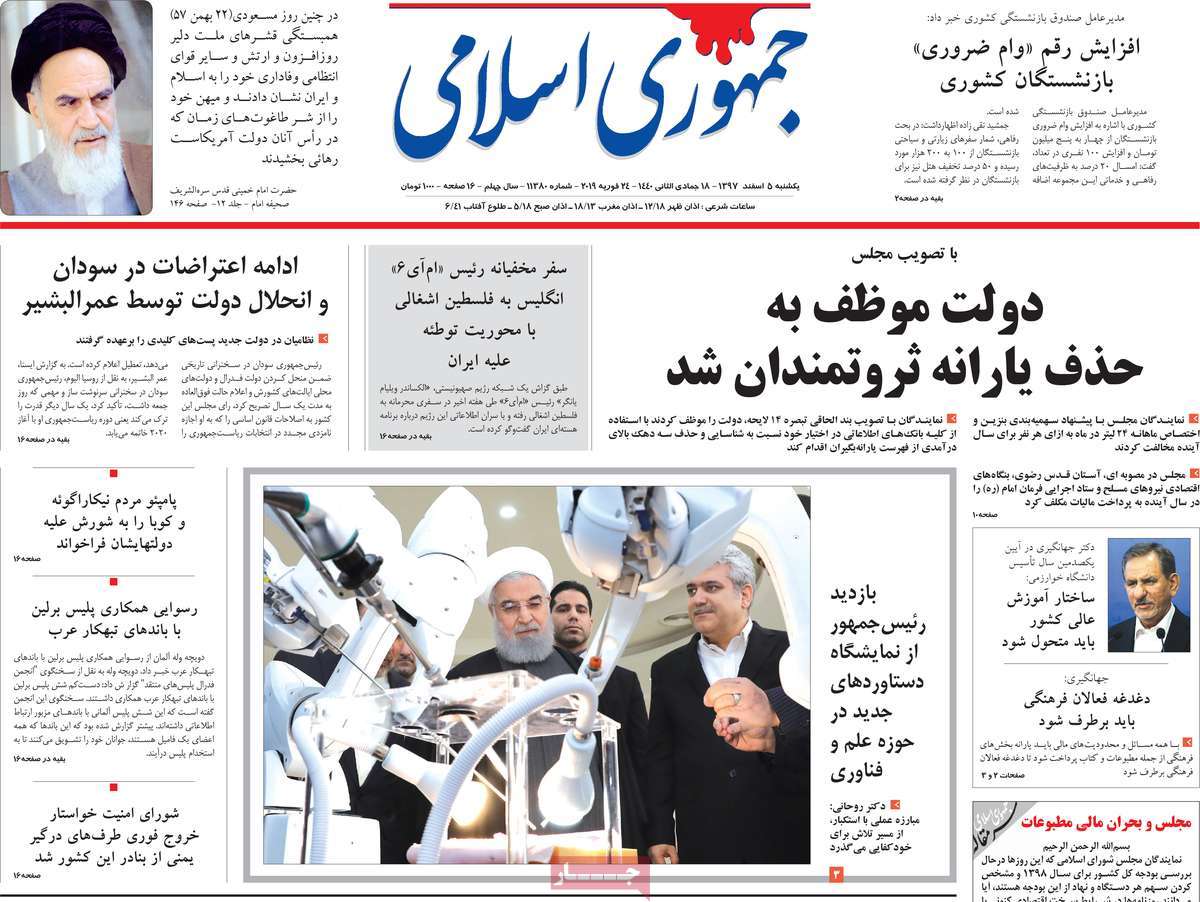
Jomhouri Eslami:

1- Government Obliged to Stop Paying Cash Subsidies to Rich People

2- Rouhani Visits Exhibition of New Sci-Tech Achievements

3- Scandal in Germany: Berlin Police Colluding with Arab Criminals

4- MI6 Chief Makes Secret Visit to Occupied Territories for Plotting against Iran

A Look at Iranian Newspaper Front Pages on February 24


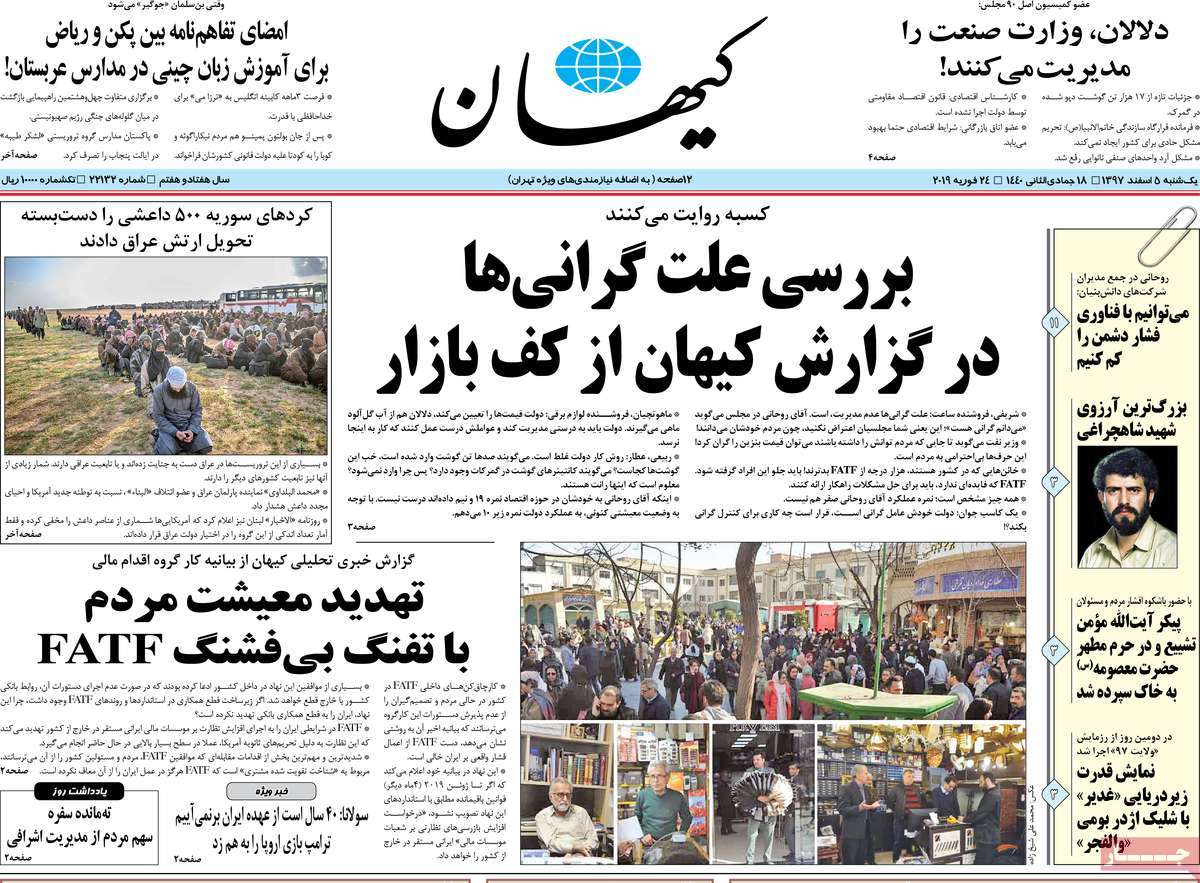
Kayhan:

1- A Report on Reasons for Price Hikes

2- Beijing, Riyadh Sign MoU on Teaching Chinese in Saudi Schools!

3- Syrian Kurds Hand Over 500 ISIS Prisoners to Iraqi Army

4- The Gun of FATF Threatening People’s Livelihood

A Look at Iranian Newspaper Front Pages on February 24


Khorasan:

1- Rouhani: We Can Cushion Enemy’s Pressure Using Technology

2- Six Offending Foreign Fishing Boats Stopped by IRGC

A Look at Iranian Newspaper Front Pages on February 24


Shargh:

1- Parliament’s Research Centre Warns of Legal Ways for Money Laundering

A Look at Iranian Newspaper Front Pages on February 24


Vatan-e Emrooz:

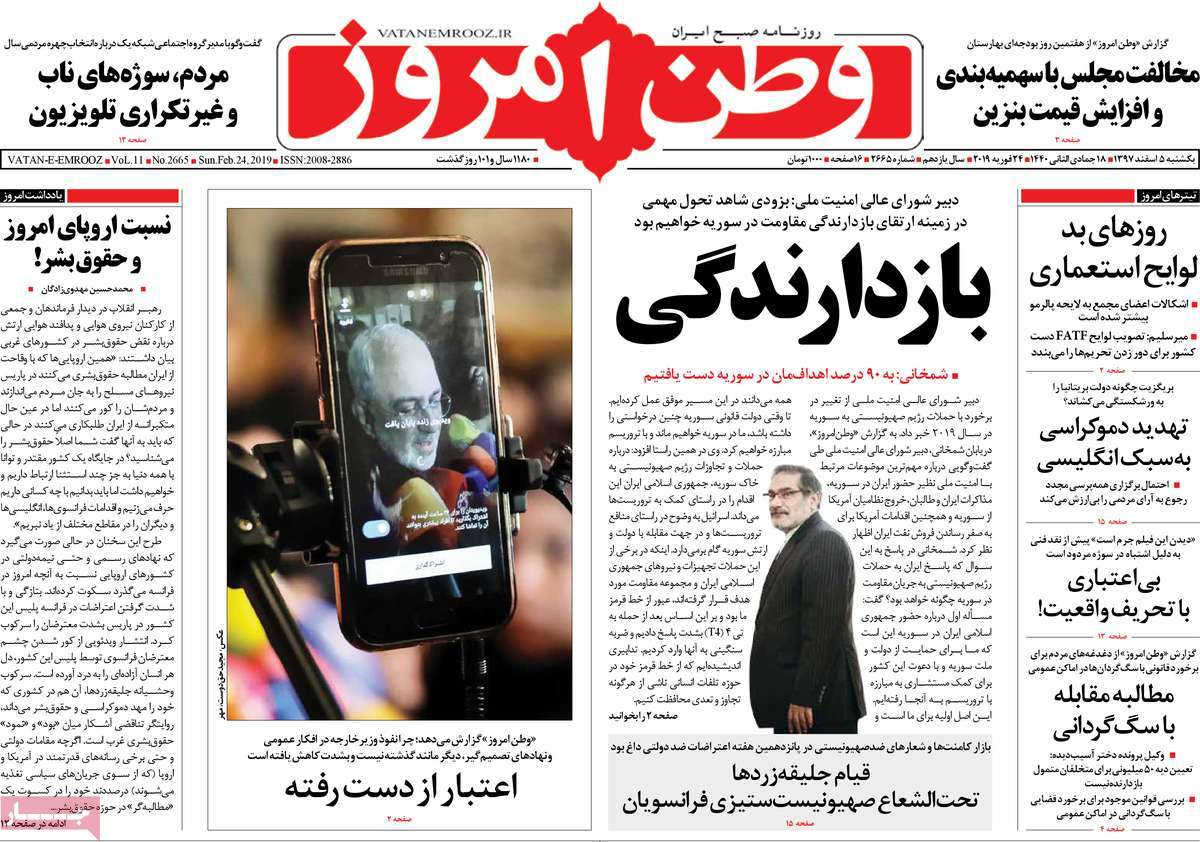
1- Parliament Opposed to Rationing, Increasing Price of Petrol

2- Yellow Vest Protesters’ Movement Overshadowed by French Anti-Zionism

A Look at Iranian Newspaper Front Pages on February 24

‘Iranian Knowledge-Based Firms Export $5 Billion Worth of Products’

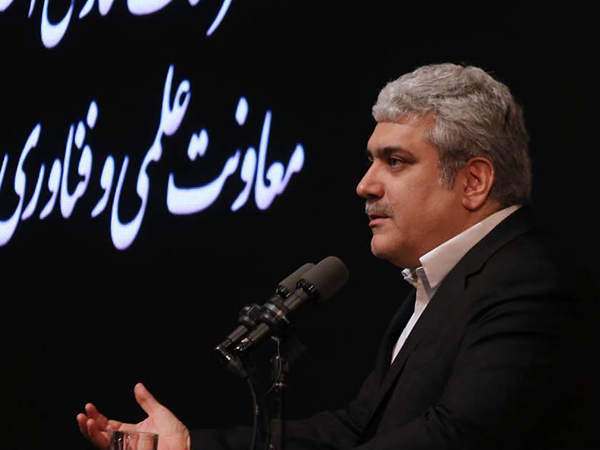
In an address to a science and technology exhibition in Tehran on Saturday, Sorena Sattari said the country’s knowledge-based firms, supported by the Science and Technology Department of the Iranian President’s office, have exported $5 billion worth of products to other countries.

He went on to say there are over six-thousand startups in various areas in Iran like biotechnology, nanotechnology, cognitive sciences, aerospace and many others.

“Today, we should see how to inject creativity into our economy. To this end, we should have this point in mind that the concept of education is changing in the world. We should take some long steps in developing new frameworks for educating our new generations,” he was quoted as saying in a report by IRNA.

The Iranian vice president underlined that cities will play a significant role in the future world, adding, today Iran should seek to create a creativity factory within its urban space.

“To this end, we are going to establish the largest creativity factory in Tehran in the near future. At least over one thousand people are active in its establishment,” he said.

Sattari said the final phase of the project will be accomplished in May and over 3,500 people from various areas including private sector will be involved in it.

He added at least four other factories are being renovated in Tehran and said planning is underway to establish similar factories in other big cities like Mashhad and Isfahan.

Elsewhere, he added smart cities are formed by educating citizens on a daily basis.

He then referred to the cooperation established between academic centres and knowledge-based firms in Iran and said the new development will not only change the urban space but also our lifestyle and culture.

The official underlined that the government has put its focus on the further development of technological startups and added the new generation, active in this field, can play a leading role in the economy and industry of the country.

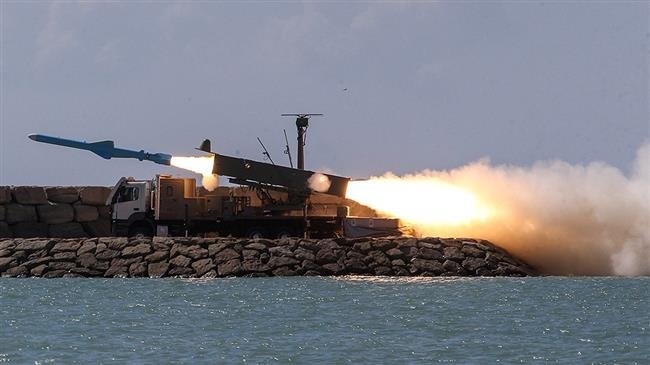
Iran Fires Torpedoes, Cruise Missiles in Large-Scale Navy Drills

The Iranian Navy fires a Qader cruise missile on the second day of the Velayat 97 drills, held in a vast area from the Persian Gulf to the Indian Ocean, on February 23, 2019. (Photo by Fars news agency)

The Qader and Qadeer missiles were fired from Iran’s Shaheed Naqdi destroyer and the missile-launching frigate Tabarzin respectively on the second day of the massive three-day drill, codenamed Velayat 97, on Saturday.

A surface-to-sea missile system also fired a Qader missile that destroyed designated marine targets.

The missiles, which have ranges from 250 to 300 kilometers, can be fired from vessels, onshore systems and aircraft.

The Iranian Navy’s unmanned aerial vehicles, equipped with various bombs and defense units, also successfully destroyed their targets.

The Navy’s air defense division managed to intercept and destroy an intruding drone belonging to the mock enemy with a range of domestically-built systems, including the Misaq shoulder-fired missile.

The domestically-made Tareq submarine fired an electric torpedo while the Ghadir submarine launched a domestically-manufactured torpedo called Valfajr.

In another operation, an SH helicopter fired a Mark 46 torpedo to detonate a marine target.

The exercises also involved commandos, who parachuted onto the ground to launch operations against mock enemy targets.

The Velayat 97 drill is being held in an area of two million square kilometers, from the Strait of Hormuz to the southeastern coasts of Makran, the Sea of Oman and the northern parts of the Indian Ocean, down to the 10-degree latitude.

In recent years, Iran has made major breakthroughs in its defense sector and attained self-sufficiency in producing important military equipment and hardware.

Iran has also conducted major military drills to enhance the defense capabilities of its armed forces and to test modern military tactics and state-of-the-art army equipment.

The Islamic Republic maintains that its military might poses no threat to other countries, stating that its defense doctrine is merely based on deterrence.

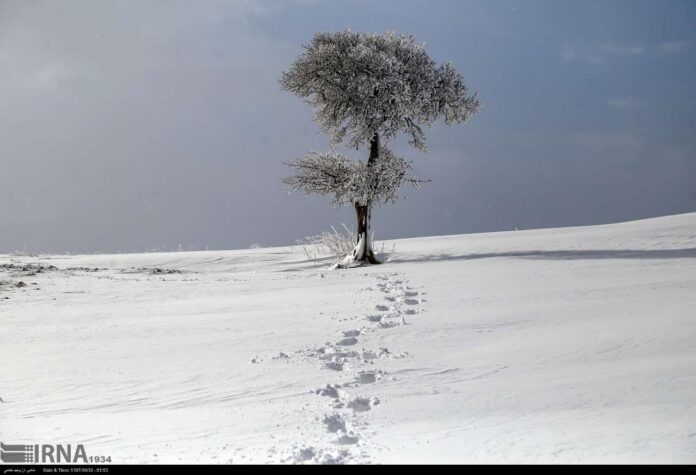
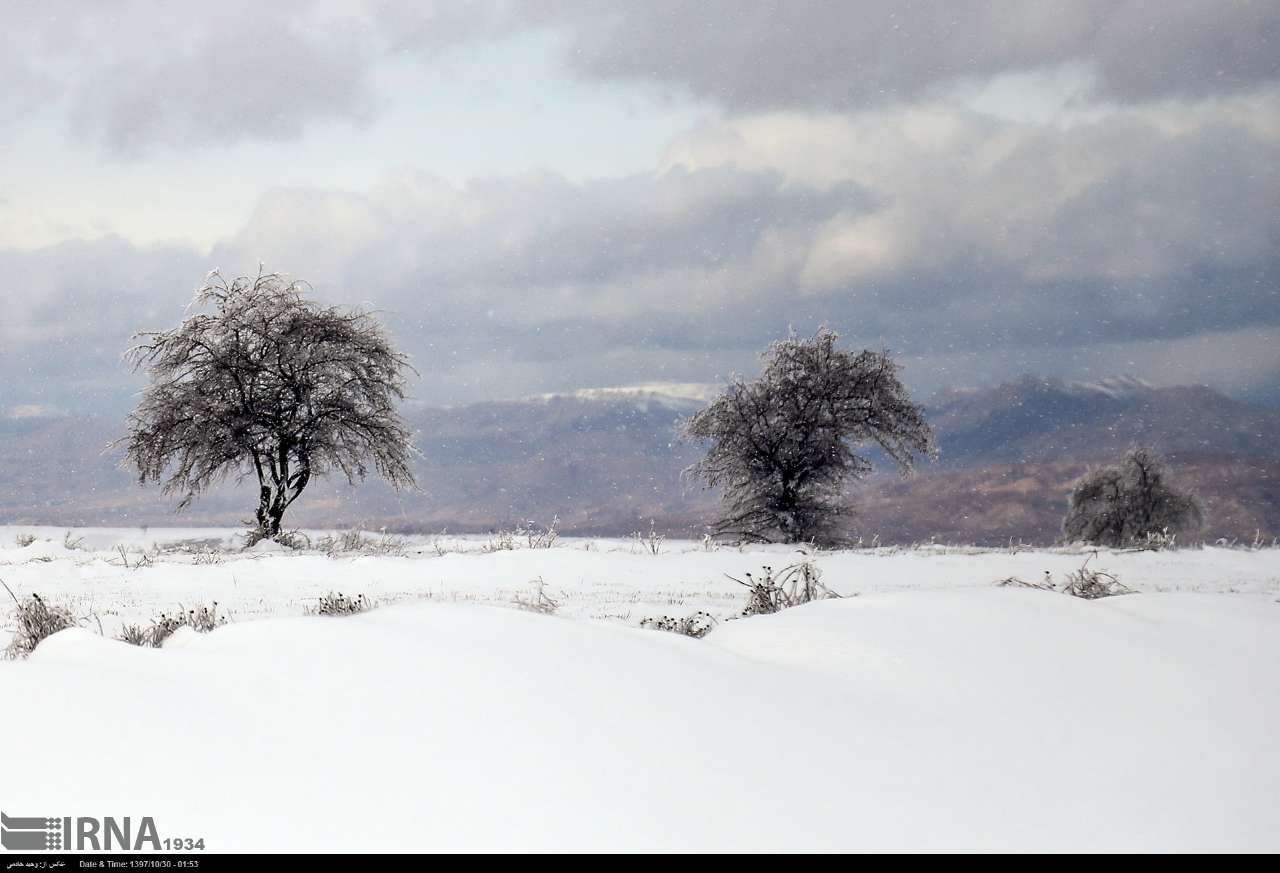
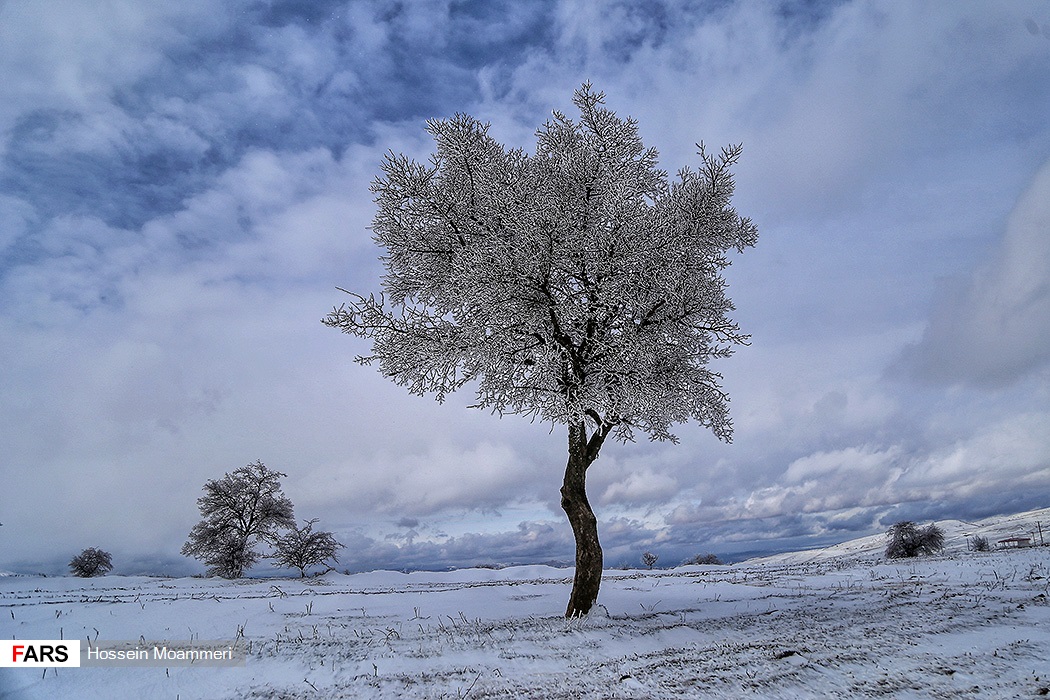
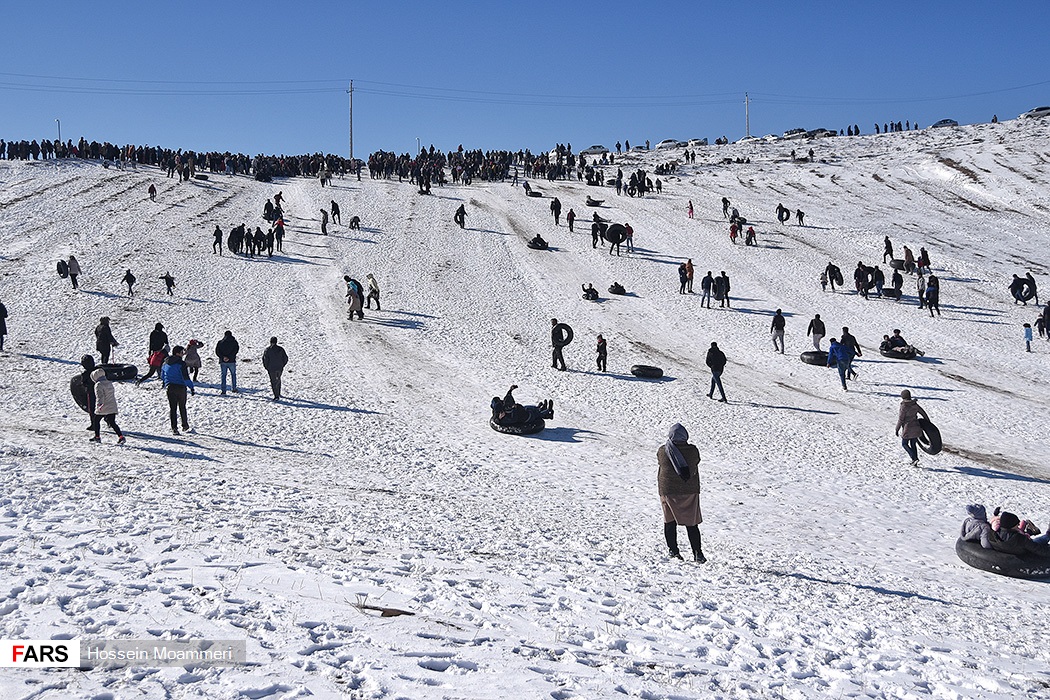
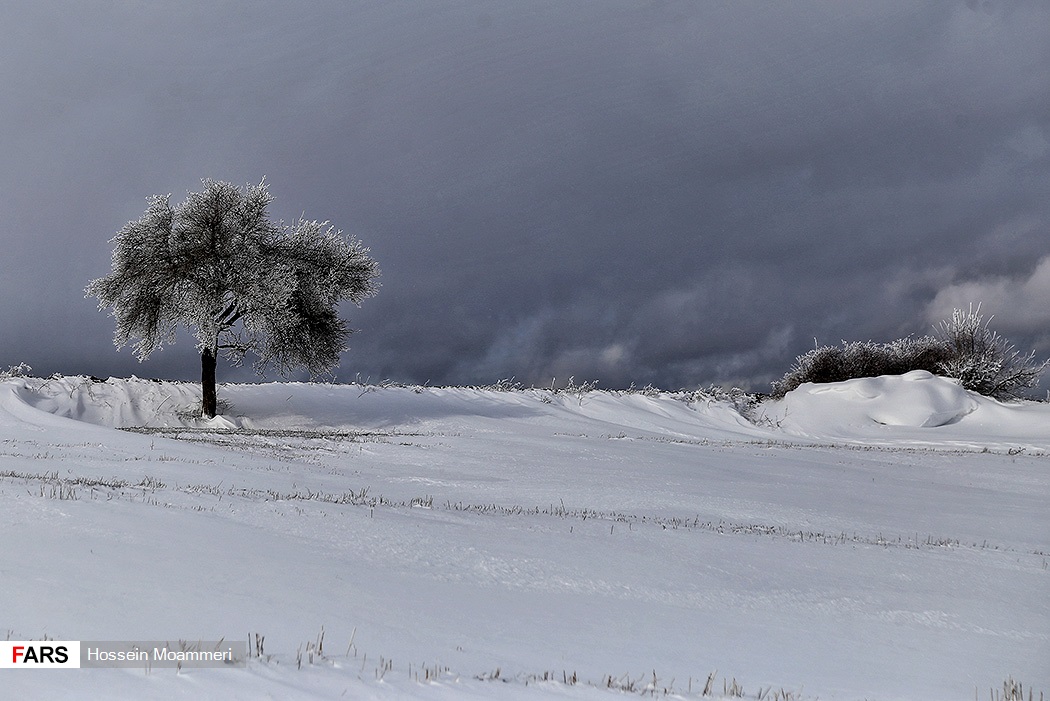
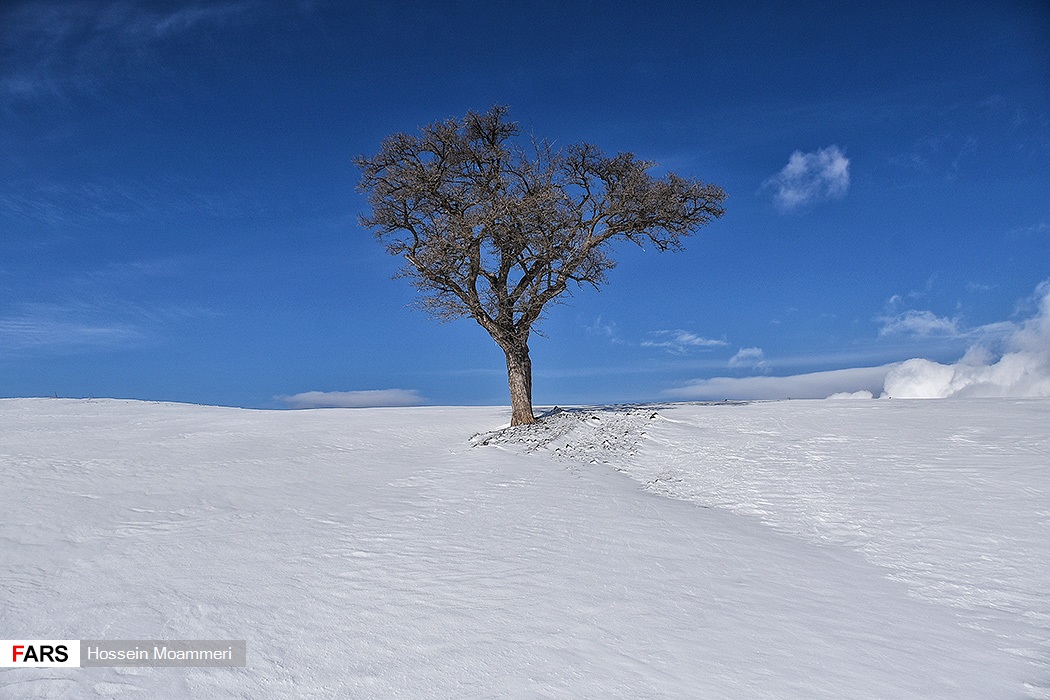
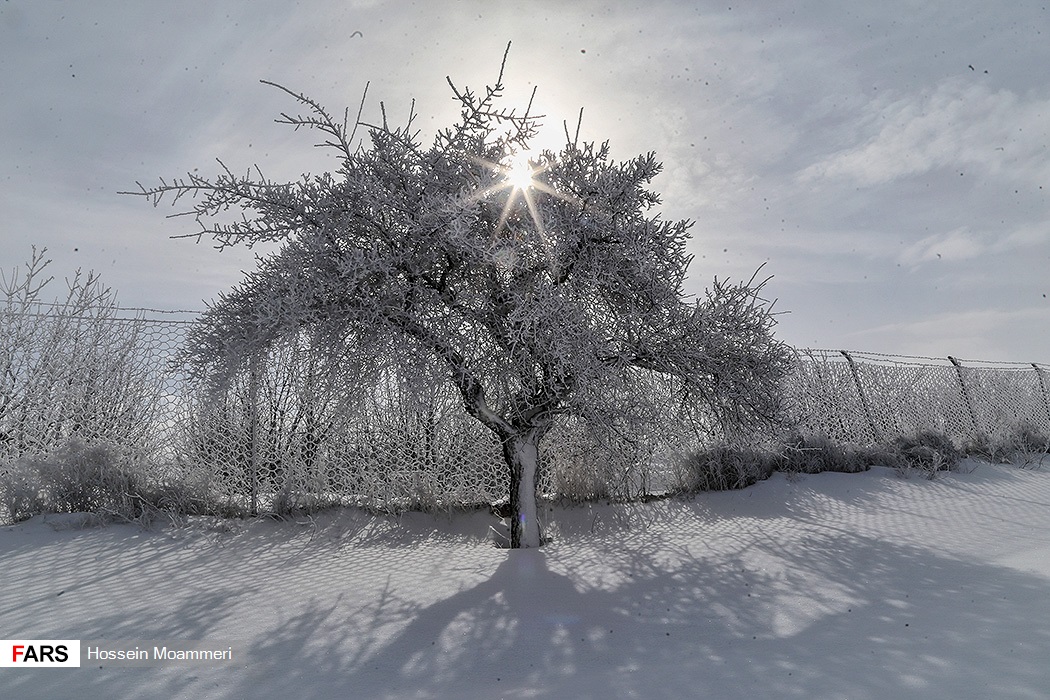
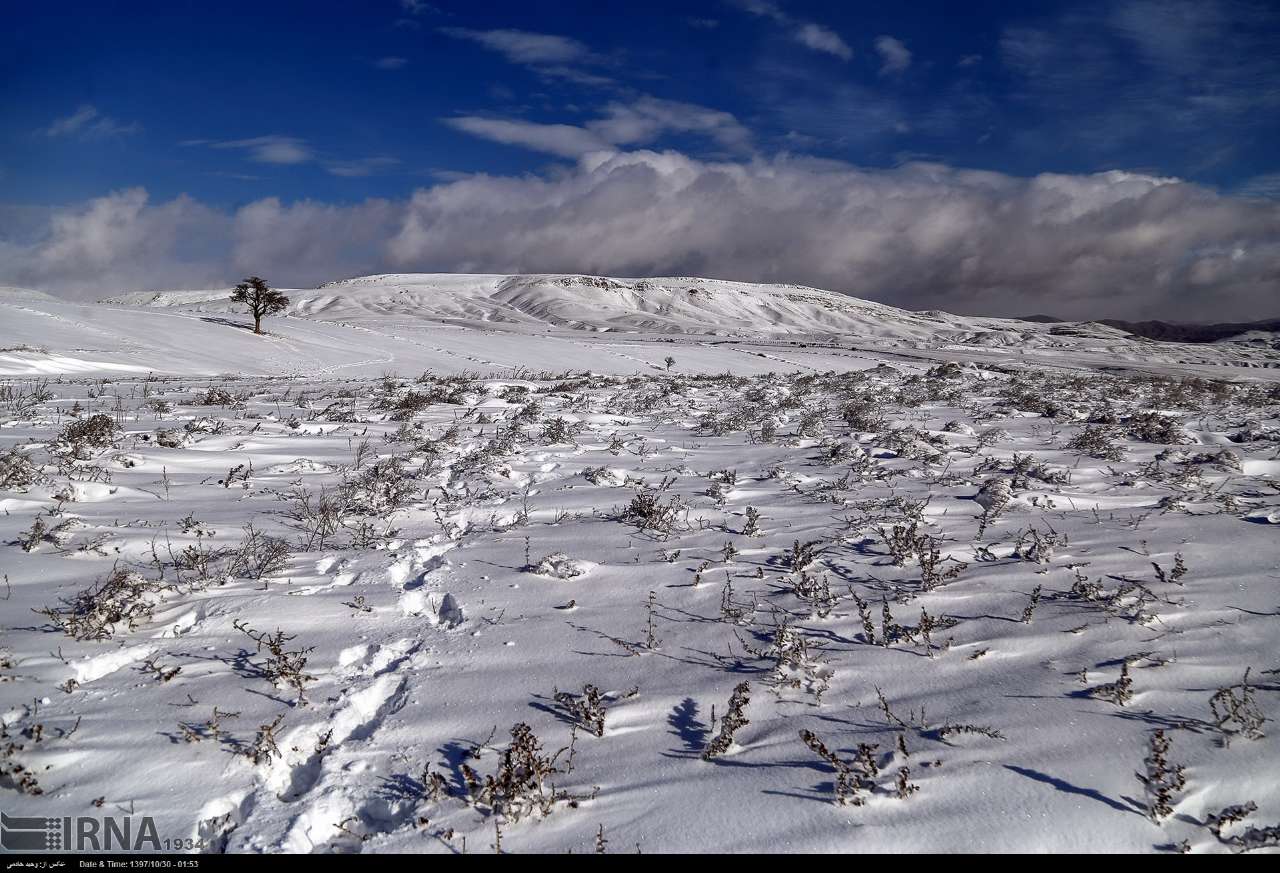
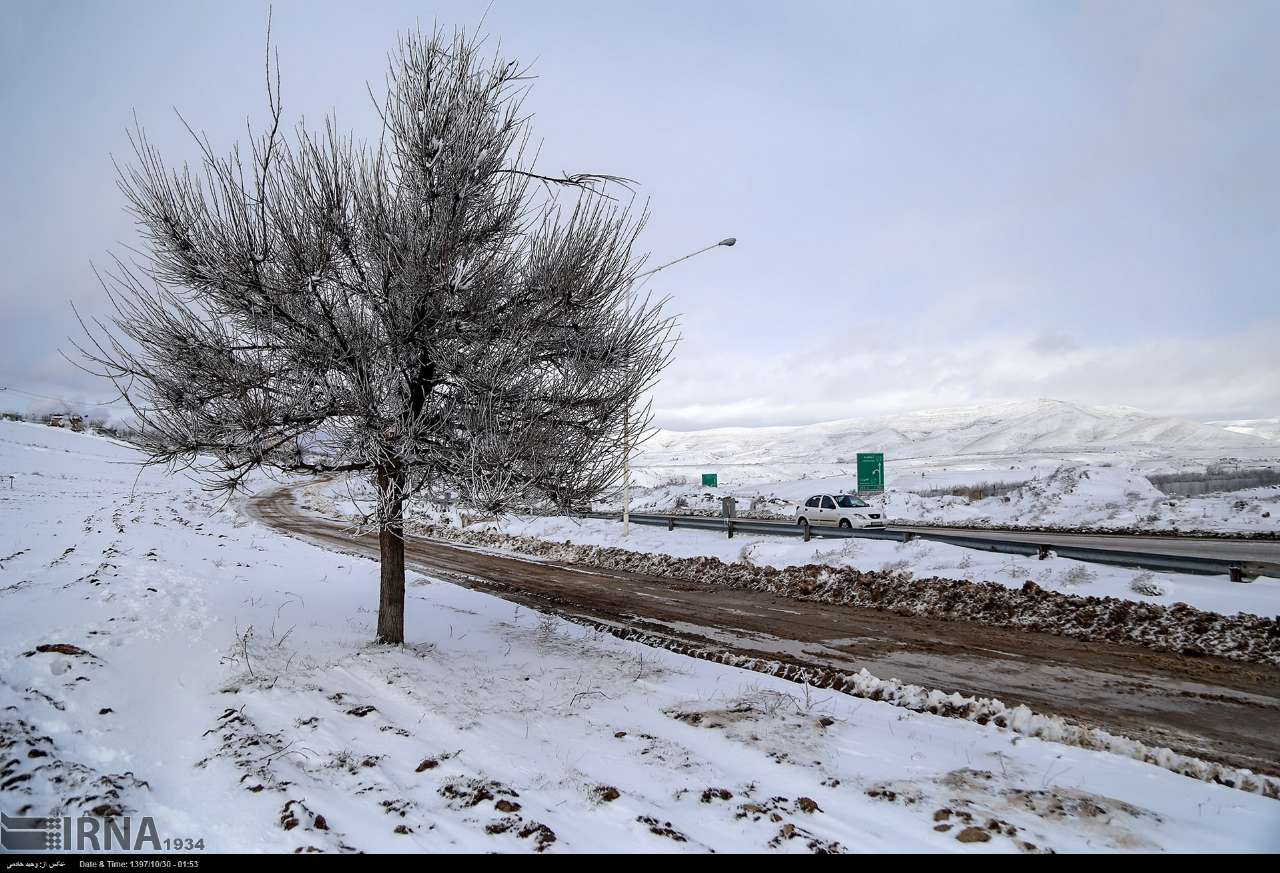
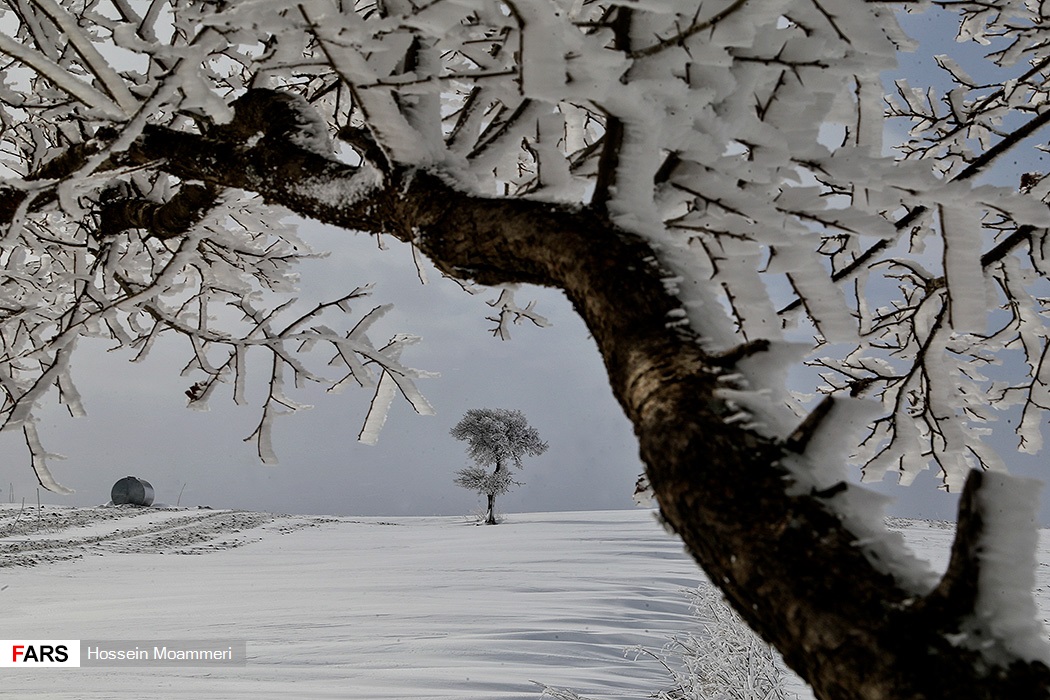
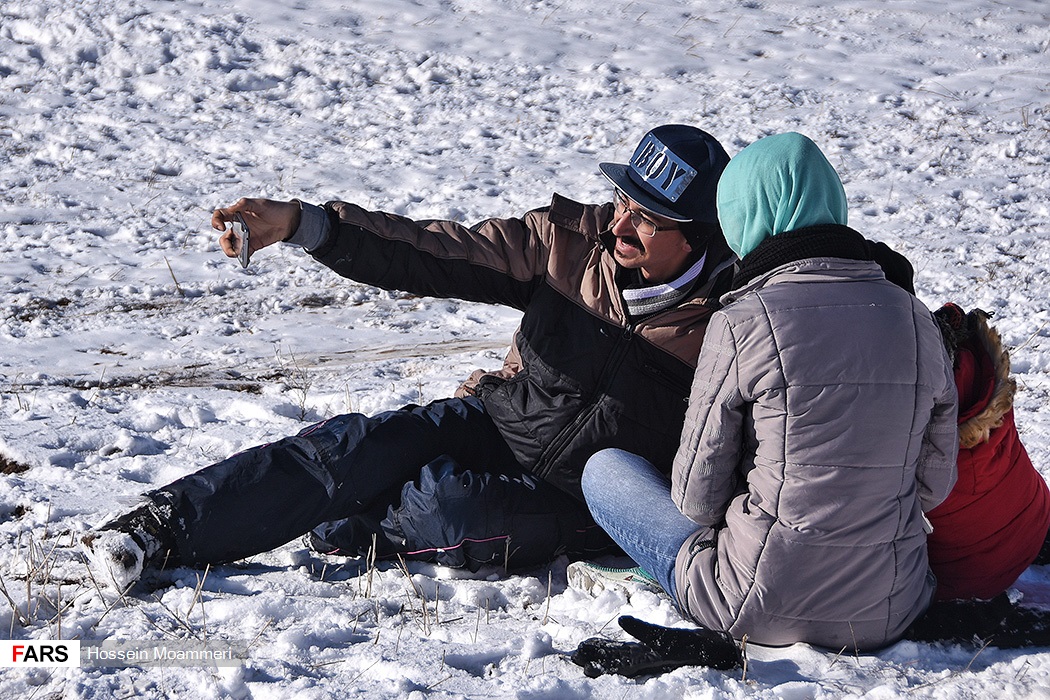
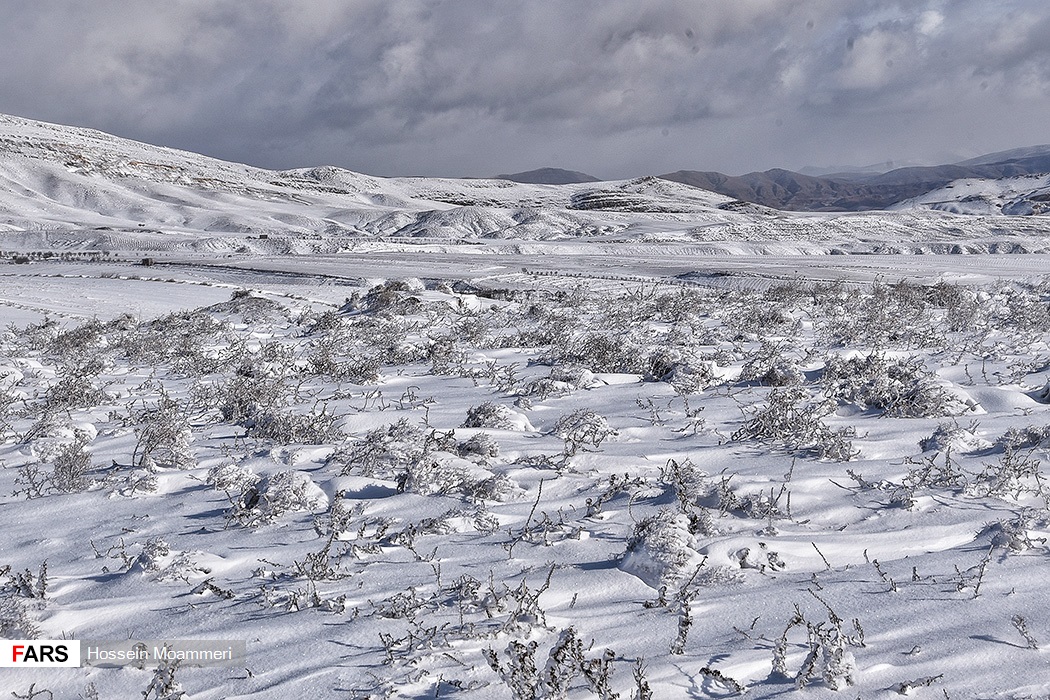
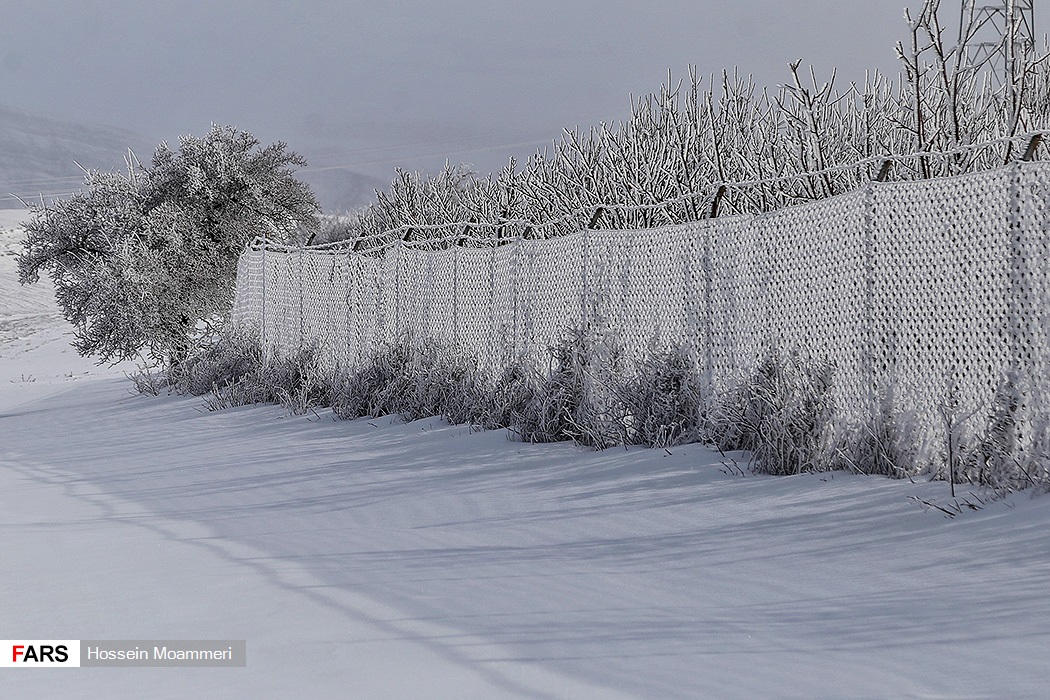
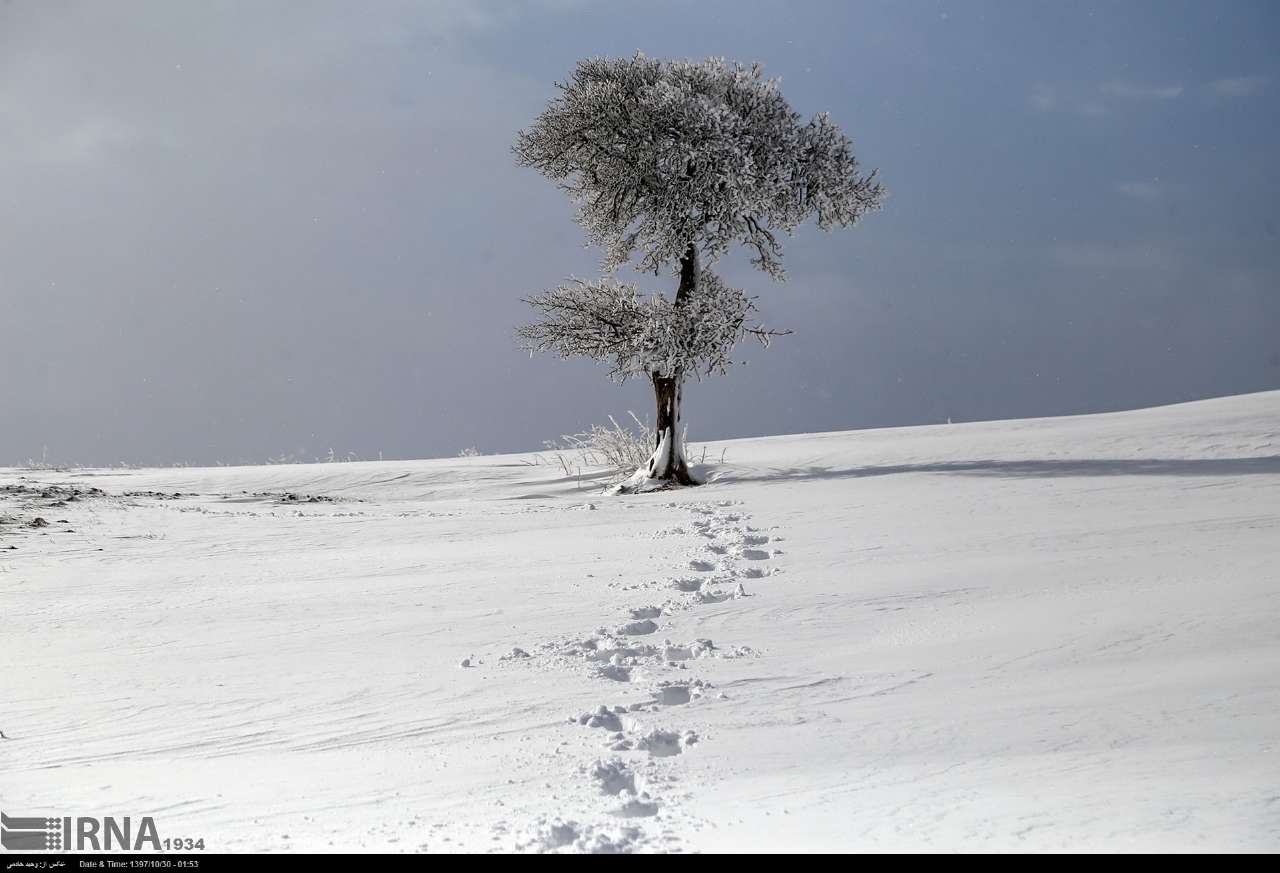
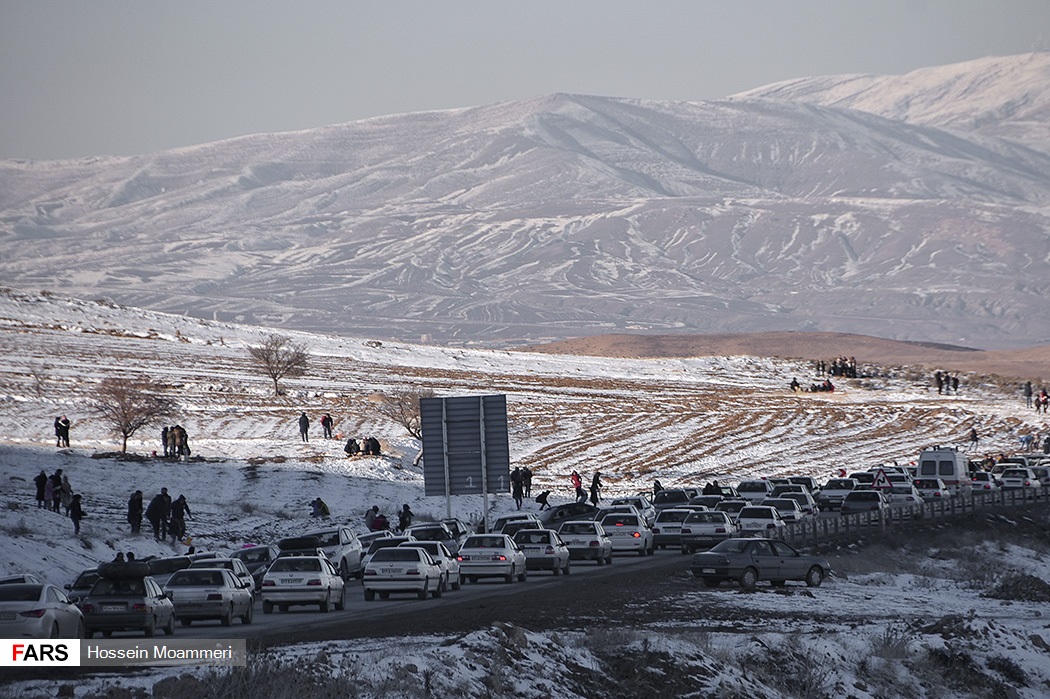
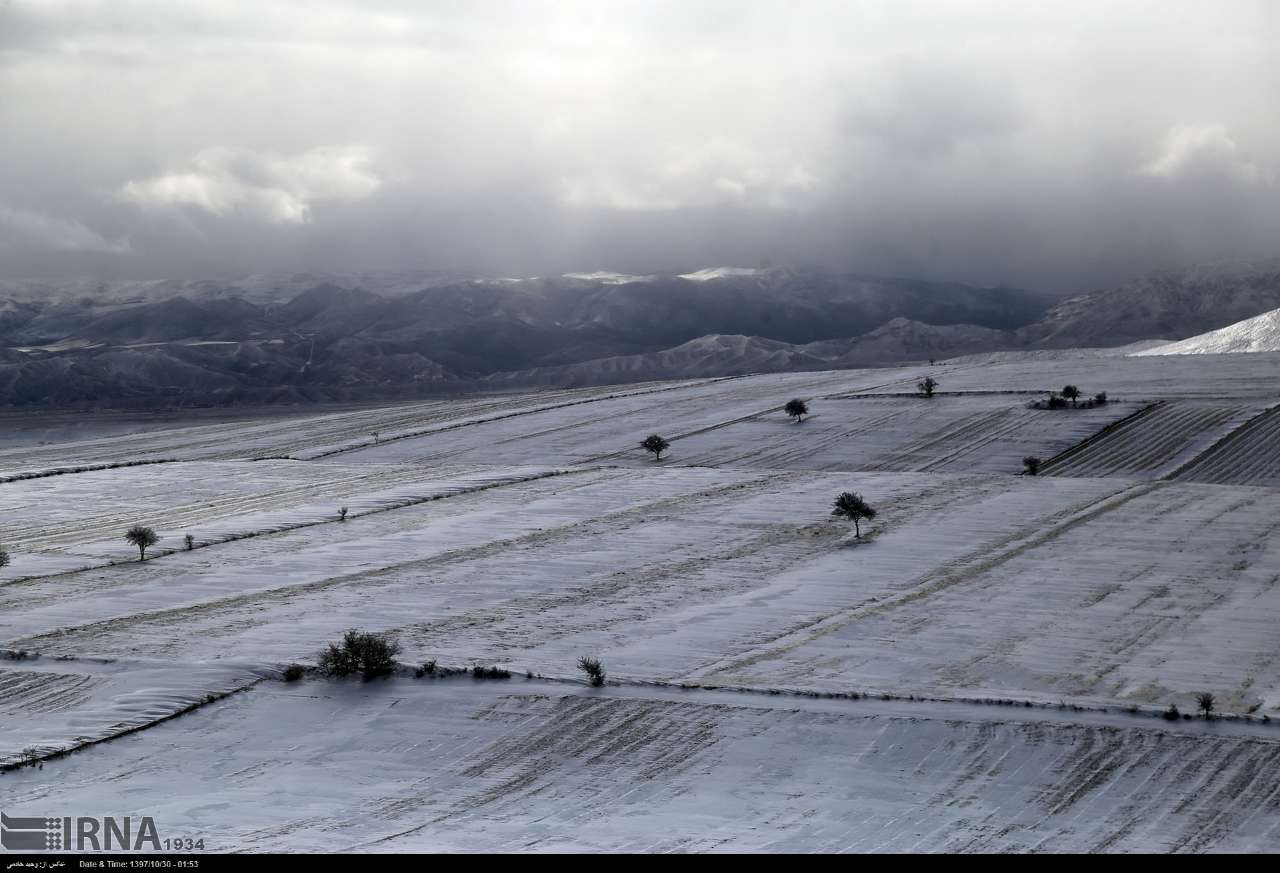
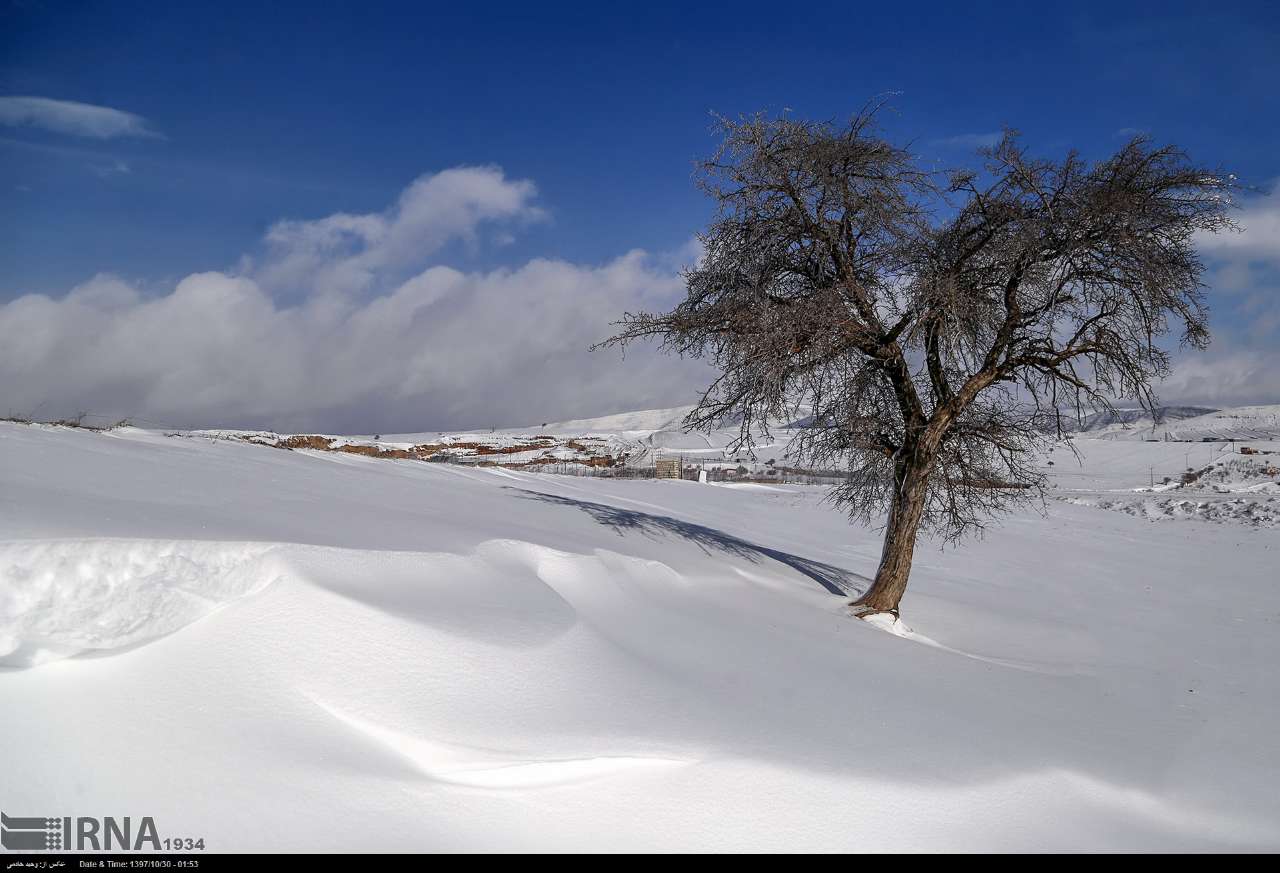
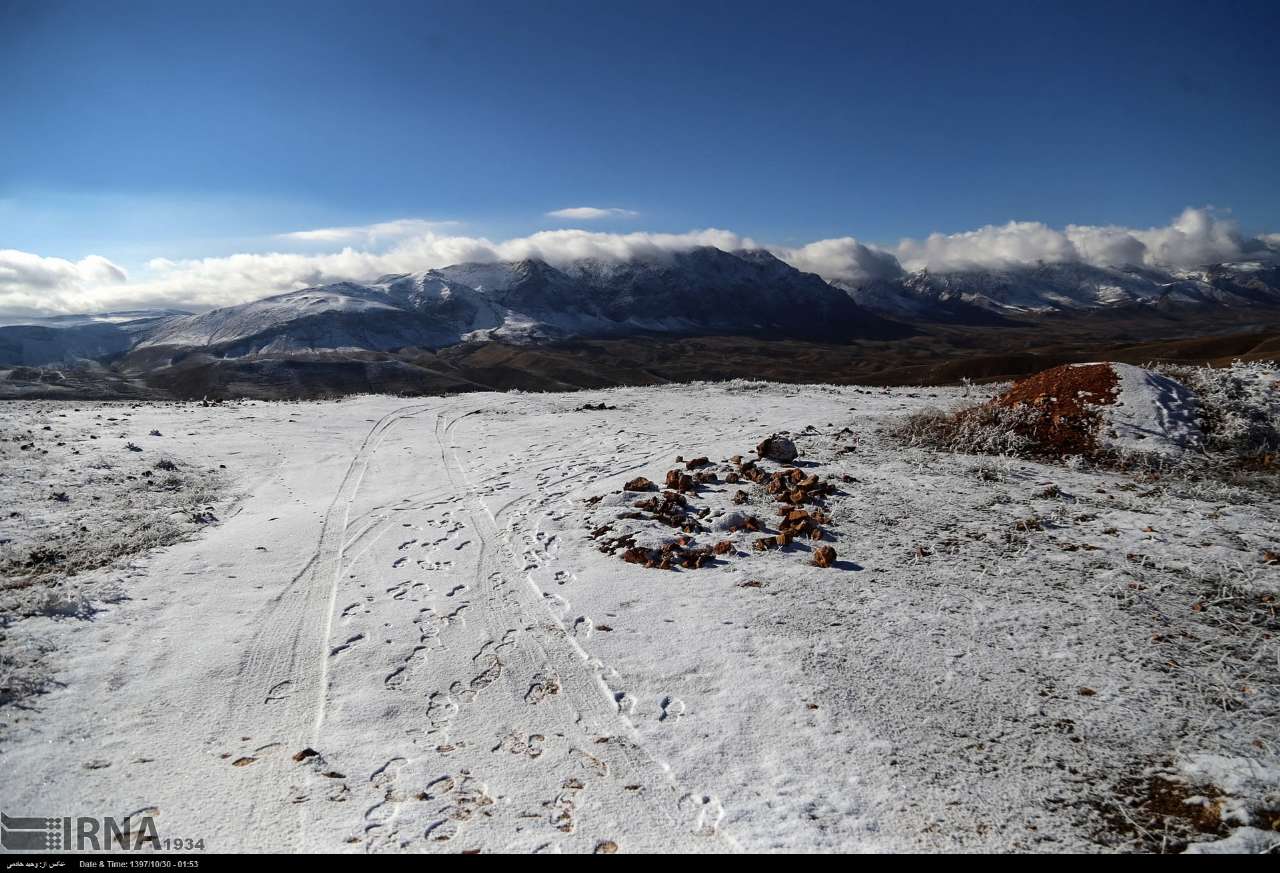
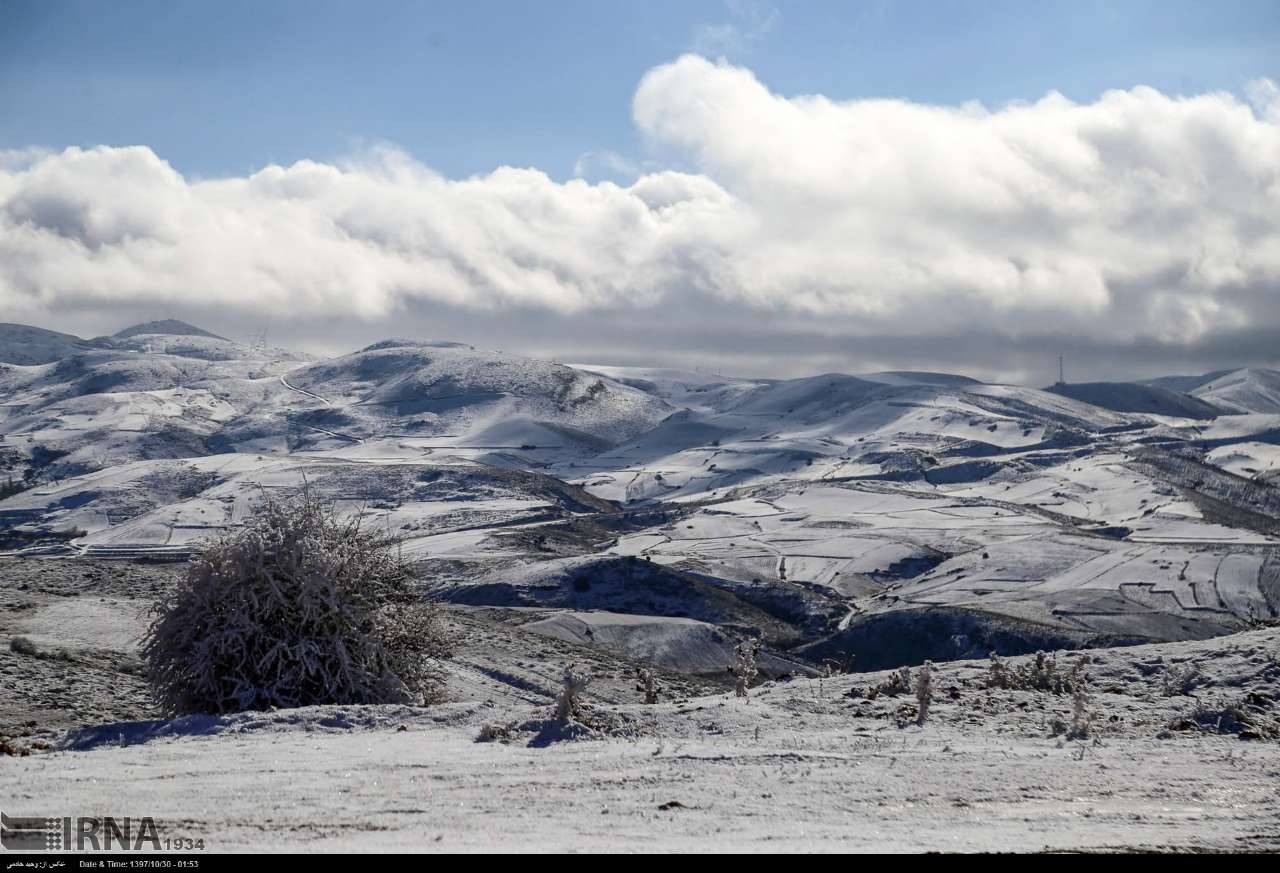
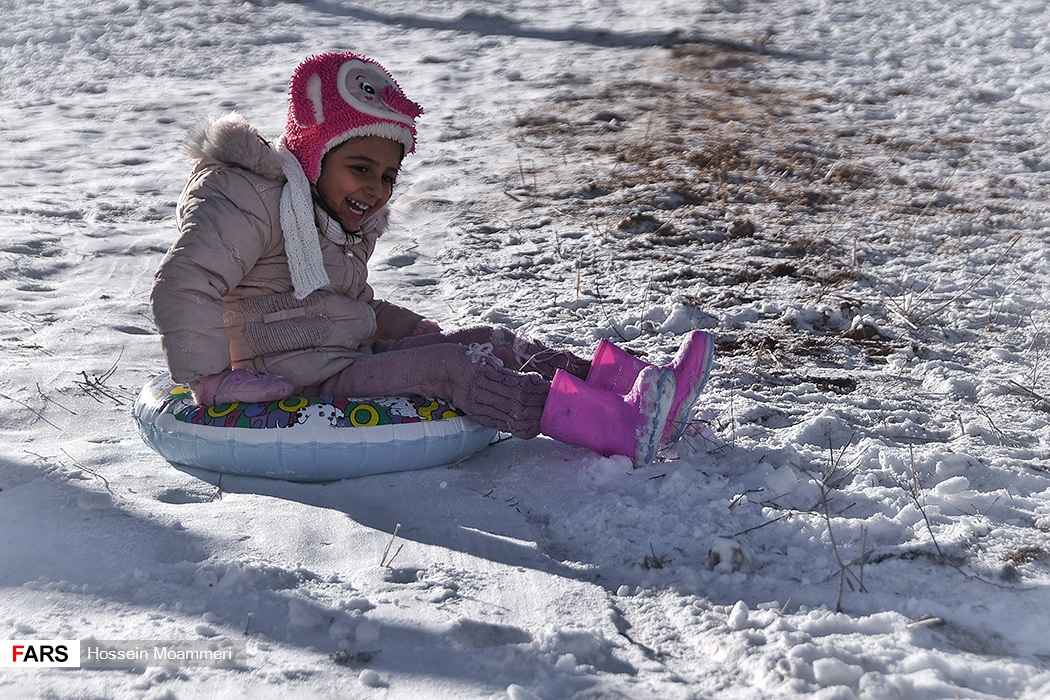
Iran’s Beauties in Winter: Nature of North Khorasan

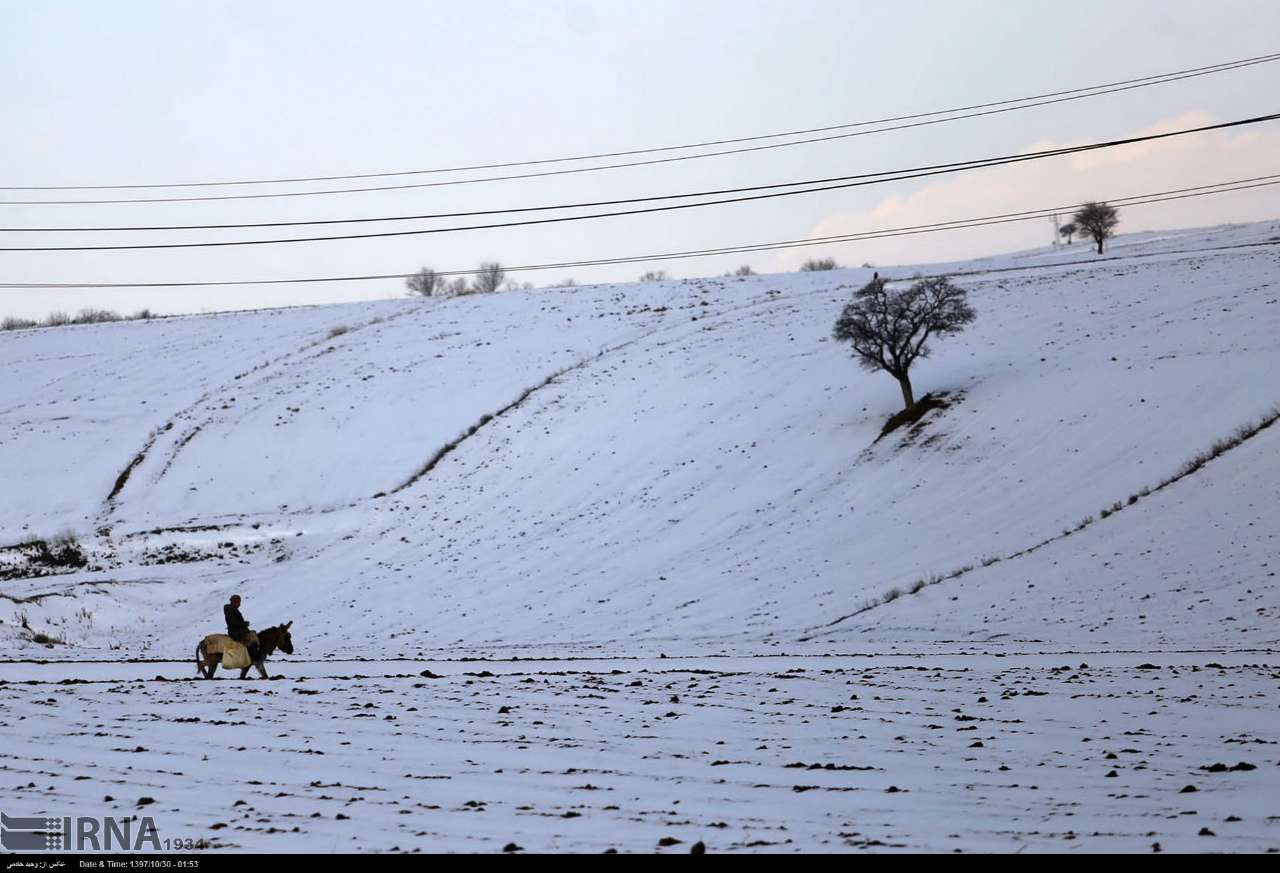
As the weather gets cold during winter and it starts to snow, the region’s beautiful nature attracts every visitor.

Here are IRNA and Fars News Agency’s photos of the province’s magnificent nature during winter:

Iran Says US Coalition-Building Efforts Doomed to Failure

Signs of US Decline Clearer Than Ever: Iran Official

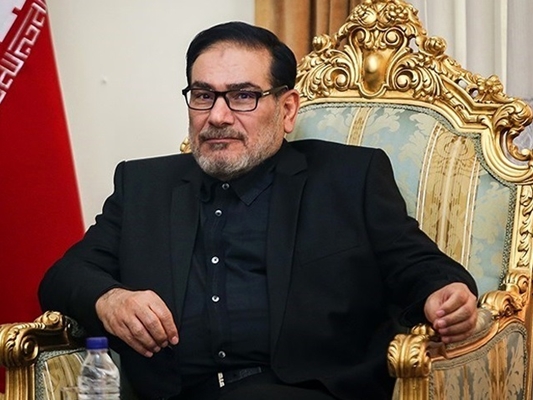
Speaking to Tasnim News Agency in an interview published on Saturday, Ali Shamkhani said the US has for a long time been trying to gather countries together against Tehran.

However, the SNSC secretary said countries in the region are not in line with the US policy on Iran, particularly Arab governments.

“Many Arab countries in the southern side of the Persian Gulf have friendly relations with Iran and see no need for creating military or security alliances against Iran,” he said.

“To the opposite, countries such as Oman, Qatar and Kuwait are looking to prevent unnecessary tensions with and have made good efforts,” he said.

“Even the UAE’s policy is not totally similar to Saudi Arabia and there are rulers inside the UAE who send messages for cooperation and removing misunderstandings,” he said.


US Unable to Wage War

Shamkhani said the US efforts to build coalitions against Tehran or impose sanctions on the country are rooted in their failure to wage wars against Tehran.

The SNSC secretary said Iran is capable of responding to threats and the US knows this.

“That’s why they are raising threats with loud voice. They make bigger threats as they know they can’t go to war,” he said.


Talks with US Meaningless

Shamkhani said Iran won’t engage in talks with the US, as Washington has frequently proved that it is untrustworthy.

“Basically, making deals with the Trump administration is wrong as it means [Iran] accepts US violation of its commitments. Moreover, there are no guarantees that the next US government will be faithful to the new deal,” he said.

Shamkhani said the US needs to prove its good will through fulfilling its JCPOA obligations.

The SNSC secretary said Iran believes the US cannot be trusted with keeping its word and it has no need to deal with such a country.


Iran Devised Plans to Foil Oil Plots

Asked if the US will be able to carry out its threat to cut down to zero Iran’s oil export, Shamkhani said Iran has developed plans to counter illegal US sanctions against Tehran.

The SNSC secretary said blocking the oil flow in the region is not equal to blocking the Hormuz strait and Iran has many options to fulfill its pledge.


Israeli Airstrikes against Syria Bear No Fruits

The Israeli attacks against Syria are aimed at assisting terrorist in the war-torn Arab country, he said.

Israel’s attack against Syria will be dealt with decisively, he said, adding that Iran has made major efforts to boost deterrence in the face of Israeli attacks.

Israel is not after a war in the northern front and resistance forces have devised their strategy based on this policy, Shamkhani said.

However, the Israeli attacks against Syria have produced no tangible outcomes and Iran has reached 90 percent of objectives in the country.


Iran-Taliban Talks Part of Peace-Building Efforts

On the recent announcement that Iran has engaged in talks with the Taliban militant group, Shamkhani said Iran has held negotiations with the group upon formal requests by the Afghan government, as part of efforts to promote peace in the neighbouring country.

“We have never spared any chance to help our Afghan brothers. We believe helping our brothers in Afghanistan in their path of progress and creating peace and stability is our duty [as a neighbor],” he said.


US Withdrawal Rooted in Mideast Realities

On the announcement that the US will withdraw forces from Syria and Afghanistan, Shamkhani said the decision has its roots in realities of the region.

“I’m of the opinion that Trump’s decision to withdraw US forces from Syria results from the imposition of realities of the region to the US. One of the most important realities in Syria and other parts of the region is that US-allied forces have been defeated by the will of nations and have inflicted political, military and financial costs to the US,” he said.

Shamkhani said the businessman-turned-politician would likely pull out his forces from some other parts of the region by the end of 2019.

Iran believes the US presence in the region has brought nothing but death and destruction and regional nations are capable of solving the region’s problems themselves.

‘Enough Is Enough: Iran Won’t Give US More Concessions’

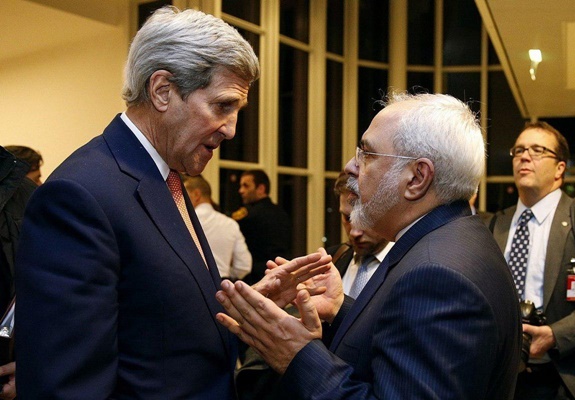
Then US Secretary of State John Kerry and his Iranian counterpart Mohammad Javad Zarif hold talks during the marathoc talks that led to the 2015 Iran nuclear deal

Hossein Shariatmadari, the managing director of the conservative Iranian newspaper Kayhan, has, in an editorial published by the daily, taken a swipe at Tehran’s performance in dealing with the US government. The full text of the analytical piece follows.

In his book titled “The Prince,” Niccolò Machiavelli says sometimes it would be very wise to seem crazy! This recommendation is explained by Herman Kahn in one of his books. He says maybe the best way to impose our policies would be to pretend that we are a little nervous and emotional. In this deterrent game, says Kahn, the side which seems to be determined and has left no path to return would have a better chance of gaining concessions from the other side, which has entered the scene with a modest and calm behaviour. He says this is the same place where unwise wisdom is allowed. According to him, pretending to be abiding by an unwise policy may be the best strategy to adopt in the face of a crisis.

It should be noted that when someone feels they are facing an opponent who complies with no laws and regulations and who may make any crazy move when confronted, they prefer to give in to the opponent’s demands in order to spare themselves of this lunatic!

The United States and its European allies have exactly used this ploy in dealing with Iran, and, unfortunately, they have somehow succeeded in taking advantage of this tactic due to the inaction of some Iranian foreign policy officials!

After resigning as US Ambassador to the United Nations, Nikki Haley said in a speech at Charlotte conference that he always regarded Trump a short-tempered person who was unpredictable during negotiations in order to scare the other side. This was what Trump wanted and the mission assigned to her, she says.

It would be unfair if we do not mention this point. While many politicians across the world and some politicians inside the country have fallen for this ploy by Washington and referred to Trump as a lunatic, the supreme Leader described him as someone who pretends to be mad.

And there are reports that the Financial Action Task Force (FATF) has extended Iran’s suspension from the FATF’s blacklist for another four months. Why? The only reason for this 4-month suspension would be Iran’s resistance to their humiliating demand with regards to the approval of the four bills related to the FATF, especially the Combating the Financing of Terrorism (CFT) law and the Palermo Convention. The FATF had threatened that Iran would face tough consequences if Iran failed to ratify the bills. However, the ratification of the FATF would mean “suicide for fear of death!”

Despite insistence by the administration and a number of MPs, the Expediency Council was tasked with deciding on whether or not to approve the bills. Fortunately, most members of the council realized the disgraceful and disastrous nature of the FATF and have, so far, refused to give the go-ahead to the ratification of the bills. In other words, when the FATF saw its threats were ineffective, it has suspended Iran on the blacklist in a bid to make the Expediency Council approve the humiliating bills.

Addressing the opponents of the FATF, A pro-government economic analyst says, “Why do you insist that we be regarded as terrorists in the world?”. He claims there are misgivings of treasons when it comes to the opponents of the FATF. In response, we should say, “Why are you insisting on introducing the IRGC, the Quds Force, the Intelligence Ministry, the Defense Ministry, etc., as terrorists? If you are unaware of the contents of the CFT, why are you expressing views on a subject you know nothing about? And if you know about it, then we should ask ‘Isn’t it treason to describe the IRGC, the Quds Force, the Defense Ministry and Intelligence Ministry as terrorists?’ Or ‘Should we [instead] oppose the ratification of bills whose approval would sound the death knell to national security and result in the surrender of Iranian people to Takfiri terrorists? Hasn’t the FATF officially announced that it does not accept Iran’s definition of terrorism, and hasn’t the US Treasury’s website officially described the aforementioned entities as terrorists?’

One should ask those supporting the ratification of the said bills what will happen if Iran does not accept the FATF.

Mr Zarif says, “Neither me, as Foreign Minister, nor Mr Rouhani, as President, can give any guarantees that the ratification of the CFT would solve any of our economic problems! But it can strip the US of some of the pretexts it has!”

Mr Zarif does not explain, first, which pretexts? Isn’t the existence of the Islamic Republic’s establishment the United States’ main pretext? And, second, in return for so many concessions that we have given, what have we gained over the past five years and a few months except the increase of sanctions and the dozens of hostile cases that the White House has opened against us?

Bitten once, no wise person should be bitten again from the same spot. Do we have to be bitten dozens of times before we come to our senses? Just mention one single concession that we have got from them. Go ahead, please!

What is INSTEX, whose implementation has been conditioned by the FATF upon the ratification of the four bills? “Oil for Food and Drugs!” Isn’t this so-called trade channel with Europe anything other than the humiliation of the Iranian nation? We are supposed to transfer to European banks the forex gained from selling oil! In return, we are supposed to purchase goods from European countries, and not any other countries; but what commodities? Only medicines and food! So far, everything is in the Europeans’ interests. Well, what about our share? Will they buy petroleum from us? The answer is “No.” Will European banks lift the sanctions? Again the answer is “No.” Then what is INSTEX and what benefit does it have for us? Practically nothing! Isn’t it so?

And what countries are supposed to monitor its implementation? Read on!

The supervision is based in France, a country which has overtly turned into a safe haven for terrorists. Members of the MKO terrorist group, who, by their own admission, have murdered some 14 thousand Iranians (The true figure is 17,000) are present in France. During the arrest of members of one of the decision-making centres of ISIS terrorists in Iraq, it was revealed that 13 of those apprehended were French officers involved in the terrorist group’s plans.

The project is managed by Germany, a country which wouldn’t allow the plane carrying Iranian Foreign Minister Mohammad Javad Zarif to fuel despite the fact that Zarif was travelling to Germany at the official invitation of that country to attend the Munich conference. Also, Germany has been holding one of Iranian diplomats in detention for months despite his diplomatic immunity.

And the auditing job lies with the government of the UK, a country which, according to Mr., Zarif, does not allow Iran to open even one bank account.

Finally, we hope the recent ploy by the US and its allies will have no bearing on the calculations of the respected members of the Expediency Council and we hope they will keep in mind this part of remarks by Leader of the Islamic Revolution Ayatollah Seyyed Ali Khamenei that “The proposals made by them (hegemonic powers) generally include deception, deceit and lies. Today, the Iranian nation regards a number of European governments along with the United States as deceitful and unreliable. The government of the Islamic Republic [of Iran] should carefully preserve its borders with them, not step back an inch from its revolutionary and national values and not be afraid of their hollow threats.”

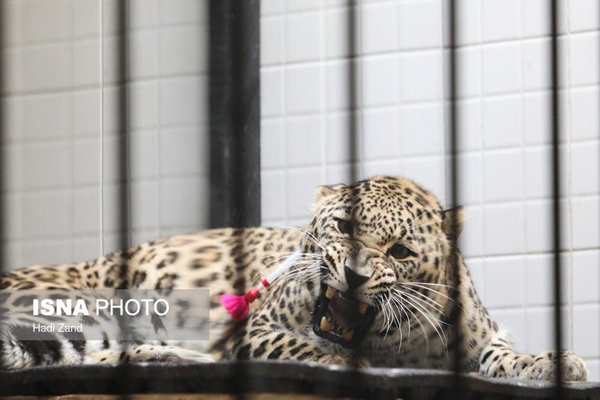
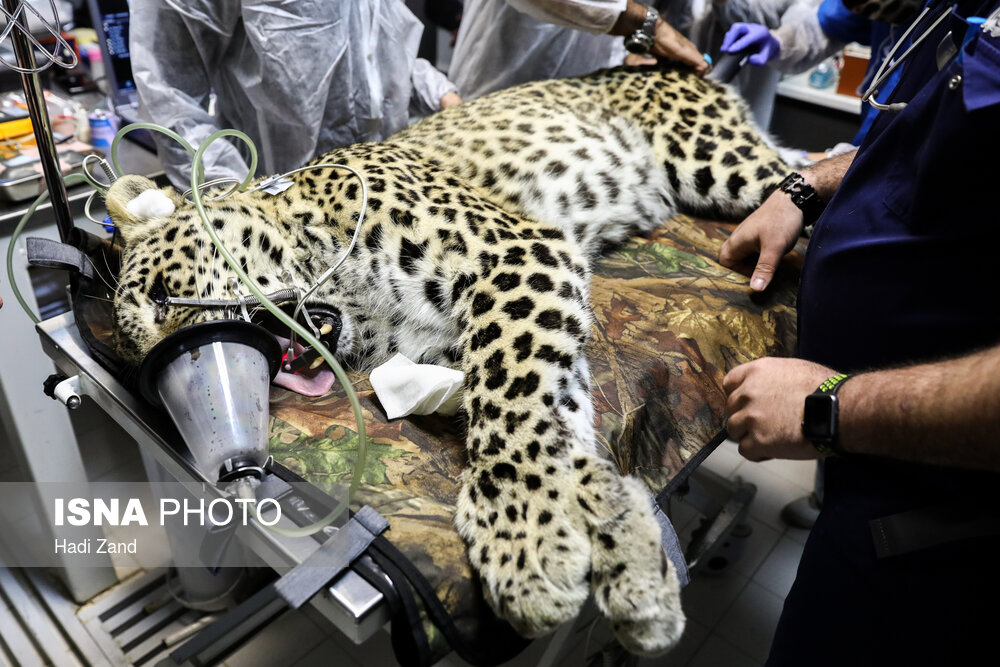
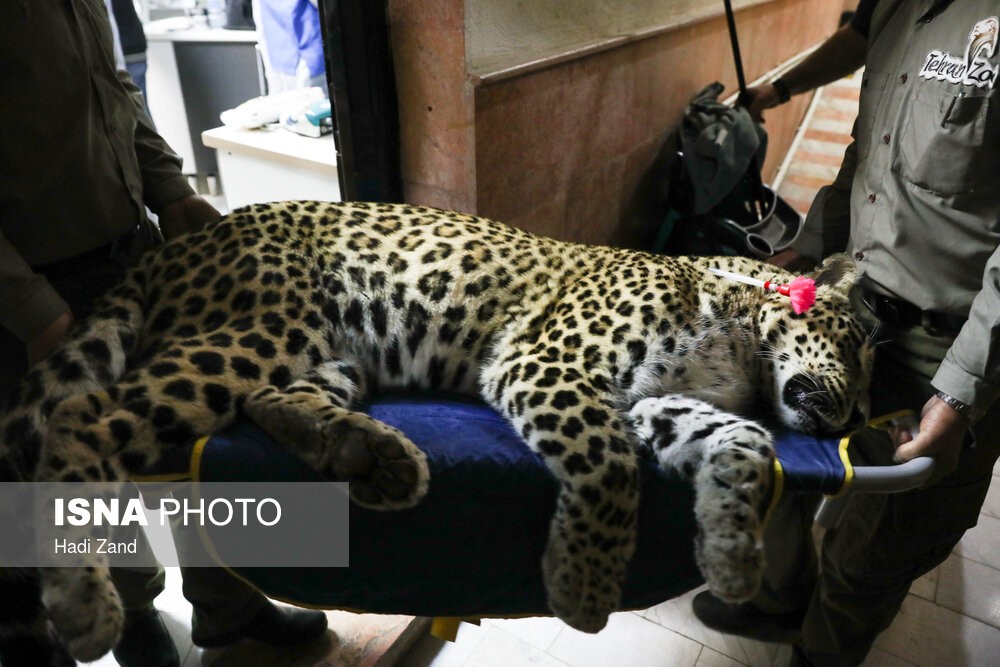
Endangered Persian Leopard Gets Pregnant via Natural Mating

The female leopard, named Kija, got pregnant after natural mating with Gaspar, a male Persian leopard on loan from a Portuguese zoo.

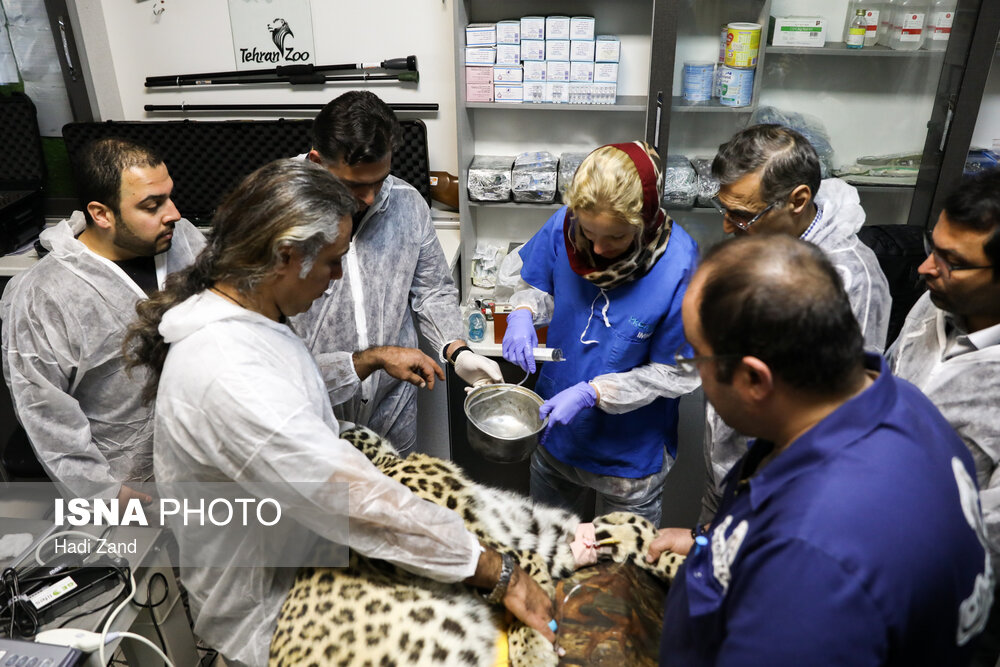
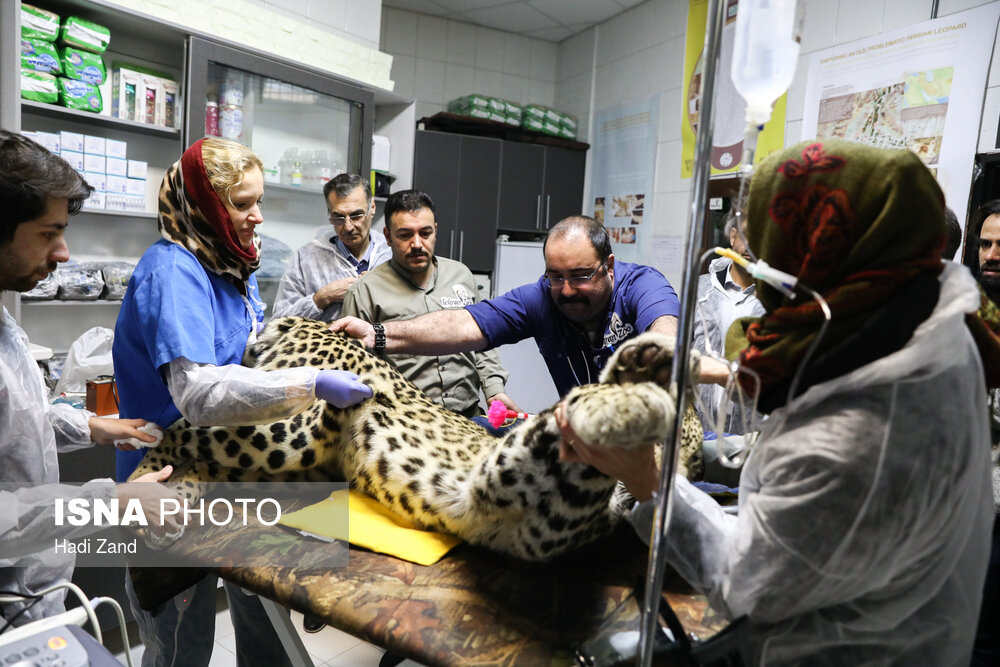
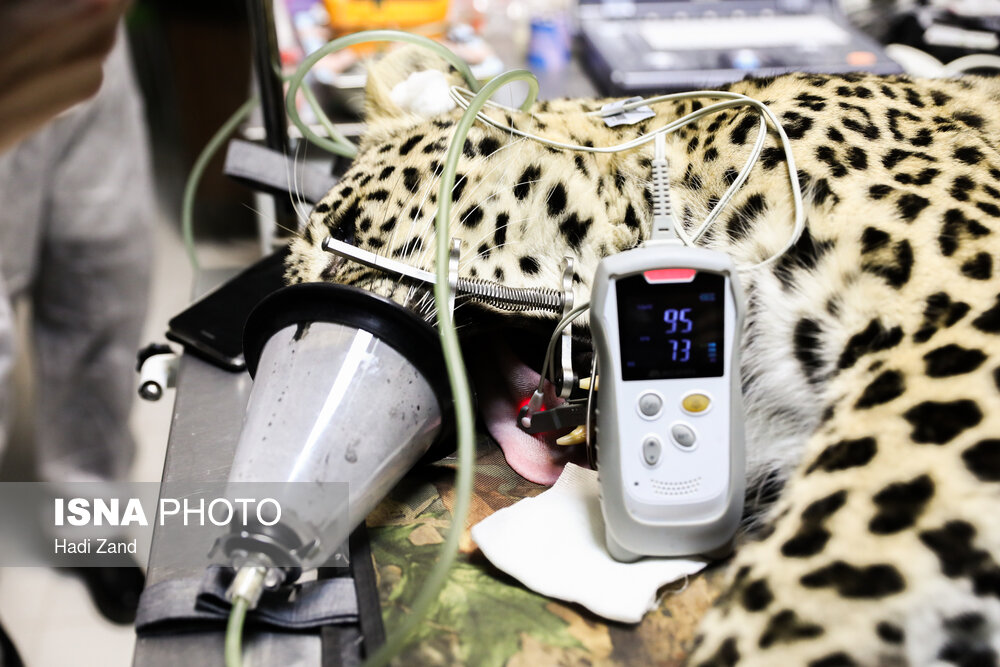
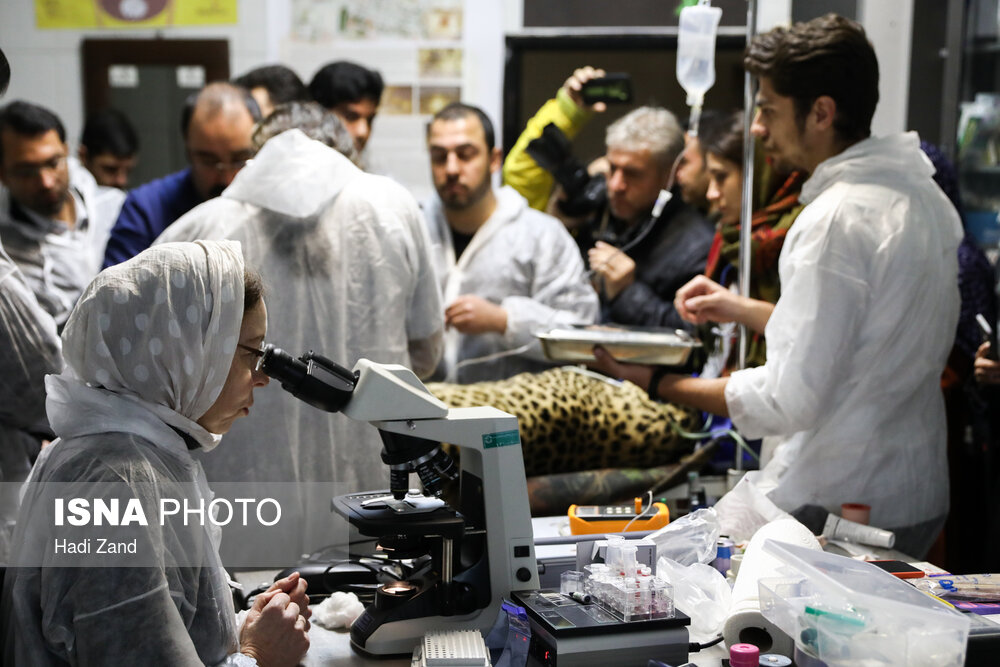
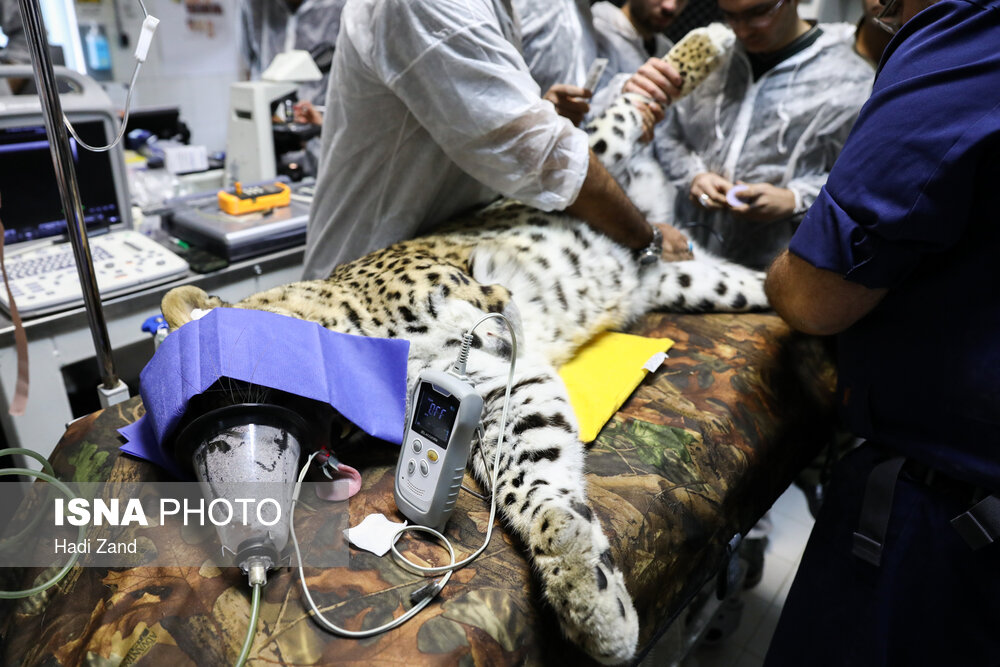
The pregnancy came after a failed artificial insemination attempt by Iranian and German experts, which was made on February 7 at Tehran’s Zoo.

If Kija delivers her baby within a 100-day timeframe, the danger of extinction of this valuable species of leopard would be decreased.

Iman Memarian, the vet of the zoo of Tehran, told ISNA that “Gaspar has been brought to Tehran from Lisbon Zoo for artificial insemination with Kija.”

“After testing the sperms of Gaspar, it turned out that the leopard has a good sperm quality.”
Referring to Kija’s highly valuable genetics, he stressed, “For this reason, last year, Gaspar was sent to Iran to get Kija pregnant. We also took sperm from another Persian leopard for about three years and kept it in liquid nitrogen.”

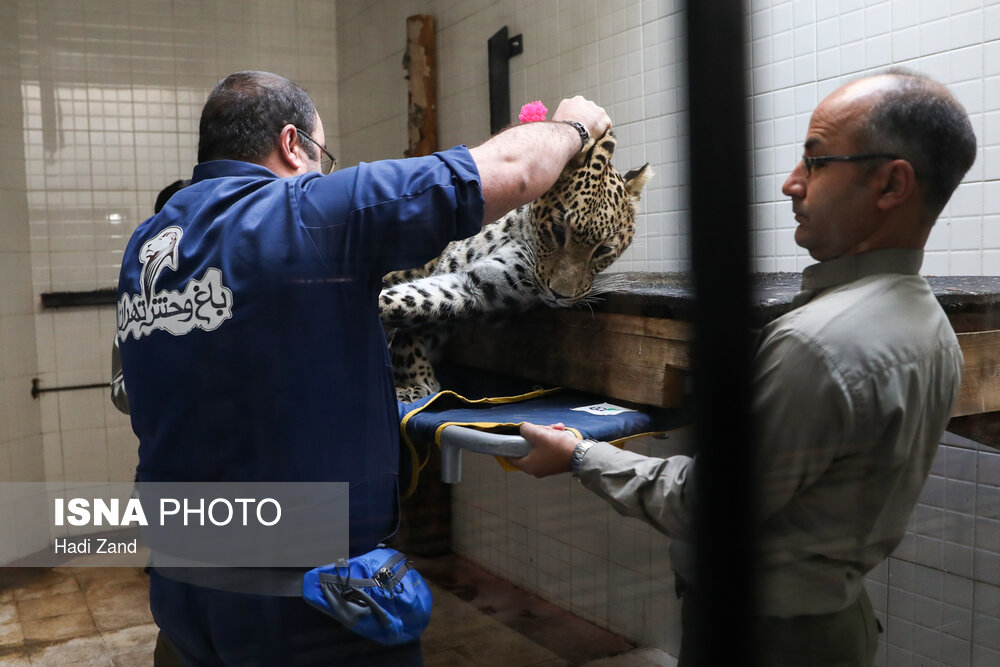
Here you can see photos of the artificial insemination operation retrieved from ISNA:

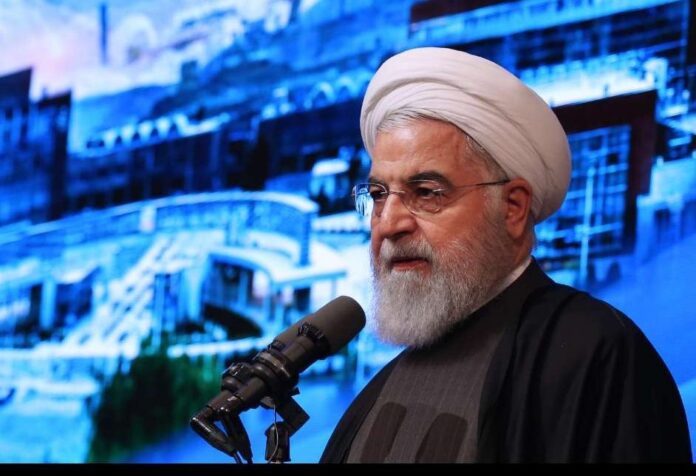
Rouhani Vows Greater Efforts to Promote Knowledge-Based Firms

Hassan Rouhani - President of the Islamic Republic of Iran

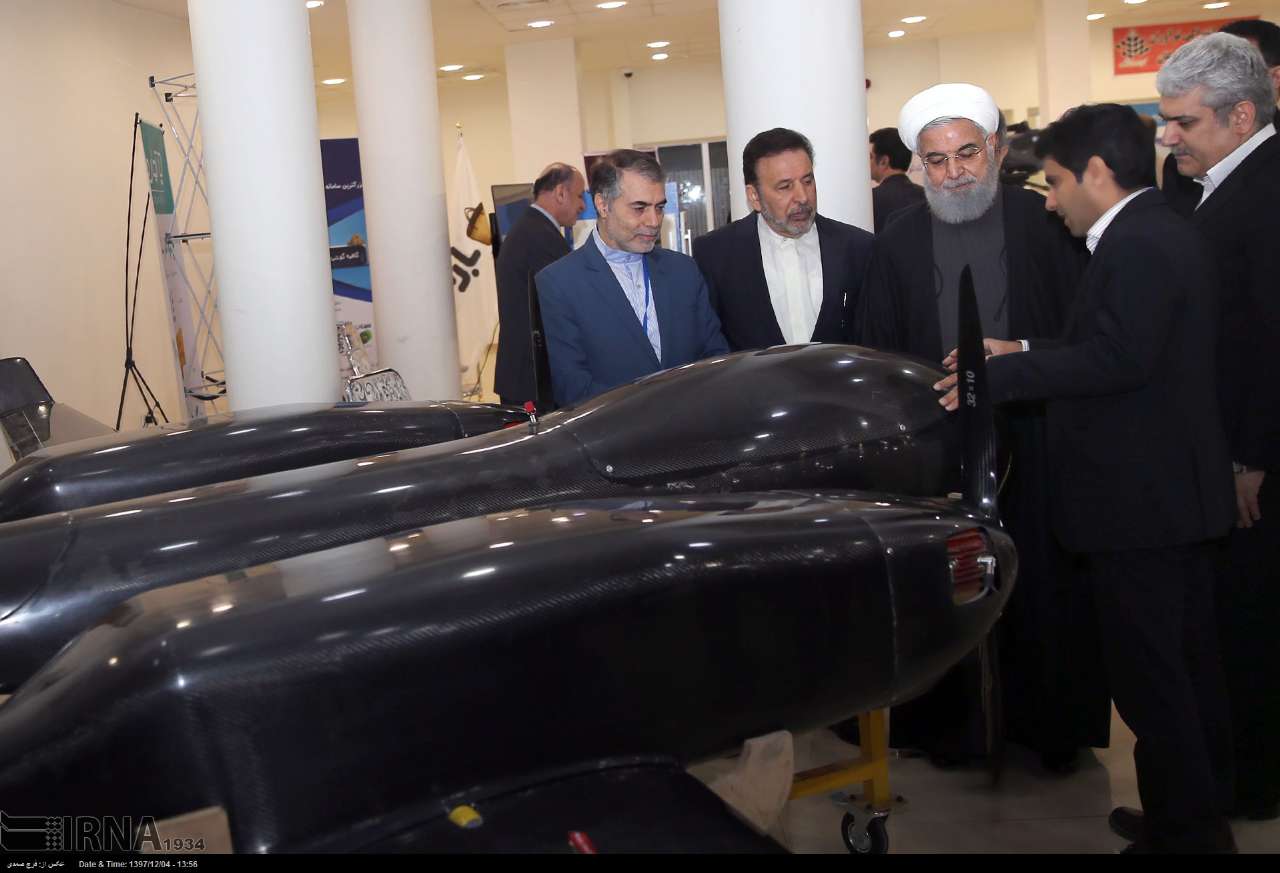
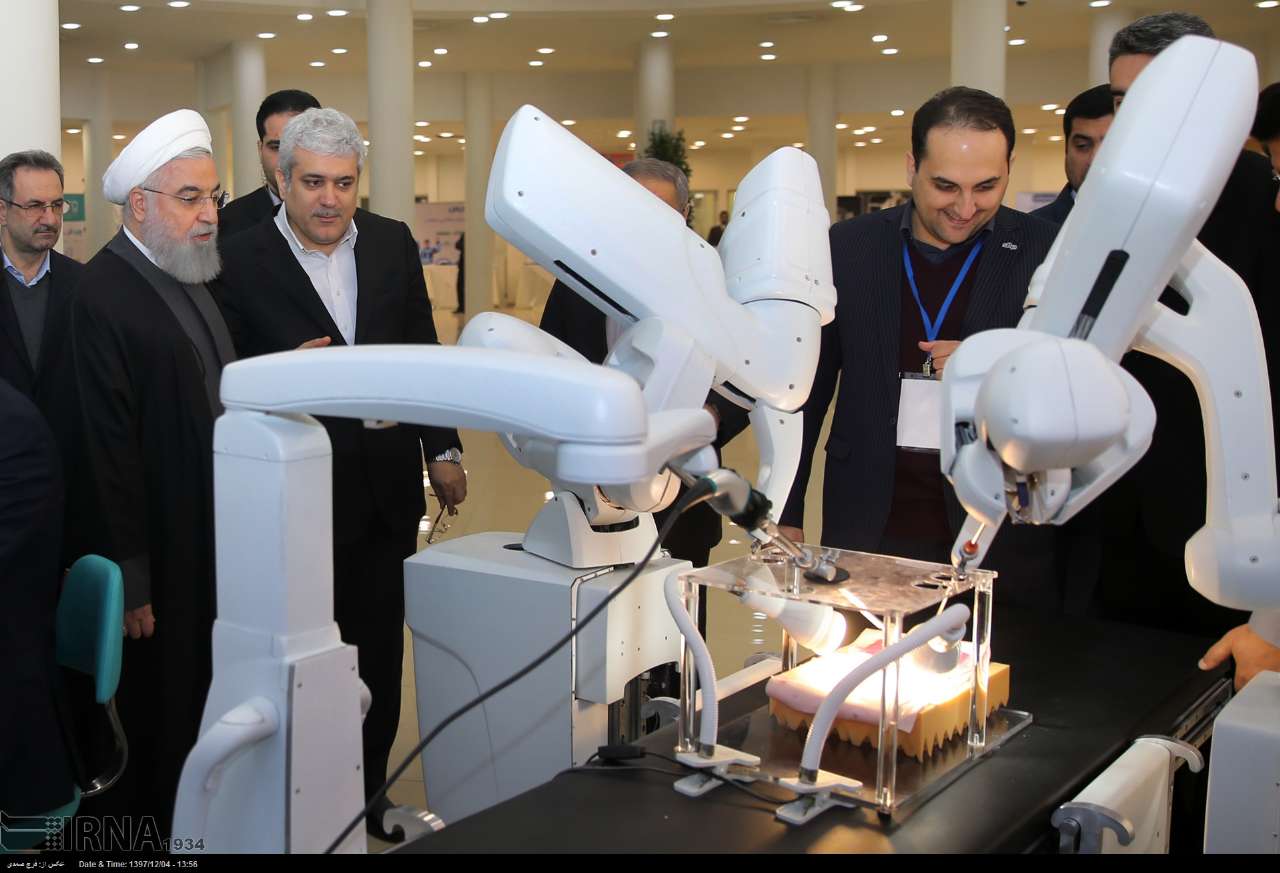
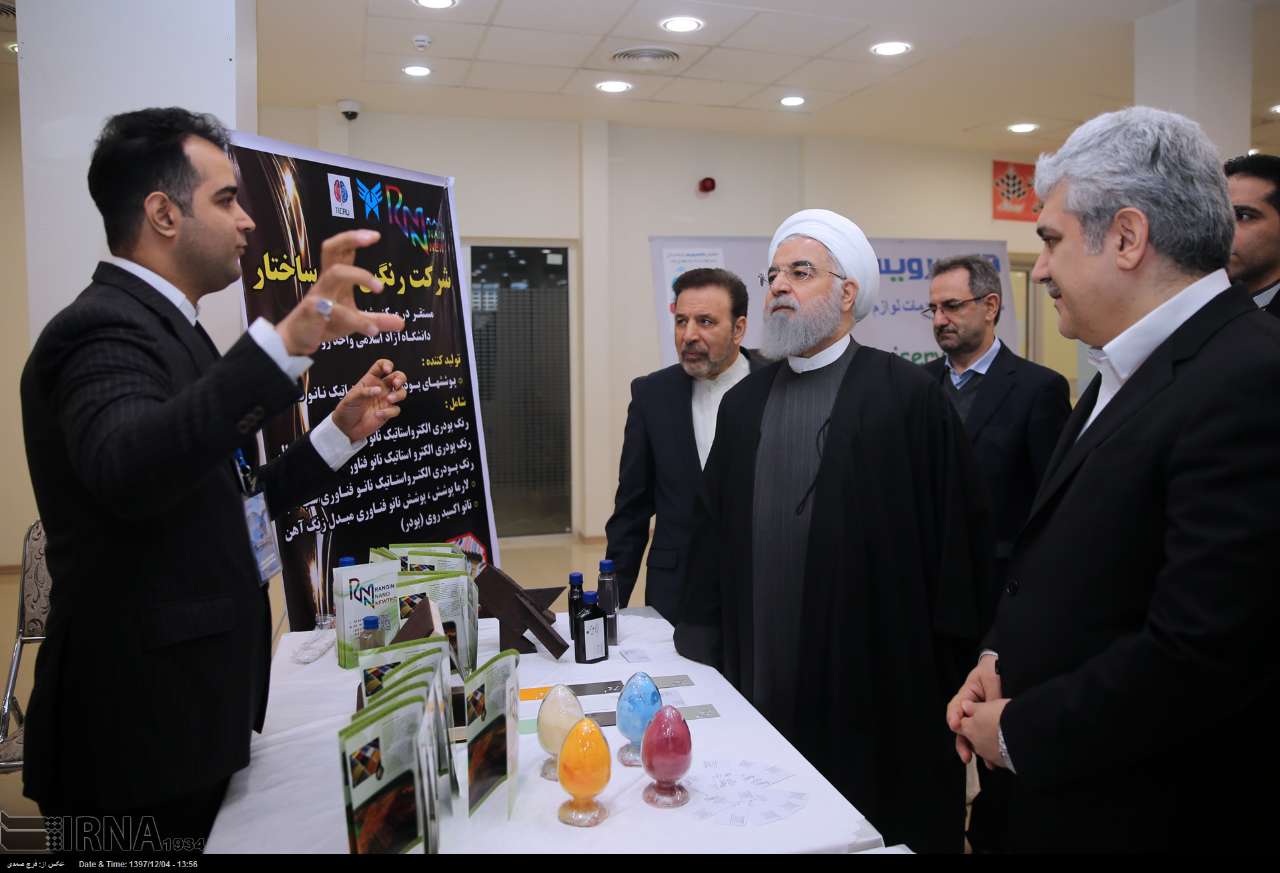
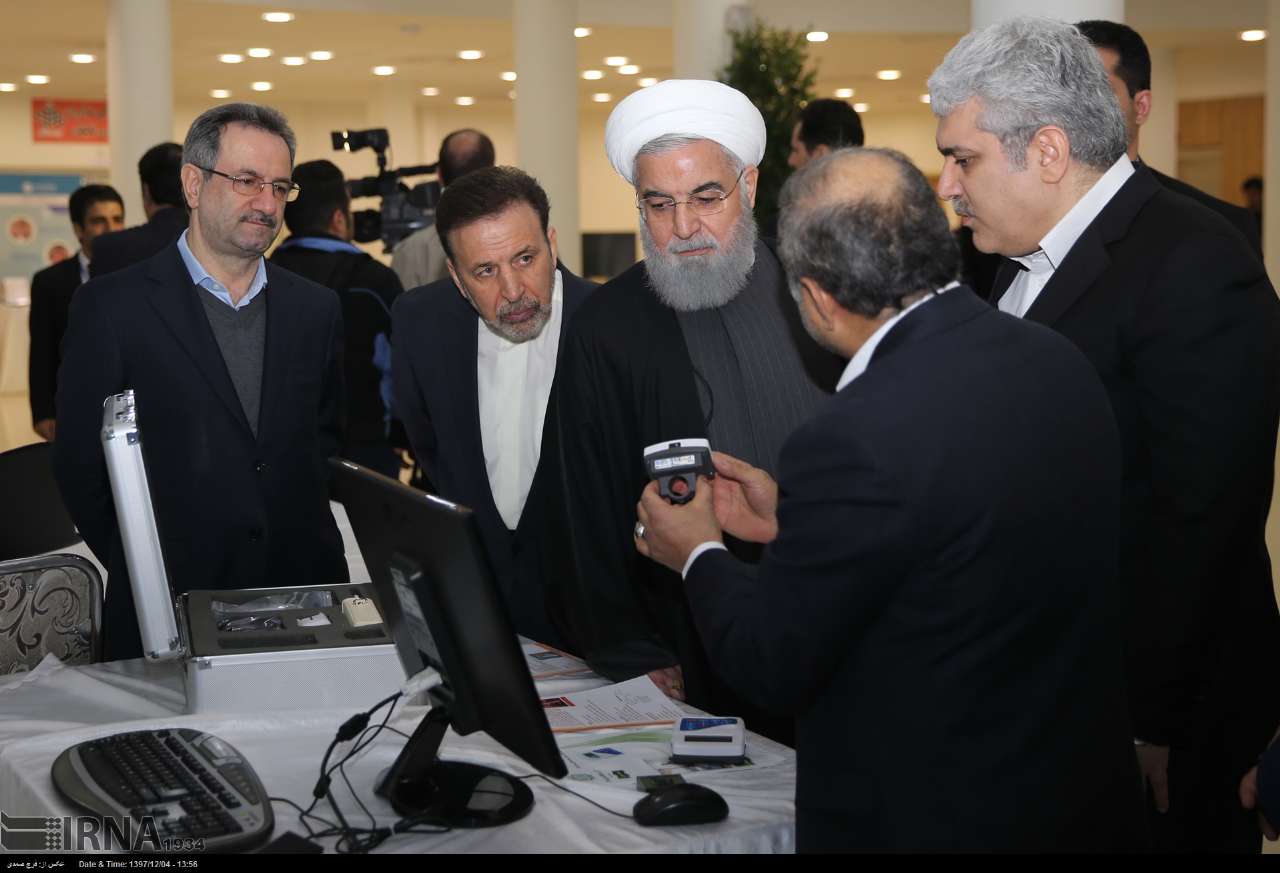
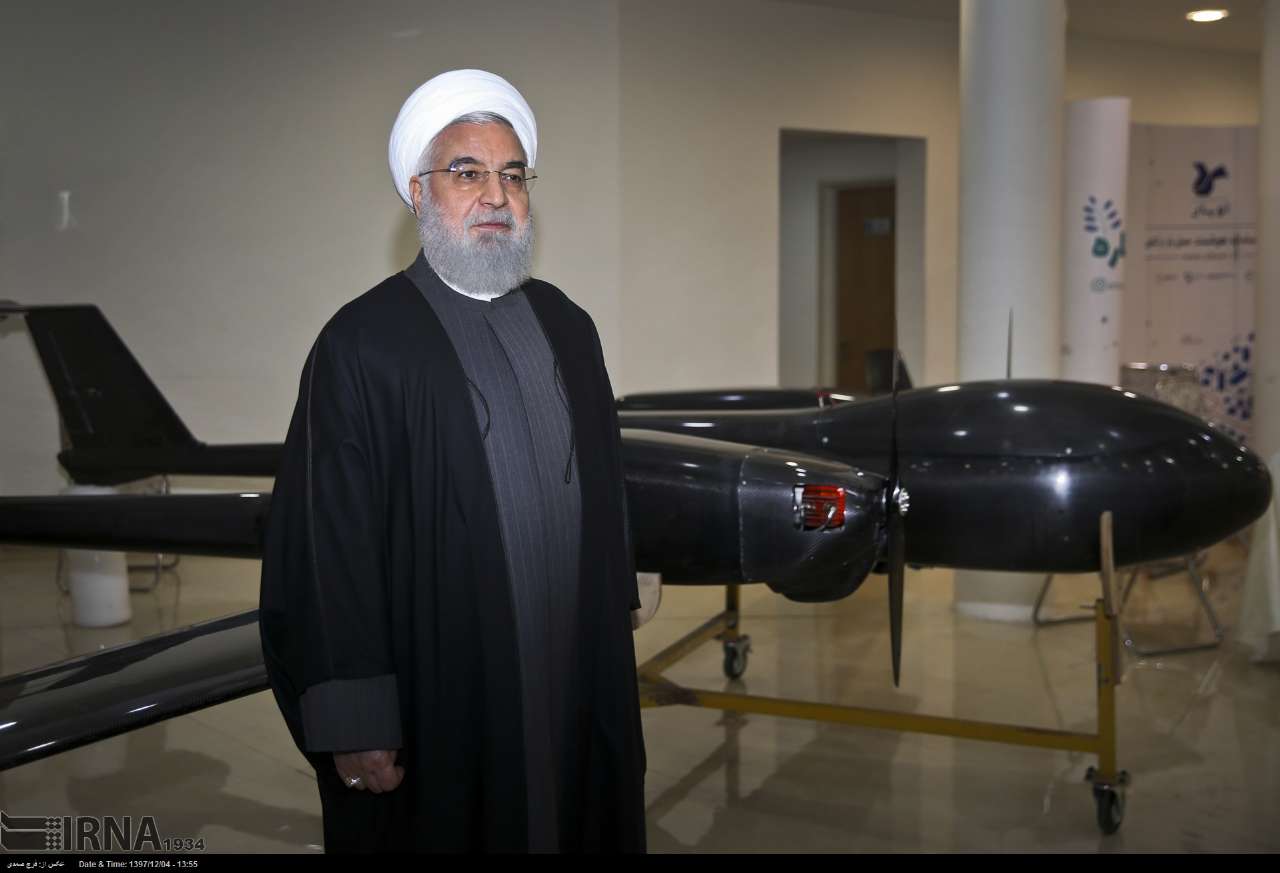
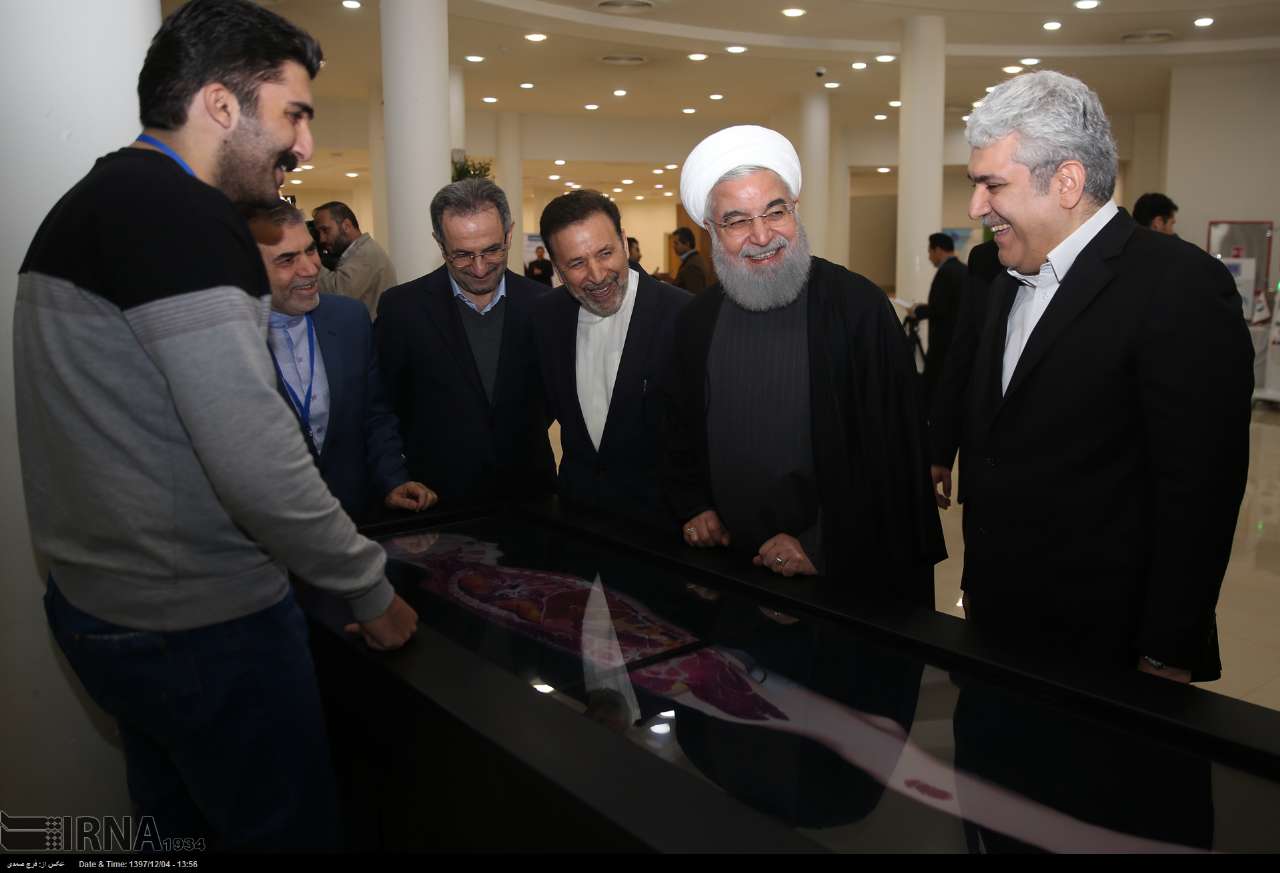
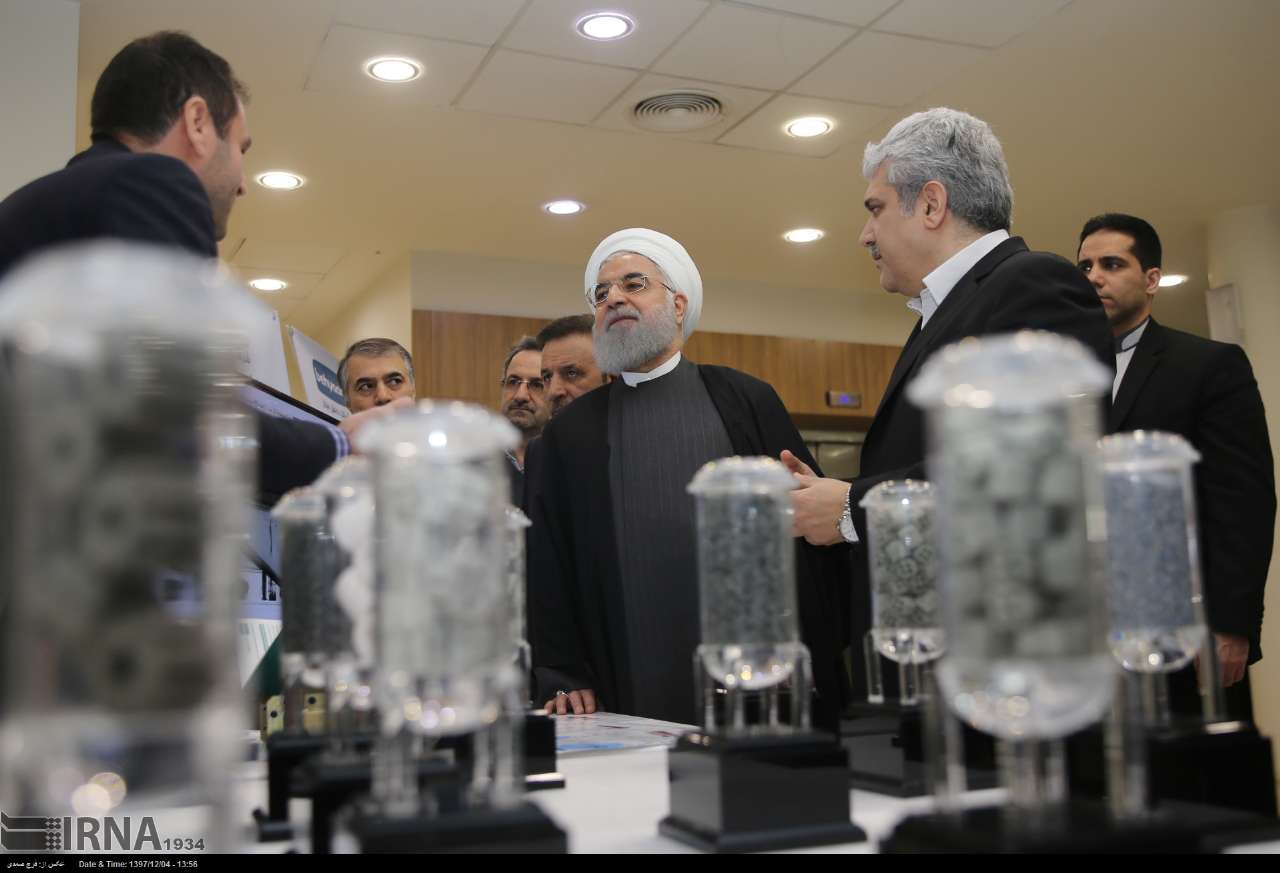
Hassan Rouhani made the statement while visiting a science and technology exhibition in Tehran on Saturday.

“I promise you that we will make efforts to facilitate the connection between the government and this sector and fulfill your needs,” he said.

Knowledge-based companies are making great contributions to the country’s progress, as they are helping Iran to save currency reserves and attain self-sufficiency in many fields, he said.


Focus on Circumventing Sanctions

The president said technologic advancements can help the country counter pressure by the western governments against Tehran, urging the knowledge-based companies to focus on solutions for countering financial sanctions against Iran.

“We ought to make the environment conducive to scientific and knowledge-based activities. I hope that your efforts at the beginning of the fifth decade of the Revolution will make us a pioneer of science in the region,” he said.

Rouhani Vows Greater Efforts to Promote Knowledge-Based Firms

Gov’t to Facilitate Connection with World

Rouhani said the government will work to prepare the ground for scientific firms to connect to the world, as political boundaries are no barrier in the world of science and many innovative products are built by people from different nationalities.

Moreover, closer connection with the outside world will allow the knowledge-based companies to export their products, he said.

“Many of new technologies developed inside the country can be exported, in addition to fulfilling domestic needs,” he said, adding that it’s the government’s duty to prepare the ground for such a connection.

Rouhani Vows Greater Efforts to Promote Knowledge-Based Firms

Walls Won’t Bring Progress

Rouhani mocked the US administration for working hard to build walls in the Mexico border, saying Donald Trump has apparently forgotten that the US made progress without such walls.

“The US progress was achieved thanks to the presence of people from different nationalities in that country and they reached the edges of science when they had no wall,” he said.

“Any country that creates walls around itself would definitely make no progress. So we should be able to form close relations with intellectuals and scientists from different and neighbouring countries,” he said.