Friday, December 19, 2025
Home Blog Page 3302

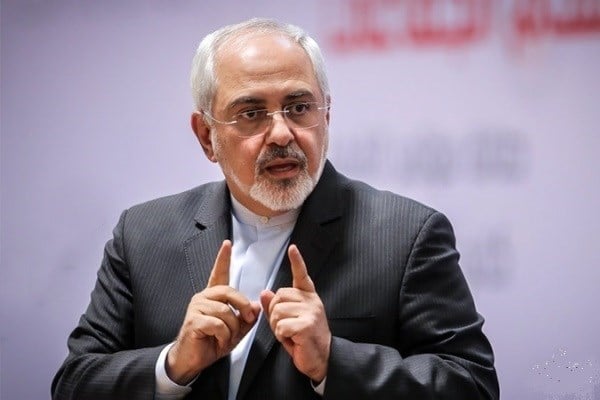
Iran FM Laments Europe Dragging Its Feet on JCPOA

Iran Blasts Europe’s ‘Disastrous’ Subservience to US

The Iranian minister said Iran’s hands are not tied on JCPOA and Iran will tread in alternative paths if it is disappointed with Europe.

“Following the US withdrawal from the accord, we have lots of options and we will use these options whenever it is within national interests,” he said, speaking in a recent interview with the Beirut-based Al-Mayadeen TV channel.

The Iranian minister said it is undesirable for Iran that Europeans have yet to fulfil their pledges, months after the US walked out of the pact.

“Europeans are slow in meeting their commitments under the nuclear deal. We won’t keep waiting unless they take practical steps,” ISNA quoted him as saying.

In May, the US walked out of the nuclear deal and since then it is working to restore its sanctions on Tehran and push the world to cut trade with Iran.

Tehran has announced its continued commitment to the deal is conditional on EU’s binding guarantees assuring Iran its interests will be served if it remains in the deal.

The EU has offered Iran a support package to compensate for the US pullout, which obliges the European Investment Bank to support EU firms willing to enter Iranian markets, and creates a special payment mechanism, known as Special Purpose Vehicle (SPV), to facilitate trade with Iran.

Iran has announced the package is acceptable at the macro level, but talks on the details of the package have led to nowhere after several months.

Trump’s Sneaky Visit to Iraq Disrespect for Its National Sovereignty: Iran

Iran Condemns Bahrain’s Plan to Normalize Relations with Israel

“As Mr Trump himself said in his address to the US military in Iraq’s Ein al-Asad … he is now forced to visit one of the regional countries in a totally secret way, or in other words in a ‘sneaky’ manner, and with tightest protective-security measures,” Qassemi said in a Friday statement.

This comes despite Washington’s growing interferences in regional affairs, thousands of billions of dollars it wasted, and the heavy and irrecoverable price paid by American people for the US’ illegal and illegitimate presence in the region, particularly in Iraq, he added.

Qassemi stressed that the visit has sparked the criticism of experts, indifference of Iraqi officials, and opposition of the Iraqi nation.

The spokesman then severely criticized Trump’s meddlesome and opportunist remarks in Iraq and said “regional governments and nations will never allow aggressive and despicable outsiders to sow seeds of division among them.”

According to Qassemi, it was the vigilant nations of the region – not the rapacious US and its staunch support of terrorism – which managed to suppress terrorist groups created, equipped and financed by the US and the Zionism.

The regional nations routed terrorists by understanding the situation in the right time and synergizing their material and spiritual powers, he noted.

Qassemi said undoubtedly all regional states will soon come to the conclusion that their region’s stability and security will only be achieved by relying on their domestic, regional and international resources and capacities.

“Foreign forces, sooner or later, will also have to leave the whole region,” he added.

The spokesman said it is better for Trump to have a serious and multilateral review of the developments of the world and the West Asia from the time he took office up to now.

A review of what he has said, what has happened, and what may happen in the future will perhaps teach Trump the required lessons, Qassemi noted.

Trump made his unannounced visit to al-Asad Airbase in Iraq’s Anbar province on Thursday causing heated controversy in Iraqi political circles.

He also commented on the possibility of using Iraq as a base for the United States to launch military operations in Syria have further enraged Iraqi statesmen.

As announced by the office, Trump was supposed to have a meeting with Abdul-Mahdi, but the meeting was called off due to “differences over how it should be held, and both sides, in a phone conversation, discussed the situation, especially the circumstances following Washington’s announcement that it would withdraw its troops from Syria.

Trump’s Snap Visit to Iraq Triggers Controversy


Trump’s Snap Visit to Iraq Triggers Controversy

In particular, his comments on the possibility of using Iraq as a base for the United States to launch military operations in Syria have further enraged Iraqi statesmen.

The Iraqi Alsumaria News reported that Trump’s trip has received negative reactions from Iraqi political groups.

The Reform and Construction Bloc at Iraq’s parliament issued a statement, condemning Trump’s visit to Iraq.

The statement dismisses Trump’s visit as a flagrant violation of Iraq’s sovereignty. It says Trump’s entering the al-Asad airbase looks as if Iraq is one of the states of the US. The statement also says it is necessary the Parliament meet to review this violation of national sovereignty.

The parliamentary bloc has also stressed in its statement that US troops’ pullout from Syria is no justification for them to stay in Iraq and use Iraq as a base for the United States in the Middle East region.

Mahmoud Rubaie, a member of the Asaib Ahl Al-Haq political party, also said making a trip to Iraq like this by Trump is a testament to Washington’s disregard for the independence, sovereignty and credibility of the Iraqi government, which makes it all the more necessary to expedite efforts to adopt a law on the expulsion of foreign forces from Iraq.

Meanwhile, Hashem Mousavi, the spokesperson for Al-Najba’a Iraqi Movement, said “stupid” Trump should know that Iraq secured its sovereignty with blood, and that no US military bases would be established in Iraq. He said it is incumbent upon the Iraqi government to expel American troops because their presence in Iraq will harm the country’s sovereignty.

Also, Jafar Hosseini, the spokesperson for Hezbollah Brigades affiliated with the Popular Mobilizations Forces, said Islamic resistance forces will make the US withdraw its troops from Iraq.

He said Trump’s snap visit to Iraq and limiting it to simply meeting American soldiers at a military base show the US president has a sense of insecurity in Iraq.

According to Hosseini, Islamic resistance commanders in Iraq have vowed to cut off the hands that intend to encroach upon neighbouring countries, namely Syria.

He emphasized that it is up to the Iraqi nation and parliament, and not Trump, to decide on US troops’ pullout from Iraq.

As negative reactions to Trump’s visit to Iraq continue to pour in, Iraqi legislator Fateh al-Khazali said Trump should know that Iraq has not been the same as before since 2014, and the Iraqi government should expel US forces form Iraq. He said victorious Iraq is not a US state, and that Iraqi Prime Minister Adil Abdul-Mahdi should discharge his responsibilities according to Article 5 of the Constitution.

Khazali said the US, which suffered defeat in Iraq, wants to return to this country once again one way or another, “but we will not allow for that to happen.”

He said Trump’s meeting with US forces shows they do not have an advisory and training role, adding the Iraqi government should accept its responsibility in that regard.

The Iraqi lawmaker noted that the Iraqi parliament has already ordered a timetable be drawn up for the withdrawal of all foreign forces from Iraq, and added this has not materialized yet due to the existing corruption.

Naim al-Aboodi, another Iraqi legislator, also disclosed that Trump has asked Iraqi authorities, especially the prime minister, president and parliament speaker, to meet him at the airbase he is visiting.

Meanwhile, the Iraqi prime minister’s media office announced that American officials had already informed Baghdad of Trump’s willingness to travel to Iraq on Tuesday to congratulate the new Iraqi government.

The office said the Iraqi government had welcomed Washington’s request and that the Iraqi premier invited Trump to Baghdad, and that Trump, for his part, invited the prime minister to visit Washington and the White House.

As announced by the office, Trump was supposed to have a meeting with Abdul-Mahdi, but the meeting was called off due to “differences over how it should be held, and both sides, in a phone conversation, discussed the situation, especially the circumstances following Washington’s announcement that it would withdraw its troops from Syria. They also discussed mutual cooperation in fighting ISIS terrorists and establishing stability and security in regional countries.”

In the meantime, the White House weighed in on why the US president and the Iraqi prime minister did not meet during Trump’s visit to Iraq. The White House confirmed that there was no meeting between the two men because Baghdad was informed of Trump’s visit only shortly before the trip took place, which required the necessary measures to be taken to ensure the security of Trump during the meeting.

According to the White House, Trump invited Abdul-Mahdi to visit Iraq during his phone conversation, which was welcomed by the Iraqi side.

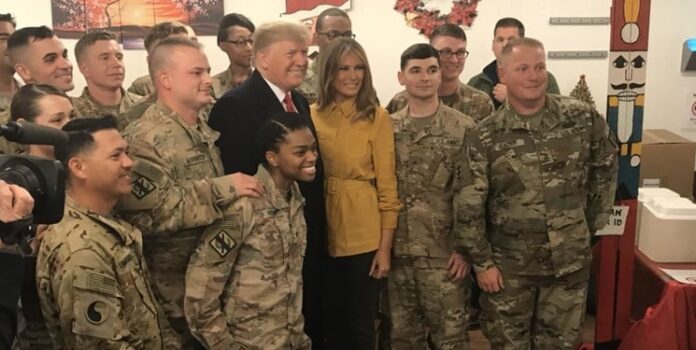
Trump and his wife met with US troops in Iraq in an unexpected trip. This is the first time Trump meets US troops outside the United States since he took office. He had been criticized by the US military for this reason.

The plane carrying Trump and his wife along with a group of his advisors and secret service agents plus a large number of journalists touched down at al-Asad airbase in west of Baghdad.

In a meeting with US forces at the airbase in Anbar province, Trump announced that Washington would use Iraq as a base to launch operations in Syria should need arise.

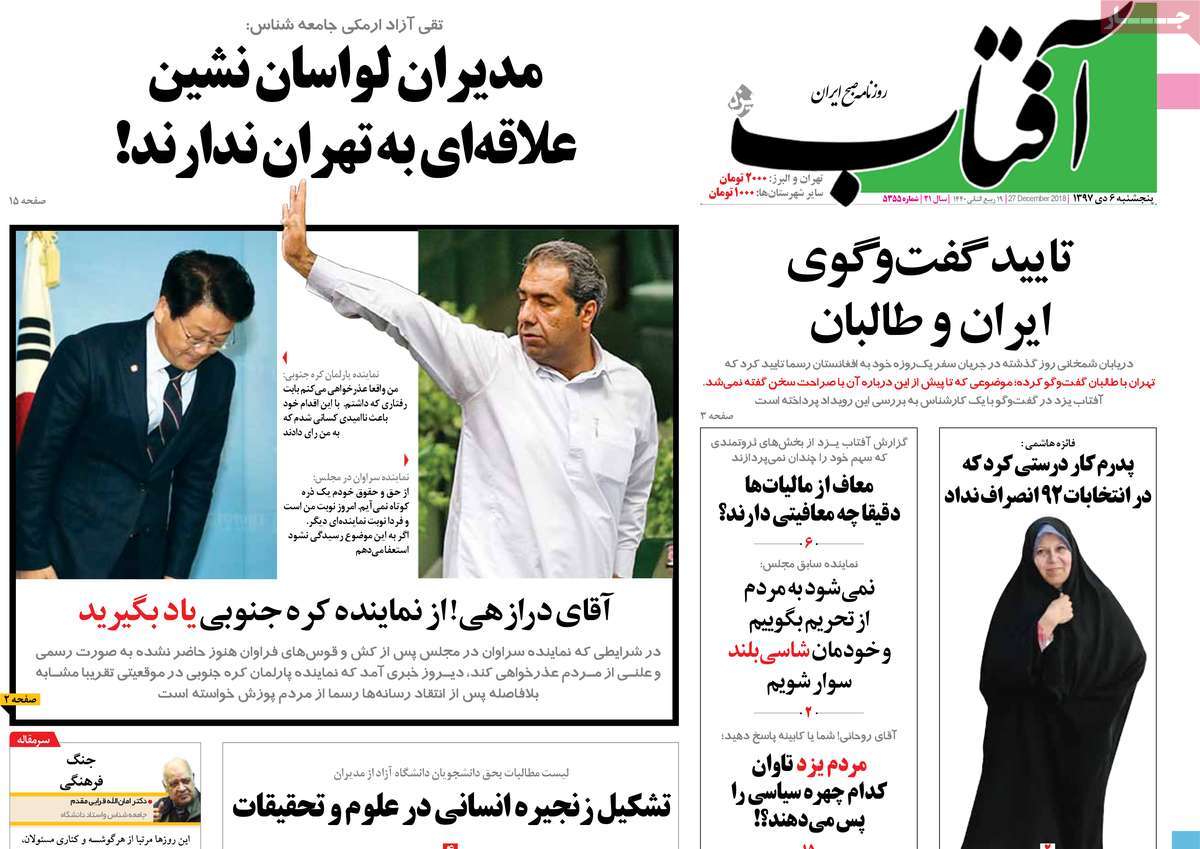
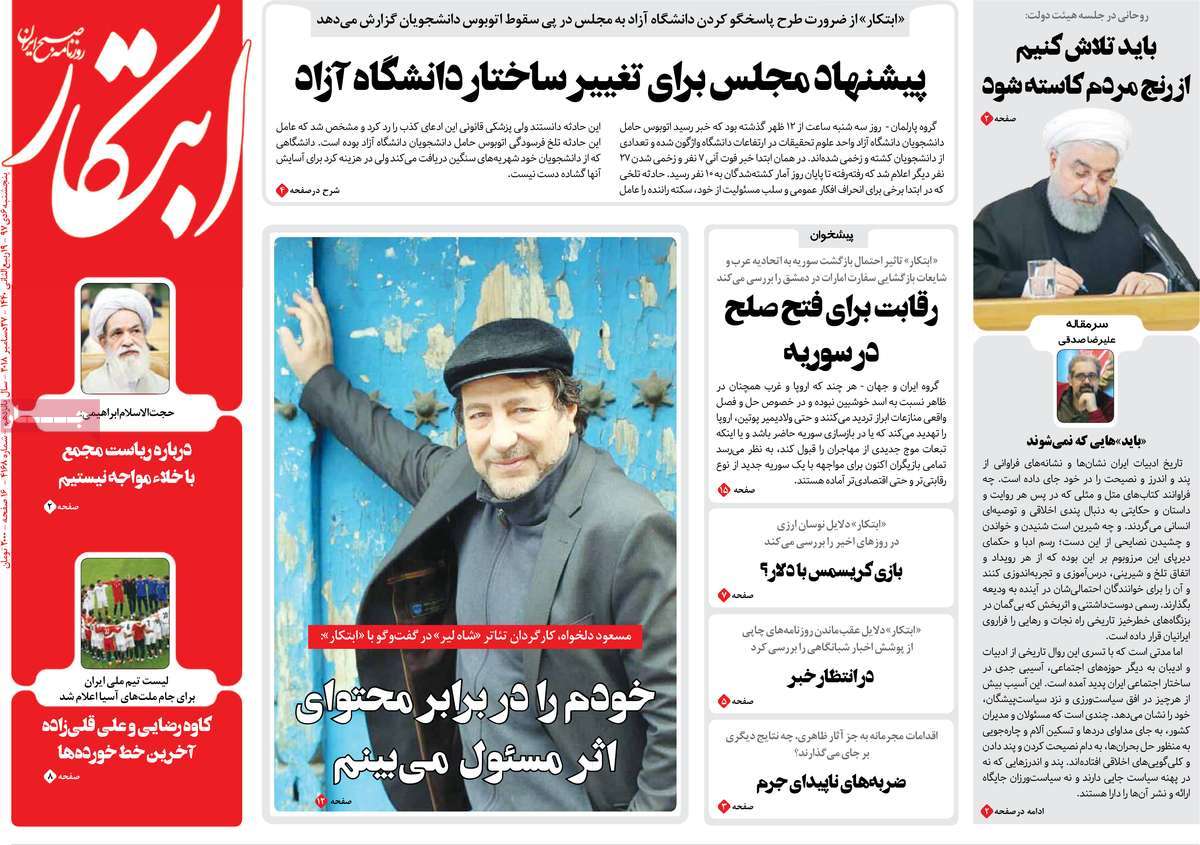
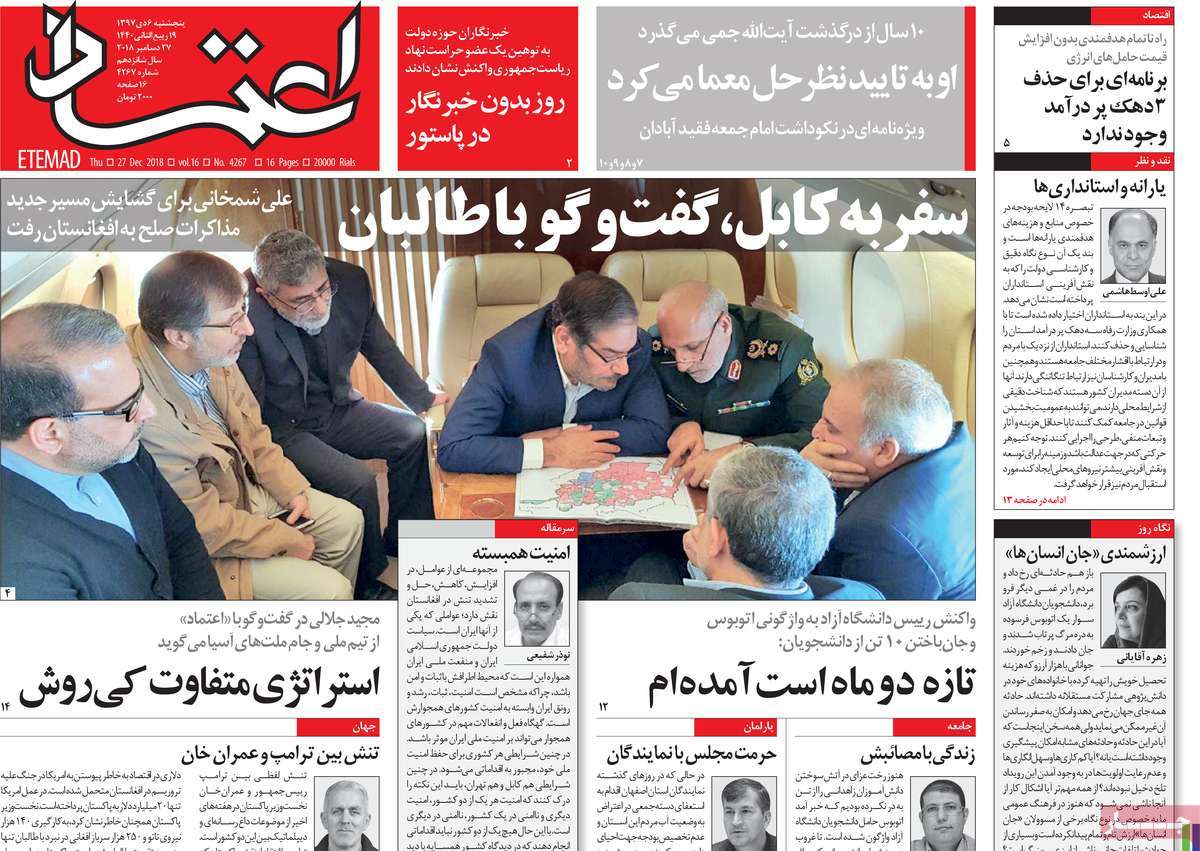
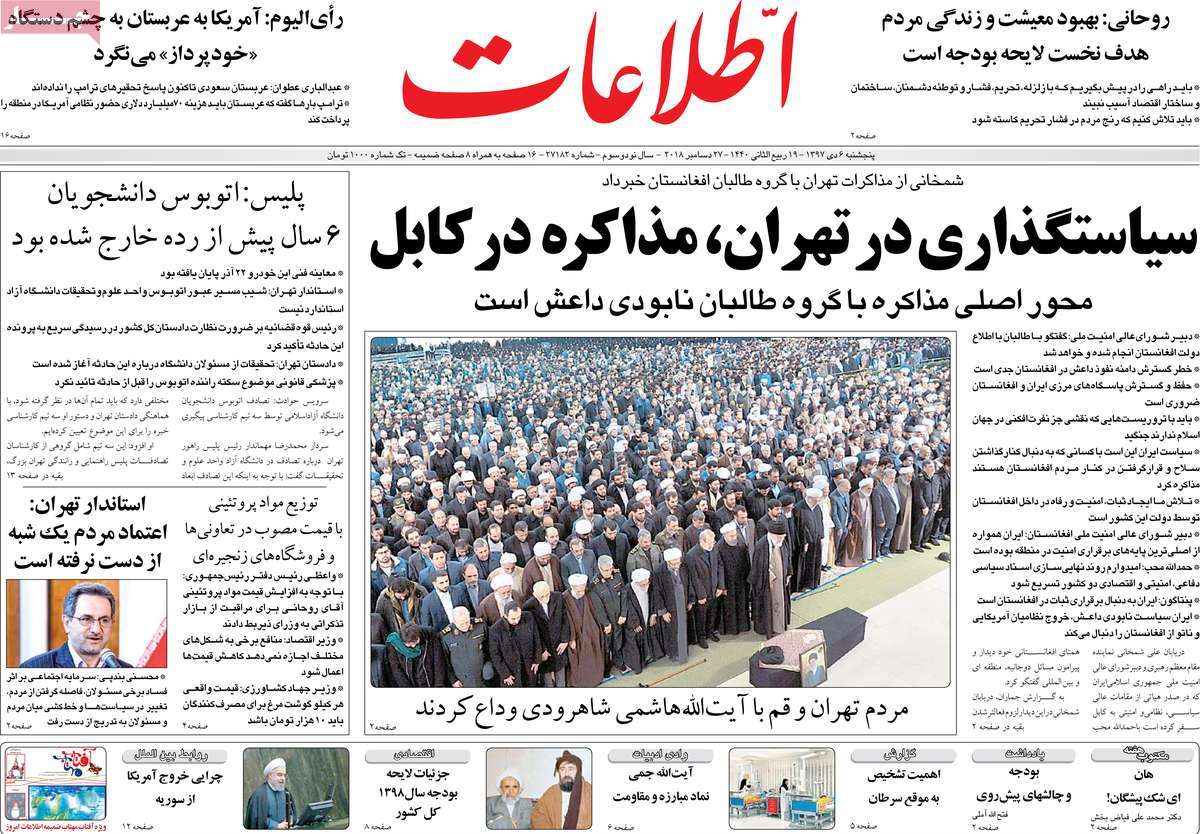
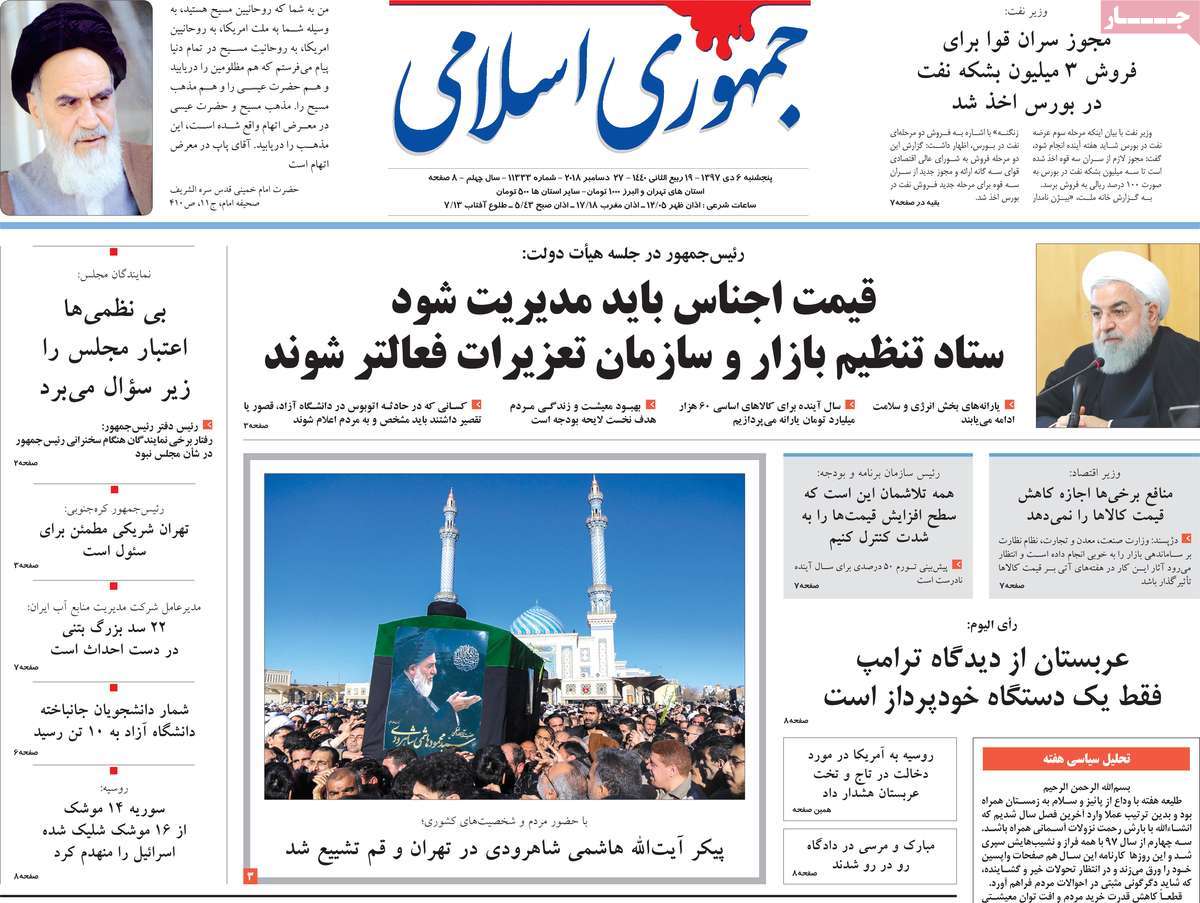
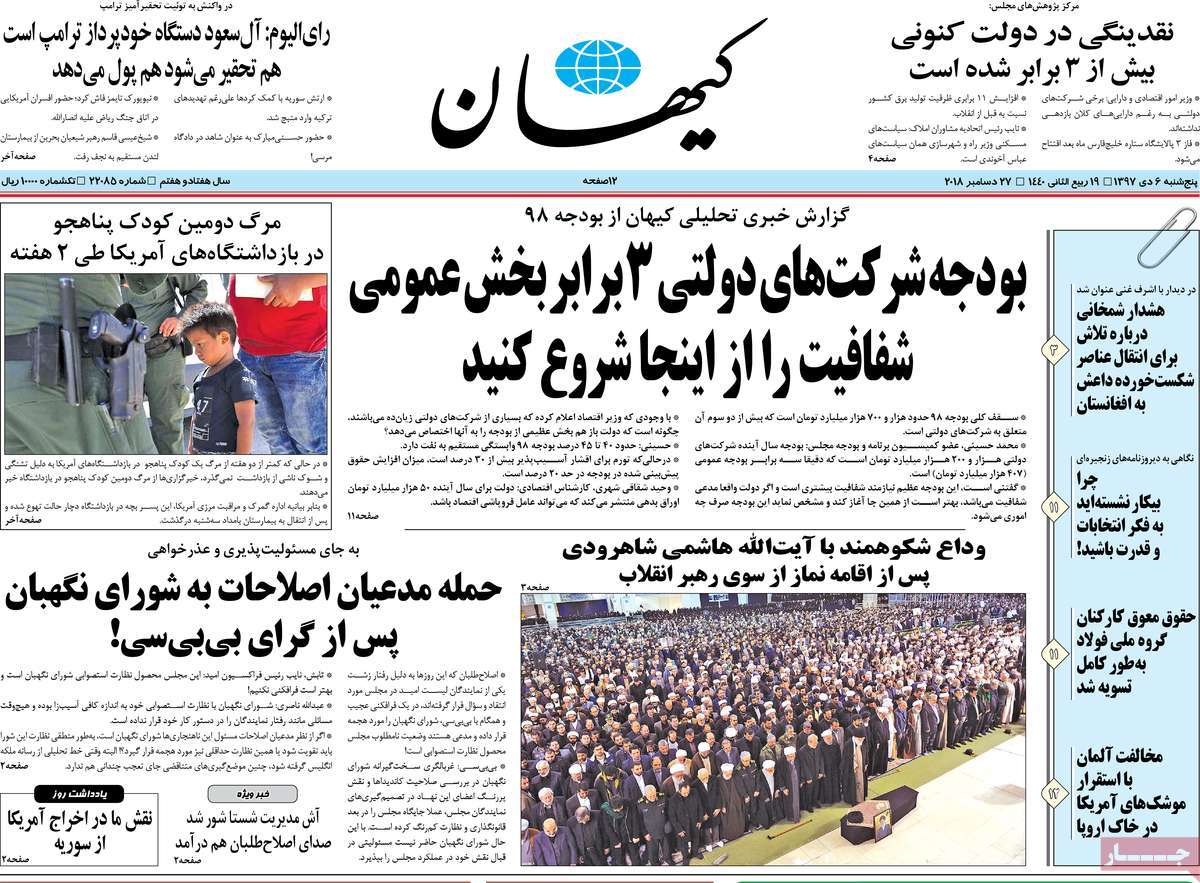
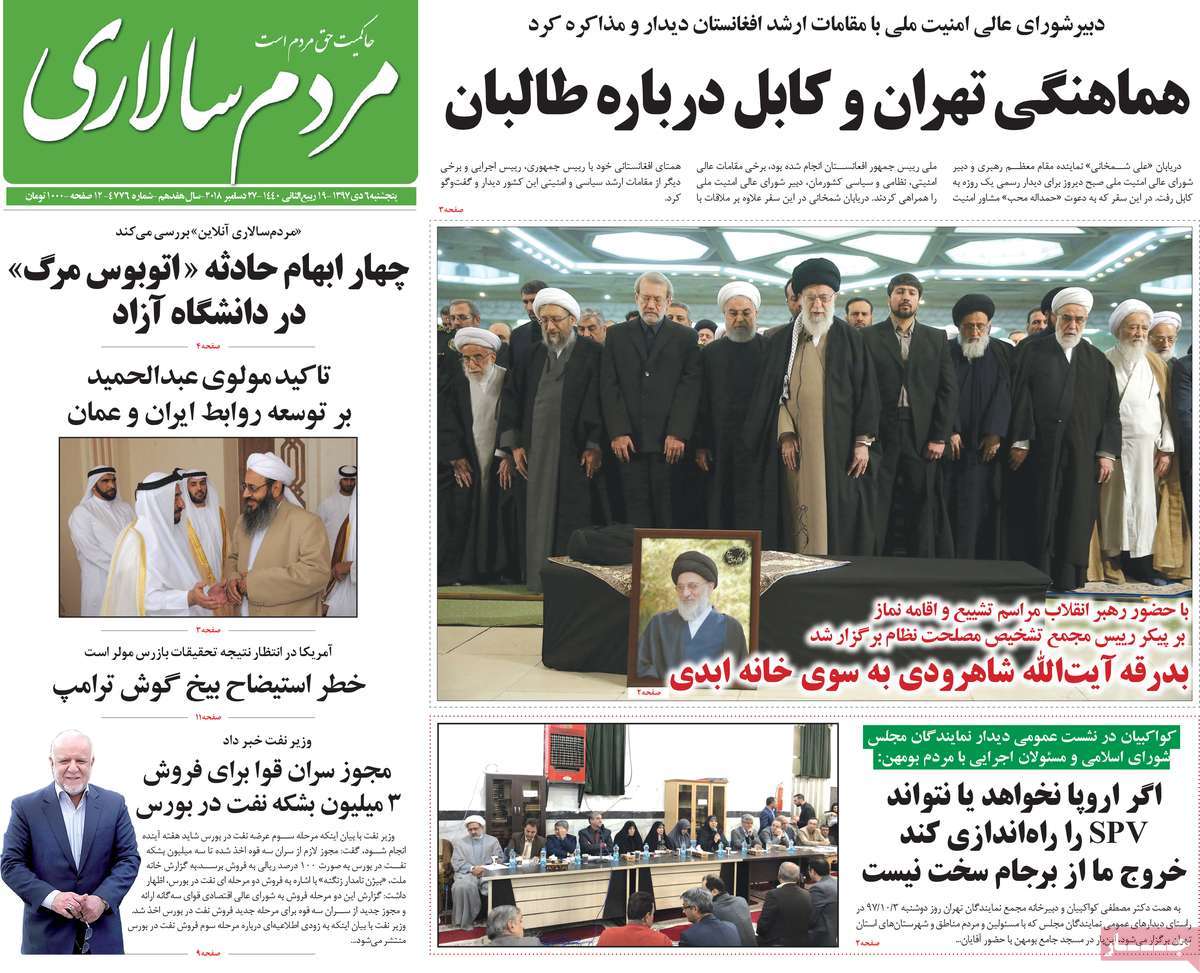
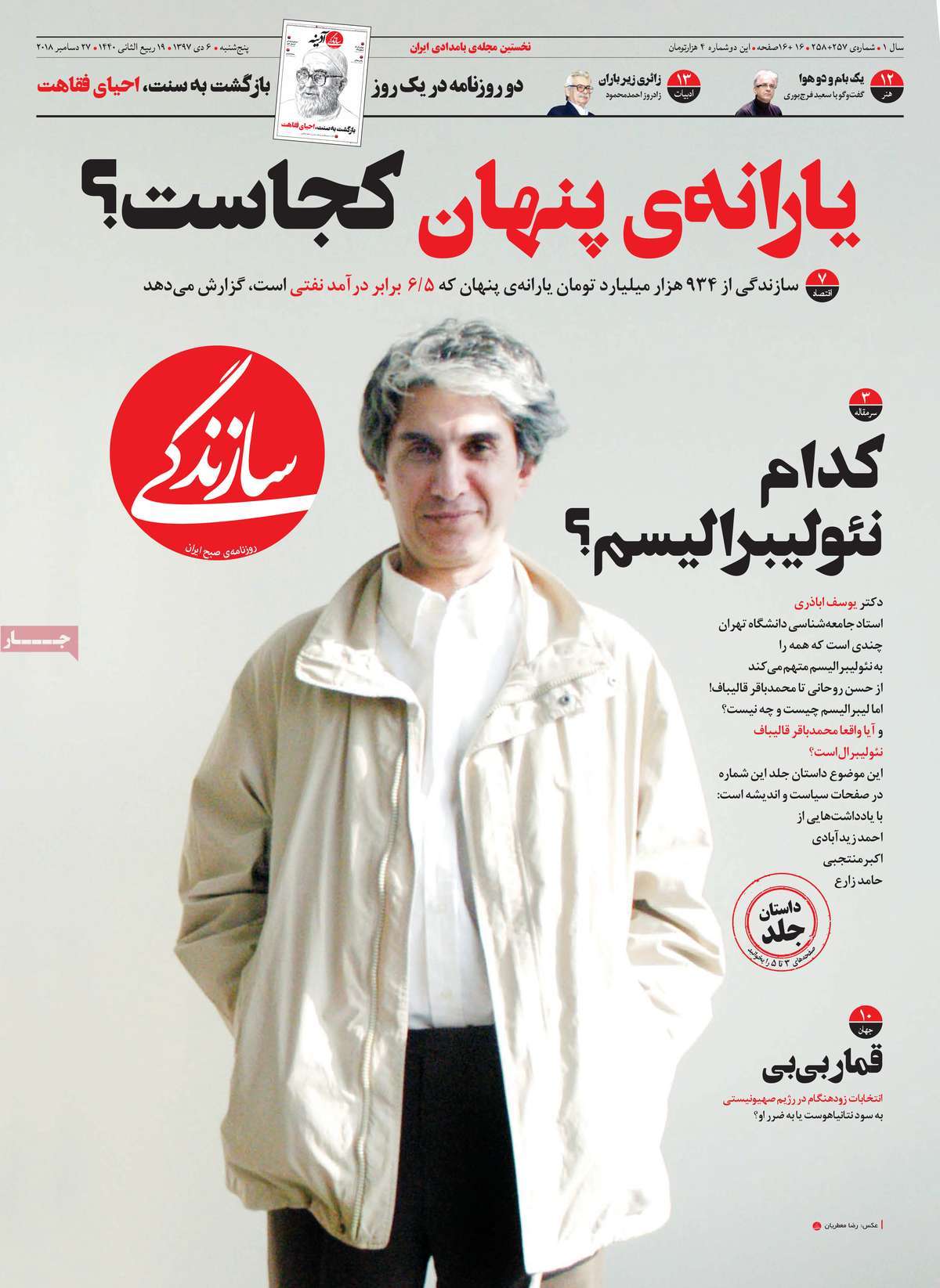
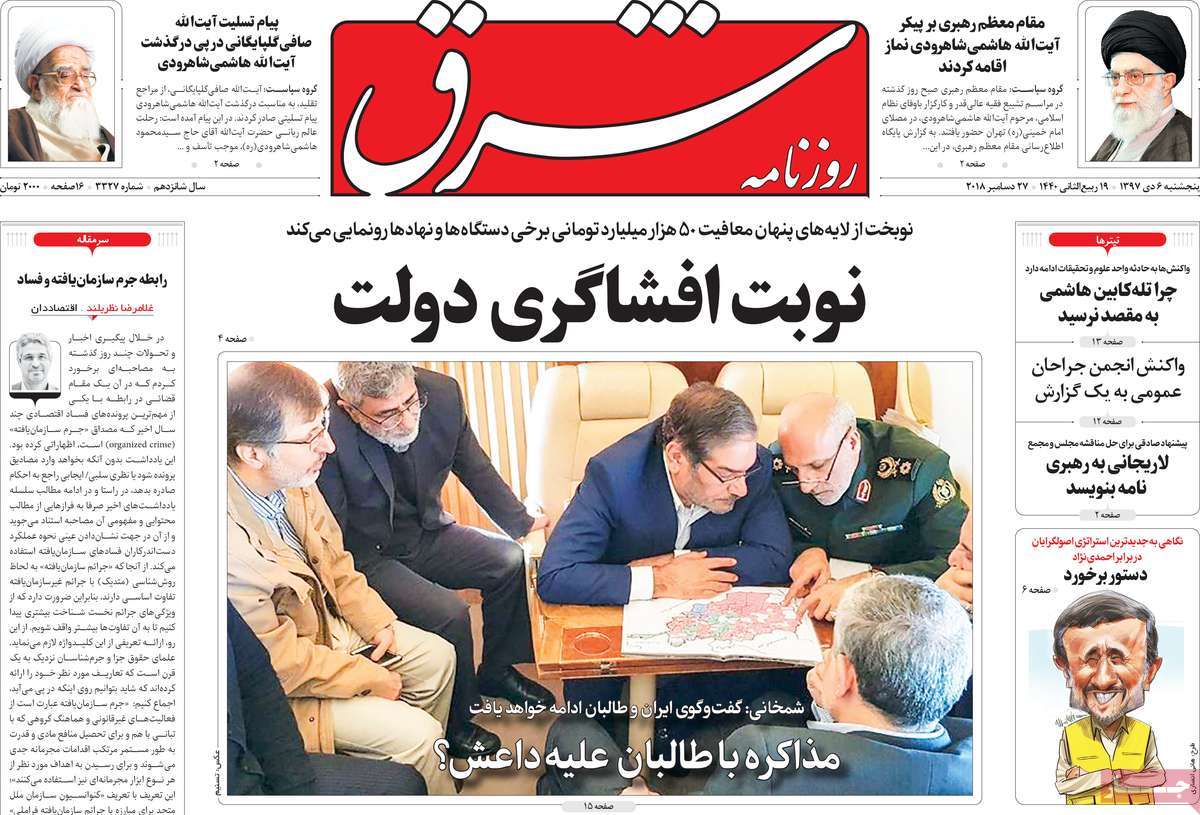
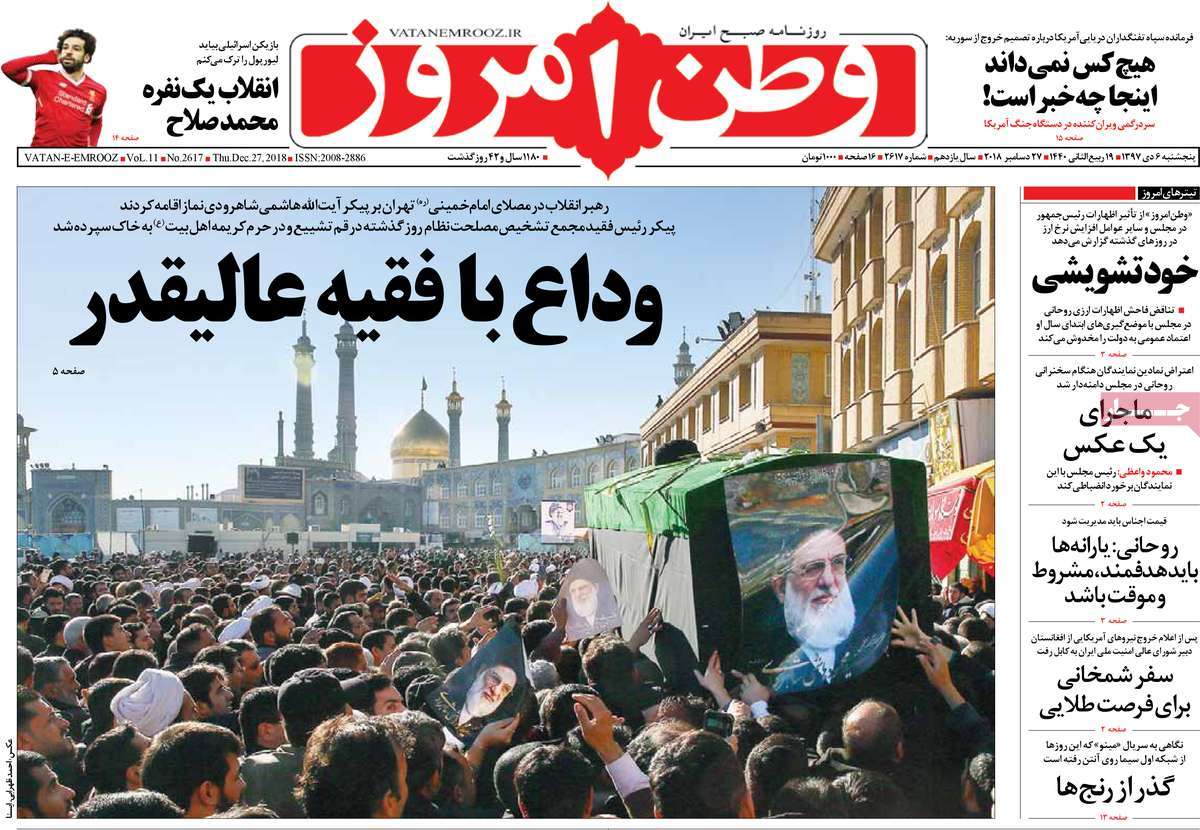
A Look at Iranian Newspaper Front Pages on December 27

A Look at Iranian Newspaper Front Pages on November 19

Almost all papers today covered the visit of Secretary of Iran’s Supreme National Security Council Ali Shamkhani to Kabul and his Confirmation of Tehran’s talks with the Taliban. During his one-day trip to Kabul, Shamkhani noted that Iran will continue talks with the Taliban to help resolve security problems in Afghanistan. He said that Tehran has been holding talks with the Taliban with the knowledge of the Afghan government.

The US decision to pull out its forces from Syria and its repercussions also remained a top story today. Several papers also focused on Israel’s attack on Syria.

The above issues, as well as many more, are highlighted in the following headlines and top stories:

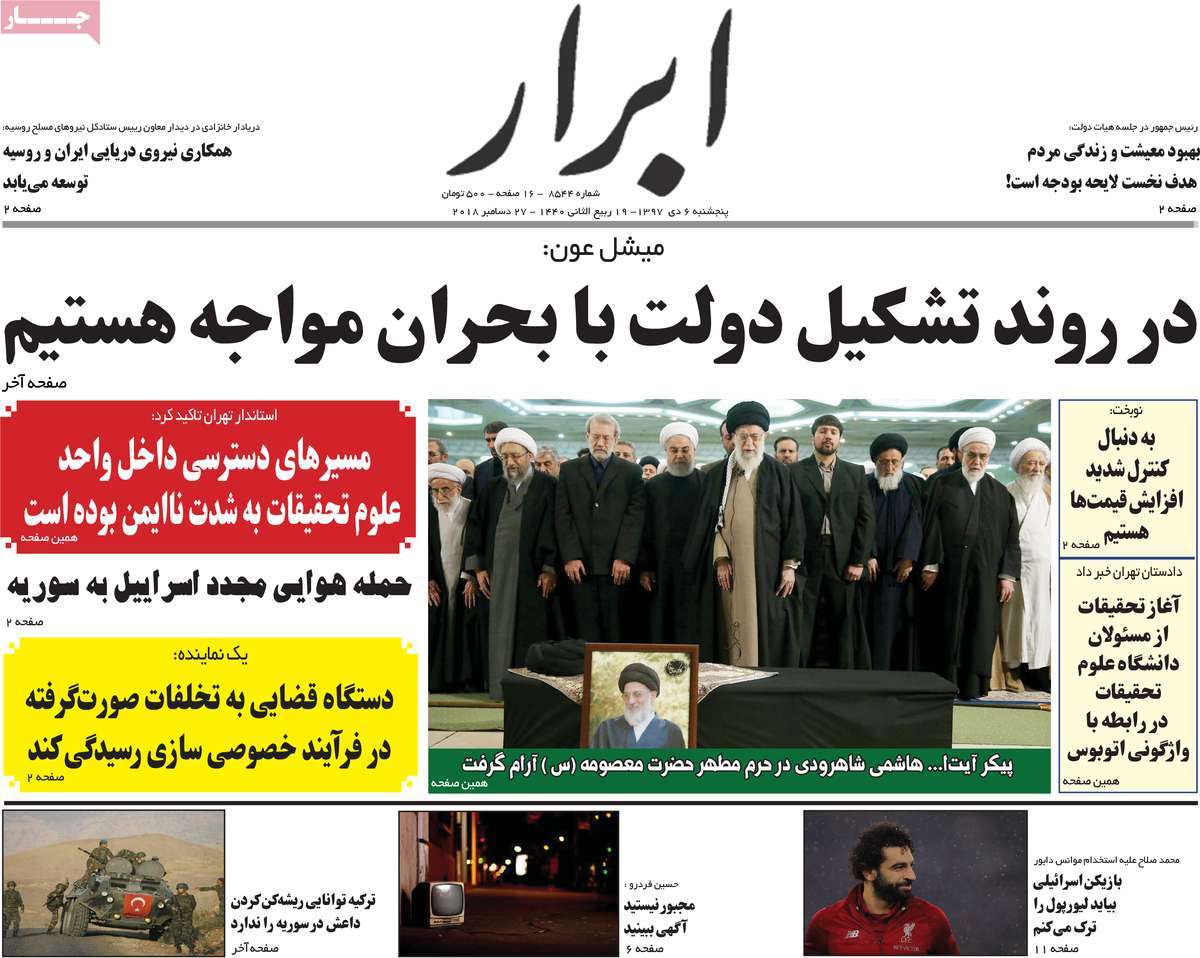
Abrar:

1- Iran-Russia Naval Ties Develop: Navy Commander

2- We Face Crisis in Forming Government: Michel Aoun

3- Turkey Not Able to Eradicate ISIS in Syria

4- Israel again Launches Air Raid on Syria

A Look at Iranian Newspaper Front Pages on December 27


Aftab-e- Yazd:

1- Iran-Taliban Talks Confirmed

* Shamkhani Officially Confirms Tehran’s Negotiations with Taliban

A Look at Iranian Newspaper Front Pages on December 27


Ebtekar:

1- We Must Try to Reduce Suffering of People: Rouhani

2- Competition for Conquering Peace in Syria

* Report on Possibility of Syria’s Return to Arab League

A Look at Iranian Newspaper Front Pages on December 27


E’temad:

1- Trip to Kabul, Dialogue with Taliban

2- Tension between Trump, Imran Khan

A Look at Iranian Newspaper Front Pages on December 27


Ettela’at:

1- Improving People’s Livelihood First Priority of Budget Bill: Rouhani

2- Trump Counts on Saudi Arabia as ATM: Rai al-Youm

3- Policymaking in Tehran, Talks in Kabul

* Annihilation of ISIS Main Focus of Talks with Taliban

A Look at Iranian Newspaper Front Pages on December 27


Jomhouri Eslami:

1- Russia Warns US against Interference in Saudi Royal Succession

2- Mubarak-Morsi Face-off in Court

3- Tehran Reliable Partner for Seoul: South Korean President

4- Syria Intercepts 14 of 16 Israeli Missiles: Russia

A Look at Iranian Newspaper Front Pages on December 27


Kayhan:

1- Iran Warns about Attempts to Transfer ISIS Elements to Afghanistan

2- Germany Opposes Deployment of US Missiles to Europe

3- Our Role in US Withdrawal from Syria [Editorial]

A Look at Iranian Newspaper Front Pages on December 27


Mardomsalari:

1- Withdrawal from JCPOA Not Difficult If Europe Fails to Launch SPV: MP

2- Molavi Abdul Hamid Stresses Development of Ties between Iran, Oman

3- Trump Possible Impeachment: US Waiting for Outcome of Muller’s Investigations

A Look at Iranian Newspaper Front Pages on December 27


Sazandegi:

1- Bibi’s Gamble: Israel’s Snap Elections to Benefit or Detriment of Netanyahu?

A Look at Iranian Newspaper Front Pages on December 27


Shargh:

1- Iran Leader Leads Funeral Prayer for Ayatollah Hashemi Shahroudi

2- Talks with Taliban against ISIS: Iran-Taliban Dialogue to Continue

A Look at Iranian Newspaper Front Pages on December 27


Vatan-e Emrooz:

1- No One Knows What’s Going on Here: US Commander on Withdrawal from Syria

A Look at Iranian Newspaper Front Pages on December 27

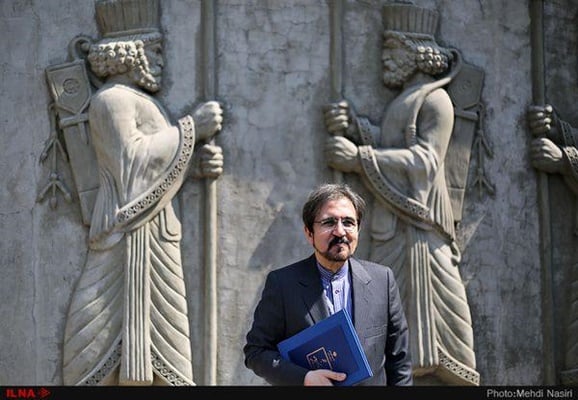
Iran Extends Condolences on Prophet Zoroaster’s Death Anniversary

In a message on Wednesday, Qassemi offered condolences to the Zoroastrians across the world.

“I send my condolences to the kind Zoroastrians in Iran and in other countries on the death anniversary of Prophet Zoroaster,” reads his message.

“Zoroaster was the founder of religion of monotheism in the ancient Iran and harbinger and preacher of Good Thoughts, Good Words and Good Deeds. Zoroastrianism has still based its identity on promoting love and friendship among good humans and avoiding hatred and demonic behaviours,” he said.

Qassemi went on to say that the Iranian nation and the Islamic Republic of Iran are the examples of a country and people that have always been able to raise the flag of coexistence and friendship among various religions on its monotheist lands.

“For this, Iran prides itself on enjoying the high culture in the current chaotic and volatile world,” he added.

Zoroaster was an ancient Persian prophet who challenged the existing traditions of the Indo-Iranian religion and later developed into the religion of Zoroastrianism.

He inaugurated a movement that eventually became the dominant religion in Ancient Persia.

He was a native speaker of Old Avestan and lived in the eastern part of the Iranian Plateau, but his exact birthplace is uncertain.

Varzaneh; A Mesmerizing Town in Central Iran

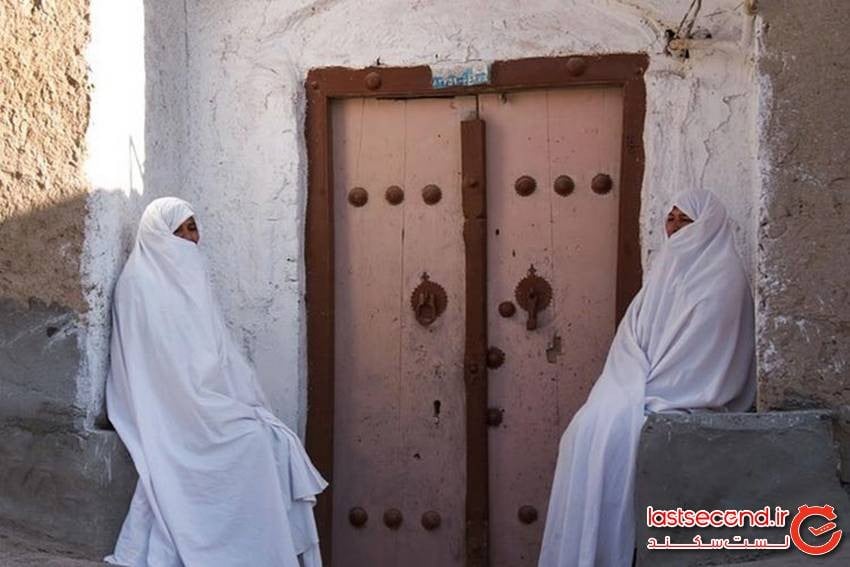
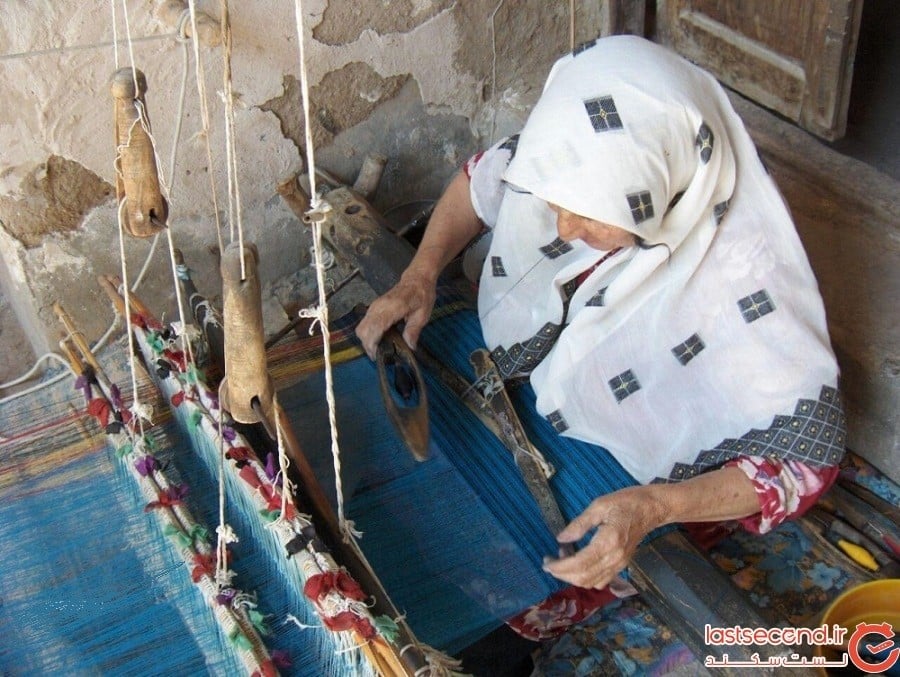
Most men in Varzaneh are farmers, and women weave fabrics and rugs. The city of Varzaneh has a new quarter and an old one. The new quarter is known as Imam Jafar Sadiq town and is located on the north of Zayanderud river. The old quarter is located on the south of Zayandehrud where a ditch used to lie.

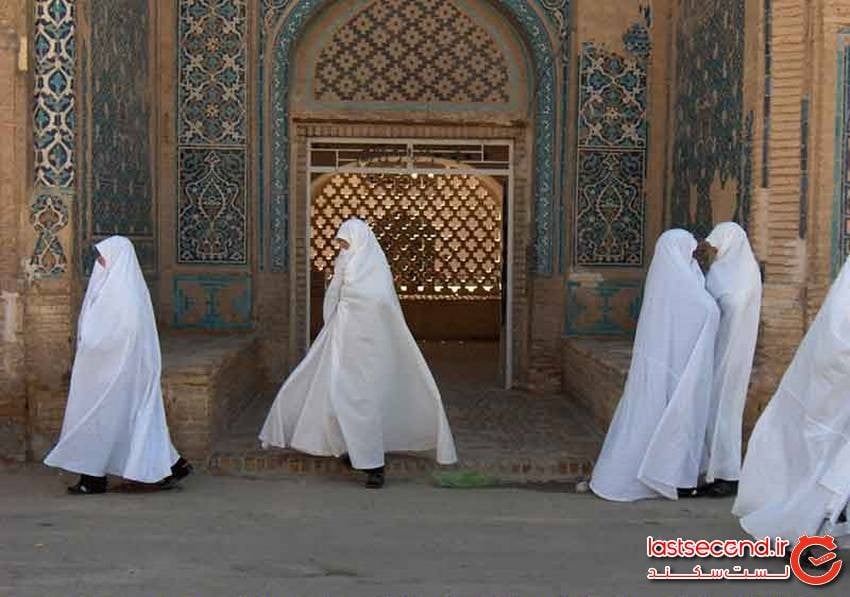
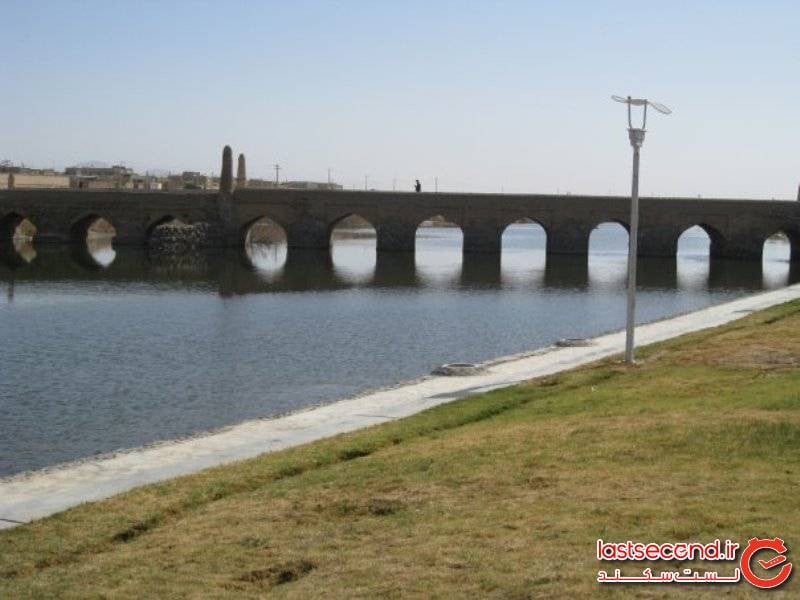
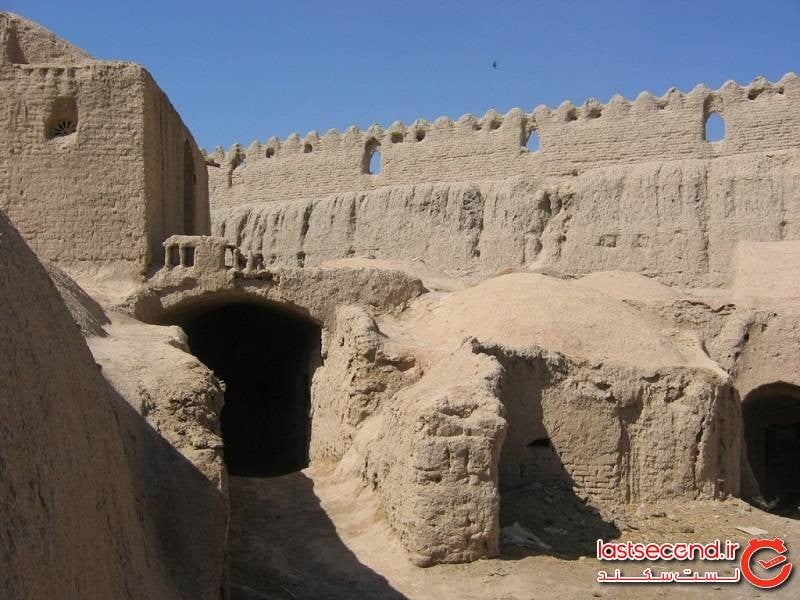
As Varzaneh is a small town, it is possible to just walk by to see its visitor sites such as historical places and handicrafts workshops. However, you need a vehicle to get to Gavchah, the Shotor (camel) windmill, Gavgerd and the Qoortan castle. It would be a great joy to visit the Mirmiran house, underground water storage chambers belonging to the Safavid era, the anthropology museum, etc., as well as the white-clad people with the Pahlavi-Sasani dialect.

As women in Varzaneh wear white chadors rather than black ones, Varzaneh is known as the whitest city of Iran. There are different opinions as to why women there wear white chadors. Some believe they wear white chadors to protect against sweltering summer heat in this desert region.

The handicrafts of Varzaneh include Kar-weaving and tablecloth-weaving. Kar-weaving has existed since the Timurid era and was once very popular in Varzaneh. However, this beautiful art is slipping into oblivion with the encroachment of industrial fabrics. The fabrics made by Kar-weavers are used as special cloth for keeping bread, wrapping brides’ dowry items, white chadors, shrouds, etc.

At the moment, there are 16 half-active home workshops for Kar-weaving where all weavers are old women. The fabric made by Kar-weavers come in five colours.

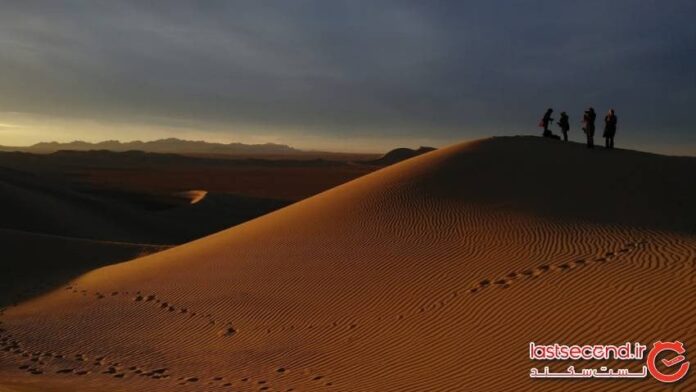
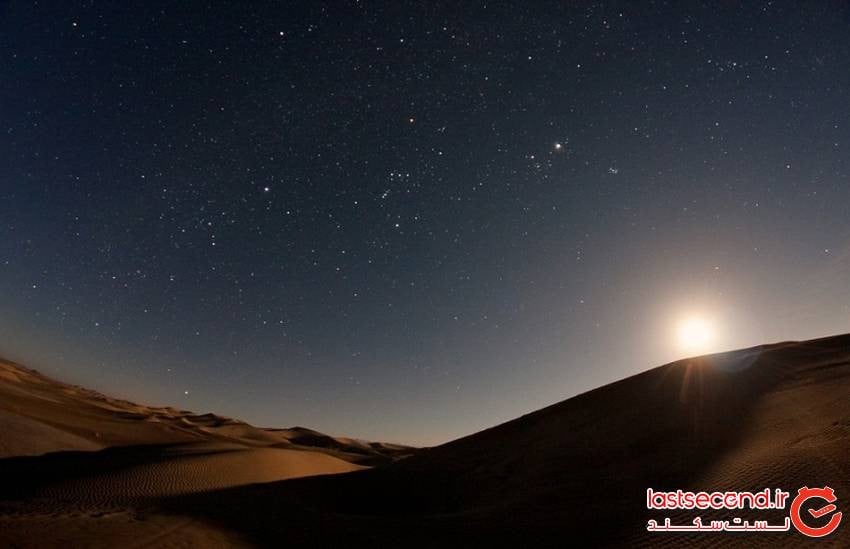
The Varzaneh desert, which is the closest desert to Isfahan, contains large expanses of sand dunes in different shapes. The landscapes of sand dunes are so mesmerizing that you will hardly forget them. The desert is also known as a place where the earth and sky meet. Late autumn and early winter are suitable times for touring deserts as the sweltering heat subsides and deserts turn into ideal places for tourists. Deserts are good places to experience excitement, beauty and silence all at once.

Iran to Hold 3rd Round of Direct Oil Sales Next Week: Minister

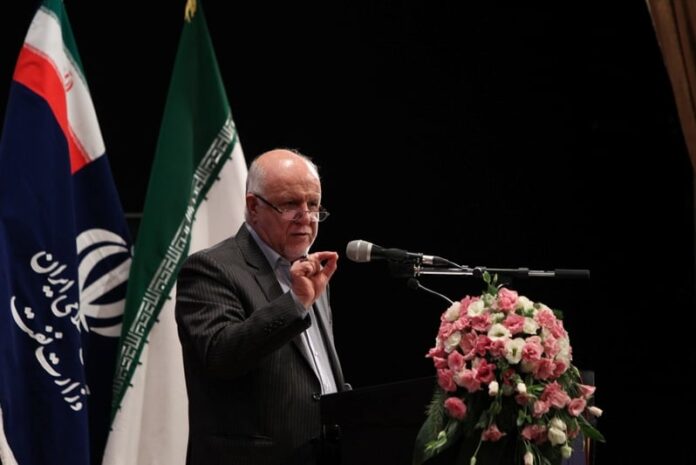
Iran's Oil Minister Bijan Zanganeh

The minister said the licence to sell the crude oil has been issued unanimously by the heads of the three branches of the Iranian Establishment.

“About 3 million barrels of oil will be supplied completely in exchange for Rial,” Zanganeh was quoted as saying in a report by IRNA.

Zanganeh referred to the previous two rounds of oil supply through oil bourse in October and November and said the Oil Ministry has provided a report on the previous rounds of direct oil sale to the High Economic Council represented by the three branches’ representatives.

He then added a notification will be given on the third round of oil supply through oil bourse in the near future.

“To this end, we have already received the legal licence from the three branches of the government to supply about three million barrels of oil,” he said.

According to Zanganeh, a purchaser can choose to pay with hard currency or rials for the crude oil on the bourse.

Elsewhere, he referred to the conditions of the oil sold in the bourse and said the purchasers can export the oil purchased through the bourse without any legal problems.

Iran started supplying its crude oil to the private sector in October through the energy bourse, a local market which provides Iranian and foreign tradesmen with a chance to purchase Iran’s crude oil and export it to the international markets.

Many believe that the new development is one of the byproducts of the US sanctions which are aimed at reducing Iran’s oil exports to zero.

It’s for the first time over the past seven years that Iran is selling its crude oil through Iran Energy Exchange. The idea to supply crude oil in such an exchange market was first raised several years ago but it never came true until some months ago with the full support of the government.

Regional Nations Count Seconds for US Withdrawal: Shamkhani

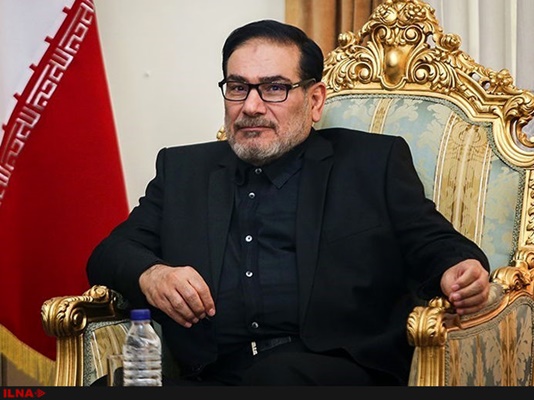
shamkhani

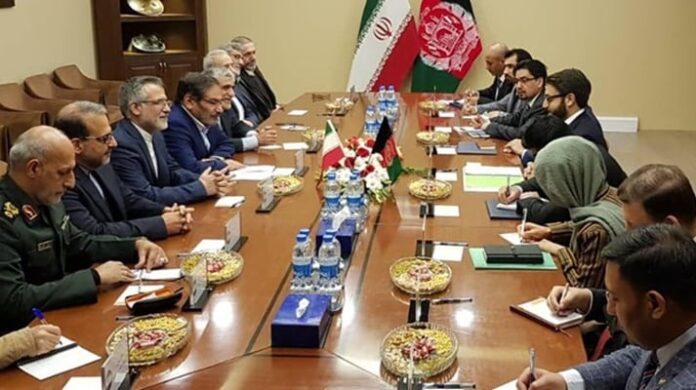
The senior security official said in a meeting with Afghan President Ashraf Ghani in Kabul on Wednesday that regional nations are counting seconds for the complete withdrawal of US forces whose presence has resulted in nothing but war and insecurity.

Shamkhani was referring to the Trump administration’s order to start withdrawing roughly 7,000 troops from Afghanistan in the coming months, an abrupt shift in the 17-year-old war there.

The SNSC secretary said the withdrawal of the US forces provides Afghanistan with a golden chance to improve domestic military capabilities and restore peace in the country, IRNA reported.

In the meantime, Afghan groups should engage in constructive talks and avoid violent moves in the region to pave the way for peace, he said.

Shamkhani said Iran and Afghanistan should make constant efforts to create security at shared borders and fight drug traffickers and terrorist groups.

He stressed that the regional countries should be vigilant to fight Takfiri terrorists in the region.

“The enemies of the region’s security and calm are looking to destabilise common borders to transfer defeated ISIS elements to Afghanistan and support Takfiri terrorism in this country so they can fuel war, bloodshed and insecurity in the region,” he said.

“Any negligence could result in a repeat of bitter and horrendous incidents, similar to what happened in Iraq and Syria,” he said.

Shamkhani said Iran believes Afghanistan’s security and progress is Iran’s progress, adding that Iran is ready to boost political, economic, cultural and defense cooperation with Afghanistan.

In turn, Ghani said protecting peace in border areas is a top priority for Afghanistan, stressing the need for creating shared mechanisms to fight terrorism, organized crime and drug trafficking.

Ghani added that his government seeks to strengthen bonds of friendship with the Iranian nation adding that making efforts to boost economic ties in various fields particularly transit and trade would guarantee sustainable cooperation between the two countries.

Afghanistan Welcomes Iran’s Initiatives

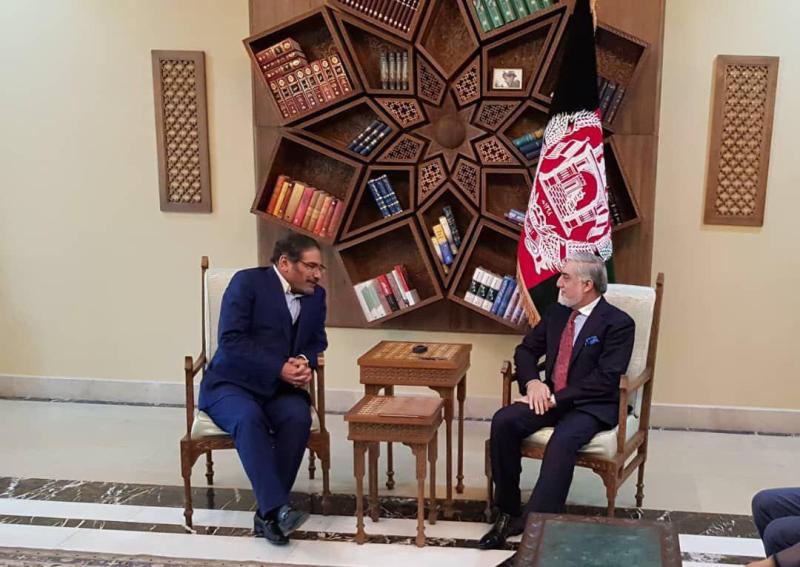
In a separate meeting later in the day, Shamkhani told Afghanistan’s Chief Executive Abdullah Abdullah that Iran supports the peace process and intra-Afghan talks in the country.

Regional Nations Count Seconds for US Withdrawal: ShamkhaniThe SNSC secretary said regional governments need to engage in cooperation to devise inclusive plans to root out terrorism, as the scourge could continue to threaten the region in the coming years.

Abdullah said he welcomes Iran’s initiatives to fight terrorism and restore peace and security to the region.

“Sustainable peace is the most important need of the region and the ground for economic progress and development of the suffered nations,” he said.

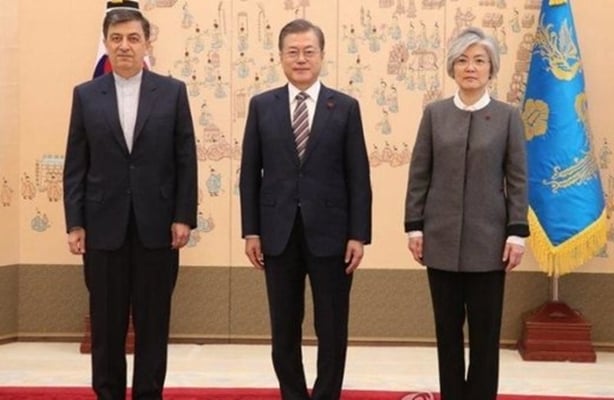
Iran Reliable Partner for S Korea: Seoul

Jae-in made the remarks Wednesday after receiving the credentials of Iran’s new ambassador to South Korea Saeed Badamchi Shabestari.

“The mutual cooperation between Iran and South Korea had been going on in the harsh conditions of the 70s, and even survived the war imposed on Iran by former Iraqi dictator Saddam Hussein in the 80s,” he said, after giving his warm regards to his Iranian counterpart Hassan Rouhani.

The Korean official then said the current problems in the development of the two sides’ relations would be removed in the future and expressed his country’s gratitude for the Islamic Republic’s support for pressing ahead with the reconciliation policies in the Korean Peninsula.

For his part, Iran’s new ambassador to South Korea gave President Rouhani’s regards to Jae-in. He also referred to the long-time relations between the two countries and underlined the need for developing and strengthening mutual cooperation in various political, economic, cultural and parliamentarian areas.

Shabestari also welcomed the role played by South Korean president in the denuclearization of the Korean Peninsula and expressed the Islamic Republic’s support for South Korea’s related plans and policies.

The ambassador also referred to the problems created in Iran-Korea relations by the US unilateral withdrawal from the nuclear deal, particularly in the banking area, over the past months and expressed hope that the problem could be resolved with the South Korean president’s cooperation.

Shabestari was appointed as Iran’s ambassador to South Korea on October 11.

‘Tehran Holding Talks with Taliban to Resolve Security Issues in Afghanistan’

Secretary of Iran’s Supreme National Security Council Ali Shamkhani made the statement on Wednesday, in a meeting with Hamdullah Mohib, the National Security Advisor to Afghanistan’s president, in which the two sides explored grounds for closer cooperation in political, economic and security fields.

Shamkhani said the talks with the Taliban have been aimed at settling security issues in Afghanistan, without elaborating further on the timing and location of the talks, ISNA reported.

Shamkhani said the two countries’ security officials should engage in closer talks to settle common security concerns.

Pointing to reports that the US and its allies are planning to relocate ISIS elements to Afghanistan, Shamkhani said the threat is serious and practical steps are needed to counter the vicious plan.

Shamkhani added that the two countries should work to boost border security, notably measures to upgrade the performance of police posts at joint borders.

For his part, Mohib said Iran plays a big role in efforts to restore peace to Afghanistan, thanks to the close determination of the Afghan government and people to counter terrorism.

“The Islamic Republic has been one of the key supporters of security in the region, and joint cooperation between the two countries would be effective in settling Afghanistan’s security problems,” he underscored.

Mohib further mentioned that he hopes the talks among Iranian and Afghan officials would also help remove obstacles to implementing previous bilateral agreements.