Saturday, April 11, 2026
Home Blog Page 3276

Arabs Have ‘Genetic Problems’, Want to Be Under Occupation: Rabbi

Arabs Have ‘Genetic Problems’, Want to Be Under Occupation: Rabbi

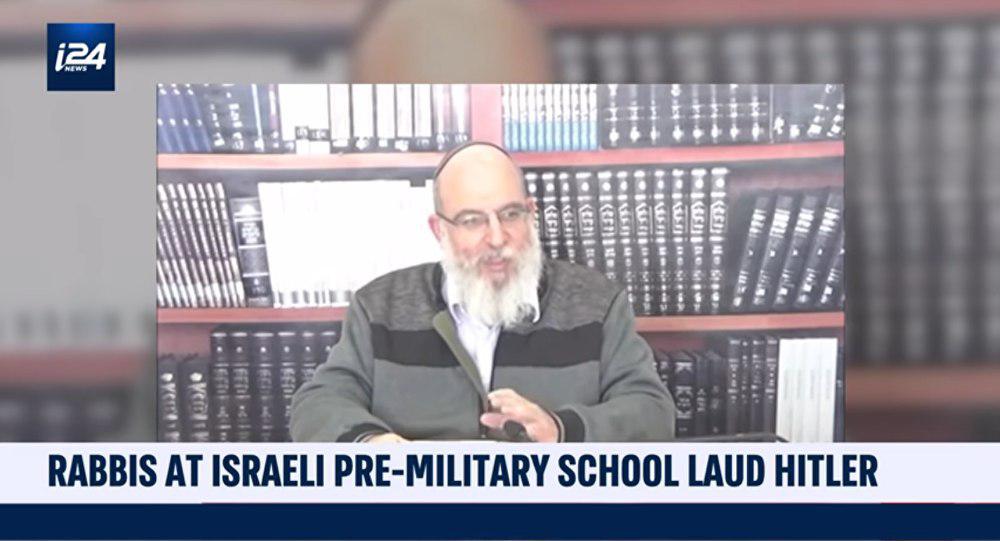
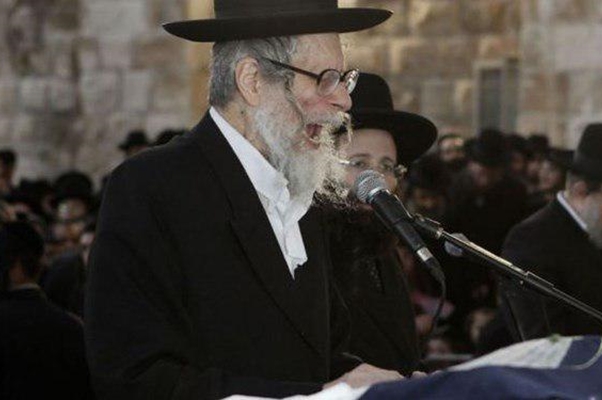
In a recording published by Channel 13 news, Rabbi Eliezer Kashtiel, the head of the Bnei David pre-military academy in the settlement of Eli in the West Bank, is telling a class that being a “slave to a Jew is the best”.

“The gentiles will want to be our slaves. Being a slave to a Jew is the best. They’re glad to be slaves, they want to be slaves. Instead of just walking the streets and being stupid and violent and harming each other, once they’re slaves, their lives can begin to take shapes,” Kashtiel said as cited by Channel 13.

According to the media outlet, the rabbi goes as far as to claim that Arabs want to “be under the occupation” due to what he described as “genetic problems” and promotes Jewish superiority.

“All around us, we are surrounded by peoples with genetic problems. Ask a simple Arab ‘where do you want to be?’ He wants to be under the occupation. Why? Because they have genetic problems, they don’t know how to run a country, they don’t know how to do anything. Look at them. Yes, we’re racists. We believe in racism… There are races in the world and people have genetic traits, and that requires us to try to help them. The Jews are a more successful race.”

Arabs Have ‘Genetic Problems’, Want to Be Under Occupation: RabbiIn another video from the batch, Rabbi Giora Redler can be heard openly saying that Adolf Hitler was the most “correct person there ever was” during a lesson on the Holocaust and lamenting that the Fuhrer was simply “on the wrong side.”

“Let’s just start with whether Hitler was right or not. He was the most correct person there ever was, and was correct in every word he said… he was just on the wrong side. The real Holocaust was not when they murdered the Jews, that’s not it. All these excuses – that it was ideological or systematic – are nonsense. Humanism and the secular culture of ‘We believe in man’, that’s Holocaust”, Redler said, according to Channel 13.

This is not the first time that Bnei David teachers have found themselves at the epicentre of a nationwide controversy: last year, a video surfaced showing Rabbi Yosef Kelner telling students that women are “weak-minded” and have a reduced capacity for spirituality.

A Look at Iranian Newspaper Front Pages on May 8

A Look at Iranian Newspaper Front Pages on November 19

Iran’s Wednesday announcement of its reciprocal measures against the US’ withdrawal from the 2015 nuclear deal was the top story in all papers today. The decision was declared later in the day in a statement by the Supreme National Security Council and a speech by President Hassan Rouhani.

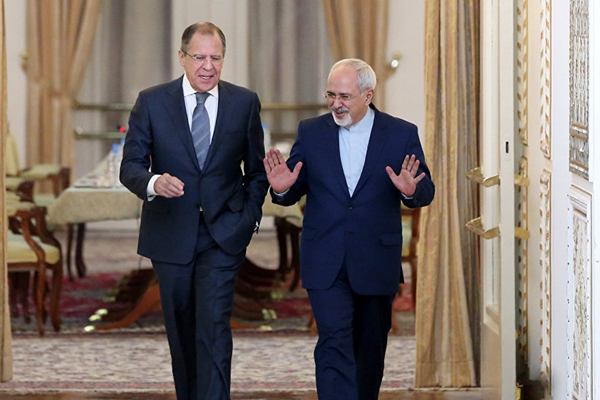
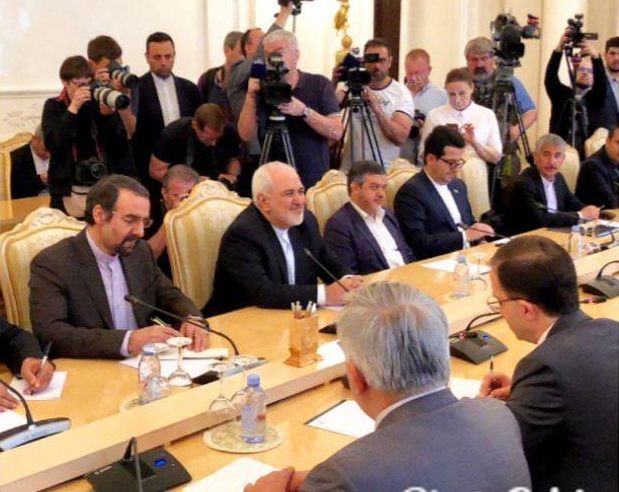
Also a top story today was the Iranian foreign minister’s visit to the Russian capital and his Wednesday talks with Sergei Lavrov, the Russian top diplomat.

The above issues, as well as many more, are highlighted in the following headlines and top stories:


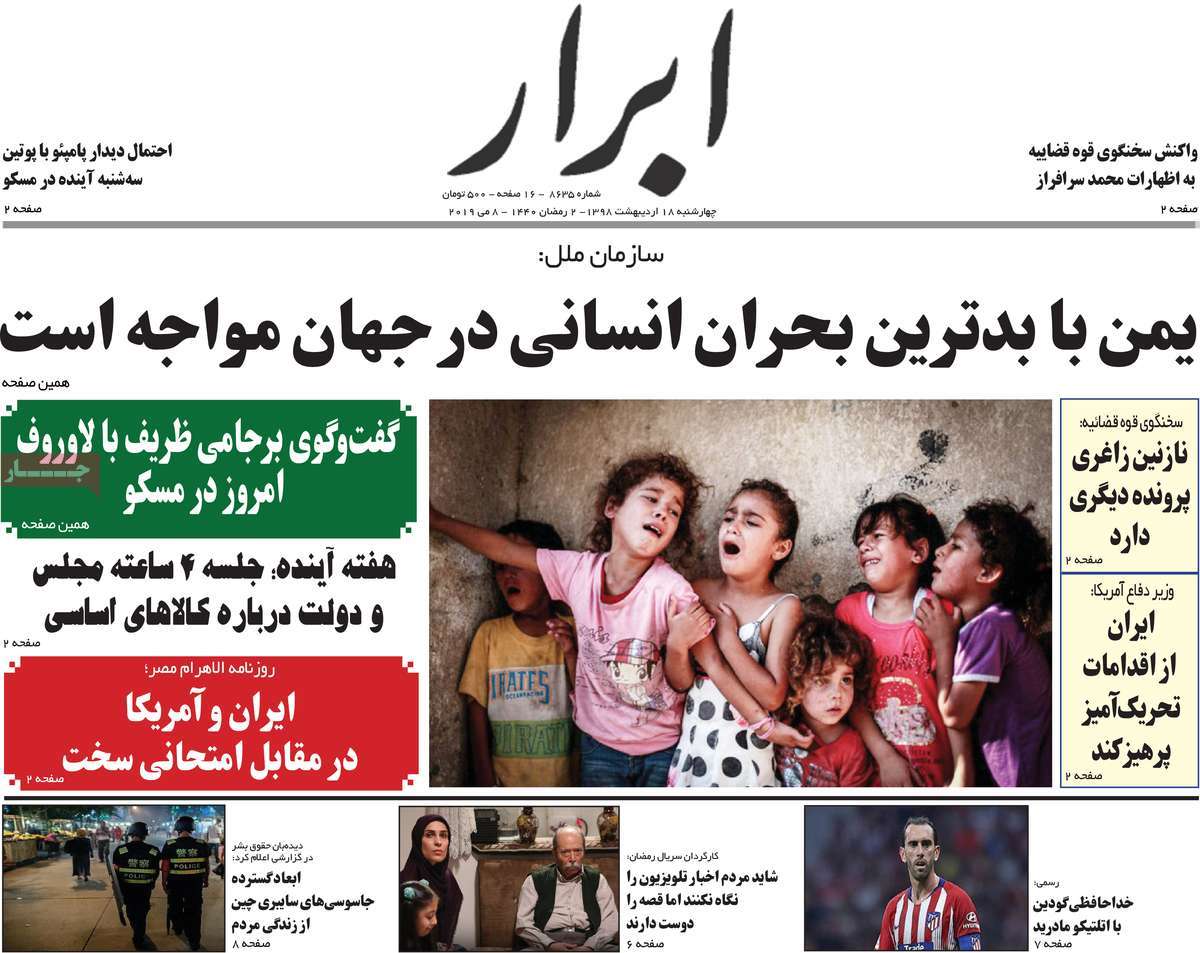
Abrar:

1- Pompeo May Meet Putin Next Tuesday in Moscow

2- Zarif, Lavrov to Hold Talks on JCPOA

3- Iran, US Faced with Difficult Test: Al-Ahram

4- Iran Must Avoid Provocative Measures: US Defence Secretary

A Look at Iranian Newspaper Front Pages on May 8


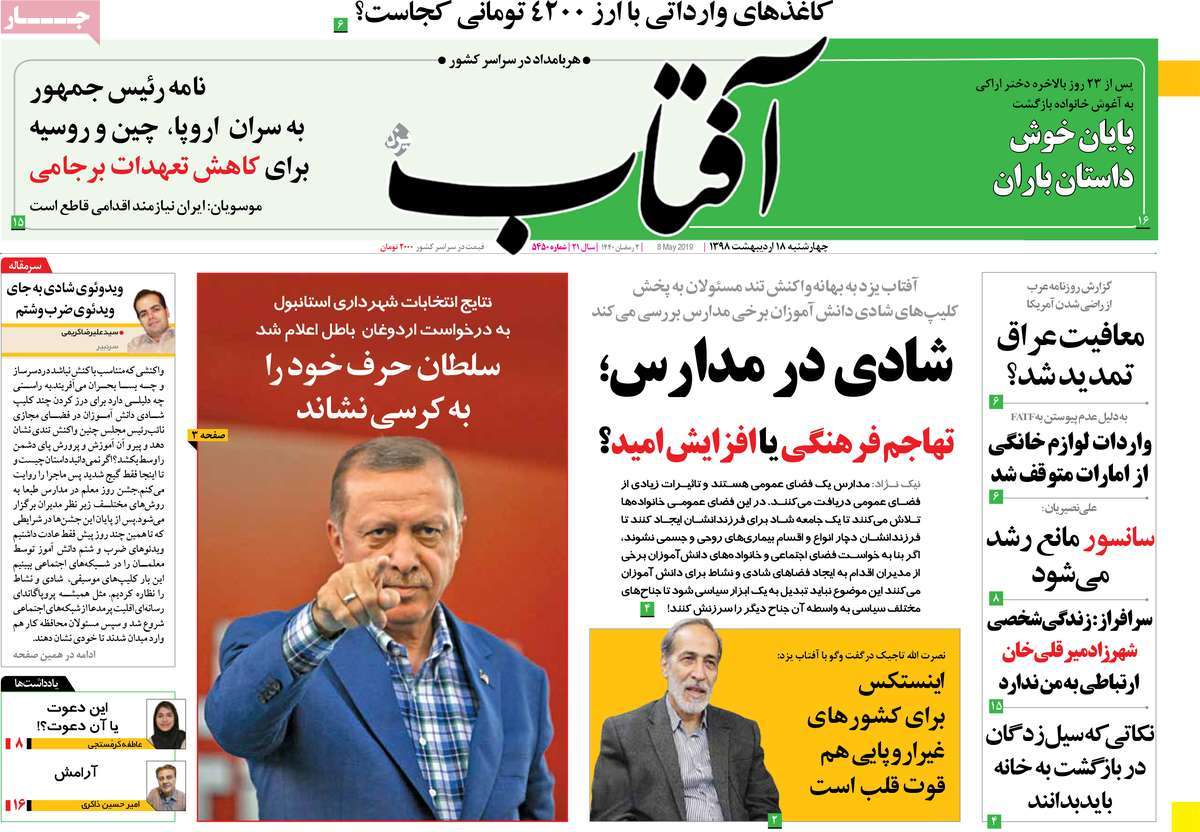
Aftab-e Yazd:

1- Rouhani’s Letter to Leaders of Europe, China, Russia on Reduction of Iran’s Commitments

2- On Erdogan’s Request, Mayoral Elections in Istanbul Nullified

3- US Reportedly Convinced to Extend Iraq’s Waivers on Dealing with Iran

A Look at Iranian Newspaper Front Pages on May 8


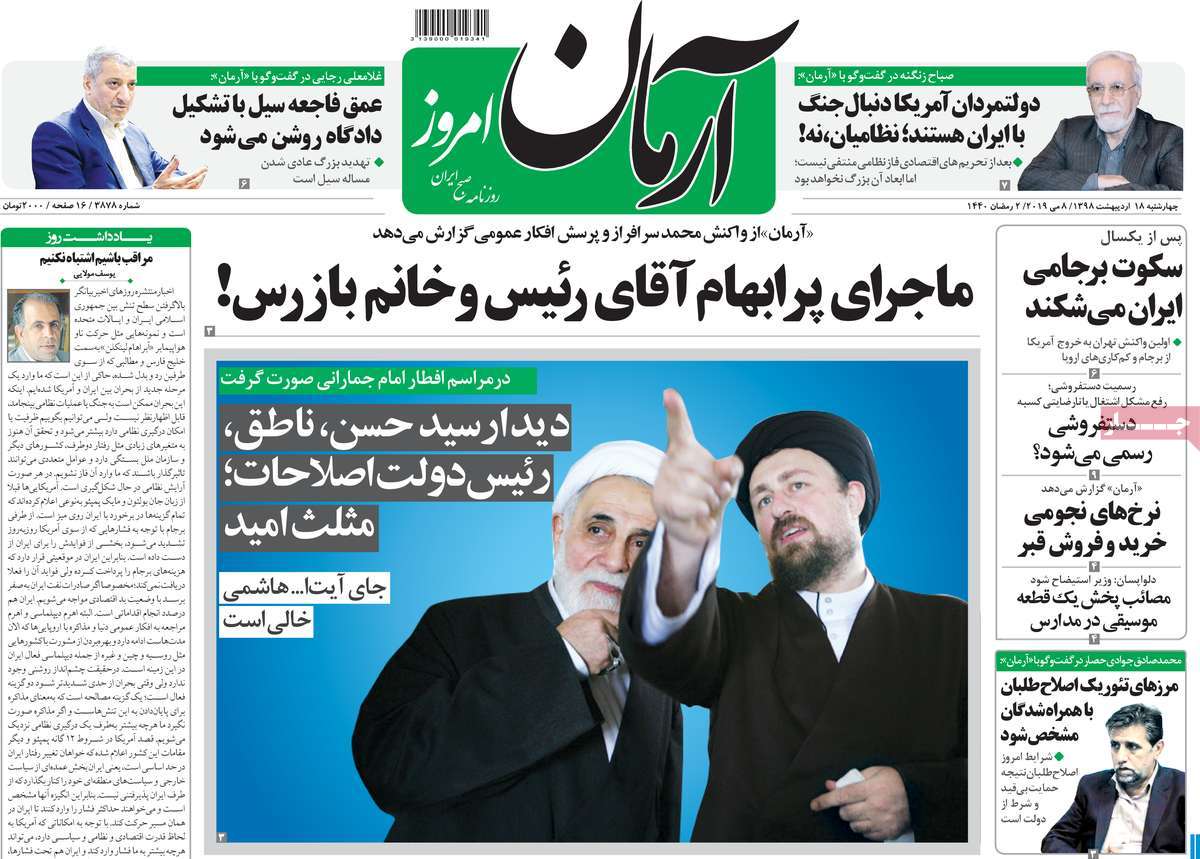
Arman-e Emrooz:

1- US Statesmen, Not Generals Seeking War with Iran

2- Iran to Break Its Silence on JCPOA: Iran’s First Reaction to US Withdrawal, EU’s Failure to Do Enough

A Look at Iranian Newspaper Front Pages on May 8


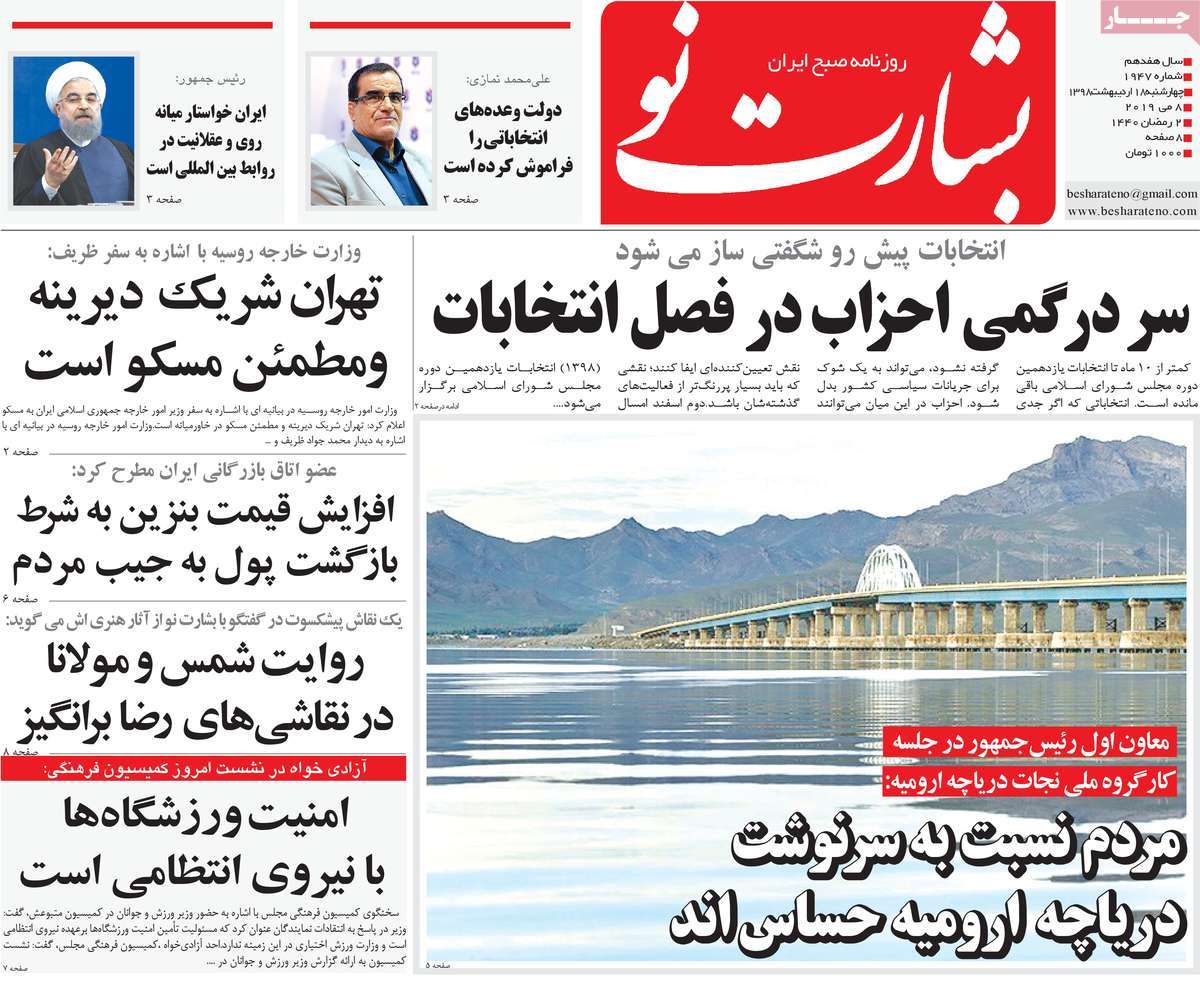
Besharat-e Now:

1- Rouhani: Iran Seeks Moderation, Rationality in International Ties

2- Tehran Longtime, Reliable Partner of Moscow: Russian Foreign Ministry

A Look at Iranian Newspaper Front Pages on May 8


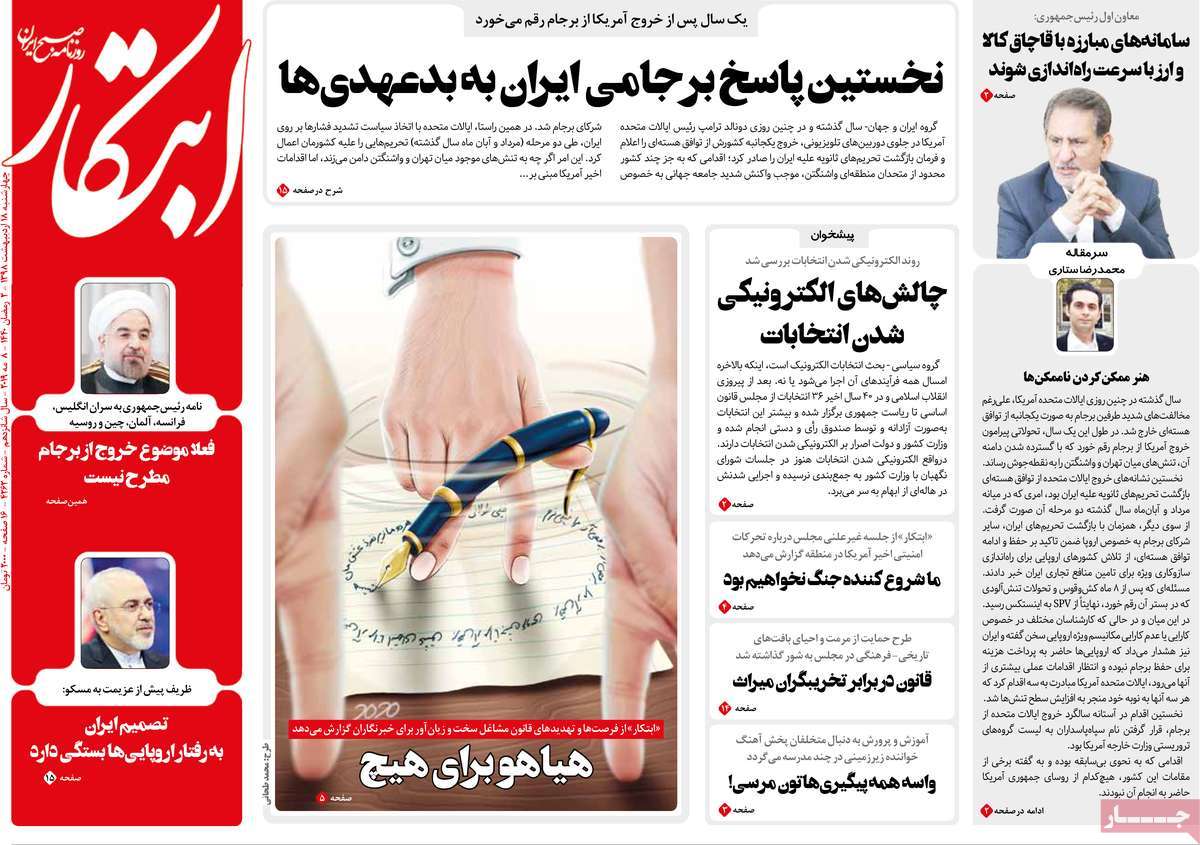
Ebtekar:

1- Iran’s First Response to JCPOA Violations One Year after US Pullout

2- Rouhani Writes to Leaders of UK, France, Germany, China, Russia

* Iran Not to Withdraw from JCPOA for Now

3- Iran’s Decision Depends on Europeans’ Behaviours: Zarif

A Look at Iranian Newspaper Front Pages on May 8


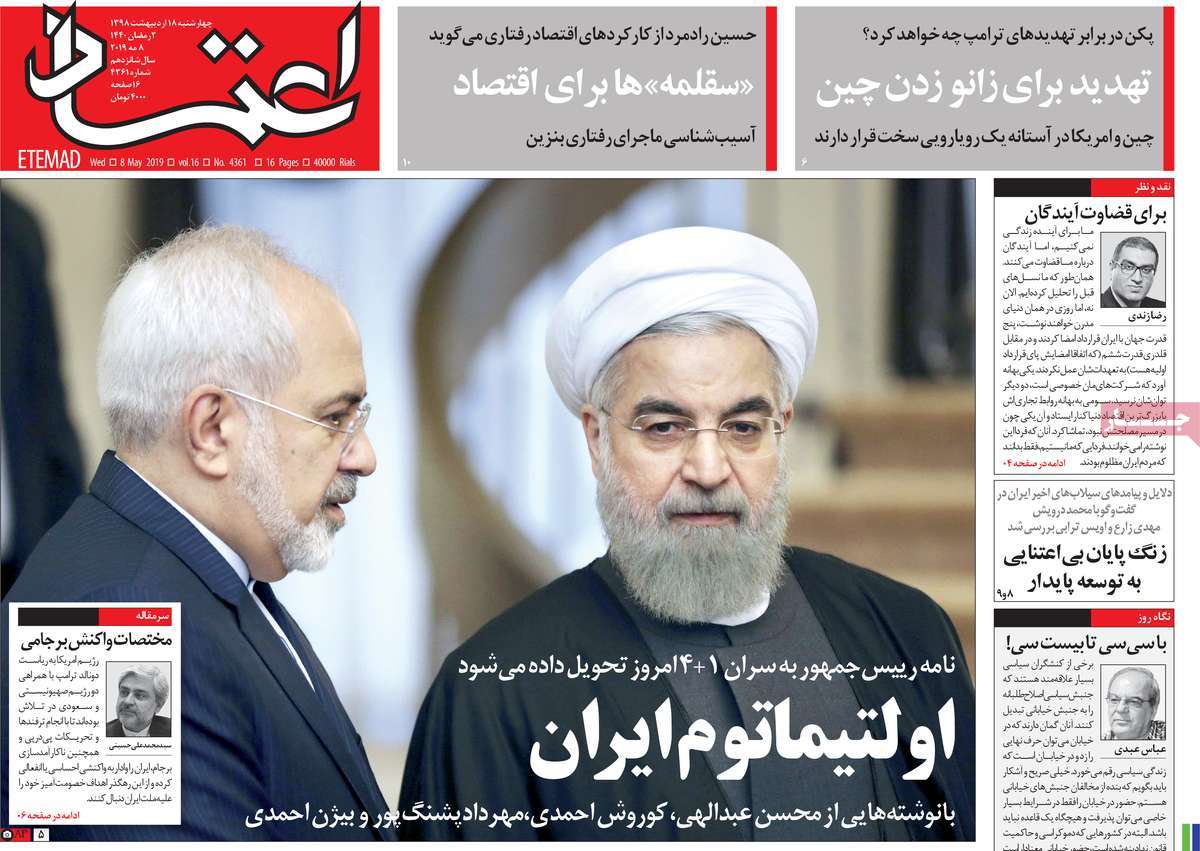
Etemad:

1- What’d Beijing Do in Reaction to Trump’s Threats?

2- Iran’s Ultimatum: Rouhani’s Letter to Leaders of P4+1

A Look at Iranian Newspaper Front Pages on May 8


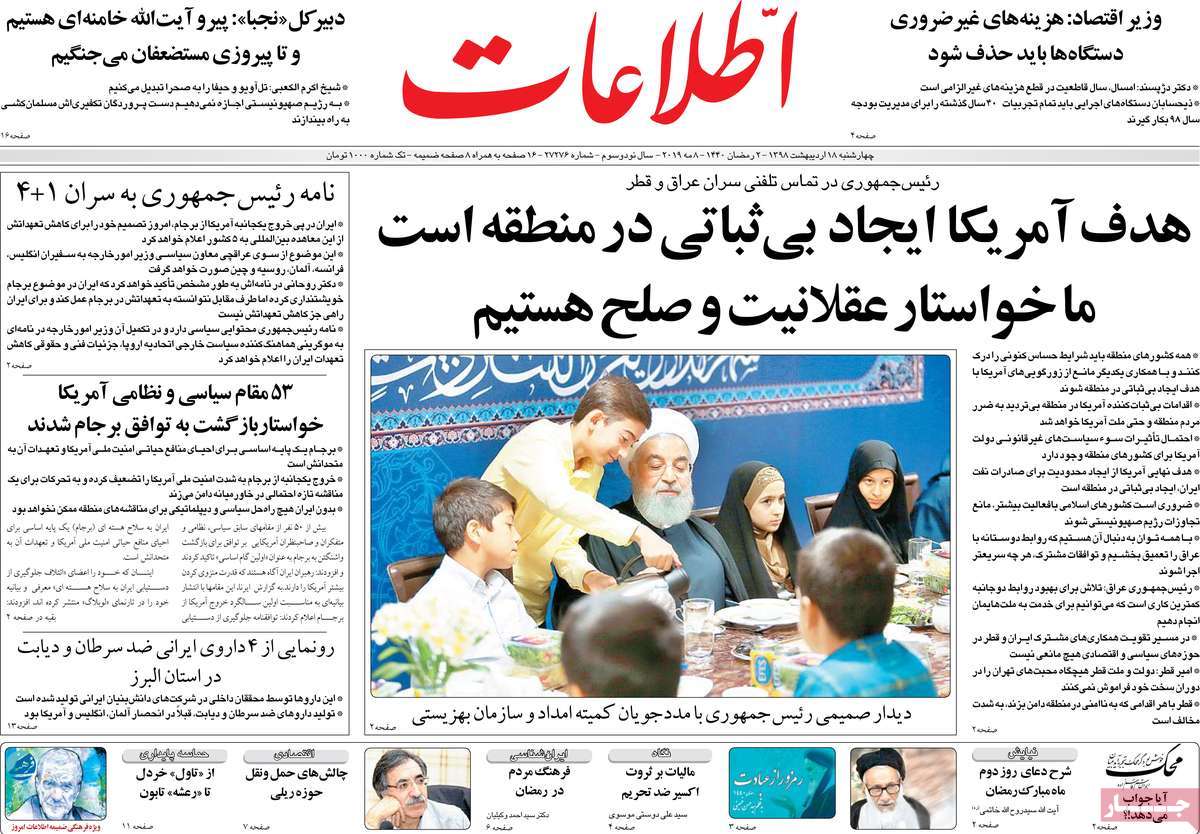
Ettela’at:

1- Iraq’s Nujaba Movement: We Follows Ayatollah Khamenei, Will Fight Until Victory of the Oppressed

2- Rouhani Pens Letter to Leaders of P4+1

3- US Seeks Instability in Region, Iran Wants Peace: Rouhani to Iraqi President, Qatari Emir

4- 53 Political, Military Officials in US Call for Return to JCPOA

A Look at Iranian Newspaper Front Pages on May 8


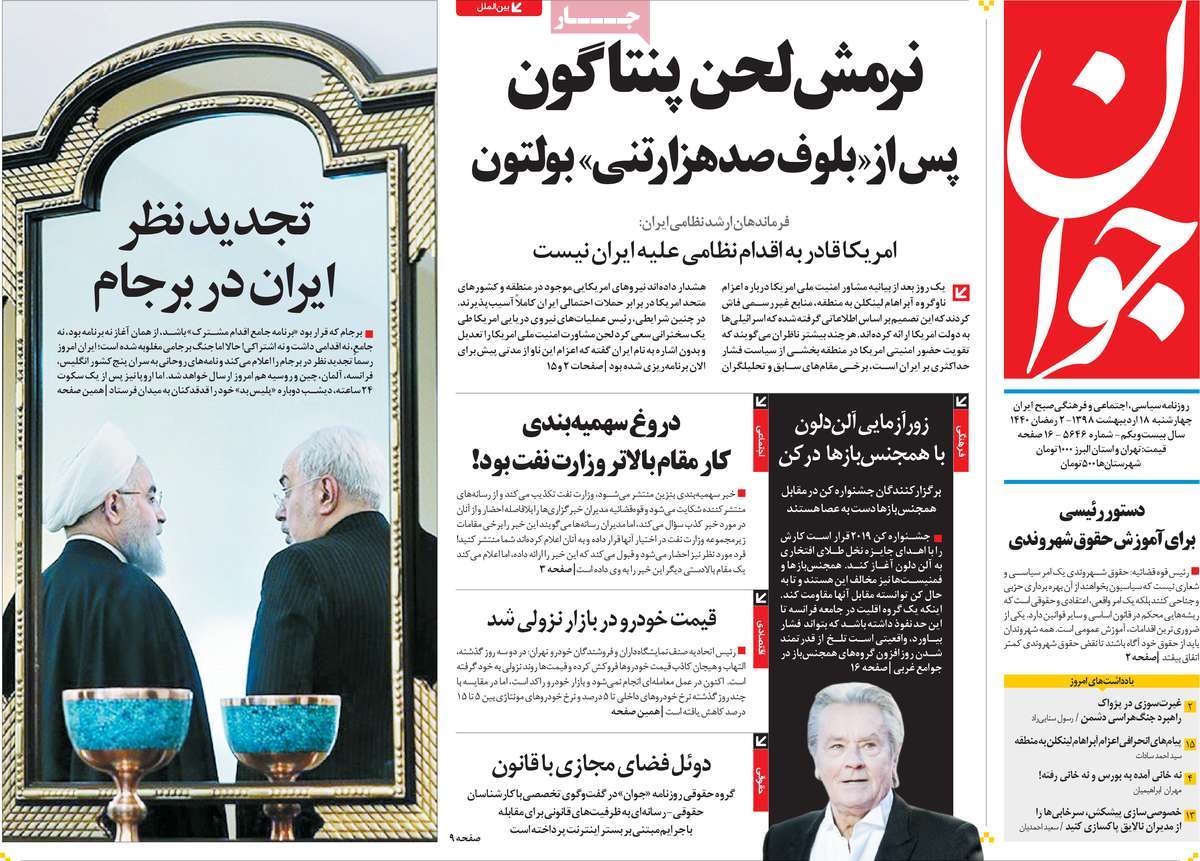
Javan:

1- Pentagon Softens Its Tone after Bolton’s Bluff

* US Cannot Take Military Action against Iran: Top Iranian General

2- Iran to Reconsider JCPOA Implementation

A Look at Iranian Newspaper Front Pages on May 8


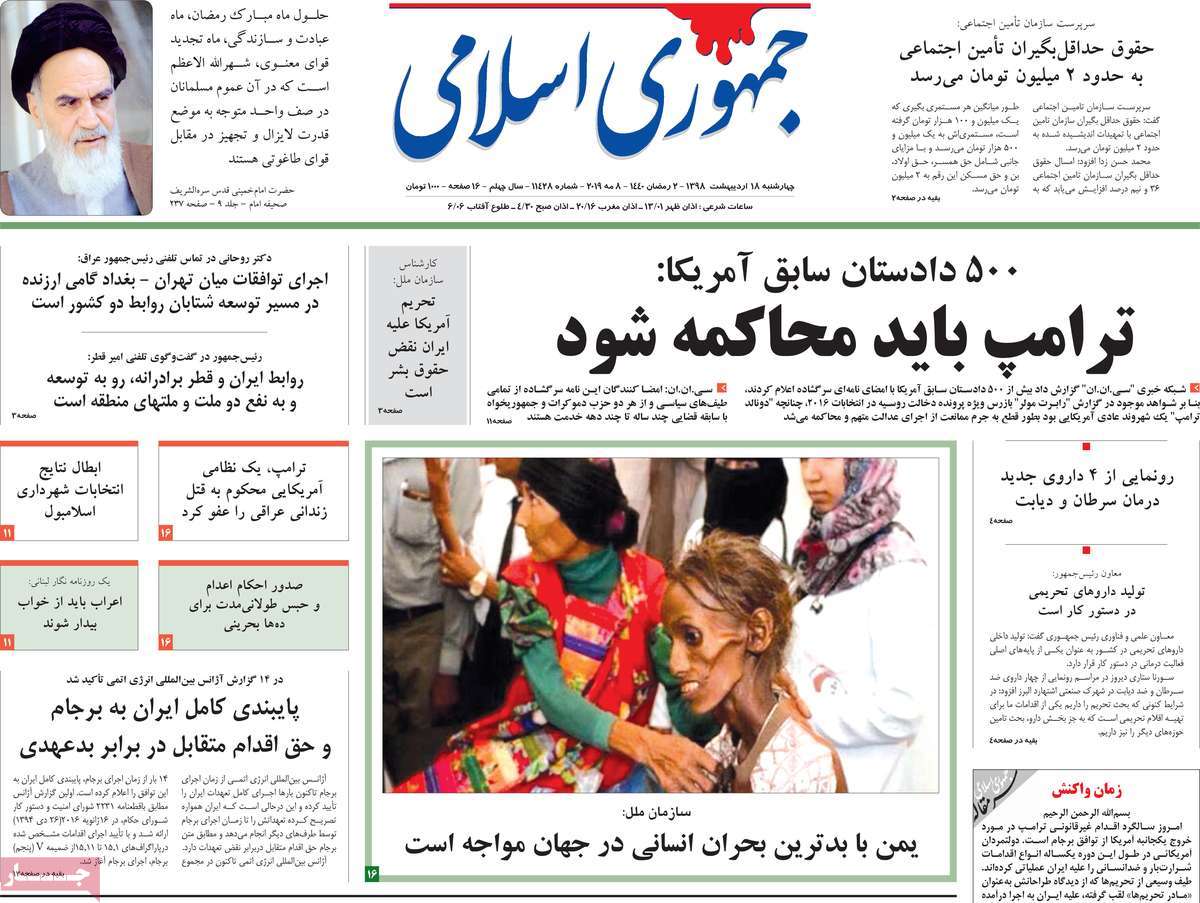
Jomhouri Eslami:

1- 500 Former Prosecutors of US Call for Prosecution of Trump

2- US Sanctions against Iran Violation of Human Rights: UN Expert

3- Iran Totally Committed to JCPOA, Has Right to Reciprocate Violations

A Look at Iranian Newspaper Front Pages on May 8


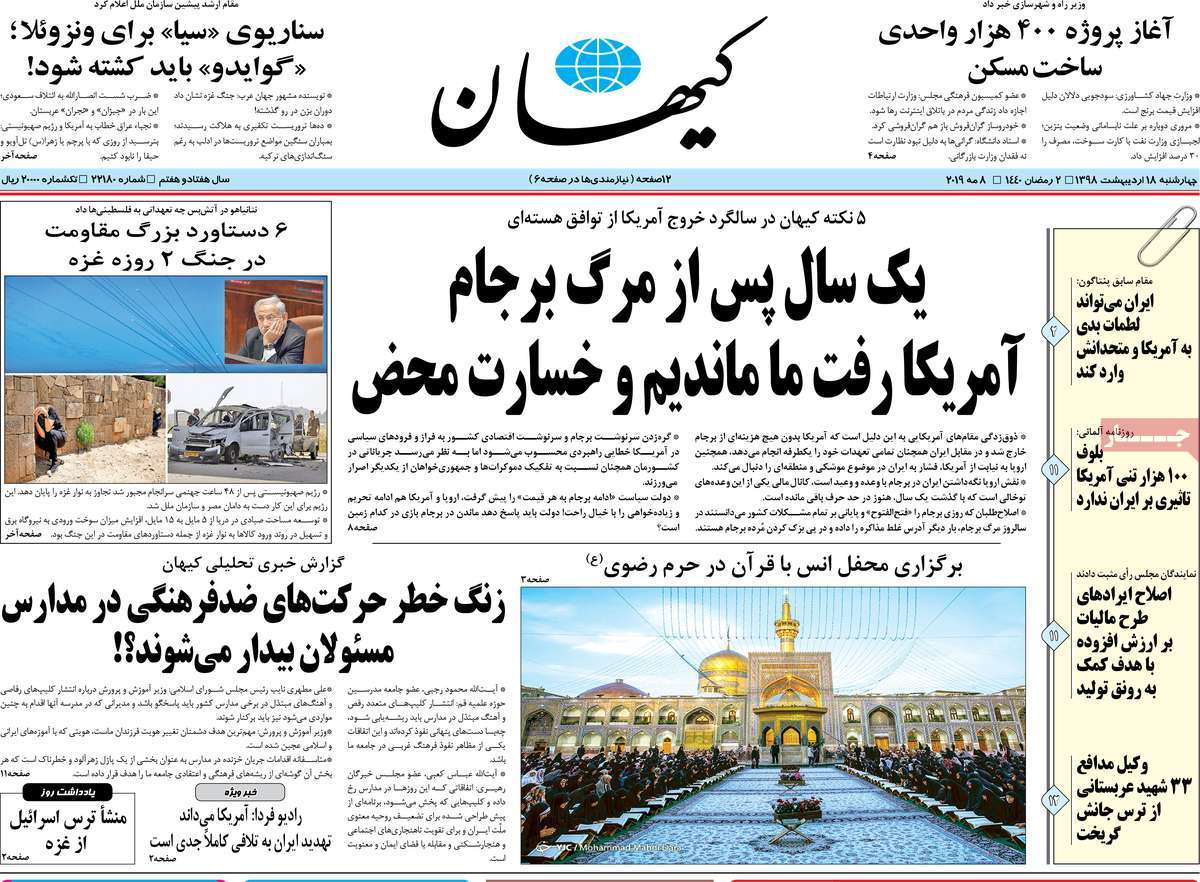
Kayhan:

1- CIA’s Scenario for Venezuela: Guaido Must Be Killed

2- One Year after Death of JCPOA: US Left, We Remained with Absolute Damage

3- Former Pentagon Official: Iran Can Cause Bad Damages to US, Allies

A Look at Iranian Newspaper Front Pages on May 8


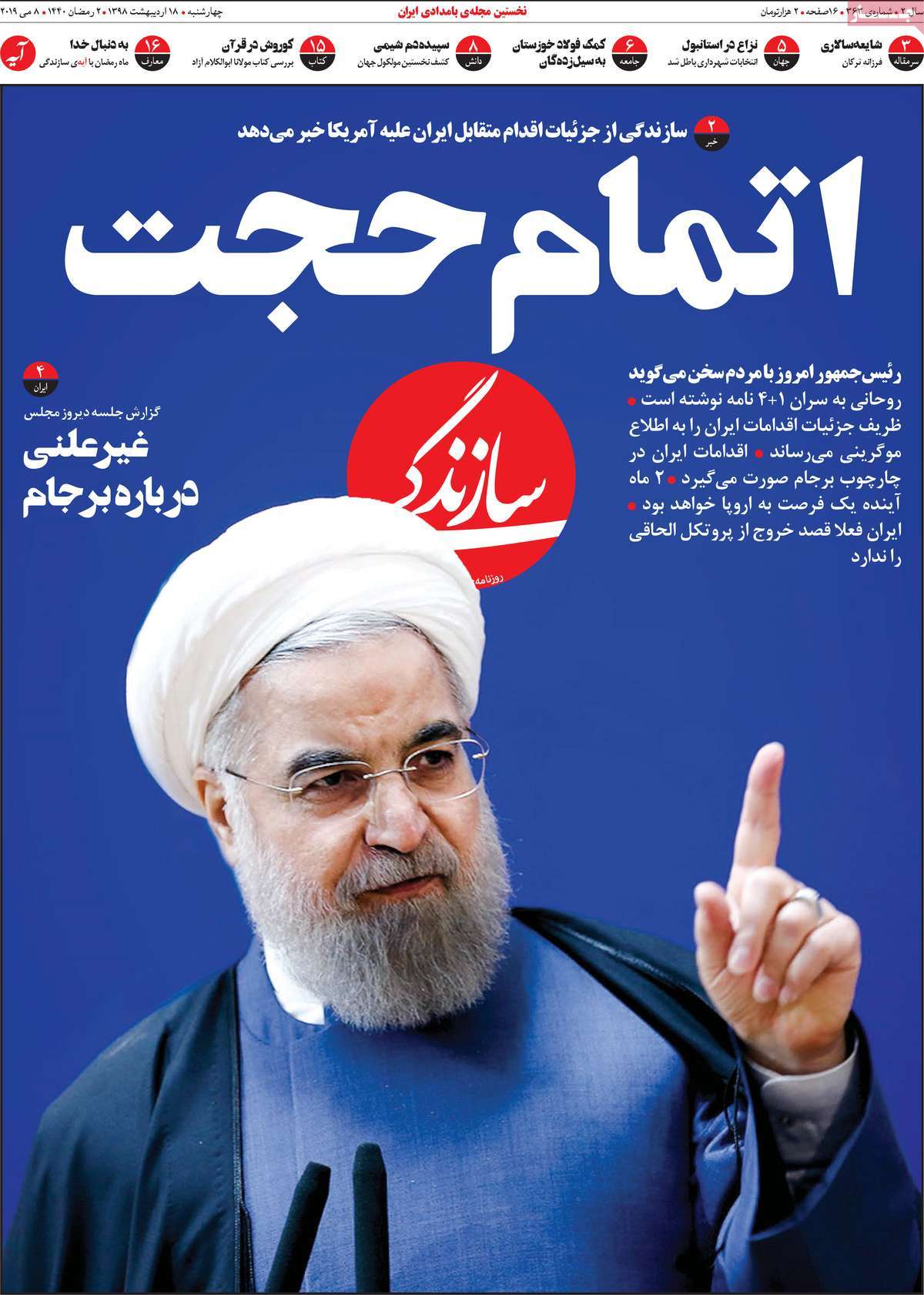
Sazandegi:

1- Ultimatum: A Report on Details of Iran’s Action against US

2- Rouhani to Talk to People Today

* Zarif to Brief Mogherini on Details of Iran’s Measures

* Next 60 Days a Chance for Europe

* Iran Not to Stop Implementing Additional Protocol

A Look at Iranian Newspaper Front Pages on May 8


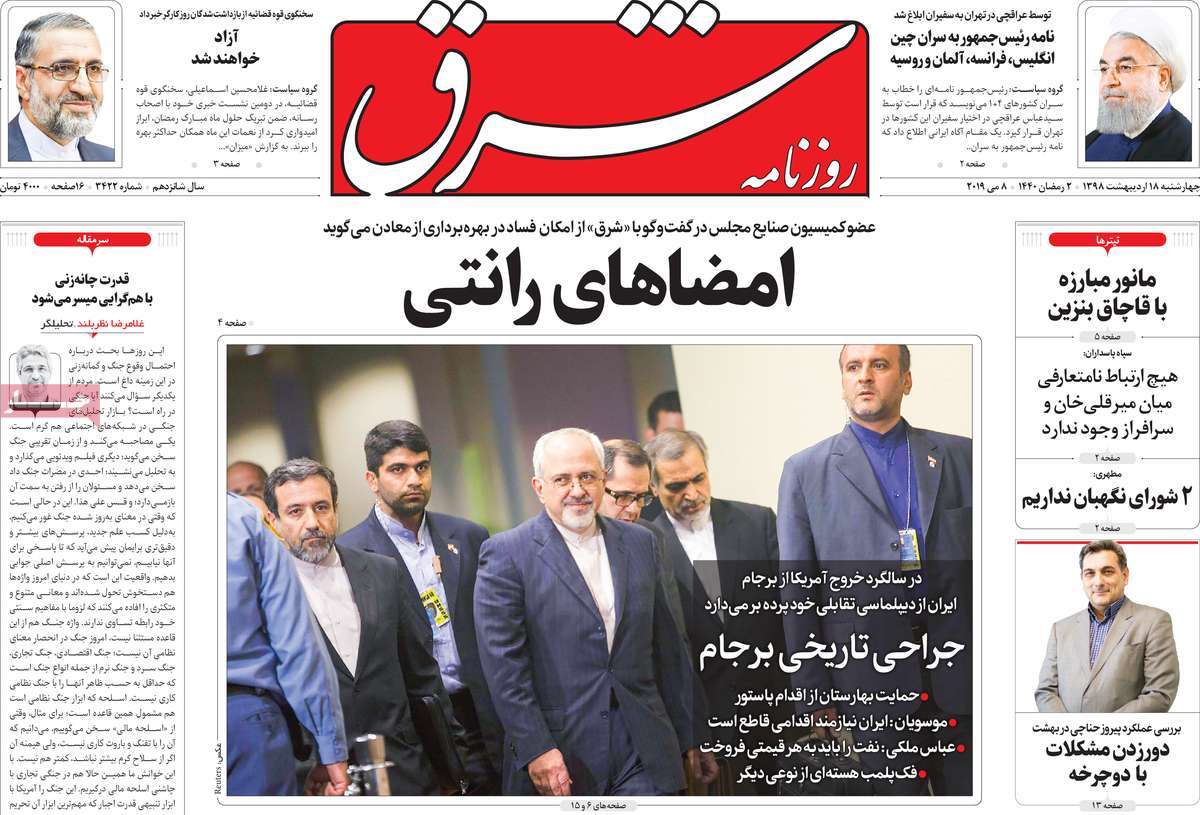
Shargh:

1- Rouhani Sends Letters to Leaders of China, UK, France, Germany, Russia

2- Historical Surgery of JCPOA: Iran to Unveils Reciprocal Diplomacy on Anniv. of US Pullout

A Look at Iranian Newspaper Front Pages on May 8

Iran’s Zarif, Russia’s Lavrov Discuss JCPOA in Moscow

During the Wednesday talks, the two sides conferred on various aspects of bilateral relations and cooperation in politics, economy, nuclear technology, oil and gas, transportation, agriculture, culture and tourism.

They also exchanged views on the most important regional and international issues including those of Afghanistan, Yemen, Syria, Venezuela, and Libya.

Zarif and Lavrov further discussed the latest developments with regard to the Iran nuclear deal (also known as JCPOA), the details of Iran’s move to reciprocate the US violation of the deal, and the fact that Tehran’s demands have not been met.

In the meeting, President Hassan Rouhani’s letter to his Russian counterpart Vladimir Putin was also handed over to Lavrov.

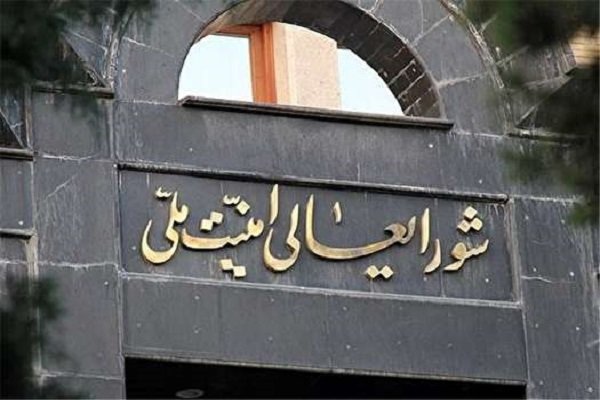
The meeting came after the Supreme National Security Council of Iran declared the country’s decision to stop implementing some of its commitments under the 2015 nuclear deal in reaction to the US’ withdrawal from JCPOA and Europe’s failure to make up for that.

In a statement on Wednesday, the SNSC said as of May 8, 2019, Iran does not commit itself to observing restrictions of stockpiling enriched uranium and heavy water given the US’ violations of the nuclear deal.

The statement also said that Iran gives other JCPOA parties 60 days to implement their commitments, especially in the banking and oil sectors.

Once they fulfil that, Iran will restart implementing its commitments. It’s now the other parties’ turn to show their good faith, the statement added.

Iran’s Zarif, Russia’s Lavrov Discuss JCPOA in Moscow

It’s World’s Turn to Fulfil Commitments on Iran: Zarif

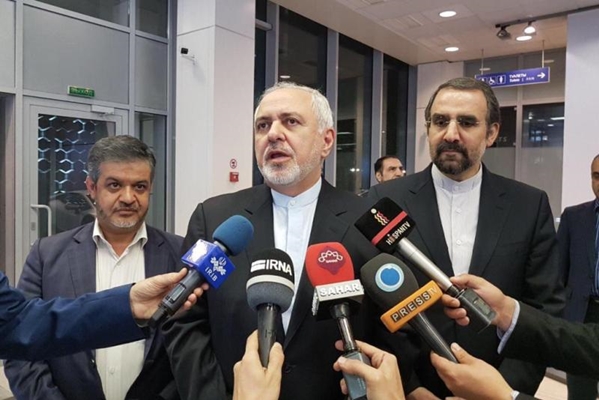
Zarif made comment while talking to reporters in the Russian capital, Moscow.

“Iran has shown the whole world that it has remained committed to its obligations, and now it is the world’s turn to live up to its commitments with regards to Iran,” said the top diplomat.

“I am confident that Russia will take the lead in this regard,” he said, shortly before his meeting with Russian Foreign Minister Sergei Lavrov.

He said Iran is a patient nation, but will resist in order to secure its rights.

“Over the past year, the Islamic Republic of Iran has shown strategic patience in the face of US efforts to scuttle the JCPOA, proving that it has always remained committed to its international obligations,” he added.

“Over the past year, the United States has not only violated the UN Security Council resolution and the JCPOA, but has, through pressure and threats and bullying, tried to make other countries breach the JCPOA and, more importantly, the UN Security Council resolution,” he said.

Zarif underlined the last measure adopted by the United States on May 4, 2019 made it impossible to implement the JCPOA.

“Through pressure and threats and bullying, the US tried to stop nuclear activities carried out within the framework of the JCPOA”, the top diplomat noted.

“One of these activities was the transfer of Iran’s heavy water and enriched uranium, and today the Islamic Republic of Iran has decided to adopt some measures authorized by the JCPOA in response to the US move and the inaction of the European countries which have stayed in the JCPOA,” he said.

Zarif noted Iran’s measure gives the remaining parties to the JCPOA 60 days to ensure the country’s rights under the nuclear deal, making it possible for Iran to snap back to all of its commitments under the agreement.

“Iran’s move is not outside the JCPOA, nor does it mean withdrawal from the JCPOA. Rather, our measure runs counter to the US action, i.e., the violation of the JCPOA and [UN Security Council] resolution 2231,” he said.

Zarif then touched upon President Rouhani’s letters to the five countries which are parties to the JCPOA.

“Although the letters we wrote for heads of state of the 4+1 countries are legally the same, our viewpoints toward different members of the 4+1 group are not the same,” the foreign minister said.

“We will never regard partners who stood by Iran in tough times in the same way as others,” he said.

He noted Iran’s choice is always “dialogue.”

“We are a nation of dialogue and our history is one of dialogue,” said the top diplomat.

Zarif said the remaining parties to the JCPOA have, so far, adopted good stances, and now they should be prepared, too, to take action to preserve an important diplomatic accomplishment.

“Iran does not want anything more than its rights under the JCPOA,” he said.

Zarif reiterated whenever they make good on their obligations, Iran will snap back to all of its commitments under the JCPOA.

He said Iran will remain committed to the JCPOA to the same extent that they fulfill their commitments.

His comments came hours after Tehran scaled down its obligations under the Iran nuclear deal following Washington’s illegal withdrawal from the deal and the Europeans’ failure to secure the country’s interests under the agreement.

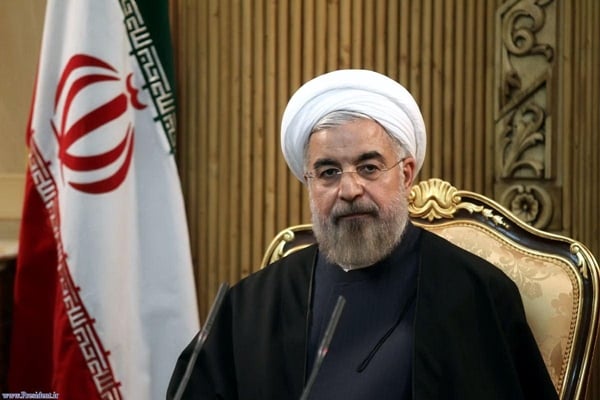
Iranian President Hassan Rouhani announced on Wednesday that Iran would stop two of its commitments under the Iran nuclear deal known as the Joint Comprehensive Plan of Action (JCPOA).

“Today, we announced to the heads of the five countries [which are parties to the JCPOA] that we would stop two actions that we’ve been doing so far,” said Rouhani.

He said Iran would stop selling its surplus “enriched materials” and “heavy water.”

“To put it simply, those two actions are [to stop] two sales. Whenever our enriched materials reached 300 kilograms, we would sell the surplus to that amount to another country and get yellow-cake in return. The second sale pertains to heavy water. Whenever our heavy water reserves exceeded 130 tonnes, we would sell the surplus to other country. And today we are stopping those sales,” he said.

“As of today, we will sell neither our enriched uranium, nor our heavy water,” the president stressed.

He said the measure will remain in effect for 60 days.

“If they come to the negotiating table in 60 days and secure our key interests, that is [interests pertaining to] oil and banking transactions, we will return to the first place [and roll back our measures],” he said.

“If we don’t reach agreement at the end of those 60 days, we will take two more actions,” President Rouhani noted.

“Under the JCPOA, Iran has undertaken to stop its enrichment level at 3.67 [percent purity]; we would stop that,” he said.

‘Iran Can Snap Back to 20% Uranium Enrichment in 4 Days’

Salehi

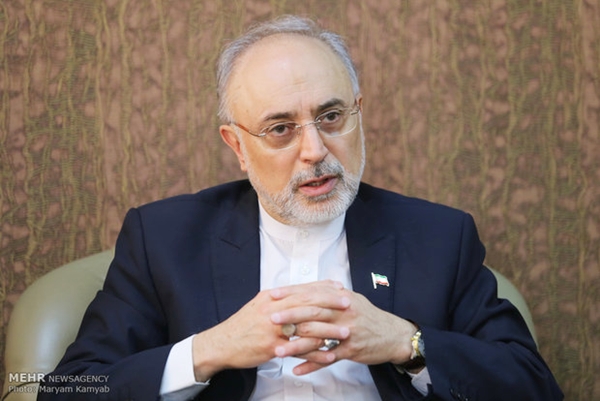
Head of the Atomic Energy Organization of Iran Ali-Akbar Salehi made the comment after President Hassan Rouhani announced that the country would suspend part of its obligations under the Iran nuclear deal known as the Joint Comprehensive Plan of Action (JCPOA).

“Iran can snap back in a moment, and if necessary, we are able to restart uranium enrichment at 20-percent level in four days,” said Salehi.

He added Iran will not abide by some of its commitments under the JCPOA for two months.

“We will no longer be obliged to comply with the 300-kilogram limit for the production of uranium enriched up to a level of 3.67-percent purity as well as the 130-tonne limit for the production of heavy water. We will no longer have any obligation to comply with those production ceilings,” he said.

“That was the president’s message today. He meant we will not be obliged to abide by these production ceilings for a period of 60 days,” he noted.

“If the other parties are able to meet the Islamic Republic of Iran’s demands within those 60 days, then Iran can reverse the trend and begin to fulfill all of its commitments under the JCPOA again,” Salehi underlined.

“But if they continue to breach their commitments and fail to make good on their obligations as stipulated in the JCPOA, then Iran will take the next steps,” he said.

Salehi reiterated President Rouhani’s statement that the suspension of Iran’s commitments does not mean the country is withdrawing from the agreement.

Full Text of Iran’s Statement on ‘Reducing’ JCPOA Commitments

What follows is the full text of the statement released on May 8, 2019:

In the Name of God

The Supreme National Security Council of Iran issued an order on May 8, 2019, to stop the country’s implementation of some of its measures under the Joint Comprehensive Plan of Action (JCPOA) in a bid to protect the security and national interests of the Iranian people, and exercise the Islamic Republic’s rights stipulated in the Articles 26 and 36 of the JCPOA.

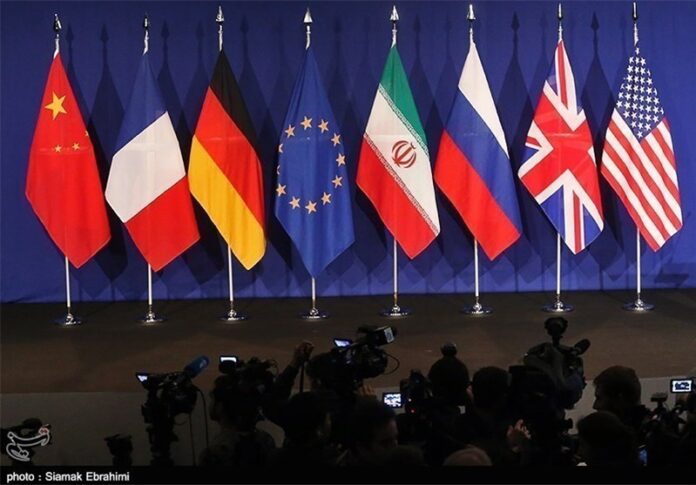
The decision was declared to the leaders of the member states of the JCPOA – including Germany, the UK, China, Russia, and France – in an important letter by President Hassan Rouhani, who is also the head of the Supreme National Security Council.

It’s been a year since the US’ illegal withdrawal from the JCPOA, and its breach of what passed by the UN Security Council. In violation of all internationally-recognized principles and in an instance of outright bullying, the country has re-imposed its unilateral and illegal sanctions against Iran. This blatant bullying behaviour by the US has unfortunately received no appropriate and reciprocal response from the UN Security Council or countries remaining in the deal.

During the past year, Iran has shown maximum self-restraint and given considerable time to other parties to the JCPOA upon their request, so that they could compensate for the impacts and repercussions of the US’ withdrawal. During the time, the “Joint JCPOA Commission” held two meetings at the level of deputy foreign ministers and two meetings at the level of foreign ministers. At these meetings, the countries remaining in the JCPOA explicitly admitted that the removal of sanctions and Iran’s enjoyment of the economic benefits resulting from the deal are vital parts of the JCPOA. To realize this objective, they undertook to devise “practical solutions” in order to normalize and even promote economic cooperation with Iran.

Iran Gives Europe 60 Days to Fulfil Its Obligations

However, the Iranian nation’s goodwill gesture and smart self-restraint has remained unanswered, and except for some political statements, no operational mechanism has been established to compensate for the US sanctions. Therefore, in order to exercise its rights and return balance to the two sides’ demands under the deal, the Islamic Republic has been left with no choice other than “reducing its commitments”.

Hereby, we announce that the Islamic Republic of Iran, at the current stage, does not consider itself anymore committed to observing the limits agreed under the deal on its stocks of enriched uranium and heavy water stocks. The countries remaining in the nuclear deal are given 60 days to meet their commitments, especially in the banking and oil sectors. In case these countries fail to meet Iran’s demands during the two-month period, the Islamic Republic of Iran will, in the next stage, stop observing the limits on the level of its uranium enrichment, as well as the measures related to the modernization of Arak heavy water reactor. Whenever our demands are met, we will, to the same extent, resume the suspended commitments. Otherwise, the Islamic Republic will be suspending more commitments stage by stage.

The Islamic Republic of Iran stands ready to continue its consultations with the remaining parties to the deal at all levels, but it will swiftly and firmly react to any irresponsible measure, including returning the [nuclear] case to the UN Security Council or imposing more sanctions. In his letter to the leaders of JCPOA countries, President Rouhani has explicitly underlined the way Iran will react.

Now the Islamic Republic of Iran has clearly informed the JCPOA parties and the international community about its expectations. We entered into the nuclear talks with good faith, clinched the deal with good faith, and gave enough time to other JCPOA parties with good faith following the US’ withdrawal. Now it’s time for the countries remaining in the JCPOA to show their good faith and take serious and practical steps to save the JCPOA.

The window which is currently open for diplomacy will not remain open for long, and the US and other JCPOA parties will be held fully responsible for the failure of JCPOA and any possible consequences it may have.

Iran Gives Europe 60 Days to Fulfil Its Obligations

Rouhani announced on May 8, 2019 that Iran would stop two of its commitments under the Iran nuclear deal known as the Joint Comprehensive Plan of Action (JCPOA).

“Today, we announced to the heads of the five countries [which are parties to the JCPOA] that we would stop two actions that we’ve been doing so far,” said Rouhani.

He said Iran would stop selling its surplus “enriched materials” and “heavy water.”

“To put it simply, those two actions are [to stop] two sales. Whenever our enriched materials reached 300 kilograms, we would sell the surplus to that amount to another country and get yellowcake in return. The second sale pertains to heavy water. Whenever our heavy water reserves exceeded 130 tonnes, we would sell the surplus to other country. And today we are stopping those sales,” he said.

“As of today, we will sell neither our enriched uranium, nor our heavy water,” the president stressed.

He said the measure will remain in effect for 60 days.

“If they come to the negotiating table in 60 days and secure our key interests, that is [interests pertaining to] oil and banking transactions, we will return to the first place [and roll back our measures],” he said.

“If we don’t reach agreement at the end of those 60 days, we will take two more actions,” President Rouhani noted.

Under the JCPOA, Iran has undertaken to enrich its uranium at the maximum level of 3.67 percent purity, Rouhani said.

Following the 60-day period, Iran will not observe that limit any more.

He noted the second of the next two actions Iran would take if no agreement is reached in these 60 days would be to make a decision on whether or not the other parties to the JCPOA should still cooperate in the renovation of the Arak Heavy Water Reactor as stipulated in the nuclear deal.

“In the second phase, too, Iran will give them another 60 days. If still no agreement is reached, we will take yet another action,” he said.

He noted if the other parties to the JCPOA want to send Iran’s case to the UN Security Council, Iran will take firm action as stipulated in five letters sent on behalf of President Rouhani to ambassadors of those five countries in Iran.

He underlined that Iran has not withdrawn from the JCPOA, and has only scaled down its commitments under the deal.

President Rouhani also lashed out at the United States for illegally and unilaterally withdrawing from the JCPOA a year ago. He said Washington expected Iran to follow suit right after the US pulls out of the treaty. However, he added, Iran remained patient and acted with prudence.

Full Text of Iran’s Statement on ‘Reducing’ JCPOA Commitments

“By pulling out of the JCPOA, the US wanted to make Iran withdraw from the agreement the following day, so that it would be able to take Iran’s case to the UN Security Council and ease the burden from US shoulders and increase pressure on Iran,” he said.

Nevertheless, the president noted, Iran’s prudence kept it from falling into Washington’s trap.

He said the problem is that the Europeans no longer regard the US as the “master” in political and legal issues, but still see Washington as having the final say in economic issues.

“Unfortunately, in the economic domain, European companies and banks still regard the United States as ‘the master,’ and this wrong way of thinking results in them being unable to make proper decisions for the interests of Europe, the region and the world, and hence, they unfortunately buckle under pressure,” he said.

Elsewhere in his remarks, President Rouhani recalled that the International Atomic Energy Agency (IAEA) has, on numerous occasions, corroborated Iran’s compliance with all of its commitments. He said the parties to the JCPOA have also confirmed that Iran has not been able to reap all the benefits of the deal following Washington’s withdrawal.

“So, everyone accepts that there is an imbalance,” he said.

Imran Khan Says Pakistan Keen to Complete Iran Gas Pipeline

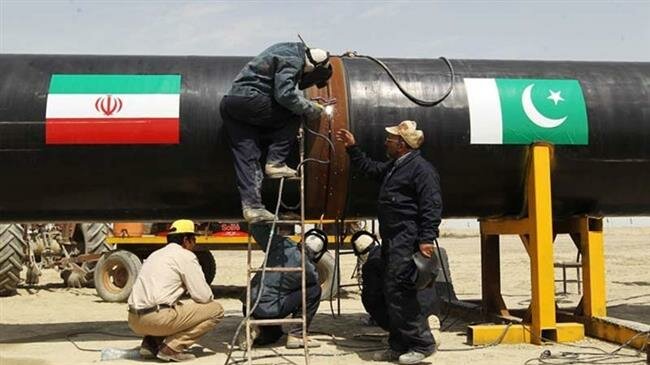
Local media reported on Tuesday that Khan had issued fresh directives to relevant Pakistani authorities on the completion of the Iran-Pakistan gas pipeline, also known as the peace pipeline.

He has also urged Pakistani Foreign Minister Shah Mahmood Qureshi to adopt the necessary measures and work to solve all issues with Iran pertaining to the project through mutual understanding and reconciliation.

The prime minister said Tehran and Islamabad should work jointly and review the agreed price of the gas and also complete the project.

Khan further described the sanctions against Iran as the biggest hurdle for the implementation the mega project.

While Iran has completed its part of the gas pipeline project with a total investment of above $2 billion of investment, Pakistan has fallen behind the target to take delivery of gas, initially scheduled for 2014.

The joint project was launched in 2010 and aims to construct 1,800 kilometers (over 1,100 miles) of pipeline from Iran to Pakistan.

Iran plans to deliver 21.5 mcm/d of gas to Pakistan through the project.

Iran has repeatedly called on energy-starved Pakistan to initiate work on its part of the gas pipeline, but those pleas have fallen on deaf ears except for pledges from some Pakistan officials that they were still committed to the project.

Iran’s Minister of Petroleum Bijan Zangeneh said in January 2018 that Pakistan is not cooperating on the construction of a much-delayed pipeline to pump natural gas to the country.

“Pakistan has been falling short and is not cooperating on the construction of the pipeline. It is likely that the US and Saudi Arabia have been doing some sort of sabotage,” the minister said, acknowledging a long-held view that Pakistan was under pressure to follow other options, including the construction of the Turkmenistan-Afghanistan-Pakistan-India (TAPI) gas pipeline.

The directives were issued after the Pakistani prime minister made his first historic visit to Iran in April at the head of a high-ranking political and economic delegation, the

During his two-day stay in Tehran, he held important meetings with Leader of the Islamic Revolution Ayatollah Seyyed Ali Khamenei and Iranian President Hassan Rouhani.

Iran ‘Diminishes’ JCPOA Commitments in Reaction to US Pullout

Nuclear Deal Talk, JCPOA, Flags

In a statement on Wednesday, the SNSC said as of May 8, 2019, Iran does not commit itself to observing restrictions of stockpiling enriched uranium and heavy water given the US’ violations of the nuclear deal.

The statement also said that Iran gives other JCPOA parties 60 days to implement their commitments, especially in the banking and oil sectors.

Once they fulfil that, Iran will restart implementing its commitments. It’s now the other parties’ turn to show their good faith, the statement added.

Iran showed maximum self-restraint during the past year and gave other parties considerable time to compensate for the impact of the US bans, the SNSC said.

However, it added, Iran’s goodwill gesture didn’t receive any response, and no operational mechanism was established.

So Iran has been left with no other choice but to diminish its commitments to bring back balance to the nuclear deal and secure its interests, the statement added.

Earlier in the day, Iranian Deputy Foreign Minister for Political Affairs Seyyed Abbas Araqchi handed over a letter from President Hassan Rouhani to ambassadors of countries remaining in the Iran nuclear deal.

The ambassadors of Germany, Britain, China, Russia and France were invited to the Iranian Foreign Ministry on Wednesday, and received the president’s letter from Deputy FM Araqchi.

Full Text of Iran’s Statement on ‘Reducing’ JCPOA Commitments

The letter informs the leaders of the five countries about a decision by the Supreme National Security Council of Iran to “stop the fulfilment of some of the Islamic Republic’s commitments under the Iran nuclear deal.”

Another letter was also sent on Wednesday morning by Iranian Foreign Minister Mohammad Javad Zarif to Federica Mogherini, the EU Foreign Policy Chief and the coordinator for the Joint Commission on the JCPOA. The letter contains the details of Iran’s action with regards to the JCPOA.

President Rouhani also on Tuesday announced Iran’s reciprocal measures with regards to the JCPOA following Washington’s withdrawal from the deal and the Europeans’ foot-dragging on with regards to securing Iran’s interests under the agreement.

Why Wrestling Is Most Respected Iranian Sport

Wrestling is one of the oldest sports in the world dating back over 5,000 years ago during the times of the Sumerians.

It is the oldest and most widely distributed sport globally. Different wrestling styles were developed by Romans, Greeks, Persians, Egyptians, and other cultural heritage.

A lot of people are familiar with the sport, but the majority does not know the connection between religion, social effects, and wrestling in Iran. This article gives you facts surrounding wrestling and its importance to Iran.

  1. Wrestling is a culture deeply rooted in Iran’s history

In Iran, wrestling is more than a sport. It is a culture that is deeply rooted in its history. Before the game became globally recognized with rules and regulations and proper sports gear, wrestlers in Iran were already wearing Wrestling belts called Kurds. This belt is the same one people in the Middle East wear today.

The Zoroastrianism belt was an indicator of one’s religious duties and was fastened before prayers. It has three knots that represented good thoughts, good deeds, and good words and was also a representation of the inner spiritual wrestling between good and evil.

This religious representation can be seen today in Iran’s House of Strength, a gym dedicated to practicing traditional wrestling that combines wrestling and reading of mystical and spiritual poems.

During the Reza Shah era, wrestling attracted official attention as an Iranian tradition which saw the building of new gyms. The first club was built in 1921; the same period wrestling became a global sport with defined international regulations. The Second World War interrupted the sport, but it picked up steadily after the war and saw Iranian wrestler win tonnes of medals during championships. With live sports streaming, watching Iranian wresters do what they do best is as easy as clocking a button.

  1. Wrestling is connected to politics and political development

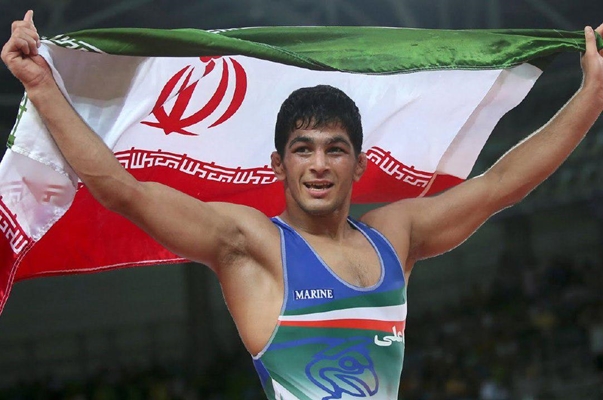
Today, Iran boasts of athletes in all sorts of games ranging from athletics, volleyball to basketball, but wrestling remains the most recognized. Beyond a cultural phenomenon, Iranian wrestlers have for a long time used their public appeal as heroes to convey people’s grievances to the government.

For instance, Gholam-Reza Takhti was a renowned wrestler who publicly opposed the Shah and spoke out against him. He died at the age of 37, and his death was reported as suicide which shocked a lot of people. In fact, Iranians blamed the Shah for his death classifying it as a murder.

After the 1979 revolution, no Iranian was allowed to wrestle an Israeli and wrestling remained a symbol of standing up to evil such as dictatorship and oppression, and the Israeli occupation of Palestinian territories.

No report has been published about a wrestler using their influence to transmit the people’s political grievances after 1979. This is thought to be a result of the government successfully engaging with the athletes. The leaders including the president and other prominent officials meet and listen to the athletes and consult with them about important issues facing the country.

Conclusion

Wrestlers in Iran are role models in humility, morality, and manhood. They were responsible for solving quarrels and helping people stand against injustice. This is why wrestling is so prevalent in Iran.