Tuesday, January 13, 2026
Home Blog Page 3253

Iran Gives Priority to Talks with Regional States, Not US

Iran Gives Priority to Talks with Regional States, Not US

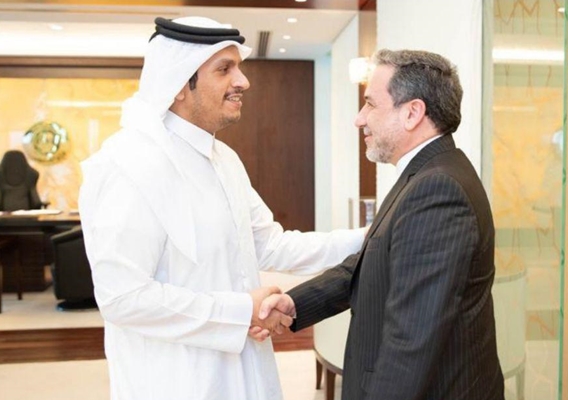
He made the remarks in a Tuesday meeting with Qatari Deputy Prime Minister and Foreign Minister Mohammed bin Abdulrahman Al Thani.

During the meeting, the Iranian official referred to the US policy of exerting maximum pressure and wage an economic war on the Islamic Republic and said full security cannot be established in the region unless the national security of all regional states is established and their economic interests are secured.

“The Islamic Republic has always played its role in establishing regional security, but the US, the Zionist regime and the states accompanying them must take responsibility for the repercussions of their acts in the region,” he said.

Araqchi once again ruled out the possibility of any negotiations with the US and underlined that the Islamic Republic gives priority to talks with the regional states.

“By establishing such mechanisms as the regional dialogue forum in the Persian Gulf and signing a non-aggression treaty, we can pave the way for confidence building and constructive interaction among regional states,” he said.

The Qatari official, in turn, welcomed mutual talks and meetings between the two countries’ officials.

He also expressed concern over the critical situation created in the region and called for continuation of negotiations between Iran and Qatar.

Ayatollah Khamenei Appoints New Air Defence Commanders

Ayatollah Khamenei Appoints New Air Defence Commanders

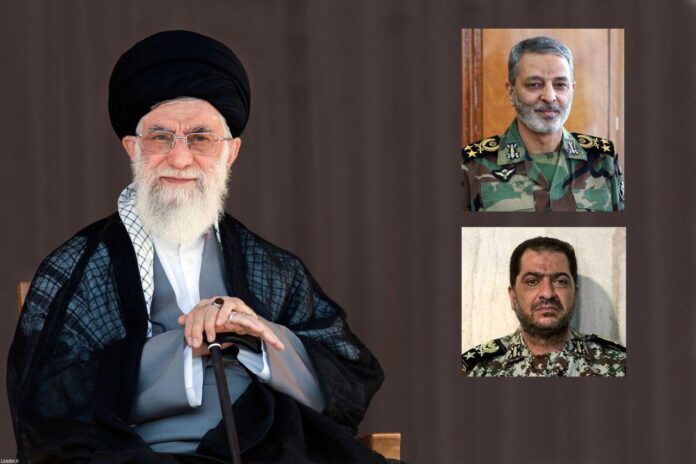
In a Tuesday decree, the Leader appointed Major General Abdolrahim Mousavi, the current chief-commander of the Iranian Army, as the new commander of Khatam al-Anbia Air Defence Base.

In the decree, the Leader urged General Mousavi to use all the facilities and capacities of the country’s Armed Forces to defend the Iranian airspace and reinforce the integrated and strong network of Iran’s air defence command and control.

In a separate decree, the Leader appointed Brigadier General Alireza Sabahifard as the commander of the newly established Air Defence Force of the Iranian Army.

General Sabahifard was chosen upon the joint recommendation of the General Staff of the Iranian Armed Forces and the Khatam al-Anbia Air Defence Base, and the recommendation of the Army chief.

In his decree, Ayatollah Khamenei called on General Sabahifard to pay special attention to the internal growth and strengthening of the Air Defence Force, particularly through professional training of forces and up-to-date maintenance and optimum use of the equipment.

The new commander was also urged to keep the Air Defence Force vigilant and use various defence methods while maintaining an effective interaction with the Khatam al-Anbia Air Defence Base.

Sabahi Fard was previously in charge of the Khatam al-Anbia Air Defence Base.

Will Russia Remain Neutral in Case of Iran-US War?

Earlier this month, Russian President Vladimir Putin declared his country’s impartial stance towards the recent escalation of tension between Iran and the US.

Speaking in a joint press conference with his Austrian counterpart, Putin explicitly said Russia is not “a fire brigade” and could not “rescue everything” as tension rise between the US and Iran.

Many western media highlighted the statement by Putin, saying that it was kind of green light to Washington.

However, Putin did not clarify who he was addressing: Iran, Europe, the US, or the international crisis caused by Trump’s warmongering?

Some political experts say it does not matter exactly who Putin was addressing in the statement; in fact, the statement by the Russian president is somehow his declaration of impartiality in the face of sanctions, and emphasises that no one should expect Moscow to do anything.

Ettela’at newspaper, which is Iran’s oldest daily, in a recent article criticized Putin for making those remarks.

“Putin was expected to make remarks that strongly deterred the US escalation in the Persian Gulf against the Islamic Republic of Iran,” the newspaper said.

“At least he could take a similar stance to that of Europeans. Federica Mogherini said in early May that she and the foreign ministers of Germany, France and Britain were urgently calling on the US to show maximum restraint and avoid escalation that would lead to military crisis,” reads the piece.

Putin has made a clear message that Iran should keep its own expectations of potential Russian help soberly modest. However, it could be speculated that Putin’s reaction in the wake of a full-scale conflict between Iran and the US might be different.

Russia’s direct involvement in the US-Iran conflict, should such a confrontation take place, is highly improbable.

However, Moscow may take certain cautious steps in order to strengthen Iran’s deterrence capacities.

It is doubtful that Moscow will make any radical changes to her policy of not supplying Tehran with offensive weapons, but that doesn’t mean Russia cannot enhance Iran’s defense capabilities, The Moscow Times reported.

Recent years’ military-to-military ties between Tehran and Moscow could provide a picture of what pragmatic steps Moscow may take to assist Tehran. Since 2011 Russian-Iranian cooperation evolved around three main categories. Arms sales, highlighted by the delivery of S-300 PMU2 systems; intelligence sharing focused on ISIS and Syrian battles; and operational cooperation mainly in the form of battle coordination and joint military operations in Syria. These unique pillars of the interplay between the two countries, accompanied by joint commissions to facilitate them have institutionalized the military cooperation between Moscow and Tehran far beyond Syria.

Russian involvement in the U.S.-Iran conflict is likely to be broadly based on this threefold pattern.

Moscow ’s first option of responding to the escalation between Iran and the US could be the fortification of Iran’s air defense system capacities to suppress US air superiority. Russian involvement in Syria has demonstrated that Kremlin is confident about using advanced air defense systems to change the balance of forces amid ongoing battles.

Moscow’s decision to provide the Syrian Army with S-300 units in Syria in response to a Russian reconnaissance plane being mistakenly shot down by the Syrian military is a clear example of that. It showed Russian willingness to readjust the military balance through the swift supply of arms.

Thus Russia may reserve the option to improve Iran’s defensive capabilities via the supply of more advanced units, should such a necessity arise.

Providing S-400 batteries or the ground-based Electronic Warfare systems including Borisoglebsk-2 and Krasukha-4S which have the potential to hamper US air superiority could constitute a part of Russia’s response, the report by Moscow Times added.

One of the other forms of Russian response can potentially take is a deployment of Russian military assets to Iran. Russia has recently demonstrated that it is ready to deploy limited military units to contested countries in order to combat threats to her interests.

The case of Tu-160 and limited force deployment in Venezuela to deter US threat in support of President Nicolas Maduro’s government is the latest example, putting forward strategic military deployments as a possible option. Teheran is also likely to support Russian troops being stationed on Iranian territories.

These developments raise the possibility that Russia may be willing to apply the same model to support the Iranian government. The move will have limited operational value, though it sends a strong signal of political support to Washington.

However, this policy could work only as a prevention tool, discouraging a potential opponent from engagement in a military conflict. The moment violence escalates, stationing troops will no longer be an option for Russia.

Finally, Russia may provide Iran with operational intelligence prior to or during the break-out of the war with the US.

Ex-Vice President of Iran Confesses to Murder of Wife

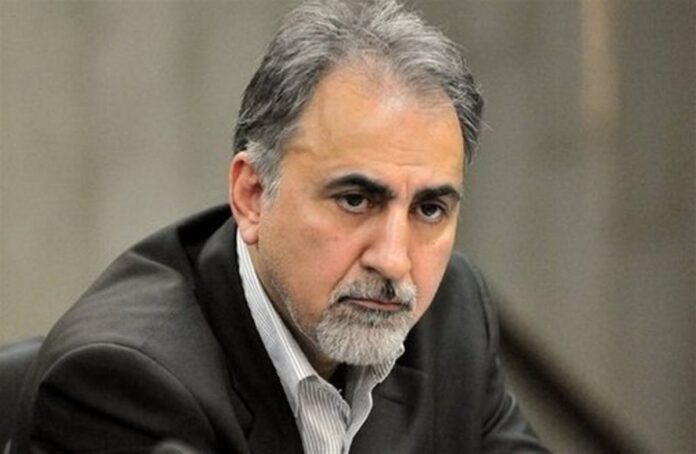
Najafi’s wife, Mitra Ostad, was murdered at her home in Tehran on Tuesday. Police found her body with several gunshots in her chest.

Najafi has reportedly gone to the Criminal Police headquarters in person and confessed to the murder.

Najafi had resigned from the post of Tehran’s mayor in April 2018, citing failing health for leaving the office.

A graduate of the Massachusetts Institute of Technology (MIT), 67-year-old Najafi was elected mayor of Tehran in August 2017.

Affiliated with the reformist political faction, he used to serve as the minister of education and the minister of culture in various administrations.

He also took the helm at Iran’s Cultural Heritage, Handicrafts and Tourism Organization (ICHTO) during President Hassan Rouhani’s first term, but resigned after six months.

Medieval Underground City Unearthed in Central Iran

Medieval Underground City Unearthed in Central Iran

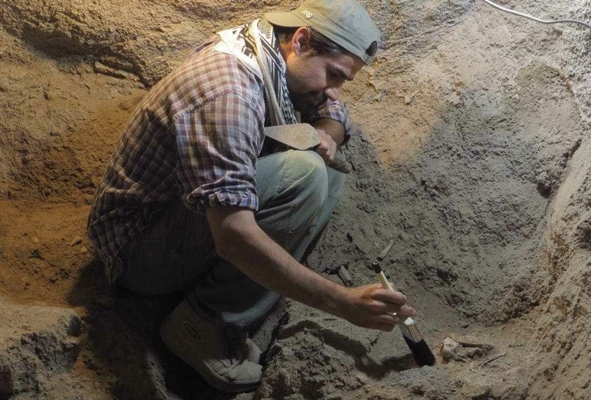
The medieval underground city dates back to about 800 years ago, when the Ilkhanate dynasty ruled the country.

This is not the first time that an underground city is being unearthed in Hamadan. Earlier, Samen and Arzan Fud cities were unearthed by Iranian archaeologists with some experts estimating that the cities date back to the Medieval Era.

Saleh Abad city was originally discovered about three years ago. Provincial archaeologists began to study the newly unearthed city for 20 days. The relics retrieved from the city include pieces of potteries from Islamic era.

Preliminary studies show that the ancient city was used by the residents of Hamadan as a hideout during the World War II, when the soviet soldiers began to pass through it on their way to the north.

Unfortunately, severe floods have led to huge alluviums which should be discharged first. To this end, some comprehensive studies should be conducted on this medieval underground city.

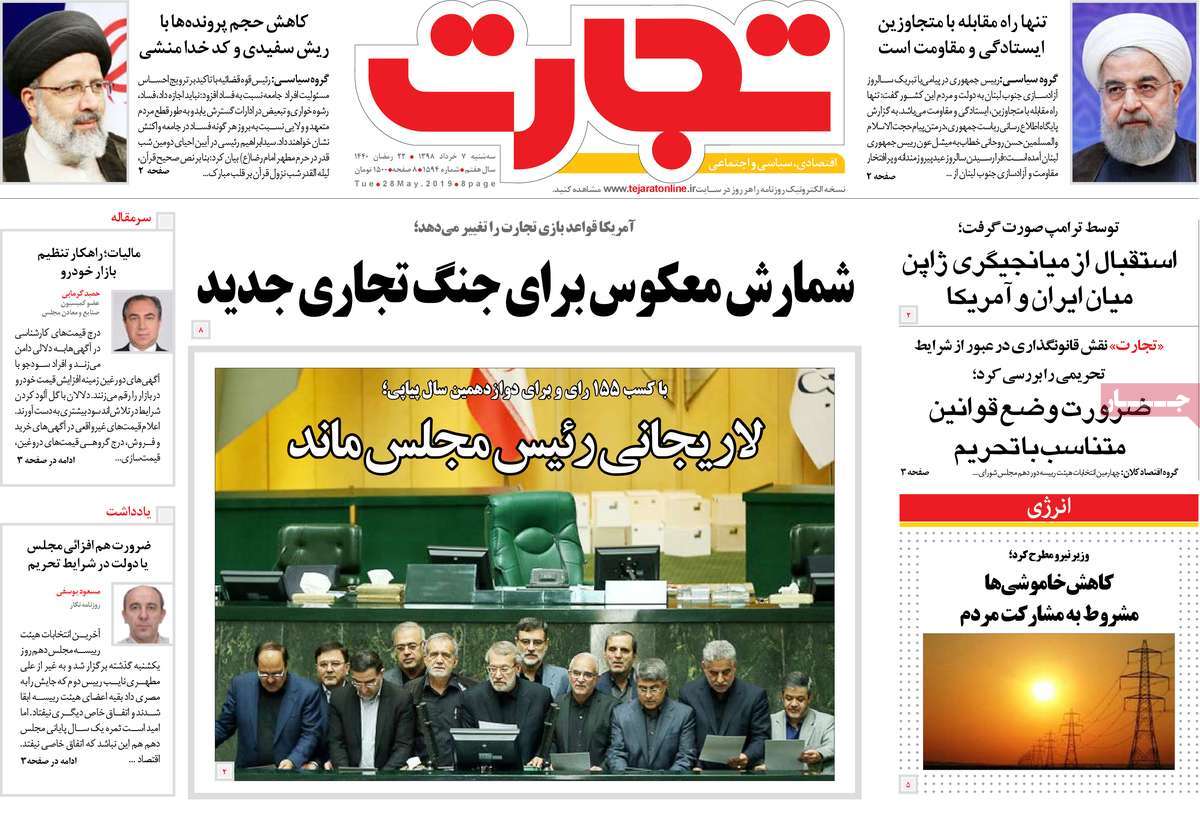
A Look at Iranian Newspaper Front Pages on May 28

A Look at Iranian Newspaper Front Pages on November 19

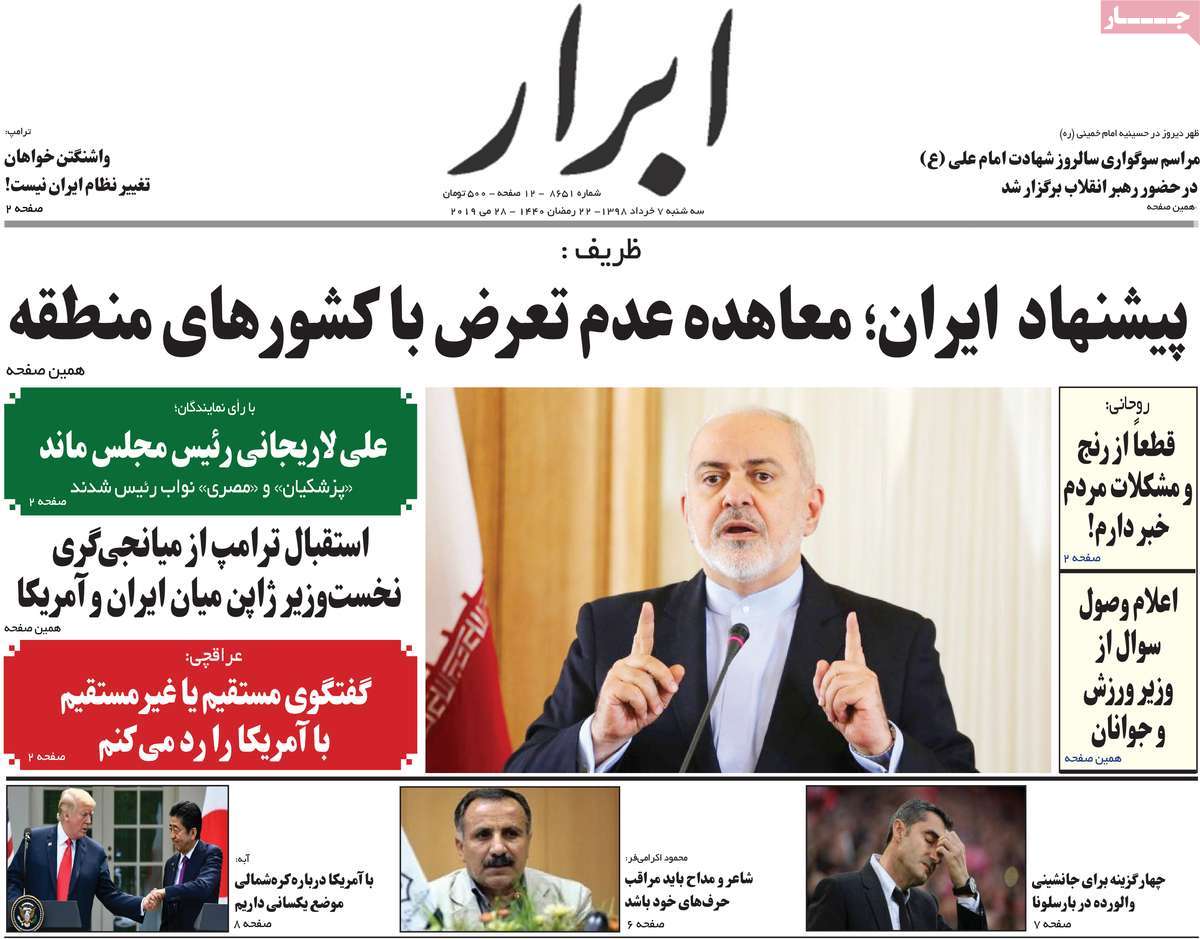
Abrar:

1- Trump Welcomes Japan PM’s Mediation between Iran, US

2- Araqchi Rejects Direct, Indirect Talks with US

3- Trump: Washington Not after Regime Change in Iran!

A Look at Iranian Newspaper Front Pages on May 28


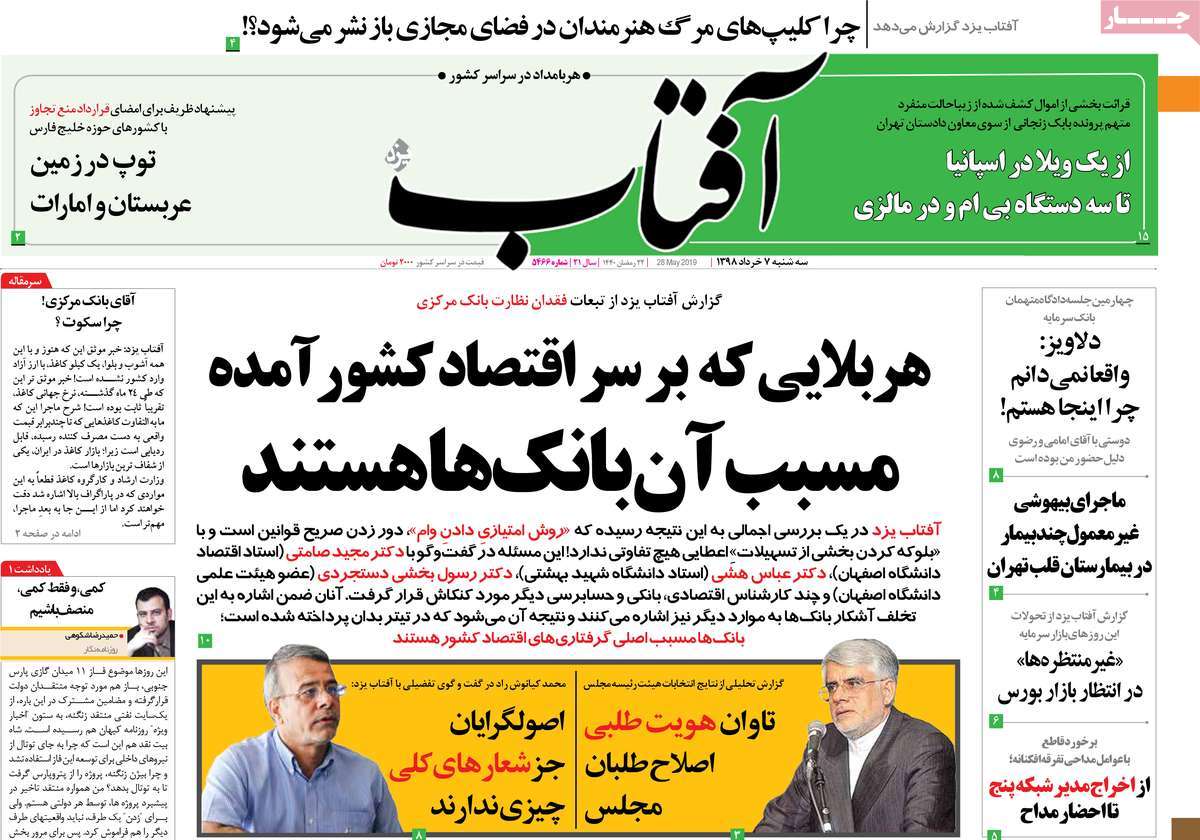
Aftab-e Yazd:

1- Ball in Court of Saudi Arabia, UAE

* Zarif Calls for Non-Aggression Treaty with PG States

A Look at Iranian Newspaper Front Pages on May 28


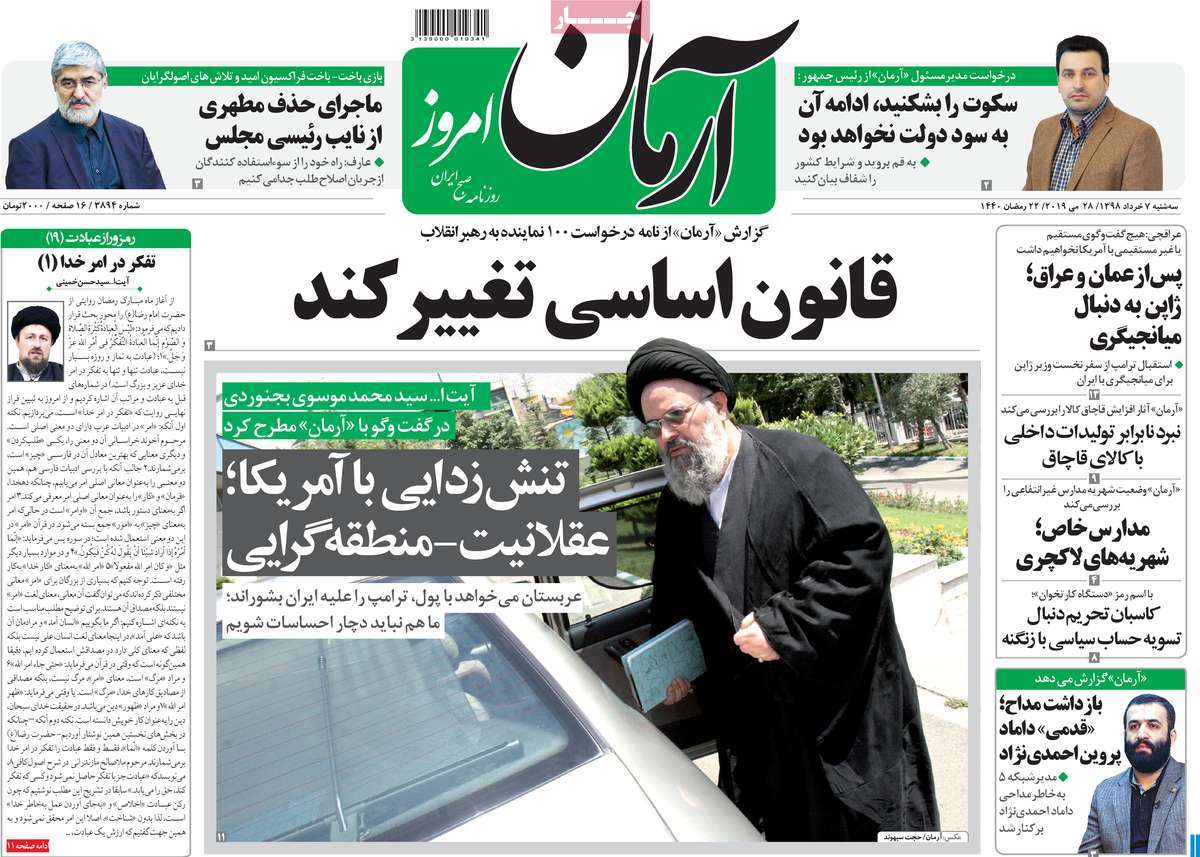
Arman-e Emrooz:

1- After Oman, Iraq, Now Japan Looking for Mediation

2- Cleric Urges Easing Tensions with US; Rationality, Regional Orientation

* Saudi Arabia Wants to Provoke Trump against Iran Using Its Petrodollars

A Look at Iranian Newspaper Front Pages on May 28


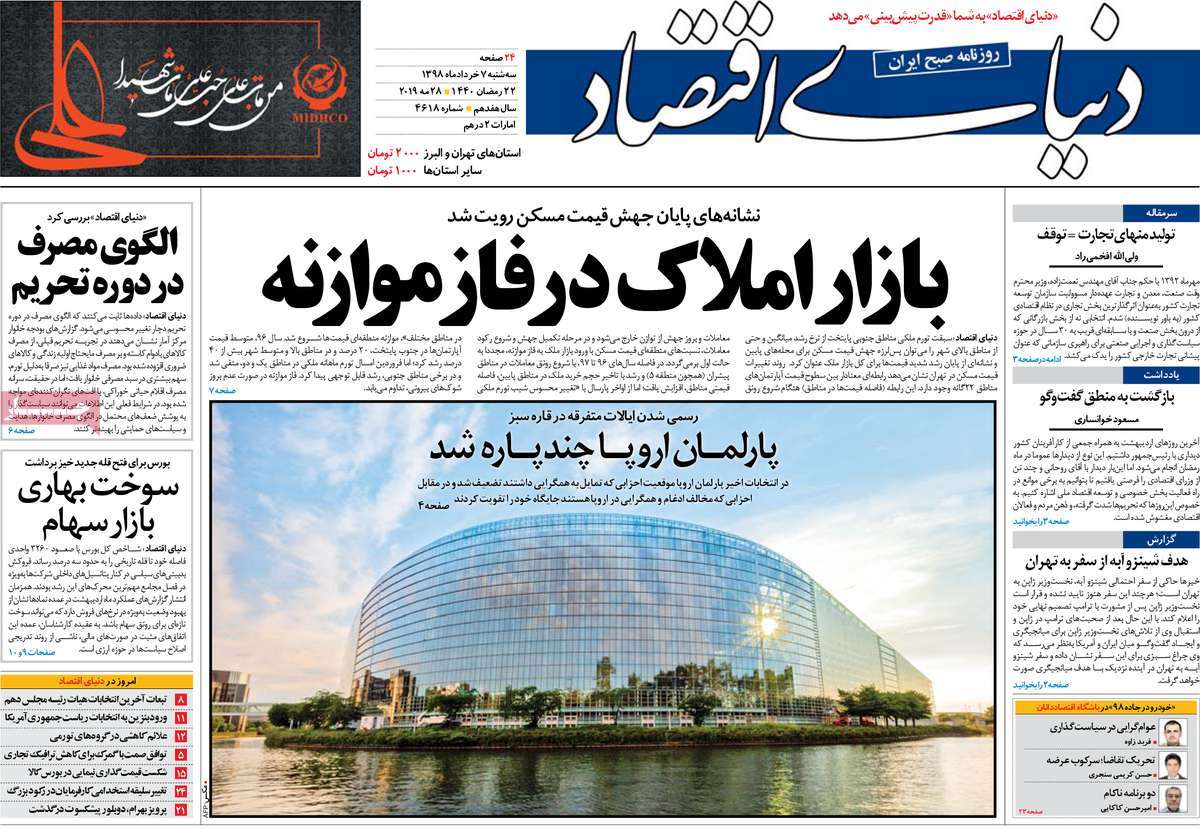
Donya-ye Eqtesad:

1- European Parliament Disintegrated

A Look at Iranian Newspaper Front Pages on May 28


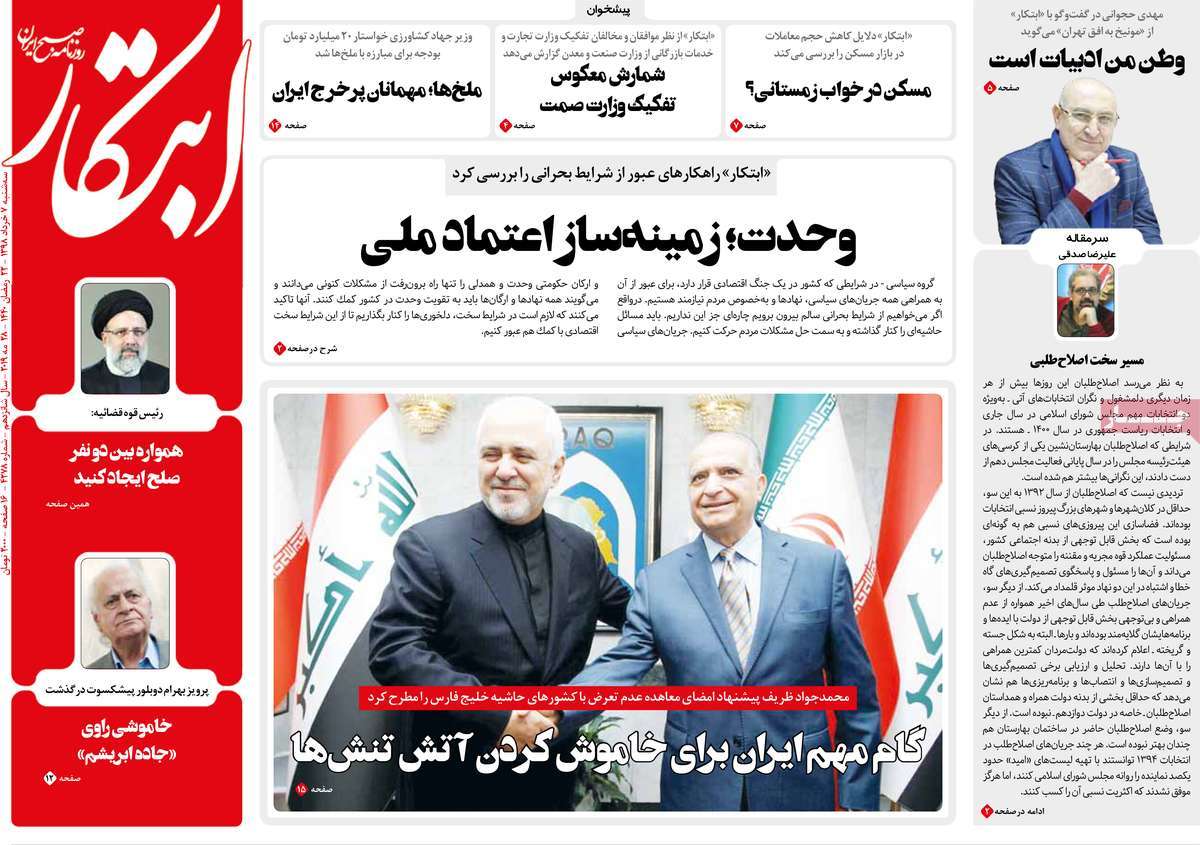
Ebtekar:

1- Iran’s Major Step to Contain Fire of Tensions

A Look at Iranian Newspaper Front Pages on May 28


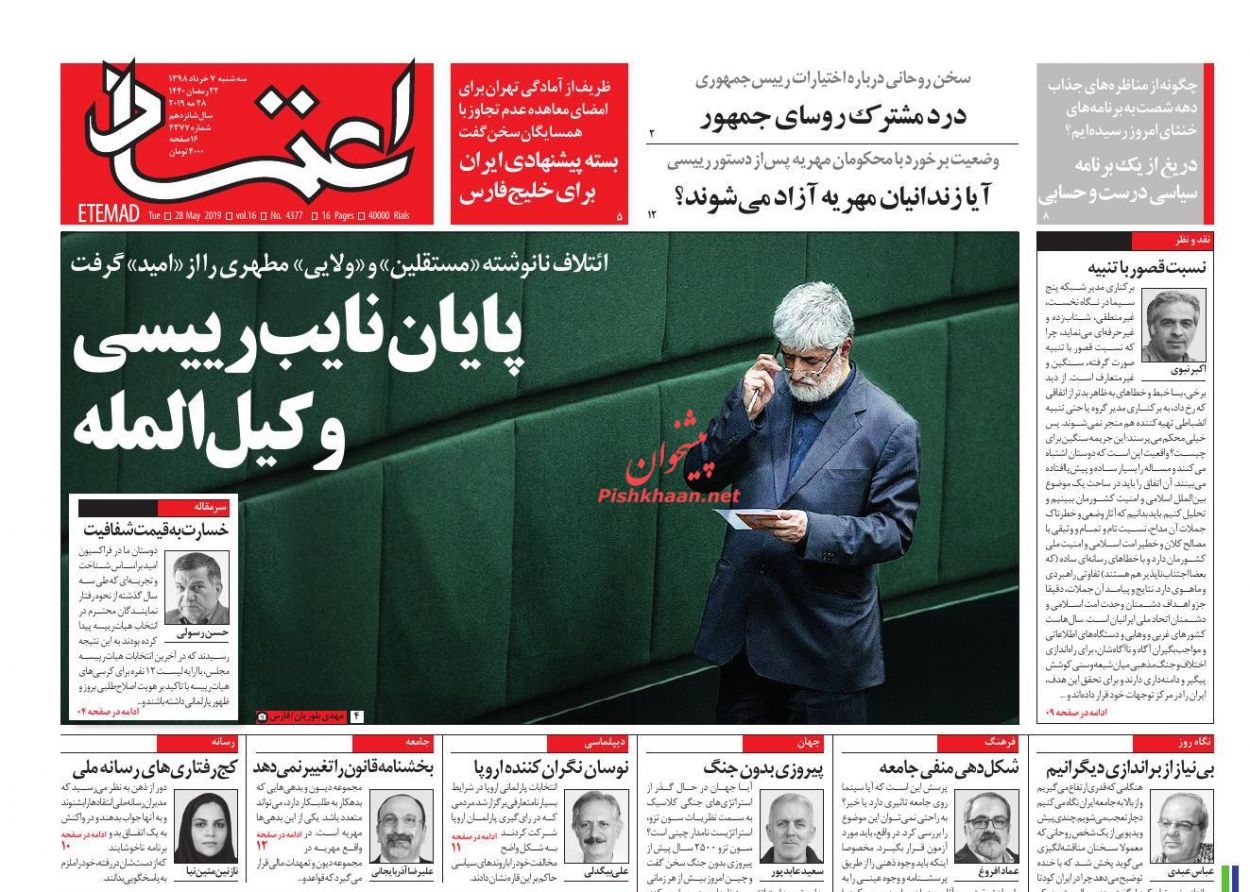
Etemad:

1- Iran Proposes Package for Persian Gulf

* Zarif Says Tehran Ready to Sign Non-Aggression Pact with Neighbours

A Look at Iranian Newspaper Front Pages on May 28


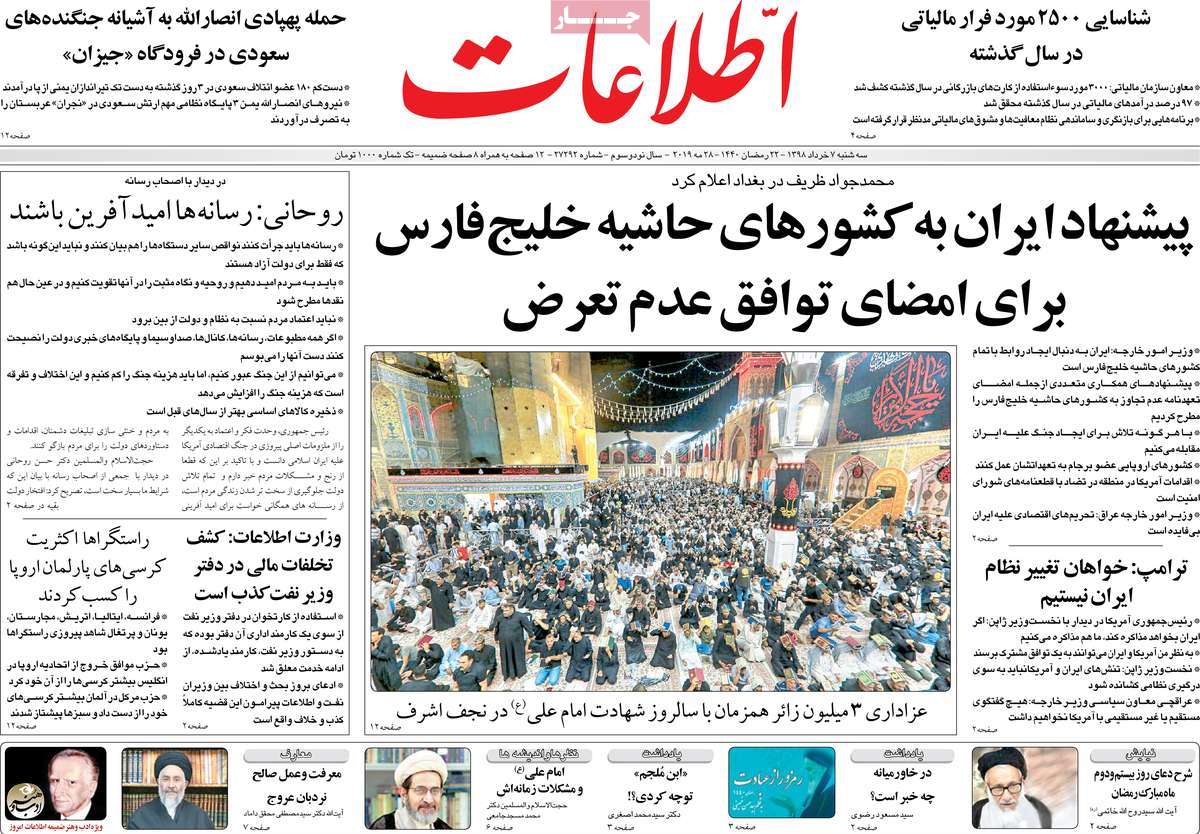
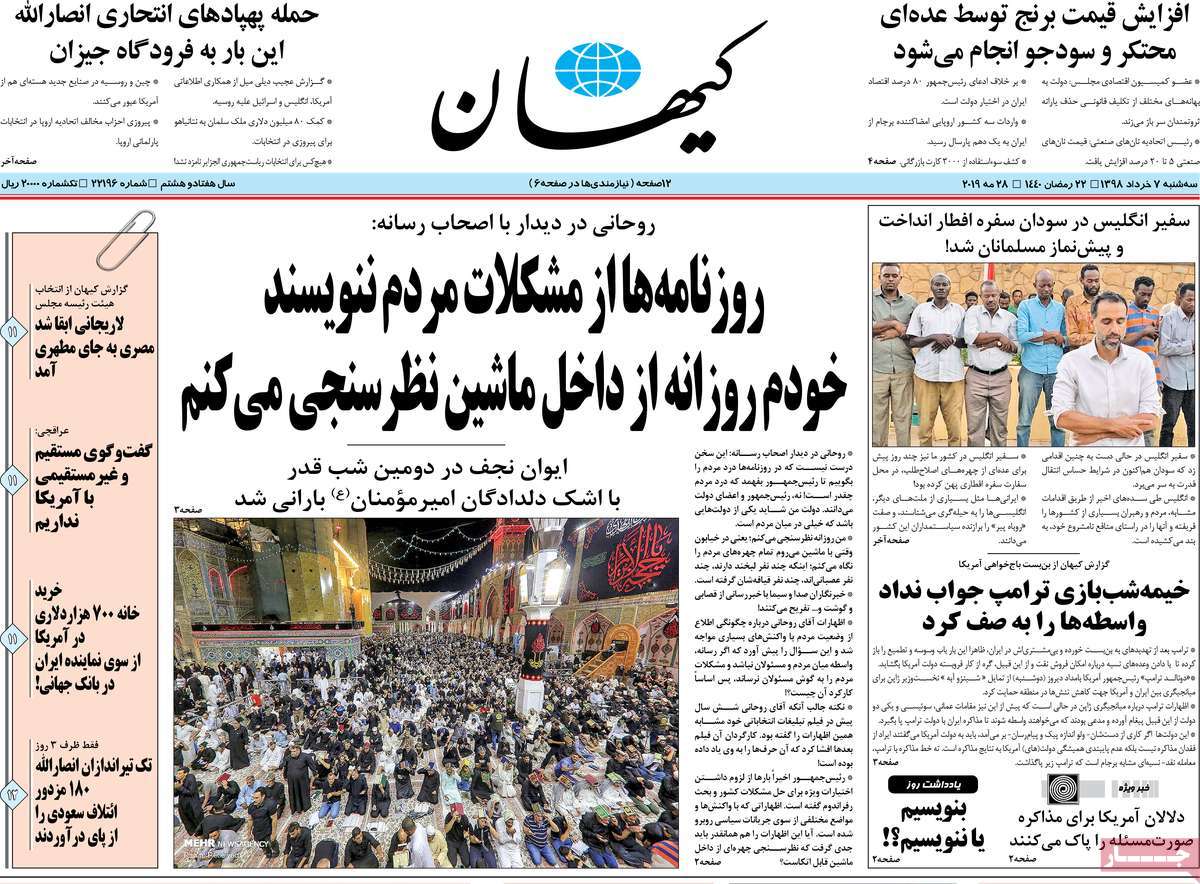
Ettela’at:

1- Iran’s Offer to PG States for Non-Aggression Treaty

2- Ansarullah’s Drone Attack Hangar of Saudi Jet Fighters in Jizan

A Look at Iranian Newspaper Front Pages on May 28


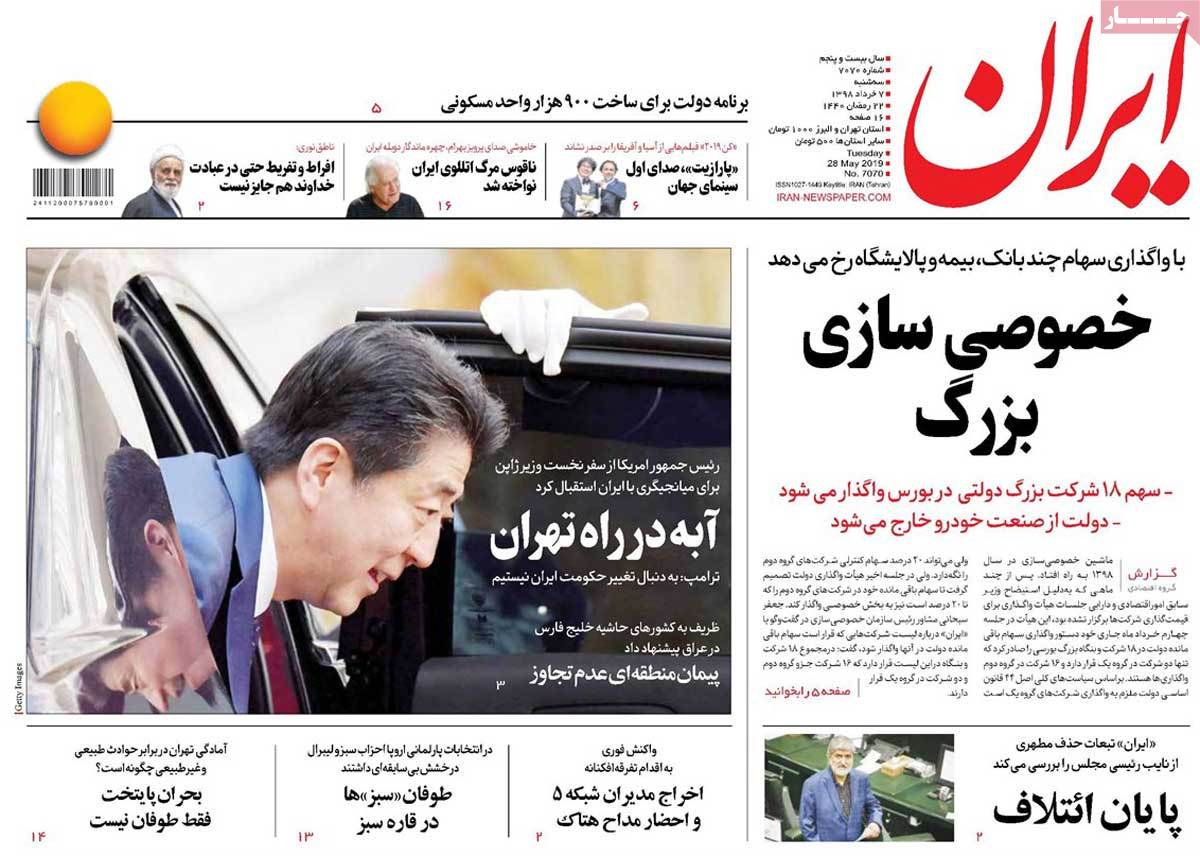
Iran:

1- Abe en Route to Tehran

2- Storm of Greens in Europe

* Unprecedented Victory of Green Parties, Liberals in EP Elections

A Look at Iranian Newspaper Front Pages on May 28


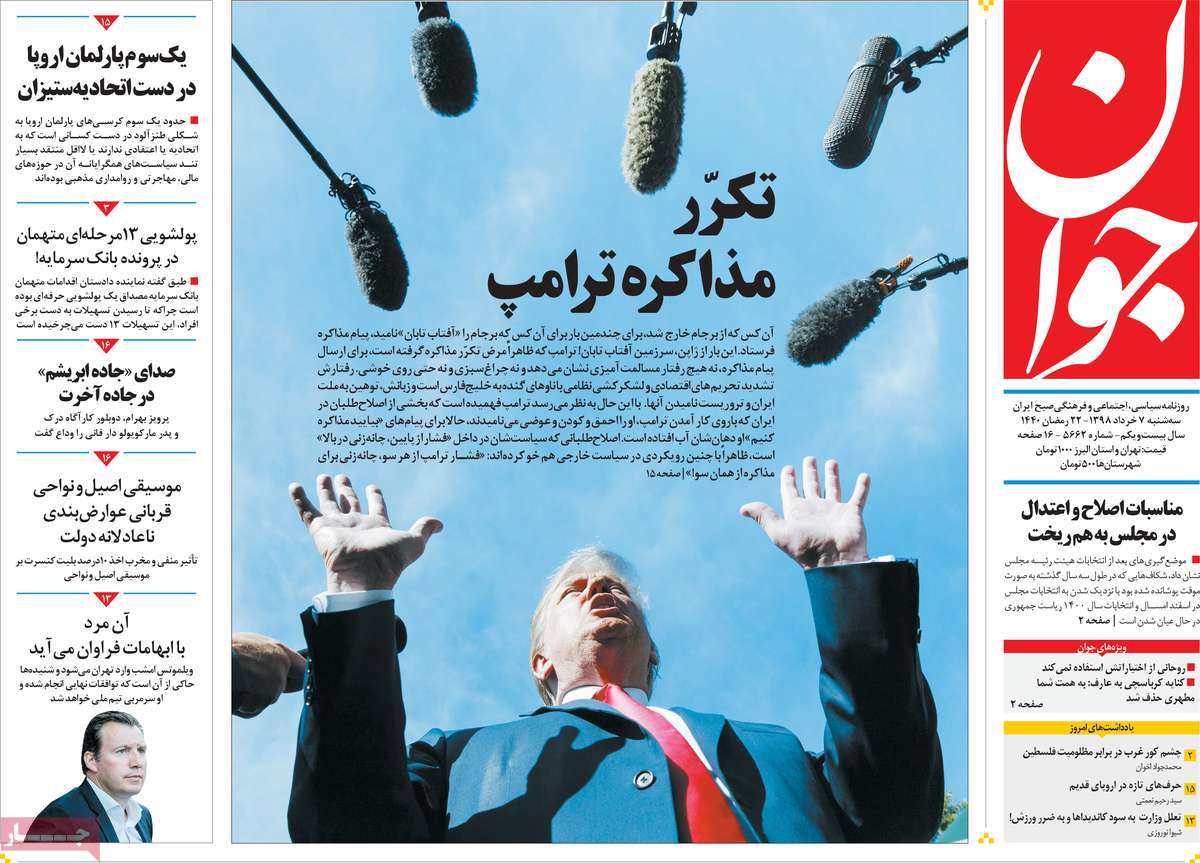
Javan:

1- Trump’s “Frequent Negotiation”

* The One Who Left JCPOA Sends another Message of Talks to Rouhani

2- One-Third of European Parliament Controlled by Anti-EU MEPs

A Look at Iranian Newspaper Front Pages on May 28


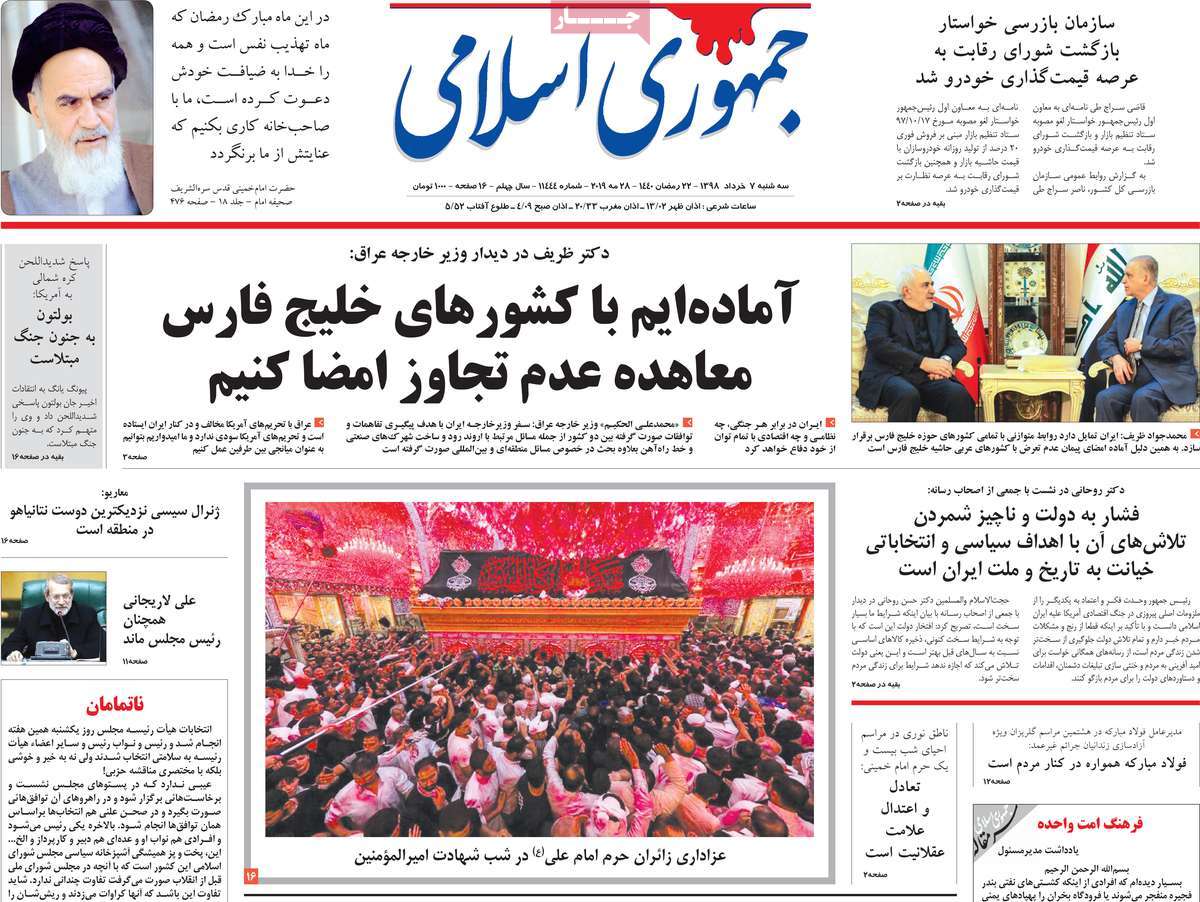
Jomhouri Eslami:

1- N Korea’s Harsh Reaction to US: Bolton Suffering from Madness of War

2- Iraq Opposed to US Sanctions, Standing by Iran

A Look at Iranian Newspaper Front Pages on May 28


Kayhan:

1- Trump’s Puppet Play Didn’t Work; He’s Now Resorting to Mediators

* Deadlock of US’ Ransom Seeking

A Look at Iranian Newspaper Front Pages on May 28


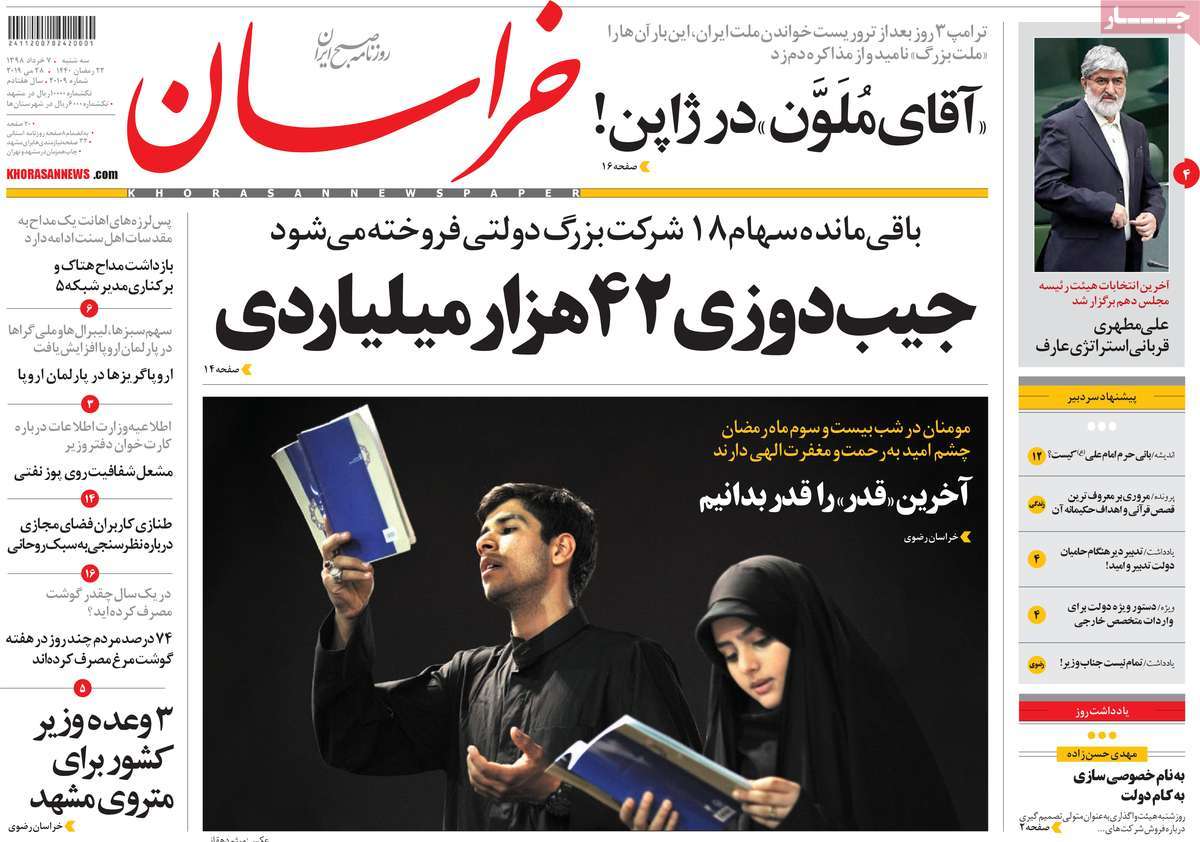
Khorasan:

1- Mr Flip-Flop in Japan!

* 3 Days after Calling Iranians Terrorist, Trump Calls Them Great Nation

2- Anti-EU Politicians Elected to European Parliament

A Look at Iranian Newspaper Front Pages on May 28


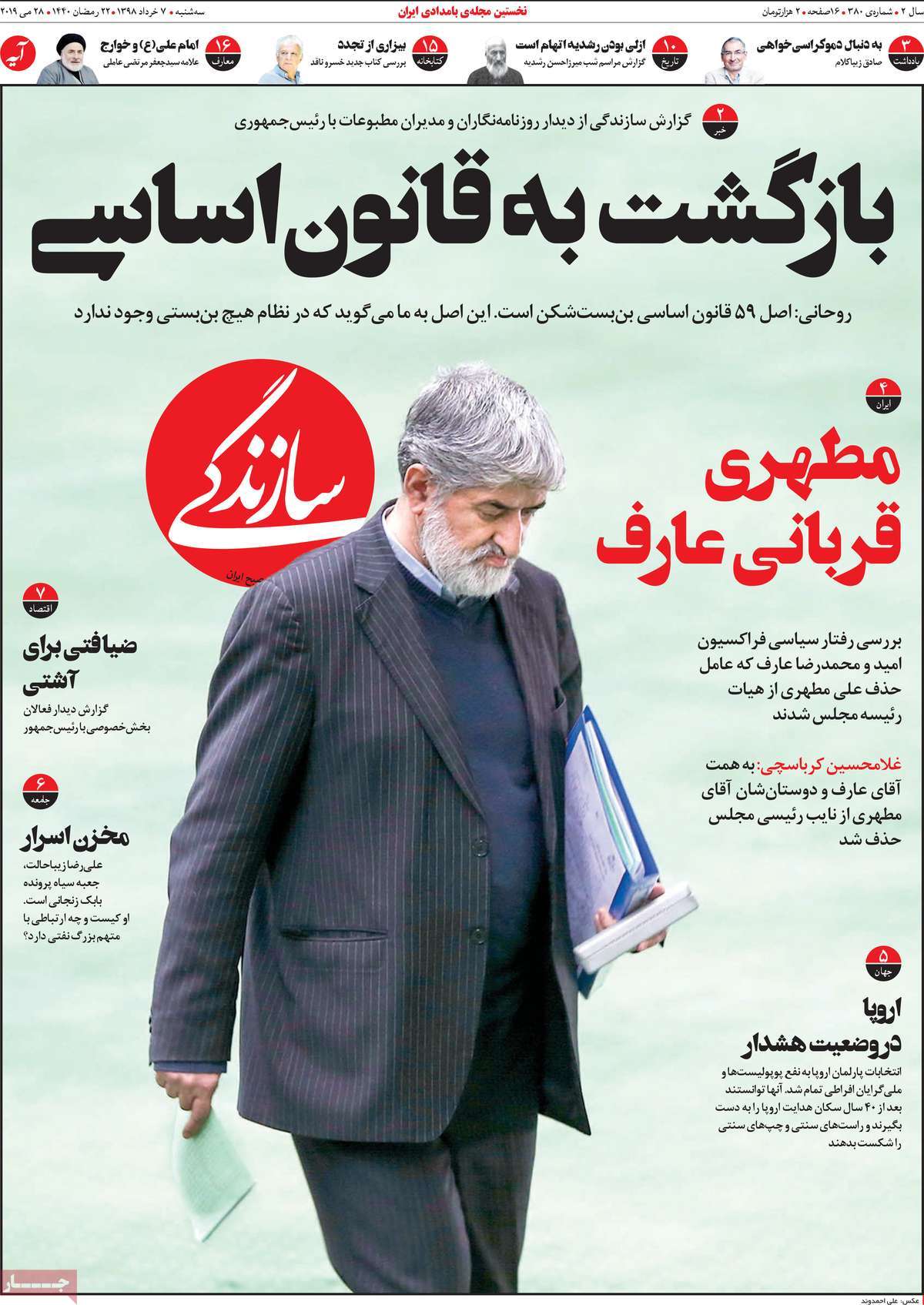
Sazandegi:

1- Europe in Alarming Situation

* Populists, Nationalists Take Helm of EU after 40 Years

A Look at Iranian Newspaper Front Pages on May 28


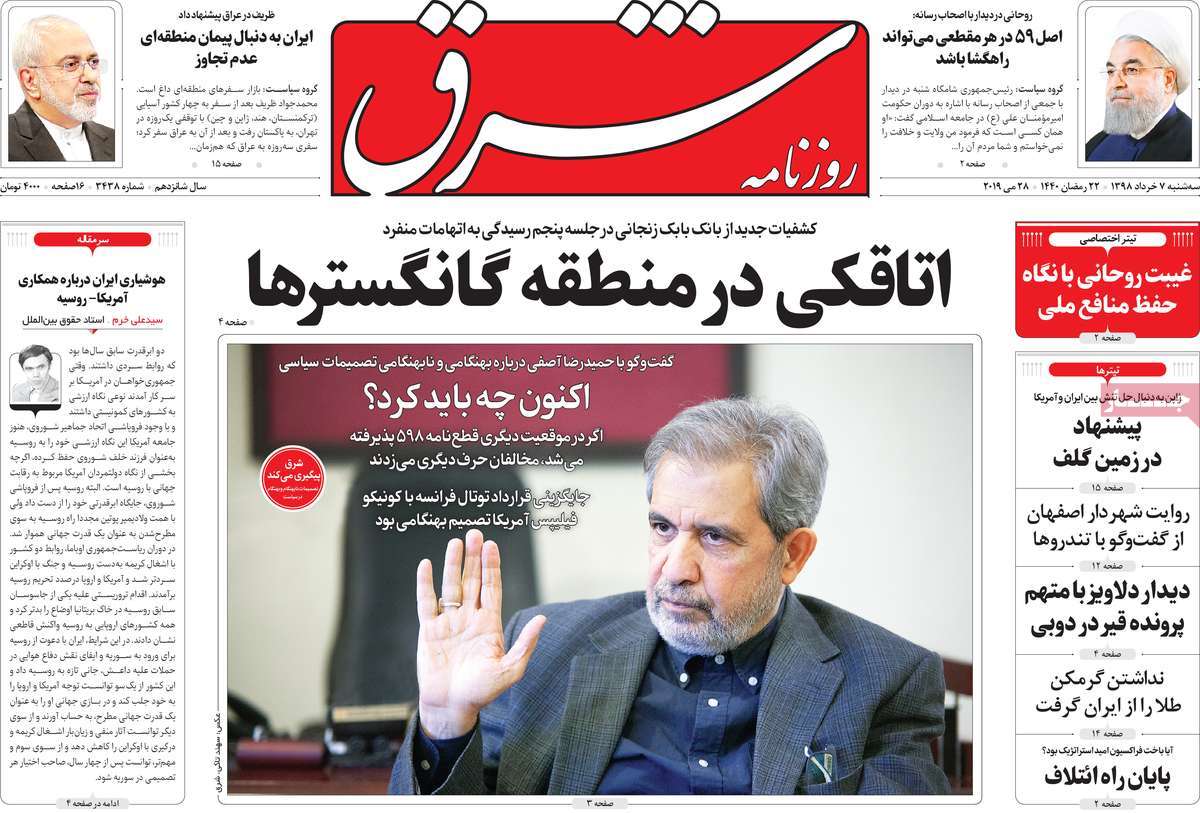
Shargh:

1- Iran Vigilant about US-Russia Cooperation

2- Offer in Golf Course: Japan after Easing Iran-US Tension

A Look at Iranian Newspaper Front Pages on May 28


Tejarat:

1- Countdown for New Trade War

* US to Change Rules of Business

2- Larijani Re-Elected as Iran’s Parliament Speaker

A Look at Iranian Newspaper Front Pages on May 28


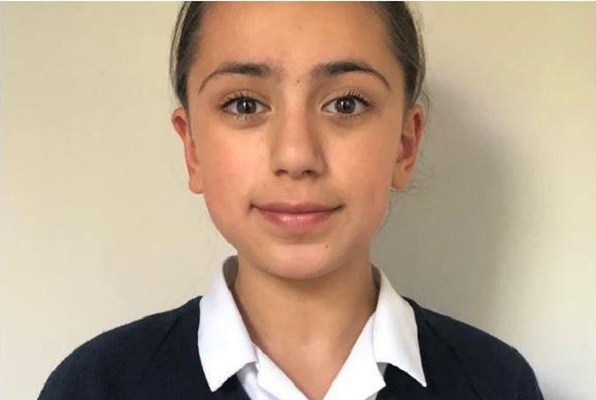
Iranian Girl Beats Einstein in Terms of IQ

That means 11-year-old Tara Sharifi is well above the so-called ‘genius benchmark’ of 140.

Her score is also two points higher than the estimated IQs of physicist Albert Einstein and cosmologist Professor Stephen Hawking.

“I was shocked when I got the result – I never expected to get such a good score,” she said.

Tara took the test in Oxford and had to answer questions within a set time.

It was a non-verbal test which focused on Tara’s ability to understand the meanings of words.

“It was a joint decision between me and my parents to take the test,” she said.

“It will be a wonderful opportunity to meet other people within the Mensa system,” Tara added.

Tara now qualifies for membership of Mensa, also known as the High IQ society, and says she looks forward to meeting other members of Mensa at some of the organisation’s gatherings.

“I have told some of my friends at school and they were really impressed,” she added.

“When I am older, I would like to do something related to mathematics.”

“I am extremely proud but very surprised at how well Tara scored,” said her father.

“I figured she might do well when we watched TV and she would get math questions before the contestants,” he added.

Iran Becomes Third Largest Producer of Orthokine PRP Kits

Mohammad-Hossein Arjangian, the CEO of a knowledge-based company, has told IRNA that the country is now the third largest producer of Orthokine kits after the US and Germany.

He highlighted the importance of the product in treatment of arthritis, adding that the cost of producing an Iranian kit is one-third of a similar foreign sample.

He further noted that the technology is not just used in the field of orthopedics and can also be used to treat burns, diabetes and ulcers.

The CEO of the knowledge-based company, which is affiliated with Tehran University of Medical Sciences, said that they are cooperating with the Research Centre for Dermatology and Stem Cell Research at Tehran University.

For a brief review of Iran’s achievements in various fields of science and technology, check the book “Science and Technology in Iran: A Brief Review

“By manufacturing the first Orthokine PRP kits in our company, a gel of platelet derived from umbilical cord blood will be used in the treatment of burns and AB patients. This kit is also exported to Italy and is one of the world’s five best-selling kits,” noted Arjangian.

PRP is a natural tool for using blood elements of patients for repairing damage tissues in various parts of body including face, neck, abdomen, hands and body.

Today, this method is used in hair growth, wrinkles removal, bed sores and diabetic wounds, as well surgeries and the treatment of arthritis.

Treatment of arthritis is very costly and complicated. For this reason, PRP has been widely discussed in recent years as a promising way of treating symptoms and controlling arthritis in large joints.

President Rouhani Invited to Attend GECF Gas Summit

Hassan Rouhani - President of the Islamic Republic of Iran

The invitation was handed over to Iranian Oil Minister Bijan Namdar Zanganeh during a Monday meeting in Tehran with Equatorial Guinea’s Minister of Mines, Industry and Energy Gabriel M. Obiang Lima.

During the session, the two sides discussed closer cooperation between Tehran and Malabo and the policies of the GECF member states.

The 5th Gas Summit of the Gas Exporting Countries Forum will convene in Malabo, Equatorial Guinea, on November 26, 2019, attended by heads of state of GECF Member Countries.

The GECF is an international governmental organization which provides the framework for exchanging experience and information among Member Countries, according to its official website.

Sunni Iranians Host Largest Fast-Breaking Reception

The one-thousand-metre table was set for some 4,000 locals in Aq-Qala in Golestan province on May 26, 2019, which marked the anniversary of the martyrdom of Imam Ali, the first Imam of Shiites.

The initiative was sponsored by the office of the Leader’s representative in Sunnis’ affairs in the north of the country, the Governor’s Office and other state institutions of Aq-Qala as well as several charity associations.

The theme of the fast-breaking reception was “unity, rapport and empathy.”

Aq-Qala lies 15 kilometres north of the provincial capital of Gorgan. Aq-Qala was struck by heavy floods months ago.

Large parts of the Sunni-majority town, most of whose population are Turkmens, were inundated in the flooding.