Sunday, December 21, 2025
Home Blog Page 3206

Abe’s Tehran Visit Reminiscent of Japan’s Historic Bypass of UK Bans

The op-ed by Ne’mat Ahmadi, a lawyer in Tehran, has referred to the ongoing visit of Abe to Tehran to discuss the US sanctions on Iran and the possible waivers that the country may receive from the US to purchase Iran’s oil, and argued that Abe’s visit reminds Iranians of a historic move by Tokyo in 1950s to sign a contract with the national government of Iranian Prime Minister Mohammad Mosaddegh to purchase Iran’s oil despite the brutal sanctions put by the Britain.

“In those days, Iran was going through harsh days similar to these days. Britain as the world’s then superpower had sanctioned Iran’s oil industry, putting Iran in a deep trouble to first find customers for its oil and then assigning a maritime transportation firm to transport its oil in the global market,” the op-ed noted.

Like what we see from the US today, the UK at that time had sustained back to back defeats from Iran in various economic, political and legal areas, and thus began to adopt harsh measures against Iran including the imposition of economic sanctions on Iran’s oil industry to hamper the efficiency of the national government of Mosaddegh.

The outrage of the UK with Iran reached its climax in 1951 after members of the Iranian parliament voted to nationalize the oil industry in the country, putting an end to Britain’s 40-year monopoly over the oil in the country. In reaction, the UK government adopted its anti-Iran measures and dispatched its vessels to the Persian Gulf. It also withdrew its nationals from Iran and put its forces stationed in Iran on high alert.

“It seemed Britain was preparing for a military attack on Iran. It planned to occupy oil-rich areas in southern Iran. The US government protested the plan. The second phase of Britain’s anti-Iran measure was waging a psychological war against Iran paving the way for the 1953 coup in the country which led to the overthrow of Mosaddegh government,” the op-ed said.

According to Ahmadi, the most significant anti-Iran measure adopted by the United Kingdom was imposing economic sanctions on Tehran to exert more pressure on the country’s national government.

“To this end, Iran’s properties in London were confiscated and no oil equipment was sold to the country. The UK sanctions had the support of UK’s allies including the US. Meanwhile, to make up for the shortage, the US rushed to expand Saudi Arabia’s oil exports so much so that the Saudi exports were increased by 60 percent. On the other hand, Kuwait and Venezuela raised their exports by 94 and 15 percent respectively.”

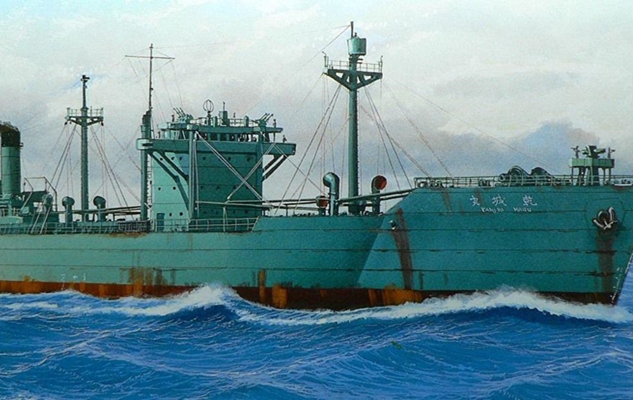
As the last blow on Iran, the UK government announced that since Iran owes a huge amount of money to London, any purchase of Iran’s oil amounts to purchase of a stolen good. So, all oil tankers were warned against transporting Iran’s oil into the global market. But Italy and Japan were respectively the first and second ones to purchase Iran’s oil amid international sanctions.

“And now the visit of Japan’s prime minister reminds us of those historic days. During those days, Japan rising from the rubbles of the World War II was in an urgent need of oil. So, the Japanese made a contract with Iran to purchase oil. The contract was made after Italy’s victory to bypass the UK’s sanctions on Iran. The conservative Japanese government sent its oil tankers to purchase Iran’s oil despite the presence of the UK’s military vessels in the Persian Gulf. Iran gave a 50 percent discount to any side daring to bypass the brutal sanctions of the UK.”

According to Ahmadi, the UK sanctions seemed harsher compared with today’s US sanctions on Iran’s oil industry. “If the 1953 coup hadn’t taken place, Japan and Italy as two major losers of the World War II could serve as reliable markets for Iran’s oil and they were ready to play the role due to their animosity with the US and its allies.”

The Iranian lawyer finally concluded that the visit of Abe should be viewed as the repetition of the historical event. Today, Iran can use the visit as a winning card in its dealing with the US and find a way to break the brutal sanctions imposed on the country.
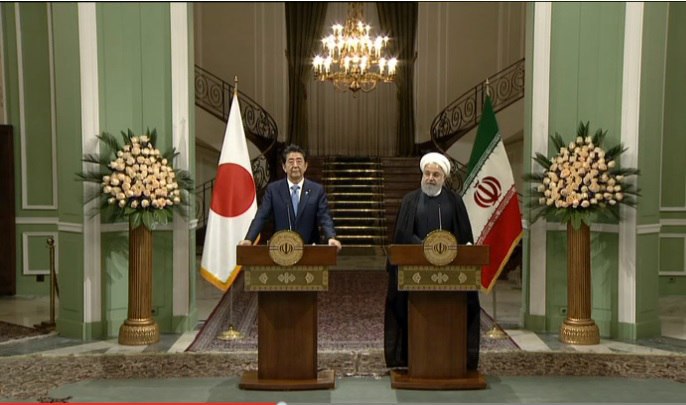
Iran President, Japan PM Hold Joint Press Conference in Tehran

Rouhani and Abe Joint Press Conference

Addressing the presser, Rouhani said Tehran welcomes Japan’s interest in importing Iran’s oil despite the US sanctions.

“Iran welcomes the Japanese prime minister’s determination to expand mutual ties between Iran and Japan in various regional, economic and international areas,” he said.

He added that during the talks, the two sides discussed mutual ties including Japan’s investment in southern Iran.

“We welcome that Japan is interested in importing Iran’s oil and resolving financial issues between the two sides because the will guarantees the expansion of two sides’ relations,” he said.

Iranian president said during the meeting, security issues and regional détente were also discussed.

“We are happy that both Iran and Japan attach significant importance to the regional security and stability. As I told the prime minister, Iran is not an initiator of any war in the region even with the US but if a war is waged, we will give a crushing response to the enemy,” he said.

According to president Rouhani, the Japanese prime minister is highly optimistic about the future and believes that some positive changes are to be made.

“I told the prime minister that Iran is interested in preserving the Iran nuclear deal and will adopt some measures in this regard. I called on the prime minister to expand our mutual ties in nuclear area because both countries believe in peaceful nuclear program and both are against any nuclear weapons,” he said.

President Rouhani said the current tensions in the region are rooted in the US economic war on the Iranian nation. “Whenever the war is stopped, we can wait for positive changes in the region and the world.”

For his part, Japanese prime minister thanked Iranian government for its warm welcome and said today tensions are on the rise in the region. “As analysts warn, the chance of a military clash in the region is high but we should adopt some measures to prevent from such an incident. Regional stability is significant for global economic boost. Japan hopes to contribute to the regional peace and stability.”

He praised Iran as an ancient civilization in the Middle East and said Iran needs to play its key role to restore peace and stability in the region.

He cited Islam as the religion of peace and tolerance and said he has always been interested in Islam’s spirituality.

Abe described Iran’s full cooperation with the International Atomic Energy Agency as a positive approach and added Japan strongly calls on Iran to remain faithful to the JCPOA.

“We shouldn’t lose our hope for creating peace in the region. Today, we took the first step and we hope the goal would be achieved soon,” he said.

Iran President Welcomes Japan PM Shinzo Abe in Tehran

This is the first-ever visit of a Japanese Prime Minister to Iran since the 1979 Islamic Revolution.

PM Abe is expected to hold talks with Iranian officials on ways to ease tensions between Tehran and Washington.

Abe had a meeting with Rouhani on Wednesday afternoon and will hold talks with the Leader of the Islamic Revolution Ayatollah Seyyed Ali Khamenei on Thursday.

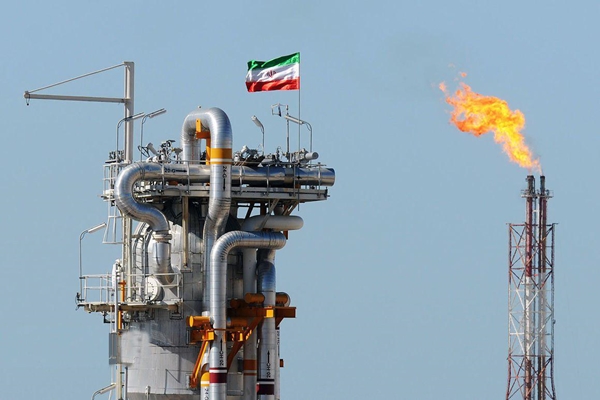
Iran Contains Fire at South Pars Gas Field

The fire did not prevent the flow of gas production in the major facility, but it caused gas leak and smoke emission.

All personnel have left the facility and are moving back to the city Assalouyeh.

The platform is reportedly surrounded by firefighting vessels which have managed to contain the fire.

The incident comes a few weeks after four oil tankers caught fire off the Emirati port city of Fujairah south of Persian Gulf.

The UAE described it as a sabotage attack, and the US accused Iran of being involved in the incident, but Iran categorically denied such a claim, and described the vessel incidents as “worrying and alarming”.

Japan PM in Tehran to Help Ease Iran-US Tension

He will hold talks with President Hassan Rouhani later today, and with Iran’s Leader Ayatollah Seyyed Ali Khamenei on Thursday.

Hours ahead of Abe’s arrival, Iranian Foreign Minister Mohammad Javad Zarif and his Japanese Counterpart Taro Kano sat for talks in Tehran.

During the first round of the meeting, the Iranian foreign minister welcomed Kano and his accompanying delegation. He then referred to the longtime and 90-year-old diplomatic ties between Iran and Japan and described Tokyo as Iran’s good and friendly partner in political, economic and cultural areas.

Zarif also referred to the economic war and terrorism waged by the US against the Iranian nation and said, “The Americans have launched an economic war against our nation. We’re also faced with their hatemongering and propaganda campaign on a daily basis.”

He went on to say that amid the current difficult situation, Iran will seek new ways to promote the Iranians’ welfare, including by revising its financial policies and budget, making them less dependent on oil revenues.

For his part, Japan’s top diplomat expressed satisfaction with his presence in Iran and the warm welcome his delegation received upon arriving in Tehran, and said Abe is visiting Iran as a historical and friendly country.

“Iran is a significant country in the region and we believe that the more secure the region is, the more interests all regional countries will gain. Otherwise, we all will lose,” he said.
Cano also expressed his country’s interest in contributing to efforts to lessen regional tensions.

A Look at Iranian Newspaper Front Pages on June 12

A Look at Iranian Newspaper Front Pages on November 19

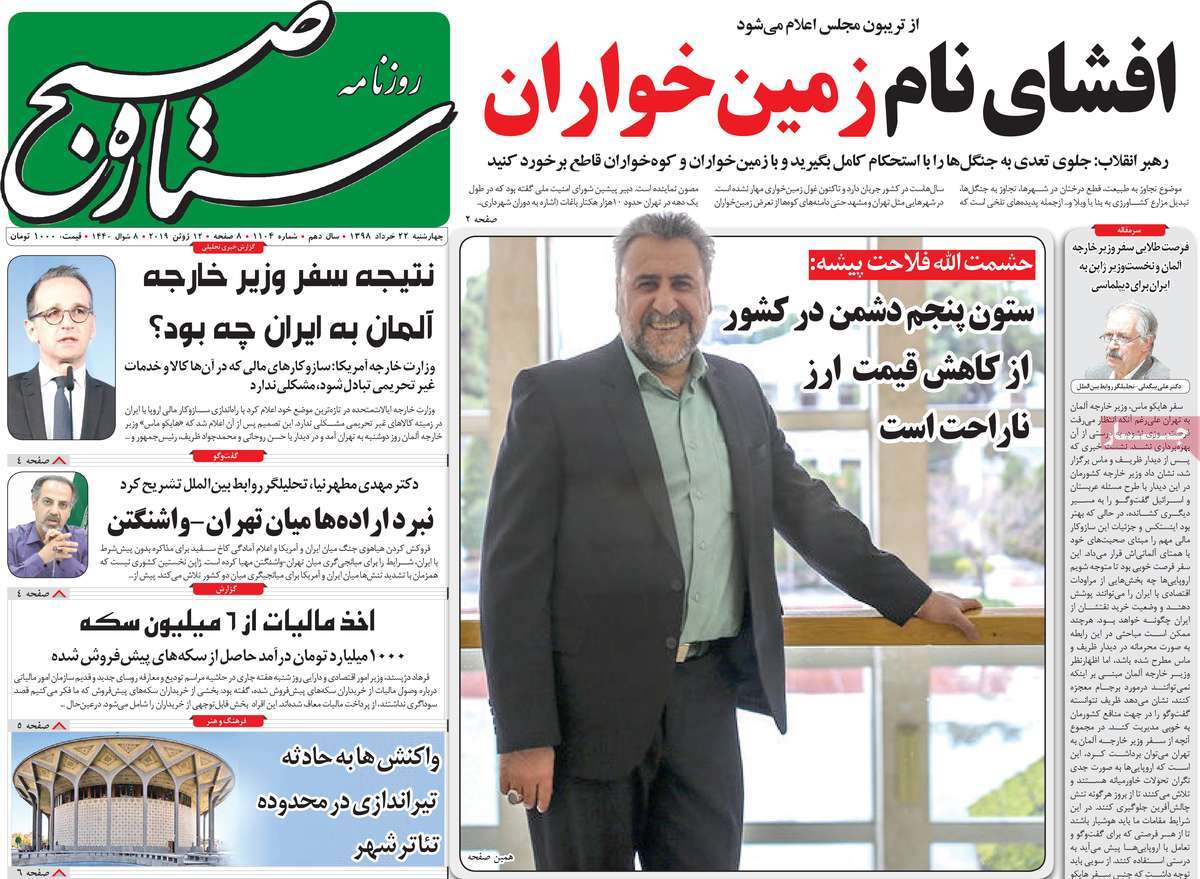
Results of German Foreign Minister’s visit to Tehran and the outcome of his meetings with Iranian officials is the golden phrase of dailies in Tehran today. Heiko Maas’s remarks on running the financial channel between the EU and Iran were particularly highlighted by Iranian newspapers today.

Release of Lebanese-American national Nizar Zakka is seen on the front page of some dailies today as well.

The above issues, as well as many more, are highlighted in the following headlines and top stories:


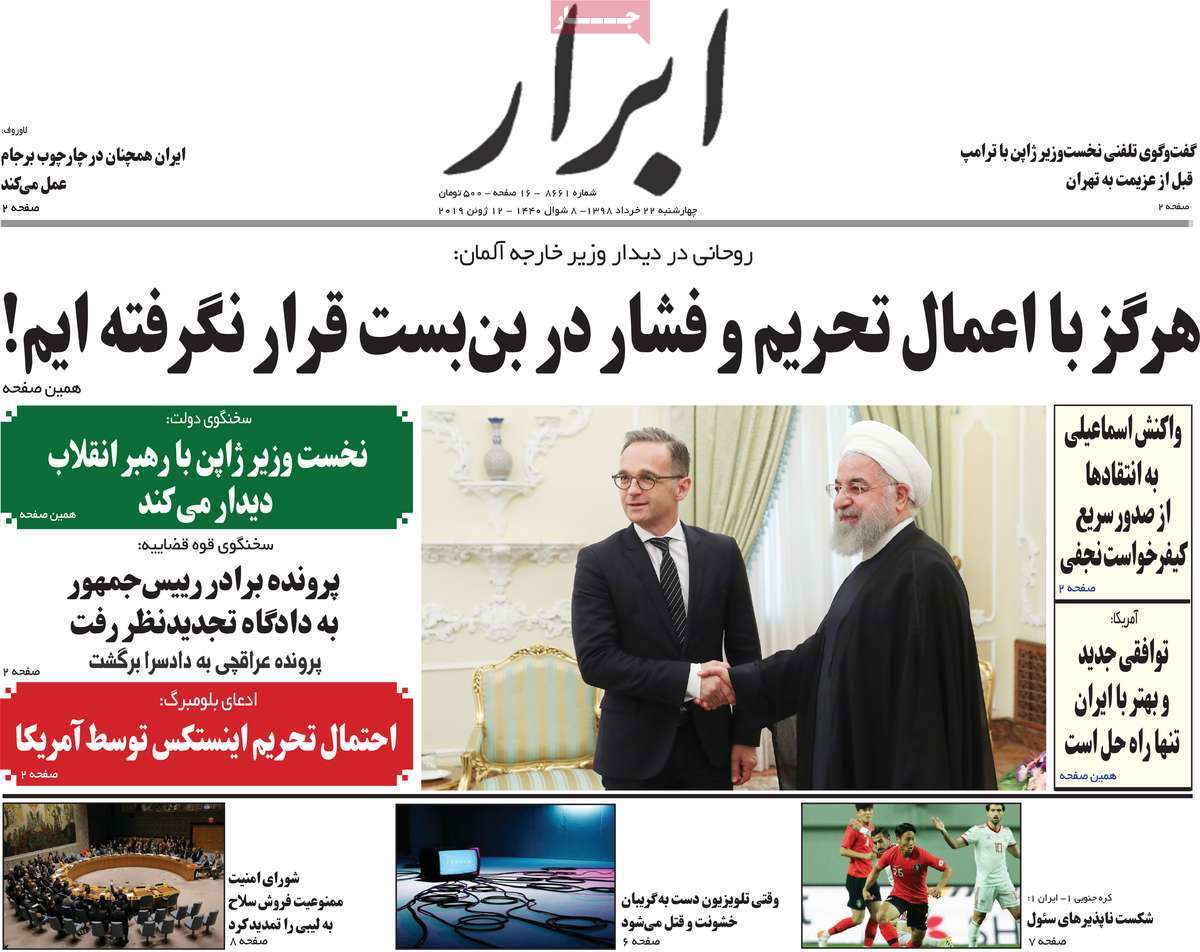
Abrar:

  • Japanese Prime Minister Holds Phone Conversation with Trump Before His Departure for Tehran
  • Iran Still Operates within JCPOA Framework: Lavrov
  • We’ve Never Been in Deadlock by Sanctions, Pressures: Rouhani Tells Japan PM
  • Japan PM to Visit Iran Leader: Government Spokesman
  • Only Solution Is New, Better Deal with Iran: US

A Look at Iranian Newspaper Front Pages on June 12


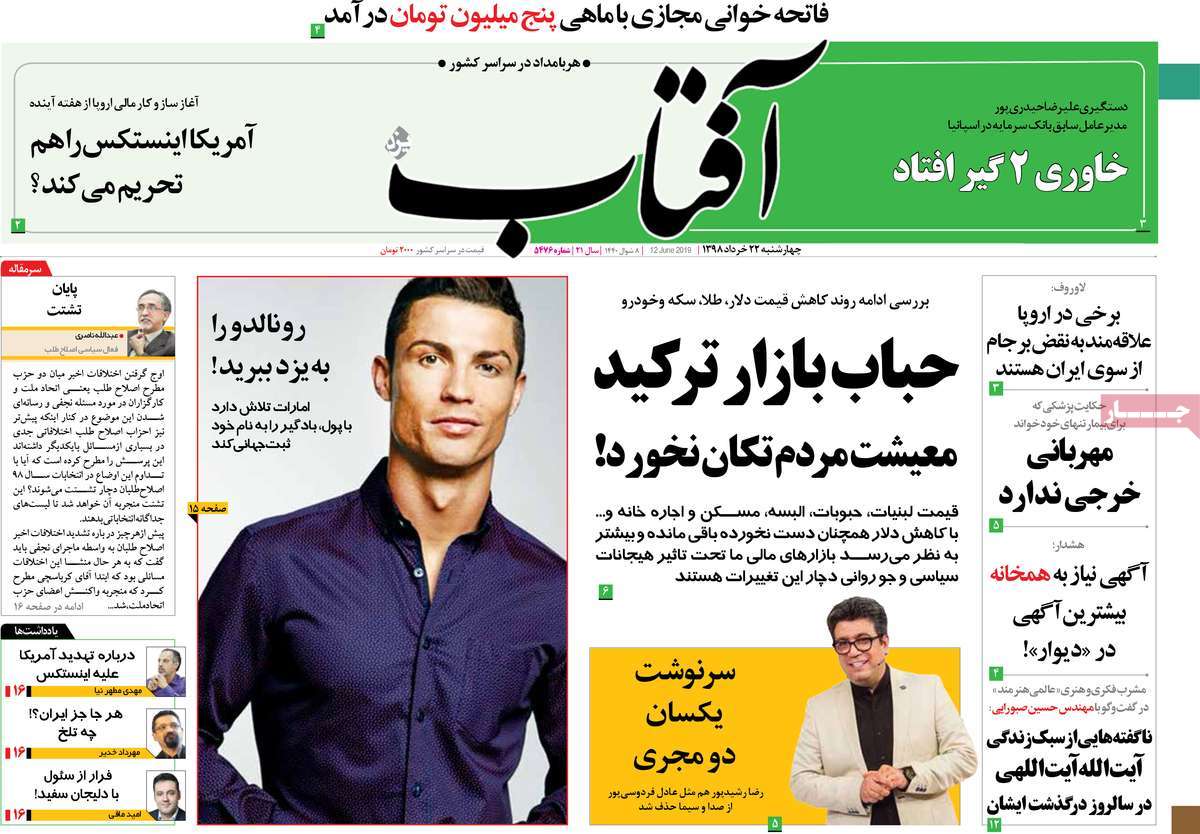
Aftab-e Yazd:

  • Will US Boycott INSTEX as Well?
  • Financial Mechanism with Europe to Kick off Next Week
  • Some in Europe Interested in Iran’s Violation of JCPOA: Lavrov

A Look at Iranian Newspaper Front Pages on June 12


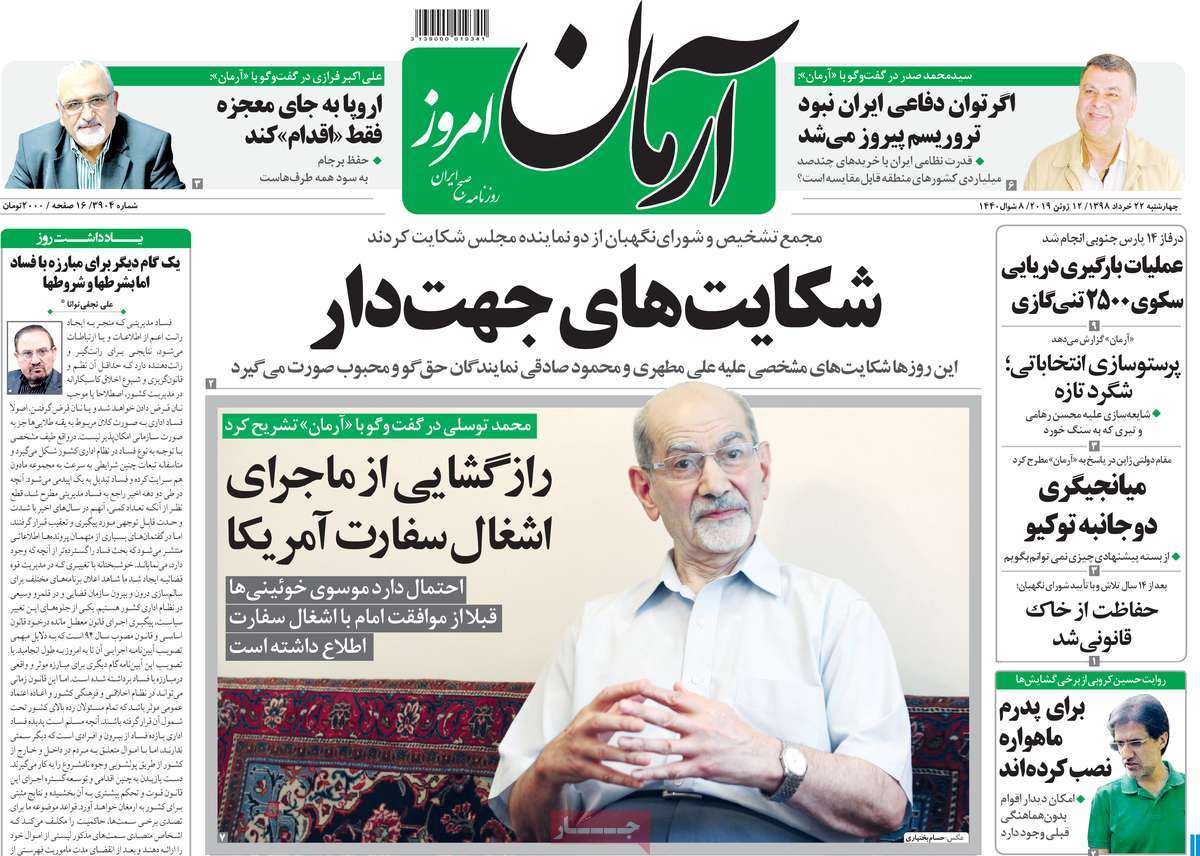
Arman-e Emrouz:

  • Two-sided Mediation
  • I Cannot Say Anything about Package: Japanese Official
  • Instead of Magic Europe Should Only Act
  • Preserving JCPOA to Interest of All Sides
  • 2,500-Tonne Structure Loaded on Barge in South Pars Oil Field

A Look at Iranian Newspaper Front Pages on June 12


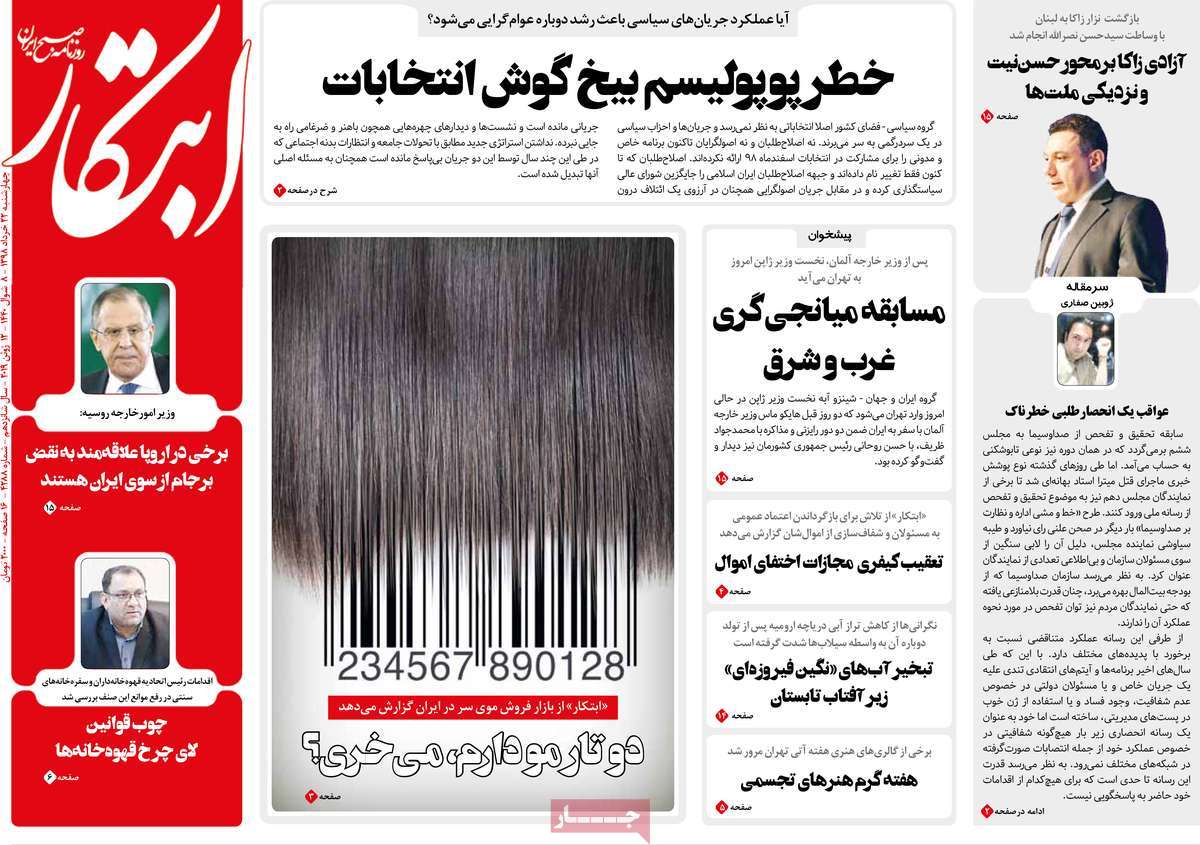
Ebtekar:

  • Nizar Zakka Released after Mediation of Hassan Nasrallah
  • West, East Mediation Contest
  • After German Foreign Minister, Prime Minister of Japan Visits Tehran
  • Some in Europe Interested in Violations by Iran: Russian FM

A Look at Iranian Newspaper Front Pages on June 12


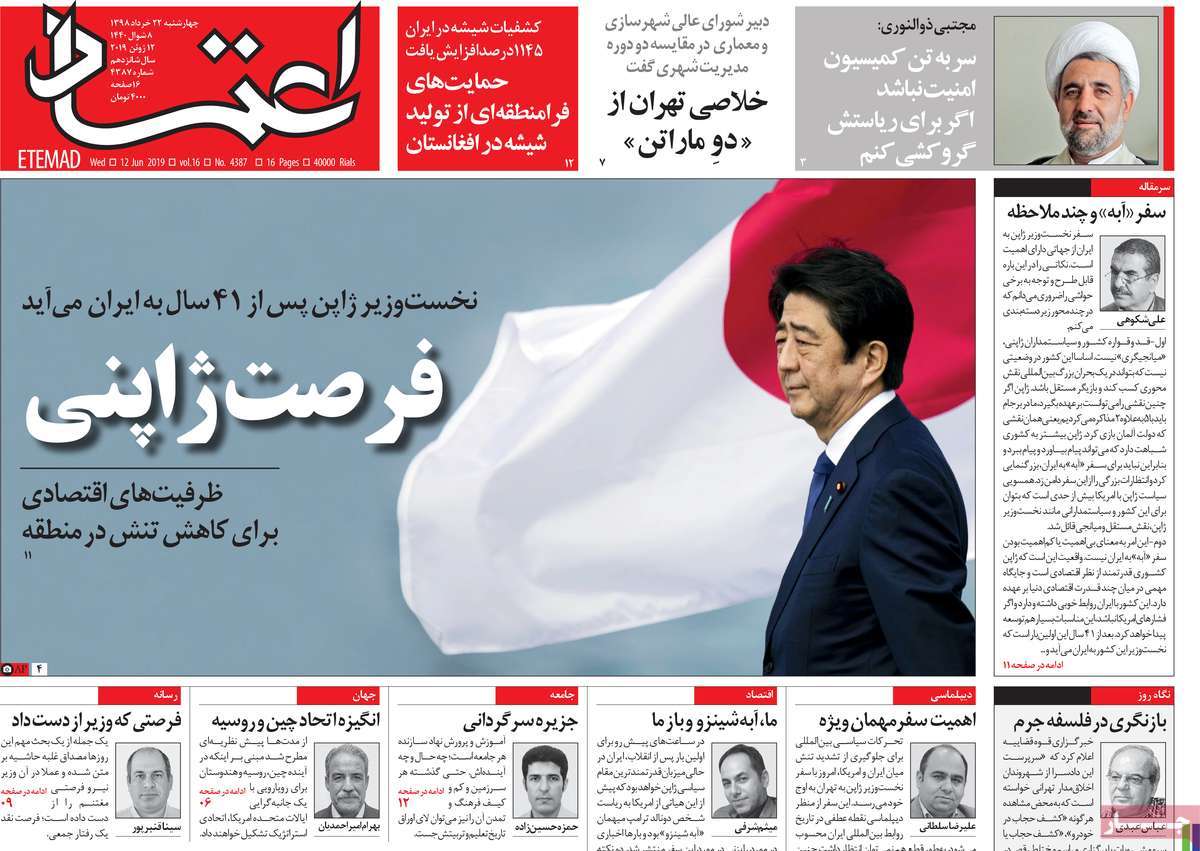
Etemad:

  • Japanese Opportunity
  • Japan’s PM Visits Iran after 41 Years
  • Economic Capacities to Reduce Tension in Region
  • Significance of Special Guest’s Visit
  • International Political Moves to Stop Escalation of Tension between Iran
  • US Reaches Climax with Visit of Japanese PM to Tehran

A Look at Iranian Newspaper Front Pages on June 12


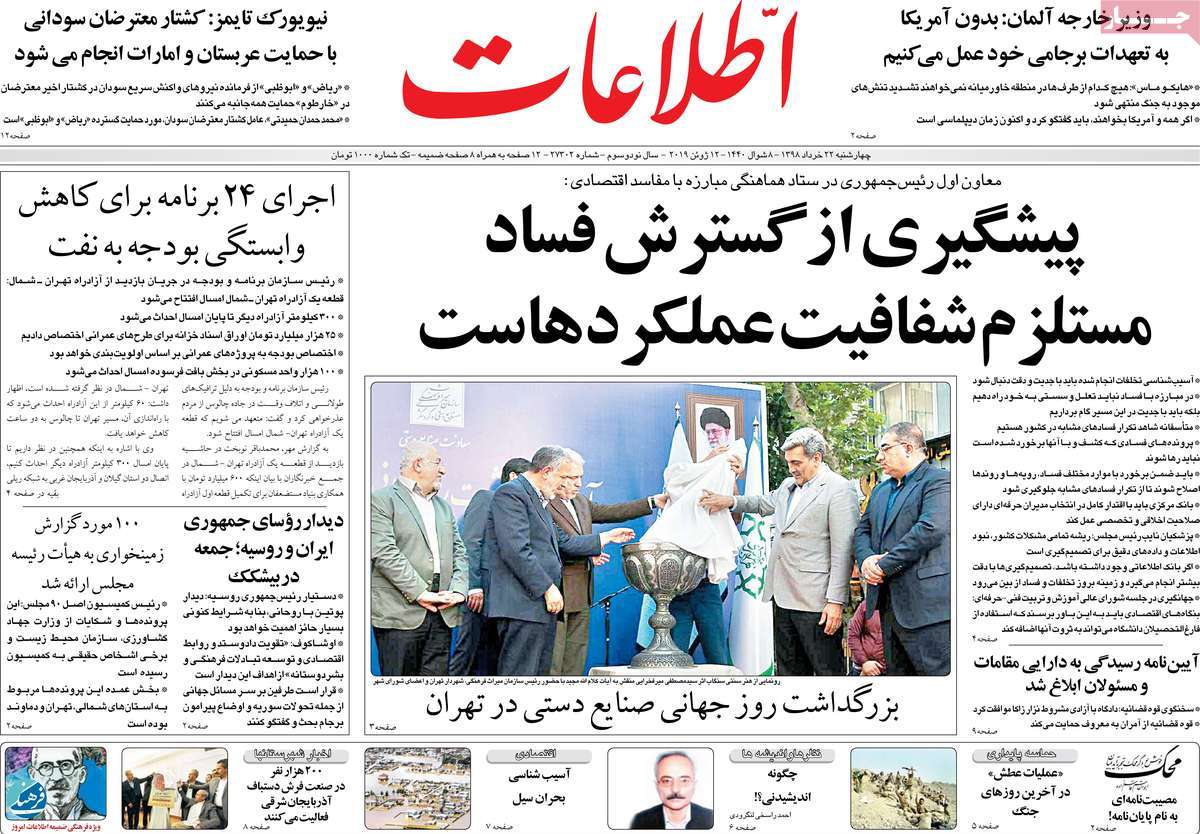
Ettela’at:

  • Without US, We Won’t Fulfil Our Commitments: German FM
  • Neither Side in Middle East Wants to Heighten Tensions which Lead to War
  • Killing of Sudanese Protesters with Support of Saudi Arabia, UAE: New York Times
  • Iran, Russia Presidents Meet in Bishkek on Friday

A Look at Iranian Newspaper Front Pages on June 12


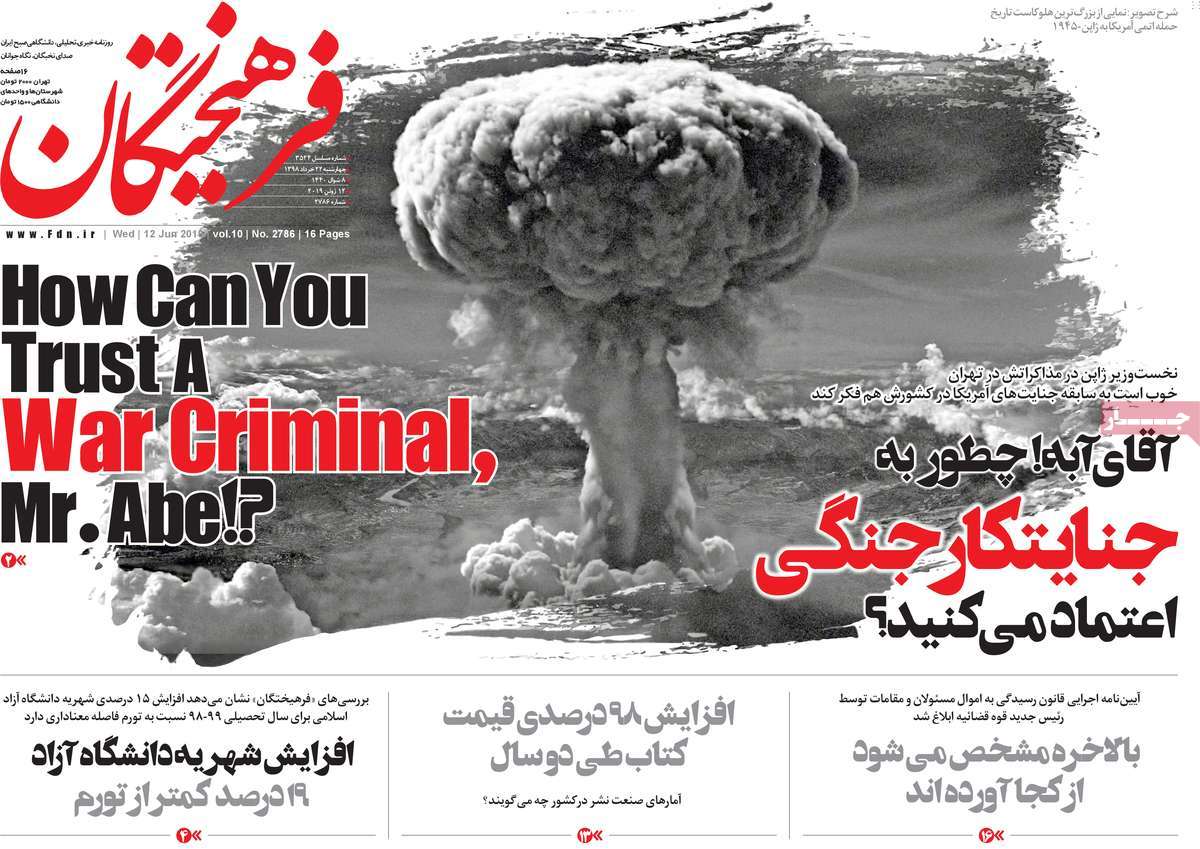
Farhikhtegan:

  • Mr Abe! How Can You Trust a War Criminal?

A Look at Iranian Newspaper Front Pages on June 12


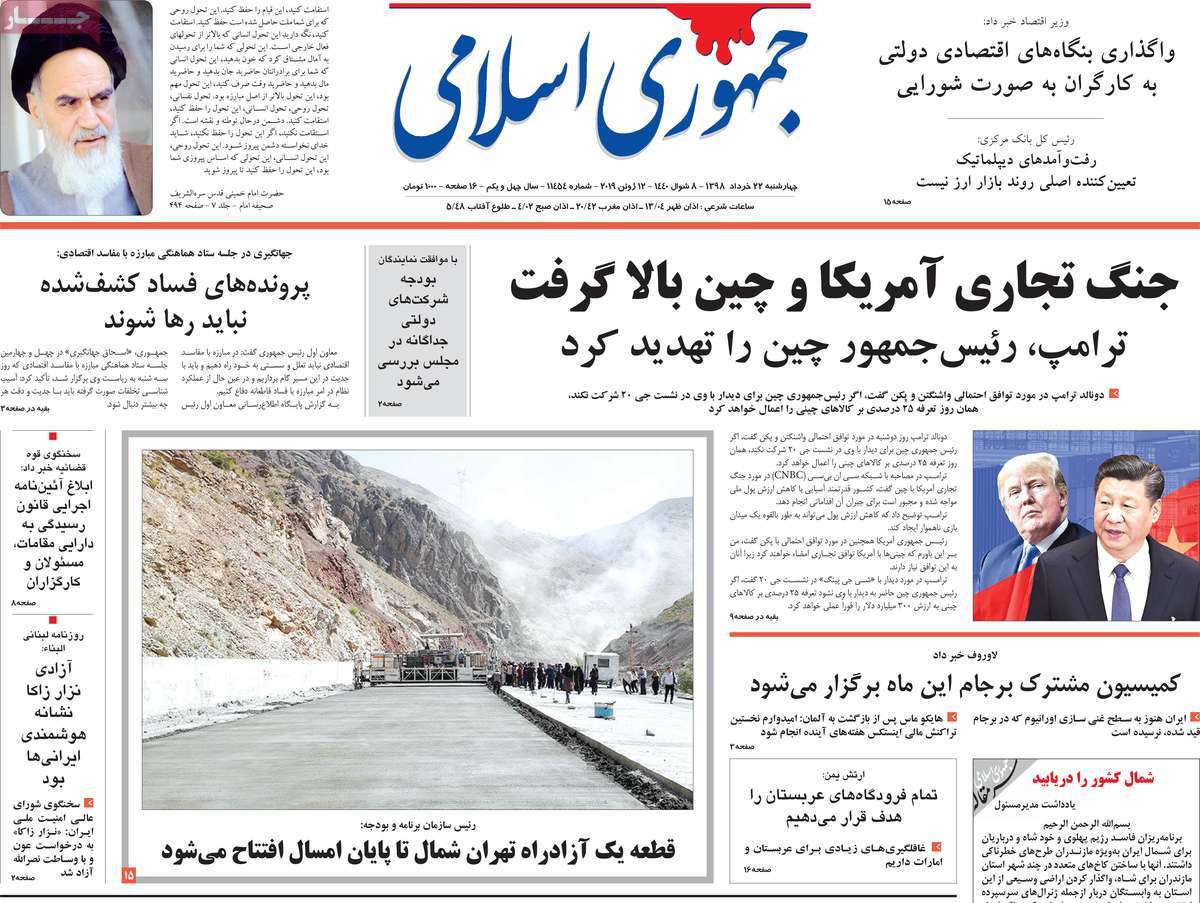
Jomhouri Eslami:

  • US-China Trade War Heightens
  • Trump Threatens Chinese President
  • JCPOA Joint Commission to Be Held This Month: Lavrov
  • We Target All Saudi Airports: Yemeni Army

A Look at Iranian Newspaper Front Pages on June 12


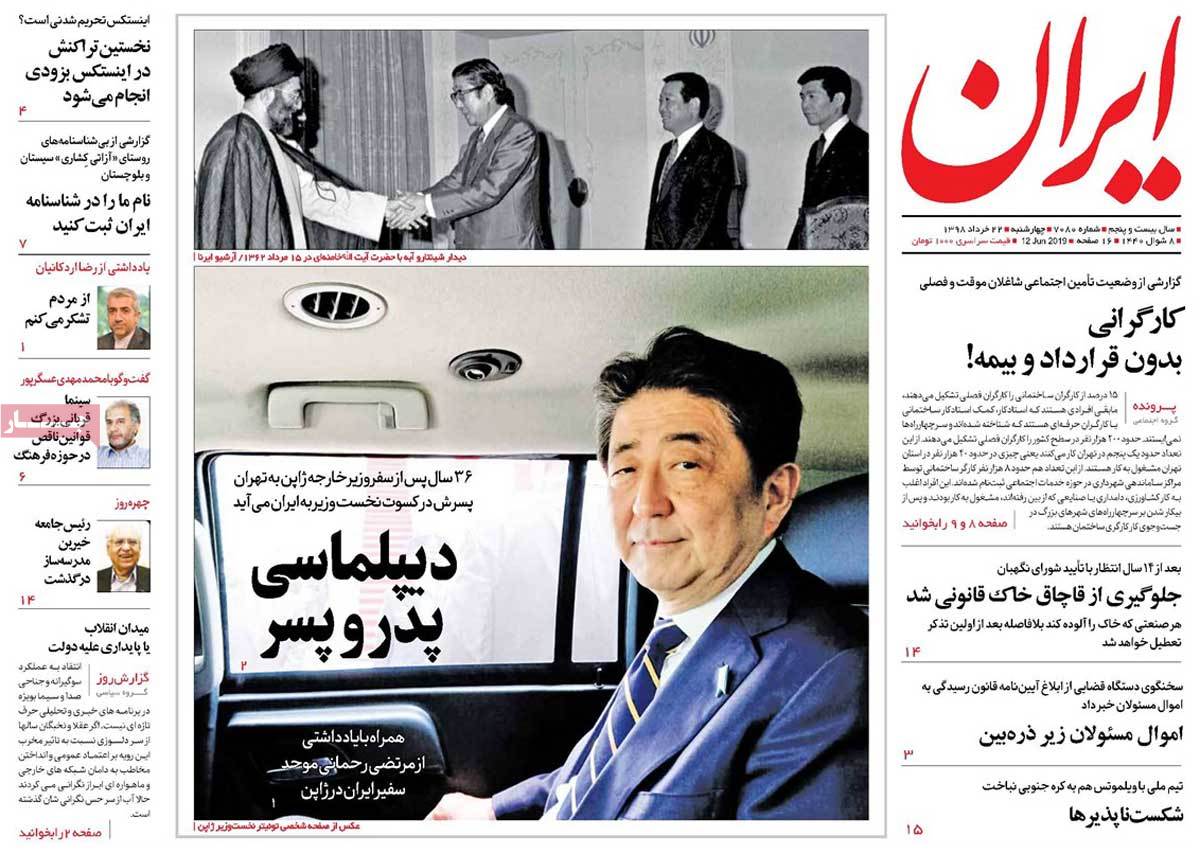
Iran:

  • First INSTEX Transaction to Be Carried Out Soon
  • Is It Possible to Sanction INSTEX?
  • Father & Son Diplomacy: 36 Years after Japanese FM’s Visit to Tehran, His Son Visits Iran as Japan’s PM

A Look at Iranian Newspaper Front Pages on June 12


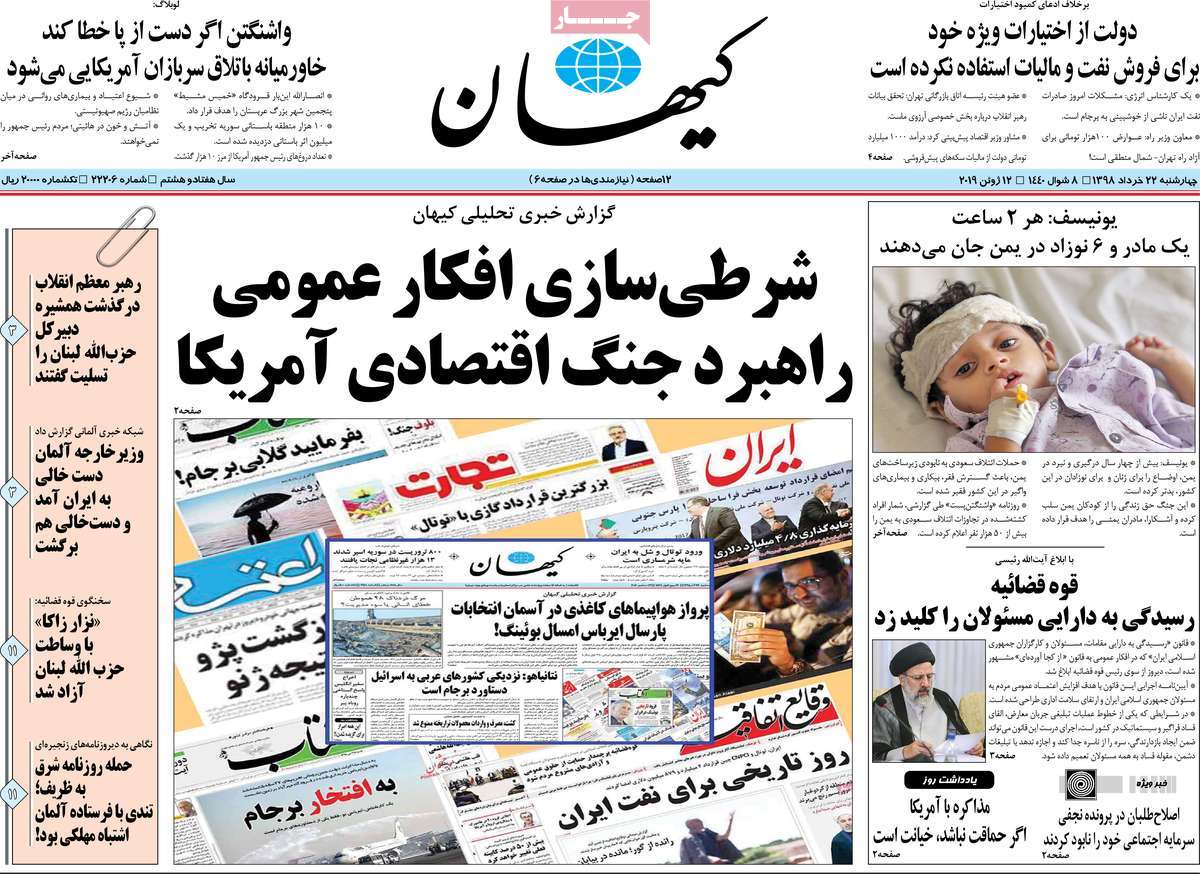
Kayhan:

  • If Washington Makes Mistake, Middle East Becomes Quagmire of US Troops: Lobelog
  • German FM Visits, Departs Tehran Empty-Handed: German News Network
  • Nizar Zakka Released after Mediation of Hassan Nasrallah: Judiciary Spokesman

A Look at Iranian Newspaper Front Pages on June 12


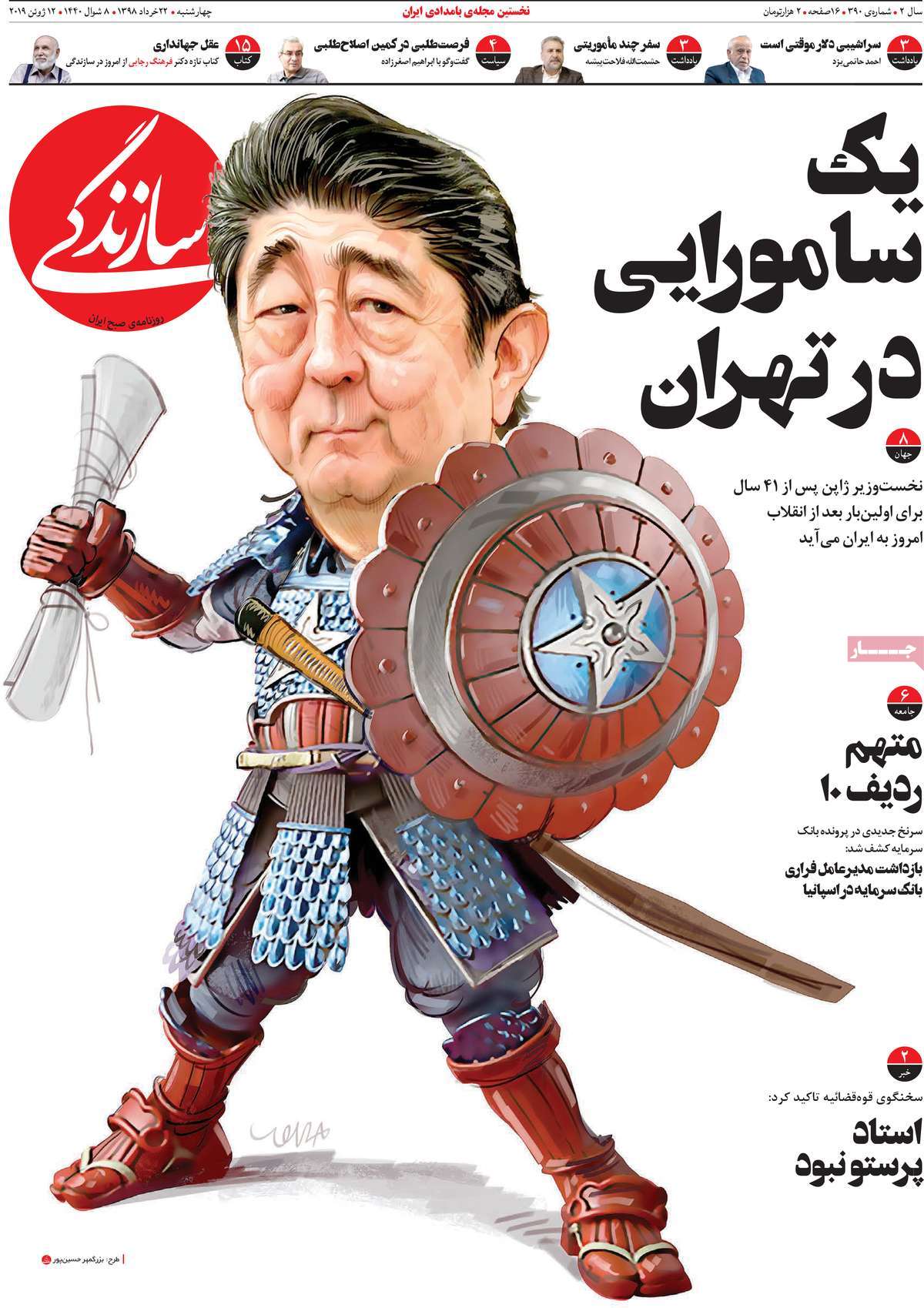
Sazandegi:

  • A Samurai in Tehran
  • Japan’s PM Visits Tehran after 41 Years

A Look at Iranian Newspaper Front Pages on June 12


Setareh Sobh:

  • What’s Outcome of German FM’s Visit to Iran?
  • No Problem in Financial Arrangements in Which Non-Sanctioned Goods, Services Exchanged: US State Department
  • Golden Opportunity for Diplomacy During German FM, Japanese PM Visit to Tehran

A Look at Iranian Newspaper Front Pages on June 12

Iran, China Discuss JCPOA, Bilateral Ties in Tehran

Iran-China 25-Year Deal Made on Equal Footing: Official

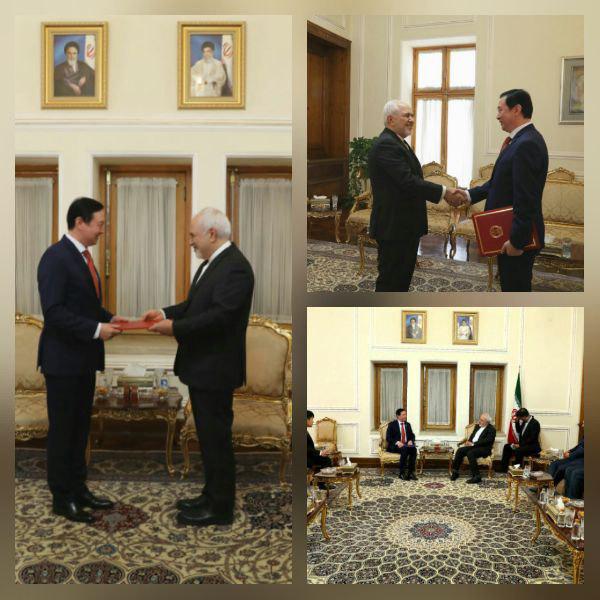
During the Wednesday talks in Tehran, the Chinese envoy presented a copy of his credentials to the Iranian top diplomat.

Referring to high-level visits and meetings between the two countries in recent years, the two sides underlined the need to follow up the previous agreements and conferred on the development of bilateral relations.

The most important issues and developments in mutual ties, regional cooperation and international talks between the two countries regarding a variety of issues, including the JCPOA, transportation, trade, energy and the fight against terrorism were also discussed in this meeting.

Iran, China Discuss JCPOA, Bilateral Ties in Tehran

Iran Tells Europe It Can’t Implement JCPOA Unilaterally

Iran Says What IAEA Wants to Access “Not A Site”

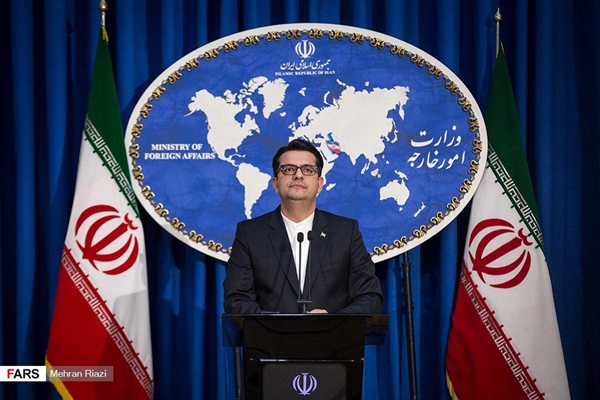
Mousavi made the remarks in reaction to German Foreign Minister Heiko Maas’s comments in Stockholm.

“We agree with him [Maas] about the importance of the JCPOA for the international community and Europe, but we do not fully understand his emphasis on the need for Iran to unilaterally fulfil its commitments under a multilateral agreement.”

“If there are several parties to this agreement, all of them must meet their commitments similarly, and if they cannot, they should realise that we can also review our obligations under the JCPOA with the use of the mechanisms the nuclear deal has provided for us,” he went on to say.

Mousavi further advised Maas and others, who express concerns over the recent decisions of Iran, to carefully read the Article 36 of the nuclear agreement and the basics of law once more.

The German and Swedish foreign ministers expressed frustration Tuesday over the probable termination of the Iran nuclear agreement, warning Tehran that withdrawing from the deal would bring “international isolation”. They also criticised Washington for endangering a decade of diplomatic efforts.

Top Iranian Diplomat to Visit Switzerland amid Tension with US

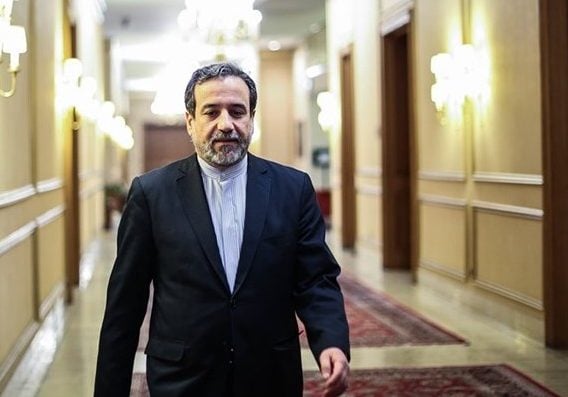
Seyyed Abbas Araqchi

Araqchi will officially visit Bern to attend the fourth round of political talks between the Islamic Republic of Iran and the Swiss Confederation.

In this round of talks, the two sides will discuss bilateral cooperation, international and regional developments, the latest situation of the Irna nuclear deal, and legal and human rights issues.

Tensions between Washington and Tehran have been rising since President Donald Trump withdrew the US from a 2015 international nuclear deal and imposed unilateral economic sanctions against Iran, mainly targeting its energy dealings on the global market.

In early May, the Trump administration beefed up the US’ military presence in the Persian Gulf, citing alleged and unspecified threats posed by the Islamic Republic to American troops and interests.

The US’ recent deployment of an aircraft carrier, B-52 bombers and Patriot missiles to the Middle East has raised fears that the Trump administration was contemplating military aggression against Iran.

Iran has insisted that it will not initiate any conflict, but will firmly defend the country against any act of aggression.

Everything Is Possible in Tense Atmosphere: Zarif

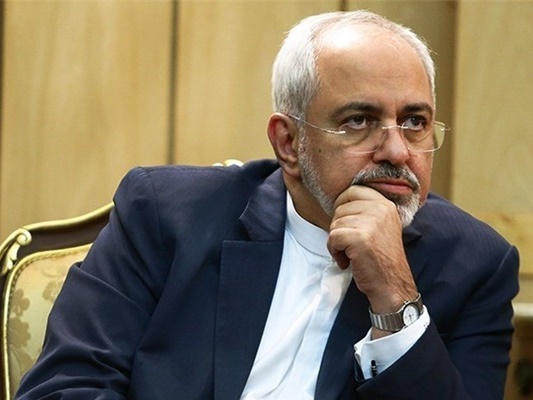
mohammad javad zarif

Speaking in an exclusive interview with Al-Araby TV on Tuesday, whose full version will be aired on Wednesday, Zarif pointed to the ongoing tension in the Middle East, and said “everything is possible” in such a tense atmosphere where the US is waging an economic war on Iran through its unilateral sanctions.

“There is no difference between military and economic war,” he said. “In the circumstances of tension, everything is possible and the region is the biggest victim.”

However, he added, Iran will never allow the US to impose a unilateral war on the Iranian nation, which will inevitably harm everyone, as “war is war”.

Tensions between Washington and Tehran have been rising since President Donald Trump withdrew the US from a 2015 international nuclear deal and imposed unilateral economic sanctions against Iran, mainly targeting its energy dealings on the global market.

In early May, the Trump administration beefed up the US’ military presence in the Persian Gulf, citing alleged and unspecified threats posed by the Islamic Republic to American troops and interests.

The US’ recent deployment of an aircraft carrier, B-52 bombers and Patriot missiles to the Middle East has raised fears that the Trump administration was contemplating military aggression against Iran.

Iran has insisted that it will not initiate any conflict, but will firmly defend the country against any act of aggression.

UAE Trying to Become New Israel

Zarif also lashed out at certain regional countries for their excessive weapons imports, saying, “Three countries in the region believe they can maintain their security through their relations with the United States,” he added.

However, he added, they are wrong to think they can import their security from America because these weapons will be used to achieve the goals of Israel.

“The United Arab Emirates is spending billions of dollars on armaments and wants to be a second Israel in the region.”

Studies show the UAE has increased its arms imports by 63% between 2012 and 2016. Its military expenditures are projected to grow to $31.8 billion by 2021 from $23.6 billion in 2016, according to SIPRI.

The country has led an increasingly interventionist foreign policy in hot spots like Libya, Syria and, most recently, Yemen.