Tuesday, December 30, 2025
Home Blog Page 3160

Iran Advises Pompeo to Get Popular among Media Like Zarif

Chip Somodevilla/Getty Images

In a post on his Twitter account on Monday, Iranian President Hassan Rouhani’s senior advisor Hessamoddin Ashena responded to US State Secretary Pompeo’s call for an interview with the Iranian media.

“The US government does not force the media outlets to do an interview with (Iranian Foreign Minister Mohammad Javad) Zarif. The Iranian government cannot force the media to have an interview with Pompeo either,” he tweeted.

“Zarif has never made any request for an interview; indeed, he is an attractive figure for the American media. Pompeo should also try to become more attractive to the Iranian media,” Ashena noted.

His comments came after Pompeo said in a July 25 interview with Bloomberg that he would “happily” go to Tehran and willingly appear on Iranian television to explain US reasoning behind its sanctions against the Islamic Republic.

A few days later, the Iranian administration’s spokesman invited Pompeo to be interviewed by Marzieh Hashemi, an American-Iranian journalist and anchor at Iran’s Press TV who was once detained in the US.

Ali Rabiei said Sunday that Pompeo had been “forced” into saying he was ready to appear on Iranian TV because of Zarif’s recent round of interviews with the US media during his UN trip in New York.

In the meantime, the Iran Front Page news website sent an e-mail to Pompeo’s office voicing readiness to have an interview with the US secretary of state, but the offer was declined.

Mike Pompeo’s request for an interview with Iran may have provided some fodder for advocates of Iran-US talks, but he does not appear to have any new or surprising message for Iranians.

Pompeo has all the hallmarks of an anti-Iranian politician, either as a member of the US House of Representatives, a director of the Central Intelligence Agency (CIA), or as the US secretary of state at present.

Pompeo has expressed his hostility to Iran so explicitly in the past that the name or nationality of the interviewers would not change anything about his policies or result in any attractive offer from the hawkish secretary.

Iranian officials have made it clear for Washington that Tehran judges the other states by their measures and deeds, not mere words.

In a Twitter post reflecting his unease about Iranian Foreign Minister Zarif’s interviews with the American press in the US, Pompeo decried what he called Iran’s “bad regime” for refusing to let him do the same thing in Tehran.

Weirdly ignorant of the fact that new communication technologies have facilitated the exchange of messages, Pompeo has insisted that people of Iran should hear “the unfiltered and unabridged truth”.

Canadian philosopher and media theorist Marshall McLuhan has called the contemporary era the age of communication, and has explained how the global village has minimized relations by compressing them in terms of time and location.

It is no more necessary for a person living in the age of telecommunication to cross the geographical border and travel to Iran to talk to people.

The US secretary of state has bemoaned the fact that Foreign Minister Zarif has the change to have interviews with the American media in the US, but has also ignored the fact that such enthusiasm for talking to Zarif is not because of his physical presence in the US, as a host of other foreign officials had taken part in the UN conference in New York as well, but hardly any of them received such attention in the American press.

The US secretary of state had better listen to the Iranian presidential advisor’s advice and judge whether he will enjoy the same amount of attention, like Zarif in the US, if he ever travels to Iran.

NoOps: What You Need to Know

There are those who claim that the evolution of DevOps culture will lead to the widespread adoption of a software development strategy where developers do not rely on IT operations. Interest in this strategy, known as “NoOps”, has attracted a lot of attention lately, but it is still far from becoming a reality. While some organizations have begun implementing NoOps, widespread adoption will not happen overnight.
Still, it is good to keep an open mind about new approaches that claim revolutionary potential. And it’s certainly worth noting how NoOps can benefit your software factory. Want to know more? Keep reading!

Changes in the area of ​​operations
In 2017, cyberattack WannaCry hit organizations around the world. If there is one thing that is guaranteed to draw the public’s attention to IT operations, it is news about the main attacks, which may occur with the failure to update or fix software known to have security vulnerabilities.
Undoubtedly, some IT professionals were feeling a little discouraged when the news broke. Others may be feeling a little defensive, seeing IT operations portrayed in such a negative way. This is expected in the context of the DevOps culture, which seems to reduce the need for operations personnel to such an extent that some people have begun to talk about the end of IT operations as we know it – NoOps being the catchword to describe this situation.
The term NoOps is not as new as you might think. Already in 2013, there was talk about this being the logical evolution of DevOps. From this perspective, it seems that NoOps has always been intended to be the logical result of DevOps. But are things so clear? Does DevOps inevitably lead to operator minimization or is it a buzzword and nothing more?

DevOps versus NoOps
DevOps is now a well-established method for continually deploying applications and software, which is a requirement to remain competitive in the face of digital transformation. The operational part of DevOps deals with configuration management and version management, but is rarely concerned with running datacenters or deploying virtual machines.
These tasks are primarily left to a cloud service provider. If there is still an internal IT staff in charge of such tasks, it can be difficult to provide a serverless environment. Basically, while in DevOps development and operations work together at each stage of creating applications and software, in NoOps these two areas do not need to interact.
This is the only way developers can use DevOps methodologies to deploy applications at home as easily as they would find in a cloud-based service if they have little knowledge of traditional operations.

Making NoOps a Reality
So aren’t the next application developers having to deal with operations professionals? You can automate the infrastructure creation and management tasks required to build and deploy application versions, and while challenging, would allow developers to manage and maintain active code in addition to their development code.
Questions remain as to which technology would be needed to make this scenario a reality (monitoring, feedback and root cause analysis come to mind). What about the continuing role of internal operations? Is this scenario only possible with cloud infrastructure or could it be realized with on-premises infrastructure?
Although the concept of NoOps has been around for some time, its widespread adoption seems a bit distant – and not necessarily inevitable. Perhaps the real question is, if so, how effectively will it allow companies to maximize the productivity of their software factories? It will be interesting to see how early users benefit from this new reality and whether it will enable their much-needed digital transformation.
Enjoy and see if your company is ready for digital transformation with the tips in our article on the subject!

ISIS Weapons, Equipment on Show in Tehran

These weapons and vehicles were captured during the fight against this terrorist group throughout the Middle East.

Some of these weapons bear the ISIS logo on them.

ISIS Weapons, Equipment on Show in Tehran
‘Sacred Defence’ Museum in Tehran Displays Sacrifices Made to Save Iran

These weapons are the signs of fight against the terrorists who committed crimes against humanity in countries like Syria and Iraq.

Along with the ISIS equipment, fighter jets remaining from the eight-year war imposed by Iraq on Iran in the 1980s as well as the cars damaged during terror attacks on Iranian nuclear martyrs are also displayed in this museum.

The Islamic Revolution and Holy Defence Museum is located in Tehran’s Haqqani Highway.

Iran’s Beauties in Photos: Tabriz Traditional Market

Tabriz Traditional Market

Various medicinal herbs are sold in Tabriz traditional market with its colourful grocery stores.

The use of medical herbs as a treatment for diseases is as old as the human existence.

People in ancient times had indeed no choice but to resort to medical herbs. The use of chemical and synthetic drugs intensified during past century; however the harmful effect of modern medicines made people resume taking medical herbs.

The traditional medicine in Iran dates back to the Aryan era: Avesta– the holy book of Zoroastrians- is the first Iranian book to speak about medical herbs.

According to Avesta, the first Persian physician was “Triteh”- the father of Garshasb, Iranian mythic hero- who knew about the use of medical herbs and extracts.

What follows are Fars News Agency’s photos of groceries  in Tabriz traditional market:

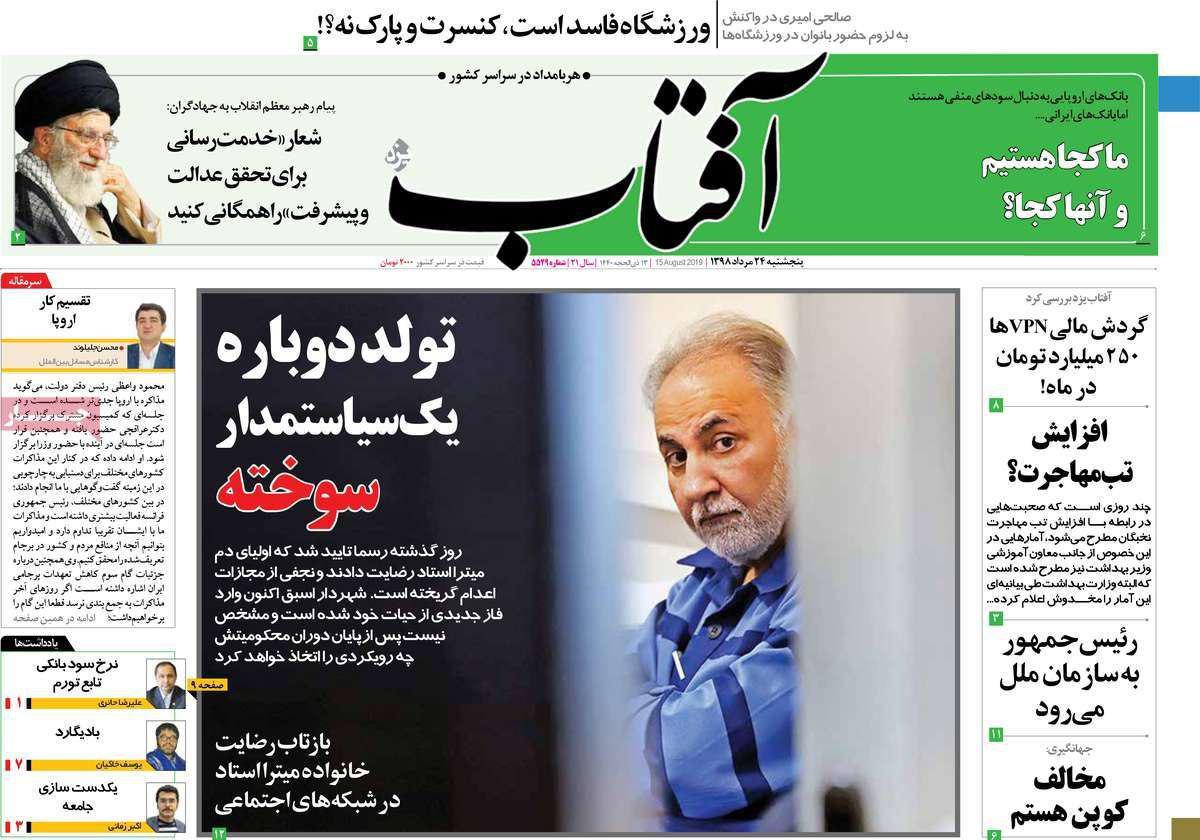
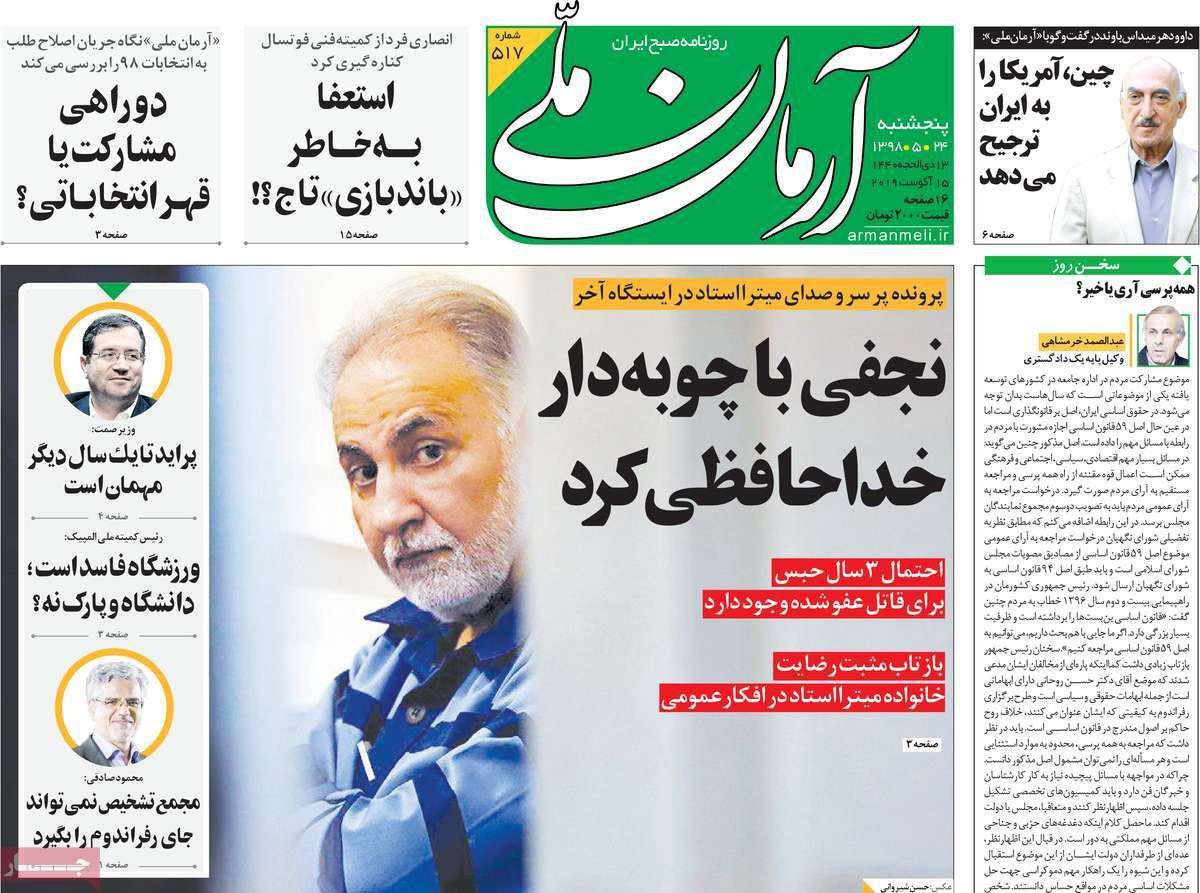
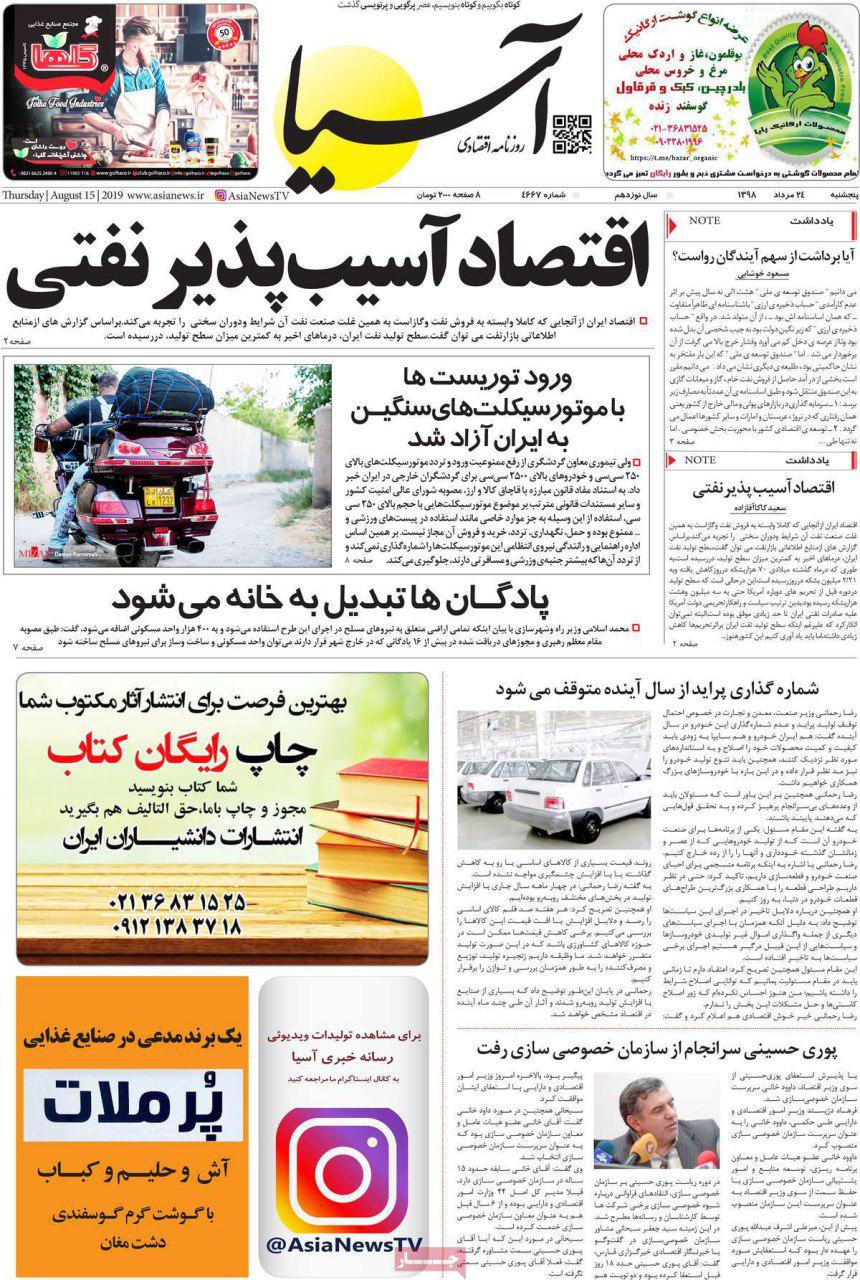
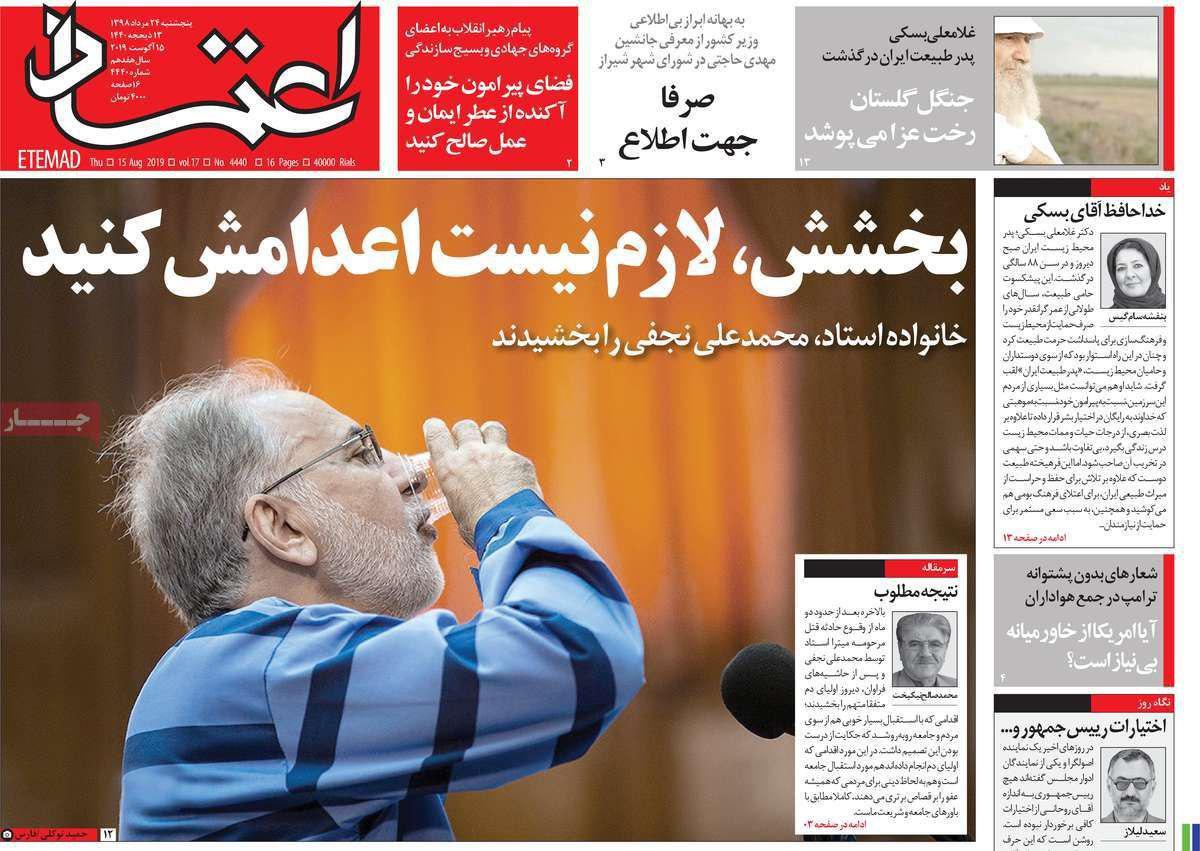
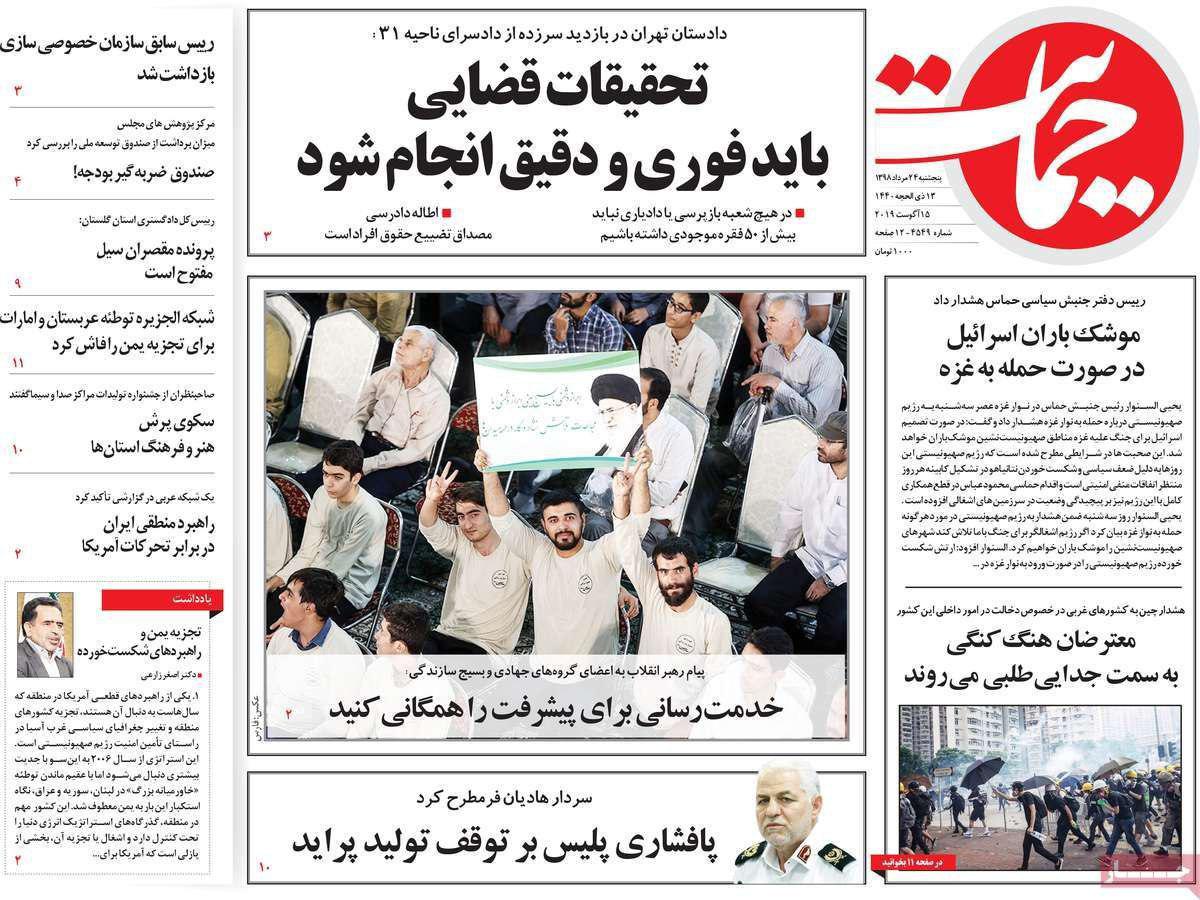
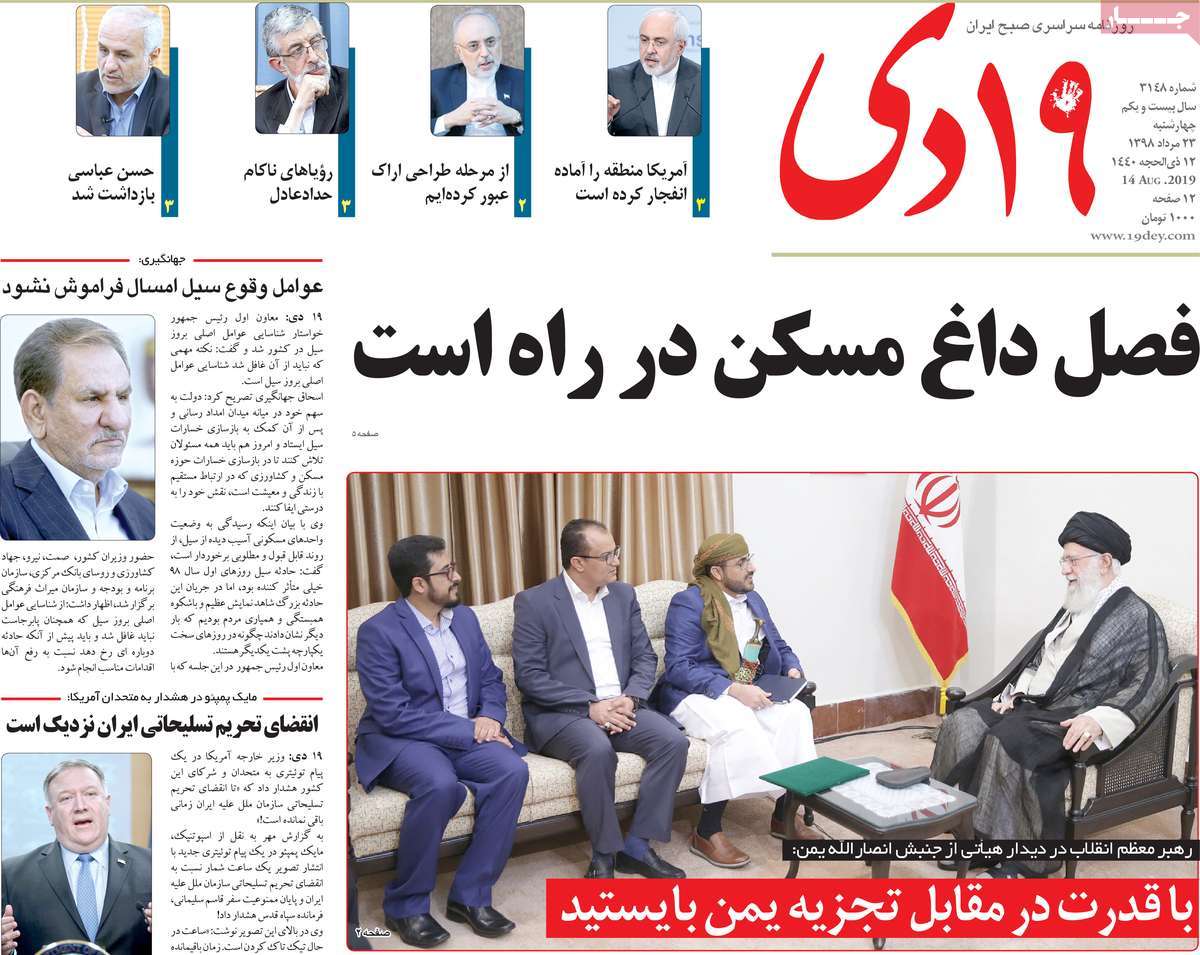
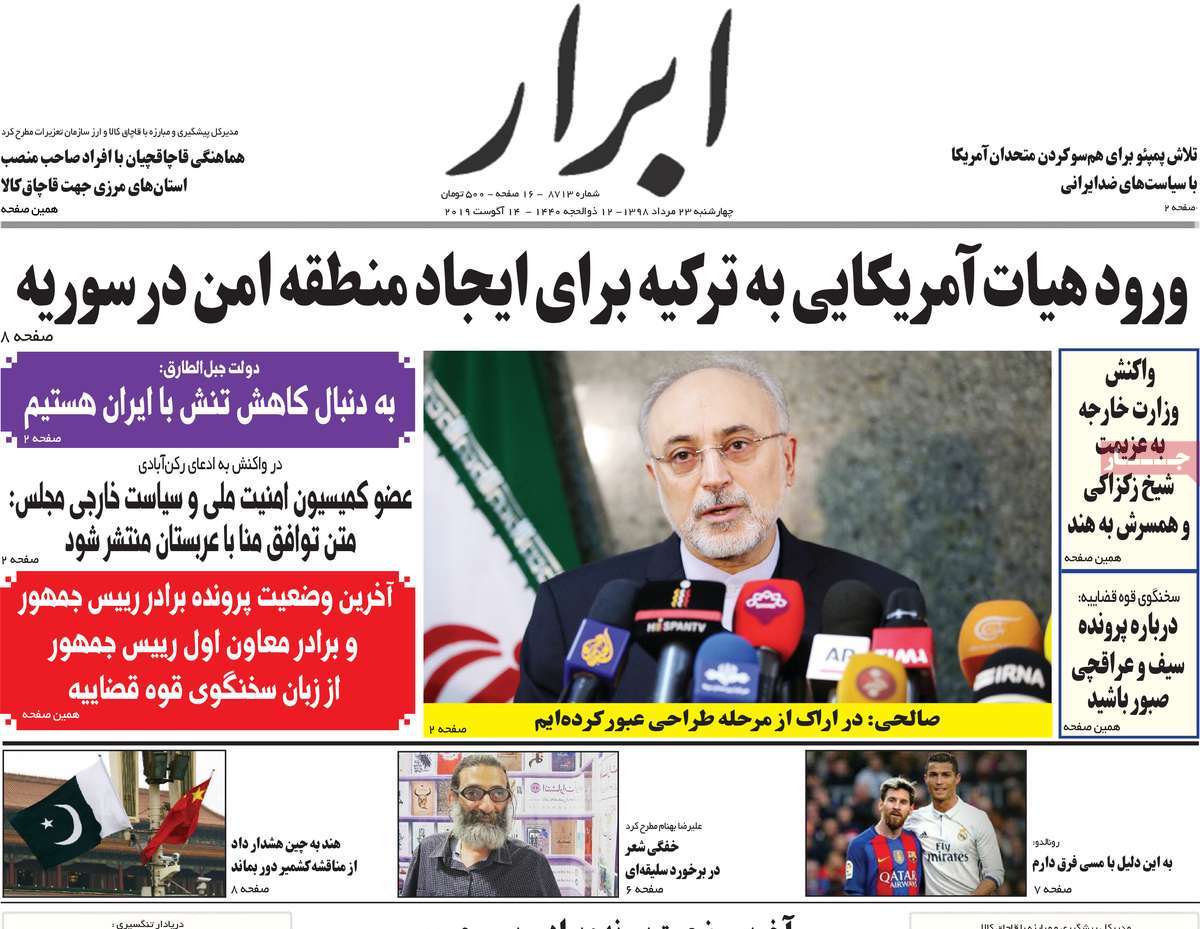
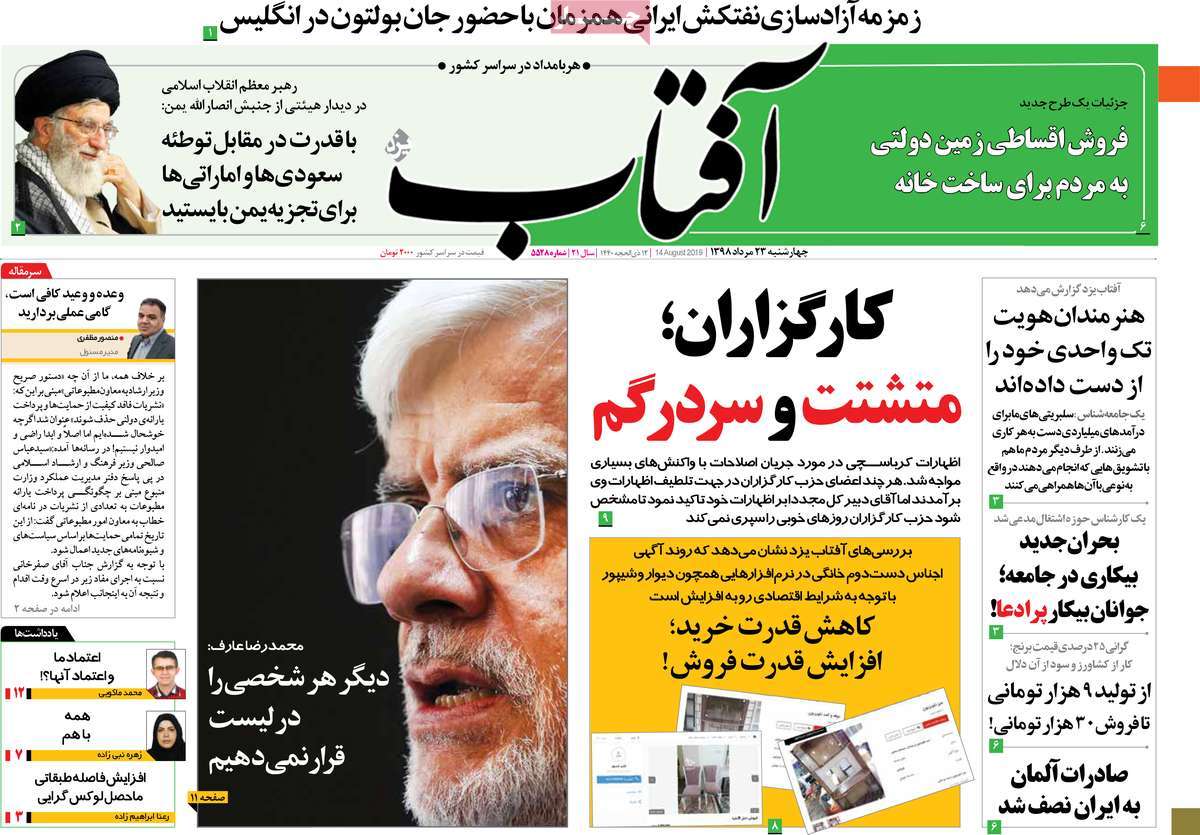
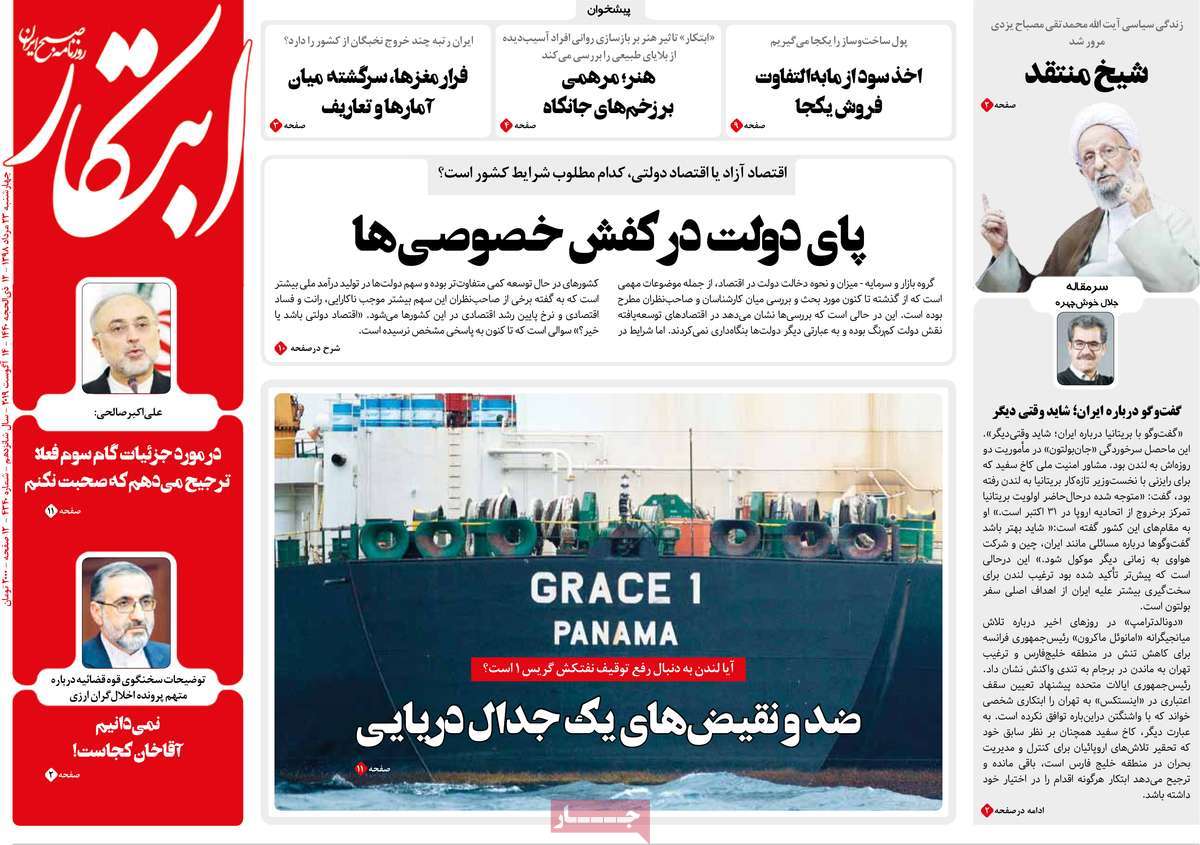
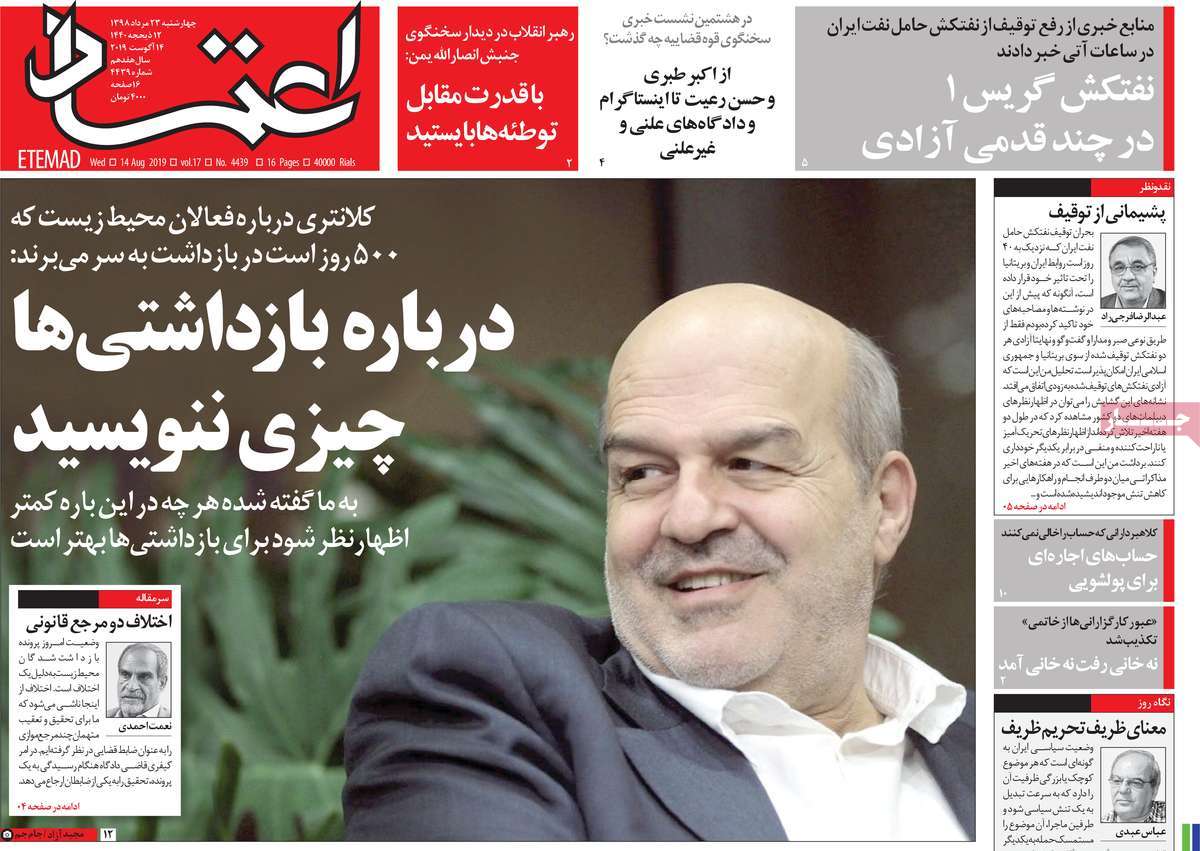
A Look at Iranian Newspaper Front Pages on July 29

A Look at Iranian Newspaper Front Pages on November 19

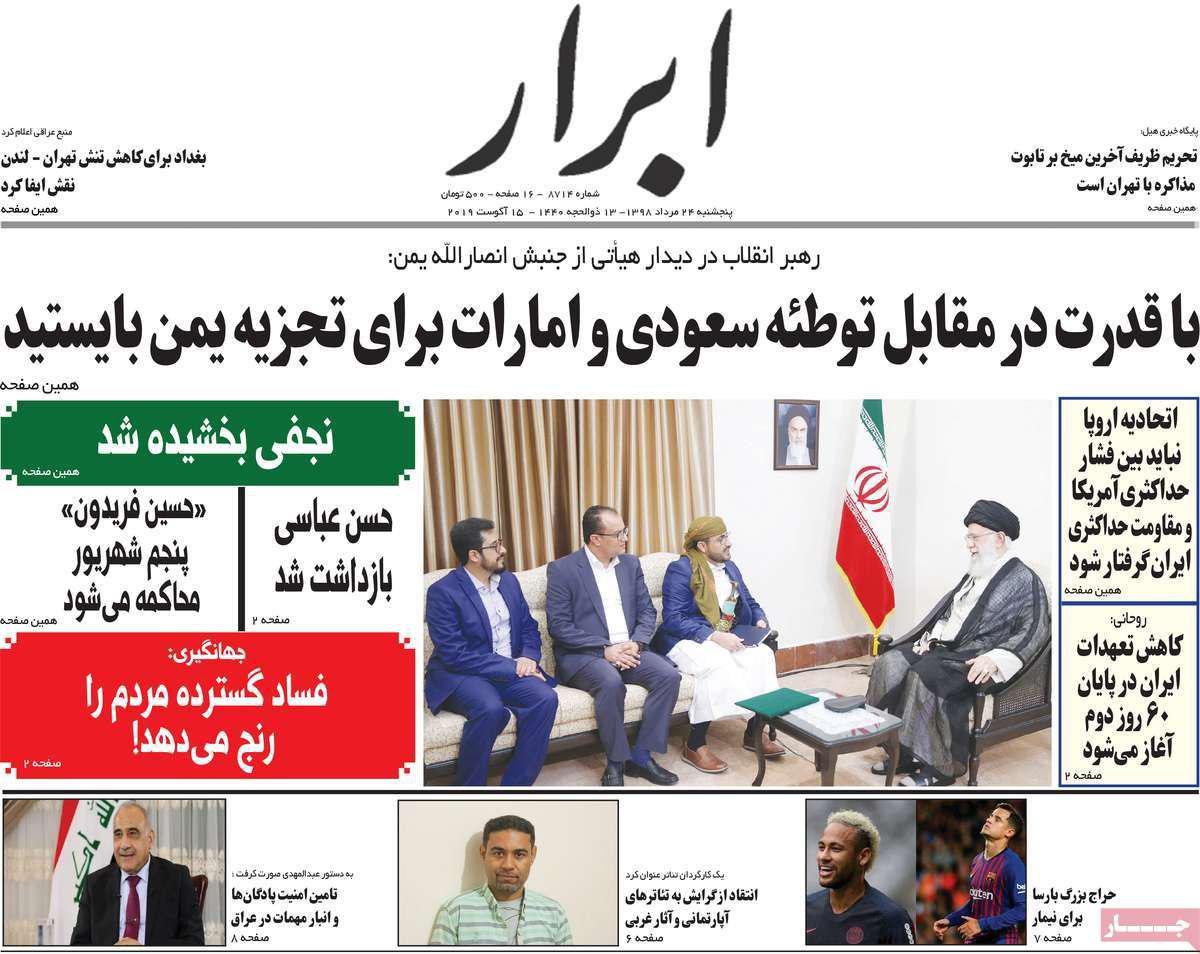
Abrar:

1- Biggest Terrorist Attack Foiled in Iraq

2- Nuclear Chief: Iran Has Enriched 24 Tonnes of Uranium during JCPOA Implementation

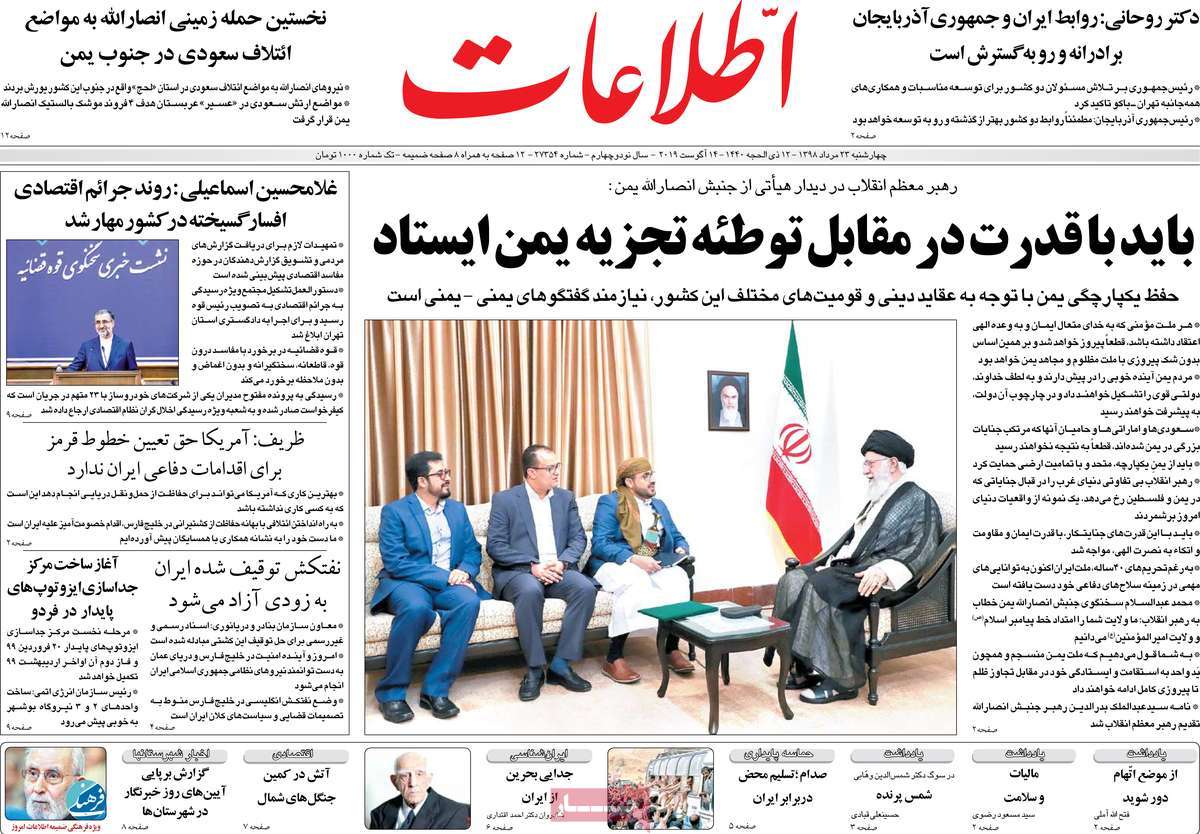
A Look at Iranian Newspaper Front Pages on July 29


Aftab-e Yazd:

1- Europeans One by One Withdrawing from Joining Naval Coalition

2- Late Decision: Rouhani Urges Four Ministers to Be Accountable for Forex Offenders

A Look at Iranian Newspaper Front Pages on July 29


Asrar:

1- Araqchi: We’ll Continue Reduction of JCPOA Commitments as Long as Our Demands Are Not Met

A Look at Iranian Newspaper Front Pages on July 29


Donya-ye Eqtesad:

1- Kamala’s Clash with Trump: Theorization of Economic Extravaganza

A Look at Iranian Newspaper Front Pages on July 29


Ebtekar:

1- JCPOA amid Rapid Developments

* Extraordinary Meeting of JCPOA Joint Commission in Vienna

2- Sanders: Saudi Arabia Is Vicious Ugly Dictatorship

A Look at Iranian Newspaper Front Pages on July 29


Etemad:

1- P4+1 Stresses Continuation of Fordow, Arak Nuclear Projects

2- Iran Claims World Title in U-21 Volleyball Championship

* Iran Leader Offers Congratulations

A Look at Iranian Newspaper Front Pages on July 29


Ettela’at:

1- Rouhani to Bin Alawi: US Withdrawal from JCPOA Root Cause of Regional Tensions

2- Young Volleyball Players of Iran Make History

3- Araqchi: Constructive Talks Held in Meeting on JCPOA

A Look at Iranian Newspaper Front Pages on July 29


Haft-e Sobh:

1- Qom, Hub of Bitcoin in Iran

* Over 2,000 Cryptocurrency Miners Confiscated in Qom Province in 2 Weeks

A Look at Iranian Newspaper Front Pages on July 29


Hemayat:

1- India Uncertain about Purchase of US Drone after IRGC’s Shoot-Down of Global Hawk

2- Iran’s Continued Oil Exports to China Despite US Sanctions

A Look at Iranian Newspaper Front Pages on July 29


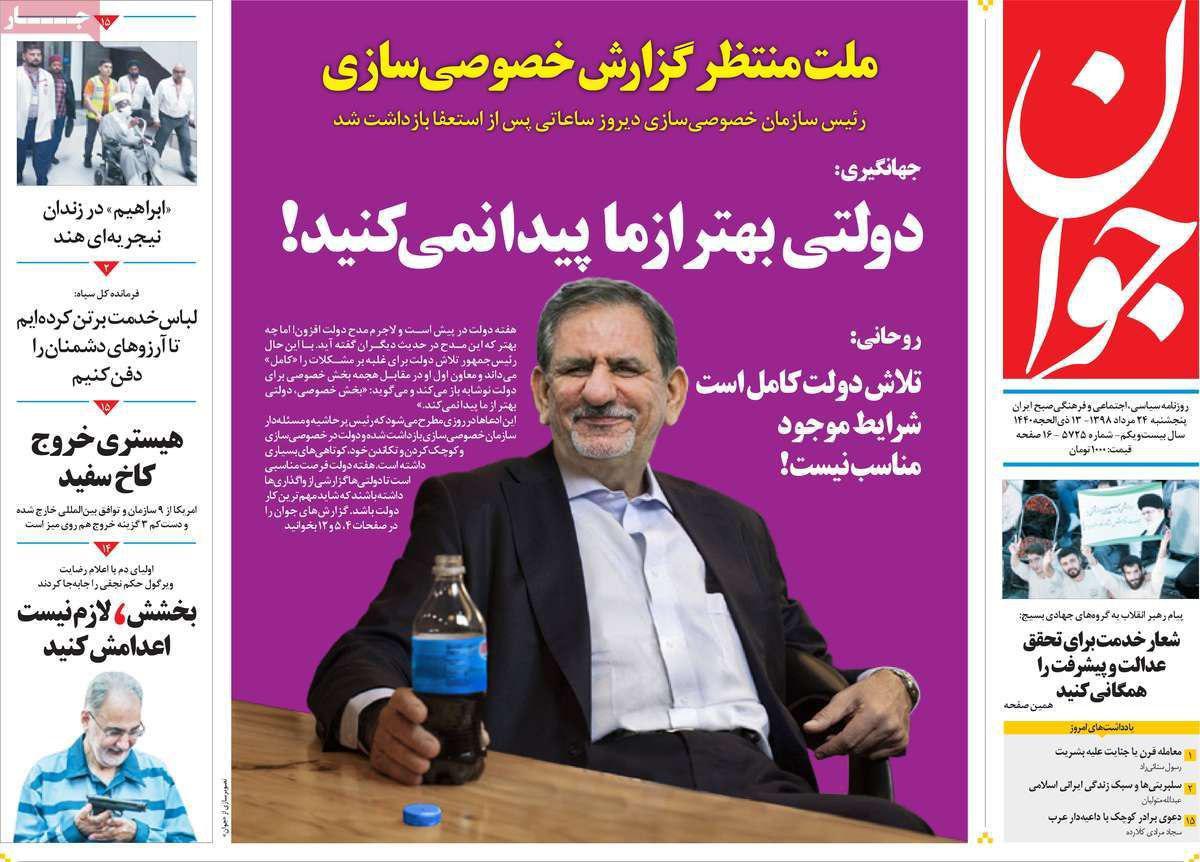
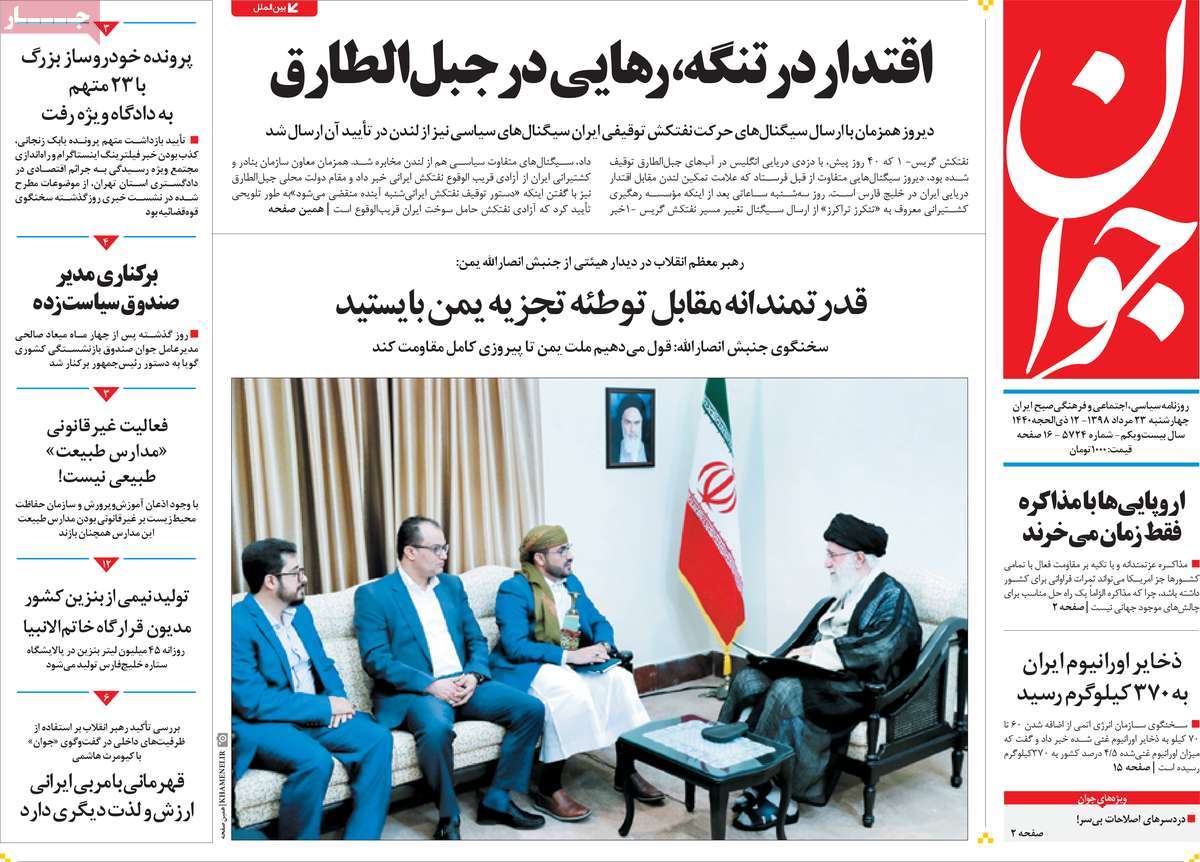
Javan:

1- Iranian Volleyball Players at Peak of the World

2- Rouhani to Oman: UK to Get Harmed by Stealing Iranian Tanker

A Look at Iranian Newspaper Front Pages on July 29


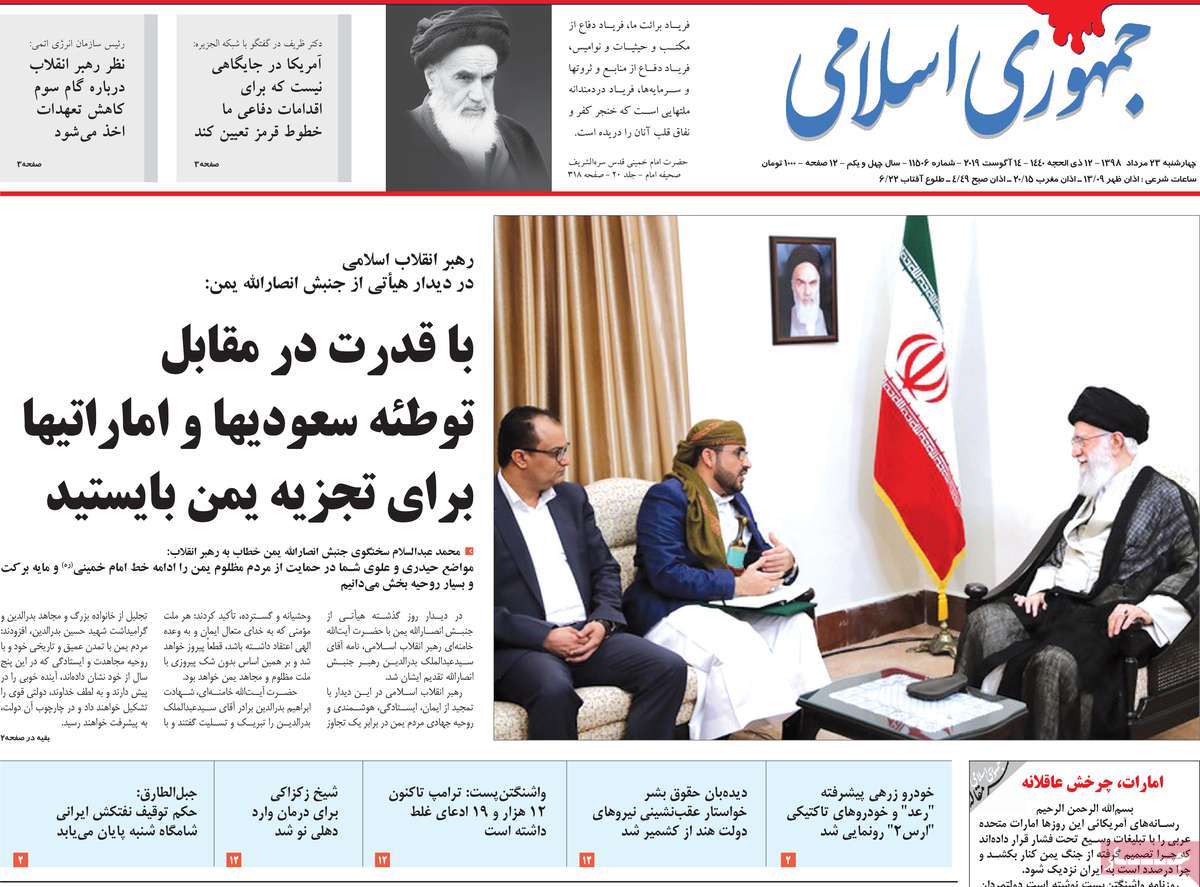
Jomhouri Eslami:

1- IMF: Iran Sanctions Slowed Down World Economic Growth Rate

2- Two New UK Ministers Stress Need for De-Escalation with Iran

3- Health Ministry: Medicine to Be Produced in Iran to Treat Hepatitis C

A Look at Iranian Newspaper Front Pages on July 29


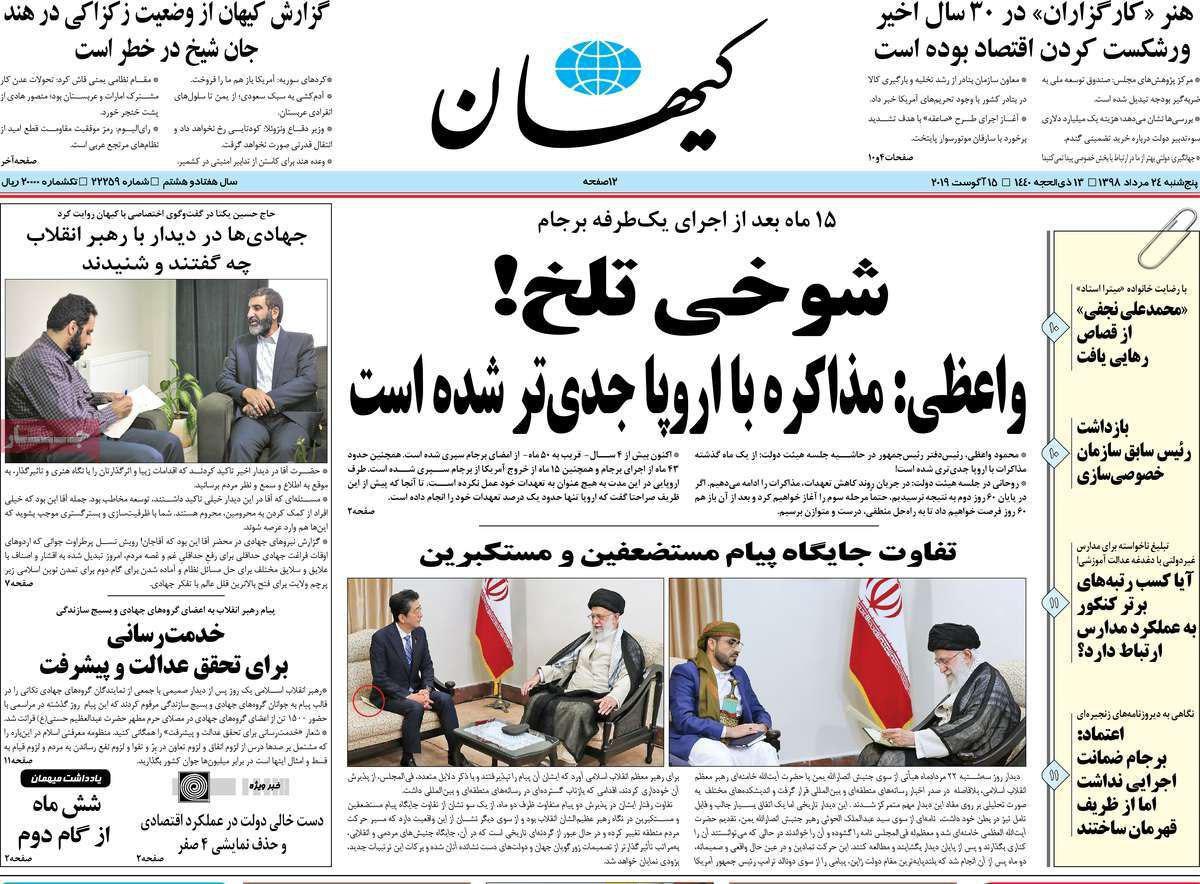
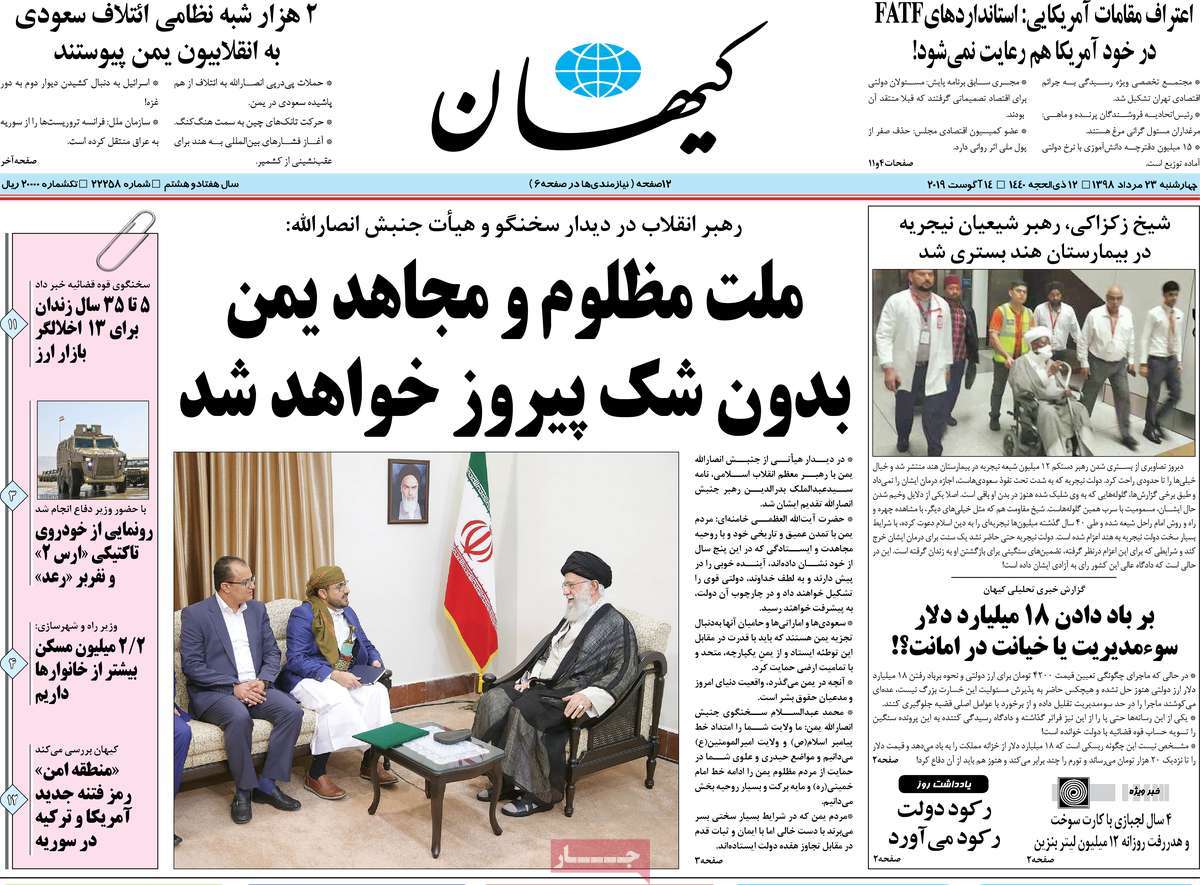
Kayhan:

1- Iran Leader Congratulates U-21 Volleyball Team on World Championship

2- Gov’t Fails to Control Price Hikes Despite Central Bank’s Efforts to Control Forex Rates

3- Big ISIS Plot Neutralized in Iraq

A Look at Iranian Newspaper Front Pages on July 29


Setareh Sobh:

1- Russian Protesters under Putin’s Boots

2- Ex-Diplomat: US Trying to Engage Iran, Saudi into War

A Look at Iranian Newspaper Front Pages on July 29


Shargh:

1- Consultation over Security of Strait of Hormuz

* Omani FM Meets Iran President, Speaker

2- Araqchi: Everyone Determined to Save JCPOA

A Look at Iranian Newspaper Front Pages on July 29

Iranian Documentary Shines in Foreign Festivals

The acclaimed documentary has already grabbed headlines in various international film festivals in the world with the latest award coming from Sole Luna Doc Film Festival held in the city of Palermo in Sicily, Italy.

Yasser Talebi is a young Iranian director who has managed to win the attentions in film circles in the world with his latest documentary film.

Iranian Documentary Shines in Foreign FestivalsThe film earlier received the best feature documentary award and a diploma of honour at the 15th Kazan International Muslim Film Festival in the Republic of Tatarstan, as well as a special mention from 25th edition of Shanghai Television Festival in China.

It was nominated for Estonian People’s Award at the 33rd Pärnu Film Festival in Estonia. The movie also received the best movie award from students’ point of view.

‘Beloved’ revolves around the life of an 80-year-old mother named Firouzeh who is fond of her isolated lifestyle in nature with her cows. The film depicts her kind and loving character and demonstrates her bravery and strength tackling the hardships of life in the Alborz Mountains without the modern comforts of technology. She believes happiness lies in the simplicity of life.

But the main question is why Beloved has won so much attention from international film festivals?

Nima Abbaspour, a film critic, elaborates on the features of the documentary, saying the main issue in the film industry is attraction. “International festivals usually focus on new themes which are part of a society which had remained unknown for them over the past years.”

He went on to say that the same principle applies to the Beloved documentary. “Here, we face an old mother living alone in the mountains. The film also depicts the encounter between humans and the nature which is attractive by itself. We should not ignore the cinematic attractions of the film.”

‘Elegant and Poetic’

The critic also said the Beloved enjoys some special features which make it distinguished from similar documentaries. He believes the film has managed to achieve some poetical aspects which are rare among other films.

“The documentary depicts the life of Firouzeh with an elegant and poetical view. This is the main feature of the film. It wins our attentions from the beginning. I think Talebi has been successful in his project,” he noted.

US Deploys Forces in KSA to Keep Al Saud in Power: Analyst

The US military began to deploy hundreds of troops, jet fighters and missile systems at a military base near Riyadh after the Saudi king gave the green light for the deployment and welcomed American troops on Saudi soil. This comes as tensions in the Persian Gulf have peaked and there is much speculation in that regard. The Saudis regard the US deployment as “boosting mutual cooperation in order to ensure regional security and stability.” The US Central Command also already announced that the deployment comes at the request of Saudi Arabia. The CENTCOM further said the move would give them further deterrence capability and redouble their ability to protect their interests and troops. Meanwhile, reports suggest that a full Patriot system has recently been deployed at the military base as part of the US Air Force movements in Saudi Arabia.

To discuss the issue further, Khabar Online news website has held an interview with Sabah Zanganeh, an expert on Middle East issues and a former Iranian ambassador to the Organization of Islamic Cooperation (OIC). Excerpts from the interview follow.

There is much speculation about the United States’ deployment of troops to Saudi Arabia. What do you think the main objective of this move is?

Most American survey centres have suggested that the reason for this move is a disruption of the political system in Saudi Arabia and the emergence of possible chaos as a result. All this comes amid pressure and the repercussions of the Yemen war as well as differences within the Saudi royal dynasty plus the possible demise of the country’s king, i.e., Kind Salman. Accordingly, US authorities, too, are seeking to monitor developments closely and keep control of the situation. In the meantime, the base that Washington has chosen is located near Riyadh, the political hub of Saudi Arabia.

What is it that has made the Americans worried about Saudi Arabia’s domestic issues?

As we know, several religious figures and princes were imprisoned during the course of domestic political developments in Saudi Arabia. This has triggered protests that could flare up on the future. Accordingly, these developments can touch off dissatisfaction among religious people in Saudi Arabia, which, in turn, can further escalate the situation.

What goal is the US pursuing in Saudi Arabia’s internal issues?

What is important is that uncertainty hangs over the future of Washington-Riyadh relations if the current Saudi rulers do not remain at the helm of affairs. Therefore, Washington seeks to keep the current ruling elite in power, and immediately replace those members of the Saudi dynasty who have died, so that close Saudi-US relations will not be harmed.

So, you don’t believe that the deployment of US troops to Saudi Arabia is somehow aimed at confronting Iran?

The US does not need so many forces in order to confront Iran. The US already has around 100,000 other troops on the ground in regional countries such as Qatar, the United Arab Emirates (UAE), Oman, Kuwait, Iraq, Pakistan, Turkey, etc. Moreover, given that the US also has bases in the region in addition to its troops, it seems the deployment of American forces to Saudi Arabia is due to Riyadh’s internal concerns. The Saudis, too, would like to preserve their dynasty and their rule at any cost.

Saudi Arabia has announced that the deployment of American troops on its soil is aimed at striking a balance in the region as Iran, Russia and Turkey have gained considerable influence in the region, and Turkey has recently taken delivery of S-400 missile systems. To what extent is this proposition justifiable?

The Saudis have always resorted to such justifications, and they have repeated the same justifications this time again in order to somehow justify the presence of foreign forces on their soil. As we know, the Saudi society is generally a religious one, and such a society has been and will remain opposed to the presence of foreign troops in the country. So, bringing up such issues is aimed at deceiving the public opinion.

Given the recent developments in the region such the deployment of US troops to Saudi Arabia and tensions in the Persian Gulf, what do you think the future holds? Will tensions begin to ease, or are we going to witness conflict in the near future?

War in the region will be meaningless without the presence of the United States. This country is on the verge of entering the election season, and any involvement in tensions and conflicts would amount to a setback for US election plans. Furthermore, without the presence of the US, no regional country will have the power or the courage to get involved in a fresh war. On the other hand, it seems political and economic pressure as well psychological warfare will increase.

However, whether or not these things can fill the void caused by a lack of US presence is another thing. We even see that the issue of escorting ships gradually begins to get out of the “coalition” mode and take on an “individual” form. We should look into the reasons behind the United States’ reluctance. Is it due to inability or domestic pressure, or are other considerations involved? At the end of the day, such a situation will make decision-making for other countries more difficult.

Great Ways to Make Money Through Your Tradelines

It is easy when the right guidelines, as given by experts, are followed. One can also read more about this from insightful publications like this one.

Curious to know more?

Below are some of the best and greatest ways to make money through tradelines that you have worked hard to maintain. Read on to learn more.

How Do Tradelines Work?

Before making an attempt to earn from tradelines, it is highly recommended that you should understand how they work. For those without any experience, there are many ways of getting some insights. The best is through consultation with experts, but reading reliable websites can also help.

These accounts can bring the user some money in addition to improving their credit score. It the same way that lenders benefit from them through interest, users can benefit in a variety of ways as we are going to see below.

You Can Piggyback for a Fee

For a long time now, ”piggybacking,” which is adding someone onto your credit history, has been in use. A person with a poor credit history gets added as an authorized user to a credit report that is doing well. Usually, the benefitting person pays a fee to the other person. There are agents who connect these two parties so that they can process the deal. So, if you have an excellent credit history, it is time to take advantage of this and earn some money from it. However, those with the potential of doing things that will compromise your credit score should be avoided.

Have More Tradelines

You can have more tradelines for credit, which is a double benefit. For one, you will get a better credit score when these are maintained well, and two, you will earn money using one of the ways we have discussed. If you do this gradually rather than all at once, the benefits will be even greater. Do this cautiously to avoid getting overwhelmed by the many tradelines that you have just started.

Refer Others for a Commission

If your tradeline refers other people to open one, the lender will give you some commission. So it is up to the user of the account to decide how much they want to earn. Some have made this is a serious source of income, which eases the amount they pay on their tradeline every month because the commission reduces this balance. Consequently, this improves the credit score, which is one of the greatest things that can happen to an entrepreneur or even individual who wishes to borrow money in the future.

Conclusion

As you can see, there are a couple of ways in which someone can get passive income from a functioning tradeline. If it is struggling, you probably need to use some additional money and boost it. But for those whose tradelines are already in good shape, it is time to enjoy the benefits.

‘Conversations with Kiarostami’ Now on Bookshelves in US

Photo of deceased Iranian filmmaker Abbas Kiarostami (right), American film critic Godfrey Cheshire (centre), and Kiarostami's son Ahmad (left) / Photo released by Cheshire in a 2017 IndieWire article

The book “Conversations with Kiarostami” was unveiled in an event in New York which began on July 26th and will run through August 15. The event also offers the most comprehensive review of the works of Kiarostami.

The book has been published by Woodville Publishing and the director’s son Ahmad Kiarostami has written the book’s foreword.

Conducted during the 1990s, these in-depth conversations offer a film-by-film account of Kiarostami’s views of his artistic development from his first short “Bread and Alley” in 1970 to the 1999 feature “The Wind Will Carry Us”.

It also looks at his lesser known features and shorts along with the masterworks that made him known around the world, such as the Koker Trilogy – “Where Is the Friend’s House?”, “And Life Goes On”, “Through the Olive Trees”, “Close-Up” and “Taste of Cherry”.

‘Conversations with Kiarostami’ Now on Bookshelves in US“During Godfrey’s numerous visits to Iran within a decade, he formed a relationship with my father that I had hardly ever seen him having with other writers,” Ahmad Kiarostami writes in the foreword.

“I believe this is because of Godfrey’s ability to go beyond the surface; his unique attitudes and interpretation. It is well-known that Godfrey was one of the first people who introduced the Iranian cinema to the US and, yet, there is no trace of the usual ‘exotic’ approach… That is what you will find in this book: a stimulating conversation which is far from the clichés,” he noted.

Cheshire then explains why he tends to divide Kiarostami’s oeuvre into three periods. The first, the Kanoon (Institute) period, is related to the Institute for the Intellectual Development of Children and Young Adults (IIDCYA) in Tehran, which produced all but a few of Kiarostami’s earliest films. Most of these have rarely been seen in the United States.

The second phase of Kiarostami’s filmmaking career, the Masterpieces period, begins with the 1989 documentary “Homework” and extends through “The Wind Will Carry Us”.

Kiarostami’s third, Experimental period doesn’t begin until the 2001 documentary “ABC Africa”. This final phase includes such landmarks as Ten (2002), Shirin (2008), Certified Copy (2010), Someone in Love (2012); and his final work, 24 Frames (2017).

Godfrey Cheshire, born in1951, is an American film critic, film writer and director. He was instrumental in the founding of Raleigh’s Spectator Magazine in 1978. He also served as the chairman of the New York Film Critics Circle.

Cheshire is one of the leading experts and specialists of the Iranian cinema, especially that of Abbas Kiarostami. He has been featured in two documentaries “Abbas Kiarostami: Art of Living” by Pat Collins and Fergus Daly (2003), and “Abbas Kiarostami: A Report” by Bahman Maghsoudlou (2013). He has also written many articles about the Iranian cinema over these years.

He was first drawn to Kiarostami’s works in 1992, when Film Comment assigned him to cover a festival of post-revolution Iranian films. It was there and then, he notes in his introduction, that Close-up (1990) “struck me as one of the most extraordinary films I’d ever seen.”

A few years later, Cheshire, having struck up a friendship with the director, began traveling to Iran and recording these conversations in which Kiarostami discusses each and every one of his films.

This American critic has written for numerous national and international publications, including The New York Times, Variety, New York Press, Film Comment, the Independent Weekly and Rogerebert.com.

Iran Eyeing Stronger Presence at Russia’s MAKS Air Show 2019
The MAKS Air Show is held every two years to showcase the countries’ achievements in various fields including airplanes, public aviation, military aircraft, helicopters, UAVs, engineering, weapons and aircraft equipment.

MAKS exhibition is one of the most prestigious aerospace shows in the world. Knowledge-based companies that meet the infrastructural requirements for international communications (website, catalogues, and brochures in English) can register for participation in this event.

Companies that are interested to be part of the national pavilion of Iran can enjoy the support of the export corridor, and Iran National Innovation Fund to rent a booth.

Companies applying for participation in the B2B meeting can enjoy 50% discount for the flight tickets, hotels and visa issuance.

The exhibition will be held in Russia from August 27 till September 1, 2019.

MAKS is an international air show held at Zhukovsky International Airport, the home of the Gromov Flight Research Institute in Zhukovsky, southeast of Moscow, Russia.

For a brief review of Iran’s achievements in various fields of science and technology, check the book “Science and Technology in Iran: A Brief Review – 2019
The event used to be organised by the Russian Ministry of Industry and Trade until 2009.The first show, Mosaeroshow-92, was held in 1992. Since 1993, the air show was renamed as MAKS and is held biennially on odd years.

MAKS is an important event for the Russian aviation industry and the Commonwealth of Independent States. Although it started mainly as an entertainment event, the show soon became a marketplace where Russian aerospace companies could negotiate export contracts and Russian air carriers could make foreign contacts.