Friday, December 26, 2025
Home Blog Page 3147

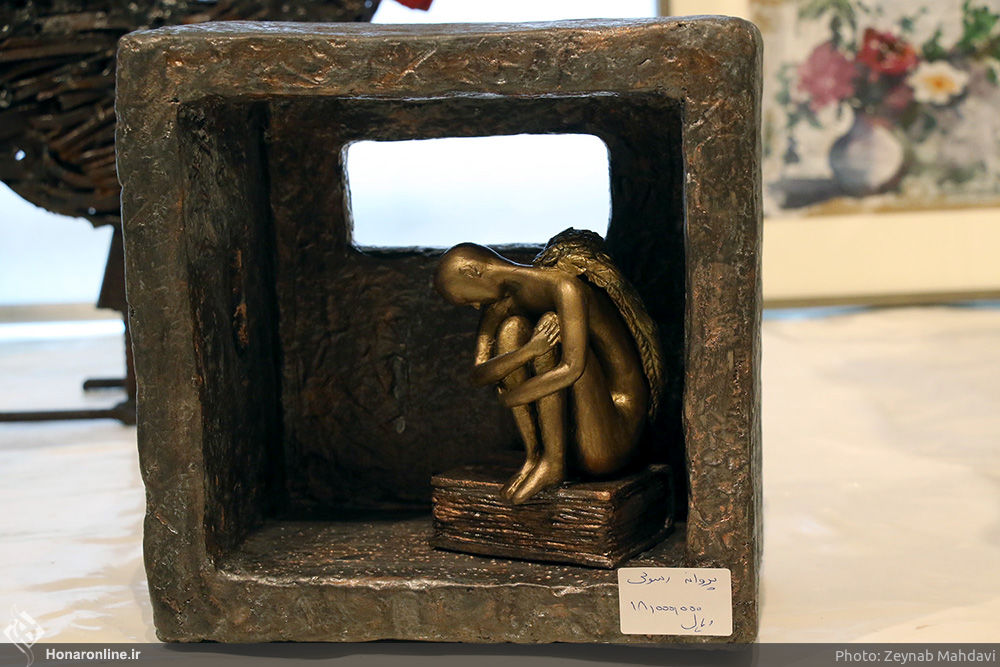
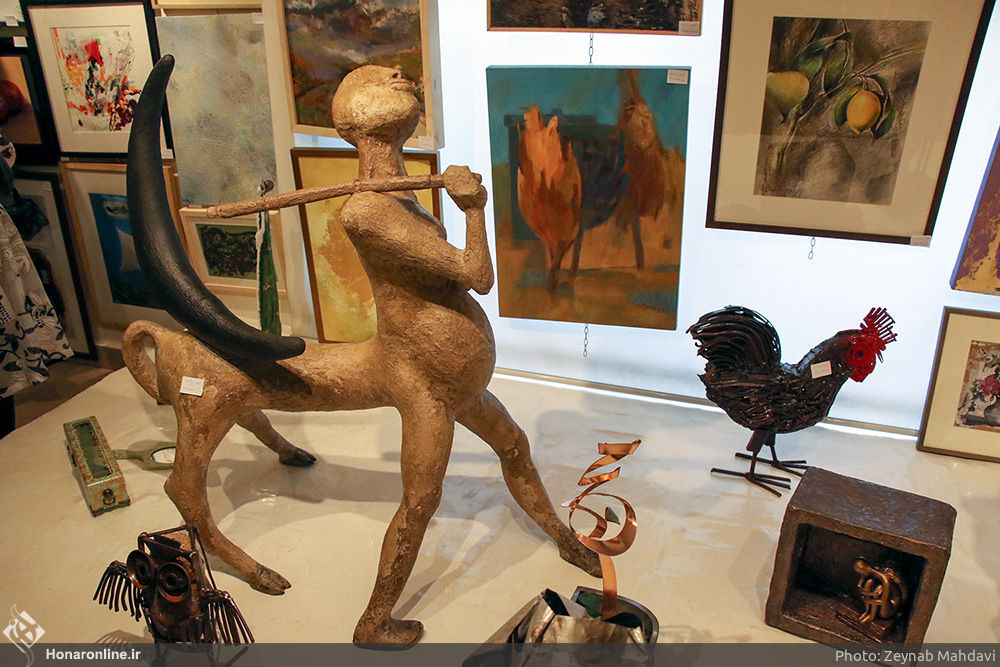
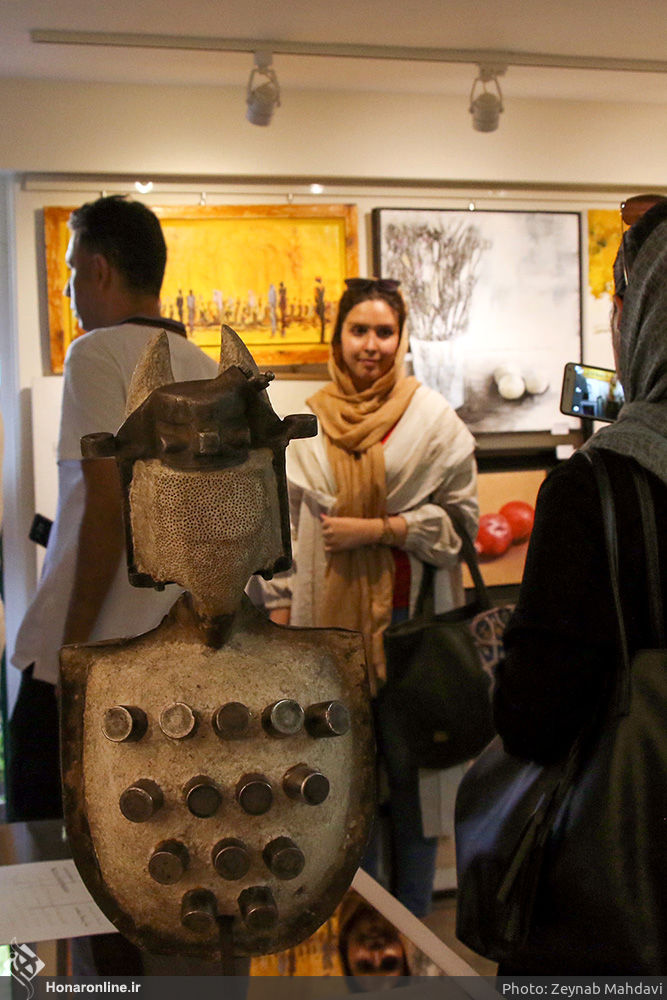
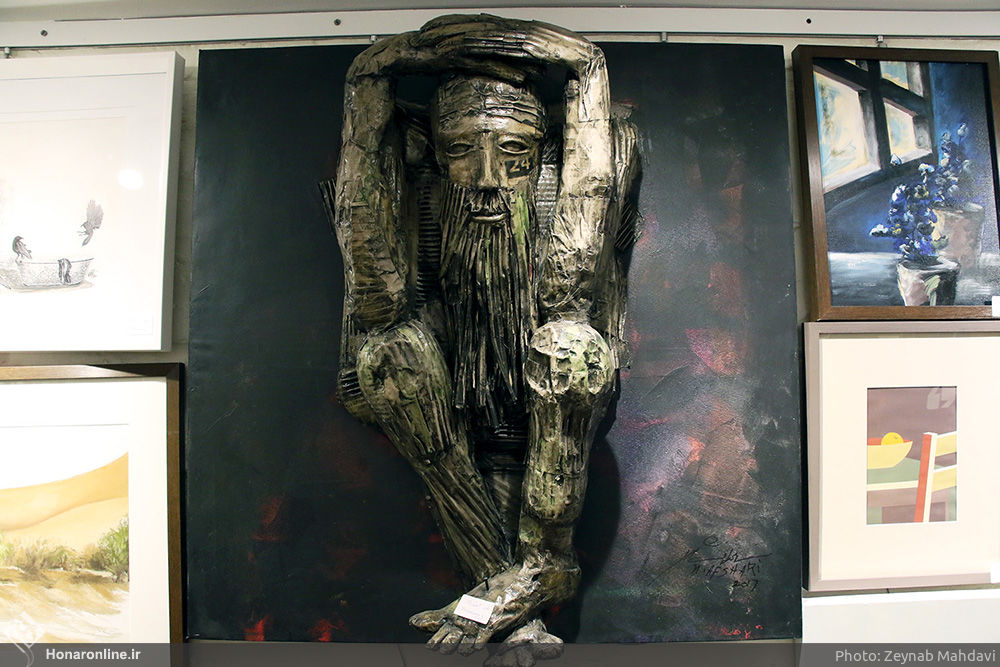
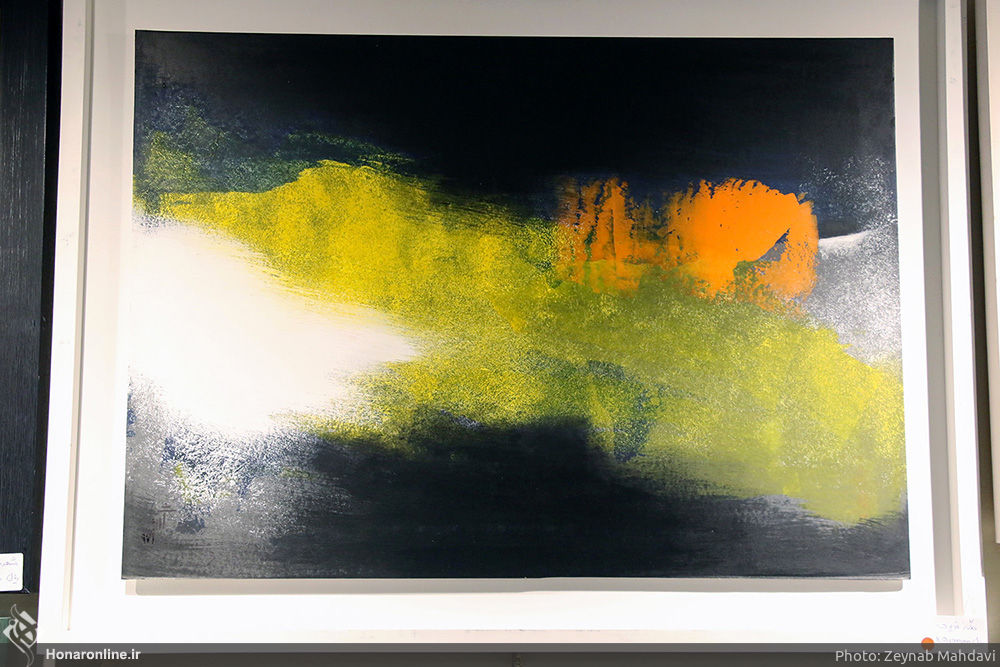
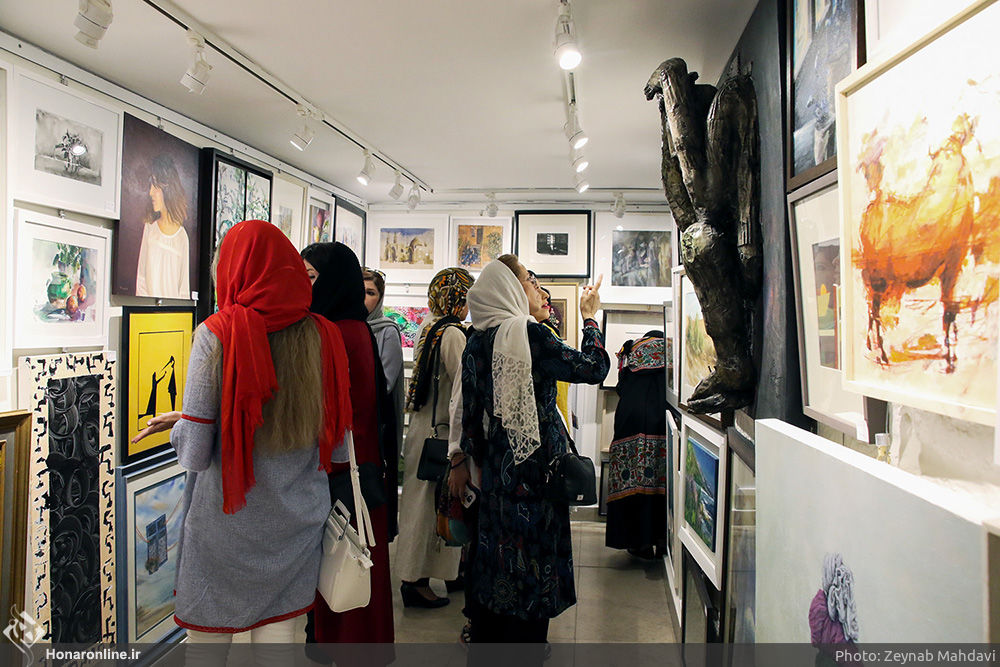
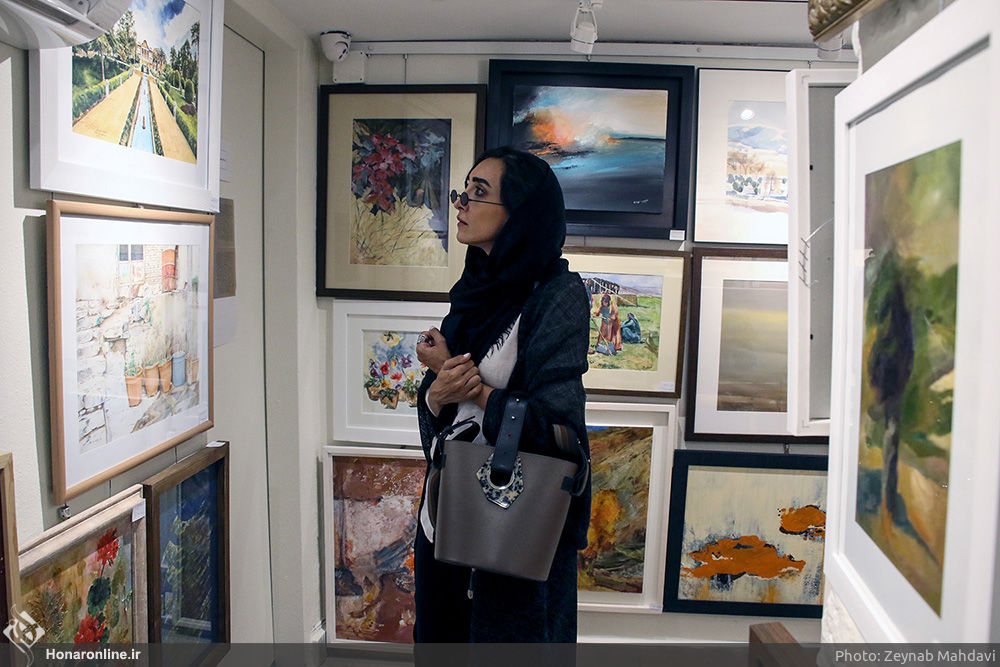
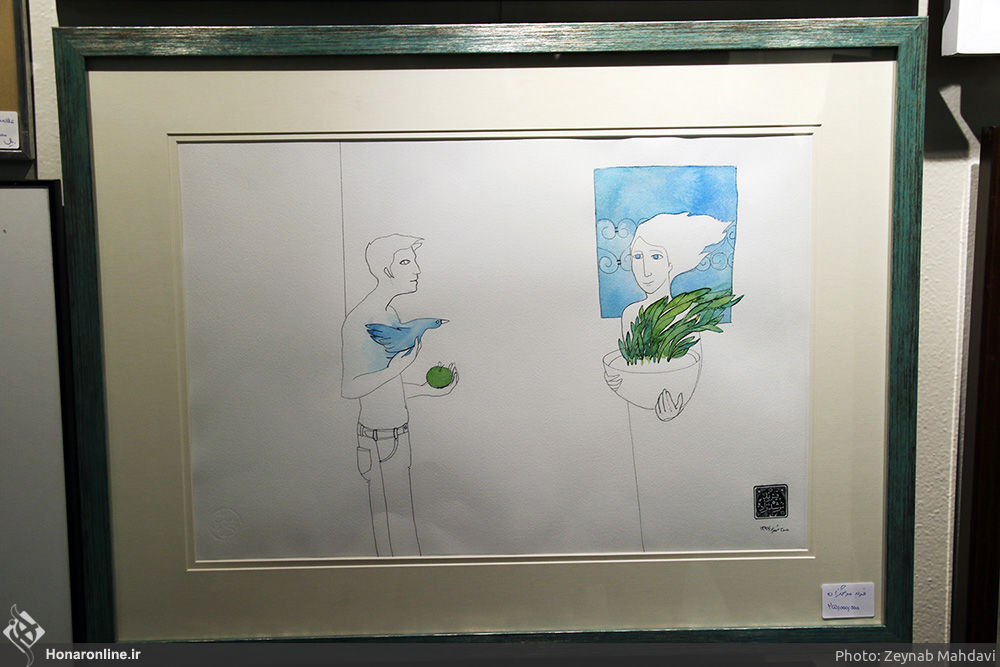
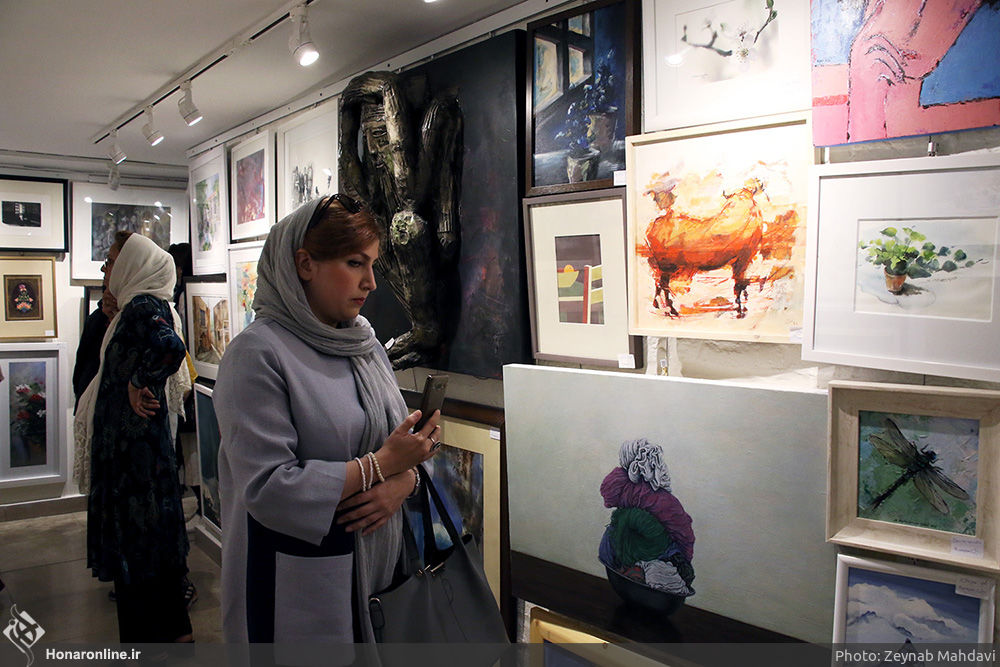
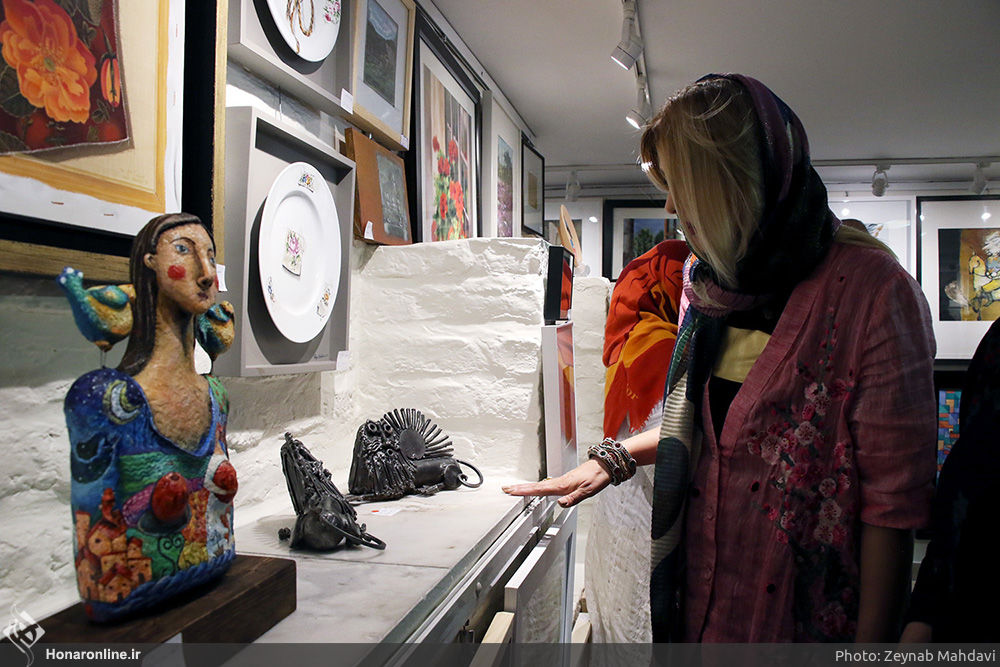
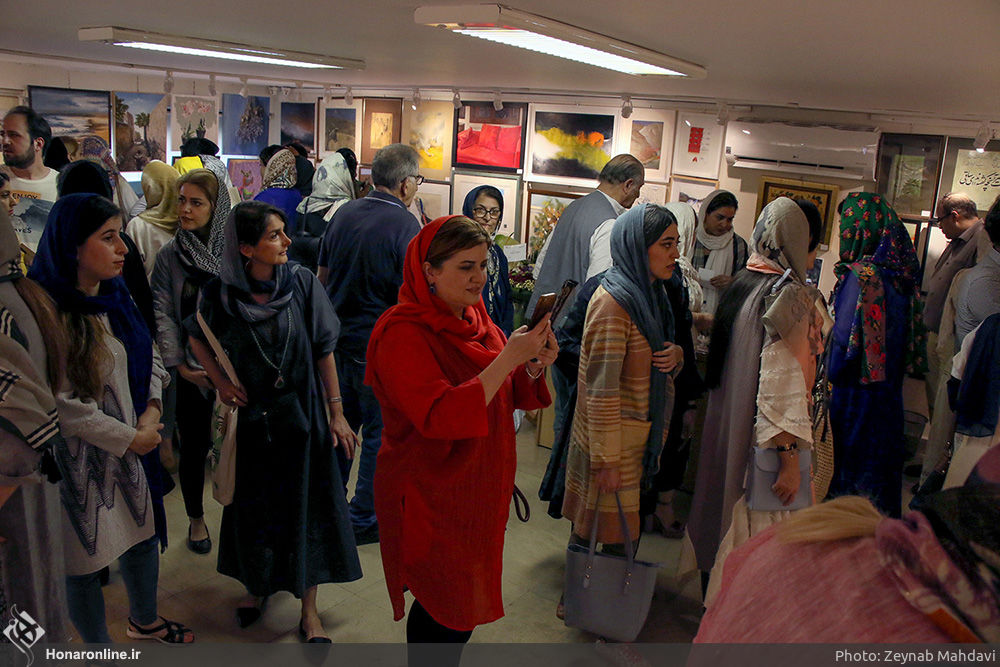
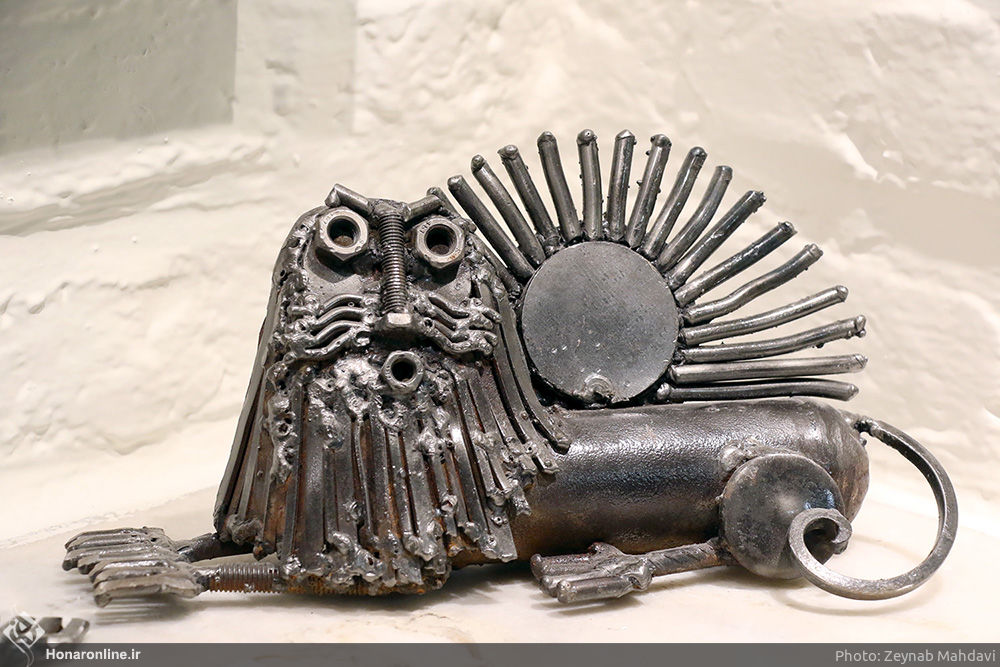
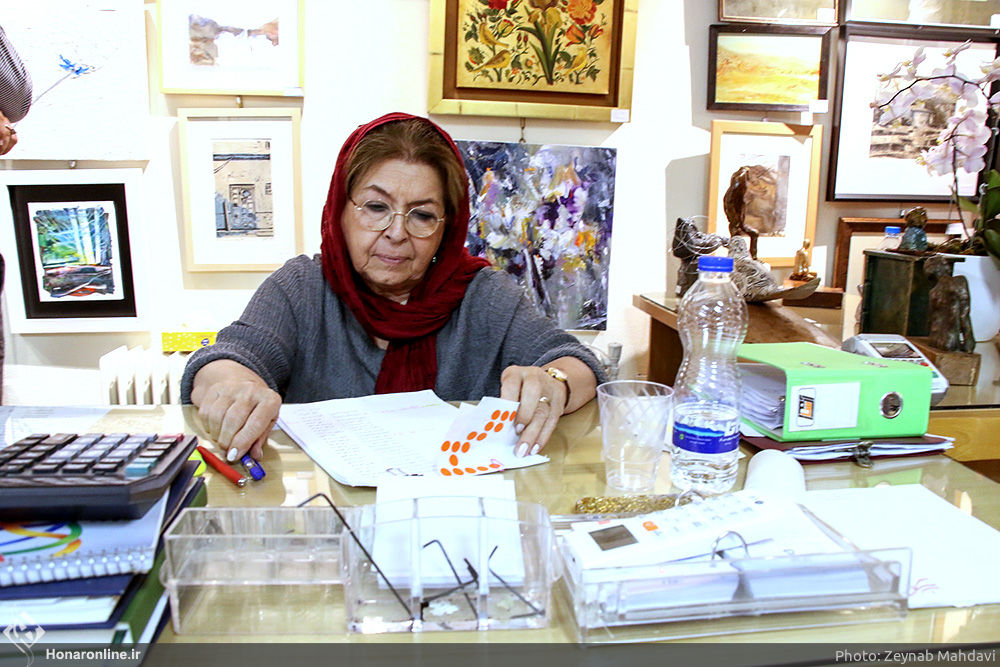
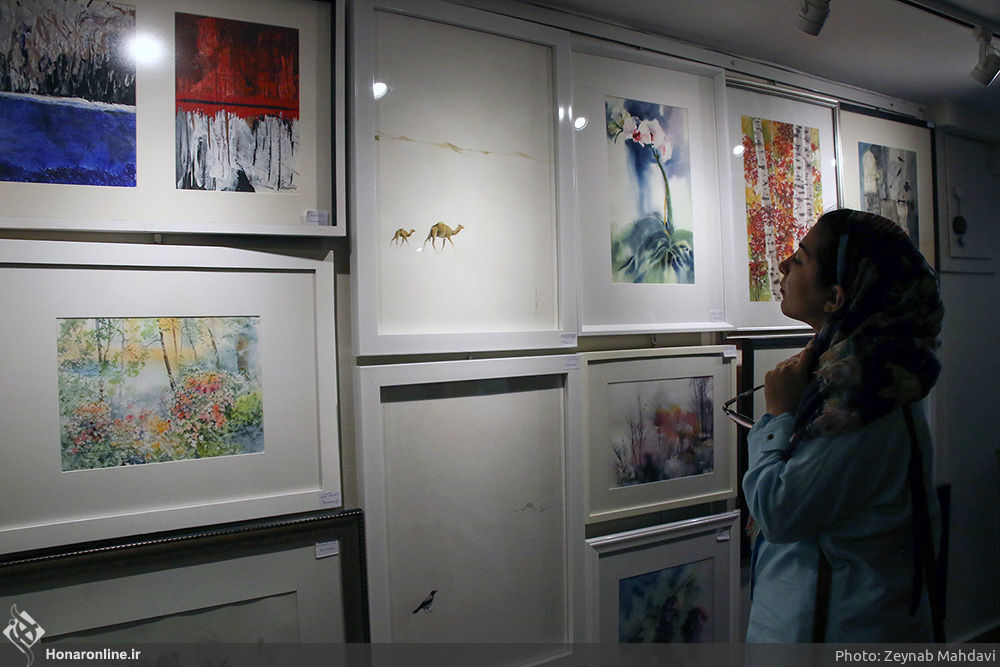
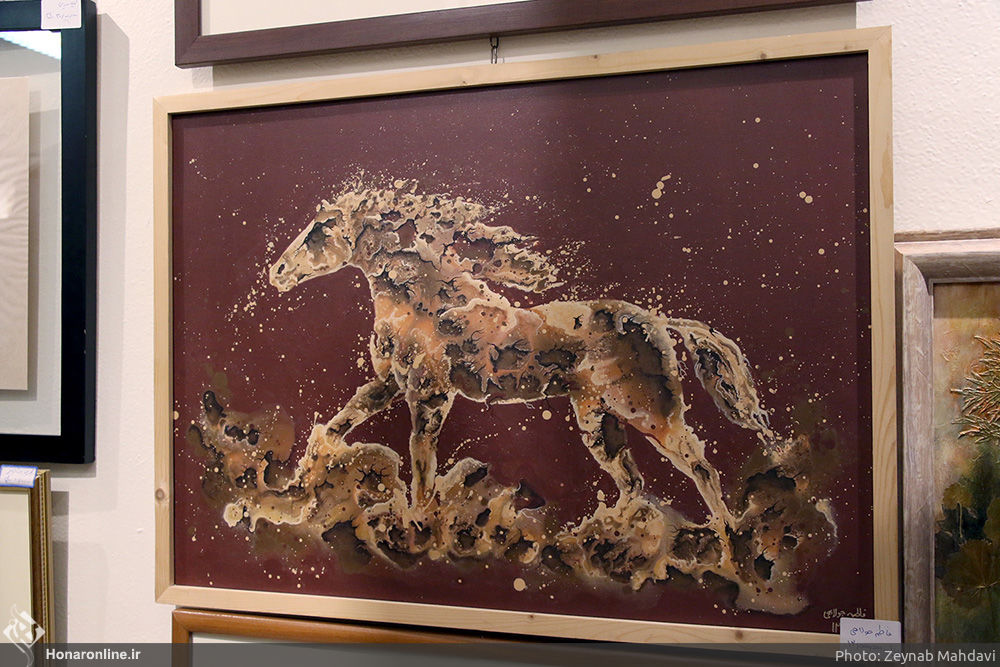
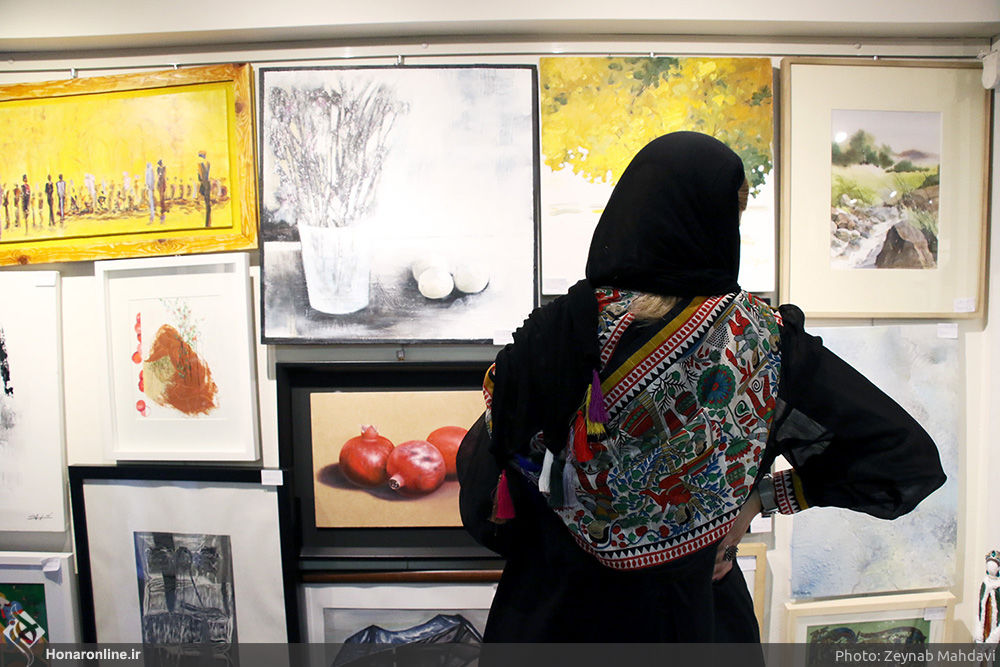
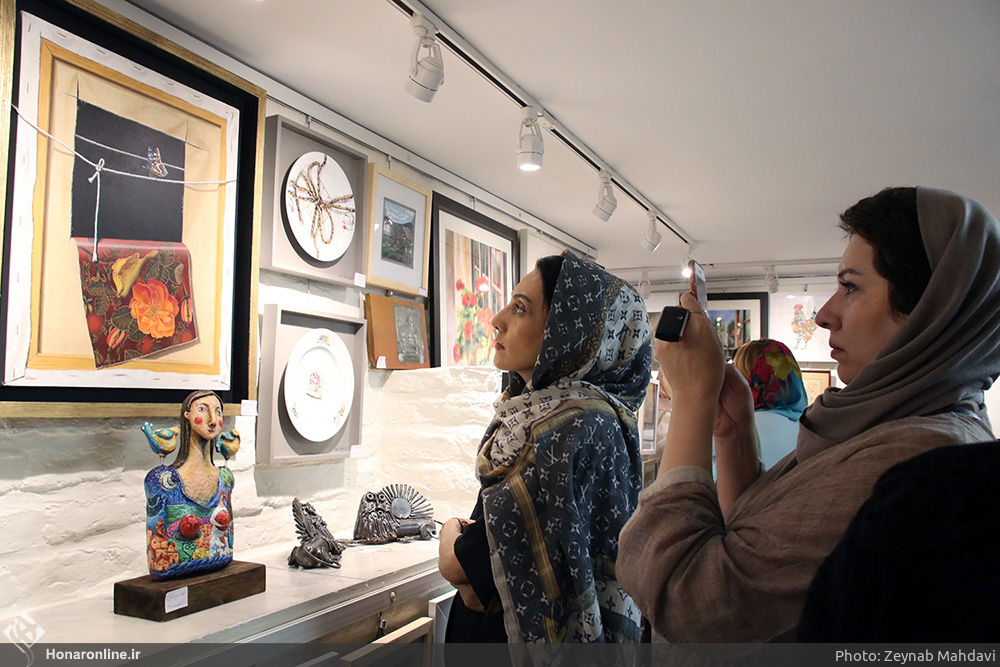
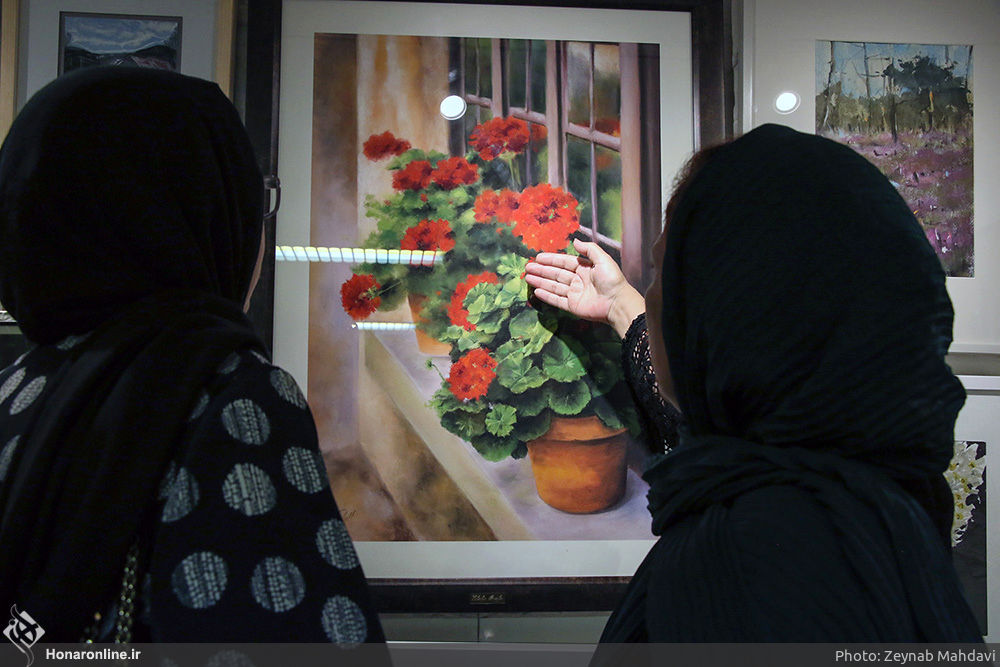
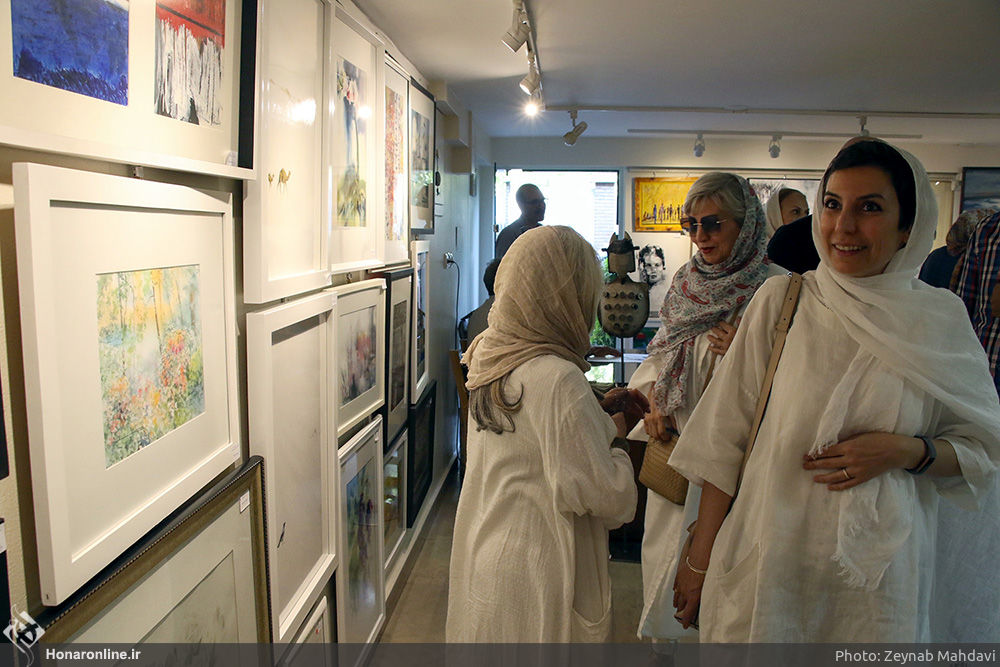
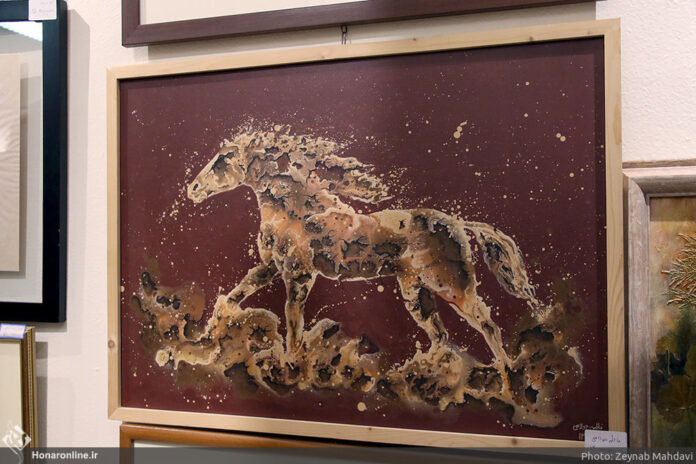
Works by Young Painters on Show at Iran’s Oldest Visual Arts Event

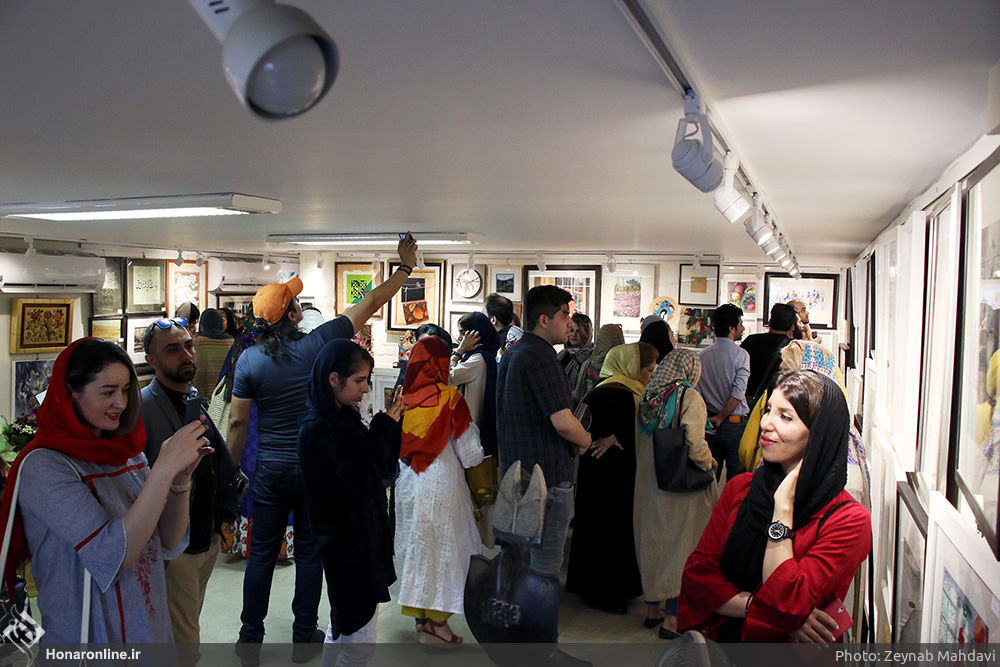
The summer event is known as the oldest visual arts event in Iran’s private sector that features works by 228 artists this year.

According to Leili Golestan, the director and designer of the gallery, 32 works worth over 10,000 USD were sold in the opening day.

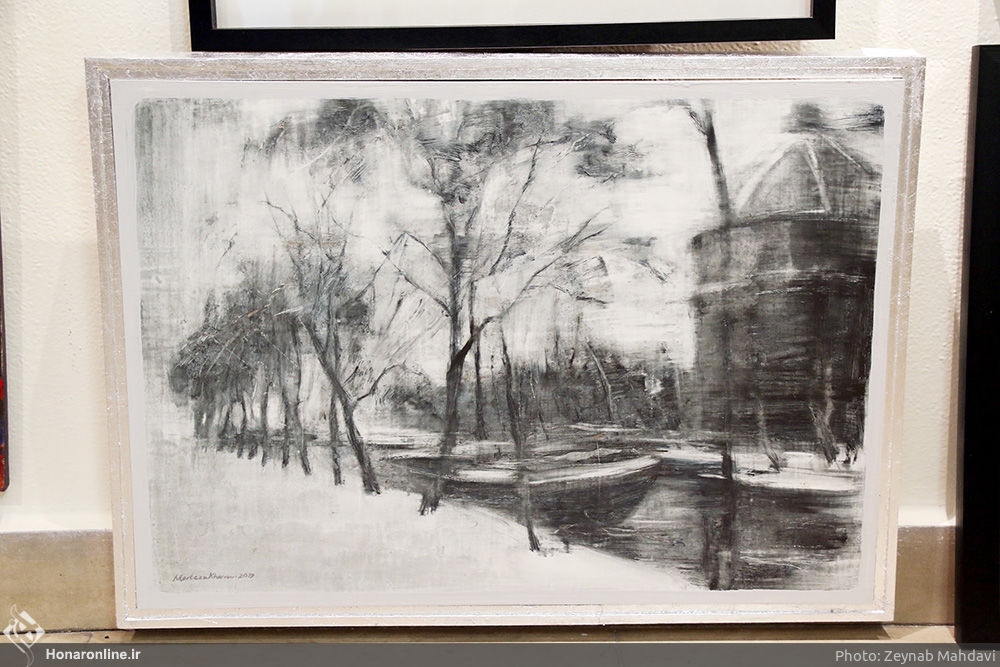
A special feature of this edition is that well-known artists have not participated and only a number of works by young and less-known artists have been presented.

Prices start at 13 dollars and the most expensive painting is 6,000 dollars which is a work by Mohammad Ebrahim Jafari.

At this event any work that is sold is removed from the wall and replaced by another work of art. Therefore, the exhibition is updated every few days and enthusiasts and shoppers can visit and shop again.

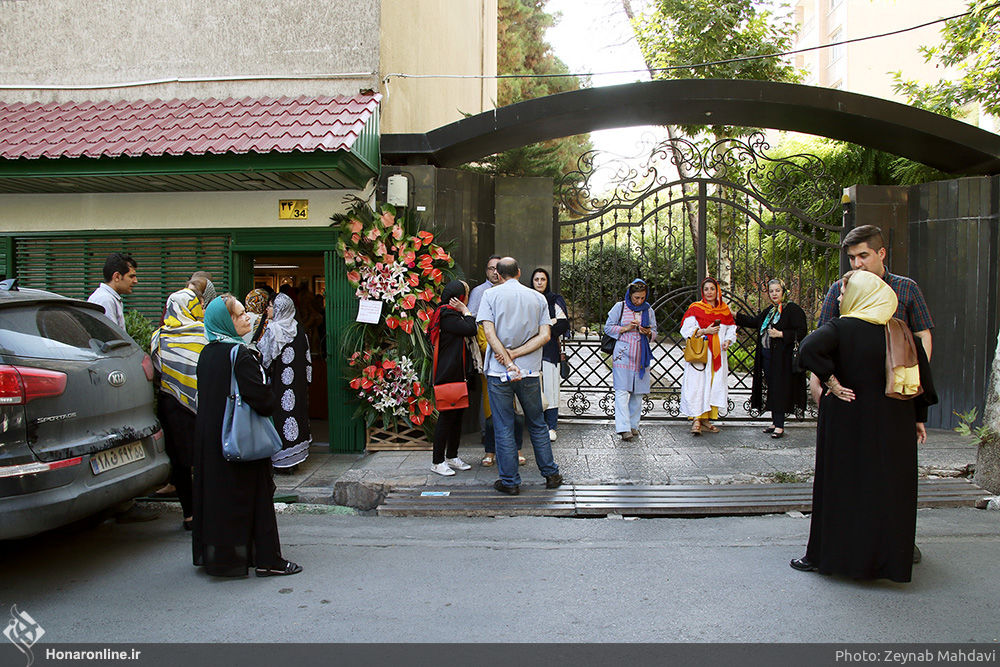
“One Hundred Works, One Hundred Artists” will run through August 21 at Golestan Gallery, north of Tehran.

What follows are Honar Online’s photos of the gallery:

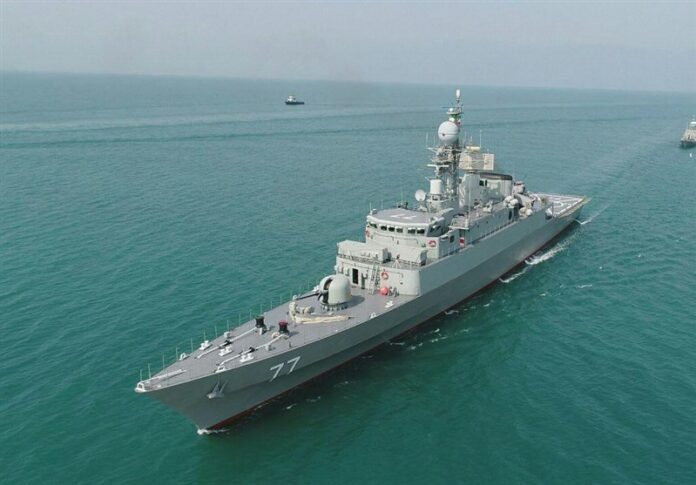
Iran to Equip Damavand Destroyer with Vertical Launch Missiles

Speaking on the sidelines of the opening ceremony of the Depth competition of the 2019 International Army Games on Kish Island in southern Iran on Monday, Rear Admiral Khanzadi said the Damavand destroyer will rejoin the Navy’s northern fleet later this year.

“The destroyer has been fully revived and this has been done in 18 months,” the commander said, adding that all defects of the destroyer have been fixed.

He went on to say that the destroyer has been equipped with advanced radar systems that allow it to reach distant targets.

“The destroyer has been equipped with new weapons and we are seeking to equip the Damavand destroyer with vertical launch missiles,” Rear Admiral Khanzadi noted.

The Damavand destroyer crashed into a jetty on January 10, 2018, killing two sailors of the Iranian Navy. The accident occurred when Damavand was docking at port in Iran’s northern province of Gilan.

Increasing wind speed and severe storm in the Caspian Sea caused the destroyer to have a crash with the jetty.

Damavand, a 100-meter-long destroyer weighing more than 1300 tons, officially joined the Navy’s northern fleet in the Caspian Sea in March 2015.

More than 700 industrial, research and academic Iranian centers cooperated in designing and producing the military vessel, which is also a training warship.

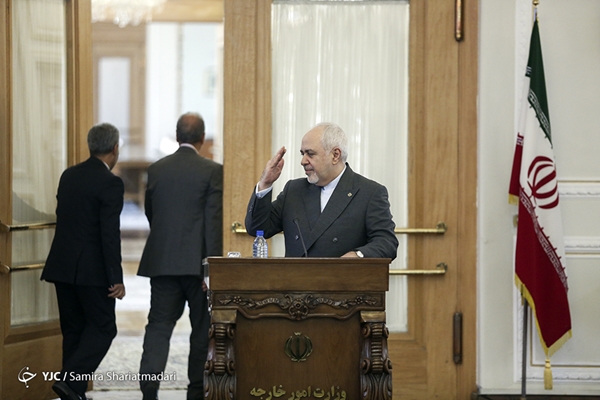
Iran Glad to See Neighbours Getting Out of B-Team: Zarif

Zarif made the remarks in a Monday press conference in Tehran, using the term he himself has coined to refer to a four-member group of anti-Iran hawks, including Israeli Prime Minister Benjamin Netanyahu, Saudi Crown Prince Mohammed bin Salman, UAE de facto leader Mohammed bin Zayed, and US president’s national security advisor John Bolton.

“Thank God the number of those in the B-Team is decreasing, and we welcome that. We want the relations with our neighbours to improve,” Zarif noted.

“Doors of Iran, as the country of your brothers, are open to you,” he added.

He also thanked Saudi Arabia for their good reception of Iranian Hajj pilgrims and expressed hope that such behaviours would be repeated after the annual pilgrimage.

“We are in the days of Hajj. Put an end to the Yemen war. Put an end to your pressures on the Syrian, Iraqi, and Afghan nations.”

“Doors of Iran are open to neighbouring states. We’re ready, and this dialogue will benefit Saudi Arabia, the UAE, and all regional states.

Zarif said Iran, Iraq, and six other Persian Gulf Cooperation Council member states need to have dialogue and sign a treaty of non-aggression with each other.

The Iranian top diplomat said he had earlier made such an offer, but they did not welcome our proposal.

“We’re always open to talks with our neighbours.”

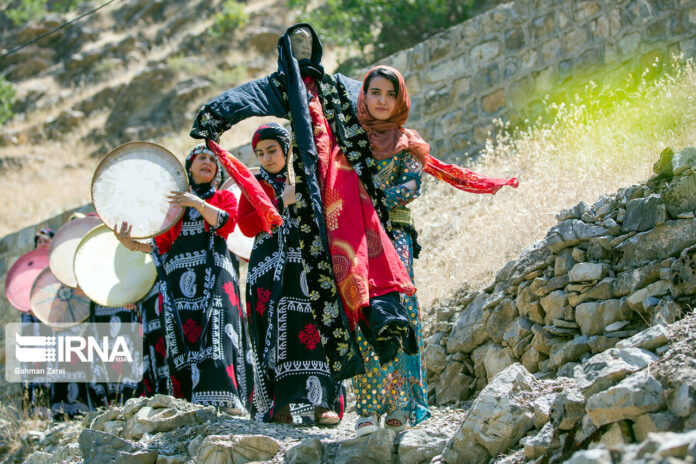
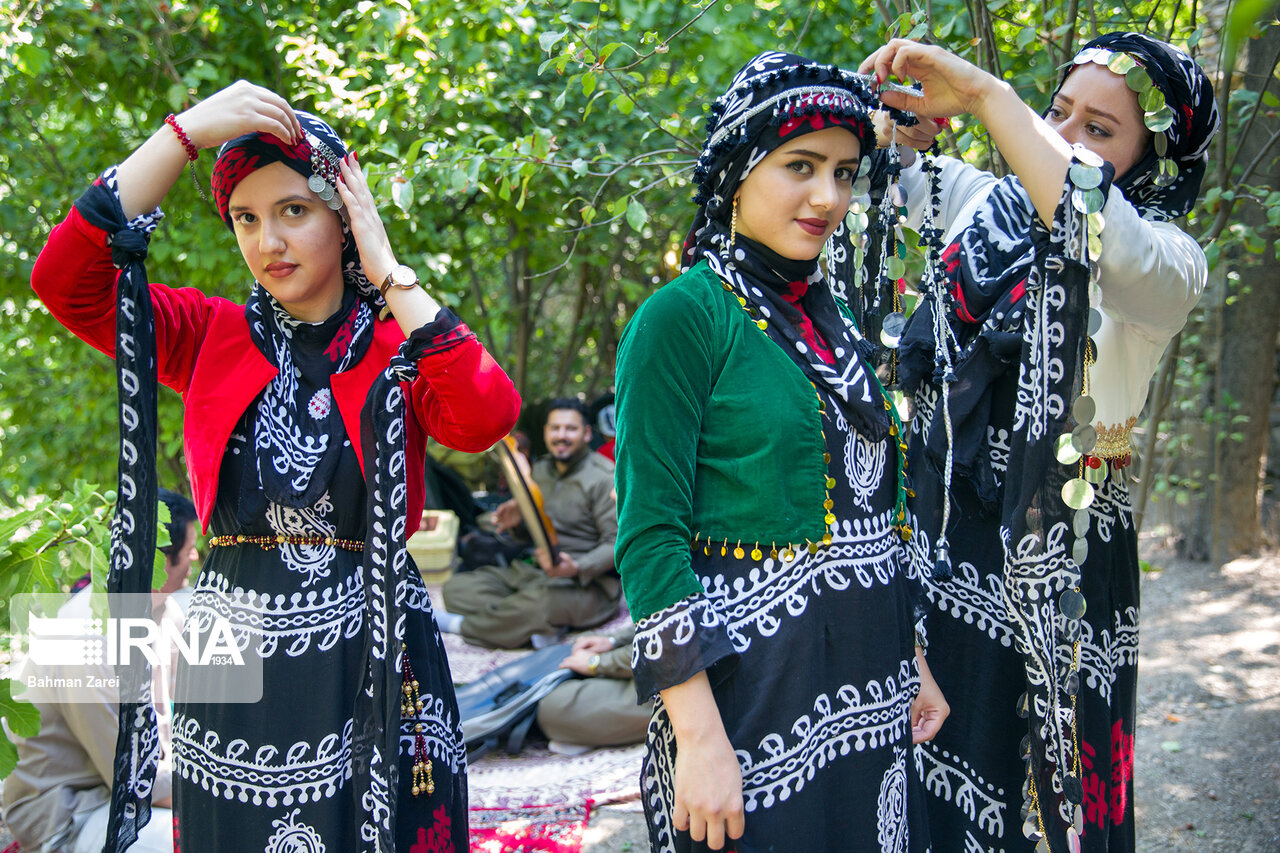
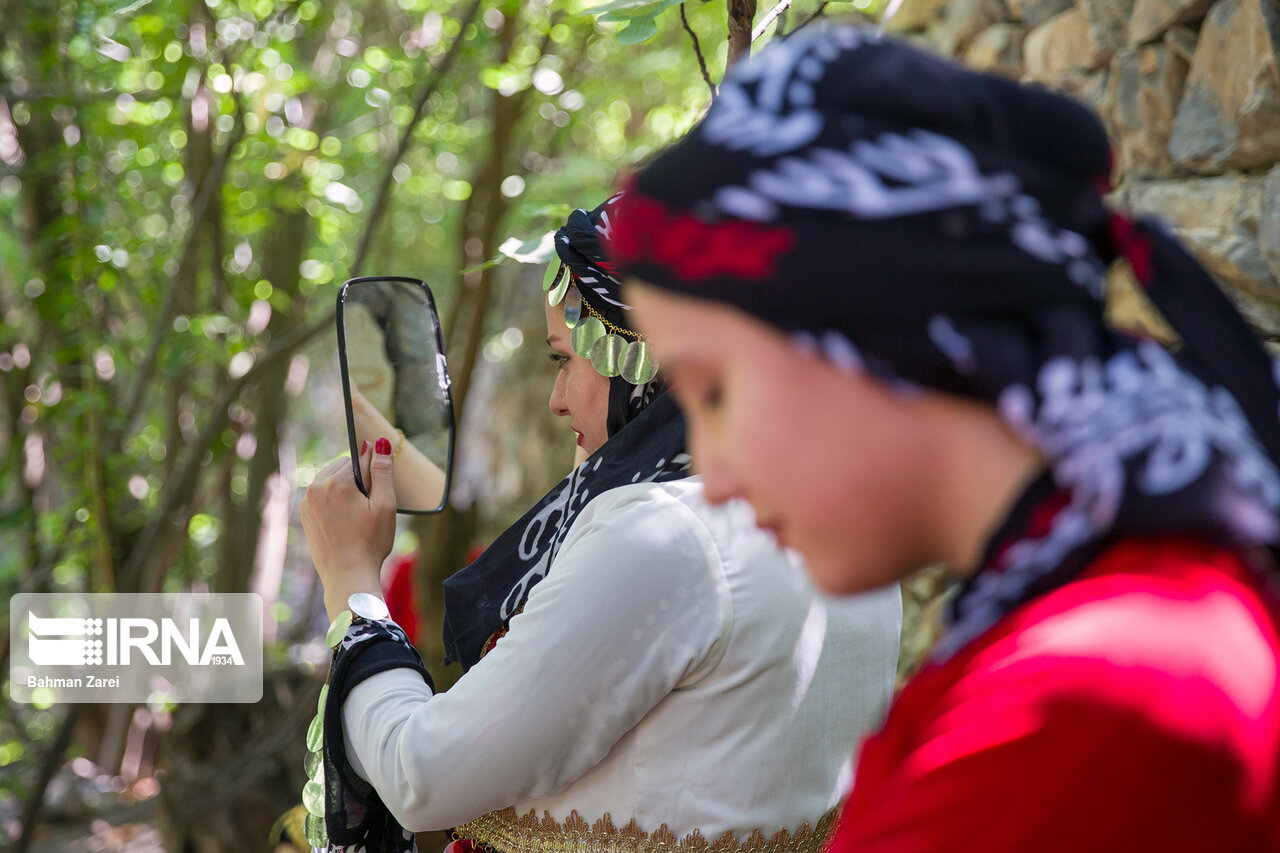
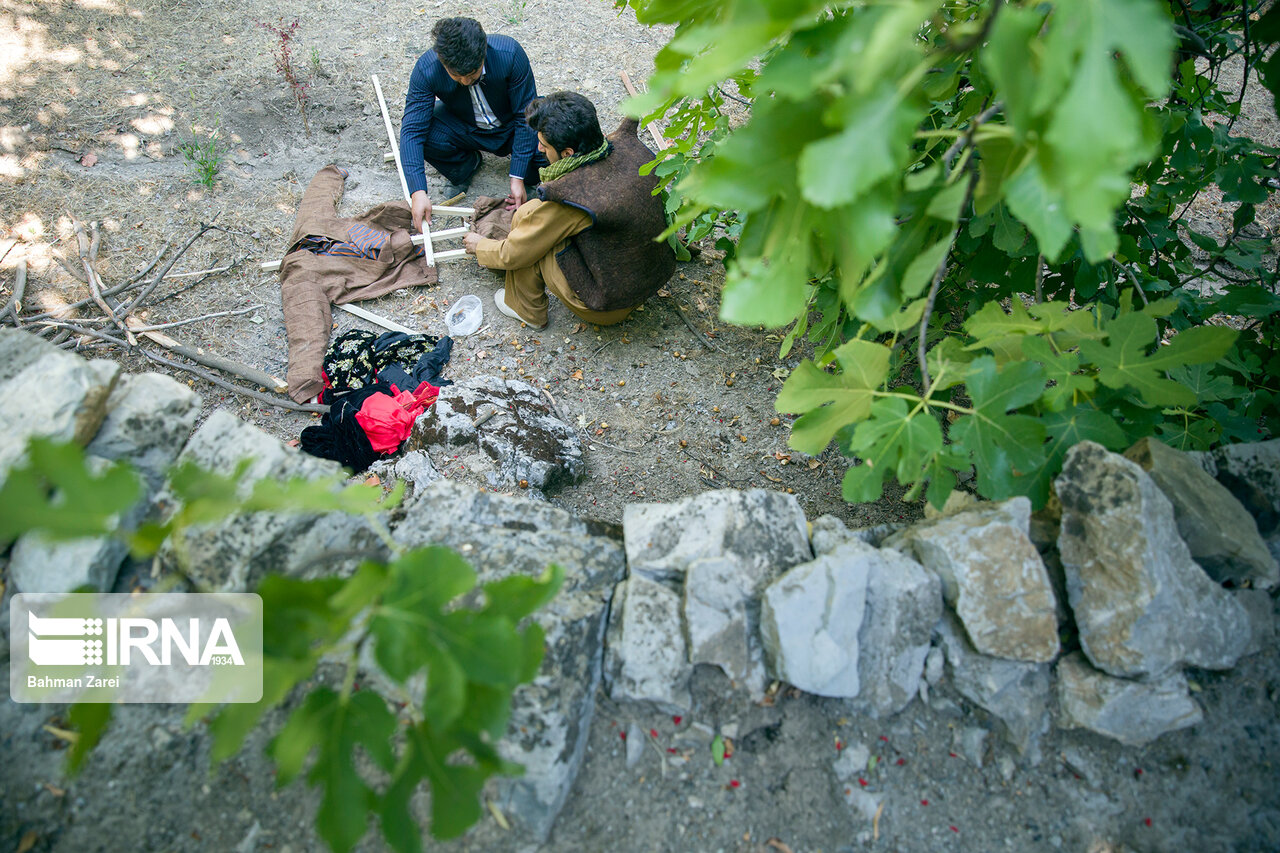
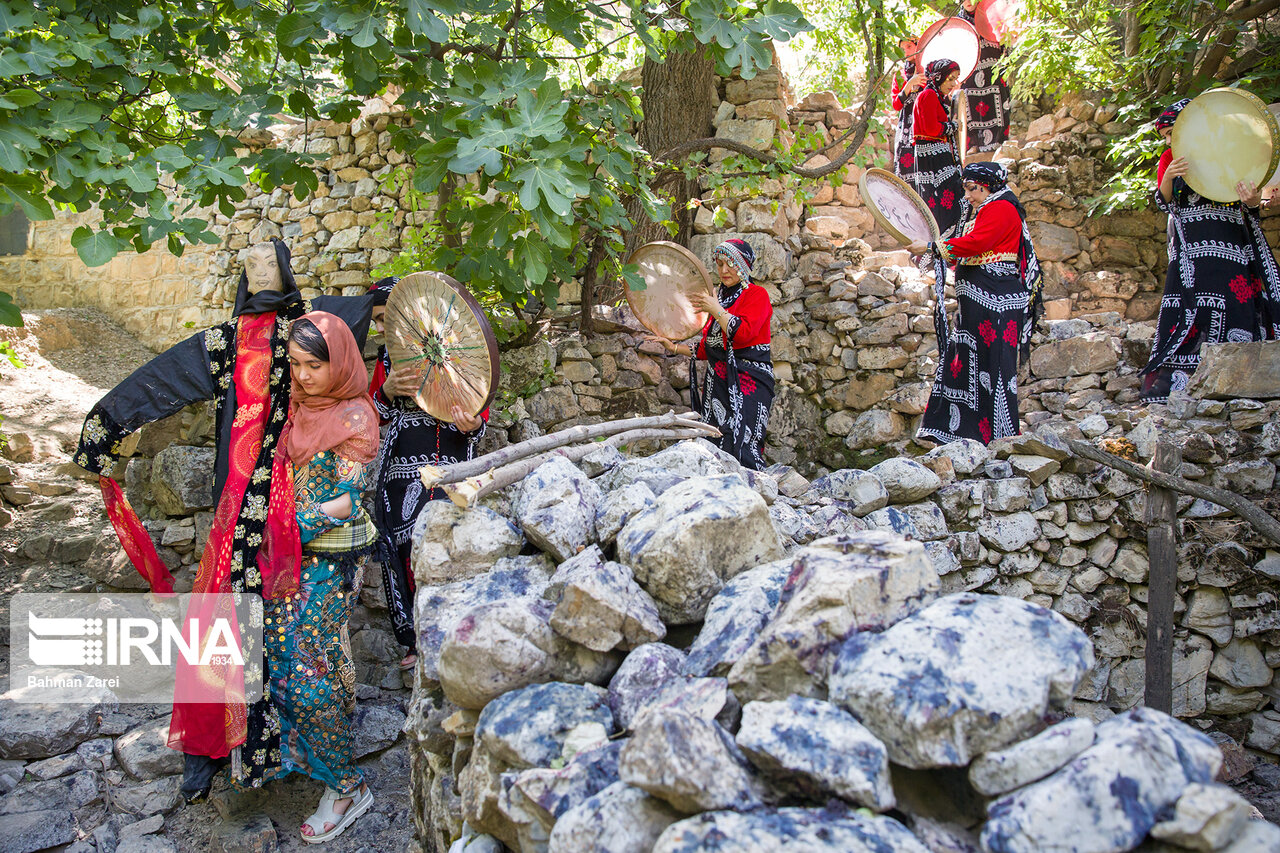
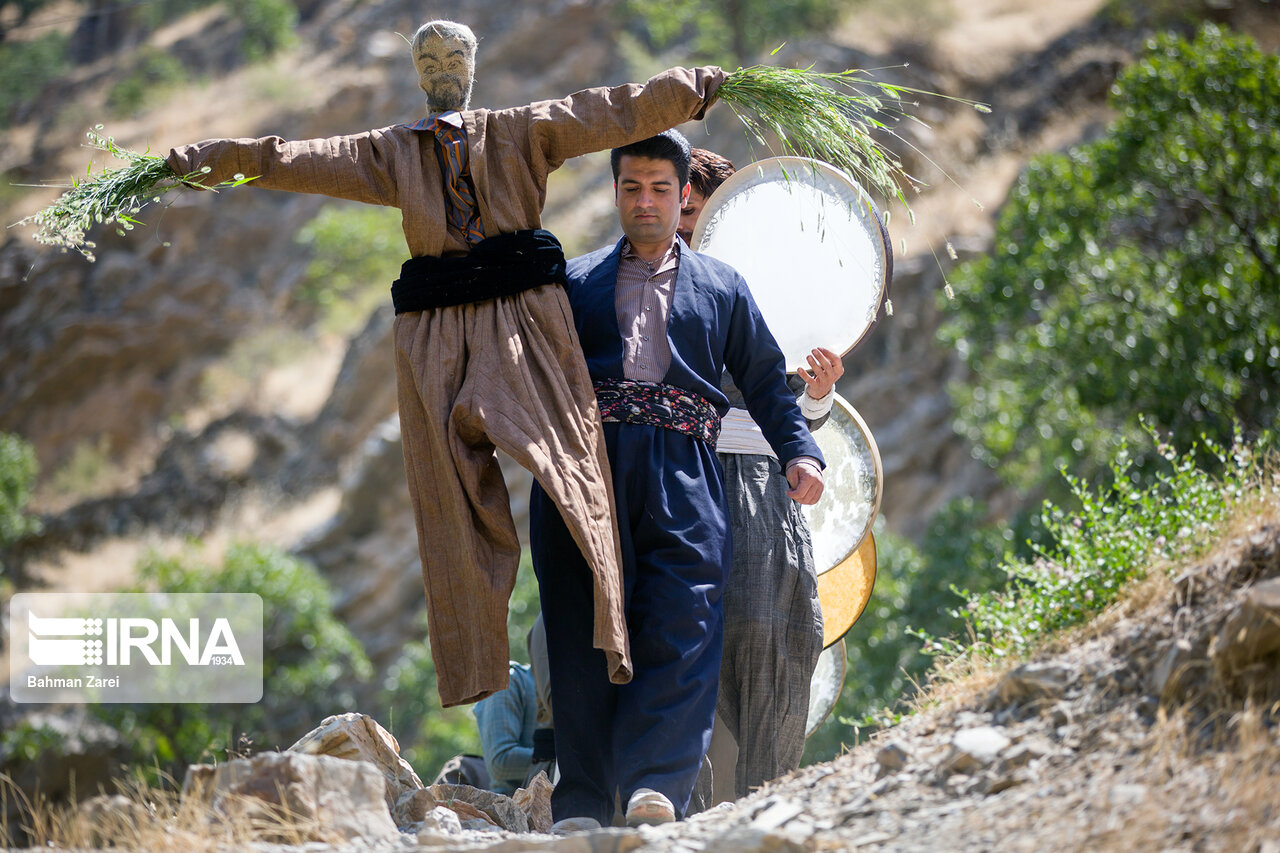
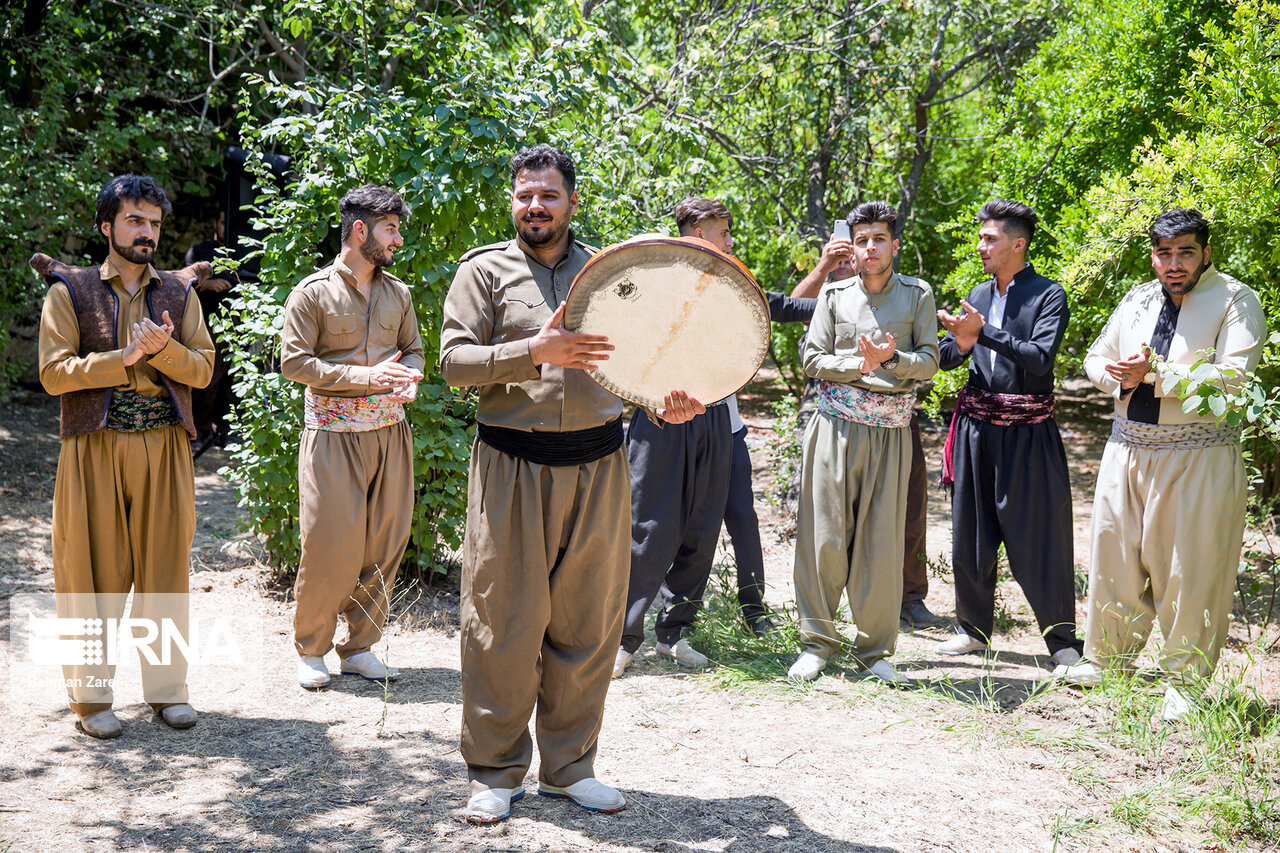
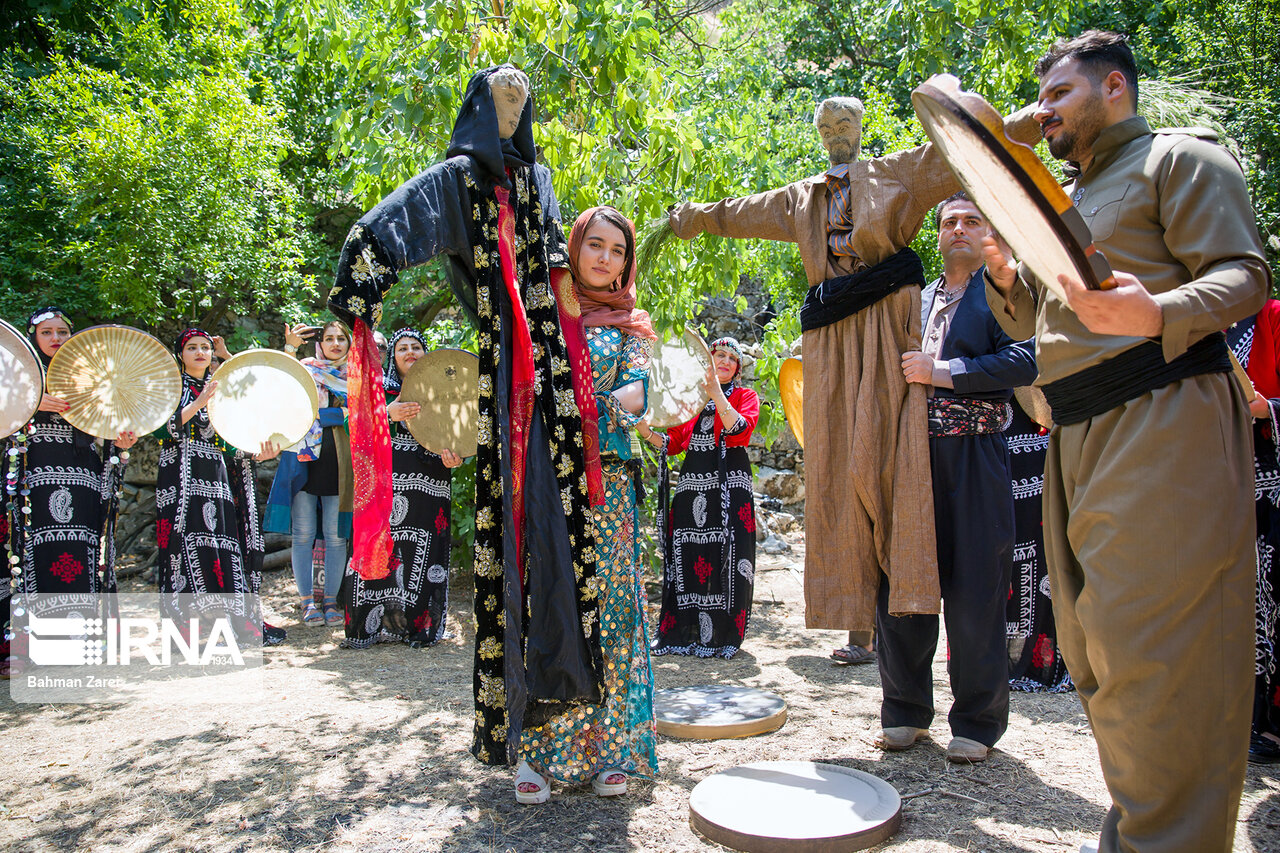
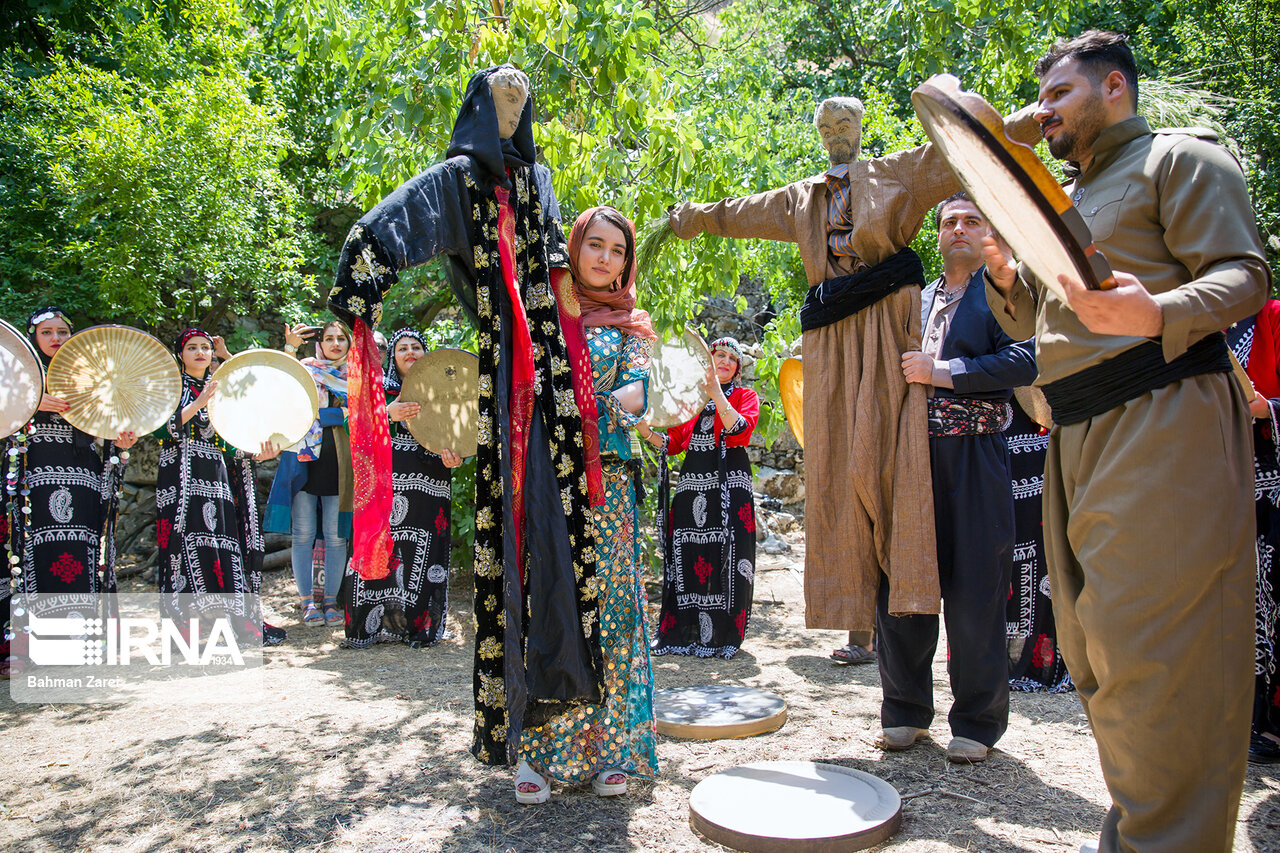
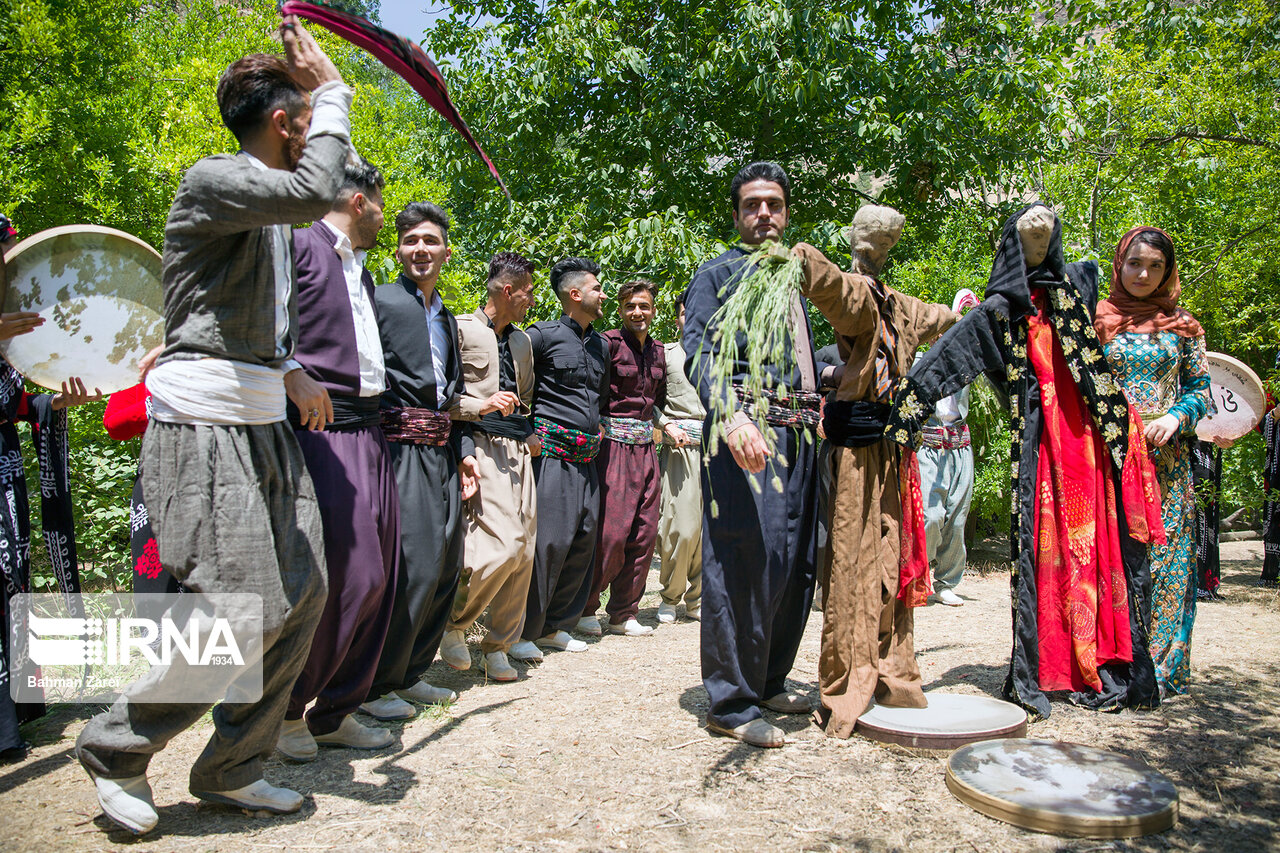
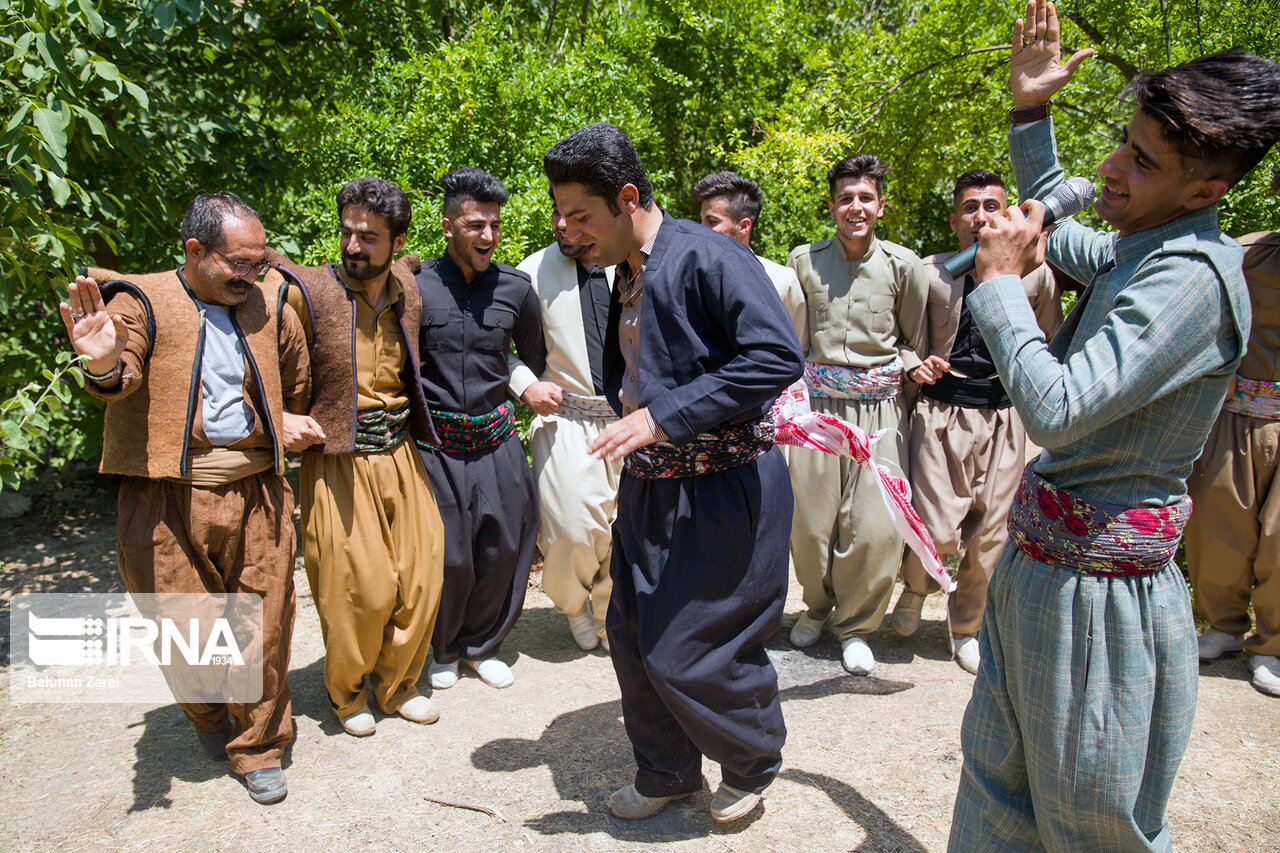
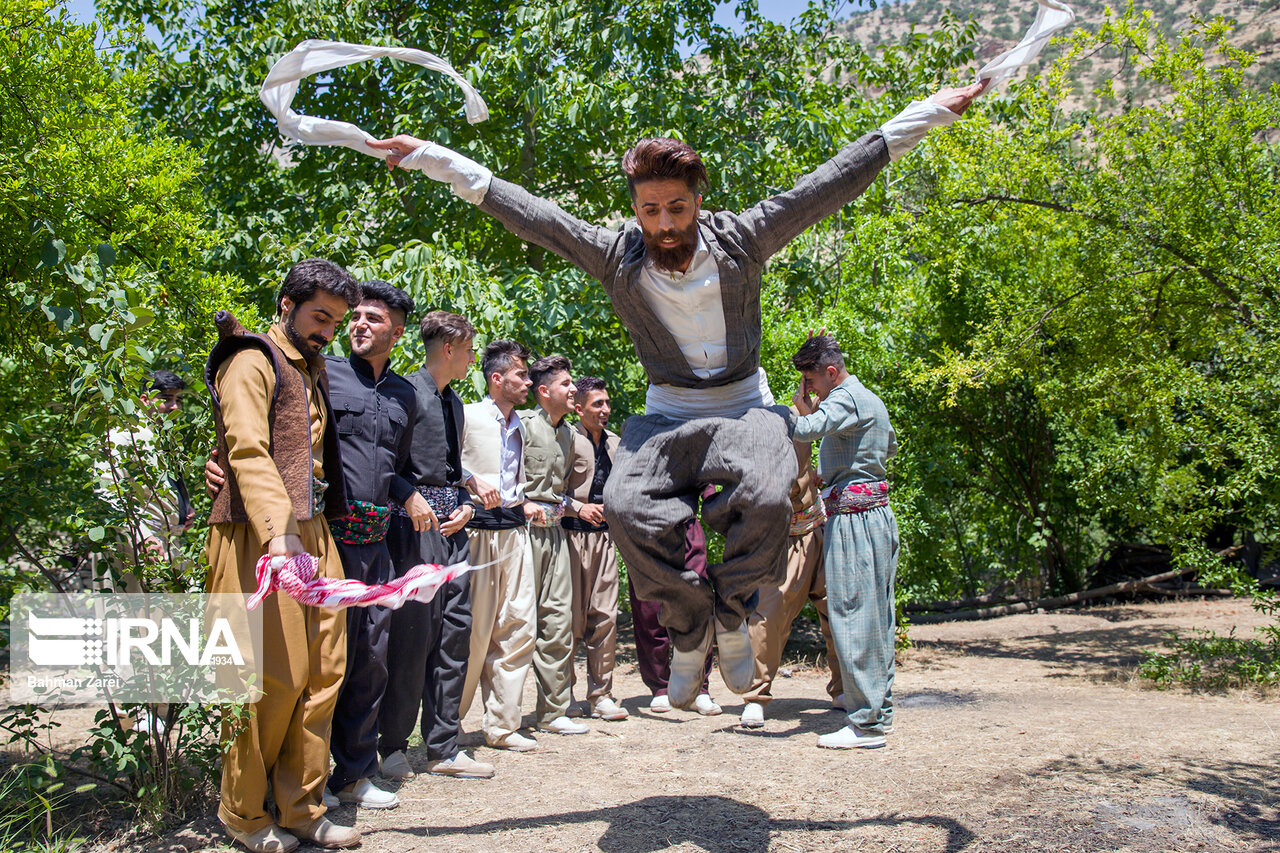
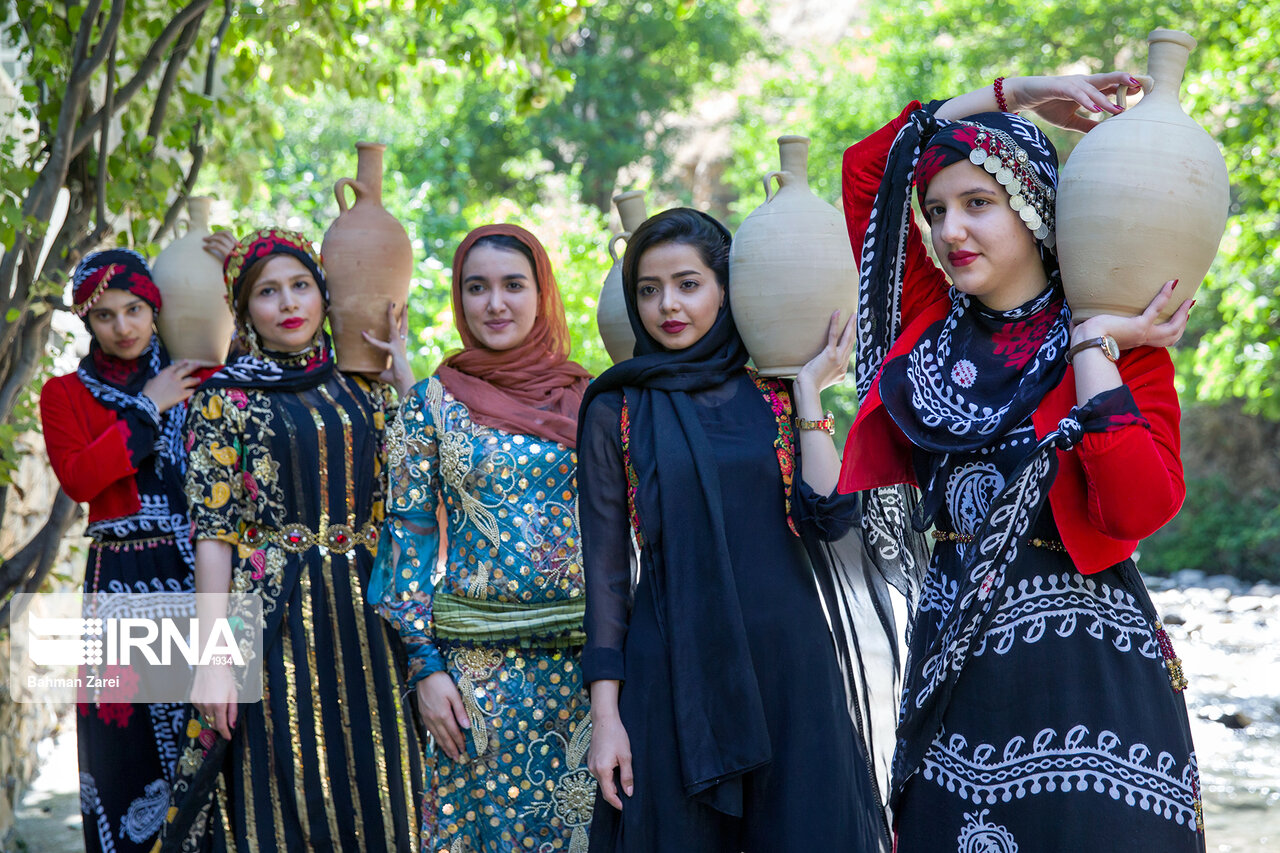
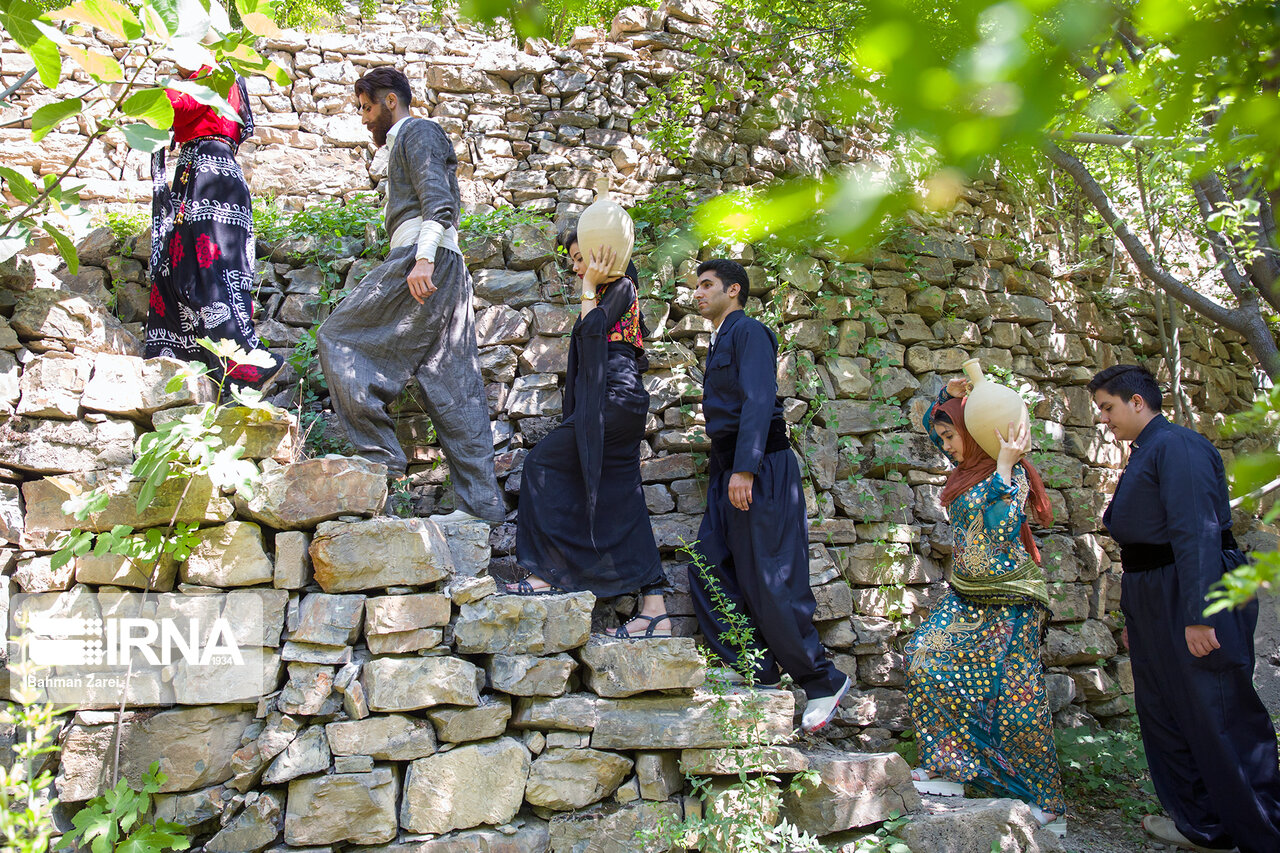
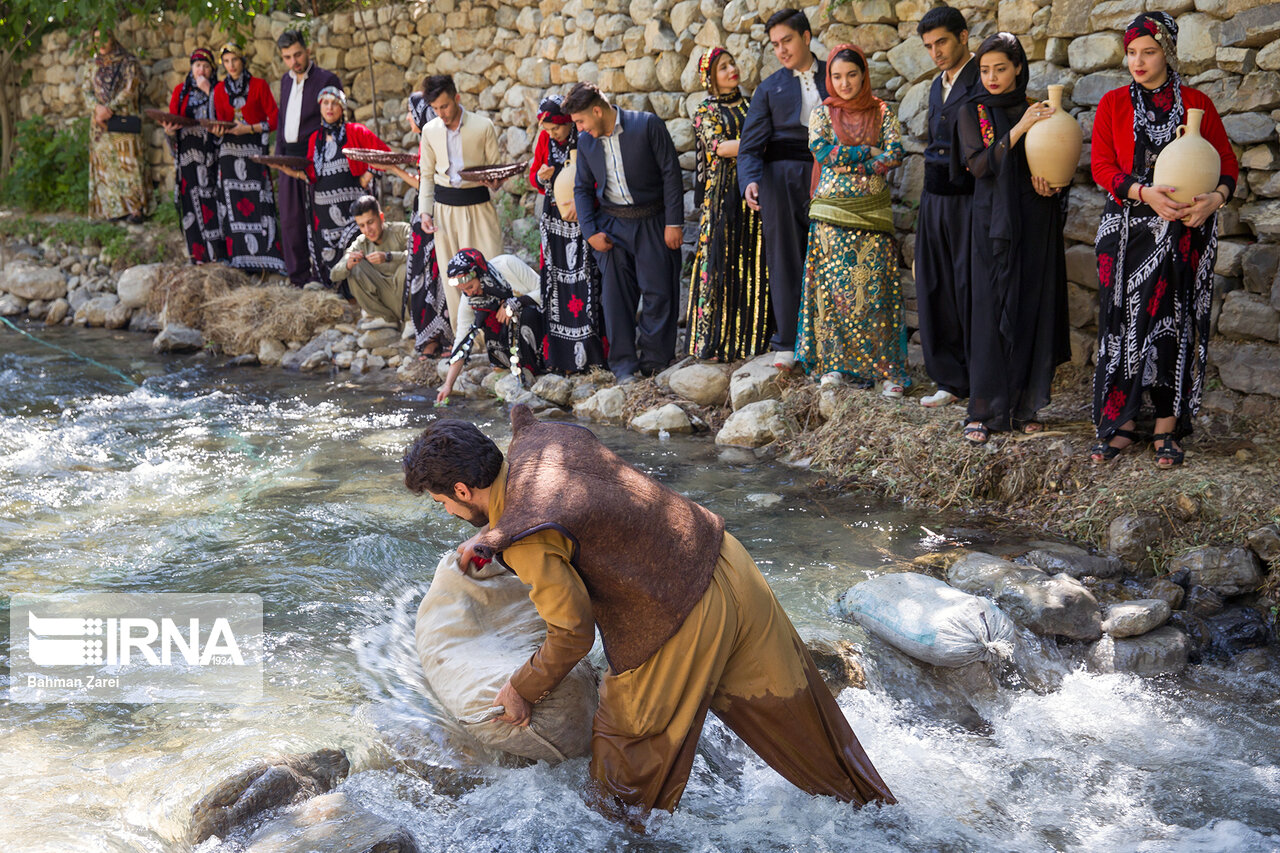
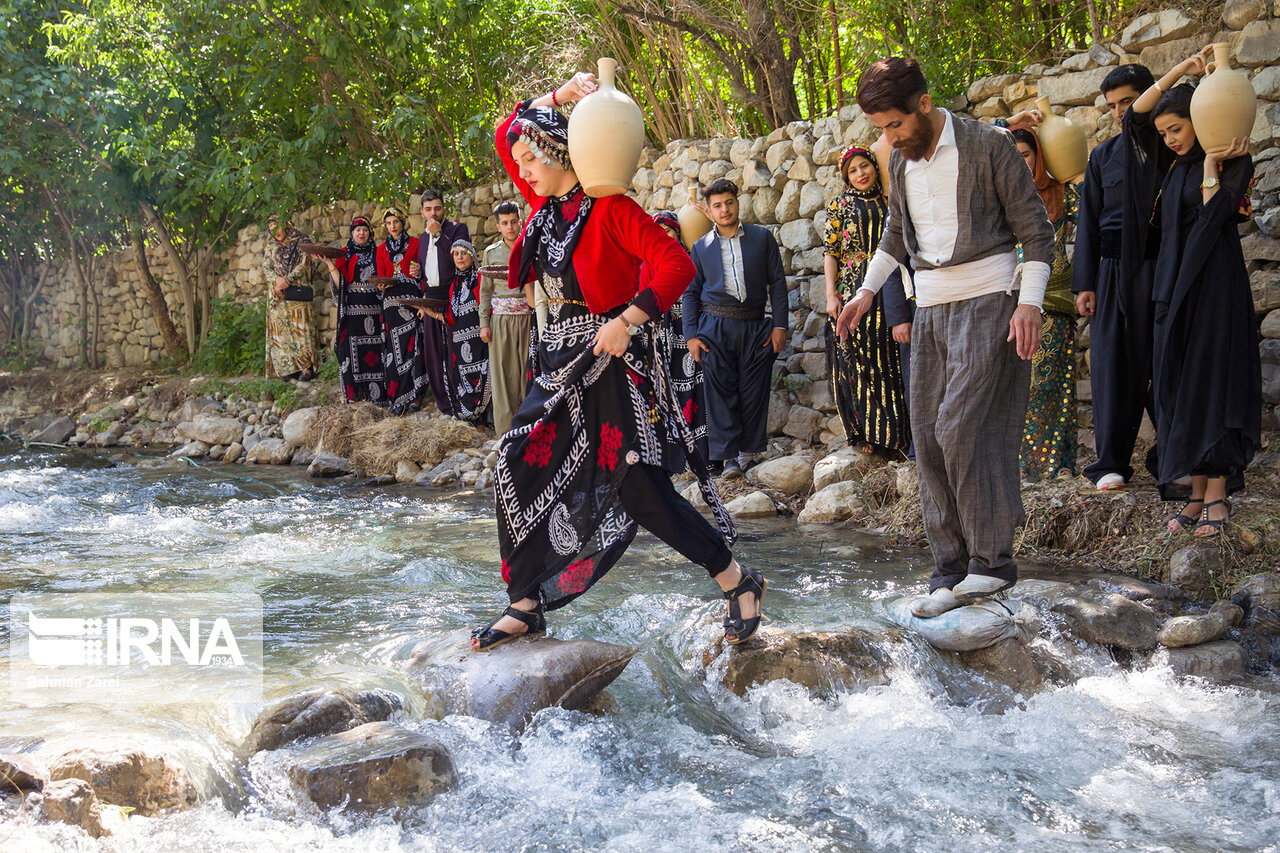
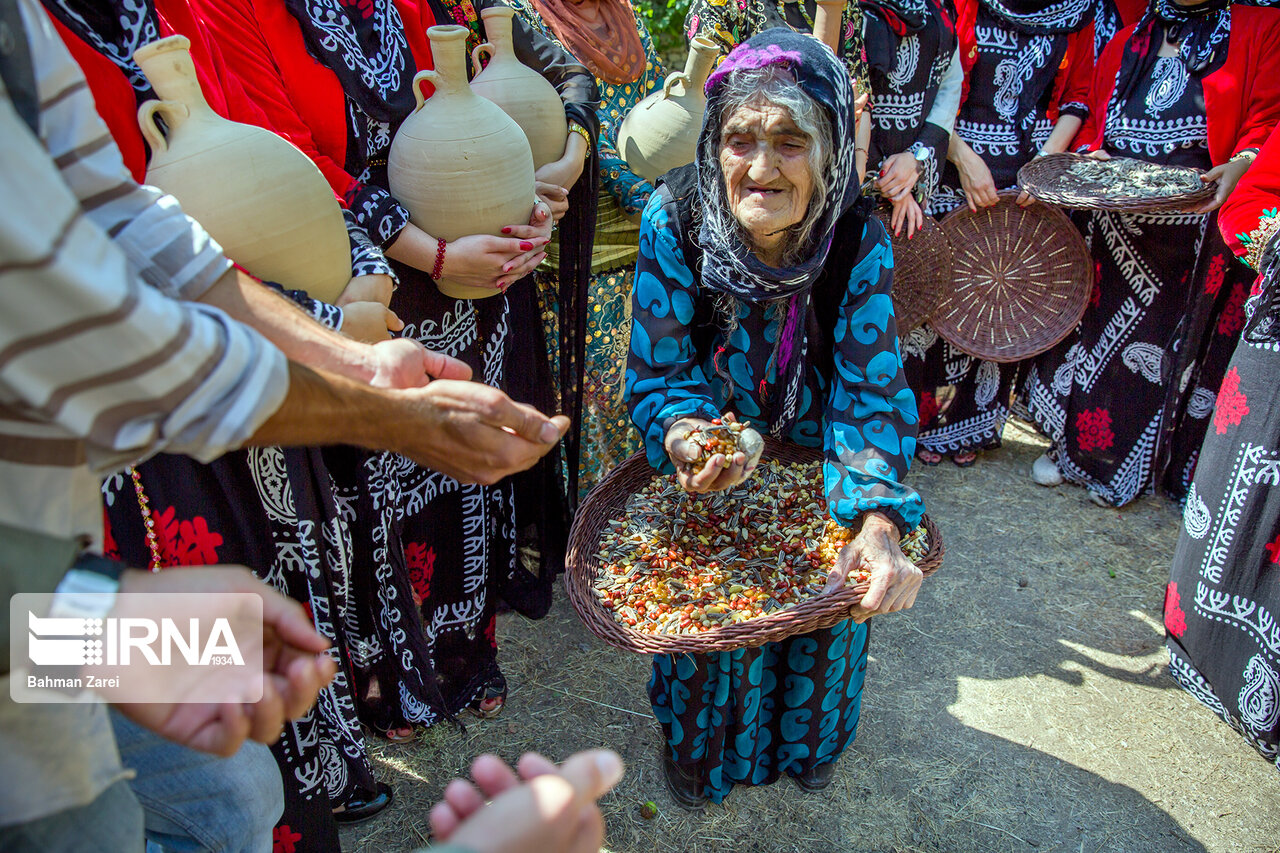
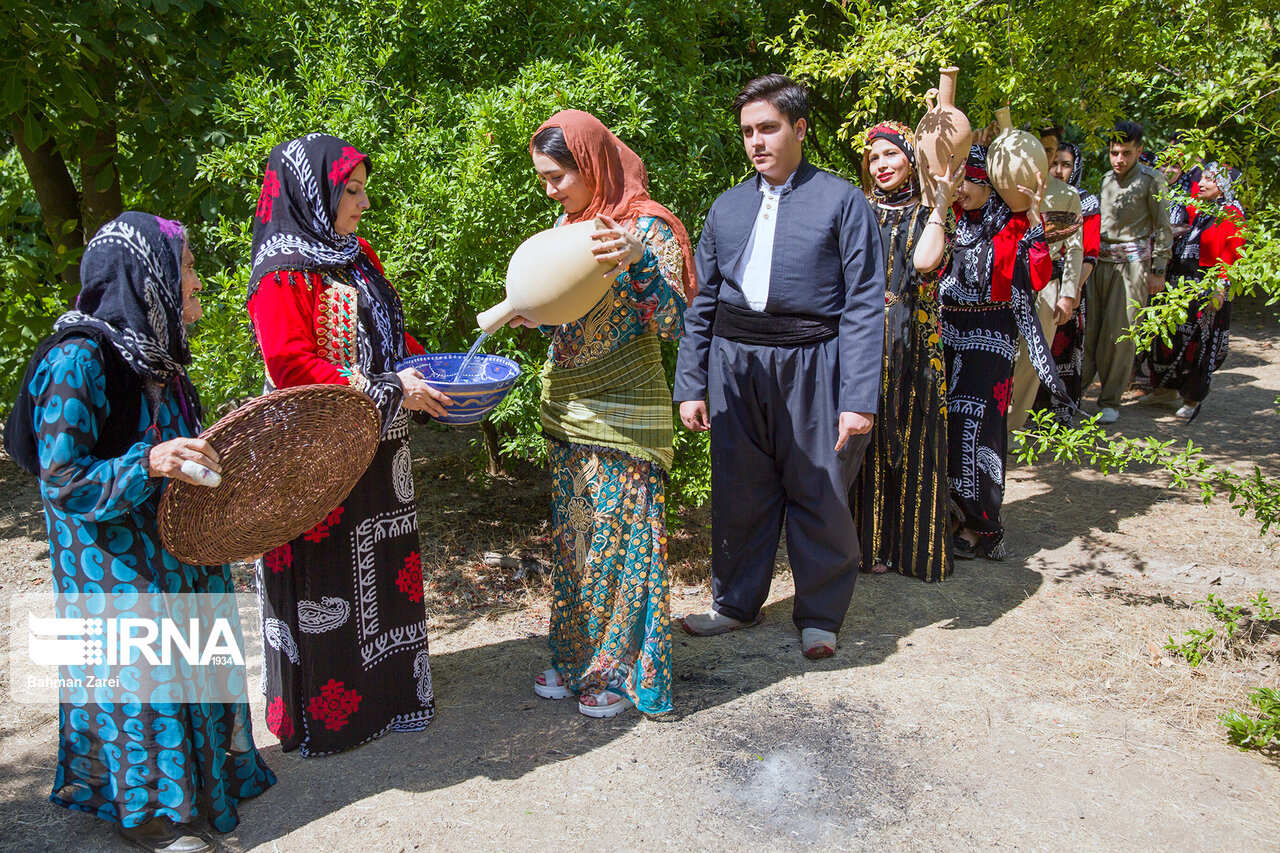
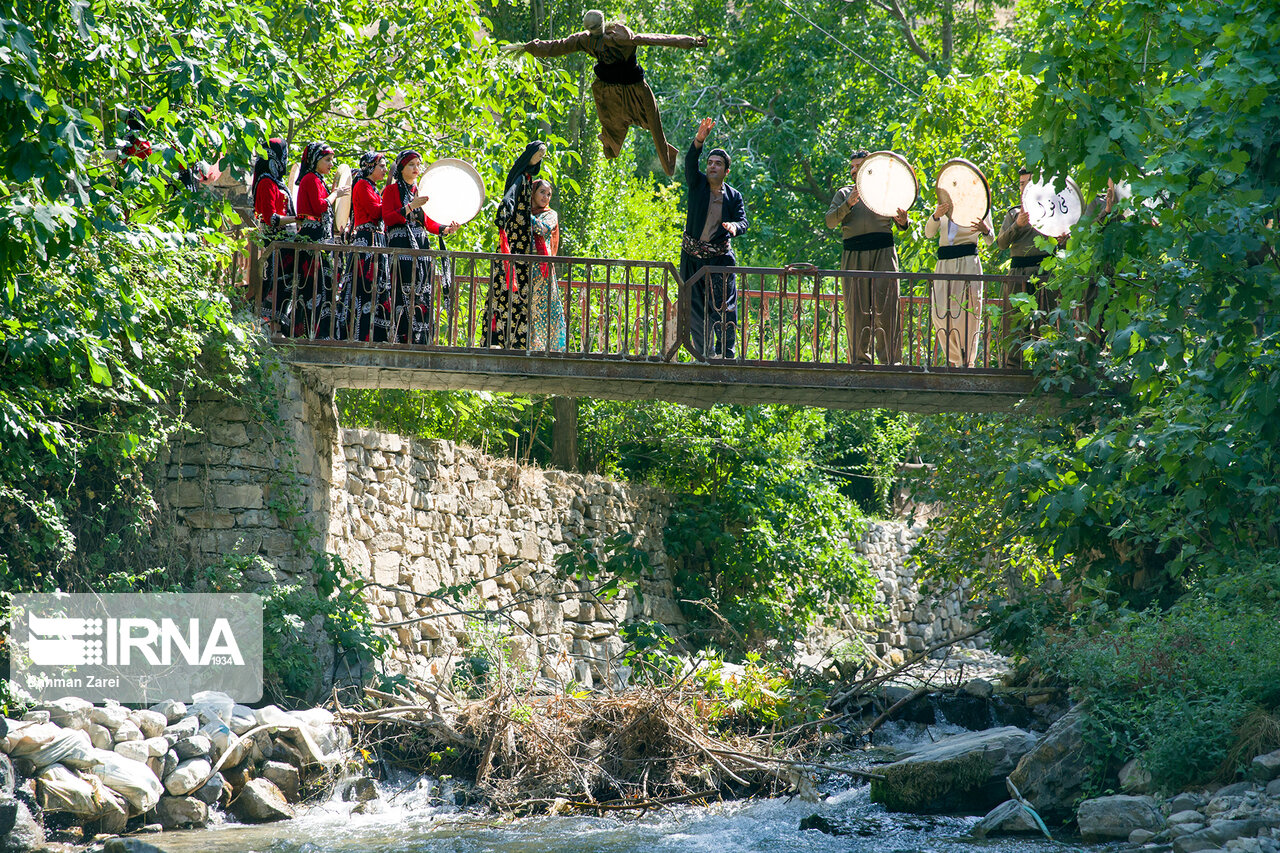
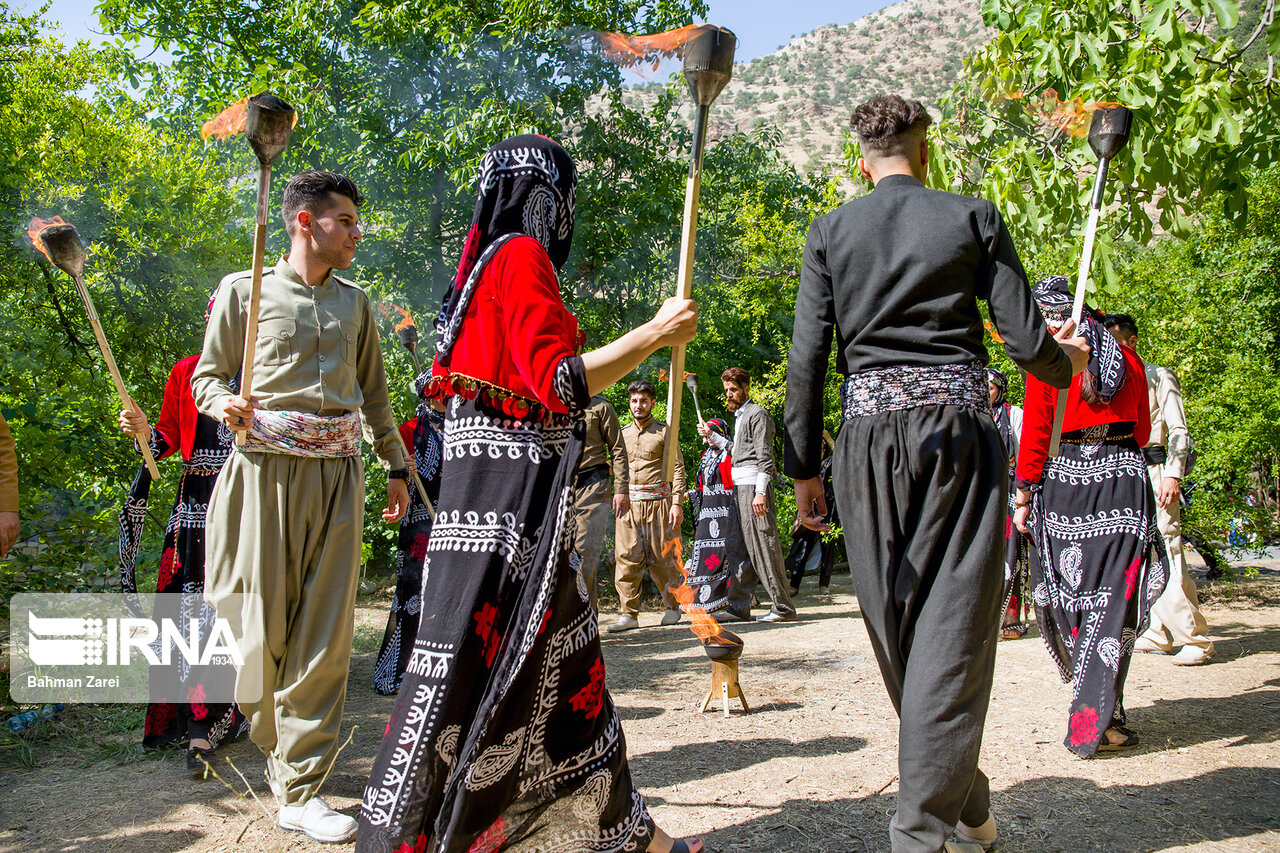
People in Western Iran Hold Midsummer Celebrations

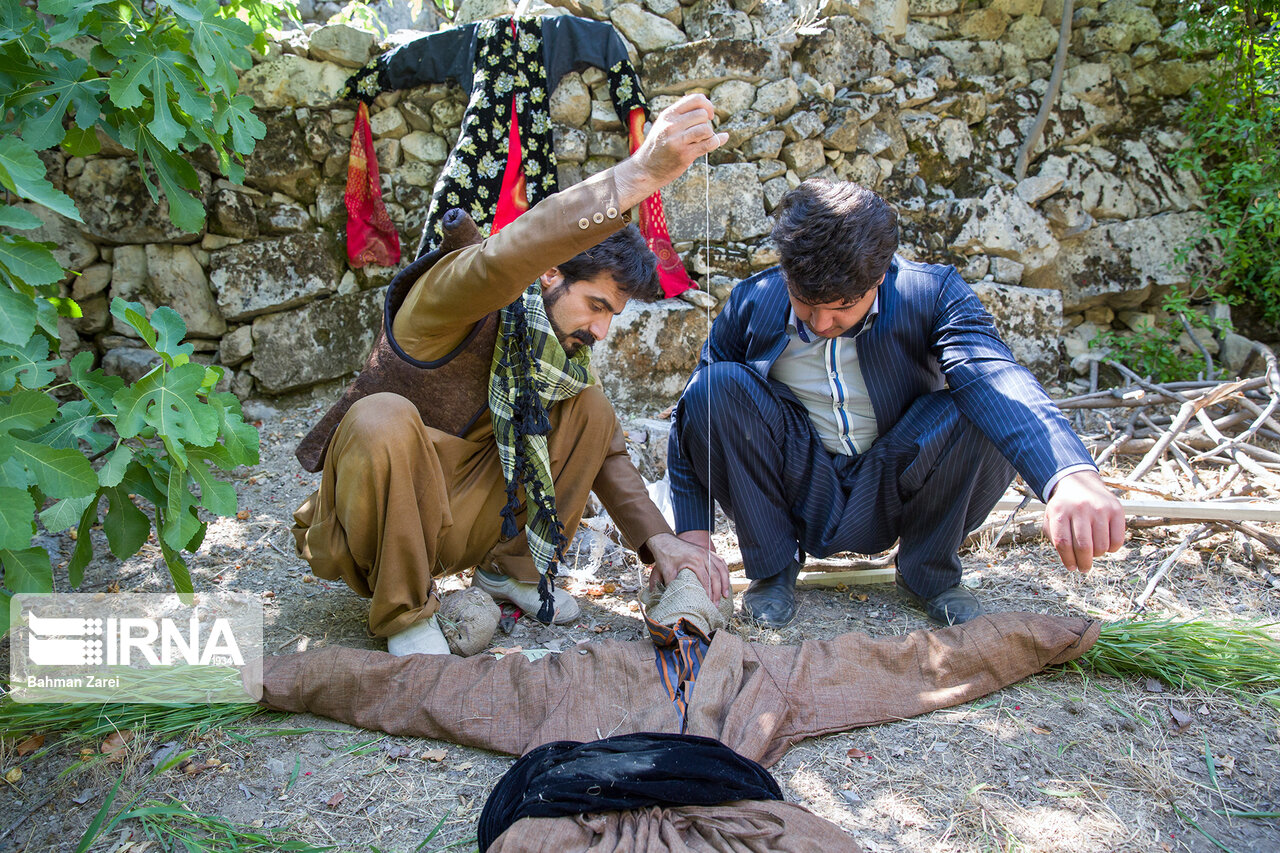
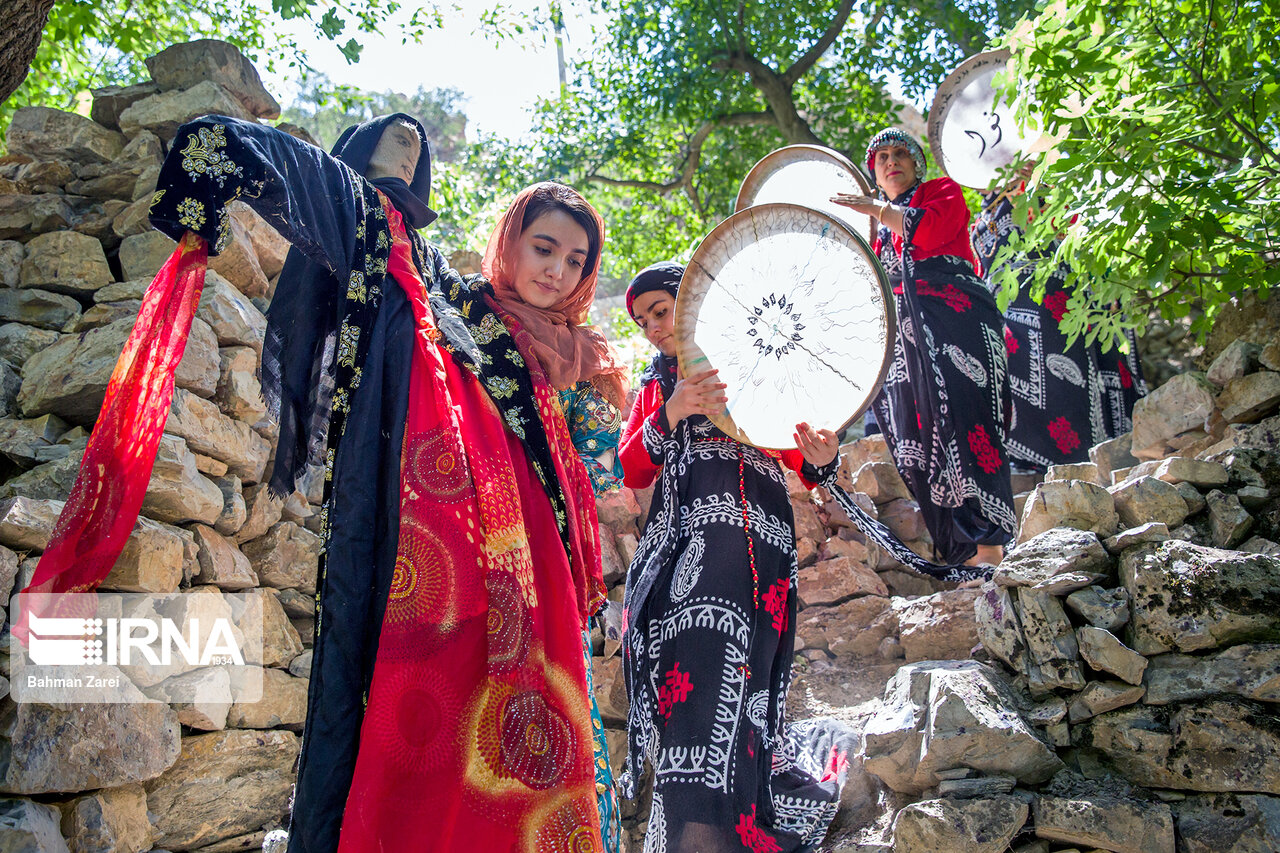
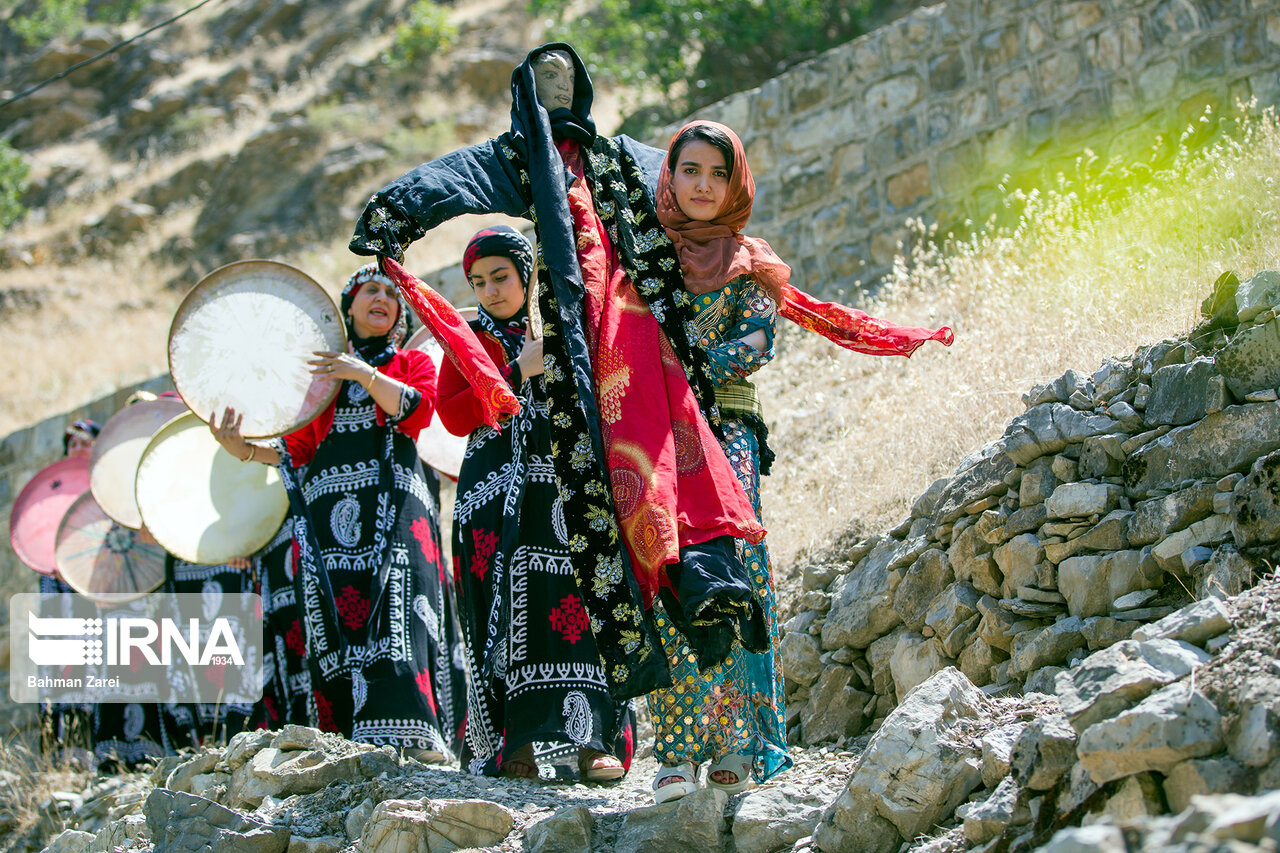
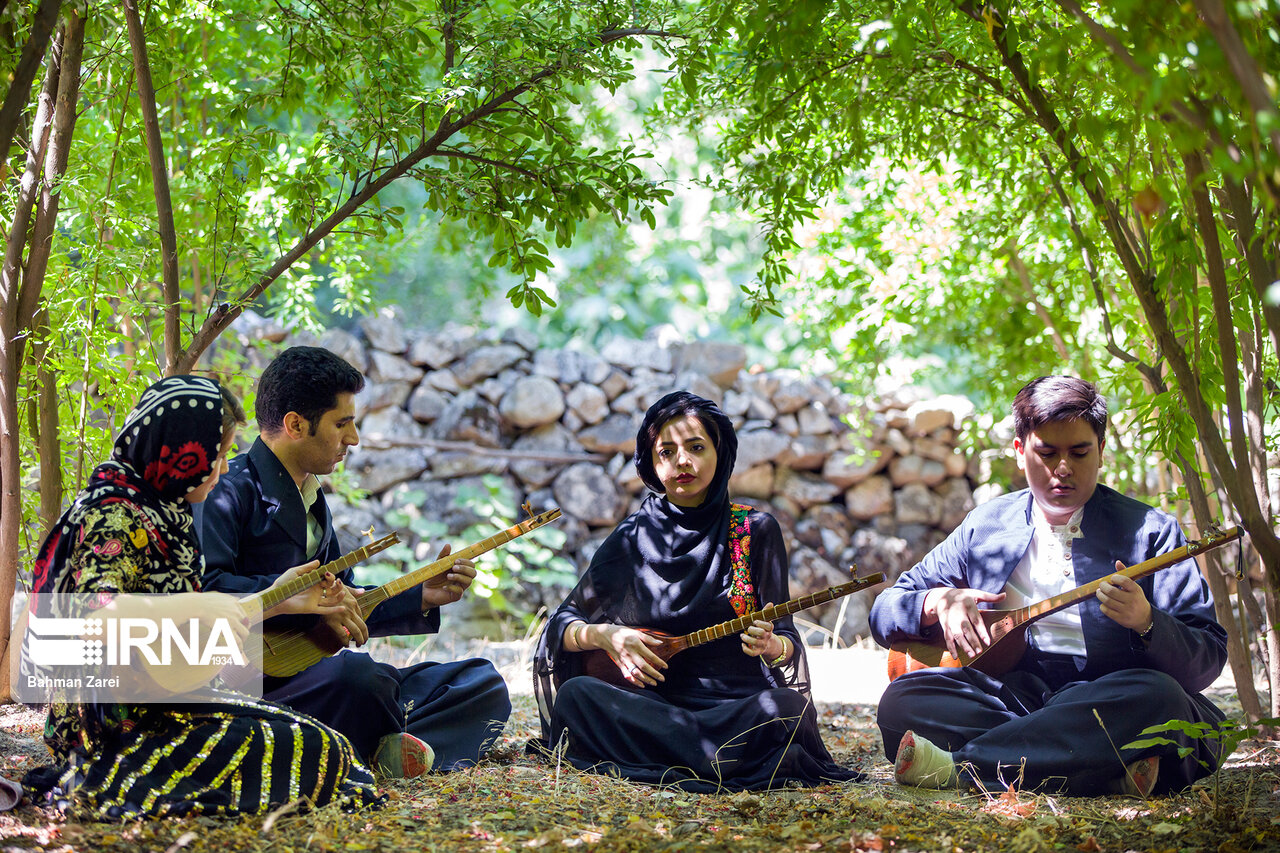
The ceremony is held at the beginning of the temperature drop when the harvest of garden products starts.

The celebrations include scarecrow handling, playing Daf (traditional Persian drum), performing local music and the Kurdish game of Halparkeh, alongside distribution of products among the participants.

What follows are IRNA’s photos of the midsummer celebration:

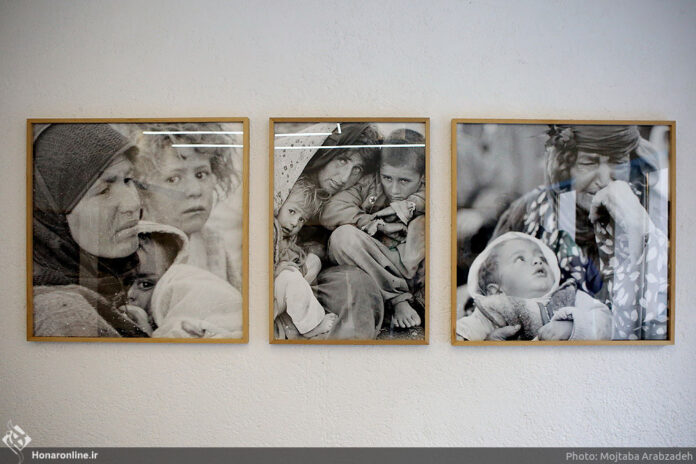
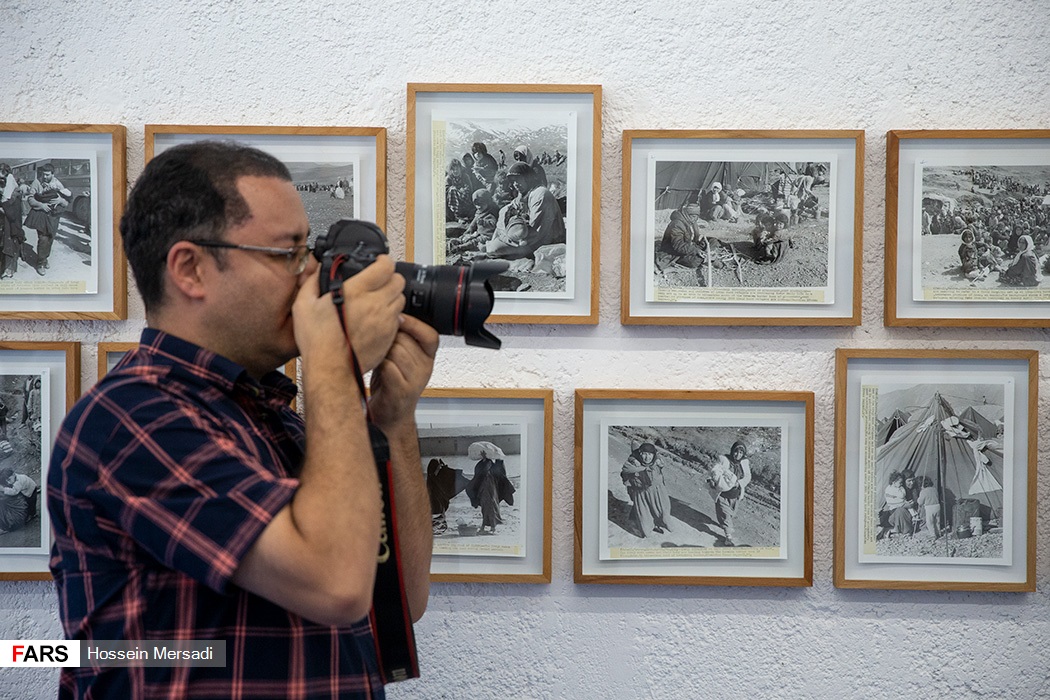
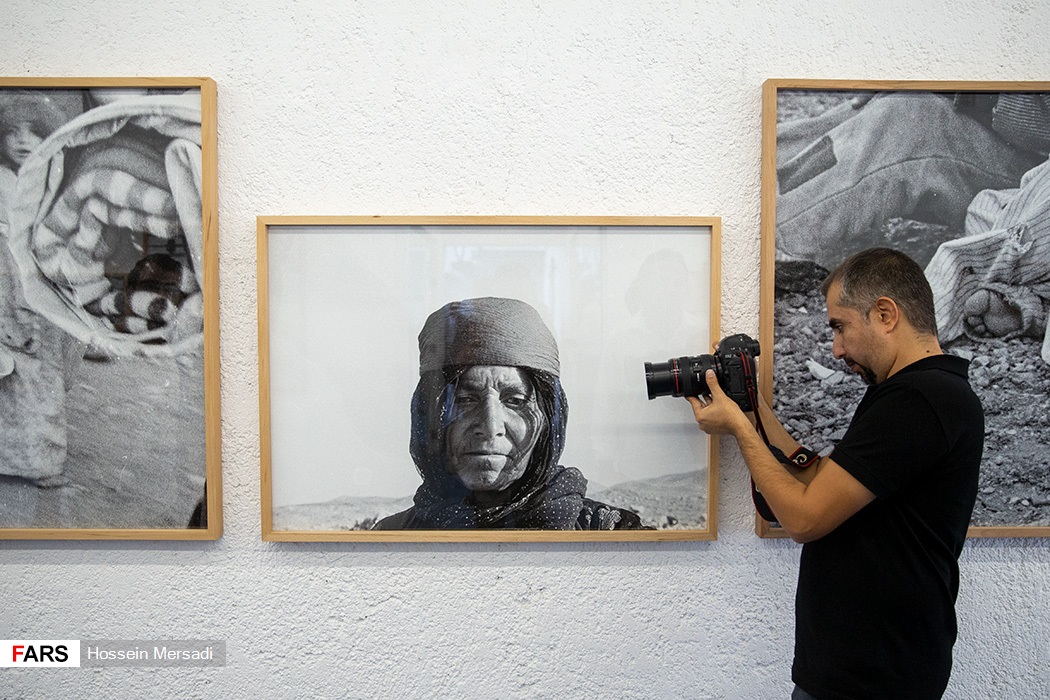
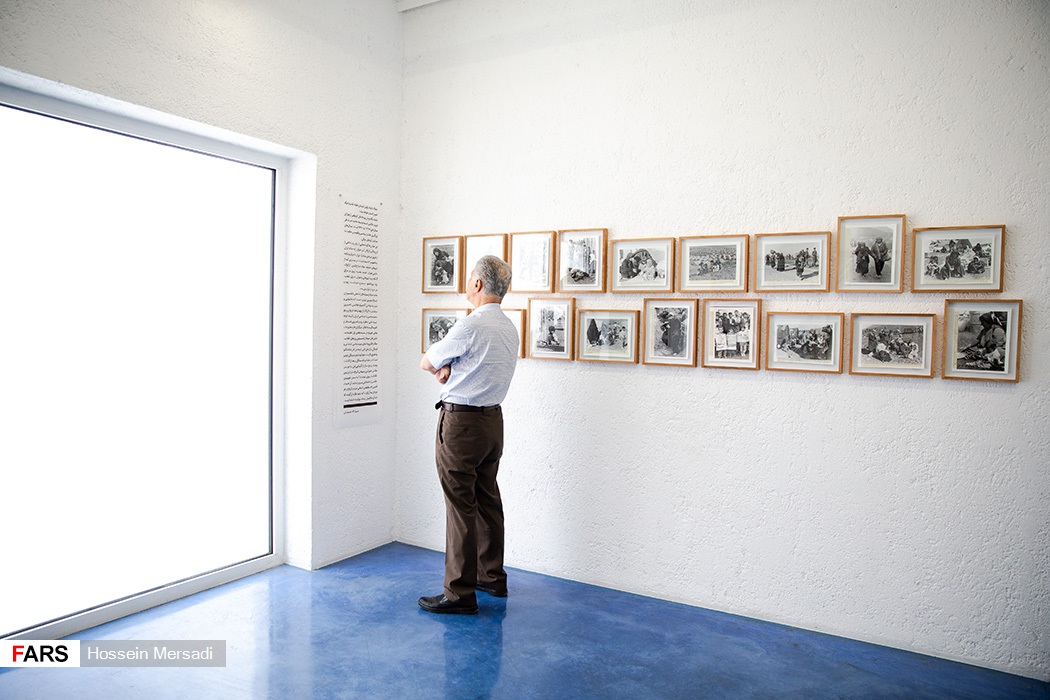
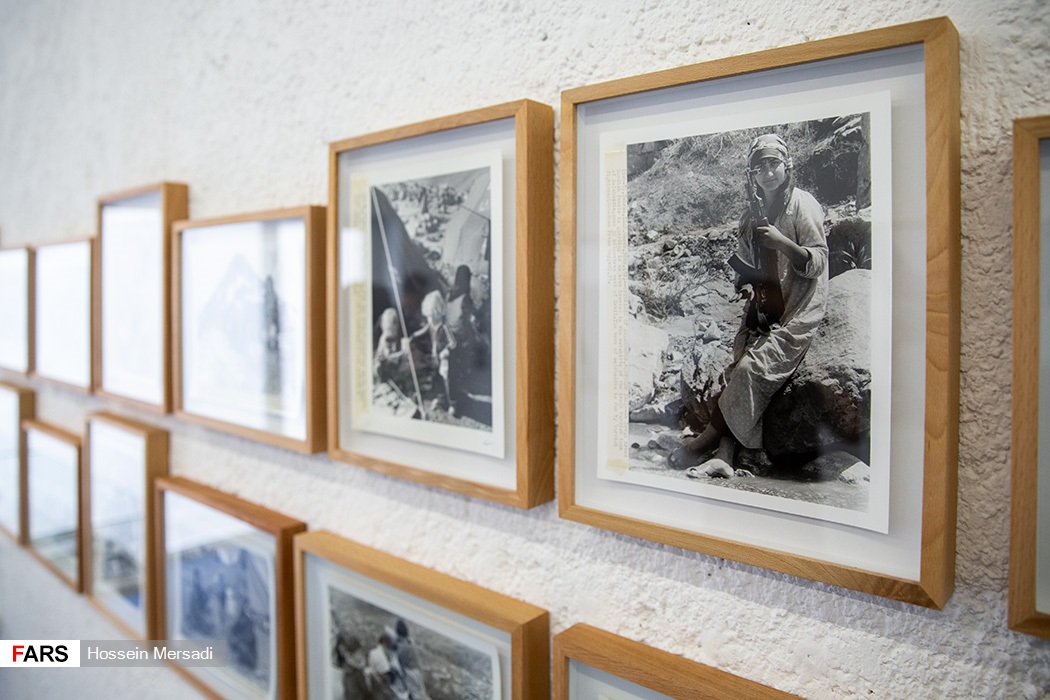
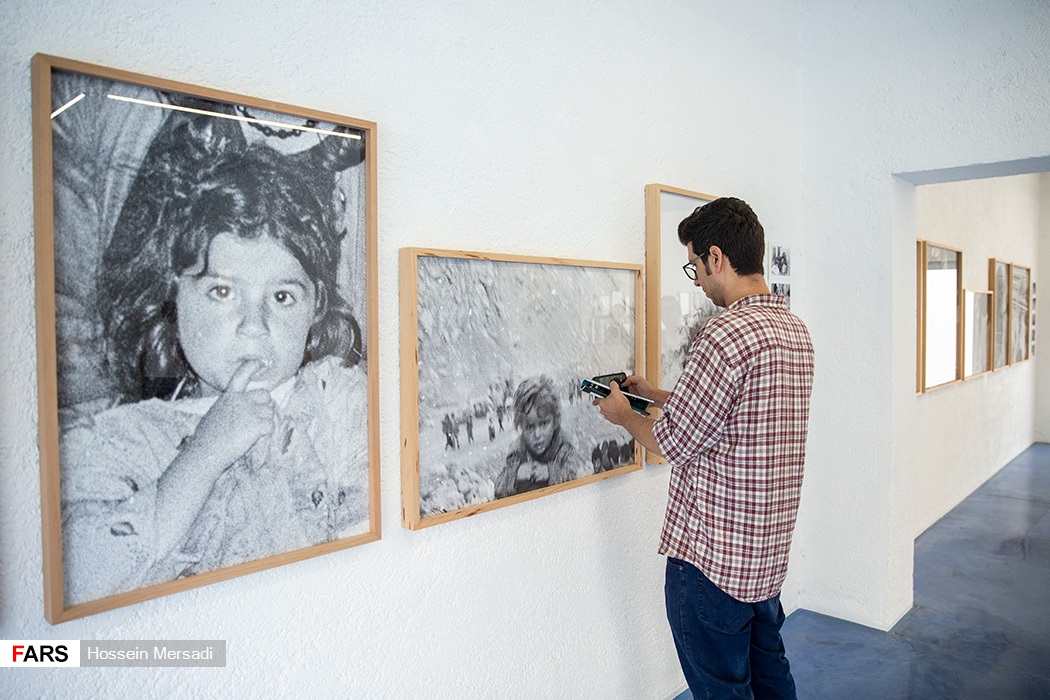
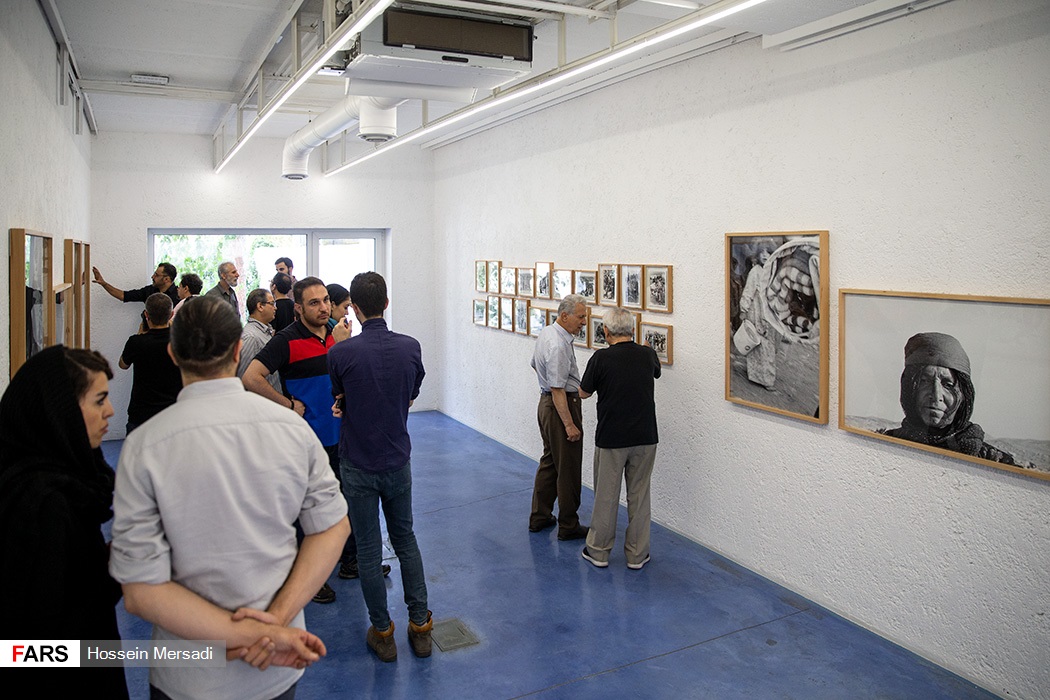
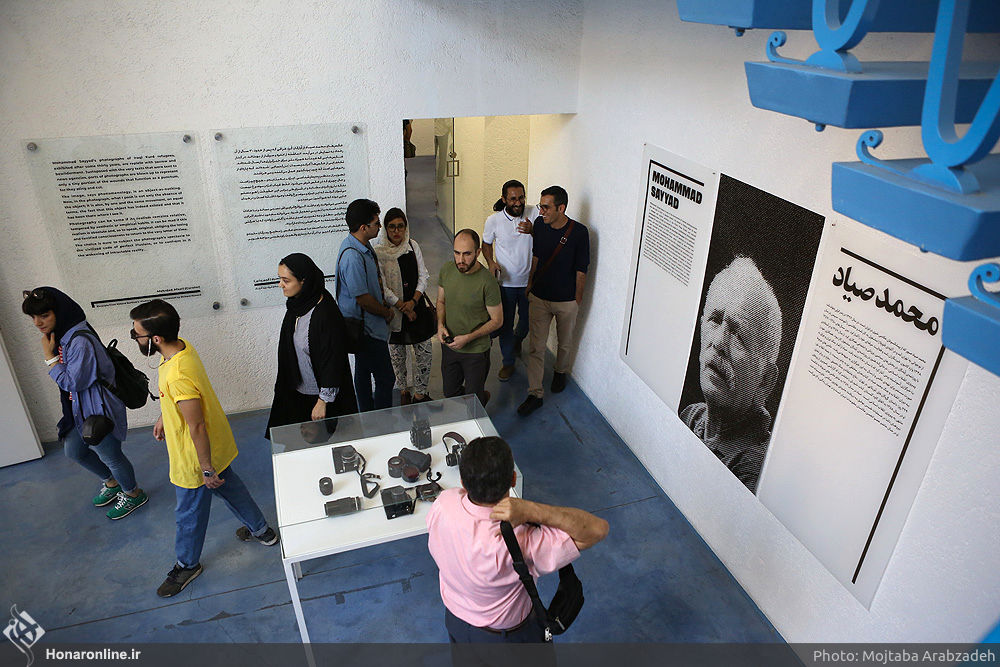
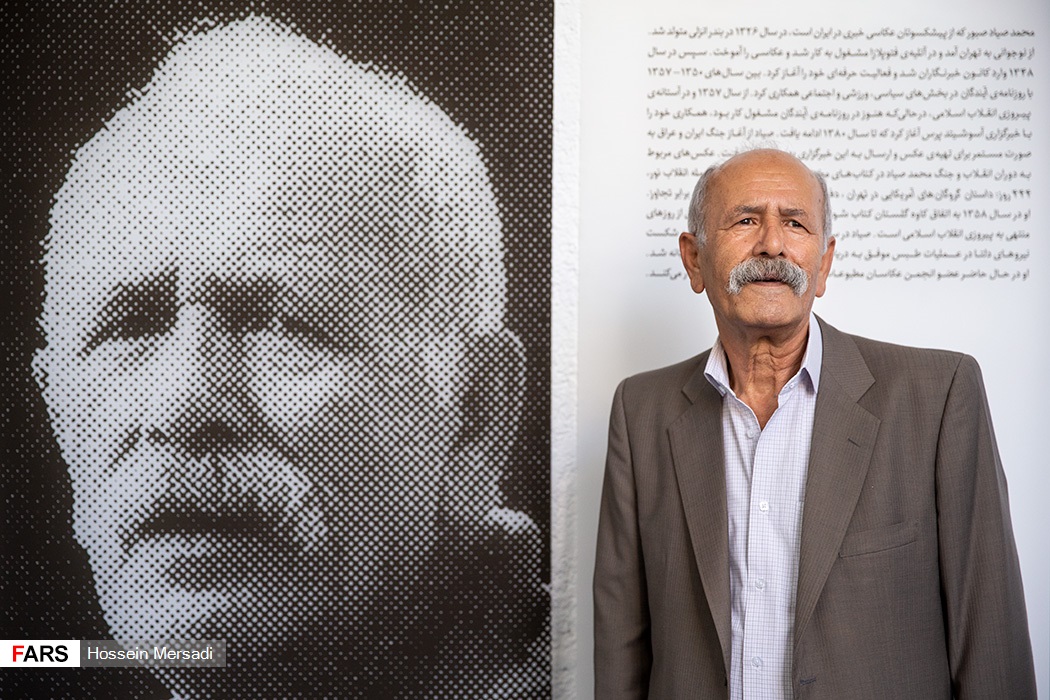
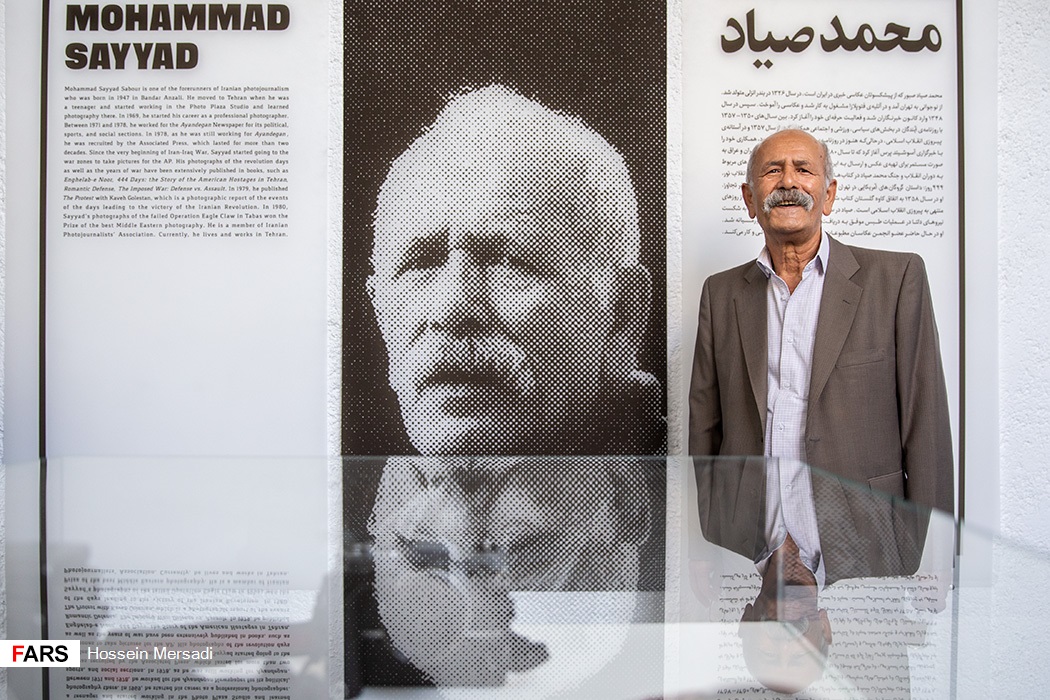
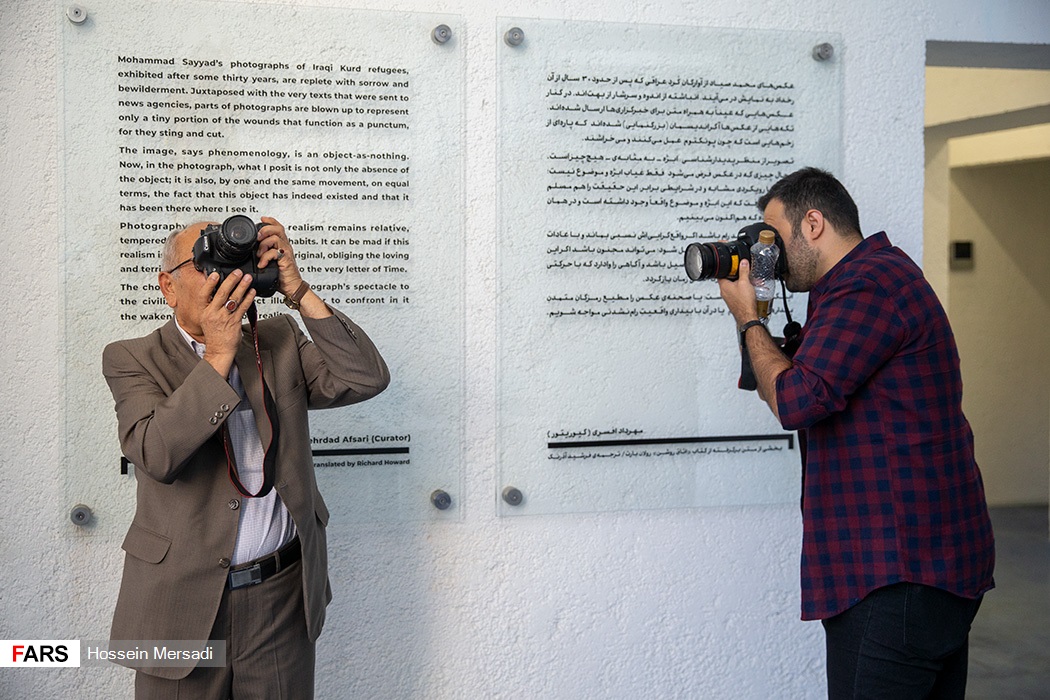
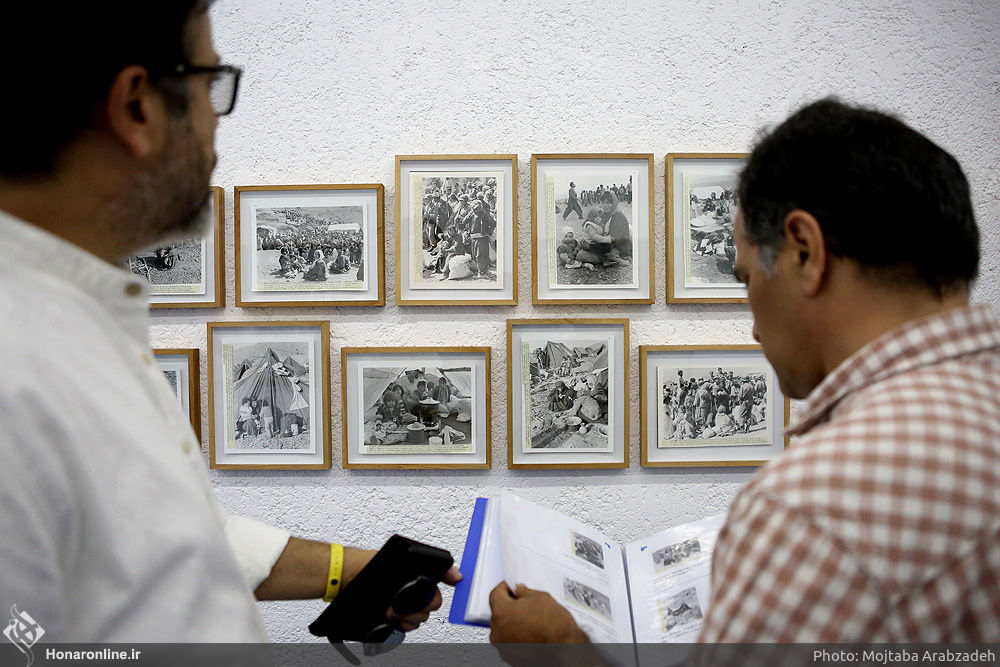
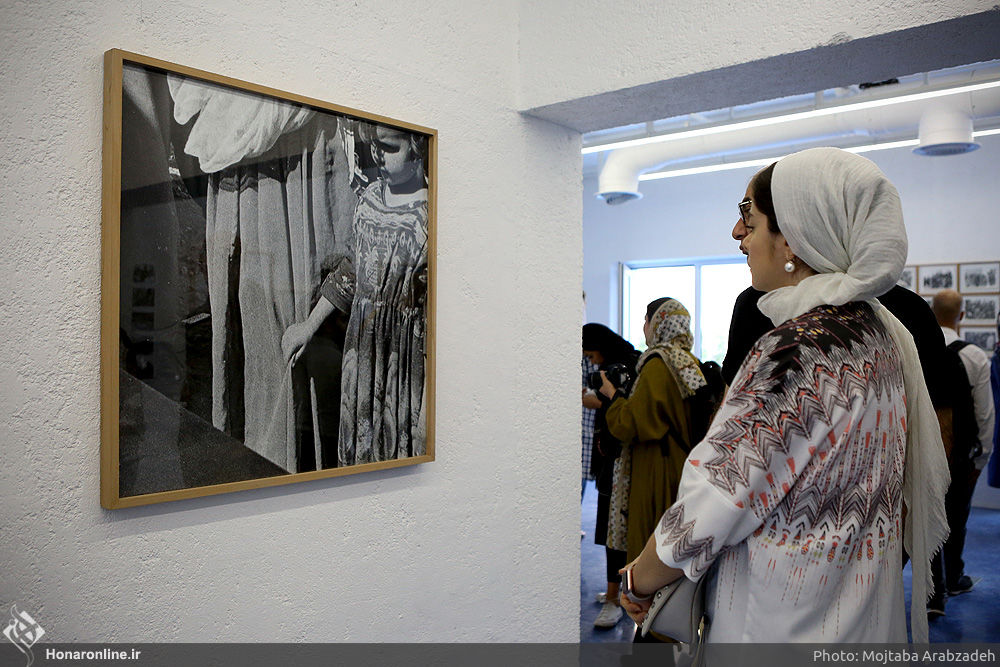
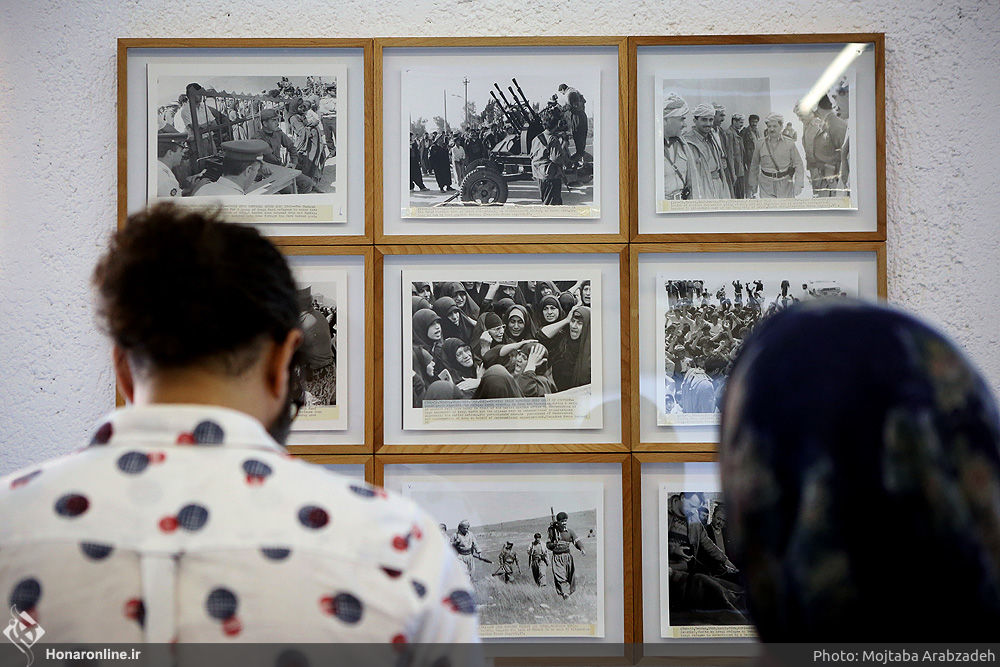
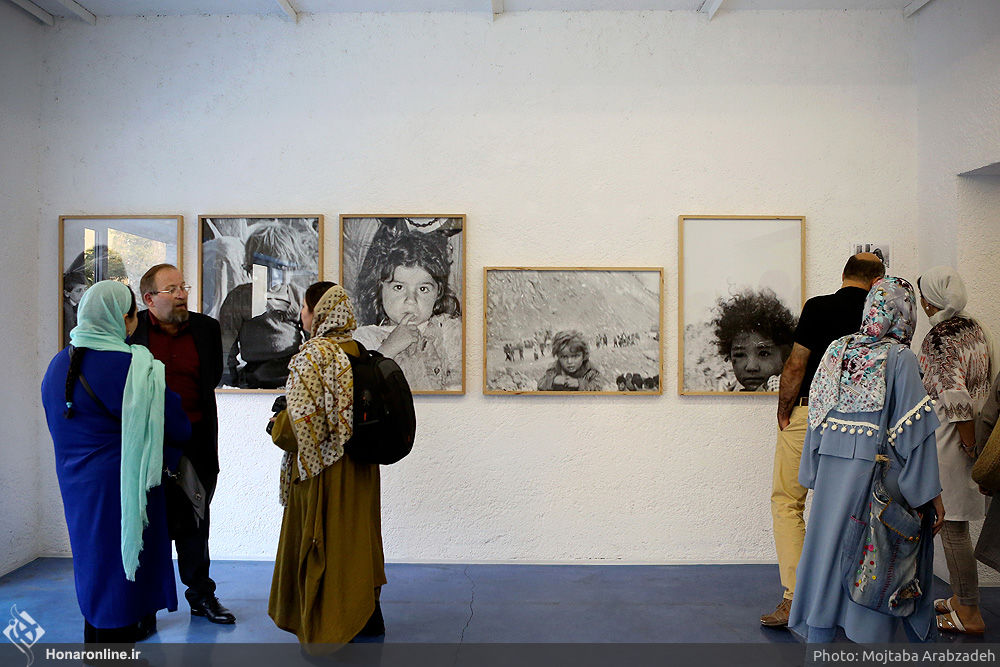
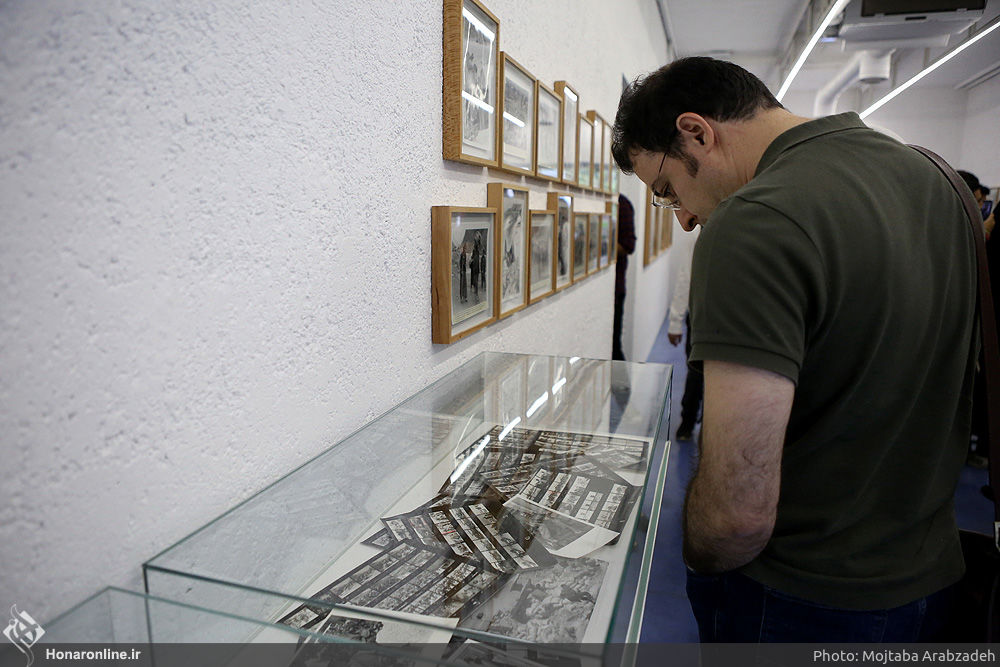
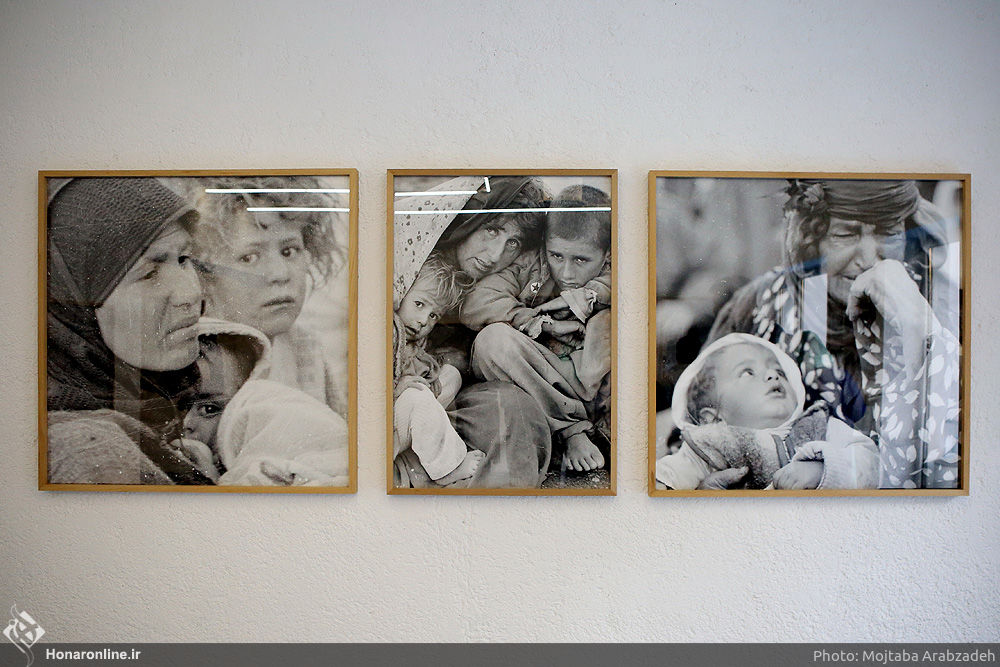
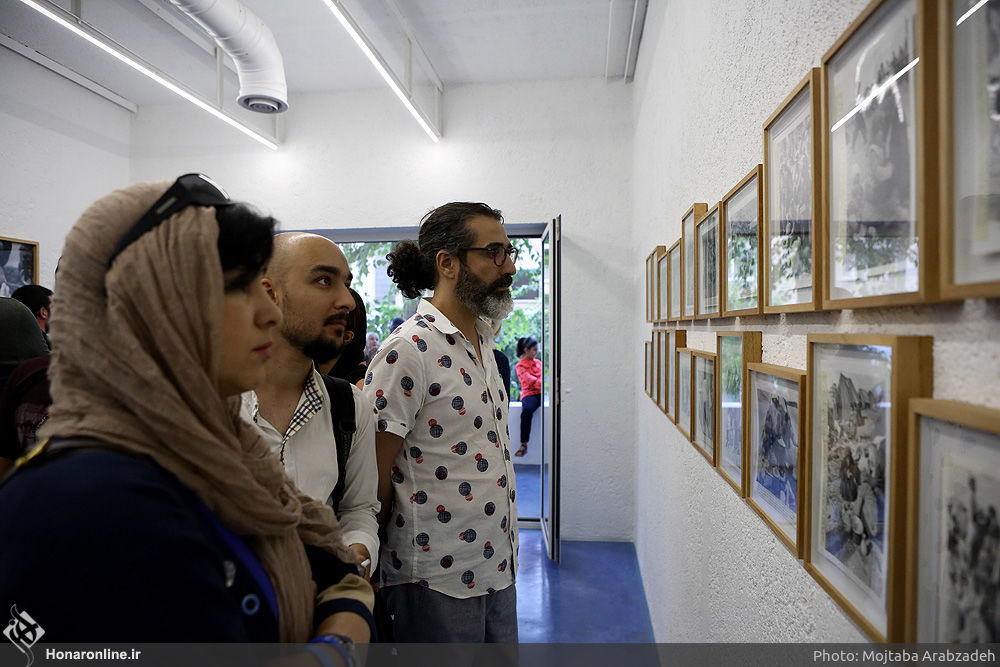
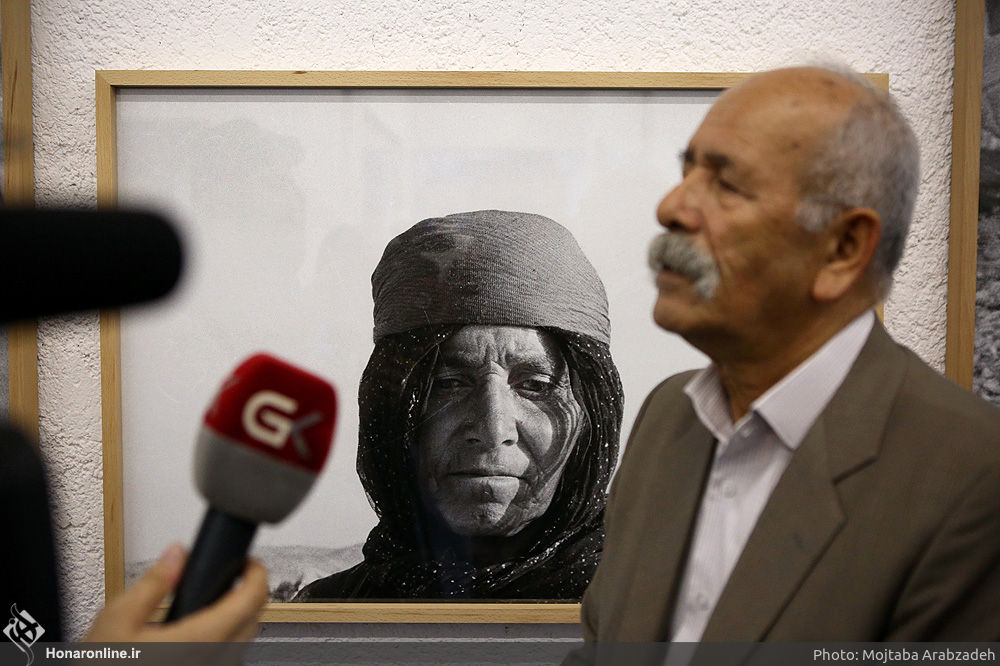
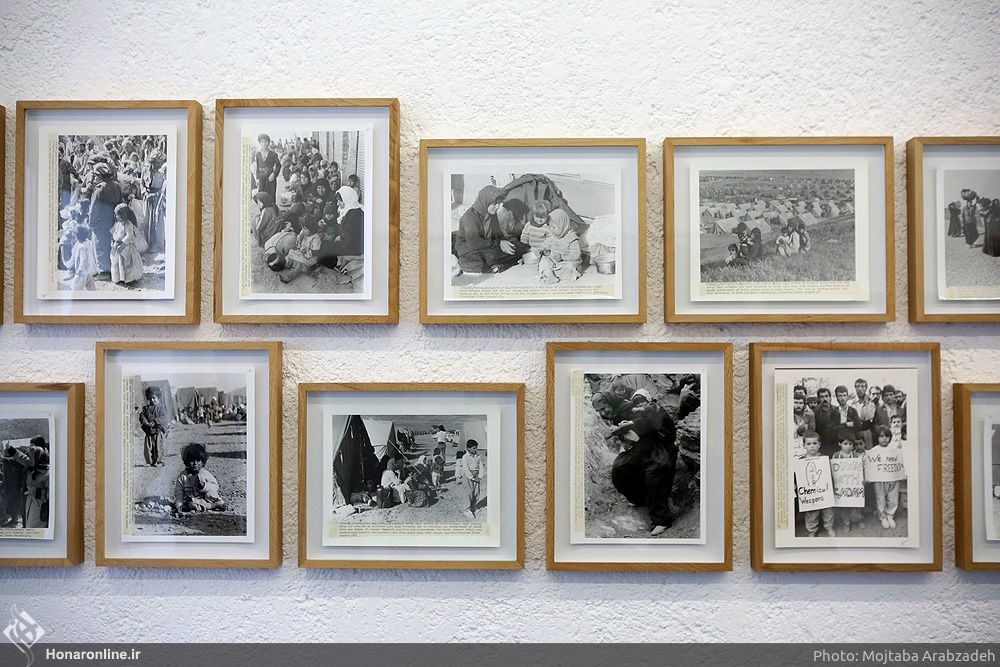
Photo Exhibition in Iran Depicts Sufferings of Iraqi Kurdish Refugees

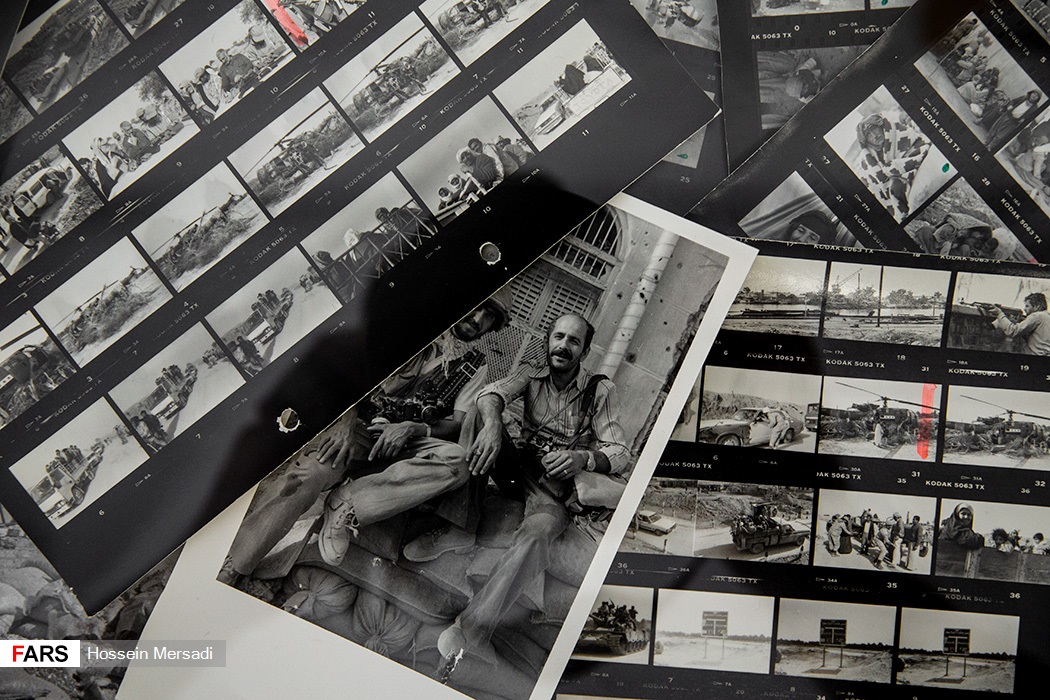
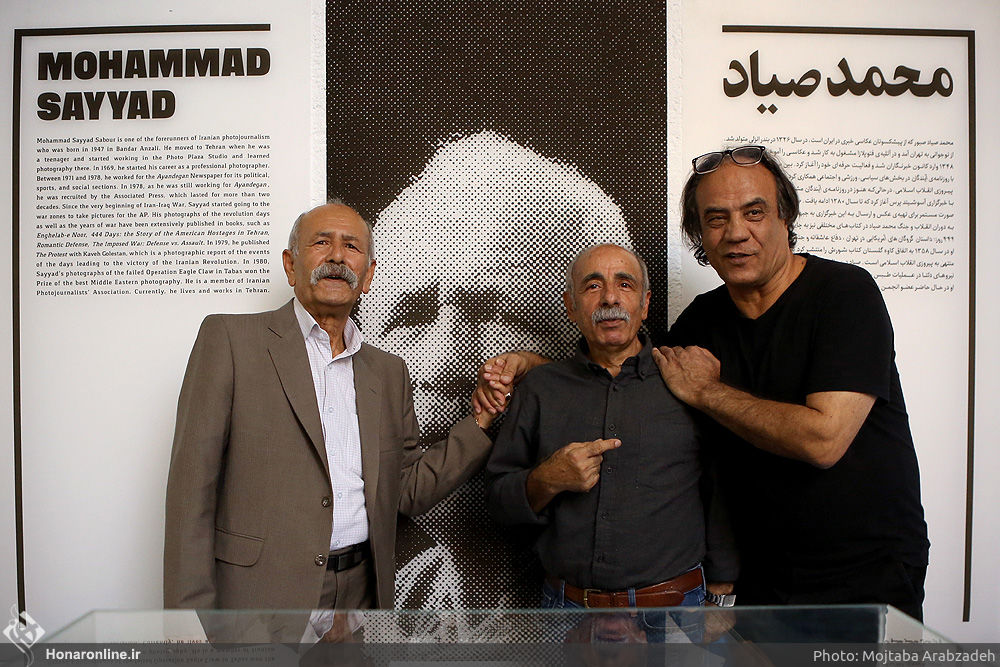
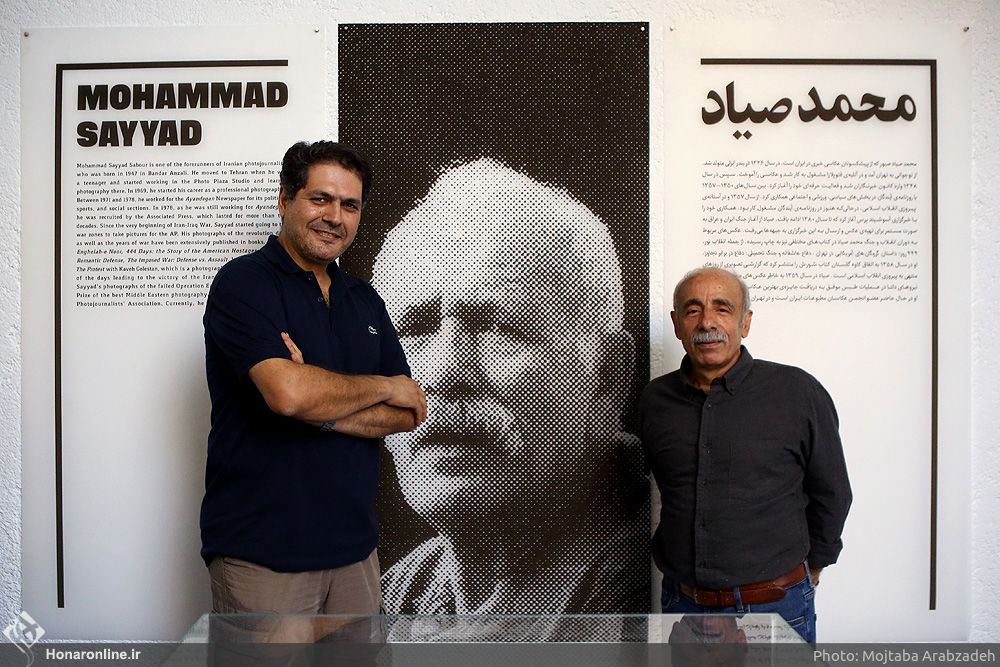
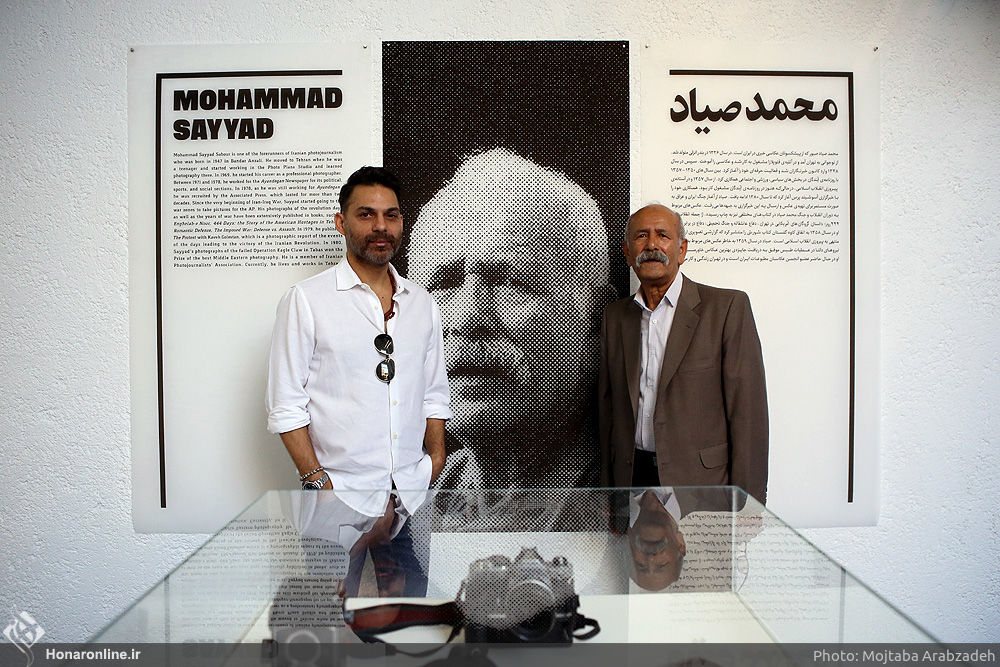
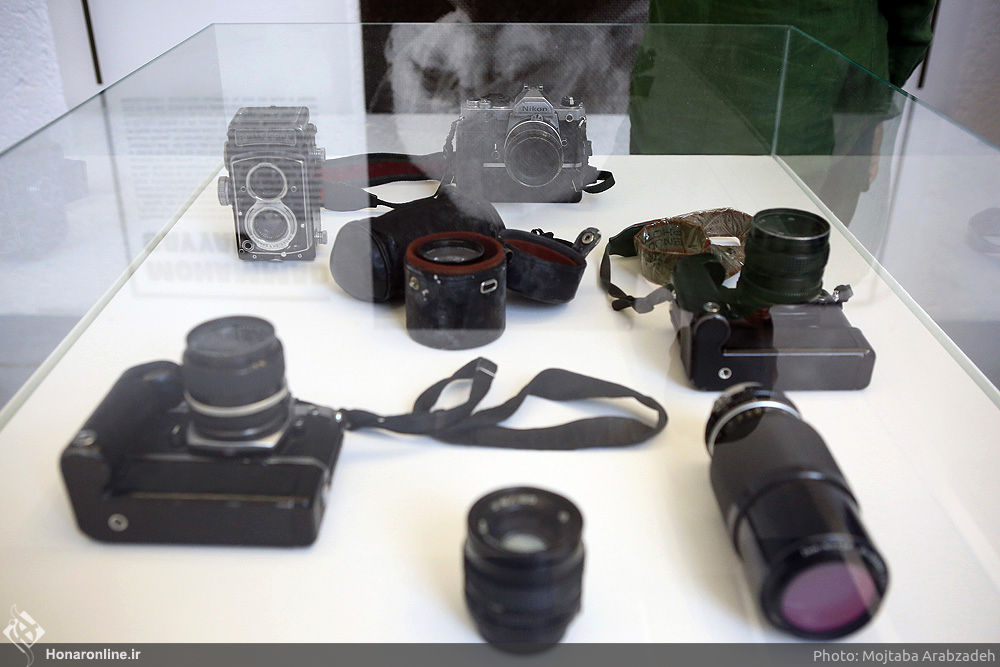
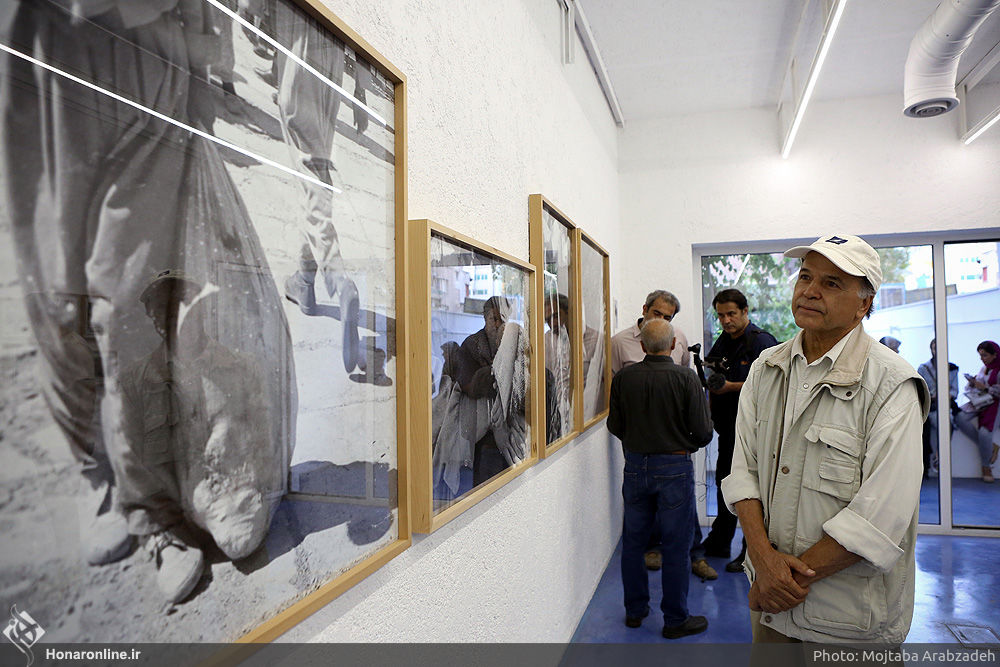
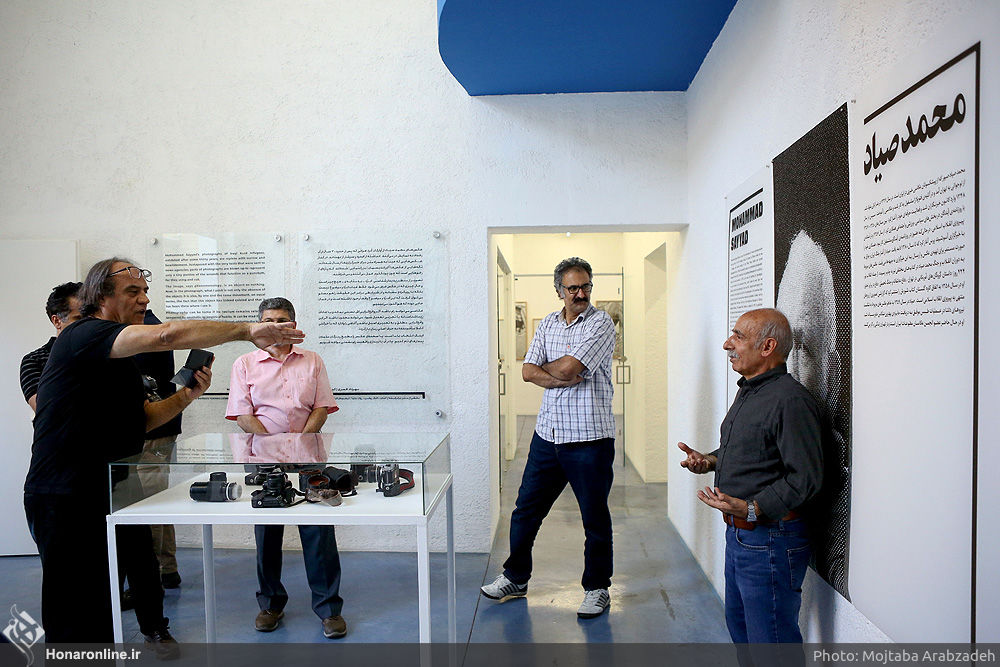
The event, which opened at Nabshi Centre art gallery on August 2, 2019, showcases works by renowned Iranian photojournalist Mohammad Sayyad Sabour whose professional career spans five decades.

More than a hundred pictures are on display at the event. They were all taken between 1988 and 1991.

Sabour is a veteran photojournalist in Iran who was born in northern Anzali Port in 1947. He joined the Journalists’ Club in 1969 and began his professional career. He began his cooperation with Associated Press in 1978 on threshold of the victory of Iran’s Islamic Revolution. At the time, he was simultaneously working for the Ayandegn newspaper.

He would keep going to the frontline to take photos and send them to the AP news agency after the eight-year Iraqi imposed war on Iran started in 1980.

Photos of the Islamic Revolution era as well as the war taken by him have also been published in different books. In 1980, he received the Middle East’s Best Photograph Award for having shot photos related to the failure of American troops in Operation Eagle Claw (also known as Operation Tabas) in Iran in 1980.

The exhibition portrays moments in history closely intertwined with political, social, cultural and ethnic concepts. The photos illustrate war, revolution, political conflicts and their impact on individual and collective life.

The event runs until August 30, 2019.

The following are images of the exhibition courtesy of Fars News Agency and Honar Online.

Nothing Finalized on Demarcation of Caspian Sea Boundaries: Iran

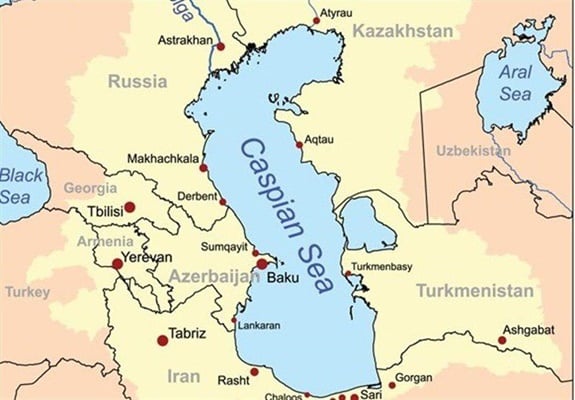
Speaking to the Islamic Republic News Agency (IRNA) on Sunday, Mousavi said there has been no development regarding the legal regime of the Caspian Sea, and discussions have not gone beyond the level of general talks and cooperation among the littoral states.

Asked about concerns over the demarcation of the Caspian Sea’s boundaries, Mousavi said, “Dr Zarif’s recent participation in the parliament’s session was just aimed at answering the respected lawmakers’ last year’s question. Legal talks over the issue have not been finalized.”

“Negotiations held so far have been limited to the generalities of cooperation among Caspian Sea littoral states, and nothing has been finalized and agreed upon regarding the legal regime and division of the seabed and sub-seabed,” he added.

Mousavi said the Caspian Sea, encircled by five countries, has its own complications and specifics, and that is why its legal regime has not been finalized yet.

“All the five [Caspian] countries have been trying to reach a solution, which requires very detailed and onerous technical and legal work, which is currently underway,” he said, rejecting the comments made about the issue as unjustified.

“Negotiations over methods of drawing the straight baseline must first be finalized. Then, based on that, the legal regime of demarcation of boundaries must be developed in the form of a five-way agreement. Then a related bill must be proposed to the Parliament for final ratification. But none of these steps have been taken so far,” he noted.

Back on August 2018, the presidents of the five states bordering the resource-rich Caspian Sea signed a historic convention on the sea’s legal status after more than two decades of discussions.

The deal was signed by Iranian President Hassan Rouhani and his counterparts from Russia, Azerbaijan, Kazakhstan, and Turkmenistan, Vladimir Putin, Ilham Aliyev, Nursultan Nazarbayev and Gurbanguly Berdymukhamedov, respectively, after the 5th Caspian Summit in the Kazakh port city of Aktau.

The Caspian Sea convention was drawn up in 24 articles with the most important highlights being a ban on military presence of all foreign countries in the sea and transit of military consignments belonging to foreign countries.

The convention emphasizes that the Caspian Sea belongs to all littoral states, prohibiting establishment and handing over of any kind of military bases to foreign countries.

The Caspian Sea Legal Regime Convention also puts emphasis on sovereignty and sovereign rights of littoral states while recognizing their right to decide on the sea.

The five states, however, failed to reach an agreement on certain unresolved issues including delimitation, the shares of the sea and its resources.

The Caspian Sea is the largest enclosed body of water by area and is variously classified as the world’s largest lake or a full-fledged sea.

The Caspian Sea littoral states have been discussing a convention on the sea’s legal status for years, which will finally turn out to be a comprehensive document outlining the duties and rights of the five littoral states as well as the framework of cooperation among these countries.

Crypto Mining Legalized in Iran

bitcoin

In a directive issued on Sunday, Jahangiri specified the terms and conditions for cryptocurrency mining in Iran as part of plans to create a safe, low-cost, transparent and high-speed basis for economic transactions and facilitate business activities.

However, neither the Iranian administration nor the local banks would support or guarantee the use of digital currencies.

According to the regulations, miners can freely produce cryptocurrency in Iran at their own risk, albeit after getting permission from Iran’s Ministry of Industry, Mine and Trade.

In addition, the Institute of Standards and Industrial Research of Iran (ISIRI) will be obliged to work with the Ministry of Energy and the Ministry of Information and Communications Technology to lay down quality standards and regulations on the production and import of cryptocurrency mining machines and devices, including the energy consumption rating.

The cryptocurrency miners will be allowed to buy electricity from the national grid or from new power plants independent of the grid, at reasonable prices.

Under the new directive, digital currency mining in the peak of power consumption will be prohibited, be it electricity from the national grid or the natural gas for running a separate power plant.

In recent weeks, Iranian authorities have seized thousands of illegal bitcoin mining machines, mostly from the abandoned factories.

A spokesman for the Energy Ministry has said cryptocurrency mining operations were destabilizing the power grid and affecting electrical access for households and businesses in Iran.

In comments on June 23, the spokesperson for Tavanir, an Iranian state-run company in charge of power supply and distribution, said the country’s consumption in the previous Iranian month had risen by 7 percent compared to the corresponding period last year, mainly because of the Bitcoin miners’ outsize thirst for electricity.

He also warned that the electricity users producing digital currencies, like Biotcoin, will be detected and their power will be cut off.

Every Bitcoin mining machine that is powered by the same cheap source of electricity available to houses consumes the equivalent of 24 dwellings, the spokesman added, saying the administration has not still set a tariff on the power consumption of digital currency miners.

With electricity so reasonably subsidized that many Iranian occupants buy modern air conditioners with powerful compressors, the number of digital currency miners using power in the residential areas has been growing in recent years.

Bitcoin is a cryptocurrency and a form of electronic cash which many computer geeks believe will form the future of the global economy.

Iran Sympathizes with American People over Mass Shootings

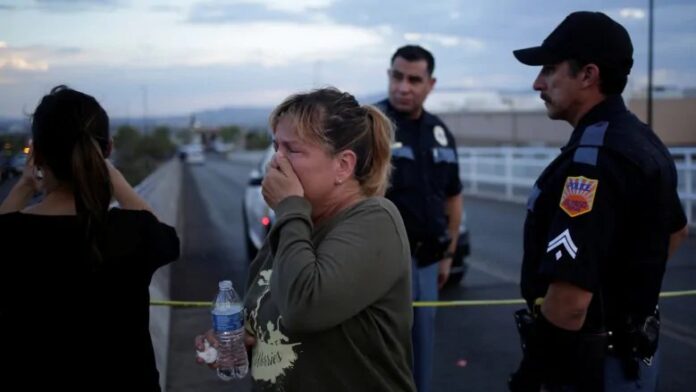
A woman reacts after a mass shooting at a Walmart in El Paso, Tex., on Saturday. / Photo by Jose Luis Gonzalez, Reuters

In a Sunday statement, Mousavi also expressed sympathy with the American people, particularly the families of the victims of the heinous crimes, and wished speedy recovery for tens of people wounded in these tragic incidents.
A total of 20 people were killed in the majority Latino city, nestled in western Texas on the US-Mexico border, as federal authorities investigated a potential hate crime and local prosecutors charged a 21-year-old white man, Patrick Crusius, with murder and said they would pursue the death penalty.
The suspect was from the town of Allen 650 miles from the site of the shooting, at a busy Walmart in the city.

Less than 13 hours later another mass shooting took place in the city of Dayton, Ohio, leaving nine dead there and bringing the total injured from both shootings to at least 52.

Authorities in Dayton named the shooter as 24 year-old Connor Betts and listed the names of the nine people killed, which included the shooter’s sister 22-year-old Megan Betts.

Police in El Paso were examining a hate-riddled message on the website 8chan, posted around 20 minutes before Saturday’s attack, in which the author expressed sympathy for a white nationalist massacre at mosques in Christchurch, New Zealand, a few months ago, and which stated: “This attack is a response to the Hispanic invasion of Texas.”

A Look at Iranian Newspaper Front Pages on August 4

A Look at Iranian Newspaper Front Pages on November 19

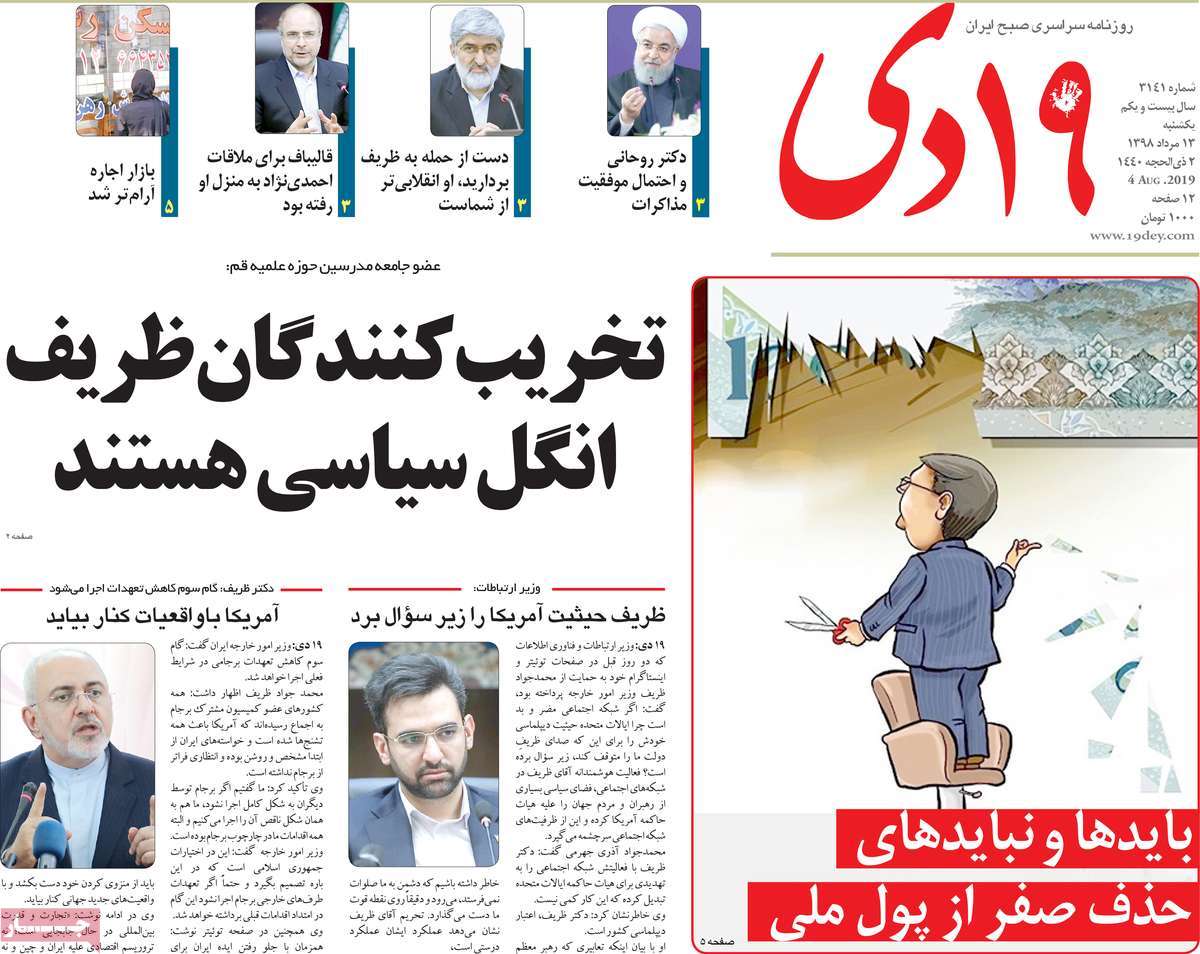
19 Dey:
1- Senior Cleric Slams Those Who Attack Zarif
2- ICT Minister: Zarif Has Disgraced US
3- Zarif: Iran to Start Implementing Third Phase of Commitment Reduction

A Look at Iranian Newspaper Front Pages on August 4


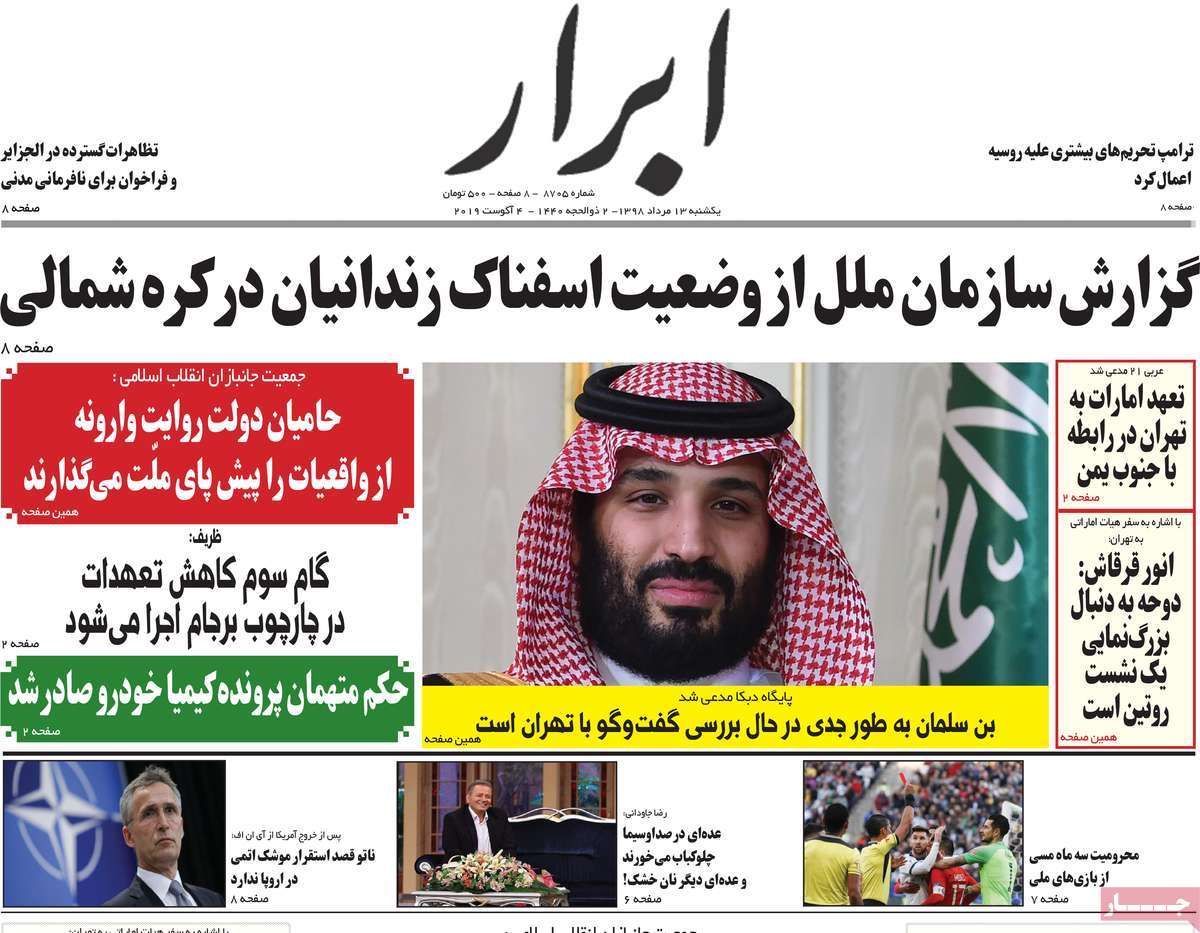
Abrar:
1- DEBKA Files: Bin Salman Seriously Mulling Talks with Tehran
2- Arabi-21: UAE Gives Commitment to Tehran on Southern Yemen

A Look at Iranian Newspaper Front Pages on August 4


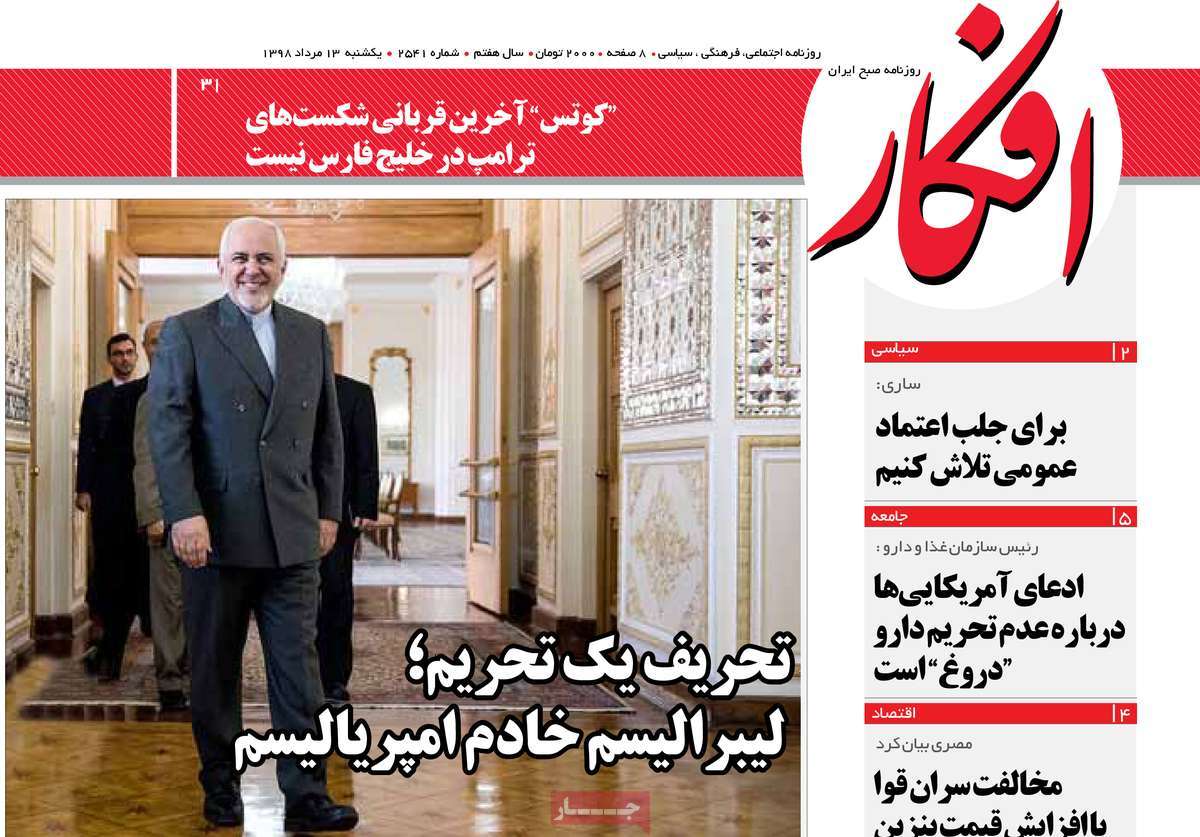
Afkar:
1- Coats Not to Be Last Victim of Trump’s Defeats in Persian Gulf
2- Americans Lying that Pharmaceuticals Not Banned for Iran: Official


A Look at Iranian Newspaper Front Pages on August 4


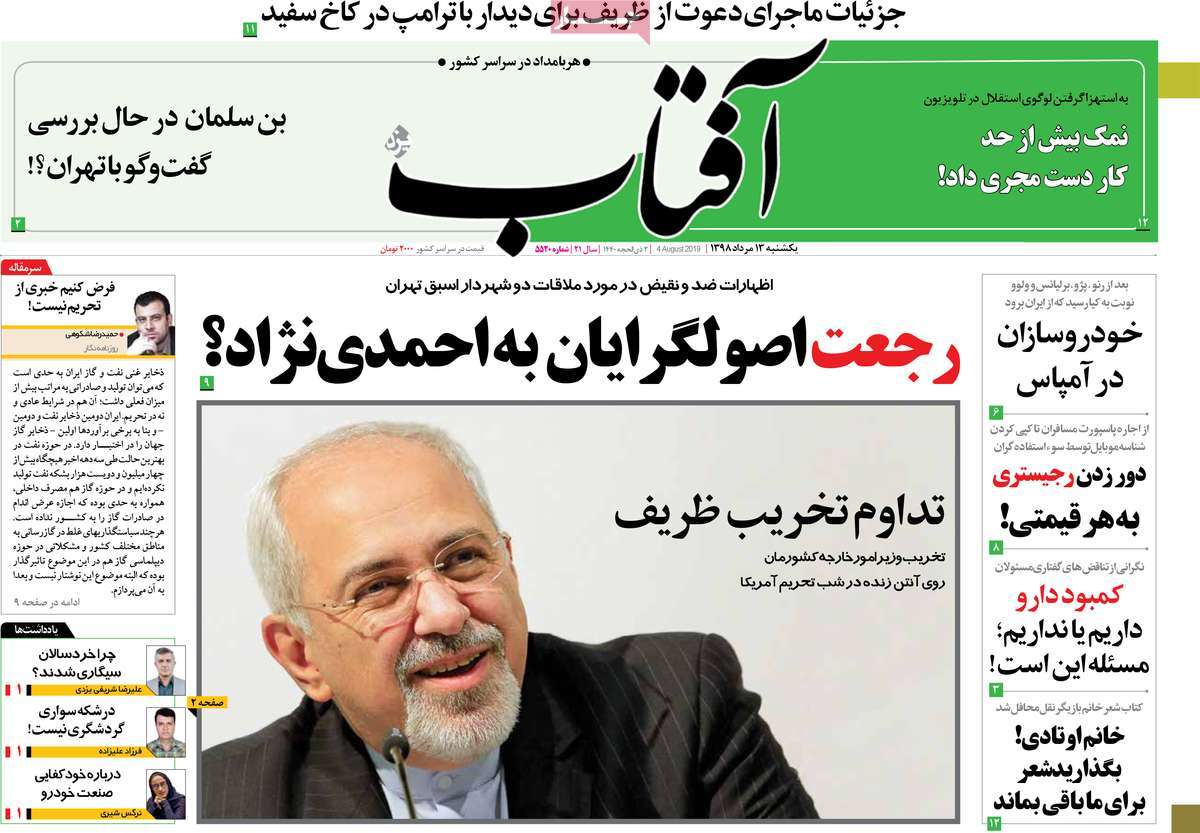
Aftab-e Yazd:
1- Details of Trump’s Invitation for Zarif to Meet Him at White House
2- Bin Salman Mulling Over Talks with Tehran?

A Look at Iranian Newspaper Front Pages on August 4


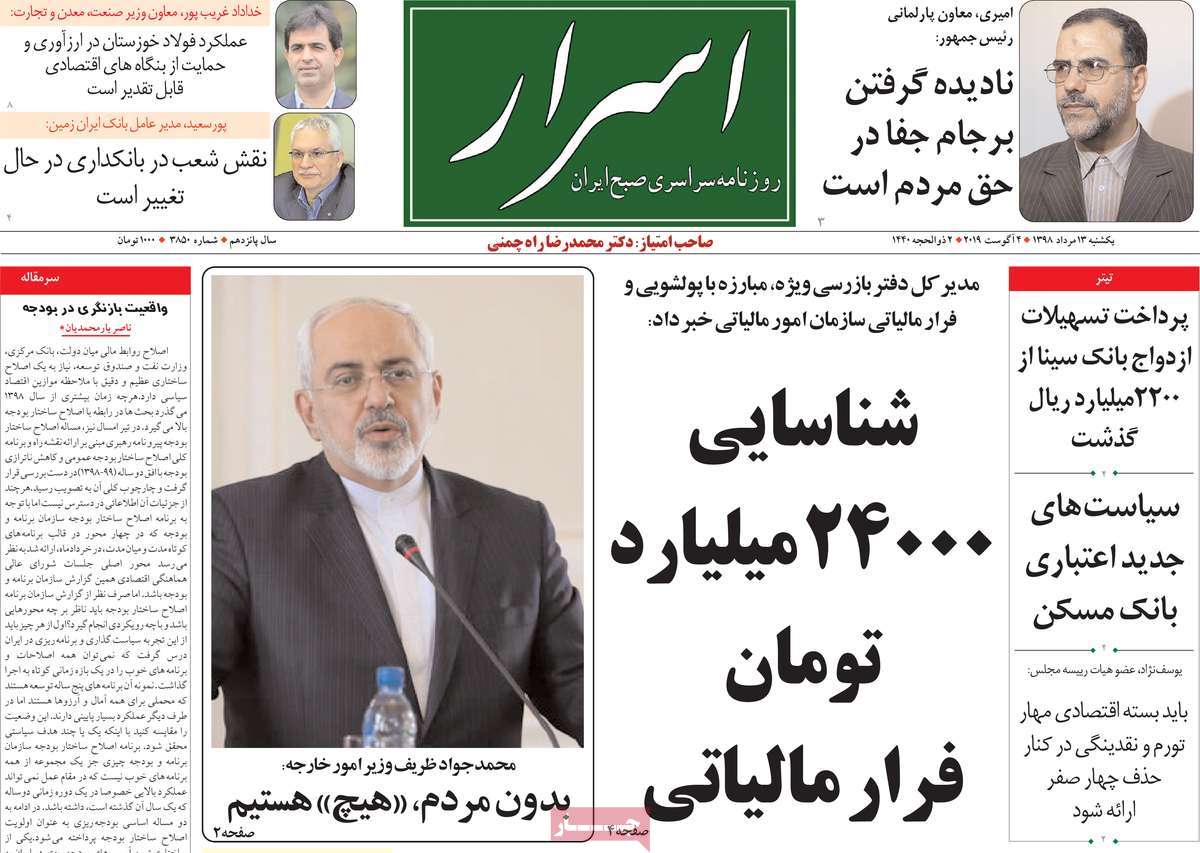
Asrar:
1- Zarif: We’re Nothing without People
2- Rouhani’s Deputy: Ignoring JCPOA Is Violation of People’s Right

A Look at Iranian Newspaper Front Pages on August 4


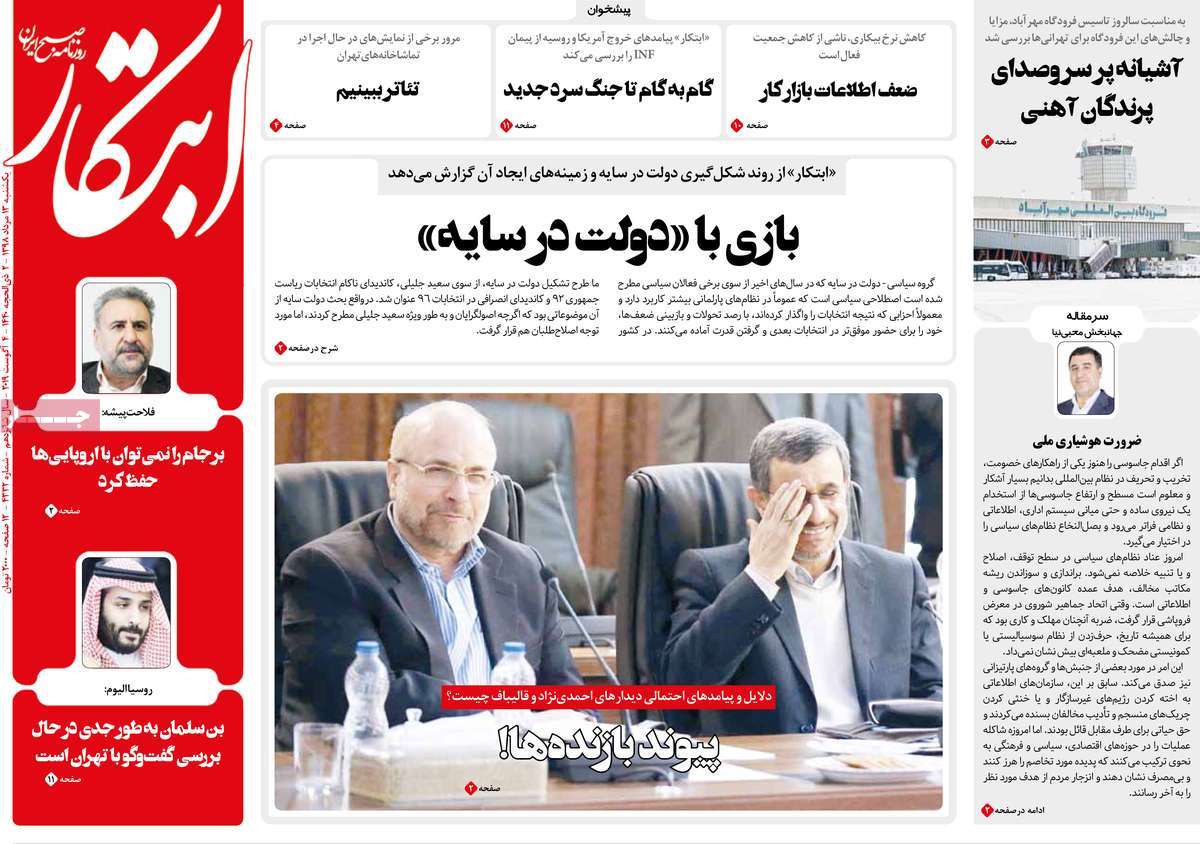
Ebtekar:
1- JCPOA Cannot Be Saved with Europeans: MP
2- Step by Step towards New Cold War
* Review of Repercussions of US, Russia Withdrawal from INF

A Look at Iranian Newspaper Front Pages on August 4


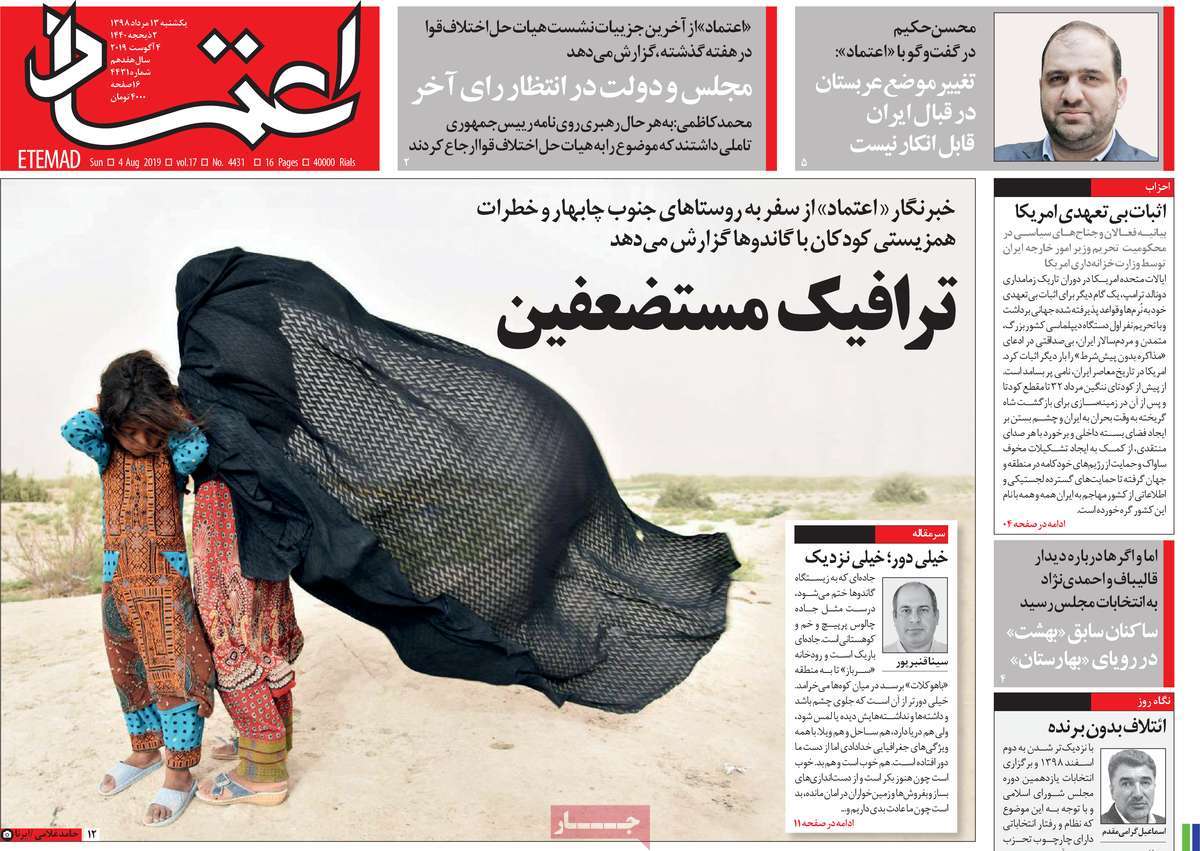
Etemad:
1- Change in Saudi Arabia’s Position towards Iran Undeniable
2- It’s Now Proved US Not Loyal to Commitments

A Look at Iranian Newspaper Front Pages on August 4


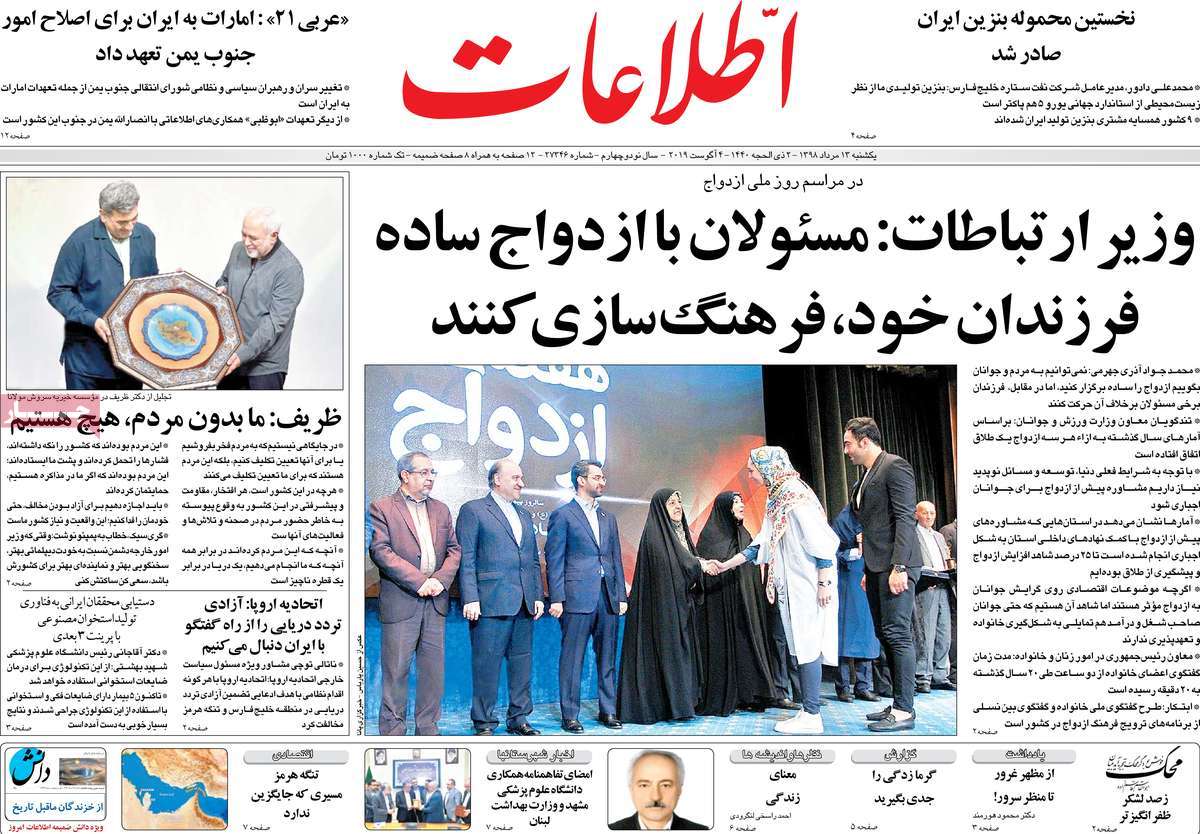
Ettela’at:
1- First Cargo of Iranian Gasoline Exported
2- EU: We’re Pursuing Freedom of Shipping through Dialogue with Iran

A Look at Iranian Newspaper Front Pages on August 4


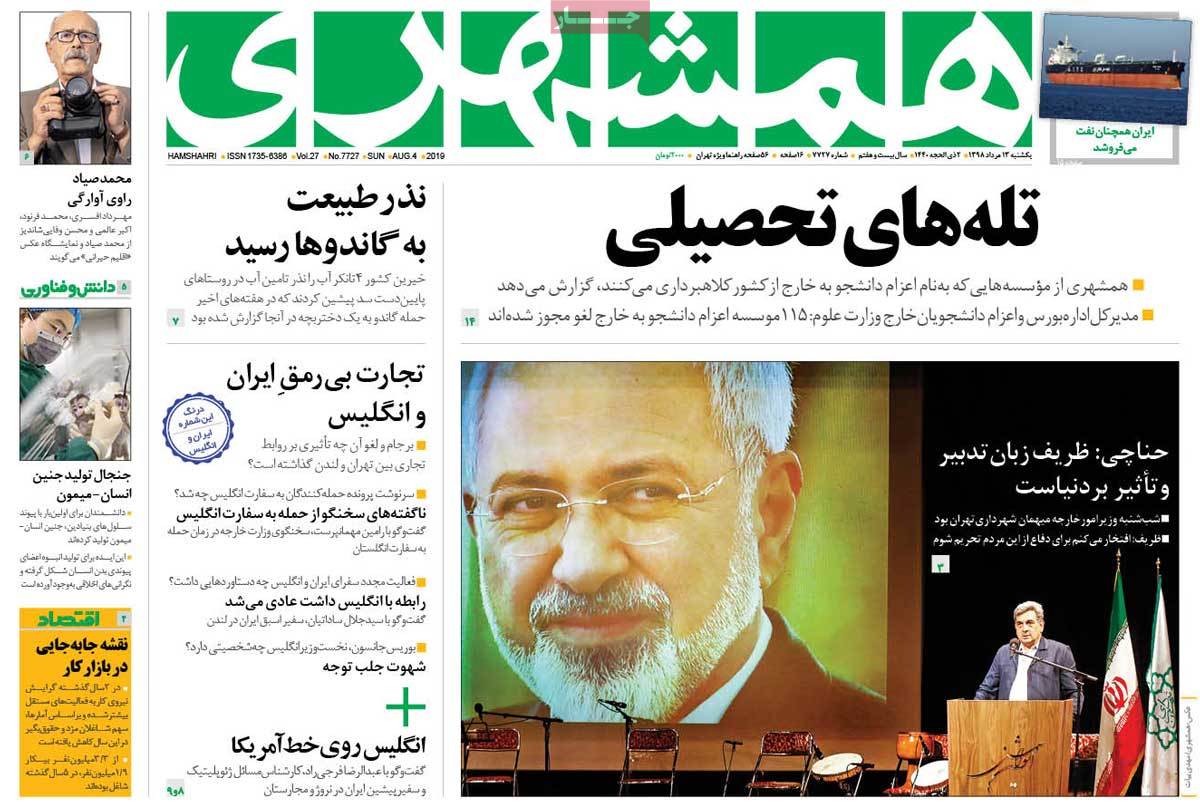
Hamshahri:
1- Tehran Mayor: Zarif Is Language of Prudence, Influence on World
2- Weak Iran-UK Business Ties

A Look at Iranian Newspaper Front Pages on August 4


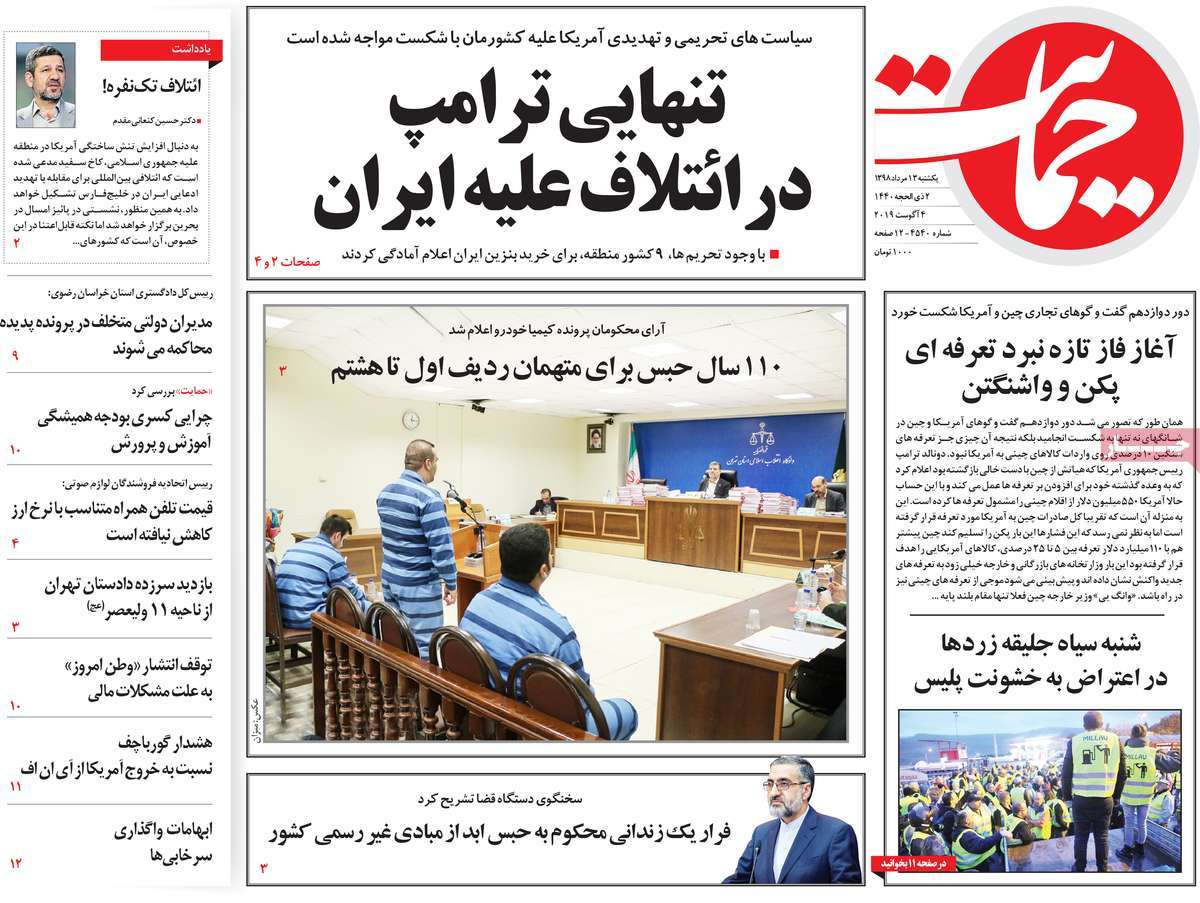
Hemayat:
1- 3rd Step of Iran’s Nuclear Decision to Make It Harder to Return to Previous State
2- Trump Seeking Missile JCPOA with China
3- Sheikhs Repenting of Sana’a War
* UAE Offers Olive Branch to Iran, Parts Ways with Saudi Arabia

A Look at Iranian Newspaper Front Pages on August 4


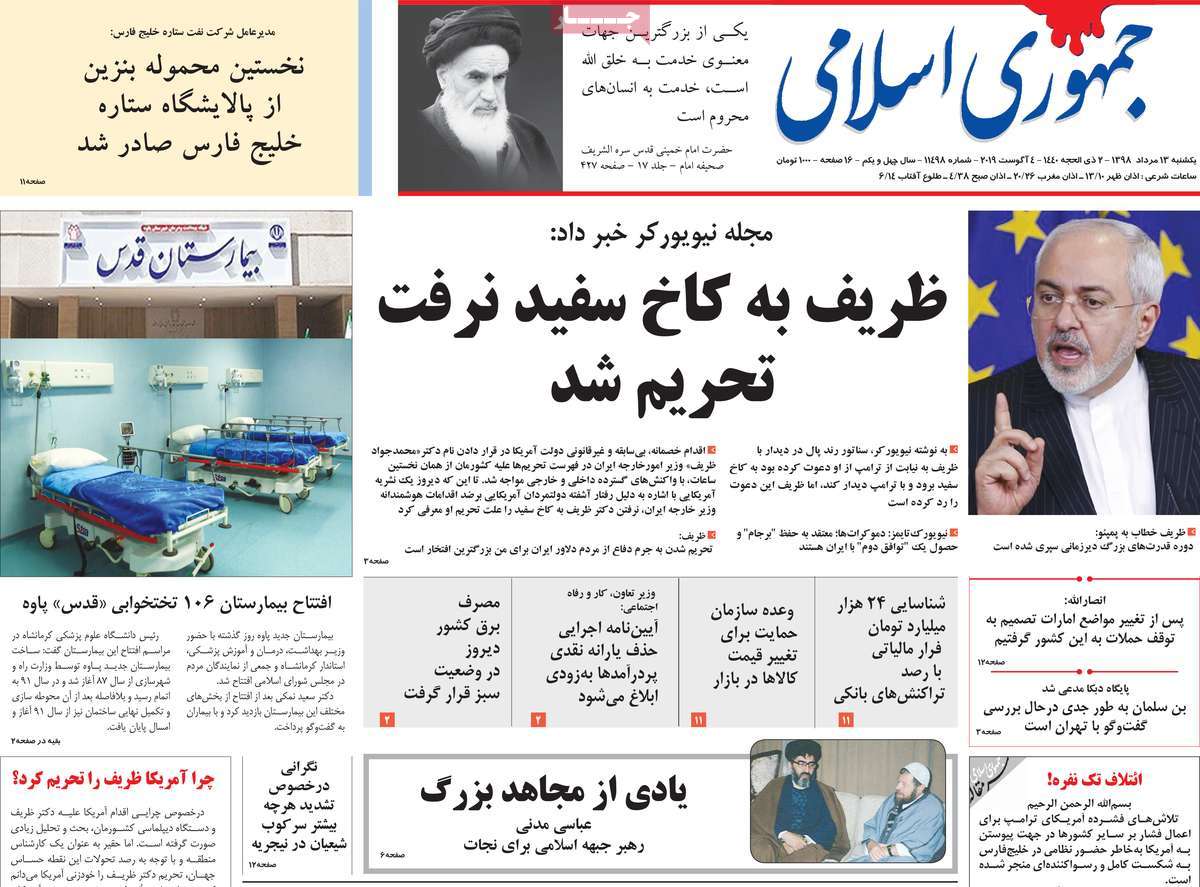
Jomhouri Eslami:
1- New Yorker: Zarif Sanctioned after He Refused to Go to White House
2- First Gasoline Cargo of Persian Gulf Star Refinery Exported

A Look at Iranian Newspaper Front Pages on August 4


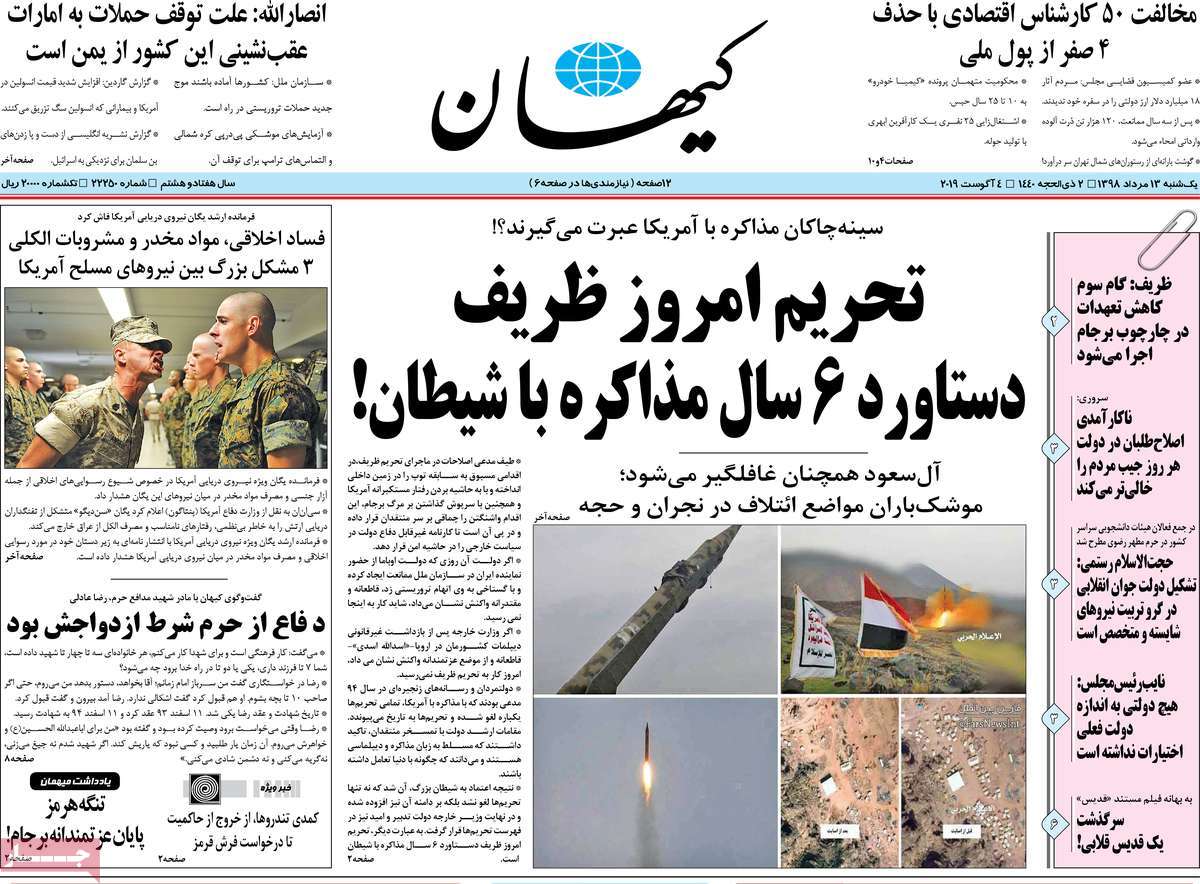
Kayhan:
1- Today’s Ban against Zarif Result of His Six-Year Talks with Satan!
2- Al Saud Still Being Surprised
* Coalition Positions in Najran, Hajjah Bombed by Yemeni Army

A Look at Iranian Newspaper Front Pages on August 4

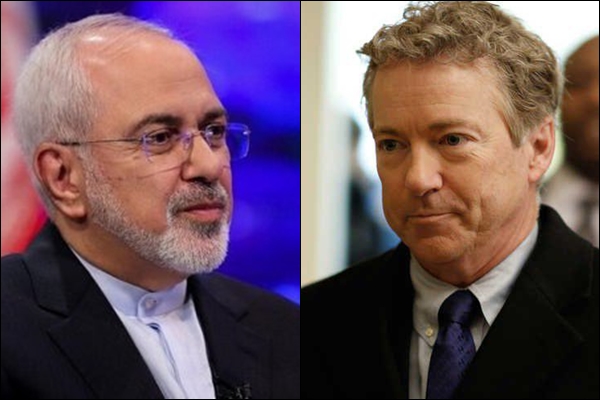
Source Reveals Details of Rand Paul’s ‘Secret’ Meeting with Zarif

According to the source, who talked to Etemad newspaper’s Sara Massoumi on condition of anonymity, Zarif tells Paul in the July 15 meeting in New York that Iran’s policy is not based on “negotiation for negotiation”, and that the US government has failed to implement its previous commitments.

Zarif tells Paul Iran won’t negotiate under pressure and coercion, and the Establishment’s decision under the current circumstances is to reject negotiations given the US’ excessive demands, the source said.

After Paul’s insistence, the source added, Zarif makes it clear that the Establishment’s declared and practical policy is not to negotiate with US.

“Zarif tells Paul he cannot make the decision to change this policy on his own, because the foreign minister only implements the policies declared and specified [at higher levels].”

Paul, in turn, tells Zarif the decision to blacklist him had been taken a few days earlier, and the meeting with Trump at White House may change that decision, the source added.

In response, Zarif once again refers to the Establishment’s decision not to negotiate under the spectre of pressures, the source said.

The US treasury last week announced sanctions on the Iranian top diplomat, which freeze Javad Zarif’s assets, if any, in the US and limit his international travels.