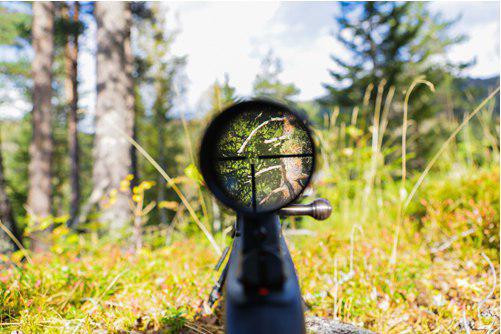
A precision optic is a tube with two main lenses. The ocular lens sits in the eyepiece and the objective lens which is the largest lens at the end of the optic. The objective lens lets light (the object image) in while the ocular lens magnifies the object to make it easier to see.
When using an optic, you’ll see a reticle, or crosshair, which helps with aiming. There’s a little more to it, but that’s the gist of how a precision optic works.
What Makes a Quality Precision Optic?
There are a few to look for in a quality precision optic.
Magnification
Where and how you hunt will help determine the magnification you’ll need. A universal optic is best for shooting around 100 yards and will have a magnification ratio of 2.5x to 10x or greater. This is a good option for hunting local game such as deer or hogs.
For those who enjoy long-distance shooting, you’ll need a higher magnification. An optic from around 12x-20x will work best. You will need a bipod or sandbags to help position your rifle when you’re above 10x magnification.
Reticle and Focal Frame
The reticle can come in various shapes and sizes in an optic. If you’re a long-range competitor, you may prefer finer crosshairs in your reticle. Tactical competitors prefer mil-dot or MOA.
The position of the reticle plays an important role. A reticle in the first focal plane will keep its same size in proportion to your target. A reticle in the second focal plane will stay the same size and shape when you magnify your target.
Do you have a preference for a particular reticle shape? You can find simple reticles that are just a dot, a circle with a dot, or the traditional crosshair.
There are also illuminated reticle options to improve sight for low-light hunting.
Turrets & Accessories
The turret adjusts the windage and elevation. Most rifle hunters opt for standard ballistic turrets that relate to firing distance in yards.
You can find turrets that allow you to make very precise adjustments. Capped turrets help prevent accidental adjustments and movement. The type of hunting or target shooting you’re planning to do will help you decide what type of turrets will work best for you.
Objective Lens
The larger the objective lens is, the more light can enter your precision optic. This makes hunting at dusk or dawn easier.
Make sure your lenses have a glass coating to protect them. The glass in your scope will have better protection with more coats. The best coating level is a fully multi-coated glass.
Top Precision Optics
Precision optics come in a range of options and costs. With today’s technology, even the simplest of models promise accuracy and reliability. You don’t need to take a second mortgage out to buy yourself a high-quality precision optic.
Check out these top-rated rifle optics on the market today.
Nikon Prostaff 5
The Nikon Prostaff 5 is a lightweight precision optic that works best for hunting and target shooting. It offers an intermediate magnification of 3.5-14×40. The turrets are spring-loaded and zero reset to adjusting the reticle system easy and convenient.
This optic features a bullet drop compensator (BDC) to make your aim and firing more accurate. A handy feature for when your prey is several hundred yards away.
Nikon’s Prostaff 5 has a better range of vision in this optic as well as a brighter optical system. All glass parts have an anti-reflective layer providing better sight and brightness from dawn to dusk.
This precision optic keeps your eye and brow safe with its long eye relief. You can confidently fire any rifle no matter how heavy the recoil may be.
Konus KonusPro El-30
As an economical precision optic, the KonusPro El-30 is a 4-16×44 mid-range magnification. While the sites and design are average, it’s the first optic to have 10 interchangeable reticles. You can use the same optic for long-range, tactical, hunting, and mid-distance shooting.
The turrets are easy to adjust and only need a slight push to lock them in. You can select the type of reticle to use. Select anything from mil-dot, duplex, and other varying reticles.
All lenses are fully multi-coated on the KonusPro to improve image quality and prevent fogging. This versatile precision optic is under $500 making it an economical option for any hunter or rifle enthusiast.
Simmons ProTarget Rimfire
The Simmons ProTarget series of precision optics continue their legacy for creating accurate optics. This ProTarget Rmifire model produces bright clear images with a 3-12×40 magnification.
When adjusting the turrets, there’s a satisfying audible click that makes adjusting easy when you’re on-the-go. It comes with 3 different turrets tuned to .17HMR, 1/4 MOA, and .22 long rifle references.
This optic is perfect for anyone with a rimfire rifle looking for a quality and affordable optic.
Athlon Midas BTR Gen2
The Athlon Midas BTR Gen2 precision optic offers a high-quality optic feel without the cost. As with most Athlon optics, the Midas BTR Gen2 optic is durable and long-lasting.
HD fully multi-coated lenses give you a brighter clearer image. Whether you’re shooting at dawn, mid-afternoon, or dusk, this optic will provide you with crisp clear image every time.
The optic’s design is versatile of hunting, long-range shooting, or tactical competition. The turrets and reticle controls are precise. The reticle illumination, zero resets, and side parallax controls ensure precision and accuracy.
Leupold VX-R 3-9×40 Patrol Precision Optic
If you’re looking for a reliable optic to fit any situation, the Leupold VX-R 3-9×40 Patrol scope rifle is the optic for you. Both police departments and military personnel make this their primary optic of-choice.
It features 9x magnification and multiple reticle settings to keep you accurate no matter the weather. You can adjust the low-profile turrets to ensure accuracy with every shot.
Since the original design of this precision optic is for use by patrols, it’s one of the most durable and reliable optics you can find pname com facebook orca.
Bushnell Engage Riflescope
Are you in need of an accurate scope that gets first-round shots on target? But don’t enjoy the minute adjustments a long-distance rifle scope requires? Then the Business Engage Riflescope is the no-nonsense optic for you.
The scope features parallax adjustment which helps hunters maintain aim and accuracy in the least ideal positions. While you shouldn’t adjust the capped turrets when you’re in the field, they do adjust by hand.
The image is always bright and clear with Bushnell’s latest lenses. The reticle sits in the second focal plane which will keep your aim the most accurate at larger magnifications.
EOTech Vudu SFP
This second focal plane precision optic is great for mid and long-distance shooting. The VUDU SFP is complete with XC High-Density glass in the lenses and an illuminated reticle for a clear image every time.
It’s 1x magnification is incredibly accurate and clear. Most scopes may slack on the accuracy of 1x magnification, but you will notice the difference in EOTech’s Vudu precision optic.
The Vudu will improve the accuracy of your hunting rifle as well as makes a decent AR optic. If you need additional parts for mounting, Seekins Precision has the quality accessories you need.
Nightforce NX8 Precision Optic
Precision is the best way to describe this high-end optic. This compact and lightweight optic packs a punch when it comes to image resolution and customizations.
The illuminated milling reticle sits in the first focal plane. The reticle includes values for whole mils and a second T-ranging scale reticle in part of the view field. You can get a precise idea of the size and distance of your target.
The internal reticle adjustments are impressive. There are 26 mils of elevation adjustment available in this optic which is unheard of in most 30mm scopes.
Improve your hunting or range shooting game with Nightforce’s high-quality precision optic.
Steiner M7Xi
As a military-grade precision optic, the Steiner M7Xi features the first-plane reticle with a second in the image plane. This along with the 7X zoom allows you to maintain accuracy shooting from both middle and long-distances.
The image in this optic is always clear and crisp with plenty of wide views to see your surroundings. This optic is lightweight and includes an illuminated reticle. It’s a tough, durable, and long-lasting optic that will never let you down.
The high-end features do come with a price. While its original design is for military use, you’ll find it makes for exceptional hunting and competition optic.
Finding the Perfect Precision Optic
Finding the right precision optic will require patience and experimenting. As long as you have an idea of what type of hunting you’ll be doing, you’re sure to find an accurate and reliable optic to fit your needs windows 7 not genuine 7600.
Check out our latest Lifestyle and Sports articles to learn about inspiring and useful tips.