Monday, April 20, 2026
Home Blog Page 2986

Iran Warns It Will Leave NPT If Its Case Taken to UNSC

Last week, the three European signatories to the 2015 nuclear deal with Iran, formally triggered the dispute mechanism within the agreement, accusing Iran of having violated the accord. Iran would now be asked to resolve the so-called dispute with the European trio, and the process could ultimately lead to the re-imposition of the Security Council’s sanctions that were lifted by the accord.

“The Europeans’ remarks lack legal justification,” Zarif said on Monday.

The European accusations concern a set of countermeasures that Iran has been applying in reaction to the United States’ withdrawal from the deal, officially known as the Joint Comprehensive Plan of Action (JCPOA), in 2018.

The measures also came in response to Washington’s re-imposition of draconian sanctions, and the EU3’s refusal to guarantee Iran’s business interests under the nuclear deal.

As part of the retaliatory steps, Iran stopped recognizing the limits set by the deal on the level of its enrichment activities and the volume of its heavy water reservoir.

On January 5, the country said it would no longer observe any operational limitations on its nuclear industry, whether concerning the capacity and level of uranium enrichment, the volume of stockpiled uranium or research and development.

The abrupt decision came two days after a set of US drone strikes assassinated senior Iranian commander and the most revered anti-terror military figure in the Middle East, Lieutenant General Qassem Soleimani in Baghdad.

Tehran has unequivocally specified that its retaliatory steps fit within the nuclear accord’s Paragraph 36, and are reversible if the other parties begin minding their contractual obligations.

Zarif explained that Iran was the party to initially trigger the dispute mechanism in 2018 by sending three letters to the European Union to notify them of Tehran’s dissatisfaction with Europe’s non-commitment to the agreement. The Islamic Republic, he added, was then forced to resort to the nuclear countermeasures as the Europeans remained in violation of the accord.

He, however, said Tehran’s measures were reversible provided Europe would begin minding its JCPOA obligations.

“But if Europeans keep up their actions based on political games, we have various options because their actions lack legal standing,” he said.

Zarif noted however that before taking the final step of withdrawing from the NPT, Iran has other steps to ponder.
 

‘Ball in Europe’s court’

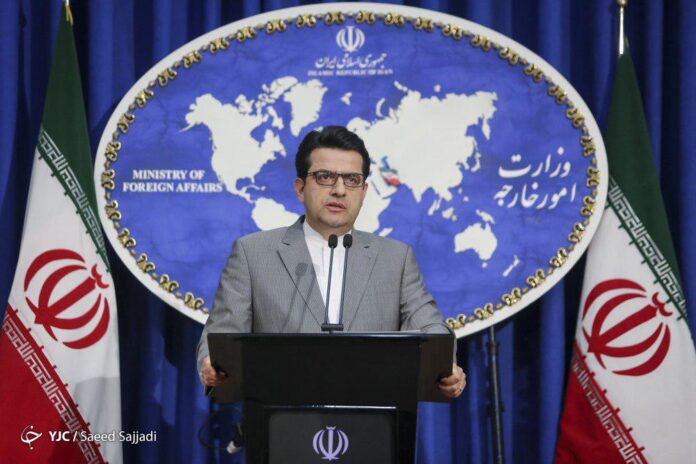
Also speaking on Monday, Foreign Ministry Spokesman Abbas Mousavi cautioned that Iran could take a “final and more effective” step concerning the nuclear deal if the other partners remained in default of their contractual obligations.

“If this trend continues, Iran will take this effective step,” Ministry Spokesman Abbas Mousavi told his weekly press briefing.

The countermeasures that have been taken by the Islamic Republic so far have been meant “to strike a balance” between the quality of Iran’s commitment to the JCPOA and the way others honor the accord, the spokesman noted.

Mousavi said Zarif has reminded European officials, especially the European Union’s foreign policy chief Josep Borrel, of Europe’s role in preserving the JCPOA.

He regretted that Europe’s “lack of determination and independence [from the US]” have so far frustrated the initiatives, which have been offered to save the deal.

“If there is one party, who needs to be decisive, it is them, who should take a decision to either be independent or listen to a bully like the US,” the spokesperson noted.

Mousavi also addressed remarks by British Prime Minister Boris Johnson, who had said he would be willing to work on a “Trump deal” to replace the JCPOA.

“Johnson’s remarks, which thrilled US President Donald Trump, are beneath our notice,” the spokesman noted.

Mousavi said, though, that despite the “betrayal” perpetrated by the European states, “the door to negotiation with them has not been closed yet,” adding, “The ball is in their court.”

Iran’s Anti-US Resistance ‘Attractive Image’ for World Nations: Leader

Iran’s Anti-US Resistance ‘Attractive Image’ for World Nations Leader

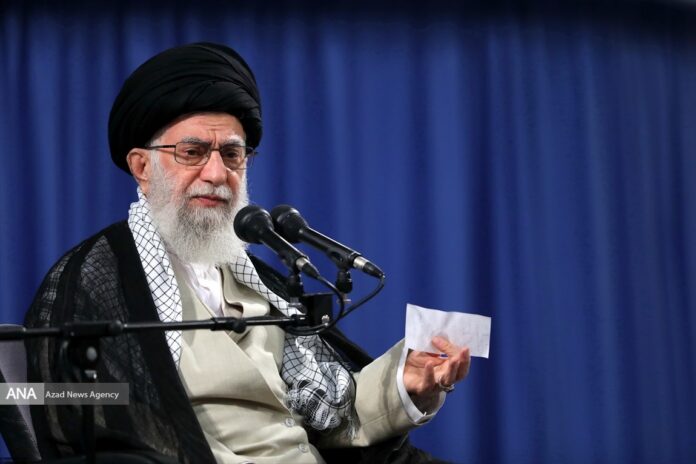
“The Americans are mad at the Iranian nation because it is an attractive image [for the world] that an independent government is standing up to a bully,” the Leader told a gathering of Hajj and pilgrimage officials on Monday.

He urged that the attractive image must be used for propagation and promotion of true Islam and a true image of the Iranian nation.

The Leader further pointed to the Americans’ claim that “Iran must turn into a normal state”, and said what they actually want is that the Islamic Republic stops combining people’s votes with Islamic thoughts and religious principles in governing the society.

“The religious democracy model is unknown to the world, and Hajj pilgrimage can be used to elaborate on this model,” he added.

Referring to millions of propaganda tools operating against the Islamic Republic, the Leader urged Hajj officials to use the pilgrimage to elaborate on such issues as the reason for the US hostility and the logic behind the Iranian nation’s refusal to accept bullying.

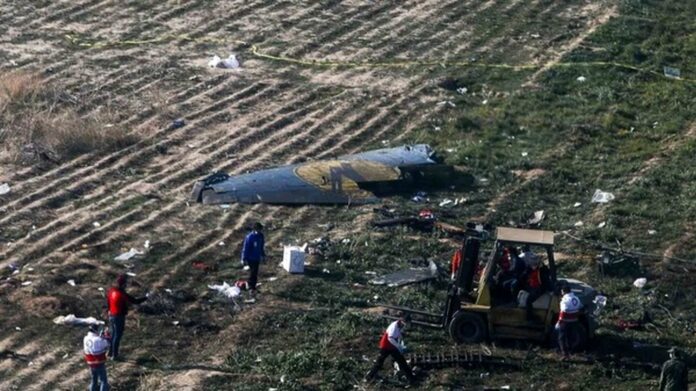
Ukraine Plane Crash: Cyber Attack Ruled Out, Human Error Confirmed

Iran Denies Receiving Canada’s Lawsuit over Ukrainian Plane Tragedy
Photo by Borna Qassemi, ISNA

The remarks were made by Chairman of the National Security Commission of the Iranian Parliament, Mojtaba Zonnour, who cited the General Staff of the Iranian Armed Forces’ examinations and accounts.

“The defence system had not been given orders to target and shoot, and even if we assume that the defence system and the operator involved were disconnected from the headquarters, the person should have not … fired at will,” Zonnour said.

Even “the disconnection between the operator and the system, and the headquarters has not been proved yet,” he added. “So, the incident is accounted for by human error, and it was the operator who committed the error.”

The possibility of the disruption of Iran air defence system by a possible cyberattack came up after the Islamic Revolution Guards Corps shot down a Ukrainian airliner in Tehran on 8 January.

The IRGC accepted responsibility for the downing of the flight after three days, but some officials had raised the possibility that it might have been a case of cyberattack carried out by the US, though he had considered it a slim possibility.

179 Killed in Passenger Plane Crash Near Tehran

Iran Says Will Target Any Country Used for Anti-Tehran Plot

Iran Vows Appropriate Response to US Interception of Mahan Air Flight

Mousavi made the remarks in a press conference on Monday, when asked about Iraq’s complaint against Iran’s “violation” of its sovereignty after the IRGC’s retaliatory missile attacks on a US base in Iraq.

The Iranian spokesman said Tehran had notified Baghdad of the attacks in advance, and they must answer why they have made such a complaint.

“As we had earlier stated, we will target any place used for conspiracy against Iran,” Mousavi said, stressing that the US’ Ain al-Assad base in Iraq had been used to attack top Iranian commander, General Qassem Soleimani, near Baghdad Airport.

“Iran has always wanted non-interference of foreign forces in the Iraqi territory, and once Iraq officially asked for Iran’s help, we provide assistance after notifying them,” he reminded.

He also praised the missile attacks carried out by the Islamic Revolution Guards Corps (IRGC) against the US’ Ain al-Assad base, and said it was a decisive reaction to the US’ “cowardly” attack on the Iranian commander.

Still, he said, the Iranian mission to the United Nations has been tasked with legally pursuing the US’ assassination of General Soleimani.

Iranian University Launches PhD Program on Satellite Studies

Iranian University Launches PhD Program on Satellite Studies

“The IUST already has postgraduate students in that major, helping considerable improvement in the capability of Iranian elites and scientists in the area of designing and building satellites,” Zakeri said.

“The university has acquired considerable achievements including the design of the satellites Zafar 1 and 2,” he added.

Two-Iranian-Satellites-Ready-for-Launch
Two Iranian Satellites Ready for Launch 

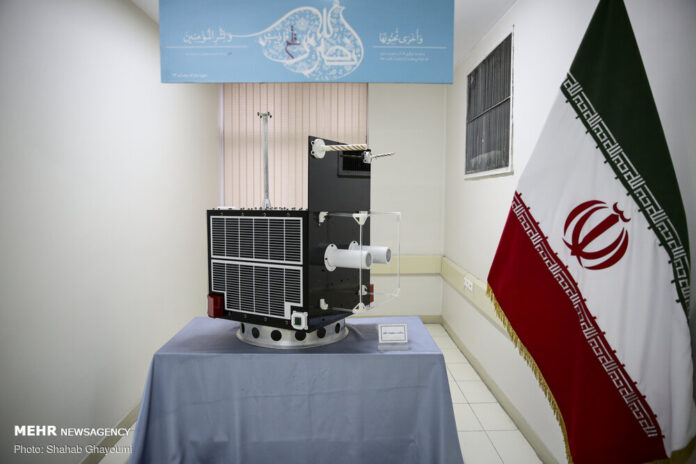
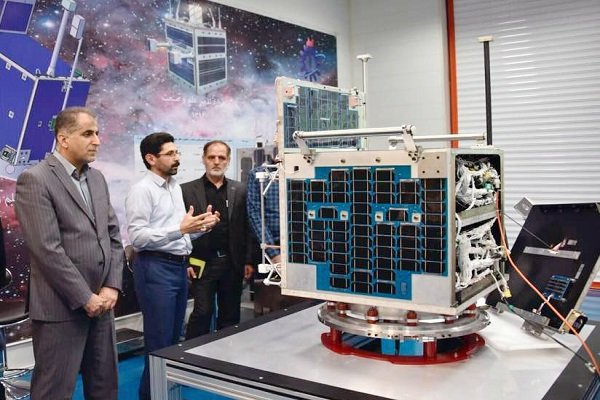
The Iranian Space Agency was presented by IUST with Zafar 1 and 2 satellites yesterday morning during a ceremony at IUST.

Officials say the two satellites monitor natural resources and environment.

“We try to get Zafar1 placed into orbit, but if complications arise, Zafar2 is ready for launch. Zafar2 has color cameras with the precision of 16 meters, and is 25 times more advanced than the satellite Navid [which came out on 3 February 2012],” said Chairman of Iran Information Technology Organization Morteza Barai.

Venezuelan FM in Tehran for Talks

Venezuelan FM in Tehran for Talks

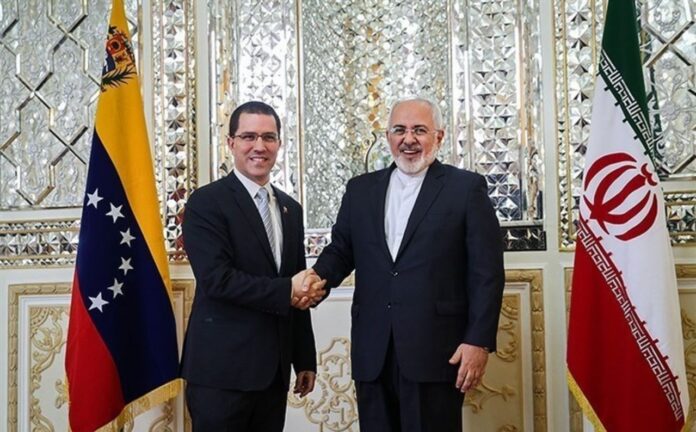
According to Foreign Ministry Spokesman Seyyed Abbas Mousavi, the Venzuelan top diplomat will hold talks with Foreign Minister Mohammad Javad Zarif and other high-ranking Iranian officials on issues of mutual interest.

Two Iranian Satellites Ready for Launch

In a post on his Twitter account on Sunday, Azari Jahromi said the Zafar-1 and Zafar-2 satellites have successfully passed the technical tests through the efforts of the young Iranian scientists.

The two homegrown satellites are going to be carried to a space center and will be soon launched into orbit, he added.


The minister described the development of the Iranian satellite and satellite-carrier as a “significant step” in the space research sphere.

In another post on his Instagram account, Azari Jahromi said the two versions of Zafar satellite enjoy more advanced technologies than the previous Iranian satellites.

According to the minister, the Zafar satellite is used for telecommunication, taking images, and picking up space signals.

In a Sunday ceremony attended by officials from the Ministry of Information and Communications Technology, Ministry of Defense and Ministry of Science, the Iran University of Science and Technology (IUST) officially delivered the Zafar satellite.

Zafar is a monitoring satellite, which will be sent into a geostationary orbit that is a circular orbit around 36,000 kilometers (22,320 miles) above the Earth’s equator.

The satellite will reportedly have a lifespan of one year and six months, and will capture images and transmit them to stations on earth.

A Look at Iranian Newspaper Front Pages on January 19

Iran Newspaper Headlines in April 11

Iran Newspapers

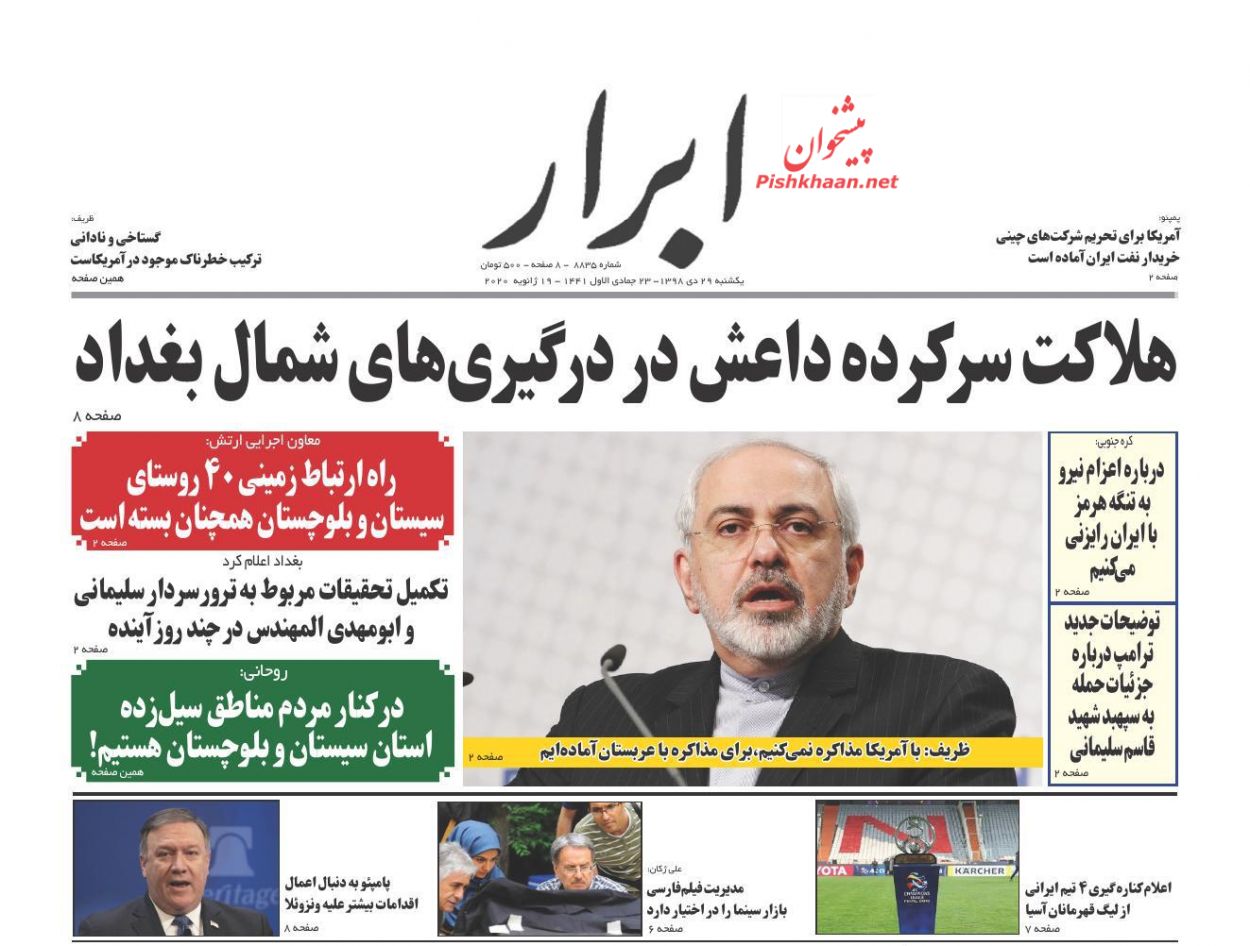
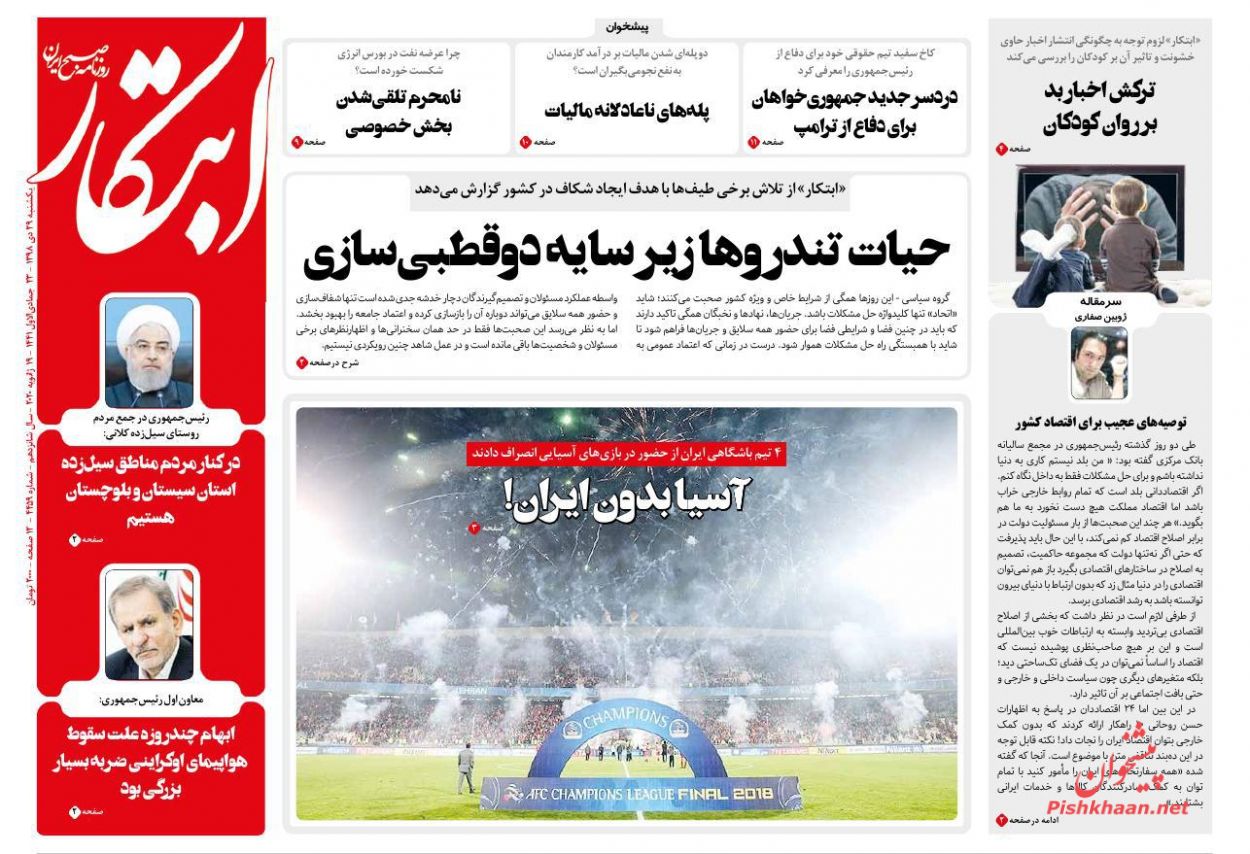
Abrar:
1- ISIS Commander Killed in Conflicts North of Baghdad
2- Zarif: Combination of Impudence, Ignorance in US Very Dangerous
3- We’ll Consult with Iran on Deployment of Forces in Hormuz Strait
4- Zarif: We Won’t Negotiate with US; We’re Ready for Talks with Saudi
5- Trump’s New Details of Attack on Lt. Gen. Soleimani

A Look at Iranian Newspaper Front Pages on January 19


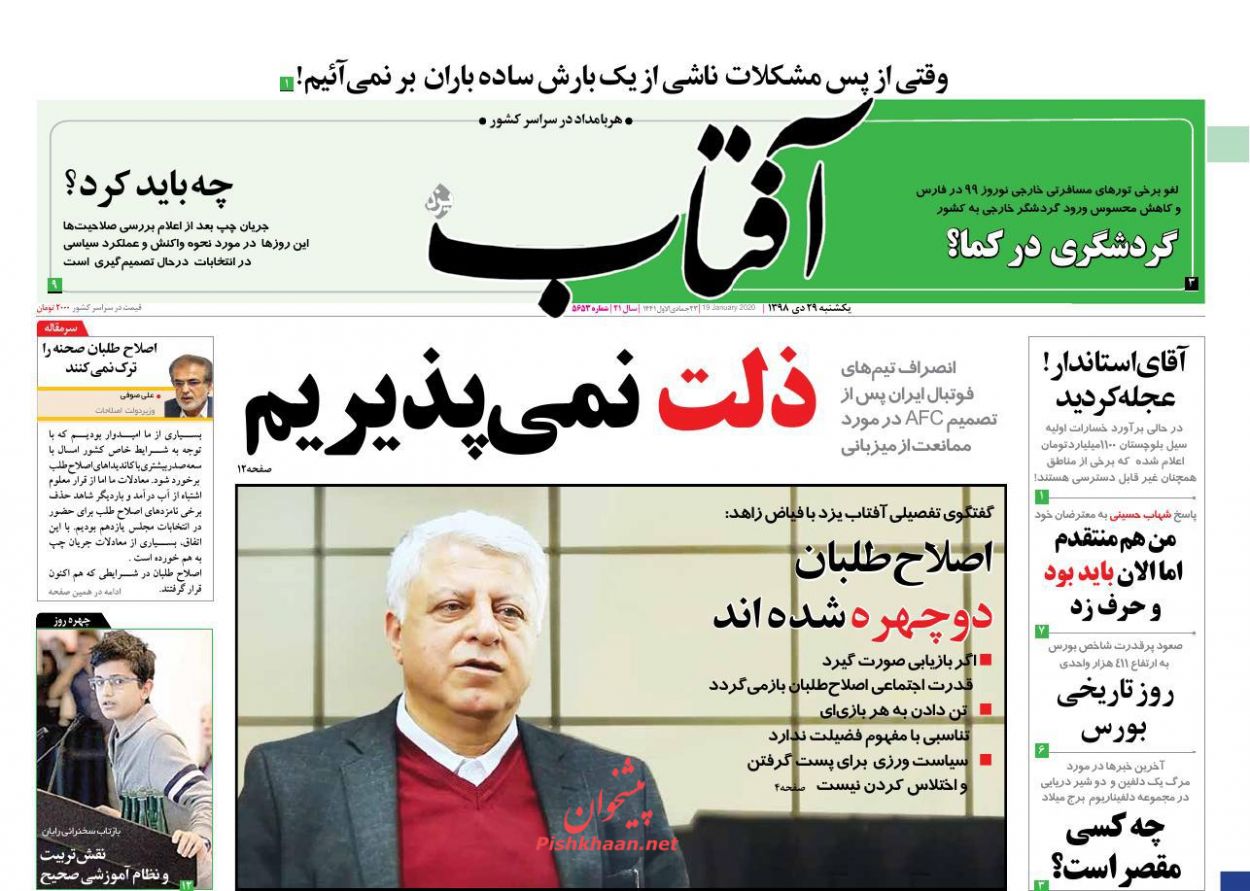
Aftab-e Yazd:
1- We Won’t Accept Humiliation: Iranian Teams Withdraw from AFC Champions League

A Look at Iranian Newspaper Front Pages on January 19


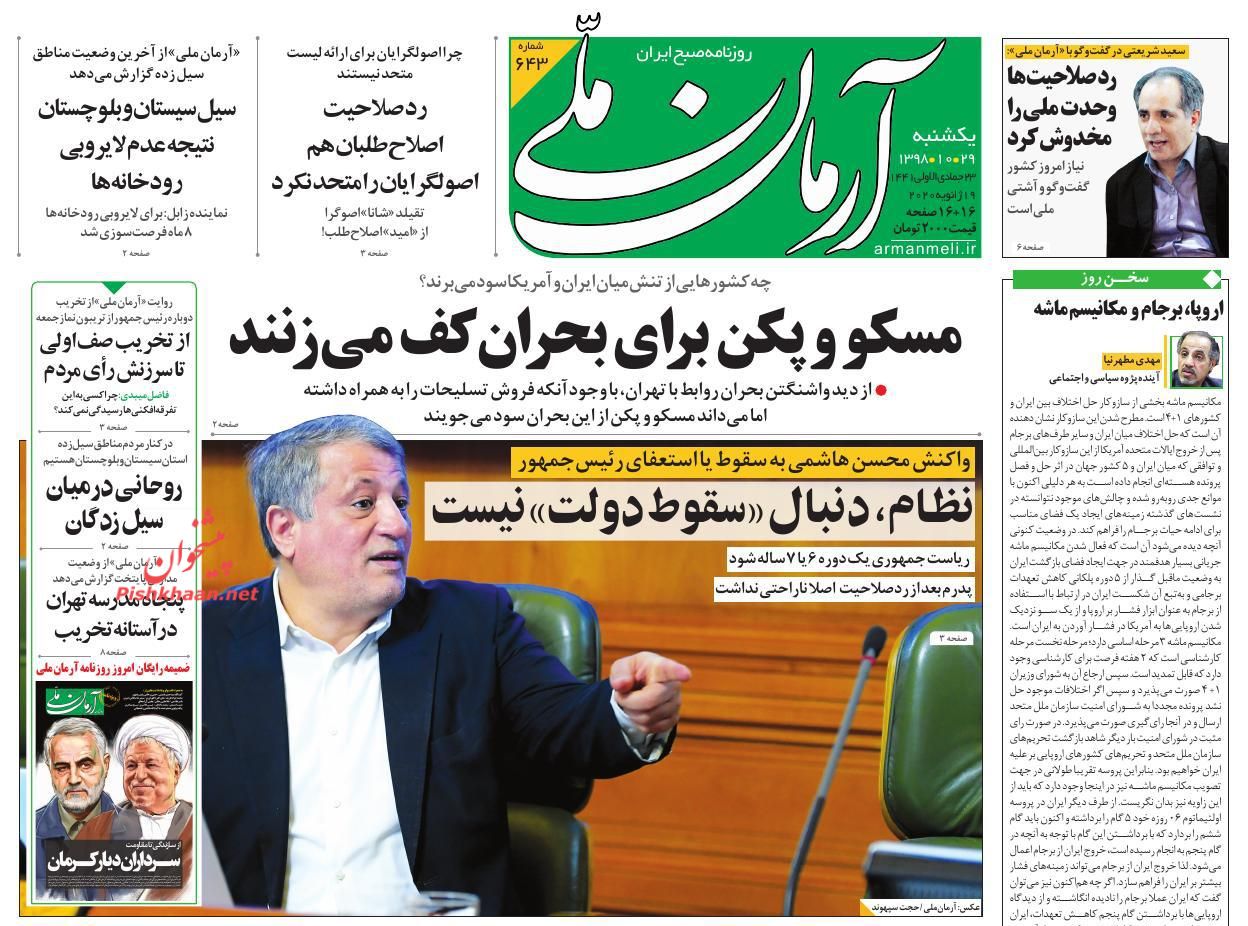
Arman-e Melli:
1- Moscow, Beijing Clapping for Crisis: Which Countries Benefit from Iran-US Tension?

A Look at Iranian Newspaper Front Pages on January 19


Ebtekar:
1- New Trouble for GOP in Defending Trump
2- Iran President: We’re Standing by Flood-Hit People of Sistan and Baluchestan
3- First Vice-President: Three-Day Ambiguity over Plane Crash a Great Blow

A Look at Iranian Newspaper Front Pages on January 19


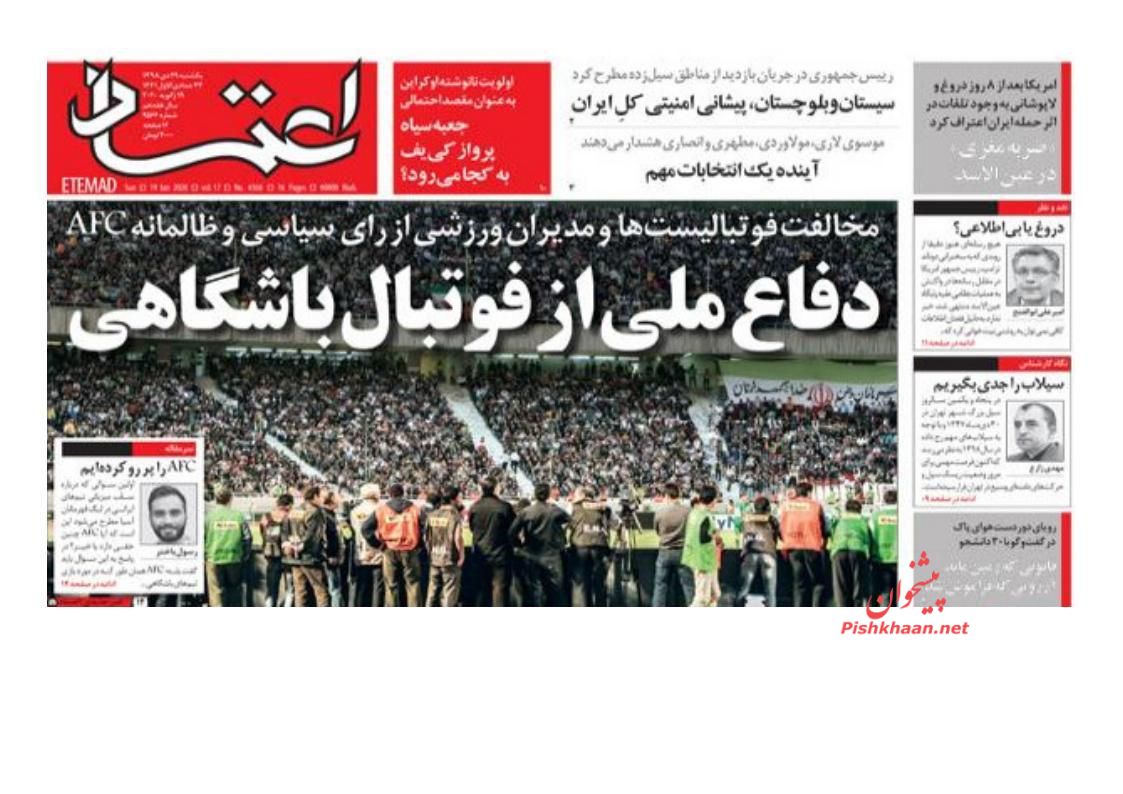
Etemad:
1- National Defence of Football Clubs
* Football Players, Managers Opposed to AFC’s Cruel, Politicized Decision
2- Sistan and Baluchestan Security Forehead of Entire Iran: Rouhani

A Look at Iranian Newspaper Front Pages on January 19


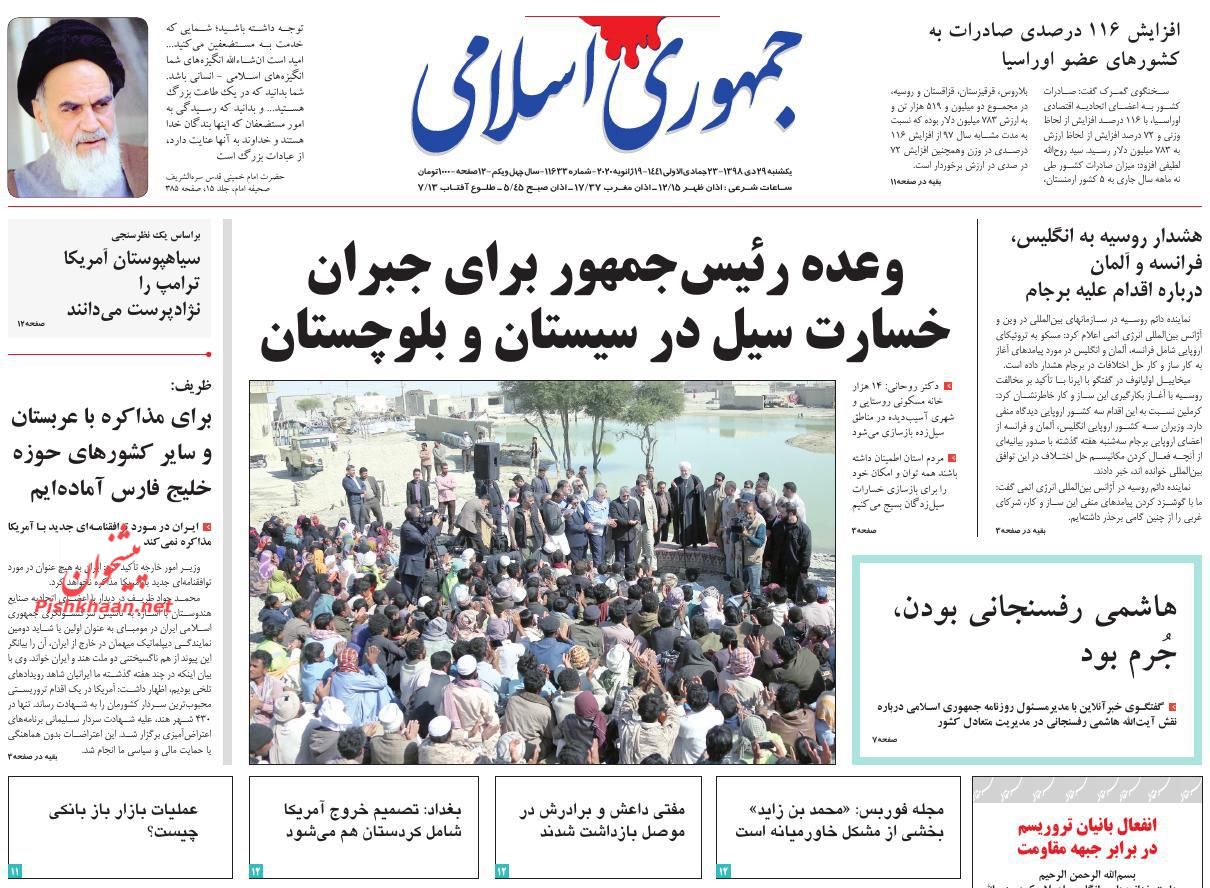
Jomhouri Eslami:
1- Russia Warns France, Germany, UK about Move against JCPOA
2- Zarif: We’re Ready for Negotiation with Saudi, Other PG States

A Look at Iranian Newspaper Front Pages on January 19


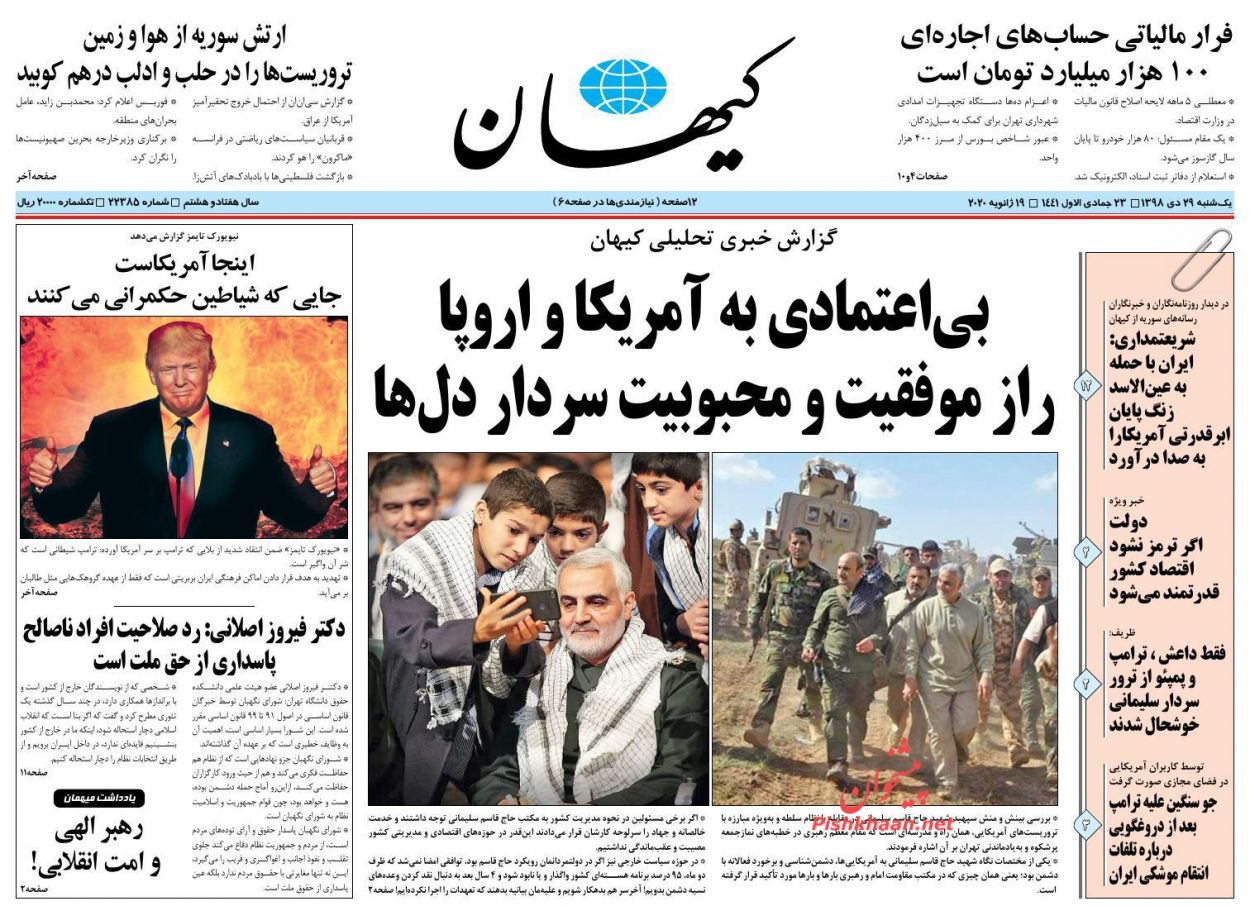
Kayhan:
1- Distrust of US, Europe Secret behind Gen. Soleimani’s Popularity, Success
2- Syrian Army Pounds Terrorists in Aleppo, Idlib in Aerial, Ground Attacks
3- Zarif: Only ISIS, Trump, Pompeo Celebrated Soleimani’s Assassination

A Look at Iranian Newspaper Front Pages on January 19


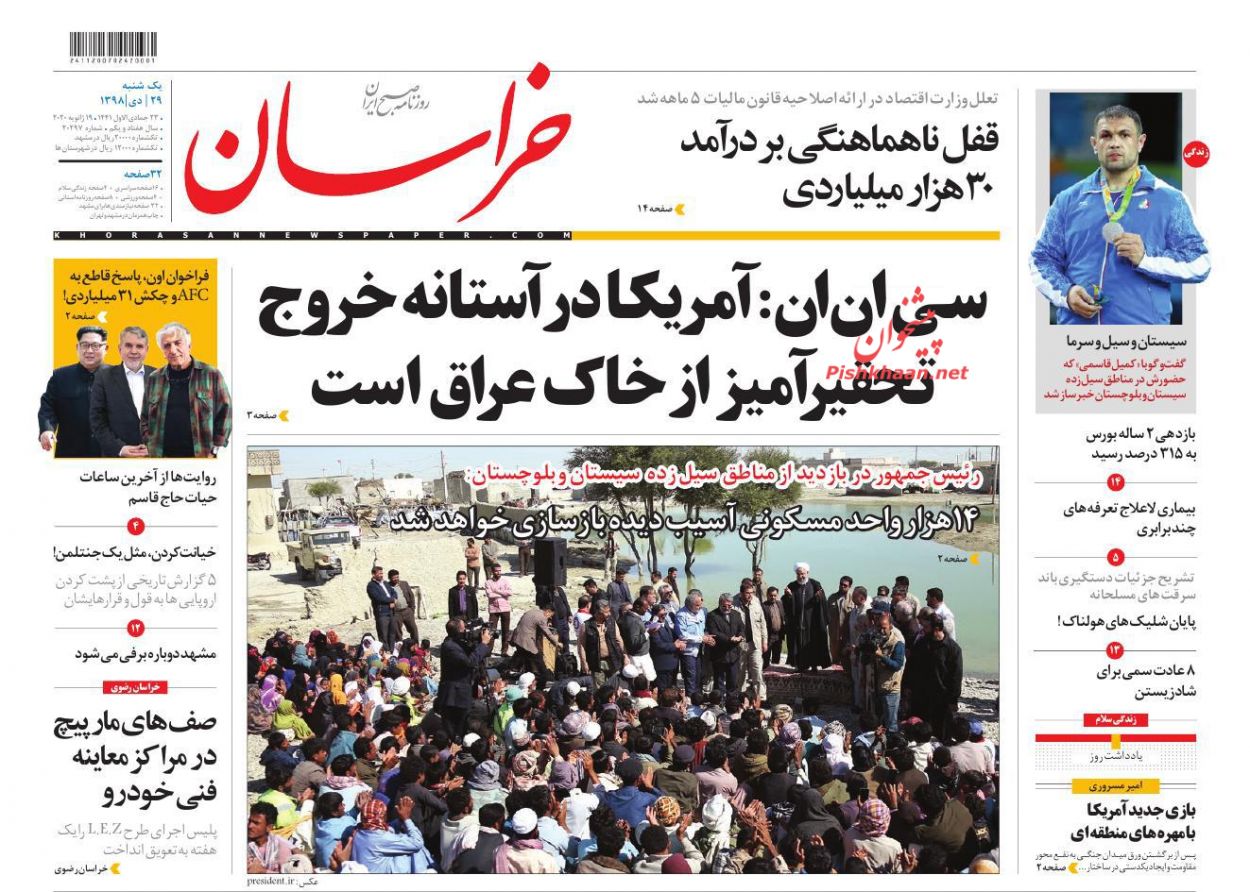
Khorasan:
1- CNN: US on Verge of Humiliating Withdrawal from Iraq

A Look at Iranian Newspaper Front Pages on January 19


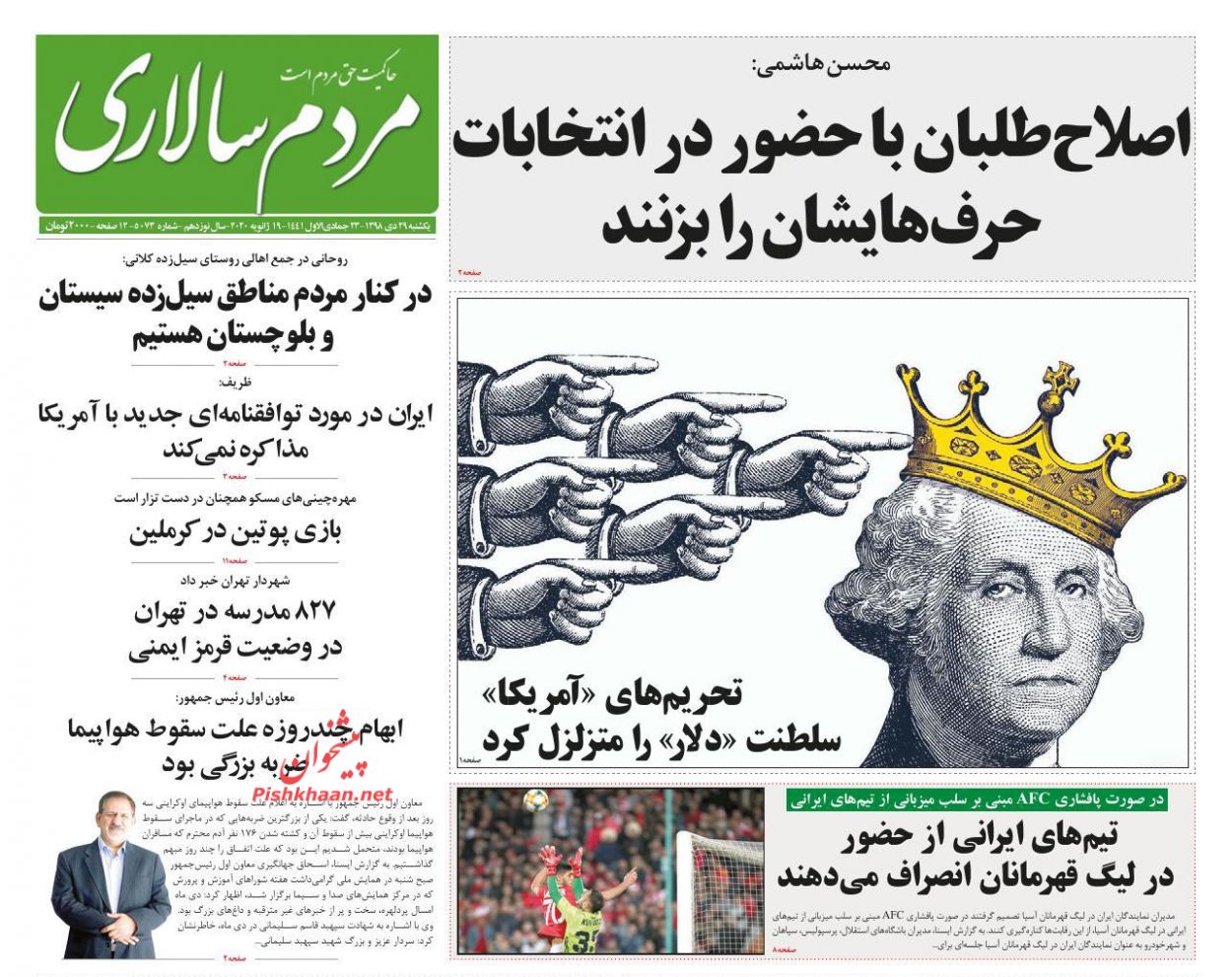
Mardom Salari:
1- US Sanctions Shake Domination of US Dollar
2- Putin’s Game in Kremlin: Tsar Still Choosing Players in Moscow
3- Iran Not to Negotiate New Deal with US

A Look at Iranian Newspaper Front Pages on January 19

Diplomat Says Gen. Soleimani’s Assassination Will Have Strategic Consequences

Diplomat Says Gen. Soleimani’s Assassination Will Have Strategic Consequences

In an address to a meeting on the political and strategic consequences of the US assassination of Lt. General Soleimani, Iranian Deputy Foreign Minister for Political Affairs Seyyed Abbas Araqchi said the history of the region has been separated into two sections after martyrdom of the commander, particularly following Iran’s strong retaliatory attack on the US bases in Iraq that “created a change in the strategic equations in the region and in the arrangement of power between Iran and the US.”

He said the assassination of the Iranian commander has had impacts on the front of resistance, the fight against Takfiri terrorism and ISIS, and on the equation of power in the struggle between Iran and the US.

“I believe that regarding the resistance, losing General Soleimani has had positive consequences, contrary to the American evaluations. We lost a great commander who had profound influence on the resistance, but when we consider the process of resistance in its entirety, (we see that) the axis of resistance has not lost any geography (territories), as the weapons and cause of resistance are still in place. The resistance groups are still existing,” Araqchi underlined.

The martyrdom of Lt. General Soleimani will undoubtedly boost the power of the axis of resistance, he noted, dismissing the notion that the Iranian commander’s loss has marked a victory for the ISIS terrorists.

“The fight against Daesh (ISIS) and the terrorist groups will definitely go on in our region, and the war on Daesh is a strategic battle that Iran and the other countries in the region of the resistance groups must and will continue,” Araqchi noted, stressing that the tactical disruptions, if any, will be immediately addressed.

Highlighting the “strategic and geopolitical” capacities developed by the new resistance groups across the region after the rise of ISIS, the Iranian diplomat said the mistakes made by the US and the West resulted in an increase in Iran’s power and the adoption of prudent policies by the Islamic Republic.

He further noted that the assassination of Lt.

General Soleimani created another milestone in the regional security equations, adding, “When the martyrdom of General Soleimani was retaliated by firing missiles at the American bases (in Iraq) and the US was incapable of showing a new response, it marked the greatest strategic development in the Persian Gulf and West Asia.”

Washington was mistaken to believe it could undermine Iran’s military might or weaken the axis of resistance by assassinating General Soleimani, Araqchi added, saying the US received a strong response following two major incidents: the massive turnout of people in the funeral of the popular commander and the retaliatory missile attack on Ain al-Assad airbase.

“Iran responded to it (assassination of Soleimani) with two moves, one was the presence of tens of millions of people in the funeral of the commander during which they expressed their faith and vented their anger at the US. A national resolve was shaped, and this national resolve dealt a strategic blow to the US. And (the other move was) firing 15 powerful and heavy missiles on the US’ largest base in Iraq, which was not a small issue and was deemed to be a strategic blow. The number of (American) casualties is not important at all… What matters is that they (Americans) came to the conclusion that they should not respond,” he explained.

Iran’s missile attack on the US airbase in Iraq created a “strategic balance” and a “strategic deterrence” in the struggle between Iran and the US, Araqchi added, saying Iran’s missile strike smashed the image of US military power and gave them a hard slap in the face.

“Over the past 40 years after the (victory of the Islamic) Revolution, the US has made many such strategic mistakes, and every mistake has led to a strategic victory for Iran. This most recent mistake resulted in the biggest strategic victory for Iran,” Araqchi underlined, saying the assassination of Lt.

General Soleimani has resulted in many strategic achievements, one of which has been stronger national unity in Iran.

Iran Guarantees Security of Visiting Football Teams: Minister

Iran Guarantees Security of Visiting Football Teams: Minister

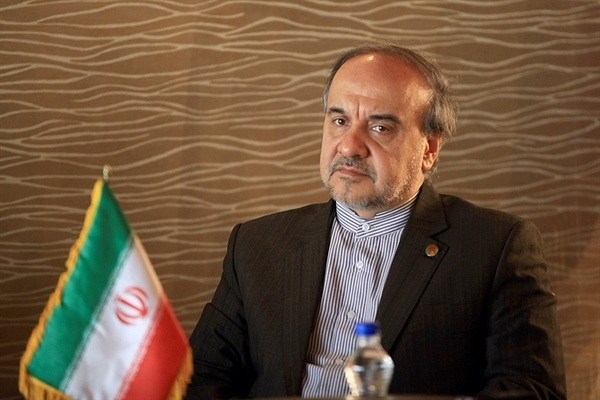
“Iran is a safe and sovereign country, and as was stated in the letter sent to you, we have no problem providing the security of air travels. Furthermore, I guarantee the security of the visiting teams,” said Soltanifar in a phone talk with the Chairman of AFC Salman bin Ibrahim al-Khalifa.

“It seems that the AFC executive committee is under the influence of media that have problems with Iran and we see in utter surprise such a behaviour towards one of the most popular teams in Asia,” he added.

The Chairman of the Asian Football has promised to reconsider the decision of the executive committee.

The dispute between Iran and AFC comes after a Ukrainian passenger plane was unintentionally downed by Iran’s Islamic Revolution Guards Corps, hours after the IRGC hit a US base in Iraq which it believed was the place where US agents planned the assassination of Iranian General Qassem Soleimani.

IRGC admitted to downing of the airliner after three days, and Iran let in expert delegations from Ukraine and Canada for further investigations.