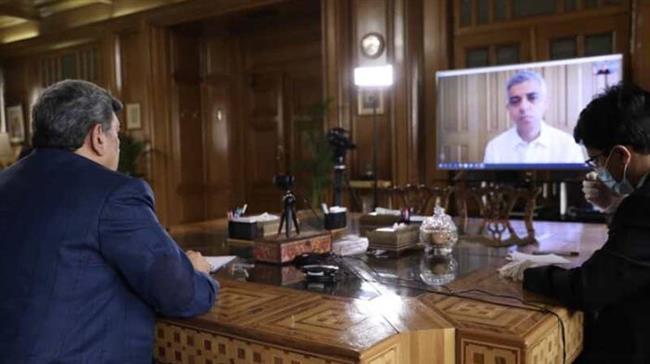
Speaking at a Saturday meeting of the National Headquarters to Fight the Coronavirus, President Rouhani said the country seeks to follow up on its existing physical distancing plan with a new “smart distancing” initiative to curb the outbreak of COVID-19.
He noted that the first and second phases of the physical distancing plan had attained “good achievements”.
“Currently, we are in the third phase which consists of smart distancing; its specifications have to be laid out,” President Rouhani said.
The president called on the chairpersons of committees of the Coronavirus Fight National Headquarters to assess the situation carefully and make decisions about the details of the new plan.
Varied and extensive protocols for the fight against the coronavirus should be defined carefully in all fields, proportional to various businesses, for the reopening period after making sure that following the previous stages, the conditions have been stabilized, he emphasized.
The president underlined that the new health protocols for smart social distancing should be devised in such a way that all people in various sectors may rest assured that their health would be protected with a high degree of confidence by observing the protocols if they get out of the house or work.
On Tuesday, Rouhani extended social distancing measures until April 8 to help stop the spread of the novel coronavirus across the country.
Kazem Gharibabadi said following consultations between the two sides, the International Atomic Energy Agency decided to send two RT-PCRs to Iran.
“In addition to these two devices, personal protective equipment for users of the device, equipment for setting up and upgrading and calibration, and special detection kits that use three techniques will also be sent,” he noted.
The RT-PCR is used in research laboratories to study gene expression. It can be used clinically to diagnose genetic diseases and monitor drug therapy.
He added the White House is also pressing ahead with its rumour-mongering against Iran.
“While the world focuses on cooperation to defeat #COVID19 — and calls on US to lift its #economicterrorism— [US Secretary of State] @SecPompeo disregards this and instead spreads disinformation: this time against Iranian diplomats,” he added.
His remarks came in reaction to a tweet by Pompeo, in which he accused Iranian diplomats of being involved in an assassination in Turkey.
The US’ psychological war against the Islamic Republic comes as the country is fighting against the novel coronavirus under the cruel sanctions imposed by the United States.
On Friday, Iran’s Ambassador and Permanent Representative to the UN office in Geneva Esmaeil Baqaei Hamaneh wrote a letter to Director General of the World Health Organization (WHO) Tedros Adhanom Ghebreyesus to warn that medical sanctions by the United States government against the Islamic Republic amount to an “unprecedented threat” to global public health.
Imposition of the cruel and illegal sanctions on Iran, which has resulted in the ordinary Iranian people being denied access to medicine and medical equipment and services, clearly exemplifies a crime against humanity, he said in the letter.
In a letter to Leader of the Islamic Revolution Ayatollah Seyyed Ali Khamenei, 182 elected MPs expressed their readiness to work towards realization of the “Jump in Production” motto, a rubric chosen by the Leader as the name of the Persian New Year 1399 starting March 20, 2020.
Signatories to the letter have given assurances that they will tap into all expert potential at the 11th parliament to remove hurdles to national economy and try their utmost to utilize all legislative and supervisory potential available to them to eliminate impediments to domestic production and channel cash flow into the production sector.
The MPs also undertook to rectify the structure of the national budget while passing the budget bill without being swayed by political considerations.
“Today, thanks to the macro-policies adopted by Your Excellency, the threat of economic sanctions has turned into a historic opportunity for carrying our structural reforms in Iran’s economy,” they said.
The MPs reiterated that they will also tap into the potentialities of other branches of government to further strengthen the country’s economy:
“We may still see new waves of the coronavirus outbreak in Tehran,” said Alireza Zali.
He also highlighted the national screening program which is also being implemented in the capital.
He said the screening plan will help identify cases with slight symptoms without them having to go to hospitals for diagnosis.
He said medical personnel have been offering invaluable services, adding, “The more time passes since the outbreak of the disease, the more experience health staff will gain.”
So far nearly 70 million Iranians have been screened for the novel Coronavirus as part of the national mobilization plan.
“Despite Nowruz holidays, the Customs Office of the Imam Khomeini International Airport cleared hygienic items and medications sent in to fight the coronavirus in the shortest time possible and with the minimum paperwork by the customs personnel working 24/7,”
Saeid Saffari Taheri, the customs chief at the airport.
The goods include machinery used to produce three-layer face masks.
“Producers of the machinery say it is capable of turning out 100,000 to 200,000 three-layer masks per day,” he said.
“Since the beginning of the time the national campaign against the coronavirus was enforced, a considerable number of medications, hygienic items and equipment used to counter the coronavirus have been sent in via the Imam Khomeini Airport’s customs,” he added.
“The supplies have been taken to the intended centres nonstop in cooperation with relevant organizations, and the trend continues,” he said.
Wrestling icons Rasoul Khadem, Hassan Rahimi and Komeil Qassemi, along with Parviz Parastoui, a distinguished star of stage and screen, are taking aid packages to low-income families.
Rasoul Khadem is a former Iranian wrestler who won a Bronze medal in the 1992 Summer Olympics and a gold medal in the 1996 Summer Olympics. He was also the 1994 and 1995 world champion and the 1991, 1992, 1993, 1994, 1995 and 1996 Asian champion. He was the president of the Islamic Republic of Iran’s Wrestling Federation from January 4, 2014 to November 3, 2018. He was also the technical director of Iran’s wrestling national teams and head coach of Iran’s freestyle wrestling national team from January 2012 to 2018.
Hassan Rahimi is another Iranian wrestler who has won several medals and was crowned the champion in 2013.
Komeil Qassemi is another former Iranian wrestler who won a gold medal in the men’s freestyle 120 kg event at the 2012 Summer Olympics.
Parviz Parastoui is also a popular and famous actor who has appeared in numerous movies and TV series.
President Hassan Rouhani issued the directives in phone conversations with seven Cabinet ministers as well as the governor of the Central Bank.
In phone calls with Minister of Health and Medical Education Saeid Namaki and Minister of the Interior Abdolreza Rahmani Fazli, the president instructed them to immediately study the trend of enforcement of the national social-distancing plan, and how effective and successful the plan has been. The president said the reports could be discussed at meetings of the National Coronavirus Task Force as a basis for future decisions on how to manage and press ahead with the campaign against COVID-19.
President Rouhani also held phone conversations with Education Minister Mohsen Haji-Mirzaei and Minister of Science, Research and Technology Mansour Gholami. During the phone calls, the president issued instructions on conducting precise studies in order to draw up health protocols after the reopening of schools, universities, scientific and educational centres and dormitories as well as how those protocols should be enforced.
President Rouhani also got on the phone with Jamshid Ansari, the vice president and head of the State Administrative and Employment Organization. The president issued orders to draw up and enforce health protocols at state organizations and institutions.
In his phone call with Petroleum Minister Bijan Namdar Zangeneh, the president issued orders with regards to the supply of energy, effective activities in petrochemical production and in the global oil climate, along with other pertinent issues.
President Rouhani also talked on the phone with Vice President Mohammad-Baqer Nobakht, who is also the head of the country’s Budget and Planning Organization. The president ordered that some Rls. 750 billion in finances be earmarked for different occupations and groups which meet the requirements as specified by the government’s Economic Task Force.
In a phone conversation with Abdunaser Hemati, the governor of the Central Bank, President Rouhani was briefed on the bank’s programs for allocating Rls. 750 trillion in finances to businesses affected by the coronavirus outbreak. The president also emphasized the necessity of offering prompt support to production and service units which have suffered losses because of the COVID-19 outbreak. He also appreciated the services offered by the Central Bank and the banking system, especially branches of different banks, in these tough days.
In the phone call, Central Bank Governor Abdolnasser Hemmati briefed the president on the programs of the Central Bank for providing foreign currency and managing forex markets.
Government Spokesman Ali Rabiei made the details public in a memo the highlights of which follow.
“The Government’s Economic Task Force met at 9 am on Thursday. Two issues were discussed at the meeting. One of them was the economic fallout from the coronavirus [outbreak.] According to reports by the ILO (International Labour Organization), the average global growth will drop … and global economy will suffer $2 trillion in losses in 2020.
The coronavirus has dealt a heavy blow to the world’s dynamic and major economies. Since the outset of the outbreak, some 25 million people have been added to the unemployed across the globe. Some reports also hint at growing poverty in low-income countries. In addition to the repercussions of the coronavirus epidemic, we in Iran have been gripped by severe sanctions over the recent two years. Our economy has shrunk due to sanctions. Although we witnessed a good economic growth rate, both with and without oil, in the first quarter of 2020, our economy will definitely suffer a negative growth due to the effects of the coronavirus.
I was talking to the deputy labour minister for employment. According to him, 51% of our employed people (i.e., more than 12 million people) is related to the service sector. The agriculture sector will not suffer in the short run. In major industries, the effects will be mostly medium-term and long-term. However, the service sector will suffer the most.
… Only 1.5 million people are employed by the city and road transport sector. Also, there are around one million business units operating at the service sector. Restaurants, hotels, and even the culture, art and media sector have suffered in the short run. If not enough attention is paid and a support plan required to sustain employment is not drawn up, there is a possibility that a considerable number of workforce (up to 400,000 people) in the service sector will be made redundant.
Today, coronavirus-stricken economies in the United States and Europe and Southeast Asia have struck terror into the hearts of strong economies. Incontrovertibly, more severe effects will be experienced in Asia and the subcontinent as well as in South America and feeble economies. …
With a slump in oil prices, one of the concerns of economic authorities of the government is the effect of this drop in prices on government revenues (in addition to the fallout from the coronavirus), not to mention the US seeking to target Iran’s exports.
Therefore, the president and Cabinet economic authorities’ concern that Iran’s economy should not run aground and suffer long-term stagnation is a key and pressing issue.
Given that sanctions will bring middle-income deciles of the population down to low income ones and will decrease the purchasing power of people, especially workers and retirees, particularly the labourers paid on a daily and unofficial basis, a coronavirus-stricken economy can further deepen poverty.
A major part of the meeting of Cabinet member and its Economic Task Force these days is dedicated to drawing up plans to keep economy on its feet in the face of both sanctions and the coronavirus outbreak.
Another issue discussed was the provision of essential commodities in the Persian Year 1399 (beginning March 20, 2020). Among the issues discussed in today’s meeting was the need to keep the prices of basic goods stable in order to prevent a decrease in people’s purchasing power. … Medicines, medical equipment, agricultural produce and rubber were among the goods highlighted in the meeting.
Another issue brought up in the meeting was the clearance of goods
which have arrived at our ports. Fortunately, four million tonnes of commodities needed by the country are available at ports and customs checkpoints. …
It was decided that the essential supplies which have arrived at ports be sent into the country after negotiations with importers. It was also decided that order-registered goods which have not received the required foreign currency, and goods which contribute to production and help boost domestic production, except for consumer goods such as clothing, canned fruit, etc., be cleared in the shortest time possible … .
… A key and alarming issue for all of us is to maintain employment. Workers should not be laid off. … One of the points that the president emphasized was that workers should keep working at factories. Some Rls. 5 trillion was earmarked for individuals who had to be made redundant and who were not covered by unemployment benefits.
… Another important point is that we should not allow any industrial, service and trade unit to reopen without a health protocol ….
Given the resources available in the country, measures that should be really adopted, the situation of sanctions, implementation of social-distancing plans, stopping the spread of poverty, and the necessity of keeping economy on its feed, policies should be made accordingly….”
A person with symptoms of suspected coronavirus infection is being examined by hospital personnel at National Medical Center on February 20, 2020 in Seoul, South Korea. ( Jong-Hyun Kim - Anadolu Agency )
Deputy Health Minister Ali Akbar Haqdoust says South Korea made good use of the isolation policy to find every infected person, and quickly tested those around them, and isolated them. In this way it managed to contain the outbreak.
“Now, as you can see, the virus is spreading on a low level in South Korea, which means it is contained and just the virus exists in the country. As soon as it puts aside the isolation policy, the second wave will start,” he said in a live TV program.
However, he said, as the country is smaller in area, with good planning and using its experience, and enjoying its much better infrastructure, it contained the virus.
“All of this has helped South Korea to be a successful country,” he added.
Elsewhere in his remarks, he talked about the situation in Italy saying that due to its limitations, many ordinary or light people do not take the test in Italy. Due to the low number of testing kits and the fact that its policy is not to do comprehensive testing for everyone, the number of identified cases increased but more slowly than the United States.
“Why is it like this in Italy? The virus is new and we don’t know much about it. Italy is one of the oldest countries in Europe and even in the world. So, it can be more dangerous for its elderly population. The morbidity of Europeans and North Americans is often more, and they are older, so naturally they suffer more. [On the other hand], the weakness of their health care system must have affected them,” he added.
Haqdoust further hailed the Islamic Republic’s healthcare system underlining that the health system of Iran is one of the truly acceptable ones.
“This health system has been operating in the country for about four decades. In such a situation, it can really help us if we use it properly,” he concluded.