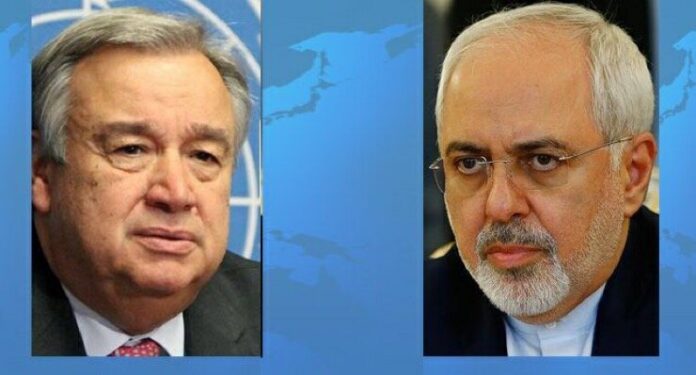
In his letter, the Iranian top diplomat has also highlighted the US‘ unlawful withdrawal from the 2015 nuclear deal, and its repeated and continued violations of the UN Charter.
What follows is the full text of Zarif’s letter to Guterres:
His Excellency
Mr. Antonio Guterres
Secretary-General United Nations
Excellency,
Further to my letter of 10 May 2018 (A/72/869-S/2018/453), I would like to bring to your attention several matters related to the unlawful withdrawal of the United States of America from the Joint Comprehensive Plan of Action (JCPOA) and the unlawful imposition of its unilateral sanctions against the people and government of the Islamic Republic of Iran in clear violation of its obligations under international law. Most notably, I would like to bring to the attention of the Security Council –through you in your capacity as the Secretary-General– matters related to the multiple, continuous and grave cases of violation of the United Nations Charter, in particular Article 25 thereof, thereby jeopardizing the credibility and the integrity of the United Nations and threatening the maintenance of international peace and security.
- US Unilateral and Unlawful Withdrawal from the JCPOA
As you are well aware, on 8 May 2018, the President of the United States officially announced the unilateral withdrawal of the United States from the Joint Comprehensive Plan of Action (JCPOA), in material breach of Security Council Resolution 2231 (2015) to which the JCPOA is annexed. Accordingly, the United States administration terminated the participation of the United States in the JCPOA and re-imposed all United States sanctions lifted in connection with the JCPOA, thus committing multiple cases of “significant non-performance” under the JCPOA, and in flagrant contravention of UNSCR 2231 (2015).
The unlawful US act of unwarranted withdrawal from the JCPOA and the re-imposition of its sanctions entail the US responsibility under the UN Charter and international law. The US has violated UNSCR 2231 (2015) which was in fact submitted by the United States itself and was adopted unanimously by the Security Council on 20 July 2015. The United Nations needs to address swiftly the US responsibility and hold it accountable for the consequences of its wrongful act that flies in the face of the United Nations Charter and international law. Impunity of the United States in this case and other instances would greatly impair the credibility of the United Nations.
It is now clear to everyone, that the unlawful conducts of the United States constitute a complete disregard for international law and the Charter of the United Nations, undermine the principle of peaceful settlement of disputes, endanger multilateralism and its institutions, indicate a regress to the failed and disastrous era of unilateralism, and encourage intransigence and illegality; representing a clear threat to international peace and security.
2. US’ Malpractices to Undermine the Provisions of UNSCR 2231 (2015)
Resolution 2231 (2015) emphasizes that “the JCPOA is conducive to promoting and facilitating the development of normal economic and trade contacts and cooperation with Iran” and urges “its full implementation on the timetable established in the JCPOA” and calls upon all Member States “to take such actions as may be appropriate to support the implementation of the JCPOA, including by taking actions commensurate with the implementation plan set out in the JCPOA and this resolution and by refraining from actions that undermine implementation of commitments under the JCPOA”.
Not only has the United States failed to honor its own commitments under the JCPOA, but also it has substantively obstructed the discharge of commitments by the remaining JCPOA participants and other Member States. Since assumption of office by Trump, the US once again resorted to the practice of Unilateral Coercive Measures and has imposed 129 sanctions against Iran inflicting irreparable harm to Iran’s economy and its international business relations. These actions bear a direct effect on Iran’s private sector, cut the revenues of ordinary Iranians and reduced the private sector’s capacity for production and employment. Today, the situation is far worse as compared to the JCPOA status quo ante. The full list of these sanctions is enclosed with this letter for further clarification.
The US withdrawal from the JCPOA and the subsequent re-imposition of a drastic, comprehensive and unilateral sanctions regime on Iran must raise the alarm for International Peace and Security. It is the first time in the UN history that a permanent member of the Security Council punishes UN members for complying with a Security Council Resolution.
It is time for Security Council and its members to ensure and guarantee the full implementation of the JCPOA by all sides. Rather than allowing the US to repeat such abusive pattern, the Council should strongly condemn the US for (re)imposing its illegal sanctions against Iranians in violation of the UN Charter, UNSCR 2231 (2015) and international law. The United States should be held responsible for these damages, and the Iranian nation must be compensated adequately. The international community must ensure the implementation of and compliance with the JCPOA.
3. Iran’s Efforts in Good Faith to Preserve the JCPOA
Following the unlawful withdrawal of the United States and the (re)imposition of its sanctions that had been lifted in accordance with the JCPOA, while reserving its immediate right under paragraph 26[1], my Government initiated the Dispute Resolution Mechanism under paragraph 36 of the JCPOA on 10 May 2018. Acting in good faith, we refrained from applying the ‘remedy’ and did not immediately resort to “cease performing its commitments under the JCPOA”, in order to enable the remaining JCPOA participants to make good on their promises.
As you asserted in your statement following the US withdrawal from the JCPOA “It is essential that all concerns regarding the implementation of the Plan be addressed through the mechanisms established in the JCPOA”[2] and upon the request of JCPOA participants, and the international community, while Iran was entitled to exercise its rights immediately after US unlawful withdrawal on May 8th 2018, my Government decided to pursue its right within the framework of the JCPOA Joint Commission and continued the full implementation of the JCPOA. I trust you are aware of 15 consecutive IAEA reports all verifying Iran’s full compliance with its JCPOA commitments.[3]
As the official Statement of the Islamic Republic of Iran (S/2015/550) following the adoption of UNSCR 2231 (2015) on July 2015 clearly states, “Removal of nuclear-related sanctions and restrictive measures by the European Union and the United States would mean that transactions and activities referred to under the JCPOA could be carried out with Iran and its entities anywhere in the world without fear of retribution from extraterritorial harassment, and all persons would be able to freely choose to engage in commercial and financial transactions with Iran. It is clearly spelled out in the JCPOA that both the European Union and the United States will refrain from reintroducing or re-imposing the sanctions and restrictive measures lifted under the JCPOA”.[4] Regrettably since May 2018, as the result of the US sanctions, Iran has been deprived of the benefits of sanction-lifting under JCPOA. From the beginning it was clear that “reintroduction or re-imposition, including through extension, of the sanctions and restrictive measures will constitute significant non-performance which would relieve Iran from its commitments in part or in whole”[5] which is also stipulated in paragraph 26 of the JCPOA.
Iran exercised restrained in good faith and exhausted all recourses under paragraph 36 for one full year after the US withdrawal. However, in the post 8 May destructive atmosphere, the E3/EU failed to honor their commitments and Iran was left with no choice but to decide to exercise its rights under paragraphs 26 and 36 of the JCPOA to cease performing its commitments in part on 8 May 2019. As a matter of fact, Iran did officially, and in a clear fashion, trigger and exhaust the mechanism under paragraph 36.
In order to manifest our good faith and serious desire to protect the JCPOA, I wish to underline once again that the Islamic Republic of Iran remains prepared to continue dialogue at all levels to ensure the full implementation of the JCPOA by all participants and will continue its full and effective cooperation with the IAEA.
It is of substantive importance to note that Iran’s nuclear program is continuously scrutinized by IAEA’s “most robust” monitoring and verification, thereby making perceived non-proliferation risks materially irrelevant. Even the very recent report by the Director General of the IAEA on 3 March 2020, states that “The Agency continues to verify the non-diversion of declared nuclear material at the nuclear facilities and locations outside facilities where nuclear material is customarily used (LOFs) declared by Iran under its Safeguards Agreement”.[6]
I would like to reaffirm that if our people’s rights and benefits are not fully compensated, it is Iran’s unquestionable right – recognized under the JCPOA and UNSCR 2231 (2015) — to take appropriate action in response to persistent unlawful acts by the US.
4. US ill-defined Interpretations of UNSCR 2231
UN Member States are obliged to comply with Security Council decisions adopted under Article 25. To hold otherwise, would be to deprive this principal organ of its essential functions and powers under the Charter. For this reason, the Security Council referred in the fourteenth preambular Paragraph of UNSCR 2231 (2015) to Article 25 of the Charter and underscored that “Member States are obligated under Article 25 of the Charter of the United Nations to accept and carry out the Security Council’s decisions”.
Drafting, adoption, interpretation and fulfillment of the Security Council Resolutions have a particular framework and should be subjected to the principles and rules of international law. No State could place itself above the law (legibus solaus) by blocking all paths of implementation of UNSCR 2231 (2015) and by violating it through unacceptable illegal acts and arbitrary interpretations. The interpretation of Security Council resolutions also requires that other factors be taken into consideration. UNSCR 2231 (2015) is the product of a voting process as provided for in Article 27 of the Charter, and the final text of that resolution, inter alia Annex A (JCPOA), represents the view of the Security Council in its totality.
Moreover, UNSCR 2231 (2015) is binding on all Member States, irrespective of their active or passive association with its formulation and adoption, or whether they have undermined or gravely violated its provisions by taking unilateral steps. It is ironic that the State that was involved in drafting and negotiating the resolution has now turned into its main antagonist by gravely violating it.
Statements by the representatives of the Security Council Members on the occasion of adopting resolutions set the substantive context for their interpretation. The US’ representative in the Security Council meeting of 20 July 2015 stated that “our work is far from finished. The international community must apply the same rigour to ensuring compliance with the Joint Comprehensive Plan of Action as we did to drafting and negotiating it. Implementation is everything”.[7] France’s representative also specified that “It is now up to the Security Council to endorse the Vienna agreement and act as guarantor of its implementation”.[8] The essence of such guarantee is not to enhance the powers of the Security Council, but to uphold the dignity and integrity of the Council and to preserve the objectives enshrined in UNSCR 2231 (2015) and its annex A, i.e. JCPOA.
It is worth noting that, UNSCR 2231 (2015) must be read within the context of the provisions set out in JCPOA too (Annex A to resolution 2231); in a sense, the resolution is tied to the JCPOA as if by an umbilical cord. In the resolution the Council: “Endorse[d] the JCPOA, and urge[d] its full implementation on the timetable established in the JCPOA.” Those provisions in the JCPOA sought to provide a “comprehensive” plan of action, and concluded a final solution to the entirely manufactured crisis over Iran’s peaceful nuclear program.
Further, it bears recalling that the second operative paragraph of UNSCR 2231 (2015) in which Security Council “Calls upon all Members States, regional organizations and international organizations to take such actions as may be appropriate to support the implementation of the JCPOA, including by taking actions commensurate with the implementation plan set out in the JCPOA and this resolution and by refraining from actions that undermine implementation of commitments under the JCPOA” obviously obliges the States to refrain from applying the sanctions lifted under the JCPOA.
Having outlined the principal characteristics of Security Council Resolution 2231 above, two distinct features of that resolution relevant to discerning its object and purpose must be observed:
Firstly, UNSCR 2231 (2015) marks a “fundamental shift” in Security Council’s consideration of this issue and will contribute to building confidence in the exclusively peaceful nature of Iran’s nuclear program. Secondly, the solution embodied in UNSCR 2231 (2015) is conducive to promoting and facilitating the development of normal economic and trade contacts and cooperation with Iran, and having regard to States’ rights and obligations relating to international trade. Thirdly, with respect to the twelfth preambular paragraph of resolution 2231 (2015), the termination of provisions of previous resolutions and other measures are foreseen in this resolution, and Member States are invited to give due regard to these changes.
Statements by US officials indicating an intention to take action against UNSCR 2231 (2015) are of grave concern and may lead the situation to uncontrollable circumstances. It is an acknowledged and well-documented fact that the ongoing efforts by the United States to bring about substantial changes to the UNSCR 2231 (2015) is not the first of its kind; their failed scheme in November 2019 to update the 2231 List was the last overt example. UNSCR 2231 (2015) was adopted to terminate the sanctions not to extend the ones that had been imposed by previous resolutions; in this sense, it is not a sanctions resolution. Any initiation against this background will have serious consequences for the durability and sustainability of the agreed conditions.
Not only is the United States in grave violation of UNSCR 2231 (2015), but it is blatantly attempting illegal paths to reverse the resolution in absolute contempt for well-established principles of international law. In fact, one of the fundamental principles governing the international relations thus established is that a State which does not fulfill its own obligations cannot be recognized as retaining the rights which it claims to derive from the relationship. In this case, solely by withdrawing from the JCPOA, the US has lost any right therein.
Therefore, I call upon the international community, and in particular the Security Council and the Secretary-General to take all appropriate measures in order to counter these malicious endeavors by the US government which greatly undermine the provisions of UNSCR 2231 (2015). The United Nations should uphold its responsibility against the recent provocative actions of the United States.
As specified in the letter of the President of the Islamic Republic of Iran to his 4+1 counterparts on 8 May 2019, any new sanction or restriction by the Security Council is against the fundamental commitments made to Iran. In such a scenario, Iran’s options, as already notified to the remaining participants of the JCPOA would be firm and the United States and any entity which may assist the United States—or acquiesce in its illegal behavior—would bear the responsibility.
As I stated almost 14 years ago in the UN Security Council, “the people and the Government of the Islamic Republic of Iran are not seeking confrontation and have always shown their readiness to engage in serious and result oriented negotiations based on mutual respect and on an equal footing. They have also shown, time and again, their resilience in the face of pressure, threat, injustice and imposition”.[9] My nation has already shown its good faith and full responsibility. Now this is the turn for the international community to reciprocate the Iranian people. Accordingly, I urge the United Nations to hold the United States accountable for its unilateral and irresponsible conduct which will detrimentally challenge the credibility of UN Security Council and undermine the integrity of UN Charter.
I should be grateful if you would have this letter circulated as a document of the General Assembly and of the Security Council.
Please accept, Excellency, the assurances of my highest consideration.
[1] Paragraph 26 of the JCPOA: “Iran has stated that it will treat such a re-introduction or re-imposition of the sanctions specified in Annex II, or such an imposition of new nuclear-related sanctions, as grounds to cease performing its commitments under this JCPOA in whole or in part.”
[2] “Statement by the Secretary-General on the Joint Comprehensive Plan of Action (JCPOA)”, 08 May 2018, Available at: https://www.un.org/sg/en/content/sg/statement/2018-05-08/statement-secretary-general-joint-comprehensive-plan-action-jcpoa
[3] IAEA Reports to the Security Council: S/2016/57 (19 January 2016), S/2016/250 (15 March 2016), S/2016/535 (13 June 2016), S/2016/808 (22 September 2016), S/2016/983 (21 November 2016), S/2017/234 (20 March 2017), S/2017/502 (14 June 2017), S/2017/777 (13 September 2017), S/2017/994 (28 November 2017), S/2018/205 (8 March 2018), S/2018/540 (6 June 2018), S/2018/835 (12 September 2018), S/2018/1048 (26 November 2018), S/2019/212 (6 March 2019), S/2019/496 (14 June 2019)
[4] S/2015/550, Letter dated 20 July 2015 from the Permanent Representative of the Islamic Republic of Iran to the United Nations addressed to the President of the Security Council.
[5] S/2015/550, Letter dated 20 July 2015 from the Permanent Representative of the Islamic Republic of Iran to the United Nations addressed to the President of the Security Council.
[6] IAEA, Report by the Director General, “Verification and monitoring in the Islamic Republic of Iran in light of United Nations Security Council resolution 2231 (2015)”, March 2020. Available at: https://www.iaea.org/sites/default/files/20/03/gov2020-5.pdf
[7] Remarks of Ms. Power (United States of America), Security Council, 71st year: 7488 meeting, Monday, 20 July 2015, New York. Available at: https://undocs.org/S/PV.7488
[8] Remarks of Mr. Delattre (France), Security Council, 71st year: 7488 meeting, Monday, 20 July 2015, New York. Available at: https://undocs.org/S/PV.7488
[9] Security Council, 61st year: 5500th meeting, Monday, 31 July 2006, New York. Available at: https://digitallibrary.un.org/record/580129?ln=en